Upgrade to Pro — share decks privately, control downloads, hide ads and more …

Python

Avatar for mikiokubo mikiokubo
January 15, 2017

 Python

Avatar for mikiokubo

mikiokubo

January 15, 2017
Tweet

Other Decks in Education

Transcript

  1. Programming languages Variables, expressions and statements Functions Conditional execution Iteration,

    strings, lists Tuples, dictionaries, files and exceptions Object oriented programming Python Crash Course João Pedro Pedroso Departmento de Ciência de Computadores Faculdade de Ciências, Universidade do Porto [email protected] Tokyo University of Marine Science and Technology December 2008 Python Crash Course
  2. Programming languages Variables, expressions and statements Functions Conditional execution Iteration,

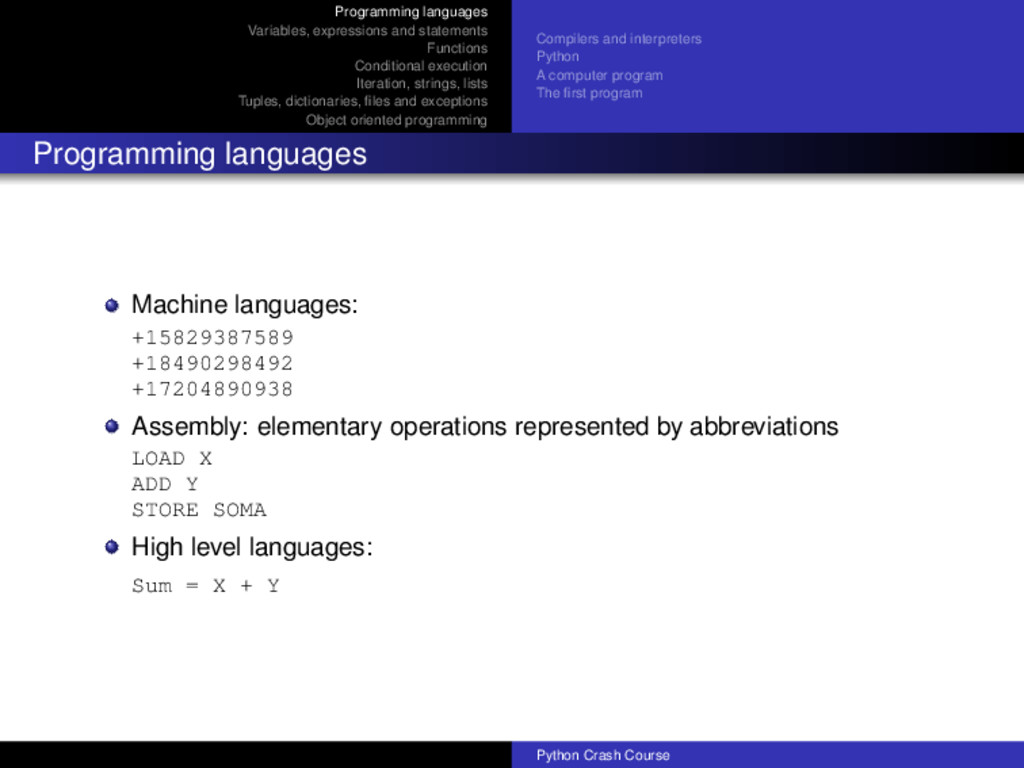
    strings, lists Tuples, dictionaries, files and exceptions Object oriented programming Compilers and interpreters Python A computer program The first program Programming languages Machine languages: +15829387589 +18490298492 +17204890938 Assembly: elementary operations represented by abbreviations LOAD X ADD Y STORE SOMA High level languages: Sum = X + Y Python Crash Course
  3. Programming languages Variables, expressions and statements Functions Conditional execution Iteration,

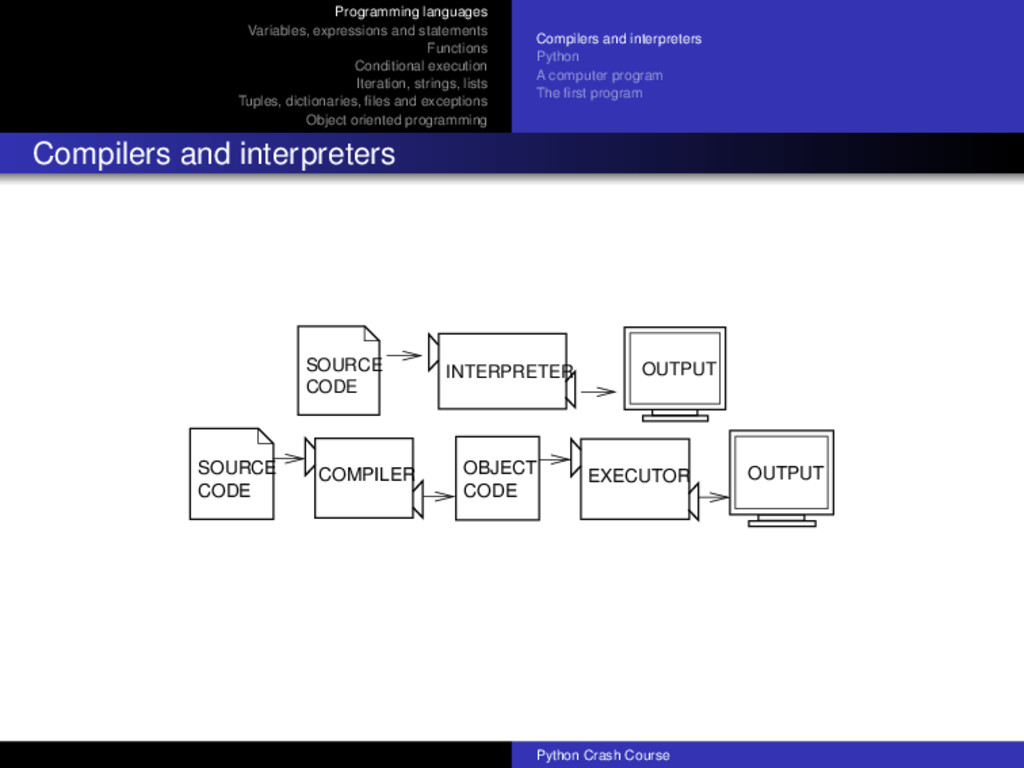
    strings, lists Tuples, dictionaries, files and exceptions Object oriented programming Compilers and interpreters Python A computer program The first program Compilers and interpreters OUTPUT SOURCE CODE INTERPRETER OUTPUT CODE OBJECT EXECUTOR CODE SOURCE COMPILER Python Crash Course
  4. Programming languages Variables, expressions and statements Functions Conditional execution Iteration,

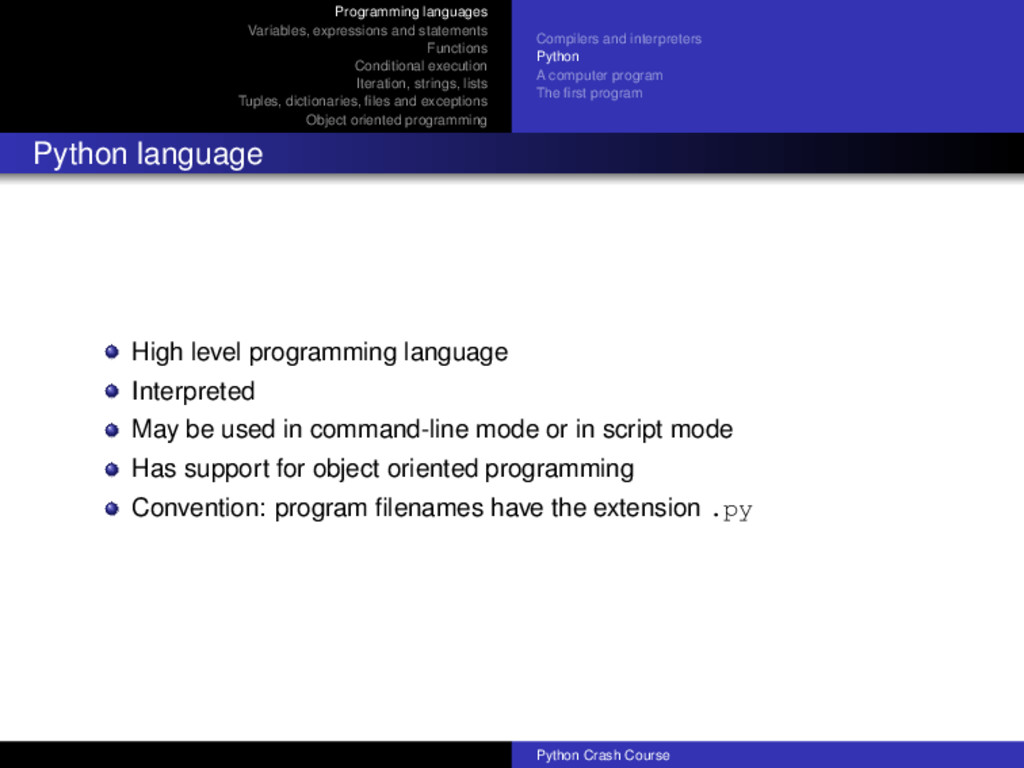
    strings, lists Tuples, dictionaries, files and exceptions Object oriented programming Compilers and interpreters Python A computer program The first program Python language High level programming language Interpreted May be used in command-line mode or in script mode Has support for object oriented programming Convention: program filenames have the extension .py Python Crash Course
  5. Programming languages Variables, expressions and statements Functions Conditional execution Iteration,

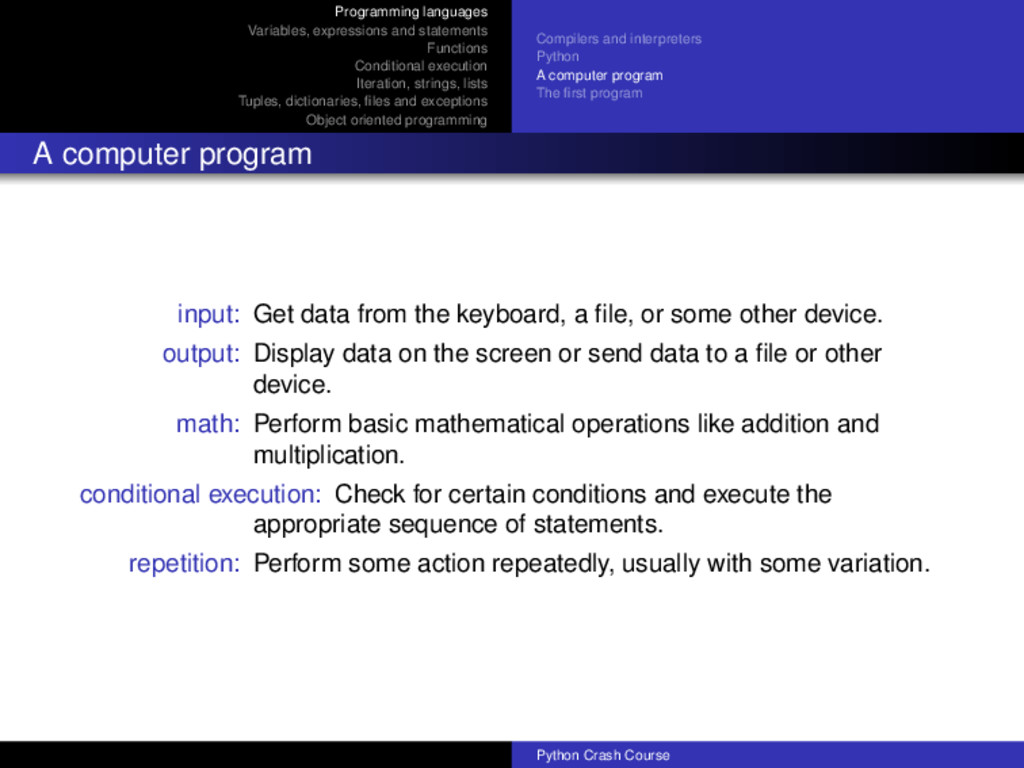
    strings, lists Tuples, dictionaries, files and exceptions Object oriented programming Compilers and interpreters Python A computer program The first program A computer program input: Get data from the keyboard, a file, or some other device. output: Display data on the screen or send data to a file or other device. math: Perform basic mathematical operations like addition and multiplication. conditional execution: Check for certain conditions and execute the appropriate sequence of statements. repetition: Perform some action repeatedly, usually with some variation. Python Crash Course
  6. Programming languages Variables, expressions and statements Functions Conditional execution Iteration,

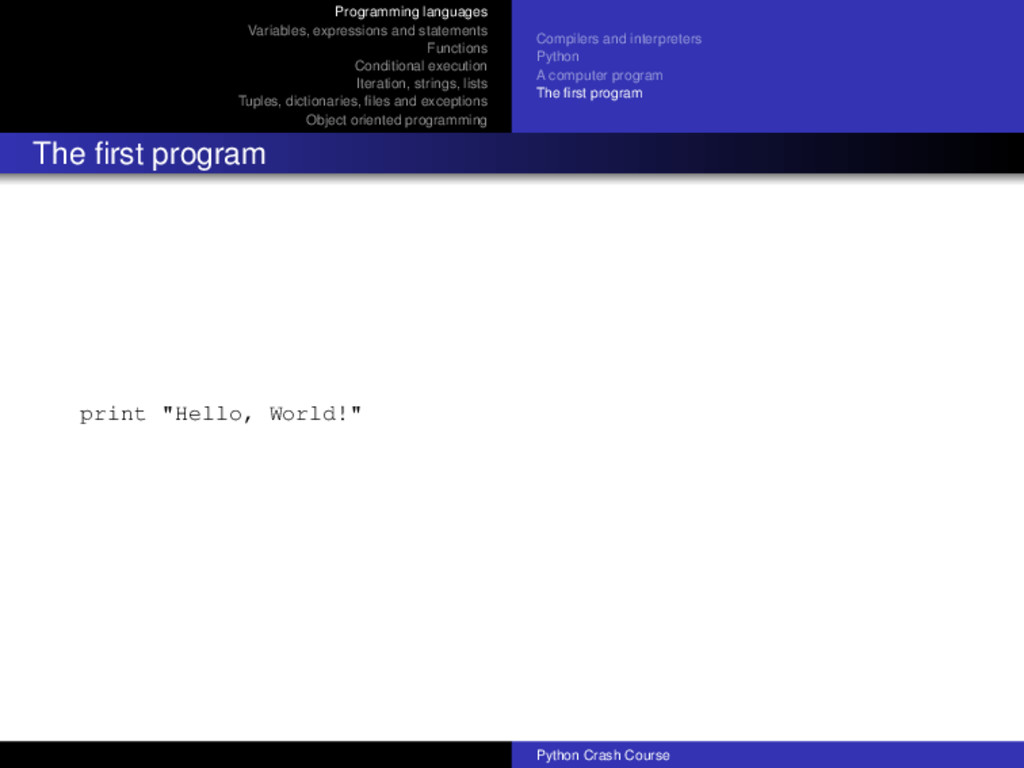
    strings, lists Tuples, dictionaries, files and exceptions Object oriented programming Compilers and interpreters Python A computer program The first program The first program print "Hello, World!" Python Crash Course
  7. Programming languages Variables, expressions and statements Functions Conditional execution Iteration,

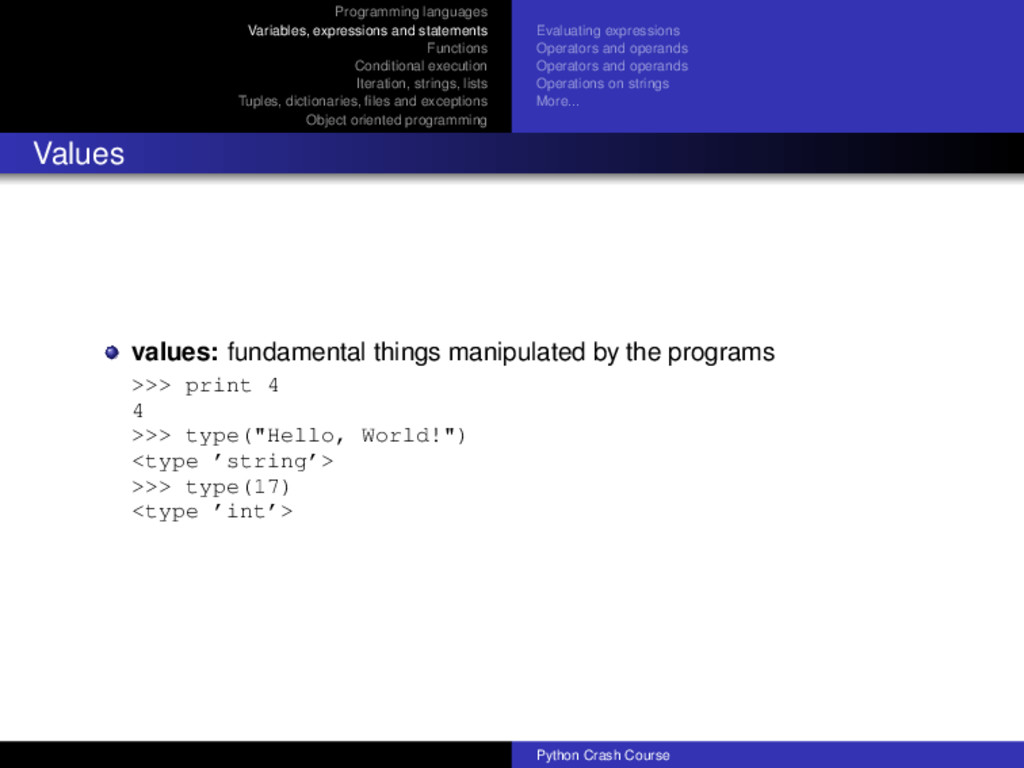
    strings, lists Tuples, dictionaries, files and exceptions Object oriented programming Evaluating expressions Operators and operands Operators and operands Operations on strings More... Values values: fundamental things manipulated by the programs >>> print 4 4 >>> type("Hello, World!") <type ’string’> >>> type(17) <type ’int’> Python Crash Course
  8. Programming languages Variables, expressions and statements Functions Conditional execution Iteration,

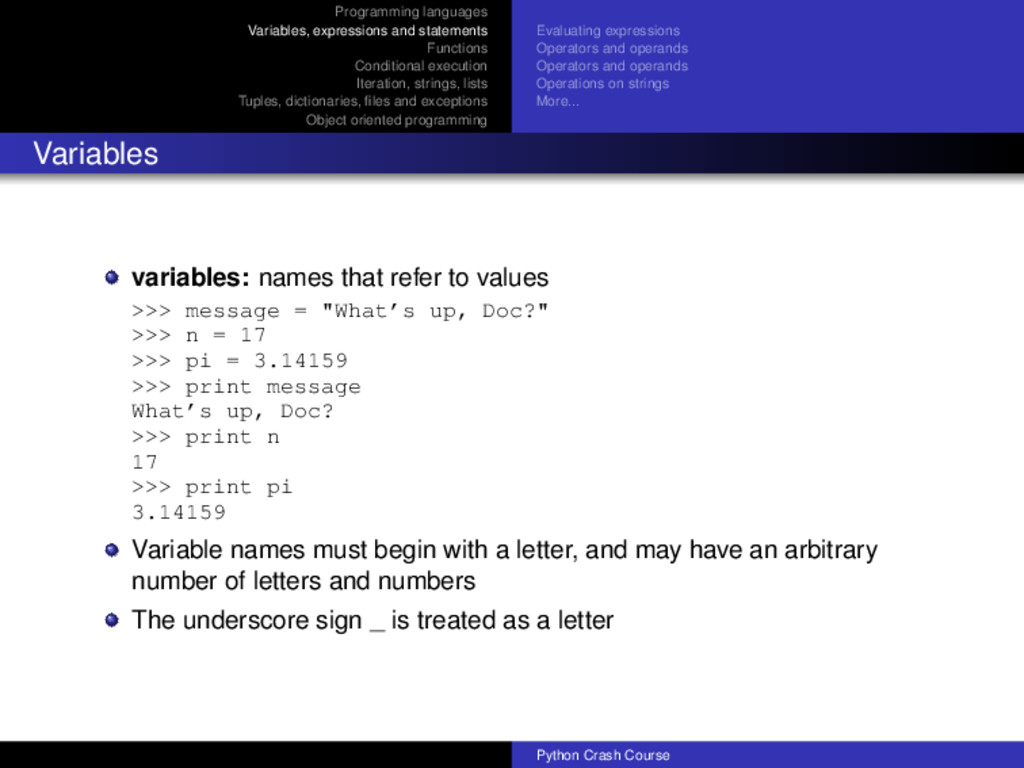
    strings, lists Tuples, dictionaries, files and exceptions Object oriented programming Evaluating expressions Operators and operands Operators and operands Operations on strings More... Variables variables: names that refer to values >>> message = "What’s up, Doc?" >>> n = 17 >>> pi = 3.14159 >>> print message What’s up, Doc? >>> print n 17 >>> print pi 3.14159 Variable names must begin with a letter, and may have an arbitrary number of letters and numbers The underscore sign _ is treated as a letter Python Crash Course
  9. Programming languages Variables, expressions and statements Functions Conditional execution Iteration,

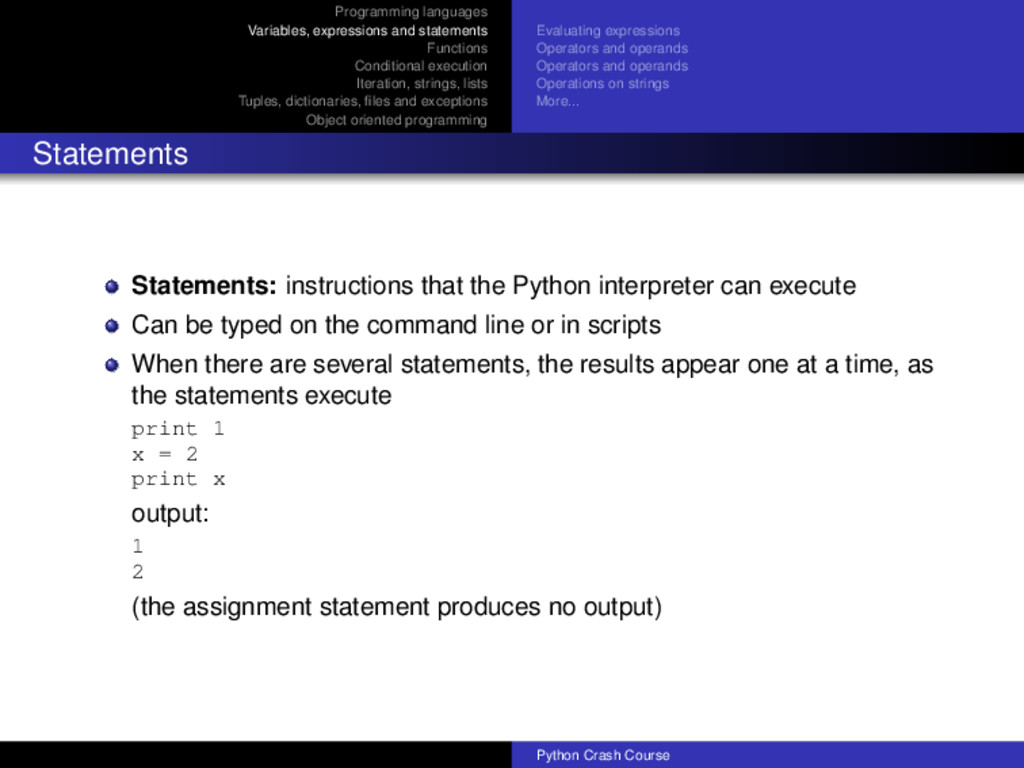
    strings, lists Tuples, dictionaries, files and exceptions Object oriented programming Evaluating expressions Operators and operands Operators and operands Operations on strings More... Statements Statements: instructions that the Python interpreter can execute Can be typed on the command line or in scripts When there are several statements, the results appear one at a time, as the statements execute print 1 x = 2 print x output: 1 2 (the assignment statement produces no output) Python Crash Course
  10. Programming languages Variables, expressions and statements Functions Conditional execution Iteration,

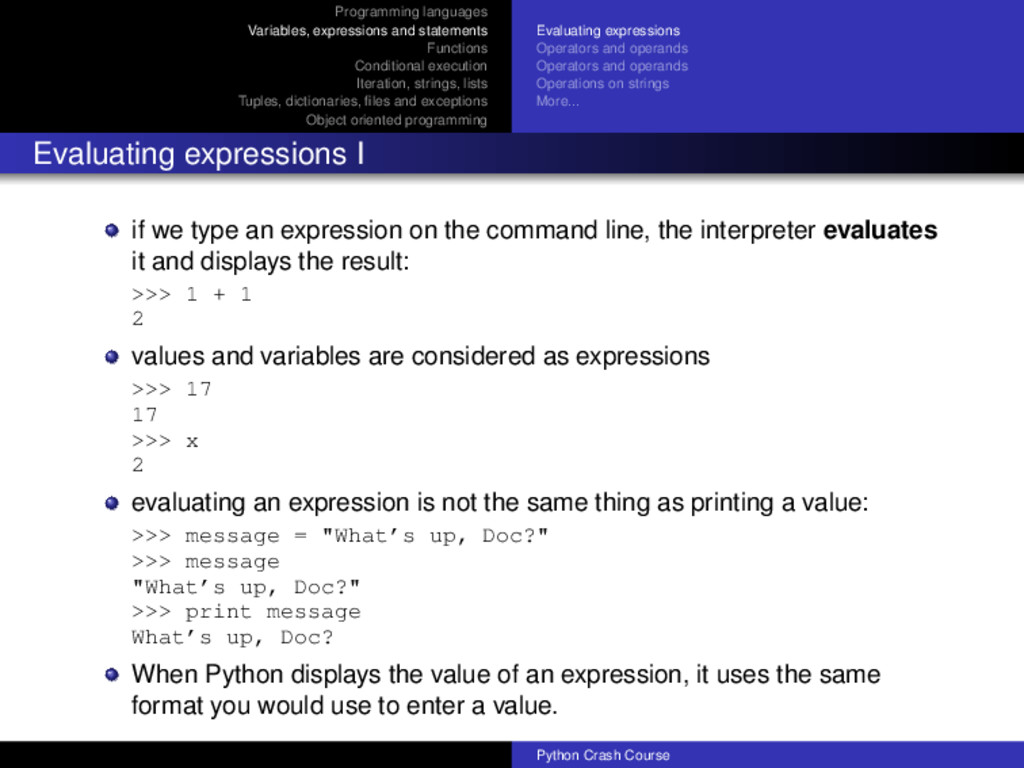
    strings, lists Tuples, dictionaries, files and exceptions Object oriented programming Evaluating expressions Operators and operands Operators and operands Operations on strings More... Evaluating expressions I if we type an expression on the command line, the interpreter evaluates it and displays the result: >>> 1 + 1 2 values and variables are considered as expressions >>> 17 17 >>> x 2 evaluating an expression is not the same thing as printing a value: >>> message = "What’s up, Doc?" >>> message "What’s up, Doc?" >>> print message What’s up, Doc? When Python displays the value of an expression, it uses the same format you would use to enter a value. Python Crash Course
  11. Programming languages Variables, expressions and statements Functions Conditional execution Iteration,

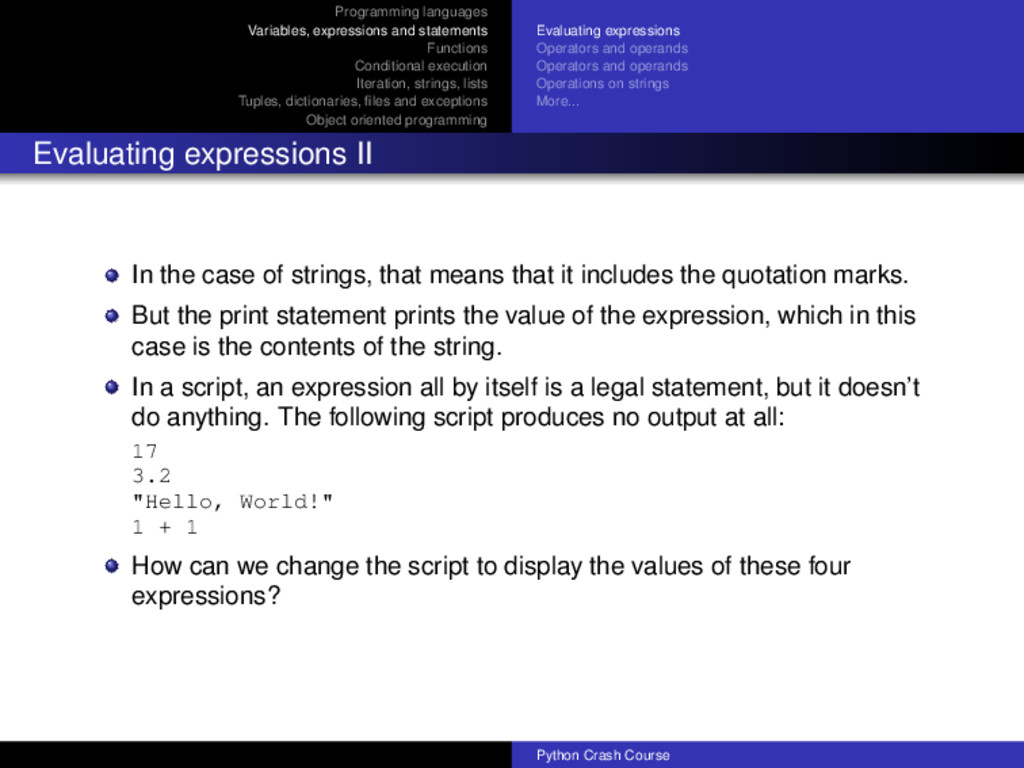
    strings, lists Tuples, dictionaries, files and exceptions Object oriented programming Evaluating expressions Operators and operands Operators and operands Operations on strings More... Evaluating expressions II In the case of strings, that means that it includes the quotation marks. But the print statement prints the value of the expression, which in this case is the contents of the string. In a script, an expression all by itself is a legal statement, but it doesn’t do anything. The following script produces no output at all: 17 3.2 "Hello, World!" 1 + 1 How can we change the script to display the values of these four expressions? Python Crash Course
  12. Programming languages Variables, expressions and statements Functions Conditional execution Iteration,

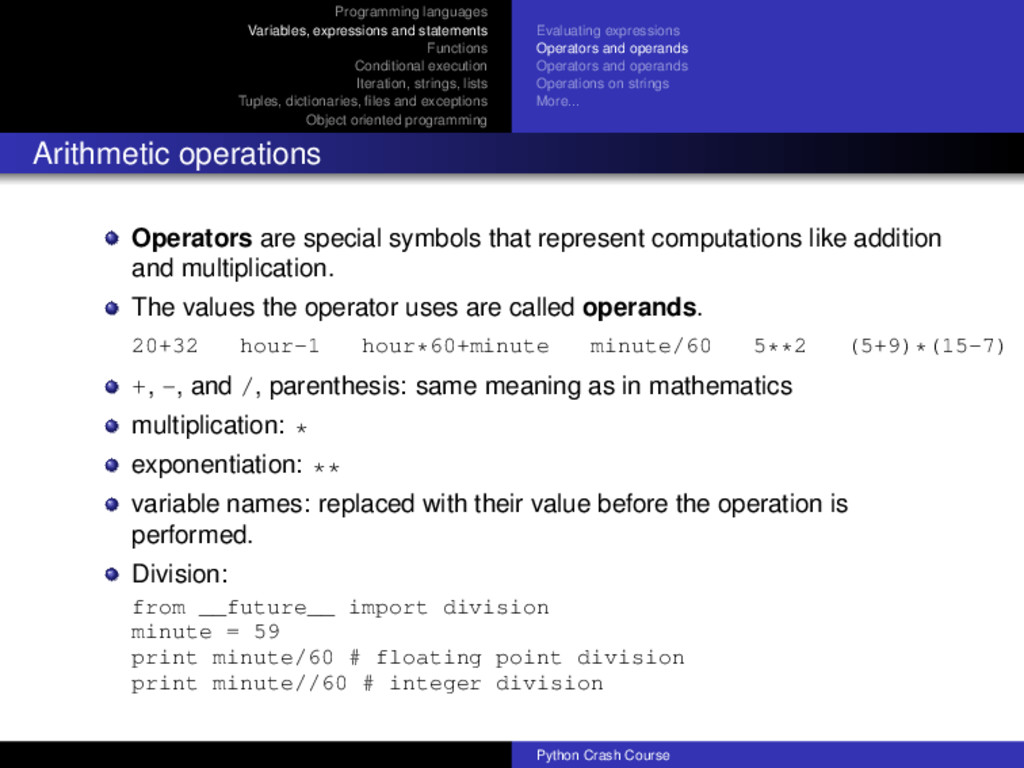
    strings, lists Tuples, dictionaries, files and exceptions Object oriented programming Evaluating expressions Operators and operands Operators and operands Operations on strings More... Arithmetic operations Operators are special symbols that represent computations like addition and multiplication. The values the operator uses are called operands. 20+32 hour-1 hour*60+minute minute/60 5**2 (5+9)*(15-7) +, -, and /, parenthesis: same meaning as in mathematics multiplication: * exponentiation: ** variable names: replaced with their value before the operation is performed. Division: from __future__ import division minute = 59 print minute/60 # floating point division print minute//60 # integer division Python Crash Course
  13. Programming languages Variables, expressions and statements Functions Conditional execution Iteration,

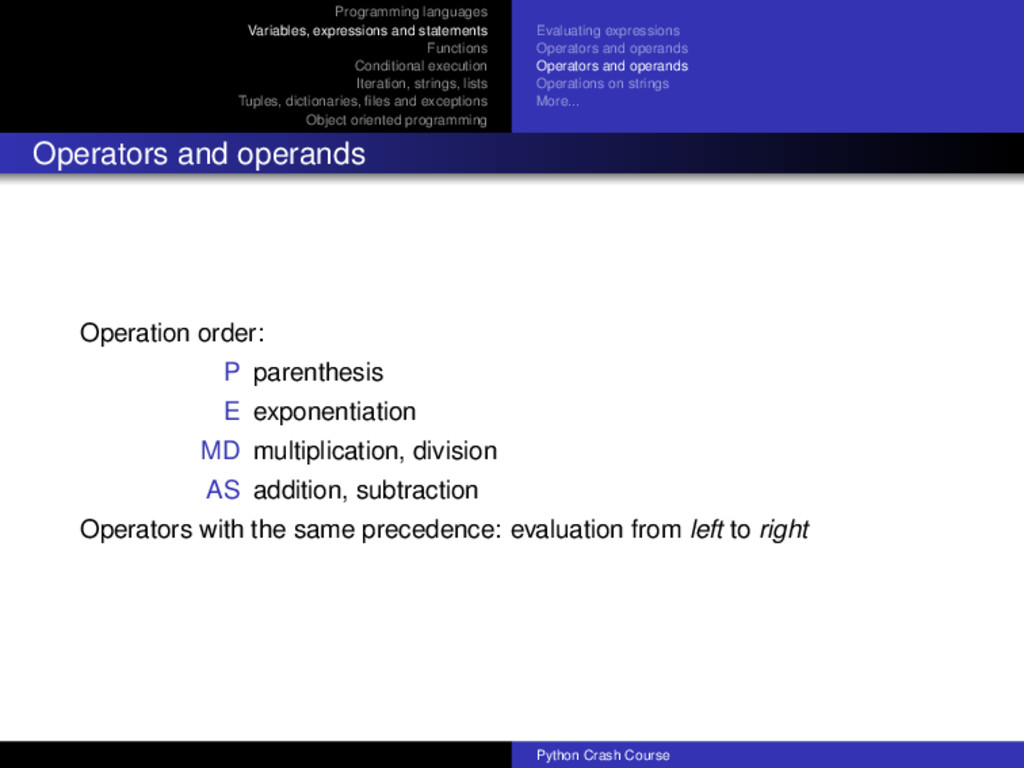
    strings, lists Tuples, dictionaries, files and exceptions Object oriented programming Evaluating expressions Operators and operands Operators and operands Operations on strings More... Operators and operands Operation order: P parenthesis E exponentiation MD multiplication, division AS addition, subtraction Operators with the same precedence: evaluation from left to right Python Crash Course
  14. Programming languages Variables, expressions and statements Functions Conditional execution Iteration,

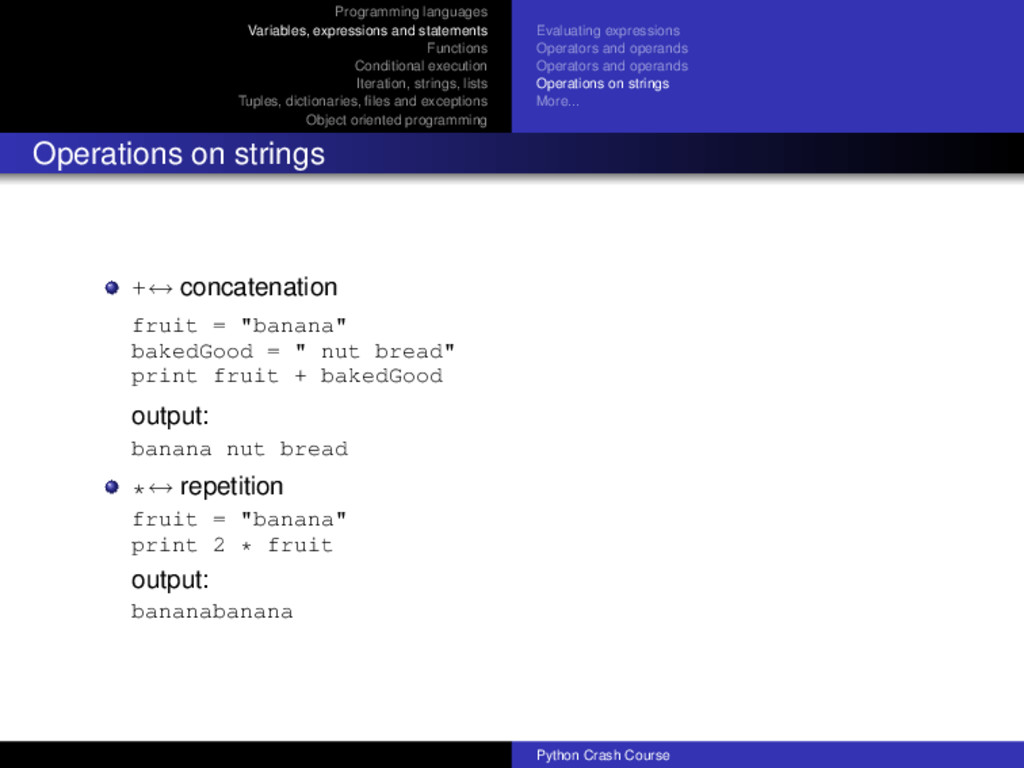
    strings, lists Tuples, dictionaries, files and exceptions Object oriented programming Evaluating expressions Operators and operands Operators and operands Operations on strings More... Operations on strings +↔ concatenation fruit = "banana" bakedGood = " nut bread" print fruit + bakedGood output: banana nut bread *↔ repetition fruit = "banana" print 2 * fruit output: bananabanana Python Crash Course
  15. Programming languages Variables, expressions and statements Functions Conditional execution Iteration,

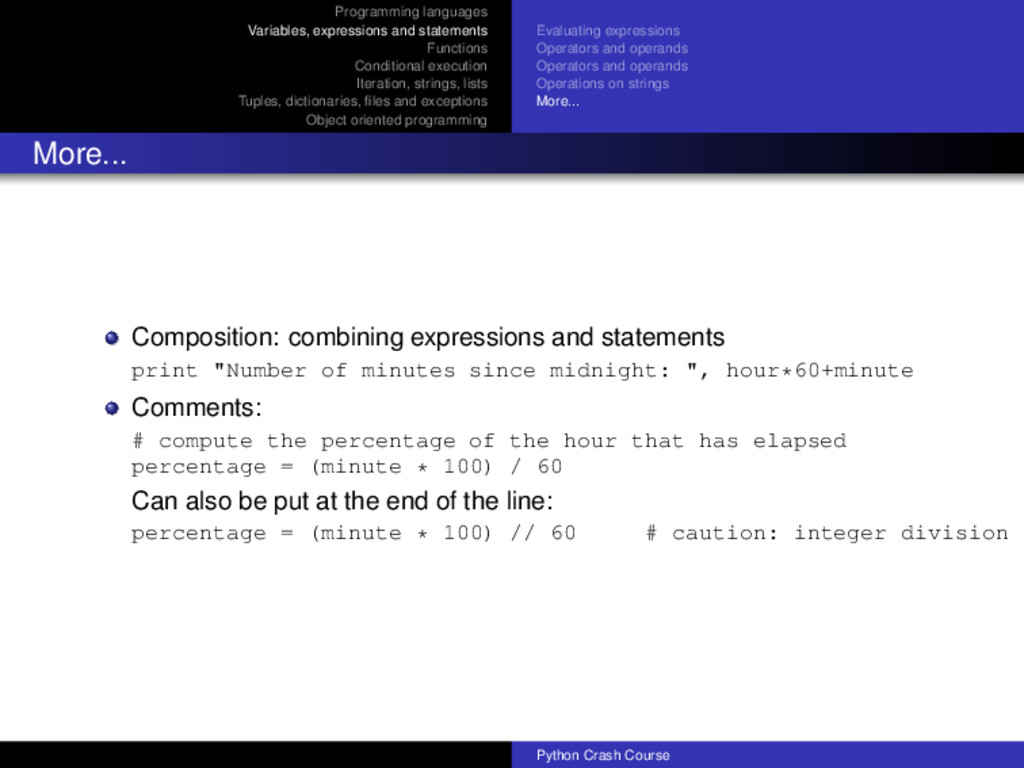
    strings, lists Tuples, dictionaries, files and exceptions Object oriented programming Evaluating expressions Operators and operands Operators and operands Operations on strings More... More... Composition: combining expressions and statements print "Number of minutes since midnight: ", hour*60+minute Comments: # compute the percentage of the hour that has elapsed percentage = (minute * 100) / 60 Can also be put at the end of the line: percentage = (minute * 100) // 60 # caution: integer division Python Crash Course
  16. Programming languages Variables, expressions and statements Functions Conditional execution Iteration,

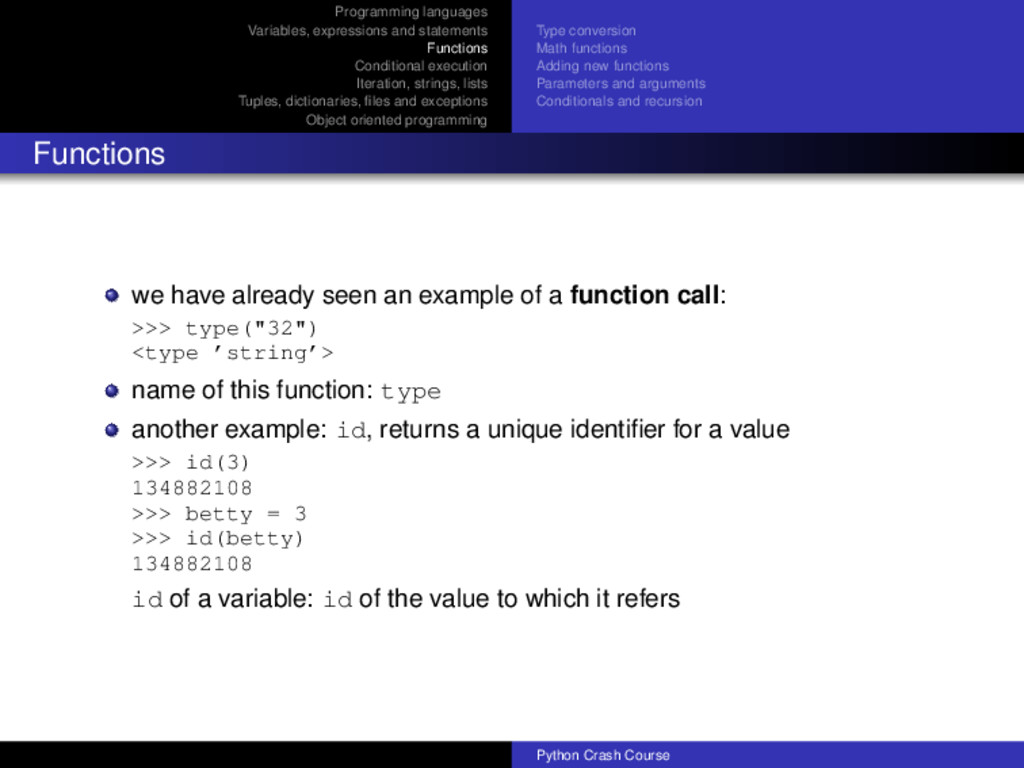
    strings, lists Tuples, dictionaries, files and exceptions Object oriented programming Type conversion Math functions Adding new functions Parameters and arguments Conditionals and recursion Functions we have already seen an example of a function call: >>> type("32") <type ’string’> name of this function: type another example: id, returns a unique identifier for a value >>> id(3) 134882108 >>> betty = 3 >>> id(betty) 134882108 id of a variable: id of the value to which it refers Python Crash Course
  17. Programming languages Variables, expressions and statements Functions Conditional execution Iteration,

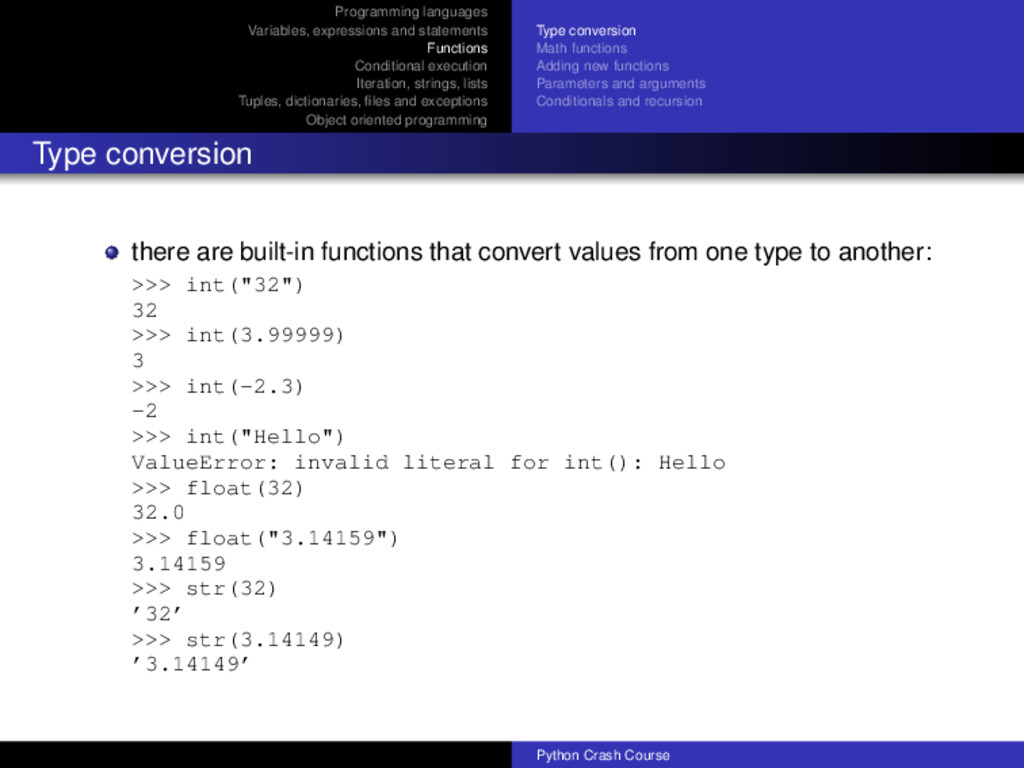
    strings, lists Tuples, dictionaries, files and exceptions Object oriented programming Type conversion Math functions Adding new functions Parameters and arguments Conditionals and recursion Type conversion there are built-in functions that convert values from one type to another: >>> int("32") 32 >>> int(3.99999) 3 >>> int(-2.3) -2 >>> int("Hello") ValueError: invalid literal for int(): Hello >>> float(32) 32.0 >>> float("3.14159") 3.14159 >>> str(32) ’32’ >>> str(3.14149) ’3.14149’ Python Crash Course
  18. Programming languages Variables, expressions and statements Functions Conditional execution Iteration,

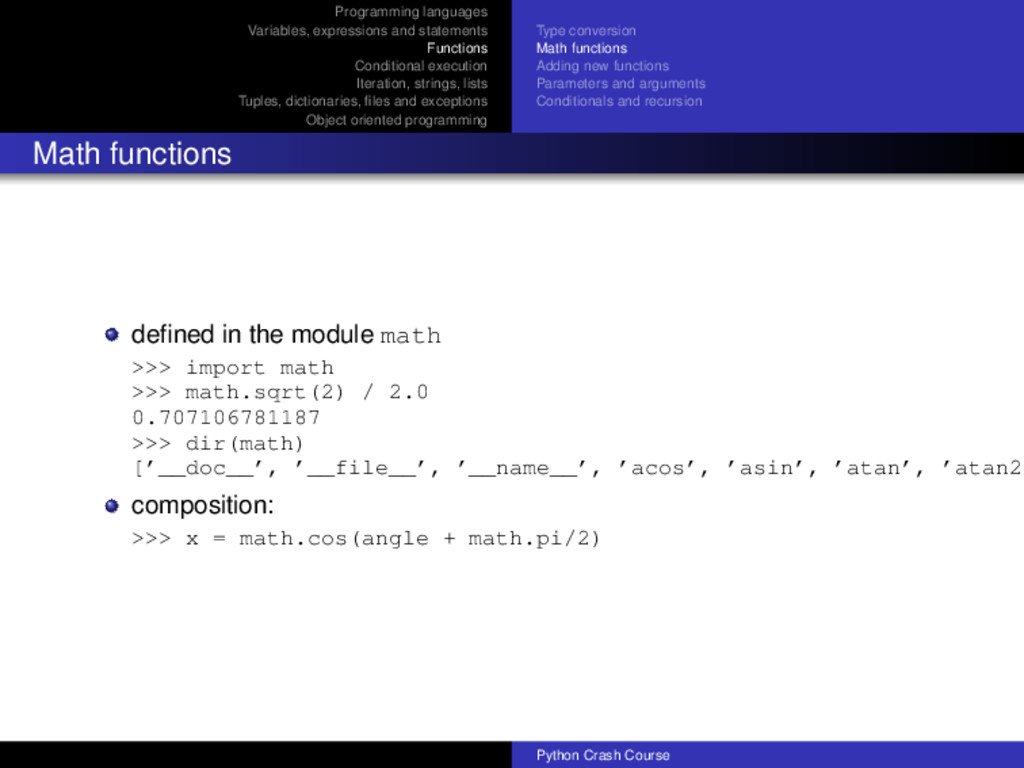
    strings, lists Tuples, dictionaries, files and exceptions Object oriented programming Type conversion Math functions Adding new functions Parameters and arguments Conditionals and recursion Math functions defined in the module math >>> import math >>> math.sqrt(2) / 2.0 0.707106781187 >>> dir(math) [’__doc__’, ’__file__’, ’__name__’, ’acos’, ’asin’, ’atan’, ’atan2’ composition: >>> x = math.cos(angle + math.pi/2) Python Crash Course
  19. Programming languages Variables, expressions and statements Functions Conditional execution Iteration,

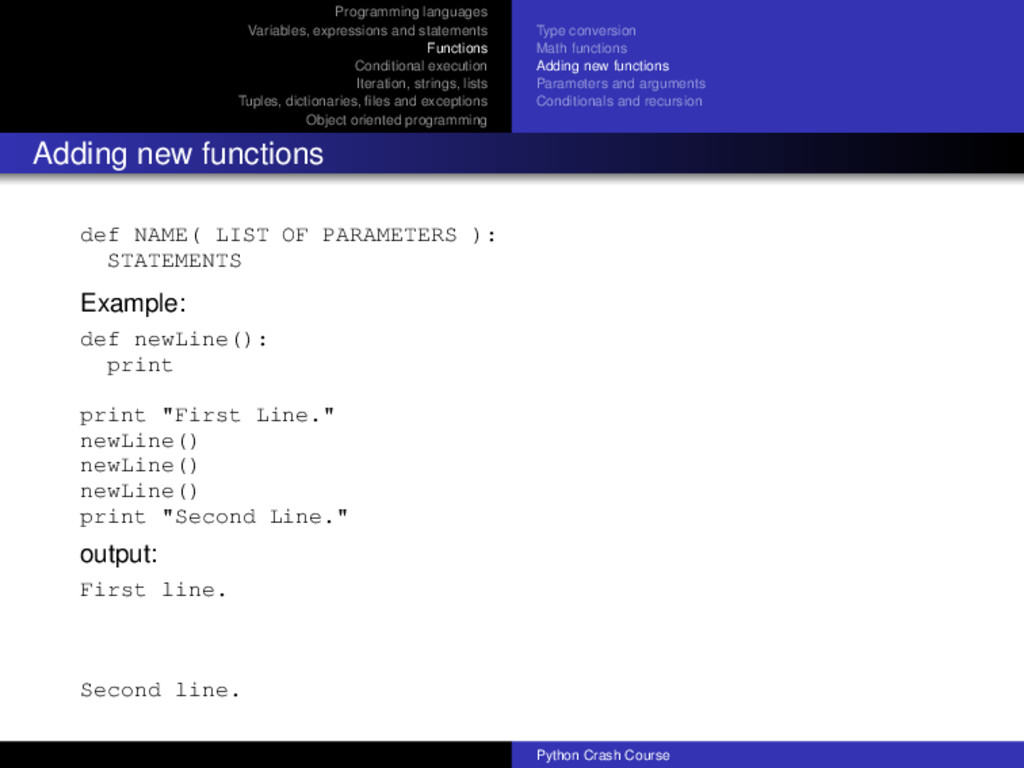
    strings, lists Tuples, dictionaries, files and exceptions Object oriented programming Type conversion Math functions Adding new functions Parameters and arguments Conditionals and recursion Adding new functions def NAME( LIST OF PARAMETERS ): STATEMENTS Example: def newLine(): print print "First Line." newLine() newLine() newLine() print "Second Line." output: First line. Second line. Python Crash Course
  20. Programming languages Variables, expressions and statements Functions Conditional execution Iteration,

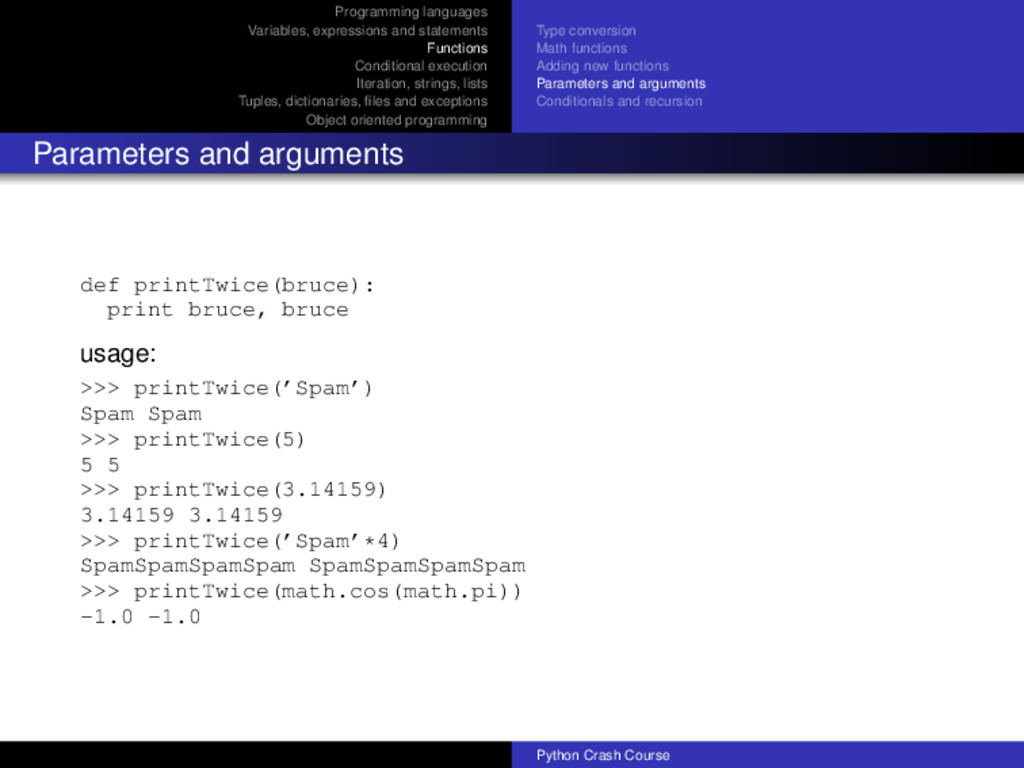
    strings, lists Tuples, dictionaries, files and exceptions Object oriented programming Type conversion Math functions Adding new functions Parameters and arguments Conditionals and recursion Parameters and arguments def printTwice(bruce): print bruce, bruce usage: >>> printTwice(’Spam’) Spam Spam >>> printTwice(5) 5 5 >>> printTwice(3.14159) 3.14159 3.14159 >>> printTwice(’Spam’*4) SpamSpamSpamSpam SpamSpamSpamSpam >>> printTwice(math.cos(math.pi)) -1.0 -1.0 Python Crash Course
  21. Programming languages Variables, expressions and statements Functions Conditional execution Iteration,

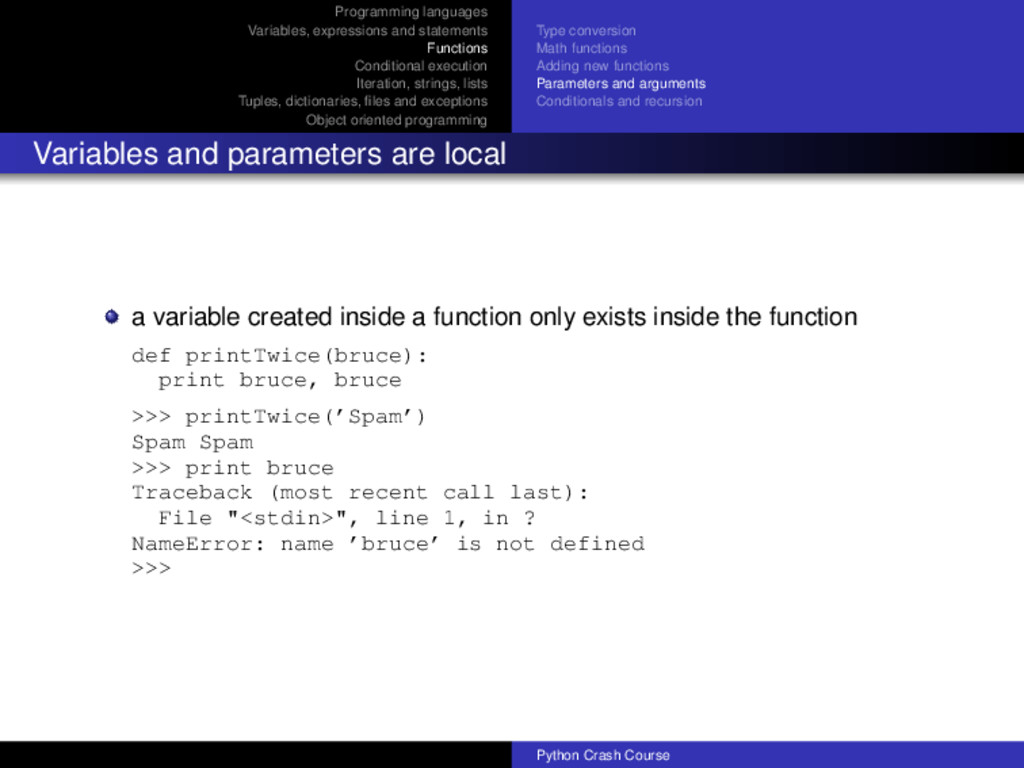
    strings, lists Tuples, dictionaries, files and exceptions Object oriented programming Type conversion Math functions Adding new functions Parameters and arguments Conditionals and recursion Variables and parameters are local a variable created inside a function only exists inside the function def printTwice(bruce): print bruce, bruce >>> printTwice(’Spam’) Spam Spam >>> print bruce Traceback (most recent call last): File "<stdin>", line 1, in ? NameError: name ’bruce’ is not defined >>> Python Crash Course
  22. Programming languages Variables, expressions and statements Functions Conditional execution Iteration,

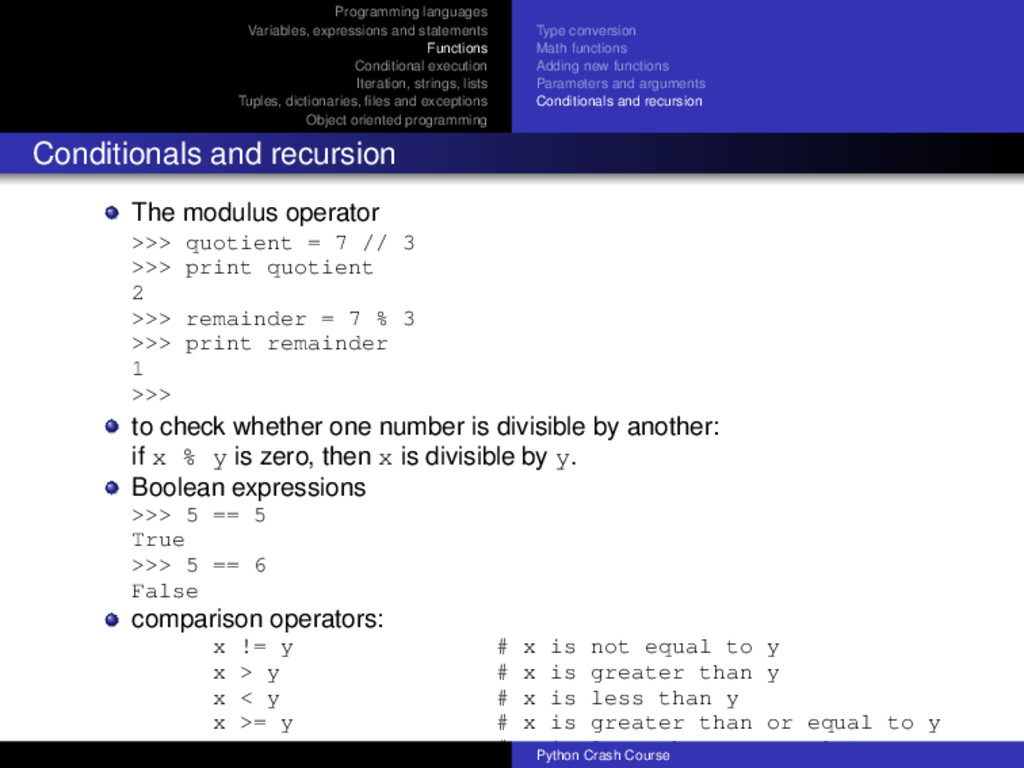
    strings, lists Tuples, dictionaries, files and exceptions Object oriented programming Type conversion Math functions Adding new functions Parameters and arguments Conditionals and recursion Conditionals and recursion The modulus operator >>> quotient = 7 // 3 >>> print quotient 2 >>> remainder = 7 % 3 >>> print remainder 1 >>> to check whether one number is divisible by another: if x % y is zero, then x is divisible by y. Boolean expressions >>> 5 == 5 True >>> 5 == 6 False comparison operators: x != y # x is not equal to y x > y # x is greater than y x < y # x is less than y x >= y # x is greater than or equal to y x <= y # x is less than or equal to y Python Crash Course
  23. Programming languages Variables, expressions and statements Functions Conditional execution Iteration,

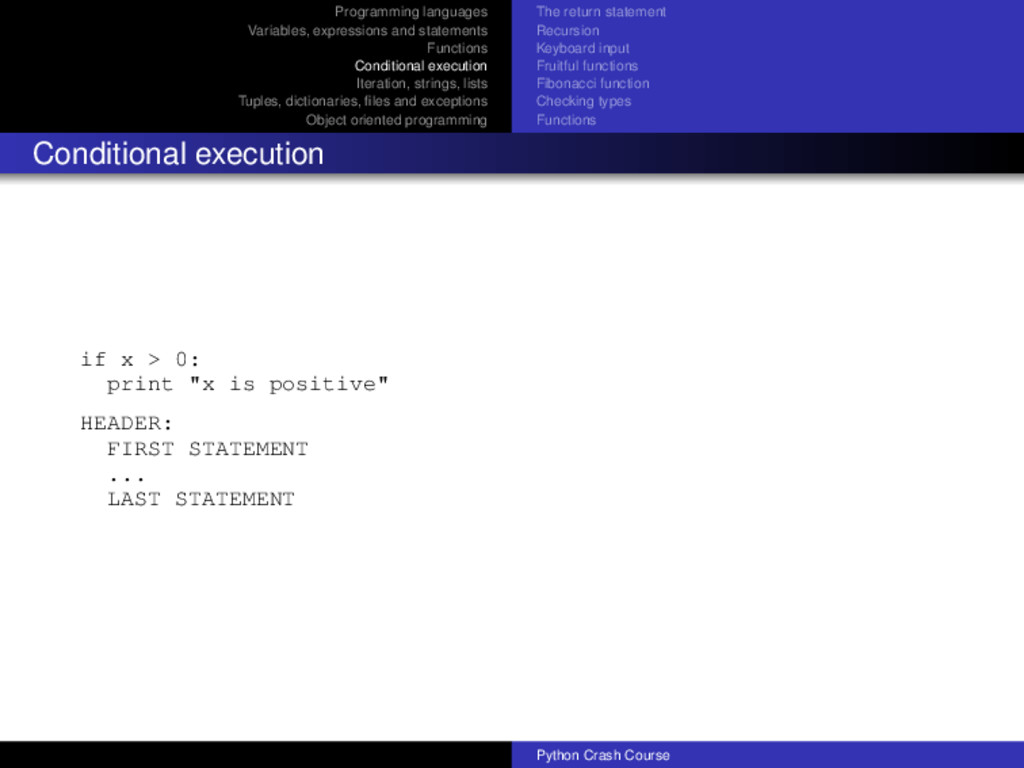
    strings, lists Tuples, dictionaries, files and exceptions Object oriented programming The return statement Recursion Keyboard input Fruitful functions Fibonacci function Checking types Functions Conditional execution if x > 0: print "x is positive" HEADER: FIRST STATEMENT ... LAST STATEMENT Python Crash Course
  24. Programming languages Variables, expressions and statements Functions Conditional execution Iteration,

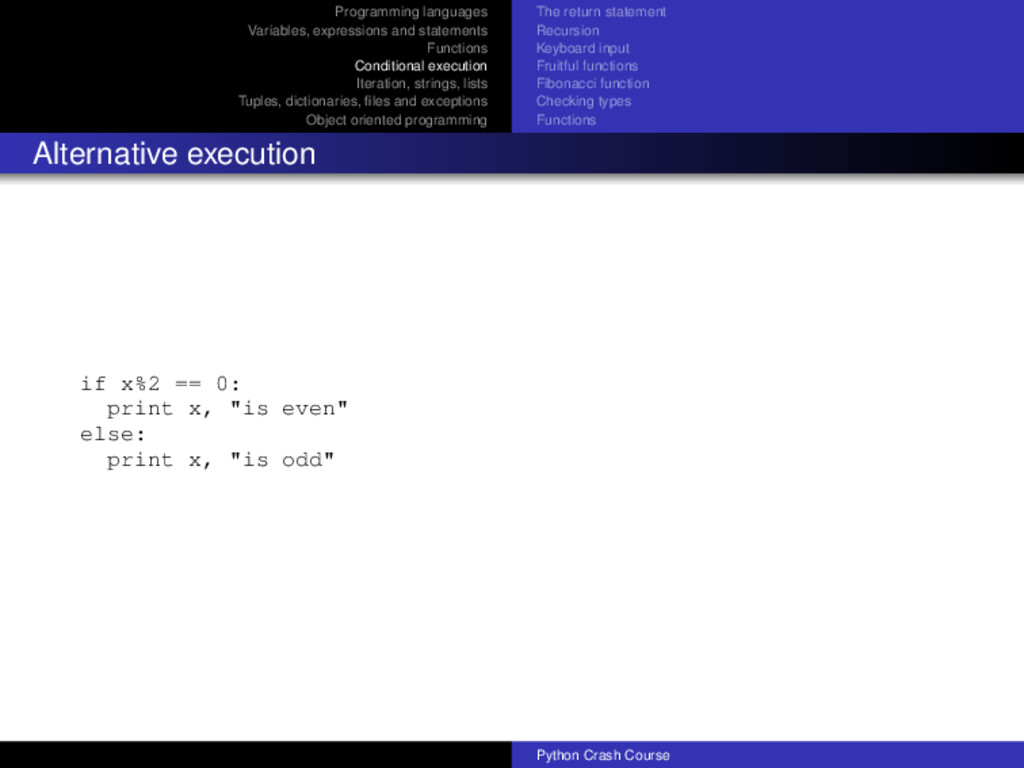
    strings, lists Tuples, dictionaries, files and exceptions Object oriented programming The return statement Recursion Keyboard input Fruitful functions Fibonacci function Checking types Functions Alternative execution if x%2 == 0: print x, "is even" else: print x, "is odd" Python Crash Course
  25. Programming languages Variables, expressions and statements Functions Conditional execution Iteration,

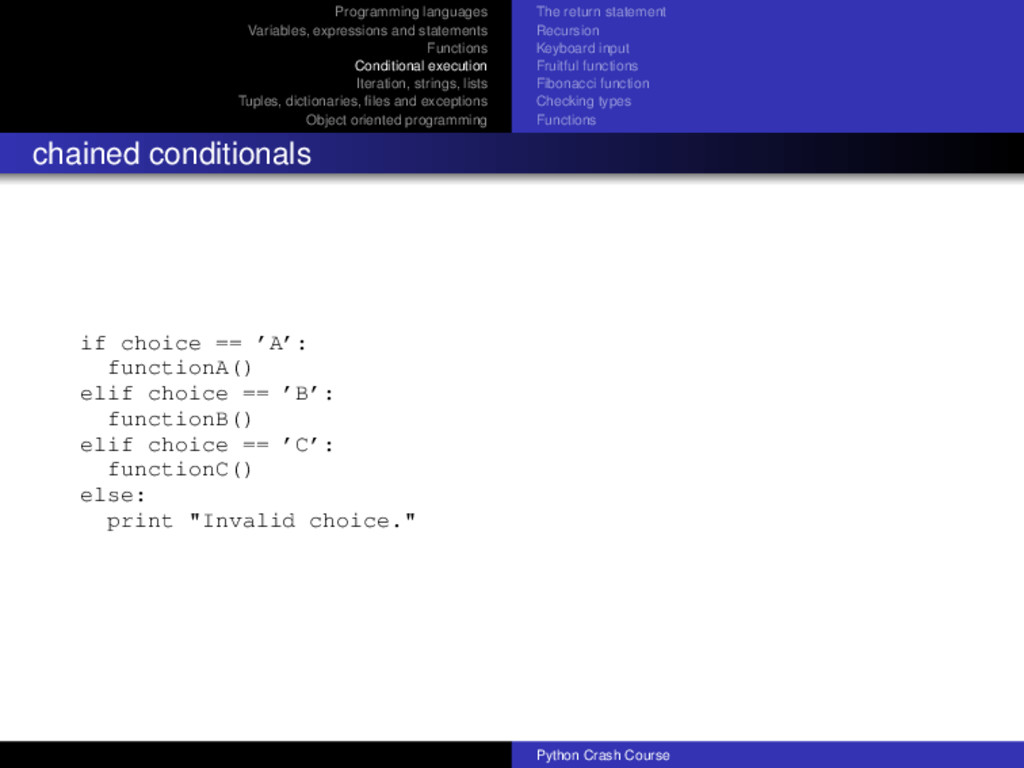
    strings, lists Tuples, dictionaries, files and exceptions Object oriented programming The return statement Recursion Keyboard input Fruitful functions Fibonacci function Checking types Functions chained conditionals if choice == ’A’: functionA() elif choice == ’B’: functionB() elif choice == ’C’: functionC() else: print "Invalid choice." Python Crash Course
  26. Programming languages Variables, expressions and statements Functions Conditional execution Iteration,

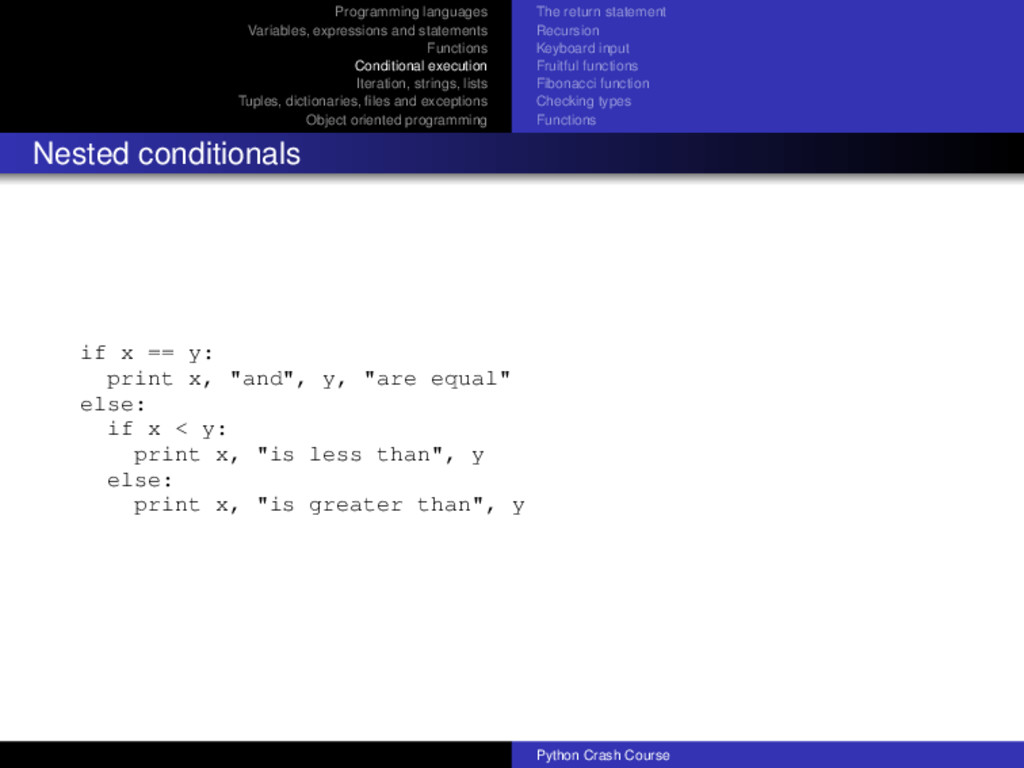
    strings, lists Tuples, dictionaries, files and exceptions Object oriented programming The return statement Recursion Keyboard input Fruitful functions Fibonacci function Checking types Functions Nested conditionals if x == y: print x, "and", y, "are equal" else: if x < y: print x, "is less than", y else: print x, "is greater than", y Python Crash Course
  27. Programming languages Variables, expressions and statements Functions Conditional execution Iteration,

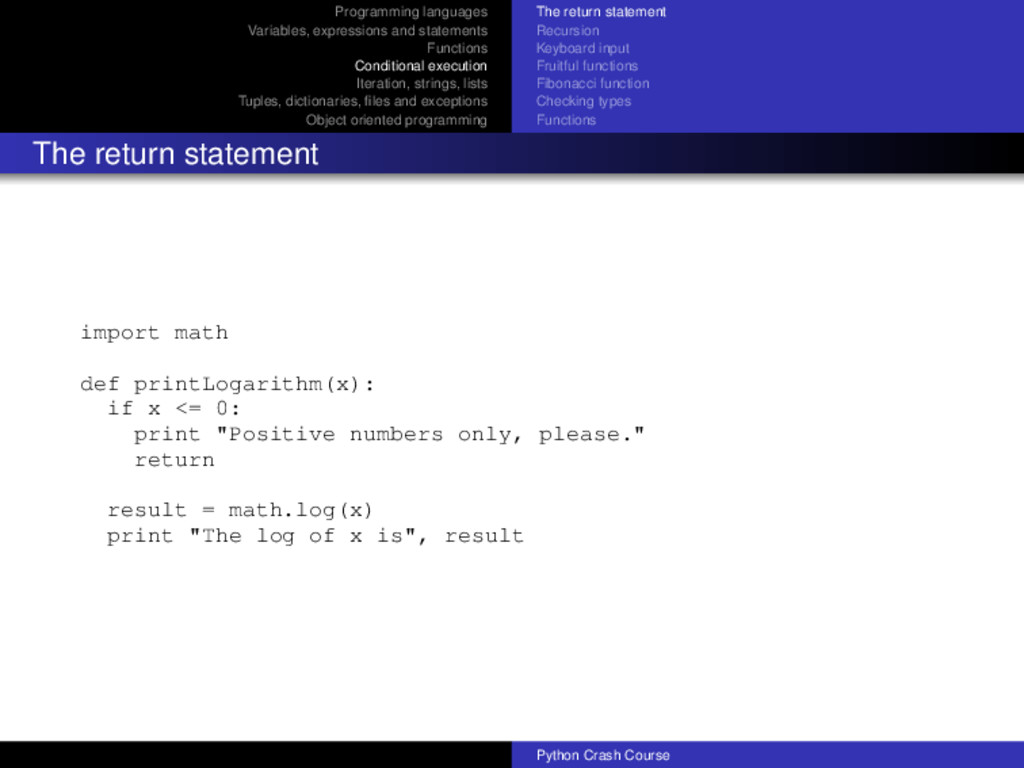
    strings, lists Tuples, dictionaries, files and exceptions Object oriented programming The return statement Recursion Keyboard input Fruitful functions Fibonacci function Checking types Functions The return statement import math def printLogarithm(x): if x <= 0: print "Positive numbers only, please." return result = math.log(x) print "The log of x is", result Python Crash Course
  28. Programming languages Variables, expressions and statements Functions Conditional execution Iteration,

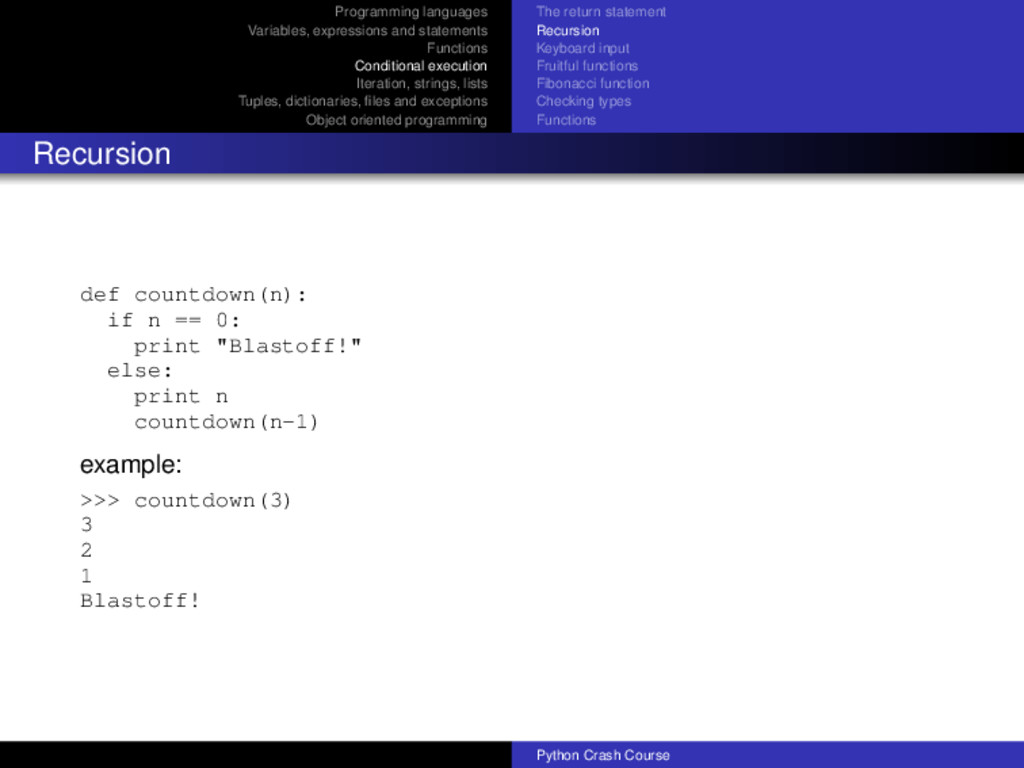
    strings, lists Tuples, dictionaries, files and exceptions Object oriented programming The return statement Recursion Keyboard input Fruitful functions Fibonacci function Checking types Functions Recursion def countdown(n): if n == 0: print "Blastoff!" else: print n countdown(n-1) example: >>> countdown(3) 3 2 1 Blastoff! Python Crash Course
  29. Programming languages Variables, expressions and statements Functions Conditional execution Iteration,

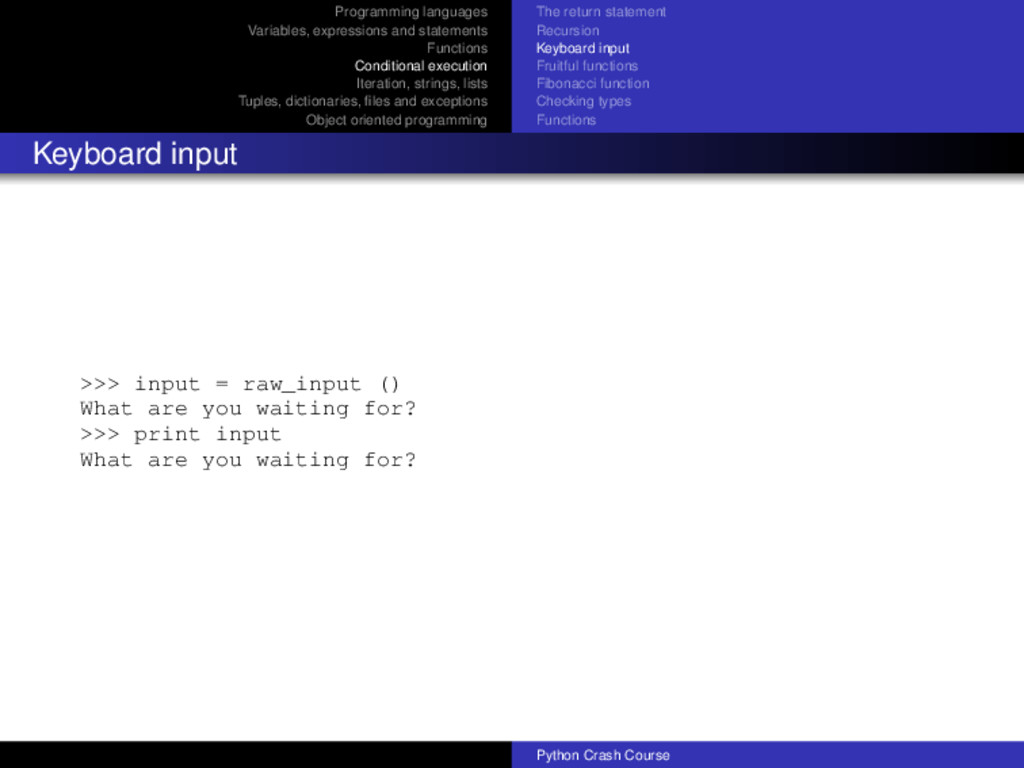
    strings, lists Tuples, dictionaries, files and exceptions Object oriented programming The return statement Recursion Keyboard input Fruitful functions Fibonacci function Checking types Functions Keyboard input >>> input = raw_input () What are you waiting for? >>> print input What are you waiting for? Python Crash Course
  30. Programming languages Variables, expressions and statements Functions Conditional execution Iteration,

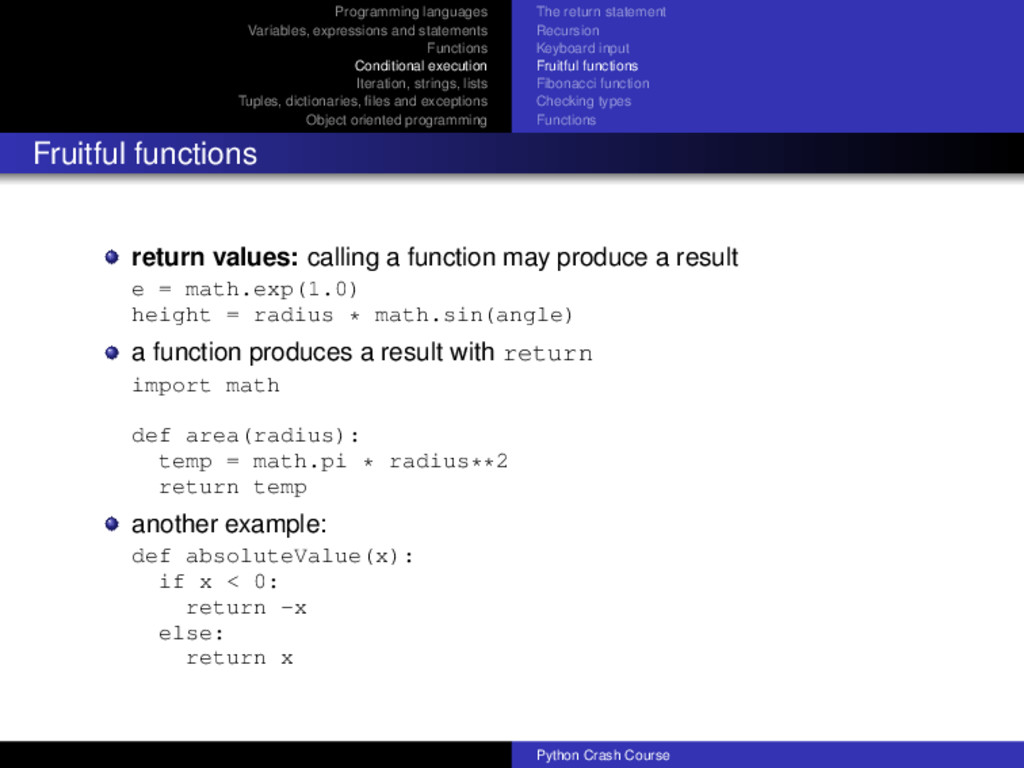
    strings, lists Tuples, dictionaries, files and exceptions Object oriented programming The return statement Recursion Keyboard input Fruitful functions Fibonacci function Checking types Functions Fruitful functions return values: calling a function may produce a result e = math.exp(1.0) height = radius * math.sin(angle) a function produces a result with return import math def area(radius): temp = math.pi * radius**2 return temp another example: def absoluteValue(x): if x < 0: return -x else: return x Python Crash Course
  31. Programming languages Variables, expressions and statements Functions Conditional execution Iteration,

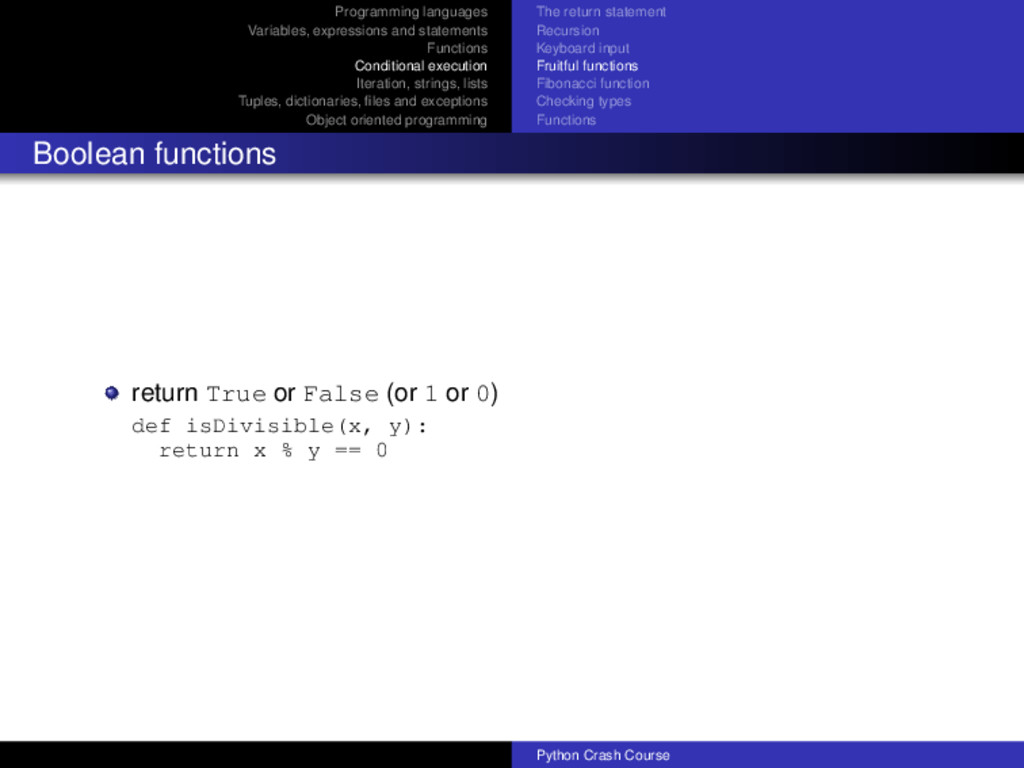
    strings, lists Tuples, dictionaries, files and exceptions Object oriented programming The return statement Recursion Keyboard input Fruitful functions Fibonacci function Checking types Functions Boolean functions return True or False (or 1 or 0) def isDivisible(x, y): return x % y == 0 Python Crash Course
  32. Programming languages Variables, expressions and statements Functions Conditional execution Iteration,

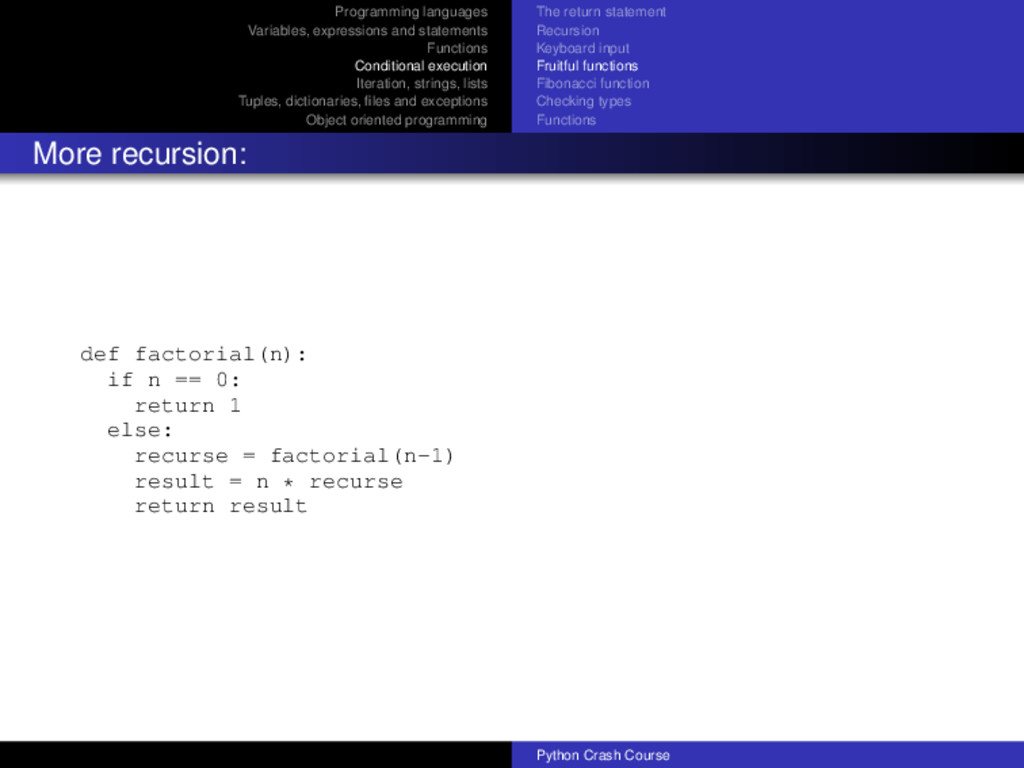
    strings, lists Tuples, dictionaries, files and exceptions Object oriented programming The return statement Recursion Keyboard input Fruitful functions Fibonacci function Checking types Functions More recursion: def factorial(n): if n == 0: return 1 else: recurse = factorial(n-1) result = n * recurse return result Python Crash Course
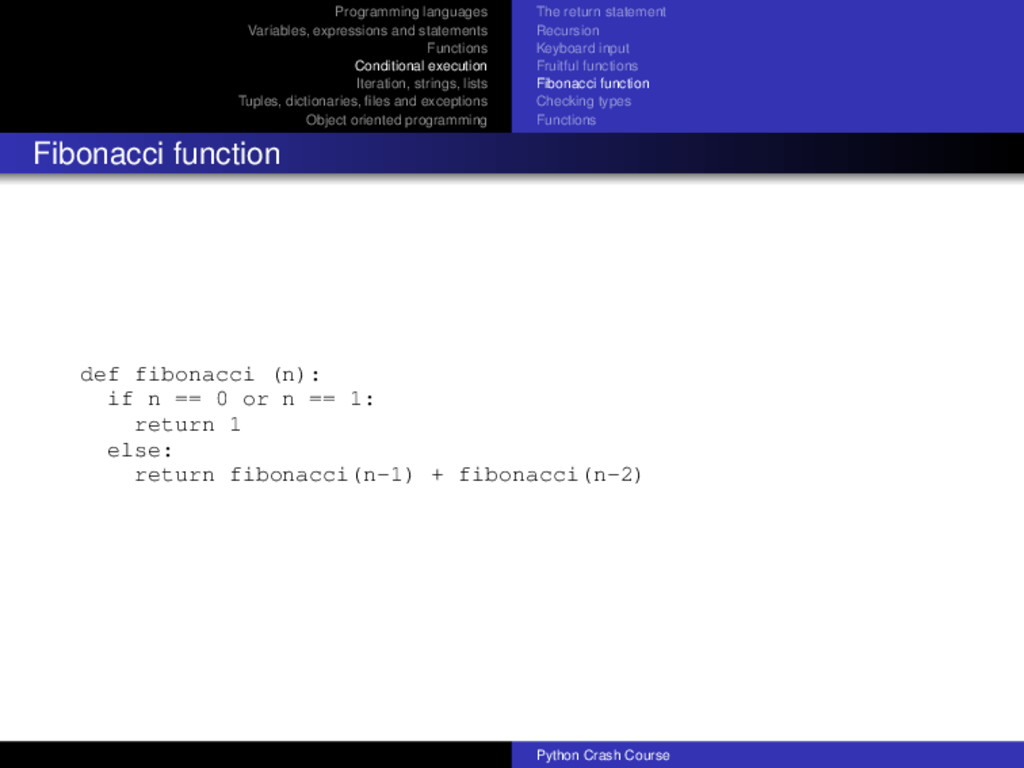
  33. Programming languages Variables, expressions and statements Functions Conditional execution Iteration,

    strings, lists Tuples, dictionaries, files and exceptions Object oriented programming The return statement Recursion Keyboard input Fruitful functions Fibonacci function Checking types Functions Fibonacci function def fibonacci (n): if n == 0 or n == 1: return 1 else: return fibonacci(n-1) + fibonacci(n-2) Python Crash Course
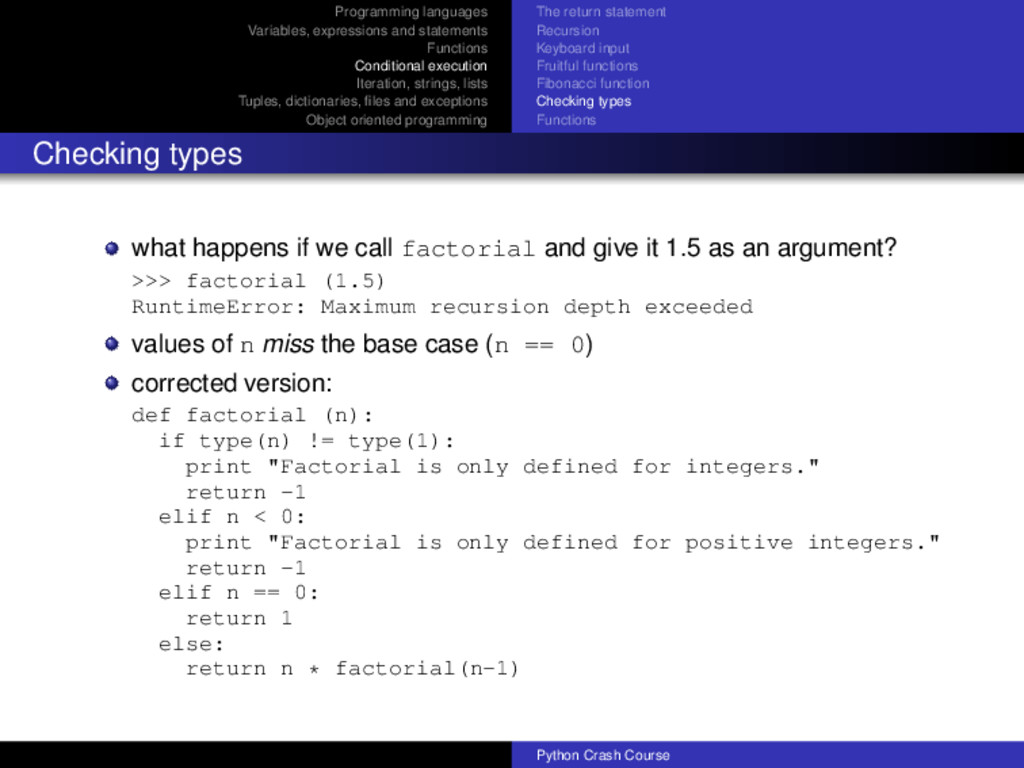
  34. Programming languages Variables, expressions and statements Functions Conditional execution Iteration,

    strings, lists Tuples, dictionaries, files and exceptions Object oriented programming The return statement Recursion Keyboard input Fruitful functions Fibonacci function Checking types Functions Checking types what happens if we call factorial and give it 1.5 as an argument? >>> factorial (1.5) RuntimeError: Maximum recursion depth exceeded values of n miss the base case (n == 0) corrected version: def factorial (n): if type(n) != type(1): print "Factorial is only defined for integers." return -1 elif n < 0: print "Factorial is only defined for positive integers." return -1 elif n == 0: return 1 else: return n * factorial(n-1) Python Crash Course
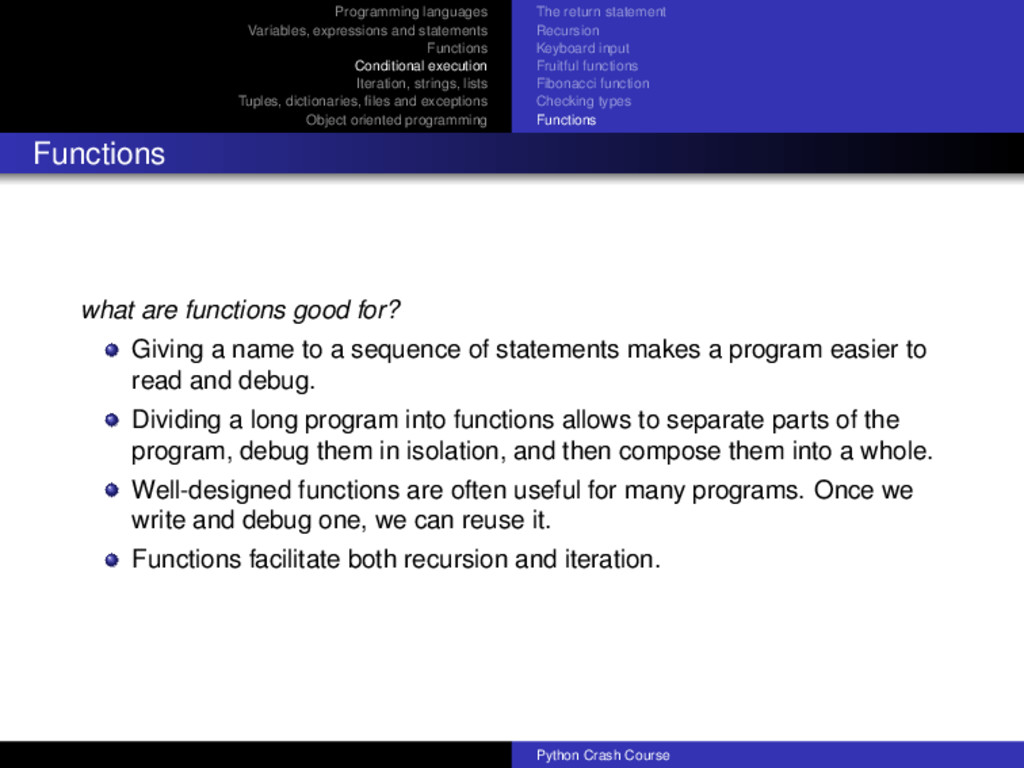
  35. Programming languages Variables, expressions and statements Functions Conditional execution Iteration,

    strings, lists Tuples, dictionaries, files and exceptions Object oriented programming The return statement Recursion Keyboard input Fruitful functions Fibonacci function Checking types Functions Functions what are functions good for? Giving a name to a sequence of statements makes a program easier to read and debug. Dividing a long program into functions allows to separate parts of the program, debug them in isolation, and then compose them into a whole. Well-designed functions are often useful for many programs. Once we write and debug one, we can reuse it. Functions facilitate both recursion and iteration. Python Crash Course
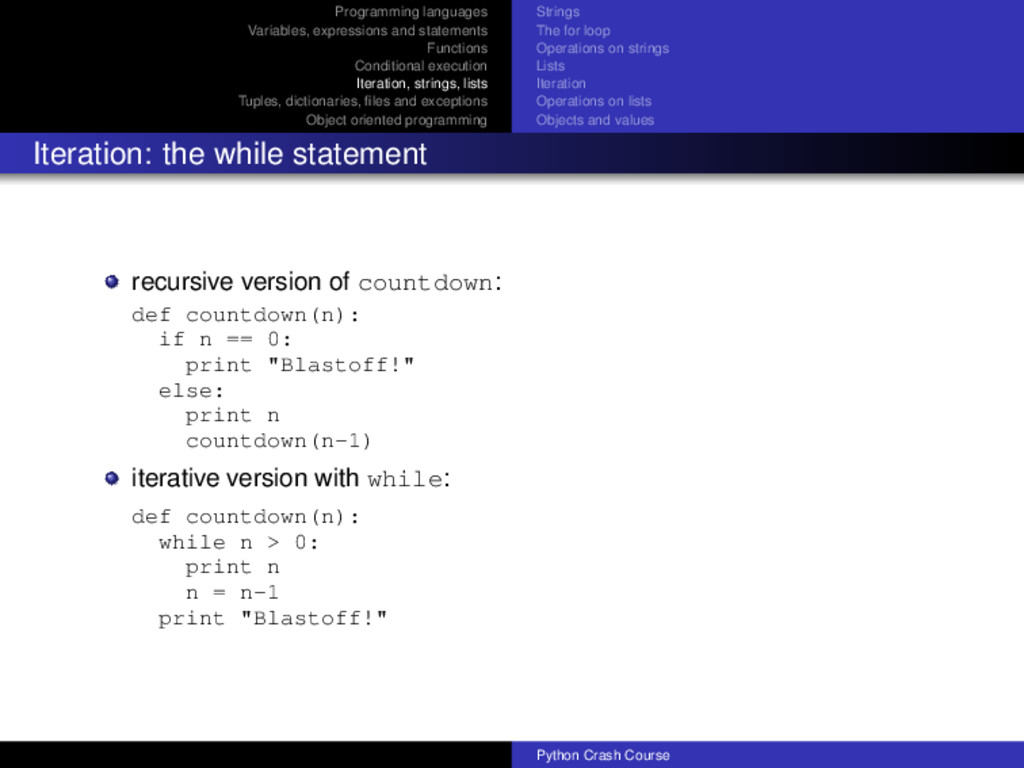
  36. Programming languages Variables, expressions and statements Functions Conditional execution Iteration,

    strings, lists Tuples, dictionaries, files and exceptions Object oriented programming Strings The for loop Operations on strings Lists Iteration Operations on lists Objects and values Iteration: the while statement recursive version of countdown: def countdown(n): if n == 0: print "Blastoff!" else: print n countdown(n-1) iterative version with while: def countdown(n): while n > 0: print n n = n-1 print "Blastoff!" Python Crash Course
  37. Programming languages Variables, expressions and statements Functions Conditional execution Iteration,

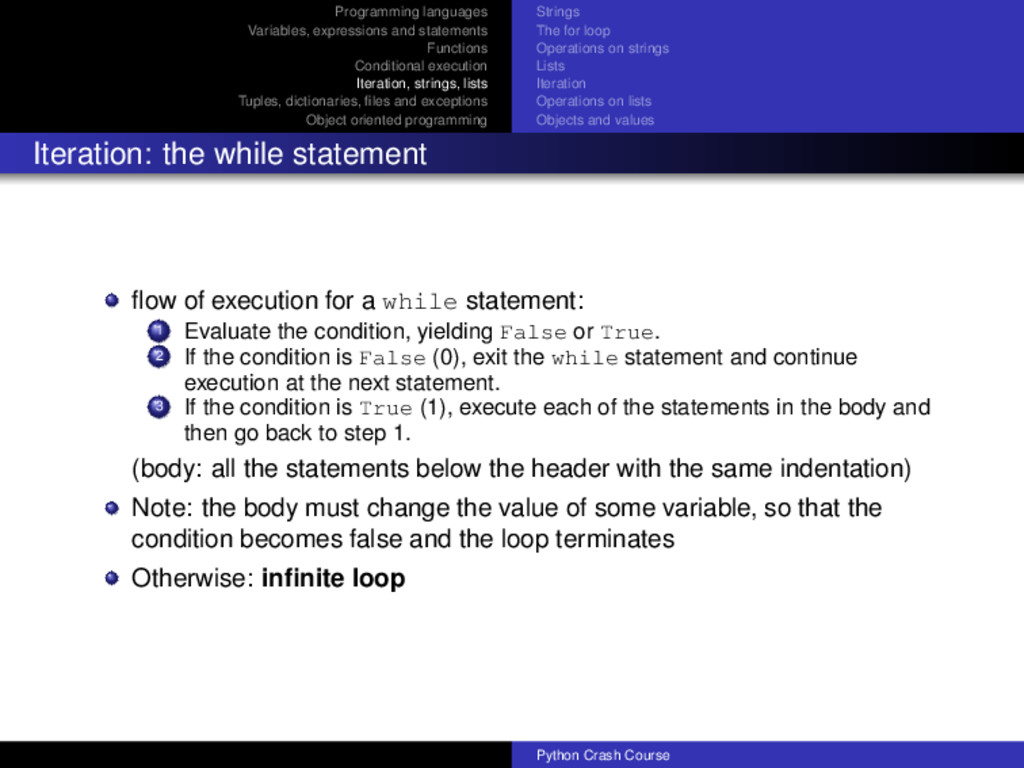
    strings, lists Tuples, dictionaries, files and exceptions Object oriented programming Strings The for loop Operations on strings Lists Iteration Operations on lists Objects and values Iteration: the while statement flow of execution for a while statement: 1 Evaluate the condition, yielding False or True. 2 If the condition is False (0), exit the while statement and continue execution at the next statement. 3 If the condition is True (1), execute each of the statements in the body and then go back to step 1. (body: all the statements below the header with the same indentation) Note: the body must change the value of some variable, so that the condition becomes false and the loop terminates Otherwise: infinite loop Python Crash Course
  38. Programming languages Variables, expressions and statements Functions Conditional execution Iteration,

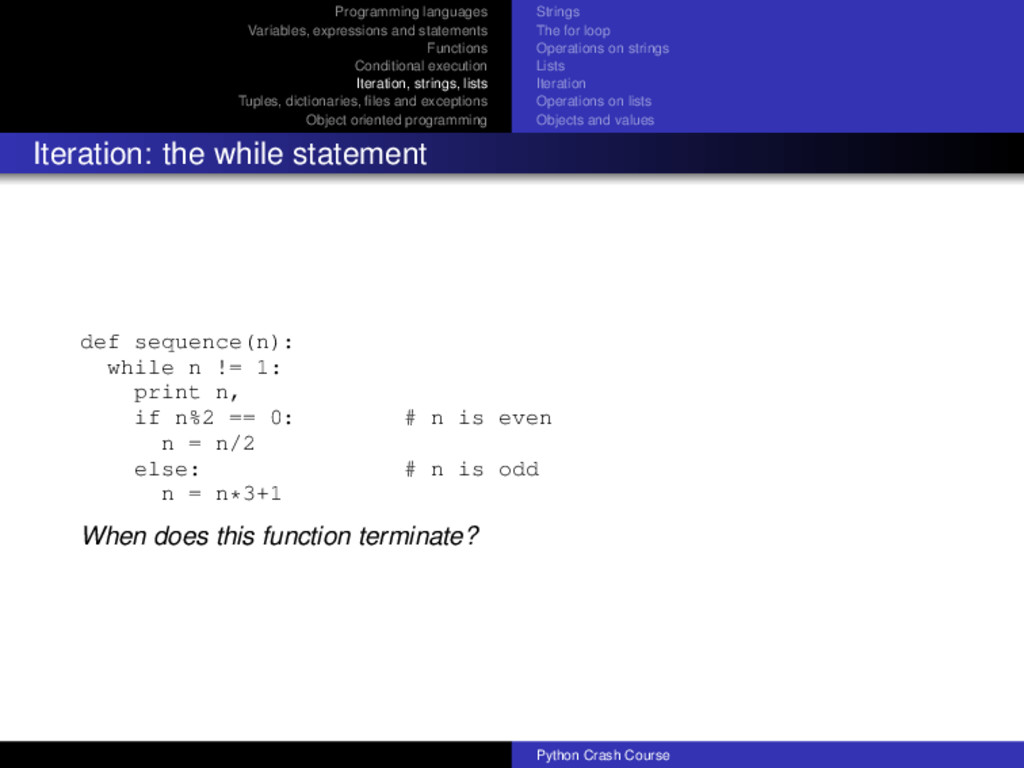
    strings, lists Tuples, dictionaries, files and exceptions Object oriented programming Strings The for loop Operations on strings Lists Iteration Operations on lists Objects and values Iteration: the while statement def sequence(n): while n != 1: print n, if n%2 == 0: # n is even n = n/2 else: # n is odd n = n*3+1 When does this function terminate? Python Crash Course
  39. Programming languages Variables, expressions and statements Functions Conditional execution Iteration,

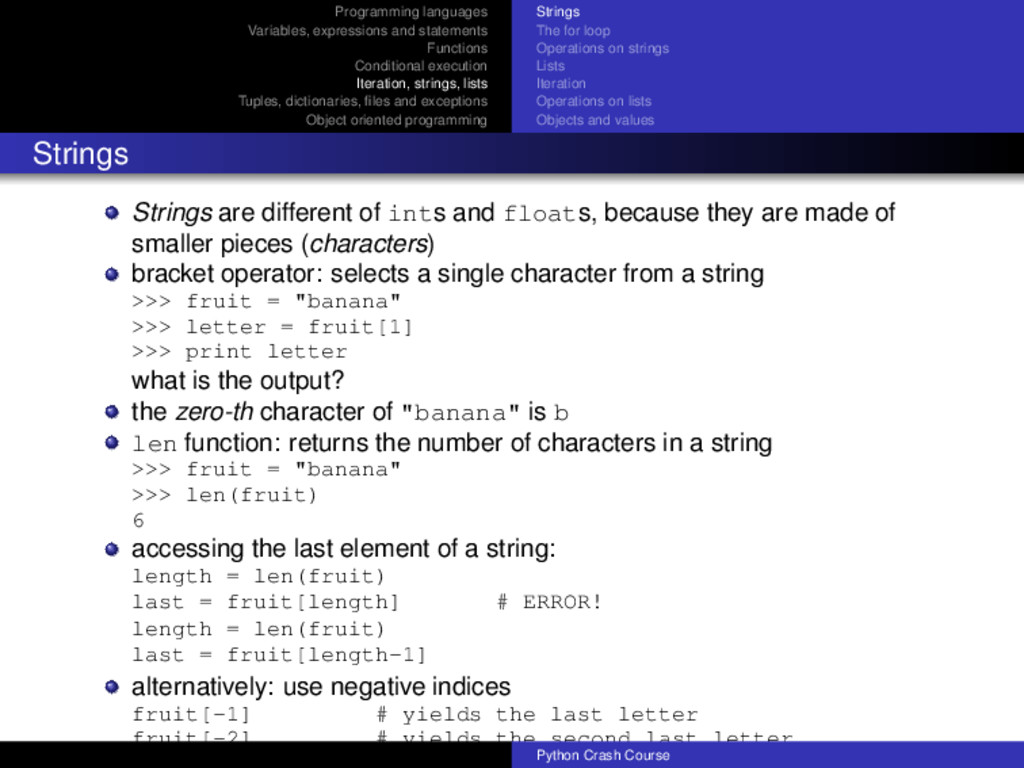
    strings, lists Tuples, dictionaries, files and exceptions Object oriented programming Strings The for loop Operations on strings Lists Iteration Operations on lists Objects and values Strings Strings are different of ints and floats, because they are made of smaller pieces (characters) bracket operator: selects a single character from a string >>> fruit = "banana" >>> letter = fruit[1] >>> print letter what is the output? the zero-th character of "banana" is b len function: returns the number of characters in a string >>> fruit = "banana" >>> len(fruit) 6 accessing the last element of a string: length = len(fruit) last = fruit[length] # ERROR! length = len(fruit) last = fruit[length-1] alternatively: use negative indices fruit[-1] # yields the last letter fruit[-2] # yields the second last letter Python Crash Course
  40. Programming languages Variables, expressions and statements Functions Conditional execution Iteration,

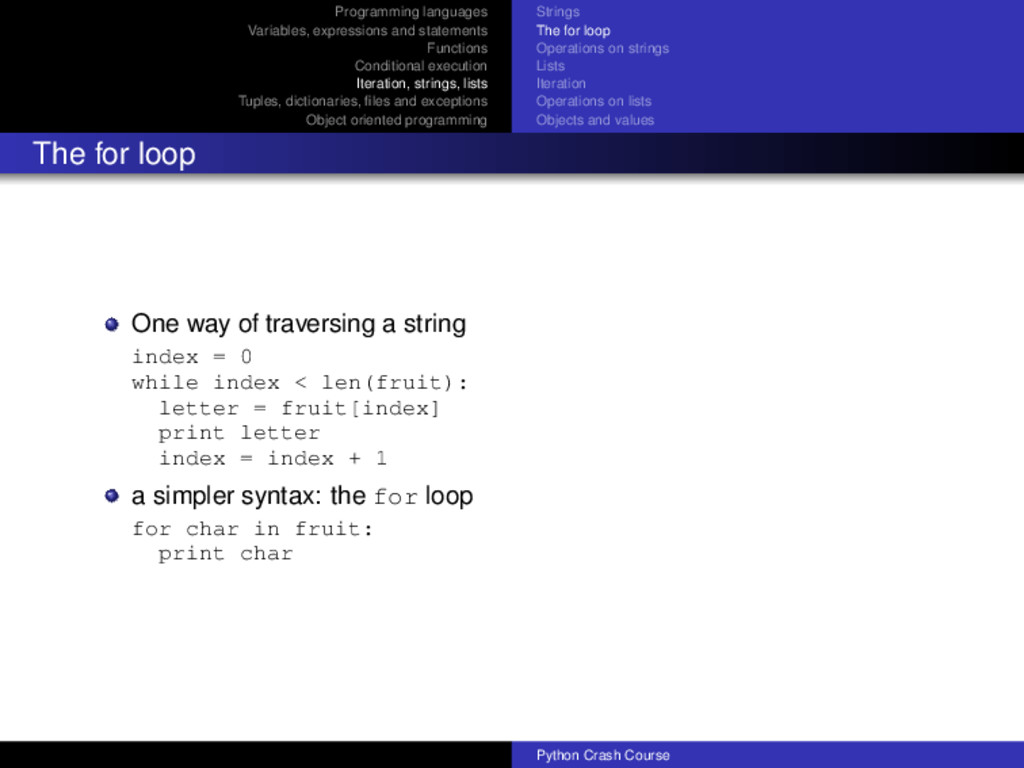
    strings, lists Tuples, dictionaries, files and exceptions Object oriented programming Strings The for loop Operations on strings Lists Iteration Operations on lists Objects and values The for loop One way of traversing a string index = 0 while index < len(fruit): letter = fruit[index] print letter index = index + 1 a simpler syntax: the for loop for char in fruit: print char Python Crash Course
  41. Programming languages Variables, expressions and statements Functions Conditional execution Iteration,

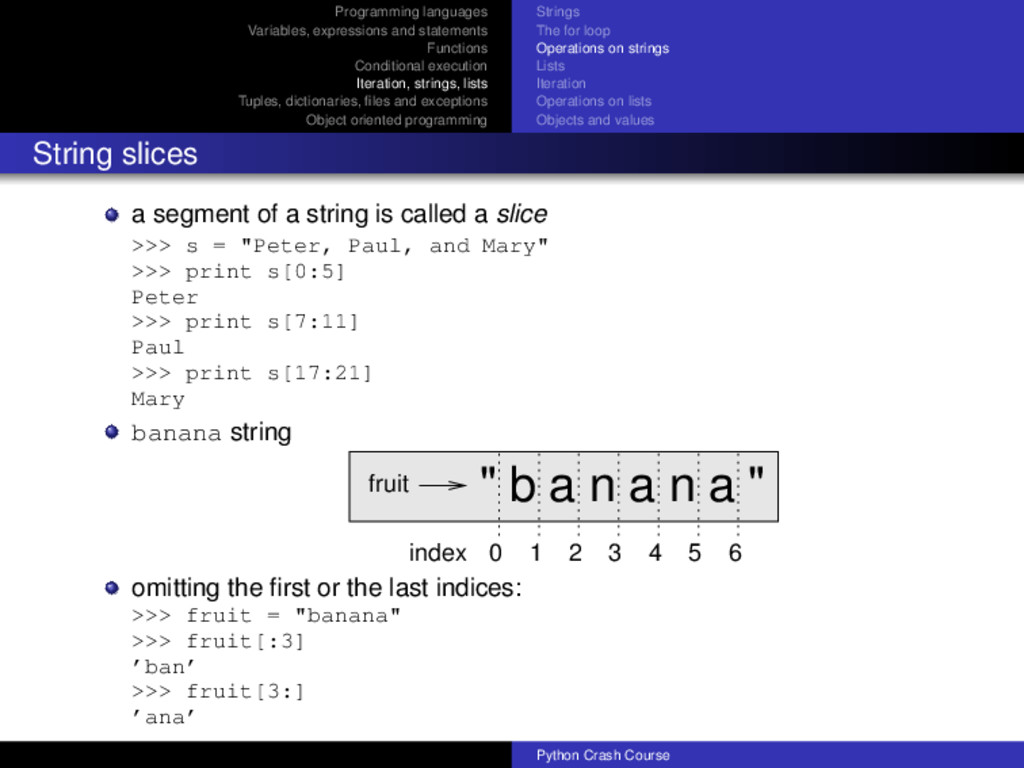
    strings, lists Tuples, dictionaries, files and exceptions Object oriented programming Strings The for loop Operations on strings Lists Iteration Operations on lists Objects and values String slices a segment of a string is called a slice >>> s = "Peter, Paul, and Mary" >>> print s[0:5] Peter >>> print s[7:11] Paul >>> print s[17:21] Mary banana string fruit " b a n n a a " 0 1 2 3 4 5 6 index omitting the first or the last indices: >>> fruit = "banana" >>> fruit[:3] ’ban’ >>> fruit[3:] ’ana’ Python Crash Course
  42. Programming languages Variables, expressions and statements Functions Conditional execution Iteration,

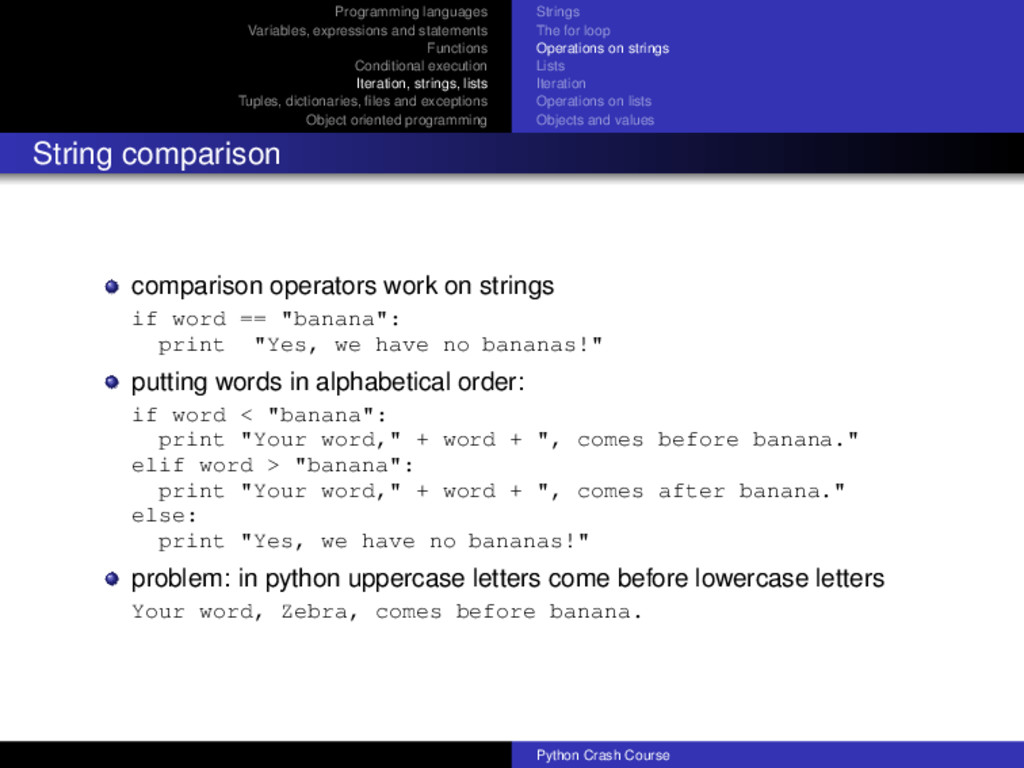
    strings, lists Tuples, dictionaries, files and exceptions Object oriented programming Strings The for loop Operations on strings Lists Iteration Operations on lists Objects and values String comparison comparison operators work on strings if word == "banana": print "Yes, we have no bananas!" putting words in alphabetical order: if word < "banana": print "Your word," + word + ", comes before banana." elif word > "banana": print "Your word," + word + ", comes after banana." else: print "Yes, we have no bananas!" problem: in python uppercase letters come before lowercase letters Your word, Zebra, comes before banana. Python Crash Course
  43. Programming languages Variables, expressions and statements Functions Conditional execution Iteration,

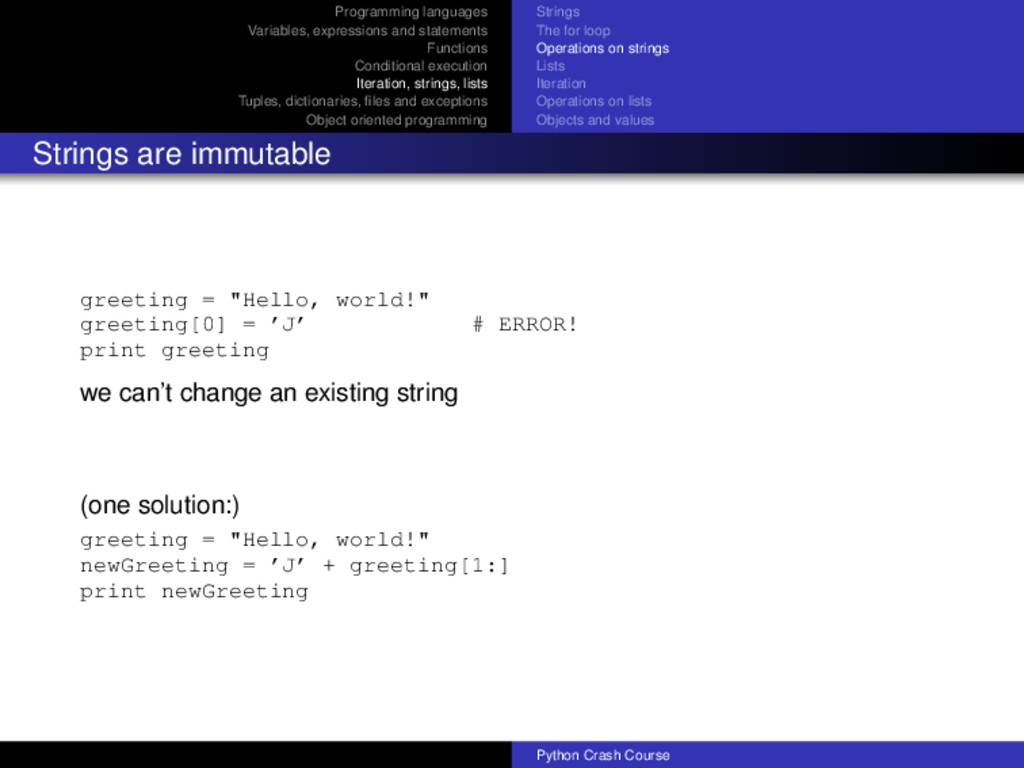
    strings, lists Tuples, dictionaries, files and exceptions Object oriented programming Strings The for loop Operations on strings Lists Iteration Operations on lists Objects and values Strings are immutable greeting = "Hello, world!" greeting[0] = ’J’ # ERROR! print greeting we can’t change an existing string (one solution:) greeting = "Hello, world!" newGreeting = ’J’ + greeting[1:] print newGreeting Python Crash Course
  44. Programming languages Variables, expressions and statements Functions Conditional execution Iteration,

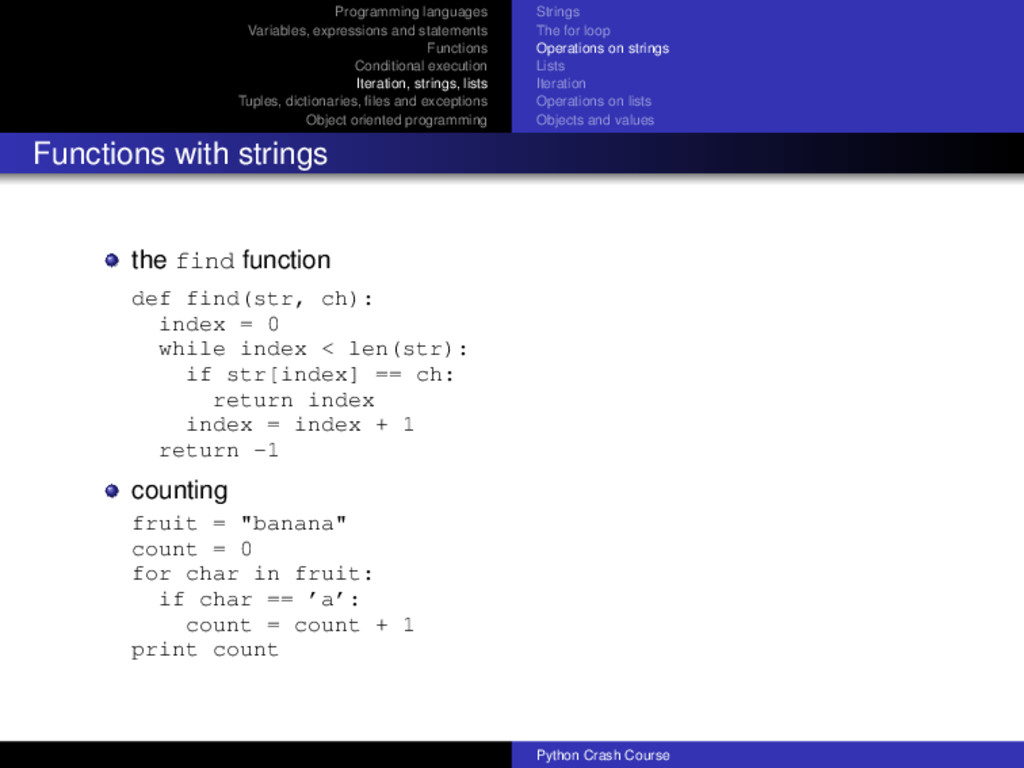
    strings, lists Tuples, dictionaries, files and exceptions Object oriented programming Strings The for loop Operations on strings Lists Iteration Operations on lists Objects and values Functions with strings the find function def find(str, ch): index = 0 while index < len(str): if str[index] == ch: return index index = index + 1 return -1 counting fruit = "banana" count = 0 for char in fruit: if char == ’a’: count = count + 1 print count Python Crash Course
  45. Programming languages Variables, expressions and statements Functions Conditional execution Iteration,

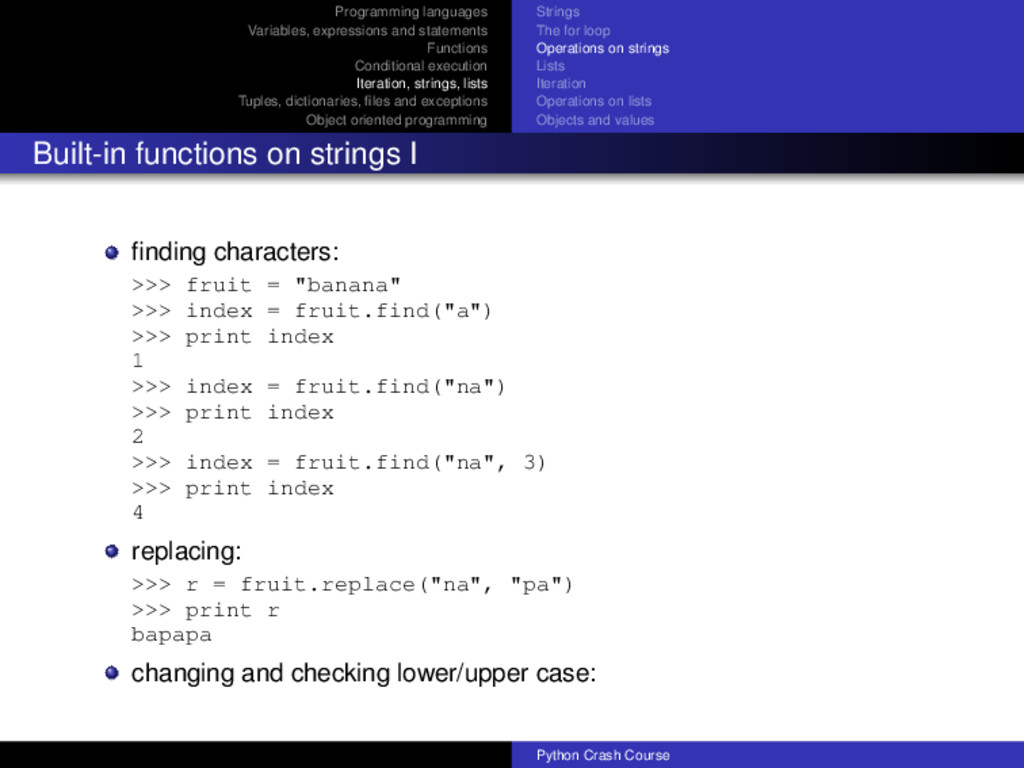
    strings, lists Tuples, dictionaries, files and exceptions Object oriented programming Strings The for loop Operations on strings Lists Iteration Operations on lists Objects and values Built-in functions on strings I finding characters: >>> fruit = "banana" >>> index = fruit.find("a") >>> print index 1 >>> index = fruit.find("na") >>> print index 2 >>> index = fruit.find("na", 3) >>> print index 4 replacing: >>> r = fruit.replace("na", "pa") >>> print r bapapa changing and checking lower/upper case: Python Crash Course
  46. Programming languages Variables, expressions and statements Functions Conditional execution Iteration,

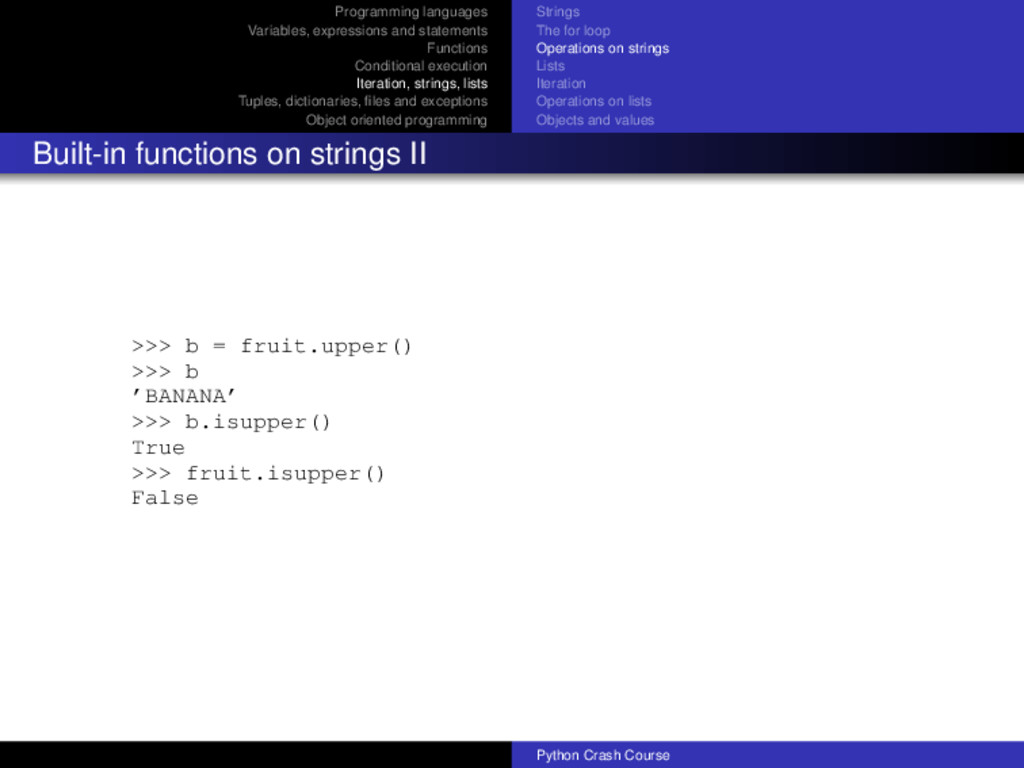
    strings, lists Tuples, dictionaries, files and exceptions Object oriented programming Strings The for loop Operations on strings Lists Iteration Operations on lists Objects and values Built-in functions on strings II >>> b = fruit.upper() >>> b ’BANANA’ >>> b.isupper() True >>> fruit.isupper() False Python Crash Course
  47. Programming languages Variables, expressions and statements Functions Conditional execution Iteration,

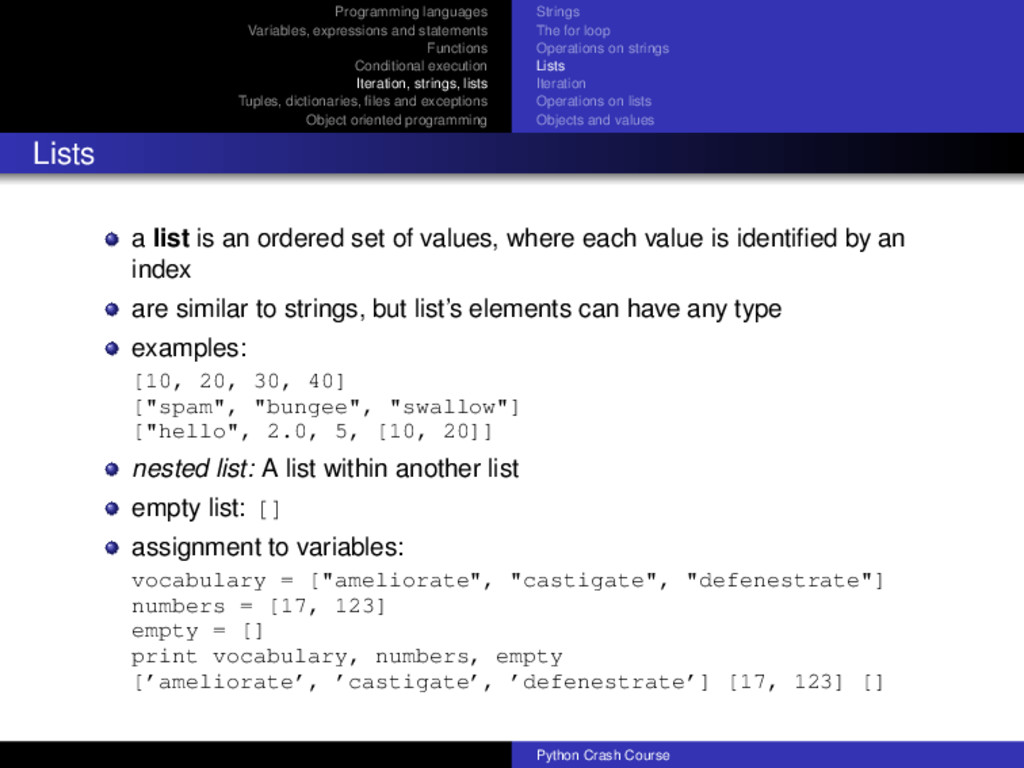
    strings, lists Tuples, dictionaries, files and exceptions Object oriented programming Strings The for loop Operations on strings Lists Iteration Operations on lists Objects and values Lists a list is an ordered set of values, where each value is identified by an index are similar to strings, but list’s elements can have any type examples: [10, 20, 30, 40] ["spam", "bungee", "swallow"] ["hello", 2.0, 5, [10, 20]] nested list: A list within another list empty list: [] assignment to variables: vocabulary = ["ameliorate", "castigate", "defenestrate"] numbers = [17, 123] empty = [] print vocabulary, numbers, empty [’ameliorate’, ’castigate’, ’defenestrate’] [17, 123] [] Python Crash Course
  48. Programming languages Variables, expressions and statements Functions Conditional execution Iteration,

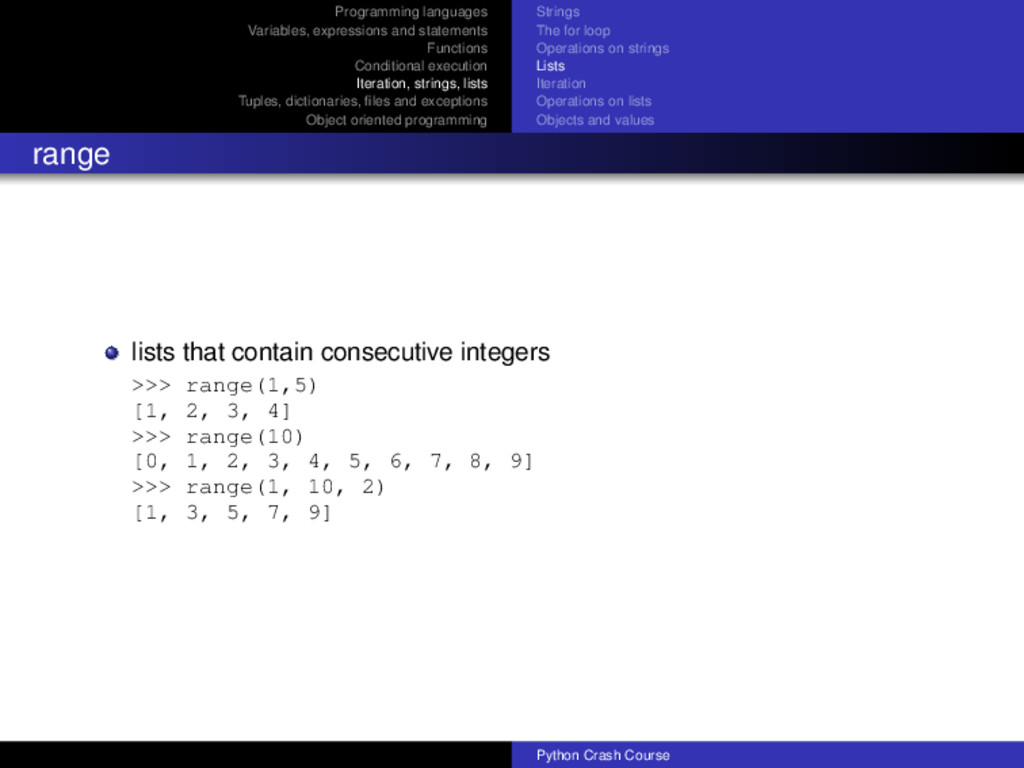
    strings, lists Tuples, dictionaries, files and exceptions Object oriented programming Strings The for loop Operations on strings Lists Iteration Operations on lists Objects and values range lists that contain consecutive integers >>> range(1,5) [1, 2, 3, 4] >>> range(10) [0, 1, 2, 3, 4, 5, 6, 7, 8, 9] >>> range(1, 10, 2) [1, 3, 5, 7, 9] Python Crash Course
  49. Programming languages Variables, expressions and statements Functions Conditional execution Iteration,

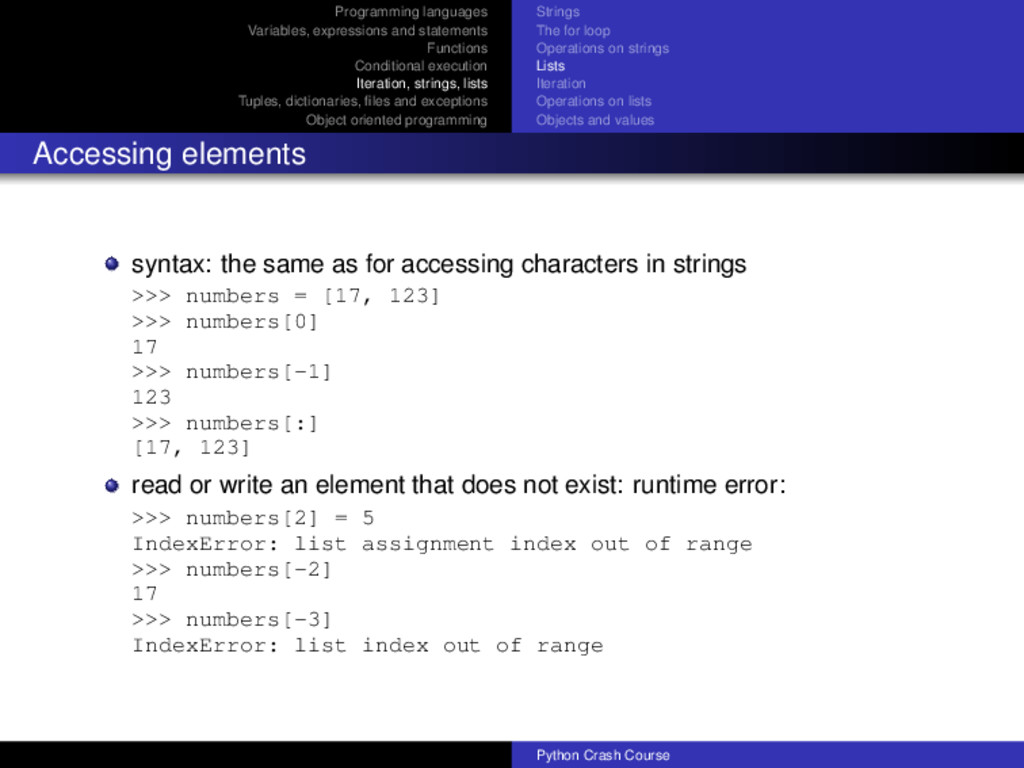
    strings, lists Tuples, dictionaries, files and exceptions Object oriented programming Strings The for loop Operations on strings Lists Iteration Operations on lists Objects and values Accessing elements syntax: the same as for accessing characters in strings >>> numbers = [17, 123] >>> numbers[0] 17 >>> numbers[-1] 123 >>> numbers[:] [17, 123] read or write an element that does not exist: runtime error: >>> numbers[2] = 5 IndexError: list assignment index out of range >>> numbers[-2] 17 >>> numbers[-3] IndexError: list index out of range Python Crash Course
  50. Programming languages Variables, expressions and statements Functions Conditional execution Iteration,

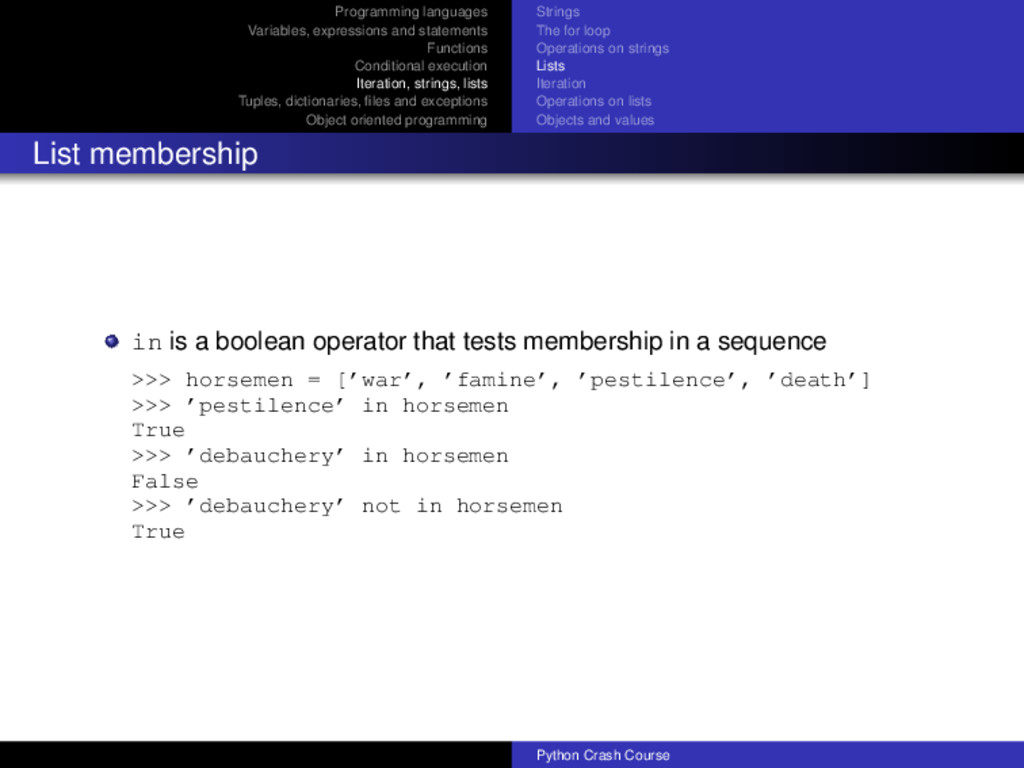
    strings, lists Tuples, dictionaries, files and exceptions Object oriented programming Strings The for loop Operations on strings Lists Iteration Operations on lists Objects and values List membership in is a boolean operator that tests membership in a sequence >>> horsemen = [’war’, ’famine’, ’pestilence’, ’death’] >>> ’pestilence’ in horsemen True >>> ’debauchery’ in horsemen False >>> ’debauchery’ not in horsemen True Python Crash Course
  51. Programming languages Variables, expressions and statements Functions Conditional execution Iteration,

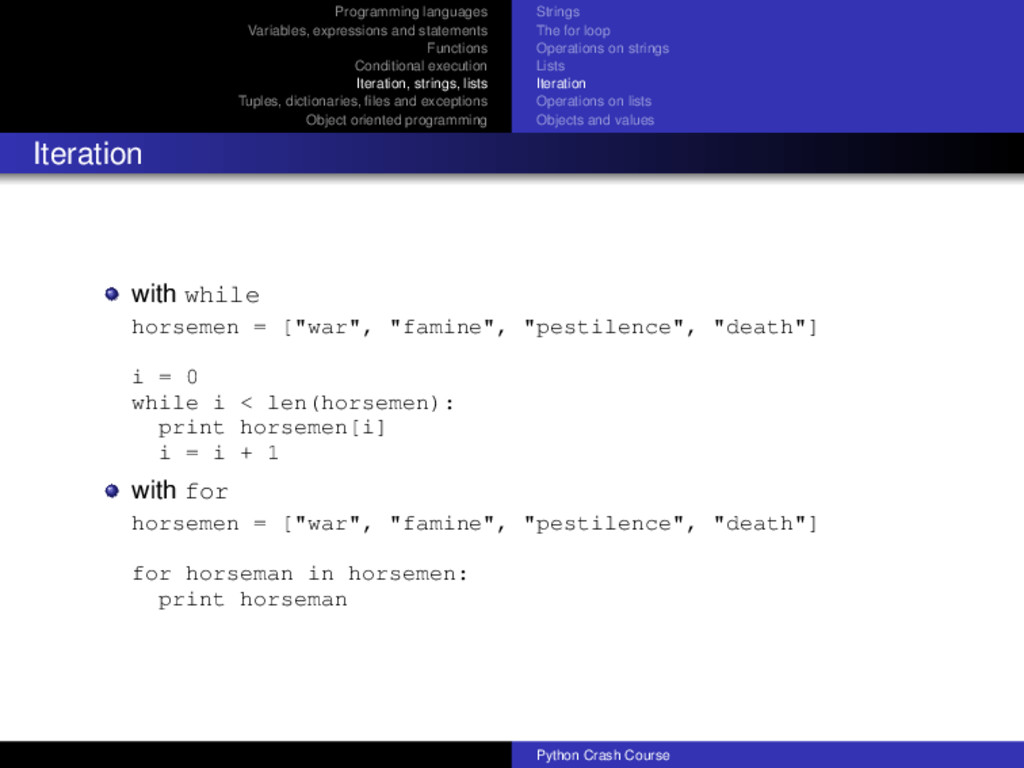
    strings, lists Tuples, dictionaries, files and exceptions Object oriented programming Strings The for loop Operations on strings Lists Iteration Operations on lists Objects and values Iteration with while horsemen = ["war", "famine", "pestilence", "death"] i = 0 while i < len(horsemen): print horsemen[i] i = i + 1 with for horsemen = ["war", "famine", "pestilence", "death"] for horseman in horsemen: print horseman Python Crash Course
  52. Programming languages Variables, expressions and statements Functions Conditional execution Iteration,

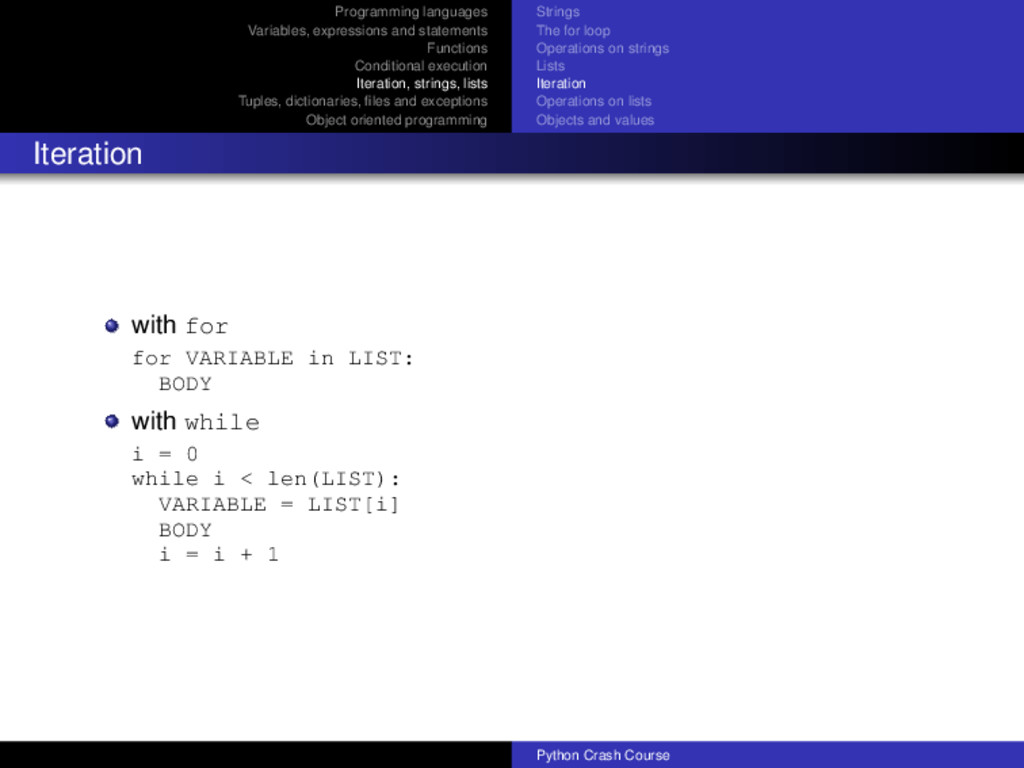
    strings, lists Tuples, dictionaries, files and exceptions Object oriented programming Strings The for loop Operations on strings Lists Iteration Operations on lists Objects and values Iteration with for for VARIABLE in LIST: BODY with while i = 0 while i < len(LIST): VARIABLE = LIST[i] BODY i = i + 1 Python Crash Course
  53. Programming languages Variables, expressions and statements Functions Conditional execution Iteration,

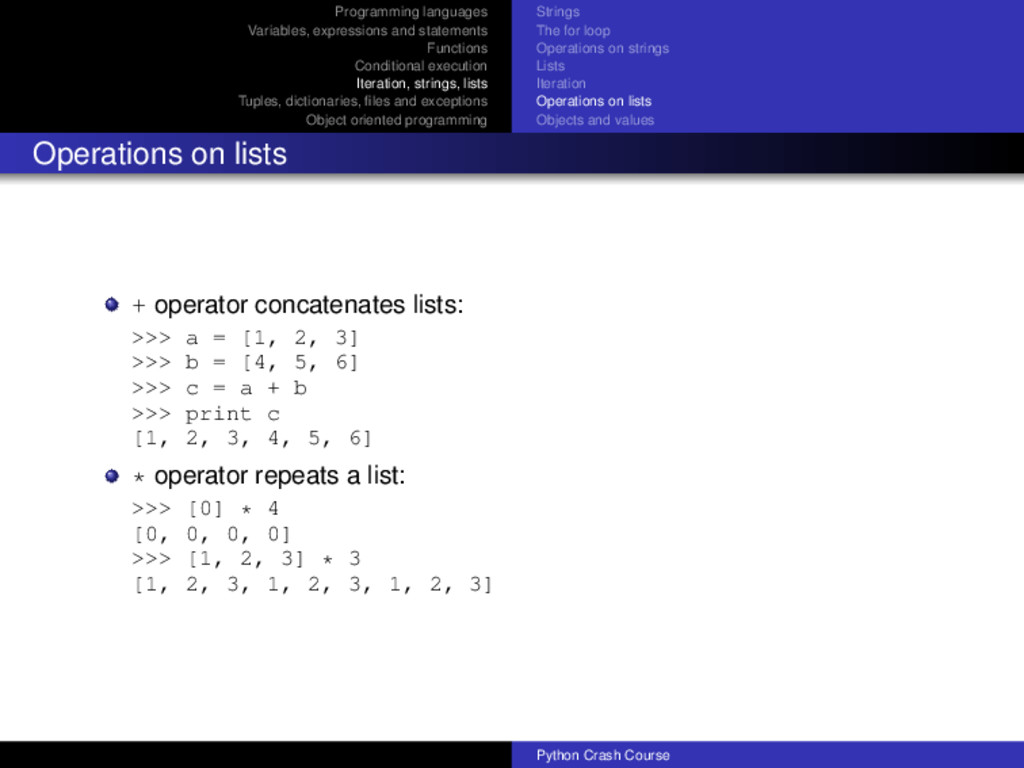
    strings, lists Tuples, dictionaries, files and exceptions Object oriented programming Strings The for loop Operations on strings Lists Iteration Operations on lists Objects and values Operations on lists + operator concatenates lists: >>> a = [1, 2, 3] >>> b = [4, 5, 6] >>> c = a + b >>> print c [1, 2, 3, 4, 5, 6] * operator repeats a list: >>> [0] * 4 [0, 0, 0, 0] >>> [1, 2, 3] * 3 [1, 2, 3, 1, 2, 3, 1, 2, 3] Python Crash Course
  54. Programming languages Variables, expressions and statements Functions Conditional execution Iteration,

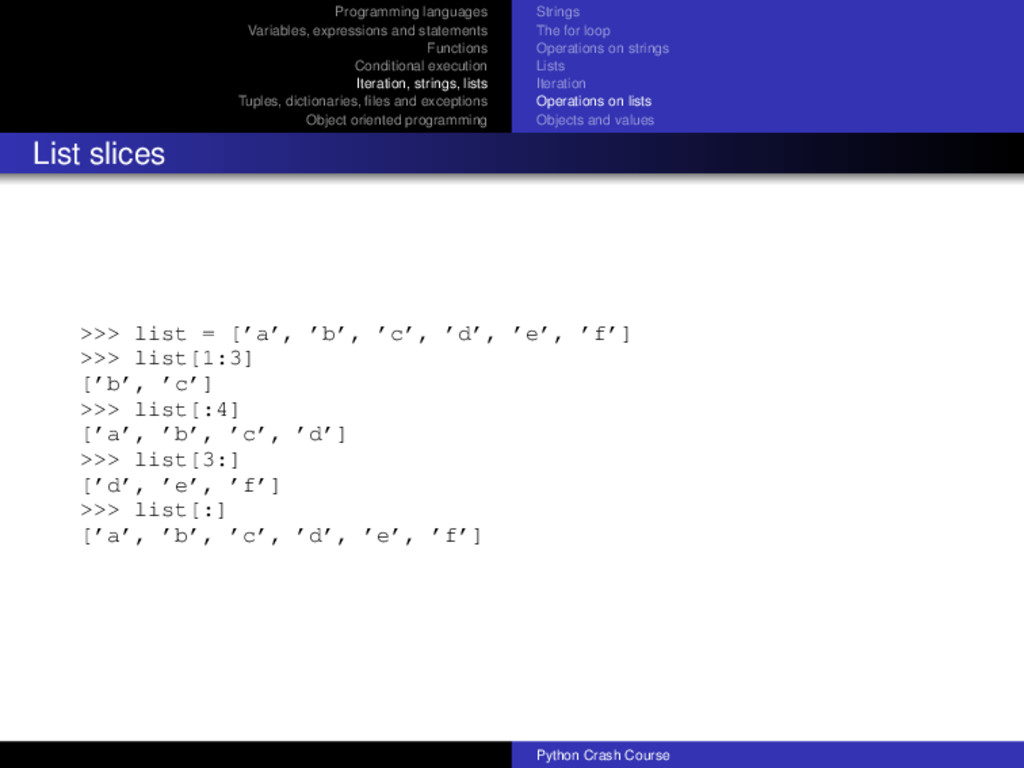
    strings, lists Tuples, dictionaries, files and exceptions Object oriented programming Strings The for loop Operations on strings Lists Iteration Operations on lists Objects and values List slices >>> list = [’a’, ’b’, ’c’, ’d’, ’e’, ’f’] >>> list[1:3] [’b’, ’c’] >>> list[:4] [’a’, ’b’, ’c’, ’d’] >>> list[3:] [’d’, ’e’, ’f’] >>> list[:] [’a’, ’b’, ’c’, ’d’, ’e’, ’f’] Python Crash Course
  55. Programming languages Variables, expressions and statements Functions Conditional execution Iteration,

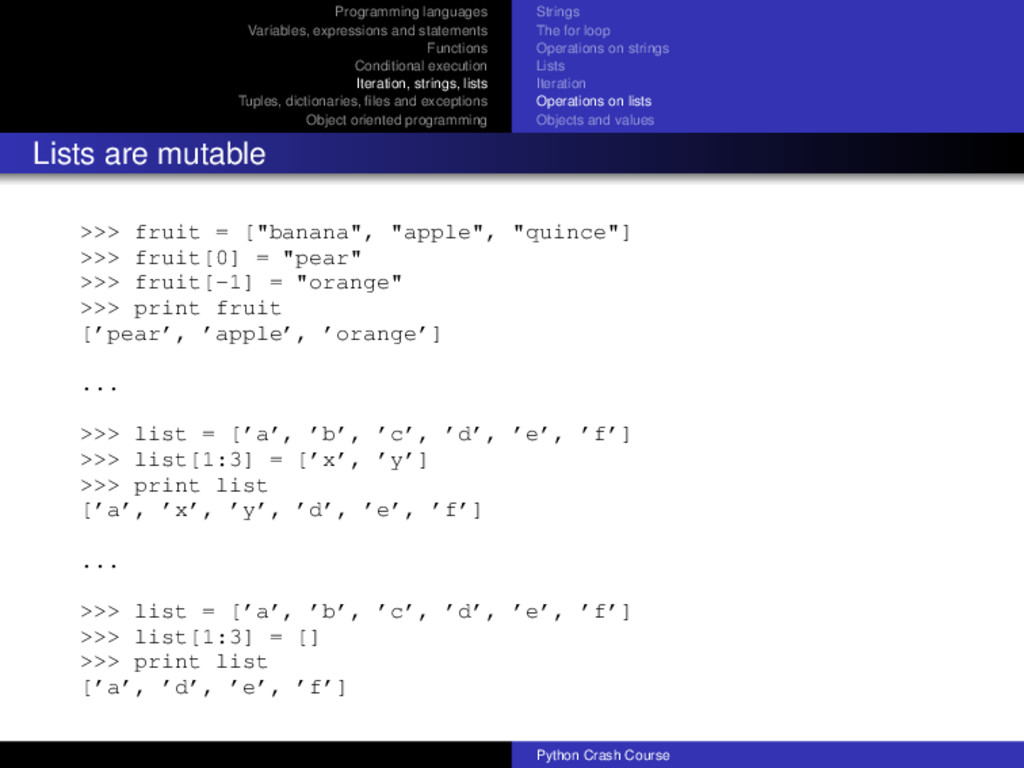
    strings, lists Tuples, dictionaries, files and exceptions Object oriented programming Strings The for loop Operations on strings Lists Iteration Operations on lists Objects and values Lists are mutable >>> fruit = ["banana", "apple", "quince"] >>> fruit[0] = "pear" >>> fruit[-1] = "orange" >>> print fruit [’pear’, ’apple’, ’orange’] ... >>> list = [’a’, ’b’, ’c’, ’d’, ’e’, ’f’] >>> list[1:3] = [’x’, ’y’] >>> print list [’a’, ’x’, ’y’, ’d’, ’e’, ’f’] ... >>> list = [’a’, ’b’, ’c’, ’d’, ’e’, ’f’] >>> list[1:3] = [] >>> print list [’a’, ’d’, ’e’, ’f’] Python Crash Course
  56. Programming languages Variables, expressions and statements Functions Conditional execution Iteration,

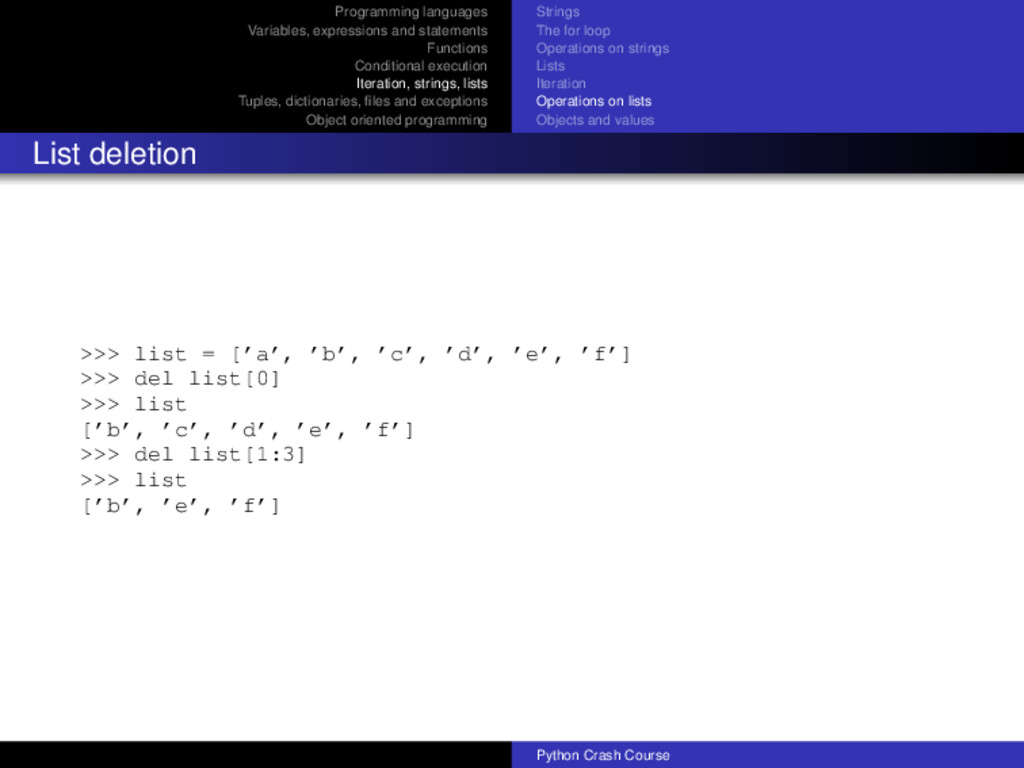
    strings, lists Tuples, dictionaries, files and exceptions Object oriented programming Strings The for loop Operations on strings Lists Iteration Operations on lists Objects and values List deletion >>> list = [’a’, ’b’, ’c’, ’d’, ’e’, ’f’] >>> del list[0] >>> list [’b’, ’c’, ’d’, ’e’, ’f’] >>> del list[1:3] >>> list [’b’, ’e’, ’f’] Python Crash Course
  57. Programming languages Variables, expressions and statements Functions Conditional execution Iteration,

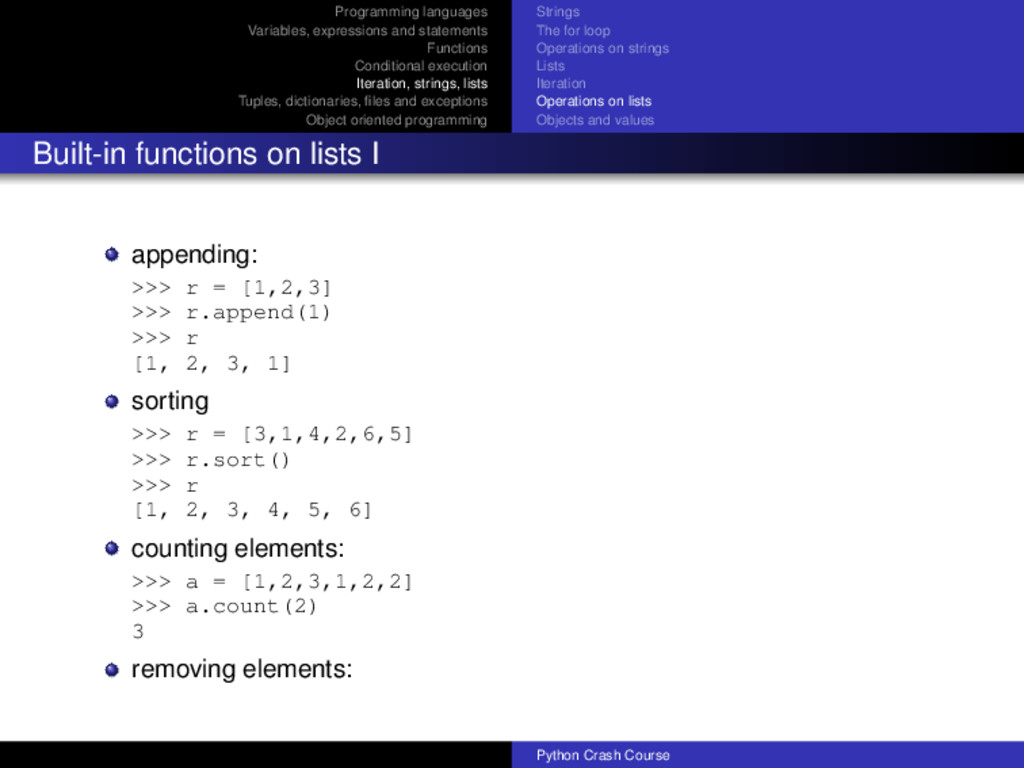
    strings, lists Tuples, dictionaries, files and exceptions Object oriented programming Strings The for loop Operations on strings Lists Iteration Operations on lists Objects and values Built-in functions on lists I appending: >>> r = [1,2,3] >>> r.append(1) >>> r [1, 2, 3, 1] sorting >>> r = [3,1,4,2,6,5] >>> r.sort() >>> r [1, 2, 3, 4, 5, 6] counting elements: >>> a = [1,2,3,1,2,2] >>> a.count(2) 3 removing elements: Python Crash Course
  58. Programming languages Variables, expressions and statements Functions Conditional execution Iteration,

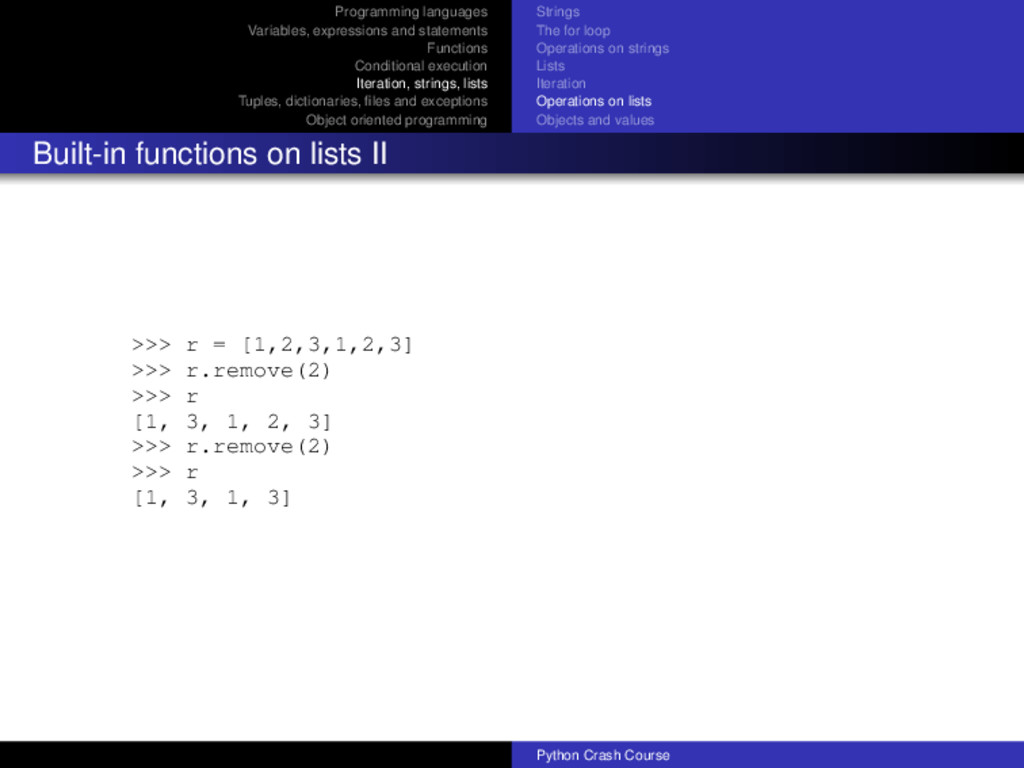
    strings, lists Tuples, dictionaries, files and exceptions Object oriented programming Strings The for loop Operations on strings Lists Iteration Operations on lists Objects and values Built-in functions on lists II >>> r = [1,2,3,1,2,3] >>> r.remove(2) >>> r [1, 3, 1, 2, 3] >>> r.remove(2) >>> r [1, 3, 1, 3] Python Crash Course
  59. Programming languages Variables, expressions and statements Functions Conditional execution Iteration,

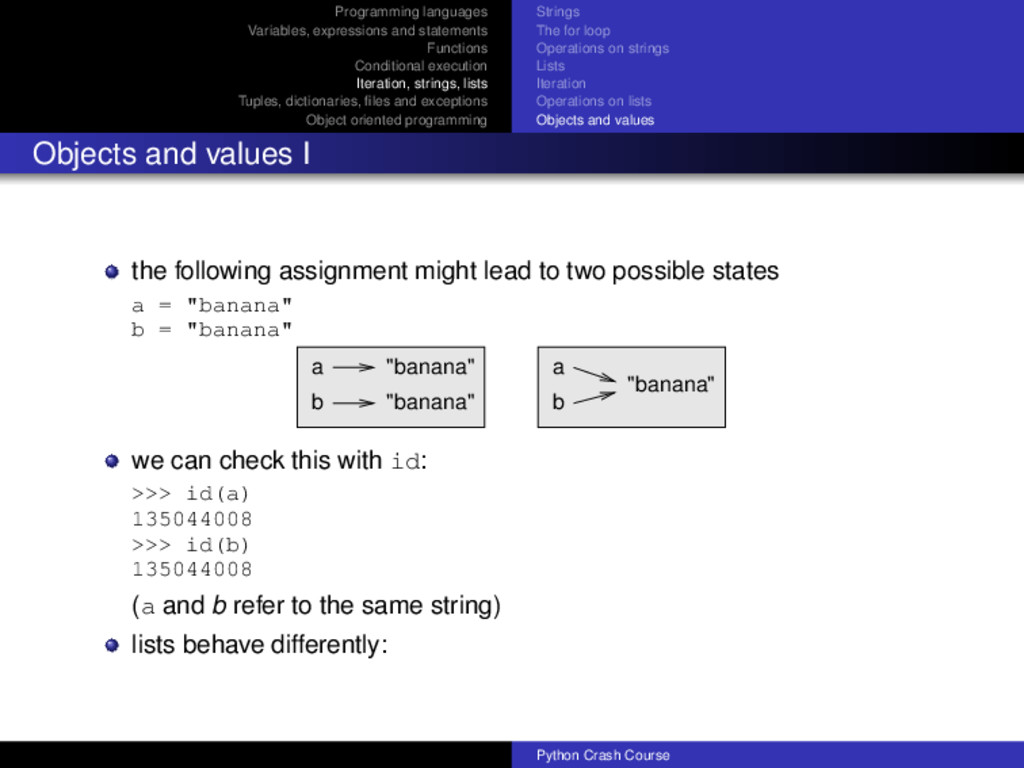
    strings, lists Tuples, dictionaries, files and exceptions Object oriented programming Strings The for loop Operations on strings Lists Iteration Operations on lists Objects and values Objects and values I the following assignment might lead to two possible states a = "banana" b = "banana" a b "banana" "banana" a b "banana" we can check this with id: >>> id(a) 135044008 >>> id(b) 135044008 (a and b refer to the same string) lists behave differently: Python Crash Course
  60. Programming languages Variables, expressions and statements Functions Conditional execution Iteration,

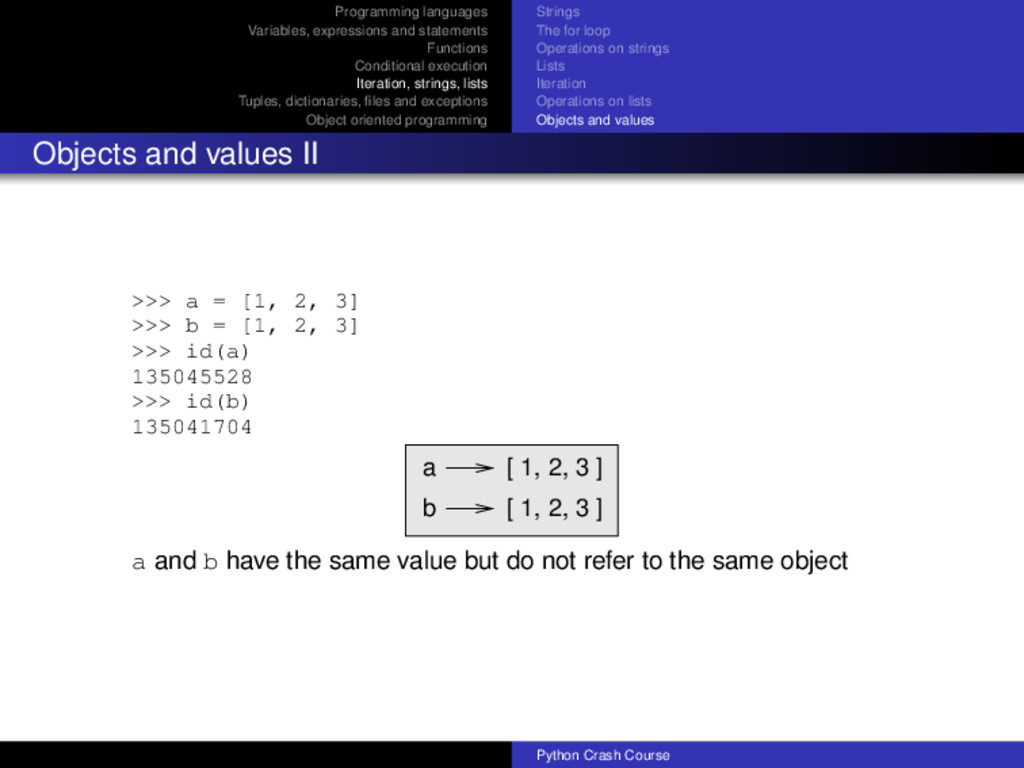
    strings, lists Tuples, dictionaries, files and exceptions Object oriented programming Strings The for loop Operations on strings Lists Iteration Operations on lists Objects and values Objects and values II >>> a = [1, 2, 3] >>> b = [1, 2, 3] >>> id(a) 135045528 >>> id(b) 135041704 a b [ 1, 2, 3 ] [ 1, 2, 3 ] a and b have the same value but do not refer to the same object Python Crash Course
  61. Programming languages Variables, expressions and statements Functions Conditional execution Iteration,

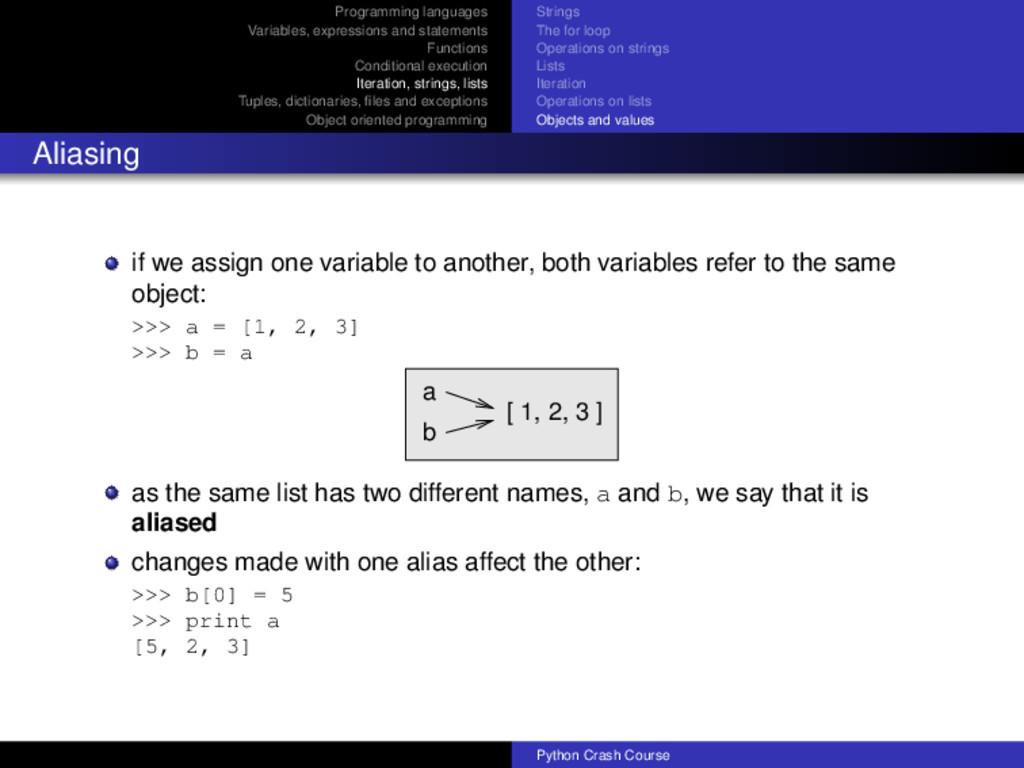
    strings, lists Tuples, dictionaries, files and exceptions Object oriented programming Strings The for loop Operations on strings Lists Iteration Operations on lists Objects and values Aliasing if we assign one variable to another, both variables refer to the same object: >>> a = [1, 2, 3] >>> b = a a b [ 1, 2, 3 ] as the same list has two different names, a and b, we say that it is aliased changes made with one alias affect the other: >>> b[0] = 5 >>> print a [5, 2, 3] Python Crash Course
  62. Programming languages Variables, expressions and statements Functions Conditional execution Iteration,

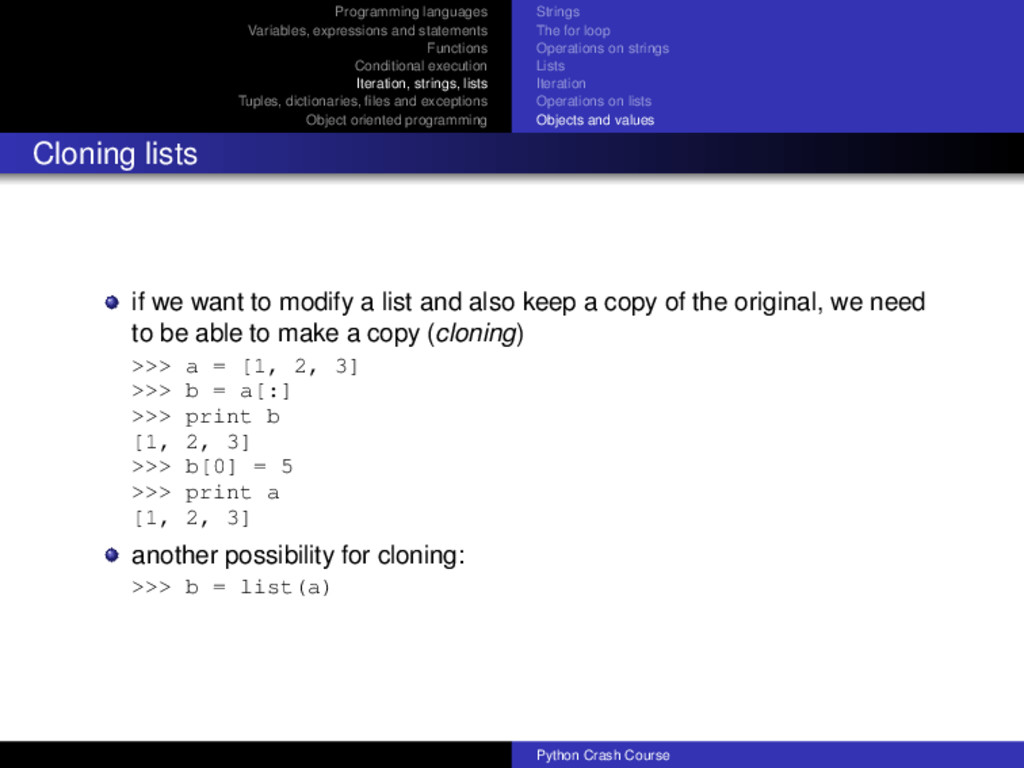
    strings, lists Tuples, dictionaries, files and exceptions Object oriented programming Strings The for loop Operations on strings Lists Iteration Operations on lists Objects and values Cloning lists if we want to modify a list and also keep a copy of the original, we need to be able to make a copy (cloning) >>> a = [1, 2, 3] >>> b = a[:] >>> print b [1, 2, 3] >>> b[0] = 5 >>> print a [1, 2, 3] another possibility for cloning: >>> b = list(a) Python Crash Course
  63. Programming languages Variables, expressions and statements Functions Conditional execution Iteration,

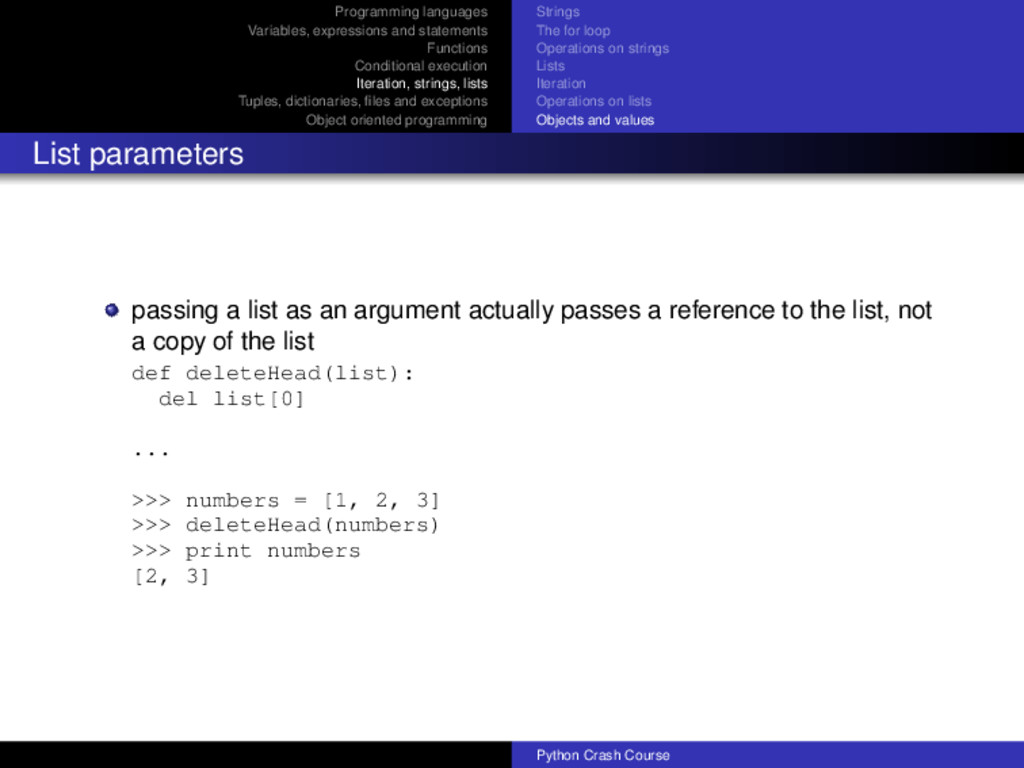
    strings, lists Tuples, dictionaries, files and exceptions Object oriented programming Strings The for loop Operations on strings Lists Iteration Operations on lists Objects and values List parameters passing a list as an argument actually passes a reference to the list, not a copy of the list def deleteHead(list): del list[0] ... >>> numbers = [1, 2, 3] >>> deleteHead(numbers) >>> print numbers [2, 3] Python Crash Course
  64. Programming languages Variables, expressions and statements Functions Conditional execution Iteration,

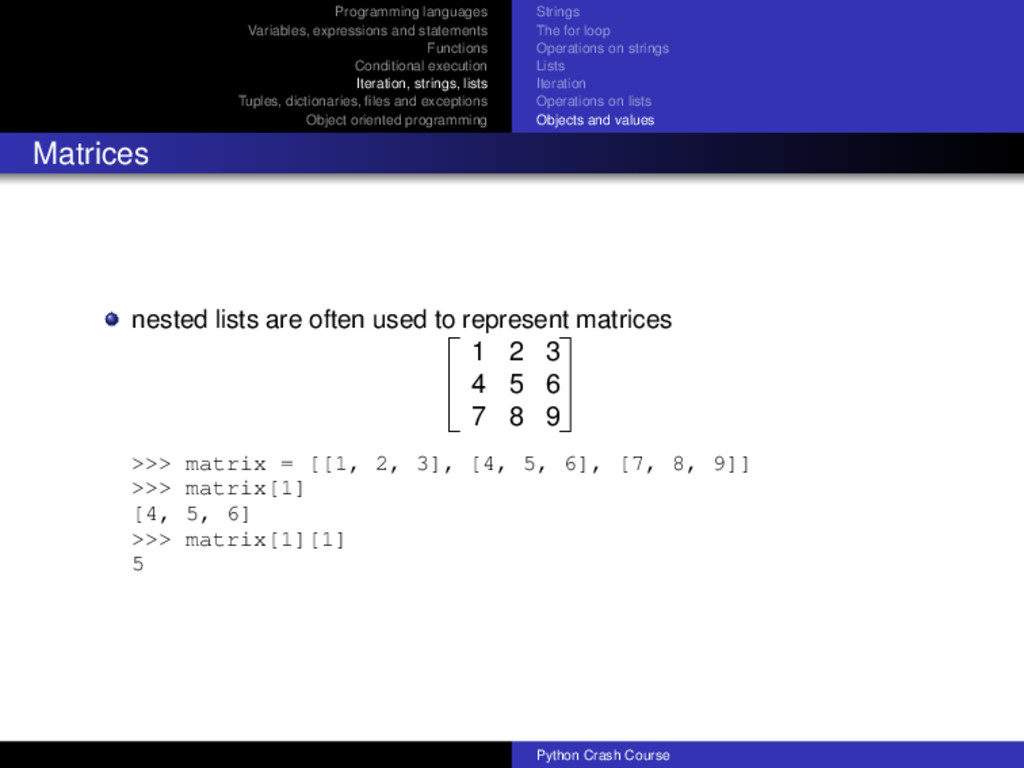
    strings, lists Tuples, dictionaries, files and exceptions Object oriented programming Strings The for loop Operations on strings Lists Iteration Operations on lists Objects and values Matrices nested lists are often used to represent matrices 1 2 3 7 8 9 4 5 6 >>> matrix = [[1, 2, 3], [4, 5, 6], [7, 8, 9]] >>> matrix[1] [4, 5, 6] >>> matrix[1][1] 5 Python Crash Course
  65. Programming languages Variables, expressions and statements Functions Conditional execution Iteration,

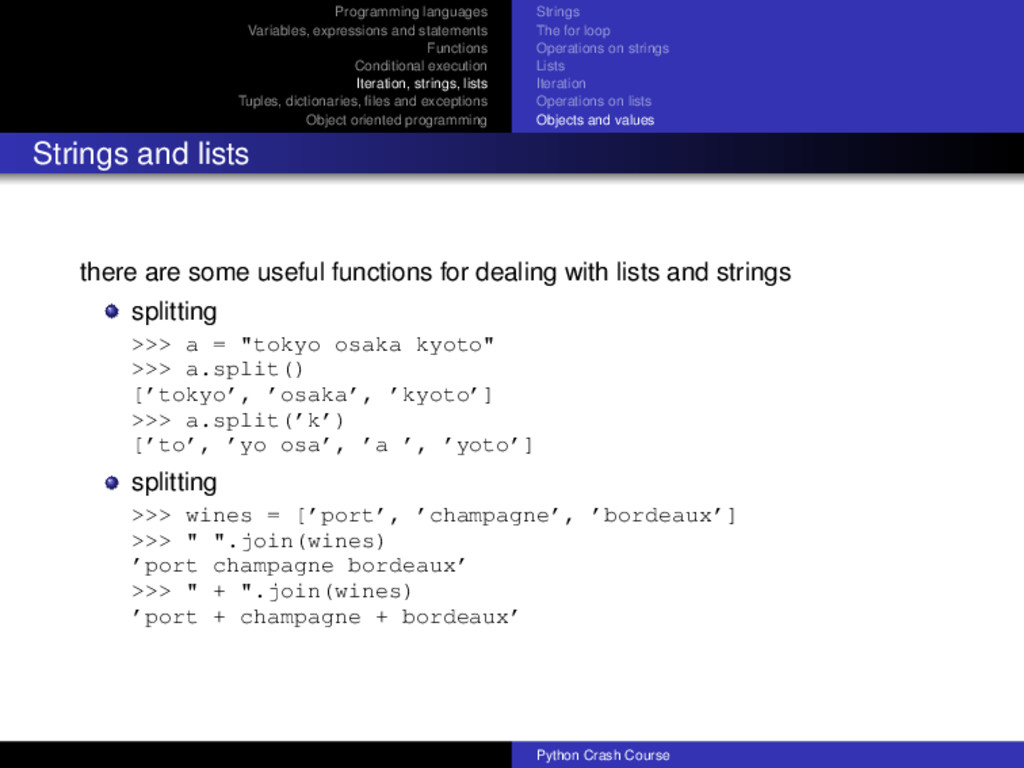
    strings, lists Tuples, dictionaries, files and exceptions Object oriented programming Strings The for loop Operations on strings Lists Iteration Operations on lists Objects and values Strings and lists there are some useful functions for dealing with lists and strings splitting >>> a = "tokyo osaka kyoto" >>> a.split() [’tokyo’, ’osaka’, ’kyoto’] >>> a.split(’k’) [’to’, ’yo osa’, ’a ’, ’yoto’] splitting >>> wines = [’port’, ’champagne’, ’bordeaux’] >>> " ".join(wines) ’port champagne bordeaux’ >>> " + ".join(wines) ’port + champagne + bordeaux’ Python Crash Course
  66. Programming languages Variables, expressions and statements Functions Conditional execution Iteration,

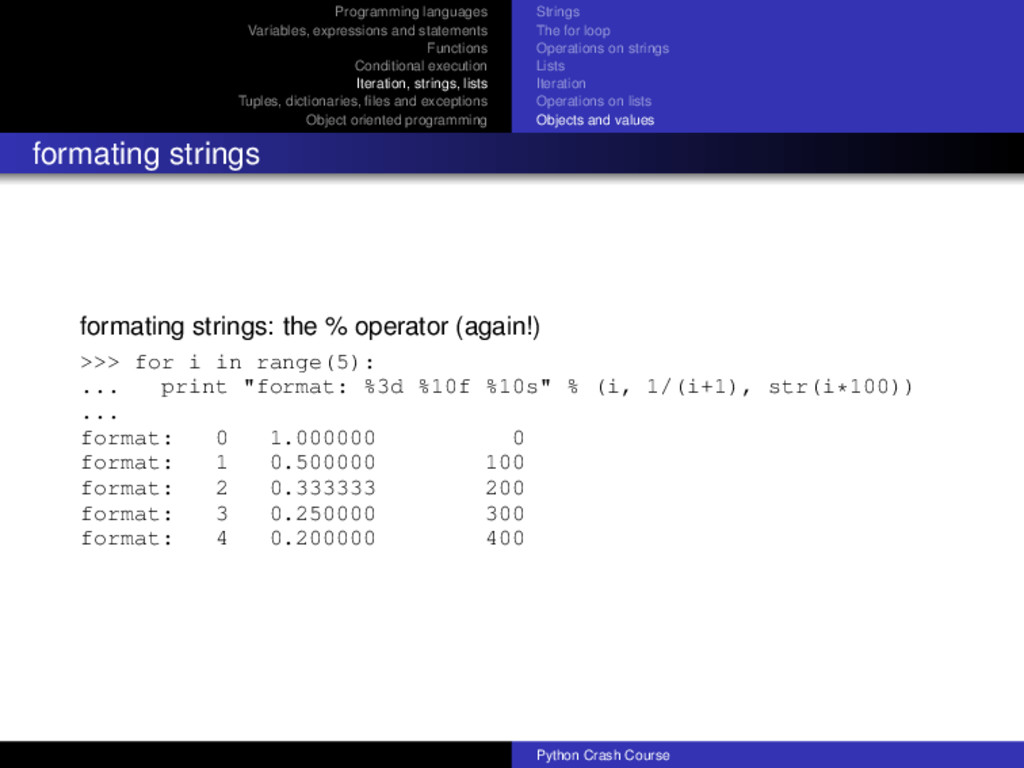
    strings, lists Tuples, dictionaries, files and exceptions Object oriented programming Strings The for loop Operations on strings Lists Iteration Operations on lists Objects and values formating strings formating strings: the % operator (again!) >>> for i in range(5): ... print "format: %3d %10f %10s" % (i, 1/(i+1), str(i*100)) ... format: 0 1.000000 0 format: 1 0.500000 100 format: 2 0.333333 200 format: 3 0.250000 300 format: 4 0.200000 400 Python Crash Course
  67. Programming languages Variables, expressions and statements Functions Conditional execution Iteration,

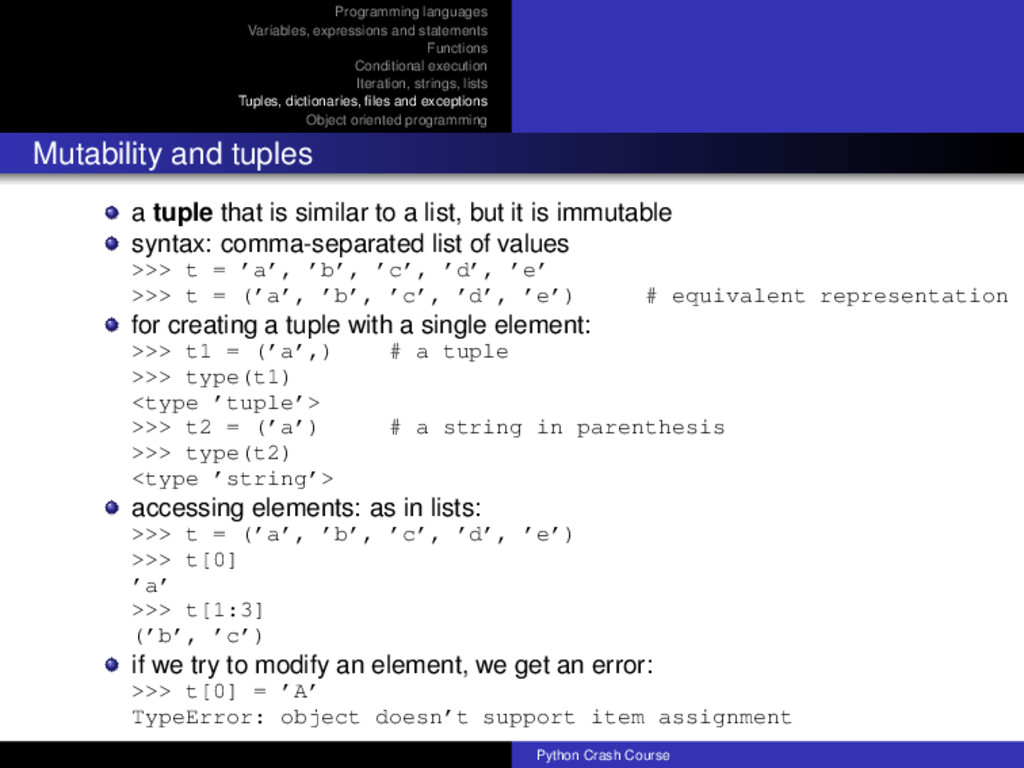
    strings, lists Tuples, dictionaries, files and exceptions Object oriented programming Mutability and tuples a tuple that is similar to a list, but it is immutable syntax: comma-separated list of values >>> t = ’a’, ’b’, ’c’, ’d’, ’e’ >>> t = (’a’, ’b’, ’c’, ’d’, ’e’) # equivalent representation for creating a tuple with a single element: >>> t1 = (’a’,) # a tuple >>> type(t1) <type ’tuple’> >>> t2 = (’a’) # a string in parenthesis >>> type(t2) <type ’string’> accessing elements: as in lists: >>> t = (’a’, ’b’, ’c’, ’d’, ’e’) >>> t[0] ’a’ >>> t[1:3] (’b’, ’c’) if we try to modify an element, we get an error: >>> t[0] = ’A’ TypeError: object doesn’t support item assignment Python Crash Course
  68. Programming languages Variables, expressions and statements Functions Conditional execution Iteration,

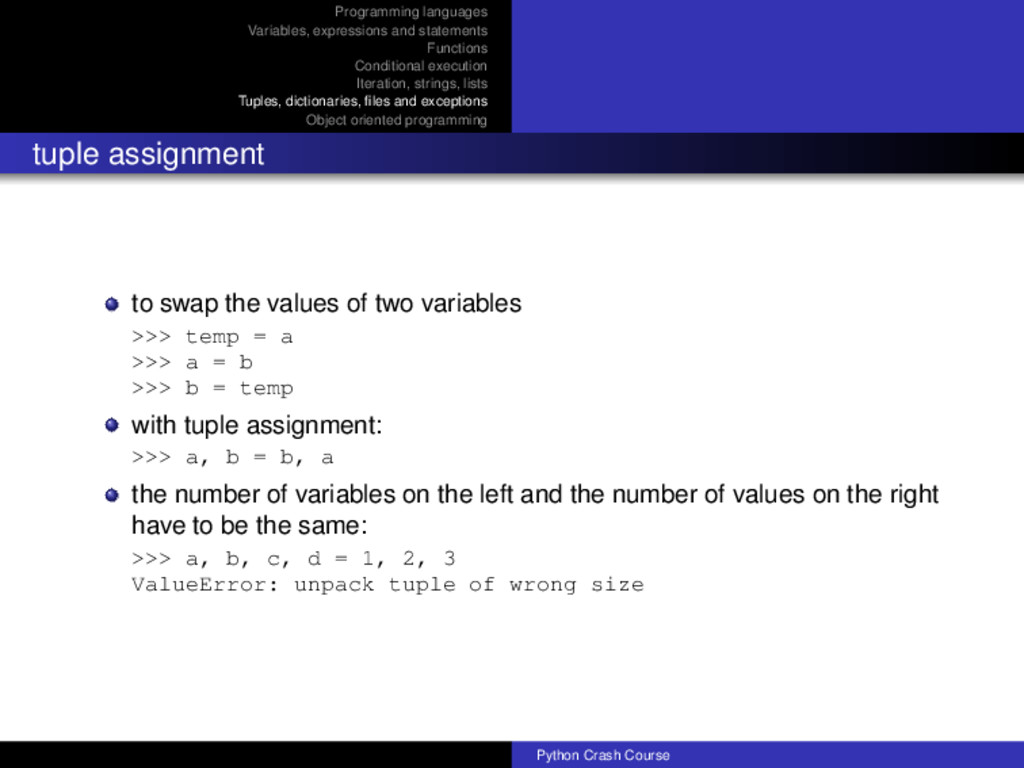
    strings, lists Tuples, dictionaries, files and exceptions Object oriented programming tuple assignment to swap the values of two variables >>> temp = a >>> a = b >>> b = temp with tuple assignment: >>> a, b = b, a the number of variables on the left and the number of values on the right have to be the same: >>> a, b, c, d = 1, 2, 3 ValueError: unpack tuple of wrong size Python Crash Course
  69. Programming languages Variables, expressions and statements Functions Conditional execution Iteration,

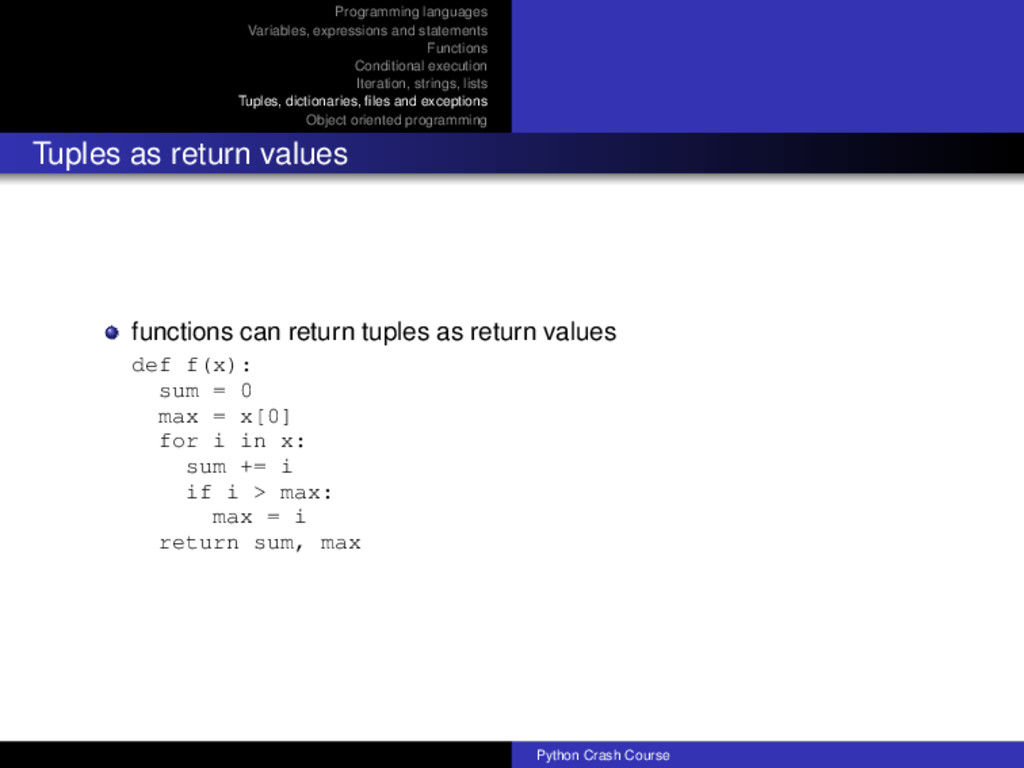
    strings, lists Tuples, dictionaries, files and exceptions Object oriented programming Tuples as return values functions can return tuples as return values def f(x): sum = 0 max = x[0] for i in x: sum += i if i > max: max = i return sum, max Python Crash Course
  70. Programming languages Variables, expressions and statements Functions Conditional execution Iteration,

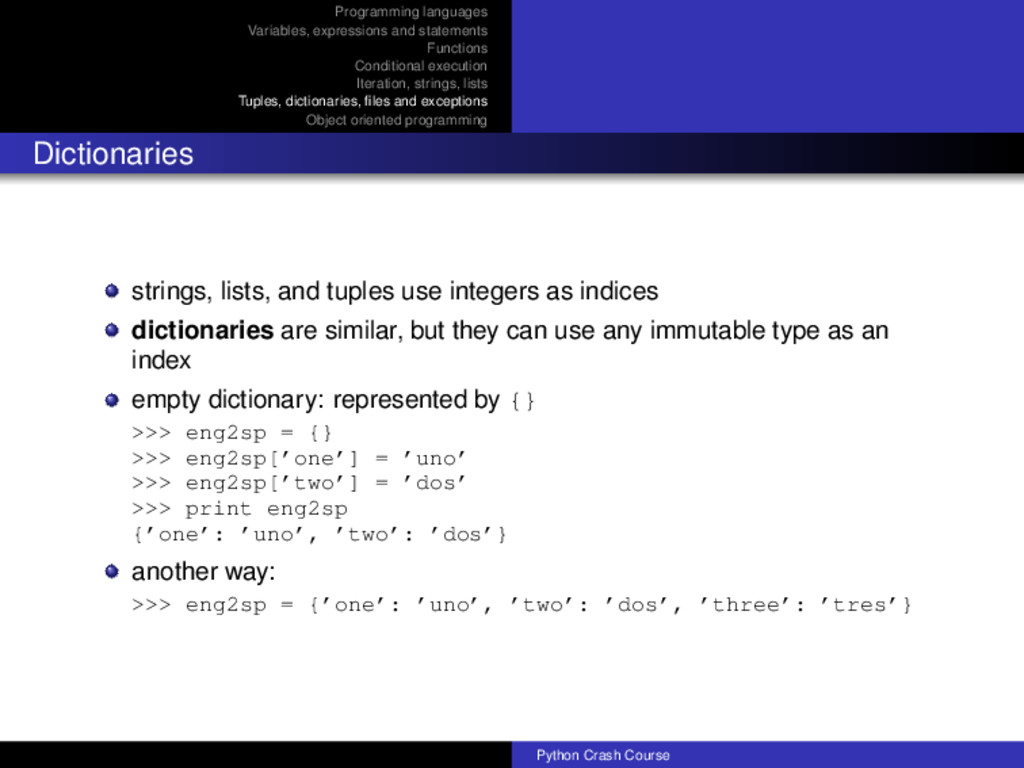
    strings, lists Tuples, dictionaries, files and exceptions Object oriented programming Dictionaries strings, lists, and tuples use integers as indices dictionaries are similar, but they can use any immutable type as an index empty dictionary: represented by {} >>> eng2sp = {} >>> eng2sp[’one’] = ’uno’ >>> eng2sp[’two’] = ’dos’ >>> print eng2sp {’one’: ’uno’, ’two’: ’dos’} another way: >>> eng2sp = {’one’: ’uno’, ’two’: ’dos’, ’three’: ’tres’} Python Crash Course
  71. Programming languages Variables, expressions and statements Functions Conditional execution Iteration,

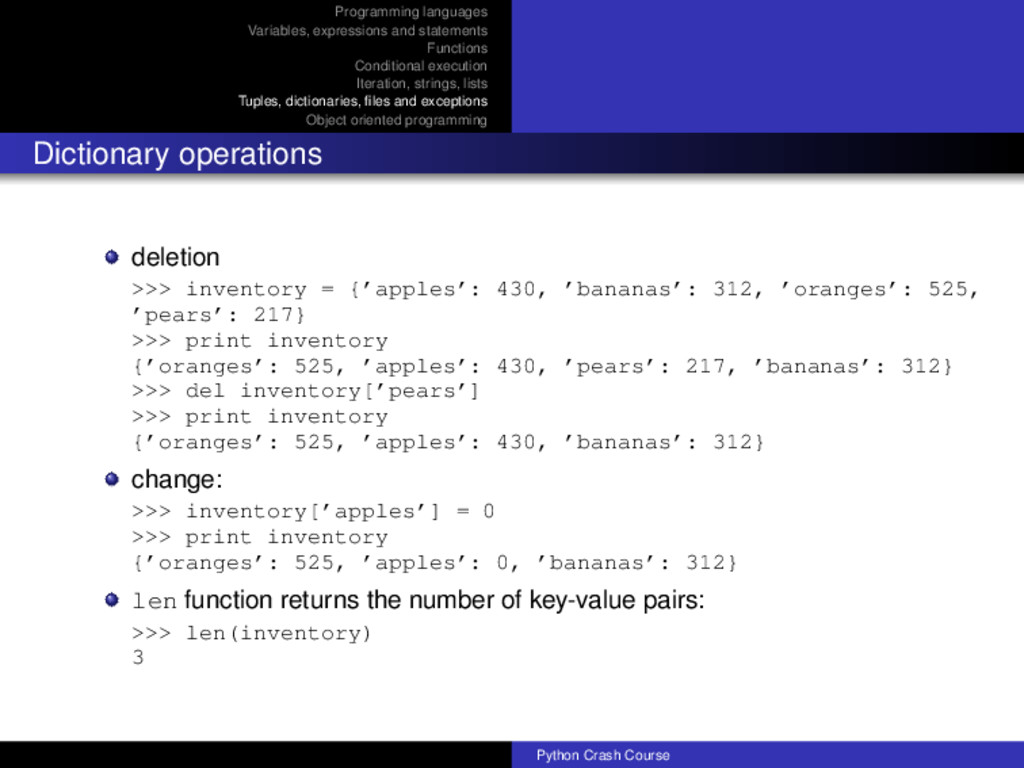
    strings, lists Tuples, dictionaries, files and exceptions Object oriented programming Dictionary operations deletion >>> inventory = {’apples’: 430, ’bananas’: 312, ’oranges’: 525, ’pears’: 217} >>> print inventory {’oranges’: 525, ’apples’: 430, ’pears’: 217, ’bananas’: 312} >>> del inventory[’pears’] >>> print inventory {’oranges’: 525, ’apples’: 430, ’bananas’: 312} change: >>> inventory[’apples’] = 0 >>> print inventory {’oranges’: 525, ’apples’: 0, ’bananas’: 312} len function returns the number of key-value pairs: >>> len(inventory) 3 Python Crash Course
  72. Programming languages Variables, expressions and statements Functions Conditional execution Iteration,

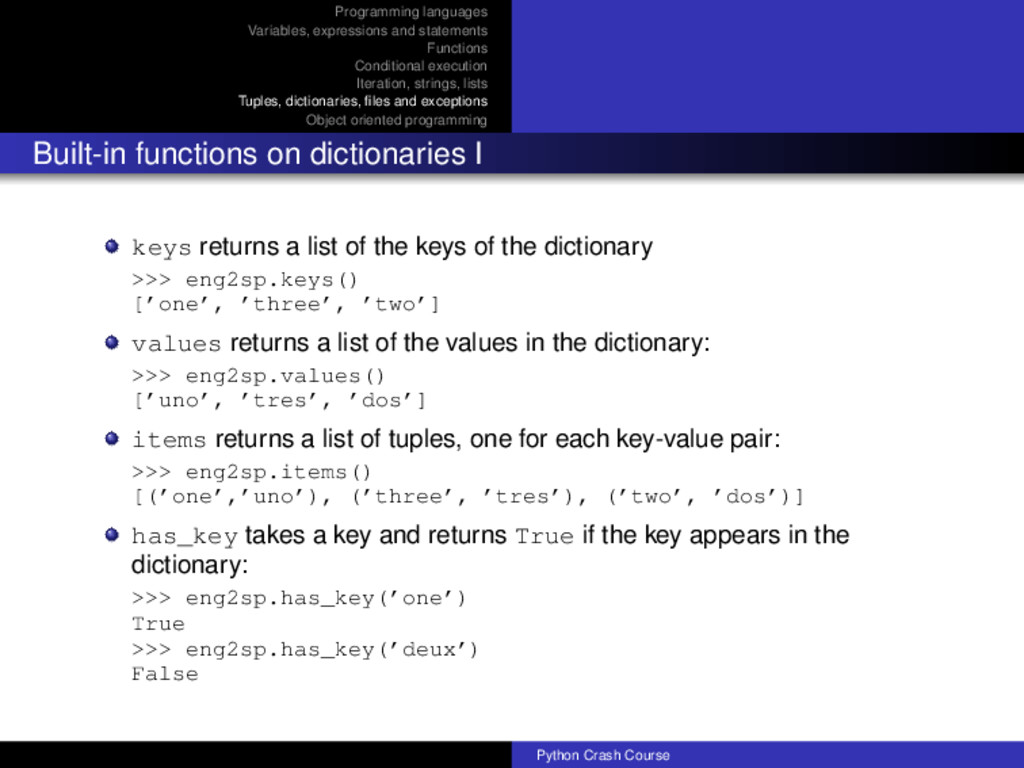
    strings, lists Tuples, dictionaries, files and exceptions Object oriented programming Built-in functions on dictionaries I keys returns a list of the keys of the dictionary >>> eng2sp.keys() [’one’, ’three’, ’two’] values returns a list of the values in the dictionary: >>> eng2sp.values() [’uno’, ’tres’, ’dos’] items returns a list of tuples, one for each key-value pair: >>> eng2sp.items() [(’one’,’uno’), (’three’, ’tres’), (’two’, ’dos’)] has_key takes a key and returns True if the key appears in the dictionary: >>> eng2sp.has_key(’one’) True >>> eng2sp.has_key(’deux’) False Python Crash Course
  73. Programming languages Variables, expressions and statements Functions Conditional execution Iteration,

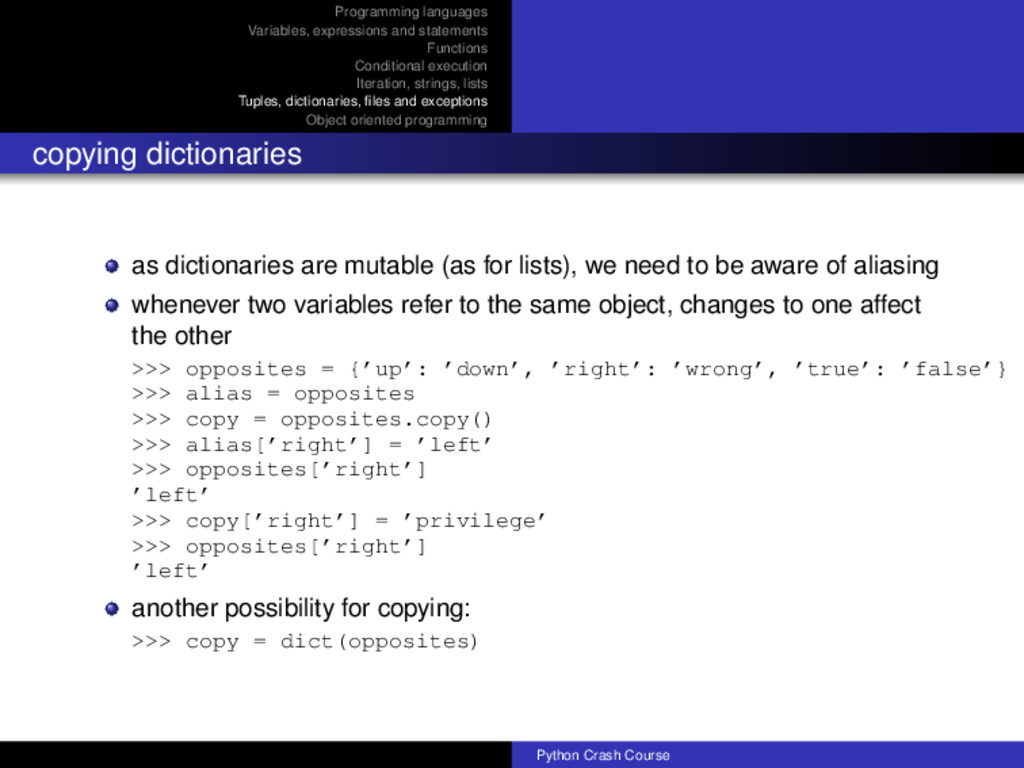
    strings, lists Tuples, dictionaries, files and exceptions Object oriented programming copying dictionaries as dictionaries are mutable (as for lists), we need to be aware of aliasing whenever two variables refer to the same object, changes to one affect the other >>> opposites = {’up’: ’down’, ’right’: ’wrong’, ’true’: ’false’} >>> alias = opposites >>> copy = opposites.copy() >>> alias[’right’] = ’left’ >>> opposites[’right’] ’left’ >>> copy[’right’] = ’privilege’ >>> opposites[’right’] ’left’ another possibility for copying: >>> copy = dict(opposites) Python Crash Course
  74. Programming languages Variables, expressions and statements Functions Conditional execution Iteration,

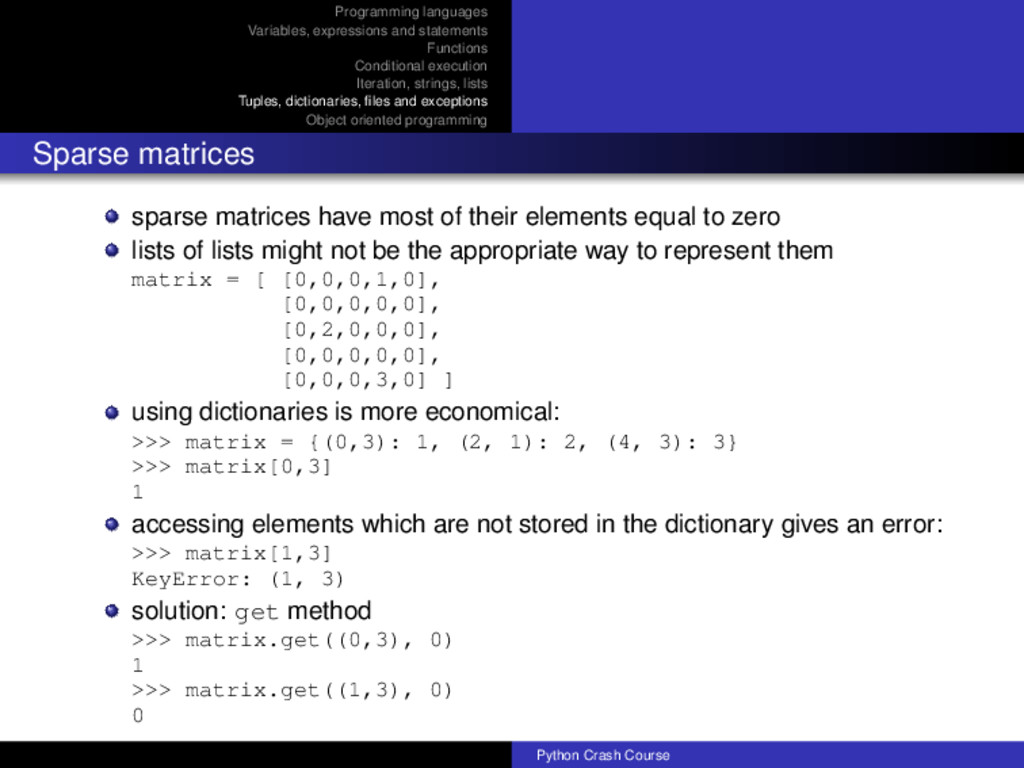
    strings, lists Tuples, dictionaries, files and exceptions Object oriented programming Sparse matrices sparse matrices have most of their elements equal to zero lists of lists might not be the appropriate way to represent them matrix = [ [0,0,0,1,0], [0,0,0,0,0], [0,2,0,0,0], [0,0,0,0,0], [0,0,0,3,0] ] using dictionaries is more economical: >>> matrix = {(0,3): 1, (2, 1): 2, (4, 3): 3} >>> matrix[0,3] 1 accessing elements which are not stored in the dictionary gives an error: >>> matrix[1,3] KeyError: (1, 3) solution: get method >>> matrix.get((0,3), 0) 1 >>> matrix.get((1,3), 0) 0 Python Crash Course
  75. Programming languages Variables, expressions and statements Functions Conditional execution Iteration,

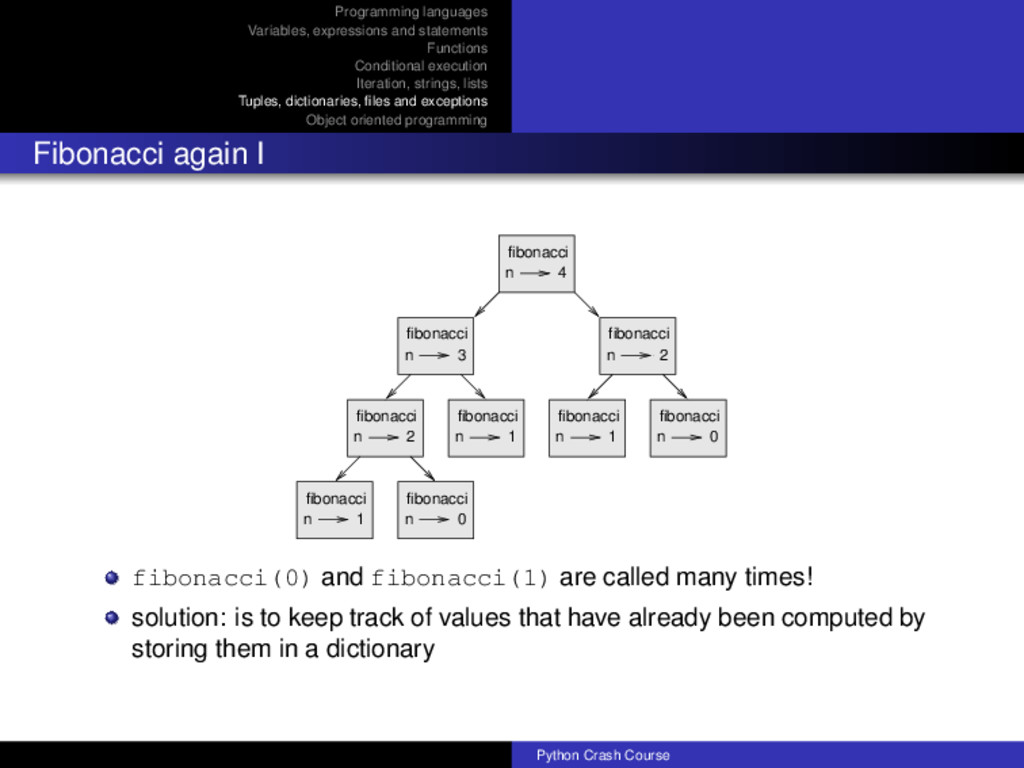
    strings, lists Tuples, dictionaries, files and exceptions Object oriented programming Fibonacci again I fibonacci n 4 fibonacci n 3 fibonacci n 2 fibonacci n 0 fibonacci n 1 fibonacci n 1 fibonacci n 2 fibonacci n 0 fibonacci n 1 fibonacci(0) and fibonacci(1) are called many times! solution: is to keep track of values that have already been computed by storing them in a dictionary Python Crash Course
  76. Programming languages Variables, expressions and statements Functions Conditional execution Iteration,

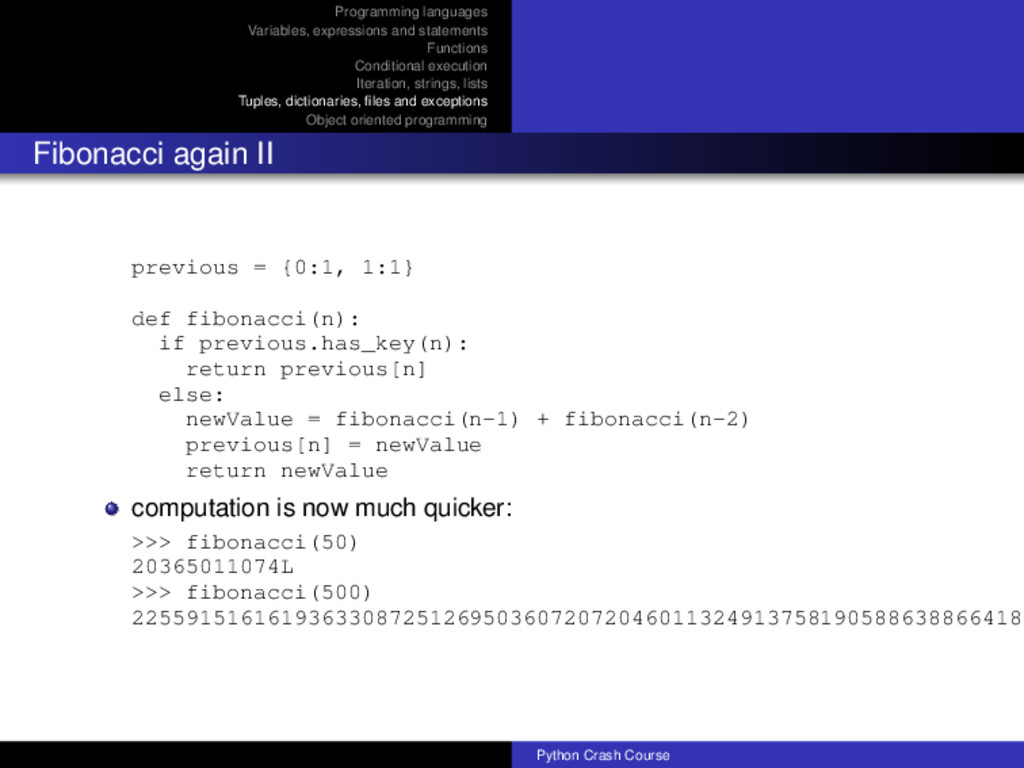
    strings, lists Tuples, dictionaries, files and exceptions Object oriented programming Fibonacci again II previous = {0:1, 1:1} def fibonacci(n): if previous.has_key(n): return previous[n] else: newValue = fibonacci(n-1) + fibonacci(n-2) previous[n] = newValue return newValue computation is now much quicker: >>> fibonacci(50) 20365011074L >>> fibonacci(500) 2255915161619363308725126950360720720460113249137581905886388664184 Python Crash Course
  77. Programming languages Variables, expressions and statements Functions Conditional execution Iteration,

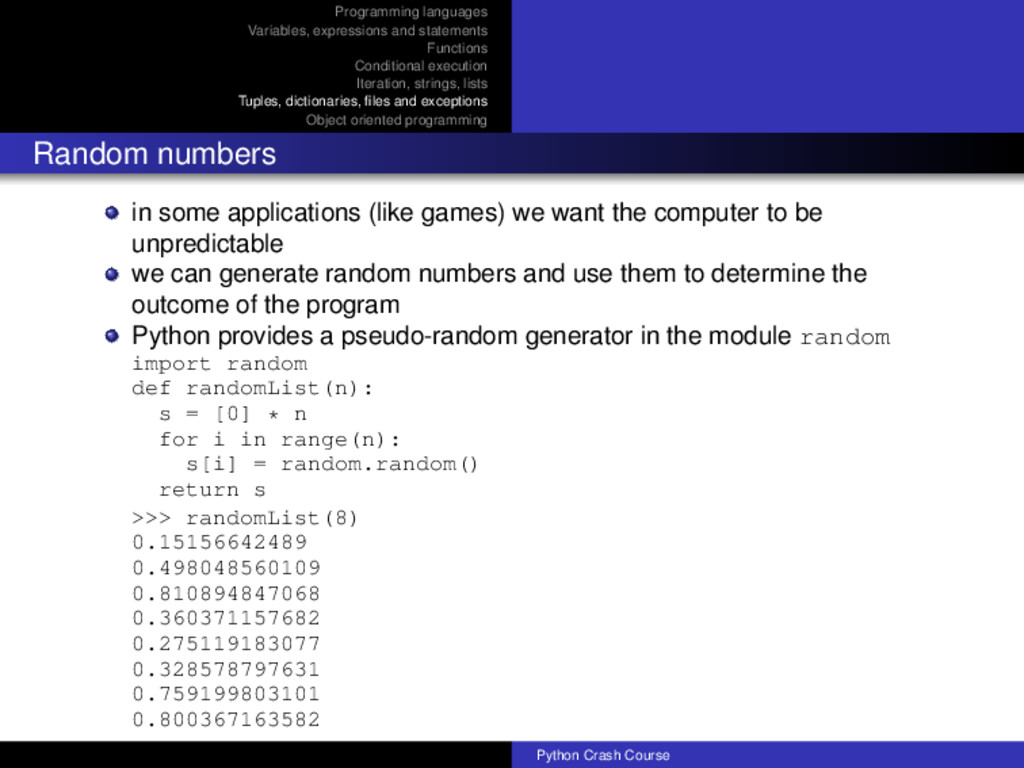
    strings, lists Tuples, dictionaries, files and exceptions Object oriented programming Random numbers in some applications (like games) we want the computer to be unpredictable we can generate random numbers and use them to determine the outcome of the program Python provides a pseudo-random generator in the module random import random def randomList(n): s = [0] * n for i in range(n): s[i] = random.random() return s >>> randomList(8) 0.15156642489 0.498048560109 0.810894847068 0.360371157682 0.275119183077 0.328578797631 0.759199803101 0.800367163582 Python Crash Course
  78. Programming languages Variables, expressions and statements Functions Conditional execution Iteration,

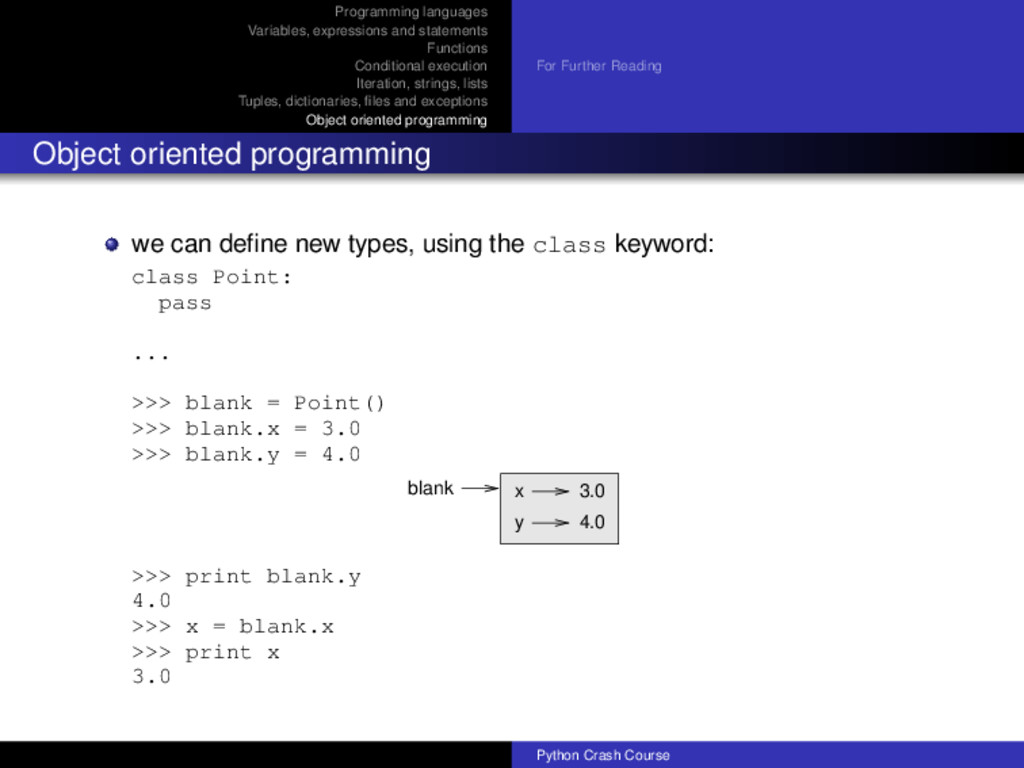
    strings, lists Tuples, dictionaries, files and exceptions Object oriented programming For Further Reading Object oriented programming we can define new types, using the class keyword: class Point: pass ... >>> blank = Point() >>> blank.x = 3.0 >>> blank.y = 4.0 x y 3.0 4.0 blank >>> print blank.y 4.0 >>> x = blank.x >>> print x 3.0 Python Crash Course
  79. Programming languages Variables, expressions and statements Functions Conditional execution Iteration,

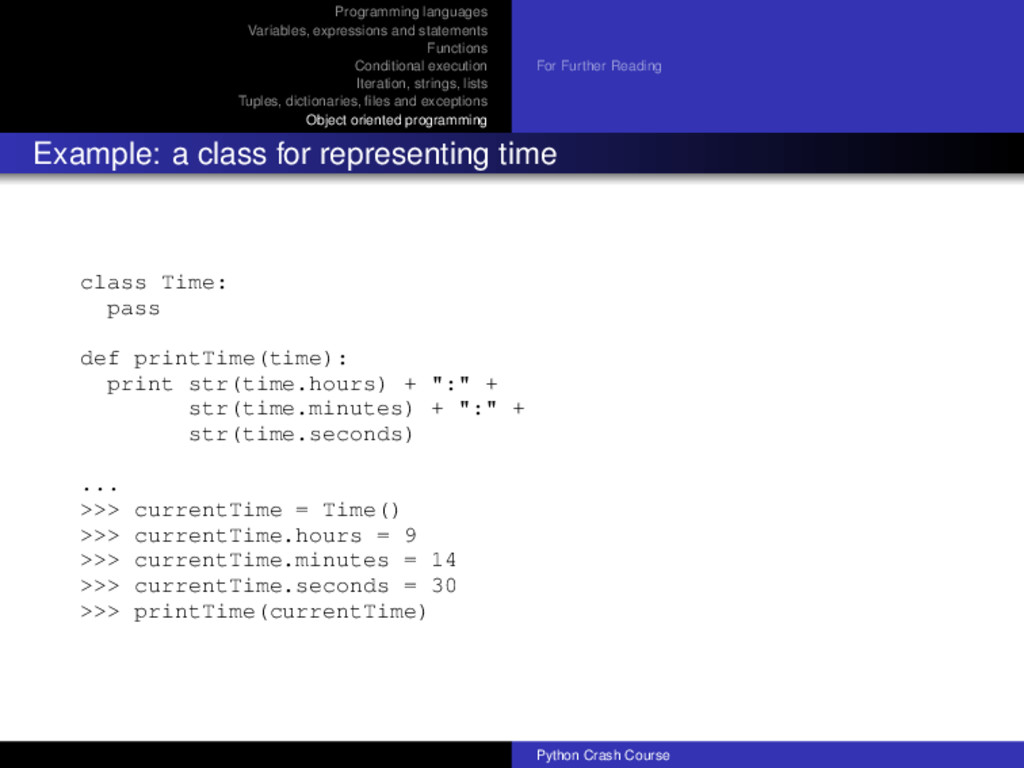
    strings, lists Tuples, dictionaries, files and exceptions Object oriented programming For Further Reading Example: a class for representing time class Time: pass def printTime(time): print str(time.hours) + ":" + str(time.minutes) + ":" + str(time.seconds) ... >>> currentTime = Time() >>> currentTime.hours = 9 >>> currentTime.minutes = 14 >>> currentTime.seconds = 30 >>> printTime(currentTime) Python Crash Course
  80. Programming languages Variables, expressions and statements Functions Conditional execution Iteration,

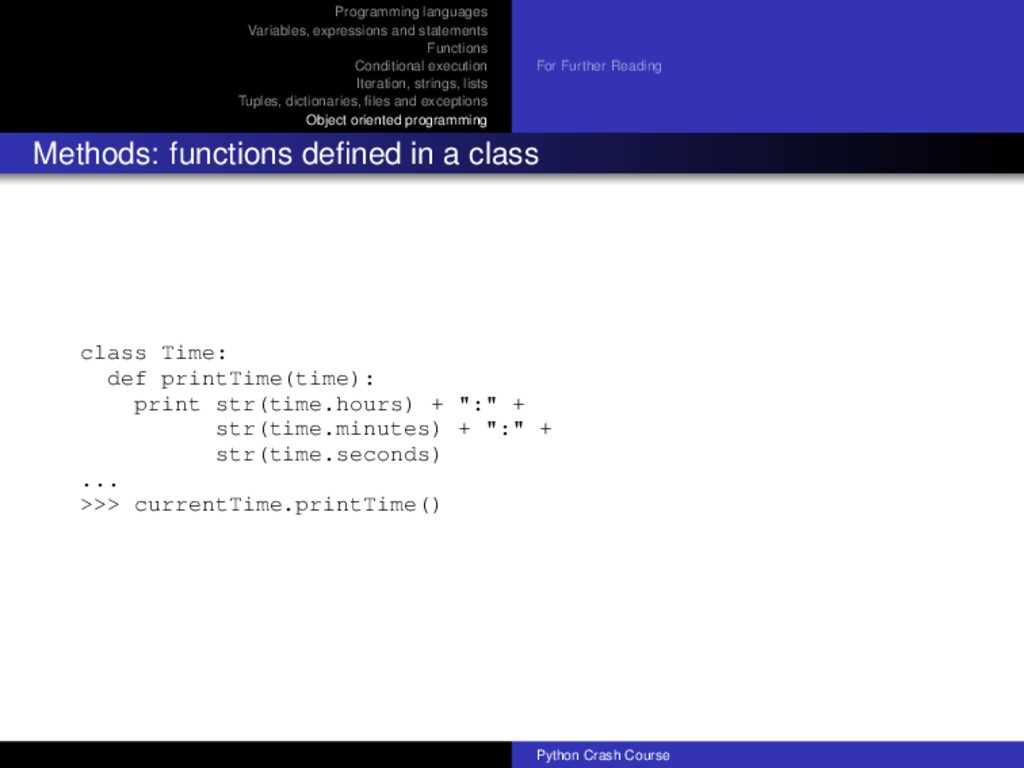
    strings, lists Tuples, dictionaries, files and exceptions Object oriented programming For Further Reading Methods: functions defined in a class class Time: def printTime(time): print str(time.hours) + ":" + str(time.minutes) + ":" + str(time.seconds) ... >>> currentTime.printTime() Python Crash Course
  81. Programming languages Variables, expressions and statements Functions Conditional execution Iteration,

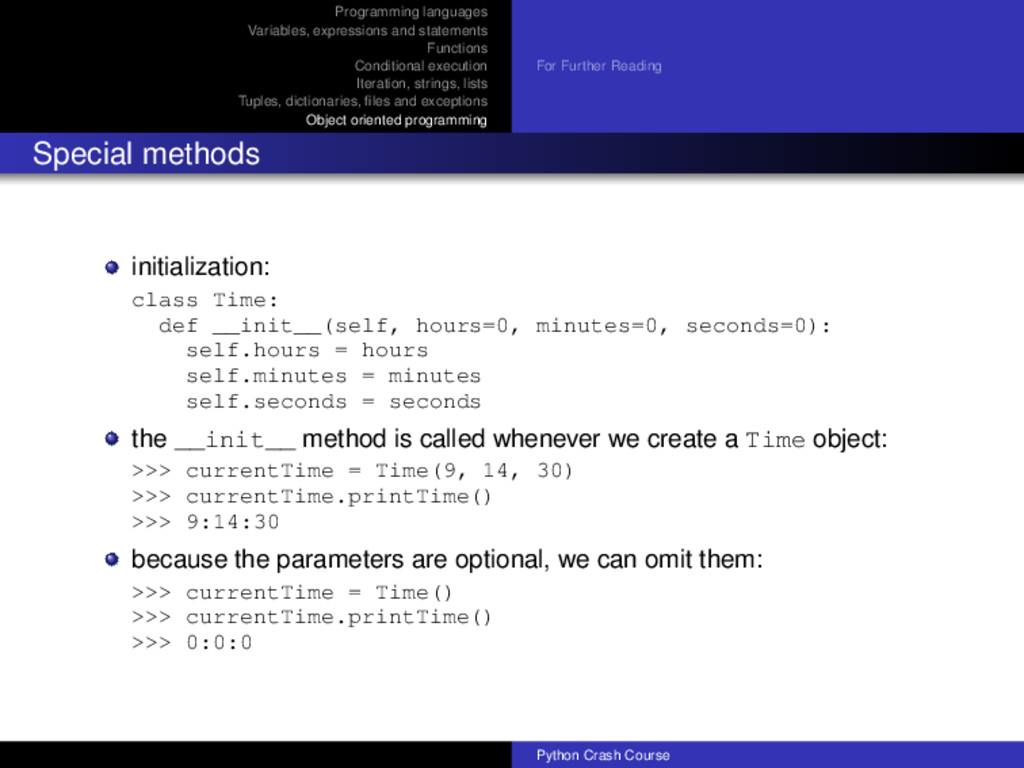
    strings, lists Tuples, dictionaries, files and exceptions Object oriented programming For Further Reading Special methods initialization: class Time: def __init__(self, hours=0, minutes=0, seconds=0): self.hours = hours self.minutes = minutes self.seconds = seconds the __init__ method is called whenever we create a Time object: >>> currentTime = Time(9, 14, 30) >>> currentTime.printTime() >>> 9:14:30 because the parameters are optional, we can omit them: >>> currentTime = Time() >>> currentTime.printTime() >>> 0:0:0 Python Crash Course
  82. Programming languages Variables, expressions and statements Functions Conditional execution Iteration,

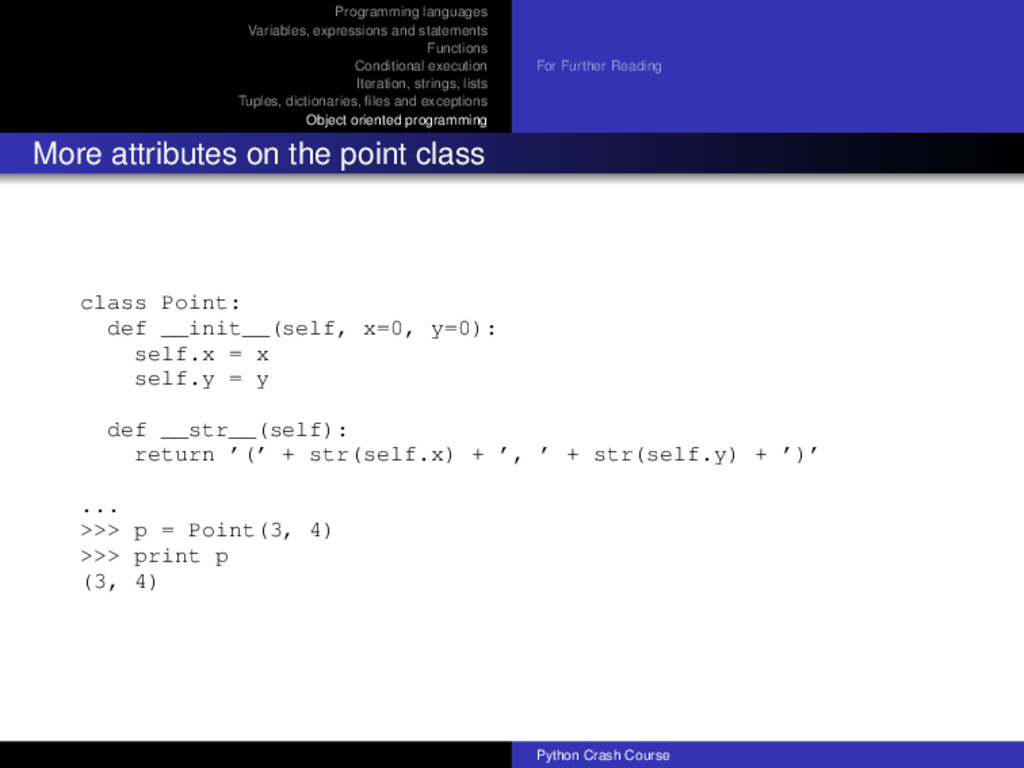
    strings, lists Tuples, dictionaries, files and exceptions Object oriented programming For Further Reading More attributes on the point class class Point: def __init__(self, x=0, y=0): self.x = x self.y = y def __str__(self): return ’(’ + str(self.x) + ’, ’ + str(self.y) + ’)’ ... >>> p = Point(3, 4) >>> print p (3, 4) Python Crash Course
  83. Programming languages Variables, expressions and statements Functions Conditional execution Iteration,

    strings, lists Tuples, dictionaries, files and exceptions Object oriented programming For Further Reading Object oriented features Some times, the programs are more clean without object-orientations Other times, object orientation simplifies a lot the operations We must decide case-by-case which is more appropriate Python Crash Course
  84. Programming languages Variables, expressions and statements Functions Conditional execution Iteration,

    strings, lists Tuples, dictionaries, files and exceptions Object oriented programming For Further Reading For Further Reading Allen B. Downey, Jeffrey Elkner, and Chris Meyers. How to think like a computer scientist. http://www.thinkpython.com Guido van Rossum et al. Python documentation http://www.python.org Python Crash Course