group. A LUG has a lot in common with it. But not quite. Product/platform-agnostic. Usergroup for sysadmins and aspiring sysadmins. Or anyone that’s interested, really. (ETENN has a bioinformatics professor that shows up, as well as a developer)
some people who say it’s to drive LOPSA membership, but those people aren’t running chapters. If you aren’t wanting to build a community of IT professionals in your local area, then don’t start a chapter.
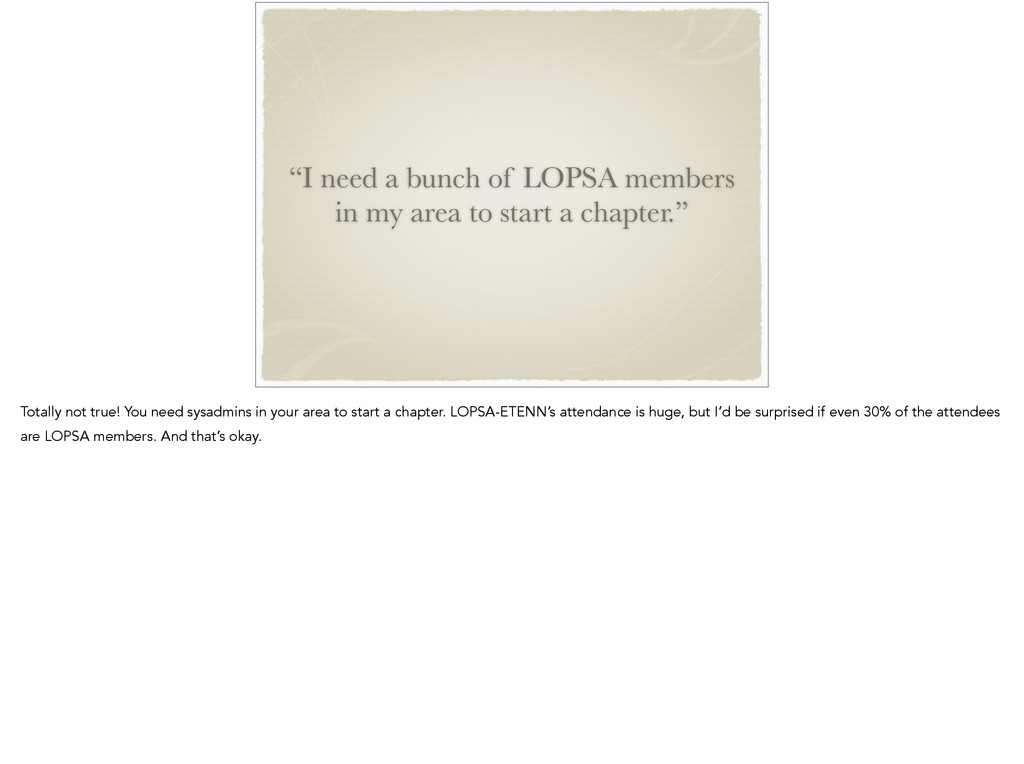
to start a chapter.” Totally not true! You need sysadmins in your area to start a chapter. LOPSA-ETENN’s attendance is huge, but I’d be surprised if even 30% of the attendees are LOPSA members. And that’s okay.
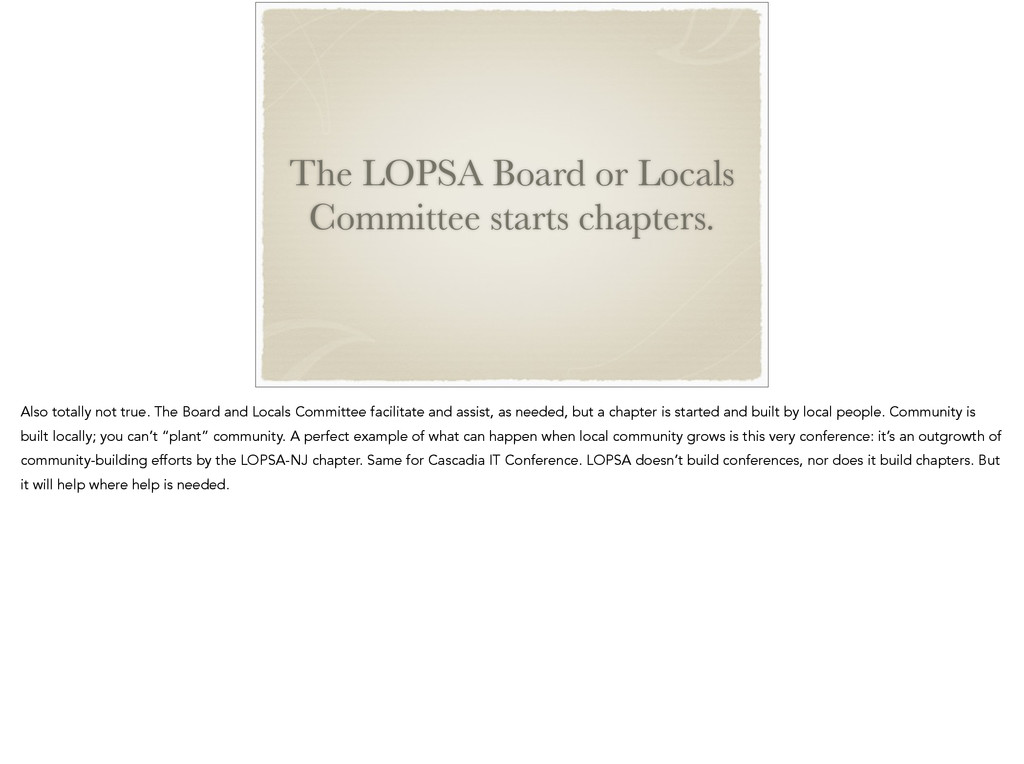
not true. The Board and Locals Committee facilitate and assist, as needed, but a chapter is started and built by local people. Community is built locally; you can’t “plant” community. A perfect example of what can happen when local community grows is this very conference: it’s an outgrowth of community-building efforts by the LOPSA-NJ chapter. Same for Cascadia IT Conference. LOPSA doesn’t build conferences, nor does it build chapters. But it will help where help is needed.
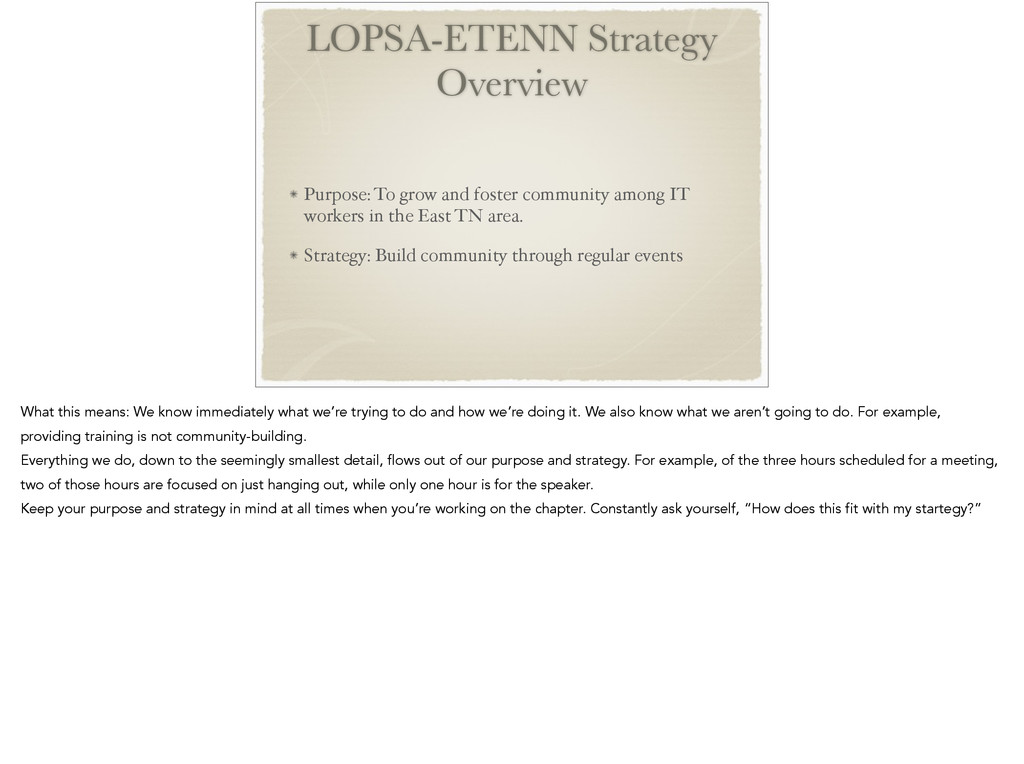
IT workers in the East TN area.! Strategy: Build community through regular events What this means: We know immediately what we’re trying to do and how we’re doing it. We also know what we aren’t going to do. For example, providing training is not community-building. Everything we do, down to the seemingly smallest detail, flows out of our purpose and strategy. For example, of the three hours scheduled for a meeting, two of those hours are focused on just hanging out, while only one hour is for the speaker. Keep your purpose and strategy in mind at all times when you’re working on the chapter. Constantly ask yourself, “How does this fit with my startegy?”
that matter: long-term commitment. Ability to not think like a sysadmin. Not afraid to lead and be in front of an audience. Not afraid to talk to sponsors and recruit speakers. Qualities that don’t matter: Your skill as a sysadmin. Chapters with only a single leader tend to falter and, ultimately, fail.
soon as people get in a car after a meeting, the meeting is over. You might have to pay for the venue. Ask sponsors to cover the cost. Or ask the venue if they would cut the cost for your group, as a sponsorship.
no company offices. They work well in a pinch, but try to find something else first. Libraries, independent meeting space. No restaurants, no bars. You need it quiet and separated from anything else going on.
others of a service or product that you have. Sometimes someone wants that service or product and you make a sale. Marketing, in itself, is not sleazy.
post to /r/Knoxville and /r/sysadmin. Know anyone in IT at other local companies? Have them post announcements internally. Do you know any IT recruiters? Tell them about the event and ask for them to tell others. This is the just the basics. Keep it simple for now.
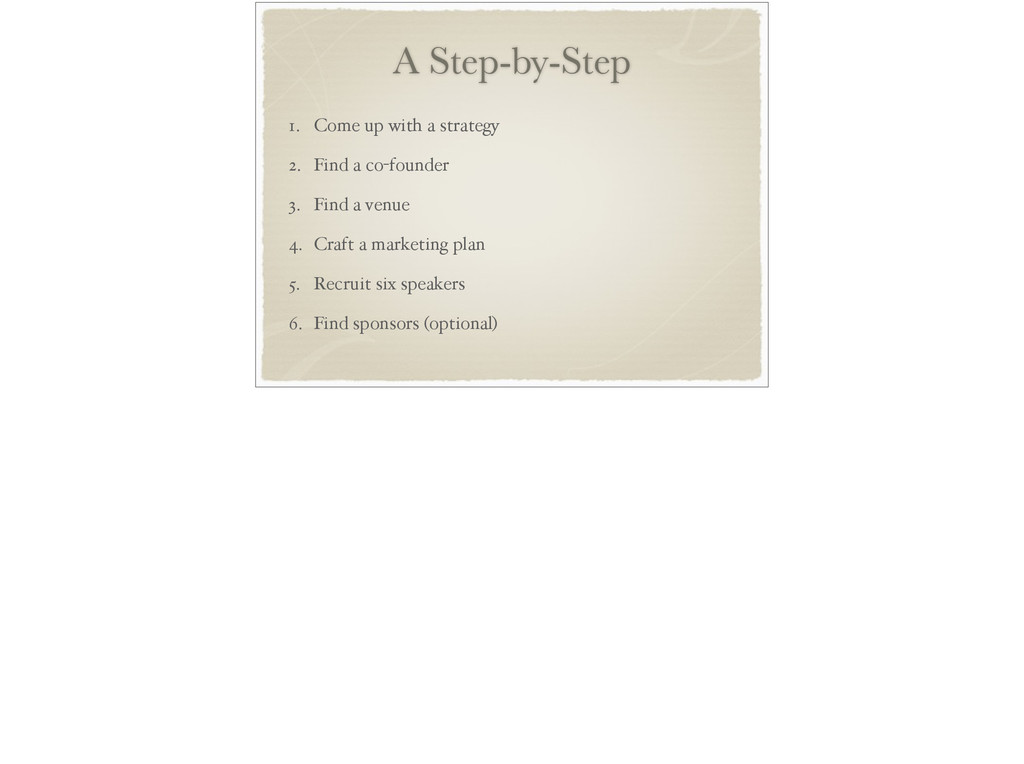
won’t be scrambling to find speakers at the last minute during your first six months. More time to focus on marketing, which is far more critical in this stage. Worst case scenario, the chapter doesn’t work, but you gave it a good try.
IT. You all have friends in IT. ETENN’s first six speakers were mostly from ORNL, where my cofounder and I were working at the time. Finding your first six speakers is the easiest part of this whole thing.
Vendors are a second best. How to think about sponsors: this is a partnership. You have something they need (IT workers), and they have something you need (money and a professional network). You don’t want to sell out the group. Be careful there.
community requires care and feeding, and no matter how much we think that sysadmins self-organize, people do not self- organize well. A community requires a leader, and that leader has a lot of work to do. What is leadership? Making sure the room is set up and torn down. Making sure sponsors do their thing. Lining up speakers. Being the go-to person for everything related to the chapter.
is a bad way to build a chapter, because it simply doesn’t work. You have to know what you’re trying to accomplish and always be marketing. ALWAYS. You are never done building a chapter.
can look back and see who spoke, when, and on what topic. I can see trends, and I pay attention to those. I constantly ask my attendees what we can do better. I pay attention to what sort of people come to my meetings, and always think about how I can get more people and a more diverse group. As I said, you are never done building a chapter.
and process for starting a chapter. They’re easy to fulfill, so don’t worry about them. How you structure the governance of the group. Don’t be formal. Be informal and loose. Having two people “in charge” is as formal as you need to get. Going any further will hamper your growth, not help.
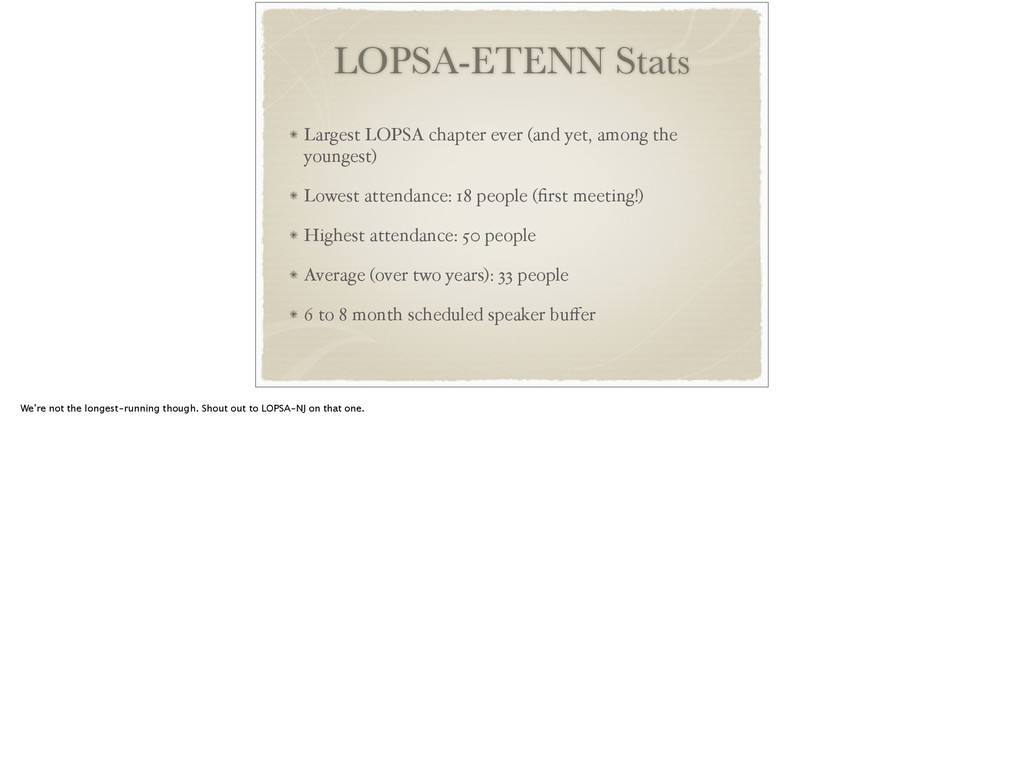
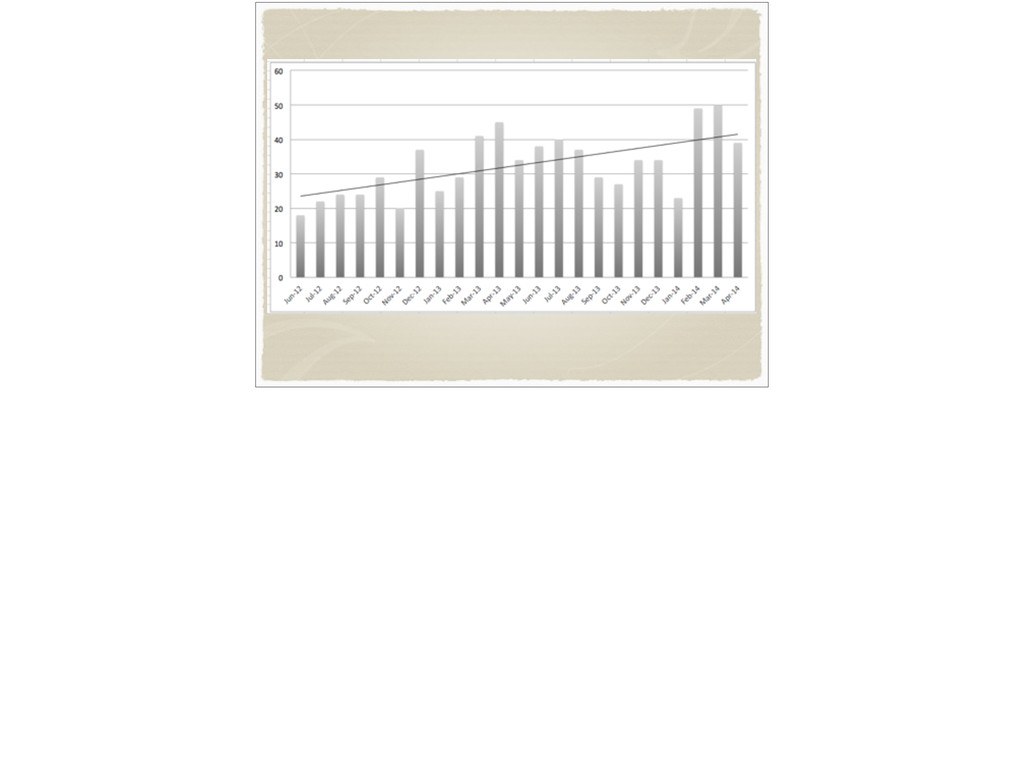
youngest)! Lowest attendance: 18 people (first meeting!)! Highest attendance: 50 people! Average (over two years): 33 people! 6 to 8 month scheduled speaker buffer We’re not the longest-running though. Shout out to LOPSA-NJ on that one.


 rfdnxbro
 techtekt
 minorun365
 jyouryuusui
 takonda
 recruitengineers
 kairim0
 sansantech
 nttcom
 jtakeda
 syuchimu
 codmoninc
 rkendrick25
 helenjbeal
 morganepeng
 aemeredith
 garrettdimon
 konakalab
 retrage
 techseoconnect
 baasie
 bryan
 tammyeverts
 wayneb77