Lock in $30 Savings on PRO—Offer Ends Soon! ⏳

Tailoring Graphite for Battery & Fuel Cell Appl...

Tailoring Graphite for Battery & Fuel Cell Applications: From Plates to Complex Bipolar Structures

Explore how engineered graphite materials enable high-performance battery and fuel cell components—from precision-machined plates to complex bipolar structures. This presentation highlights thermal stability, conductivity optimization, porosity control, and advanced forming techniques that enhance durability and electrochemical efficiency.

Avatar for Mkube Enterprise Pty Ltd

Mkube Enterprise Pty Ltd

December 12, 2025
Tweet

More Decks by Mkube Enterprise Pty Ltd

Transcript

  1. Tailoring Graphite for Battery & Fuel Cell Applications: From Plates

    to Complex Bipolar Structures Submitted By: M-Kube Enterprise Pty Ltd
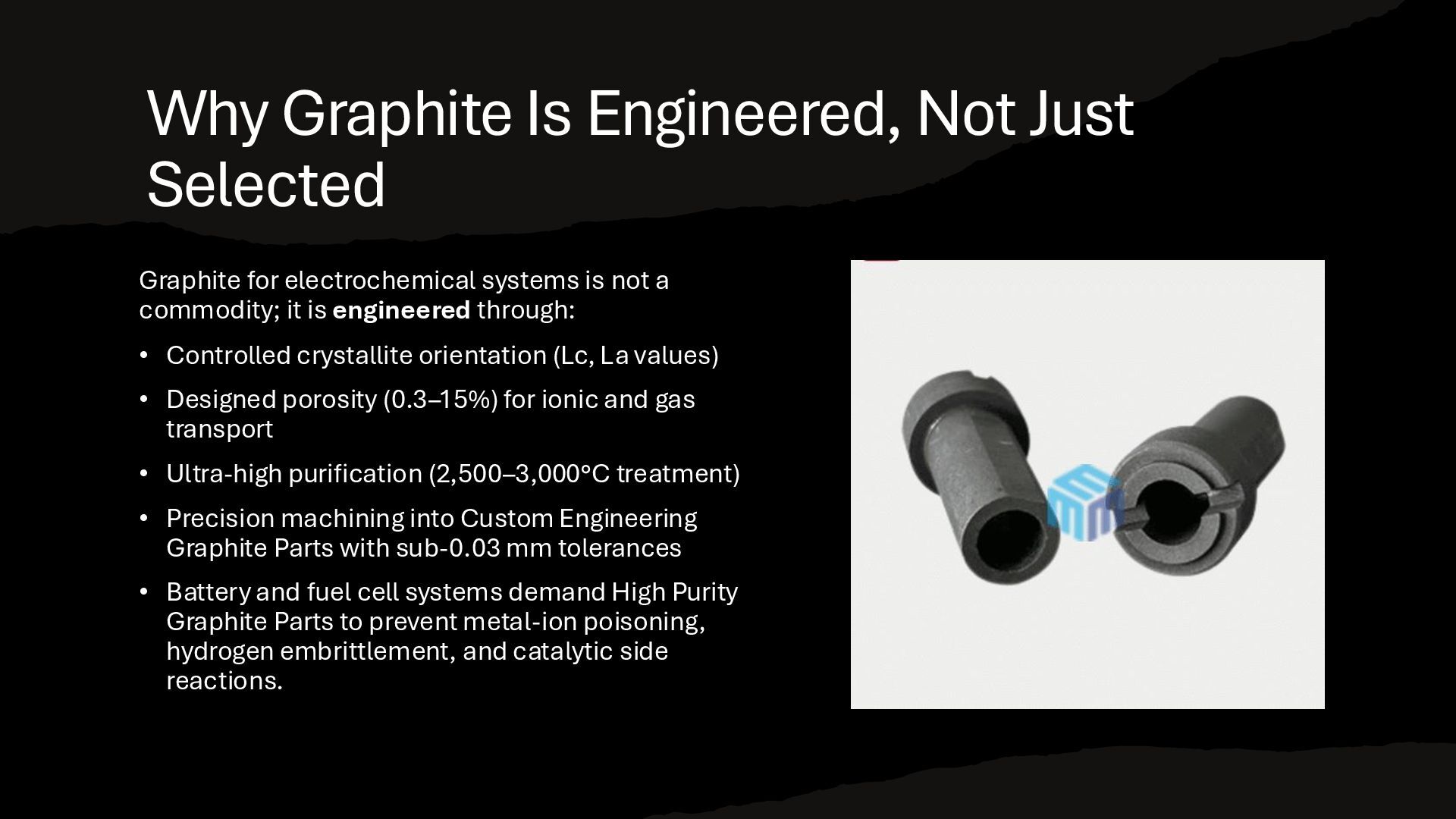
  2. Why Graphite Is Engineered, Not Just Selected Graphite for electrochemical

    systems is not a commodity; it is engineered through: • Controlled crystallite orientation (Lc, La values) • Designed porosity (0.3–15%) for ionic and gas transport • Ultra-high purification (2,500–3,000°C treatment) • Precision machining into Custom Engineering Graphite Parts with sub-0.03 mm tolerances • Battery and fuel cell systems demand High Purity Graphite Parts to prevent metal-ion poisoning, hydrogen embrittlement, and catalytic side reactions.
  3. Graphite Material Classes for Electrochemical Hardware Isostatic Graphite • Near-isotropic

    microstructure • 1.80–1.90 g/cm³ density • Preferred for Custom Graphite Parts with micro-flow channels Molded Graphite • High thermal conductivity (up to 140 W/m·K) • Best for high-current collector systems Extruded Graphite • Directional conductivity • Used where gas diffusion channels require anisotropic flow These classifications define the baseline for customized graphite carbon parts used in bipolar plates and fuel cell stack hardware.
  4. Purification Pathways for High Purity Graphite Parts Electrochemical environments need

    metal-impurity control at ppm levels. Purification methods include: • Halogen purification (Cl₂, Br₂) → removes Fe, Ni, Cr • High-temperature purification (HTP) → 2800–3000°C • Acid leaching (HCl/HF blends) → surface-level metal removal • Plasma purification (for semiconductor-grade parts) These steps create High Purity Graphite Parts essential for solid- state batteries and PEMFC.
  5. Anatomy of a Fuel Cell Bipolar Plate (Graphite Version) A

    graphite bipolar plate is engineered for: • Electrical conduction (5–20 mΩ·cm) • Gas management (O₂/H₂ flow fields) • Humidification balance • Heat dissipation • Mechanical compression stability in stack Graphite Machine Parts allow: • 3D serpentine channels • Micro-ridge sealing geometries • Integrating reinforcement ribs without delamination • Reverse-tapered ports for laminar flow
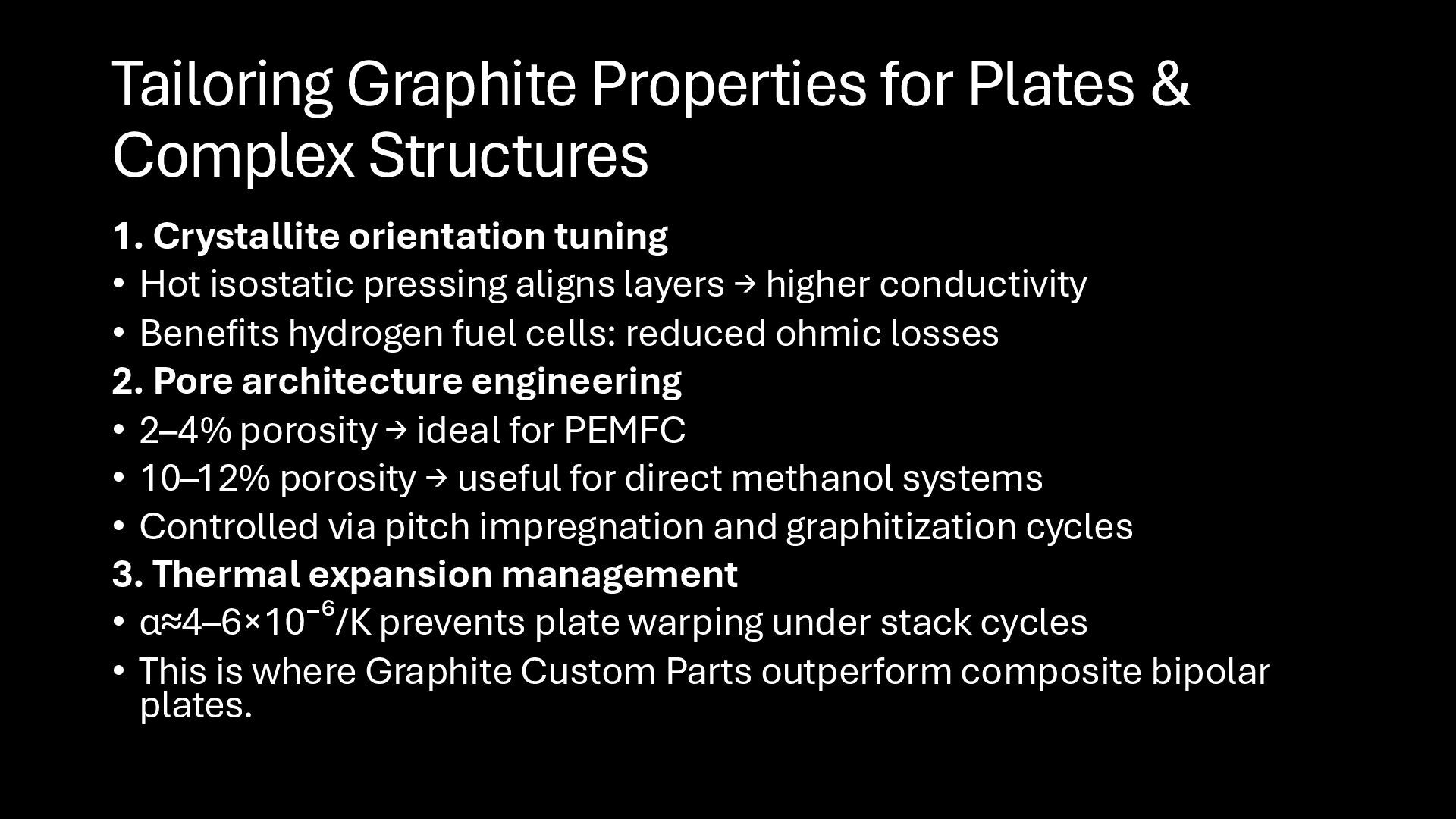
  6. Tailoring Graphite Properties for Plates & Complex Structures 1. Crystallite

    orientation tuning • Hot isostatic pressing aligns layers → higher conductivity • Benefits hydrogen fuel cells: reduced ohmic losses 2. Pore architecture engineering • 2–4% porosity → ideal for PEMFC • 10–12% porosity → useful for direct methanol systems • Controlled via pitch impregnation and graphitization cycles 3. Thermal expansion management • α≈4–6×10⁻⁶/K prevents plate warping under stack cycles • This is where Graphite Custom Parts outperform composite bipolar plates.
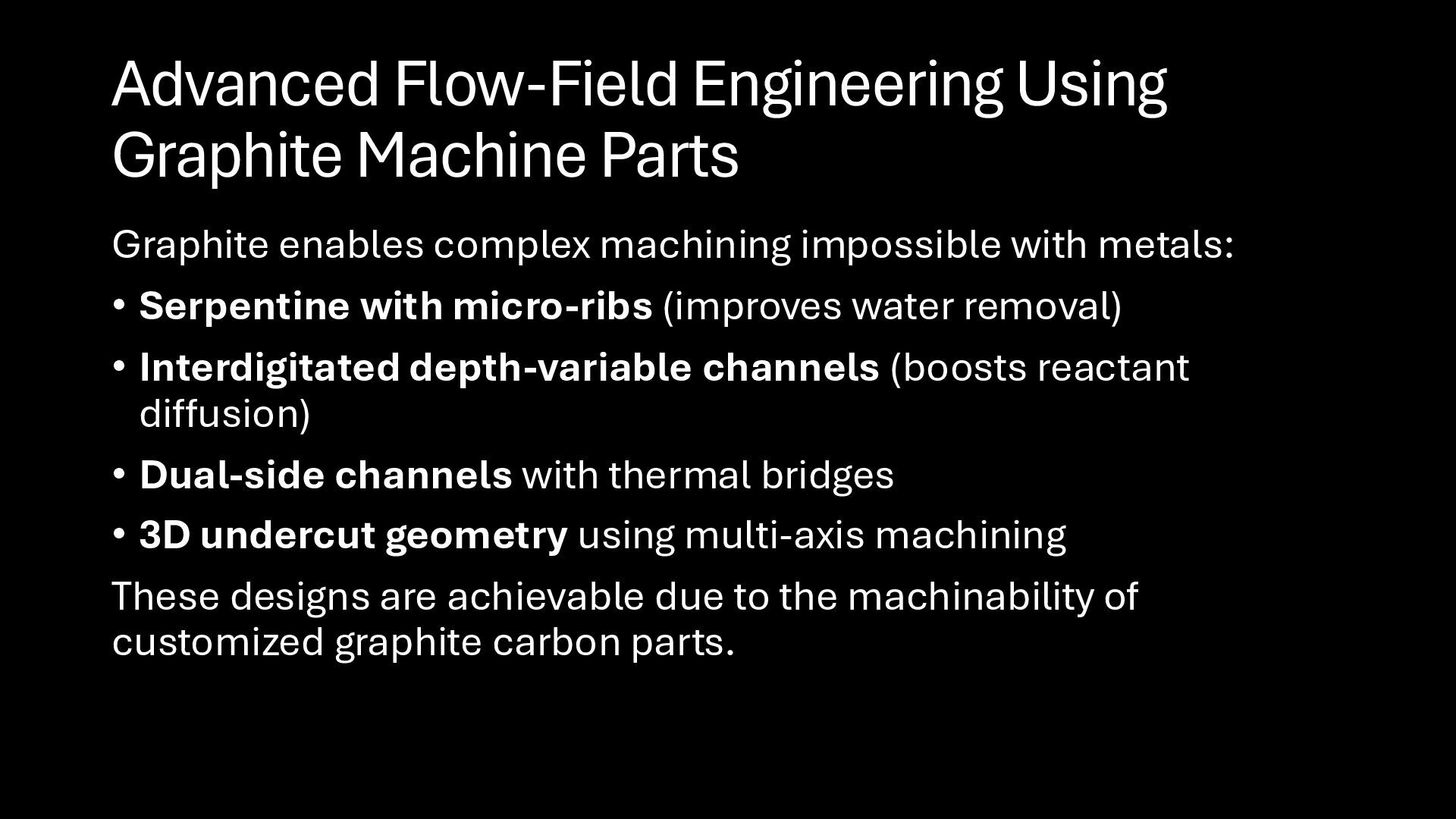
  7. Advanced Flow-Field Engineering Using Graphite Machine Parts Graphite enables complex

    machining impossible with metals: • Serpentine with micro-ribs (improves water removal) • Interdigitated depth-variable channels (boosts reactant diffusion) • Dual-side channels with thermal bridges • 3D undercut geometry using multi-axis machining These designs are achievable due to the machinability of customized graphite carbon parts.
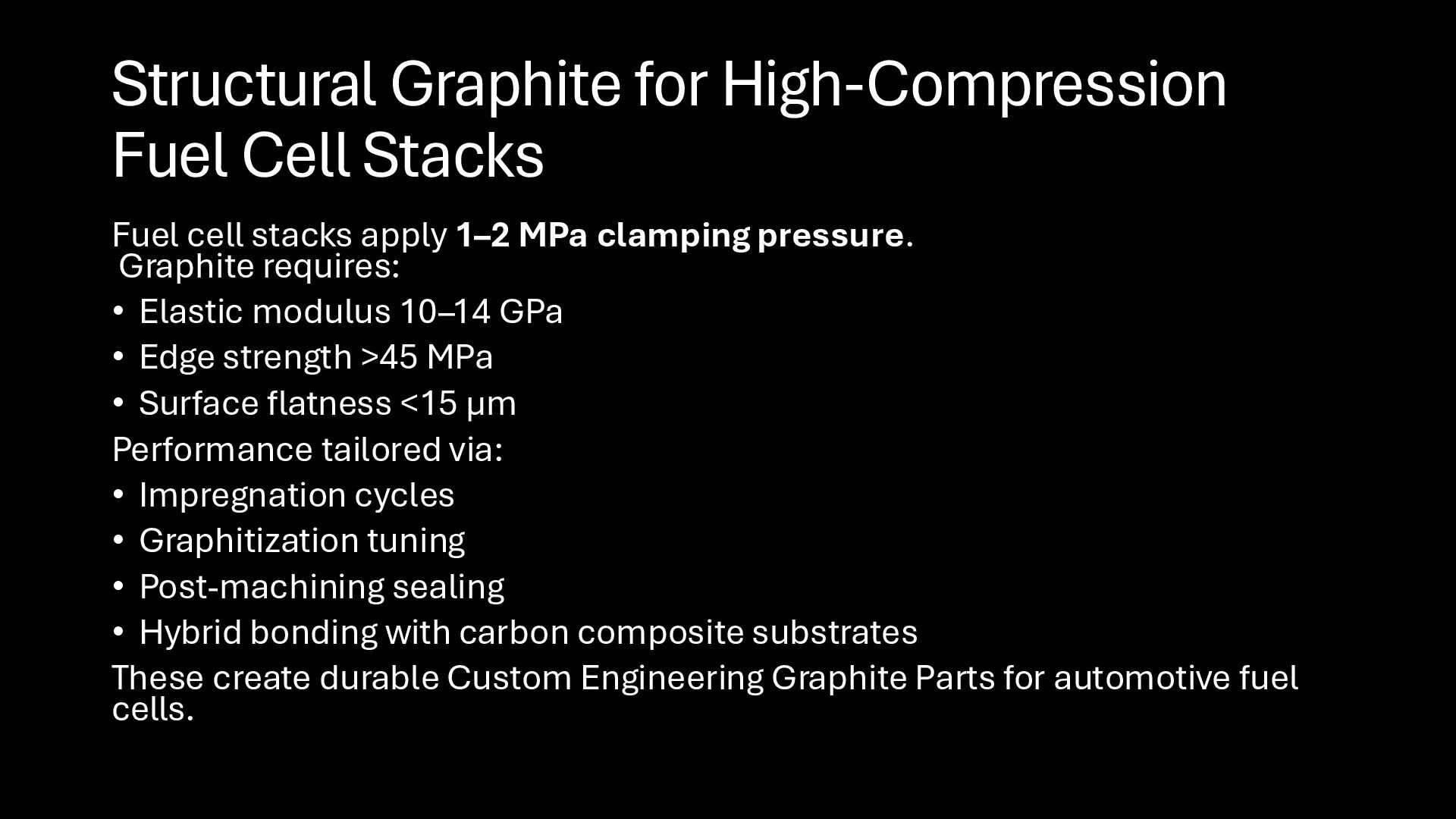
  8. Structural Graphite for High-Compression Fuel Cell Stacks Fuel cell stacks

    apply 1–2 MPa clamping pressure. Graphite requires: • Elastic modulus 10–14 GPa • Edge strength >45 MPa • Surface flatness <15 µm Performance tailored via: • Impregnation cycles • Graphitization tuning • Post-machining sealing • Hybrid bonding with carbon composite substrates These create durable Custom Engineering Graphite Parts for automotive fuel cells.
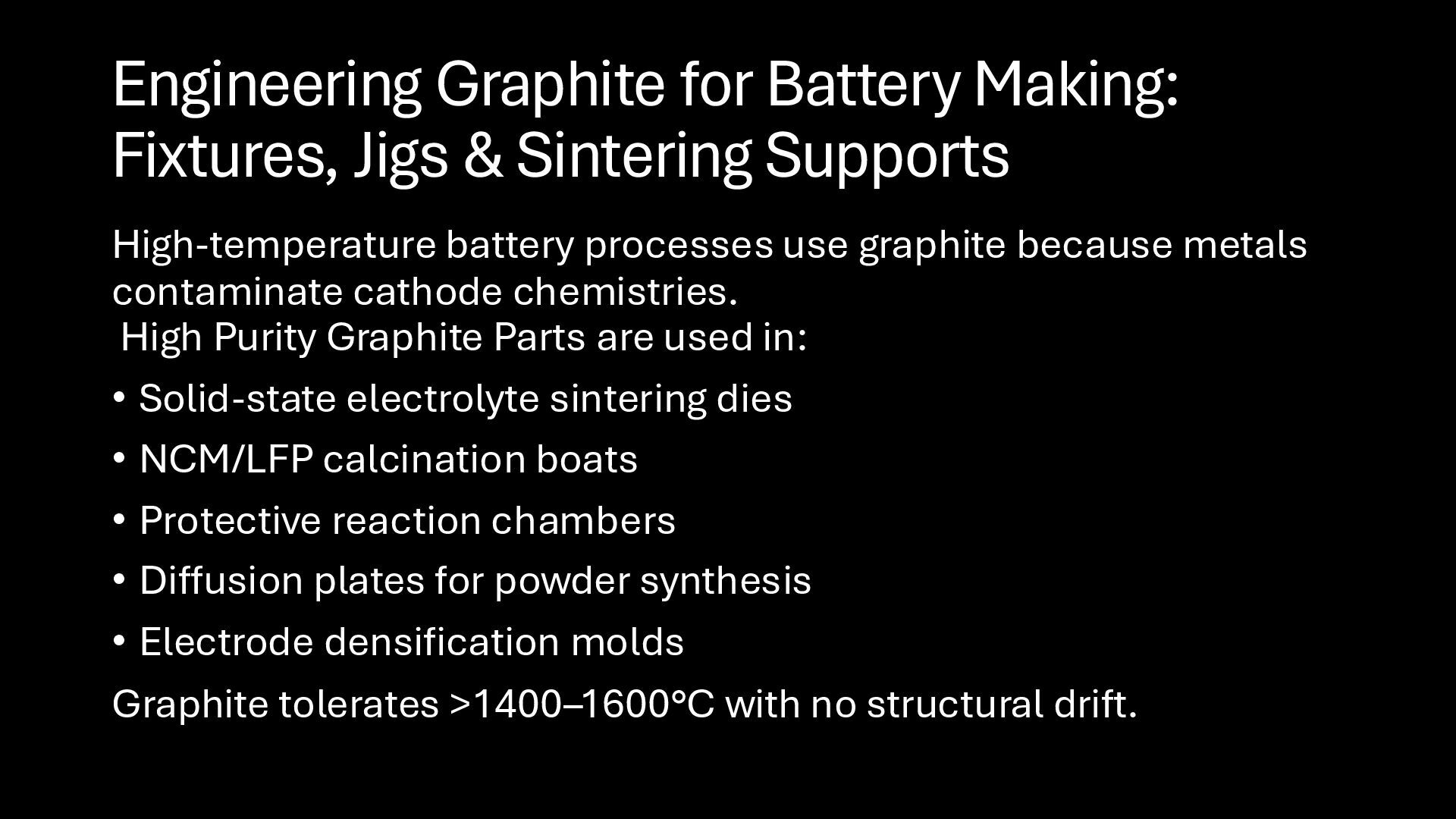
  9. Engineering Graphite for Battery Making: Fixtures, Jigs & Sintering Supports

    High-temperature battery processes use graphite because metals contaminate cathode chemistries. High Purity Graphite Parts are used in: • Solid-state electrolyte sintering dies • NCM/LFP calcination boats • Protective reaction chambers • Diffusion plates for powder synthesis • Electrode densification molds Graphite tolerates >1400–1600°C with no structural drift.
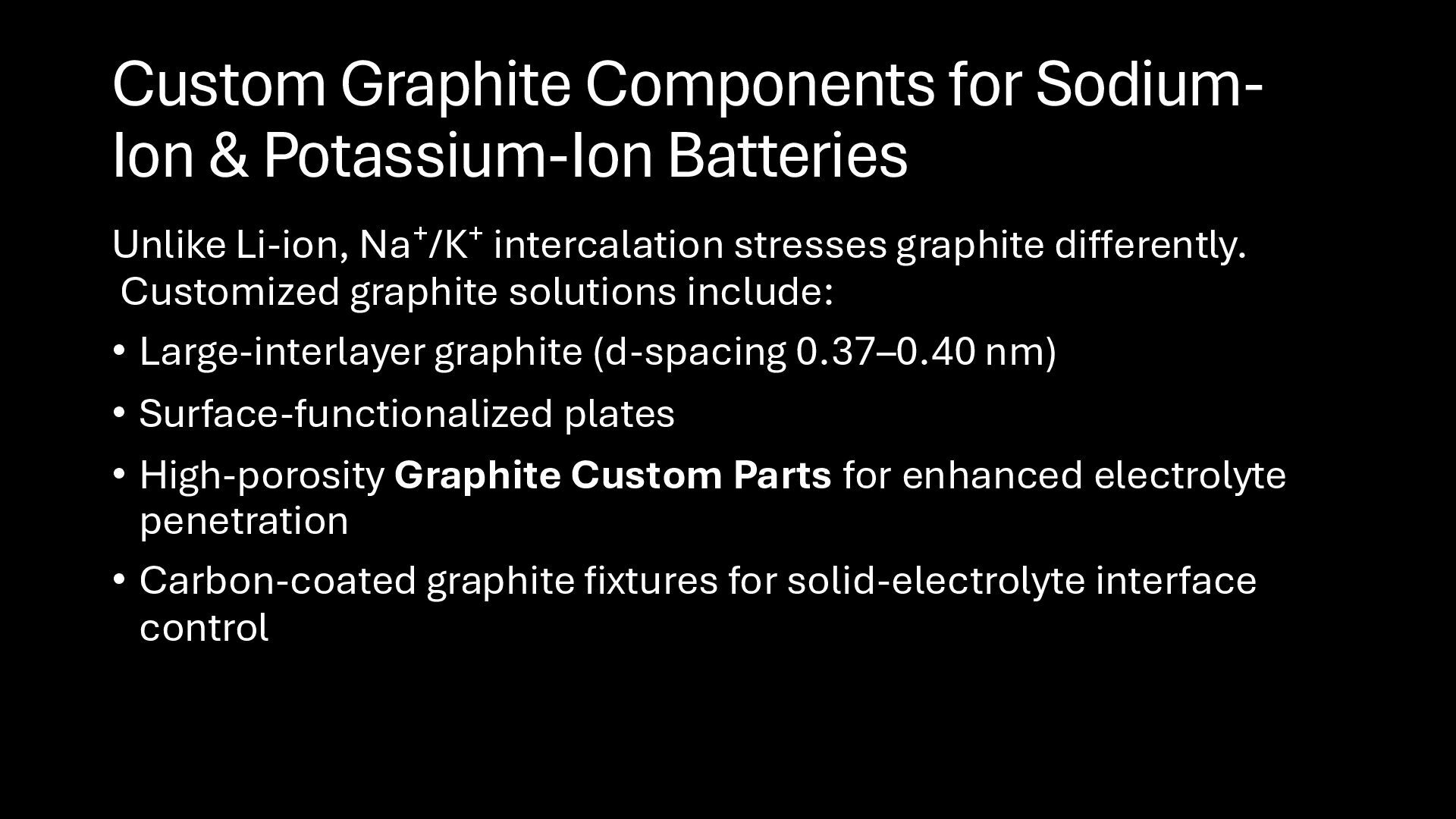
  10. Custom Graphite Components for Sodium- Ion & Potassium-Ion Batteries Unlike

    Li-ion, Na⁺/K⁺ intercalation stresses graphite differently. Customized graphite solutions include: • Large-interlayer graphite (d-spacing 0.37–0.40 nm) • Surface-functionalized plates • High-porosity Graphite Custom Parts for enhanced electrolyte penetration • Carbon-coated graphite fixtures for solid-electrolyte interface control
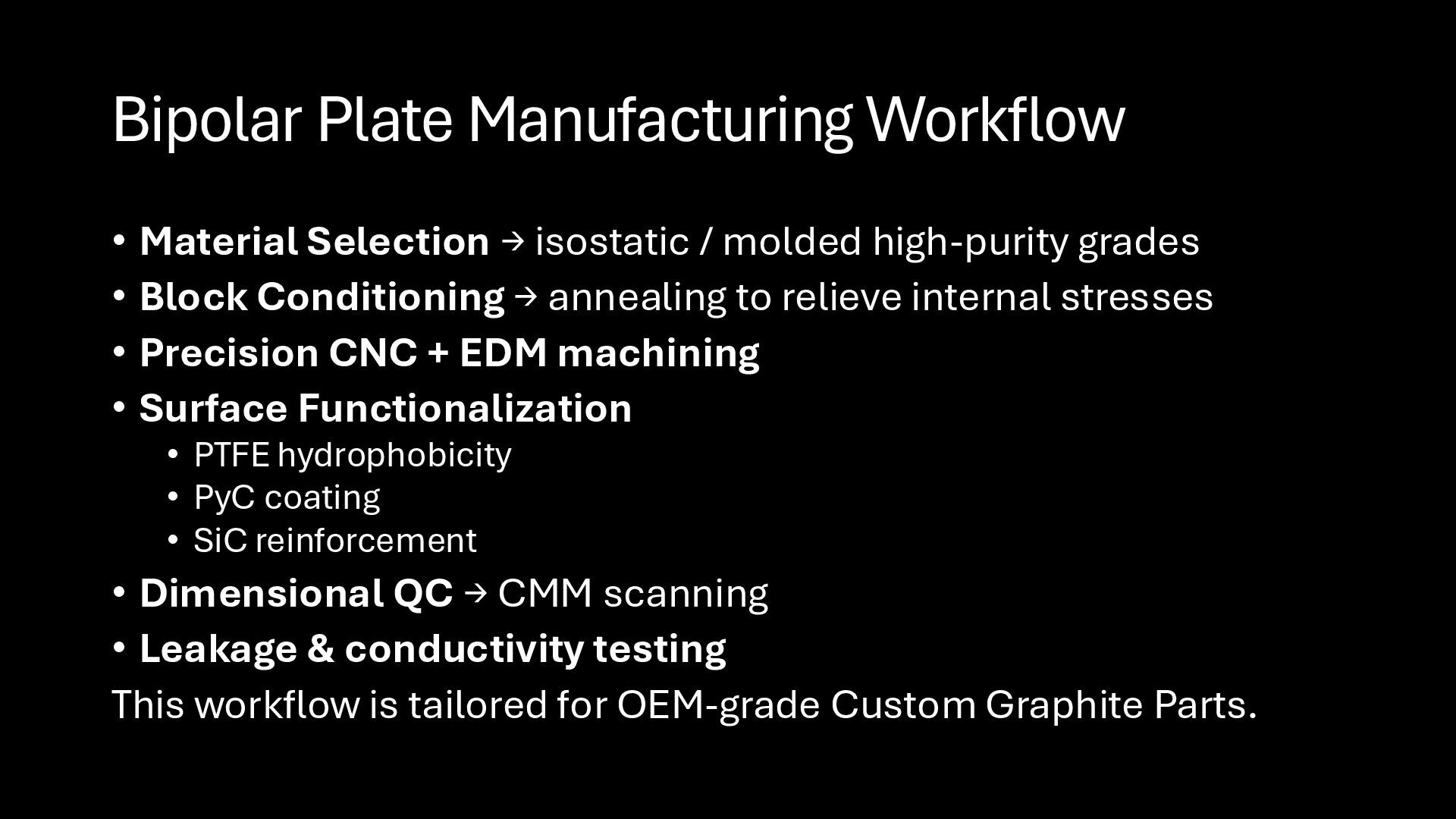
  11. Bipolar Plate Manufacturing Workflow • Material Selection → isostatic /

    molded high-purity grades • Block Conditioning → annealing to relieve internal stresses • Precision CNC + EDM machining • Surface Functionalization • PTFE hydrophobicity • PyC coating • SiC reinforcement • Dimensional QC → CMM scanning • Leakage & conductivity testing This workflow is tailored for OEM-grade Custom Graphite Parts.
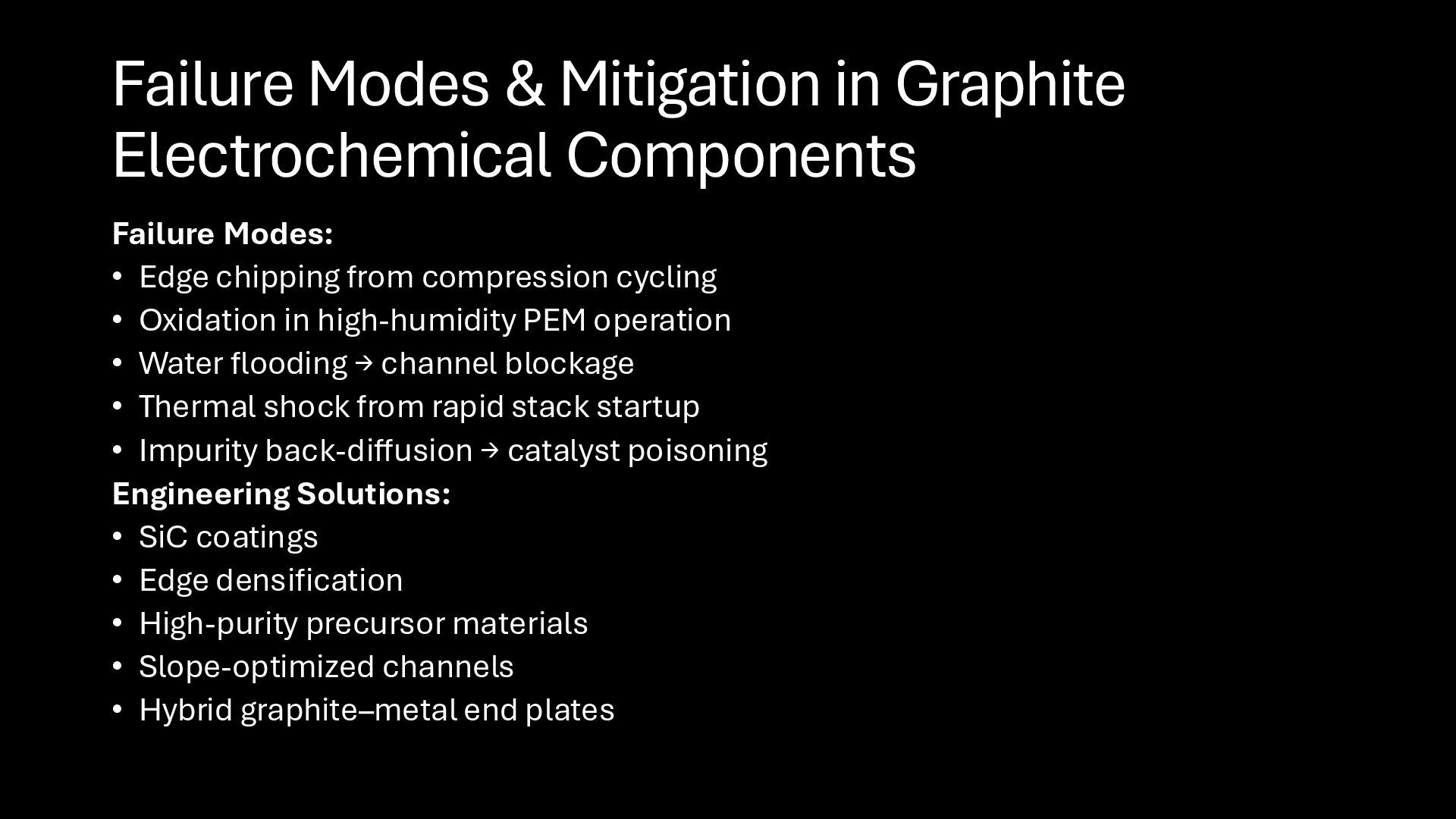
  12. Failure Modes & Mitigation in Graphite Electrochemical Components Failure Modes:

    • Edge chipping from compression cycling • Oxidation in high-humidity PEM operation • Water flooding → channel blockage • Thermal shock from rapid stack startup • Impurity back-diffusion → catalyst poisoning Engineering Solutions: • SiC coatings • Edge densification • High-purity precursor materials • Slope-optimized channels • Hybrid graphite–metal end plates
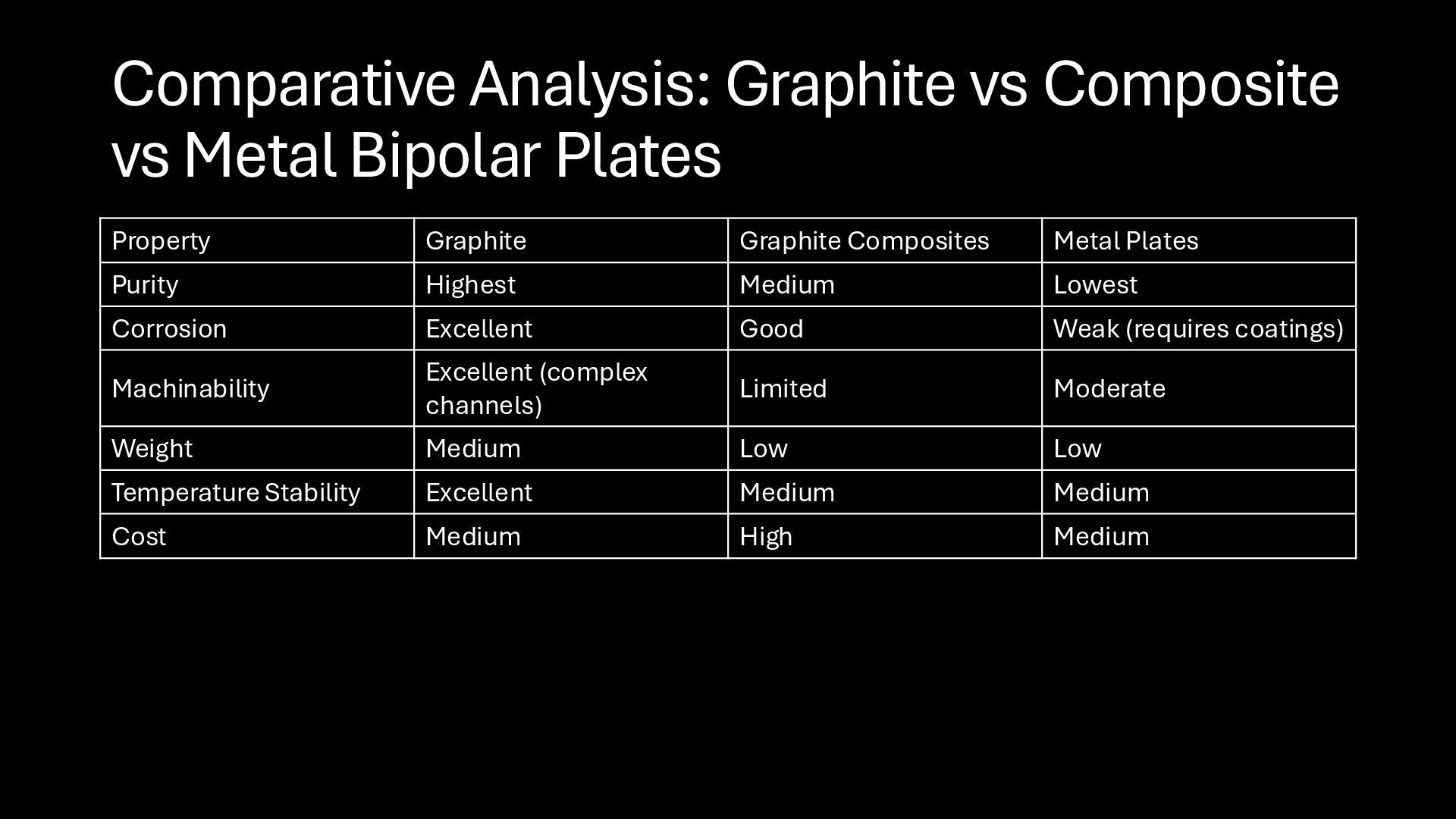
  13. Comparative Analysis: Graphite vs Composite vs Metal Bipolar Plates Property

    Graphite Graphite Composites Metal Plates Purity Highest Medium Lowest Corrosion Excellent Good Weak (requires coatings) Machinability Excellent (complex channels) Limited Moderate Weight Medium Low Low Temperature Stability Excellent Medium Medium Cost Medium High Medium
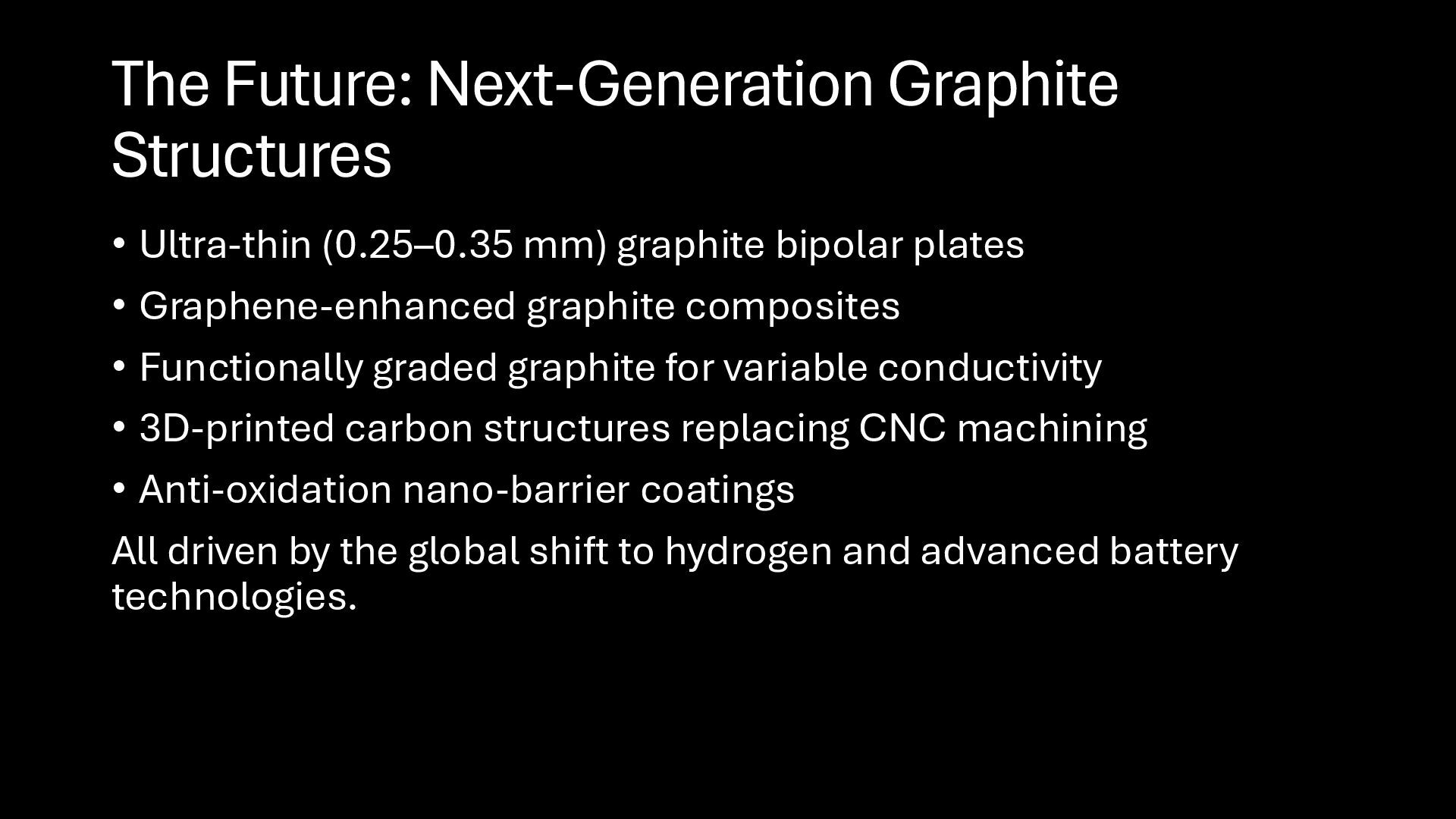
  14. The Future: Next-Generation Graphite Structures • Ultra-thin (0.25–0.35 mm) graphite

    bipolar plates • Graphene-enhanced graphite composites • Functionally graded graphite for variable conductivity • 3D-printed carbon structures replacing CNC machining • Anti-oxidation nano-barrier coatings All driven by the global shift to hydrogen and advanced battery technologies.
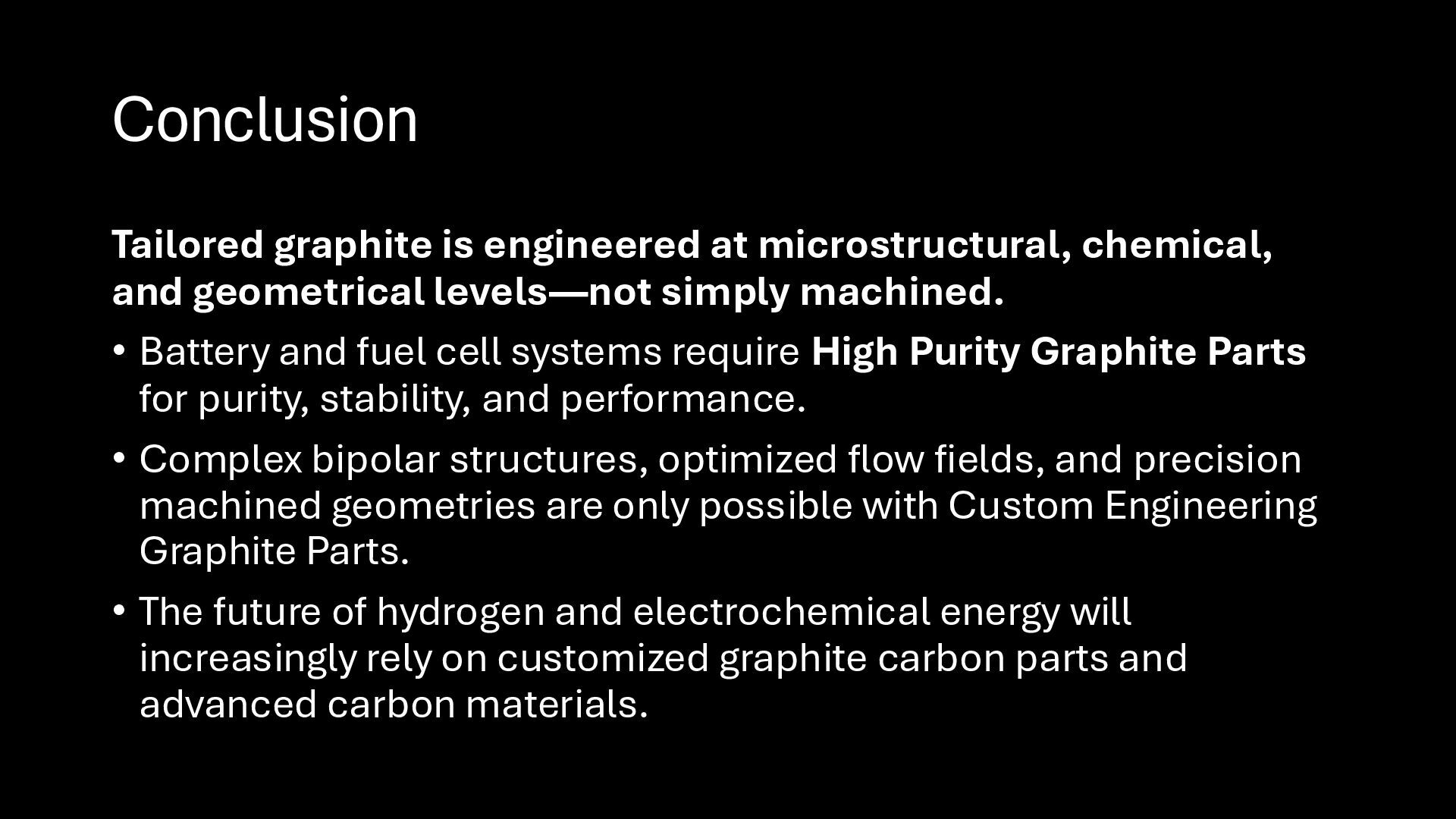
  15. Conclusion Tailored graphite is engineered at microstructural, chemical, and geometrical

    levels—not simply machined. • Battery and fuel cell systems require High Purity Graphite Parts for purity, stability, and performance. • Complex bipolar structures, optimized flow fields, and precision machined geometries are only possible with Custom Engineering Graphite Parts. • The future of hydrogen and electrochemical energy will increasingly rely on customized graphite carbon parts and advanced carbon materials.