Upgrade to Pro — share decks privately, control downloads, hide ads and more …

Clothing Manufacturing Glossary: 100+ Terms Eve...

Clothing Manufacturing Glossary: 100+ Terms Every Fashion Brand Should Know

The technical vocabulary of clothing manufacturing, explained. Most brand founders meet around 60 unfamiliar terms in their first three months with a manufacturer — and a single misunderstanding can produce a sample that is technically correct and commercially useless.

This deck covers the five confusion clusters that cost brands the most: CMT versus full-package, EXW versus FOB versus CIF versus DDP, tech pack versus spec sheet versus BOM, lab dip versus strike off, and ease allowance versus grading.

It then works through fabric measurement (GSM, denier, gauge, yarn count), fabric structure (warp, weft, twill, bias cut, selvedge), colour specification (Pantone TCX, dye lot, PFD), pattern and cutting (toile, lay plan, consumption), stitch and seam types, sampling vocabulary, and quality and certification terms (AQL, ISO 9001, OEKO-TEX, GOTS).

Closes with terms specific to UK production: CMT rates by garment type, Made in Britain certification, Harris Tweed and the Orb trademark, UKFT, the Real Living Wage, and the London and Leicester manufacturing clusters.

Read the full glossary: https://silkroutes.co.uk/clothing-manufacturing-glossary-100-terms-explained/

Manufacturing services: https://silkroutes.co.uk/clothing-manufacturing-services/
About Silk Routes: https://silkroutes.co.uk/about-silk-routes/

Avatar for Mostafa Kamal Mazumder

Mostafa Kamal Mazumder

August 24, 2026

Other Decks in Business

Transcript

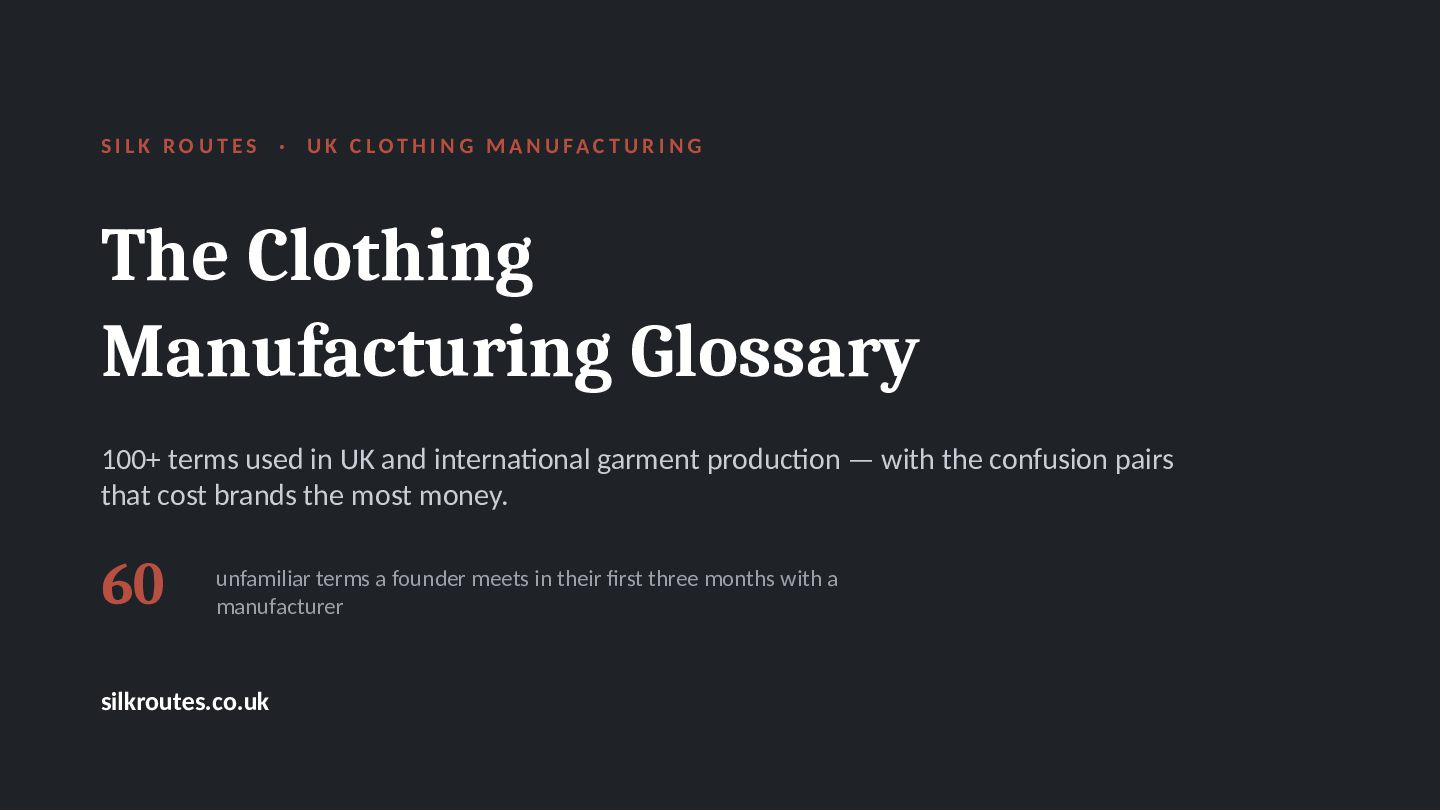
  1. SILK ROUTES · U K C L OT H I

    N G M A N U FA C T U R I N G The Clothing Manufacturing Glossary 100+ terms used in UK and international garment production — with the confusion pairs that cost brands the most money. 60 unfamiliar terms a founder meets in their first three months with a manufacturer silkroutes.co.uk
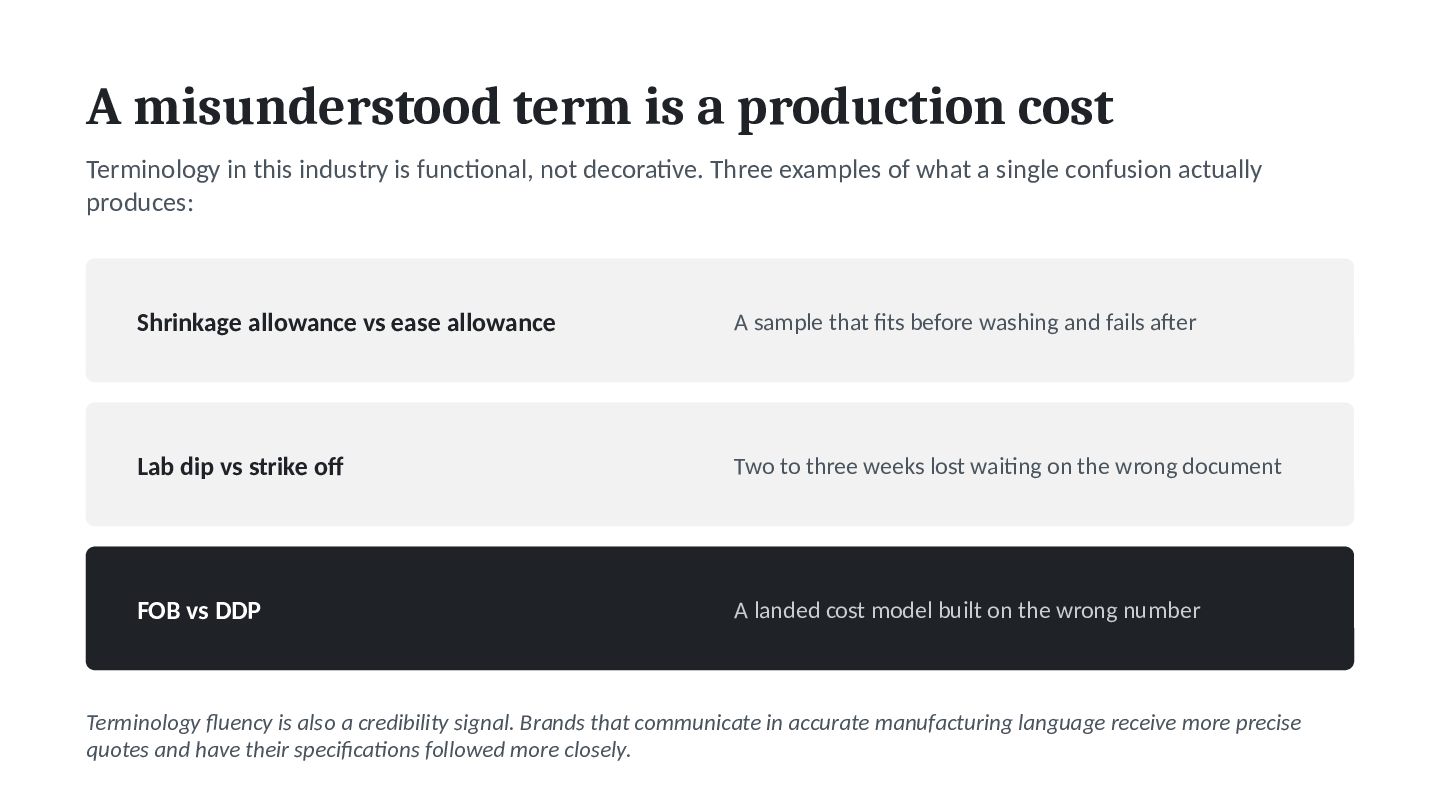
  2. A misunderstood term is a production cost Terminology in this

    industry is functional, not decorative. Three examples of what a single confusion actually produces: Shrinkage allowance vs ease allowance A sample that fits before washing and fails after Lab dip vs strike off Two to three weeks lost waiting on the wrong document FOB vs DDP A landed cost model built on the wrong number Terminology fluency is also a credibility signal. Brands that communicate in accurate manufacturing language receive more precise quotes and have their specifications followed more closely.
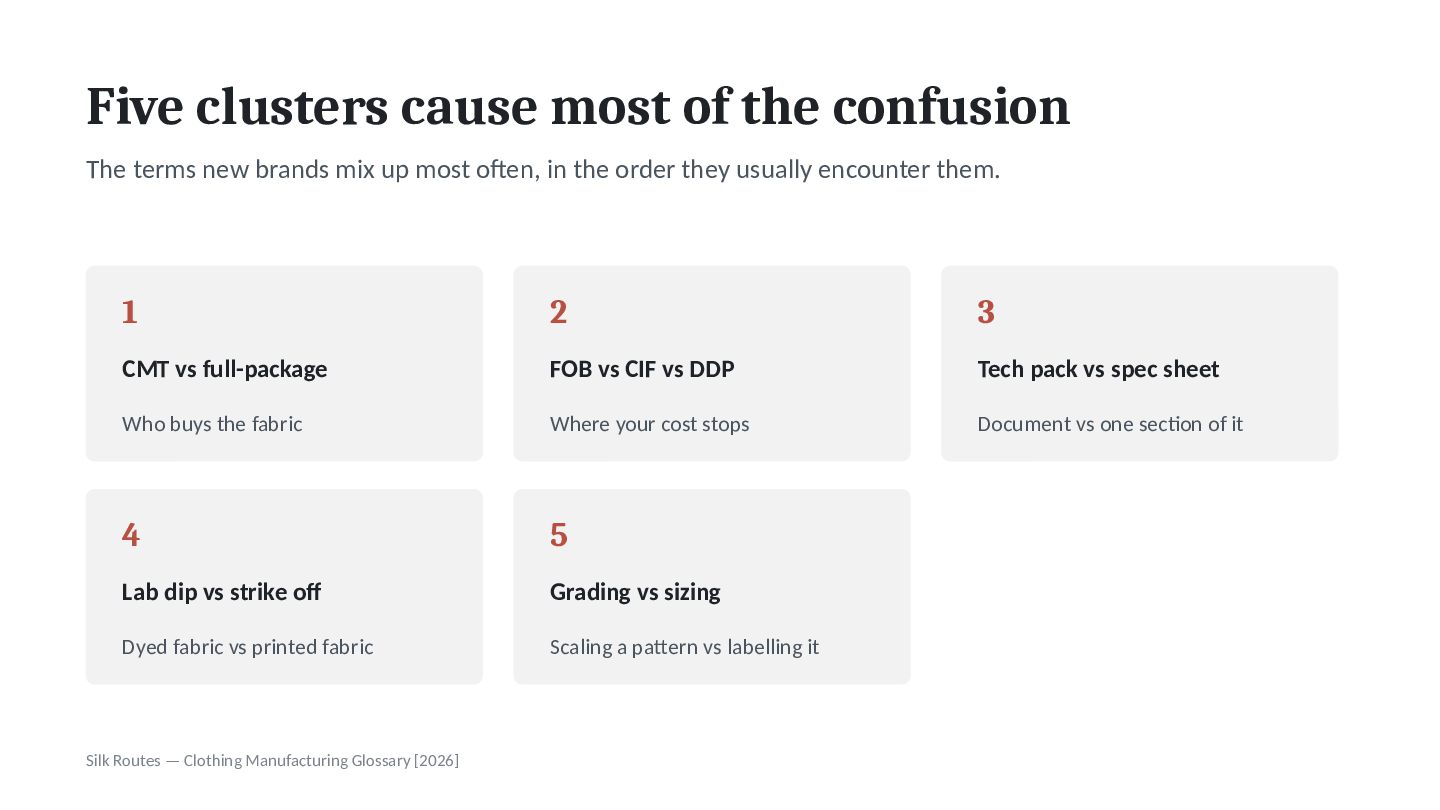
  3. Five clusters cause most of the confusion The terms new

    brands mix up most often, in the order they usually encounter them. 1 2 3 CMT vs full-package FOB vs CIF vs DDP Tech pack vs spec sheet Who buys the fabric Where your cost stops Document vs one section of it 4 5 Lab dip vs strike off Grading vs sizing Dyed fabric vs printed fabric Scaling a pattern vs labelling it Silk Routes — Clothing Manufacturing Glossary [2026]
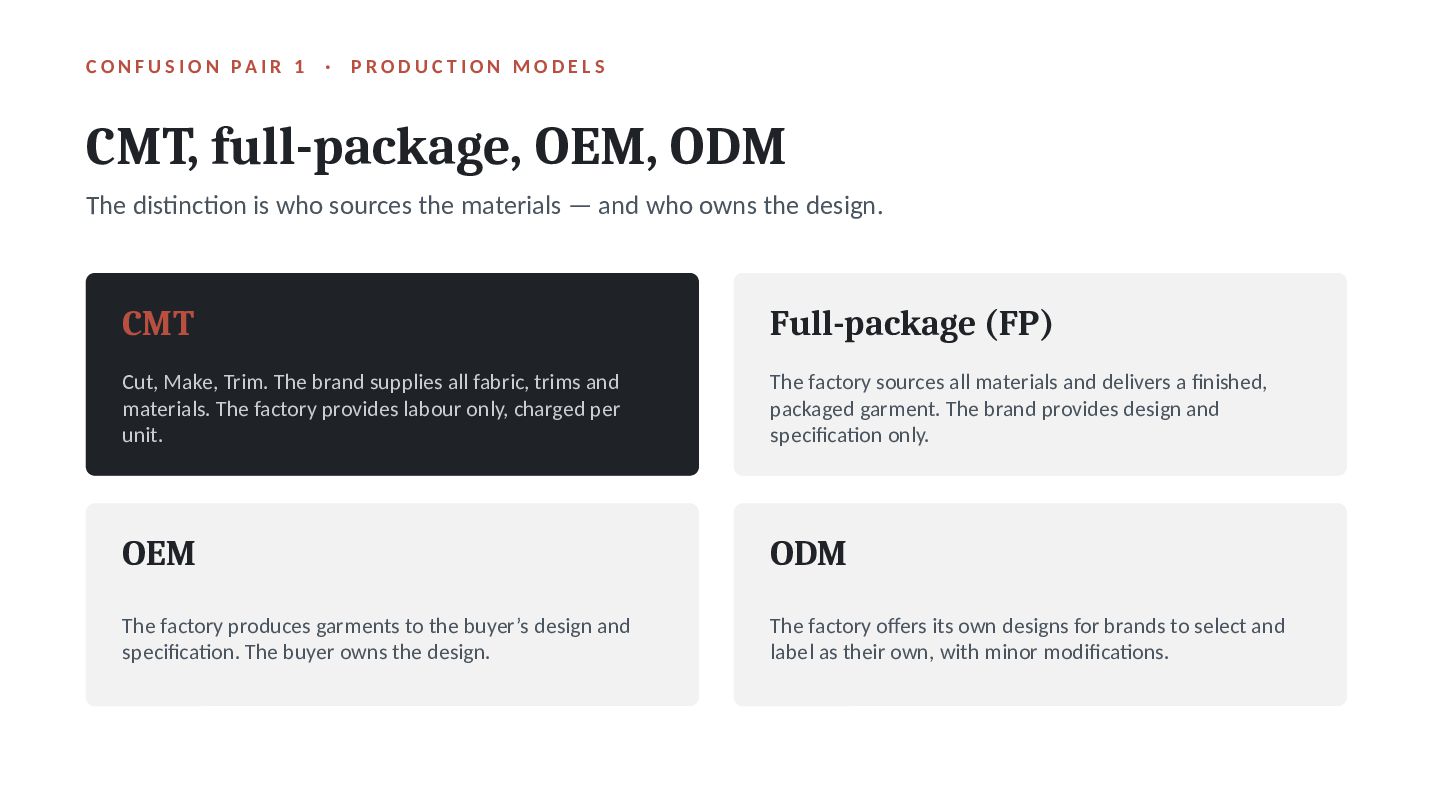
  4. C O N F U S I O N PA

    I R 1 · PRODUCTION MODELS CMT, full-package, OEM, ODM The distinction is who sources the materials — and who owns the design. CMT Full-package (FP) Cut, Make, Trim. The brand supplies all fabric, trims and materials. The factory provides labour only, charged per unit. The factory sources all materials and delivers a finished, packaged garment. The brand provides design and specification only. OEM ODM The factory produces garments to the buyer’s design and specification. The buyer owns the design. The factory offers its own designs for brands to select and label as their own, with minor modifications.
  5. C O N F U S I O N PA

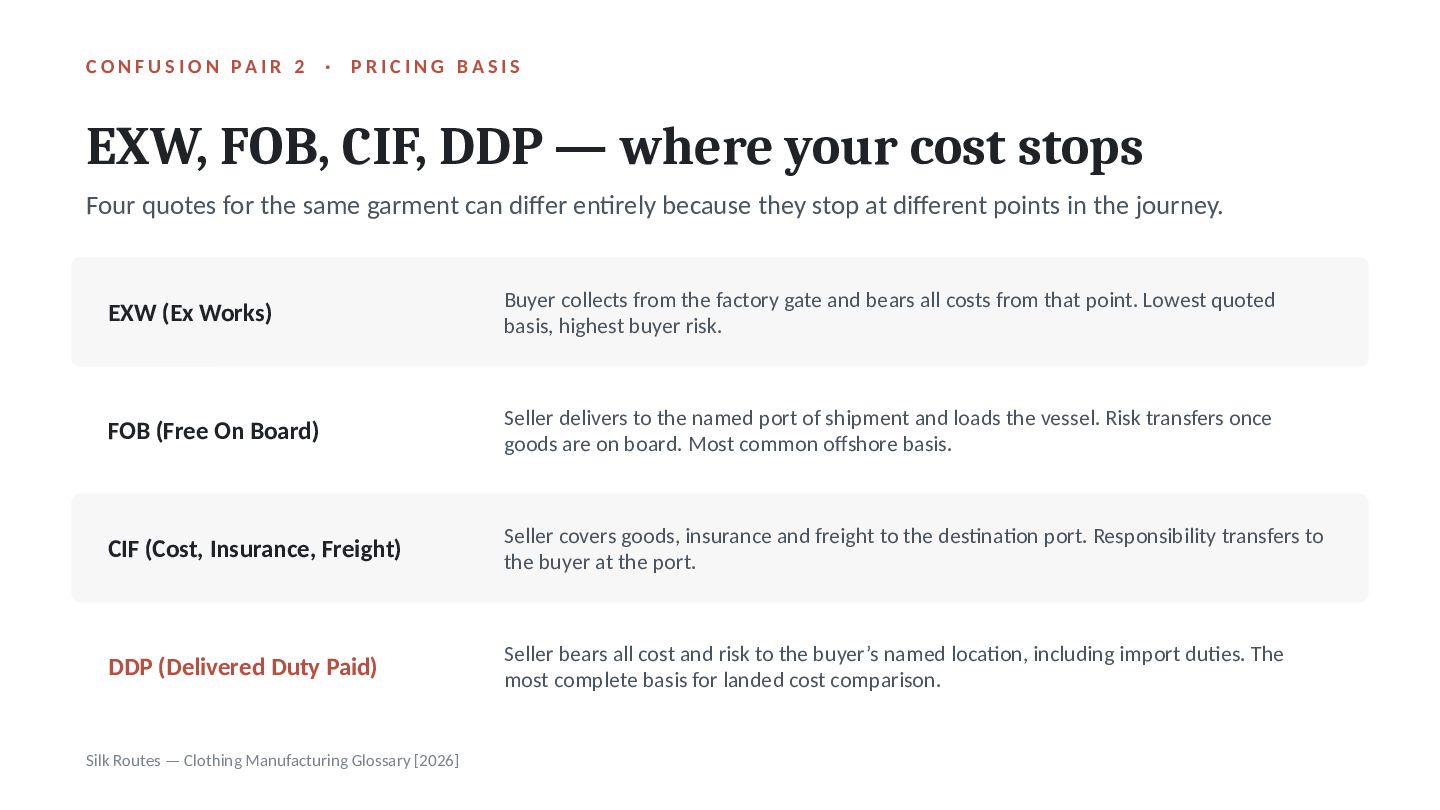
    I R 2 · PRICING BASIS EXW, FOB, CIF, DDP — where your cost stops Four quotes for the same garment can differ entirely because they stop at different points in the journey. EXW (Ex Works) Buyer collects from the factory gate and bears all costs from that point. Lowest quoted basis, highest buyer risk. FOB (Free On Board) Seller delivers to the named port of shipment and loads the vessel. Risk transfers once goods are on board. Most common offshore basis. CIF (Cost, Insurance, Freight) Seller covers goods, insurance and freight to the destination port. Responsibility transfers to the buyer at the port. DDP (Delivered Duty Paid) Seller bears all cost and risk to the buyer’s named location, including import duties. The most complete basis for landed cost comparison. Silk Routes — Clothing Manufacturing Glossary [2026]
  6. C O N F U S I O N PA

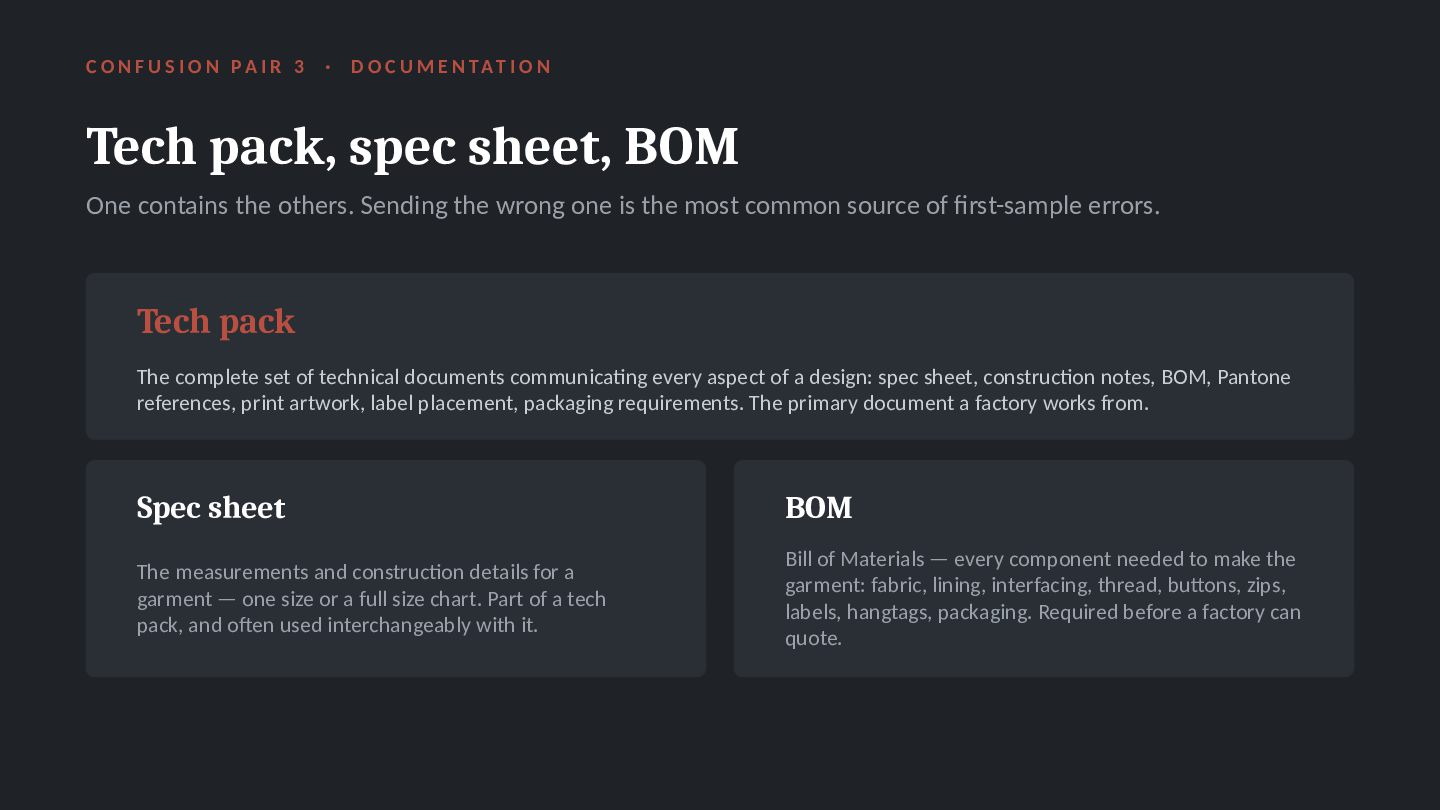
    I R 3 · D O C U M E N TAT I O N Tech pack, spec sheet, BOM One contains the others. Sending the wrong one is the most common source of first-sample errors. Tech pack The complete set of technical documents communicating every aspect of a design: spec sheet, construction notes, BOM, Pantone references, print artwork, label placement, packaging requirements. The primary document a factory works from. Spec sheet BOM The measurements and construction details for a garment — one size or a full size chart. Part of a tech pack, and often used interchangeably with it. Bill of Materials — every component needed to make the garment: fabric, lining, interfacing, thread, buttons, zips, labels, hangtags, packaging. Required before a factory can quote.
  7. C O N F U S I O N PA

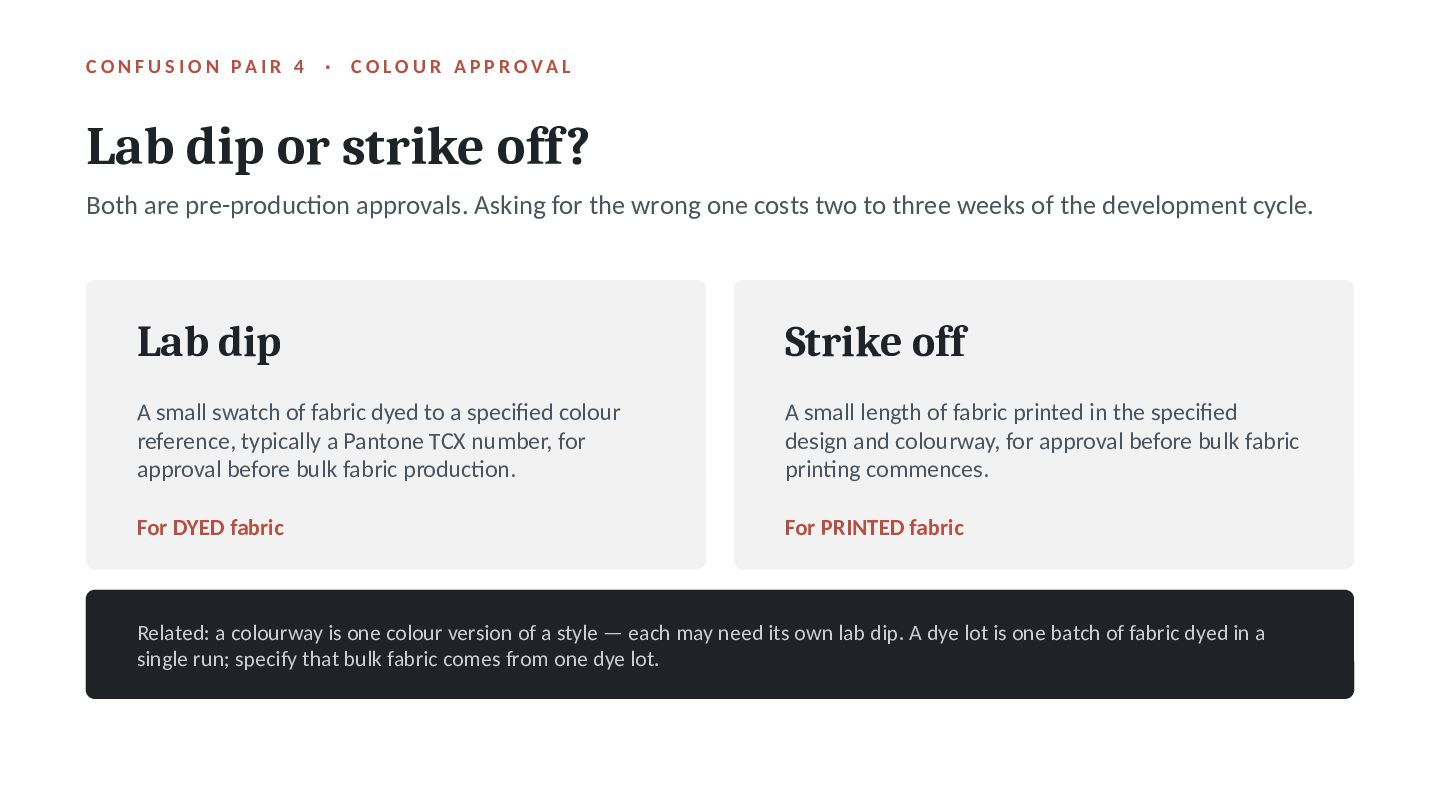
    I R 4 · C O L O U R A P P R O VA L Lab dip or strike off? Both are pre-production approvals. Asking for the wrong one costs two to three weeks of the development cycle. Lab dip Strike off A small swatch of fabric dyed to a specified colour reference, typically a Pantone TCX number, for approval before bulk fabric production. A small length of fabric printed in the specified design and colourway, for approval before bulk fabric printing commences. For DYED fabric For PRINTED fabric Related: a colourway is one colour version of a style — each may need its own lab dip. A dye lot is one batch of fabric dyed in a single run; specify that bulk fabric comes from one dye lot.
  8. C O N F U S I O N PA

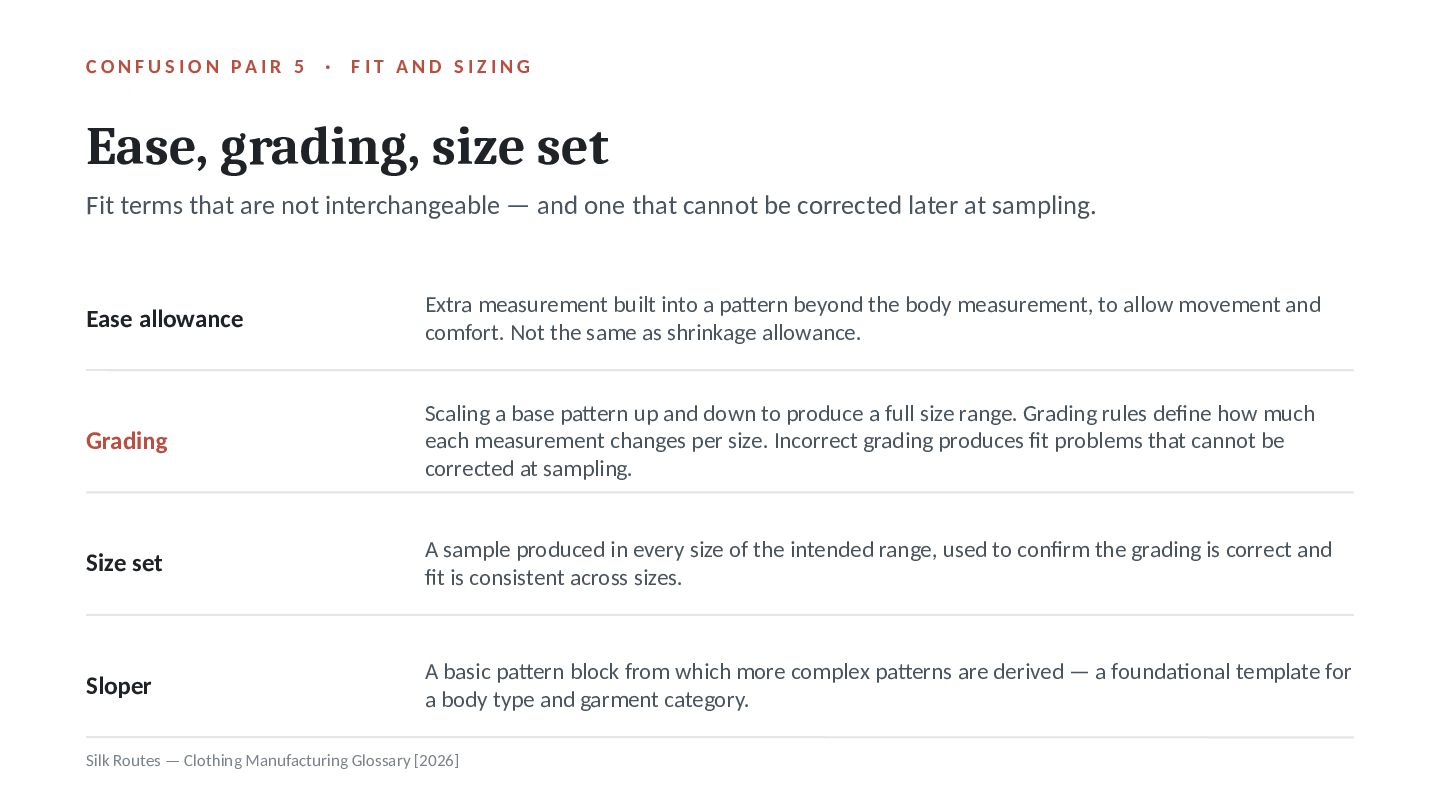
    I R 5 · FIT AND SIZING Ease, grading, size set Fit terms that are not interchangeable — and one that cannot be corrected later at sampling. Ease allowance Extra measurement built into a pattern beyond the body measurement, to allow movement and comfort. Not the same as shrinkage allowance. Grading Scaling a base pattern up and down to produce a full size range. Grading rules define how much each measurement changes per size. Incorrect grading produces fit problems that cannot be corrected at sampling. Size set A sample produced in every size of the intended range, used to confirm the grading is correct and fit is consistent across sizes. Sloper A basic pattern block from which more complex patterns are derived — a foundational template for a body type and garment category. Silk Routes — Clothing Manufacturing Glossary [2026]
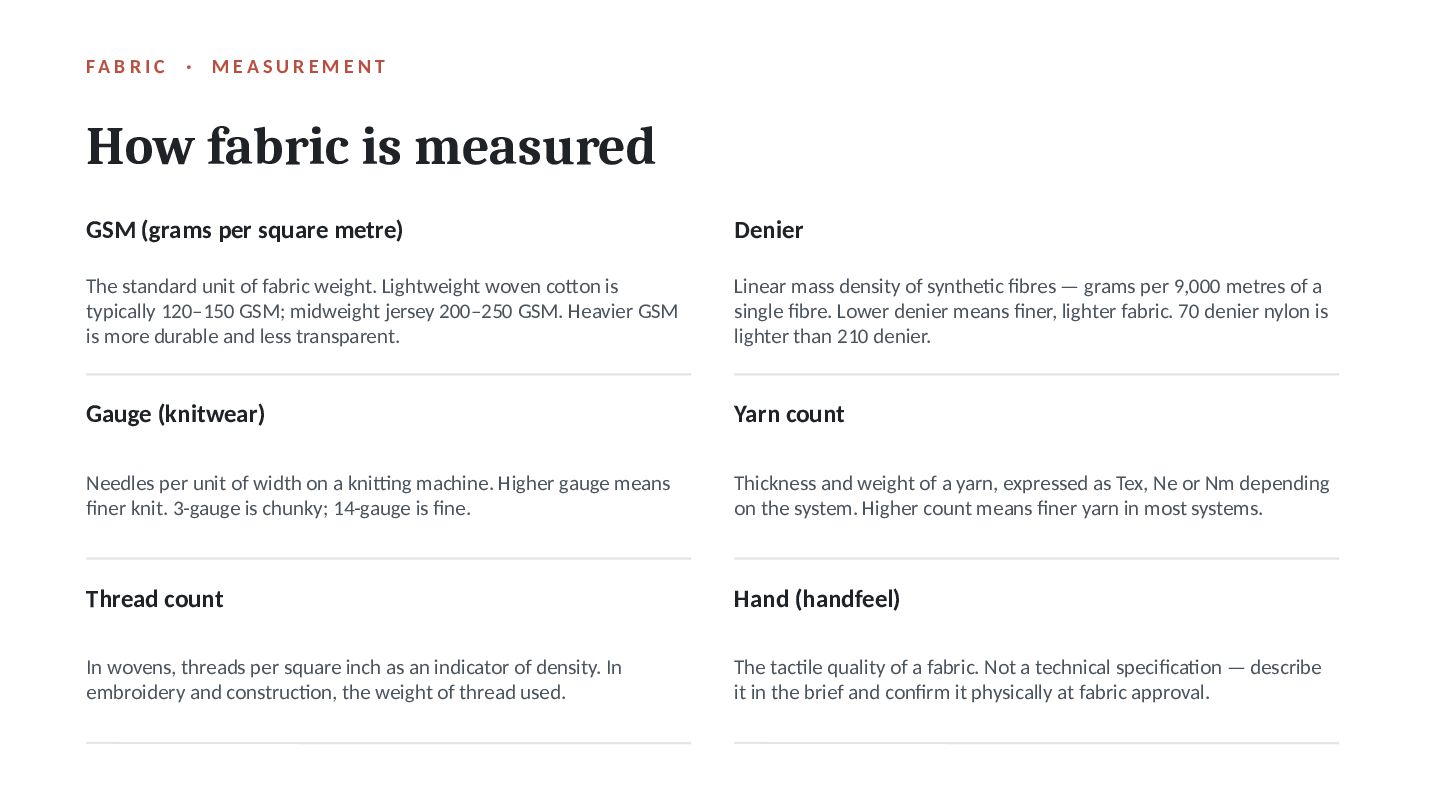
  9. FA B R I C · MEASUREMENT How fabric is

    measured GSM (grams per square metre) Denier The standard unit of fabric weight. Lightweight woven cotton is typically 120–150 GSM; midweight jersey 200–250 GSM. Heavier GSM is more durable and less transparent. Linear mass density of synthetic fibres — grams per 9,000 metres of a single fibre. Lower denier means finer, lighter fabric. 70 denier nylon is lighter than 210 denier. Gauge (knitwear) Yarn count Needles per unit of width on a knitting machine. Higher gauge means finer knit. 3-gauge is chunky; 14-gauge is fine. Thickness and weight of a yarn, expressed as Tex, Ne or Nm depending on the system. Higher count means finer yarn in most systems. Thread count Hand (handfeel) In wovens, threads per square inch as an indicator of density. In embroidery and construction, the weight of thread used. The tactile quality of a fabric. Not a technical specification — describe it in the brief and confirm it physically at fabric approval.
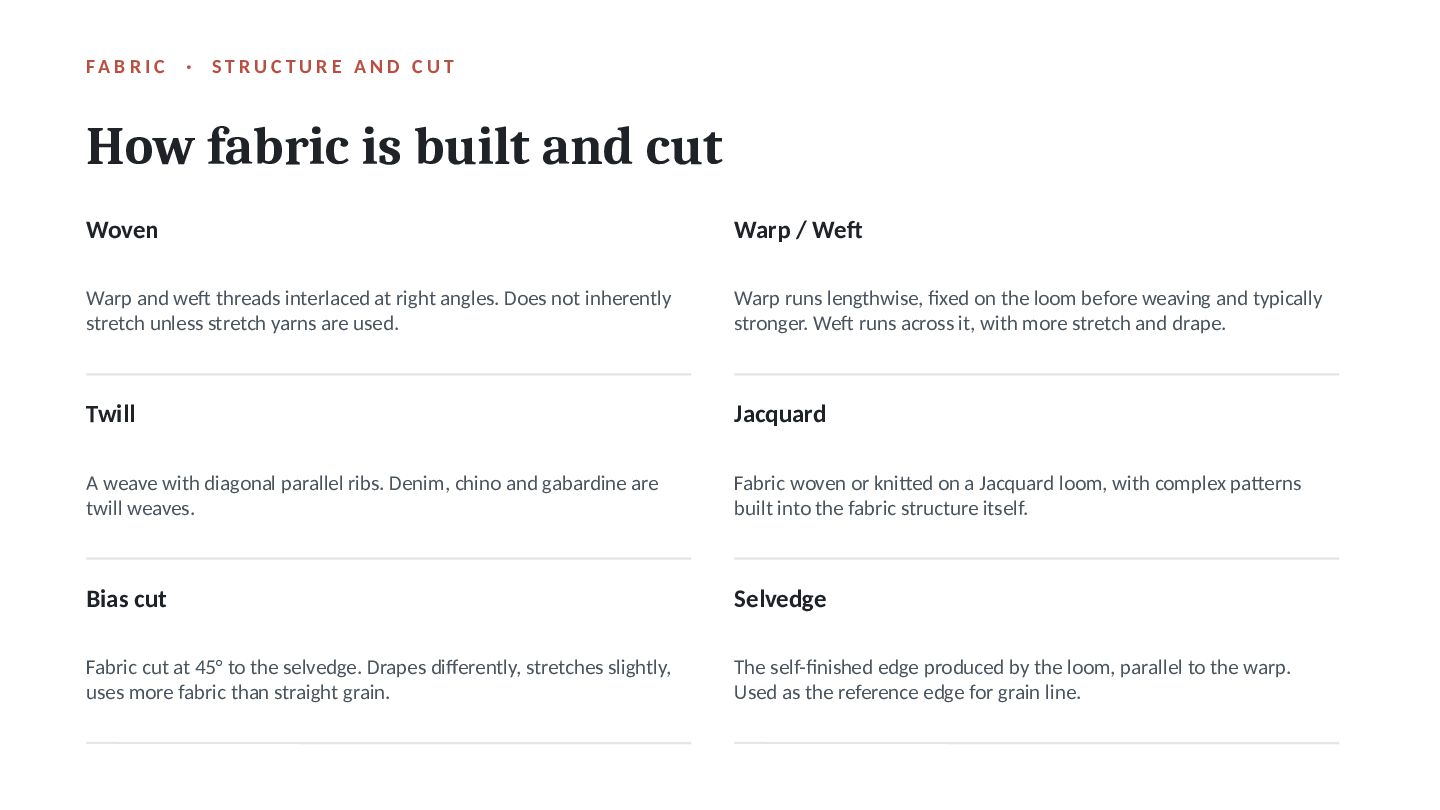
  10. FA B R I C · STRUCTURE AND CUT How

    fabric is built and cut Woven Warp / Weft Warp and weft threads interlaced at right angles. Does not inherently stretch unless stretch yarns are used. Warp runs lengthwise, fixed on the loom before weaving and typically stronger. Weft runs across it, with more stretch and drape. Twill Jacquard A weave with diagonal parallel ribs. Denim, chino and gabardine are twill weaves. Fabric woven or knitted on a Jacquard loom, with complex patterns built into the fabric structure itself. Bias cut Selvedge Fabric cut at 45° to the selvedge. Drapes differently, stretches slightly, uses more fabric than straight grain. The self-finished edge produced by the loom, parallel to the warp. Used as the reference edge for grain line.
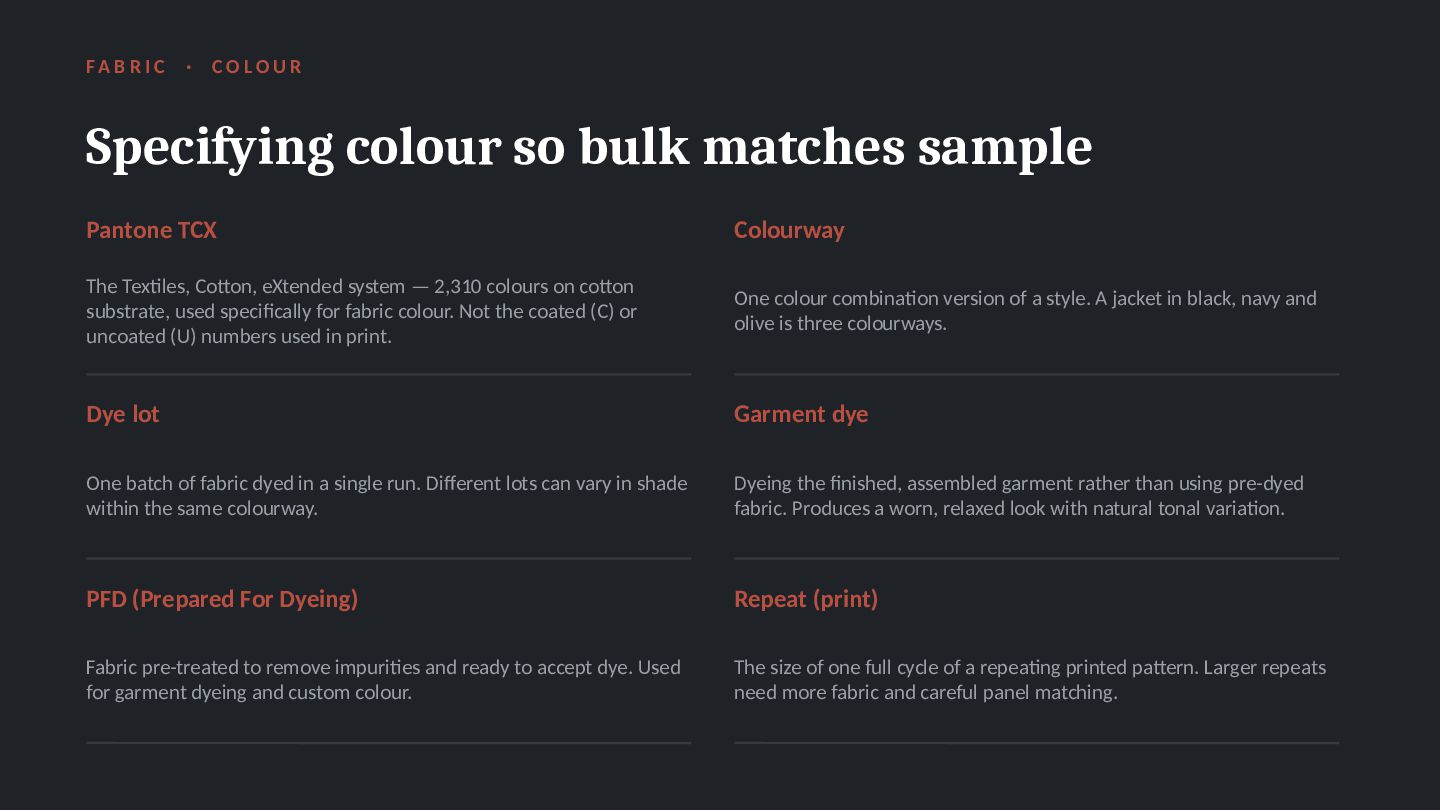
  11. FA B R I C · COLOUR Specifying colour so

    bulk matches sample Pantone TCX Colourway The Textiles, Cotton, eXtended system — 2,310 colours on cotton substrate, used specifically for fabric colour. Not the coated (C) or uncoated (U) numbers used in print. One colour combination version of a style. A jacket in black, navy and olive is three colourways. Dye lot Garment dye One batch of fabric dyed in a single run. Different lots can vary in shade within the same colourway. Dyeing the finished, assembled garment rather than using pre-dyed fabric. Produces a worn, relaxed look with natural tonal variation. PFD (Prepared For Dyeing) Repeat (print) Fabric pre-treated to remove impurities and ready to accept dye. Used for garment dyeing and custom colour. The size of one full cycle of a repeating printed pattern. Larger repeats need more fabric and careful panel matching.
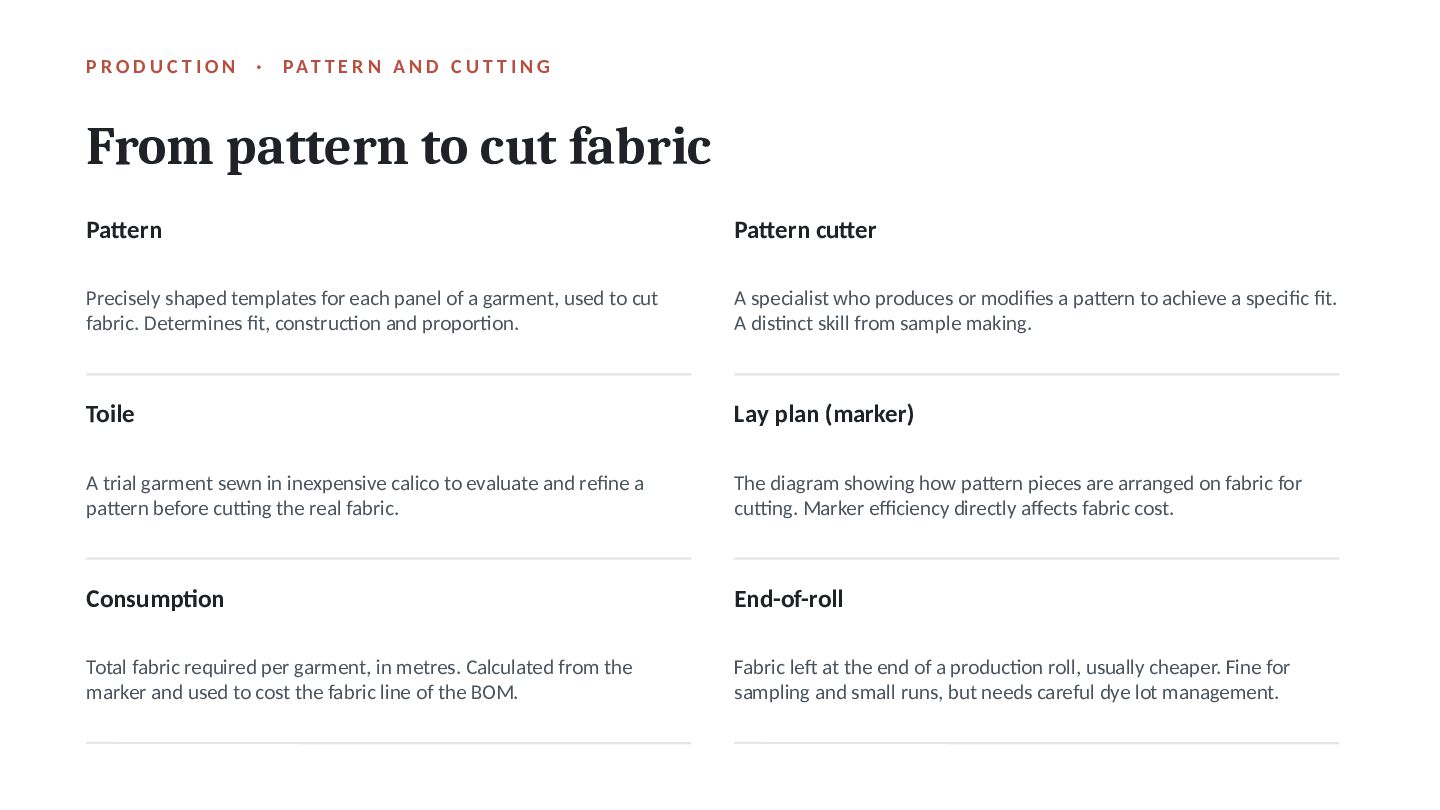
  12. PRODUCTION · PAT T E R N A N D

    C U T T I N G From pattern to cut fabric Pattern Pattern cutter Precisely shaped templates for each panel of a garment, used to cut fabric. Determines fit, construction and proportion. A specialist who produces or modifies a pattern to achieve a specific fit. A distinct skill from sample making. Toile Lay plan (marker) A trial garment sewn in inexpensive calico to evaluate and refine a pattern before cutting the real fabric. The diagram showing how pattern pieces are arranged on fabric for cutting. Marker efficiency directly affects fabric cost. Consumption End-of-roll Total fabric required per garment, in metres. Calculated from the marker and used to cost the fabric line of the BOM. Fabric left at the end of a production roll, usually cheaper. Fine for sampling and small runs, but needs careful dye lot management.
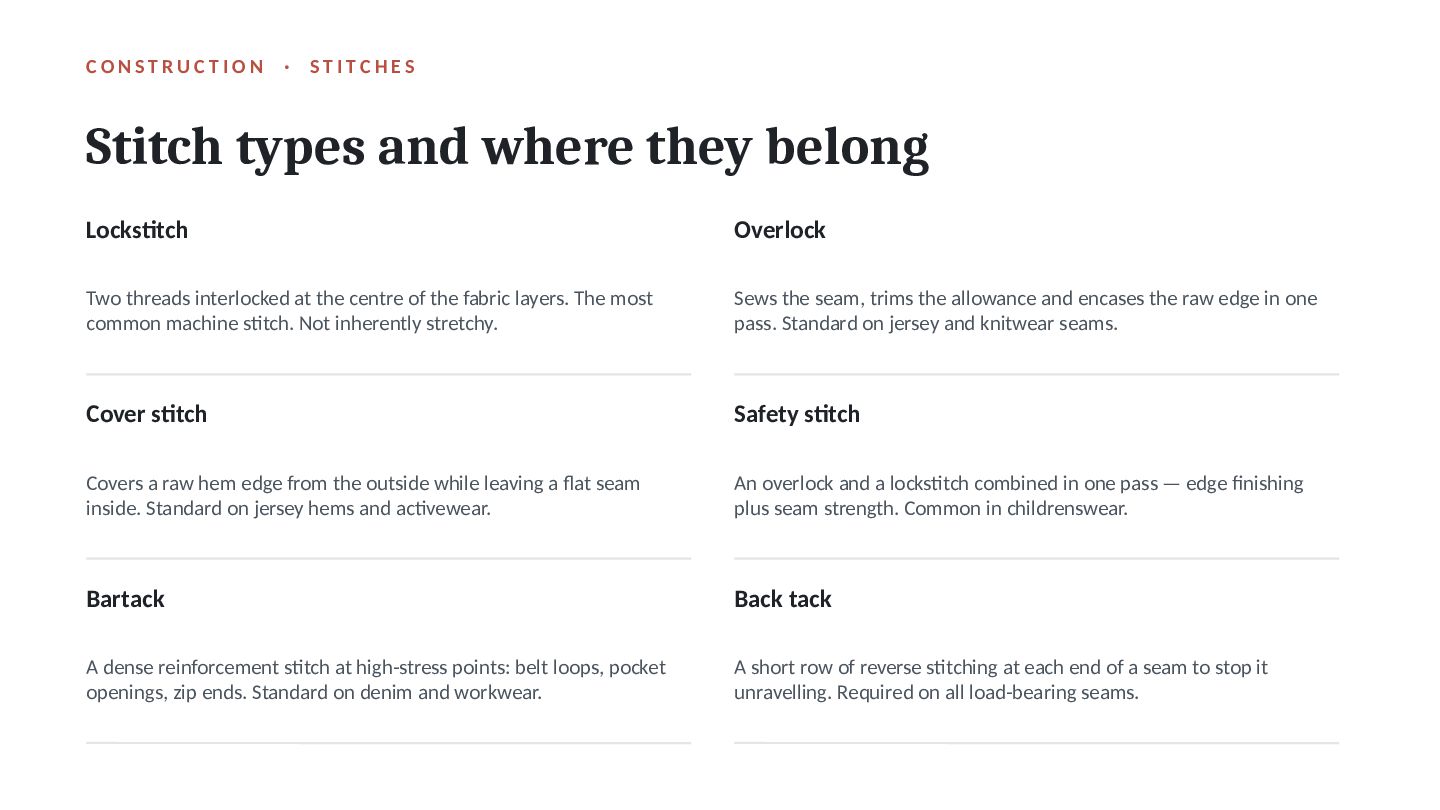
  13. CONSTRUCTION · STITCHES Stitch types and where they belong Lockstitch

    Overlock Two threads interlocked at the centre of the fabric layers. The most common machine stitch. Not inherently stretchy. Sews the seam, trims the allowance and encases the raw edge in one pass. Standard on jersey and knitwear seams. Cover stitch Safety stitch Covers a raw hem edge from the outside while leaving a flat seam inside. Standard on jersey hems and activewear. An overlock and a lockstitch combined in one pass — edge finishing plus seam strength. Common in childrenswear. Bartack Back tack A dense reinforcement stitch at high-stress points: belt loops, pocket openings, zip ends. Standard on denim and workwear. A short row of reverse stitching at each end of a seam to stop it unravelling. Required on all load-bearing seams.
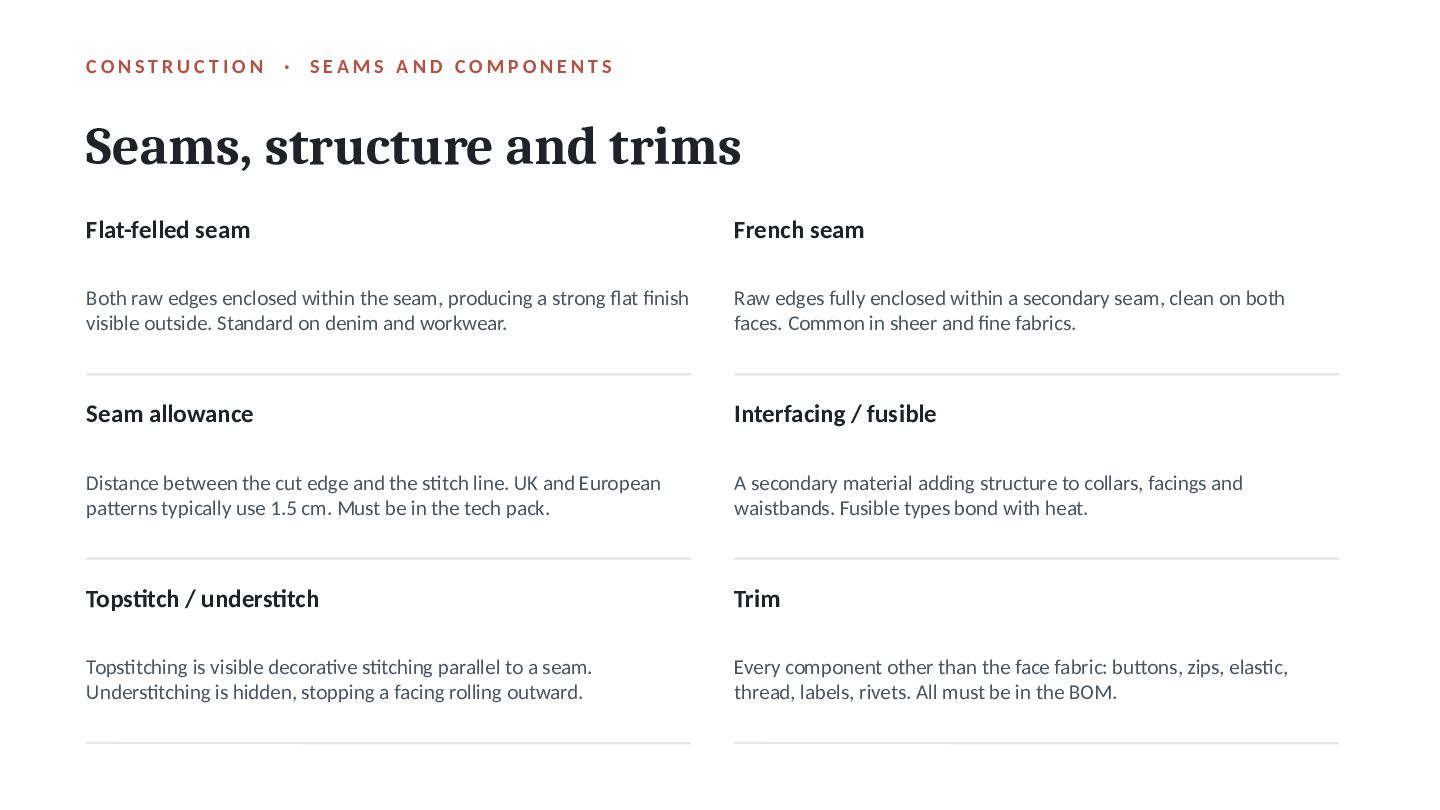
  14. CONSTRUCTION · SEAMS AND COMPONENTS Seams, structure and trims Flat-felled

    seam French seam Both raw edges enclosed within the seam, producing a strong flat finish visible outside. Standard on denim and workwear. Raw edges fully enclosed within a secondary seam, clean on both faces. Common in sheer and fine fabrics. Seam allowance Interfacing / fusible Distance between the cut edge and the stitch line. UK and European patterns typically use 1.5 cm. Must be in the tech pack. A secondary material adding structure to collars, facings and waistbands. Fusible types bond with heat. Topstitch / understitch Trim Topstitching is visible decorative stitching parallel to a seam. Understitching is hidden, stopping a facing rolling outward. Every component other than the face fabric: buttons, zips, elastic, thread, labels, rivets. All must be in the BOM.
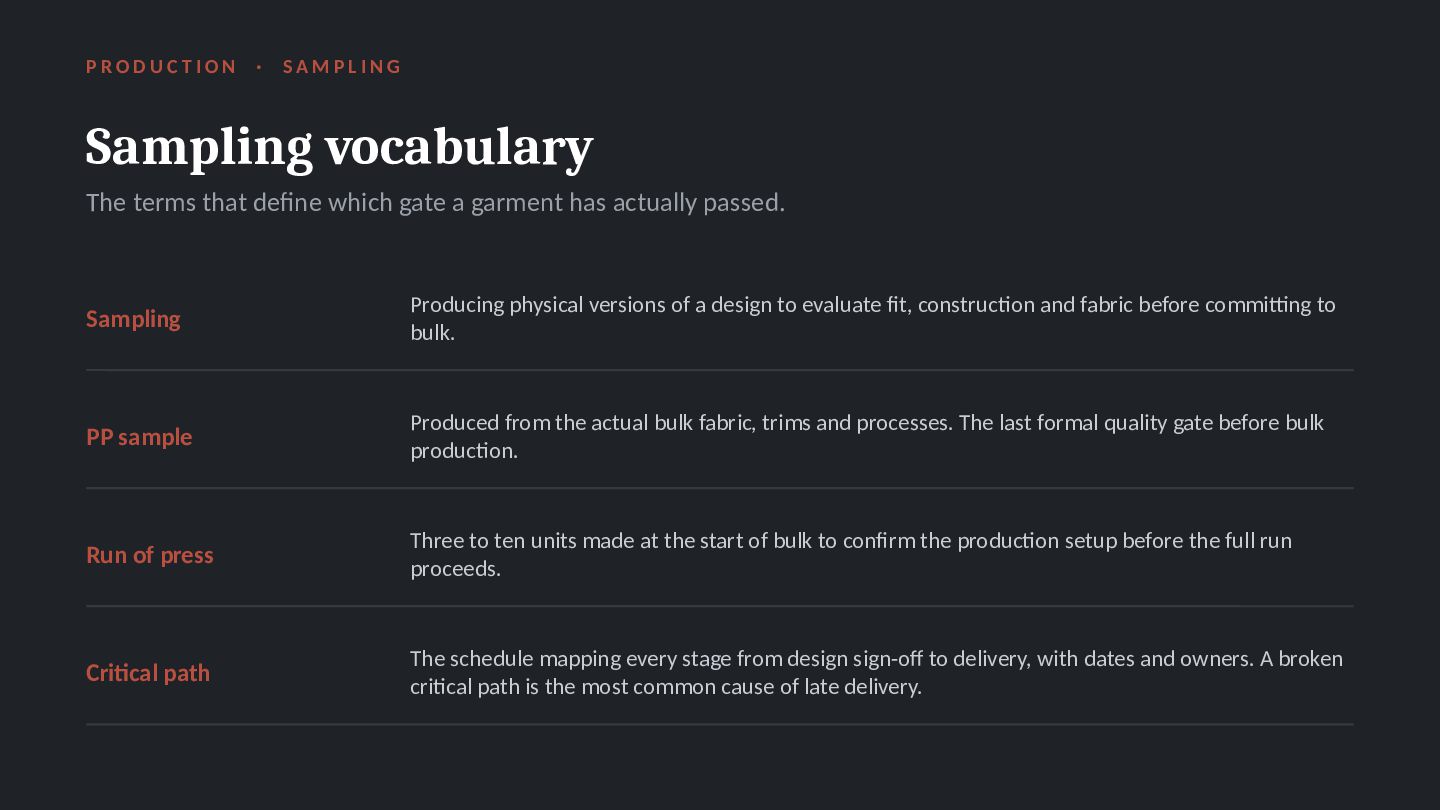
  15. PRODUCTION · SAMPLING Sampling vocabulary The terms that define which

    gate a garment has actually passed. Sampling Producing physical versions of a design to evaluate fit, construction and fabric before committing to bulk. PP sample Produced from the actual bulk fabric, trims and processes. The last formal quality gate before bulk production. Run of press Three to ten units made at the start of bulk to confirm the production setup before the full run proceeds. Critical path The schedule mapping every stage from design sign-off to delivery, with dates and owners. A broken critical path is the most common cause of late delivery.
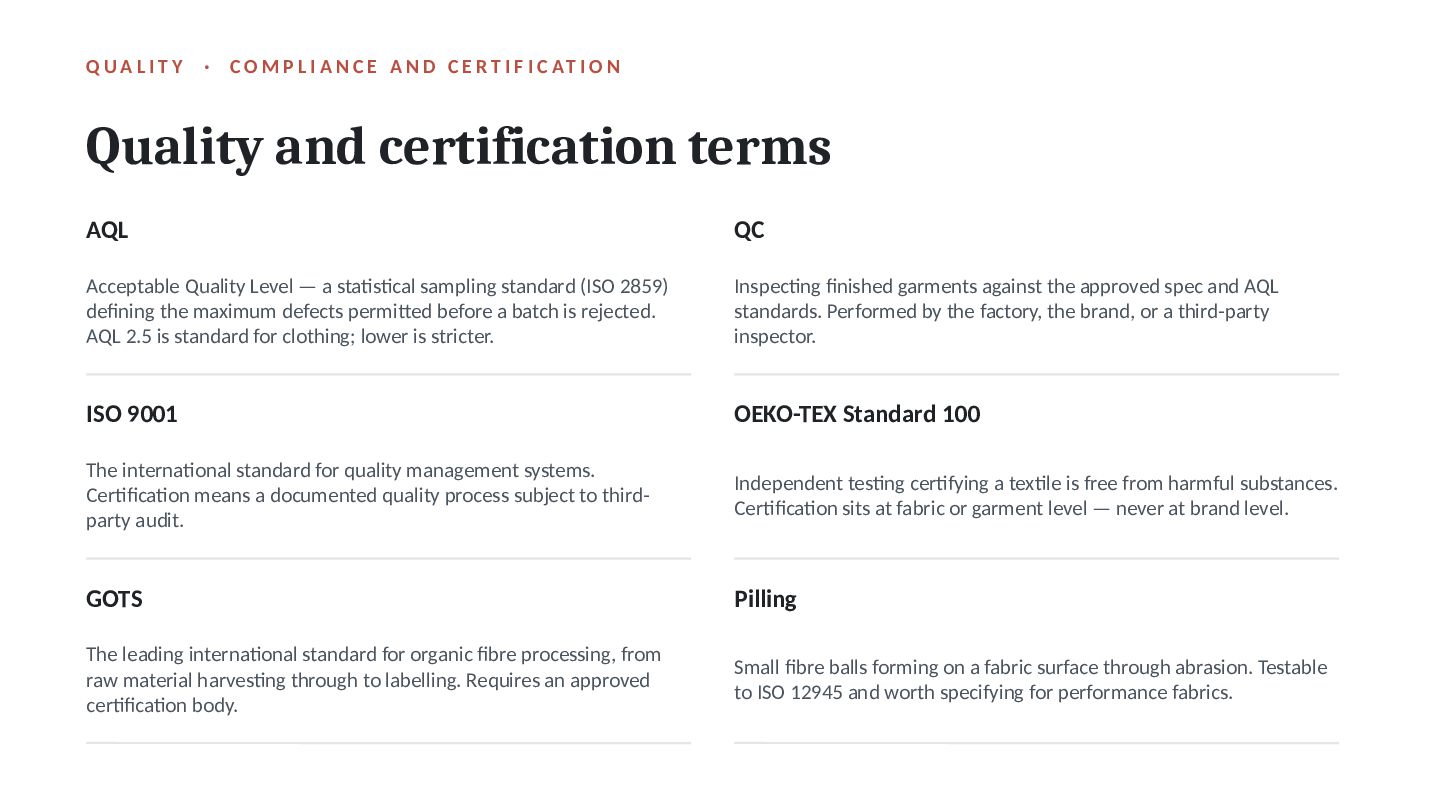
  16. QUALITY · C O M P L I A N

    C E A N D C E R T I F I C AT I O N Quality and certification terms AQL QC Acceptable Quality Level — a statistical sampling standard (ISO 2859) defining the maximum defects permitted before a batch is rejected. AQL 2.5 is standard for clothing; lower is stricter. Inspecting finished garments against the approved spec and AQL standards. Performed by the factory, the brand, or a third-party inspector. ISO 9001 OEKO-TEX Standard 100 The international standard for quality management systems. Certification means a documented quality process subject to thirdparty audit. Independent testing certifying a textile is free from harmful substances. Certification sits at fabric or garment level — never at brand level. GOTS Pilling The leading international standard for organic fibre processing, from raw material harvesting through to labelling. Requires an approved certification body. Small fibre balls forming on a fabric surface through abrasion. Testable to ISO 12945 and worth specifying for performance fabrics.
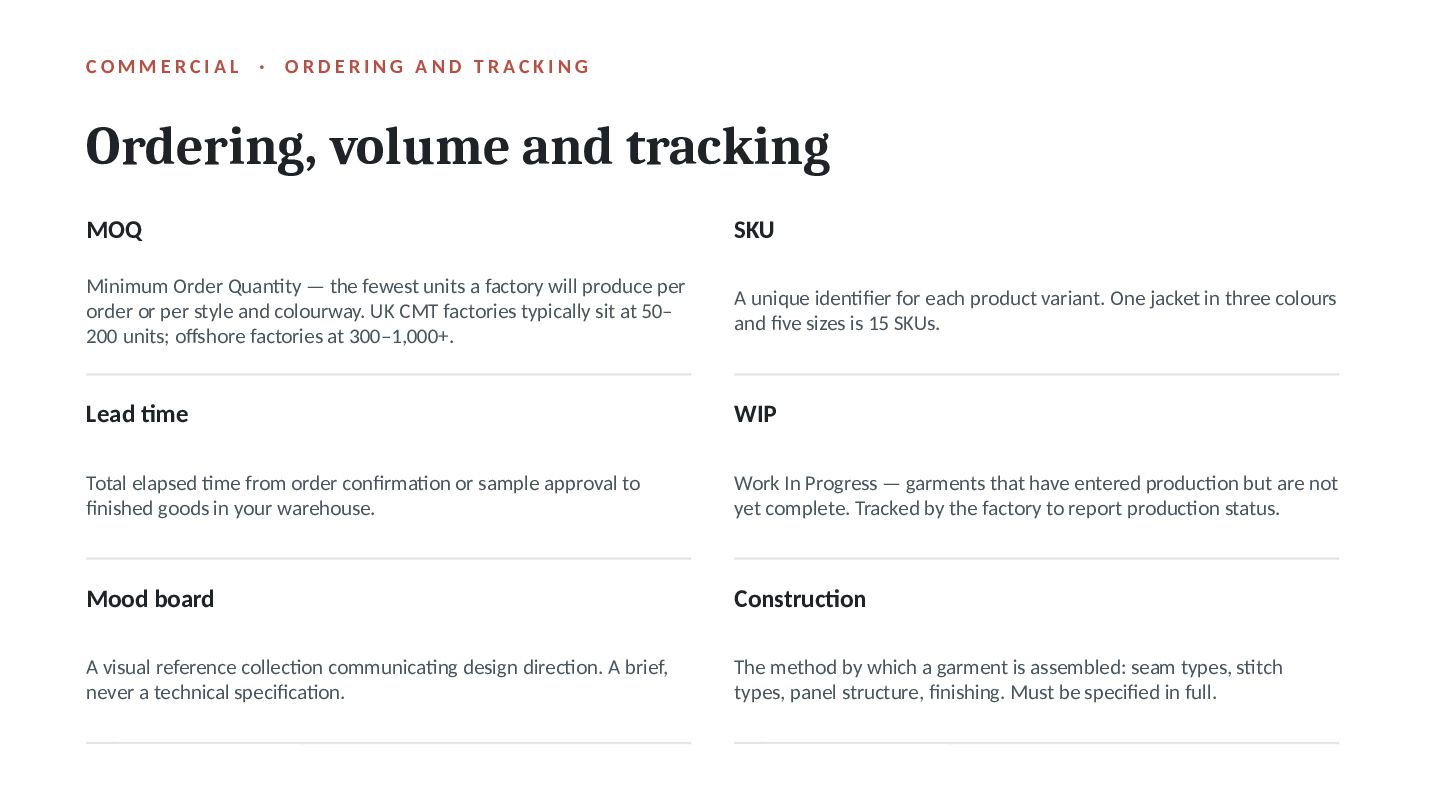
  17. COMMERCIAL · ORDERING AND TRACKING Ordering, volume and tracking MOQ

    SKU Minimum Order Quantity — the fewest units a factory will produce per order or per style and colourway. UK CMT factories typically sit at 50– 200 units; offshore factories at 300–1,000+. A unique identifier for each product variant. One jacket in three colours and five sizes is 15 SKUs. Lead time WIP Total elapsed time from order confirmation or sample approval to finished goods in your warehouse. Work In Progress — garments that have entered production but are not yet complete. Tracked by the factory to report production status. Mood board Construction A visual reference collection communicating design direction. A brief, never a technical specification. The method by which a garment is assembled: seam types, stitch types, panel structure, finishing. Must be specified in full.
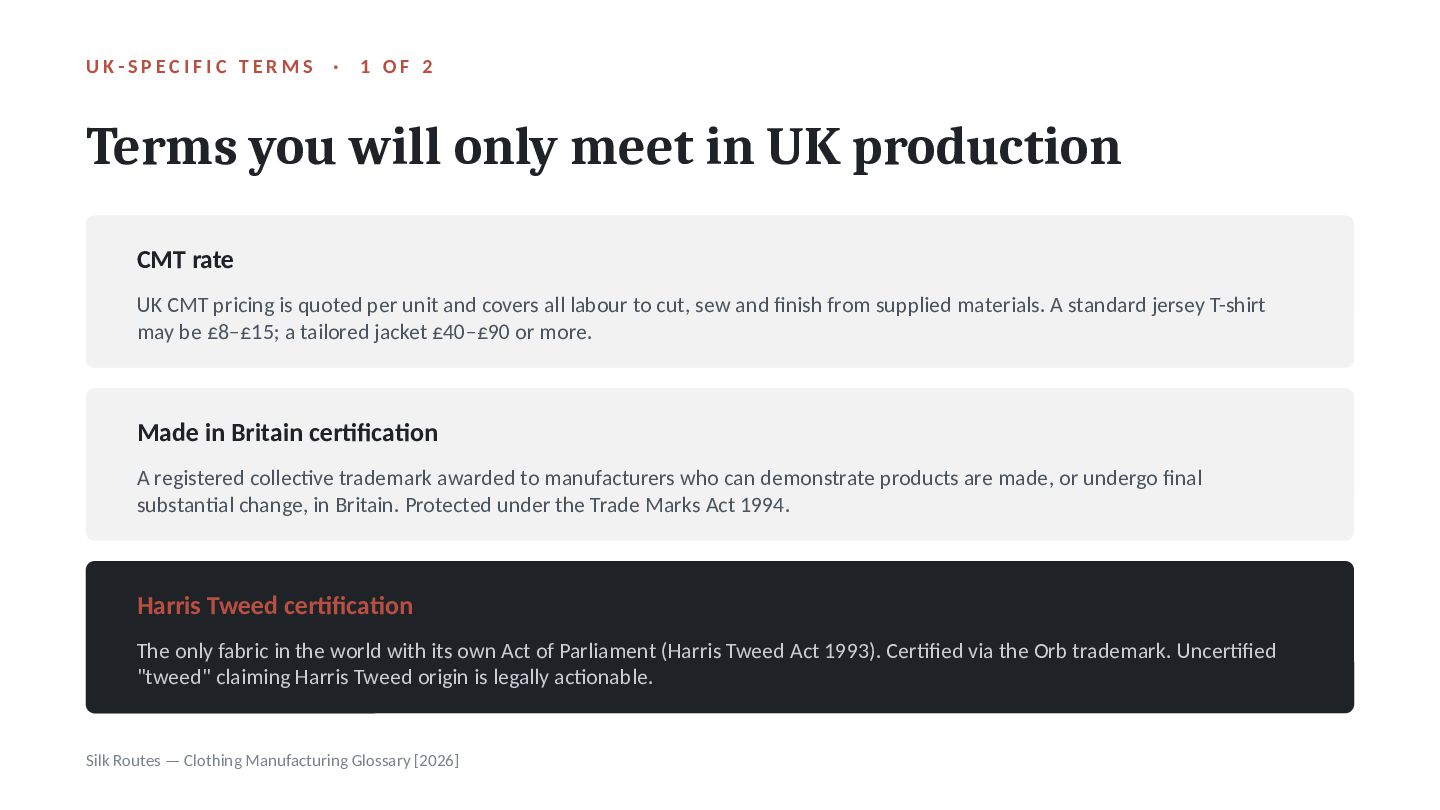
  18. UK-SPECIFIC TERMS · 1 OF 2 Terms you will only

    meet in UK production CMT rate UK CMT pricing is quoted per unit and covers all labour to cut, sew and finish from supplied materials. A standard jersey T-shirt may be £8–£15; a tailored jacket £40–£90 or more. Made in Britain certification A registered collective trademark awarded to manufacturers who can demonstrate products are made, or undergo final substantial change, in Britain. Protected under the Trade Marks Act 1994. Harris Tweed certification The only fabric in the world with its own Act of Parliament (Harris Tweed Act 1993). Certified via the Orb trademark. Uncertified "tweed" claiming Harris Tweed origin is legally actionable. Silk Routes — Clothing Manufacturing Glossary [2026]
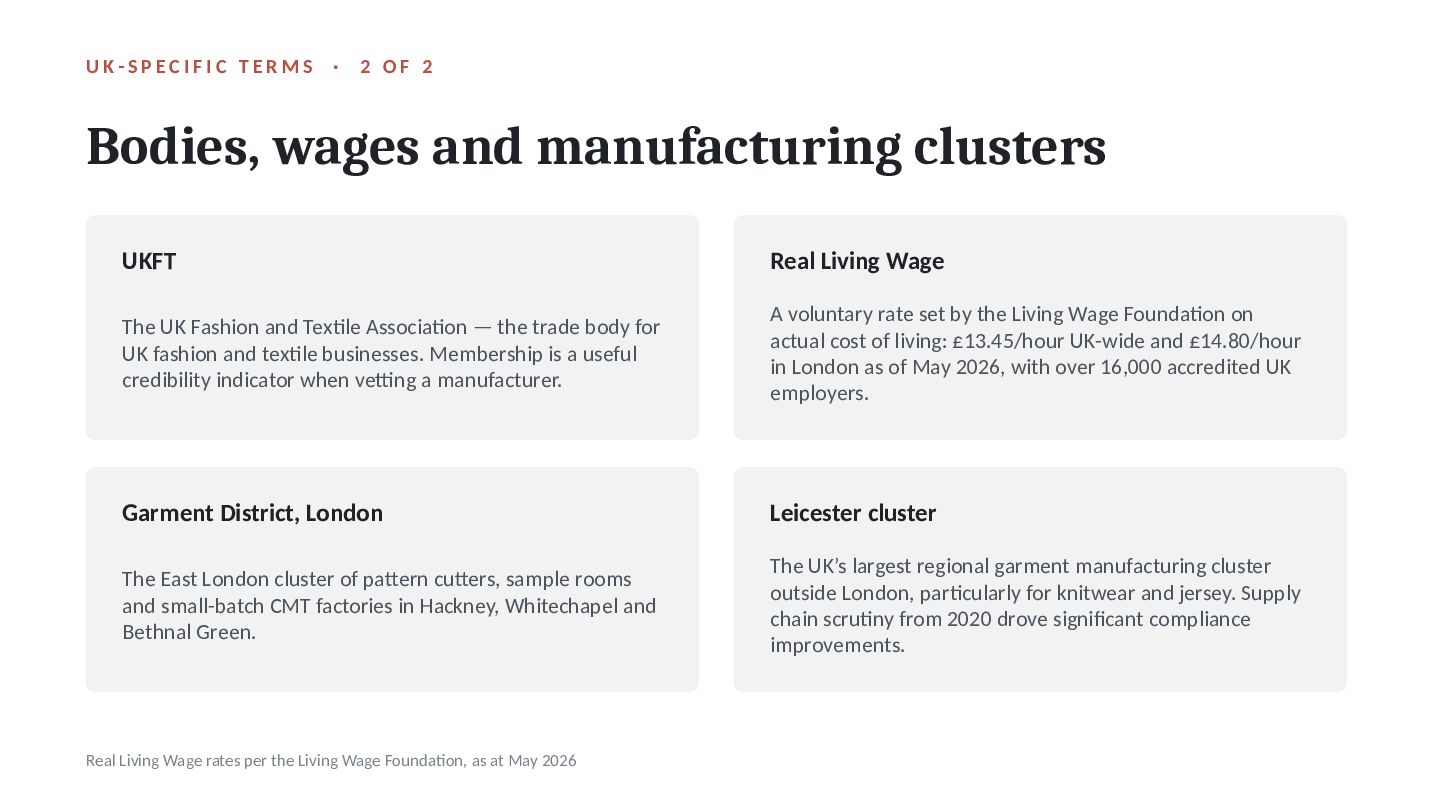
  19. UK-SPECIFIC TERMS · 2 OF 2 Bodies, wages and manufacturing

    clusters UKFT Real Living Wage The UK Fashion and Textile Association — the trade body for UK fashion and textile businesses. Membership is a useful credibility indicator when vetting a manufacturer. A voluntary rate set by the Living Wage Foundation on actual cost of living: £13.45/hour UK-wide and £14.80/hour in London as of May 2026, with over 16,000 accredited UK employers. Garment District, London Leicester cluster The East London cluster of pattern cutters, sample rooms and small-batch CMT factories in Hackney, Whitechapel and Bethnal Green. The UK’s largest regional garment manufacturing cluster outside London, particularly for knitwear and jersey. Supply chain scrutiny from 2020 drove significant compliance improvements. Real Living Wage rates per the Living Wage Foundation, as at May 2026
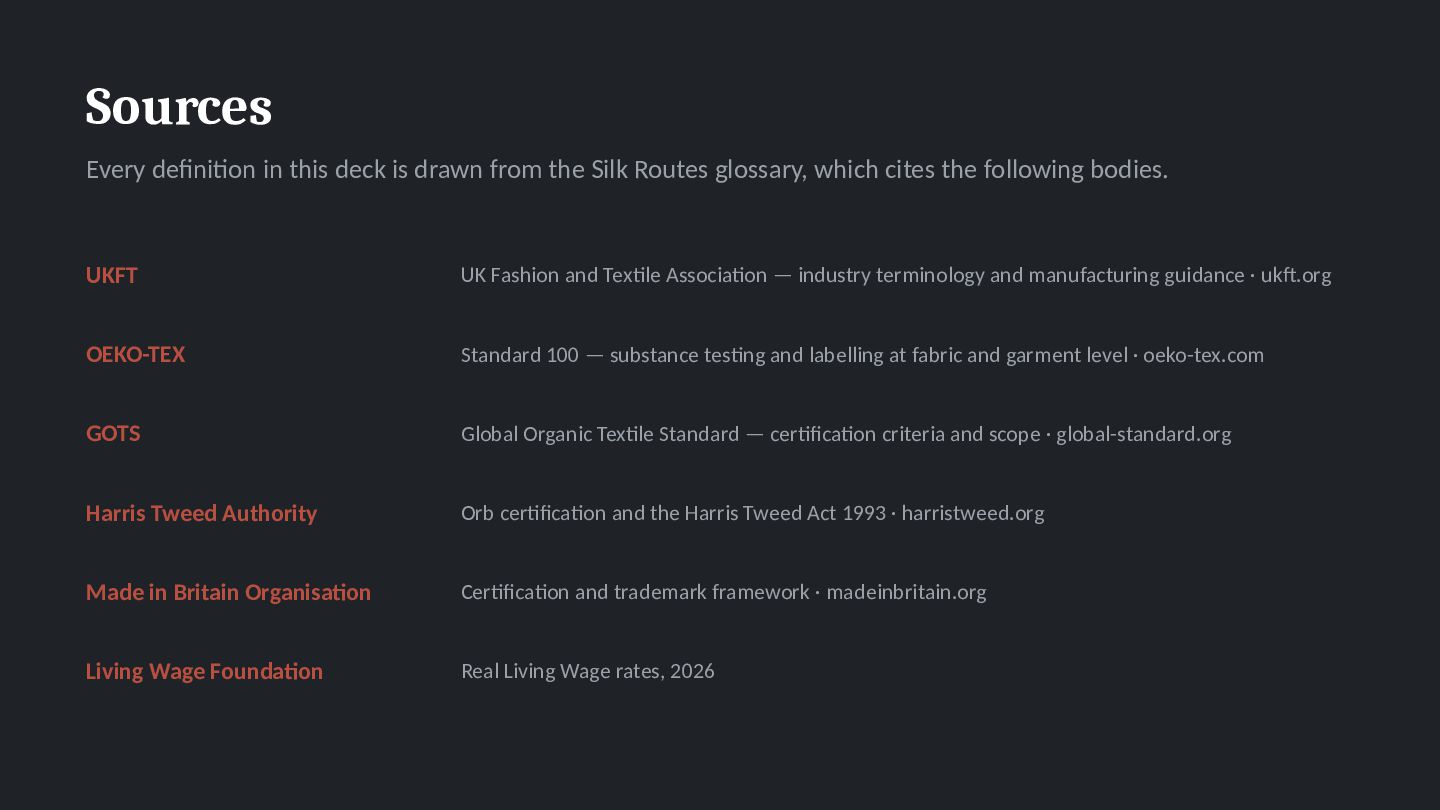
  20. Sources Every definition in this deck is drawn from the

    Silk Routes glossary, which cites the following bodies. UKFT UK Fashion and Textile Association — industry terminology and manufacturing guidance · ukft.org OEKO-TEX Standard 100 — substance testing and labelling at fabric and garment level · oeko-tex.com GOTS Global Organic Textile Standard — certification criteria and scope · global-standard.org Harris Tweed Authority Orb certification and the Harris Tweed Act 1993 · harristweed.org Made in Britain Organisation Certification and trademark framework · madeinbritain.org Living Wage Foundation Real Living Wage rates, 2026
  21. Read the full glossary Clothing Manufacturing Glossary: 100+ Terms Explained

    silkroutes.co.uk/clothing-manufacturing-glossary-100-terms-explained/ Manufacturing services · silkroutes.co.uk/clothing-manufacturing-services/ About Silk Routes · silkroutes.co.uk/about-silk-routes/ Silk Routes Limited · Registered in England and Wales · Company Number 7287895