Upgrade to Pro — share decks privately, control downloads, hide ads and more …

Commercial Aquaponics Course

Sponsored · Your Podcast. Everywhere. Effortlessly. Share. Educate. Inspire. Entertain. You do you. We'll handle the rest. →

Commercial Aquaponics Course

Commercial Aquaponics Engineering — Course Introduction

An overview of a 7-module course covering the complete design, construction, and operation of a real, commercial-scale aquaponics facility — built on the UVI model and adapted for hot, arid climates — then adapted down to backyard and DIY hydroponic scale. Covers water chemistry and the nitrogen cycle, mechanical system design and construction, hydraulic loops and aeration, water quality governance, commercial aquaculture operations, crop architecture and scaling, and a full facility walkthrough with universal scale adaptation.

Includes a downloadable resources library: SOPs, checklists, water quality logs, and reference sheets used to run the actual facility this course is built from.

Course launching soon.

Avatar for Mohamed Rabie

Mohamed Rabie

September 20, 2026

More Decks by Mohamed Rabie

Other Decks in Education

Transcript

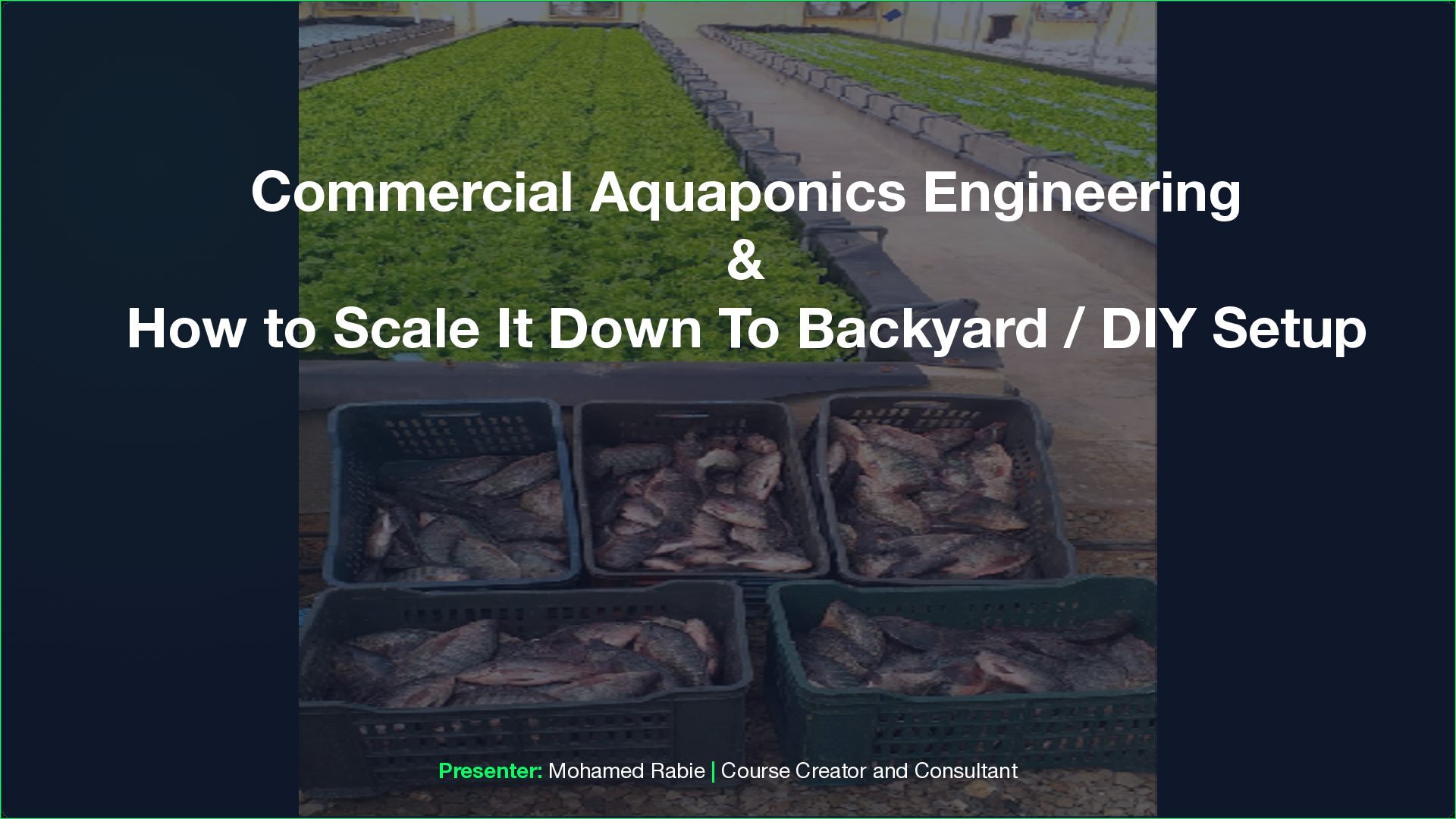
  1. Commercial Aquaponics Engineering & How to Scale It Down To

    Backyard / DIY Setup Presenter: Mohamed Rabie | Course Creator and Consultant
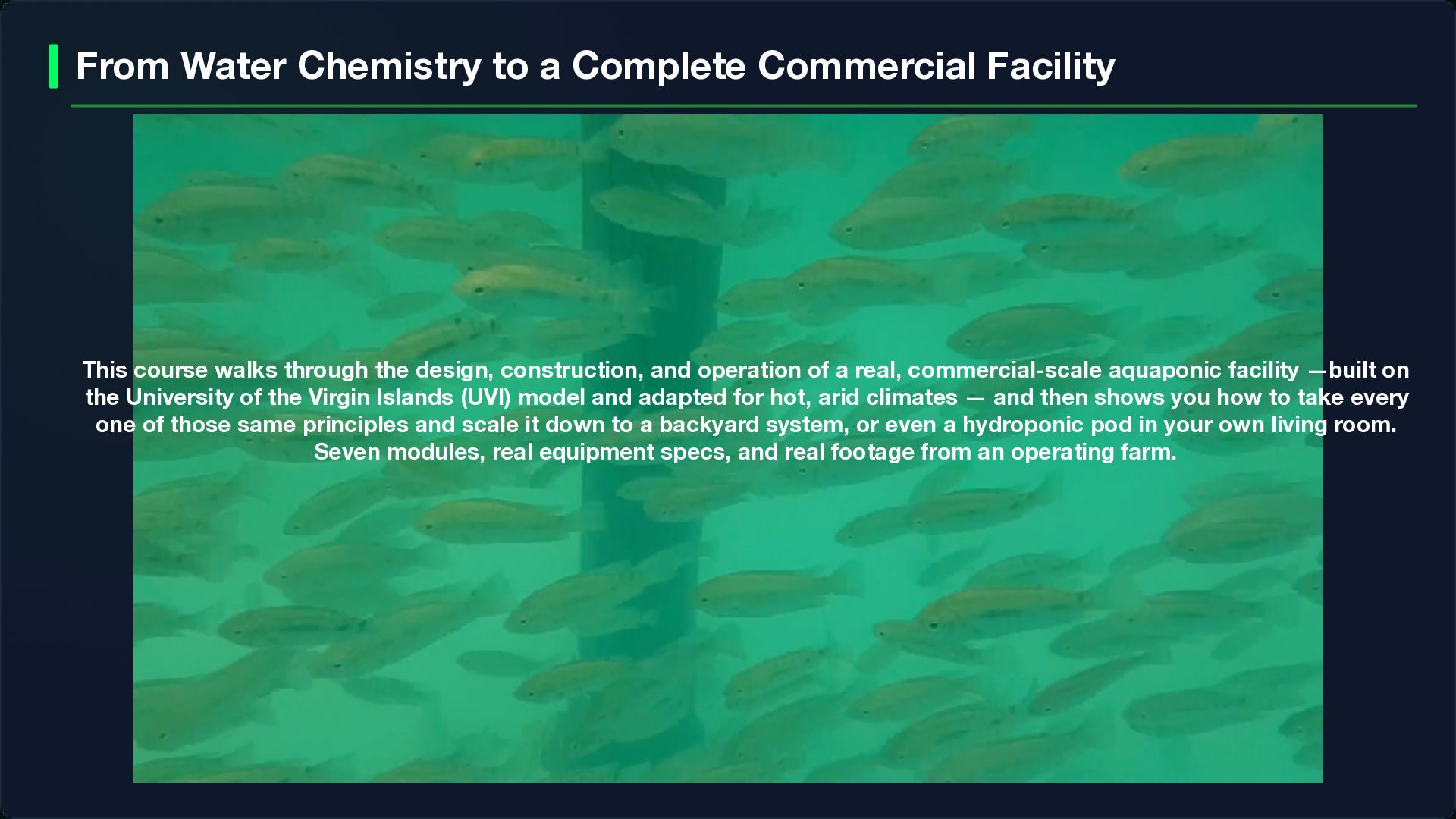
  2. From Water Chemistry to a Complete Commercial Facility This course

    walks through the design, construction, and operation of a real, commercial-scale aquaponic facility —built on the University of the Virgin Islands (UVI) model and adapted for hot, arid climates — and then shows you how to take every one of those same principles and scale it down to a backyard system, or even a hydroponic pod in your own living room. Seven modules, real equipment specs, and real footage from an operating farm.
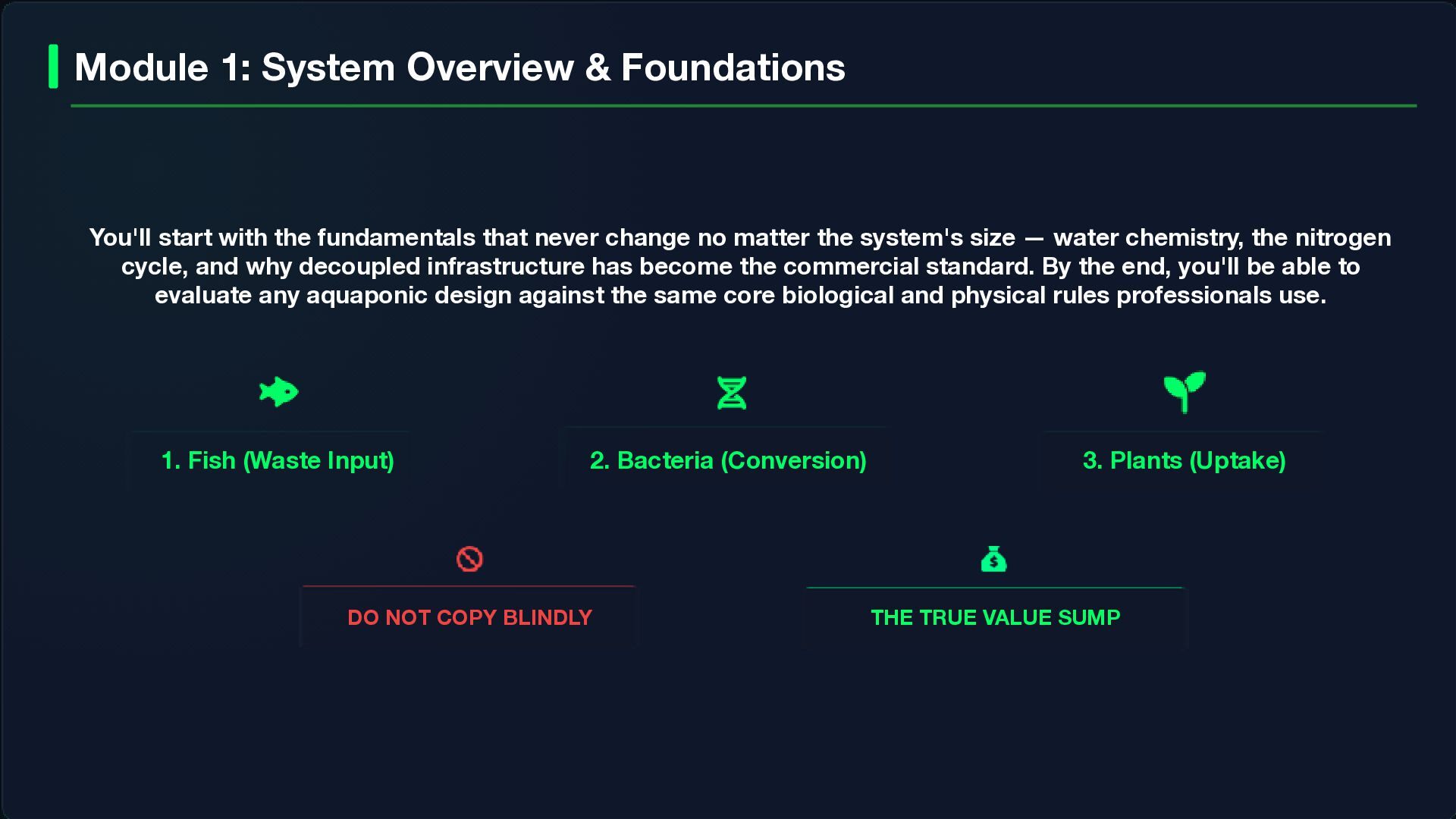
  3. Module 1: System Overview & Foundations You'll start with the

    fundamentals that never change no matter the system's size — water chemistry, the nitrogen cycle, and why decoupled infrastructure has become the commercial standard. By the end, you'll be able to evaluate any aquaponic design against the same core biological and physical rules professionals use. 1. Fish (Waste Input) 2. Bacteria (Conversion) DO NOT COPY BLINDLY 3. Plants (Uptake) THE TRUE VALUE SUMP
  4. Module 2: Mechanical System Design and Construction Blueprint From there,

    you'll move into the physical build — sizing and fabricating self-cleaning rearing tanks, gravitational clari ers, ne solids ltration, and degassing systems. You'll come away knowing how to lay out and construct the mechanical backbone of a commercial-grade facility. fi fi fi The Circular Velocity Loop The Need For Circular current Eliminating Dead Zones
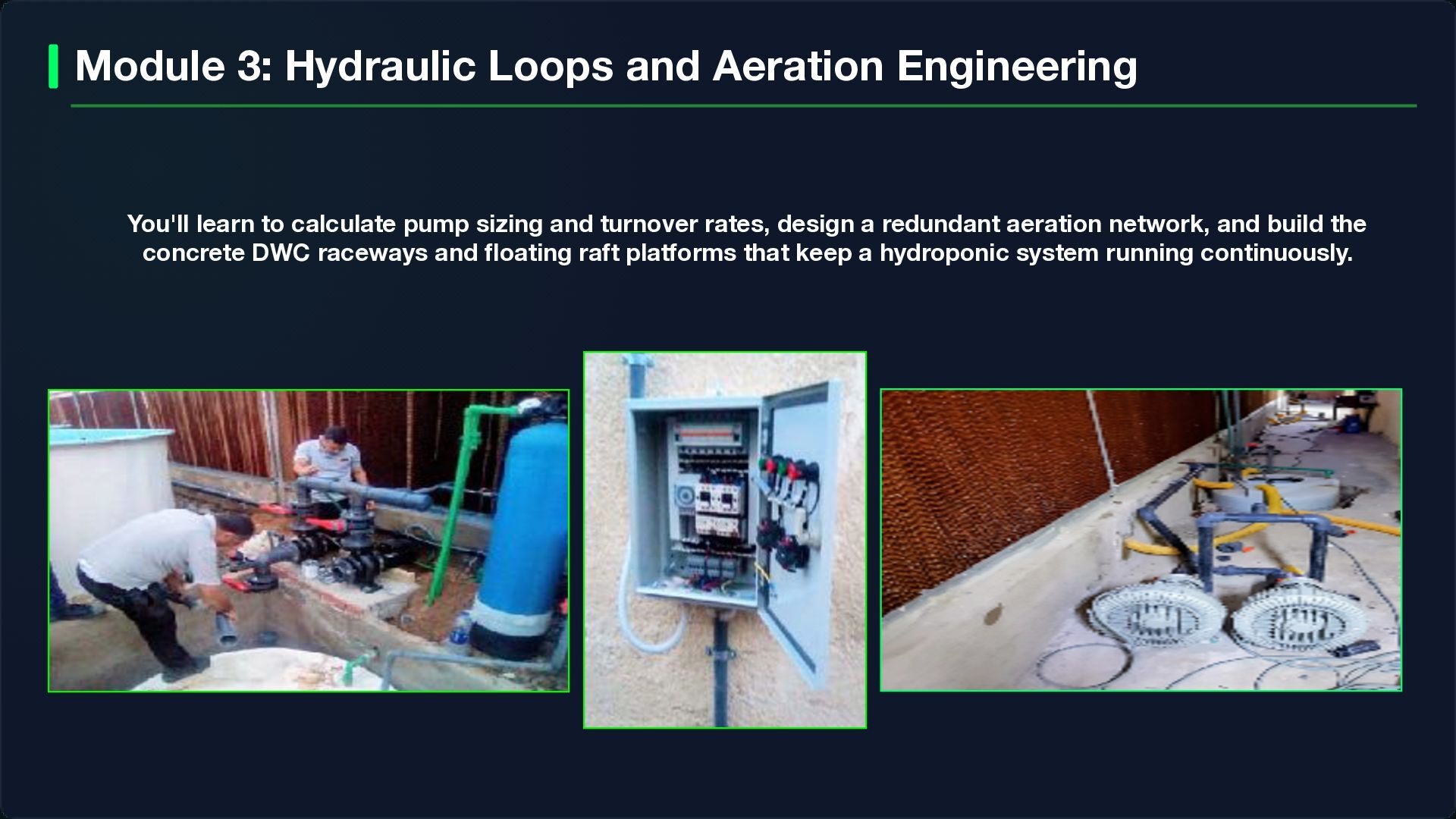
  5. Module 3: Hydraulic Loops and Aeration Engineering fl You'll learn

    to calculate pump sizing and turnover rates, design a redundant aeration network, and build the concrete DWC raceways and oating raft platforms that keep a hydroponic system running continuously.
  6. Module 4: Water Quality Governance and SOP Logs This module

    covers how to safely start a new bio lter, maintain pH and alkalinity through structured bu ering, and build a repeatable daily water-quality monitoring routine — including where automation helps, and where it can never replace you. Turn Waste into Feed DEDICATED BASE MIXING STATION PATHOGEN ERADICATION ff fi THE GERMICIDAL LONGEVITY RULE
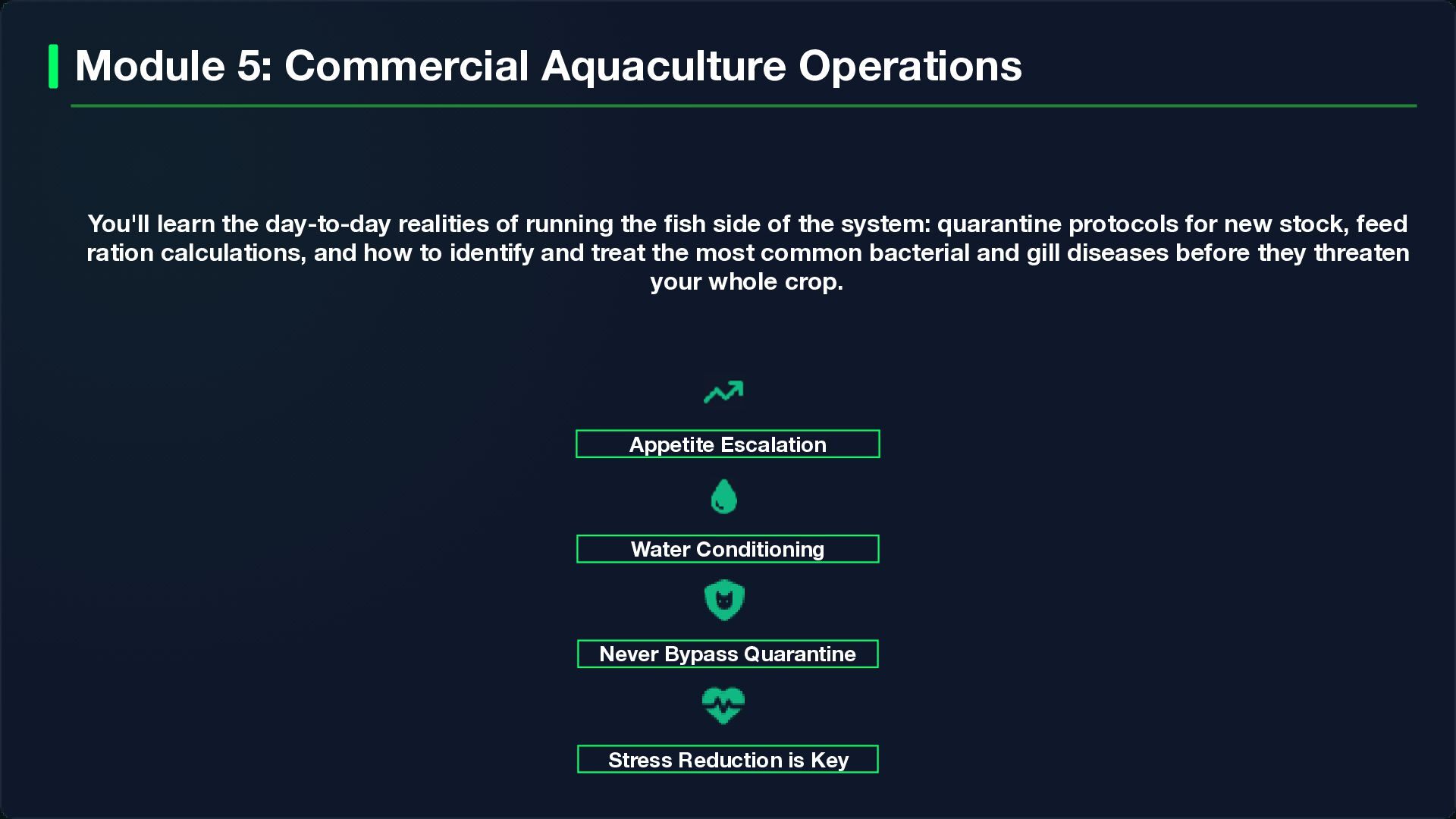
  7. Module 5: Commercial Aquaculture Operations You'll learn the day-to-day realities

    of running the sh side of the system: quarantine protocols for new stock, feed ration calculations, and how to identify and treat the most common bacterial and gill diseases before they threaten your whole crop. Appetite Escalation Water Conditioning Never Bypass Quarantine fi Stress Reduction is Key
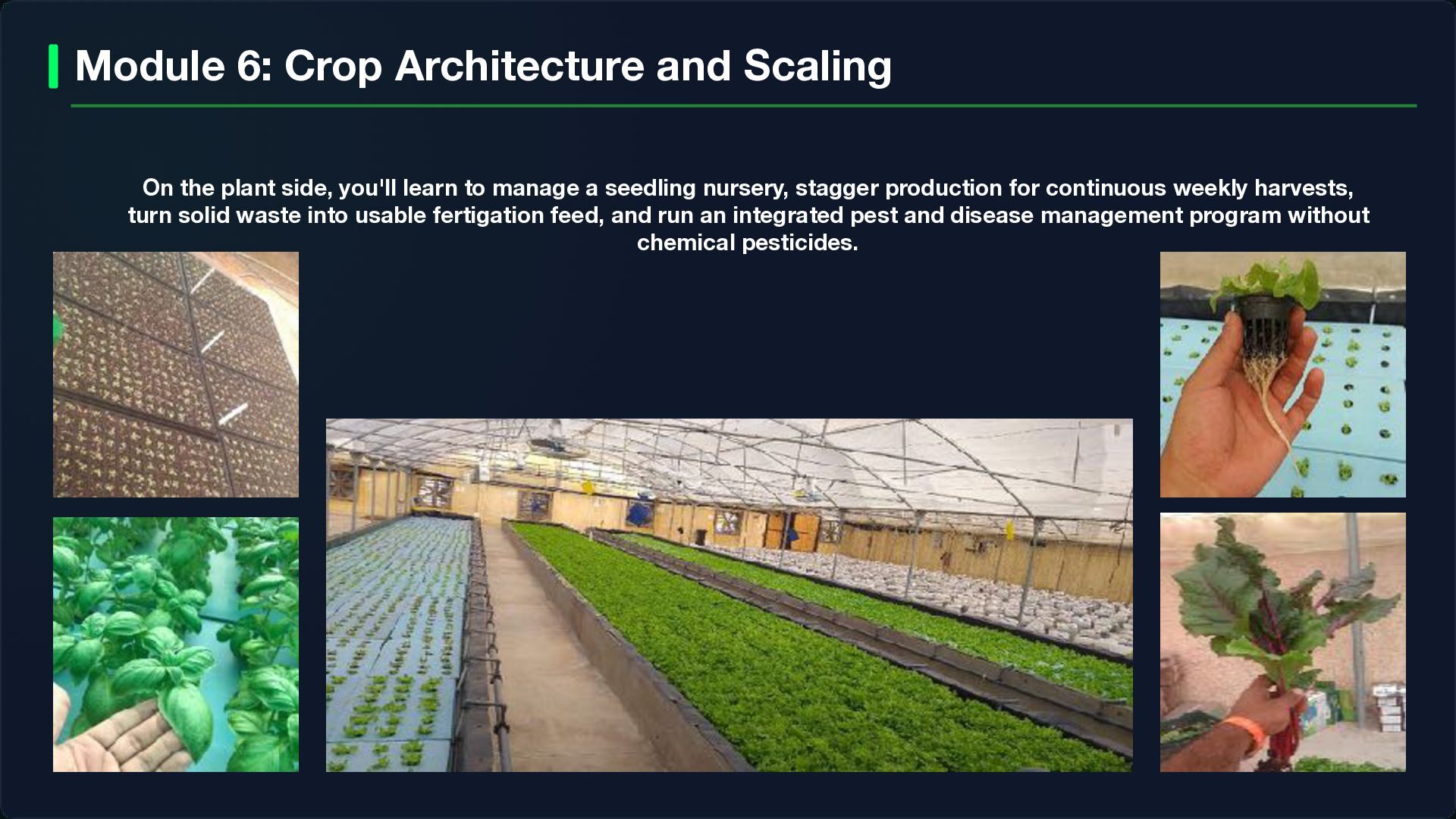
  8. Module 6: Crop Architecture and Scaling On the plant side,

    you'll learn to manage a seedling nursery, stagger production for continuous weekly harvests, turn solid waste into usable fertigation feed, and run an integrated pest and disease management program without chemical pesticides.
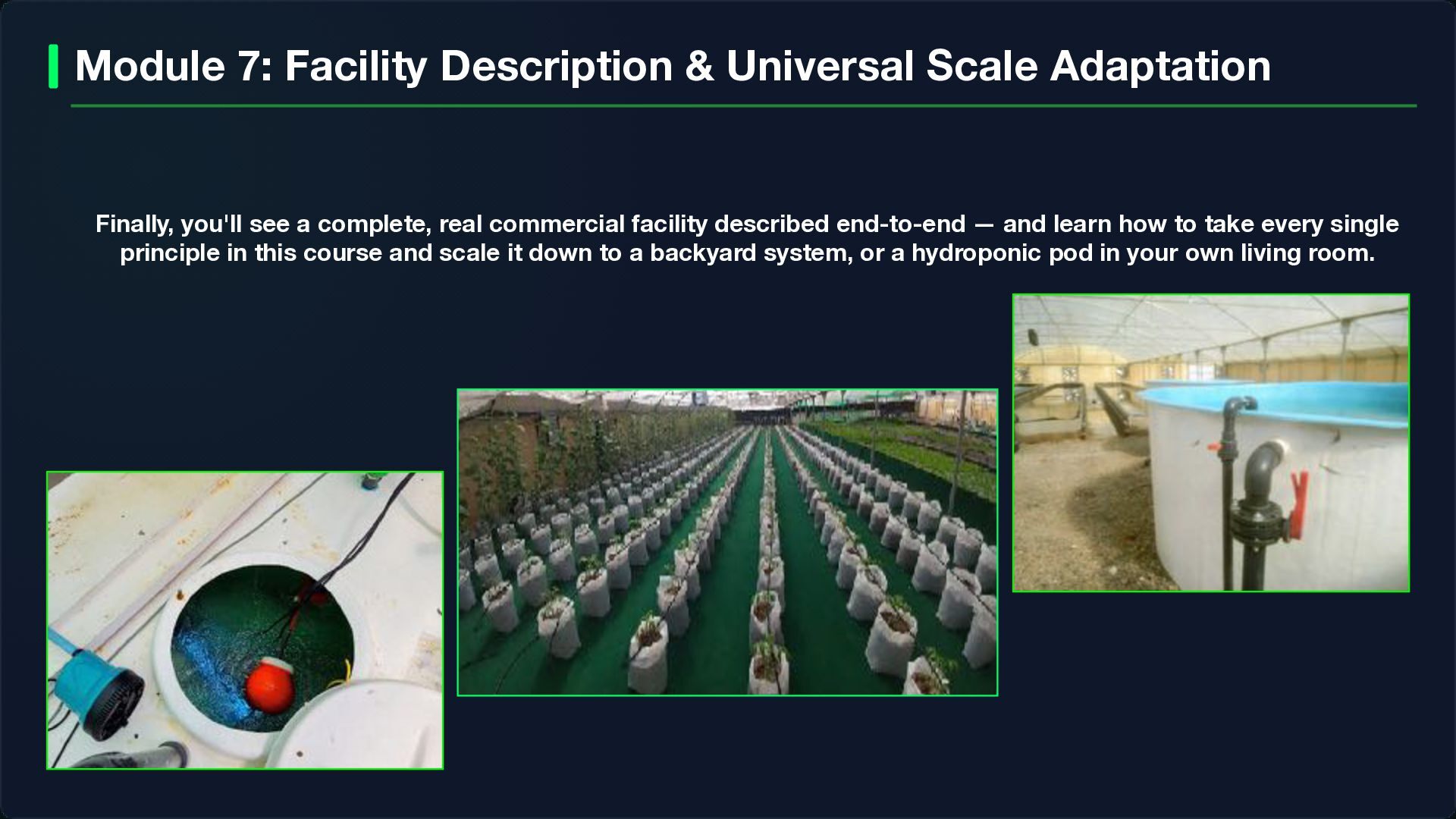
  9. Module 7: Facility Description & Universal Scale Adaptation Finally, you'll

    see a complete, real commercial facility described end-to-end — and learn how to take every single principle in this course and scale it down to a backyard system, or a hydroponic pod in your own living room.
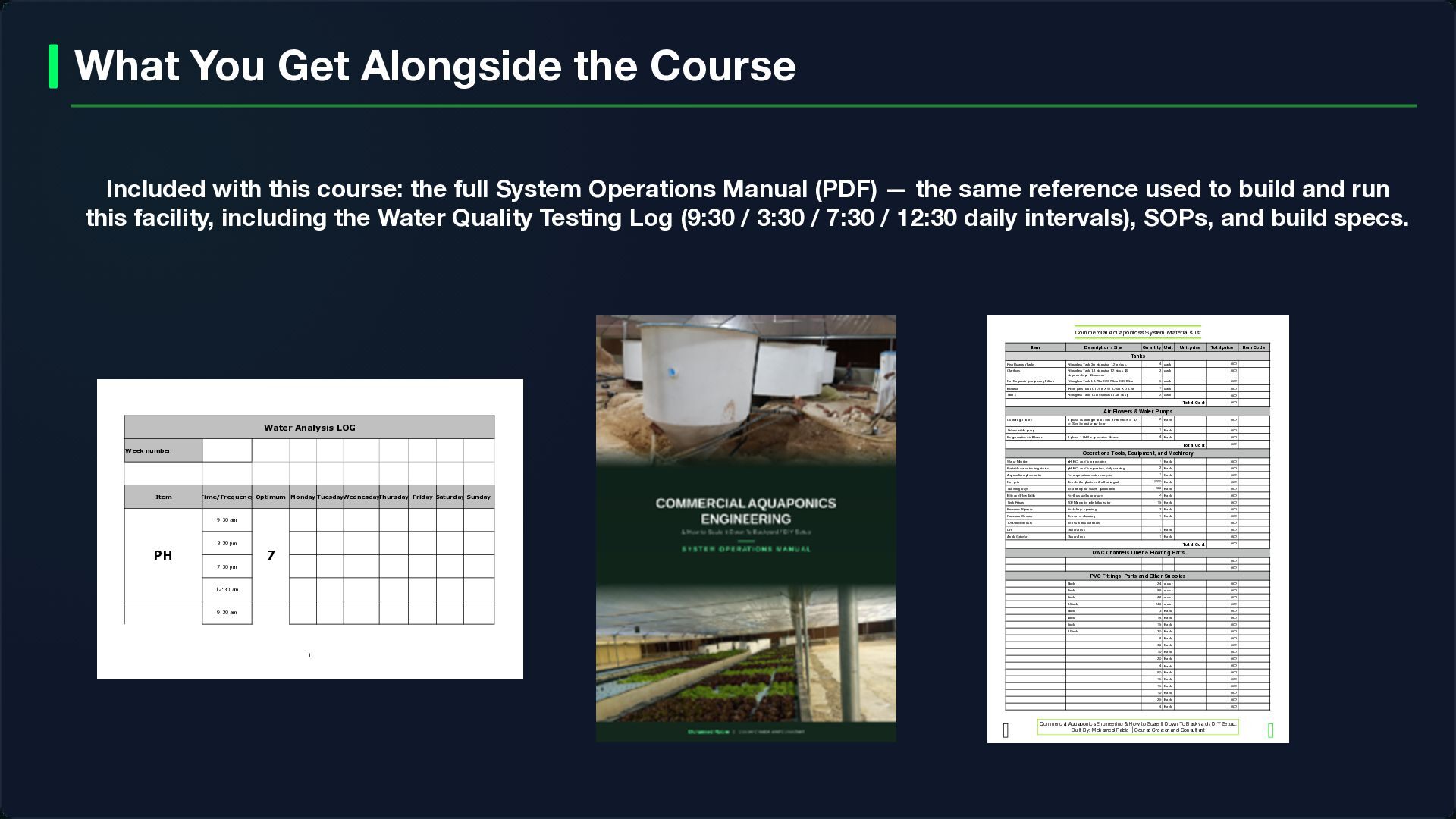
  10. What You Get Alongside the Course Included with this course:

    the full System Operations Manual (PDF) — the same reference used to build and run this facility, including the Water Quality Testing Log (9:30 / 3:30 / 7:30 / 12:30 daily intervals), SOPs, and build specs. Commercial Aquaponicss System Materials list Item Description / Size Quantity Unit Unit price Total price Tanks Fish Rearing Tanks Fibreglass Tank 3m diameter, 1.2m deep. 4 each 0.00 Clarifiers Fibreglass Tank 1.8 diameter 1.2 deep, 45 degrees slope 90cm cone 2 each 0.00 Net Degassing degassing Filters Fibreglass Tank L 1.75m X W 75cm X D 60cm 5 each Biofilter Fibreglass Tank L 1.75m X W 1.75m X D 1.2m 1 each Sump Fibreglass Tank 1.5m diameter 1.5m deep 2 each 0.00 0.00 0.00 Total Cost 0.00 Air Blowers & Water Pumps Centrifugal pump Water Analysis LOG 3 phase centrifugal pump with a rated flow of 60 to 65 cubic meter per hour 0.00 1 Each Submersible pump Regenerative Air Blower 3 phase 1.5HP regenerative blower 0.00 4 Each 0.00 Total Cost Week number Item 2 Each 0.00 Operations Tools, Equipment, and Machinery Time/Frequency Optimum Monday TuesdayWednesdayThursday Friday Saturday Sunday 9:30 am 1 Each 0.00 2 Each 0.00 1 Each 0.00 10000 Each 0.00 Water Monitor pH, EC, and Temp monitor Portable water testing device pH, EC, and Temperature, daily reading Aquaculture photometer For aquaculture water analysis Net pots To hold the plants on the floating raft Seedling Trays To start up the seeds germination 100 Each 0.00 Ebb and Flow Table For the seedling nursery 2 Each 0.00 Sock Filters 200 Micron to polish the water 15 Each 0.00 Pressure Sprayer For foliage spraying 2 Each 0.00 Pressure Washer To use for cleaning 1 Each 0.00 1000 micron nets To use in the net filters Drill General use 1 Each Angle Grinder General use 1 Each 0.00 3:30 pm PH 0.00 0.00 Total Cost 7 0.00 DWC Channels Liner & Floating Rafts 0.00 7:30 pm 0.00 PVC Fittings, Parts and Other Supplies 6inch 12:30 am 1 0.00 96 meter 0.00 3inch 48 meter 0.00 1.5inch 240 meter 0.00 6inch 3 Each 0.00 4inch 18 Each 0.00 3inch 15 Each 0.00 1.5inch 20 Each 0.00 8 Each 0.00 30 Each 0.00 10 Each 0.00 20 Each 0.00 4 Each 0.00 60 Each 0.00 15 Each 0.00 15 Each 0.00 10 Each 0.00 25 Each 0.00 4 Each 0.00 4inch 9:30 am 24 meter Commercial Aquaponics Engineering & How to Scale It Down To Backyard / DIY Setup. Built By: Mohamed Rabie | Course Creator and Consultant Item Code
  11. Build It Right, at Any Scale Whether your goal is

    a commercial farm, a backyard system, or just a working hydroponic pod on a shelf, this course gives you the same rules a professional facility runs on — and shows you exactly how to adapt them to what you're building. “The difference between a hobby and a farm isn't the size of the tank — it's whether you follow the same rules either way.”