Upgrade to Pro — share decks privately, control downloads, hide ads and more …

Patterns of the Lambda Architecture (with Speak...

Sponsored · SiteGround - Reliable hosting with speed, security, and support you can count on. →

Patterns of the Lambda Architecture (with Speaker Notes)

This talk centers on two things: a set of patterns for the architecture of high-scale data systems; and a framework for understanding the tradeoffs we make in designing them.

Avatar for Philip (flip) Kromer
Philip (flip) Kromer
April 16, 2015

Other Decks in Programming

Transcript

  1. Patterns of the Lambda Architecture Truth and Lies at the

    Edge of Scale Flip Kromer — CSC I’m Flip Kromer, Distinguished Engineer at CSC. If you are a large enterprise company looking to add Big Data capabilities — especially one involving legacy systems — we’re a big, stable company that specializes in turning technology into an enterprise- grade solution.
  2. Pattern Set This talk will equip you with two things.

    One is patterns for how we design high-scale architectures to solve specific solution cases now that extra infrastructure is nearly free
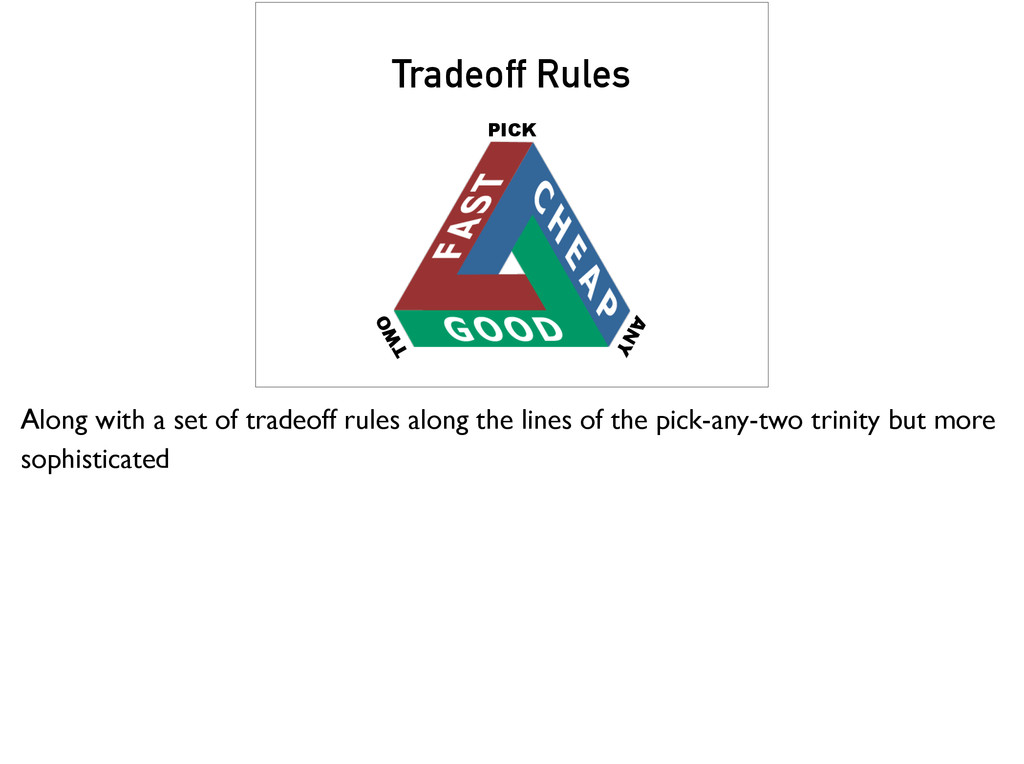
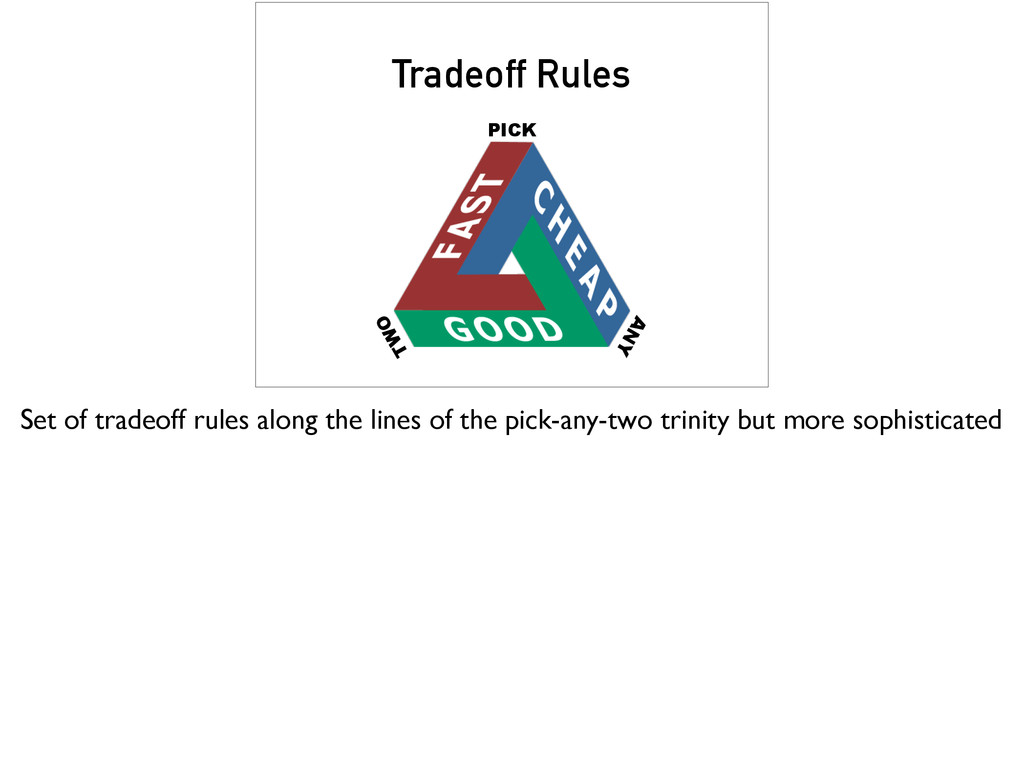
  3. Tradeoff Rules PICK ANY TWO Along with a set of

    tradeoff rules along the lines of the pick-any-two trinity but more sophisticated
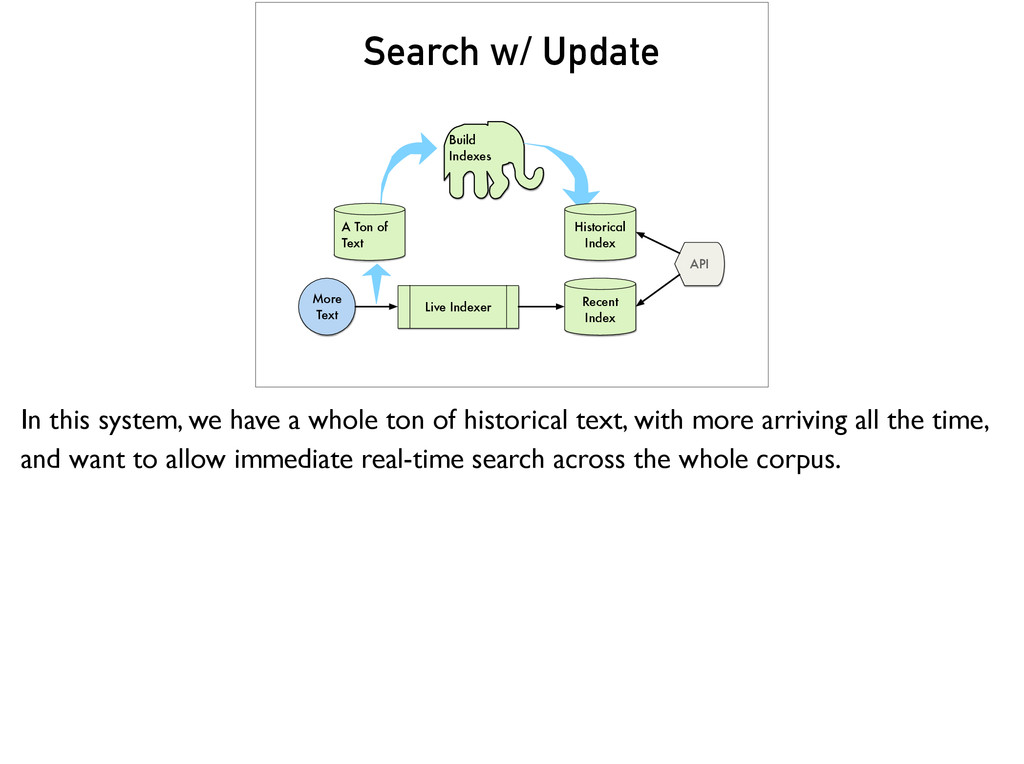
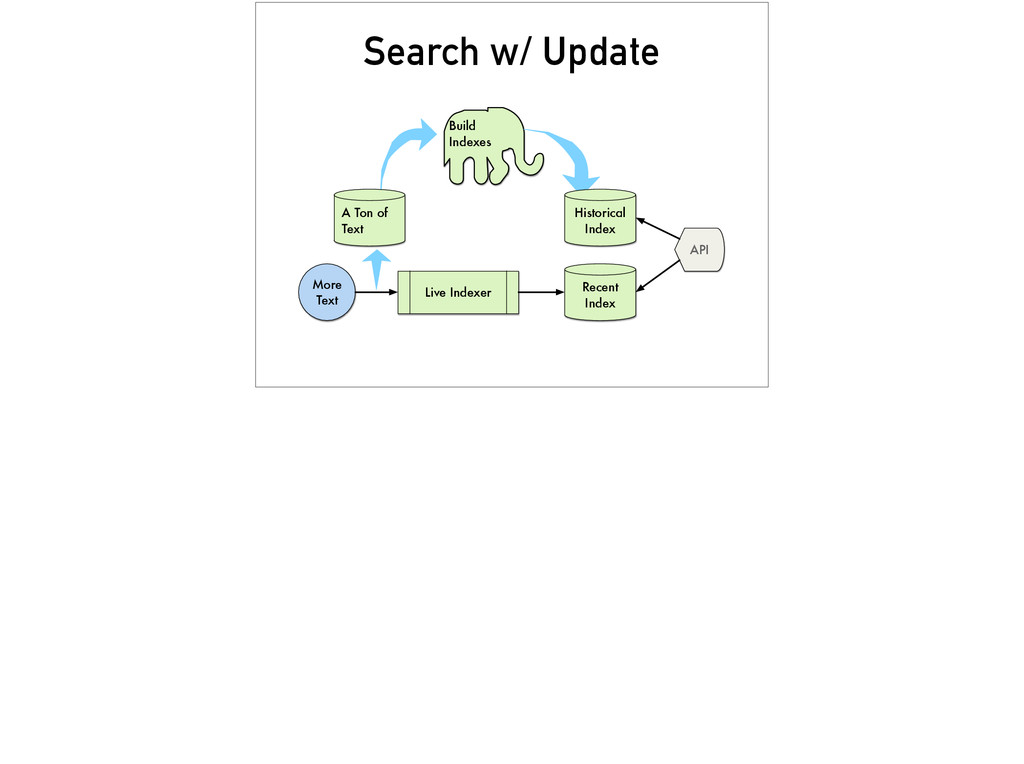
  4. Search w/ Update Build Indexes A Ton of Text Historical

    Index Live Indexer More Text Recent Index API In this system, we have a whole ton of historical text, with more arriving all the time, and want to allow immediate real-time search across the whole corpus.
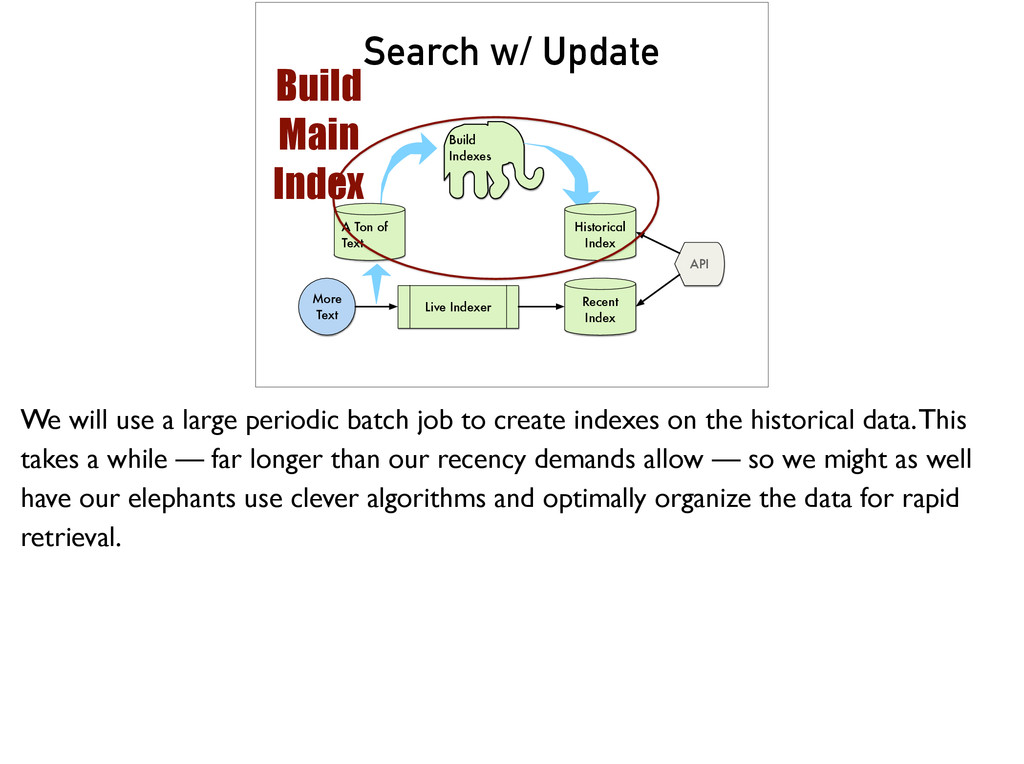
  5. Search w/ Update Build Indexes A Ton of Text Historical

    Index Live Indexer More Text Recent Index API Build
 Main Index We will use a large periodic batch job to create indexes on the historical data. This takes a while — far longer than our recency demands allow — so we might as well have our elephants use clever algorithms and optimally organize the data for rapid retrieval.
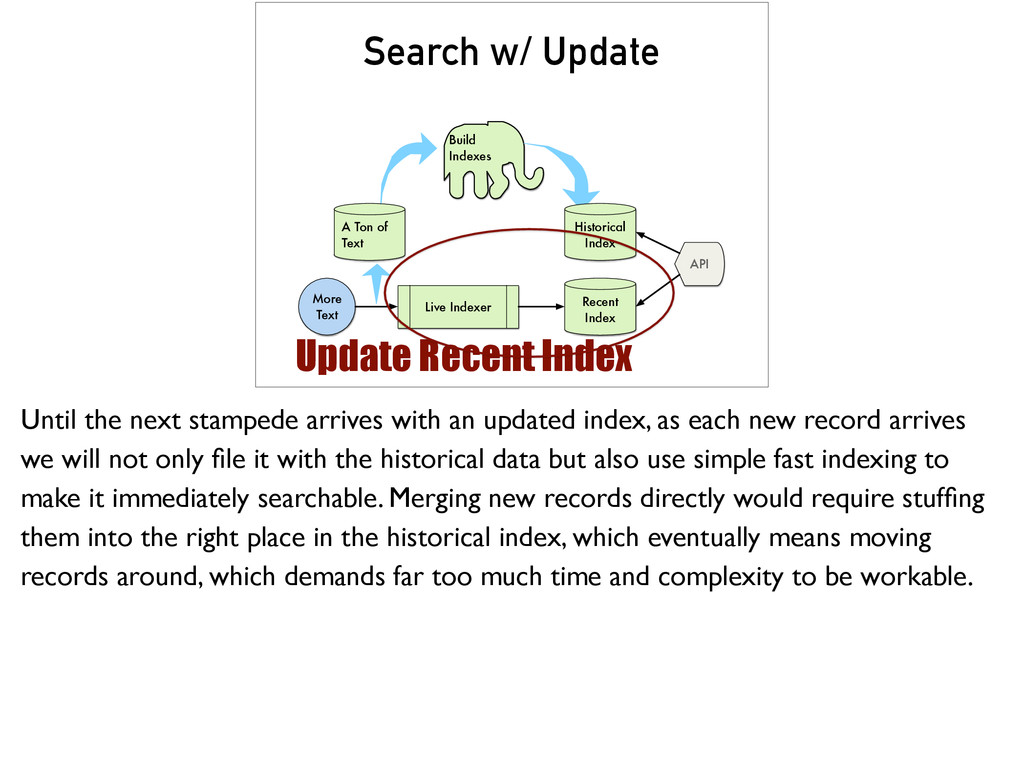
  6. Search w/ Update Build Indexes A Ton of Text Historical

    Index Live Indexer More Text Recent Index API Update Recent Index Until the next stampede arrives with an updated index, as each new record arrives we will not only file it with the historical data but also use simple fast indexing to make it immediately searchable. Merging new records directly would require stuffing them into the right place in the historical index, which eventually means moving records around, which demands far too much time and complexity to be workable.
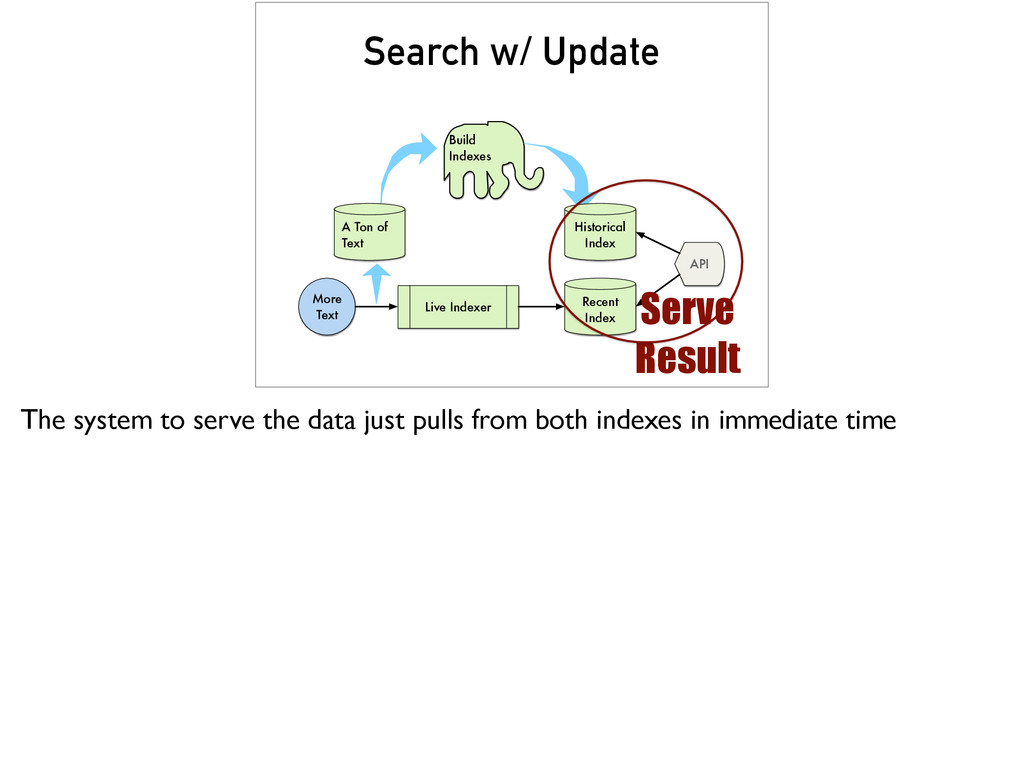
  7. Search w/ Update Build Indexes A Ton of Text Historical

    Index Live Indexer More Text Recent Index API Serve Result The system to serve the data just pulls from both indexes in immediate time
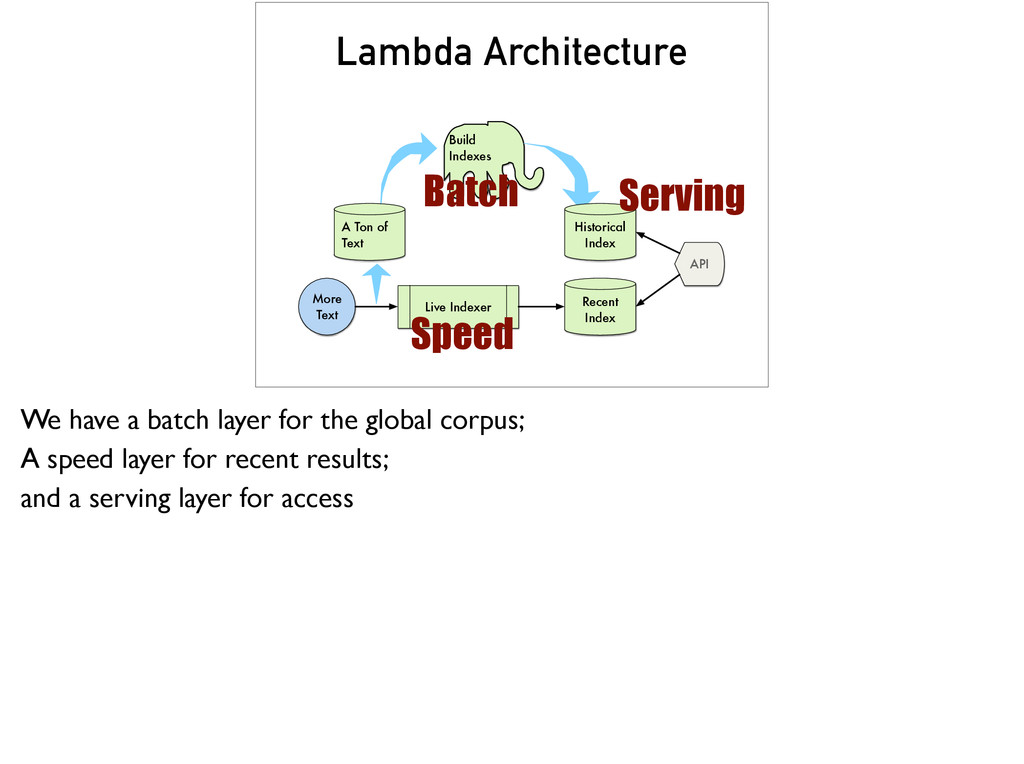
  8. Build Indexes A Ton of Text Historical Index Live Indexer

    More Text Recent Index API Lambda Architecture Batch Speed Serving We have a batch layer for the global corpus; A speed layer for recent results; and a serving layer for access
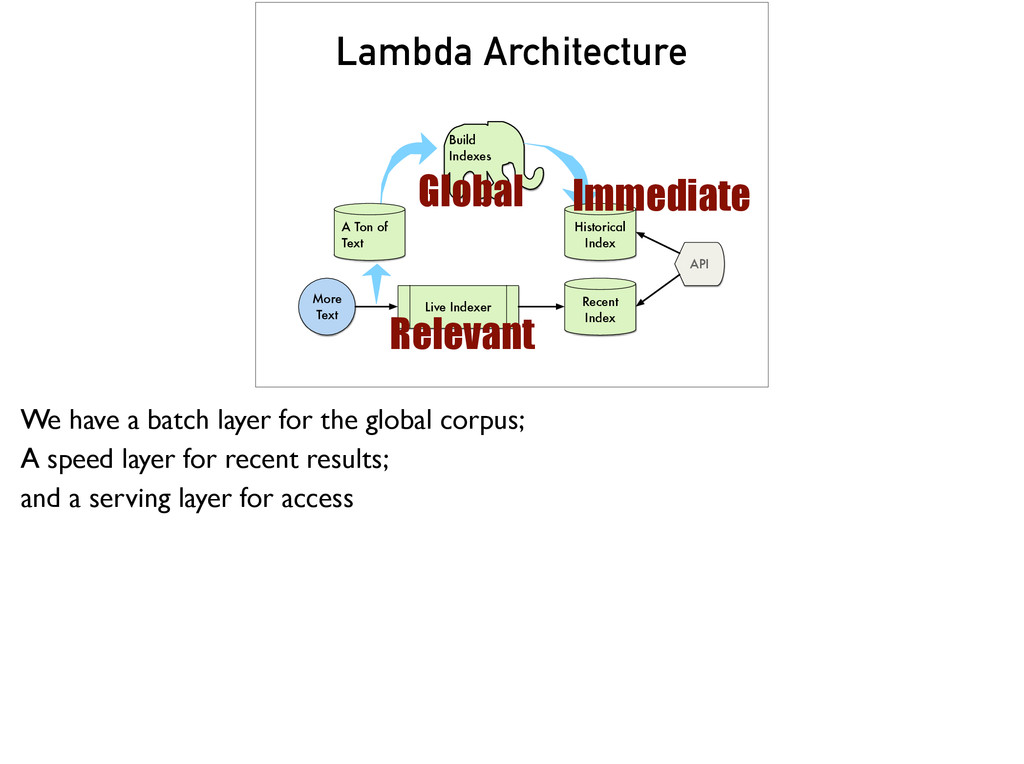
  9. Build Indexes A Ton of Text Historical Index Live Indexer

    More Text Recent Index API Lambda Architecture Global Relevant Immediate We have a batch layer for the global corpus; A speed layer for recent results; and a serving layer for access
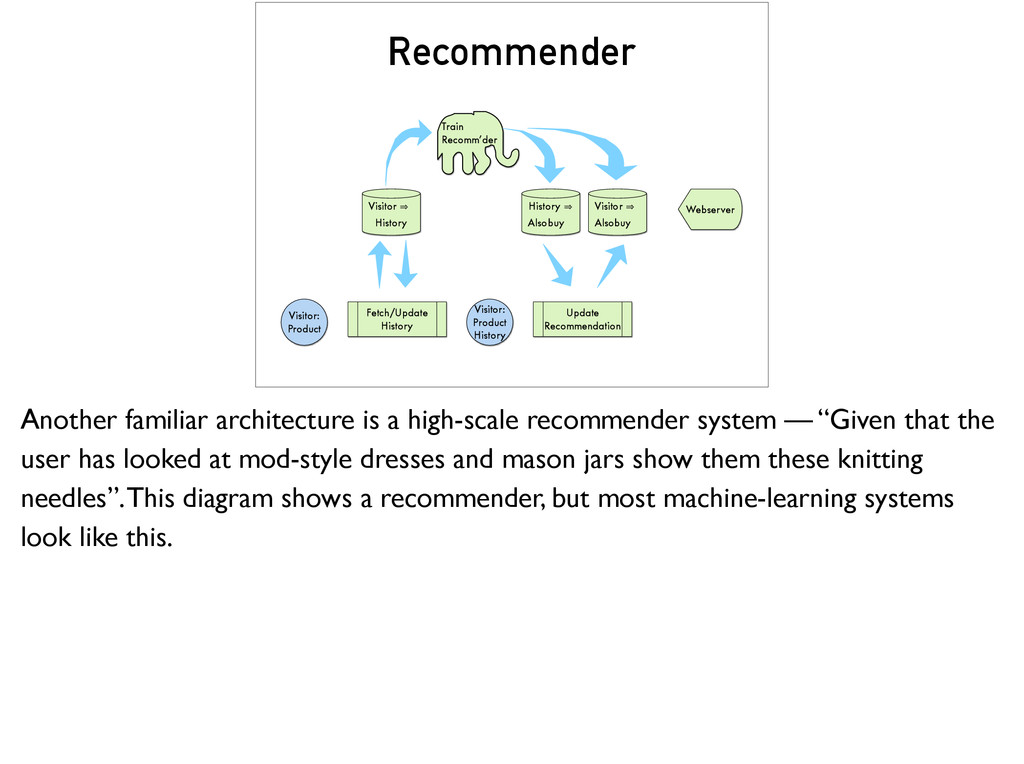
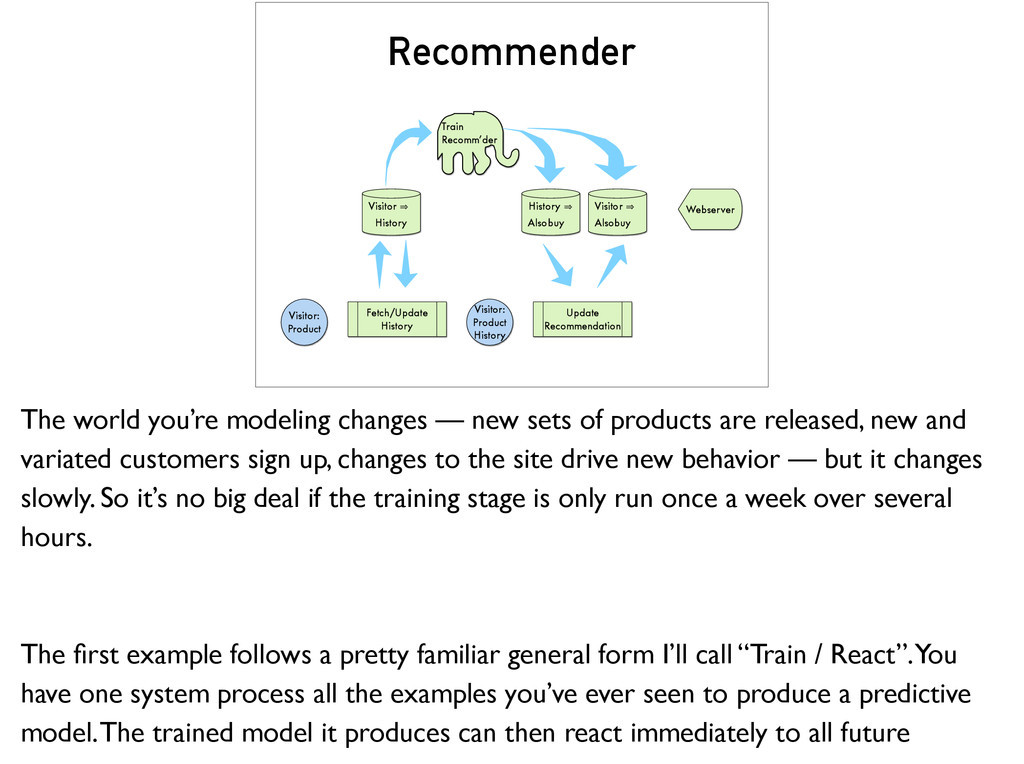
  10. Train Recomm’der Visitor 㱺 History History 㱺 Alsobuy Visitor: Product

    Visitor 㱺 Alsobuy Update Recommendation Fetch/Update History Visitor: Product History Webserver Recommender Another familiar architecture is a high-scale recommender system — “Given that the user has looked at mod-style dresses and mason jars show them these knitting needles”. This diagram shows a recommender, but most machine-learning systems look like this.
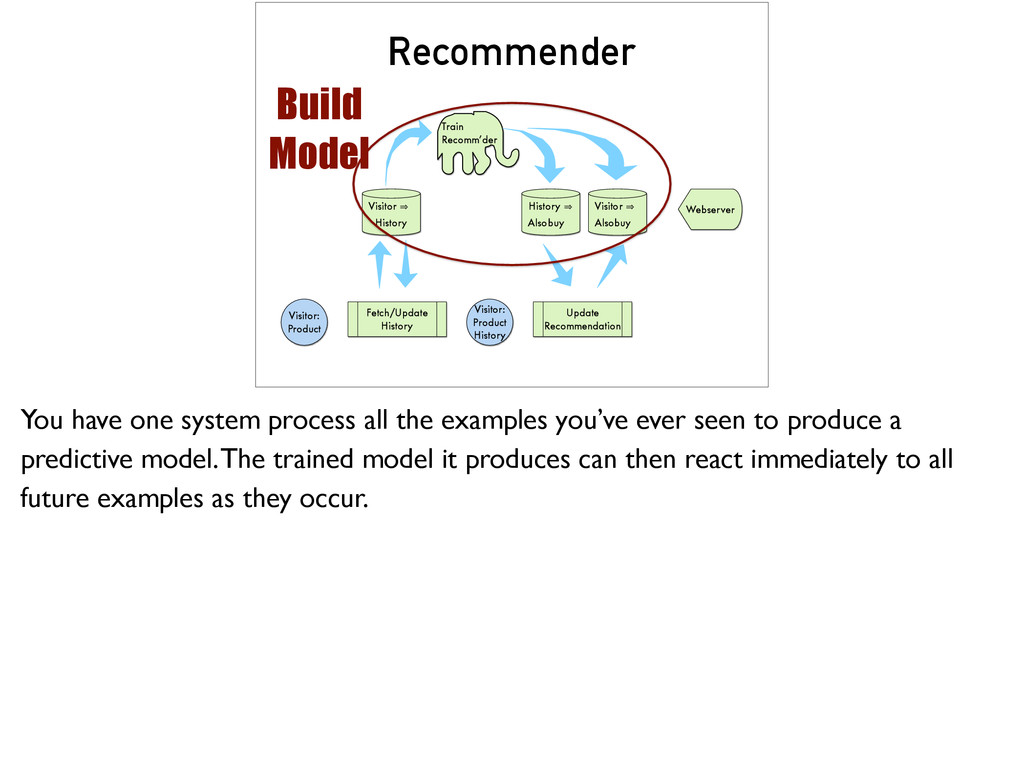
  11. Train Recomm’der Visitor 㱺 History History 㱺 Alsobuy Visitor: Product

    Visitor 㱺 Alsobuy Update Recommendation Fetch/Update History Visitor: Product History Webserver Recommender Build Model You have one system process all the examples you’ve ever seen to produce a predictive model. The trained model it produces can then react immediately to all future examples as they occur.
  12. Train Recomm’der Visitor 㱺 History History 㱺 Alsobuy Visitor: Product

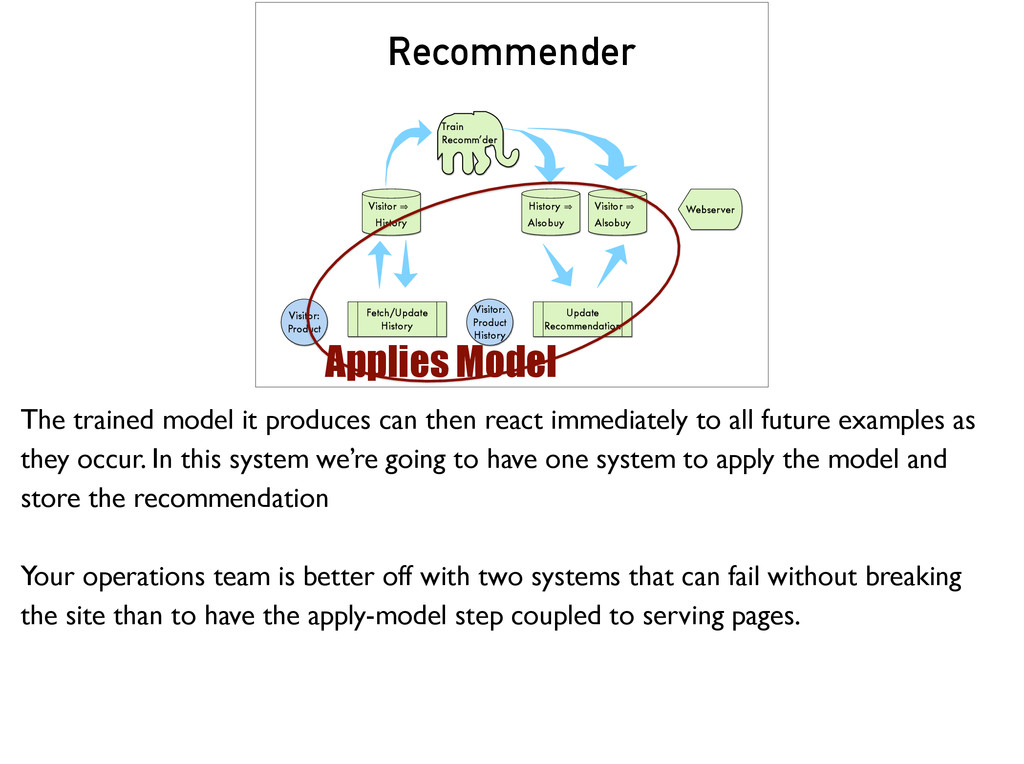
    Visitor 㱺 Alsobuy Update Recommendation Fetch/Update History Visitor: Product History Webserver Recommender Applies Model The trained model it produces can then react immediately to all future examples as they occur. In this system we’re going to have one system to apply the model and store the recommendation Your operations team is better off with two systems that can fail without breaking the site than to have the apply-model step coupled to serving pages.
  13. Train Recomm’der Visitor 㱺 History History 㱺 Alsobuy Visitor: Product

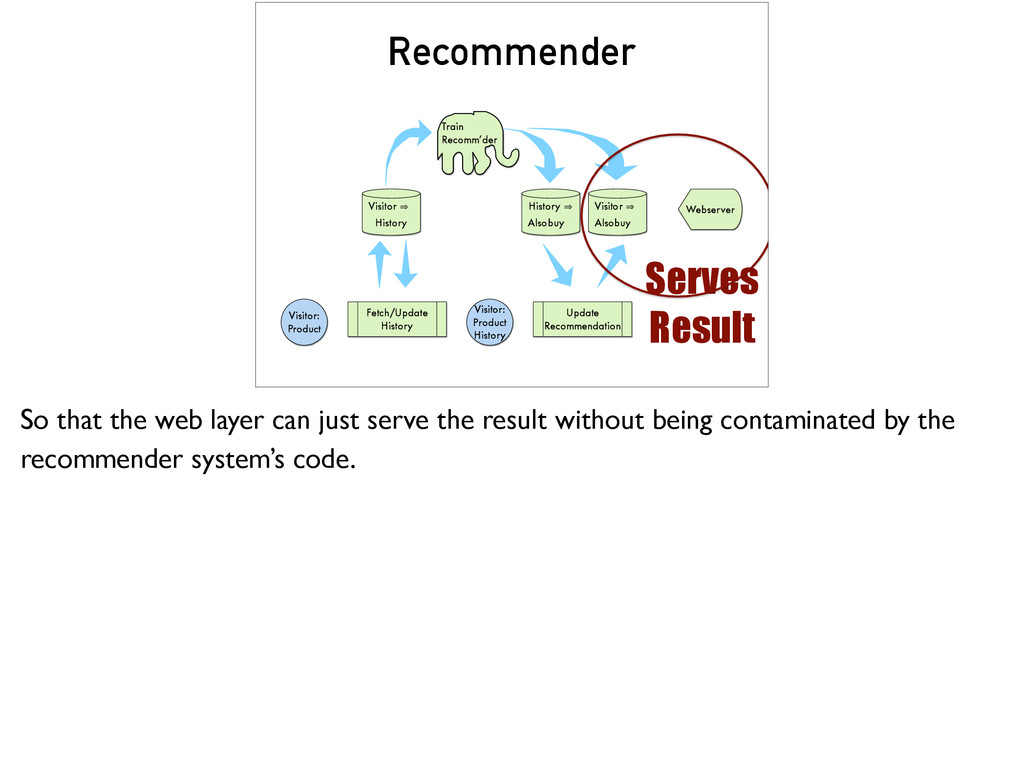
    Visitor 㱺 Alsobuy Update Recommendation Fetch/Update History Visitor: Product History Webserver Recommender Serves Result So that the web layer can just serve the result without being contaminated by the recommender system’s code.
  14. Train Recomm’der Visitor 㱺 History History 㱺 Alsobuy Visitor: Product

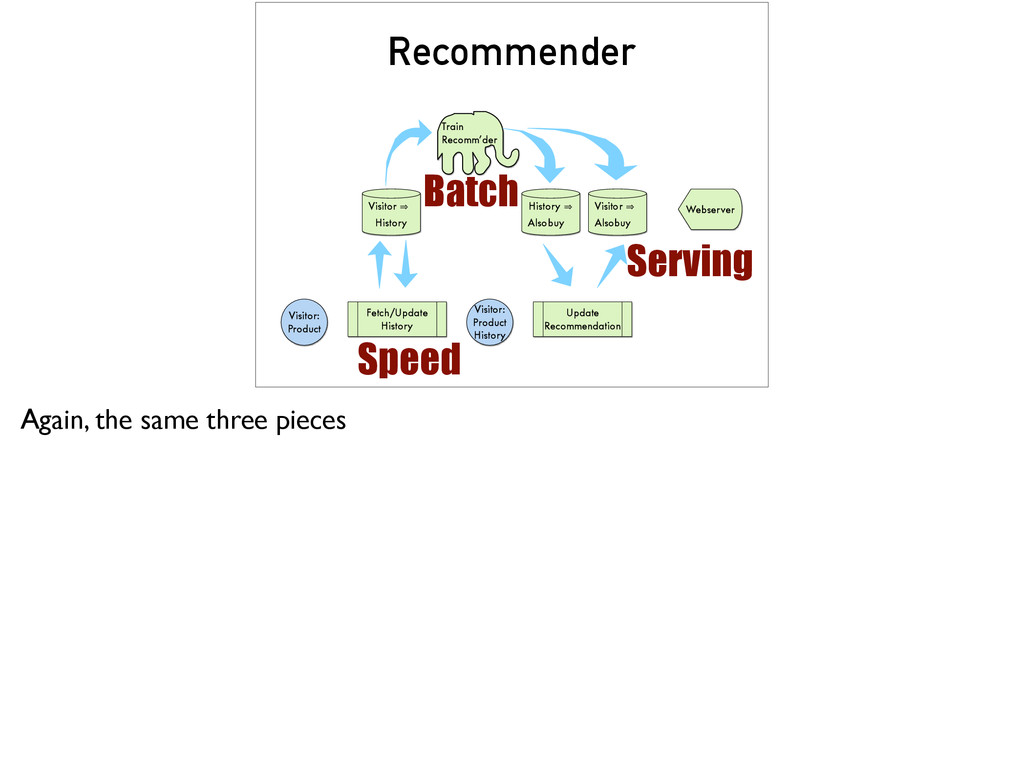
    Visitor 㱺 Alsobuy Update Recommendation Fetch/Update History Visitor: Product History Webserver Recommender Batch Speed Serving Again, the same three pieces
  15. Lambda Arch Layers • Batch layer Deep Global Truth throughput

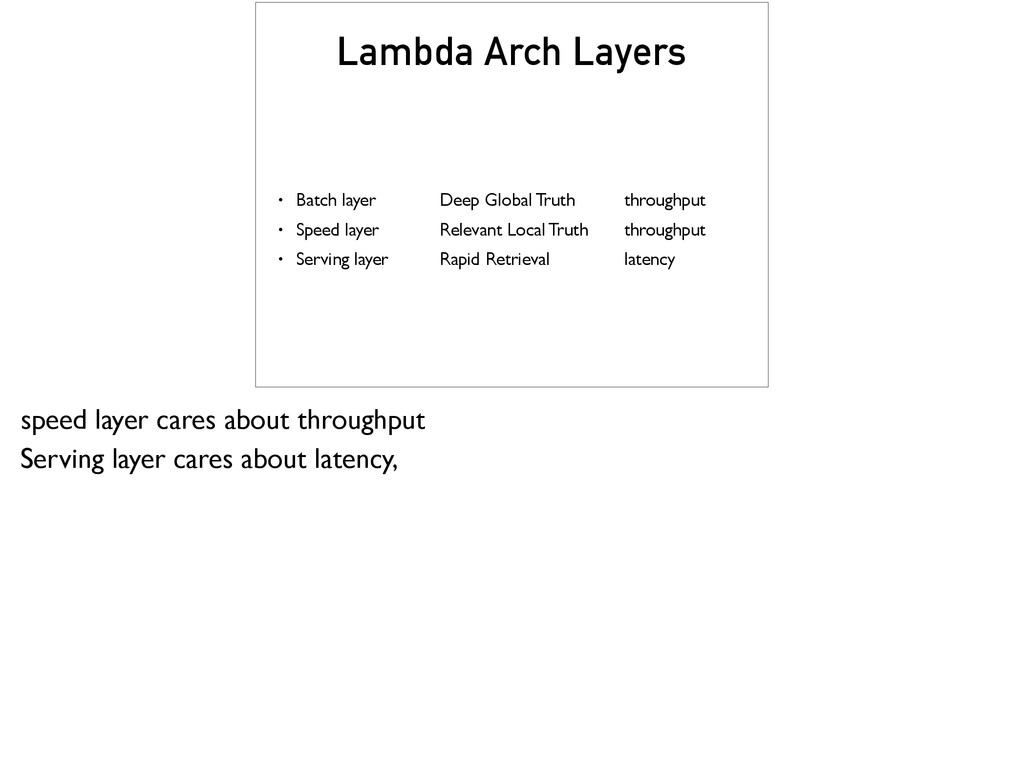
    • Speed layer Relevant Local Truth throughput • Serving layer Rapid Retrieval latency speed layer cares about throughput Serving layer cares about latency,
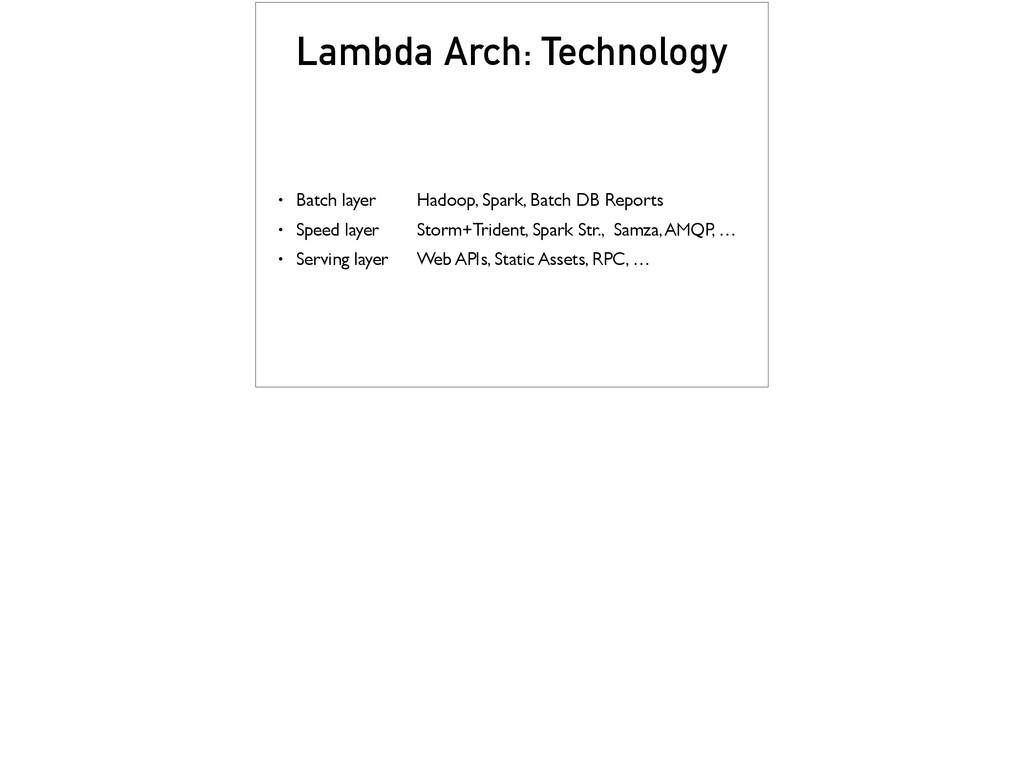
  16. Lambda Arch: Technology • Batch layer Hadoop, Spark, Batch DB

    Reports • Speed layer Storm+Trident, Spark Str., Samza, AMQP, … • Serving layer Web APIs, Static Assets, RPC, …
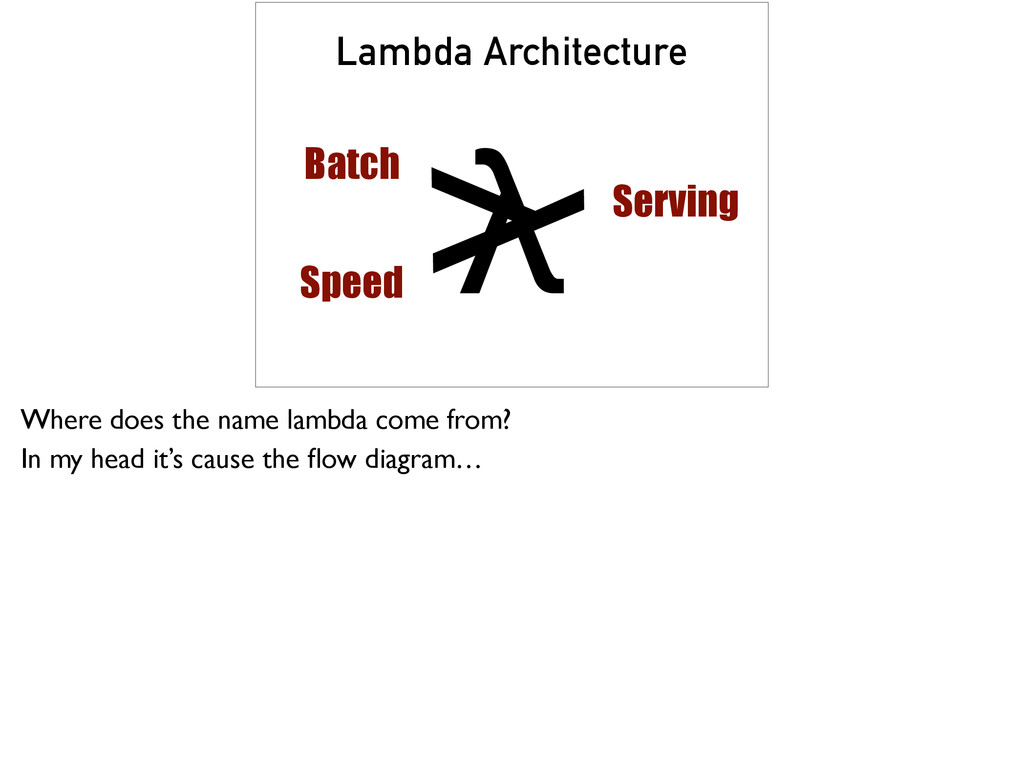
  17. Lambda Architecture Batch Speed Serving λ λ Where does the

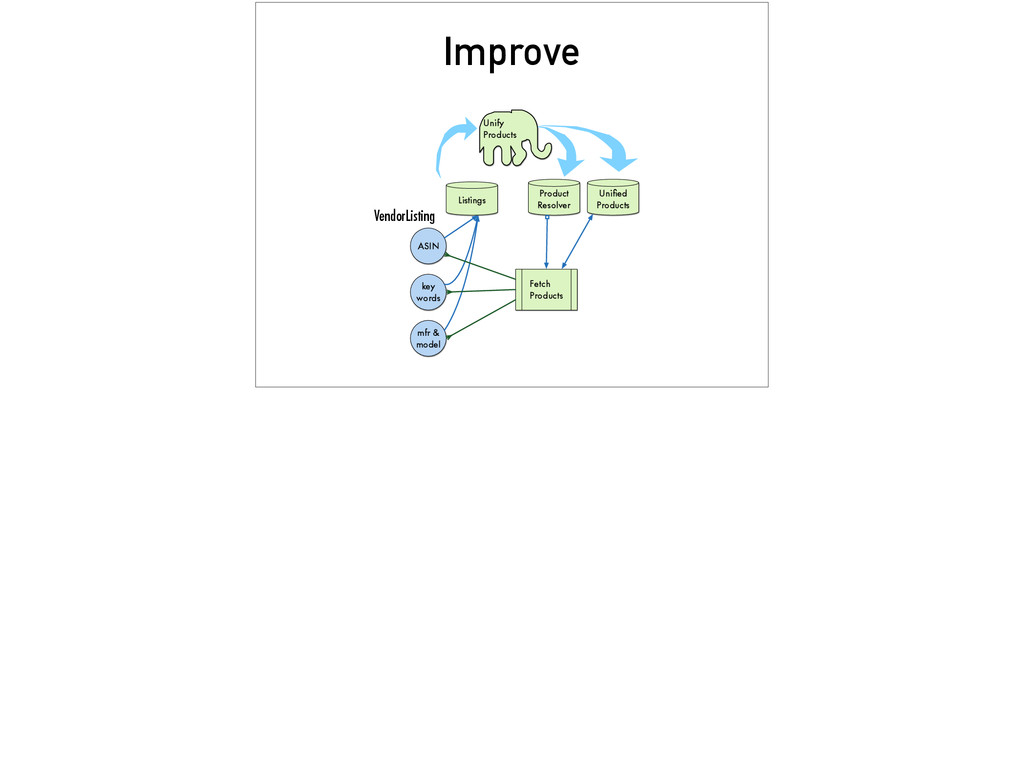
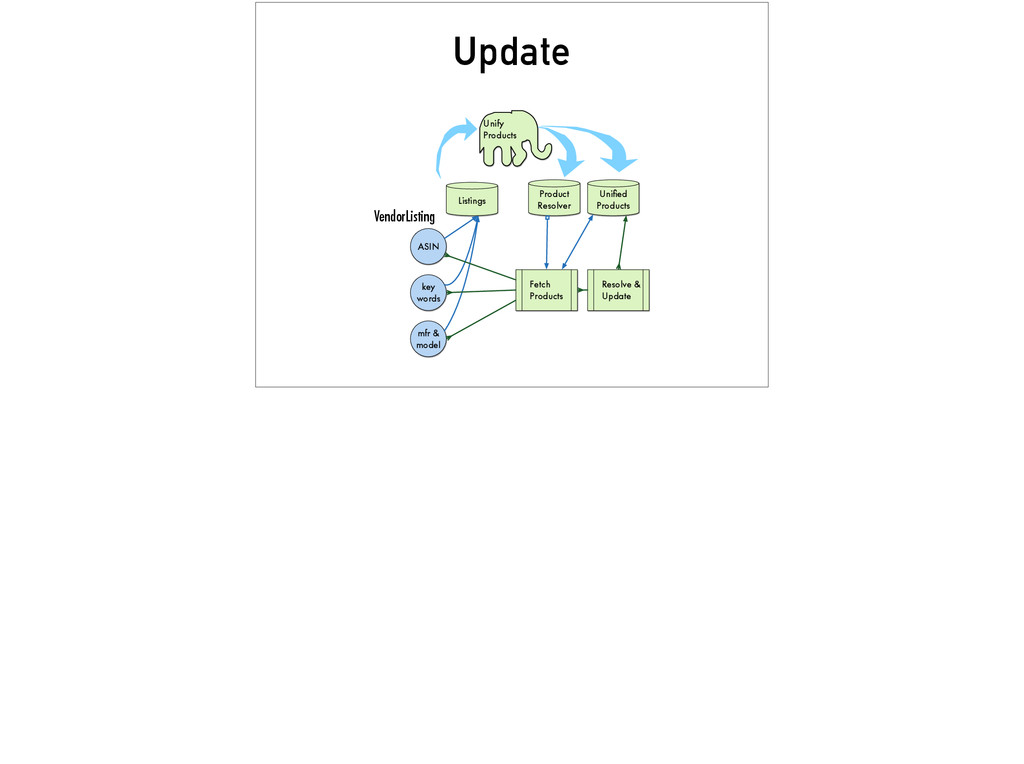
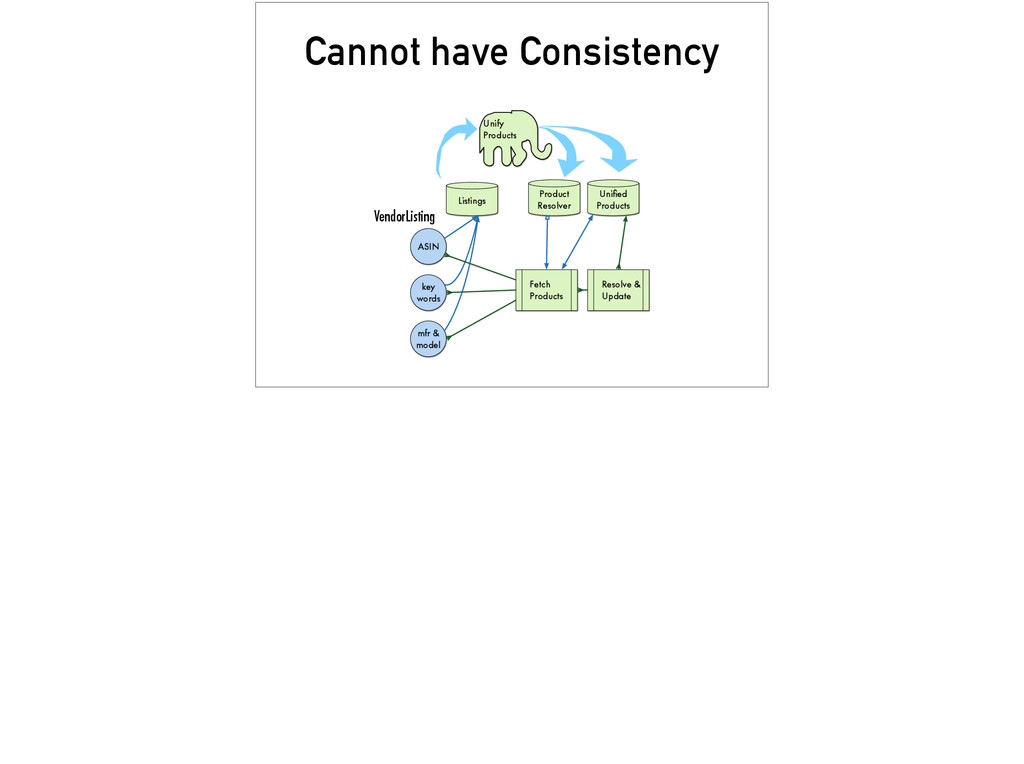
    name lambda come from? In my head it’s cause the flow diagram…
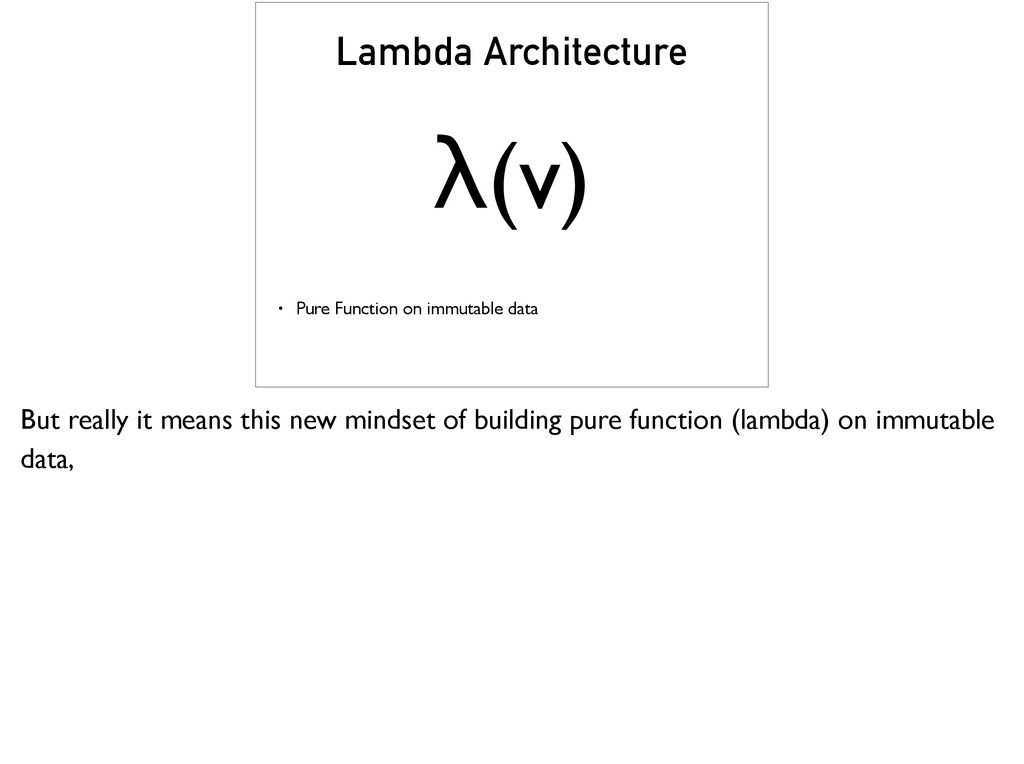
  18. Lambda Architecture λ(v) • Pure Function on immutable data But

    really it means this new mindset of building pure function (lambda) on immutable data,
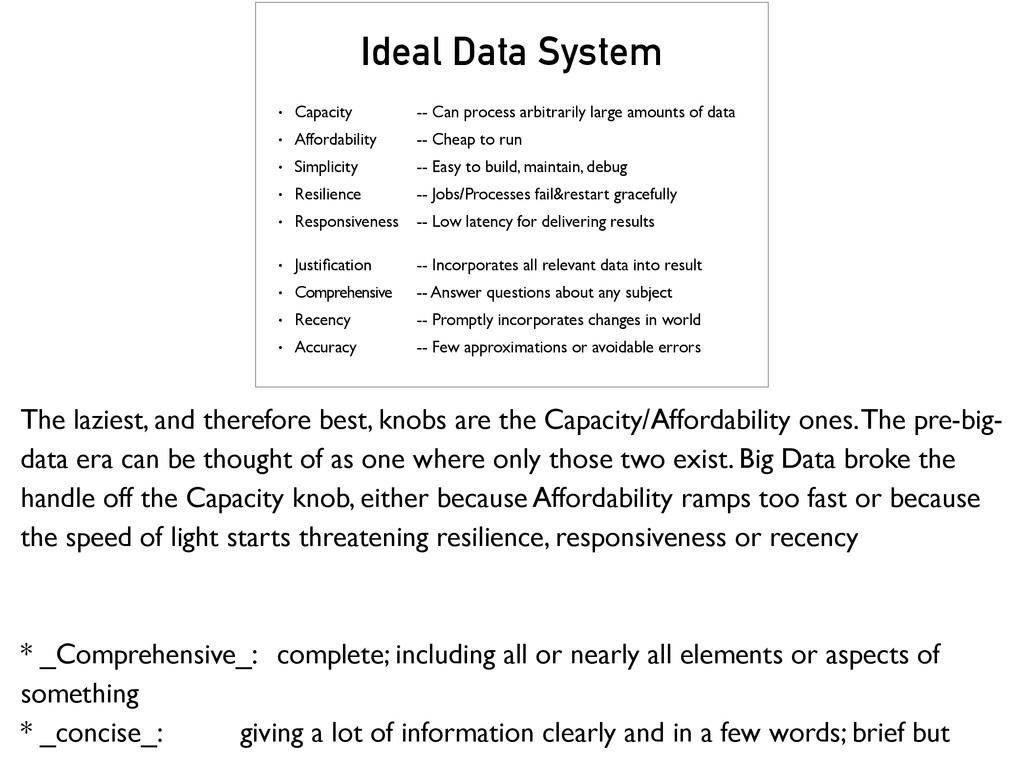
  19. Ideal Data System • Capacity -- Can process arbitrarily large

    amounts of data • Affordability -- Cheap to run • Simplicity -- Easy to build, maintain, debug • Resilience -- Jobs/Processes fail&restart gracefully • Responsiveness -- Low latency for delivering results • Justification -- Incorporates all relevant data into result • Comprehensive -- Answer questions about any subject • Recency -- Promptly incorporates changes in world • Accuracy -- Few approximations or avoidable errors The laziest, and therefore best, knobs are the Capacity/Affordability ones. The pre-big- data era can be thought of as one where only those two exist. Big Data broke the handle off the Capacity knob, either because Affordability ramps too fast or because the speed of light starts threatening resilience, responsiveness or recency * _Comprehensive_: complete; including all or nearly all elements or aspects of something * _concise_: giving a lot of information clearly and in a few words; brief but
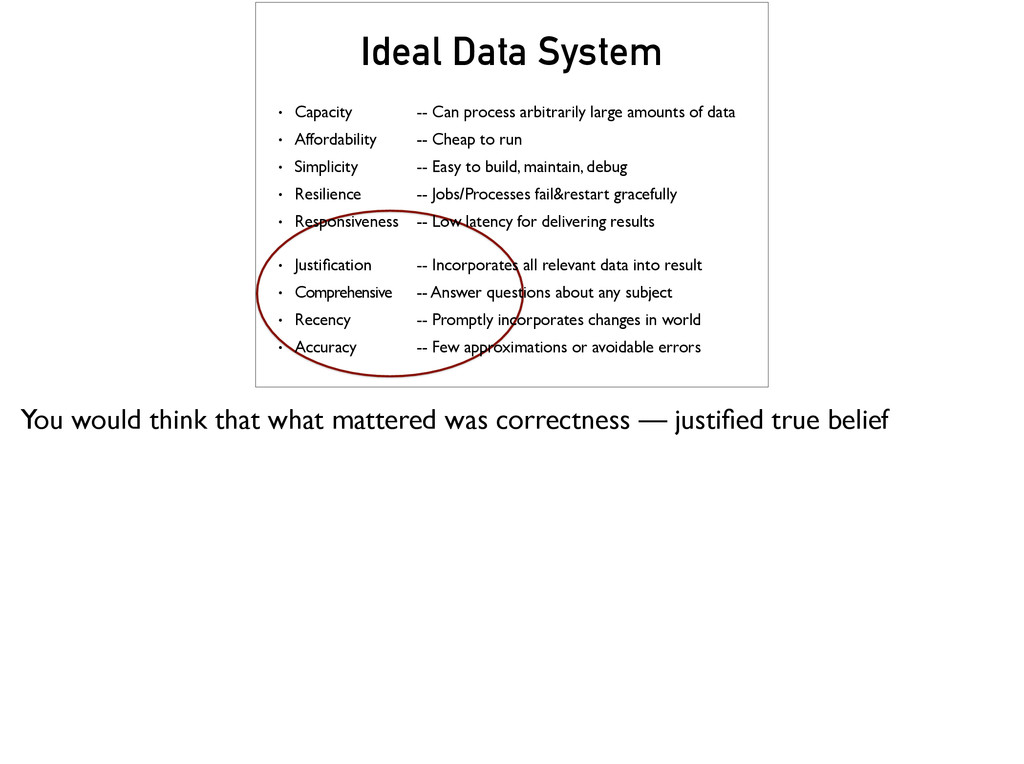
  20. Ideal Data System • Capacity -- Can process arbitrarily large

    amounts of data • Affordability -- Cheap to run • Simplicity -- Easy to build, maintain, debug • Resilience -- Jobs/Processes fail&restart gracefully • Responsiveness -- Low latency for delivering results • Justification -- Incorporates all relevant data into result • Comprehensive -- Answer questions about any subject • Recency -- Promptly incorporates changes in world • Accuracy -- Few approximations or avoidable errors You would think that what mattered was correctness — justified true belief
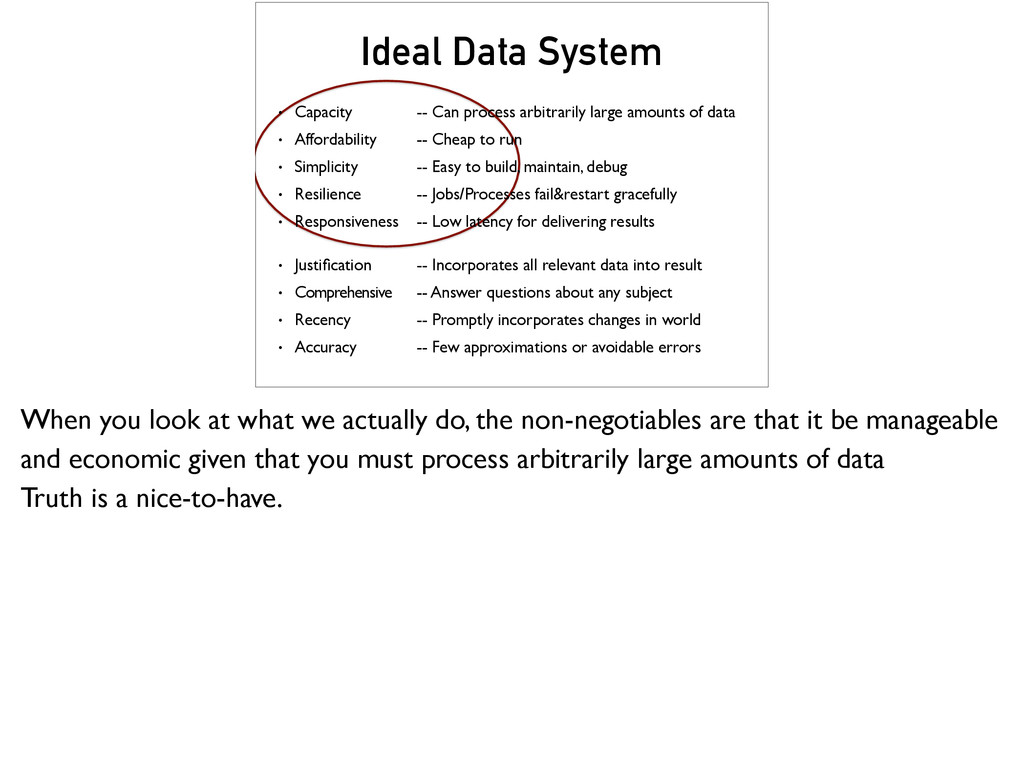
  21. Ideal Data System • Capacity -- Can process arbitrarily large

    amounts of data • Affordability -- Cheap to run • Simplicity -- Easy to build, maintain, debug • Resilience -- Jobs/Processes fail&restart gracefully • Responsiveness -- Low latency for delivering results • Justification -- Incorporates all relevant data into result • Comprehensive -- Answer questions about any subject • Recency -- Promptly incorporates changes in world • Accuracy -- Few approximations or avoidable errors When you look at what we actually do, the non-negotiables are that it be manageable and economic given that you must process arbitrarily large amounts of data Truth is a nice-to-have.
  22. Tradeoff Rules PICK ANY TWO Set of tradeoff rules along

    the lines of the pick-any-two trinity but more sophisticated
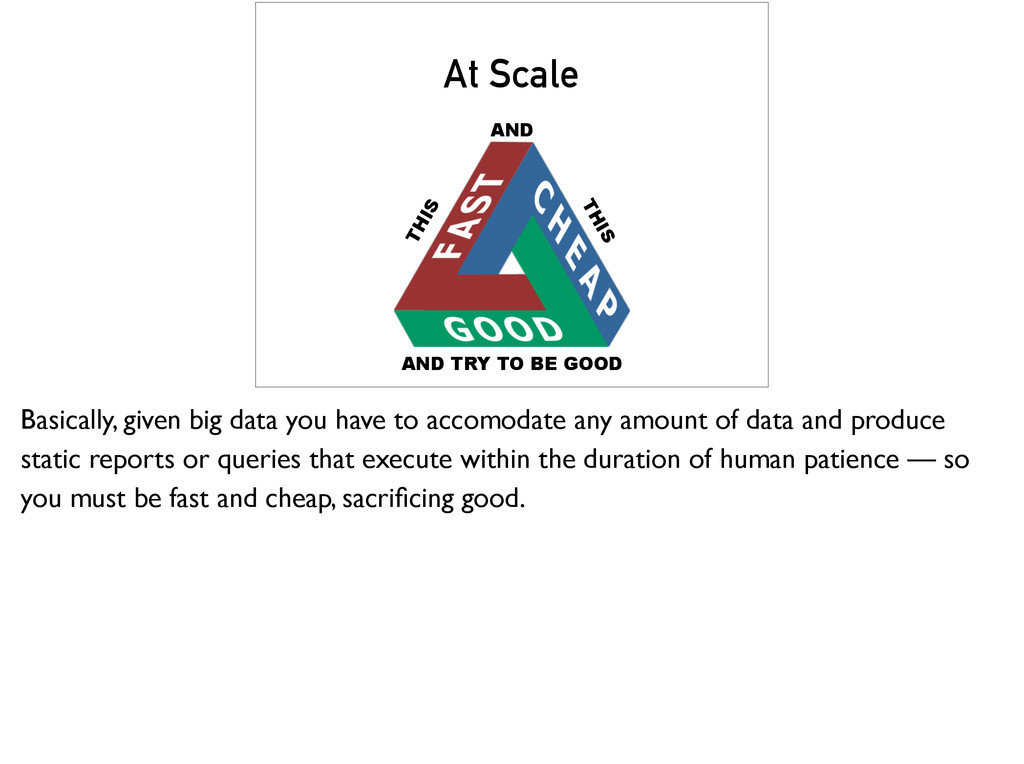
  23. At Scale AND THIS THIS AND TRY TO BE GOOD

    Basically, given big data you have to accomodate any amount of data and produce static reports or queries that execute within the duration of human patience — so you must be fast and cheap, sacrificing good.
  24. Train Recomm’der Visitor 㱺 History History 㱺 Alsobuy Visitor: Product

    Visitor 㱺 Alsobuy Update Recommendation Fetch/Update History Visitor: Product History Webserver Recommender The world you’re modeling changes — new sets of products are released, new and variated customers sign up, changes to the site drive new behavior — but it changes slowly. So it’s no big deal if the training stage is only run once a week over several hours. The first example follows a pretty familiar general form I’ll call “Train / React”. You have one system process all the examples you’ve ever seen to produce a predictive model. The trained model it produces can then react immediately to all future
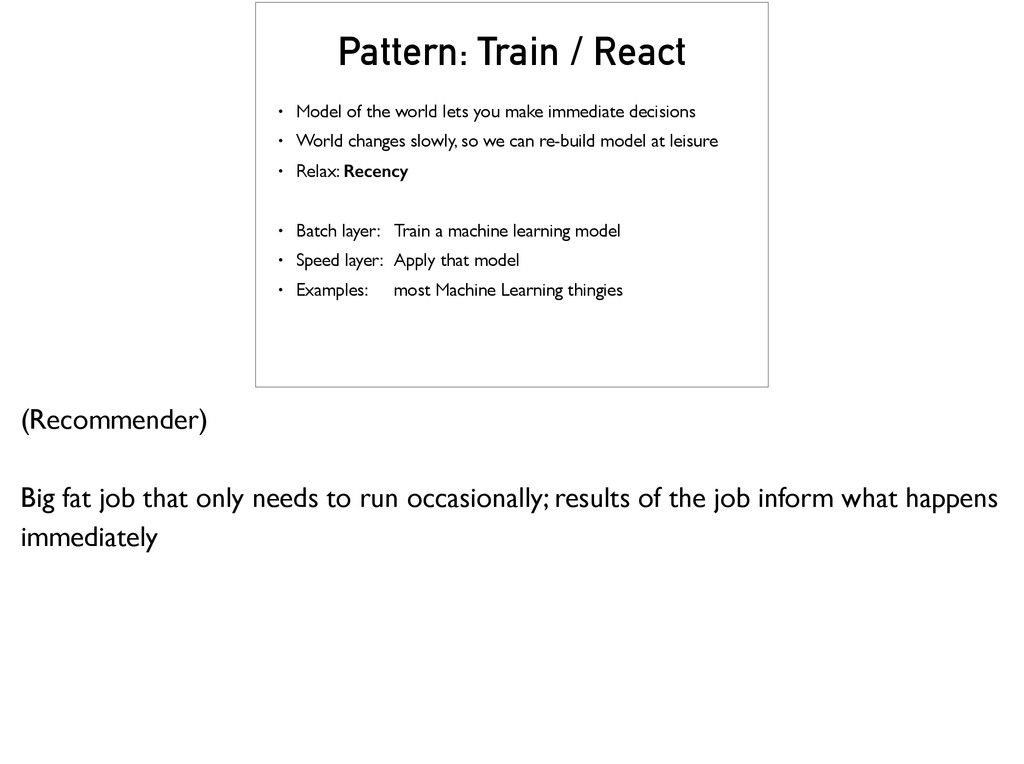
  25. Pattern: Train / React • Model of the world lets

    you make immediate decisions • World changes slowly, so we can re-build model at leisure • Relax: Recency • Batch layer: Train a machine learning model • Speed layer: Apply that model • Examples: most Machine Learning thingies (Recommender) Big fat job that only needs to run occasionally; results of the job inform what happens immediately
  26. Search w/ Update Build Indexes A Ton of Text Historical

    Index Live Indexer More Text Recent Index API
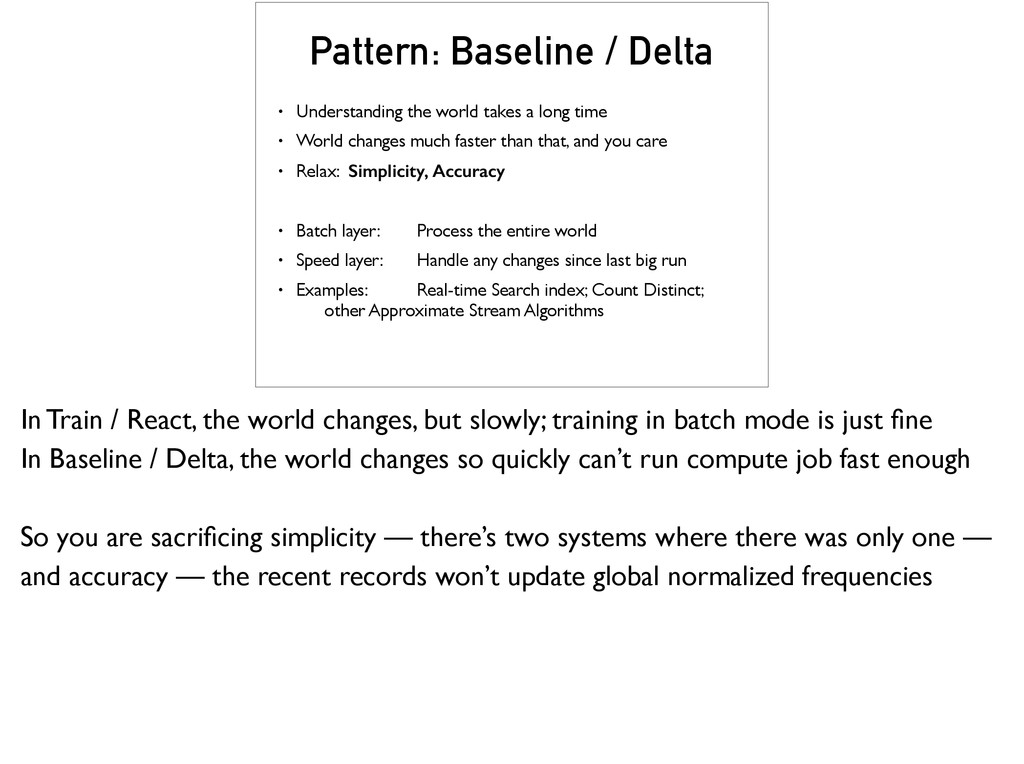
  27. Pattern: Baseline / Delta • Understanding the world takes a

    long time • World changes much faster than that, and you care • Relax: Simplicity, Accuracy • Batch layer: Process the entire world • Speed layer: Handle any changes since last big run • Examples: Real-time Search index; Count Distinct; 
 other Approximate Stream Algorithms In Train / React, the world changes, but slowly; training in batch mode is just fine In Baseline / Delta, the world changes so quickly can’t run compute job fast enough So you are sacrificing simplicity — there’s two systems where there was only one — and accuracy — the recent records won’t update global normalized frequencies
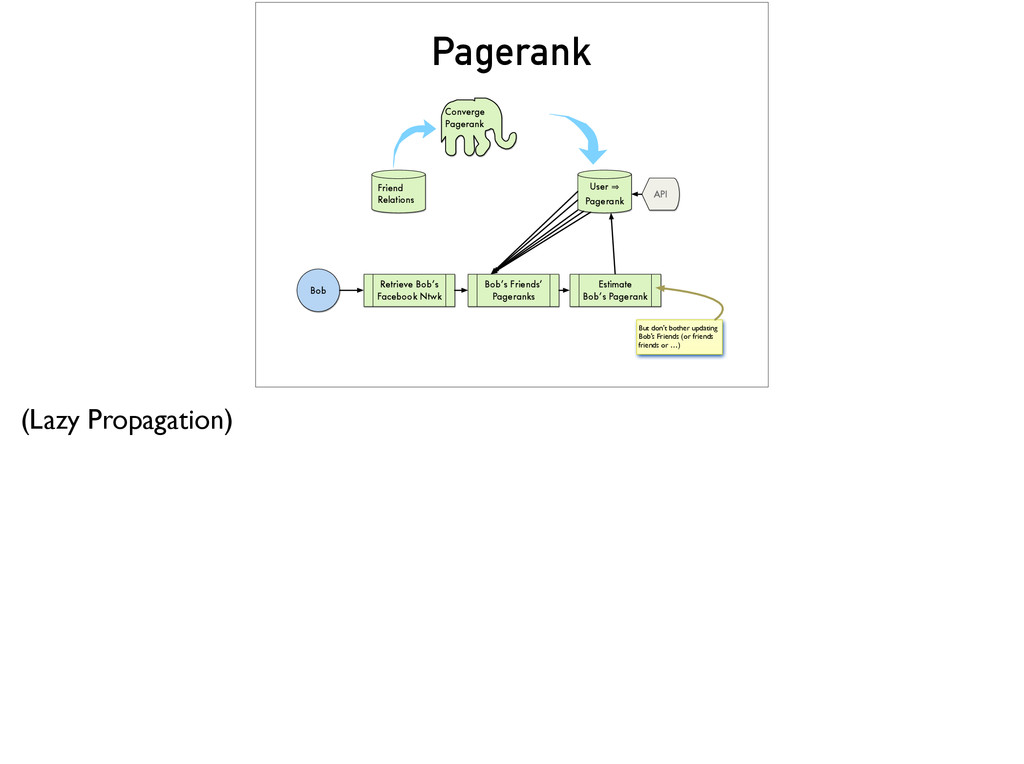
  28. Pagerank Converge Pagerank Friend Relations User 㱺 Pagerank Retrieve Bob’s

    Facebook Ntwk Bob Bob’s Friends’ Pageranks Estimate Bob’s Pagerank But don’t bother updating Bob’s Friends (or friends friends or …) API (Lazy Propagation)
  29. Pagerank 48 24 42 12 12 6 24 24 42

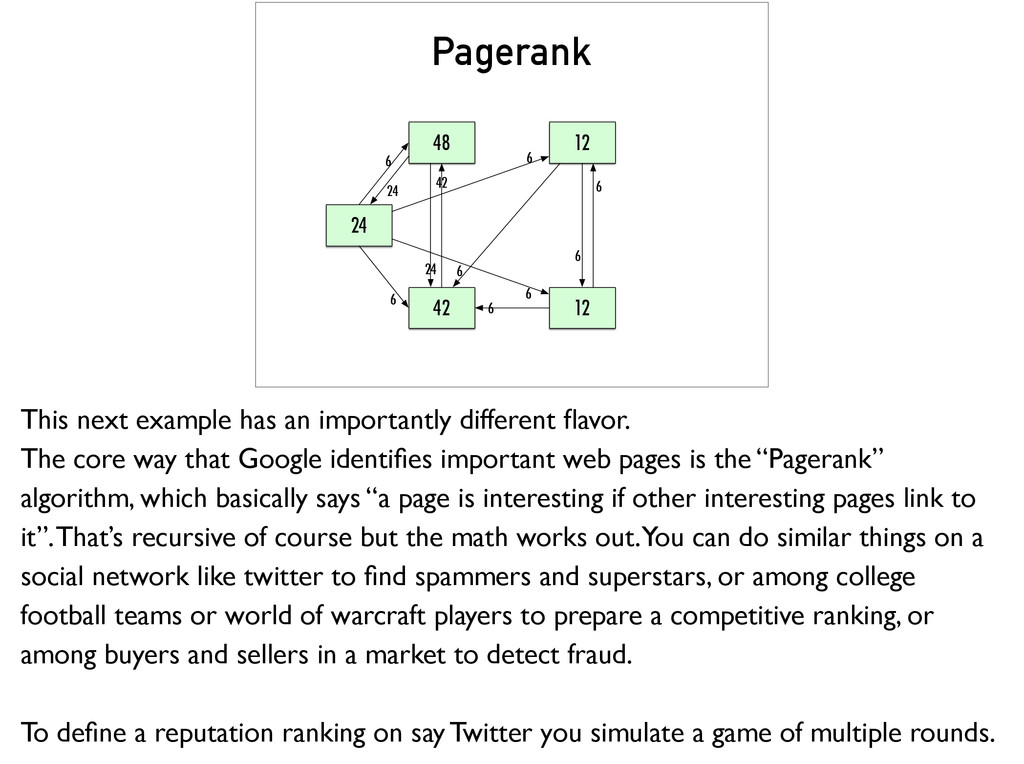
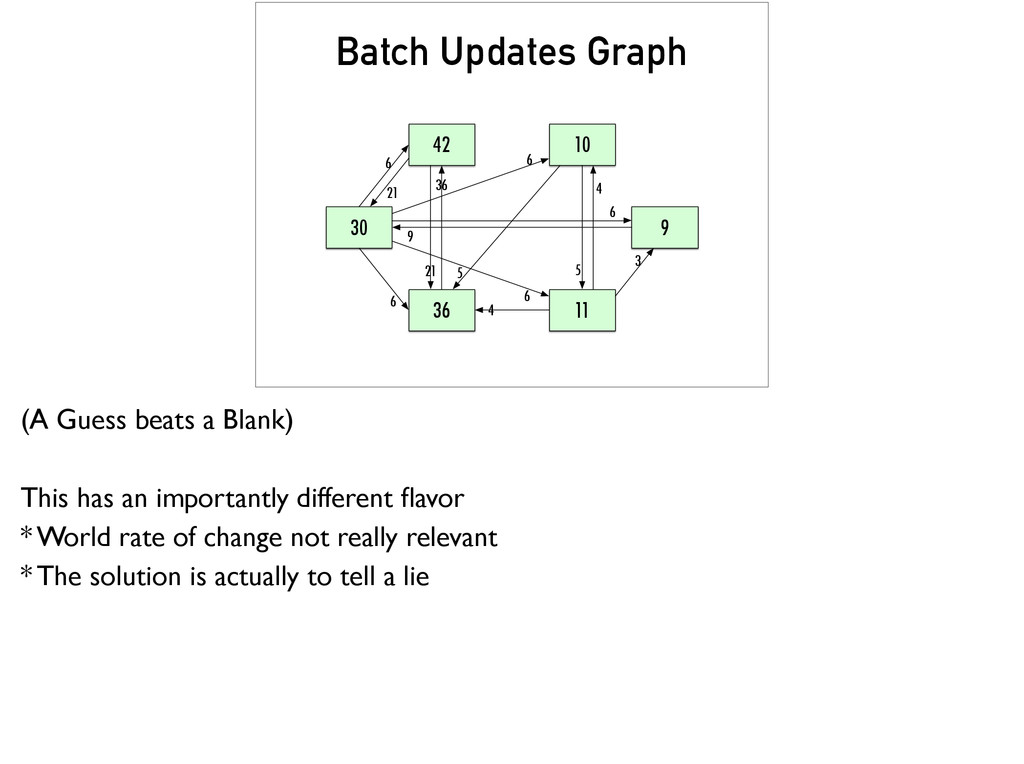
    6 6 6 6 6 6 6 This next example has an importantly different flavor. The core way that Google identifies important web pages is the “Pagerank” algorithm, which basically says “a page is interesting if other interesting pages link to it”. That’s recursive of course but the math works out. You can do similar things on a social network like twitter to find spammers and superstars, or among college football teams or world of warcraft players to prepare a competitive ranking, or among buyers and sellers in a market to detect fraud. To define a reputation ranking on say Twitter you simulate a game of multiple rounds.
  30. 48 24 42 12 12 6 24 24 42 6

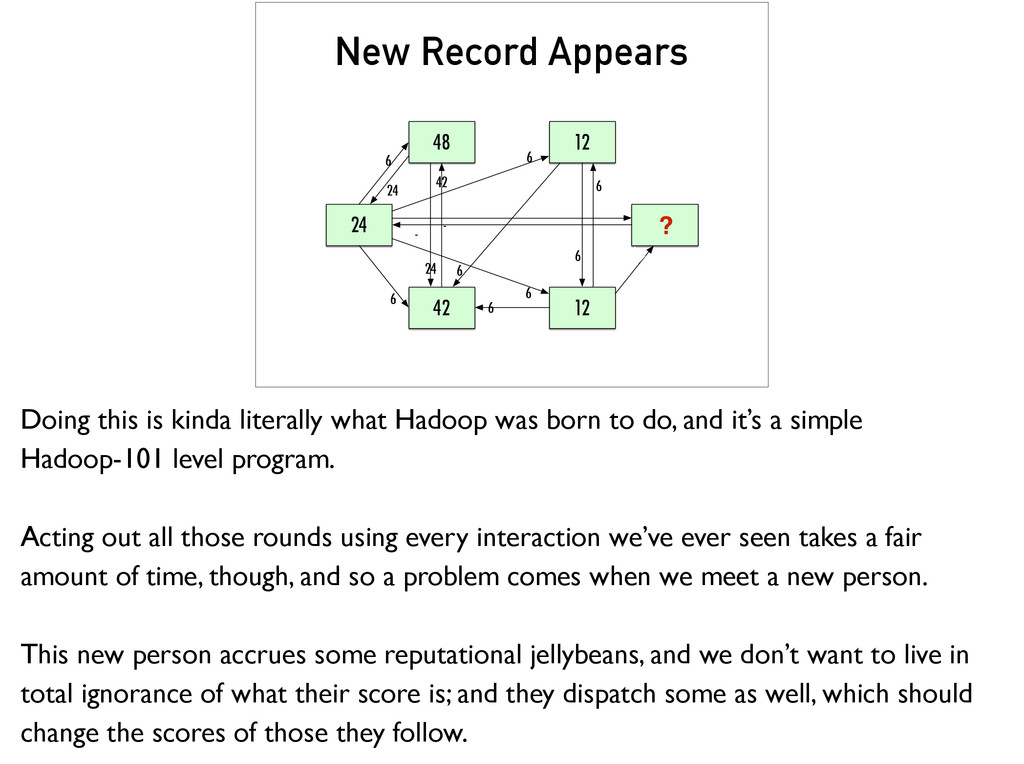
    6 6 6 6 6 6 9 4 - 5 - New Record Appears ? Doing this is kinda literally what Hadoop was born to do, and it’s a simple Hadoop-101 level program. Acting out all those rounds using every interaction we’ve ever seen takes a fair amount of time, though, and so a problem comes when we meet a new person. This new person accrues some reputational jellybeans, and we don’t want to live in total ignorance of what their score is; and they dispatch some as well, which should change the scores of those they follow.
  31. 48 24 42 12 12 6 24 24 42 6

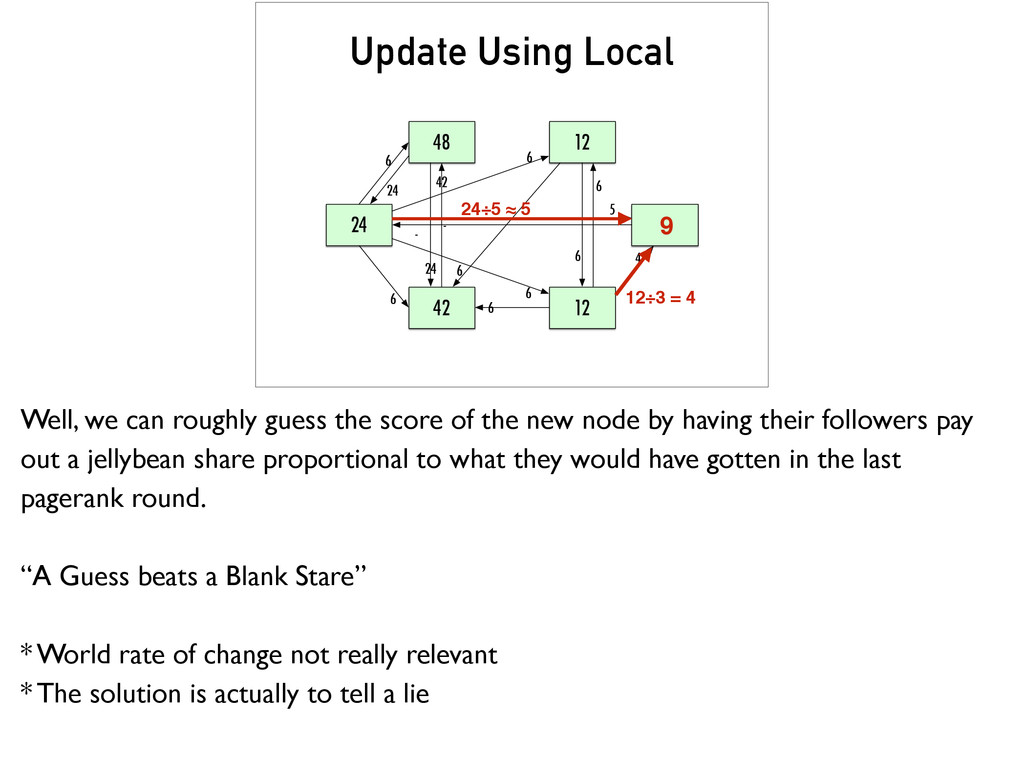
    6 6 6 6 6 6 9 4 - 5 - Update Using Local 12÷3 = 4 24÷5 ≈ 5 9 Well, we can roughly guess the score of the new node by having their followers pay out a jellybean share proportional to what they would have gotten in the last pagerank round. “A Guess beats a Blank Stare” * World rate of change not really relevant * The solution is actually to tell a lie
  32. 48 24 42 12 12 6 24 24 42 6

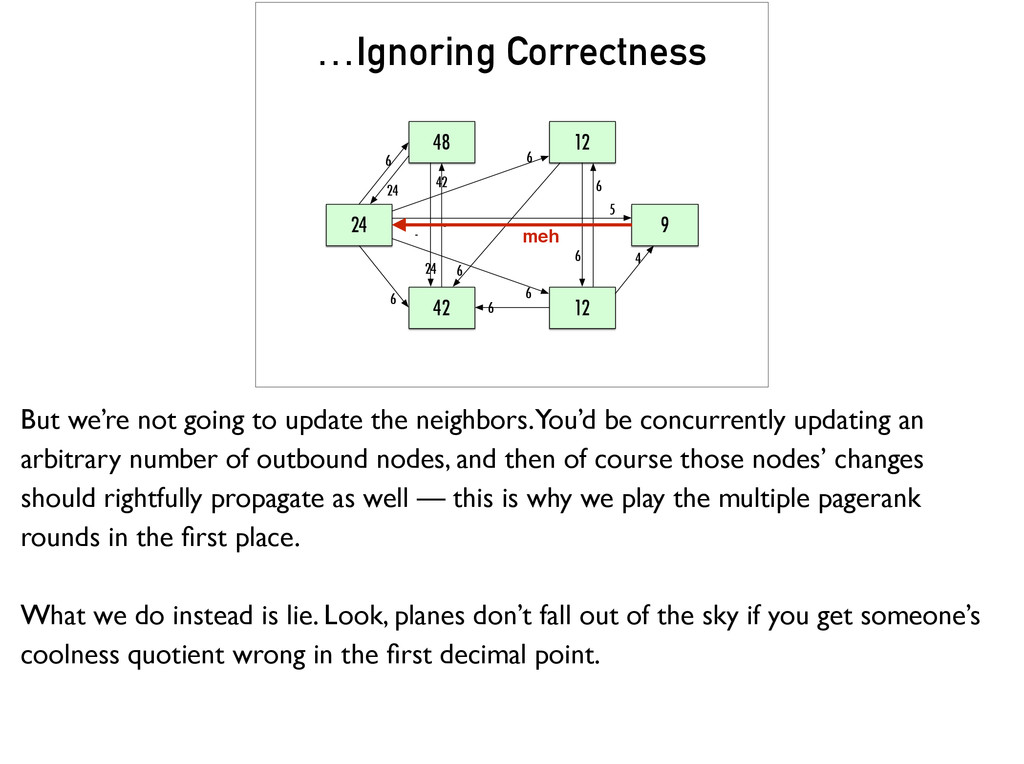
    6 6 6 6 6 6 9 4 - 5 - …Ignoring Correctness meh But we’re not going to update the neighbors. You’d be concurrently updating an arbitrary number of outbound nodes, and then of course those nodes’ changes should rightfully propagate as well — this is why we play the multiple pagerank rounds in the first place. What we do instead is lie. Look, planes don’t fall out of the sky if you get someone’s coolness quotient wrong in the first decimal point.
  33. Batch Updates Graph 42 30 36 11 10 6 21

    21 36 4 6 6 6 5 5 4 9 3 9 6 (A Guess beats a Blank) This has an importantly different flavor * World rate of change not really relevant * The solution is actually to tell a lie
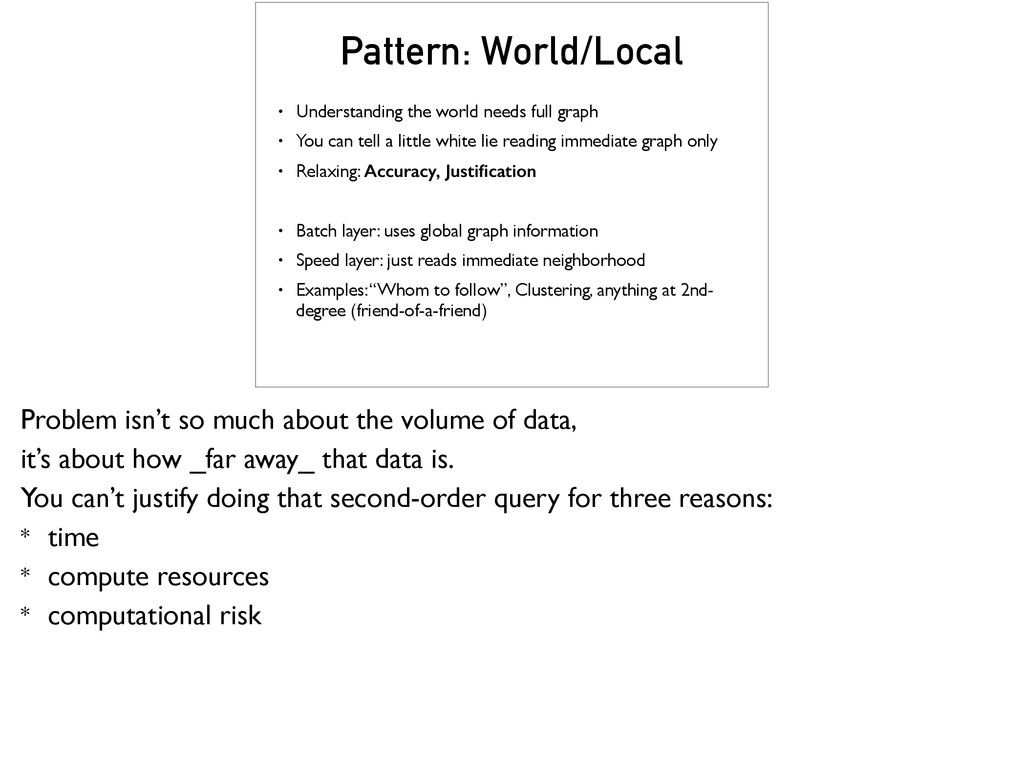
  34. Pattern: World/Local • Understanding the world needs full graph •

    You can tell a little white lie reading immediate graph only • Relaxing: Accuracy, Justification • Batch layer: uses global graph information • Speed layer: just reads immediate neighborhood • Examples: “Whom to follow”, Clustering, anything at 2nd- degree (friend-of-a-friend) Problem isn’t so much about the volume of data, it’s about how _far away_ that data is. You can’t justify doing that second-order query for three reasons: * time * compute resources * computational risk
  35. Pattern: Guess Beats Blank • You can’t calculate a good

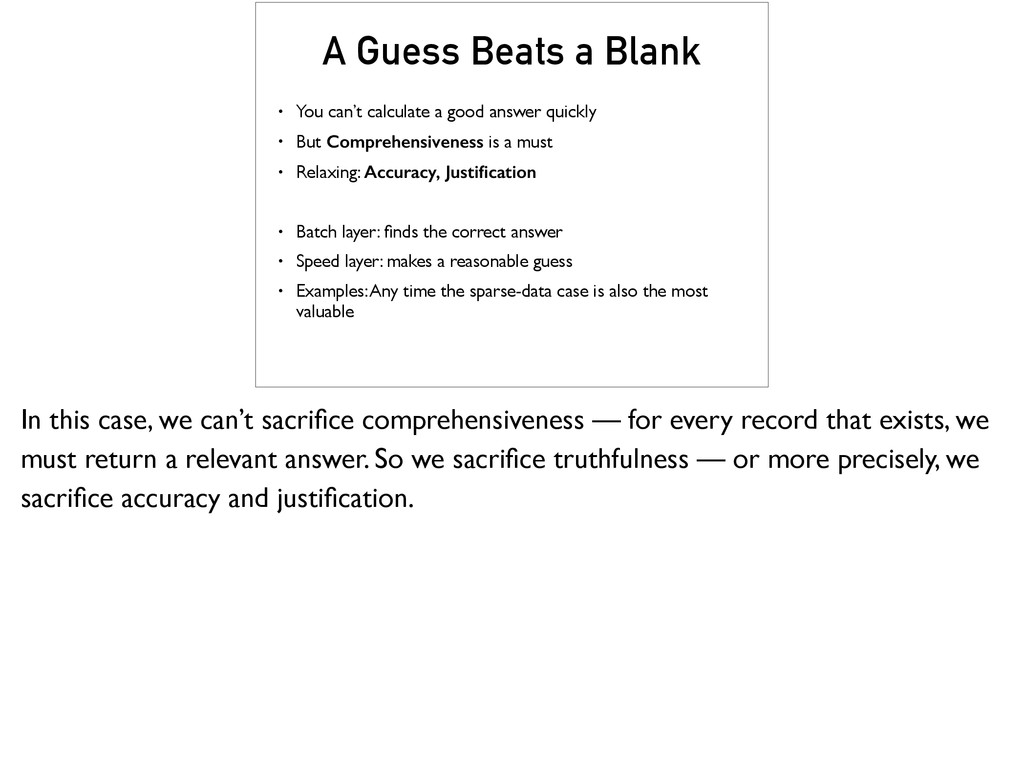
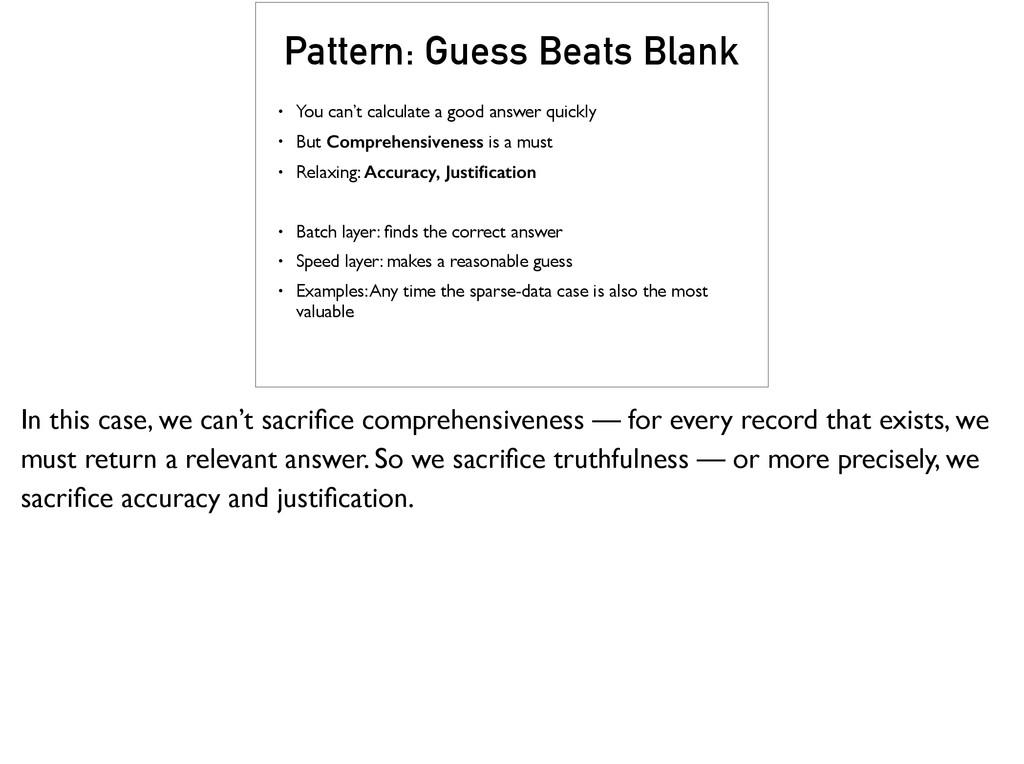
    answer quickly • But Comprehensiveness is a must • Relaxing: Accuracy, Justification • Batch layer: finds the correct answer • Speed layer: makes a reasonable guess • Examples: Any time the sparse-data case is also the most valuable In this case, we can’t sacrifice comprehensiveness — for every record that exists, we must return a relevant answer. So we sacrifice truthfulness — or more precisely, we sacrifice accuracy and justification.
  36. Marine Corp’s 80% Rule “Any decision made with more than

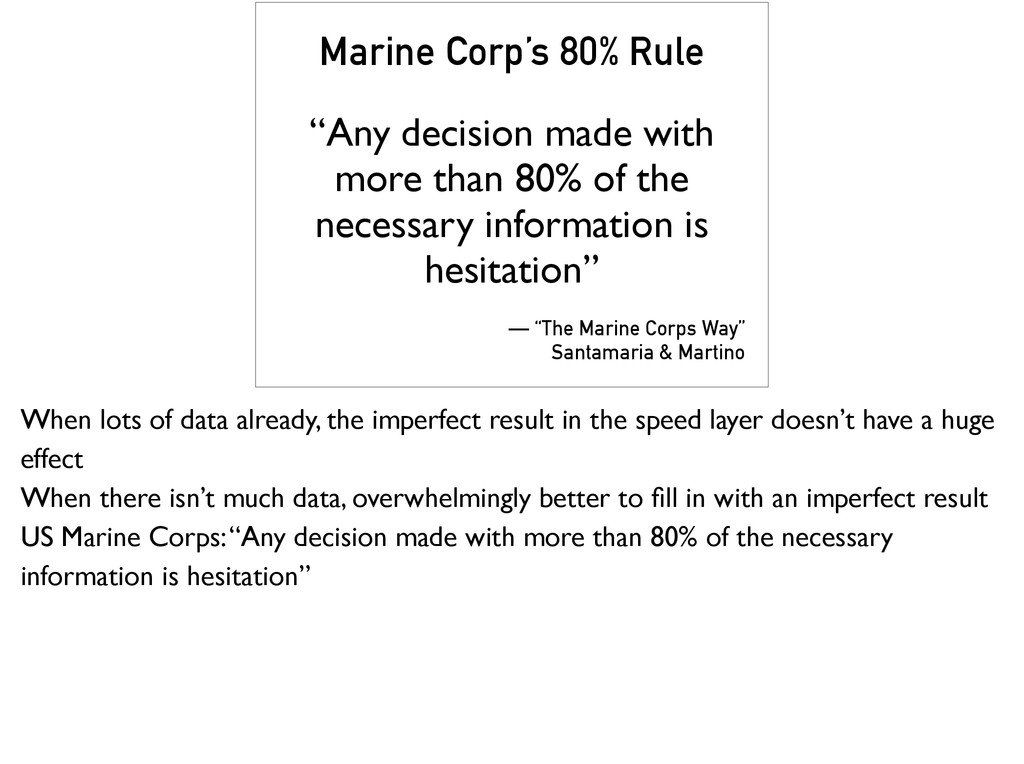
    80% of the necessary information is hesitation” — “The Marine Corps Way” Santamaria & Martino When lots of data already, the imperfect result in the speed layer doesn’t have a huge effect When there isn’t much data, overwhelmingly better to fill in with an imperfect result US Marine Corps: “Any decision made with more than 80% of the necessary information is hesitation”
  37. A Guess Beats a Blank • You can’t calculate a

    good answer quickly • But Comprehensiveness is a must • Relaxing: Accuracy, Justification • Batch layer: finds the correct answer • Speed layer: makes a reasonable guess • Examples: Any time the sparse-data case is also the most valuable In this case, we can’t sacrifice comprehensiveness — for every record that exists, we must return a relevant answer. So we sacrifice truthfulness — or more precisely, we sacrifice accuracy and justification.
  38. Security Find Potential Evilness Connection Counts Agents of Interest Store

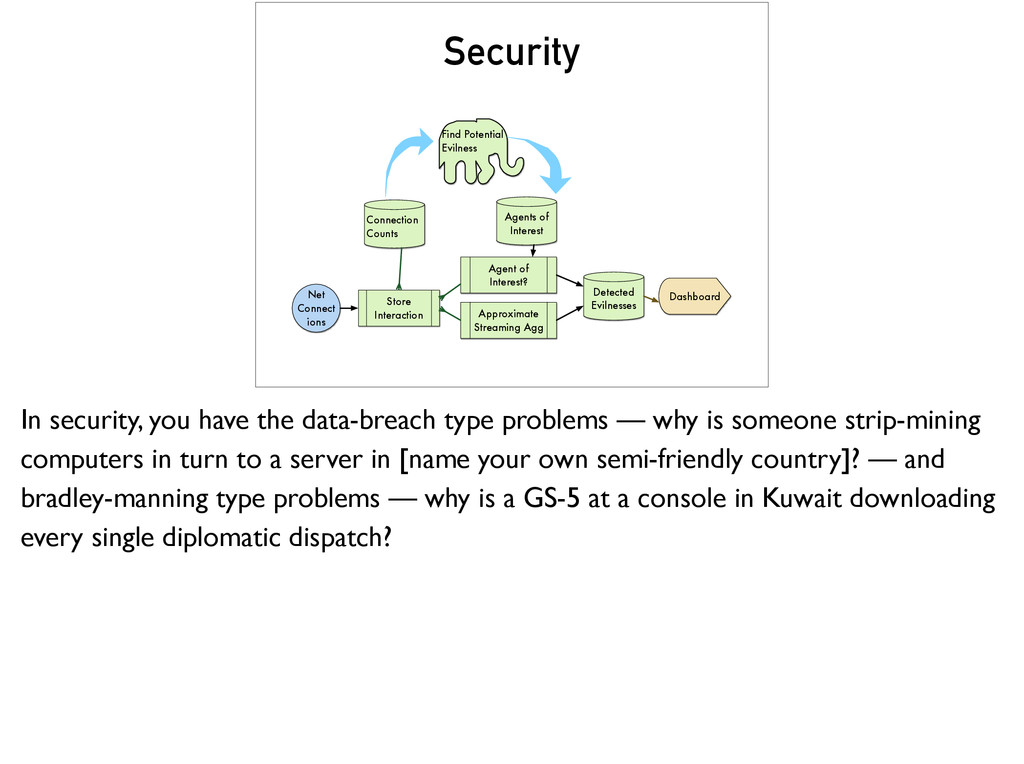
    Interaction Net Connect ions Detected Evilnesses Approximate Streaming Agg Agent of Interest? Dashboard In security, you have the data-breach type problems — why is someone strip-mining computers in turn to a server in [name your own semi-friendly country]? — and bradley-manning type problems — why is a GS-5 at a console in Kuwait downloading every single diplomatic dispatch?
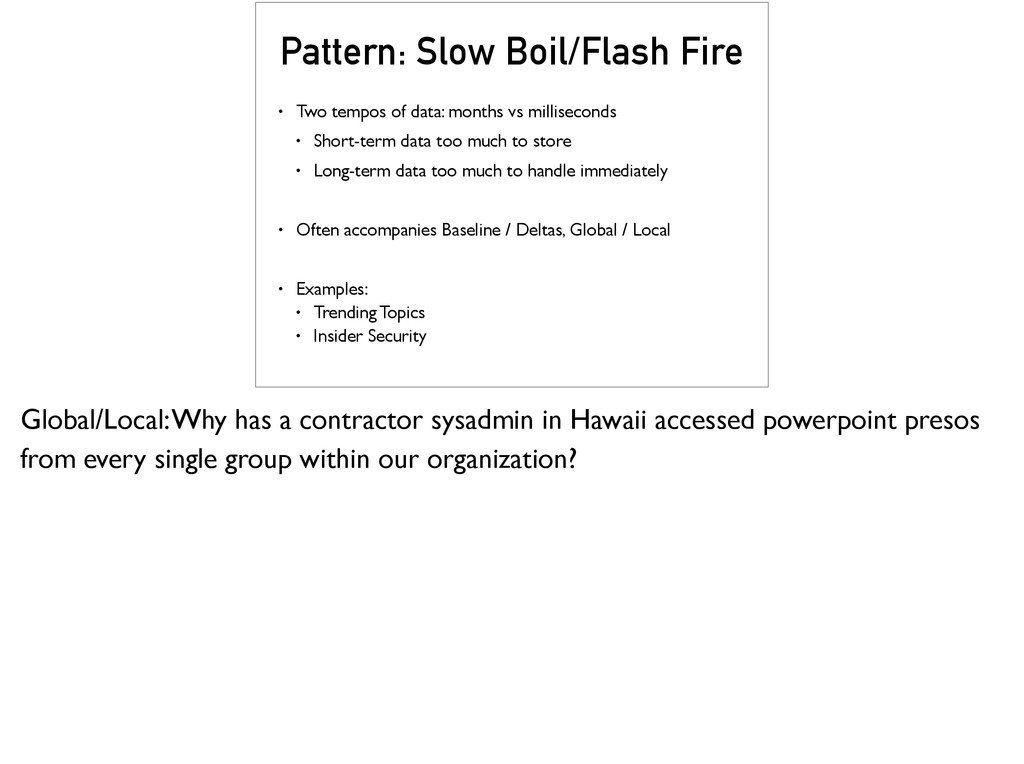
  39. Pattern: Slow Boil/Flash Fire • Two tempos of data: months

    vs milliseconds • Short-term data too much to store • Long-term data too much to handle immediately • Often accompanies Baseline / Deltas, Global / Local • Examples: • Trending Topics • Insider Security Global/Local: Why has a contractor sysadmin in Hawaii accessed powerpoint presos from every single group within our organization?
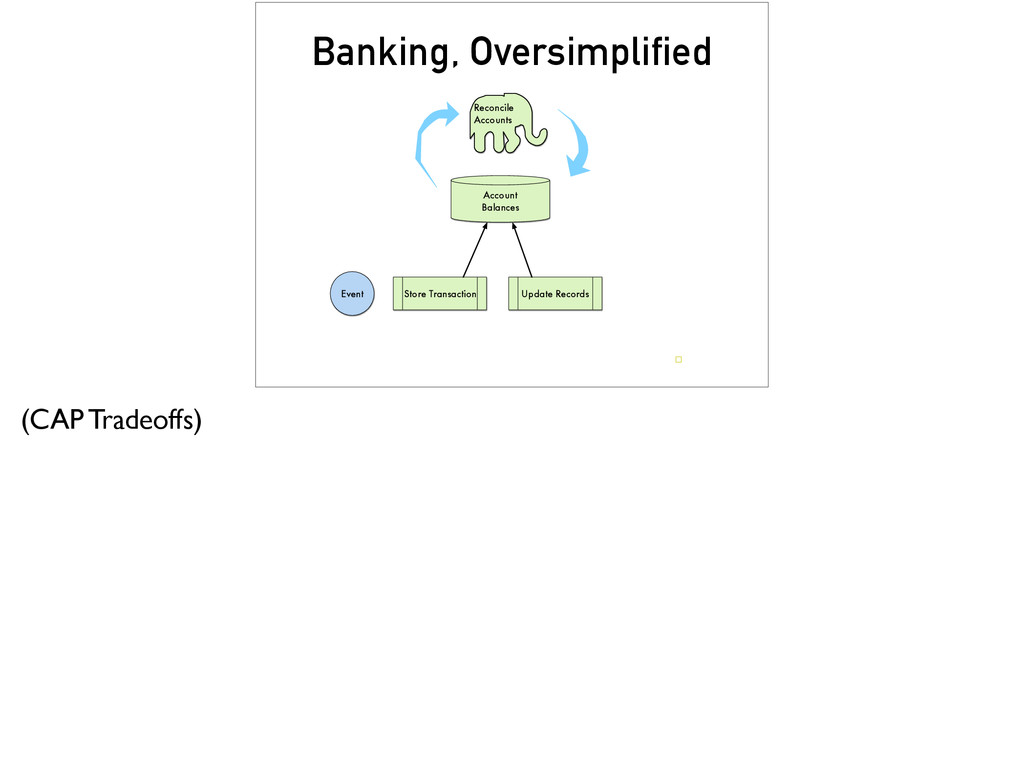
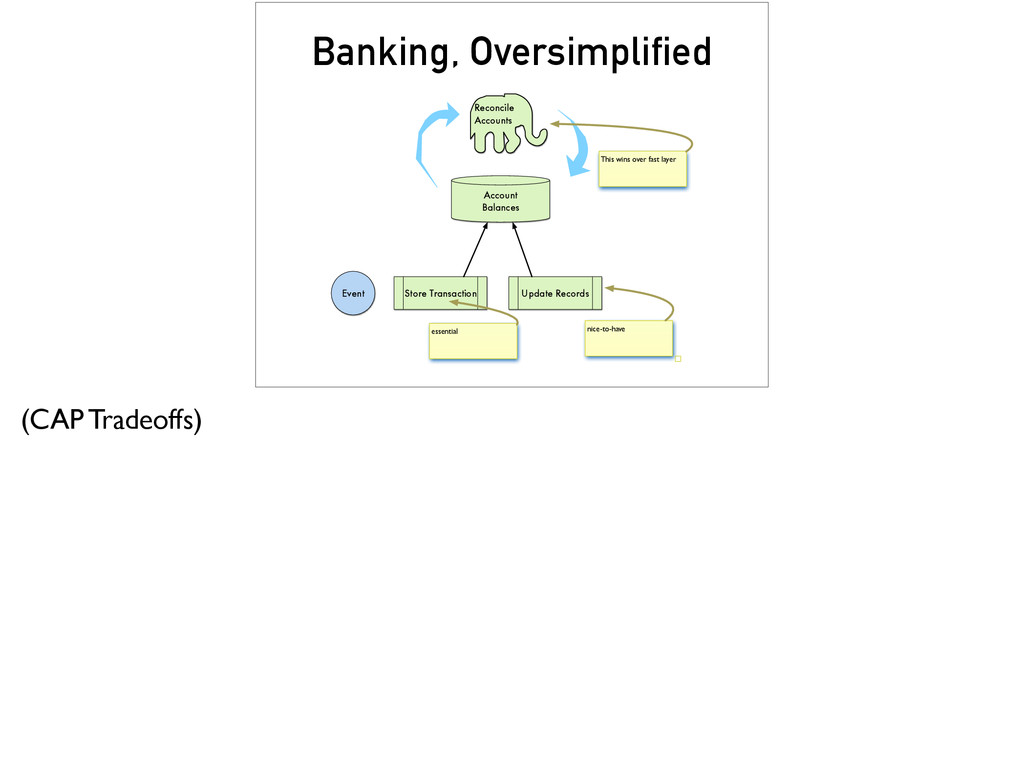
  40. Banking, Oversimplified Reconcile Accounts Account Balances Event Store Transaction Update

    Records nice-to-have essential This wins over fast layer (CAP Tradeoffs)
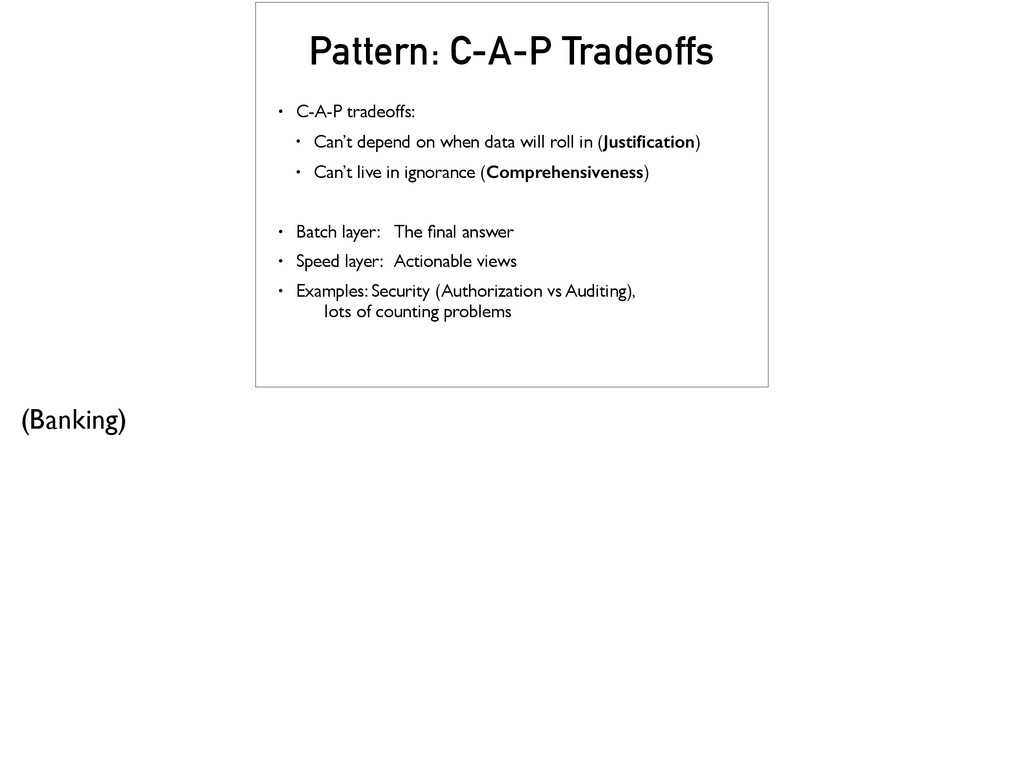
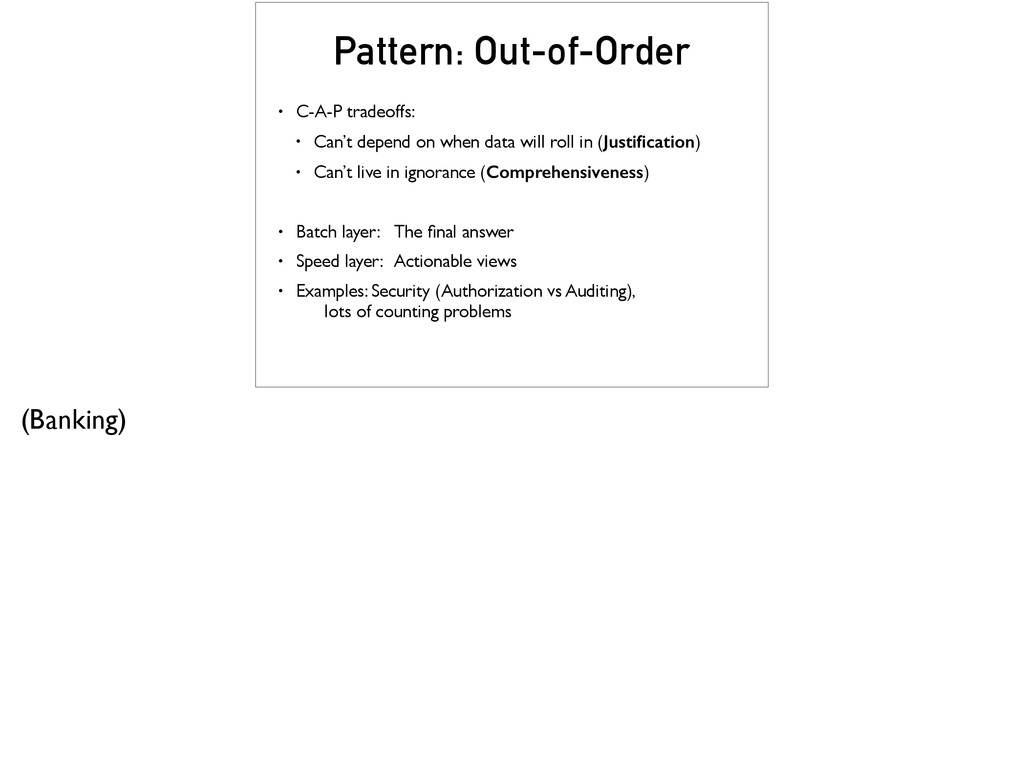
  41. Pattern: C-A-P Tradeoffs • C-A-P tradeoffs: • Can’t depend on

    when data will roll in (Justification) • Can’t live in ignorance (Comprehensiveness) • Batch layer: The final answer • Speed layer: Actionable views • Examples: Security (Authorization vs Auditing), 
 lots of counting problems (Banking)
  42. Pattern: Out-of-Order • C-A-P tradeoffs: • Can’t depend on when

    data will roll in (Justification) • Can’t live in ignorance (Comprehensiveness) • Batch layer: The final answer • Speed layer: Actionable views • Examples: Security (Authorization vs Auditing), 
 lots of counting problems (Banking)
  43. Common Theme The System Asymptotes to Truth over time We

    keep seeing this common theme — you are building a system that approaches correctness over time. This leads to a best practice that I’ll call the improver pattern:
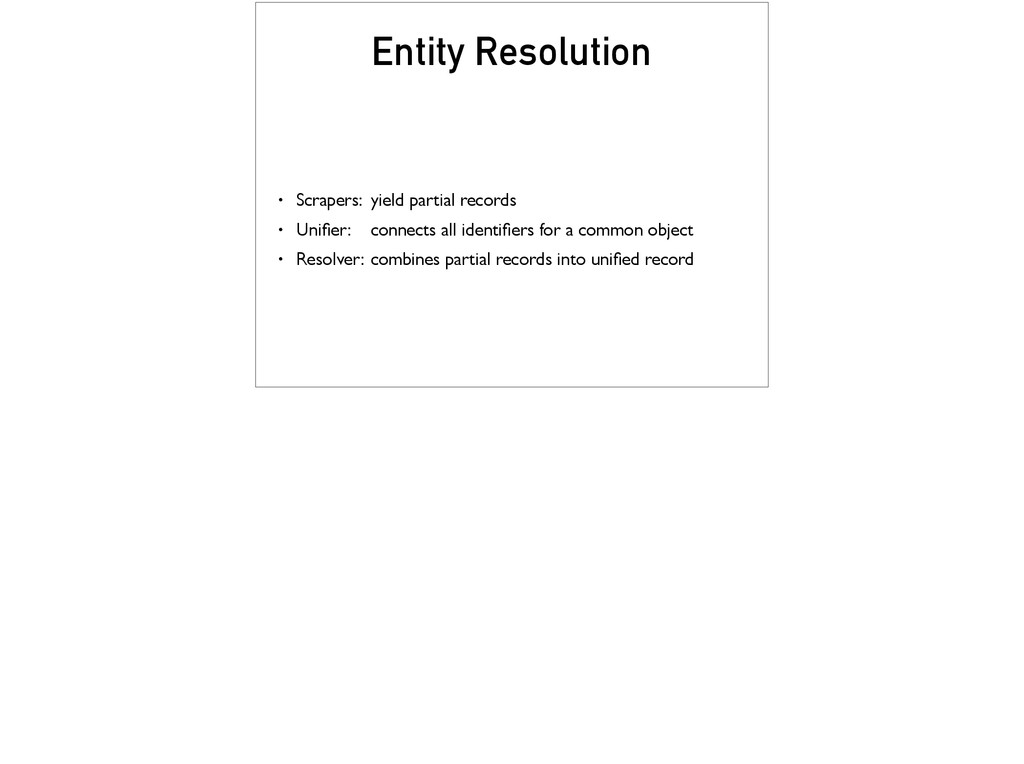
  44. • Scrapers: yield partial records • Unifier: connects all identifiers

    for a common object • Resolver: combines partial records into unified record Entity Resolution
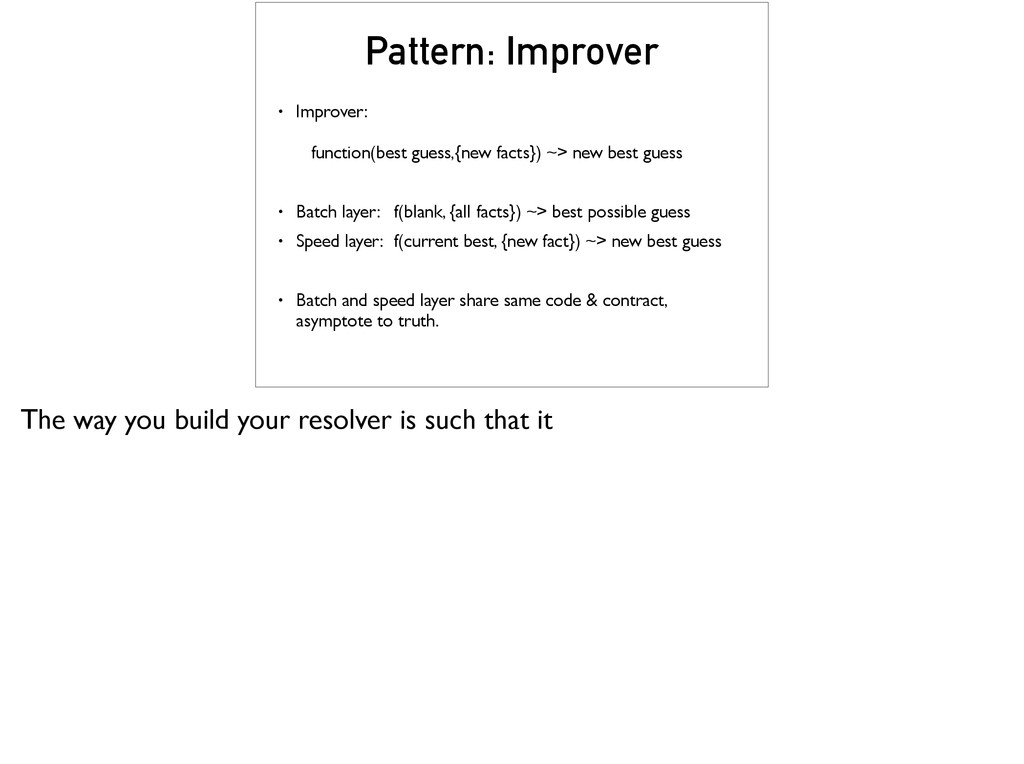
  45. Pattern: Improver • Improver:
 
 function(best guess,{new facts}) ~> new

    best guess • Batch layer: f(blank, {all facts}) ~> best possible guess • Speed layer: f(current best, {new fact}) ~> new best guess • Batch and speed layer share same code & contract, asymptote to truth. The way you build your resolver is such that it
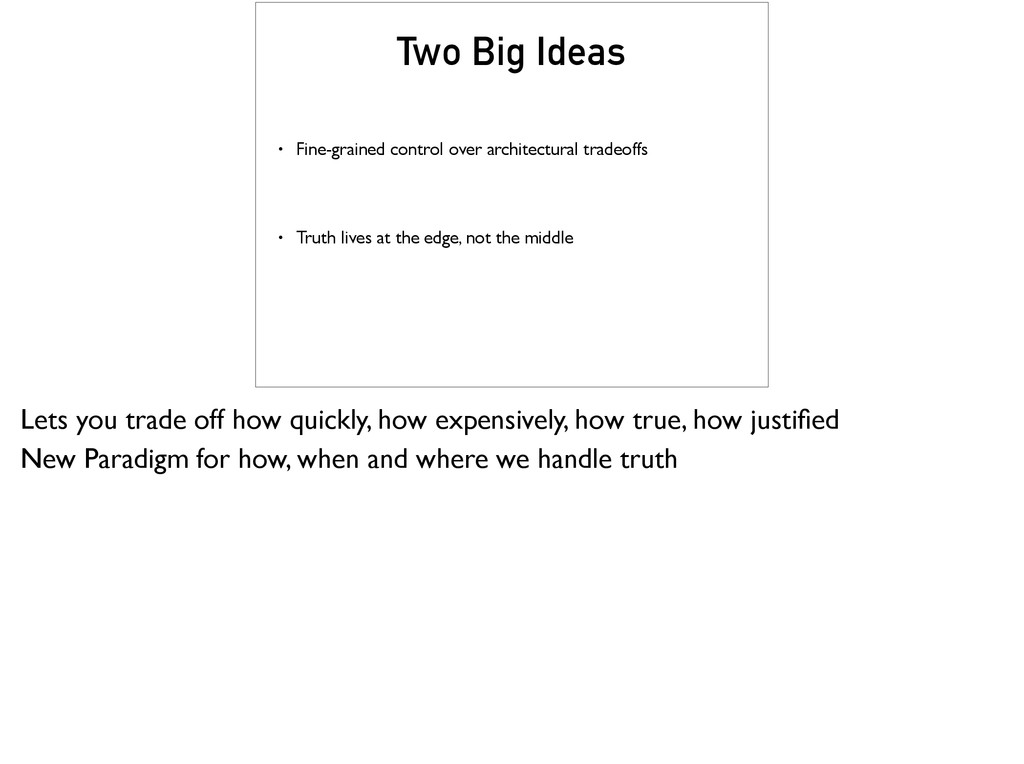
  46. Two Big Ideas • Fine-grained control over architectural tradeoffs •

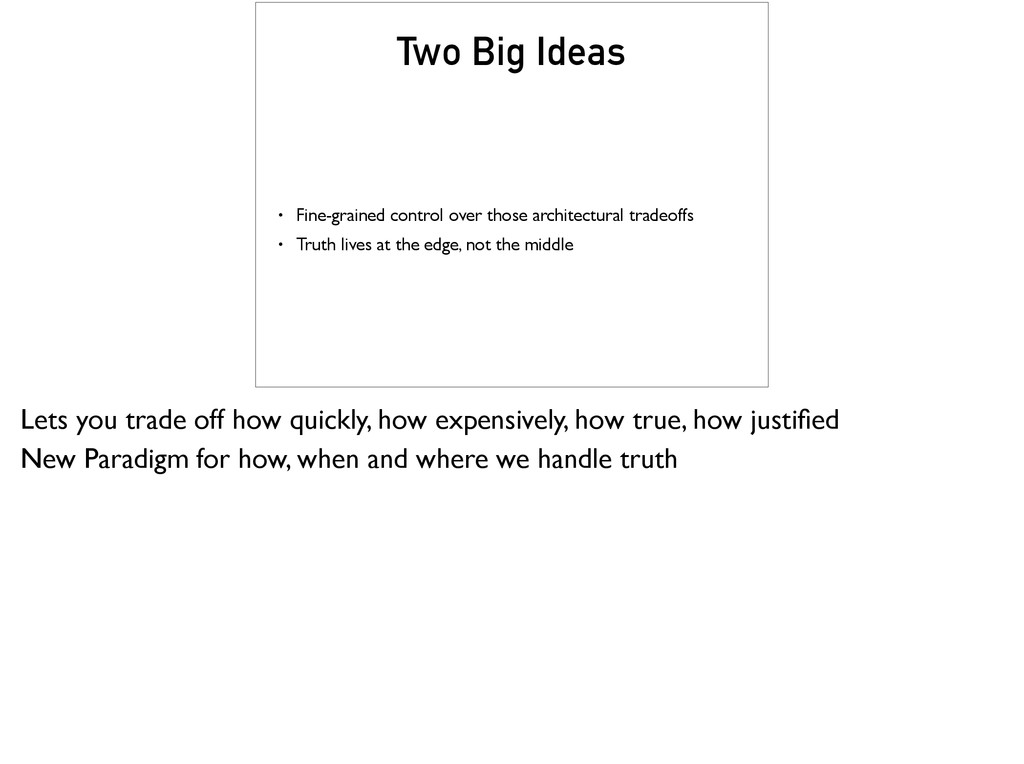
    Truth lives at the edge, not the middle Lets you trade off how quickly, how expensively, how true, how justified New Paradigm for how, when and where we handle truth
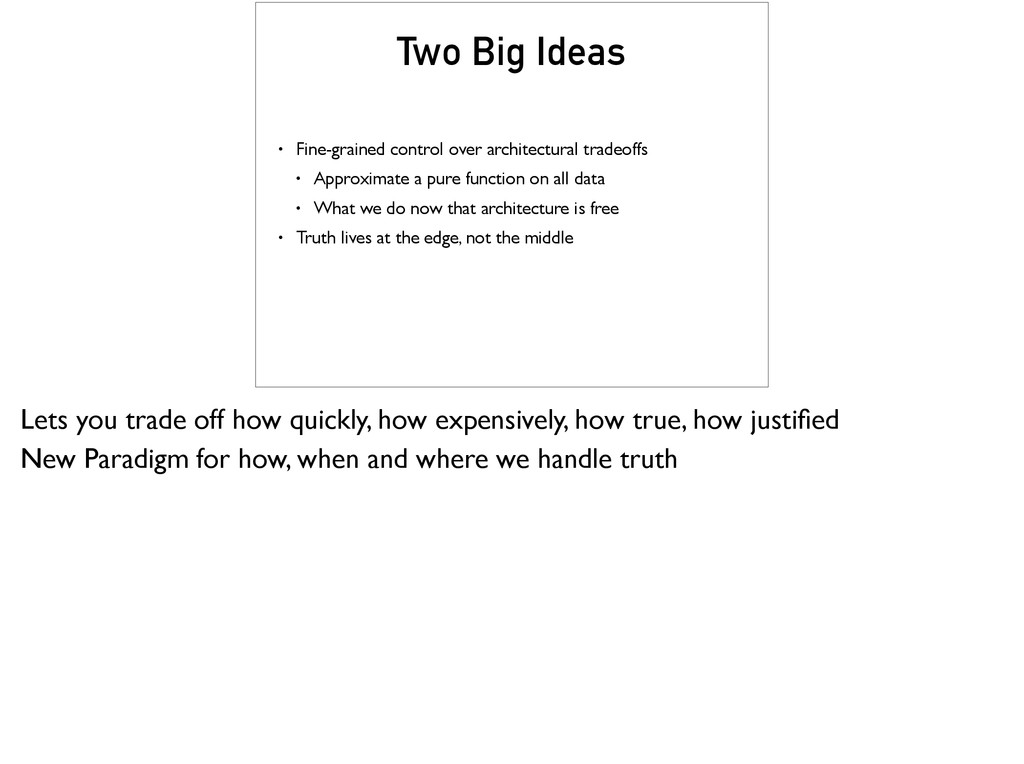
  47. Two Big Ideas • Fine-grained control over architectural tradeoffs •

    Approximate a pure function on all data • What we do now that architecture is free • Truth lives at the edge, not the middle Lets you trade off how quickly, how expensively, how true, how justified New Paradigm for how, when and where we handle truth
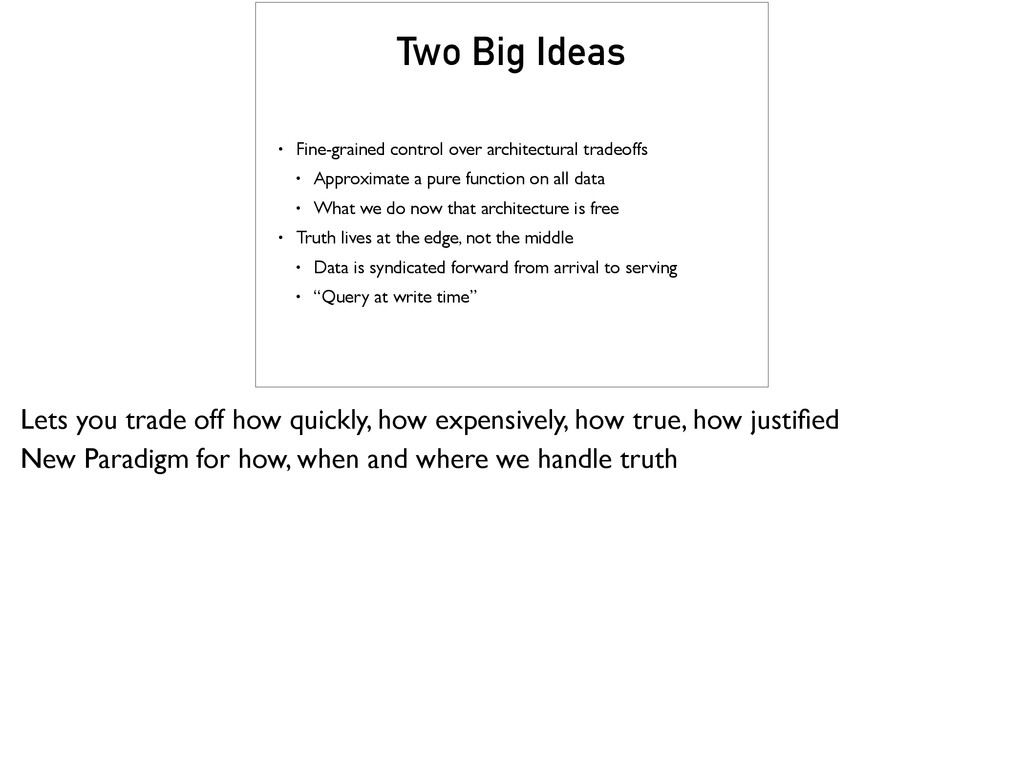
  48. Two Big Ideas • Fine-grained control over architectural tradeoffs •

    Approximate a pure function on all data • What we do now that architecture is free • Truth lives at the edge, not the middle • Data is syndicated forward from arrival to serving • “Query at write time” Lets you trade off how quickly, how expensively, how true, how justified New Paradigm for how, when and where we handle truth
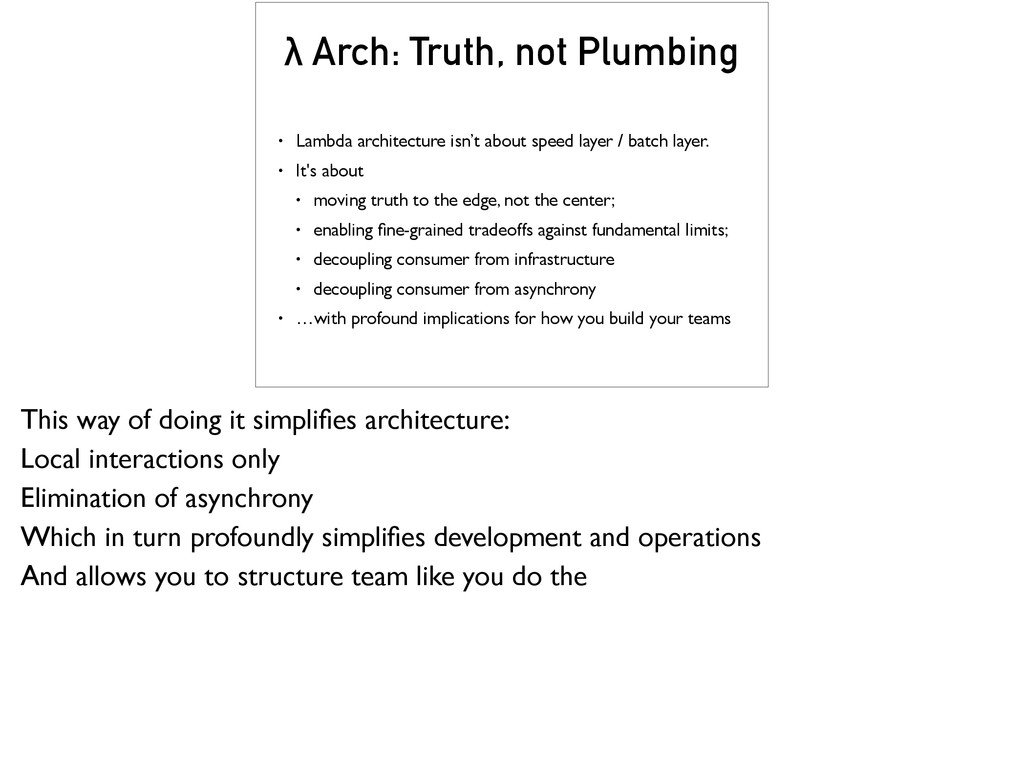
  49. • Lambda architecture isn’t about speed layer / batch layer.

    • It's about • moving truth to the edge, not the center; • enabling fine-grained tradeoffs against fundamental limits; • decoupling consumer from infrastructure • decoupling consumer from asynchrony • …with profound implications for how you build your teams λ Arch: Truth, not Plumbing This way of doing it simplifies architecture: Local interactions only Elimination of asynchrony Which in turn profoundly simplifies development and operations And allows you to structure team like you do the
  50. Lambda Architecture for a Dinky Little Blog So far, talked

    about a bunch of reasons why you might be led **to** a lambda architecture And when there's a new technology people always first ask why they should do it differently, which is a wise Thing to ask and a foolish thing to insist on But let's look at it from the other end, from what life is like if this were the natural state of being. And to do so, let's take the most unjustifiable case for a high scale architecture: a blog engine
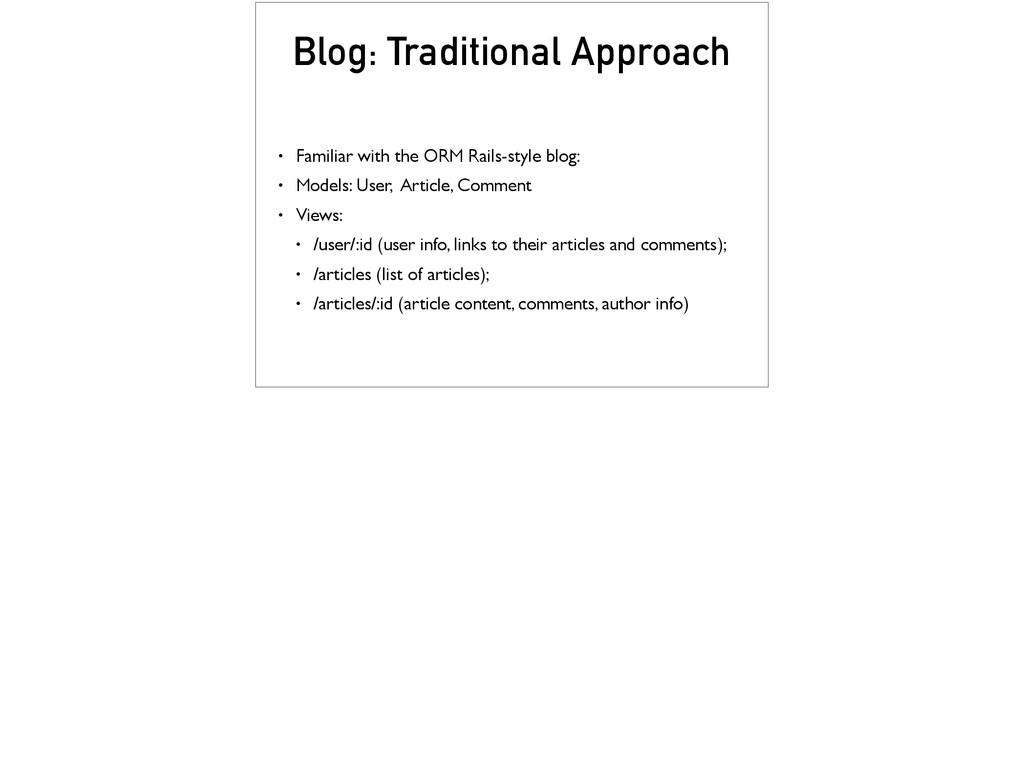
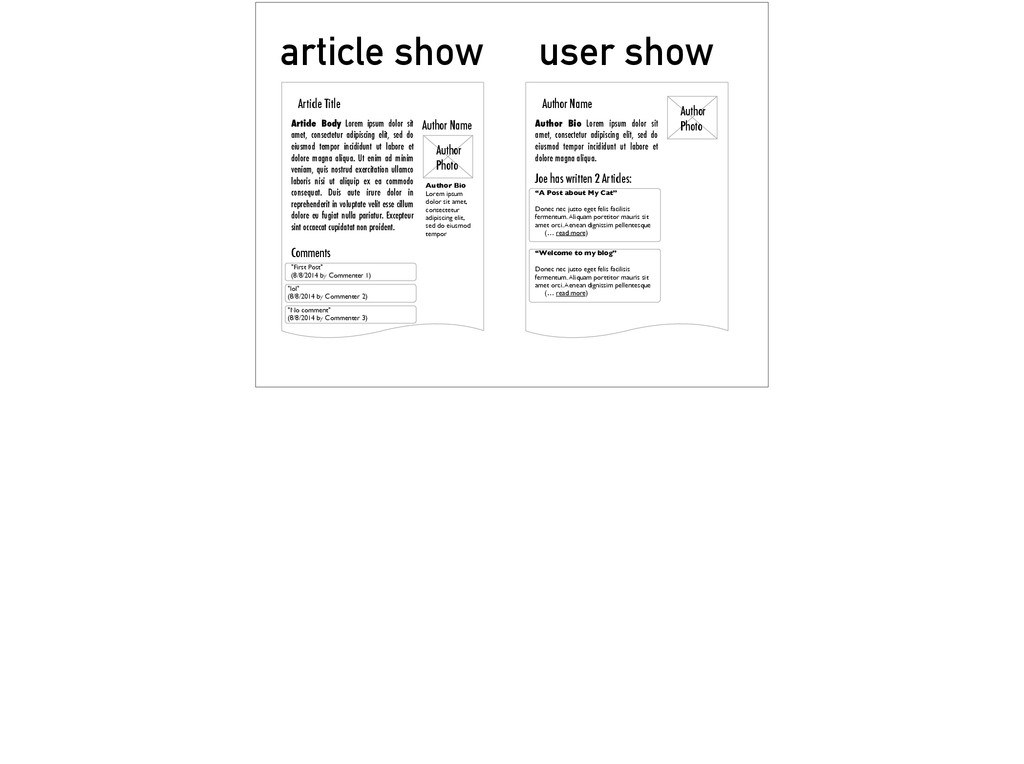
  51. Blog: Traditional Approach • Familiar with the ORM Rails-style blog:

    • Models: User, Article, Comment • Views: • /user/:id (user info, links to their articles and comments); • /articles (list of articles); • /articles/:id (article content, comments, author info)
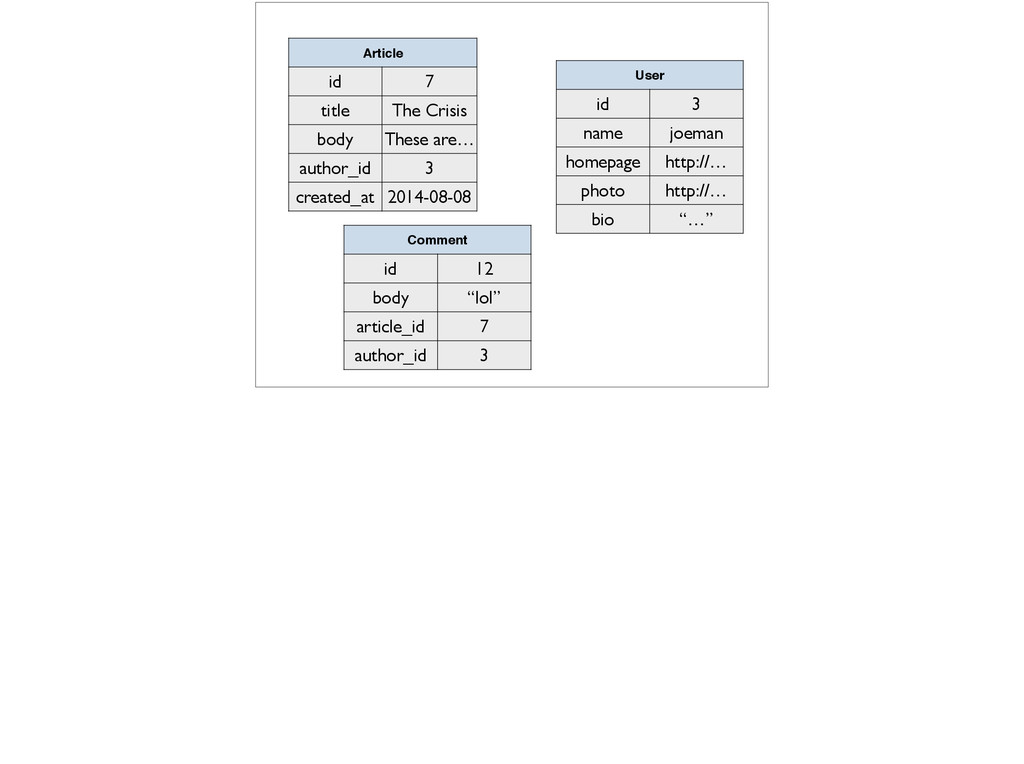
  52. User id 3 name joeman homepage http://… photo http://… bio

    “…” Article id 7 title The Crisis body These are… author_id 3 created_at 2014-08-08 Comment id 12 body “lol” article_id 7 author_id 3
  53. Author Name Author Bio Lorem ipsum dolor sit amet, consectetur

    adipiscing elit, sed do eiusmod tempor incididunt ut labore et dolore magna aliqua. Author Photo Joe has written 2 Articles: “A Post about My Cat” Donec nec justo eget felis facilisis fermentum. Aliquam porttitor mauris sit amet orci. Aenean dignissim pellentesque (… read more) “Welcome to my blog” Donec nec justo eget felis facilisis fermentum. Aliquam porttitor mauris sit amet orci. Aenean dignissim pellentesque (… read more) Article Title Article Body Lorem ipsum dolor sit amet, consectetur adipiscing elit, sed do eiusmod tempor incididunt ut labore et dolore magna aliqua. Ut enim ad minim veniam, quis nostrud exercitation ullamco laboris nisi ut aliquip ex ea commodo consequat. Duis aute irure dolor in reprehenderit in voluptate velit esse cillum dolore eu fugiat nulla pariatur. Excepteur sint occaecat cupidatat non proident. Author Name Author Photo Author Bio Lorem ipsum dolor sit amet, consectetur adipiscing elit, sed do eiusmod tempor Comments "First Post" (8/8/2014 by Commenter 1) "lol" (8/8/2014 by Commenter 2) "No comment" (8/8/2014 by Commenter 3) article show user show
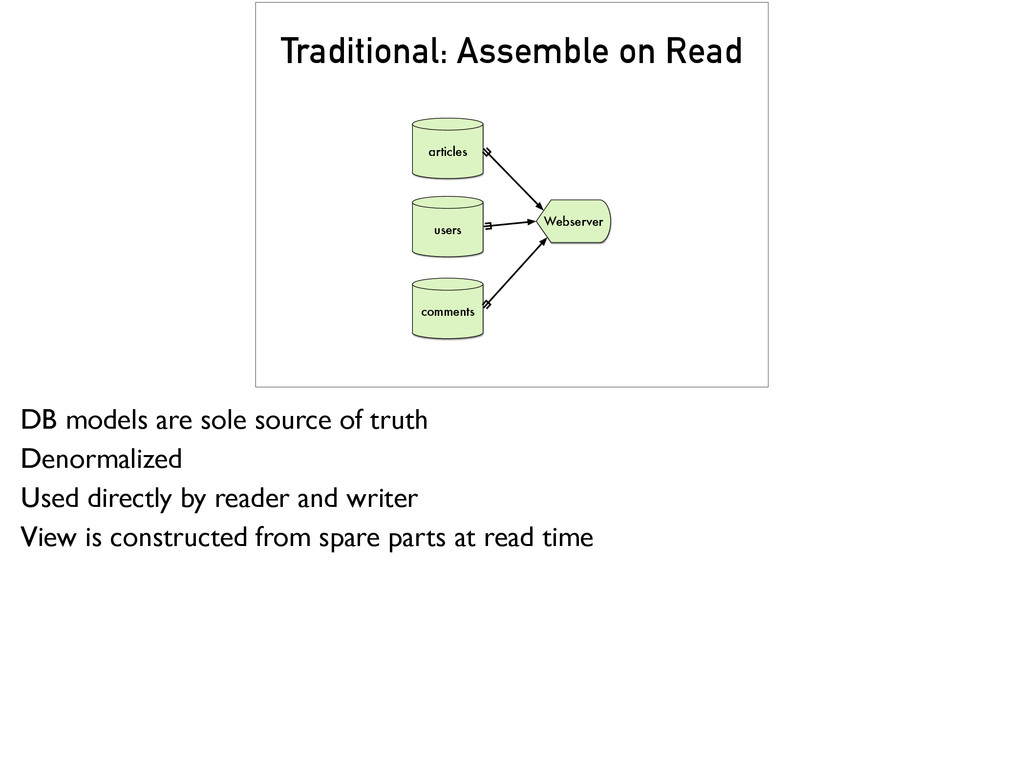
  54. articles users comments Webserver Traditional: Assemble on Read DB models

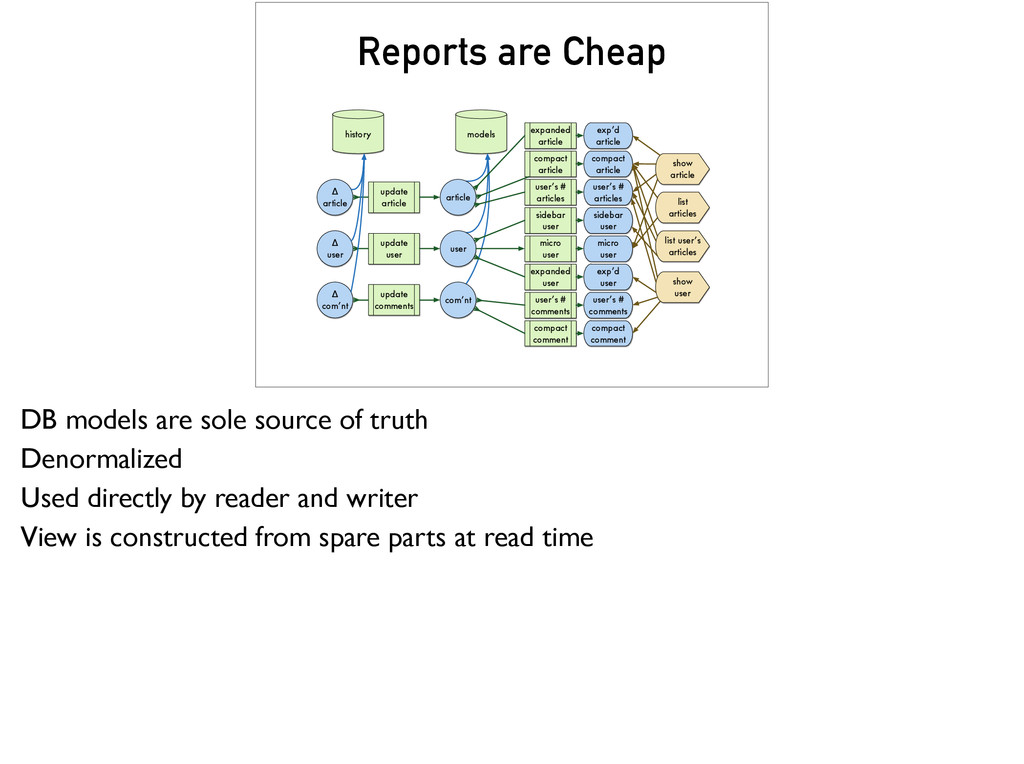
    are sole source of truth Denormalized Used directly by reader and writer View is constructed from spare parts at read time
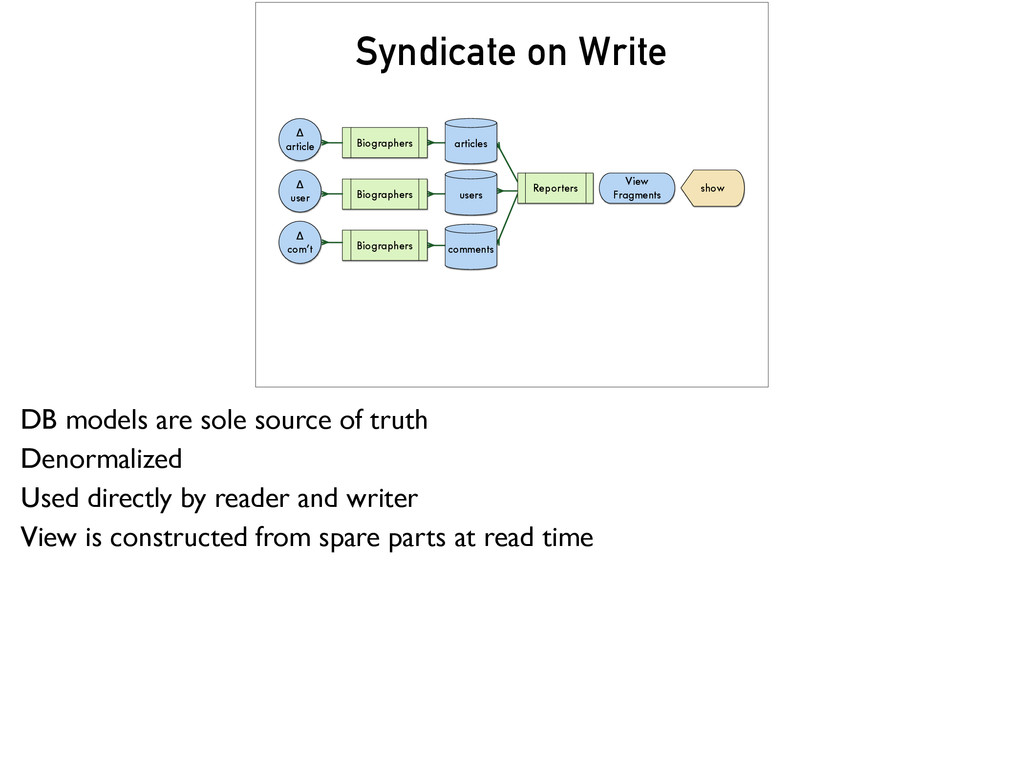
  55. Syndicate on Write Δ article Biographers View Fragments show Reporters

    Δ user Biographers Δ com’t Biographers articles users comments DB models are sole source of truth Denormalized Used directly by reader and writer View is constructed from spare parts at read time
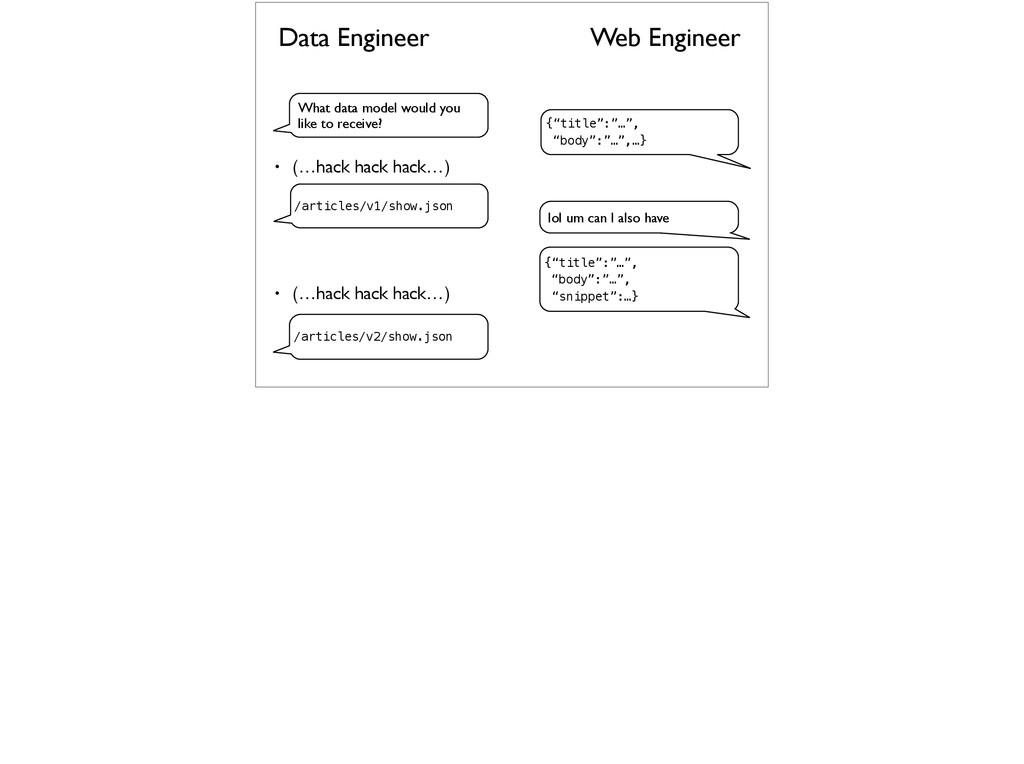
  56. • (…hack hack hack…) /articles/v2/show.json /articles/v1/show.json • (…hack hack hack…)

    What data model would you like to receive? {“title”:”…”, “body”:”…”,…} lol um can I also have Data Engineer Web Engineer {“title”:”…”, “body”:”…”, “snippet”:…}
  57. Syndicated Data • The Data is always _there_ • …but

    sometimes it’s more perfect than other times.
  58. Syndicated Data • Reports are cheap, single-concern, and faithful to

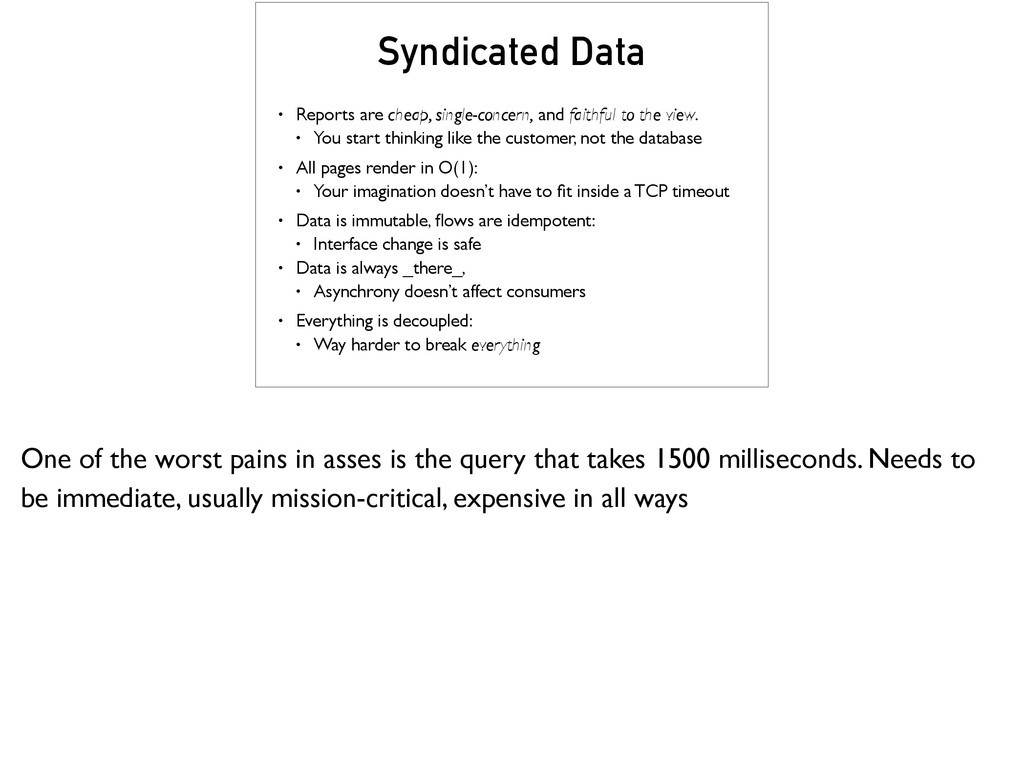
    the view. • You start thinking like the customer, not the database • All pages render in O(1): • Your imagination doesn’t have to fit inside a TCP timeout • Data is immutable, flows are idempotent: • Interface change is safe • Data is always _there_, • Asynchrony doesn’t affect consumers • Everything is decoupled: • Way harder to break everything One of the worst pains in asses is the query that takes 1500 milliseconds. Needs to be immediate, usually mission-critical, expensive in all ways
  59. • Lambda architecture isn’t about speed layer / batch layer.

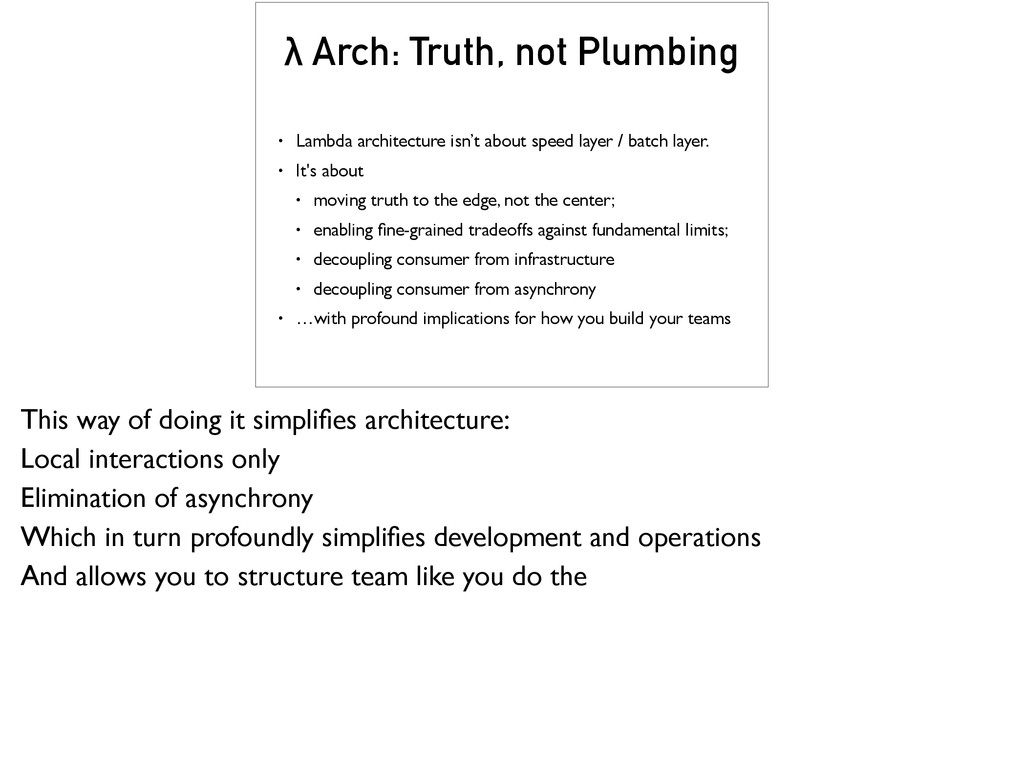
    • It's about • moving truth to the edge, not the center; • enabling fine-grained tradeoffs against fundamental limits; • decoupling consumer from infrastructure • decoupling consumer from asynchrony • …with profound implications for how you build your teams λ Arch: Truth, not Plumbing This way of doing it simplifies architecture: Local interactions only Elimination of asynchrony Which in turn profoundly simplifies development and operations And allows you to structure team like you do the
  60. …

  61. …

  62. Changes update models update article update user update comments Δ

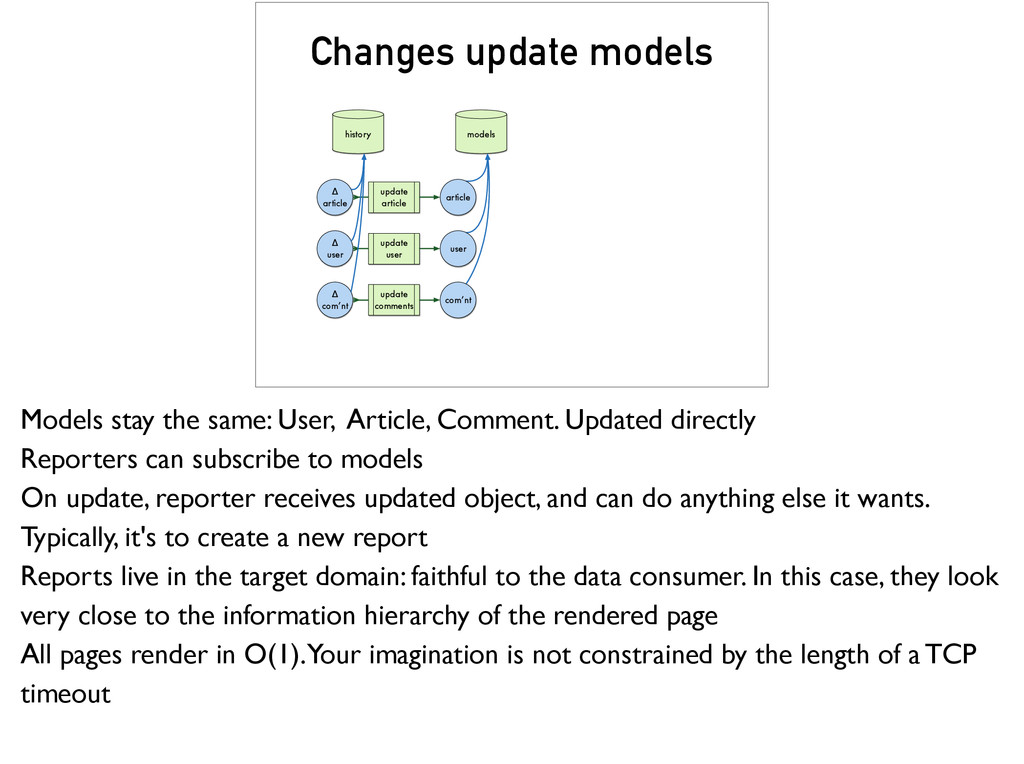
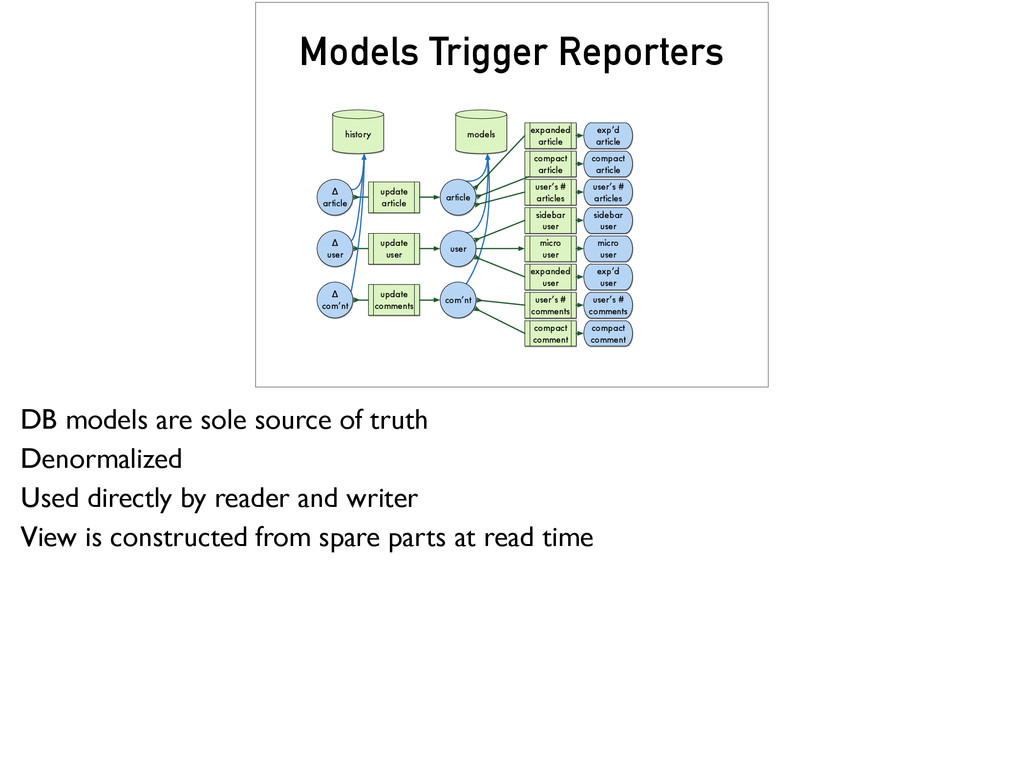
    article Δ user Δ com’nt models user com’nt article history Models stay the same: User, Article, Comment. Updated directly Reporters can subscribe to models On update, reporter receives updated object, and can do anything else it wants. Typically, it's to create a new report Reports live in the target domain: faithful to the data consumer. In this case, they look very close to the information hierarchy of the rendered page All pages render in O(1). Your imagination is not constrained by the length of a TCP timeout
  63. Models Trigger Reporters update article update user update comments Δ

    article Δ user Δ com’nt models user com’nt article history compact article user’s # articles expanded user user’s # comments sidebar user compact comment expanded article exp’d article compact article user’s # articles exp’d user sidebar user user’s # comments compact comment micro user micro user DB models are sole source of truth Denormalized Used directly by reader and writer View is constructed from spare parts at read time
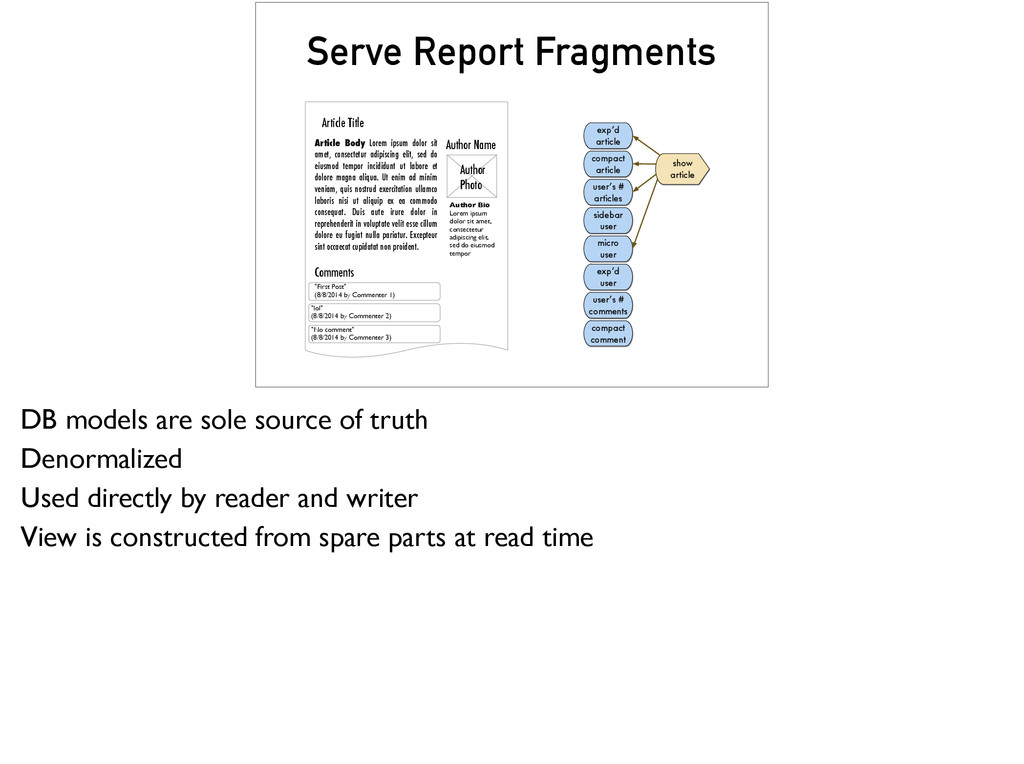
  64. Serve Report Fragments exp’d article compact article user’s # articles

    exp’d user sidebar user user’s # comments compact comment micro user show article Article Title Article Body Lorem ipsum dolor sit amet, consectetur adipiscing elit, sed do eiusmod tempor incididunt ut labore et dolore magna aliqua. Ut enim ad minim veniam, quis nostrud exercitation ullamco laboris nisi ut aliquip ex ea commodo consequat. Duis aute irure dolor in reprehenderit in voluptate velit esse cillum dolore eu fugiat nulla pariatur. Excepteur sint occaecat cupidatat non proident. Author Name Author Photo Author Bio Lorem ipsum dolor sit amet, consectetur adipiscing elit, sed do eiusmod tempor Comments "First Post" (8/8/2014 by Commenter 1) "lol" (8/8/2014 by Commenter 2) "No comment" (8/8/2014 by Commenter 3) DB models are sole source of truth Denormalized Used directly by reader and writer View is constructed from spare parts at read time
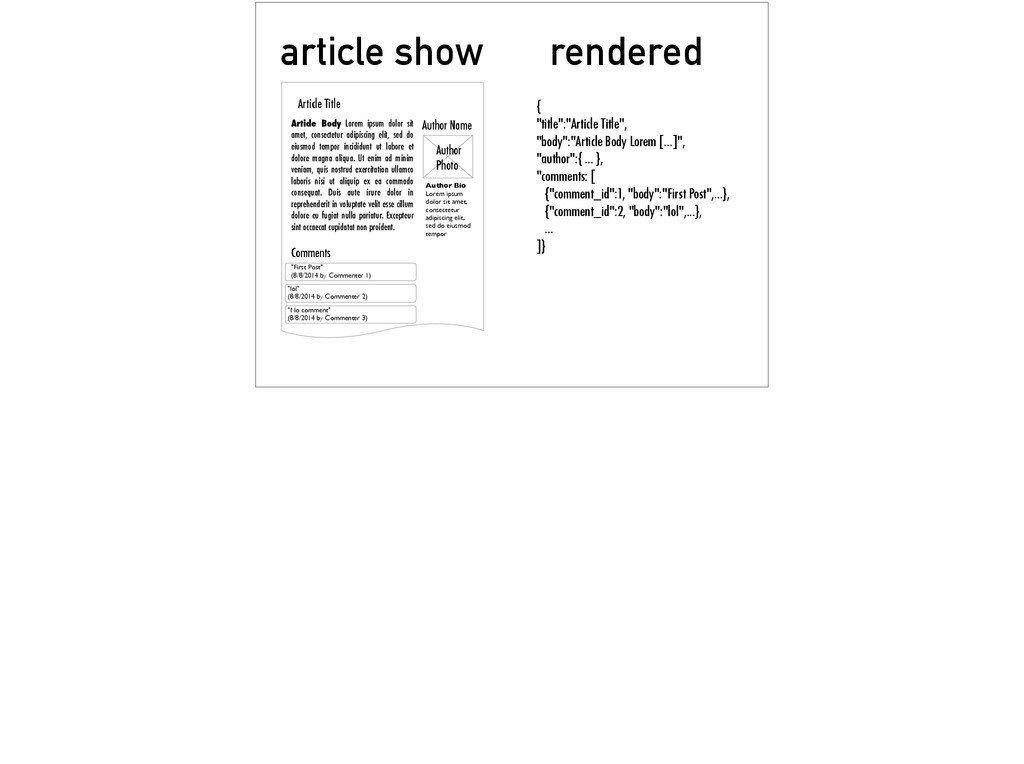
  65. Article Title Article Body Lorem ipsum dolor sit amet, consectetur

    adipiscing elit, sed do eiusmod tempor incididunt ut labore et dolore magna aliqua. Ut enim ad minim veniam, quis nostrud exercitation ullamco laboris nisi ut aliquip ex ea commodo consequat. Duis aute irure dolor in reprehenderit in voluptate velit esse cillum dolore eu fugiat nulla pariatur. Excepteur sint occaecat cupidatat non proident. Author Name Author Photo Author Bio Lorem ipsum dolor sit amet, consectetur adipiscing elit, sed do eiusmod tempor Comments "First Post" (8/8/2014 by Commenter 1) "lol" (8/8/2014 by Commenter 2) "No comment" (8/8/2014 by Commenter 3) article show rendered { "title":"Article Title", "body":"Article Body Lorem [...]", "author":{ ... }, "comments: [ {"comment_id":1, "body":"First Post",...}, {"comment_id":2, "body":"lol",...}, ... ]}
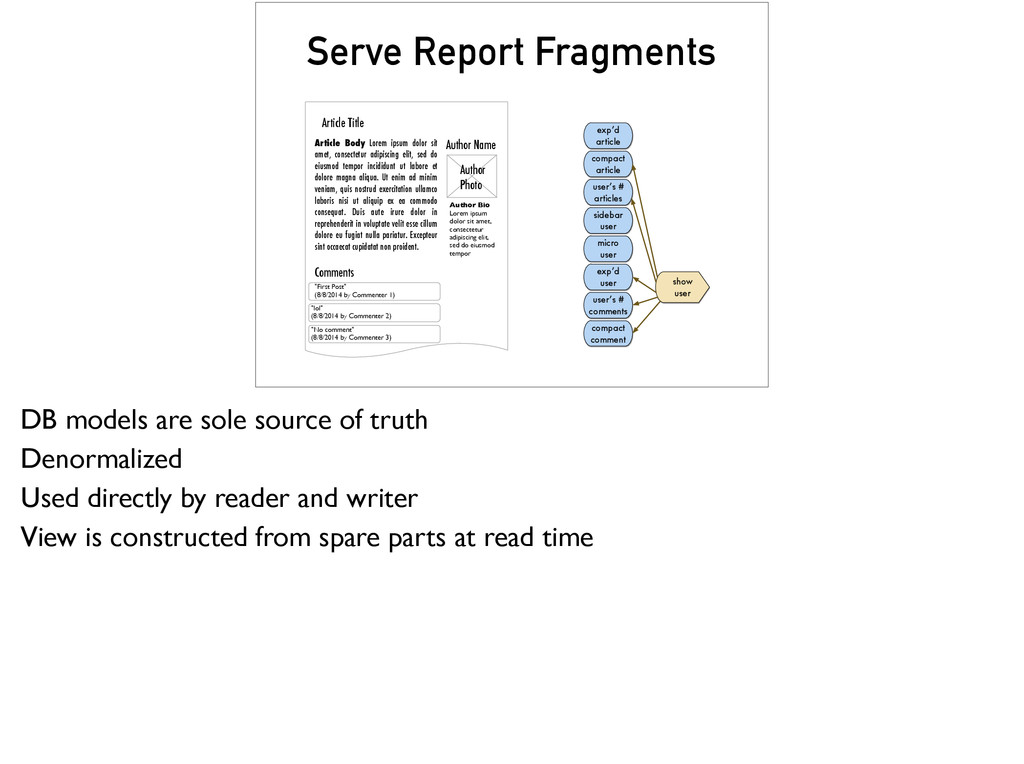
  66. Serve Report Fragments Article Title Article Body Lorem ipsum dolor

    sit amet, consectetur adipiscing elit, sed do eiusmod tempor incididunt ut labore et dolore magna aliqua. Ut enim ad minim veniam, quis nostrud exercitation ullamco laboris nisi ut aliquip ex ea commodo consequat. Duis aute irure dolor in reprehenderit in voluptate velit esse cillum dolore eu fugiat nulla pariatur. Excepteur sint occaecat cupidatat non proident. Author Name Author Photo Author Bio Lorem ipsum dolor sit amet, consectetur adipiscing elit, sed do eiusmod tempor Comments "First Post" (8/8/2014 by Commenter 1) "lol" (8/8/2014 by Commenter 2) "No comment" (8/8/2014 by Commenter 3) exp’d article compact article user’s # articles exp’d user sidebar user user’s # comments compact comment micro user show user DB models are sole source of truth Denormalized Used directly by reader and writer View is constructed from spare parts at read time
  67. Reports are Cheap update article update user update comments Δ

    article Δ user Δ com’nt models user com’nt article history compact article user’s # articles expanded user user’s # comments sidebar user compact comment expanded article exp’d article compact article user’s # articles exp’d user sidebar user user’s # comments compact comment micro user micro user list articles show article list user’s articles show user DB models are sole source of truth Denormalized Used directly by reader and writer View is constructed from spare parts at read time
  68. Two Big Ideas • Fine-grained control over those architectural tradeoffs

    • Truth lives at the edge, not the middle Lets you trade off how quickly, how expensively, how true, how justified New Paradigm for how, when and where we handle truth
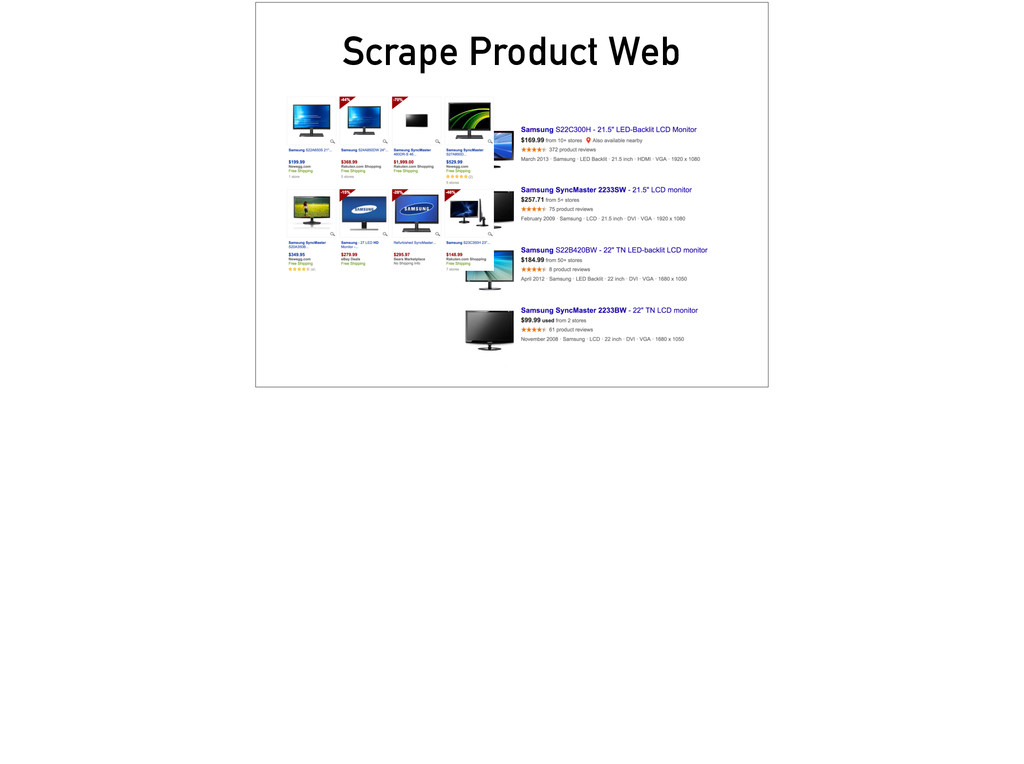
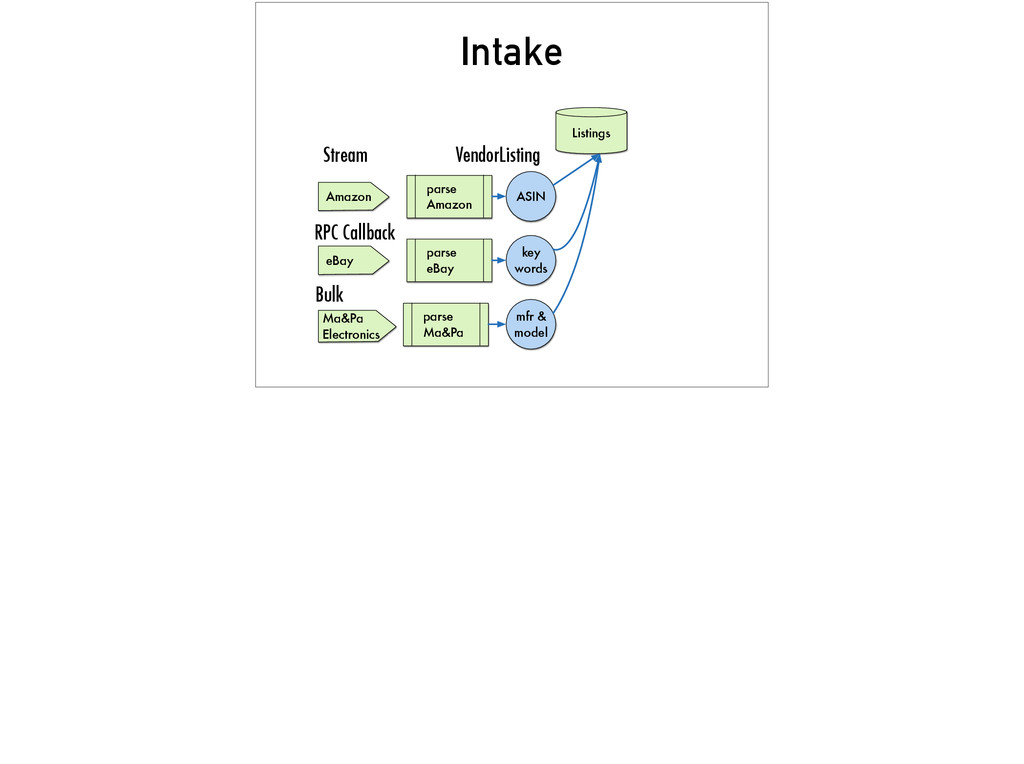
  69. Intake parse Amazon Amazon parse eBay eBay parse Ma&Pa Ma&Pa

    Electronics Bulk Stream RPC Callback key words mfr & model ASIN VendorListing Listings
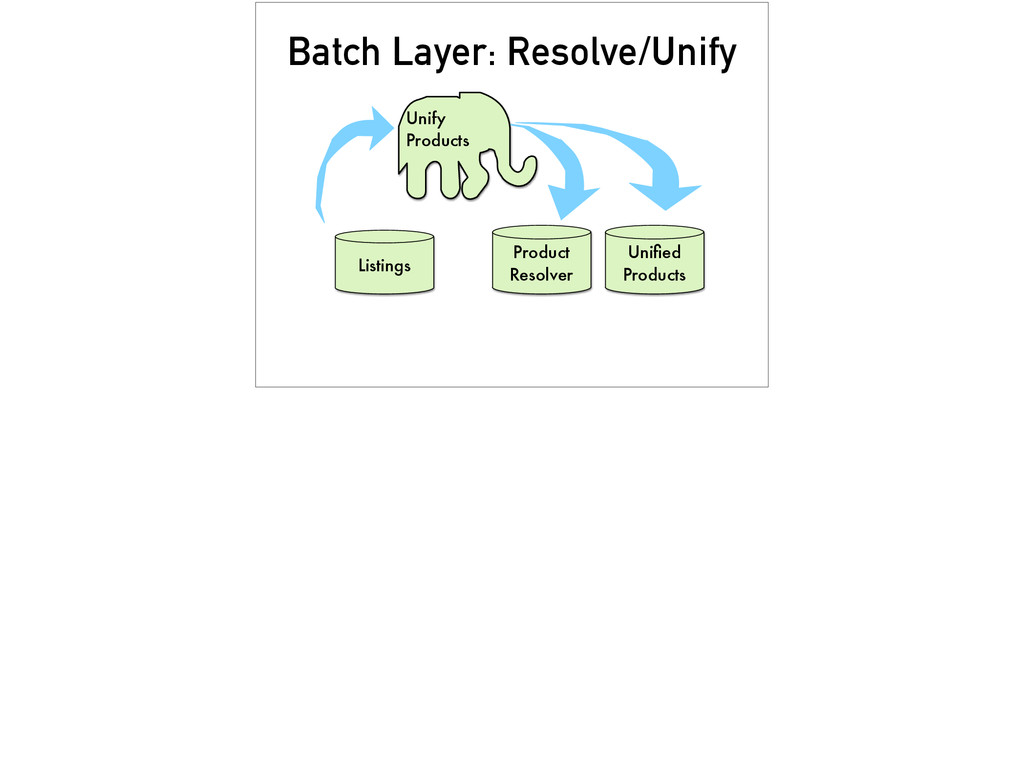
  70. Improve Product Resolver key words mfr & model ASIN VendorListing

    Fetch Products Unified Products Listings Unify Products
  71. Update Product Resolver key words mfr & model ASIN VendorListing

    Fetch Products Unified Products Resolve & Update Listings Unify Products
  72. Cannot have Consistency Product Resolver key words mfr & model

    ASIN VendorListing Fetch Products Unified Products Resolve & Update Listings Unify Products
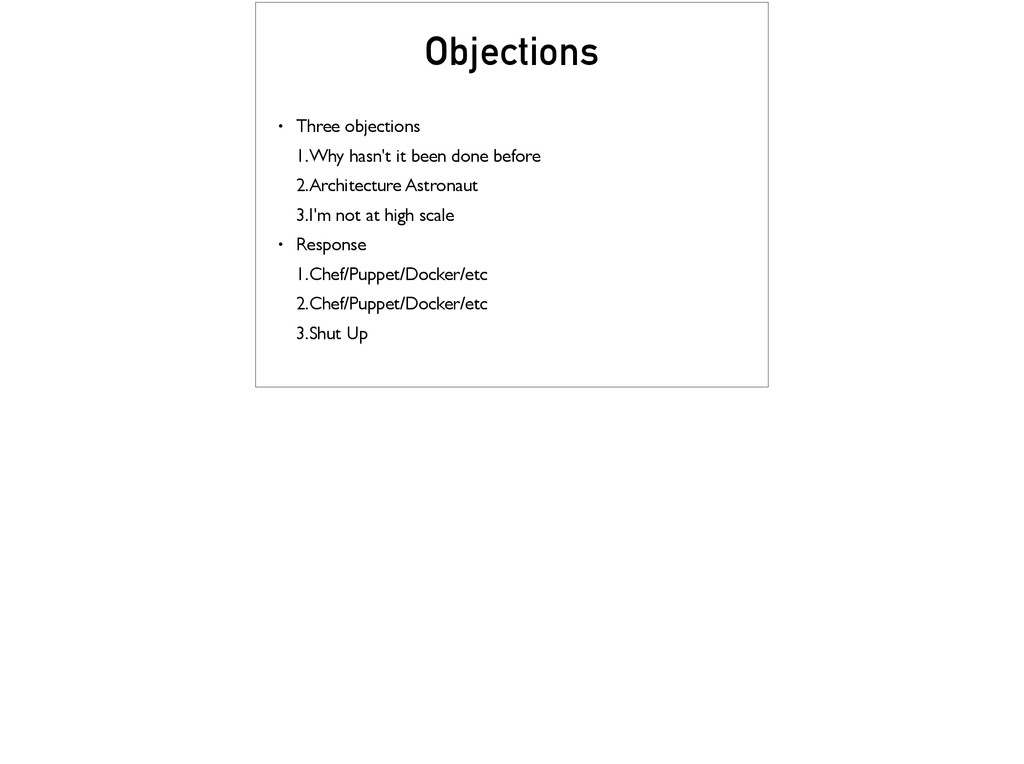
  73. Objections • Three objections 1.Why hasn't it been done before

    2.Architecture Astronaut 3.I'm not at high scale • Response 1.Chef/Puppet/Docker/etc 2.Chef/Puppet/Docker/etc 3.Shut Up
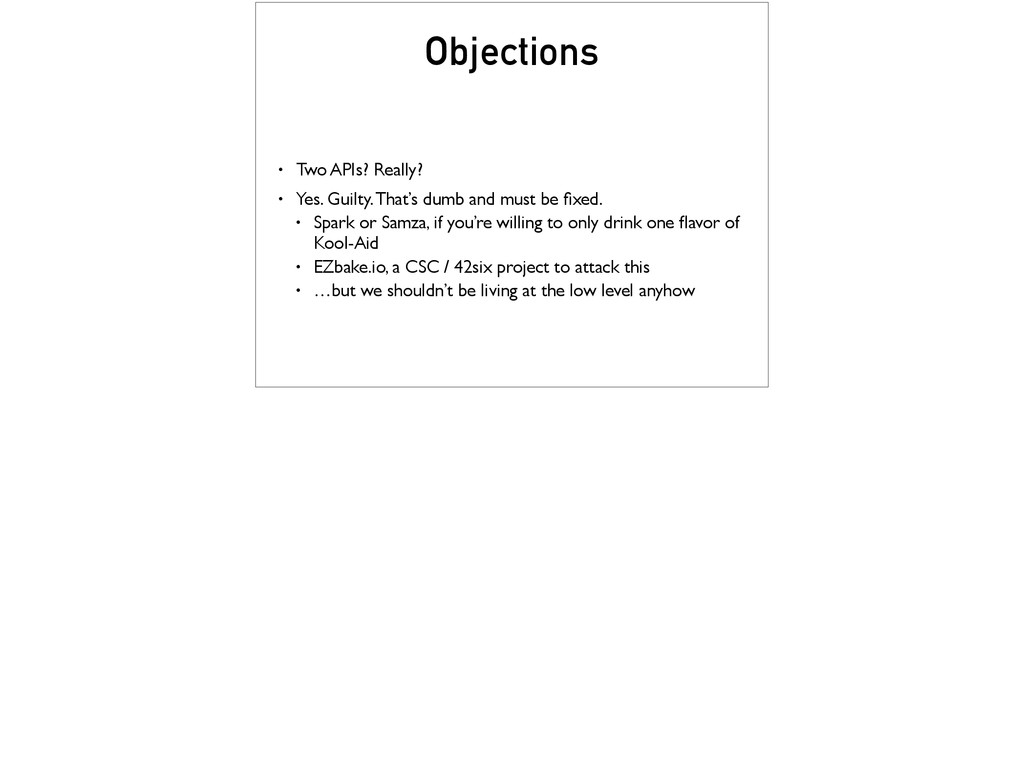
  74. Objections • Two APIs? Really? • Yes. Guilty. That’s dumb

    and must be fixed. • Spark or Samza, if you’re willing to only drink one flavor of Kool-Aid • EZbake.io, a CSC / 42six project to attack this • …but we shouldn’t be living at the low level anyhow
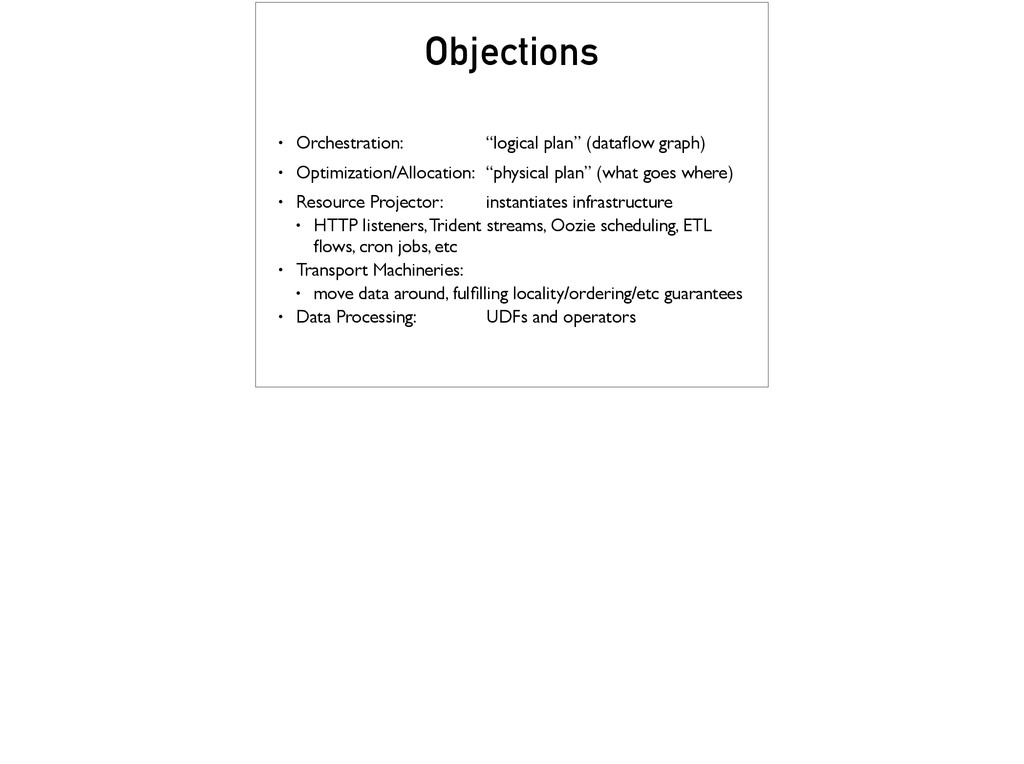
  75. Objections • Orchestration: “logical plan” (dataflow graph) • Optimization/Allocation: “physical

    plan” (what goes where) • Resource Projector: instantiates infrastructure • HTTP listeners, Trident streams, Oozie scheduling, ETL flows, cron jobs, etc • Transport Machineries: • move data around, fulfilling locality/ordering/etc guarantees • Data Processing: UDFs and operators