Stratified Sampling – Detailed Notes for M.Ed
1. Introduction
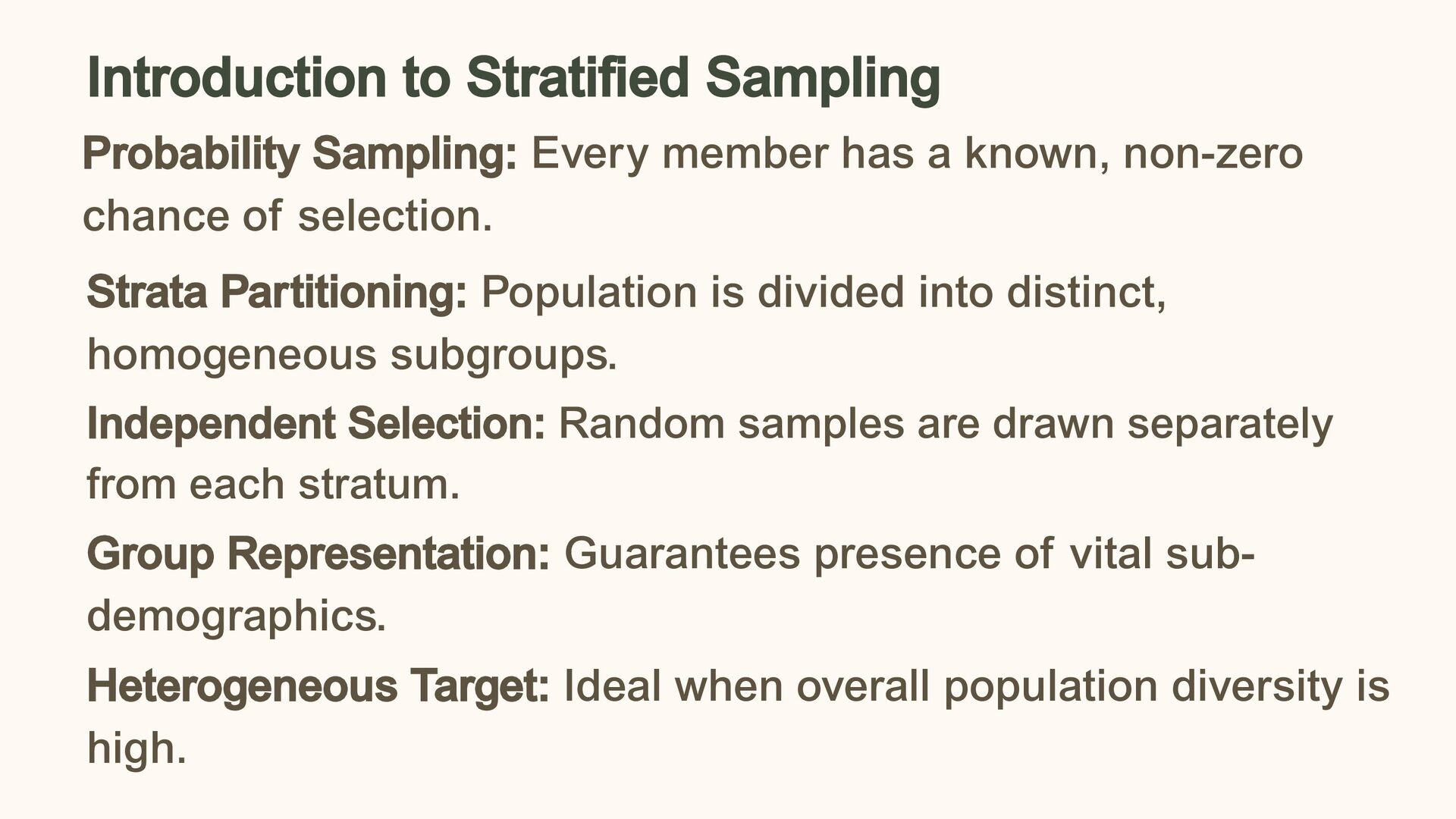
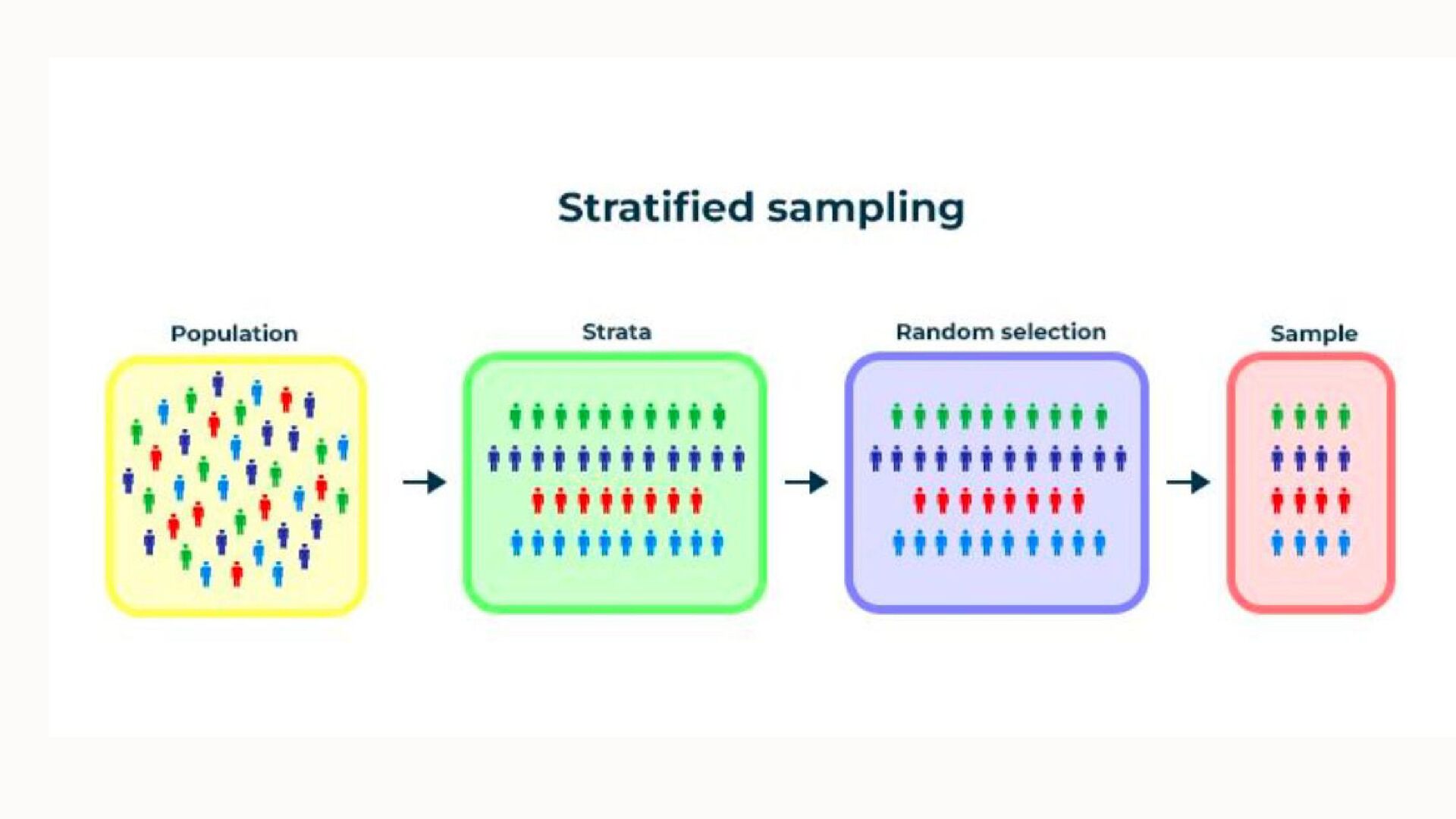
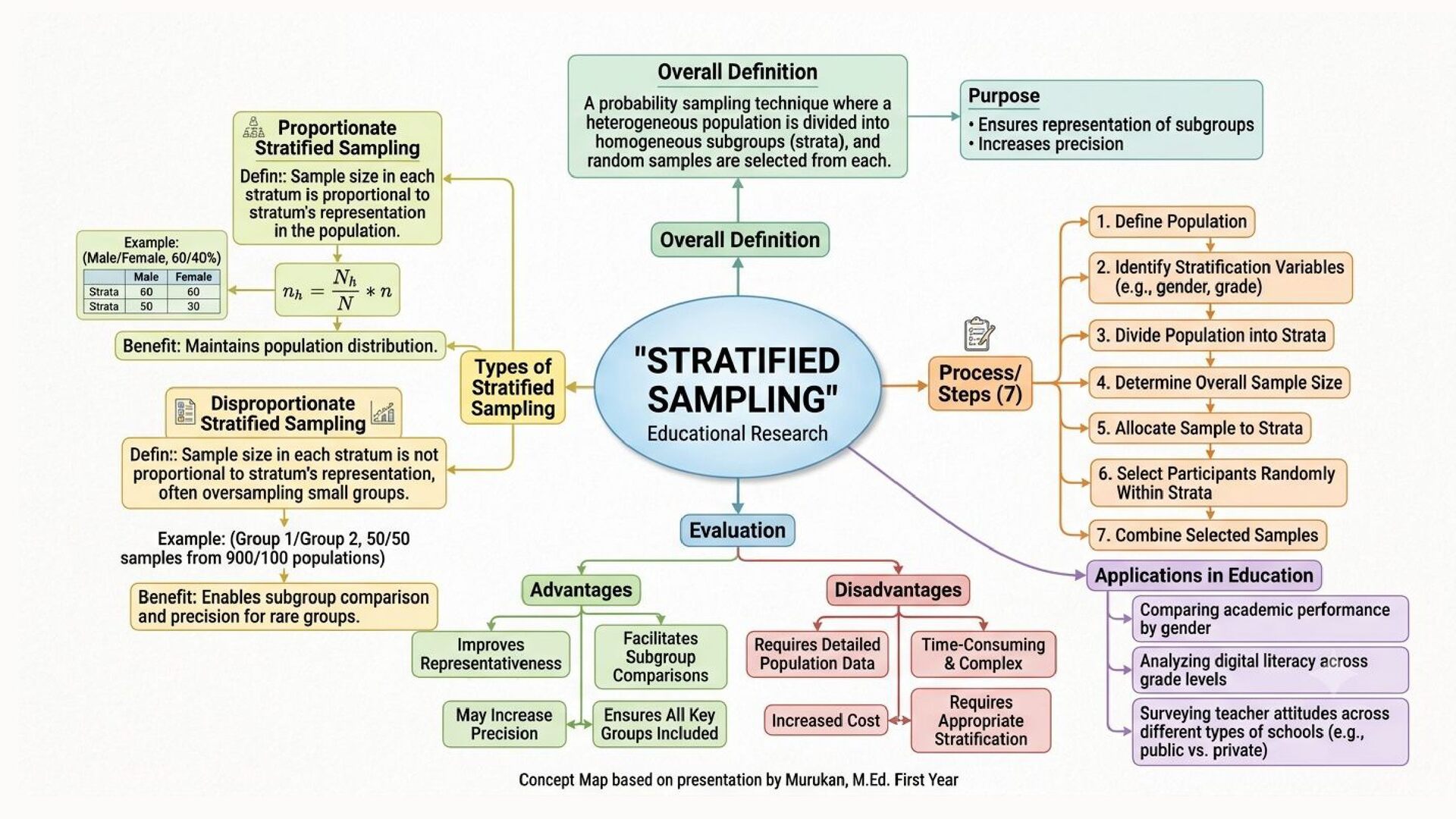
Stratified sampling is a probability sampling technique in which the entire population is divided into smaller, homogeneous subgroups called strata based on a relevant characteristic. A sample is then selected from each stratum using a probability sampling method such as simple random sampling.
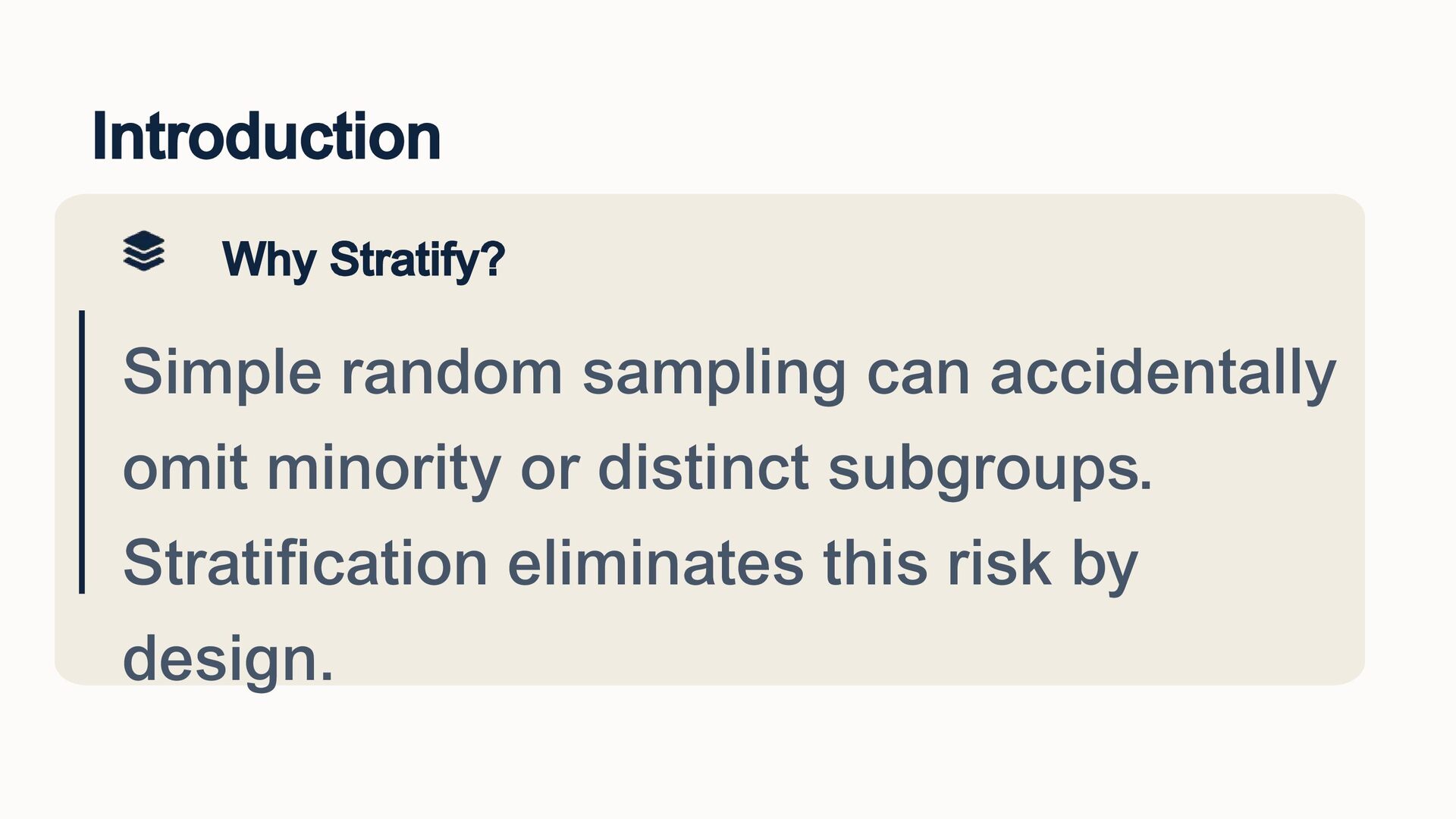
The main purpose of stratified sampling is to ensure that important subgroups of the population are adequately represented in the sample.
For example, if an educational researcher wants to study the academic achievement of secondary school students, the population can be divided into strata based on gender, school type, locality, or socioeconomic status. Students can then be randomly selected from each group.
---
2. Definition
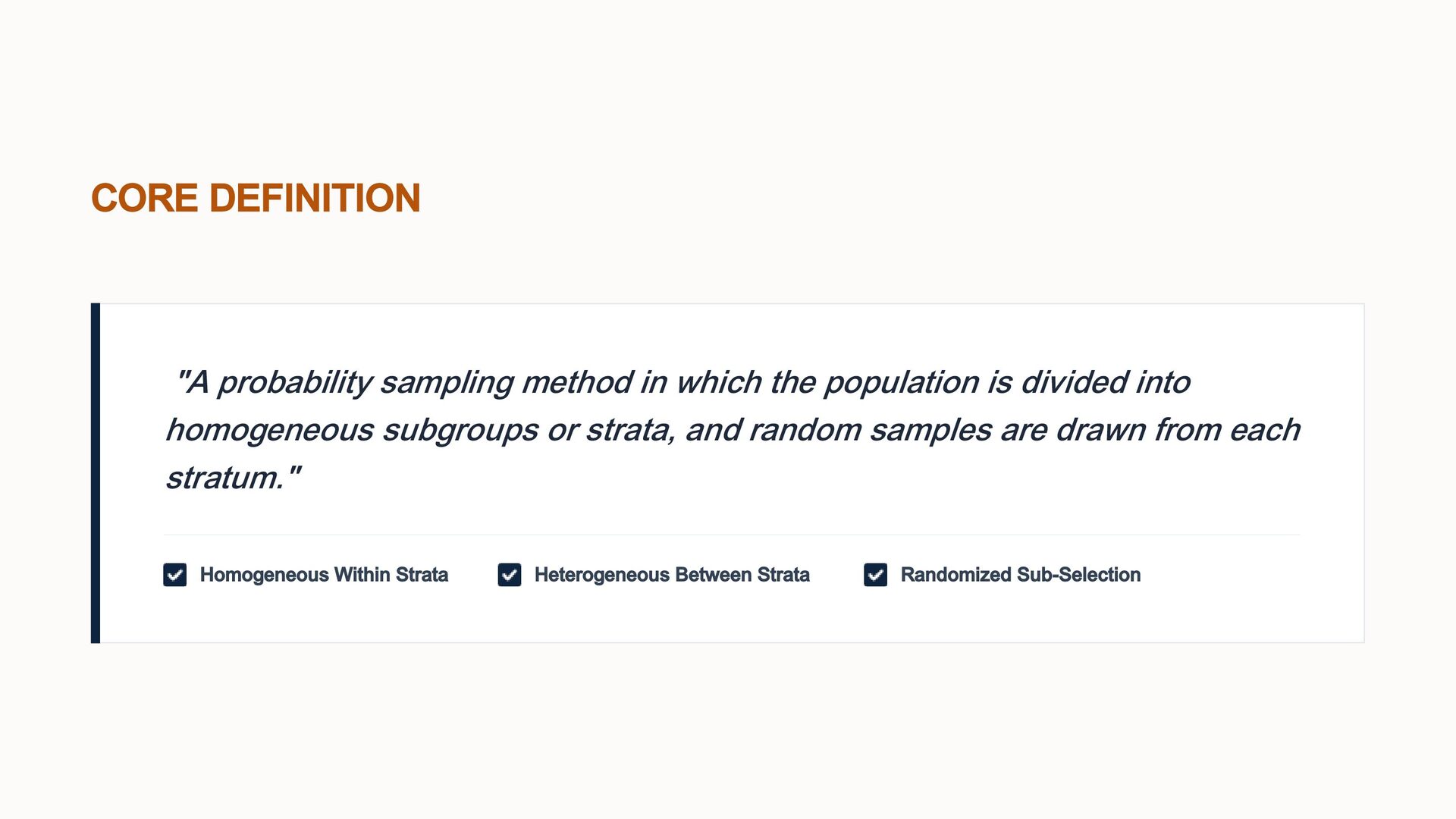
Stratified sampling may be defined as:
> A sampling method in which a heterogeneous population is divided into relatively homogeneous subgroups or strata, and samples are independently selected from each stratum.
Simple example
Suppose a district has 10,000 secondary school students:
6,000 students from government schools
3,000 students from aided schools
1,000 students from private schools
If the researcher wants a sample of 1,000 students, the population can be divided into these three strata and students can be selected from each stratum.
---
3. Basic Characteristics
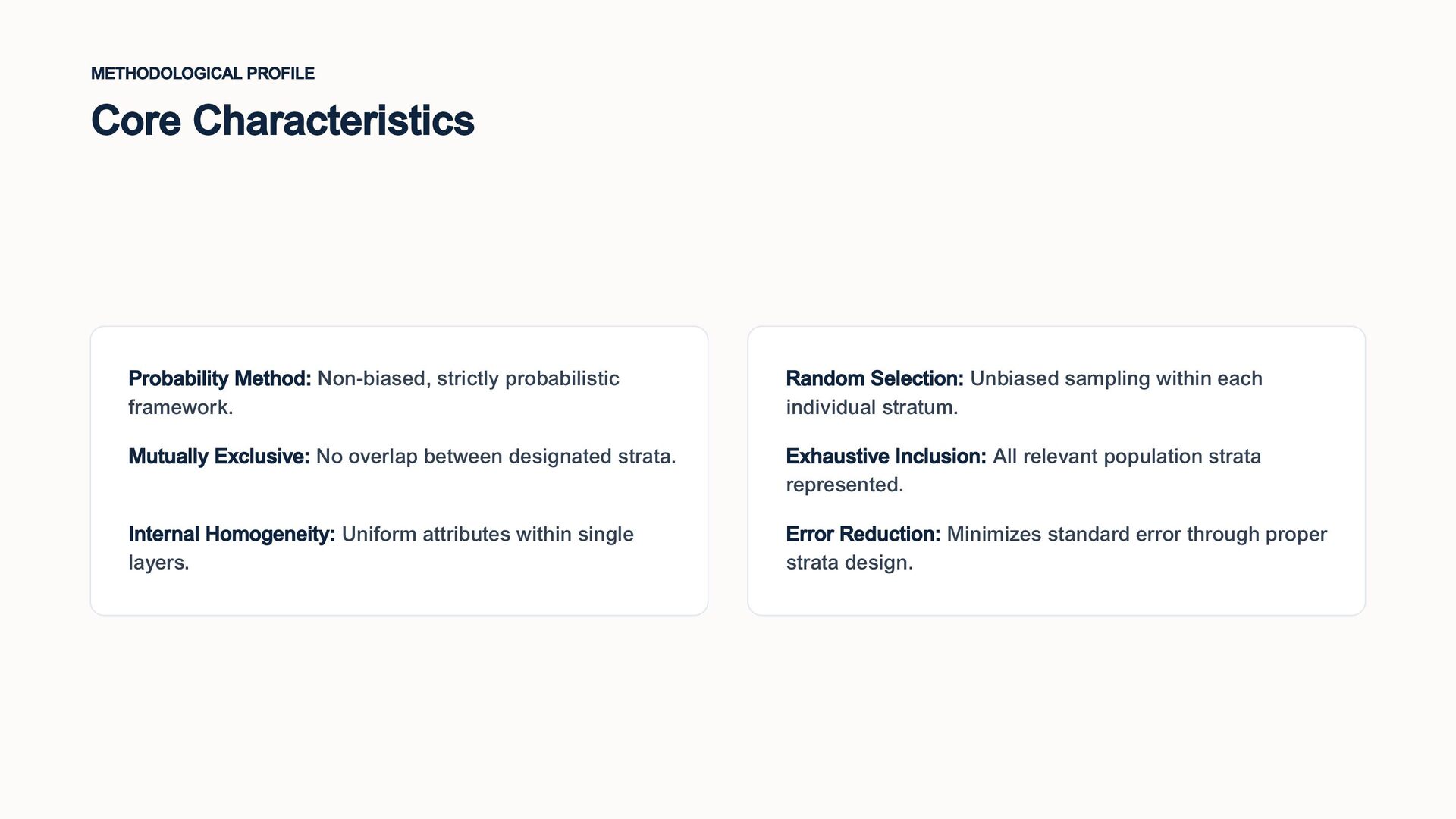
Stratified sampling has the following important characteristics:
1. The population is divided into strata.
2. Each stratum consists of members having a common characteristic.
3. Strata should ideally be internally homogeneous.
4. The strata together should represent the whole population.
5. Sampling is carried out separately within each stratum.
6. Random sampling is generally used to select participants from each stratum.
7. It improves the representation of important subgroups.
8. It is particularly useful when the population is heterogeneous.
---
4. Steps in Stratified Sampling
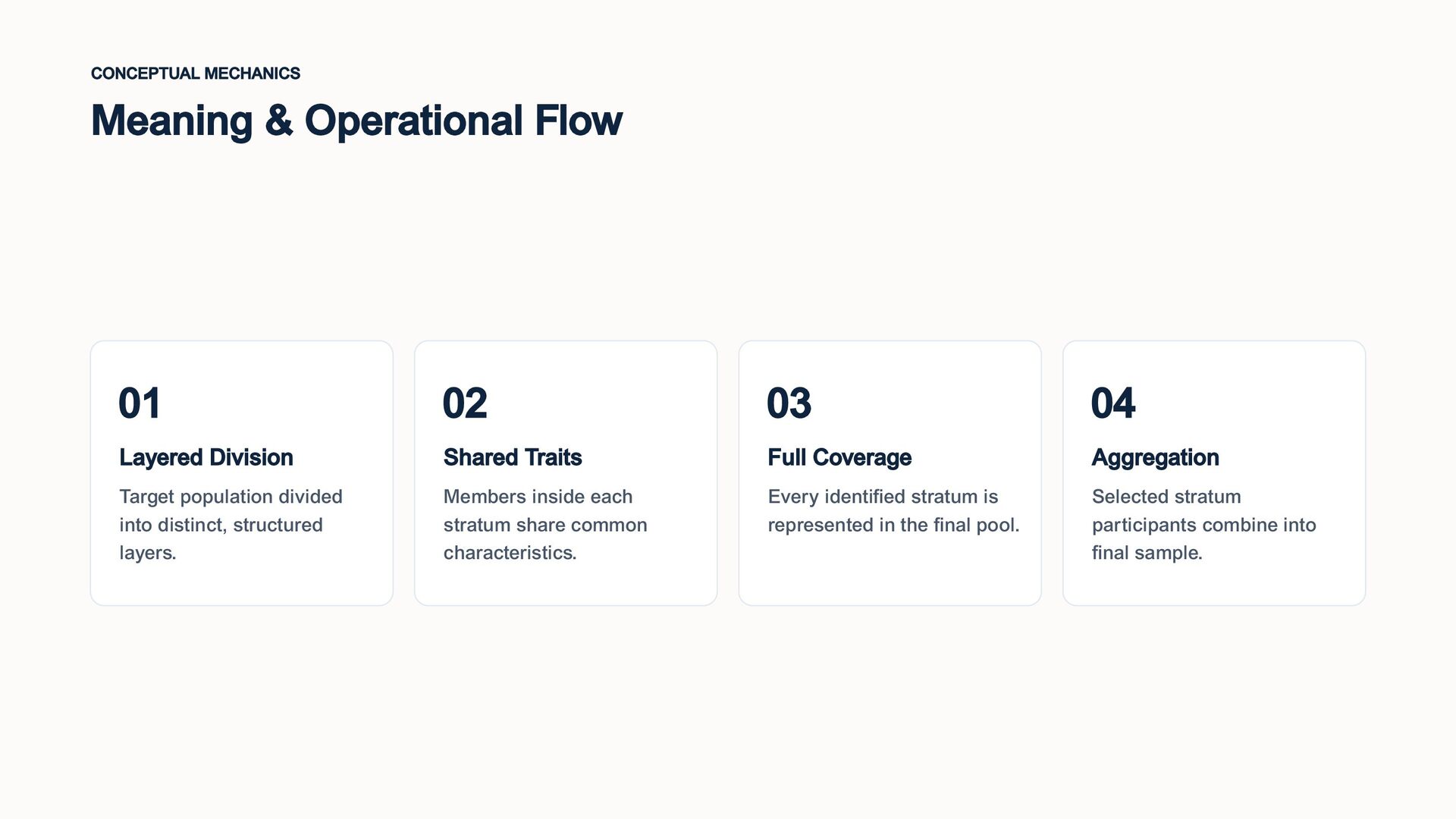
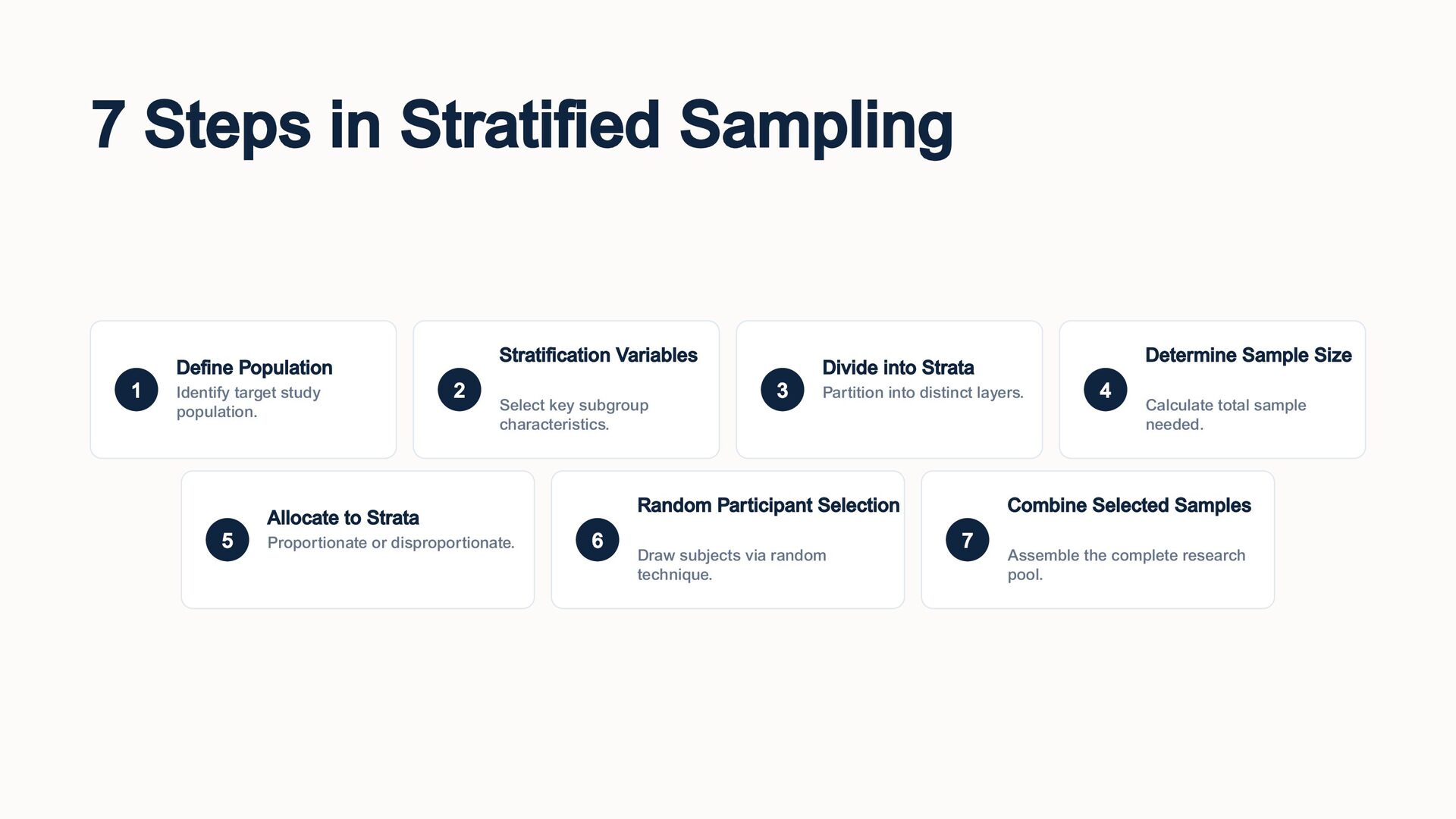
Step 1: Define the population
Clearly identify the population to be studied.
Example: All M.Ed students studying in universities in Kerala.
Step 2: Identify the stratification variable
Choose a characteristic that is relevant to the research problem.
Possible variables include:
Gender
Age
School type
Locality
Socioeconomic status
Academic stream
Teaching experience
Step 3: Divide the population into strata
The population is divided into mutually distinguishable groups.
Example:
M.Ed students → Male students + Female students
Step 4: Determine the size of each stratum
Find out how many members are present in each group.
Step 5: Decide the sample size
Determine the total number of participants required.
Step 6: Allocate the sample among strata
The sample may be allocated proportionately or disproportionately.
Step 7: Select participants
Select participants independently from each stratum, usually using simple random sampling or systematic sampling.
Step 8: Combine the selected participants
The samples from all strata are combined to form the final sample.
---
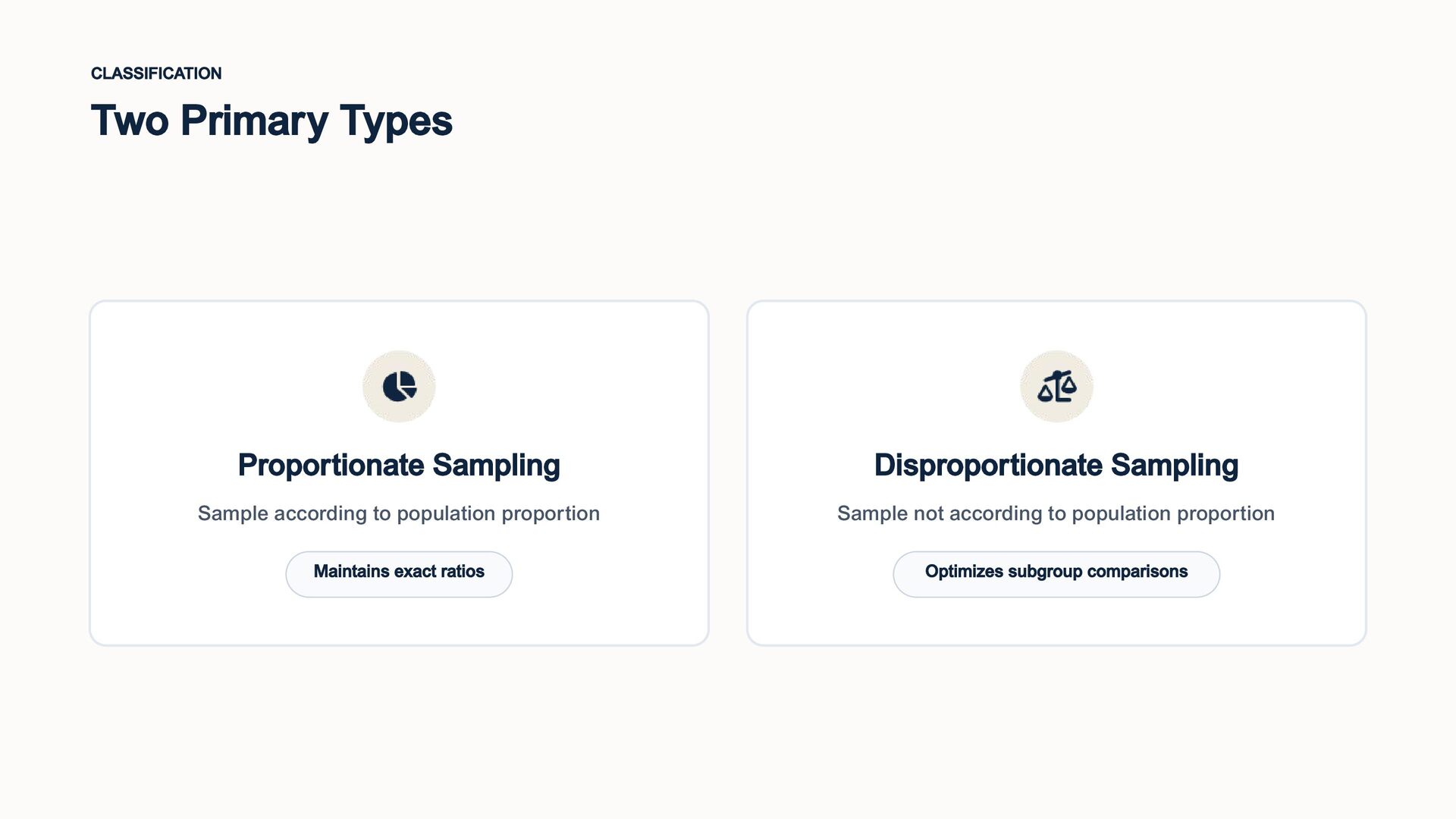
5. Types of Stratified Sampling
A. Proportionate Stratified Sampling
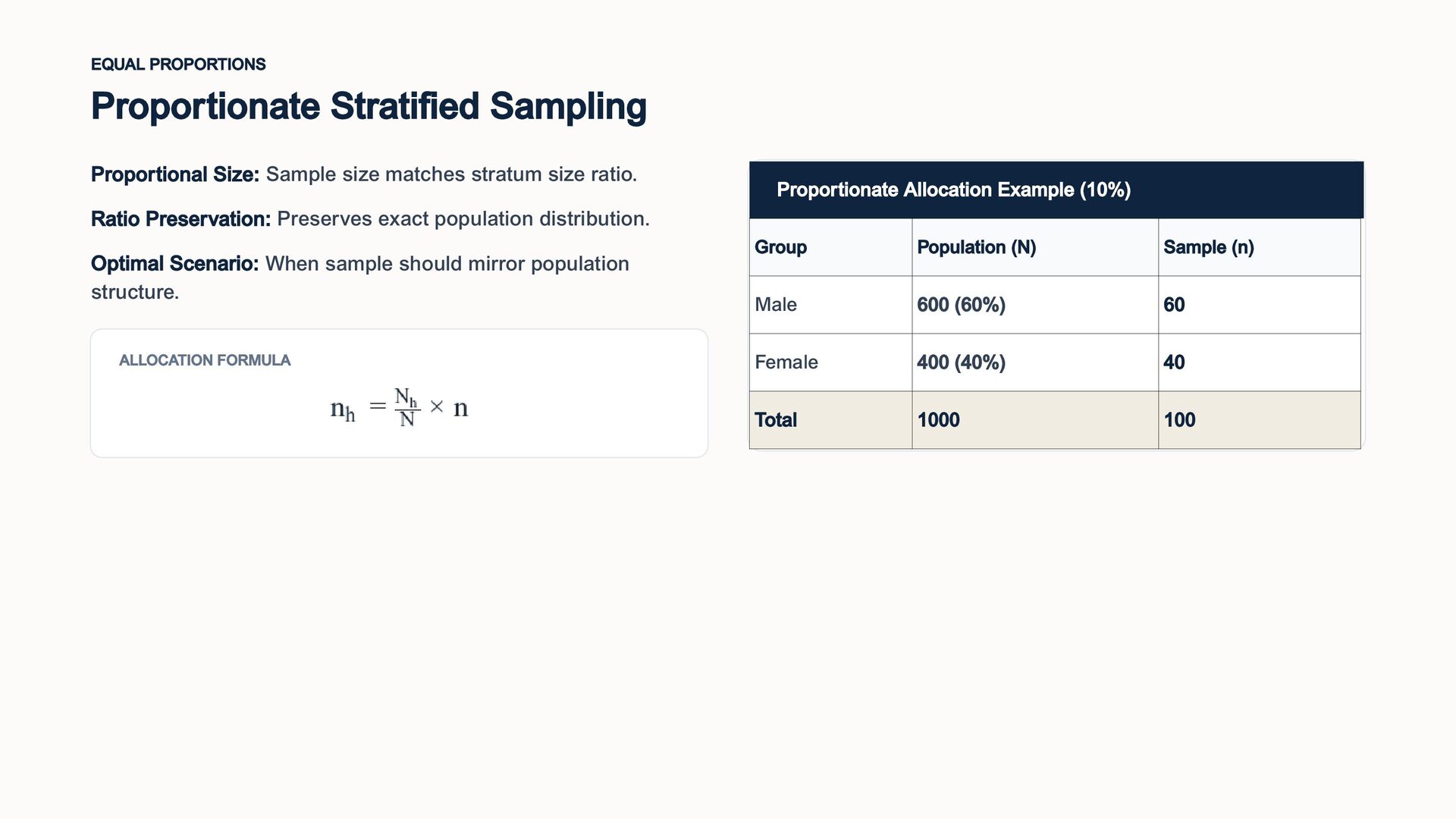
In proportionate stratified sampling, the number of participants selected from each stratum is proportional to the size of that stratum in the population.
Formula
\[
n_h = \frac{N_h}{N}\times n
\]
Where:
\(n_h\) = sample required from a stratum
\(N_h\) = population of the stratum
\(N\) = total population
\(n\) = total sample size
Example
Suppose there are 1,000 students:
Stratum Population
Government schools 500
Aided schools 300
Private schools 200
Total 1,000
If the required sample is 100, the researcher selects:
Government = 50
Aided = 30
Private = 20
Thus, the sample maintains the same proportions as the population.
---
B. Disproportionate Stratified Sampling
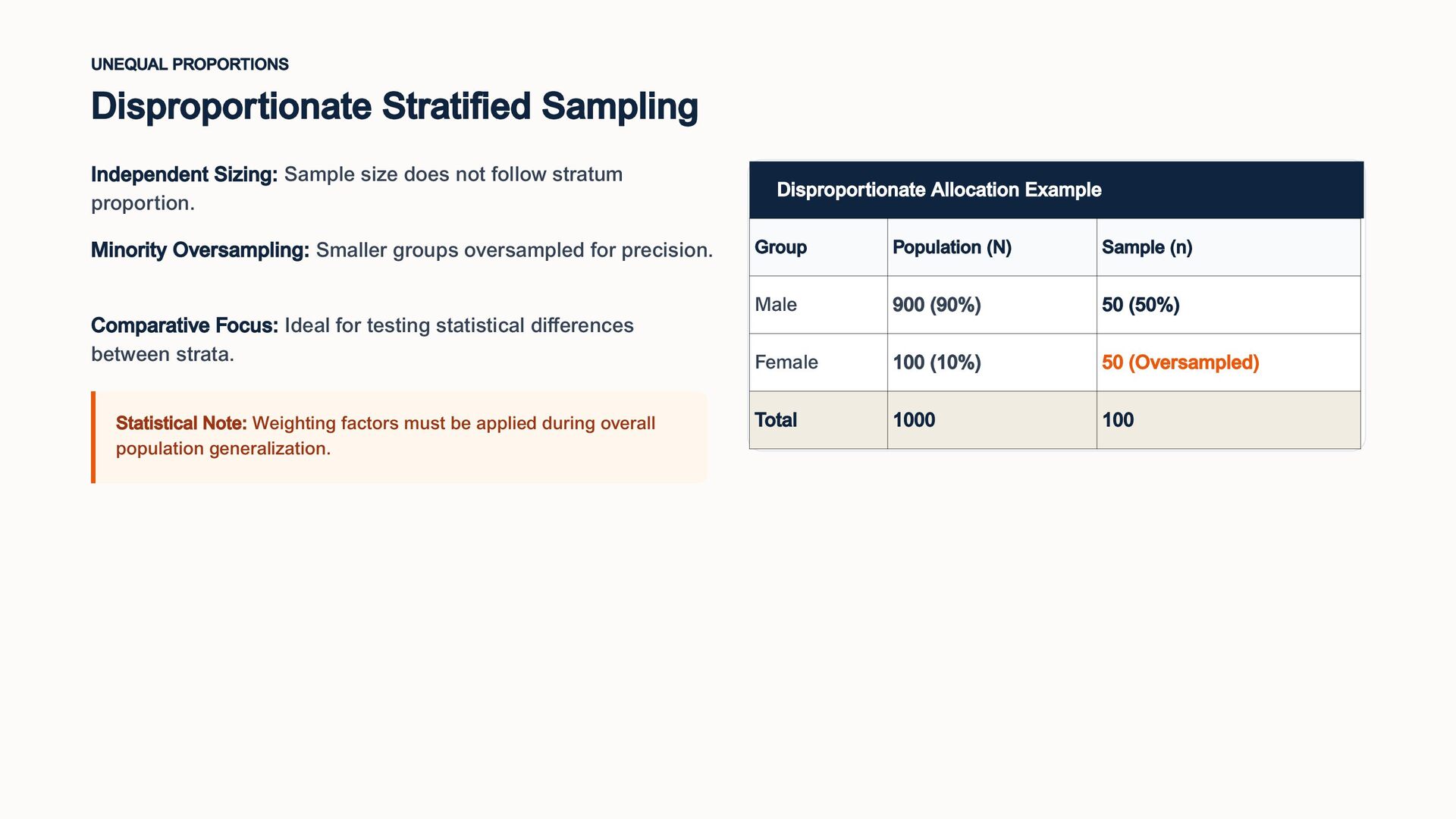
Here, the number selected from each stratum does not necessarily correspond to its population proportion.
This is useful when the researcher wants sufficient representation of a small subgroup.
Example
Suppose:
Urban students = 800
Rural students = 200
Instead of selecting 80 urban and 20 rural students, the researcher may select:
50 urban students
50 rural students
This gives rural students greater representation than their actual population proportion.
Disproportionate sampling is particularly useful when comparisons between small and large groups are important.
---
6. Methods of Sample Allocation
1. Equal Allocation
An equal number of participants is selected from every stratum.
Example:
Government schools – 50
Aided schools – 50
Private schools – 50
This is useful when comparison among strata is the main purpose.
2. Proportional Allocation
The sample size of each stratum corresponds to its population size.
3. Optimum Allocation
Sample sizes are determined by considering both:
Size of the stratum
Variability within the stratum
This approach can produce greater statistical efficiency.
---
7. Advantages of Stratified Sampling
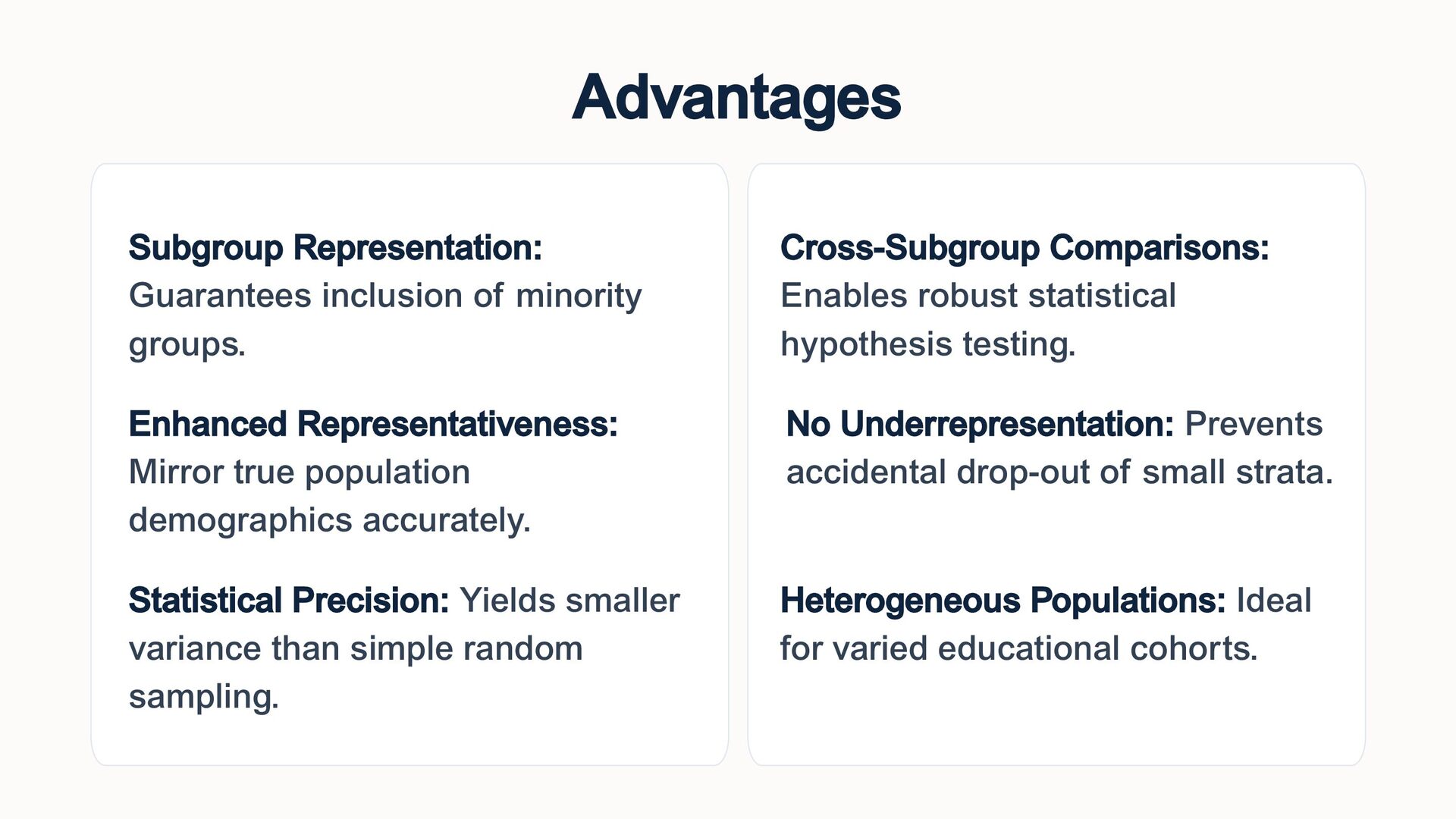
1. Better representation
Important subgroups of the population are represented in the sample.
2. Increased precision
When strata are internally homogeneous, stratification can reduce sampling error and improve estimates.
3. Useful for heterogeneous populations
It is particularly appropriate when the population contains clearly identifiable subgroups.
4. Enables subgroup comparison
Researchers can compare groups such as:
Male and female students
Rural and urban students
Government and private school students
5. Prevents underrepresentation
Small but important groups can be deliberately included in the sample.
6. Greater efficiency
Compared with a simple random sample of the same size, a well-designed stratified sample may provide more precise estimates.
7. Useful in educational research
Educational populations frequently contain naturally occurring groups, making stratification especially useful for M.Ed research.
---
8. Limitations of Stratified Sampling
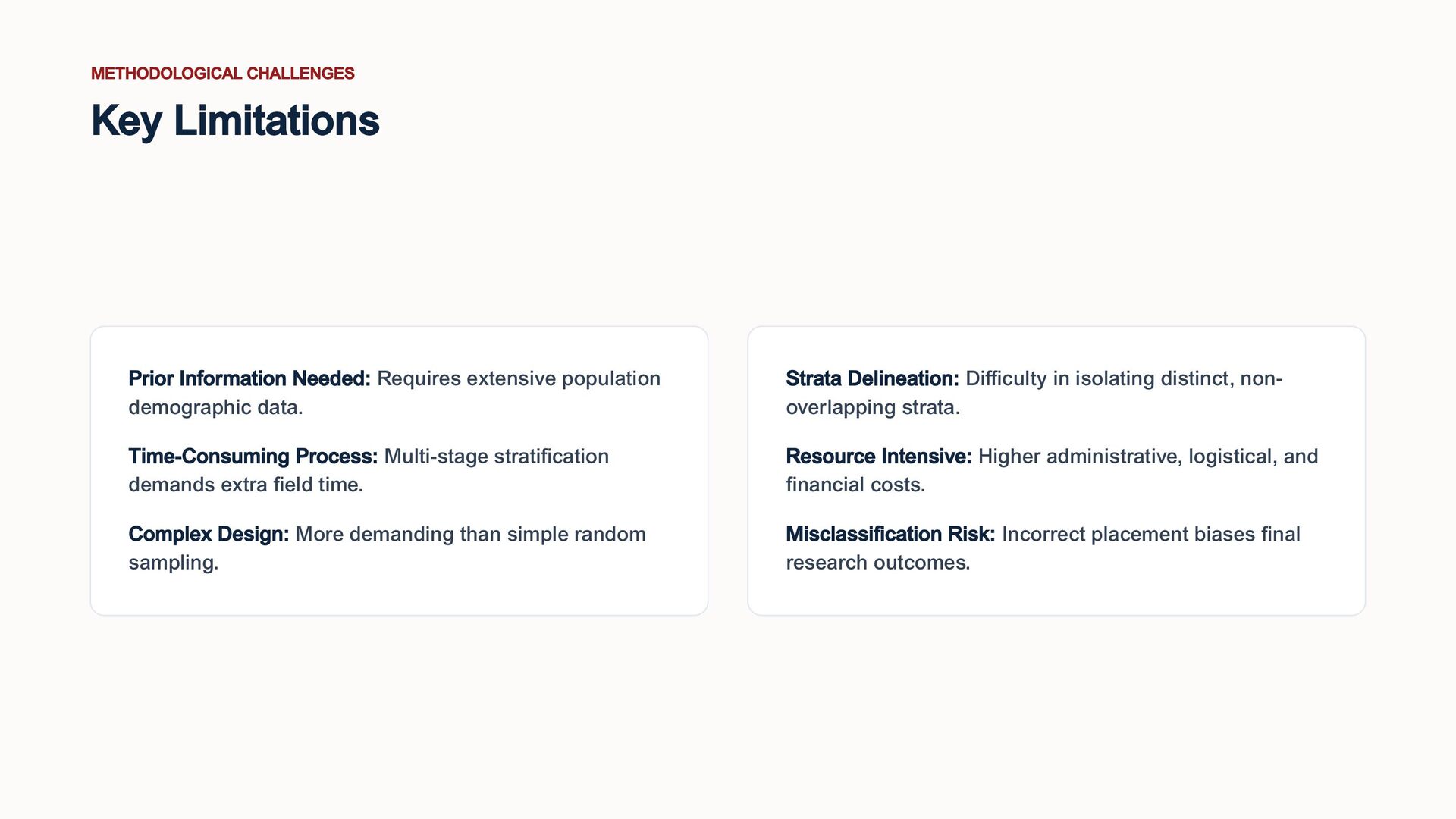
1. Requires population information
The researcher needs reliable information about the characteristics and sizes of the strata.
2. More complicated
It is more complex than simple random sampling because sampling must be organized separately within each stratum.
3. Difficult classification
Sometimes it is difficult to decide which characteristic should be used for stratification.
4. Incorrect stratification can reduce effectiveness
If the strata are poorly designed, the advantages of stratification may be reduced.
5. Multiple variables increase complexity
Stratifying simultaneously by several characteristics can produce many small groups and make sampling difficult.
6. Time-consuming
Preparing lists and selecting participants from each stratum can require considerable time and effort.
---
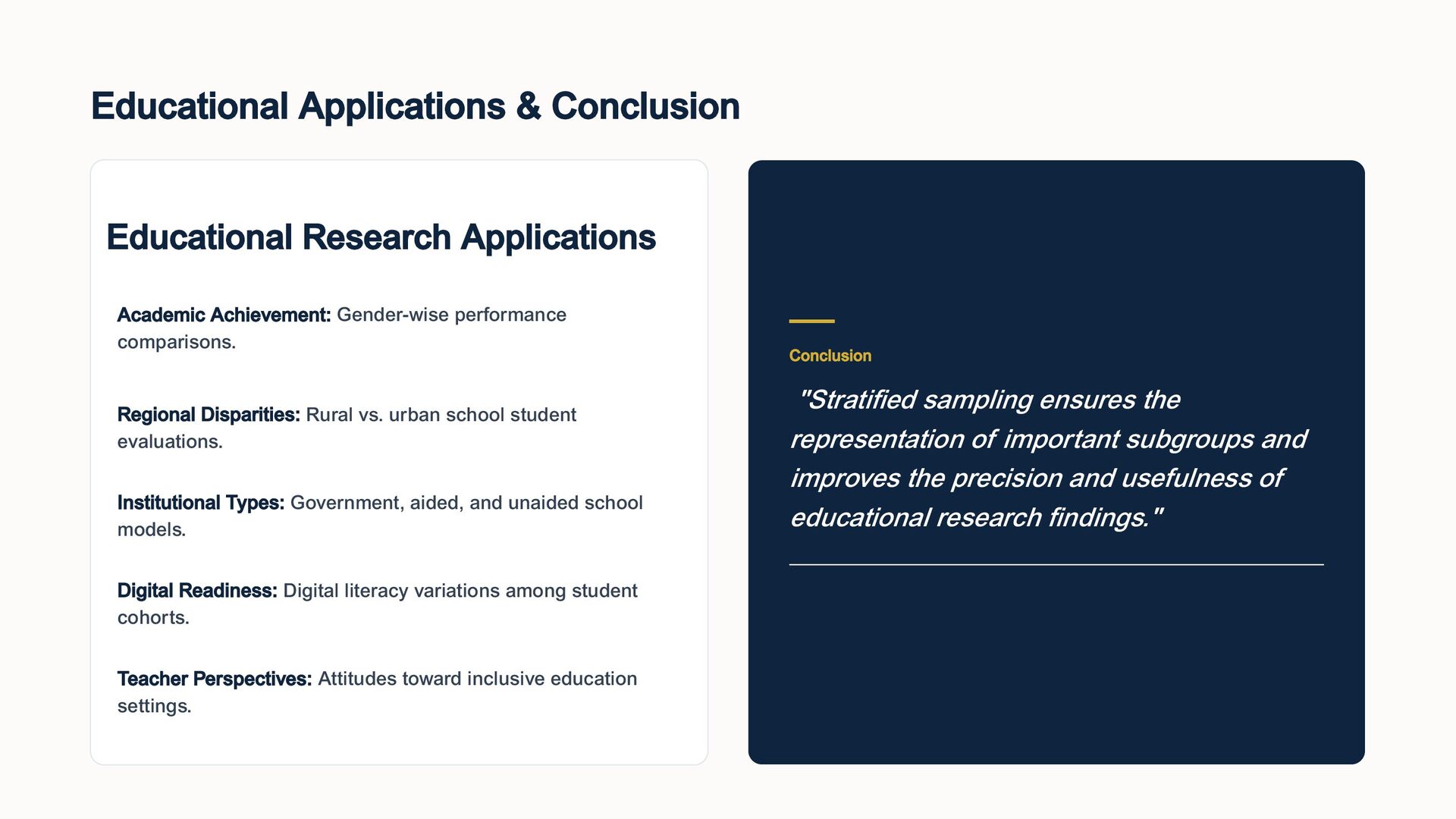
9. Stratified Sampling in Educational Research
Stratified sampling is highly relevant to M.Ed research.
Example research problem
“A study of the effectiveness of digital learning among secondary school students in Kerala.”
The researcher may divide students into strata according to:
Gender
Rural/urban locality
Government/private school
Academic level
For example:
Population → School type → Gender → Random selection
This ensures that different categories of students are represented.
---
10. Stratified Sampling vs Simple Random Sampling
Stratified Sampling Simple Random Sampling
Population is divided into strata Population is treated as one group
Samples are selected from every stratum Participants are selected from the whole population
Ensures subgroup representation Subgroups may be underrepresented
Often gives greater precision May be less precise for heterogeneous populations
Requires information about strata Requires a population sampling frame
Useful for heterogeneous populations Suitable when population is relatively homogeneous
---
11. Important Points for M.Ed Examination
Remember these key terms:
Population → Strata → Allocation → Random Selection → Final Sample
A good stratified sampling design generally requires:
Clearly defined population
Relevant stratification variable
Appropriate strata
Reliable information about stratum sizes
Appropriate allocation method
Random selection within strata
---
Conclusion
Stratified sampling is an important probability sampling technique in educational research. It divides a heterogeneous population into relatively homogeneous subgroups and selects participants from each subgroup. By ensuring adequate representation of important groups, it can improve the quality and precision of research findings. For M.Ed researchers, it is particularly useful when the study involves comparisons among groups such as gender, locality, school type, socioeconomic background, or academic level.


 moore
 bkeepers
 geshan
 ianozsvald
 minecr
 kastner
 inesmontani
 soudai
 marktimemedia
 katarinadahlin
 sachag
 jacobian