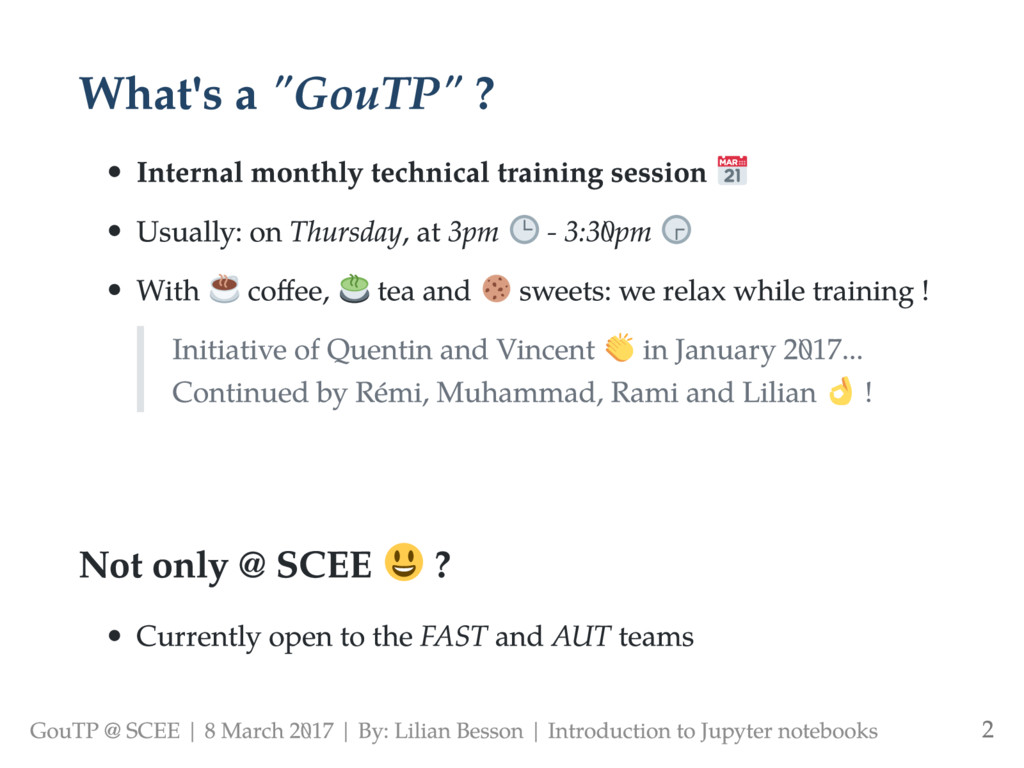
on Thursday, at 3pm - 3:3pm With coffee, tea and sweets: we relax while training ! Initiative of Quentin and Vincent in January 217... Continued by Rémi, Muhammad, Rami and Lilian ! Not only @ SCEE ? Currently open to the FAST and AUT teams GouTP @ SCEE | 8 March 217 | By: Lilian Besson | Introduction to Jupyter notebooks 2
tools @ SCEE [5 min] 2. What are the Jupyter notebook tools ? [1 min] 3. Demo time [1 min] 4. Sharing your notebooks online or as PDF [5 min] Please Ask questions and interrupt me if you want! GouTP @ SCEE | 8 March 217 | By: Lilian Besson | Introduction to Jupyter notebooks 3
new PhD student and interns ! You met (almost) everybody this week ! You will become familiar with the research themes of our team … ↪ Let see a few tools that can make your life easier! GouTP @ SCEE | 8 March 217 | By: Lilian Besson | Introduction to Jupyter notebooks 4
maintained mainly by Rémi : we need help! New comers, please send a short summary of your research interest with links to your LinkedIn, Google Scholar profile (or other sites). Picture: if you want to Rémi and I so we add you on the website 5
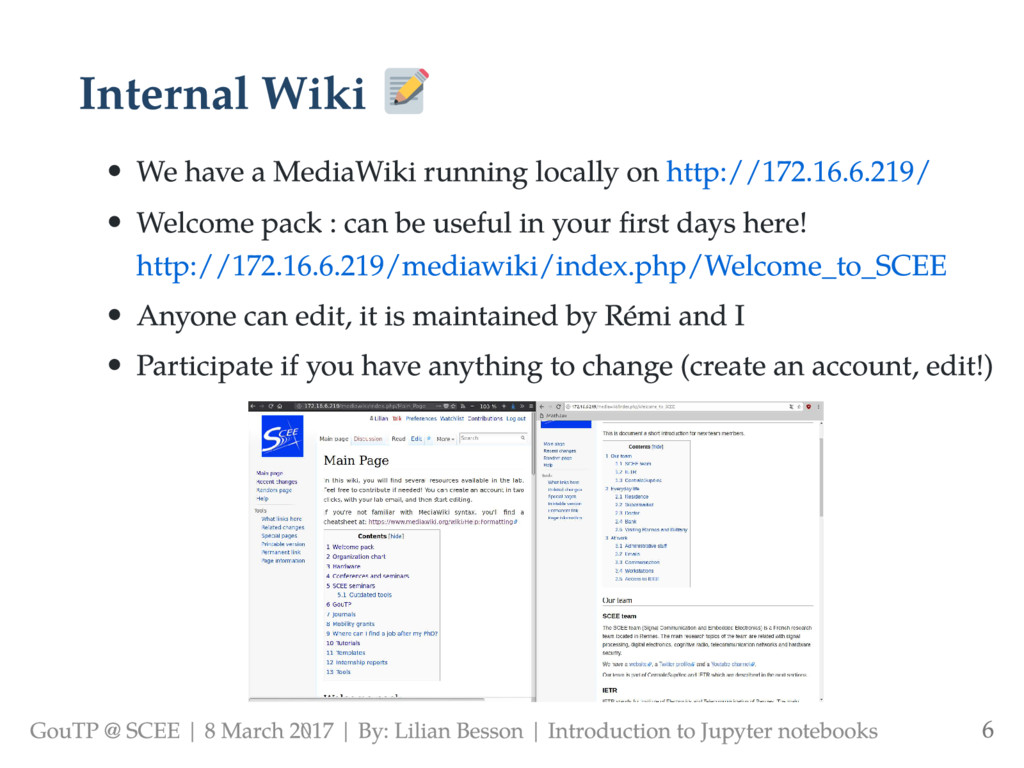
Welcome pack : can be useful in your first days here! http://172.16.6.219/mediawiki/index.php/Welcome_to_SCEE Anyone can edit, it is maintained by Rémi and I Participate if you have anything to change (create an account, edit!) GouTP @ SCEE | 8 March 217 | By: Lilian Besson | Introduction to Jupyter notebooks 6
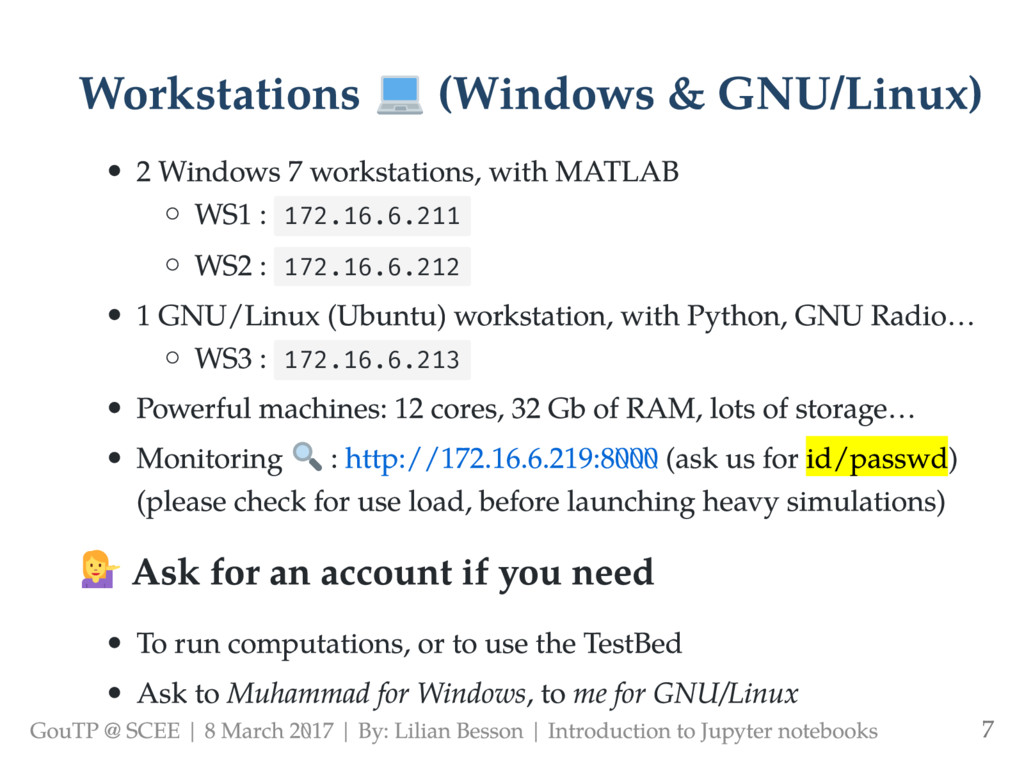
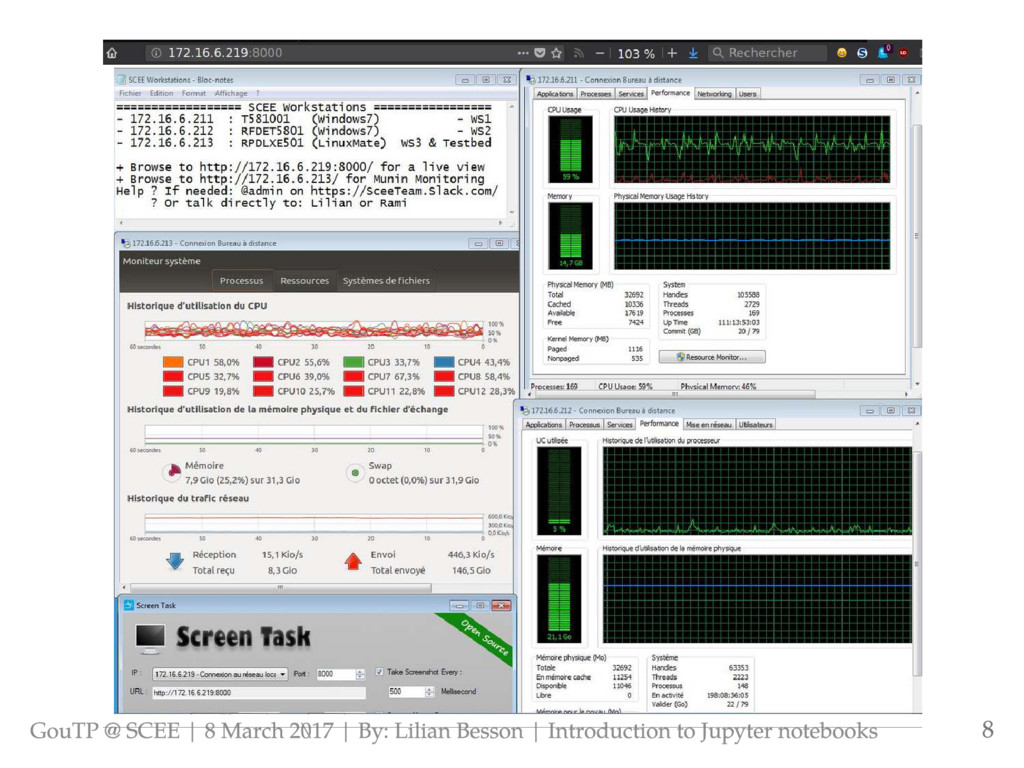
WS1 : . . . WS2 : . . . 1 GNU/Linux (Ubuntu) workstation, with Python, GNU Radio… WS3 : . . . Powerful machines: 12 cores, 32 Gb of RAM, lots of storage… Monitoring : http://172.16.6.219:8 (ask us for id/passwd) (please check for use load, before launching heavy simulations) Ask for an account if you need To run computations, or to use the TestBed Ask to Muhammad for Windows , to me for GNU/Linux GouTP @ SCEE | 8 March 217 | By: Lilian Besson | Introduction to Jupyter notebooks 7
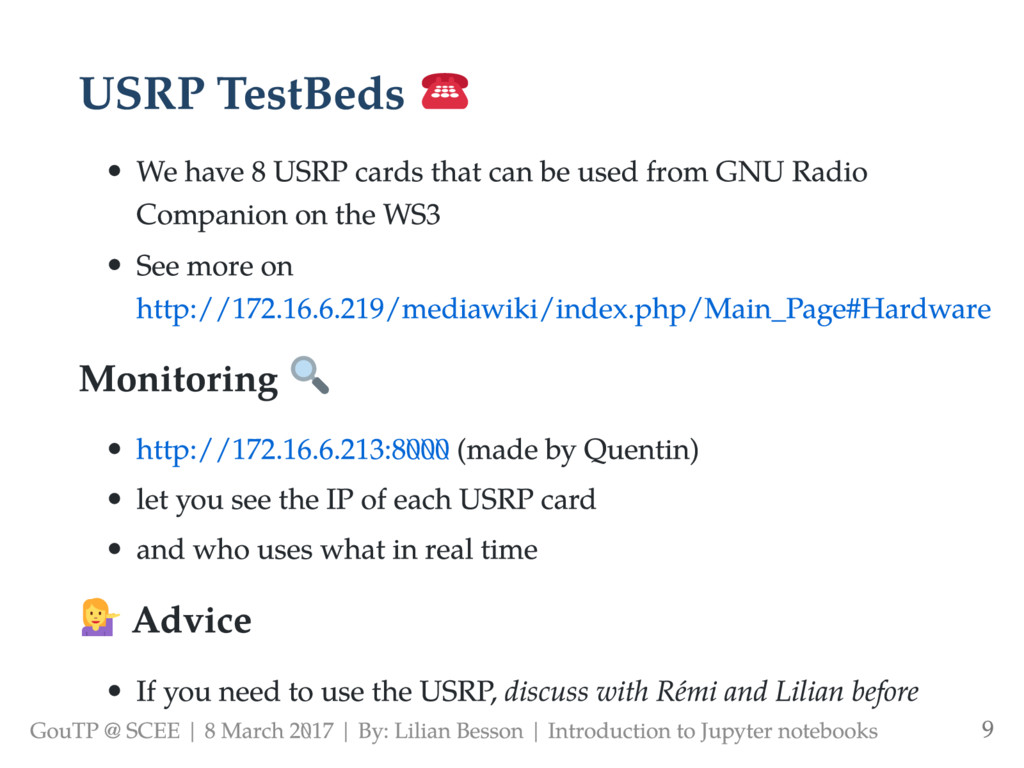
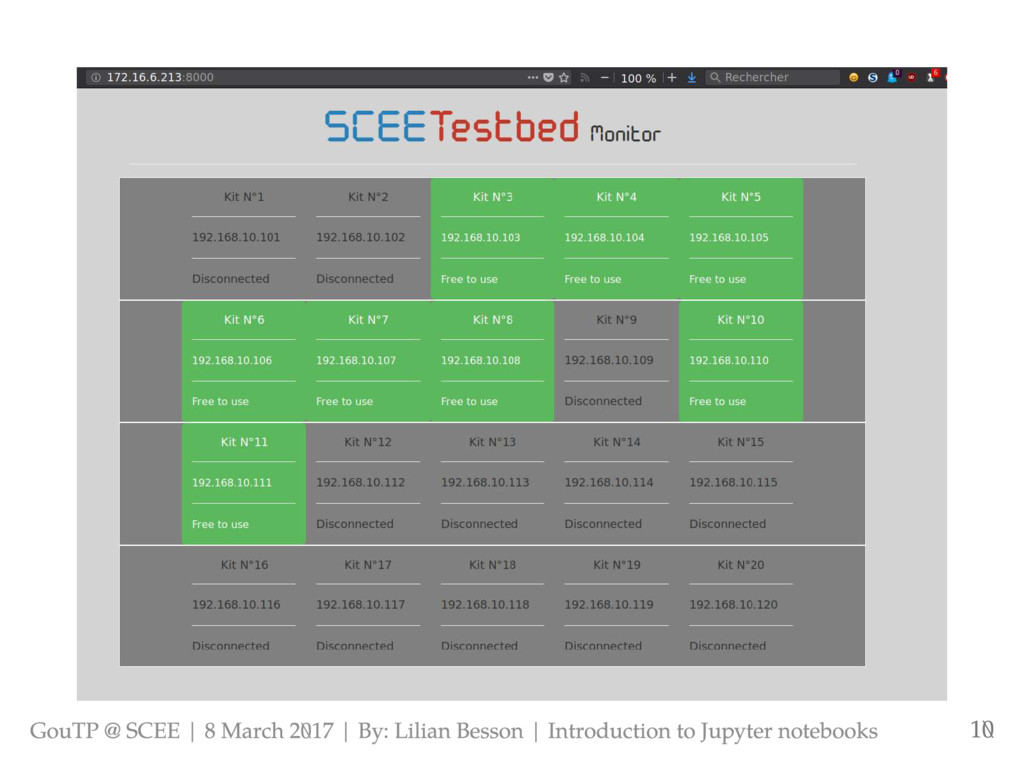
used from GNU Radio Companion on the WS3 See more on http://172.16.6.219/mediawiki/index.php/Main_Page#Hardware Monitoring http://172.16.6.213:8 (made by Quentin) let you see the IP of each USRP card and who uses what in real time Advice If you need to use the USRP, discuss with Rémi and Lilian before GouTP @ SCEE | 8 March 217 | By: Lilian Besson | Introduction to Jupyter notebooks 9
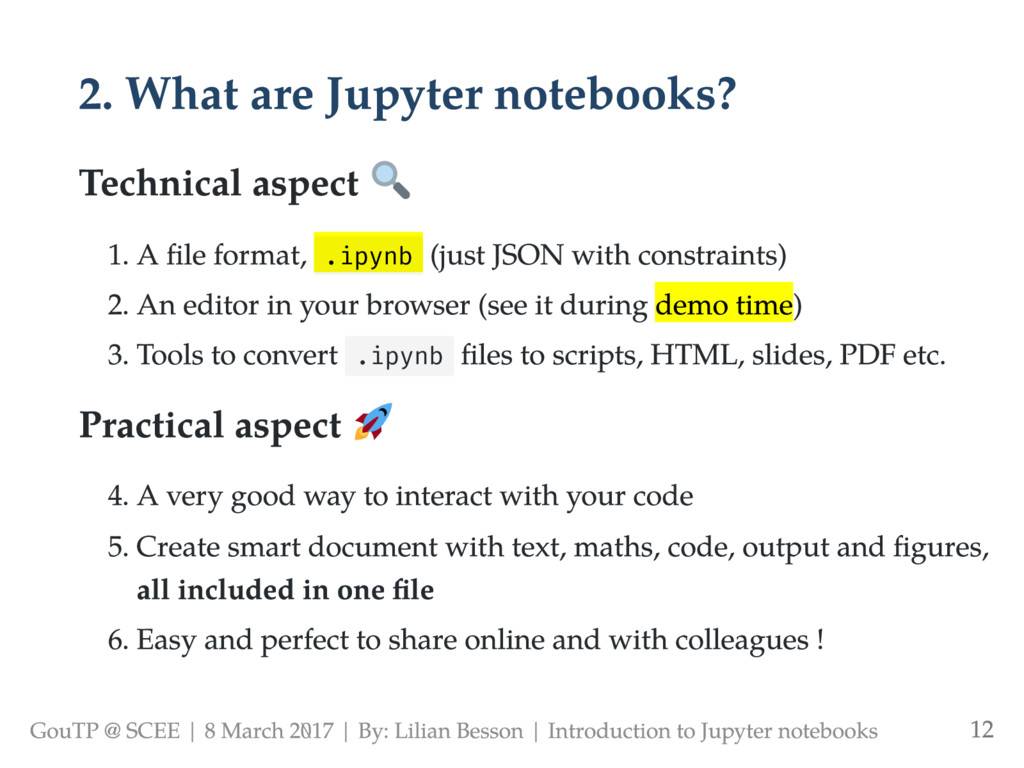
format, .ipynb (just JSON with constraints) 2. An editor in your browser (see it during demo time) 3. Tools to convert .ipynb files to scripts, HTML, slides, PDF etc. Practical aspect 4. A very good way to interact with your code 5. Create smart document with text, maths, code, output and figures, all included in one file 6. Easy and perfect to share online and with colleagues ! GouTP @ SCEE | 8 March 217 | By: Lilian Besson | Introduction to Jupyter notebooks 12
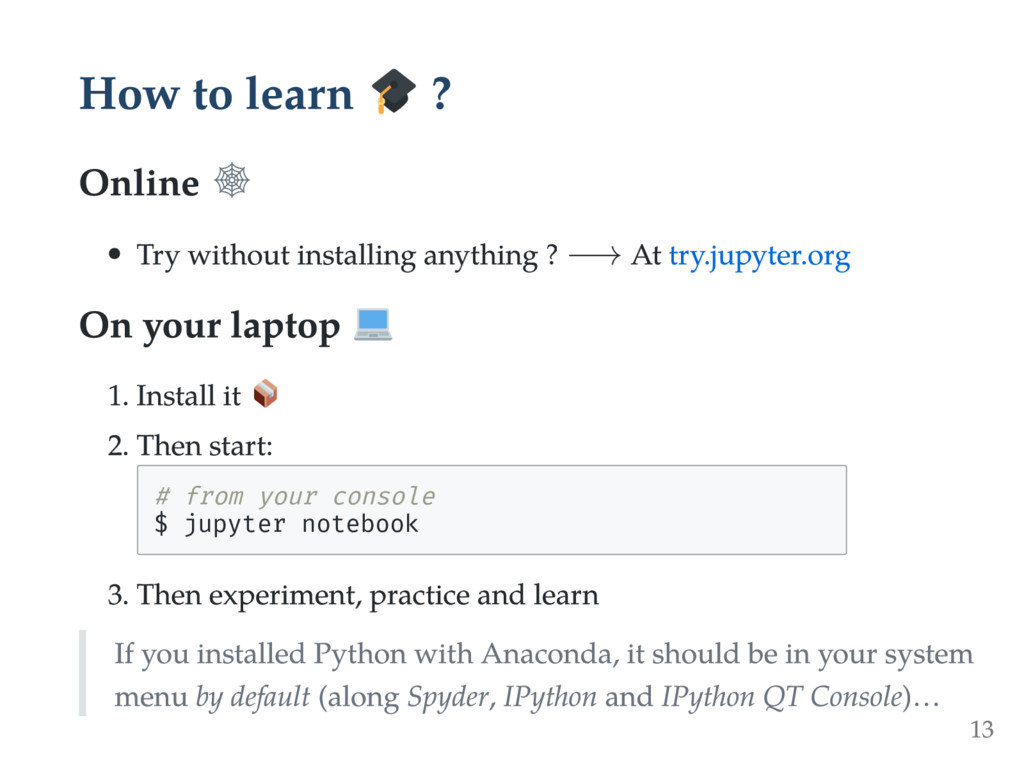
⟶ At try.jupyter.org On your laptop 1. Install it 2. Then start: # from your console $ jupyter notebook 3. Then experiment, practice and learn If you installed Python with Anaconda, it should be in your system menu by default (along Spyder , IPython and IPython QT Console )… 13
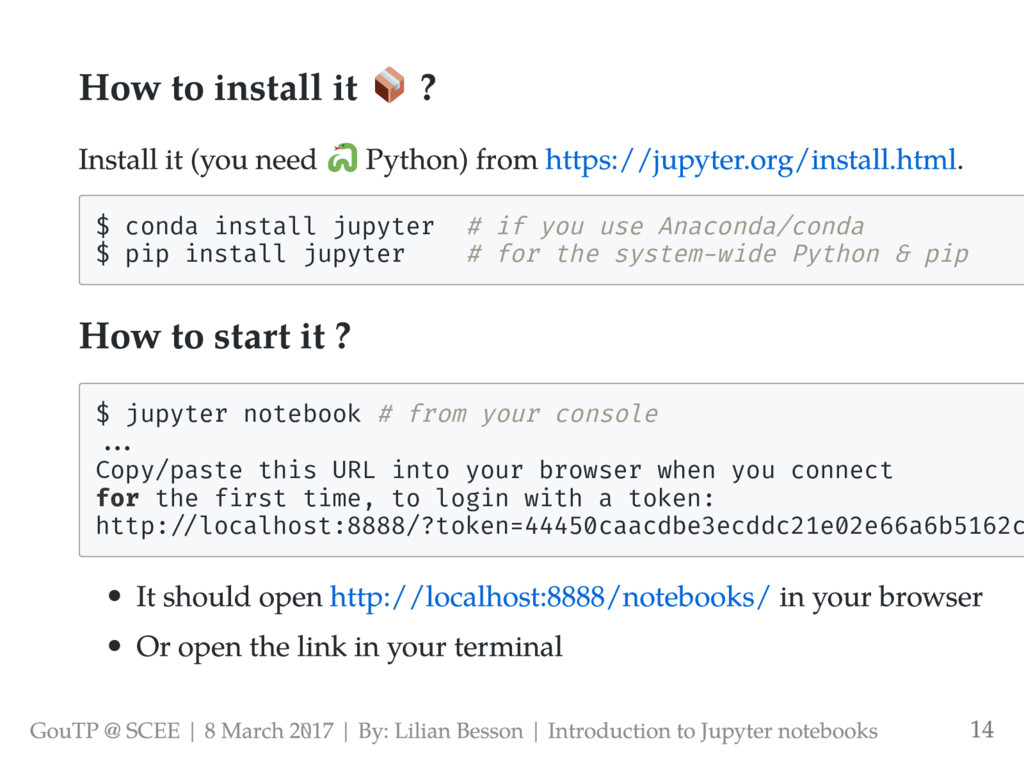
from https://jupyter.org/install.html. $ conda install jupyter # if you use Anaconda/conda $ pip install jupyter # for the system wide Python & pip How to start it ? $ jupyter notebook # from your console Copy/paste this URL into your browser when you connect for the first time, to login with a token: http: localhost: /?token= caacdbe ecddc e e a b c It should open http://localhost:8888/notebooks/ in your browser Or open the link in your terminal GouTP @ SCEE | 8 March 217 | By: Lilian Besson | Introduction to Jupyter notebooks 14
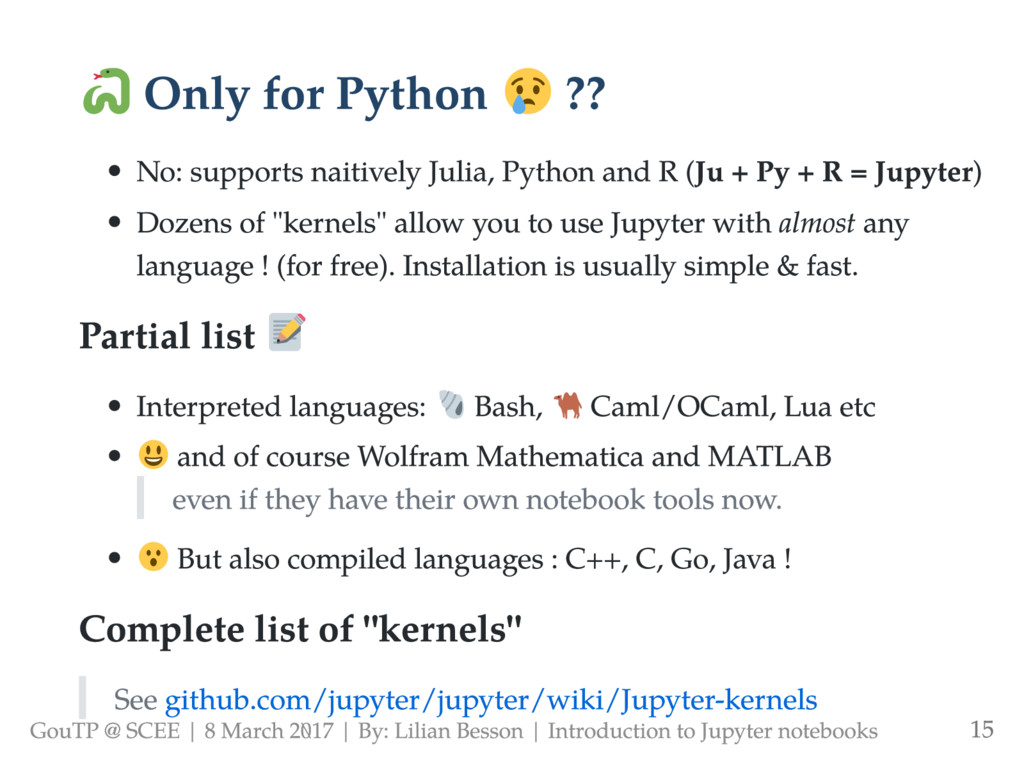
R (Ju + Py + R = Jupyter) Dozens of "kernels" allow you to use Jupyter with almost any language ! (for free). Installation is usually simple & fast. Partial list Interpreted languages: Bash, Caml/OCaml, Lua etc and of course Wolfram Mathematica and MATLAB even if they have their own notebook tools now. But also compiled languages : C++, C, Go, Java ! Complete list of "kernels" See github.com/jupyter/jupyter/wiki/Jupyter-kernels GouTP @ SCEE | 8 March 217 | By: Lilian Besson | Introduction to Jupyter notebooks 15
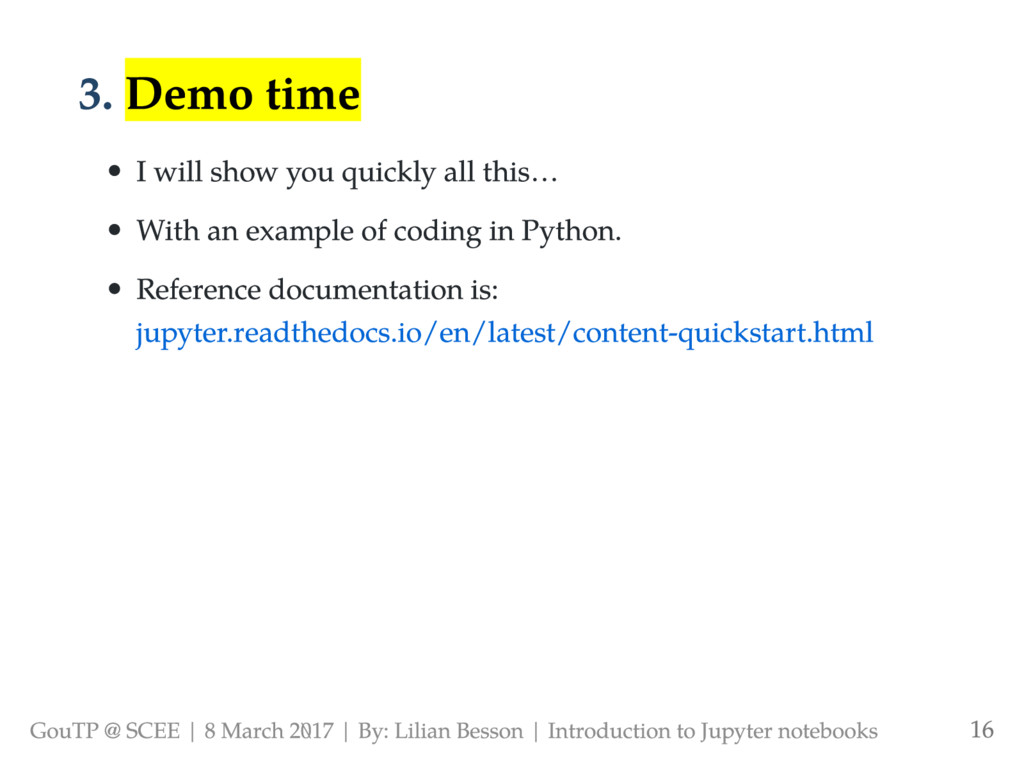
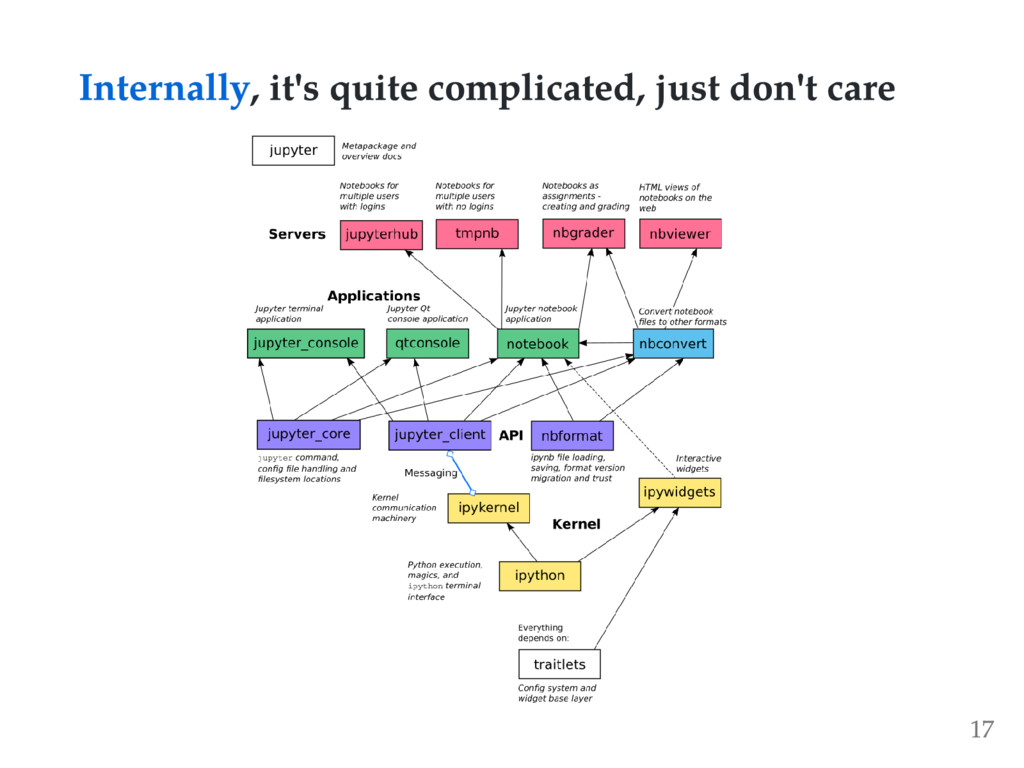
… With an example of coding in Python. Reference documentation is: jupyter.readthedocs.io/en/latest/content-quickstart.html GouTP @ SCEE | 8 March 217 | By: Lilian Besson | Introduction to Jupyter notebooks 16
to Jupyter Official documentation: at jupyter.rtfd.io Also datacamp.com/community/tutorials/tutorial-jupyter-notebook Pointers 1. use it and fall in love with it ! 2. Use Jupyter-themes ( github.com/dunovank/jupyter themes ) to customize the UI as you wish (dark themes, custom fonts etc) 3. Use extensions if you want more features, See jupyter-contrib-nbextensions.rtfd.io GouTP @ SCEE | 8 March 217 | By: Lilian Besson | Introduction to Jupyter notebooks 18
? GouTP @ FAST or AUT ? By Pierre Haessig ? Julia programming language (~ between Python and Matlab) ↪ see julialang.org if you are curious We need participants! By you ? Any idea is welcome! GouTP @ SCEE | 8 March 217 | By: Lilian Besson | Introduction to Jupyter notebooks 19
want to do a GouTP ! Your mission, if you accept it … 1. Padawan level : next time you program in Python (or other language), think about Jyputer. Can it help you being more efficient? 2. Jedi level : Try to use Jupyter when you will have to share or show some piece of code? 3. Master level : From now on, try to use (only?) open-source tools for your research (Python and others) … GouTP @ SCEE | 8 March 217 | By: Lilian Besson | Introduction to Jupyter notebooks 2


 naereen
 nagano
 okana2ki
 mickey_0226
 ianozsvald
 masakiokuda
 konakalab
 michielstock
 institutdelelevage
 hiranabe
 i2tsuki
 trycycle
 marcoroth
 coloredviolet
 techseoconnect
 axbom
axbom
 szymonslowik
 csswizardry
 codingconduct
 rkendrick25
 stuffmc
 kimpetersen
 addyosmani
 cassininazir
![Agenda for today [3 min] 1. Quick presentation of internal](https://files.speakerdeck.com/presentations/00e0a13a698441c7b61a92d131515d14/slide_2.jpg)