Upgrade to Pro — share decks privately, control downloads, hide ads and more …

Teaching Students How To Practice

Teaching Students How To Practice

Some students put hundreds of hours into practicing with no results, while others avoid practicing altogether. Some are eager to learn new study techniques, while others cling to ineffective methods. What should you do in these situations?

In this presentation, we'll explore how students can adopt more productive habits and supercharge their learning by answering three questions: Why don't students practice? How can we turn practicing into a desirable, effortless routine? And what does science show about how people learn hard skills and improve their performance over time?

Avatar for Natasha Godwin

Natasha Godwin

October 29, 2019
Tweet

Transcript

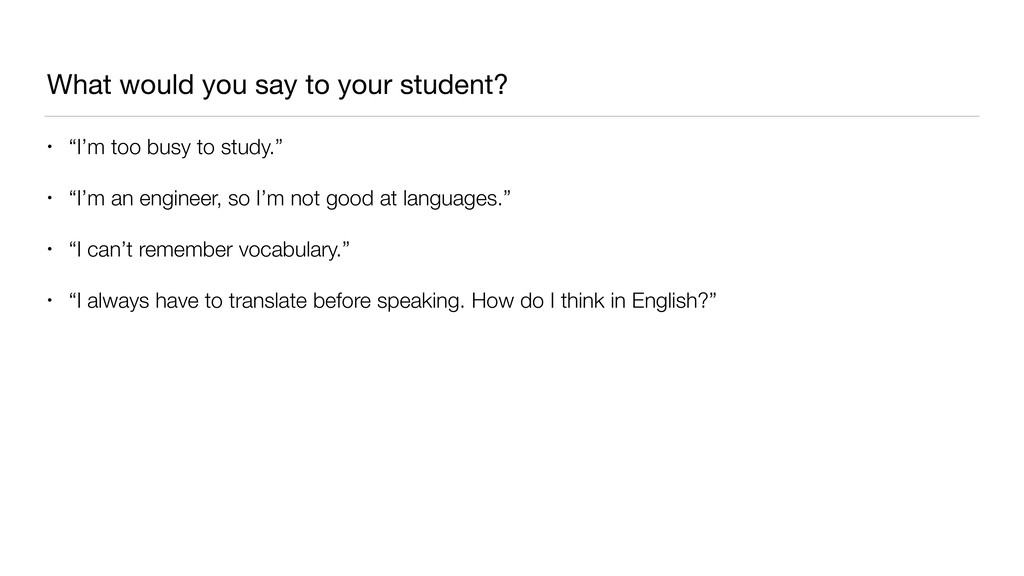
  1. What would you say to your student? • “I’m too

    busy to study.” • “I’m an engineer, so I’m not good at languages.” • “I can’t remember vocabulary.” • “I always have to translate before speaking. How do I think in English?”
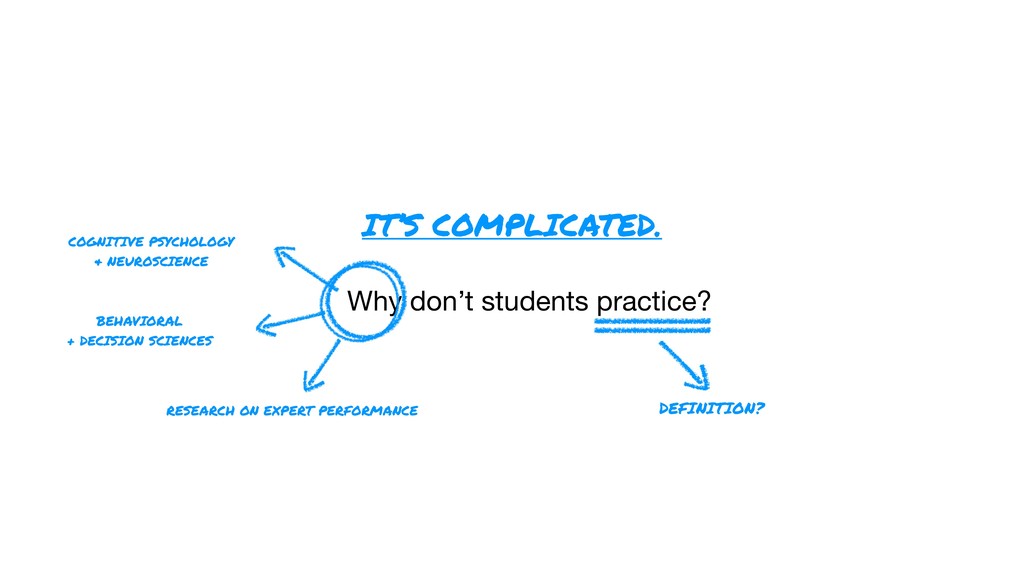
  2. Why don’t students practice? COGNITIVE PSYCHOLOGY & NEUROSCIENCE RESEARCH ON

    EXPERT PERFORMANCE DEFINITION? IT’S COMPLICATED. BEHAVIORAL + DECISION SCIENCES
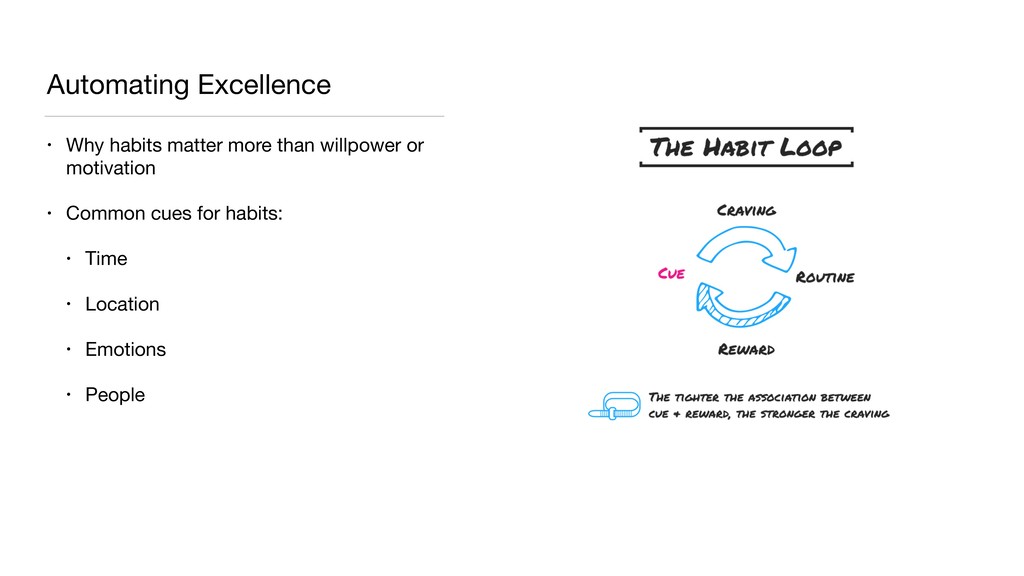
  3. Automating Excellence • Why habits matter more than willpower or

    motivation • Common cues for habits: • Time • Location • Emotions • People
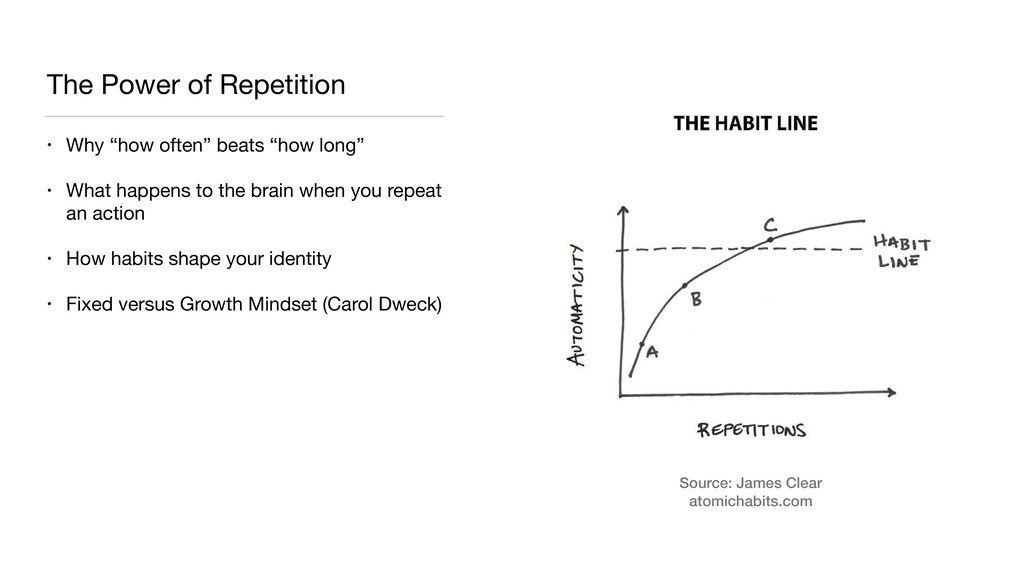
  4. The Power of Repetition • Why “how often” beats “how

    long” • What happens to the brain when you repeat an action • How habits shape your identity • Fixed versus Growth Mindset (Carol Dweck) Source: James Clear atomichabits.com
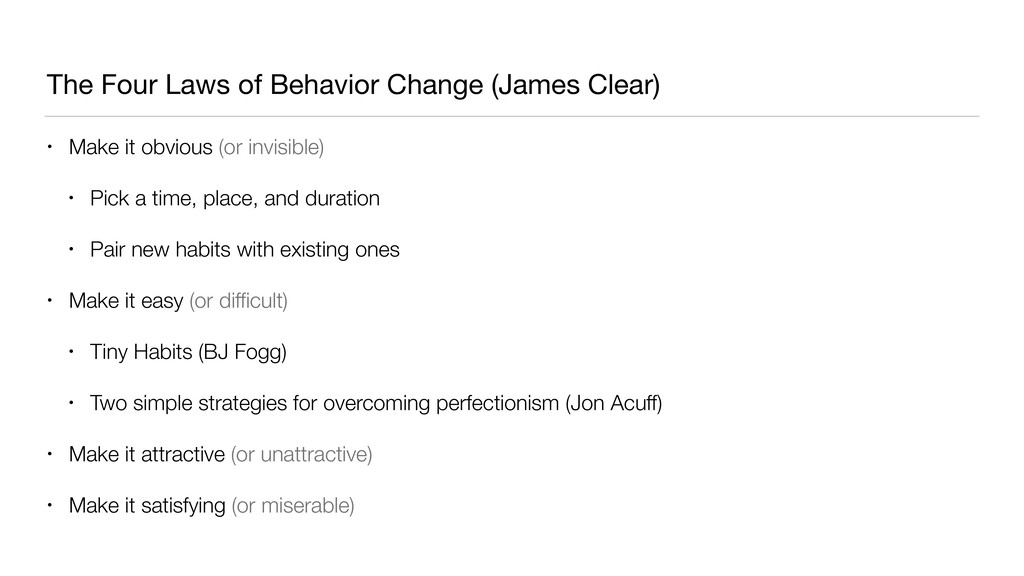
  5. The Four Laws of Behavior Change (James Clear) • Make

    it obvious (or invisible) • Pick a time, place, and duration • Pair new habits with existing ones • Make it easy (or difficult) • Tiny Habits (BJ Fogg) • Two simple strategies for overcoming perfectionism (Jon Acuff) • Make it attractive (or unattractive) • Make it satisfying (or miserable)
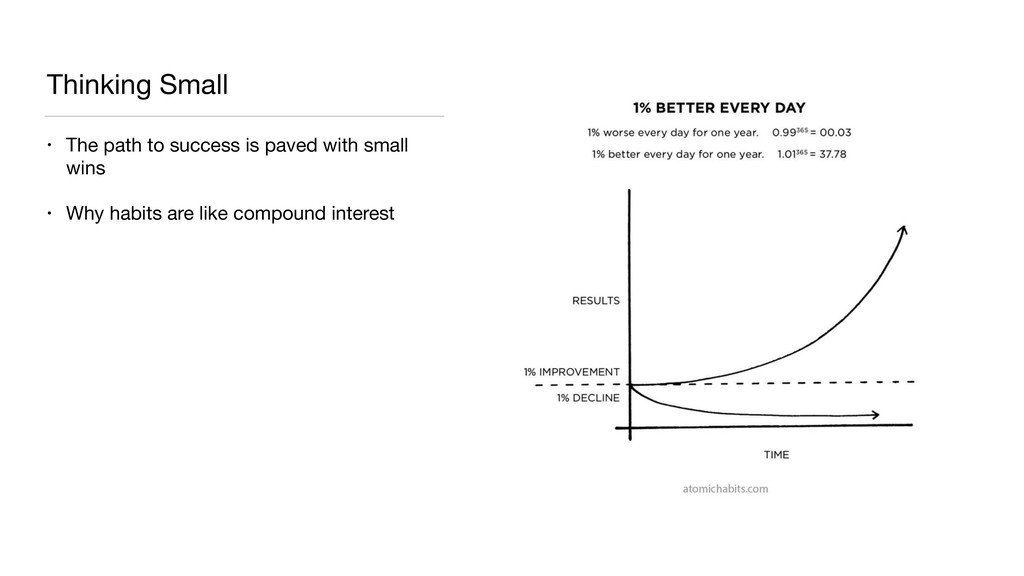
  6. Thinking Small • The path to success is paved with

    small wins • Why habits are like compound interest
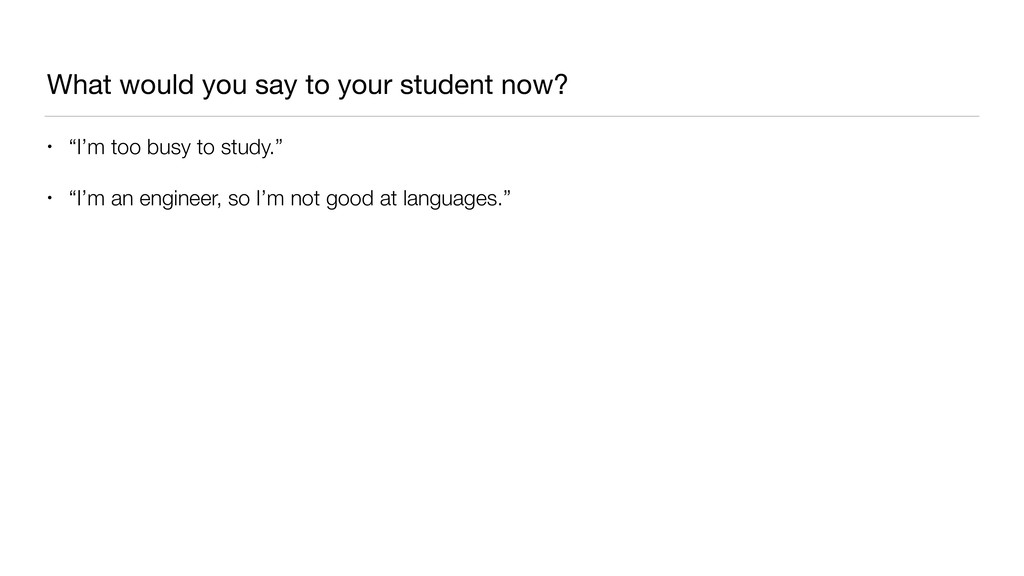
  7. What would you say to your student now? • “I’m

    too busy to study.” • “I’m an engineer, so I’m not good at languages.”
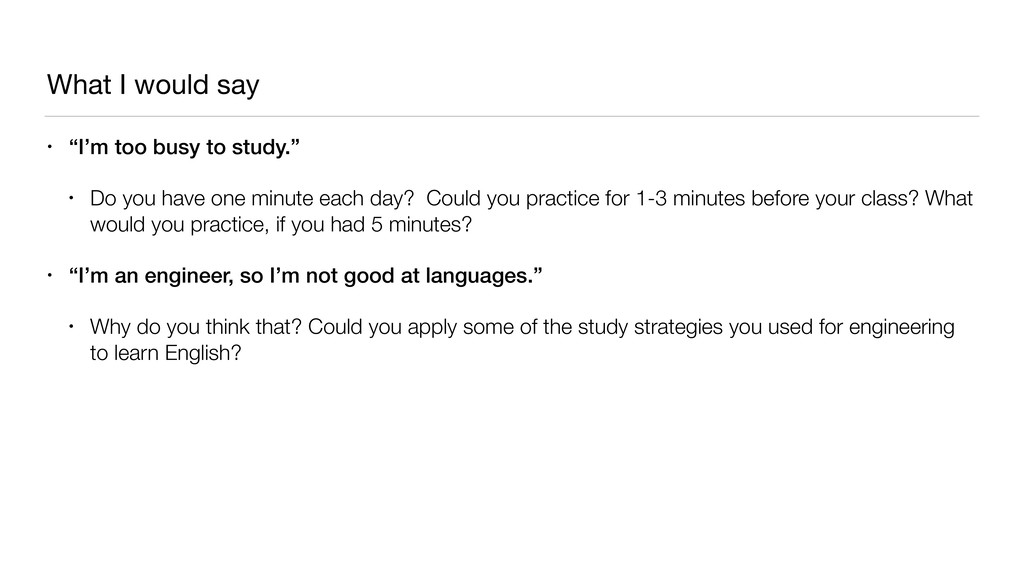
  8. What I would say • “I’m too busy to study.”

    • Do you have one minute each day? Could you practice for 1-3 minutes before your class? What would you practice, if you had 5 minutes? • “I’m an engineer, so I’m not good at languages.” • Why do you think that? Could you apply some of the study strategies you used for engineering to learn English?
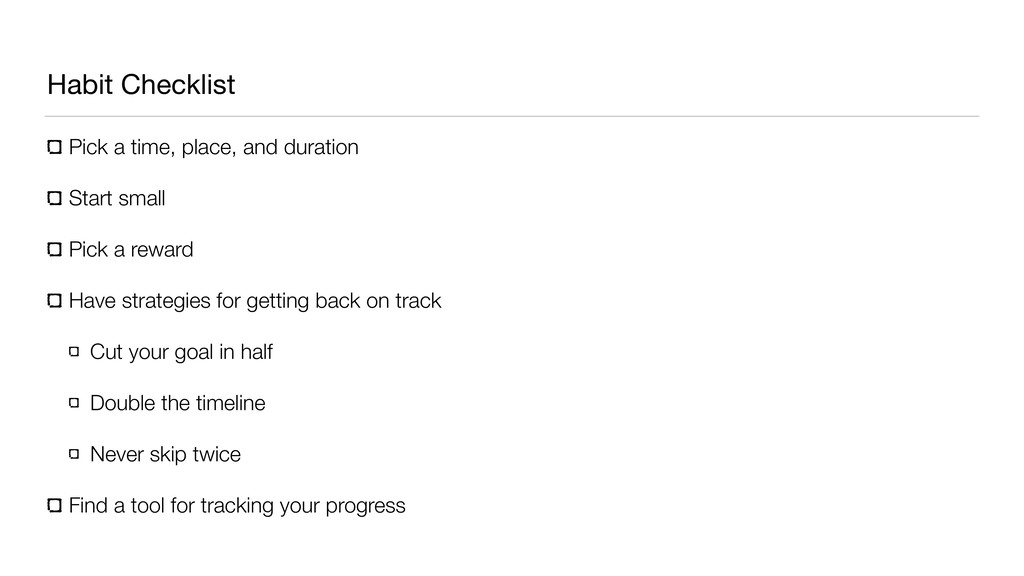
  9. Habit Checklist Pick a time, place, and duration Start small

    Pick a reward Have strategies for getting back on track Cut your goal in half Double the timeline Never skip twice Find a tool for tracking your progress
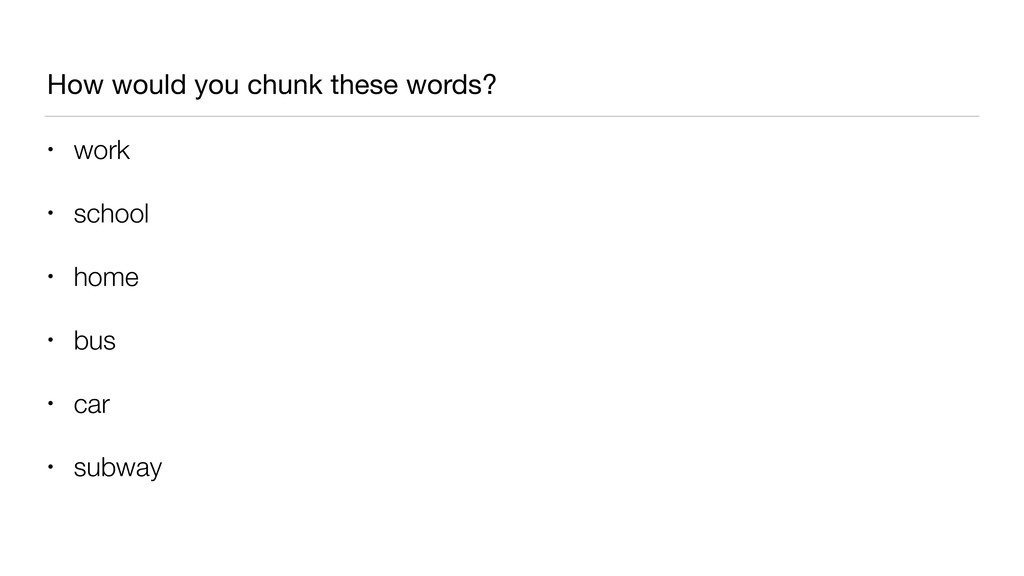
  10. How would you chunk these words? • work • school

    • home • bus • car • subway
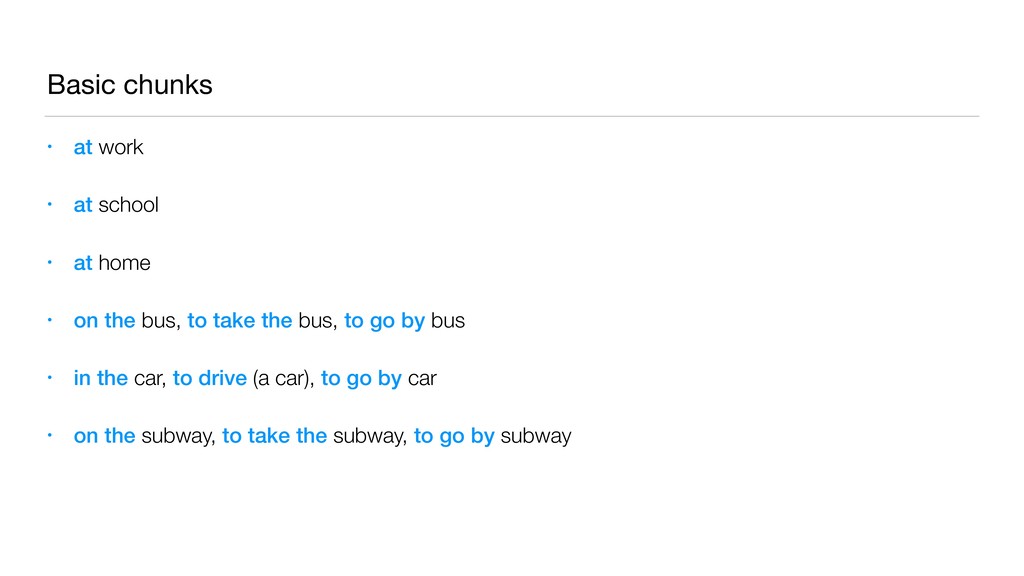
  11. Basic chunks • at work • at school • at

    home • on the bus, to take the bus, to go by bus • in the car, to drive (a car), to go by car • on the subway, to take the subway, to go by subway
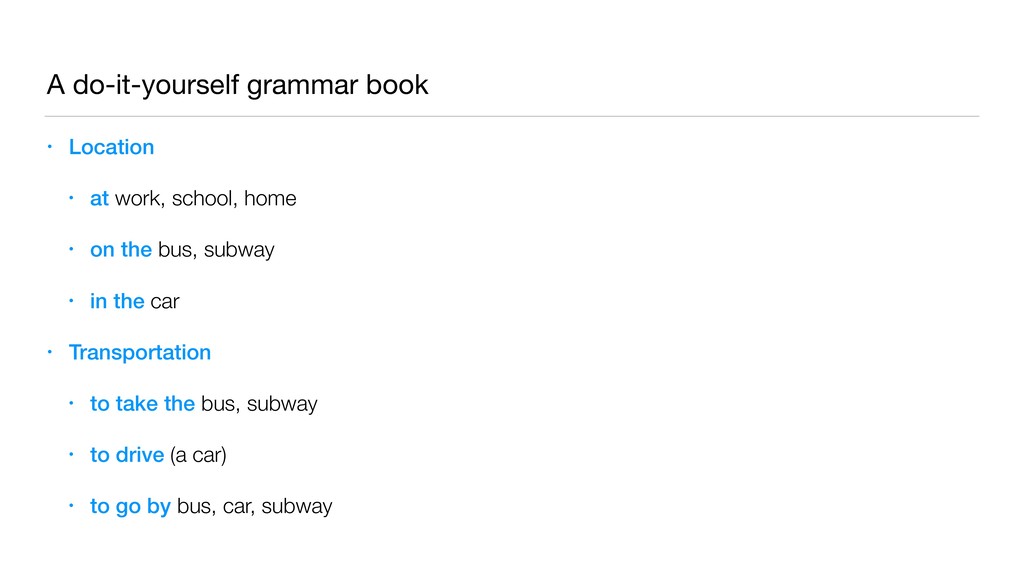
  12. A do-it-yourself grammar book • Location • at work, school,

    home • on the bus, subway • in the car • Transportation • to take the bus, subway • to drive (a car) • to go by bus, car, subway
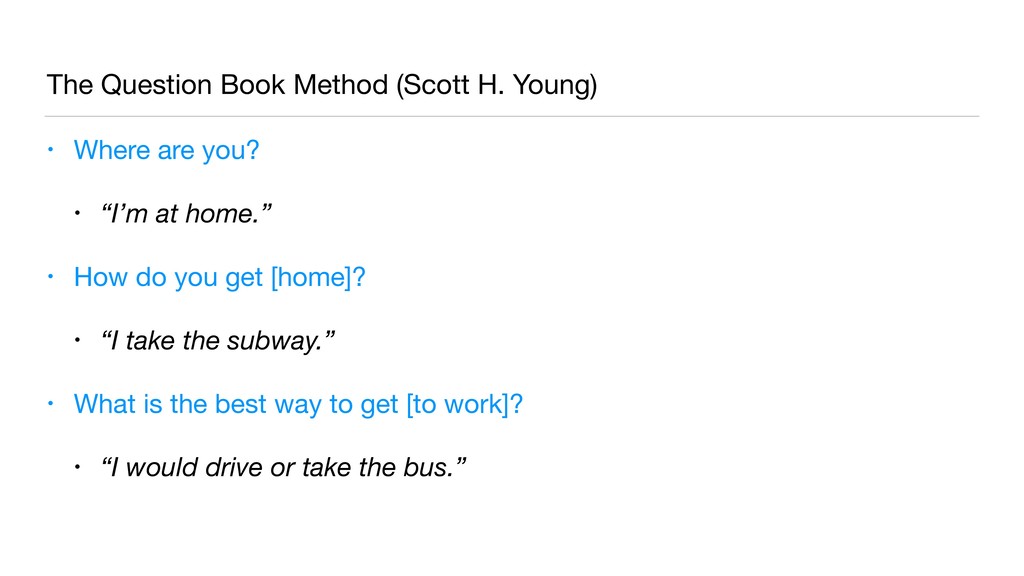
  13. The Question Book Method (Scott H. Young) • Where are

    you? • “I’m at home.” • How do you get [home]? • “I take the subway.” • What is the best way to get [to work]? • “I would drive or take the bus.”
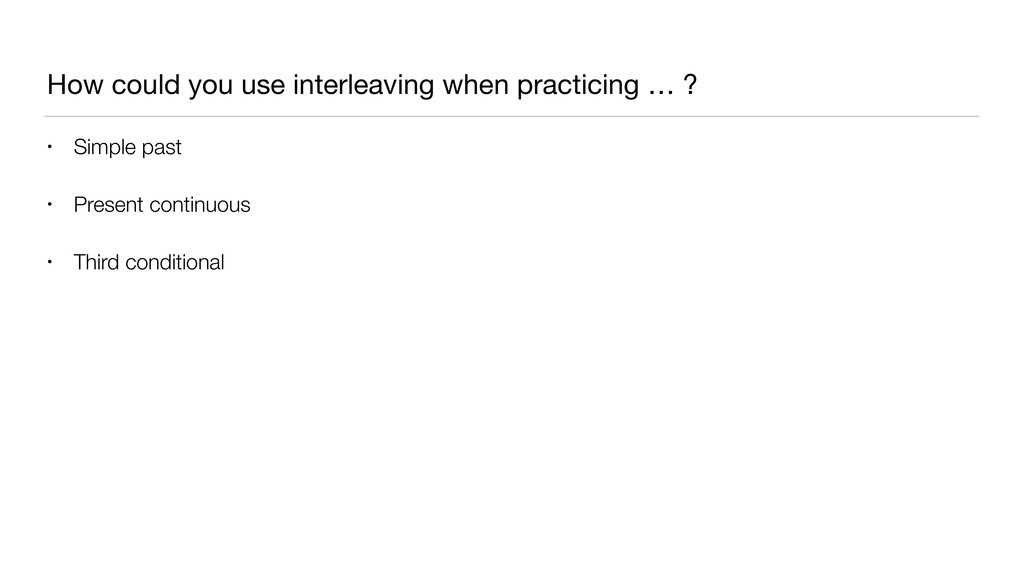
  14. How could you use interleaving when practicing … ? •

    Simple past • Present continuous • Third conditional
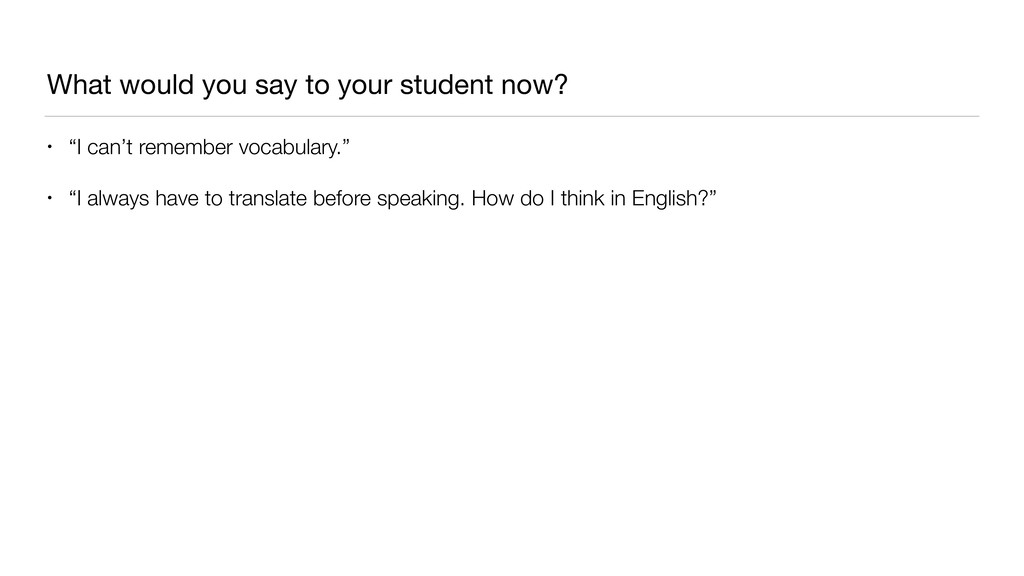
  15. What would you say to your student now? • “I

    can’t remember vocabulary.” • “I always have to translate before speaking. How do I think in English?”
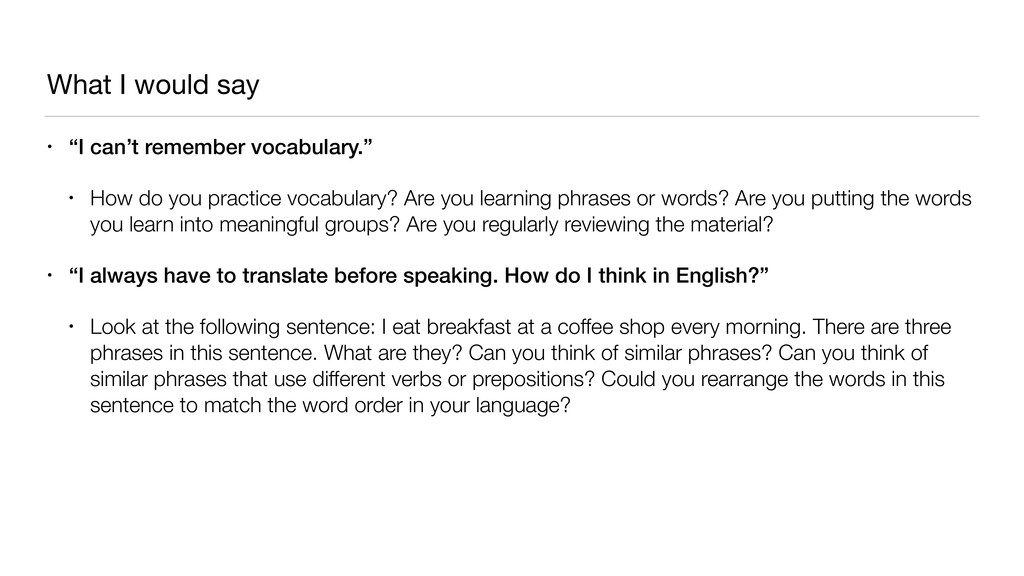
  16. What I would say • “I can’t remember vocabulary.” •

    How do you practice vocabulary? Are you learning phrases or words? Are you putting the words you learn into meaningful groups? Are you regularly reviewing the material? • “I always have to translate before speaking. How do I think in English?” • Look at the following sentence: I eat breakfast at a coffee shop every morning. There are three phrases in this sentence. What are they? Can you think of similar phrases? Can you think of similar phrases that use different verbs or prepositions? Could you rearrange the words in this sentence to match the word order in your language?
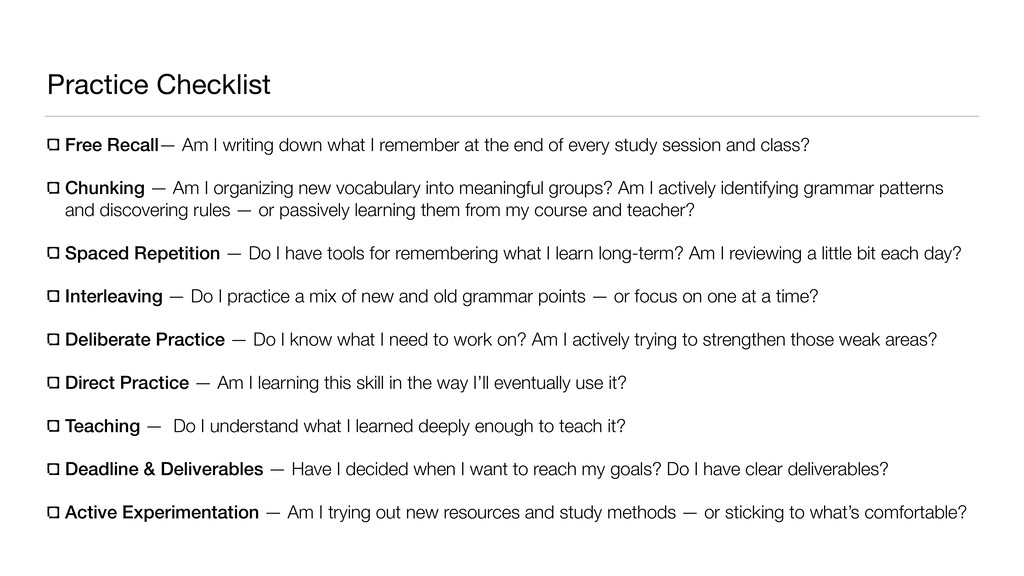
  17. Practice Checklist Free Recall— Am I writing down what I

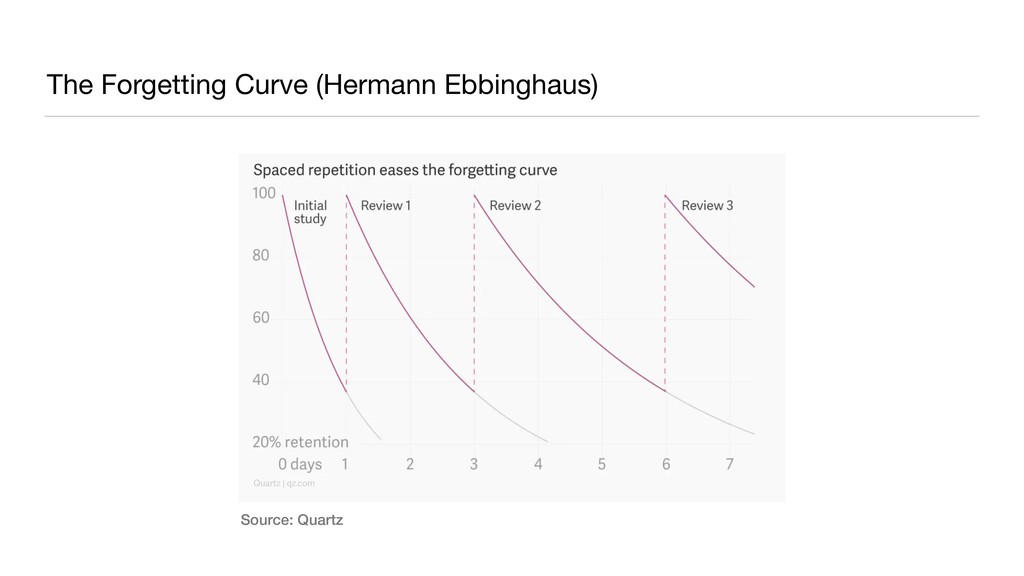
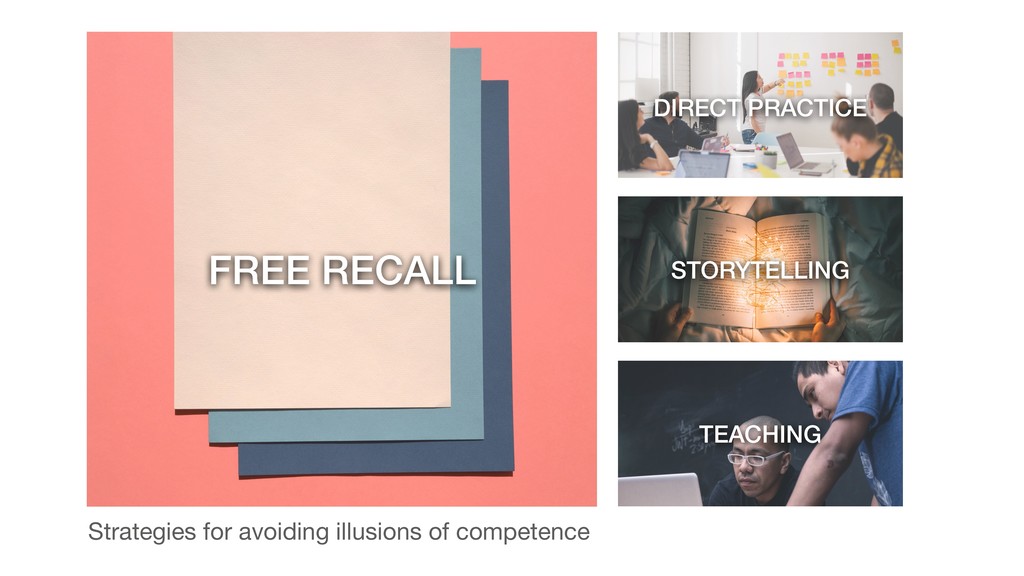
    remember at the end of every study session and class? Chunking — Am I organizing new vocabulary into meaningful groups? Am I actively identifying grammar patterns and discovering rules — or passively learning them from my course and teacher? Spaced Repetition — Do I have tools for remembering what I learn long-term? Am I reviewing a little bit each day? Interleaving — Do I practice a mix of new and old grammar points — or focus on one at a time? Deliberate Practice — Do I know what I need to work on? Am I actively trying to strengthen those weak areas? Direct Practice — Am I learning this skill in the way I’ll eventually use it? Teaching — Do I understand what I learned deeply enough to teach it? Deadline & Deliverables — Have I decided when I want to reach my goals? Do I have clear deliverables? Active Experimentation — Am I trying out new resources and study methods — or sticking to what’s comfortable?
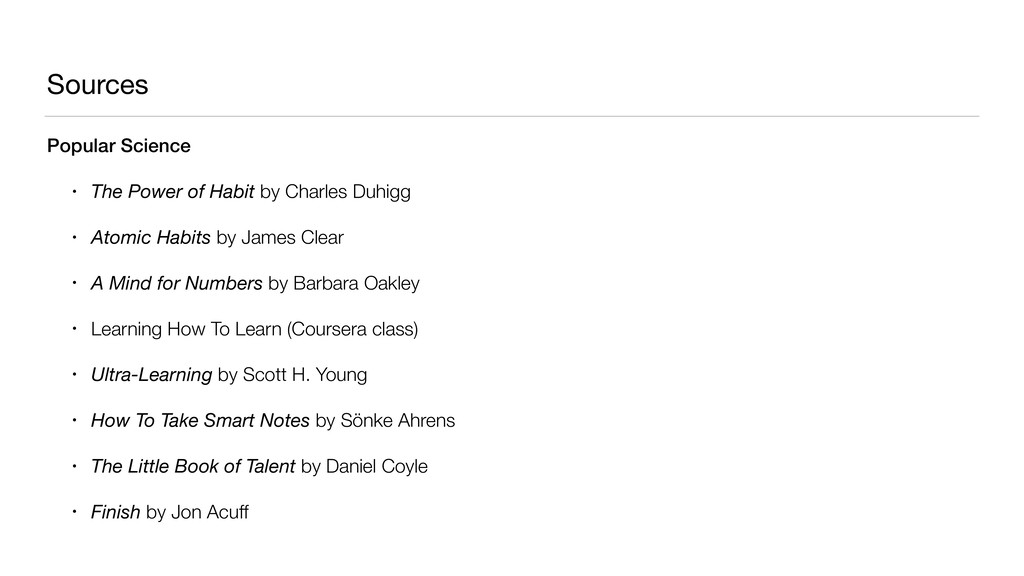
  18. Sources Popular Science • The Power of Habit by Charles

    Duhigg • Atomic Habits by James Clear • A Mind for Numbers by Barbara Oakley • Learning How To Learn (Coursera class) • Ultra-Learning by Scott H. Young • How To Take Smart Notes by Sönke Ahrens • The Little Book of Talent by Daniel Coyle • Finish by Jon Acuff
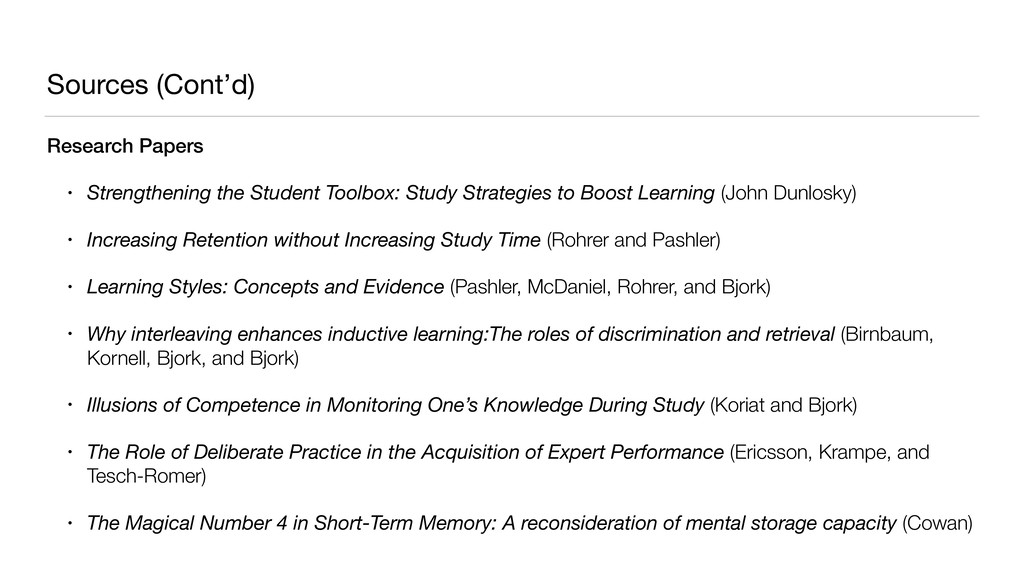
  19. Sources (Cont’d) Research Papers • Strengthening the Student Toolbox: Study

    Strategies to Boost Learning (John Dunlosky) • Increasing Retention without Increasing Study Time (Rohrer and Pashler) • Learning Styles: Concepts and Evidence (Pashler, McDaniel, Rohrer, and Bjork) • Why interleaving enhances inductive learning:The roles of discrimination and retrieval (Birnbaum, Kornell, Bjork, and Bjork) • Illusions of Competence in Monitoring One’s Knowledge During Study (Koriat and Bjork) • The Role of Deliberate Practice in the Acquisition of Expert Performance (Ericsson, Krampe, and Tesch-Romer) • The Magical Number 4 in Short-Term Memory: A reconsideration of mental storage capacity (Cowan)