Upgrade to Pro — share decks privately, control downloads, hide ads and more …

Reasoning Models in Practice: From Inference- T...

Reasoning Models in Practice: From Inference- Time to Training-Time Scaling on Verifiable Tasks

Explore how recent reasoning models are built and improved in practice. We will look at several inference-time scaling techniques that improve reasoning performance without changing the base model. On the training side, we will introduce GRPO as a practical method for training reasoning models with RLVR (Reinforcement Learning with Verifiable Rewards). To make the ideas concrete, a lightweight implementation in PyTorch will be provided to demonstrate the core mechanisms behind these approaches.

Avatar for Dat Nguyen

Dat Nguyen

April 25, 2026

More Decks by Dat Nguyen

Other Decks in Technology

Transcript

  1. Reasoning Models in Practice: From Inference- Time to Training-Time Scaling

    on Verifiable Tasks VJAI SEMINAR #2 - 2026 Dat Nguyen VJAI Seminar #2 - 2026 Reasoning Models in Practice 1/93
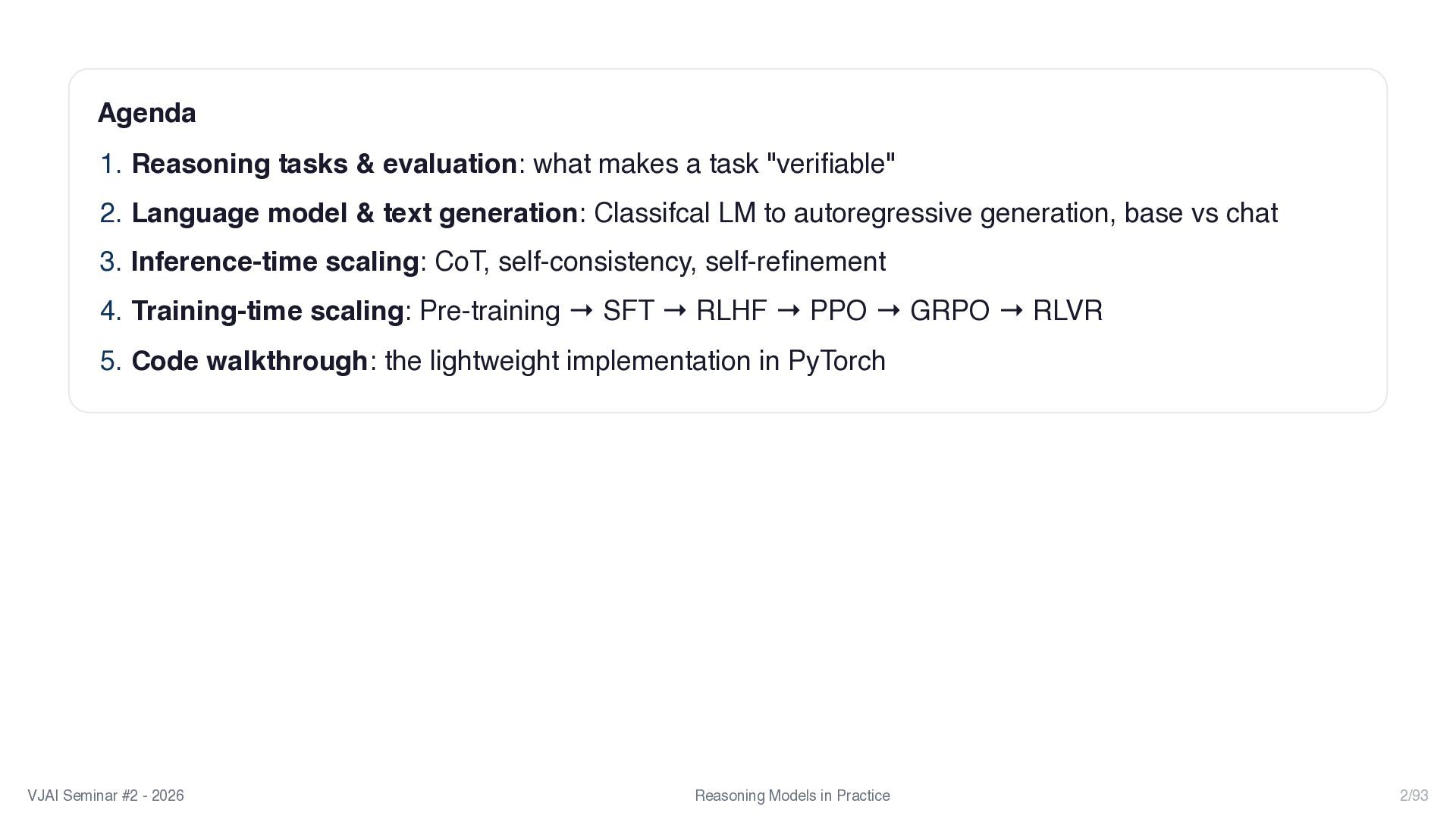
  2. Agenda 1. Reasoning tasks & evaluation: what makes a task

    "verifiable" 2. Language model & text generation: Classifcal LM to autoregressive generation, base vs chat 3. Inference-time scaling: CoT, self-consistency, self-refinement 4. Training-time scaling: Pre-training → SFT → RLHF → PPO → GRPO → RLVR 5. Code walkthrough: the lightweight implementation in PyTorch VJAI Seminar #2 - 2026 Reasoning Models in Practice 2/93
  3. Part 1 — Reasoning tasks & evaluation VJAI Seminar #2

    - 2026 Reasoning Models in Practice 3/93
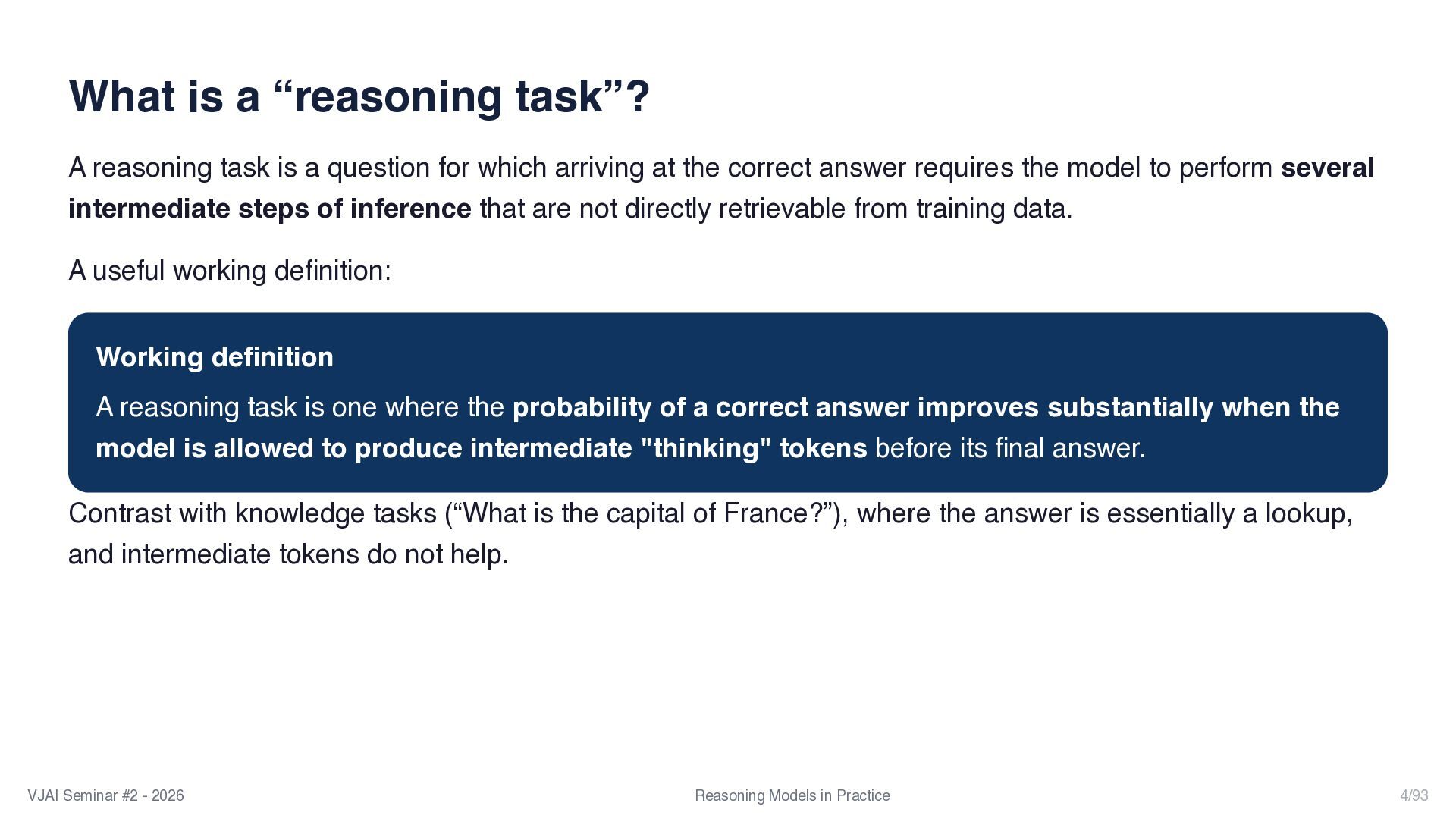
  4. What is a “reasoning task”? A reasoning task is a

    question for which arriving at the correct answer requires the model to perform several intermediate steps of inference that are not directly retrievable from training data. A useful working definition: Working definition A reasoning task is one where the probability of a correct answer improves substantially when the model is allowed to produce intermediate "thinking" tokens before its final answer. Contrast with knowledge tasks (“What is the capital of France?”), where the answer is essentially a lookup, and intermediate tokens do not help. VJAI Seminar #2 - 2026 Reasoning Models in Practice 4/93
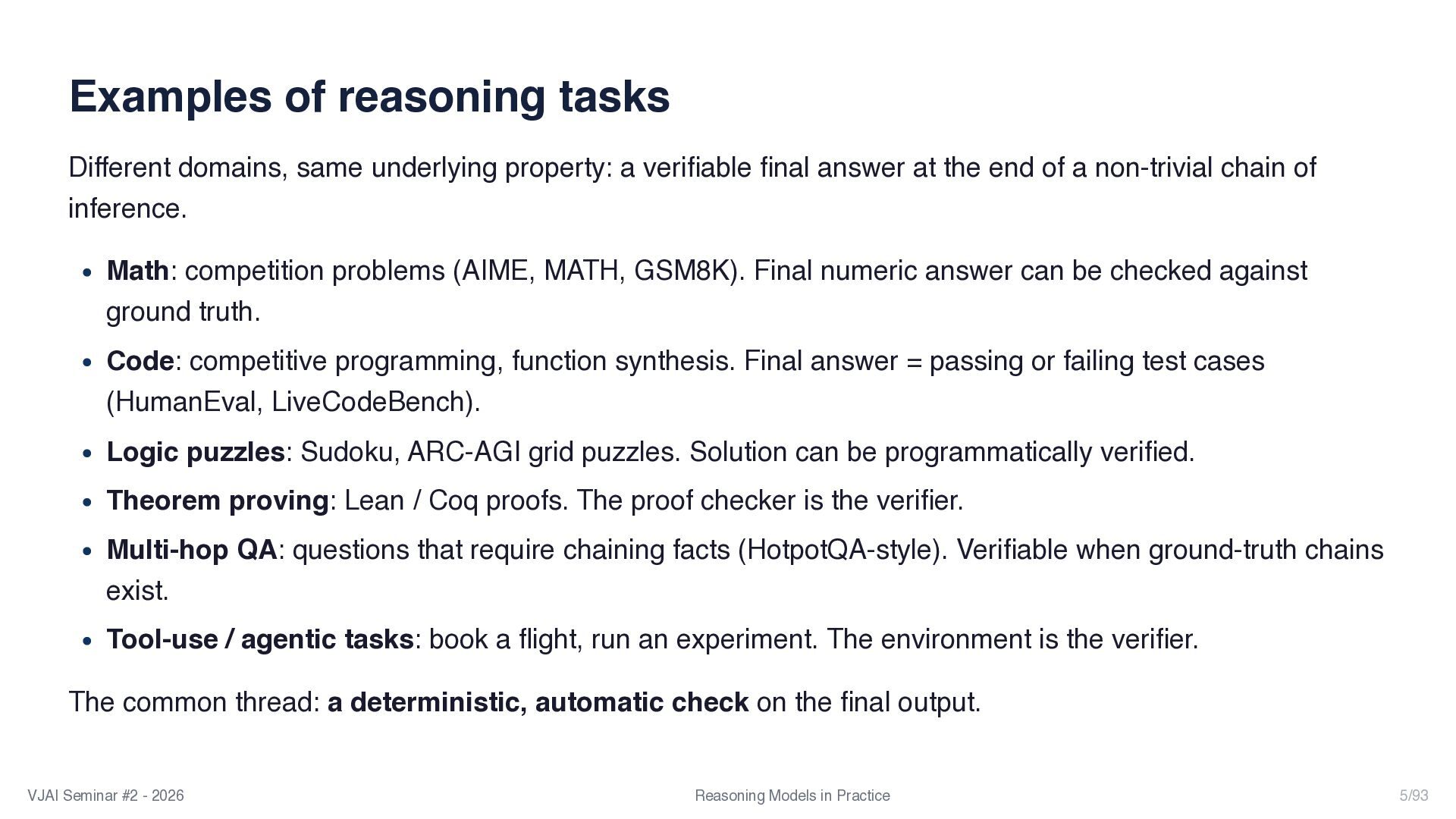
  5. Examples of reasoning tasks Different domains, same underlying property: a

    verifiable final answer at the end of a non-trivial chain of inference. Math: competition problems (AIME, MATH, GSM8K). Final numeric answer can be checked against ground truth. Code: competitive programming, function synthesis. Final answer = passing or failing test cases (HumanEval, LiveCodeBench). Logic puzzles: Sudoku, ARC-AGI grid puzzles. Solution can be programmatically verified. Theorem proving: Lean / Coq proofs. The proof checker is the verifier. Multi-hop QA: questions that require chaining facts (HotpotQA-style). Verifiable when ground-truth chains exist. Tool-use / agentic tasks: book a flight, run an experiment. The environment is the verifier. The common thread: a deterministic, automatic check on the final output. VJAI Seminar #2 - 2026 Reasoning Models in Practice 5/93
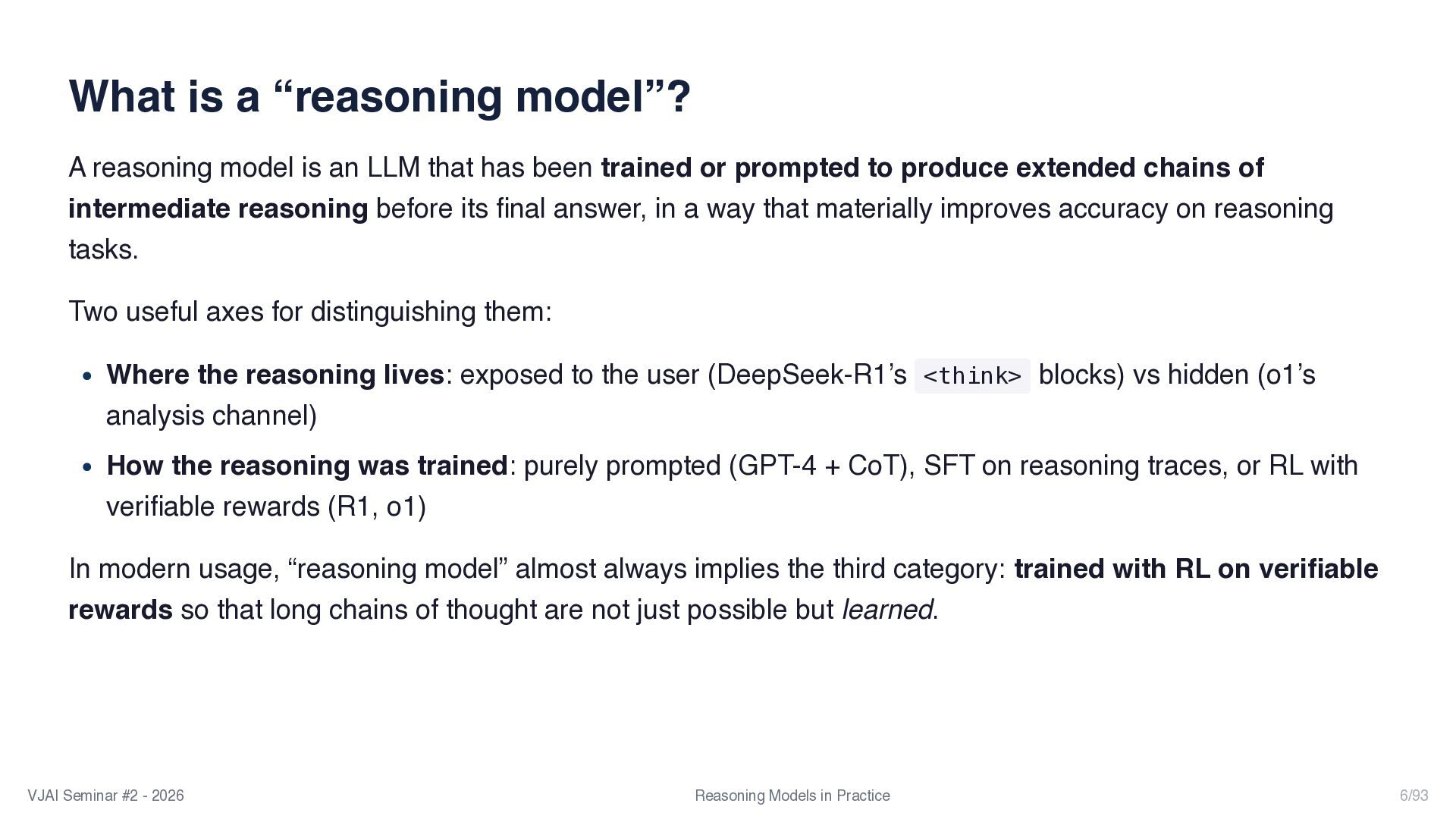
  6. What is a “reasoning model”? A reasoning model is an

    LLM that has been trained or prompted to produce extended chains of intermediate reasoning before its final answer, in a way that materially improves accuracy on reasoning tasks. Two useful axes for distinguishing them: Where the reasoning lives: exposed to the user (DeepSeek-R1’s <think> blocks) vs hidden (o1’s analysis channel) How the reasoning was trained: purely prompted (GPT-4 + CoT), SFT on reasoning traces, or RL with verifiable rewards (R1, o1) In modern usage, “reasoning model” almost always implies the third category: trained with RL on verifiable rewards so that long chains of thought are not just possible but learned. VJAI Seminar #2 - 2026 Reasoning Models in Practice 6/93
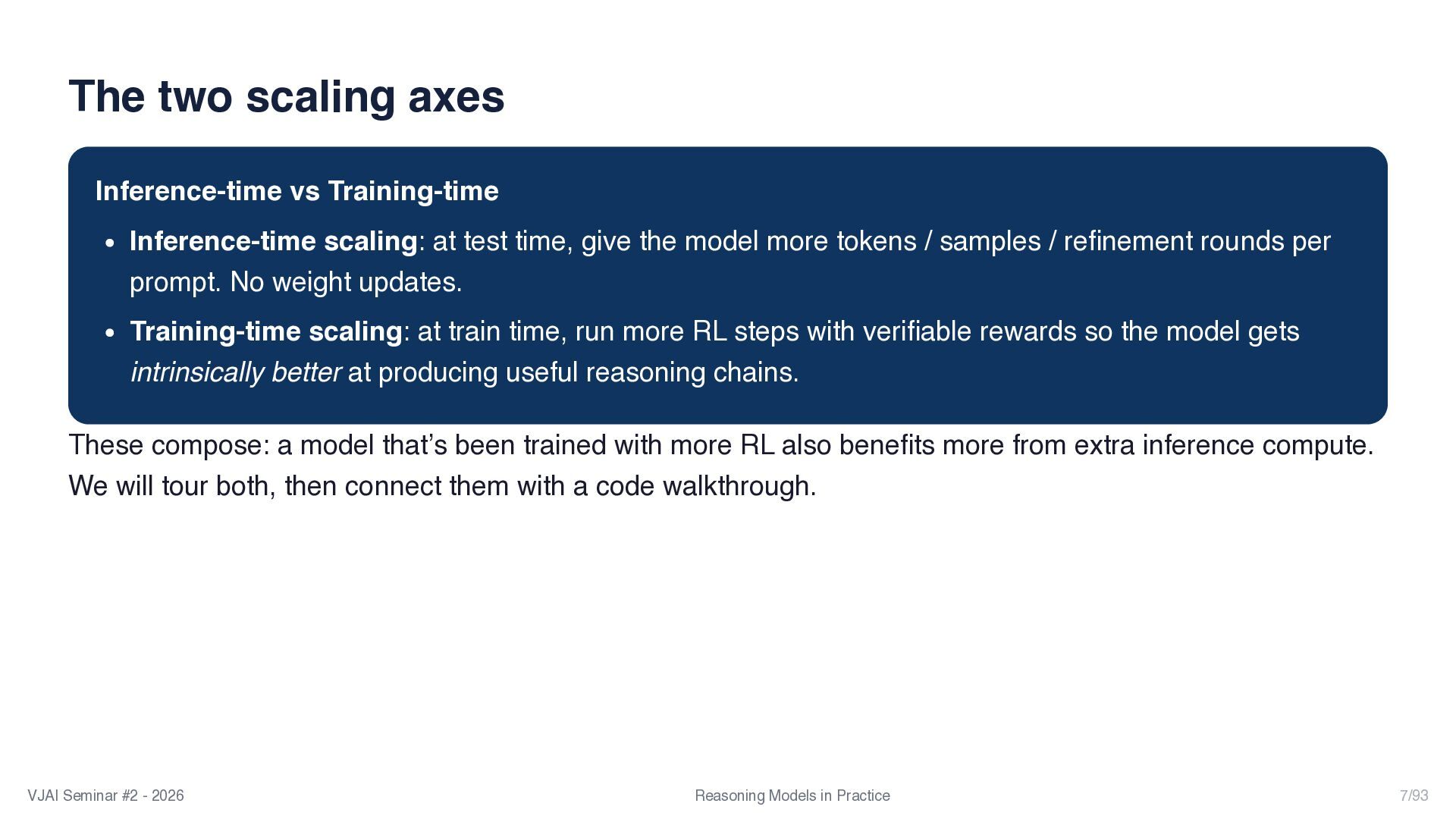
  7. The two scaling axes Inference-time vs Training-time Inference-time scaling: at

    test time, give the model more tokens / samples / refinement rounds per prompt. No weight updates. Training-time scaling: at train time, run more RL steps with verifiable rewards so the model gets intrinsically better at producing useful reasoning chains. These compose: a model that’s been trained with more RL also benefits more from extra inference compute. We will tour both, then connect them with a code walkthrough. VJAI Seminar #2 - 2026 Reasoning Models in Practice 7/93
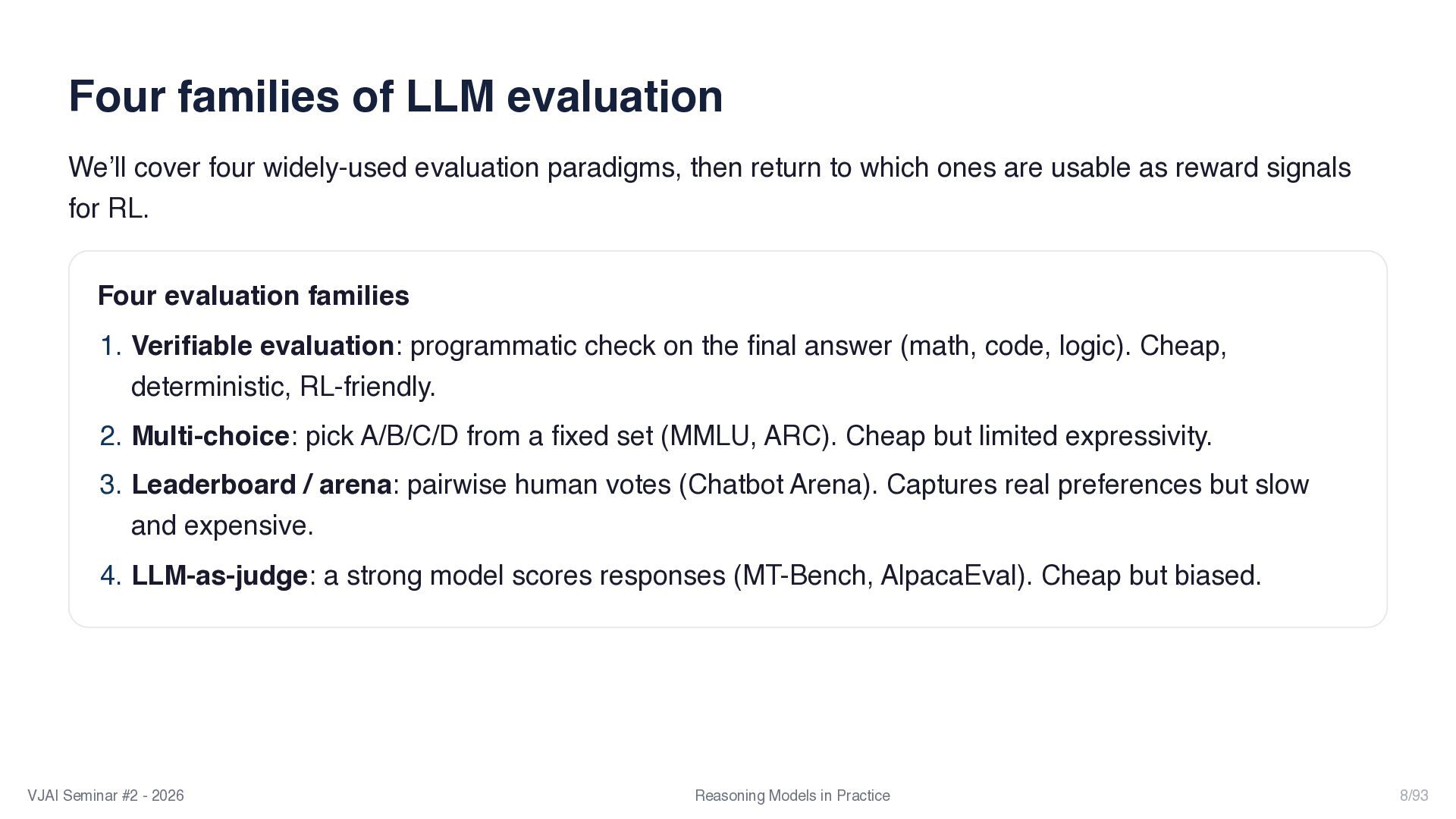
  8. Four families of LLM evaluation We’ll cover four widely-used evaluation

    paradigms, then return to which ones are usable as reward signals for RL. Four evaluation families 1. Verifiable evaluation: programmatic check on the final answer (math, code, logic). Cheap, deterministic, RL-friendly. 2. Multi-choice: pick A/B/C/D from a fixed set (MMLU, ARC). Cheap but limited expressivity. 3. Leaderboard / arena: pairwise human votes (Chatbot Arena). Captures real preferences but slow and expensive. 4. LLM-as-judge: a strong model scores responses (MT-Bench, AlpacaEval). Cheap but biased. VJAI Seminar #2 - 2026 Reasoning Models in Practice 8/93
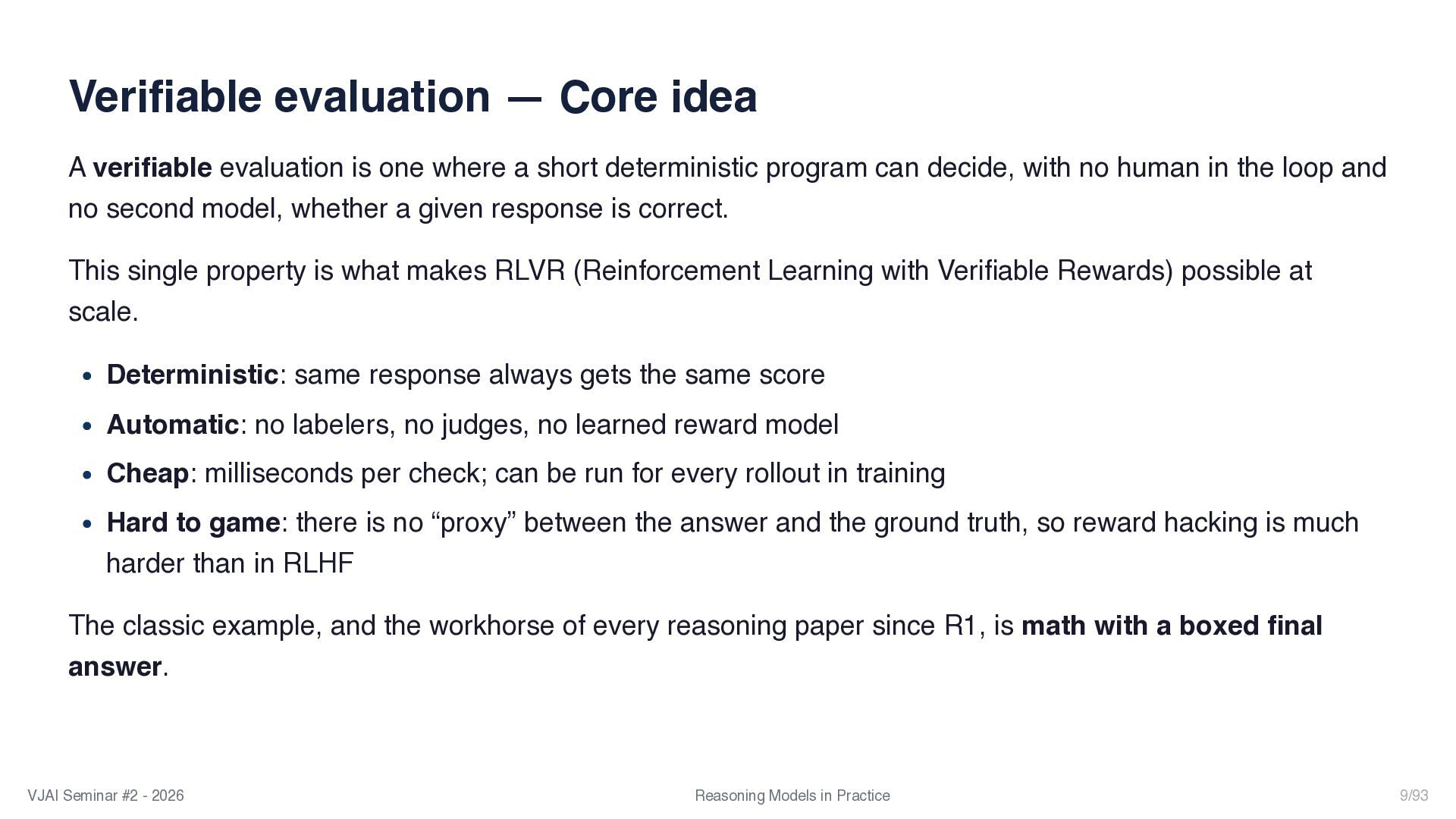
  9. Verifiable evaluation — Core idea A verifiable evaluation is one

    where a short deterministic program can decide, with no human in the loop and no second model, whether a given response is correct. This single property is what makes RLVR (Reinforcement Learning with Verifiable Rewards) possible at scale. Deterministic: same response always gets the same score Automatic: no labelers, no judges, no learned reward model Cheap: milliseconds per check; can be run for every rollout in training Hard to game: there is no “proxy” between the answer and the ground truth, so reward hacking is much harder than in RLHF The classic example, and the workhorse of every reasoning paper since R1, is math with a boxed final answer. VJAI Seminar #2 - 2026 Reasoning Models in Practice 9/93
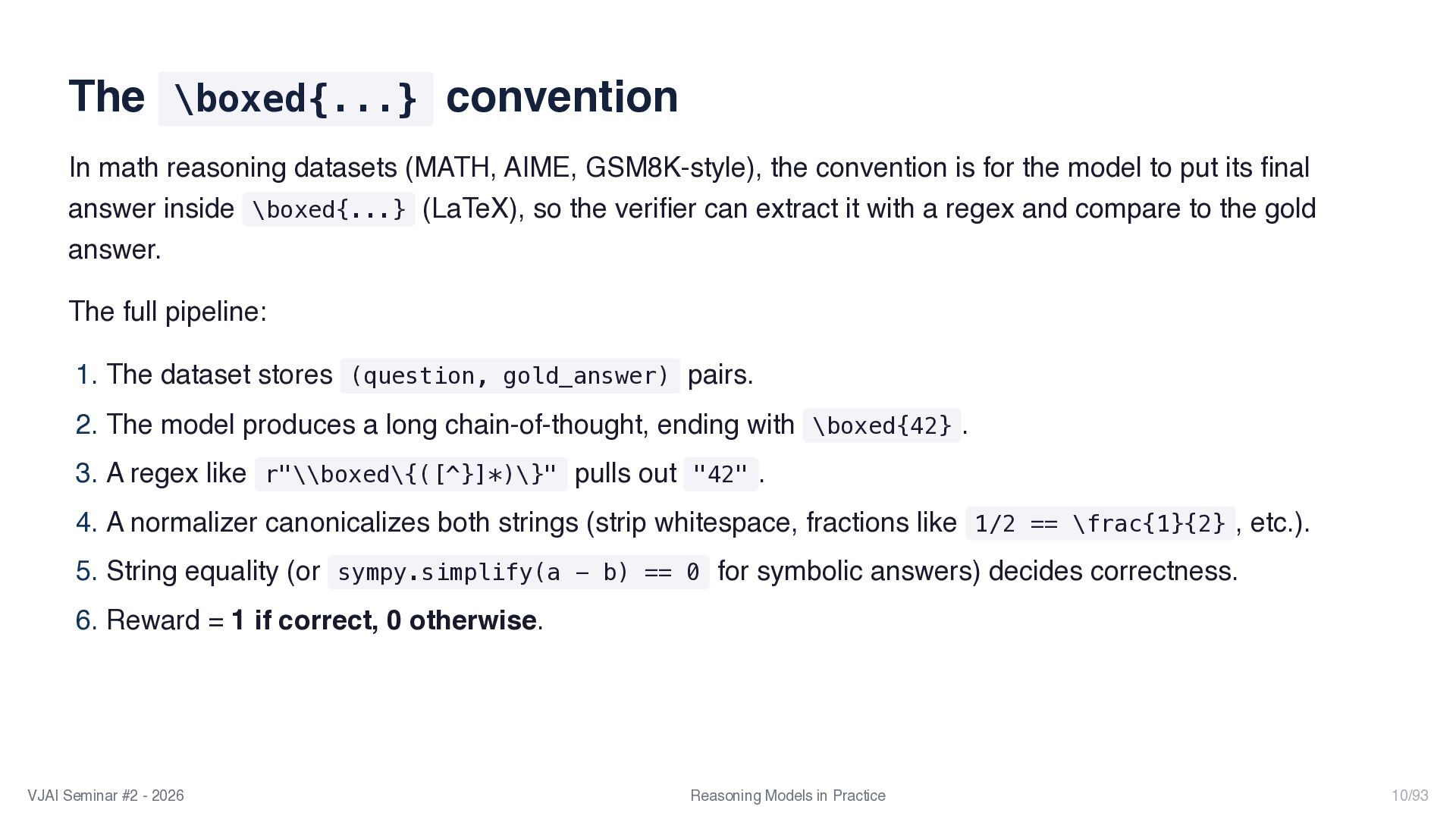
  10. The \boxed{...} convention In math reasoning datasets (MATH, AIME, GSM8K-style),

    the convention is for the model to put its final answer inside \boxed{...} (LaTeX), so the verifier can extract it with a regex and compare to the gold answer. The full pipeline: 1. The dataset stores (question, gold_answer) pairs. 2. The model produces a long chain-of-thought, ending with \boxed{42} . 3. A regex like r"\\boxed\{([^}]*)\}" pulls out "42" . 4. A normalizer canonicalizes both strings (strip whitespace, fractions like 1/2 == \frac{1}{2} , etc.). 5. String equality (or sympy.simplify(a - b) == 0 for symbolic answers) decides correctness. 6. Reward = 1 if correct, 0 otherwise. VJAI Seminar #2 - 2026 Reasoning Models in Practice 10/93
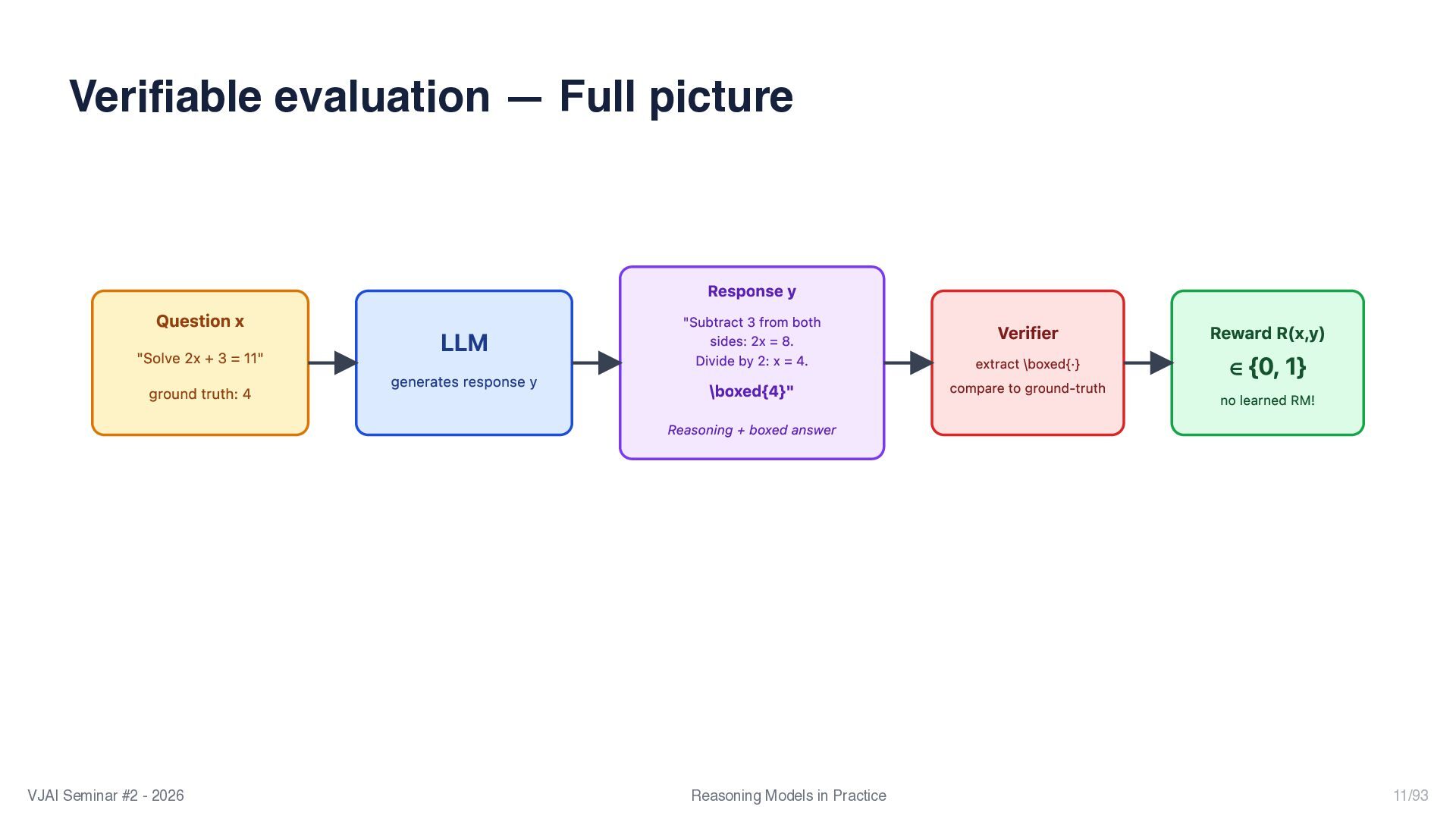
  11. Verifiable evaluation — Full picture Question x "Solve 2x +

    3 = 11" ground truth: 4 LLM generates response y Response y "Subtract 3 from both sides: 2x = 8. Divide by 2: x = 4. \boxed{4}" Reasoning + boxed answer Verifier extract \boxed{·} compare to ground-truth Reward R(x,y) ∈ {0, 1} no learned RM! VJAI Seminar #2 - 2026 Reasoning Models in Practice 11/93
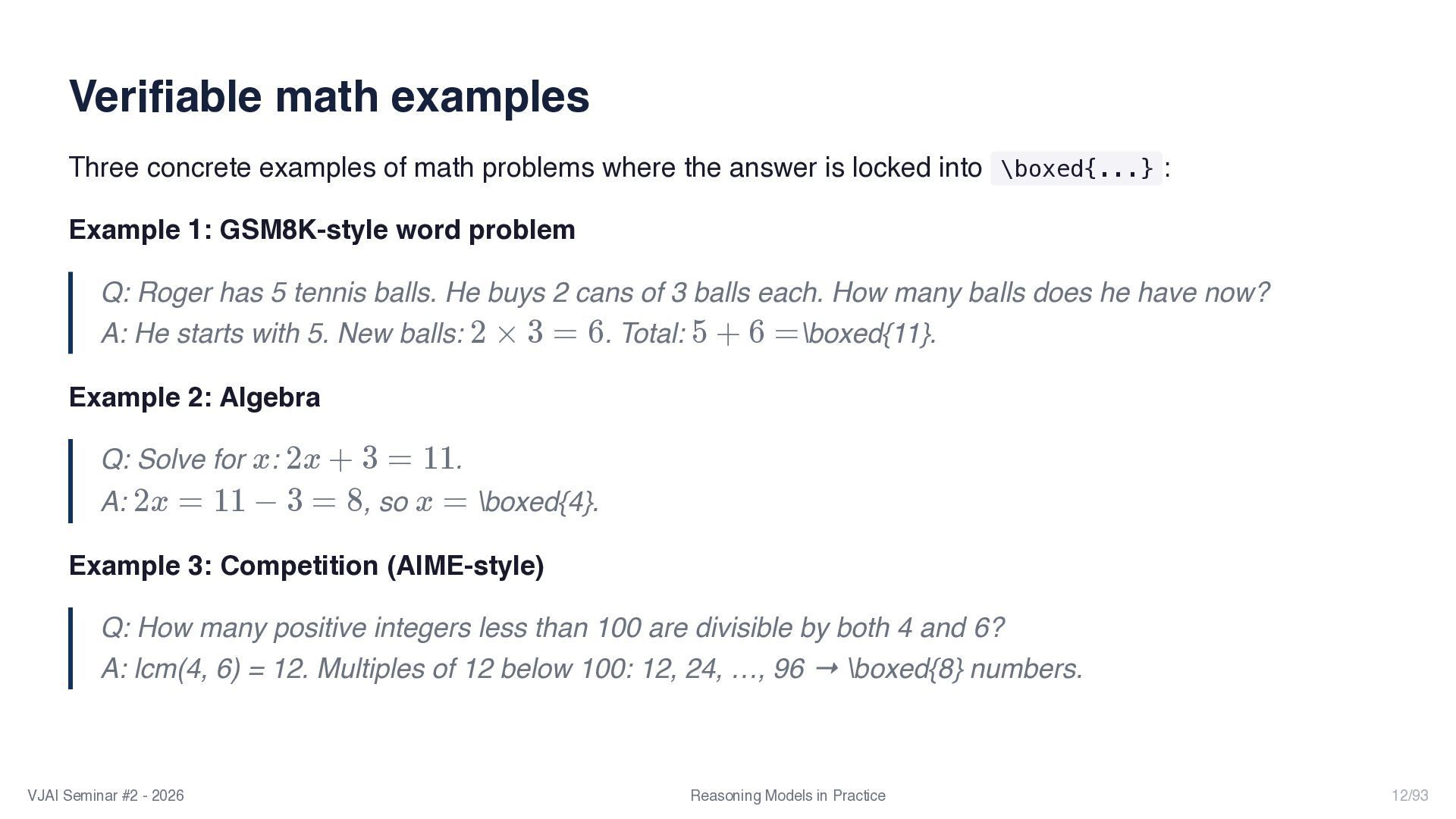
  12. Verifiable math examples Three concrete examples of math problems where

    the answer is locked into \boxed{...} : Example 1: GSM8K-style word problem Q: Roger has 5 tennis balls. He buys 2 cans of 3 balls each. How many balls does he have now? A: He starts with 5. New balls: . Total: \boxed{11}. Example 2: Algebra Q: Solve for : . A: , so \boxed{4}. Example 3: Competition (AIME-style) Q: How many positive integers less than 100 are divisible by both 4 and 6? A: lcm(4, 6) = 12. Multiples of 12 below 100: 12, 24, …, 96 → \boxed{8} numbers. 2 × 3 = 6 5 + 6 = x 2x + 3 = 11 2x = 11 − 3 = 8 x = VJAI Seminar #2 - 2026 Reasoning Models in Practice 12/93
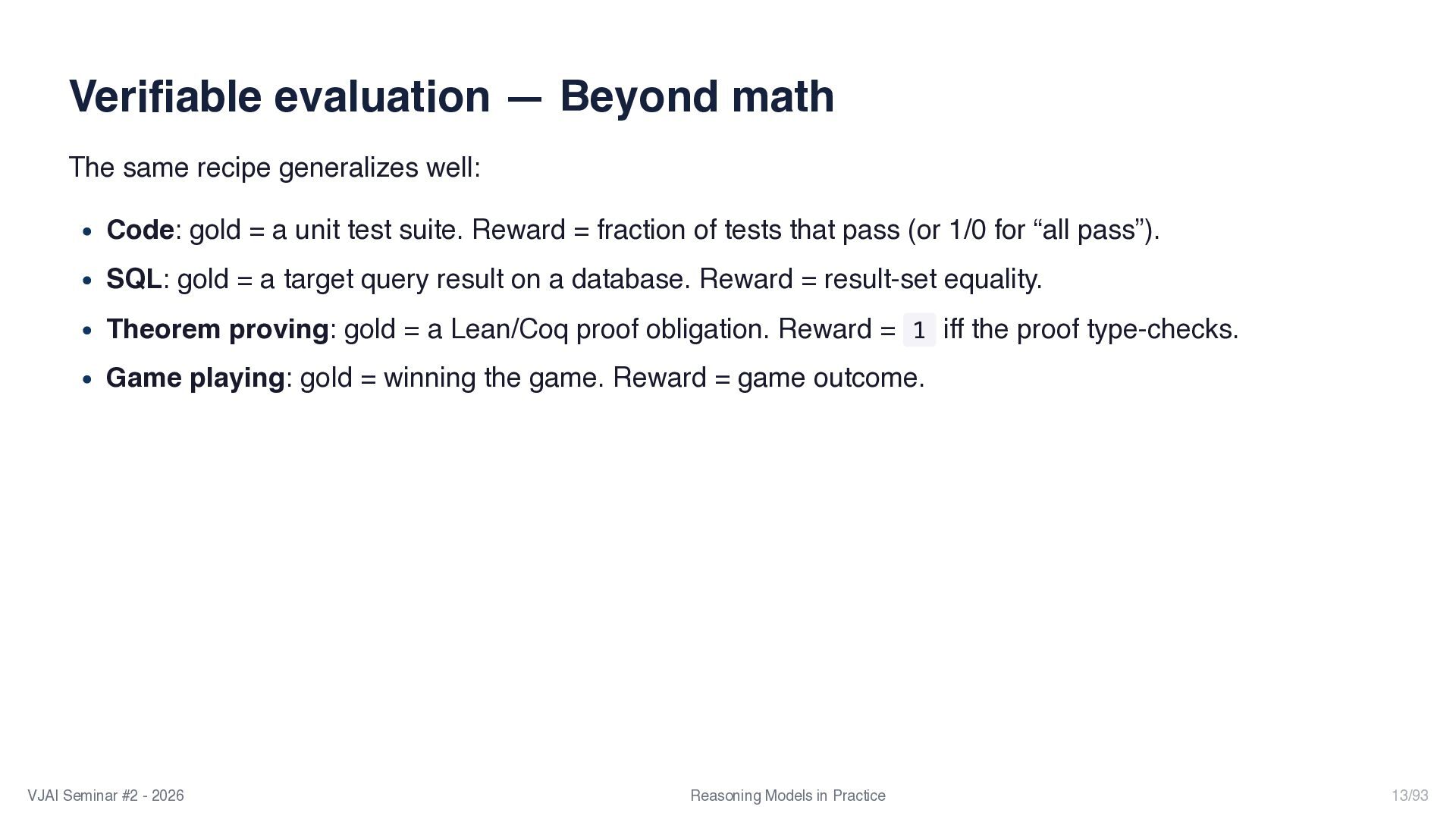
  13. Verifiable evaluation — Beyond math The same recipe generalizes well:

    Code: gold = a unit test suite. Reward = fraction of tests that pass (or 1/0 for “all pass”). SQL: gold = a target query result on a database. Reward = result-set equality. Theorem proving: gold = a Lean/Coq proof obligation. Reward = 1 iff the proof type-checks. Game playing: gold = winning the game. Reward = game outcome. VJAI Seminar #2 - 2026 Reasoning Models in Practice 13/93
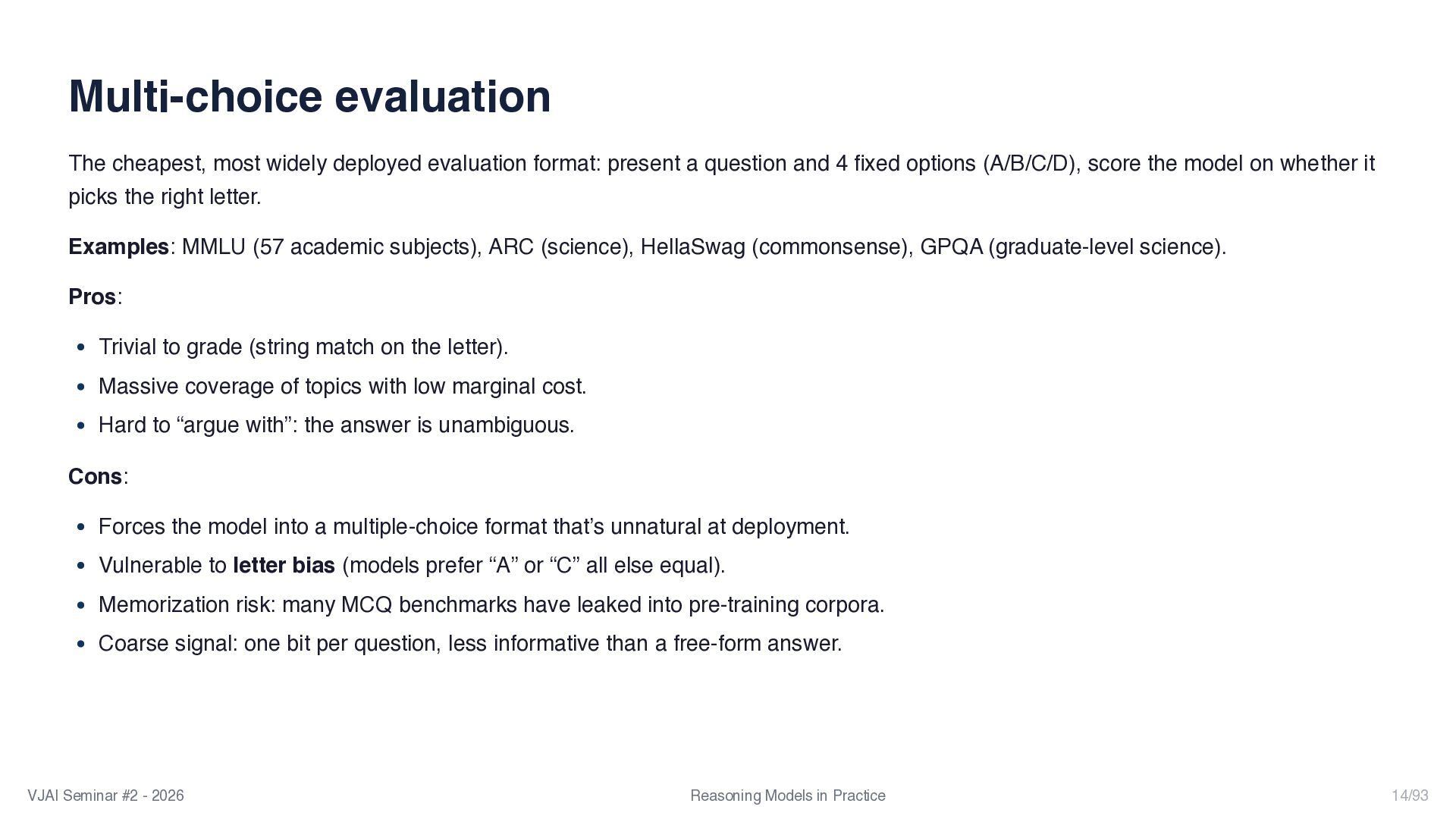
  14. Multi-choice evaluation The cheapest, most widely deployed evaluation format: present

    a question and 4 fixed options (A/B/C/D), score the model on whether it picks the right letter. Examples: MMLU (57 academic subjects), ARC (science), HellaSwag (commonsense), GPQA (graduate-level science). Pros: Trivial to grade (string match on the letter). Massive coverage of topics with low marginal cost. Hard to “argue with”: the answer is unambiguous. Cons: Forces the model into a multiple-choice format that’s unnatural at deployment. Vulnerable to letter bias (models prefer “A” or “C” all else equal). Memorization risk: many MCQ benchmarks have leaked into pre-training corpora. Coarse signal: one bit per question, less informative than a free-form answer. VJAI Seminar #2 - 2026 Reasoning Models in Practice 14/93
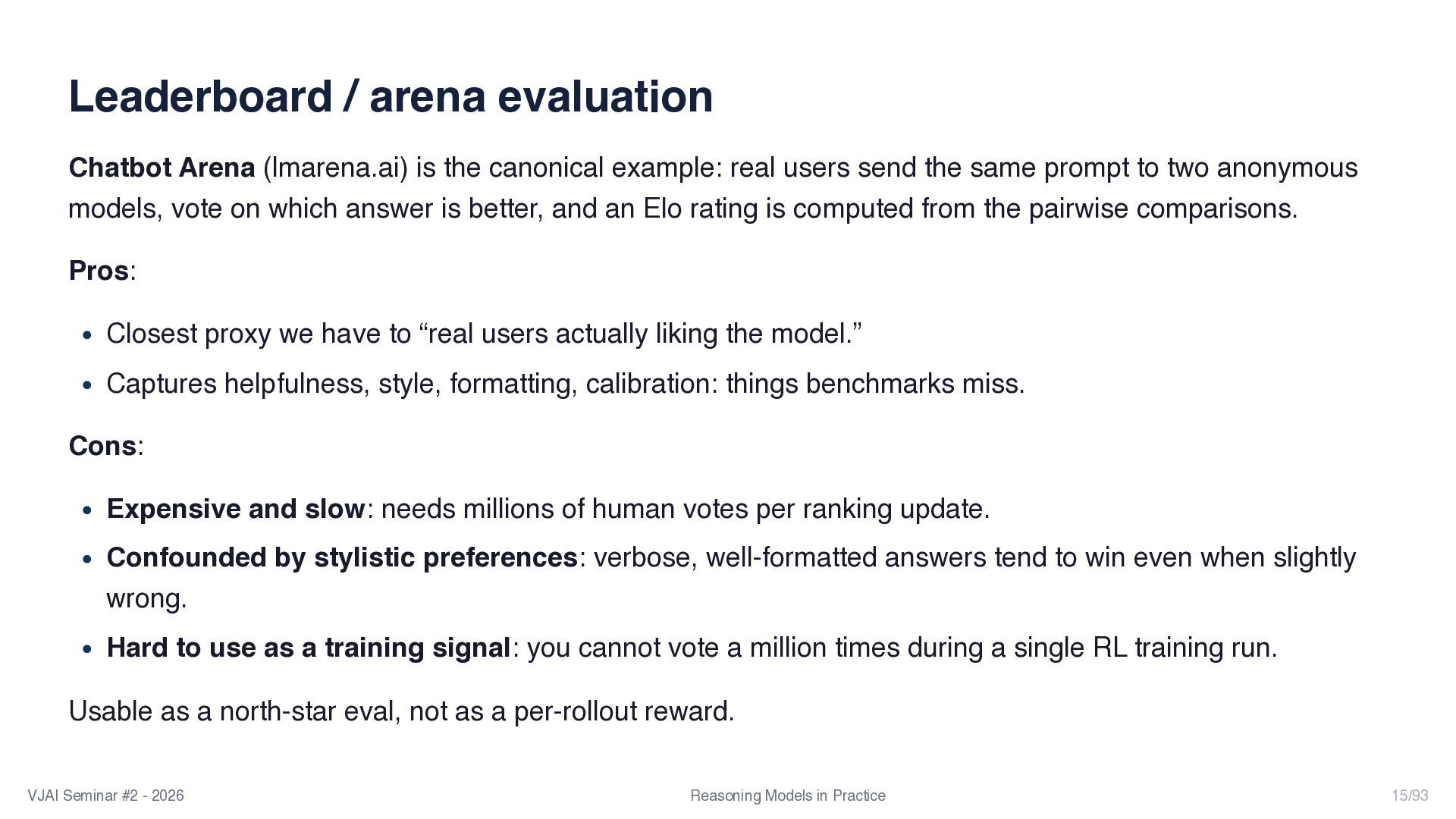
  15. Leaderboard / arena evaluation Chatbot Arena (lmarena.ai) is the canonical

    example: real users send the same prompt to two anonymous models, vote on which answer is better, and an Elo rating is computed from the pairwise comparisons. Pros: Closest proxy we have to “real users actually liking the model.” Captures helpfulness, style, formatting, calibration: things benchmarks miss. Cons: Expensive and slow: needs millions of human votes per ranking update. Confounded by stylistic preferences: verbose, well-formatted answers tend to win even when slightly wrong. Hard to use as a training signal: you cannot vote a million times during a single RL training run. Usable as a north-star eval, not as a per-rollout reward. VJAI Seminar #2 - 2026 Reasoning Models in Practice 15/93
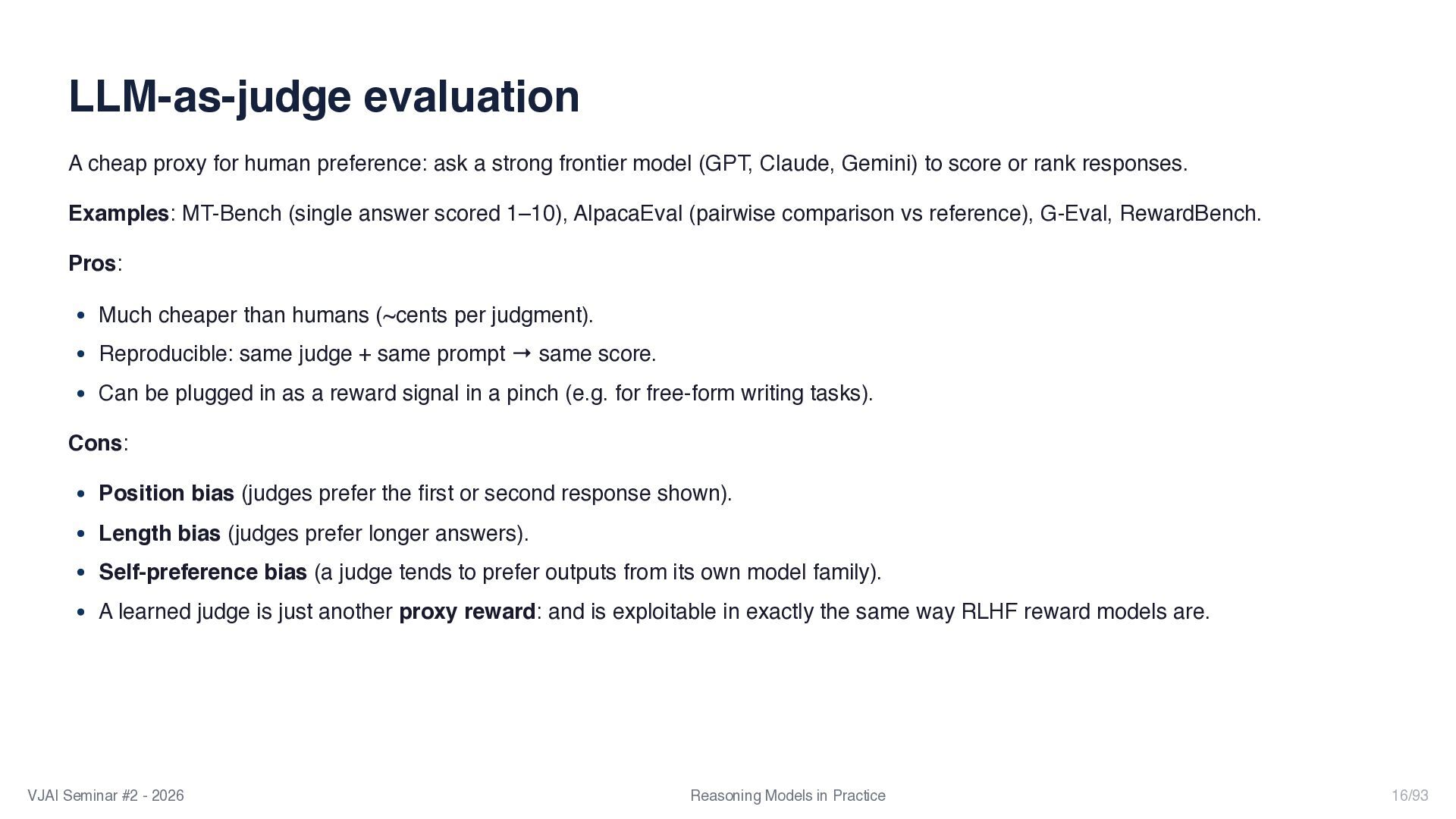
  16. LLM-as-judge evaluation A cheap proxy for human preference: ask a

    strong frontier model (GPT, Claude, Gemini) to score or rank responses. Examples: MT-Bench (single answer scored 1–10), AlpacaEval (pairwise comparison vs reference), G-Eval, RewardBench. Pros: Much cheaper than humans (~cents per judgment). Reproducible: same judge + same prompt → same score. Can be plugged in as a reward signal in a pinch (e.g. for free-form writing tasks). Cons: Position bias (judges prefer the first or second response shown). Length bias (judges prefer longer answers). Self-preference bias (a judge tends to prefer outputs from its own model family). A learned judge is just another proxy reward: and is exploitable in exactly the same way RLHF reward models are. VJAI Seminar #2 - 2026 Reasoning Models in Practice 16/93
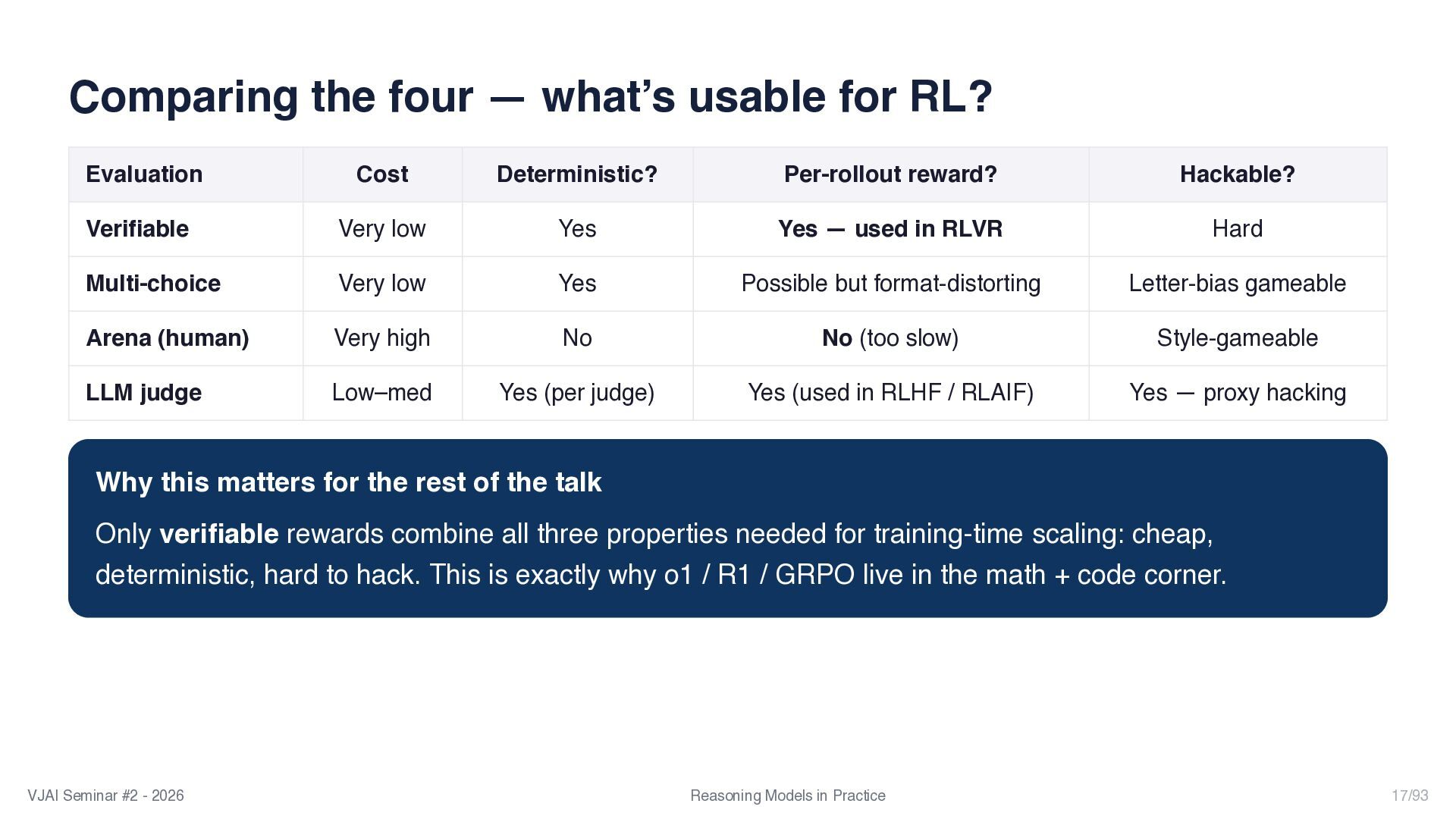
  17. Comparing the four — what’s usable for RL? Evaluation Cost

    Deterministic? Per-rollout reward? Hackable? Verifiable Very low Yes Yes — used in RLVR Hard Multi-choice Very low Yes Possible but format-distorting Letter-bias gameable Arena (human) Very high No No (too slow) Style-gameable LLM judge Low–med Yes (per judge) Yes (used in RLHF / RLAIF) Yes — proxy hacking Why this matters for the rest of the talk Only verifiable rewards combine all three properties needed for training-time scaling: cheap, deterministic, hard to hack. This is exactly why o1 / R1 / GRPO live in the math + code corner. VJAI Seminar #2 - 2026 Reasoning Models in Practice 17/93
  18. Part 2 — From classical language models to modern text

    generation VJAI Seminar #2 - 2026 Reasoning Models in Practice 18/93
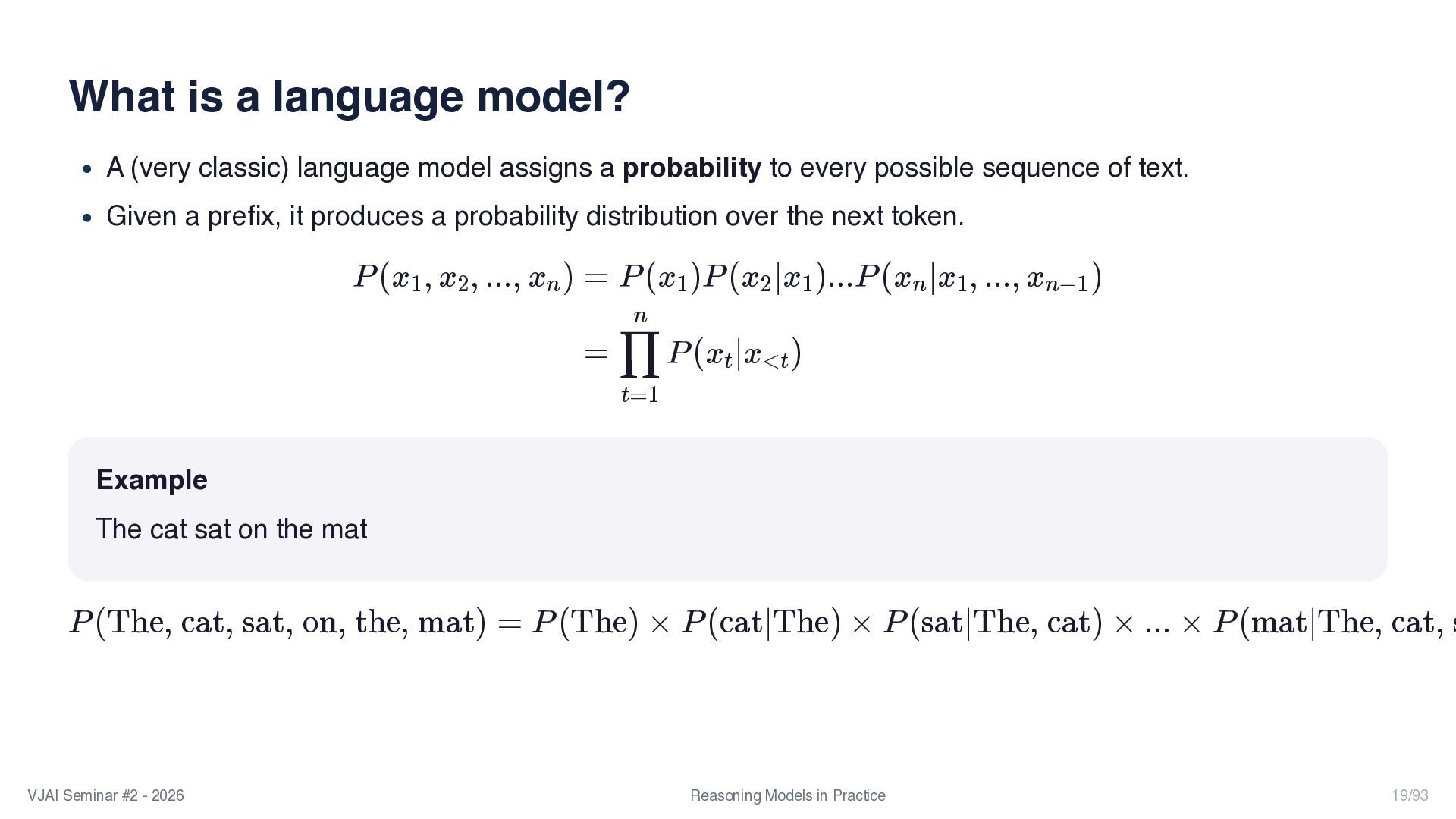
  19. What is a language model? A (very classic) language model

    assigns a probability to every possible sequence of text. Given a prefix, it produces a probability distribution over the next token. Example The cat sat on the mat ​ ​ P(x ​ , x ​ , ..., x ​ ) 1 2 n = P(x ​ )P(x ​ ∣x ​ )...P(x ​ ∣x ​ , ..., x ​ ) 1 2 1 n 1 n−1 = ​ P(x ​ ∣x ​ ) t=1 ∏ n t <t P(The, cat, sat, on, the, mat) = P(The) × P(cat∣The) × P(sat∣The, cat) × ... × P(mat∣The, cat, s VJAI Seminar #2 - 2026 Reasoning Models in Practice 19/93
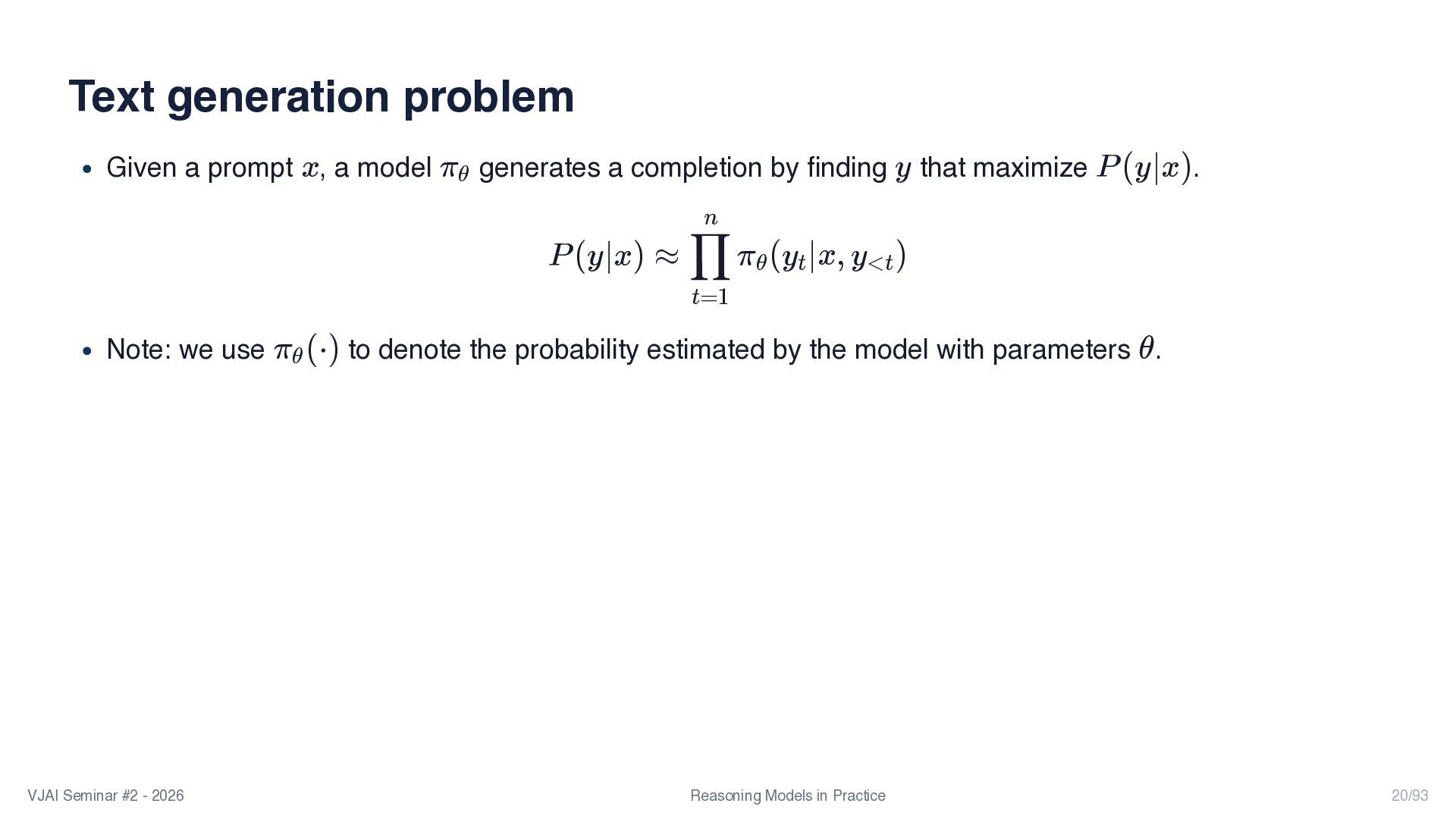
  20. Text generation problem Given a prompt , a model generates

    a completion by finding that maximize . Note: we use to denote the probability estimated by the model with parameters . x π ​ θ y P(y∣x) P(y∣x) ≈ ​ π ​ (y ​ ∣x, y ​ ) t=1 ∏ n θ t <t π ​ (⋅) θ θ VJAI Seminar #2 - 2026 Reasoning Models in Practice 20/93
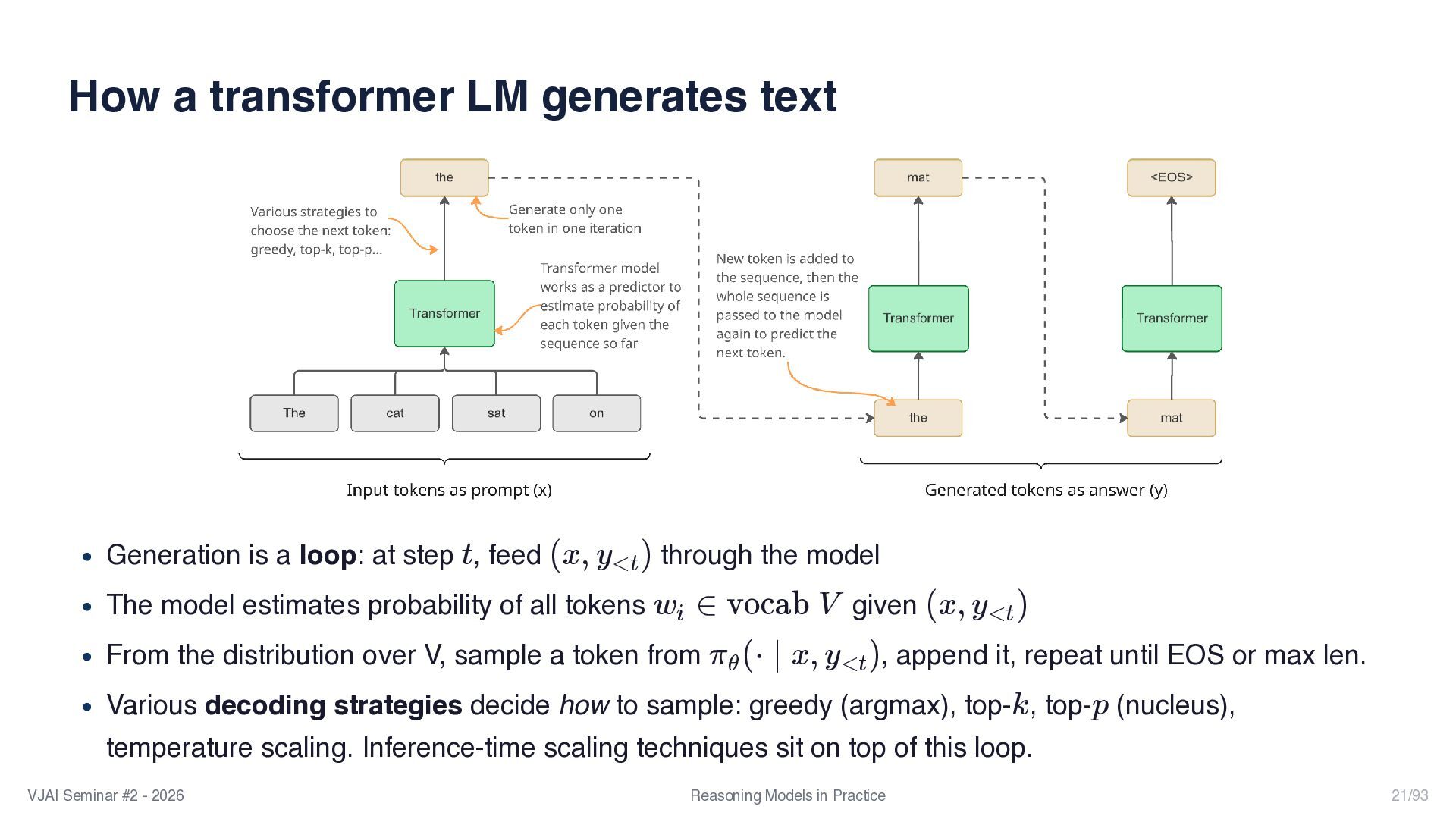
  21. How a transformer LM generates text Generation is a loop:

    at step , feed through the model The model estimates probability of all tokens given From the distribution over V, sample a token from , append it, repeat until EOS or max len. Various decoding strategies decide how to sample: greedy (argmax), top- , top- (nucleus), temperature scaling. Inference-time scaling techniques sit on top of this loop. t (x, y ​ ) <t w ​ ∈ vocab V i (x, y ​ ) <t π ​ (⋅ ∣ θ x, y ​ ) <t k p VJAI Seminar #2 - 2026 Reasoning Models in Practice 21/93
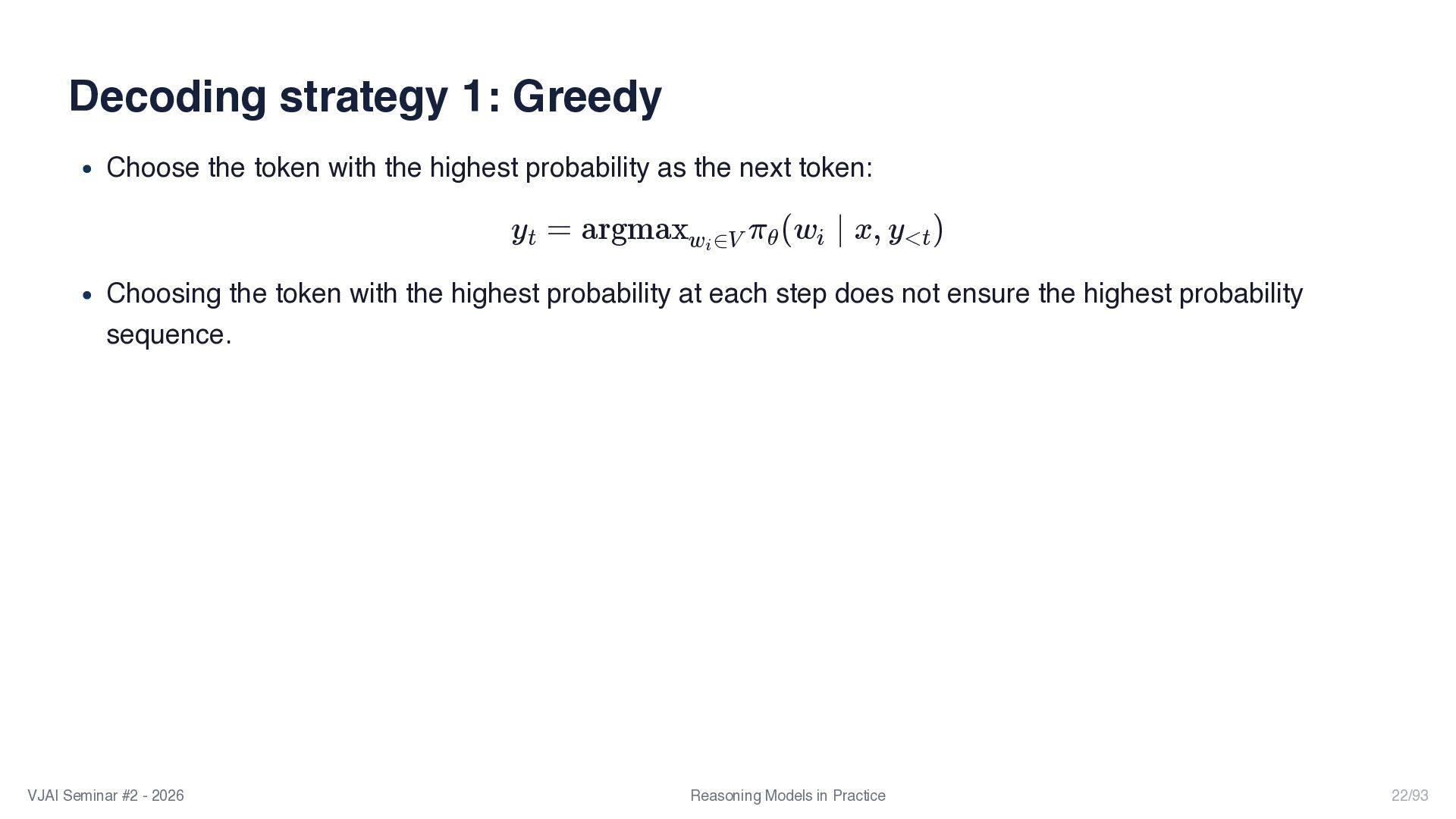
  22. Decoding strategy 1: Greedy Choose the token with the highest

    probability as the next token: Choosing the token with the highest probability at each step does not ensure the highest probability sequence. y ​ = t argmax ​ π ​ (w ​ ∣ w ​ ∈V i θ i x, y ​ ) <t VJAI Seminar #2 - 2026 Reasoning Models in Practice 22/93
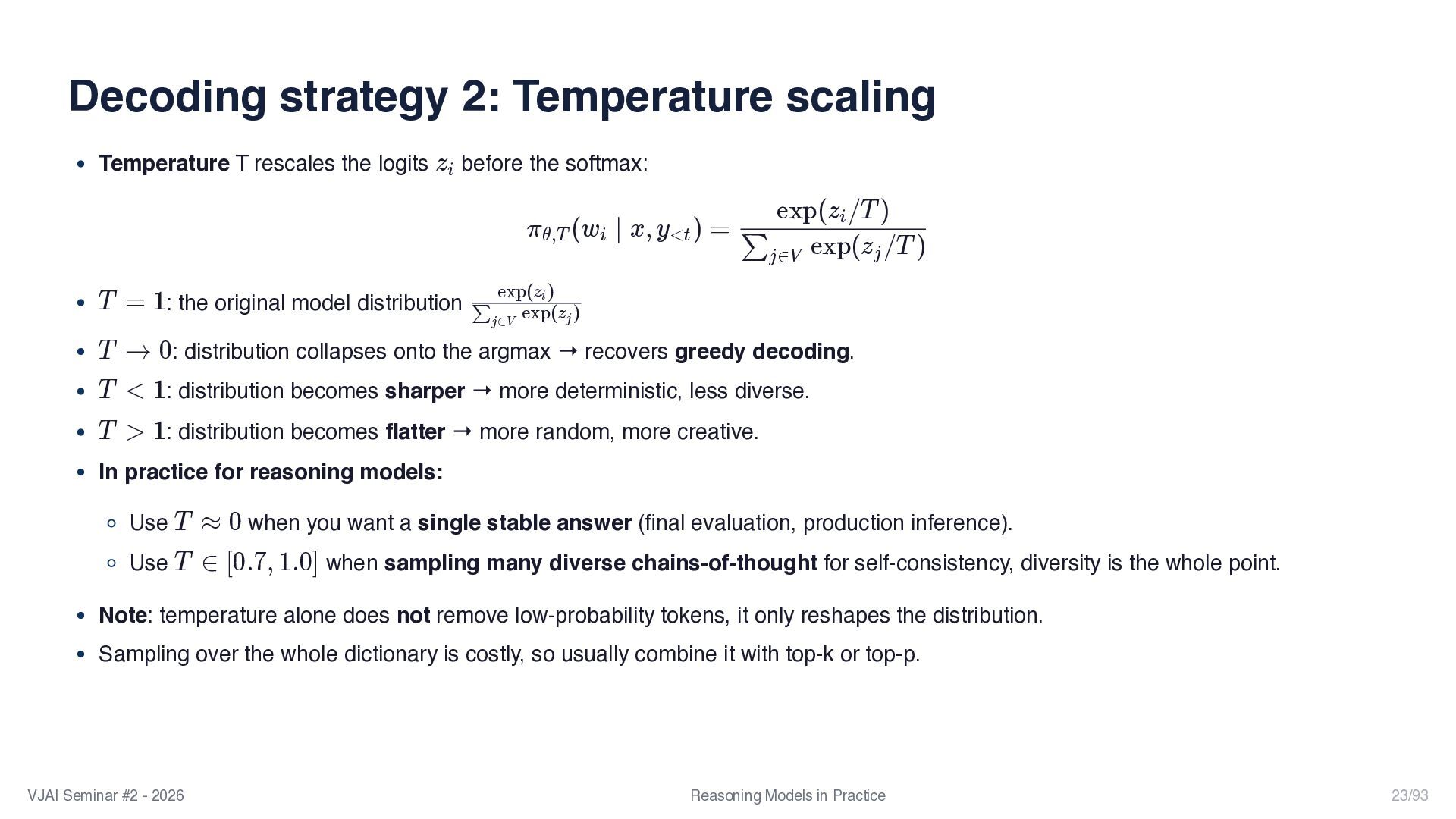
  23. Decoding strategy 2: Temperature scaling Temperature T rescales the logits

    before the softmax: : the original model distribution : distribution collapses onto the argmax → recovers greedy decoding. : distribution becomes sharper → more deterministic, less diverse. : distribution becomes flatter → more random, more creative. In practice for reasoning models: Use when you want a single stable answer (final evaluation, production inference). Use when sampling many diverse chains-of-thought for self-consistency, diversity is the whole point. Note: temperature alone does not remove low-probability tokens, it only reshapes the distribution. Sampling over the whole dictionary is costly, so usually combine it with top-k or top-p. z ​ i π ​ (w ​ ∣ θ,T i x, y ​ ) = <t ​ ​ exp(z ​ /T) ∑ j∈V j exp(z ​ /T) i T = 1 ​ ​ exp(z ​ ) ∑ j∈V j exp(z ​ ) i T → 0 T < 1 T > 1 T ≈ 0 T ∈ [0.7, 1.0] VJAI Seminar #2 - 2026 Reasoning Models in Practice 23/93
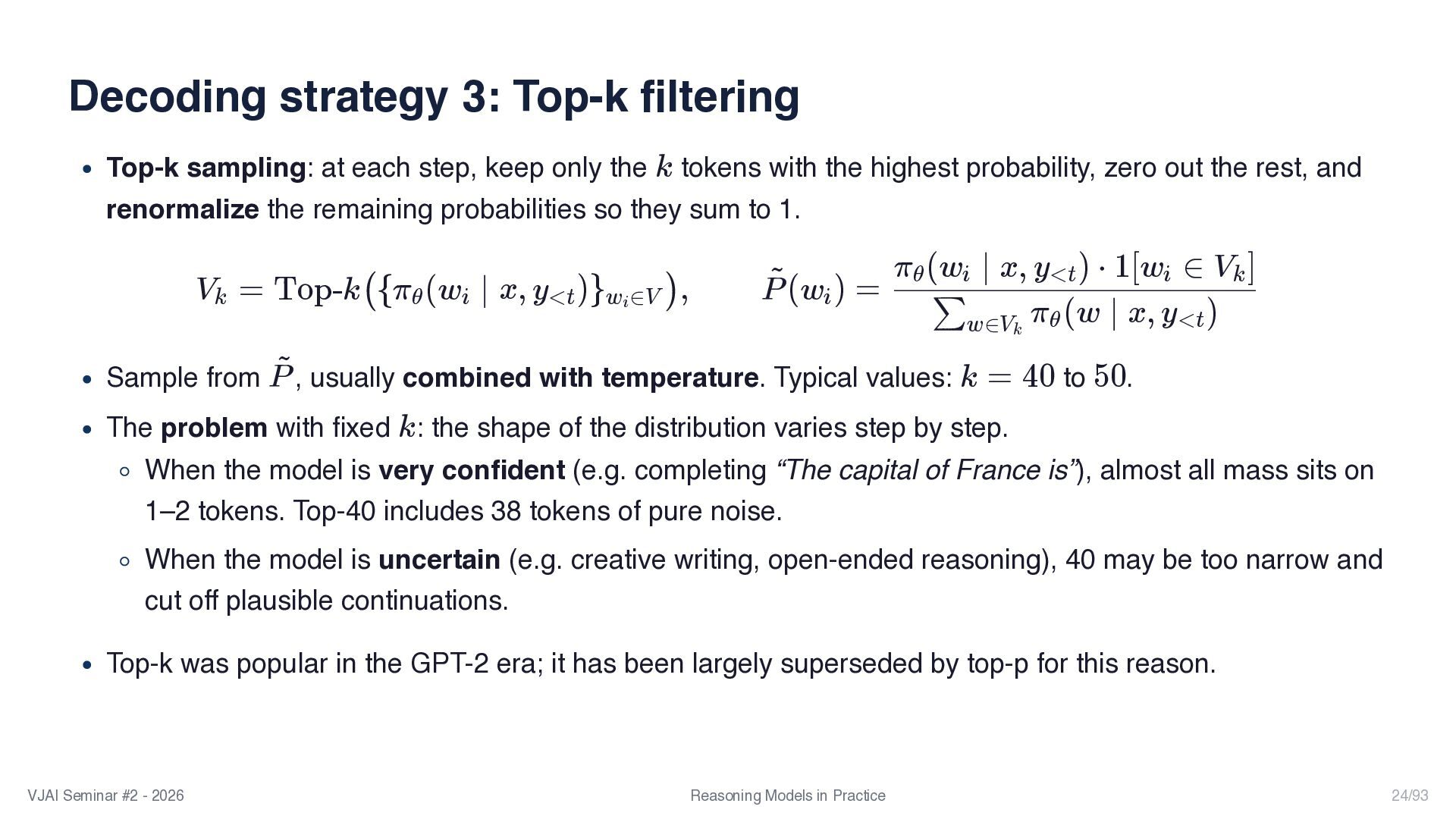
  24. Decoding strategy 3: Top-k filtering Top-k sampling: at each step,

    keep only the tokens with the highest probability, zero out the rest, and renormalize the remaining probabilities so they sum to 1. Sample from , usually combined with temperature. Typical values: to . The problem with fixed : the shape of the distribution varies step by step. When the model is very confident (e.g. completing “The capital of France is”), almost all mass sits on 1–2 tokens. Top-40 includes 38 tokens of pure noise. When the model is uncertain (e.g. creative writing, open-ended reasoning), 40 may be too narrow and cut off plausible continuations. Top-k was popular in the GPT-2 era; it has been largely superseded by top-p for this reason. k V ​ = k Top-k({π ​ (w ​ ∣ θ i x, y ​ )} ​ ), (w ​ ) = <t w ​ ∈V i P ~ i ​ ​ π ​ (w ∣ x, y ​ ) ∑ w∈V ​ k θ <t π ​ (w ​ ∣ x, y ​ ) ⋅ 1[w ​ ∈ V ​ ] θ i <t i k P ~ k = 40 50 k VJAI Seminar #2 - 2026 Reasoning Models in Practice 24/93
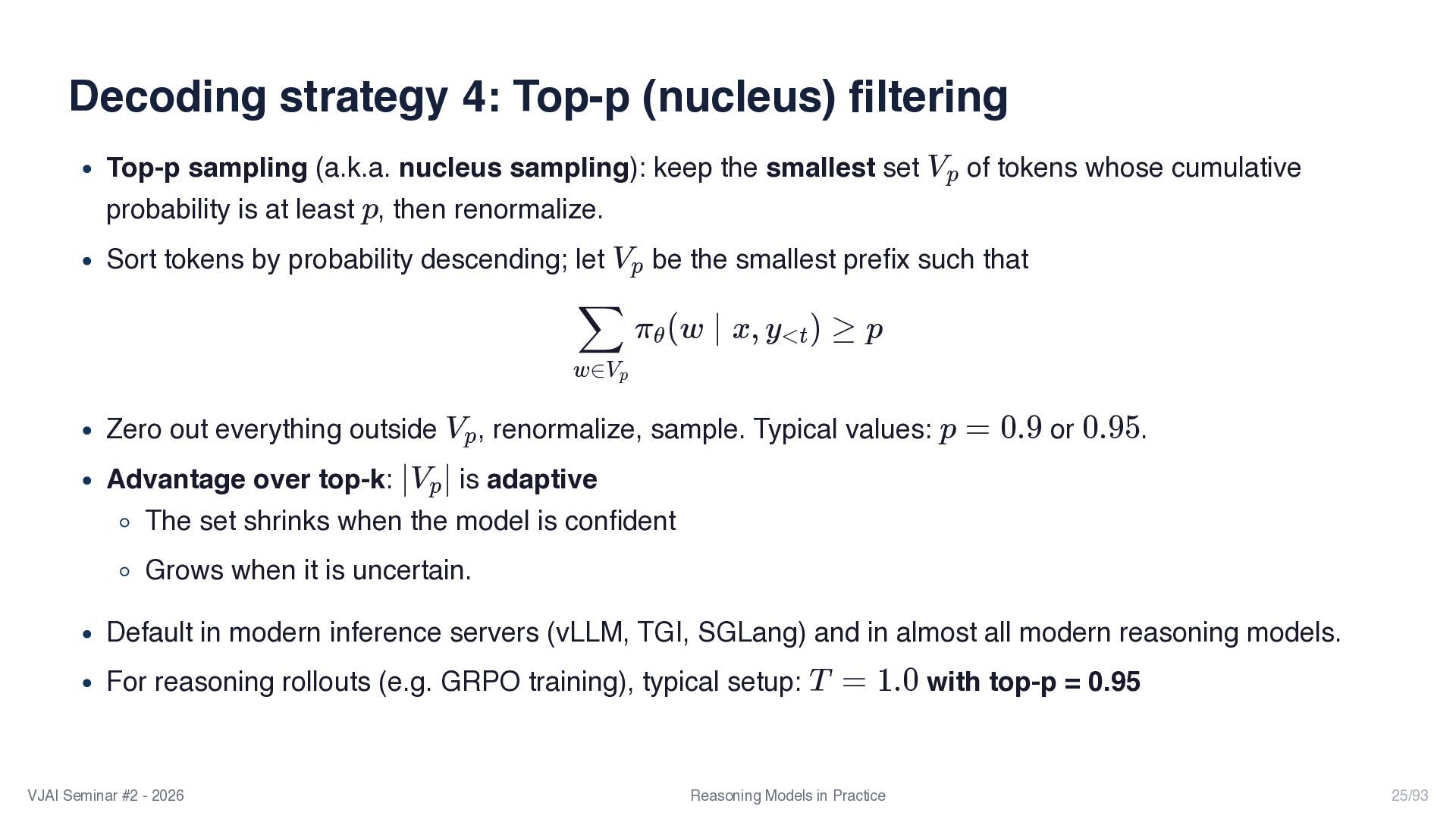
  25. Decoding strategy 4: Top-p (nucleus) filtering Top-p sampling (a.k.a. nucleus

    sampling): keep the smallest set of tokens whose cumulative probability is at least , then renormalize. Sort tokens by probability descending; let be the smallest prefix such that Zero out everything outside , renormalize, sample. Typical values: or . Advantage over top-k: is adaptive The set shrinks when the model is confident Grows when it is uncertain. Default in modern inference servers (vLLM, TGI, SGLang) and in almost all modern reasoning models. For reasoning rollouts (e.g. GRPO training), typical setup: with top-p = 0.95 V ​ p p V ​ p ​ π ​ (w ∣ w∈V ​ p ∑ θ x, y ​ ) ≥ <t p V ​ p p = 0.9 0.95 ∣V ​ ∣ p T = 1.0 VJAI Seminar #2 - 2026 Reasoning Models in Practice 25/93
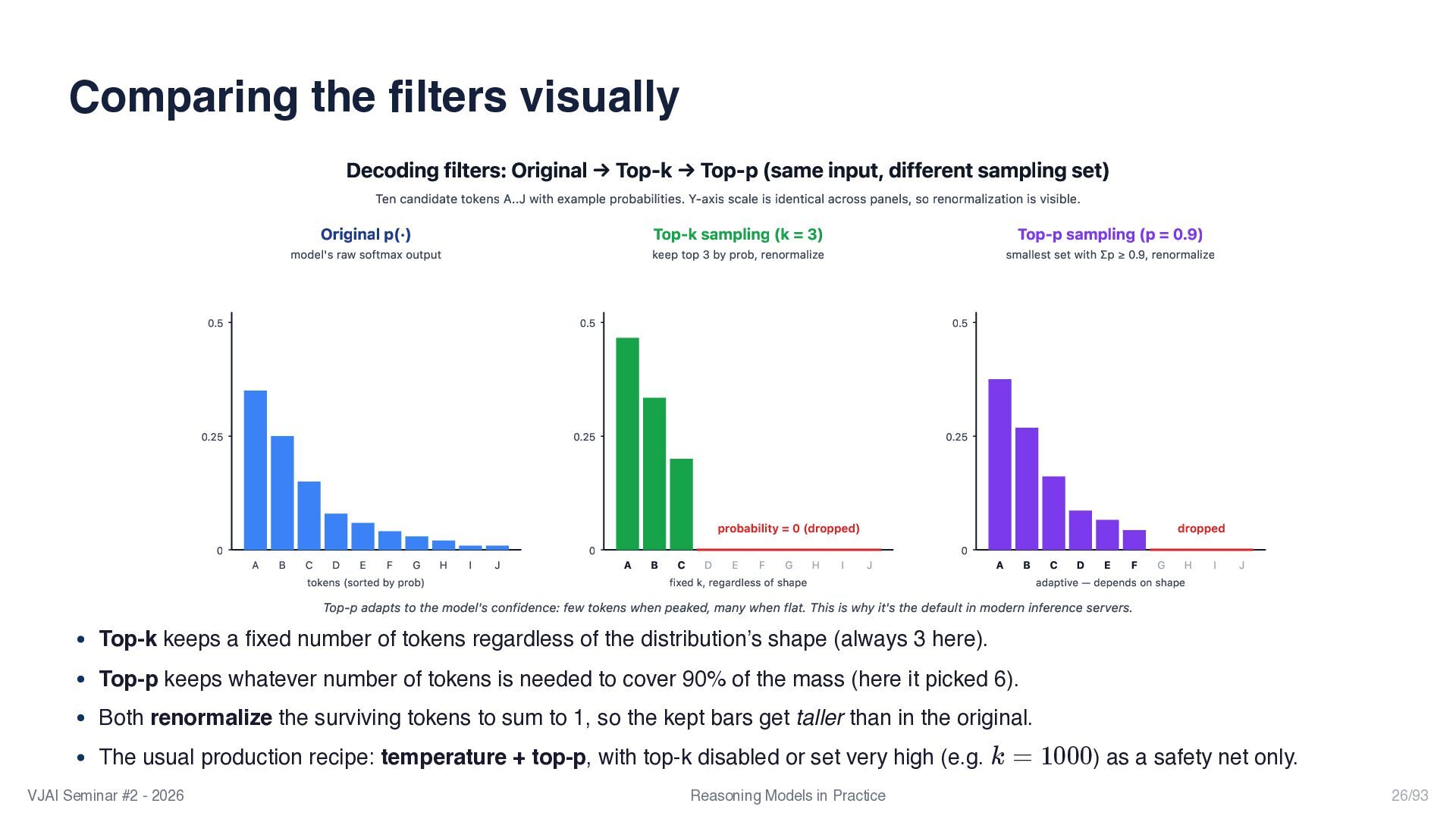
  26. Comparing the filters visually Decoding filters: Original → Top-k →

    Top-p (same input, different sampling set) Ten candidate tokens A..J with example probabilities. Y-axis scale is identical across panels, so renormalization is visible. Original p(·) model's raw softmax output 0 0.25 0.5 A B C D E F G H I J tokens (sorted by prob) Top-k sampling (k = 3) keep top 3 by prob, renormalize 0 0.25 0.5 probability = 0 (dropped) A B C D E F G H I J fixed k, regardless of shape Top-p sampling (p = 0.9) smallest set with Ʃp ≥ 0.9, renormalize 0 0.25 0.5 dropped A B C D E F G H I J adaptive — depends on shape Top-p adapts to the model's confidence: few tokens when peaked, many when flat. This is why it's the default in modern inference servers. Top-k keeps a fixed number of tokens regardless of the distribution’s shape (always 3 here). Top-p keeps whatever number of tokens is needed to cover 90% of the mass (here it picked 6). Both renormalize the surviving tokens to sum to 1, so the kept bars get taller than in the original. The usual production recipe: temperature + top-p, with top-k disabled or set very high (e.g. ) as a safety net only. k = 1000 VJAI Seminar #2 - 2026 Reasoning Models in Practice 26/93
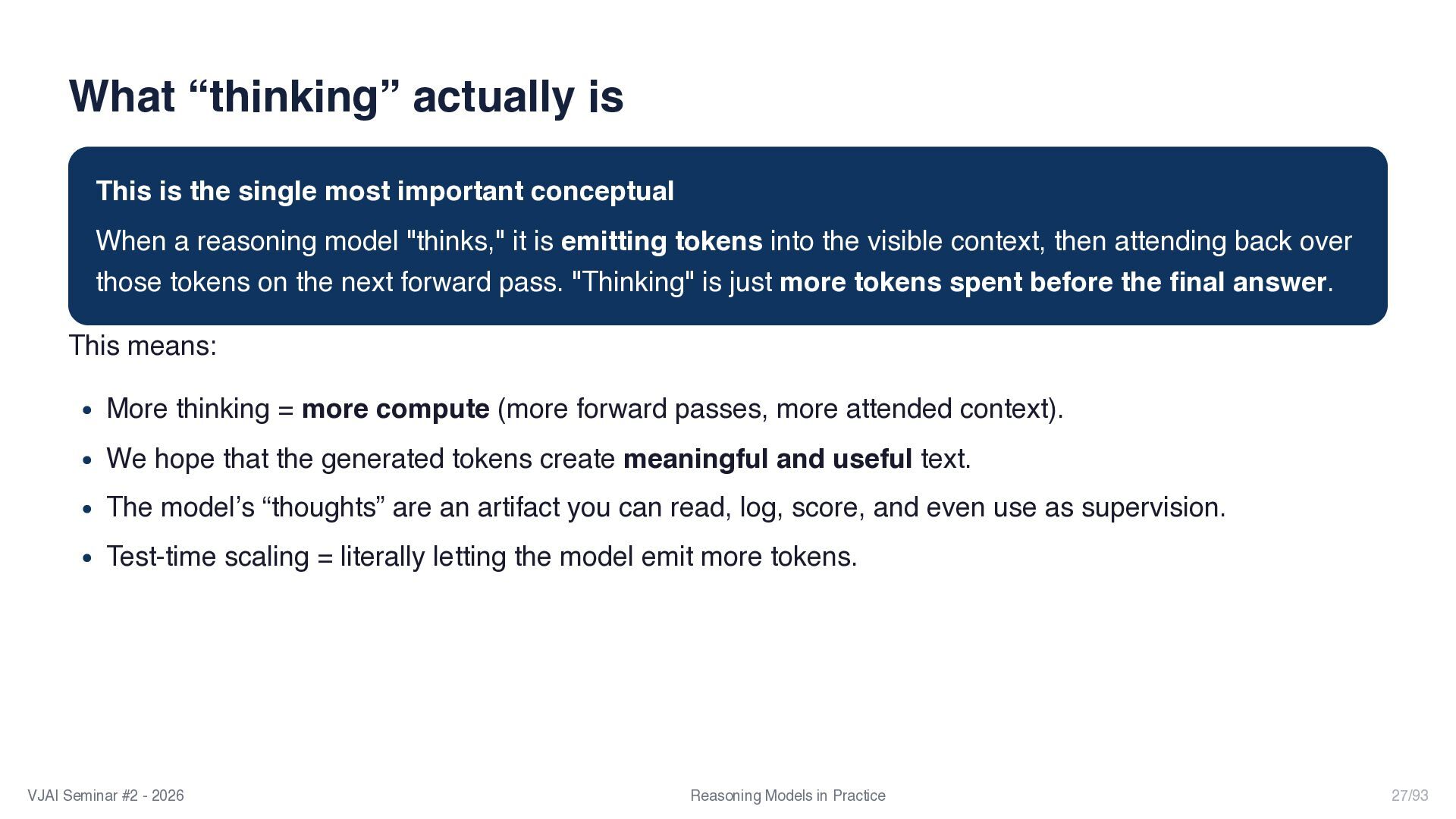
  27. What “thinking” actually is This is the single most important

    conceptual When a reasoning model "thinks," it is emitting tokens into the visible context, then attending back over those tokens on the next forward pass. "Thinking" is just more tokens spent before the final answer. This means: More thinking = more compute (more forward passes, more attended context). We hope that the generated tokens create meaningful and useful text. The model’s “thoughts” are an artifact you can read, log, score, and even use as supervision. Test-time scaling = literally letting the model emit more tokens. VJAI Seminar #2 - 2026 Reasoning Models in Practice 27/93
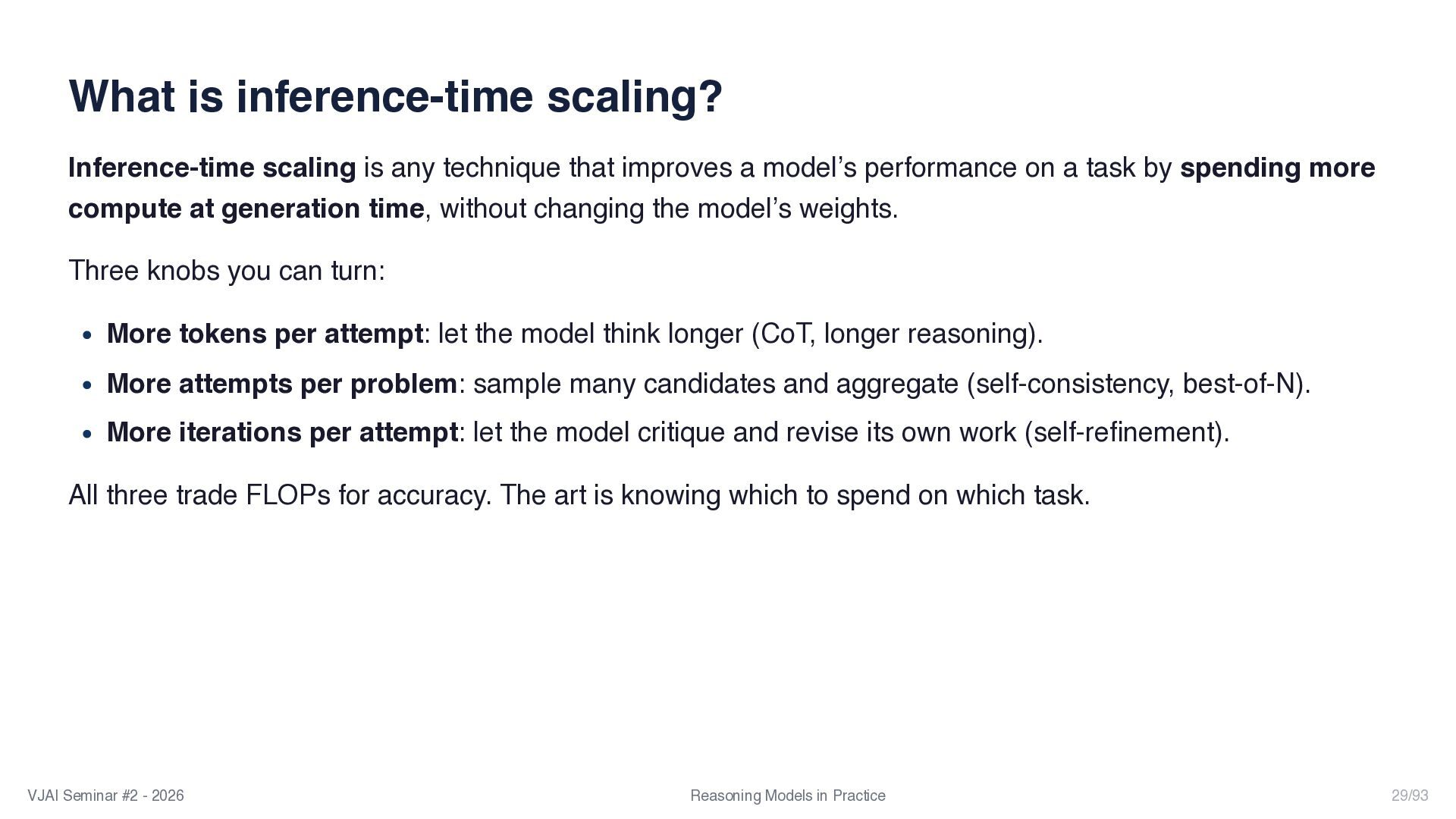
  28. What is inference-time scaling? Inference-time scaling is any technique that

    improves a model’s performance on a task by spending more compute at generation time, without changing the model’s weights. Three knobs you can turn: More tokens per attempt: let the model think longer (CoT, longer reasoning). More attempts per problem: sample many candidates and aggregate (self-consistency, best-of-N). More iterations per attempt: let the model critique and revise its own work (self-refinement). All three trade FLOPs for accuracy. The art is knowing which to spend on which task. VJAI Seminar #2 - 2026 Reasoning Models in Practice 29/93
  29. Three popular techniques In this part of the talk we’ll

    cover three foundational inference-time techniques. They are simple, composable, and form the building blocks for everything fancier (Tree-of-Thoughts, Reflexion, MCTS-style search, etc.). The three techniques 1. Chain-of-Thought (CoT): let the model think out loud before answering 2. Self-consistency: sample many CoTs, take a majority vote 3. Self-refinement: generate, critique, revise in a loop VJAI Seminar #2 - 2026 Reasoning Models in Practice 30/93
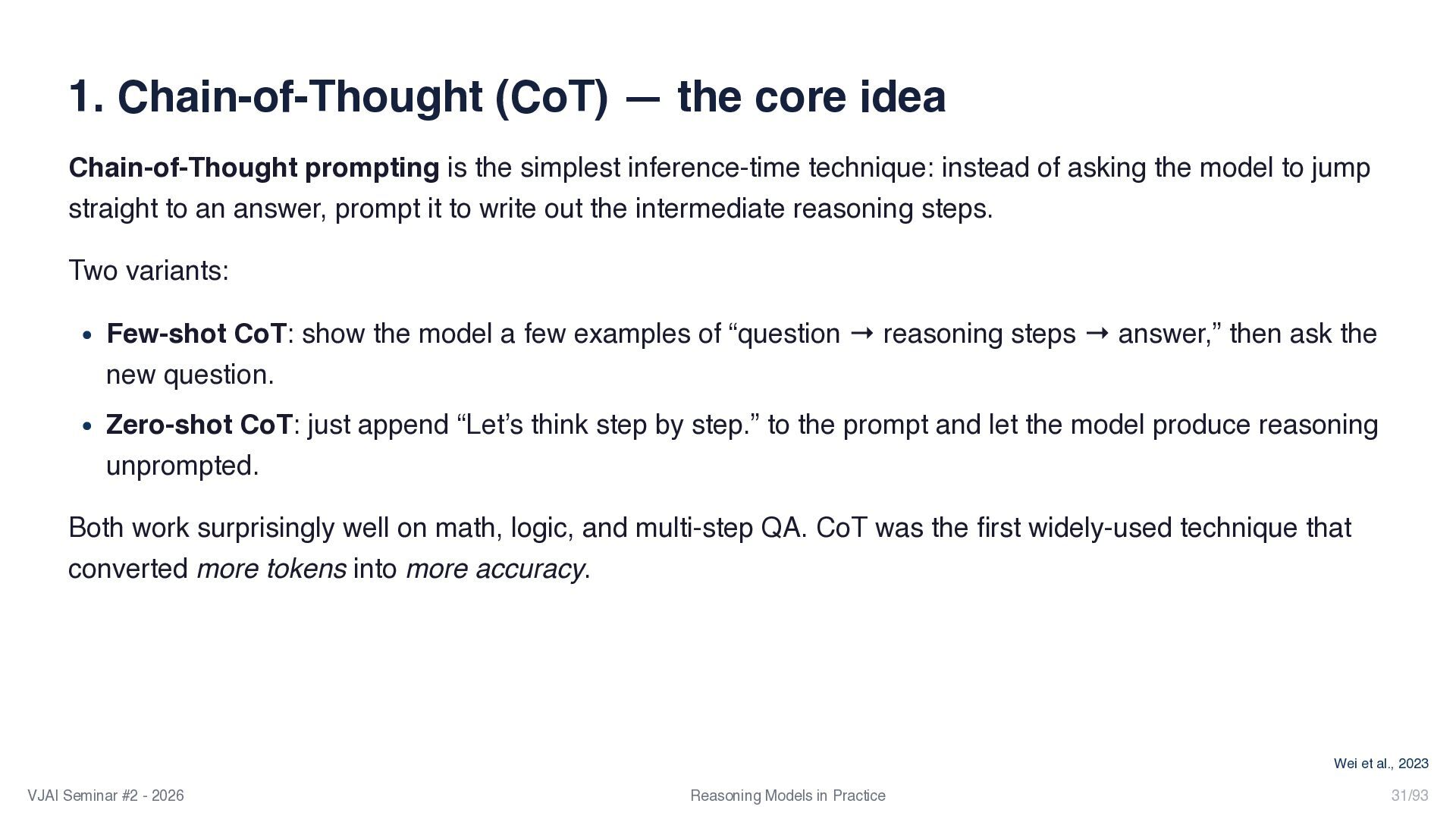
  30. 1. Chain-of-Thought (CoT) — the core idea Chain-of-Thought prompting is

    the simplest inference-time technique: instead of asking the model to jump straight to an answer, prompt it to write out the intermediate reasoning steps. Two variants: Few-shot CoT: show the model a few examples of “question → reasoning steps → answer,” then ask the new question. Zero-shot CoT: just append “Let’s think step by step.” to the prompt and let the model produce reasoning unprompted. Both work surprisingly well on math, logic, and multi-step QA. CoT was the first widely-used technique that converted more tokens into more accuracy. VJAI Seminar #2 - 2026 Reasoning Models in Practice 31/93 Wei et al., 2023
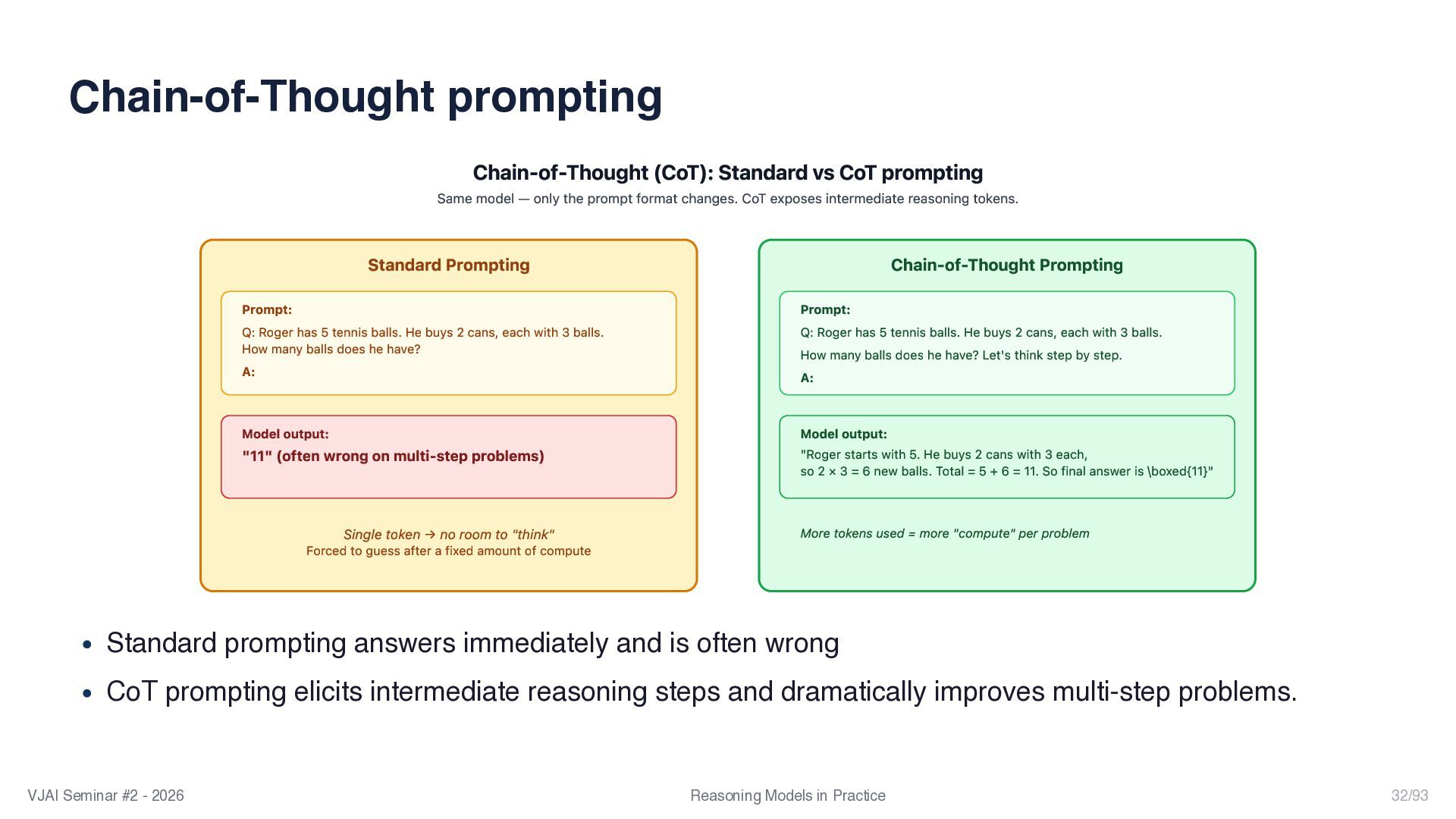
  31. Chain-of-Thought prompting Chain-of-Thought (CoT): Standard vs CoT prompting Same model

    — only the prompt format changes. CoT exposes intermediate reasoning tokens. Standard Prompting Prompt: Q: Roger has 5 tennis balls. He buys 2 cans, each with 3 balls. How many balls does he have? A: Model output: "11" (often wrong on multi-step problems) Single token → no room to "think" Forced to guess after a fixed amount of compute Chain-of-Thought Prompting Prompt: Q: Roger has 5 tennis balls. He buys 2 cans, each with 3 balls. How many balls does he have? Let's think step by step. A: Model output: "Roger starts with 5. He buys 2 cans with 3 each, so 2 × 3 = 6 new balls. Total = 5 + 6 = 11. So final answer is \boxed{11}" More tokens used = more "compute" per problem Standard prompting answers immediately and is often wrong CoT prompting elicits intermediate reasoning steps and dramatically improves multi-step problems. VJAI Seminar #2 - 2026 Reasoning Models in Practice 32/93
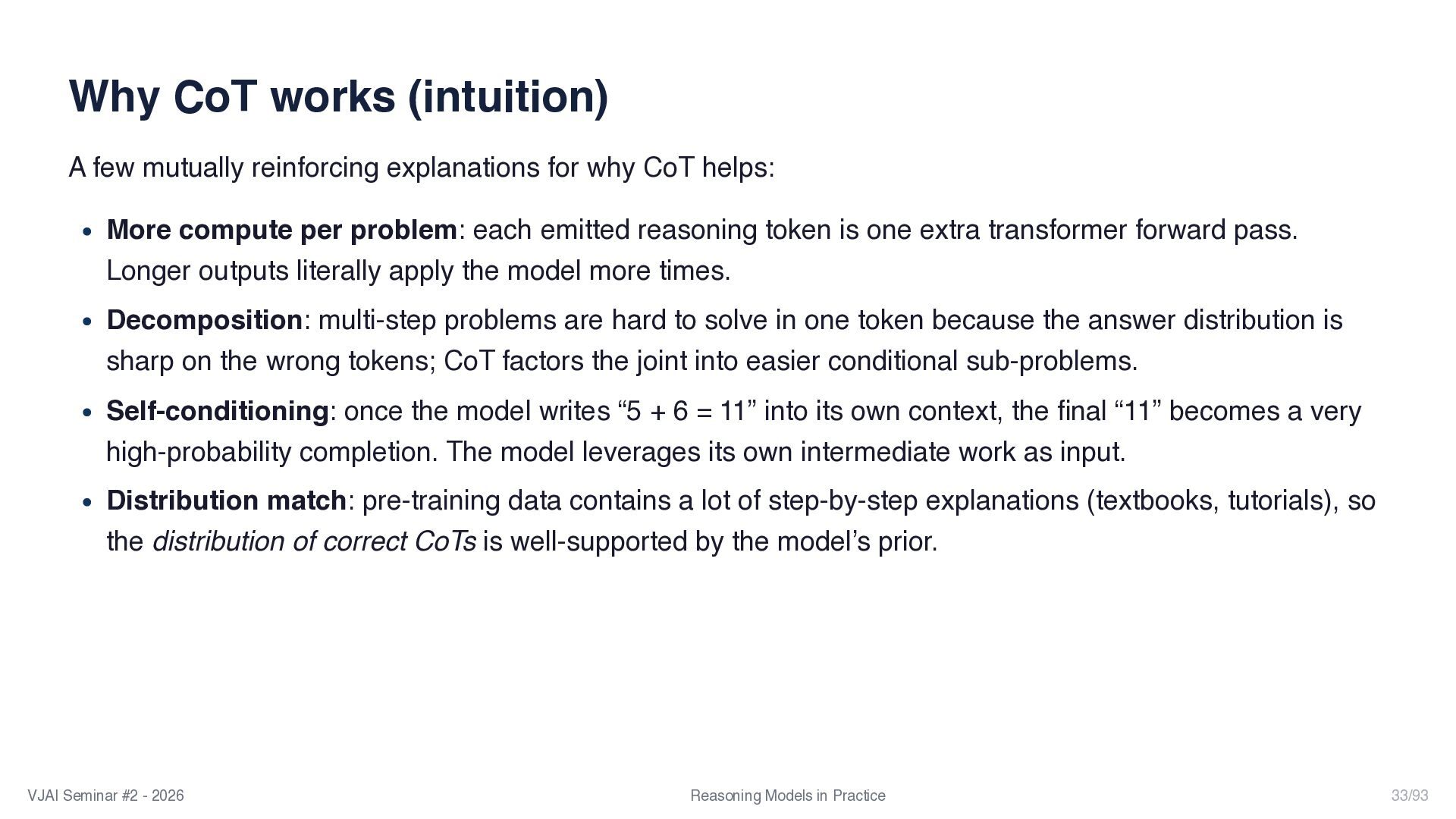
  32. Why CoT works (intuition) A few mutually reinforcing explanations for

    why CoT helps: More compute per problem: each emitted reasoning token is one extra transformer forward pass. Longer outputs literally apply the model more times. Decomposition: multi-step problems are hard to solve in one token because the answer distribution is sharp on the wrong tokens; CoT factors the joint into easier conditional sub-problems. Self-conditioning: once the model writes “5 + 6 = 11” into its own context, the final “11” becomes a very high-probability completion. The model leverages its own intermediate work as input. Distribution match: pre-training data contains a lot of step-by-step explanations (textbooks, tutorials), so the distribution of correct CoTs is well-supported by the model’s prior. VJAI Seminar #2 - 2026 Reasoning Models in Practice 33/93
  33. CoT — when it helps and when it doesn’t CoT

    is not free. A short list of where to use it and where to skip it. Helps a lot on: Multi-step arithmetic / word problems Logical reasoning, planning, multi-hop QA Code where the model has to reason about edge cases Helps little or hurts on: Pure recall tasks (“capital of France”) Tasks where the model is already at ceiling Latency-sensitive deployments (CoT is several times slower per query) A recurring practical lesson: CoT on a model that hasn’t been post-trained for reasoning can introduce as many errors as it fixes. Reasoning models trained with RLVR are far more robust to long CoT. VJAI Seminar #2 - 2026 Reasoning Models in Practice 34/93
  34. 2. Self-consistency — the core idea Self-consistency generalizes CoT: instead

    of one greedy reasoning chain, sample independent CoTs at temperature , then take the majority vote over the final answers. The intuition is borrowed from ensembling and from how humans solve hard problems: There are many valid reasoning paths to the right answer, and the right answer is the one that many independent paths agree on, while wrong answers tend to be idiosyncratic. git Cost is roughly a single CoT, so this is a clean compute → accuracy dial. N > 0 N× VJAI Seminar #2 - 2026 Reasoning Models in Practice 35/93 Wang et al., 2023
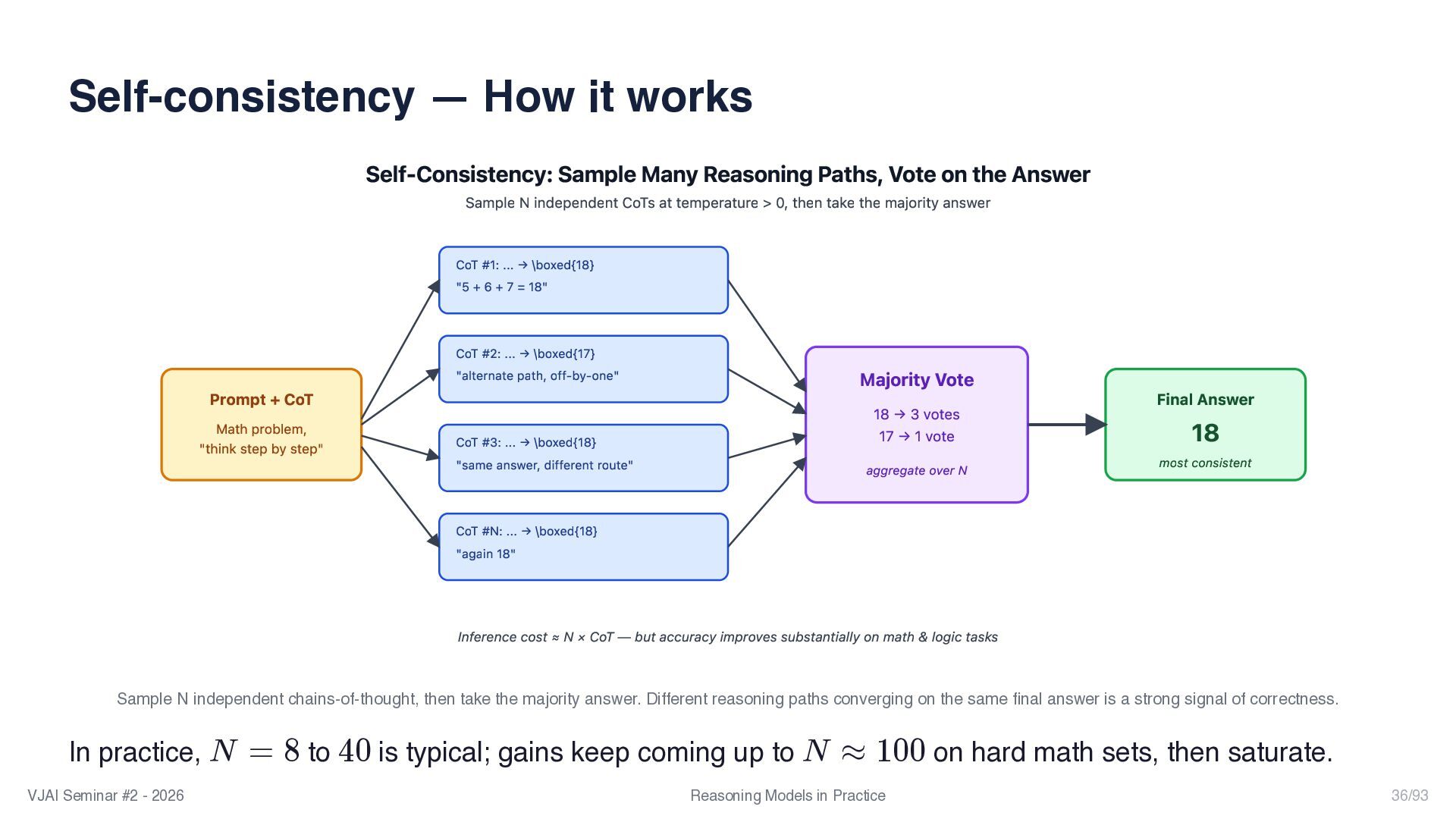
  35. Self-consistency — How it works Self-Consistency: Sample Many Reasoning Paths,

    Vote on the Answer Sample N independent CoTs at temperature > 0, then take the majority answer Prompt + CoT Math problem, "think step by step" CoT #1: ... → \boxed{18} "5 + 6 + 7 = 18" CoT #2: ... → \boxed{17} "alternate path, off-by-one" CoT #3: ... → \boxed{18} "same answer, different route" CoT #N: ... → \boxed{18} "again 18" Majority Vote 18 → 3 votes 17 → 1 vote aggregate over N Final Answer 18 most consistent Inference cost ≈ N × CoT — but accuracy improves substantially on math & logic tasks Sample N independent chains-of-thought, then take the majority answer. Different reasoning paths converging on the same final answer is a strong signal of correctness. In practice, to is typical; gains keep coming up to on hard math sets, then saturate. N = 8 40 N ≈ 100 VJAI Seminar #2 - 2026 Reasoning Models in Practice 36/93
  36. Self-consistency — Properties A few properties worth internalizing: Requires a

    verifiable extractor: to vote, you need to extract a comparable final answer from each CoT (e.g. the \boxed{...} content). Trades parallelism for serial latency: you can sample the chains in parallel, so wall-clock cost is closer to if you have multi GPUs. Composes with CoT and self-refinement: you can refine each of the chains, or refine the final majority answer. Bias-variance angle: self-consistency reduces variance across reasoning paths. It does not fix systematic biases of the underlying model. A close cousin is best-of-N, where instead of voting you score each candidate with a verifier or a learned reward model and pick the highest-scoring one. N 1× N VJAI Seminar #2 - 2026 Reasoning Models in Practice 37/93
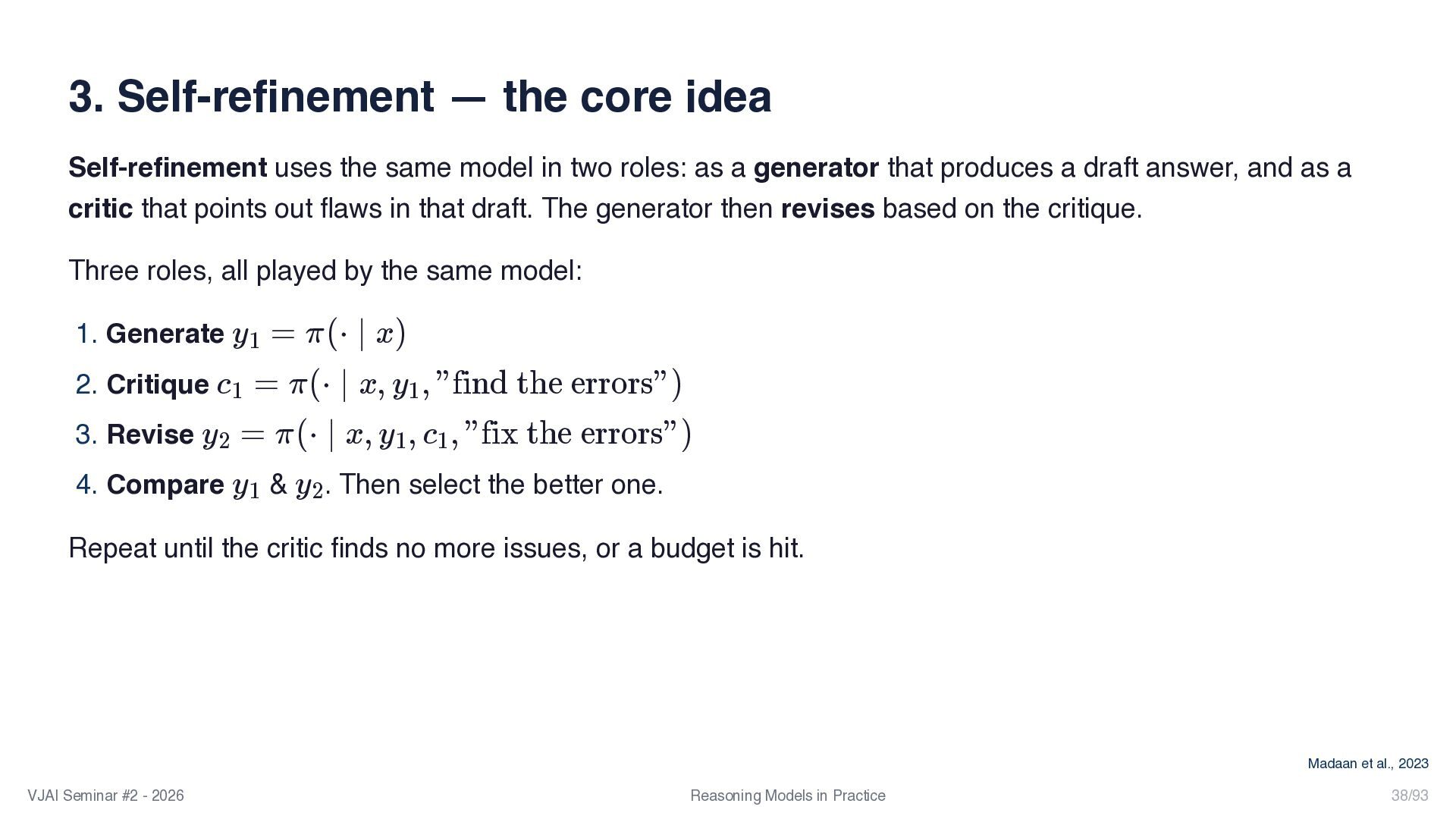
  37. 3. Self-refinement — the core idea Self-refinement uses the same

    model in two roles: as a generator that produces a draft answer, and as a critic that points out flaws in that draft. The generator then revises based on the critique. Three roles, all played by the same model: 1. Generate 2. Critique 3. Revise 4. Compare & . Then select the better one. Repeat until the critic finds no more issues, or a budget is hit. y ​ = 1 π(⋅ ∣ x) c ​ = 1 π(⋅ ∣ x, y ​ , "find the errors") 1 y ​ = 2 π(⋅ ∣ x, y ​ , c ​ , "fix the errors") 1 1 y ​ 1 y ​ 2 VJAI Seminar #2 - 2026 Reasoning Models in Practice 38/93 Madaan et al., 2023
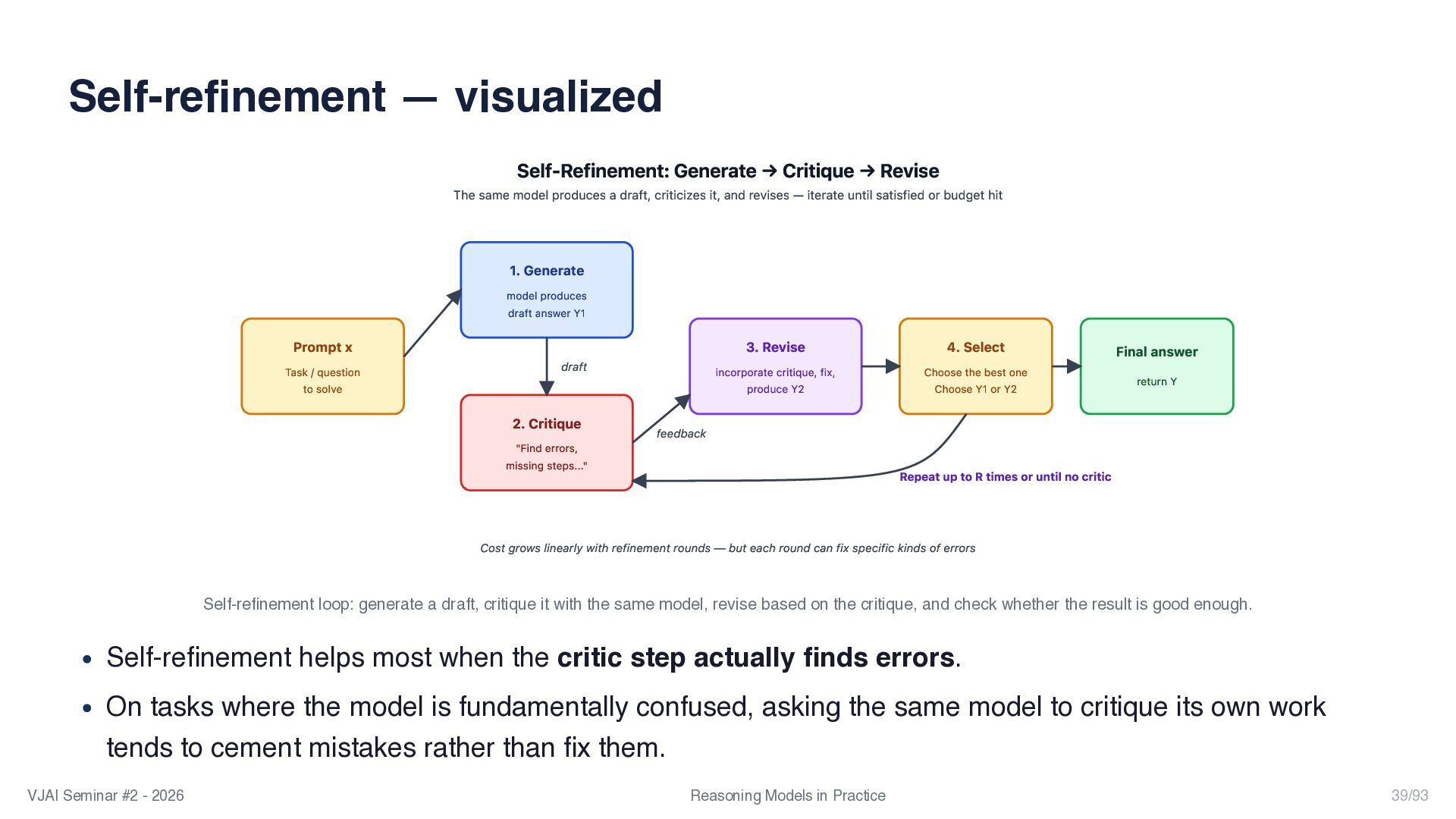
  38. Self-refinement — visualized Self-Refinement: Generate → Critique → Revise The

    same model produces a draft, criticizes it, and revises — iterate until satisfied or budget hit Prompt x Task / question to solve 1. Generate model produces draft answer Y1 2. Critique "Find errors, missing steps..." 3. Revise incorporate critique, fix, produce Y2 4. Select Choose the best one Choose Y1 or Y2 Final answer return Y draft feedback Repeat up to R times or until no critic Cost grows linearly with refinement rounds — but each round can fix specific kinds of errors Self-refinement loop: generate a draft, critique it with the same model, revise based on the critique, and check whether the result is good enough. Self-refinement helps most when the critic step actually finds errors. On tasks where the model is fundamentally confused, asking the same model to critique its own work tends to cement mistakes rather than fix them. VJAI Seminar #2 - 2026 Reasoning Models in Practice 39/93
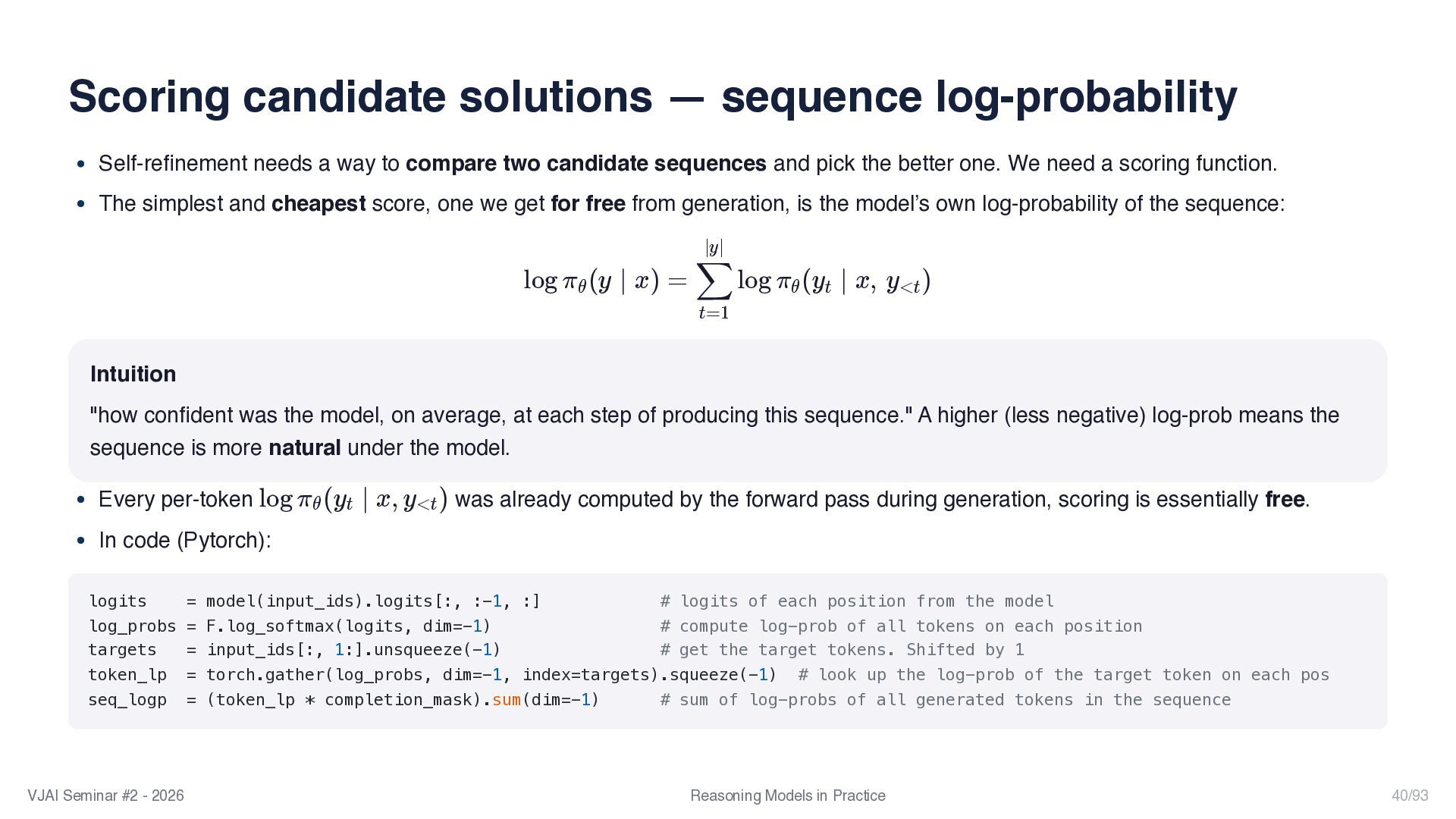
  39. Scoring candidate solutions — sequence log-probability Self-refinement needs a way

    to compare two candidate sequences and pick the better one. We need a scoring function. The simplest and cheapest score, one we get for free from generation, is the model’s own log-probability of the sequence: Intuition "how confident was the model, on average, at each step of producing this sequence." A higher (less negative) log-prob means the sequence is more natural under the model. Every per-token was already computed by the forward pass during generation, scoring is essentially free. In code (Pytorch): logits = model(input_ids).logits[:, :-1, :] # logits of each position from the model log_probs = F.log_softmax(logits, dim=-1) # compute log-prob of all tokens on each position targets = input_ids[:, 1:].unsqueeze(-1) # get the target tokens. Shifted by 1 token_lp = torch.gather(log_probs, dim=-1, index=targets).squeeze(-1) # look up the log-prob of the target token on each pos seq_logp = (token_lp * completion_mask).sum(dim=-1) # sum of log-probs of all generated tokens in the sequence log π ​ (y ∣ θ x) = ​ log π ​ y ​ ∣ x, y ​ t=1 ∑ ∣y∣ θ ( t <t ) log π ​ (y ​ ∣ θ t x, y ​ ) <t VJAI Seminar #2 - 2026 Reasoning Models in Practice 40/93
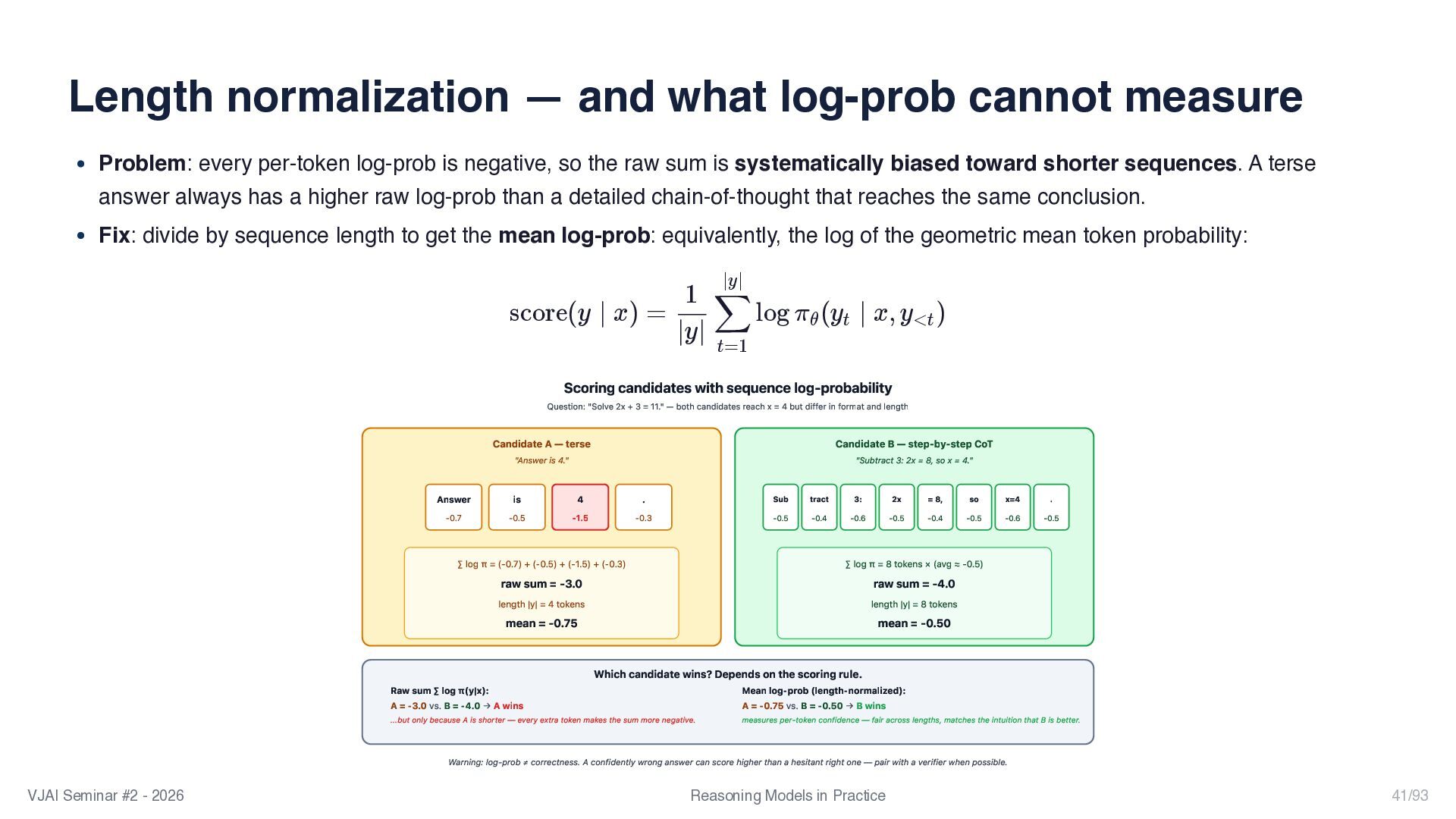
  40. Length normalization — and what log-prob cannot measure Problem: every

    per-token log-prob is negative, so the raw sum is systematically biased toward shorter sequences. A terse answer always has a higher raw log-prob than a detailed chain-of-thought that reaches the same conclusion. Fix: divide by sequence length to get the mean log-prob: equivalently, the log of the geometric mean token probability: Scoring candidates with sequence log-probability Question: "Solve 2x + 3 = 11." — both candidates reach x = 4 but differ in format and length Candidate A — terse "Answer is 4." Answer -0.7 is -0.5 4 -1.5 . -0.3 ∑ log π = (-0.7) + (-0.5) + (-1.5) + (-0.3) raw sum = -3.0 length |y| = 4 tokens mean = -0.75 Candidate B — step-by-step CoT "Subtract 3: 2x = 8, so x = 4." Sub -0.5 tract -0.4 3: -0.6 2x -0.5 = 8, -0.4 so -0.5 x=4 -0.6 . -0.5 ∑ log π = 8 tokens × (avg ≈ -0.5) raw sum = -4.0 length |y| = 8 tokens mean = -0.50 Which candidate wins? Depends on the scoring rule. Raw sum ∑ log π(y|x): A = -3.0 vs. B = -4.0 → A wins ...but only because A is shorter — every extra token makes the sum more negative. Mean log-prob (length-normalized): A = -0.75 vs. B = -0.50 → B wins measures per-token confidence — fair across lengths, matches the intuition that B is better. Warning: log-prob ≠ correctness. A confidently wrong answer can score higher than a hesitant right one — pair with a verifier when possible. score(y ∣ x) = ​ ​ log π ​ y ​ ∣ x, y ​ ∣y∣ 1 t=1 ∑ ∣y∣ θ ( t <t ) VJAI Seminar #2 - 2026 Reasoning Models in Practice 41/93
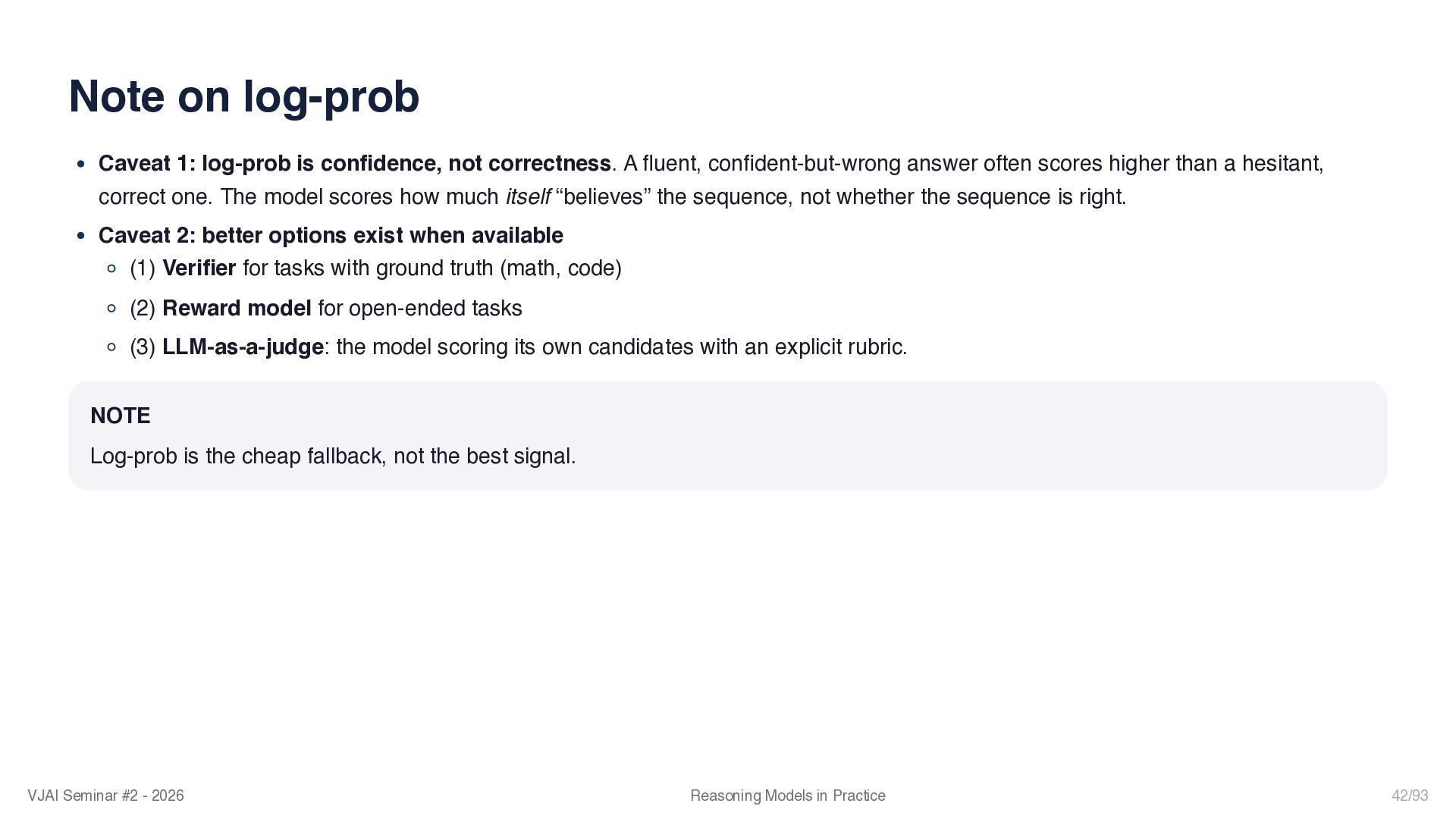
  41. Note on log-prob Caveat 1: log-prob is confidence, not correctness.

    A fluent, confident-but-wrong answer often scores higher than a hesitant, correct one. The model scores how much itself “believes” the sequence, not whether the sequence is right. Caveat 2: better options exist when available (1) Verifier for tasks with ground truth (math, code) (2) Reward model for open-ended tasks (3) LLM-as-a-judge: the model scoring its own candidates with an explicit rubric. NOTE Log-prob is the cheap fallback, not the best signal. VJAI Seminar #2 - 2026 Reasoning Models in Practice 42/93
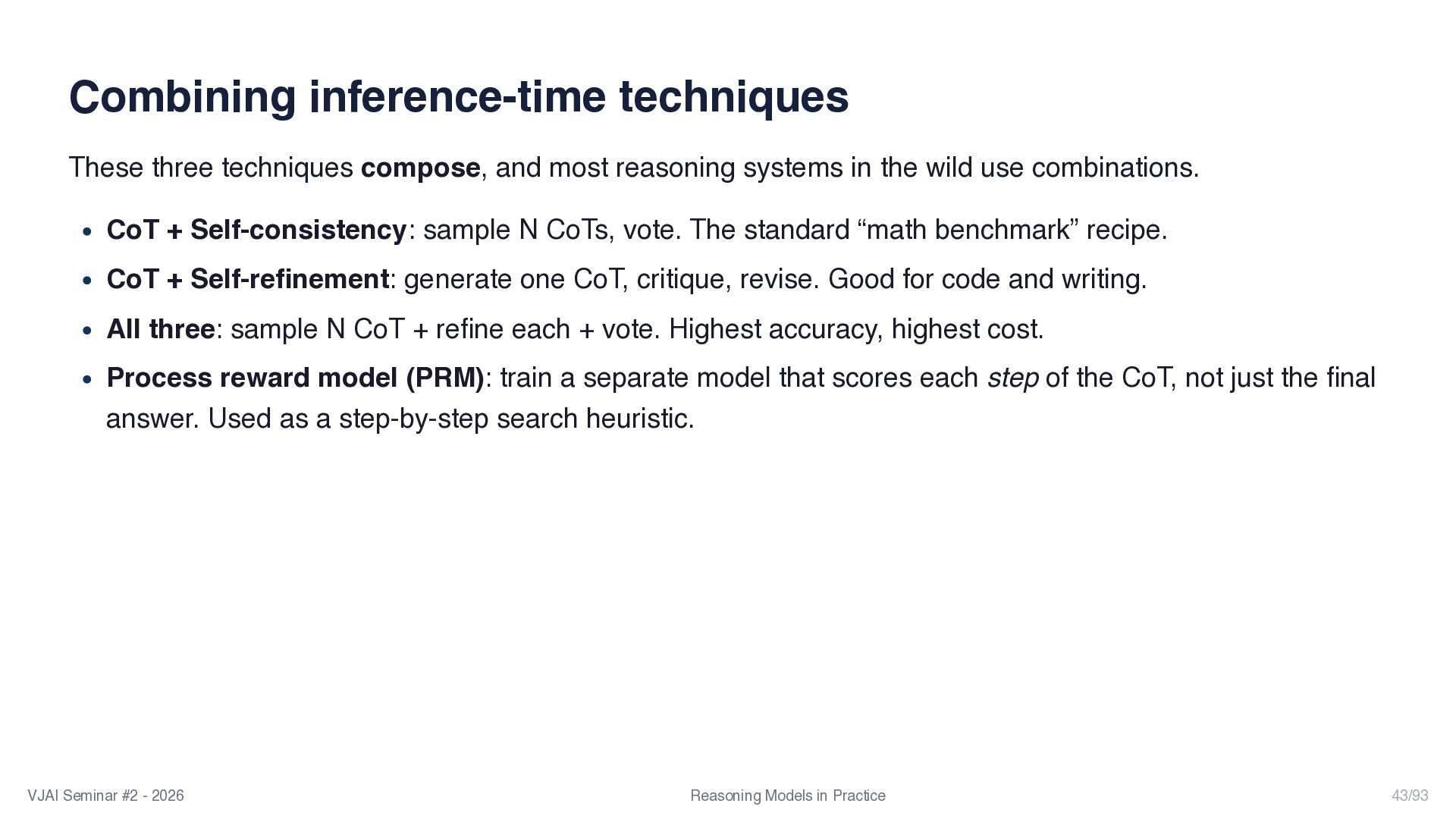
  42. Combining inference-time techniques These three techniques compose, and most reasoning

    systems in the wild use combinations. CoT + Self-consistency: sample N CoTs, vote. The standard “math benchmark” recipe. CoT + Self-refinement: generate one CoT, critique, revise. Good for code and writing. All three: sample N CoT + refine each + vote. Highest accuracy, highest cost. Process reward model (PRM): train a separate model that scores each step of the CoT, not just the final answer. Used as a step-by-step search heuristic. VJAI Seminar #2 - 2026 Reasoning Models in Practice 43/93
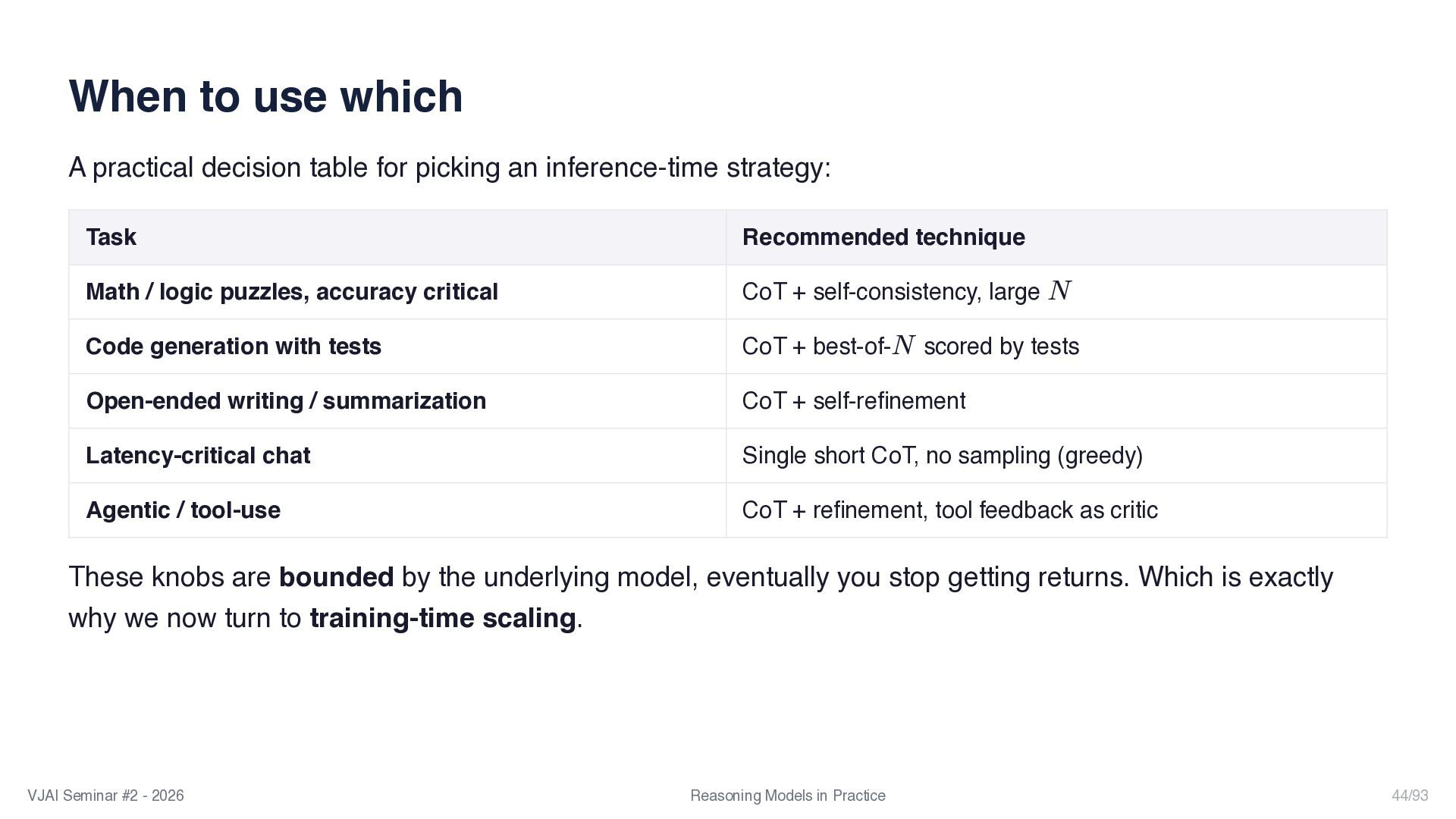
  43. When to use which A practical decision table for picking

    an inference-time strategy: Task Recommended technique Math / logic puzzles, accuracy critical CoT + self-consistency, large Code generation with tests CoT + best-of- scored by tests Open-ended writing / summarization CoT + self-refinement Latency-critical chat Single short CoT, no sampling (greedy) Agentic / tool-use CoT + refinement, tool feedback as critic These knobs are bounded by the underlying model, eventually you stop getting returns. Which is exactly why we now turn to training-time scaling. N N VJAI Seminar #2 - 2026 Reasoning Models in Practice 44/93
  44. Part 4 — Training-time scaling VJAI Seminar #2 - 2026

    Reasoning Models in Practice 45/93
  45. Why we need training-time scaling Inference-time scaling has hard limits:

    Diminishing returns: accuracy gains flatten well before you’ve spent unbounded compute. Costs scale per query: every user, every prompt pays the inference-time tax. No new capability: you cannot make the model do anything it could not already do; you are only sampling its existing distribution more thoroughly. Training-time scaling changes the model itself. Capabilities that required 100 self-consistency samples can be baked in so they appear in a single greedy decode. The economics flip: pay once at training, save every query. VJAI Seminar #2 - 2026 Reasoning Models in Practice 46/93
  46. The two scaling curves, unified Train-time RL compute → reasoning

    accuracy (you pay once, every user benefits) Test-time thinking compute → reasoning accuracy (you pay per query) Both curves are unlocked by the same thing: a verifiable reward signal that you can grind on for billions of tokens during training, and that the model has learned to chase at inference time. The unifying observation RLVR converts inference-time compute (which the user pays) into training-time compute (which the lab pays). A model trained with more RL needs less thinking per query to hit a given accuracy. VJAI Seminar #2 - 2026 Reasoning Models in Practice 47/93 Guo et al., 2025; OpenAI, 2024
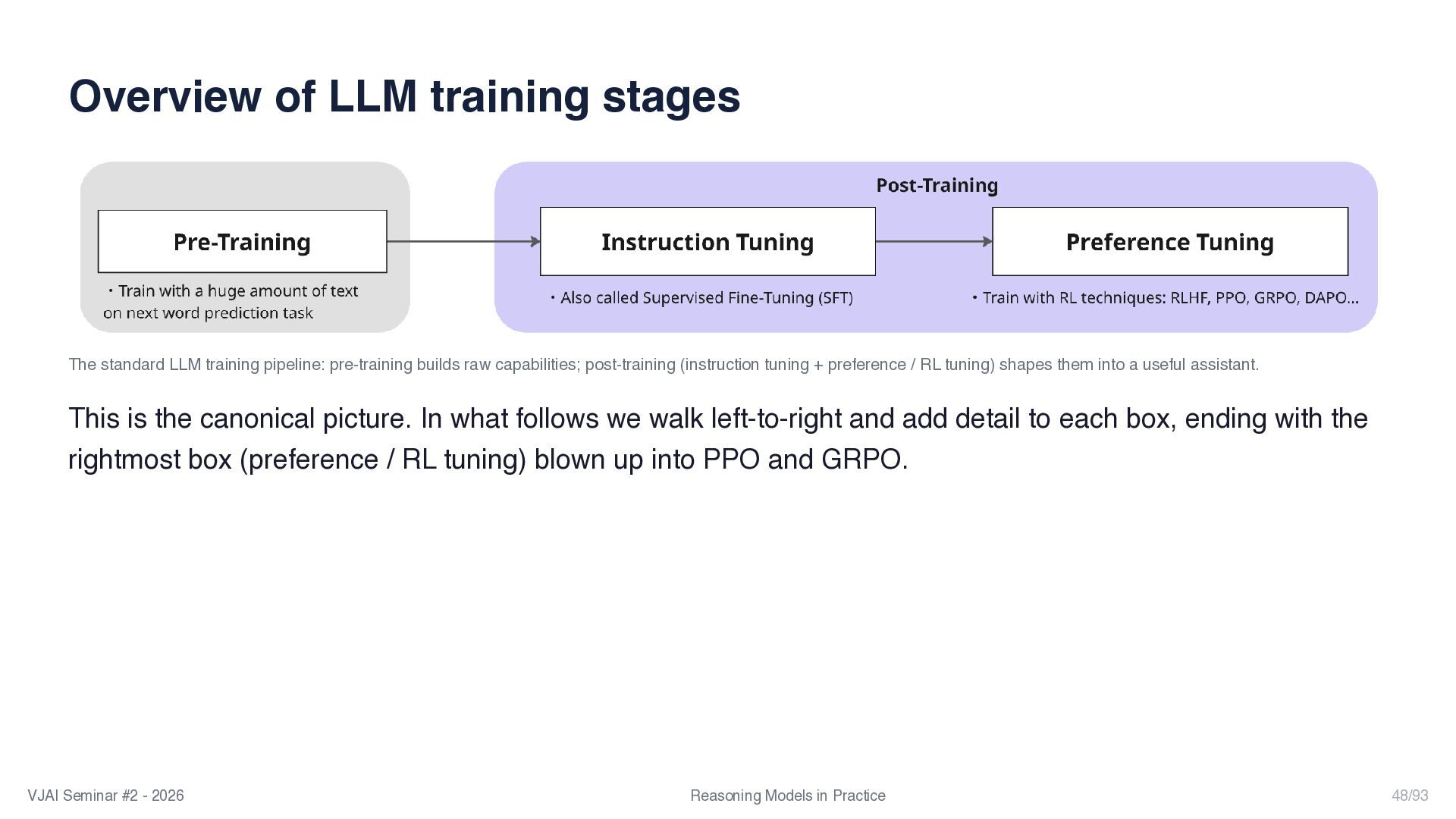
  47. Overview of LLM training stages The standard LLM training pipeline:

    pre-training builds raw capabilities; post-training (instruction tuning + preference / RL tuning) shapes them into a useful assistant. This is the canonical picture. In what follows we walk left-to-right and add detail to each box, ending with the rightmost box (preference / RL tuning) blown up into PPO and GRPO. VJAI Seminar #2 - 2026 Reasoning Models in Practice 48/93
  48. Modern recipe: SFT then RL Almost every modern reasoning model

    follows the same multi-stage recipe: 1. Pre-training: next-token prediction on trillions of web tokens. Builds the base capabilities. 2. Mid-training / cool-down: high-quality data mix for the last 5–10% of pre-training tokens. 3. Instruction tuning (SFT): teach the model the chat format and basic helpfulness. 4. Reasoning SFT: fine-tune on long chains-of-thought (often distilled from a stronger reasoning model). 5. Reinforcement learning: RLHF, RLVR, or both, depending on whether the goal is style or correctness. We will spend the rest of the talk unpacking stages 1–5, with most attention on stage 5. VJAI Seminar #2 - 2026 Reasoning Models in Practice 49/93
  49. Pre-training Pre-training is the phase where a randomly-initialized transformer is

    trained to predict the next token on a massive corpus of text. Corpus size: 5–50+ trillion tokens (web, books, code, papers). Compute: typically months on thousands of GPUs. Objective: cross-entropy on next-token prediction. Output: a “base model” with broad world knowledge but no chat behavior. Pre-training accounts for the majority of training compute spent on a frontier model, and per the Elicitation Theory of post-training, it sets the ceiling of what the model can ever do. Post-training only reaches that ceiling. VJAI Seminar #2 - 2026 Reasoning Models in Practice 50/93 Kaplan et al., 2020
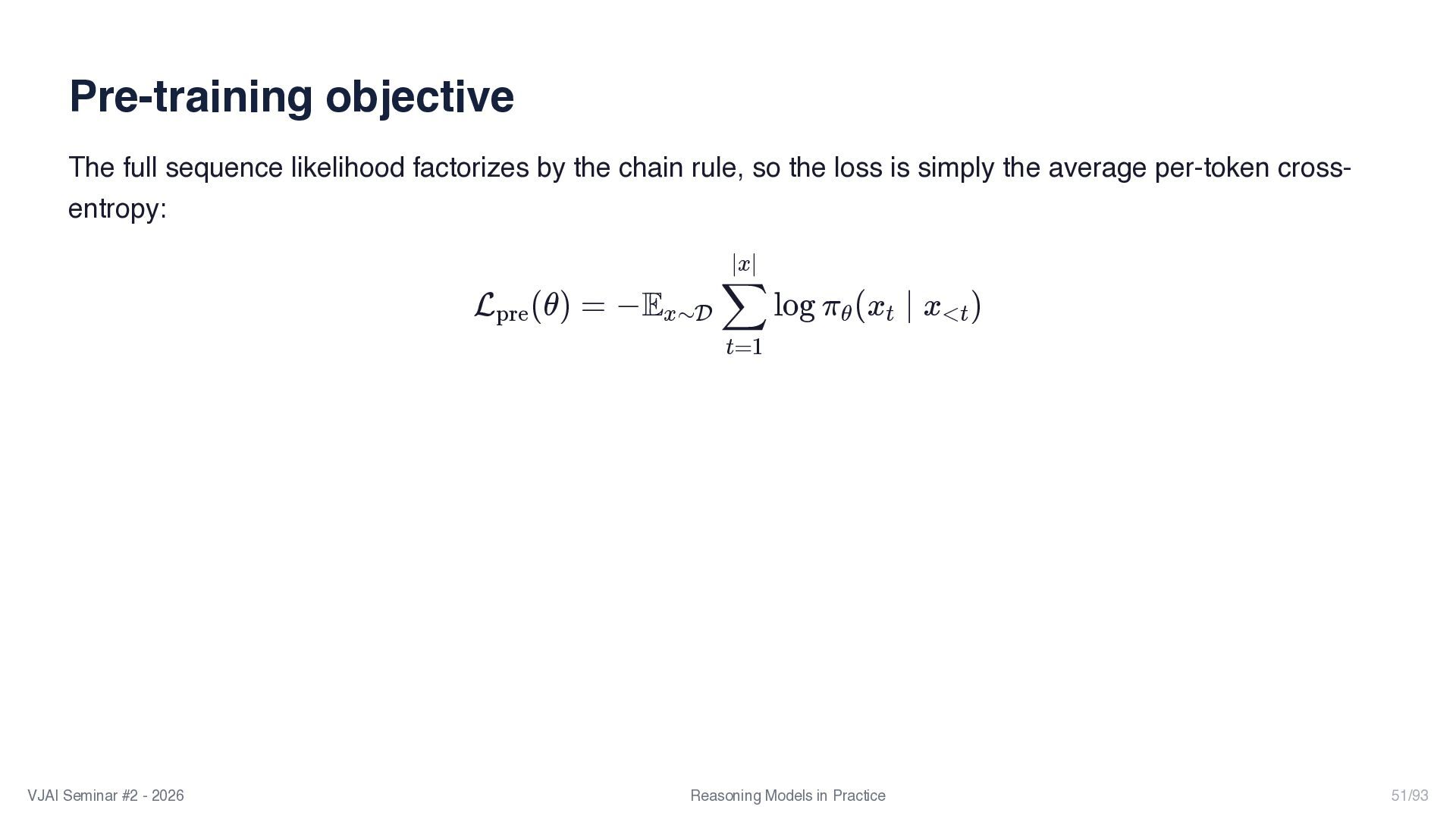
  50. Pre-training objective The full sequence likelihood factorizes by the chain

    rule, so the loss is simply the average per-token cross- entropy: L ​ (θ) = pre −E ​ ​ log π ​ (x ​ ∣ x∼D t=1 ∑ ∣x∣ θ t x ​ ) <t VJAI Seminar #2 - 2026 Reasoning Models in Practice 51/93
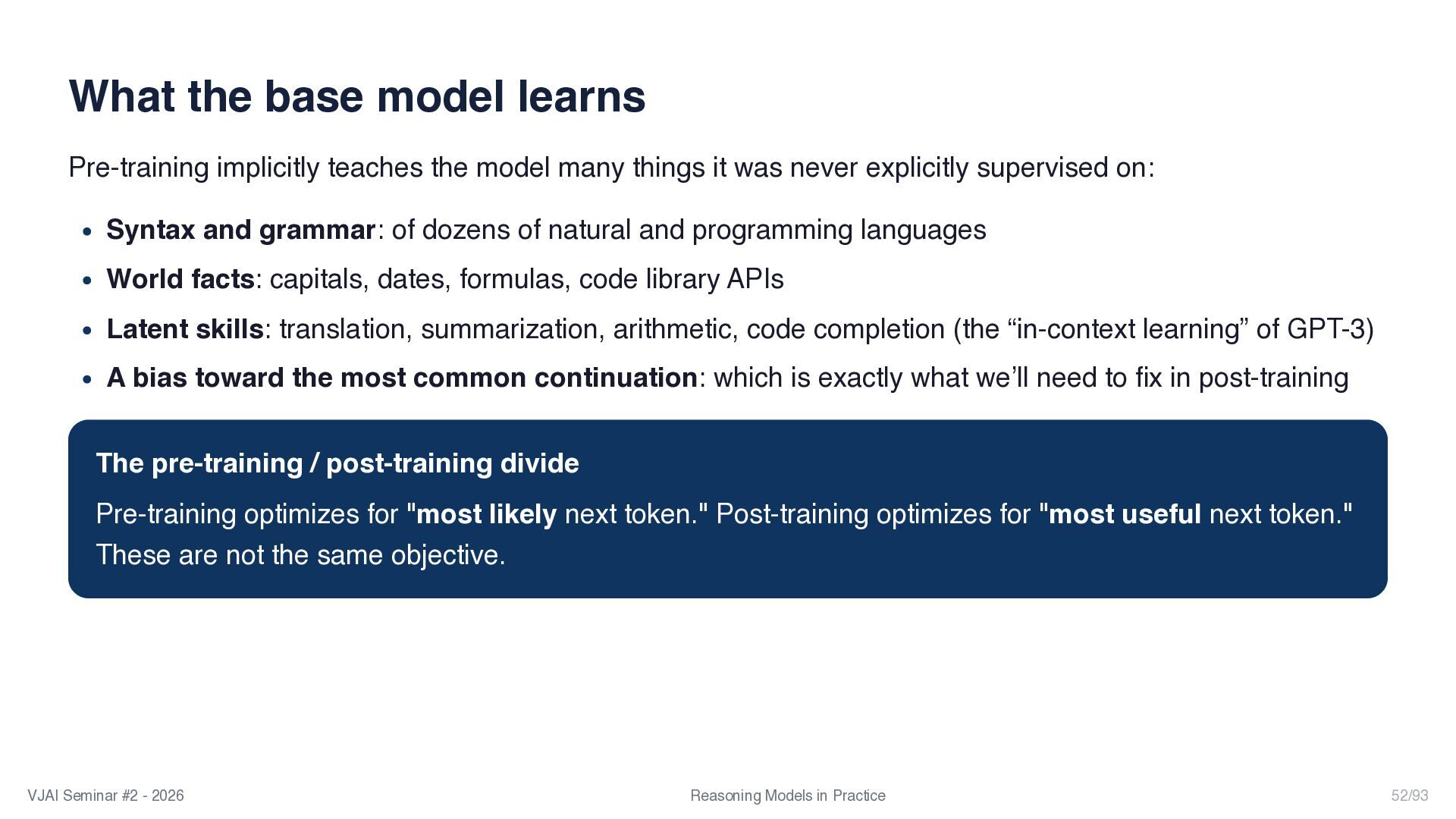
  51. What the base model learns Pre-training implicitly teaches the model

    many things it was never explicitly supervised on: Syntax and grammar: of dozens of natural and programming languages World facts: capitals, dates, formulas, code library APIs Latent skills: translation, summarization, arithmetic, code completion (the “in-context learning” of GPT-3) A bias toward the most common continuation: which is exactly what we’ll need to fix in post-training The pre-training / post-training divide Pre-training optimizes for "most likely next token." Post-training optimizes for "most useful next token." These are not the same objective. VJAI Seminar #2 - 2026 Reasoning Models in Practice 52/93
  52. From base model to chat model A base model trained

    only on next-token prediction is a glorified autocomplete: Given “What is 2+2?”, it might continue with another math question rather than answering. Useful for completion, useless as a chatbot. Post-training fixes this by reshaping the response distribution: Instruction tuning (SFT): teaches the model the question-answer format. Preference tuning (RLHF / DPO): teaches the model which answers humans like. RLVR: teaches the model to produce correct answers on verifiable tasks. VJAI Seminar #2 - 2026 Reasoning Models in Practice 53/93
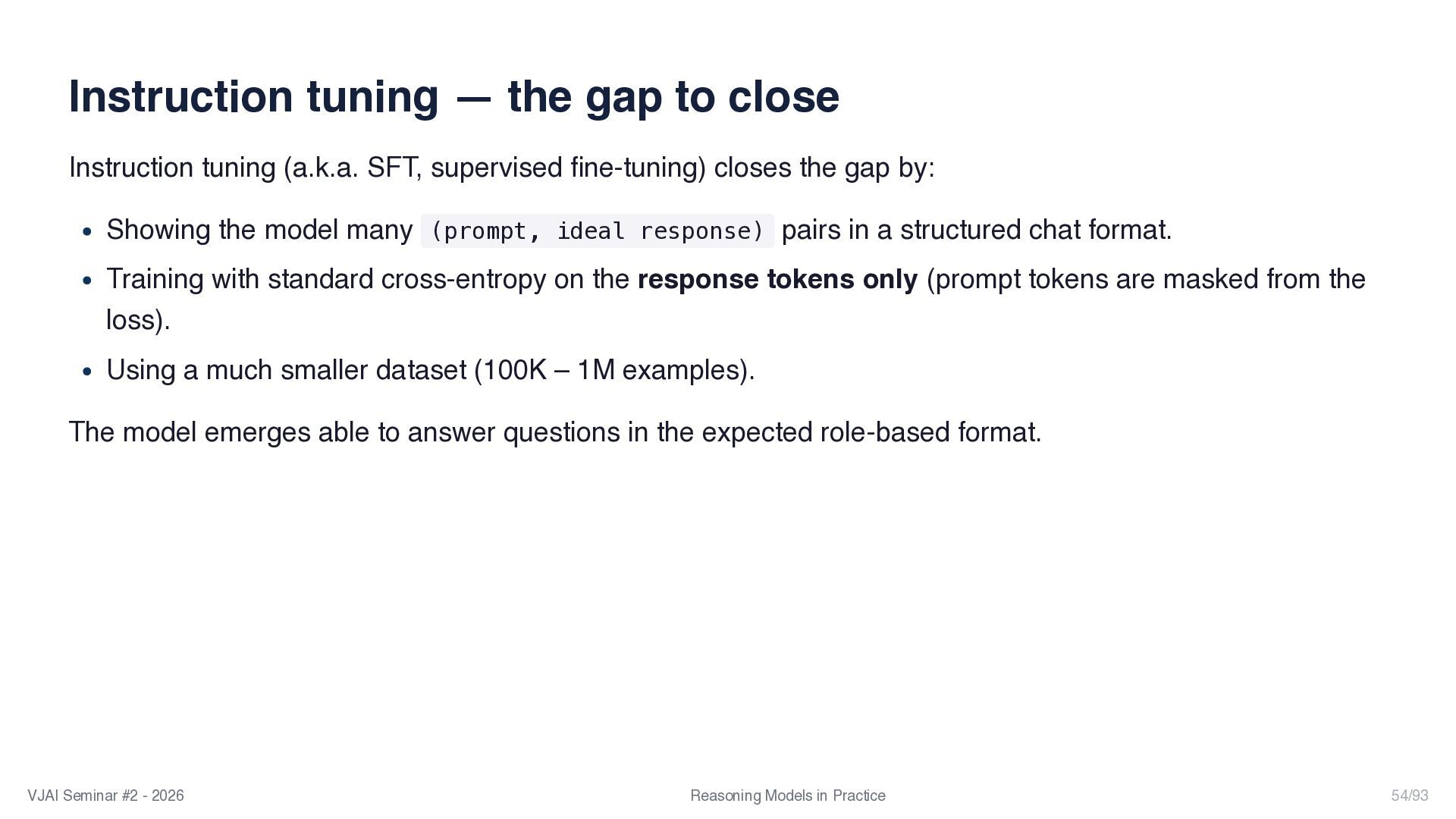
  53. Instruction tuning — the gap to close Instruction tuning (a.k.a.

    SFT, supervised fine-tuning) closes the gap by: Showing the model many (prompt, ideal response) pairs in a structured chat format. Training with standard cross-entropy on the response tokens only (prompt tokens are masked from the loss). Using a much smaller dataset (100K – 1M examples). The model emerges able to answer questions in the expected role-based format. VJAI Seminar #2 - 2026 Reasoning Models in Practice 54/93
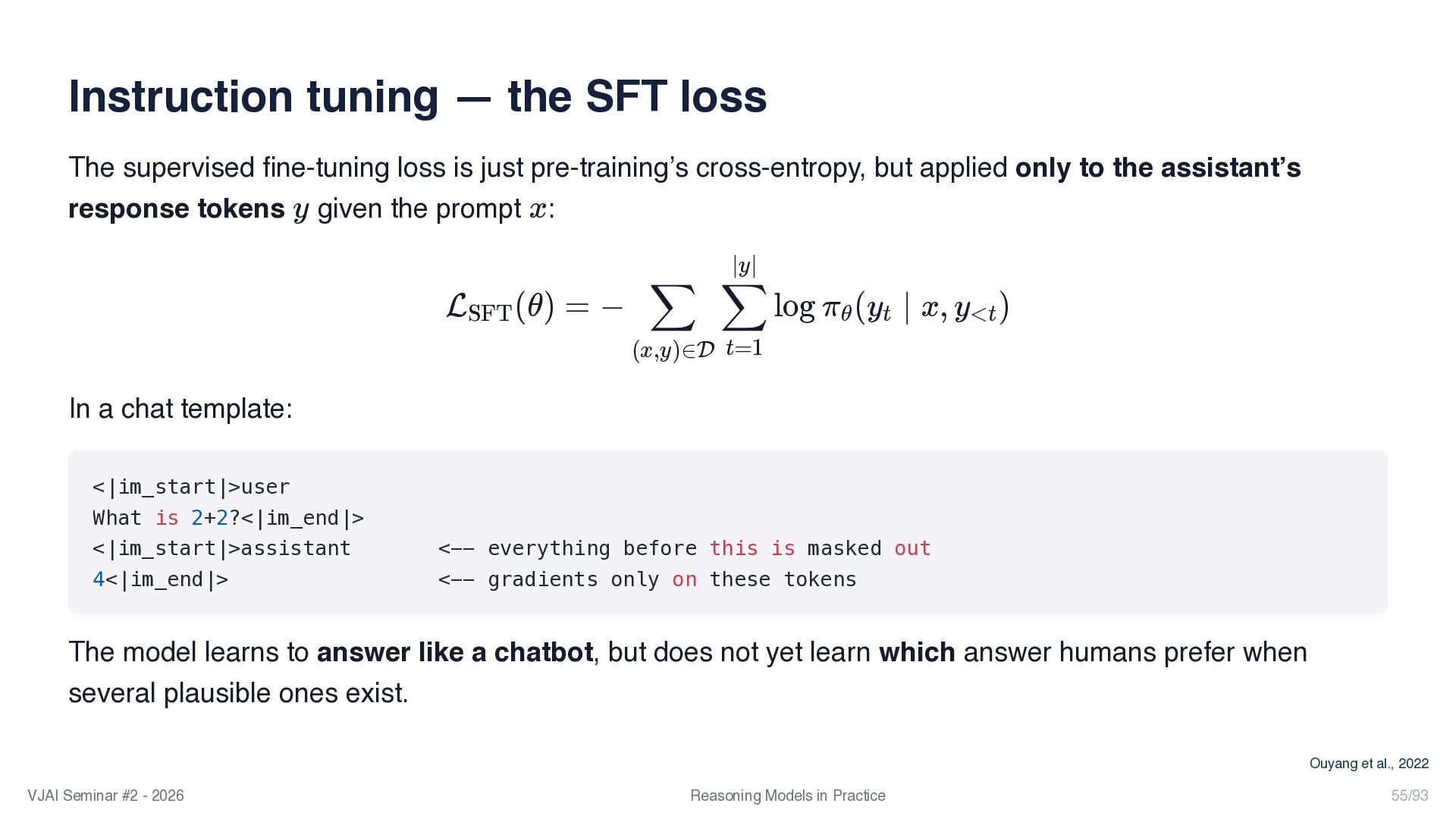
  54. Instruction tuning — the SFT loss The supervised fine-tuning loss

    is just pre-training’s cross-entropy, but applied only to the assistant’s response tokens given the prompt : In a chat template: <|im_start|>user What is 2+2?<|im_end|> <|im_start|>assistant <-- everything before this is masked out 4<|im_end|> <-- gradients only on these tokens The model learns to answer like a chatbot, but does not yet learn which answer humans prefer when several plausible ones exist. y x L ​ (θ) = SFT − ​ ​ log π ​ y ​ ∣ x, y ​ (x,y)∈D ∑ t=1 ∑ ∣y∣ θ( t <t) VJAI Seminar #2 - 2026 Reasoning Models in Practice 55/93 Ouyang et al., 2022
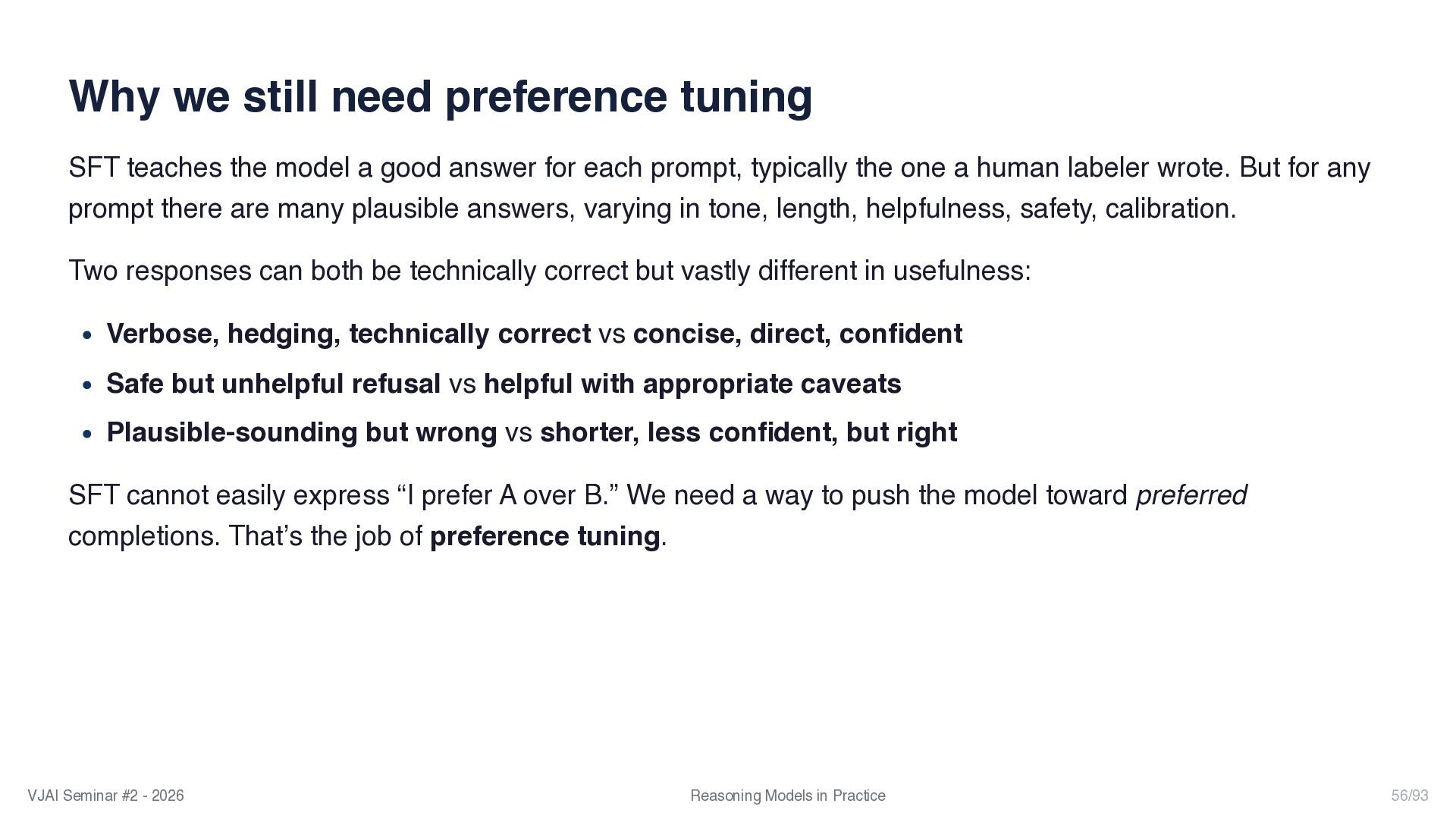
  55. Why we still need preference tuning SFT teaches the model

    a good answer for each prompt, typically the one a human labeler wrote. But for any prompt there are many plausible answers, varying in tone, length, helpfulness, safety, calibration. Two responses can both be technically correct but vastly different in usefulness: Verbose, hedging, technically correct vs concise, direct, confident Safe but unhelpful refusal vs helpful with appropriate caveats Plausible-sounding but wrong vs shorter, less confident, but right SFT cannot easily express “I prefer A over B.” We need a way to push the model toward preferred completions. That’s the job of preference tuning. VJAI Seminar #2 - 2026 Reasoning Models in Practice 56/93
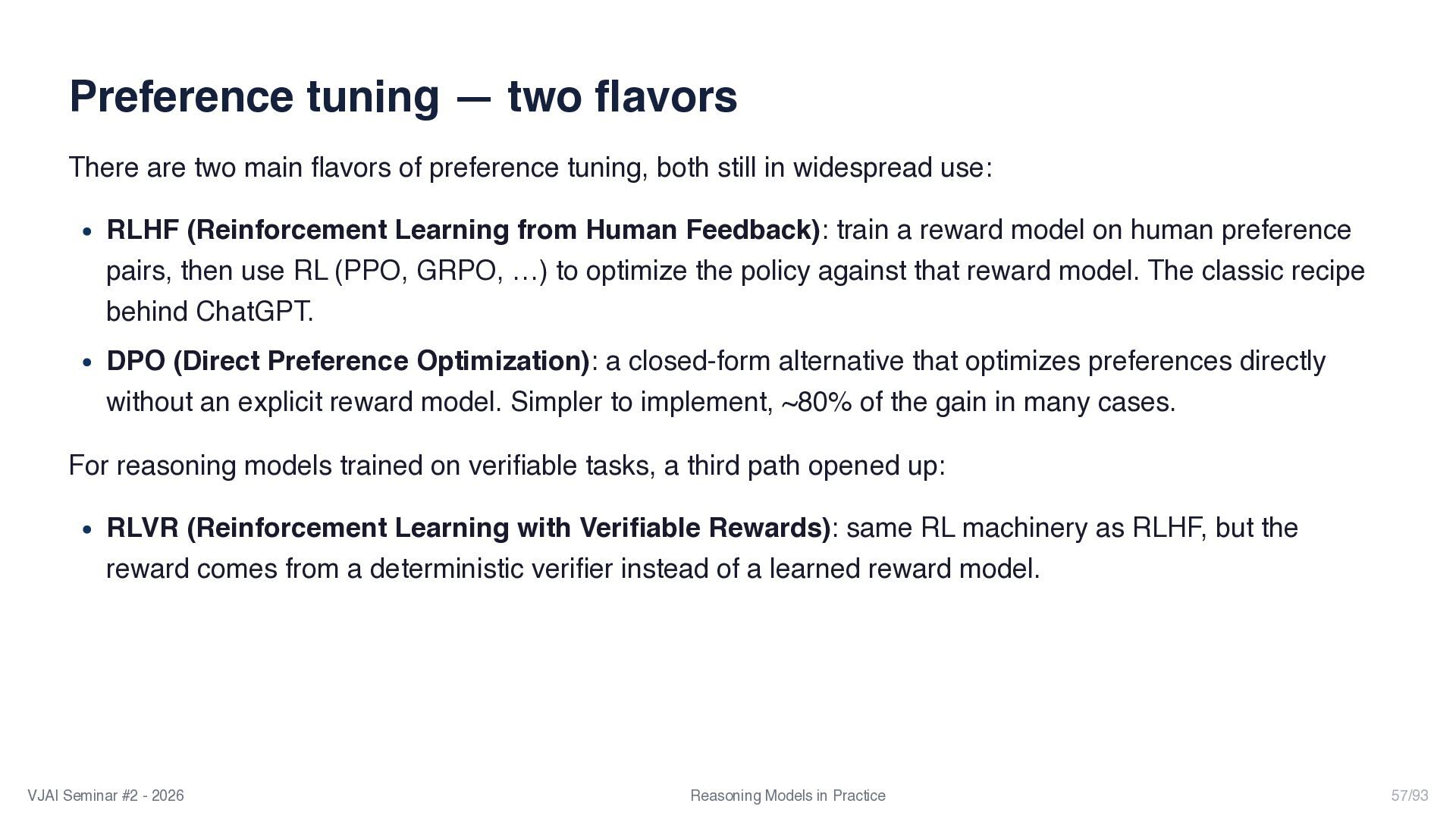
  56. Preference tuning — two flavors There are two main flavors

    of preference tuning, both still in widespread use: RLHF (Reinforcement Learning from Human Feedback): train a reward model on human preference pairs, then use RL (PPO, GRPO, …) to optimize the policy against that reward model. The classic recipe behind ChatGPT. DPO (Direct Preference Optimization): a closed-form alternative that optimizes preferences directly without an explicit reward model. Simpler to implement, ~80% of the gain in many cases. For reasoning models trained on verifiable tasks, a third path opened up: RLVR (Reinforcement Learning with Verifiable Rewards): same RL machinery as RLHF, but the reward comes from a deterministic verifier instead of a learned reward model. VJAI Seminar #2 - 2026 Reasoning Models in Practice 57/93
  57. Part 4a — The path to modern RLHF VJAI Seminar

    #2 - 2026 Reasoning Models in Practice 58/93
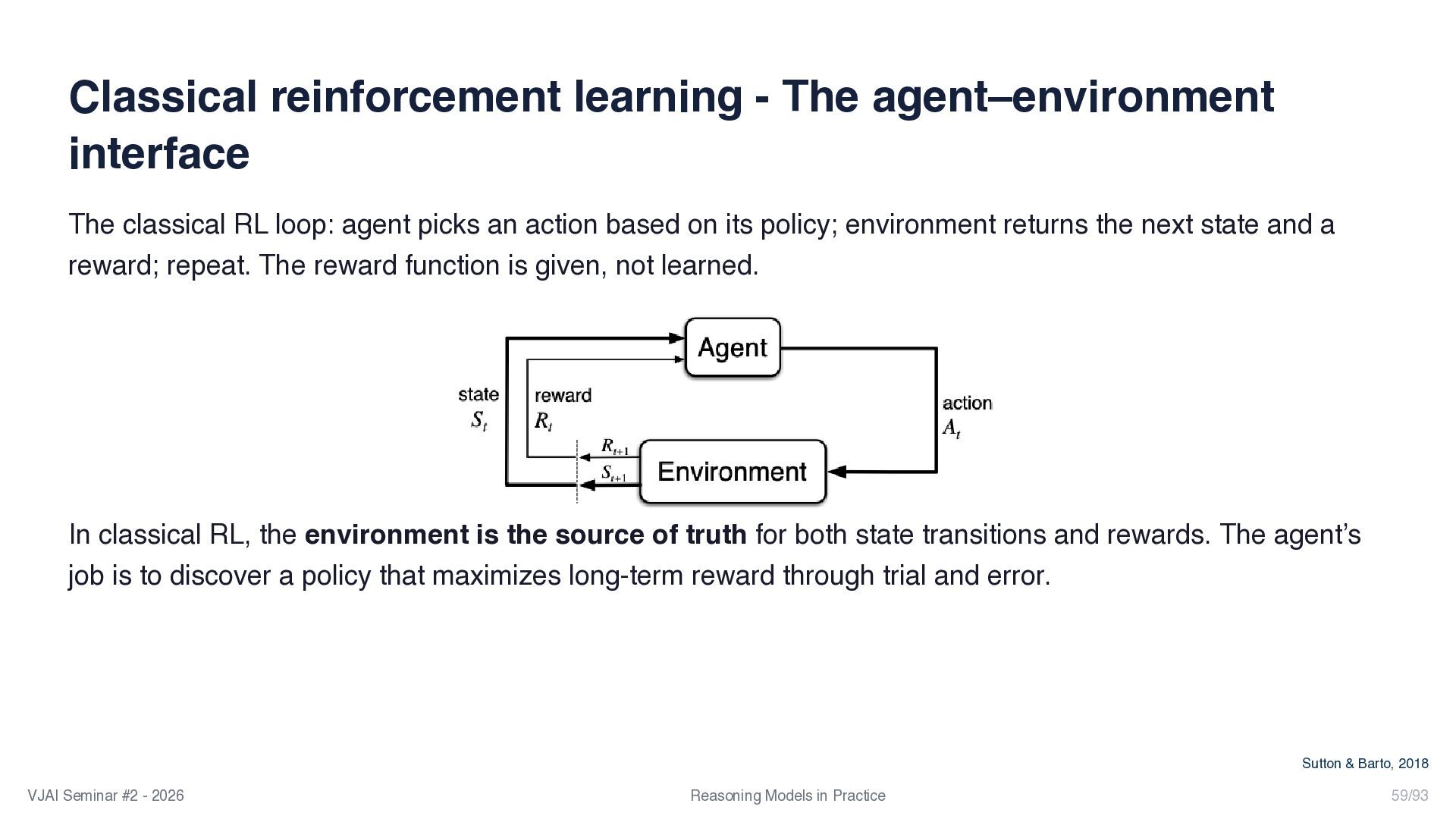
  58. Classical reinforcement learning - The agent–environment interface The classical RL

    loop: agent picks an action based on its policy; environment returns the next state and a reward; repeat. The reward function is given, not learned. In classical RL, the environment is the source of truth for both state transitions and rewards. The agent’s job is to discover a policy that maximizes long-term reward through trial and error. VJAI Seminar #2 - 2026 Reasoning Models in Practice 59/93 Sutton & Barto, 2018
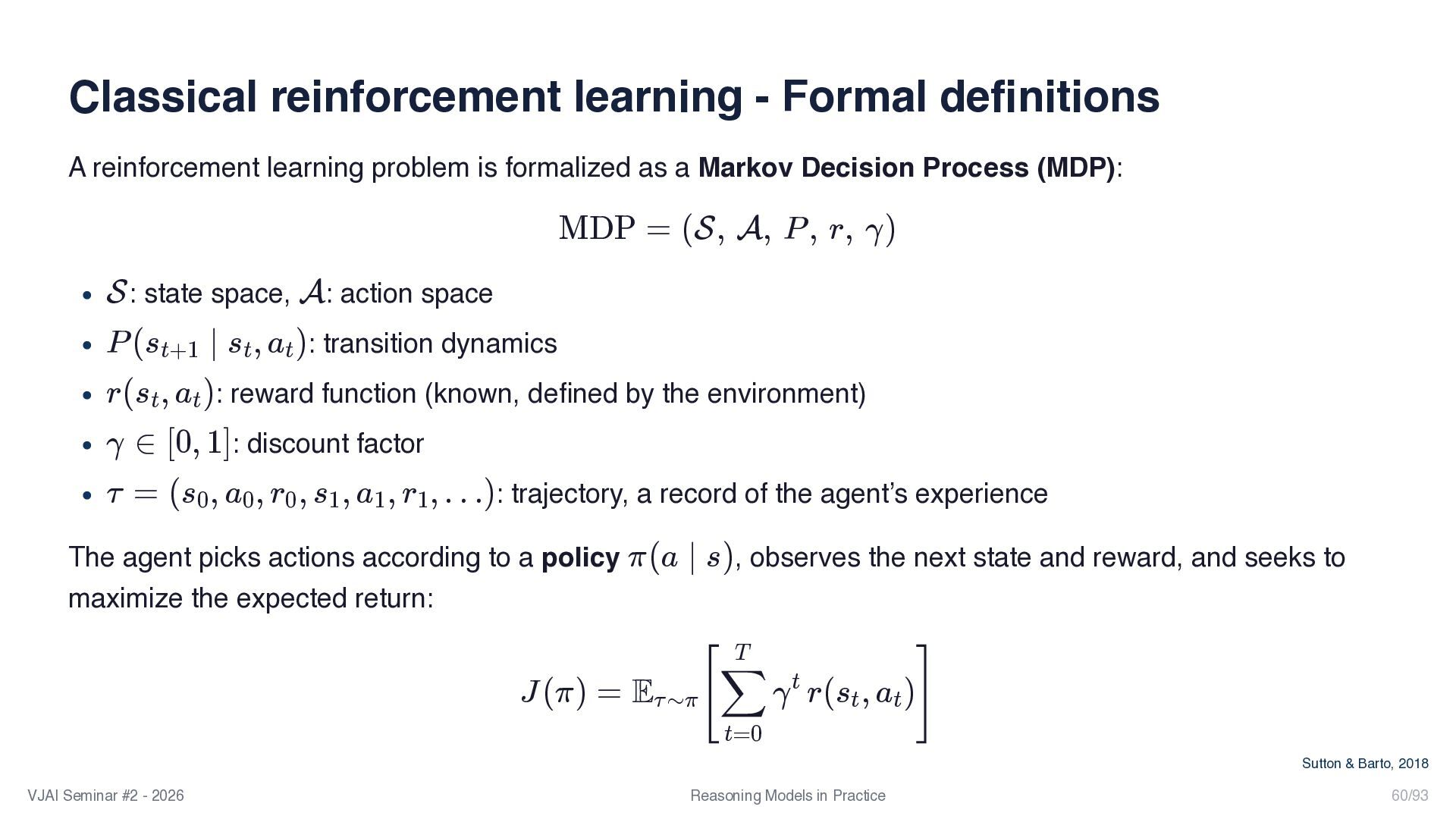
  59. Classical reinforcement learning - Formal definitions A reinforcement learning problem

    is formalized as a Markov Decision Process (MDP): : state space, : action space : transition dynamics : reward function (known, defined by the environment) : discount factor : trajectory, a record of the agent’s experience The agent picks actions according to a policy , observes the next state and reward, and seeks to maximize the expected return: MDP = (S, A, P, r, γ) S A P(s ​ ∣ t+1 s ​ , a ​ ) t t r(s ​ , a ​ ) t t γ ∈ [0, 1] τ = (s ​ , a ​ , r ​ , s ​ , a ​ , r , …) 0 0 0 1 1 1 π(a ∣ s) J(π) = E ​ ​ γ r(s ​ , a ​ ) τ∼π [ t=0 ∑ T t t t ] VJAI Seminar #2 - 2026 Reasoning Models in Practice 60/93 Sutton & Barto, 2018
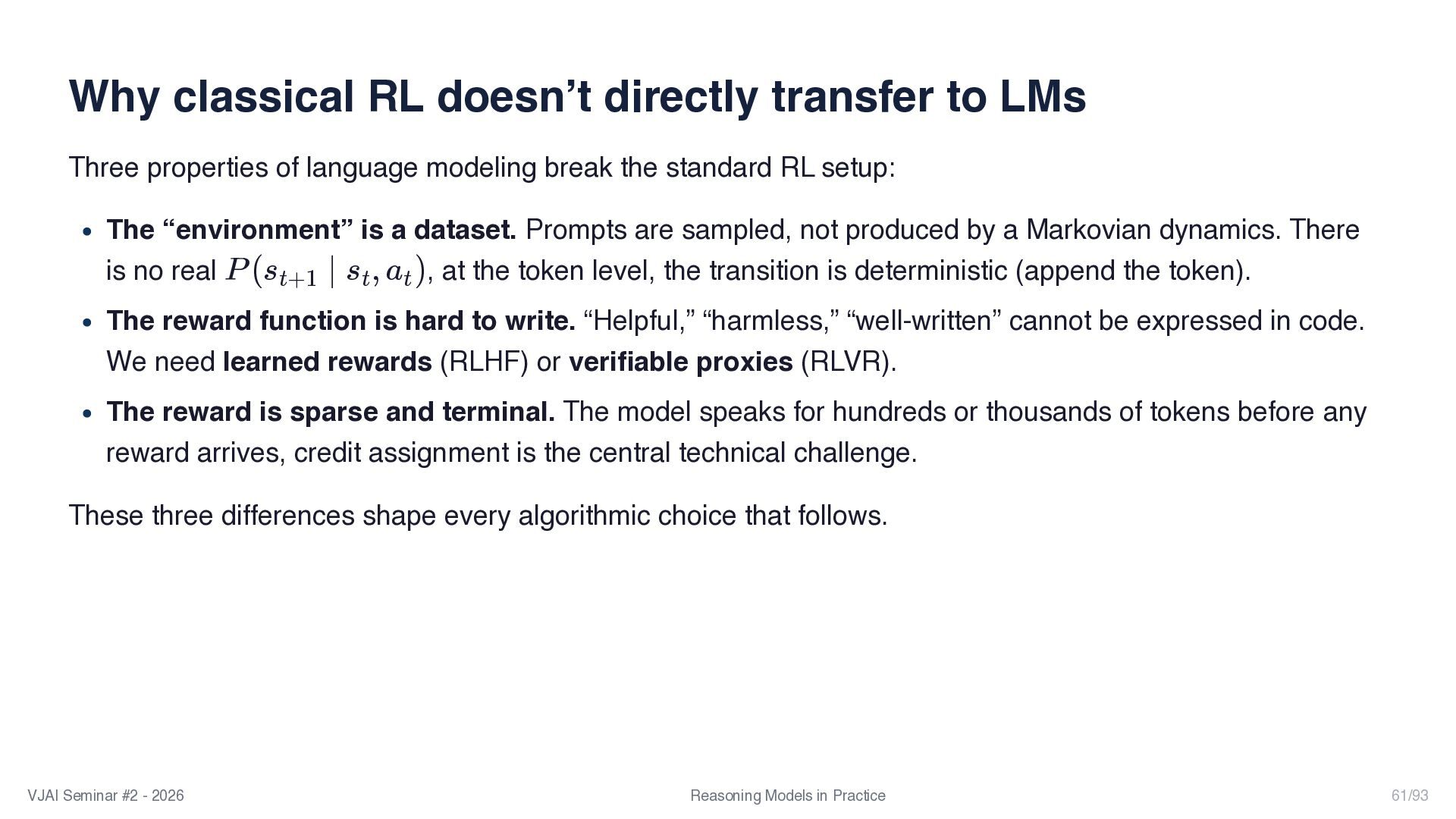
  60. Why classical RL doesn’t directly transfer to LMs Three properties

    of language modeling break the standard RL setup: The “environment” is a dataset. Prompts are sampled, not produced by a Markovian dynamics. There is no real , at the token level, the transition is deterministic (append the token). The reward function is hard to write. “Helpful,” “harmless,” “well-written” cannot be expressed in code. We need learned rewards (RLHF) or verifiable proxies (RLVR). The reward is sparse and terminal. The model speaks for hundreds or thousands of tokens before any reward arrives, credit assignment is the central technical challenge. These three differences shape every algorithmic choice that follows. P(s ​ ∣ t+1 s ​ , a ​ ) t t VJAI Seminar #2 - 2026 Reasoning Models in Practice 61/93
  61. Part 4b — Reinforcement Learning from Human Feedback VJAI Seminar

    #2 - 2026 Reasoning Models in Practice 62/93
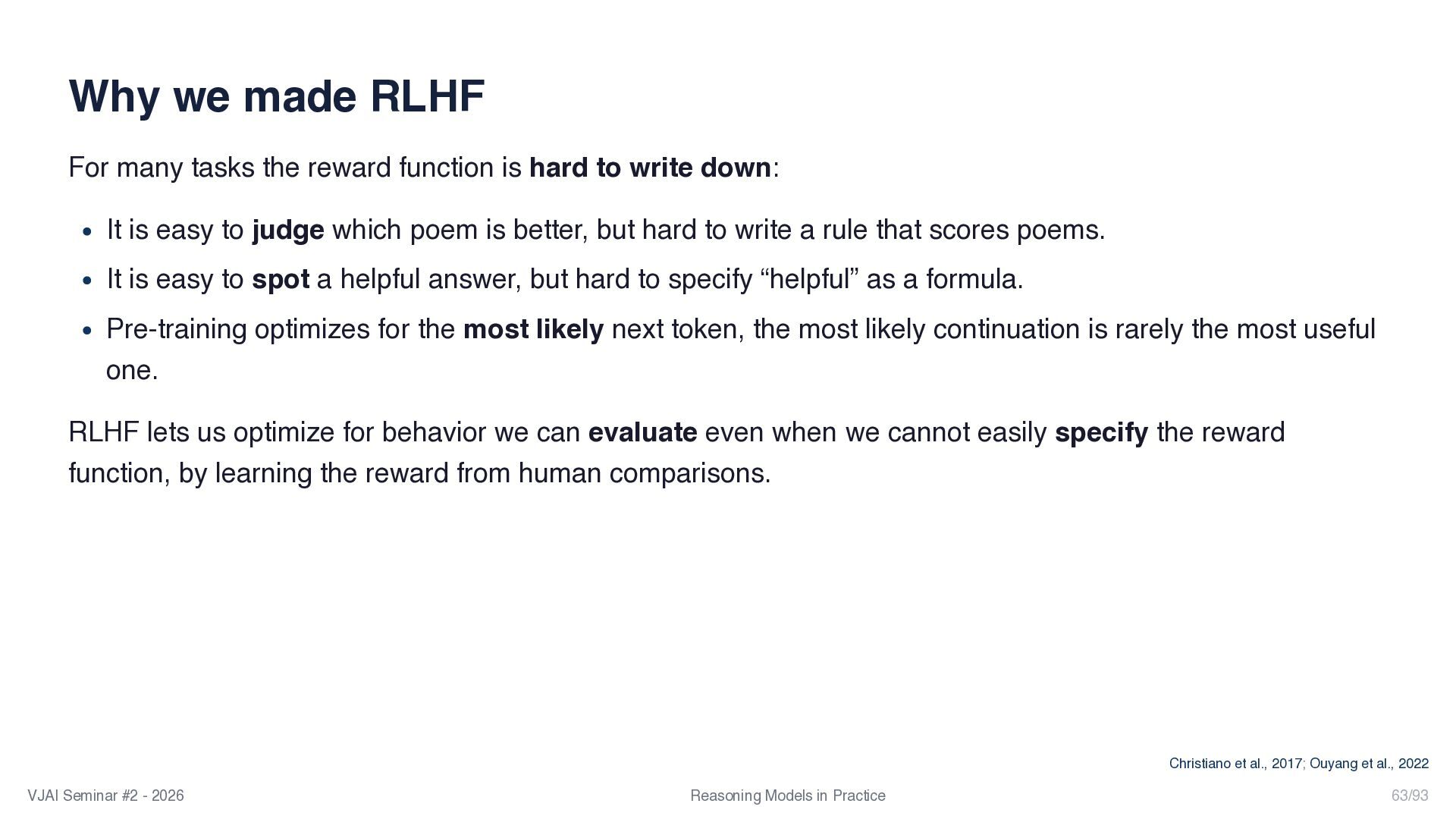
  62. Why we made RLHF For many tasks the reward function

    is hard to write down: It is easy to judge which poem is better, but hard to write a rule that scores poems. It is easy to spot a helpful answer, but hard to specify “helpful” as a formula. Pre-training optimizes for the most likely next token, the most likely continuation is rarely the most useful one. RLHF lets us optimize for behavior we can evaluate even when we cannot easily specify the reward function, by learning the reward from human comparisons. VJAI Seminar #2 - 2026 Reasoning Models in Practice 63/93 Christiano et al., 2017; Ouyang et al., 2022
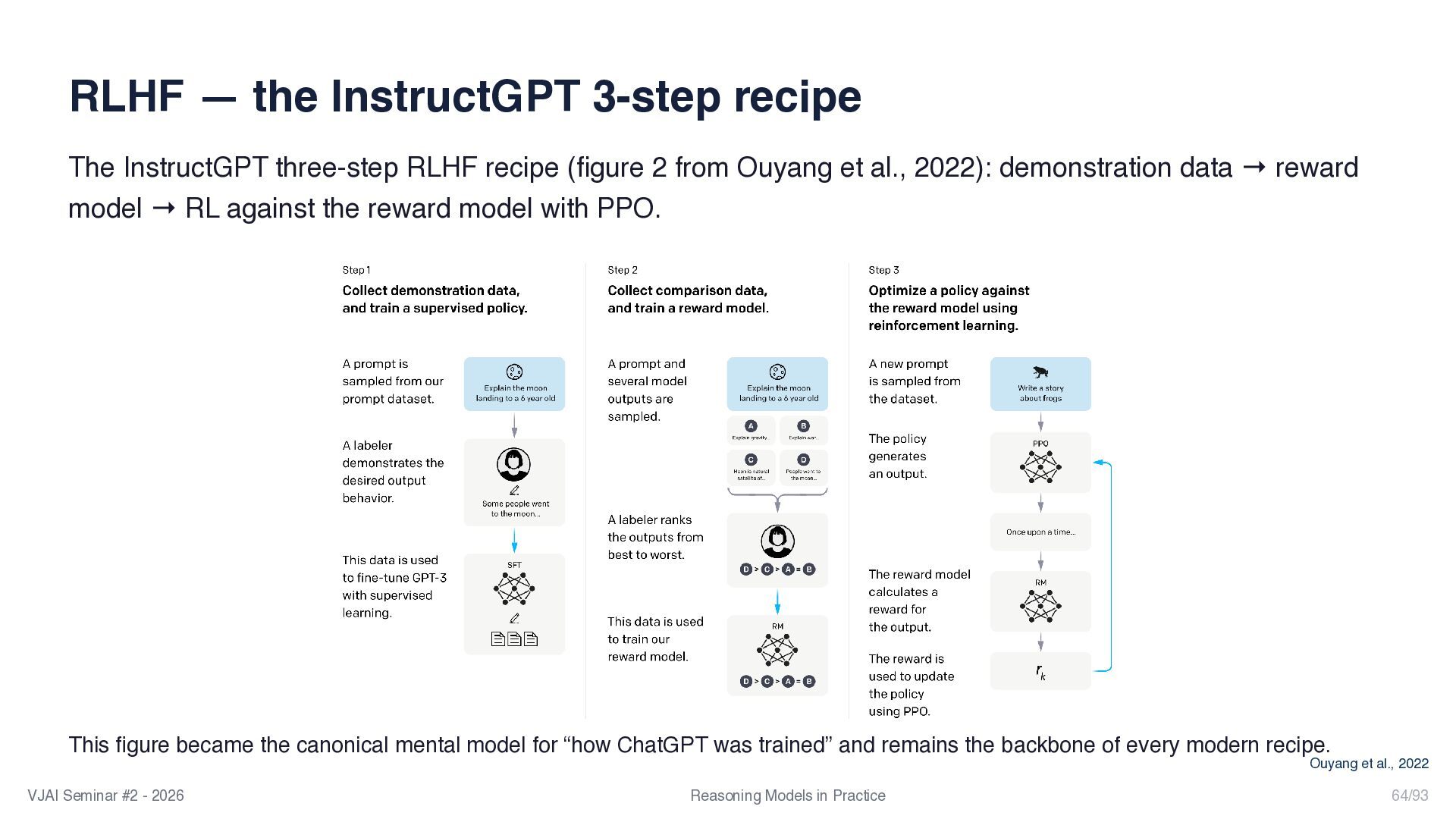
  63. RLHF — the InstructGPT 3-step recipe The InstructGPT three-step RLHF

    recipe (figure 2 from Ouyang et al., 2022): demonstration data → reward model → RL against the reward model with PPO. This figure became the canonical mental model for “how ChatGPT was trained” and remains the backbone of every modern recipe. VJAI Seminar #2 - 2026 Reasoning Models in Practice 64/93 Ouyang et al., 2022
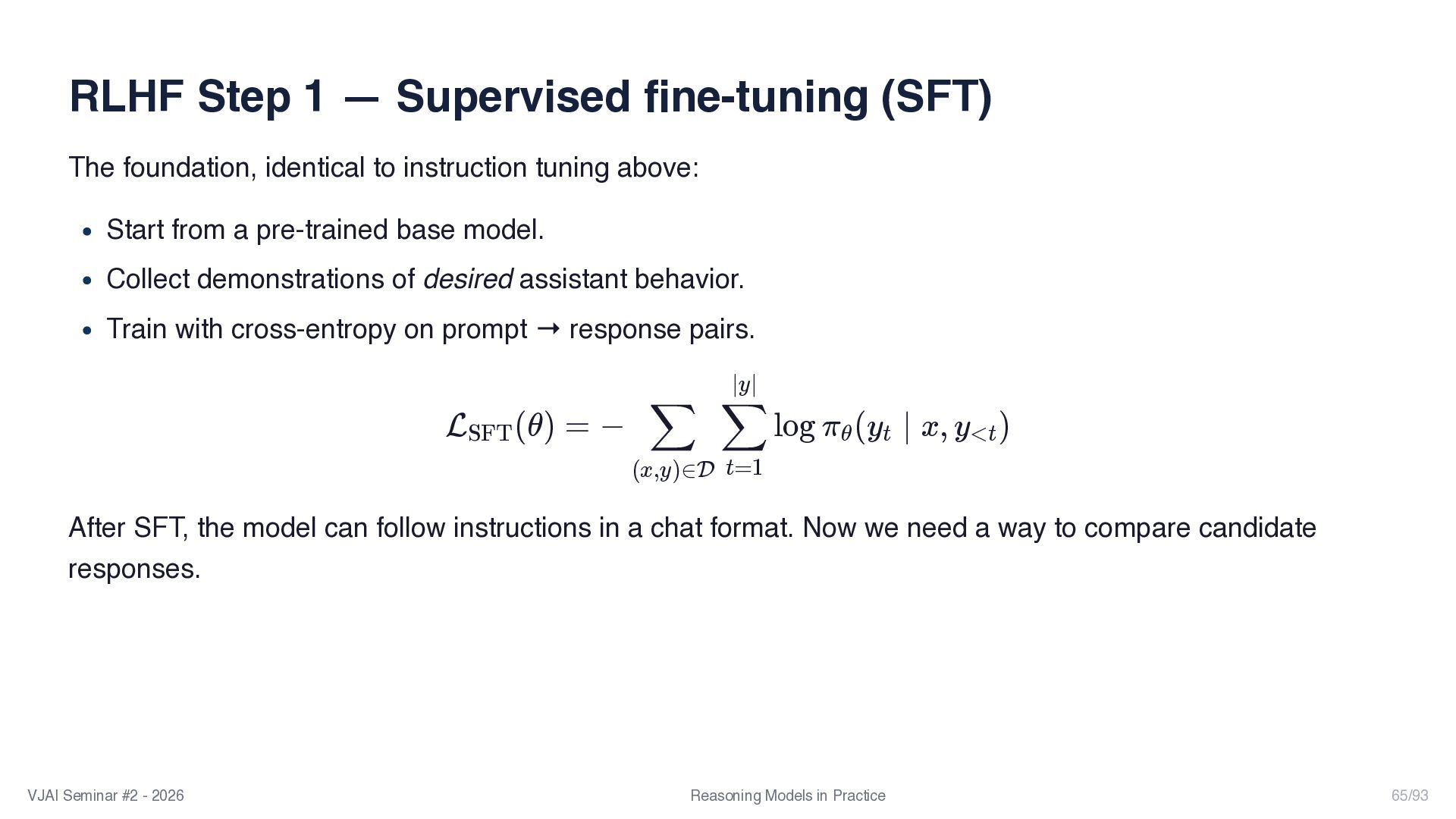
  64. RLHF Step 1 — Supervised fine-tuning (SFT) The foundation, identical

    to instruction tuning above: Start from a pre-trained base model. Collect demonstrations of desired assistant behavior. Train with cross-entropy on prompt → response pairs. After SFT, the model can follow instructions in a chat format. Now we need a way to compare candidate responses. L ​ (θ) = SFT − ​ ​ log π ​ y ​ ∣ x, y ​ (x,y)∈D ∑ t=1 ∑ ∣y∣ θ( t <t) VJAI Seminar #2 - 2026 Reasoning Models in Practice 65/93
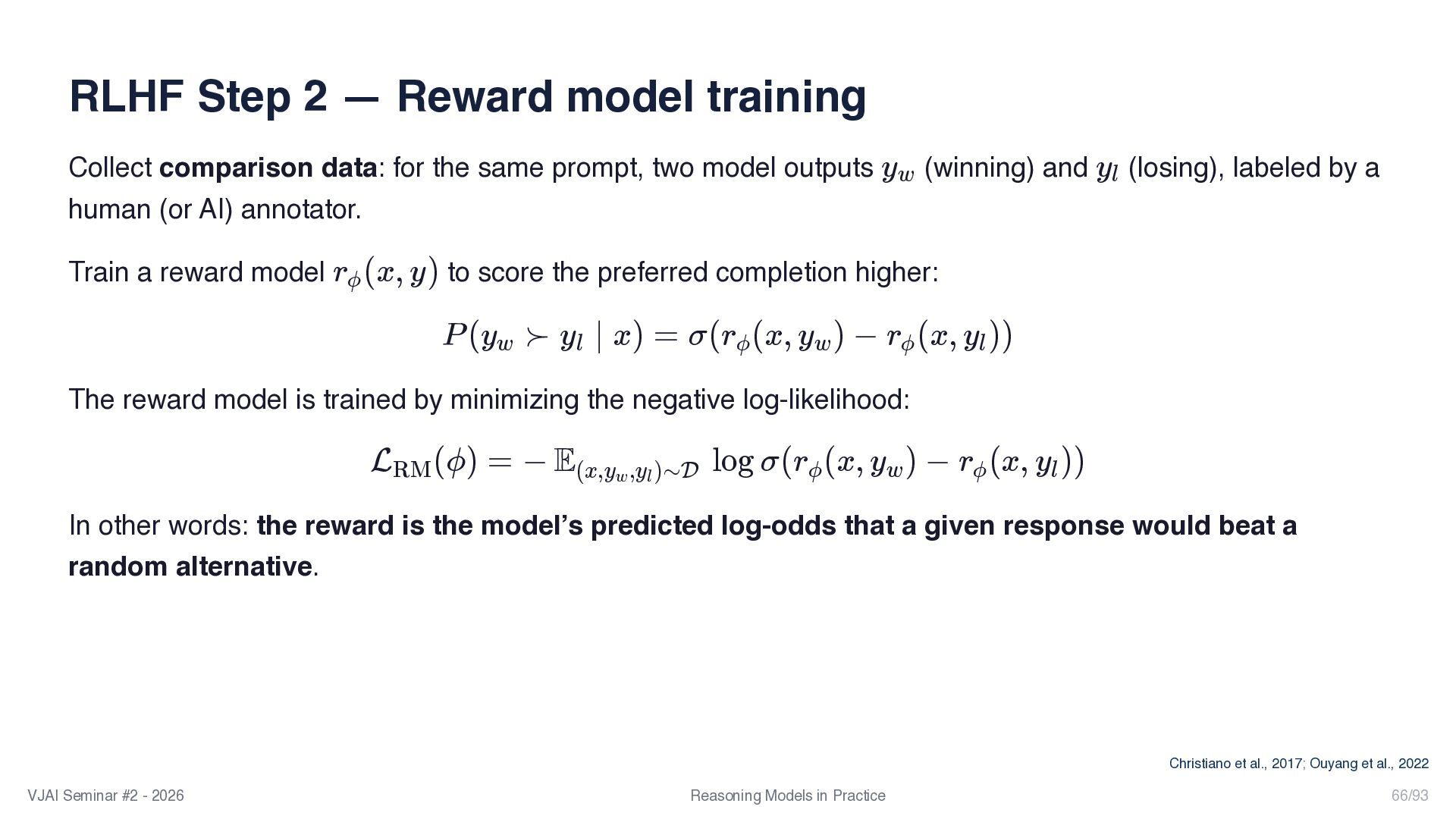
  65. RLHF Step 2 — Reward model training Collect comparison data:

    for the same prompt, two model outputs (winning) and (losing), labeled by a human (or AI) annotator. Train a reward model to score the preferred completion higher: The reward model is trained by minimizing the negative log-likelihood: In other words: the reward is the model’s predicted log-odds that a given response would beat a random alternative. y ​ w y ​ l r ​ (x, y) ϕ P(y ​ ≻ w y ​ ∣ l x) = σ r ​ (x, y ​ ) − r ​ (x, y ​ ) ( ϕ w ϕ l ) L ​ (ϕ) = RM − E ​ log σ r ​ (x, y ​ ) − r ​ (x, y ​ ) (x,y ​ ,y ​ )∼D w l ( ϕ w ϕ l ) VJAI Seminar #2 - 2026 Reasoning Models in Practice 66/93 Christiano et al., 2017; Ouyang et al., 2022
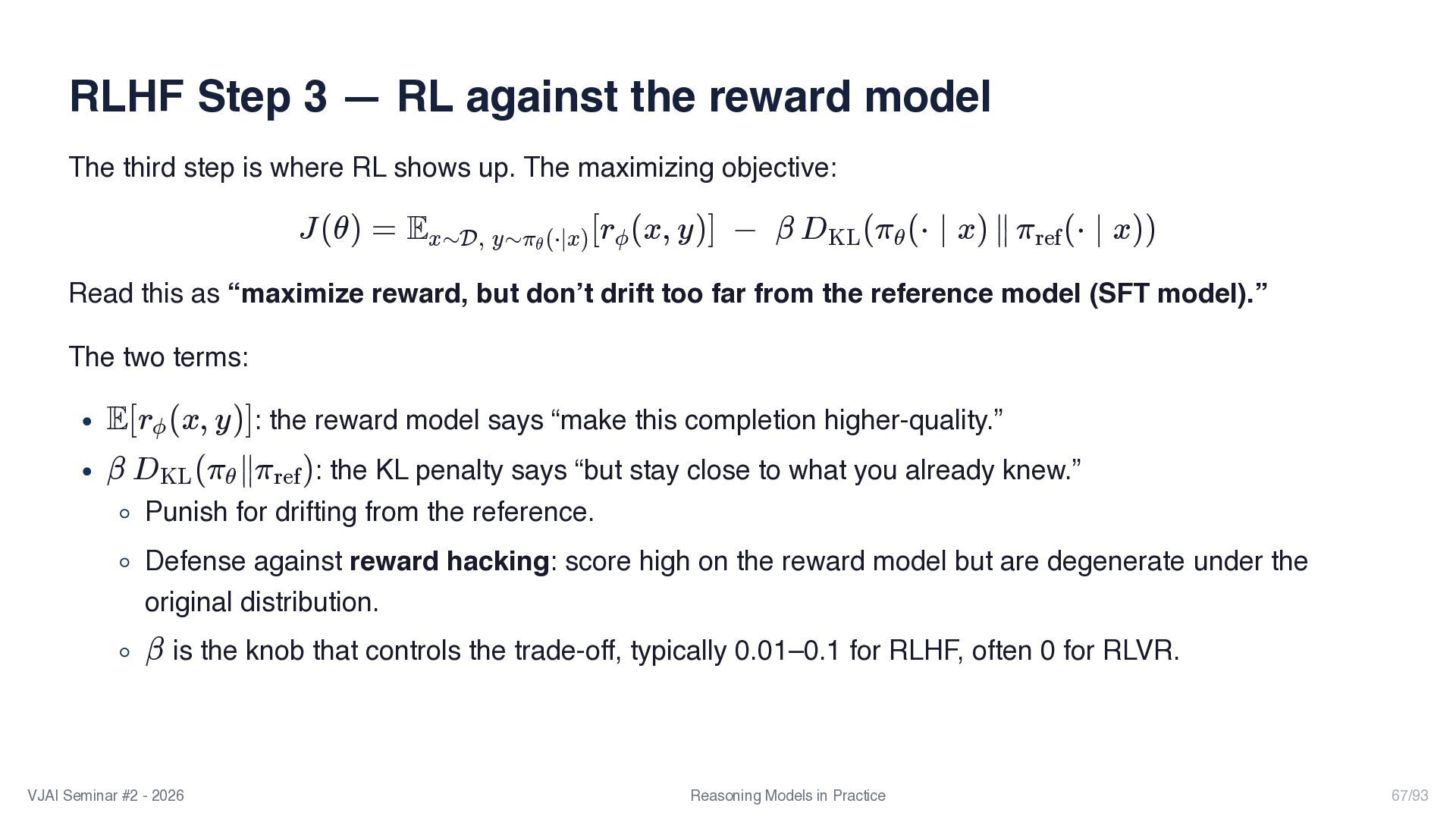
  66. RLHF Step 3 — RL against the reward model The

    third step is where RL shows up. The maximizing objective: Read this as “maximize reward, but don’t drift too far from the reference model (SFT model).” The two terms: : the reward model says “make this completion higher-quality.” : the KL penalty says “but stay close to what you already knew.” Punish for drifting from the reference. Defense against reward hacking: score high on the reward model but are degenerate under the original distribution. is the knob that controls the trade-off, typically 0.01–0.1 for RLHF, often 0 for RLVR. J(θ) = E ​ r ​ (x, y) − x∼D, y∼π ​ (⋅∣x) θ [ ϕ ] β D ​ π ​ (⋅ ∣ x) ∥ π ​ (⋅ ∣ x) KL ( θ ref ) E[r ​ (x, y)] ϕ β D ​ (π ​ ∥π ​ ) KL θ ref β VJAI Seminar #2 - 2026 Reasoning Models in Practice 67/93
  67. Part 4c — Proximal Policy Optimization (PPO) VJAI Seminar #2

    - 2026 Reasoning Models in Practice 68/93
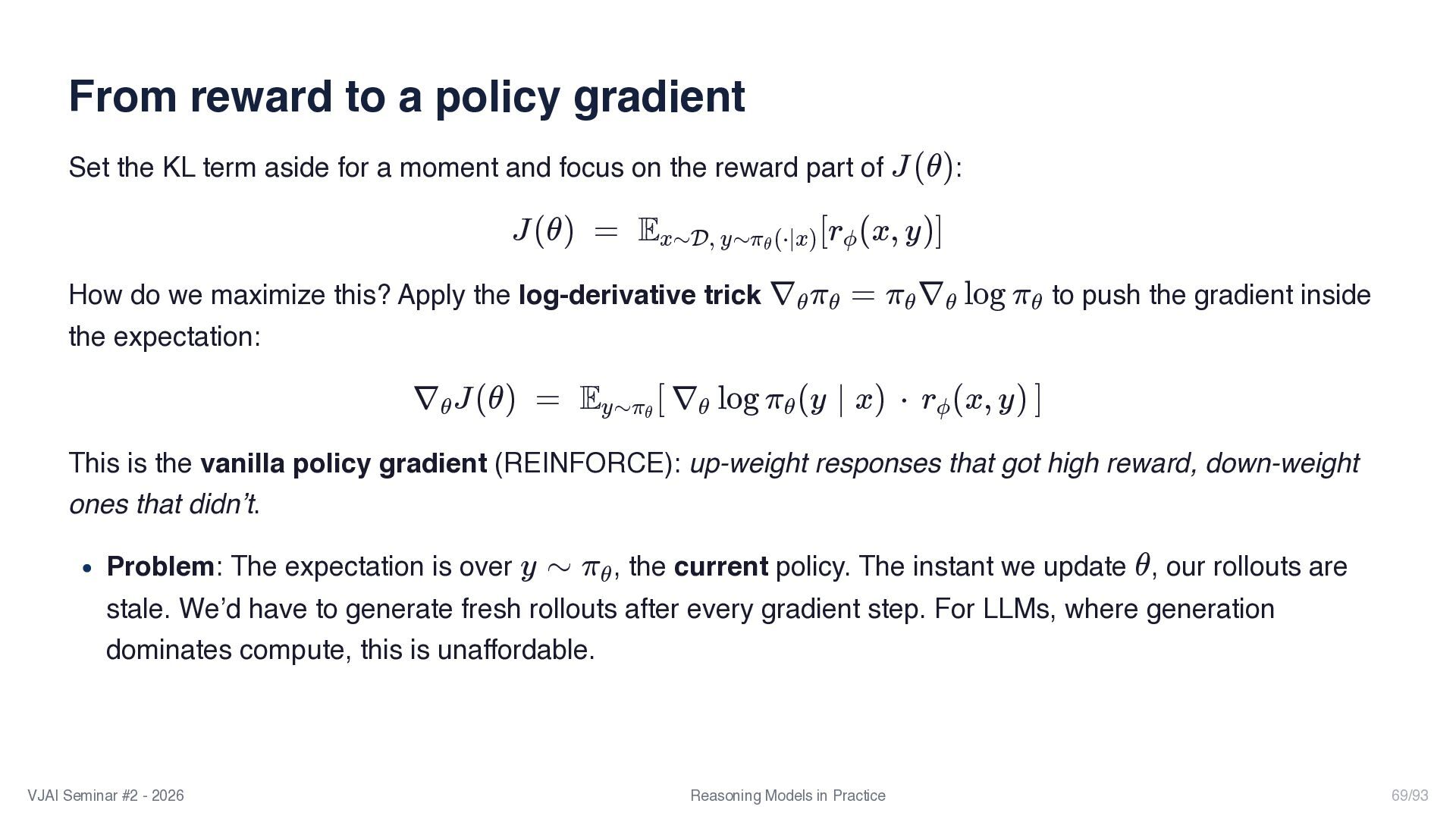
  68. From reward to a policy gradient Set the KL term

    aside for a moment and focus on the reward part of : How do we maximize this? Apply the log-derivative trick to push the gradient inside the expectation: This is the vanilla policy gradient (REINFORCE): up-weight responses that got high reward, down-weight ones that didn’t. Problem: The expectation is over , the current policy. The instant we update , our rollouts are stale. We’d have to generate fresh rollouts after every gradient step. For LLMs, where generation dominates compute, this is unaffordable. J(θ) J(θ) = E ​ r ​ (x, y) x∼D, y∼π ​ (⋅∣x) θ [ ϕ ] ∇ ​ π ​ = θ θ π ​ ∇ ​ log π ​ θ θ θ ∇ ​ J(θ) = θ E ​ ∇ ​ log π ​ (y ∣ x) ⋅ r ​ (x, y) y∼π ​ θ [ θ θ ϕ ] y ∼ π ​ θ θ VJAI Seminar #2 - 2026 Reasoning Models in Practice 69/93
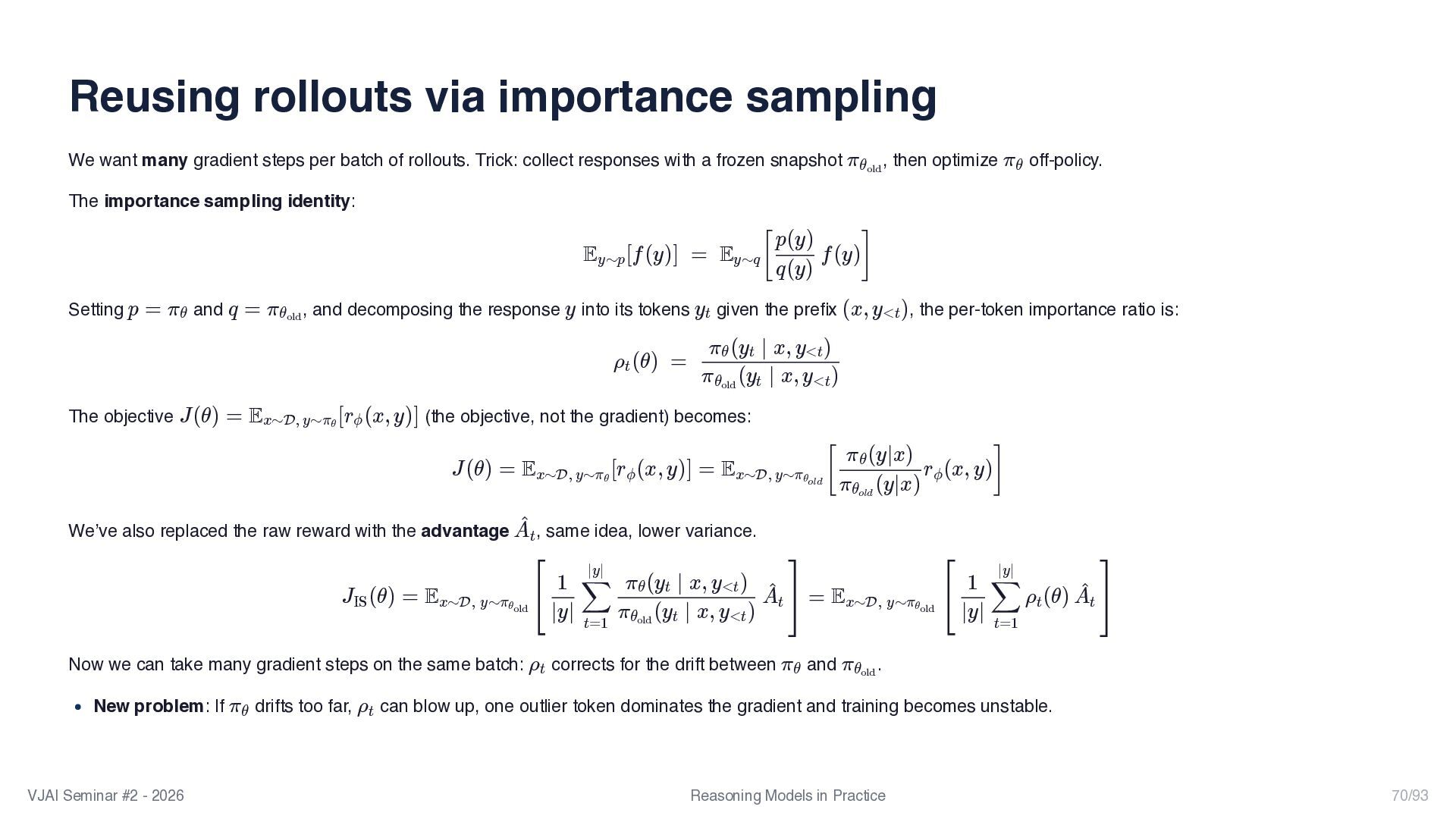
  69. Reusing rollouts via importance sampling We want many gradient steps

    per batch of rollouts. Trick: collect responses with a frozen snapshot , then optimize off-policy. The importance sampling identity: Setting and , and decomposing the response into its tokens given the prefix , the per-token importance ratio is: The objective (the objective, not the gradient) becomes: We’ve also replaced the raw reward with the advantage , same idea, lower variance. Now we can take many gradient steps on the same batch: corrects for the drift between and . New problem: If drifts too far, can blow up, one outlier token dominates the gradient and training becomes unstable. π ​ θ ​ old π ​ θ E ​ [f(y)] = y∼p E ​ ​ f(y) y∼q [ q(y) p(y) ] p = π ​ θ q = π ​ θ ​ old y y ​ t (x, y ​ ) <t ρ ​ (θ) = t ​ π ​ (y ​ ∣ x, y ​ ) θ ​ old t <t π ​ (y ​ ∣ x, y ​ ) θ t <t J(θ) = E ​ r ​ (x, y) x∼D, y∼π ​ θ [ ϕ ] ​ J(θ) = E ​ r ​ (x, y) = E ​ ​ r ​ (x, y) x∼D, y∼π ​ θ [ ϕ ] x∼D, y∼π ​ θ ​ old [ π ​ (y∣x) θ ​ old π ​ (y∣x) θ ϕ ] ​ A ^ t J ​ (θ) = IS E ​ ​ ​ ​ ​ ​ ​ = x∼D, y∼π ​ θ ​ old ∣y∣ 1 t=1 ∑ ∣y∣ π ​ (y ​ ∣ x, y ) θ ​ old t <t π ​ (y ​ ∣ x, y ​ ) θ t <t A ^ t E ​ ​ ​ ​ ρ ​ (θ) ​ ​ x∼D, y∼π ​ θ ​ old ∣y∣ 1 t=1 ∑ ∣y∣ t A ^ t ρ ​ t π ​ θ π ​ θ ​ old π ​ θ ρ ​ t VJAI Seminar #2 - 2026 Reasoning Models in Practice 70/93
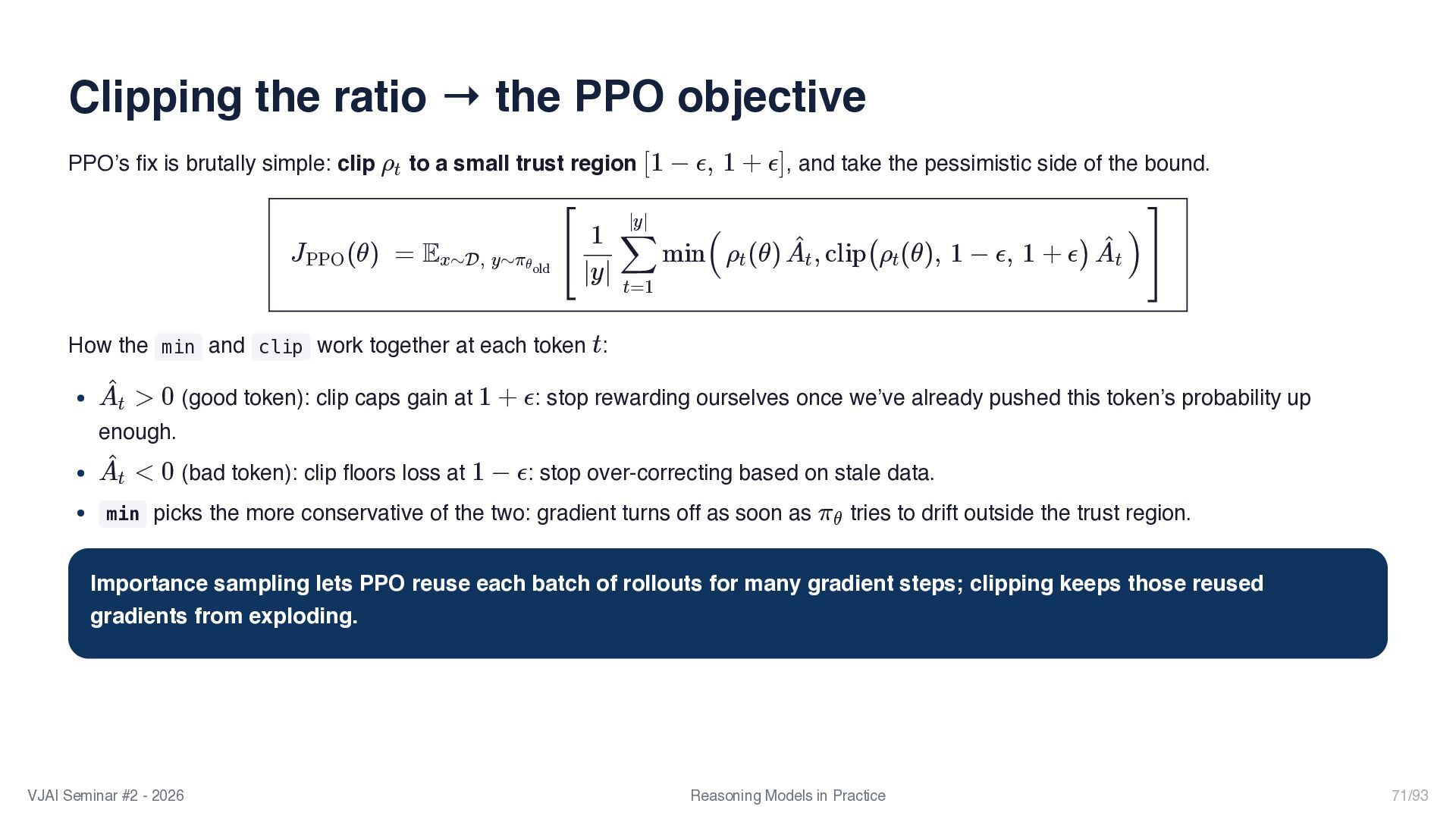
  70. Clipping the ratio → the PPO objective PPO’s fix is

    brutally simple: clip to a small trust region , and take the pessimistic side of the bound. How the min and clip work together at each token : (good token): clip caps gain at : stop rewarding ourselves once we’ve already pushed this token’s probability up enough. (bad token): clip floors loss at : stop over-correcting based on stale data. min picks the more conservative of the two: gradient turns off as soon as tries to drift outside the trust region. Importance sampling lets PPO reuse each batch of rollouts for many gradient steps; clipping keeps those reused gradients from exploding. ρt [1 − ϵ, 1 + ϵ] ​ J ​ (θ) = E ​ ​ ​ ​ min( ρ ​ (θ) ​ , clip(ρ ​ (θ), 1 − ϵ, 1 + ϵ) ​ ) ​ PPO x∼D, y∼π ​ θ ​ old ∣y∣ 1 t=1 ∑ ∣y∣ t A ^ t t A ^ t t ​ > A ^ t 0 1 + ϵ ​ < A ^ t 0 1 − ϵ π ​ θ VJAI Seminar #2 - 2026 Reasoning Models in Practice 71/93
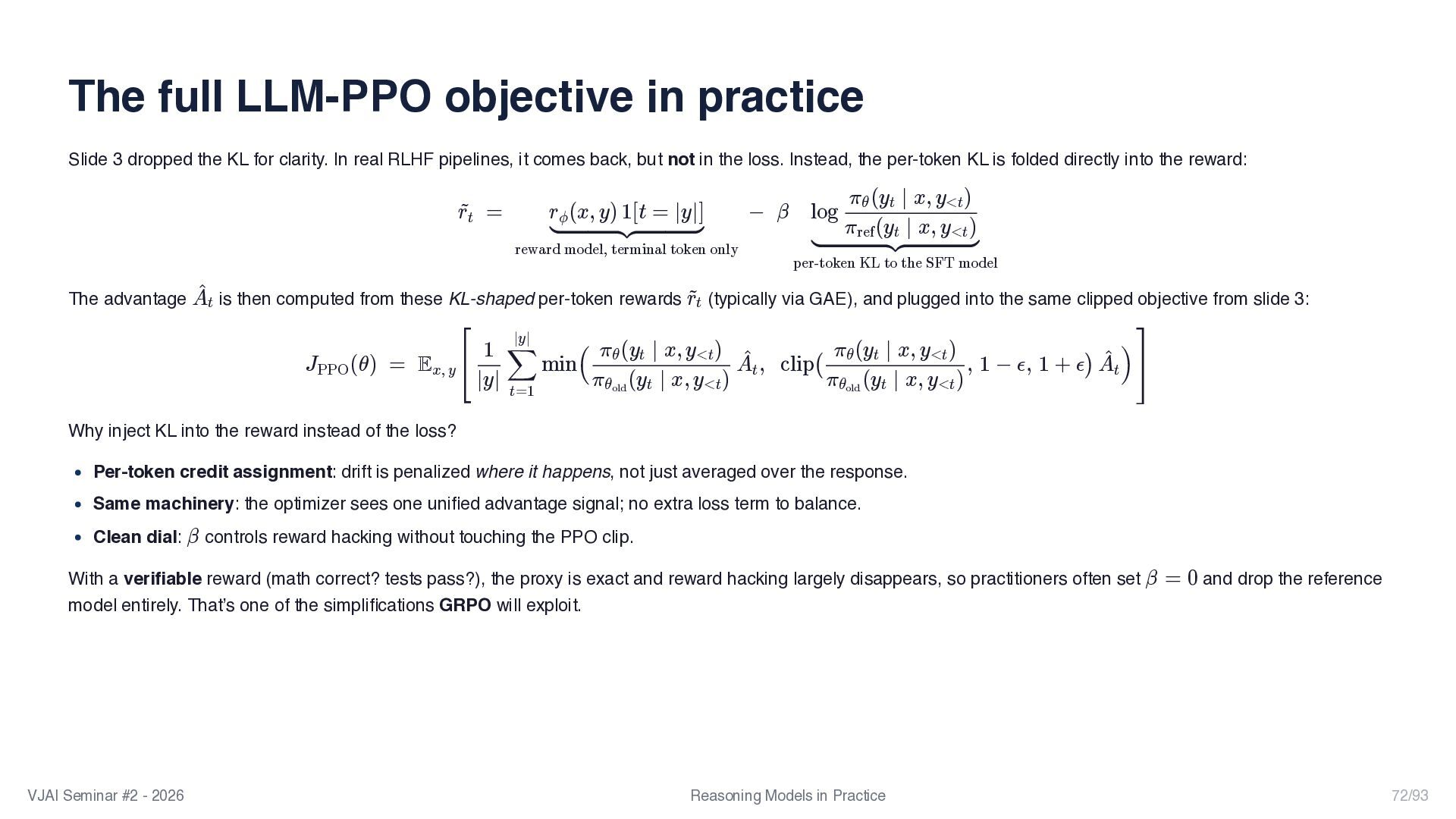
  71. The full LLM-PPO objective in practice Slide 3 dropped the

    KL for clarity. In real RLHF pipelines, it comes back, but not in the loss. Instead, the per-token KL is folded directly into the reward: The advantage is then computed from these KL-shaped per-token rewards (typically via GAE), and plugged into the same clipped objective from slide 3: Why inject KL into the reward instead of the loss? Per-token credit assignment: drift is penalized where it happens, not just averaged over the response. Same machinery: the optimizer sees one unified advantage signal; no extra loss term to balance. Clean dial: controls reward hacking without touching the PPO clip. With a verifiable reward (math correct? tests pass?), the proxy is exact and reward hacking largely disappears, so practitioners often set and drop the reference model entirely. That’s one of the simplifications GRPO will exploit. ​ = r ~ t ​ − reward model, terminal token only ​ r ​ (x, y) 1[t = ∣y∣] ϕ β ​ per-token KL to the SFT model ​ log ​ π ​ (y ​ ∣ x, y ​ ) ref t <t π ​ (y ​ ∣ x, y ​ ) θ t <t ​ A ^ t ​ r ~ t J ​ (θ) = PPO E ​ ​ ​ ​ min( ​ ​ , clip( ​ , 1 − ϵ, 1 + ϵ) ​ ) ​ x, y ∣y∣ 1 t=1 ∑ ∣y∣ π ​ (y ​ ∣ x, y ​ ) θ ​ old t <t π ​ (y ​ ∣ x, y ​ ) θ t <t A ^ t π ​ (y ​ ∣ x, y ​ ) θ ​ old t <t π ​ (y ​ ∣ x, y ​ ) θ t <t A ^ t β β = 0 VJAI Seminar #2 - 2026 Reasoning Models in Practice 72/93
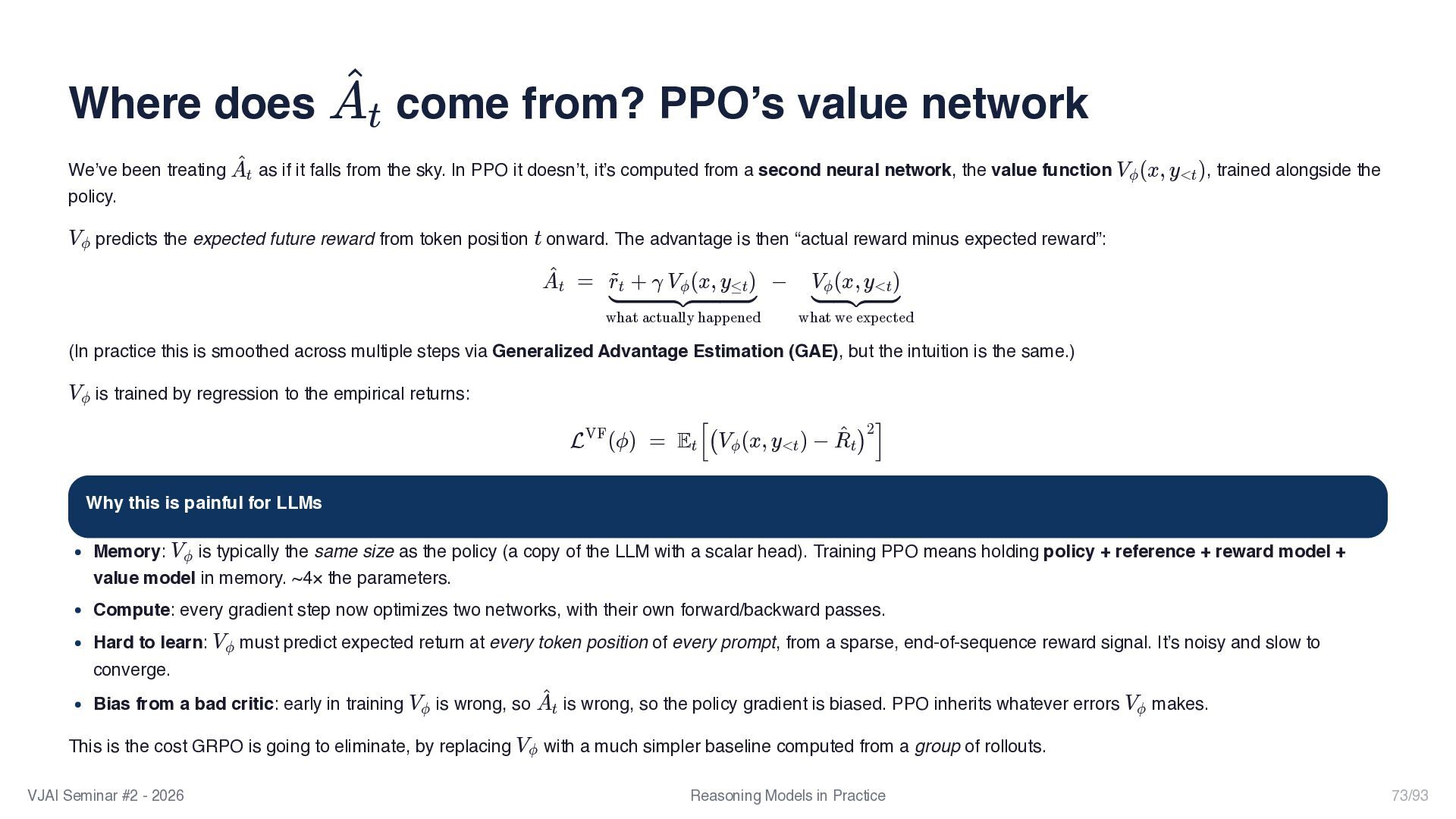
  72. Where does come from? PPO’s value network We’ve been treating

    as if it falls from the sky. In PPO it doesn’t, it’s computed from a second neural network, the value function , trained alongside the policy. predicts the expected future reward from token position onward. The advantage is then “actual reward minus expected reward”: (In practice this is smoothed across multiple steps via Generalized Advantage Estimation (GAE), but the intuition is the same.) is trained by regression to the empirical returns: Why this is painful for LLMs Memory: is typically the same size as the policy (a copy of the LLM with a scalar head). Training PPO means holding policy + reference + reward model + value model in memory. ~4× the parameters. Compute: every gradient step now optimizes two networks, with their own forward/backward passes. Hard to learn: must predict expected return at every token position of every prompt, from a sparse, end-of-sequence reward signal. It’s noisy and slow to converge. Bias from a bad critic: early in training is wrong, so is wrong, so the policy gradient is biased. PPO inherits whatever errors makes. This is the cost GRPO is going to eliminate, by replacing with a much simpler baseline computed from a group of rollouts. ​ A ^ t ​ A ^ t V ​ (x, y ​ ) ϕ <t V ​ ϕ t ​ = A ^ t ​ − what actually happened ​ ​ + γ V ​ (x, y ​ ) r ~ t ϕ ≤t ​ what we expected ​ V ​ (x, y ​ ) ϕ <t V ​ ϕ L (ϕ) = VF E ​ (V ​ (x, y ) − ​ ) t [ ϕ <t R ^ t 2 ] V ​ ϕ V ​ ϕ V ​ ϕ ​ A ^ t V ​ ϕ V ​ ϕ VJAI Seminar #2 - 2026 Reasoning Models in Practice 73/93
  73. Part 4d — Group Relative Policy Optimization (GRPO) VJAI Seminar

    #2 - 2026 Reasoning Models in Practice 74/93
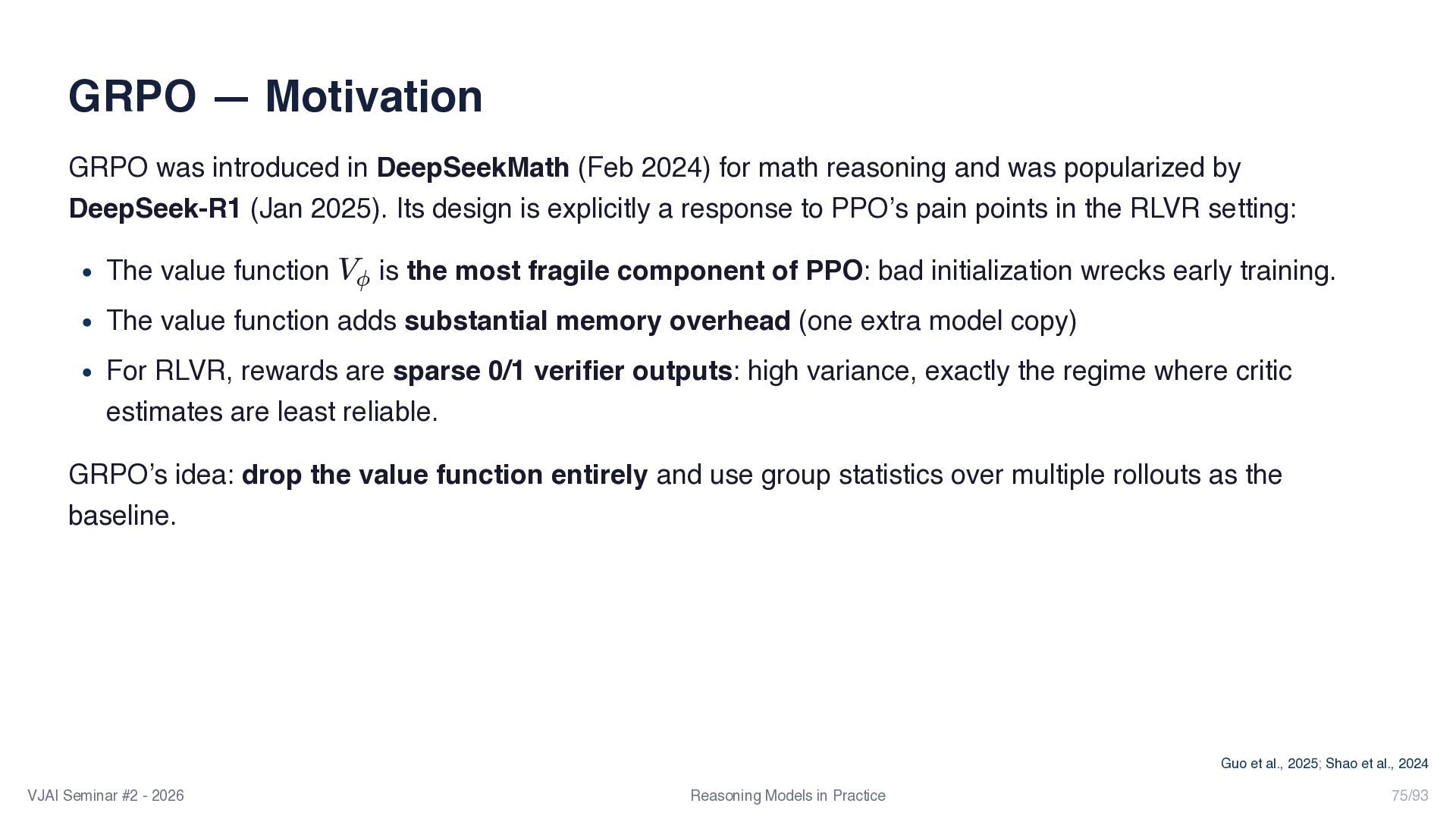
  74. GRPO — Motivation GRPO was introduced in DeepSeekMath (Feb 2024)

    for math reasoning and was popularized by DeepSeek-R1 (Jan 2025). Its design is explicitly a response to PPO’s pain points in the RLVR setting: The value function is the most fragile component of PPO: bad initialization wrecks early training. The value function adds substantial memory overhead (one extra model copy) For RLVR, rewards are sparse 0/1 verifier outputs: high variance, exactly the regime where critic estimates are least reliable. GRPO’s idea: drop the value function entirely and use group statistics over multiple rollouts as the baseline. V ​ ϕ VJAI Seminar #2 - 2026 Reasoning Models in Practice 75/93 Guo et al., 2025; Shao et al., 2024
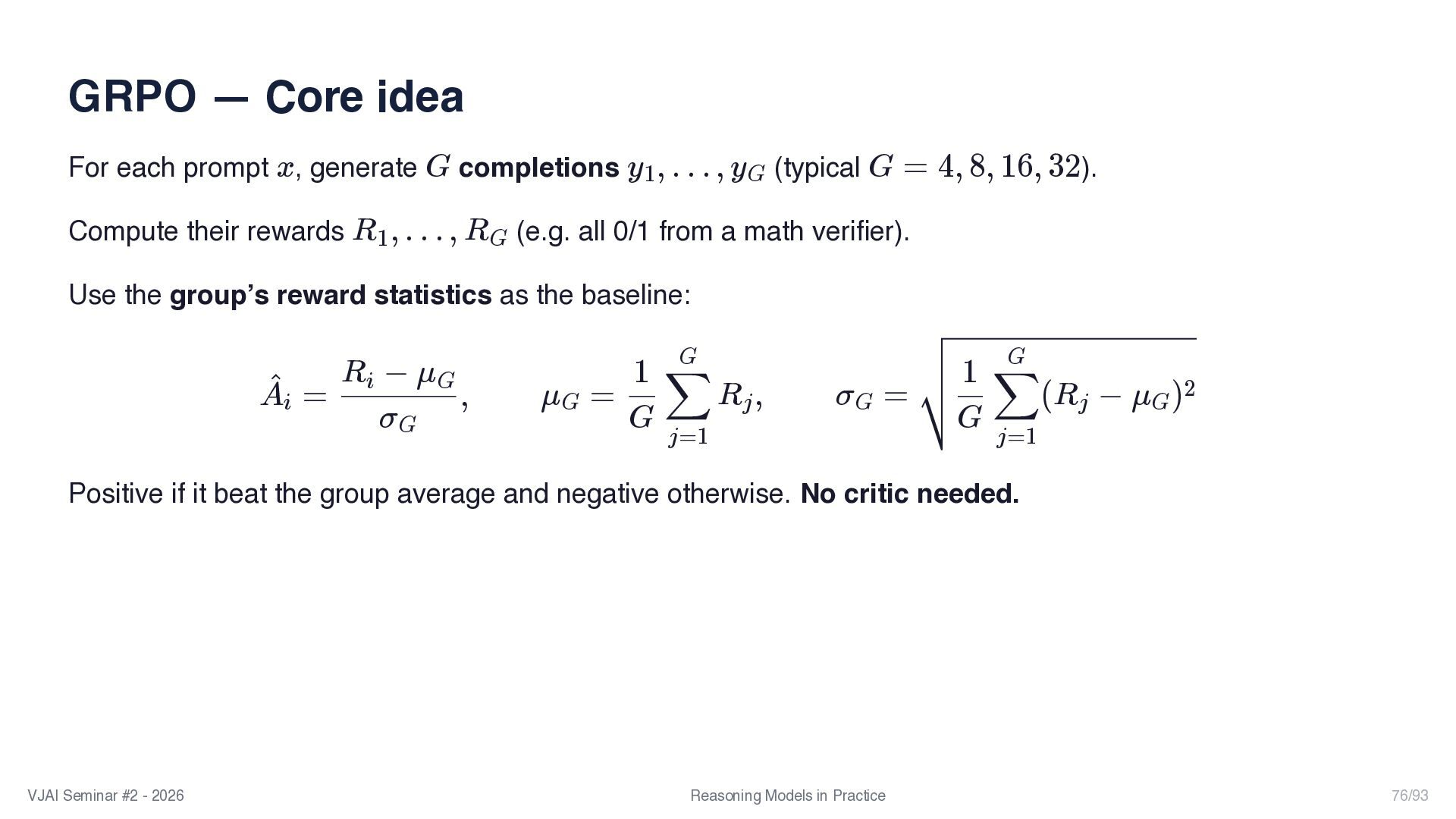
  75. GRPO — Core idea For each prompt , generate completions

    (typical ). Compute their rewards (e.g. all 0/1 from a math verifier). Use the group’s reward statistics as the baseline: Positive if it beat the group average and negative otherwise. No critic needed. x G y ​ , … , y ​ 1 G G = 4, 8, 16, 32 R ​ , … , R ​ 1 G ​ = A ^ i ​ , μ ​ = σ ​ G R ​ − μ ​ i G G ​ ​ R ​ , σ ​ = G 1 j=1 ∑ G j G ​ ​ ​ (R ​ − μ ​ ) G 1 j=1 ∑ G j G 2 VJAI Seminar #2 - 2026 Reasoning Models in Practice 76/93
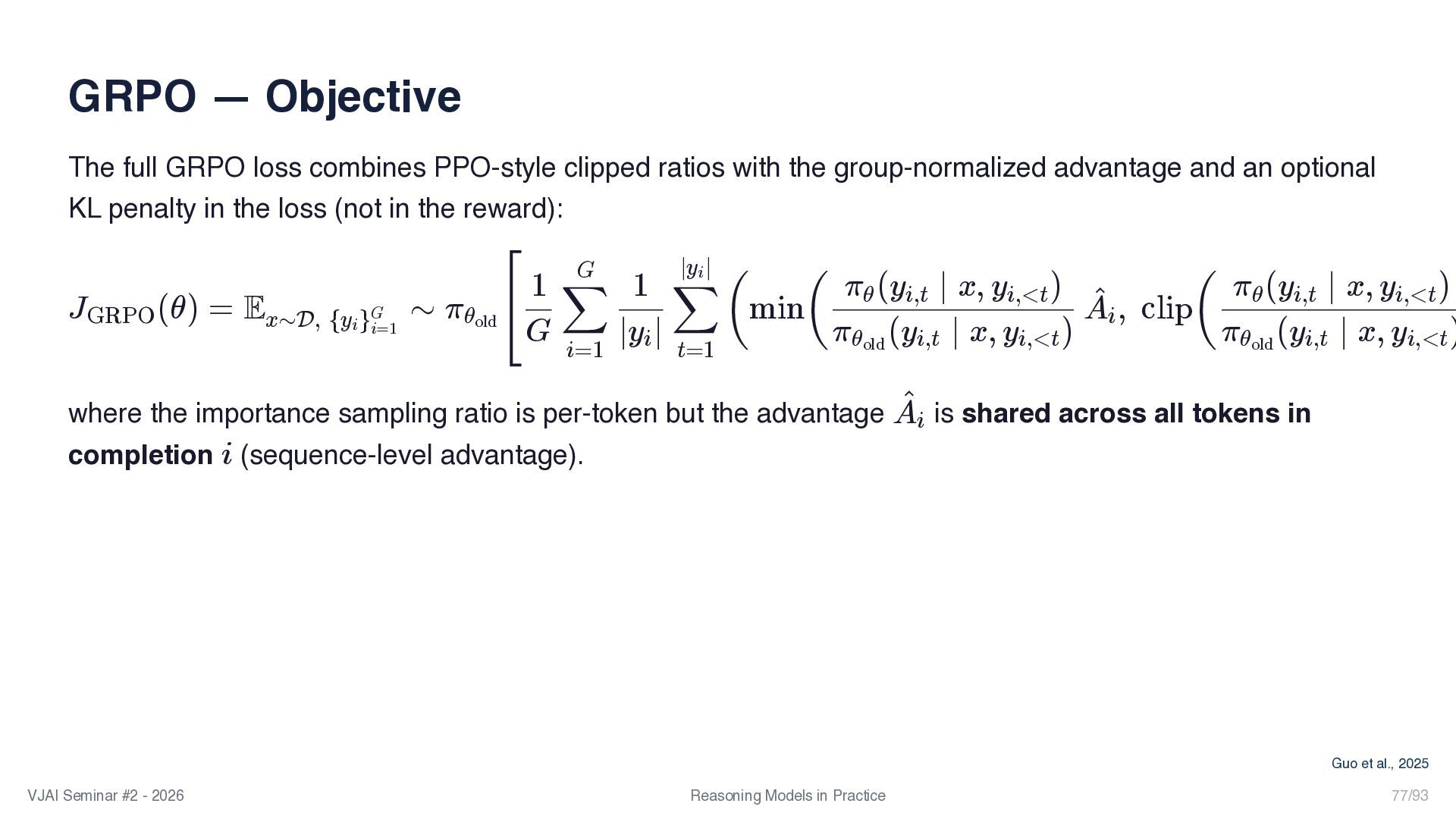
  76. GRPO — Objective The full GRPO loss combines PPO-style clipped

    ratios with the group-normalized advantage and an optional KL penalty in the loss (not in the reward): where the importance sampling ratio is per-token but the advantage is shared across all tokens in completion (sequence-level advantage). J ​ (θ) = GRPO E ​ ∼ x∼D, {y ​ } ​ i i=1 G π ​ ​ ​ ​ ​ ​ min ​ ​ , clip θ ​ old G 1 i=1 ∑ G ∣y ​ ∣ i 1 t=1 ∑ ∣y ​ ∣ i ( ( π ​ (y ​ ∣ x, y ​ ) θ ​ old i,t i,<t π ​ (y ​ ∣ x, y ​ ) θ i,t i,<t A ^ i ( π ​ (y ​ ∣ x, y ​ ) θ ​ old i,t i,<t π ​ (y ​ ∣ x, y ​ ) θ i,t i,<t ​ A ^ i i VJAI Seminar #2 - 2026 Reasoning Models in Practice 77/93 Guo et al., 2025
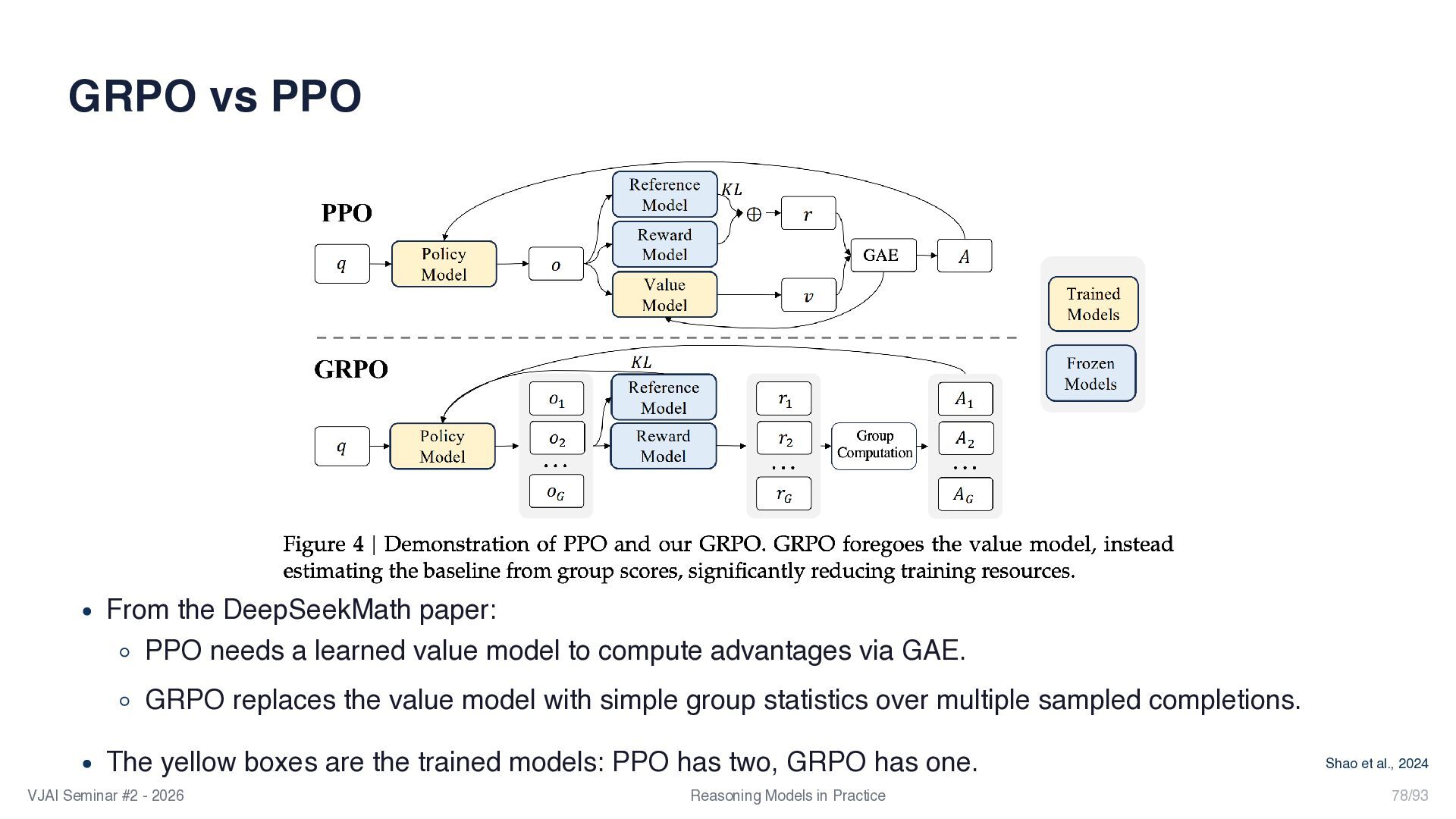
  77. GRPO vs PPO From the DeepSeekMath paper: PPO needs a

    learned value model to compute advantages via GAE. GRPO replaces the value model with simple group statistics over multiple sampled completions. The yellow boxes are the trained models: PPO has two, GRPO has one. VJAI Seminar #2 - 2026 Reasoning Models in Practice 78/93 Shao et al., 2024
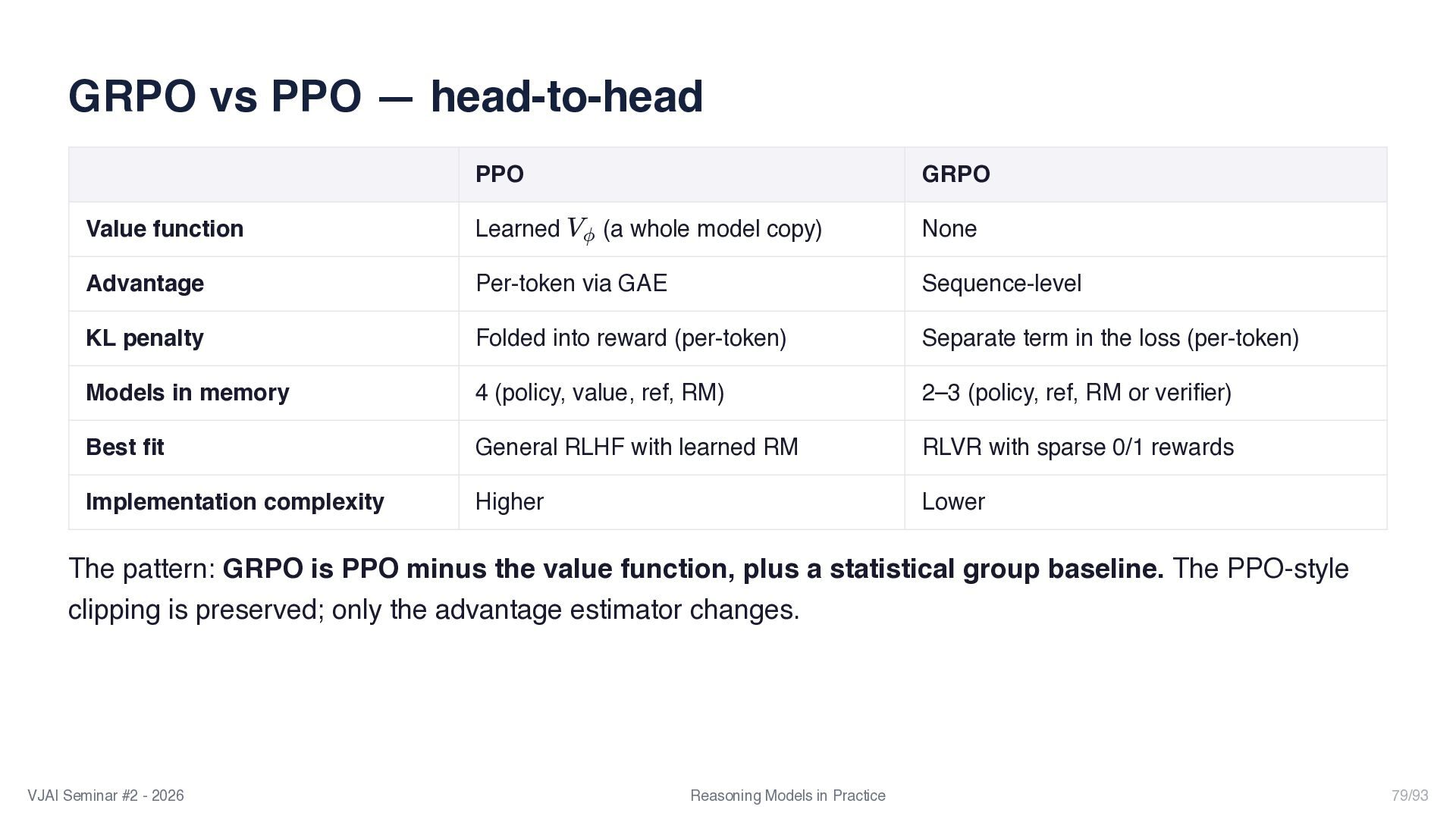
  78. GRPO vs PPO — head-to-head PPO GRPO Value function Learned

    (a whole model copy) None Advantage Per-token via GAE Sequence-level KL penalty Folded into reward (per-token) Separate term in the loss (per-token) Models in memory 4 (policy, value, ref, RM) 2–3 (policy, ref, RM or verifier) Best fit General RLHF with learned RM RLVR with sparse 0/1 rewards Implementation complexity Higher Lower The pattern: GRPO is PPO minus the value function, plus a statistical group baseline. The PPO-style clipping is preserved; only the advantage estimator changes. V ​ ϕ VJAI Seminar #2 - 2026 Reasoning Models in Practice 79/93
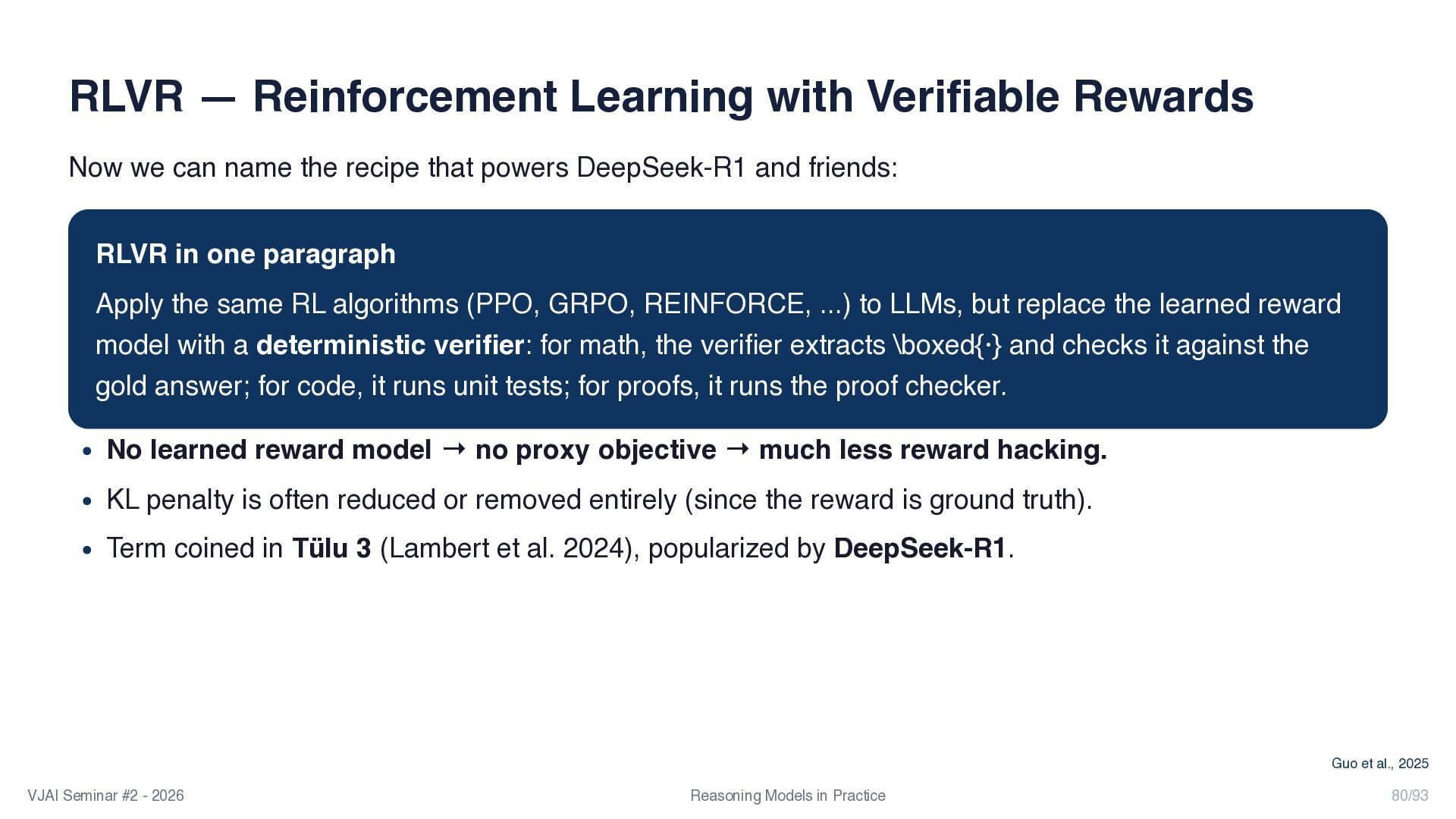
  79. RLVR — Reinforcement Learning with Verifiable Rewards Now we can

    name the recipe that powers DeepSeek-R1 and friends: RLVR in one paragraph Apply the same RL algorithms (PPO, GRPO, REINFORCE, ...) to LLMs, but replace the learned reward model with a deterministic verifier: for math, the verifier extracts \boxed{·} and checks it against the gold answer; for code, it runs unit tests; for proofs, it runs the proof checker. No learned reward model → no proxy objective → much less reward hacking. KL penalty is often reduced or removed entirely (since the reward is ground truth). Term coined in Tülu 3 (Lambert et al. 2024), popularized by DeepSeek-R1. VJAI Seminar #2 - 2026 Reasoning Models in Practice 80/93 Guo et al., 2025
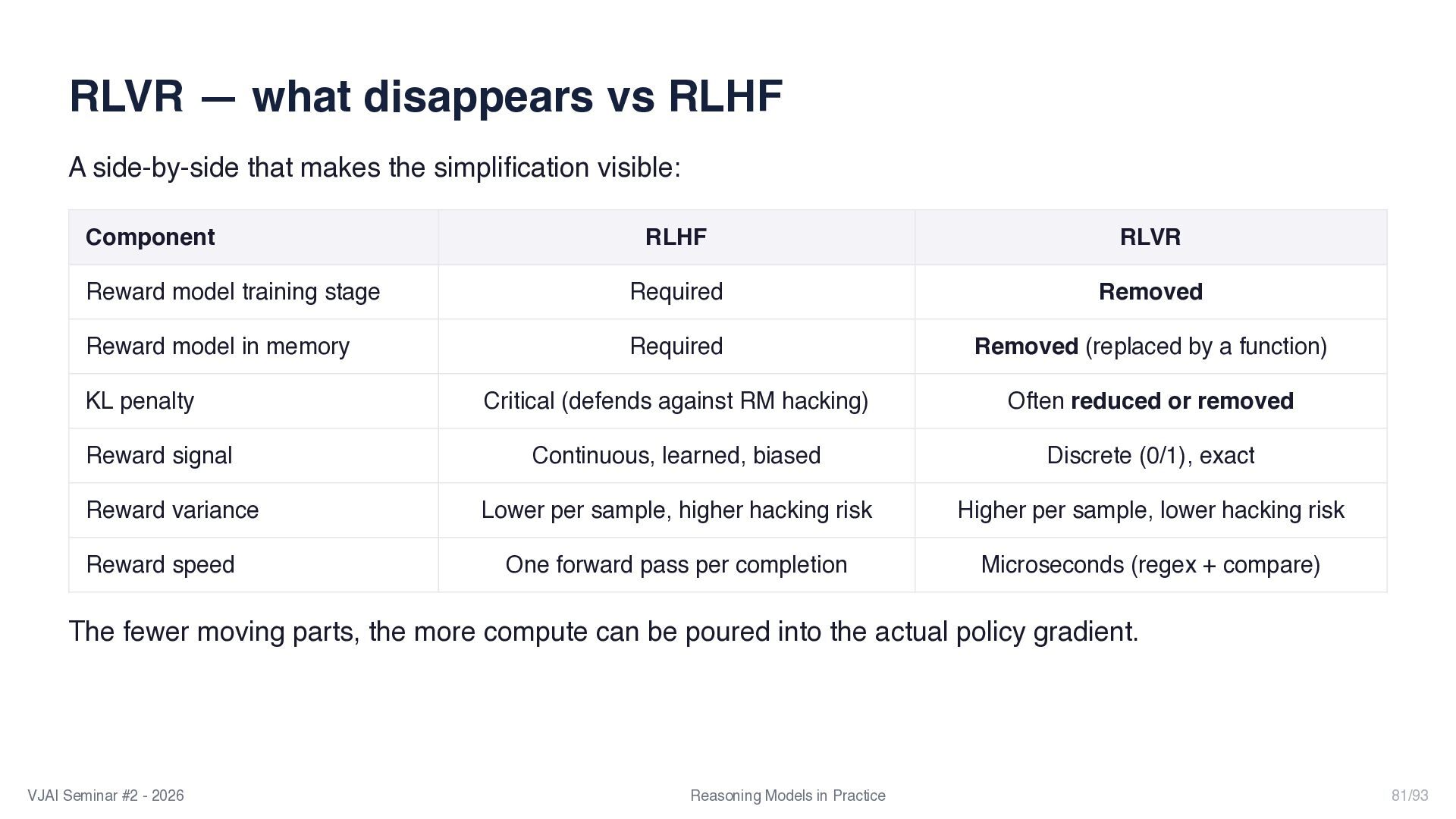
  80. RLVR — what disappears vs RLHF A side-by-side that makes

    the simplification visible: Component RLHF RLVR Reward model training stage Required Removed Reward model in memory Required Removed (replaced by a function) KL penalty Critical (defends against RM hacking) Often reduced or removed Reward signal Continuous, learned, biased Discrete (0/1), exact Reward variance Lower per sample, higher hacking risk Higher per sample, lower hacking risk Reward speed One forward pass per completion Microseconds (regex + compare) The fewer moving parts, the more compute can be poured into the actual policy gradient. VJAI Seminar #2 - 2026 Reasoning Models in Practice 81/93
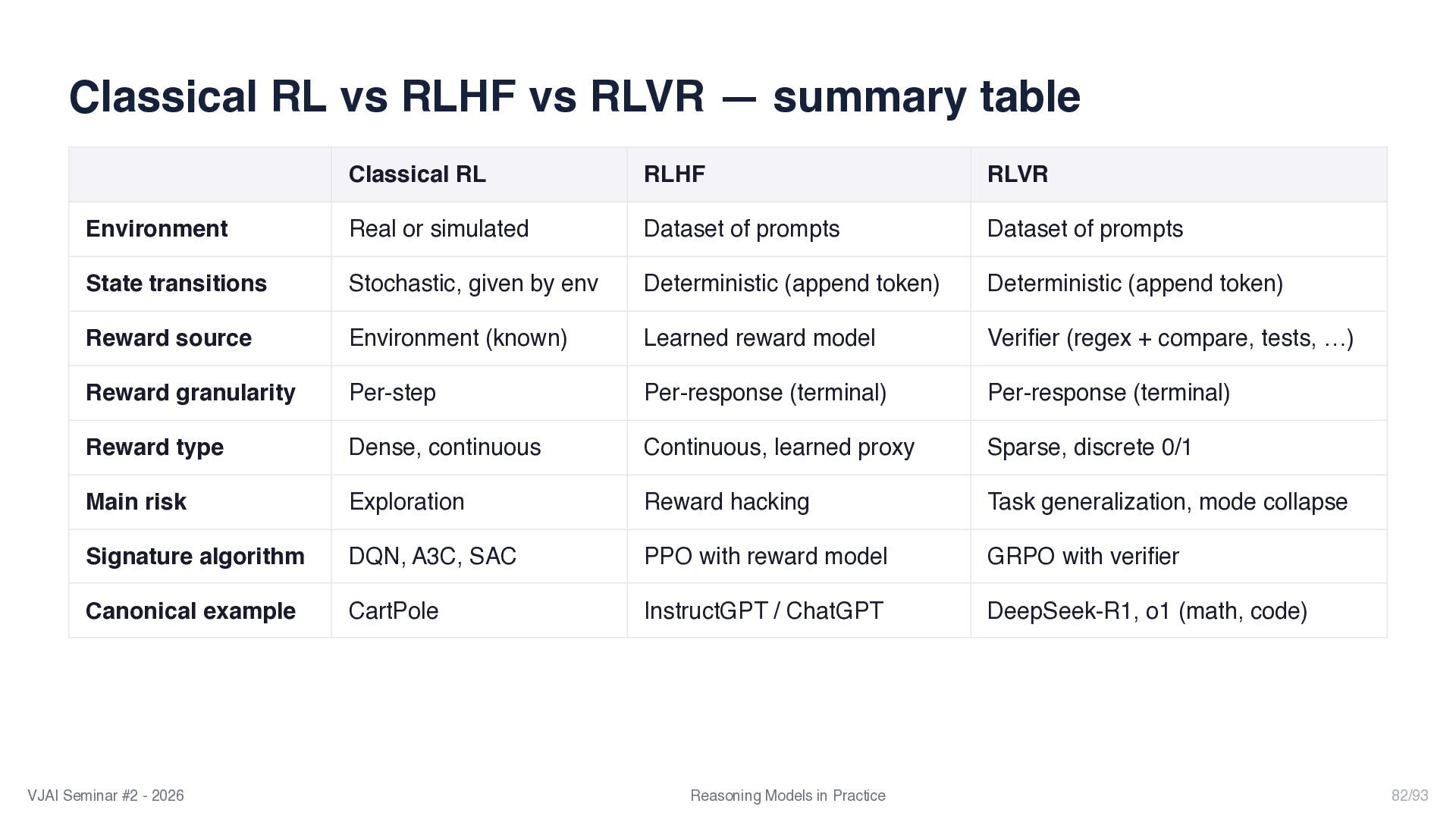
  81. Classical RL vs RLHF vs RLVR — summary table Classical

    RL RLHF RLVR Environment Real or simulated Dataset of prompts Dataset of prompts State transitions Stochastic, given by env Deterministic (append token) Deterministic (append token) Reward source Environment (known) Learned reward model Verifier (regex + compare, tests, …) Reward granularity Per-step Per-response (terminal) Per-response (terminal) Reward type Dense, continuous Continuous, learned proxy Sparse, discrete 0/1 Main risk Exploration Reward hacking Task generalization, mode collapse Signature algorithm DQN, A3C, SAC PPO with reward model GRPO with verifier Canonical example CartPole InstructGPT / ChatGPT DeepSeek-R1, o1 (math, code) VJAI Seminar #2 - 2026 Reasoning Models in Practice 82/93
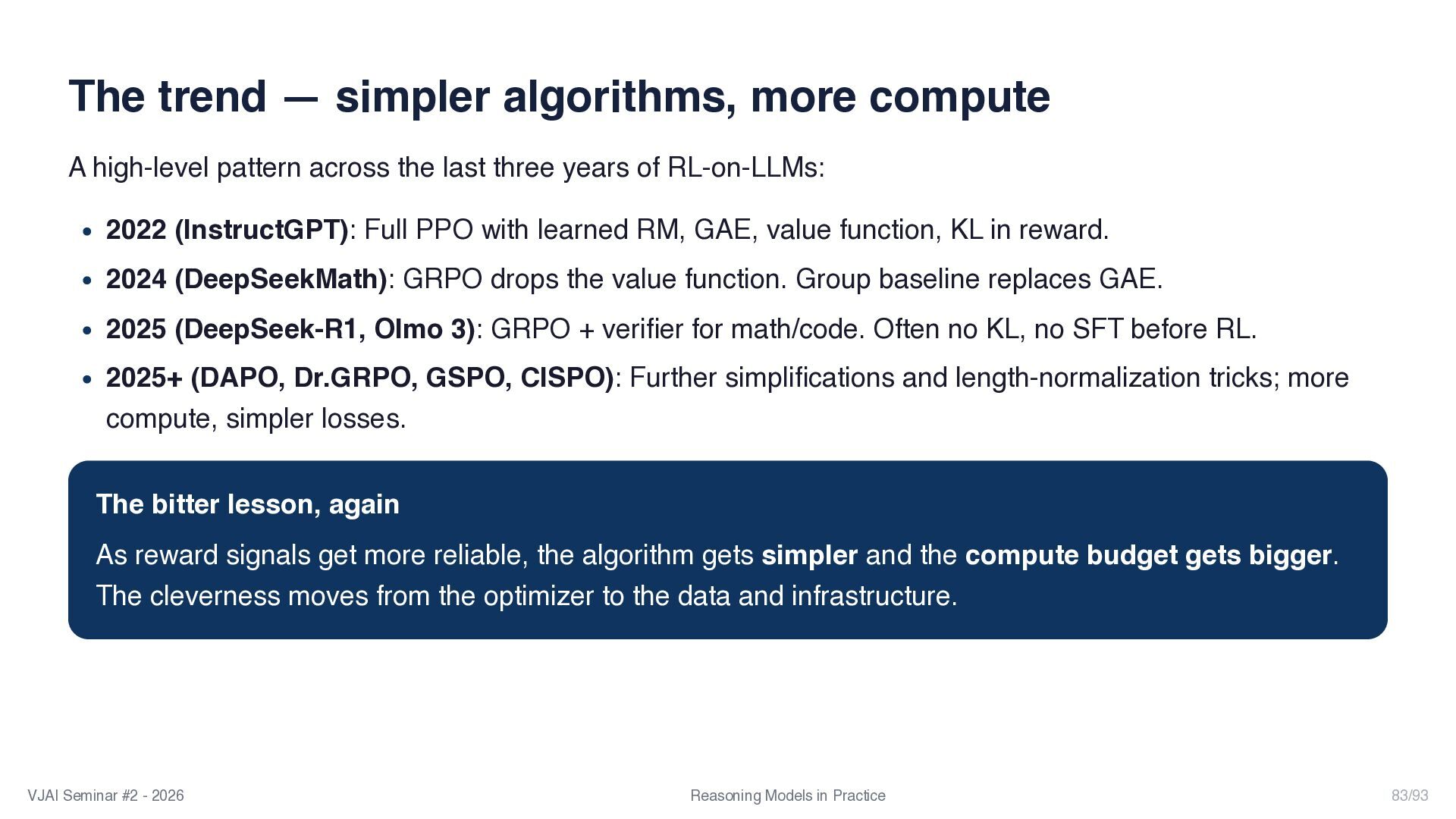
  82. The trend — simpler algorithms, more compute A high-level pattern

    across the last three years of RL-on-LLMs: 2022 (InstructGPT): Full PPO with learned RM, GAE, value function, KL in reward. 2024 (DeepSeekMath): GRPO drops the value function. Group baseline replaces GAE. 2025 (DeepSeek-R1, Olmo 3): GRPO + verifier for math/code. Often no KL, no SFT before RL. 2025+ (DAPO, Dr.GRPO, GSPO, CISPO): Further simplifications and length-normalization tricks; more compute, simpler losses. The bitter lesson, again As reward signals get more reliable, the algorithm gets simpler and the compute budget gets bigger. The cleverness moves from the optimizer to the data and infrastructure. VJAI Seminar #2 - 2026 Reasoning Models in Practice 83/93
  83. Part 5 — Code walkthrough: the minimal GRPO pipeline VJAI

    Seminar #2 - 2026 Reasoning Models in Practice 84/93
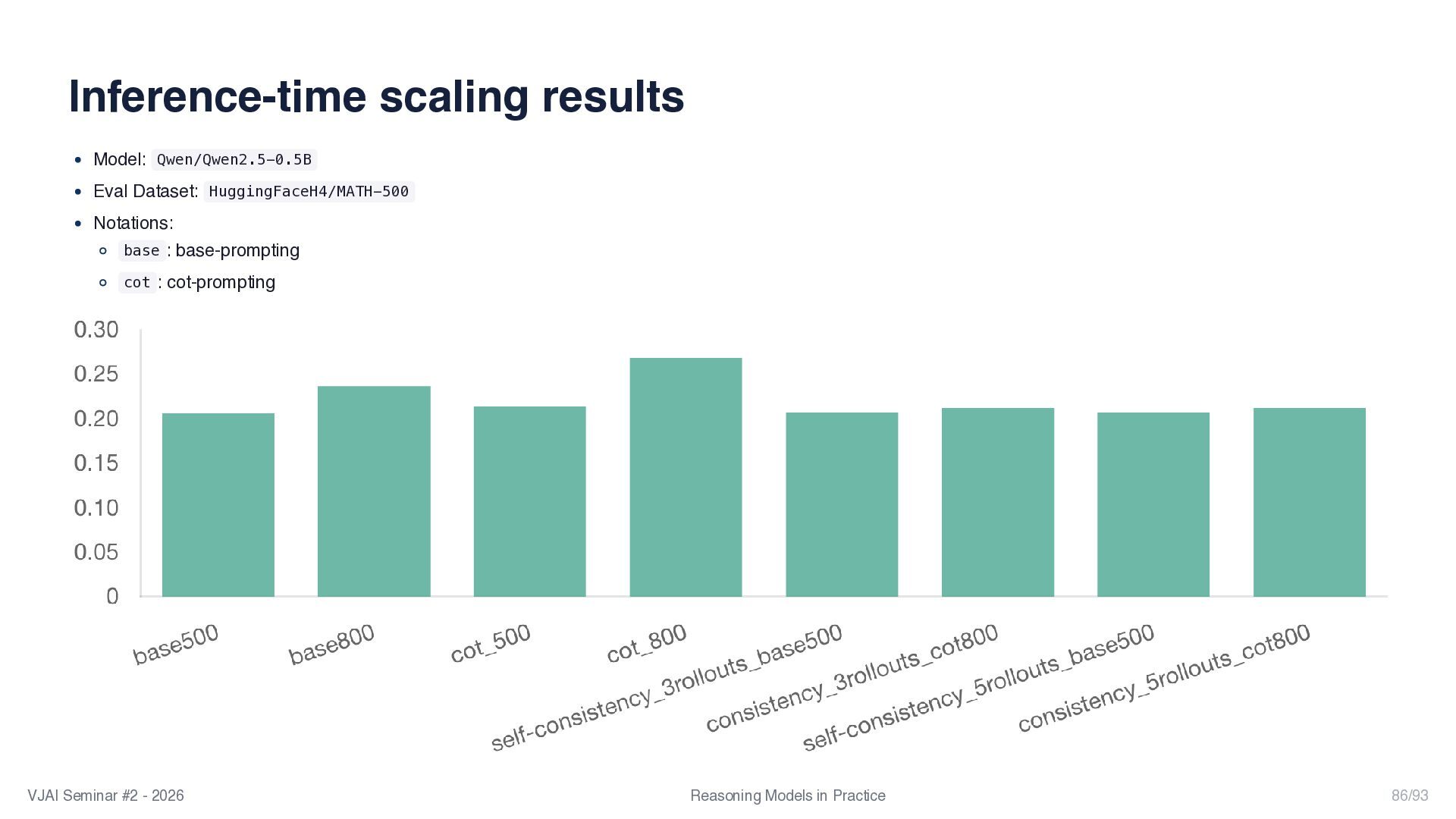
  84. Inference-time scaling results Model: Qwen/Qwen2.5-0.5B Eval Dataset: HuggingFaceH4/MATH-500 Notations: base

    : base-prompting cot : cot-prompting VJAI Seminar #2 - 2026 Reasoning Models in Practice 86/93
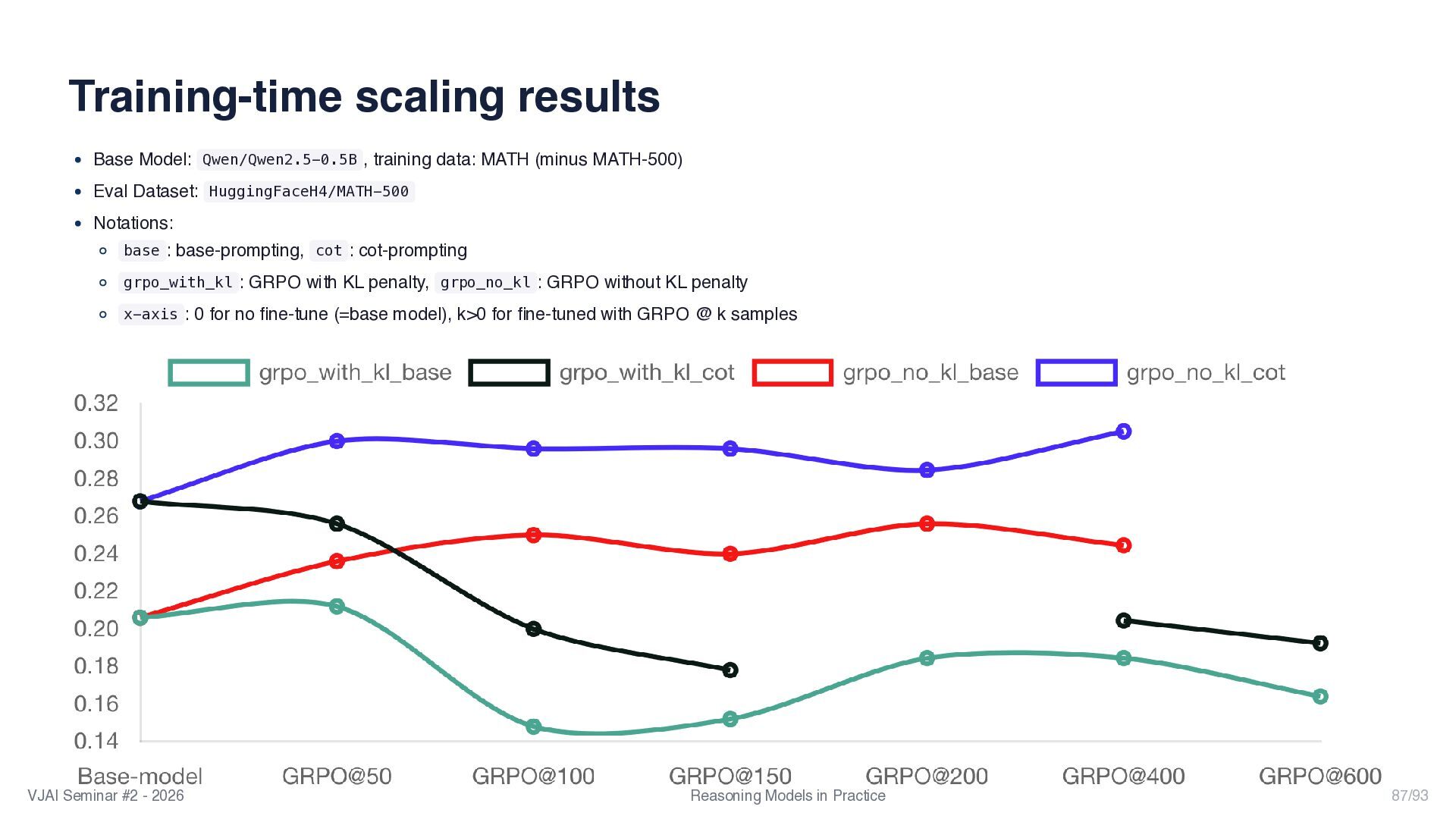
  85. Training-time scaling results Base Model: Qwen/Qwen2.5-0.5B , training data: MATH

    (minus MATH-500) Eval Dataset: HuggingFaceH4/MATH-500 Notations: base : base-prompting, cot : cot-prompting grpo_with_kl : GRPO with KL penalty, grpo_no_kl : GRPO without KL penalty x-axis : 0 for no fine-tune (=base model), k>0 for fine-tuned with GRPO @ k samples VJAI Seminar #2 - 2026 Reasoning Models in Practice 87/93
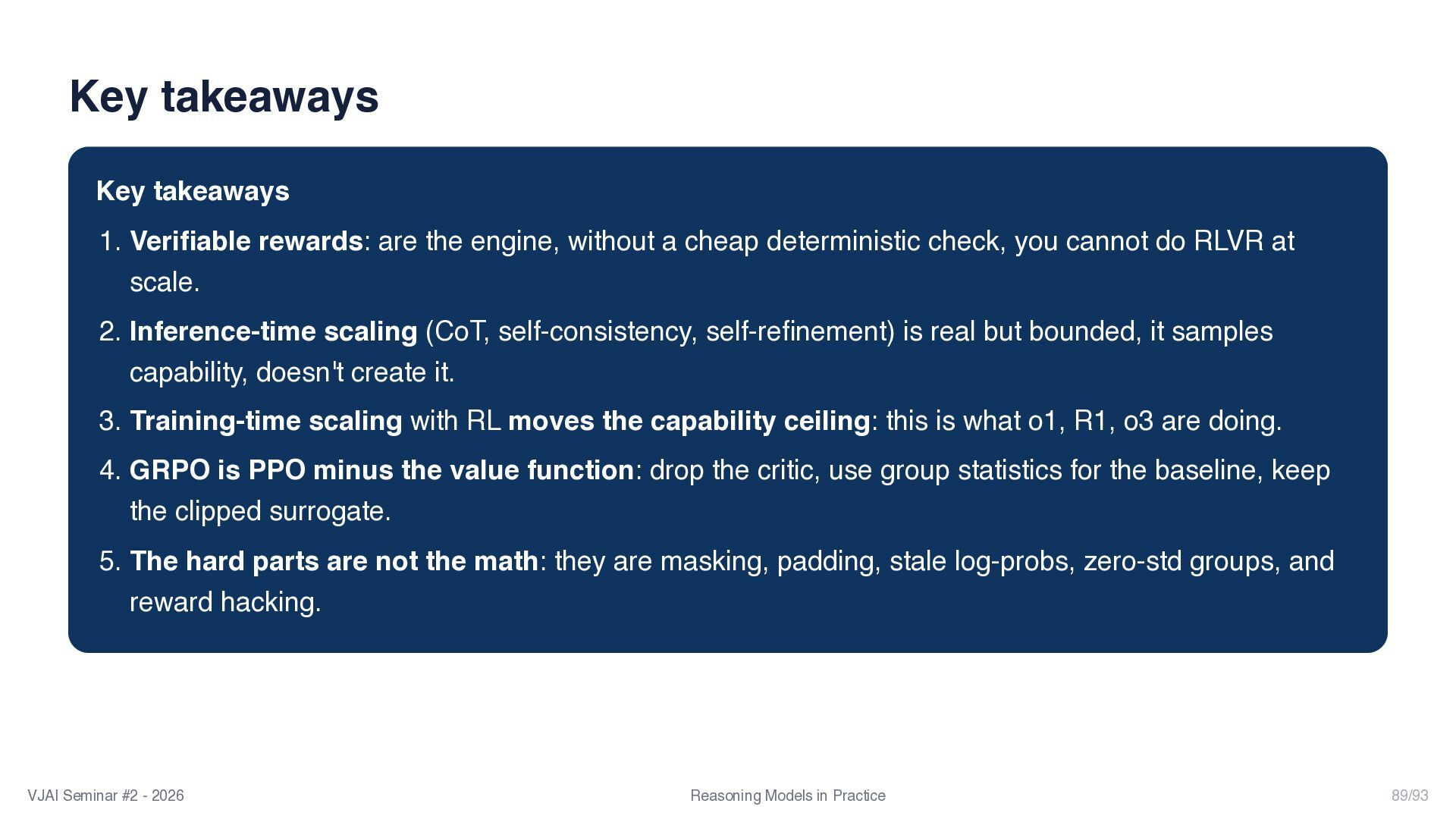
  86. Key takeaways Key takeaways 1. Verifiable rewards: are the engine,

    without a cheap deterministic check, you cannot do RLVR at scale. 2. Inference-time scaling (CoT, self-consistency, self-refinement) is real but bounded, it samples capability, doesn't create it. 3. Training-time scaling with RL moves the capability ceiling: this is what o1, R1, o3 are doing. 4. GRPO is PPO minus the value function: drop the critic, use group statistics for the baseline, keep the clipped surrogate. 5. The hard parts are not the math: they are masking, padding, stale log-probs, zero-std groups, and reward hacking. VJAI Seminar #2 - 2026 Reasoning Models in Practice 89/93
  87. Resources Books & lectures rlhfbook.com (Nathan Lambert) — the source

    for most of this talk "Build a Reasoning Model From Scratch" (Sebastian Raschka, MEAP) DeepSeek-R1 paper (Guo et al. 2025) — read the appendices DeepSeekMath paper (Shao et al. 2024) — the original GRPO VJAI Seminar #2 - 2026 Reasoning Models in Practice 90/93
  88. References (1/2) Christiano, P., Leike, J., Brown, T., Martic, M.,

    Legg, S., et al.. “Deep Reinforcement Learning from Human Preferences.” Advances in Neural Information Processing Systems, 2017. Guo, D., Yang, D., Zhang, H., Song, J., Zhang, R., et al.. “Deepseek-r1: Incentivizing reasoning capability in llms via reinforcement learning.” arXiv preprint arXiv:2501.12948, 2025. Kaplan, J., McCandlish, S., Henighan, T., Brown, T., Chess, B., et al.. “Scaling Laws for Neural Language Models.” arXiv preprint arXiv:2001.08361, 2020. [link] Madaan, A., Tandon, N., Gupta, P., Hallinan, S., Gao, L., et al.. “Self-Refine: Iterative Refinement with Self-Feedback.” 2023. [link] OpenAI. “Introducing OpenAI o1-preview.” OpenAI Blog, 2024. [link] Ouyang, L., Wu, J., Jiang, X., Almeida, D., Wainwright, C., et al.. “Training language models to follow instructions with human feedback.” Advances in Neural Information Processing Systems, 2022. Shao, Z., Wang, P., Zhu, Q., Xu, R., Song, J., et al.. “DeepSeekMath: Pushing the Limits of Mathematical Reasoning in Open Language Models.” arXiv preprint arXiv:2402.03300, 2024. Sutton, R., and Barto, A.. “Reinforcement Learning: An Introduction.” MIT Press, 2018. [link] VJAI Seminar #2 - 2026 Reasoning Models in Practice 92/93
  89. References (2/2) Wang, X., Wei, J., Schuurmans, D., Le, Q.,

    Chi, E., et al.. “Self-Consistency Improves Chain of Thought Reasoning in Language Models.” International Conference on Learning Representations, 2023. [link] Wei, J., Wang, X., Schuurmans, D., Bosma, M., Ichter, B., et al.. “Chain-of-Thought Prompting Elicits Reasoning in Large Language Models.” 2023. [link] VJAI Seminar #2 - 2026 Reasoning Models in Practice 93/93