Share
Embed
How to Choose the Best Programming Assignment Help for University Students
How to Choose the Best Programming Assignment Help for University Students

olivia Smith
October 27, 2026
Transcript
6 slides
-
How to Choose the Best Programming Assignment Help for University
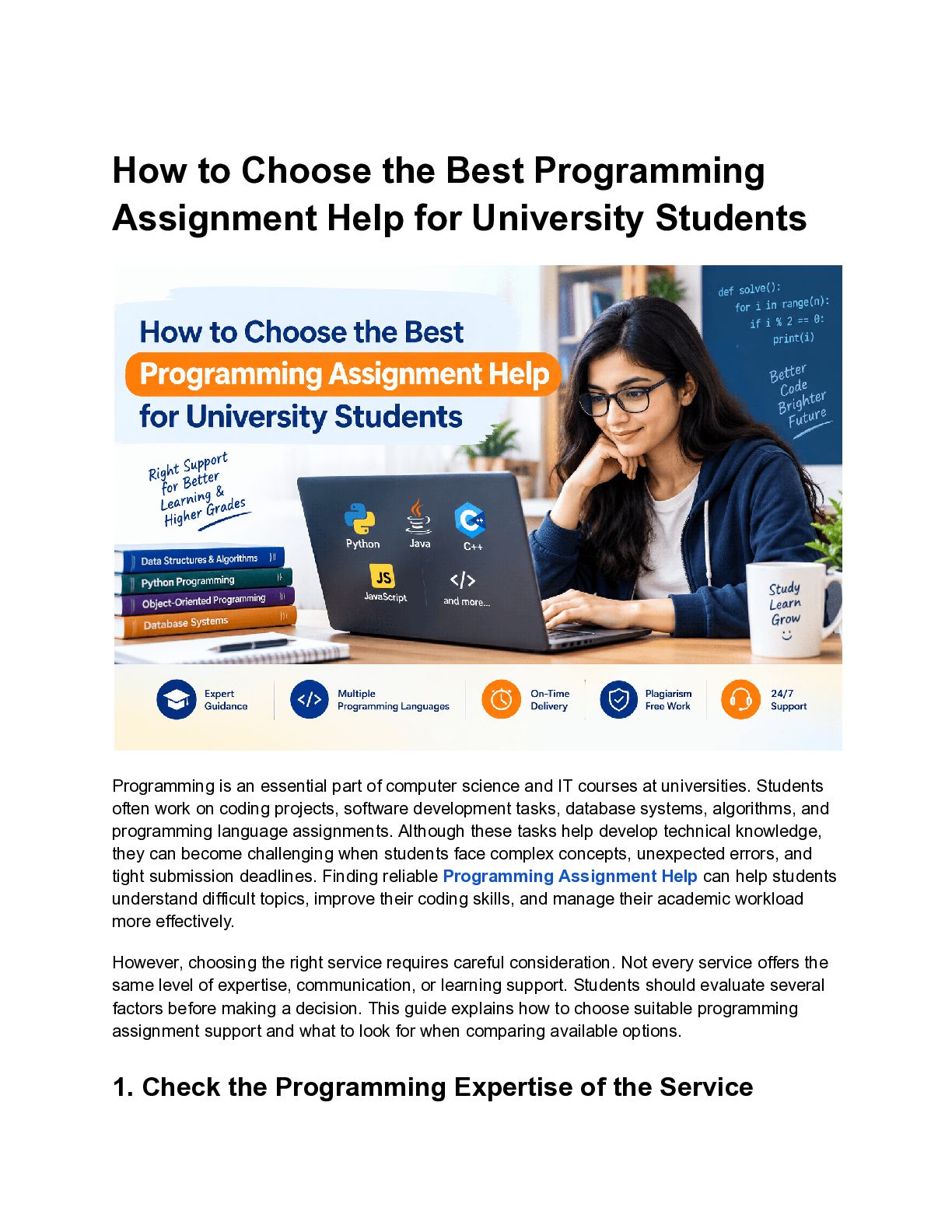
Students Programming is an essential part of computer science and IT courses at universities. Students often work on coding projects, software development tasks, database systems, algorithms, and programming language assignments. Although these tasks help develop technical knowledge, they can become challenging when students face complex concepts, unexpected errors, and tight submission deadlines. Finding reliable Programming Assignment Help can help students understand difficult topics, improve their coding skills, and manage their academic workload more effectively. However, choosing the right service requires careful consideration. Not every service offers the same level of expertise, communication, or learning support. Students should evaluate several factors before making a decision. This guide explains how to choose suitable programming assignment support and what to look for when comparing available options. 1. Check the Programming Expertise of the Service -
The first step is to check whether a service has
experience with your programming language and assignment requirements. University programming courses cover different languages, tools, and technical concepts. A service that specialises in Python may not necessarily have the same expertise in advanced Java applications or C++ development. Look for support covering relevant subjects, such as: • • • • • • Python, Java, C++, and JavaScript Data structures and algorithms Object-oriented programming Database management and SQL Web development and software engineering Artificial intelligence and machine learning Before choosing a service, review its subject coverage and ask whether it can explain the concepts relevant to your task. Specialist knowledge is particularly important for assignments involving complex algorithms, debugging, or software architecture. 2. Look for Clear and Transparent Pricing Budget is another important consideration for university students. Students often need to manage tuition fees, accommodation, study materials, and everyday expenses alongside their academic work. When comparing Programming Assignment Help services, check whether the pricing structure is easy to understand. Some providers calculate costs according to assignment complexity, word count, coding requirements, or submission deadlines. Before placing an order, confirm: • • • • • The total cost of the service Whether additional charges may apply What is included in the quoted price Whether revisions are available The payment and refund policies Avoid choosing a provider based only on the lowest advertised price. A very low price does not automatically mean good value. Instead, compare the cost with the level of technical support, communication, and learning resources offered. 3. Read Genuine Reviews and Student Feedback -
Reviews can help you understand how a service communicates with
students and manages assignments. However, it is important to evaluate feedback carefully rather than relying entirely on ratings or promotional testimonials. Look for reviews that discuss specific aspects of the experience, such as technical knowledge, response times, clarity of explanations, and how problems were handled. Independent review platforms can provide additional context. Pay attention to recurring complaints about missed deadlines, unclear pricing, poor communication, or limited revision options. Be cautious if a website displays only perfect ratings without verifiable details. You can also check whether the provider offers examples of its educational resources or demonstrations of how it explains programming concepts. These can help you assess the quality of its learning support before committing. 4. Make Sure the Service Supports Different Programming Languages University assignments may require students to work with more than one programming language during their course. For example, a computer science student might use Python for data analysis, Java for object-oriented programming, and SQL for database management. A suitable Programming Assignment Help provider should clearly explain which languages and technical areas it supports. This makes it easier to find relevant guidance as your course progresses. Consider whether the service can help you understand language-specific challenges, including syntax errors, data types, loops, functions, classes, and exception handling. For advanced assignments, check whether support is available for testing, debugging, API integration, and performance optimisation. Choosing support that matches your exact requirements can save time and help you focus on the concepts your university expects you to learn. 5. Check Communication and Availability Good communication is essential when working through a difficult programming problem. You may need to clarify assignment instructions, discuss technical requirements, or understand why a particular solution does not work. Before selecting a provider, find out how you can contact its support team and how quickly it typically responds. Check whether communication is available through email, live chat, or another clearly stated channel. -
Ask whether you can request explanations of complex code or
clarification about the approach used to solve a problem. Clear explanations are especially useful when you need to apply the same concepts in laboratory sessions, practical examinations, or future projects. Although some services advertise round-the-clock support, verify their actual availability and response policies rather than assuming that immediate assistance is guaranteed. 6. Review the Quality of Explanations and Learning Resources The main purpose of university programming assignments is to develop problem-solving abilities and technical understanding. Therefore, useful academic support should help you learn, not simply provide an answer without explanation. Look for resources that explain how a program works, why a particular algorithm is suitable, and how different parts of the code interact. For example, if you are struggling with a Python assignment involving loops and conditional statements, a helpful explanation should show how the logic works and how to identify common errors. Similarly, guidance on object-oriented programming should clarify concepts such as inheritance, encapsulation, and polymorphism. Quality learning support can help you become more confident when writing your own code. It can also make it easier to identify mistakes independently and apply your knowledge to future assignments. 7. Confirm Deadline Policies and Revision Options Programming assignments can involve several stages, including planning, coding, testing, debugging, and documentation. A short deadline may make it difficult to complete every stage carefully. Before choosing a service, check its stated turnaround times and whether it can accommodate your actual requirements. Provide the correct submission date, assignment brief, programming language, and any required development environment details. You should also understand the revision policy. If an explanation is unclear or a technical issue remains unresolved, knowing how to request clarification can make the process less stressful. Do not assume that every provider guarantees successful execution of code in your university's environment. Ask what testing is performed and what limitations apply. Always test your own code before submitting it. -
8. Consider Academic Integrity and Data Security Academic integrity is
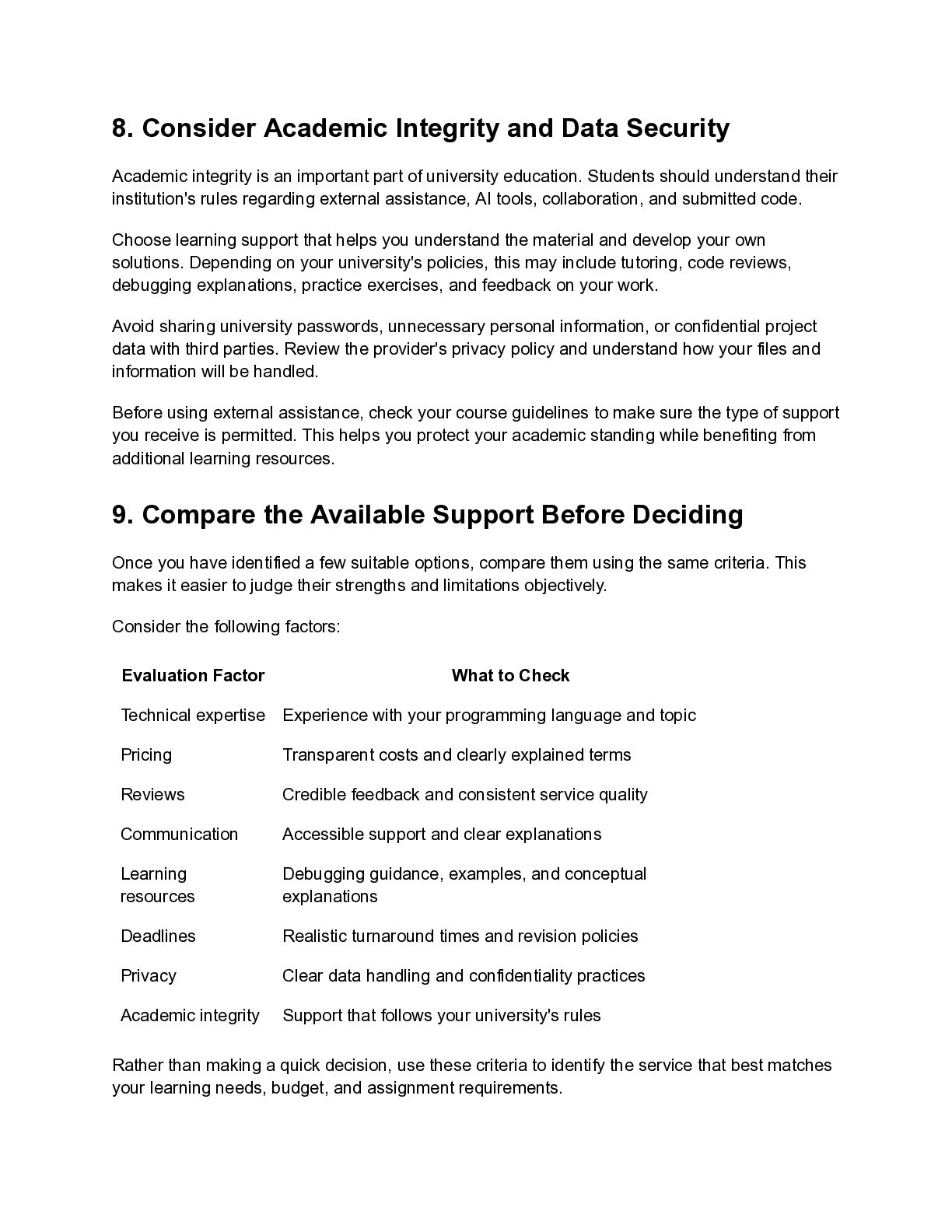
an important part of university education. Students should understand their institution's rules regarding external assistance, AI tools, collaboration, and submitted code. Choose learning support that helps you understand the material and develop your own solutions. Depending on your university's policies, this may include tutoring, code reviews, debugging explanations, practice exercises, and feedback on your work. Avoid sharing university passwords, unnecessary personal information, or confidential project data with third parties. Review the provider's privacy policy and understand how your files and information will be handled. Before using external assistance, check your course guidelines to make sure the type of support you receive is permitted. This helps you protect your academic standing while benefiting from additional learning resources. 9. Compare the Available Support Before Deciding Once you have identified a few suitable options, compare them using the same criteria. This makes it easier to judge their strengths and limitations objectively. Consider the following factors: Evaluation Factor What to Check Technical expertise Experience with your programming language and topic Pricing Transparent costs and clearly explained terms Reviews Credible feedback and consistent service quality Communication Accessible support and clear explanations Learning resources Debugging guidance, examples, and conceptual explanations Deadlines Realistic turnaround times and revision policies Privacy Clear data handling and confidentiality practices Academic integrity Support that follows your university's rules Rather than making a quick decision, use these criteria to identify the service that best matches your learning needs, budget, and assignment requirements. -
10. Identify Your Assignment Needs Before Seeking Help Before contacting
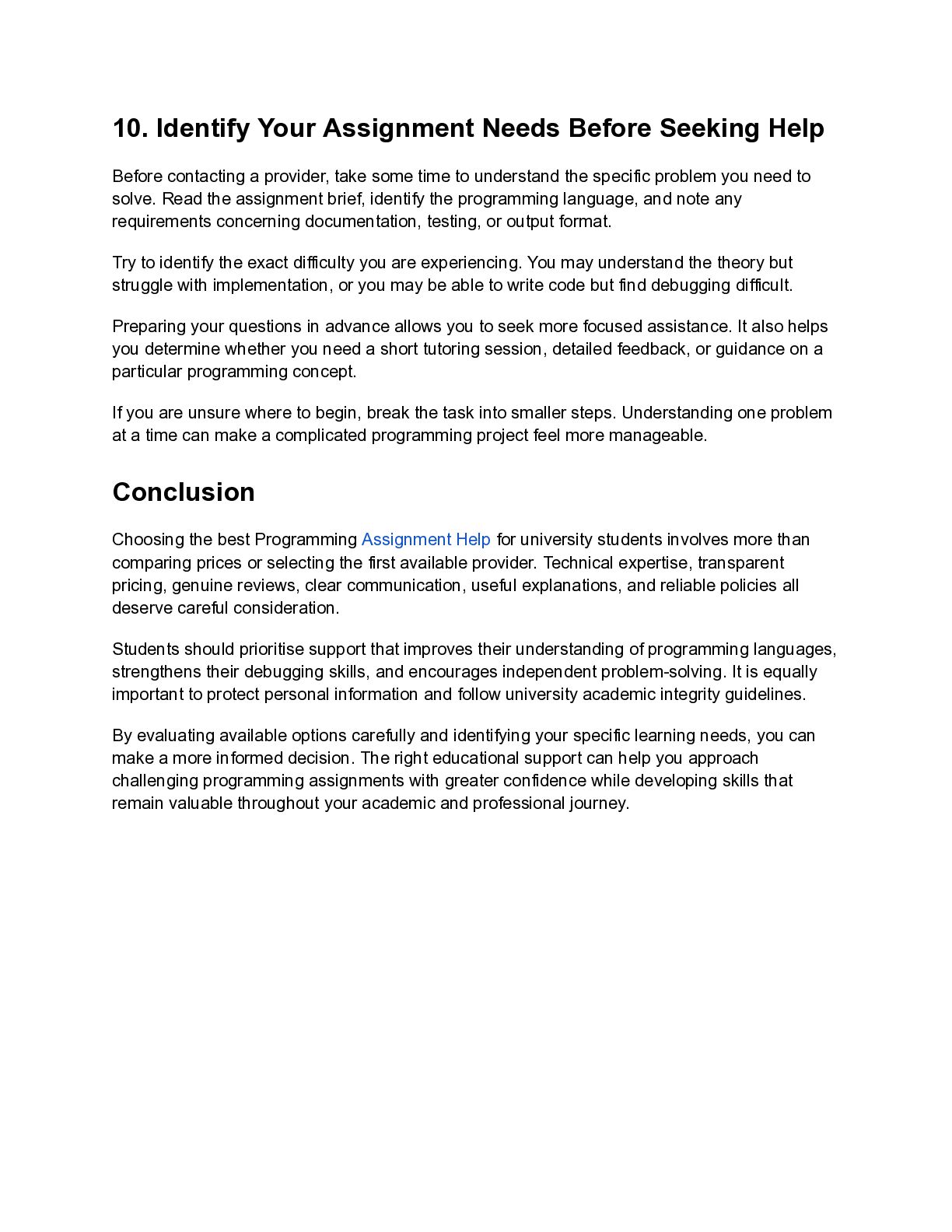
a provider, take some time to understand the specific problem you need to solve. Read the assignment brief, identify the programming language, and note any requirements concerning documentation, testing, or output format. Try to identify the exact difficulty you are experiencing. You may understand the theory but struggle with implementation, or you may be able to write code but find debugging difficult. Preparing your questions in advance allows you to seek more focused assistance. It also helps you determine whether you need a short tutoring session, detailed feedback, or guidance on a particular programming concept. If you are unsure where to begin, break the task into smaller steps. Understanding one problem at a time can make a complicated programming project feel more manageable. Conclusion Choosing the best Programming Assignment Help for university students involves more than comparing prices or selecting the first available provider. Technical expertise, transparent pricing, genuine reviews, clear communication, useful explanations, and reliable policies all deserve careful consideration. Students should prioritise support that improves their understanding of programming languages, strengthens their debugging skills, and encourages independent problem-solving. It is equally important to protect personal information and follow university academic integrity guidelines. By evaluating available options carefully and identifying your specific learning needs, you can make a more informed decision. The right educational support can help you approach challenging programming assignments with greater confidence while developing skills that remain valuable throughout your academic and professional journey.
 oliviasmith9
 mu7889yoon
 bvr7352
 cbtlibrary
 ainischool
 adeputra13
 radlovacki1976
 yasslab
 yatabe
 sonakv
 2720japanoke
 spring_aki
 juanmartin2026
 soudai
 jnunemaker
 rakko
 ryanjones
 lauravandoore
 sachag
 jonoalderson
 akihiro_kokubo
 jlugia
 samanthasiow
 skipperchong
 sarafernandez