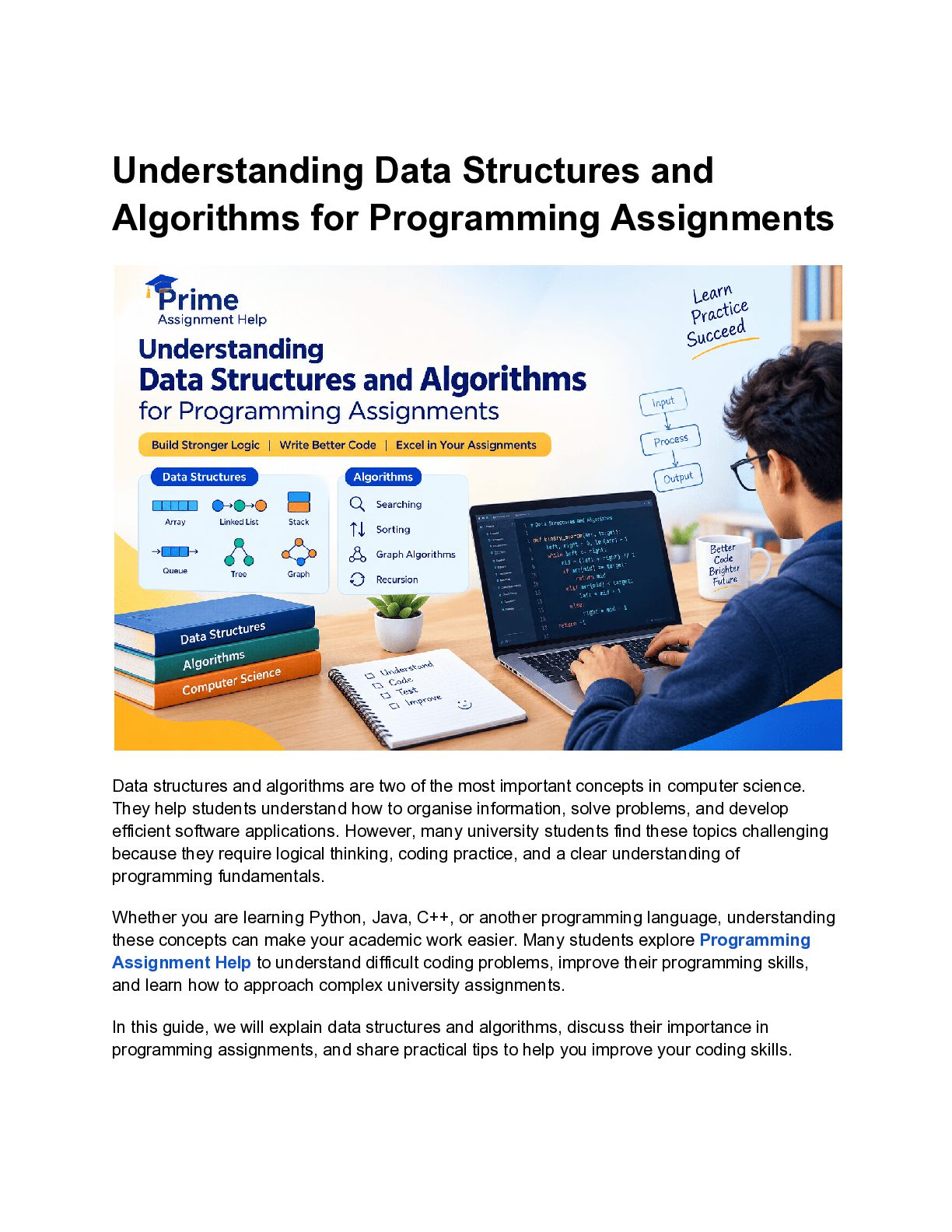
Understanding Data Structures and Algorithms fo...
Sponsored
·
 Your Podcast. Everywhere. Effortlessly.
Share. Educate. Inspire. Entertain. You do you. We'll handle the rest.
→
Your Podcast. Everywhere. Effortlessly.
Share. Educate. Inspire. Entertain. You do you. We'll handle the rest.
→

Share
Embed
Understanding Data Structures and Algorithms for Programming Assignments
Understanding Data Structures and Algorithms for Programming Assignments

olivia Smith
October 28, 2026
Transcript
6 slides
-
Understanding Data Structures and Algorithms for Programming Assignments Data structures
and algorithms are two of the most important concepts in computer science. They help students understand how to organise information, solve problems, and develop efficient software applications. However, many university students find these topics challenging because they require logical thinking, coding practice, and a clear understanding of programming fundamentals. Whether you are learning Python, Java, C++, or another programming language, understanding these concepts can make your academic work easier. Many students explore Programming Assignment Help to understand difficult coding problems, improve their programming skills, and learn how to approach complex university assignments. In this guide, we will explain data structures and algorithms, discuss their importance in programming assignments, and share practical tips to help you improve your coding skills. -
What Are Data Structures in Programming? A data structure is
a method of organising and storing data so that a computer program can access, manage, and process information efficiently. Choosing the right data structure can make your code easier to understand and improve its performance. Different programming problems require different ways of storing information. For example, a program that manages student records may need to store names, identification numbers, and grades. A suitable data structure helps organise this information and makes it easier to retrieve when required. Some common data structures include: 1. Arrays Arrays store multiple elements in an ordered collection. In many programming languages, arrays allow programmers to access elements using their index positions. For example, an array can store student marks, product prices, or daily temperatures. Arrays are useful when you need to work with a collection of related values. 2. Linked Lists A linked list contains individual elements called nodes. Each node stores data and a reference to another node. Unlike a typical array, a linked list does not require all its elements to occupy consecutive memory locations. Linked lists are useful for understanding dynamic data organisation, although inserting, deleting, or searching for elements can have different performance characteristics depending on the operation. 3. Stacks and Queues Stacks follow the Last In, First Out (LIFO) principle. This means the last element added is the first one removed. A stack is useful for function calls, undo operations, and expression evaluation. Queues generally follow the First In, First Out (FIFO) principle. The first element added is the first one removed. They are commonly used in task scheduling, customer service systems, and processing requests. 4. Trees and Graphs Trees organise data in a hierarchical structure. They are used in file systems, search operations, and decision-making applications. -
Graphs represent relationships between connected objects. For example, a transport
network can be represented as a graph in which locations are vertices and routes are edges. Understanding these structures helps students choose suitable solutions when completing computer science assignments. What Are Algorithms and Why Do They Matter? An algorithm is a sequence of clear instructions used to solve a problem or complete a task. In programming, algorithms determine how a program processes data and produces the required output. For example, imagine you need to find the highest mark in a list of student scores. An algorithm could examine each score, compare it with the highest value found so far, and update that value whenever a higher score appears. Common algorithms include: • Searching algorithms: Linear search and binary search help locate specific elements in a collection. • Sorting algorithms: Bubble sort, merge sort, and quicksort arrange data into a particular order. • Graph algorithms: Breadth-first search and depth-first search explore connected structures. • Recursive algorithms: These solve problems by calling the same function on smaller versions of the original problem. Each algorithm has different strengths and limitations. Selecting an appropriate algorithm is an important part of designing an effective program. The Relationship Between Data Structures and Algorithms Data structures and algorithms work together. A data structure determines how information is organised, while an algorithm determines how that information is processed. For instance, searching for an element in an unsorted array may require checking each element individually. However, binary search can find an element efficiently in a sorted array by repeatedly dividing the search area in half. This illustrates why selecting the correct data structure and algorithm matters. The same programming task can have different performance results depending on the approach used. -
Students who need Programming Assignment Help may benefit from studying
these relationships through examples, practice problems, and step-by-step explanations rather than memorising definitions alone. Common Challenges Students Face in Programming Assignments Data structures and algorithms can be difficult for beginners because they involve both theoretical knowledge and practical implementation. Understanding Time and Space Complexity Time complexity describes how an algorithm's running time grows as the input size increases. Space complexity describes how its memory requirements grow. Big O notation is commonly used to express these growth rates. For example, linear search has O(n) time complexity in the worst case, while binary search has O(log n) time complexity when the data is sorted and random access is available. Understanding complexity helps students compare different solutions and explain why one approach may be more efficient than another. Debugging Coding Errors A program may fail because of incorrect conditions, invalid input, indexing mistakes, or logical errors. Students sometimes struggle to identify the exact cause of a problem. Testing smaller sections of code, reading error messages carefully, and checking intermediate results can make debugging easier. Choosing the Right Approach A programming assignment may have several possible solutions. The challenge is selecting an approach that meets the task requirements while balancing readability, execution time, and memory usage. When students find these decisions difficult, Programming Assignment Help can provide useful learning support through worked examples, code explanations, and guidance on problem-solving methods. Practical Tips for Solving Data Structures and Algorithms Assignments -
You can improve your programming skills by following a structured
approach to each assignment. 1. Understand the question first. Identify the required input, expected output, restrictions, and special cases before writing code. 2. Break the problem into smaller steps. Write down the logic in plain English or use pseudocode before converting it into a programming language. 3. Choose an appropriate data structure. Consider whether an array, linked list, stack, queue, tree, or graph best suits the information you need to manage. 4. Compare possible algorithms. Consider correctness, time complexity, space complexity, and the size of the expected input. 5. Test different scenarios. Include normal inputs, empty collections, duplicate values, very small inputs, and other edge cases relevant to your task. 6. Review and improve your code. Use meaningful variable names, remove unnecessary operations, and add comments where they clarify complex logic. 7. Practise regularly. Work through small coding challenges before attempting larger university projects. Consistent practice builds confidence and improves logical thinking. How Programming Assignment Help Can Support Your Learning University programming assignments often require students to explain theoretical concepts, implement working code, test solutions, and discuss their efficiency. Managing all these requirements can be challenging, particularly when several deadlines occur together. Reliable Programming Assignment Help can support students who need guidance with data structures, algorithm design, debugging, and code optimisation. Learning-focused support can also help you understand why a particular solution works instead of simply focusing on the final result. For example, if you are struggling with a sorting assignment, reviewing a worked example can help you understand how the algorithm compares elements and changes their positions. Similarly, studying a graph problem step by step can make concepts such as traversal and shortest-path calculations easier to understand. The most valuable support encourages independent learning. Use explanations to strengthen your knowledge, practise implementing solutions yourself, and make sure your submitted work follows your university's academic integrity rules. -
Conclusion Data structures and algorithms form the foundation of efficient
programming. Arrays, linked lists, stacks, queues, trees, and graphs help organise information, while searching, sorting, and graph algorithms provide methods for solving computational problems. By understanding time complexity, choosing suitable data structures, testing code carefully, and practising regularly, students can approach programming assignments with greater confidence. If you find complex coding tasks difficult, Programming Assignment Help can provide additional guidance and learning resources to help you understand challenging concepts. Building a strong foundation in data structures and algorithms will support your current university assignments and prepare you for more advanced software development projects in the future.
 oliviasmith9
 baltimoreniso
 aisw77
 2720japanoke
 hiola
 bvr7352
 akiraasano
 hachama
 kfujita
 kaityo256
 signer
 matleenalaakso
 reverentgeek
 cassininazir
 baasie
 hatefulcrawdad
 brettharned
 sonatard
 soudai
 denniskardys
 stephaniewalter
 kristinabergwall1
 watany
 stephenakadiri