Share
Embed
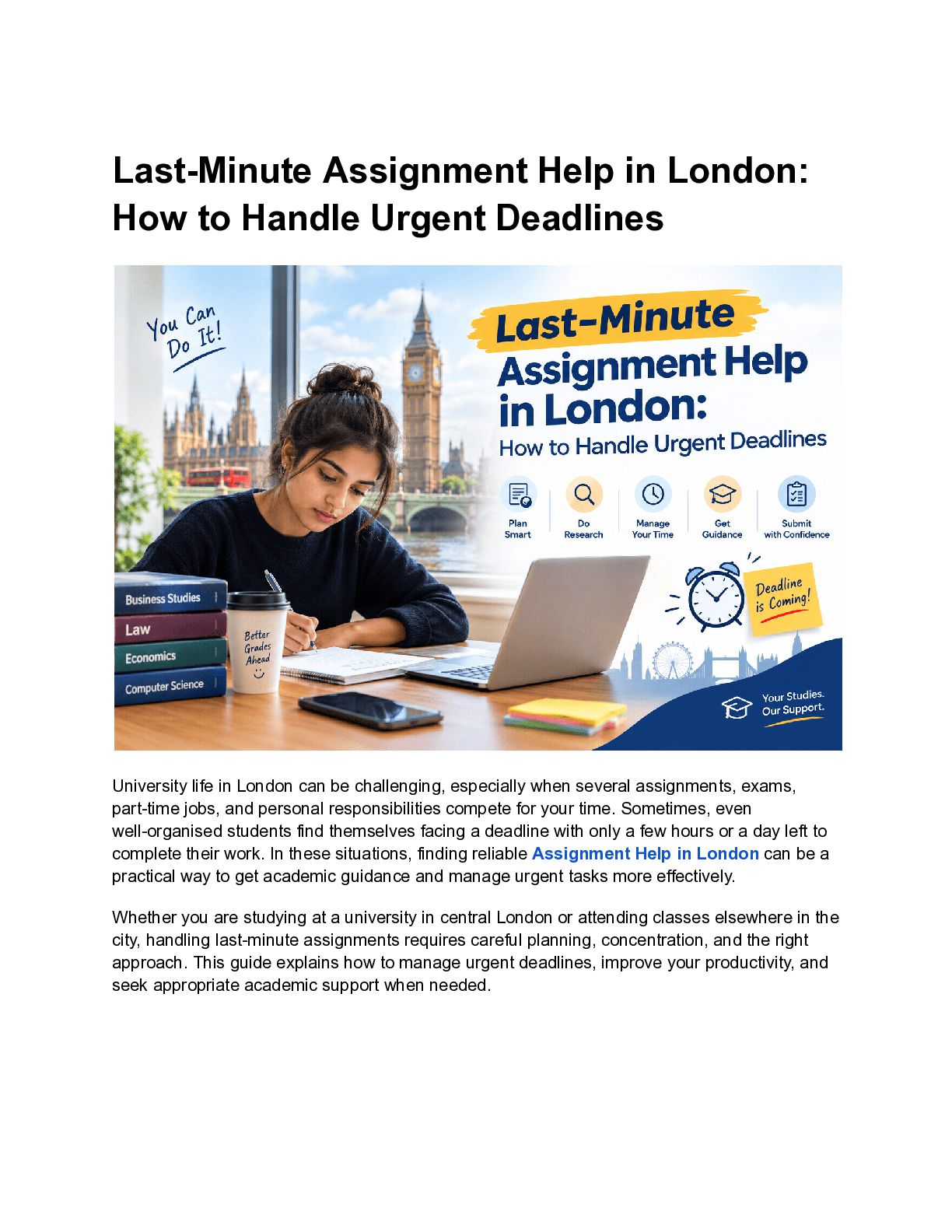
Last-Minute Assignment Help in London: How to Handle Urgent Deadlines
University life in London can be challenging, especially when several assignments, exams, part-time jobs, and personal responsibilities compete for your time. Sometimes, even well-organised students find themselves facing a deadline with only a few hours or a day left to complete their work. In these situations, finding reliable Assignment Help in London can be a practical way to get academic guidance and manage urgent tasks more effectively.

olivia Smith
October 23, 2026
Transcript
6 slides
-
Last-Minute Assignment Help in London: How to Handle Urgent Deadlines
University life in London can be challenging, especially when several assignments, exams, part-time jobs, and personal responsibilities compete for your time. Sometimes, even well-organised students find themselves facing a deadline with only a few hours or a day left to complete their work. In these situations, finding reliable Assignment Help in London can be a practical way to get academic guidance and manage urgent tasks more effectively. Whether you are studying at a university in central London or attending classes elsewhere in the city, handling last-minute assignments requires careful planning, concentration, and the right approach. This guide explains how to manage urgent deadlines, improve your productivity, and seek appropriate academic support when needed. -
Why Do Students Face Last-Minute Assignment Deadlines? There are several
reasons why students struggle to complete their university assignments on time. Understanding these challenges can help you avoid similar problems in the future. 1. Multiple academic responsibilities: Students often have essays, reports, presentations, coursework, and exams scheduled within the same week. Managing all these responsibilities can become difficult without a clear plan. 2. Part-time jobs: Many students in London work part-time to support their living expenses. Balancing work shifts with academic commitments can leave limited time for research and writing. 3. Difficult assignment topics: Some subjects require extensive research, data analysis, calculations, or critical thinking. Students may spend too much time understanding the question before starting the actual assignment. 4. Poor time management: Delaying the beginning of an assignment can create unnecessary pressure. Even a relatively straightforward task becomes stressful when the submission deadline is approaching. 5. Unexpected circumstances: Illness, family responsibilities, technical problems, and other emergencies can disrupt an otherwise organised study schedule. Recognising the reason behind a delay is the first step towards finding a workable solution. 7 Practical Ways to Handle Urgent Assignment Deadlines When your submission deadline is approaching, you need a realistic strategy rather than trying to complete everything at once. The following steps can help you use your remaining time wisely. 1. Understand the Assignment Requirements Before writing anything, read the assignment brief carefully. Identify the main question, word count, submission format, marking criteria, and referencing style. For example, a university essay may require critical analysis rather than a simple description of a topic. Similarly, a business report may need recommendations supported by evidence. Understanding these requirements prevents you from wasting valuable time on irrelevant information. If any instruction is unclear, consult your lecturer, seminar tutor, or university guidance resources as early as possible. -
2. Create a Short and Realistic Work Plan Divide the
assignment into smaller tasks and estimate how much time each task requires. Focus on completing the most important sections first. For example, if you have six hours available, you could allocate your time as follows: • • • • • 30 minutes to understand the question and plan the structure. 90 minutes to find and review relevant sources. Two hours to develop the main arguments and draft the content. One hour to complete the remaining sections. One hour to check references, grammar, formatting, and submission requirements. Adjust this schedule according to your assignment type and existing research. Remember to include short breaks if you need them to maintain concentration. 3. Prioritise Research and Reliable Sources Research is essential for producing a strong university assignment, but urgent deadlines make it important to work efficiently. Start with your university library, recommended reading list, academic journals, and credible publications. Use search terms directly related to your assignment question instead of browsing unrelated material. As you research, record important arguments, publication details, and page numbers where relevant. This will make referencing easier when you begin writing. Avoid relying entirely on random websites or unverified online summaries. Your arguments should be supported by appropriate evidence, and every source you use should be referenced according to your university's requirements. 4. Focus on Structure Before Perfecting Every Sentence One common mistake students make under pressure is spending too much time improving the introduction while leaving the main discussion unfinished. Instead, create a clear outline before drafting your assignment. A typical academic essay may include an introduction, several main paragraphs, and a conclusion. A report may require an executive summary, findings, discussion, recommendations, and references, depending on the brief. Write a complete first draft before focusing on small language improvements. Each section should address a specific part of the assignment question. -
A clear, relevant, and well-supported response is more useful than
a beautifully written introduction followed by incomplete arguments. 5. Reduce Distractions During Study Sessions When a deadline is close, every focused study session matters. Put your phone on silent, close unnecessary browser tabs, and choose a quiet place to work. Students in London may find it helpful to study in a university library or another suitable study space. If you work better at home, organise your materials before beginning. Try working in focused blocks, such as 25 minutes of study followed by a five-minute break. You can adjust the duration depending on your concentration level. The goal is to reduce interruptions and make steady progress rather than repeatedly switching between different tasks. 6. Seek Academic Guidance When Necessary Sometimes, the biggest challenge is not the deadline itself but understanding a difficult concept, structuring an argument, or applying the correct referencing style. In these situations, consider asking your lecturer, academic adviser, writing centre, or university support service for guidance. You can also use reputable academic resources to clarify unfamiliar concepts. Students searching for Assignment Help in London may also consider professional tutoring, proofreading, or study support when appropriate. Before choosing a provider, check its transparency, subject expertise, privacy practices, pricing, and service terms. Use academic support to strengthen your understanding and improve your own work. Make sure any assistance complies with your university's academic integrity rules, and do not submit work produced by someone else as your own. 7. Review Your Work Before Submission Even when time is limited, leave enough time for a final review. Small errors can affect clarity and make an otherwise useful assignment difficult to follow. Check the following points before submitting: • • • • • Does the assignment answer the actual question? Are the main arguments explained clearly? Have you supported important claims with suitable evidence? Are all borrowed ideas and quotations properly referenced? Have you checked spelling, grammar, and sentence structure? -
• Does the document follow the required formatting and word
count? • Have you uploaded the correct file to the correct submission portal? Finally, confirm that your university platform shows a successful submission. Keep a copy of your work and any submission confirmation. How Assignment Help in London Can Support Students When students face several academic responsibilities at once, appropriate support can help them identify gaps in their understanding and organise their work more effectively. Depending on your needs, useful support may include: Essay planning: Learning how to interpret questions, develop arguments, and organise paragraphs logically. Research guidance: Understanding how to locate credible sources and evaluate evidence. Referencing assistance: Learning how to apply Harvard, OSCOLA, APA, or another required referencing style. Proofreading and feedback: Identifying grammar problems, unclear explanations, and weaknesses in structure. Subject-specific tutoring: Getting help with difficult concepts in subjects such as business, law, finance, nursing, or economics. For students looking for Assignment Help in London, the most suitable option is one that supports learning, explains difficult concepts, and respects academic integrity. Check your institution's rules before using any external service, particularly for proofreading, editing, or AI-assisted work. Tips to Avoid Last-Minute Assignment Stress in the Future Although urgent deadlines cannot always be avoided, a few consistent habits can make university life more manageable. • Start early: Read the assignment brief as soon as it becomes available, even if you only have time to make a basic outline. • Use a deadline calendar: Record submission dates, exam schedules, and important milestones in one place. • Set personal deadlines: Aim to finish your first draft before the actual submission date. -
• Break large projects into smaller tasks: Complete research, outlining,
drafting, and editing separately. • Ask questions early: Contact your tutor when instructions or academic concepts are unclear. • Review your weekly workload: Identify busy periods before several deadlines overlap. If an unexpected emergency prevents you from submitting on time, contact your university as soon as possible. Ask about its extension or mitigating circumstances procedures and provide any supporting evidence required by its policies. Conclusion Handling an urgent university deadline can feel overwhelming, but a clear plan can make the task more manageable. Start by understanding the assignment requirements, prioritising research, organising your time, and focusing on the most important sections. Remember to review your work carefully and follow your institution's academic integrity rules. If you need additional guidance, Assignment Help in London can be a useful starting point for exploring academic support, subject tutoring, research guidance, and proofreading options. Choose support that helps you develop your skills rather than simply rushing to finish a task. With better planning, realistic goals, and the right academic resources, you can approach future deadlines with greater confidence and less stress.
 oliviasmith9
 yasulab
 rashwhitman
 baltimoreniso
 hiola
 signer
 2720japanoke
 adeputra13
 michielstock
 oripsolob
 caitiem20
 jmmastey
 cassininazir
 rkendrick25
 aleyda
 maltzj
 davidcarrasco
 mkilby
 tammyeverts