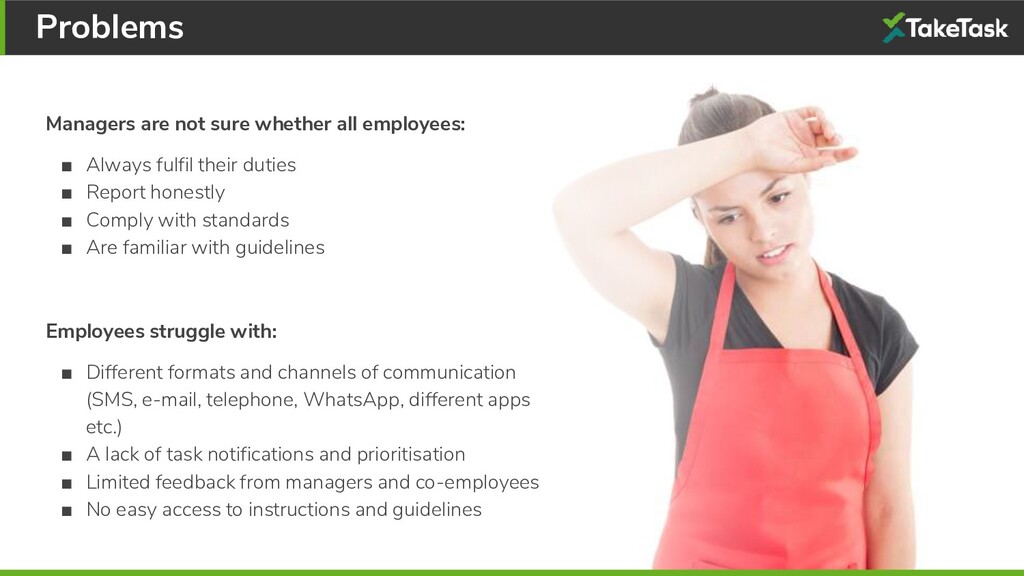
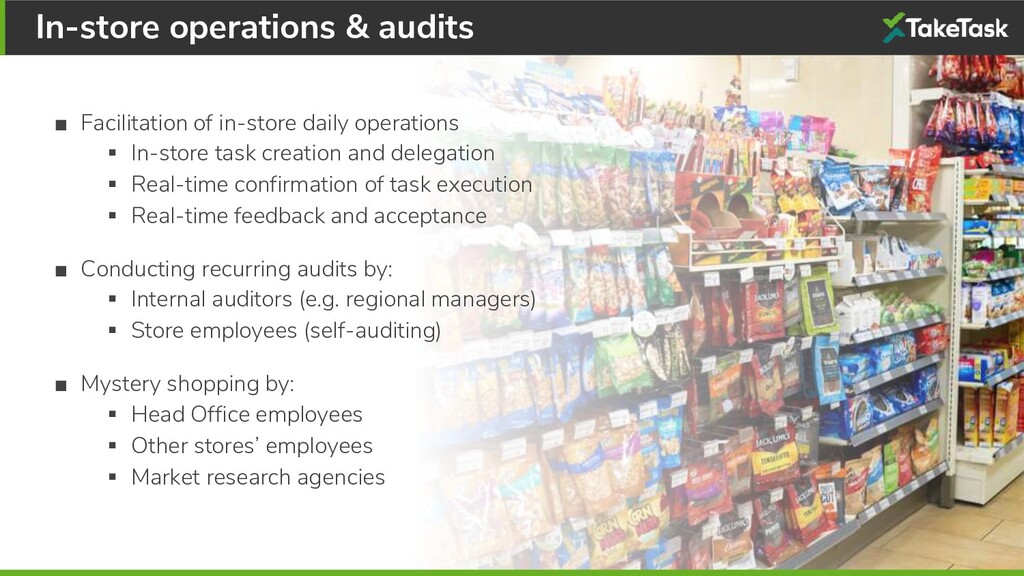
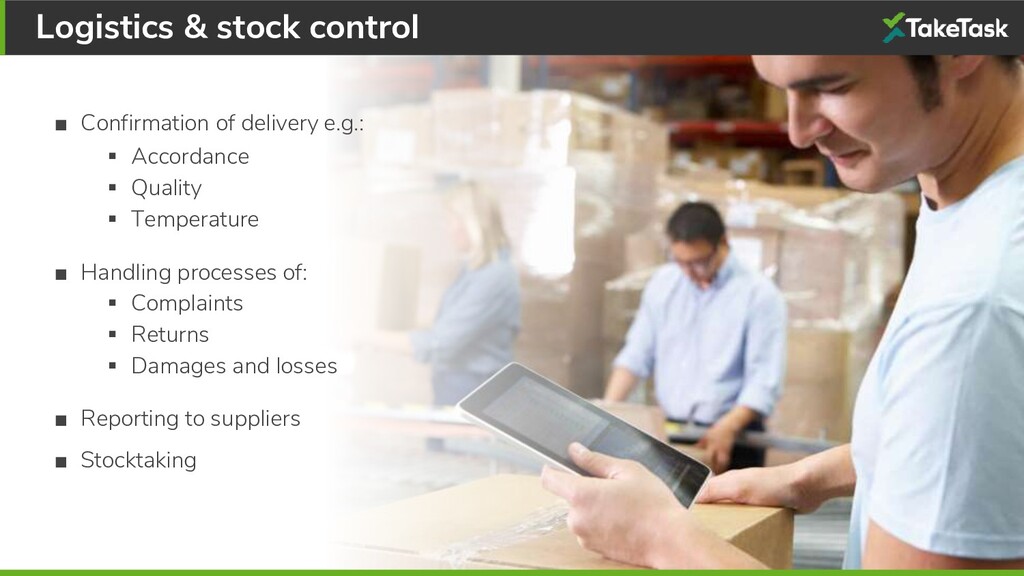
their duties ▪ Report honestly ▪ Comply with standards ▪ Are familiar with guidelines Employees struggle with: ▪ Different formats and channels of communication (SMS, e-mail, telephone, WhatsApp, different apps etc.) ▪ A lack of task notifications and prioritisation ▪ Limited feedback from managers and co-employees ▪ No easy access to instructions and guidelines Problems
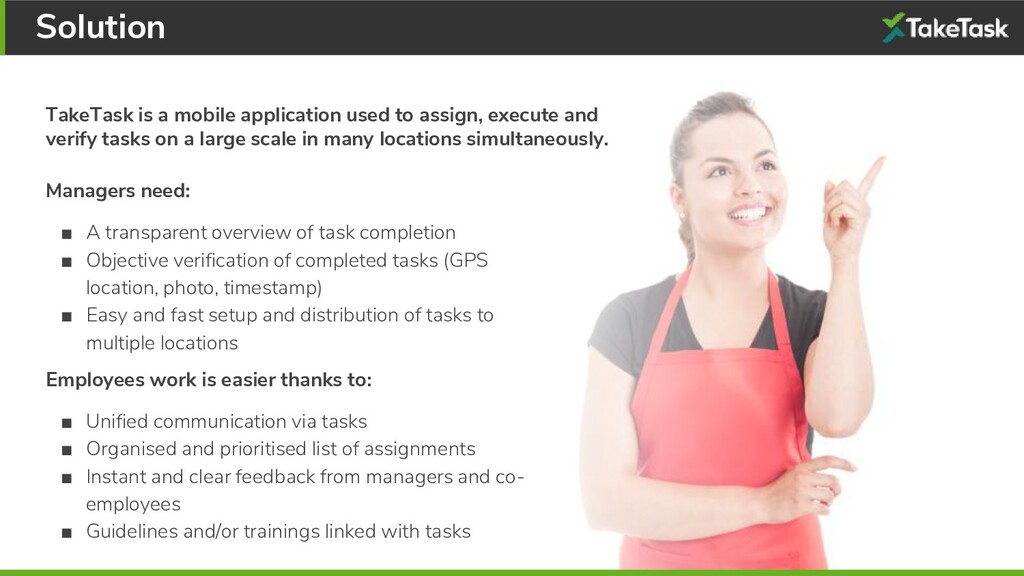
and verify tasks on a large scale in many locations simultaneously. Managers need: ▪ A transparent overview of task completion ▪ Objective verification of completed tasks (GPS location, photo, timestamp) ▪ Easy and fast setup and distribution of tasks to multiple locations Employees work is easier thanks to: ▪ Unified communication via tasks ▪ Organised and prioritised list of assignments ▪ Instant and clear feedback from managers and co- employees ▪ Guidelines and/or trainings linked with tasks
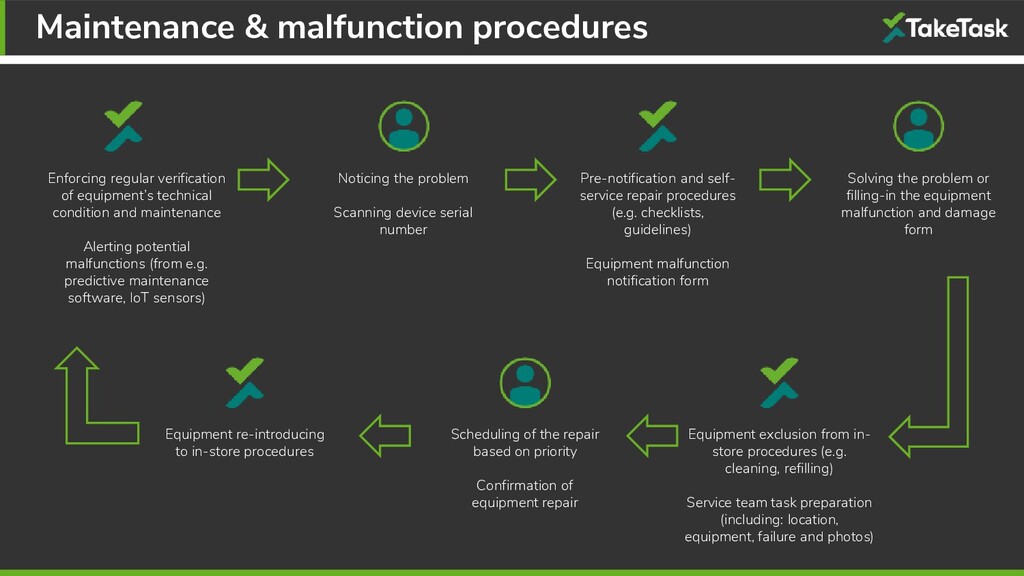
condition and maintenance Alerting potential malfunctions (from e.g. predictive maintenance software, IoT sensors) Noticing the problem Scanning device serial number Pre-notification and self- service repair procedures (e.g. checklists, guidelines) Equipment malfunction notification form Equipment re-introducing to in-store procedures Scheduling of the repair based on priority Confirmation of equipment repair Equipment exclusion from in- store procedures (e.g. cleaning, refilling) Service team task preparation (including: location, equipment, failure and photos) Solving the problem or filling-in the equipment malfunction and damage form
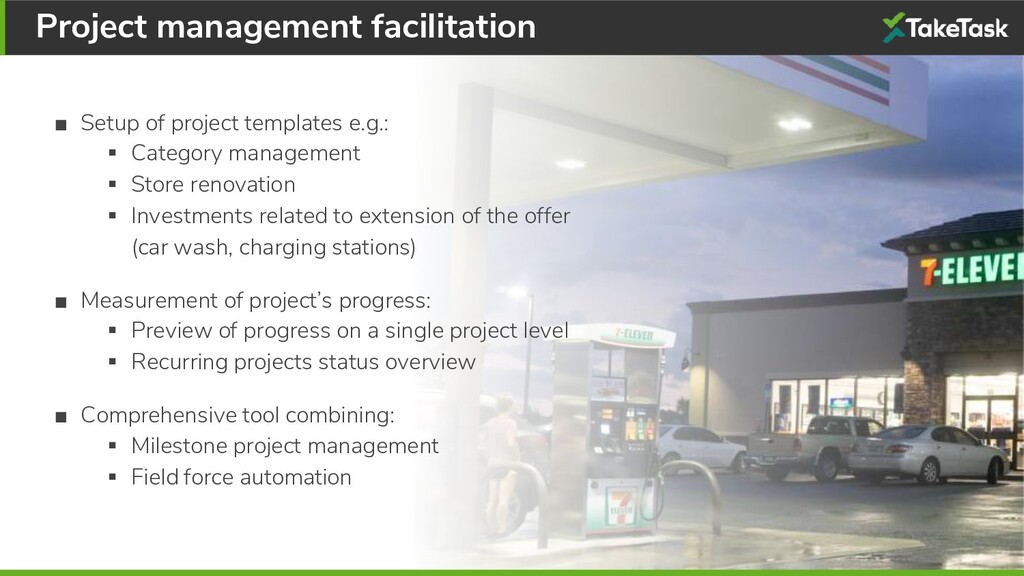
Category management ▪ Store renovation ▪ Investments related to extension of the offer (car wash, charging stations) ▪ Measurement of project’s progress: ▪ Preview of progress on a single project level ▪ Recurring projects status overview ▪ Comprehensive tool combining: ▪ Milestone project management ▪ Field force automation
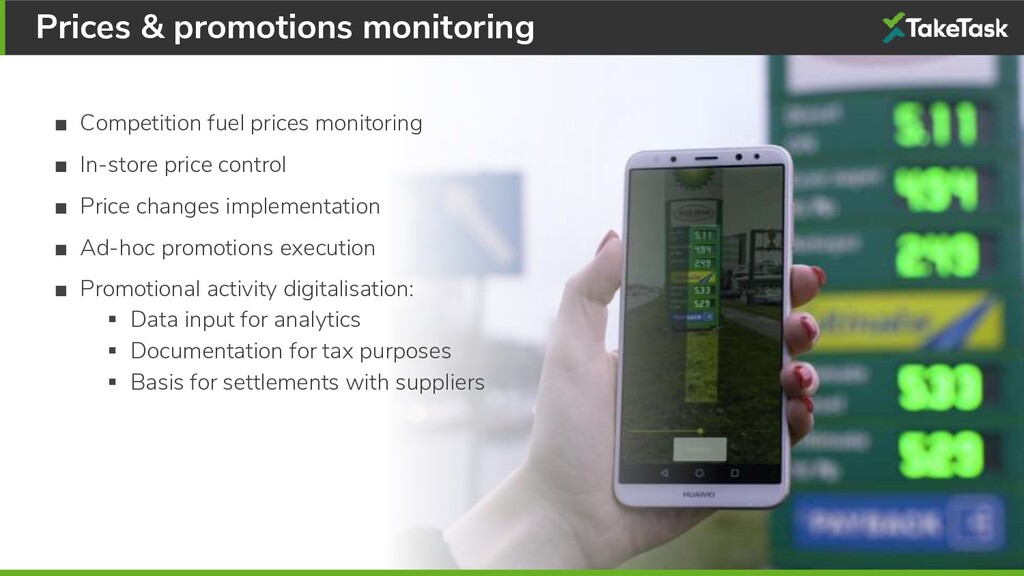
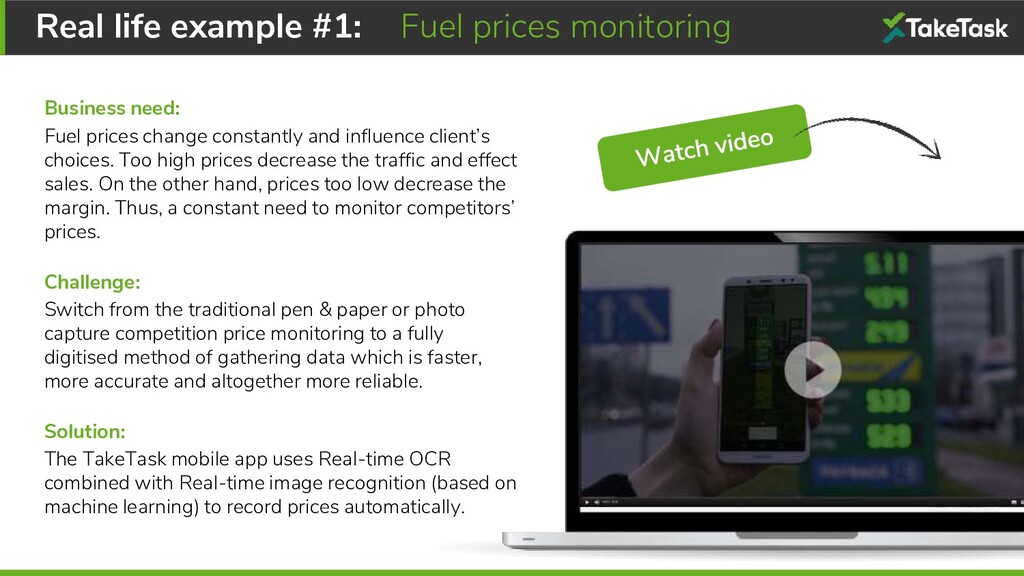
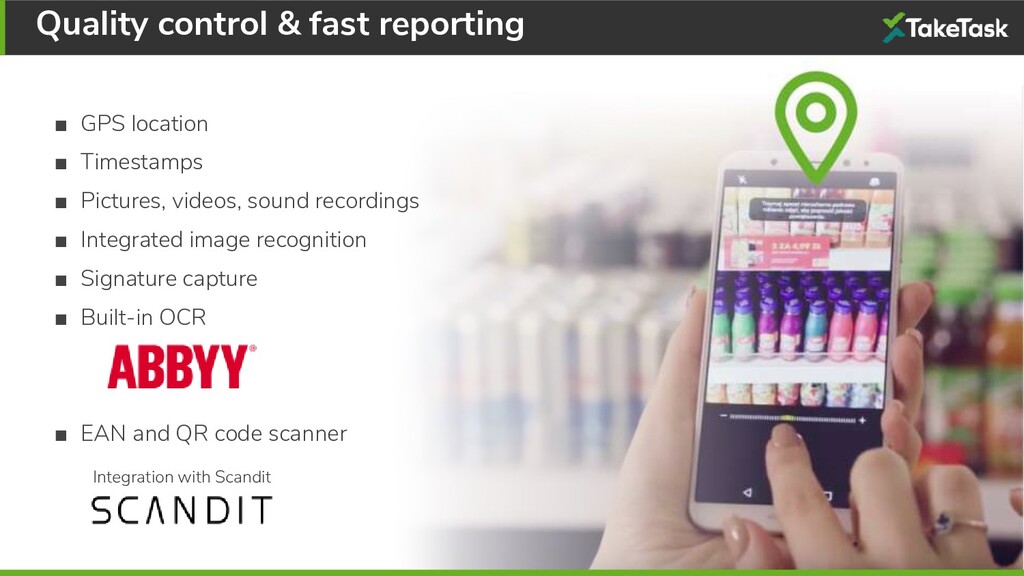
prices change constantly and influence client’s choices. Too high prices decrease the traffic and effect sales. On the other hand, prices too low decrease the margin. Thus, a constant need to monitor competitors’ prices. Challenge: Switch from the traditional pen & paper or photo capture competition price monitoring to a fully digitised method of gathering data which is faster, more accurate and altogether more reliable. Solution: The TakeTask mobile app uses Real-time OCR combined with Real-time image recognition (based on machine learning) to record prices automatically.
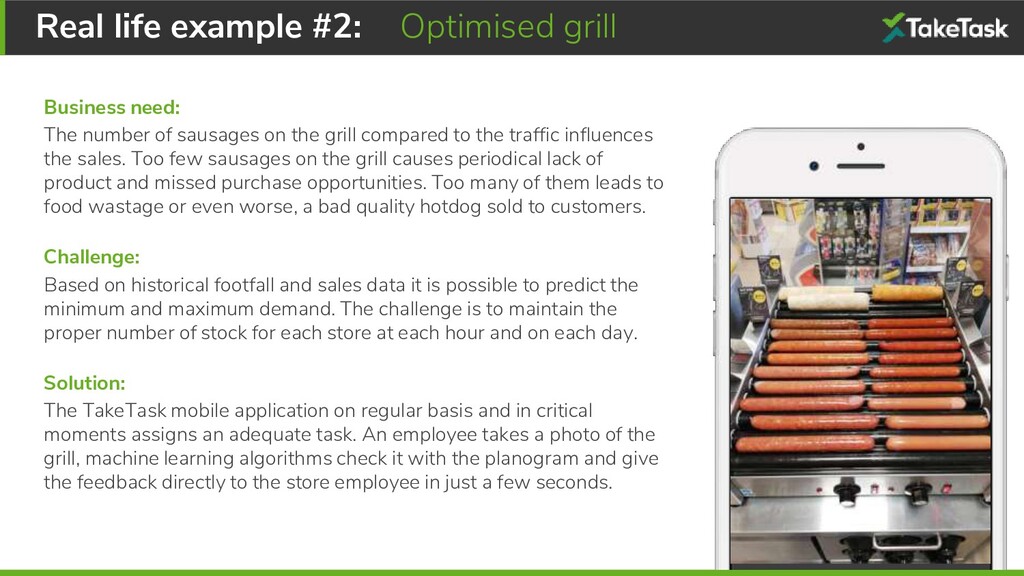
to the traffic influences the sales. Too few sausages on the grill causes periodical lack of product and missed purchase opportunities. Too many of them leads to food wastage or even worse, a bad quality hotdog sold to customers. Challenge: Based on historical footfall and sales data it is possible to predict the minimum and maximum demand. The challenge is to maintain the proper number of stock for each store at each hour and on each day. Solution: The TakeTask mobile application on regular basis and in critical moments assigns an adequate task. An employee takes a photo of the grill, machine learning algorithms check it with the planogram and give the feedback directly to the store employee in just a few seconds. Real life example #2: Optimised grill
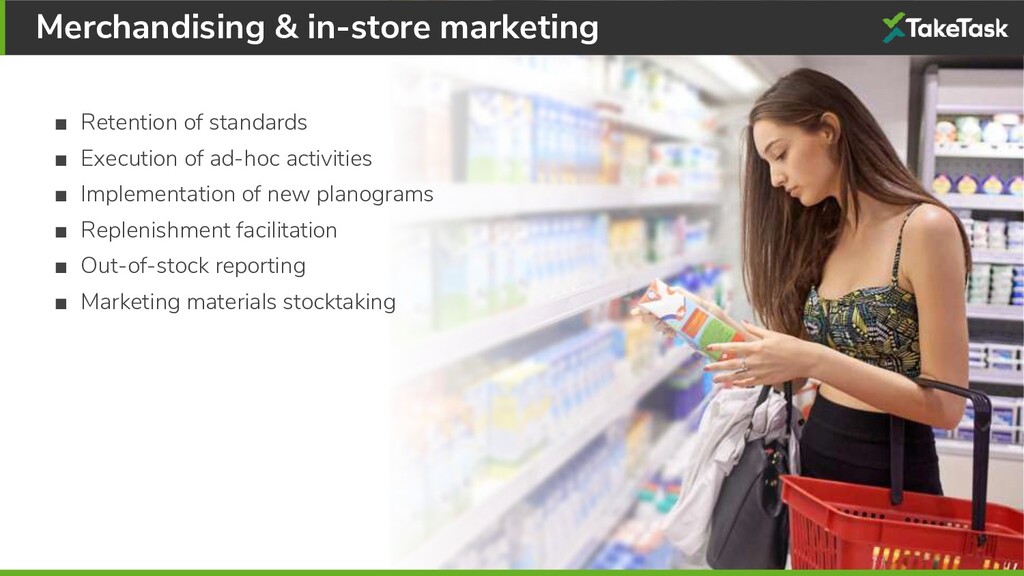
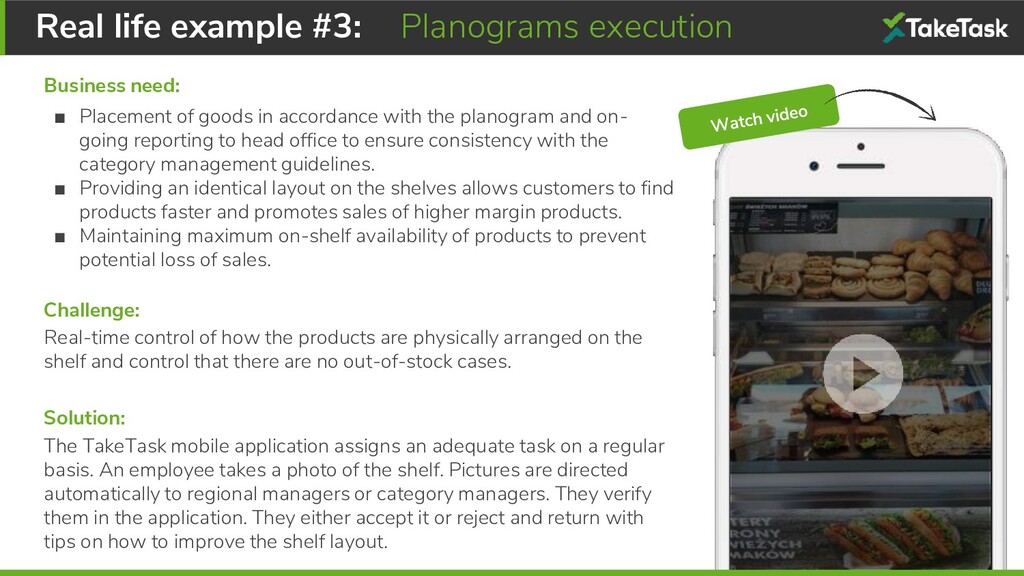
of goods in accordance with the planogram and on- going reporting to head office to ensure consistency with the category management guidelines. ▪ Providing an identical layout on the shelves allows customers to find products faster and promotes sales of higher margin products. ▪ Maintaining maximum on-shelf availability of products to prevent potential loss of sales. Challenge: Real-time control of how the products are physically arranged on the shelf and control that there are no out-of-stock cases. Solution: The TakeTask mobile application assigns an adequate task on a regular basis. An employee takes a photo of the shelf. Pictures are directed automatically to regional managers or category managers. They verify them in the application. They either accept it or reject and return with tips on how to improve the shelf layout.
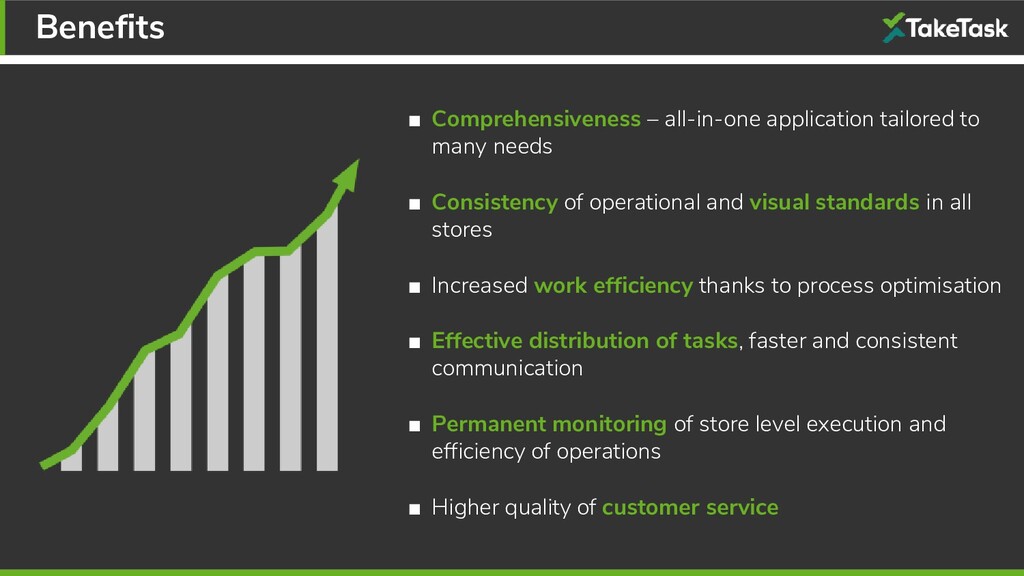
▪ Consistency of operational and visual standards in all stores ▪ Increased work efficiency thanks to process optimisation ▪ Effective distribution of tasks, faster and consistent communication ▪ Permanent monitoring of store level execution and efficiency of operations ▪ Higher quality of customer service
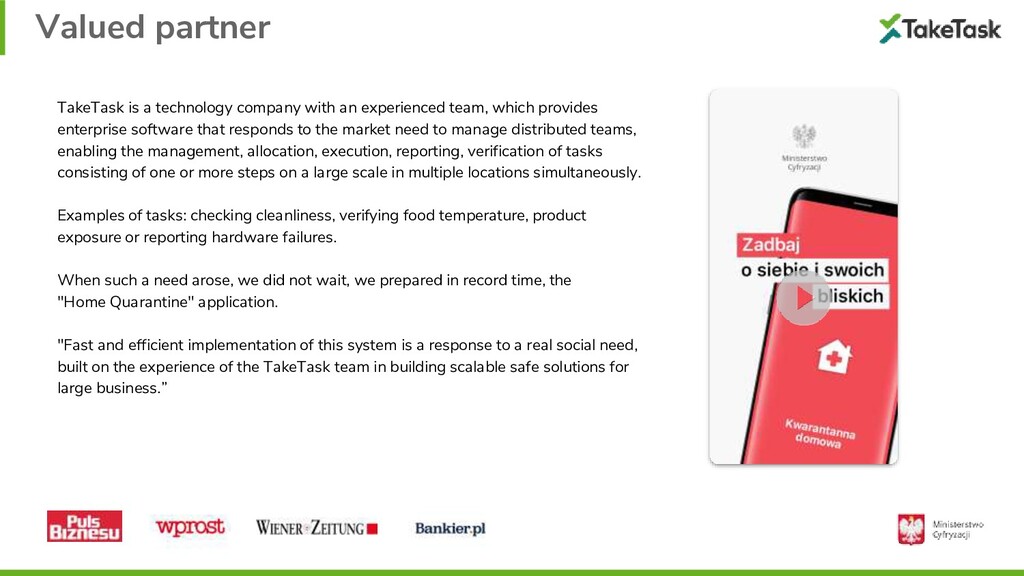
experienced team, which provides enterprise software that responds to the market need to manage distributed teams, enabling the management, allocation, execution, reporting, verification of tasks consisting of one or more steps on a large scale in multiple locations simultaneously. Examples of tasks: checking cleanliness, verifying food temperature, product exposure or reporting hardware failures. When such a need arose, we did not wait, we prepared in record time, the "Home Quarantine" application. "Fast and efficient implementation of this system is a response to a real social need, built on the experience of the TakeTask team in building scalable safe solutions for large business.” Valued partner
processes provided by the client ▪ Preparation of the first version of digitised tasks ▪ Fine-tuning of processes ▪ Possibility of testing the application with clients’ employees ▪ Identifying quick-win areas of implementation We enable the testing of our application on your own processes:


 natsumidnx
 ggfs
 nakahara
 kuradashi
 takemura_yuto
 so_kotani
 sukatsu1222
 flux
 kawanotron
 tsuchihashi
 neuroenergia
 ozakiomumkj
 retrage
 michaelherold
 marktimemedia
 stephenakadiri
 jcasabona
 orderedlist
 letsgokoyo
 skipperchong
 addyosmani
 baasie
 szymonslowik
 techseoconnect