Upgrade to Pro — share decks privately, control downloads, hide ads and more …

Saving Open Source (Drupal Eastern Time Zone Me...

Sponsored · Your Podcast. Everywhere. Effortlessly. Share. Educate. Inspire. Entertain. You do you. We'll handle the rest.

Saving Open Source (Drupal Eastern Time Zone Meetup March 2026)

Open source software is ubiquitous. We fought for its acceptance, and we won. So, why doesn't it feel that way? Why does the win feel so hollow?

With many projects foregoing traditional open source licenses for "source-available" licenses, is open source dead? Are we in a post-open source era?

To find out how we got here, let's look back to the beginnings of the free software movement to discover what made it a movement and not a corporate strategy. We'll consider whether open source has exchanged its jeans and t-shirt in favor of khakis and blue, button-up shirt. More importantly, we'll examine whether this is a greater cultural phenomenon, what it means for the future of software development, and how we can save open source.

Avatar for Ben Ramsey

Ben Ramsey PRO

March 04, 2026

More Decks by Ben Ramsey

Other Decks in Programming

Transcript

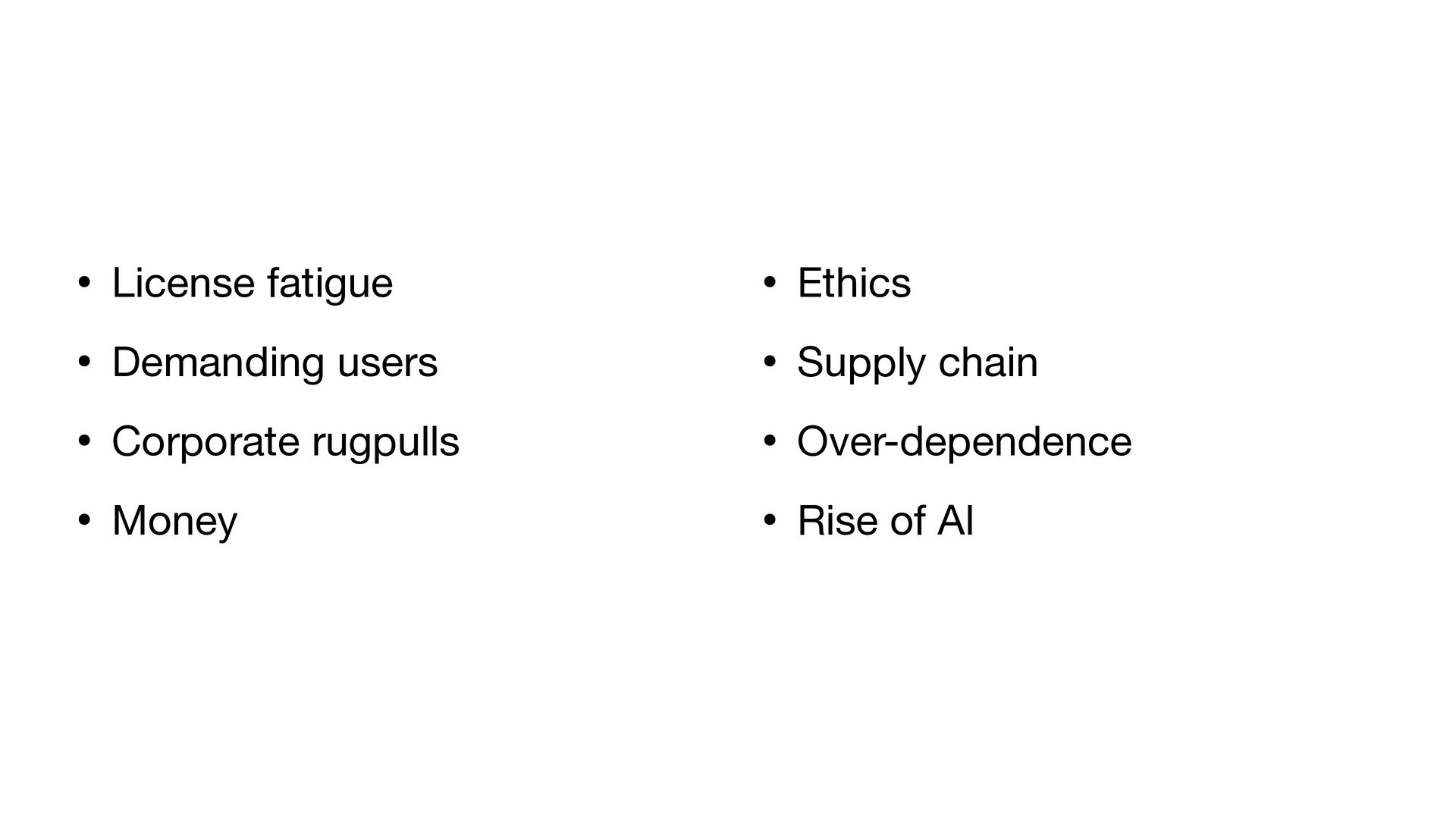
  1. • License fatigue • Demanding users • Corporate rugpulls •

    Money • Ethics • Supply chain • Over-dependence • Rise of AI
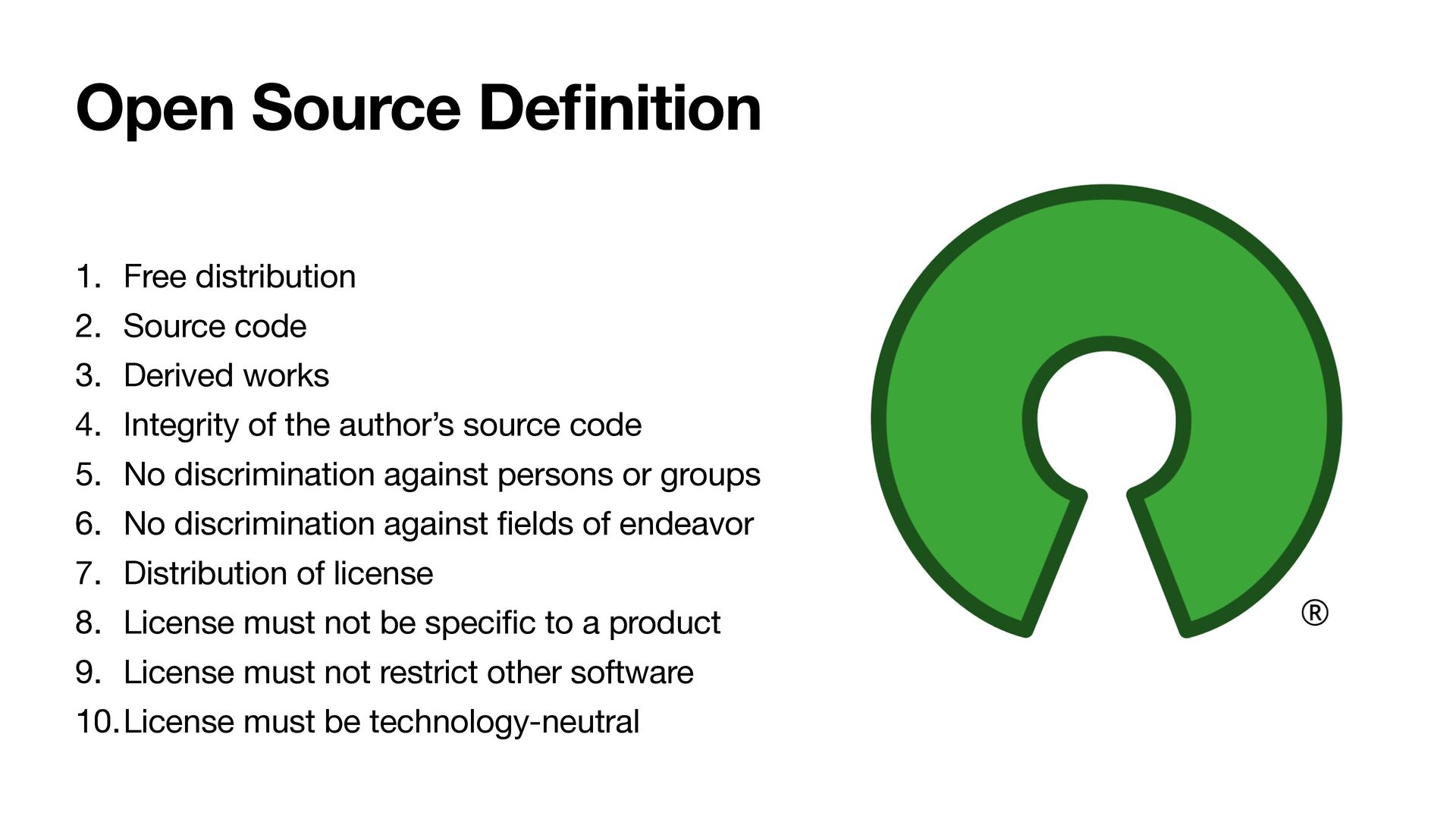
  2. Open Source De fi nition 1. Free distribution 2. Source

    code 3. Derived works 4. Integrity of the author’s source code 5. No discrimination against persons or groups 6. No discrimination against fi elds of endeavor 7. Distribution of license 8. License must not be speci fi c to a product 9. License must not restrict other software 10.License must be technology-neutral
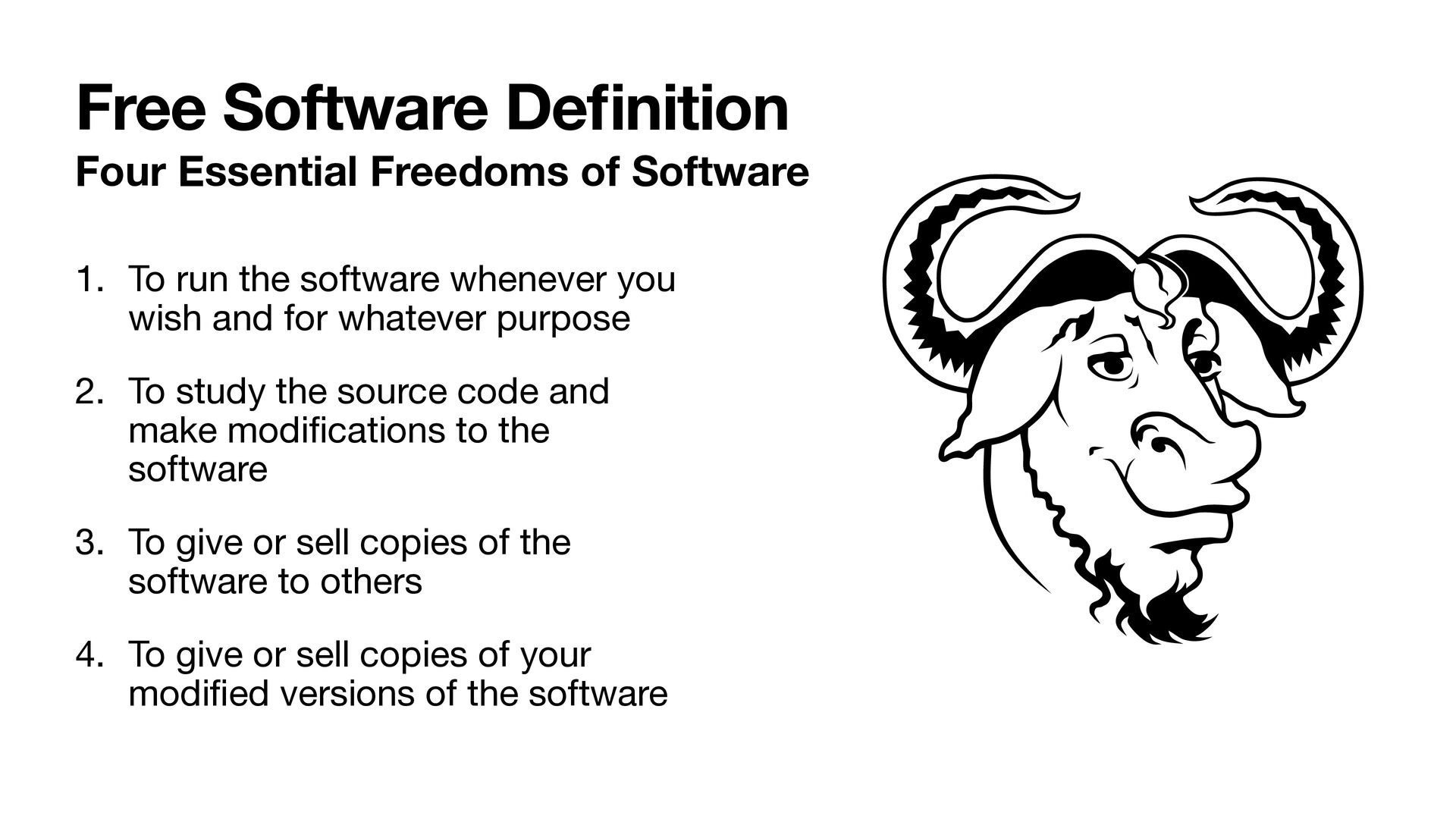
  3. Free Software De fi nition Four Essential Freedoms of Software

    1. To run the software whenever you wish and for whatever purpose 2. To study the source code and make modi fi cations to the software 3. To give or sell copies of the software to others 4. To give or sell copies of your modi fi ed versions of the software
  4. —Eric Raymond, “The Cathedral and the Bazaar” “Every good work
    of software starts by scratching a developer’s personal itch.”
  5. More reasons to contribute… • Gain more knowledge • Improve

    your skills • Work with others • Build a reputation • Modify something for your job
  6. —Richard Stallman “I was so angry I couldn’t think of

    a way to express it. So I just turned away and walked out without another word. I might have slammed the door. Who knows? All I remember is wanting to get out of there. I went to his o ff i ce expecting him to cooperate, so I had not thought about how I would respond if he refused. When he did, I was stunned speechless as well as disappointed and angry.”
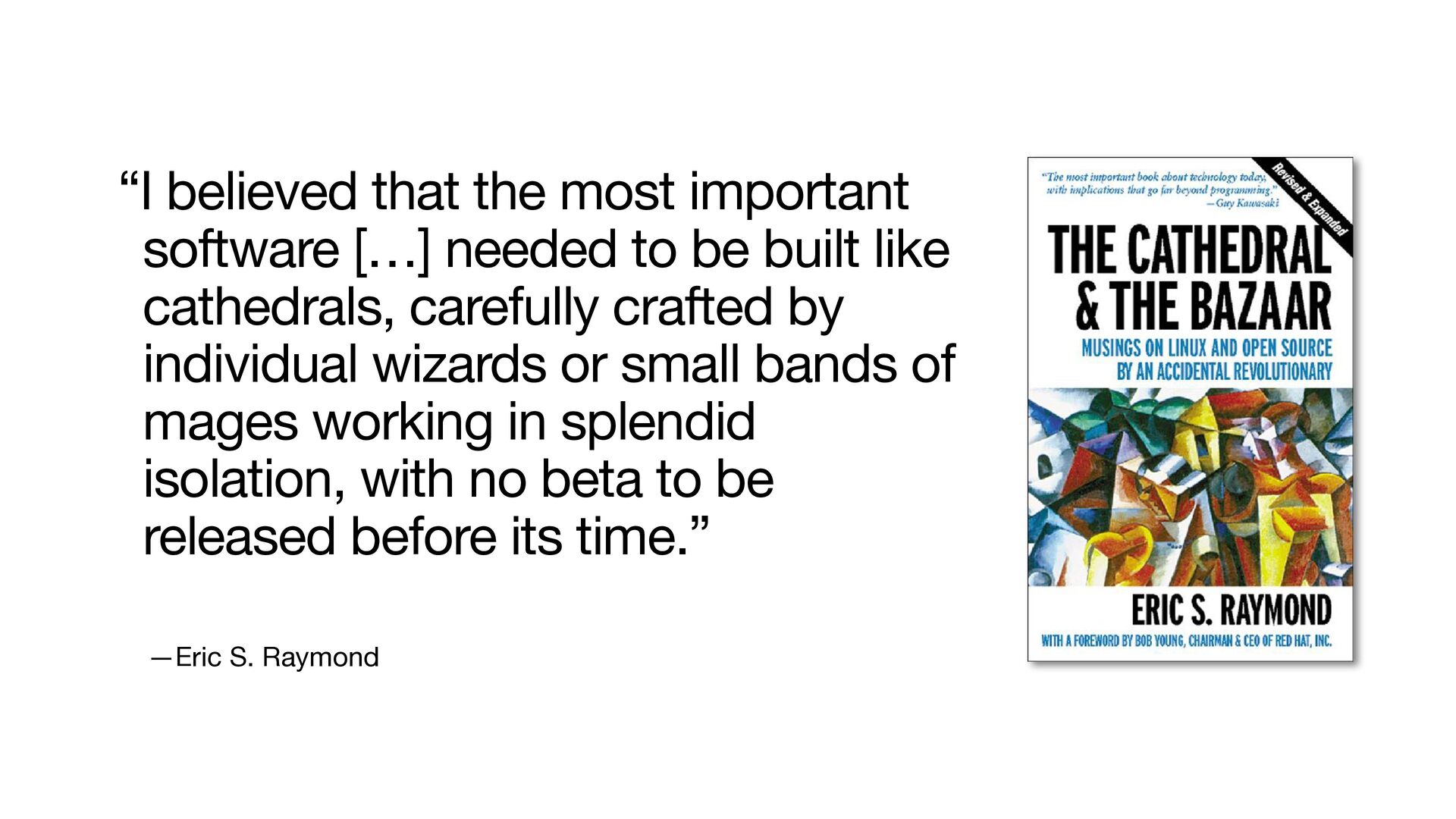
  7. —Eric S. Raymond “I believed that the most important software

    […] needed to be built like cathedrals, carefully crafted by individual wizards or small bands of mages working in splendid isolation, with no beta to be released before its time.”
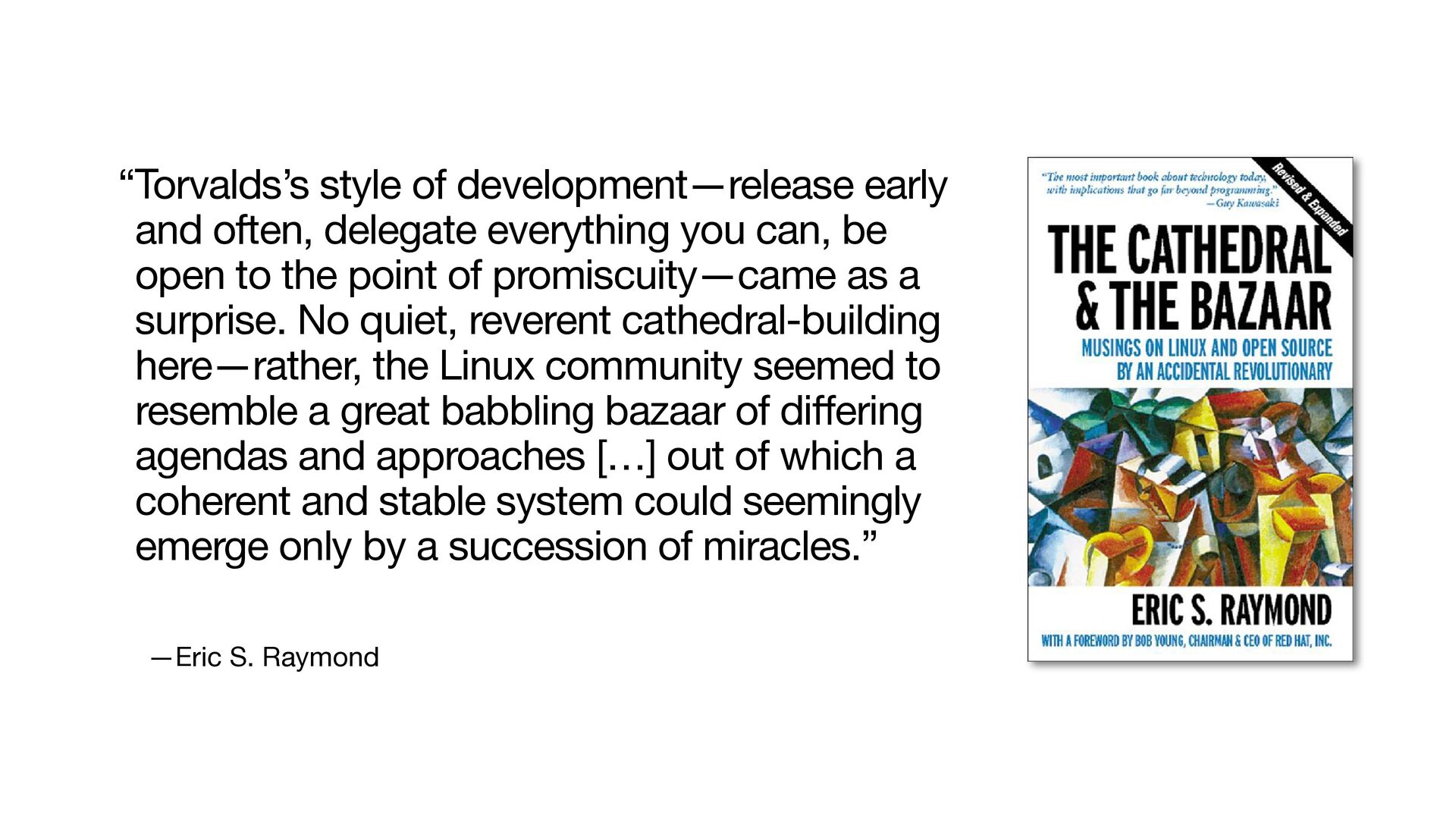
  8. —Eric S. Raymond “Torvalds’s style of development—release early and often,

    delegate everything you can, be open to the point of promiscuity—came as a surprise. No quiet, reverent cathedral-building here—rather, the Linux community seemed to resemble a great babbling bazaar of di ff ering agendas and approaches […] out of which a coherent and stable system could seemingly emerge only by a succession of miracles.”
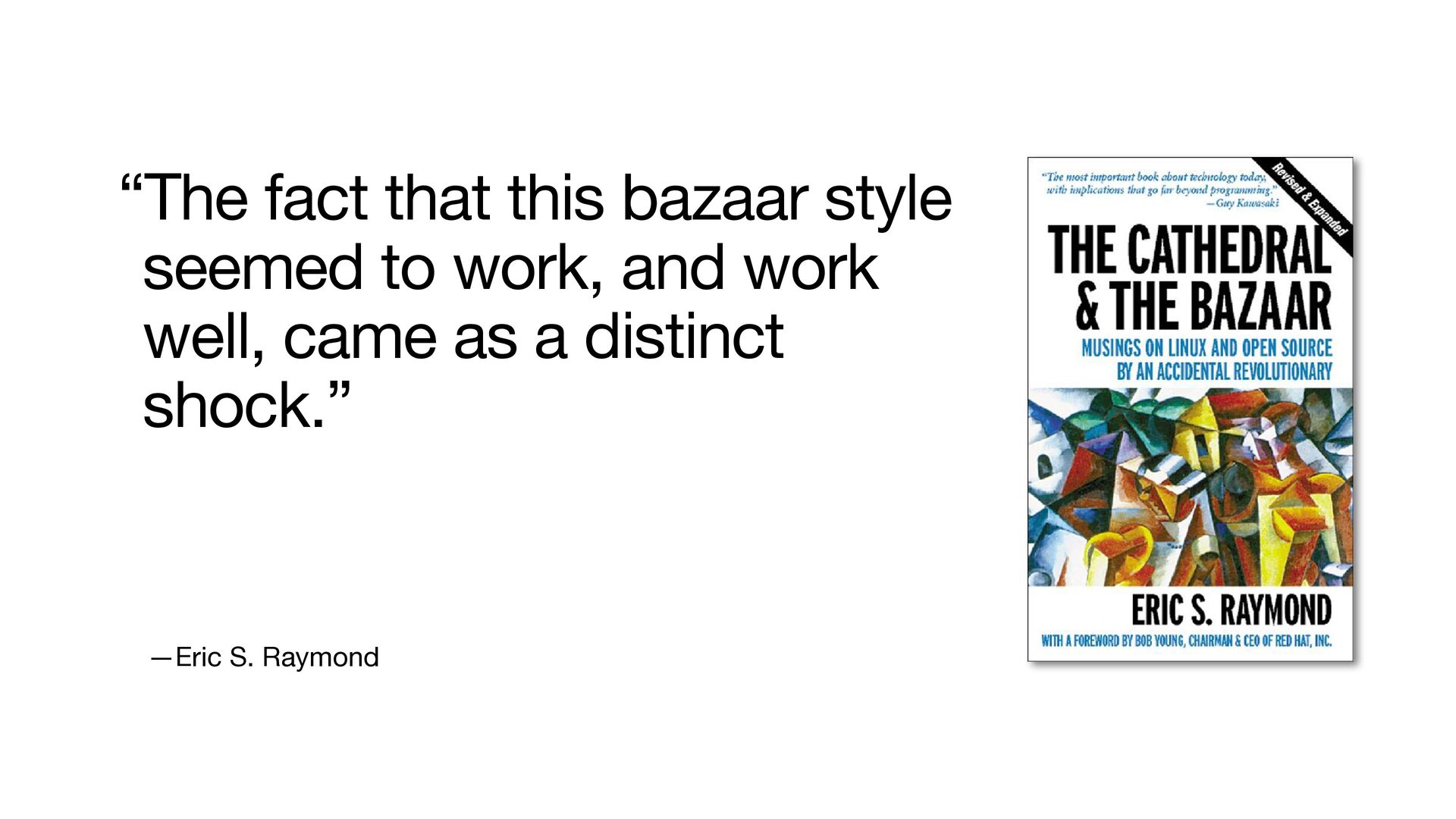
  9. —Eric S. Raymond “The fact that this bazaar style seemed

    to work, and work well, came as a distinct shock.”
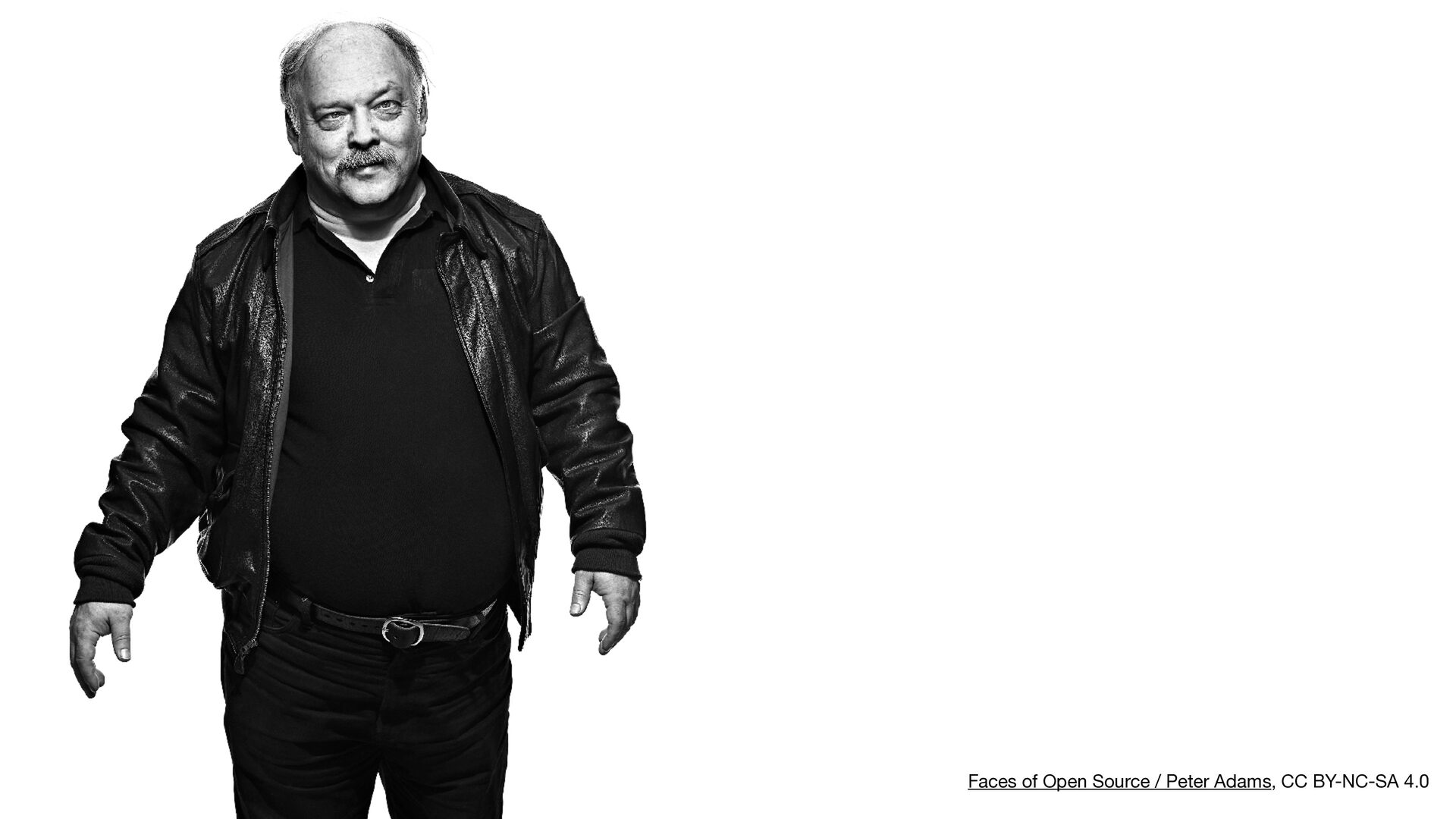
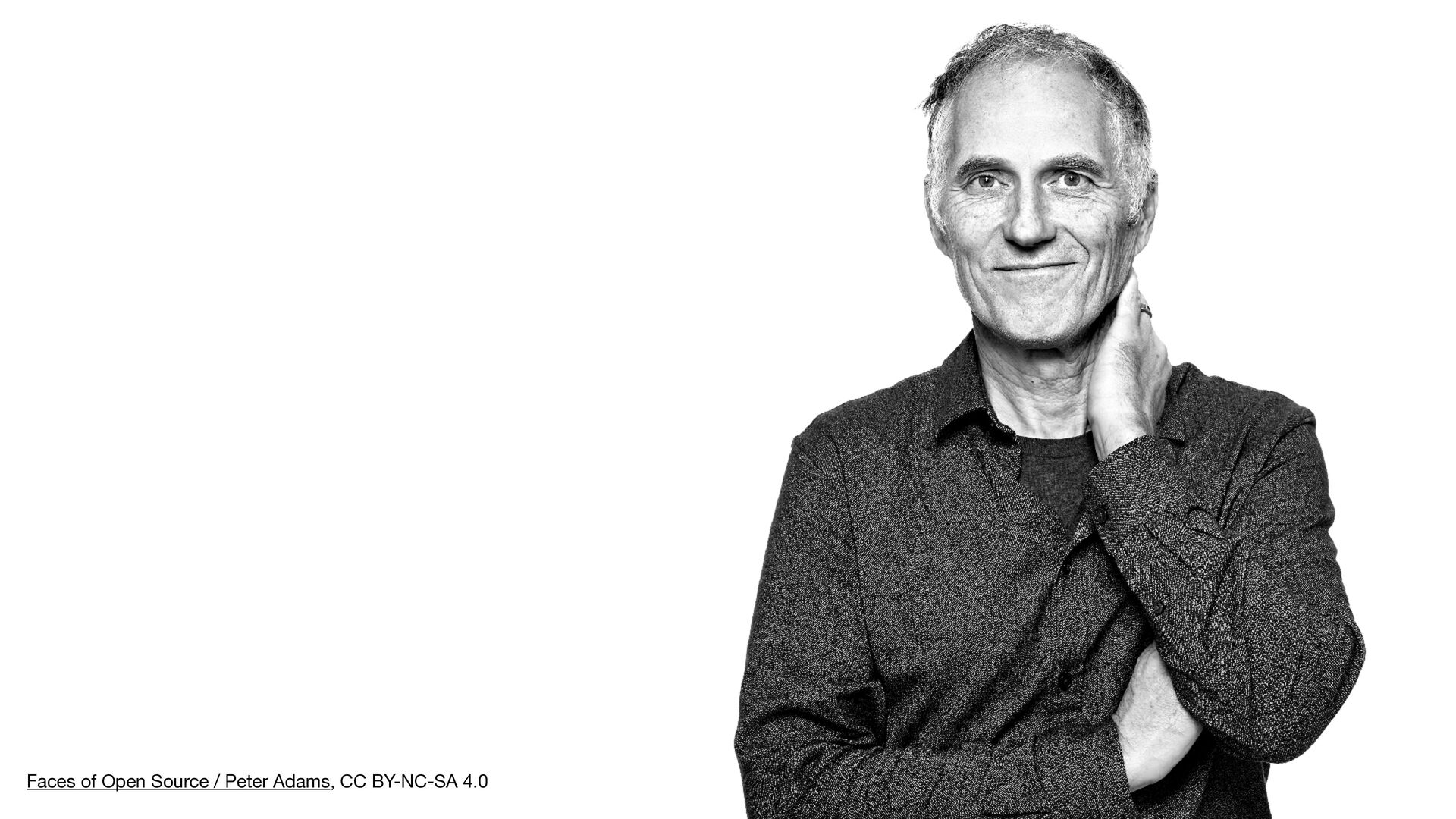
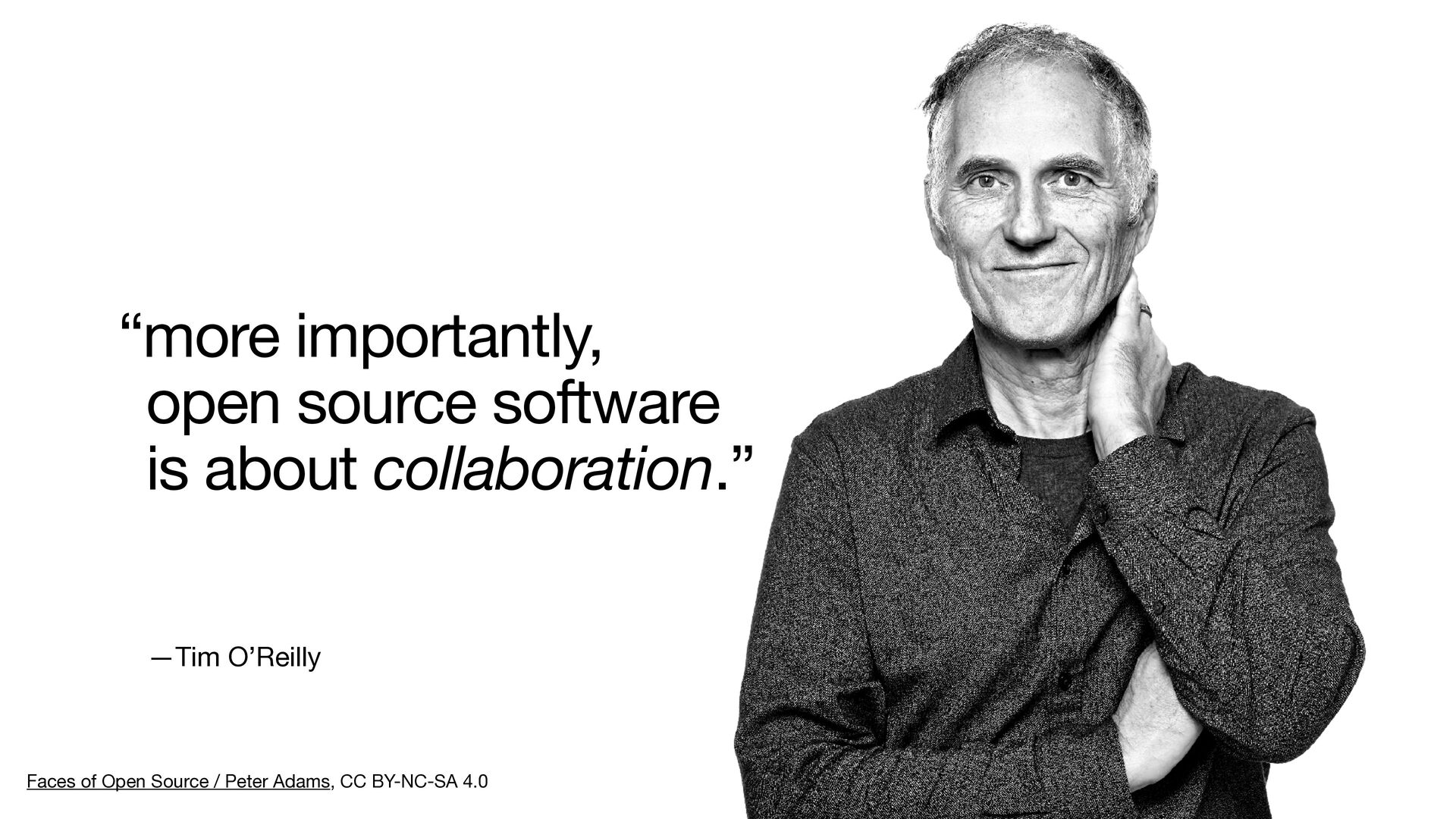
  10. Faces of Open Source / Peter Adams, CC BY-NC-SA 4.0

    “more importantly, open source software is about collaboration.” —Tim O’Reilly
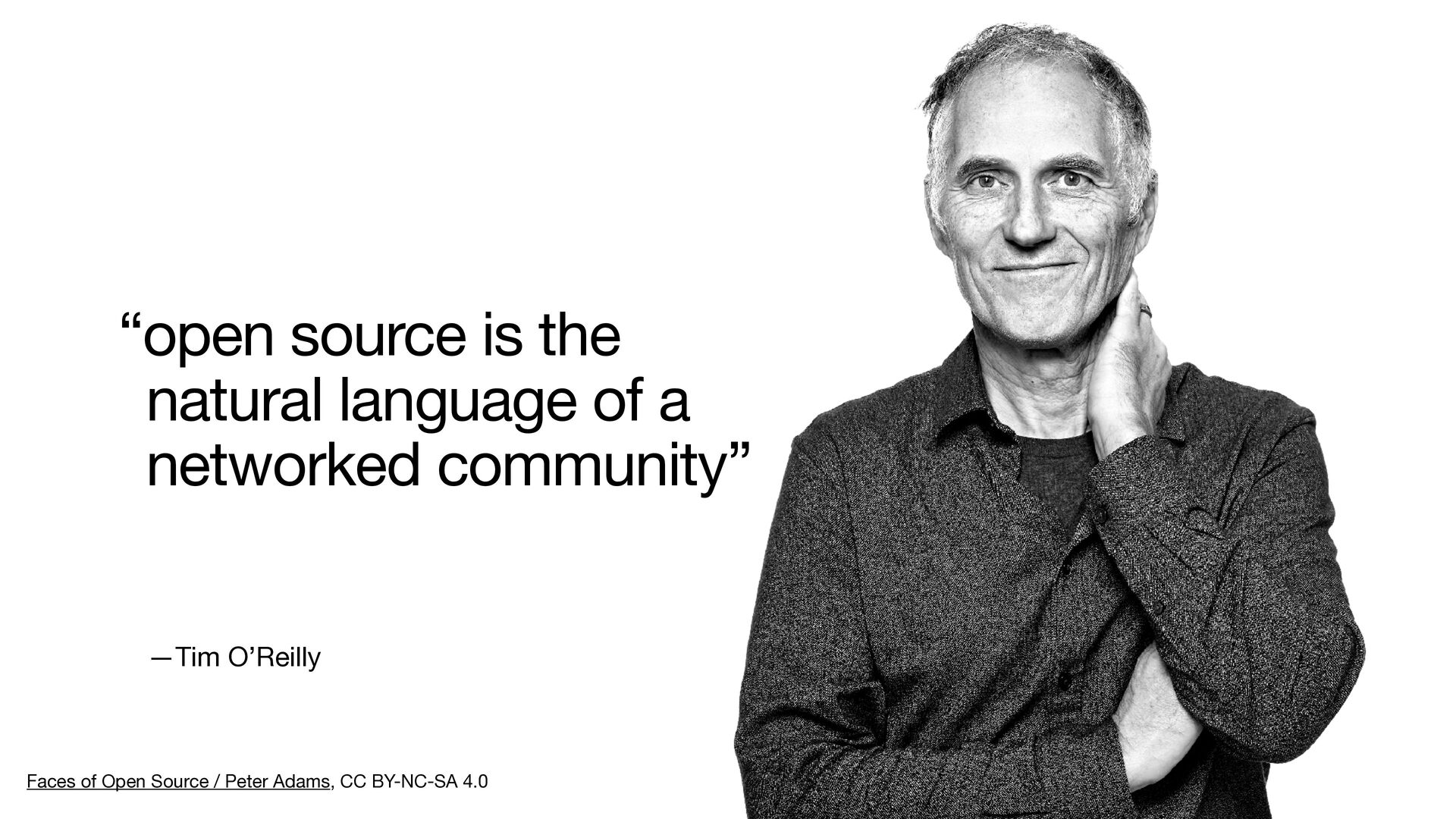
  11. Faces of Open Source / Peter Adams, CC BY-NC-SA 4.0

    “open source is the natural language of a networked community” —Tim O’Reilly
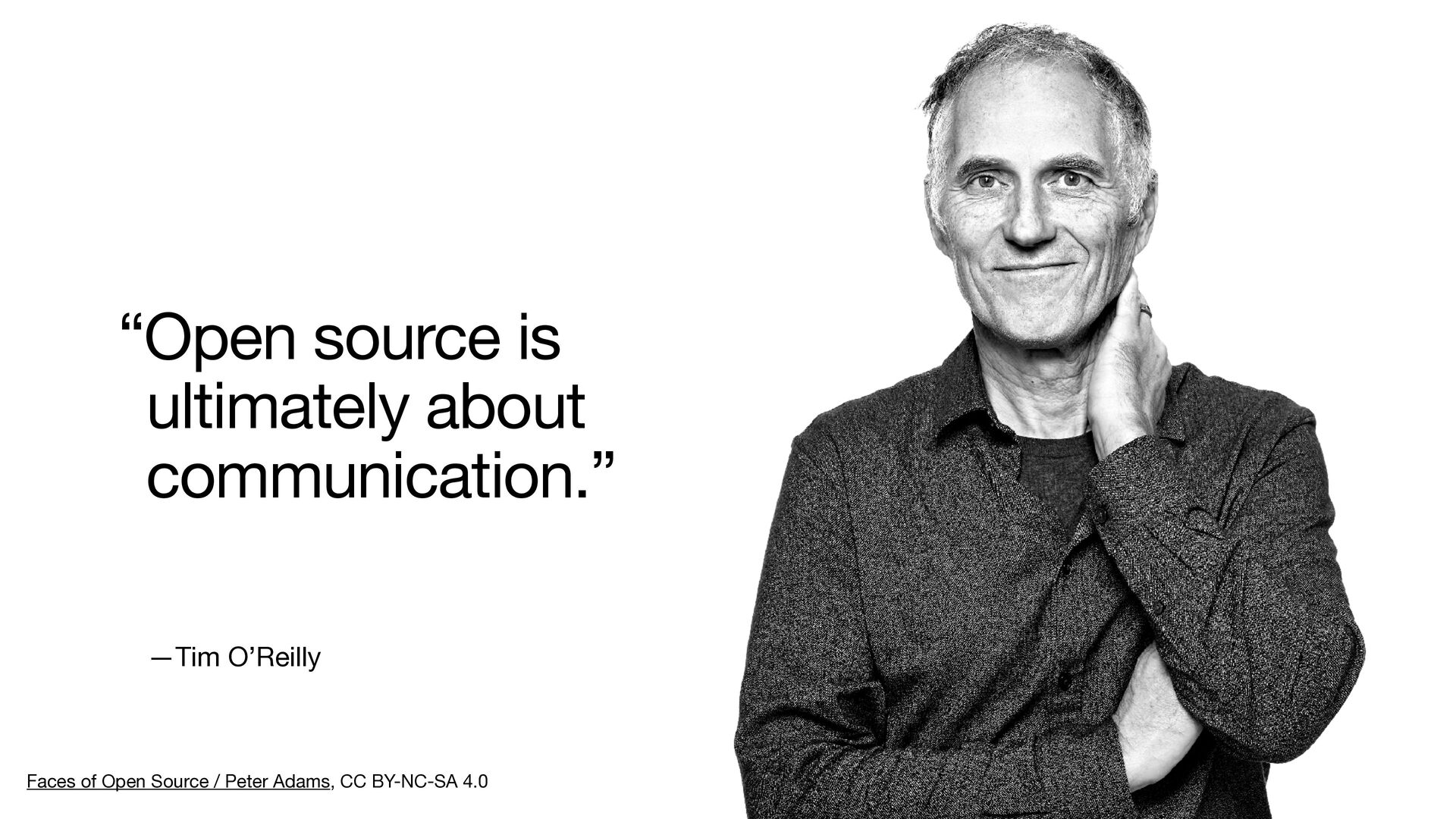
  12. Faces of Open Source / Peter Adams, CC BY-NC-SA 4.0

    “Open source is ultimately about communication.” —Tim O’Reilly
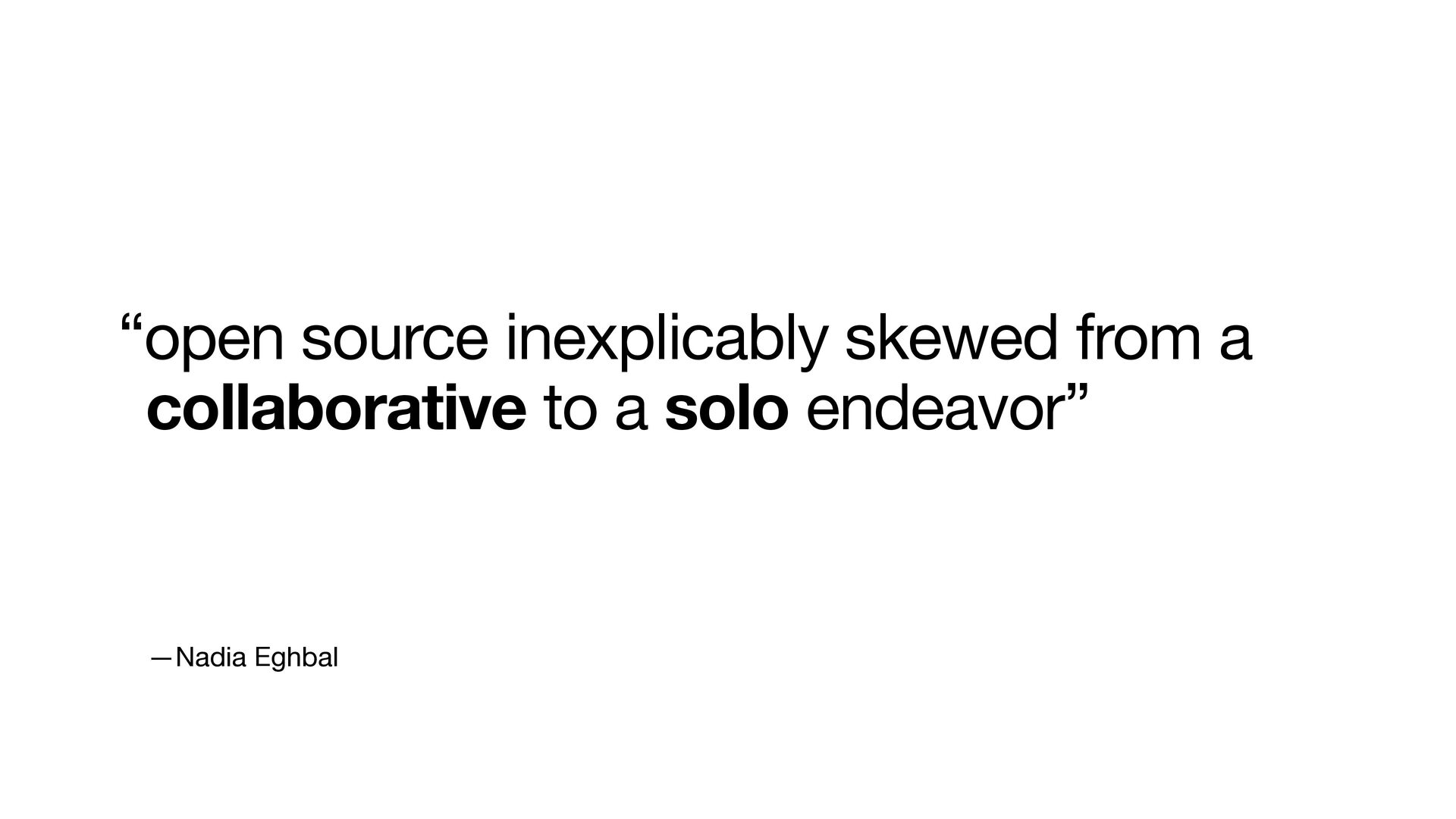
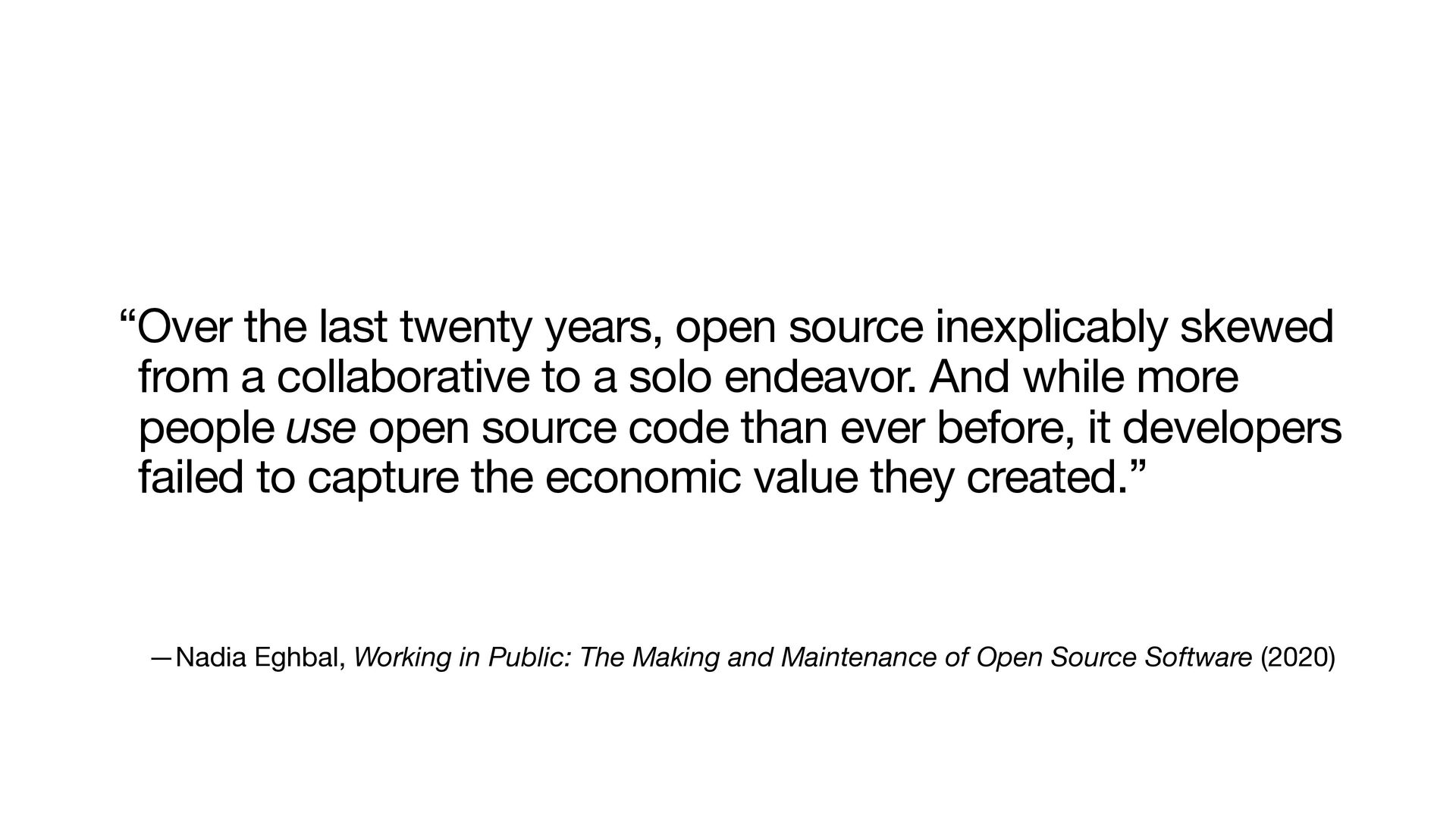
  13. —Nadia Eghbal, Working in Public: The Making and Maintenance of

    Open Source Software (2020) “Over the last twenty years, open source inexplicably skewed from a collaborative to a solo endeavor. And while more people use open source code than ever before, it developers failed to capture the economic value they created.”
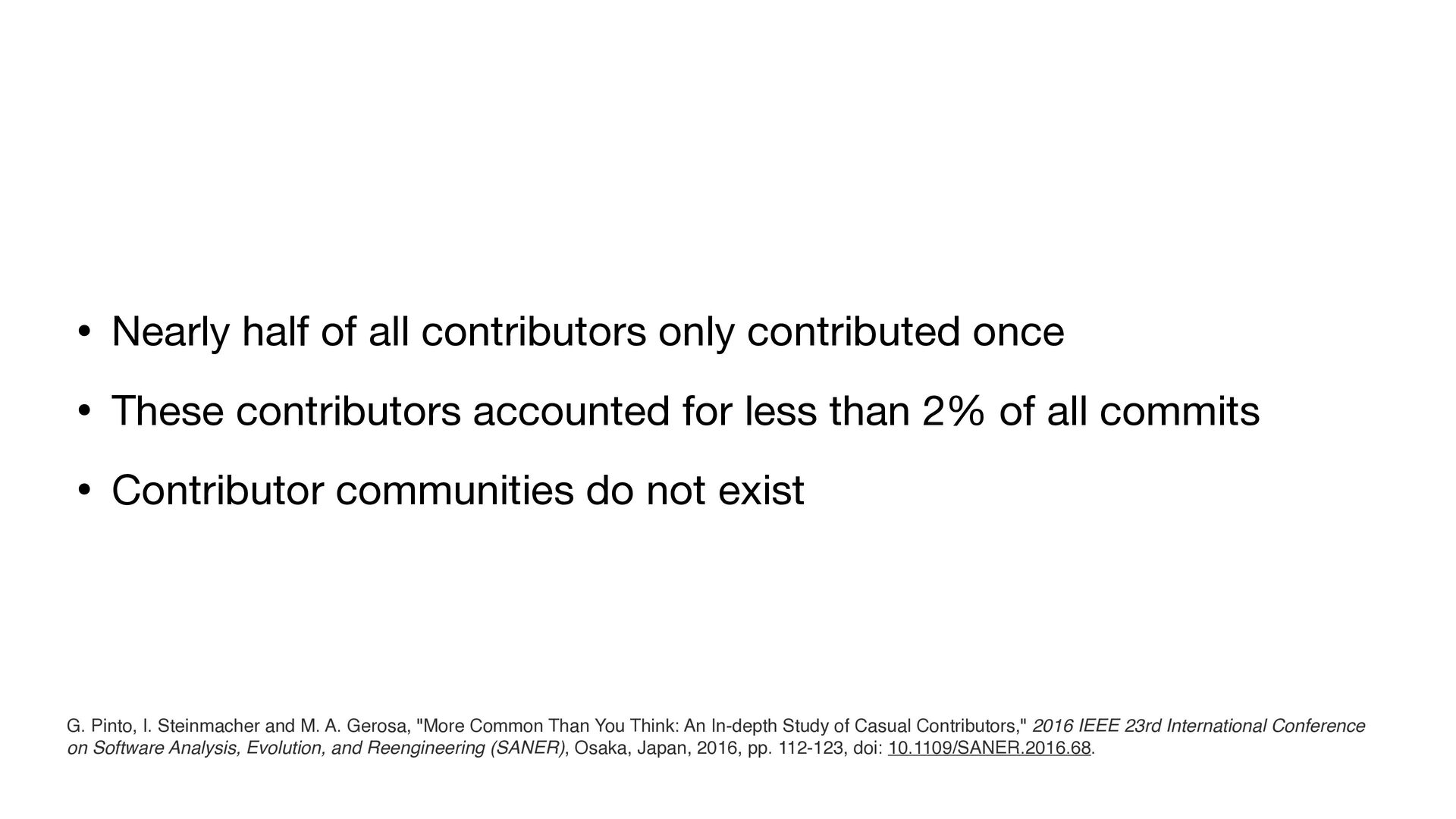
  14. • Nearly half of all contributors only contributed once •

    These contributors accounted for less than 2% of all commits • Contributor communities do not exist G. Pinto, I. Steinmacher and M. A. Gerosa, "More Common Than You Think: An In-depth Study of Casual Contributors," 2016 IEEE 23rd International Conference on Software Analysis, Evolution, and Reengineering (SANER), Osaka, Japan, 2016, pp. 112-123, doi: 10.1109/SANER.2016.68.
  15. “Good diagnostic of the problem. Would love to have spent

    more time discussing and chewing on possible solutions. ‘Be more community’ is good, but how do we get there?” —Larry Gar fi eld
  16. Thank you! Keep in touch     

     ben.ramsey.dev phpc.social/@ramsey github.com/ramsey speakerdeck.com/ramsey www.linkedin.com/in/benramsey [email protected]