Upgrade to Pro — share decks privately, control downloads, hide ads and more …

Fintech Summit 2026

Sponsored · SiteGround - Reliable hosting with speed, security, and support you can count on. →
Avatar for Ray Bugg Ray Bugg
October 15, 2026

Fintech Summit 2026

The Fintech Summit

The Fintech Summit is Scotland’s largest annual gathering of financial technology leaders, and has established itself as the must-attend event for stakeholders in the sector.

The conference will explore technological innovation across the industry, from developments in leading FS institutions, to the disruptive innovators within the challenger and start-up community that are reshaping the Financial Services market. The programme will consider the key shifts in regulation, investment, and technology, and discuss how they will impact the future evolution of the sector.

The Summit is the official flagship event of the Scotland Fintech Festival, and is free to attend for delegates working for Financial Services and FinTech companies.

Avatar for Ray Bugg

Ray Bugg

October 15, 2026

More Decks by Ray Bugg

Other Decks in Technology

Transcript

  1. From AI Assistants to Agentic Systems What work should we

    trust AI to do? Abhay Pradhan Group Head of AI Engineering, LSEG
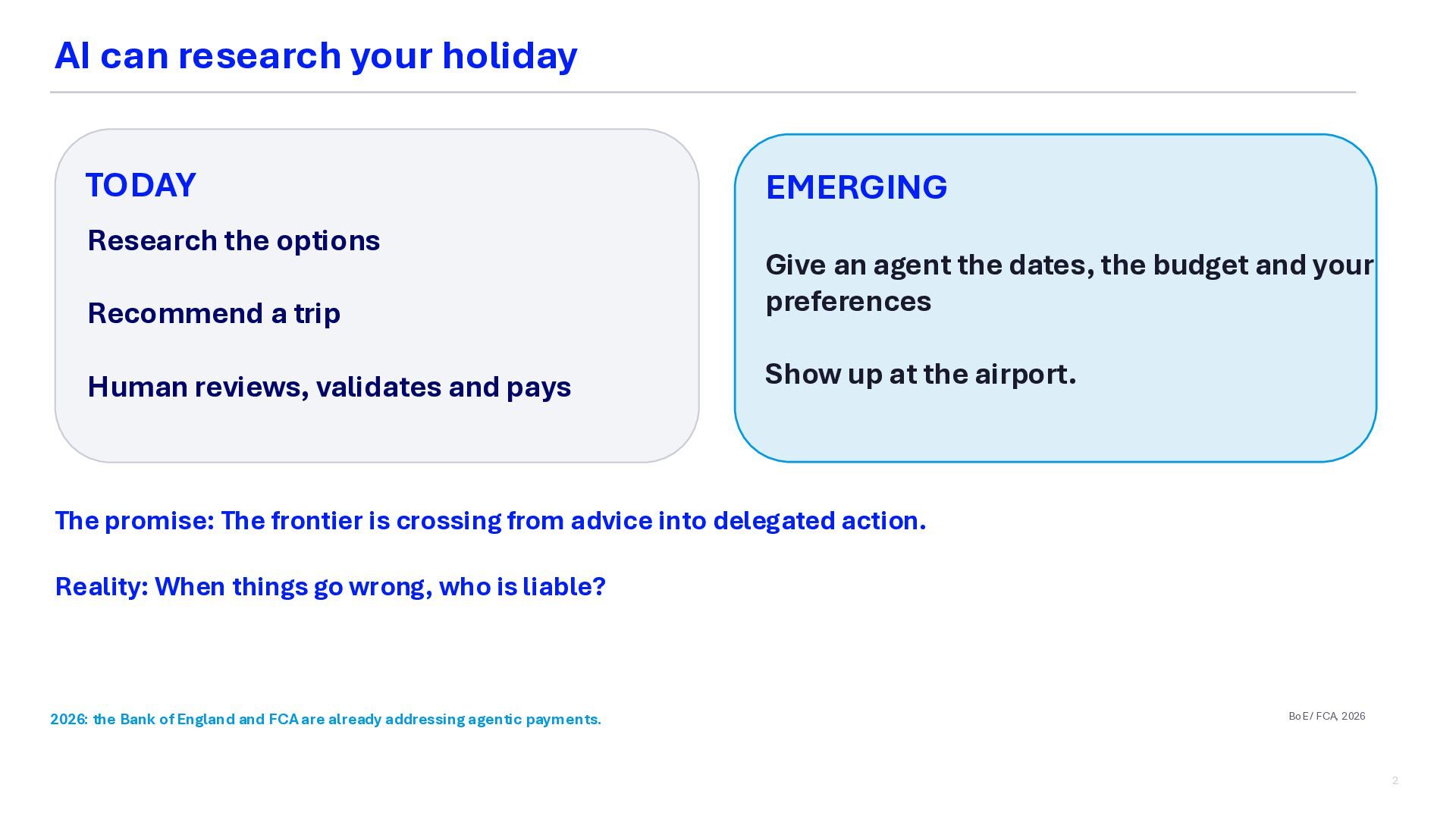
  2. AI can research your holiday TODAY Research the options EMERGING

    Recommend a trip Give an agent the dates, the budget and your preferences Human reviews, validates and pays Show up at the airport. The promise: The frontier is crossing from advice into delegated action. Reality: When things go wrong, who is liable? 2026: the Bank of England and FCA are already addressing agentic payments. BoE / FCA, 2026 2
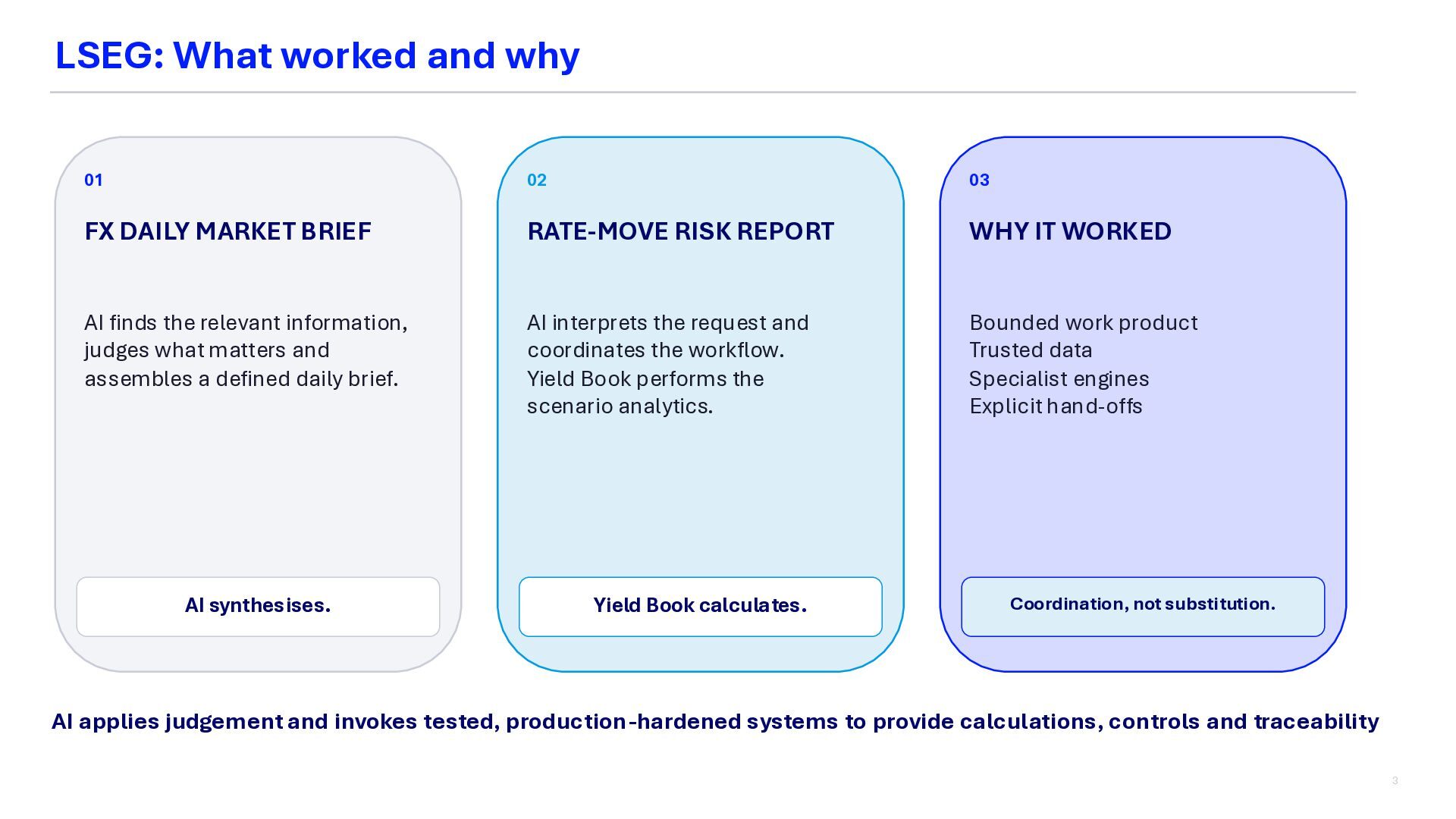
  3. LSEG: What worked and why 01 02 03 FX DAILY

    MARKET BRIEF RATE-MOVE RISK REPORT WHY IT WORKED AI finds the relevant information, judges what matters and assembles a defined daily brief. AI interprets the request and coordinates the workflow. Yield Book performs the scenario analytics. Bounded work product Trusted data Specialist engines Explicit hand-offs AI synthesises. Yield Book calculates. Coordination, not substitution. AI applies judgement and invokes tested, production-hardened systems to provide calculations, controls and traceability 3
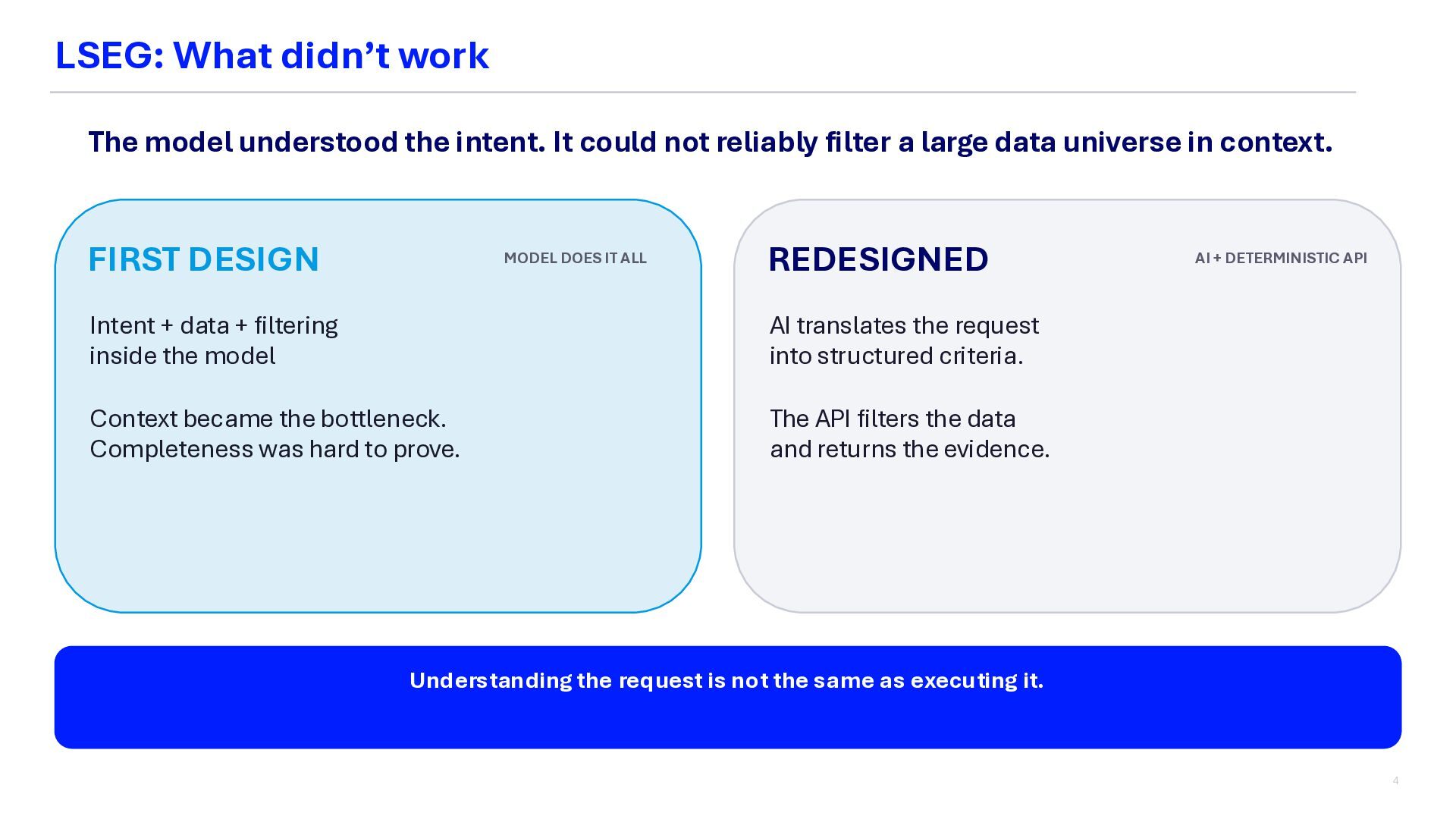
  4. LSEG: What didn’t work The model understood the intent. It

    could not reliably filter a large data universe in context. FIRST DESIGN MODEL DOES IT ALL REDESIGNED Intent + data + filtering inside the model AI translates the request into structured criteria. Context became the bottleneck. Completeness was hard to prove. The API filters the data and returns the evidence. AI + DETERMINISTIC API Understanding the request is not the same as executing it. 4
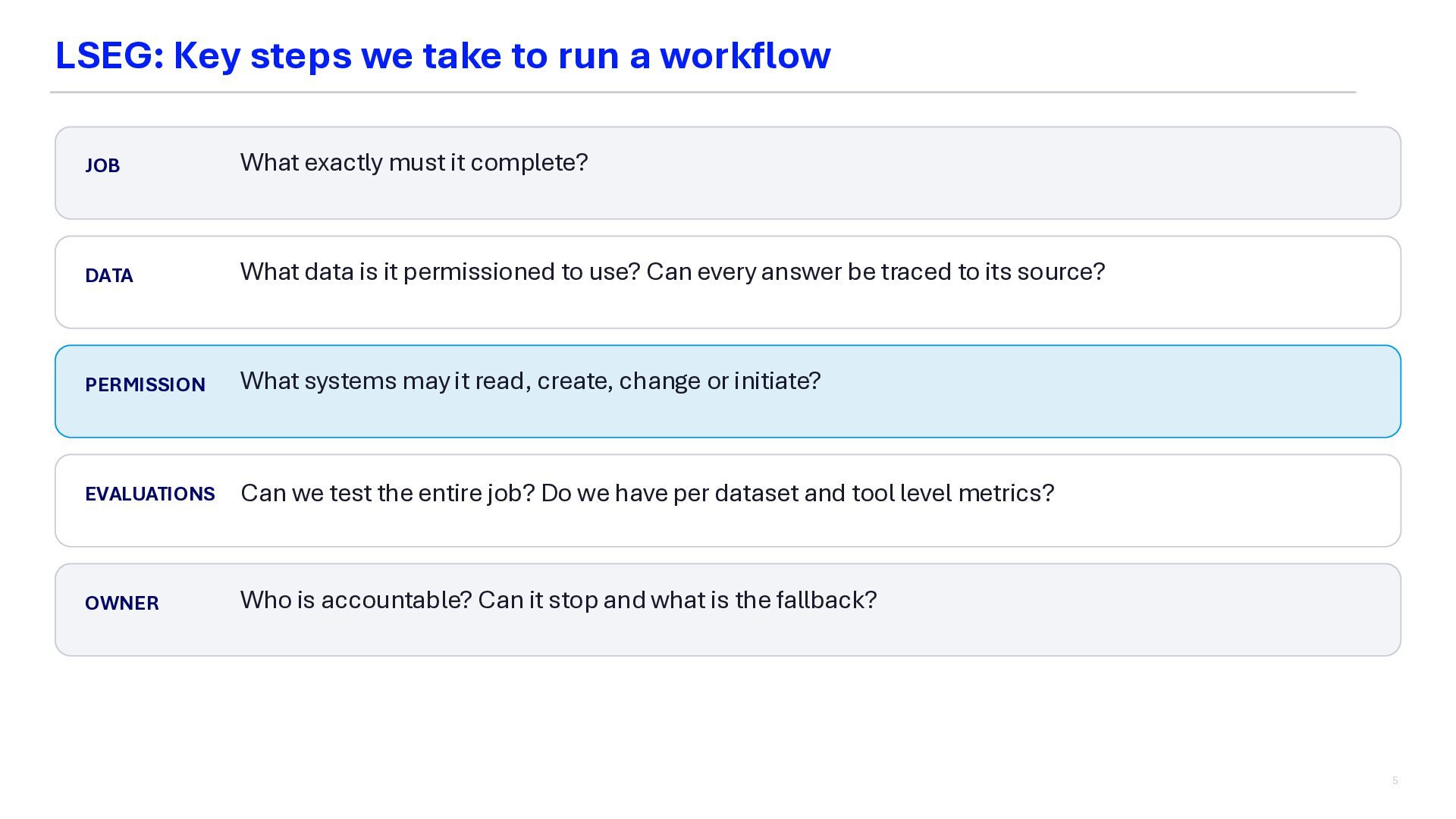
  5. LSEG: Key steps we take to run a workflow JOB

    What exactly must it complete? DATA What data is it permissioned to use? Can every answer be traced to its source? PERMISSION What systems may it read, create, change or initiate? EVALUATIONS Can we test the entire job? Do we have per dataset and tool level metrics? OWNER Who is accountable? Can it stop and what is the fallback? 5
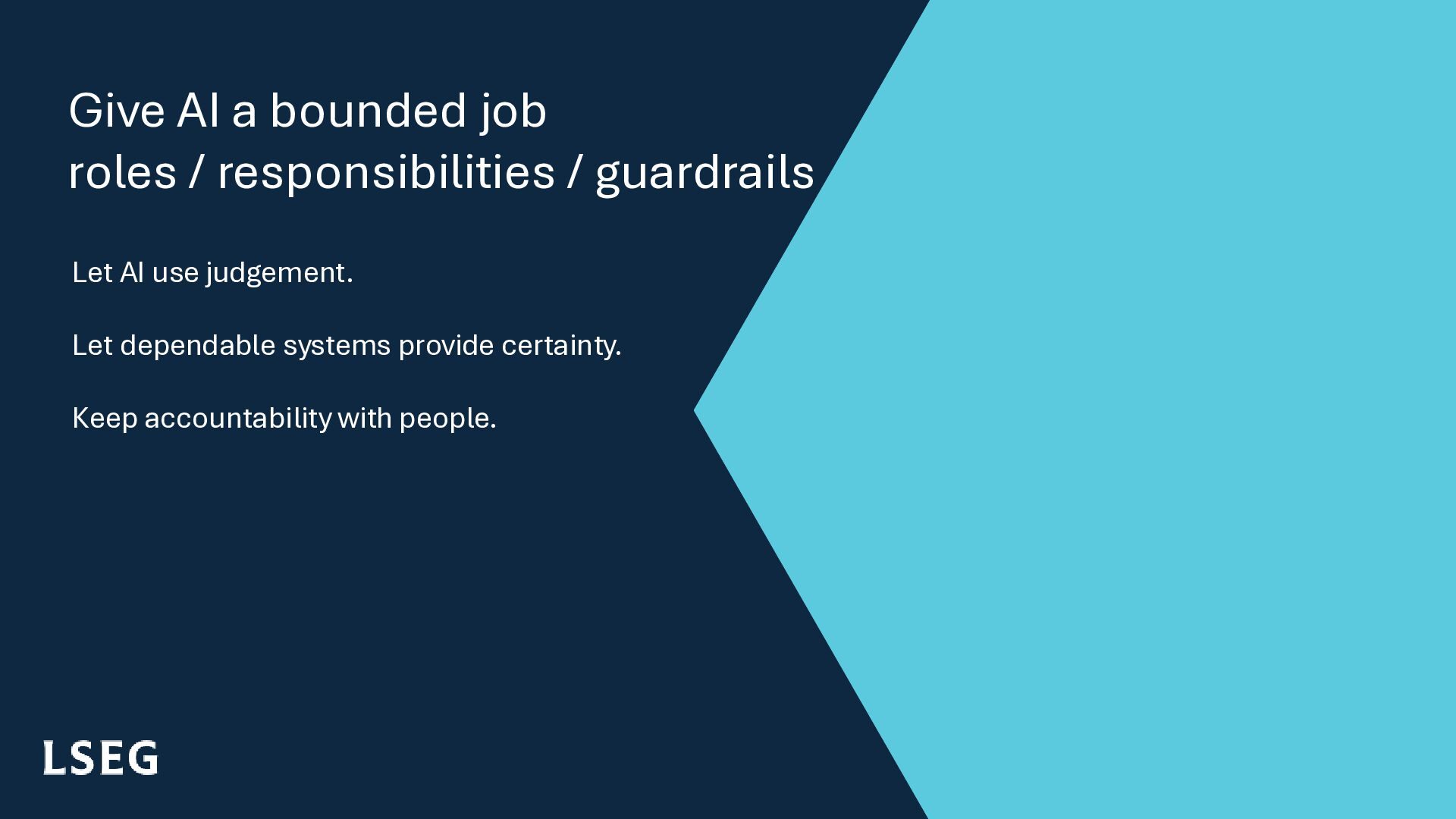
  6. Give AI a bounded job roles / responsibilities / guardrails

    Let AI use judgement. Let dependable systems provide certainty. Keep accountability with people.
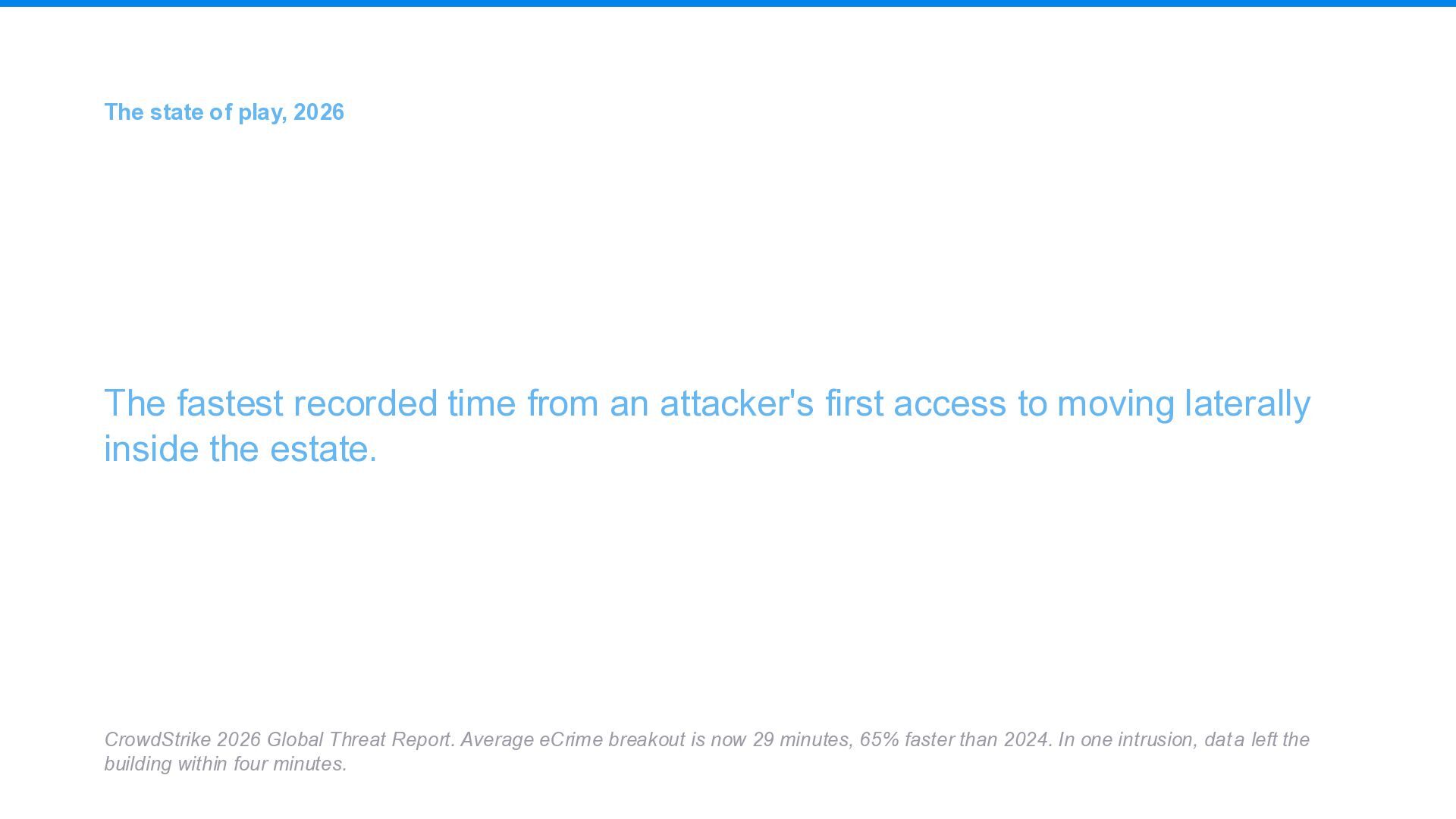
  7. The state of play, 2026 27 seconds. The fastest recorded

    time from an attacker's first access to moving laterally inside the estate. CrowdStrike 2026 Global Threat Report. Average eCrime breakout is now 29 minutes, 65% faster than 2024. In one intrusion, dat a left the building within four minutes.
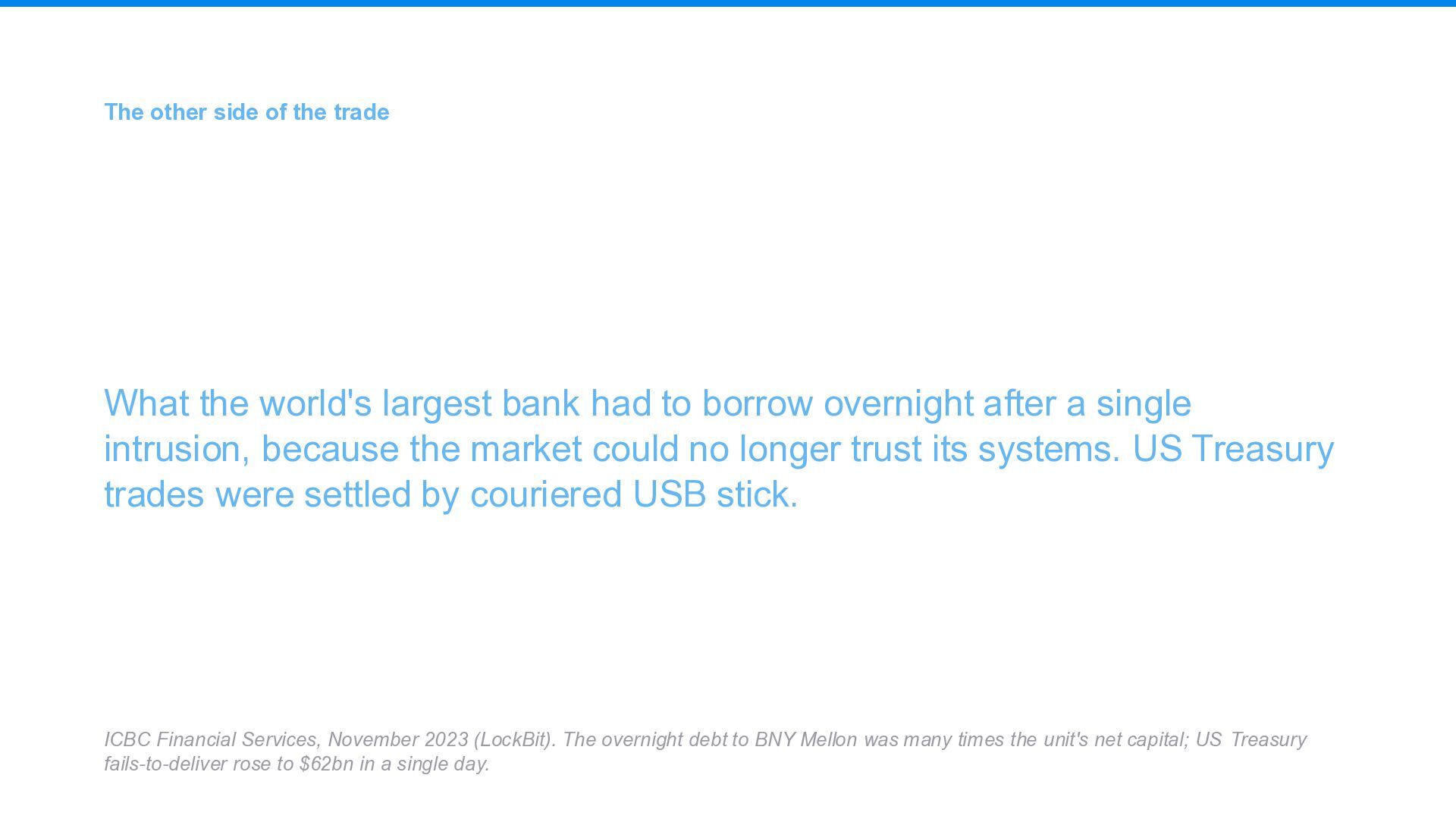
  8. The other side of the trade $9 billion. What the

    world's largest bank had to borrow overnight after a single intrusion, because the market could no longer trust its systems. US Treasury trades were settled by couriered USB stick. ICBC Financial Services, November 2023 (LockBit). The overnight debt to BNY Mellon was many times the unit's net capital; US Treasury fails-to-deliver rose to $62bn in a single day.
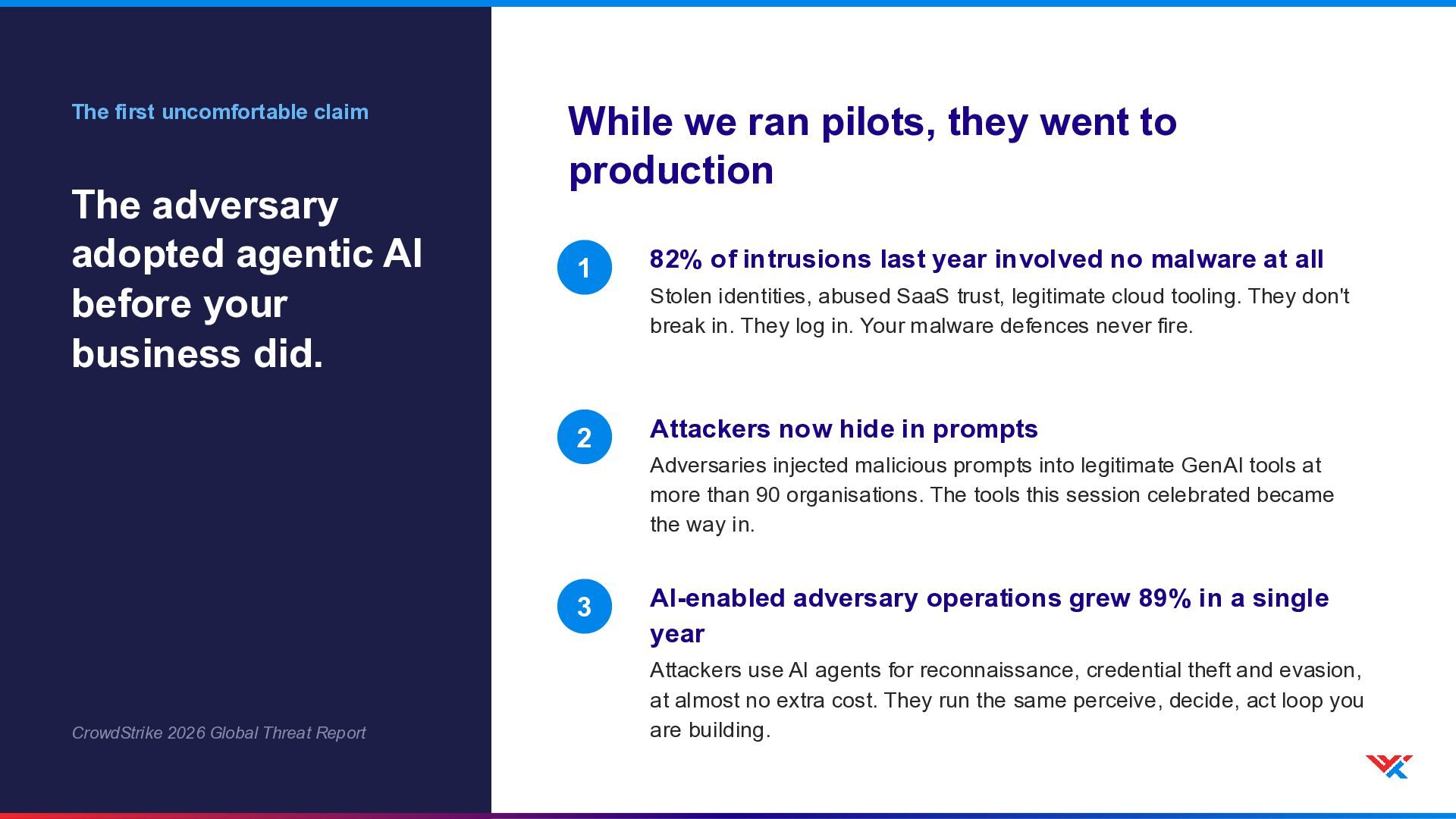
  9. The first uncomfortable claim The adversary adopted agentic AI before

    your business did. While we ran pilots, they went to production 1 82% of intrusions last year involved no malware at all Stolen identities, abused SaaS trust, legitimate cloud tooling. They don't break in. They log in. Your malware defences never fire. 2 Attackers now hide in prompts Adversaries injected malicious prompts into legitimate GenAI tools at more than 90 organisations. The tools this session celebrated became the way in. 3 CrowdStrike 2026 Global Threat Report AI-enabled adversary operations grew 89% in a single year Attackers use AI agents for reconnaissance, credential theft and evasion, at almost no extra cost. They run the same perceive, decide, act loop you are building.
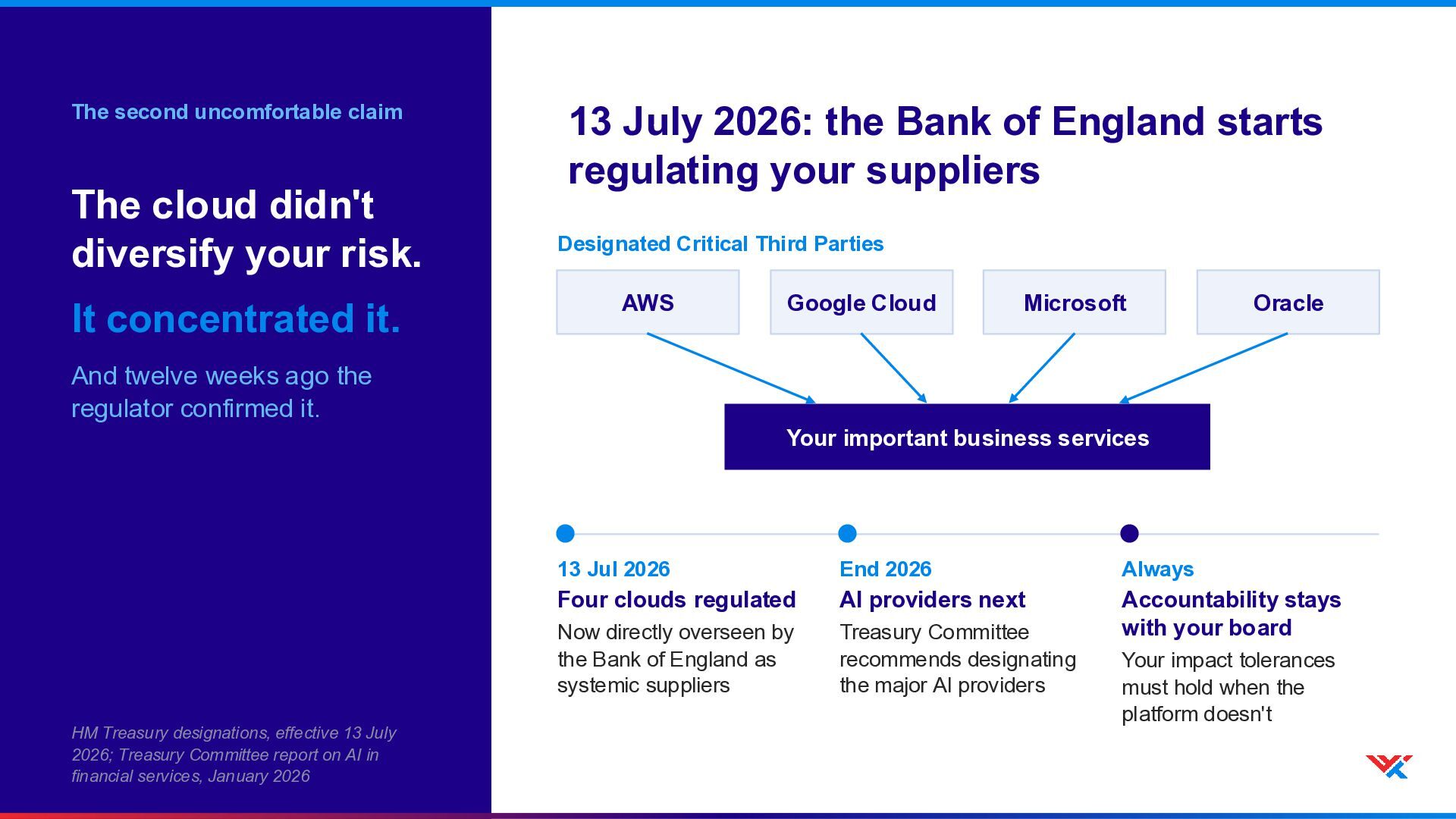
  10. The second uncomfortable claim The cloud didn't diversify your risk.

    It concentrated it. 13 July 2026: the Bank of England starts regulating your suppliers Designated Critical Third Parties AWS Google Cloud Microsoft Oracle And twelve weeks ago the regulator confirmed it. Your important business services HM Treasury designations, effective 13 July 2026; Treasury Committee report on AI in financial services, January 2026 13 Jul 2026 End 2026 Always Four clouds regulated Now directly overseen by the Bank of England as systemic suppliers AI providers next Treasury Committee recommends designating the major AI providers Accountability stays with your board Your impact tolerances must hold when the platform doesn't
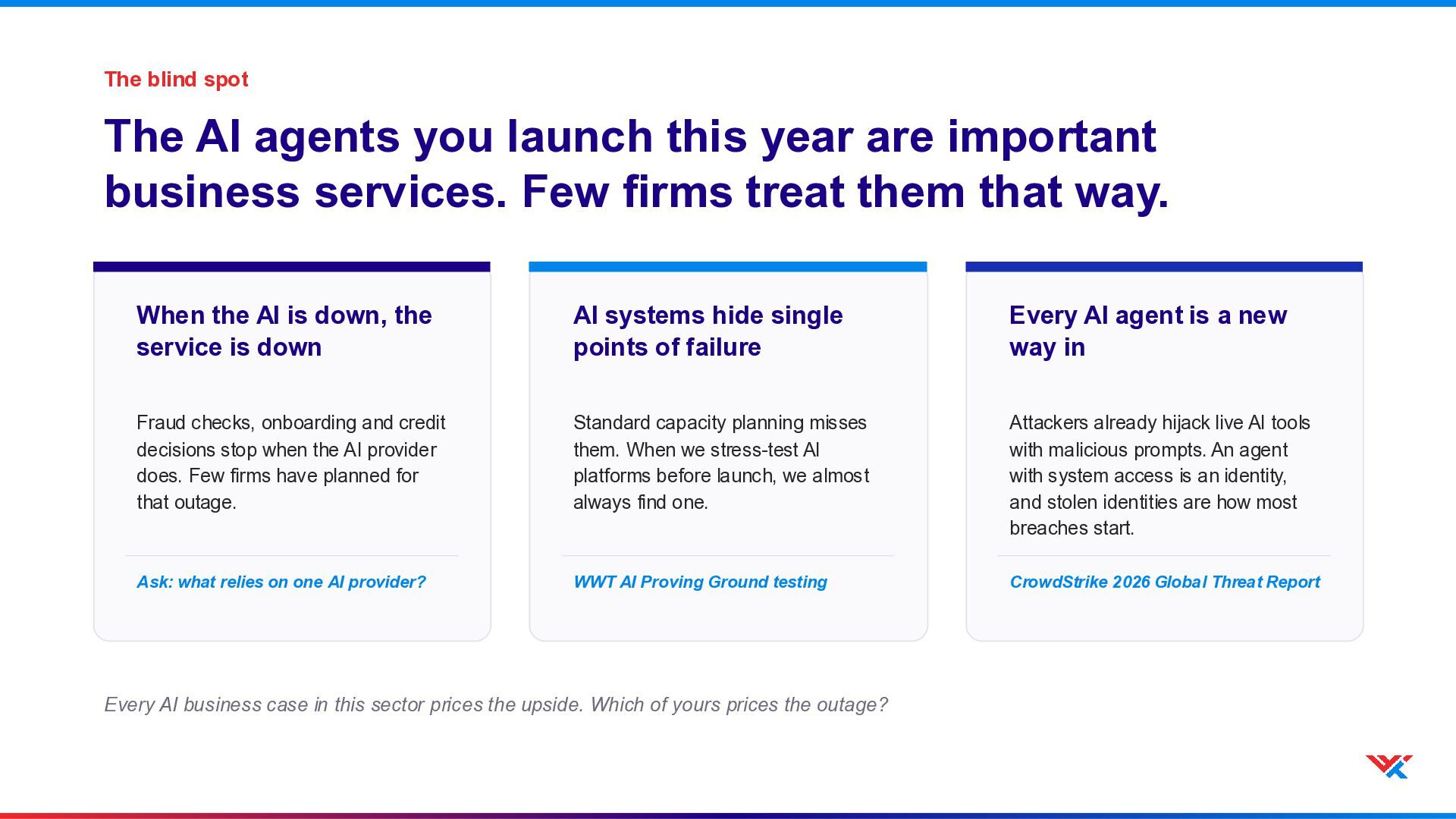
  11. The blind spot The AI agents you launch this year

    are important business services. Few firms treat them that way. When the AI is down, the service is down AI systems hide single points of failure Every AI agent is a new way in Fraud checks, onboarding and credit decisions stop when the AI provider does. Few firms have planned for that outage. Standard capacity planning misses them. When we stress-test AI platforms before launch, we almost always find one. Attackers already hijack live AI tools with malicious prompts. An agent with system access is an identity, and stolen identities are how most breaches start. Ask: what relies on one AI provider? WWT AI Proving Ground testing CrowdStrike 2026 Global Threat Report Every AI business case in this sector prices the upside. Which of yours prices the outage?
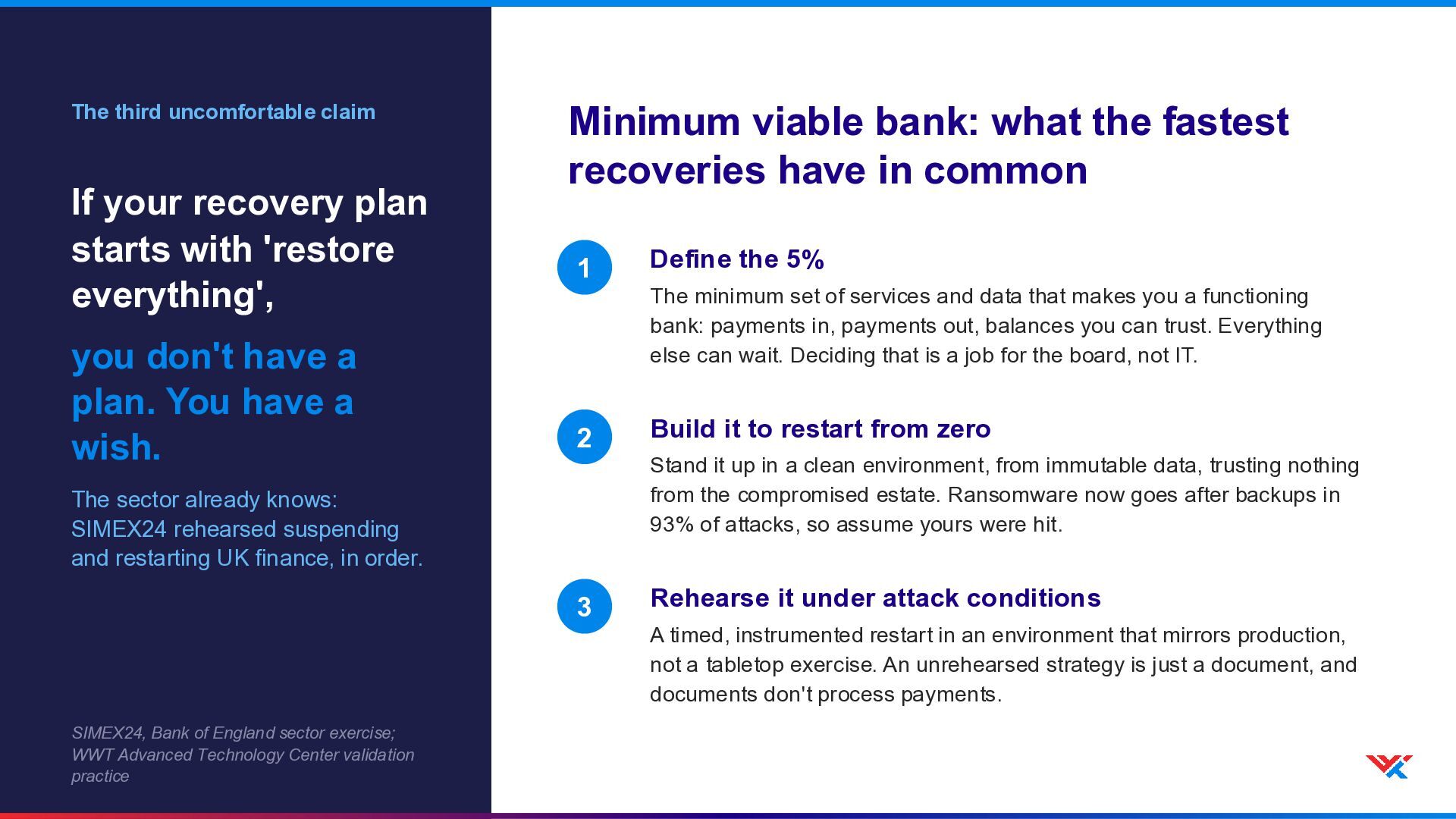
  12. The third uncomfortable claim If your recovery plan starts with

    'restore everything', you don't have a plan. You have a wish. Minimum viable bank: what the fastest recoveries have in common 1 Define the 5% The minimum set of services and data that makes you a functioning bank: payments in, payments out, balances you can trust. Everything else can wait. Deciding that is a job for the board, not IT. 2 Build it to restart from zero Stand it up in a clean environment, from immutable data, trusting nothing from the compromised estate. Ransomware now goes after backups in 93% of attacks, so assume yours were hit. The sector already knows: SIMEX24 rehearsed suspending and restarting UK finance, in order. 3 Rehearse it under attack conditions A timed, instrumented restart in an environment that mirrors production, not a tabletop exercise. An unrehearsed strategy is just a document, and documents don't process payments. SIMEX24, Bank of England sector exercise; WWT Advanced Technology Center validation practice
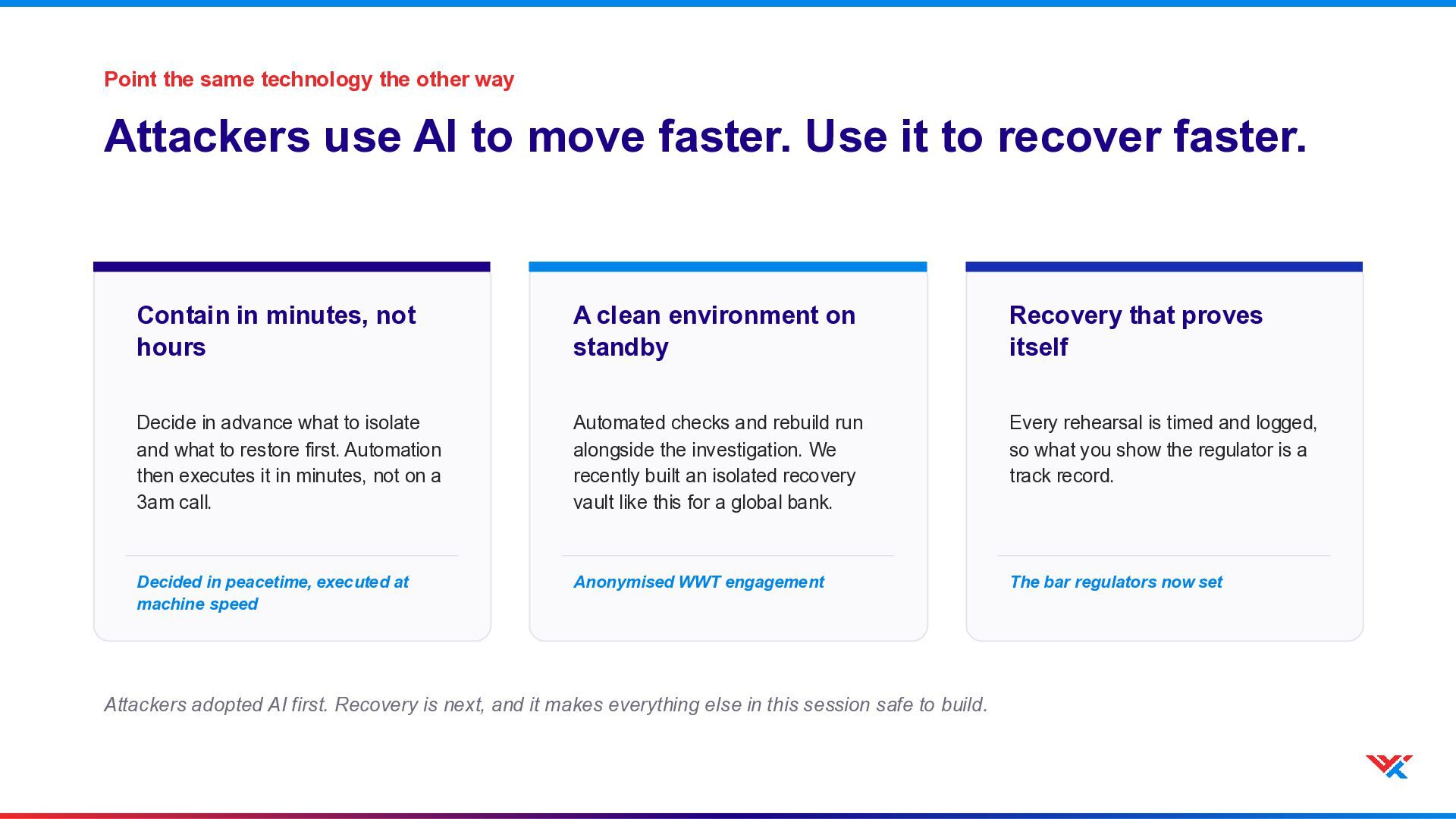
  13. Point the same technology the other way Attackers use AI

    to move faster. Use it to recover faster. Contain in minutes, not hours A clean environment on standby Recovery that proves itself Decide in advance what to isolate and what to restore first. Automation then executes it in minutes, not on a 3am call. Automated checks and rebuild run alongside the investigation. We recently built an isolated recovery vault like this for a global bank. Every rehearsal is timed and logged, so what you show the regulator is a track record. Decided in peacetime, executed at machine speed Anonymised WWT engagement The bar regulators now set Attackers adopted AI first. Recovery is next, and it makes everything else in this session safe to build.
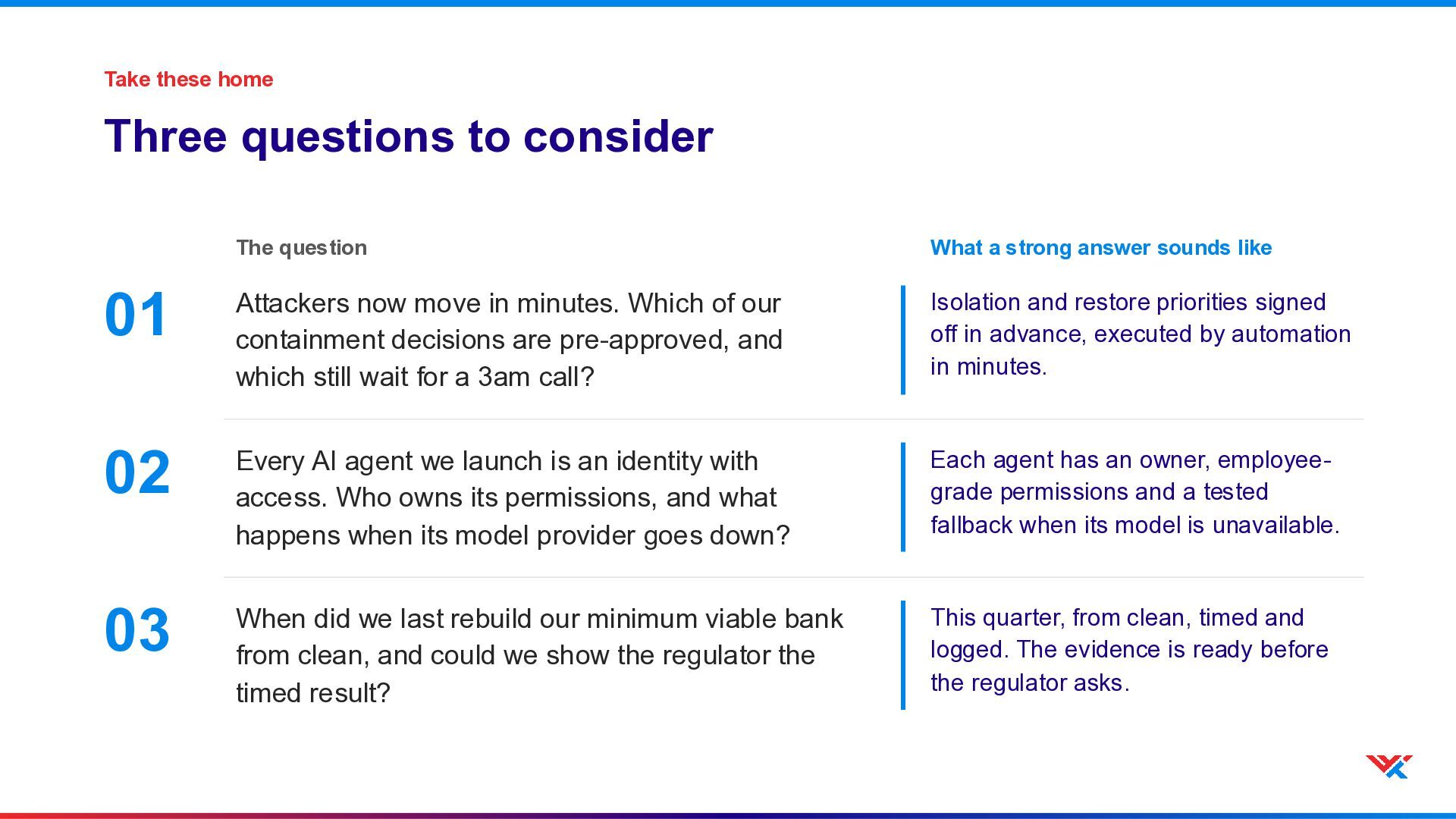
  14. Take these home Three questions to consider The question What

    a strong answer sounds like 01 Attackers now move in minutes. Which of our containment decisions are pre-approved, and which still wait for a 3am call? Isolation and restore priorities signed off in advance, executed by automation in minutes. 02 Every AI agent we launch is an identity with access. Who owns its permissions, and what happens when its model provider goes down? Each agent has an owner, employeegrade permissions and a tested fallback when its model is unavailable. 03 When did we last rebuild our minimum viable bank from clean, and could we show the regulator the timed result? This quarter, from clean, timed and logged. The evidence is ready before the regulator asks.
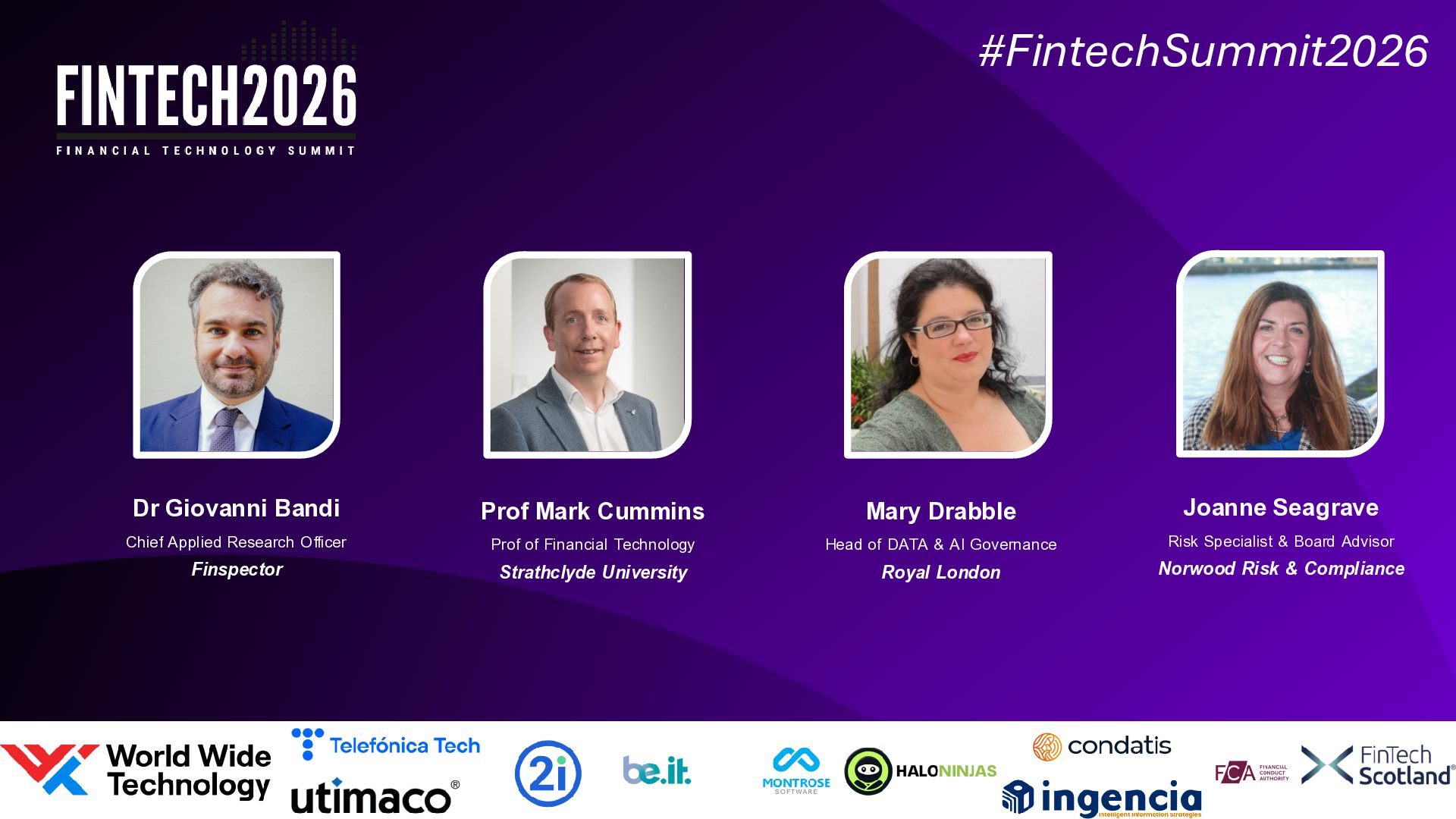
  15. #FintechSummit2026 Breakout C The Governance Gap: Why FS AI Is

    Scaling Faster Than Oversight: Panel Discussion
  16. #FintechSummit2026 Dr Giovanni Bandi Chief Applied Research Officer Finspector Prof

    Mark Cummins Mary Drabble Prof of Financial Technology Head of DATA & AI Governance Strathclyde University Royal London Joanne Seagrave Risk Specialist & Board Advisor Norwood Risk & Compliance
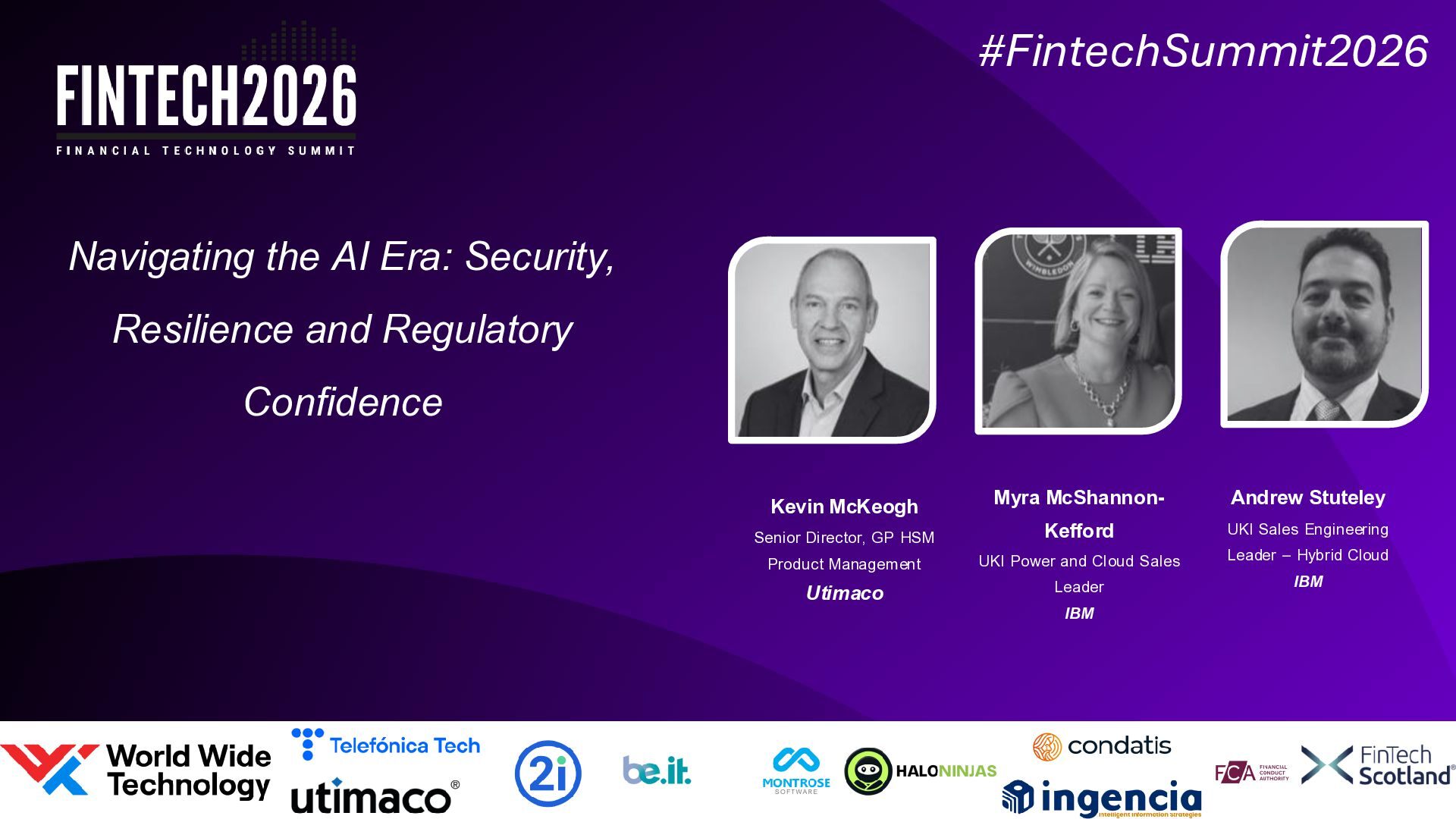
  17. #FintechSummit2026 Navigating the AI Era: Security, Resilience and Regulatory Confidence
    Kevin McKeogh Senior Director, GP HSM Product Management Utimaco Myra McShannonKefford UKI Power and Cloud Sales Leader IBM Andrew Stuteley UKI Sales Engineering Leader – Hybrid Cloud IBM
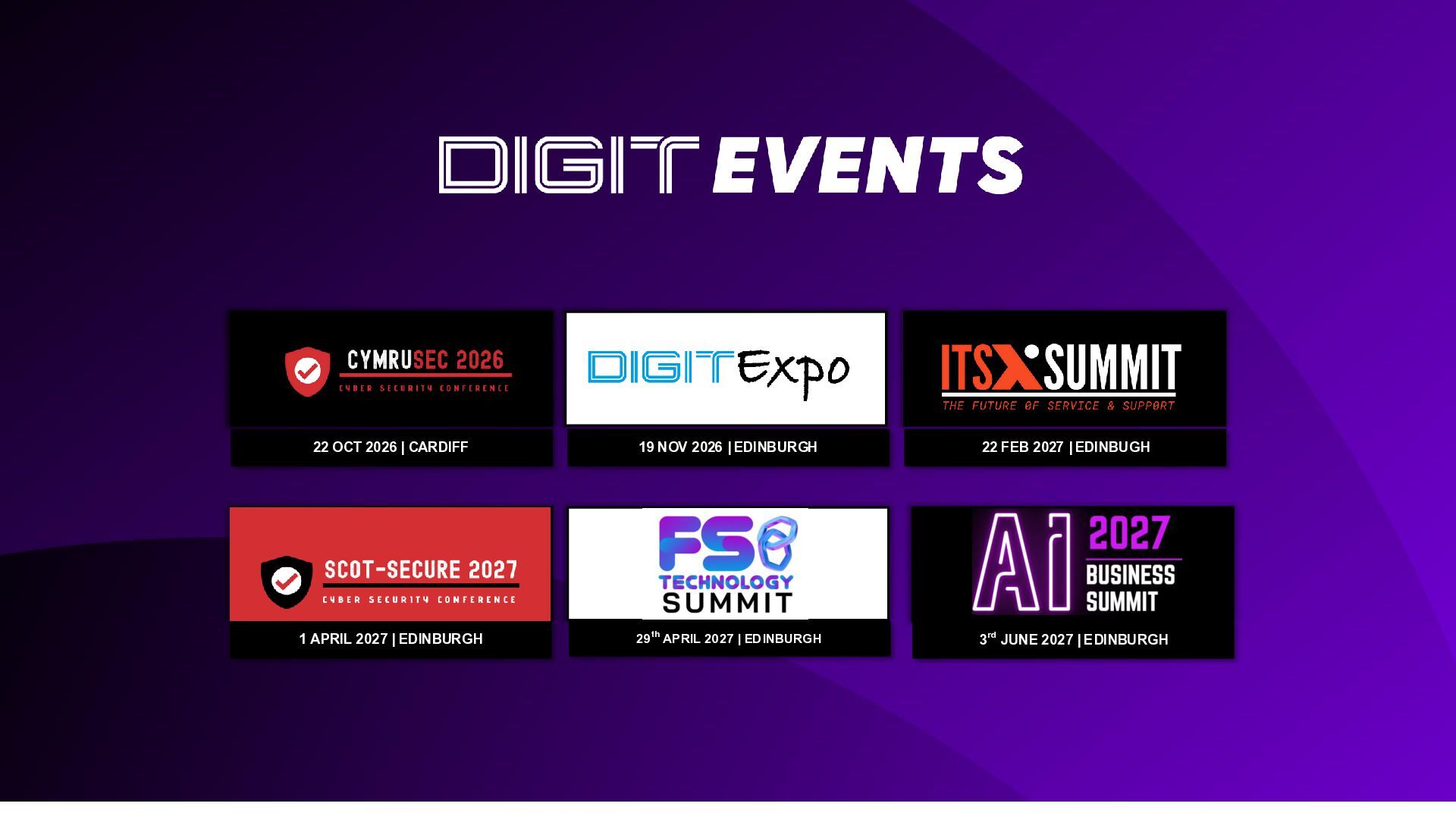
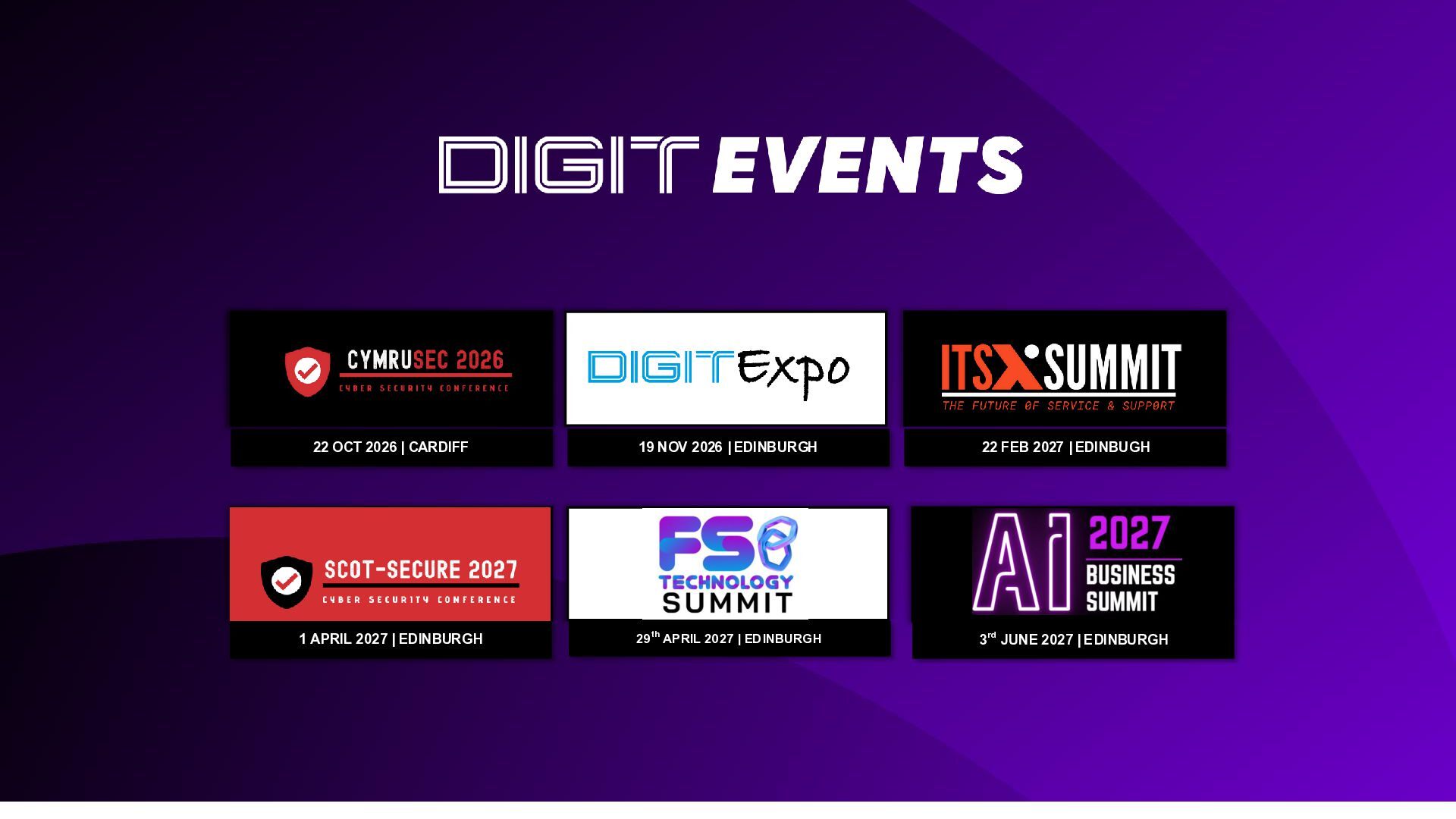
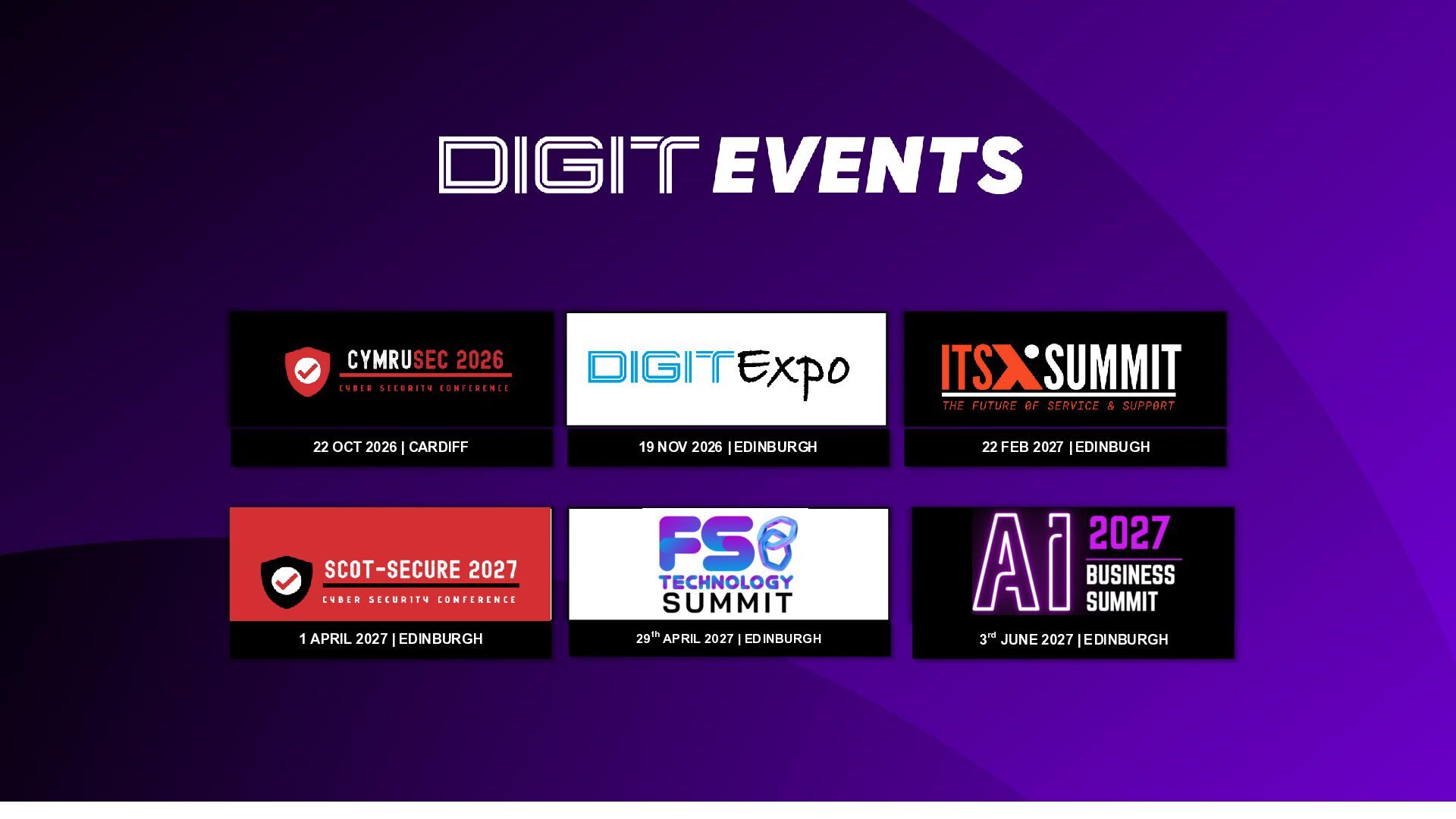
  18. 22 OCT 2026 | CARDIFF 19 NOV 2026 | EDINBURGH

    22 FEB 2027 | EDINBUGH 1 APRIL 2027 | EDINBURGH 29th APRIL 2027 | EDINBURGH 3rd JUNE 2027 | EDINBURGH
  19. SC OTL AND FI NTE CH FES TIV AL –

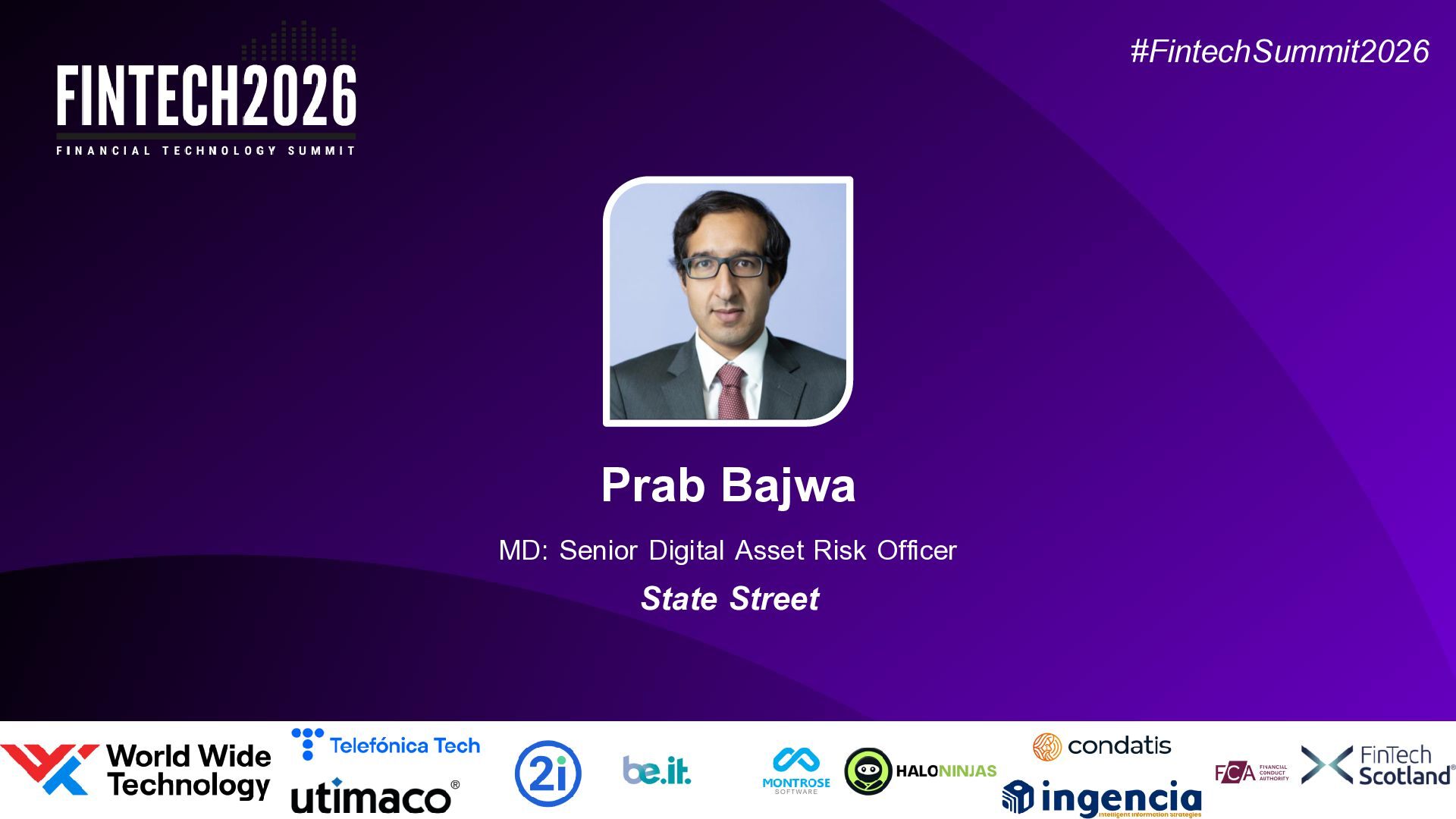
    7 OCT OBE R 2 026 Programmable Finance The Future of Financial Services. Prab Bajwa, CFA Senior Digital Asset Risk Officer, State Street Personal views 1 / 10
  20. 0 1 · P A ST T HE FI R

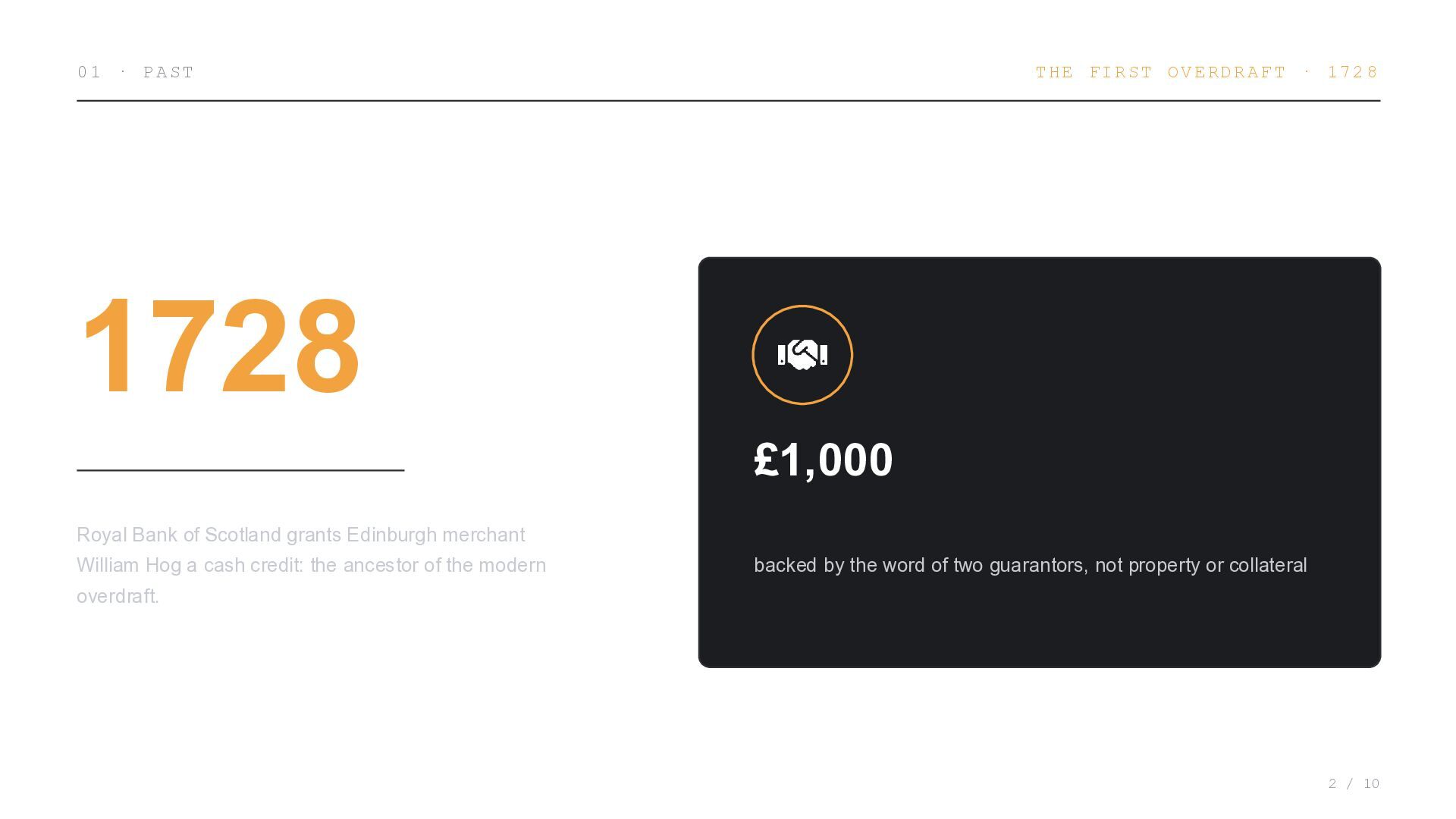
    ST OV E RD R AF T · 17 2 8 A timing problem, solved by trust 1728 EDINBURGH, SCOTLAND £1,000 Royal Bank of Scotland grants Edinburgh merchant William Hog a cash credit: the ancestor of the modern backed by the word of two guarantors, not property or collateral overdraft. 2 / 10
  21. 0 1 · P A ST A T R EN

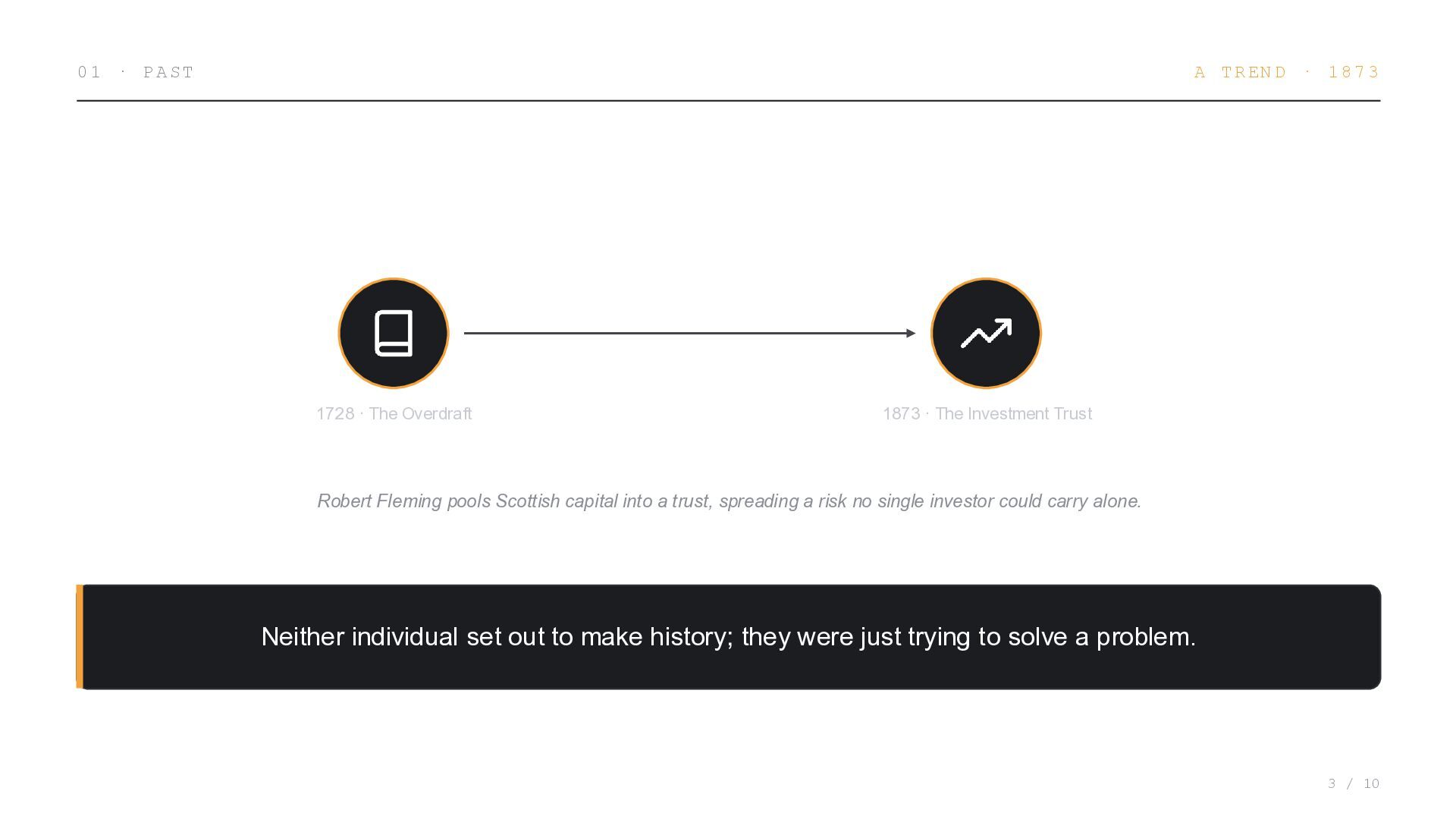
    D · 18 7 3 Not a one-off: Scotland kept innovating 1728 · The Overdraft 1873 · The Investment Trust Robert Fleming pools Scottish capital into a trust, spreading a risk no single investor could carry alone. Neither individual set out to make history; they were just trying to solve a problem. 3 / 10
  22. 0 2 · P R ES E NT T HE

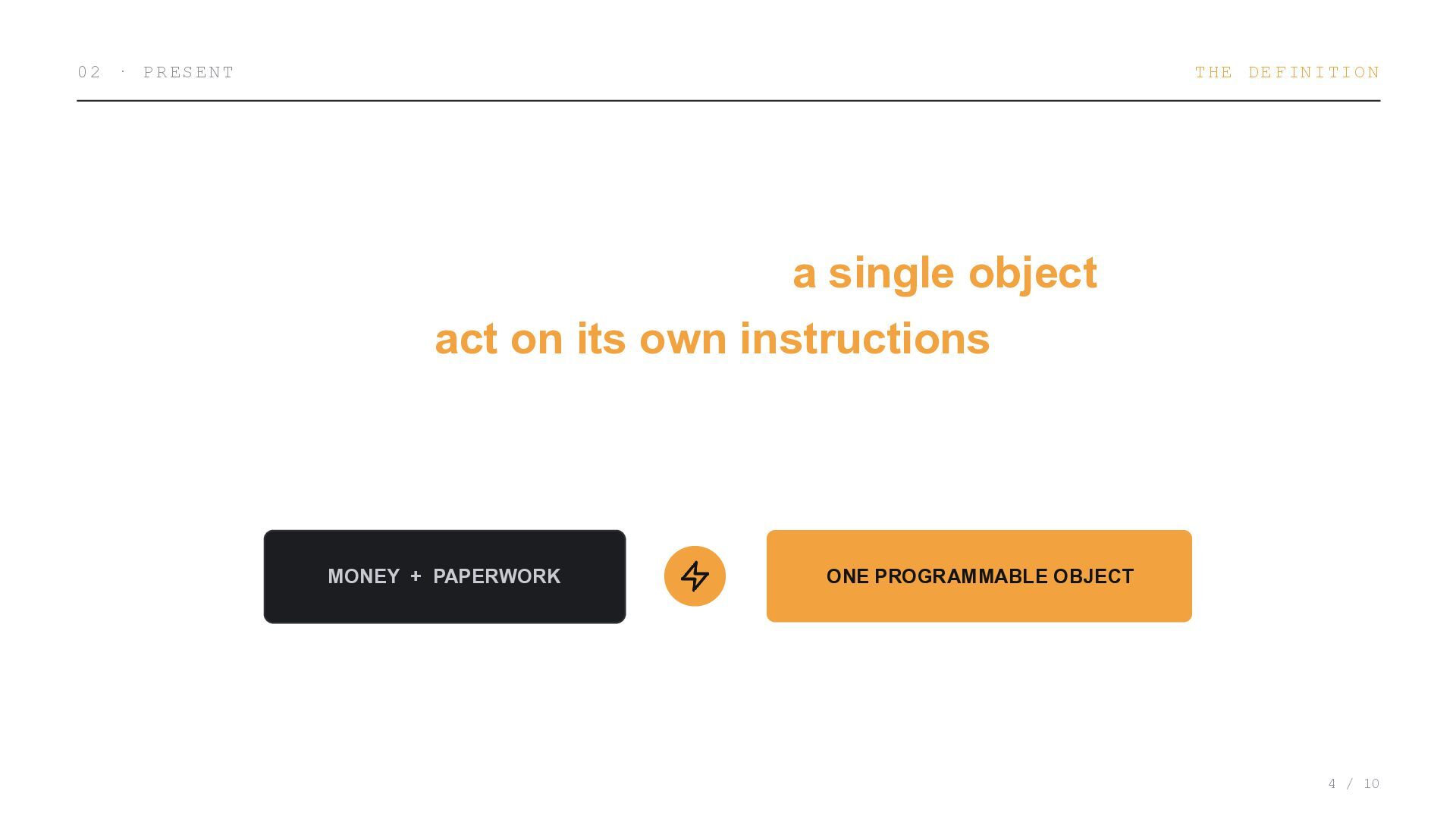
    DE F IN I TI O N Money and paperwork become a single object, and that object can act on its own instructions the moment agreed conditions are met. MONEY + PAPERWORK ONE PROGRAMMABLE OBJECT 4 / 10
  23. 0 2 · P R ES E NT P RO

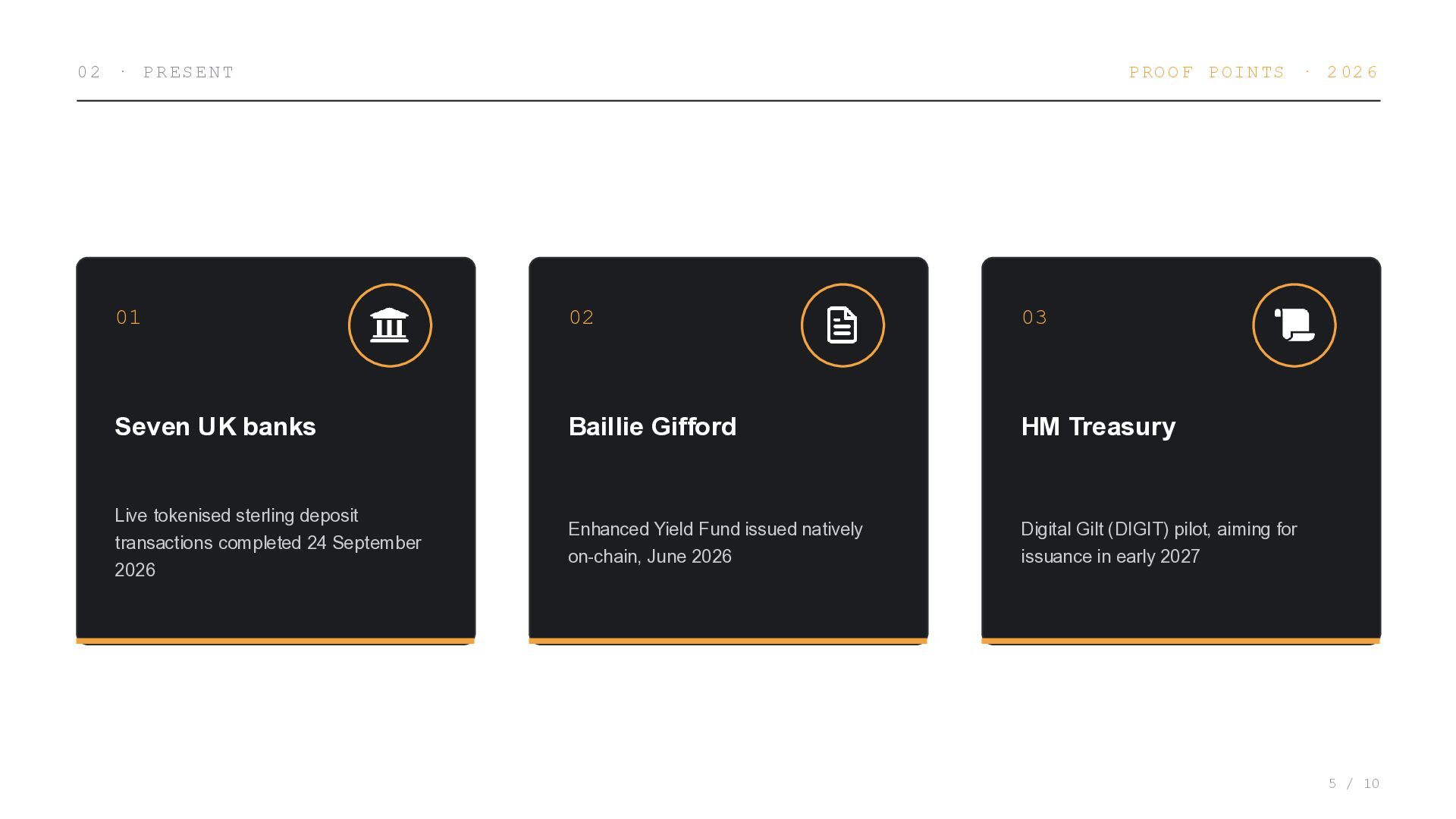
    O F P OI N TS · 2 02 6 2026: three institutions, one idea 01 02 03 Seven UK banks Baillie Gifford HM Treasury Enhanced Yield Fund issued natively on-chain, June 2026 Digital Gilt (DIGIT) pilot, aiming for issuance in early 2027 Live tokenised sterling deposit transactions completed 24 September 2026 5 / 10
  24. 0 3 · F U TU R E S CE

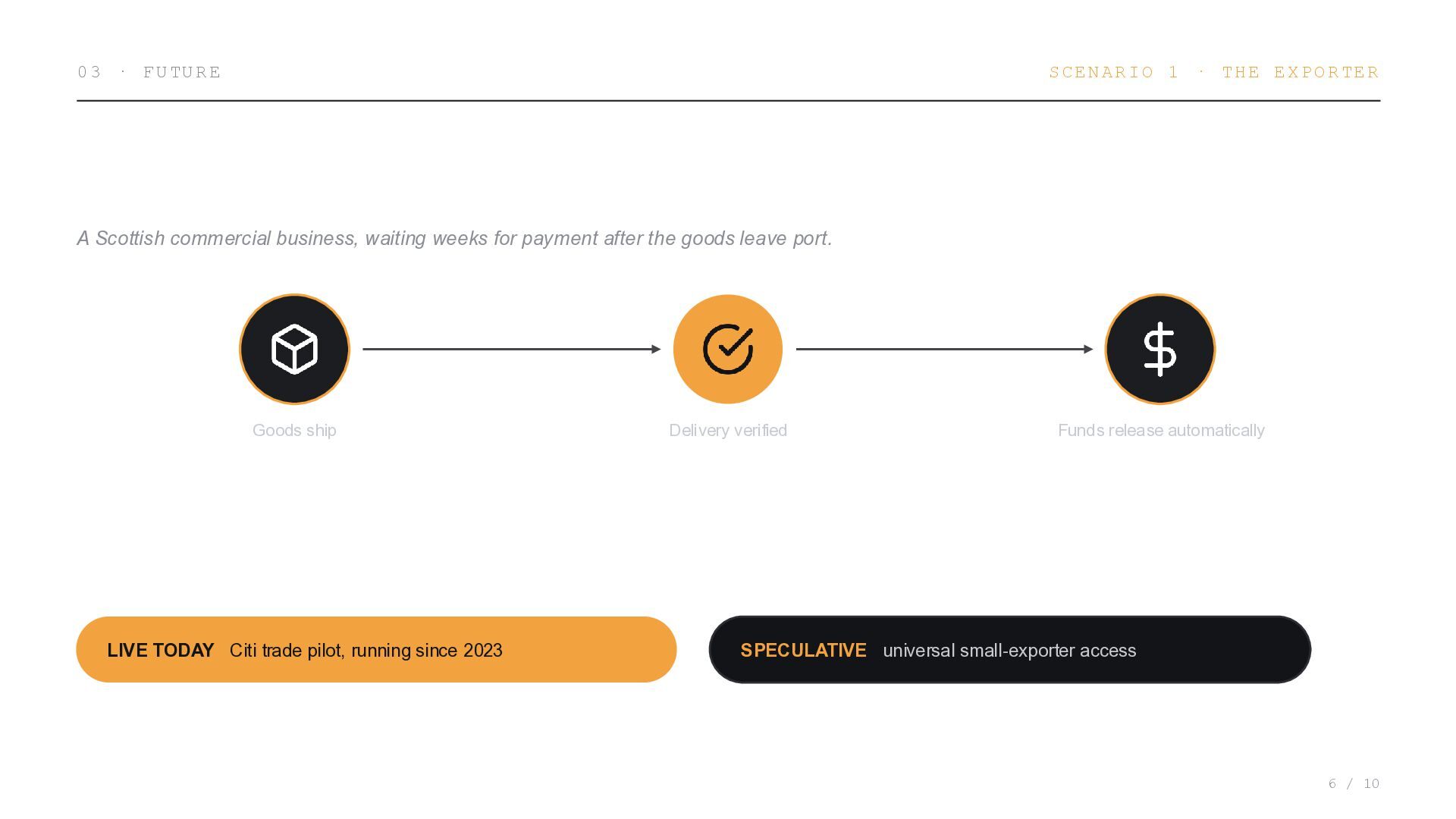
    N AR I O 1 · TH E E X PO R TE R Automated and faster cross-border business A Scottish commercial business, waiting weeks for payment after the goods leave port. Goods ship LIVE TODAY Citi trade pilot, running since 2023 Delivery verified Funds release automatically SPECULATIVE universal small-exporter access 6 / 10
  25. 0 3 · F U TU R E S CE

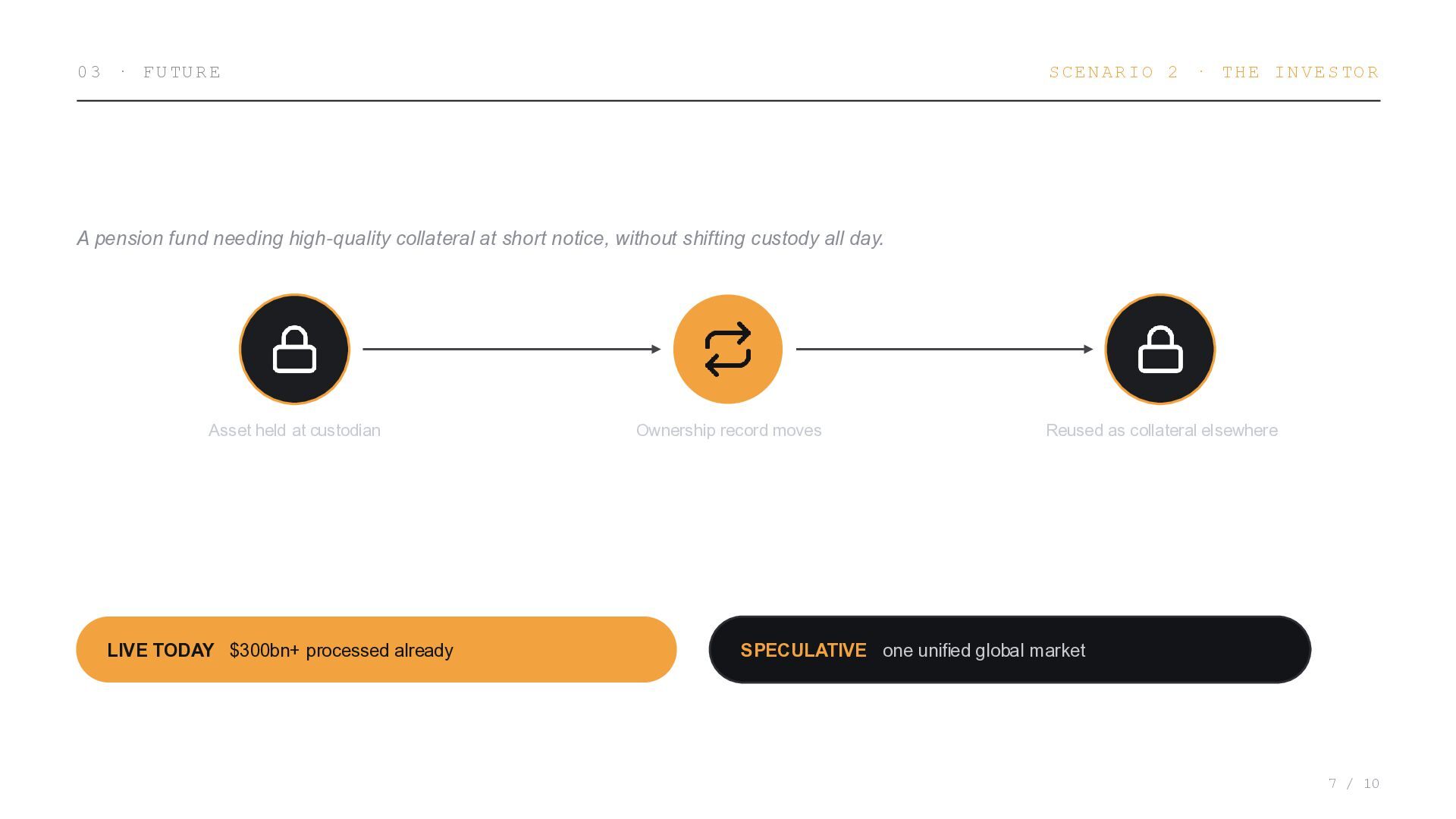
    N AR I O 2 · TH E I N VE S TO R Collateral that moves at greater velocity A pension fund needing high-quality collateral at short notice, without shifting custody all day. Asset held at custodian LIVE TODAY $300bn+ processed already Ownership record moves Reused as collateral elsewhere SPECULATIVE one unified global market 7 / 10
  26. 0 3 · F U TU R E S CE

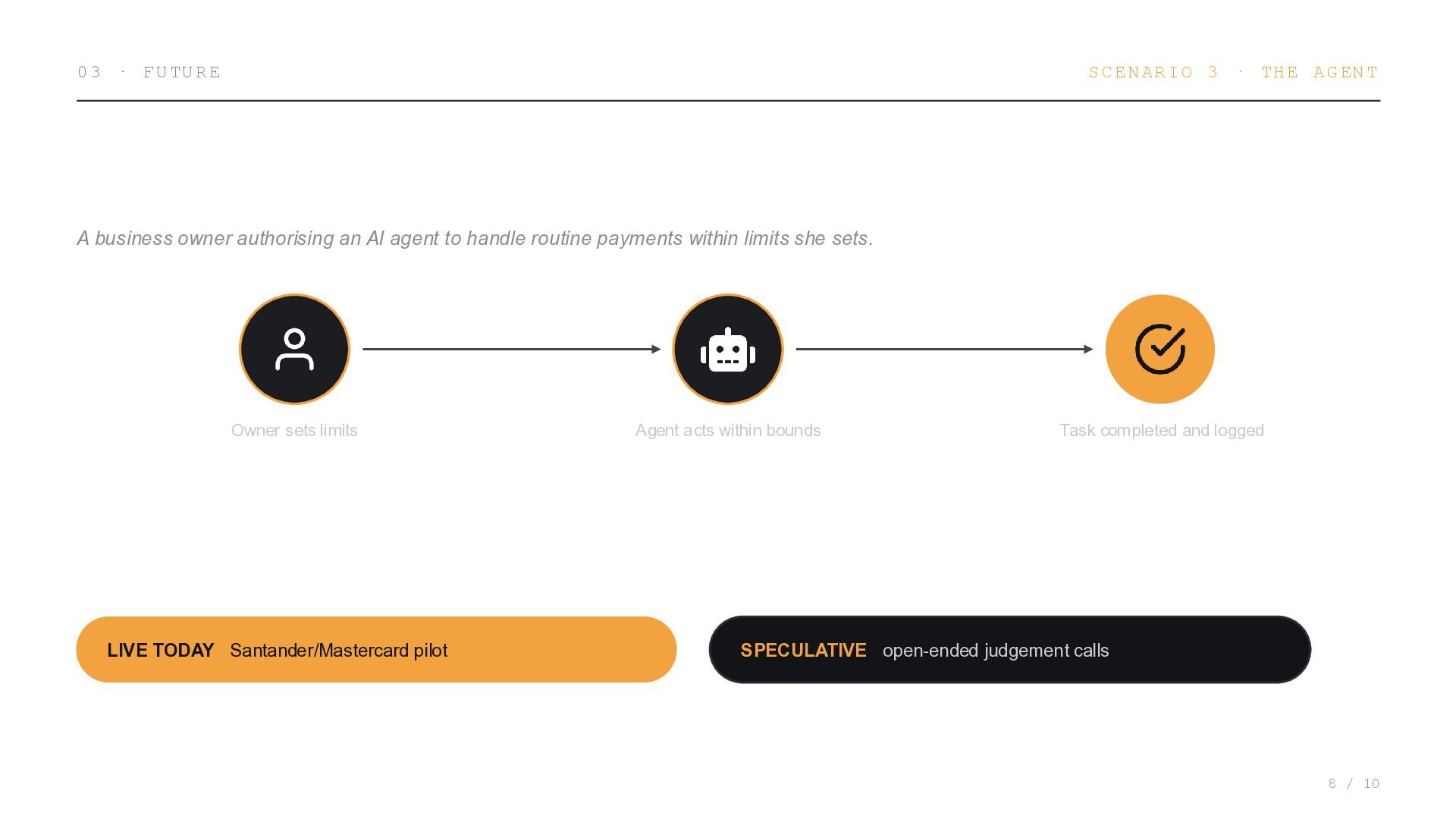
    N AR I O 3 · TH E A G EN T Autonomous agents; enforceable boundaries A business owner authorising an AI agent to handle routine payments within limits she sets. Owner sets limits LIVE TODAY Santander/Mastercard pilot Agent acts within bounds Task completed and logged SPECULATIVE open-ended judgement calls 8 / 10
  27. 0 4 · B U IL D IN G T

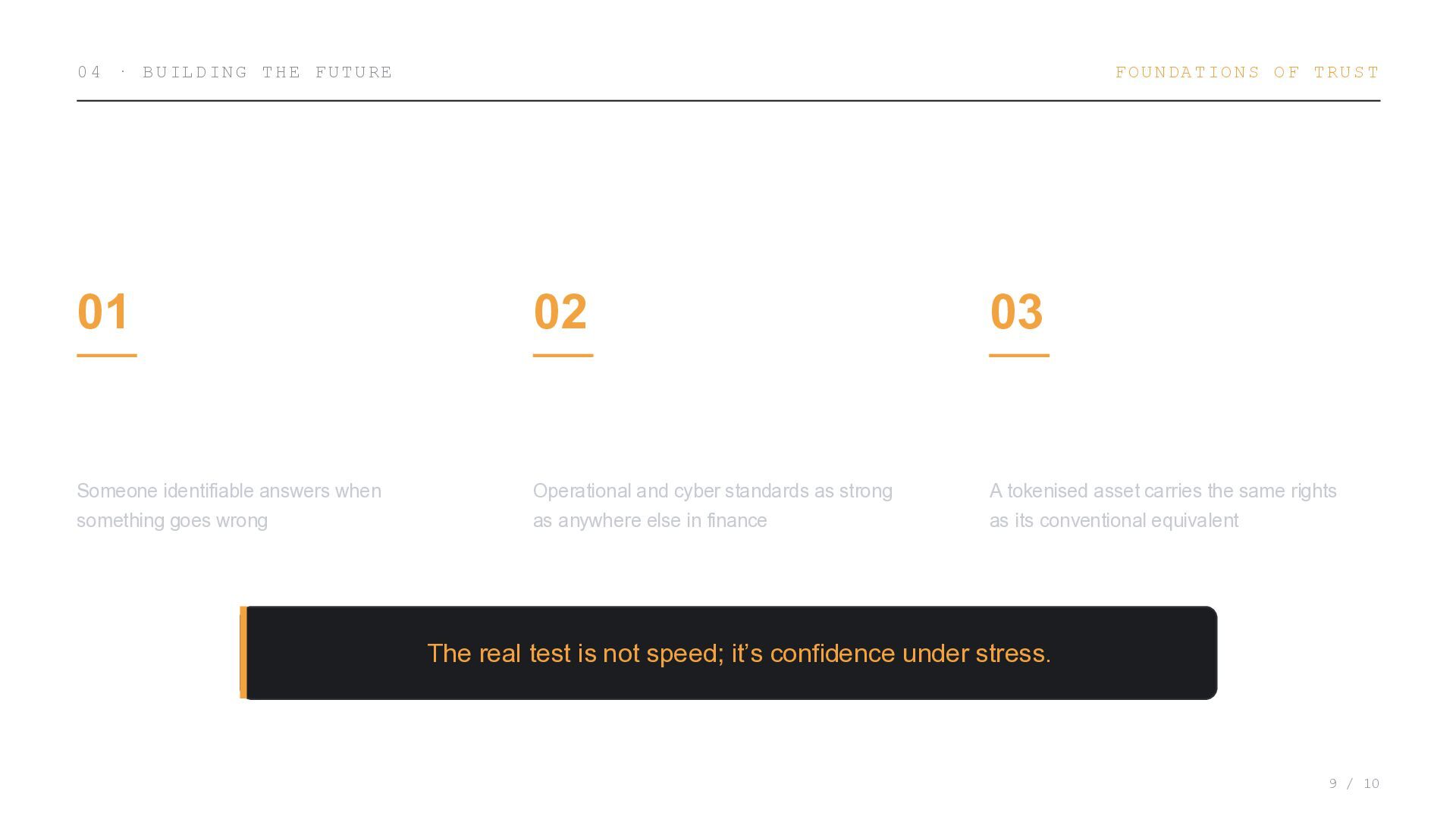
    H E F UT U RE F OU N DA T IO N S O F T RU S T Trust is the foundation for scale 01 02 03 Accountability Resilience Equivalent protection Someone identifiable answers when Operational and cyber standards as strong A tokenised asset carries the same rights something goes wrong as anywhere else in finance as its conventional equivalent The real test is not speed; it’s confidence under stress. 9 / 10
  28. P RO G RA M MA B LE FI N

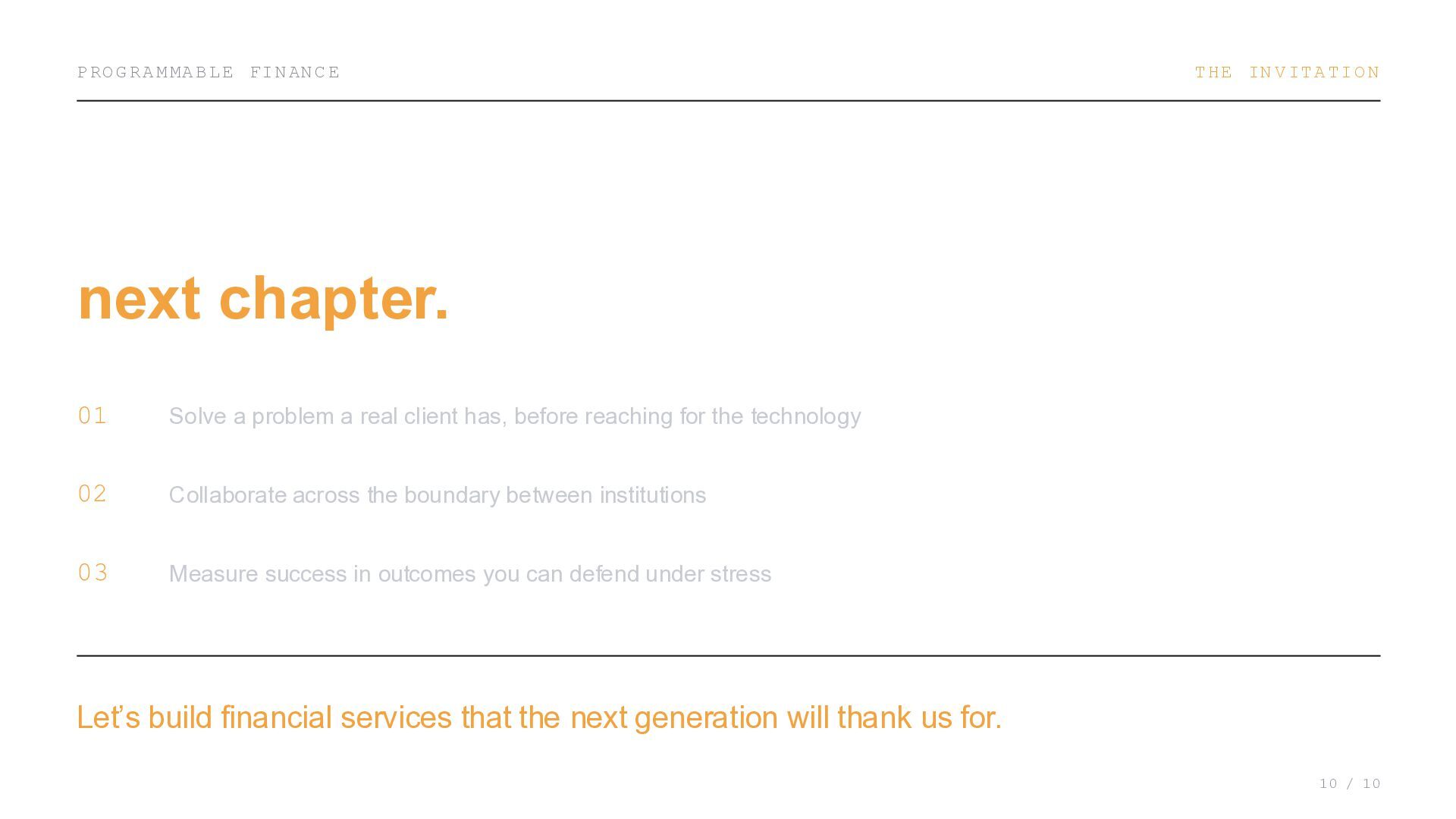
    AN C E T HE IN V IT A TI O N Scotland's next chapter. 01 Solve a problem a real client has, before reaching for the technology 02 Collaborate across the boundary between institutions 03 Measure success in outcomes you can defend under stress Let’s build financial services that the next generation will thank us for. 10 / 10
  29. Balancing Innovation and Governance in the Shift to Agentic Commerce

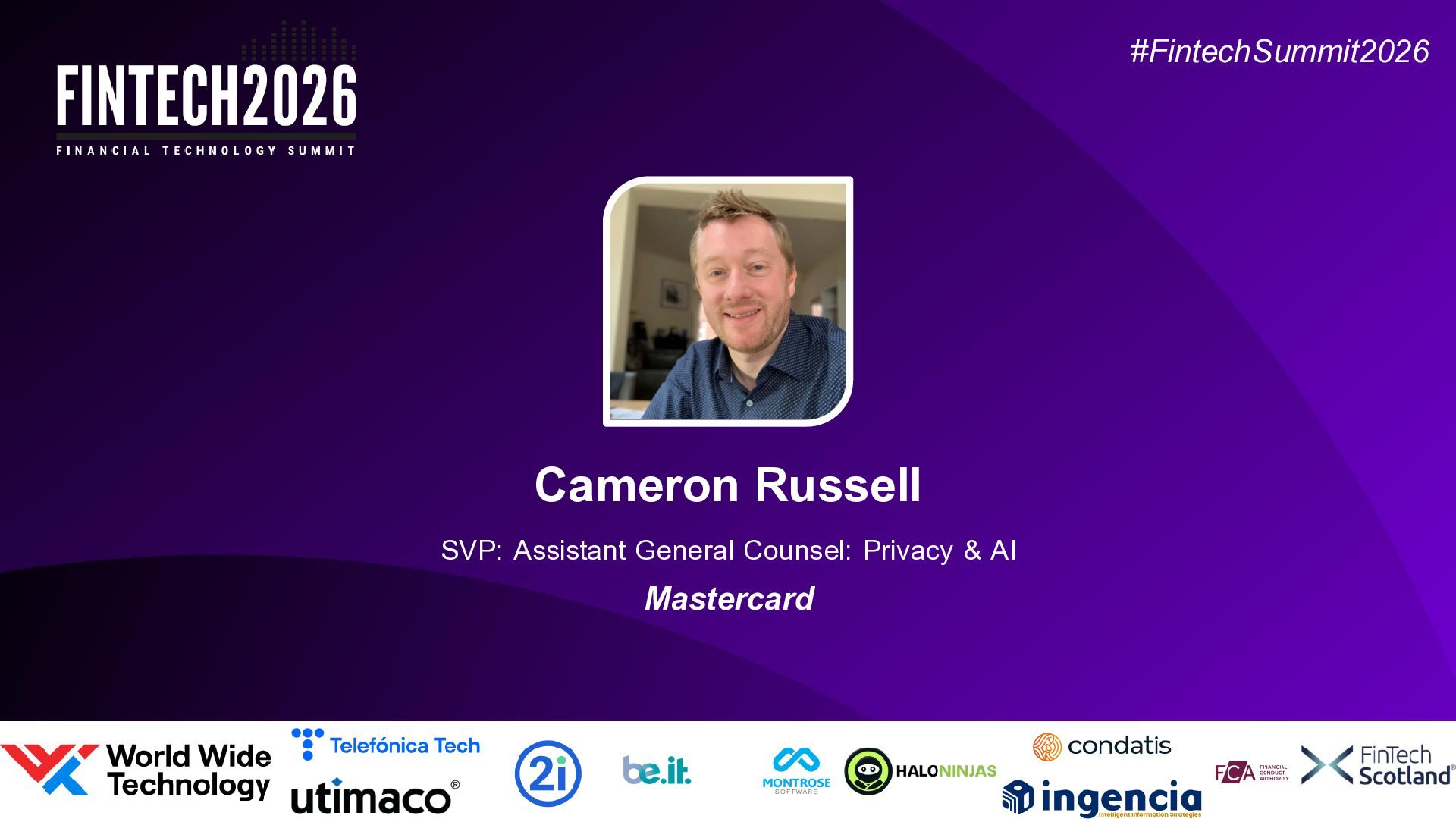
    Cameron Russell · Mastercard · October 2026 ©2026 Mastercard.
  30. 01 THE SHI FT The biggest change in commerce isn’t

    AI. It’s delegation. Mastercard Signals, Encoding Trust, 2026 ©2026 Mastercard.
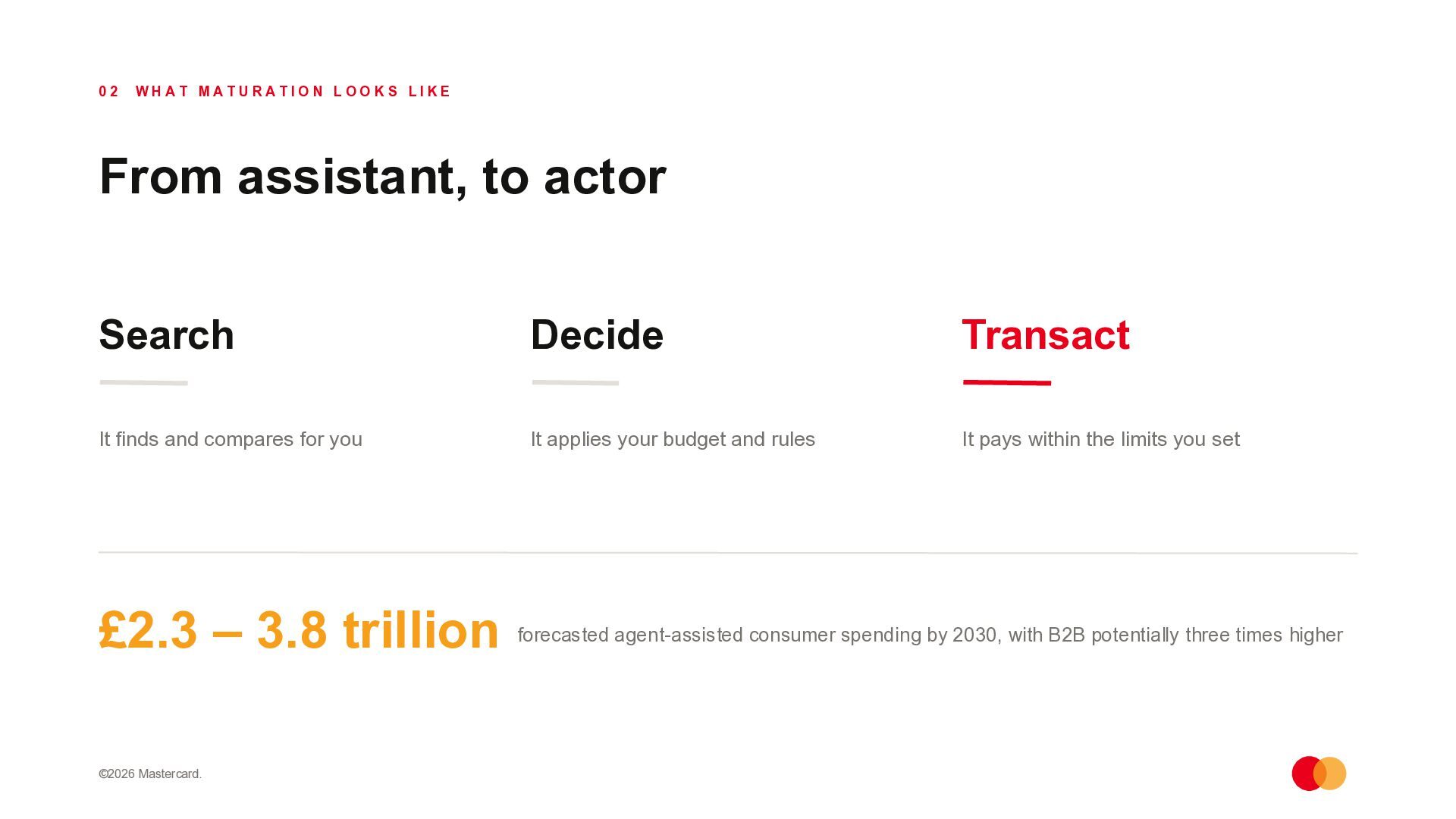
  31. 02 WH A T MA T U RA T IO

    N L OO K S LI KE From assistant, to actor Search Decide Transact It finds and compares for you It applies your budget and rules It pays within the limits you set £2.3 – 3.8 trillion forecasted agent-assisted consumer spending by 2030, with B2B potentially three times higher ©2026 Mastercard.
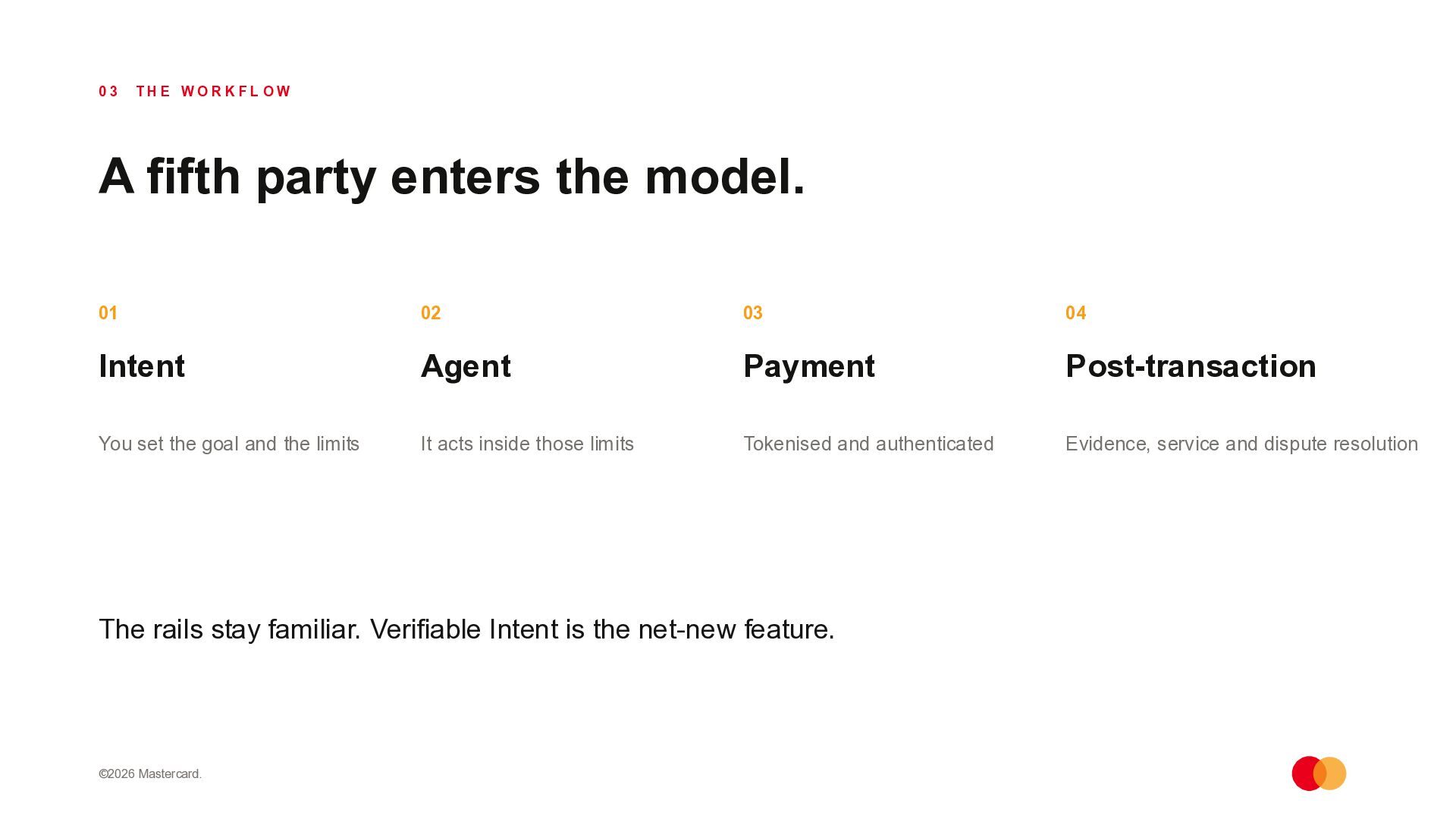
  32. 03 THE WO RKFL OW A fifth party enters the

    model. 01 02 03 04 Intent Agent Payment Post-transaction You set the goal and the limits It acts inside those limits Tokenised and authenticated Evidence, service and dispute resolution The rails stay familiar. Verifiable Intent is the net-new feature. ©2026 Mastercard.
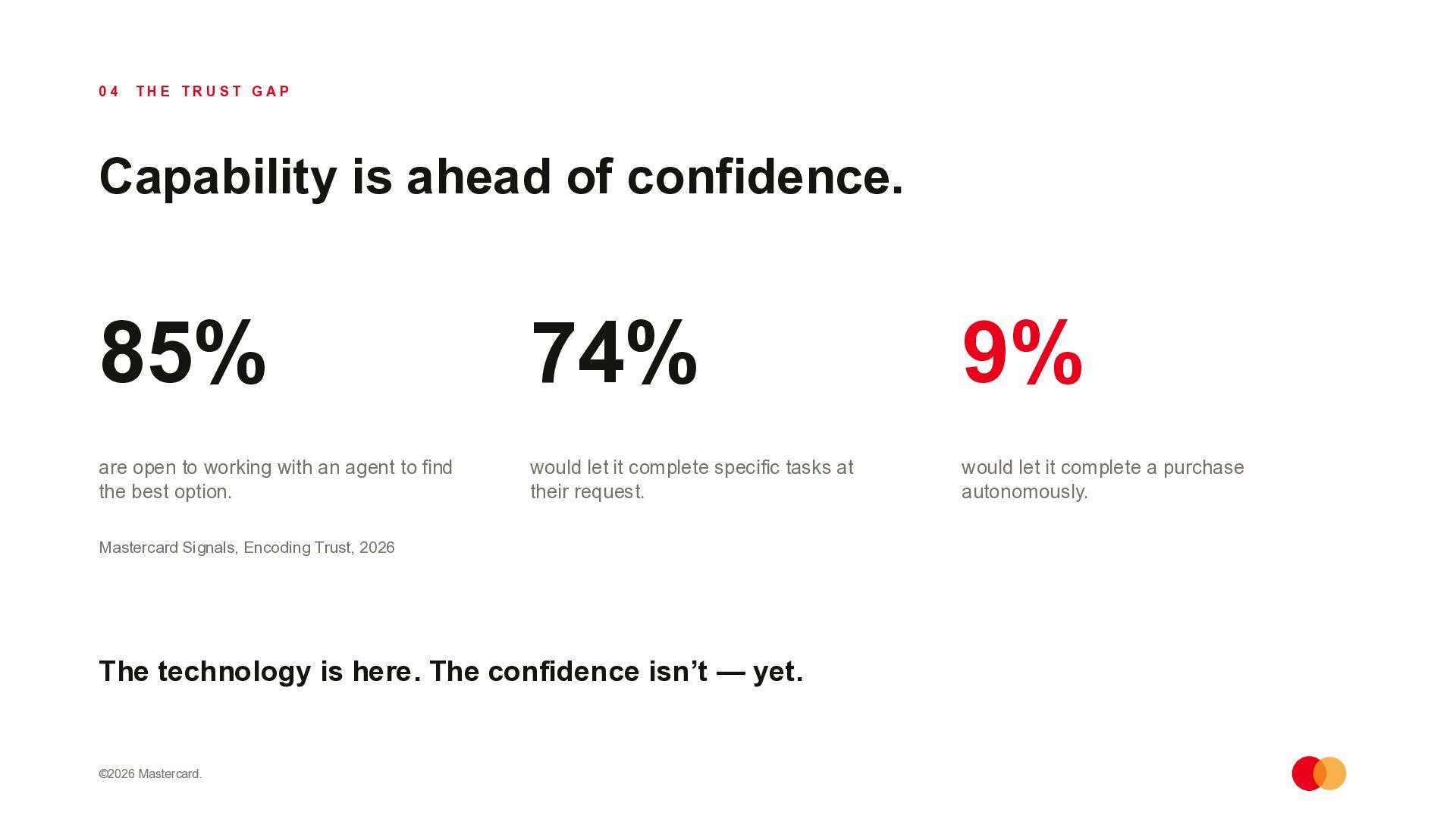
  33. 04 THE TRUST G AP Capability is ahead of confidence.

    85% 74% 9% are open to working with an agent to find the best option. would let it complete specific tasks at their request. would let it complete a purchase autonomously. Mastercard Signals, Encoding Trust, 2026 The technology is here. The confidence isn’t — yet. ©2026 Mastercard.
  34. 05 MA ST ER C AR D ’ S A

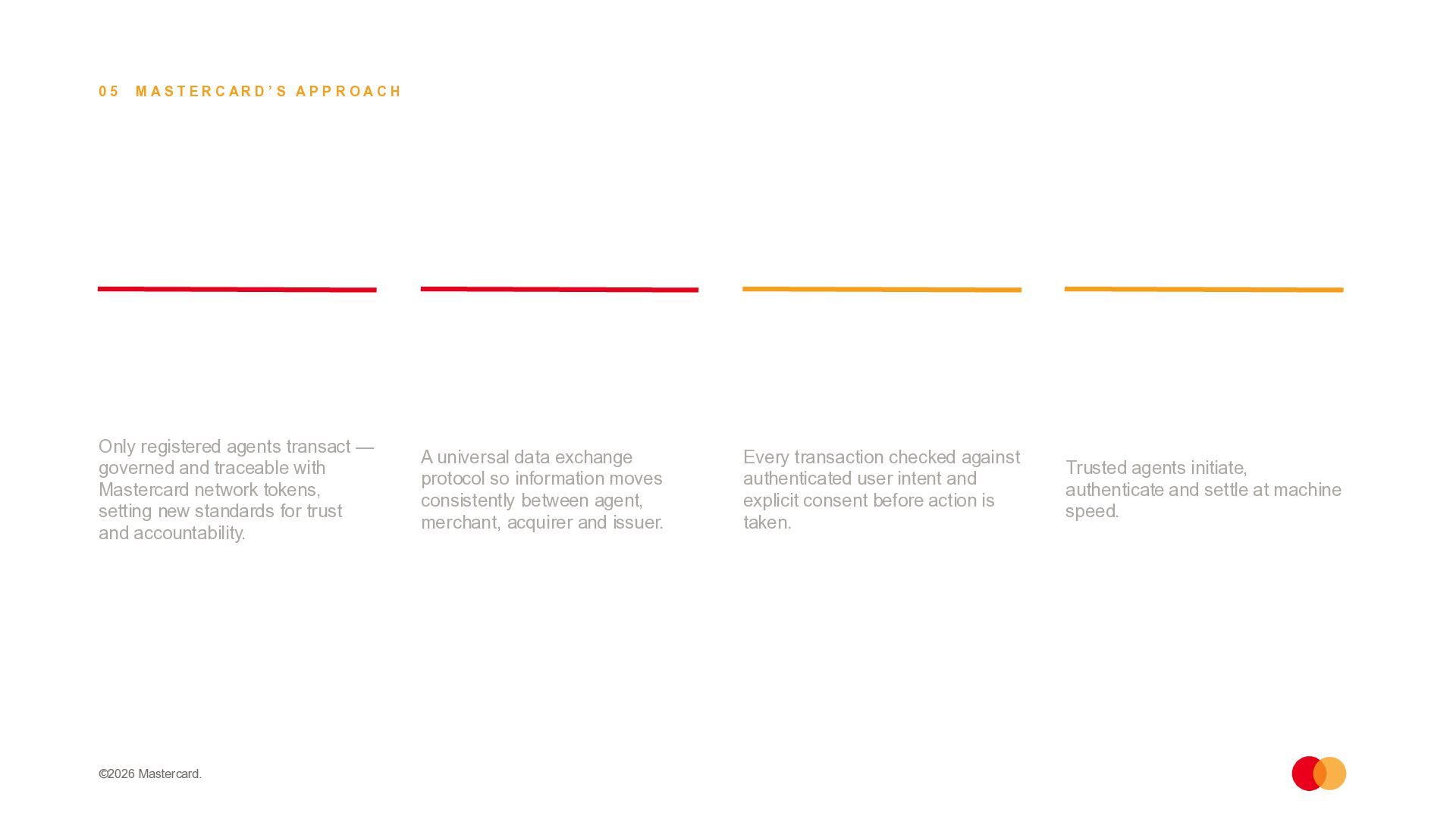
    PP R OA C H Agent Pay: building the trust layer Know Your Agent Interface standards Verifiable Intent Agent Pay for Machines Only registered agents transact — governed and traceable with Mastercard network tokens, setting new standards for trust and accountability. A universal data exchange protocol so information moves consistently between agent, merchant, acquirer and issuer. Every transaction checked against authenticated user intent and explicit consent before action is taken. Trusted agents initiate, authenticate and settle at machine speed. ©2026 Mastercard.
  35. 06 PR IV AC Y B Y D ESIG N

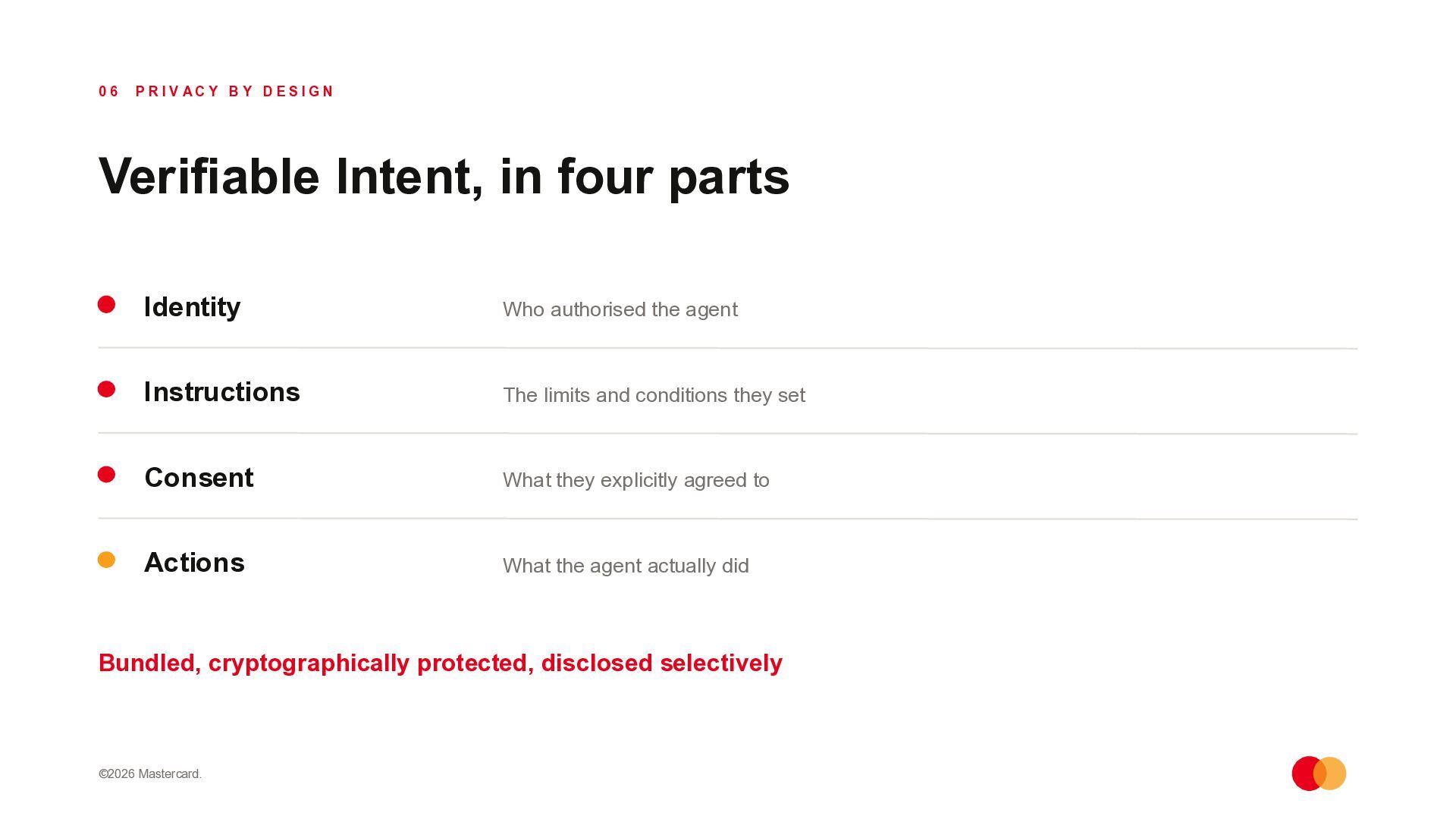
    Verifiable Intent, in four parts Identity Who authorised the agent Instructions The limits and conditions they set Consent What they explicitly agreed to Actions What the agent actually did Bundled, cryptographically protected, disclosed selectively ©2026 Mastercard.
  36. 07 FR O M P R IN C IP LE

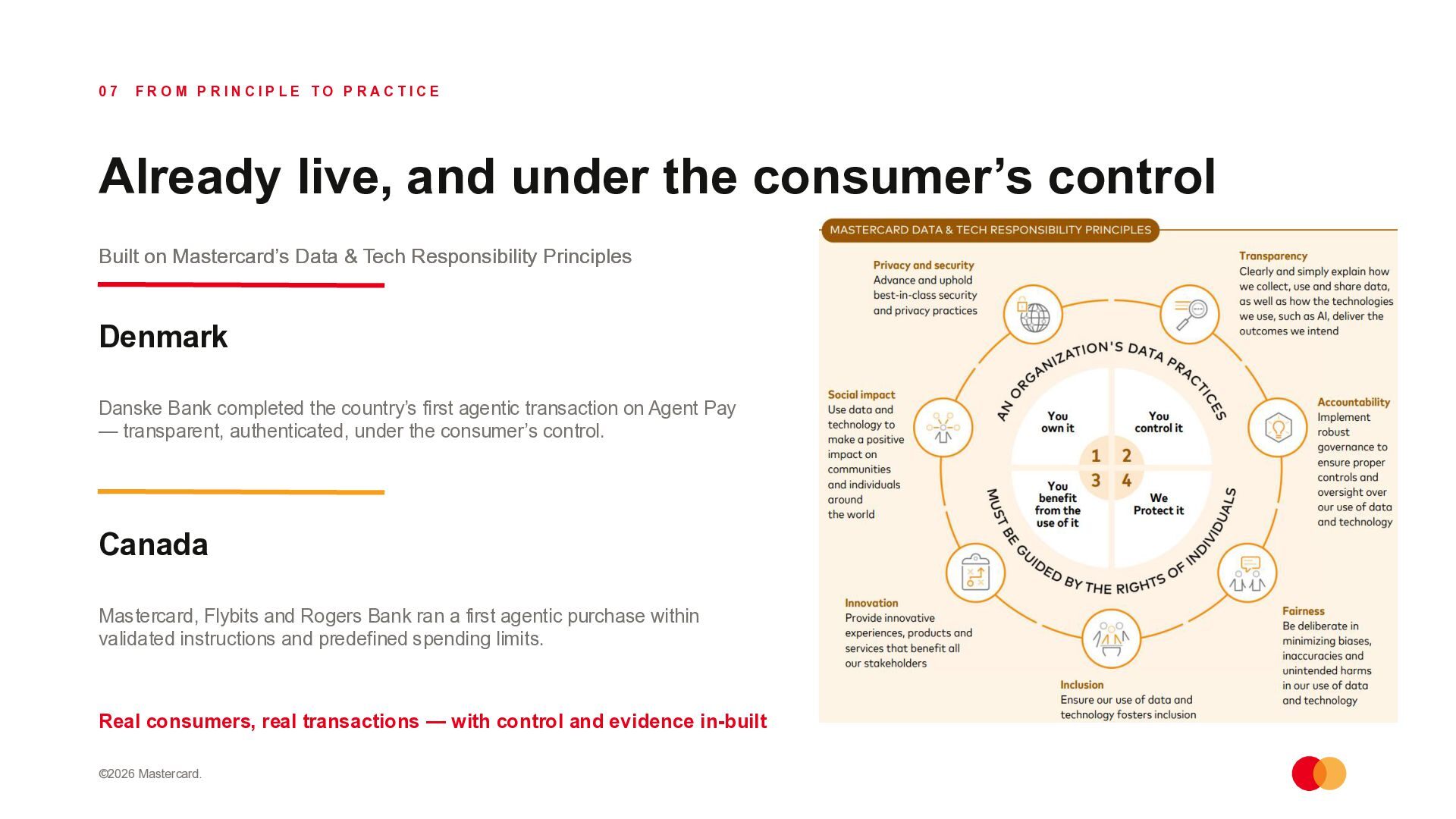
    TO P RA C T IC E Already live, and under the consumer’s control Built on Mastercard’s Data & Tech Responsibility Principles Denmark Danske Bank completed the country’s first agentic transaction on Agent Pay — transparent, authenticated, under the consumer’s control. Canada Mastercard, Flybits and Rogers Bank ran a first agentic purchase within validated instructions and predefined spending limits. Real consumers, real transactions — with control and evidence in-built ©2026 Mastercard.
  37. 08 C OL LA B O RA T IO N

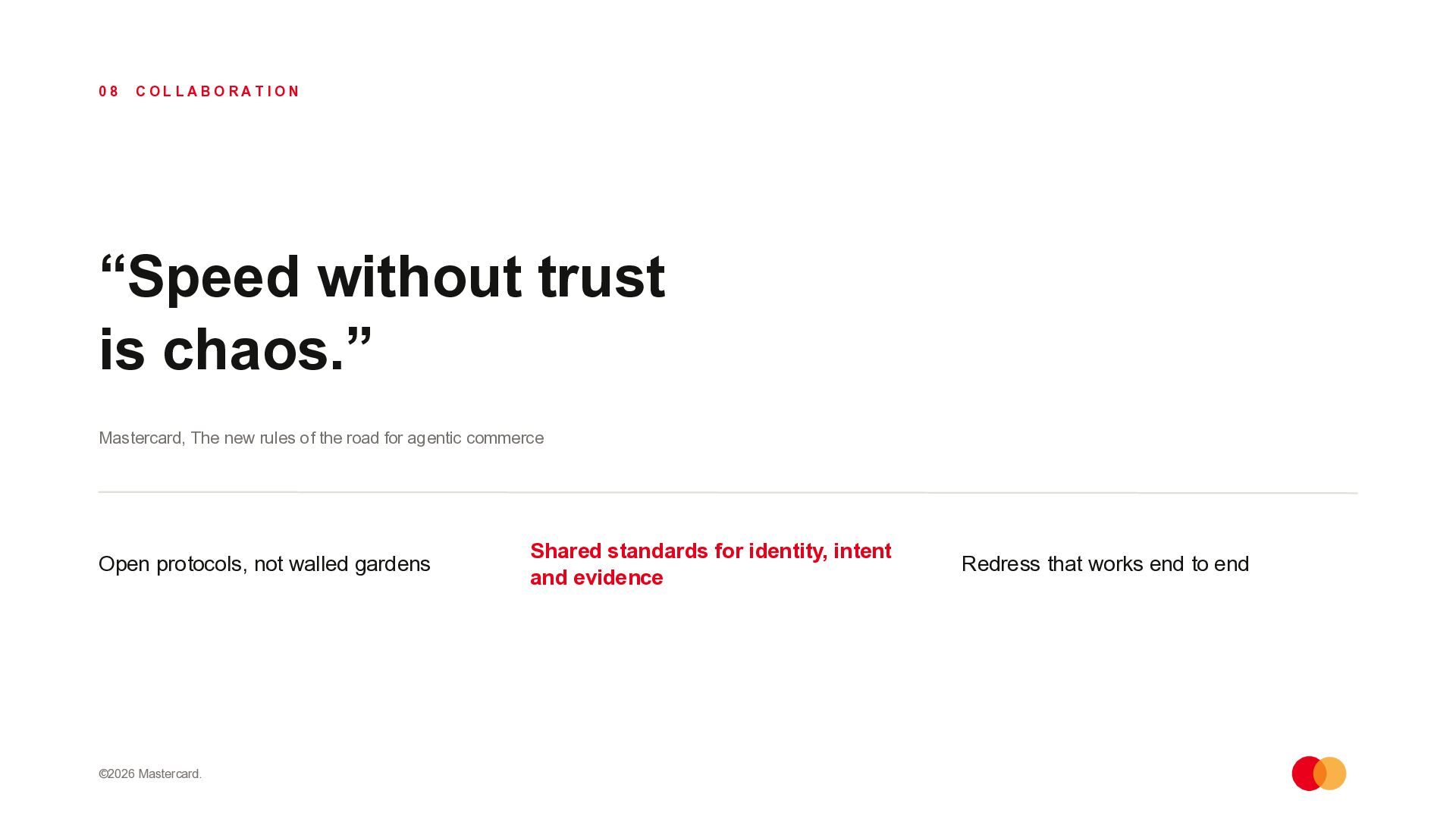
    “Speed without trust is chaos.” Mastercard, The new rules of the road for agentic commerce Open protocols, not walled gardens ©2026 Mastercard. Shared standards for identity, intent and evidence Redress that works end to end
  38. 09 TH E N EW Q UE STI ON S

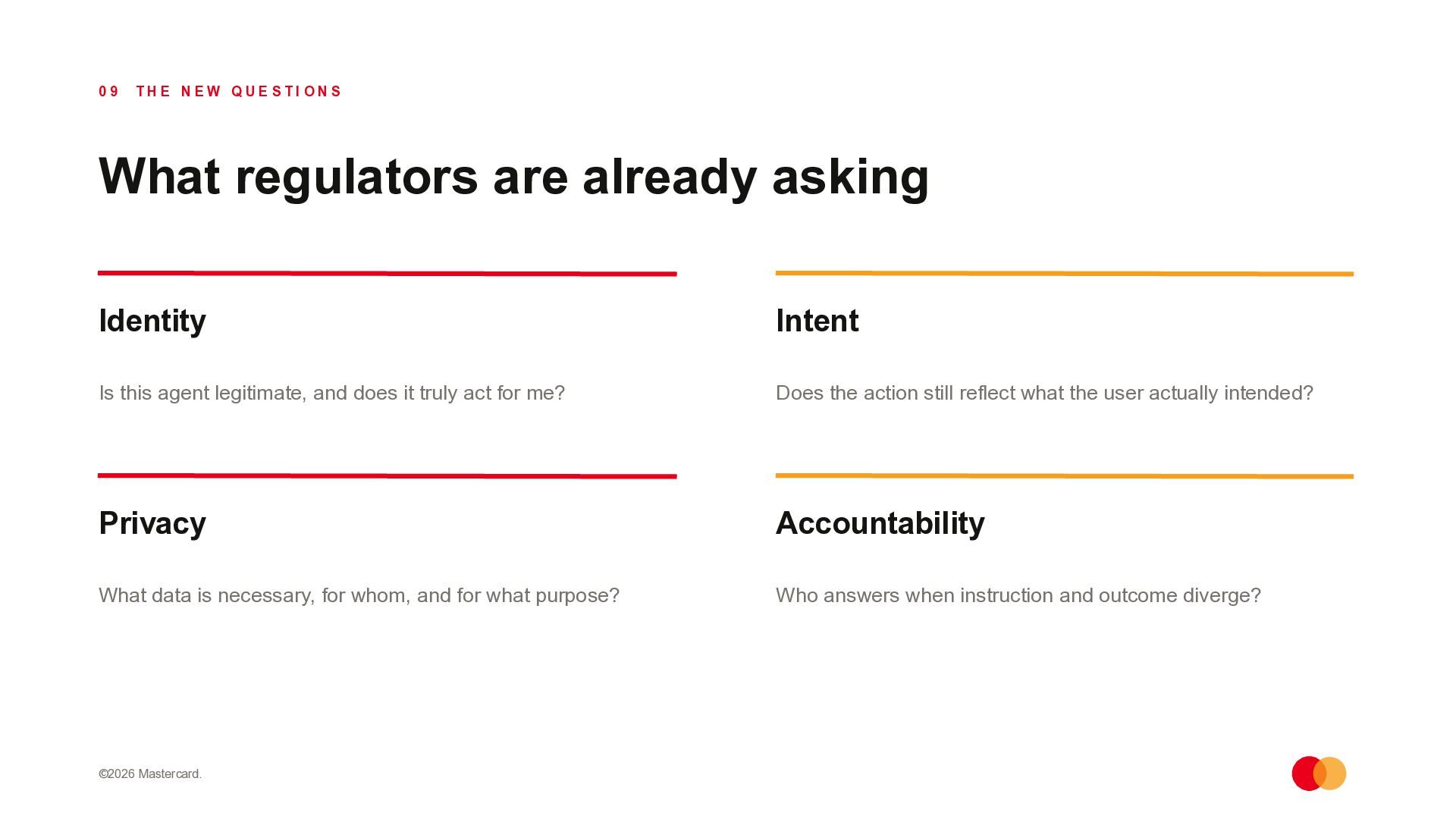
    What regulators are already asking Identity Intent Is this agent legitimate, and does it truly act for me? Does the action still reflect what the user actually intended? Privacy Accountability What data is necessary, for whom, and for what purpose? Who answers when instruction and outcome diverge? ©2026 Mastercard.
  39. 22 OCT 2026 | CARDIFF 19 NOV 2026 | EDINBURGH

    22 FEB 2027 | EDINBUGH 1 APRIL 2027 | EDINBURGH 29th APRIL 2027 | EDINBURGH 3rd JUNE 2027 | EDINBURGH
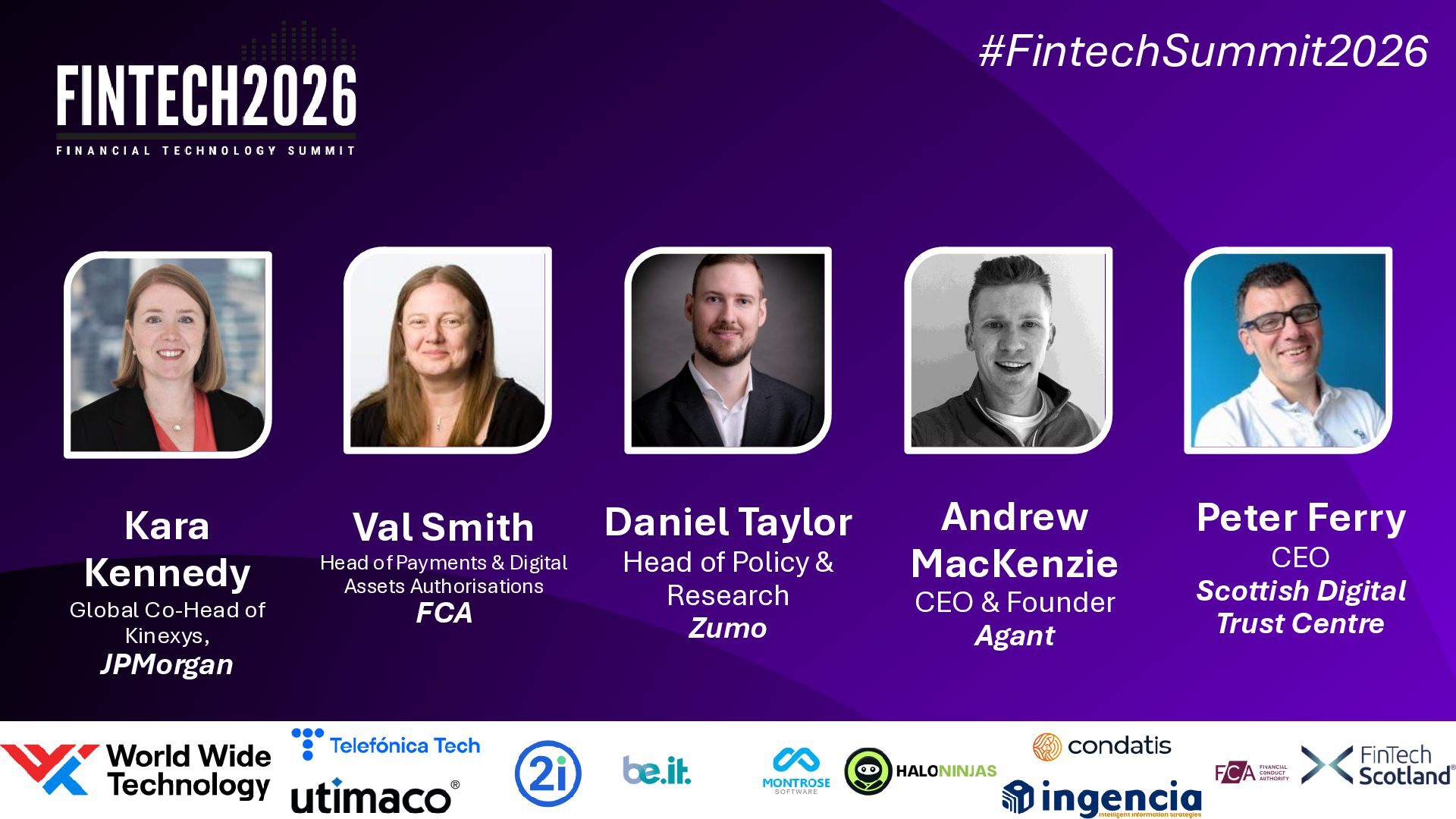
  40. #FintechSummit2026 Kara Kennedy Global Co-Head of Kinexys, JPMorgan Val Smith

    Head of Payments & Digital Assets Authorisations FCA Daniel Taylor Head of Policy & Research Zumo Andrew MacKenzie CEO & Founder Agant Peter Ferry CEO Scottish Digital Trust Centre
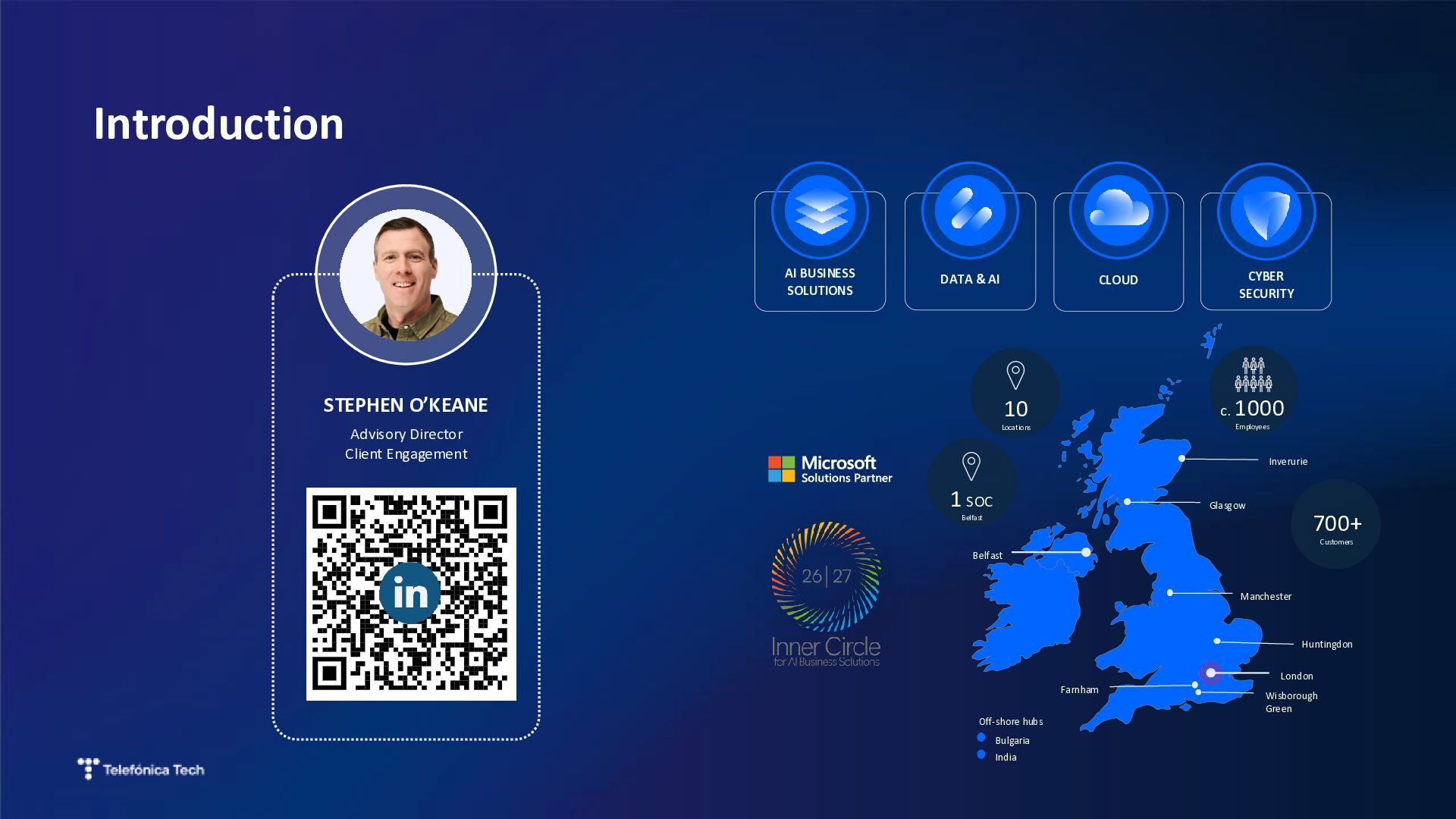
  41. Introduction AI BUSINESS SOLUTIONS DATA & AI CLOUD STEPHEN O’KEANE

    10 Advisory Director Client Engagement Locations CYBER SECURITY c. 1000 Employees Inverurie 1 SOC Glasgow 700+ Belfast Customers Belfast Manchester Huntingdon London Farnham Off-shore hubs Bulgaria India Wi sborough Green
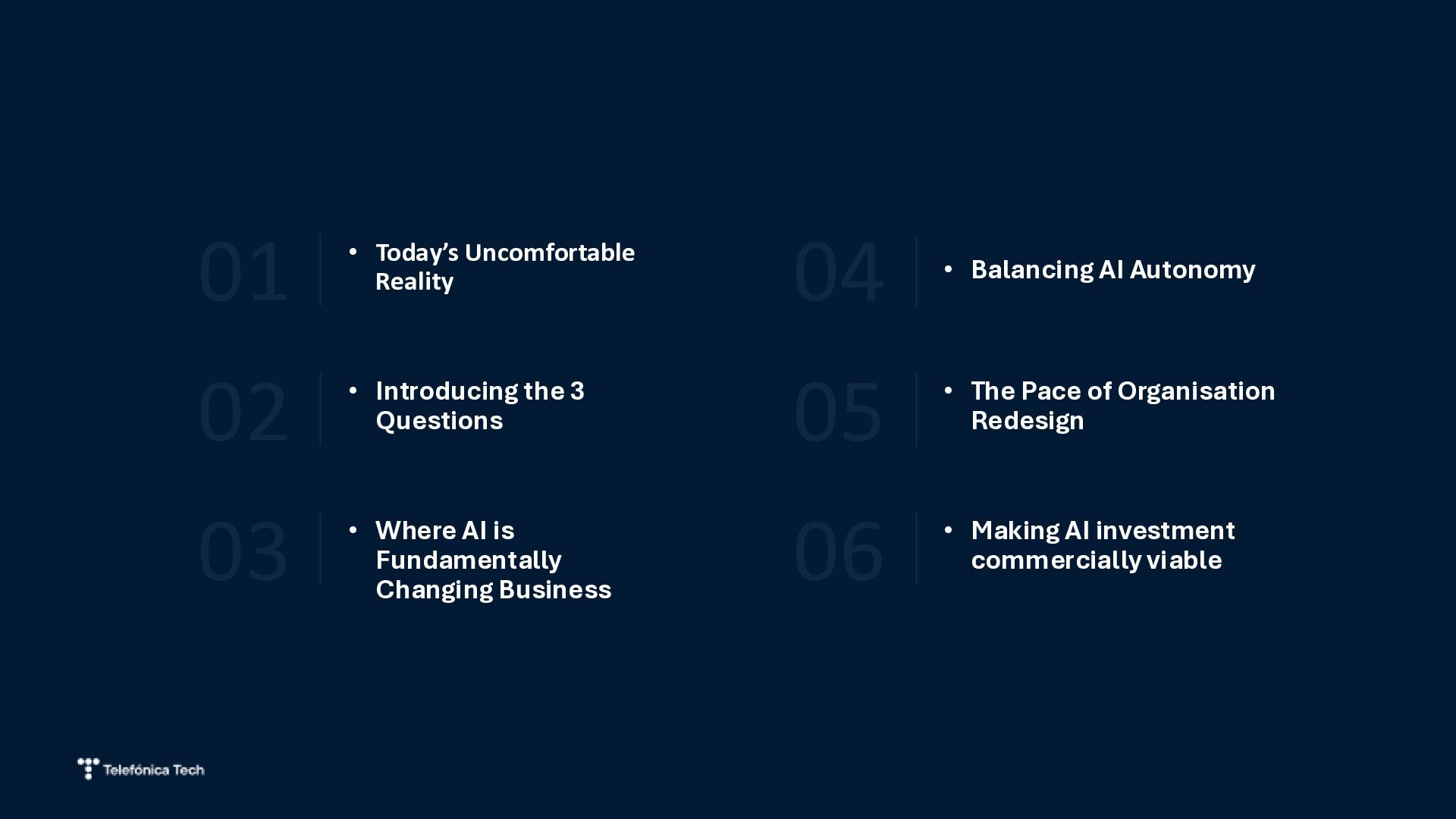
  42. 01 • Today’s Uncomfortable Reality 04 • Balancing AI Autonomy

    02 • Introducing the 3 Questions 05 • The Pace of Organisation Redesign 03 • Where AI is Fundamentally Changing Business 06 • Making AI investment commercially viable
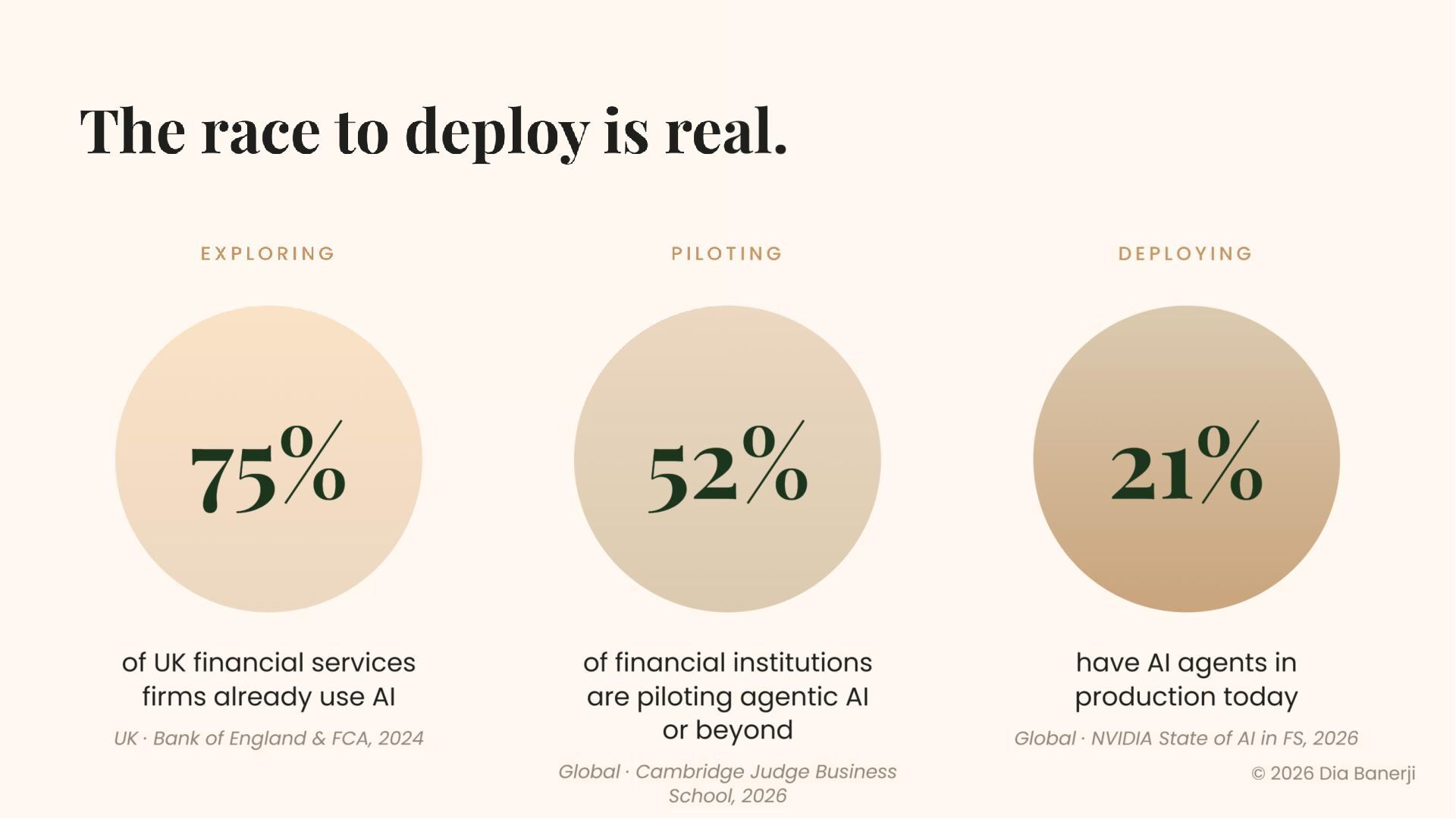
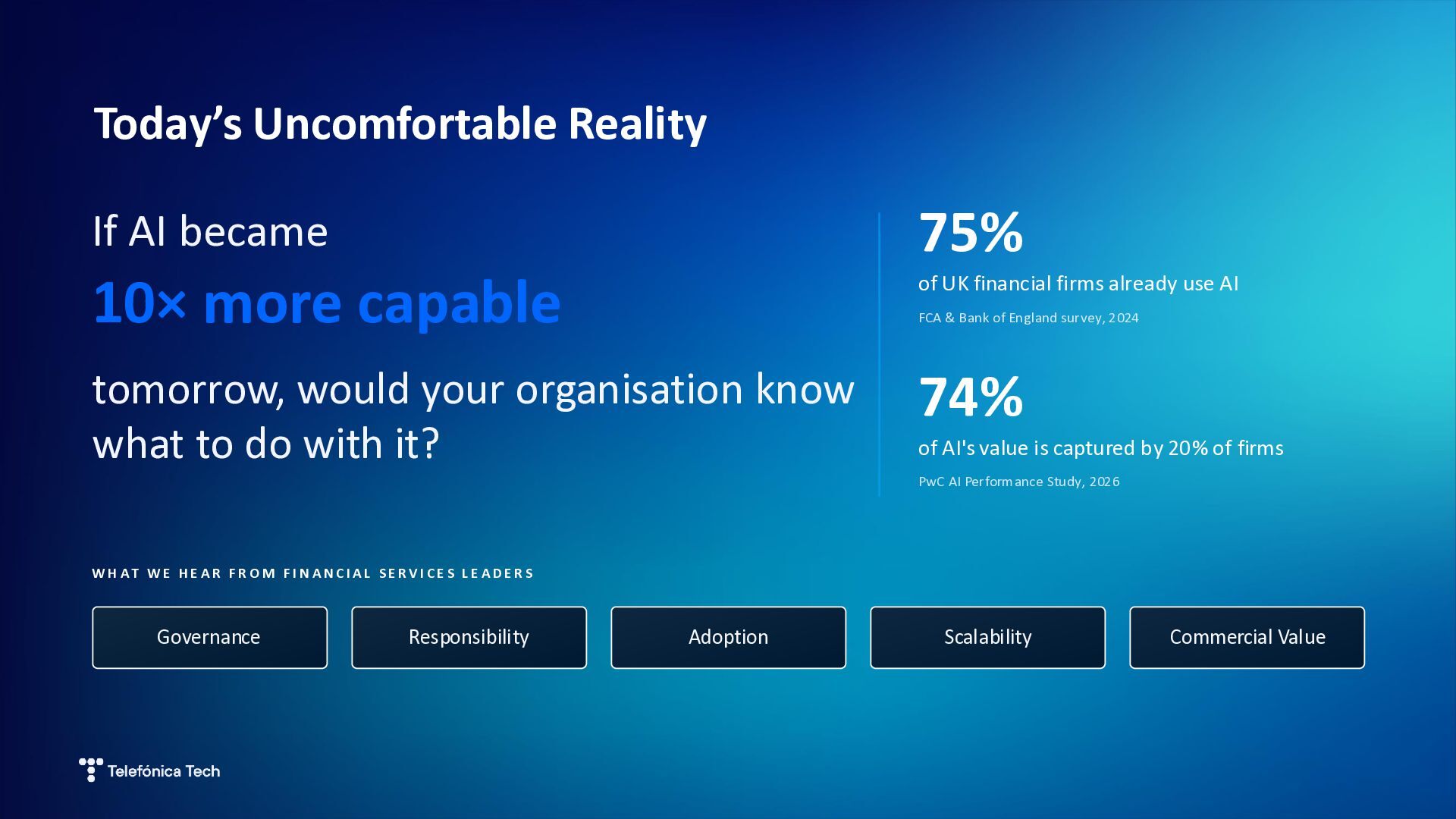
  43. Today’s Uncomfortable Reality 75% If AI became 10× more capable

    of UK financial firms already use AI FCA & Bank of England survey, 2024 tomorrow, would your organisation know what to do with it? 74% of AI's value is captured by 20% of firms PwC AI Performance Study, 2026 W H AT W E HE AR FR O M FI N AN CI AL SE RV I CE S L E ADE R S Governance Responsibility Adoption Scalability Commercial Value
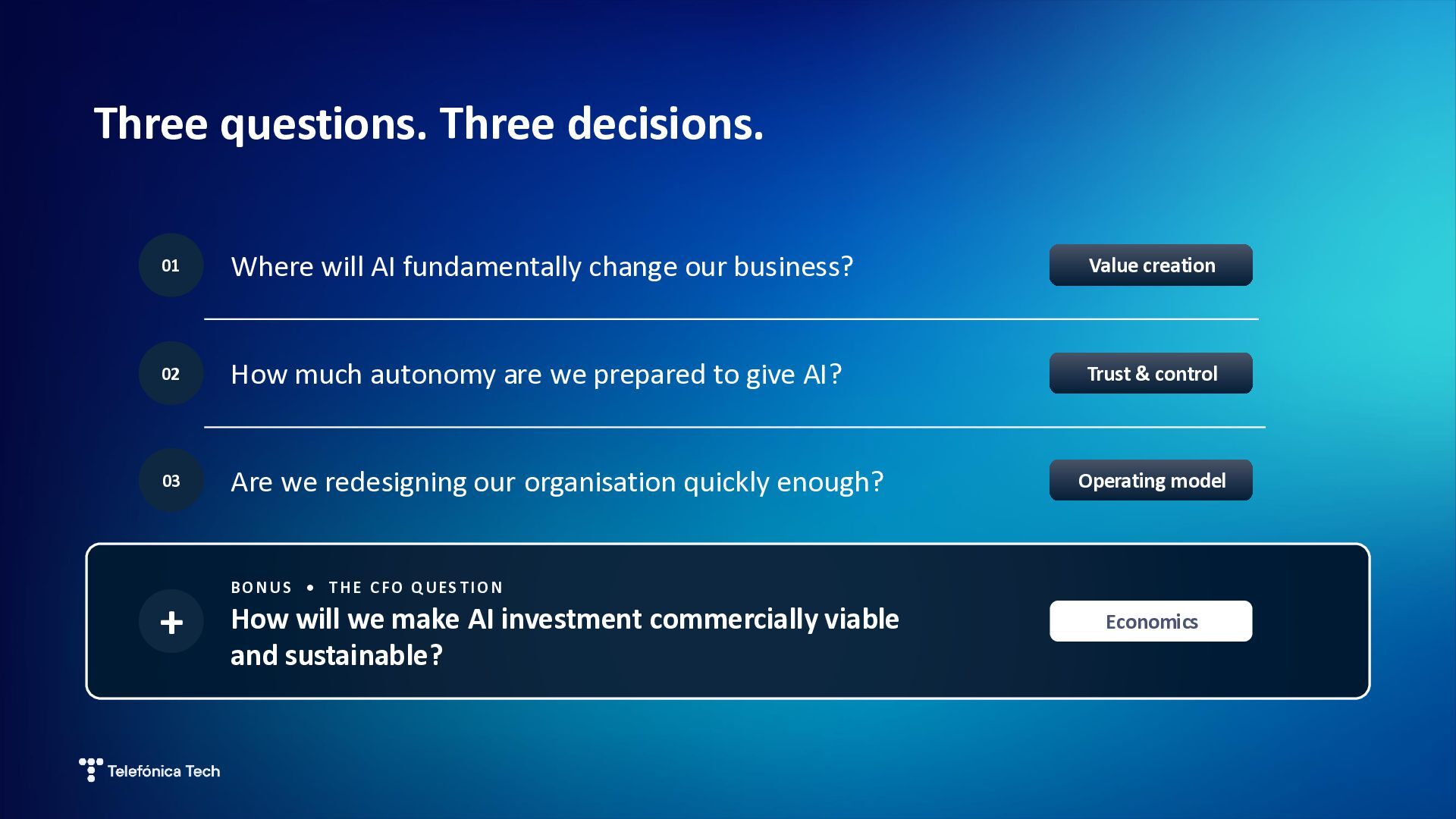
  44. Three questions. Three decisions. 01 Where will AI fundamentally change

    our business? Value creation 02 How much autonomy are we prepared to give AI? Trust & control 03 Are we redesigning our organisation quickly enough? Operating model + B O N U S • T H E C F O Q UE S T I O N How will we make AI investment commercially viable and sustainable? Economics
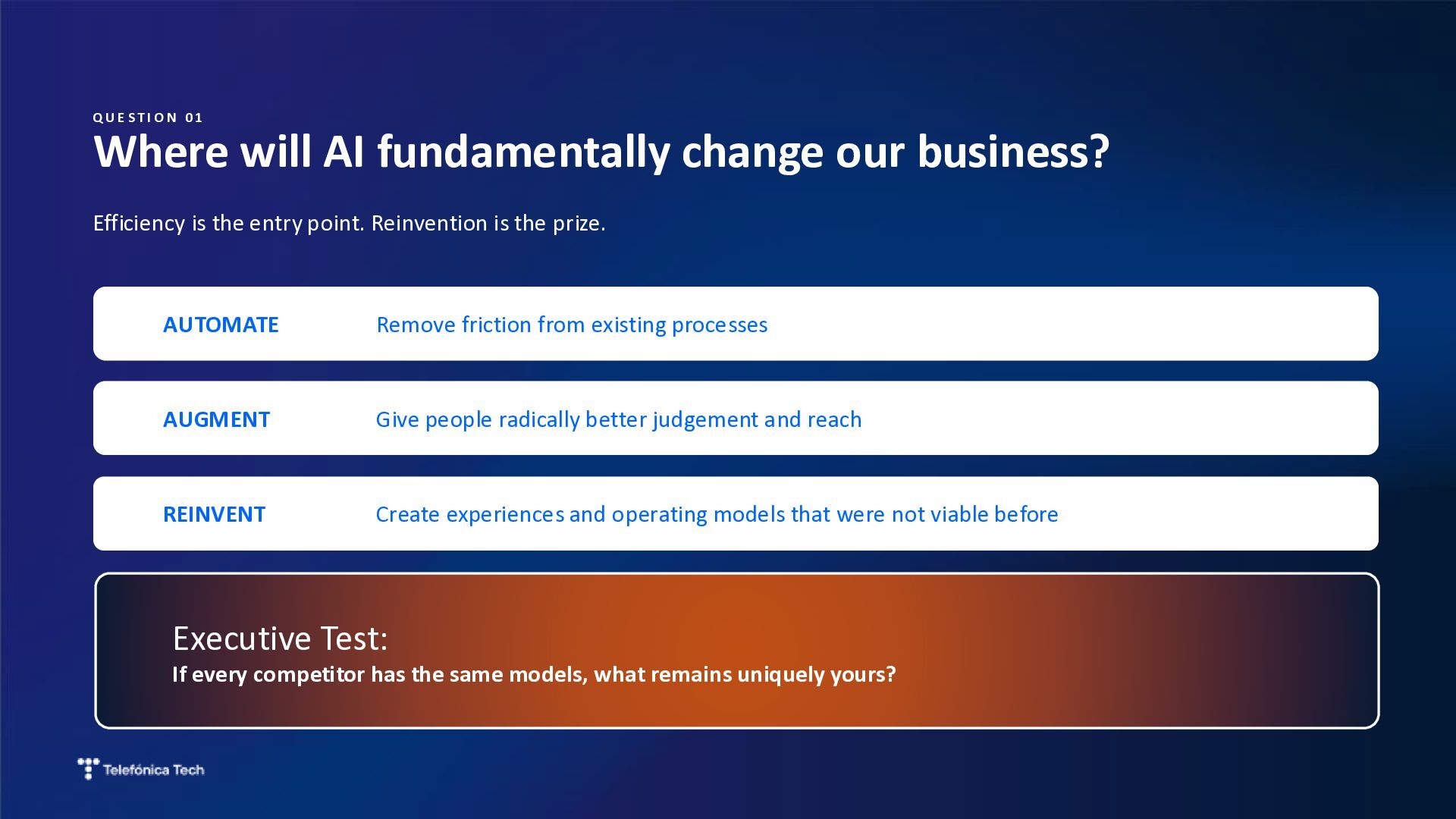
  45. QU E ST I ON 0 1 Where will AI

    fundamentally change our business? Efficiency is the entry point. Reinvention is the prize. AUTOMATE Remove friction from existing processes AUGMENT Give people radically better judgement and reach REINVENT Create experiences and operating models that were not viable before Executive Test: If every competitor has the same models, what remains uniquely yours?
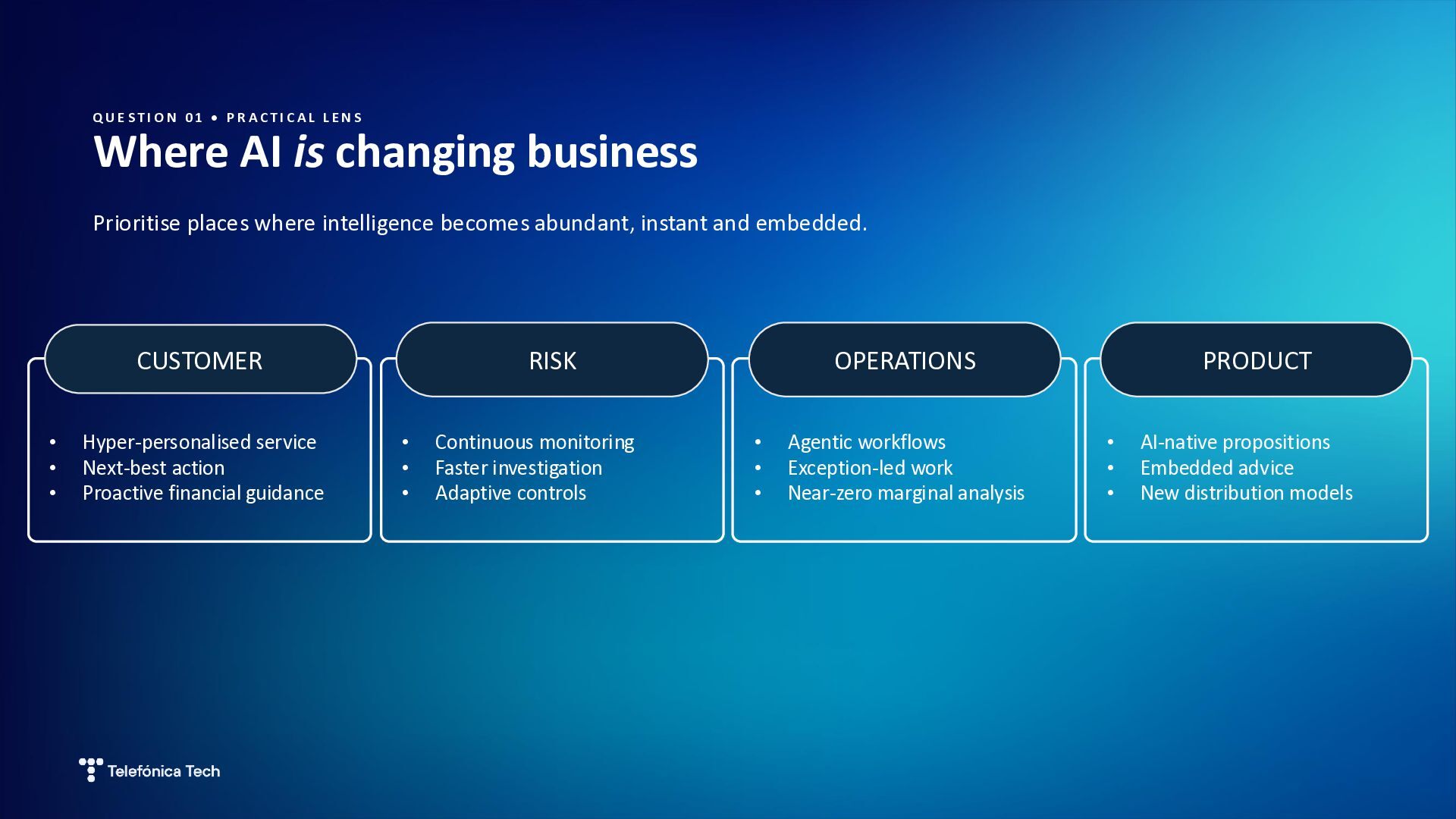
  46. QU E ST I O N 0 1 • PR

    ACT I CAL L EN S Where AI is changing business Prioritise places where intelligence becomes abundant, instant and embedded. CUSTOMER • • • Hyper-personalised service Next-best action Proactive financial guidance RISK • • • Continuous monitoring Faster investigation Adaptive controls OPERATIONS • • • Agentic workflows Exception-led work Near-zero marginal analysis PRODUCT • • • AI-native propositions Embedded advice New distribution models
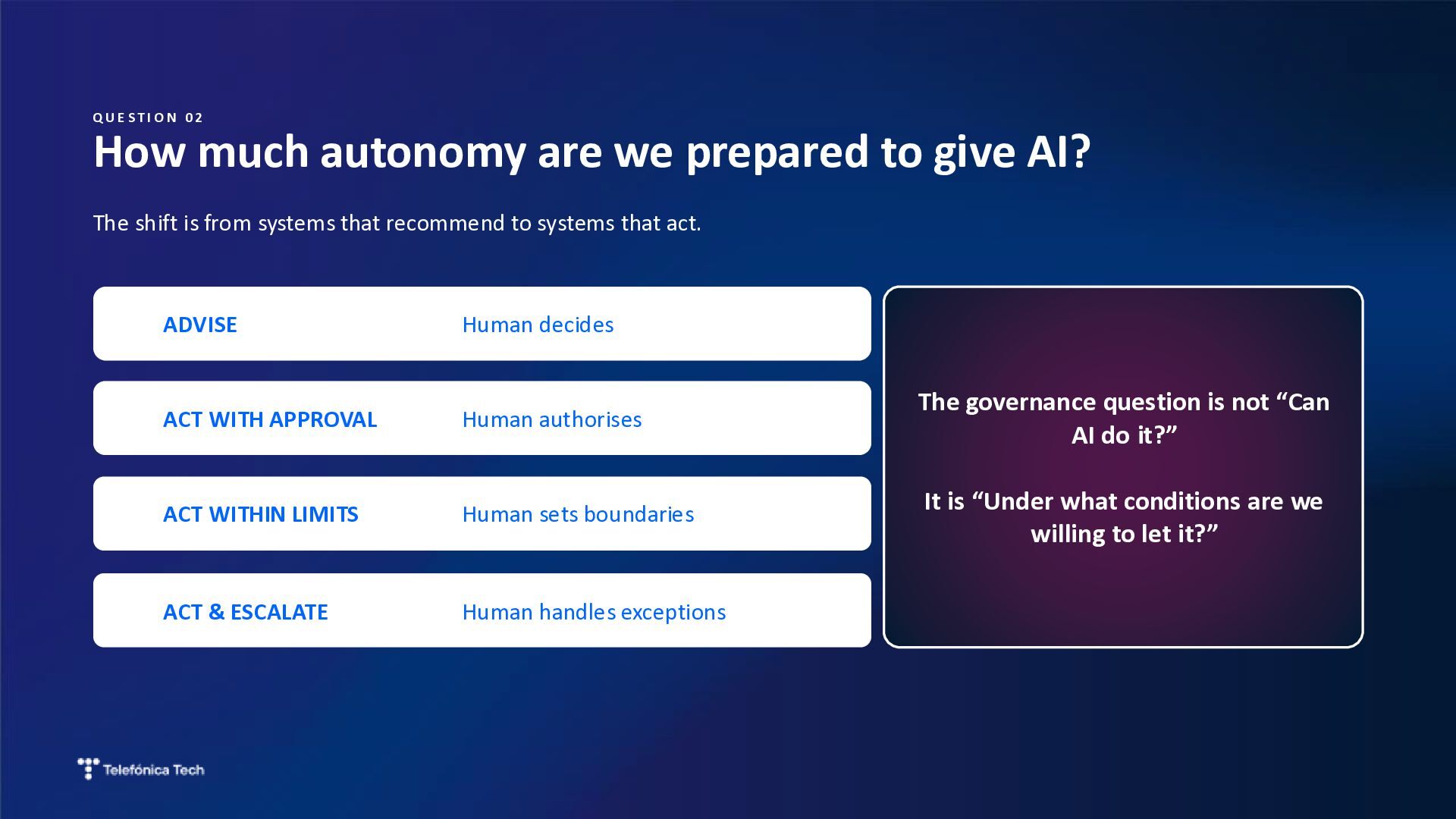
  47. QU E ST I ON 0 2 How much autonomy

    are we prepared to give AI? The shift is from systems that recommend to systems that act. ADVISE Human decides ACT WITH APPROVAL Human authorises The governance question is not “Can AI do it?” ACT WITHIN LIMITS Human sets boundaries It is “Under what conditions are we willing to let it?” ACT & ESCALATE Human handles exceptions
  48. QU E ST I O N 0 2 • PR

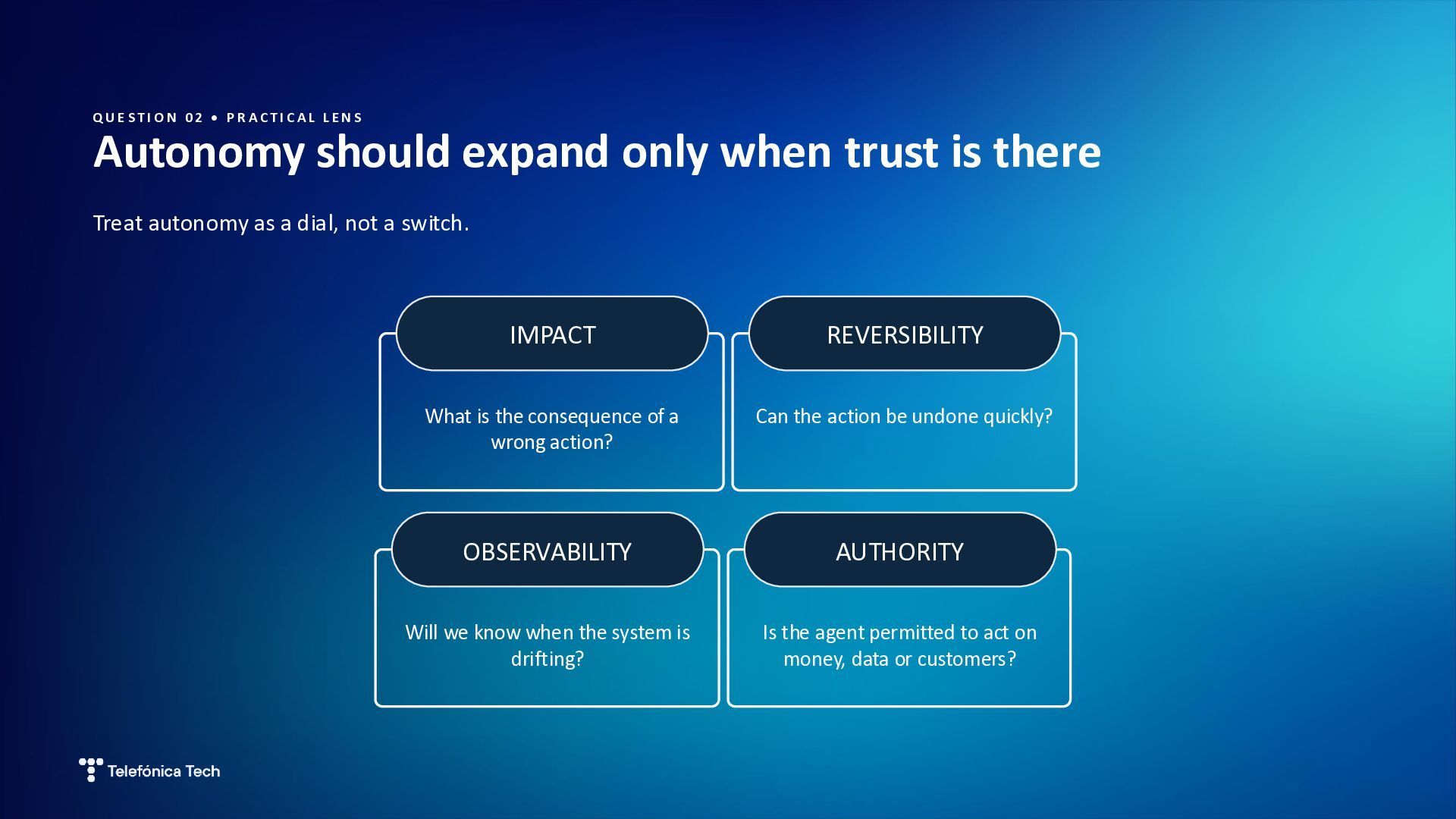
    ACT I CAL L EN S Autonomy should expand only when trust is there Treat autonomy as a dial, not a switch. IMPACT REVERSIBILITY What is the consequence of a wrong action? Can the action be undone quickly? OBSERVABILITY AUTHORITY Will we know when the system is drifting? Is the agent permitted to act on money, data or customers?
  49. QU E ST I ON 0 3 Are we redesigning

    our organisation quickly enough? AI transformation is an operating-model decision disguised as a technology programme. WORK Shift from tasks to outcomes ROLES Redraw where judgement sits SKILLS Reward orchestration, challenge and domain expertise STRUCTURE Build teams around customer value, not process hand-offs The uncomfortable possibility: the organisation, not the model, becomes the bottleneck.
  50. QU E ST I O N 0 3 • PR

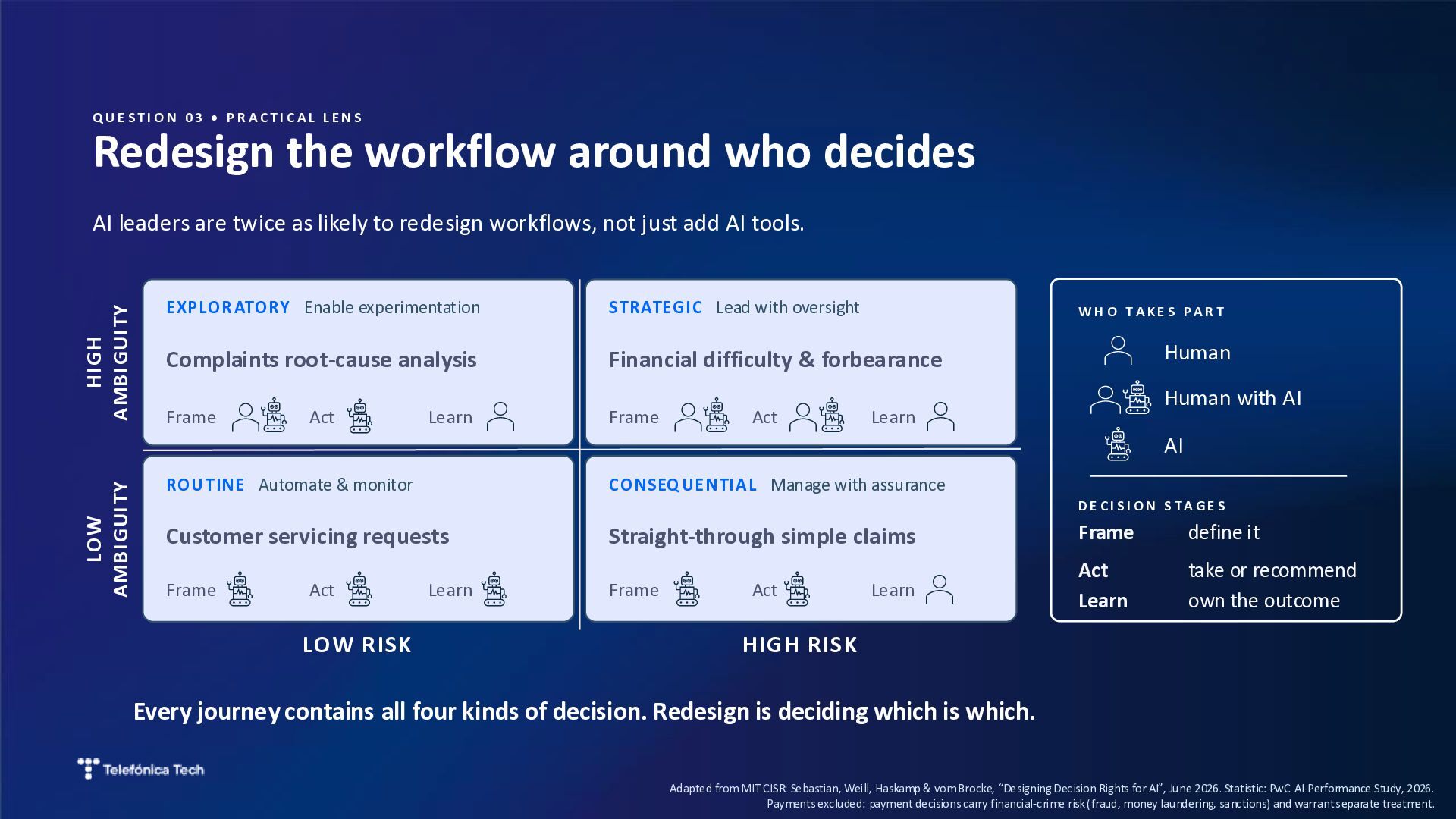
    ACT I CAL L EN S Redesign the workflow around who decides HIGH AMBI GUI TY AI leaders are twice as likely to redesign workflows, not just add AI tools. EXPLOR ATORY Enable experimentation STRATEG I C Lead with oversight Complaints root-cause analysis Financial difficulty & forbearance Frame Frame Act Learn Act WH O T AKE S PAR T Human Human with AI Learn LOW AMBI GUI TY AI ROUT INE Automate & monitor CONSEQ UENTI AL Manage with assurance DE C I SI O N S TA GE S Customer servicing requests Straight-through simple claims Frame define it Frame Frame Act Learn take or recommend own the outcome Act LOW R ISK Learn Act Learn HIGH RISK Every journey contains all four kinds of decision. Redesign is deciding which is which. Adapted from MIT CISR: Sebastian, Weill, Haskamp & vom Brocke, “Designing Decision Rights for AI”, June 2026. Statistic: PwC AI Performance Study, 2026. Payments excluded: payment decisions carry financial-crime risk (fraud, money laundering, sanctions) and warrant separate treatment.
  51. B ON U S • T H E C FO

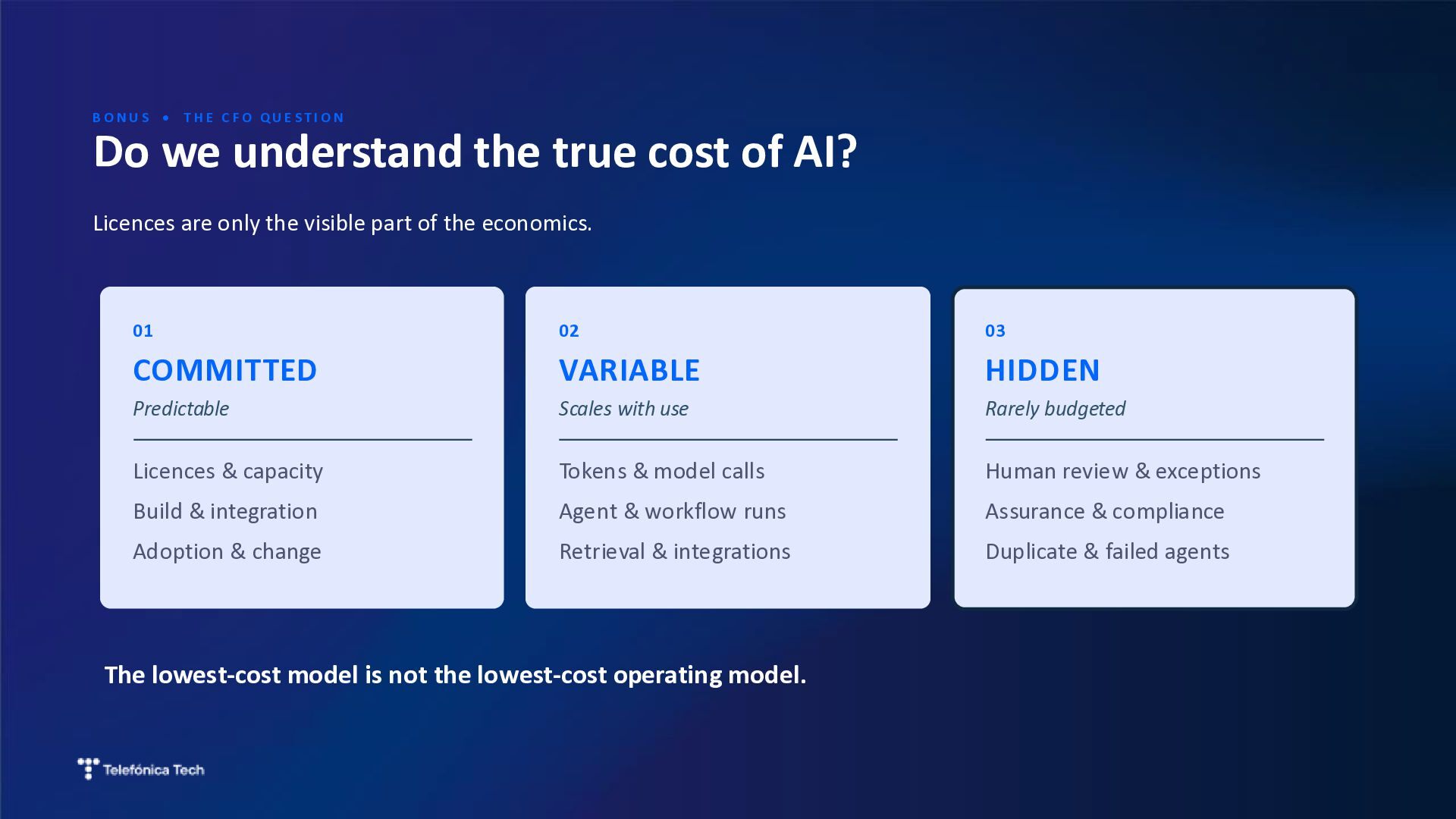
    QU E ST I ON Do we understand the true cost of AI? Licences are only the visible part of the economics. 01 02 03 COMMITTED VARIABLE HIDDEN Predictable Scales with use Rarely budgeted Licences & capacity Tokens & model calls Human review & exceptions Build & integration Agent & workflow runs Assurance & compliance Adoption & change Retrieval & integrations Duplicate & failed agents The lowest-cost model is not the lowest-cost operating model.
  52. B ON U S • T H E C FO

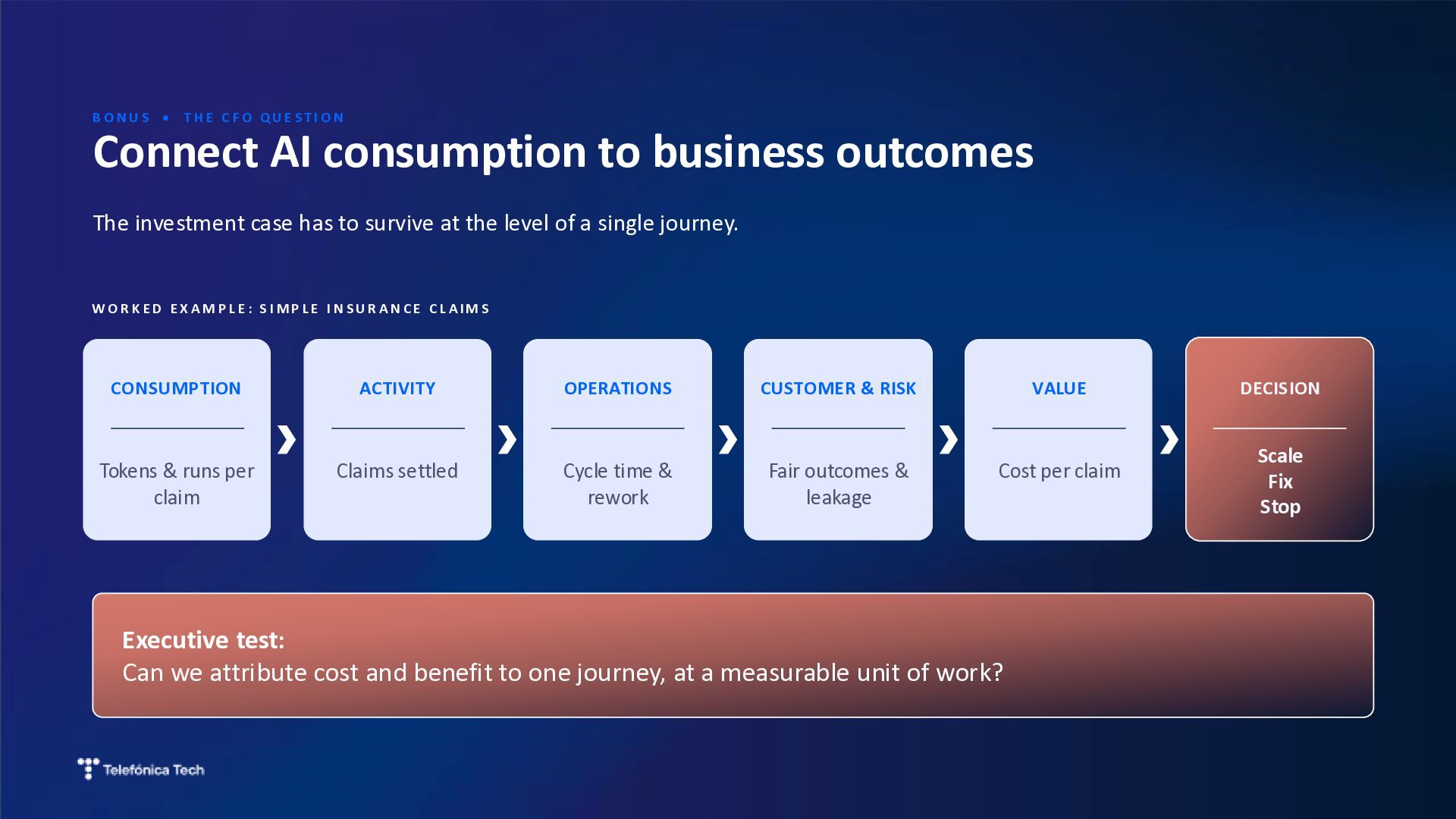
    QU E ST I ON Connect AI consumption to business outcomes The investment case has to survive at the level of a single journey. W O R K ED EX A M P L E : S I MP LE I N SU R A N C E C L A IM S CONSUMPTION ACTIVITY OPERATIONS CUSTOMER & RISK VALUE Tokens & runs per claim Claims settled Cycle time & rework Fair outcomes & leakage Cost per claim Executive test: Can we attribute cost and benefit to one journey, at a measurable unit of work? DECISION Scale Fix Stop
  53. B ON U S • T H E C FO

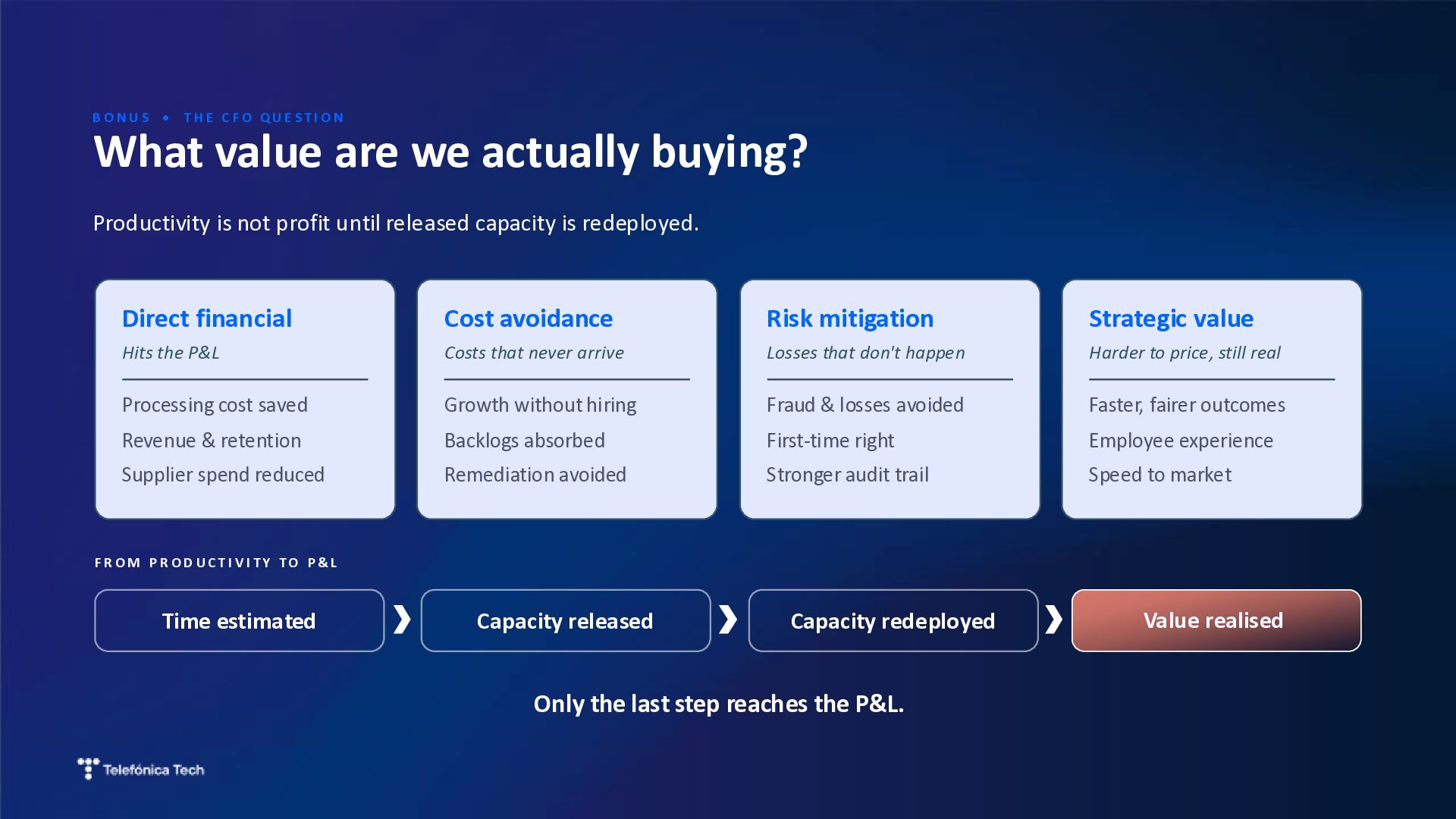
    QU E ST I ON What value are we actually buying? Productivity is not profit until released capacity is redeployed. Direct financial Cost avoidance Risk mitigation Strategic value Hits the P&L Costs that never arrive Losses that don't happen Harder to price, still real Processing cost saved Growth without hiring Fraud & losses avoided Faster, fairer outcomes Revenue & retention Backlogs absorbed First-time right Employee experience Supplier spend reduced Remediation avoided Stronger audit trail Speed to market F R O M P R O D UC T I V I TY TO P &L Time estimated Capacity released Capacity redeployed Only the last step reaches the P&L. Value realised
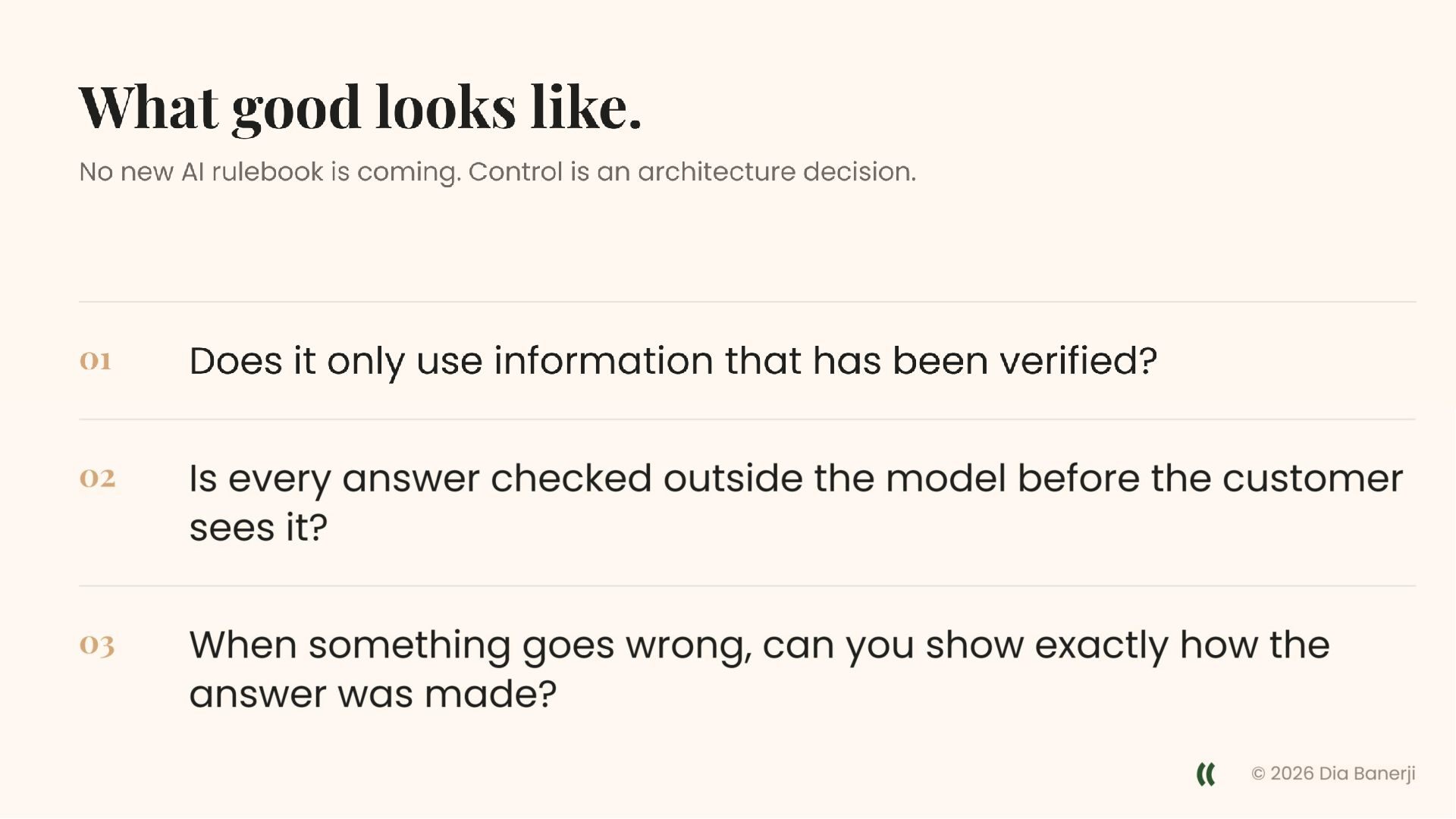
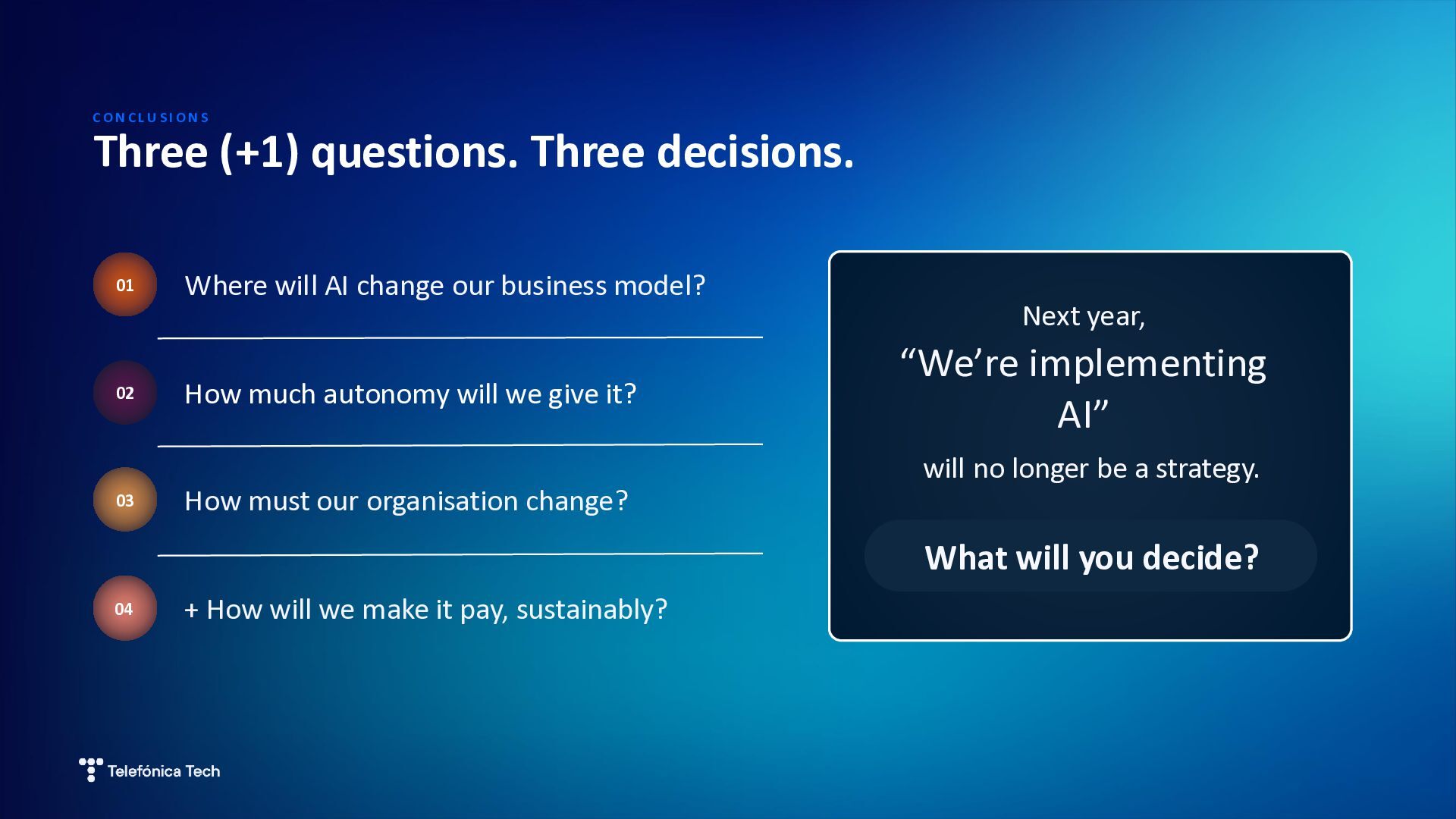
  54. CON CL U SI ON S Three (+1) questions. Three

    decisions. 01 02 03 Where will AI change our business model? How much autonomy will we give it? How must our organisation change? Next year, “We’re implementing AI” will no longer be a strategy. What will you decide? 04 + How will we make it pay, sustainably?
  55. 22 OCT 2026 | CARDIFF 19 NOV 2026 | EDINBURGH

    22 FEB 2027 | EDINBUGH 1 APRIL 2027 | EDINBURGH 29th APRIL 2027 | EDINBURGH 3rd JUNE 2027 | EDINBURGH
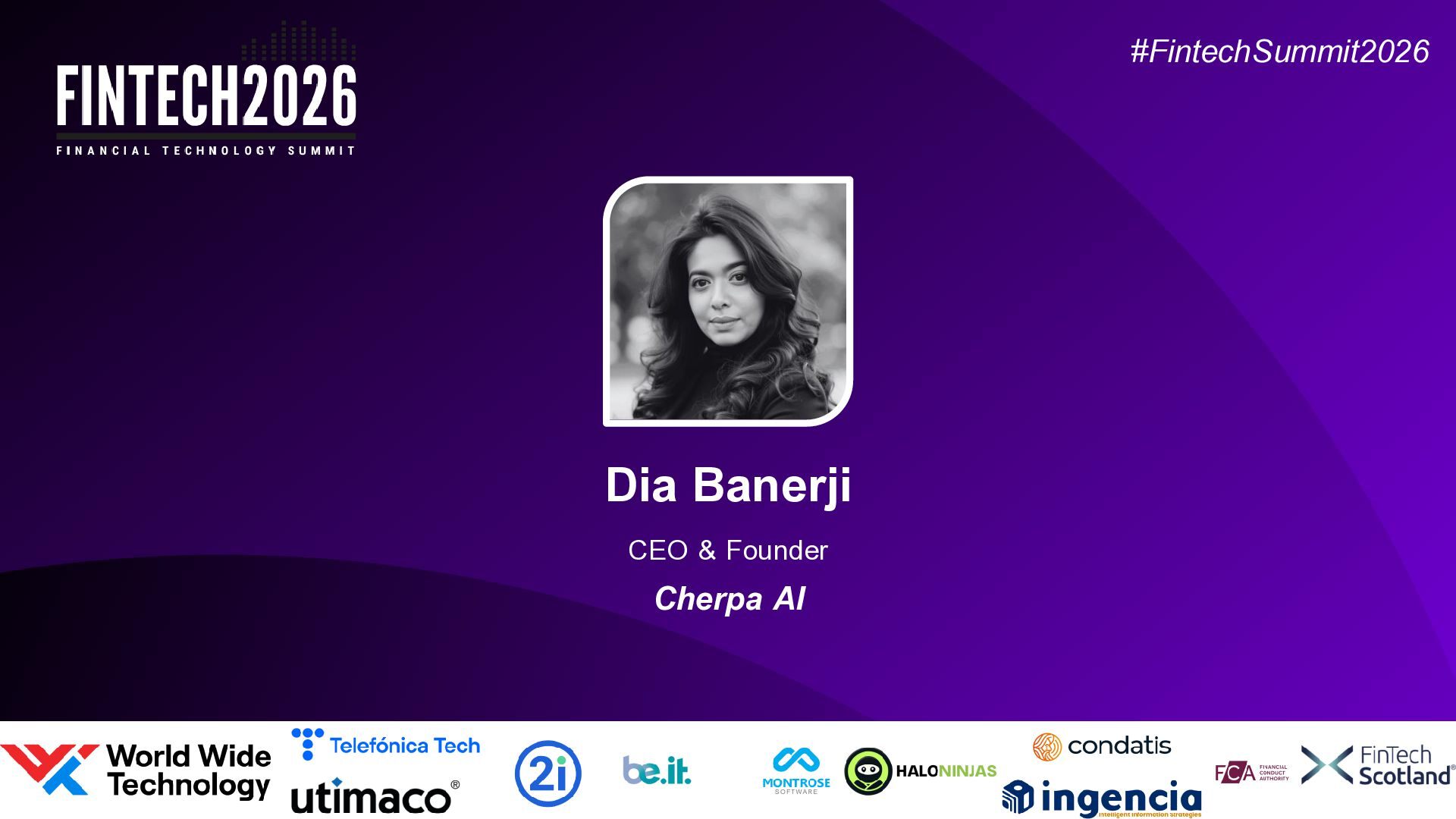
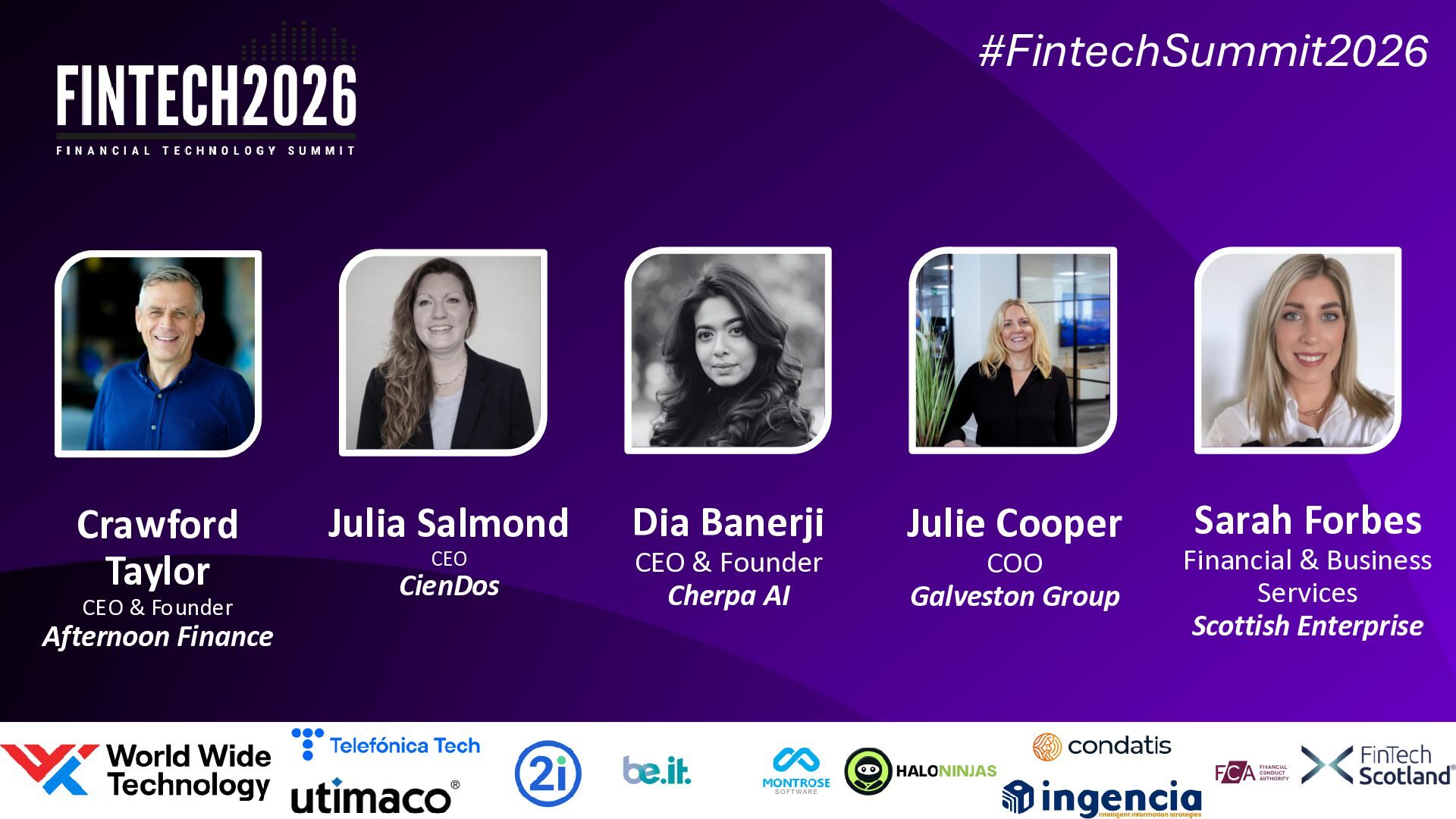
  56. #FintechSummit2026 Crawford Taylor CEO & Founder Afternoon Finance Julia Salmond

    CEO CienDos Dia Banerji CEO & Founder Cherpa AI Julie Cooper COO Galveston Group Sarah Forbes Financial & Business Services Scottish Enterprise
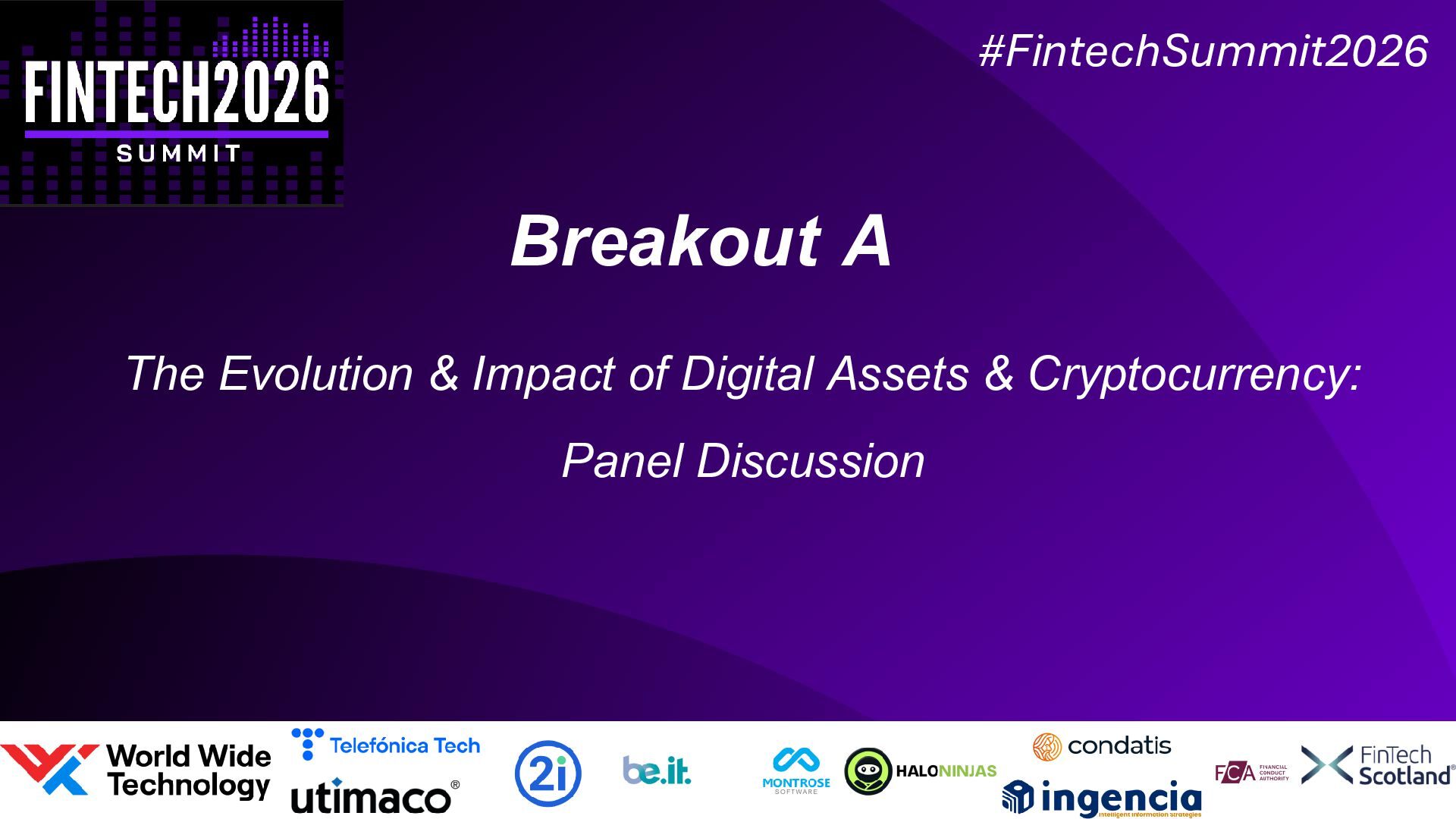
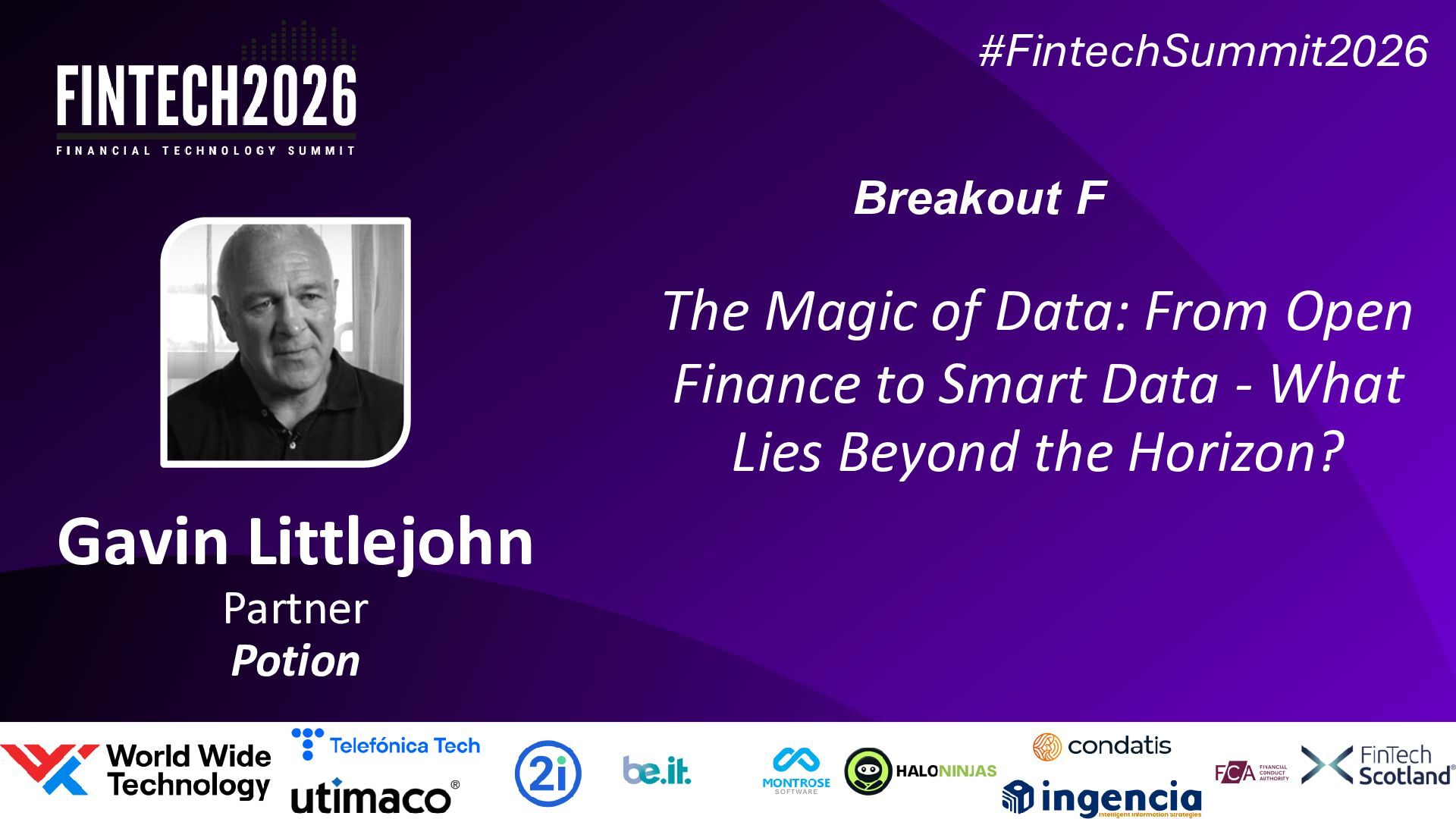
  57. #FintechSummit2026 Breakout F The Magic of Data: From Open Finance

    to Smart Data - What Lies Beyond the Horizon? Gavin Littlejohn Partner Potion