Upgrade to Pro — share decks privately, control downloads, hide ads and more …

Small World and Decentralized Algorithms

Sponsored · Your Podcast. Everywhere. Effortlessly. Share. Educate. Inspire. Entertain. You do you. We'll handle the rest. →
Avatar for reachnomind reachnomind
September 06, 2012

Small World and Decentralized Algorithms

A class presentation for papers

S. Milgram J. Travers. \An Experimental Study of the Small World Problem". In: Sociometry 32 (1969), p. 425
keywords: network, social

J. Kleinberg. \The Small-World Phenomenon: An Algorithmic Perspective". In: Proceedings of the 32nd ACM Symposium on Theory of Computing (2000), pp. 163{170
keywords: network, decentralized algorithm, lower/upper bounds

Avatar for reachnomind

reachnomind

September 06, 2012

Other Decks in Education

Transcript

  1. Small World and Decentralized Algorithms A class presentation for S.

    Milgram J. Travers. “An Experimental Study of the Small World Problem”. In: Sociometry 32 (1969), p. 425 keywords: network, social J. Kleinberg. “The Small-World Phenomenon: An Algorithmic Perspective”. In: Proceedings of the 32nd ACM Symposium on Theory of Computing (2000), pp. 163–170 keywords: network, decentralized algorithm, lower/upper bounds Anirban Mitra Department of Computer Science Stony Brook University 6 September, 2012
  2. Milgram’s Experiment letters to be delievered from a source s

    to a target t starting with a few, a sender could have only sent it to one whom he knew by first name each sender had some basic information about t such as address, occupation each successful chain was found to have 5–6 hops on an average the birth of six degree of separation
  3. Findings short chain of acquaintances connecting random people people were

    able to find short paths using only local information
  4. Algorithmic Perspective small world graphs have very short diameter and

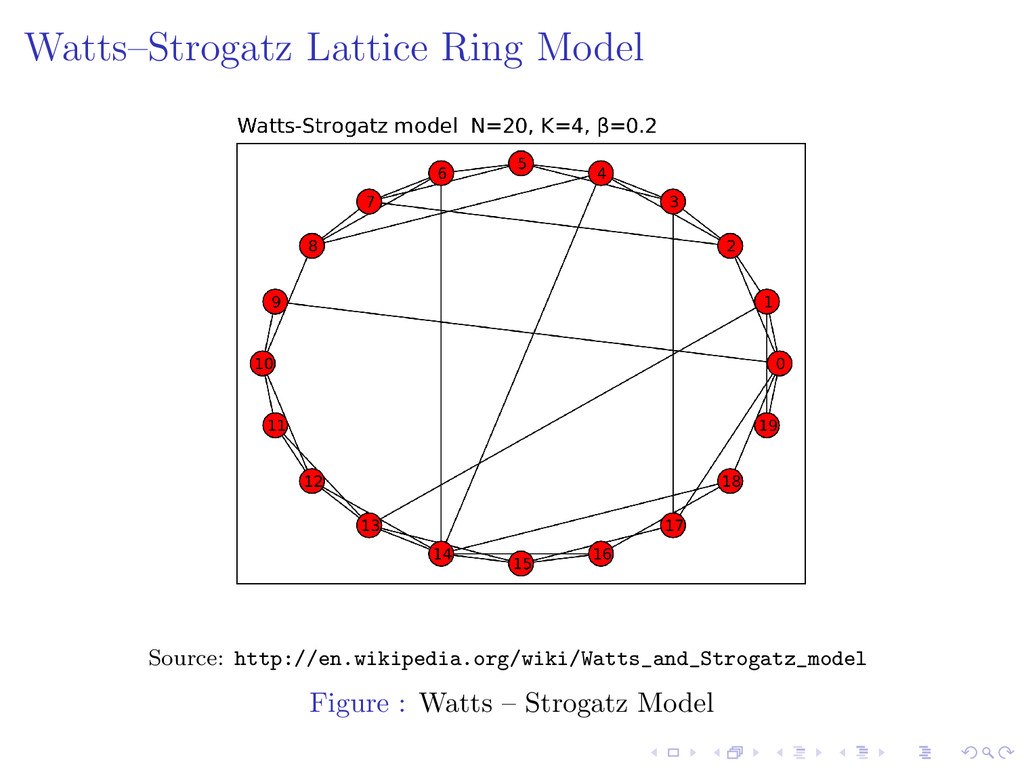
    high clustering coefficient random graphs have short diameter but very low clustering coefficient [5] a different model is than random graph required to study the small world phenomenon Watts–Strogatz proposed models with these properties where a uniform graph is superimposed with sparse random graph [1]
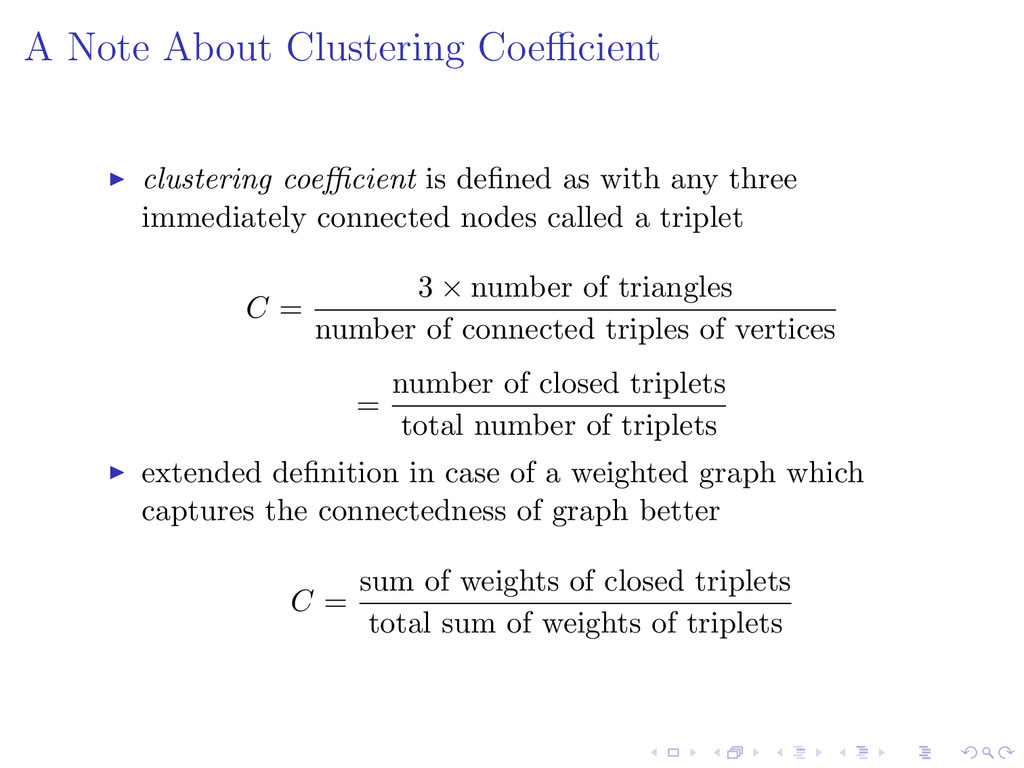
  5. A Note About Clustering Coefficient clustering coefficient is defined as

    with any three immediately connected nodes called a triplet C = 3 × number of triangles number of connected triples of vertices = number of closed triplets total number of triplets extended definition in case of a weighted graph which captures the connectedness of graph better C = sum of weights of closed triplets total sum of weights of triplets
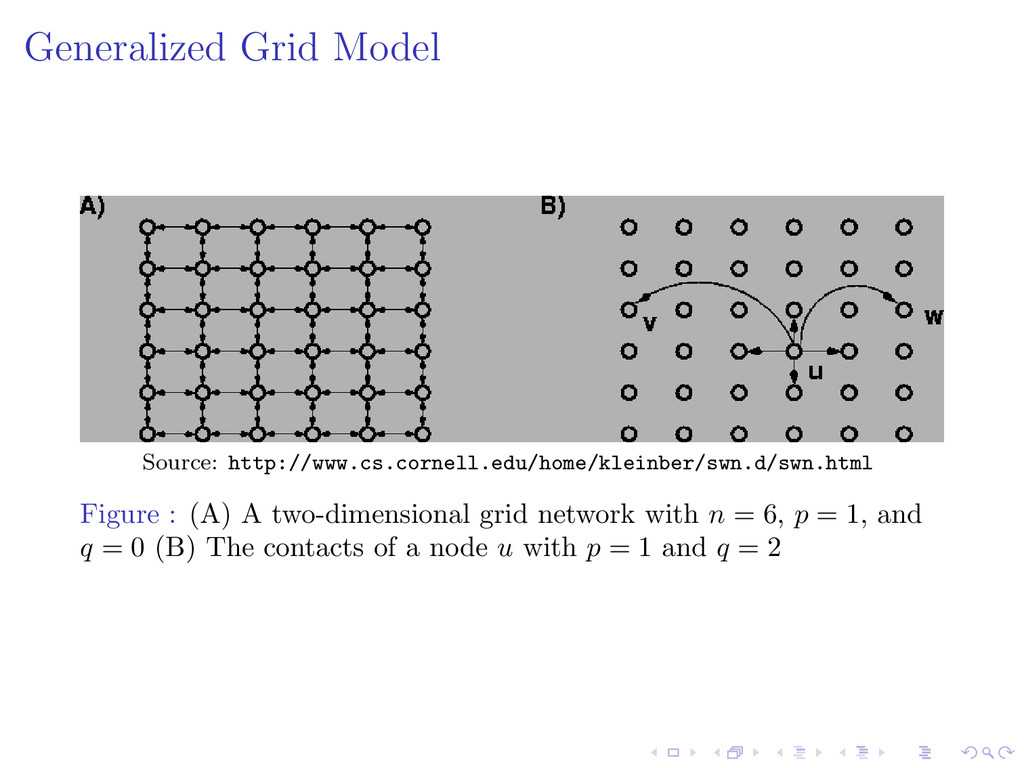
  6. Generalized Grid Model Source: http://www.cs.cornell.edu/home/kleinber/swn.d/swn.html Figure : (A) A two-dimensional

    grid network with n = 6, p = 1, and q = 0 (B) The contacts of a node u with p = 1 and q = 2
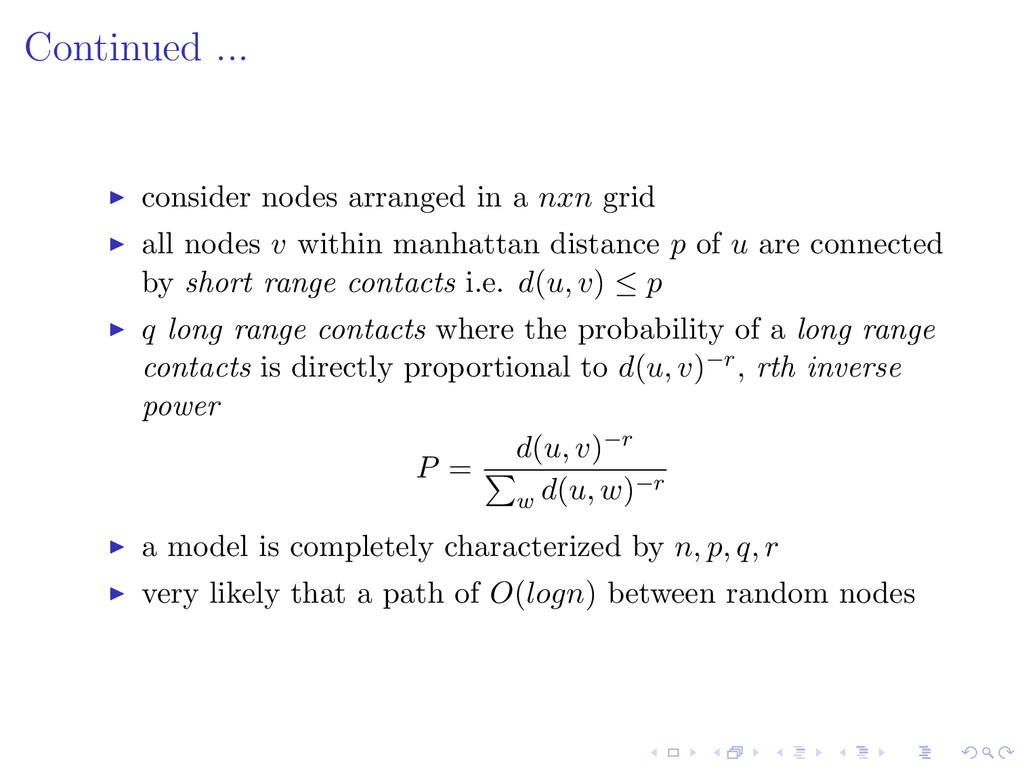
  7. Continued ... consider nodes arranged in a nxn grid all

    nodes v within manhattan distance p of u are connected by short range contacts i.e. d(u, v) ≤ p q long range contacts where the probability of a long range contacts is directly proportional to d(u, v)−r, rth inverse power P = d(u, v)−r w d(u, w)−r a model is completely characterized by n, p, q, r very likely that a path of O(logn) between random nodes
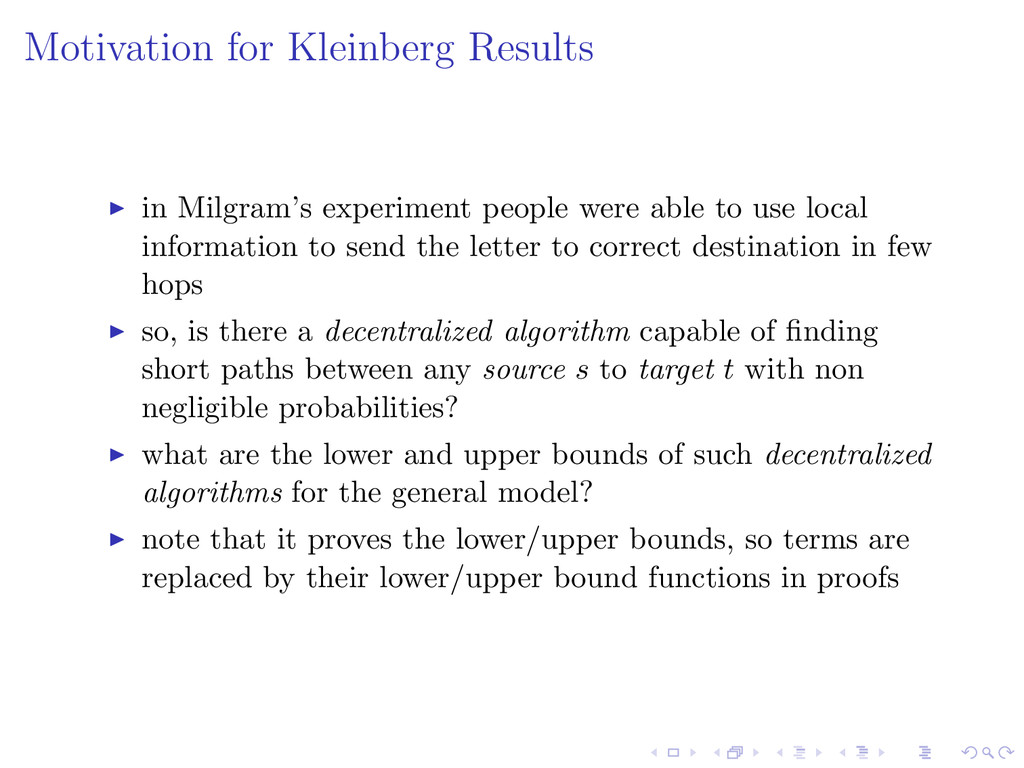
  8. Motivation for Kleinberg Results in Milgram’s experiment people were able

    to use local information to send the letter to correct destination in few hops so, is there a decentralized algorithm capable of finding short paths between any source s to target t with non negligible probabilities? what are the lower and upper bounds of such decentralized algorithms for the general model? note that it proves the lower/upper bounds, so terms are replaced by their lower/upper bound functions in proofs
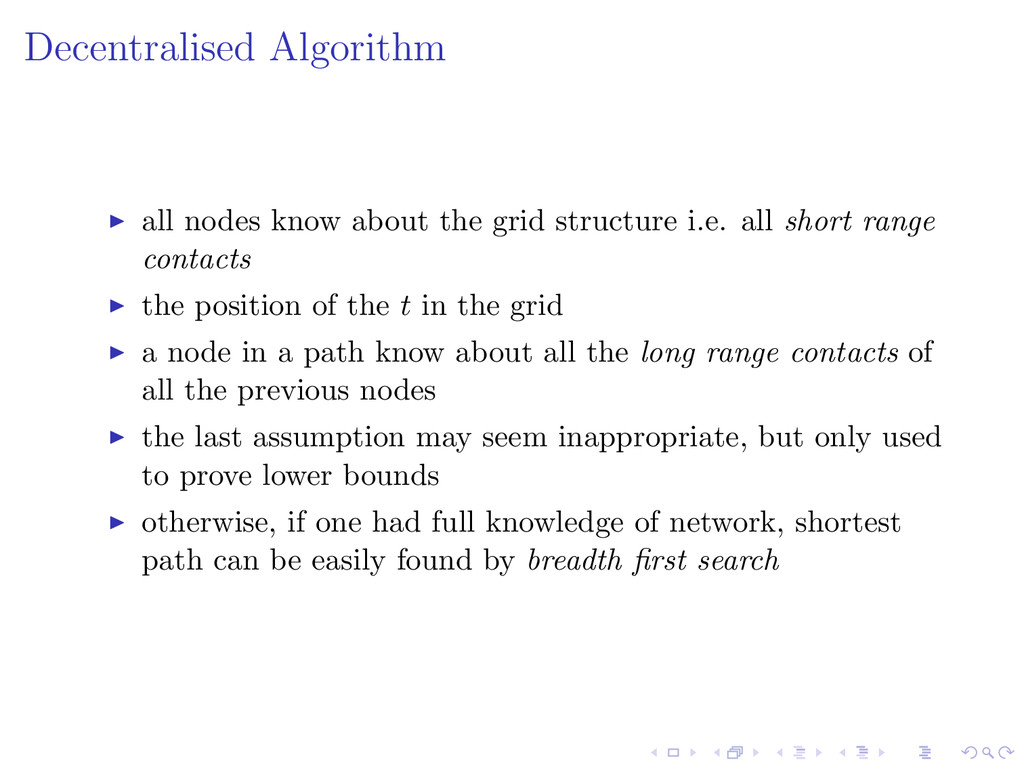
  9. Decentralised Algorithm all nodes know about the grid structure i.e.

    all short range contacts the position of the t in the grid a node in a path know about all the long range contacts of all the previous nodes the last assumption may seem inappropriate, but only used to prove lower bounds otherwise, if one had full knowledge of network, shortest path can be easily found by breadth first search
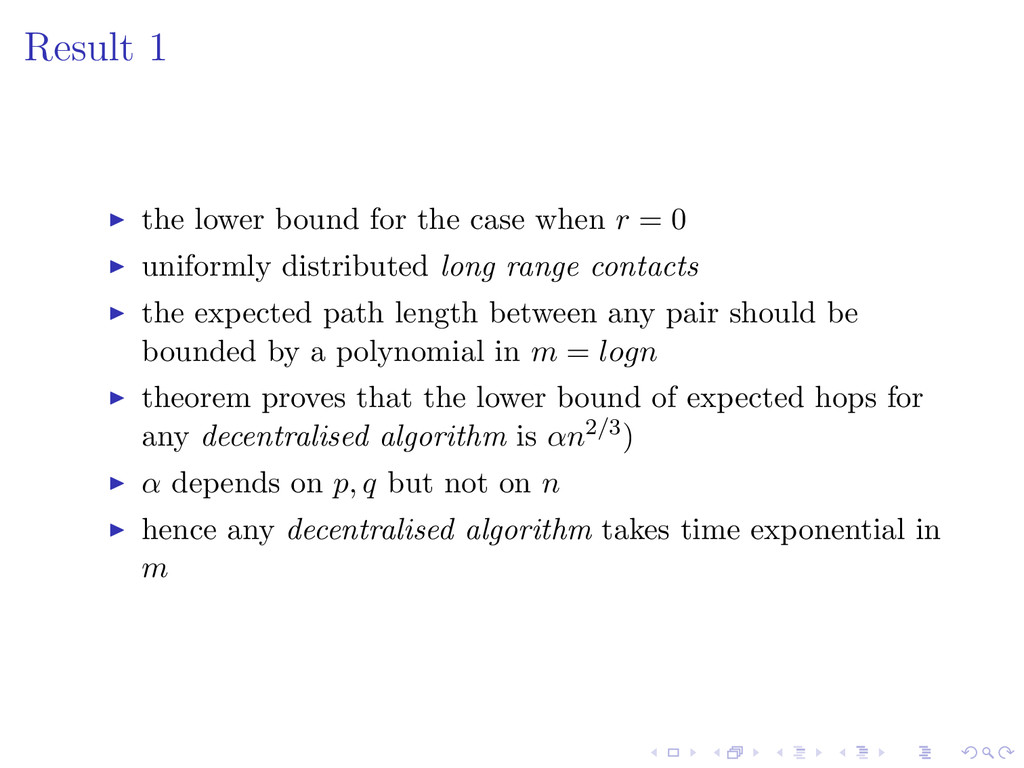
  10. Result 1 the lower bound for the case when r

    = 0 uniformly distributed long range contacts the expected path length between any pair should be bounded by a polynomial in m = logn theorem proves that the lower bound of expected hops for any decentralised algorithm is αn2/3) α depends on p, q but not on n hence any decentralised algorithm takes time exponential in m
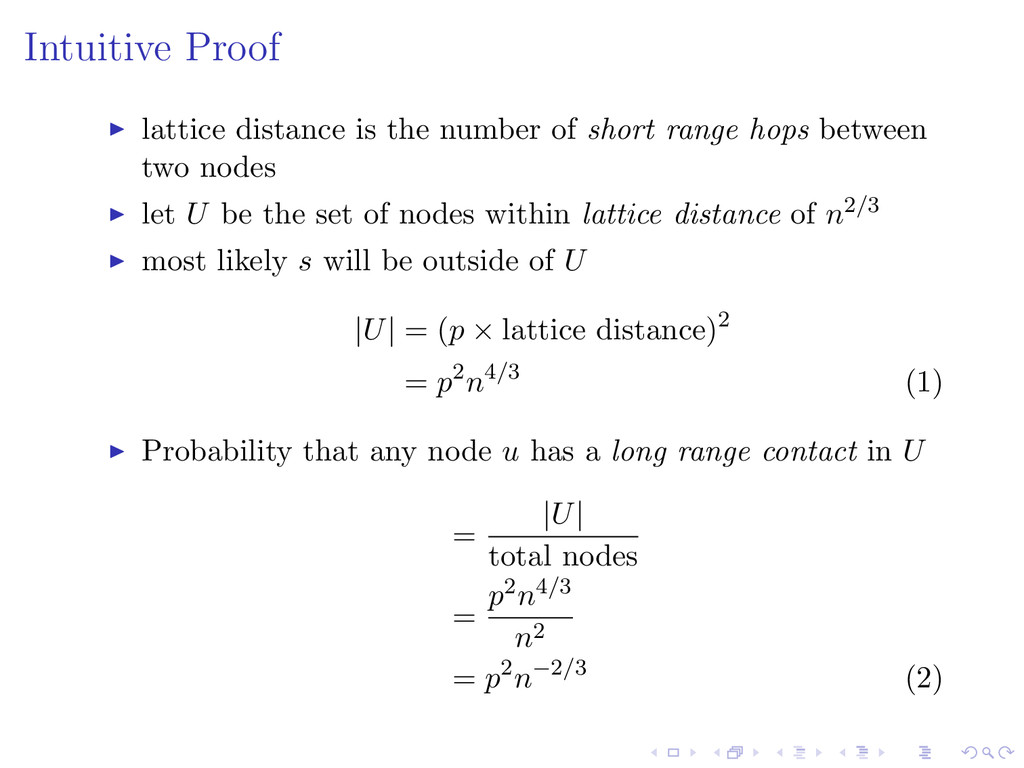
  11. Intuitive Proof lattice distance is the number of short range

    hops between two nodes let U be the set of nodes within lattice distance of n2/3 most likely s will be outside of U |U| = (p × lattice distance)2 = p2n4/3 (1) Probability that any node u has a long range contact in U = |U| total nodes = p2n4/3 n2 = p2n−2/3 (2)
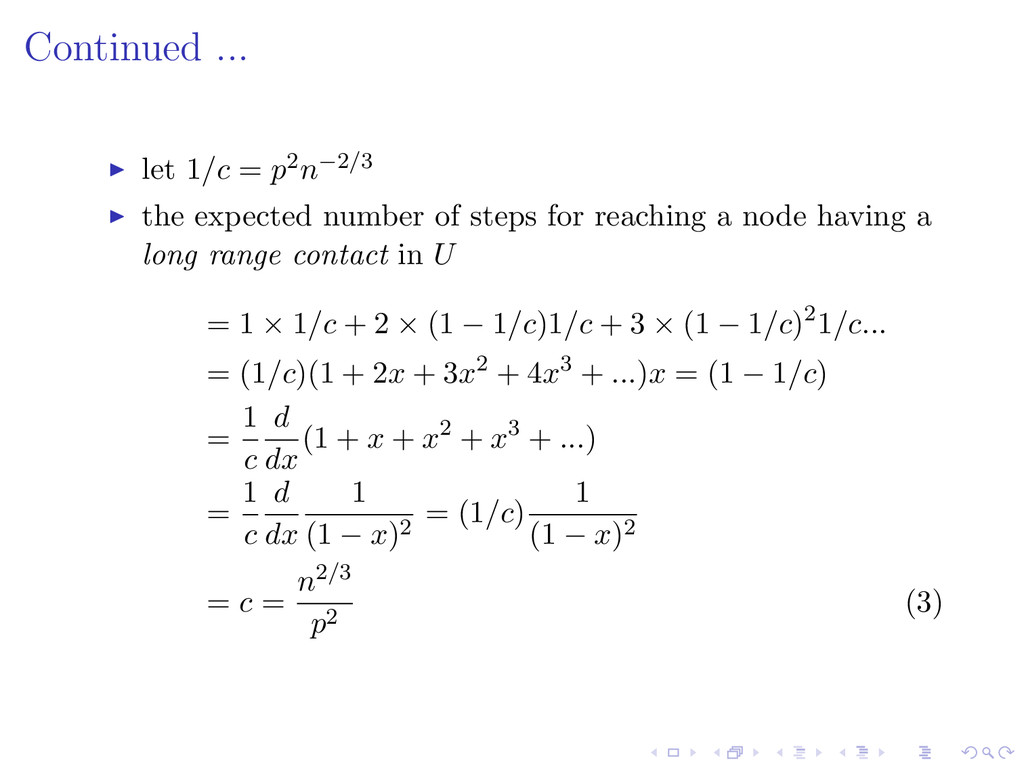
  12. Continued ... let 1/c = p2n−2/3 the expected number of

    steps for reaching a node having a long range contact in U = 1 × 1/c + 2 × (1 − 1/c)1/c + 3 × (1 − 1/c)21/c... = (1/c)(1 + 2x + 3x2 + 4x3 + ...)x = (1 − 1/c) = 1 c d dx (1 + x + x2 + x3 + ...) = 1 c d dx 1 (1 − x)2 = (1/c) 1 (1 − x)2 = c = n2/3 p2 (3)
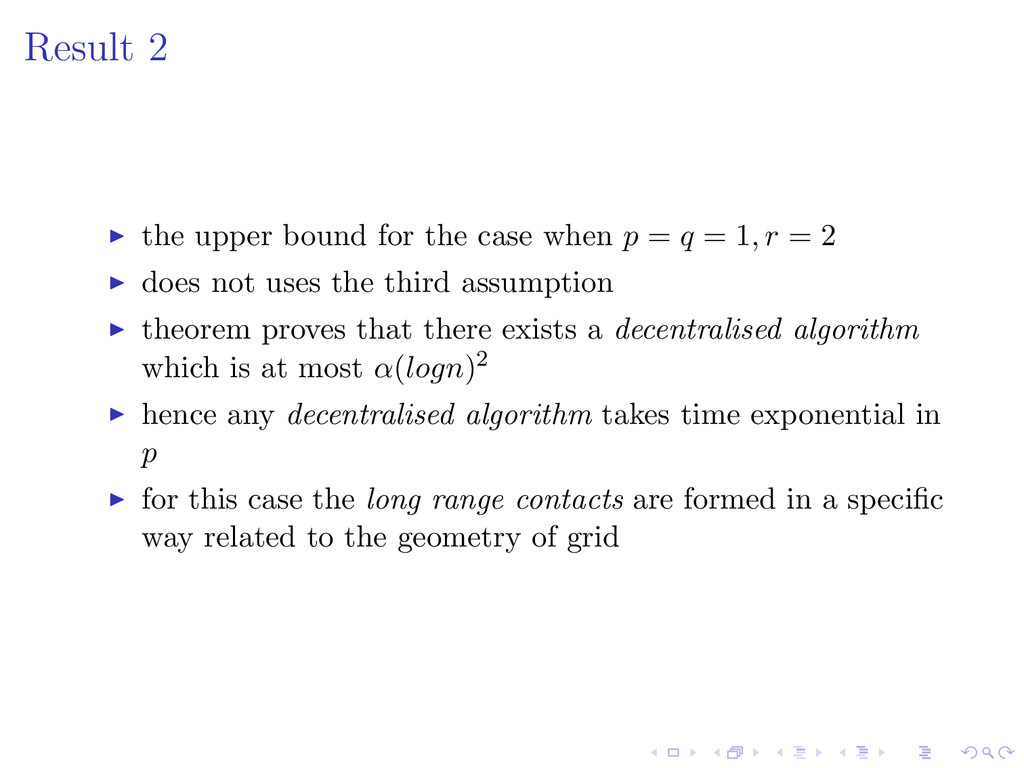
  13. Result 2 the upper bound for the case when p

    = q = 1, r = 2 does not uses the third assumption theorem proves that there exists a decentralised algorithm which is at most α(logn)2 hence any decentralised algorithm takes time exponential in p for this case the long range contacts are formed in a specific way related to the geometry of grid
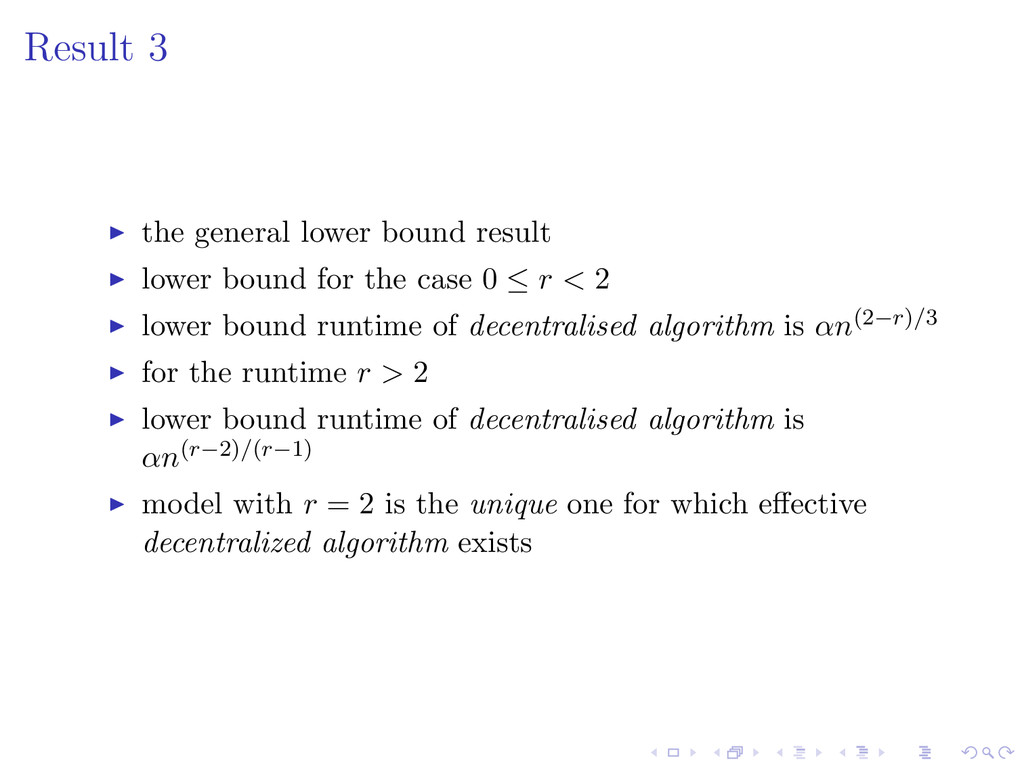
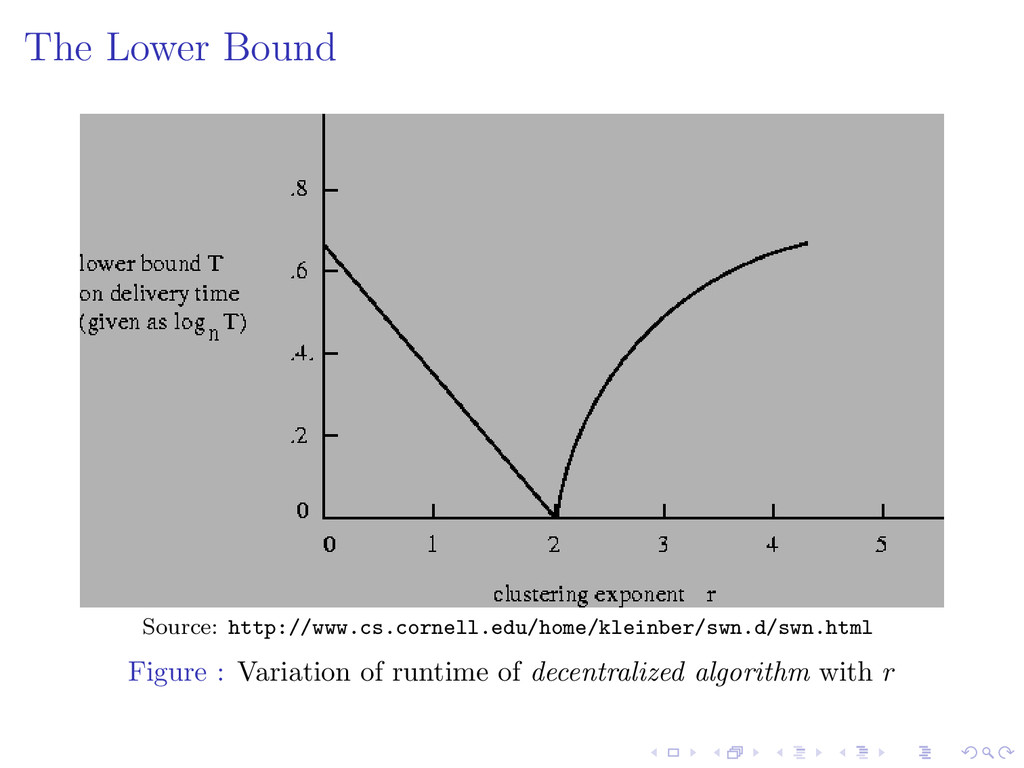
  14. Result 3 the general lower bound result lower bound for

    the case 0 ≤ r < 2 lower bound runtime of decentralised algorithm is αn(2−r)/3 for the runtime r > 2 lower bound runtime of decentralised algorithm is αn(r−2)/(r−1) model with r = 2 is the unique one for which effective decentralized algorithm exists
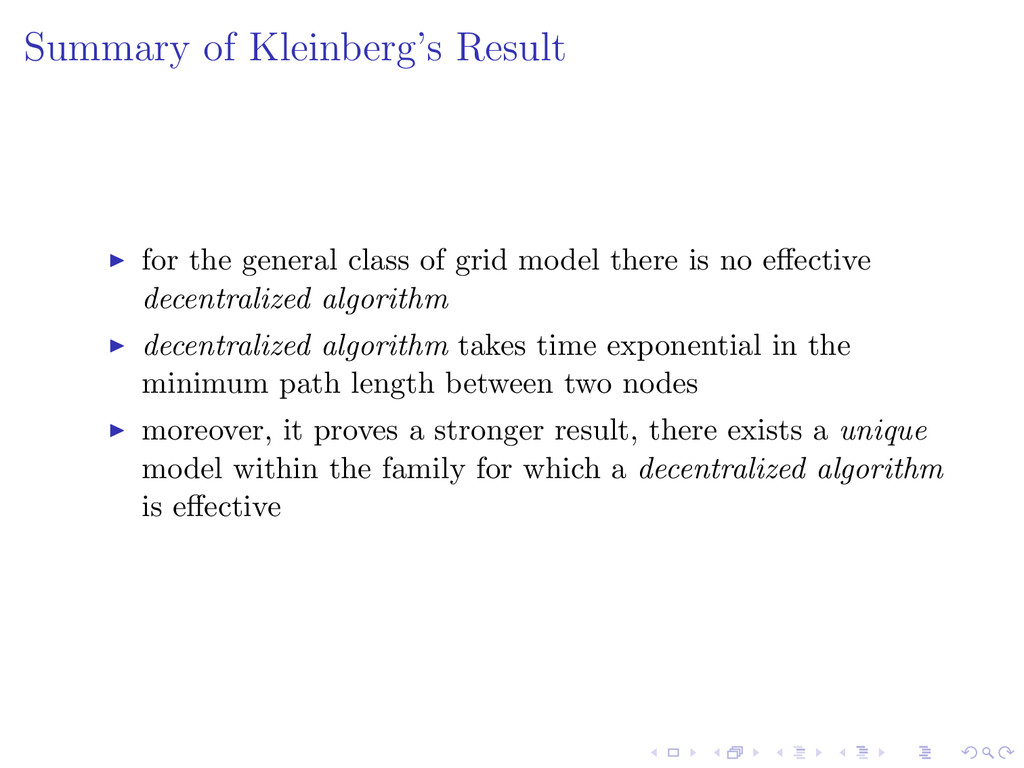
  15. Summary of Kleinberg’s Result for the general class of grid

    model there is no effective decentralized algorithm decentralized algorithm takes time exponential in the minimum path length between two nodes moreover, it proves a stronger result, there exists a unique model within the family for which a decentralized algorithm is effective
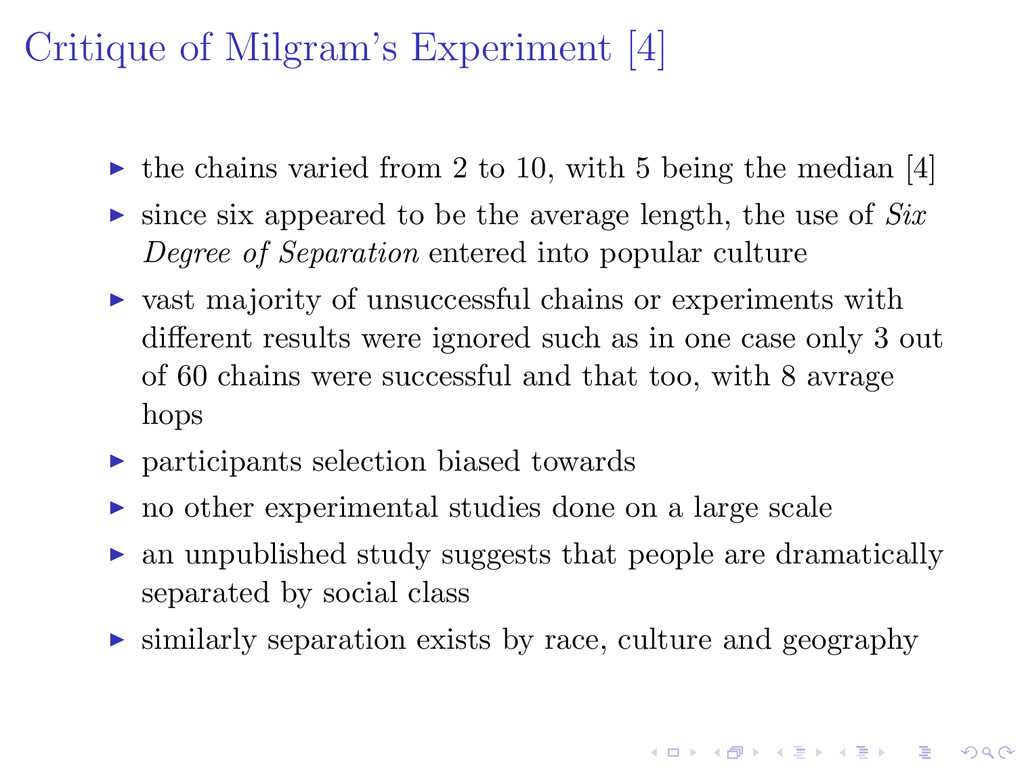
  16. Critique of Milgram’s Experiment [4] the chains varied from 2

    to 10, with 5 being the median [4] since six appeared to be the average length, the use of Six Degree of Separation entered into popular culture vast majority of unsuccessful chains or experiments with different results were ignored such as in one case only 3 out of 60 chains were successful and that too, with 8 avrage hops participants selection biased towards no other experimental studies done on a large scale an unpublished study suggests that people are dramatically separated by social class similarly separation exists by race, culture and geography
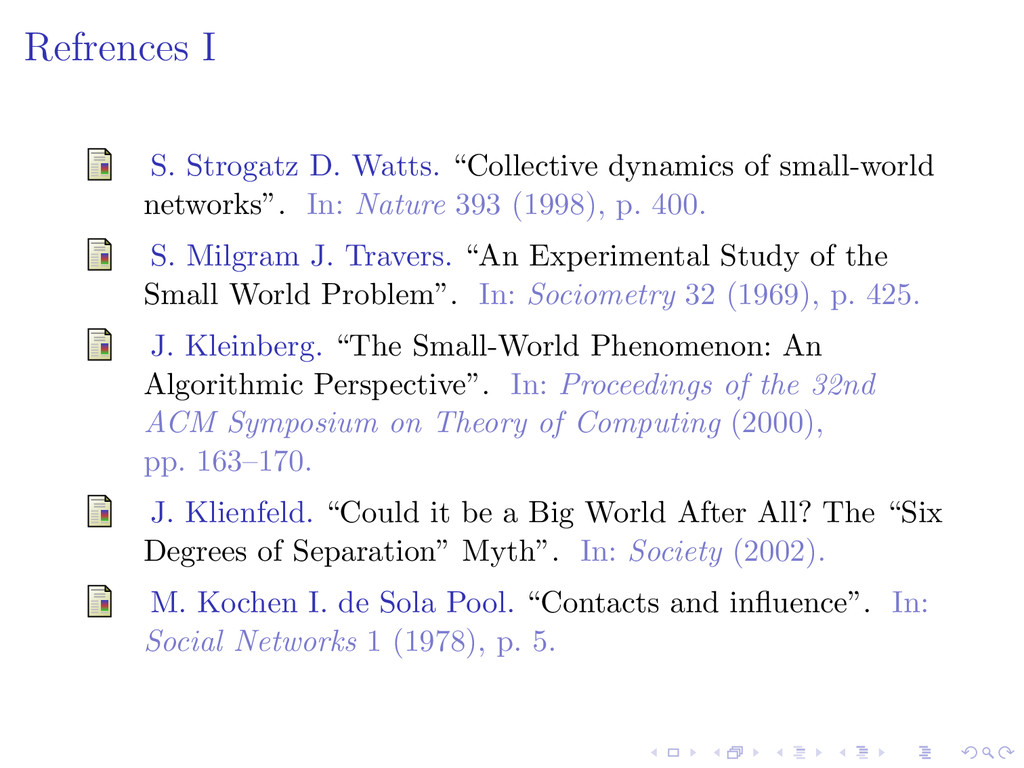
  17. Refrences I S. Strogatz D. Watts. “Collective dynamics of small-world

    networks”. In: Nature 393 (1998), p. 400. S. Milgram J. Travers. “An Experimental Study of the Small World Problem”. In: Sociometry 32 (1969), p. 425. J. Kleinberg. “The Small-World Phenomenon: An Algorithmic Perspective”. In: Proceedings of the 32nd ACM Symposium on Theory of Computing (2000), pp. 163–170. J. Klienfeld. “Could it be a Big World After All? The “Six Degrees of Separation” Myth”. In: Society (2002). M. Kochen I. de Sola Pool. “Contacts and influence”. In: Social Networks 1 (1978), p. 5.