Upgrade to Pro — share decks privately, control downloads, hide ads and more …

Devops training

Avatar for Rinki Rinki
June 12, 2026

Devops training

DevOps Training has become one of the most valuable technology courses today. Organizations need faster software delivery and better system management. DevOps helps companies improve collaboration between development and operations teams.
Modern businesses rely on digital applications for daily operations. They require skilled professionals who can automate processes, manage infrastructure, and ensure smooth software deployment. A professional DevOps Training program helps learners gain these skills.

Avatar for Rinki

Rinki

June 12, 2026

Other Decks in Education

Transcript

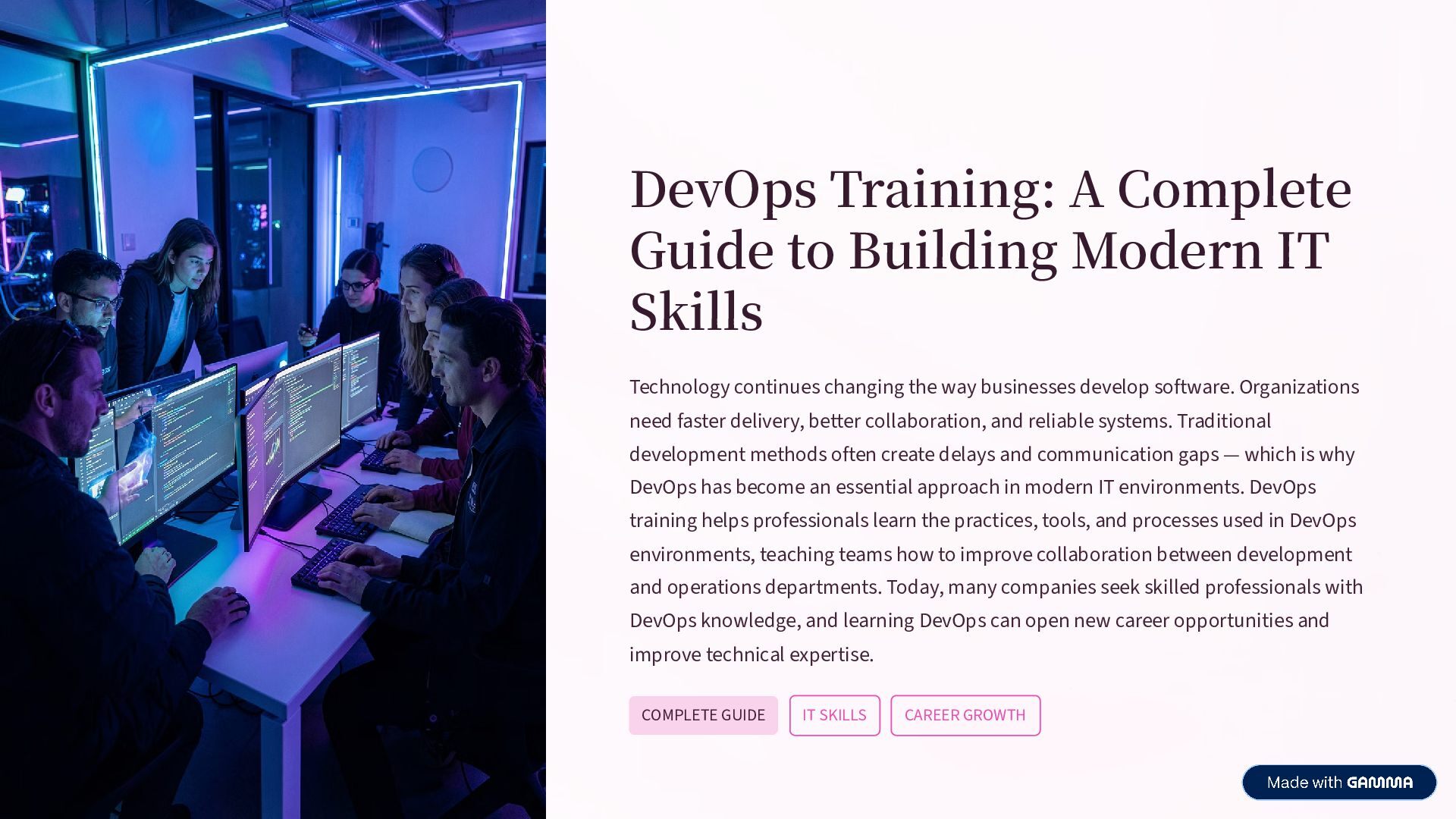
  1. DevOps Training: A Complete Guide to Building Modern IT Skills

    Technology continues changing the way businesses develop software. Organizations need faster delivery, better collaboration, and reliable systems. Traditional development methods often create delays and communication gaps — which is why DevOps has become an essential approach in modern IT environments. DevOps training helps professionals learn the practices, tools, and processes used in DevOps environments, teaching teams how to improve collaboration between development and operations departments. Today, many companies seek skilled professionals with DevOps knowledge, and learning DevOps can open new career opportunities and improve technical expertise. COMPLETE GUIDE IT SKILLS CAREER GROWTH
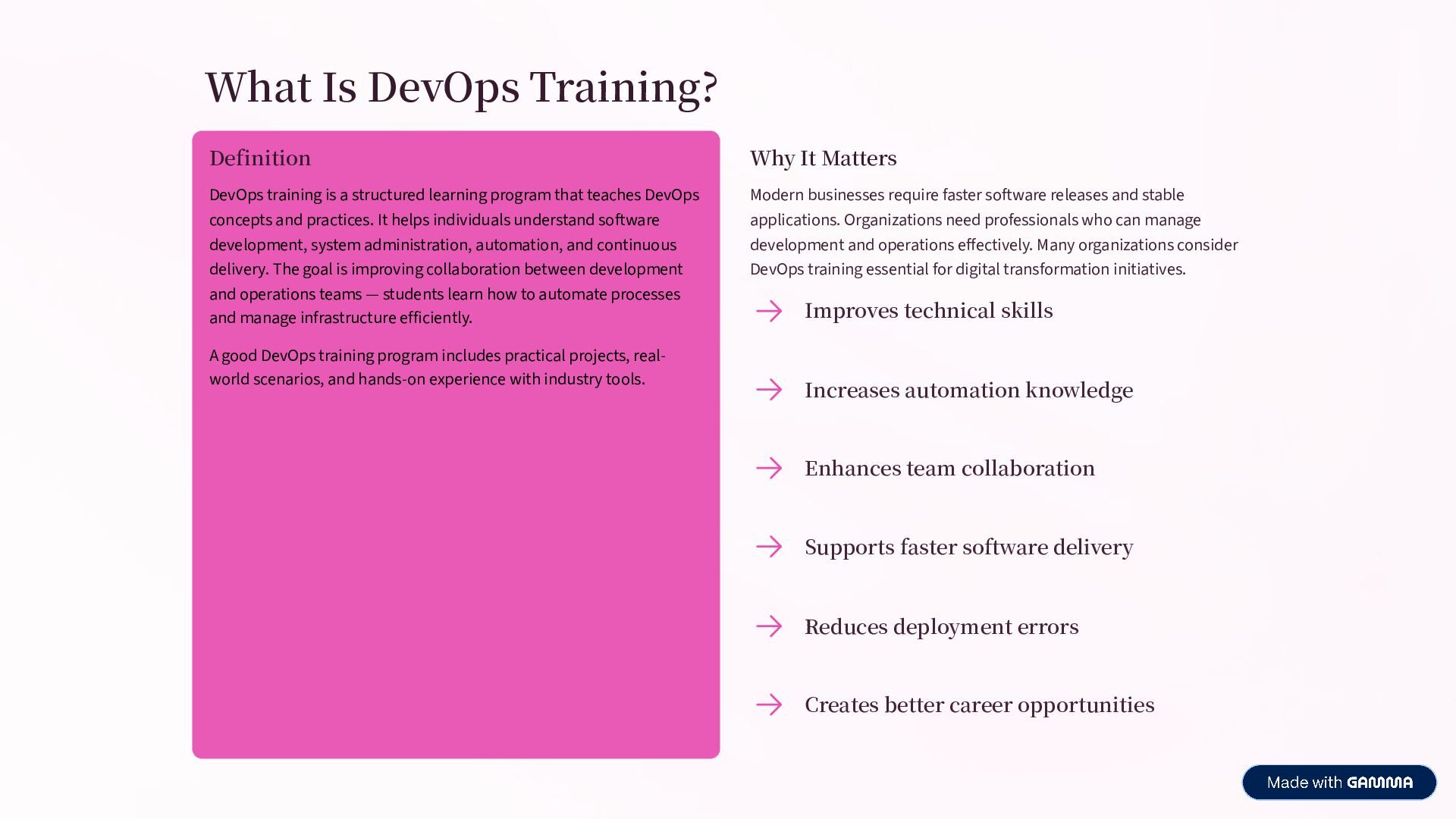
  2. What Is DevOps Training? Definition DevOps training is a structured

    learning program that teaches DevOps concepts and practices. It helps individuals understand software development, system administration, automation, and continuous delivery. The goal is improving collaboration between development and operations teams — students learn how to automate processes and manage infrastructure efficiently. A good DevOps training program includes practical projects, real- world scenarios, and hands-on experience with industry tools. Why It Matters Modern businesses require faster software releases and stable applications. Organizations need professionals who can manage development and operations effectively. Many organizations consider DevOps training essential for digital transformation initiatives. Improves technical skills Increases automation knowledge Enhances team collaboration Supports faster software delivery Reduces deployment errors Creates better career opportunities
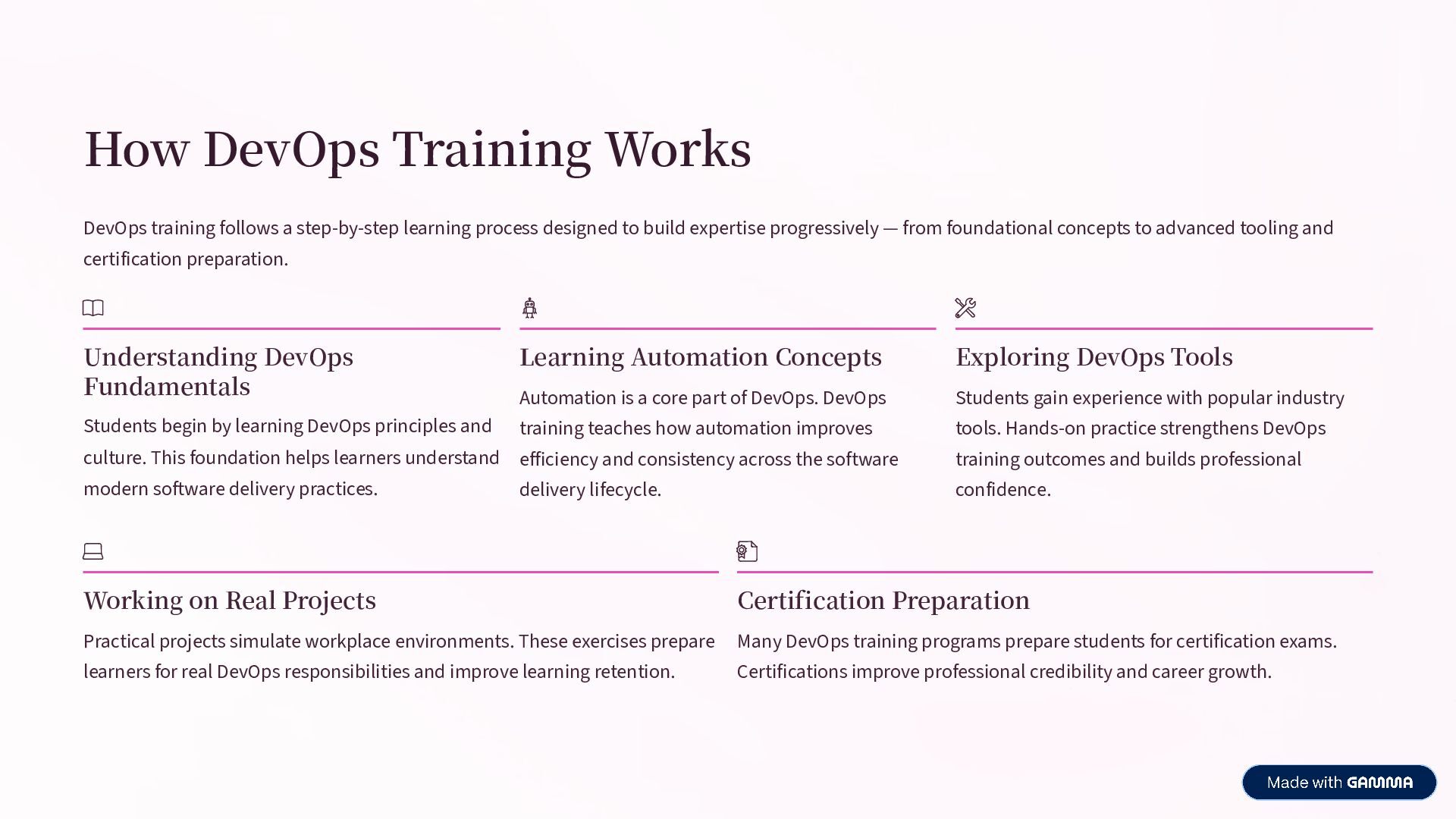
  3. How DevOps Training Works DevOps training follows a step-by-step learning

    process designed to build expertise progressively — from foundational concepts to advanced tooling and certification preparation. Understanding DevOps Fundamentals Students begin by learning DevOps principles and culture. This foundation helps learners understand modern software delivery practices. Learning Automation Concepts Automation is a core part of DevOps. DevOps training teaches how automation improves efficiency and consistency across the software delivery lifecycle. Exploring DevOps Tools Students gain experience with popular industry tools. Hands-on practice strengthens DevOps training outcomes and builds professional confidence. Working on Real Projects Practical projects simulate workplace environments. These exercises prepare learners for real DevOps responsibilities and improve learning retention. Certification Preparation Many DevOps training programs prepare students for certification exams. Certifications improve professional credibility and career growth.
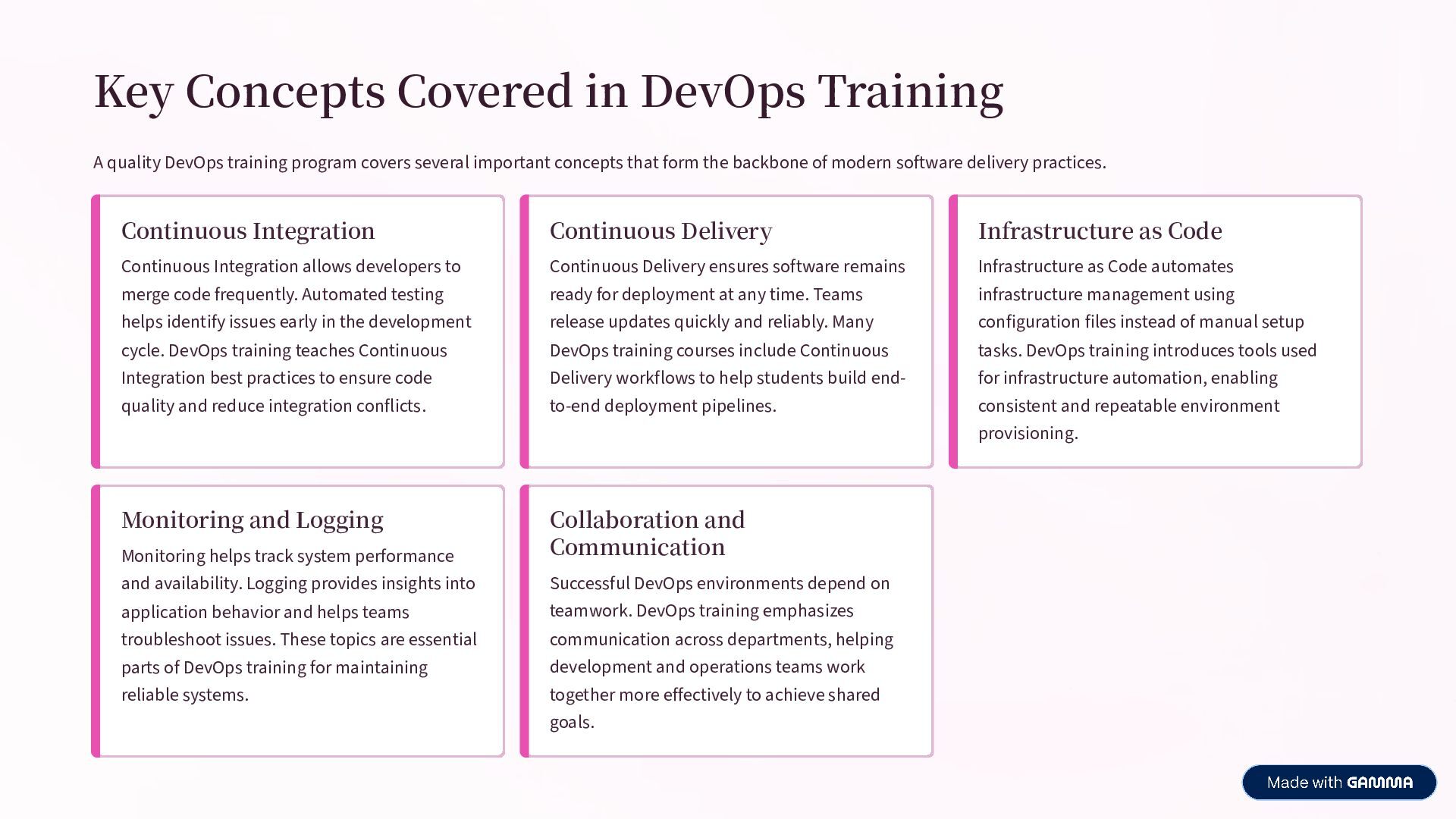
  4. Key Concepts Covered in DevOps Training A quality DevOps training

    program covers several important concepts that form the backbone of modern software delivery practices. Continuous Integration Continuous Integration allows developers to merge code frequently. Automated testing helps identify issues early in the development cycle. DevOps training teaches Continuous Integration best practices to ensure code quality and reduce integration conflicts. Continuous Delivery Continuous Delivery ensures software remains ready for deployment at any time. Teams release updates quickly and reliably. Many DevOps training courses include Continuous Delivery workflows to help students build end- to-end deployment pipelines. Infrastructure as Code Infrastructure as Code automates infrastructure management using configuration files instead of manual setup tasks. DevOps training introduces tools used for infrastructure automation, enabling consistent and repeatable environment provisioning. Monitoring and Logging Monitoring helps track system performance and availability. Logging provides insights into application behavior and helps teams troubleshoot issues. These topics are essential parts of DevOps training for maintaining reliable systems. Collaboration and Communication Successful DevOps environments depend on teamwork. DevOps training emphasizes communication across departments, helping development and operations teams work together more effectively to achieve shared goals.
  5. Benefits of DevOps Training DevOps training offers many advantages for

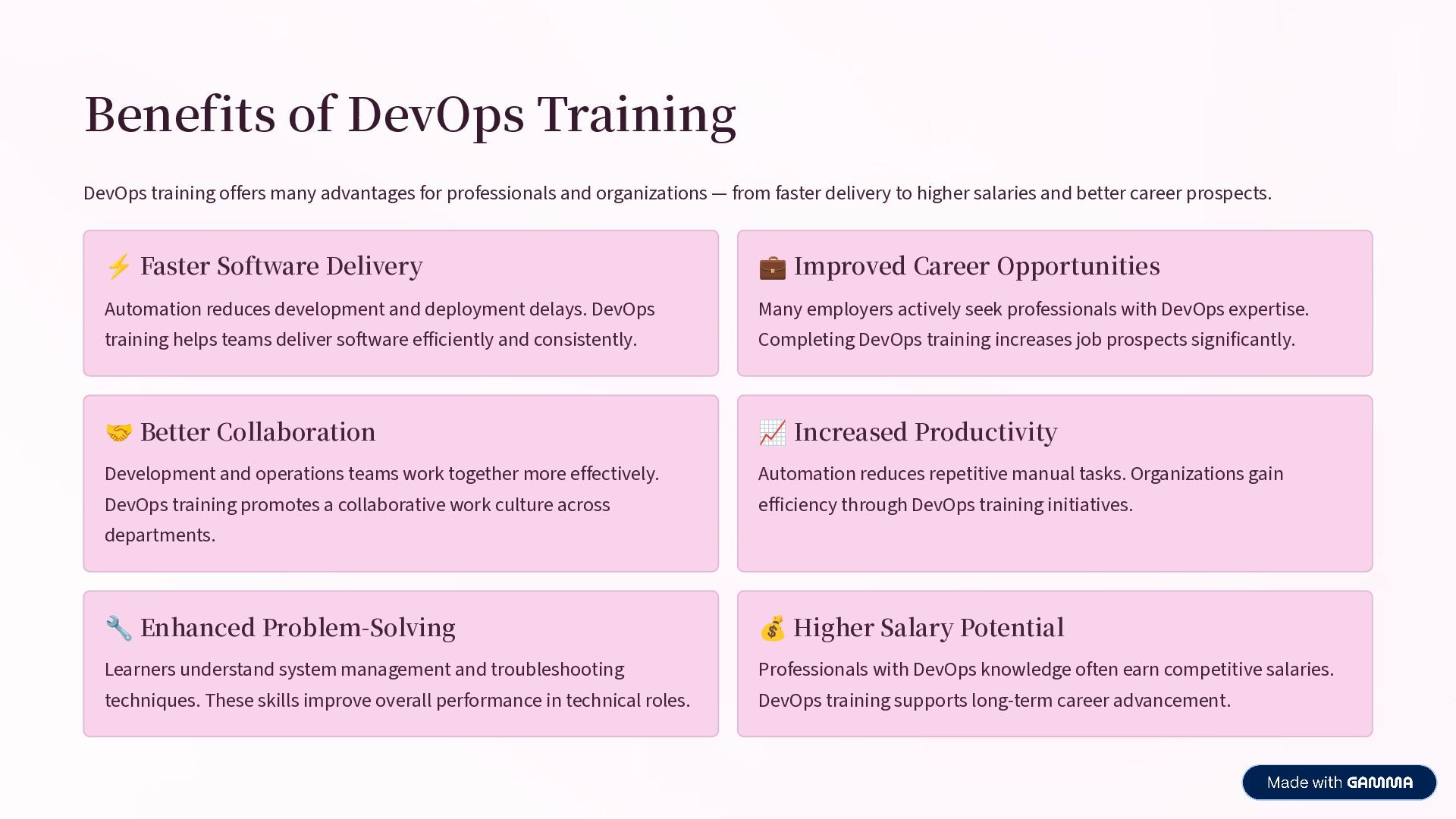
    professionals and organizations — from faster delivery to higher salaries and better career prospects. ⚡ Faster Software Delivery Automation reduces development and deployment delays. DevOps training helps teams deliver software efficiently and consistently. 💼 Improved Career Opportunities Many employers actively seek professionals with DevOps expertise. Completing DevOps training increases job prospects significantly. 🤝 Better Collaboration Development and operations teams work together more effectively. DevOps training promotes a collaborative work culture across departments. 📈 Increased Productivity Automation reduces repetitive manual tasks. Organizations gain efficiency through DevOps training initiatives. 🔧 Enhanced Problem-Solving Learners understand system management and troubleshooting techniques. These skills improve overall performance in technical roles. 💰 Higher Salary Potential Professionals with DevOps knowledge often earn competitive salaries. DevOps training supports long-term career advancement.
  6. Essential Skills Learned in DevOps Training Students develop several valuable

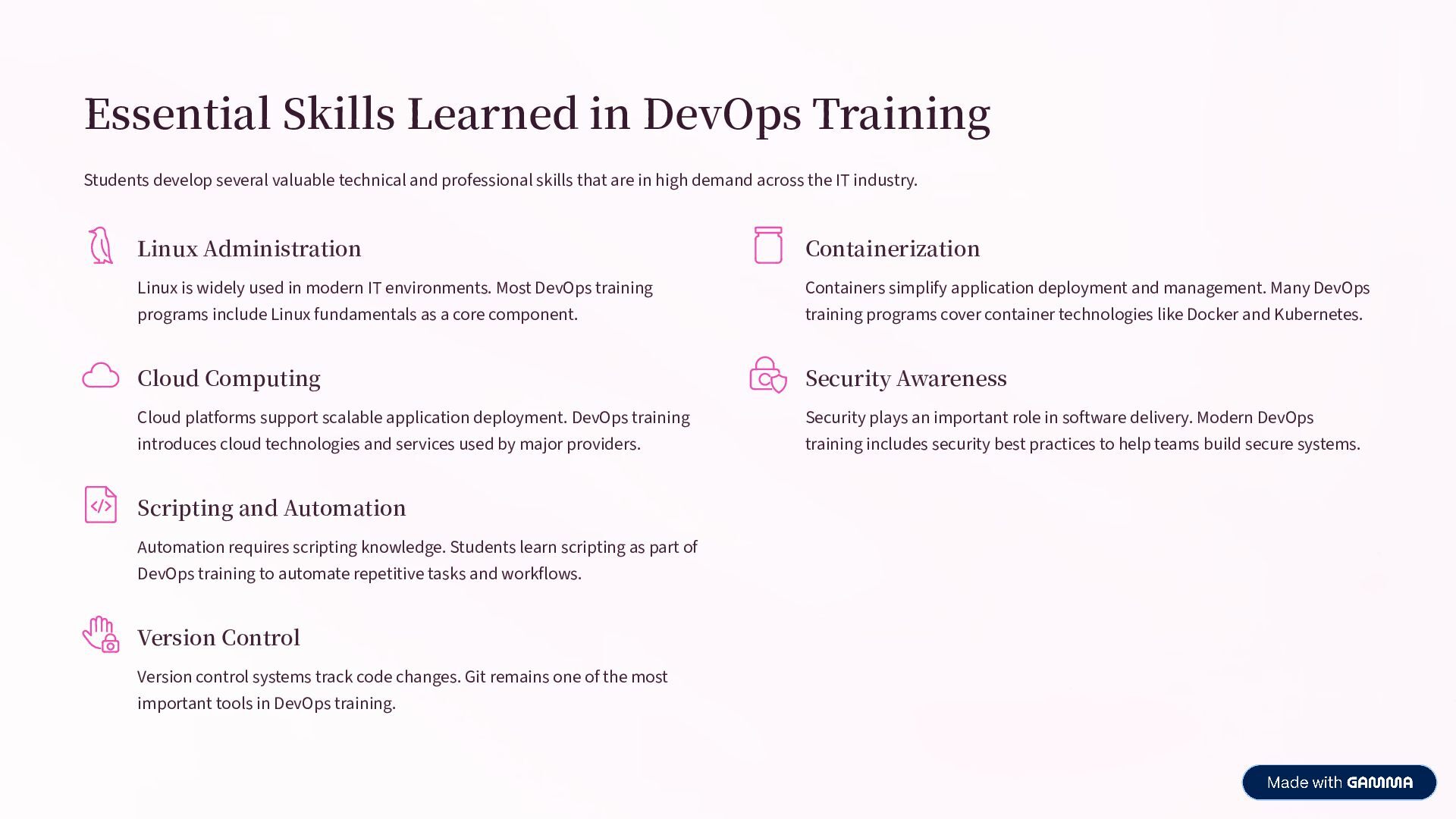
    technical and professional skills that are in high demand across the IT industry. Linux Administration Linux is widely used in modern IT environments. Most DevOps training programs include Linux fundamentals as a core component. Cloud Computing Cloud platforms support scalable application deployment. DevOps training introduces cloud technologies and services used by major providers. Scripting and Automation Automation requires scripting knowledge. Students learn scripting as part of DevOps training to automate repetitive tasks and workflows. Version Control Version control systems track code changes. Git remains one of the most important tools in DevOps training. Containerization Containers simplify application deployment and management. Many DevOps training programs cover container technologies like Docker and Kubernetes. Security Awareness Security plays an important role in software delivery. Modern DevOps training includes security best practices to help teams build secure systems.
  7. Popular Tools Covered in DevOps Training DevOps professionals use various

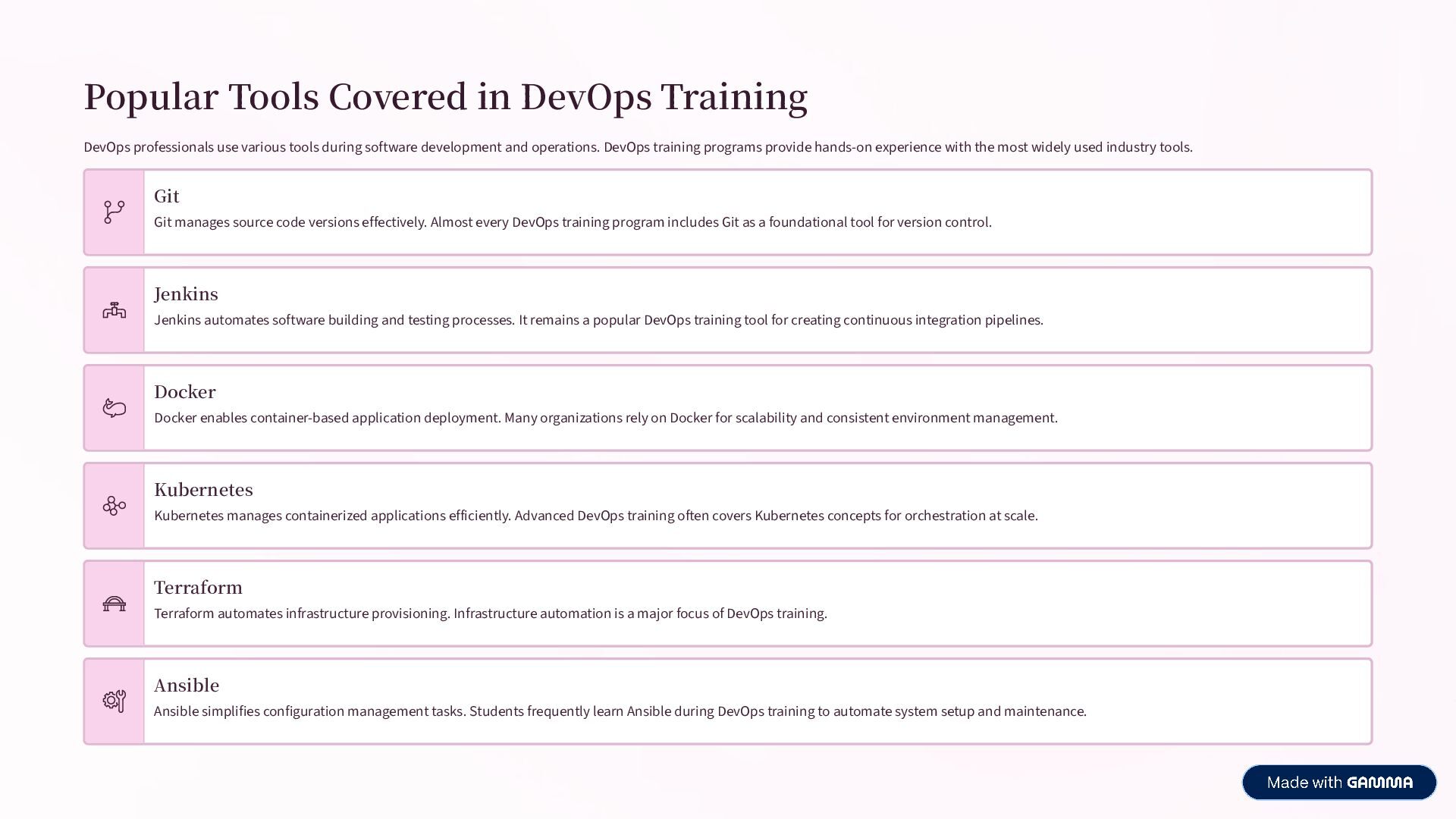
    tools during software development and operations. DevOps training programs provide hands-on experience with the most widely used industry tools. Git Git manages source code versions effectively. Almost every DevOps training program includes Git as a foundational tool for version control. Jenkins Jenkins automates software building and testing processes. It remains a popular DevOps training tool for creating continuous integration pipelines. Docker Docker enables container-based application deployment. Many organizations rely on Docker for scalability and consistent environment management. Kubernetes Kubernetes manages containerized applications efficiently. Advanced DevOps training often covers Kubernetes concepts for orchestration at scale. Terraform Terraform automates infrastructure provisioning. Infrastructure automation is a major focus of DevOps training. Ansible Ansible simplifies configuration management tasks. Students frequently learn Ansible during DevOps training to automate system setup and maintenance.
  8. Types of DevOps Training Programs Different learning formats are available

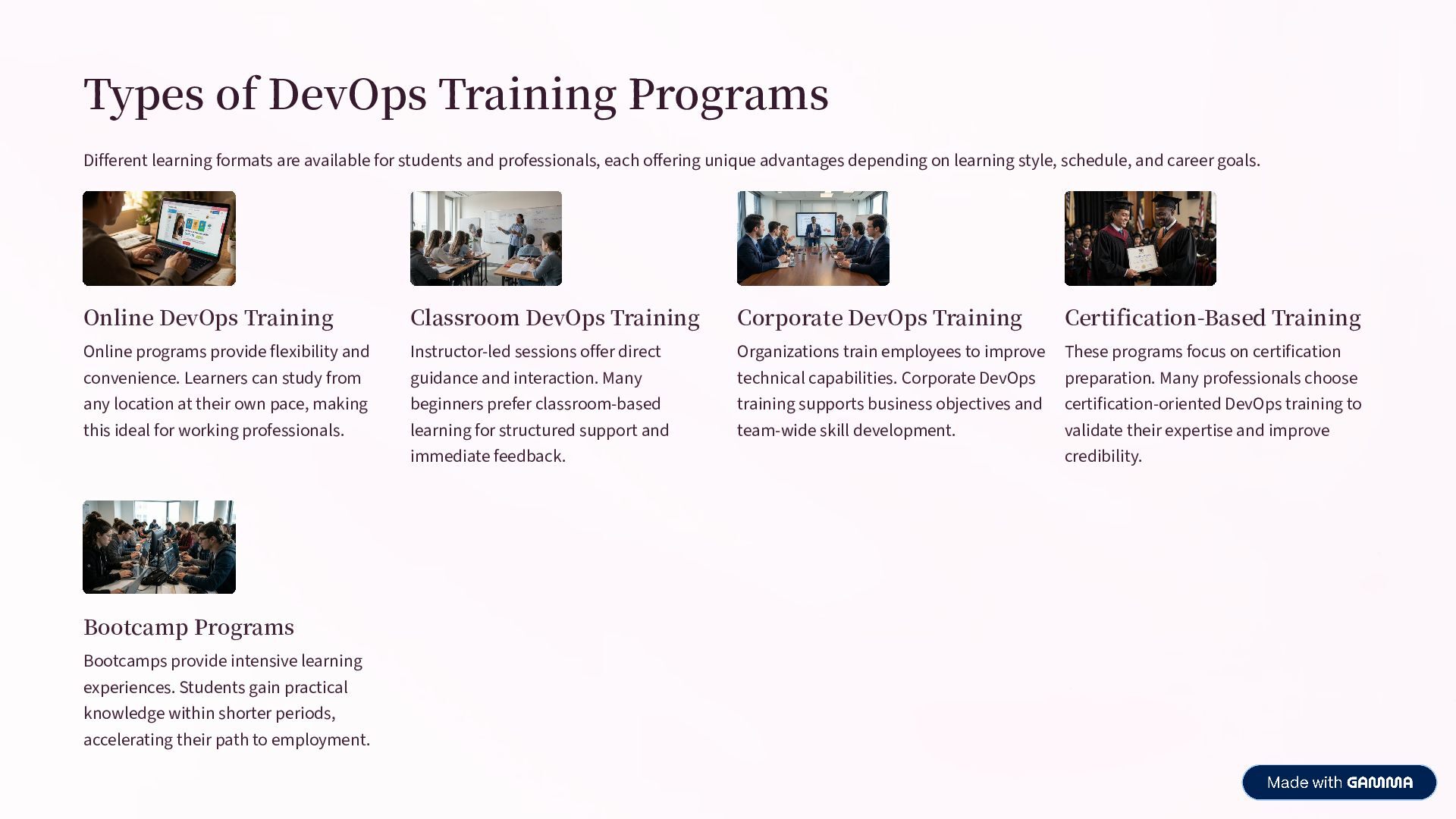
    for students and professionals, each offering unique advantages depending on learning style, schedule, and career goals. Online DevOps Training Online programs provide flexibility and convenience. Learners can study from any location at their own pace, making this ideal for working professionals. Classroom DevOps Training Instructor-led sessions offer direct guidance and interaction. Many beginners prefer classroom-based learning for structured support and immediate feedback. Corporate DevOps Training Organizations train employees to improve technical capabilities. Corporate DevOps training supports business objectives and team-wide skill development. Certification-Based Training These programs focus on certification preparation. Many professionals choose certification-oriented DevOps training to validate their expertise and improve credibility. Bootcamp Programs Bootcamps provide intensive learning experiences. Students gain practical knowledge within shorter periods, accelerating their path to employment.
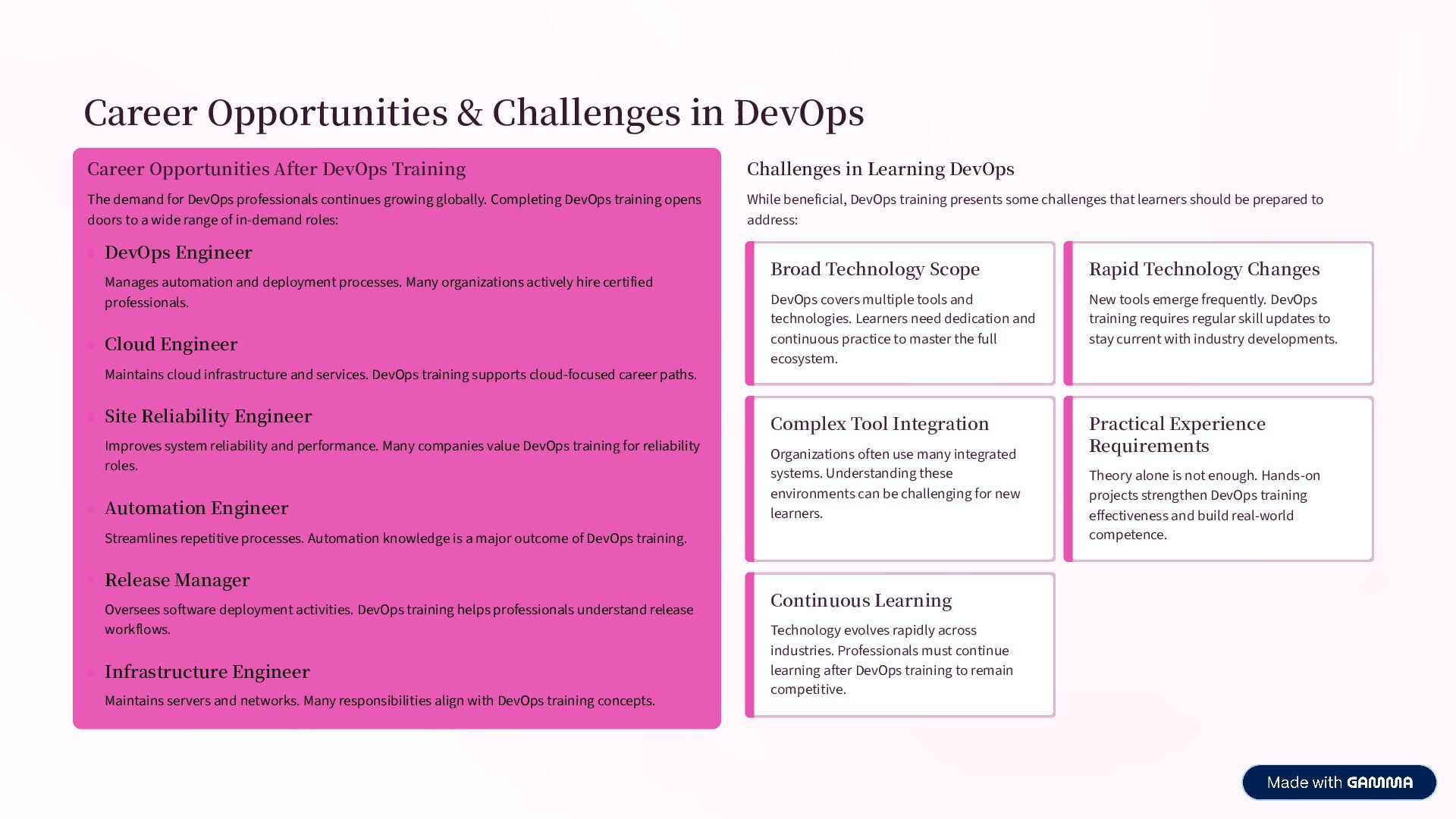
  9. Career Opportunities & Challenges in DevOps Career Opportunities After DevOps

    Training The demand for DevOps professionals continues growing globally. Completing DevOps training opens doors to a wide range of in-demand roles: DevOps Engineer Manages automation and deployment processes. Many organizations actively hire certified professionals. Cloud Engineer Maintains cloud infrastructure and services. DevOps training supports cloud-focused career paths. Site Reliability Engineer Improves system reliability and performance. Many companies value DevOps training for reliability roles. Automation Engineer Streamlines repetitive processes. Automation knowledge is a major outcome of DevOps training. Release Manager Oversees software deployment activities. DevOps training helps professionals understand release workflows. Infrastructure Engineer Maintains servers and networks. Many responsibilities align with DevOps training concepts. Challenges in Learning DevOps While beneficial, DevOps training presents some challenges that learners should be prepared to address: Broad Technology Scope DevOps covers multiple tools and technologies. Learners need dedication and continuous practice to master the full ecosystem. Rapid Technology Changes New tools emerge frequently. DevOps training requires regular skill updates to stay current with industry developments. Complex Tool Integration Organizations often use many integrated systems. Understanding these environments can be challenging for new learners. Practical Experience Requirements Theory alone is not enough. Hands-on projects strengthen DevOps training effectiveness and build real-world competence. Continuous Learning Technology evolves rapidly across industries. Professionals must continue learning after DevOps training to remain competitive.
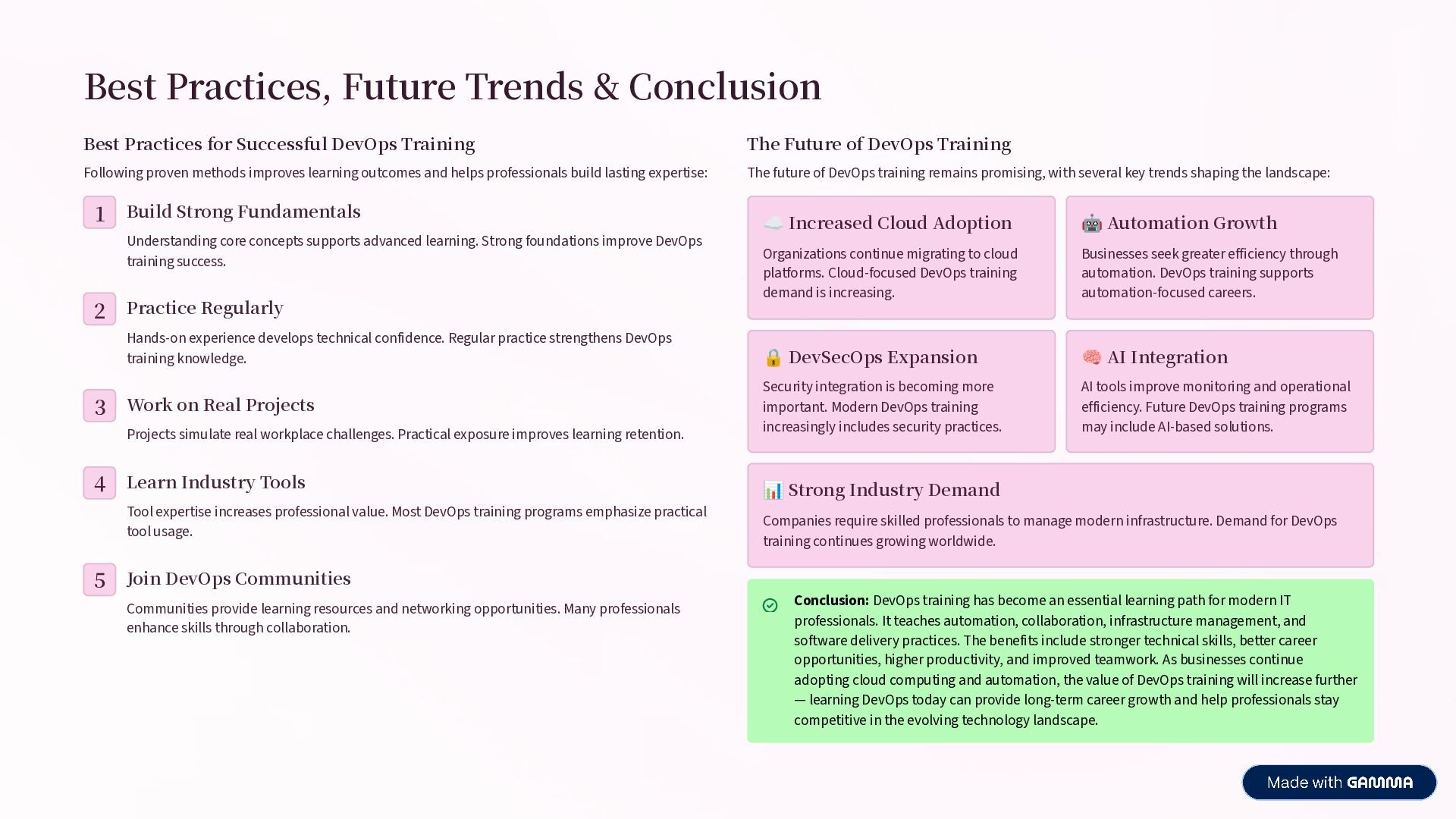
  10. Best Practices, Future Trends & Conclusion Best Practices for Successful

    DevOps Training Following proven methods improves learning outcomes and helps professionals build lasting expertise: 1 Build Strong Fundamentals Understanding core concepts supports advanced learning. Strong foundations improve DevOps training success. 2 Practice Regularly Hands-on experience develops technical confidence. Regular practice strengthens DevOps training knowledge. 3 Work on Real Projects Projects simulate real workplace challenges. Practical exposure improves learning retention. 4 Learn Industry Tools Tool expertise increases professional value. Most DevOps training programs emphasize practical tool usage. 5 Join DevOps Communities Communities provide learning resources and networking opportunities. Many professionals enhance skills through collaboration. The Future of DevOps Training The future of DevOps training remains promising, with several key trends shaping the landscape: ☁️ Increased Cloud Adoption Organizations continue migrating to cloud platforms. Cloud-focused DevOps training demand is increasing. 🤖 Automation Growth Businesses seek greater efficiency through automation. DevOps training supports automation-focused careers. 🔒 DevSecOps Expansion Security integration is becoming more important. Modern DevOps training increasingly includes security practices. 🧠 AI Integration AI tools improve monitoring and operational efficiency. Future DevOps training programs may include AI-based solutions. 📊 Strong Industry Demand Companies require skilled professionals to manage modern infrastructure. Demand for DevOps training continues growing worldwide. Conclusion: DevOps training has become an essential learning path for modern IT professionals. It teaches automation, collaboration, infrastructure management, and software delivery practices. The benefits include stronger technical skills, better career opportunities, higher productivity, and improved teamwork. As businesses continue adopting cloud computing and automation, the value of DevOps training will increase further — learning DevOps today can provide long-term career growth and help professionals stay competitive in the evolving technology landscape.