Upgrade to Pro — share decks privately, control downloads, hide ads and more …

From For Wheels to Two - Droidcon NYC

Avatar for RJ RJ
August 26, 2019

From For Wheels to Two - Droidcon NYC

Launching Lyft Scooters, Engineering principles for fast paced, wheel spinning product development

Avatar for RJ

RJ

August 26, 2019

More Decks by RJ

Other Decks in Programming

Transcript

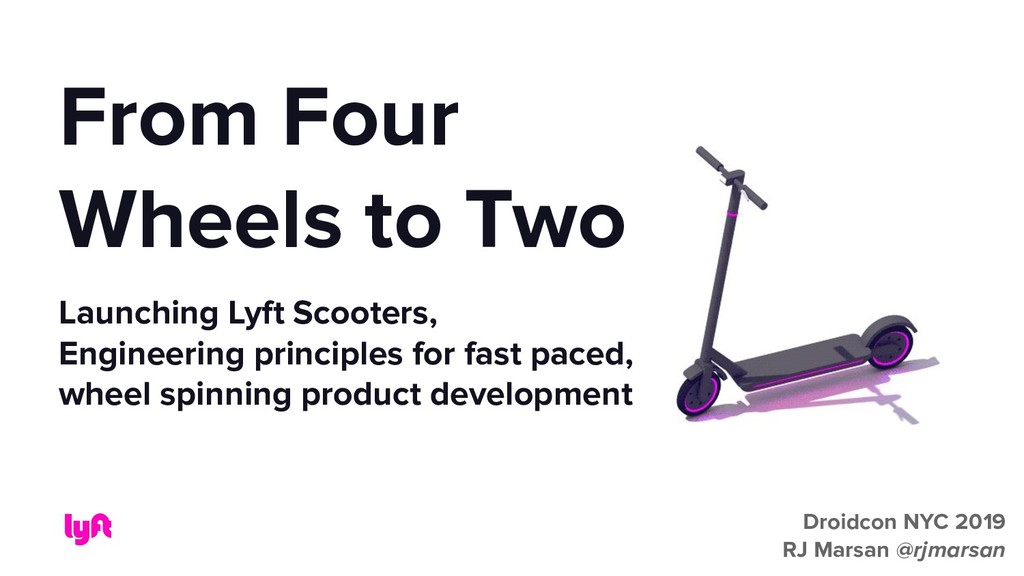
  1. From Four Wheels to Two Launching Lyft Scooters, Engineering principles

    for fast paced, wheel spinning product development Droidcon NYC 2019 RJ Marsan @rjmarsan
  2. Reasons this talk might be worthwhile • Useful product engineering

    principles • Fun and unique story • Learn how to build apps fast • The Lyft Bikes and Scooters team is here!
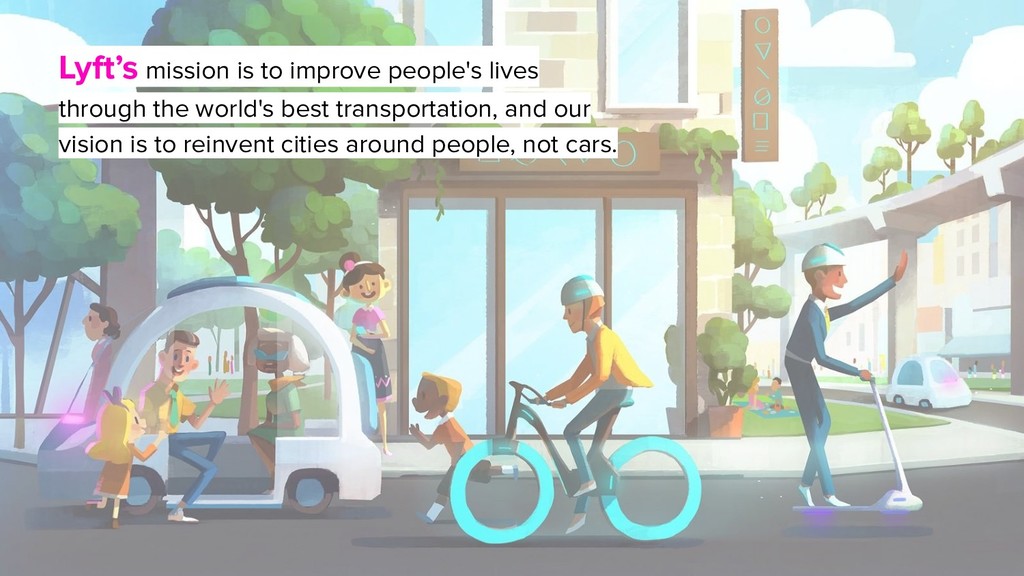
  3. Lyft’s mission is to improve people's lives through the world's

    best transportation, and our vision is to reinvent cities around people, not cars.
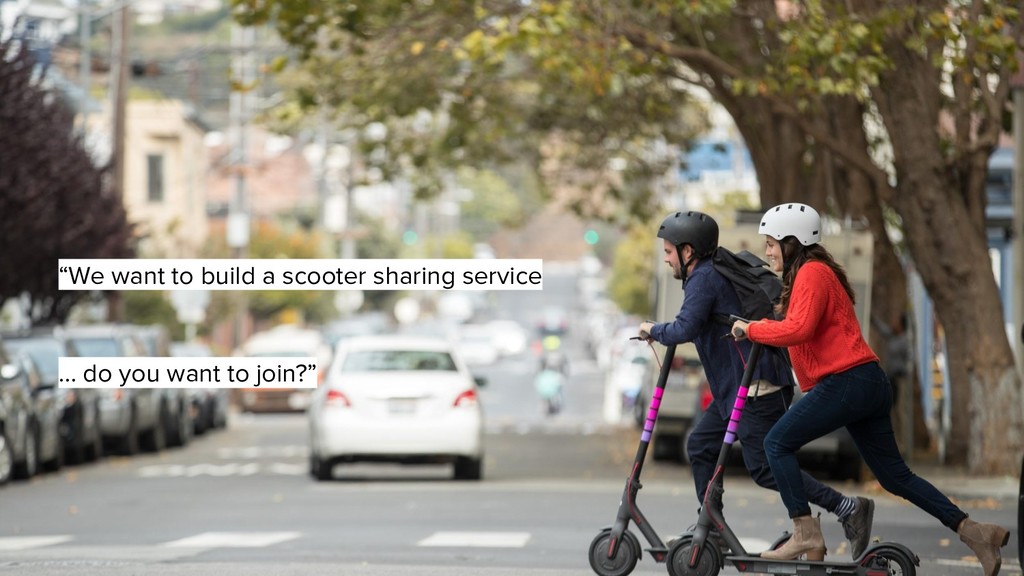
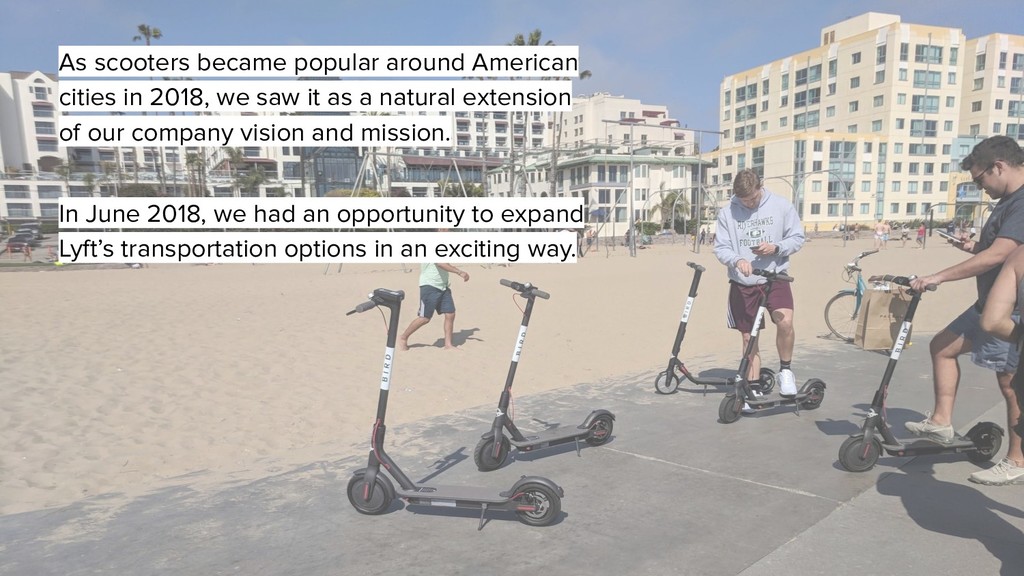
  4. As scooters became popular around American cities in 2018, we

    saw it as a natural extension of our company vision and mission. In June 2018, we had an opportunity to expand Lyft’s transportation options in an exciting way.
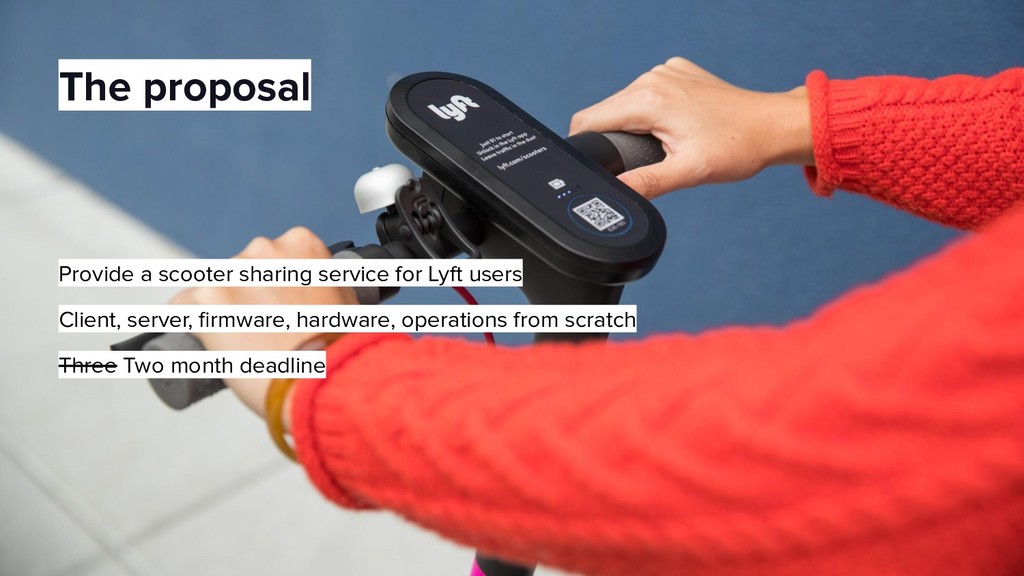
  5. The proposal Provide a scooter sharing service for Lyft users

    Client, server, firmware, hardware, operations from scratch Three Two month deadline
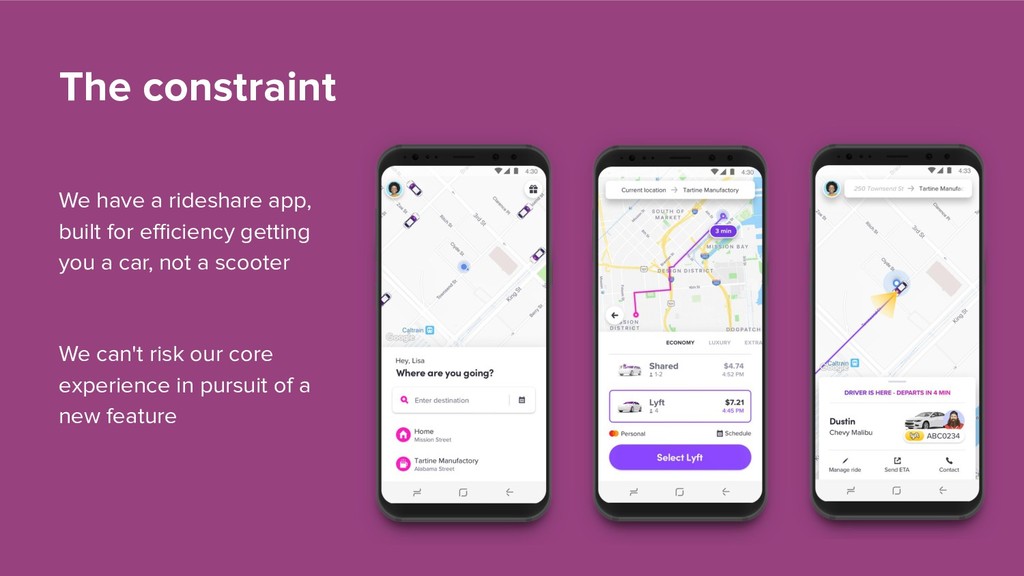
  6. The constraint We have a rideshare app, built for efficiency

    getting you a car, not a scooter We can't risk our core experience in pursuit of a new feature
  7. I’m RJ (@rjmarsan) SF based, 9 years of Android @

    Lyft, Google & Hulu You’ll find me brewin’ pour-over coffee, snowboarding, cooking, hiking, and sometimes writing Android code
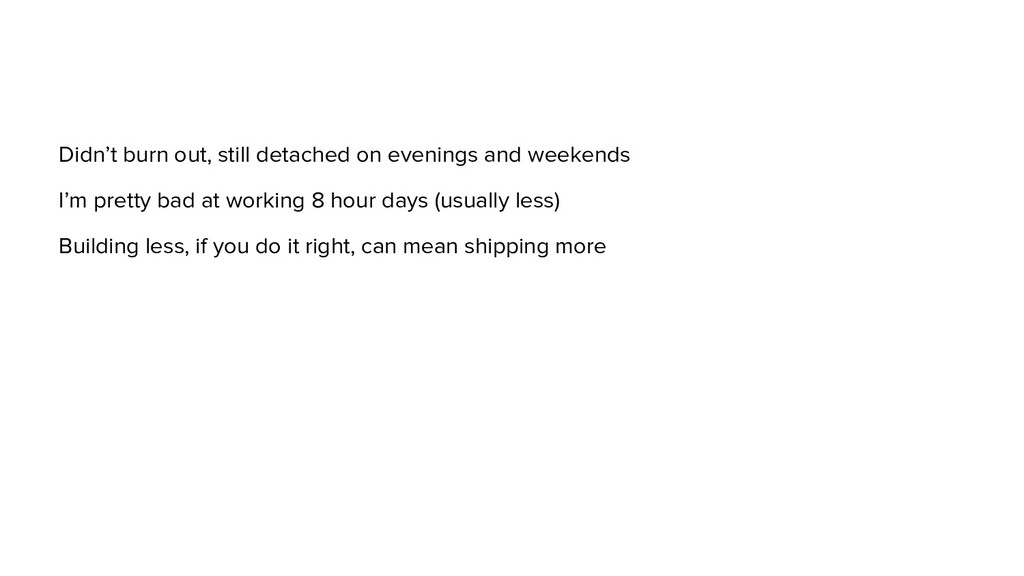
  8. Didn’t burn out, still detached on evenings and weekends I’m

    pretty bad at working 8 hour days (usually less) Building less, if you do it right, can mean shipping more
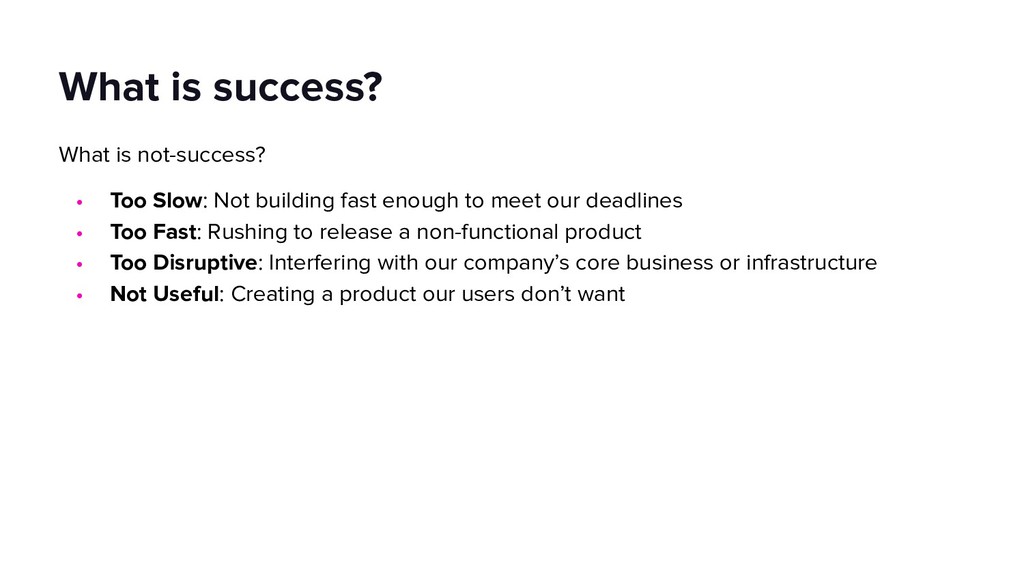
  9. What is success? What is not-success? • Too Slow: Not

    building fast enough to meet our deadlines • Too Fast: Rushing to release a non-functional product • Too Disruptive: Interfering with our company’s core business or infrastructure • Not Useful: Creating a product our users don’t want
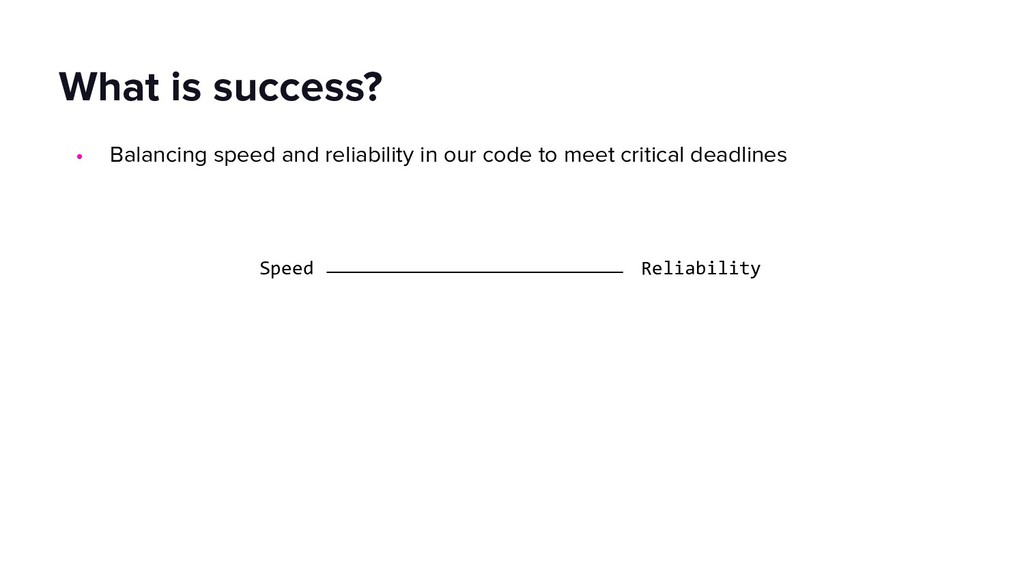
  10. What is success? • Balancing speed and reliability in our

    code to meet critical deadlines Speed Reliability
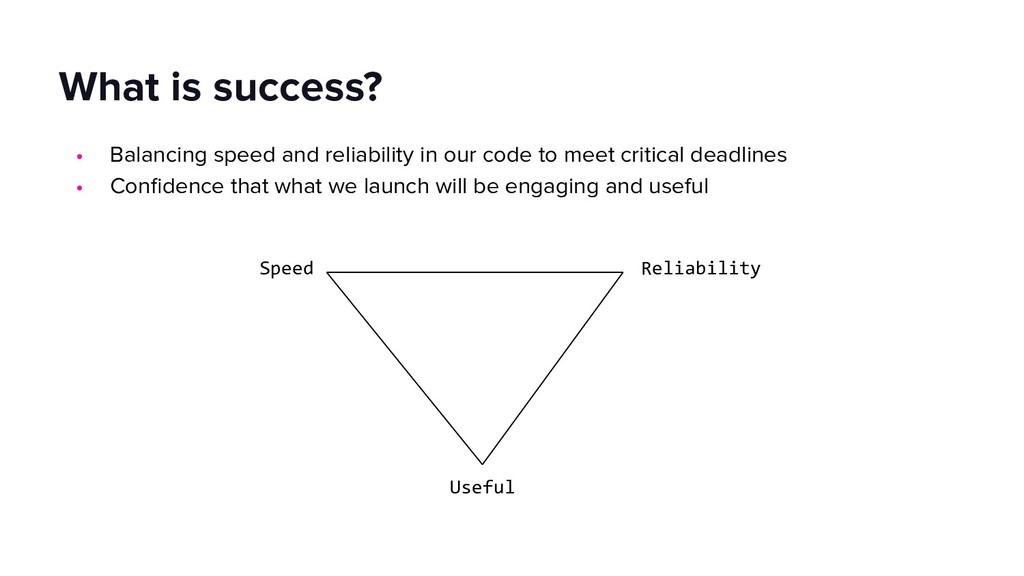
  11. What is success? • Balancing speed and reliability in our

    code to meet critical deadlines • Confidence that what we launch will be engaging and useful Speed Reliability Useful
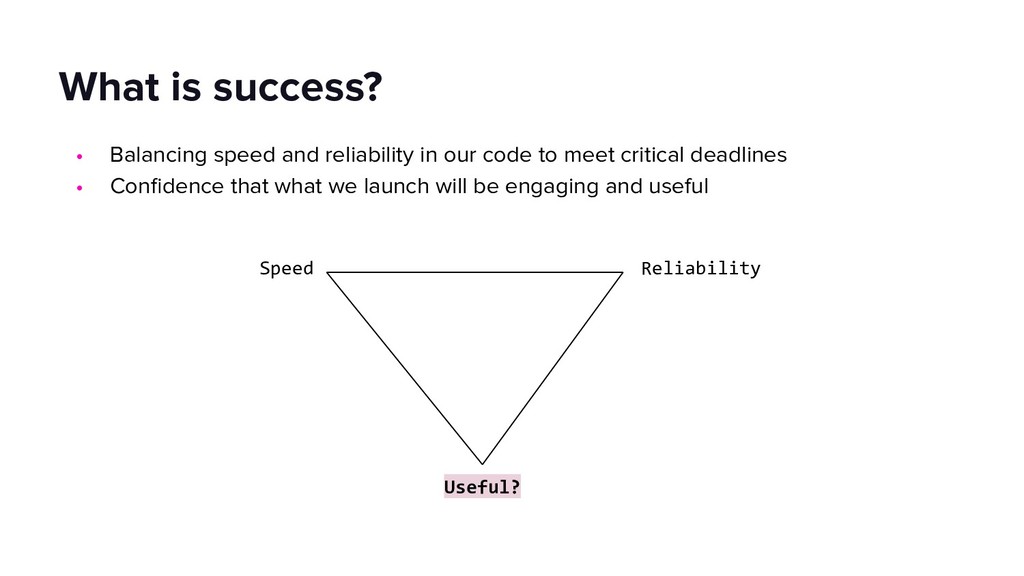
  12. What is success? • Balancing speed and reliability in our

    code to meet critical deadlines • Confidence that what we launch will be engaging and useful Speed Reliability Useful?
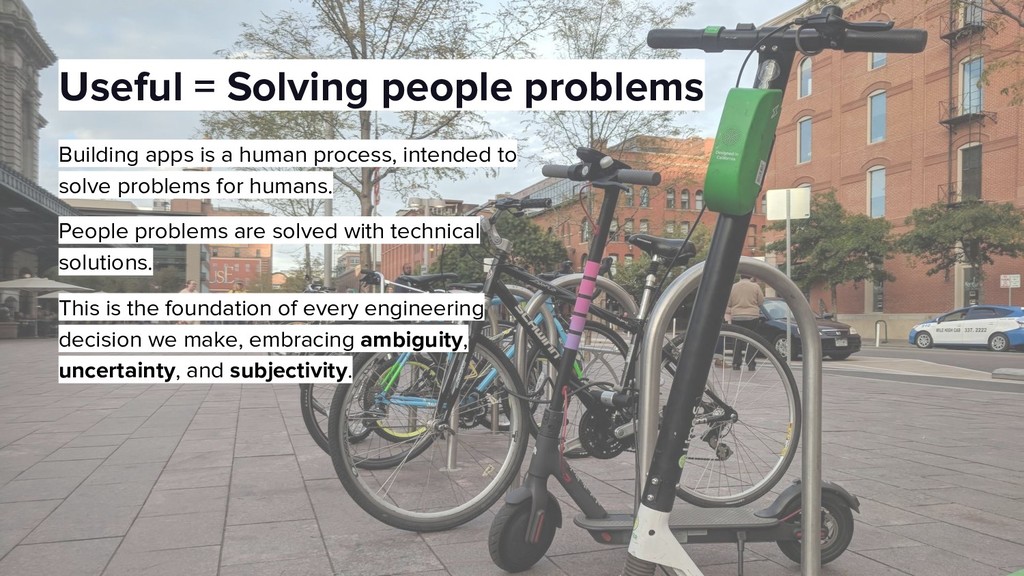
  13. Useful = Solving people problems Building apps is a human

    process, intended to solve problems for humans. People problems are solved with technical solutions. This is the foundation of every engineering decision we make, embracing ambiguity, uncertainty, and subjectivity.
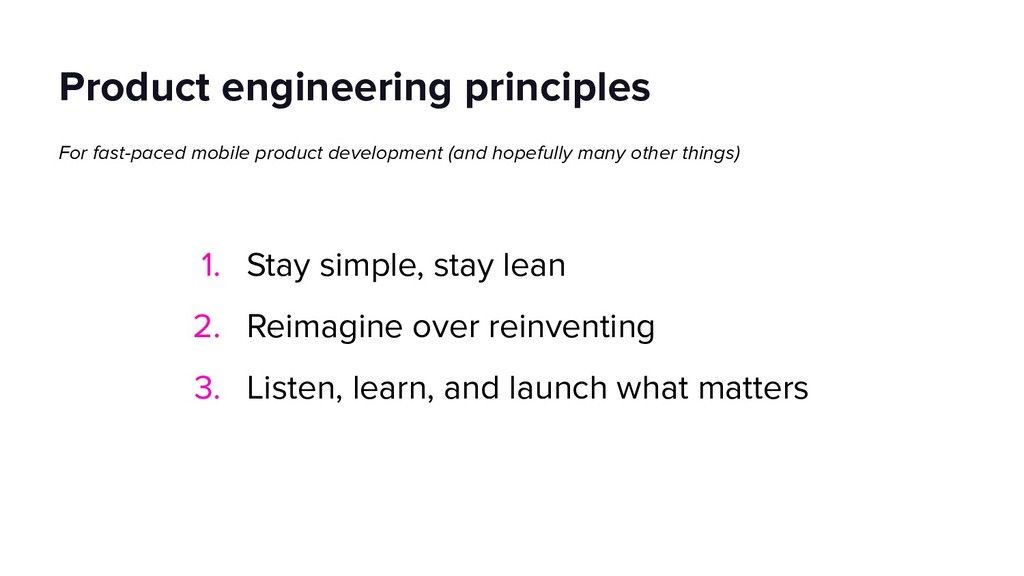
  14. Product engineering principles For fast-paced mobile product development (and hopefully

    many other things) 1. Stay simple, stay lean 2. Reimagine over reinventing 3. Listen, learn, and launch what matters
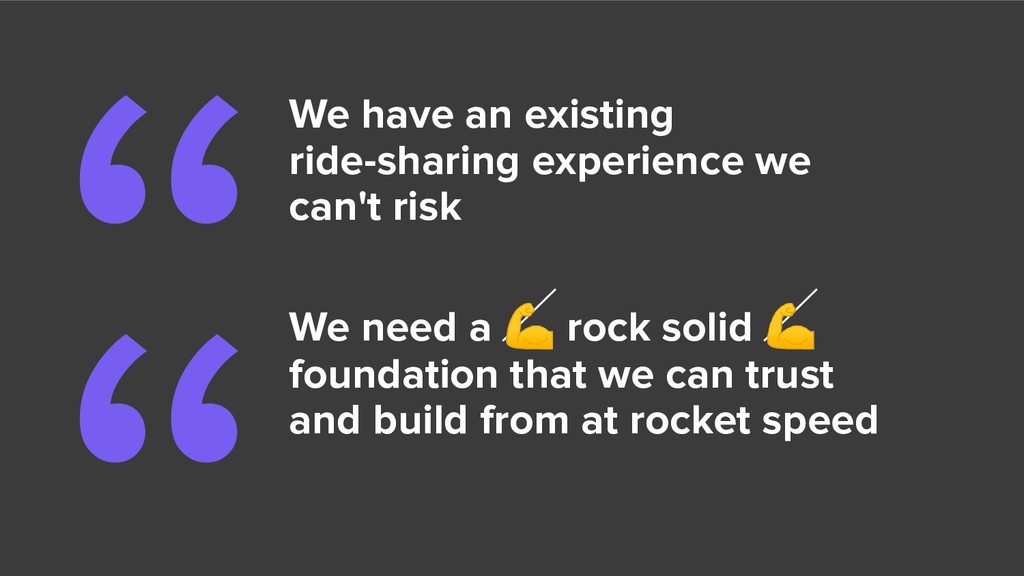
  15. We have an existing ride-sharing experience we can't risk We

    need a rock solid foundation that we can trust and build from at rocket speed “
  16. Safe & Solid Foundation Safeguarding it behind a Feature Flag

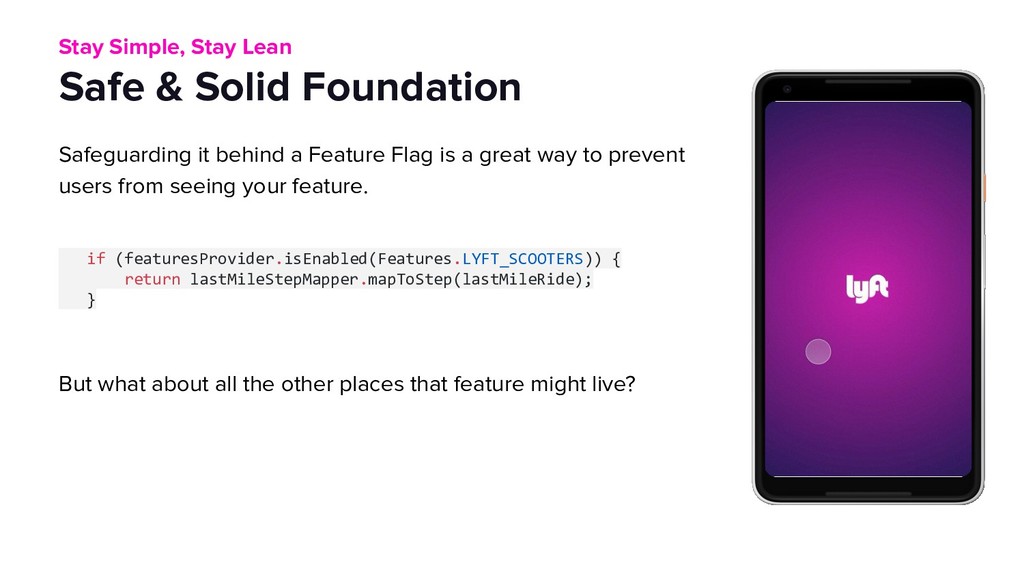
    is a great way to prevent users from seeing your feature. if (featuresProvider.isEnabled(Features.LYFT_SCOOTERS)) { return lastMileStepMapper.mapToStep(lastMileRide); } But what about all the other places that feature might live? Stay Simple, Stay Lean
  17. Safe & Solid Foundation How else might this add risk

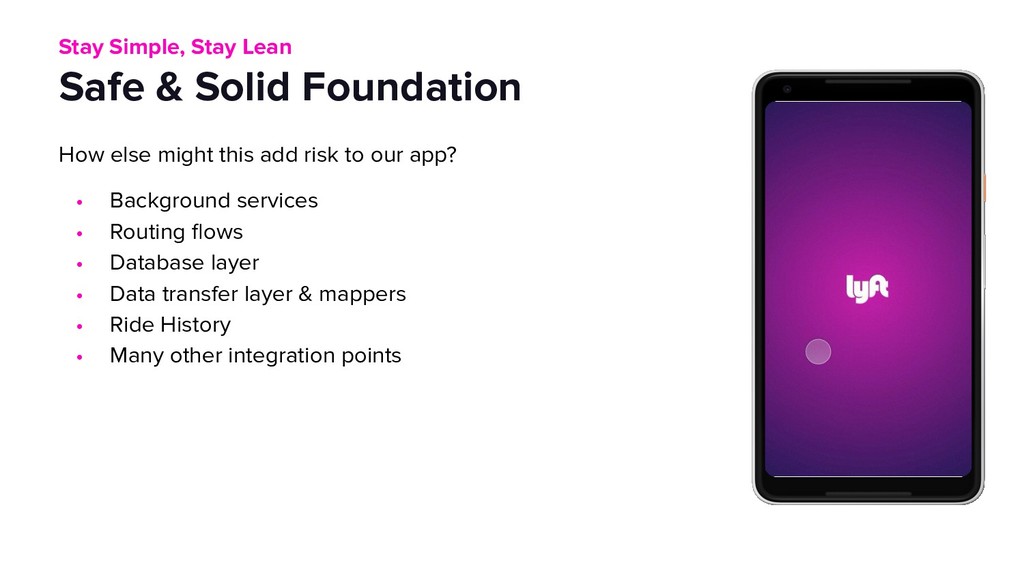
    to our app? • Background services • Routing flows • Database layer • Data transfer layer & mappers • Ride History • Many other integration points Stay Simple, Stay Lean
  18. Safe & Solid Foundation Feature modules minimize surface area and

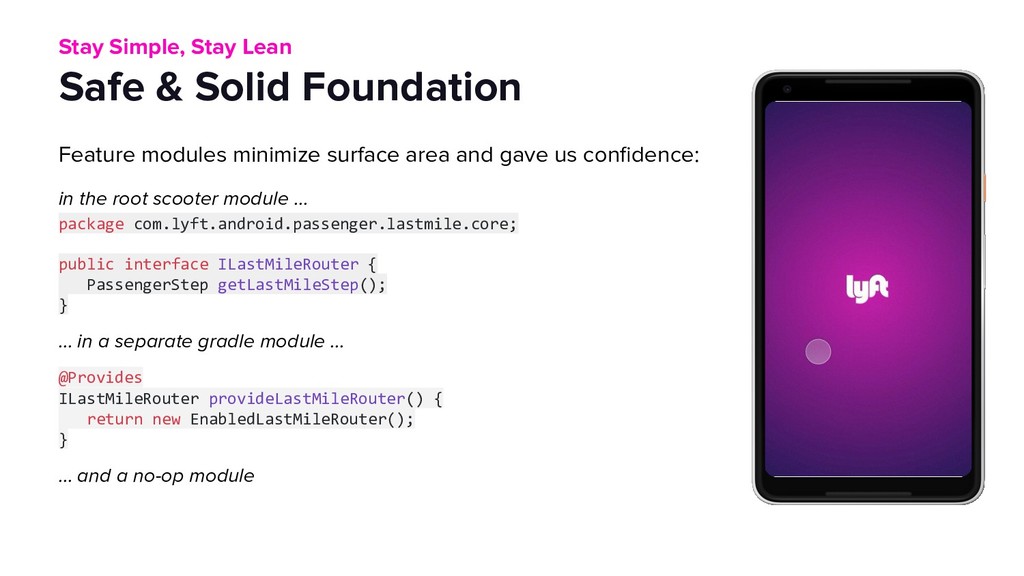
    gave us confidence: in the root scooter module … package com.lyft.android.passenger.lastmile.core; public interface ILastMileRouter { PassengerStep getLastMileStep(); } … in a separate gradle module … @Provides ILastMileRouter provideLastMileRouter() { return new EnabledLastMileRouter(); } … and a no-op module Stay Simple, Stay Lean
  19. Safe & Solid Foundation FlavorModules let us be confident that

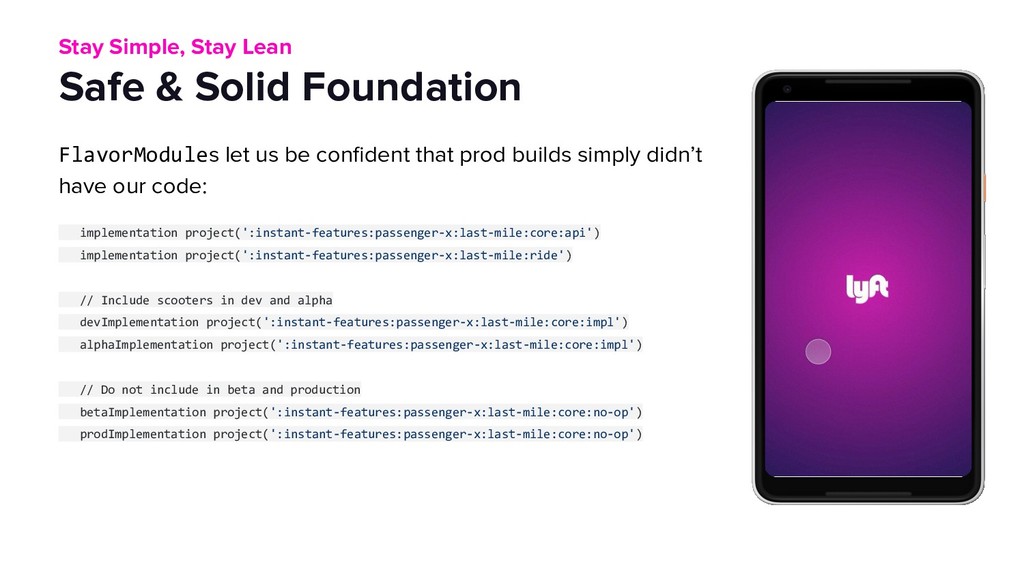
    prod builds simply didn’t have our code: implementation project(':instant-features:passenger-x:last-mile:core:api') implementation project(':instant-features:passenger-x:last-mile:ride') // Include scooters in dev and alpha devImplementation project(':instant-features:passenger-x:last-mile:core:impl') alphaImplementation project(':instant-features:passenger-x:last-mile:core:impl') // Do not include in beta and production betaImplementation project(':instant-features:passenger-x:last-mile:core:no-op') prodImplementation project(':instant-features:passenger-x:last-mile:core:no-op') Stay Simple, Stay Lean
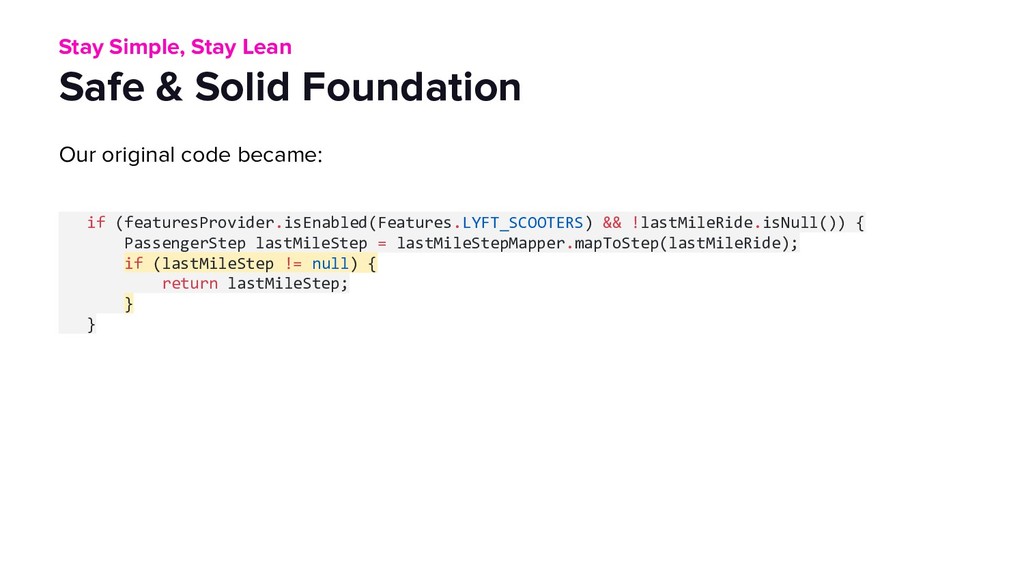
  20. Safe & Solid Foundation Our original code became: if (featuresProvider.isEnabled(Features.LYFT_SCOOTERS)

    && !lastMileRide.isNull()) { PassengerStep lastMileStep = lastMileStepMapper.mapToStep(lastMileRide); if (lastMileStep != null) { return lastMileStep; } } Stay Simple, Stay Lean
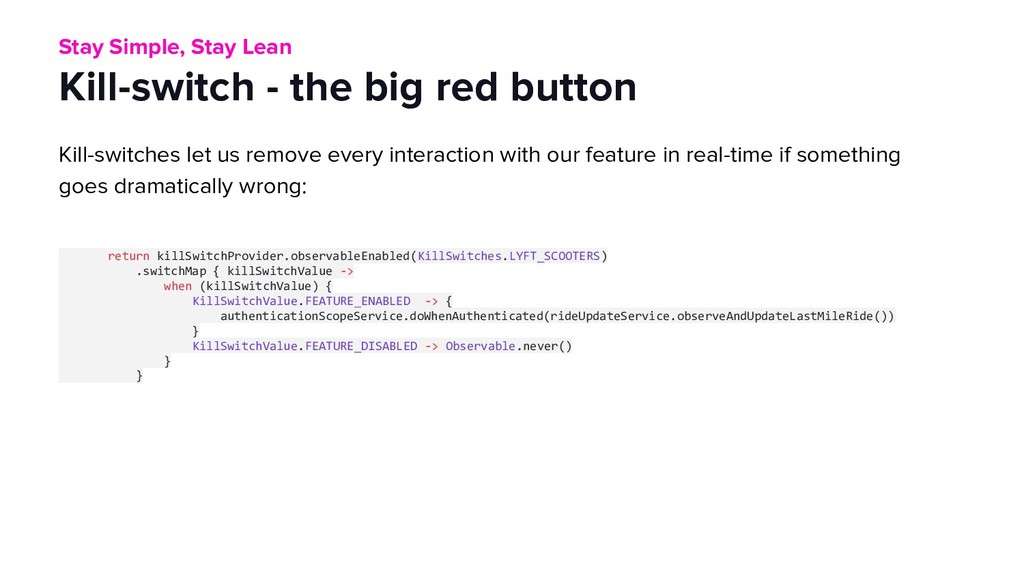
  21. Kill-switch - the big red button Kill-switches let us remove

    every interaction with our feature in real-time if something goes dramatically wrong: return killSwitchProvider.observableEnabled(KillSwitches.LYFT_SCOOTERS) .switchMap { killSwitchValue -> when (killSwitchValue) { KillSwitchValue.FEATURE_ENABLED -> { authenticationScopeService.doWhenAuthenticated(rideUpdateService.observeAndUpdateLastMileRide()) } KillSwitchValue.FEATURE_DISABLED -> Observable.never() } } Stay Simple, Stay Lean
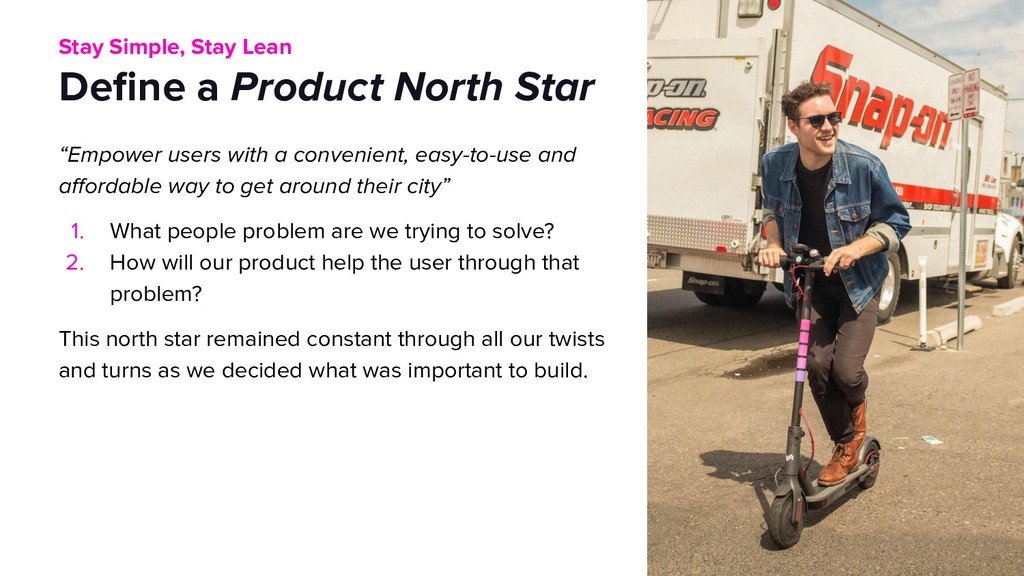
  22. Define a Product North Star “Empower users with a convenient,

    easy-to-use and affordable way to get around their city” 1. What people problem are we trying to solve? 2. How will our product help the user through that problem? This north star remained constant through all our twists and turns as we decided what was important to build. Stay Simple, Stay Lean
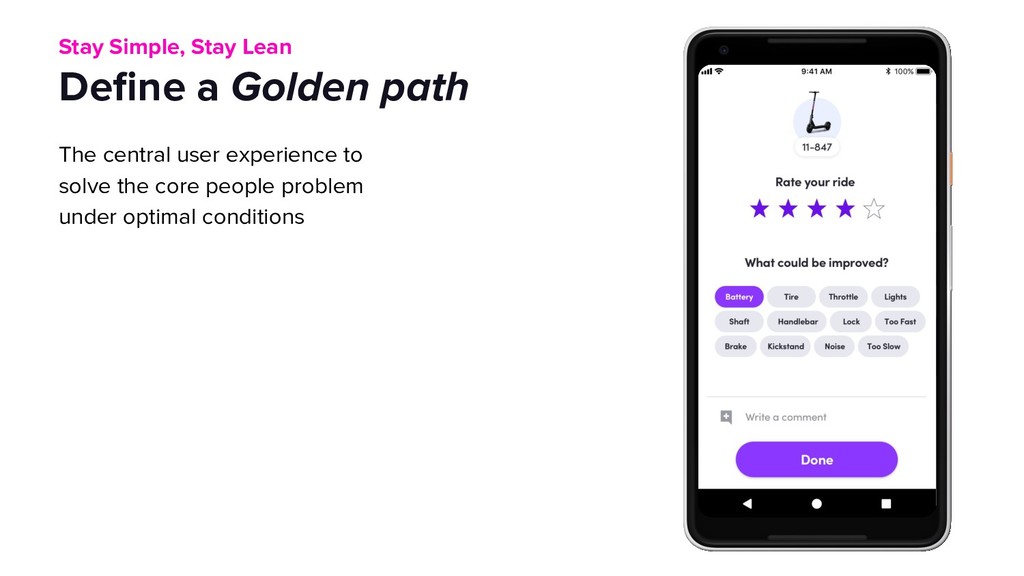
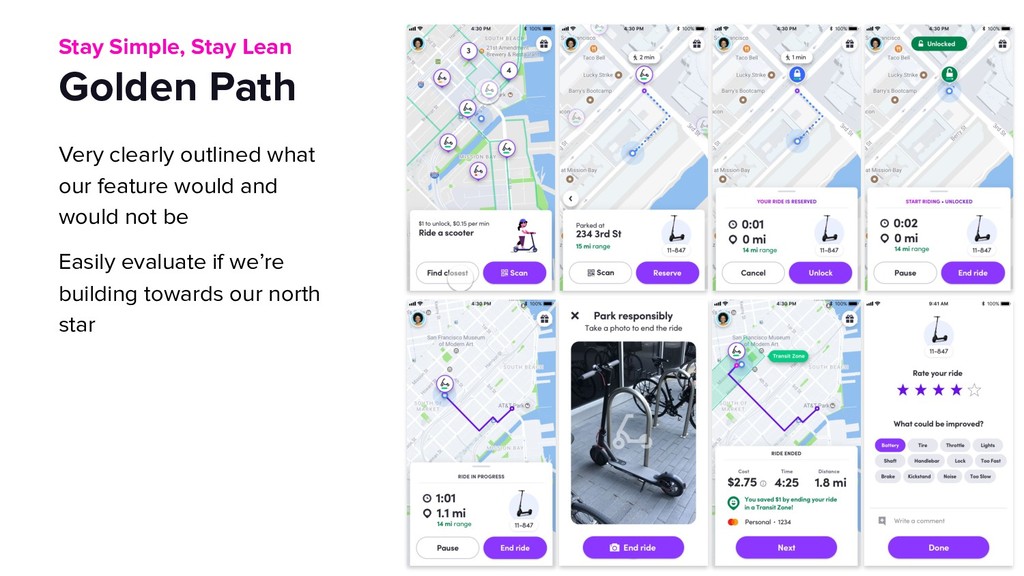
  23. Define a Golden path The central user experience to solve

    the core people problem under optimal conditions Stay Simple, Stay Lean
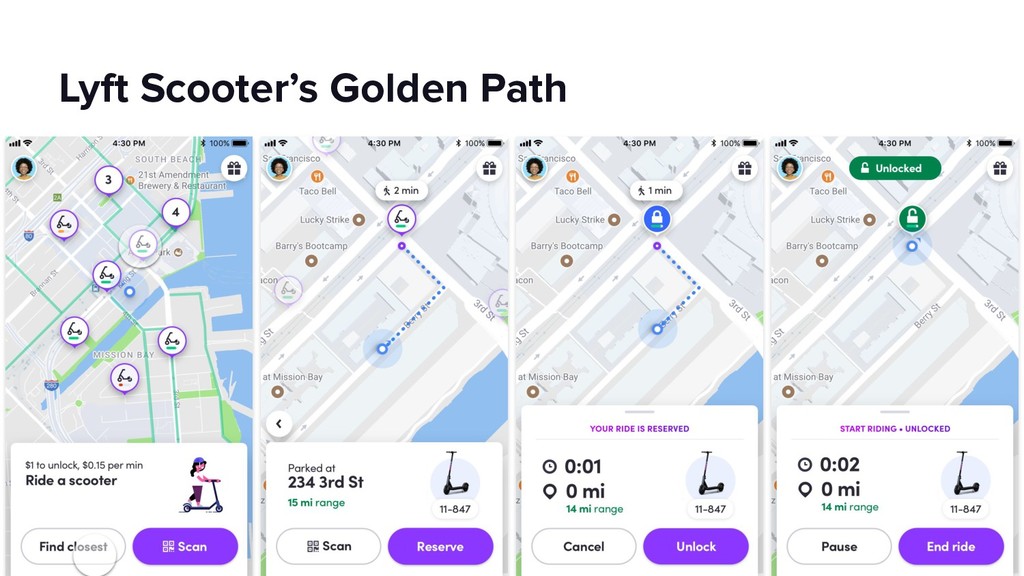
  24. Golden Path Very clearly outlined what our feature would and

    would not be Easily evaluate if we’re building towards our north star Stay Simple, Stay Lean
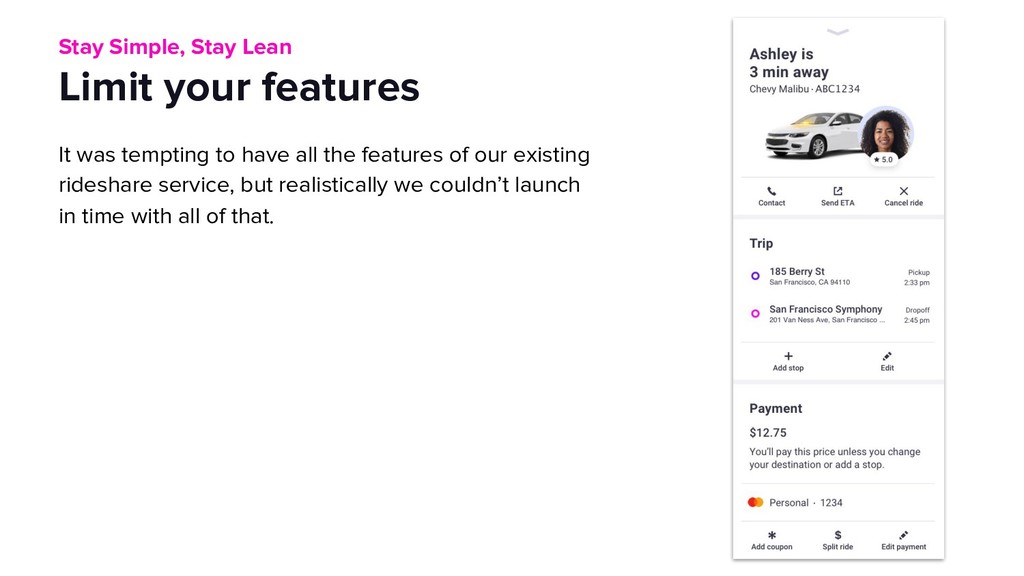
  25. Limit your features It was tempting to have all the

    features of our existing rideshare service, but realistically we couldn’t launch in time with all of that. Stay Simple, Stay Lean
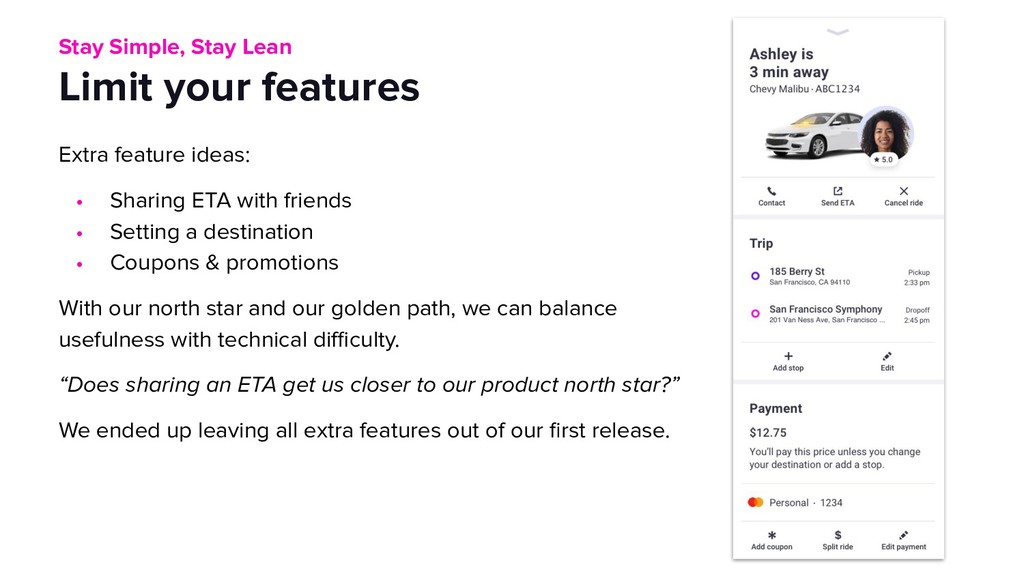
  26. Limit your features Extra feature ideas: • Sharing ETA with

    friends • Setting a destination • Coupons & promotions With our north star and our golden path, we can balance usefulness with technical difficulty. “Does sharing an ETA get us closer to our product north star?” We ended up leaving all extra features out of our first release. Stay Simple, Stay Lean
  27. Design the simplest architecture Now that we have a north

    star, a solid foundation and a limited feature set, we need an overall architecture to make the golden path a reality. What’s the most straightforward and easy-to-reason architecture that gives us enough wiggle room to handle changes? Stay Simple, Stay Lean
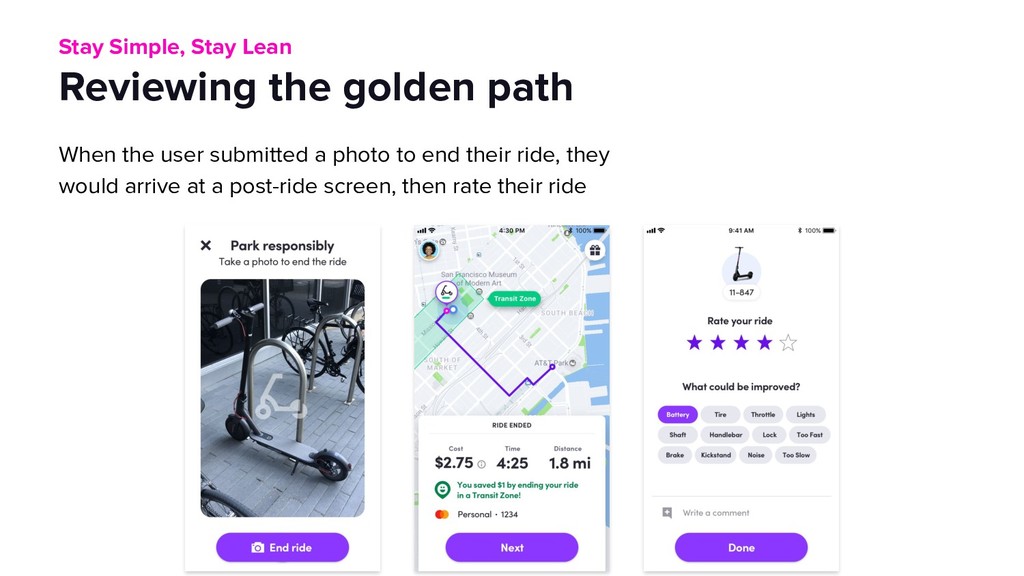
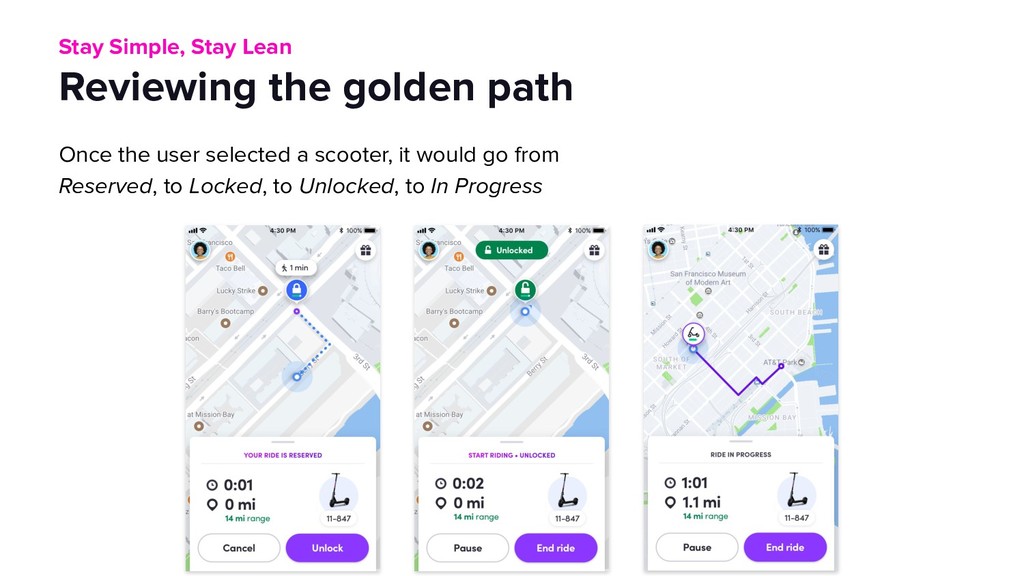
  28. Reviewing the golden path Once the user selected a scooter,

    it would go from Reserved, to Locked, to Unlocked, to In Progress Stay Simple, Stay Lean
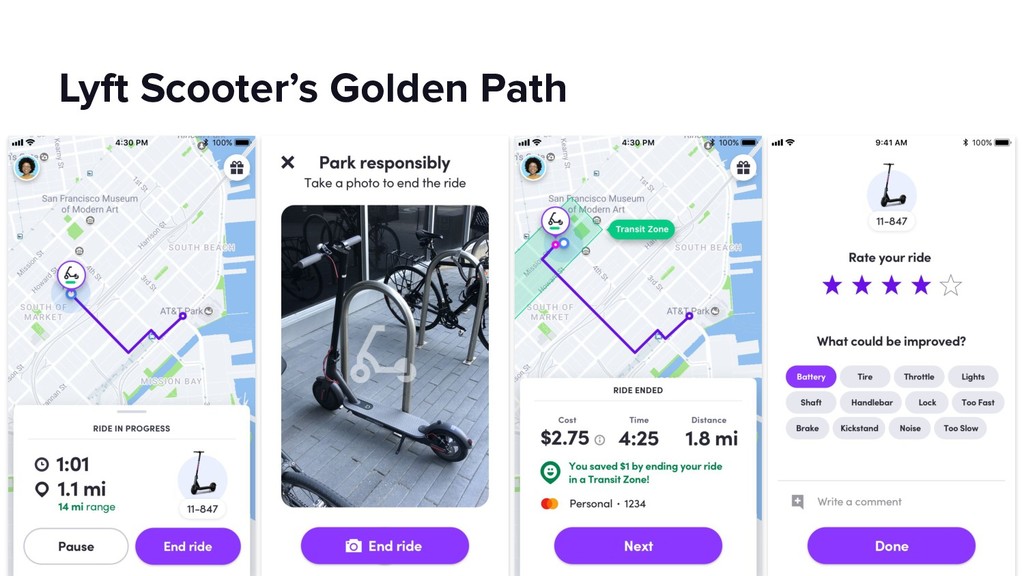
  29. Reviewing the golden path When the user submitted a photo

    to end their ride, they would arrive at a post-ride screen, then rate their ride Stay Simple, Stay Lean
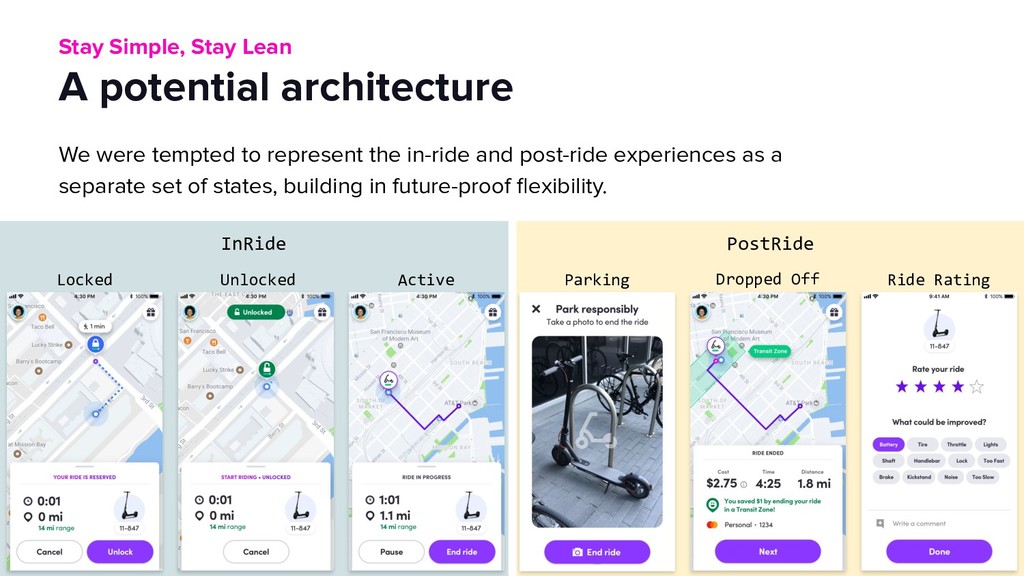
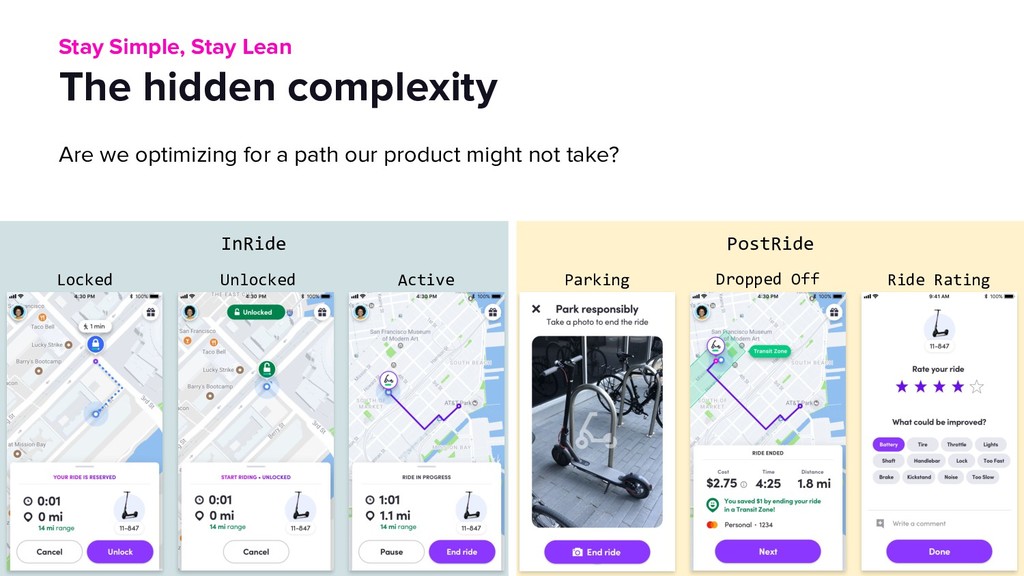
  30. InRide A potential architecture We were tempted to represent the

    in-ride and post-ride experiences as a separate set of states, building in future-proof flexibility. Stay Simple, Stay Lean PostRide Locked Unlocked Active Parking Dropped Off Ride Rating
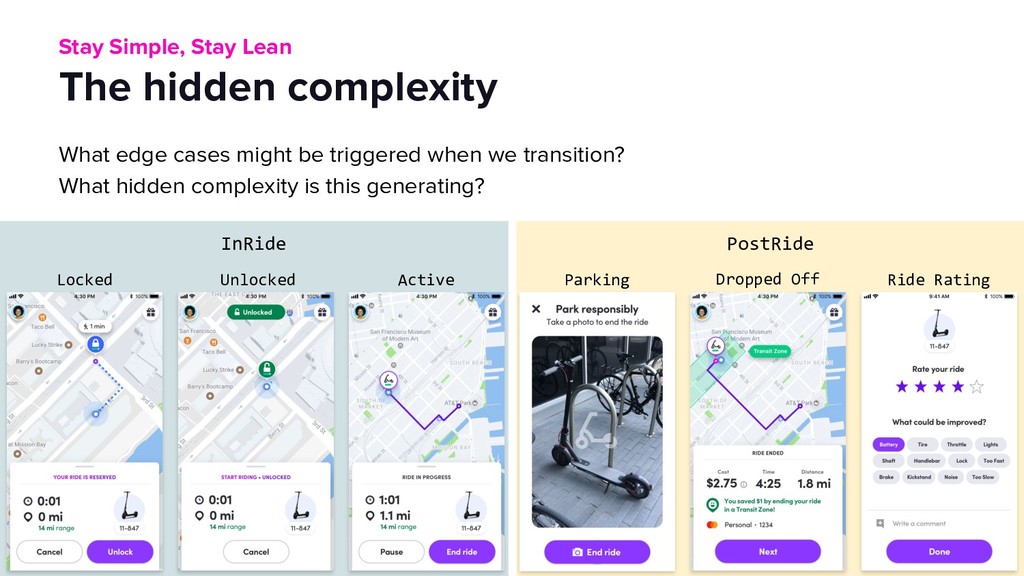
  31. InRide The hidden complexity What edge cases might be triggered

    when we transition? What hidden complexity is this generating? Stay Simple, Stay Lean PostRide Locked Unlocked Active Parking Dropped Off Ride Rating
  32. InRide The hidden complexity Are we optimizing for a path

    our product might not take? Stay Simple, Stay Lean PostRide Locked Unlocked Active Parking Dropped Off Ride Rating
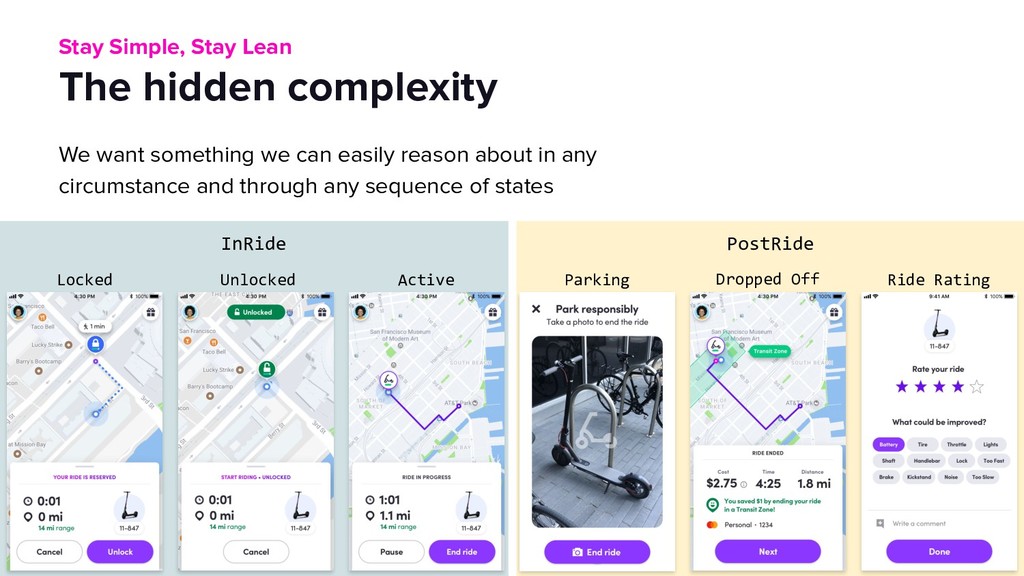
  33. InRide The hidden complexity We want something we can easily

    reason about in any circumstance and through any sequence of states Stay Simple, Stay Lean PostRide Locked Unlocked Active Parking Dropped Off Ride Rating
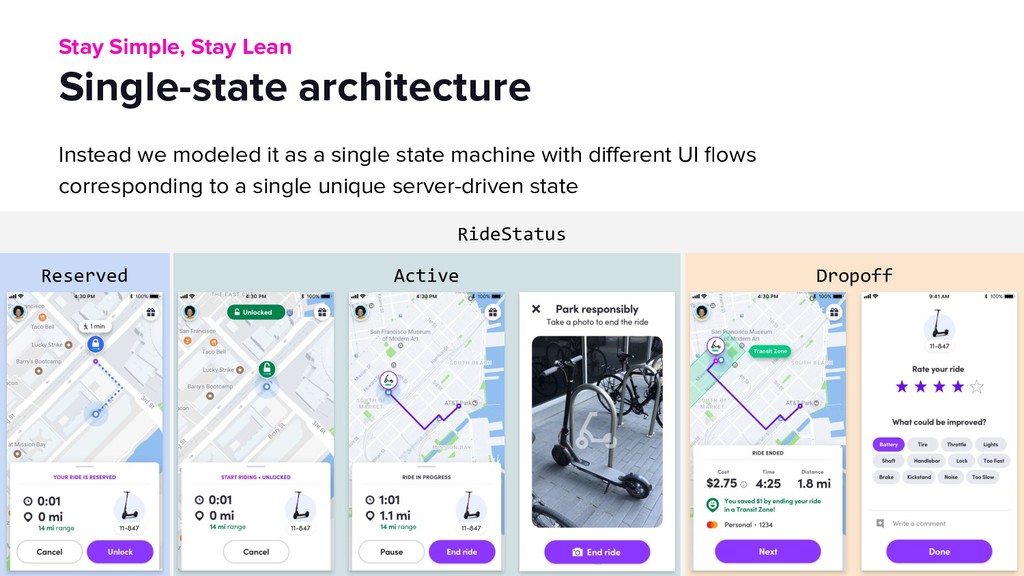
  34. RideStatus Active Reserved Single-state architecture Dropoff Instead we modeled it

    as a single state machine with different UI flows corresponding to a single unique server-driven state Stay Simple, Stay Lean
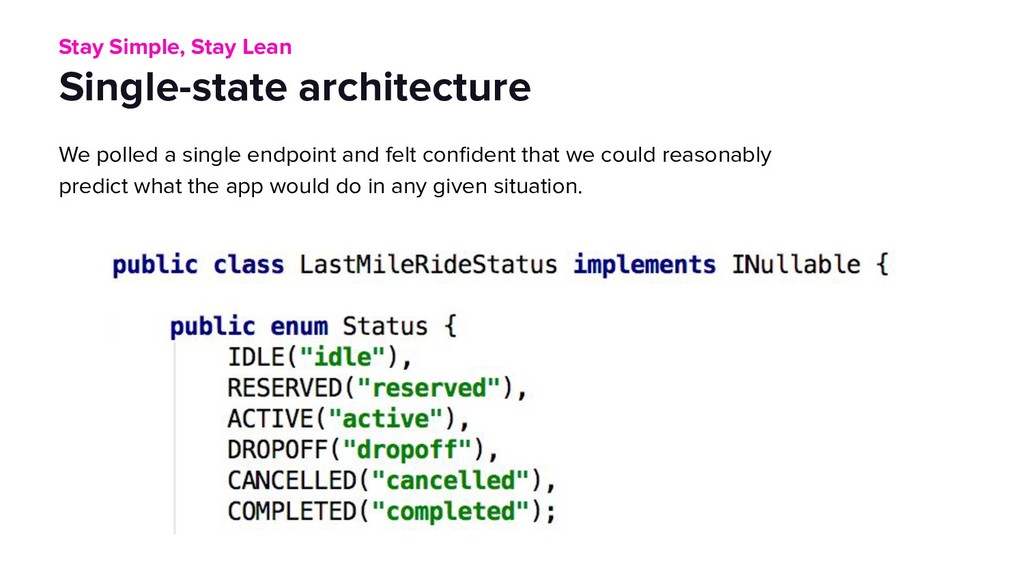
  35. Single-state architecture We polled a single endpoint and felt confident

    that we could reasonably predict what the app would do in any given situation. Stay Simple, Stay Lean
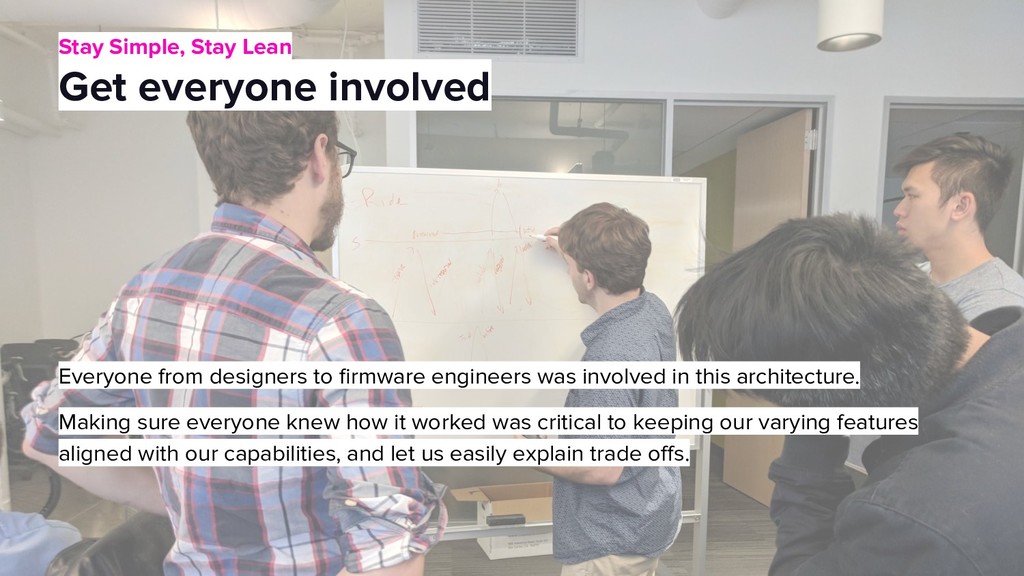
  36. Get everyone involved Everyone from designers to firmware engineers was

    involved in this architecture. Making sure everyone knew how it worked was critical to keeping our varying features aligned with our capabilities, and let us easily explain trade offs. Stay Simple, Stay Lean
  37. It’s natural when… You have tight timelines – start from

    scratch and stay small You are expecting to scale – reuse everything to leverage existing infrastructure For us, the optimal solution was somewhere in-between: Focus on creative reuse of existing infrastructure Reimagine Over Reinventing
  38. Leverage everything you can Build systems, Network stack, Authentication, Databases,

    Localization Release process, Testing infrastructure, etc. Tight timelines aren’t possible without building off the great work of your coworkers! ‍♀ Reimagine Over Reinventing
  39. Don’t let it slow you down In our experience, often

    the biggest roadblocks happen when you depend on another team to change something for you. Remember: you have options, and it’s your job to explain them! Reimagine Over Reinventing
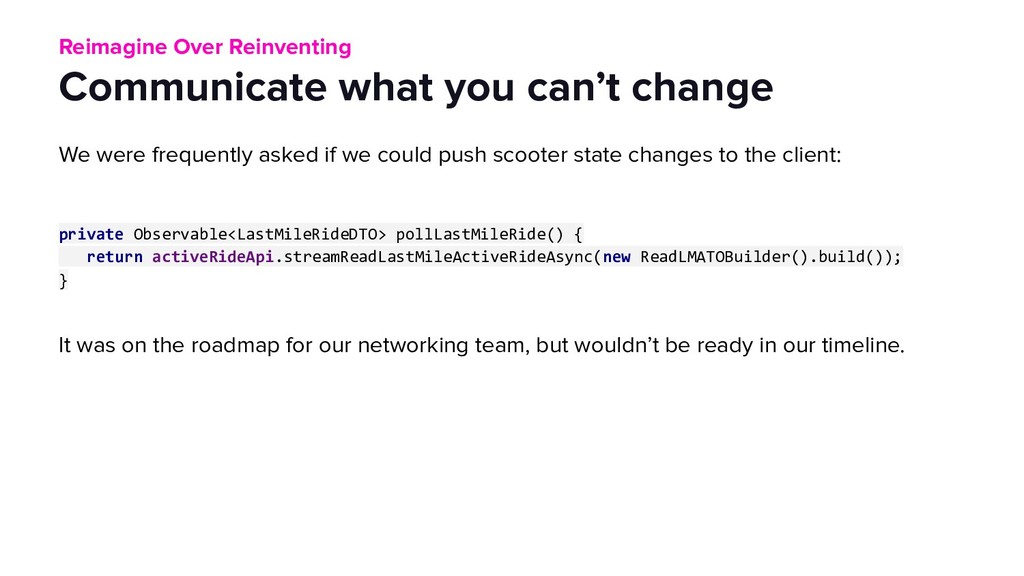
  40. Communicate what you can’t change We were frequently asked if

    we could push scooter state changes to the client: private Observable<LastMileRideDTO> pollLastMileRide() { return activeRideApi.streamReadLastMileActiveRideAsync(new ReadLMATOBuilder().build()); } It was on the roadmap for our networking team, but wouldn’t be ready in our timeline. Reimagine Over Reinventing
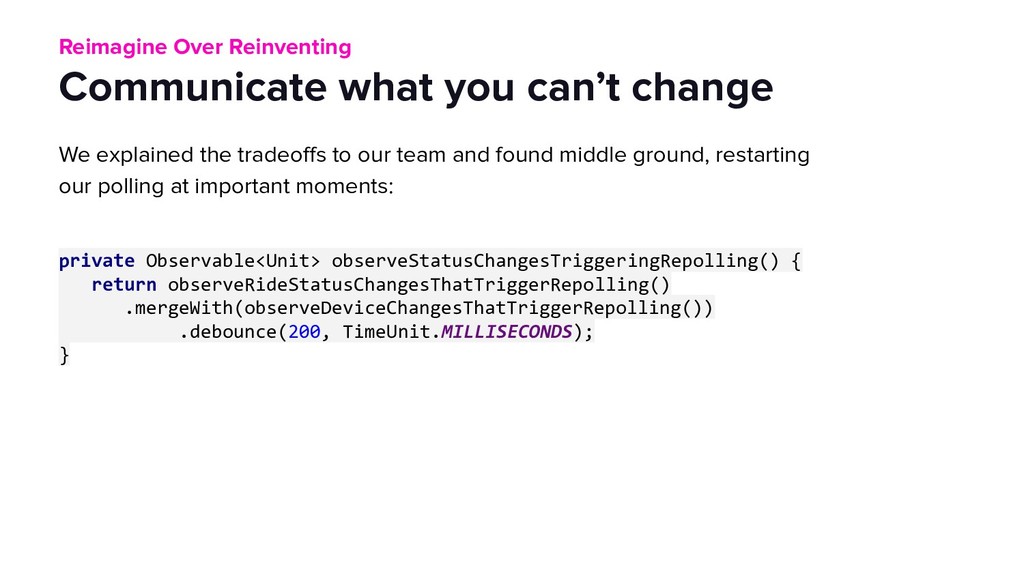
  41. Communicate what you can’t change We explained the tradeoffs to

    our team and found middle ground, restarting our polling at important moments: private Observable<Unit> observeStatusChangesTriggeringRepolling() { return observeRideStatusChangesThatTriggerRepolling() .mergeWith(observeDeviceChangesThatTriggerRepolling()) .debounce(200, TimeUnit.MILLISECONDS); } Reimagine Over Reinventing
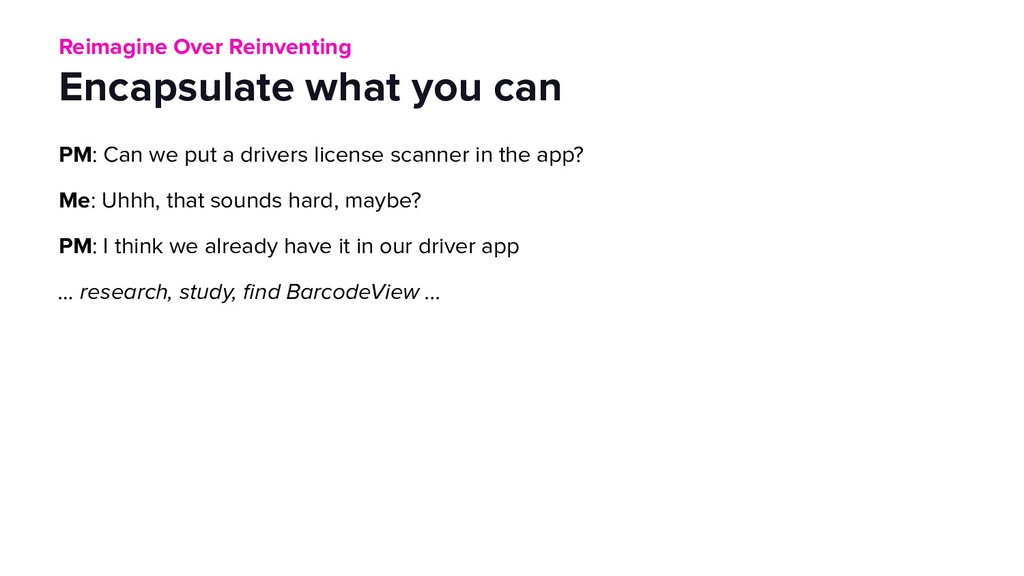
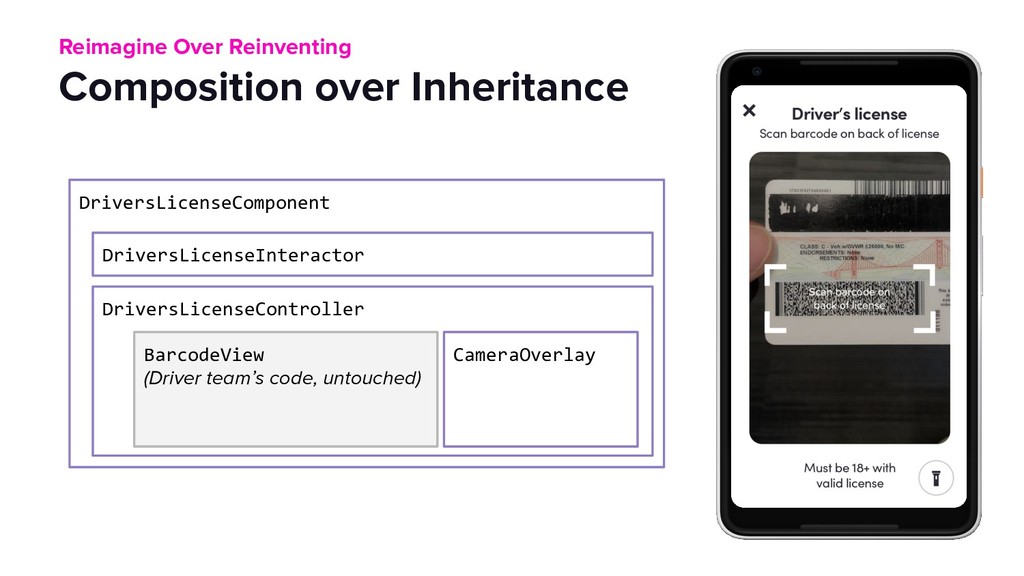
  42. Encapsulate what you can PM: Can we put a drivers

    license scanner in the app? Me: Uhhh, that sounds hard, maybe? PM: I think we already have it in our driver app … research, study, find BarcodeView ... Reimagine Over Reinventing
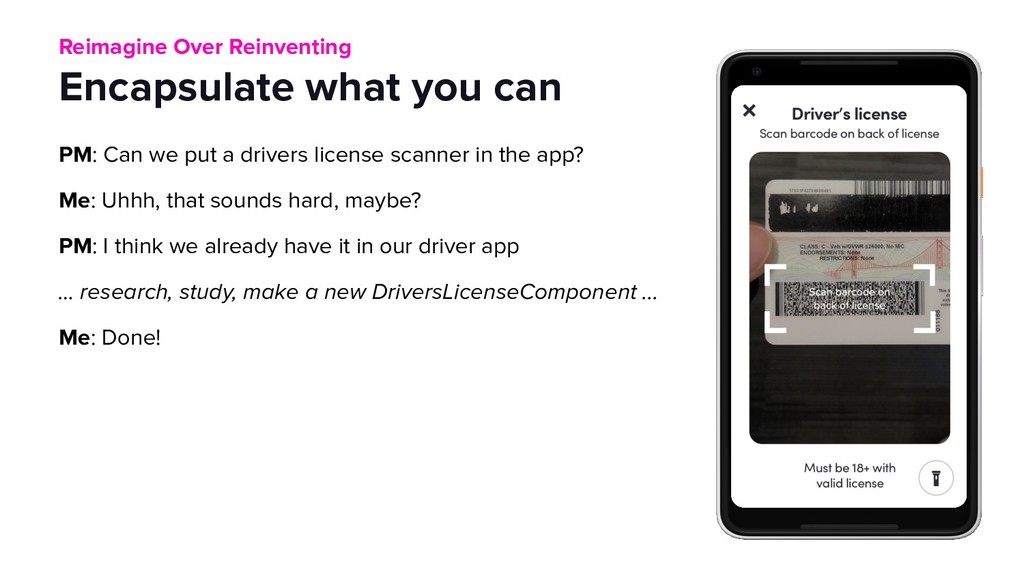
  43. Encapsulate what you can PM: Can we put a drivers

    license scanner in the app? Me: Uhhh, that sounds hard, maybe? PM: I think we already have it in our driver app … research, study, make a new DriversLicenseComponent ... Me: Done! Reimagine Over Reinventing
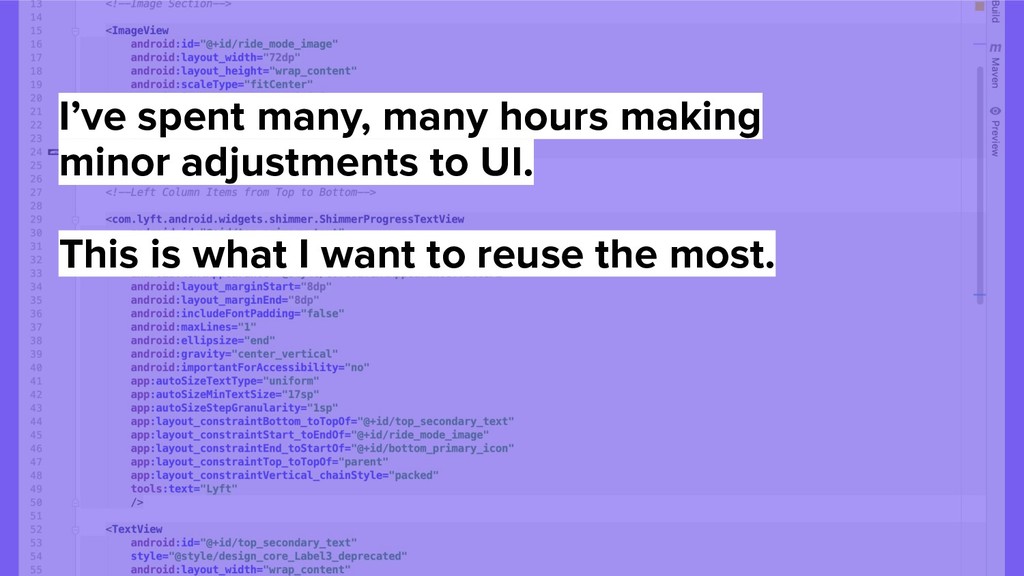
  44. I’ve spent many, many hours making minor adjustments to UI.

    This is what I want to reuse the most.
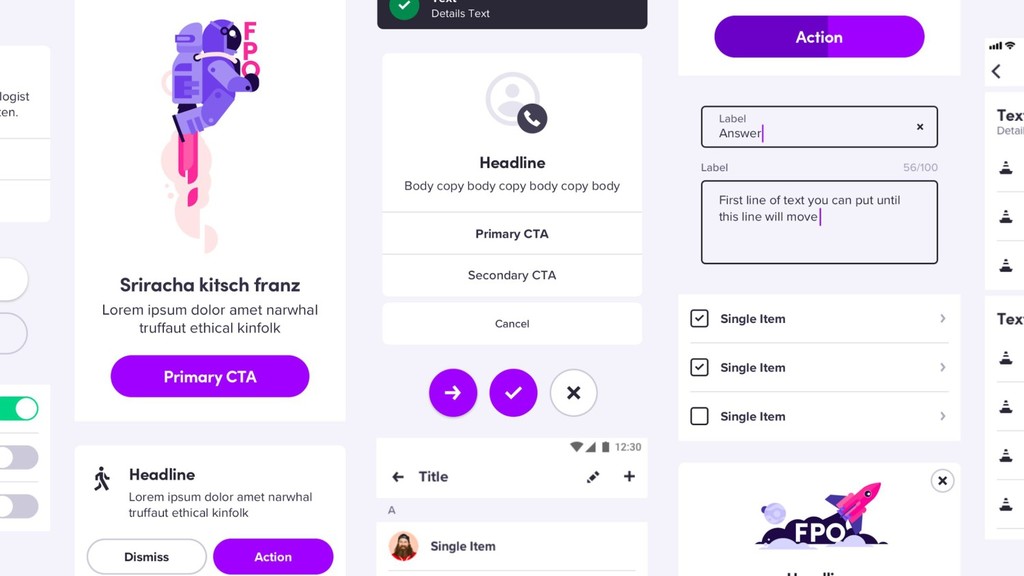
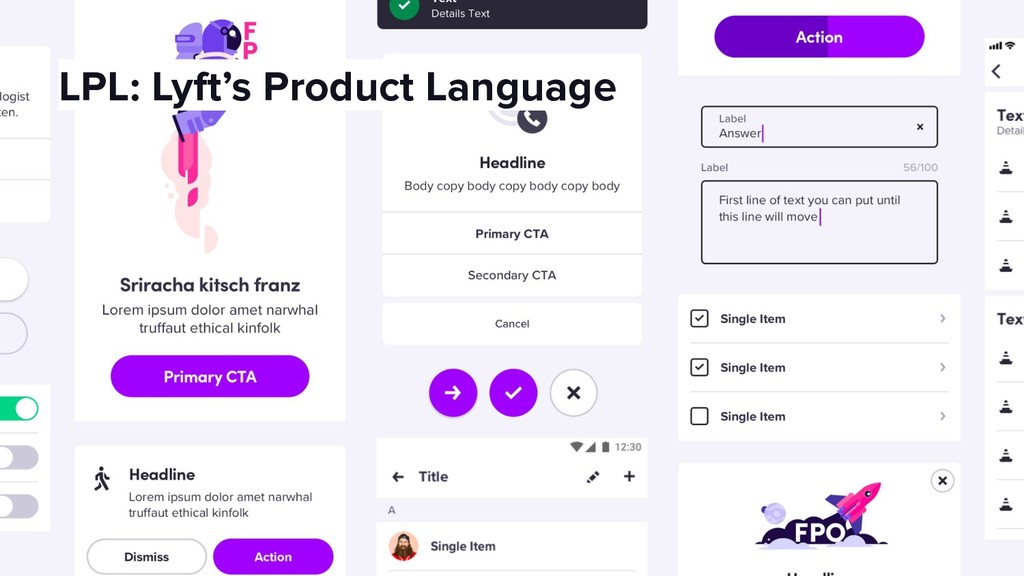
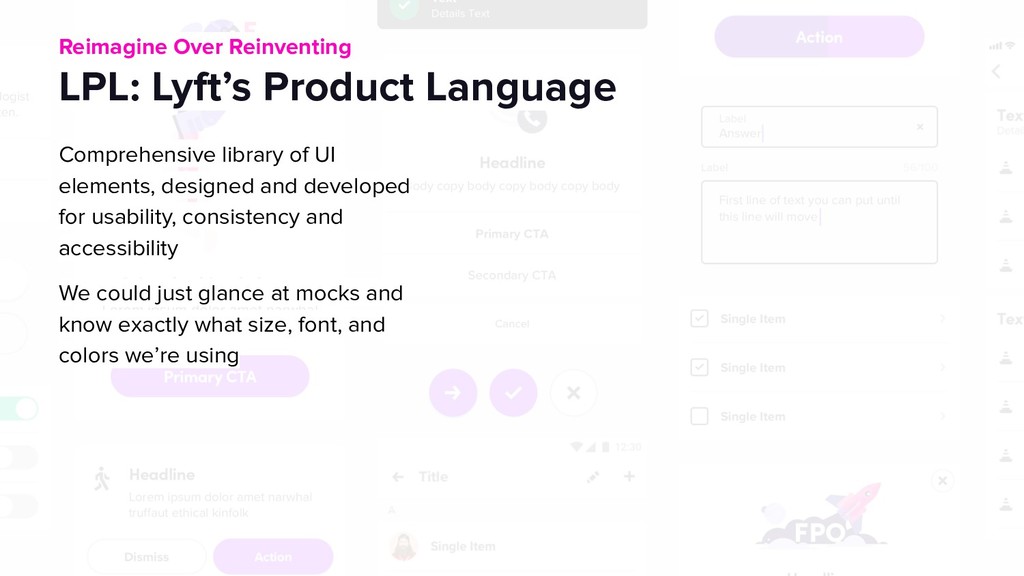
  45. LPL: Lyft’s Product Language Comprehensive library of UI elements, designed

    and developed for usability, consistency and accessibility We could just glance at mocks and know exactly what size, font, and colors we’re using Reimagine Over Reinventing
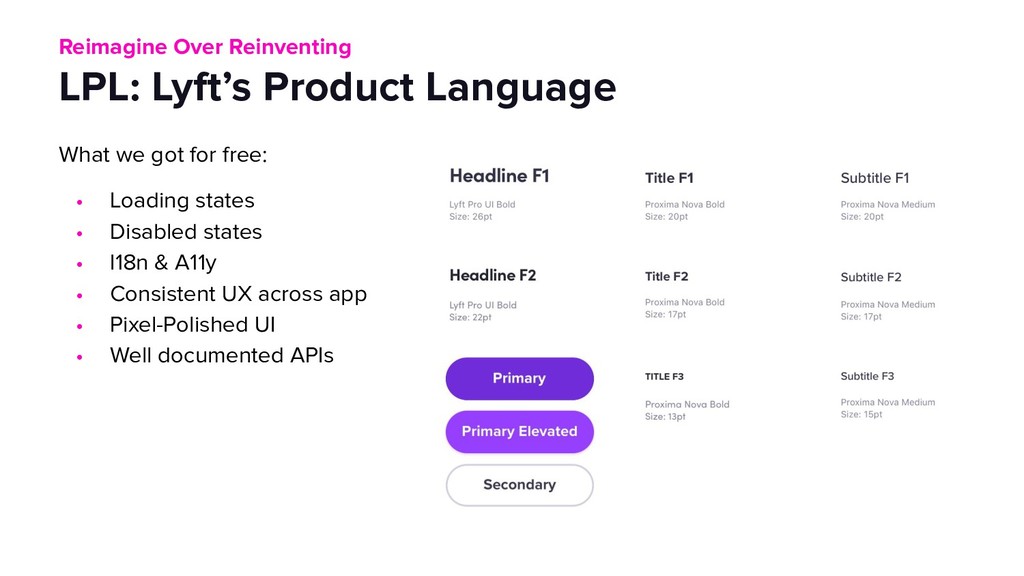
  46. LPL: Lyft’s Product Language What we got for free: •

    Loading states • Disabled states • I18n & A11y • Consistent UX across app • Pixel-Polished UI • Well documented APIs Reimagine Over Reinventing
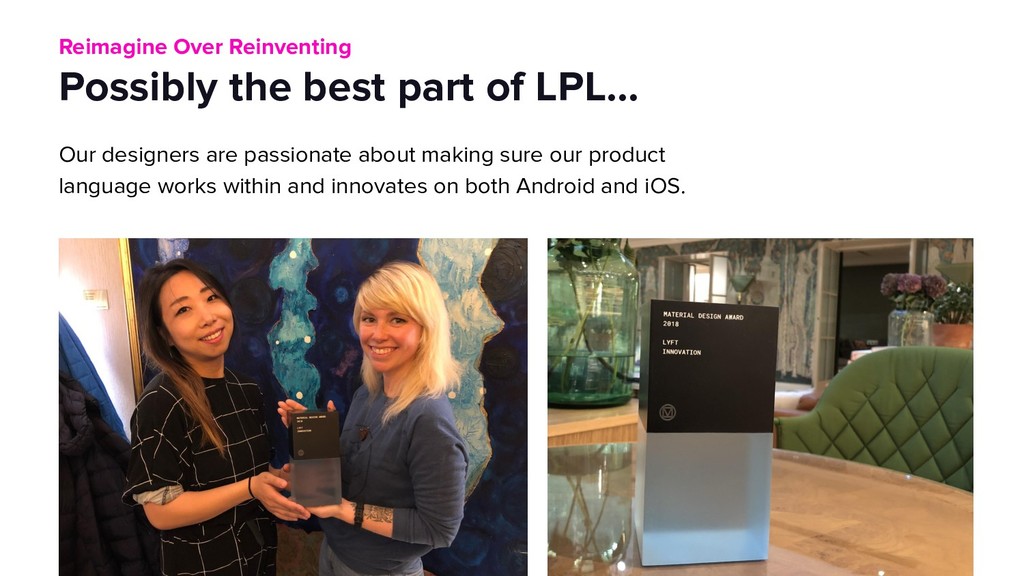
  47. Possibly the best part of LPL… Our designers are passionate

    about making sure our product language works within and innovates on both Android and iOS. Reimagine Over Reinventing
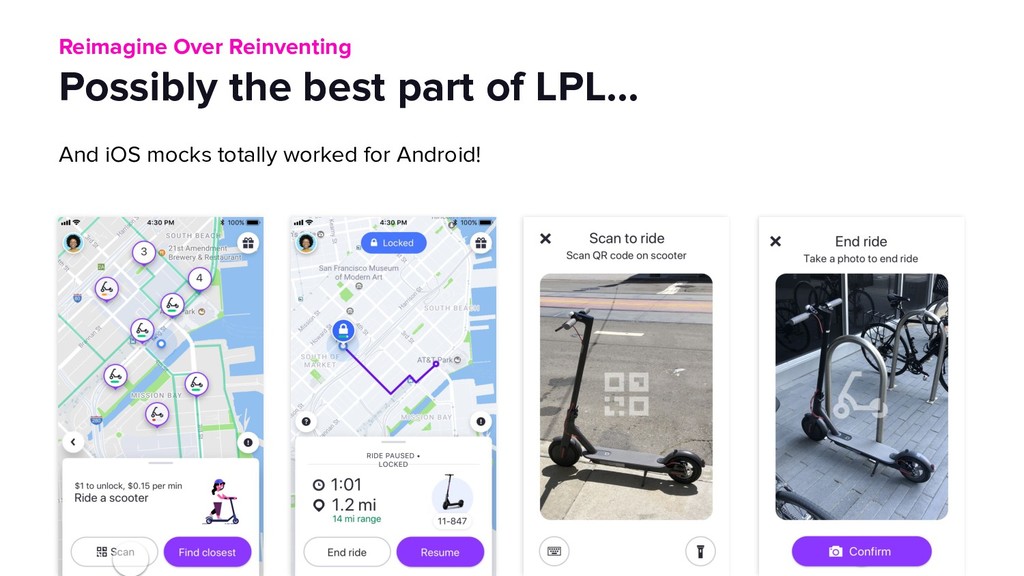
  48. Possibly the best part of LPL… And iOS mocks totally

    worked for Android! Reimagine Over Reinventing
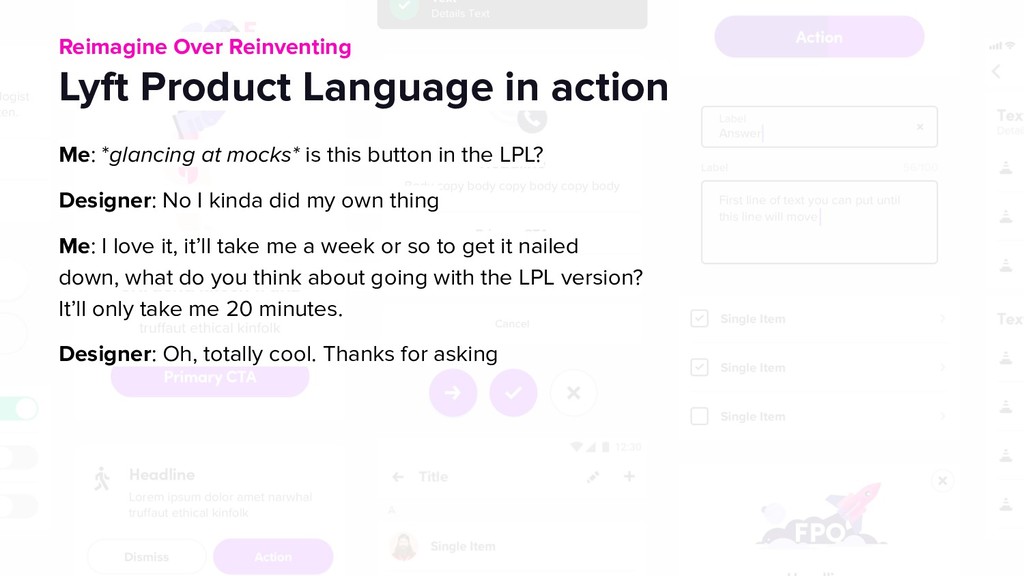
  49. Lyft Product Language in action Me: *glancing at mocks* is

    this button in the LPL? Designer: No I kinda did my own thing Me: I love it, it’ll take me a week or so to get it nailed down, what do you think about going with the LPL version? It’ll only take me 20 minutes. Designer: Oh, totally cool. Thanks for asking Reimagine Over Reinventing
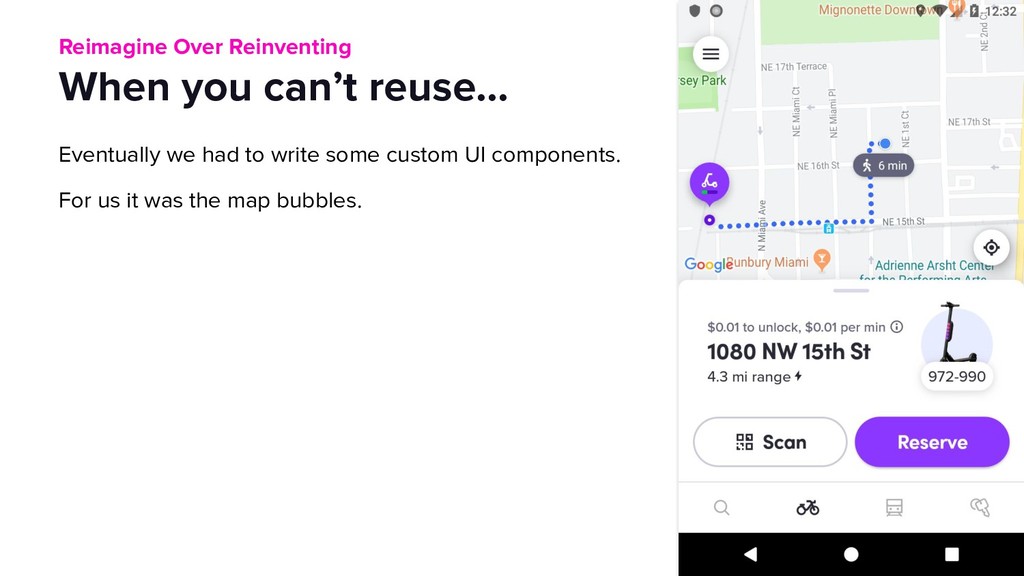
  50. When you can’t reuse... Eventually we had to write some

    custom UI components. For us it was the map bubbles. Reimagine Over Reinventing
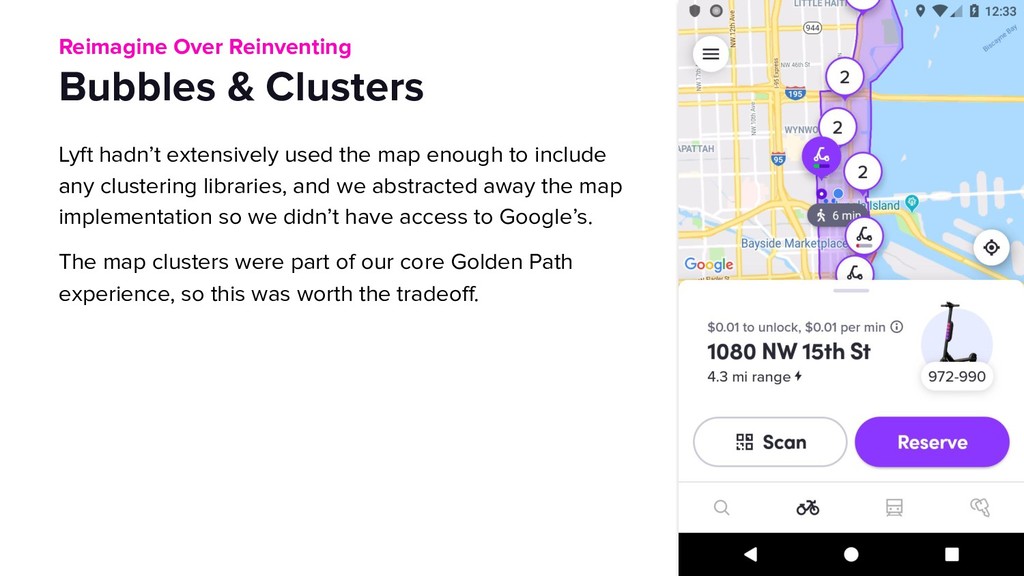
  51. Bubbles & Clusters Lyft hadn’t extensively used the map enough

    to include any clustering libraries, and we abstracted away the map implementation so we didn’t have access to Google’s. The map clusters were part of our core Golden Path experience, so this was worth the tradeoff. Reimagine Over Reinventing
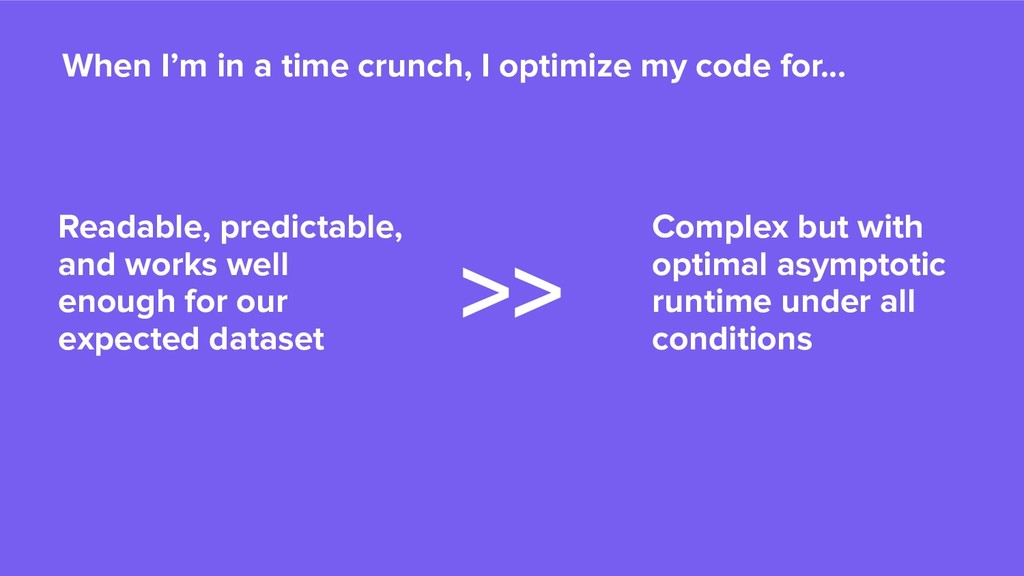
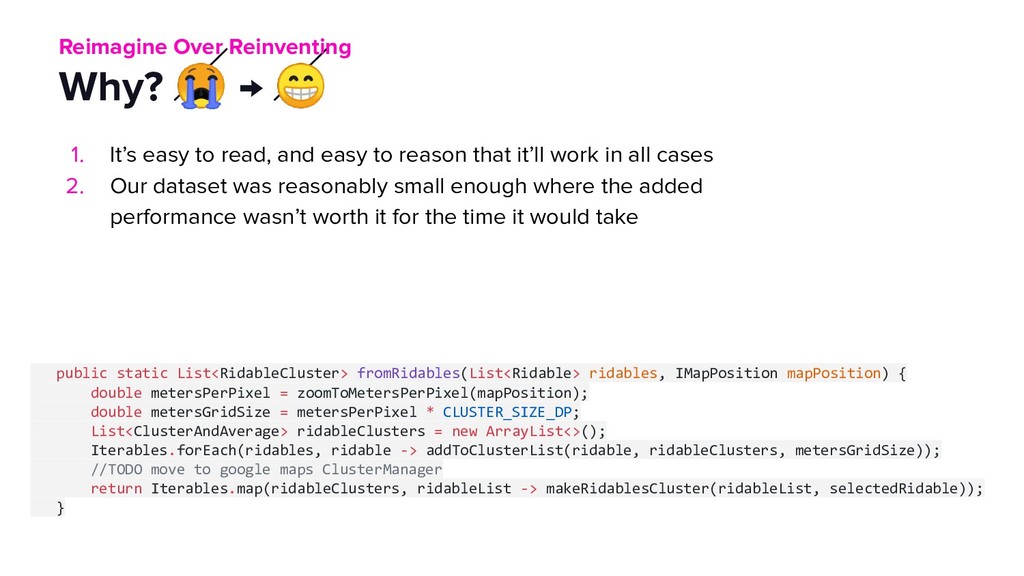
  52. Readable, predictable, and works well enough for our expected dataset

    Complex but with optimal asymptotic runtime under all conditions >> When I’m in a time crunch, I optimize my code for...
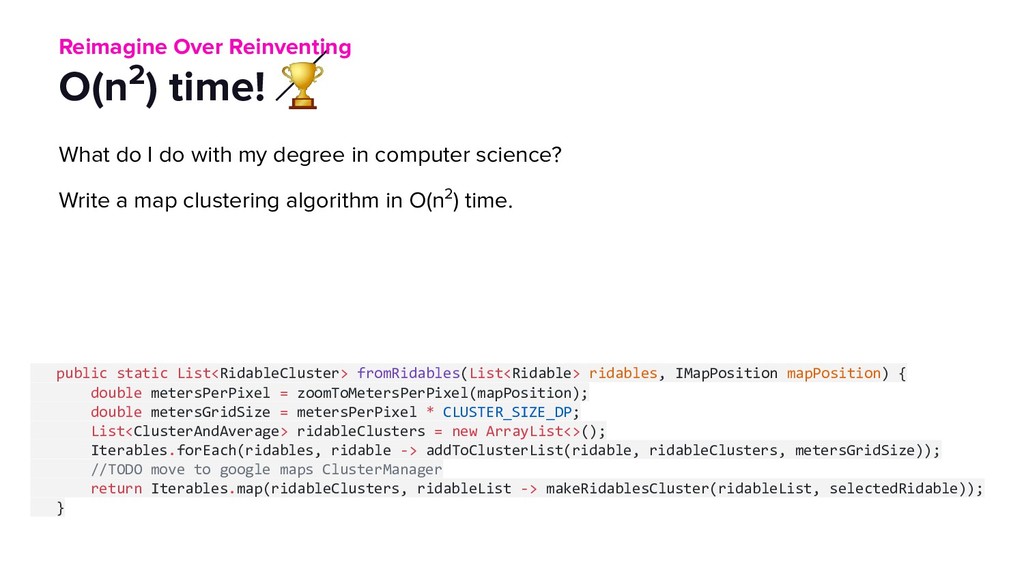
  53. O(n2) time! What do I do with my degree in

    computer science? Write a map clustering algorithm in O(n2) time. Reimagine Over Reinventing public static List<RidableCluster> fromRidables(List<Ridable> ridables, IMapPosition mapPosition) { double metersPerPixel = zoomToMetersPerPixel(mapPosition); double metersGridSize = metersPerPixel * CLUSTER_SIZE_DP; List<ClusterAndAverage> ridableClusters = new ArrayList<>(); Iterables.forEach(ridables, ridable -> addToClusterList(ridable, ridableClusters, metersGridSize)); //TODO move to google maps ClusterManager return Iterables.map(ridableClusters, ridableList -> makeRidablesCluster(ridableList, selectedRidable)); }
  54. Why? → 1. It’s easy to read, and easy to

    reason that it’ll work in all cases 2. Our dataset was reasonably small enough where the added performance wasn’t worth it for the time it would take Reimagine Over Reinventing public static List<RidableCluster> fromRidables(List<Ridable> ridables, IMapPosition mapPosition) { double metersPerPixel = zoomToMetersPerPixel(mapPosition); double metersGridSize = metersPerPixel * CLUSTER_SIZE_DP; List<ClusterAndAverage> ridableClusters = new ArrayList<>(); Iterables.forEach(ridables, ridable -> addToClusterList(ridable, ridableClusters, metersGridSize)); //TODO move to google maps ClusterManager return Iterables.map(ridableClusters, ridableList -> makeRidablesCluster(ridableList, selectedRidable)); }
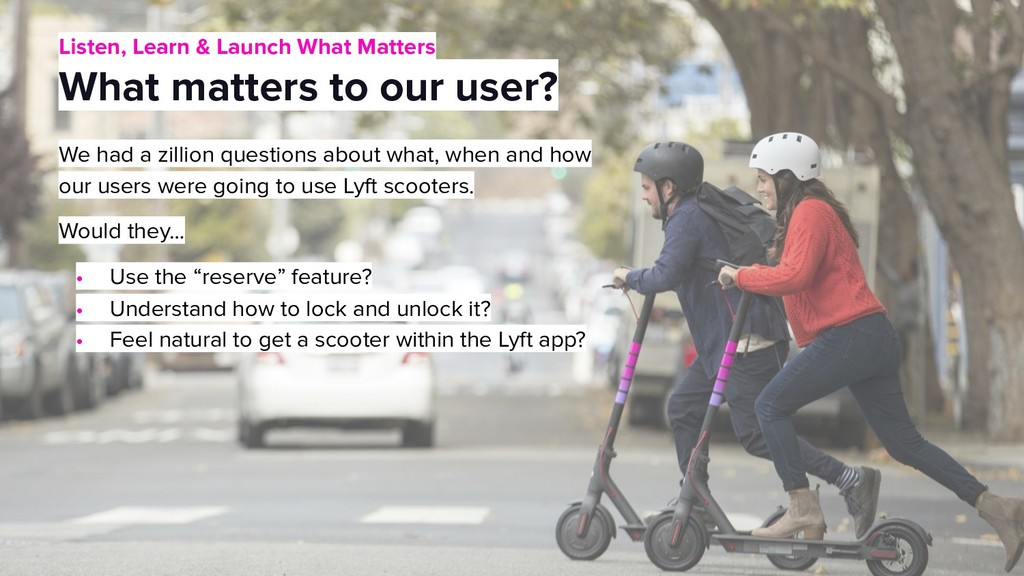
  55. What matters to our user? We had a zillion questions

    about what, when and how our users were going to use Lyft scooters. Would they… • Use the “reserve” feature? • Understand how to lock and unlock it? • Feel natural to get a scooter within the Lyft app? Listen, Learn & Launch What Matters
  56. When your feature is already live For established products, we

    iteratively release and roll out, A/B testing along the way. This helps us understand user behavior and preferences, and guards against major issues. Since we had never done something like this before, we couldn’t use any of these processes. Listen, Learn & Launch What Matters
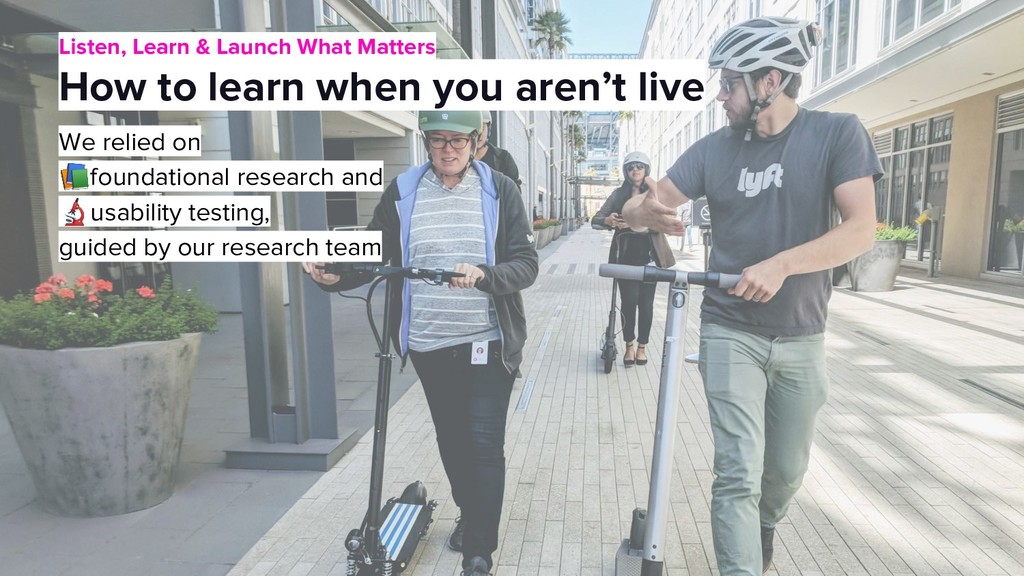
  57. How to learn when you aren’t live We relied on

    foundational research and usability testing, guided by our research team Listen, Learn & Launch What Matters
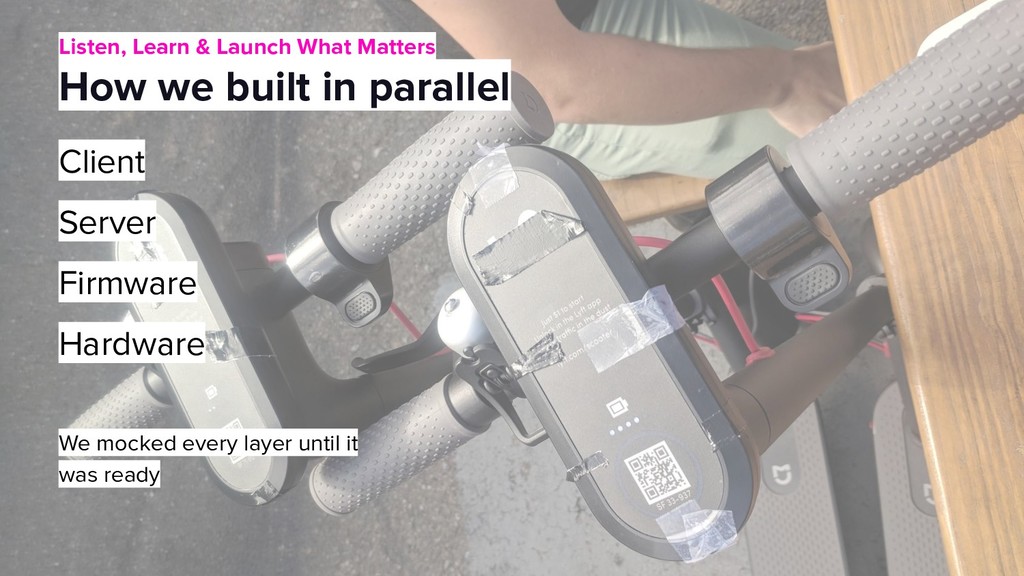
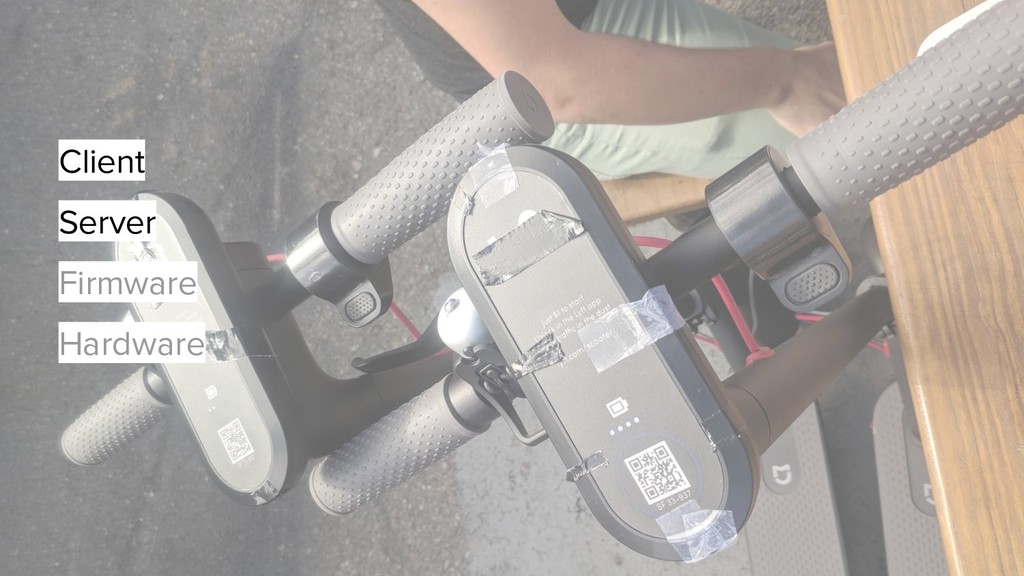
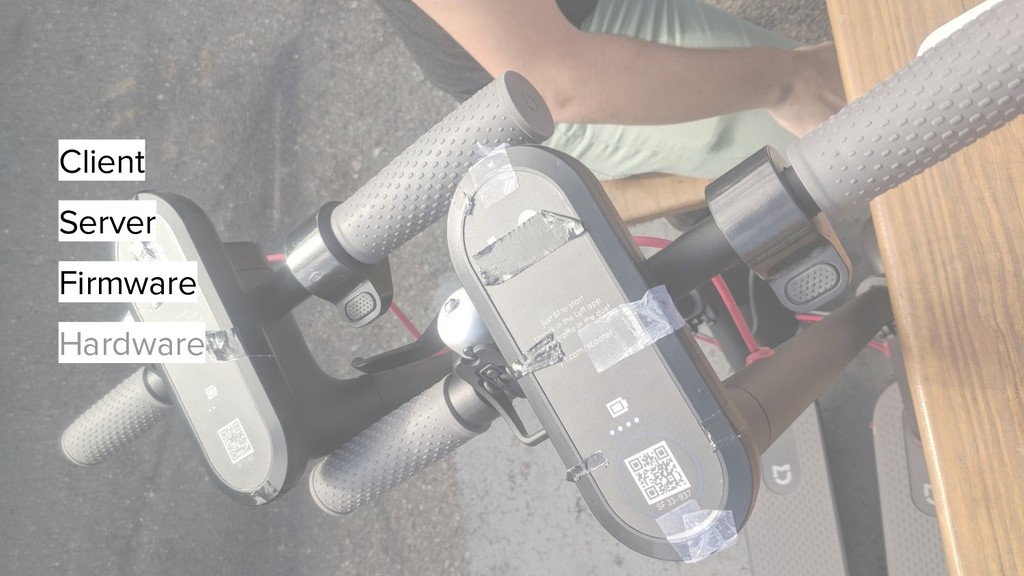
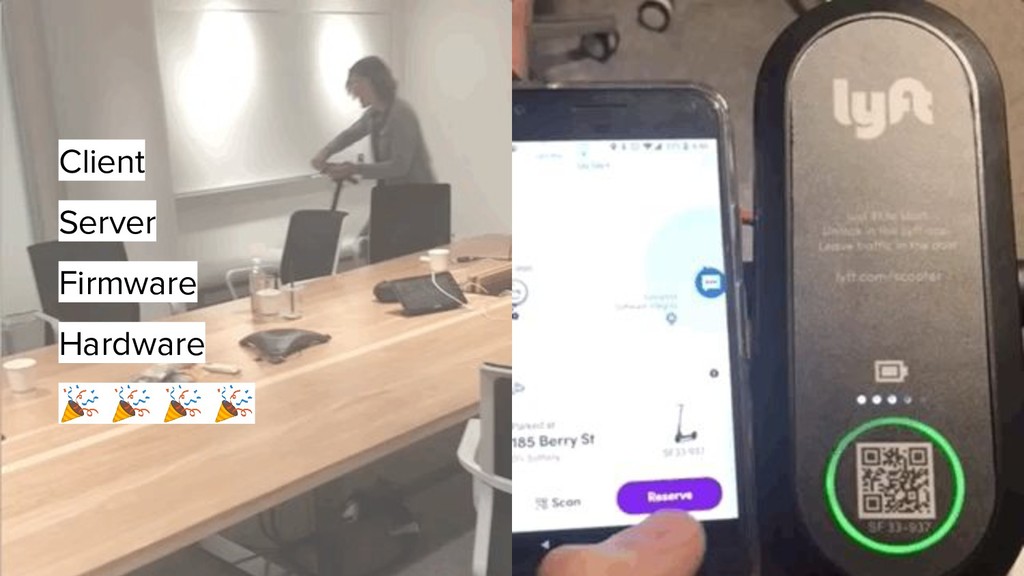
  58. How we built in parallel Client Server Firmware Hardware We

    mocked every layer until it was ready Listen, Learn & Launch What Matters
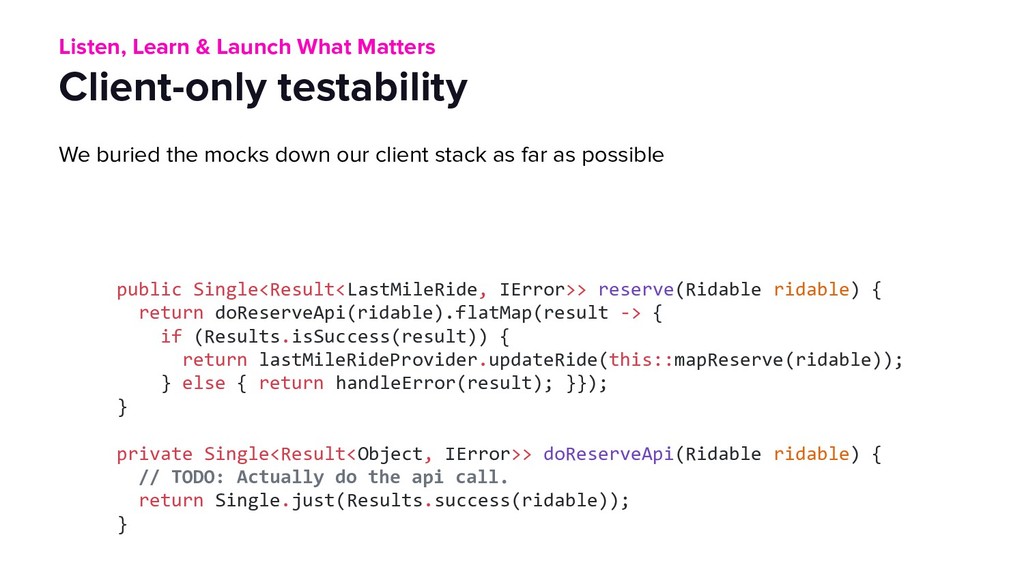
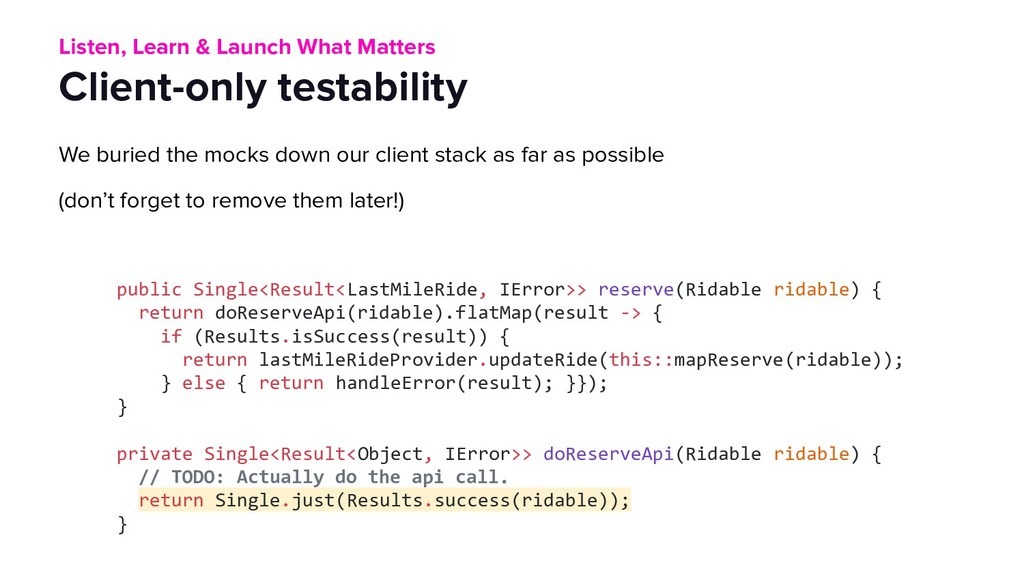
  59. Client-only testability We buried the mocks down our client stack

    as far as possible Listen, Learn & Launch What Matters public Single<Result<LastMileRide, IError>> reserve(Ridable ridable) { return doReserveApi(ridable).flatMap(result -> { if (Results.isSuccess(result)) { return lastMileRideProvider.updateRide(this::mapReserve(ridable)); } else { return handleError(result); }}); } private Single<Result<Object, IError>> doReserveApi(Ridable ridable) { // TODO: Actually do the api call. return Single.just(Results.success(ridable)); }
  60. Client-only testability We buried the mocks down our client stack

    as far as possible (don’t forget to remove them later!) Listen, Learn & Launch What Matters public Single<Result<LastMileRide, IError>> reserve(Ridable ridable) { return doReserveApi(ridable).flatMap(result -> { if (Results.isSuccess(result)) { return lastMileRideProvider.updateRide(this::mapReserve(ridable)); } else { return handleError(result); }}); } private Single<Result<Object, IError>> doReserveApi(Ridable ridable) { // TODO: Actually do the api call. return Single.just(Results.success(ridable)); }
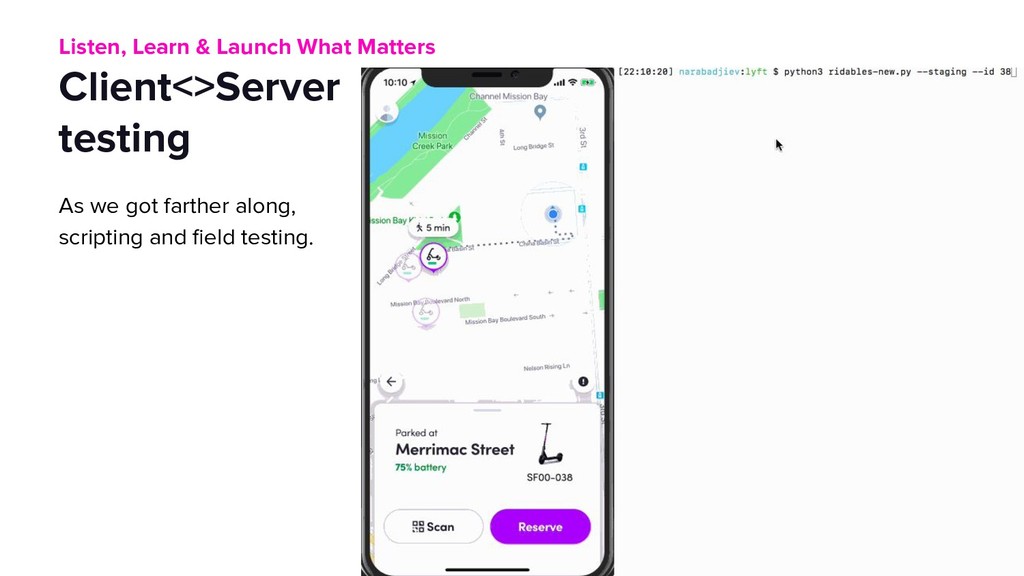
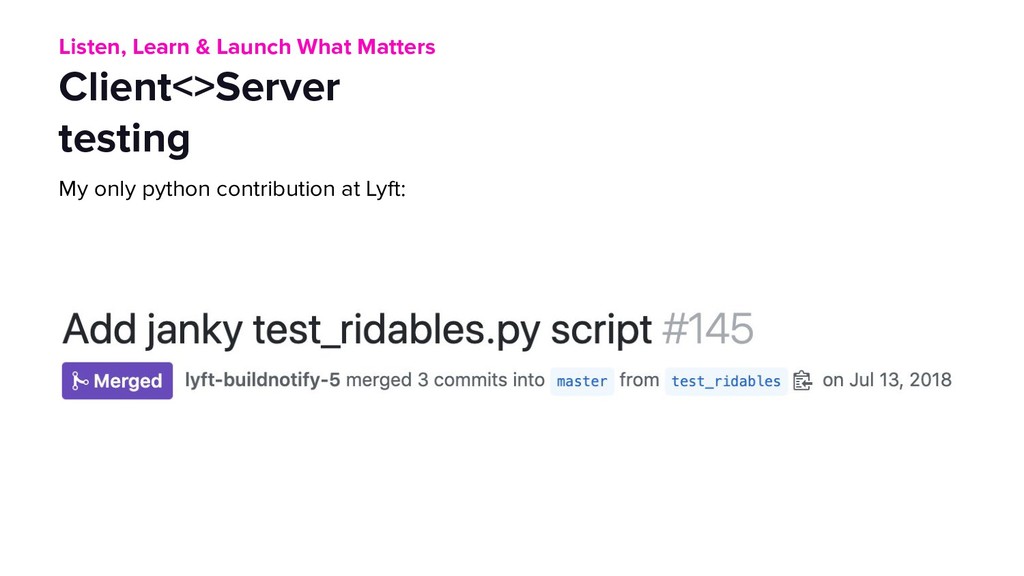
  61. Client<>Server testing As we got farther along, scripting and field

    testing. Listen, Learn & Launch What Matters
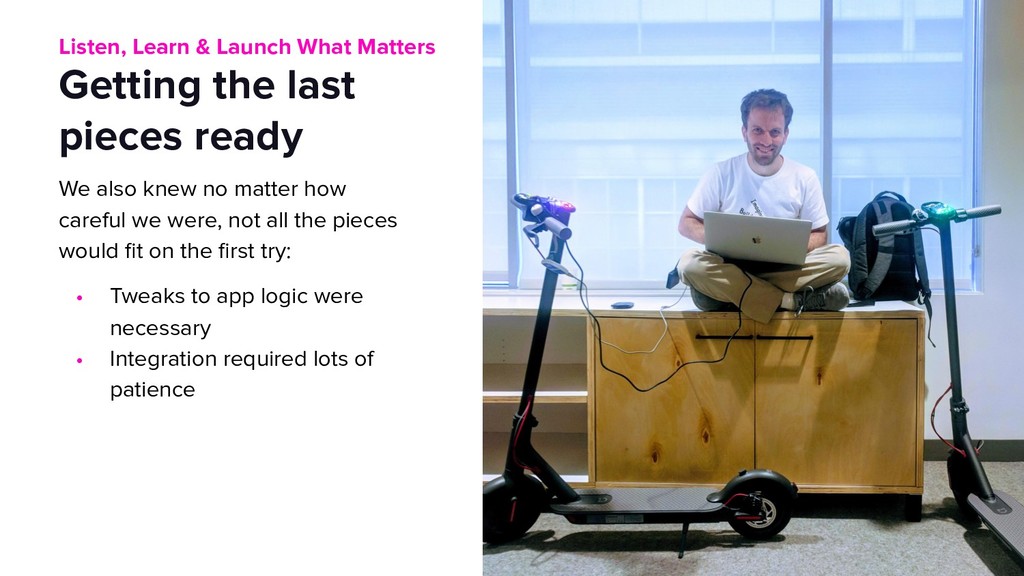
  62. Getting the last pieces ready We also knew no matter

    how careful we were, not all the pieces would fit on the first try: • Tweaks to app logic were necessary • Integration required lots of patience Listen, Learn & Launch What Matters
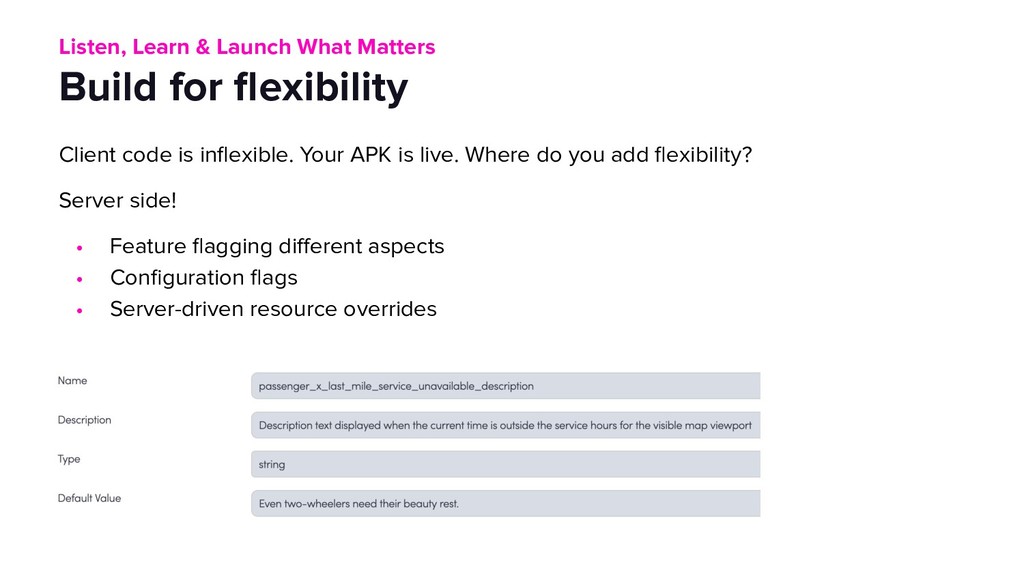
  63. Build for flexibility Client code is inflexible. Your APK is

    live. Where do you add flexibility? Server side! • Feature flagging different aspects • Configuration flags • Server-driven resource overrides Listen, Learn & Launch What Matters
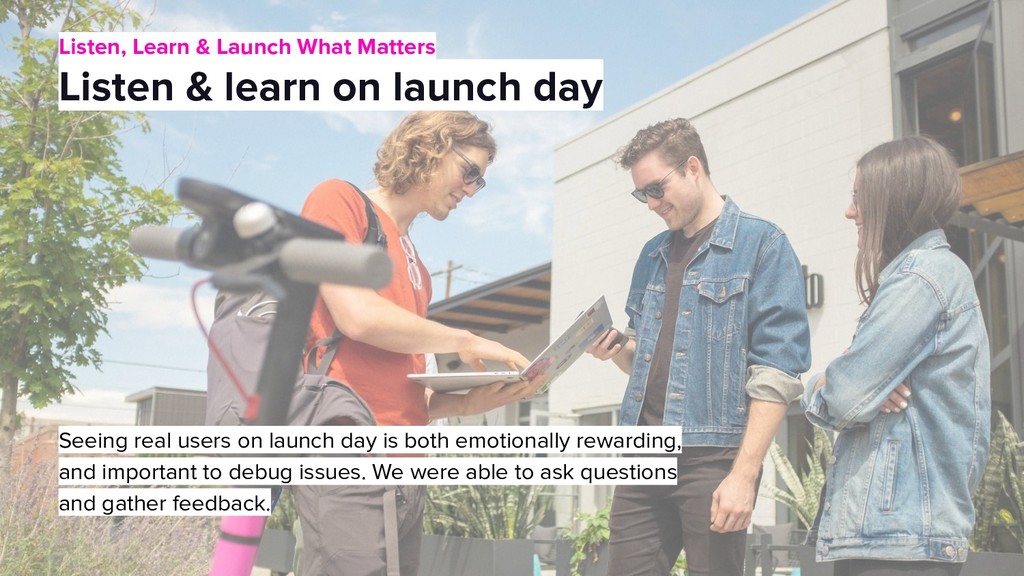
  64. Listen & learn on launch day Seeing real users on

    launch day is both emotionally rewarding, and important to debug issues. We were able to ask questions and gather feedback. Listen, Learn & Launch What Matters
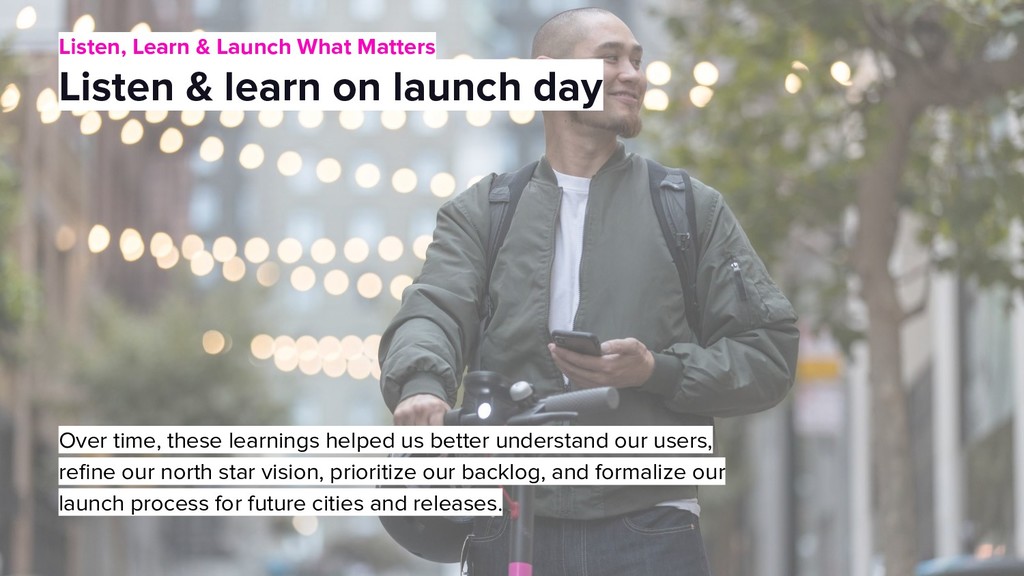
  65. Listen & learn on launch day Over time, these learnings

    helped us better understand our users, refine our north star vision, prioritize our backlog, and formalize our launch process for future cities and releases. Listen, Learn & Launch What Matters
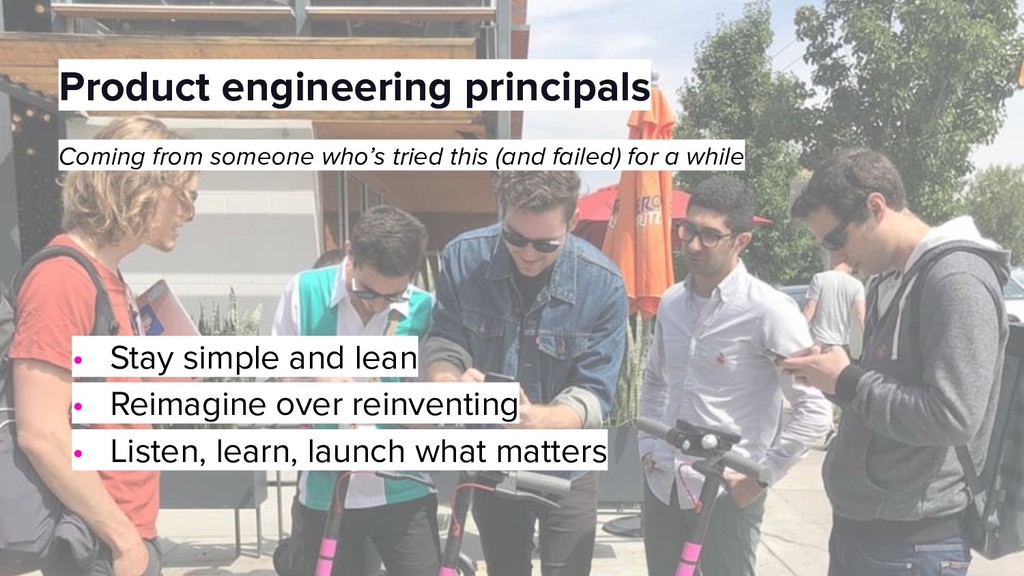
  66. Product engineering principals Coming from someone who’s tried this (and

    failed) for a while • Stay simple and lean • Reimagine over reinventing • Listen, learn, launch what matters
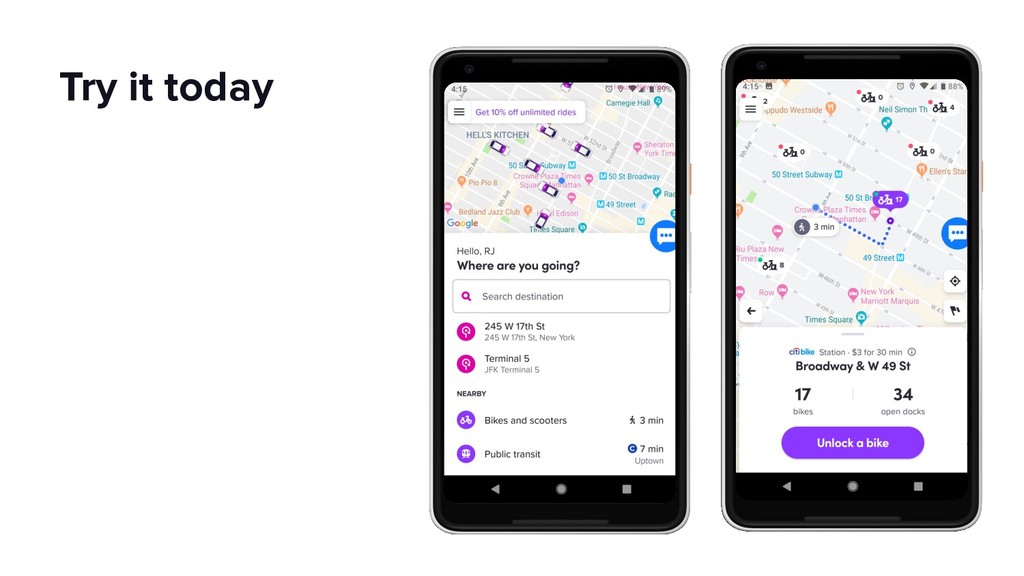
  67. Thanks! Try a Lyft bike or scooter! lyft.com/scooters Read more

    on eng.lyft.com Follow me on social: @rjmarsan Lyft is hiring all sorts of talented engineers!