Explore the critical role of industrial chains in power transmission, common failure causes, selection criteria, and advancements for durable, efficient industrial machinery performance.
chain on a conveyor line. A worn drive chain on mining equipment. The ripple effect through production is immediate and expensive. From automotive assembly to heavy construction, industrial chains keep modern industry turning — and when they're specified and maintained properly, they just keep working.
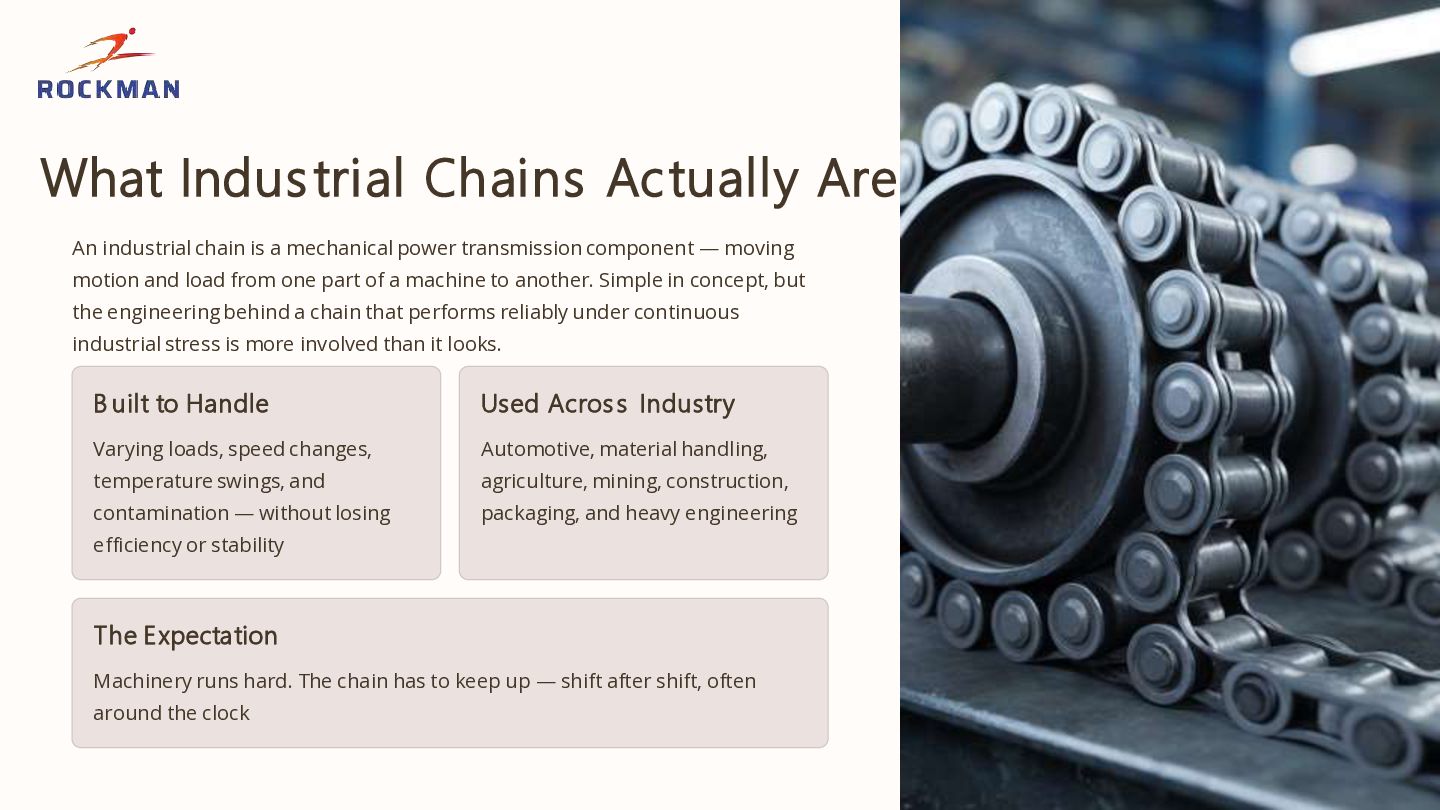
mechanical power transmission component — moving motion and load from one part of a machine to another. Simple in concept, but the engineering behind a chain that performs reliably under continuous industrial stress is more involved than it looks. B uilt to Handle Varying loads, speed changes, temperature swings, and contamination — without losing efficiency or stability Used Across Industry Automotive, material handling, agriculture, mining, construction, packaging, and heavy engineering The Expectation Machinery runs hard. The chain has to keep up — shift after shift, often around the clock
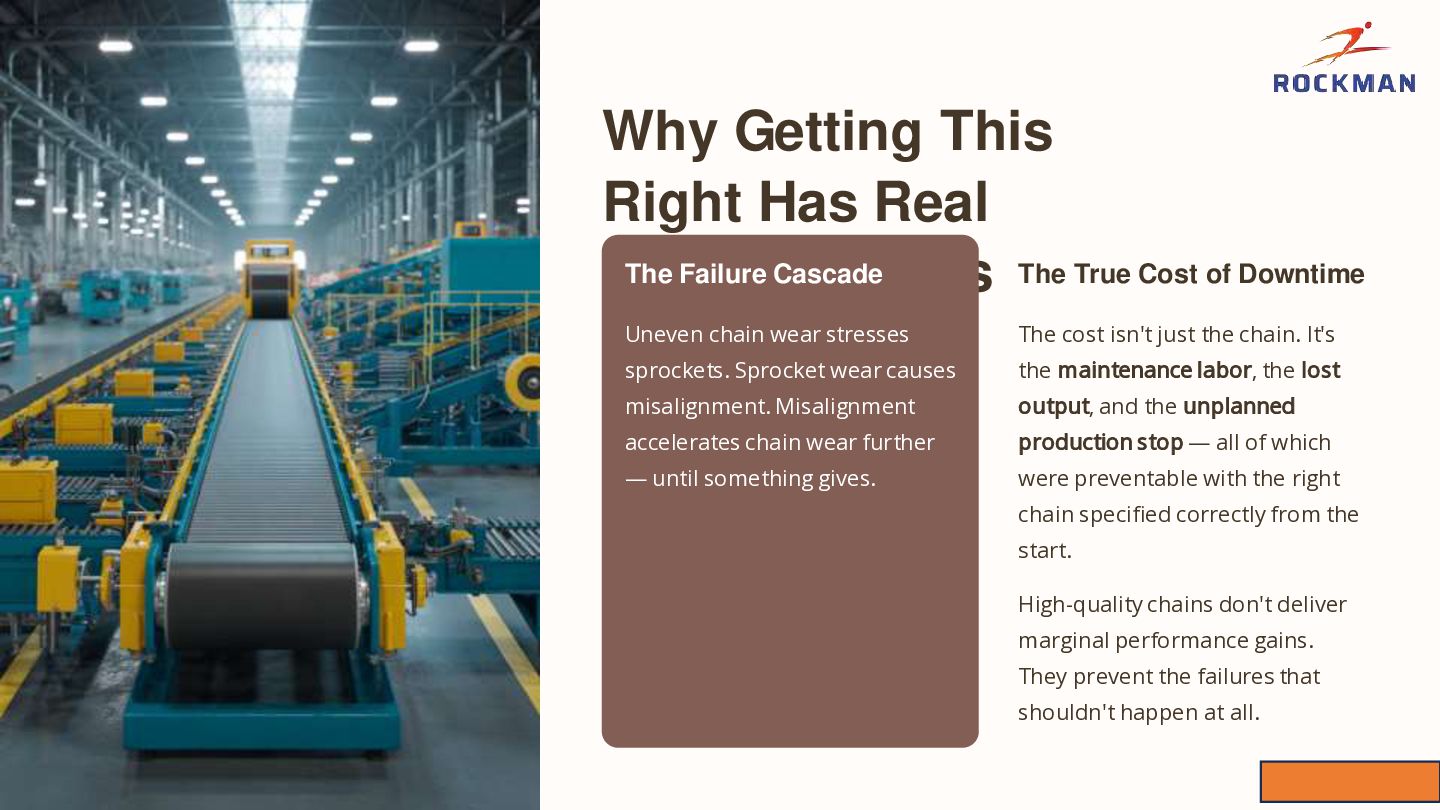
Uneven chain wear stresses sprockets. Sprocket wear causes misalignment. Misalignment accelerates chain wear further — until something gives. The True Cost of Downtime The cost isn't just the chain. It's the maintenance labor, the lost output, and the unplanned production stop — all of which were preventable with the right chain specified correctly from the start. High-quality chains don't deliver marginal performance gains. They prevent the failures that shouldn't happen at all.
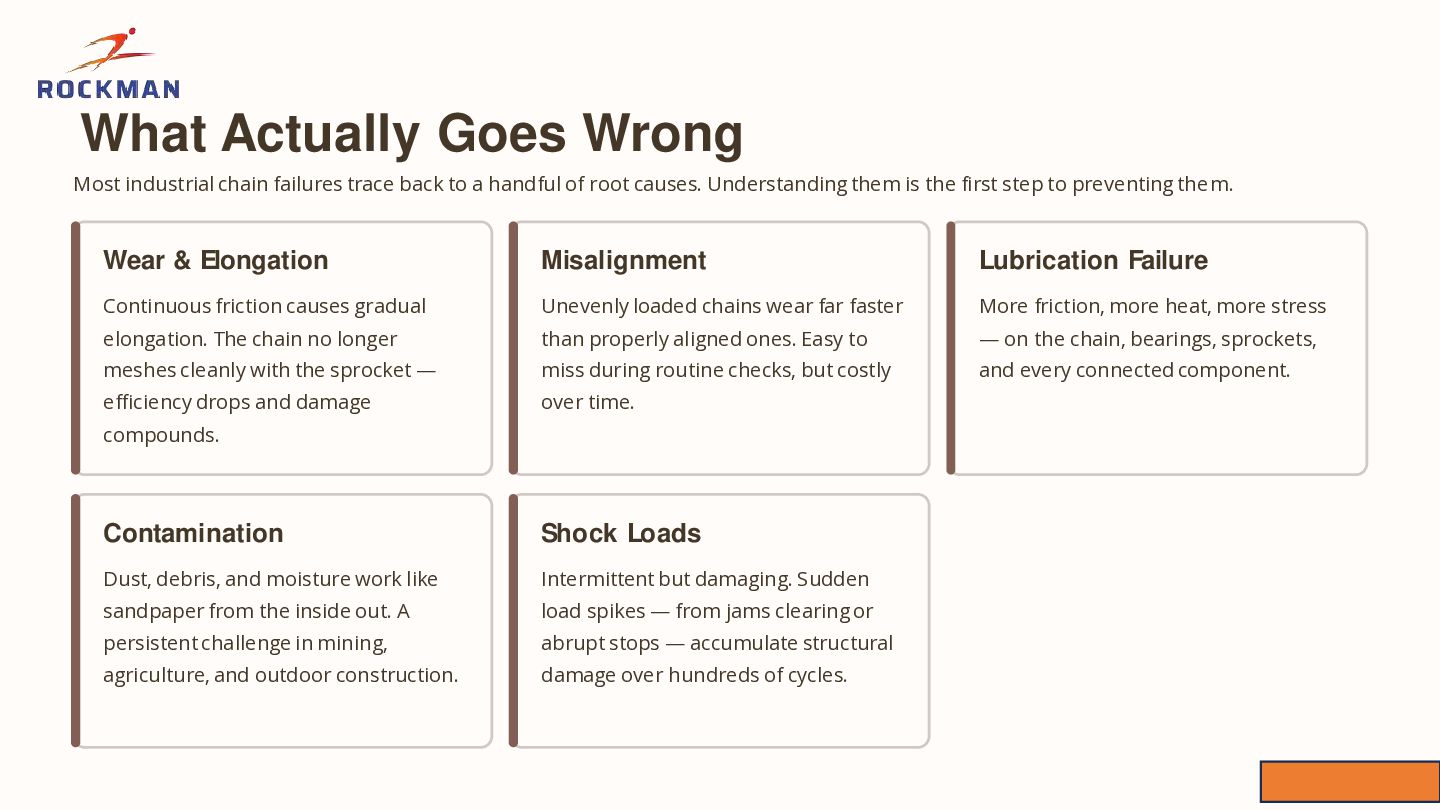
to a handful of root causes. Understanding them is the first step to preventing them. Wear & Elongation Continuous friction causes gradual elongation. The chain no longer meshes cleanly with the sprocket — efficiency drops and damage compounds. Misalignment Unevenly loaded chains wear far faster than properly aligned ones. Easy to miss during routine checks, but costly over time. Lubrication Failure More friction, more heat, more stress — on the chain, bearings, sprockets, and every connected component. Contamination Dust, debris, and moisture work like sandpaper from the inside out. A persistent challenge in mining, agriculture, and outdoor construction. Shock Loads Intermittent but damaging. Sudden load spikes — from jams clearing or abrupt stops — accumulate structural damage over hundreds of cycles.
chain requires thinking through the specific application — not just matching a catalogue number. Load Capacity Size for peak loads, not averages. Ignoring load spikes is one of the most common and costly specification mistakes. Operating Environment Temperature, moisture, and contamination levels all determine which chain is appropriate. A clean plant and a dusty quarry demand very different solutions. Speed Requirements Slow, high-torque applications and fast, lighter-load systems require different chain designs. Getting this wrong affects both performance and service life. Maintenance Accessibility A chain requiring frequent lubrication but installed in a hard- to-reach location will eventually be neglected. Plan for access before installation. Material Quality & Precision Tighter manufacturing tolerances mean better sprocket engagement throughout the chain's entire service life — measurable in real operational performance.
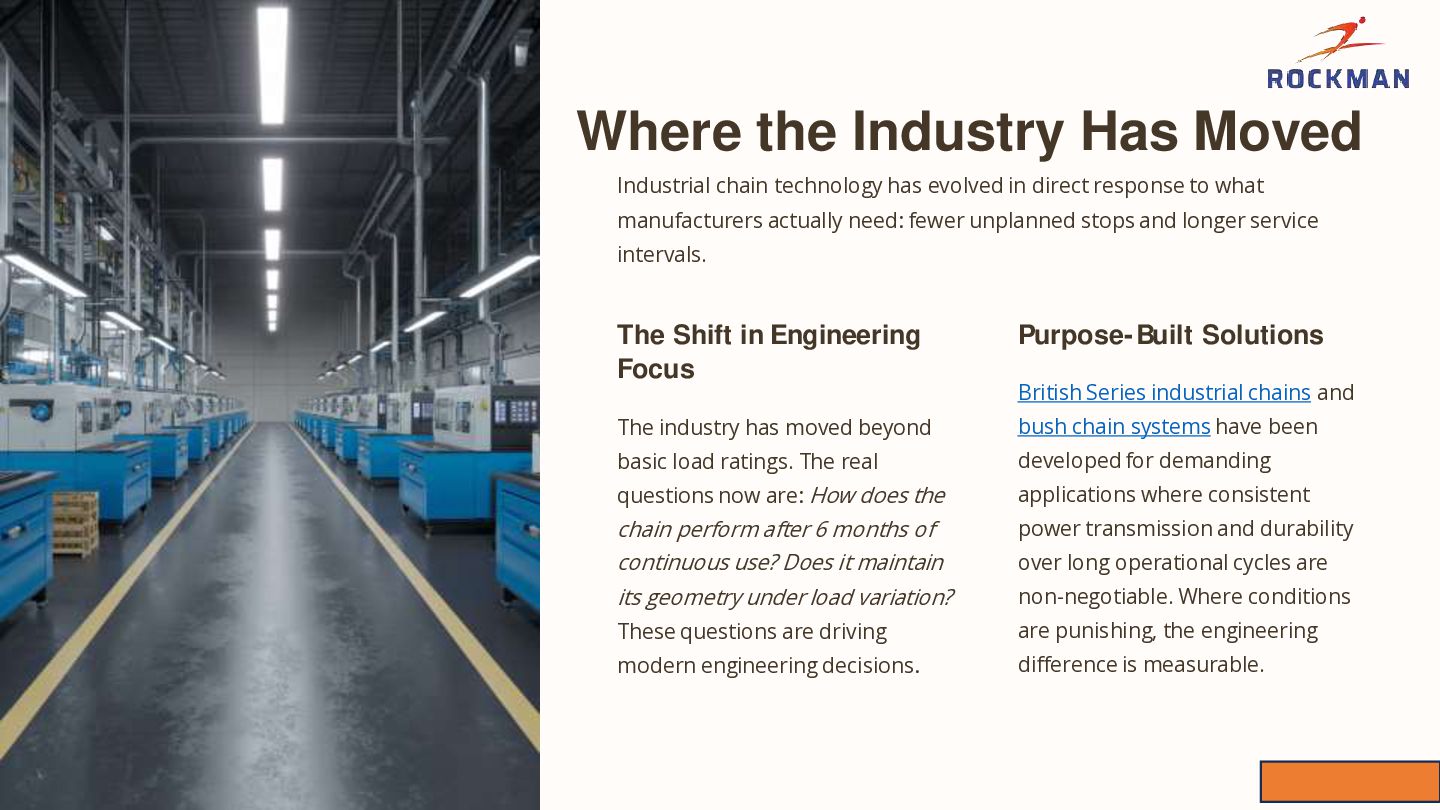
in direct response to what manufacturers actually need: fewer unplanned stops and longer service intervals. The Shift in Engineering Focus The industry has moved beyond basic load ratings. The real questions now are: How does the chain perform after 6 months of continuous use? Does it maintain its geometry under load variation? These questions are driving modern engineering decisions. Purpose-Built Solutions British Series industrial chains and bush chain systems have been developed for demanding applications where consistent power transmission and durability over long operational cycles are non-negotiable. Where conditions are punishing, the engineering difference is measurable.
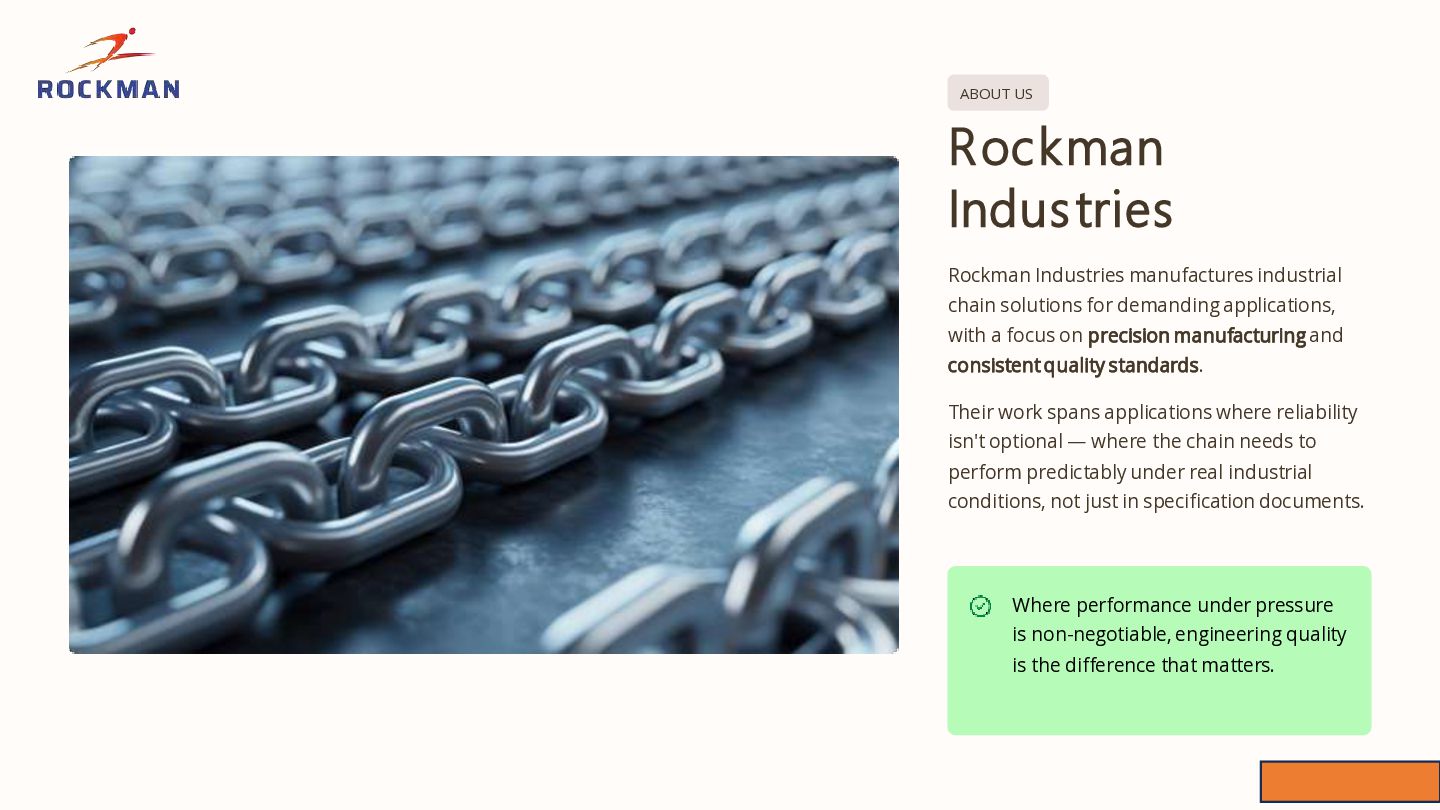
for demanding applications, with a focus on precision manufacturing and consistent quality standards. Their work spans applications where reliability isn't optional — where the chain needs to perform predictably under real industrial conditions, not just in specification documents. Where performance under pressure is non-negotiable, engineering quality is the difference that matters.
power and movement across machinery systems — across manufacturing, mining, automotive, packaging, agriculture, and heavy engineering where machines run continuously under demanding conditions. What affects industrial chain performance? Wear, improper lubrication, sprocket misalignment, contamination from dust or moisture, and sudden shock loads can all reduce chain efficiency and lifespan significantly. How can industrial chain life be increased? Regular lubrication, proper alignment, routine inspection, and selecting the right chain for the specific application are the most effective ways to extend service life and maintain stable long-term performance. The best industrial chain is the one you never have to think about. Choosing correctly upfront — for the environment, the load, and the maintenance reality — is what gets you there.


 rockmanindustries
 varn
 konakalab
 coloredviolet
 katarinadahlin
 rasagy
 jonoalderson
 michaelherold
 letsgokoyo
 bcantrill
 axbom
 szymonslowik
 inesmontani