Share
Embed
Transcript
37 slides
-
A Multi-scale CNN for Single Image Spectral Super-resolution 基于多尺度卷积神经网络的 单图光谱超分辨
答辩人:闫奕岐 指导老师:魏巍 2018年6月7日 Yiqi Yan Supervisor: Dr. Wei Wei July 7, 2018 -
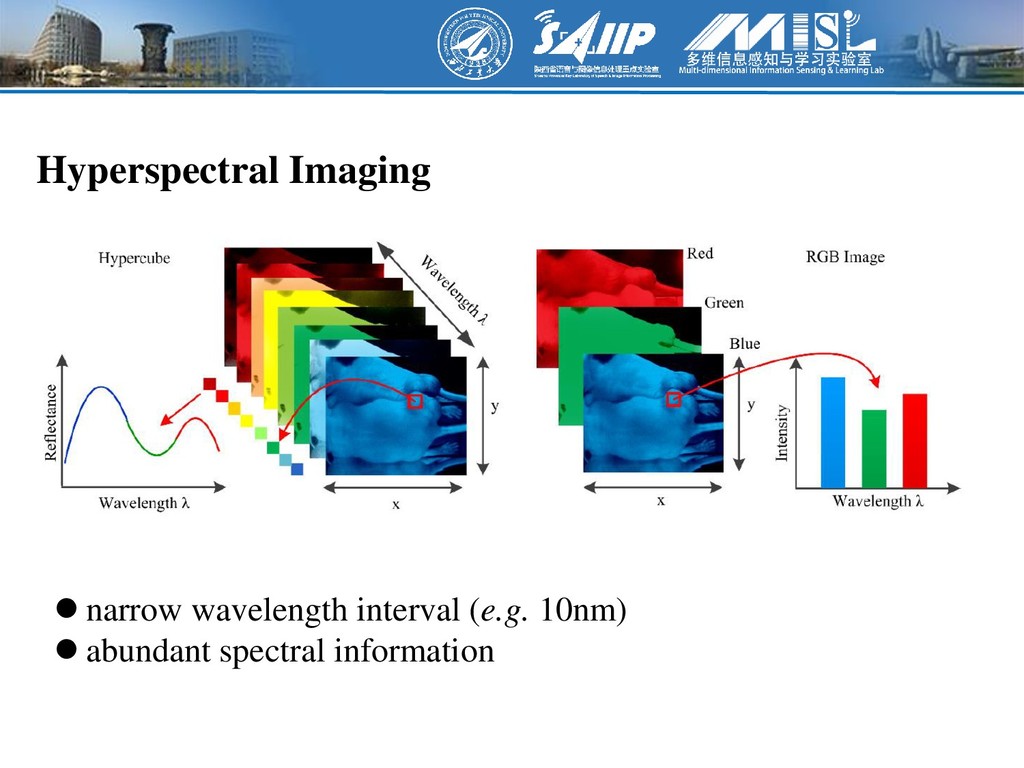
Hyperspectral Imaging ⚫ narrow wavelength interval (e.g. 10nm) ⚫ abundant
spectral information -
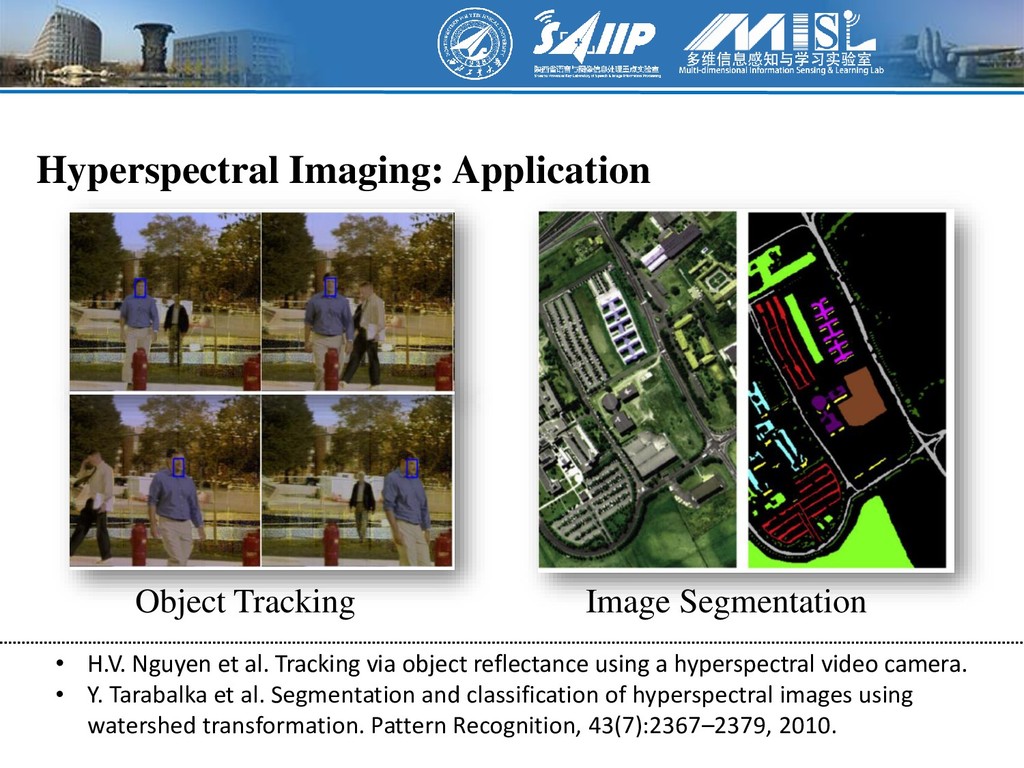
Hyperspectral Imaging: Application • H.V. Nguyen et al. Tracking via
object reflectance using a hyperspectral video camera. • Y. Tarabalka et al. Segmentation and classification of hyperspectral images using watershed transformation. Pattern Recognition, 43(7):2367–2379, 2010. Object Tracking Image Segmentation -
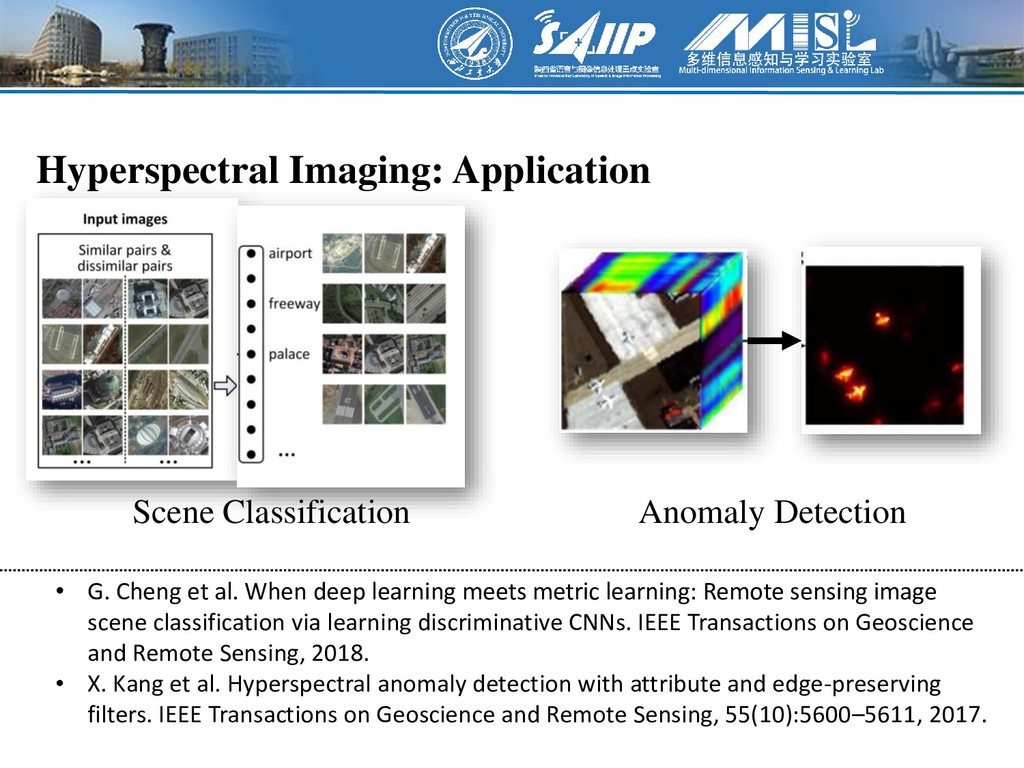
Hyperspectral Imaging: Application • G. Cheng et al. When deep
learning meets metric learning: Remote sensing image scene classification via learning discriminative CNNs. IEEE Transactions on Geoscience and Remote Sensing, 2018. • X. Kang et al. Hyperspectral anomaly detection with attribute and edge-preserving filters. IEEE Transactions on Geoscience and Remote Sensing, 55(10):5600–5611, 2017. Scene Classification Anomaly Detection -
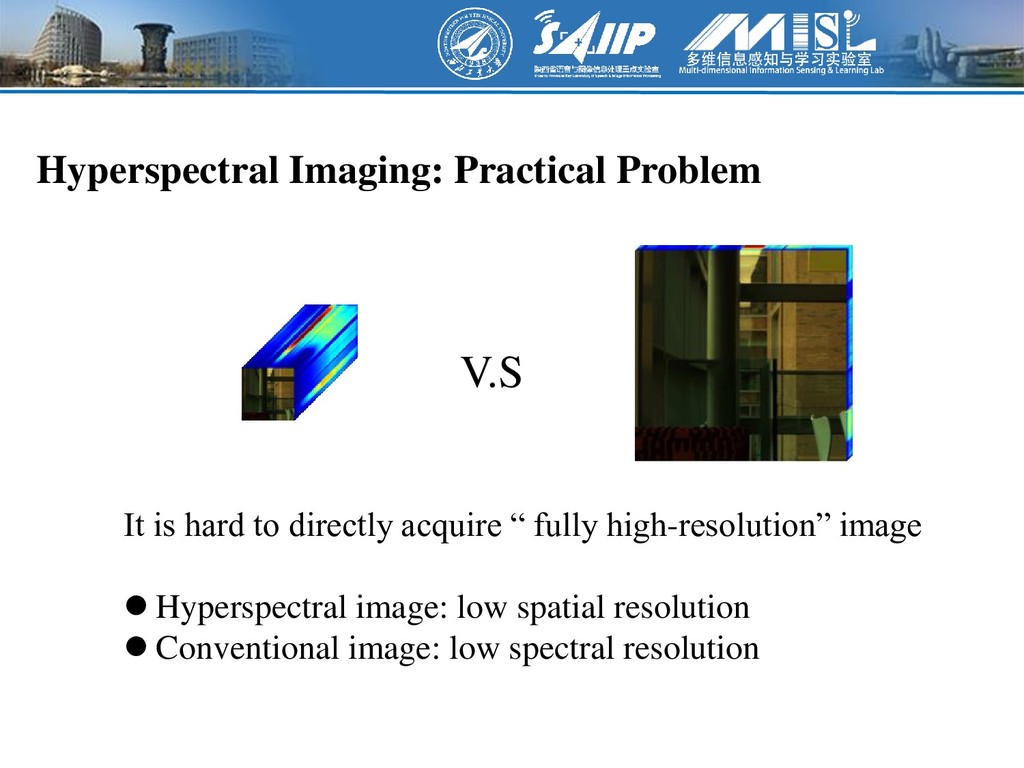
Hyperspectral Imaging: Practical Problem V.S It is hard to directly
acquire “ fully high-resolution” image ⚫ Hyperspectral image: low spatial resolution ⚫ Conventional image: low spectral resolution -
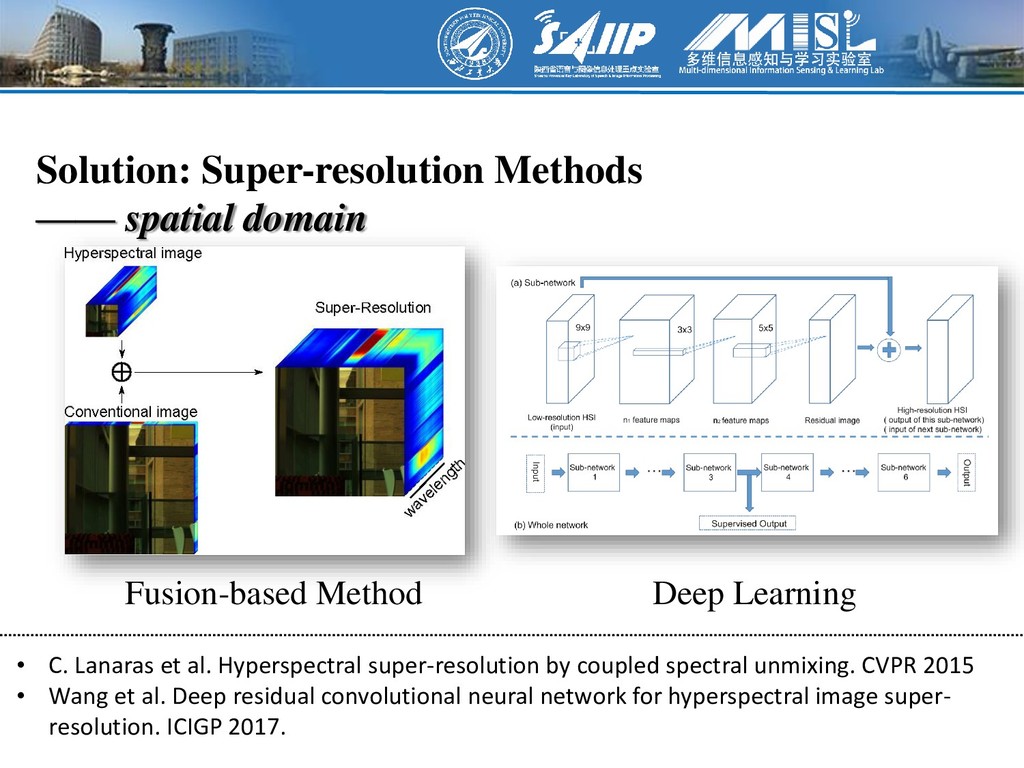
Solution: Super-resolution Methods —— spatial domain Fusion-based Method Deep Learning
• C. Lanaras et al. Hyperspectral super-resolution by coupled spectral unmixing. CVPR 2015 • Wang et al. Deep residual convolutional neural network for hyperspectral image super- resolution. ICIGP 2017. -
Solution: Super-resolution Methods —— spatial domain ⚫ High cost: still
need hyperspectral sensors ⚫ (Fusion-based) need well registered hyper-RGB image pair Spatial super-resolution is still not practical in reality! -
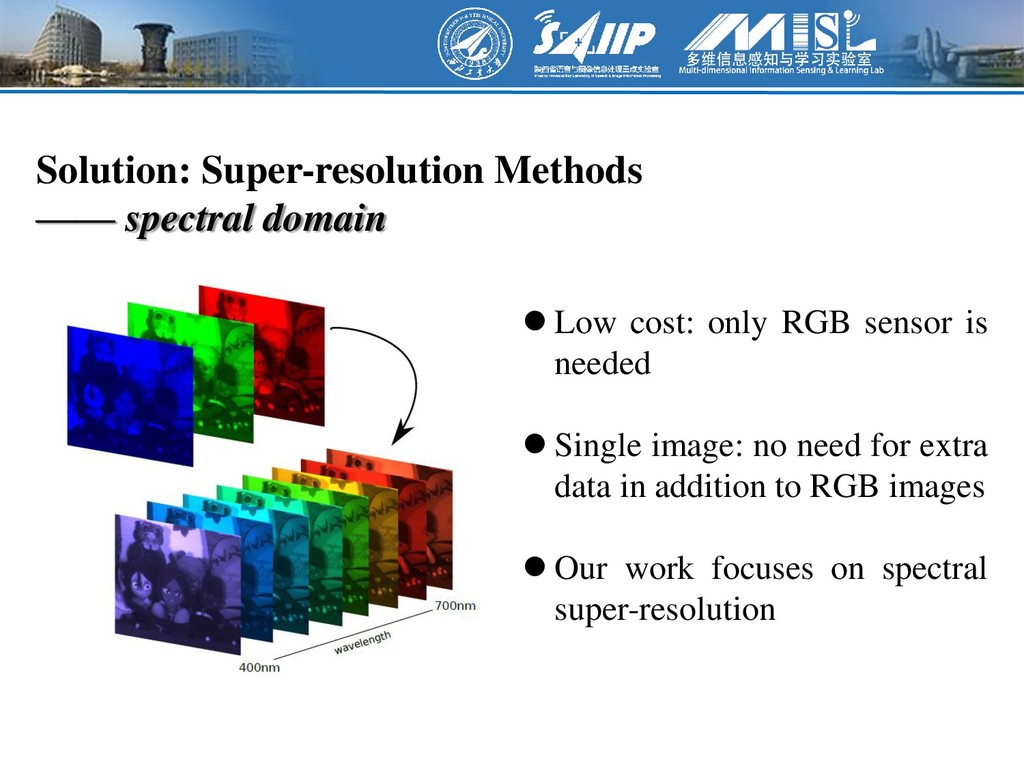
Solution: Super-resolution Methods —— spectral domain ⚫ Low cost: only
RGB sensor is needed ⚫ Single image: no need for extra data in addition to RGB images ⚫ Our work focuses on spectral super-resolution -
Motivation ⚫ Inherent correlation of natural images ⚫ Local and
non-local similarity ⚫ Multi-scale information -
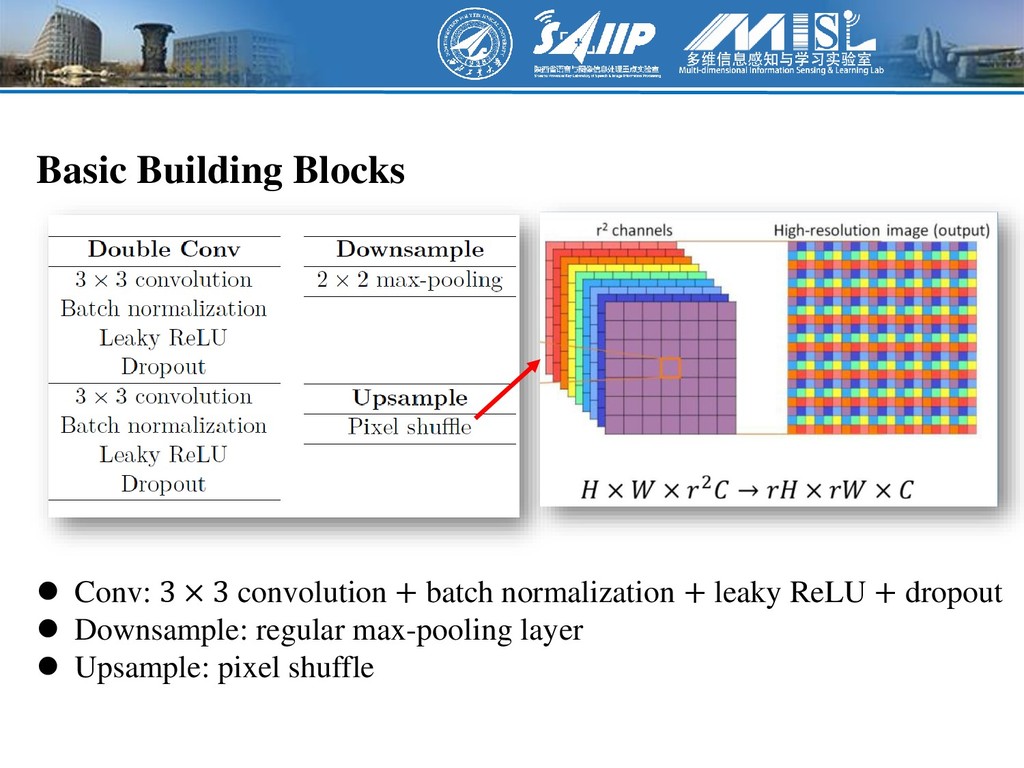
Basic Building Blocks ⚫ Conv: 3 × 3 convolution +
batch normalization + leaky ReLU + dropout ⚫ Downsample: regular max-pooling layer ⚫ Upsample: pixel shuffle -
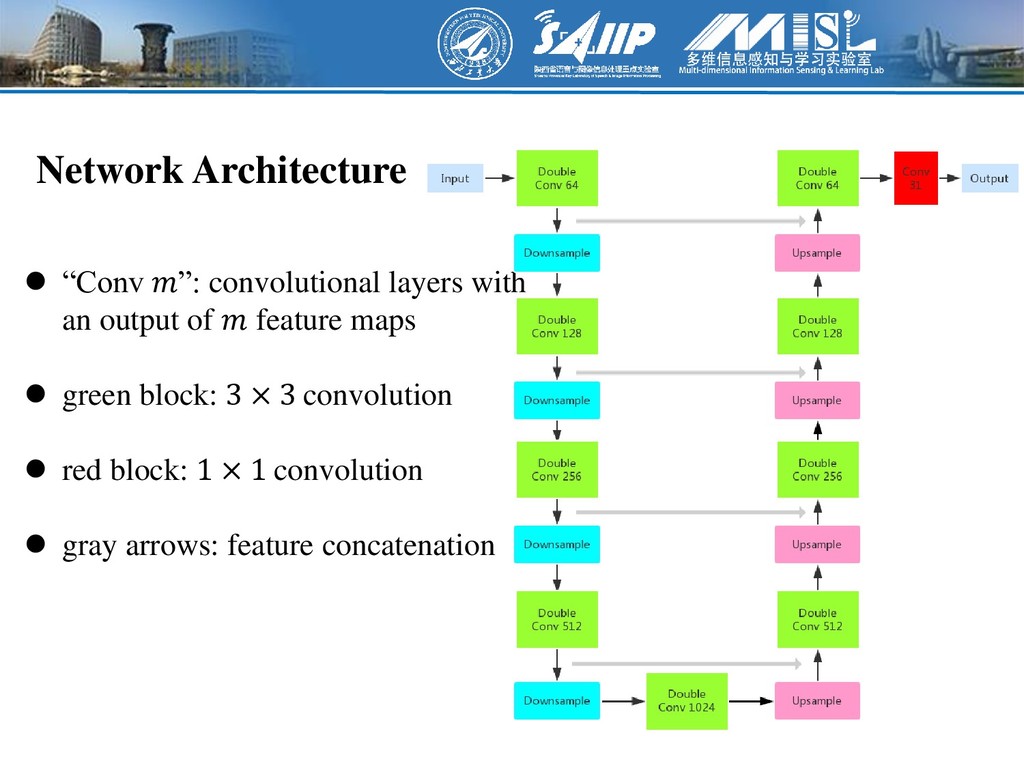
Network Architecture ⚫ “Conv ”: convolutional layers with an output
of feature maps ⚫ green block: 3 × 3 convolution ⚫ red block: 1 × 1 convolution ⚫ gray arrows: feature concatenation -
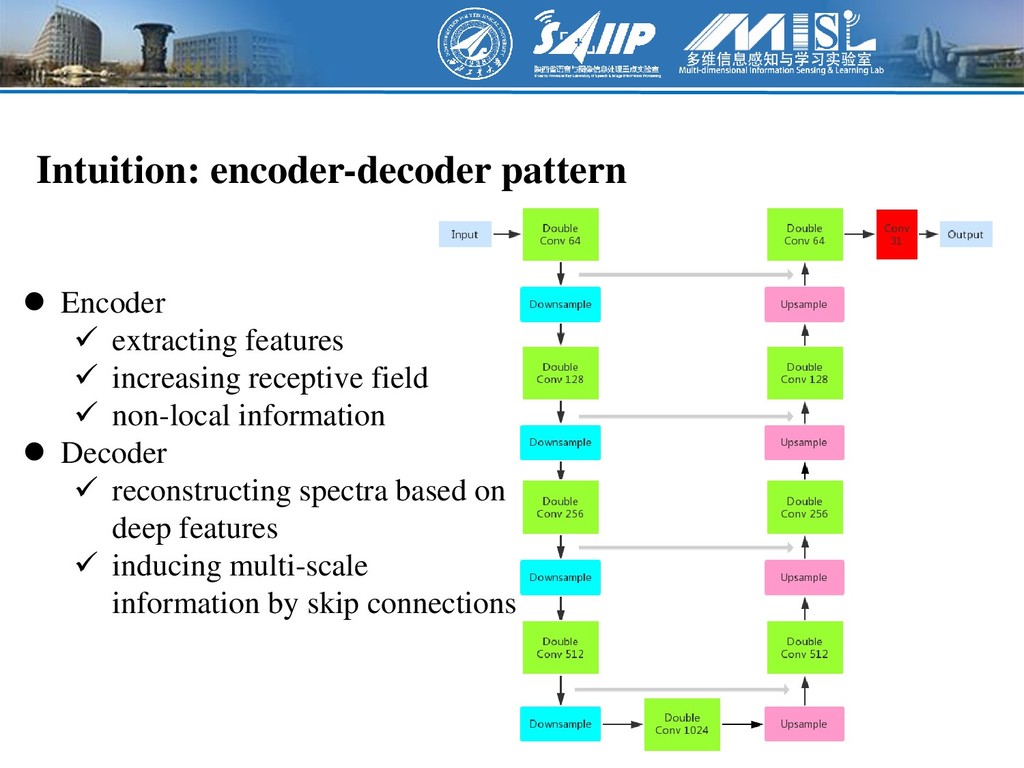
Intuition: encoder-decoder pattern ⚫ Encoder ✓ extracting features ✓ increasing
receptive field ✓ non-local information ⚫ Decoder ✓ reconstructing spectra based on deep features ✓ inducing multi-scale information by skip connections -
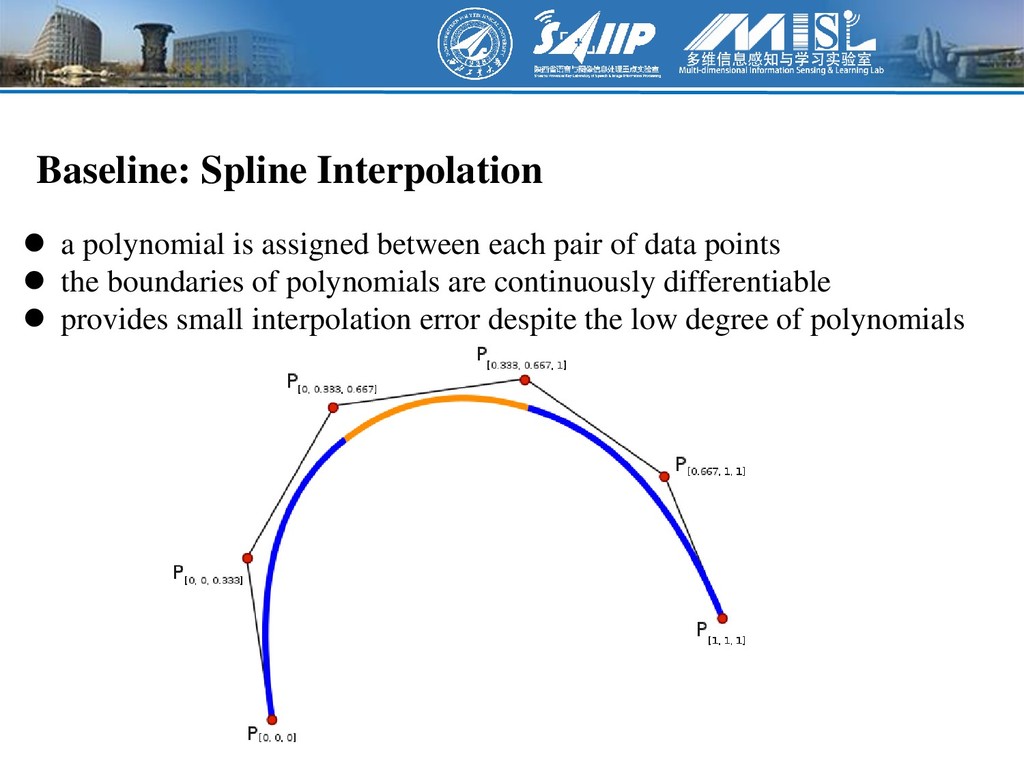
Baseline: Spline Interpolation ⚫ a polynomial is assigned between each
pair of data points ⚫ the boundaries of polynomials are continuously differentiable ⚫ provides small interpolation error despite the low degree of polynomials -
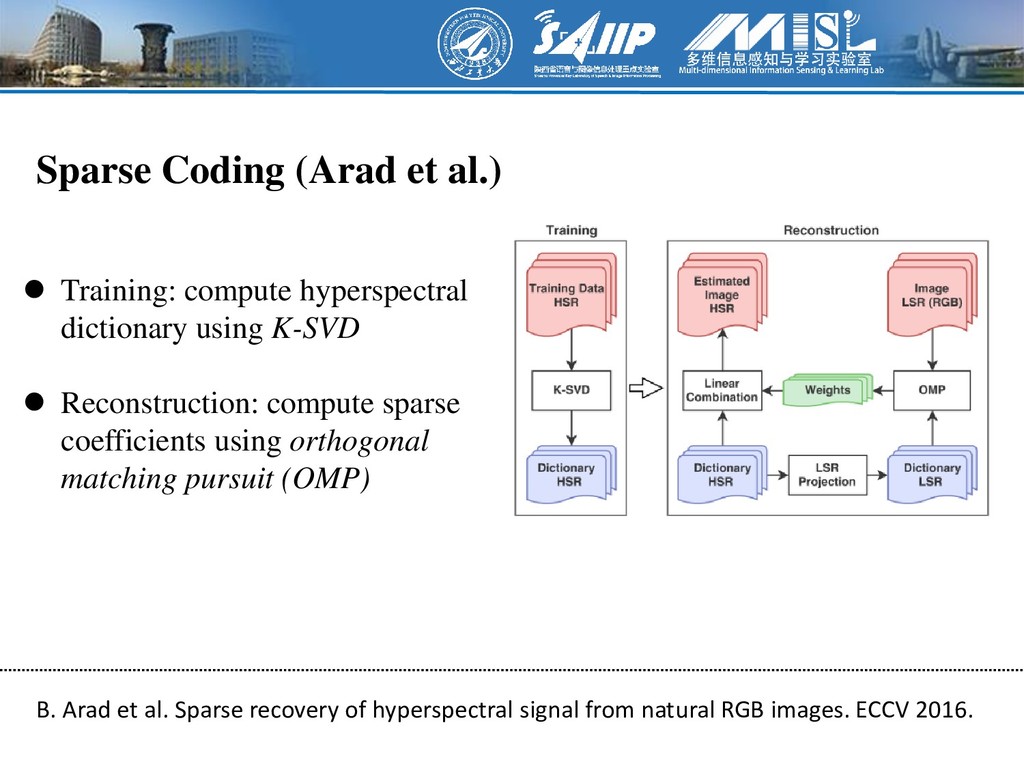
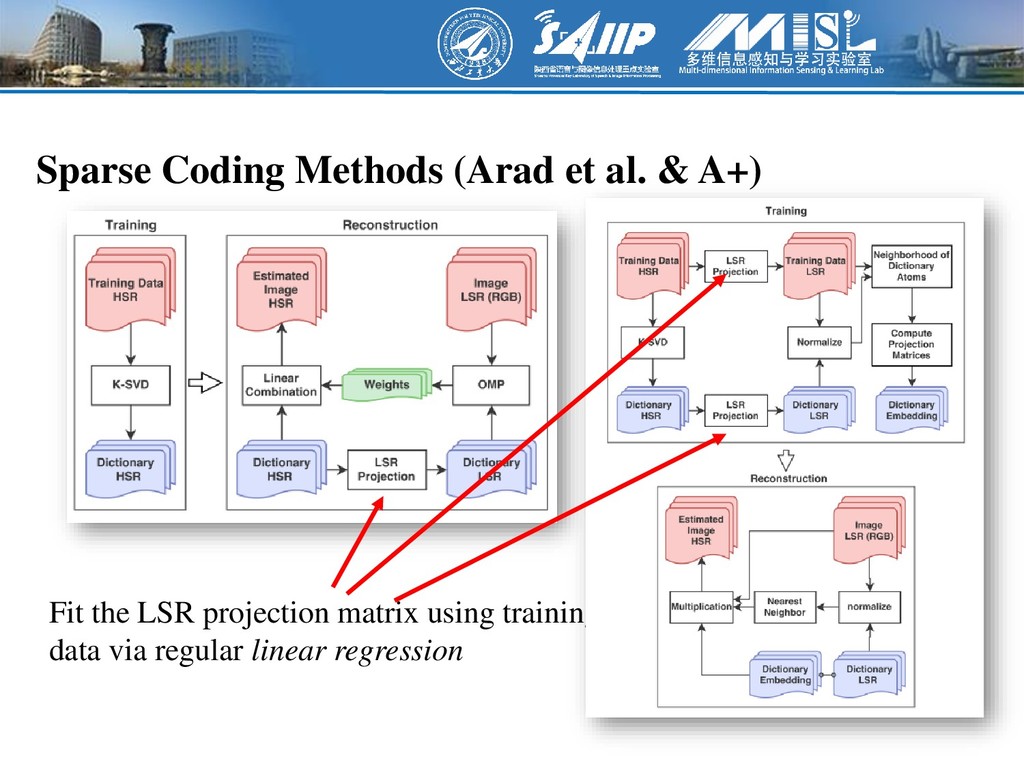
Sparse Coding (Arad et al.) ⚫ Training: compute hyperspectral dictionary
using K-SVD ⚫ Reconstruction: compute sparse coefficients using orthogonal matching pursuit (OMP) B. Arad et al. Sparse recovery of hyperspectral signal from natural RGB images. ECCV 2016. -
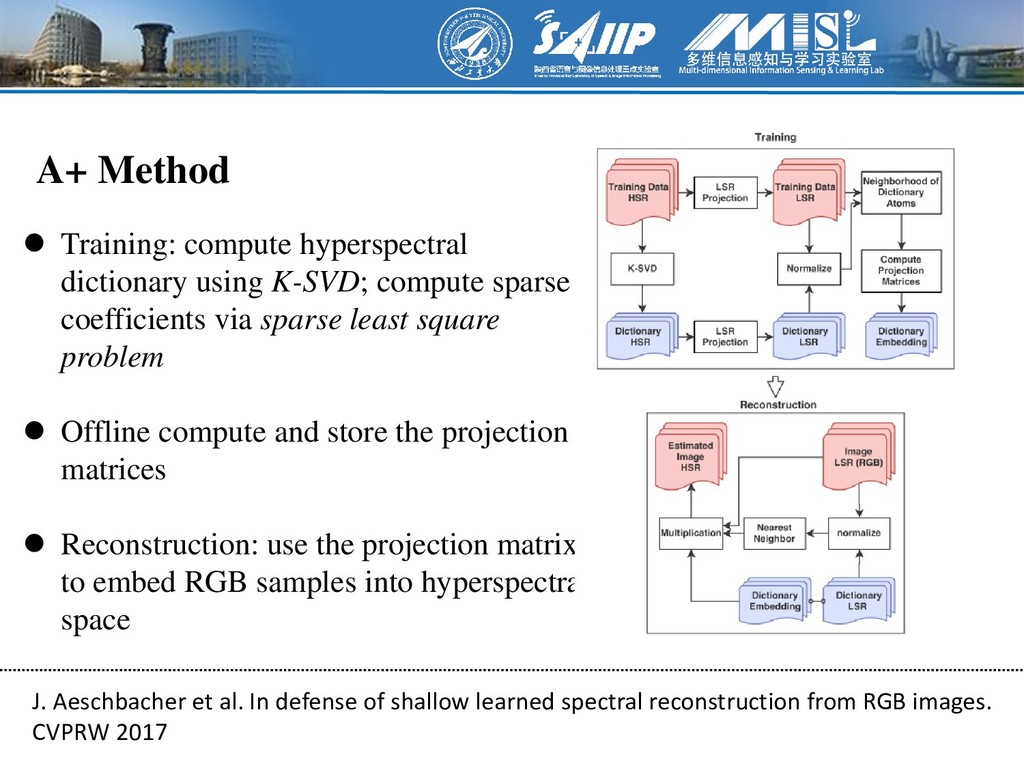
A+ Method ⚫ Training: compute hyperspectral dictionary using K-SVD; compute
sparse coefficients via sparse least square problem ⚫ Offline compute and store the projection matrices ⚫ Reconstruction: use the projection matrix to embed RGB samples into hyperspectral space J. Aeschbacher et al. In defense of shallow learned spectral reconstruction from RGB images. CVPRW 2017 -
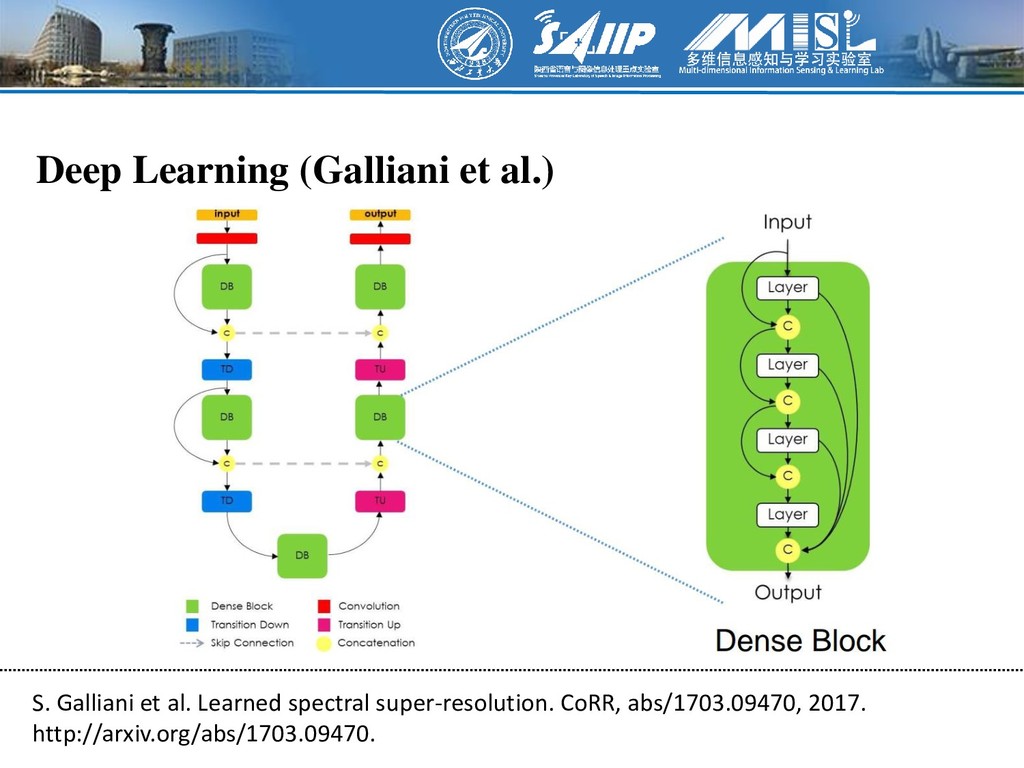
Deep Learning (Galliani et al.) S. Galliani et al. Learned
spectral super-resolution. CoRR, abs/1703.09470, 2017. http://arxiv.org/abs/1703.09470. -
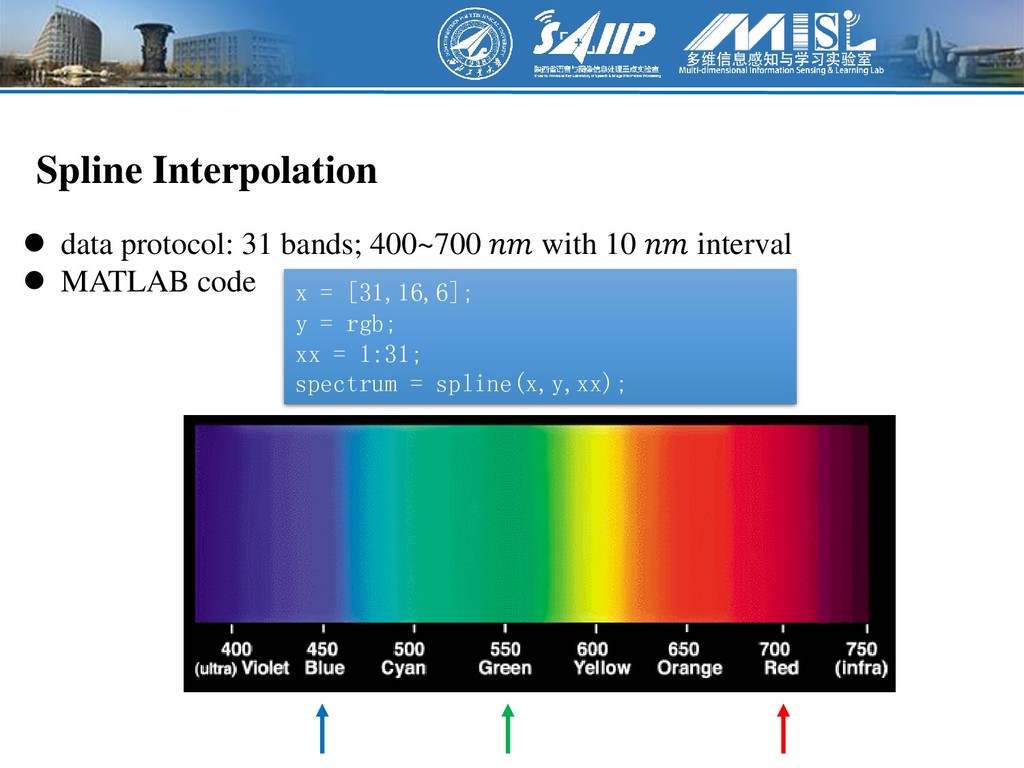
Spline Interpolation ⚫ data protocol: 31 bands; 400~700 with 10
interval ⚫ MATLAB code x = [31,16,6]; y = rgb; xx = 1:31; spectrum = spline(x,y,xx); -
Sparse Coding Methods (Arad et al. & A+) Fit the
LSR projection matrix using training data via regular linear regression -
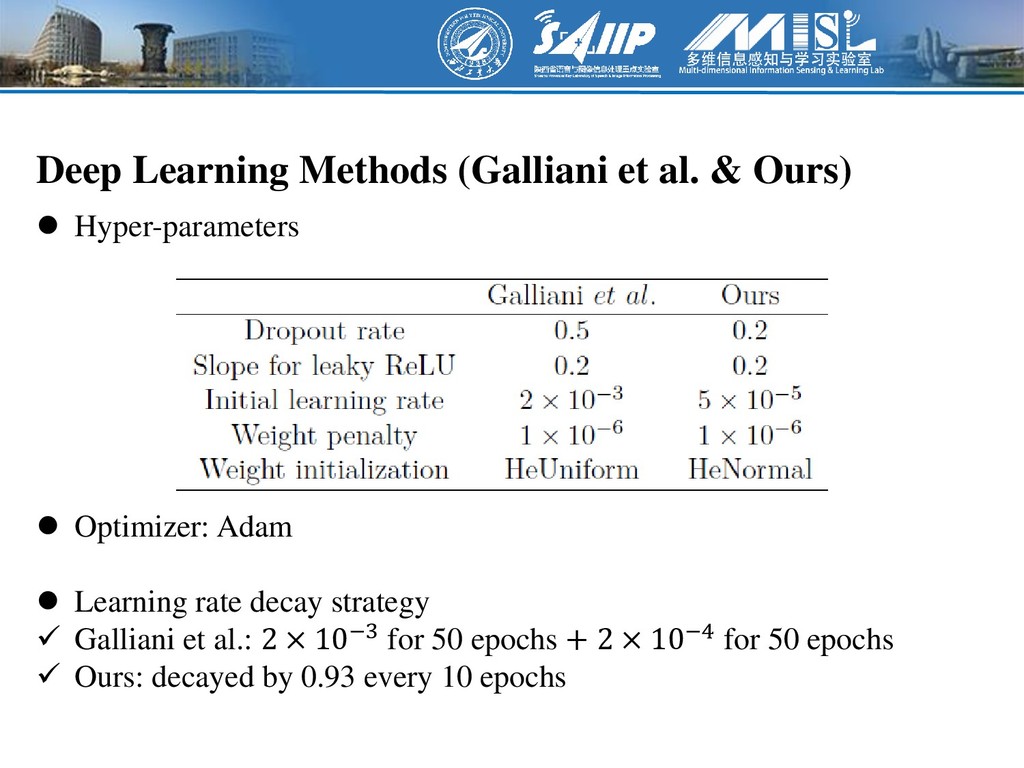
⚫ Hyper-parameters ⚫ Optimizer: Adam ⚫ Learning rate decay strategy
✓ Galliani et al.: 2 × 10⁻³ for 50 epochs + 2 × 10⁻⁴ for 50 epochs ✓ Ours: decayed by 0.93 every 10 epochs Deep Learning Methods (Galliani et al. & Ours) -
Dataset: NTIRE2018 NTIRE2018: latest & largest! NTIRE 2018 challenge on
spectral reconstruction from RGB images (CVPR 2018) http://www.vision.ee.ethz.ch/ntire18/ -
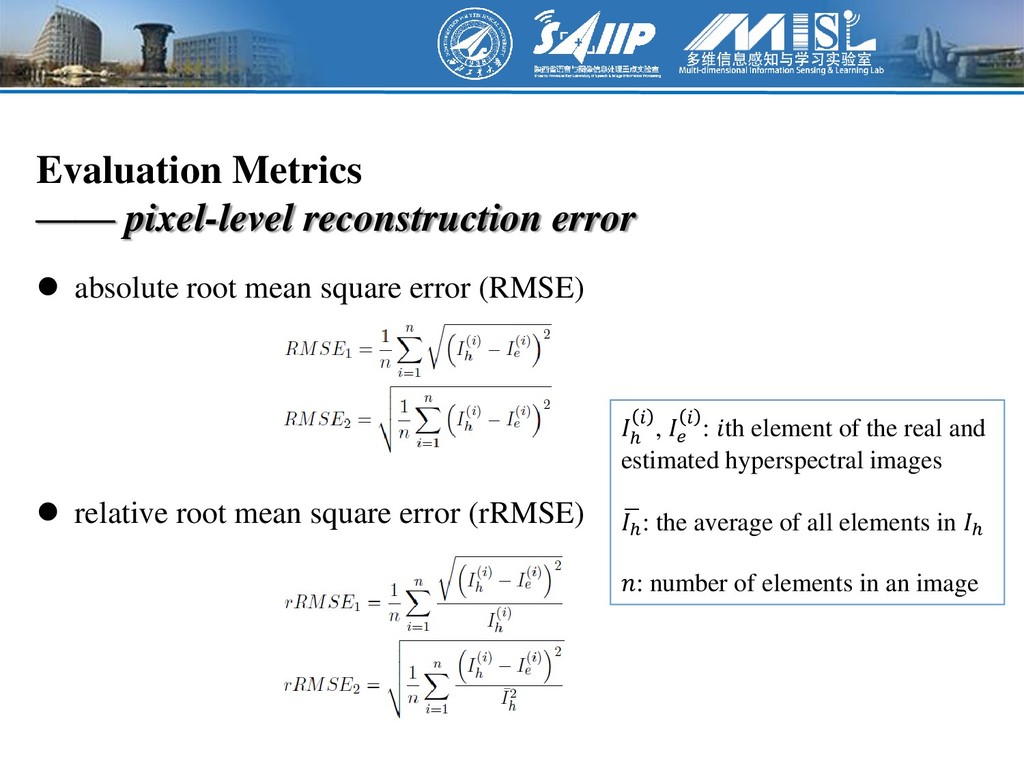
⚫ absolute root mean square error (RMSE) ⚫ relative root
mean square error (rRMSE) Evaluation Metrics —— pixel-level reconstruction error ℎ , : th element of the real and estimated hyperspectral images ഥ ℎ: the average of all elements in ℎ : number of elements in an image -
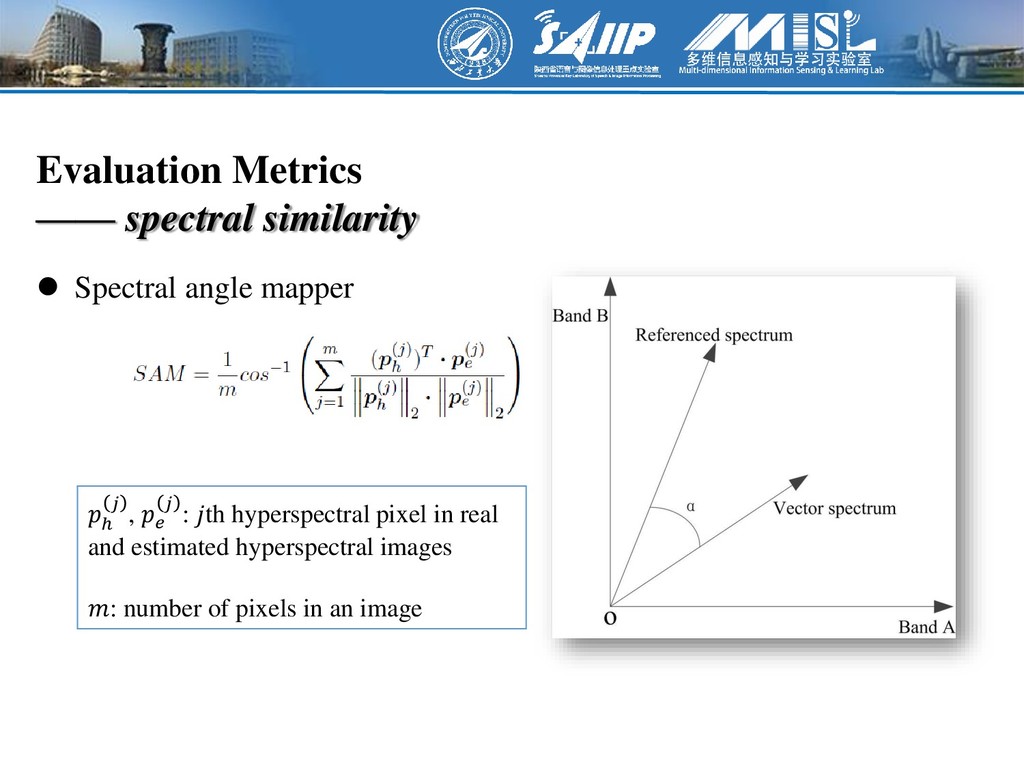
⚫ Spectral angle mapper Evaluation Metrics —— spectral similarity ℎ
, : th hyperspectral pixel in real and estimated hyperspectral images : number of pixels in an image -
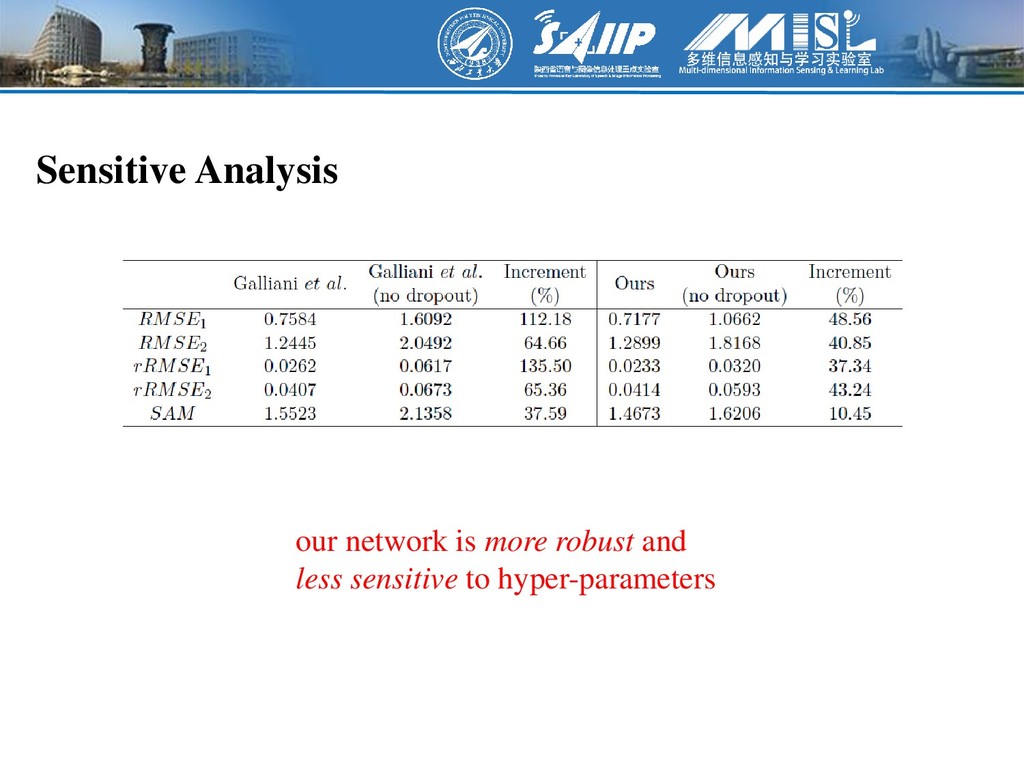
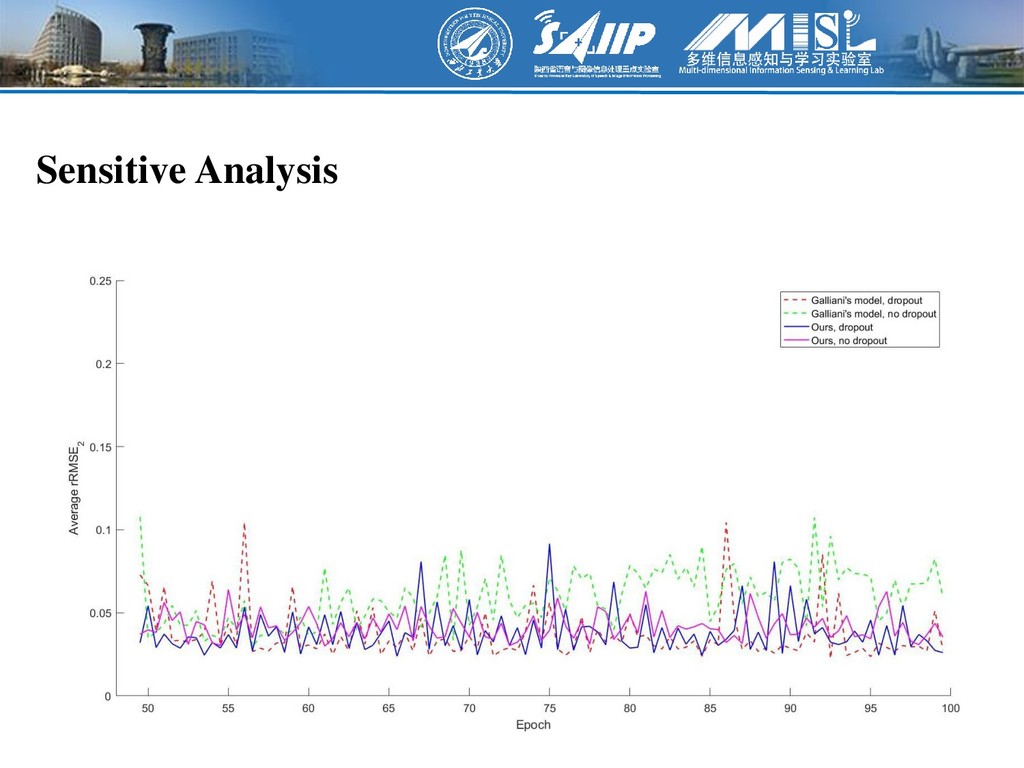
Sensitive Analysis our network is more robust and less sensitive
to hyper-parameters -
Publication Yiqi Yan, Lei Zhang, Wei Wei, Yanning Zhang, Accurate
Spectral Super-resolution from Single RGB Image Using Multi-scale CNN. Submitted to Chinese Conference on Pattern Recognition and Computer Vision (PRCV) 2018