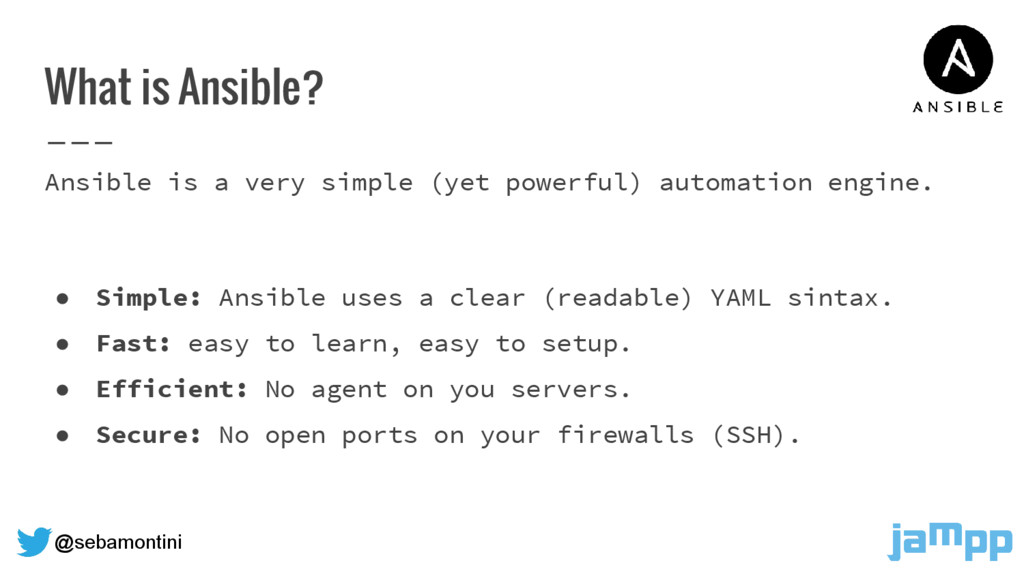
automation engine. • Simple: Ansible uses a clear (readable) YAML sintax. • Fast: easy to learn, easy to setup. • Efficient: No agent on you servers. • Secure: No open ports on your firewalls (SSH). @sebamontini
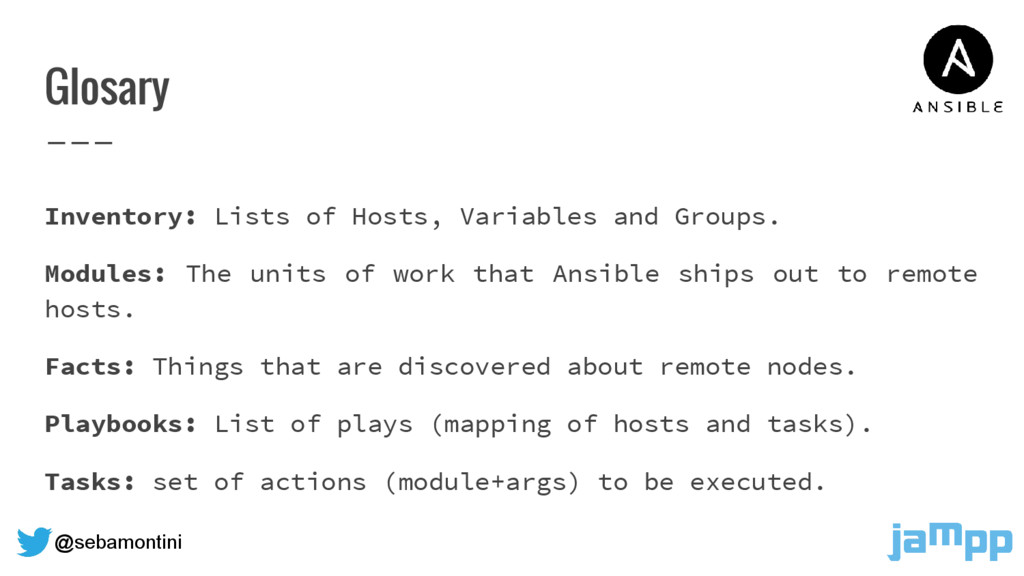
units of work that Ansible ships out to remote hosts. Facts: Things that are discovered about remote nodes. Playbooks: List of plays (mapping of hosts and tasks). Tasks: set of actions (module+args) to be executed. @sebamontini
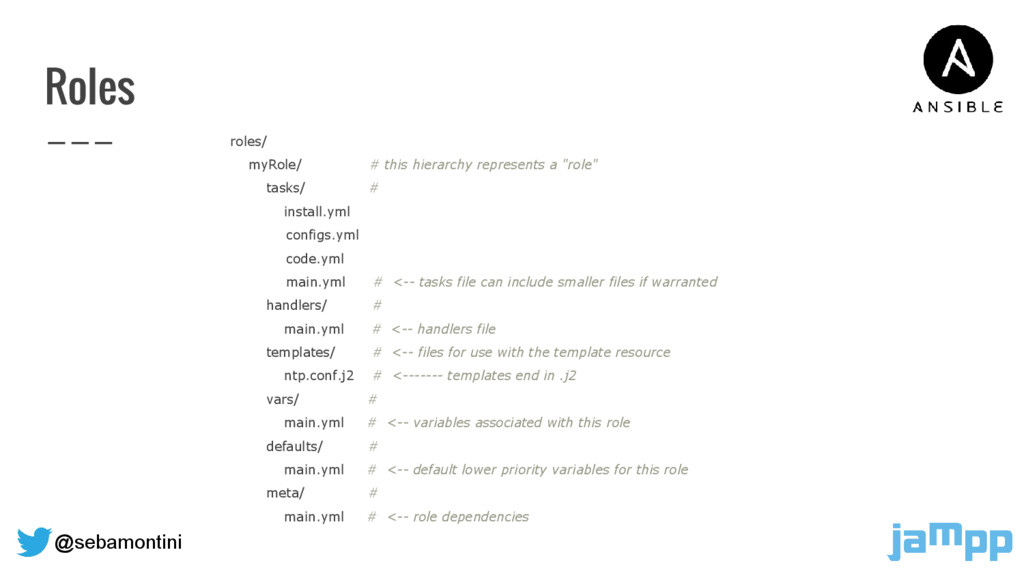
tasks/ # install.yml configs.yml code.yml main.yml # <-- tasks file can include smaller files if warranted handlers/ # main.yml # <-- handlers file templates/ # <-- files for use with the template resource ntp.conf.j2 # <------- templates end in .j2 vars/ # main.yml # <-- variables associated with this role defaults/ # main.yml # <-- default lower priority variables for this role meta/ # main.yml # <-- role dependencies
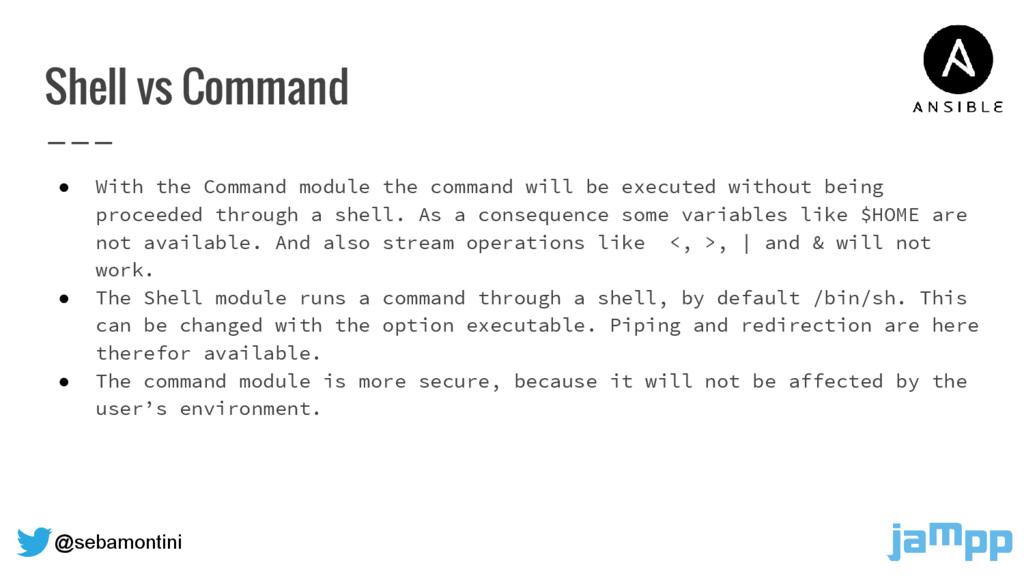
will be executed without being proceeded through a shell. As a consequence some variables like $HOME are not available. And also stream operations like <, >, | and & will not work. • The Shell module runs a command through a shell, by default /bin/sh. This can be changed with the option executable. Piping and redirection are here therefor available. • The command module is more secure, because it will not be affected by the user’s environment. @sebamontini
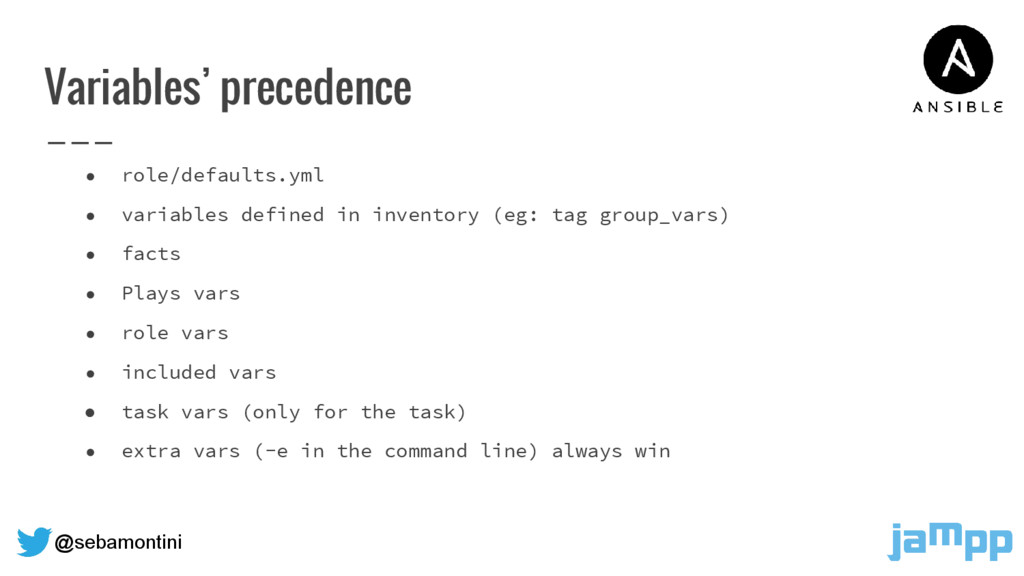
tag group_vars) • facts • Plays vars • role vars • included vars • task vars (only for the task) • extra vars (-e in the command line) always win @sebamontini


 sebamontini
 terurou
 kizawa2020
 ymrl
ymrl
 ishiirikie
 y0hgi
y0hgi
 chack411
 philipz
 mochizuki875
 tomzoh
 segadevtech
 grimoh
.png) codatum
codatum
 paigeccino
 greggifford
 orderedlist
 yeseniaperezcruz
 cassininazir
 twada
twada
 honzajavorek
 aleyda
 marcelosomers
 katarinadahlin
 konakalab
 jlugia
![ansible.cfg [defaults] inventory = inventory/ec2.py roles_path = roles:roles-galaxy retry_files_enabled =](https://files.speakerdeck.com/presentations/00aa6d1fe93c4d8992aebdec995d9c71/slide_11.jpg)

![Thanks [email protected] @sebamontini github.com/sebamontini](https://files.speakerdeck.com/presentations/00aa6d1fe93c4d8992aebdec995d9c71/slide_16.jpg)