Upgrade to Pro — share decks privately, control downloads, hide ads and more …

Managing Large Flask Applications On Google App...

Managing Large Flask Applications On Google App Engine (GAE)

There are a number of issues production applications need to solve to be scalable and fault tolerant. In this talk, we explore some tips for efficiently running Python apps, particularly with Flask, on App Engine. We also share some collective experience and best practices on GAE.

Avatar for Emmanuel Olowosulu

Emmanuel Olowosulu

September 14, 2018

Other Decks in Programming

Transcript

  1. Emmanuel Olowosulu CTO, Formplus @seyisulu o Also, software developer with

    experience building Flask applications and community builder. Yemisi Obielodan Product Manager, Formplus @ye_misi o Over 8 years experience consulting and building production apps with a variety of stacks and technologies.
  2. o Formplus is a cloud-based data collection software as a

    service. We help businesses gather data from their users who are online and offline, analyze the data and then help them make data-driven decisions from it. o Also a fun place to work.
  3. o Python 2.7 o Flask o Google App Engine o

    Cloud Datastore o Cloud Tasks o AngularJS 1.5 (don’t judge !) Our Stack
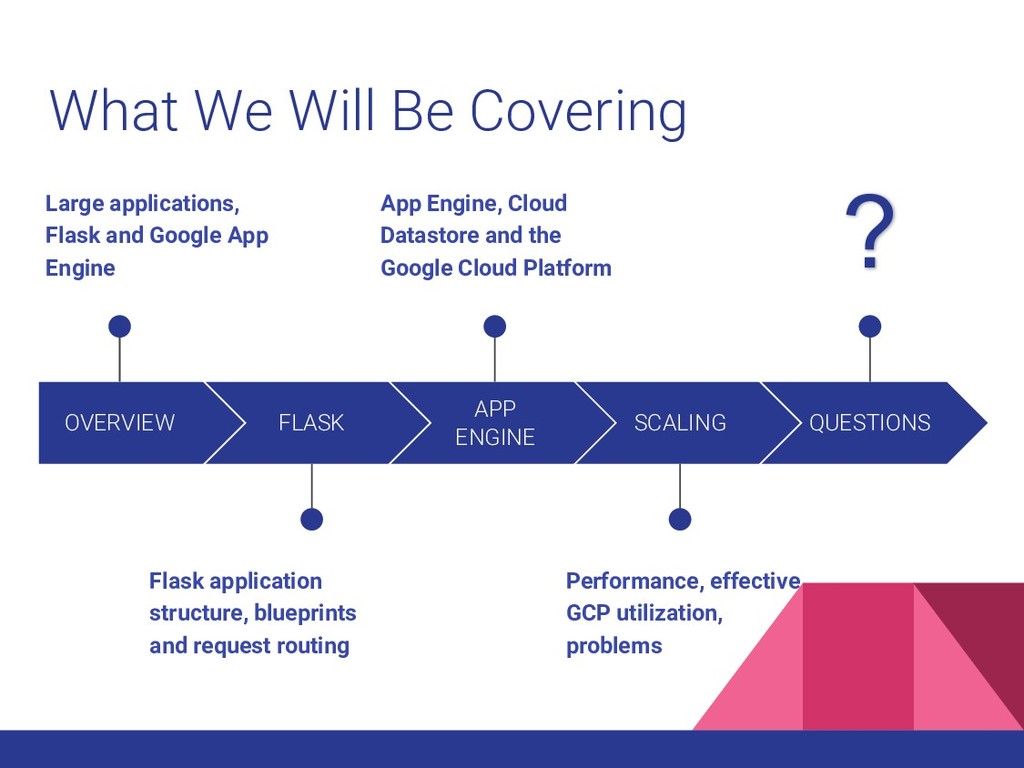
  4. What We Will Be Covering OVERVIEW Large applications, Flask and

    Google App Engine FLASK Flask application structure, blueprints and request routing APP ENGINE App Engine, Cloud Datastore and the Google Cloud Platform SCALING Performance, effective GCP utilization, problems QUESTIONS ?
  5. What is a Large Application? o Large number of users

    o High requests/second o Distributed servers o Large data volume
  6. Flask Framework o Flask is a micro web framework written

    in Python o Supports extensions for additional functionality o Compatible with Google App Engine
  7. Google App Engine o GAE is a web framework and

    cloud computing platform for developing and hosting web applications in Google-managed data centers o Applications are sandboxed and run across multiple servers
  8. Flask Application Structure o Large Flask apps should be broken

    down into microservices. There should be at least two: the frontend handling user facing requests and backend handling longer running data and event processing. o This ensures that the application is responsive. o Also, there is nothing micro about microservices; the frontend and backend may be monoliths themselves and could benefit from refactoring.
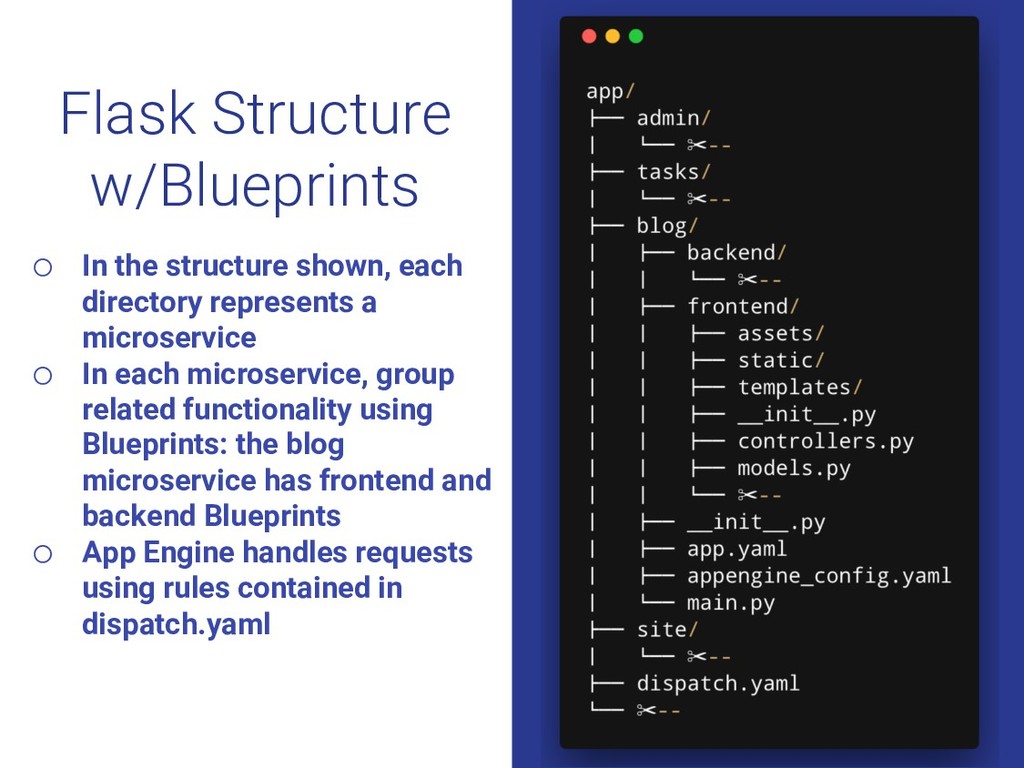
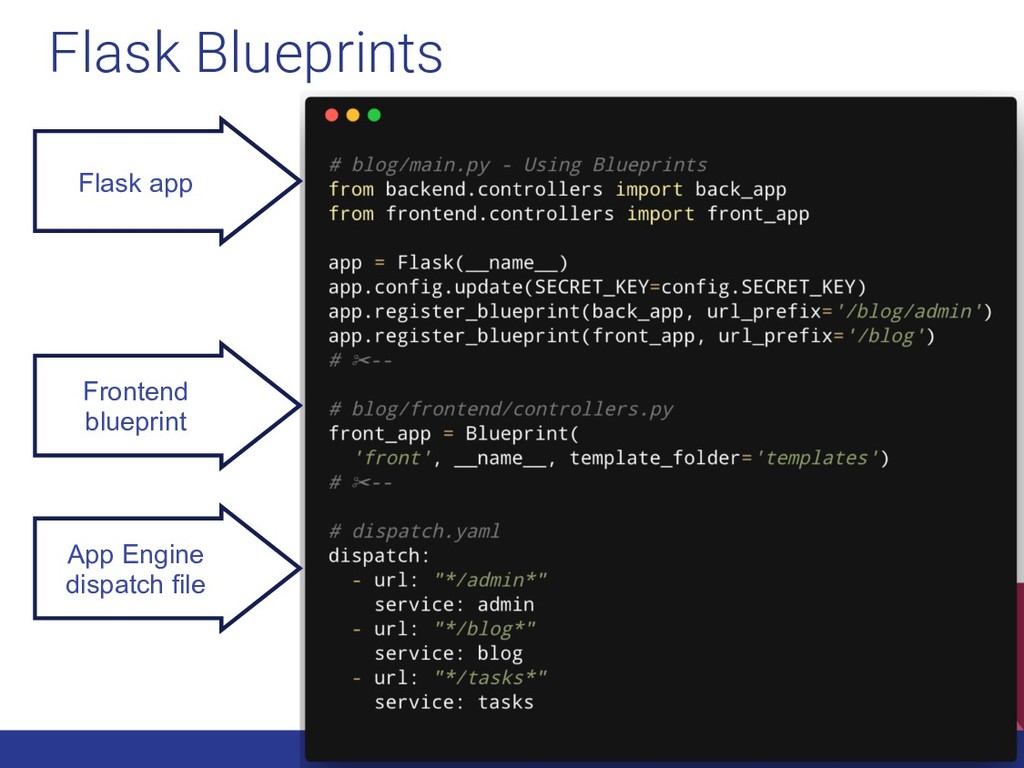
  9. Flask Structure w/Blueprints o In the structure shown, each directory

    represents a microservice o In each microservice, group related functionality using Blueprints: the blog microservice has frontend and backend Blueprints o App Engine handles requests using rules contained in dispatch.yaml
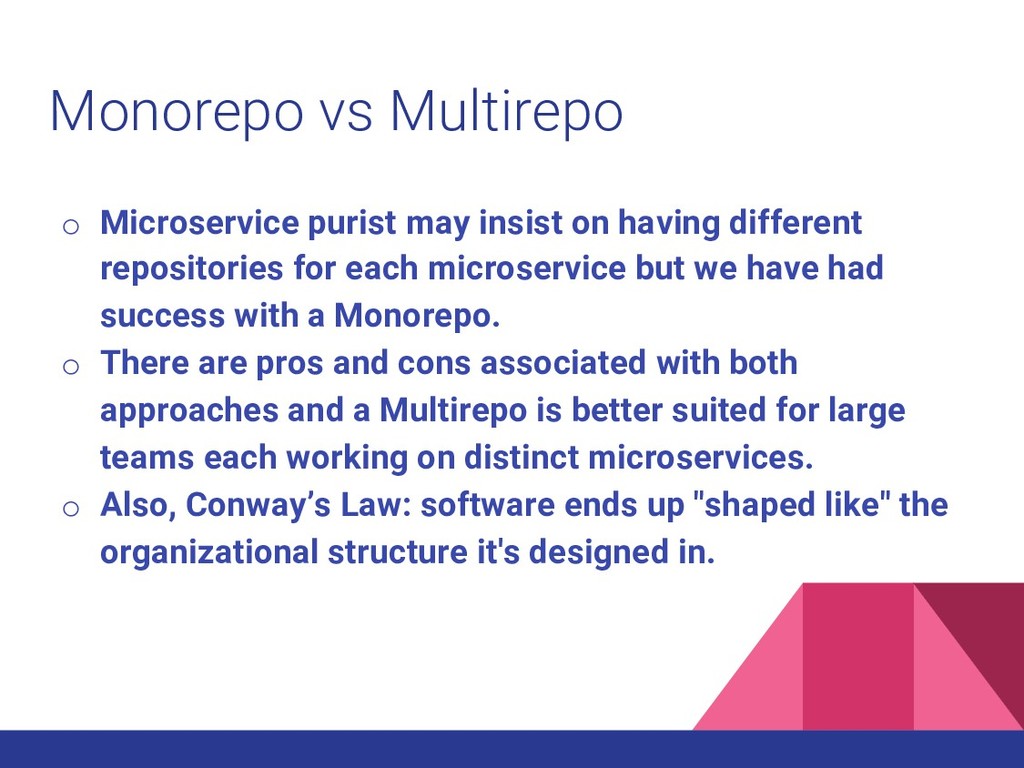
  10. Monorepo vs Multirepo o Microservice purist may insist on having

    different repositories for each microservice but we have had success with a Monorepo. o There are pros and cons associated with both approaches and a Multirepo is better suited for large teams each working on distinct microservices. o Also, Conway’s Law: software ends up "shaped like" the organizational structure it's designed in.
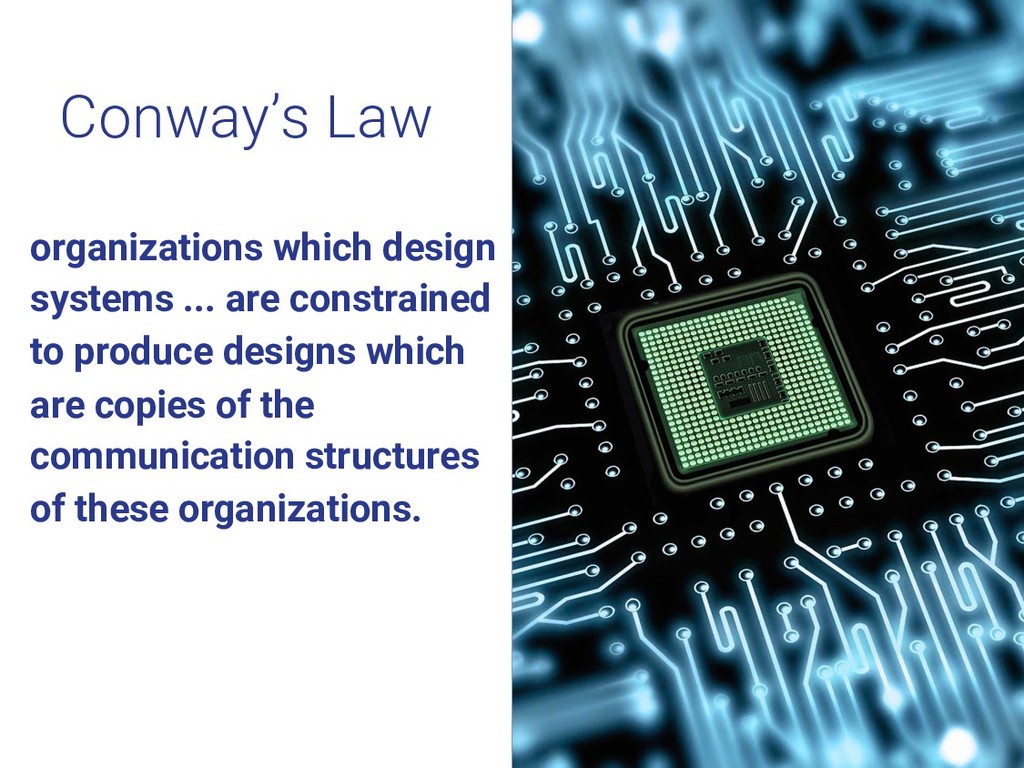
  11. organizations which design systems ... are constrained to produce designs

    which are copies of the communication structures of these organizations. Conway’s Law
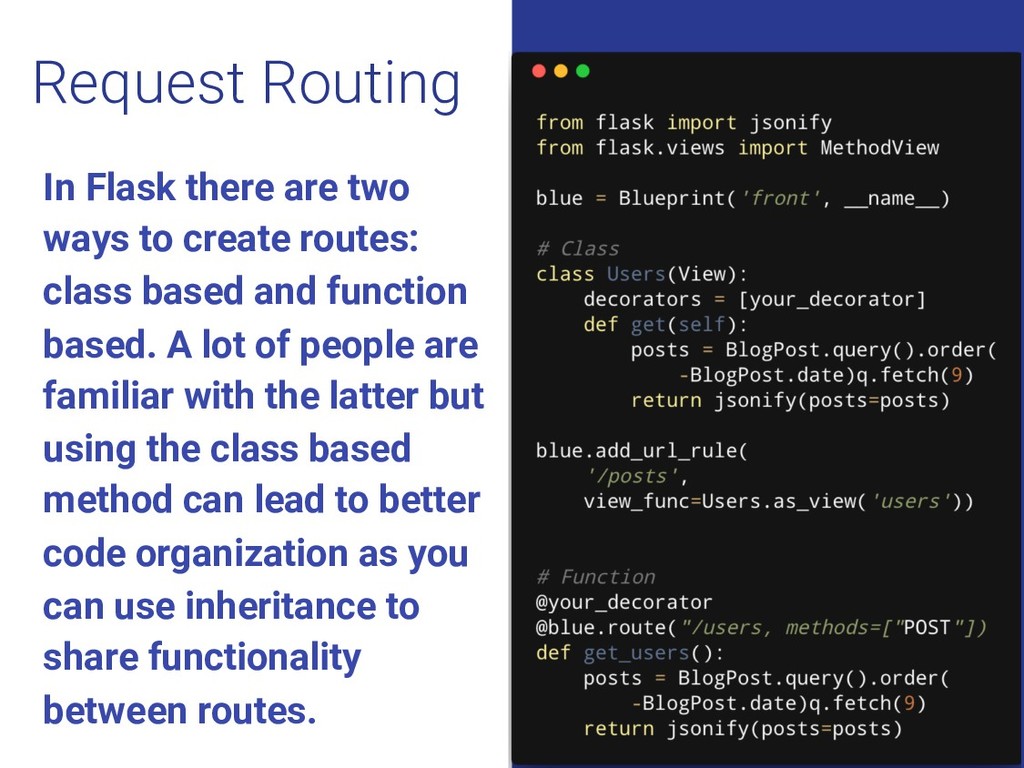
  12. In Flask there are two ways to create routes: class

    based and function based. A lot of people are familiar with the latter but using the class based method can lead to better code organization as you can use inheritance to share functionality between routes. Request Routing
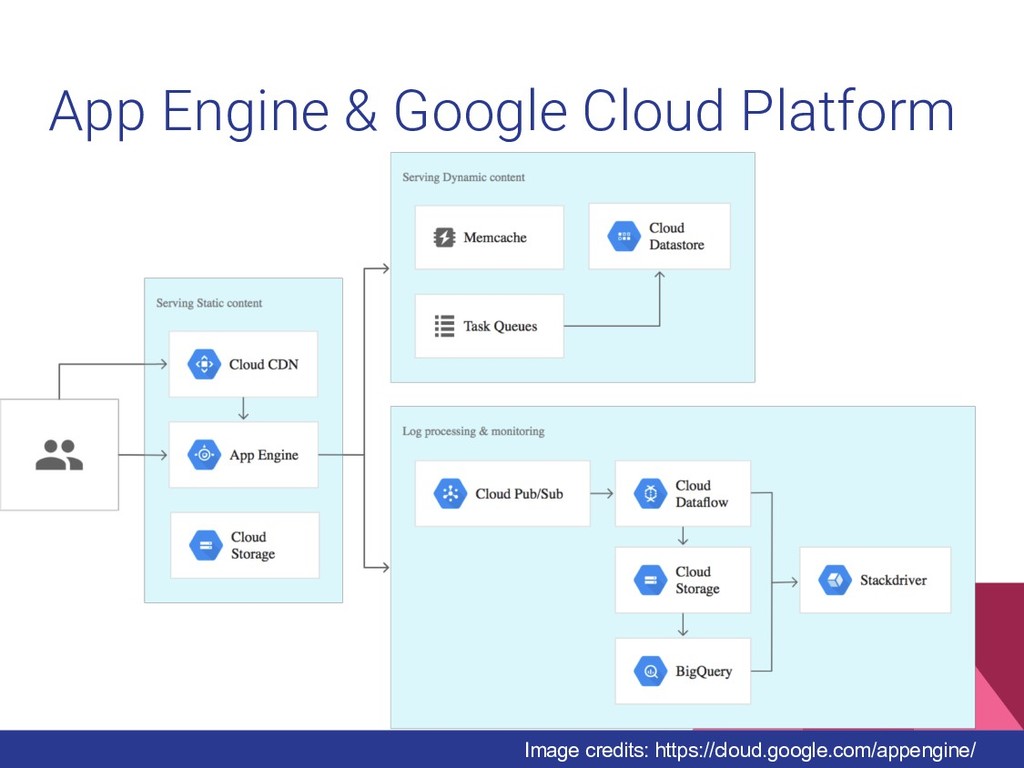
  13. Cloud Storage o Google Cloud Storage is file storage solution

    intended for developers and system admins and has APIs allowing apps to store and retrieve objects. It features global edge-caching, versioning, OAuth and granular access controls, configurable security, etc.
  14. Cloud CDN o Google Cloud CDN (Content Delivery Network) uses

    Google's servers worldwide to load balanced content close to your users. This provides faster delivery of content to your users and reduces serving costs. o App Engine also automatically pushes application assets to Cloud CDN on deployment.
  15. Cloud Tasks o Task queues let applications do work, asynchronously

    outside of a user request. If an app needs to execute work in the background, it adds tasks to task queues. The tasks are executed later, by worker services. Task queues come in two flavors, push and pull. o Push queues run tasks by delivering HTTP requests to App Engine worker services. o Pull queues rely on other worker services to fetch tasks from the queue on their own.
  16. Cloud Pub/Sub o Cloud Pub/Sub is a fully-managed real-time messaging

    service that allows you to send and receive messages between independent applications. o Pub/Sub broadcasts messages from publishers to subscribers via channels. Many subscribers can subscribe to the same channel. o Allows the decoupling of background, long running data and event processing from user-facing requests.
  17. Cloud Dataflow o Cloud Dataflow is a fully-managed service for

    transforming and enriching data in stream (real time) and batch (historical) modes. Cloud Dataflow seamlessly integrates with GCP services for streaming events ingestion (Cloud Pub/Sub), data warehousing (BigQuery), and more.
  18. Google BigQuery o BigQuery is Google's serverless, highly scalable, enterprise

    cloud data warehouse. It is fast, cost- effective, fully managed and can be used for analytics. It also has built-in machine learning (beta). o BigQuery is used for Online Analytical Processing (OLAP): generating reports, time series and trend analysis views and can be paired with Business Intelligence (BI) tools like Metabase or Google Data Studio (beta).
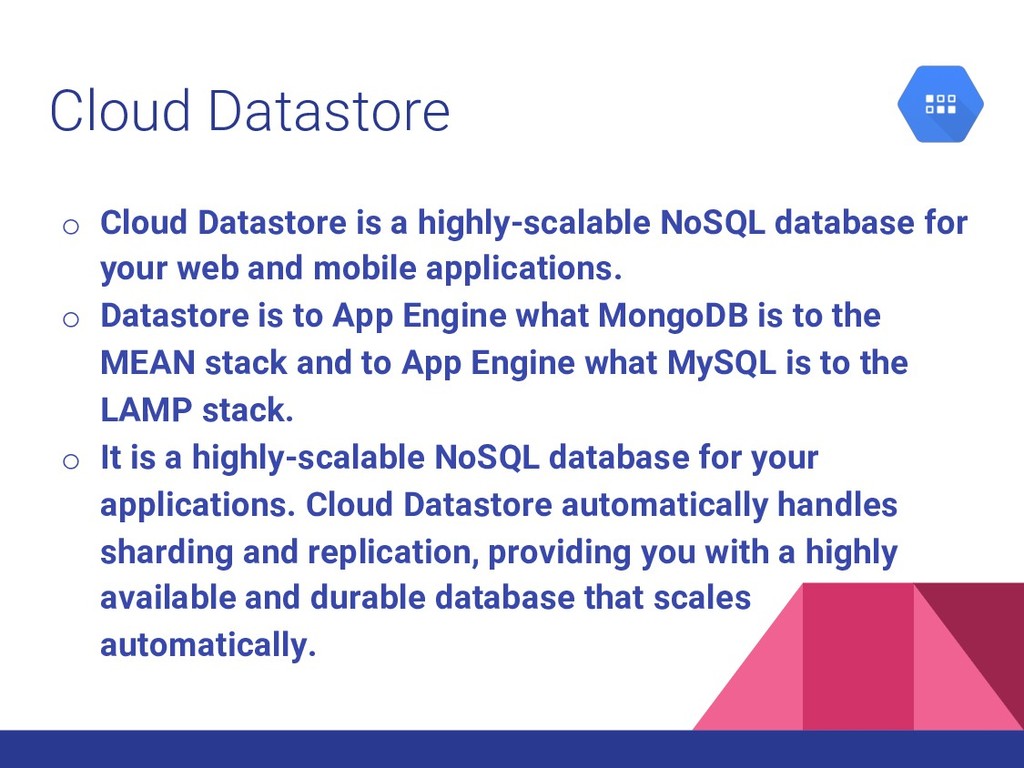
  19. Cloud Datastore o Cloud Datastore is a highly-scalable NoSQL database

    for your web and mobile applications. o Datastore is to App Engine what MongoDB is to the MEAN stack and to App Engine what MySQL is to the LAMP stack. o It is a highly-scalable NoSQL database for your applications. Cloud Datastore automatically handles sharding and replication, providing you with a highly available and durable database that scales automatically.
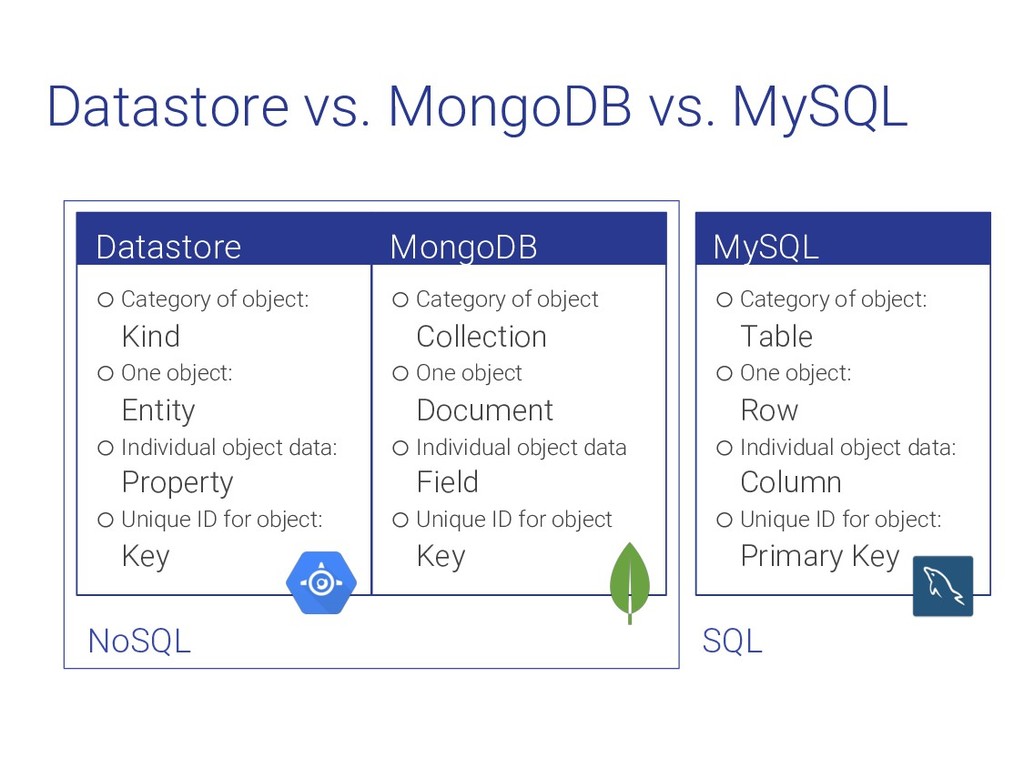
  20. Datastore vs. MongoDB vs. MySQL Datastore oCategory of object: Kind

    oOne object: Entity oIndividual object data: Property oUnique ID for object: Key MongoDB oCategory of object Collection oOne object Document oIndividual object data Field oUnique ID for object Key MySQL statement oCategory of object: Table oOne object: Row oIndividual object data: Column oUnique ID for object: Primary Key NoSQL SQL
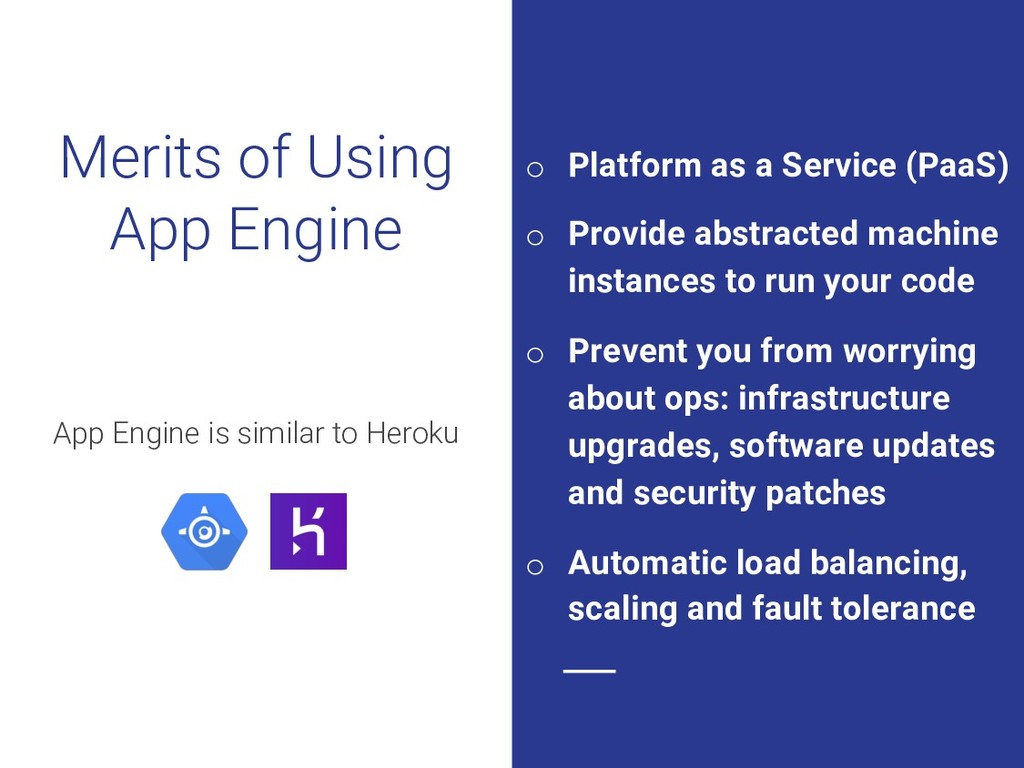
  21. Merits of Using App Engine App Engine is similar to

    Heroku o Platform as a Service (PaaS) o Provide abstracted machine instances to run your code o Prevent you from worrying about ops: infrastructure upgrades, software updates and security patches o Automatic load balancing, scaling and fault tolerance
  22. Google App Engine o Task queues let applications do work,

    asynchronously outside of a user request. If an app needs to execute work in the background, it adds tasks to task queues. The tasks are executed later, by worker services. Task queues come in two flavors, push and pull. o Push queues run tasks by delivering HTTP requests to App Engine worker services. o Pull queues rely on other worker services to fetch tasks from the queue on their own.
  23. - Pete Edochie He who thinks the soup is too

    much for the eba cannot handle greatness scale.
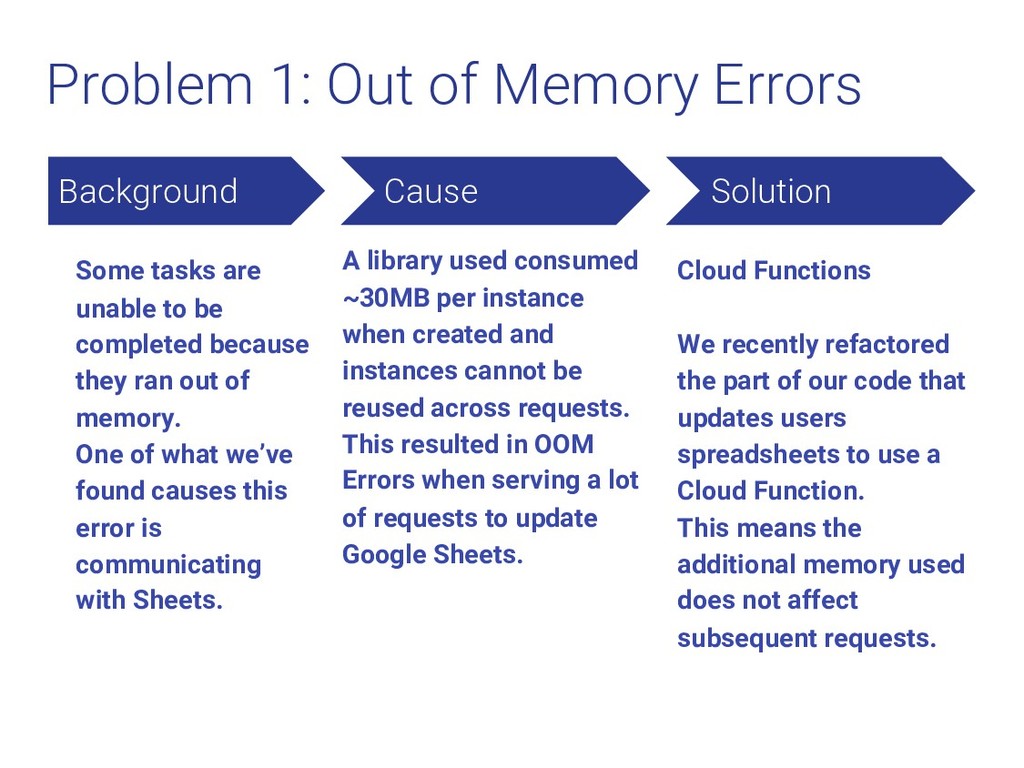
  24. Problem 1: Out of Memory Errors Background Some tasks are

    unable to be completed because they ran out of memory. One of what we’ve found causes this error is communicating with Sheets. Cause A library used consumed ~30MB per instance when created and instances cannot be reused across requests. This resulted in OOM Errors when serving a lot of requests to update Google Sheets. Solution Cloud Functions We recently refactored the part of our code that updates users spreadsheets to use a Cloud Function. This means the additional memory used does not affect subsequent requests.
  25. - Phil Karlton There are only two hard things in

    Computer Science: cache invalidation and naming things.
  26. Problem 2: Cache Invalidation Background Users not having their monthly

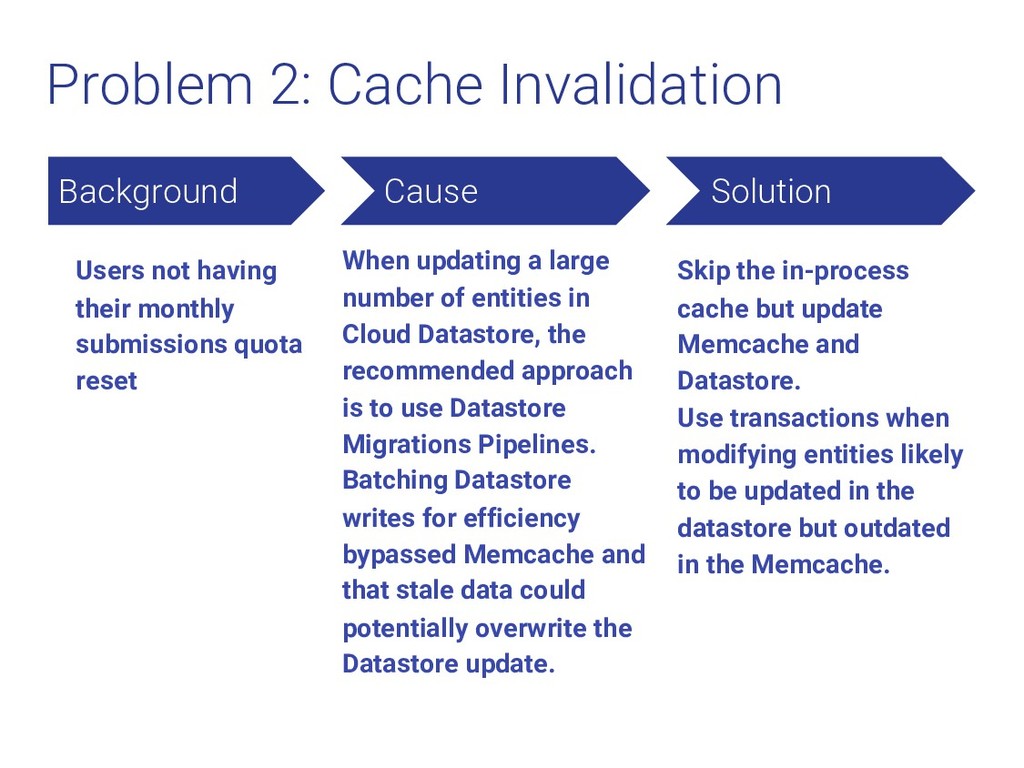
    submissions quota reset Cause When updating a large number of entities in Cloud Datastore, the recommended approach is to use Datastore Migrations Pipelines. Batching Datastore writes for efficiency bypassed Memcache and that stale data could potentially overwrite the Datastore update. Solution Skip the in-process cache but update Memcache and Datastore. Use transactions when modifying entities likely to be updated in the datastore but outdated in the Memcache.
  27. Problem 3: Datastore Contention Background Updating form submission count for

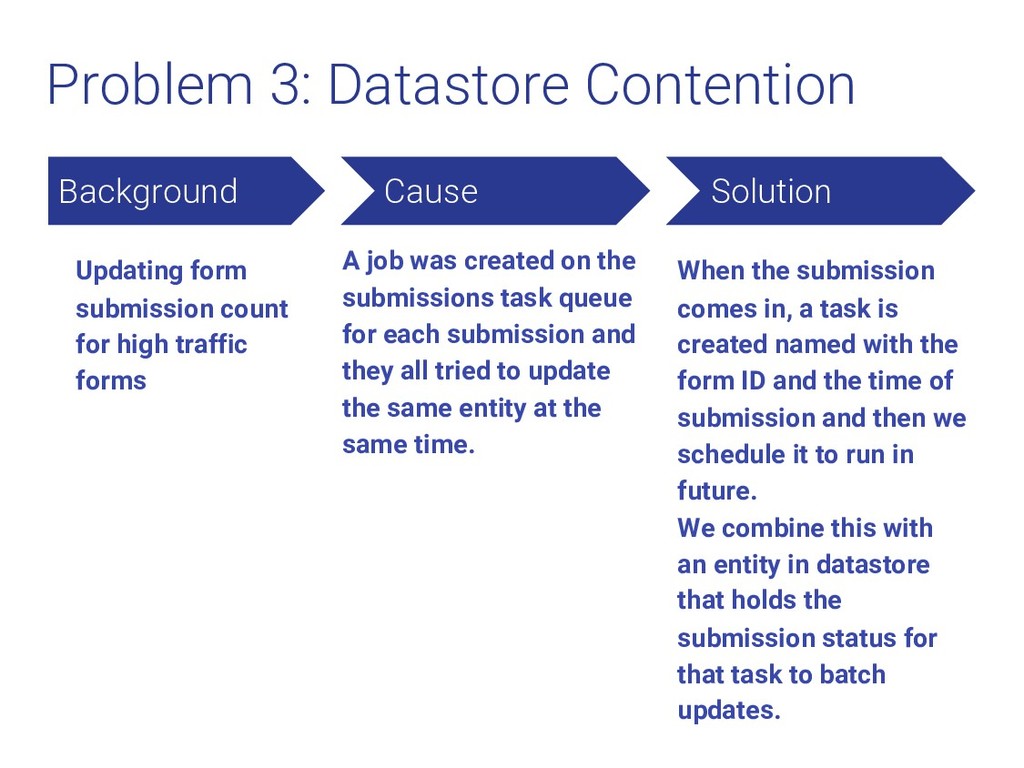
    high traffic forms Cause A job was created on the submissions task queue for each submission and they all tried to update the same entity at the same time. Solution When the submission comes in, a task is created named with the form ID and the time of submission and then we schedule it to run in future. We combine this with an entity in datastore that holds the submission status for that task to batch updates.