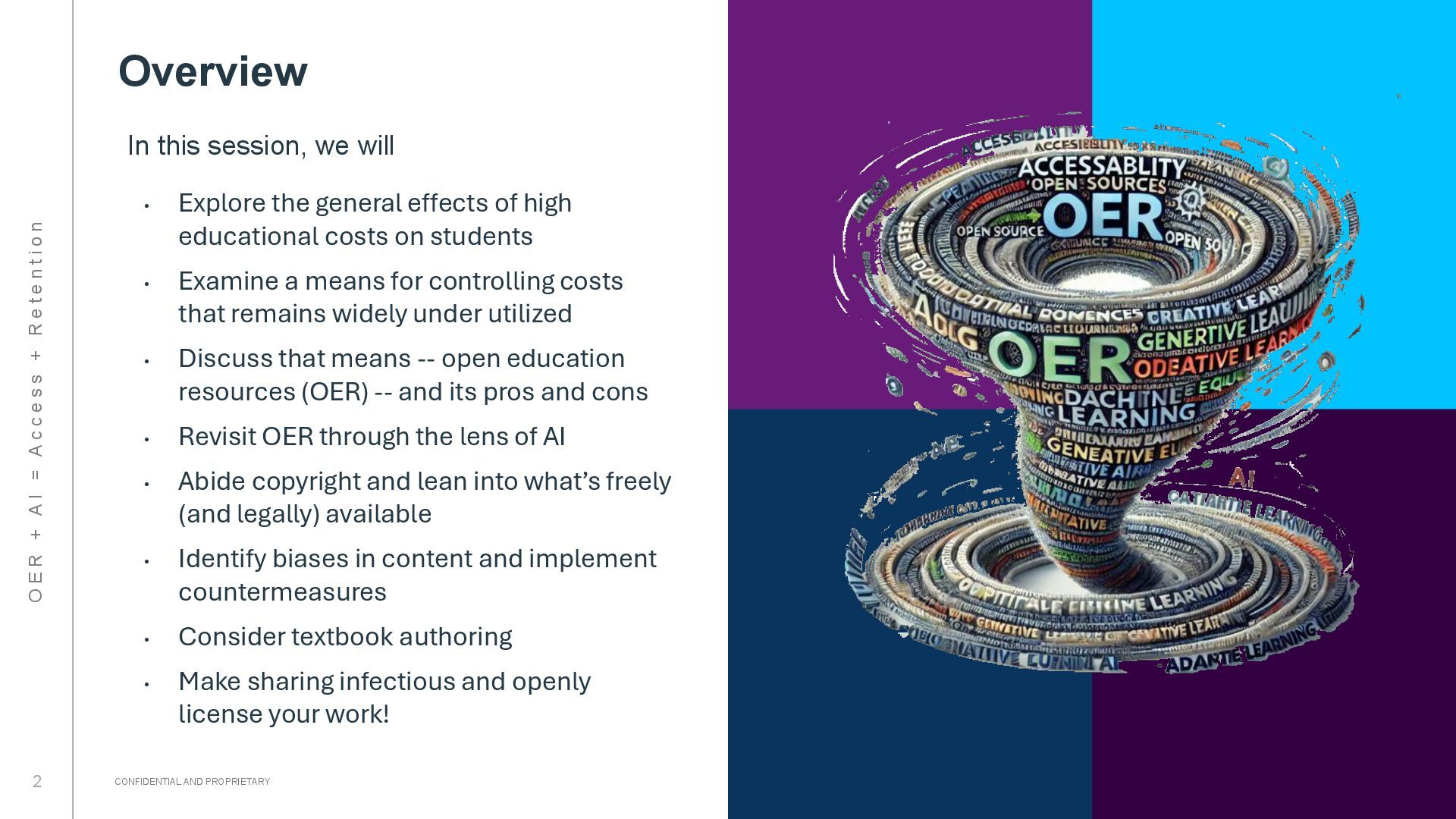
A c c e s s + R e t e n t i o n 2 Overview • Explore the general effects of high educational costs on students • Examine a means for controlling costs that remains widely under utilized • Discuss that means -- open education resources (OER) -- and its pros and cons • Revisit OER through the lens of AI • Abide copyright and lean into what’s freely (and legally) available • Identify biases in content and implement countermeasures • Consider textbook authoring • Make sharing infectious and openly license your work! In this session, we will
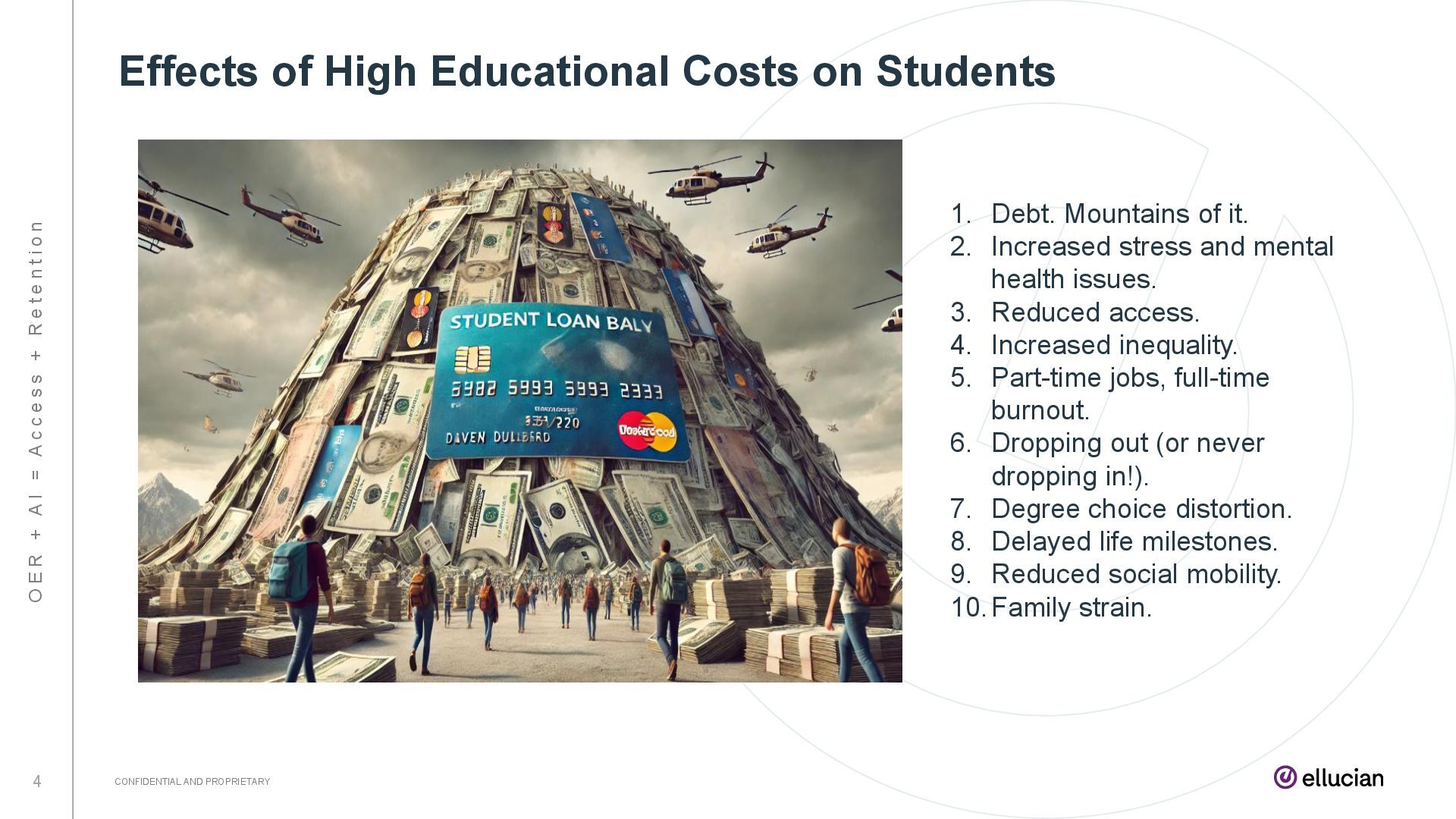
A c c e s s + R e t e n t i o n 4 1. Debt. Mountains of it. 2. Increased stress and mental health issues. 3. Reduced access. 4. Increased inequality. 5. Part-time jobs, full-time burnout. 6. Dropping out (or never dropping in!). 7. Degree choice distortion. 8. Delayed life milestones. 9. Reduced social mobility. 10.Family strain. Effects of High Educational Costs on Students
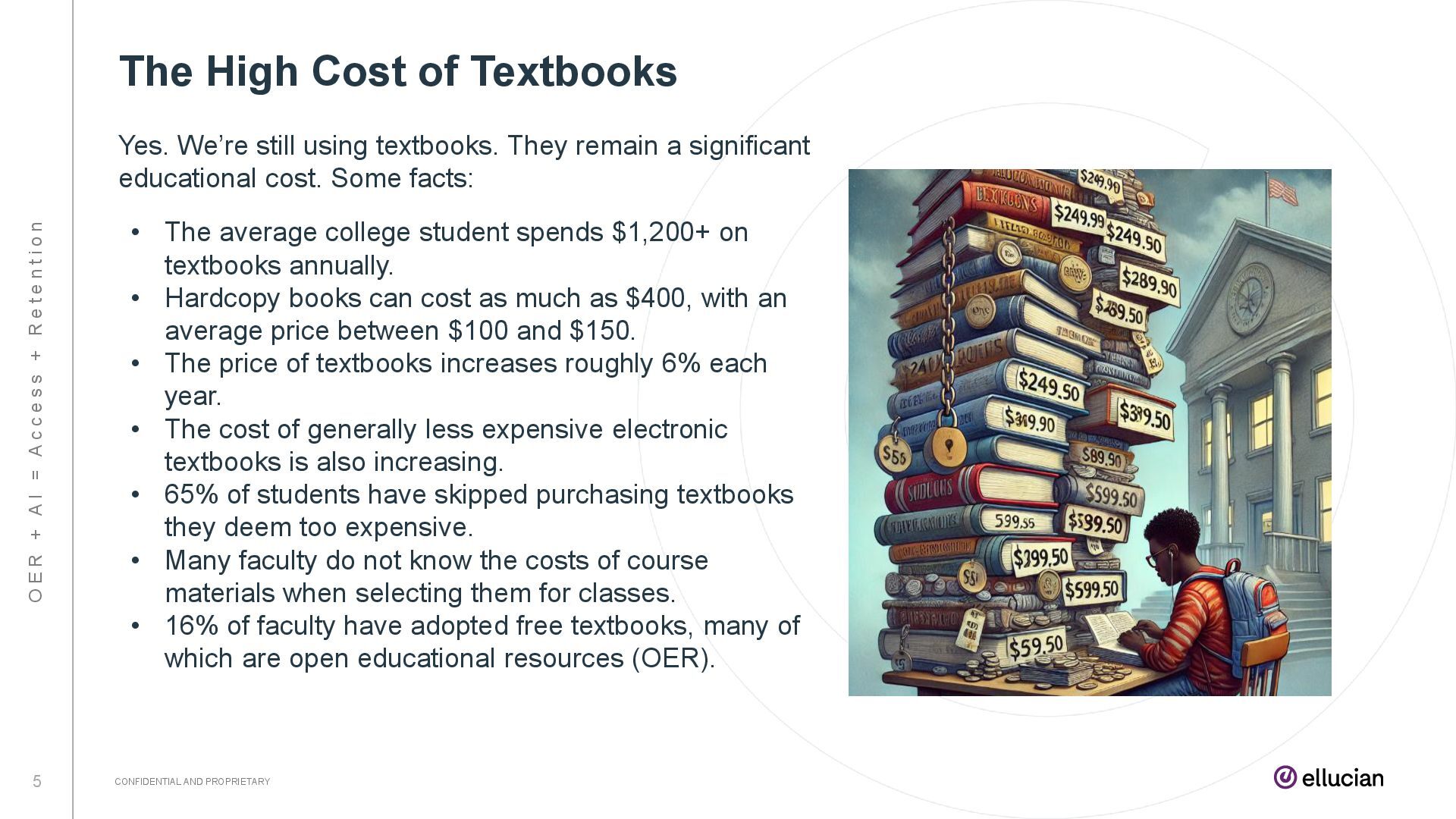
A c c e s s + R e t e n t i o n 5 The High Cost of Textbooks • The average college student spends $1,200+ on textbooks annually. • Hardcopy books can cost as much as $400, with an average price between $100 and $150. • The price of textbooks increases roughly 6% each year. • The cost of generally less expensive electronic textbooks is also increasing. • 65% of students have skipped purchasing textbooks they deem too expensive. • Many faculty do not know the costs of course materials when selecting them for classes. • 16% of faculty have adopted free textbooks, many of which are open educational resources (OER). Yes. We’re still using textbooks. They remain a significant educational cost. Some facts:
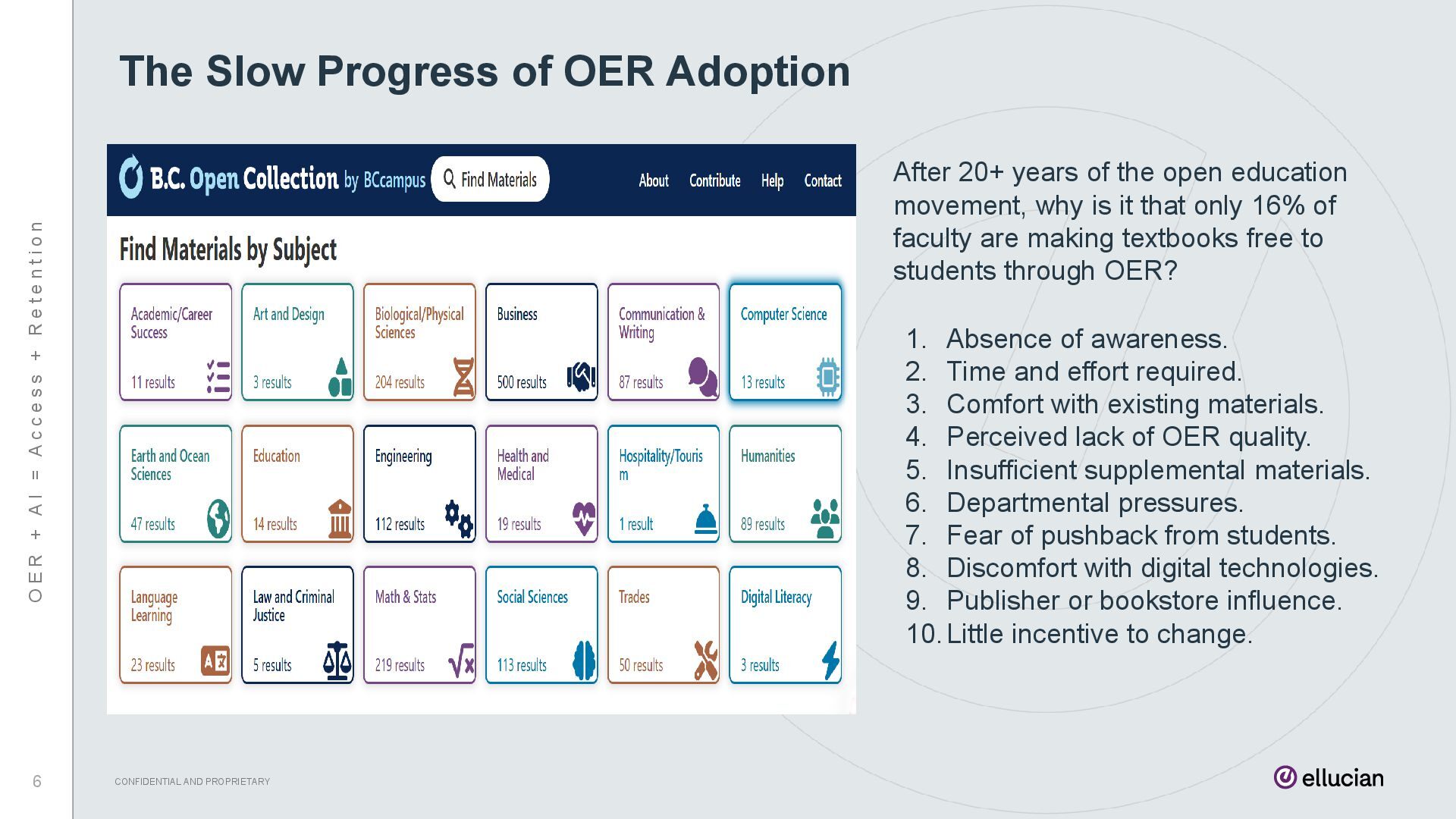
= A c c e s s + R e t e n t i o n The Slow Progress of OER Adoption After 20+ years of the open education movement, why is it that only 16% of faculty are making textbooks free to students through OER? 1. Absence of awareness. 2. Time and effort required. 3. Comfort with existing materials. 4. Perceived lack of OER quality. 5. Insufficient supplemental materials. 6. Departmental pressures. 7. Fear of pushback from students. 8. Discomfort with digital technologies. 9. Publisher or bookstore influence. 10.Little incentive to change.
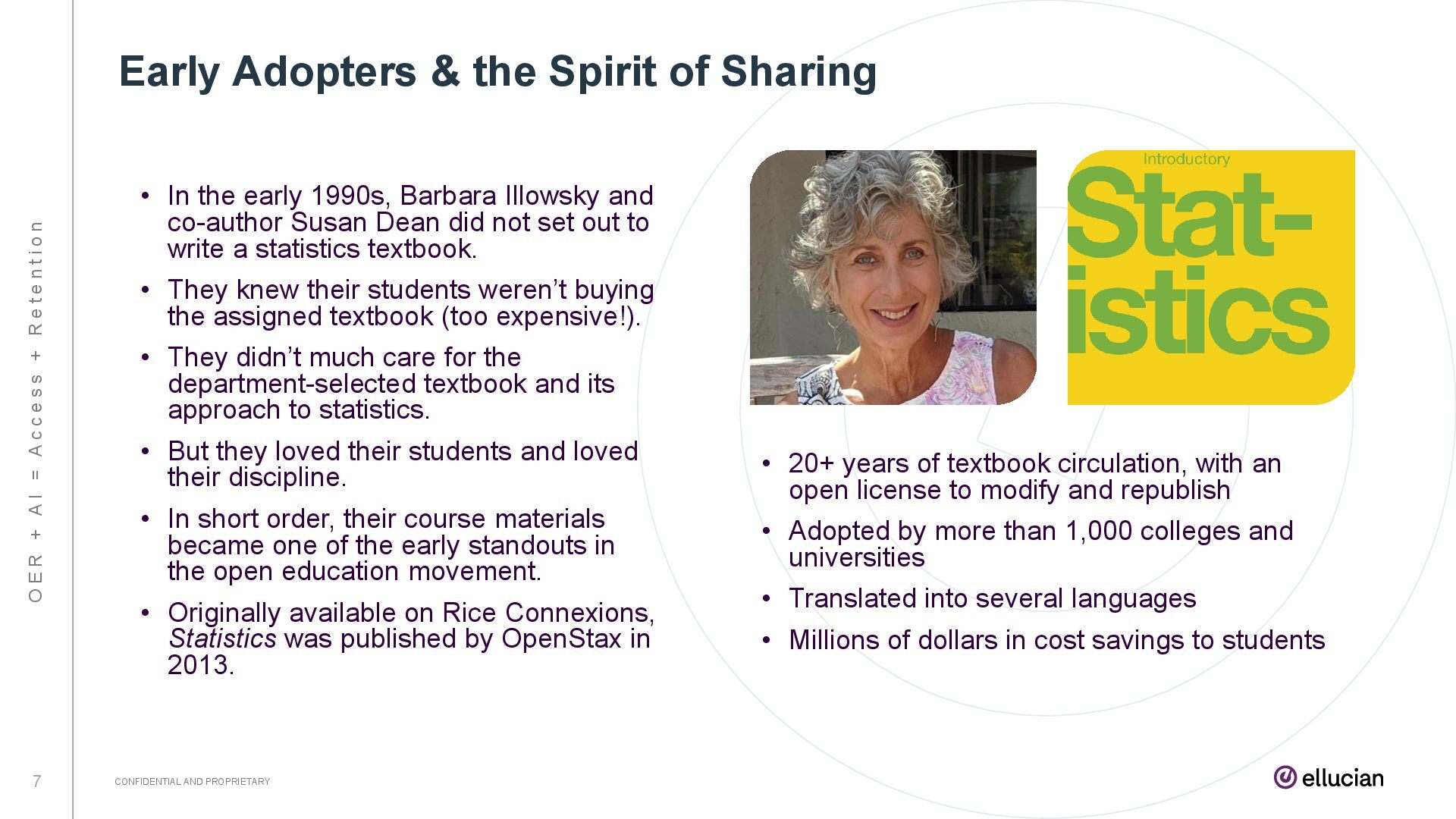
and co-author Susan Dean did not set out to write a statistics textbook. • They knew their students weren’t buying the assigned textbook (too expensive!). • They didn’t much care for the department-selected textbook and its approach to statistics. • But they loved their students and loved their discipline. • In short order, their course materials became one of the early standouts in the open education movement. • Originally available on Rice Connexions, Statistics was published by OpenStax in 2013. • 20+ years of textbook circulation, with an open license to modify and republish • Adopted by more than 1,000 colleges and universities • Translated into several languages • Millions of dollars in cost savings to students O E R + A I = A c c e s s + R e t e n t i o n 7 Early Adopters & the Spirit of Sharing
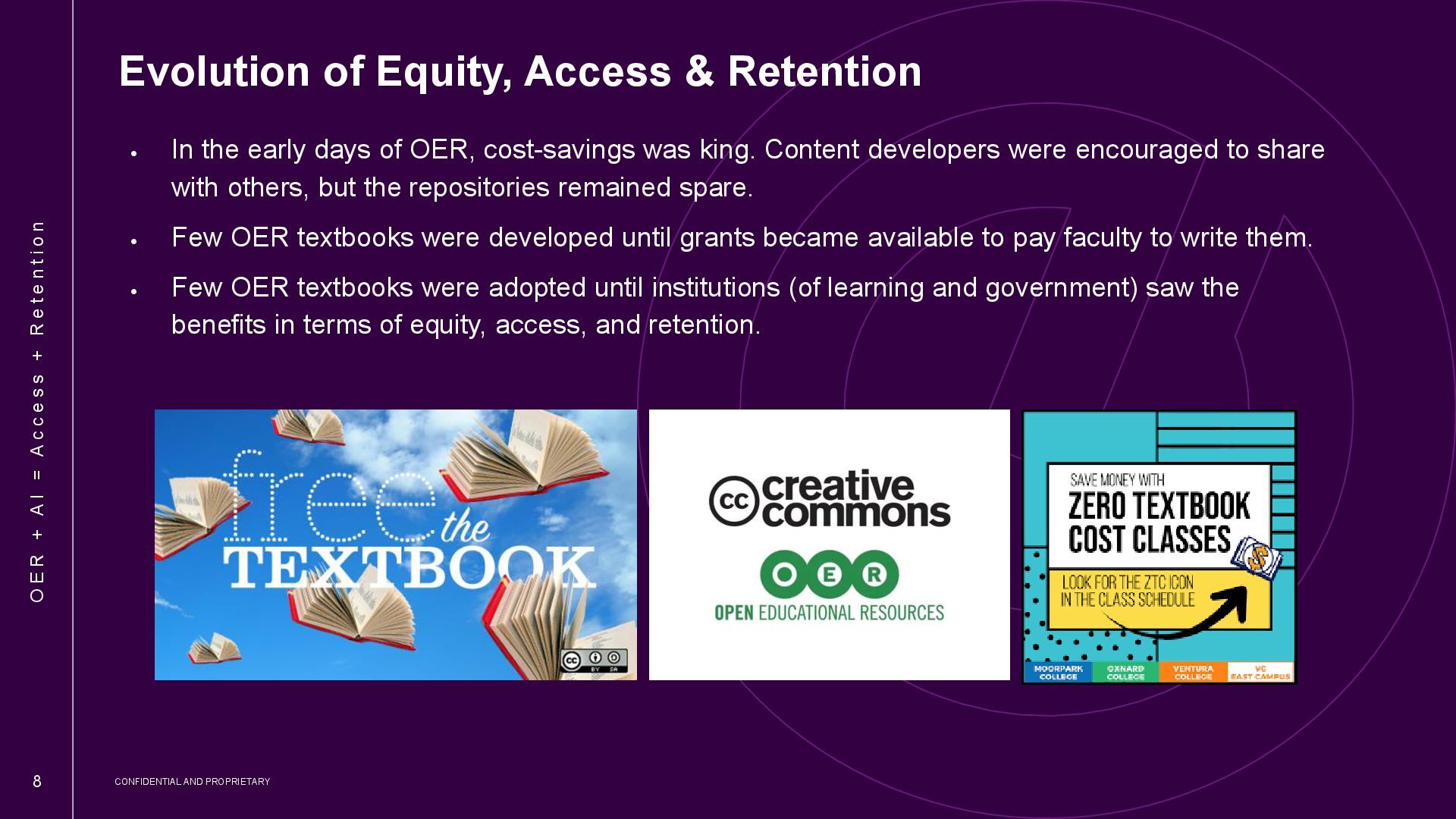
= A c c e s s + R e t e n t i o n Evolution of Equity, Access & Retention • In the early days of OER, cost-savings was king. Content developers were encouraged to share with others, but the repositories remained spare. • Few OER textbooks were developed until grants became available to pay faculty to write them. • Few OER textbooks were adopted until institutions (of learning and government) saw the benefits in terms of equity, access, and retention.
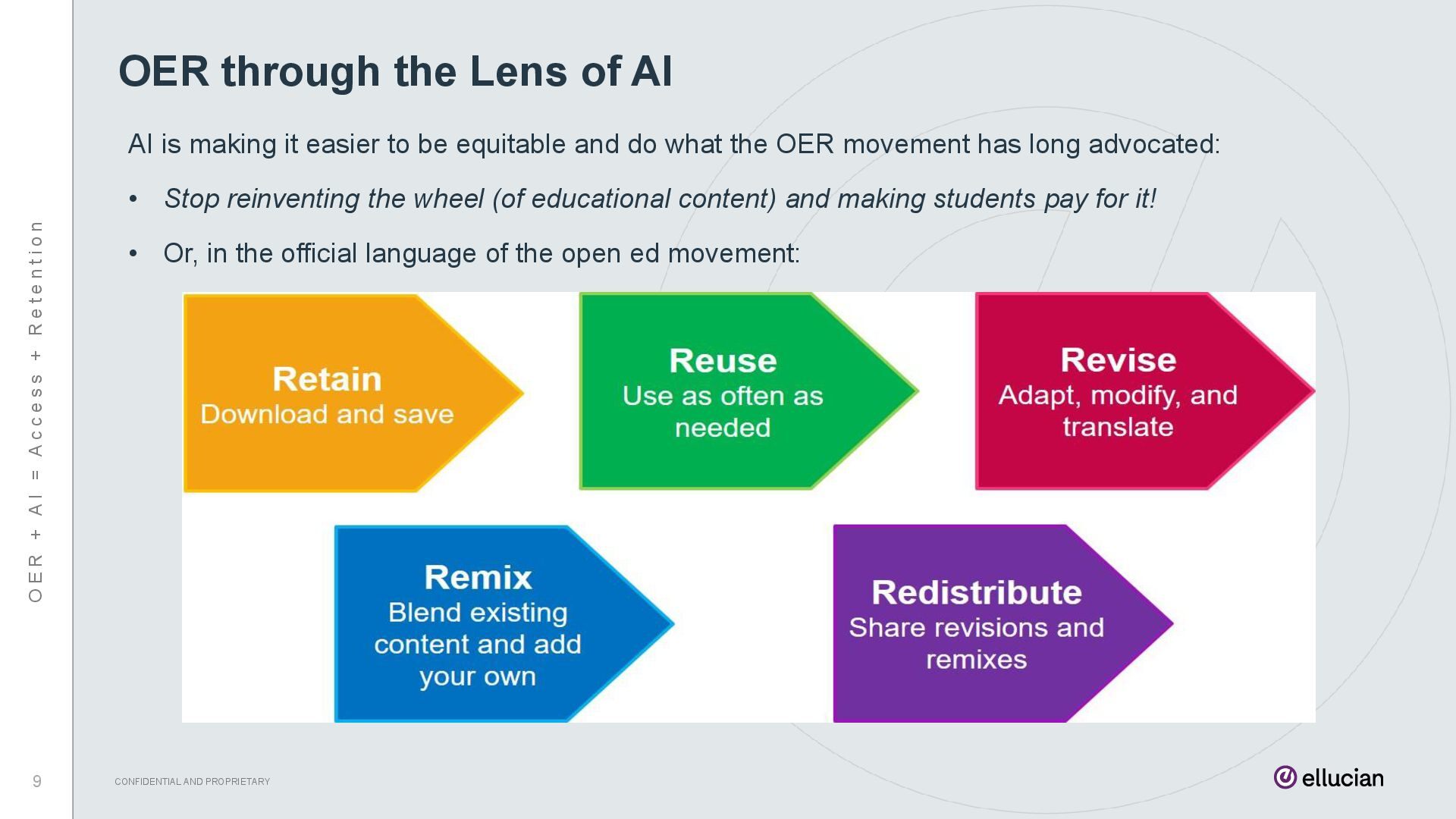
AI is making it easier to be equitable and do what the OER movement has long advocated: • Stop reinventing the wheel (of educational content) and making students pay for it! • Or, in the official language of the open ed movement: O E R + A I = A c c e s s + R e t e n t i o n
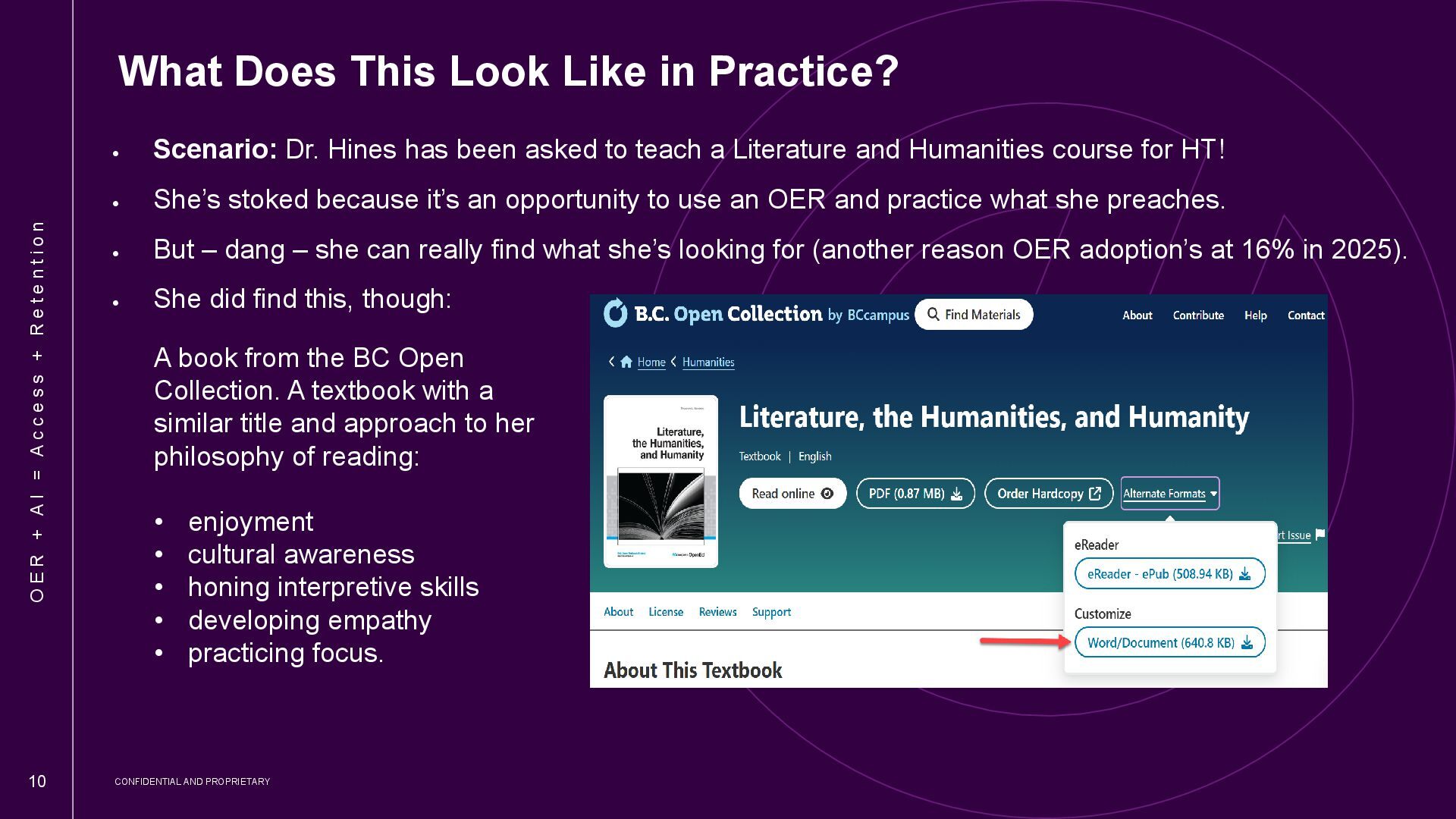
= A c c e s s + R e t e n t i o n What Does This Look Like in Practice? • Scenario: Dr. Hines has been asked to teach a Literature and Humanities course for HT! • She’s stoked because it’s an opportunity to use an OER and practice what she preaches. • But – dang – she can really find what she’s looking for (another reason OER adoption’s at 16% in 2025). • She did find this, though: A screenshot of a computer AI-generated content may be incorrect. A book from the BC Open Collection. A textbook with a similar title and approach to her philosophy of reading: • enjoyment • cultural awareness • honing interpretive skills • developing empathy • practicing focus.
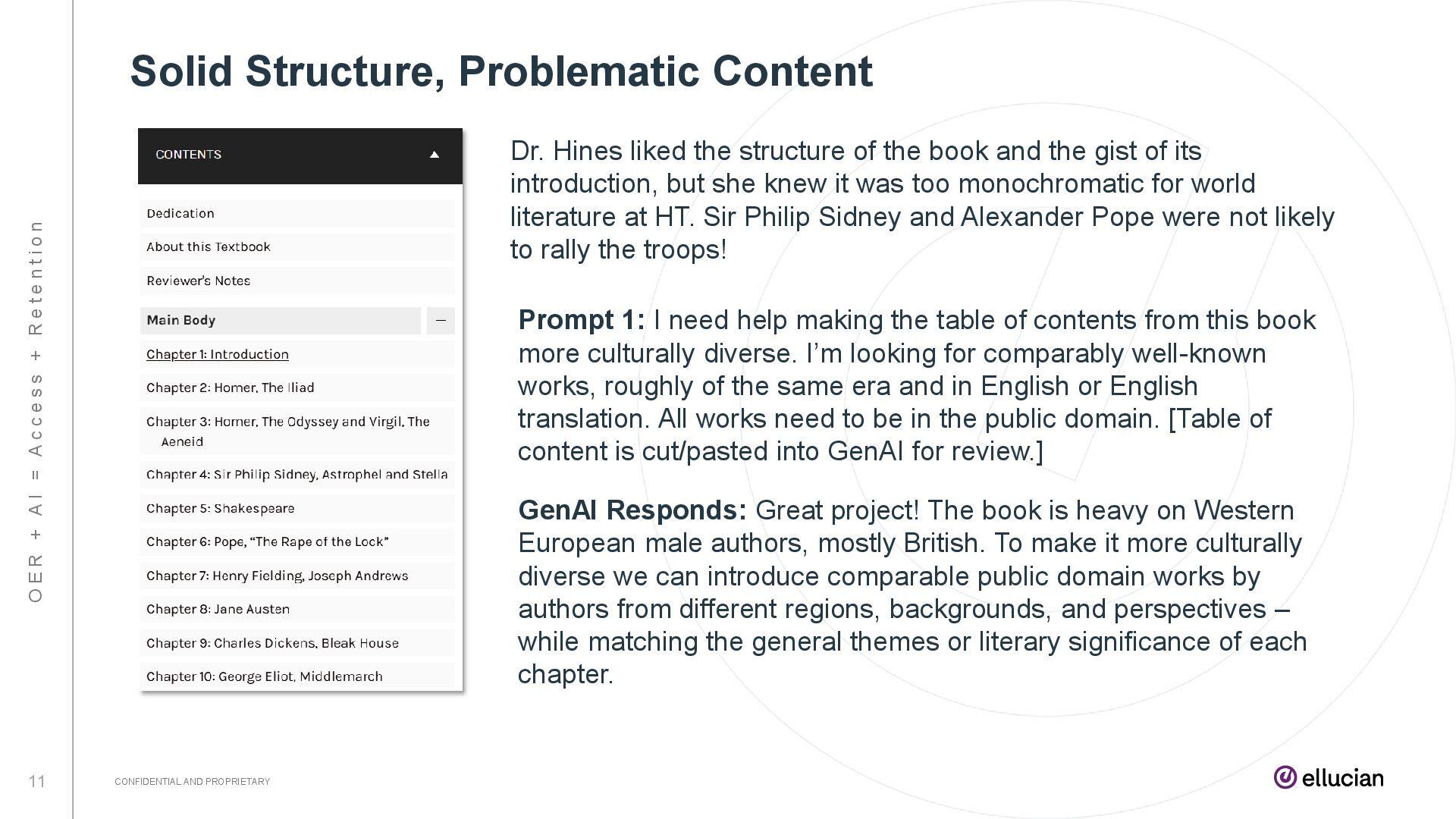
A c c e s s + R e t e n t i o n 11 Solid Structure, Problematic Content Dr. Hines liked the structure of the book and the gist of its introduction, but she knew it was too monochromatic for world literature at HT. Sir Philip Sidney and Alexander Pope were not likely to rally the troops! Prompt 1: I need help making the table of contents from this book more culturally diverse. I’m looking for comparably well-known works, roughly of the same era and in English or English translation. All works need to be in the public domain. [Table of content is cut/pasted into GenAI for review.] GenAI Responds: Great project! The book is heavy on Western European male authors, mostly British. To make it more culturally diverse we can introduce comparable public domain works by authors from different regions, backgrounds, and perspectives – while matching the general themes or literary significance of each chapter.
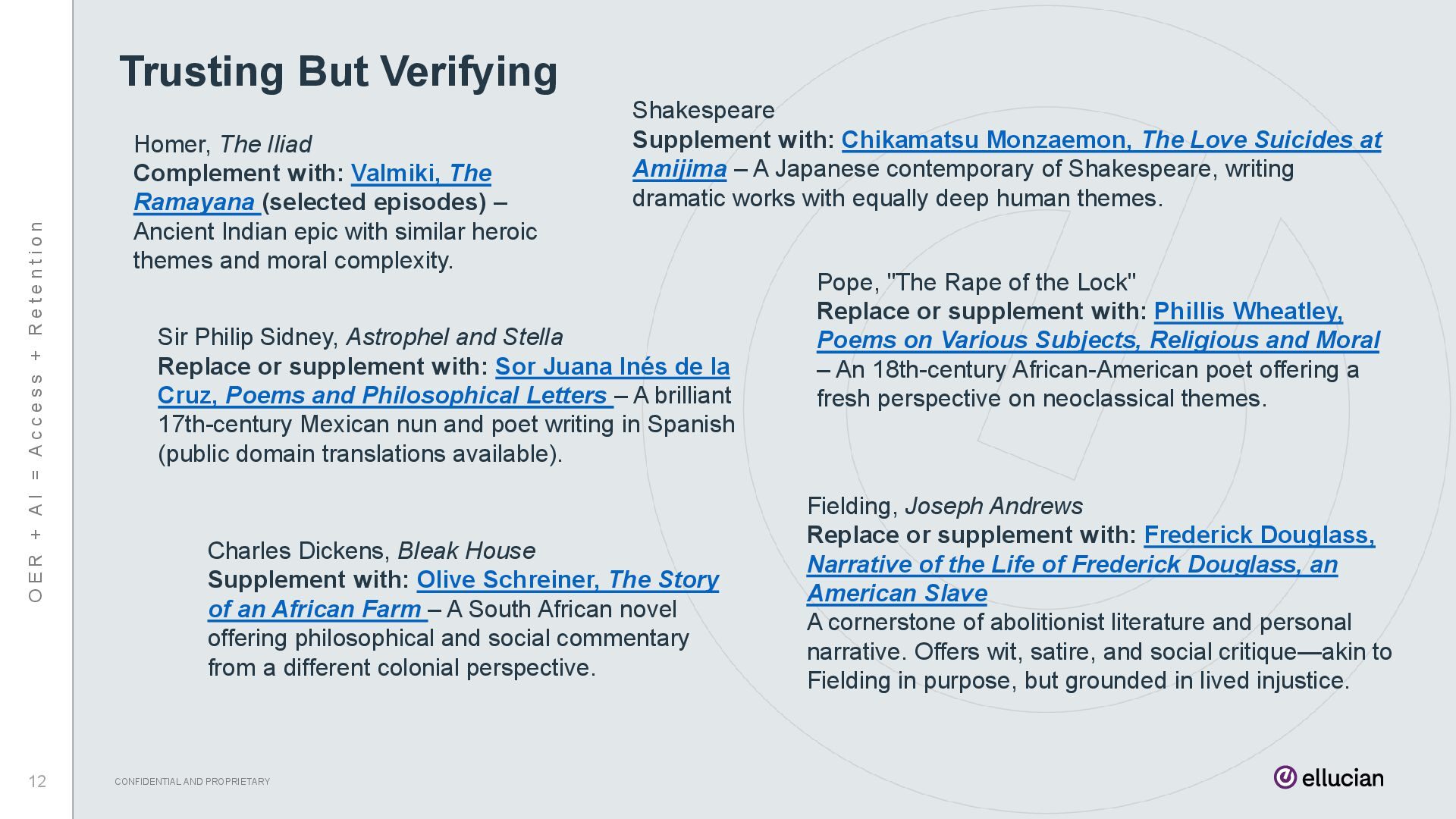
= A c c e s s + R e t e n t i o n Trusting But Verifying Homer, The Iliad Complement with: Valmiki, The Ramayana (selected episodes) – Ancient Indian epic with similar heroic themes and moral complexity. Sir Philip Sidney, Astrophel and Stella Replace or supplement with: Sor Juana Inés de la Cruz, Poems and Philosophical Letters – A brilliant 17th-century Mexican nun and poet writing in Spanish (public domain translations available). Shakespeare Supplement with: Chikamatsu Monzaemon, The Love Suicides at Amijima – A Japanese contemporary of Shakespeare, writing dramatic works with equally deep human themes. Pope, "The Rape of the Lock" Replace or supplement with: Phillis Wheatley, Poems on Various Subjects, Religious and Moral – An 18th-century African-American poet offering a fresh perspective on neoclassical themes. Charles Dickens, Bleak House Supplement with: Olive Schreiner, The Story of an African Farm – A South African novel offering philosophical and social commentary from a different colonial perspective. Fielding, Joseph Andrews Replace or supplement with: Frederick Douglass, Narrative of the Life of Frederick Douglass, an American Slave A cornerstone of abolitionist literature and personal narrative. Offers wit, satire, and social critique—akin to Fielding in purpose, but grounded in lived injustice.
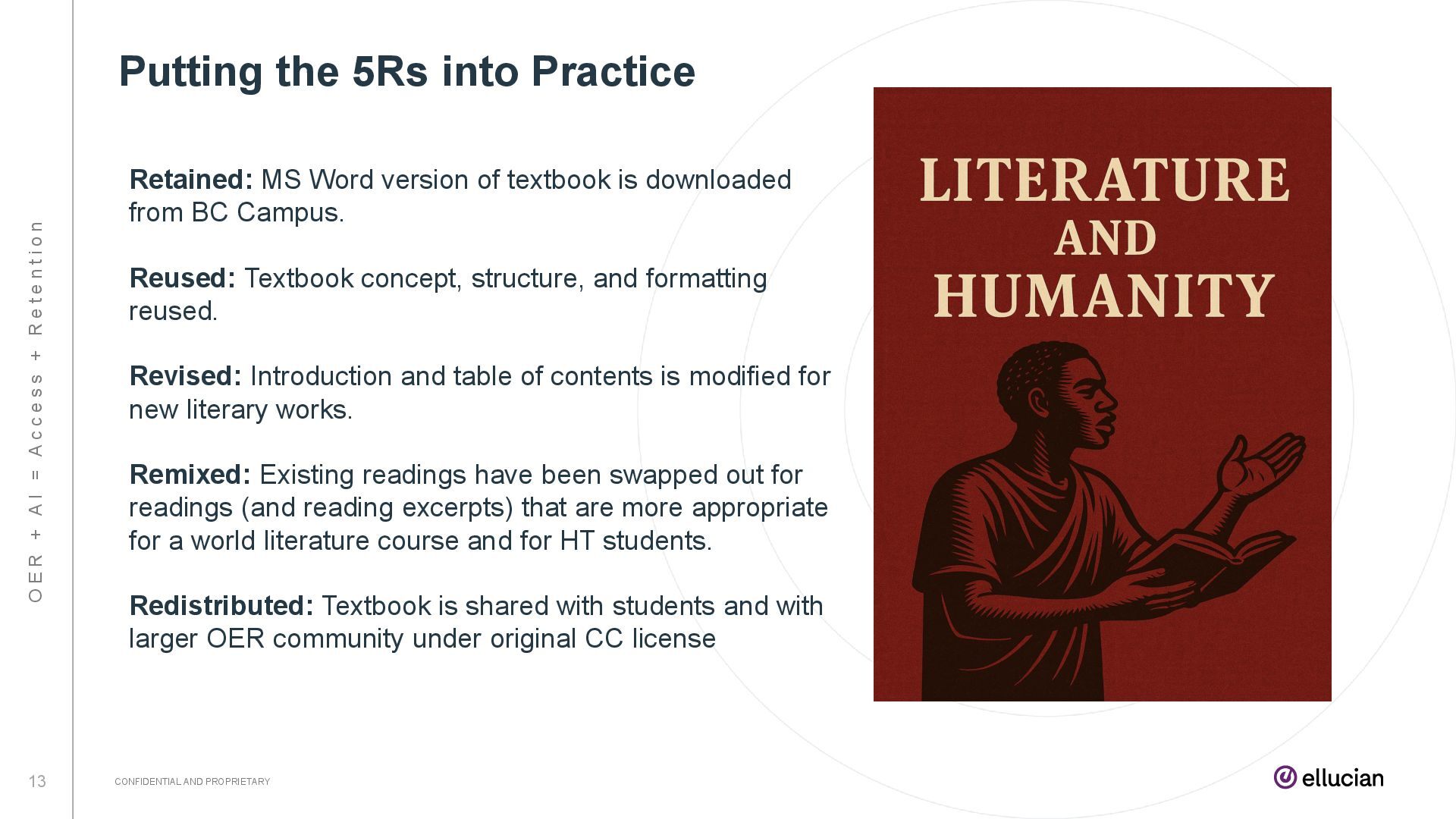
A c c e s s + R e t e n t i o n 13 Putting the 5Rs into Practice Retained: MS Word version of textbook is downloaded from BC Campus. Reused: Textbook concept, structure, and formatting reused. Revised: Introduction and table of contents is modified for new literary works. Remixed: Existing readings have been swapped out for readings (and reading excerpts) that are more appropriate for a world literature course and for HT students. Redistributed: Textbook is shared with students and with larger OER community under original CC license
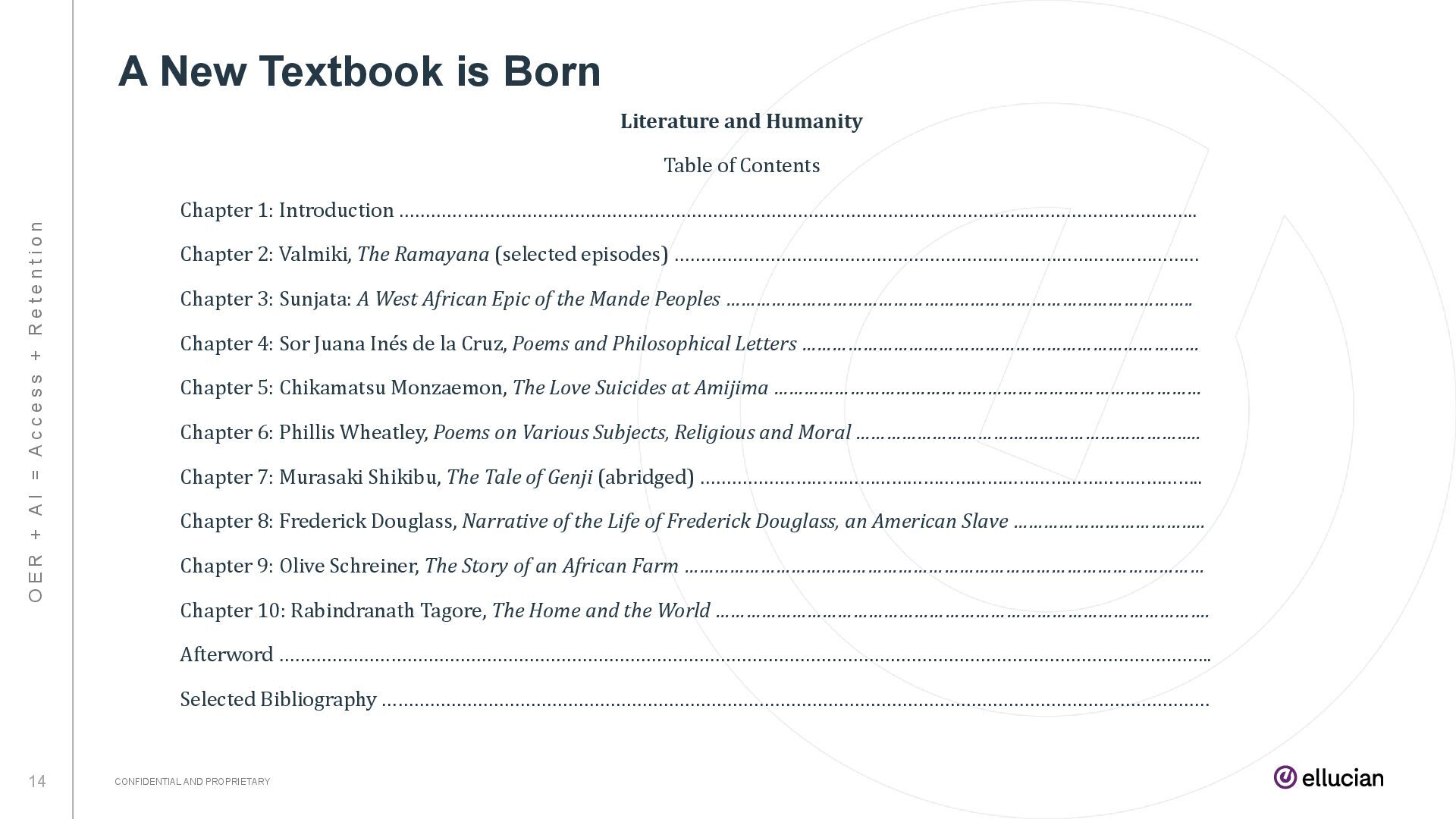
A c c e s s + R e t e n t i o n 14 A New Textbook is Born Literature and Humanity Table of Contents Chapter 1: Introduction ………………………………………………………………………………………………………..………………………….. Chapter 2: Valmiki, The Ramayana (selected episodes) ……………………………………………………………………………………… Chapter 3: Sunjata: A West African Epic of the Mande Peoples ……………………………………………………………………………….. Chapter 4: Sor Juana Inés de la Cruz, Poems and Philosophical Letters …………………………………………………………………… Chapter 5: Chikamatsu Monzaemon, The Love Suicides at Amijima ………………………………………………………………………… Chapter 6: Phillis Wheatley, Poems on Various Subjects, Religious and Moral ………………………………………………………….. Chapter 7: Murasaki Shikibu, The Tale of Genji (abridged) ………………………………………………………………………………….. Chapter 8: Frederick Douglass, Narrative of the Life of Frederick Douglass, an American Slave ……………………………….. Chapter 9: Olive Schreiner, The Story of an African Farm ………………………………………………………………………………………… Chapter 10: Rabindranath Tagore, The Home and the World ……………………………………………………………………………………. Afterword ………………………………………………………………………………………………………………………………………………………….. Selected Bibliography …………………………………………………………………………………………………………………………………………
= A c c e s s + R e t e n t i o n More Than the Sum of Its Parts • How might an OER (like the one I just wrote) affect access and retention – at HBCUs? • Access: Students get immediate access to the textbook at no cost. • Access: Digital books pair nicely with online courses, which expands access – useful at times when enrollments increase but equally useful when enrollments decrease. • Access: Digital books are also easier to make ADA compliant. • Retention: When students have what they need to learn in a course – at the very beginning of a course – they are less likely to drop the course. • Retention: When students feel represented in the materials they study, they know they have “skin in the game”; they’re invested – education is both for and about them. • Retention: OERs are in the public domain or licensed for reuse; so, they are great for creating chatbots to provide the kind of study assistance that’s becoming increasingly popular.
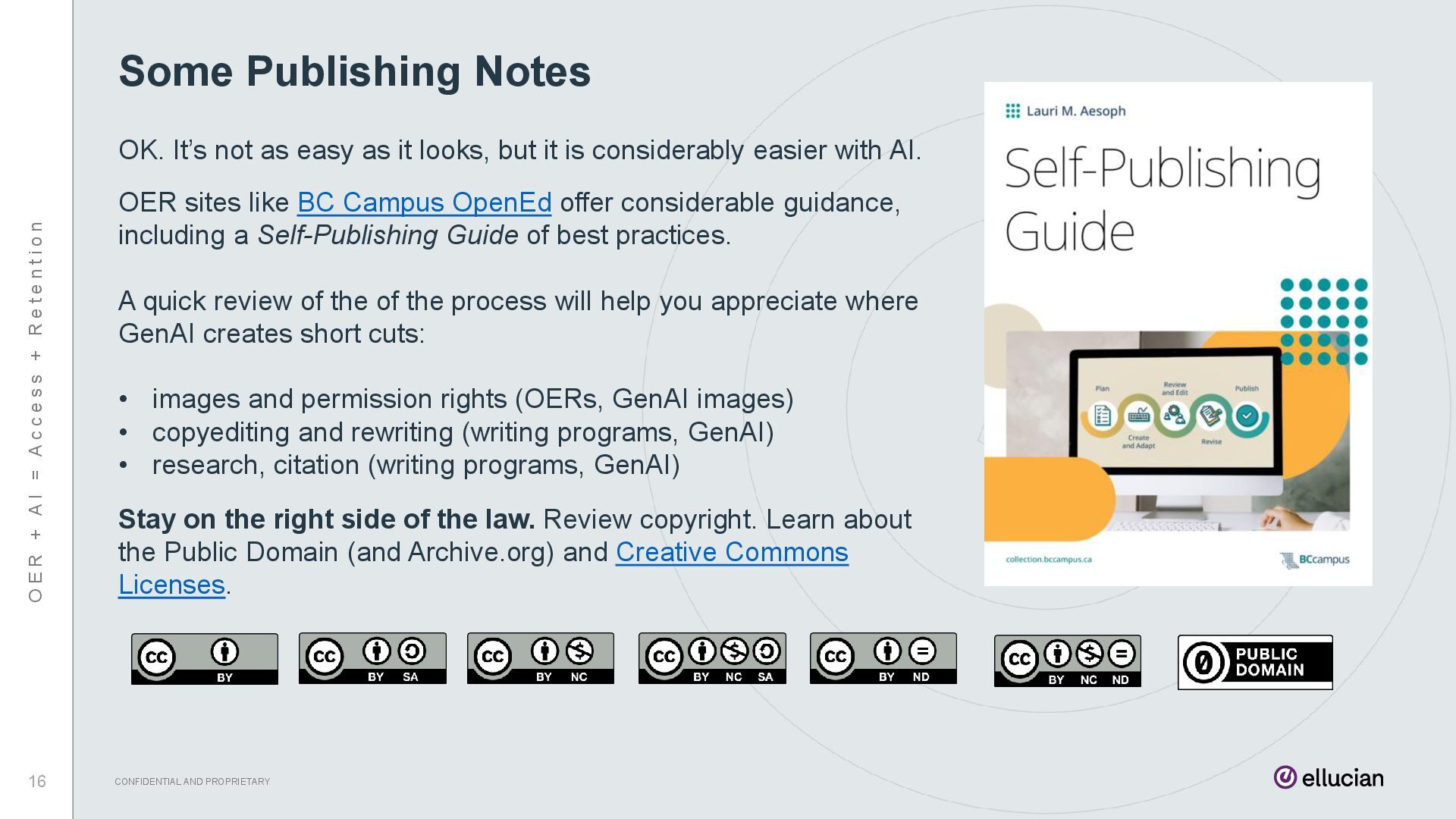
= A c c e s s + R e t e n t i o n Some Publishing Notes OK. It’s not as easy as it looks, but it is considerably easier with AI. OER sites like BC Campus OpenEd offer considerable guidance, including a Self-Publishing Guide of best practices. A quick review of the of the process will help you appreciate where GenAI creates short cuts: • images and permission rights (OERs, GenAI images) • copyediting and rewriting (writing programs, GenAI) • research, citation (writing programs, GenAI) Stay on the right side of the law. Review copyright. Learn about the Public Domain (and Archive.org) and Creative Commons Licenses.
A c c e s s + R e t e n t i o n 17 References • "About CC Licenses." Creative Commons, creativecommons.org/share-your-work/cclicenses/. Accessed 3 Apr. 2025. • "College Students Avoid Courses with High Textbook Costs." Inside Higher Ed, 26 Aug. 2024, www.insidehighered.com/news/student-success/health-wellness/2024/08/26/college-students-avoid-courses-high-textbook-costs#. • "Find Open Educational Resources." Open Michigan, University of Michigan, open.umich.edu/find/find-open-educational- resources. Accessed 3 Apr. 2025. • Hanson, Melanie. "Average Cost of College Textbooks." Education Data Initiative, 12 Oct. 2024, educationdata.org/average-cost- of-college-textbooks. • "Looking for an Open Textbook?" BCcampus OpenEd Resources, open.bccampus.ca/browse-our-collection/find-open-textbooks/. Accessed 3 Apr. 2025. • Nova, Annie. "More Students Are Dropping Out of College. Here's Why." CNBC, 3 Apr. 2024, www.cnbc.com/2024/04/03/more- students-are-dropping-out-of-college-heres-why.html. • "National Survey on Student Course Material Affordability, 2023." Bay View Analytics, www.bayviewanalytics.com/reports/student_course_material_affordability.html. Accessed 3 Apr. 2025. • "OER Repositories and Collections." ASCCC Open Educational Resources Initiative, Academic Senate for California Community Colleges, asccc-oeri.org/oer-repositories-and-collections/. Accessed 3 Apr. 2025. • "Skyrocketing Textbook Prices Are a Cost to Student Equity." Foghorn News, 24 Sept. 2024, www.foghornnews.com/2024/09/skyrocketing-textbook-prices-are-a-cost-to-student-equity/. • Steinberg, Theodore L. Literature, the Humanities, and Humanity. Milne Open Textbooks, 2013, milnepublishing.geneseo.edu/literature-humanities-humanity/. • "Solving the World's Problems with Open Education." TAP Blog, Zero Textbook Cost TAP, sites.google.com/view/ztctap/home/tap- blog/archive-solving-the-worlds-problems-with-open-education. Accessed 3 Apr. 2025. • "Textbook Costs: A Social Justice Issue." Open and Affordable Course Content, Virginia Commonwealth University Libraries, guides.library.vcu.edu/acc/socialjustice. Accessed 3 Apr. 2025.


 ytapples613
 pawan_pharm
 matleenalaakso
 signer
 rashwhitman
 cbtlibrary
 frievea
 drpoonamkc
 akiraasano
 terasawat
 katarinadahlin
 lynnandtonic
 twada
 cassininazir
 mongodb
 inesmontani
 wjessup
 deanohume
 katiecoart
 aleyda
 baasie
 sonatard