Upgrade to Pro — share decks privately, control downloads, hide ads and more …

From Developer to Builder: A Spec-Driven Develo...

From Developer to Builder: A Spec-Driven Development Deep Dive

Spec-Driven Development is a way of working with AI coding agents where the specification drives the code, not the prompt. I use Spec-Driven Development (SDD) according to the AI Unified Process (AIUP) in several customer projects, and in this deep dive, I show how it works in practice.

We will build a business application from scratch, and also learn how to work on brownfield projects. We write specifications, let an AI agent generate the code, run it, and add tests that check the code against the spec. When the requirements change, we update the spec and regenerate the code rather than patching the code by hand.

We will explore the harness: the rules, context, and tests around the agent that keep its output predictable enough for real work. By the end, you will know how to use SDD with the AI Unified Process, where it helps, where it does not, and how to try it on your own stack.

Avatar for Simon Martinelli

Simon Martinelli PRO

October 08, 2026

More Decks by Simon Martinelli

Other Decks in Programming

Transcript

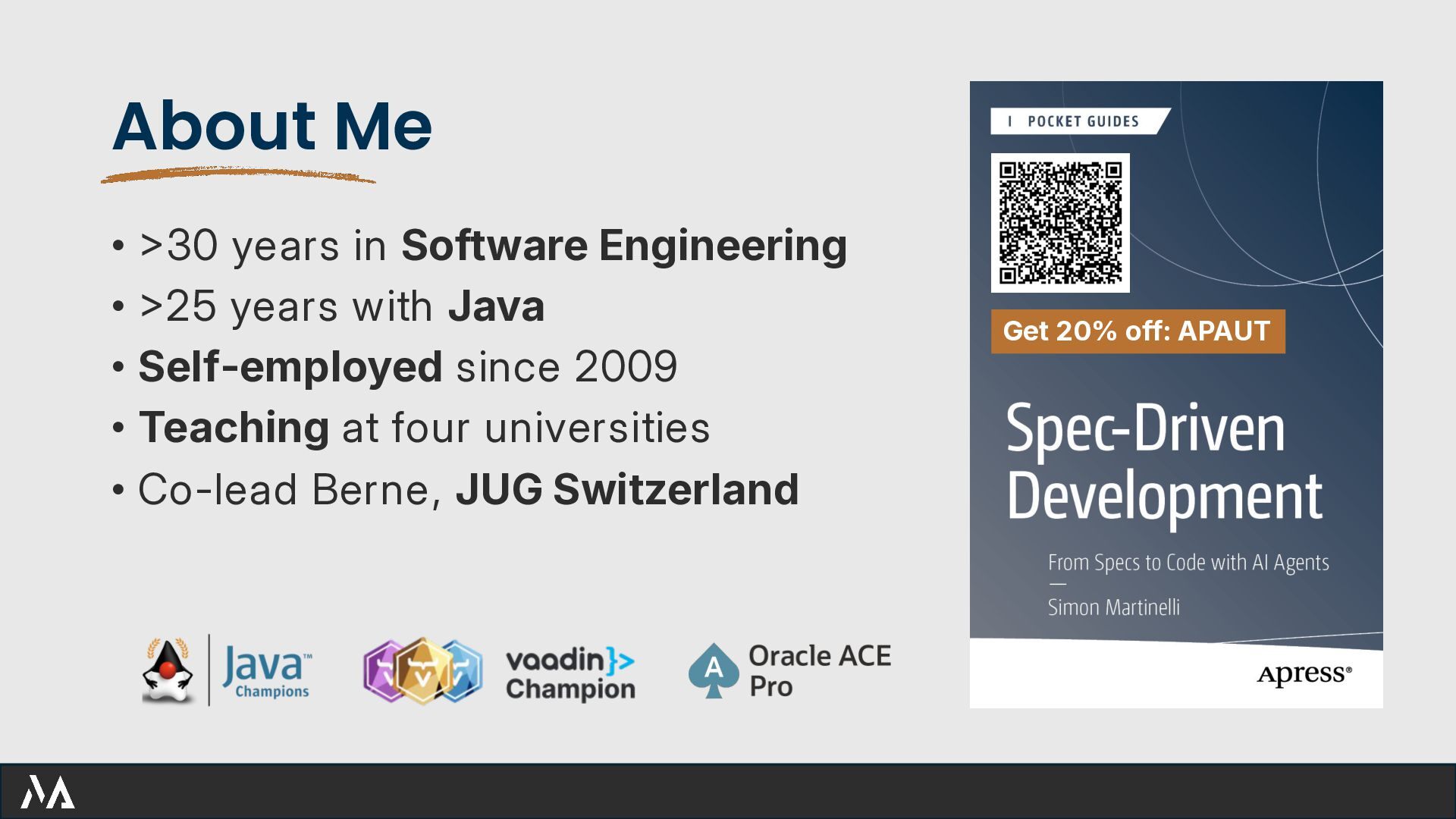
  1. About Me • 30 years in Software Engineering • 25

    years with Java • Self-employed since 2009 • Teaching at four universities • Co-lead Berne, JUG Switzerland Get 20% off: APAUT
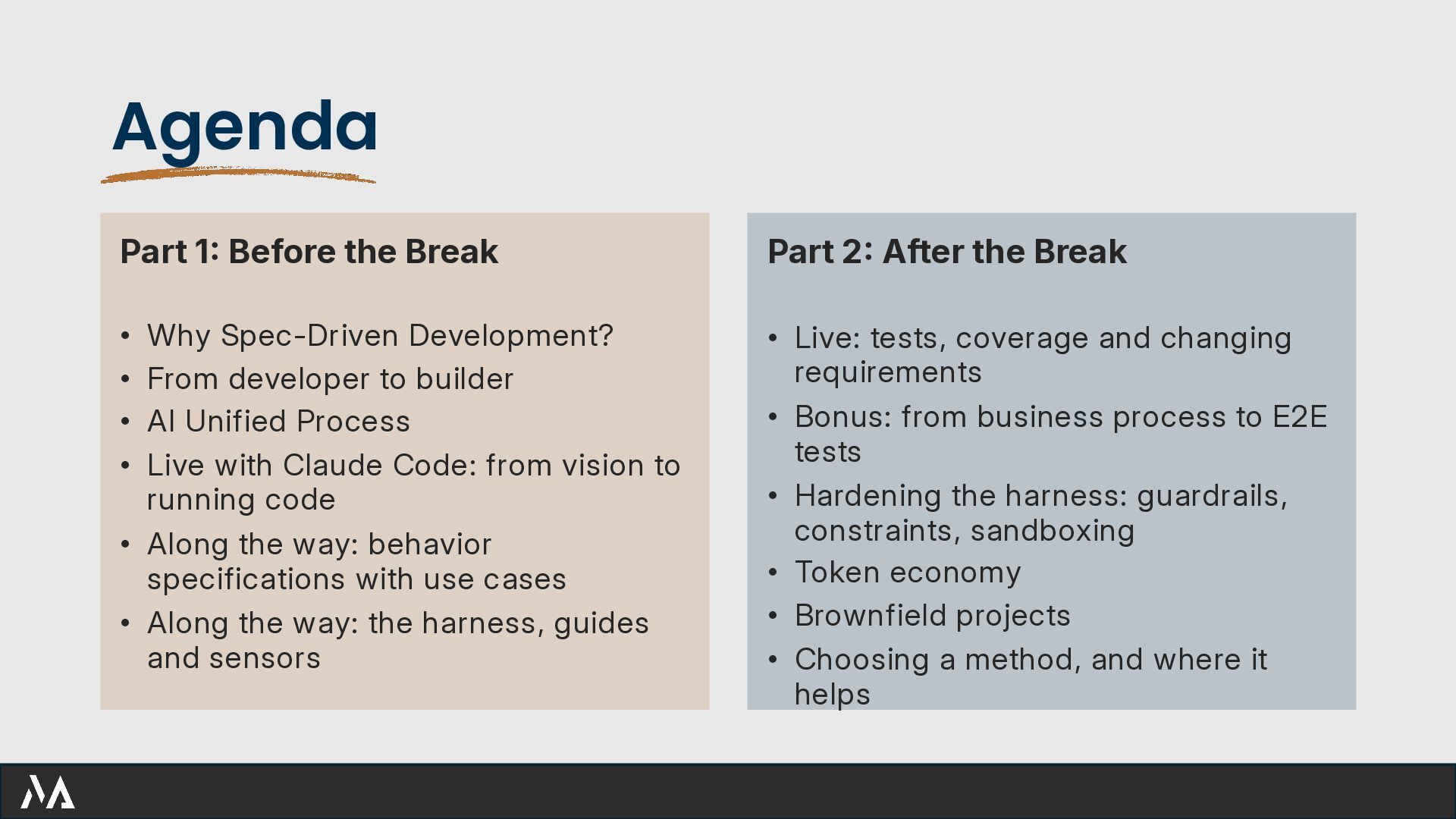
  2. Agenda Part 1 Before the Break Part 2 After the

    Break • Why Spec-Driven Development? • From developer to builder • AI Unified Process • Live with Claude Code: from vision to running code • Along the way: behavior specifications with use cases • Along the way: the harness, guides and sensors • Live: tests, coverage and changing requirements • Bonus: from business process to E2E tests • Hardening the harness: guardrails, constraints, sandboxing • Token economy • Brownfield projects • Choosing a method, and where it helps
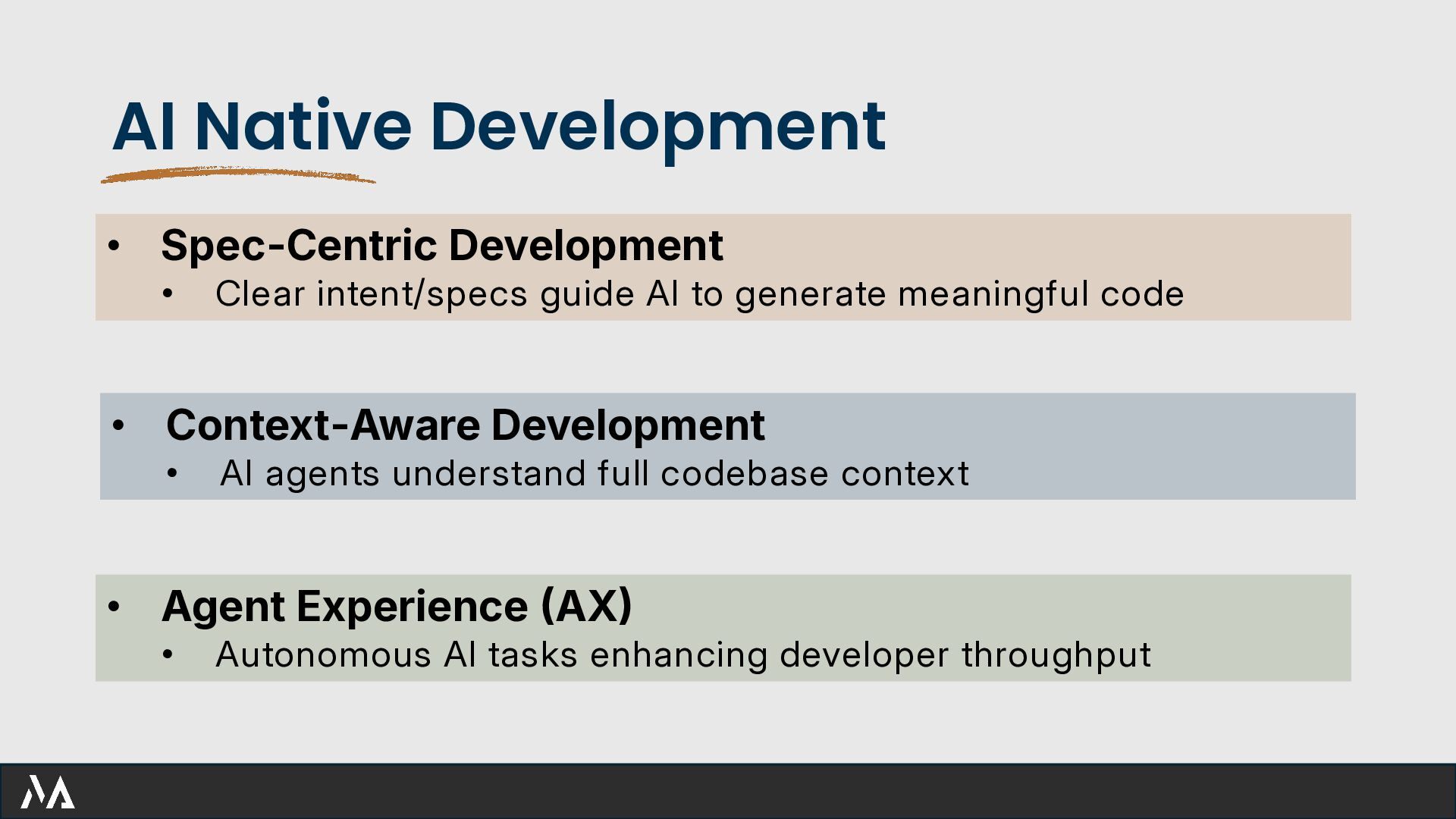
  3. AI Native Development • Spec-Centric Development • Clear intent/specs guide

    AI to generate meaningful code • Context-Aware Development • AI agents understand full codebase context • Agent Experience AX • Autonomous AI tasks enhancing developer throughput
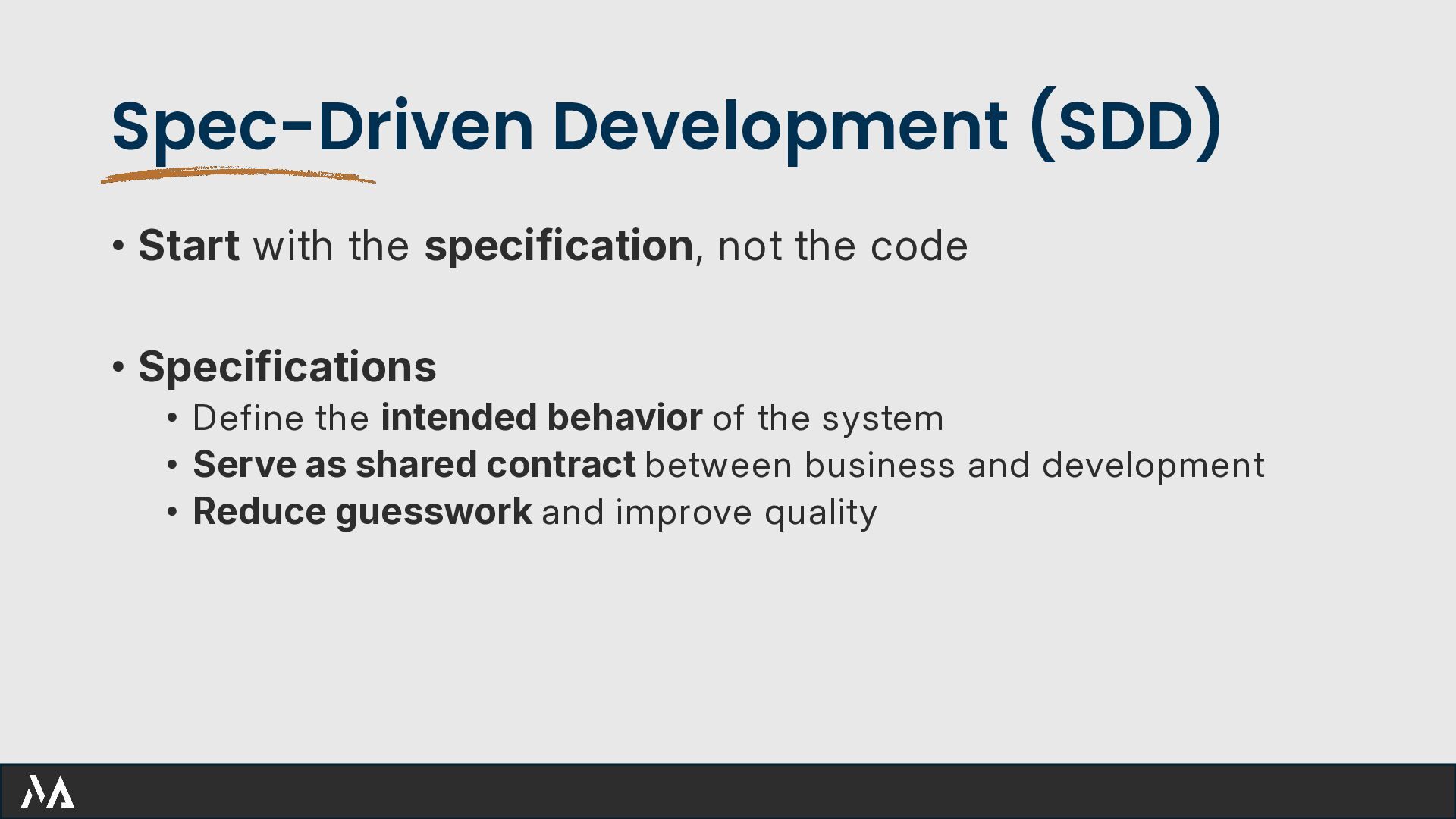
  4. Spec-Driven Development (SDD) • Start with the specification, not the

    code • Specifications • Define the intended behavior of the system • Serve as shared contract between business and development • Reduce guesswork and improve quality
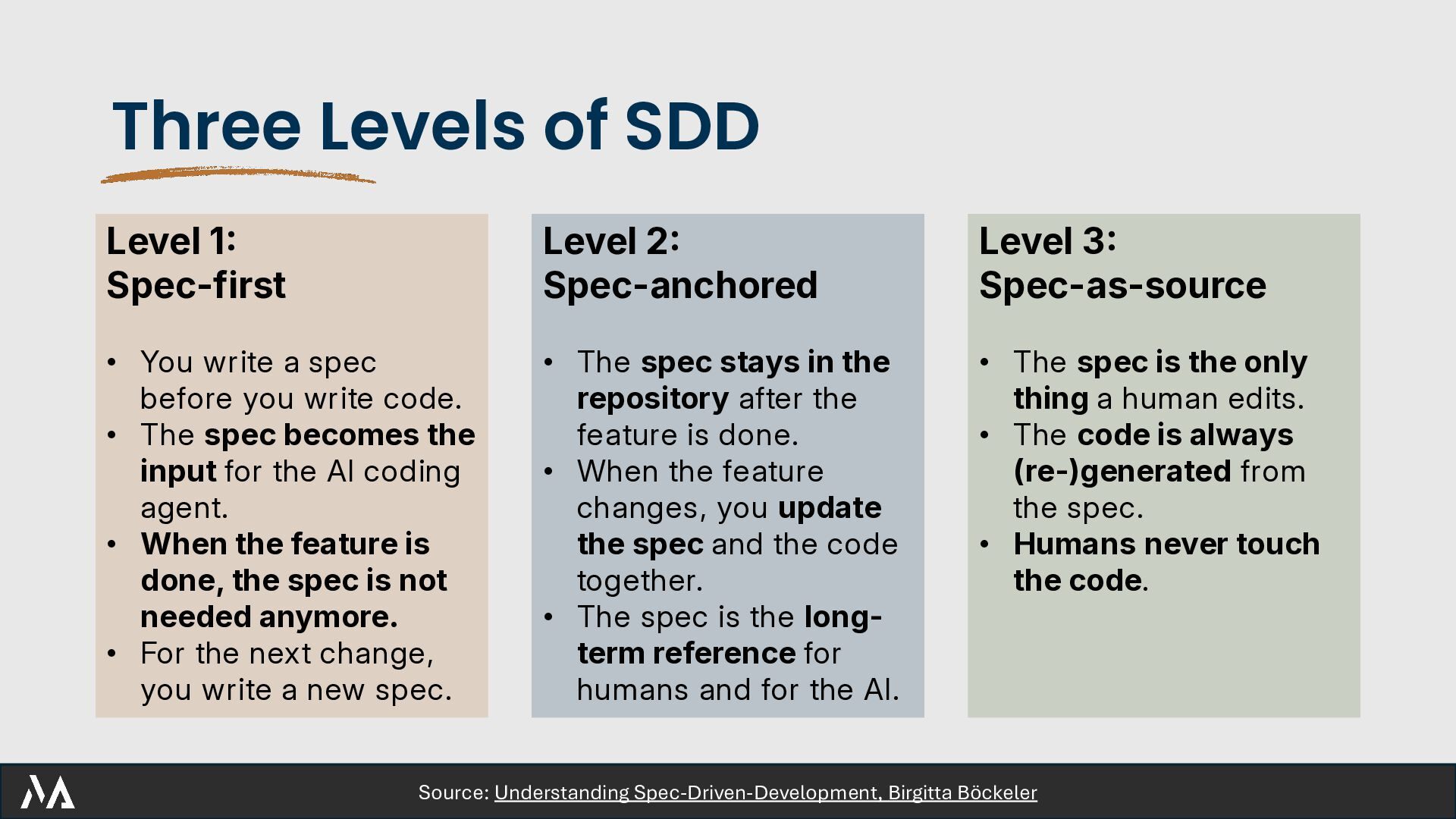
  5. Three Levels of SDD Level 1 Spec-first Level 2 Spec-anchored

    Level 3 Spec-as-source • You write a spec before you write code. • The spec becomes the input for the AI coding agent. • When the feature is done, the spec is not needed anymore. • For the next change, you write a new spec. • The spec stays in the repository after the feature is done. • When the feature changes, you update the spec and the code together. • The spec is the longterm reference for humans and for the AI. • The spec is the only thing a human edits. • The code is always (re-)generated from the spec. • Humans never touch the code. Source: Understanding Spec-Driven-Development, Birgitta Böckeler
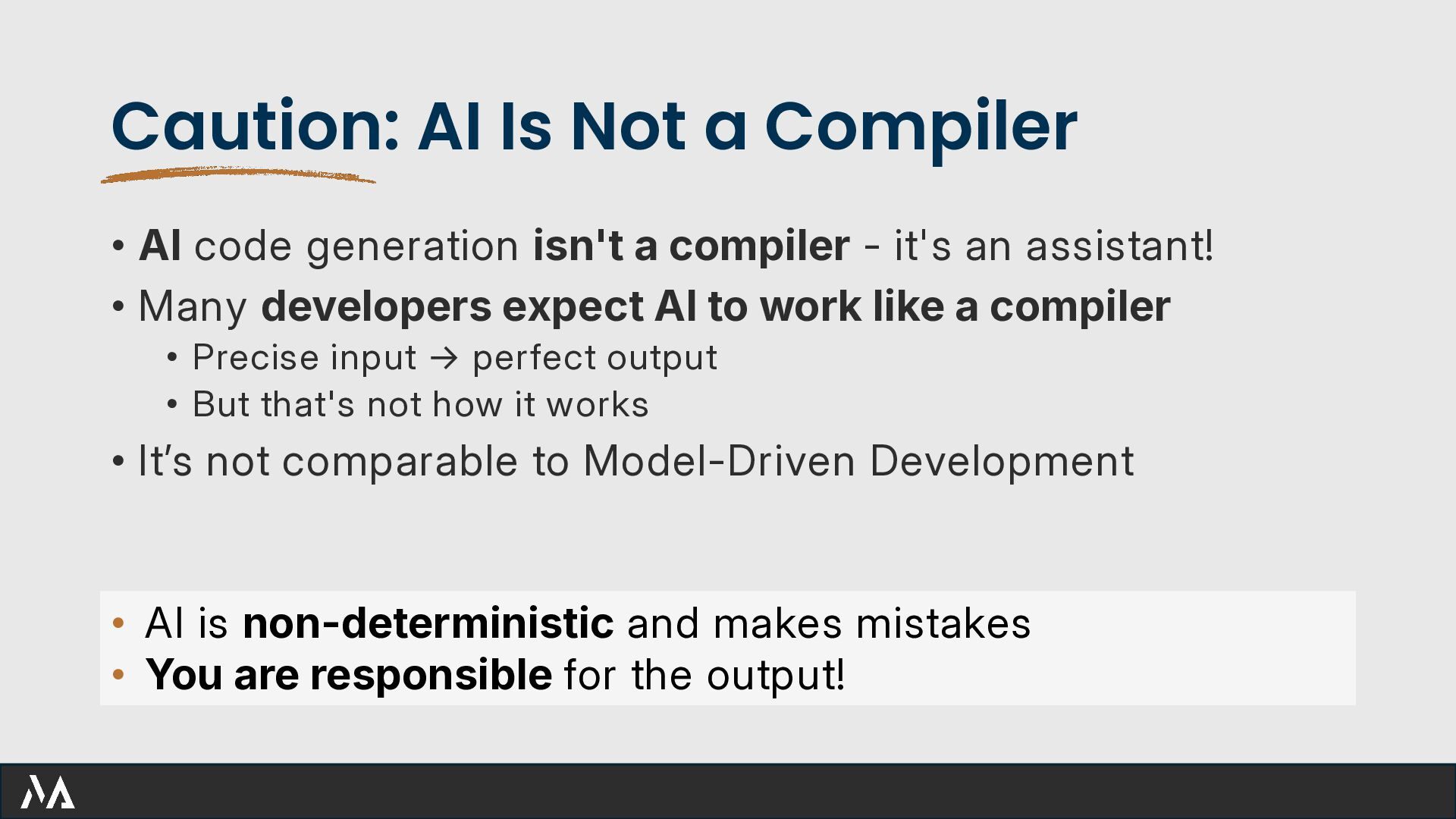
  6. Caution: AI Is Not a Compiler • AI code generation

    isn't a compiler - it's an assistant! • Many developers expect AI to work like a compiler • Precise input → perfect output • But that's not how it works • It’s not comparable to Model-Driven Development • AI is non-deterministic and makes mistakes • You are responsible for the output!
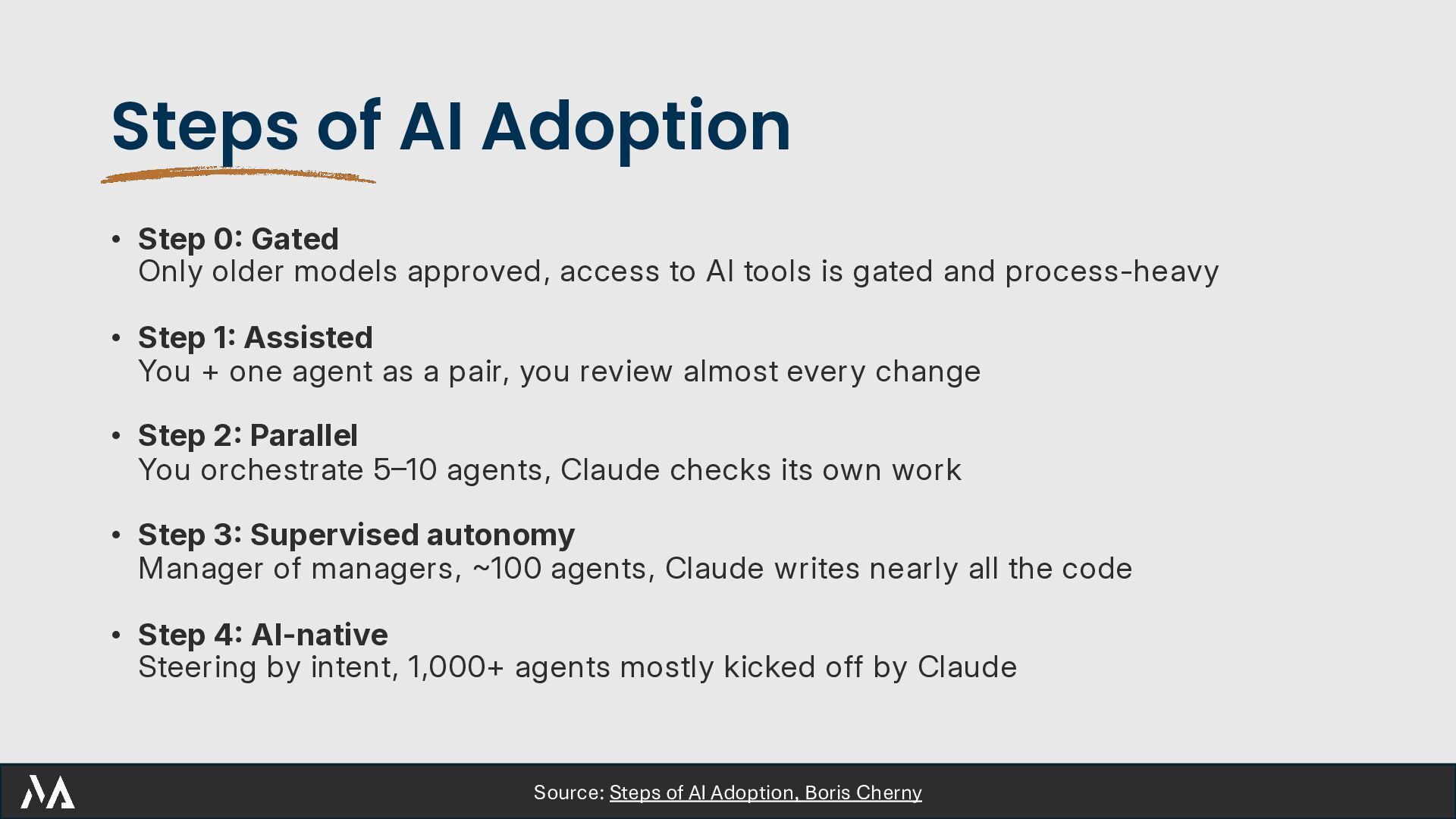
  7. Steps of AI Adoption • Step 0 Gated Only older

    models approved, access to AI tools is gated and process-heavy • Step 1 Assisted You + one agent as a pair, you review almost every change • Step 2 Parallel You orchestrate 510 agents, Claude checks its own work • Step 3 Supervised autonomy Manager of managers, 100 agents, Claude writes nearly all the code • Step 4 AI-native Steering by intent, 1,000+ agents mostly kicked off by Claude Source: Steps of AI Adoption, Boris Cherny
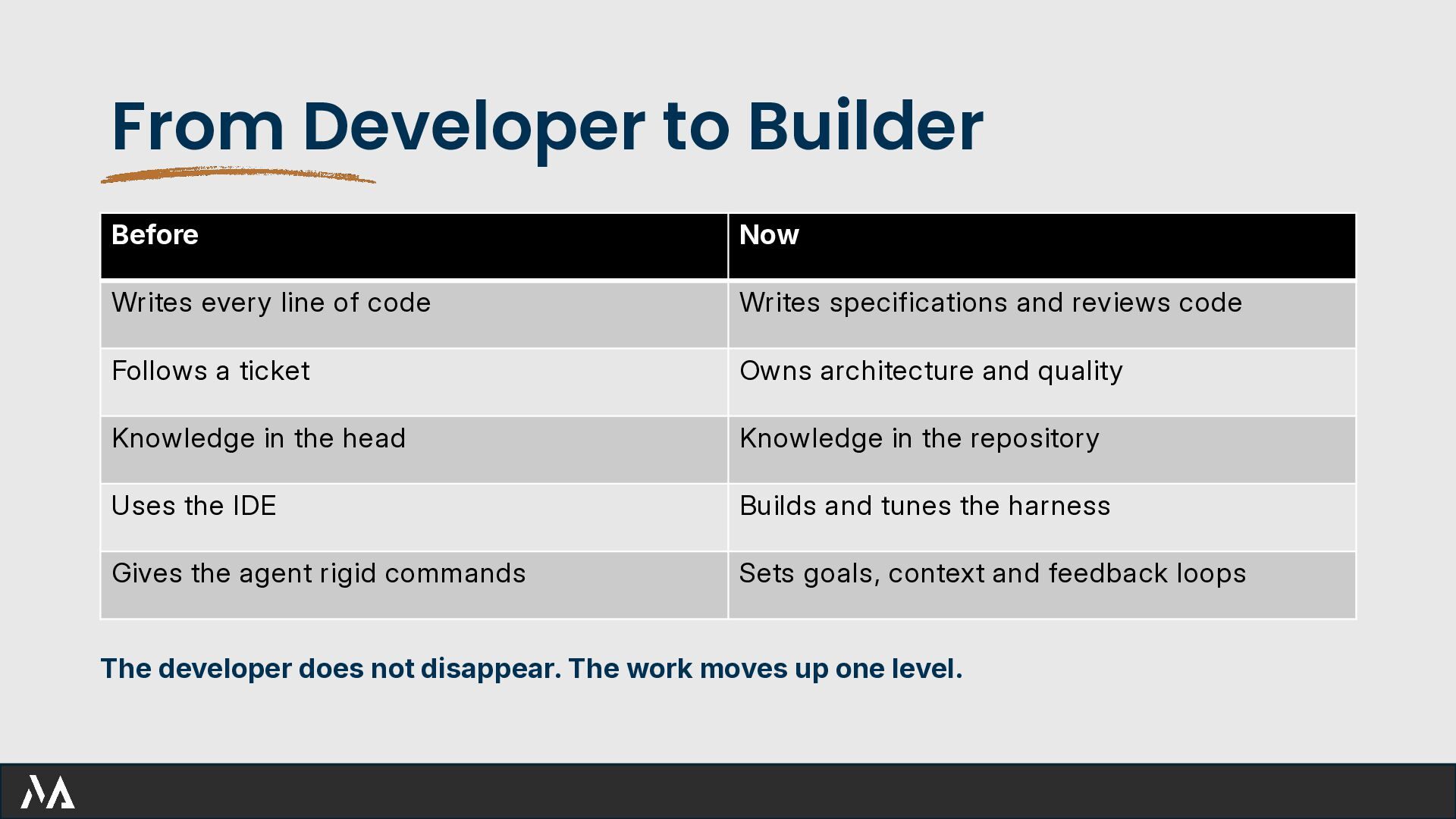
  8. From Developer to Builder Before Now Writes every line of

    code Writes specifications and reviews code Follows a ticket Owns architecture and quality Knowledge in the head Knowledge in the repository Uses the IDE Builds and tunes the harness Gives the agent rigid commands Sets goals, context and feedback loops The developer does not disappear. The work moves up one level.
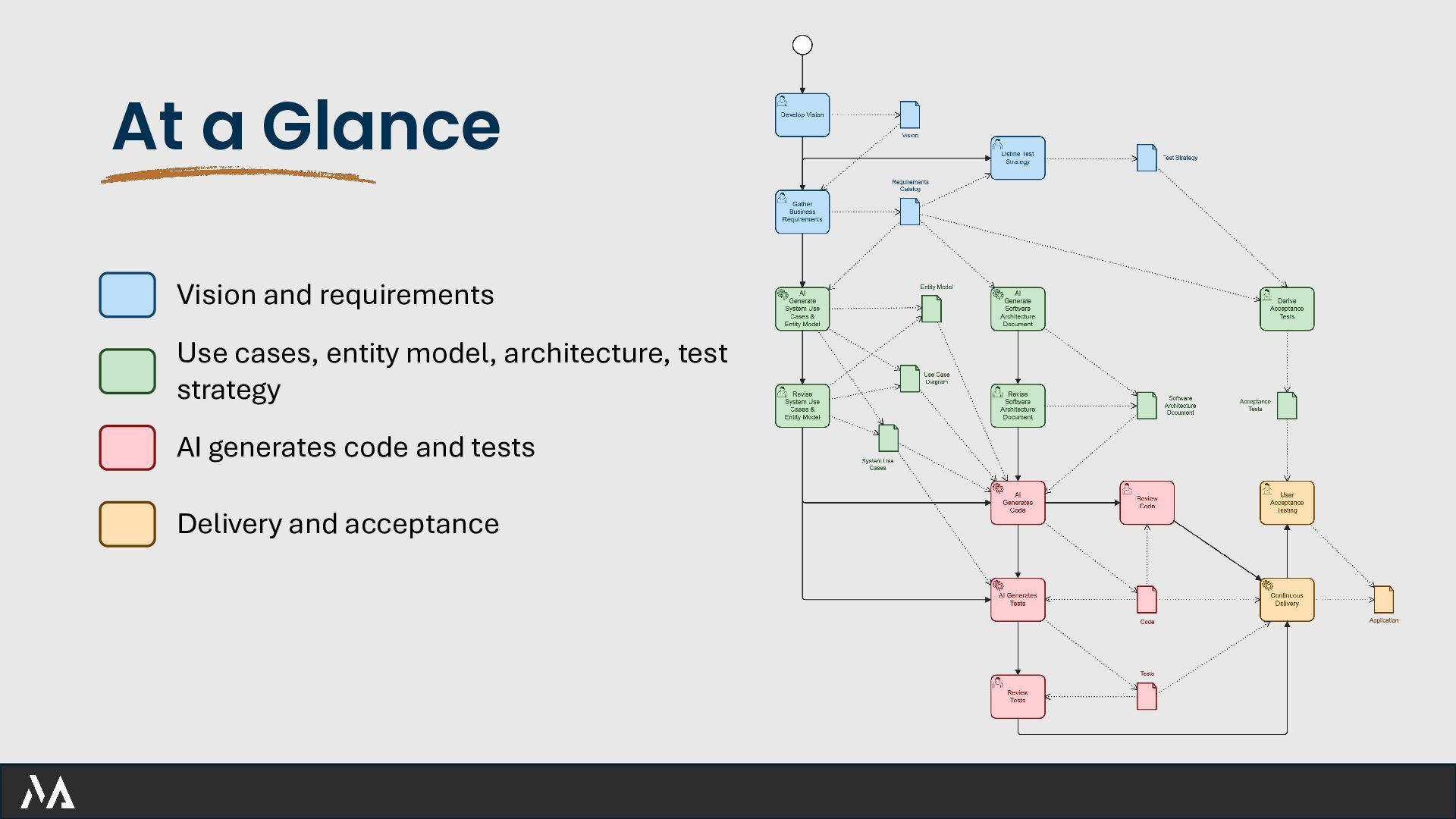
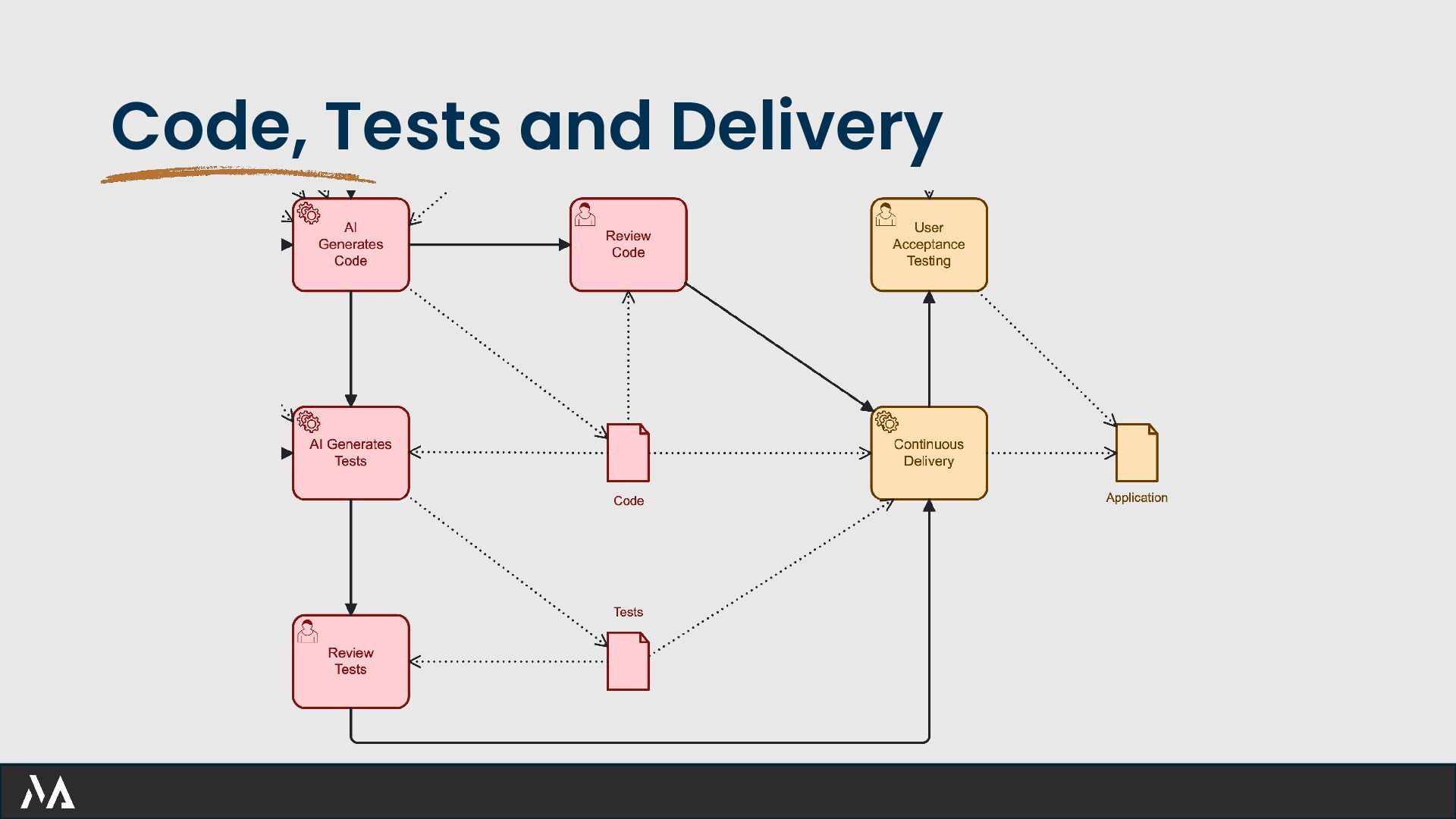
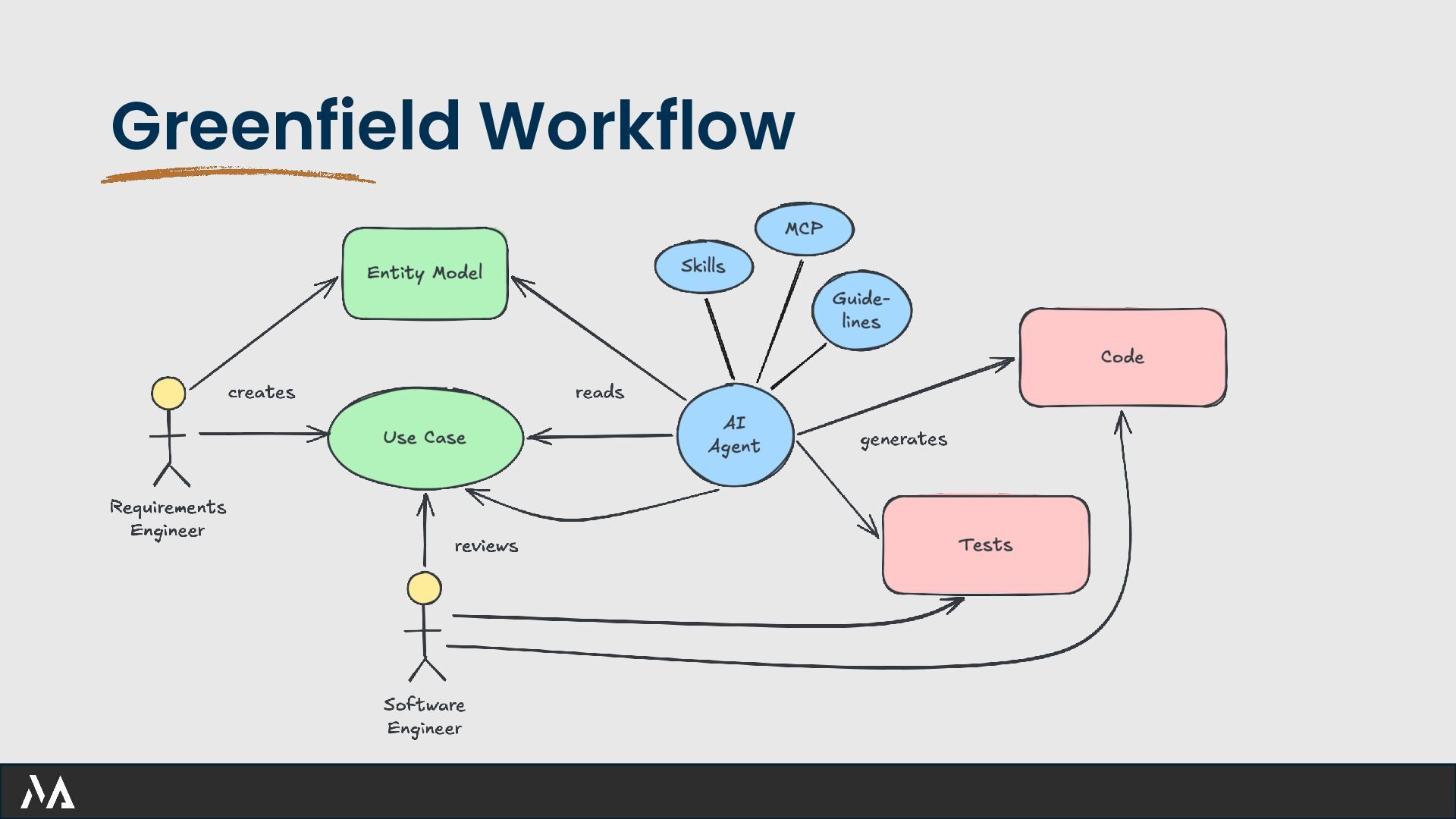
  9. At a Glance Vision and requirements Use cases, entity model,

    architecture, test strategy AI generates code and tests Delivery and acceptance
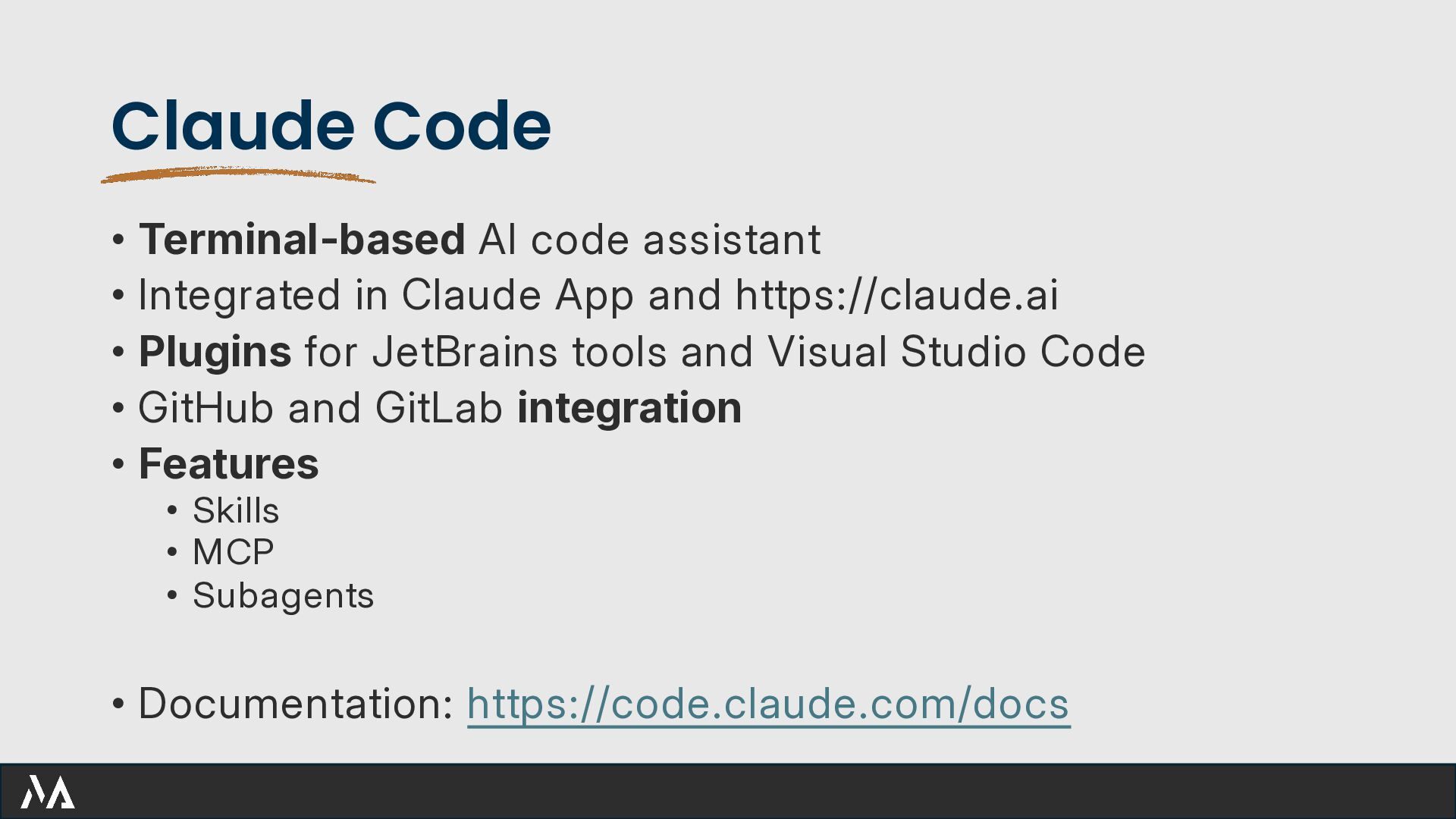
  10. Claude Code • Terminal-based AI code assistant • Integrated in

    Claude App and https://claude.ai • Plugins for JetBrains tools and Visual Studio Code • GitHub and GitLab integration • Features • Skills • MCP • Subagents • Documentation: https://code.claude.com/docs
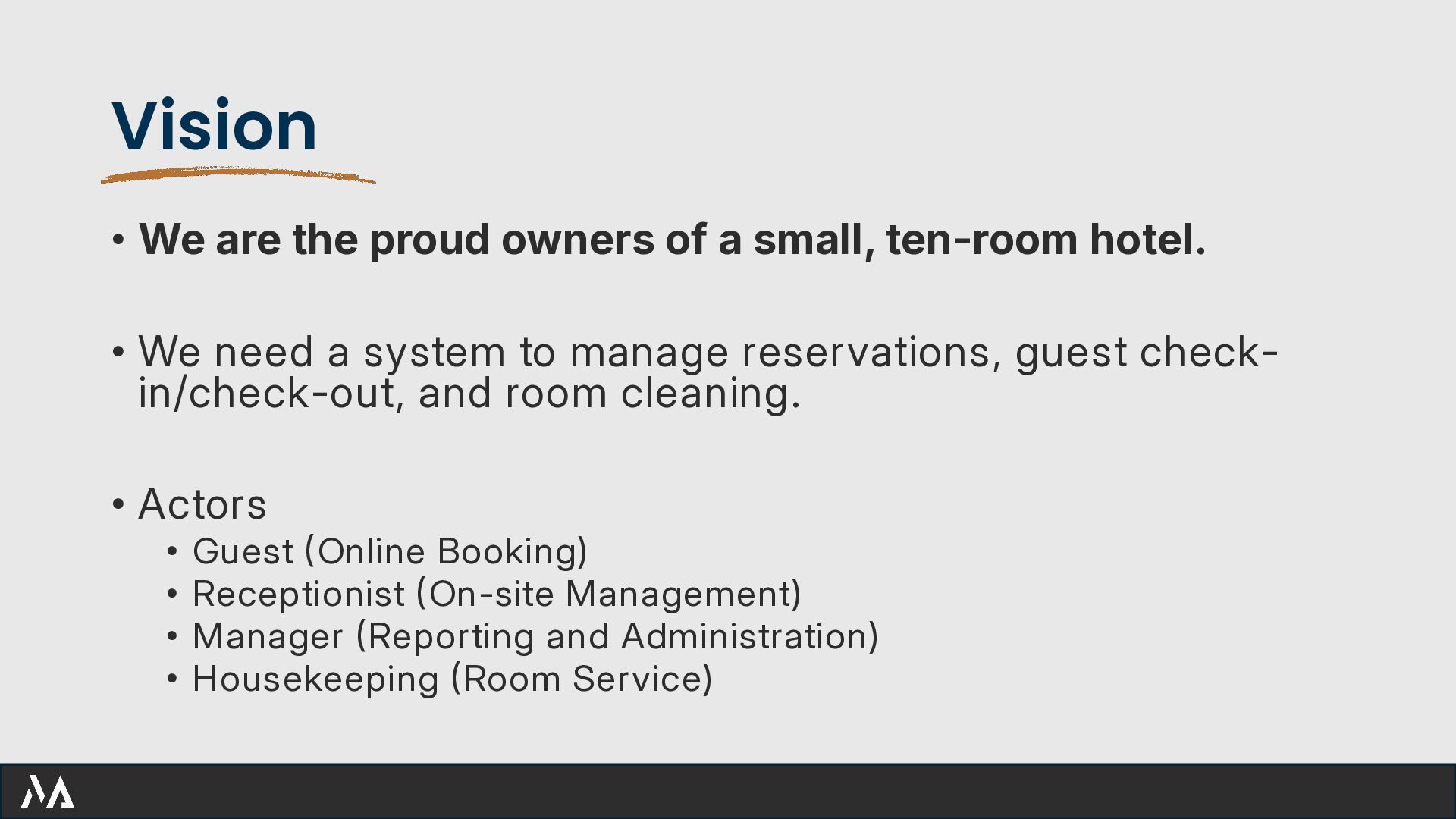
  11. Vision • We are the proud owners of a small,

    ten-room hotel. • We need a system to manage reservations, guest checkin/check-out, and room cleaning. • Actors • Guest Online Booking) • Receptionist On-site Management) • Manager Reporting and Administration) • Housekeeping Room Service)
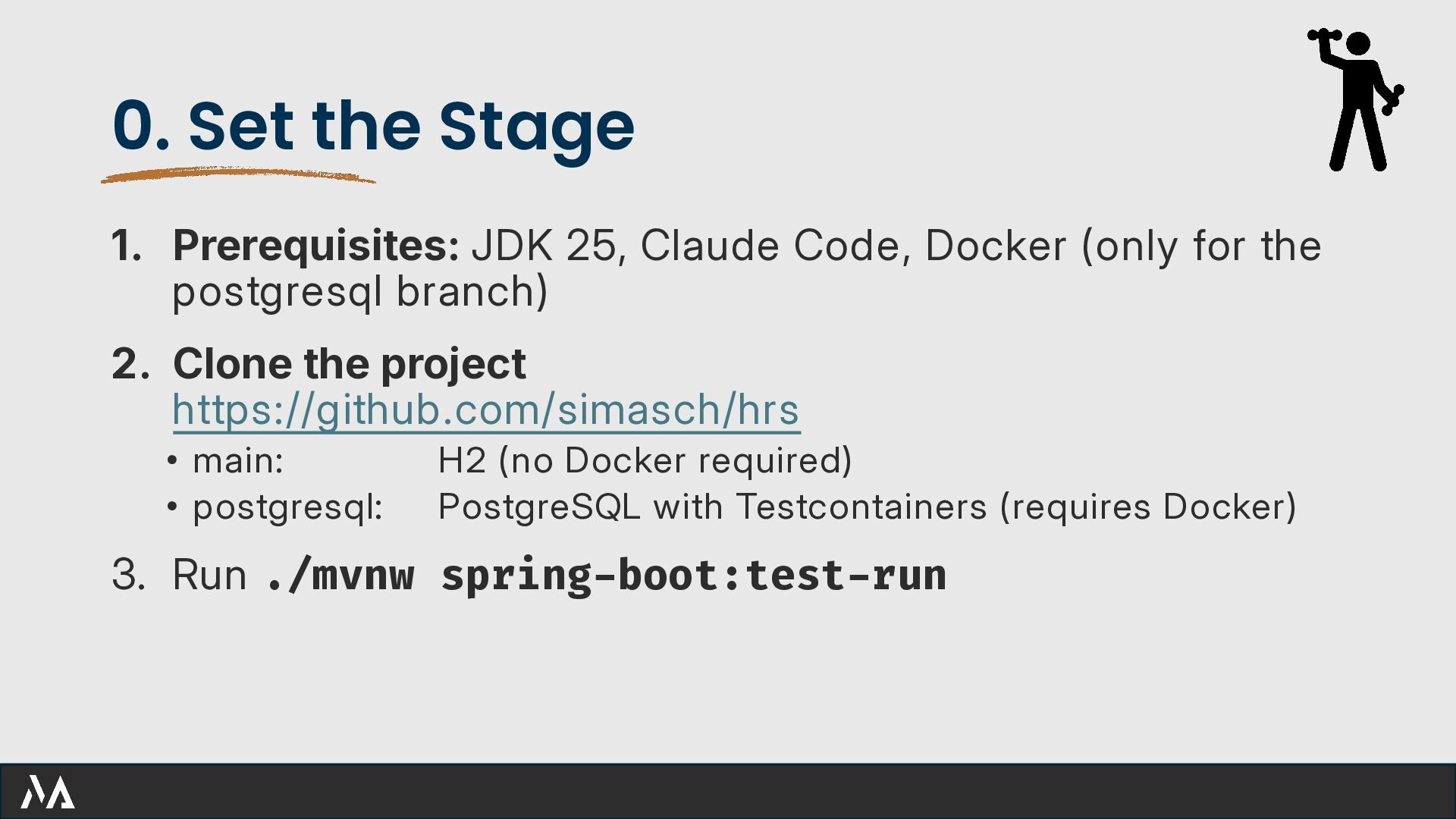
  12. 0. Set the Stage 1. Prerequisites: JDK 25, Claude Code,

    Docker (only for the postgresql branch) 2. Clone the project https://github.com/simasch/hrs • main: • postgresql: H2 (no Docker required) PostgreSQL with Testcontainers (requires Docker) 3. Run ./mvnw spring-boot:test-run
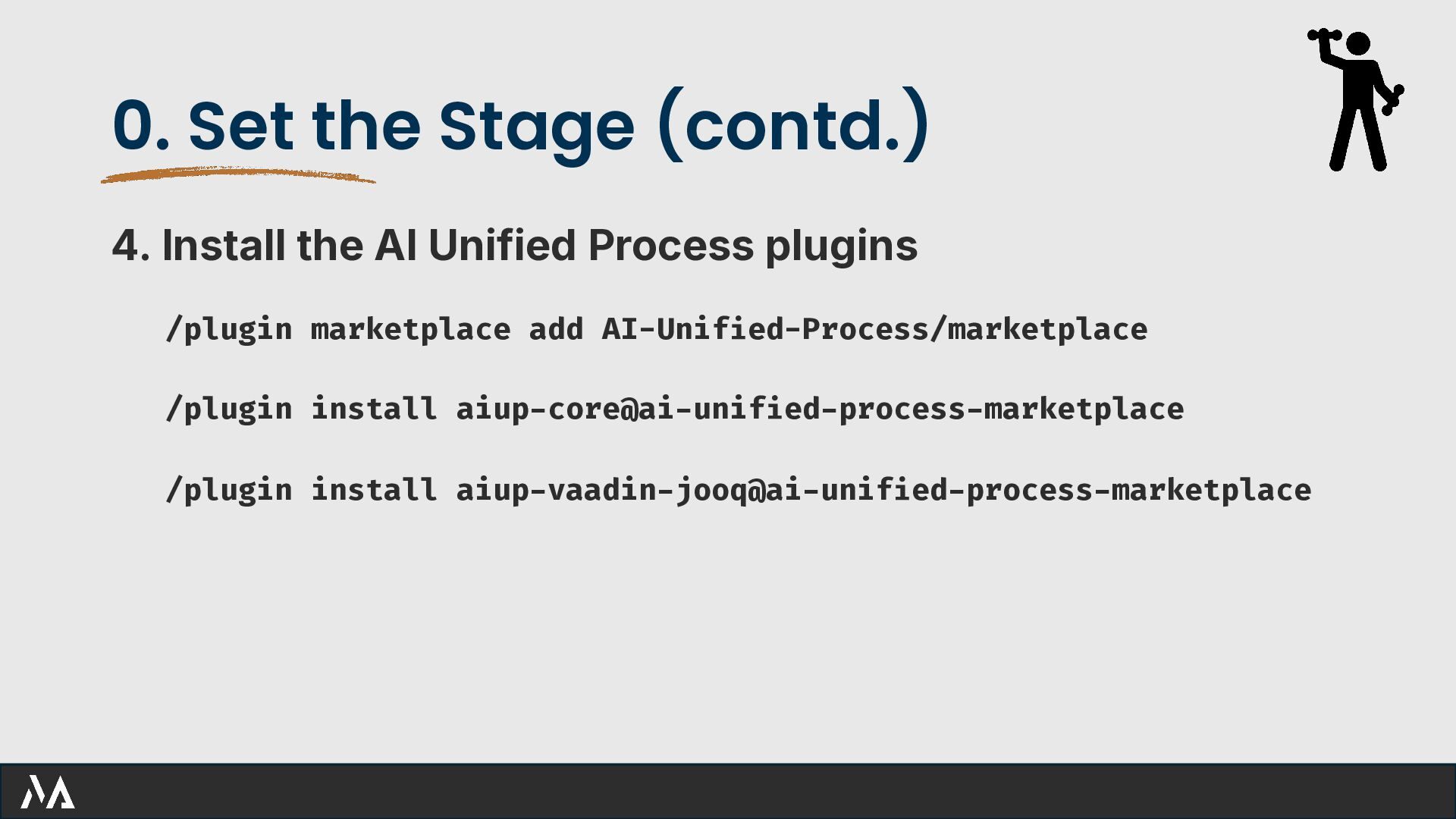
  13. 0. Set the Stage (contd.) 4. Install the AI Unified

    Process plugins /plugin marketplace add AI-Unified-Process/marketplace /plugin install aiup-core@ai-unified-process-marketplace /plugin install aiup-vaadin-jooq@ai-unified-process-marketplace
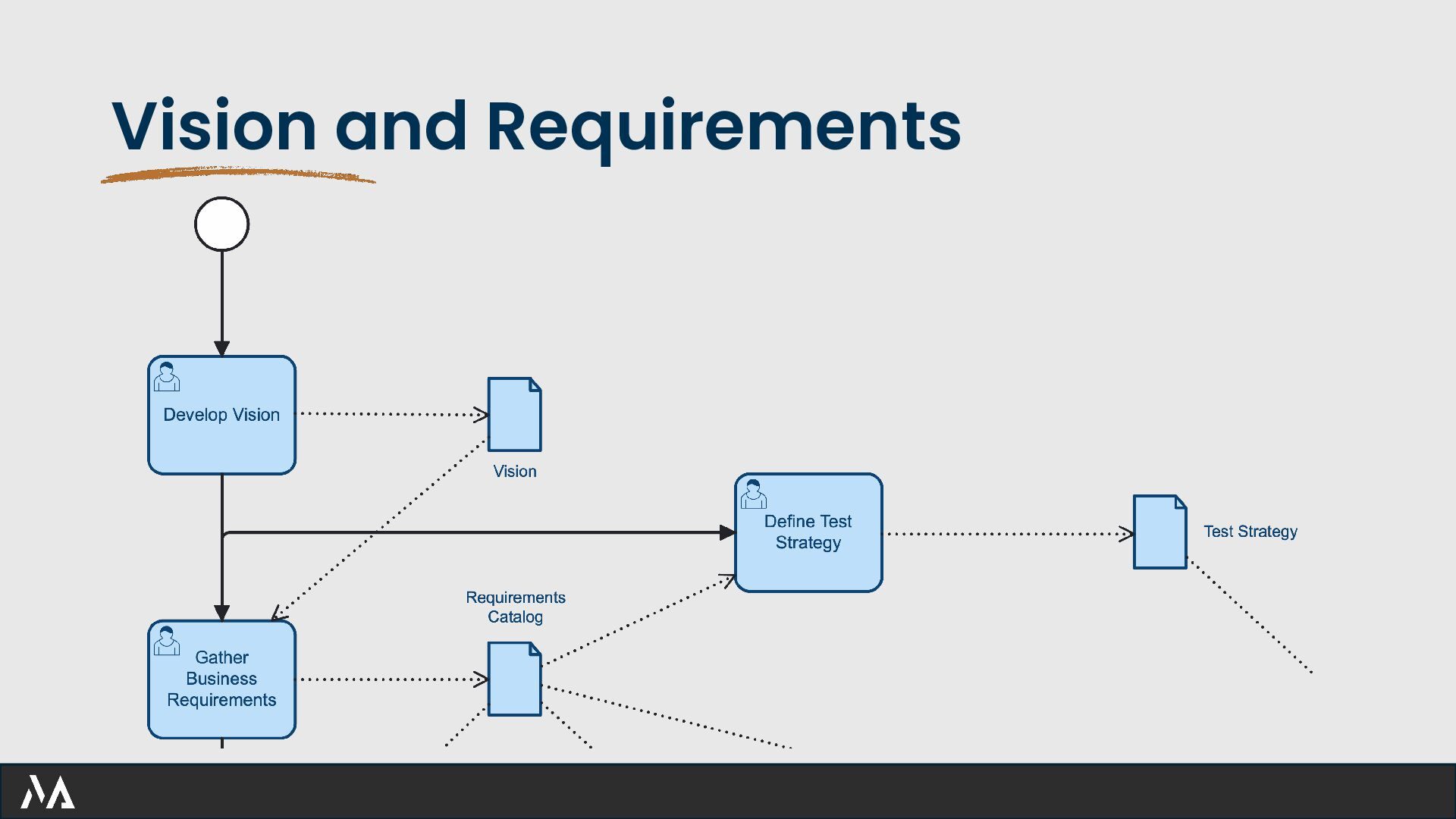
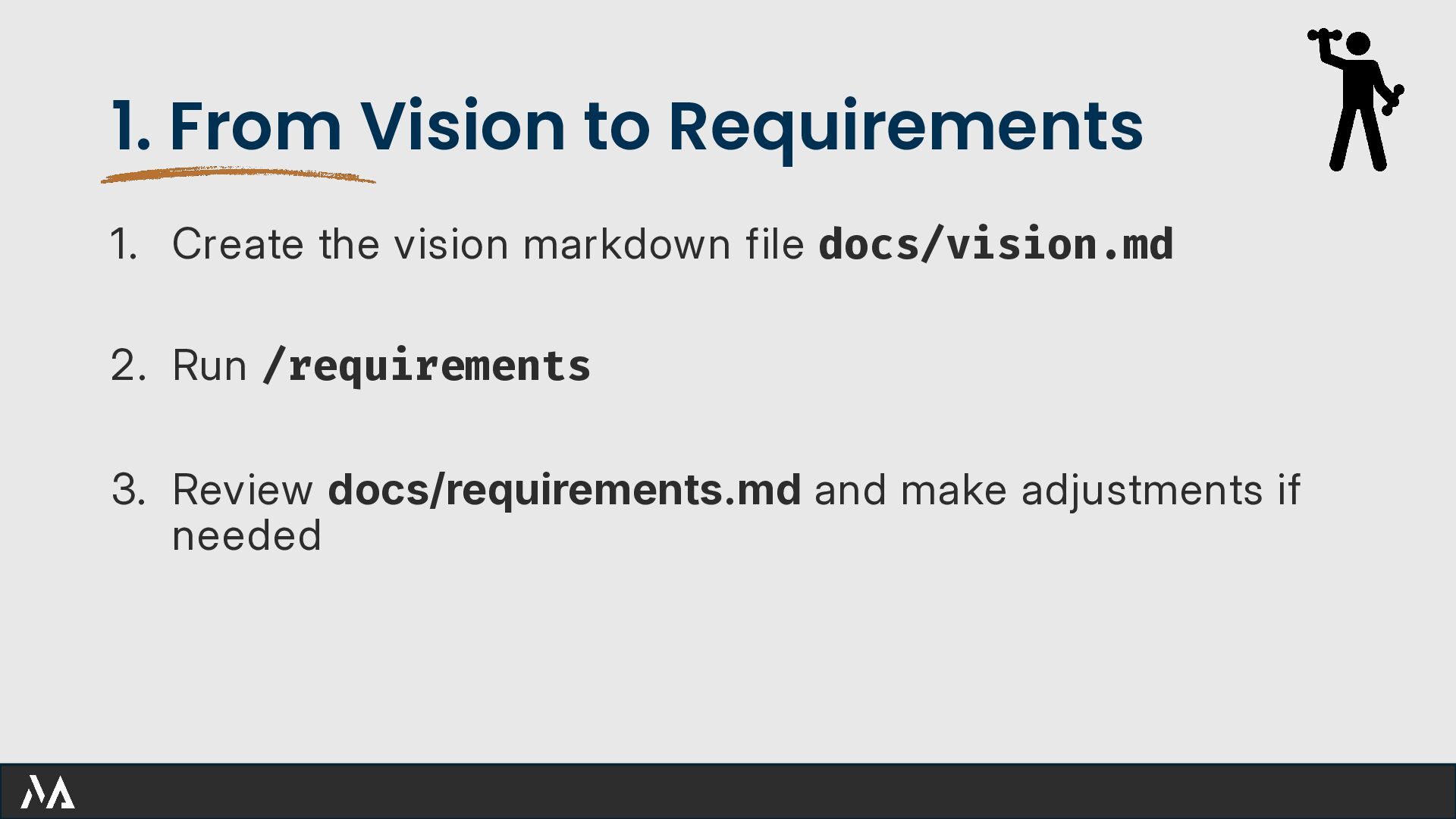
  14. 1. From Vision to Requirements 1. Create the vision markdown

    file docs/vision.md 2. Run /requirements 3. Review docs/requirements.md and make adjustments if needed
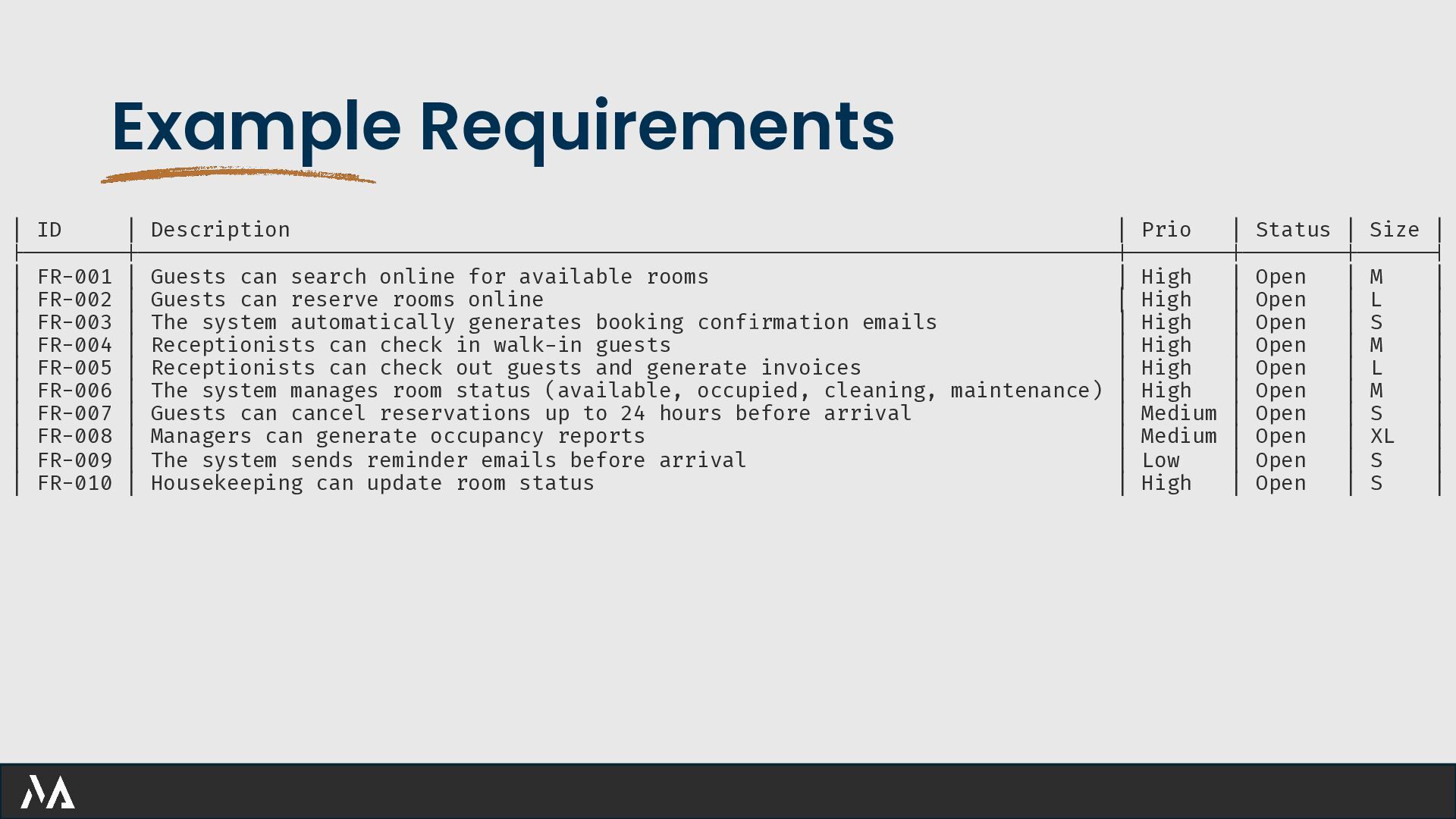
  15. Example Requirements | ID | Description | Prio | Status

    | Size | |---------|------------------------------------------------------------------------------|---------|---------|-------|| FR-001 | Guests can search online for available rooms | High | Open | M | | FR-002 | Guests can reserve rooms online | High | Open | L | | FR-003 | The system automatically generates booking confirmation emails | High | Open | S | | FR-004 | Receptionists can check in walk-in guests | High | Open | M | | FR-005 | Receptionists can check out guests and generate invoices | High | Open | L | | FR-006 | The system manages room status (available, occupied, cleaning, maintenance) | High | Open | M | | FR-007 | Guests can cancel reservations up to 24 hours before arrival | Medium | Open | S | | FR-008 | Managers can generate occupancy reports | Medium | Open | XL | | FR-009 | The system sends reminder emails before arrival | Low | Open | S | | FR-010 | Housekeeping can update room status | High | Open | S |
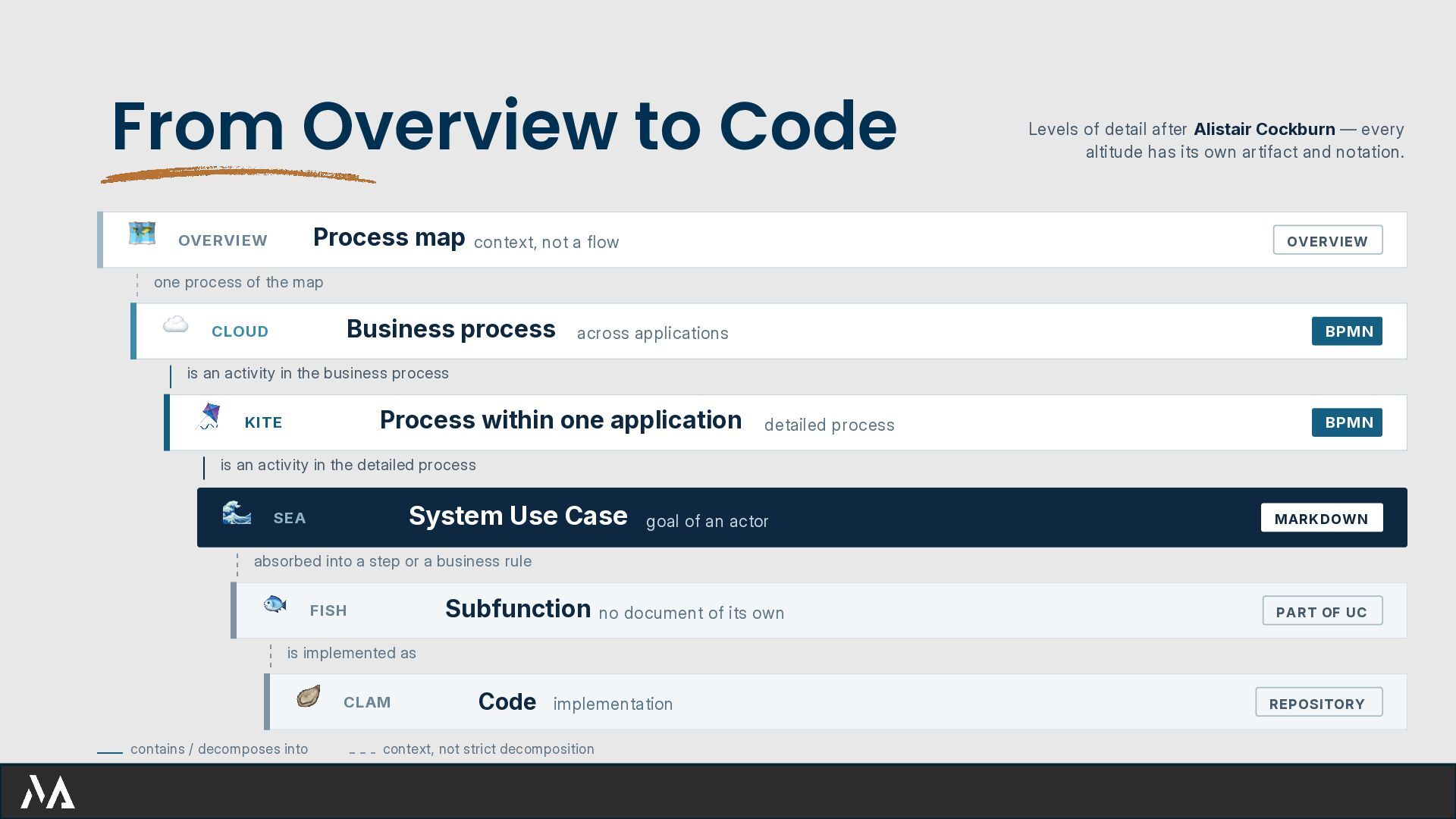
  16. From Overview to Code 🗺 Process map context, not a

    flow OVERVIEW Levels of detail after Alistair Cockburn — every altitude has its own artifact and notation. OVERVIEW one process of the map ☁ Business process CLOUD BPMN across applications is an activity in the business process 🪁 Process within one application KITE detailed process BPMN is an activity in the detailed process 🌊 System Use Case SEA goal of an actor MARKDOWN absorbed into a step or a business rule 🐟 Subfunction no document of its own FISH PART OF UC is implemented as 🦪 contains / decomposes into CLAM Code implementation context, not strict decomposition REPOSITORY
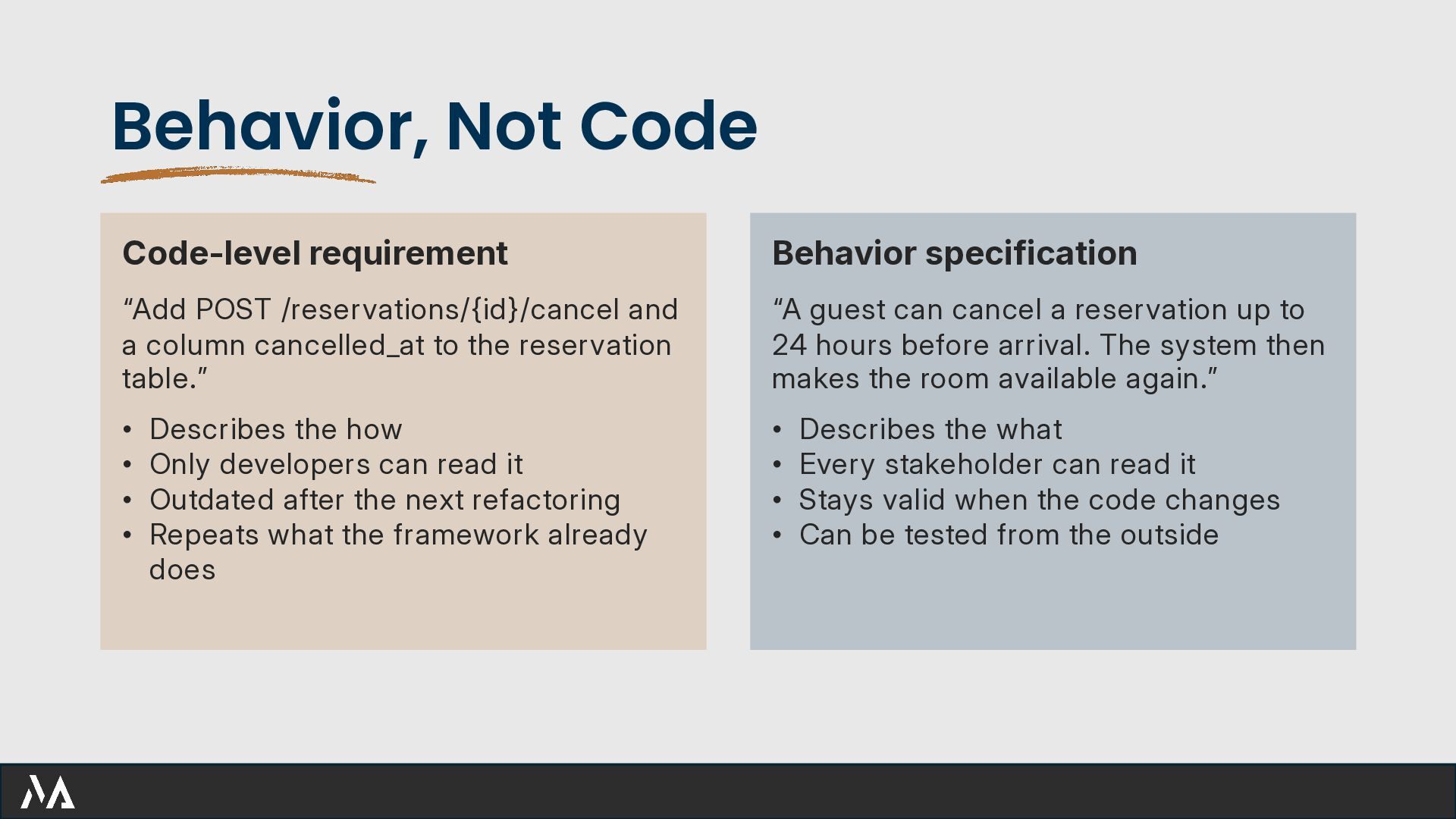
  17. Behavior, Not Code Code-level requirement Behavior specification “Add POST /reservations/{id}/cancel

    and a column cancelled_at to the reservation table.” “A guest can cancel a reservation up to 24 hours before arrival. The system then makes the room available again.” • Describes the how • Only developers can read it • Outdated after the next refactoring • Repeats what the framework already does • Describes the what • Every stakeholder can read it • Stays valid when the code changes • Can be tested from the outside
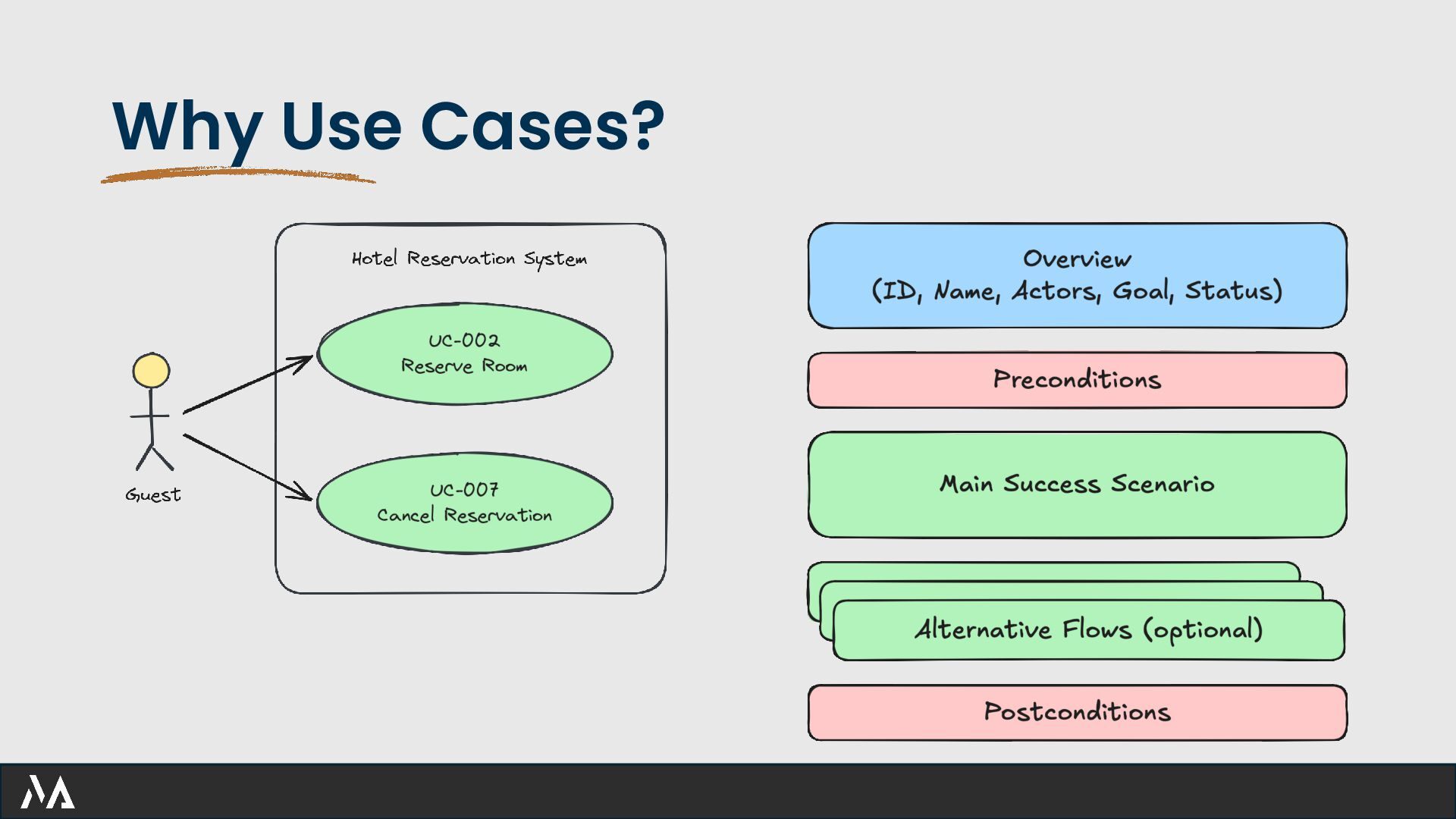
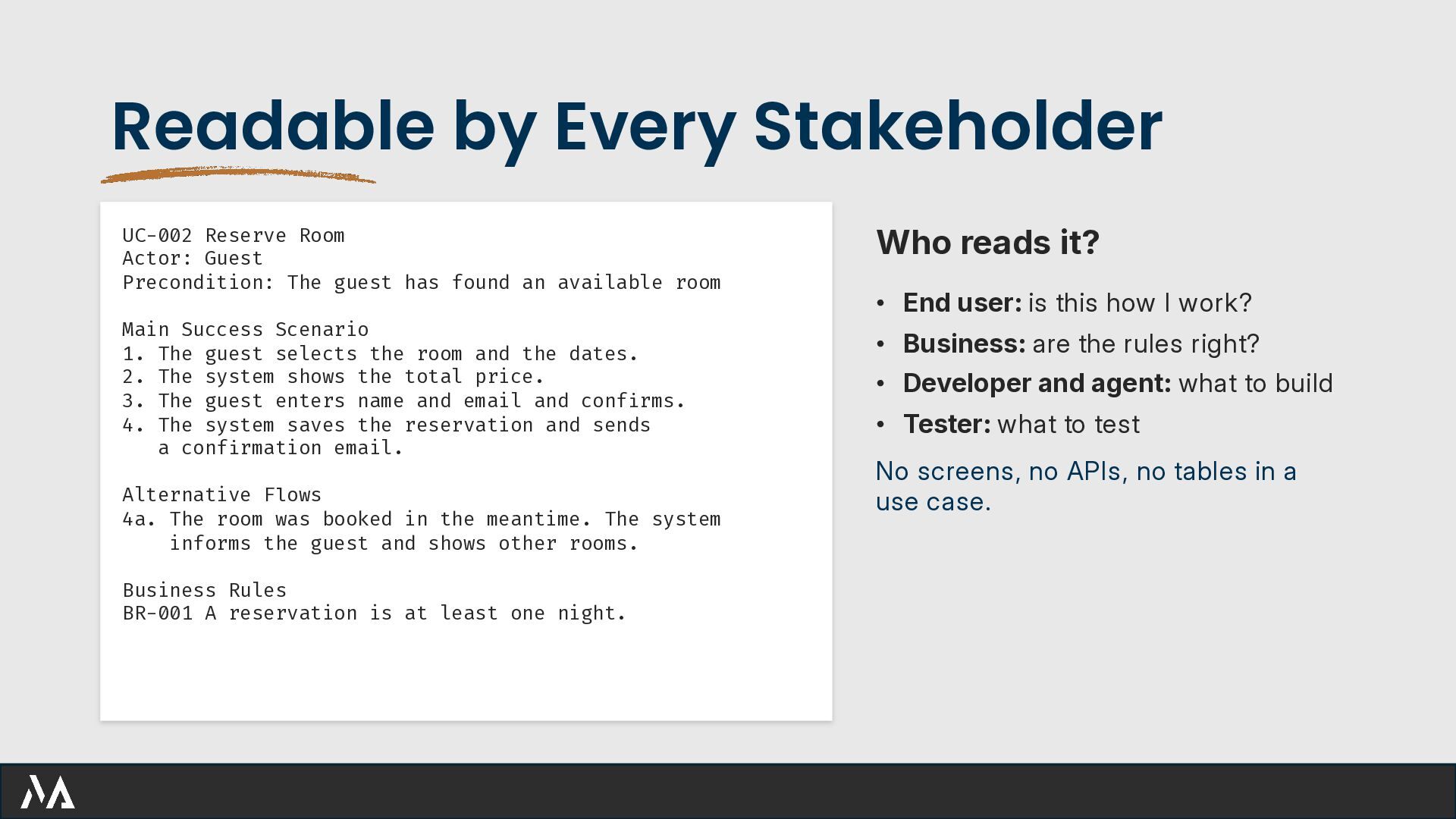
  18. Readable by Every Stakeholder UC-002 Reserve Room Actor: Guest Precondition:

    The guest has found an available room Main Success Scenario 1. The guest selects the room and the dates. 2. The system shows the total price. 3. The guest enters name and email and confirms. 4. The system saves the reservation and sends a confirmation email. Alternative Flows 4a. The room was booked in the meantime. The system informs the guest and shows other rooms. Business Rules BR-001 A reservation is at least one night. Who reads it? • End user: is this how I work? • Business: are the rules right? • Developer and agent: what to build • Tester: what to test No screens, no APIs, no tables in a use case.
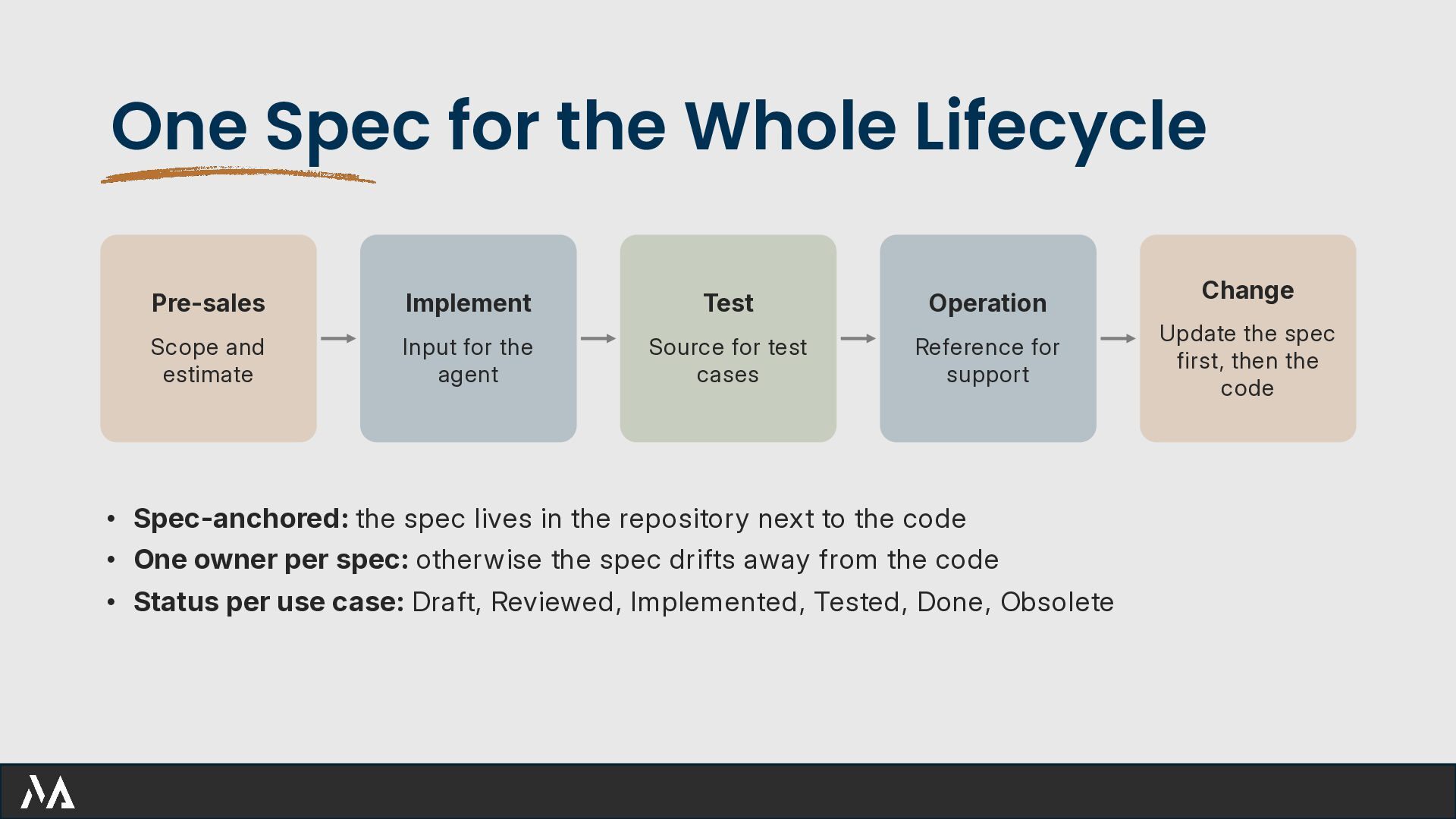
  19. One Spec for the Whole Lifecycle Pre-sales Implement Test Operation

    Scope and estimate Input for the agent Source for test cases Reference for support • Spec-anchored: the spec lives in the repository next to the code • One owner per spec: otherwise the spec drifts away from the code • Status per use case: Draft, Reviewed, Implemented, Tested, Done, Obsolete Change Update the spec first, then the code
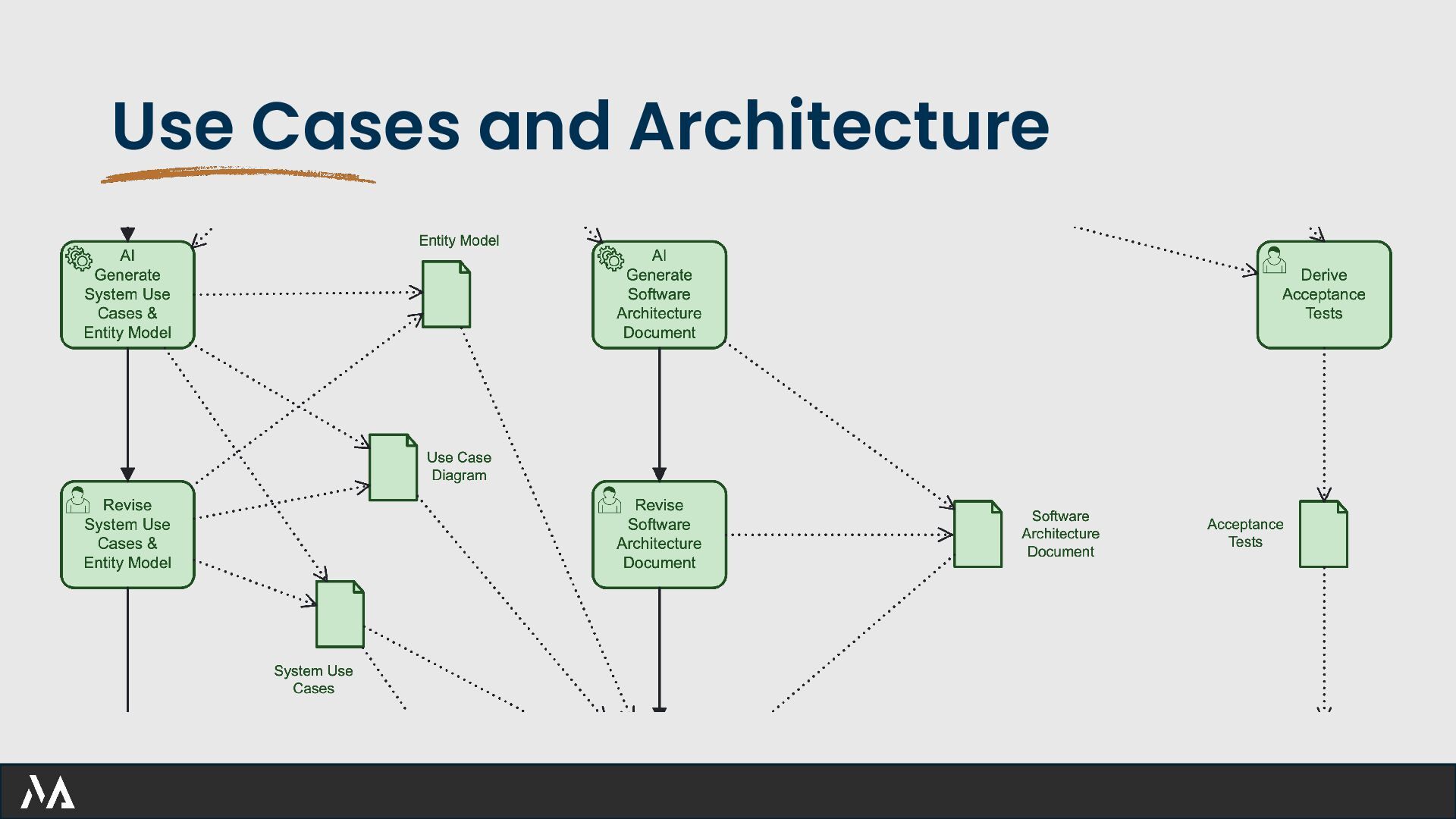
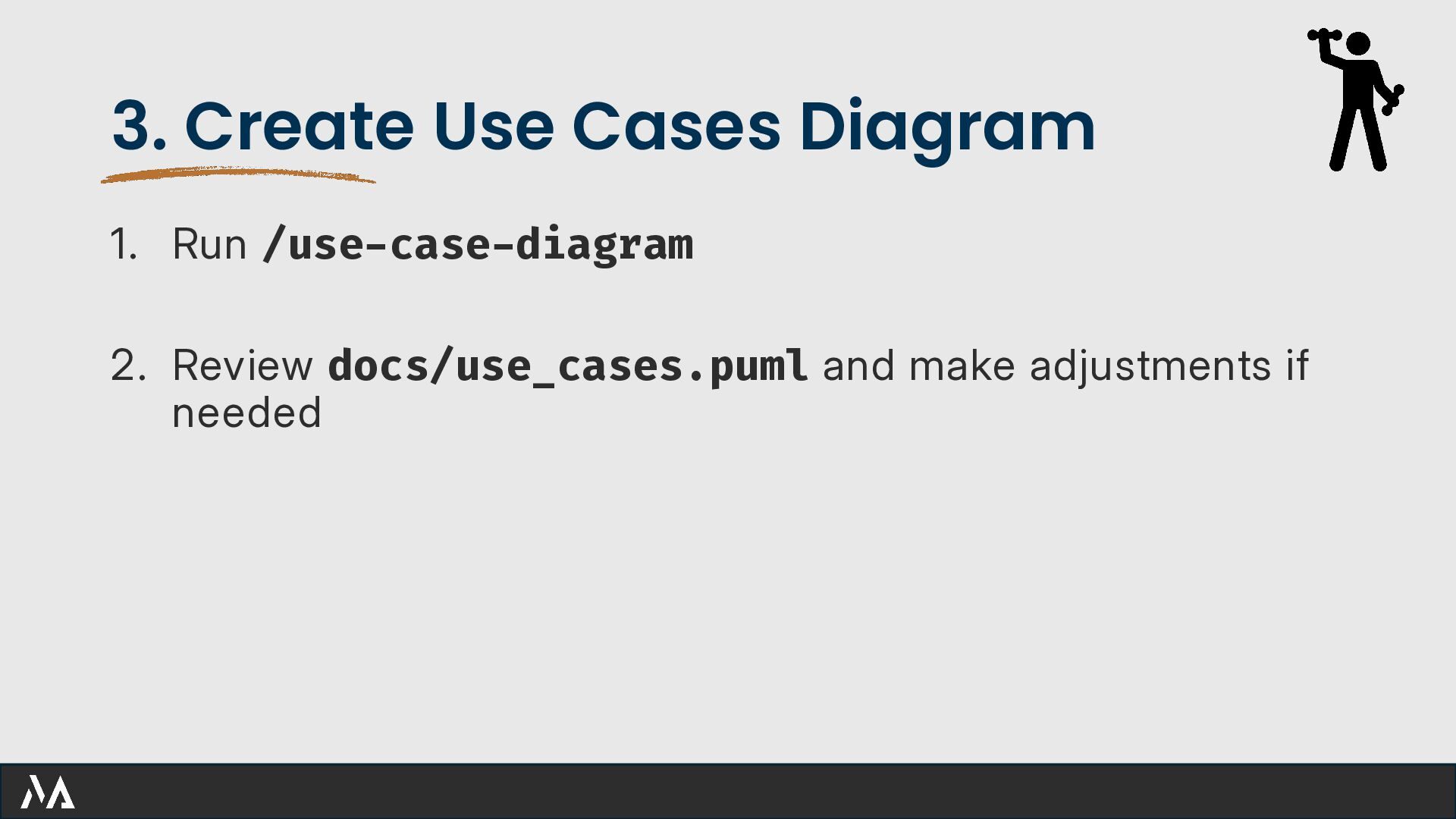
  20. 3. Create Use Cases Diagram 1. Run /use-case-diagram 2. Review

    docs/use_cases.puml and make adjustments if needed
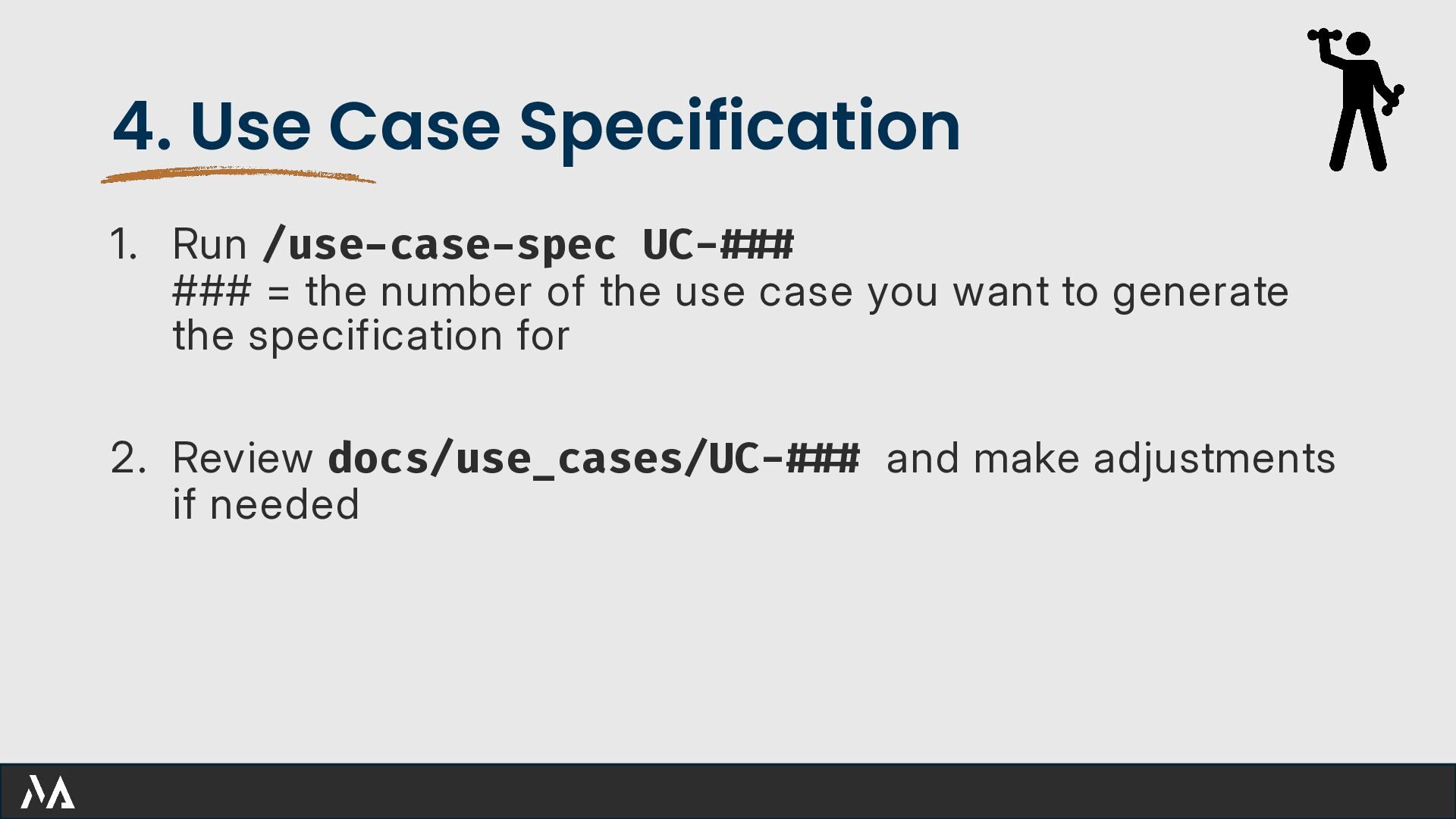
  21. 4. Use Case Specification 1. Run /use-case-spec UC-### ### =

    the number of the use case you want to generate the specification for 2. Review docs/use_cases/UC-### and make adjustments if needed
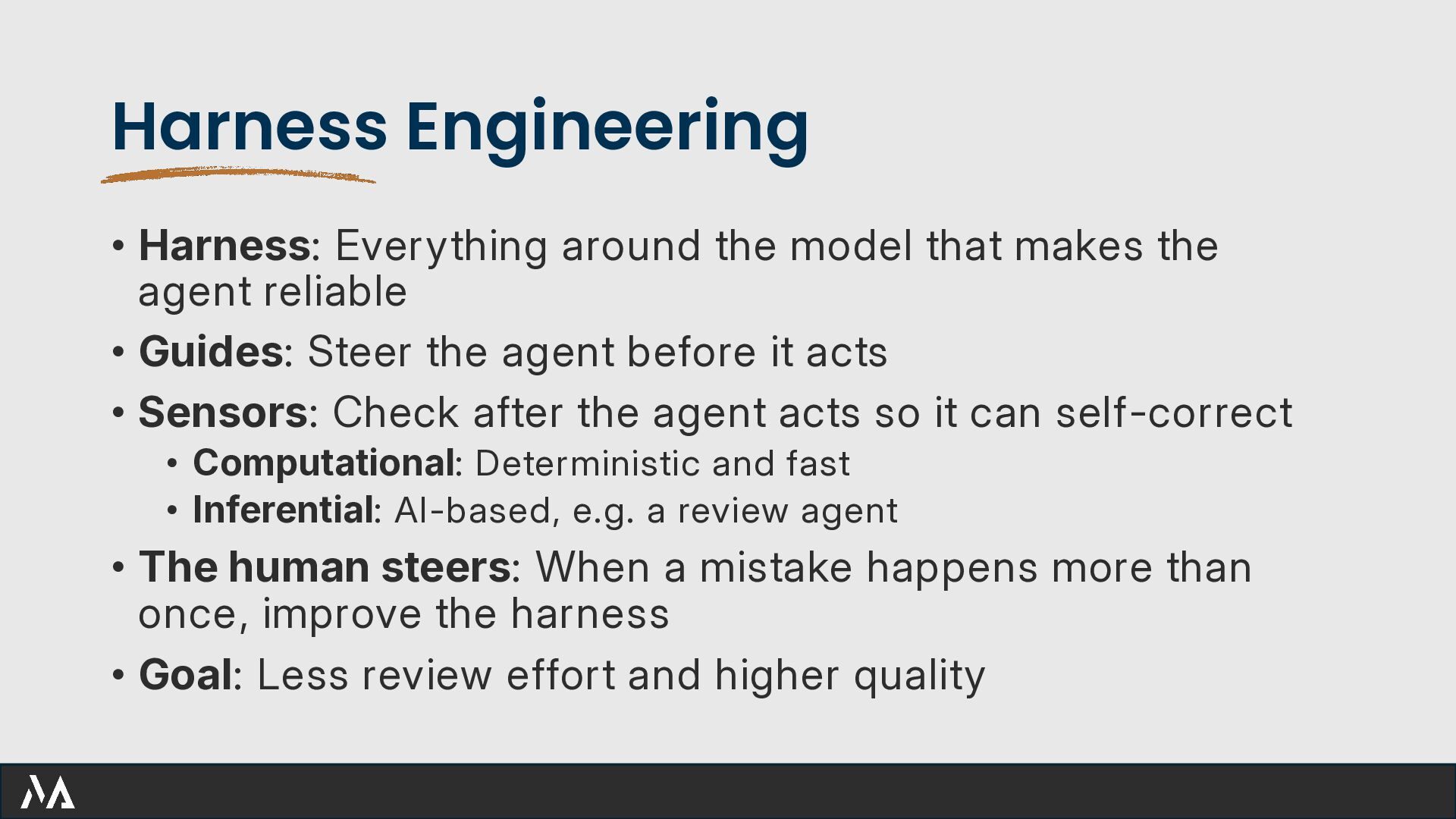
  22. Harness Engineering • Harness: Everything around the model that makes

    the agent reliable • Guides: Steer the agent before it acts • Sensors: Check after the agent acts so it can self-correct • Computational: Deterministic and fast • Inferential: AI-based, e.g. a review agent • The human steers: When a mistake happens more than once, improve the harness • Goal: Less review effort and higher quality
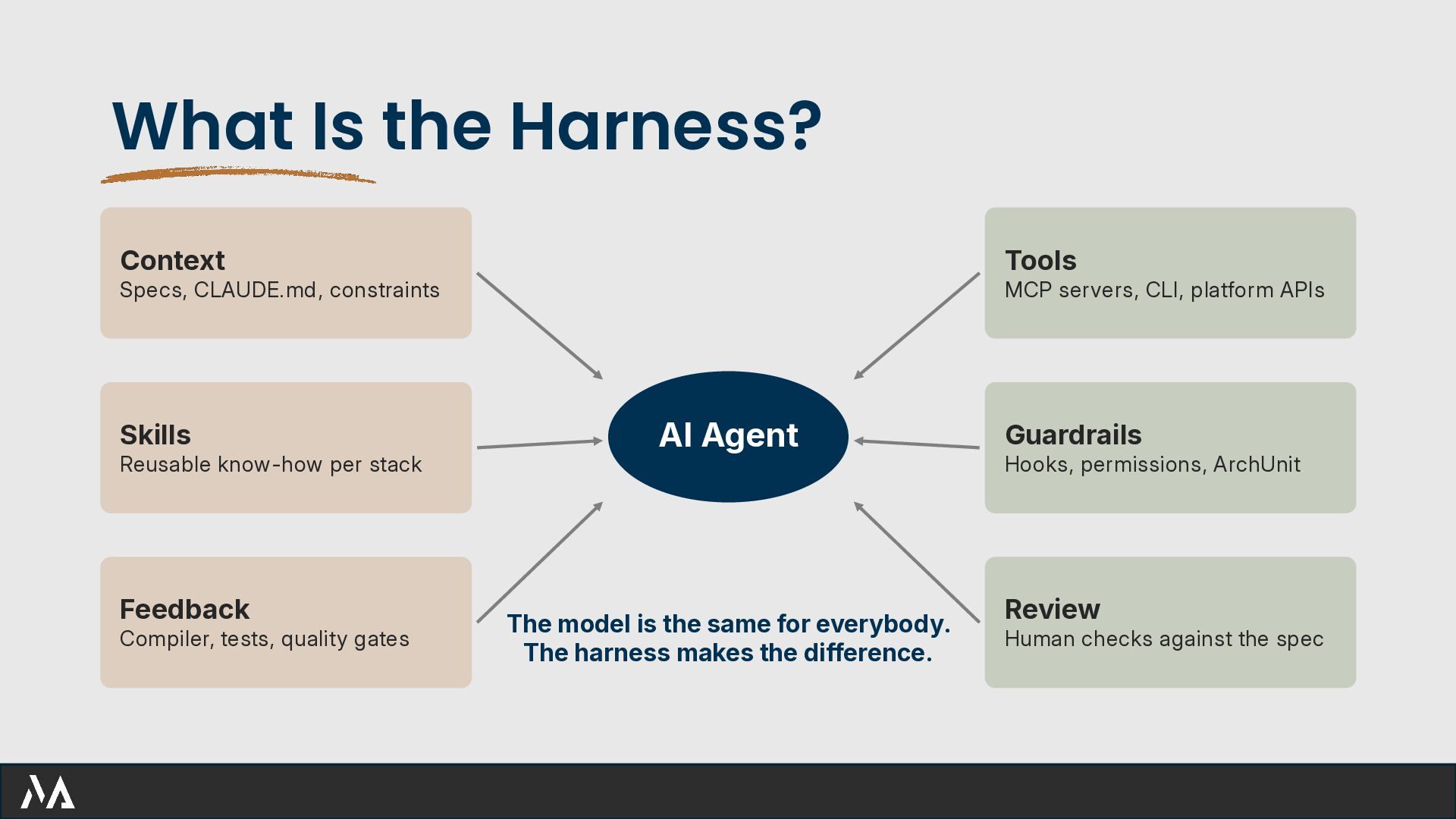
  23. What Is the Harness? Context Tools Specs, CLAUDE.md, constraints MCP

    servers, CLI, platform APIs Skills Reusable know-how per stack Feedback Compiler, tests, quality gates AI Agent The model is the same for everybody. The harness makes the difference. Guardrails Hooks, permissions, ArchUnit Review Human checks against the spec
  24. 5. Review the Specifications 1. Run /spec-review 2. Fix the

    findings in docs/ 3. Discuss: which findings surprised you?
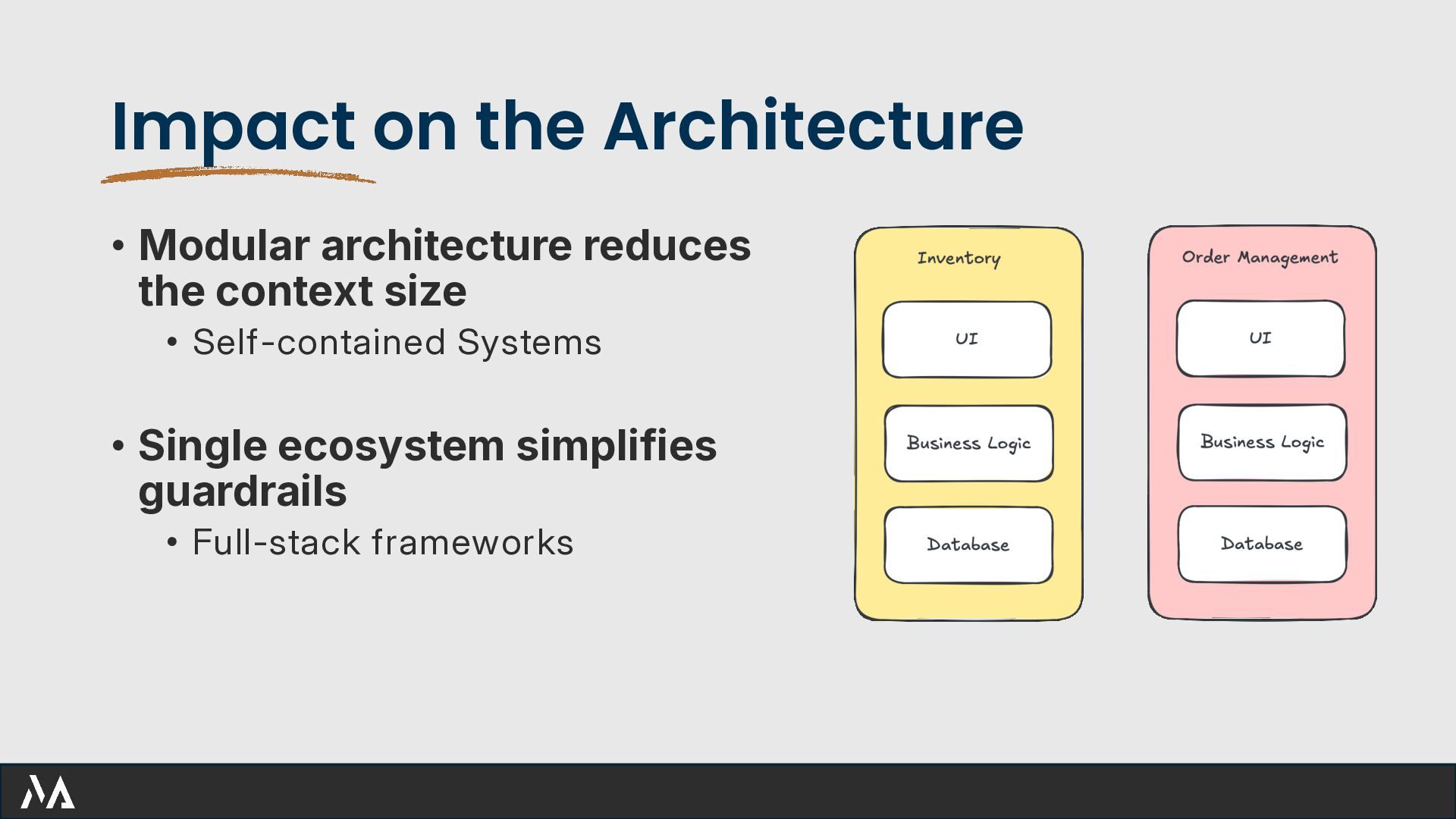
  25. Impact on the Architecture • Modular architecture reduces the context

    size • Self-contained Systems • Single ecosystem simplifies guardrails • Full-stack frameworks
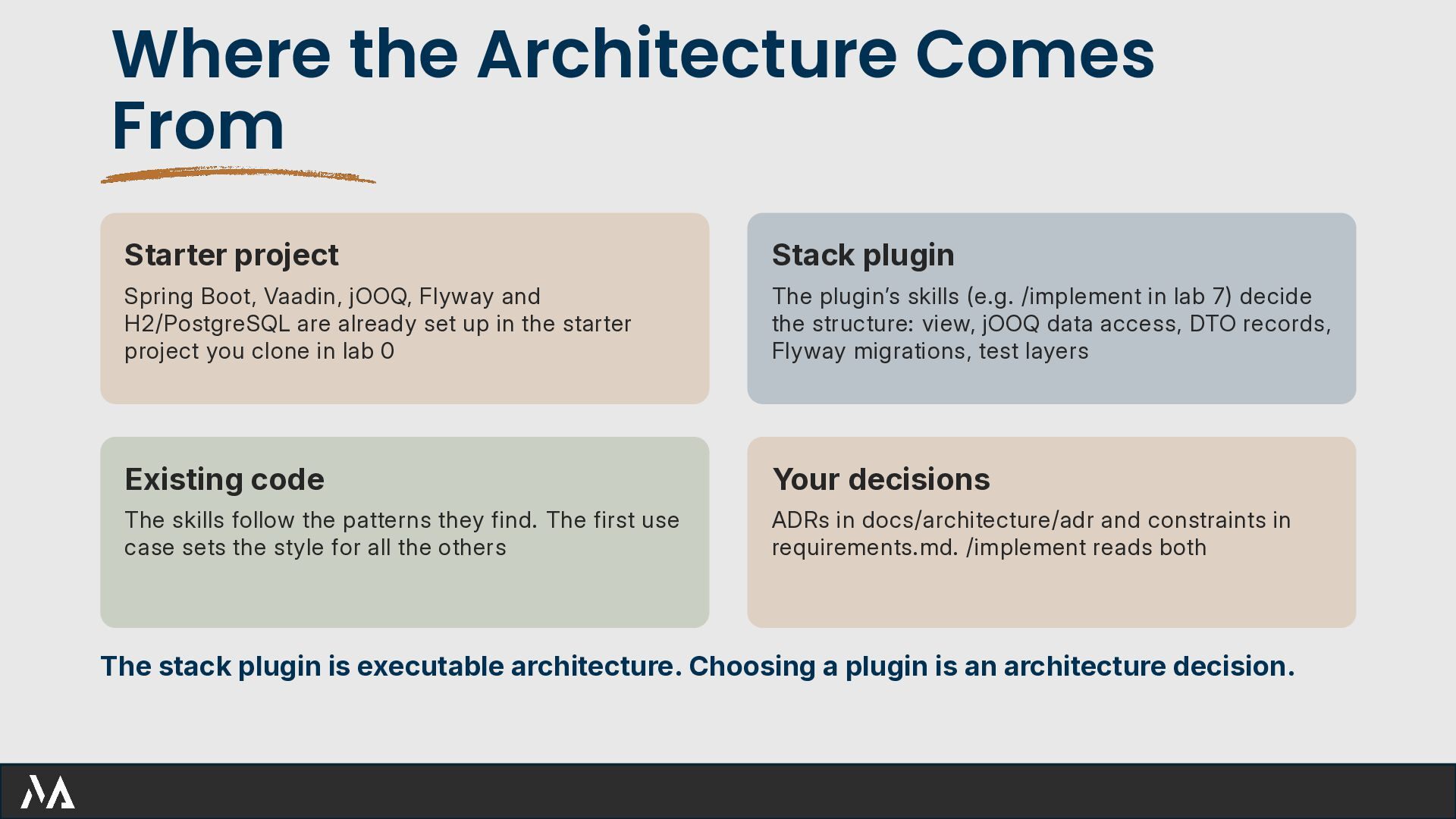
  26. Where the Architecture Comes From Starter project Stack plugin Spring

    Boot, Vaadin, jOOQ, Flyway and H2/PostgreSQL are already set up in the starter project you clone in lab 0 The plugin’s skills (e.g. /implement in lab 7) decide the structure: view, jOOQ data access, DTO records, Flyway migrations, test layers Existing code Your decisions The skills follow the patterns they find. The first use case sets the style for all the others ADRs in docs/architecture/adr and constraints in requirements.md. /implement reads both The stack plugin is executable architecture. Choosing a plugin is an architecture decision.
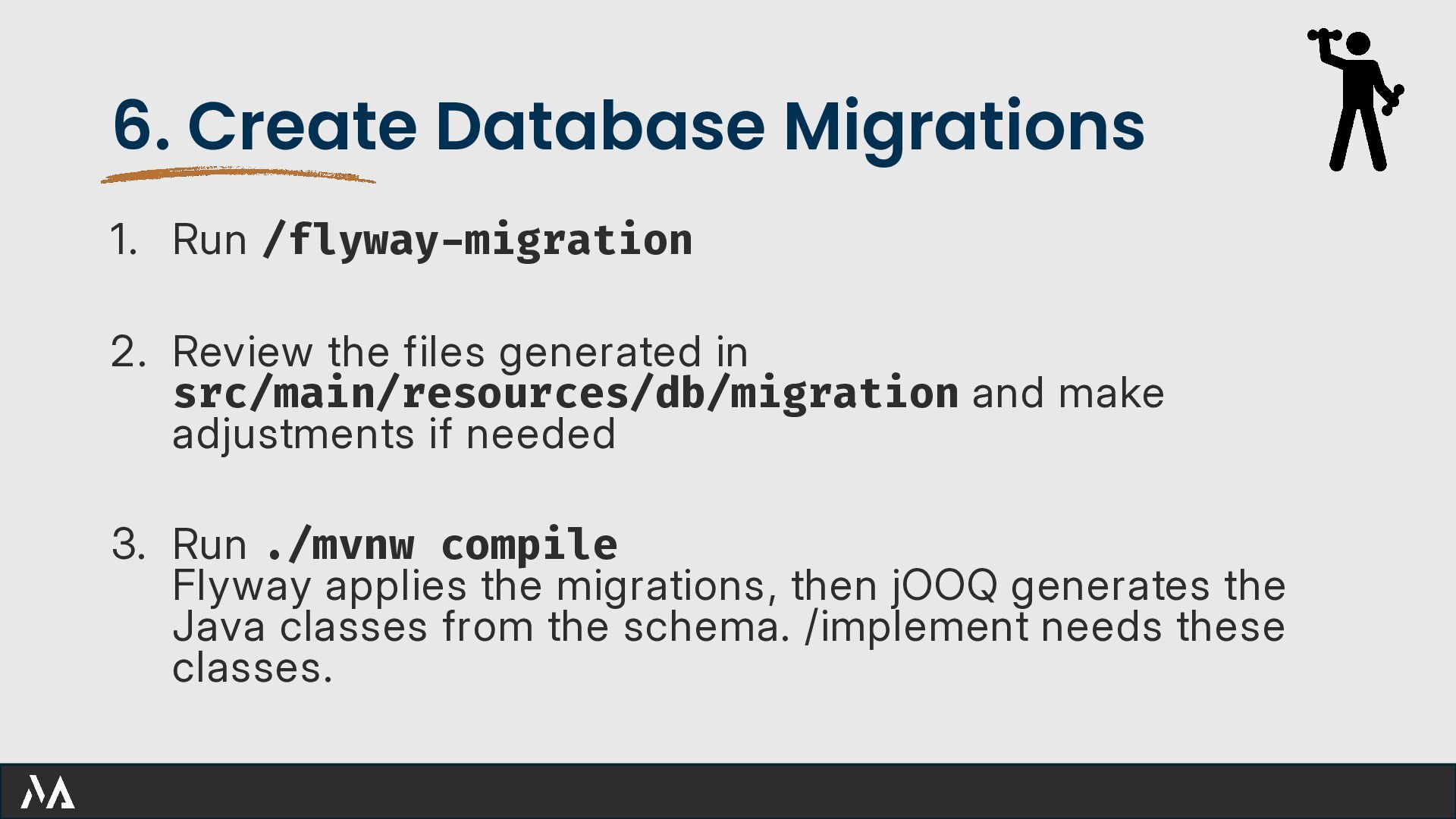
  27. 6. Create Database Migrations 1. Run /flyway-migration 2. Review the

    files generated in src/main/resources/db/migration and make adjustments if needed 3. Run ./mvnw compile Flyway applies the migrations, then jOOQ generates the Java classes from the schema. /implement needs these classes.
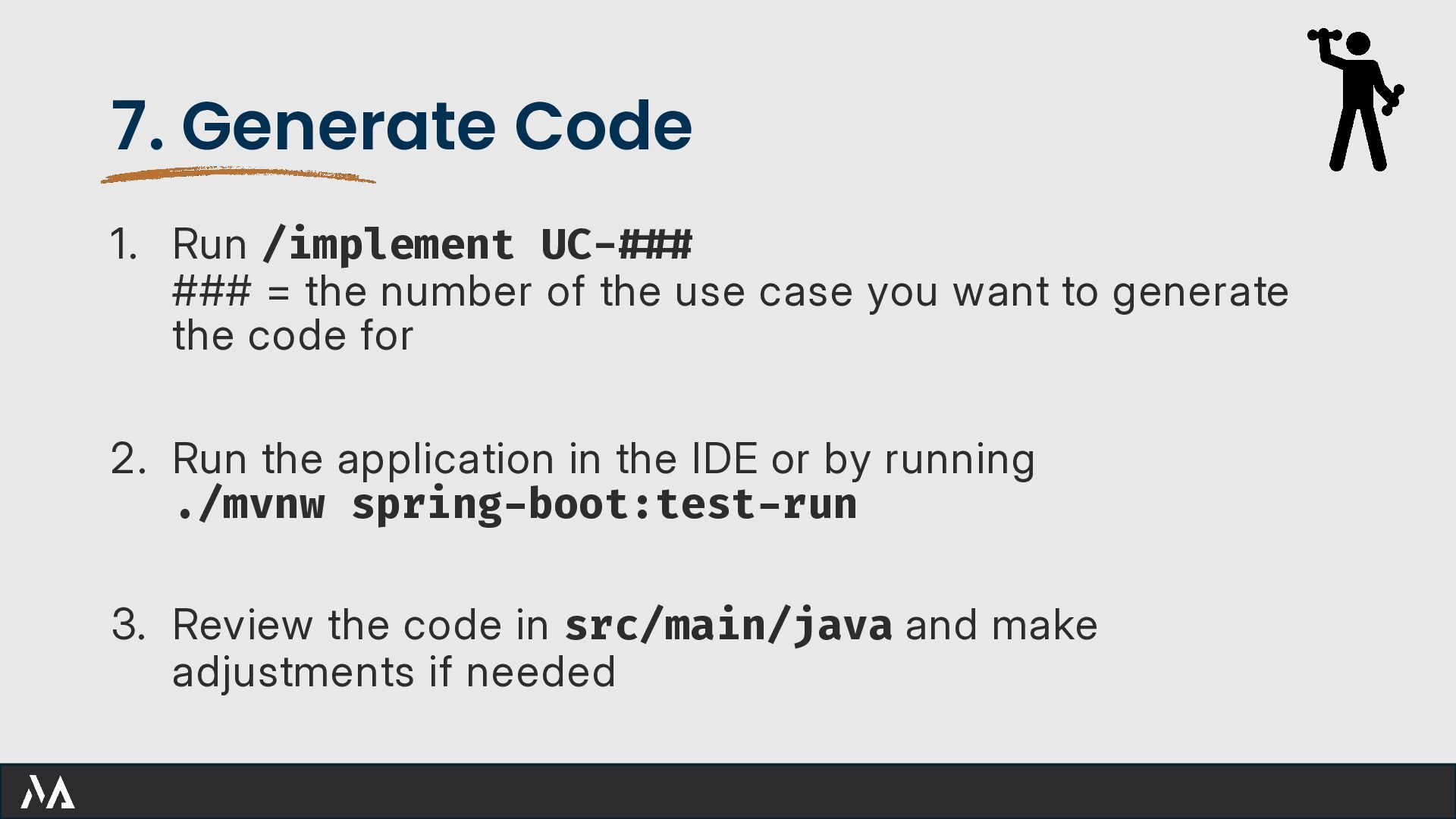
  28. 7. Generate Code 1. Run /implement UC-### ### = the

    number of the use case you want to generate the code for 2. Run the application in the IDE or by running ./mvnw spring-boot:test-run 3. Review the code in src/main/java and make adjustments if needed
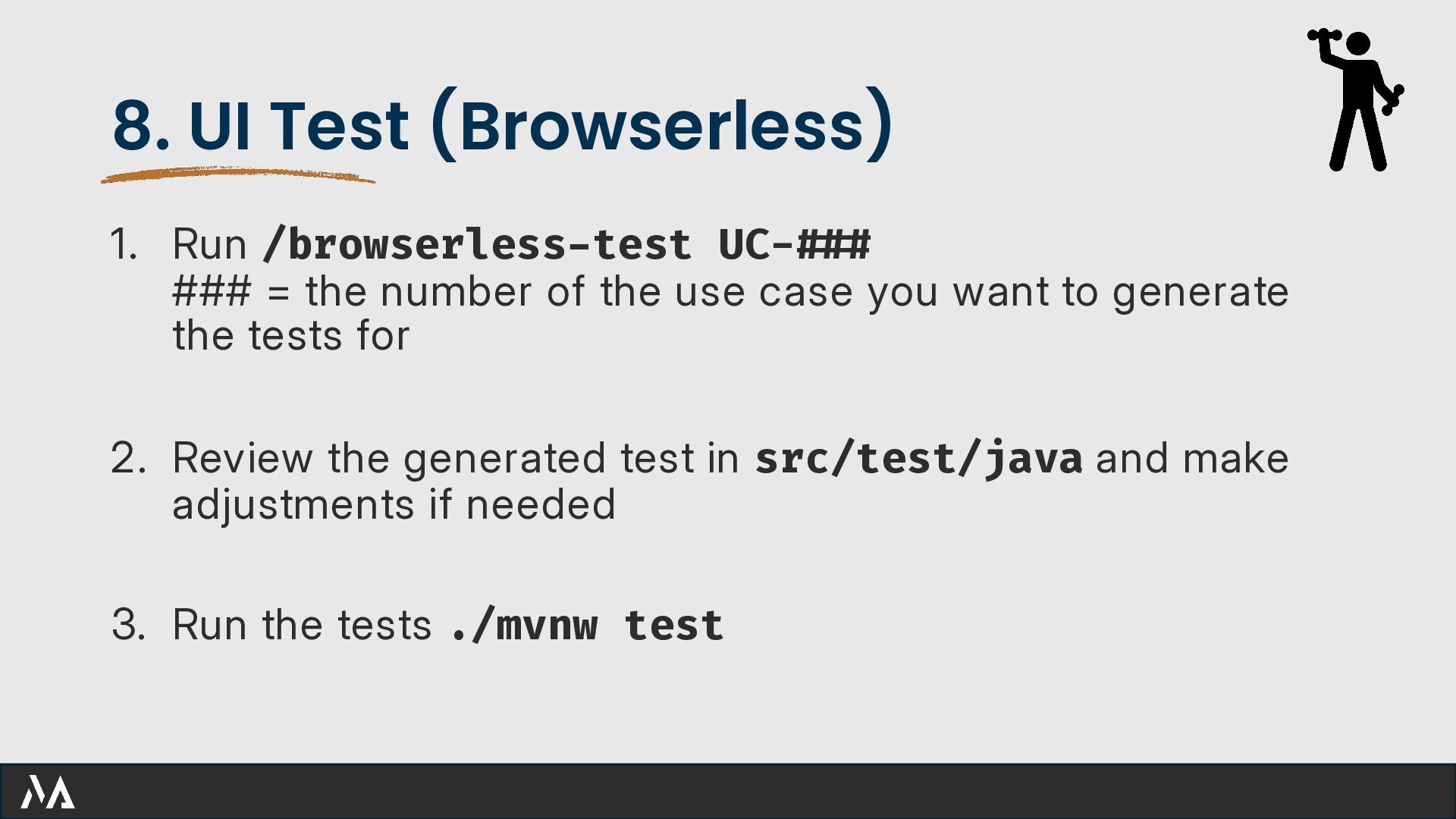
  29. 8. UI Test (Browserless) 1. Run /browserless-test UC-### ### =

    the number of the use case you want to generate the tests for 2. Review the generated test in src/test/java and make adjustments if needed 3. Run the tests ./mvnw test
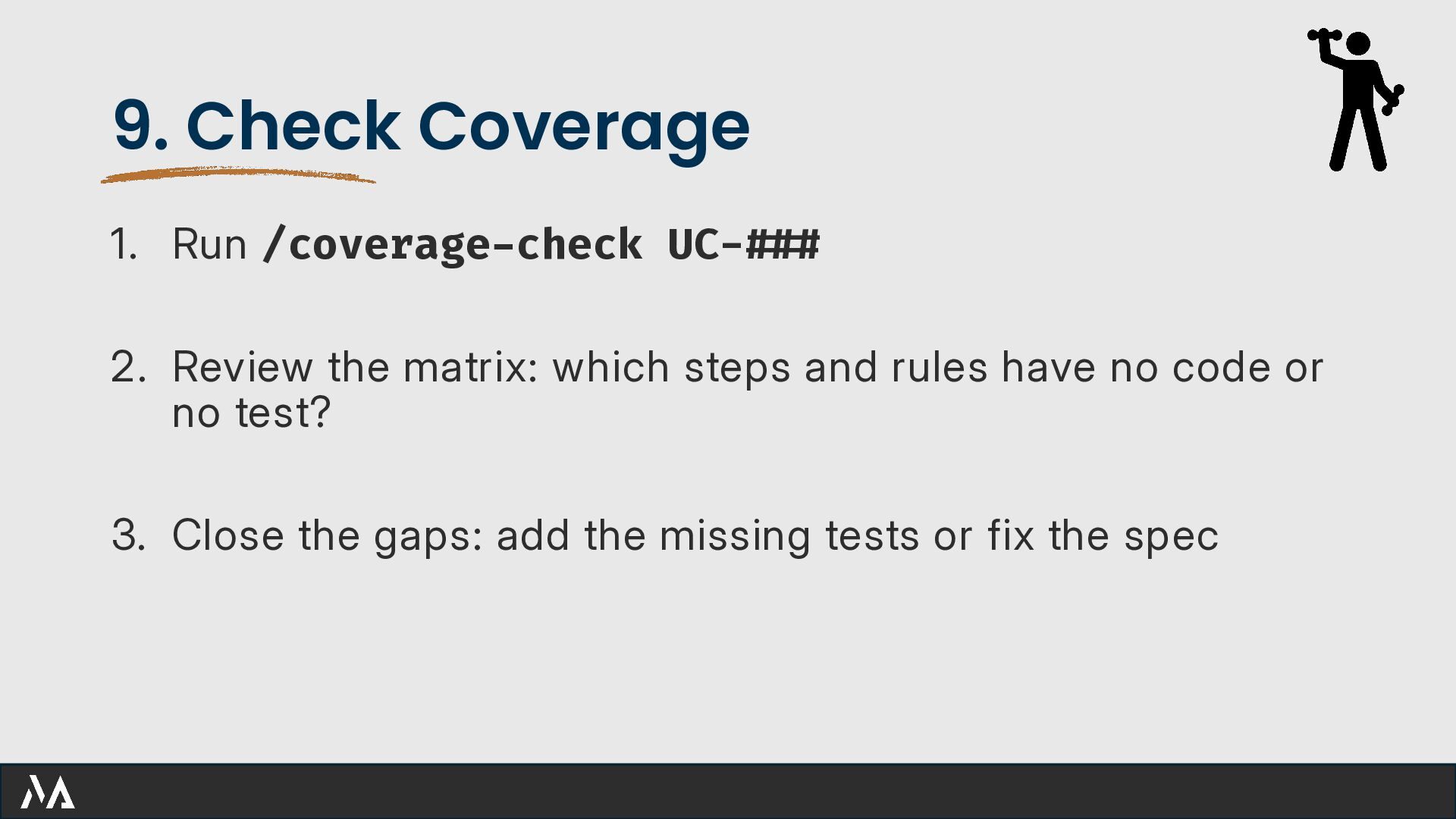
  30. 9. Check Coverage 1. Run /coverage-check UC-### 2. Review the

    matrix: which steps and rules have no code or no test? 3. Close the gaps: add the missing tests or fix the spec
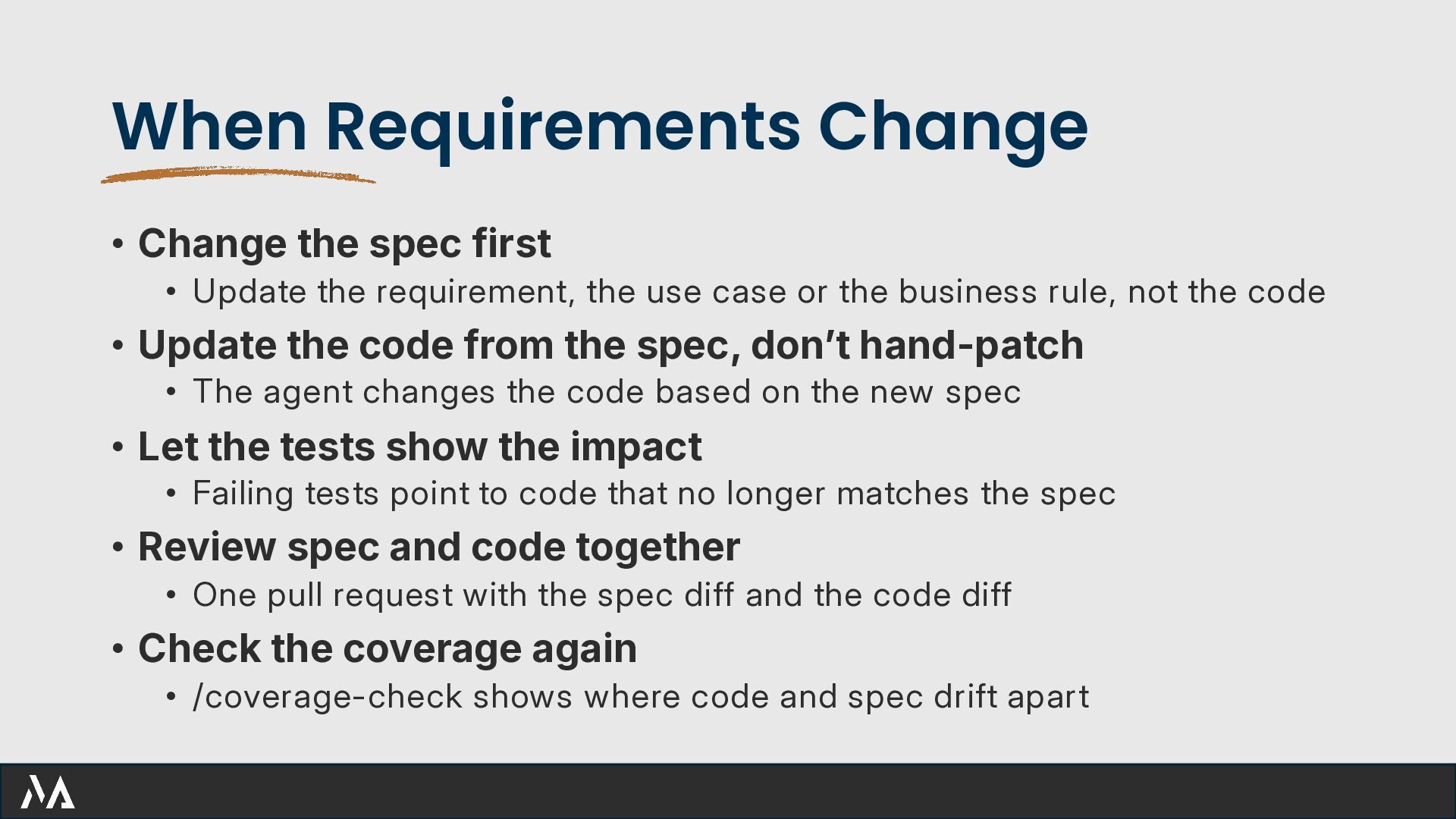
  31. When Requirements Change • Change the spec first • Update

    the requirement, the use case or the business rule, not the code • Update the code from the spec, don’t hand-patch • The agent changes the code based on the new spec • Let the tests show the impact • Failing tests point to code that no longer matches the spec • Review spec and code together • One pull request with the spec diff and the code diff • Check the coverage again • /coverage-check shows where code and spec drift apart
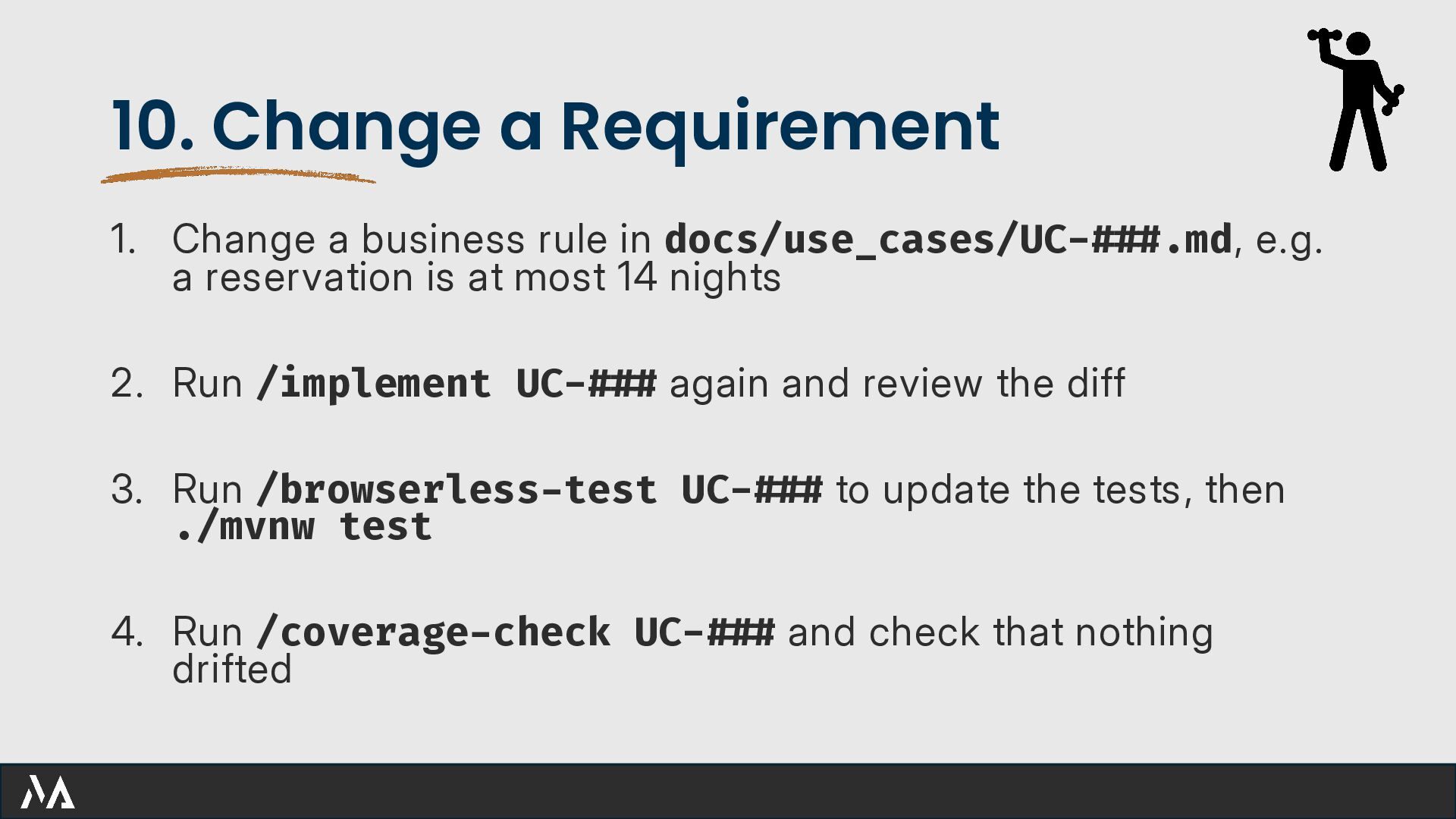
  32. 10. Change a Requirement 1. Change a business rule in

    docs/use_cases/UC-###.md, e.g. a reservation is at most 14 nights 2. Run /implement UC-### again and review the diff 3. Run /browserless-test UC-### to update the tests, then ./mvnw test 4. Run /coverage-check UC-### and check that nothing drifted
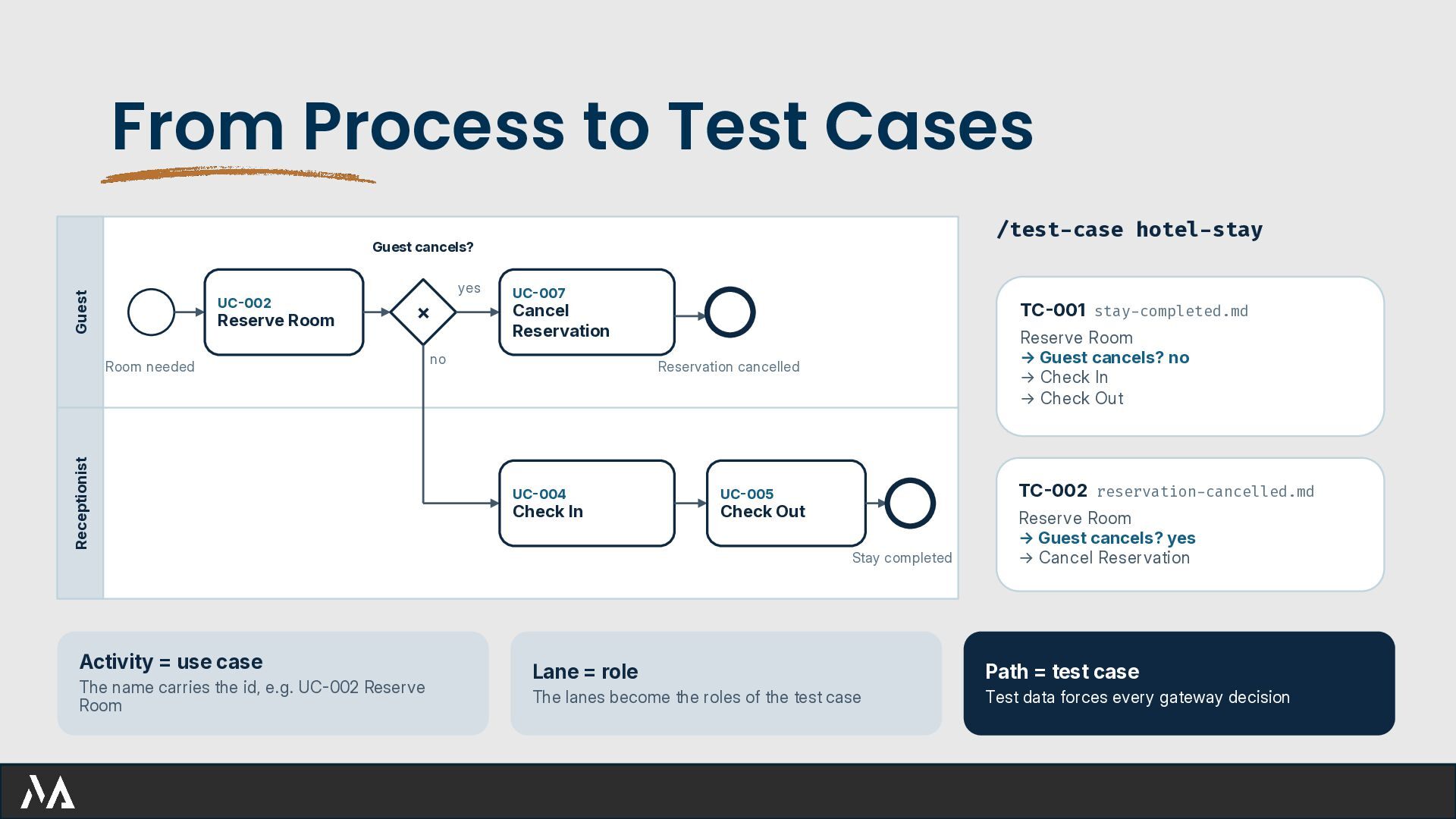
  33. From Process to Test Cases /test-case hotel-stay Guest Guest cancels?

    UC002 Reserve Room yes × Receptionist Room needed Activity = use case The name carries the id, e.g. UC002 Reserve Room UC007 TC001 stay-completed.md Cancel Reservation no Reserve Room → Guest cancels? no → Check In → Check Out Reservation cancelled UC004 Check In TC002 reservation-cancelled.md UC005 Check Out Stay completed Reserve Room → Guest cancels? yes → Cancel Reservation Lane = role Path = test case The lanes become the roles of the test case Test data forces every gateway decision
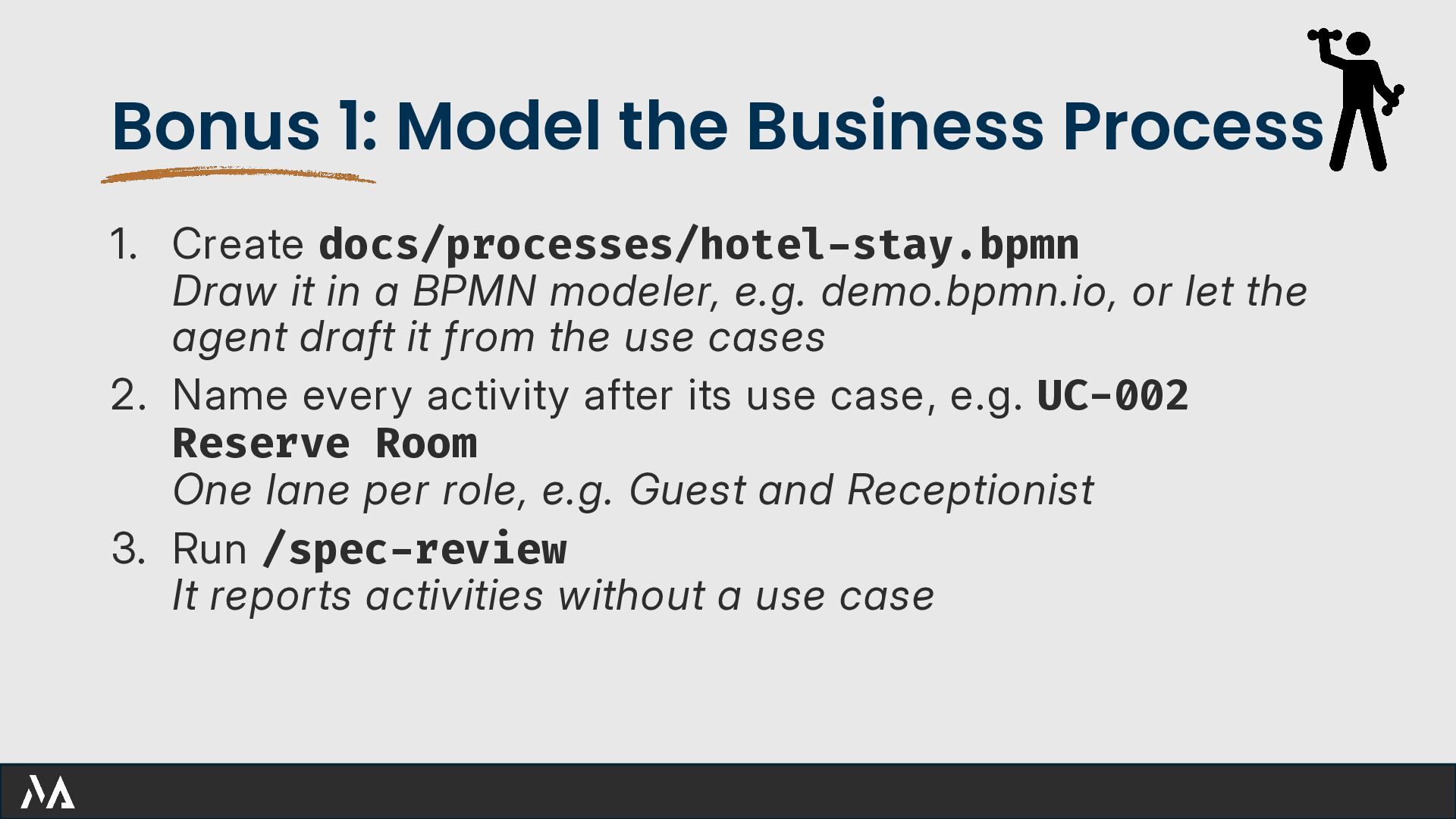
  34. Bonus 1: Model the Business Process 1. Create docs/processes/hotel-stay.bpmn Draw

    it in a BPMN modeler, e.g. demo.bpmn.io, or let the agent draft it from the use cases 2. Name every activity after its use case, e.g. UC-002 Reserve Room One lane per role, e.g. Guest and Receptionist 3. Run /spec-review It reports activities without a use case
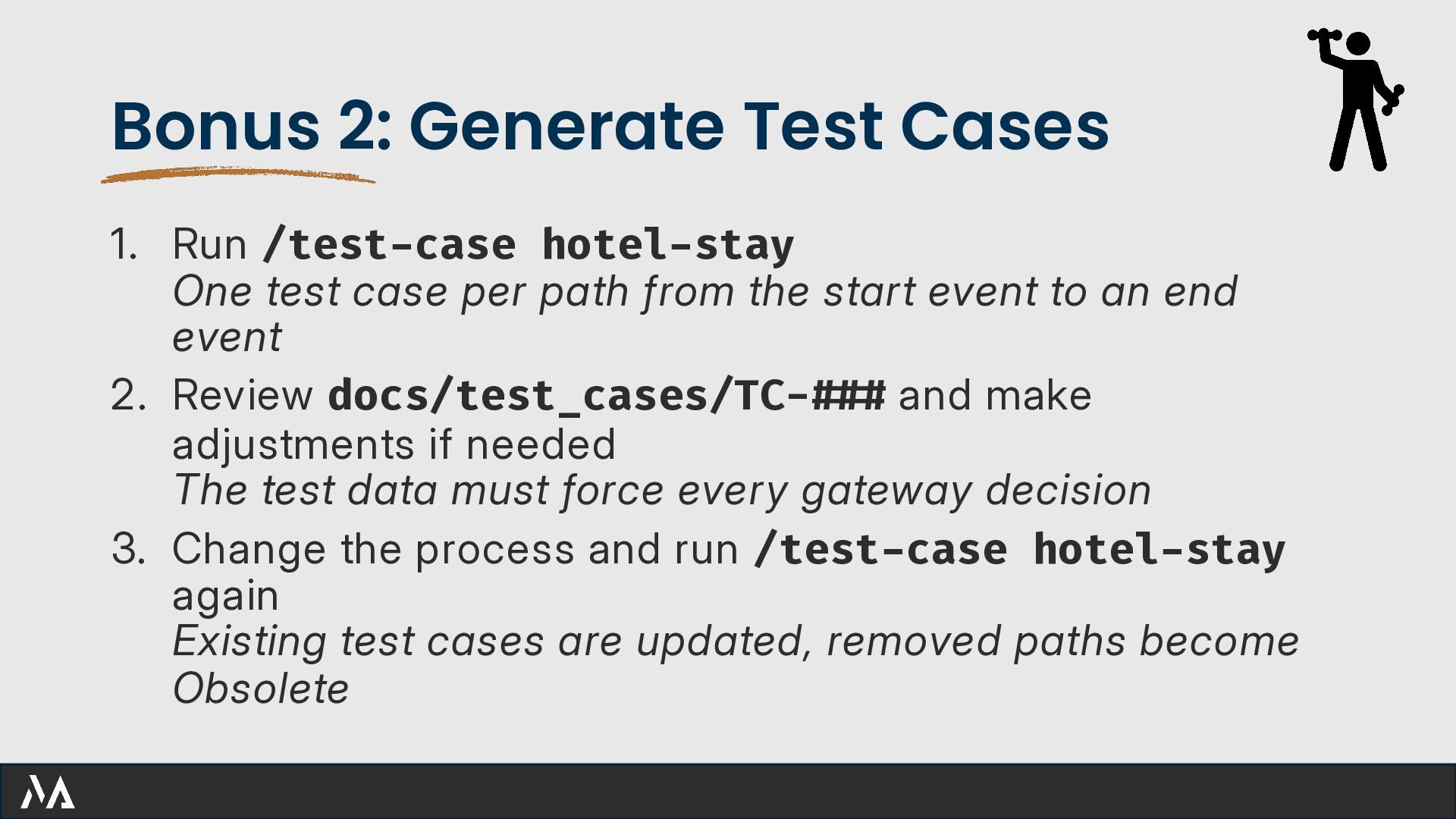
  35. Bonus 2: Generate Test Cases 1. Run /test-case hotel-stay One

    test case per path from the start event to an end event 2. Review docs/test_cases/TC-### and make adjustments if needed The test data must force every gateway decision 3. Change the process and run /test-case hotel-stay again Existing test cases are updated, removed paths become Obsolete
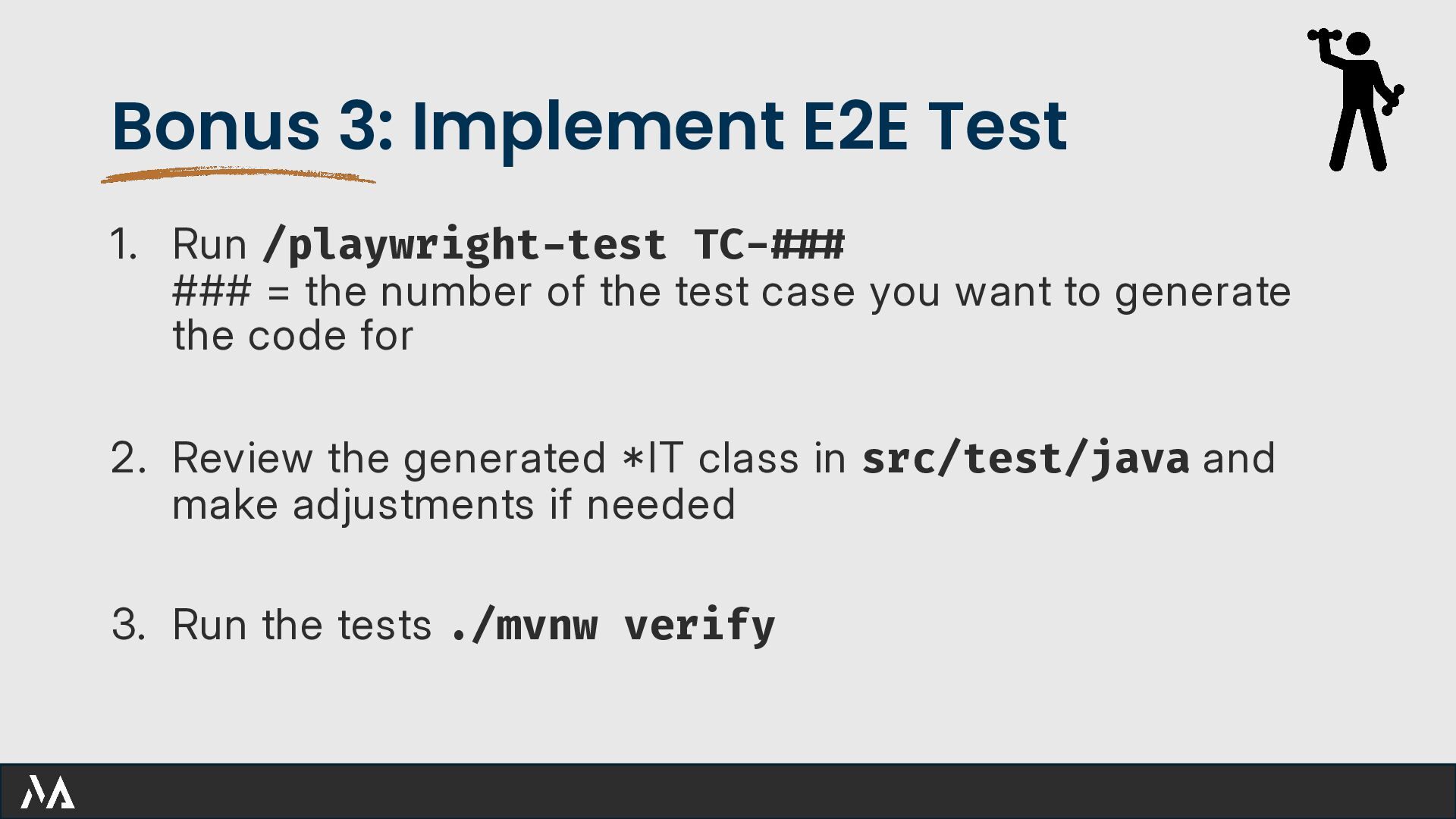
  36. Bonus 3: Implement E2E Test 1. Run /playwright-test TC-### ###

    = the number of the test case you want to generate the code for 2. Review the generated IT class in src/test/java and make adjustments if needed 3. Run the tests ./mvnw verify
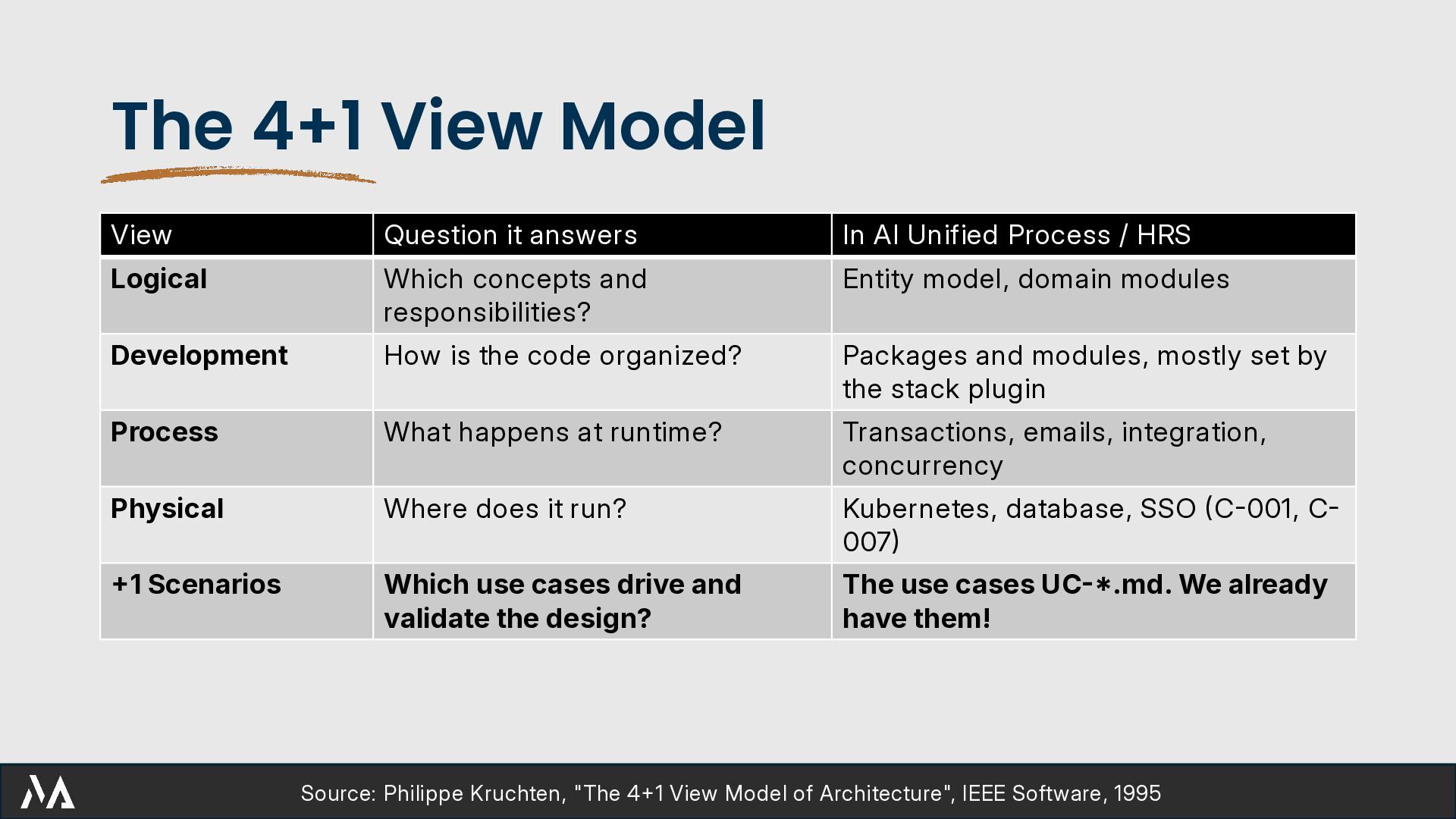
  37. The 4+1 View Model View Question it answers In AI

    Unified Process / HRS Logical Which concepts and responsibilities? Entity model, domain modules Development How is the code organized? Packages and modules, mostly set by the stack plugin Process What happens at runtime? Transactions, emails, integration, concurrency Physical Where does it run? Kubernetes, database, SSO C001, C 007 1 Scenarios Which use cases drive and validate the design? The use cases UC.md. We already have them! Source: Philippe Kruchten, "The 41 View Model of Architecture", IEEE Software, 1995
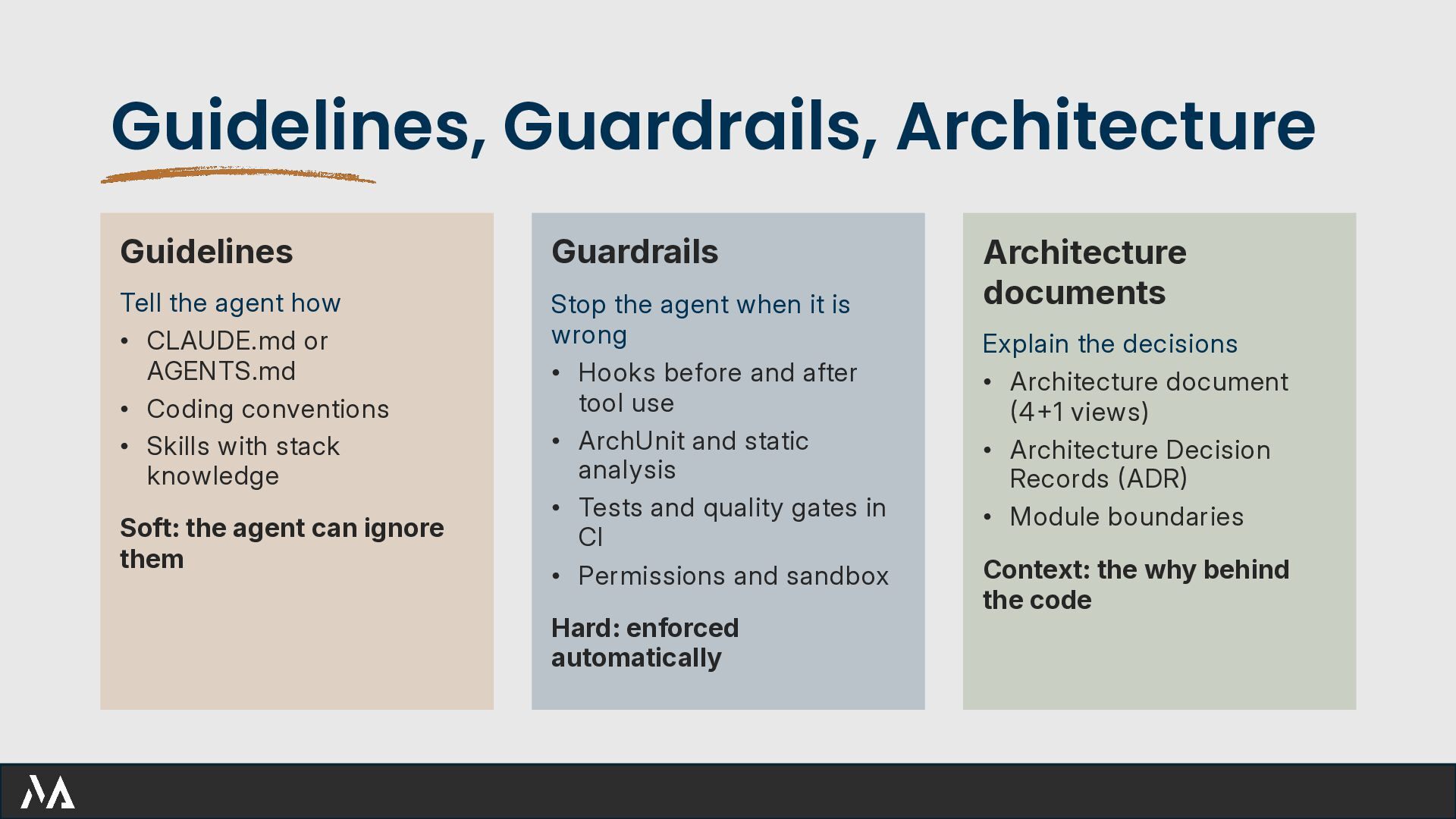
  38. Guidelines, Guardrails, Architecture Guidelines Guardrails Tell the agent how •

    CLAUDE.md or AGENTS.md • Coding conventions • Skills with stack knowledge Stop the agent when it is wrong • Hooks before and after tool use • ArchUnit and static analysis • Tests and quality gates in CI • Permissions and sandbox Soft: the agent can ignore them Hard: enforced automatically Architecture documents Explain the decisions • Architecture document 41 views) • Architecture Decision Records ADR • Module boundaries Context: the why behind the code
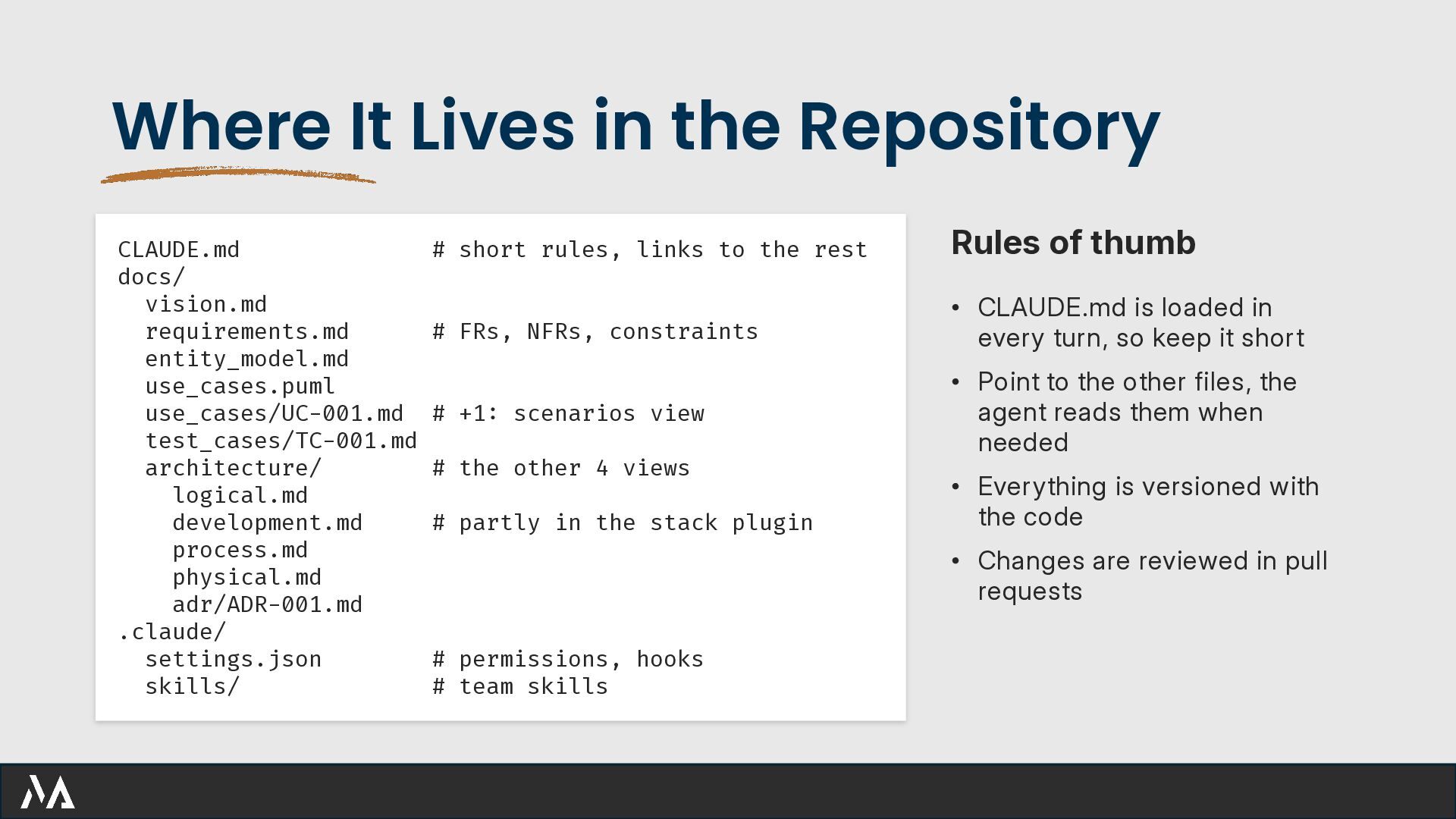
  39. Where It Lives in the Repository CLAUDE.md # short rules,

    links to the rest docs/ vision.md requirements.md # FRs, NFRs, constraints entity_model.md use_cases.puml use_cases/UC-001.md # +1: scenarios view test_cases/TC-001.md architecture/ # the other 4 views logical.md development.md # partly in the stack plugin process.md physical.md adr/ADR-001.md .claude/ settings.json # permissions, hooks skills/ # team skills Rules of thumb • CLAUDE.md is loaded in every turn, so keep it short • Point to the other files, the agent reads them when needed • Everything is versioned with the code • Changes are reviewed in pull requests
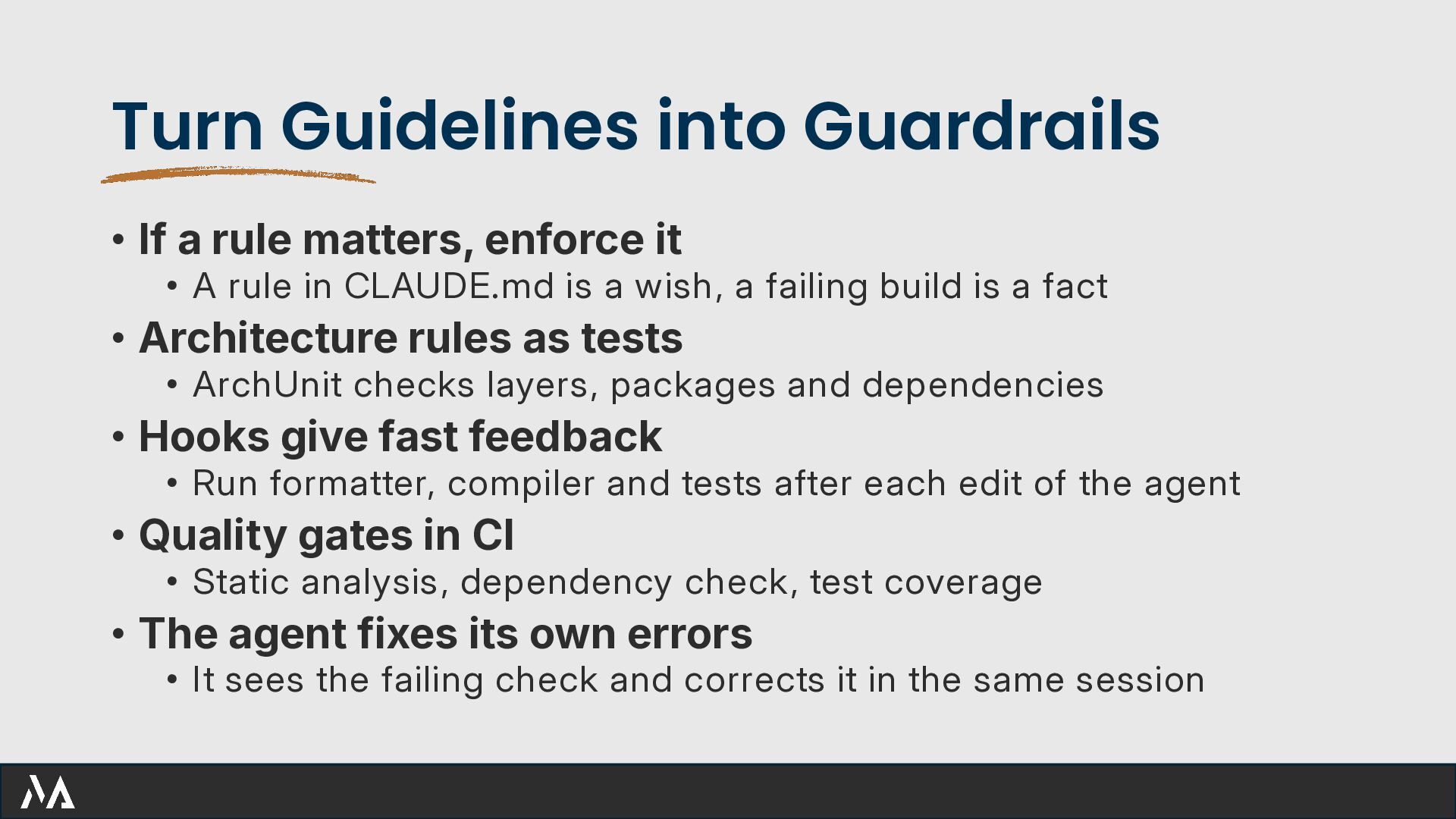
  40. Turn Guidelines into Guardrails • If a rule matters, enforce

    it • A rule in CLAUDE.md is a wish, a failing build is a fact • Architecture rules as tests • ArchUnit checks layers, packages and dependencies • Hooks give fast feedback • Run formatter, compiler and tests after each edit of the agent • Quality gates in CI • Static analysis, dependency check, test coverage • The agent fixes its own errors • It sees the failing check and corrects it in the same session
  41. Example: Sensors in the PetClinic Sensor Checks UseCaseTraceabilityTest Every UseCase

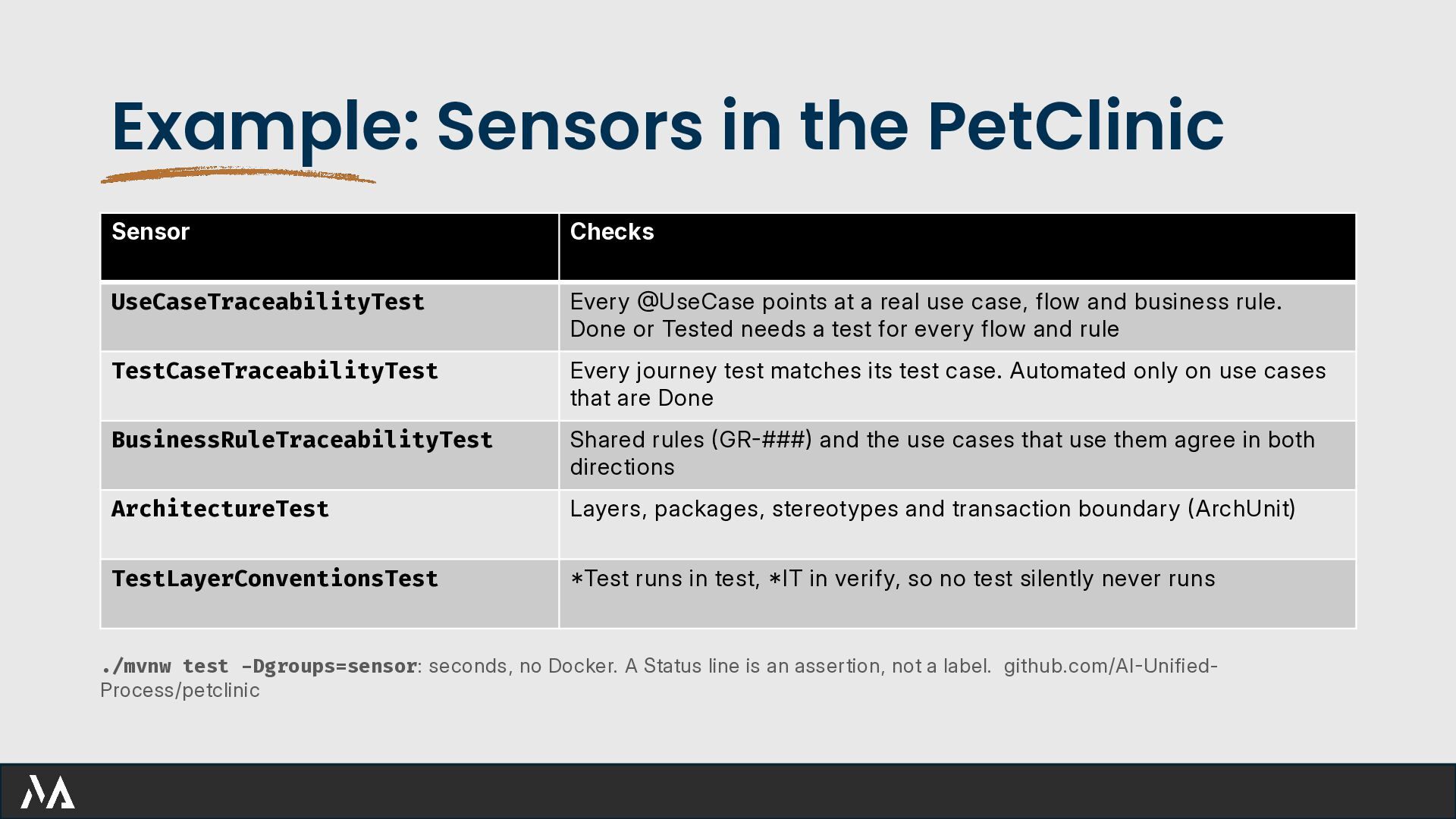
    points at a real use case, flow and business rule. Done or Tested needs a test for every flow and rule TestCaseTraceabilityTest Every journey test matches its test case. Automated only on use cases that are Done BusinessRuleTraceabilityTest Shared rules GR### and the use cases that use them agree in both directions ArchitectureTest Layers, packages, stereotypes and transaction boundary ArchUnit) TestLayerConventionsTest Test runs in test, IT in verify, so no test silently never runs ./mvnw test -Dgroups=sensor: seconds, no Docker. A Status line is an assertion, not a label. github.com/AIUnifiedProcess/petclinic
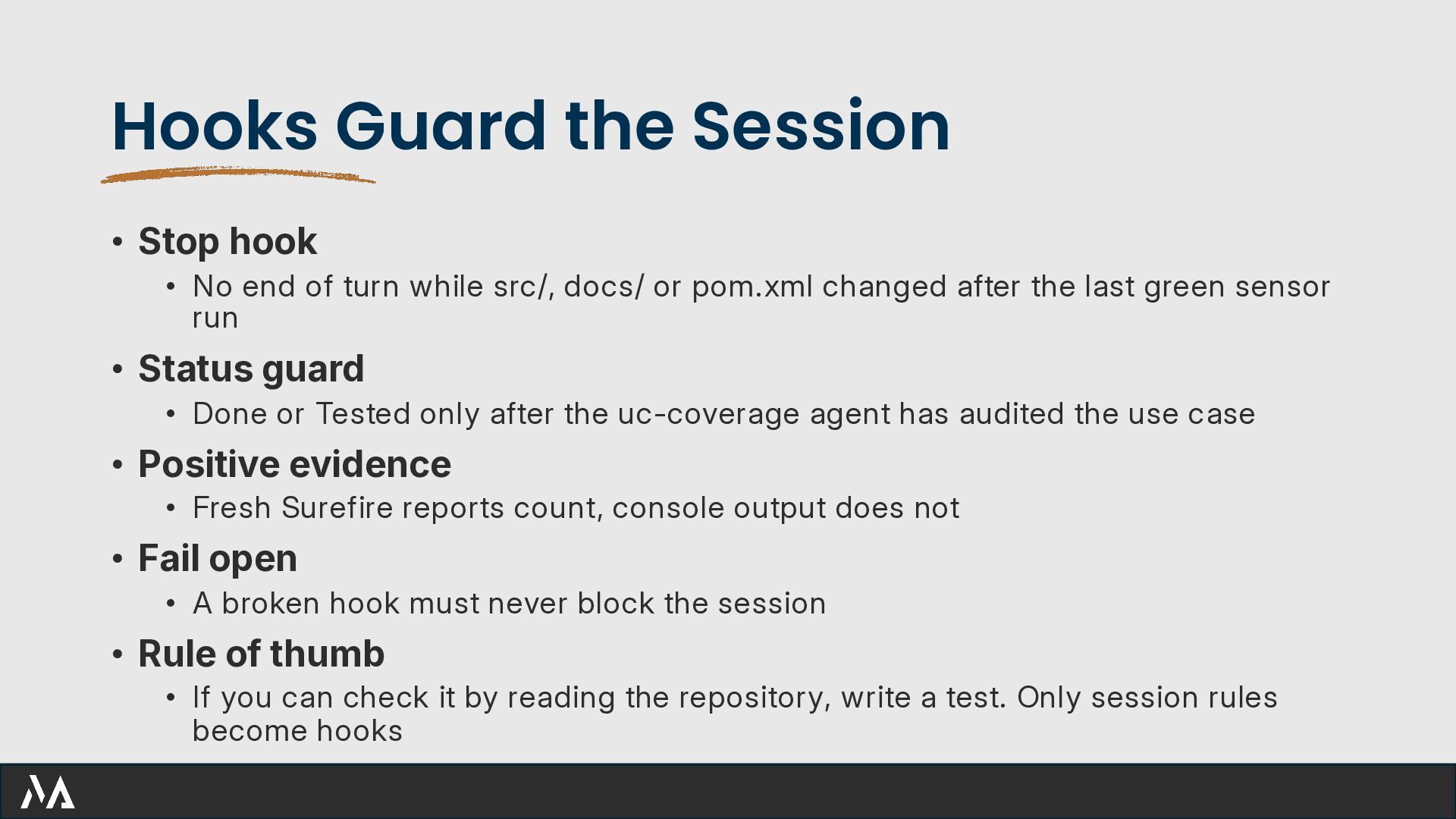
  42. Hooks Guard the Session • Stop hook • No end

    of turn while src/, docs/ or pom.xml changed after the last green sensor run • Status guard • Done or Tested only after the uc-coverage agent has audited the use case • Positive evidence • Fresh Surefire reports count, console output does not • Fail open • A broken hook must never block the session • Rule of thumb • If you can check it by reading the repository, write a test. Only session rules become hooks
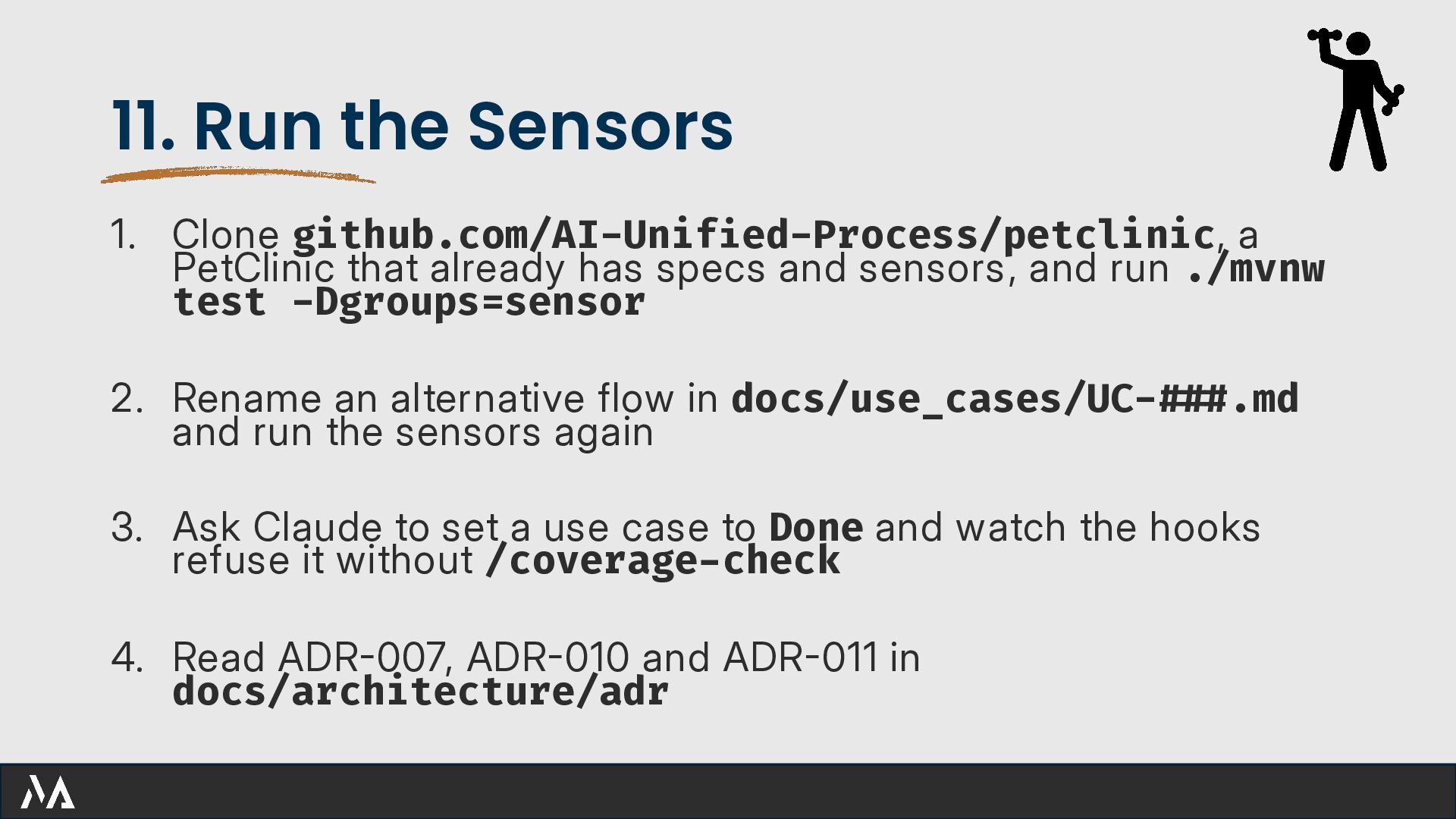
  43. 11. Run the Sensors 1. Clone github.com/AI-Unified-Process/petclinic, a PetClinic that

    already has specs and sensors, and run ./mvnw test -Dgroups=sensor 2. Rename an alternative flow in docs/use_cases/UC-###.md and run the sensors again 3. Ask Claude to set a use case to Done and watch the hooks refuse it without /coverage-check 4. Read ADR007, ADR010 and ADR011 in docs/architecture/adr
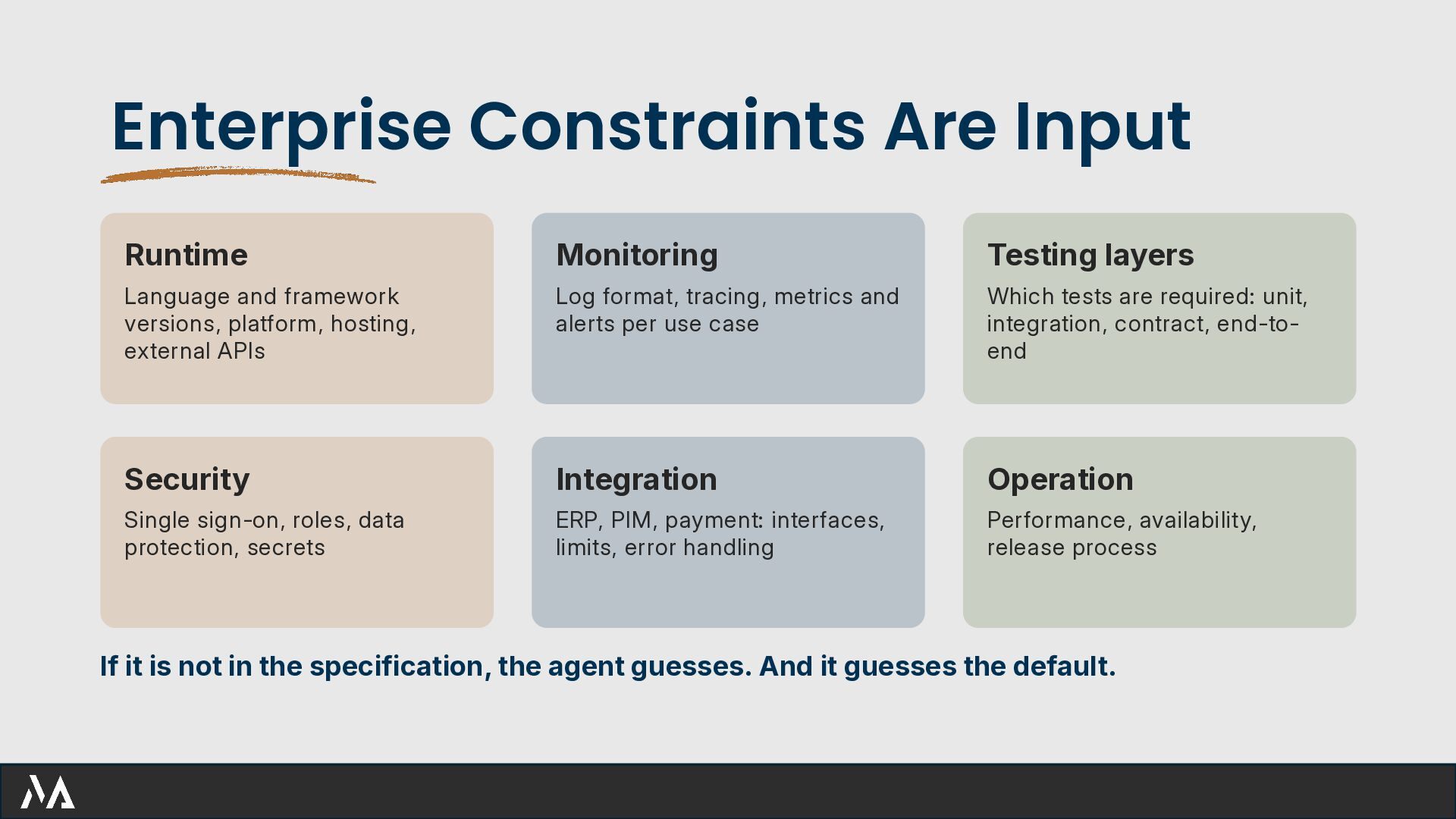
  44. Enterprise Constraints Are Input Runtime Monitoring Testing layers Language and

    framework versions, platform, hosting, external APIs Log format, tracing, metrics and alerts per use case Which tests are required: unit, integration, contract, end-toend Security Integration Operation Single sign-on, roles, data protection, secrets ERP, PIM, payment: interfaces, limits, error handling Performance, availability, release process If it is not in the specification, the agent guesses. And it guesses the default.
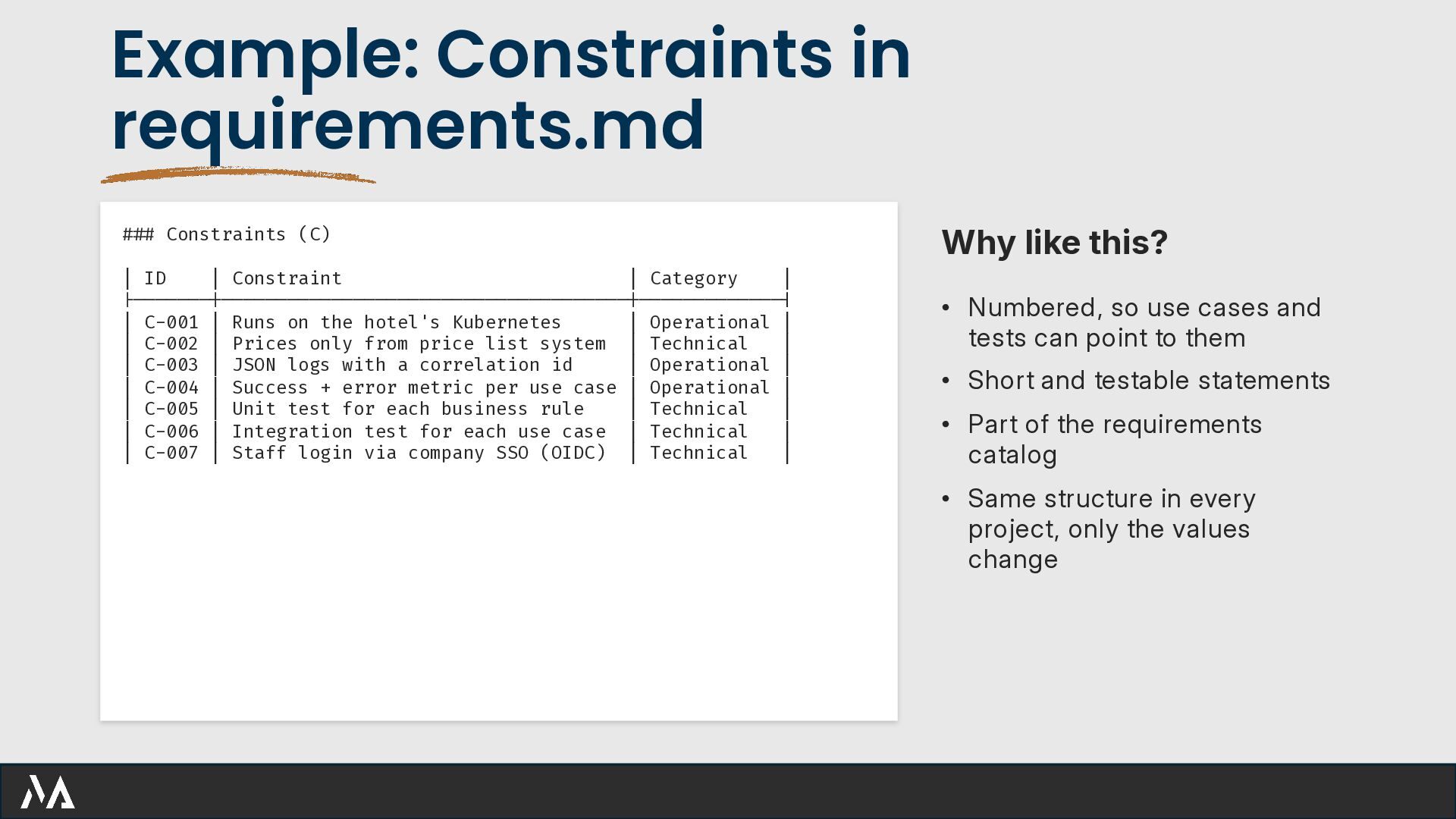
  45. Example: Constraints in requirements.md ### Constraints (C) | ID |

    Constraint | Category | |--------|--------------------------------------|--------------|| C-001 | Runs on the hotel's Kubernetes | Operational | | C-002 | Prices only from price list system | Technical | | C-003 | JSON logs with a correlation id | Operational | | C-004 | Success + error metric per use case | Operational | | C-005 | Unit test for each business rule | Technical | | C-006 | Integration test for each use case | Technical | | C-007 | Staff login via company SSO (OIDC) | Technical | Why like this? • Numbered, so use cases and tests can point to them • Short and testable statements • Part of the requirements catalog • Same structure in every project, only the values change
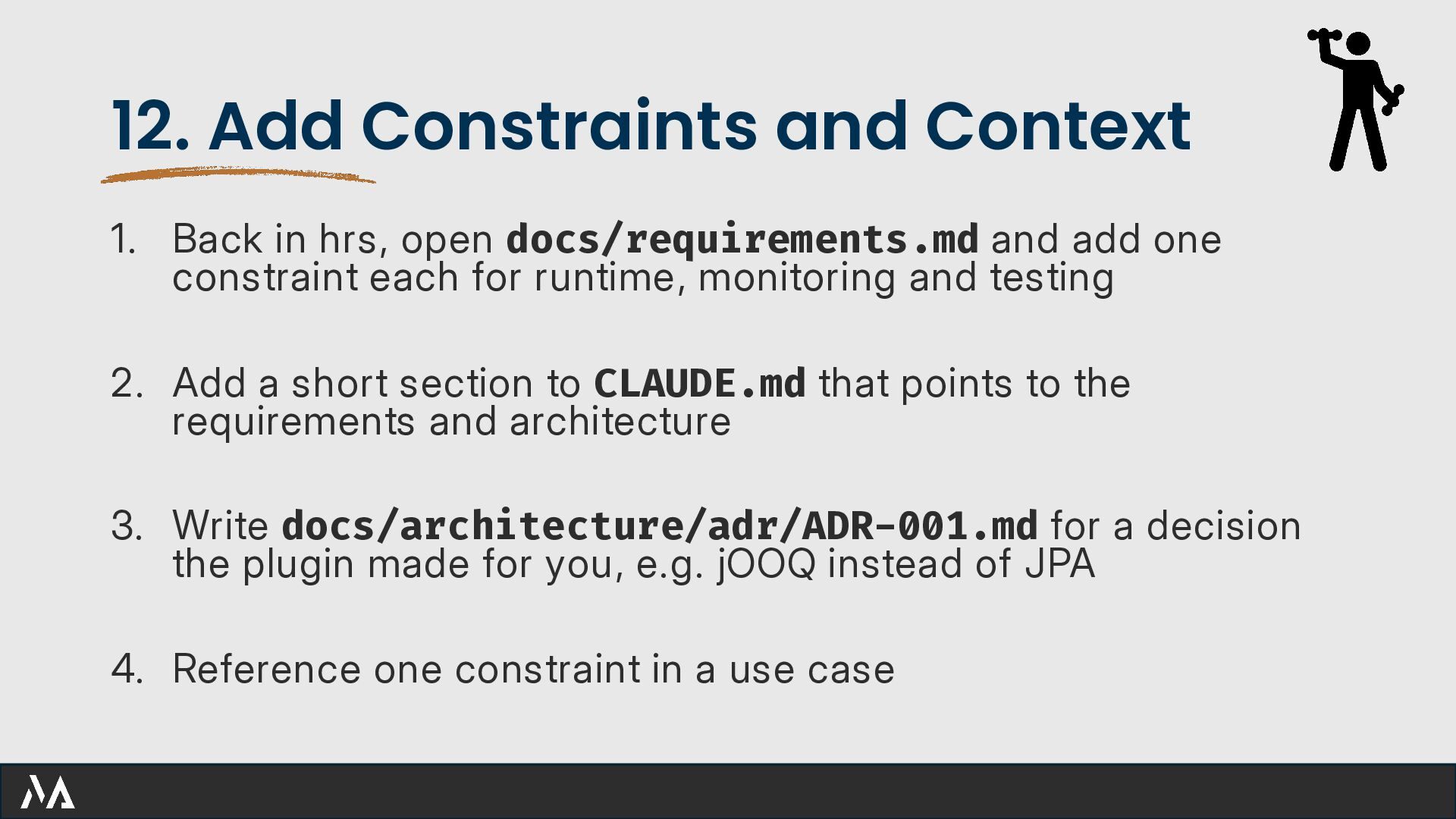
  46. 12. Add Constraints and Context 1. Back in hrs, open

    docs/requirements.md and add one constraint each for runtime, monitoring and testing 2. Add a short section to CLAUDE.md that points to the requirements and architecture 3. Write docs/architecture/adr/ADR-001.md for a decision the plugin made for you, e.g. jOOQ instead of JPA 4. Reference one constraint in a use case
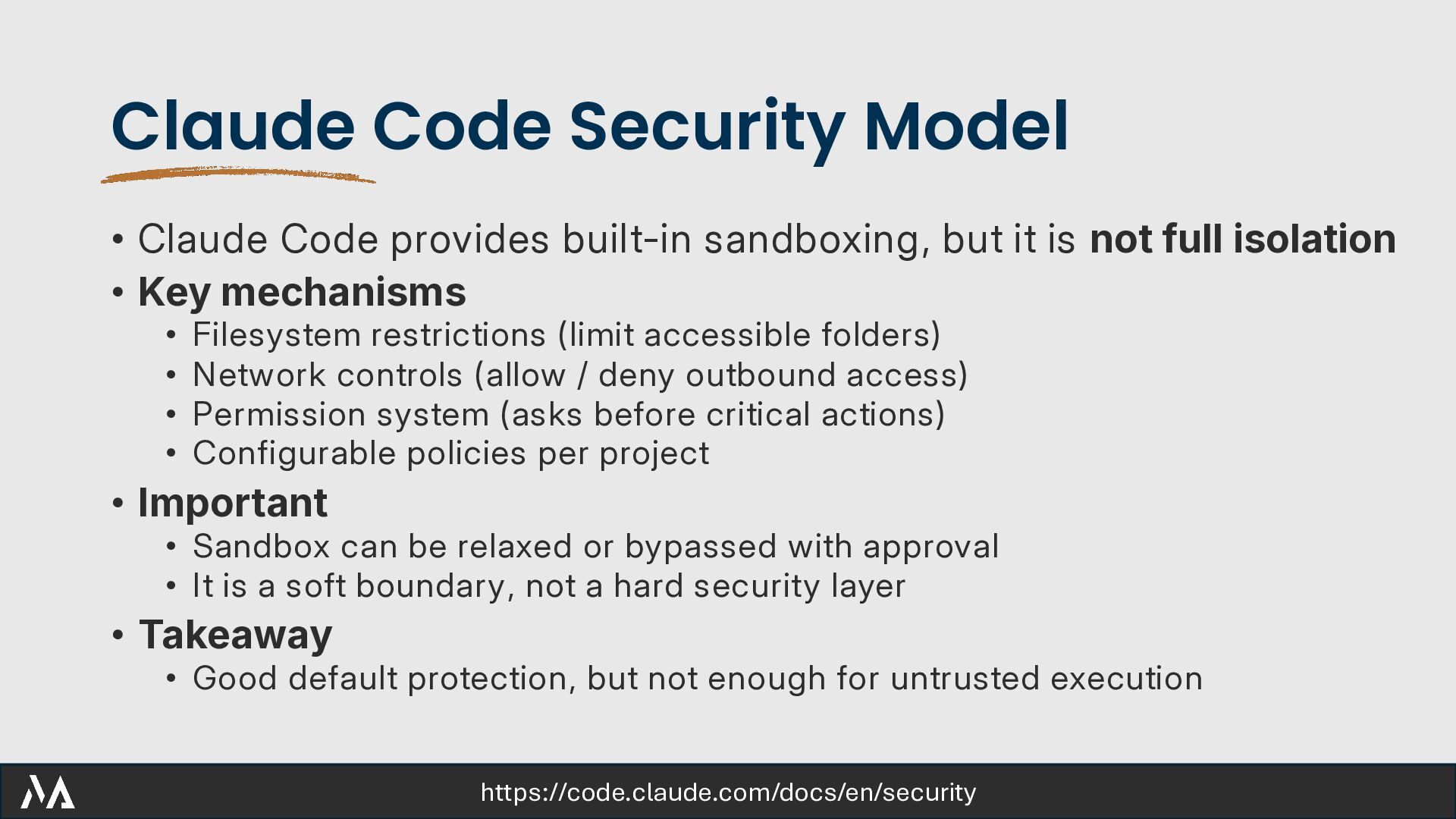
  47. Claude Code Security Model • Claude Code provides built-in sandboxing,

    but it is not full isolation • Key mechanisms • Filesystem restrictions (limit accessible folders) • Network controls (allow / deny outbound access) • Permission system (asks before critical actions) • Configurable policies per project • Important • Sandbox can be relaxed or bypassed with approval • It is a soft boundary, not a hard security layer • Takeaway • Good default protection, but not enough for untrusted execution https://code.claude.com/docs/en/security
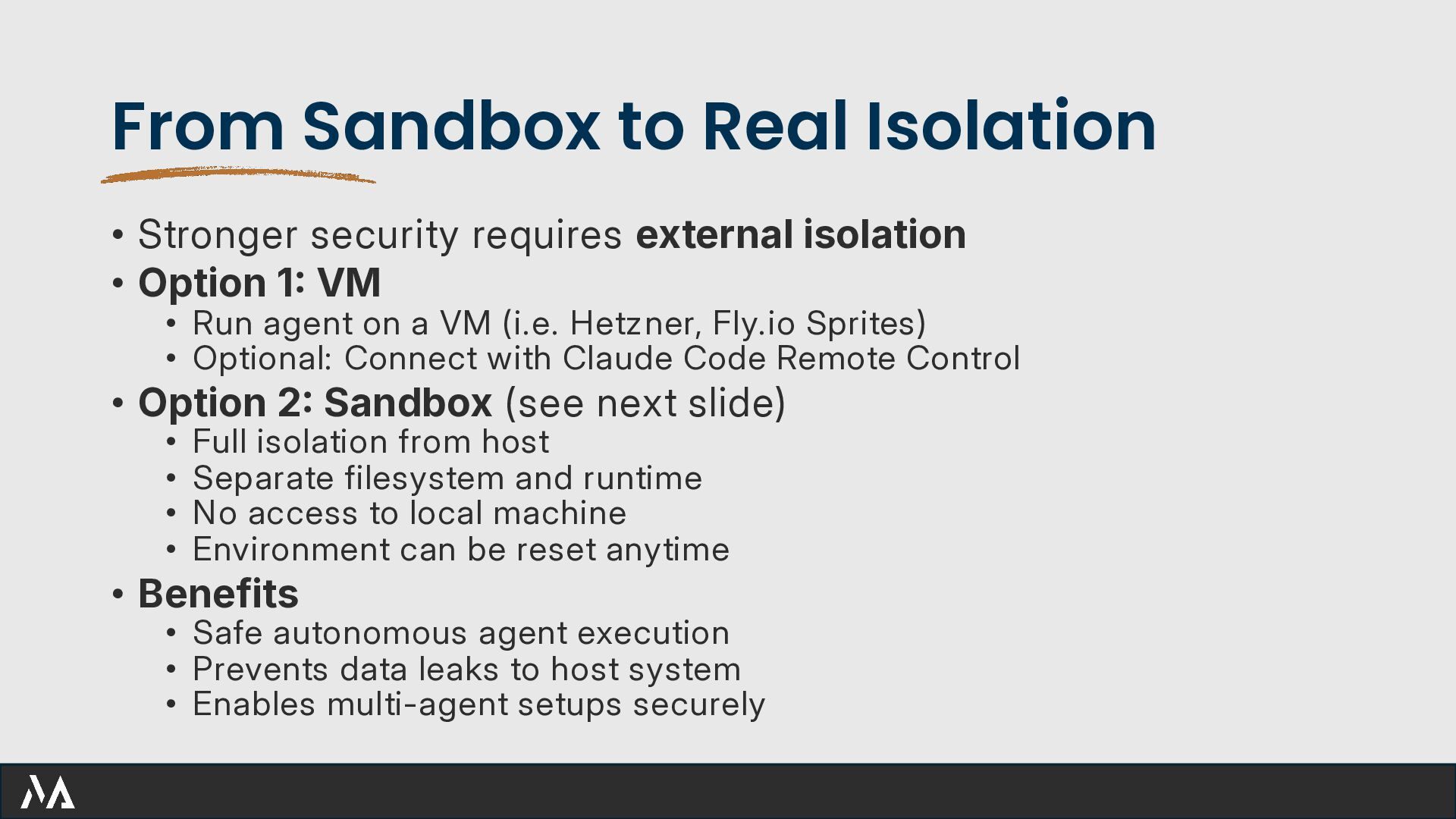
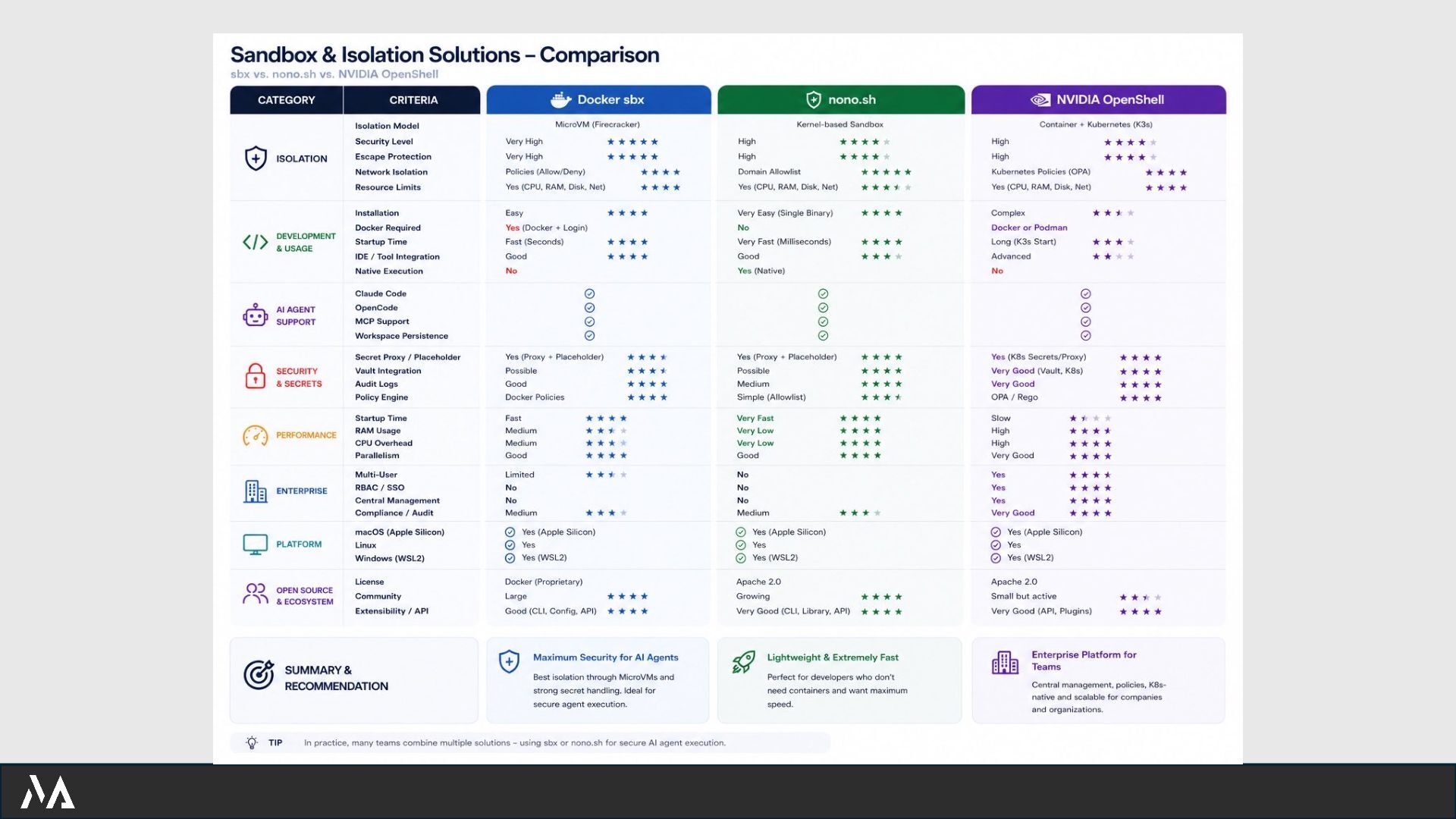
  48. From Sandbox to Real Isolation • Stronger security requires external

    isolation • Option 1 VM • Run agent on a VM (i.e. Hetzner, Fly.io Sprites) • Optional: Connect with Claude Code Remote Control • Option 2 Sandbox (see next slide) • Full isolation from host • Separate filesystem and runtime • No access to local machine • Environment can be reset anytime • Benefits • Safe autonomous agent execution • Prevents data leaks to host system • Enables multi-agent setups securely
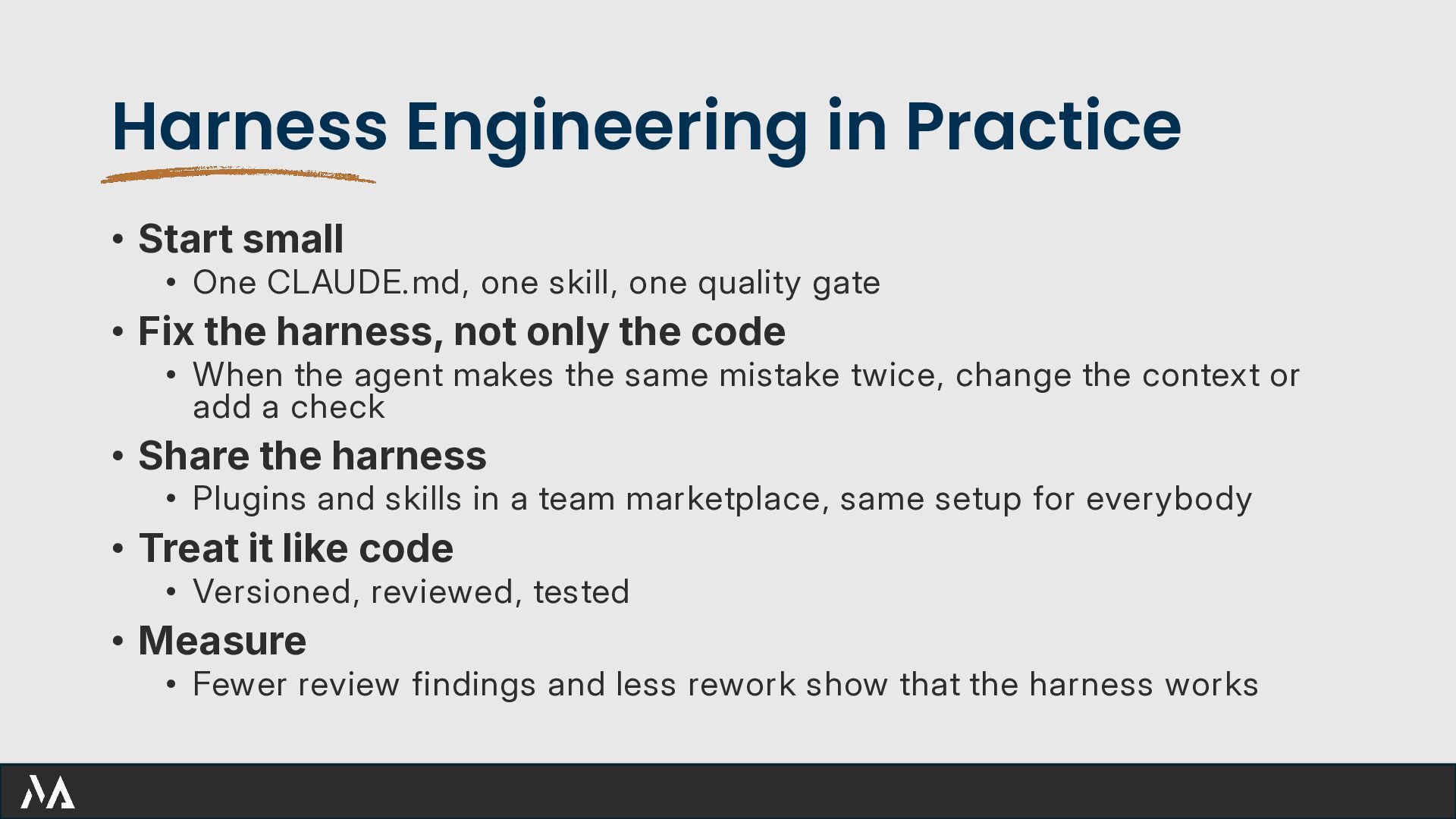
  49. Harness Engineering in Practice • Start small • One CLAUDE.md,

    one skill, one quality gate • Fix the harness, not only the code • When the agent makes the same mistake twice, change the context or add a check • Share the harness • Plugins and skills in a team marketplace, same setup for everybody • Treat it like code • Versioned, reviewed, tested • Measure • Fewer review findings and less rework show that the harness works
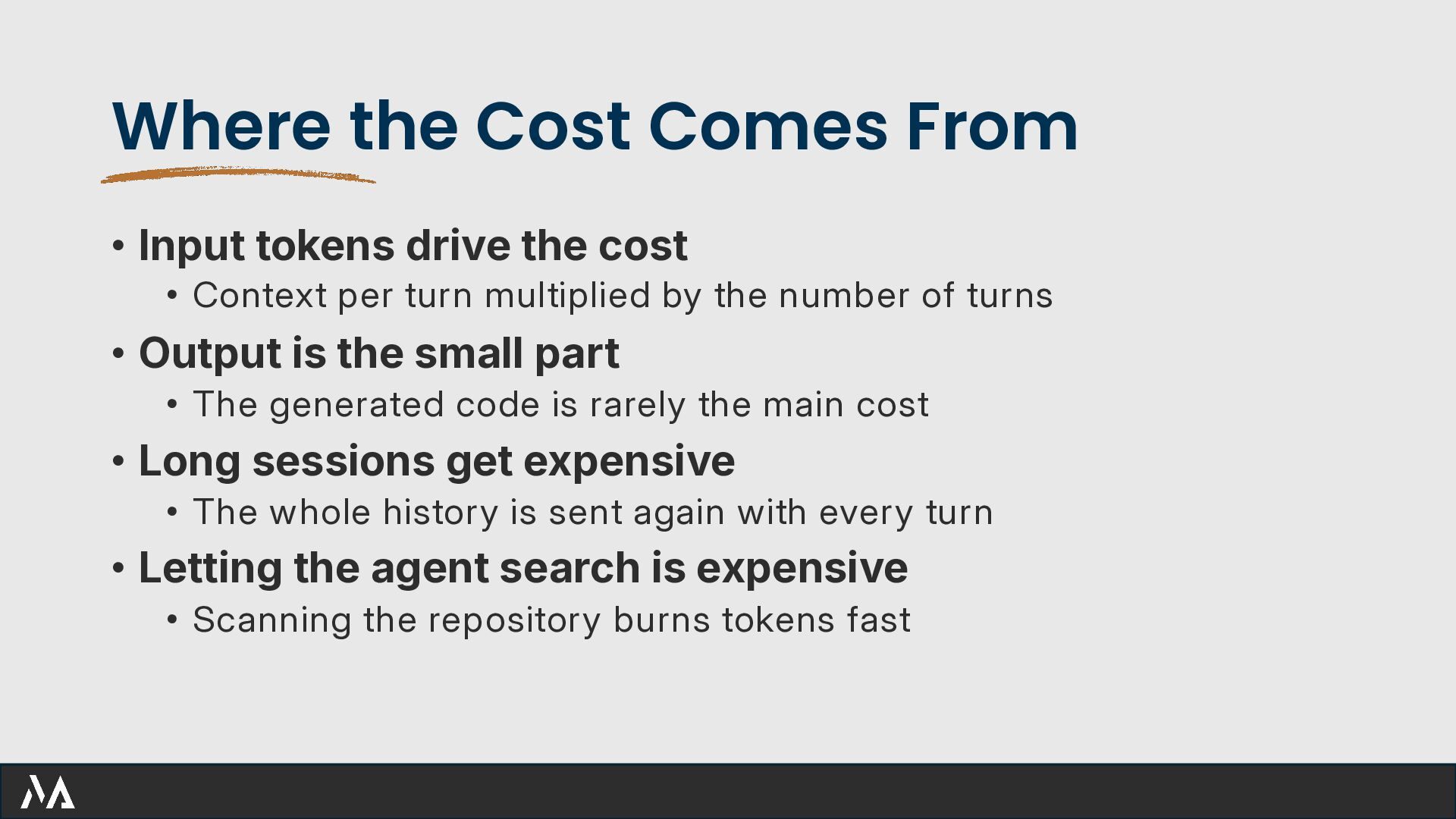
  50. Where the Cost Comes From • Input tokens drive the

    cost • Context per turn multiplied by the number of turns • Output is the small part • The generated code is rarely the main cost • Long sessions get expensive • The whole history is sent again with every turn • Letting the agent search is expensive • Scanning the repository burns tokens fast
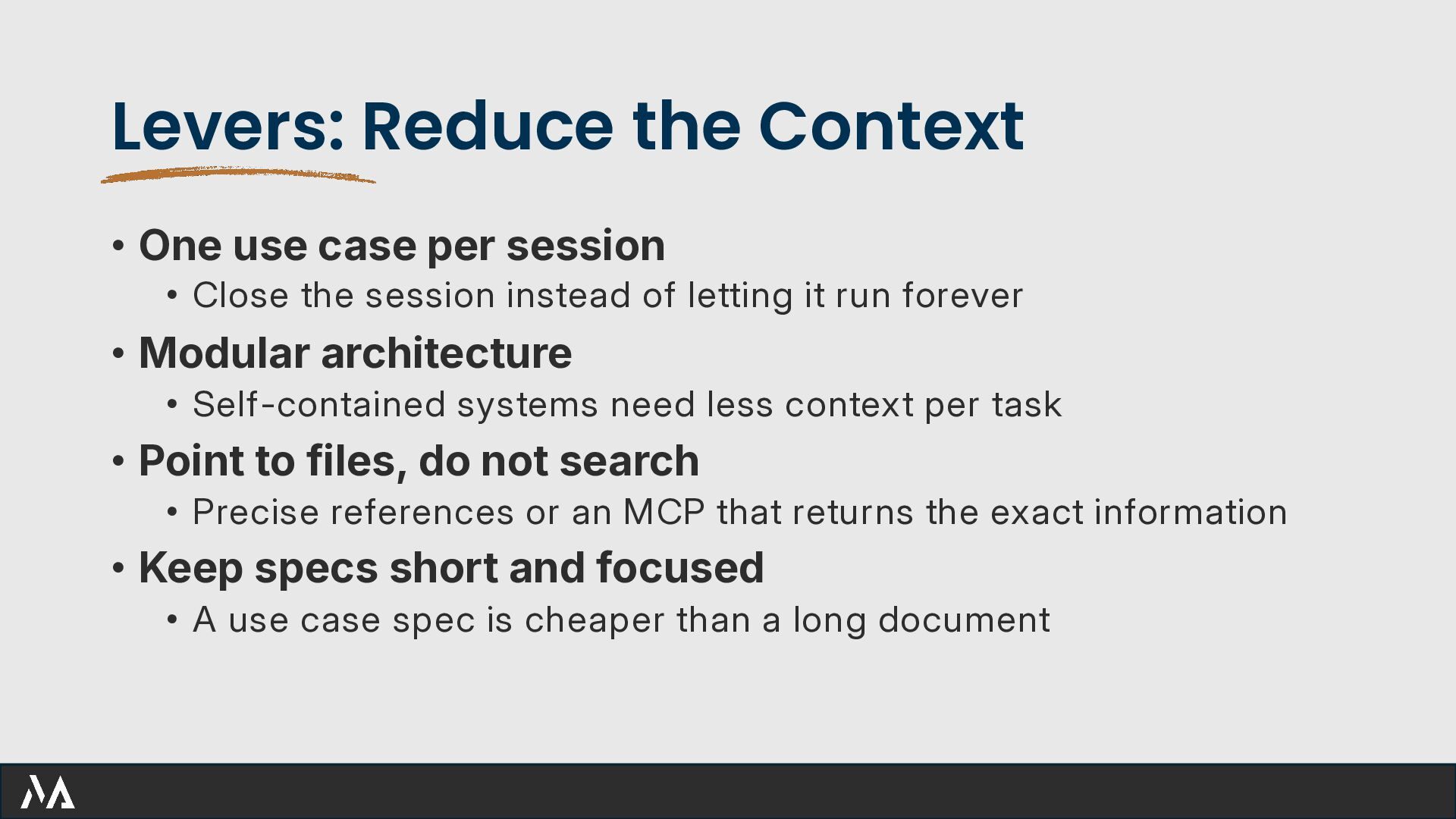
  51. Levers: Reduce the Context • One use case per session

    • Close the session instead of letting it run forever • Modular architecture • Self-contained systems need less context per task • Point to files, do not search • Precise references or an MCP that returns the exact information • Keep specs short and focused • A use case spec is cheaper than a long document
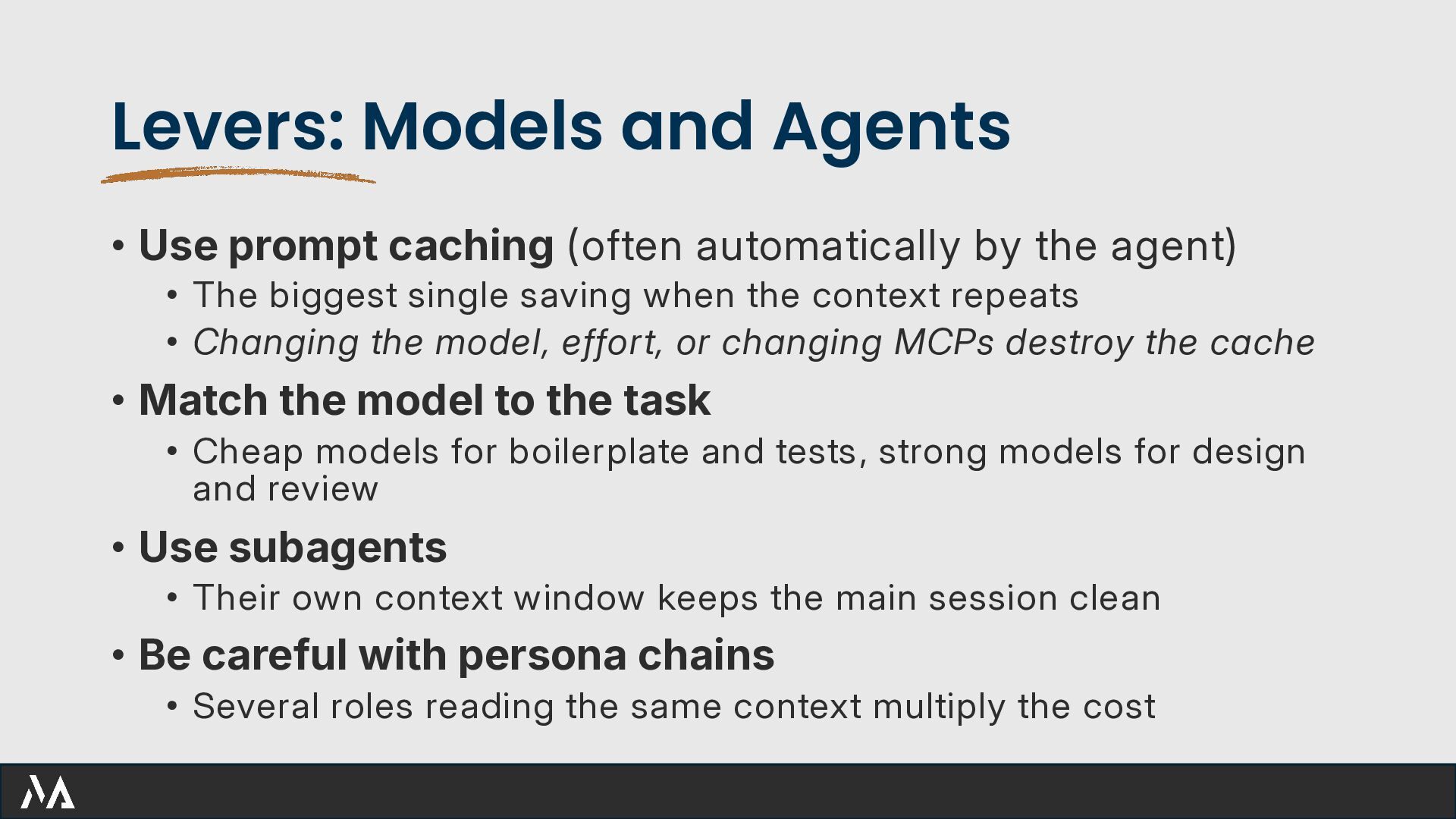
  52. Levers: Models and Agents • Use prompt caching (often automatically

    by the agent) • The biggest single saving when the context repeats • Changing the model, effort, or changing MCPs destroy the cache • Match the model to the task • Cheap models for boilerplate and tests, strong models for design and review • Use subagents • Their own context window keeps the main session clean • Be careful with persona chains • Several roles reading the same context multiply the cost
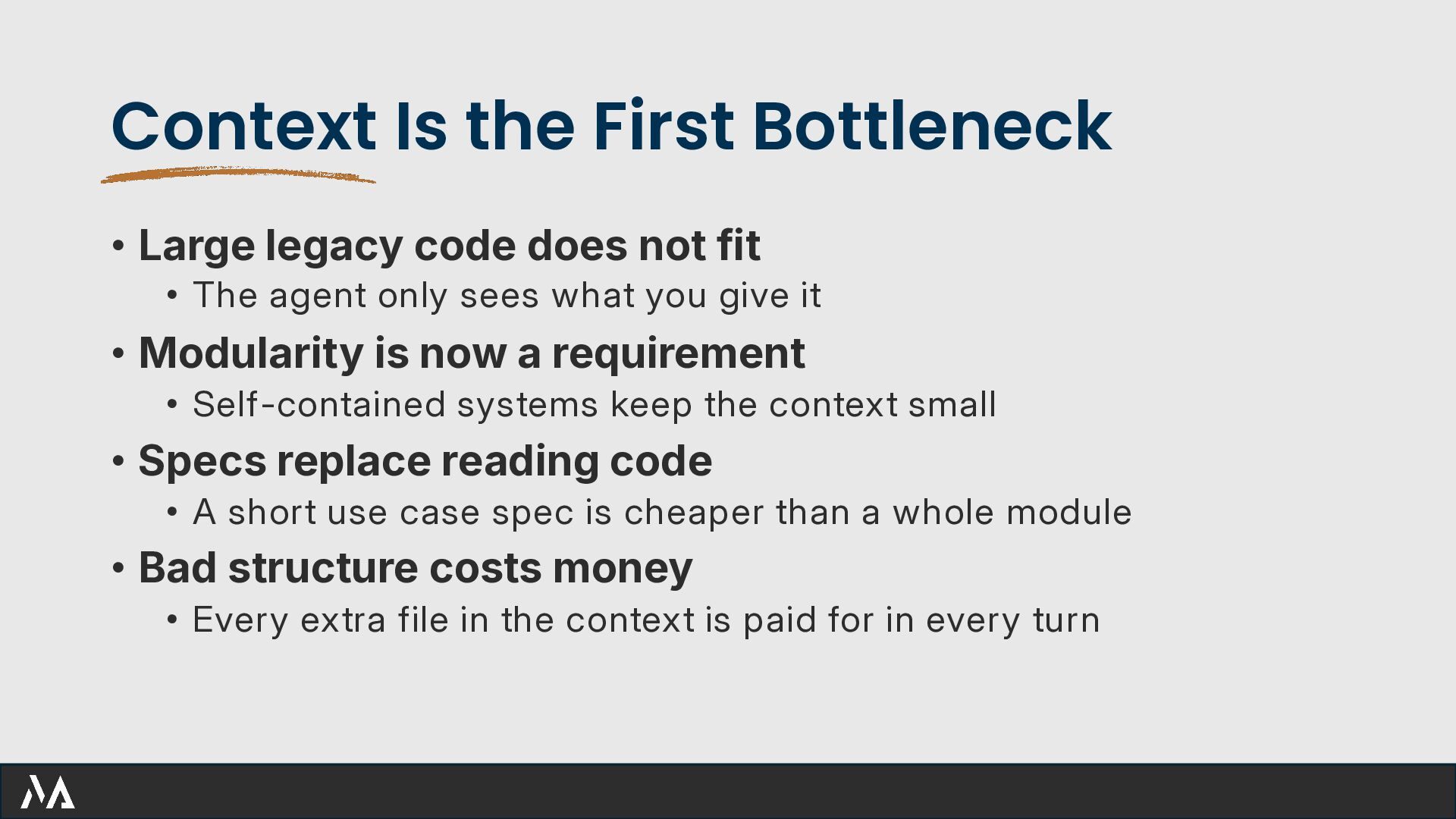
  53. Context Is the First Bottleneck • Large legacy code does

    not fit • The agent only sees what you give it • Modularity is now a requirement • Self-contained systems keep the context small • Specs replace reading code • A short use case spec is cheaper than a whole module • Bad structure costs money • Every extra file in the context is paid for in every turn
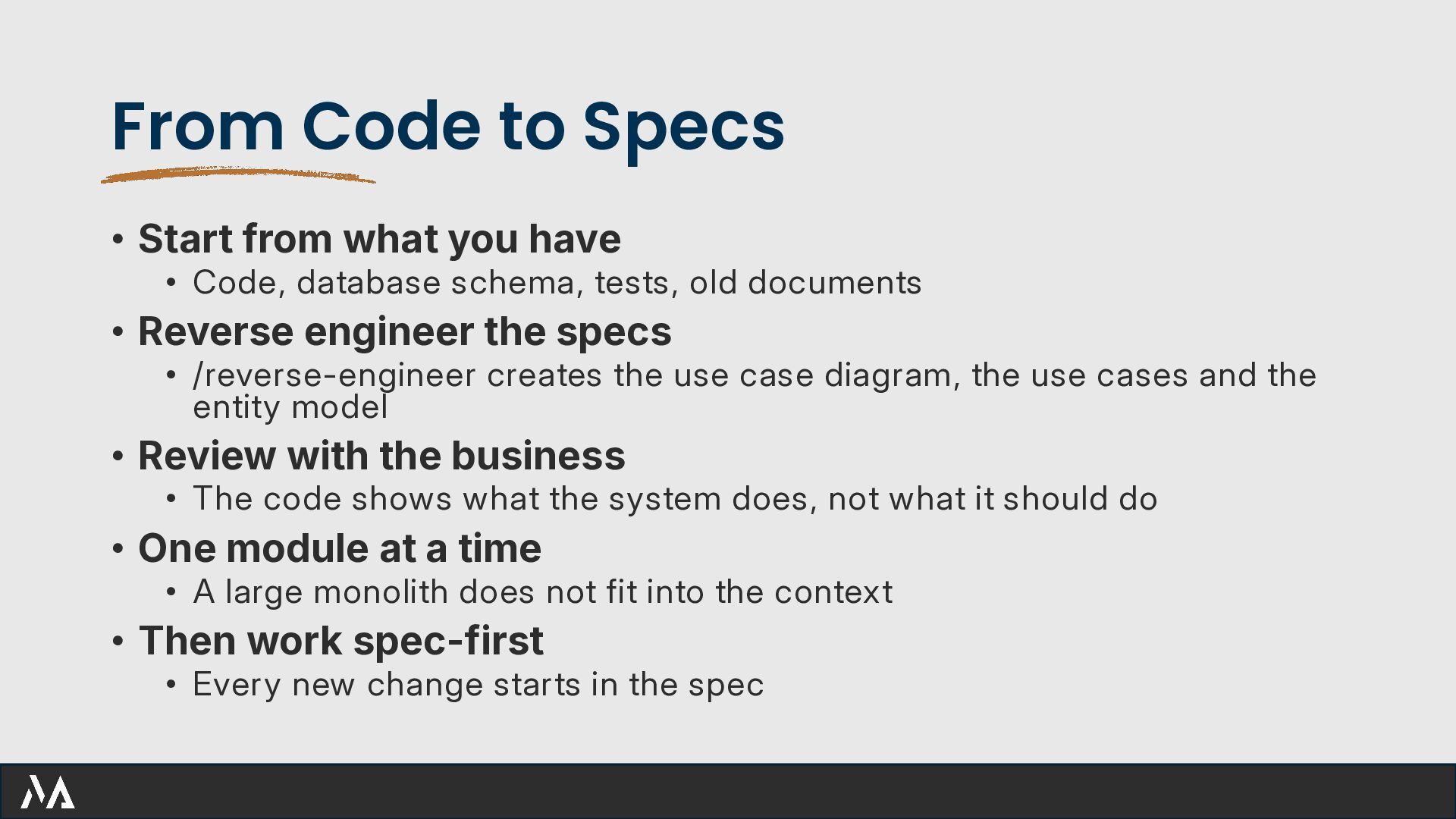
  54. From Code to Specs • Start from what you have

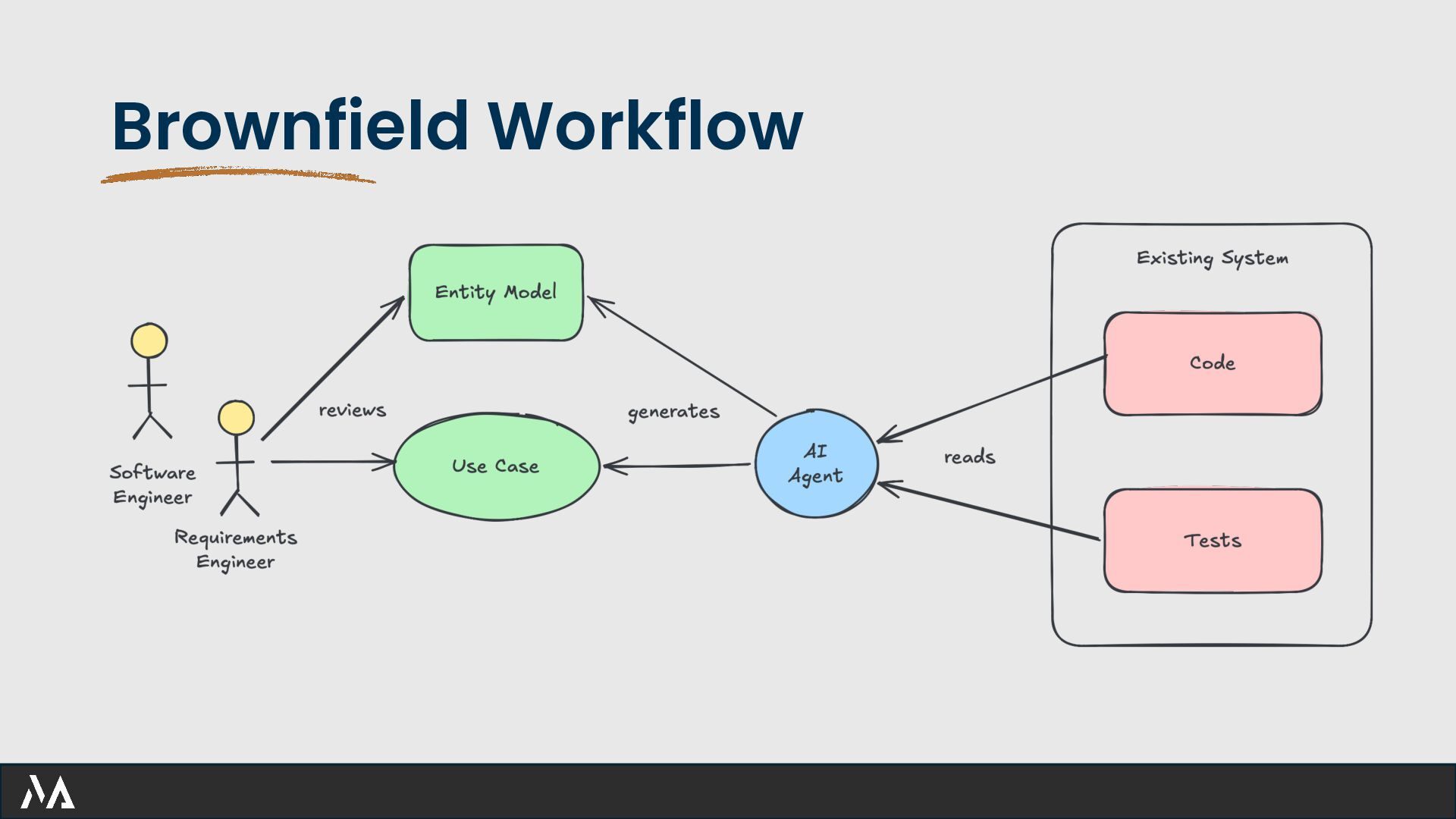
    • Code, database schema, tests, old documents • Reverse engineer the specs • /reverse-engineer creates the use case diagram, the use cases and the entity model • Review with the business • The code shows what the system does, not what it should do • One module at a time • A large monolith does not fit into the context • Then work spec-first • Every new change starts in the spec
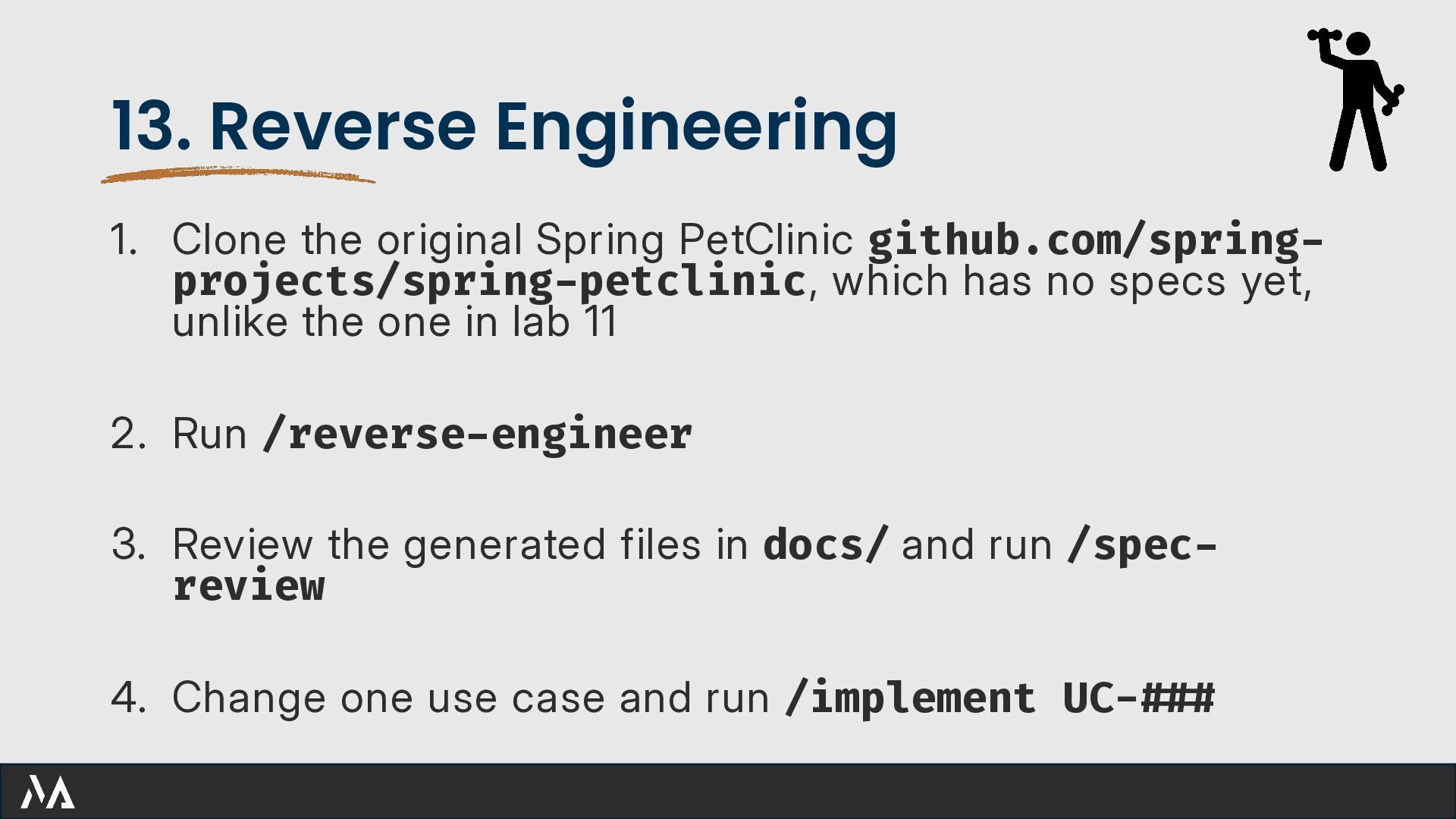
  55. 13. Reverse Engineering 1. Clone the original Spring PetClinic github.com/springprojects/spring-petclinic,

    which has no specs yet, unlike the one in lab 11 2. Run /reverse-engineer 3. Review the generated files in docs/ and run /specreview 4. Change one use case and run /implement UC-###
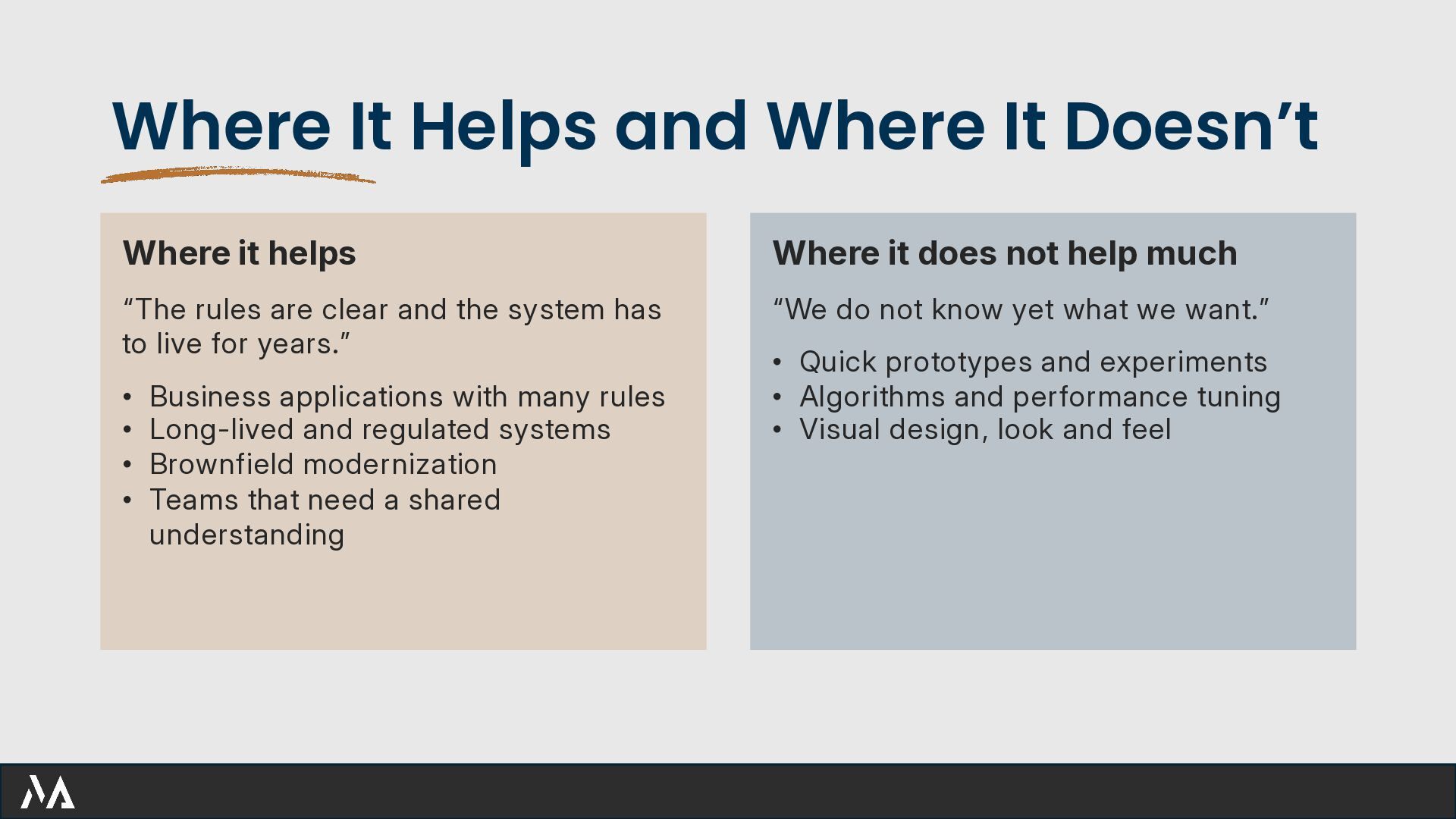
  56. Where It Helps and Where It Doesn’t Where it helps

    Where it does not help much “ The rules are clear and the system has to live for years.” “ We do not know yet what we want.” • Business applications with many rules • Long-lived and regulated systems • Brownfield modernization • Teams that need a shared understanding • Quick prototypes and experiments • Algorithms and performance tuning • Visual design, look and feel
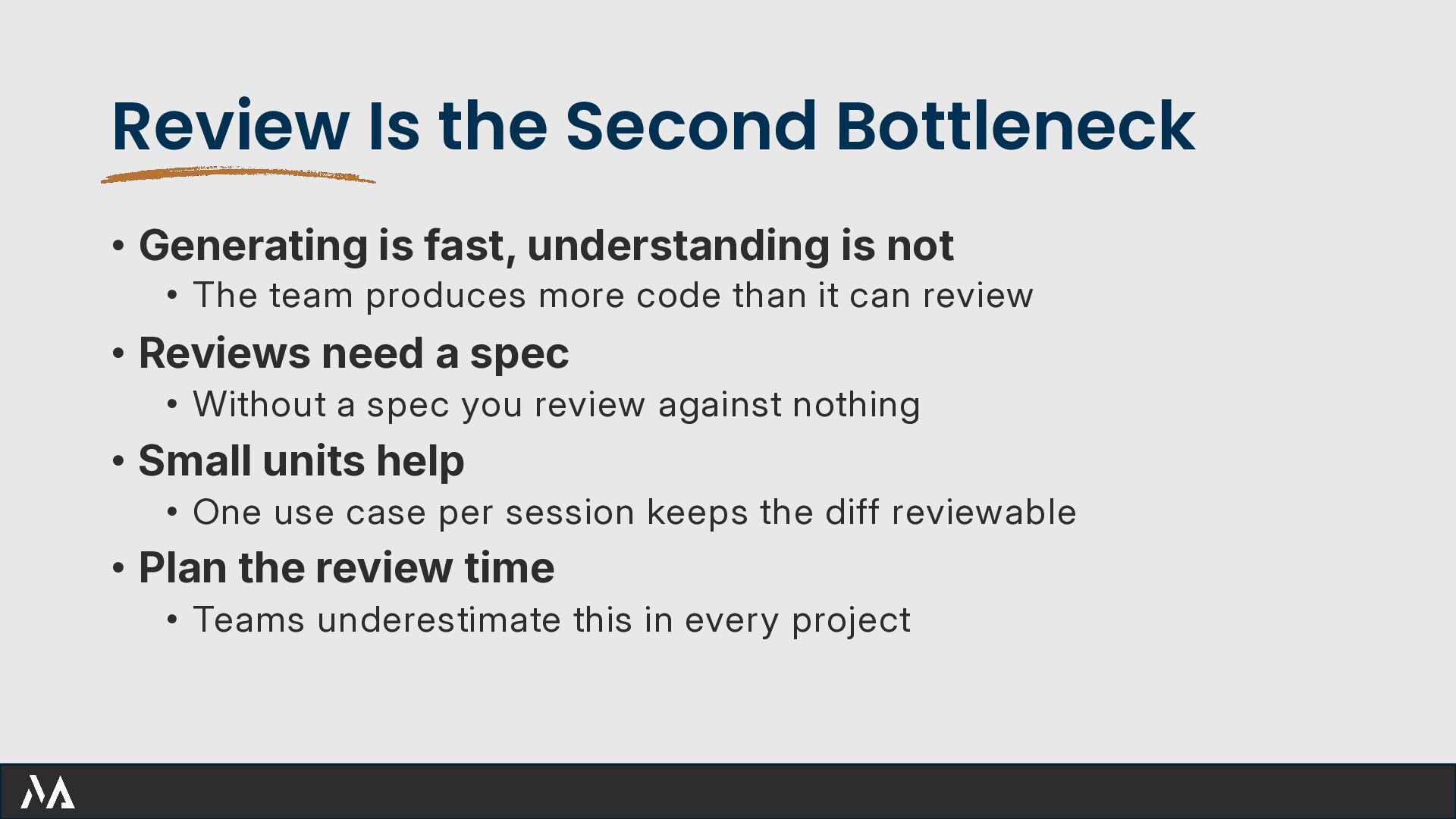
  57. Review Is the Second Bottleneck • Generating is fast, understanding

    is not • The team produces more code than it can review • Reviews need a spec • Without a spec you review against nothing • Small units help • One use case per session keeps the diff reviewable • Plan the review time • Teams underestimate this in every project
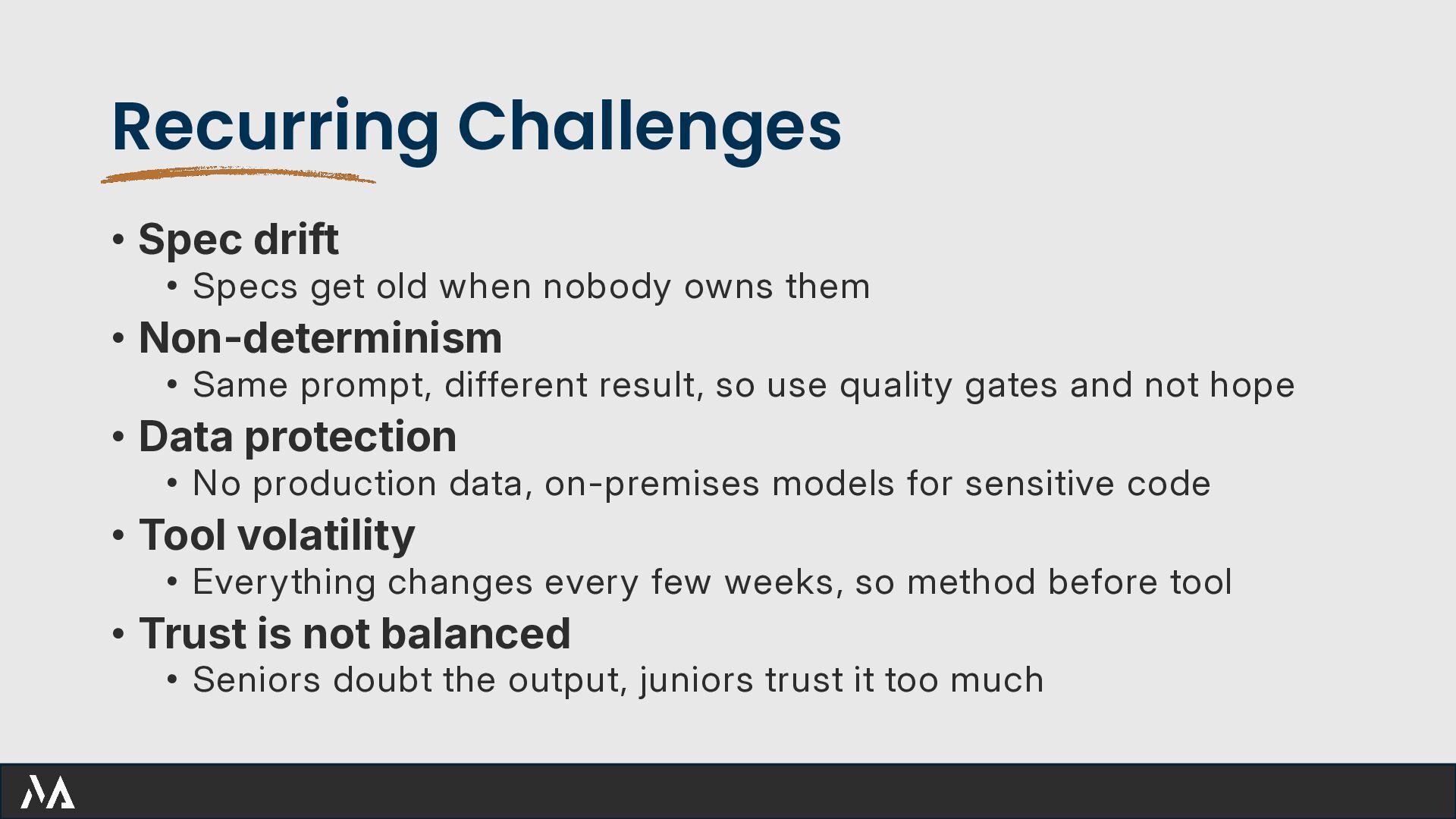
  58. Recurring Challenges • Spec drift • Specs get old when

    nobody owns them • Non-determinism • Same prompt, different result, so use quality gates and not hope • Data protection • No production data, on-premises models for sensitive code • Tool volatility • Everything changes every few weeks, so method before tool • Trust is not balanced • Seniors doubt the output, juniors trust it too much
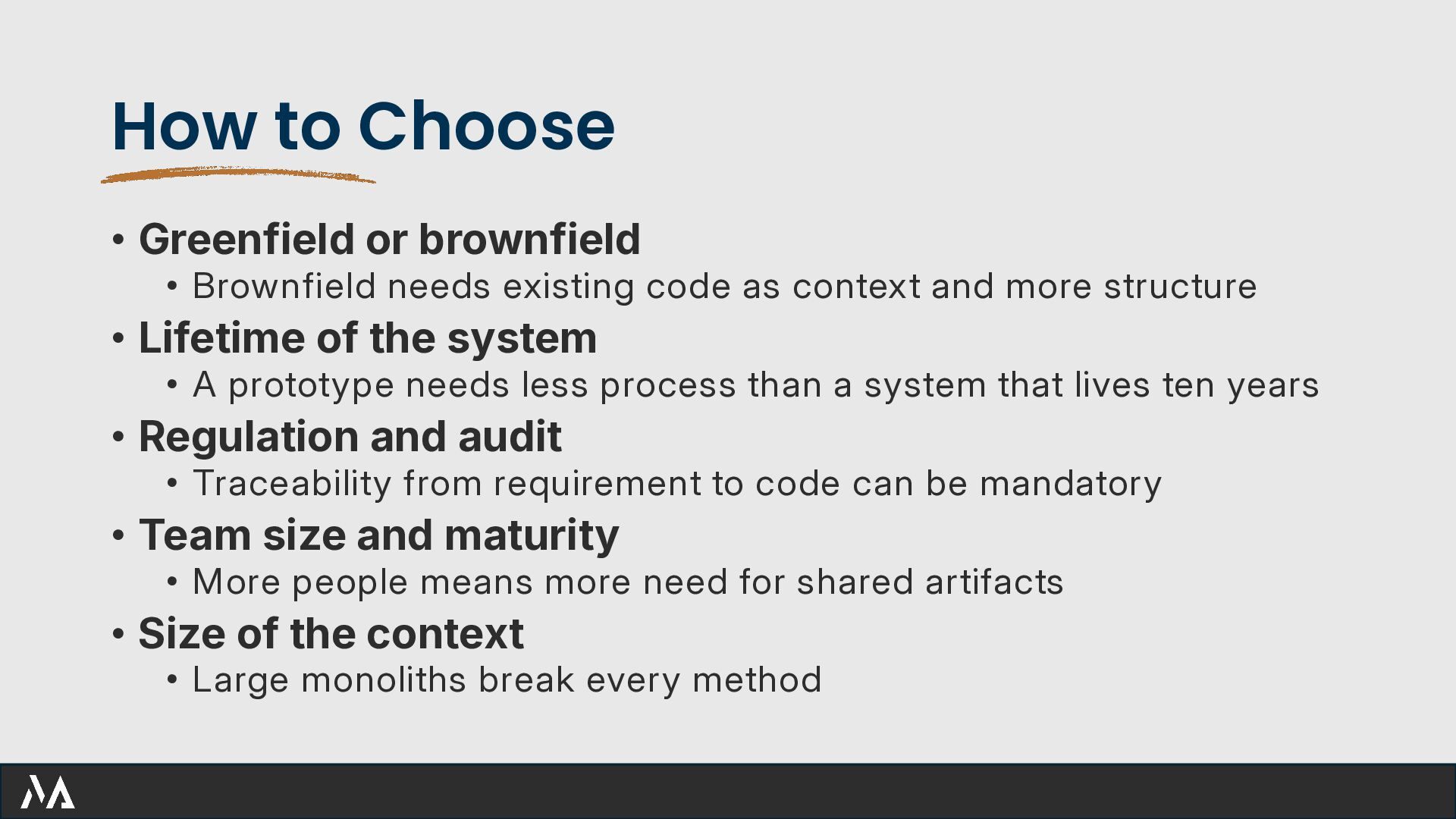
  59. How to Choose • Greenfield or brownfield • Brownfield needs

    existing code as context and more structure • Lifetime of the system • A prototype needs less process than a system that lives ten years • Regulation and audit • Traceability from requirement to code can be mandatory • Team size and maturity • More people means more need for shared artifacts • Size of the context • Large monoliths break every method
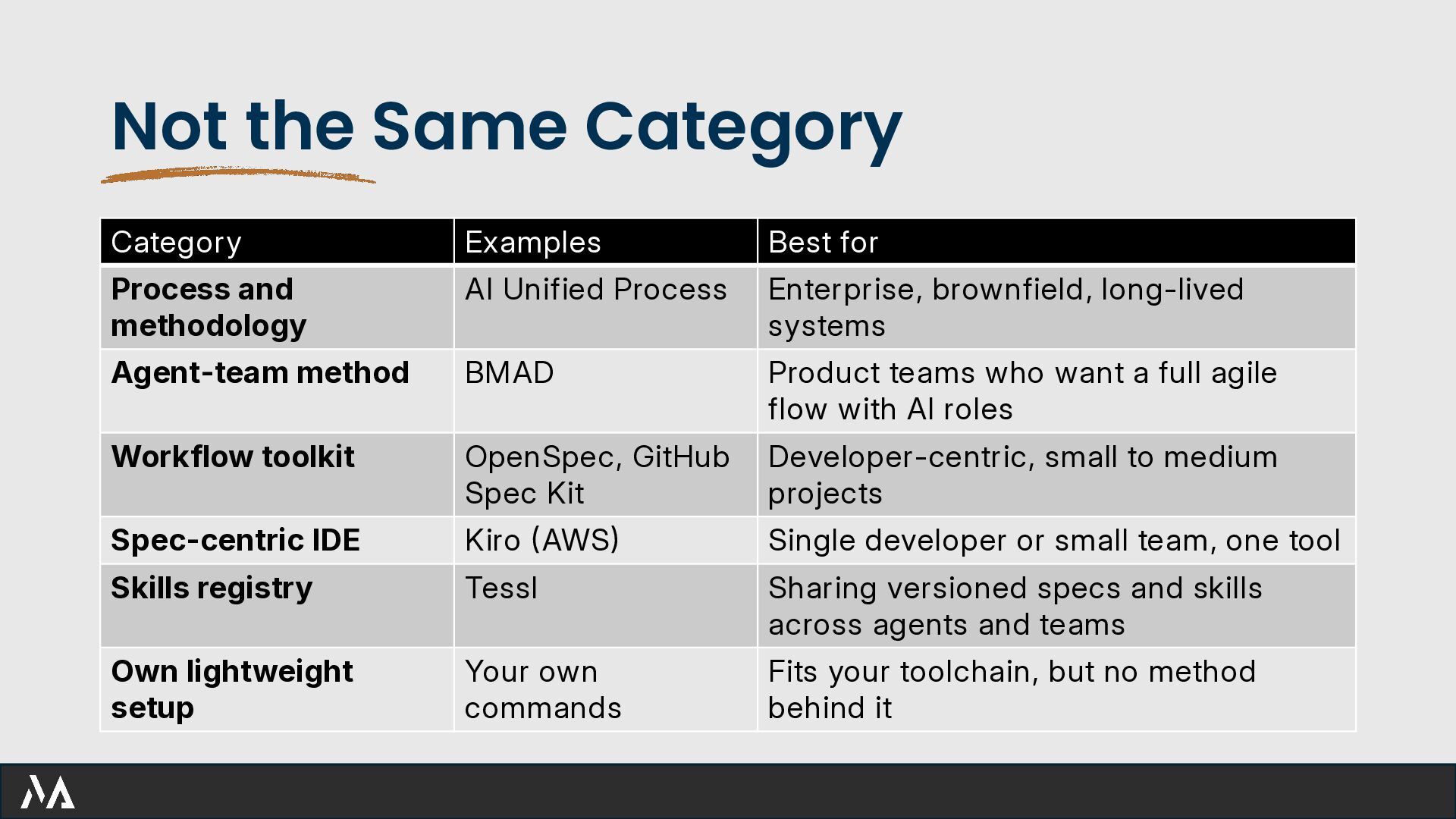
  60. Not the Same Category Category Examples Best for Process and

    methodology AI Unified Process Enterprise, brownfield, long-lived systems Agent-team method BMAD Product teams who want a full agile flow with AI roles Workflow toolkit OpenSpec, GitHub Spec Kit Developer-centric, small to medium projects Spec-centric IDE Kiro AWS Single developer or small team, one tool Skills registry Tessl Sharing versioned specs and skills across agents and teams Own lightweight setup Your own commands Fits your toolchain, but no method behind it
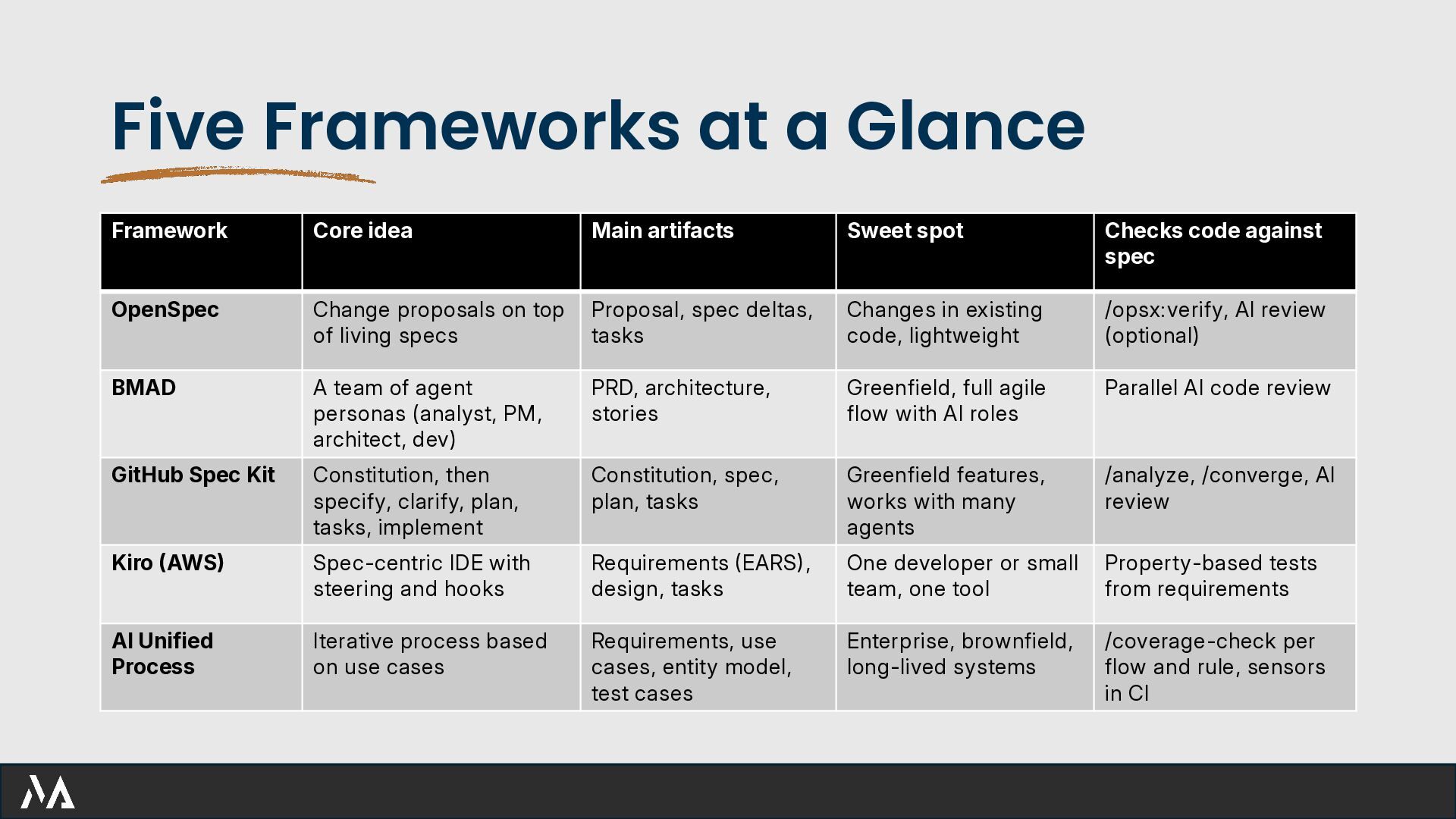
  61. Five Frameworks at a Glance Framework Core idea Main artifacts

    Sweet spot Checks code against spec OpenSpec Change proposals on top of living specs Proposal, spec deltas, tasks Changes in existing code, lightweight /opsx:verify, AI review (optional) BMAD A team of agent personas (analyst, PM, architect, dev) PRD, architecture, stories Greenfield, full agile flow with AI roles Parallel AI code review GitHub Spec Kit Constitution, then specify, clarify, plan, tasks, implement Constitution, spec, plan, tasks Greenfield features, works with many agents /analyze, /converge, AI review Kiro AWS Spec-centric IDE with steering and hooks Requirements EARS, design, tasks One developer or small team, one tool Property-based tests from requirements AI Unified Process Iterative process based on use cases Requirements, use cases, entity model, test cases Enterprise, brownfield, long-lived systems /coverage-check per flow and rule, sensors in CI
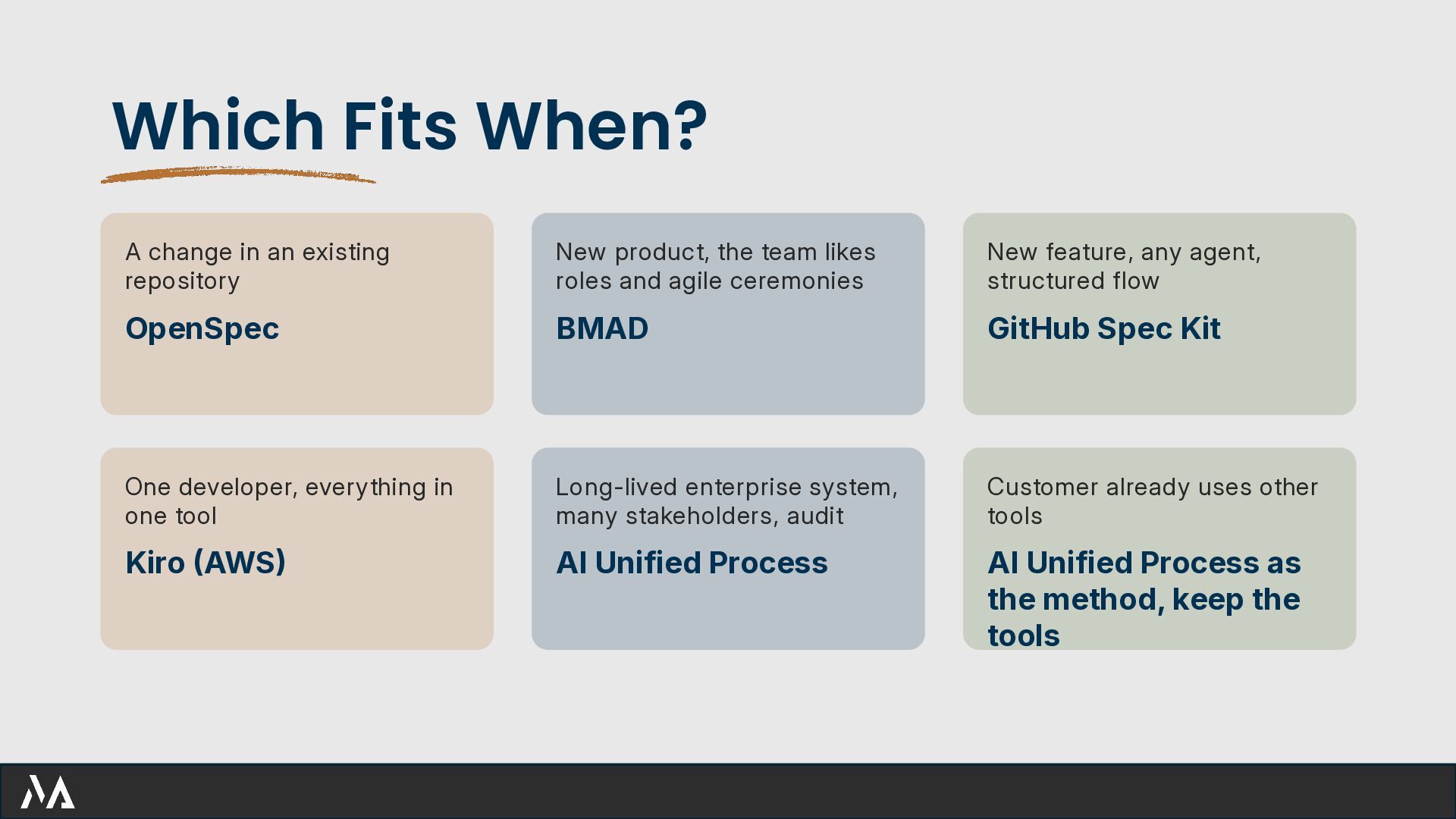
  62. Which Fits When? A change in an existing repository New

    product, the team likes roles and agile ceremonies New feature, any agent, structured flow OpenSpec BMAD GitHub Spec Kit One developer, everything in one tool Long-lived enterprise system, many stakeholders, audit Customer already uses other tools Kiro AWS AI Unified Process AI Unified Process as the method, keep the tools
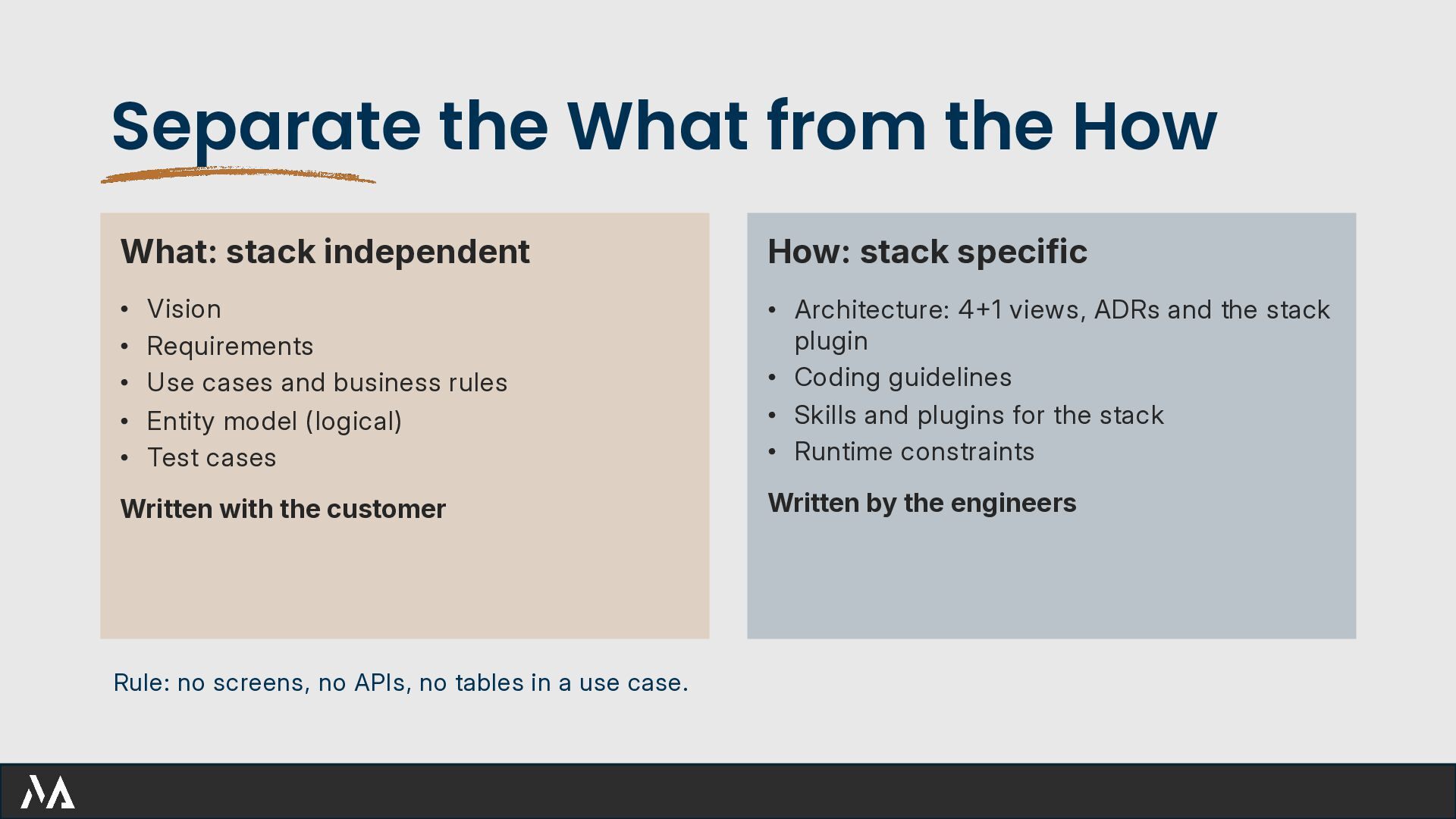
  63. Separate the What from the How What: stack independent •

    • • • • Vision Requirements Use cases and business rules Entity model (logical) Test cases Written with the customer Rule: no screens, no APIs, no tables in a use case. How: stack specific • Architecture: 41 views, ADRs and the stack plugin • Coding guidelines • Skills and plugins for the stack • Runtime constraints Written by the engineers
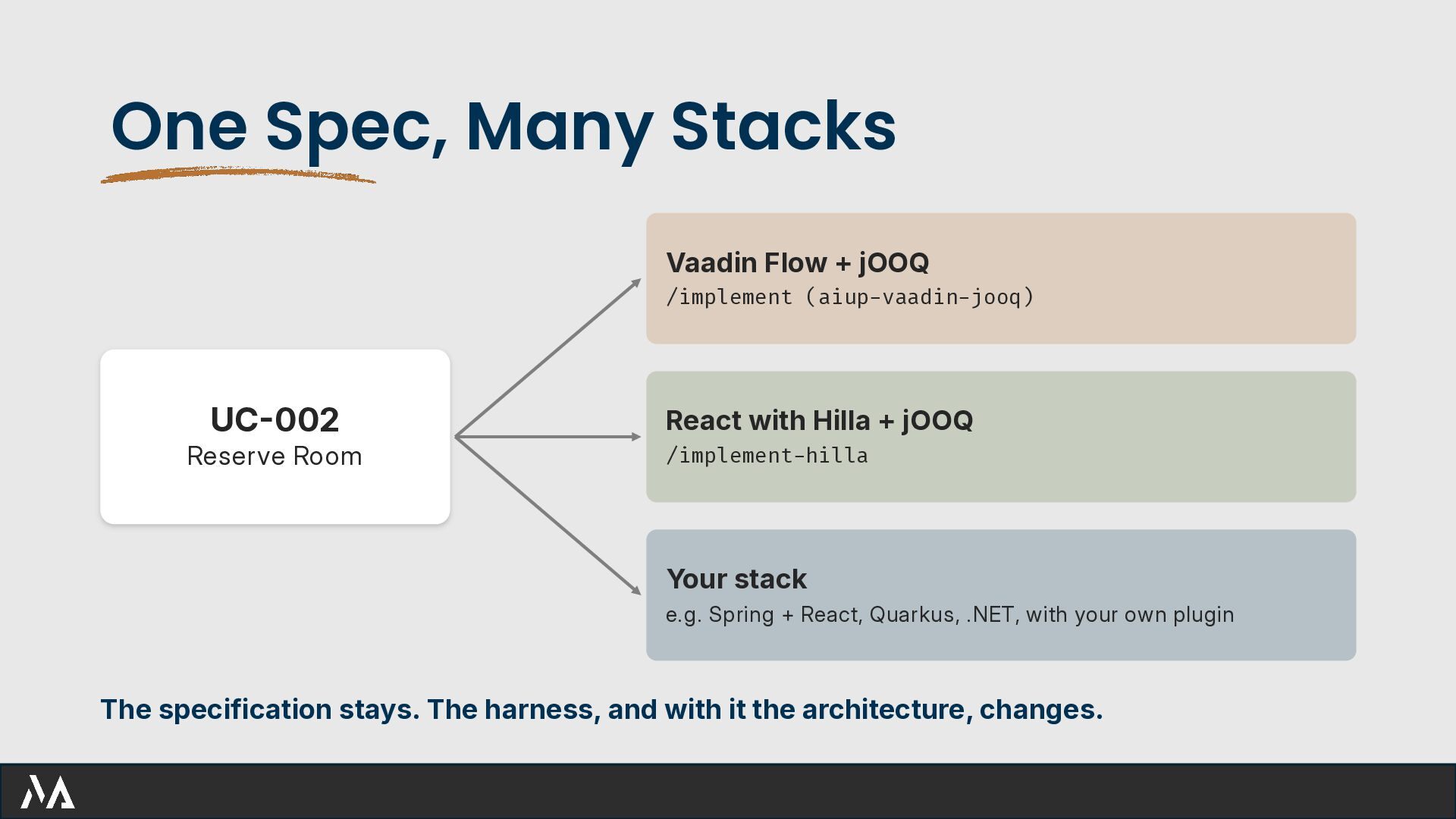
  64. One Spec, Many Stacks Vaadin Flow + jOOQ /implement (aiup-vaadin-jooq)

    UC002 Reserve Room React with Hilla + jOOQ /implement-hilla Your stack e.g. Spring + React, Quarkus, .NET, with your own plugin The specification stays. The harness, and with it the architecture, changes.
  65. How to Try It on Your Own Stack • Pick

    one real use case • Small, but with real business rules • Write the spec first • Vision, requirements, entity model, one use case • Build a minimal harness • CLAUDE.md, one skill for your stack, one quality gate • Reuse what exists • AI Unified Process marketplace: unifiedprocess.ai • Measure • Rework, review findings and tokens per use case
  66. Conclusion • Specs and the harness help to reduce non-determinism

    and make development sustainable • It accelerates development, but you are responsible for the quality • Know your architecture and domain
  67. Thank you! • Web martinelli.ch • EMail [email protected] • Bluesky

    @martinelli.ch • X/Twitter @simas_ch • LinkedIn https://linkedin.com/in/ simonmartinelli