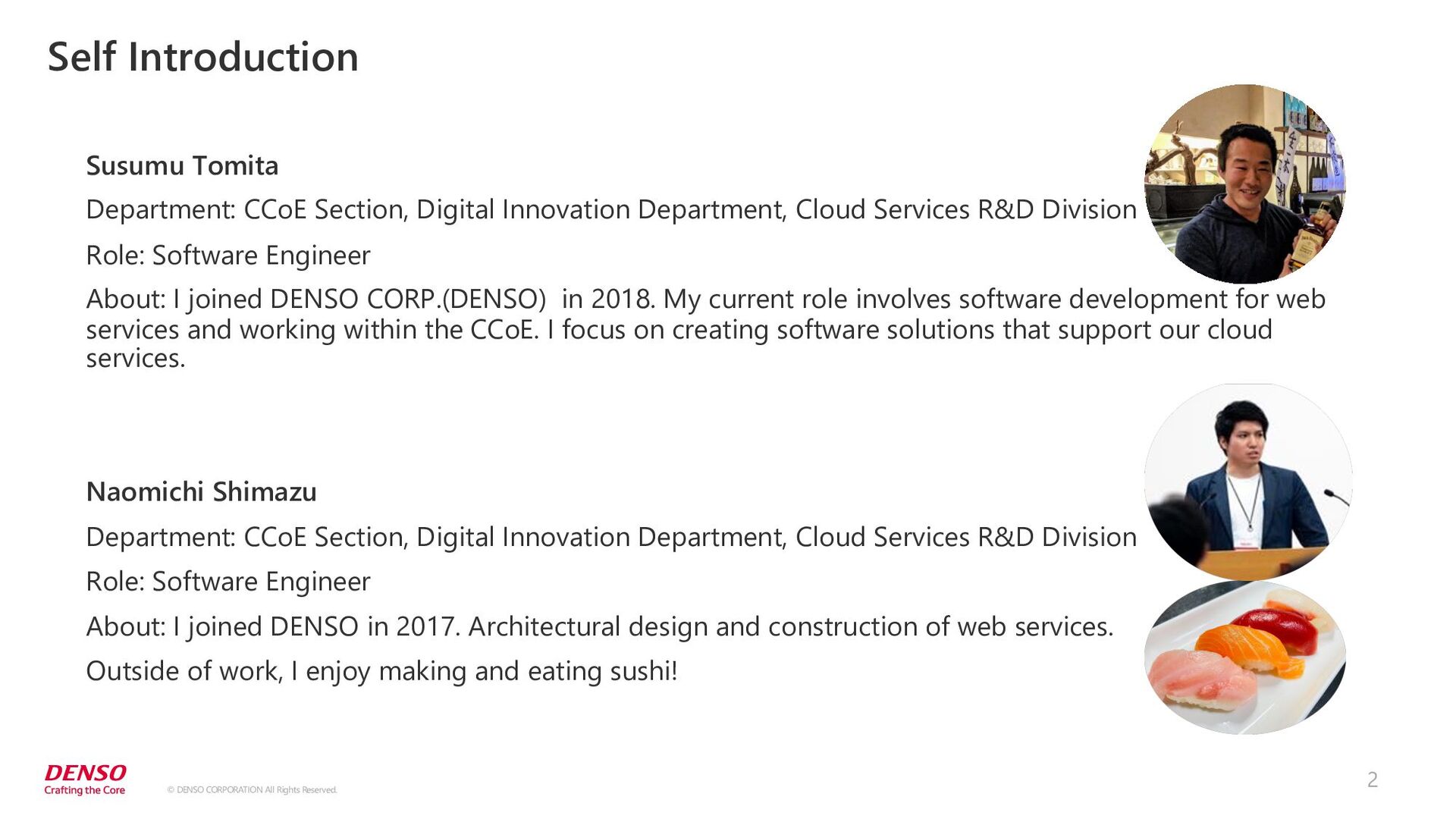
CCoE Section, Digital Innovation Department, Cloud Services R&D Division Role: Software Engineer About: I joined DENSO CORP.(DENSO) in 2018. My current role involves software development for web services and working within the CCoE. I focus on creating software solutions that support our cloud services. Naomichi Shimazu Department: CCoE Section, Digital Innovation Department, Cloud Services R&D Division Role: Software Engineer About: I joined DENSO in 2017. Architectural design and construction of web services. Outside of work, I enjoy making and eating sushi! Self Introduction
o DENSO is leader in changing car technology. Cars are now more using computer technology for Software-Defined Vehicles , connected cars and so on. • Need for New Skills: o Many embedded software engineers are working in DENSO, but we need expand our capability more. o For example cloud and web technologies. • What We Do: o Design and implement the next generation cars. Safer, easy to use and integrated Cloud and new technologies.. About DENSO: Embracing Cloud Technology Denmaru
o Our department established in 2017 to enhance our capabilities in cloud technologies. • Diverse Team Composition: o Our team includes not only software engineers but also business developers, combining technical and commercial expertise. • Collaborative Approach: o Our business and development teams work together closely, using a 'try and error' method to rapidly develop and refine software products. • Growth Strategy: o We start our projects small and scale them up gradually based on success and learning. Cloud Services R&D Division
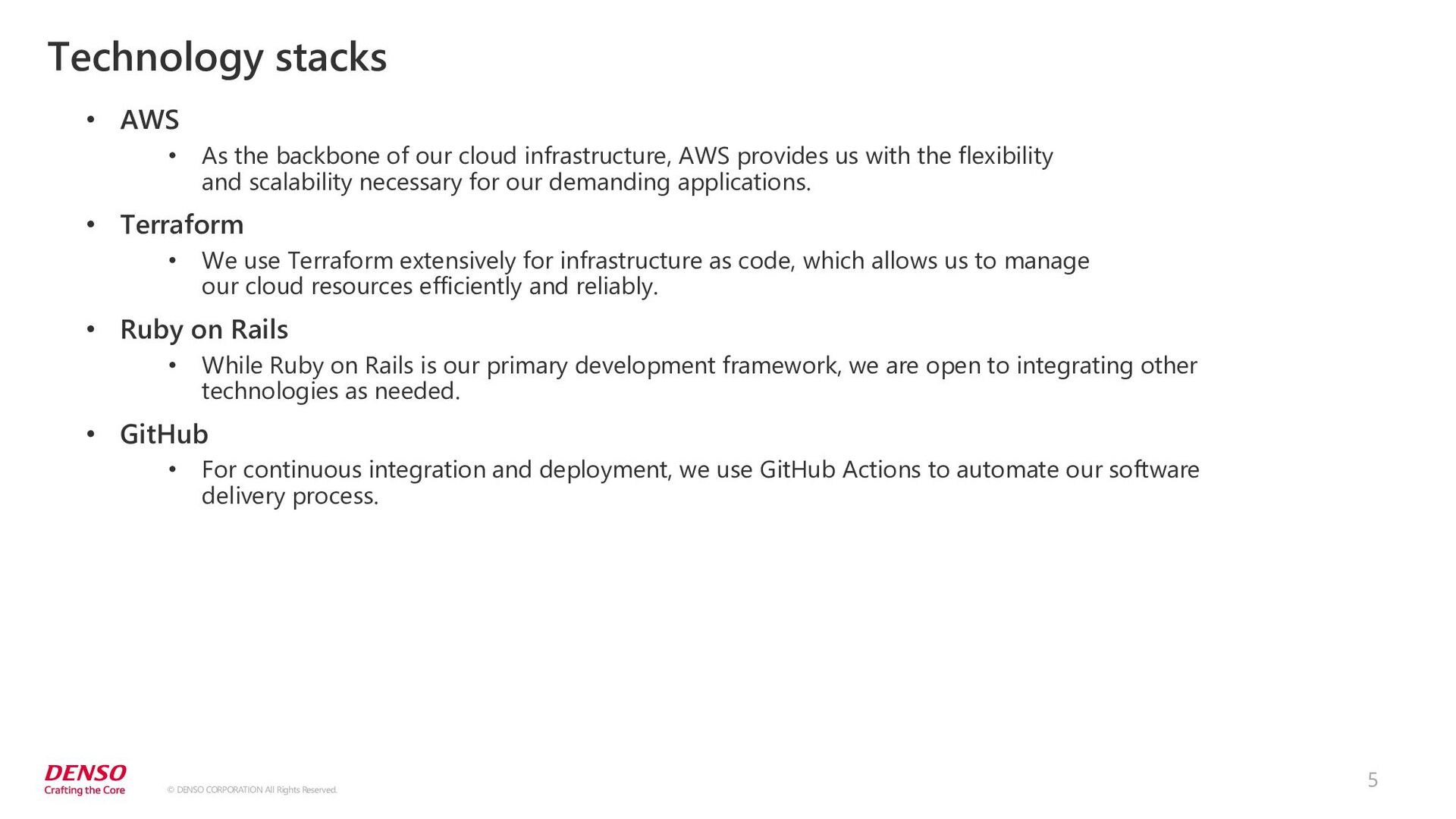
As the backbone of our cloud infrastructure, AWS provides us with the flexibility and scalability necessary for our demanding applications. • Terraform • We use Terraform extensively for infrastructure as code, which allows us to manage our cloud resources efficiently and reliably. • Ruby on Rails • While Ruby on Rails is our primary development framework, we are open to integrating other technologies as needed. • GitHub • For continuous integration and deployment, we use GitHub Actions to automate our software delivery process. Technology stacks
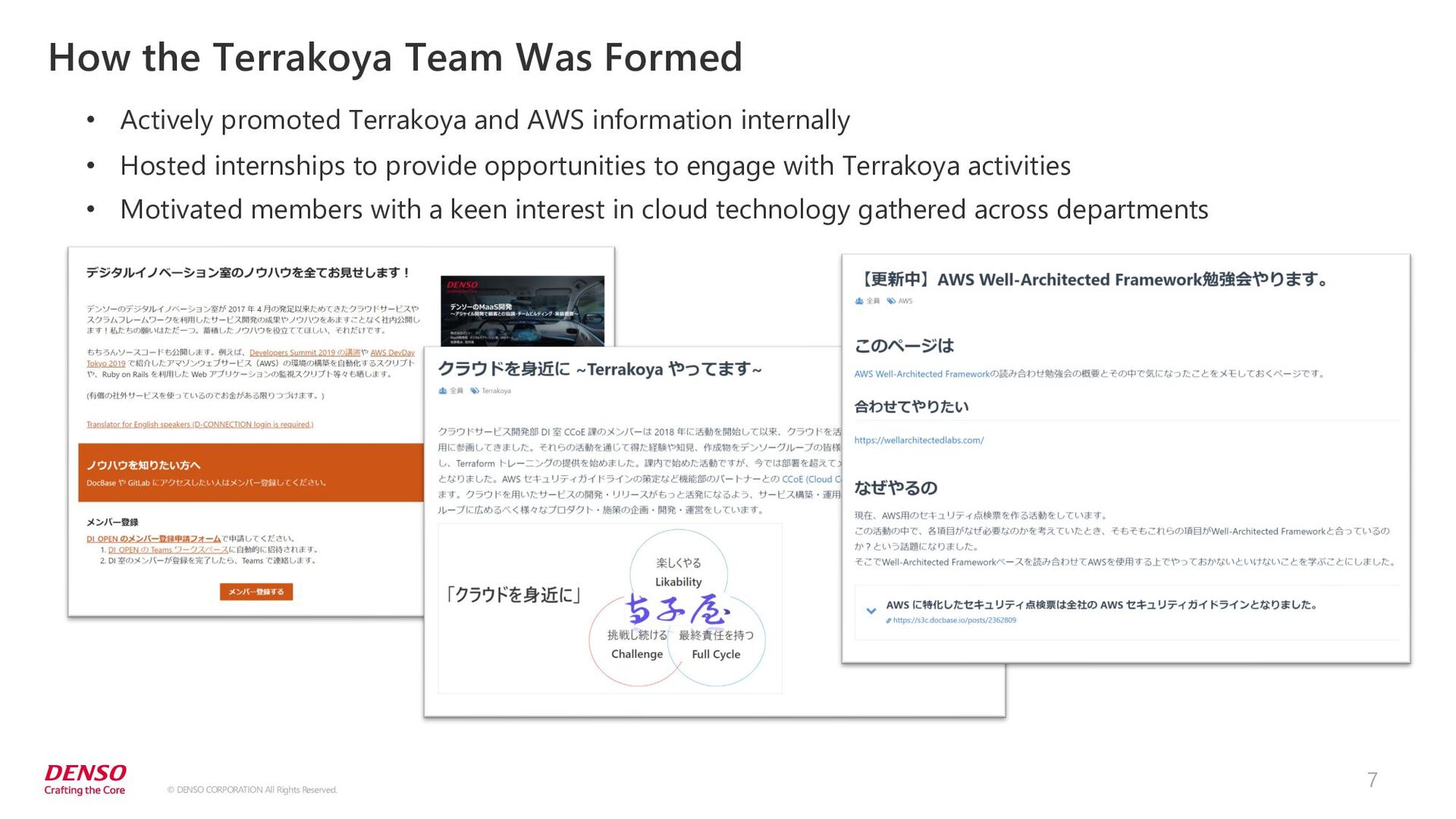
Terrakoya and AWS information internally • Hosted internships to provide opportunities to engage with Terrakoya activities • Motivated members with a keen interest in cloud technology gathered across departments How the Terrakoya Team Was Formed
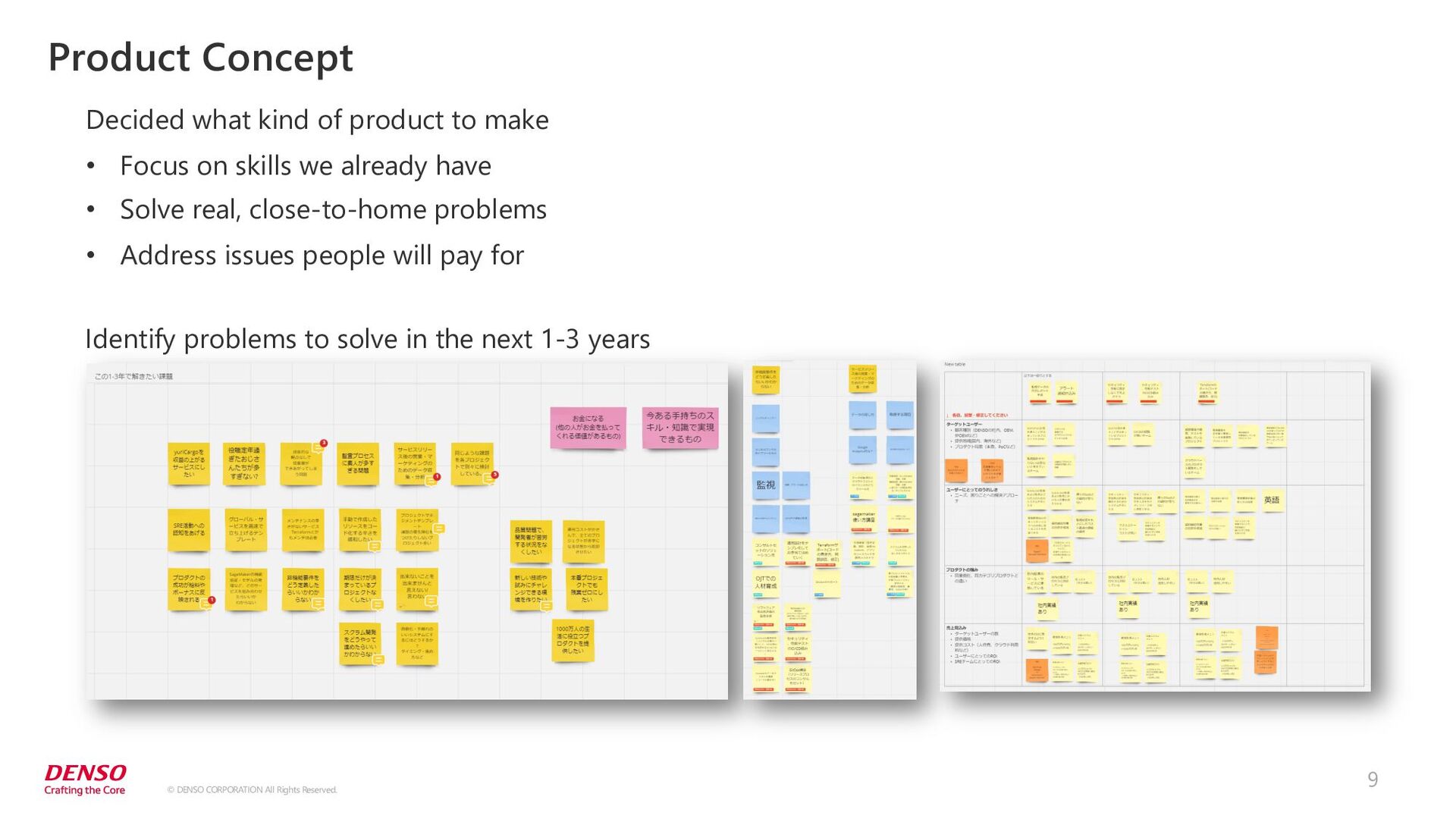
of product to make • Focus on skills we already have • Solve real, close-to-home problems • Address issues people will pay for Product Concept Identify problems to solve in the next 1-3 years
Training • Internal AWS Security Guidelines • Operational Muscle Training 👈 Today's focus Training for IT service operations skills and knowledge Terrakoya members act as trainers, solving real-world issues together Examples: AWS cost optimization, release process optimization Terrakoya's Released Products
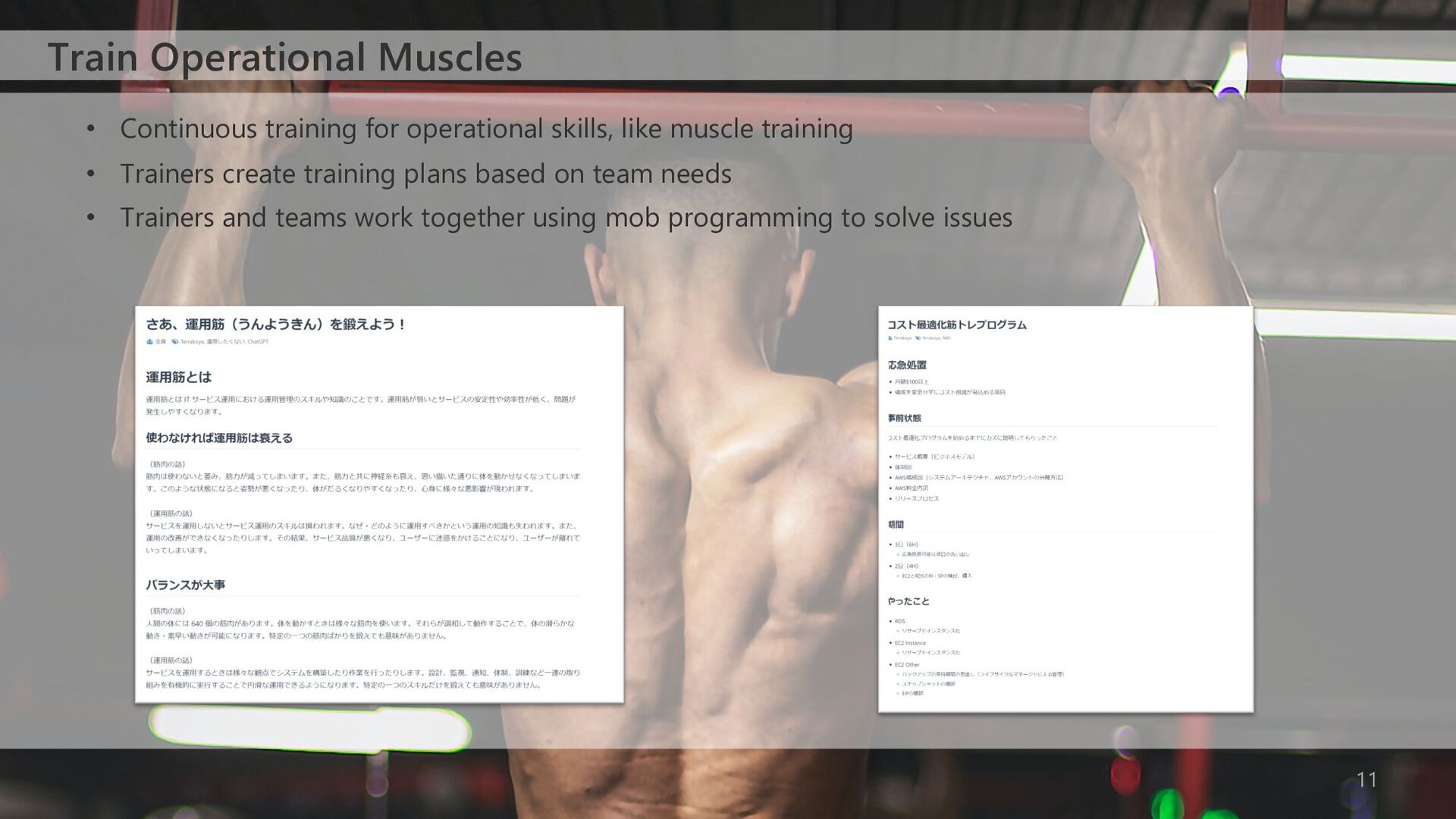
for operational skills, like muscle training • Trainers create training plans based on team needs • Trainers and teams work together using mob programming to solve issues Train Operational Muscles
weaken if not used • Balance is important • Training reduces effort needed for operations • Training lowers the risk of service failures Example: If we don't use a CI/CD pipeline and continue with manual releases, it creates problems. By building processes into our operations and regularly reviewing them, we can make operations smoother. We call this operational muscle training. Benefits of Training Operational Muscles
to handle customer complaints smoothly • Keep better records to talk with customers based on facts • Improve mental stability, sleep better at night Create systems to avoid night-time emergency responses, making night on-calls unnecessary • Reduce internal and external pressure during incident recovery Effects of Training Operational Muscles
system, purpose, and methods • Exercise operational muscles daily • Adopt the latest practices • Get external trainers for guidance How to Train Operational Muscles
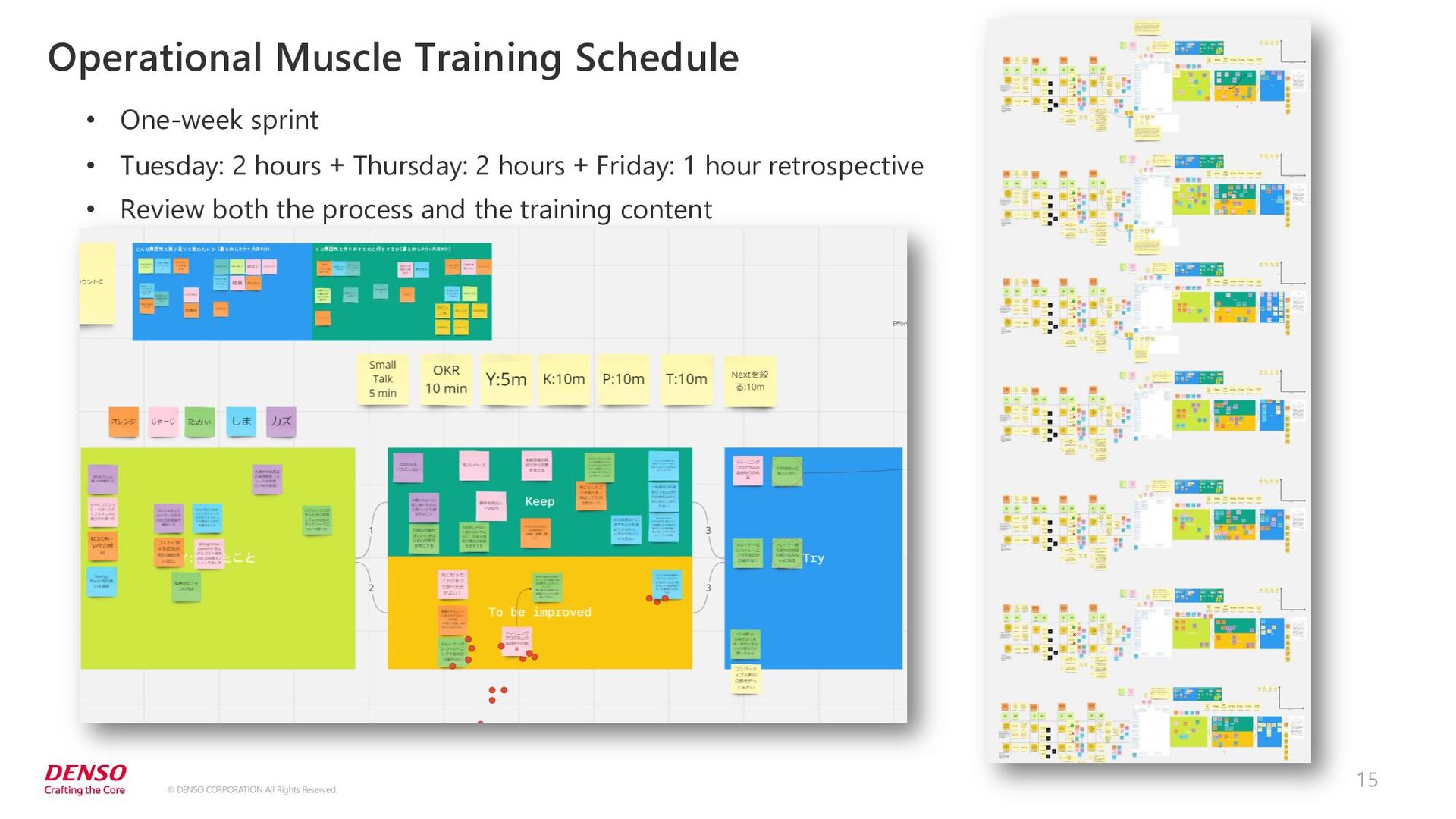
• Tuesday: 2 hours + Thursday: 2 hours + Friday: 1 hour retrospective • Review both the process and the training content Operational Muscle Training Schedule
commercial product development teams To begin with, we provided first aid improvements. Below are the results • Optimized release procedures: o Reduced pre-release steps from 27 to 2 o Reduced backup steps from 7 to 1 o Eliminated post-release steps from 1 to 0 • AWS Cost optimization: o Trained teams on Reserved Instances and Savings Plans o Achieved up to 60% reduction in server running costs The First Step of Operational Muscle Training
release procedure documents with trainees • Key questions to ask trainees: o Why does this procedure exist? o How did this procedure come to be? • Encourage insights through questions, not just pointing out issues Concrete Steps for Optimized Release Procedures
what can be done quickly without changing the structure • Focus on services with high billing amounts • Check invoices as a team (mob programming) o Set a threshold for review (e.g., items costing over $100) • Avoid structural changes due to planned future changes AWS Cost Optimization
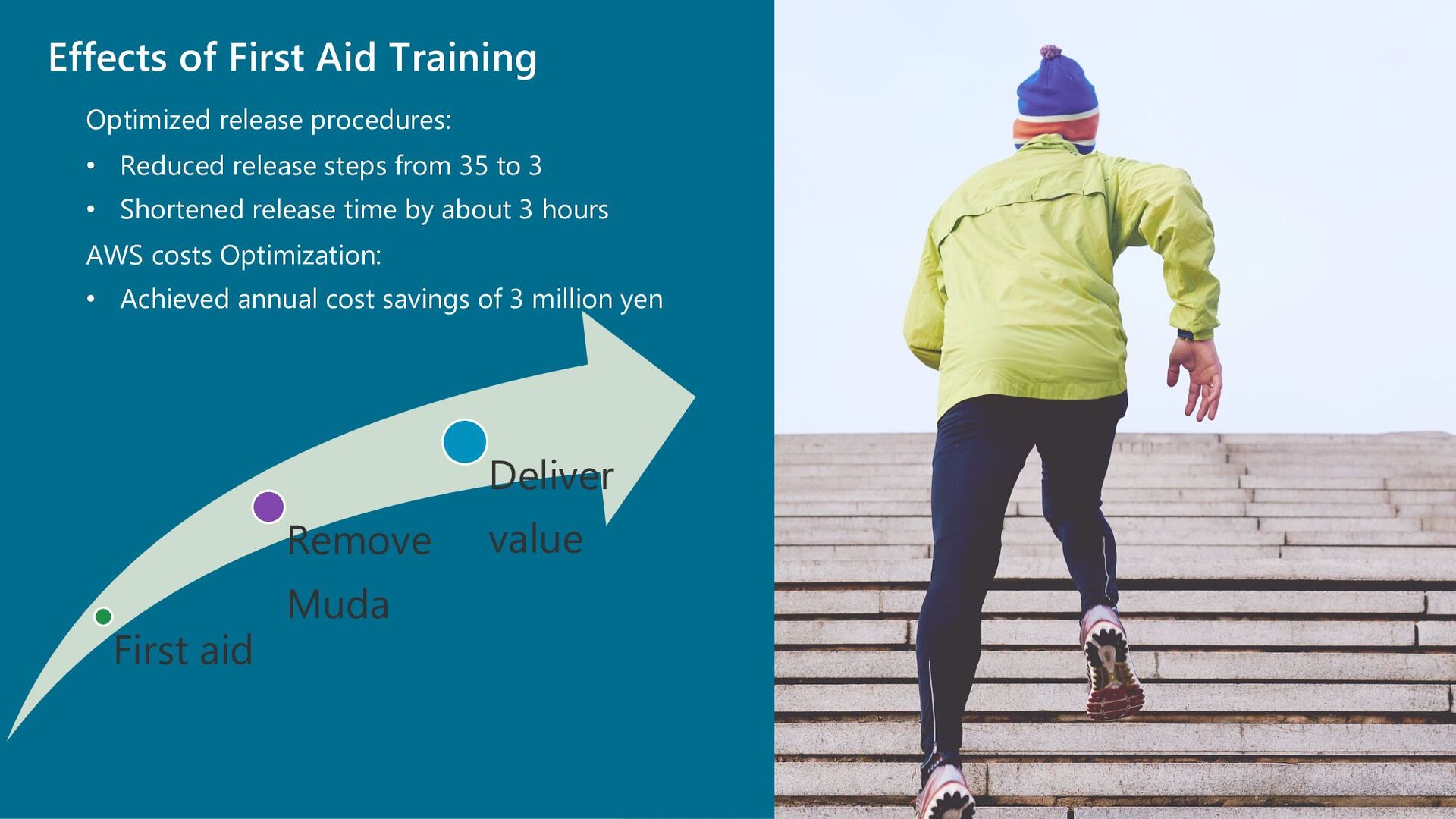
Deliver value 19 Optimized release procedures: • Reduced release steps from 35 to 3 • Shortened release time by about 3 hours AWS costs Optimization: • Achieved annual cost savings of 3 million yen Effects of First Aid Training
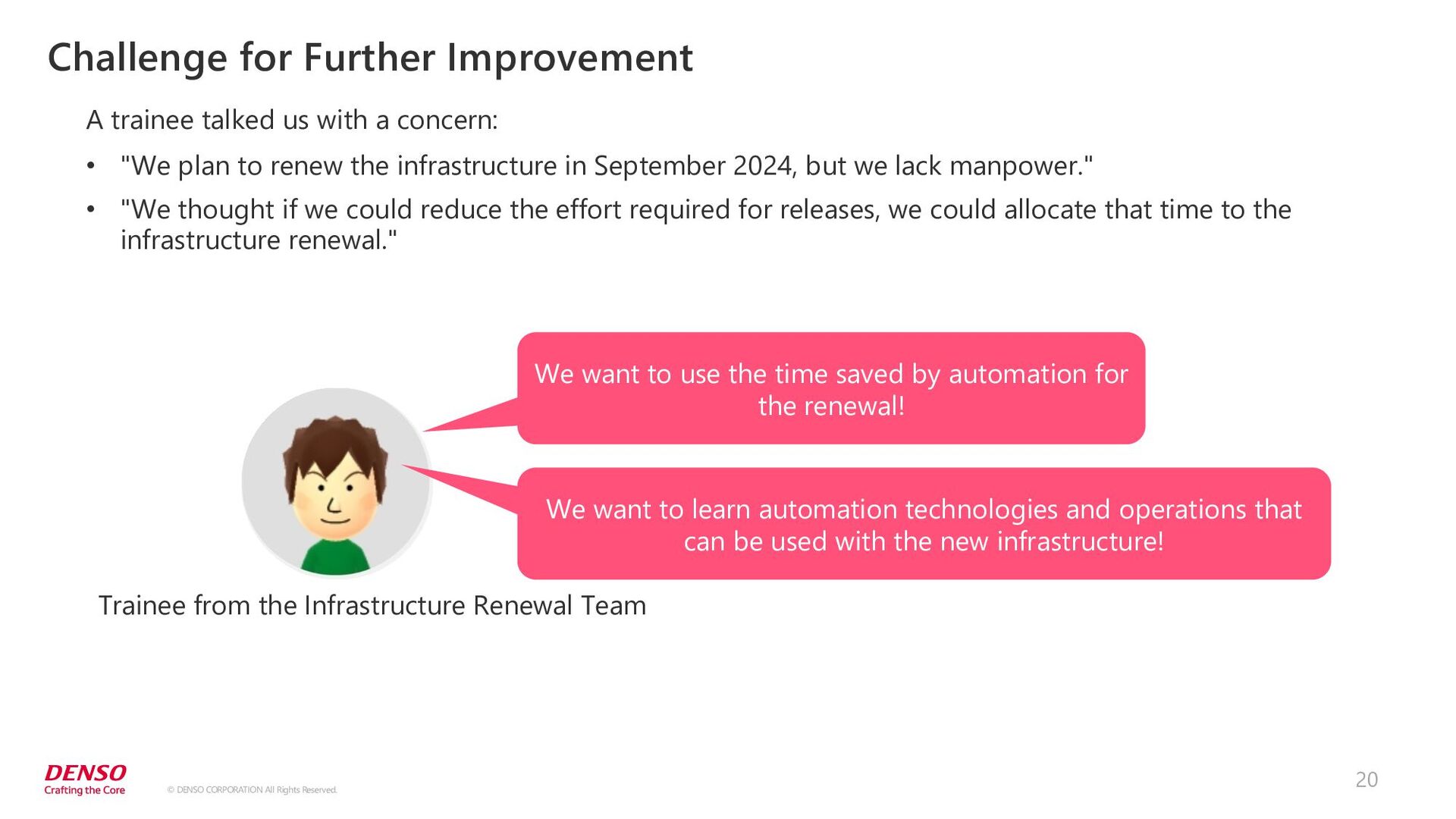
us with a concern: • "We plan to renew the infrastructure in September 2024, but we lack manpower." • "We thought if we could reduce the effort required for releases, we could allocate that time to the infrastructure renewal." Challenge for Further Improvement We want to learn automation technologies and operations that can be used with the new infrastructure! We want to use the time saved by automation for the renewal! Trainee from the Infrastructure Renewal Team
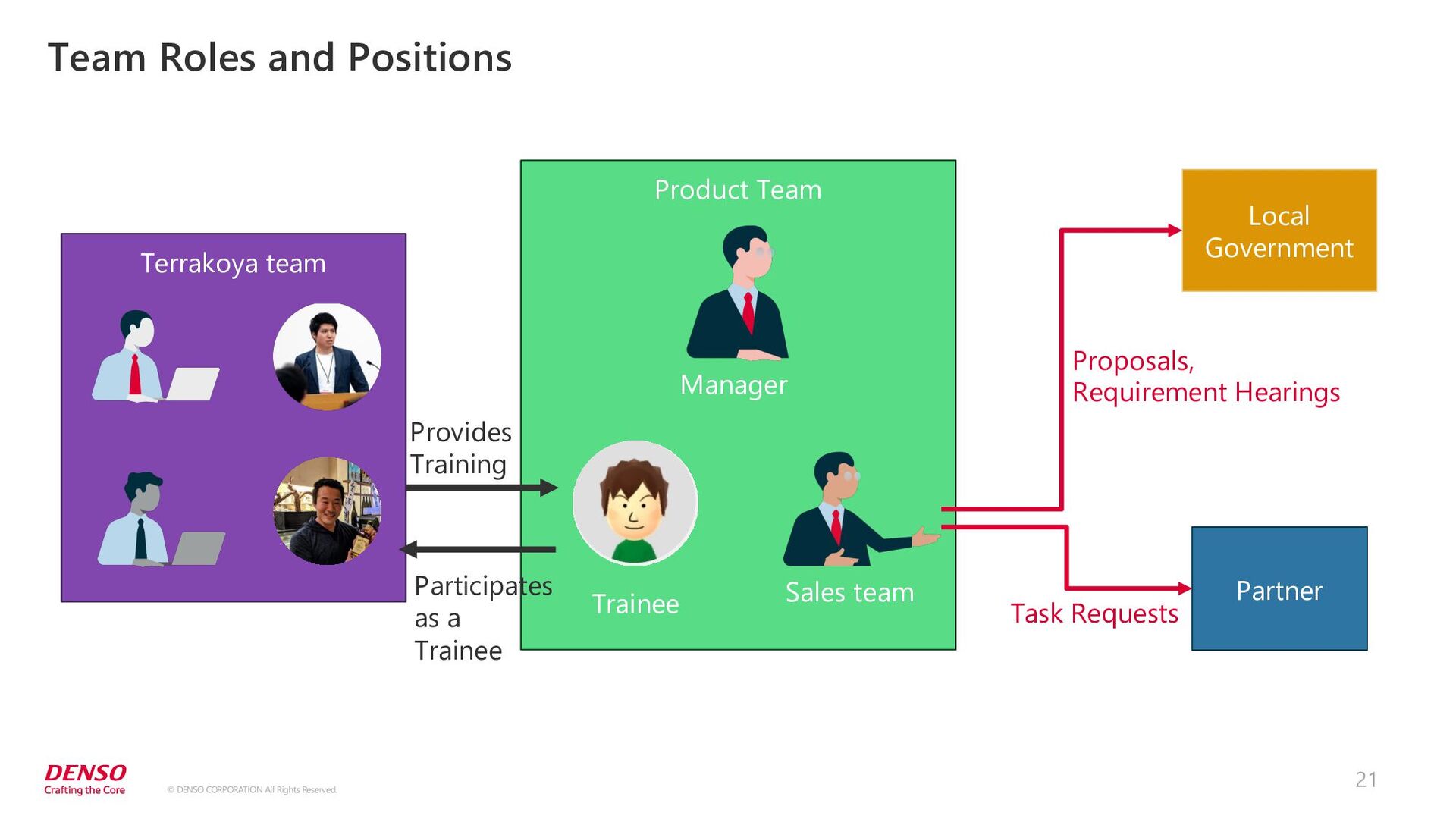
Positions Product Team Terrakoya team Partner Local Government Manager Sales team Provides Training Participates as a Trainee Proposals, Requirement Hearings Task Requests Trainee
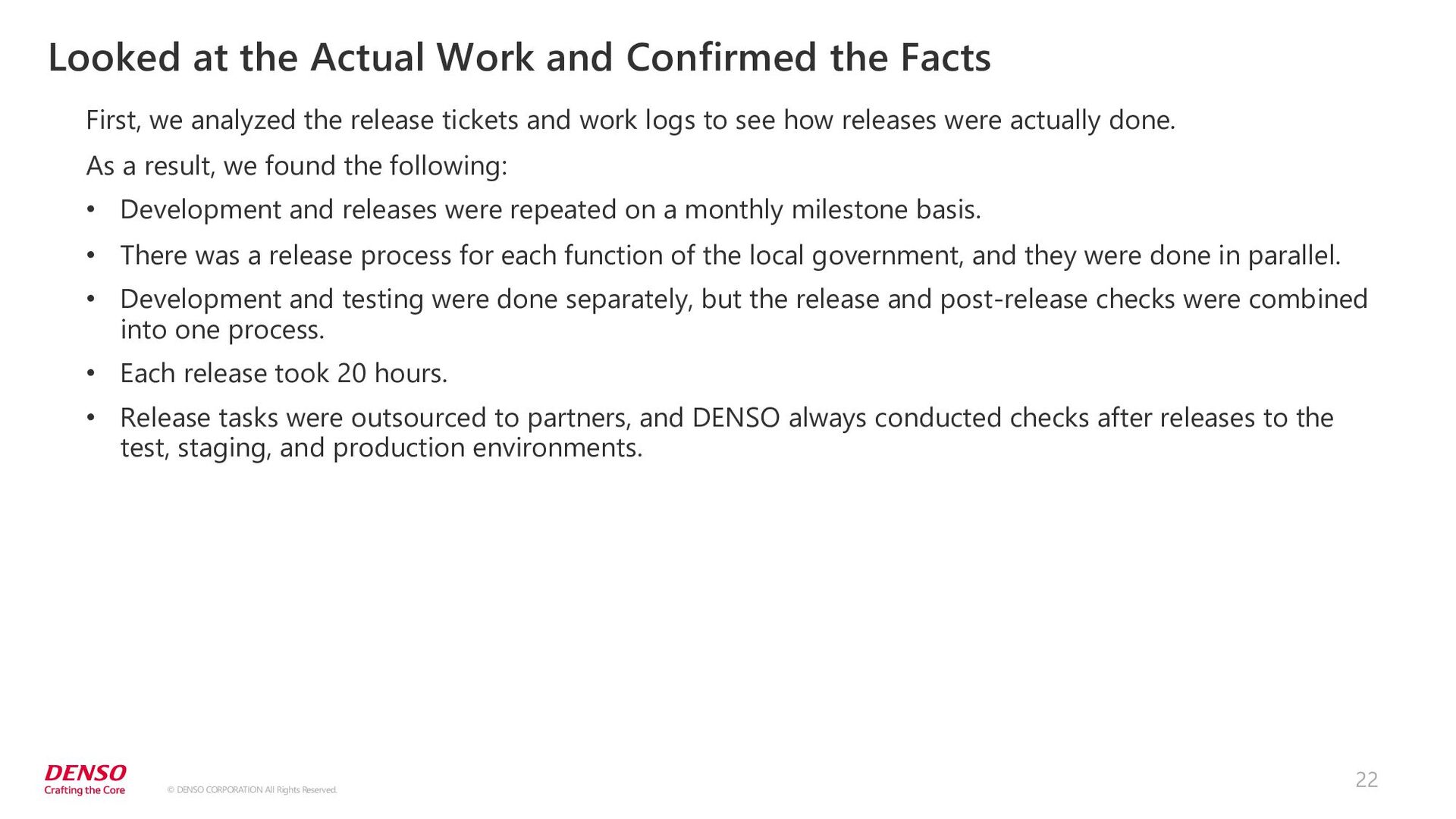
the release tickets and work logs to see how releases were actually done. As a result, we found the following: • Development and releases were repeated on a monthly milestone basis. • There was a release process for each function of the local government, and they were done in parallel. • Development and testing were done separately, but the release and post-release checks were combined into one process. • Each release took 20 hours. • Release tasks were outsourced to partners, and DENSO always conducted checks after releases to the test, staging, and production environments. Looked at the Actual Work and Confirmed the Facts
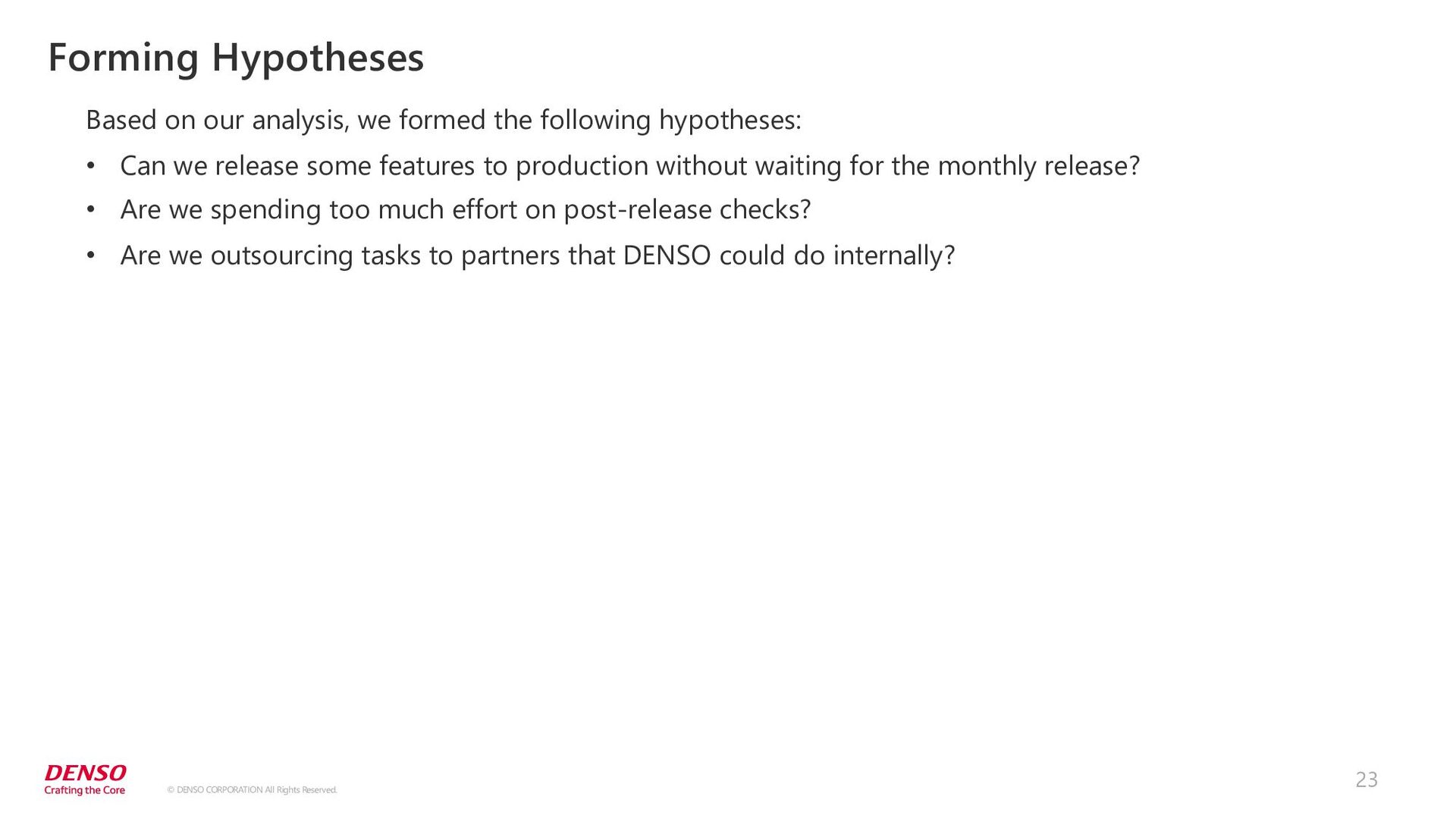
analysis, we formed the following hypotheses: • Can we release some features to production without waiting for the monthly release? • Are we spending too much effort on post-release checks? • Are we outsourcing tasks to partners that DENSO could do internally? Forming Hypotheses
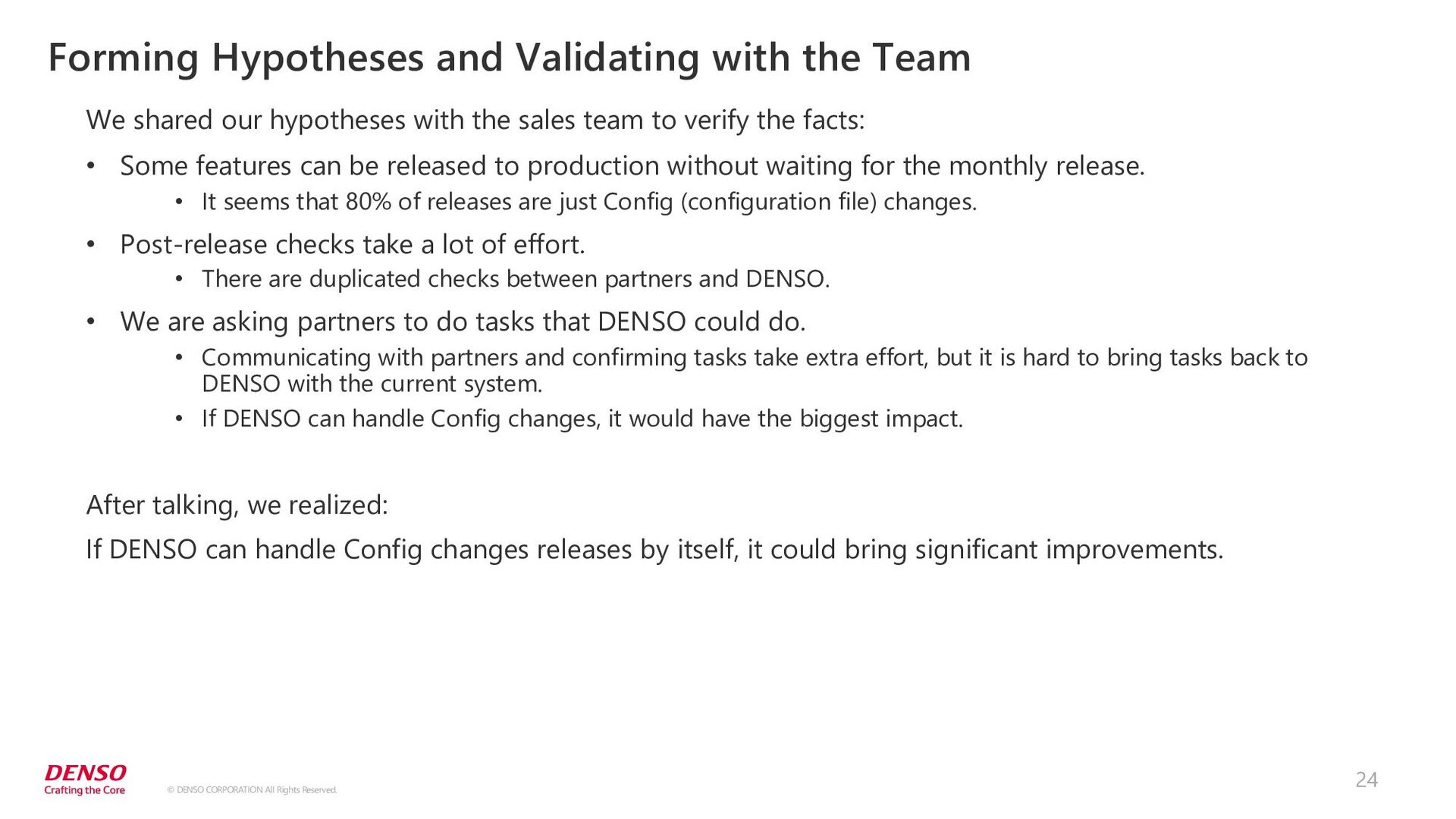
hypotheses with the sales team to verify the facts: • Some features can be released to production without waiting for the monthly release. • It seems that 80% of releases are just Config (configuration file) changes. • Post-release checks take a lot of effort. • There are duplicated checks between partners and DENSO. • We are asking partners to do tasks that DENSO could do. • Communicating with partners and confirming tasks take extra effort, but it is hard to bring tasks back to DENSO with the current system. • If DENSO can handle Config changes, it would have the biggest impact. After talking, we realized: If DENSO can handle Config changes releases by itself, it could bring significant improvements. Forming Hypotheses and Validating with the Team
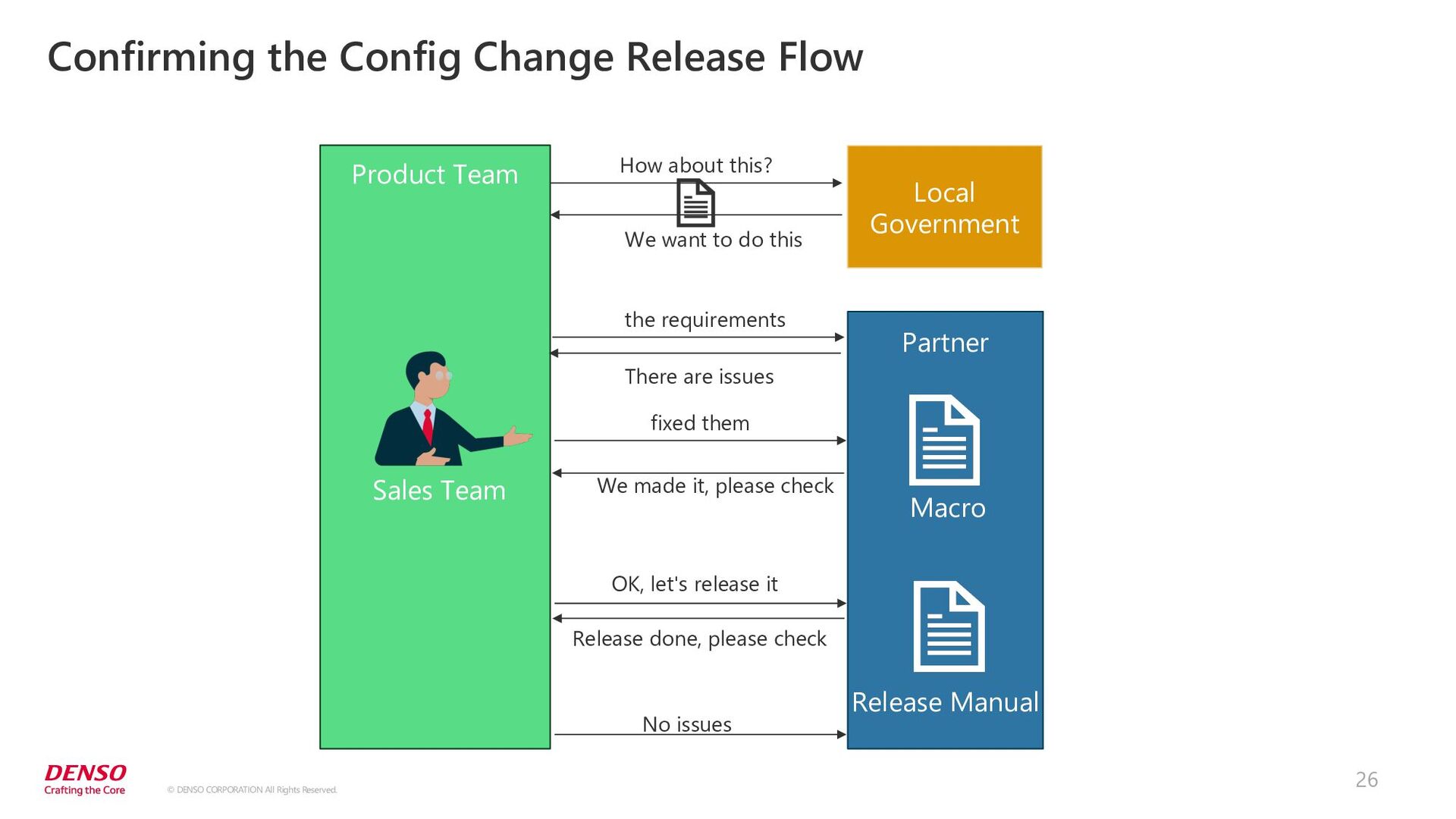
we found the following: • DENSO's sales team directly requested changes from the partners. • Multiple exchanges were required with partners to finalize the Config items. • Config was converted from Excel input values to PHP code using macros. • The Excel macros were not version-controlled, so DENSO did not know which macro was used for which customer. • After conversion to PHP code, further manual corrections were made. The release manual did not specify what to change. To handle Config changes within DENSO, we needed to design the entire release flow, including the actions of the sales team. Understanding the Config Change Release Flow in Detail
Change Release Flow Product Team Partner Local Government Sales Team How about this? We want to do this the requirements There are issues OK, let's release it Release done, please check Release Manual fixed them We made it, please check No issues Macro
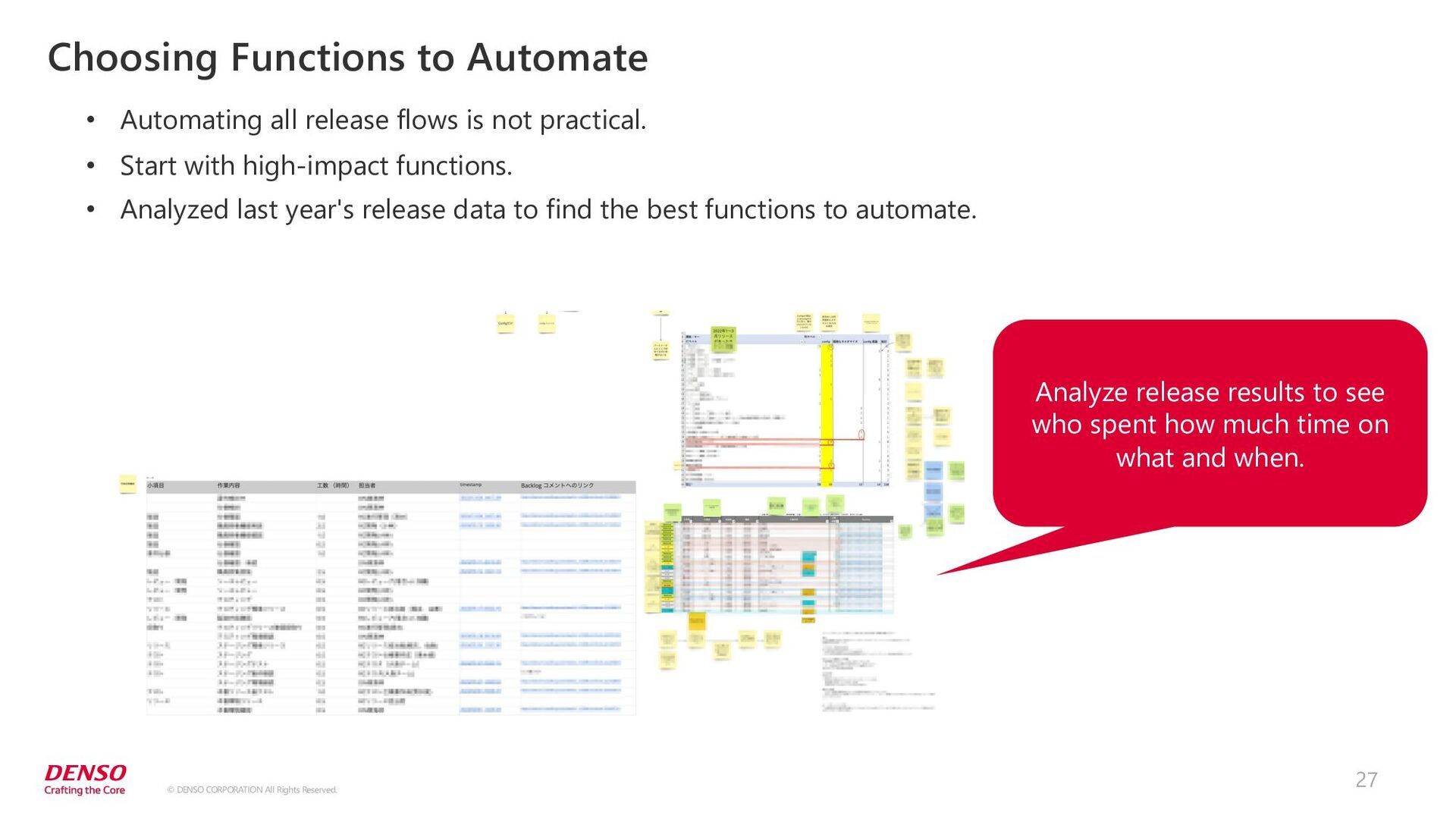
release flows is not practical. • Start with high-impact functions. • Analyzed last year's release data to find the best functions to automate. Choosing Functions to Automate Analyze release results to see who spent how much time on what and when.
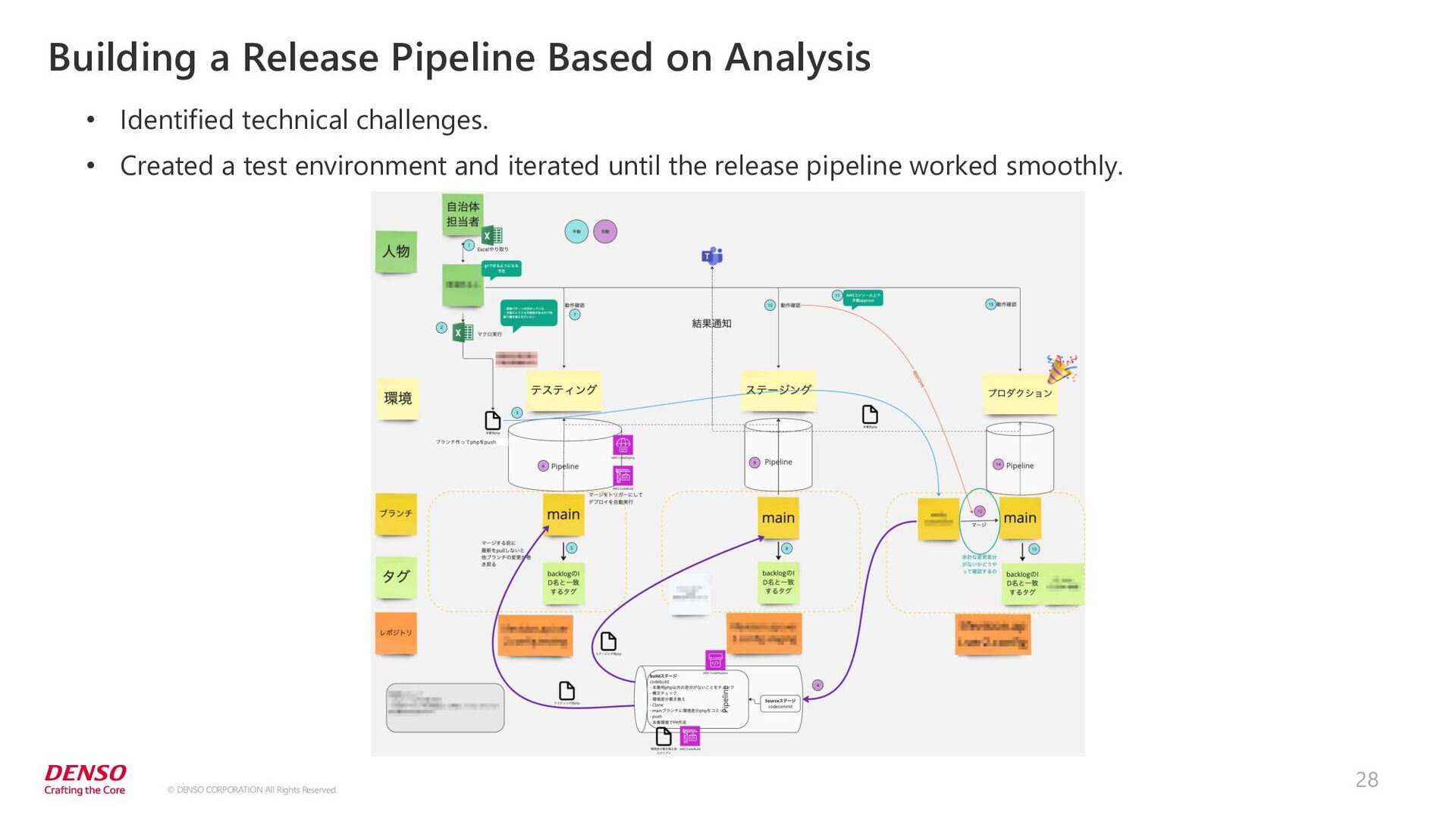
that technical feasibility is one thing, but whether non-engineer sales staff can execute the release process is another. • Especially, using Git to push Configs to the repository seemed challenging. • If it's difficult, we needed to make the process easier for them. Therefore, we got feedback from sales team at the design stage of the pipeline. Sales team responded, "We can do this." Taked to Sales Team again
that technical feasibility is one thing, but whether non-engineer sales staff can execute the release process is another. • Especially, using Git to push Configs to the repository seemed challenging. • If it's difficult, we needed to make the process easier for them. Therefore, we got feedback from sales team at the design stage of the pipeline. Sales team responded, "We can do this." Taked to Sales Team again Avoid implementing too many features at first Talked to users about what they can accept
for implementation; estimated outcome of automated release flow. • Estimated cost reduction if the release pipeline runs until September 2024. • Expressed cost reduction in time and money for non-engineers. • Proposed to sales and managers; received positive feedback. Estimating the Outcome of Release Automation
for implementation; estimated outcome of automated release flow. • Estimated cost reduction if the release pipeline runs until September 2024. • Expressed cost reduction in time and money for non-engineers. • Proposed to sales and managers; received positive feedback. Estimating the Outcome of Release Automation Use common language to express outcomes
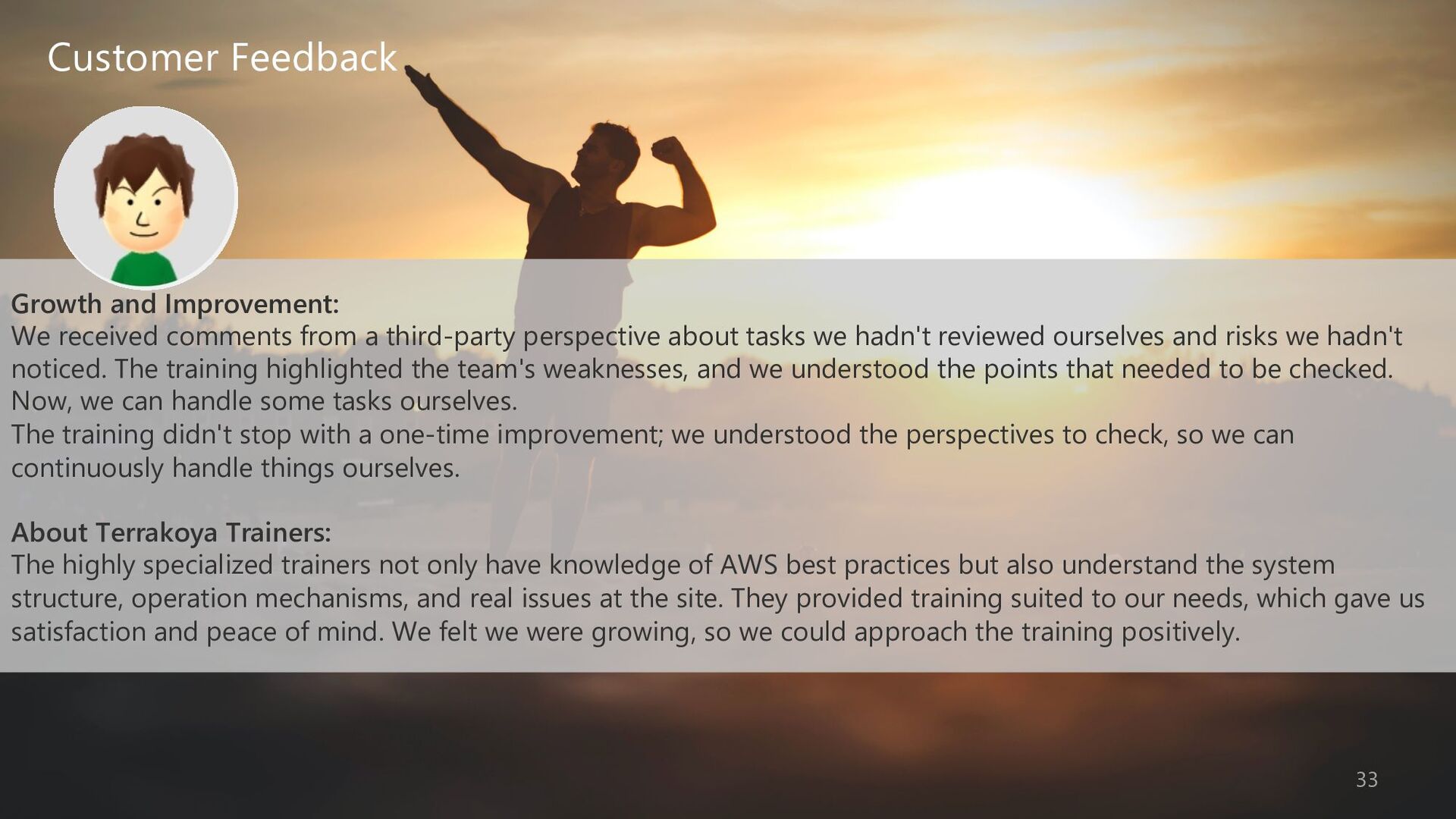
and Improvement: We received comments from a third-party perspective about tasks we hadn't reviewed ourselves and risks we hadn't noticed. The training highlighted the team's weaknesses, and we understood the points that needed to be checked. Now, we can handle some tasks ourselves. The training didn't stop with a one-time improvement; we understood the perspectives to check, so we can continuously handle things ourselves. About Terrakoya Trainers: The highly specialized trainers not only have knowledge of AWS best practices but also understand the system structure, operation mechanisms, and real issues at the site. They provided training suited to our needs, which gave us satisfaction and peace of mind. We felt we were growing, so we could approach the training positively.
involving the business side: • Observe the actual work and understand the facts. • Form hypotheses about the problems and verify them by talking to the people involved. • Avoid implementing too many features at first; find out what users can accept. • Use common language to express outcomes. Key Takeaways


 susumutomita
 takahashim
 camiha
 taketakekaho
 kentapapa
 greenmidori
 kaminashi
 ymotongpoo
 riyaamemiya
 pfn
pfn
 teamlab
 jtakeda
 masakiokuda
 techseoconnect
 matthewcrist
 holman
 bcantrill
 marcduiker
 marktimemedia
.png) helenjbeal
helenjbeal
 varn
varn
 sachag
 ryanjones
 baasie
 aleyda