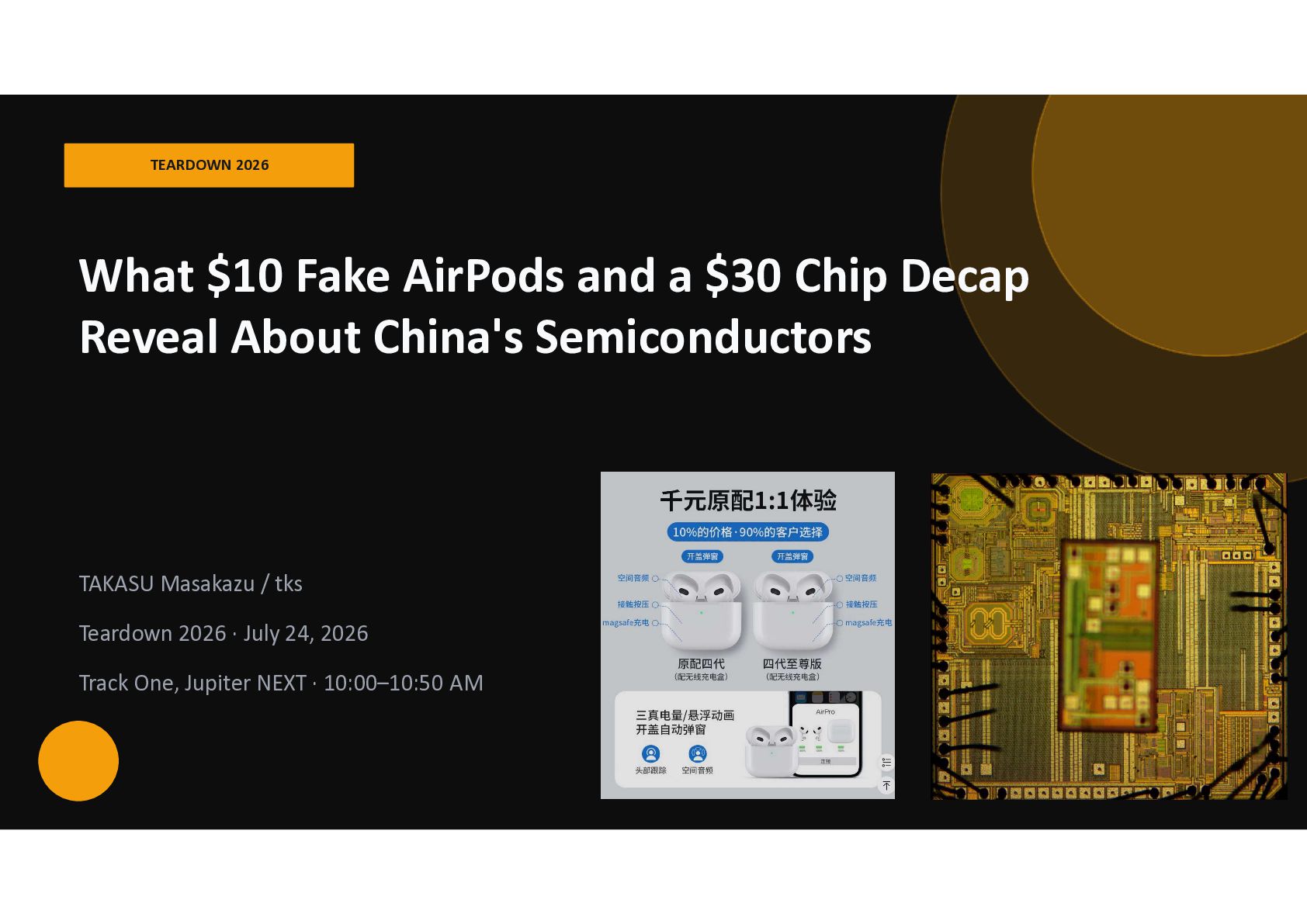
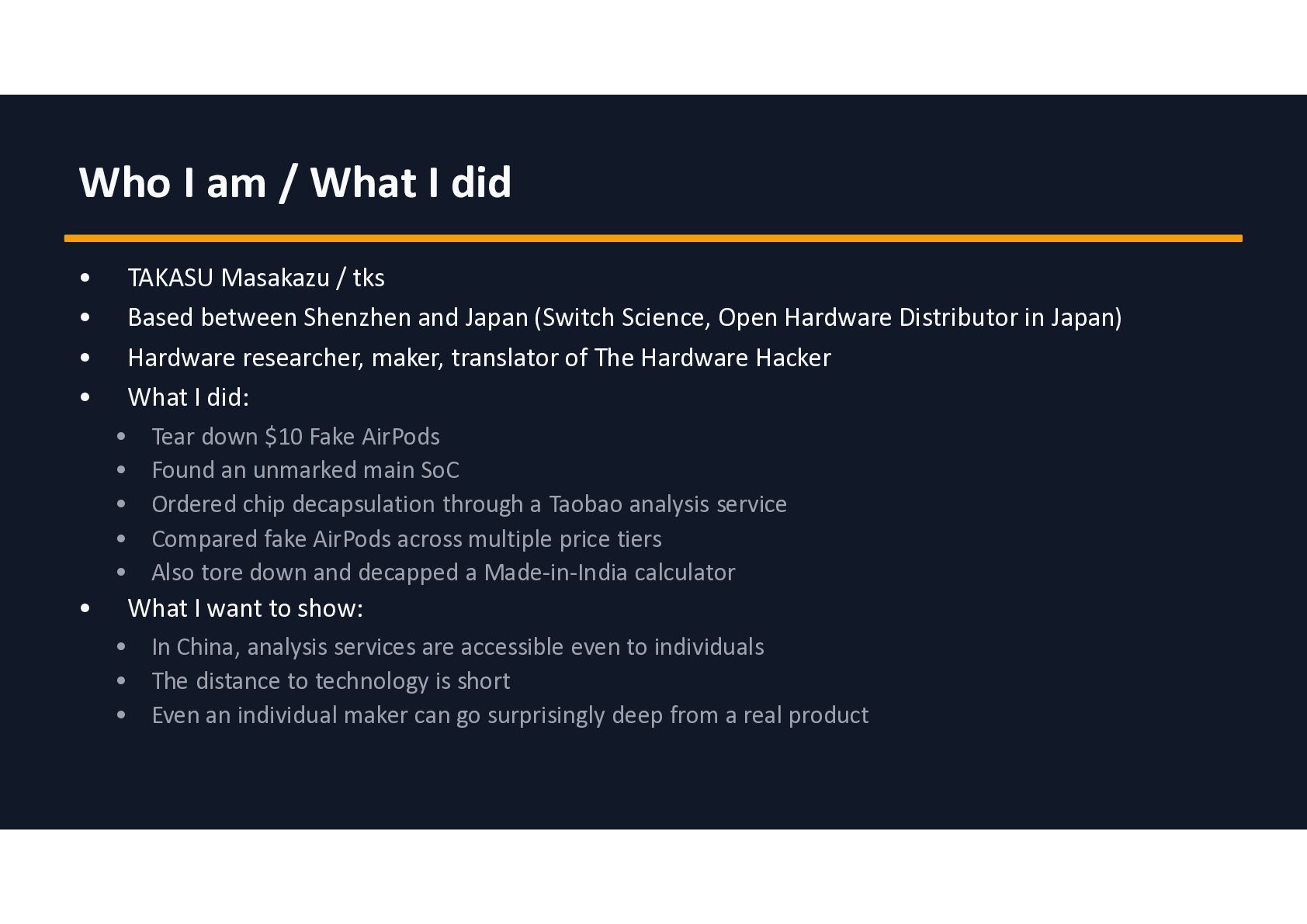
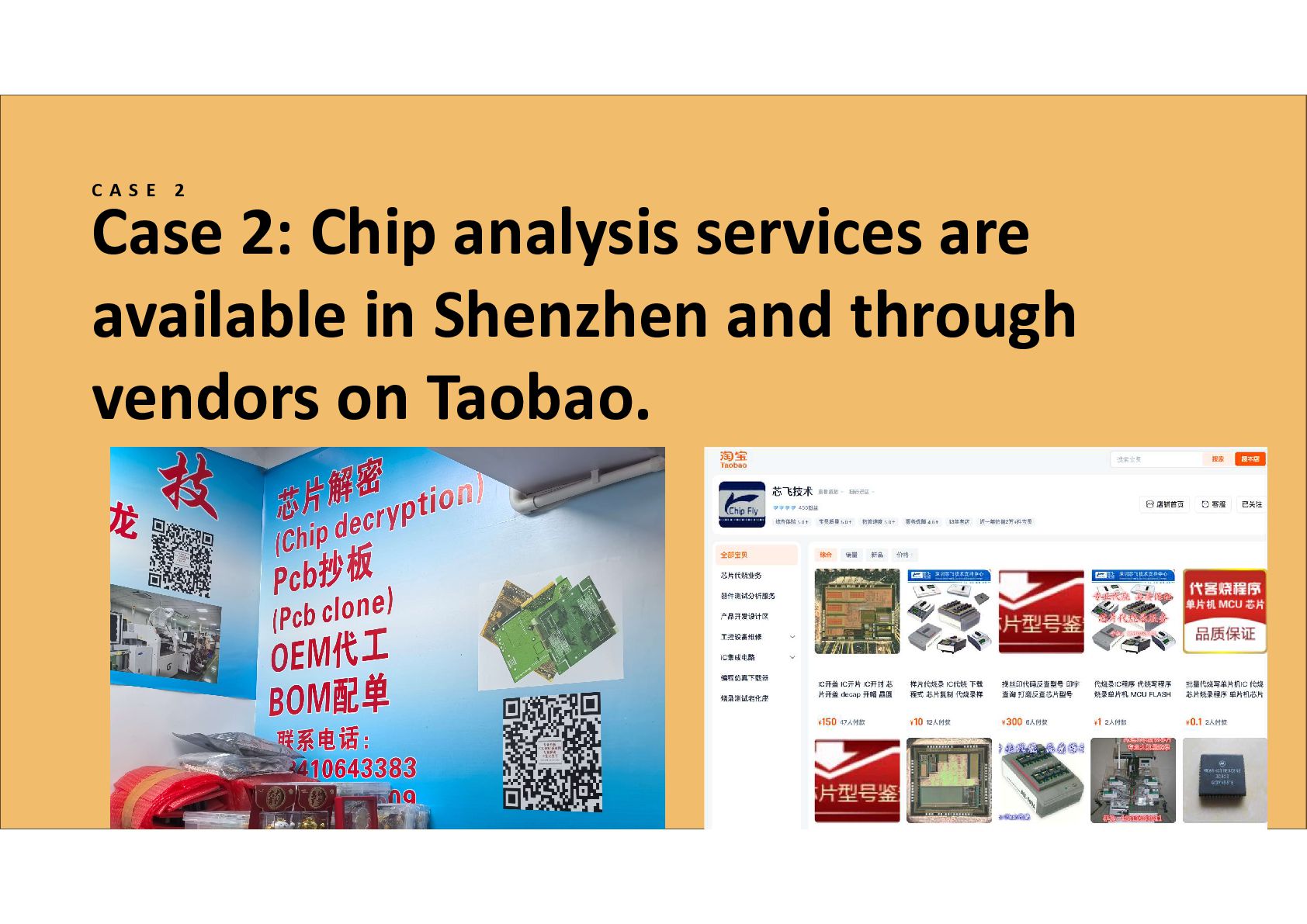
• TAKASU Masakazu / tks Based between Shenzhen and Japan (Switch Science, Open Hardware Distributor in Japan) Hardware researcher, maker, translator of The Hardware Hacker What I did: • • • • • • Tear down $10 Fake AirPods Found an unmarked main SoC Ordered chip decapsulation through a Taobao analysis service Compared fake AirPods across multiple price tiers Also tore down and decapped a Made-in-India calculator What I want to show: • In China, analysis services are accessible even to individuals • The distance to technology is short • Even an individual maker can go surprisingly deep from a real product
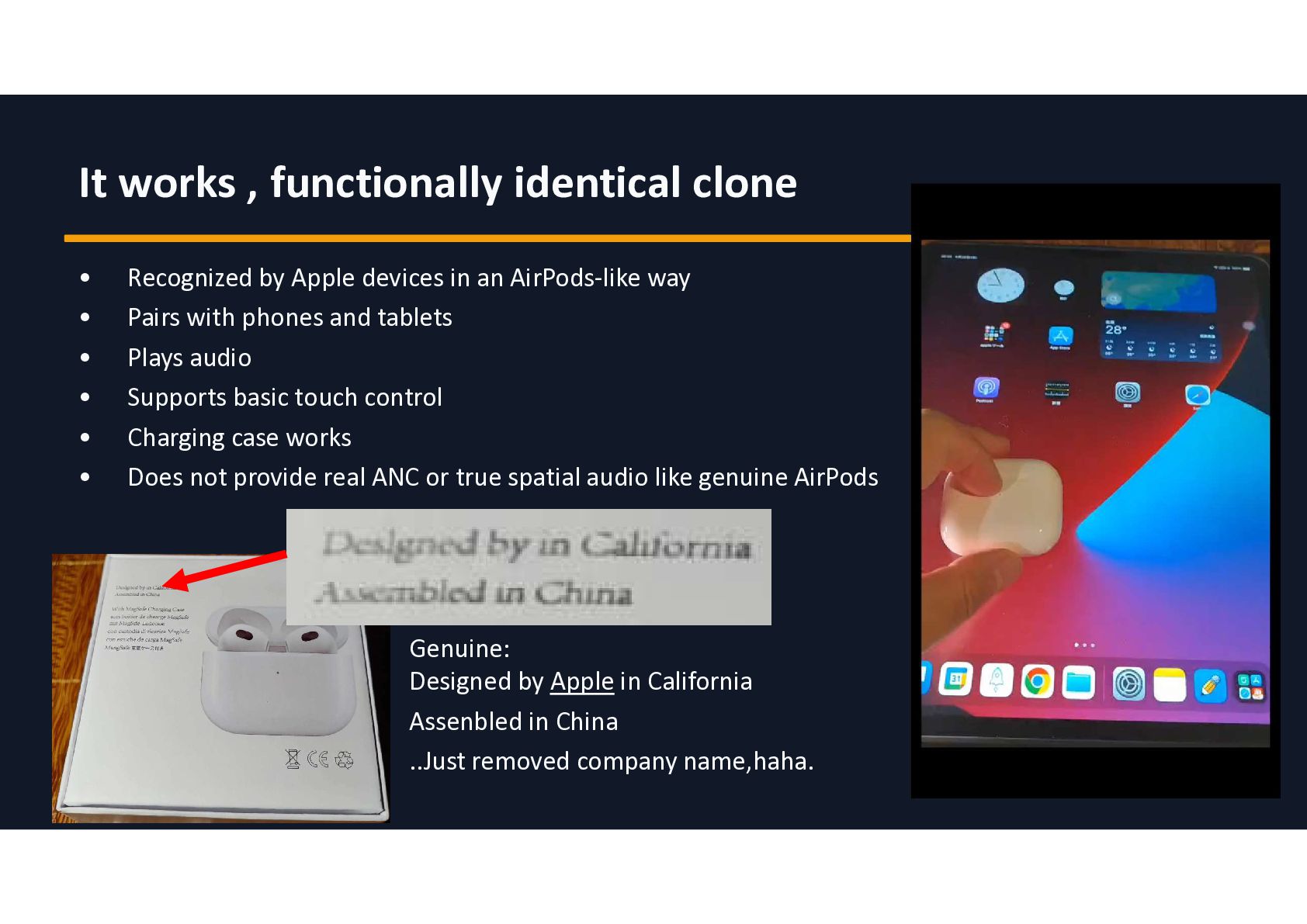
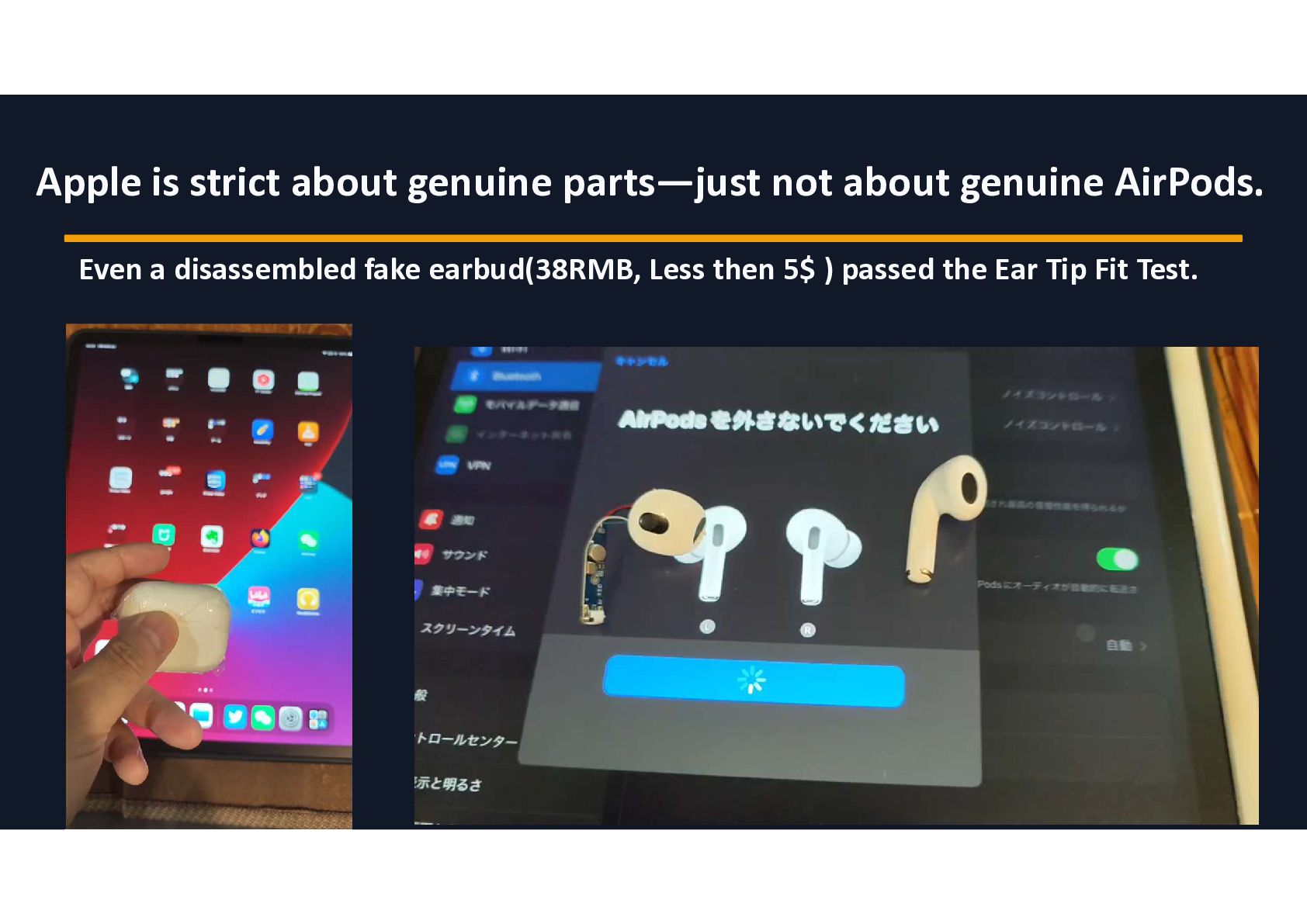
• • Recognized by Apple devices in an AirPods-like way Pairs with phones and tablets Plays audio Supports basic touch control Charging case works Does not provide real ANC or true spatial audio like genuine AirPods Genuine: Designed by Apple in California Assenbled in China ..Just removed company name,haha.
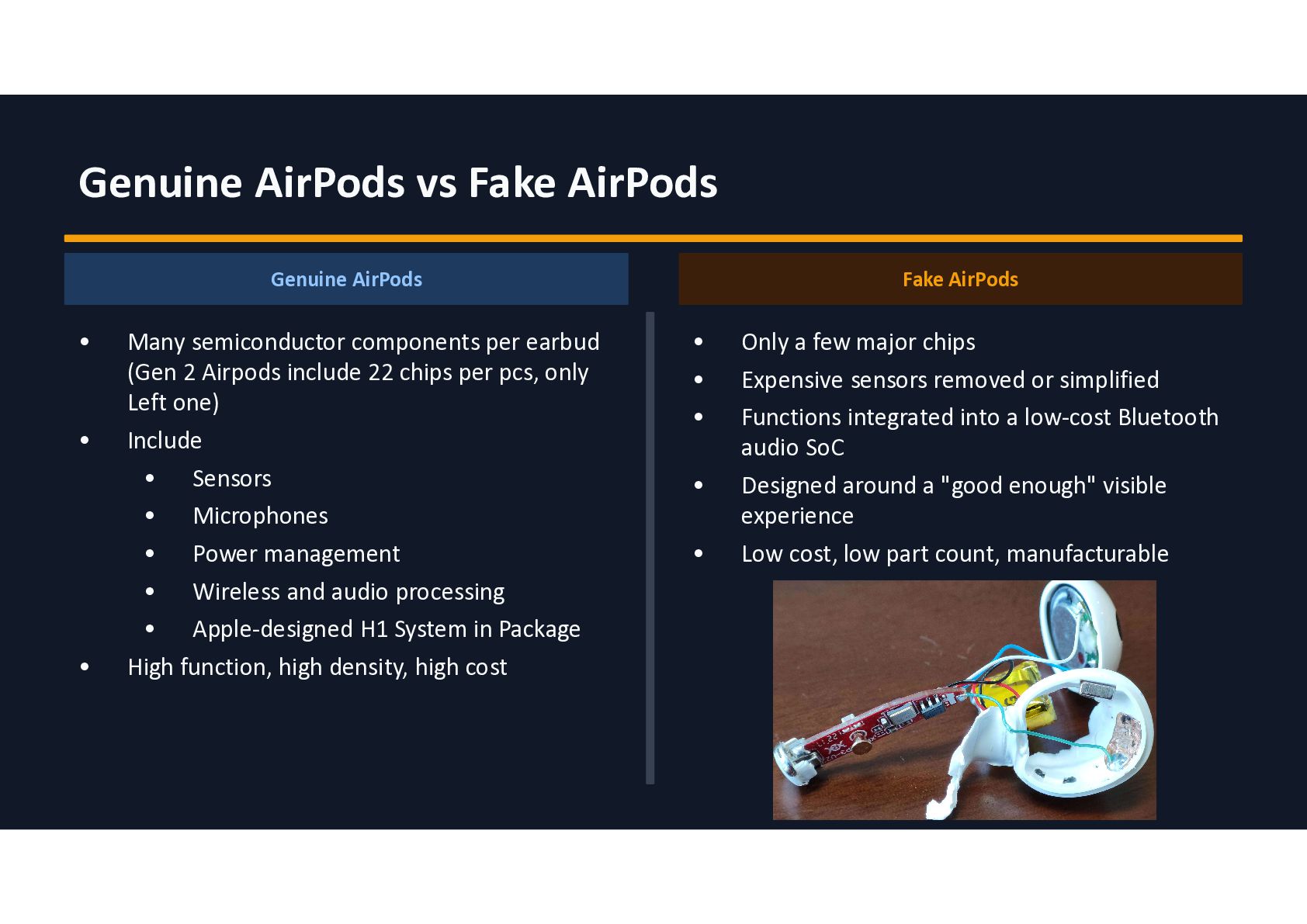
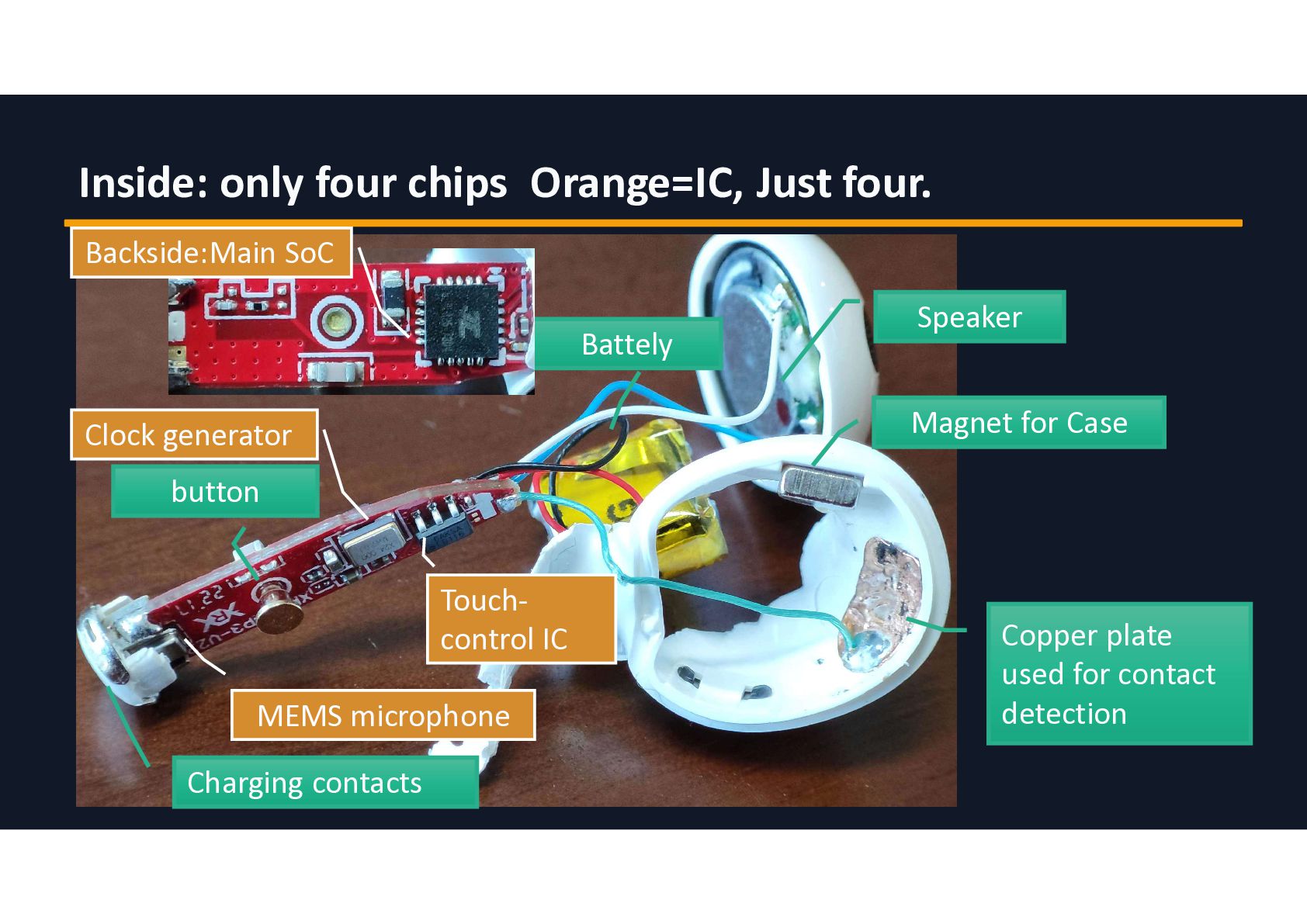
Many semiconductor components per earbud (Gen 2 Airpods include 22 chips per pcs, only Left one) Include • Sensors • Microphones • Power management • Wireless and audio processing • Apple-designed H1 System in Package High function, high density, high cost Fake AirPods • • • • • Only a few major chips Expensive sensors removed or simplified Functions integrated into a low-cost Bluetooth audio SoC Designed around a "good enough" visible experience Low cost, low part count, manufacturable
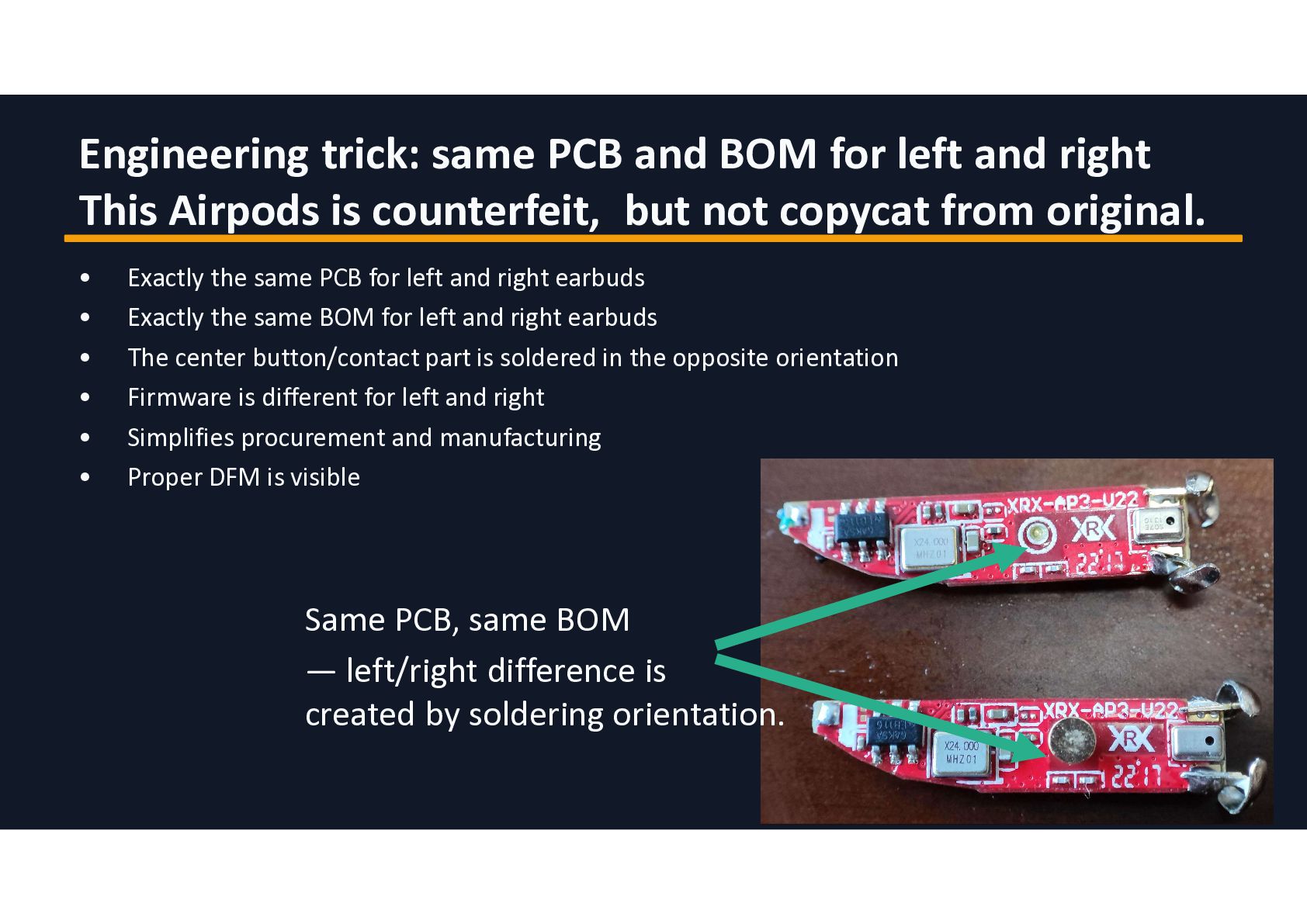
This Airpods is counterfeit, but not copycat from original. • • • • • • Exactly the same PCB for left and right earbuds Exactly the same BOM for left and right earbuds The center button/contact part is soldered in the opposite orientation Firmware is different for left and right Simplifies procurement and manufacturing Proper DFM is visible Same PCB, same BOM — left/right difference is created by soldering orientation.
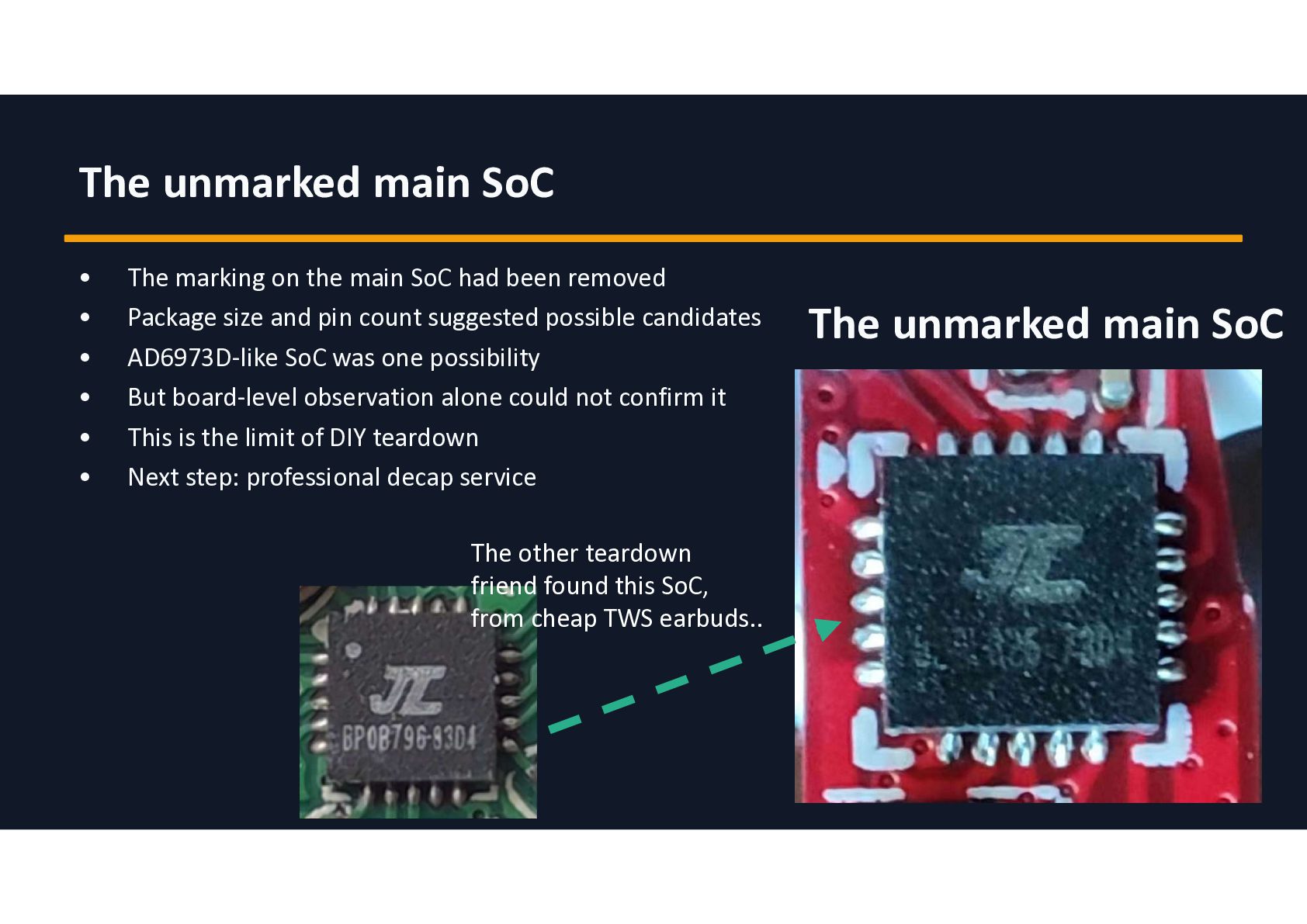
The marking on the main SoC had been removed Package size and pin count suggested possible candidates AD6973D-like SoC was one possibility But board-level observation alone could not confirm it This is the limit of DIY teardown Next step: professional decap service The other teardown friend found this SoC, from cheap TWS earbuds.. The unmarked main SoC
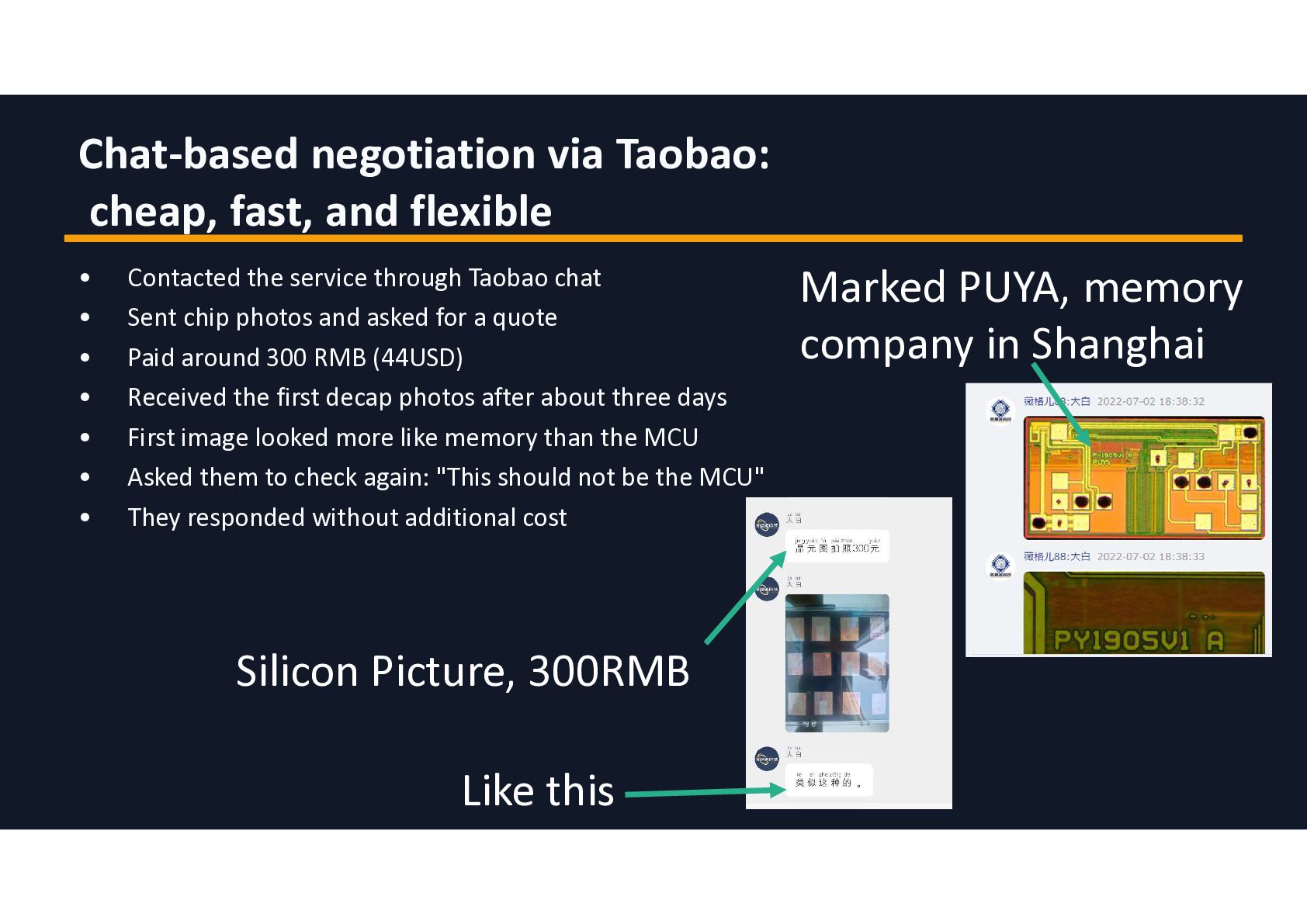
• • • • • Contacted the service through Taobao chat Sent chip photos and asked for a quote Paid around 300 RMB (44USD) Received the first decap photos after about three days First image looked more like memory than the MCU Asked them to check again: "This should not be the MCU" They responded without additional cost Silicon Picture, 300RMB Like this Marked PUYA, memory company in Shanghai
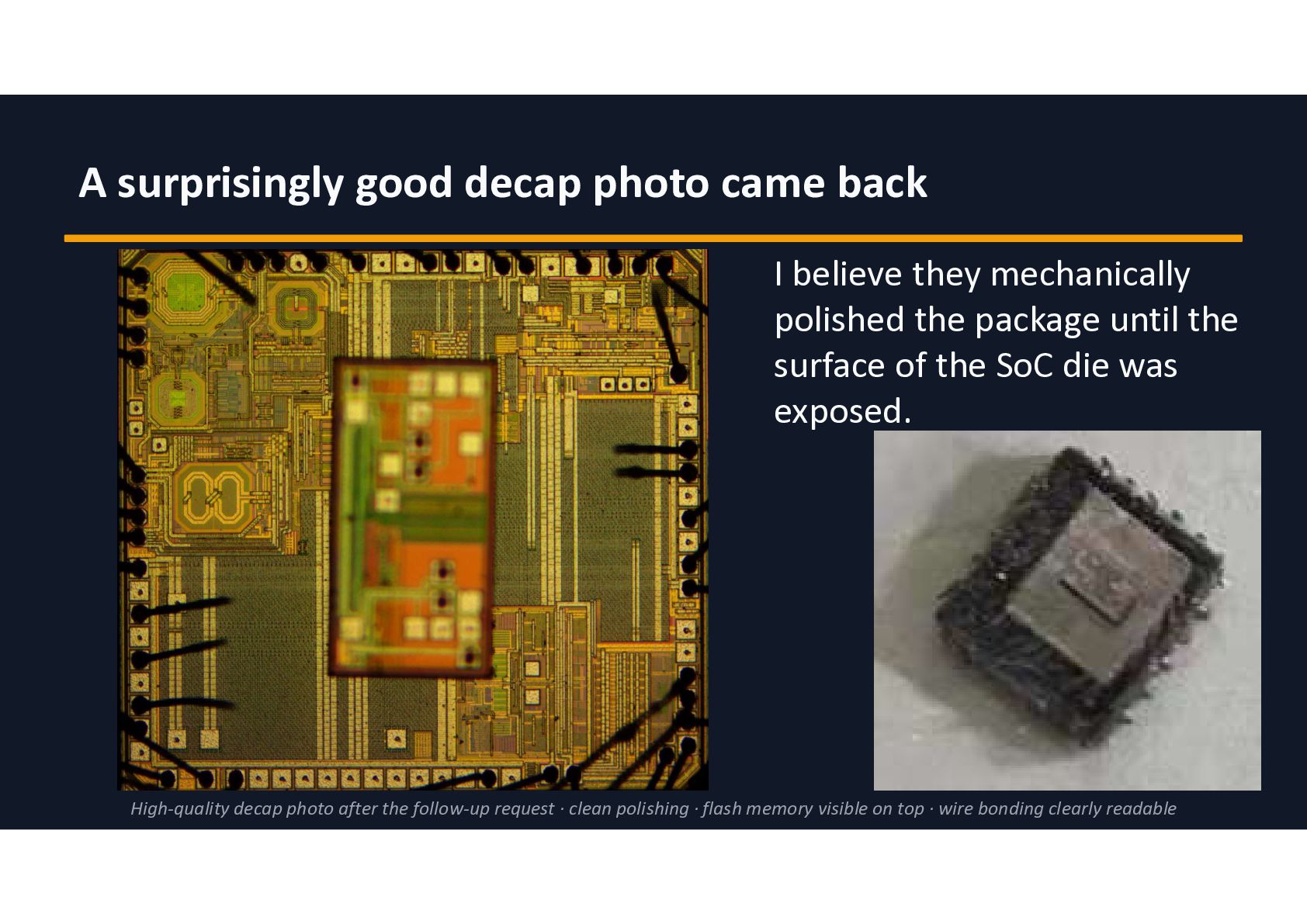
mechanically polished the package until the surface of the SoC die was exposed. High-quality decap photo after the follow-up request · clean polishing · flash memory visible on top · wire bonding clearly readable
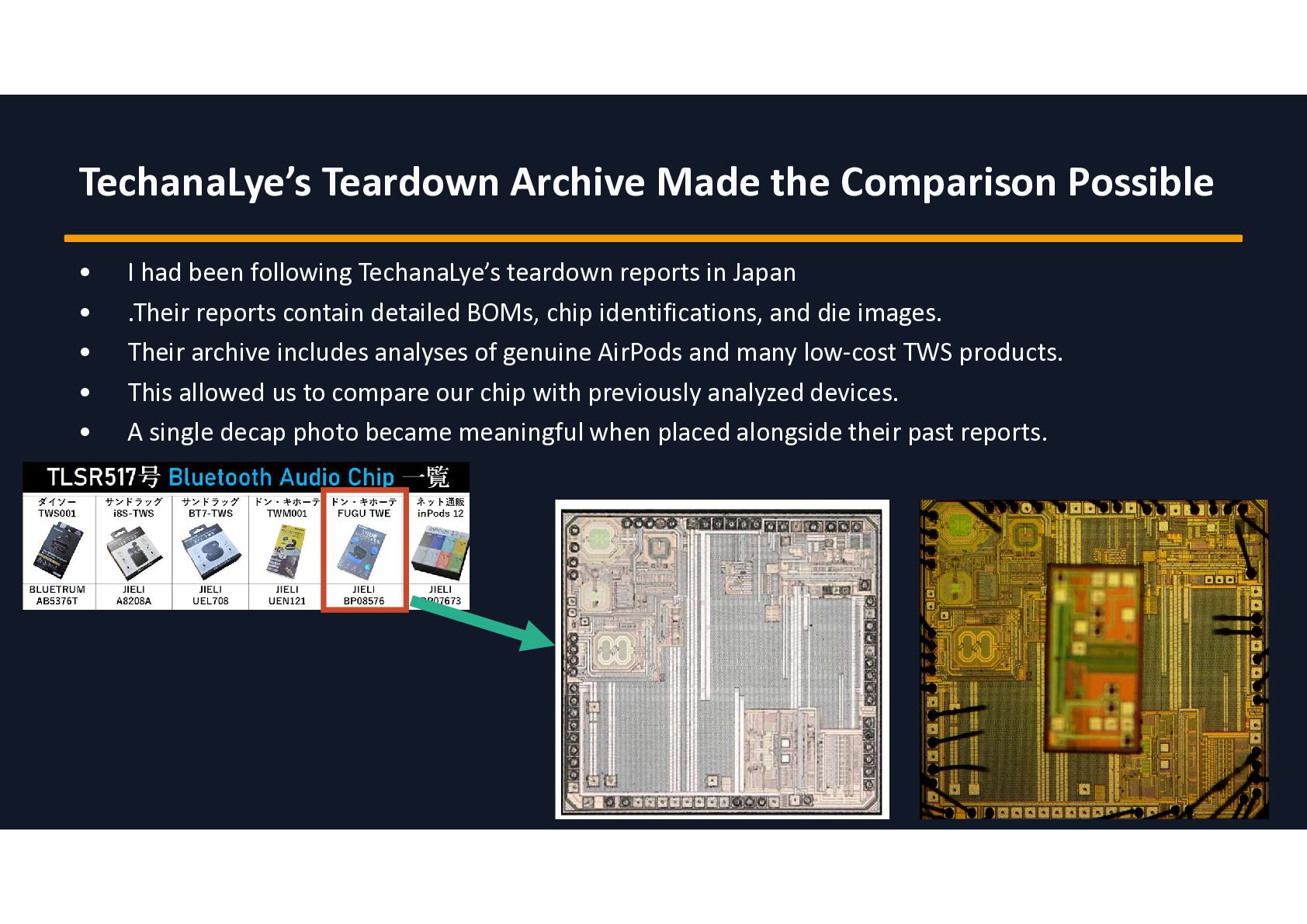
• • I had been following TechanaLye’s teardown reports in Japan .Their reports contain detailed BOMs, chip identifications, and die images. Their archive includes analyses of genuine AirPods and many low-cost TWS products. This allowed us to compare our chip with previously analyzed devices. A single decap photo became meaningful when placed alongside their past reports.
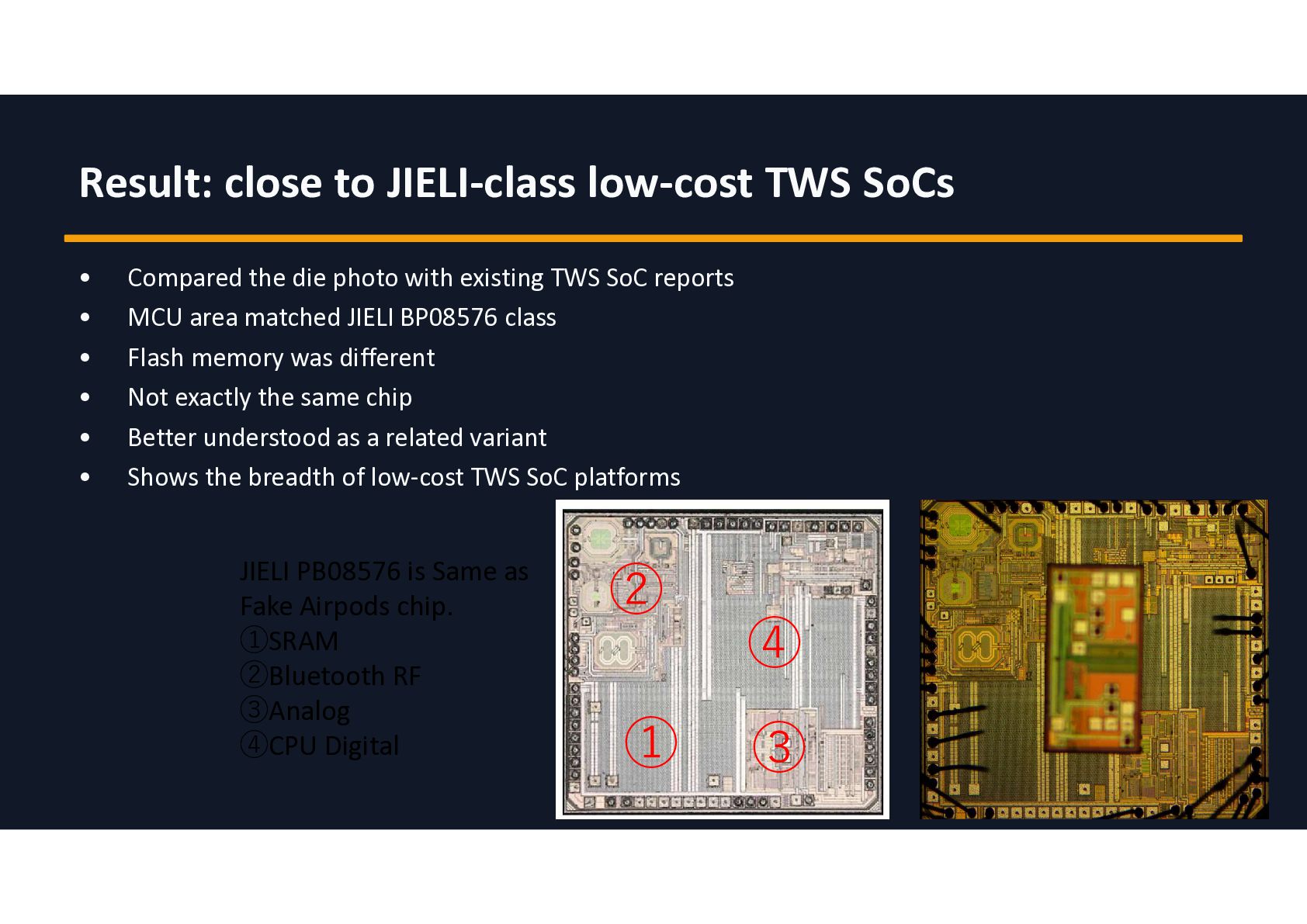
• • • Compared the die photo with existing TWS SoC reports MCU area matched JIELI BP08576 class Flash memory was different Not exactly the same chip Better understood as a related variant Shows the breadth of low-cost TWS SoC platforms JIELI PB08576 is Same as Fake Airpods chip. ①SRAM ②Bluetooth RF ③Analog ④CPU Digital ② ① ④ ③
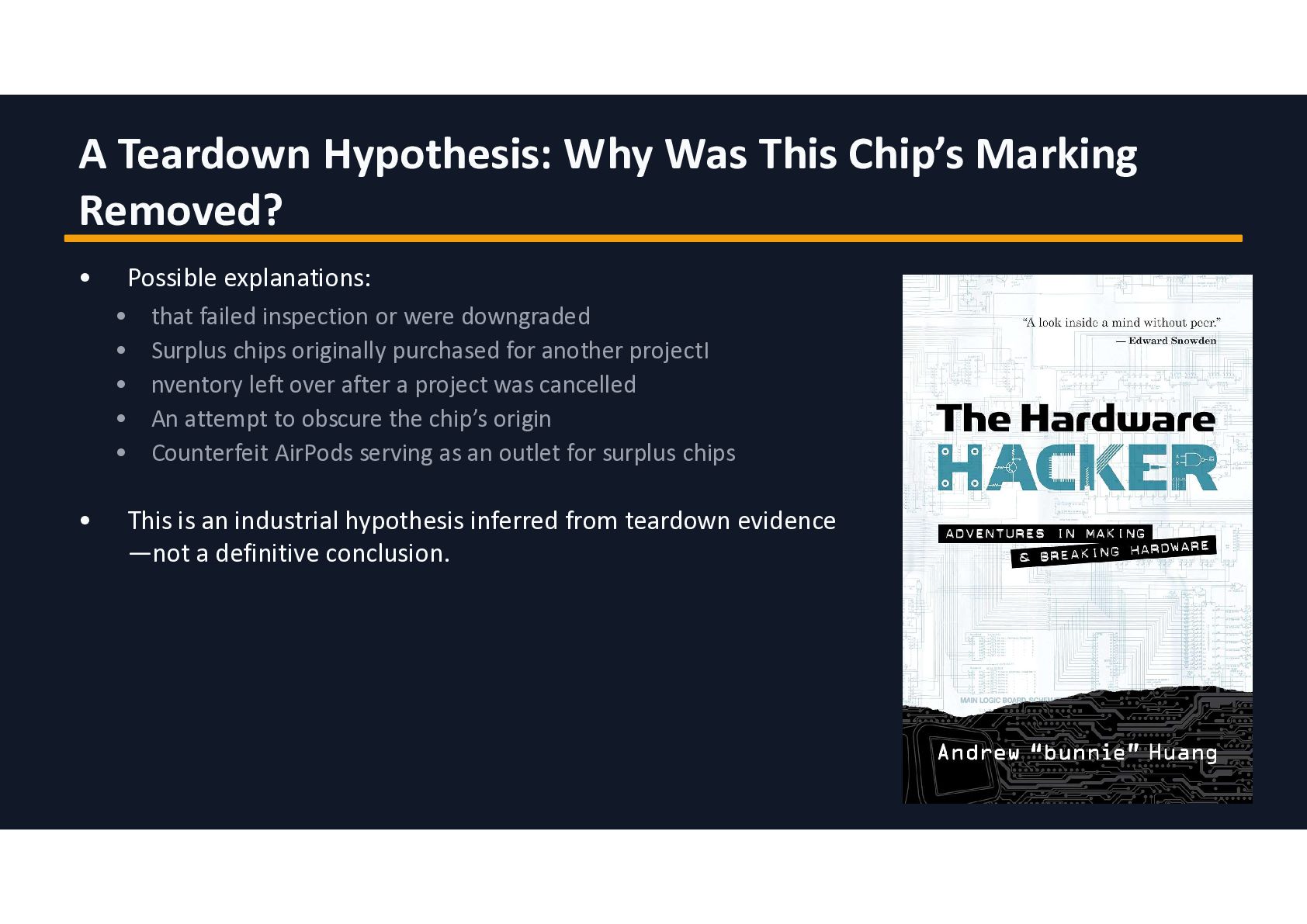
Possible explanations: • • • • • • that failed inspection or were downgraded Surplus chips originally purchased for another projectI nventory left over after a project was cancelled An attempt to obscure the chip’s origin Counterfeit AirPods serving as an outlet for surplus chips This is an industrial hypothesis inferred from teardown evidence —not a definitive conclusion.
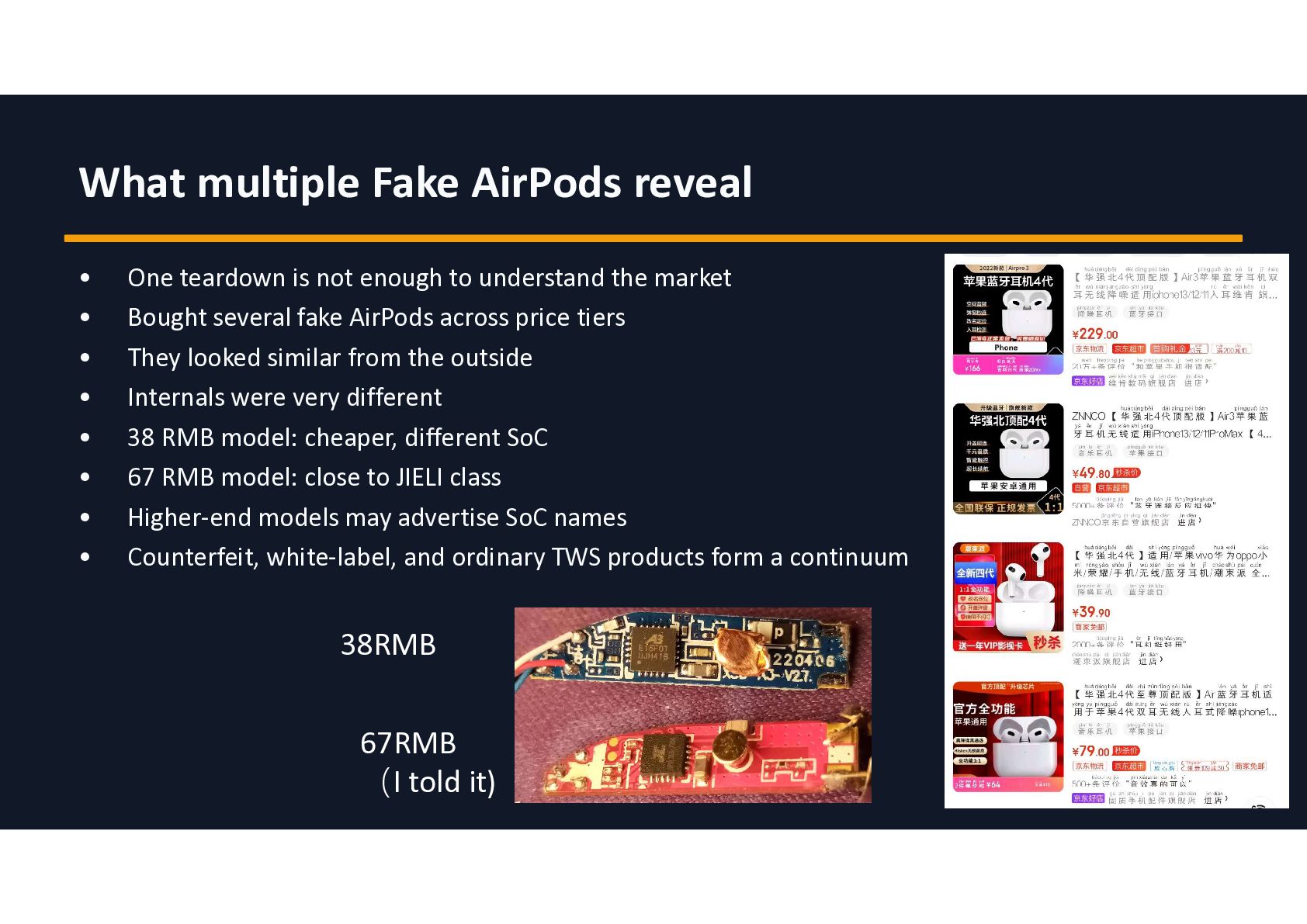
• • • One teardown is not enough to understand the market Bought several fake AirPods across price tiers They looked similar from the outside Internals were very different 38 RMB model: cheaper, different SoC 67 RMB model: close to JIELI class Higher-end models may advertise SoC names Counterfeit, white-label, and ordinary TWS products form a continuum 38RMB 67RMB (I told it)
• • • • • Recover a BOM from a bare PCB Reconstruct schematics from hardware Recover lost design knowledge Help products whose original engineers have left Understand acquired products when documents are missing Identify surplus and project-cancelled components This is not simply "bad behavior" It is part of real hardware business Gray use cases exist, but they are not the whole story
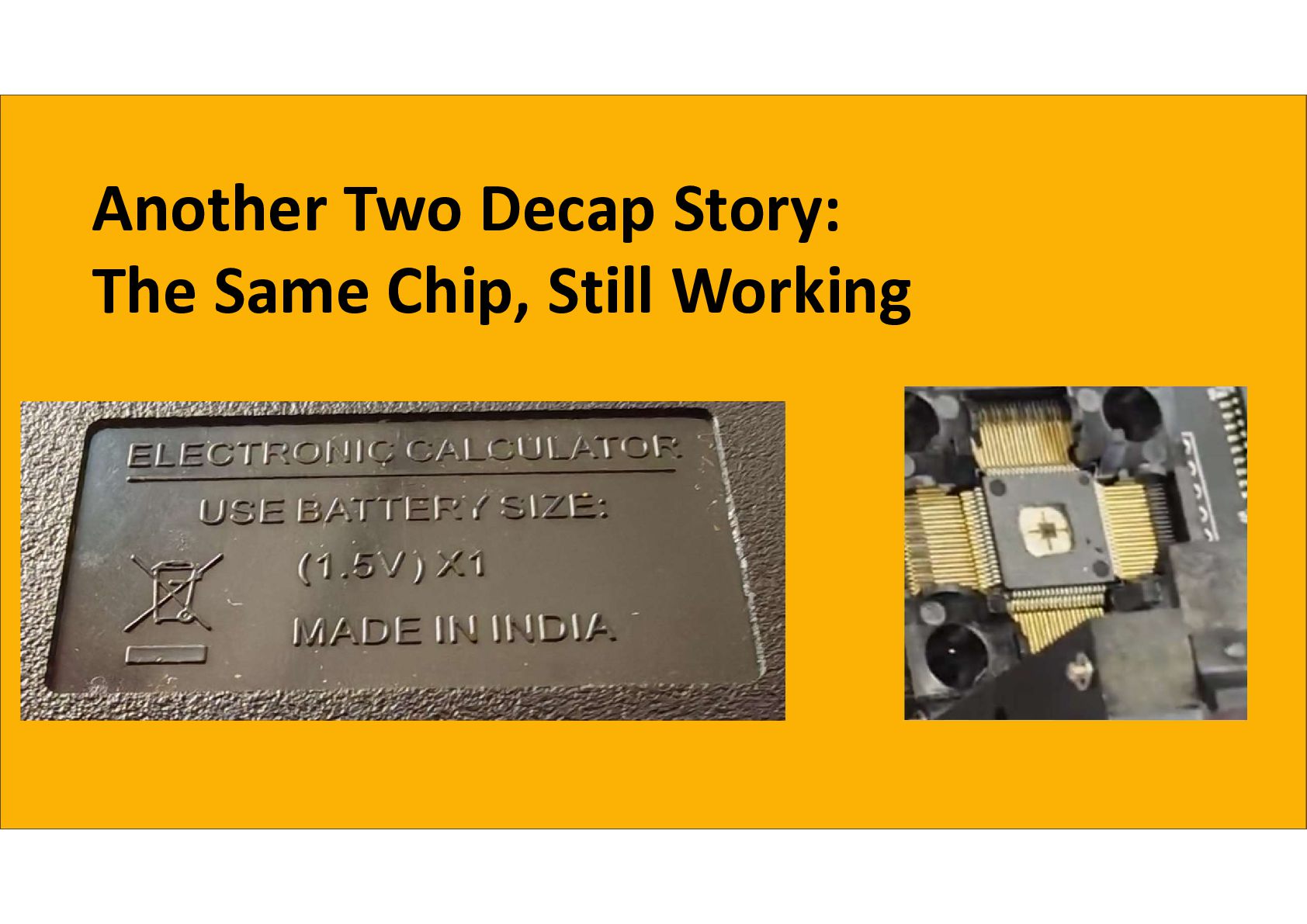
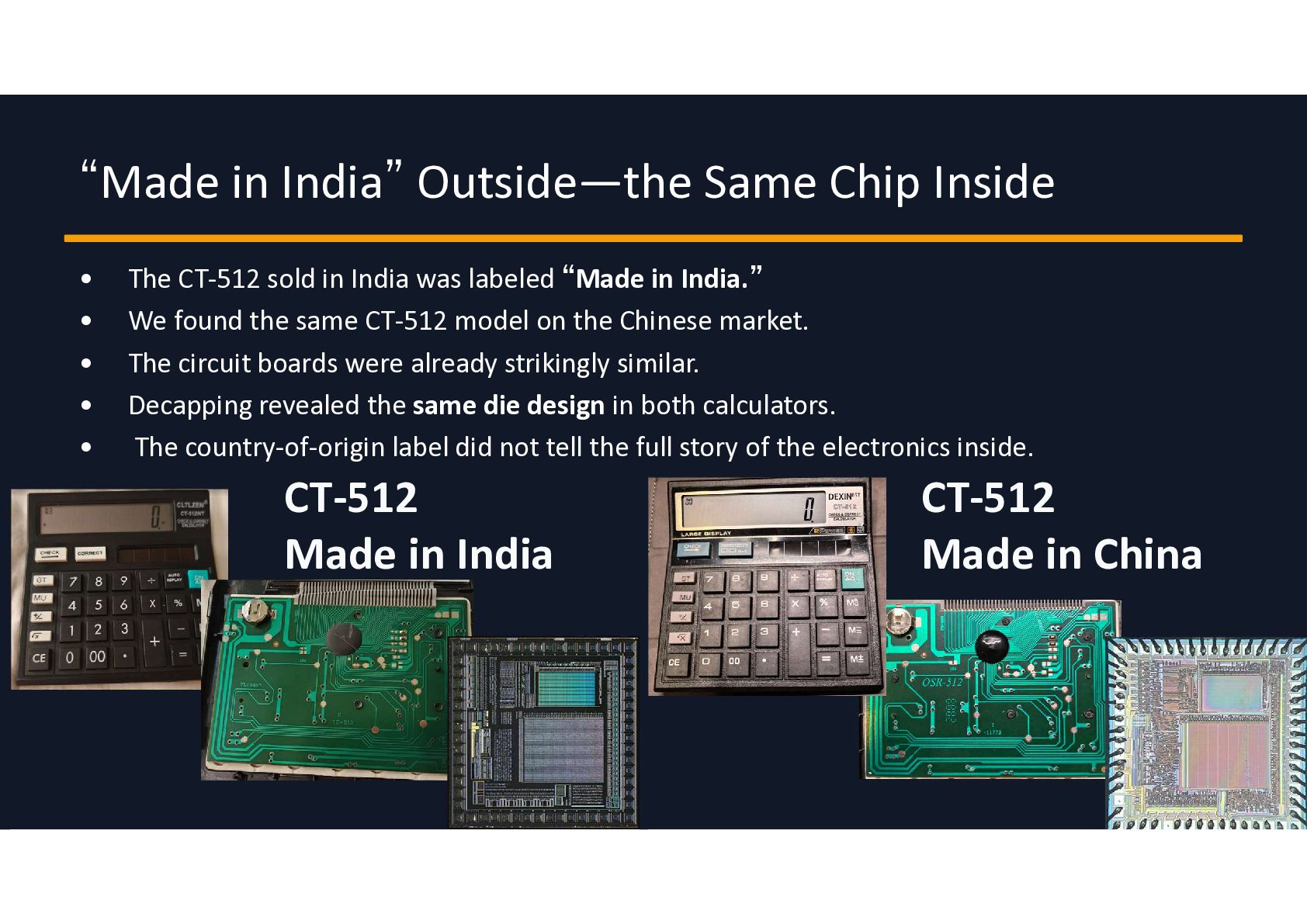
• • The CT-512 sold in India was labeled “Made in India.” We found the same CT-512 model on the Chinese market. The circuit boards were already strikingly similar. Decapping revealed the same die design in both calculators. The country-of-origin label did not tell the full story of the electronics inside. CT-512 Made in India CT-512 Made in China
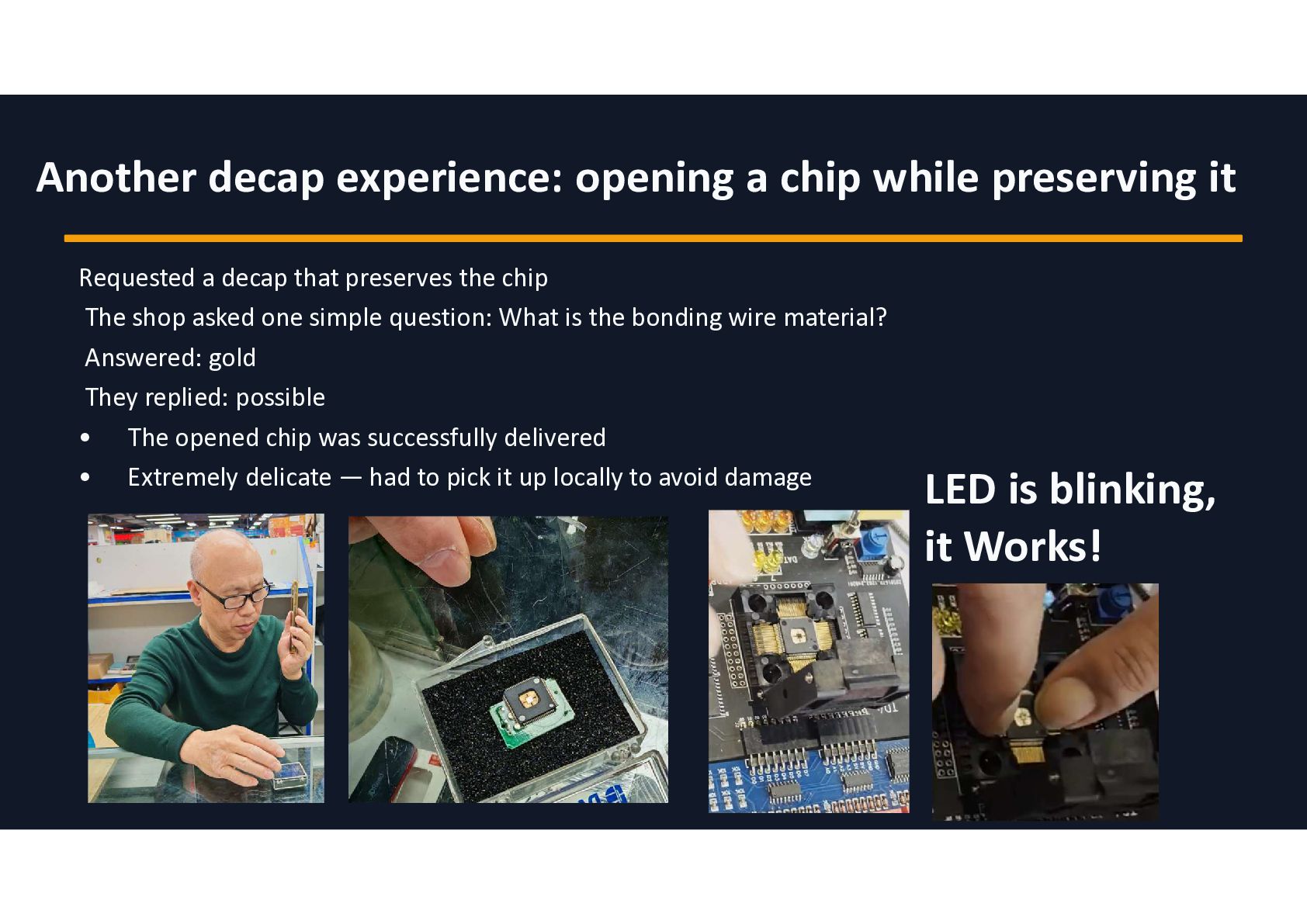
a decap that preserves the chip The shop asked one simple question: What is the bonding wire material? Answered: gold They replied: possible • The opened chip was successfully delivered • Extremely delicate — had to pick it up locally to avoid damage LED is blinking, it Works!
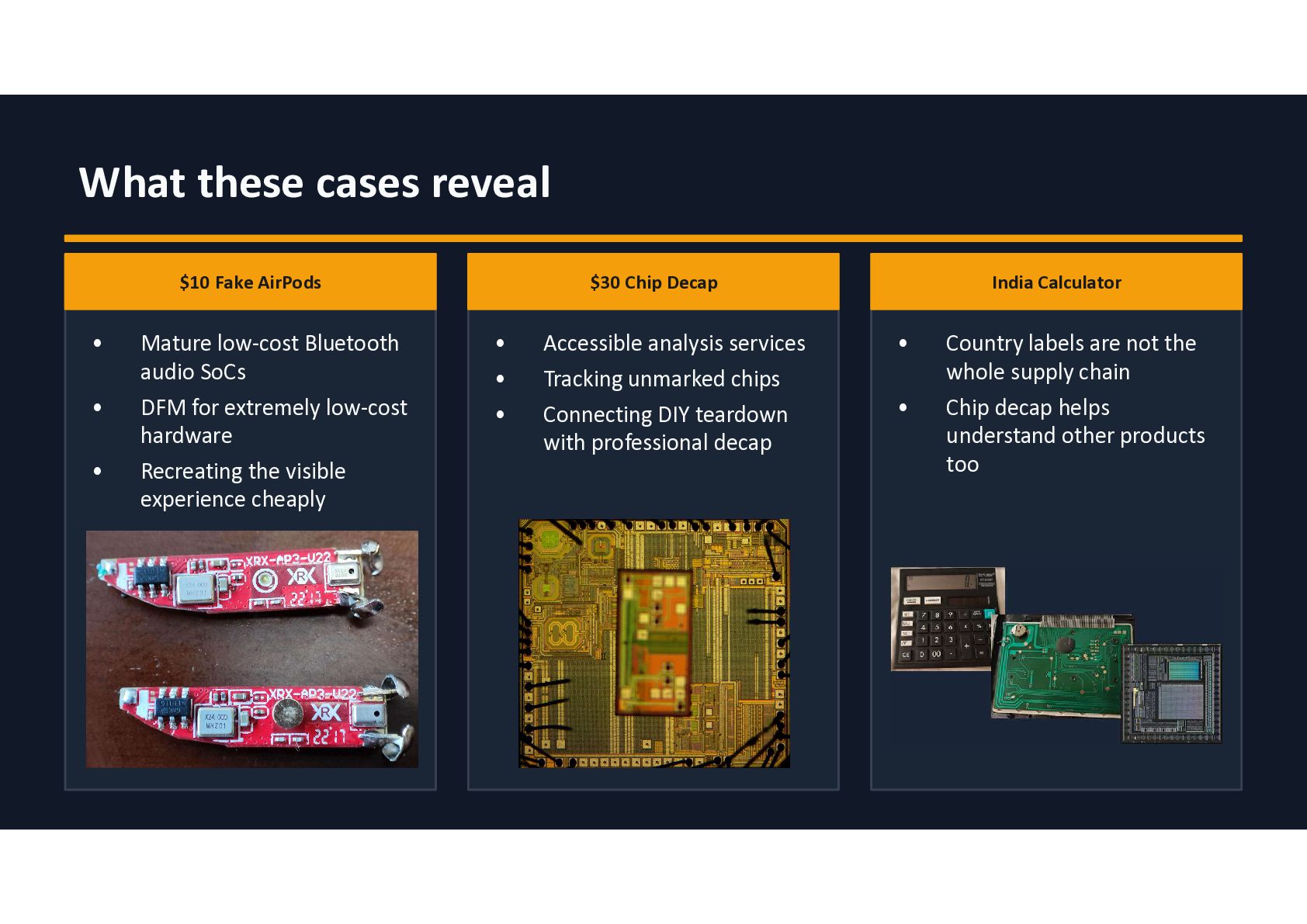
Decap Mature low-cost Bluetooth audio SoCs • Accessible analysis services • DFM for extremely low-cost hardware • Tracking unmarked chips • • Recreating the visible experience cheaply Connecting DIY teardown with professional decap India Calculator • Country labels are not the whole supply chain • Chip decap helps understand other products too
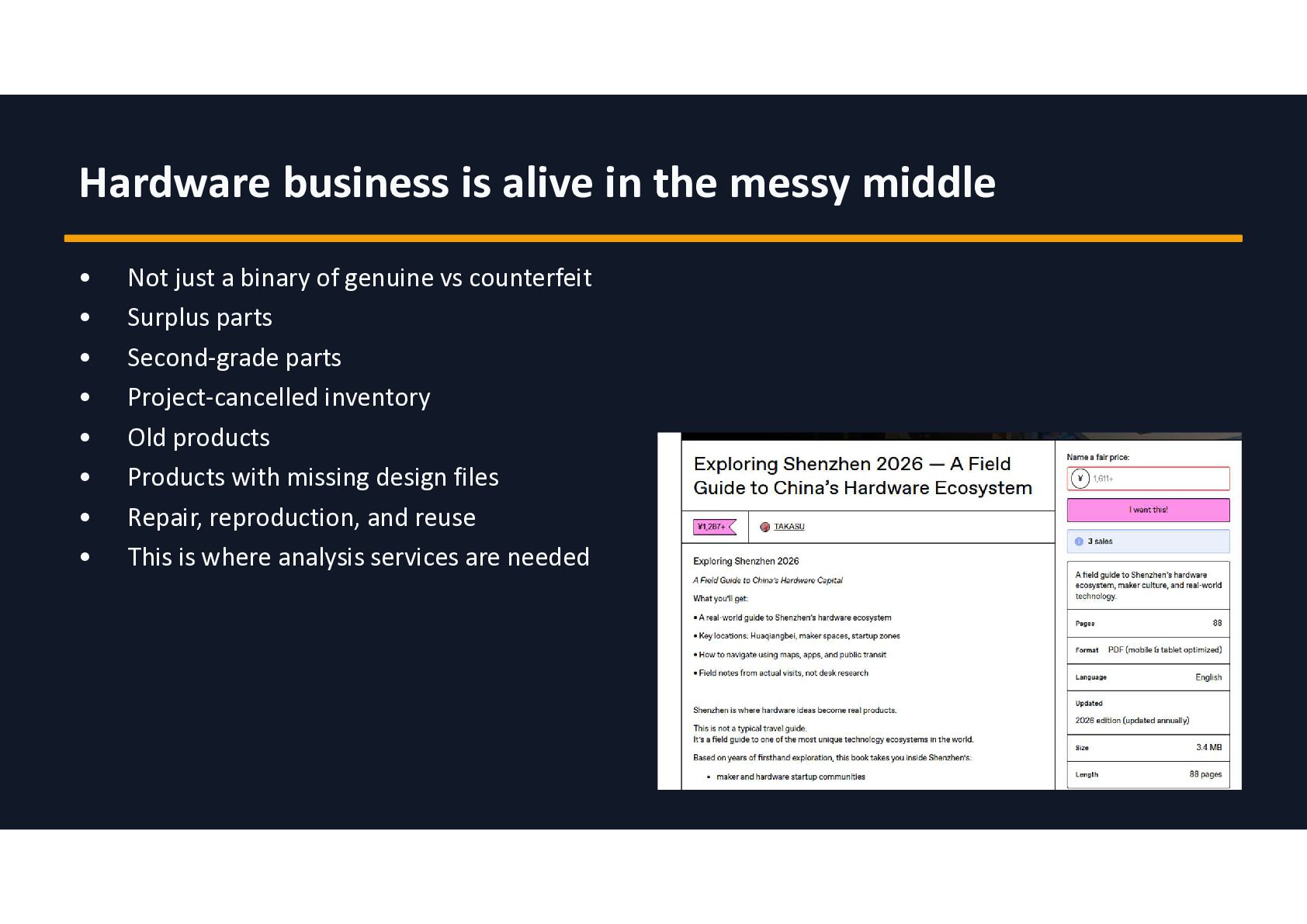
• • • • • • Not just a binary of genuine vs counterfeit Surplus parts Second-grade parts Project-cancelled inventory Old products Products with missing design files Repair, reproduction, and reuse This is where analysis services are needed
AirPods / TWS SoCs JIELI / Bluetrum / low-cost Bluetooth audio chips Taobao chip decap services Shenzhen reverse-engineering shops What teardown can and cannot prove India calculator teardown How makers can use analysis services What it means to "own" hardware If you can’t open it, you don’t own it. takasumasakazu.net | @tks


 takasumasakazu
 awsjcpm
 n0bisuke2
 bobfromjapan
 aokiplayer
 mongonta0716
 miyakawa2449
 scbc1167
 2bo
2bo
 girigiribauer
 productmarketing
 tessaabrams
 sstephenson
 marketingsoph
 leimatthew05
 codingconduct
 rakko
rakko
 gurzu
gurzu
 nmsamuel
 holman
 lara
lara
 kristinabergwall1