API-Based Code Search
Sponsored
·
 SiteGround - Reliable hosting with speed, security, and support you can count on.
→
SiteGround - Reliable hosting with speed, security, and support you can count on.
→

Share
Embed
API-Based Code Search

Rikito Taniguchi
March 25, 2021
Transcript
70 slides
-
What do you do if…? If you have to use
an unfamiliar API method, what do you do? e.g. “What function should I pass to Array.prototype.sort in JS?” • Read API Documentation • Visit related forum, Q&A (e.g. stack overflow, discussions) • Try to find API code example 2 -
What do you do if…? If you have to use
an unfamiliar API method, what do you do? e.g. “What function should I pass to Array.prototype.sort in JS?” • Read API Documentation • Visit related forum, Q&A (e.g. stack overflow, discussions) • Try to find API code example Today’s topic 3 -
Agenda • Background and Motivation • How Developers Search for
Code [Caitlin et al ’15] • What is API-Based Code Search • Previous Researches: • MAPO [Xhong et al ’09] • MUSE [Moreno et al ’15] • Future Work 4 -
Agenda • Background and Motivation • How Developers Search for
Code [Caitlin et al ’15] • What is API-Based Code Search • Previous Researches: • MAPO [Xhong et al ’09] • MUSE [Moreno et al ’15] • Future Work 5 -
How developers know API usages? • Developers frequently need to
use unfamiliar API (method). • e.g. FileReader.read in JDK library • How developers know how to use those APIs? Developer How to use FileReader.read method? 6 -
Visit Q&A Forums e.g. stack overflow, Github issues Problem: For
unpopular APIs, it’s difficult to find the answer. 7 Searching for code example of Scala3 compiler API… -
Visit Q&A Forums Problems • The answer might not be
up-to-date. • e.g. The answer is for previous version of the API… • The answer could be too specific to the questions 8 -
Read API documentation • Not necessarily well documented. • Hard
to grasp the usage only from natural language explanation. 9 https://docs.oracle.com/javase/8/docs/api/java/util/ArrayList.html -
Need more code examples!!! Code examples play significant role for
complementing developers’ understanding of API usage. 10 https://docs.ruby-lang.org/en/2.0.0/Array.html -
However… • For large library (like JDK) authors, it’s time-consuming
to write and maintain the API examples. • Code examples are not necessarily available. In that case, we need to search for code examples. Actually, research shows developers frequently search for code examples. 11 -
How Developers Search for Code [Sadowski et al ’15] •
An empirical study performed at Google. • Research Questions • RQ1: Why do programmers search? • and more … 12 -
How Developers Search for Code [Sadowski et al ’15] •
(Probably) Google’s internal code search engine was used. • Participants: 27 software developers at Google • Duration: 2 weeks • Participants answer “What question are you trying to answer?” before searching (in free-form response). • Gathered 259 answers • Categorize answers and analyze what’s the purpose of the search. 13 -
How Developers Search for Code [Sadowski et al ’15] On
average 5 search sessions, 12 queries on a workday. • 33.5% search for code example. • 26% for exploring or reading the code • … 14 -
How Developers Search for Code [Sadowski et al ’15] Developers
frequently search for code examples! However… -
Problem with text based search engine Search FileReader.read on Github
Search (with filtering Java code) 16 -
Problem with text based search engine • Since it doesn’t
care semantic information, it matches a lot of irrelevant code snippets. • Because it ranks the result with NLP manner (e.g. TF-IDF), non- important results tend to rank in top. We need better code example search engine. 17 -
Agenda • Background and Motivation • How Developers Search for
Code [Caitlin et al ’15] • What is API-Based Code Search • Previous Researches: • MAPO [Xhong et al ’09] • MUSE [Moreno et al ’15] • Future Work 18 -
API-Based Code Search API-Based Code Search System returns the code
examples, in response to the API search query. How to use java.io.FileReader.read ? Developer API-Based Code Search System 19 Here’re code examples for java.io.FileReader.read -
Demands for API-Based Code Search • It should return distinct
code examples. • Otherwise, developers need to browse many search results • The resulting code examples should be simple. • So developers can easily understand the API usage. • Typical or “interesting” examples should be in top results. • Niche use cases tend to be uninteresting. 20 -
Duplicated results make developers browse a tons of examples… 21
Should return distinct code examples Here’re code examples for java.io.FileReader.read These examples doing the same thing… browse down… -
Distinct examples enable developers to find the interesting example quickly.
22 Should return distinct code examples Here’re code examples for java.io.FileReader.read THIS IS IT!! -
The code examples should be simple So… where should I
read…? Irrevant to java.io.FileReader.read Here’re code example for java.io.FileReader.read 23 -
Typical or “interesting” examples should be in top Otherwise, developers
have to browse a lot… These examples are not what I want… scrolling down… Here’re code examples for java.io.FileReader.read demanding answer 24 -
Challenges of API-Based Code Search • It should return distinct
code examples as much as possible. • -> How to cluster the “duplicated” code examples? • The resulting code examples should be simple. • -> How to choose the concise example from each cluster? • Typical or “interesting” examples should be in top results. • -> How to sort and rank the code examples? 25 -
Agenda • Background and Motivation • How Developers Search for
Code [Caitlin et al ’15] • What is API-Based Code Search • Previous Researches: • MAPO [Xhong et al ’09] • MUSE [Moreno et al ’15] • Future Work 26 -
API-Based Code Search Researches • MAPO: Mining and Recommending API
Usage Patterns [Zhong et al ’09] • Zhong, Hao, et al. "MAPO: Mining and recommending API usage patterns." European Conference on Object-Oriented Programming. Springer, Berlin, Heidelberg, 2009. • How Can I Use This Method? [Moreno et al ’15] • Laura Moreno, et al. "How can I use this method?" In Proceedings of the 37th International Conference on Software Engineering - Volume 1 (ICSE '15). IEEE Press, 880–890, 2015. 27 -
MAPO: Mining and recommending API usage patterns • Input: API
• e.g. some.pkg.class.method • Output: API usage pattern described by Method Invocation Sequence. 28 Method Invocation Sequence, We can see the details by clicking Found patterns of org.eclipse.jface.action.IContributionManager.appendToGroup MAPO is an Eclipse plugin for Java. -
MAPO: Mining and recommending API usage patterns Editor List of
Patterns Details of the selected pattern 29 -
MAPO architecture • Code Analyzer • Retrieve and analyze code
into API call sequence. • API usage miner • Cluster API call sequence and rank the patterns. • Recommender • Provide code examples to a developer. 30 -
MAPO / Code Analyzer • MAPO utilizes Eclipse’s JDT compiler
to analyze source code. • For each method, MAPO extracts third-party API method call sequence. • m1 • m2 • @new SomeClass • m3 • chain 31 -
MAPO / Code Analyzer More realistic example from a paper
org.eclipse.gef.ui.parts.GraphicalEditor#getGraphicalViewer • @new org.eclipse.gef.editparts.ScalableRootEditPart • @org.eclipse.gef.ui.parts.GraphicalEditor#getGraphica lViewer • @org.eclipse.gef.EditPartViewer#setRootEditPart 32 -
Dealing with conditional statements • <i1, i2, i4> (then, while)
• <i1, i3, i4> (else, while) • <i1, i2> (don’t execute loop) • <i1, i3> (don’t execute loop) If branch: retrieve all possible MISs Loop: execute once or nothing. 33 -
Dealing with conditional statements • <i1, i2, i4> • <i1,
i3, i4> • <i1, i2> • <i1, i3> Limit the number of possibilities. (Otherwise, method with lot conditional generate many MISs, and rank higher). 34 Greedily pick from longer MISs, until picked MISs cover whole methods. • <i1, i2, i4> • <i1, i3, i4> • <i1, i2> • <i1, i3> • <i1, i2, i4> • <i1, i3, i4> • <i1, i2> • <i1, i3> Cover whole method invocations: i1, i2, i3, i4 -
MAPO / API Usage Miner / clustering For clustering Method
Invocation Sequence (MIS), API Usage Miner calculate the similarities between each MIS. The similarity score is average of two heuristics scores. • Method and class name • Called API methods 35 -
MAPO / API Usage Miner / clustering Calculate (Normalized) Levenshtein
distance between • Class name • “DEditorActionContributor” vs “RubyEditorActionContributor” • Method name • “contributeToMenu” vs “contributeToMenu” 36 -
MAPO / API Usage Miner / clustering Similarity based on
Method Invocation Sequences • s1, s2: Method Invocation Sequence. • # of API calls: number of API calls. • I1, I2: set of API method calls in s1 and s2 37 -
MAPO / API Usage Miner / pattern miner For each
cluster, MAPO mines the most frequent subsequent utilizing sequential pattern mining. • m1 • m2 • m3 • m4 • m5 • m1 • m2 • m3 • xxx • yyy • m1 • m2 • xxx • m4 • m5 • m1 • m2 • m3 • xxx • m5 Subsequent <m1, m2, m3> frequently appear! Patterns 38 -
MAPO / Recommender Calculate the similarity between code at hand
and API usage patterns. Higher similarity example ranks higher. 39 Code at hand -
MAPO / empirical study • 6 tasks using GEF (Eclipse
Graphical Editing Framework), with test cases. • Participants: 6 (all grad students). • 2 groups: • do task with MAPO • with GoogleCodeSearch and Strathcona (code recommend system). 40 Latter are more complicated tasks -
MAPO / empirical study • Each group do the task
in a fixed time. • Count the number of failed tests (if the program doesn’t build, count as 1 failed test). 41 MAPO looks effective for complicated tasks (fewer bugs) -
MAPO / conclusion • MAPO returns Method Invocation Sequence as
common usage pattern. • Uses JDT compiler to extract MIS. • Clulsters patterns by similarity heuristics (based on class and method name, called APIs). • Identify common pattern utilizing sequential pattern mining. • Show examples considering the context. 42 -
Drawbacks of MAPO MAPO relies on whole MIS in a
method. Irrelevant part might be a noise. Irrevant to java.io.FileReader.read 43 -
Drawbacks of MAPO • Returns MIS, instead of concrete code
example • Room for improvement in clustering algorithm • MAPO uses some heuristics… 44 -
Agenda • Background and Motivation • How Developers Search for
Code [Caitlin et al ’15] • What is API-Based Code Search • Previous Researches: • MAPO [Xhong et al ’09] • MUSE [Moreno et al ’15] • Future Work 45 -
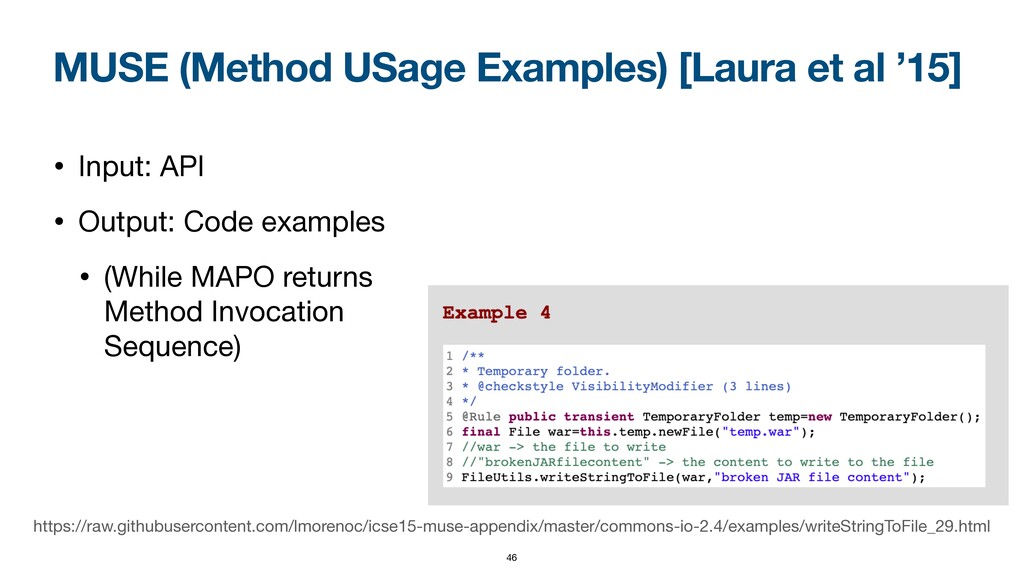
MUSE (Method USage Examples) [Laura et al ’15] • Input:
API • Output: Code examples • (While MAPO returns Method Invocation Sequence) https://raw.githubusercontent.com/lmorenoc/icse15-muse-appendix/master/commons-io-2.4/examples/writeStringToFile_29.html 46 -
MUSE architecture overview Basically the same with MAPO Code Repository
Code Analyzer Clustering Engine Code Clusters Program Slices Pattern selection Code Examples Developer 47 -
Difference from MAPO Code Repository Code Analyzer Clustering Engine Code
Clusters Program Slices Pattern selection Code Examples Developer 48 Instead of MIS, extract Program Slice Code Clone detection Use simplicity instead of Sequential Pattern Mining Code examples, not MIS -
Program Slicing MUSE applies static backward slicing to extract only
relevant (to interesting API call) part of code snippet. 49 x := 1; y := x + 1; foo() bar(); method(x, y); uninteresting(y); x := 1; y := x + 1; foo() bar(); method(x, y); uninteresting(y); Interesting method -
Clustering Code Repository Code Analyzer Clustering Engine Code Clusters Program
Slices Pattern selection Code Examples Developer MUSE utilizes code clone detection technique for clustering. (While MAPO uses similarity heuristics). 50 -
Code clone detection MUSE uses Simian (text-based) code similarity analyzer
for clustering. Simian, Similarity Analyzer https://www.harukizaemon.com/simian/ 51 If (a >= b) { c = d + b; // comment1 d = d + 1; } else { c = d - a; // comment2 } If (m >= n) { // comment1 y = x + n; // comment2 x = x + 1; } else { y = x - m; // comment3 } Not-similar by simple string comparison -
Code clone detection Simian can detect syntactically identical code clones
allowing variation of identifiers, comments, etc… (called type-2 clone) Simian, Similarity Analyzer https://www.harukizaemon.com/simian/ 52 If (m >= n) { y = x + n; // comment1 x = x + 1; } else { y = d - a; // comment2 } If (m >= n) { // comment1 y = x + n; // comment2 x = x + 1; } else { y = x - m; // comment3 } Ignore comments Rename identifiers -
Rank example clusters Intuition: More examples from variable methods in
a cluster -> rank higher 3 examples 1 examples 53 Code Repository Code Analyzer Clustering Engine Code Clusters Program Slices Pattern selection Code Examples Developer -
Readability and reusability metric MUSE pick one representative for each
cluster. (because MUSE shows only one example for each cluster). Pick the most readable and reusable code 54 Code Repository Code Analyzer Clustering Engine Code Clusters Program Slices Pattern selection Code Examples Developer -
Readability metric Learning a metric for code readability [Buse et
al ’09] • Supervised classification model. • Vectorize method by • Lines, avg of identifiers, indent • # of branches, loops, assignments, etc… 55 Vectorize ML model 0.8 score -
Reusability metric Intuition: more stdlib object -> more reusability •
ex_i: (i th) code example • #JavaObjectTypes: number of objects from JDK libraries • #ObjectTypes: number of (any) objects 56 -
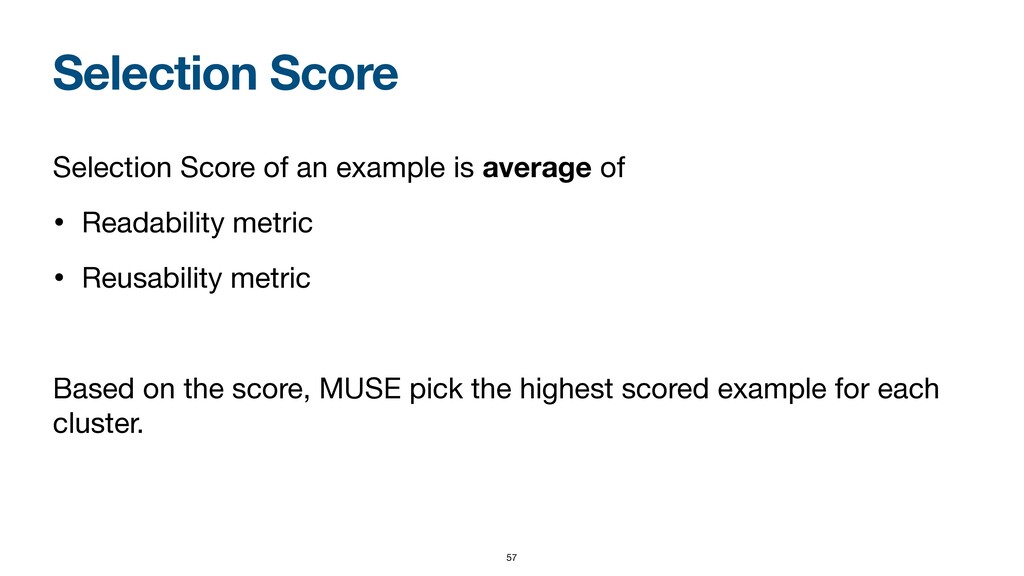
Selection Score Selection Score of an example is average of
• Readability metric • Reusability metric Based on the score, MUSE pick the highest scored example for each cluster. 57 -
MUSE architecture Code Repository Code Analyzer Clustering Engine Code Clusters
Program Slices Pattern miner Code Examples Developer 58 Give me code example for FileUtils.writeStringToFile -
MUSE / experiment RQ: Do MUSE’s examples help developers to
complete their programming tasks? • 12 industrial developers (5y experience on average) • Assign two kind of tasks, in 60 minutes each • Participants need to use designated 3rd party libraries. 59 -
MUSE / experiment Assigned tasks • T1: Retrieve PDF metadata
for the given input URL. • T2: Open a csv file, and filter rows by specific value, then output filtered data to the designated file. Each task has subtasks (e.g. fetch pdf from internet, open csv file …) Evaluate task subtasks’ completeness by (human) code review. 60 -
MUSE / experiment T1-NCE: Solve T1 using any resources available
on Internet (e.g. stack overflow, API document), except MUSE generated code examples. T1-CE: Solve T1 using any resources available on Internet and MUSE generated code examples 61 -
MUSE / experiment Avg 53% completeness in NCE group Avg
73% completeness in CE group 62 -
Agenda • Background and Motivation • How Developers Search for
Code [Caitlin’ 15] • What is API-Based Code Search • Previous Researches: • MAPO [Xhong et al ’09] • MUSE [Moreno et al ’15] • Future Work 63 -
Room for improvements for MAPO and MUSE • Unnecessary complexity
of code example. • Need returned value description in code example. • Large search scope, huge index size. (for MUSE) 64 -
Unnecessary complexity of code examples 65 Interesting part of BufferedReader.read
Unnecessary can’t remove by slicing Code example for BufferedReader.read -
Need returned value description in code example MAPO and MUSE
gives code examples, but they lack the result of execution. What value in n in the end??? 66 -
Large search scope, huge indexes MUSE needs to create code
slices and clusters for each API call from whole search scope. Code snippet generate 3 API usage example. • FileReader.read • StringBuffer.append • InputStreamReader.read In experience, MUSE fix the query and search scope… 67 -
What can we do? (Idea) Extract code example from unit
tests (of the method). • Unit tests tend to focus on the specific method usage. • They have the examples of inputs and output of the method. • Limit the search scope, and index size. 68 -
Thank you! • Background and Motivation • How Developers Search
for Code [Caitlin et al ’15] • What is API-Based Code Search • Previous Researches: • MAPO [Xhong et al ’09] • MUSE [Moreno et al ’15] • Future Work 69 -
Related research areas • Automatic code summarization • Shido, Yusuke,
et al. "Automatic source code summarization with extended tree- LSTM." 2019 International Joint Conference on Neural Networks (IJCNN). IEEE, 2019. • Code snippet Recommendation • Luan, Sifei, et al. "Aroma: Code recommendation via structural code search." Proceedings of the ACM on Programming Languages 3.OOPSLA (2019): 1-28. • Text-based code search with DeepLearning technique • Husain, Hamel, et al. "Codesearchnet challenge: Evaluating the state of semantic code search." arXiv preprint arXiv:1909.09436 (2019). 70
 tanishiking
 utakaha
 vivion
 barnbarn
 kmars0605
 fuqda
 sakawe_ee
 cclai999
 naruogram
 sylph01
 simas
 a_matsuda
 omatty198
 codingconduct
 katiecoart
 moore
 destraynor
 szymonslowik
 inesmontani
 bethany
 helenjbeal
 bkeepers
 samtorres