Upgrade to Pro — share decks privately, control downloads, hide ads and more …

From Verified Skills to Opportunity: LERs, Digi...

From Verified Skills to Opportunity: LERs, Digital Credential Wallets, and Talent Marketplaces

This overview explains how Learning and Employment Records, digital credential wallets, and talent marketplaces work together to make skills verifiable, portable, and connected to opportunity. It highlights practical benefits for learners, colleges, employers, and states, including smoother transfers, credit for prior learning, trusted hiring, and stronger education-to-workforce alignment.

Avatar for Territorium

Territorium PRO

July 16, 2026

More Decks by Territorium

Other Decks in Education

Transcript

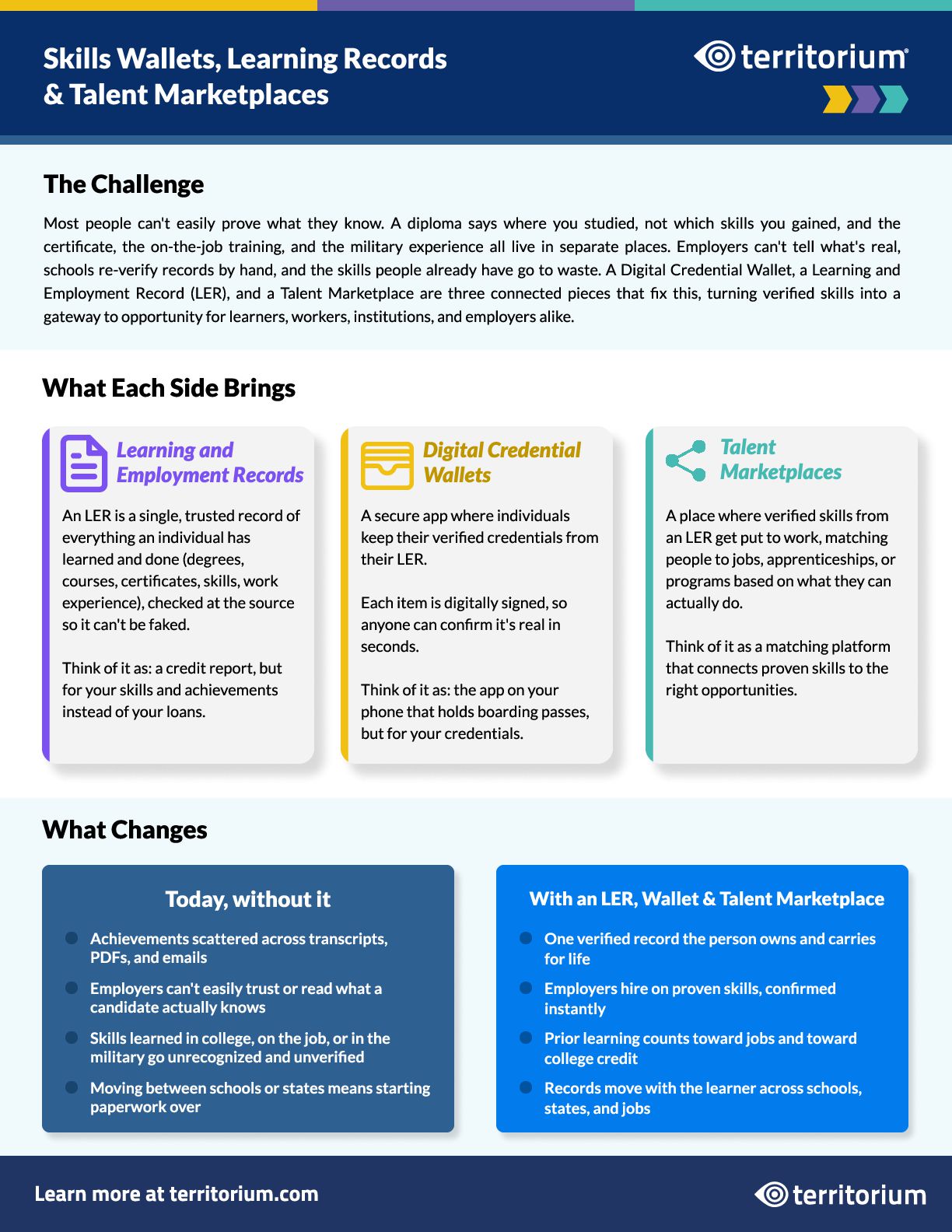
  1. Skills Wallets, Learning Records & T alent Marketplaces The Challenge

    Most people can't easily prove what they know. A diploma says where you studied, not which skills you gained, and the certificate, the on-the-job training, and the military experience all live in separate places. Employers can't tell what's real, schools re-verify records by hand, and the skills people already have go to waste. A Digital Credential Wallet, a Learning and Employment Record (LER), and a T alent Marketplace are three connected pieces that fix this, turning verified skills into a gateway to opportunity for learners, workers, institutions, and employers alike. What Each Side Brings Learning and
 Employment Records Digital Credential Wallets Talent Marketplaces An LER is a single, trusted record of everything an individual has learned and done (degrees, courses, certificates, skills, work experience), checked at the source so it can't be faked. Think of it as: a credit report, but for your skills and achievements instead of your loans. A secure app where individuals keep their verified credentials from their LER. Each item is digitally signed, so anyone can confirm it's real in seconds. Think of it as: the app on your phone that holds boarding passes, but for your credentials. A place where verified skills from an LER get put to work, matching people to jobs, apprenticeships, or programs based on what they can actually do. Think of it as a matching platform that connects proven skills to the right opportunities. What Changes Toda y, witho ut it Achievements scattered across transcripts, PDFs, and emails Emplo yers can 't easil y tr ust or read what a candidate act uall y kno ws Skills learned in colle ge, on the jo b, or in the militar y go unreco gni zed and unveri fied Movin g bet ween schools or states means startin g paper wor k ove r Learn more at territorium.com With an LER, Wallet & T alent Marketplace One veri fied record the person o wns and carries for li fe Emplo yers hire on proven s kills, con firmed instantl y Prior learnin g co unts to ward jo bs and to ward colle ge credit Records move with the learner across schools, states, and jo bs
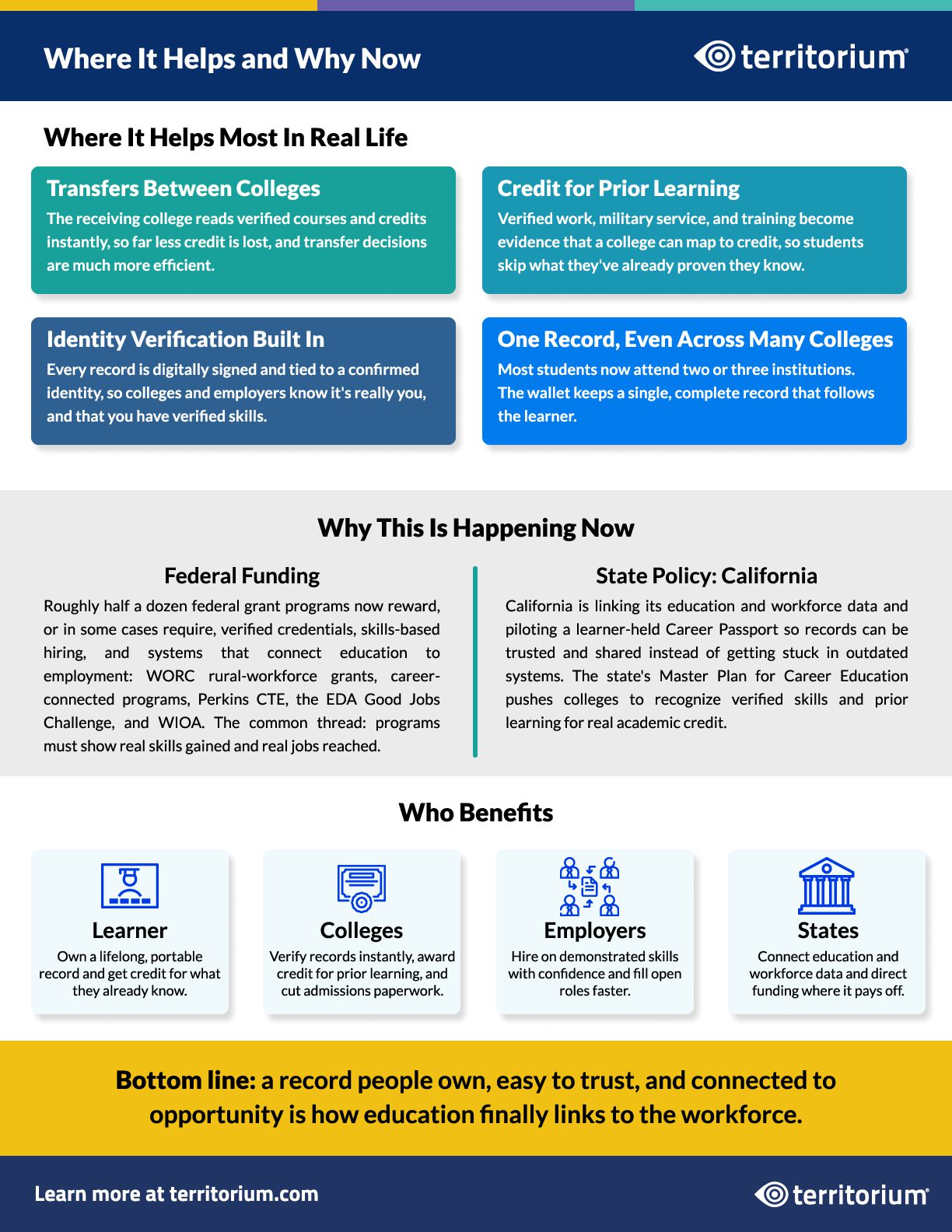
  2. Where It Helps and Why Now Where It Helps Most

    In Real Life Transfers Between Colleges The receiving college reads verified courses and credits instantly, so far less credit is lost, and transfer decisions are much more efficient. Identity Verification Built In Every record is digitally signed and tied to a confirmed identity, so colleges and employers know it's really you, and that you have verified skills. Credit for Prior Learning Verified work, military service, and training become evidence that a college can map to credit, so students skip what they've already proven they know. One Record, Even Across Many Colleges Most students now attend two or three institutions. The wallet keeps a single, complete record that follows the learner. Why This Is Happening Now Federal Funding State Policy: California Roughly half a dozen federal grant programs now reward, or in some cases require, verified credentials, skills-based hiring, and systems that connect education to employment: WORC rural-workforce grants, career- connected programs, Perkins CTE, the EDA Good Jobs Challenge, and WIOA. The common thread: programs must show real skills gained and real jobs reached. California is linking its education and workforce data and piloting a learner-held Career Passport so records can be trusted and shared instead of getting stuck in outdated systems. The state's Master Plan for Career Education pushes colleges to recognize verified skills and prior learning for real academic credit. Who Benefits Learner Own a lifelong, portable record and get credit for what they already know. Colleges Verify records instantly, award credit for prior learning, and cut admissions paperwork. Employers Hire on demonstrated skills with confidence and fill open roles faster. States Connect education and workforce data and direct funding where it pays off. Bottom line: a record people own, easy to trust, and connected to opportunity is how education finally links to the workforce. Learn more at territorium.com