Upgrade to Pro — share decks privately, control downloads, hide ads and more …

improving debuggability of nommu code with UML ...

Sponsored · Ship Features Fearlessly Turn features on and off without deploys. Used by thousands of Ruby developers.

improving debuggability of nommu code with UML - Linux netdev conference 0x1a

Avatar for Hajime Tazaki

Hajime Tazaki

July 13, 2026

More Decks by Hajime Tazaki

Other Decks in Technology

Transcript

  1. improving debuggability of nommu code with UML (why do we

    need nommu kernel in Linux ?) Hajime Tazaki (@thehajime) Linux netdev conference 0x1a  1 
  2. Userspace network stacks year lang how API features origina (if

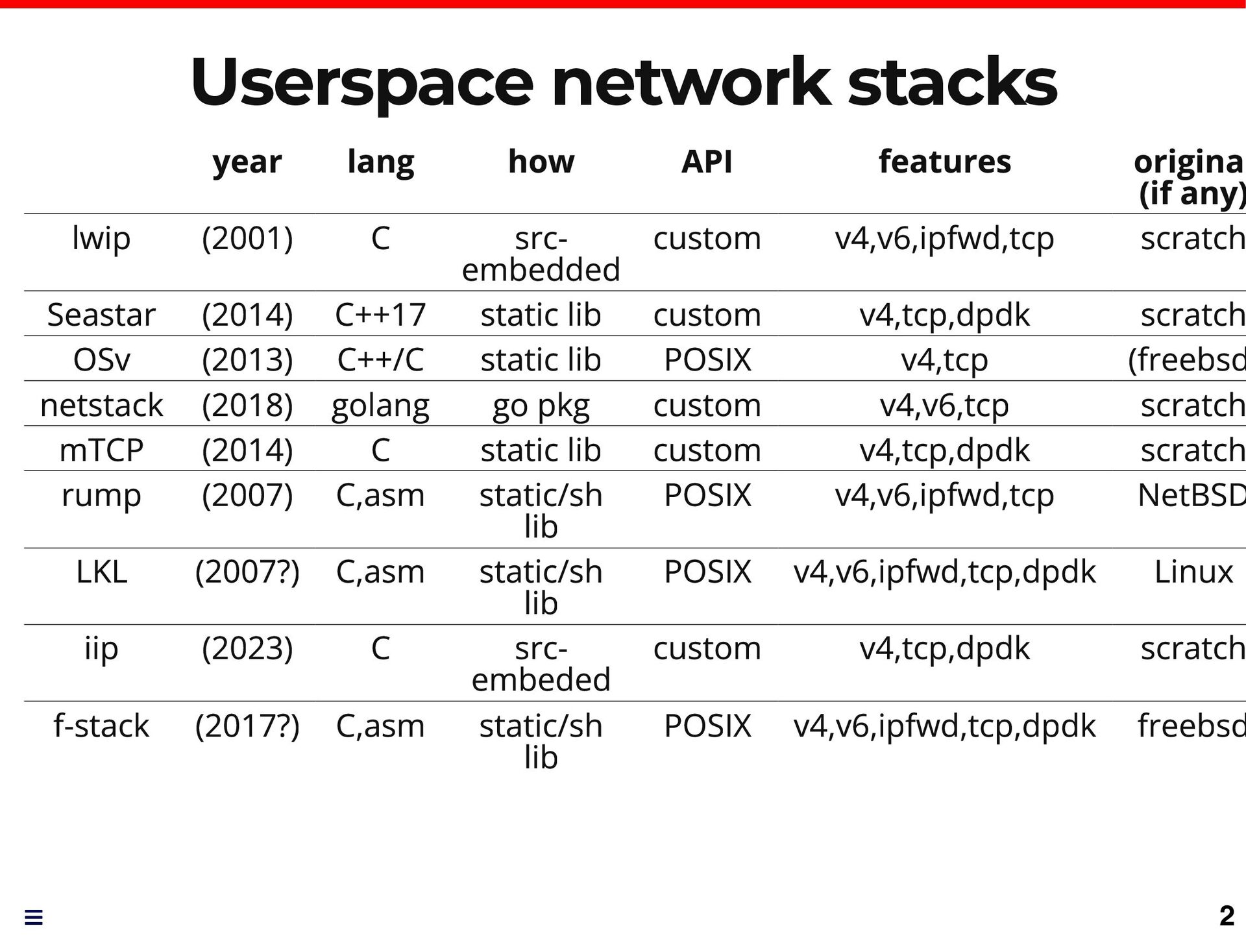
    any) lwip (2001) C src- embedded custom v4,v6,ipfwd,tcp scratch Seastar (2014) C++17 static lib custom v4,tcp,dpdk scratch OSv (2013) C++/C static lib POSIX v4,tcp (freebsd netstack (2018) golang go pkg custom v4,v6,tcp scratch mTCP (2014) C static lib custom v4,tcp,dpdk scratch rump (2007) C,asm static/sh lib POSIX v4,v6,ipfwd,tcp NetBSD LKL (2007?) C,asm static/sh lib POSIX v4,v6,ipfwd,tcp,dpdk Linux iip (2023) C src- embeded custom v4,tcp,dpdk scratch f-stack (2017?) C,asm static/sh lib POSIX v4,v6,ipfwd,tcp,dpdk freebsd 2 
  3. Userspace network stack (cont'd) implement network stack in userspace which

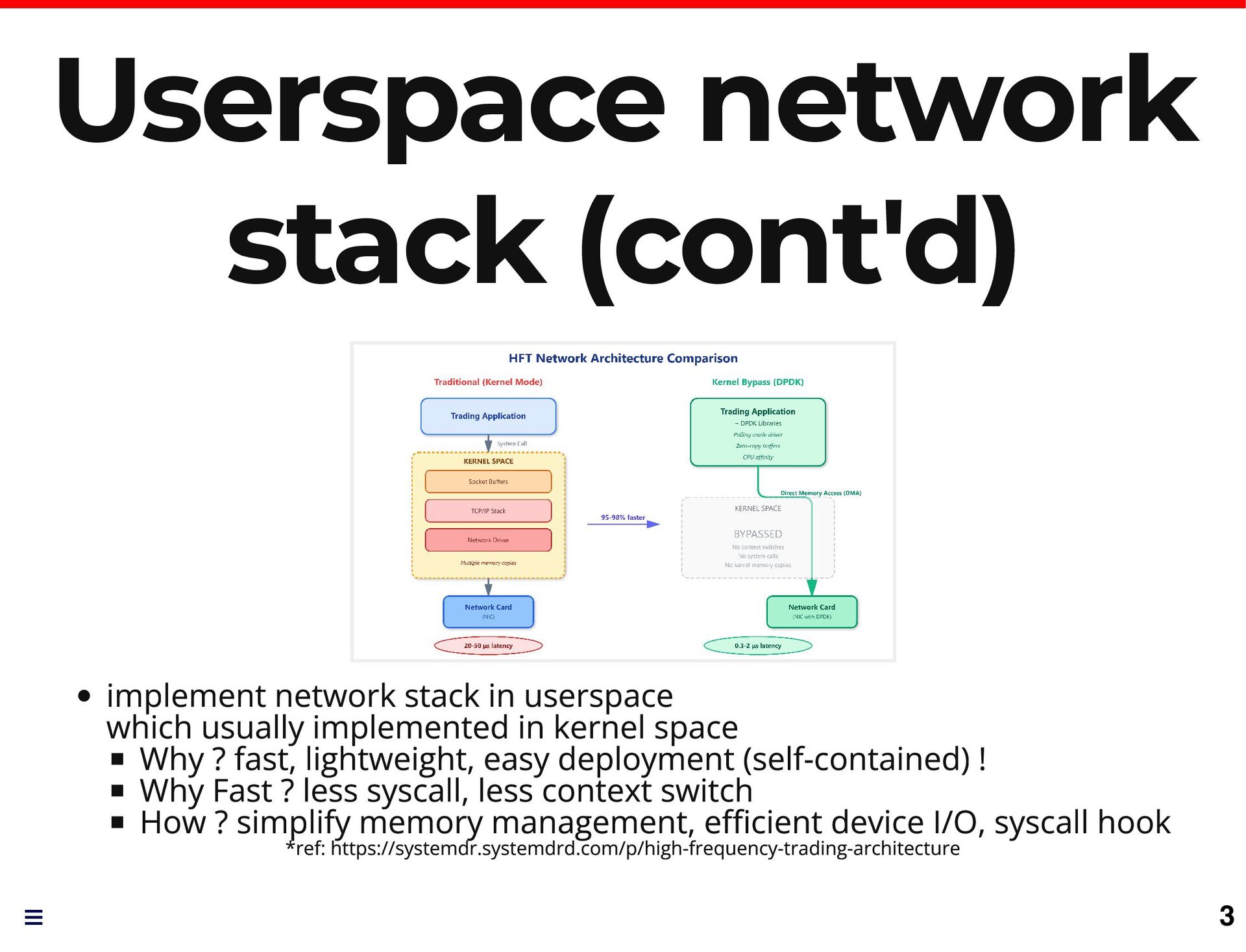
    usually implemented in kernel space Why ? fast, lightweight, easy deployment (self-contained) ! Why Fast ? less syscall, less context switch How ? simplify memory management, efficient device I/O, syscall hook *ref: https://systemdr.systemdrd.com/p/high-frequency-trading-architecture 3 
  4. Why Fast ?              

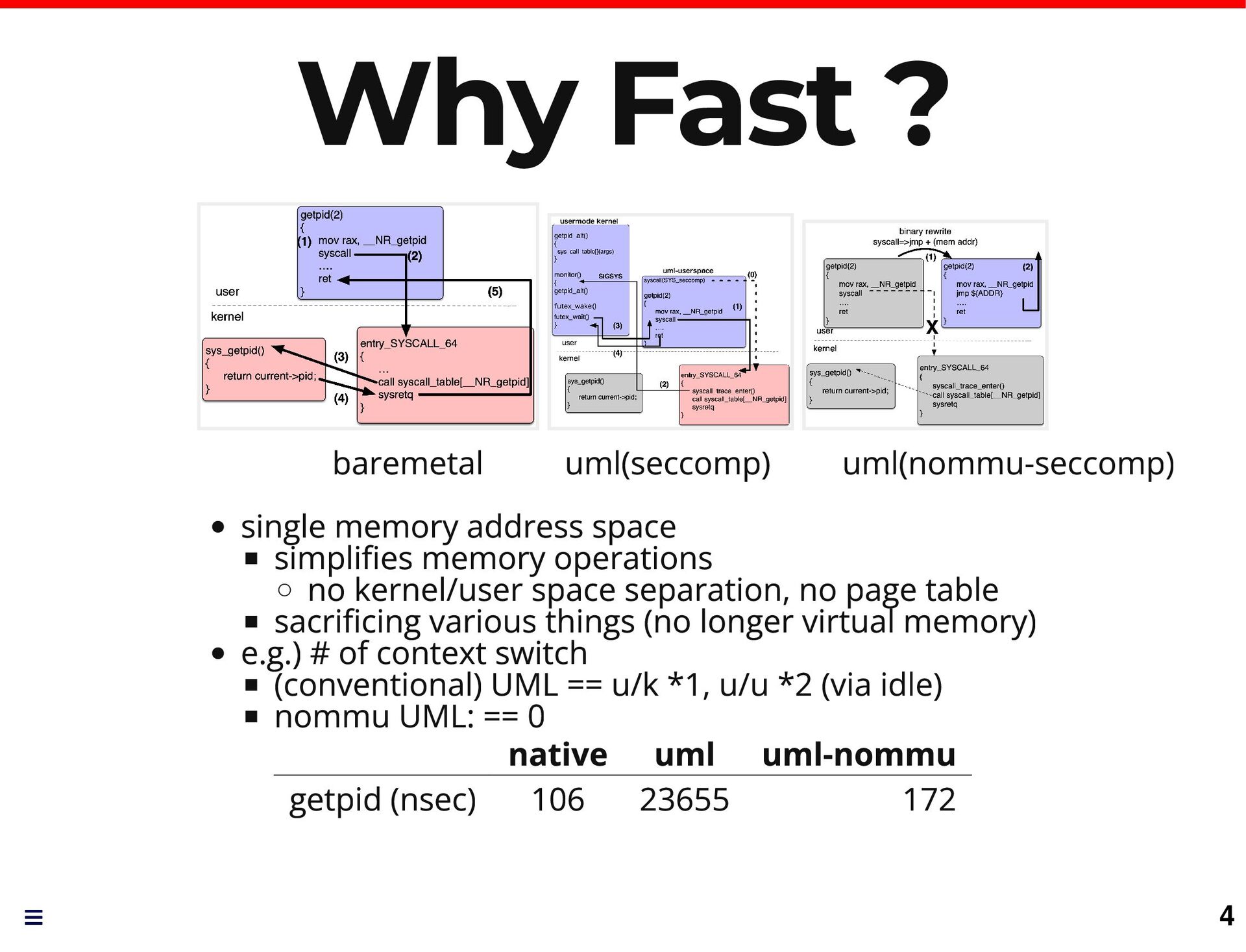
      baremetal   uml(seccomp)    uml(nommu-seccomp) single memory address space simplifies memory operations no kernel/user space separation, no page table sacrificing various things (no longer virtual memory) e.g.) # of context switch (conventional) UML == u/k *1, u/u *2 (via idle) nommu UML: == 0 native uml uml-nommu getpid (nsec) 106 23655 172 4 
  5. Alternate options use full-scratch based userspace network stacks maybe fast,

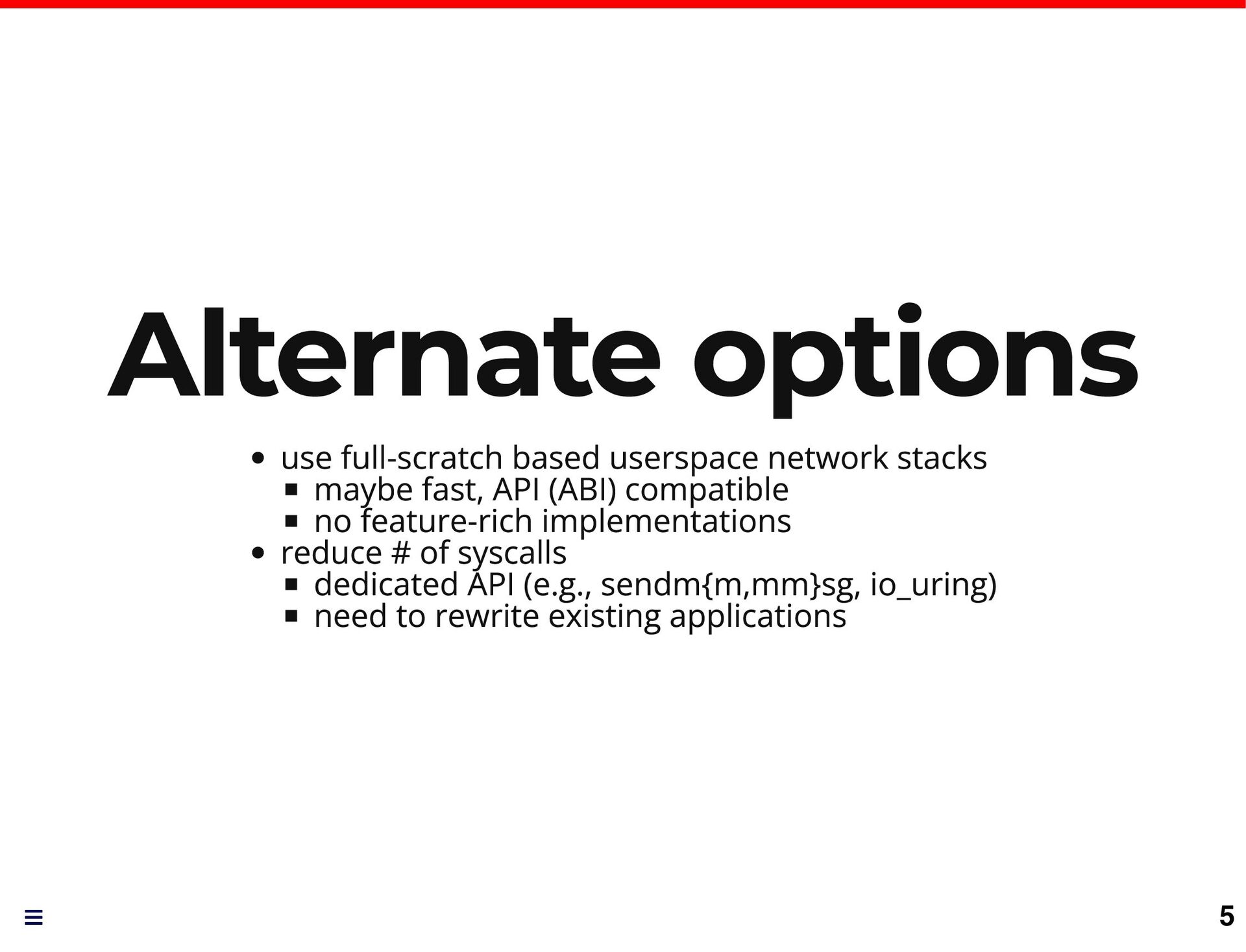
    API (ABI) compatible no feature-rich implementations reduce # of syscalls dedicated API (e.g., sendm{m,mm}sg, io_uring) need to rewrite existing applications 5 
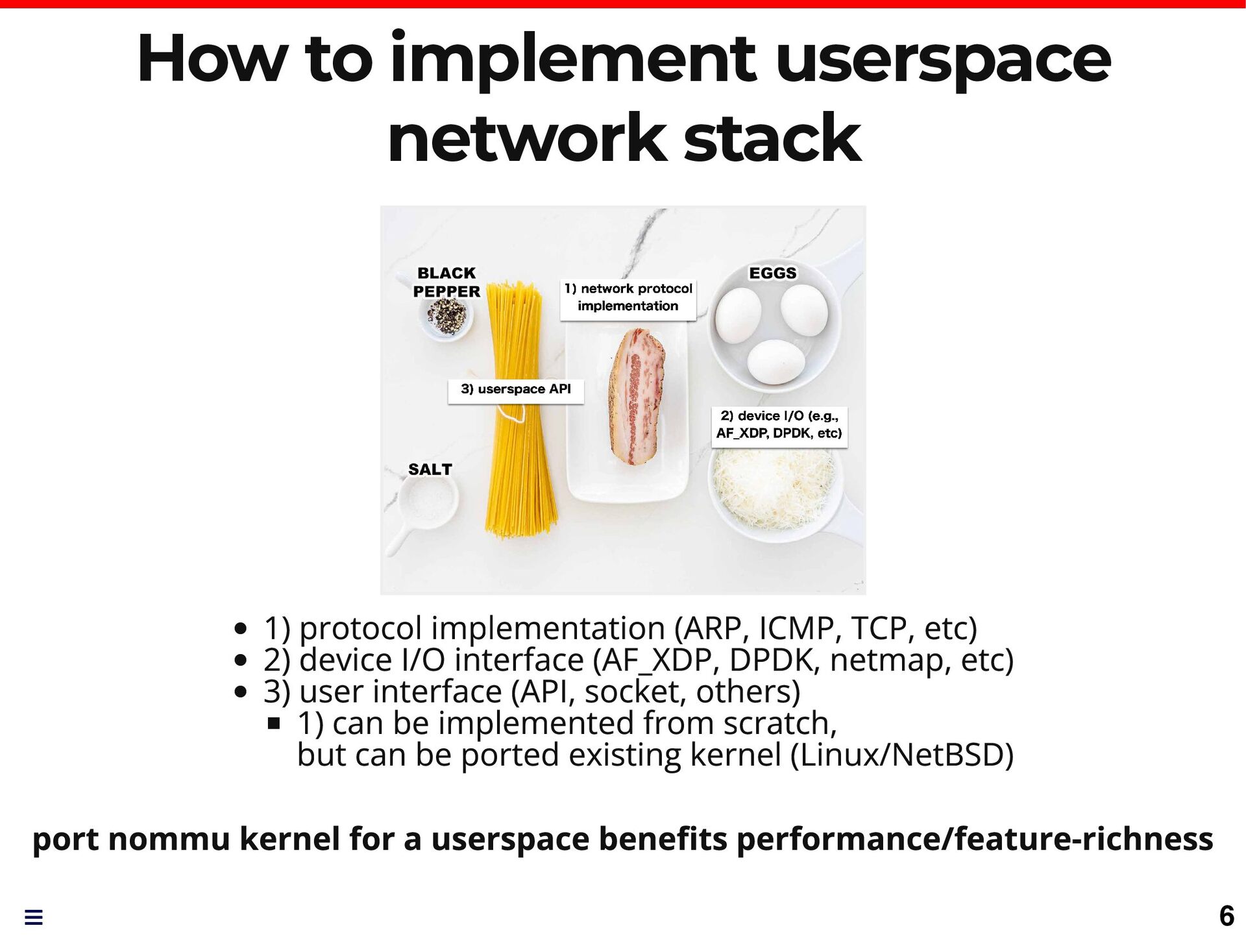
  6. How to implement userspace network stack 1) protocol implementation (ARP,

    ICMP, TCP, etc) 2) device I/O interface (AF_XDP, DPDK, netmap, etc) 3) user interface (API, socket, others) 1) can be implemented from scratch, but can be ported existing kernel (Linux/NetBSD) port nommu kernel for a userspace benefits performance/feature-richness 6 
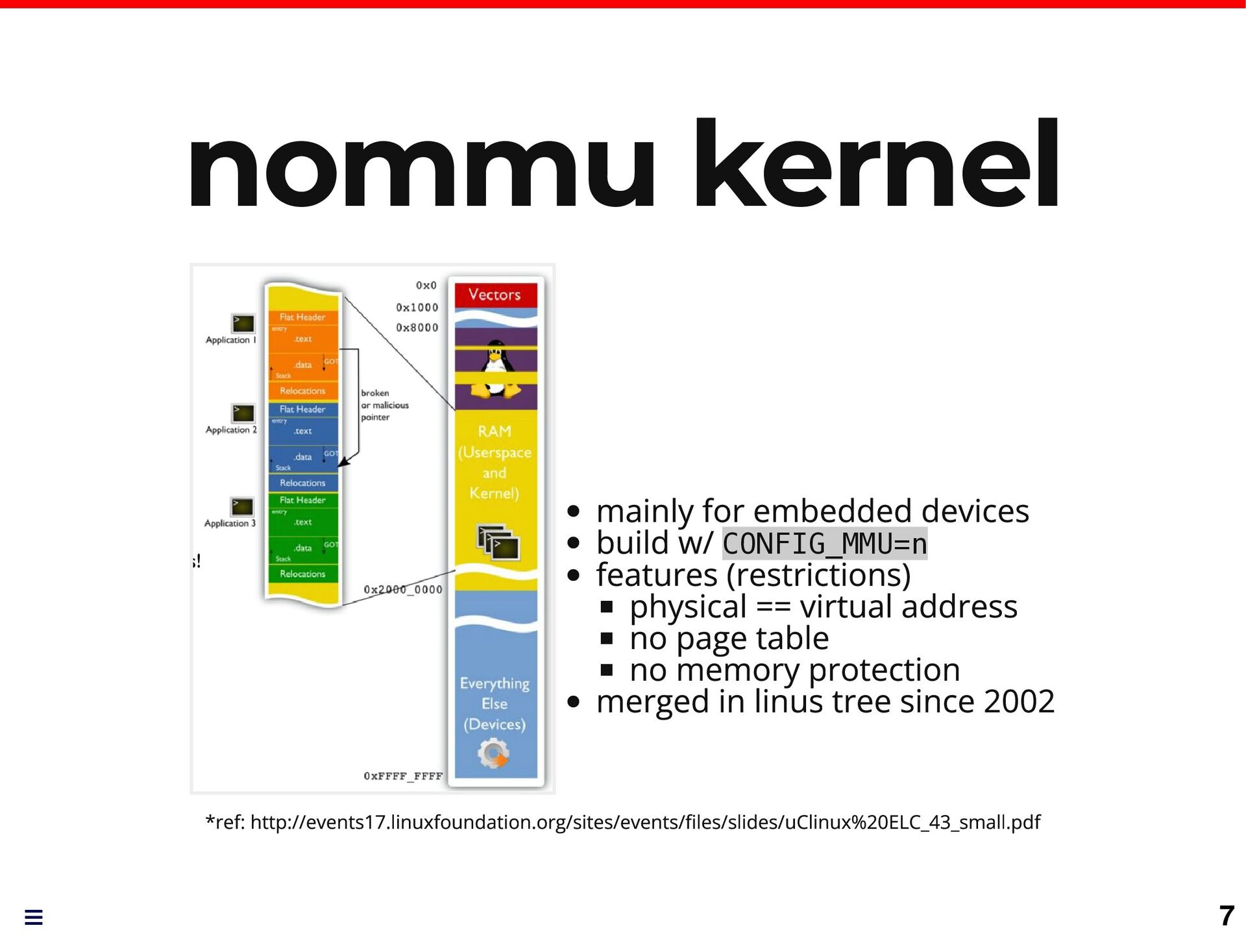
  7. nommu kernel mainly for embedded devices build w/ CONFIG_MMU=n features

    (restrictions) physical == virtual address no page table no memory protection merged in linus tree since 2002 *ref: http://events17.linuxfoundation.org/sites/events/files/slides/uClinux%20ELC_43_small.pdf 7 
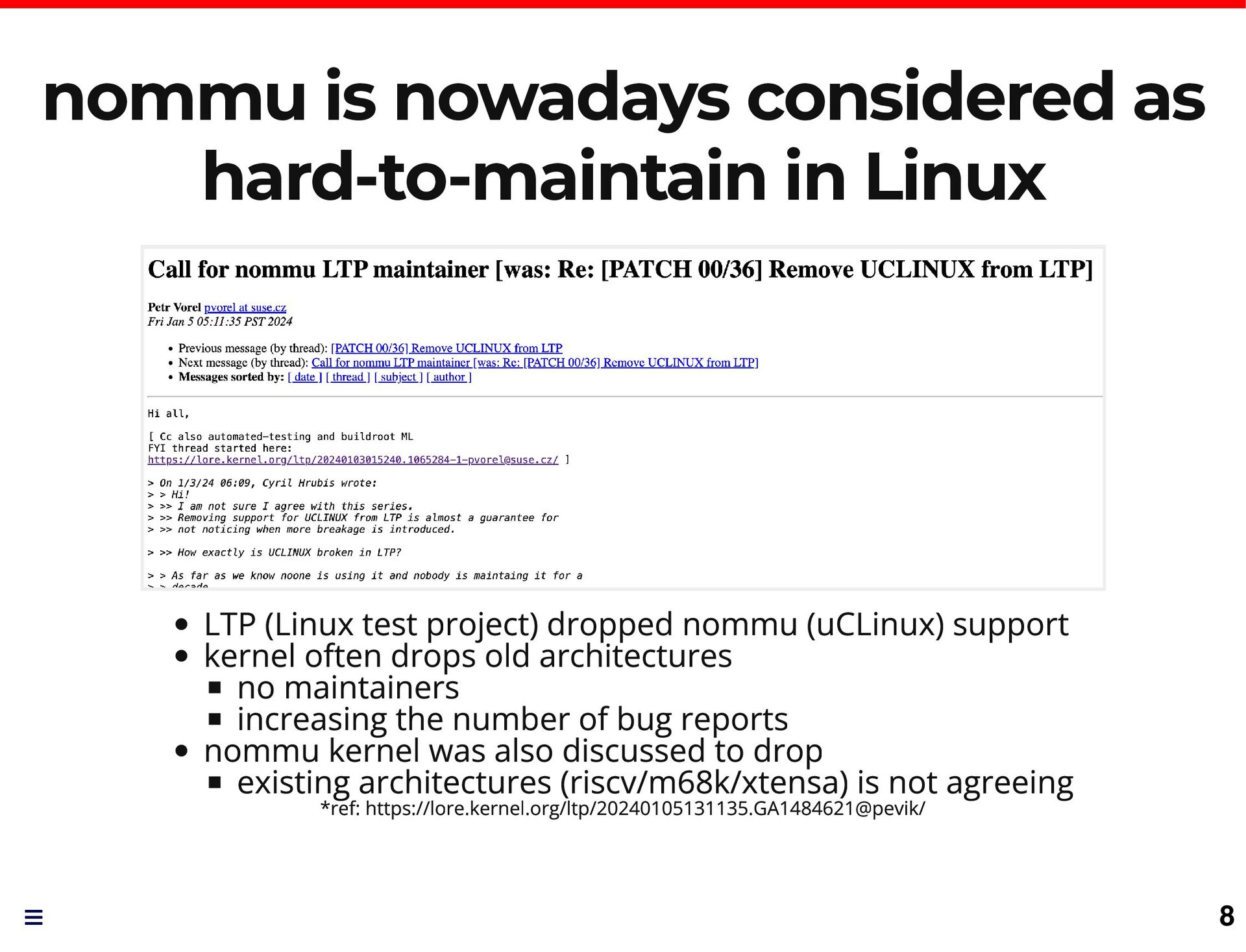
  8. nommu is nowadays considered as hard-to-maintain in Linux LTP (Linux

    test project) dropped nommu (uCLinux) support kernel often drops old architectures no maintainers increasing the number of bug reports nommu kernel was also discussed to drop existing architectures (riscv/m68k/xtensa) is not agreeing *ref: https://lore.kernel.org/ltp/20240105131135.GA1484621@pevik/ 8 
  9. this is pity... still useful for small devices, FPGAs nommu

    with virtualization if a guest doesn't need identical view with host e.g, single process only guest (container/micro-service) e.g., large number of instances, but needs genuine TCP implementation but lack of test infrastructure, thus, hard to maintain ! (<= now) 9 
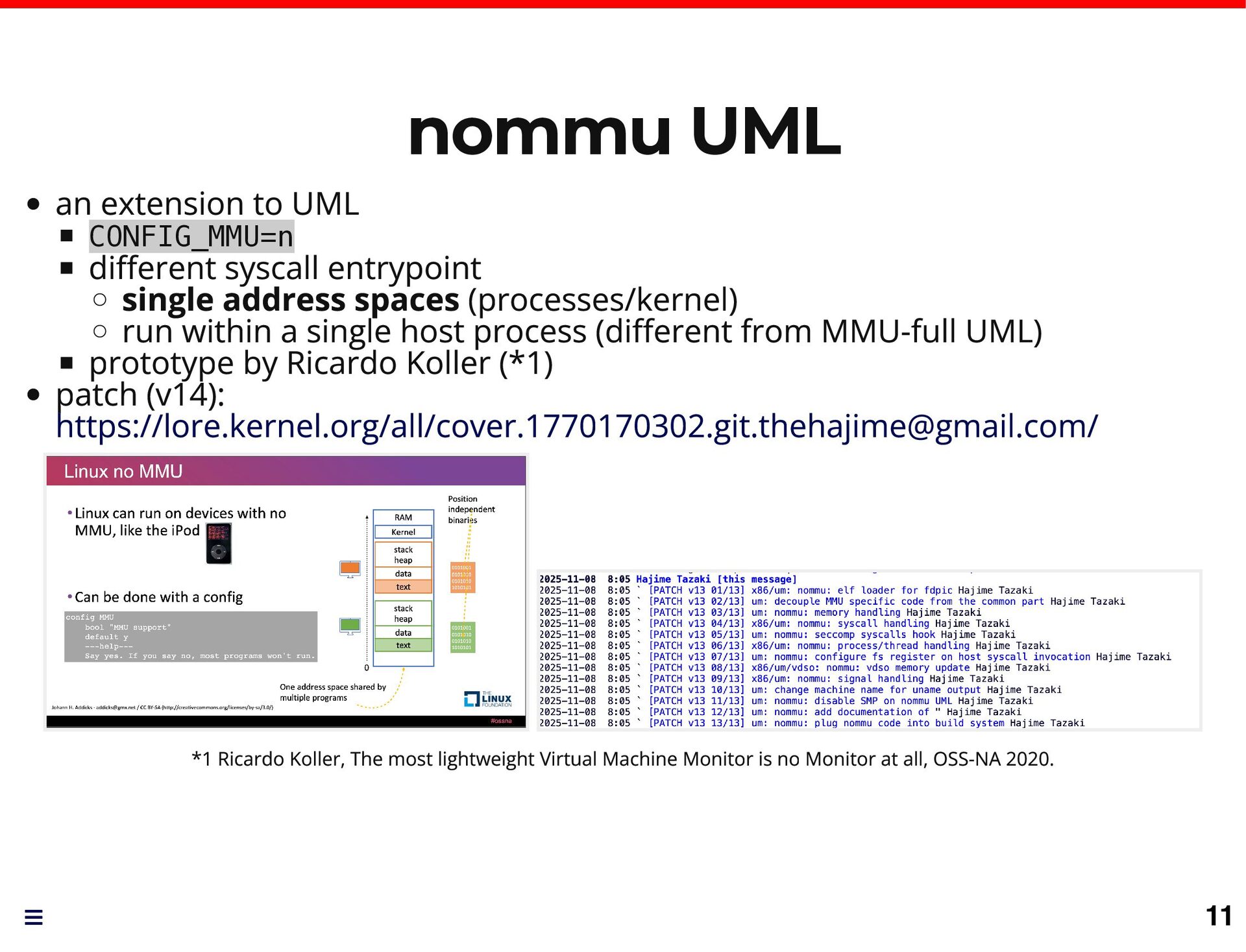
  10. nommu UML an extension to UML CONFIG_MMU=n different syscall entrypoint

    single address spaces (processes/kernel) run within a single host process (different from MMU-full UML) prototype by Ricardo Koller (*1) patch (v14): *1 Ricardo Koller, The most lightweight Virtual Machine Monitor is no Monitor at all, OSS-NA 2020. https://lore.kernel.org/all/[email protected]/ 11 
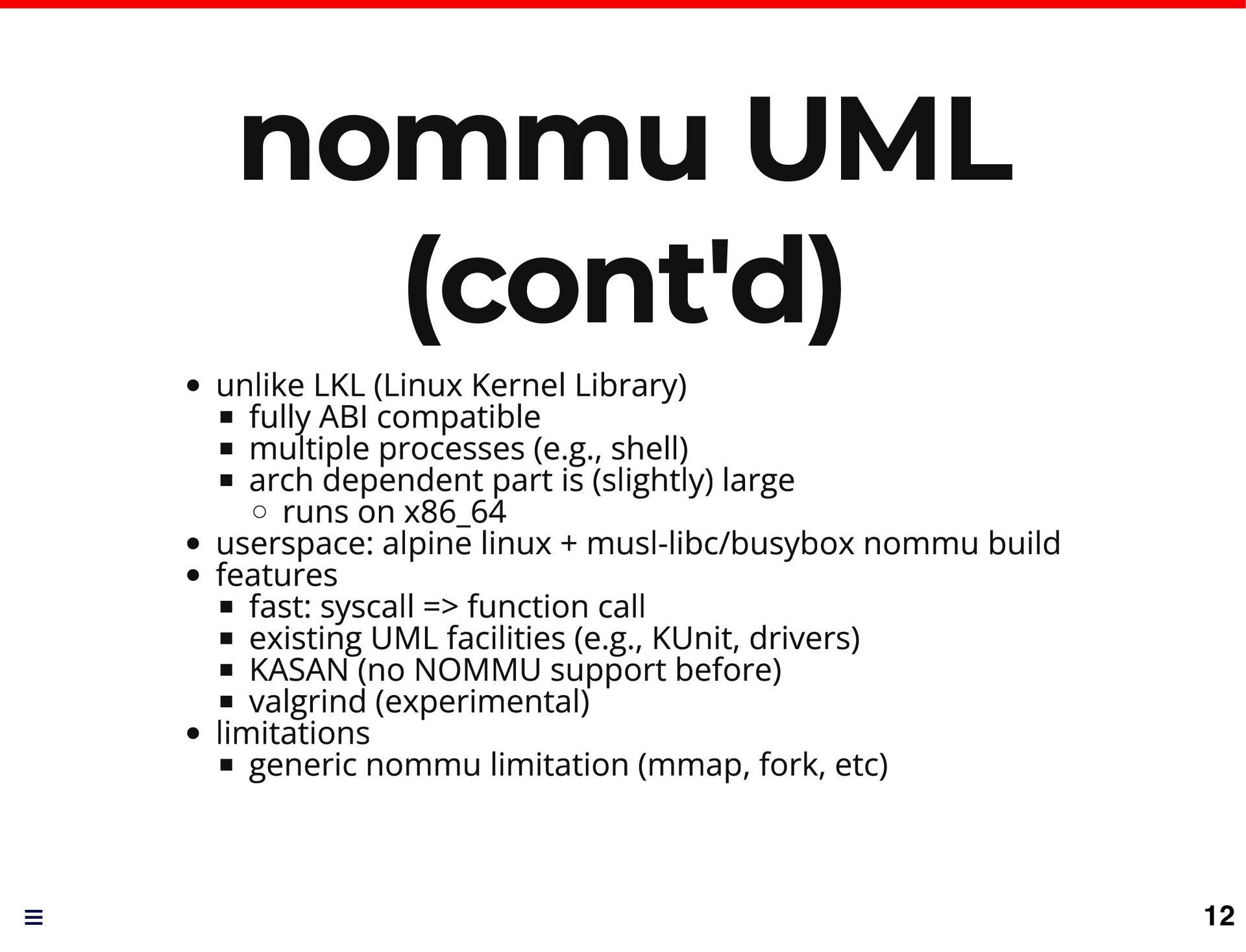
  11. nommu UML (cont'd) unlike LKL (Linux Kernel Library) fully ABI

    compatible multiple processes (e.g., shell) arch dependent part is (slightly) large runs on x86_64 userspace: alpine linux + musl-libc/busybox nommu build features fast: syscall => function call existing UML facilities (e.g., KUnit, drivers) KASAN (no NOMMU support before) valgrind (experimental) limitations generic nommu limitation (mmap, fork, etc) 12 
  12. Limitations vfork(2) instead of fork(2) no CoW (copy-on-write) parent blocks

    until child exit(2) applications should be aware of PIE (position independent executable) binaries objects w/o absolute address to execute in different location processes share the address space among others no memory protection mmap(2): a subset of functionalities e.g., no MAP_FIXED, partial MAP_SHARED support 13 
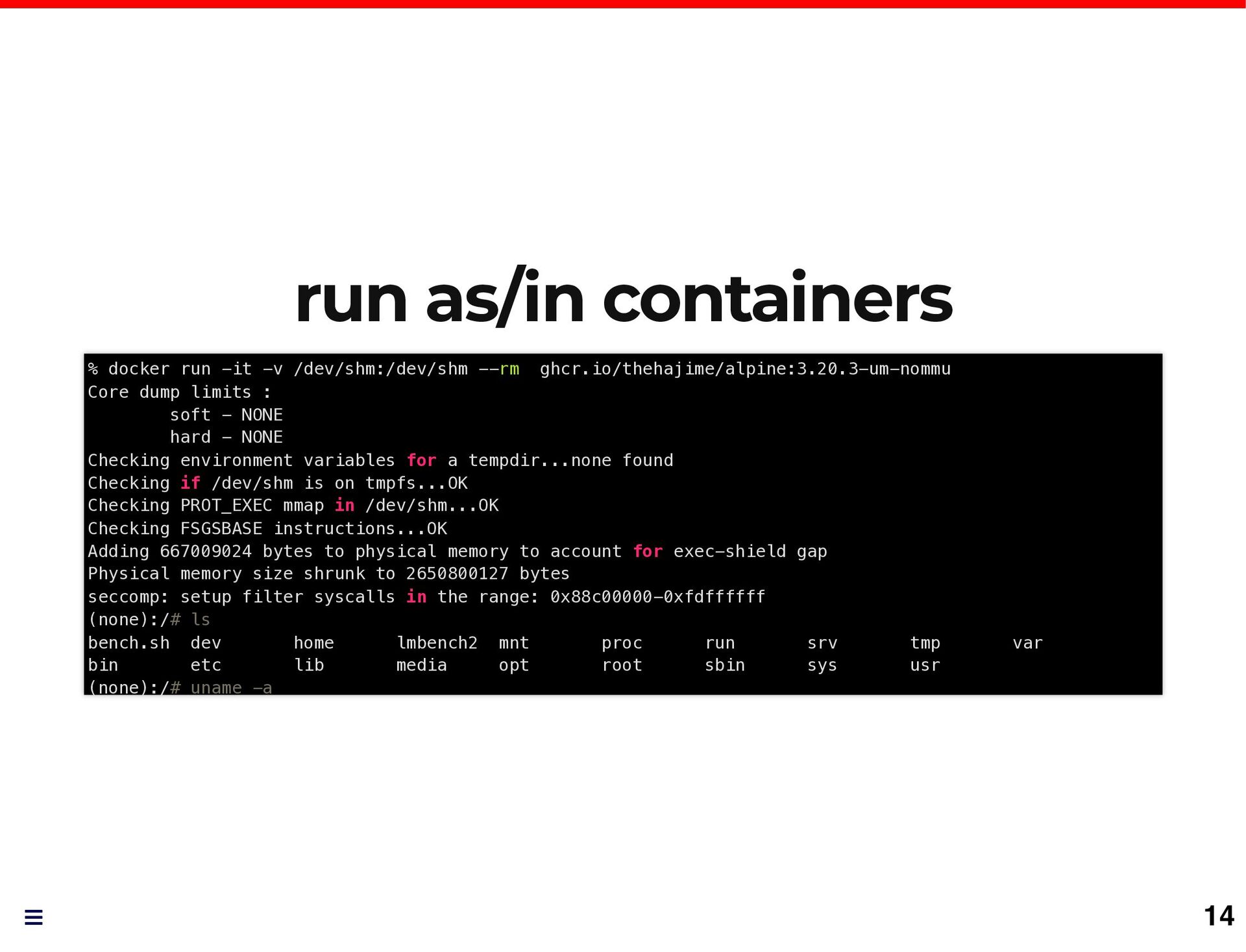
  13. run as/in containers % docker run -it -v /dev/shm:/dev/shm --rm

    ghcr.io/thehajime/alpine:3.20.3-um-nommu Core dump limits : soft - NONE hard - NONE Checking environment variables for a tempdir...none found Checking if /dev/shm is on tmpfs...OK Checking PROT_EXEC mmap in /dev/shm...OK Checking FSGSBASE instructions...OK Adding 667009024 bytes to physical memory to account for exec-shield gap Physical memory size shrunk to 2650800127 bytes seccomp: setup filter syscalls in the range: 0x88c00000-0xfdffffff (none):/# ls bench.sh dev home lmbench2 mnt proc run srv tmp var bin etc lib media opt root sbin sys usr (none):/# uname -a 14 
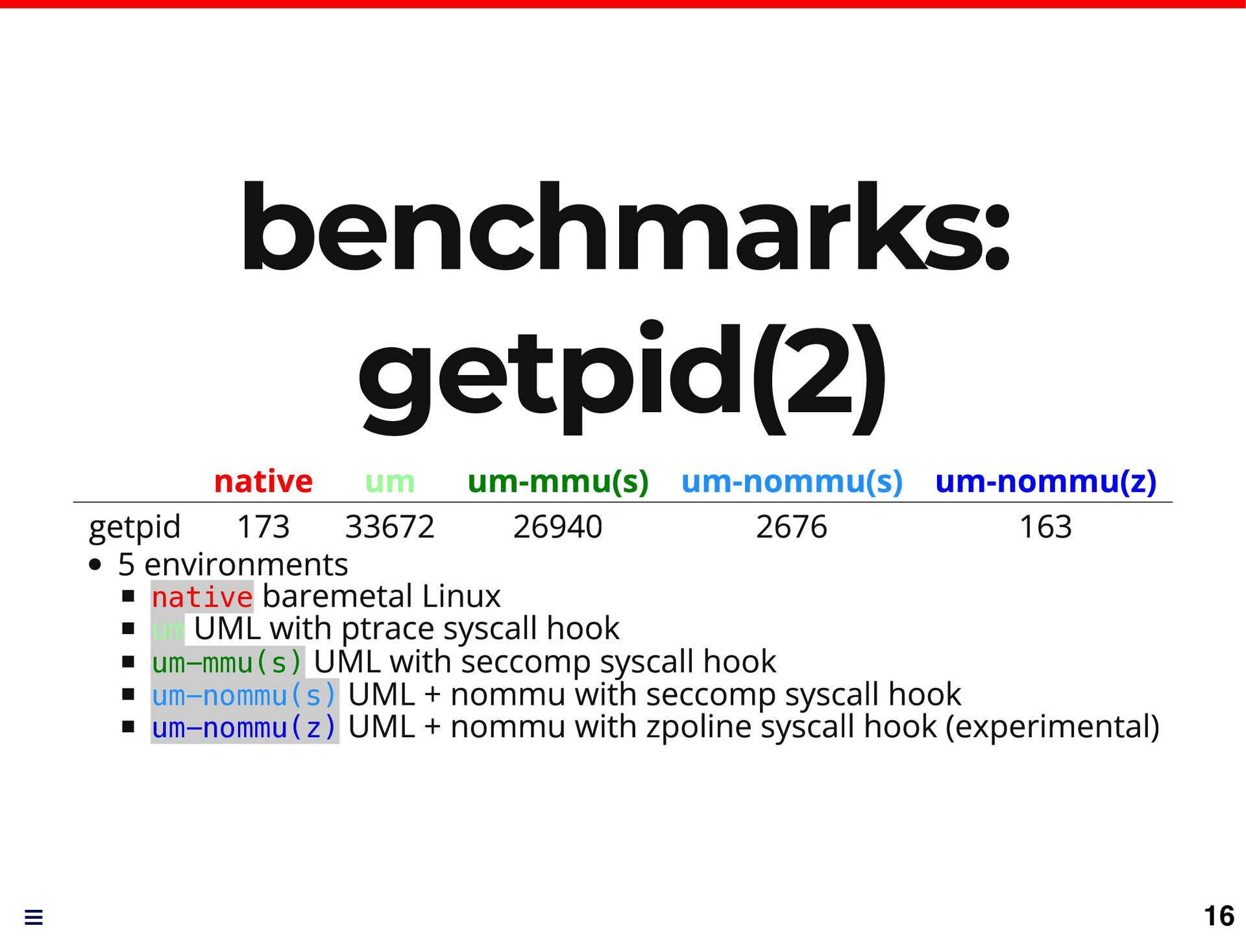
  14. benchmarks: getpid(2) native um um-mmu(s) um-nommu(s) um-nommu(z) getpid 173 33672

    26940 2676 163 5 environments native baremetal Linux um UML with ptrace syscall hook um-mmu(s) UML with seccomp syscall hook um-nommu(s) UML + nommu with seccomp syscall hook um-nommu(z) UML + nommu with zpoline syscall hook (experimental) 16 
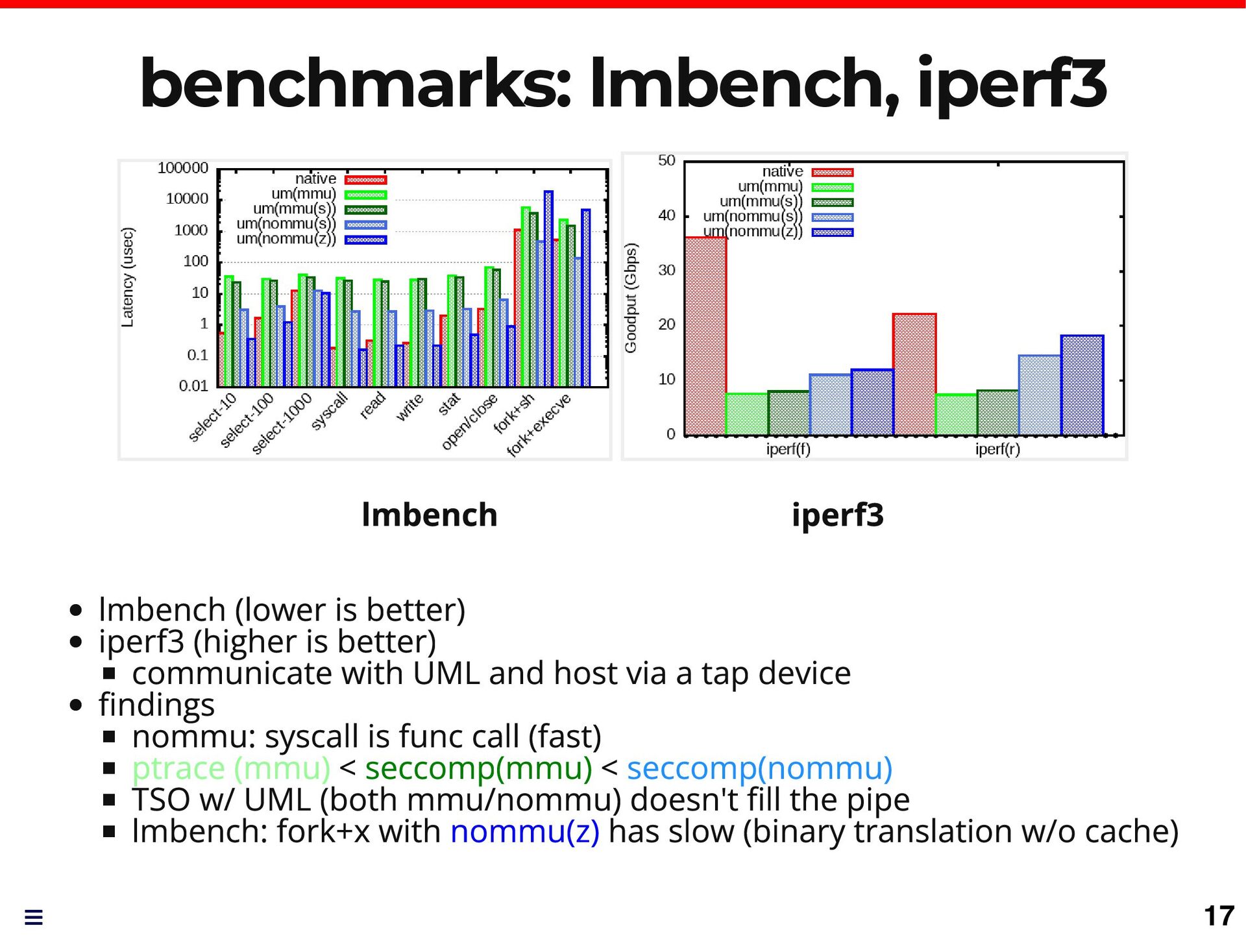
  15. benchmarks: lmbench, iperf3 lmbench iperf3 lmbench (lower is better) iperf3

    (higher is better) communicate with UML and host via a tap device findings nommu: syscall is func call (fast) ptrace (mmu) < seccomp(mmu) < seccomp(nommu) TSO w/ UML (both mmu/nommu) doesn't fill the pipe lmbench: fork+x with nommu(z) has slow (binary translation w/o cache) 17 
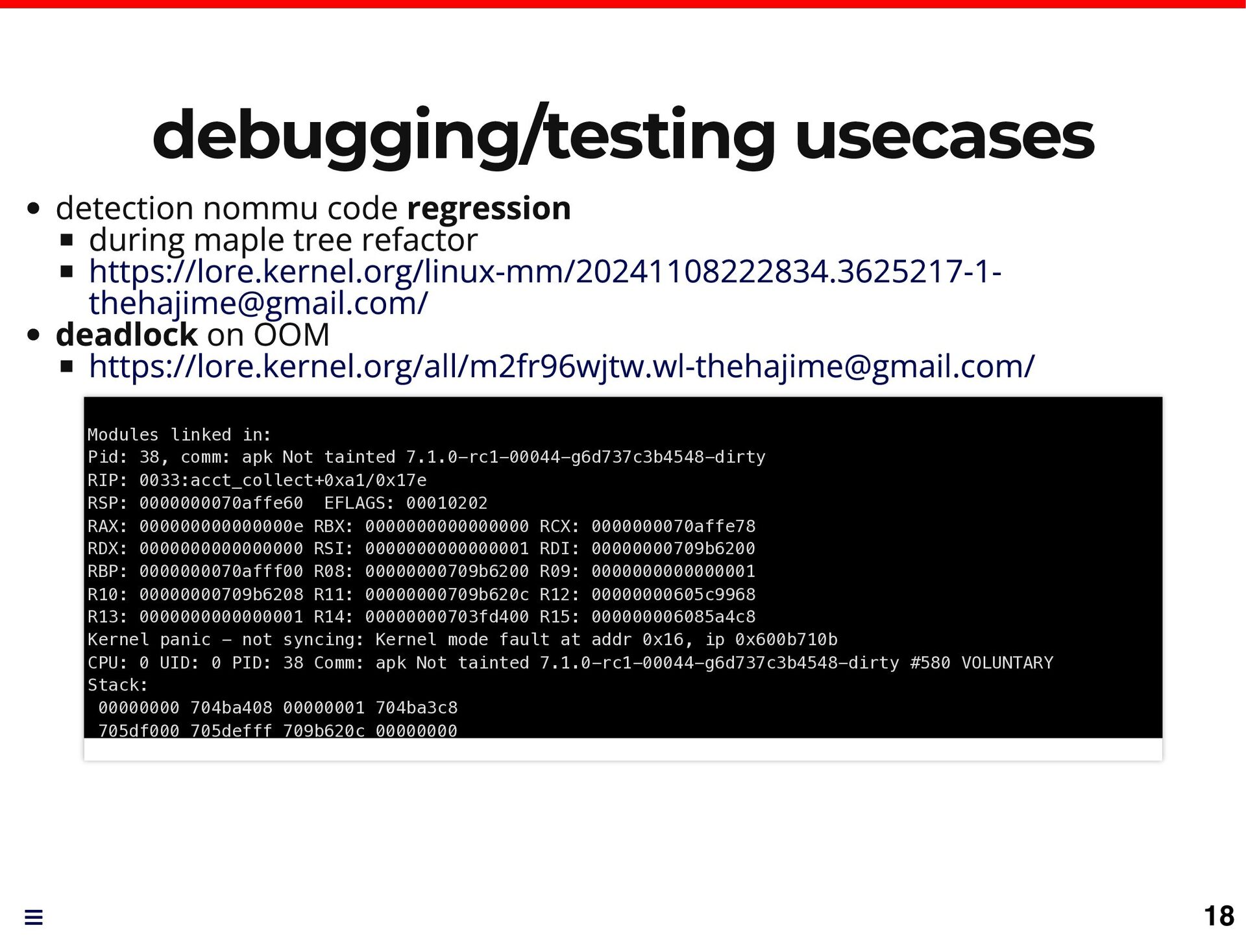
  16. debugging/testing usecases detection nommu code regression during maple tree refactor

    deadlock on OOM https://lore.kernel.org/linux-mm/20241108222834.3625217-1- [email protected]/ https://lore.kernel.org/all/[email protected]/ Modules linked in: Pid: 38, comm: apk Not tainted 7.1.0-rc1-00044-g6d737c3b4548-dirty RIP: 0033:acct_collect+0xa1/0x17e RSP: 0000000070affe60 EFLAGS: 00010202 RAX: 000000000000000e RBX: 0000000000000000 RCX: 0000000070affe78 RDX: 0000000000000000 RSI: 0000000000000001 RDI: 00000000709b6200 RBP: 0000000070afff00 R08: 00000000709b6200 R09: 0000000000000001 R10: 00000000709b6208 R11: 00000000709b620c R12: 00000000605c9968 R13: 0000000000000001 R14: 00000000703fd400 R15: 000000006085a4c8 Kernel panic - not syncing: Kernel mode fault at addr 0x16, ip 0x600b710b CPU: 0 UID: 0 PID: 38 Comm: apk Not tainted 7.1.0-rc1-00044-g6d737c3b4548-dirty #580 VOLUNTARY Stack: 00000000 704ba408 00000001 704ba3c8 705df000 705defff 709b620c 00000000 18 
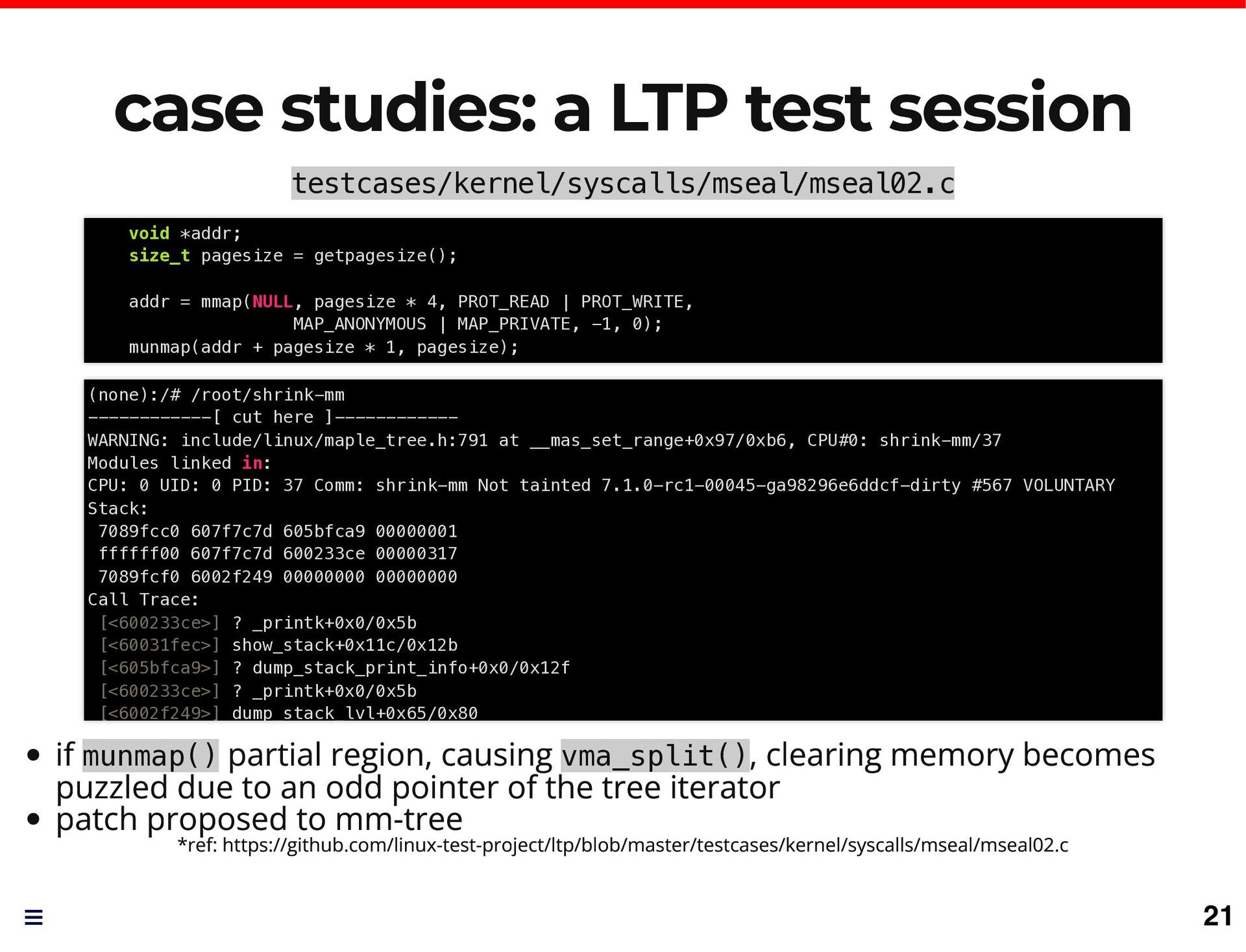
  17. case studies: a LTP test session testcases/kernel/syscalls/mseal/mseal02.c if munmap() partial

    region, causing vma_split(), clearing memory becomes puzzled due to an odd pointer of the tree iterator patch proposed to mm-tree *ref: https://github.com/linux-test-project/ltp/blob/master/testcases/kernel/syscalls/mseal/mseal02.c void *addr; size_t pagesize = getpagesize(); addr = mmap(NULL, pagesize * 4, PROT_READ | PROT_WRITE, MAP_ANONYMOUS | MAP_PRIVATE, -1, 0); munmap(addr + pagesize * 1, pagesize); (none):/# /root/shrink-mm ------------[ cut here ]------------ WARNING: include/linux/maple_tree.h:791 at __mas_set_range+0x97/0xb6, CPU#0: shrink-mm/37 Modules linked in: CPU: 0 UID: 0 PID: 37 Comm: shrink-mm Not tainted 7.1.0-rc1-00045-ga98296e6ddcf-dirty #567 VOLUNTARY Stack: 7089fcc0 607f7c7d 605bfca9 00000001 ffffff00 607f7c7d 600233ce 00000317 7089fcf0 6002f249 00000000 00000000 Call Trace: [<600233ce>] ? _printk+0x0/0x5b [<60031fec>] show_stack+0x11c/0x12b [<605bfca9>] ? dump_stack_print_info+0x0/0x12f [<600233ce>] ? _printk+0x0/0x5b [<6002f249>] dump_stack_lvl+0x65/0x80 21 
  18. next steps more studies w/ tests implement selftests for mm/nommu

    KASAN CI syzbot stabilize LTP results automations (nightly, per-commit) 23 
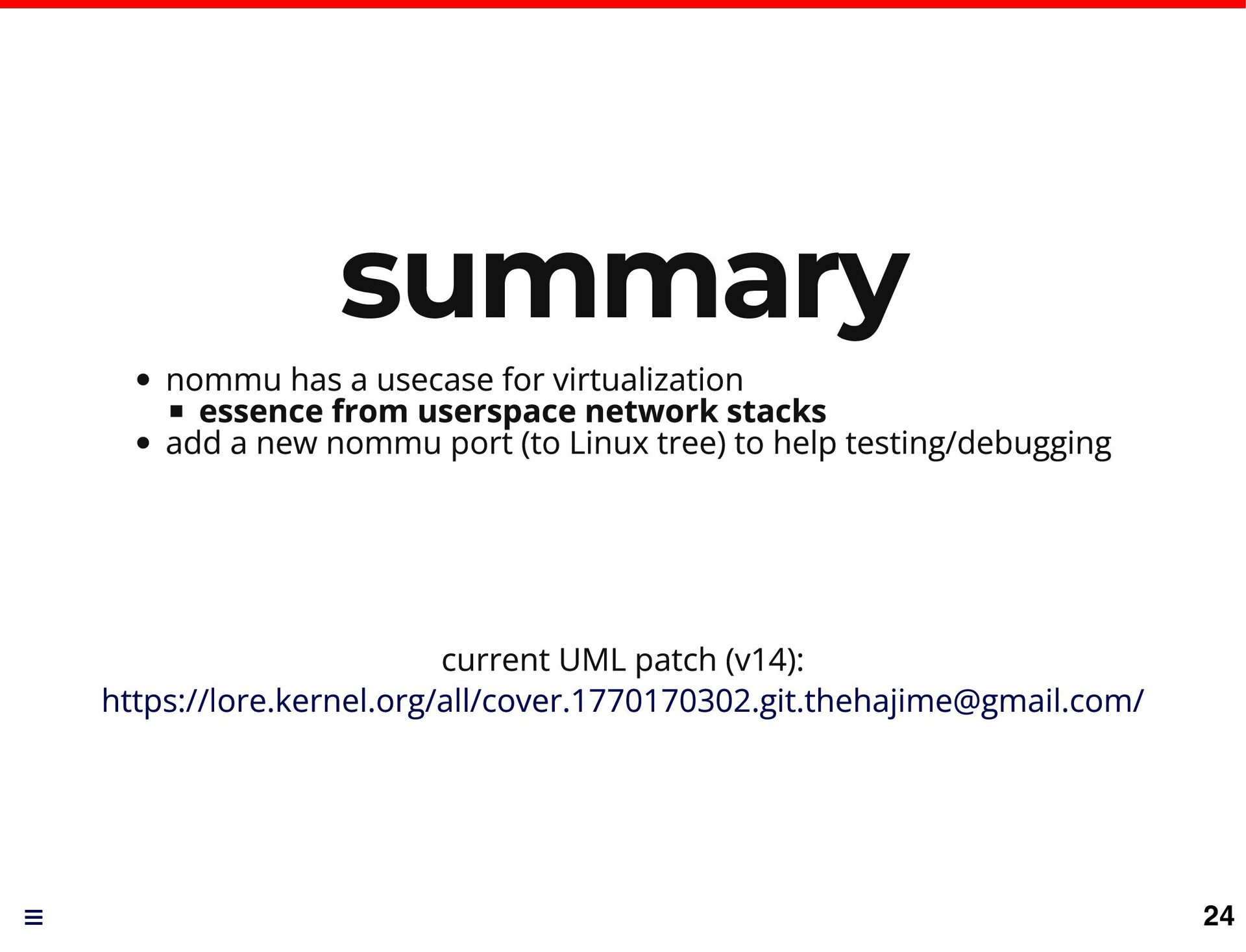
  19. summary nommu has a usecase for virtualization essence from userspace

    network stacks add a new nommu port (to Linux tree) to help testing/debugging current UML patch (v14): https://lore.kernel.org/all/[email protected]/ 24 
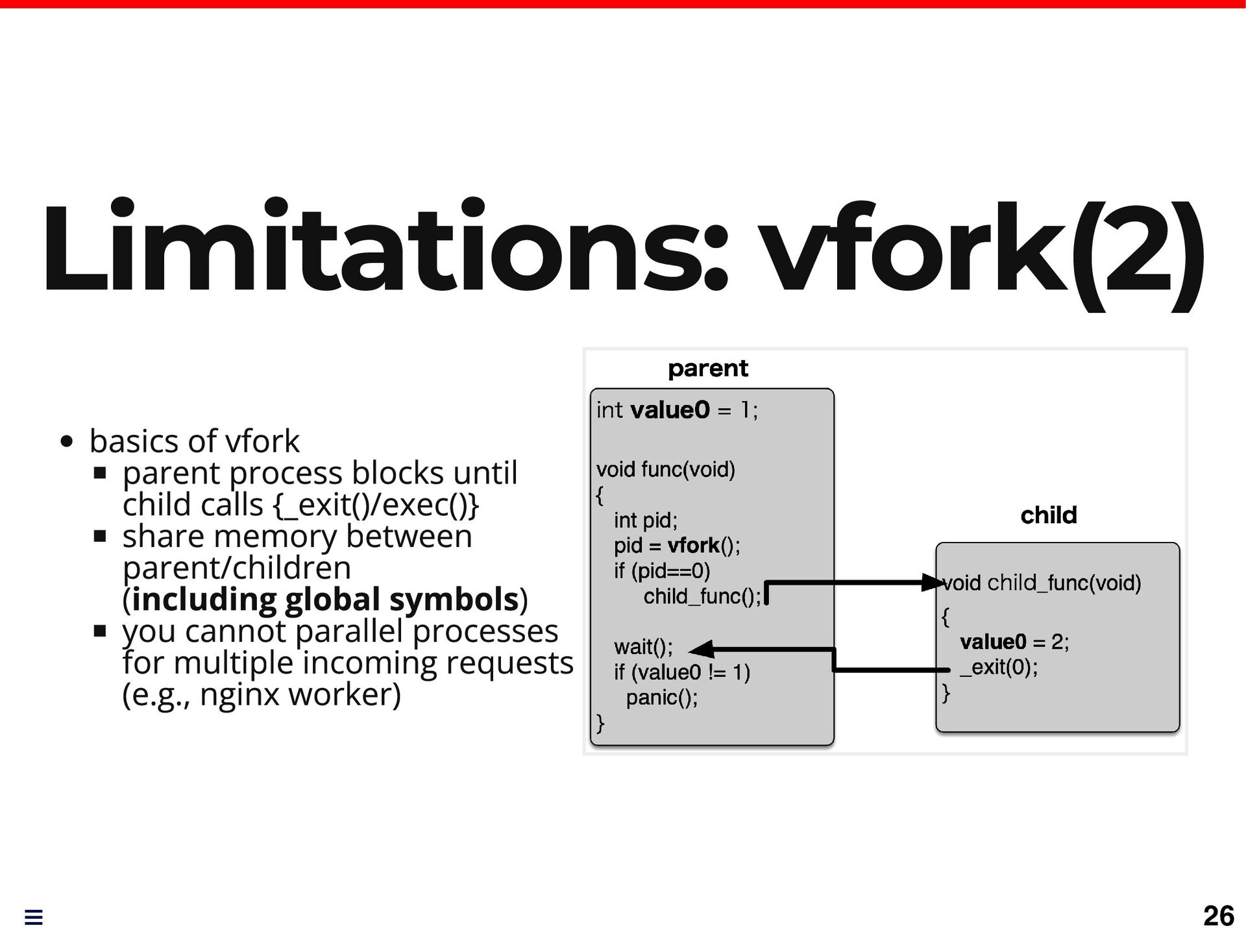
  20. Limitations: vfork(2) basics of vfork parent process blocks until child

    calls {_exit()/exec()} share memory between parent/children (including global symbols) you cannot parallel processes for multiple incoming requests (e.g., nginx worker) 26 
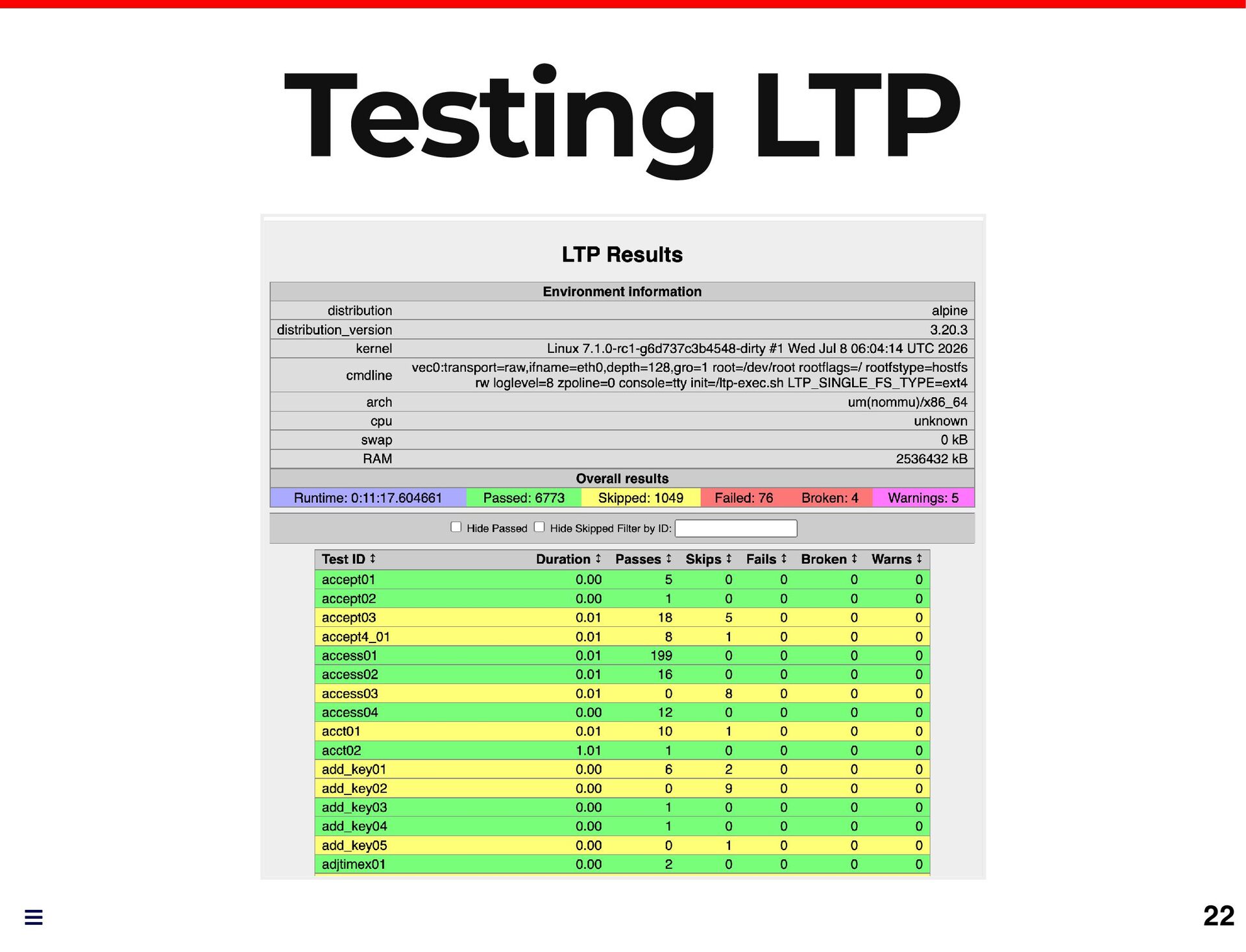
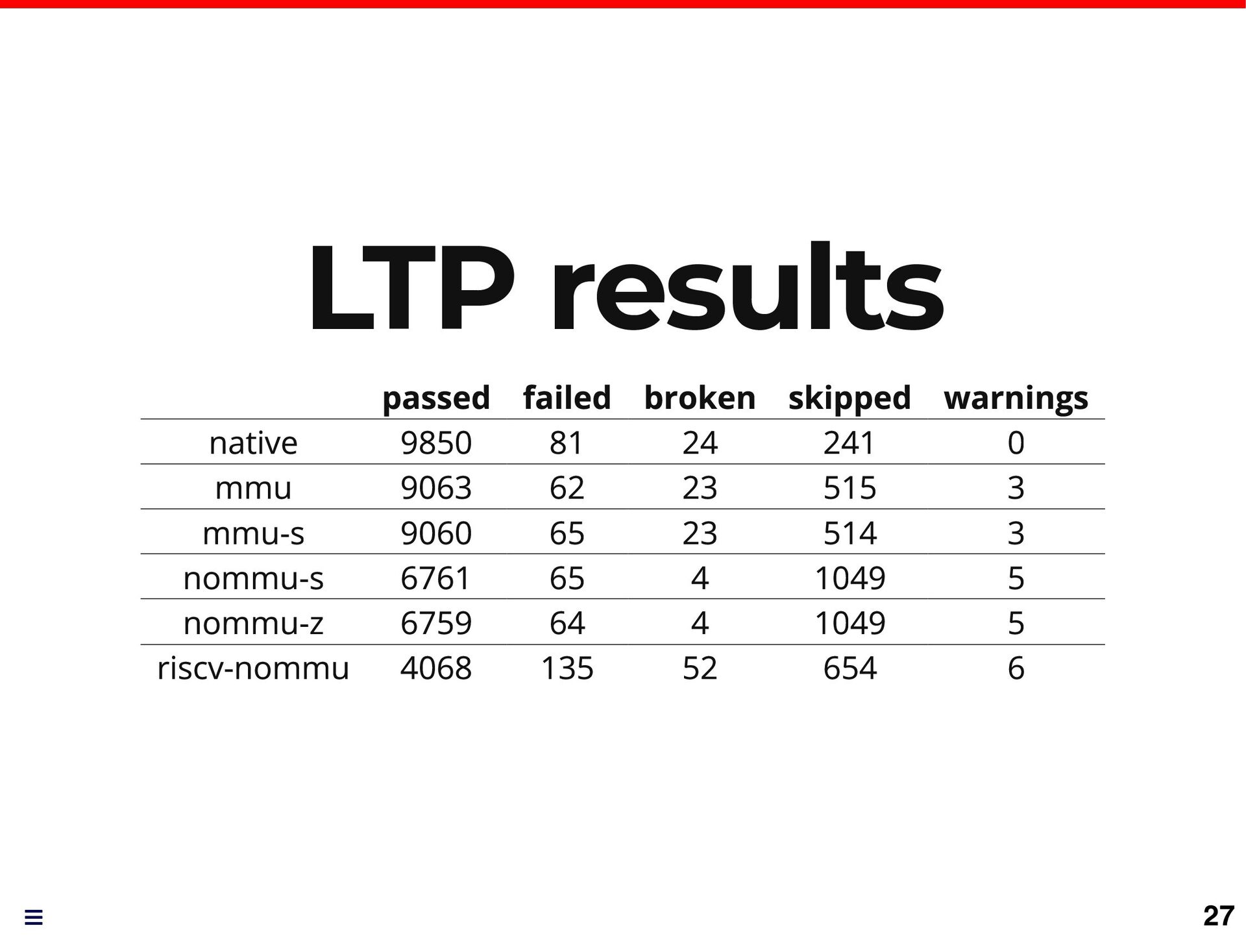
  21. LTP results passed failed broken skipped warnings native 9850 81

    24 241 0 mmu 9063 62 23 515 3 mmu-s 9060 65 23 514 3 nommu-s 6761 65 4 1049 5 nommu-z 6759 64 4 1049 5 riscv-nommu 4068 135 52 654 6 27 
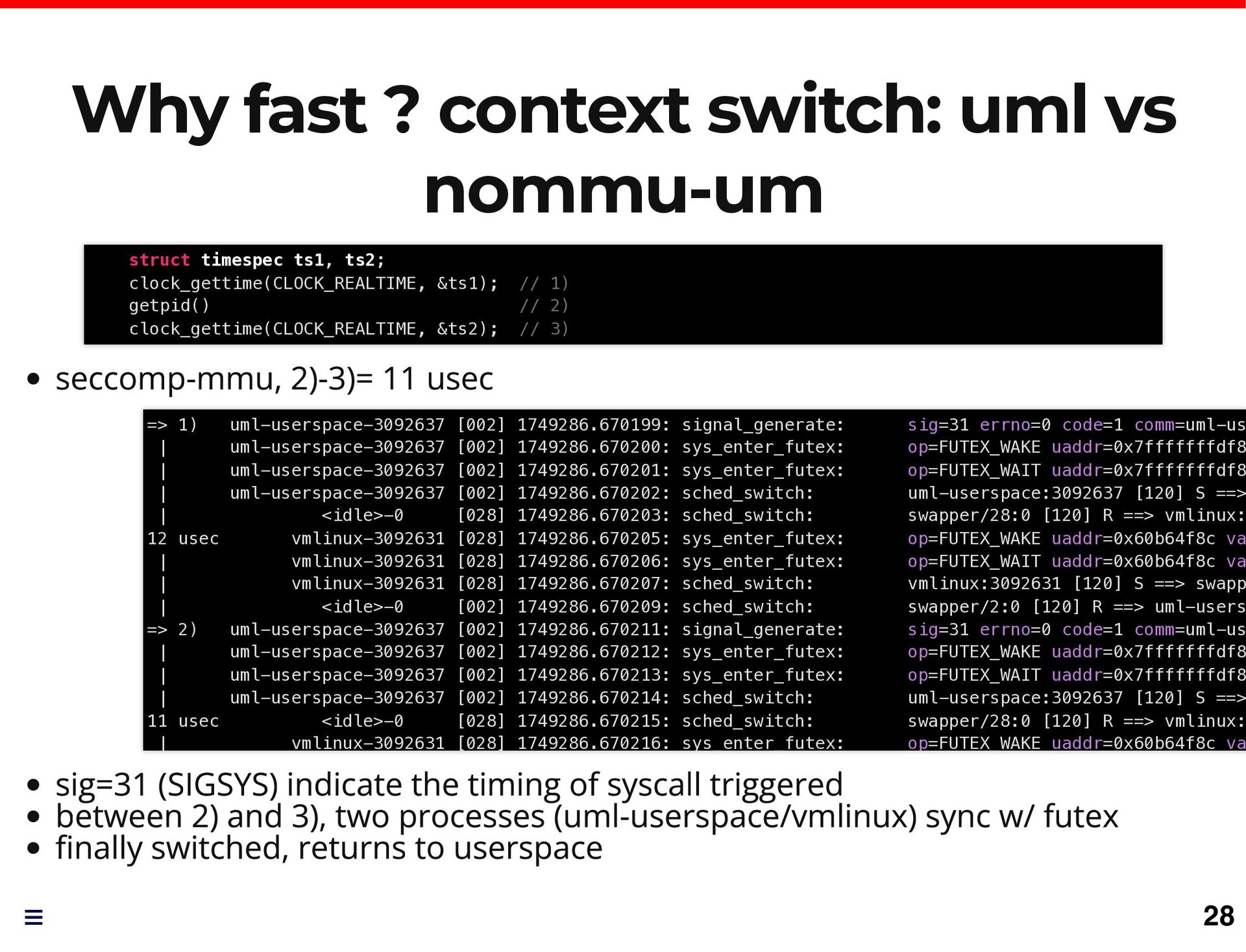
  22. Why fast ? context switch: uml vs nommu-um seccomp-mmu, 2)-3)=

    11 usec sig=31 (SIGSYS) indicate the timing of syscall triggered between 2) and 3), two processes (uml-userspace/vmlinux) sync w/ futex finally switched, returns to userspace struct timespec ts1, ts2; clock_gettime(CLOCK_REALTIME, &ts1); // 1) getpid() // 2) clock_gettime(CLOCK_REALTIME, &ts2); // 3) => 1) uml-userspace-3092637 [002] 1749286.670199: signal_generate: sig=31 errno=0 code=1 comm=uml-us | uml-userspace-3092637 [002] 1749286.670200: sys_enter_futex: op=FUTEX_WAKE uaddr=0x7fffffffdf8 | uml-userspace-3092637 [002] 1749286.670201: sys_enter_futex: op=FUTEX_WAIT uaddr=0x7fffffffdf8 | uml-userspace-3092637 [002] 1749286.670202: sched_switch: uml-userspace:3092637 [120] S ==> | <idle>-0 [028] 1749286.670203: sched_switch: swapper/28:0 [120] R ==> vmlinux: 12 usec vmlinux-3092631 [028] 1749286.670205: sys_enter_futex: op=FUTEX_WAKE uaddr=0x60b64f8c va | vmlinux-3092631 [028] 1749286.670206: sys_enter_futex: op=FUTEX_WAIT uaddr=0x60b64f8c va | vmlinux-3092631 [028] 1749286.670207: sched_switch: vmlinux:3092631 [120] S ==> swapp | <idle>-0 [002] 1749286.670209: sched_switch: swapper/2:0 [120] R ==> uml-users => 2) uml-userspace-3092637 [002] 1749286.670211: signal_generate: sig=31 errno=0 code=1 comm=uml-us | uml-userspace-3092637 [002] 1749286.670212: sys_enter_futex: op=FUTEX_WAKE uaddr=0x7fffffffdf8 | uml-userspace-3092637 [002] 1749286.670213: sys_enter_futex: op=FUTEX_WAIT uaddr=0x7fffffffdf8 | uml-userspace-3092637 [002] 1749286.670214: sched_switch: uml-userspace:3092637 [120] S ==> 11 usec <idle>-0 [028] 1749286.670215: sched_switch: swapper/28:0 [120] R ==> vmlinux: | vmlinux-3092631 [028] 1749286.670216: sys_enter_futex: op=FUTEX_WAKE uaddr=0x60b64f8c va 28 
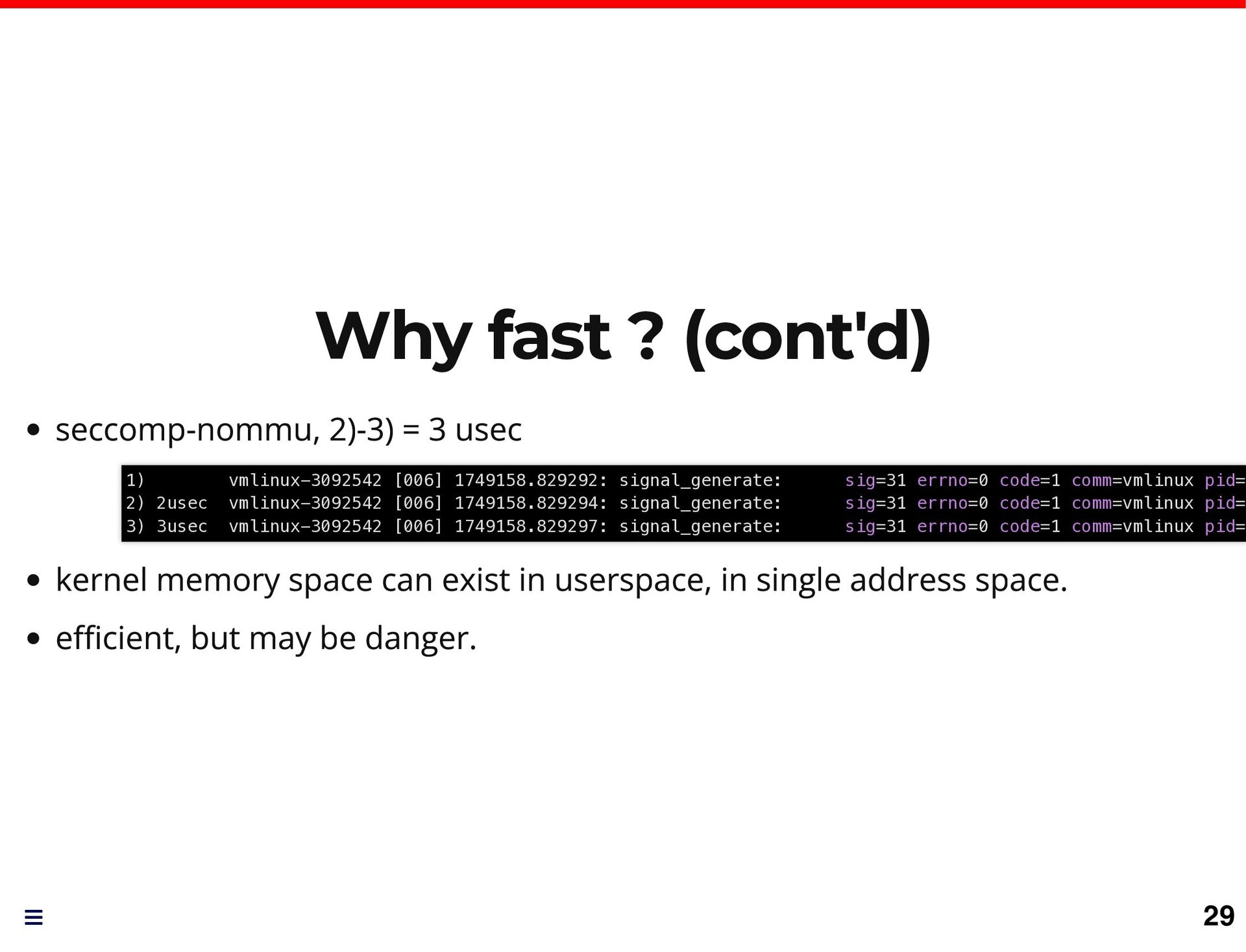
  23. Why fast ? (cont'd) seccomp-nommu, 2)-3) = 3 usec kernel

    memory space can exist in userspace, in single address space. efficient, but may be danger. 1) vmlinux-3092542 [006] 1749158.829292: signal_generate: sig=31 errno=0 code=1 comm=vmlinux pid= 2) 2usec vmlinux-3092542 [006] 1749158.829294: signal_generate: sig=31 errno=0 code=1 comm=vmlinux pid= 3) 3usec vmlinux-3092542 [006] 1749158.829297: signal_generate: sig=31 errno=0 code=1 comm=vmlinux pid= 29 
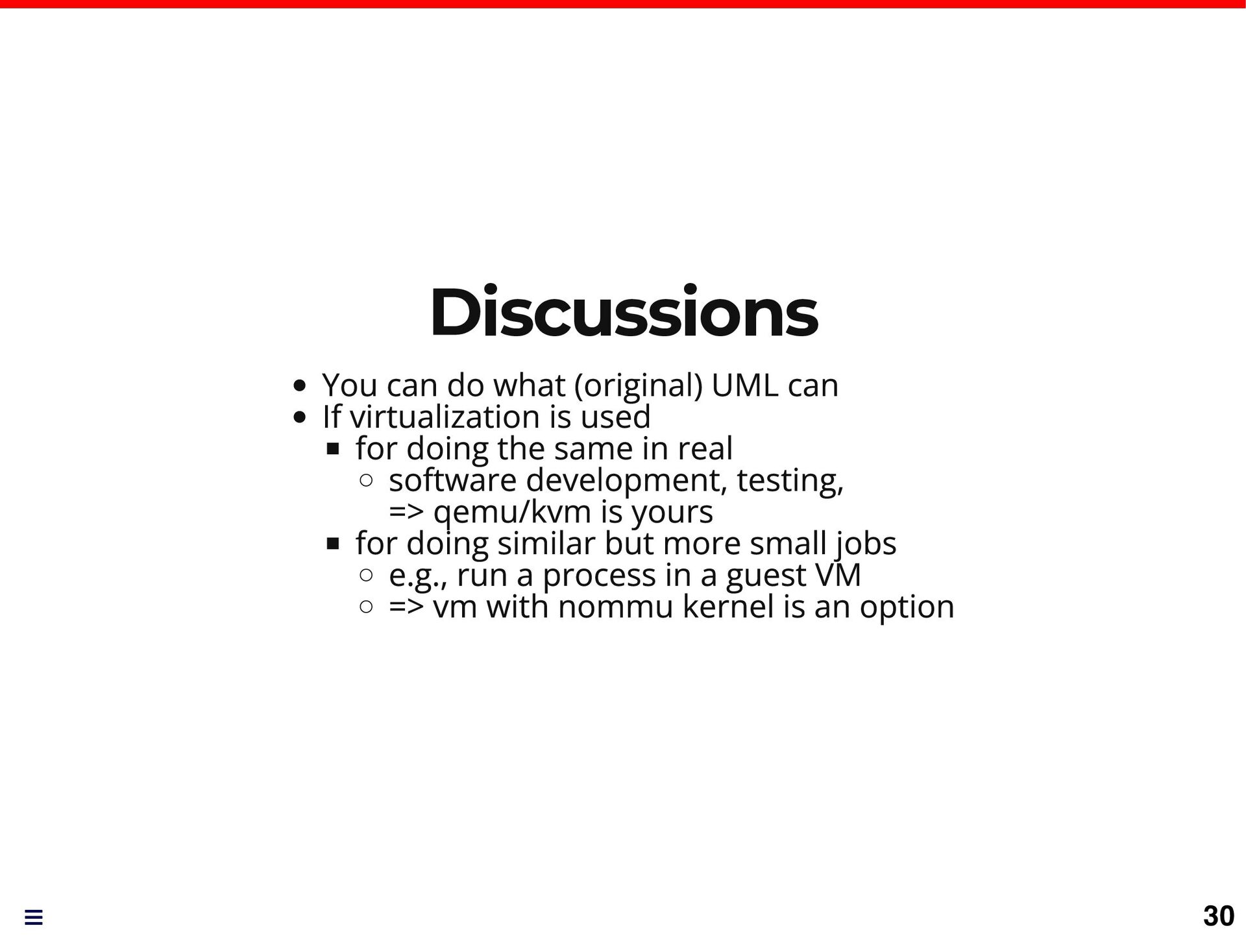
  24. Discussions You can do what (original) UML can If virtualization

    is used for doing the same in real software development, testing, => qemu/kvm is yours for doing similar but more small jobs e.g., run a process in a guest VM => vm with nommu kernel is an option 30 