Upgrade to Pro — share decks privately, control downloads, hide ads and more …

Integrating LLMs in Java: A Practical Guide to ...

Integrating LLMs in Java: A Practical Guide to Model Context Protocol

Learn how to securely and efficiently connect AI models with enterprise data and tools using the Model Context Protocol in Java.

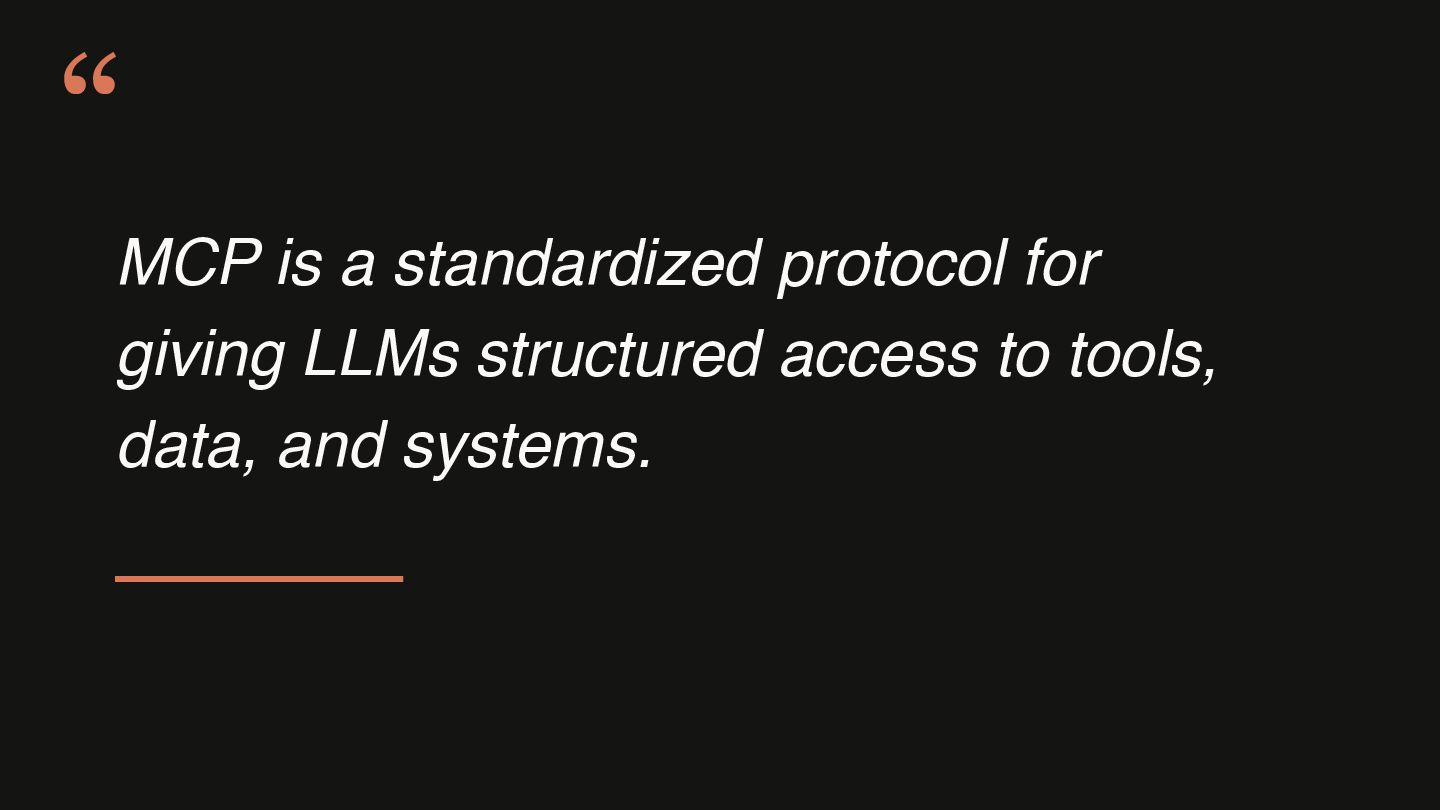
As Large Language Models (LLMs) revolutionize application development, Java developers face a critical challenge: how to securely and efficiently connect these AI models with enterprise data and tools. The Model Context Protocol (MCP) is transforming how AI applications interact with external systems, and it's rapidly becoming an industry standard.

In this session, you'll learn the basic building blocks of MCP and how to build, secure, and test your MCP servers. We'll explore practical examples that demonstrate how to bridge the gap between LLMs and your existing Java infrastructure.

Avatar for Dan Vega

Dan Vega

March 05, 2026
Tweet

More Decks by Dan Vega

Other Decks in Programming

Transcript

  1. Integrating LLMs in Java A Practical Guide to Model Context

    Protocol (MCP) Dan Vega · Spring Developer Advocate · @Brodcom
  2. Learn more at danvega.dev 🧑🧑🧒🧒 Husband & Father 🏠 Cleveland

    ☕ Java Champion 🧑💻 Software Development 23 Years 🍃 Spring Developer Advocate 📖 Author About Me
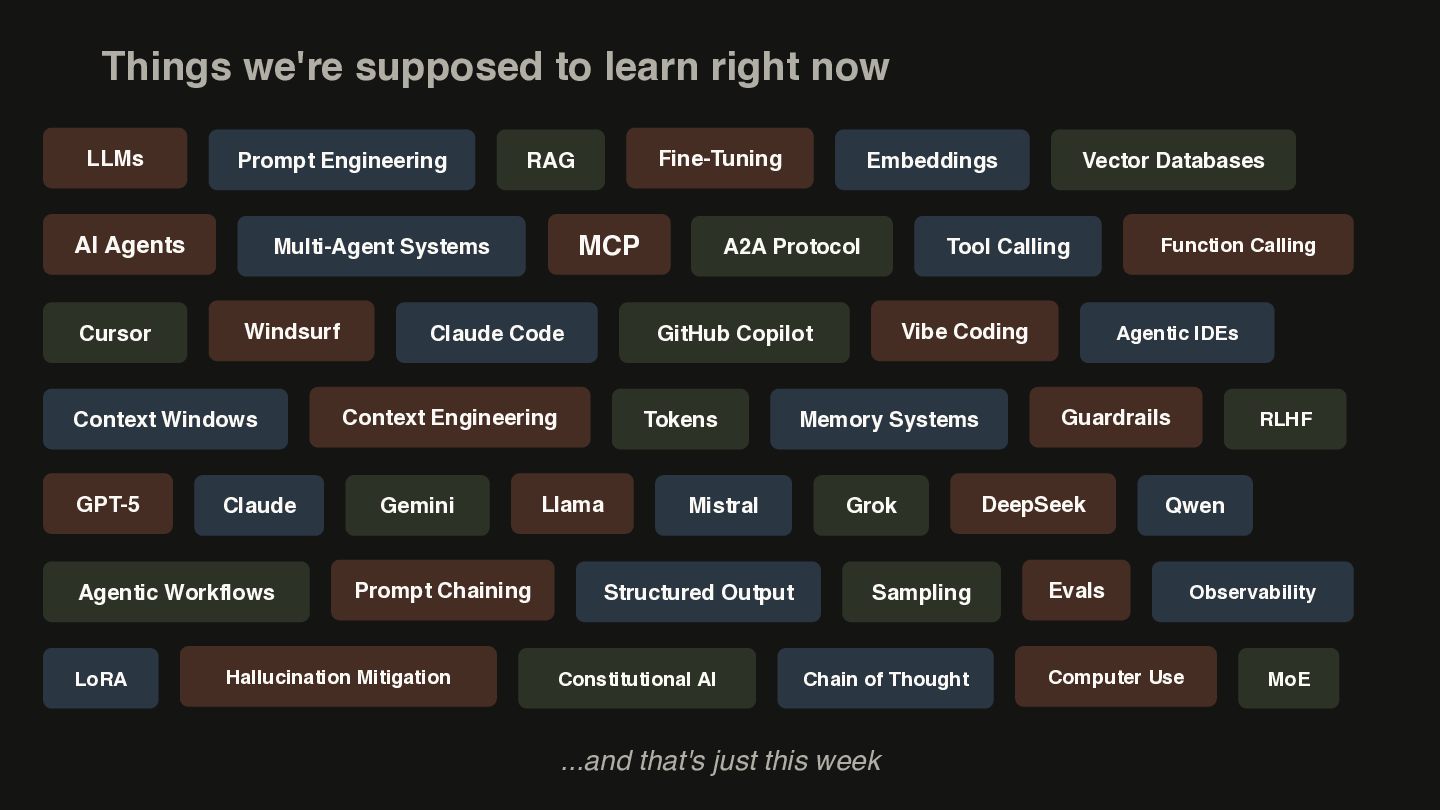
  3. Things we're supposed to learn right now Prompt Engineering Embeddings

    Multi-Agent Systems Tool Calling Claude Code Agentic IDEs Context Windows Memory Systems Claude Mistral Qwen Structured Output Observability LoRA Chain of Thought LLMs Fine-Tuning AI Agents MCP Function Calling Windsurf Vibe Coding Context Engineering Guardrails GPT-5 Llama DeepSeek Prompt Chaining Evals Hallucination Mitigation Computer Use RAG Vector Databases A2A Protocol Cursor GitHub Copilot Tokens RLHF Gemini Grok Agentic Workflows Sampling Constitutional AI MoE ...and that's just this week
  4. The good news? You don't need to learn all of

    this. You need to understand the building blocks.
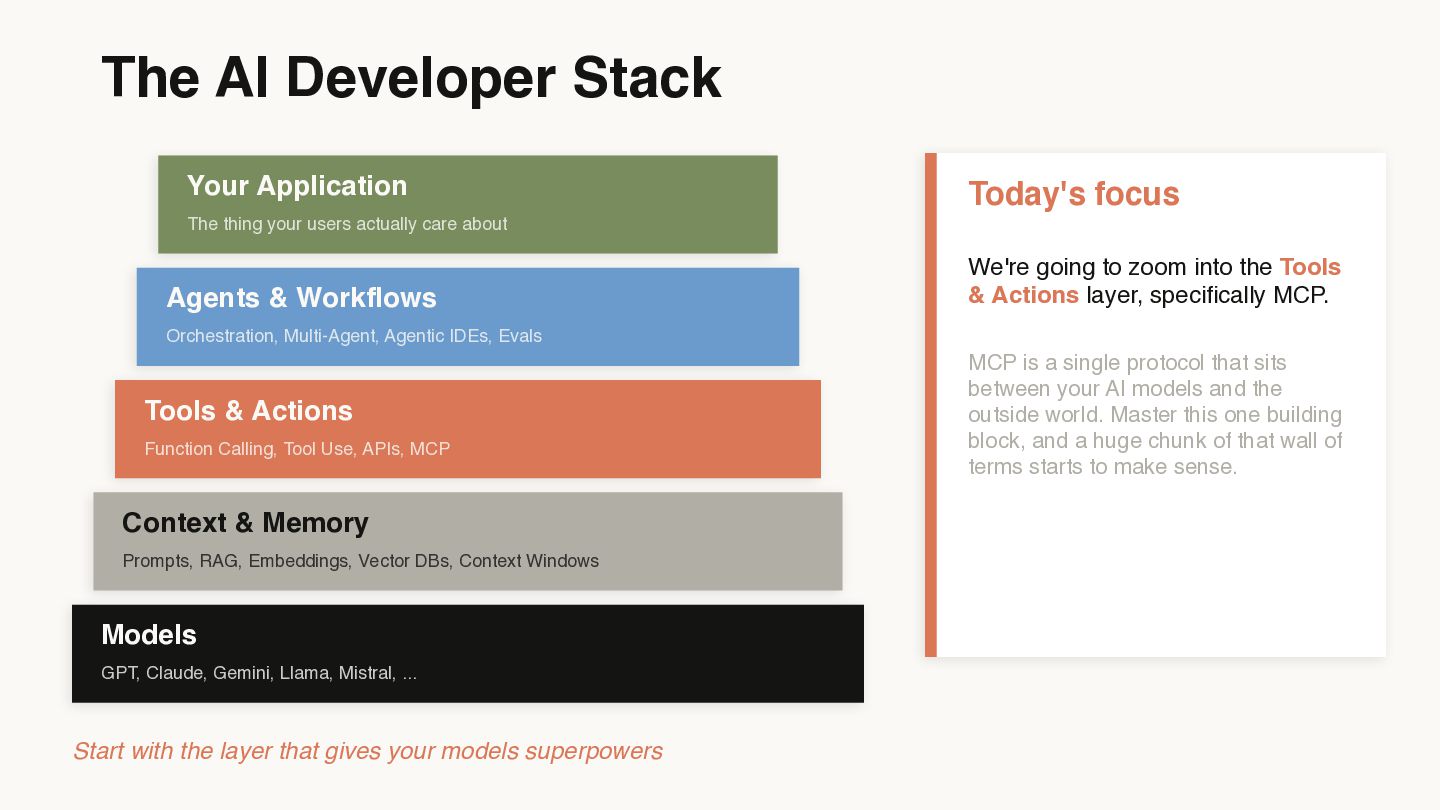
  5. The AI Developer Stack Models GPT, Claude, Gemini, Llama, Mistral,

    ... Context & Memory Prompts, RAG, Embeddings, Vector DBs, Context Windows Tools & Actions Function Calling, Tool Use, APIs, MCP Agents & Workflows Orchestration, Multi-Agent, Agentic IDEs, Evals Your Application The thing your users actually care about Today's focus We're going to zoom into the Tools & Actions layer, specifically MCP. MCP is a single protocol that sits between your AI models and the outside world. Master this one building block, and a huge chunk of that wall of terms starts to make sense. Start with the layer that gives your models superpowers
  6. So let's start simple. What happens when an LLM isn't

    enough? Understanding LLM limitations → Tools → MCP
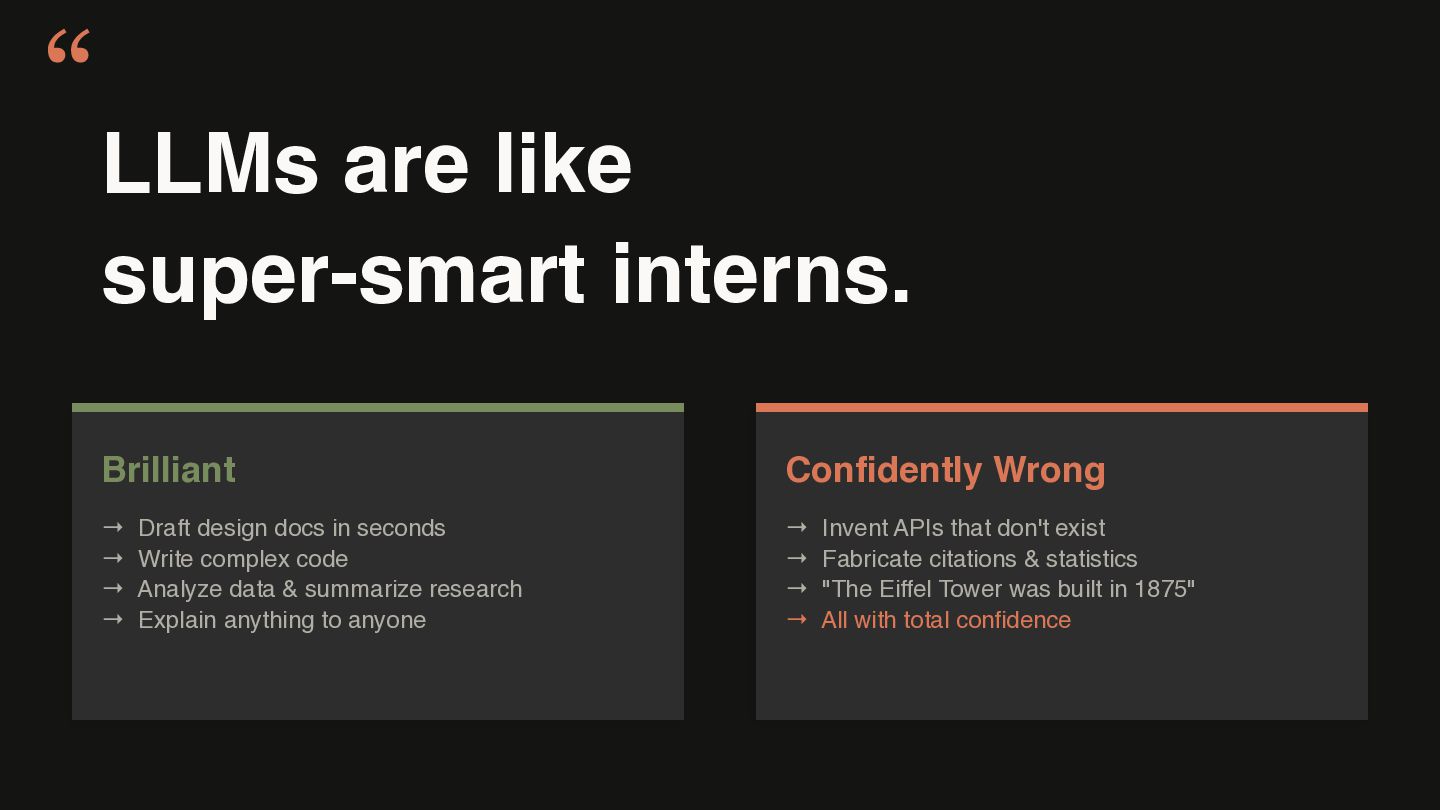
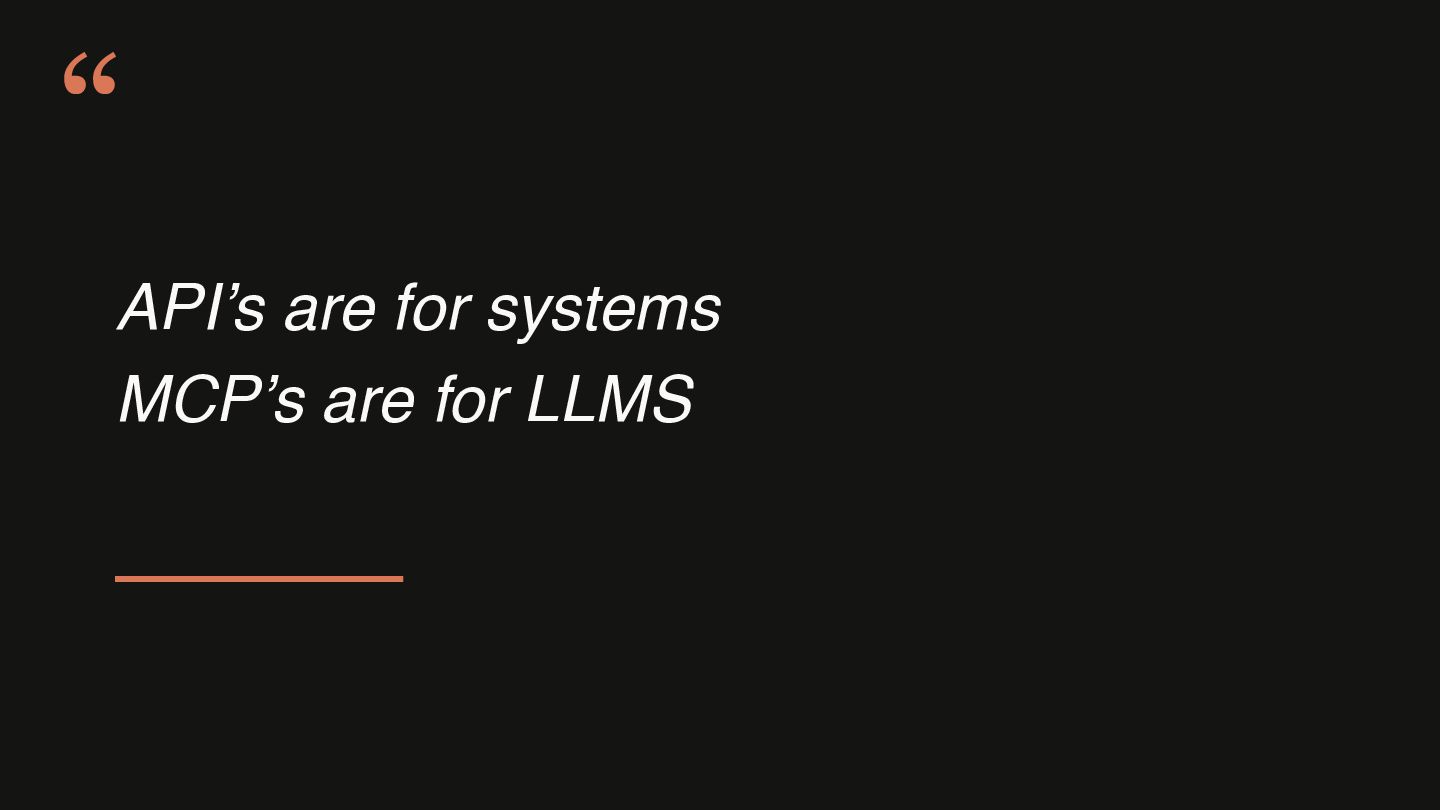
  7. “ LLMs are like super-smart interns. Brilliant → Draft design

    docs in seconds → Write complex code → Analyze data & summarize research → Explain anything to anyone Confidently Wrong → Invent APIs that don't exist → Fabricate citations & statistics → "The Eiffel Tower was built in 1875" → All with total confidence
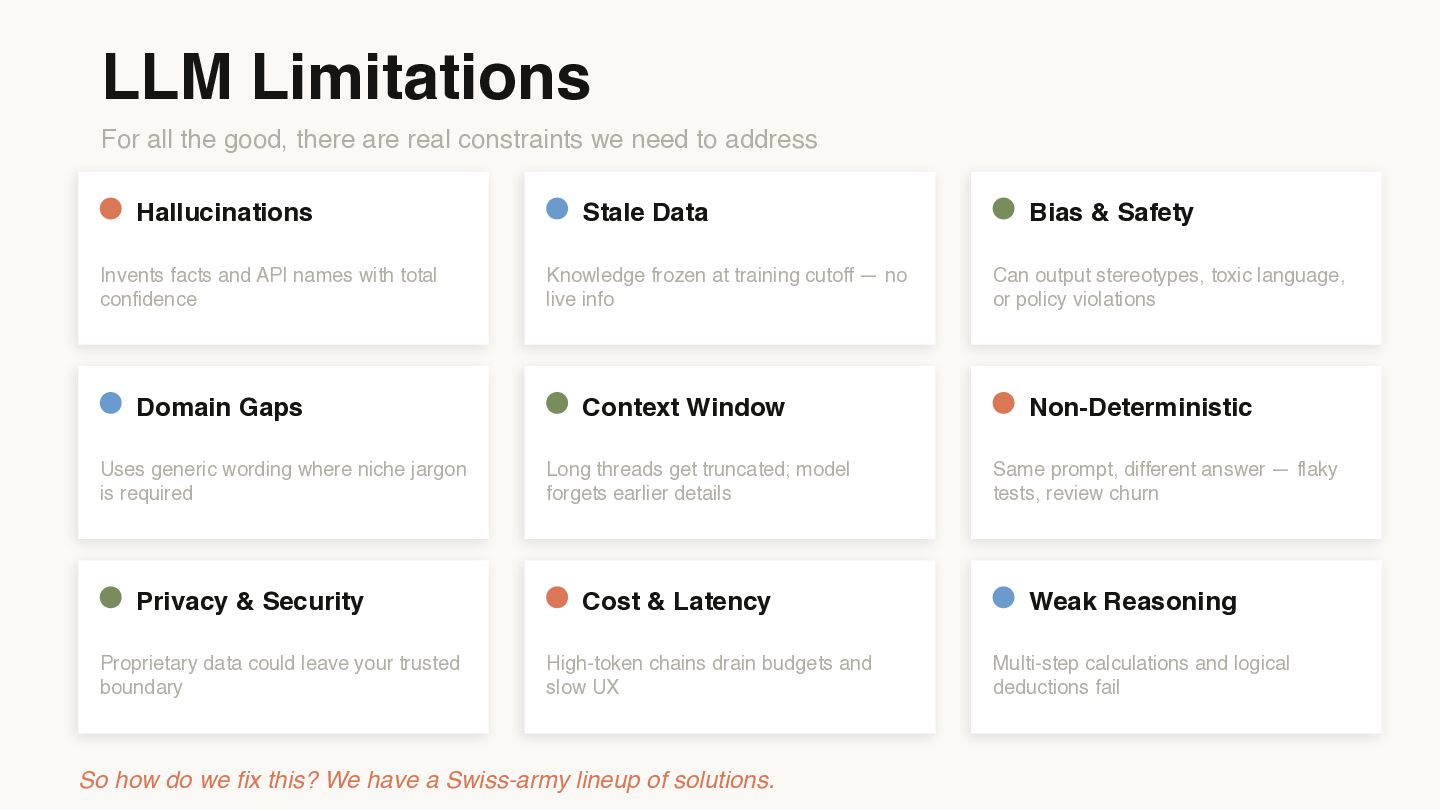
  8. LLM Limitations For all the good, there are real constraints

    we need to address Hallucinations Invents facts and API names with total confidence Stale Data Knowledge frozen at training cutoff — no live info Bias & Safety Can output stereotypes, toxic language, or policy violations Domain Gaps Uses generic wording where niche jargon is required Context Window Long threads get truncated; model forgets earlier details Non-Deterministic Same prompt, different answer — flaky tests, review churn Privacy & Security Proprietary data could leave your trusted boundary Cost & Latency High-token chains drain budgets and slow UX Weak Reasoning Multi-step calculations and logical deductions fail So how do we fix this? We have a Swiss-army lineup of solutions.
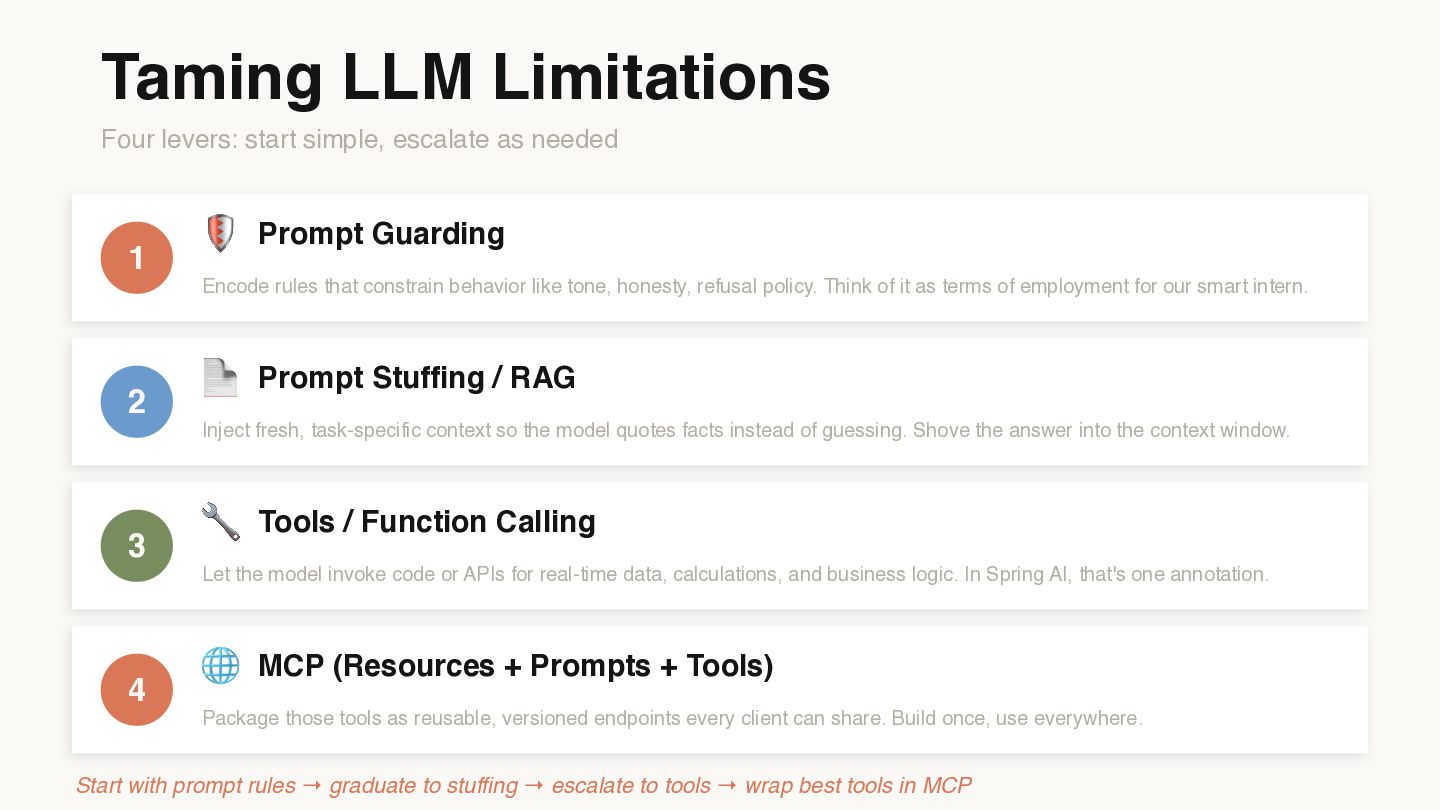
  9. Taming LLM Limitations Four levers: start simple, escalate as needed

    1 🛡 Prompt Guarding Encode rules that constrain behavior like tone, honesty, refusal policy. Think of it as terms of employment for our smart intern. 2 📄 Prompt Stuffing / RAG Inject fresh, task-specific context so the model quotes facts instead of guessing. Shove the answer into the context window. 3 🔧 Tools / Function Calling Let the model invoke code or APIs for real-time data, calculations, and business logic. In Spring AI, that's one annotation. 4 🌐 MCP (Resources + Prompts + Tools) Package those tools as reusable, versioned endpoints every client can share. Build once, use everywhere. Start with prompt rules → graduate to stuffing → escalate to tools → wrap best tools in MCP
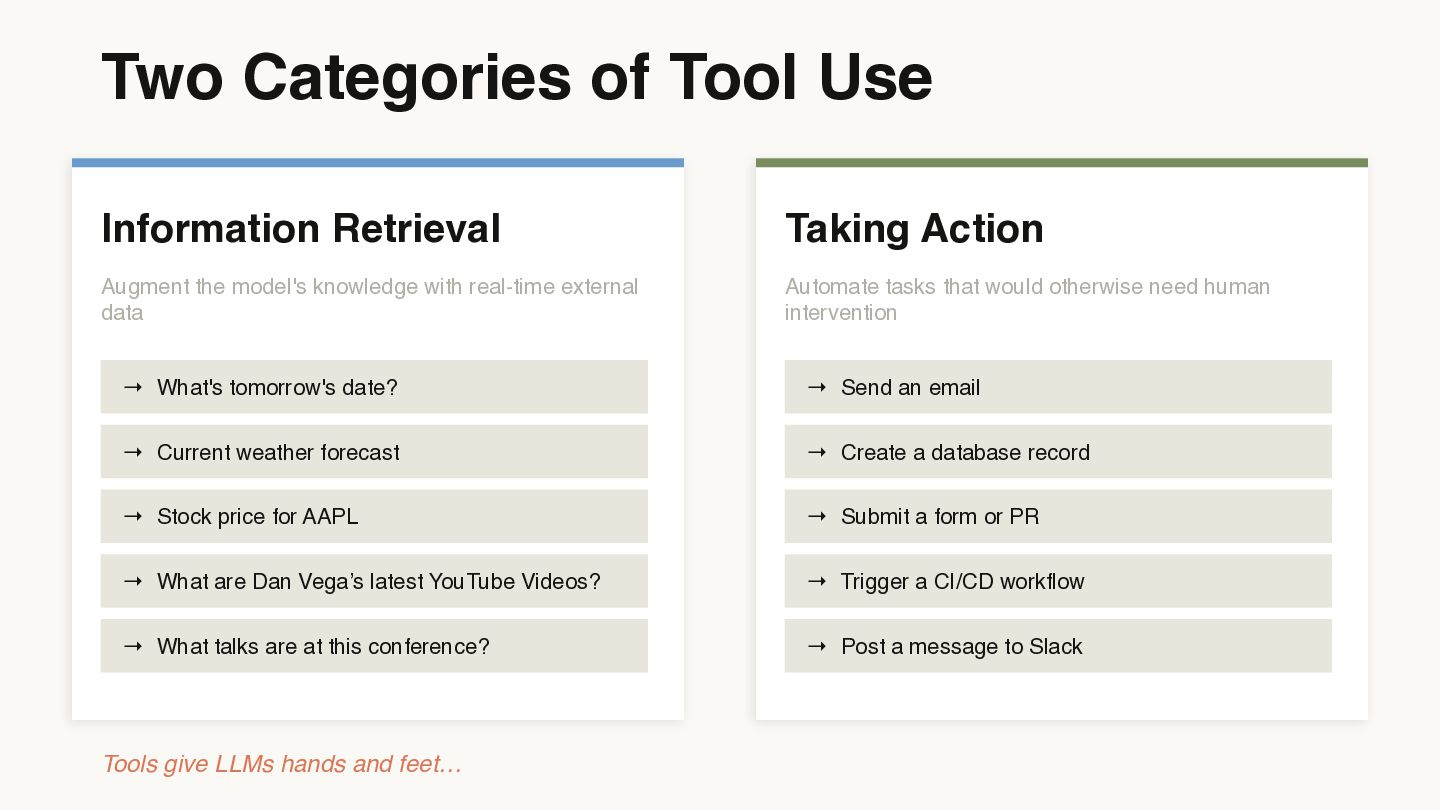
  10. Two Categories of Tool Use Information Retrieval Augment the model's

    knowledge with real-time external data → What's tomorrow's date? → Current weather forecast → Stock price for AAPL → What are Dan Vega’s latest YouTube Videos? → What talks are at this conference? Taking Action Automate tasks that would otherwise need human intervention → Send an email → Create a database record → Submit a form or PR → Trigger a CI/CD workflow → Post a message to Slack Tools give LLMs hands and feet…
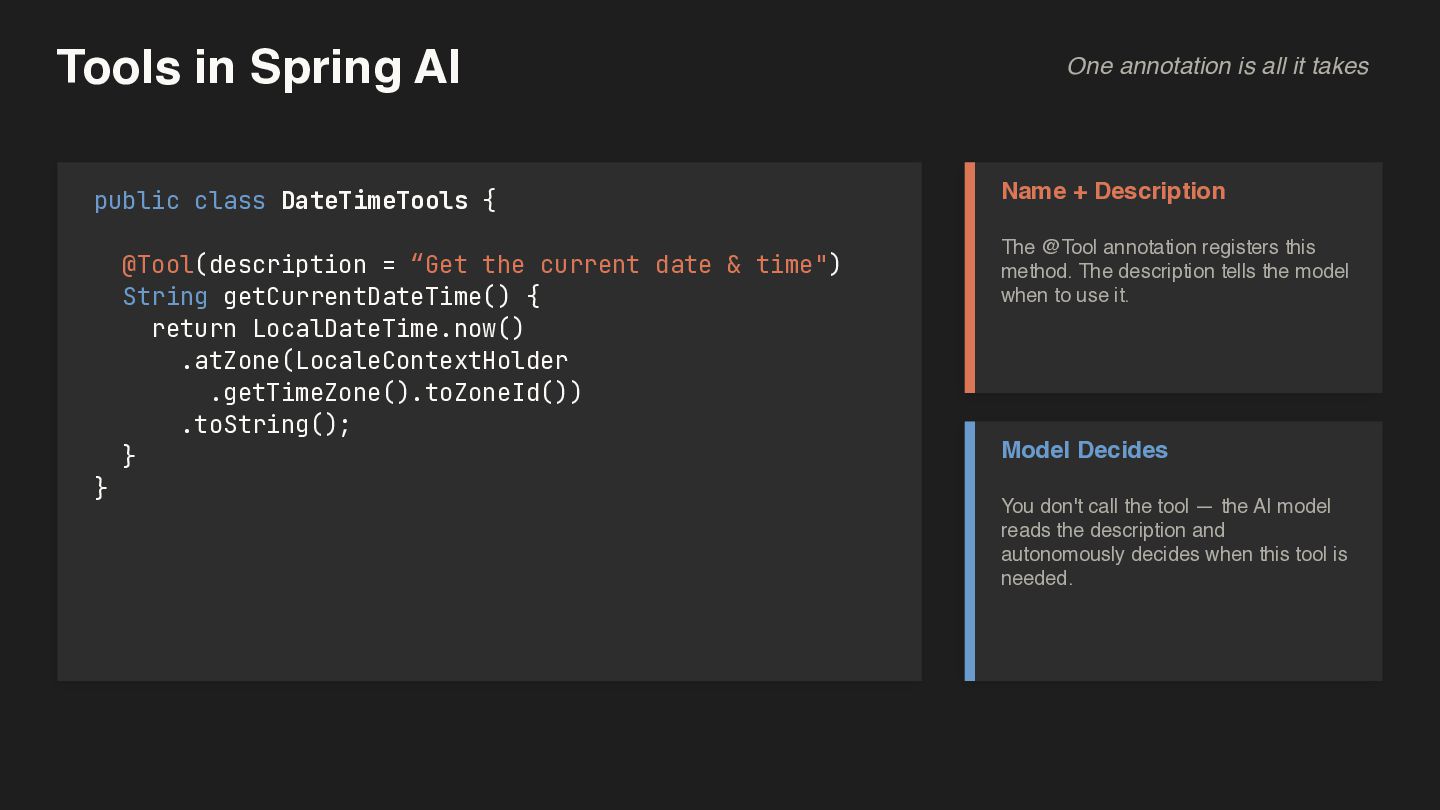
  11. Tools in Spring AI One annotation is all it takes

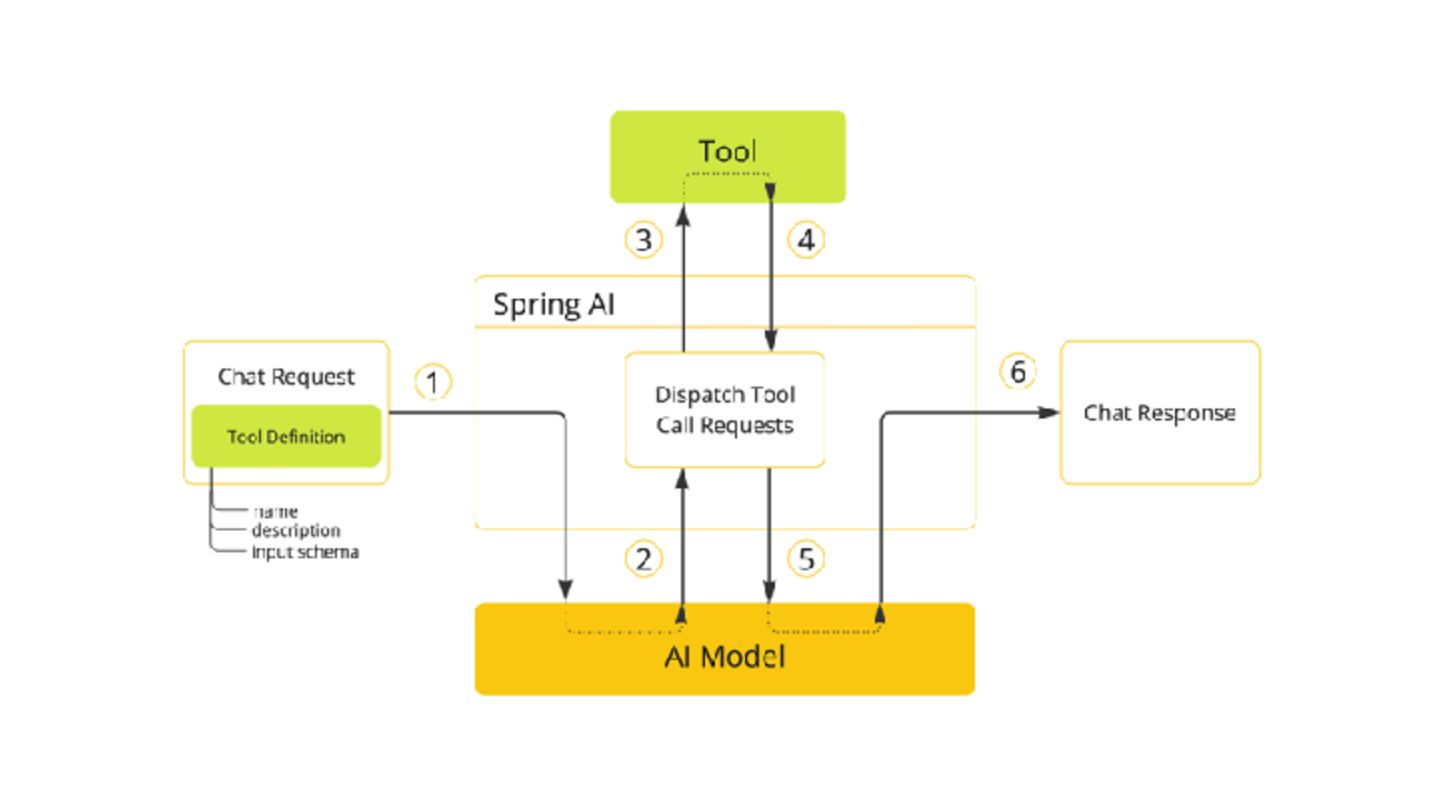
    public class DateTimeTools { @Tool(description = “Get the current date & time") String getCurrentDateTime() { return LocalDateTime.now() .atZone(LocaleContextHolder .getTimeZone().toZoneId()) .toString(); } } Name + Description The @Tool annotation registers this method. The description tells the model when to use it. Model Decides You don't call the tool — the AI model reads the description and autonomously decides when this tool is needed.
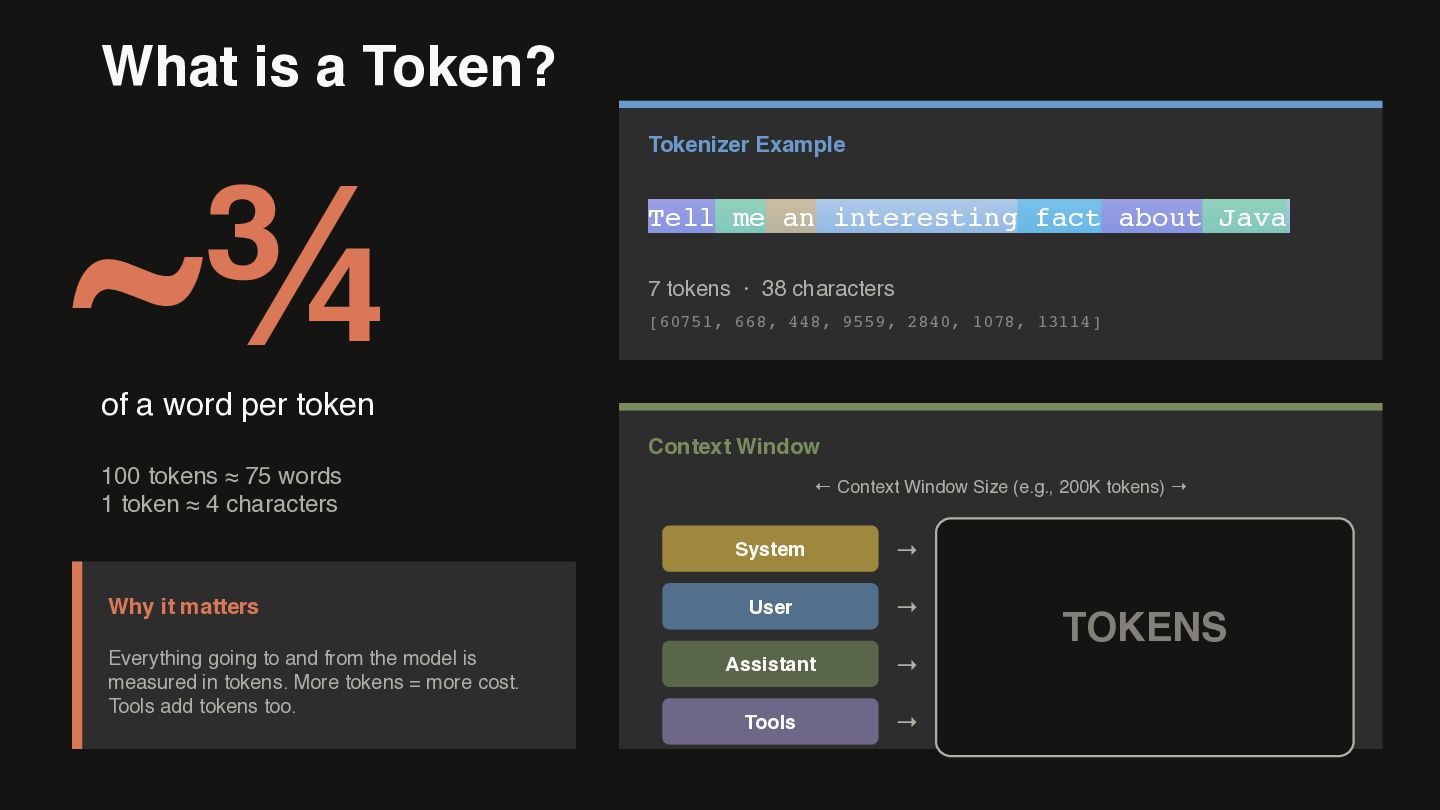
  12. What is a Token? ~¾ of a word per token

    100 tokens ≈ 75 words 1 token ≈ 4 characters Tokenizer Example Tell me an interesting fact about Java 7 tokens · 38 characters [60751, 668, 448, 9559, 2840, 1078, 13114] Context Window ← Context Window Size (e.g., 200K tokens) → System → User → Assistant → Tools → TOKENS Why it matters Everything going to and from the model is measured in tokens. More tokens = more cost. Tools add tokens too.
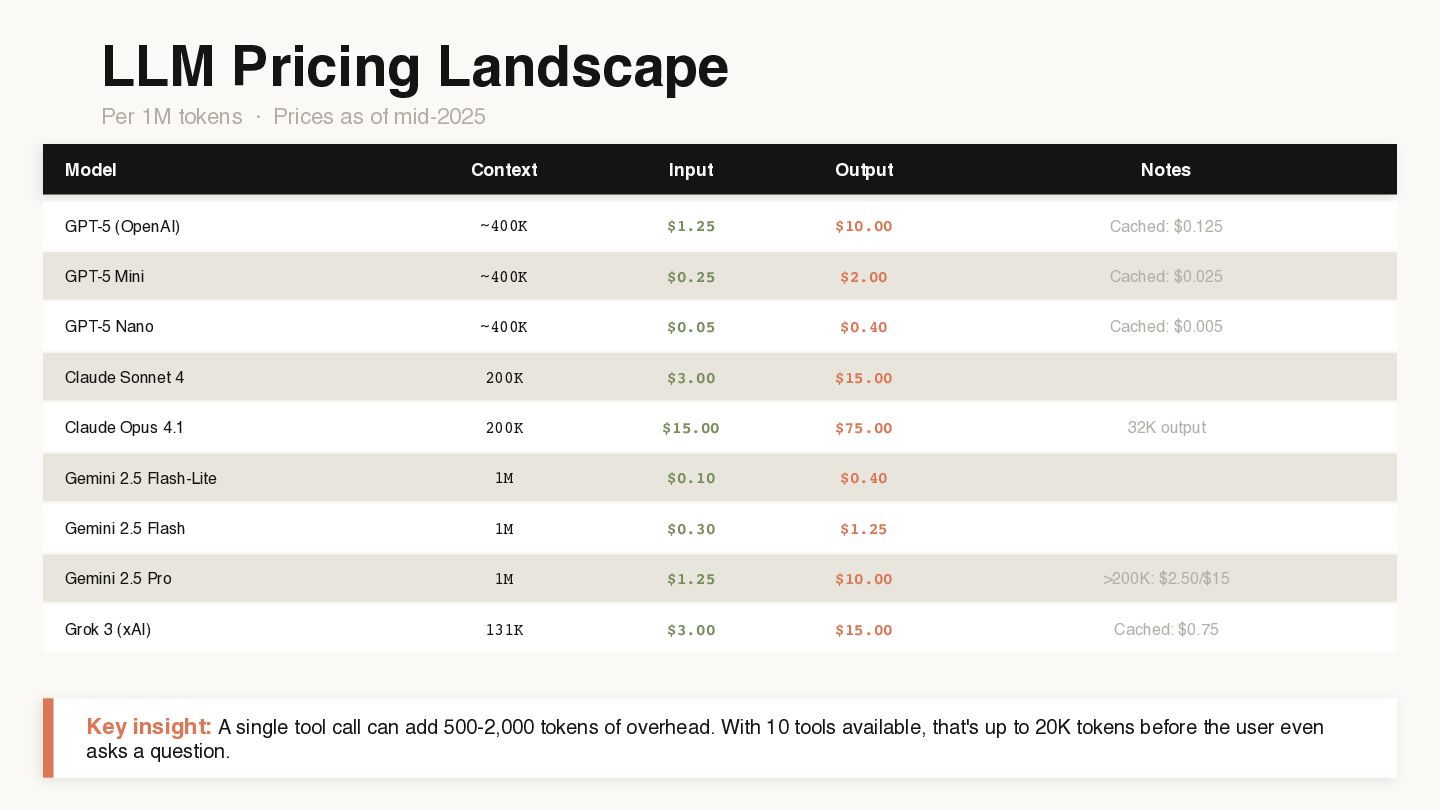
  13. LLM Pricing Landscape Per 1M tokens · Prices as of

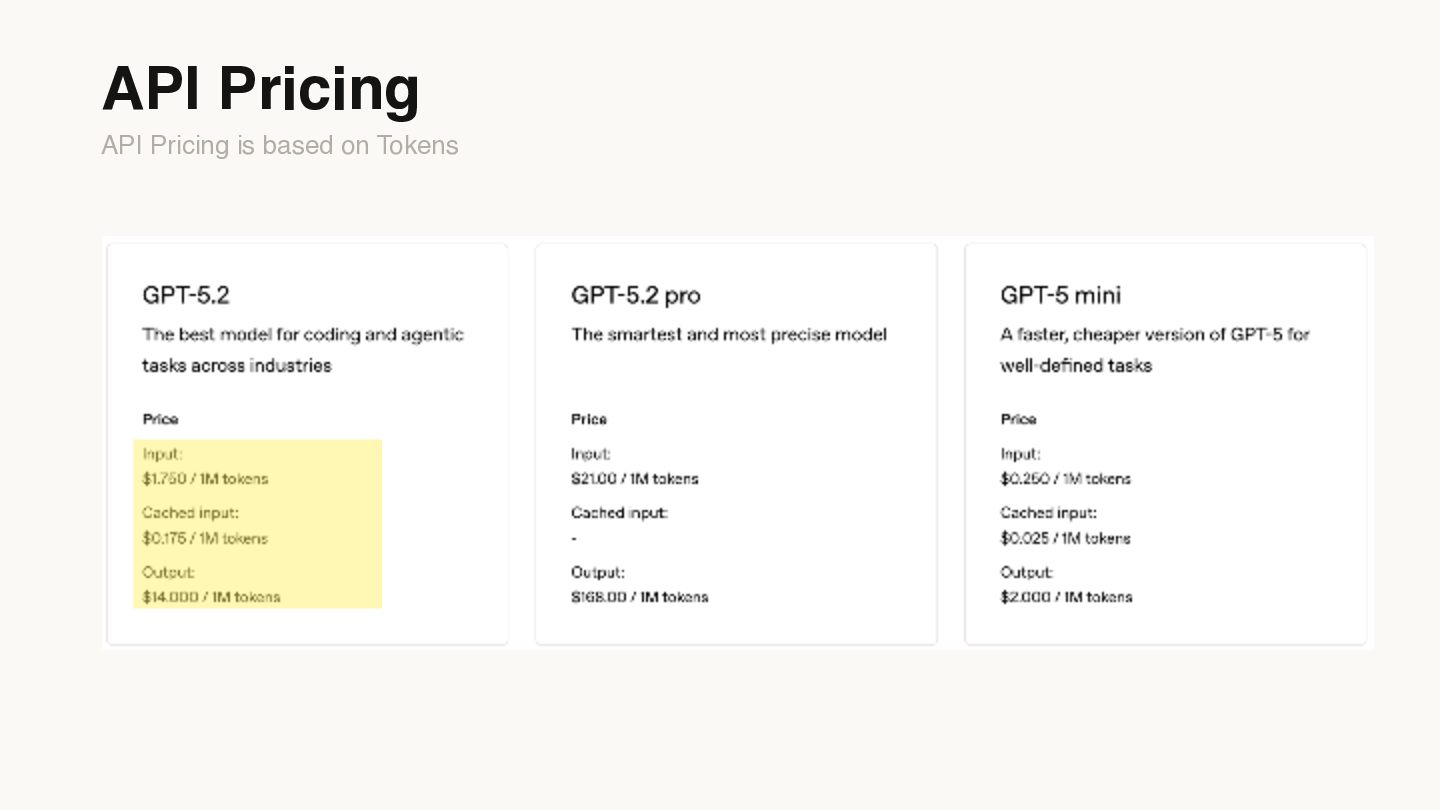
    mid-2025 Model Context Input Output Notes GPT-5 (OpenAI) ~400K $1.25 $10.00 Cached: $0.125 GPT-5 Mini ~400K $0.25 $2.00 Cached: $0.025 GPT-5 Nano ~400K $0.05 $0.40 Cached: $0.005 Claude Sonnet 4 200K $3.00 $15.00 Claude Opus 4.1 200K $15.00 $75.00 32K output Gemini 2.5 Flash-Lite 1M $0.10 $0.40 Gemini 2.5 Flash 1M $0.30 $1.25 Gemini 2.5 Pro 1M $1.25 $10.00 >200K: $2.50/$15 Grok 3 (xAI) 131K $3.00 $15.00 Cached: $0.75 Key insight: A single tool call can add 500-2,000 tokens of overhead. With 10 tools available, that's up to 20K tokens before the user even asks a question.
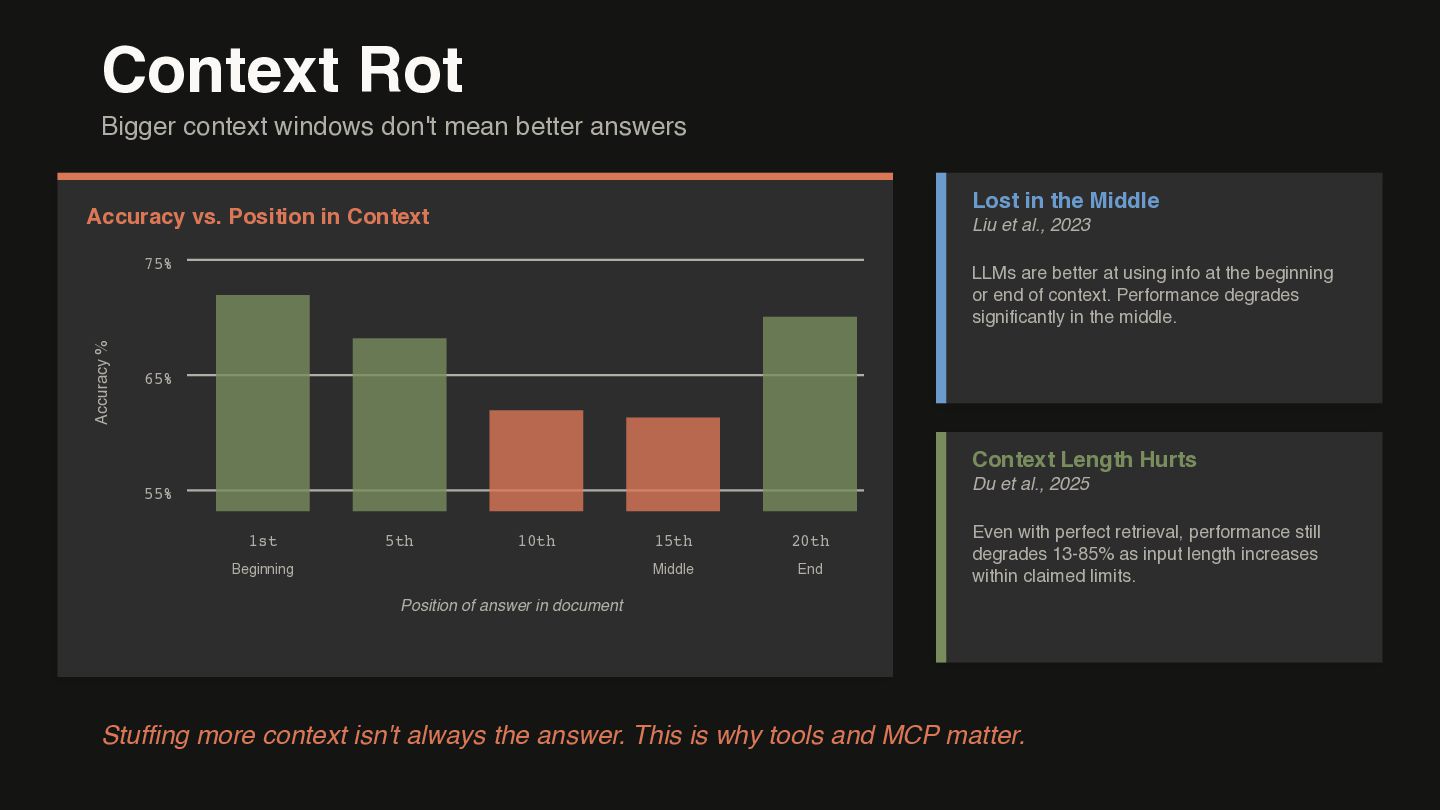
  14. Context Rot Bigger context windows don't mean better answers Accuracy

    vs. Position in Context Accuracy % 75% 65% 55% 1st Beginning 5th 10th 15th Middle 20th End Position of answer in document Lost in the Middle Liu et al., 2023 LLMs are better at using info at the beginning or end of context. Performance degrades significantly in the middle. Context Length Hurts Du et al., 2025 Even with perfect retrieval, performance still degrades 13-85% as input length increases within claimed limits. Stuffing more context isn't always the answer. This is why tools and MCP matter.
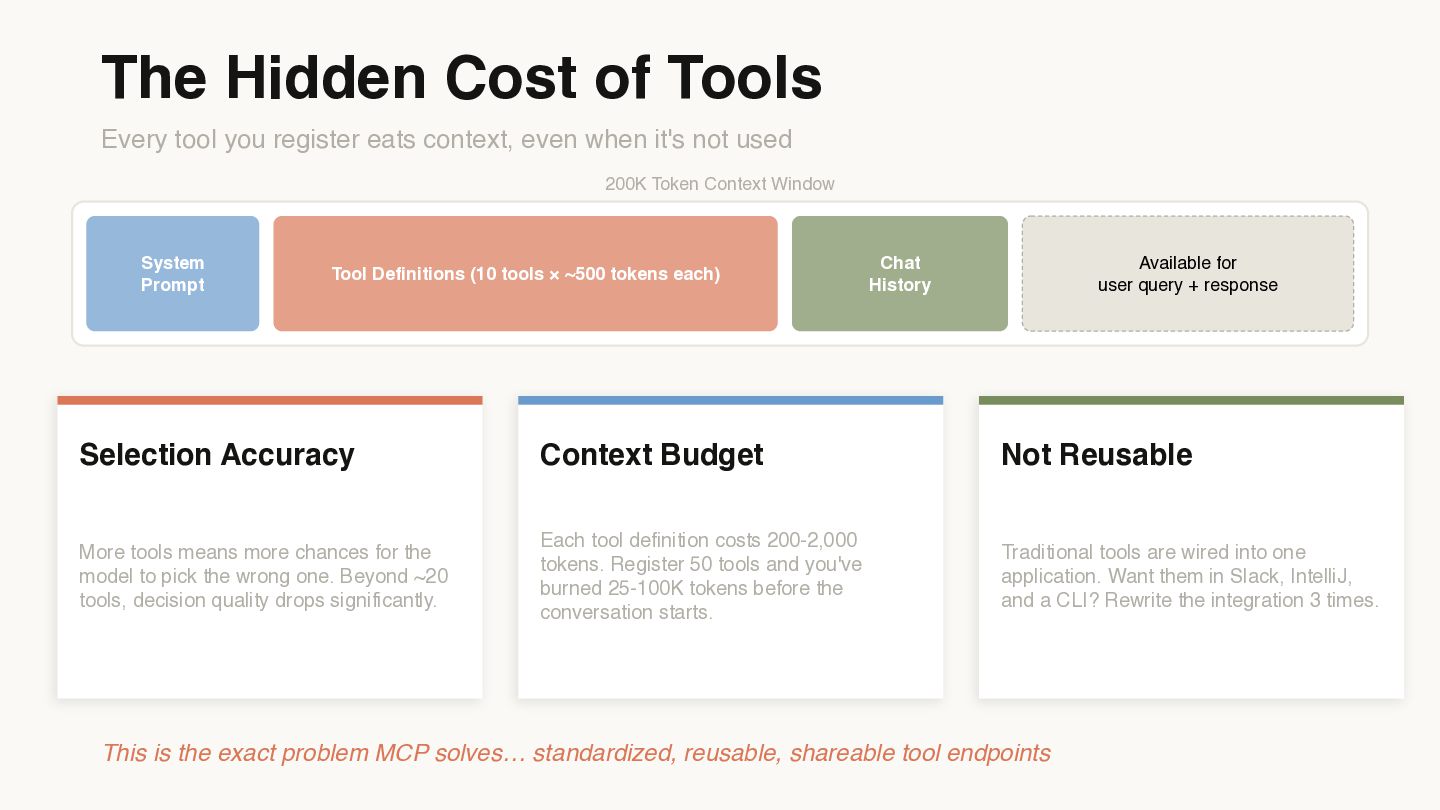
  15. The Hidden Cost of Tools Every tool you register eats

    context, even when it's not used 200K Token Context Window System Prompt Tool Definitions (10 tools × ~500 tokens each) Chat History Available for user query + response Selection Accuracy More tools means more chances for the model to pick the wrong one. Beyond ~20 tools, decision quality drops significantly. Context Budget Each tool definition costs 200-2,000 tokens. Register 50 tools and you've burned 25-100K tokens before the conversation starts. Not Reusable Traditional tools are wired into one application. Want them in Slack, IntelliJ, and a CLI? Rewrite the integration 3 times. This is the exact problem MCP solves… standardized, reusable, shareable tool endpoints
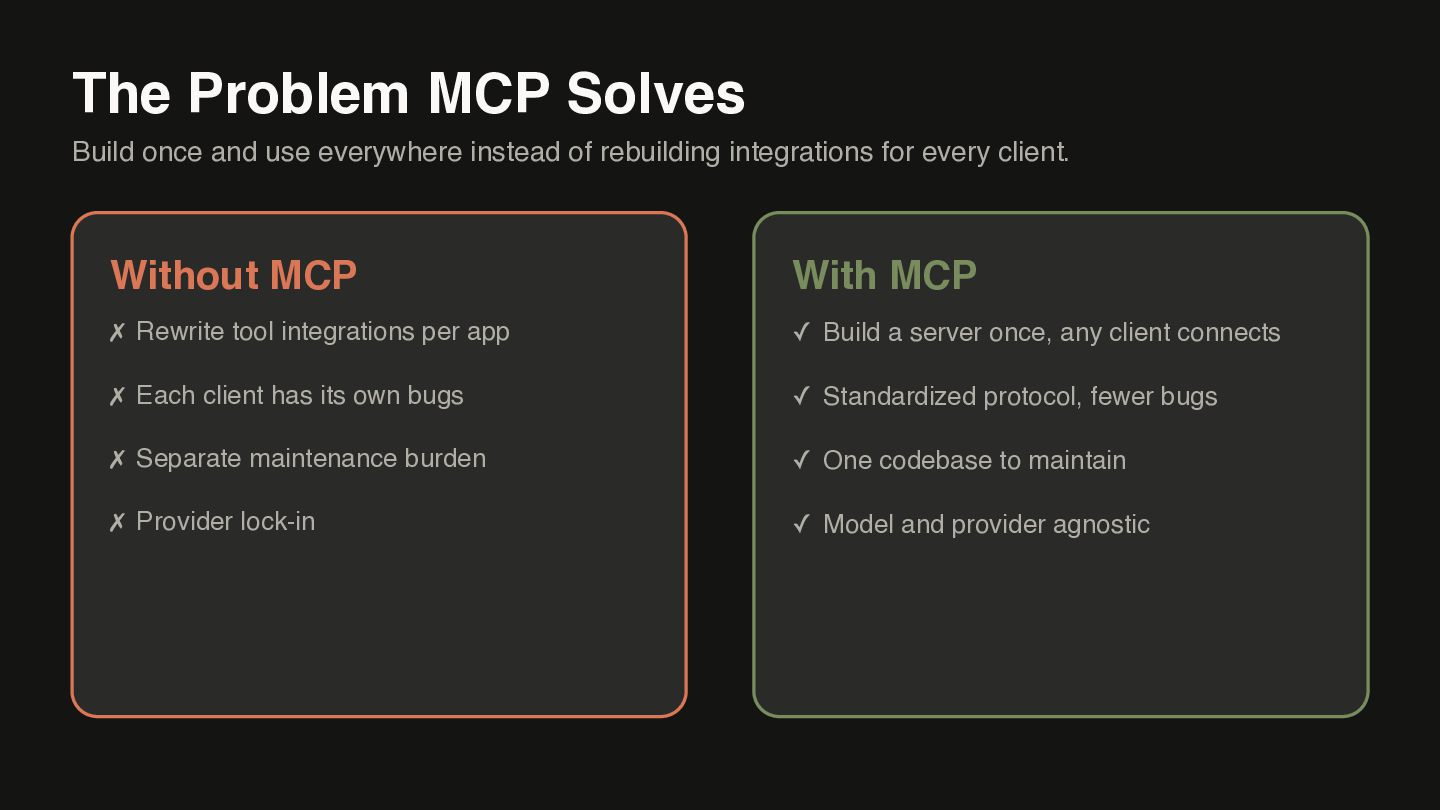
  16. The Problem MCP Solves Build once and use everywhere instead

    of rebuilding integrations for every client. Without MCP ✗ Rewrite tool integrations per app ✗ Each client has its own bugs ✗ Separate maintenance burden ✗ Provider lock-in With MCP ✓ Build a server once, any client connects ✓ Standardized protocol, fewer bugs ✓ One codebase to maintain ✓ Model and provider agnostic
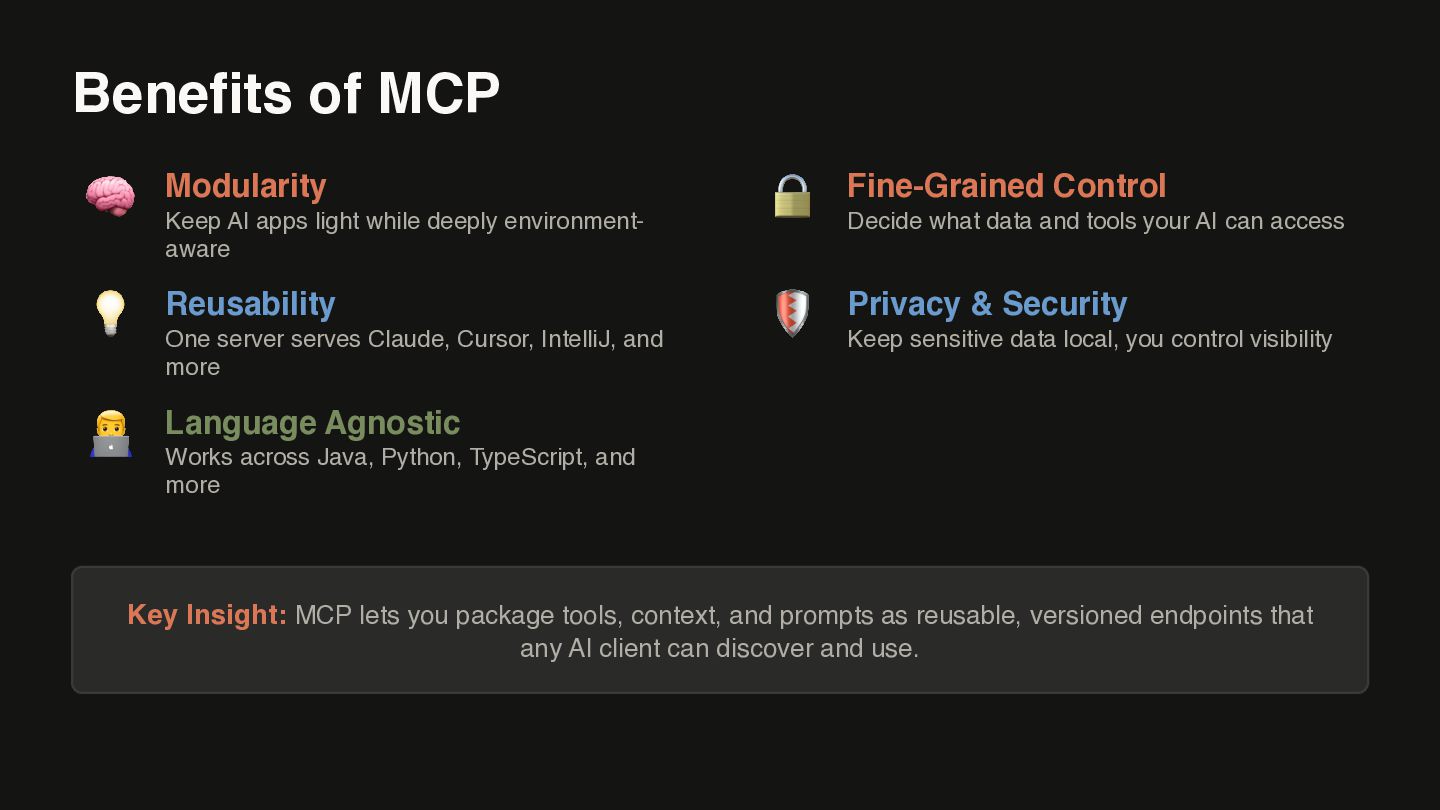
  17. Benefits of MCP 🧠 Modularity Keep AI apps light while

    deeply environment- aware 💡 Reusability One server serves Claude, Cursor, IntelliJ, and more 👨💻 Language Agnostic Works across Java, Python, TypeScript, and more 🔒 Fine-Grained Control Decide what data and tools your AI can access 🛡 Privacy & Security Keep sensitive data local, you control visibility Key Insight: MCP lets you package tools, context, and prompts as reusable, versioned endpoints that any AI client can discover and use.
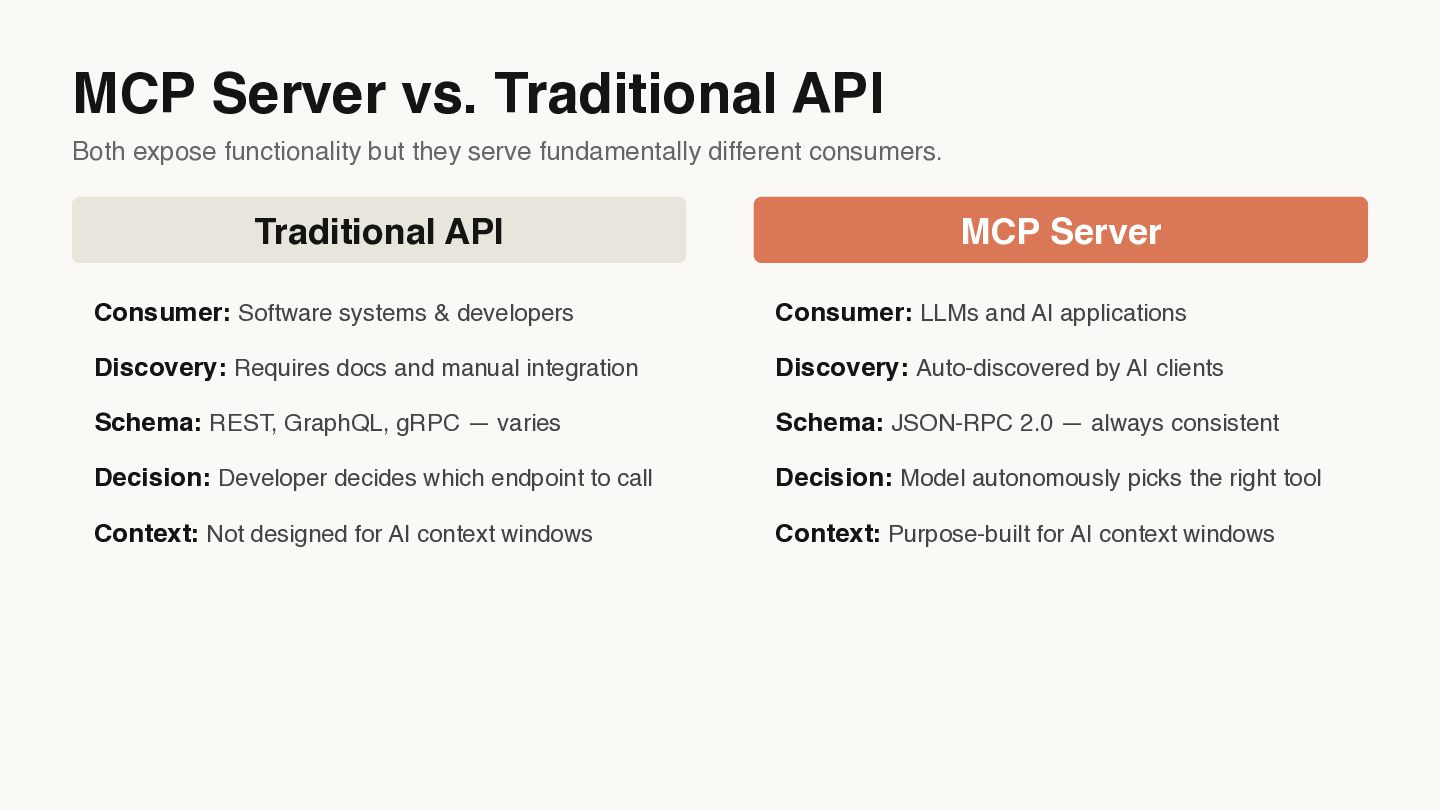
  18. MCP Server vs. Traditional API Both expose functionality but they

    serve fundamentally different consumers. Traditional API Consumer: Software systems & developers Discovery: Requires docs and manual integration Schema: REST, GraphQL, gRPC — varies Decision: Developer decides which endpoint to call Context: Not designed for AI context windows MCP Server Consumer: LLMs and AI applications Discovery: Auto-discovered by AI clients Schema: JSON-RPC 2.0 — always consistent Decision: Model autonomously picks the right tool Context: Purpose-built for AI context windows
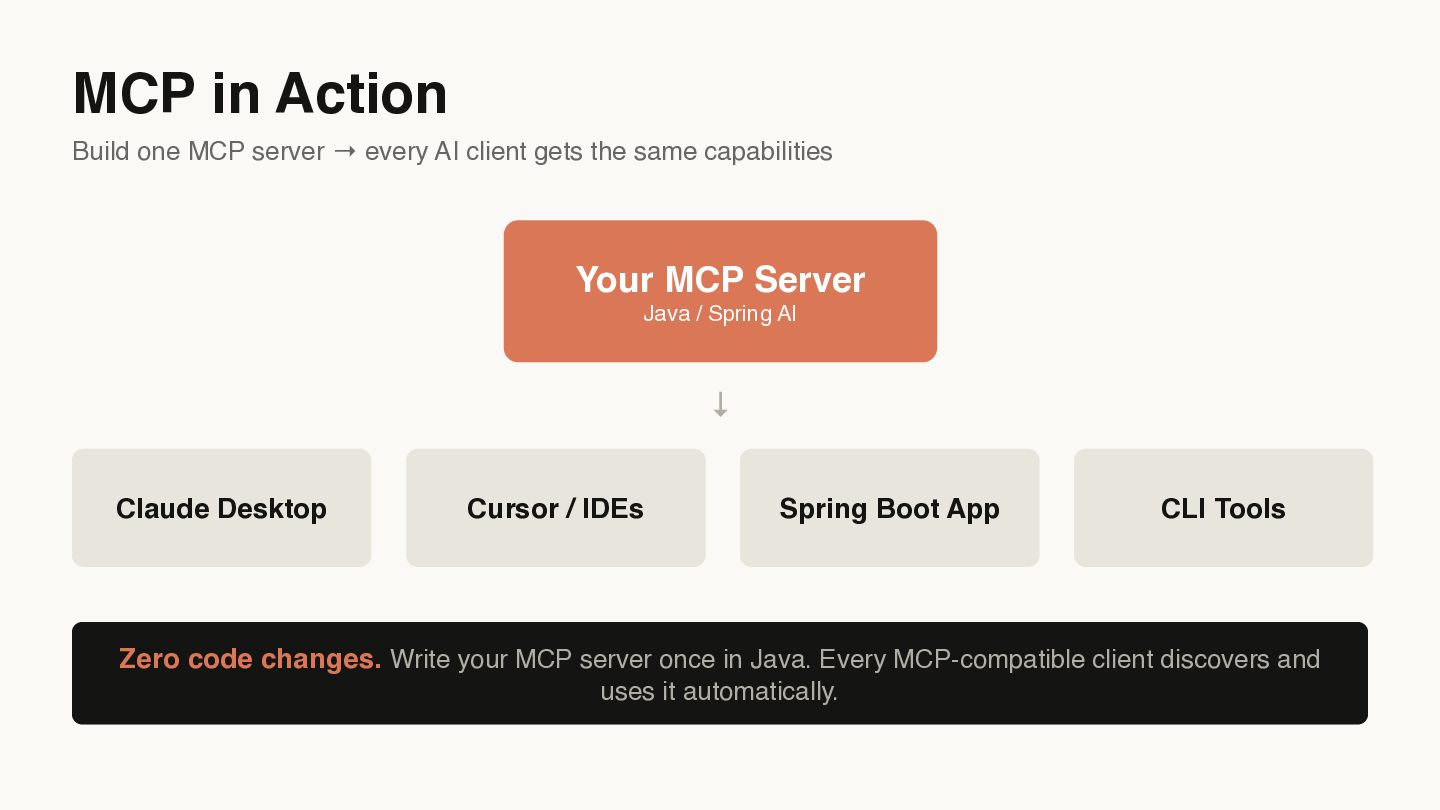
  19. MCP in Action Build one MCP server → every AI

    client gets the same capabilities Your MCP Server Java / Spring AI ↓ Claude Desktop Cursor / IDEs Spring Boot App CLI Tools Zero code changes. Write your MCP server once in Java. Every MCP-compatible client discovers and uses it automatically.
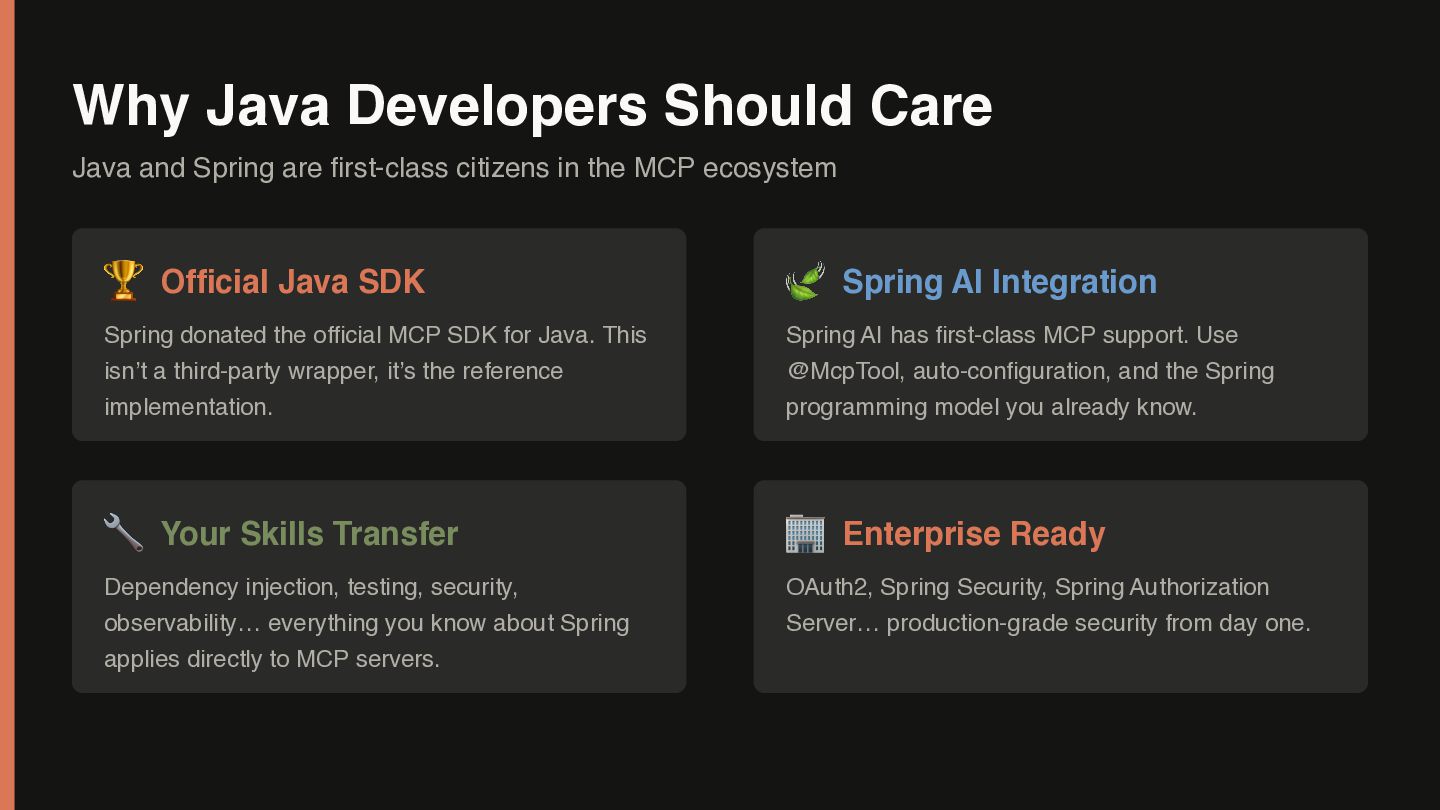
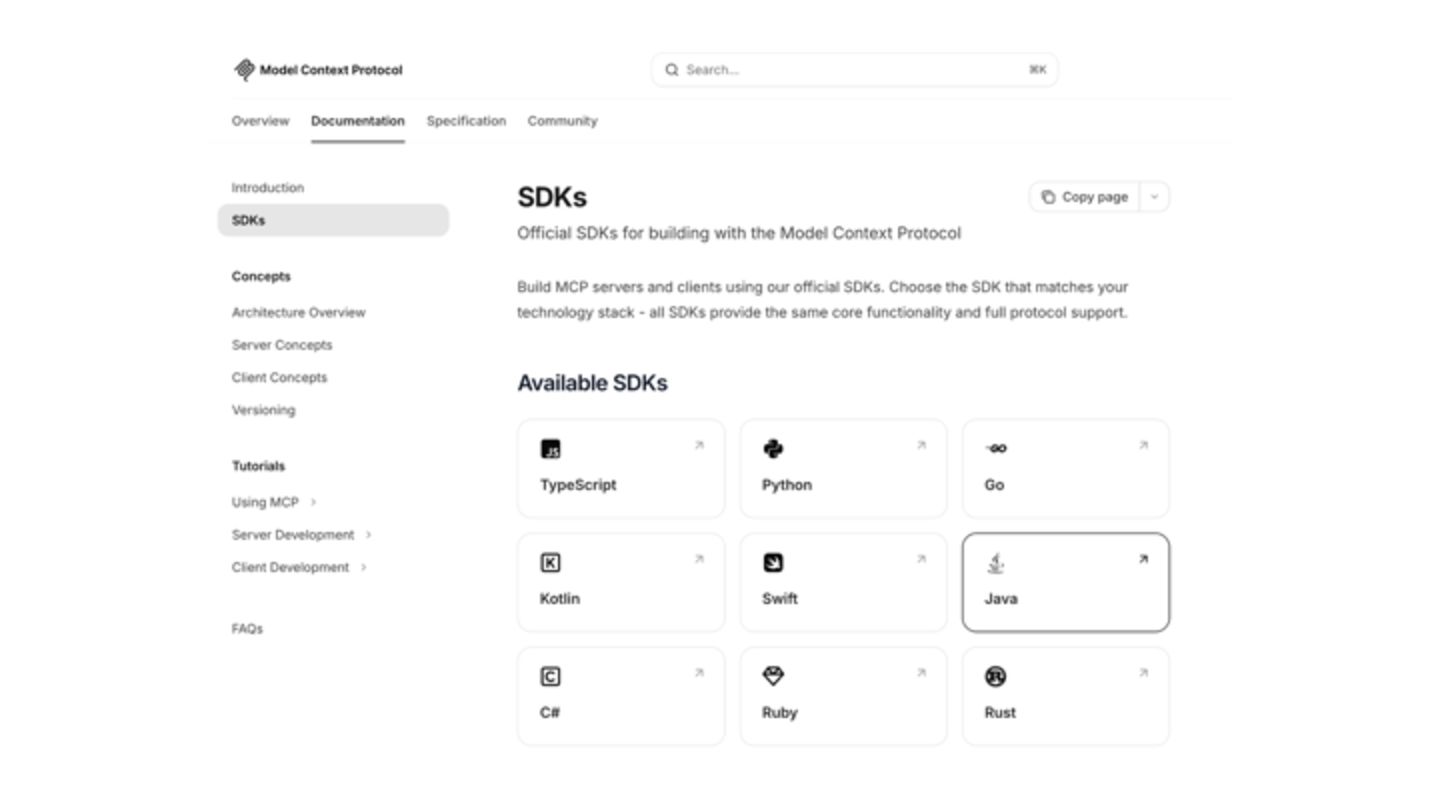
  20. Why Java Developers Should Care Java and Spring are first-class
    citizens in the MCP ecosystem 🏆 Official Java SDK Spring donated the official MCP SDK for Java. This isn’t a third-party wrapper, it’s the reference implementation. 🍃 Spring AI Integration Spring AI has first-class MCP support. Use @McpTool, auto-configuration, and the Spring programming model you already know. 🔧 Your Skills Transfer Dependency injection, testing, security, observability… everything you know about Spring applies directly to MCP servers. 🏢 Enterprise Ready OAuth2, Spring Security, Spring Authorization Server… production-grade security from day one.
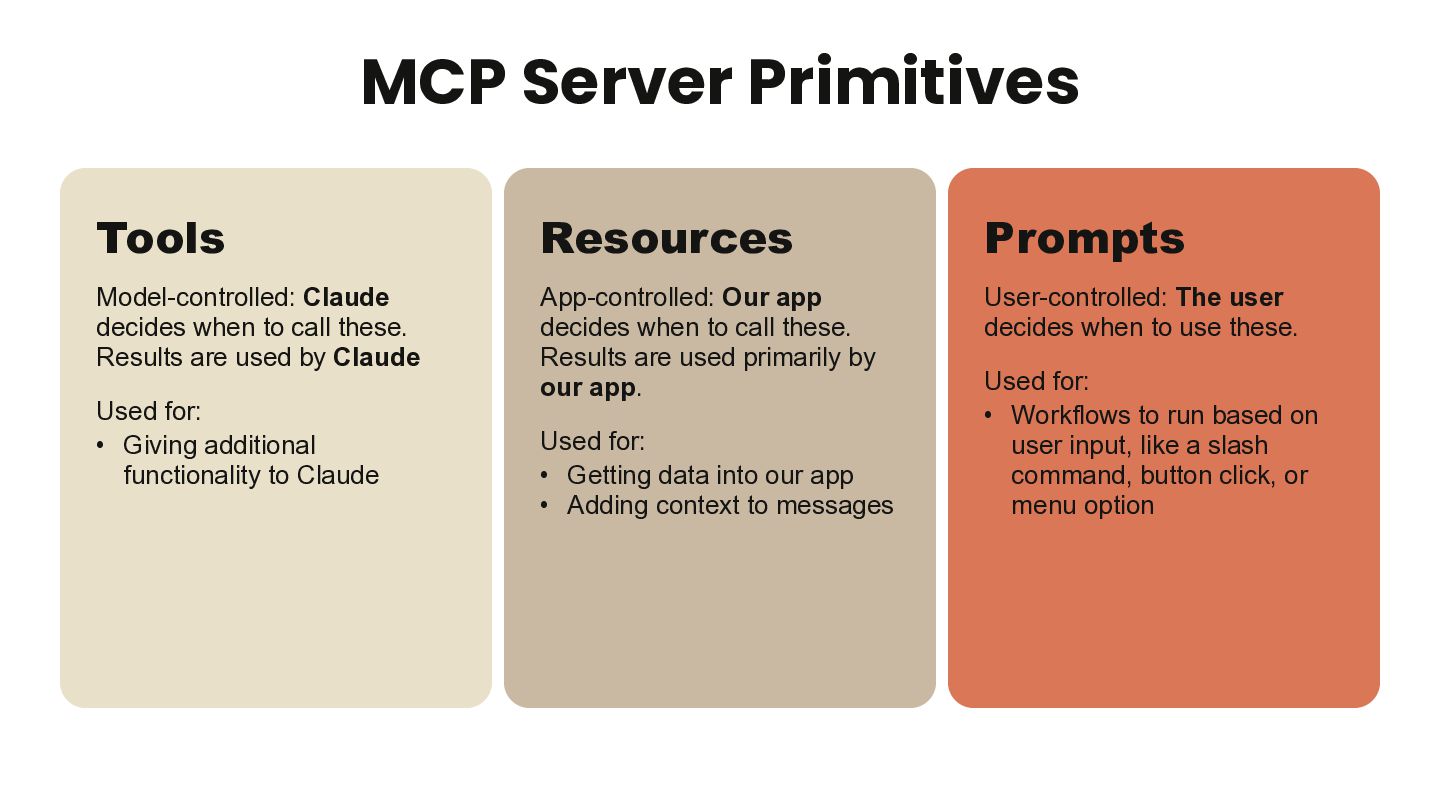
  21. MCP Server Primitives Tools Model-controlled: Claude decides when to call

    these. Results are used by Claude Used for: • Giving additional functionality to Claude Resources App-controlled: Our app decides when to call these. Results are used primarily by our app. Used for: • Getting data into our app • Adding context to messages Prompts User-controlled: The user decides when to use these. Used for: • Workflows to run based on user input, like a slash command, button click, or menu option
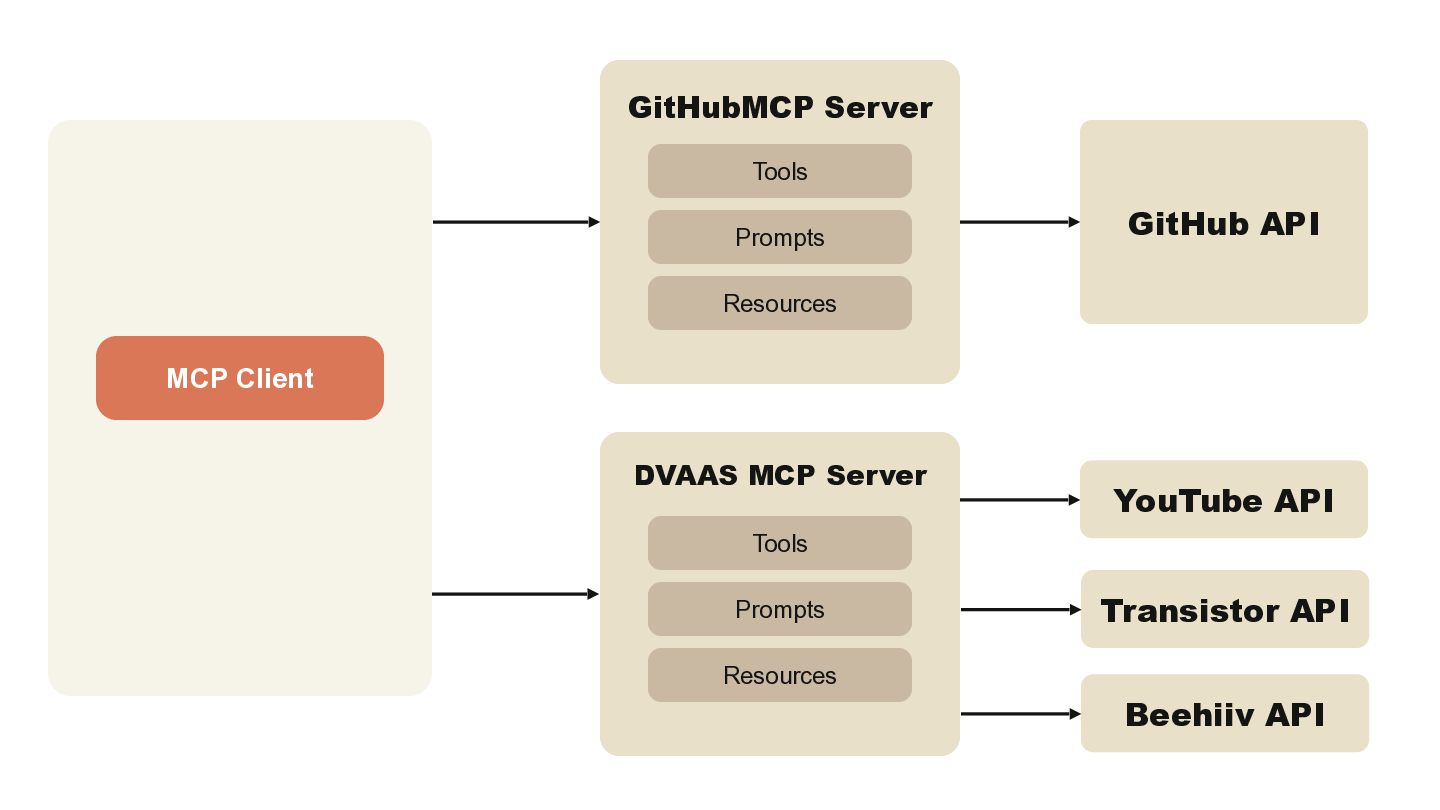
  22. MCP Client GitHubMCP Server Tools Prompts Resources GitHub API DVAAS

    MCP Server Tools Prompts Resources YouTube API Transistor API Beehiiv API
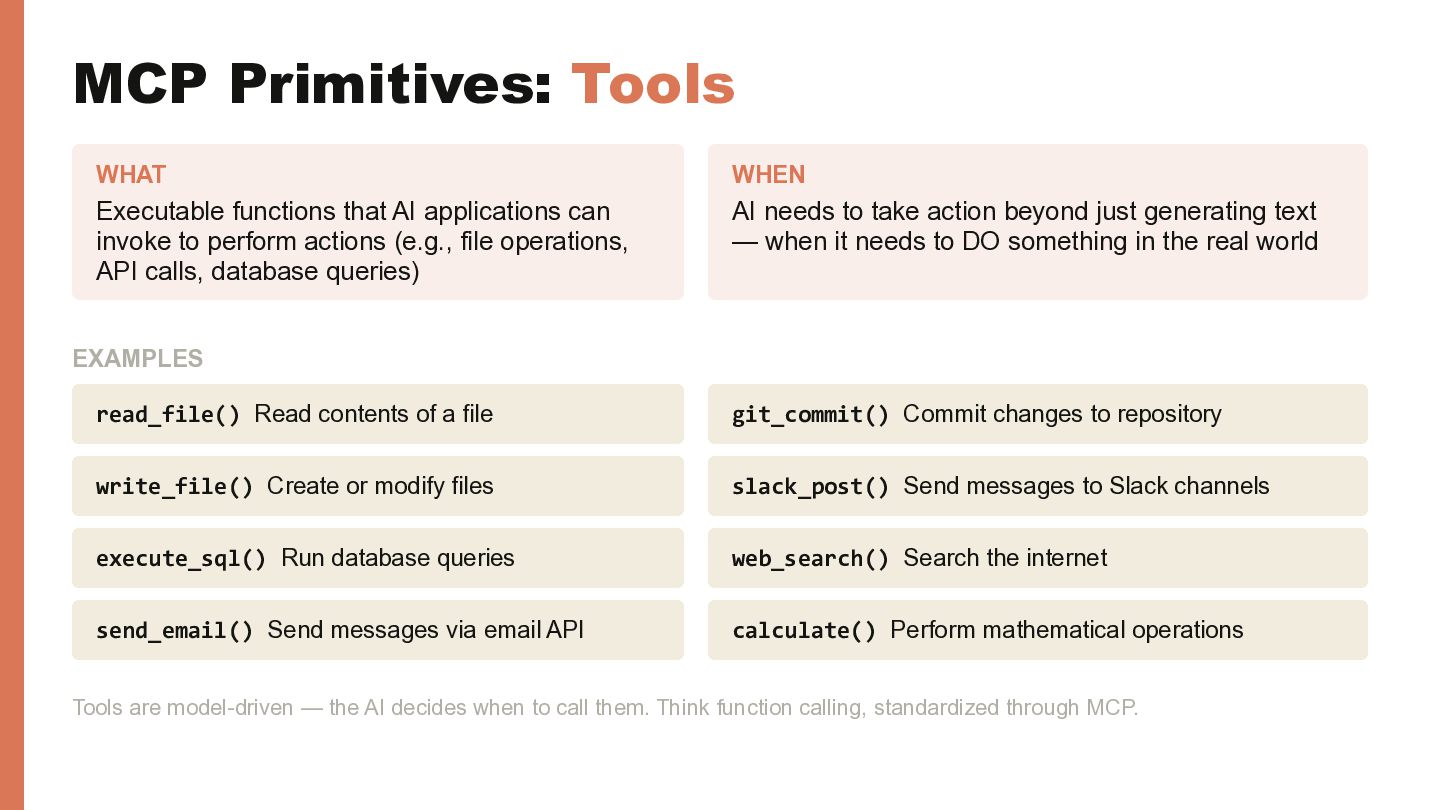
  23. MCP Primitives: Tools WHAT Executable functions that AI applications can

    invoke to perform actions (e.g., file operations, API calls, database queries) WHEN AI needs to take action beyond just generating text — when it needs to DO something in the real world EXAMPLES read_file() Read contents of a file write_file() Create or modify files execute_sql() Run database queries send_email() Send messages via email API git_commit() Commit changes to repository slack_post() Send messages to Slack channels web_search() Search the internet calculate() Perform mathematical operations Tools are model-driven — the AI decides when to call them. Think function calling, standardized through MCP.
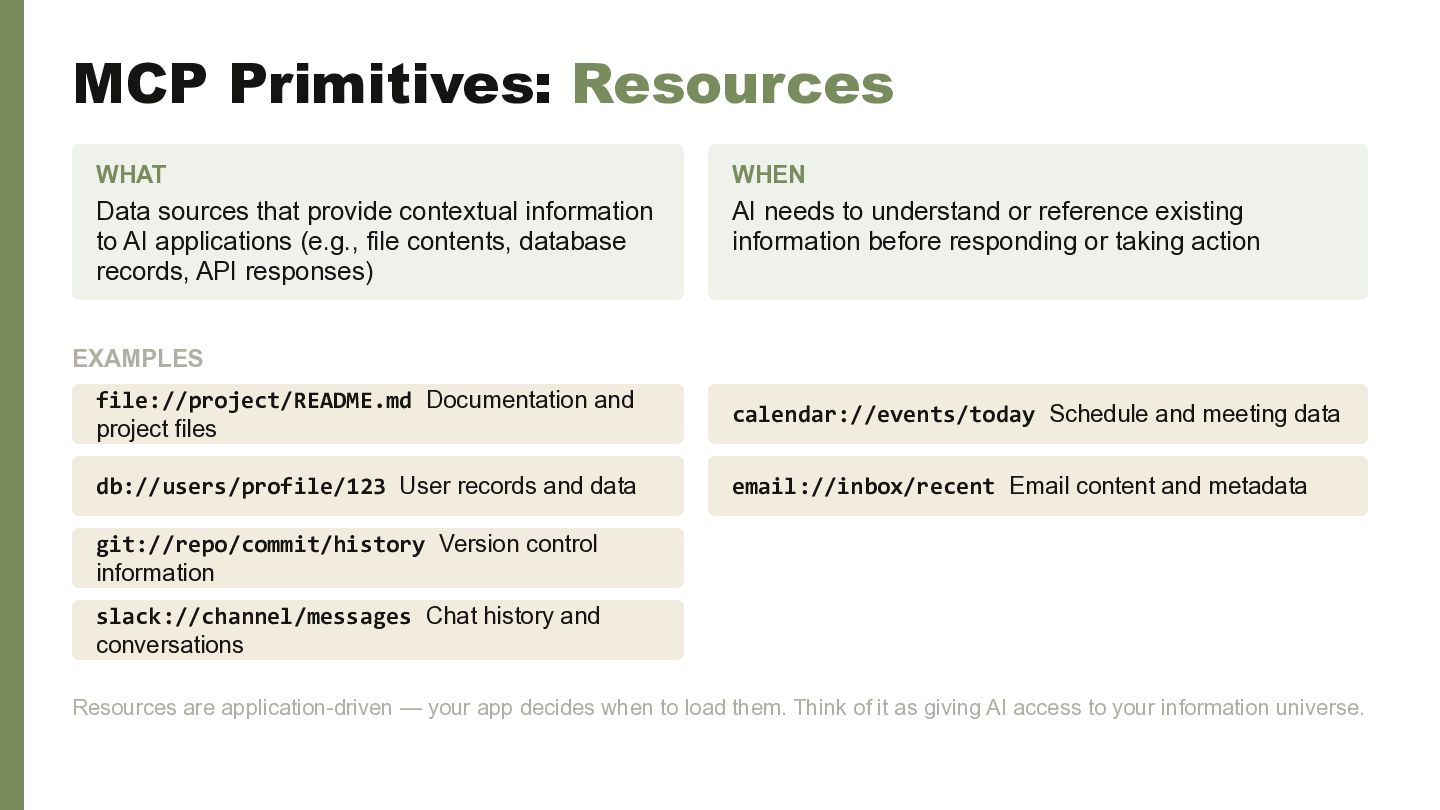
  24. MCP Primitives: Resources WHAT Data sources that provide contextual information

    to AI applications (e.g., file contents, database records, API responses) WHEN AI needs to understand or reference existing information before responding or taking action EXAMPLES file://project/README.md Documentation and project files db://users/profile/123 User records and data git://repo/commit/history Version control information slack://channel/messages Chat history and conversations calendar://events/today Schedule and meeting data email://inbox/recent Email content and metadata Resources are application-driven — your app decides when to load them. Think of it as giving AI access to your information universe.
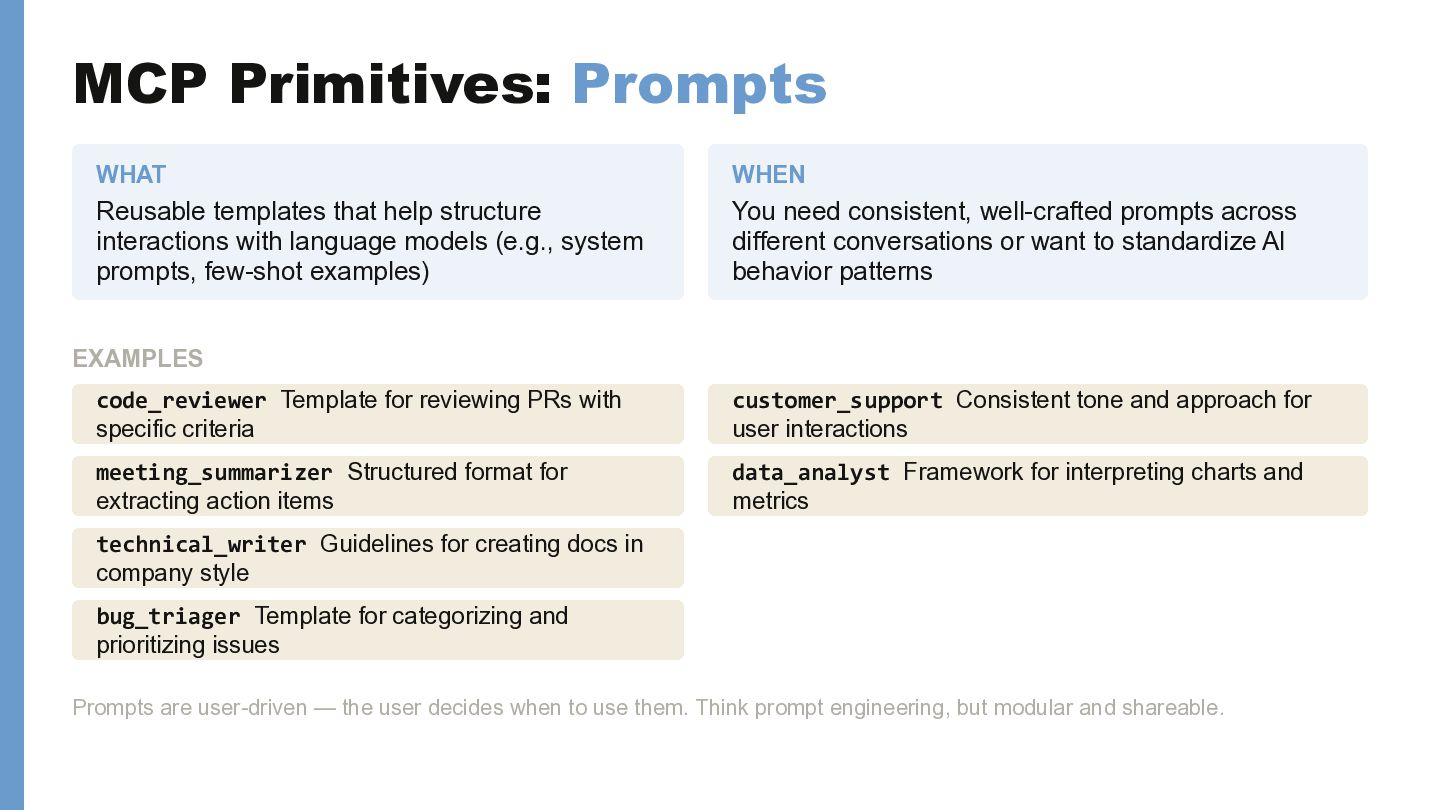
  25. MCP Primitives: Prompts WHAT Reusable templates that help structure interactions

    with language models (e.g., system prompts, few-shot examples) WHEN You need consistent, well-crafted prompts across different conversations or want to standardize AI behavior patterns EXAMPLES code_reviewer Template for reviewing PRs with specific criteria meeting_summarizer Structured format for extracting action items technical_writer Guidelines for creating docs in company style bug_triager Template for categorizing and prioritizing issues customer_support Consistent tone and approach for user interactions data_analyst Framework for interpreting charts and metrics Prompts are user-driven — the user decides when to use them. Think prompt engineering, but modular and shareable.
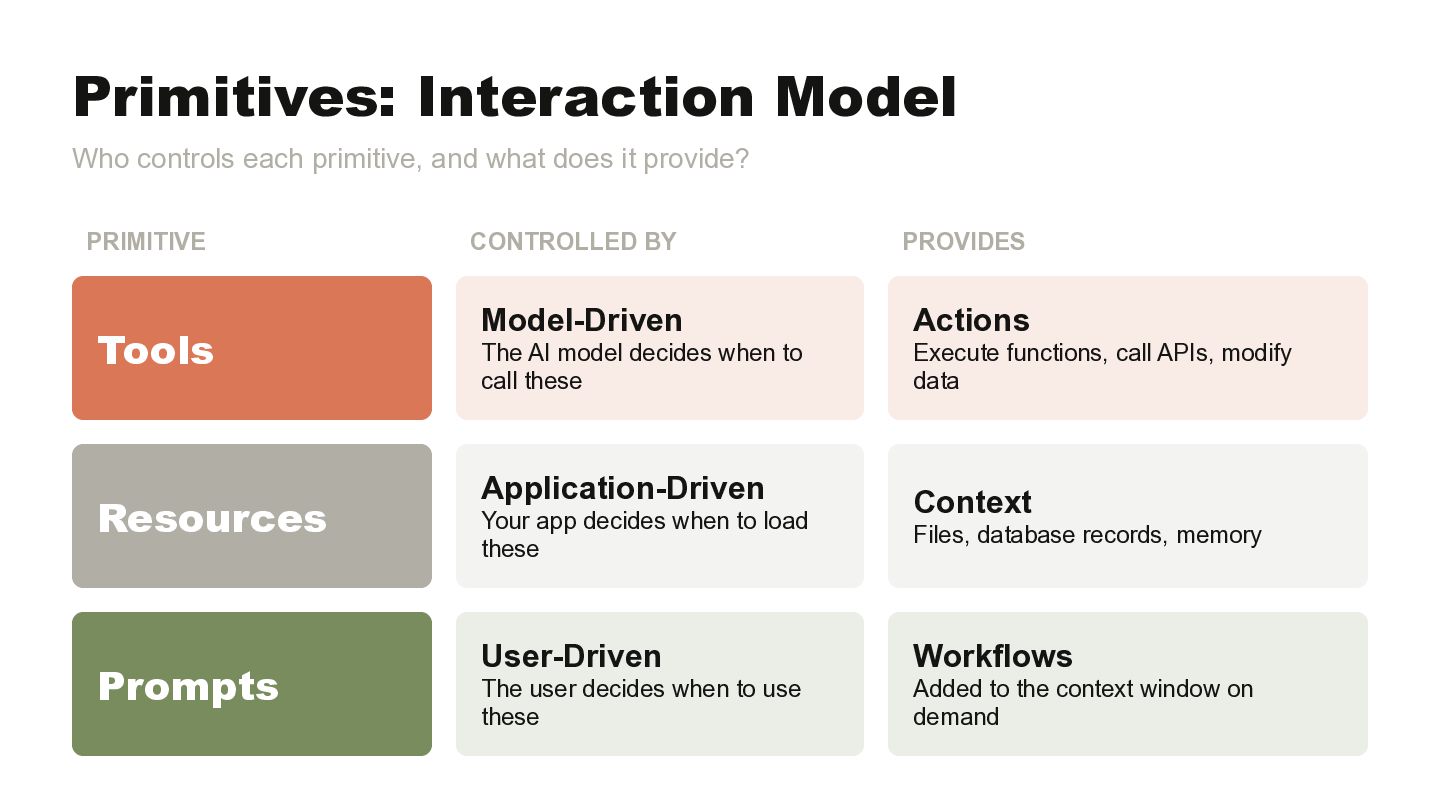
  26. Primitives: Interaction Model Who controls each primitive, and what does

    it provide? PRIMITIVE CONTROLLED BY PROVIDES Tools Model-Driven The AI model decides when to call these Actions Execute functions, call APIs, modify data Resources Application-Driven Your app decides when to load these Context Files, database records, memory Prompts User-Driven The user decides when to use these Workflows Added to the context window on demand
  27. “ Transports in the Model Context Protocol (MCP) provide the

    foundation for communication between clients and servers. A transport handles the underlying mechanics of how messages are sent and received.
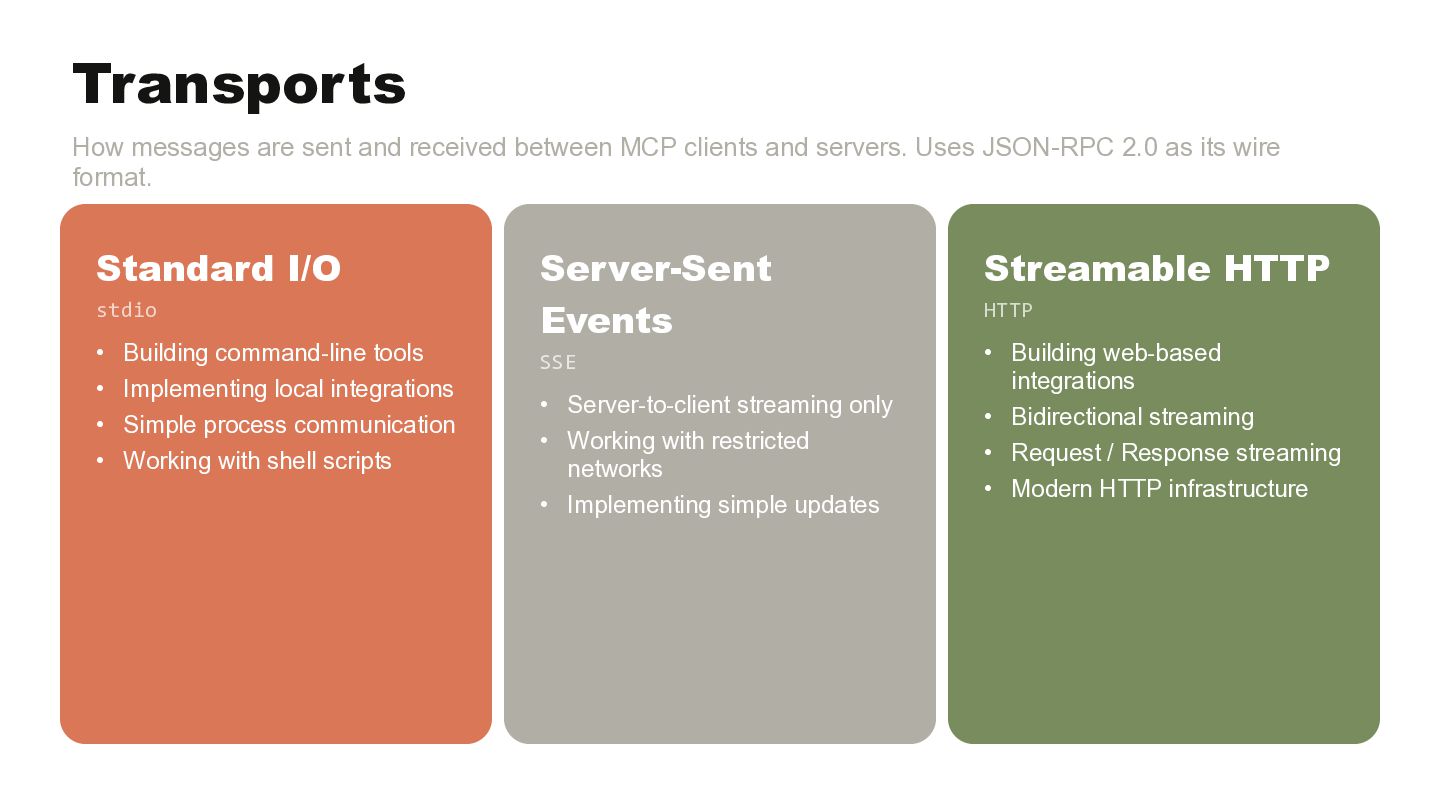
  28. Transports How messages are sent and received between MCP clients

    and servers. Uses JSON-RPC 2.0 as its wire format. Standard I/O stdio • Building command-line tools • Implementing local integrations • Simple process communication • Working with shell scripts Server-Sent Events SSE • Server-to-client streaming only • Working with restricted networks • Implementing simple updates Streamable HTTP HTTP • Building web-based integrations • Bidirectional streaming • Request / Response streaming • Modern HTTP infrastructure
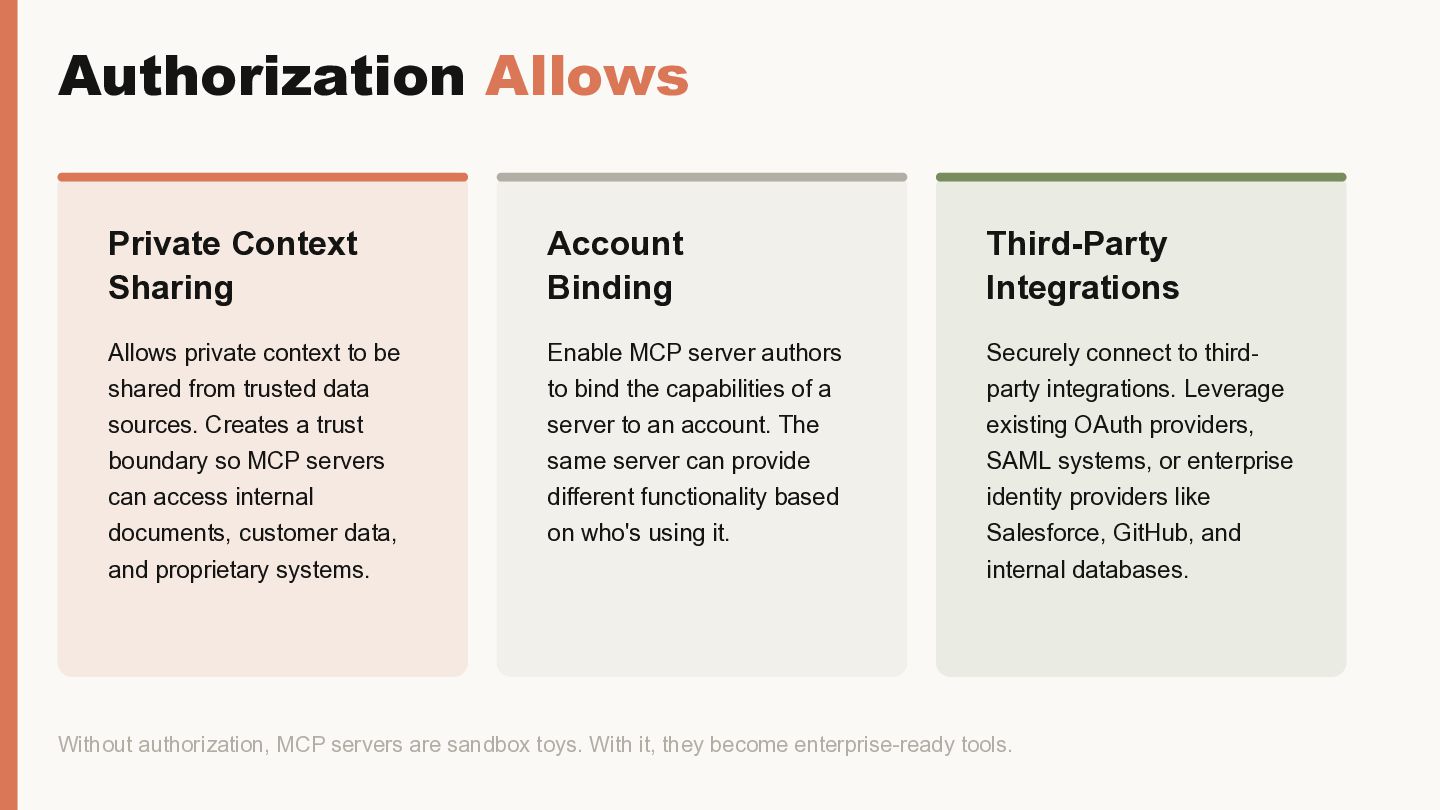
  29. Authorization Allows Private Context Sharing Allows private context to be

    shared from trusted data sources. Creates a trust boundary so MCP servers can access internal documents, customer data, and proprietary systems. Account Binding Enable MCP server authors to bind the capabilities of a server to an account. The same server can provide different functionality based on who's using it. Third-Party Integrations Securely connect to third- party integrations. Leverage existing OAuth providers, SAML systems, or enterprise identity providers like Salesforce, GitHub, and internal databases. Without authorization, MCP servers are sandbox toys. With it, they become enterprise-ready tools.
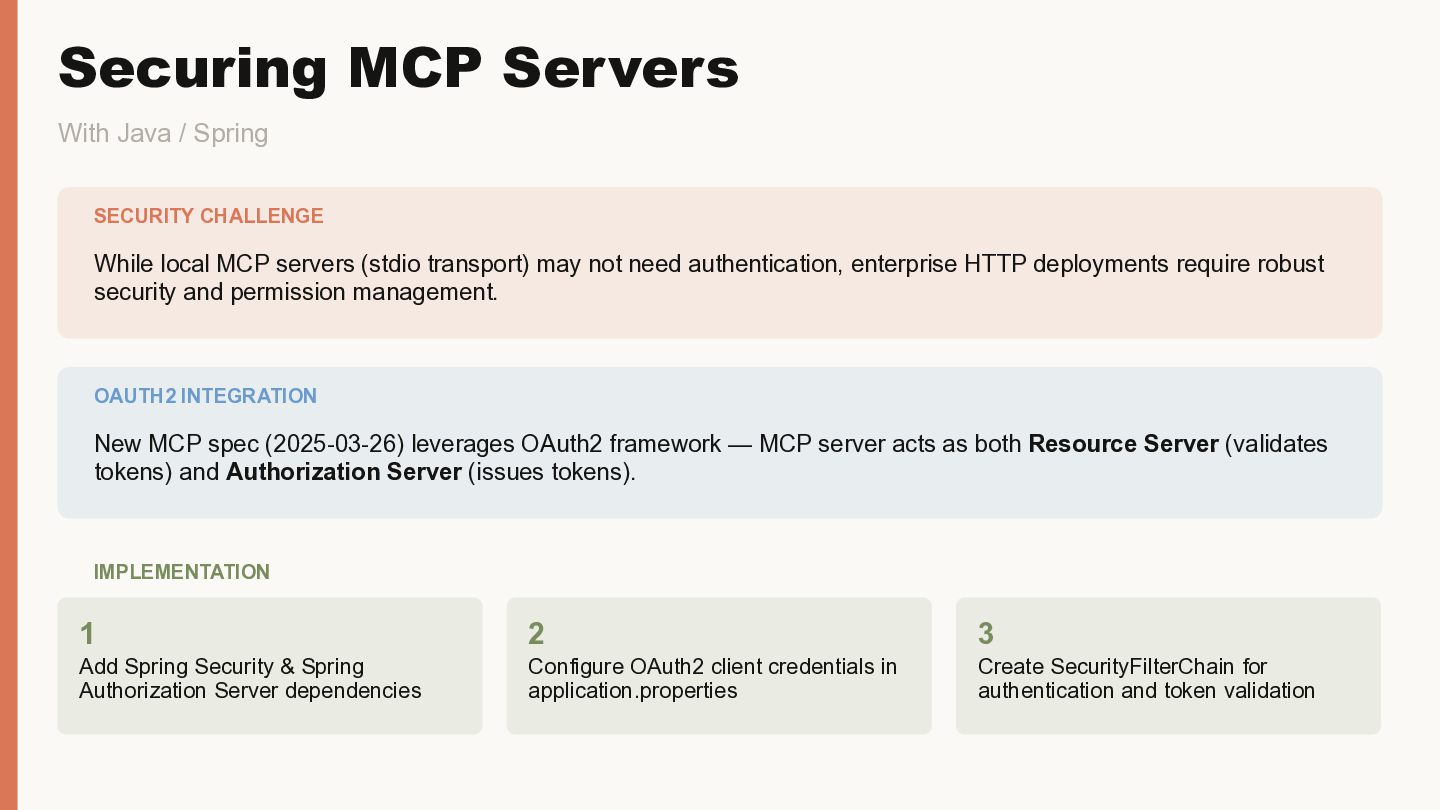
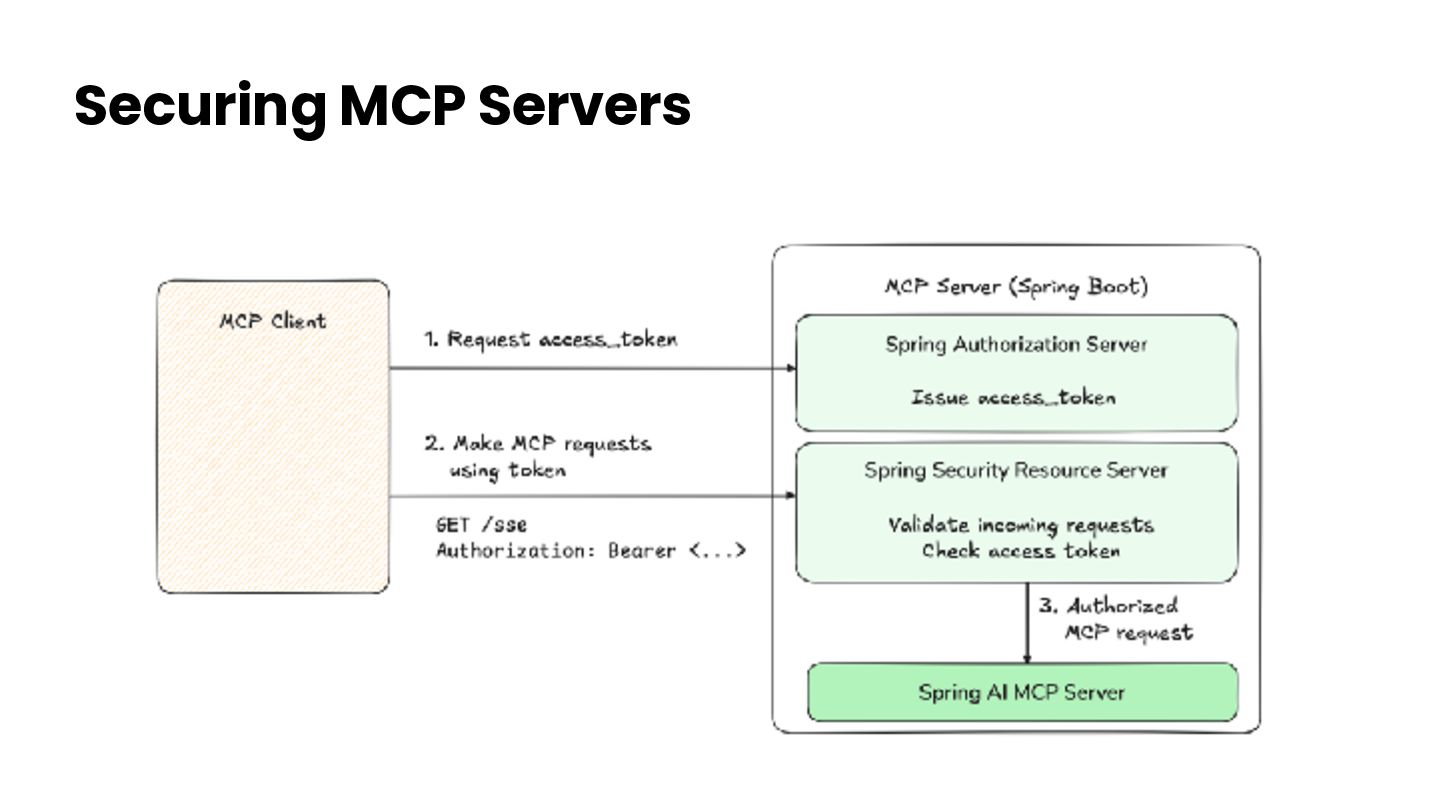
  30. Securing MCP Servers With Java / Spring SECURITY CHALLENGE While

    local MCP servers (stdio transport) may not need authentication, enterprise HTTP deployments require robust security and permission management. OAUTH2 INTEGRATION New MCP spec (2025-03-26) leverages OAuth2 framework — MCP server acts as both Resource Server (validates tokens) and Authorization Server (issues tokens). IMPLEMENTATION 1 Add Spring Security & Spring Authorization Server dependencies 2 Configure OAuth2 client credentials in application.properties 3 Create SecurityFilterChain for authentication and token validation
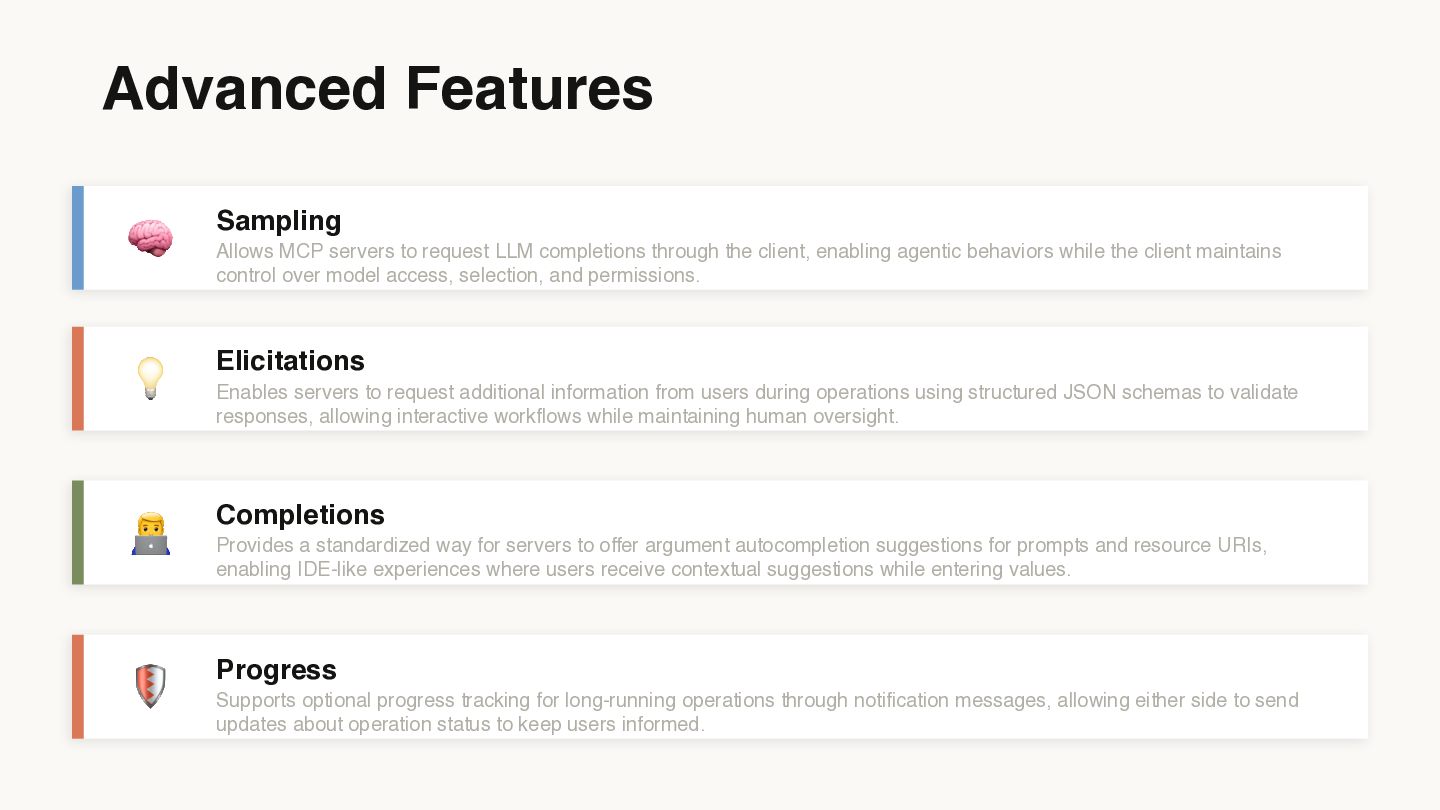
  31. Advanced Features 🧠 Sampling Allows MCP servers to request LLM

    completions through the client, enabling agentic behaviors while the client maintains control over model access, selection, and permissions. 💡 Elicitations Enables servers to request additional information from users during operations using structured JSON schemas to validate responses, allowing interactive workflows while maintaining human oversight. 👨💻 Completions Provides a standardized way for servers to offer argument autocompletion suggestions for prompts and resource URIs, enabling IDE-like experiences where users receive contextual suggestions while entering values. 🛡 Progress Supports optional progress tracking for long-running operations through notification messages, allowing either side to send updates about operation status to keep users informed.
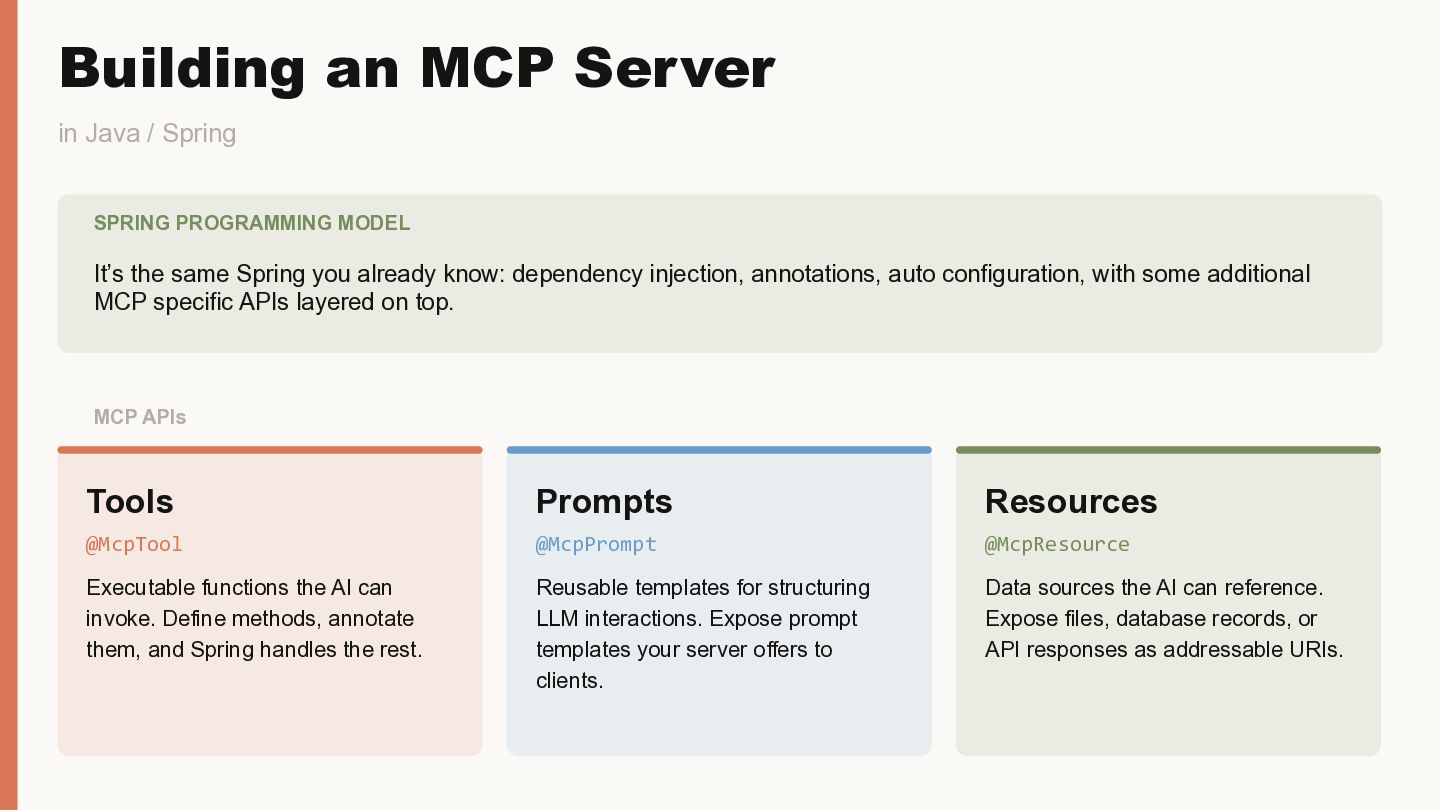
  32. Building an MCP Server in Java / Spring SPRING PROGRAMMING

    MODEL It’s the same Spring you already know: dependency injection, annotations, auto configuration, with some additional MCP specific APIs layered on top. MCP APIs Tools @McpTool Executable functions the AI can invoke. Define methods, annotate them, and Spring handles the rest. Prompts @McpPrompt Reusable templates for structuring LLM interactions. Expose prompt templates your server offers to clients. Resources @McpResource Data sources the AI can reference. Expose files, database records, or API responses as addressable URIs.
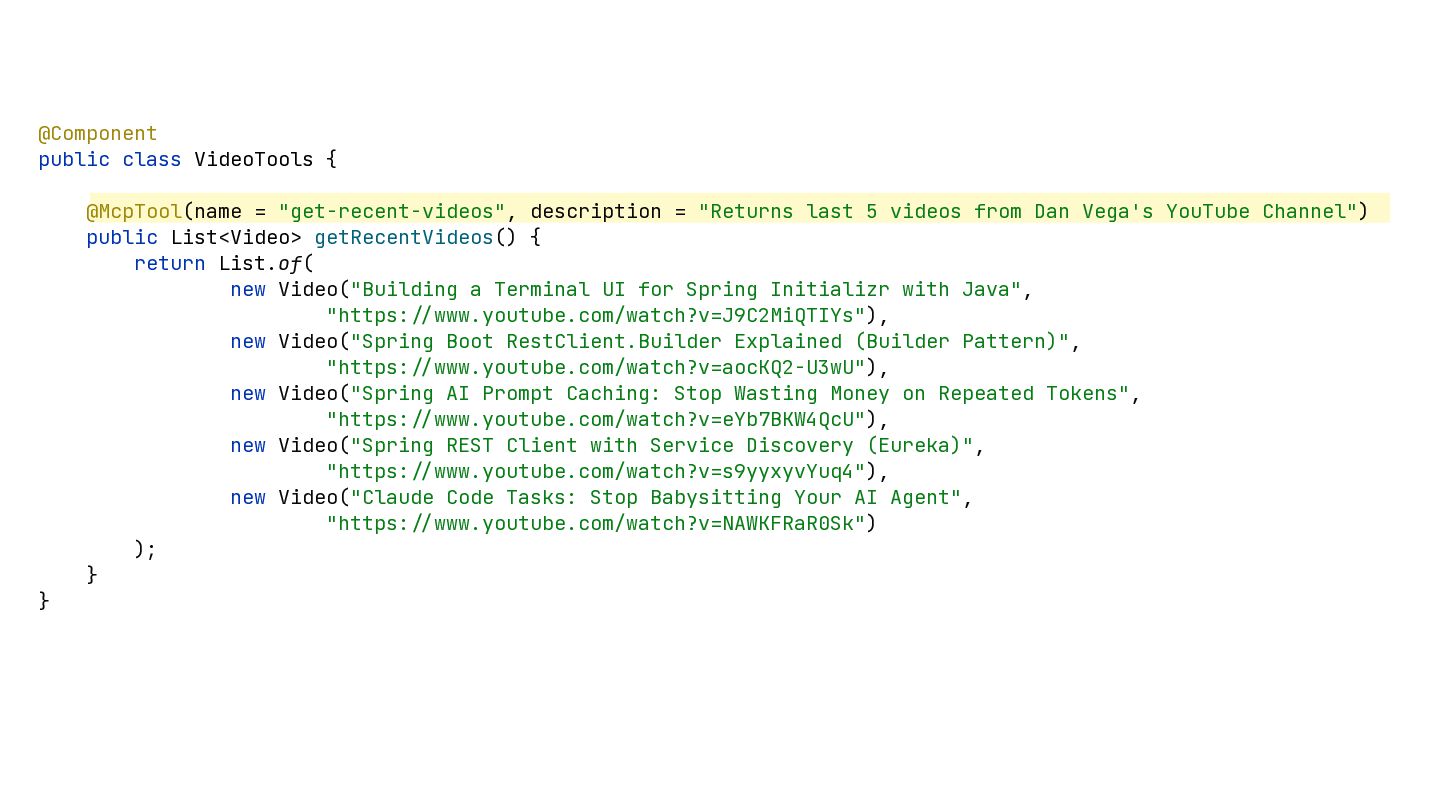
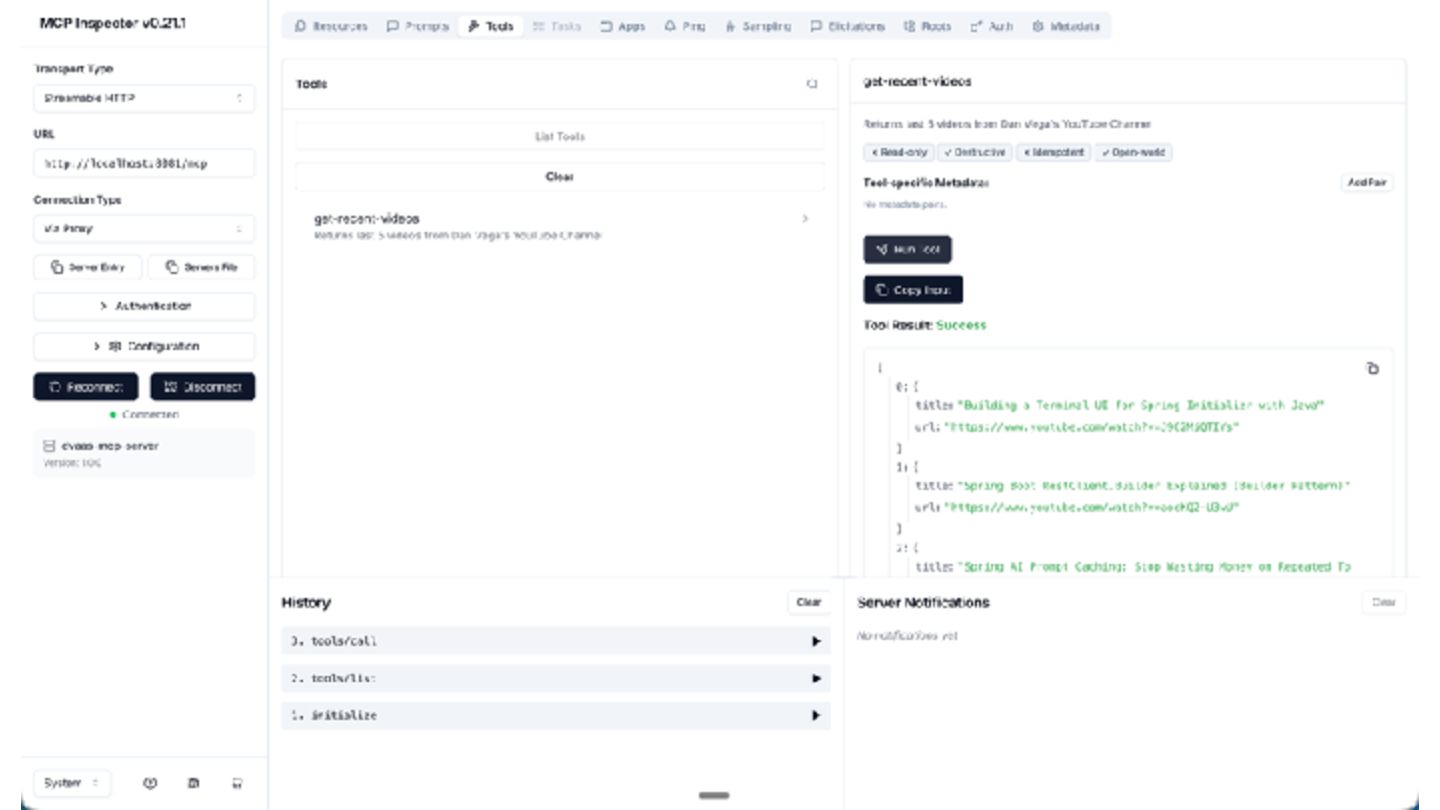
  33. @Component public class VideoTools { @McpTool(name = "get-recent-videos", description =

    "Returns last 5 videos from Dan Vega's YouTube Channel") public List<Video> getRecentVideos() { return List.of( new Video("Building a Terminal UI for Spring Initializr with Java", "https: // www.youtube.com/watch?v=J9C2MiQTIYs"), new Video("Spring Boot RestClient.Builder Explained (Builder Pattern)", "https: // www.youtube.com/watch?v=aocKQ2-U3wU"), new Video("Spring AI Prompt Caching: Stop Wasting Money on Repeated Tokens", "https: // www.youtube.com/watch?v=eYb7BKW4QcU"), new Video("Spring REST Client with Service Discovery (Eureka)", "https: // www.youtube.com/watch?v=s9yyxyvYuq4"), new Video("Claude Code Tasks: Stop Babysitting Your AI Agent", "https: // www.youtube.com/watch?v=NAWKFRaR0Sk") ); } }
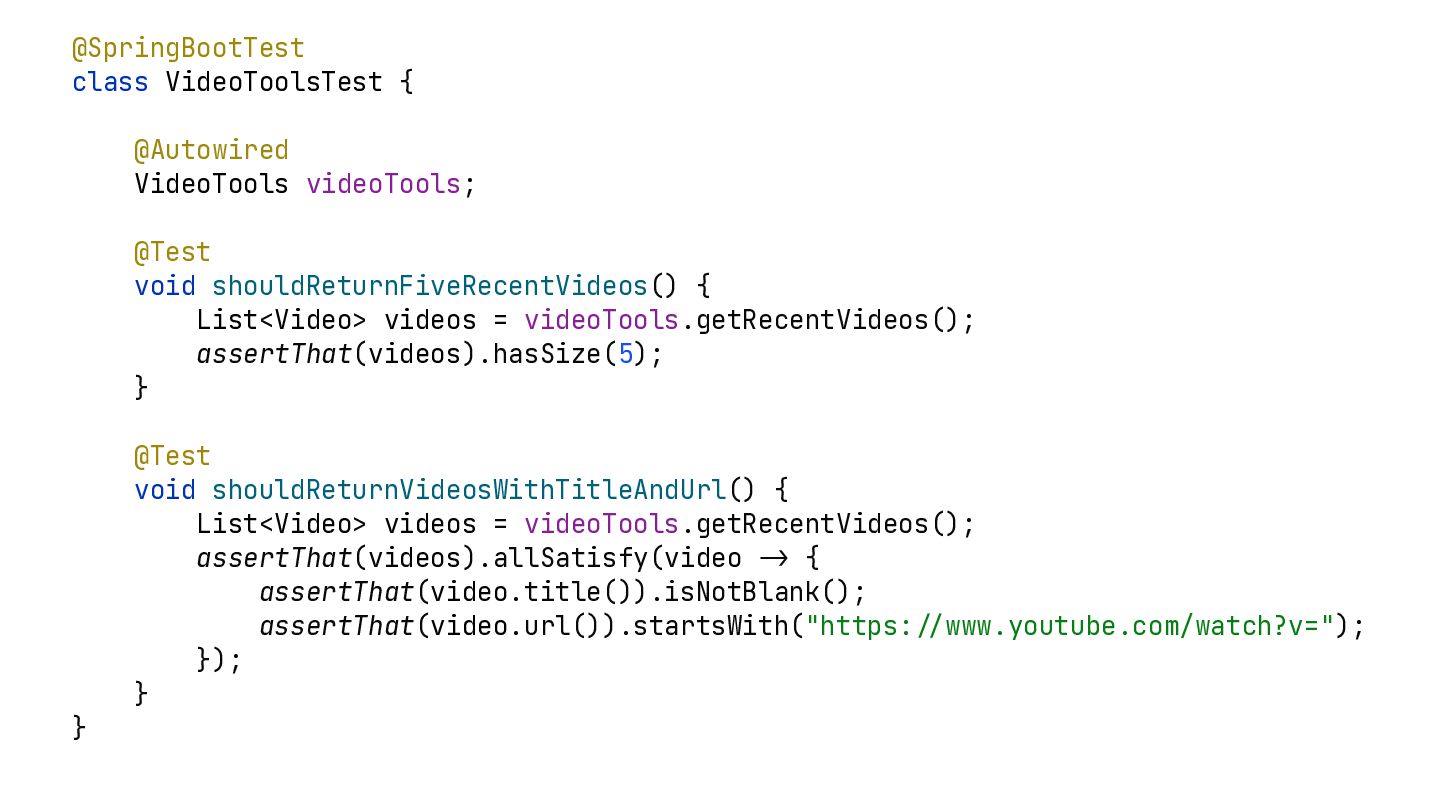
  34. @SpringBootTest class VideoToolsTest { @Autowired VideoTools videoTools; @Test void shouldReturnFiveRecentVideos()

    { List<Video> videos = videoTools.getRecentVideos(); assertThat(videos).hasSize(5); } @Test void shouldReturnVideosWithTitleAndUrl() { List<Video> videos = videoTools.getRecentVideos(); assertThat(videos).allSatisfy(video -> { assertThat(video.title()).isNotBlank(); assertThat(video.url()).startsWith("https: // www.youtube.com/watch?v="); }); } }
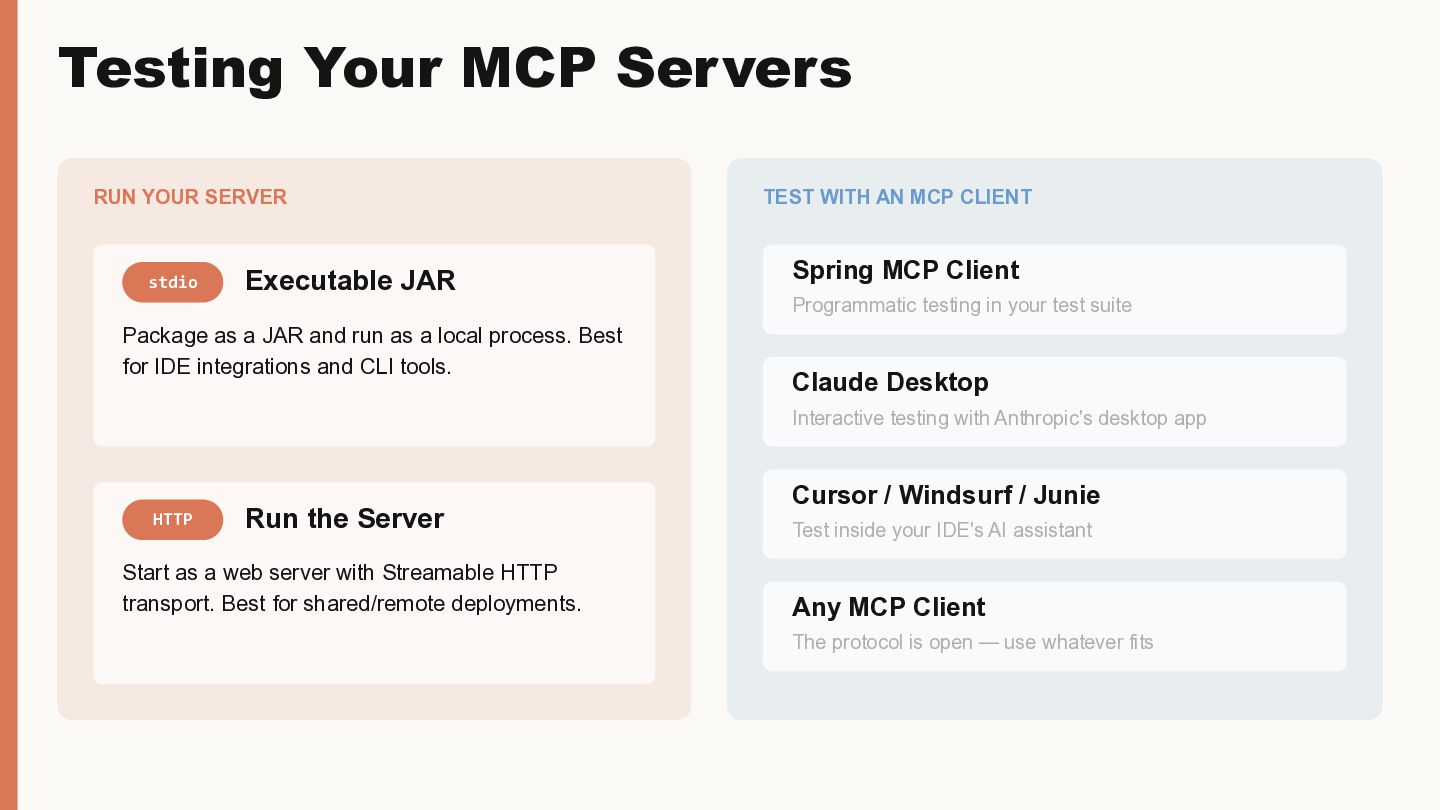
  35. Testing Your MCP Servers RUN YOUR SERVER stdio Executable JAR

    Package as a JAR and run as a local process. Best for IDE integrations and CLI tools. HTTP Run the Server Start as a web server with Streamable HTTP transport. Best for shared/remote deployments. TEST WITH AN MCP CLIENT Spring MCP Client Programmatic testing in your test suite Claude Desktop Interactive testing with Anthropic's desktop app Cursor / Windsurf / Junie Test inside your IDE's AI assistant Any MCP Client The protocol is open — use whatever fits
  36. “ You have an MCP Server, where and how do

    you deploy it for anyone to use?
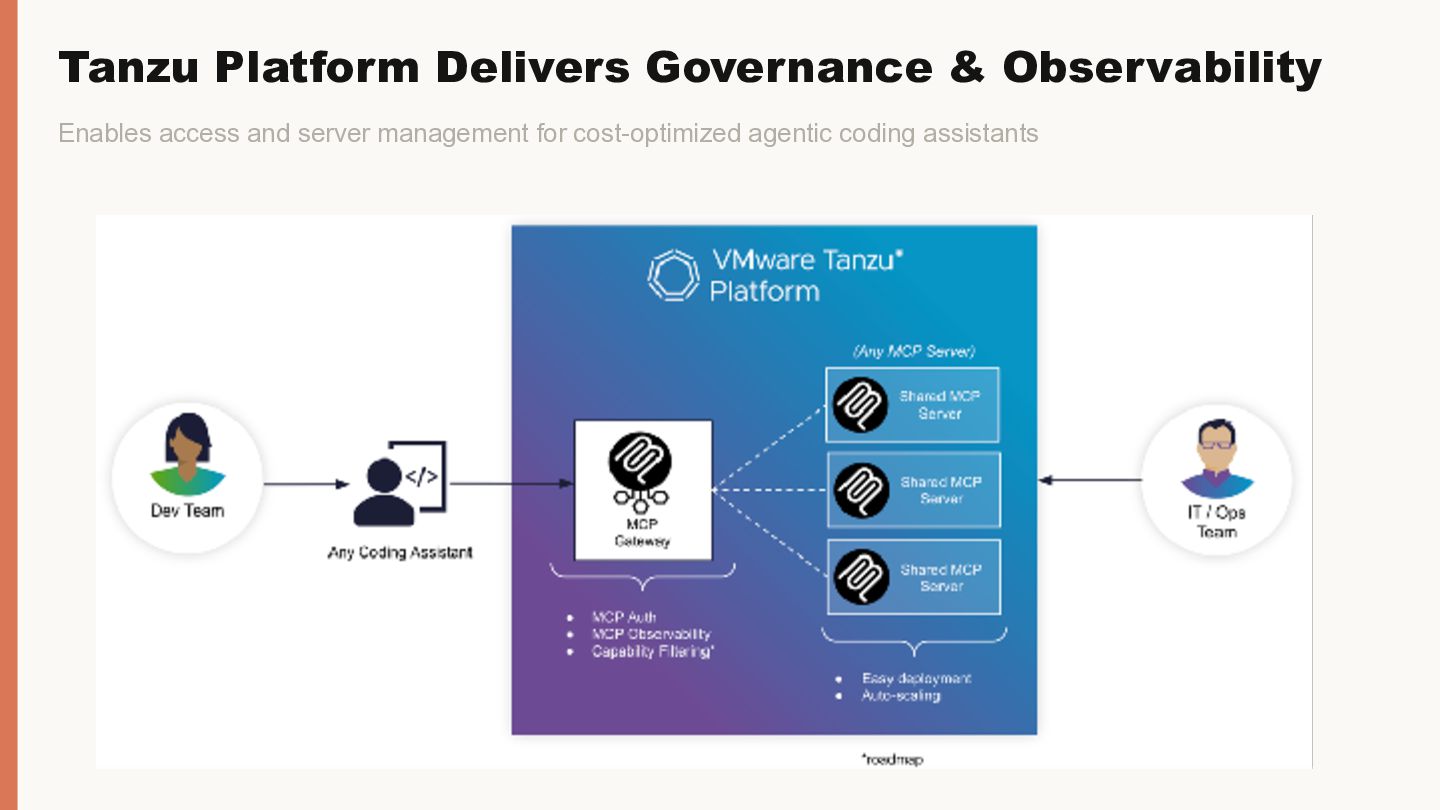
  37. Tanzu Platform Delivers Governance & Observability Enables access and server

    management for cost-optimized agentic coding assistants