Upgrade to Pro — share decks privately, control downloads, hide ads and more …

How to Start Affiliate Marketing With No Produc...

Sponsored · Ship Features Fearlessly Turn features on and off without deploys. Used by thousands of Ruby developers. →
Avatar for Thuriyen Thuriyen
September 29, 2026

How to Start Affiliate Marketing With No Product of Your Own

Learn how to start affiliate marketing without creating your own product. This beginner-friendly guide covers audience research, content creation, affiliate links, trust-building, common mistakes, and a simple 7-day action plan.

Avatar for Thuriyen

Thuriyen

September 29, 2026

Other Decks in Business

Transcript

  1. How to Start Affiliate Marketing With No Product of Your

    Own Starting an online business can feel difficult when you do not have your own product, a large audience, or a big budget. You may think you need to create an online course, manufacture a product, build an app, or maintain a complicated website before you can start. That is not necessarily the case. Affiliate marketing is one online business model where you can promote products or services created by other businesses and potentially earn a commission when someone completes a qualifying action through your referral. The important part, however, is understanding that affiliate marketing is not simply about placing links everywhere. The real skill is learning how to find a specific audience, understand its problems, create genuinely useful content, and recommend relevant solutions. This guide explains a simple way to approach affiliate marketing as a beginner. 1. Understand What Affiliate Marketing Actually Is The basic process is straightforward. A business or product owner creates an affiliate program. You receive a unique tracking link. You then introduce the product to people who may genuinely find it useful.
  2. If someone clicks your tracking link and completes the required

    action, the affiliate system can attribute that conversion to you and pay a commission according to the program's terms. For example: Audience → Problem → Helpful Content → Relevant Resource → Affiliate Link → Possible Commission The important word here is relevant. If your content discusses beginner affiliate marketing, recommending a resource that teaches affiliate marketing can make sense. If your content is about fitness and you randomly place an unrelated business-training link inside it, the recommendation becomes much less useful to the reader. Good affiliate marketing starts with relevance. 2. You Don't Need to Create Your Own Product One reason beginners become interested in affiliate marketing is that they can promote an existing offer instead of developing everything themselves. Creating a product can require: Research Development Customer support Branding Payment processing Updates Marketing Affiliate marketing can remove some of those responsibilities because the product owner handles the underlying offer. But that does not mean affiliate marketing is effortless. You still need to learn how to attract the right audience, communicate clearly, create useful content and understand what makes people interested in an offer. Your job is not simply to "sell a link." Your job is to help the right person discover a potentially useful resource. 3. Start With One Audience
  3. One of the biggest beginner mistakes is trying to talk

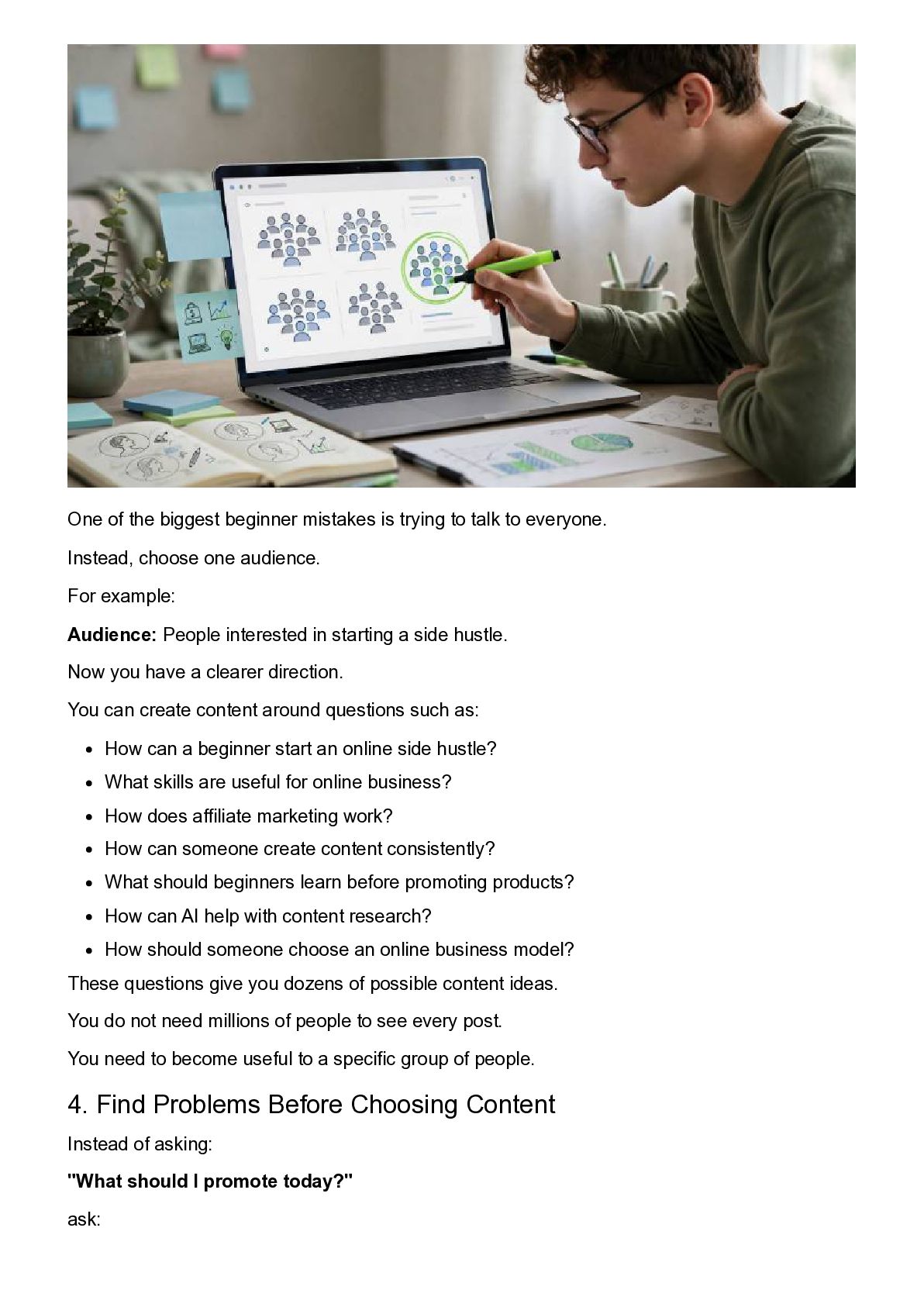
    to everyone. Instead, choose one audience. For example: Audience: People interested in starting a side hustle. Now you have a clearer direction. You can create content around questions such as: How can a beginner start an online side hustle? What skills are useful for online business? How does affiliate marketing work? How can someone create content consistently? What should beginners learn before promoting products? How can AI help with content research? How should someone choose an online business model? These questions give you dozens of possible content ideas. You do not need millions of people to see every post. You need to become useful to a specific group of people. 4. Find Problems Before Choosing Content Instead of asking: "What should I promote today?" ask:
  4. "What problem is my audience trying to solve?" That small

    change can completely alter your content strategy. Suppose your audience wants to start affiliate marketing but does not understand where to begin. You could create an article called: "Affiliate Marketing for Beginners: The First 5 Things to Understand." The article teaches the basics. At the end, you can introduce a relevant educational resource for readers who want to learn more. This feels much more natural than starting an article with: "Buy this product today." Education comes first. Promotion comes second. 5. Create Content That Solves One Small Problem Your content does not have to solve someone's entire life. Solve one small problem well. For example: Problem: "I don't know what to post." You could create a guide explaining how to find 20 content ideas from audience questions. Another example: Problem: "I don't understand affiliate marketing." Create a beginner-friendly explanation showing how the model works. Another: Problem: "I don't know whether affiliate marketing is right for me." Create a comparison of the skills, time, learning curve and responsibilities involved. This approach gives you a repeatable content system. One problem can become: A PDF A blog article An X post A Threads post A short video
  5. A carousel A newsletter One useful idea can therefore become

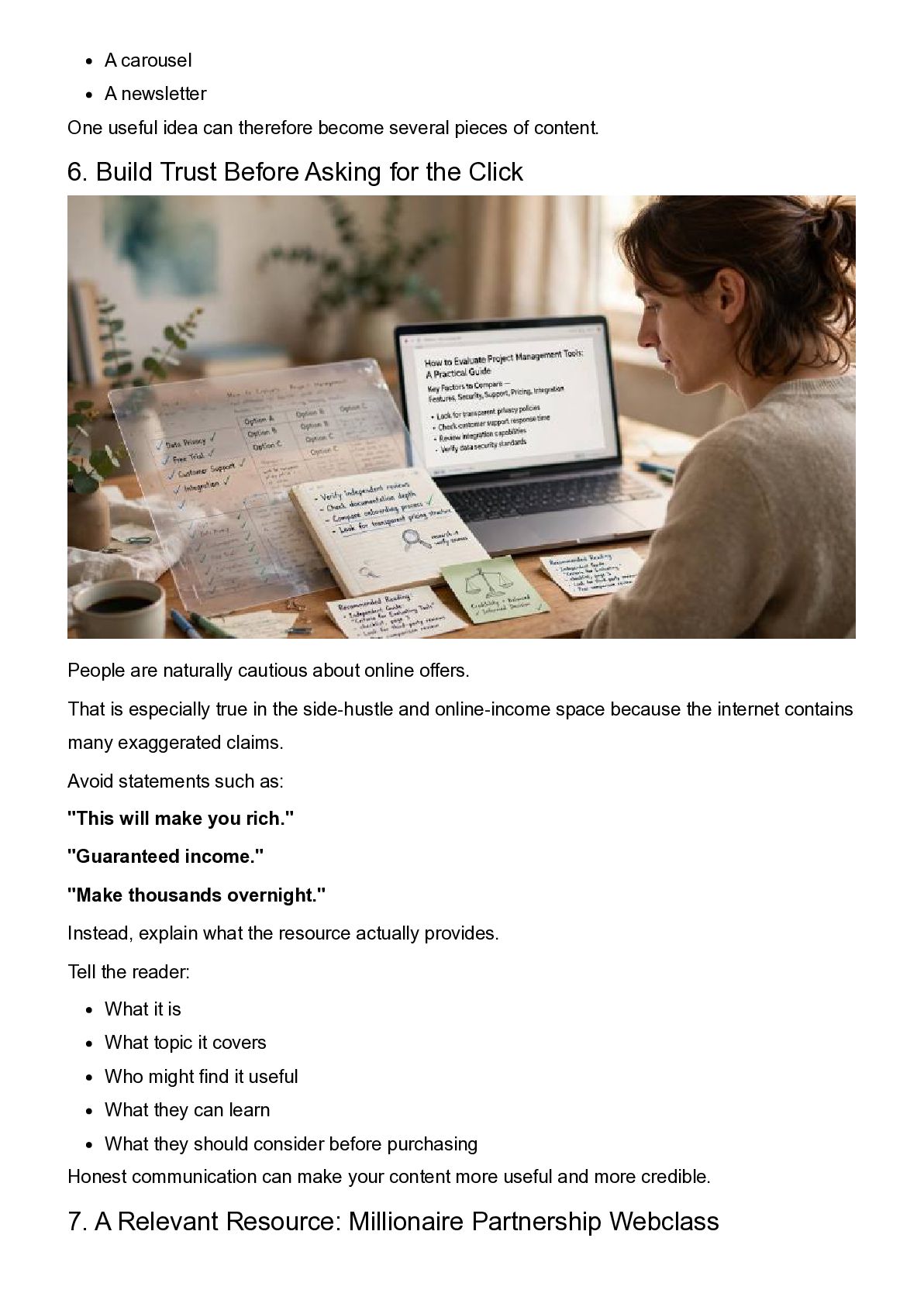
    several pieces of content. 6. Build Trust Before Asking for the Click People are naturally cautious about online offers. That is especially true in the side-hustle and online-income space because the internet contains many exaggerated claims. Avoid statements such as: "This will make you rich." "Guaranteed income." "Make thousands overnight." Instead, explain what the resource actually provides. Tell the reader: What it is What topic it covers Who might find it useful What they can learn What they should consider before purchasing Honest communication can make your content more useful and more credible. 7. A Relevant Resource: Millionaire Partnership Webclass
  6. If your content is focused on affiliate marketing, online business

    and side hustles, you can introduce a related educational resource. One option is the Millionaire Partnership Webclass. Instead of presenting it as a guaranteed-income solution, position it as something readers can explore if they want additional training and information about online business and affiliate marketing. Want to Explore the Webclass? If you are interested in learning more about affiliate marketing and online business, you can explore the Millionaire Partnership Webclass here: Explore the Millionaire Partnership Webclass Take time to review the information yourself and decide whether the material fits your goals. 8. Your Content Should Not Depend on One Affiliate Link Another useful principle is to avoid building your entire online presence around one link. Your audience should be able to get value from your content even if they never click your affiliate link. For example, you could create a series called: Side Hustle Seekers Your content could cover: 1. Affiliate marketing basics 2. Freelancing 3. Digital products 4. Content creation 5. AI-assisted workflows 6. Personal branding 7. Online business models 8. Audience research 9. Email marketing 10. Beginner mistakes Now your audience has a reason to keep following your content. The affiliate offer becomes one relevant resource inside a larger educational ecosystem. 9. A Simple 7-Day Beginner Plan You do not need to create 100 pieces of content on your first day. Start with seven days.
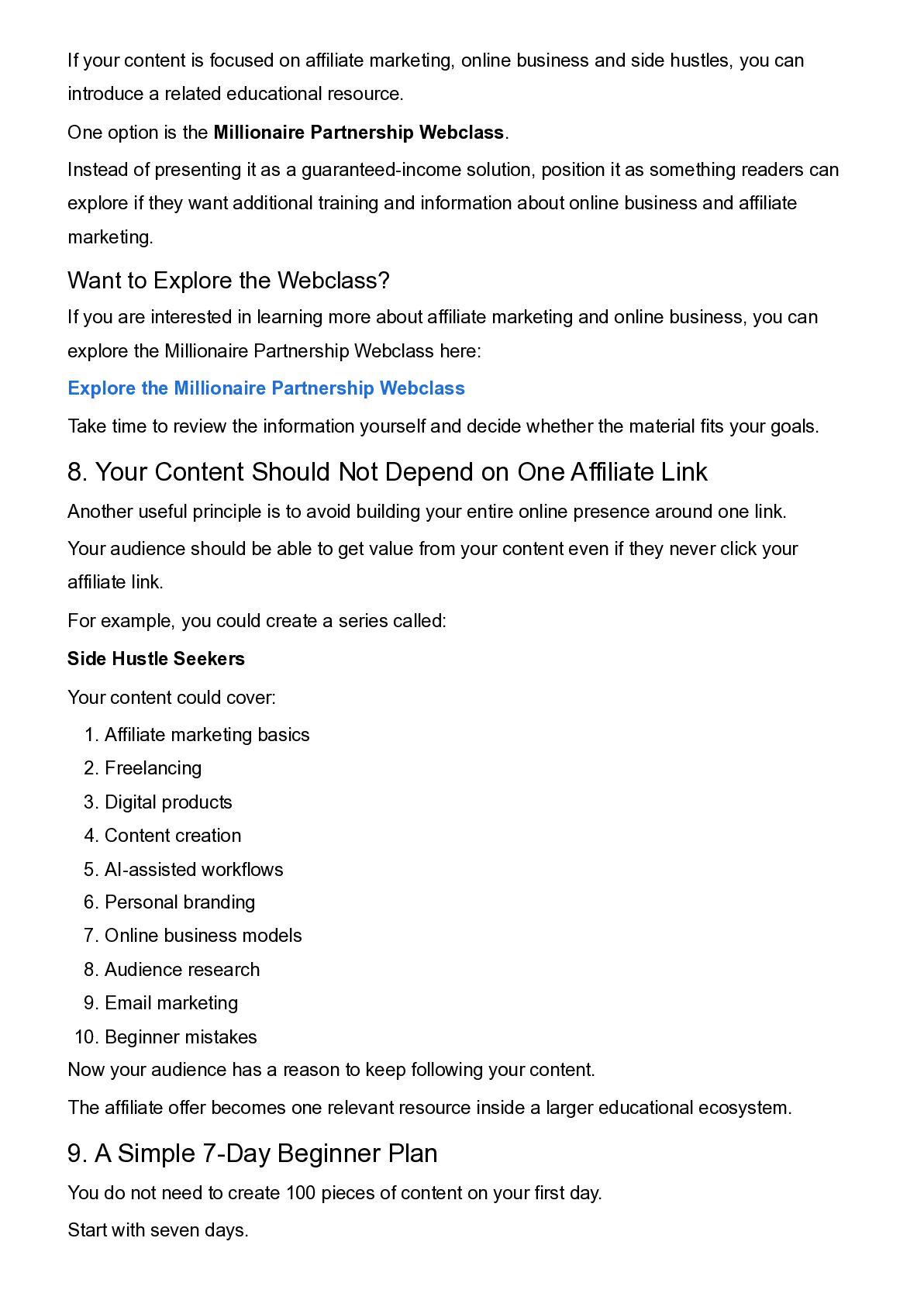
  7. Day 1 — Choose Your Audience Write down exactly who

    you want to help. Example: People who want to understand online side hustles and affiliate marketing. Day 2 — List Their Problems Write down at least 20 questions they might have. Do not worry about making them perfect. Day 3 — Choose Three Content Topics Select three questions that you can explain clearly. Day 4 — Create Your First Article Write one genuinely useful guide. Focus on helping the reader rather than promoting an offer. Day 5 — Create Supporting Content Turn your article into short posts, a checklist or a social-media discussion. Day 6 — Add a Relevant Resource If an affiliate product genuinely fits the topic, introduce it naturally. Clearly disclose that you may receive a commission. Day 7 — Review Look at the questions, replies, saves, clicks and conversations generated by your content.
  8. Then use what you learned to plan the following week.

    10. Common Beginner Mistakes Posting Only Promotional Content If every post contains an affiliate link, people may stop paying attention. Balance promotional content with educational content. Choosing Products Only Because of Commission A high commission does not automatically make an offer suitable for your audience. Relevance matters. Copying Other People's Content Instead of copying popular posts, understand the underlying problem and explain it in your own words. Making Unrealistic Income Claims Online business results vary. Avoid presenting hypothetical earnings as guaranteed outcomes. Giving Up Too Quickly Content-based businesses often require experimentation. Your first few posts may not receive much attention. Use them as feedback rather than treating them as a final verdict. 11. The Bigger Picture Affiliate marketing is easier to understand when you stop thinking of it as simply "getting people to click a link." Think of it as a value chain: Understand → Educate → Help → Recommend → Measure → Improve First, understand your audience. Then create useful educational content. When a relevant product or service genuinely helps solve the problem, introduce it. Measure what happens. Then improve your approach. That mindset can help you build something more sustainable than simply posting promotional links. 12. Your Next Step
  9. If you are completely new to affiliate marketing, do not

    try to master everything at once. Choose one audience. Choose one problem. Create one useful article. Then create another. As you become more comfortable, you can experiment with different platforms, content formats and relevant offers. If you want additional training around online business and affiliate marketing, you can explore the Millionaire Partnership Webclass: Click here to explore the Millionaire Partnership Webclass Affiliate Disclosure This article contains an affiliate link. If you register or make a purchase through the link, I may receive a commission at no additional cost to you. The recommendation should be evaluated based on your own needs, goals and research. Quick Action Checklist ☐ Choose one audience. ☐ Identify 10–20 problems that audience has. ☐ Pick one problem to solve. ☐ Create genuinely useful content. ☐ Find a relevant educational resource. ☐ Add your affiliate disclosure. ☐ Place your affiliate link naturally. ☐ Track useful engagement. ☐ Improve your content based on what you learn. Start small. Stay useful. Keep learning.