Upgrade to Pro
— share decks privately, control downloads, hide ads and more …
Speaker Deck
Sign up for free
Menu
Search
Features
All features
Private URLs
Password Protection
Custom URLS
Scheduled publishing
Remove Branding
Restrict embedding
Deck Collections
Notes
Features
All features
Private URLs
Password Protection
Custom URLS
Scheduled publishing
Remove Branding
Restrict embedding
Deck Collections
Notes
Explore
Featured decks
Featured speakers
Programming
Technology
Storyboards
Explore
Featured decks
Featured speakers
Programming
Technology
Storyboards
Pricing
Search
Sign in
Sign up for free
MOLI: multi-omics late integration with deep ne...
Search
takatoh
August 21, 2019
Science
140
1
Share
Embed
Copy iframe code
Copy JS code
Copy link
Start on current slide
MOLI: multi-omics late integration with deep neural networks for drug response prediction
takatoh
August 21, 2019
More Decks by takatoh
See All by takatoh
論文LT会: A deep convolutional neural network approach to single-particle recognition in cryo-electron microscopy
tkfmmry
0
600
論文 LT会: Identifying Medical Diagnoses and Treatable Diseases by Image-Based Deep Learning
tkfmmry
1
410
Other Decks in Science
See All in Science
データベース06: SQL (3/3) 副問い合わせ
trycycle
PRO
1
1.2k
20260410_SystemsThinking
takusamar
1
160
Where does the rigor go? Research software and the future of trustworthy science.
arfon
0
350
HOLO: Homography-Guided Pose Estimator Network for Fine-Grained Visual Localization on SD Maps
tomoaki0705
0
160
Génétique moléculaire de la mortalité
institutdelelevage
PRO
0
160
生成AI・プレプリント時代における 研究成果公開の再設計 ― トップカンファレンス文化はどこへ向かうのか / Redesigning the Dissemination of Research Outputs in the Age of Generative AI and Preprints — Where Is the Top-Conference Culture Heading?
ykiyota
0
30k
チュートリアル:世界モデル
hf149
0
2.4k
自社のレビュー履歴からAIコードレビュアーをつくる方法
estie
5
1.6k
言葉をはかる:テキストマイニング入門①講義編
satocos135
0
270
ssmonline #51 ヤマサキ春のサメ祭り 2026 / ssmjp Yamasaki Spring JAWS Festival 2026
naospon
1
160
[第67回 CV勉強会@関東] CV × Scientific Figures / kantoCV 67th CVPR 2026
lychee1223
0
250
Toward Causal Scientific Discovery with AI
sshimizu2006
0
210
Featured
See All Featured
Prompt Engineering for Job Search
mfonobong
0
490
A better future with KSS
kneath
240
18k
Build your cross-platform service in a week with App Engine
jlugia
234
19k
AI Search: Where Are We & What Can We Do About It?
aleyda
0
8.1k
世界の人気アプリ100個を分析して見えたペイウォール設計の心得
akihiro_kokubo
PRO
74
42k
Information Architects: The Missing Link in Design Systems
soysaucechin
1
1.2k
The Illustrated Children's Guide to Kubernetes
chrisshort
51
53k
Practical Tips for Bootstrapping Information Extraction Pipelines
honnibal
25
2.1k
ReactJS: Keep Simple. Everything can be a component!
pedronauck
666
130k
Refactoring Trust on Your Teams (GOTO; Chicago 2020)
rmw
35
3.8k
Amusing Abliteration
ianozsvald
1
330
Self-Hosted WebAssembly Runtime for Runtime-Neutral Checkpoint/Restore in Edge–Cloud Continuum
chikuwait
0
870
Transcript
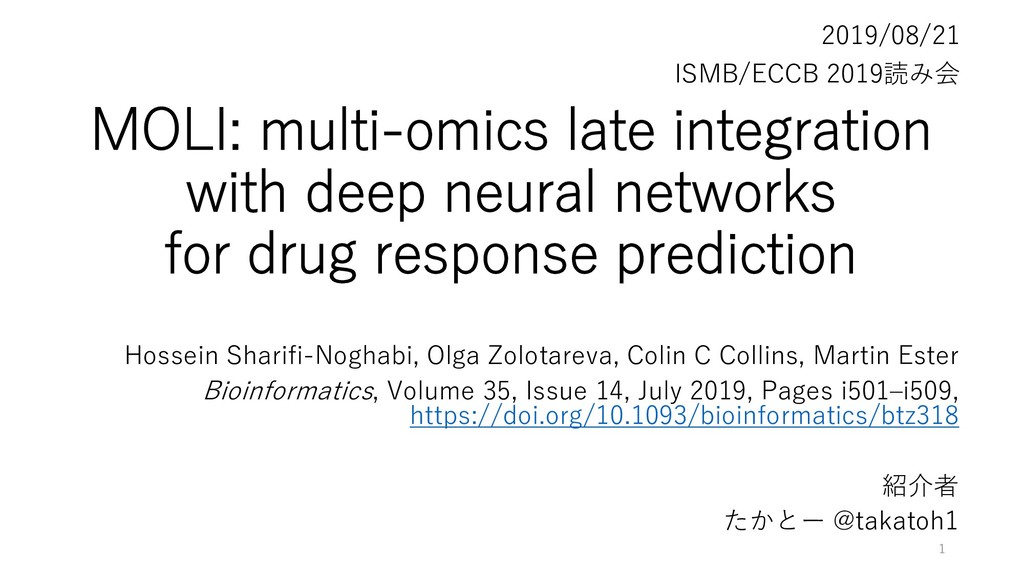
MOLI: multi-omics late integration with deep neural networks for drug
response prediction Hossein Sharifi-Noghabi, Olga Zolotareva, Colin C Collins, Martin Ester Bioinformatics, Volume 35, Issue 14, July 2019, Pages i501‒i509, https://doi.org/10.1093/bioinformatics/btz318 紹介者 たかとー @takatoh1 2019/08/21 ISMB/ECCB 2019読み会 1
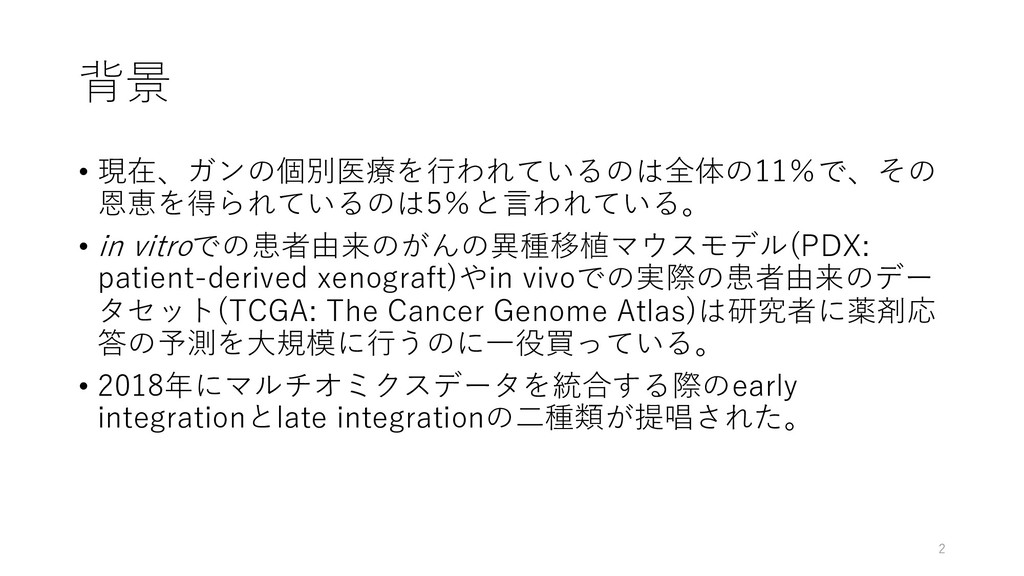
背景 • 現在、ガンの個別医療を⾏われているのは全体の11%で、その 恩恵を得られているのは5%と⾔われている。 • in vitroでの患者由来のがんの異種移植マウスモデル(PDX: patient-derived xenograft)やin vivoでの実際の患者由来のデー
タセット(TCGA: The Cancer Genome Atlas)は研究者に薬剤応 答の予測を⼤規模に⾏うのに⼀役買っている。 • 2018年にマルチオミクスデータを統合する際のearly integrationとlate integrationの⼆種類が提唱された。 2
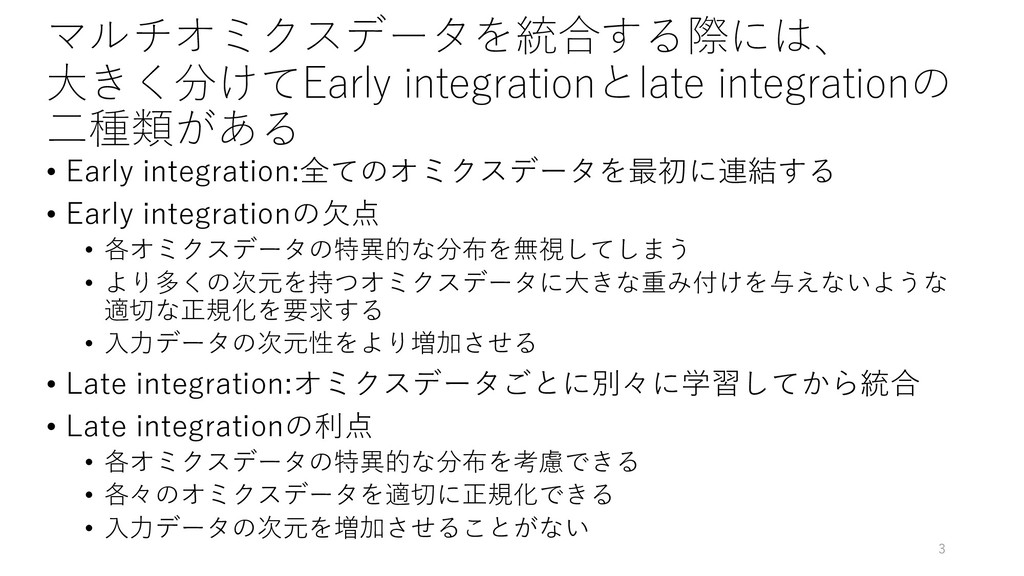
マルチオミクスデータを統合する際には、 ⼤きく分けてEarly integrationとlate integrationの ⼆種類がある • Early integration:全てのオミクスデータを最初に連結する • Early
integrationの⽋点 • 各オミクスデータの特異的な分布を無視してしまう • より多くの次元を持つオミクスデータに⼤きな重み付けを与えないような 適切な正規化を要求する • ⼊⼒データの次元性をより増加させる • Late integration:オミクスデータごとに別々に学習してから統合 • Late integrationの利点 • 各オミクスデータの特異的な分布を考慮できる • 各々のオミクスデータを適切に正規化できる • ⼊⼒データの次元を増加させることがない 3
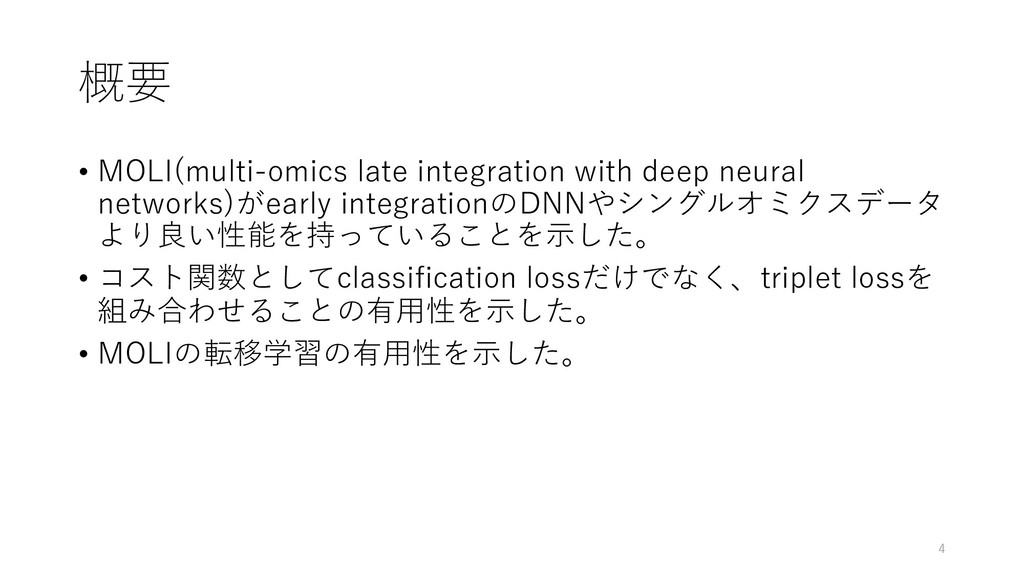
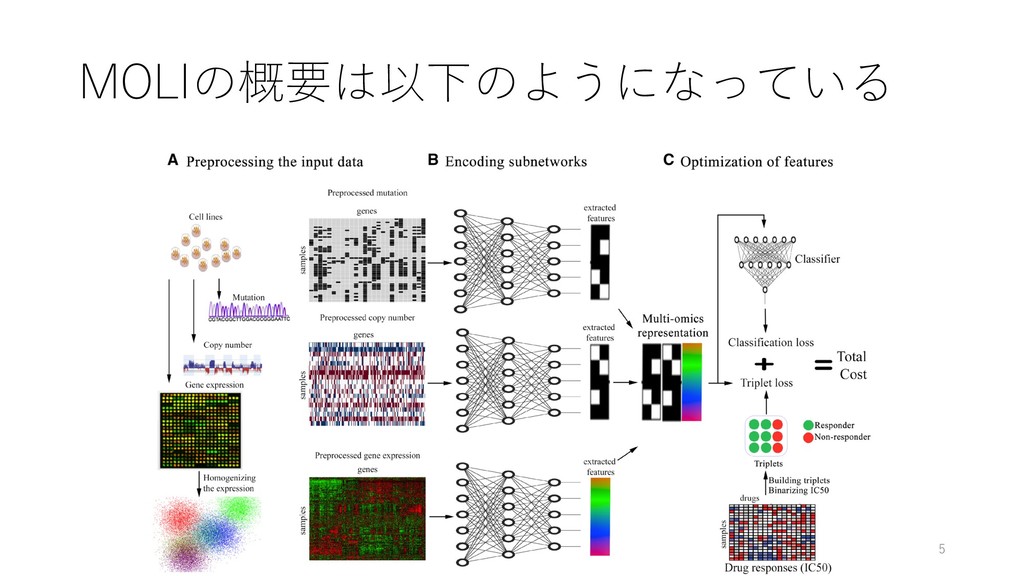
概要 • MOLI(multi-omics late integration with deep neural networks)がearly integrationのDNNやシングルオミクスデータ
より良い性能を持っていることを⽰した。 • コスト関数としてclassification lossだけでなく、triplet lossを 組み合わせることの有⽤性を⽰した。 • MOLIの転移学習の有⽤性を⽰した。 4
MOLIの概要は以下のようになっている 5
Input dataは体細胞変異、コピー数変化、 遺伝⼦発現データから構成される 6
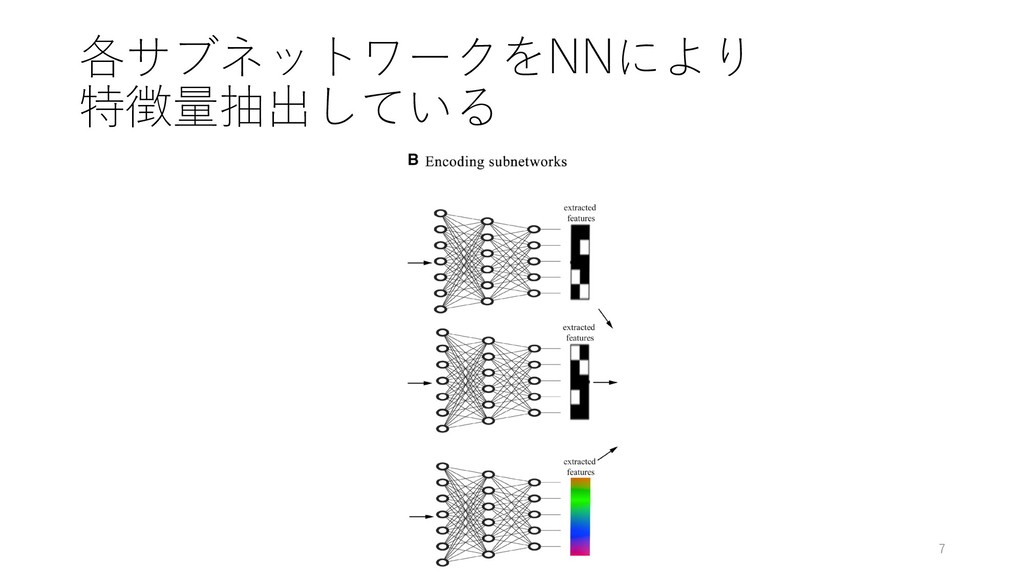
各サブネットワークをNNにより 特徴量抽出している 7
Total costはclassification lossとtriplet loss から求める Multi-omics representation X_M:mutation, X_C: copy
number, X_E: gene expression Cross-entropy classification loss Triplet loss Anchor, Positive: 抗がん剤に対して応答する細胞種 Negative: 抗がん剤に対して応答しない細胞種 8
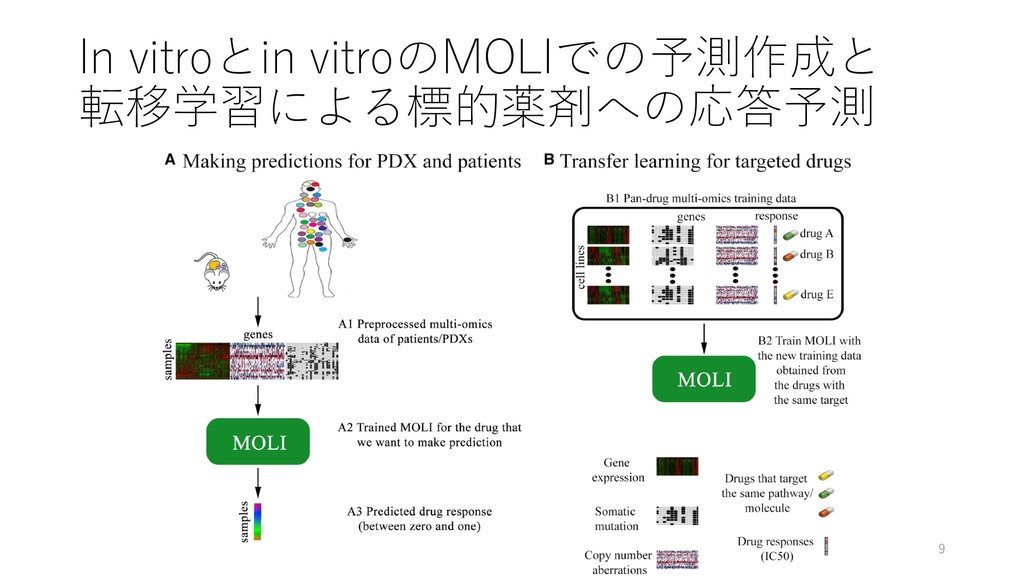
In vitroとin vitroのMOLIでの予測作成と 転移学習による標的薬剤への応答予測 9
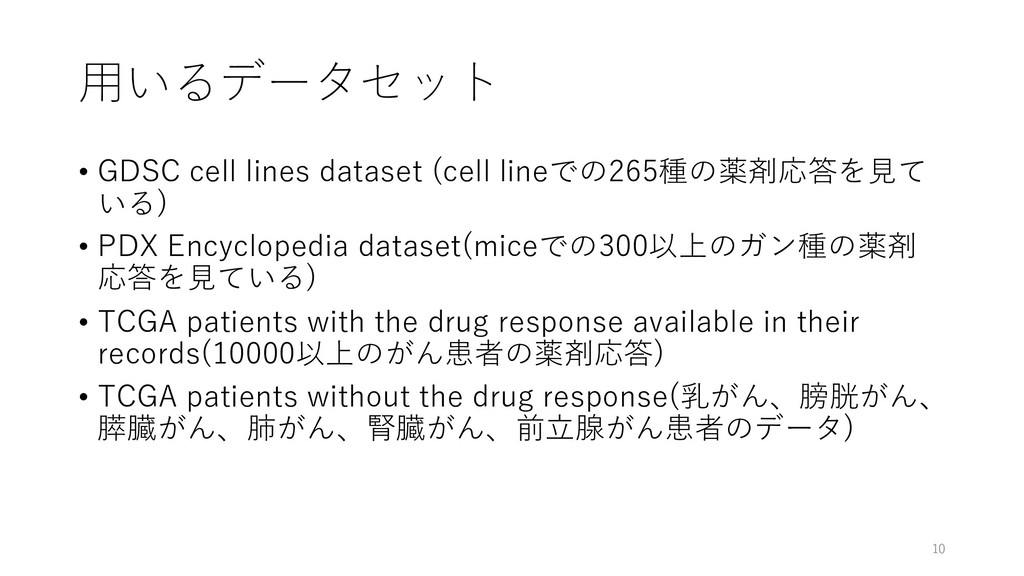
⽤いるデータセット • GDSC cell lines dataset (cell lineでの265種の薬剤応答を⾒て いる) •
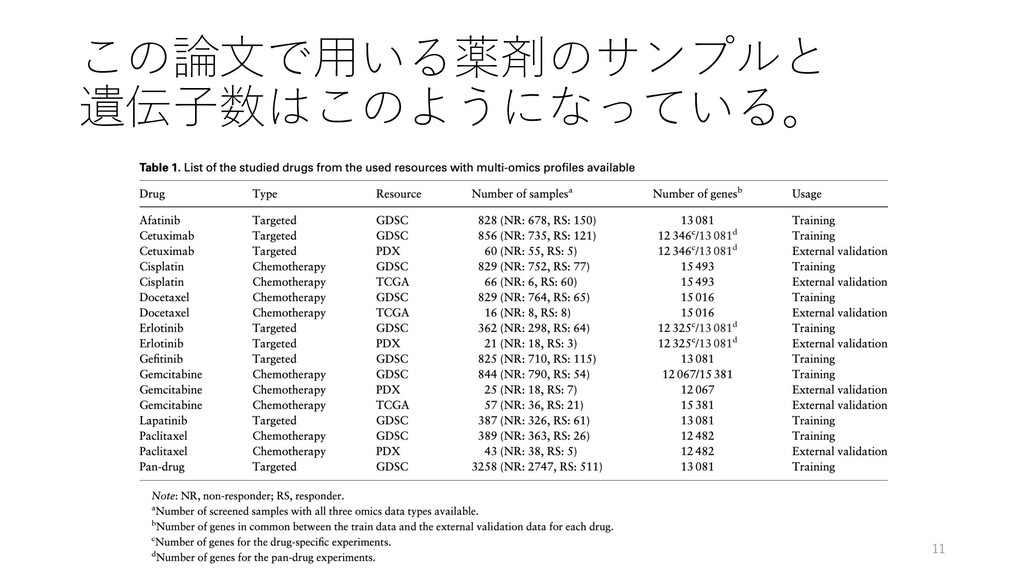
PDX Encyclopedia dataset(miceでの300以上のガン種の薬剤 応答を⾒ている) • TCGA patients with the drug response available in their records(10000以上のがん患者の薬剤応答) • TCGA patients without the drug response(乳がん、膀胱がん、 膵臓がん、肺がん、腎臓がん、前⽴腺がん患者のデータ) 10
この論⽂で⽤いる薬剤のサンプルと 遺伝⼦数はこのようになっている。 11
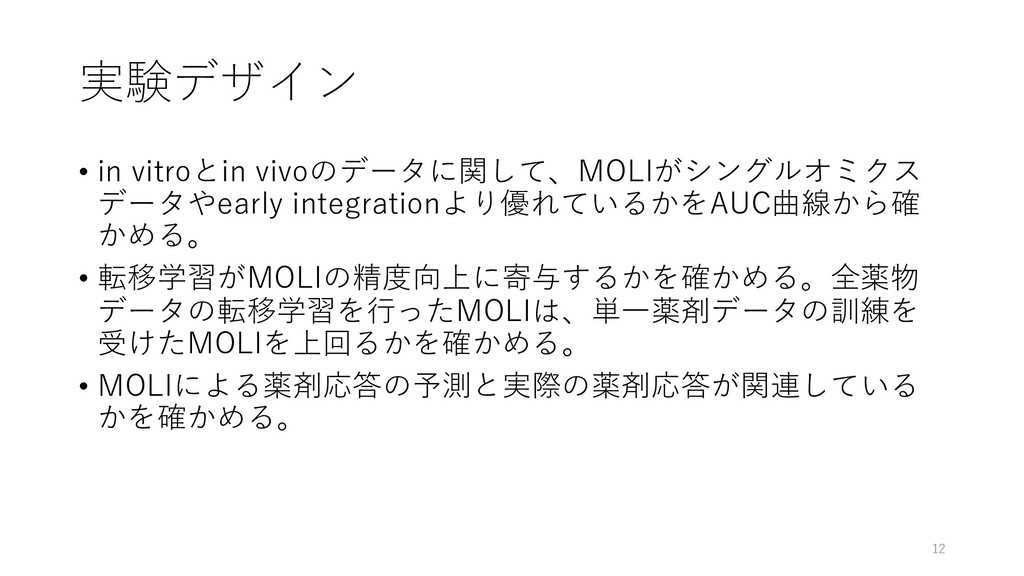
実験デザイン • in vitroとin vivoのデータに関して、MOLIがシングルオミクス データやearly integrationより優れているかをAUC曲線から確 かめる。 • 転移学習がMOLIの精度向上に寄与するかを確かめる。全薬物
データの転移学習を⾏ったMOLIは、単⼀薬剤データの訓練を 受けたMOLIを上回るかを確かめる。 • MOLIによる薬剤応答の予測と実際の薬剤応答が関連している かを確かめる。 12
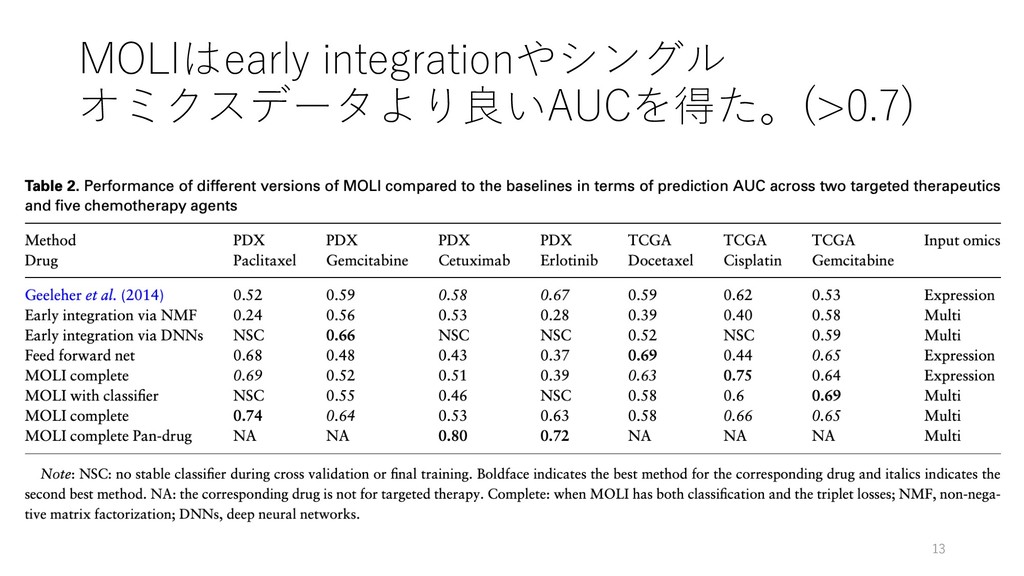
MOLIはearly integrationやシングル オミクスデータより良いAUCを得た。(>0.7) 13
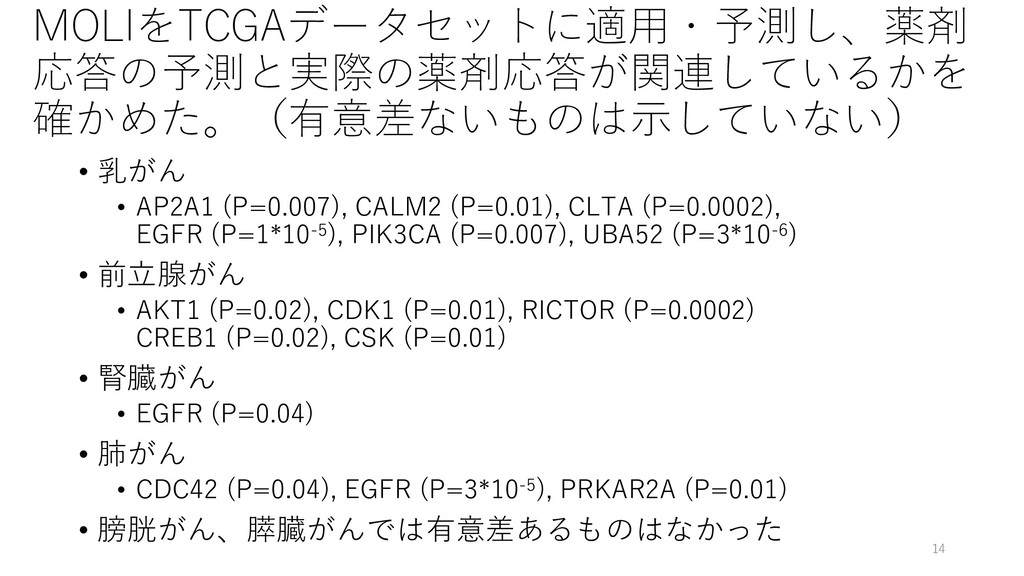
MOLIをTCGAデータセットに適⽤・予測し、薬剤 応答の予測と実際の薬剤応答が関連しているかを 確かめた。(有意差ないものは⽰していない) • 乳がん • AP2A1 (P=0.007), CALM2 (P=0.01),
CLTA (P=0.0002), EGFR (P=1*10-5), PIK3CA (P=0.007), UBA52 (P=3*10-6) • 前⽴腺がん • AKT1 (P=0.02), CDK1 (P=0.01), RICTOR (P=0.0002) CREB1 (P=0.02), CSK (P=0.01) • 腎臓がん • EGFR (P=0.04) • 肺がん • CDC42 (P=0.04), EGFR (P=3*10-5), PRKAR2A (P=0.01) • 膀胱がん、膵臓がんでは有意差あるものはなかった 14
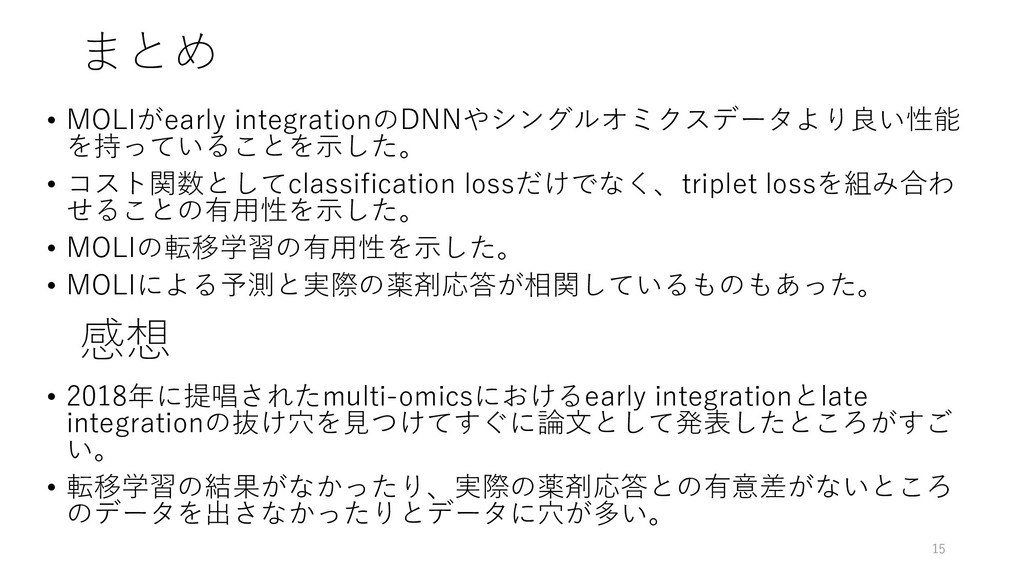
まとめ • MOLIがearly integrationのDNNやシングルオミクスデータより良い性能 を持っていることを⽰した。 • コスト関数としてclassification lossだけでなく、triplet lossを組み合わ せることの有⽤性を⽰した。
• MOLIの転移学習の有⽤性を⽰した。 • MOLIによる予測と実際の薬剤応答が相関しているものもあった。 • 2018年に提唱されたmulti-omicsにおけるearly integrationとlate integrationの抜け⽳を⾒つけてすぐに論⽂として発表したところがすご い。 • 転移学習の結果がなかったり、実際の薬剤応答との有意差がないところ のデータを出さなかったりとデータに⽳が多い。 感想 15


 tkfmmry
 trycycle
 takusamar
 arfon
arfon
 tomoaki0705
 institutdelelevage
 ykiyota
 hf149
hf149
 estie
estie
 satocos135
 naospon
.jpg) lychee1223
lychee1223
 sshimizu2006
 mfonobong
 kneath
 jlugia
 aleyda
 akihiro_kokubo
 soysaucechin
 chrisshort
 honnibal
 pedronauck
 rmw
rmw
 ianozsvald
 chikuwait