Share
Embed
Caffeinated Style Sheets
Have you ever been frustrated by the limitations of CSS? In this talk, Tommy will explore ways that simple JavaScript functions can immensely increase the scope of what CSS can do. You’ll learn how to think about these functions, how to write them, and what they can help you accomplish.
Tommy Hodgins
October 02, 2018
Transcript
145 slides
-
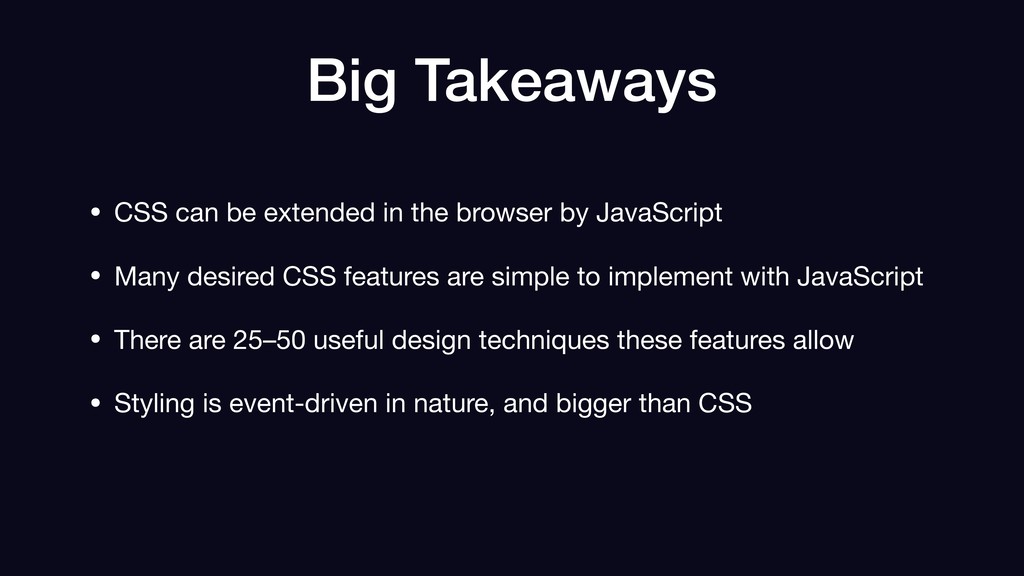
Big Takeaways • CSS can be extended in the browser
by JavaScript -
Big Takeaways • CSS can be extended in the browser
by JavaScript • Many desired CSS features are simple to implement with JavaScript -
Big Takeaways • CSS can be extended in the browser
by JavaScript • Many desired CSS features are simple to implement with JavaScript • There are 25–50 useful design techniques these features allow -
Big Takeaways • CSS can be extended in the browser
by JavaScript • Many desired CSS features are simple to implement with JavaScript • There are 25–50 useful design techniques these features allow • Styling is event-driven in nature, and bigger than CSS -
Big Takeaways • CSS can be extended in the browser
by JavaScript • Many desired CSS features are simple to implement with JavaScript • There are 25–50 useful design techniques these features allow • Styling is event-driven in nature, and bigger than CSS • You don’t need a custom CSS syntax to extend CSS -
Think of your stylesheet as a function of what’s going
on in the browser -
Think of your stylesheet as a function of what’s going
on in the browser -
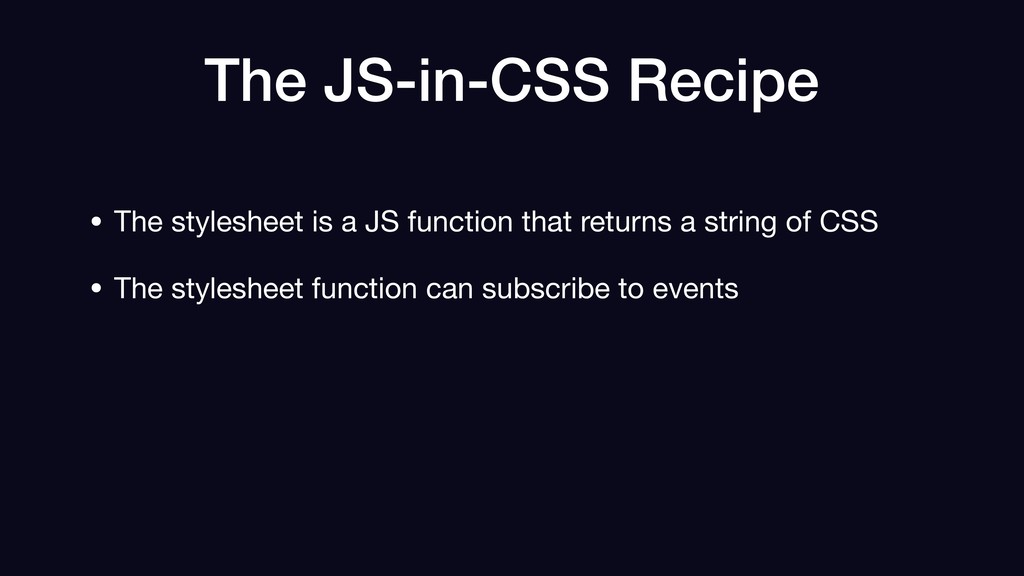
The JS-in-CSS Recipe • The stylesheet is a JS function
that returns a string of CSS -
The JS-in-CSS Recipe • The stylesheet is a JS function
that returns a string of CSS • The stylesheet function can subscribe to events -
The JS-in-CSS Recipe • The stylesheet is a JS function
that returns a string of CSS • The stylesheet function can subscribe to events • A <style> tag is populated with the resulting CSS -
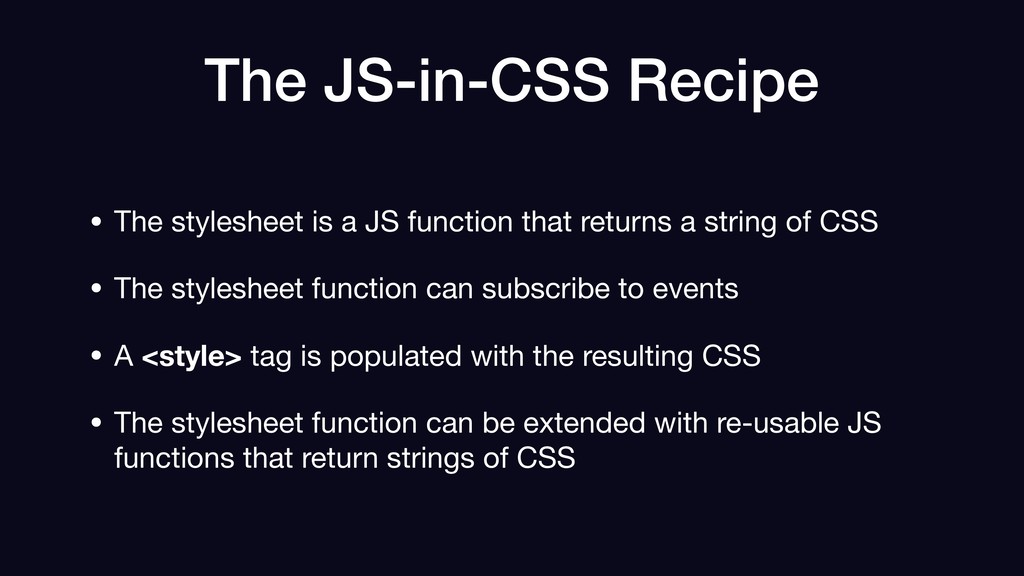
The JS-in-CSS Recipe • The stylesheet is a JS function
that returns a string of CSS • The stylesheet function can subscribe to events • A <style> tag is populated with the resulting CSS • The stylesheet function can be extended with re-usable JS functions that return strings of CSS -
<style> </style> <script> onload = () => document.querySelector('style').textContent = `
html { background: lime; } ` </script> -
<style> </style> <script> window.addEventListener('load', loadStyles) function populate() { return document.querySelector('style').textContent
= ` html { background: lime; } ` } </script> -
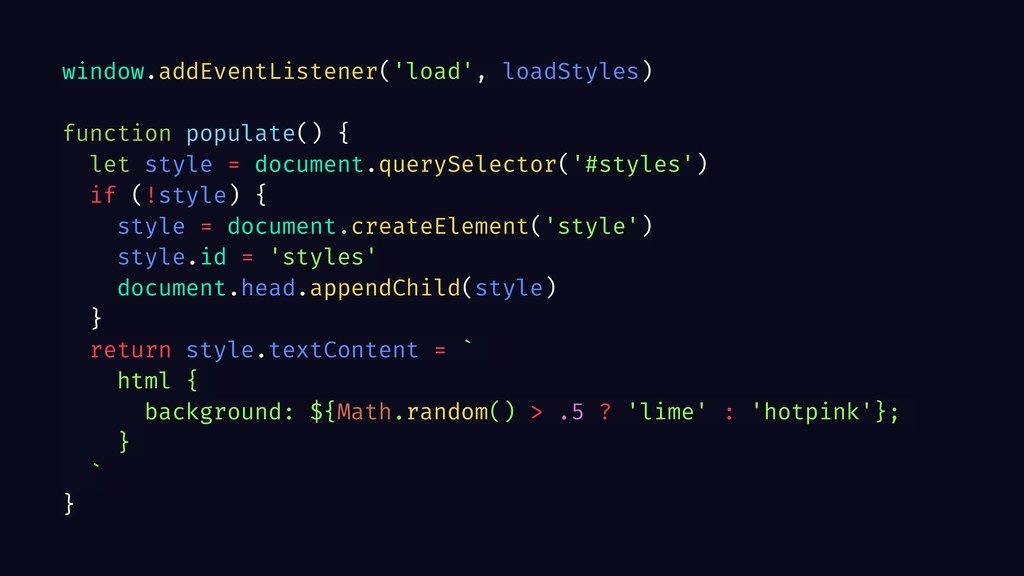
window.addEventListener('load', loadStyles) function populate() { let style = document.querySelector('#styles') if
(!style) { style = document.createElement('style') style.id = 'styles' document.head.appendChild(style) } return style.textContent = ` html { background: ${Math.random() > .5 ? 'lime' : 'hotpink'}; } ` } -
window.addEventListener('load', loadStyles) function populate() { let style = document.querySelector('#styles') if
(!style) { style = document.createElement('style') style.id = 'styles' document.head.appendChild(style) } return style.textContent = stylesheet() } function stylesheet() { return ` html { background: ${Math.random() > .5 ? 'lime' : 'hotpink'}; } ` } -
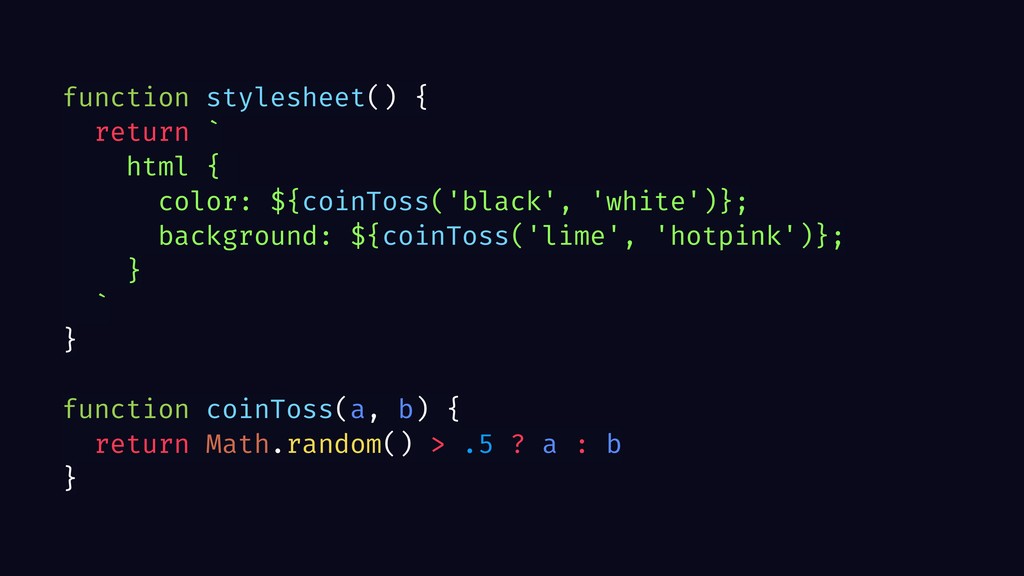
function stylesheet() { return ` html { color: ${coinToss('black', 'white')};
background: ${coinToss('lime', 'hotpink')}; } ` } function coinToss(a, b) { return Math.random() > .5 ? a : b } -
function jsincss( stylesheet = () => '', selector = window,
events = ['load', 'resize', 'input', 'click', 'reprocess'] ) { function registerEvent(target, event, id, stylesheet) { return target.addEventListener( event, e => populateStylesheet(id, stylesheet) ) } -
function registerEvent(target, event, id, stylesheet) { return target.addEventListener( event, e
=> populateStylesheet(id, stylesheet) ) } function populateStylesheet(id, stylesheet) { let tag = document.querySelector(`#jsincss-${id}`) if (!tag) { tag = document.createElement('style') tag.id = `jsincss-${id}` document.head.appendChild(tag) } const currentStyles = tag.textContent const generatedStyles = stylesheet() if (!currentStyles || (generatedStyles !== currentStyles)) { return tag.textContent = generatedStyles } } -
const currentStyles = tag.textContent const generatedStyles = stylesheet() if (!currentStyles
|| (generatedStyles !== currentStyles)) { return tag.textContent = generatedStyles } } let id = Date.now() + Math.floor(Math.random() * 100) if (selector === window) { return events.forEach(event => registerEvent(window, event, id, stylesheet) ) } else { return document.querySelectorAll(selector).forEach(tag => events.forEach(event => registerEvent(tag, event, id, stylesheet) ) ) } } -
function jsincss( stylesheet = () => '', selector = window,
events = ['load', 'resize', 'input', 'click', 'reprocess'] ) { function registerEvent(target, event, id, stylesheet) { return target.addEventListener( event, e => populateStylesheet(id, stylesheet) ) } function populateStylesheet(id, stylesheet) { let tag = document.querySelector(`#jsincss-${id}`) if (!tag) { tag = document.createElement('style') tag.id = `jsincss-${id}` document.head.appendChild(tag) } const currentStyles = tag.textContent const generatedStyles = stylesheet() if (!currentStyles || (generatedStyles !== currentStyles)) { return tag.textContent = generatedStyles } } let id = Date.now() + Math.floor(Math.random() * 100) if (selector === window) { return events.forEach(event => registerEvent(window, event, id, stylesheet) ) } else { return document.querySelectorAll(selector).forEach(tag => events.forEach(event => registerEvent(tag, event, id, stylesheet) ) ) } } -
<style> </style> <script> // Event-Driven window.addEventListener('load', populate) // Virtual Stylesheet
function populate() { return document.querySelector('style').textContent = stylesheet() } // Function function stylesheet() { return ` html ::before { font-size: 10vw; content: '${innerWidth} x ${innerHeight}'; } ` } </script> -
Finding JS-Powered Rules • Loop through the document.styleSheets object •
For each stylesheet, loop through it's cssRules -
Finding JS-Powered Rules • Loop through the document.styleSheets object •
For each stylesheet, loop through it's cssRules • Look for style rules (type 1) or @supports rules (type 12) -
Finding JS-Powered Rules • Loop through the document.styleSheets object •
For each stylesheet, loop through it's cssRules • Look for style rules (type 1) or @supports rules (type 12) • Check selectorText or conditionText to see if it includes ‘--’ -
Finding JS-Powered Rules • Loop through the document.styleSheets object •
For each stylesheet, loop through it's cssRules • Look for style rules (type 1) or @supports rules (type 12) • Check selectorText or conditionText to see if it includes ‘--’ • Parse selector (if a rule), arguments, and styles -
Array.from(document.styleSheets).forEach(stylesheet => Array.from(stylesheet.cssRules).forEach(rule => { if (rule.type === 1 &&
rule.selectorText.includes(' --')) { console.log('found a js-powered style rule') } else if (rule.type === 12 && rule.conditionText.includes(' --')) { console.log('found a js-powered @supports rule') } }) ) -
if (rule.type === 1 && rule.selectorText.includes(' --custom')) { const selector
= rule.selectorText .split('[ --custom')[0] .trim() const arguments = rule.selectorText.includes(' --custom=') ? rule.selectorText.replace(/.*\[ --custom=(.*)\]/, '$1').slice(1, -1) : '' const declarations = rule.cssText .split(rule.selectorText)[1] .trim() .slice(1, -1) .trim() } -
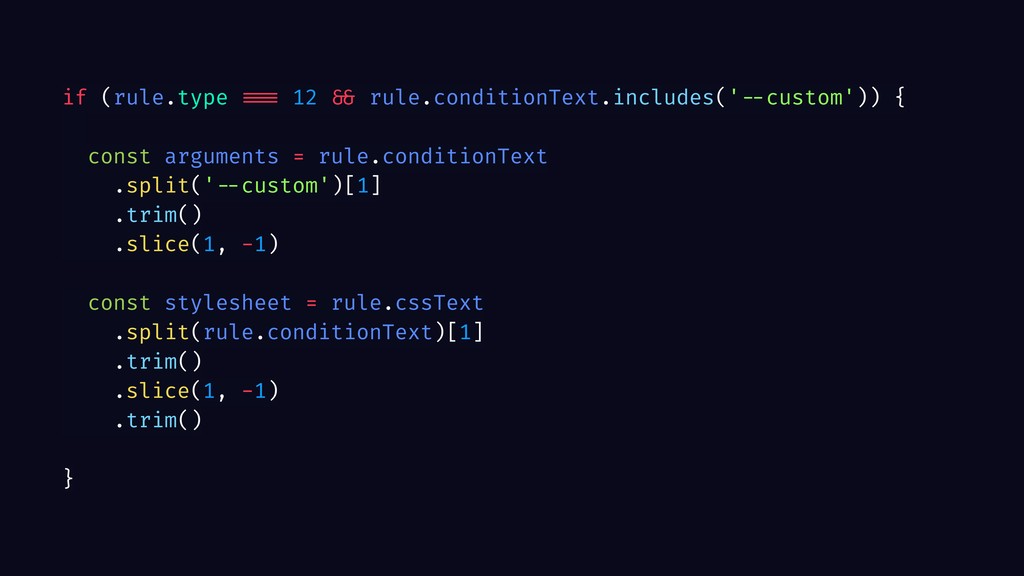
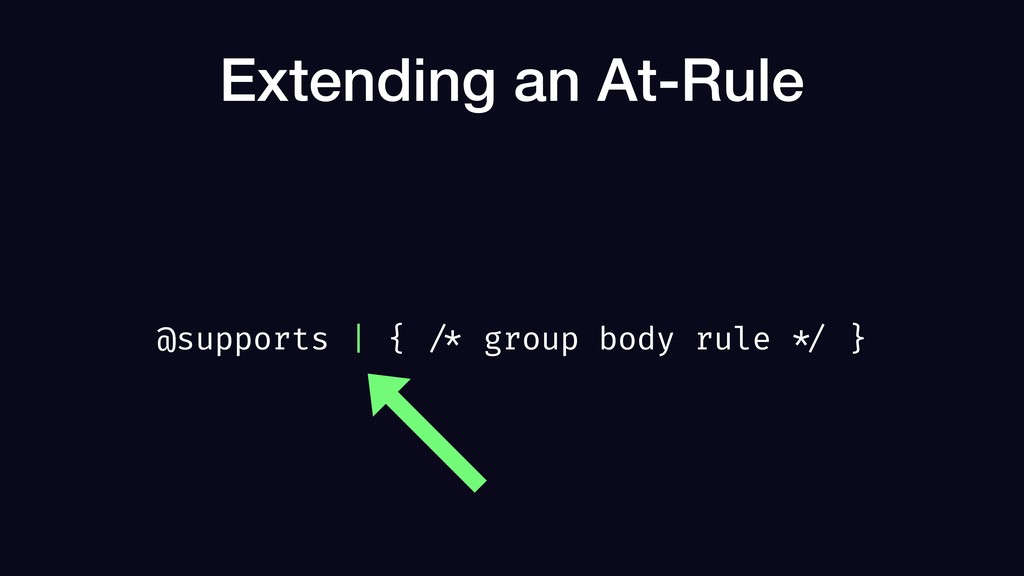
if (rule.type === 12 && rule.conditionText.includes(' --custom')) { const arguments
= rule.conditionText .split(' --custom')[1] .trim() .slice(1, -1) const stylesheet = rule.cssText .split(rule.conditionText)[1] .trim() .slice(1, -1) .trim() } -
The “No More Tears” approach to CSS parsing, Write only
100% valid CSS and let the browser parse it! -
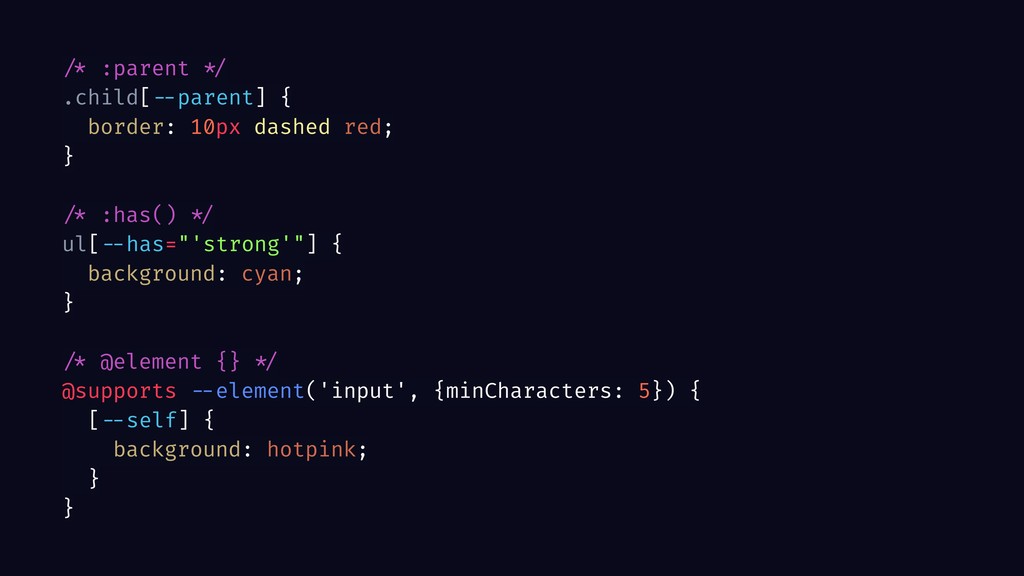
/* :parent */ .child[ --parent] { border: 10px dashed red;
} /* :has() */ ul[ --has="'strong'"] { background: cyan; } /* @element {} */ @supports --element('input', {minCharacters: 5}) { [ --self] { background: hotpink; } } -
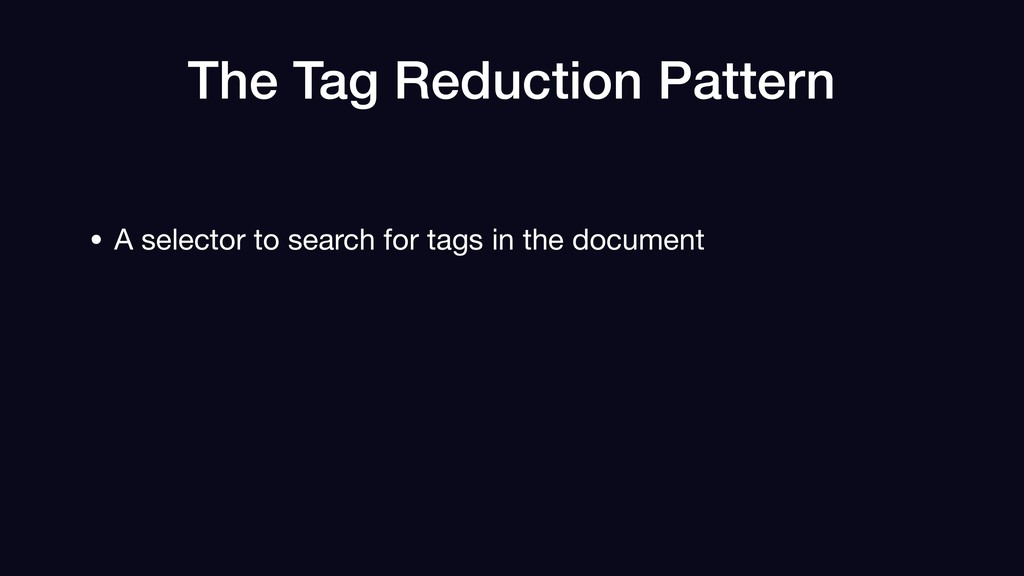
The Tag Reduction Pattern • A selector to search for
tags in the document -
The Tag Reduction Pattern • A selector to search for
tags in the document • A test to filter matching tags -
The Tag Reduction Pattern • A selector to search for
tags in the document • A test to filter matching tags • To know which tag we want to apply styles to -
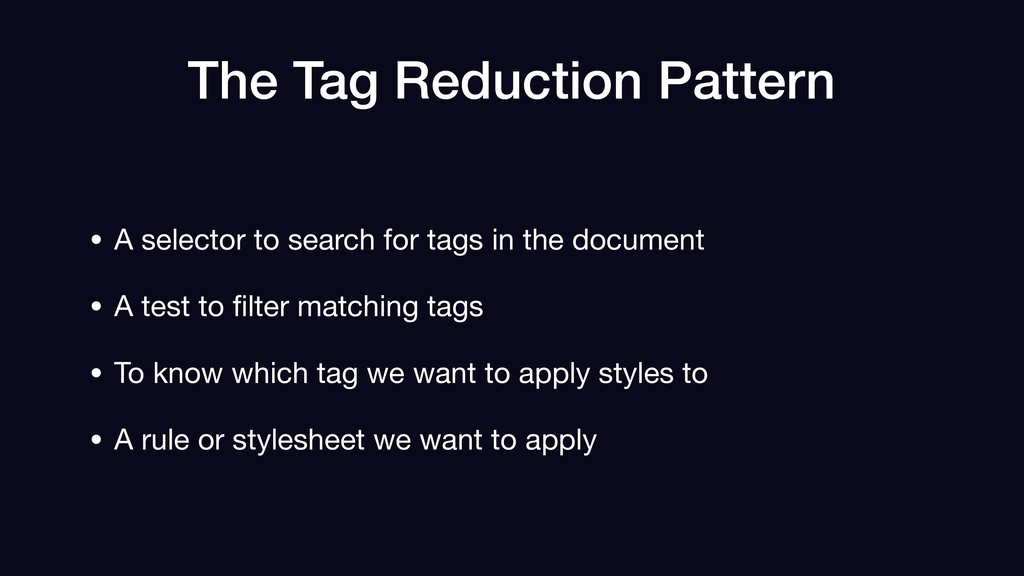
The Tag Reduction Pattern • A selector to search for
tags in the document • A test to filter matching tags • To know which tag we want to apply styles to • A rule or stylesheet we want to apply -
The Tag Reduction Pattern 1. Get an array of all
tags matching the selector -
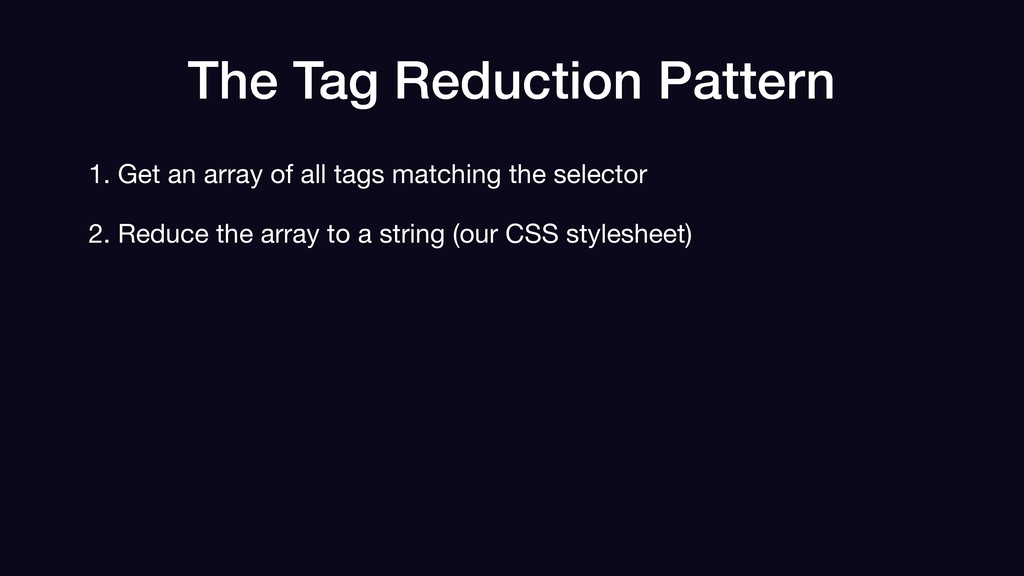
The Tag Reduction Pattern 1. Get an array of all
tags matching the selector 2. Reduce the array to a string (our CSS stylesheet) -
The Tag Reduction Pattern 1. Get an array of all
tags matching the selector 2. Reduce the array to a string (our CSS stylesheet) 3. Create a unique identifier (from plugin name, selector, options) -
The Tag Reduction Pattern 1. Get an array of all
tags matching the selector 2. Reduce the array to a string (our CSS stylesheet) 3. Create a unique identifier (from plugin name, selector, options) 4. Test each matching tag -
The Tag Reduction Pattern 1. Get an array of all
tags matching the selector 2. Reduce the array to a string (our CSS stylesheet) 3. Create a unique identifier (from plugin name, selector, options) 4. Test each matching tag If tag passes: add unique identifier to tag, and add copy of CSS rule or stylesheet to output -
The Tag Reduction Pattern 1. Get an array of all
tags matching the selector 2. Reduce the array to a string (our CSS stylesheet) 3. Create a unique identifier (from plugin name, selector, options) 4. Test each matching tag If tag passes: add unique identifier to tag, and add copy of CSS rule or stylesheet to output If tag fails: remove any unique identifier that might exist -
Min-Width as a Selector .example:min-width(500px) { /* rule */ }
What we want in CSS: -
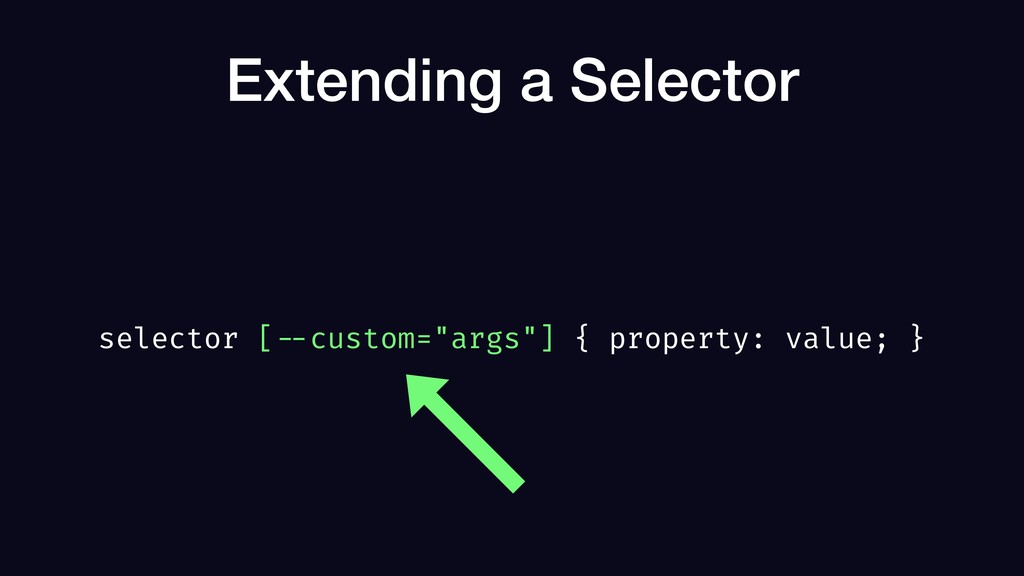
Min-Width as a Selector .example[ --min-width="500"] { /* rule */
} What we can write in CSS: -
Min-Width as a Selector minWidth('.example', 500, ' /* rule */')
What we can run in JS: -
function minWidth(selector, width, rule) { return Array.from(document.querySelectorAll(selector)) .reduce((styles, tag, count)
=> { const attr = (selector + width).replace(/\W/g, '') if (tag.offsetWidth >= width) { tag.setAttribute(`data-minwidth-${attr}`, count) styles += `[data-minwidth-${attr}="${count}"] { ${rule} }\n` } else { tag.setAttribute(`data-minwidth-${attr}`, '') } return styles }, '') } -
Min-Width as an At-Rule What we want in CSS: @element
.example and (min-width: 500px) { :self { background: lime; } } -
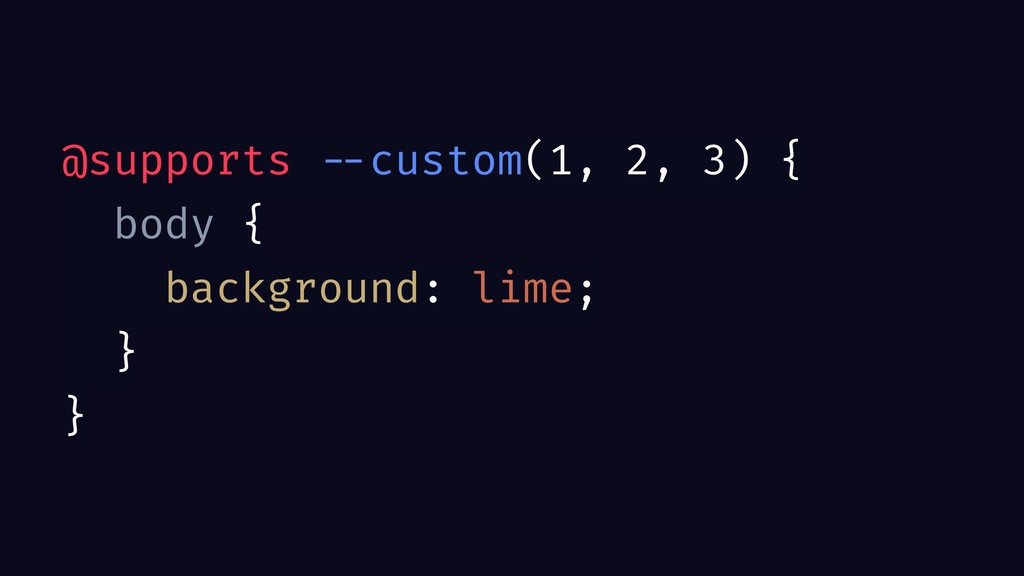
Min-Width as an At-Rule @supports --minWidth('.example', 500) { [ --self]
{ background: lime; } } What we can write in CSS: -
Min-Width as an At-Rule minWidth('.example', 500, ' /* stylesheet */')
What we can run in JS: -
function minWidth(selector, width, stylesheet) { return Array.from(document.querySelectorAll(selector)) .reduce((styles, tag, count)
=> { const attr = (selector + width).replace(/\W/g, '') if (tag.offsetWidth >= width) { tag.setAttribute(`data-minwidth-${attr}`, count) styles += stylesheet.replace( /\[ --self\]/g, `[data-minwidth-${attr}="${count}"]` ) } else { tag.setAttribute(`data-minwidth-${attr}`, '') } return styles }, '') } -
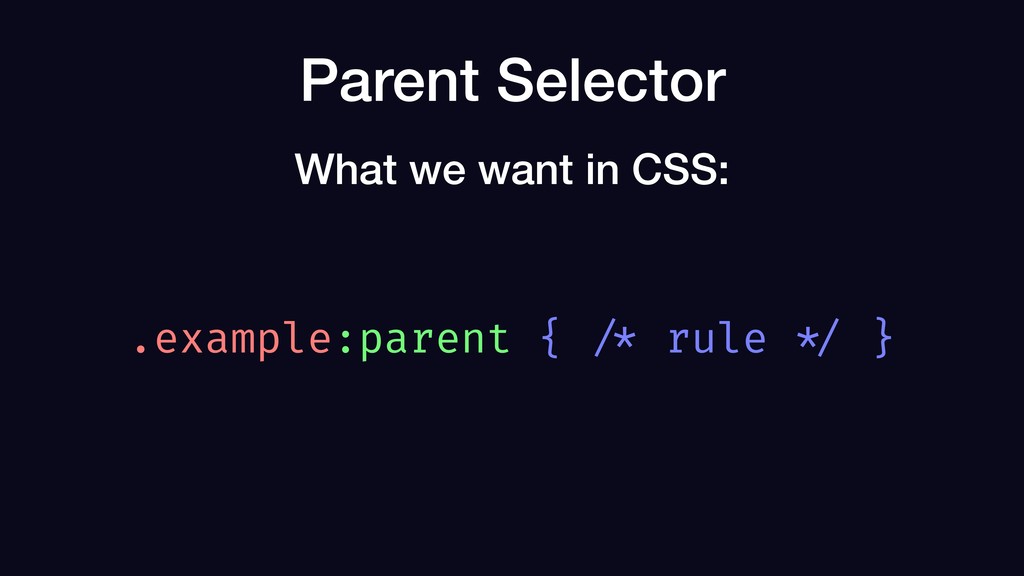
Parent Selector .example[ --parent] { /* rule */ } What
we can write in CSS: -
function parent(selector, rule) { return Array.from(document.querySelectorAll(selector)) .filter(tag => tag.parentElement) .reduce((styles,
tag, count) => { const attr = selector.replace(/\W/g, '') tag.parentElement.setAttribute(`data-parent-${attr}`, count) styles += `[data-parent-${attr}="${count}"] { ${rule} }\n` return styles }, '') } -
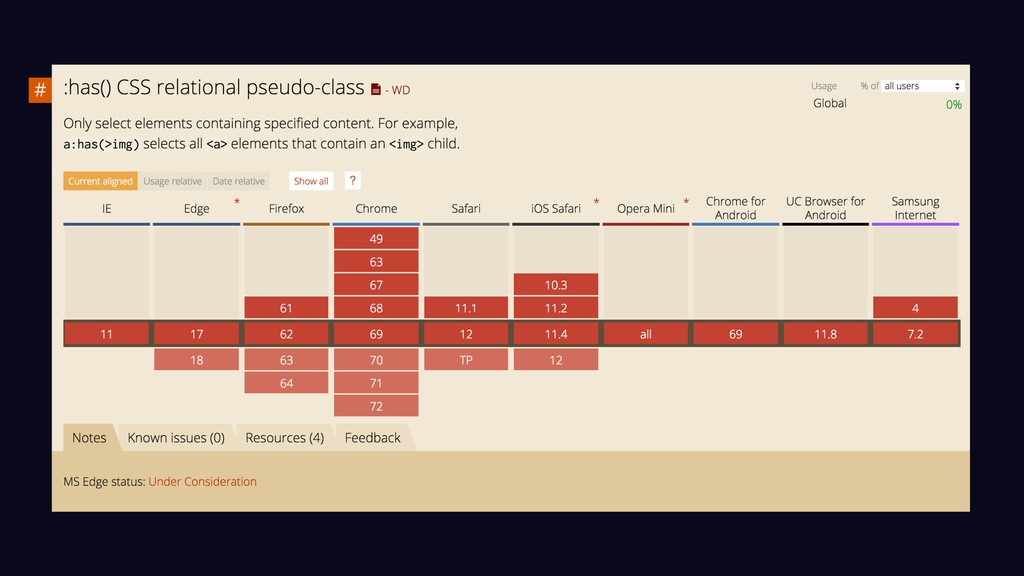
:has() .example[ --has="'.demo'"] { /* rule */ } What we
can write in CSS: -
function has(selector, child, rule) { return Array.from(document.querySelectorAll(selector)) .filter(tag => tag.querySelector(child))
.reduce((styles, tag, count) => { const attr = (selector + child).replace(/\W/g, '') tag.setAttribute(`data-has-${attr}`, count) styles += `[data-has-${attr}="${count}"] { ${rule} }\n` return styles }, '') } -
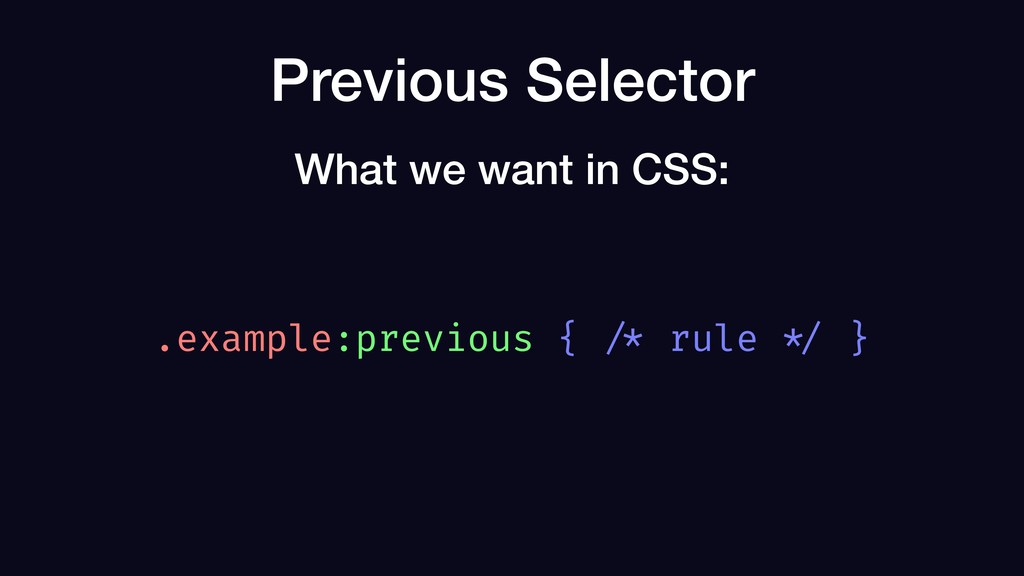
Previous Selector .example[ --previous] { /* rule */ } What
we can write in CSS: -
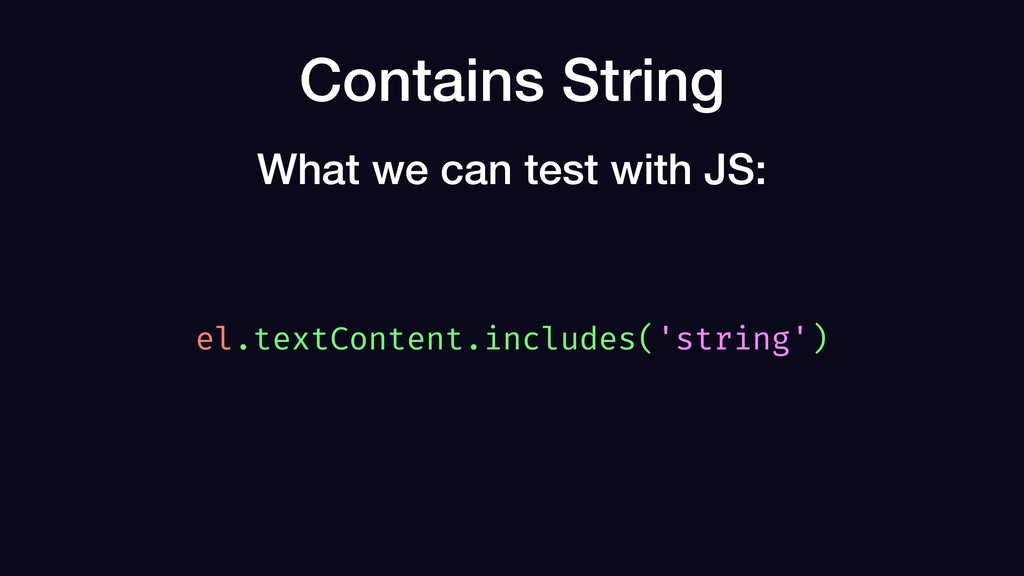
Contains String .example[ --contains-text="'demo'"] { /* rule */ } What
we can write in CSS: -
Attribute Comparison .example[price > 50] { /* rule */ }
What we want in CSS: -
Attribute Comparison .example[ --attr-greater="'price', 50"] { /* rule */ }
What we can write in CSS: -
Style based on any property or test you can write,
on any element, when any event happens in the browser -
Style based on any property or test you can write,
on any element, when any event happens in the browser -
Style based on any property or test you can write,
on any element, when any event happens in the browser -
— Tab Atkins, on ‘dynamic values’ in CSS “The JS
you write is less of a performance hit than what would happen if we recast the entire style system to handle this sort of thing.” -
// Tag Reduction function custom(selector, option, rule) { return Array.from(document.querySelectorAll(selector))
.reduce((styles, tag, count) => { const attr = (selector + option).replace(/\W/g, '') if (option(tag)) { tag.setAttribute(`data-custom-${attr}`, count) styles += `[data-custom-${attr}="${count}"] { ${rule} }\n` } else { tag.setAttribute(`data-custom-${attr}`, '') } return styles }, '') } -
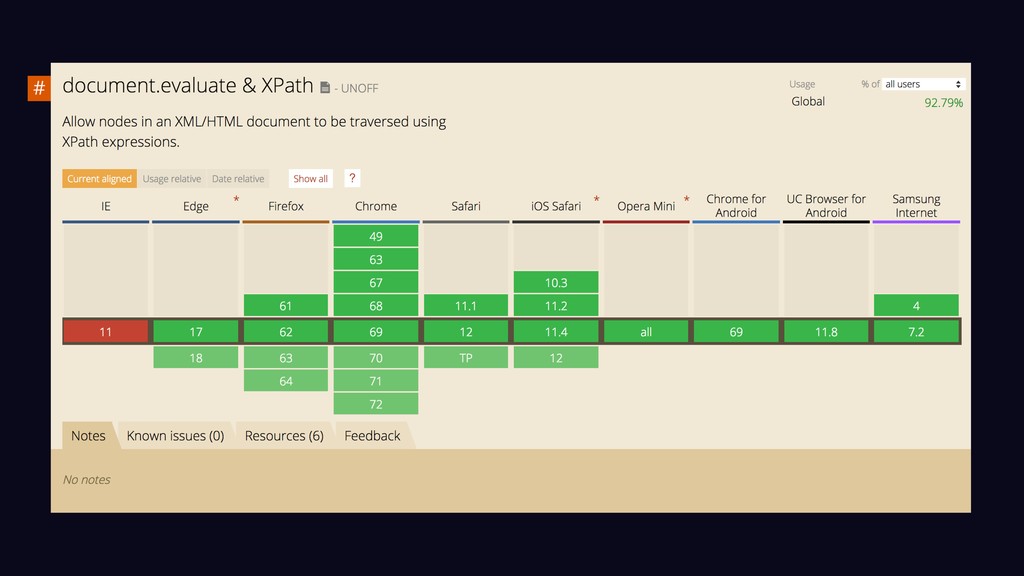
function xpath(selector, rule) { const tags = [] const result
= document.evaluate( selector, document, null, XPathResult.UNORDERED_NODE_SNAPSHOT_TYPE, null ) for (let i=0; i < result.snapshotLength; i ++) { tags.push(result.snapshotItem(i)) } return tags.reduce((styles, tag, count) => { const attr = selector.replace(/\W/g, '') tag.setAttribute(`data-xpath-${attr}`, count) styles += `[data-xpath-${attr}="${count}"] { ${rule} }\n` return styles }, '') } -
/* :has(li) */ \/\/\*[li] [ --xpath] { background: lime; }
/* li:parent */ \/\/li\/parent\:\:\* [ --xpath] { background: hotpink; } /* li:contains-text('hello') */ \/\/\*\[contains\(text\(\)\,\'hello\'\)\] [ --xpath] { background: purple; } -
import jsincss from 'https: //unpkg.com/jsincss/index.vanilla.js' import xpath from 'https: //unpkg.com/jsincss-xpath-selector/index.vanilla.js'
Array.from(document.styleSheets).forEach(stylesheet => Array.from(stylesheet.cssRules).forEach(rule => { if (rule.type === 1 && rule.selectorText.includes('[ --xpath]')) { jsincss(() => xpath( rule.selectorText .split('[ --xpath]')[0] .replace(/\ /g, '') .trim(), rule.cssText.split(rule.selectorText)[1] .trim() .slice(1, -1) )) } }) ) -
Media Queries @media (min-width: 500px) { /* stylesheet */ }
What we wanted in CSS: -
function media(conditions, stylesheet) { return Object.keys(conditions).every( test => ({ minWidth:
number => number <= innerWidth, maxWidth: number => number >= innerWidth, minHeight: number => number <= innerHeight, maxHeight: number => number >= innerHeight, minAspectRatio: number => number <= innerWidth / innerHeight, maxAspectRatio: number => number >= innerWidth / innerHeight, orientation: string => { switch (string) { case 'portrait': return innerWidth < innerHeight case 'landscape': return innerWidth > innerHeight } } })[test](conditions[test]) ) ? stylesheet : '' } -
function element(selector, conditions, stylesheet) { const features = { minWidth:
(el, number) => number <= el.offsetWidth, maxWidth: (el, number) => number >= el.offsetWidth, minHeight: (el, number) => number <= el.offsetHeight, maxHeight: (el, number) => number >= el.offsetHeight, minAspectRatio: (el, number) => number <= el.offsetWidth / el.offsetHeight, maxAspectRatio: (el, number) => number >= el.offsetWidth / el.offsetHeight, orientation: (el, string) => { switch (string) { case 'portrait': return el.offsetWidth < el.offsetHeight case 'square': return el.offsetWidth === el.offsetHeight case 'landscape': return el.offsetWidth > el.offsetHeight } }, minChildren: (el, number) => number <= el.children.length, children: (el, number) => number === el.children.length, maxChildren: (el, number) => number >= el.children.length, minCharacters: (el, number) => number <= ( (el.value && el.value.length) || el.textContent.length ), characters: (el, number) => number === ( -
minAspectRatio: (el, number) => number <= el.offsetWidth / el.offsetHeight, maxAspectRatio:
(el, number) => number >= el.offsetWidth / el.offsetHeight, orientation: (el, string) => { switch (string) { case 'portrait': return el.offsetWidth < el.offsetHeight case 'square': return el.offsetWidth === el.offsetHeight case 'landscape': return el.offsetWidth > el.offsetHeight } }, minChildren: (el, number) => number <= el.children.length, children: (el, number) => number === el.children.length, maxChildren: (el, number) => number >= el.children.length, minCharacters: (el, number) => number <= ( (el.value && el.value.length) || el.textContent.length ), characters: (el, number) => number === ( (el.value && el.value.length) || el.textContent.length ), maxCharacters: (el, number) => number >= ( (el.value && el.value.length) || el.textContent.length ), minScrollX: (el, number) => number <= el.scrollLeft, maxScrollX: (el, number) => number >= el.scrollLeft, minScrollY: (el, number) => number <= el.scrollTop, maxScrollY: (el, number) => number >= el.scrollTop } -
} return Array.from(document.querySelectorAll(selector)) .reduce((styles, tag, count) => { const attr
= ( selector + Object.keys(conditions) + Object.values(conditions) ).replace(/\W/g, '') if (Object.entries(conditions).every(test => features[test[0]](tag, test[1]) )) { tag.setAttribute(`data-element-${attr}`, count) styles += stylesheet.replace( /\[ --self\]/g, `[data-element-${attr}="${count}"]` ) } else { tag.setAttribute(`data-element-${attr}`, '') } return styles }, '') } -
function element(selector, conditions, stylesheet) { const features = { minWidth:
(el, number) => number <= el.offsetWidth, maxWidth: (el, number) => number >= el.offsetWidth, minHeight: (el, number) => number <= el.offsetHeight, maxHeight: (el, number) => number >= el.offsetHeight, minAspectRatio: (el, number) => number <= el.offsetWidth / el.offsetHeight, maxAspectRatio: (el, number) => number >= el.offsetWidth / el.offsetHeight, orientation: (el, string) => { switch (string) { case 'portrait': return el.offsetWidth < el.offsetHeight case 'square': return el.offsetWidth === el.offsetHeight case 'landscape': return el.offsetWidth > el.offsetHeight } }, minChildren: (el, number) => number <= el.children.length, children: (el, number) => number === el.children.length, maxChildren: (el, number) => number >= el.children.length, minCharacters: (el, number) => number <= ( (el.value && el.value.length) || el.textContent.length ), characters: (el, number) => number === ( (el.value && el.value.length) || el.textContent.length ), maxCharacters: (el, number) => number >= ( (el.value && el.value.length) || el.textContent.length ), minScrollX: (el, number) => number <= el.scrollLeft, maxScrollX: (el, number) => number >= el.scrollLeft, minScrollY: (el, number) => number <= el.scrollTop, maxScrollY: (el, number) => number >= el.scrollTop } return Array.from(document.querySelectorAll(selector)) .reduce((styles, tag, count) => { const attr = ( selector + Object.keys(conditions) + Object.values(conditions) ).replace(/\W/g, '') if (Object.entries(conditions).every(test => features[test[0]](tag, test[1]) )) { tag.setAttribute(`data-element-${attr}`, count) styles += stylesheet.replace( /\[ --self\]/g, `[data-element-${attr}="${count}"]` ) } else { tag.setAttribute(`data-element-${attr}`, '') } return styles }, '') }