Share
Embed

Transcript
81 slides
-
trait Monad[F[_]] extends Applicative[F] { def flatMap[A, B](fa: F[A])(f :A=>F[B]):F[B]
} * monad type class * flatMap also called bind, >>= -
def point[A](a: => A): M[A] def map[A,B](ma: M[A])(f: A =>
B): M[B] def flatMap[A,B](ma: M[A])(f: A => M[B]): M[B] * the functions we care about * lift pure value, lift pure function, chain “operations” -
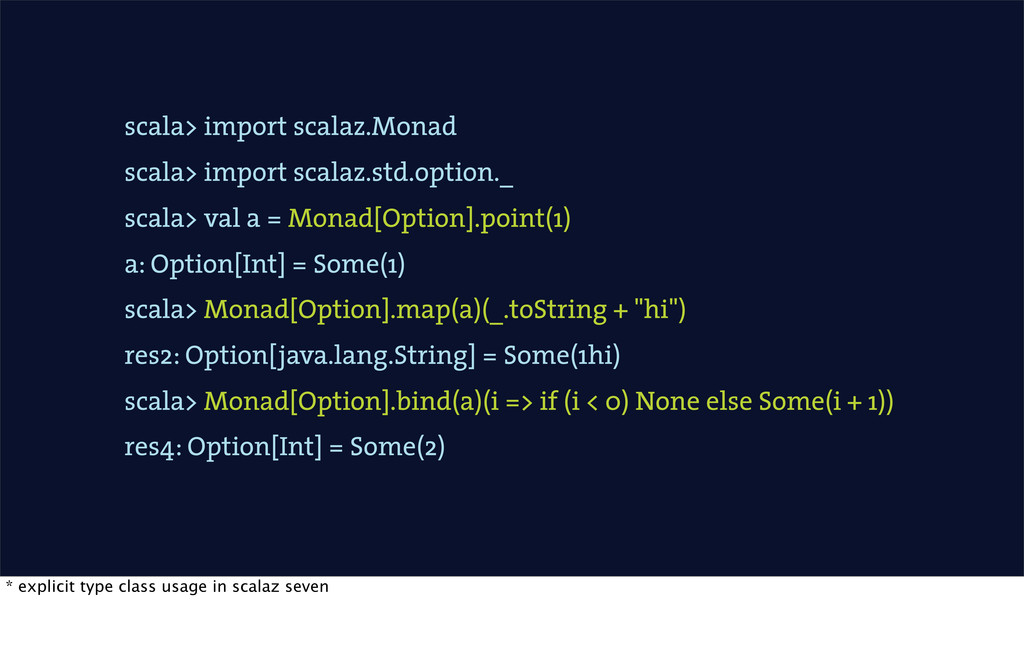
scala> import scalaz.Monad scala> import scalaz.std.option._ scala> val a =
Monad[Option].point(1) a: Option[Int] = Some(1) scala> Monad[Option].map(a)(_.toString + "hi") res2: Option[java.lang.String] = Some(1hi) scala> Monad[Option].bind(a)(i => if (i < 0) None else Some(i + 1)) res4: Option[Int] = Some(2) * explicit type class usage in scalaz seven -
scala> import scalaz.syntax.monad._ import scalaz.syntax.monad._ scala> Option(1).flatMap(i => if (i
< 0) None else Some(i+1)) res6: Option[Int] = Some(2) scala> 1.point[Option].flatMap(...) res7: Option[Int] = Some(2) * implicit type class usage in scalaz7 using syntax extensions -
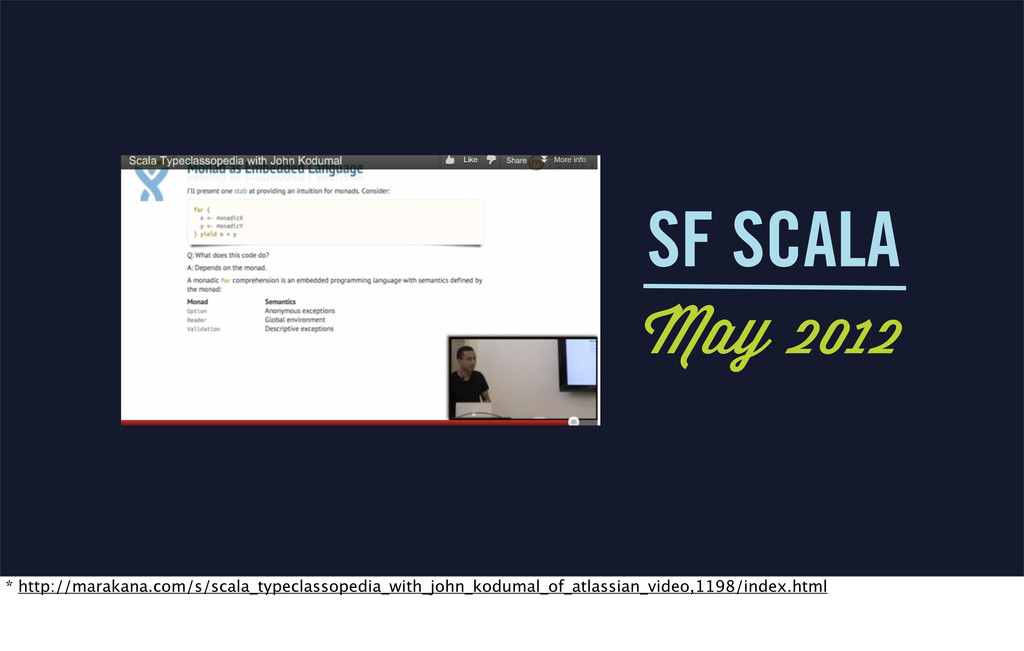
“A MONADIC FOR COMPREHENSION IS AN EMBEDDED PROGRAMMING LANGUAGE WITH
SEMANTICS DEFINED BY THE MONAD” * “one intuition of monads” - john -
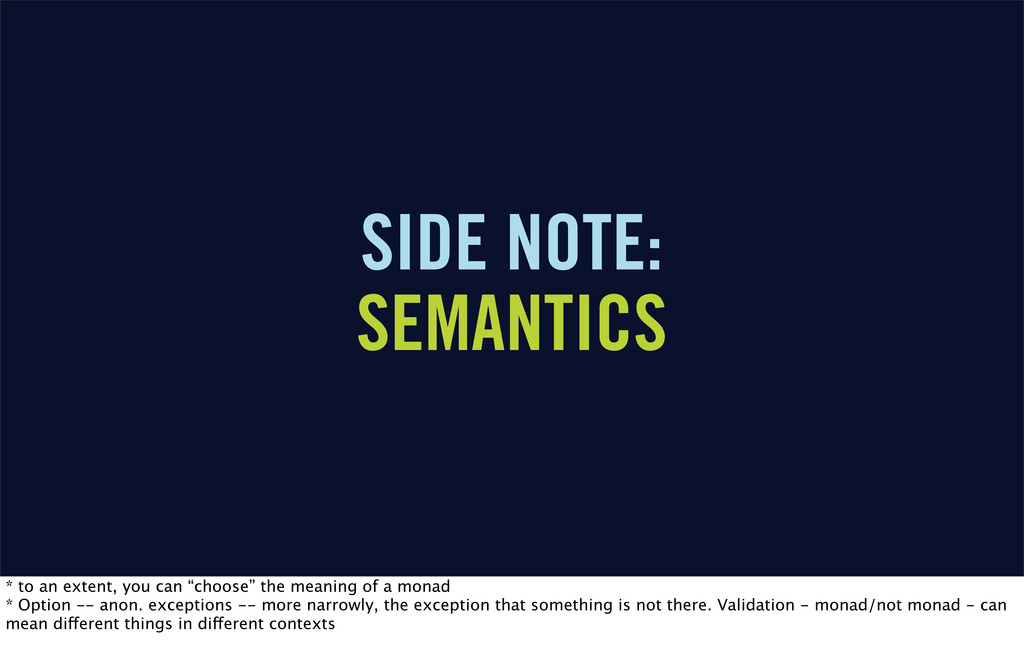
SEMANTICS SIDE NOTE: * to an extent, you can “choose”
the meaning of a monad * Option -- anon. exceptions -- more narrowly, the exception that something is not there. Validation - monad/not monad - can mean different things in different contexts -
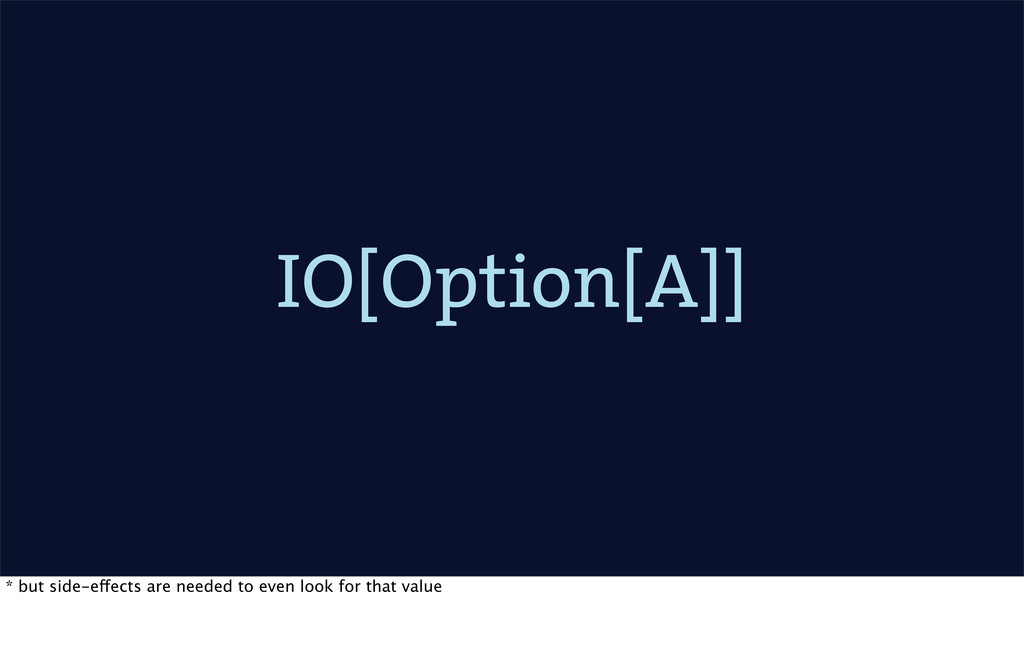
IO[Validation[Throwable,Option[A]] * and looking for that value may throw exceptions
(or fail in some way) -
def composeFunctor[M[_],N[_]](implicit m: Functor[M], n: Functor[N]) = new Functor[({type MN[A]=[M[N[A]]]})#MN]
{ def map[A,B](mna: M[N[A]])(f: A => B): M[N[B]] = ... } * generic function that composes any two functors M[_] and N[_] -
def composeFunctor[M[_],N[_]](implicit m: Functor[M], n: Functor[N]) = new Functor[({type MN[A]=[M[N[A]]]})#MN]
{ def map[A,B](mna: M[N[A]])(f: A => B): M[N[B]] = { M.map(mna)(na => N.map(na)(f)) } } -
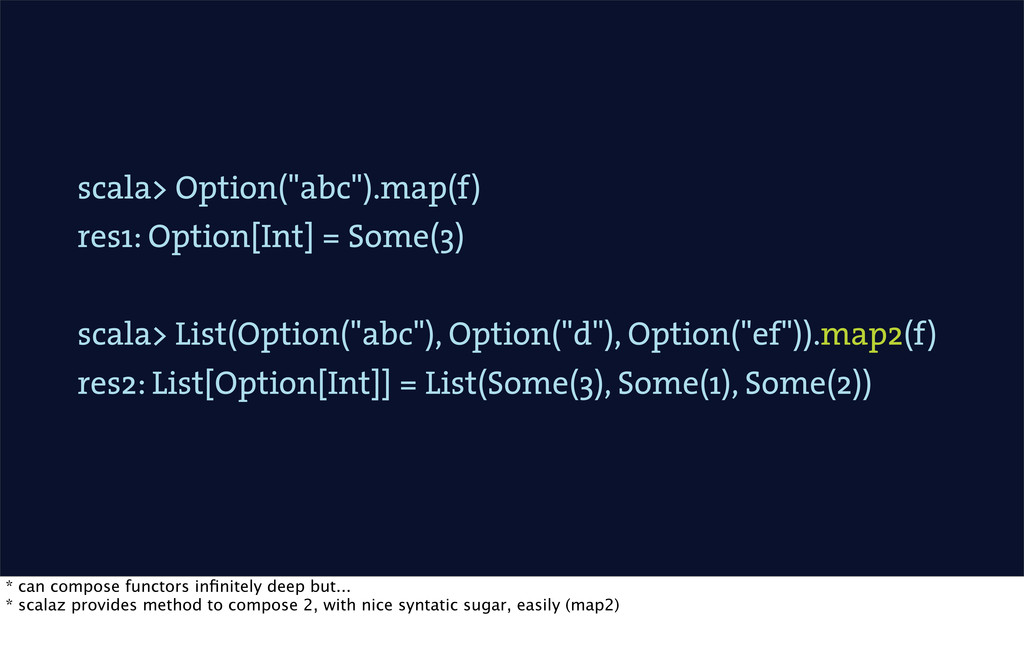
scala> Option("abc").map(f) res1: Option[Int] = Some(3) scala> List(Option("abc"), Option("d"), Option("ef")).map2(f)
res2: List[Option[Int]] = List(Some(3), Some(1), Some(2)) * can compose functors infinitely deep but... * scalaz provides method to compose 2, with nice syntatic sugar, easily (map2) -
def notPossible[M[_],N[_]](implicit m: Monad[M], n: Monad[N]) = new Monad[({type MN[A]=[M[N[A]]]})#MN]
{ def flatMap[A,B](mna: M[N[A]])(f: A => M[N[B]]): M[N[B]] = ... } * cannot write the same function for any two monads M[_], N[_] -
def notPossible[M[_],N[_]](implicit m: Monad[M], n: Monad[N]) = new Monad[({type MN[A]=[M[N[A]]]})#MN]
{ def flatMap[A,B](mna: M[N[A]])(f: A => M[N[B]]): M[N[B]] = ... } TRY IT! * best way to understand this is attempt to write it yourself * it won’t compile -
http://blog.tmorris.net/monads-do-not-compose/ * good resource to dive into this in more
detail * some of previous slides based on above * provides template, in the form of a gist, for trying this stuff out -
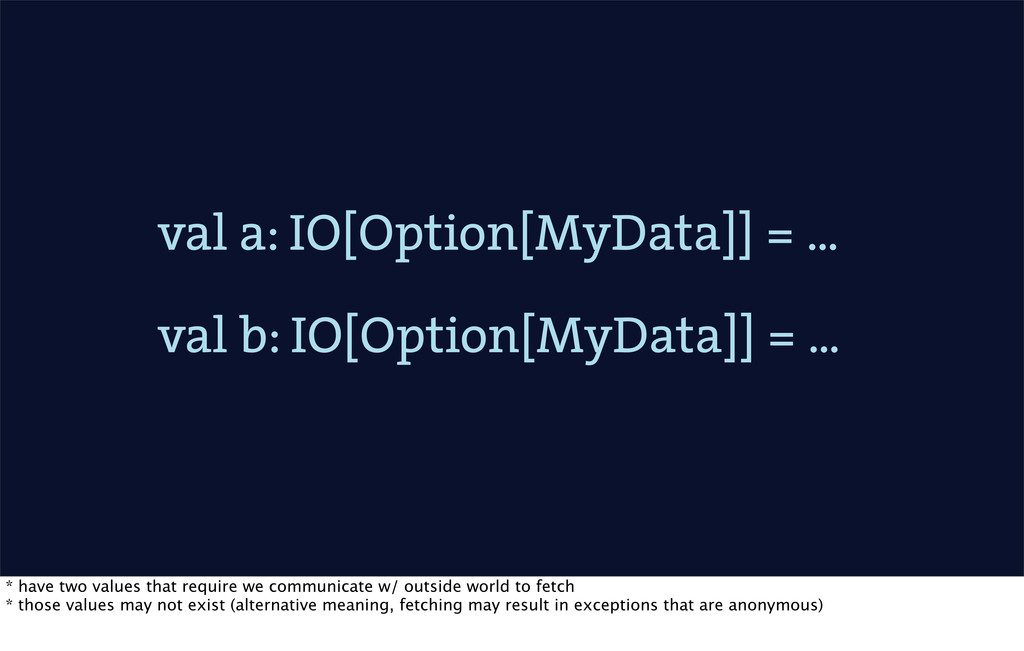
val a: IO[Option[MyData]] = ... val b: IO[Option[MyData]] = ...
* have two values that require we communicate w/ outside world to fetch * those values may not exist (alternative meaning, fetching may result in exceptions that are anonymous) -
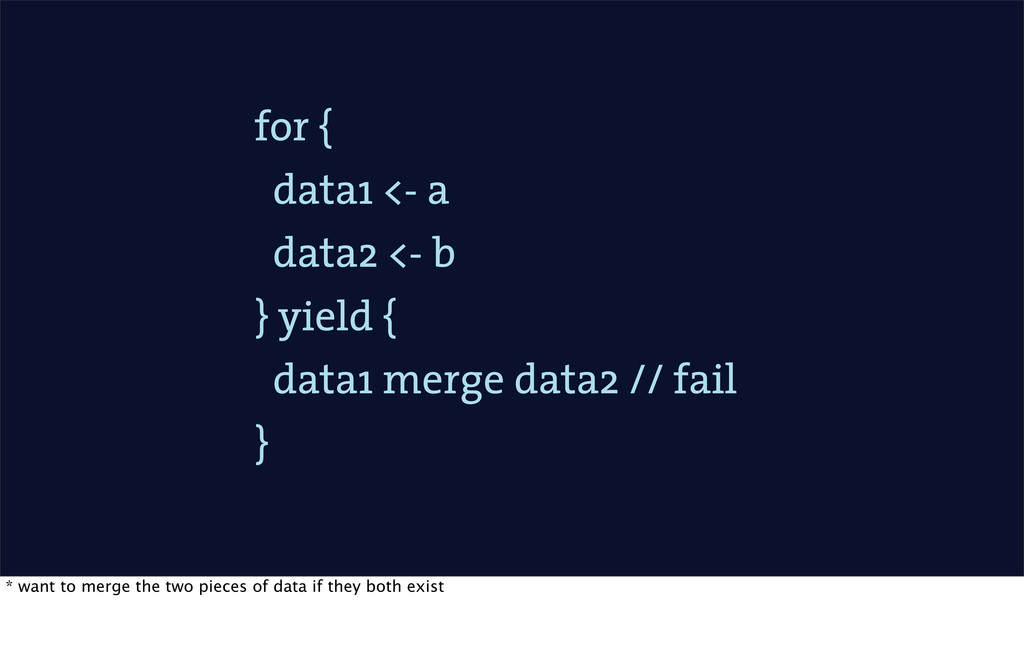
for { data1 <- a data2 <- b } yield
{ data1 merge data2 // fail } * want to merge the two pieces of data if they both exist -
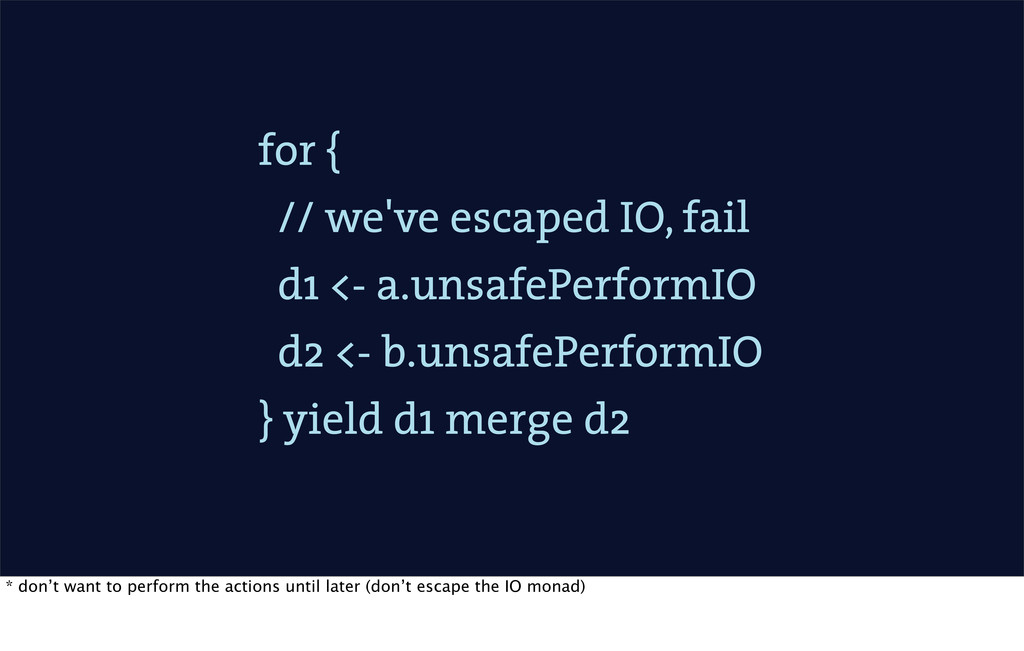
for { // we've escaped IO, fail d1 <- a.unsafePerformIO
d2 <- b.unsafePerformIO } yield d1 merge d2 * don’t want to perform the actions until later (don’t escape the IO monad) -
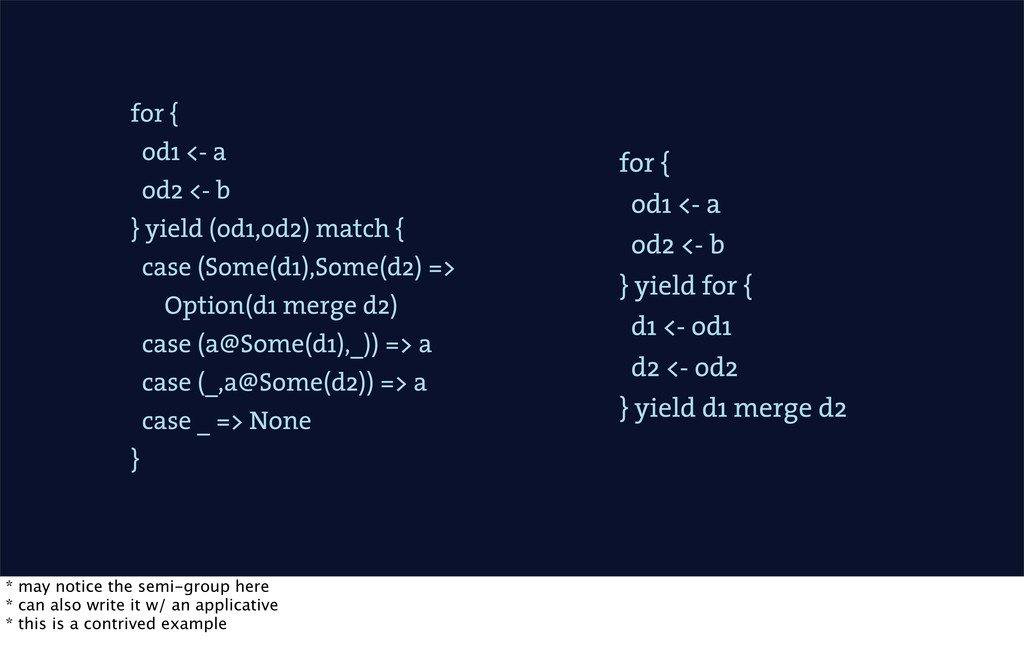
for { od1 <- a od2 <- b } yield
(od1,od2) match { case (Some(d1),Some(d2) => Option(d1 merge d2) case (a@Some(d1),_)) => a case (_,a@Some(d2)) => a case _ => None } for { od1 <- a od2 <- b } yield for { d1 <- od1 d2 <- od2 } yield d1 merge d2 * may notice the semi-group here * can also write it w/ an applicative * this is a contrived example -
def b(data: MyData): IO[Option[MyData] BUT WHAT IF... * even w/
simple example, this minor change throws a monkey wrench in things -
for { readRes <- readIO(domain) res <- readRes.fold( success =
_.cata( some = meta => if (meta.enabledStatus /== status) { writeIO(meta.copy(enabledStatus = status)) } else meta.successNel[BarneyException].pure[IO], none = new ReadFailure(domain).failNel[AppMetadata].pure[IO] ), failure = errors => errors.fail[AppMetadata].pure[IO] ) } yield res ): * example of what not to do from something I wrote a while back -
case class IOOption[A](run: IO[Option[A]]) define type that boxes box the
value, doesn’t need to be a case class, similar to haskell newtype. -
new Monad[IOOption] { def point[A](a: => A): IOOption[A] = IOOption(a.point[Option].point[IO])
def map[A,B](fa: IOOption[A])(f: A => B): IOOption[B] = IOOption(fa.run.map(opt => opt.map(f))) def flatMap[A, B](fa: IOOption[A])(f :A=>IOOption[B]):IOOption[B] = IOOption(fa.run.flatMap((o: Option[A]) => o match { case Some(a) => f(a).run case None => (None : Option[B]).point[IO] })) } * can define a Monad instance for new type -
val a: IOOption[MyData] = ... val b: IOOption[MyData] = ...
val c: IOOption[MyData] = for { data1 <- a data2 <- b } yield { data1 merge data2 } val d: IO[Option[MyData]] = c.run can use new type to improve previous contrived example -
type MyState[A] = State[StateData,A] case class MyStateOption[A](run: MyState[Option[A]]) * what
if we don’t need effects, but state we can read and write to produce a final optional value and some new state * State[S,A] where S is fixed is a monad * can define a new type for that as well -
new Monad[MyStateOption] { def map[A,B](fa: MyStateOption[A])(f: A => B): MyStateOption[B]
= MyStateOption(Functor[MyState].map(fa)(opt => opt.map(f))) def flatMap[A, B](fa: MyStateOption[A])(f :A=>IOOption[B]) = MyStateOption(Monad[MyState]].bind(fa)((o: Option[A]) => o match { case Some(a) => f(a).run case None => (None : Option[B]).point[MyState] })) } new Monad[IOOption] { def map[A,B](fa: IOOption[A])(f: A => B): IOOption[B] = IOOption(Functor[IO].map(fa)(opt => opt.map(f))) def flatMap[A, B](fa: IOOption[A])(f :A=>IOOption[B]) = IOOption(Monad[IO]].bind(fa)((o: Option[A]) => o match { case Some(a) => f(a).run case None => (None : Option[B]).point[IO] })) } * opportunity for more abstraction * if you were going to do this, not exactly the way you would define these in real code, cheated a bit using {Functor,Monad}.apply -
case class OptionT[M[_], A](run: M[Option[A]]) { def map[B](f: A =>
B)(implicit F: Functor[M]): OptionT[M,B] def flatMap[B](f: A => OptionT[M,B])(implicit M: Monad[M]): OptionT[M,B] } * define map/flatMap a little differently, can be done like previous as typeclass instance but convention is to define the interface on the transformer and later define typeclass instance using the interface -
case class OptionT[M[_], A](run: M[Option[A]]) { def map[B](f: A =>
B)(implicit F: Functor[M]): OptionT[M,B] = OptionT[M,B](F.map(run)((o: Option[A]) => o map f)) def flatMap[B](f: A => OptionT[M,B])(implicit M: Monad[M]): OptionT[M,B] = OptionT[M,B](M.bind(run)((o: Option[A]) => o match { case Some(a) => f(a).run case None => M.point((None: Option[B])) })) } * implementations resemble what has already been shown -
new Monad[IOOption] { def map[A,B](fa: IOOption[A])(f: A => B): IOOption[B]
= IOOption(Functor[IO].map(fa)(opt => opt.map(f))) def flatMap[A, B](fa: IOOption[A])(f :A=>IOOption[B]) = IOOption(Monad[IO]].bind(fa)((o: Option[A]) => o match { case Some(a) => f(a).run case None => (None : Option[B]).point[IO] })) } case class OptionT[M[_], A](run: M[Option[A]]) { def map[B](f: A => B)(implicit F: Functor[M]): OptionT[M,B] = OptionT[M,B](F.map(run)((o: Option[A]) => o map f)) def flatMap[B](f: A => OptionT[M,B])(implicit M: Monad[M]) = OptionT[M,B](M.bind(run)((o: Option[A]) => o match { case Some(a) => f(a).run case None => M.point((None: Option[B])) })) } * it the generalization of what was written before -
type FlowState[A] = State[ReqRespData, A] val f: Option[String] => FlowState[Boolean]
= (etag: Option[String]) => { val a: OptionT[FlowState, Boolean] = for { // string <- OptionT[FlowState,String] e <- optionT[FlowState](etag.point[FlowState]) // wrap FlowState[Option[String]] in OptionT matches <- optionT[FlowState]((requestHeadersL member IfMatch)) } yield matches.split(",").map(_.trim).toList.contains(e) a getOrElse false // FlowState[Boolean] } * check existence of etag in an http request, data lives in state * has minor bug, doesn’t deal w/ double quotes as written * https://github.com/stackmob/scalamachine/blob/master/core/src/main/scala/scalamachine/core/v3/ WebmachineDecisions.scala#L282-285 -
val reqCType: OptionT[FlowState,ContentType] = for { contentType <- optionT[FlowState]( (requestHeadersL
member ContentTypeHeader) ) mediaInfo <- optionT[FlowState]( parseMediaTypes(contentType).headOption.point[FlowState] ) } yield mediaInfo.mediaRange * determine content type of the request, data lives in state, may not be specified * https://github.com/stackmob/scalamachine/blob/master/core/src/main/scala/scalamachine/core/v3/ WebmachineDecisions.scala#L772-775 -
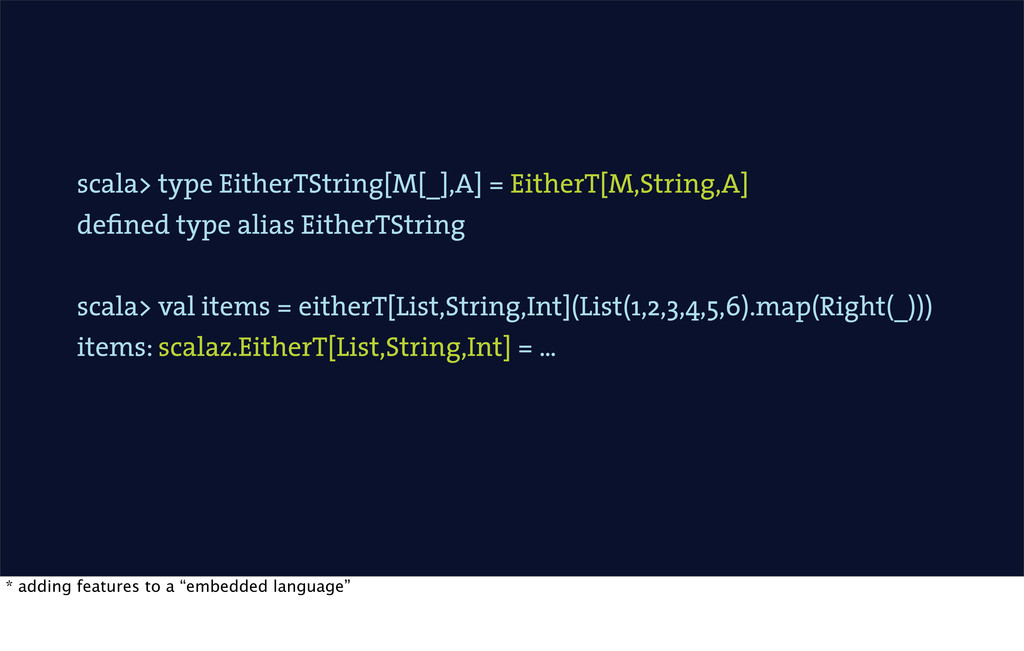
scala> type EitherTString[M[_],A] = EitherT[M,String,A] defined type alias EitherTString scala>
val items = eitherT[List,String,Int](List(1,2,3,4,5,6).map(Right(_))) items: scalaz.EitherT[List,String,Int] = ... * adding features to a “embedded language” -
for { i <- items } yield print(i) // 123456
for { i <- items _ <- if (i > 4) leftT[List,String,Unit]("fail") else rightT[List,String,Unit](()) } yield print(i) // 1234 * adding error handling, and early termination to non-deterministic computation -
BOXES A VALUE run: M[MyMonad[A] * value is typically called
“run” in scalaz7 * often called “value” in scalaz6 (because of NewType) -
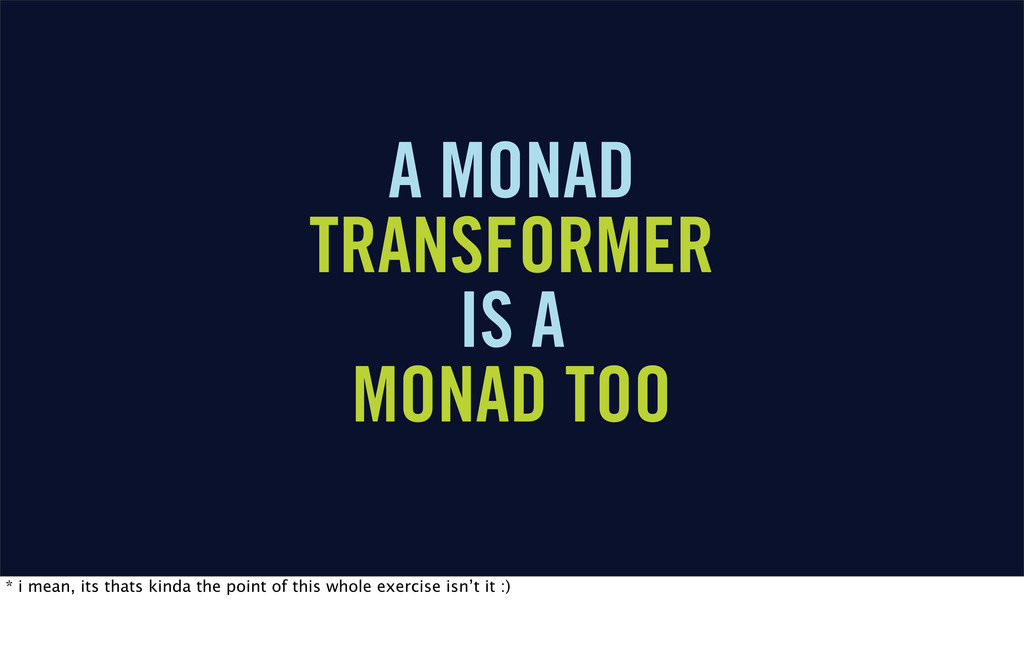
A MONAD TRANSFORMER IS A MONAD TOO * i mean,
its thats kinda the point of this whole exercise isn’t it :) -
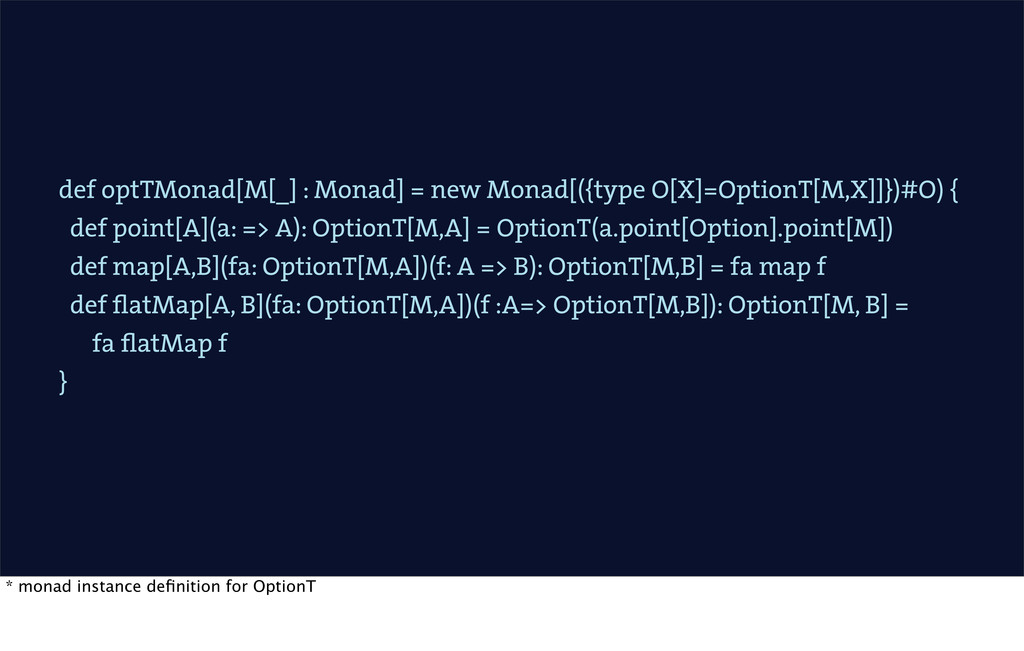
def optTMonad[M[_] : Monad] = new Monad[({type O[X]=OptionT[M,X]]})#O) { def
point[A](a: => A): OptionT[M,A] = OptionT(a.point[Option].point[M]) def map[A,B](fa: OptionT[M,A])(f: A => B): OptionT[M,B] = fa map f def flatMap[A, B](fa: OptionT[M,A])(f :A=> OptionT[M,B]): OptionT[M, B] = fa flatMap f } * monad instance definition for OptionT -
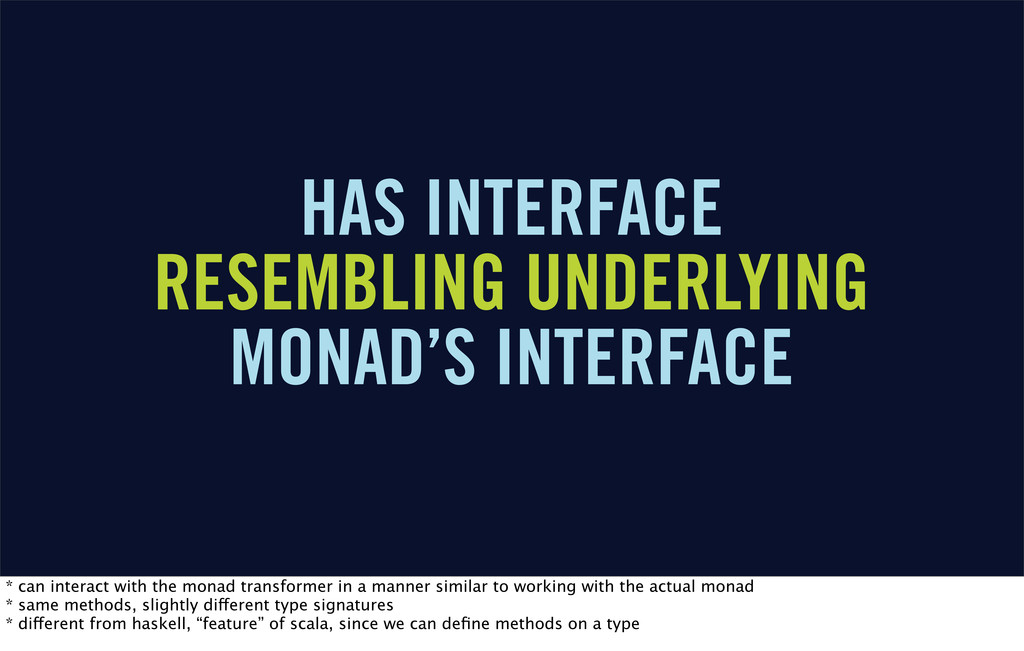
HAS INTERFACE RESEMBLING UNDERLYING MONAD’S INTERFACE * can interact with
the monad transformer in a manner similar to working with the actual monad * same methods, slightly different type signatures * different from haskell, “feature” of scala, since we can define methods on a type -
case class OptionT[M[_], A](run: M[Option[A]]) { def getOrElse[AA >: A](d:
=> AA)(implicit F: Functor[M]): M[AA] = F.map(run)((_: Option[A]) getOrElse default) def orElse[AA >: A](o: OptionT[M,AA])(implicit M: Monad[M]): OptionT[M,AA] = OptionT[M,AA](M.bind(run) { case x@Some(_) => M.point(x) case None => o.run } } -
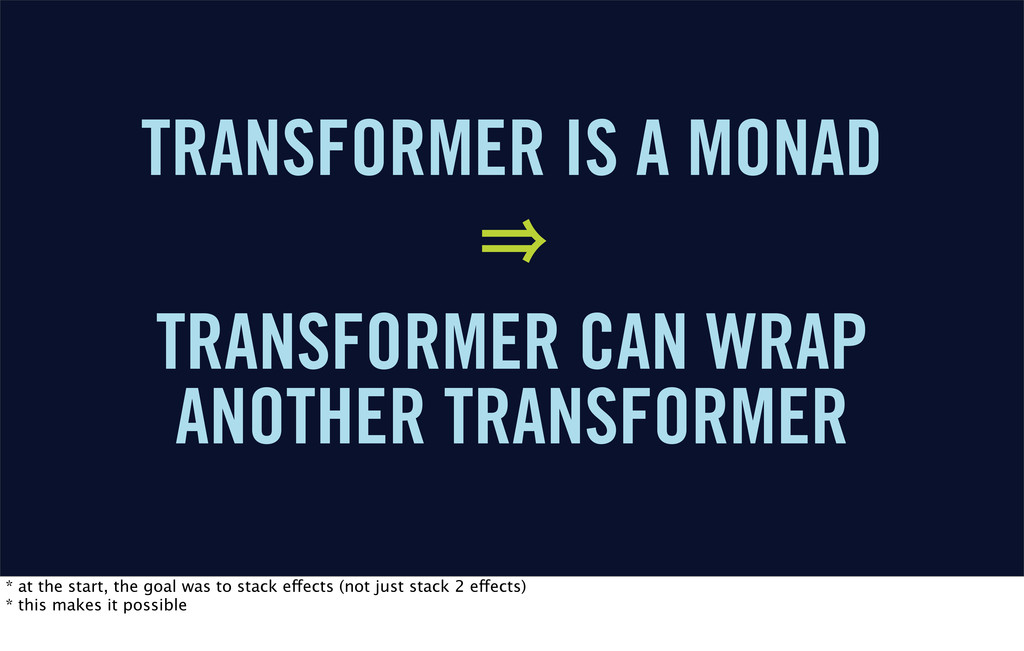
TRANSFORMER IS A MONAD 㱺 TRANSFORMER CAN WRAP ANOTHER TRANSFORMER
* at the start, the goal was to stack effects (not just stack 2 effects) * this makes it possible -
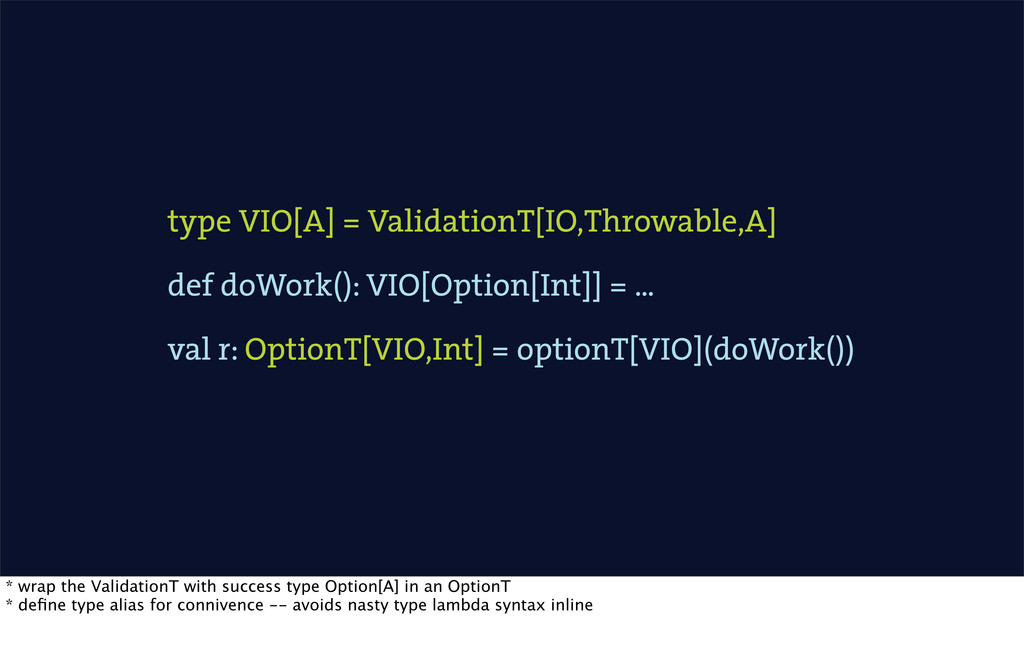
type VIO[A] = ValidationT[IO,Throwable,A] def doWork(): VIO[Option[Int]] = ... val
r: OptionT[VIO,Int] = optionT[VIO](doWork()) * wrap the ValidationT with success type Option[A] in an OptionT * define type alias for connivence -- avoids nasty type lambda syntax inline -
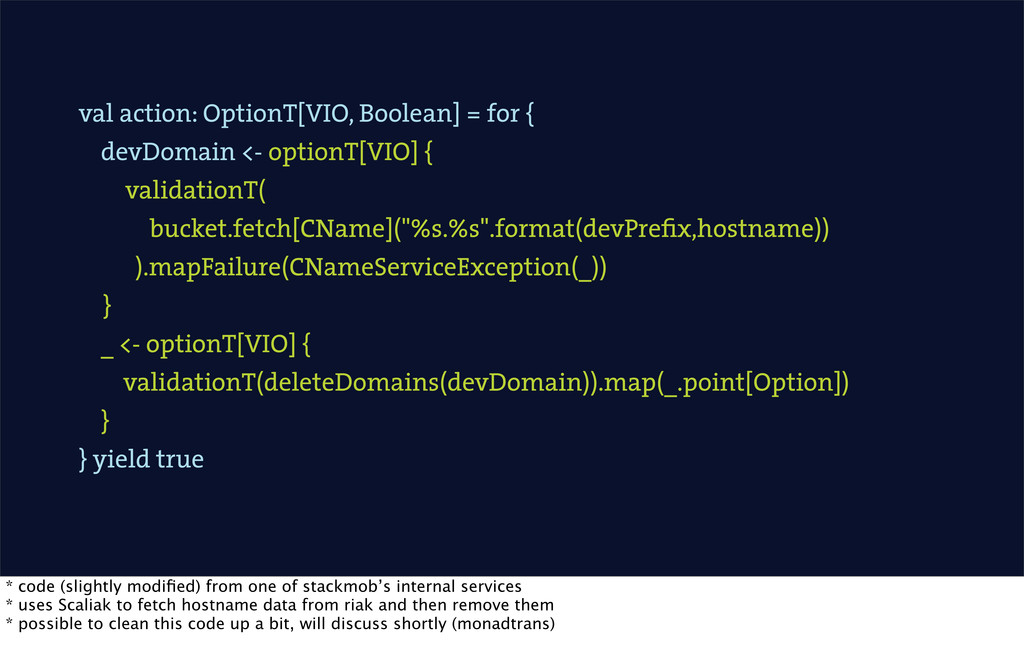
val action: OptionT[VIO, Boolean] = for { devDomain <- optionT[VIO]
{ validationT( bucket.fetch[CName]("%s.%s".format(devPrefix,hostname)) ).mapFailure(CNameServiceException(_)) } _ <- optionT[VIO] { validationT(deleteDomains(devDomain)).map(_.point[Option]) } } yield true * code (slightly modified) from one of stackmob’s internal services * uses Scaliak to fetch hostname data from riak and then remove them * possible to clean this code up a bit, will discuss shortly (monadtrans) -
KEEP ON STACKIN’ ON * don’t have to stop at
2 levels deep, our new stack is monad too * each monad/transformer we add to the stack compose more types of effects -
“ORDER” MATTERS * how stack is built, which transformers wrap
which monads, determines the overall semantics of the entire stack * changing that order can, and usually does, change semantics -
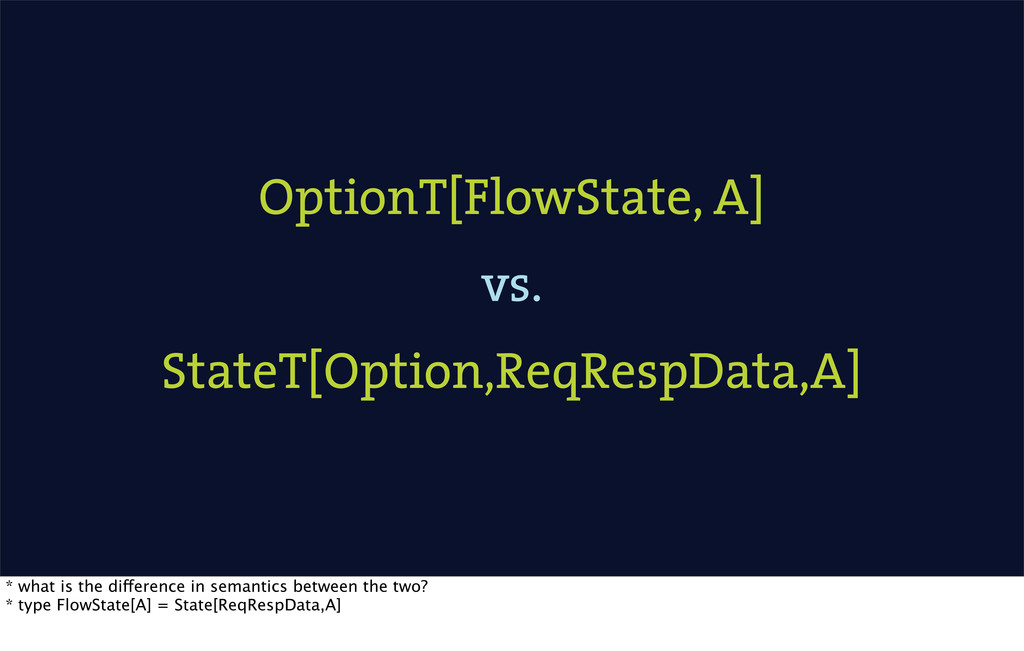
OptionT[FlowState, A] vs. StateT[Option,ReqRespData,A] * what is the difference in
semantics between the two? * type FlowState[A] = State[ReqRespData,A] -
FlowState[Option[A]] vs. Option[State[ReqRespData,A] * unboxing makes things easier to see
* a state action that returns an optional value vs a state action that may not exist * the latter probably doesn’t make as much sense in the majority of cases -
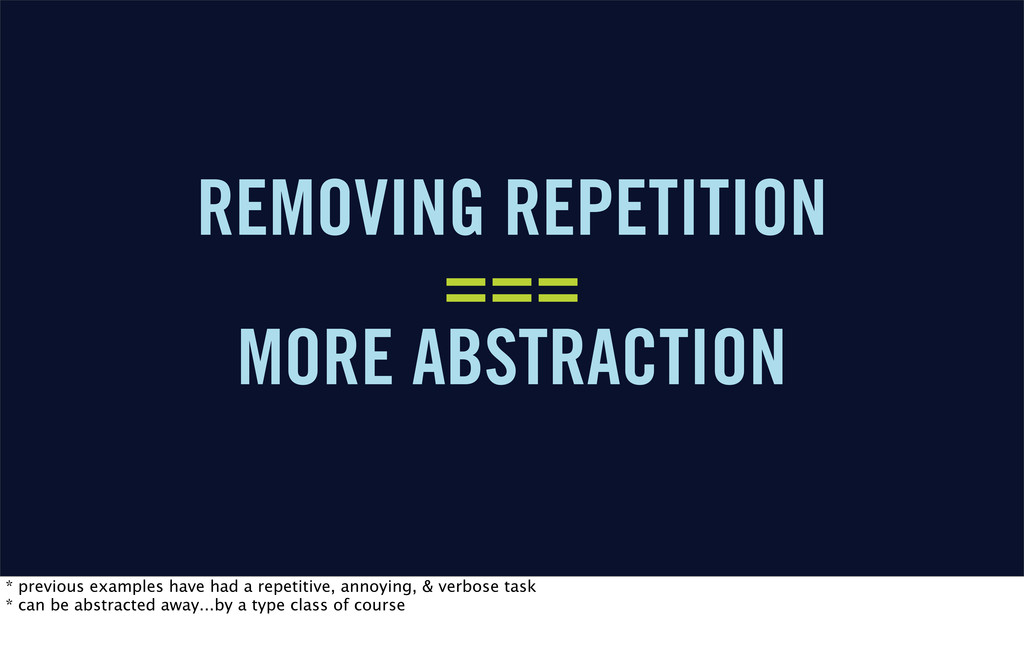
REMOVING REPETITION === MORE ABSTRACTION * previous examples have had
a repetitive, annoying, & verbose task * can be abstracted away...by a type class of course -
optionT[VIO](validationT(deleteDomains(devDomain)).map(_.point[Option])) eitherT[List,String,Int](List(1,2,3,4,5,6).map(Right(_))) resT[FlowState](encodeBodyIfSet(resource).map(_.point[Res])) * some cases require lifting the value
into the monad and then wrap it in the transformer * from previous examples -
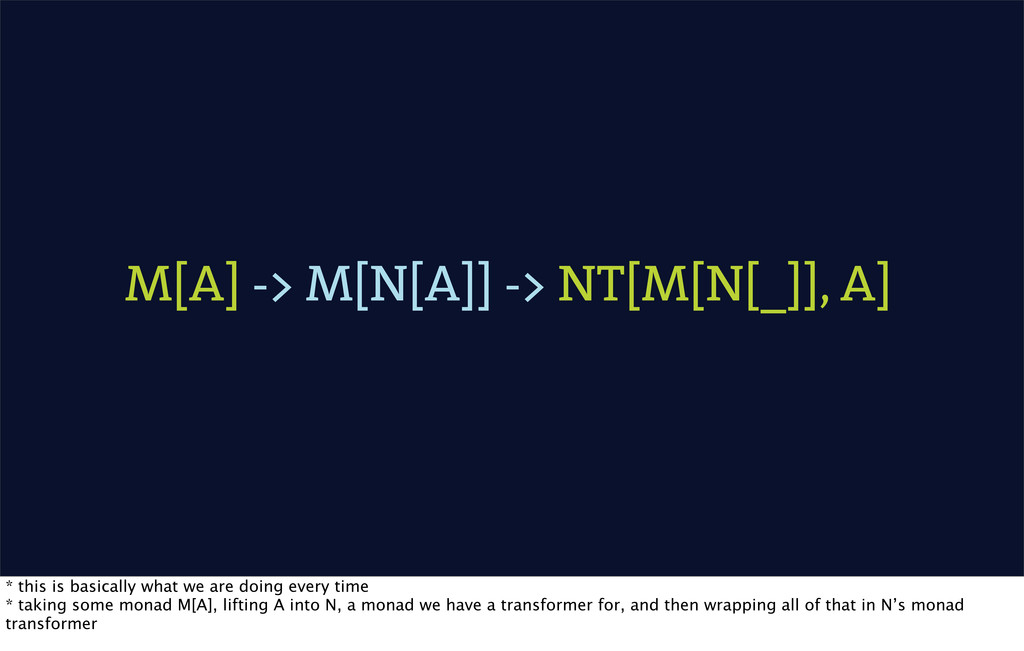
M[A] -> M[N[A]] -> NT[M[N[_]], A] * this is basically
what we are doing every time * taking some monad M[A], lifting A into N, a monad we have a transformer for, and then wrapping all of that in N’s monad transformer -
trait MonadTrans[F[_[_], _]] { def liftM[G[_] : Monad, A](a: G[A]):
F[G, A] } * liftM will do this for any transformer F[_[_],_] and any monad G[_] provided an instance of it is defined for F[_[_],_] -
def liftM[G[_], A](a: G[A])(implicit G: Monad[G]): OptionT[G, A] = OptionT[G,
A](G.map[A, Option[A]](a)((a: A) => a.point[Option])) * full definition requires some type ceremony * https://github.com/scalaz/scalaz/blob/scalaz-seven/core/src/main/scala/scalaz/OptionT.scala#L155-156 -
def liftM[G[_], A](ga: G[A])(implicit G: Monad[G]): ResT[G,A] = ResT[G,A](G.map(ga)(_.point[Res])) *
implementation for scalamachine’s Res monad * https://github.com/stackmob/scalamachine/blob/master/scalaz7/src/main/scala/scalamachine/scalaz/res/ ResT.scala#L75-76 -
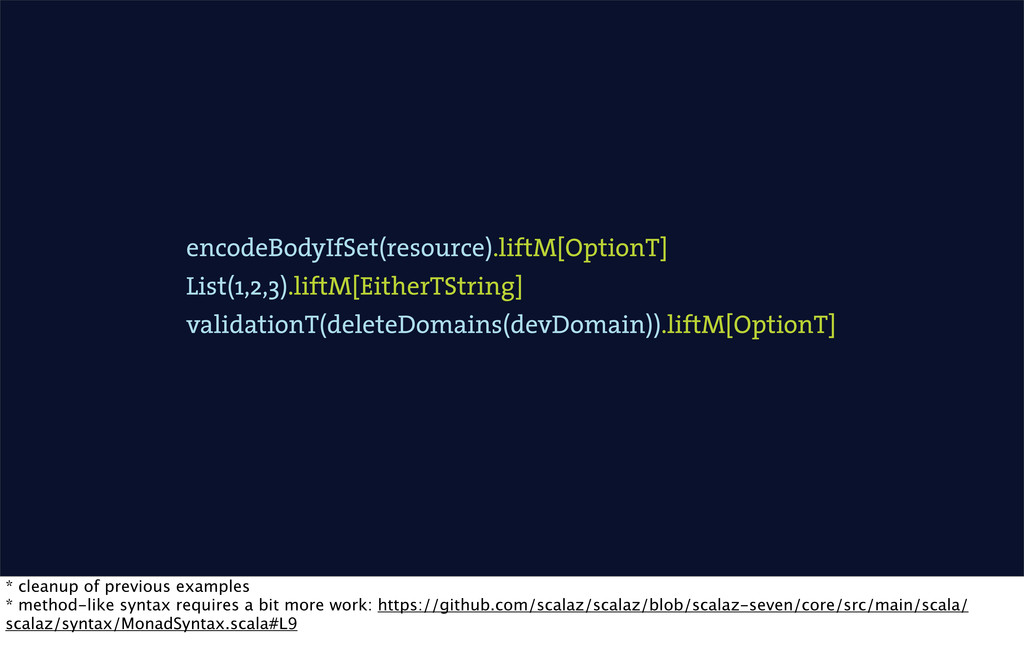
encodeBodyIfSet(resource).liftM[OptionT] List(1,2,3).liftM[EitherTString] validationT(deleteDomains(devDomain)).liftM[OptionT] * cleanup of previous examples * method-like
syntax requires a bit more work: https://github.com/scalaz/scalaz/blob/scalaz-seven/core/src/main/scala/ scalaz/syntax/MonadSyntax.scala#L9 -
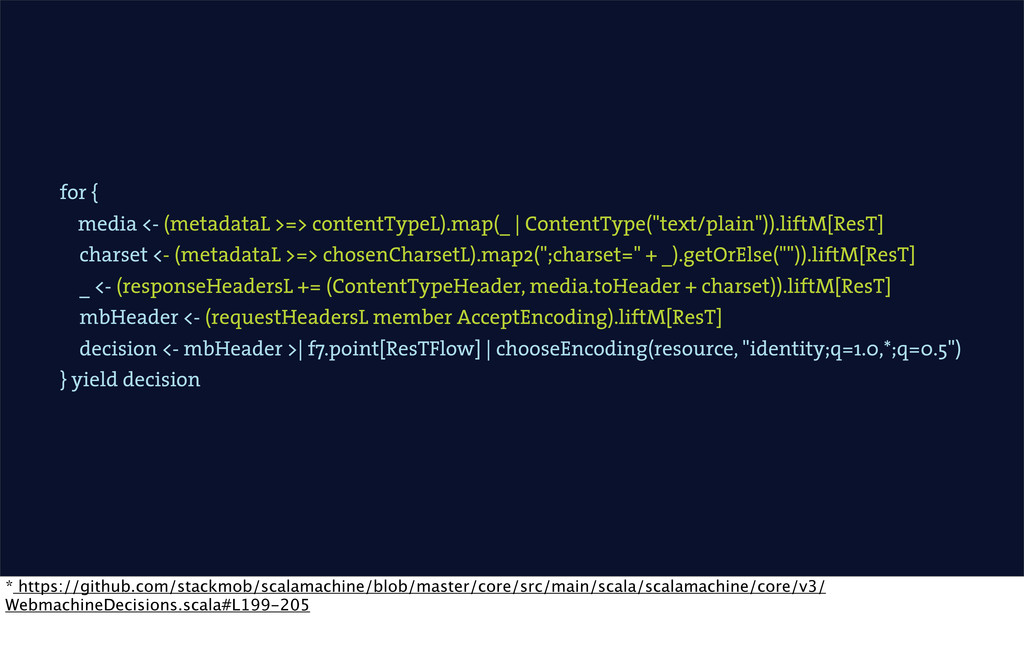
for { media <- (metadataL >=> contentTypeL).map(_ | ContentType("text/plain")).liftM[ResT] charset
<- (metadataL >=> chosenCharsetL).map2(";charset=" + _).getOrElse("")).liftM[ResT] _ <- (responseHeadersL += (ContentTypeHeader, media.toHeader + charset)).liftM[ResT] mbHeader <- (requestHeadersL member AcceptEncoding).liftM[ResT] decision <- mbHeader >| f7.point[ResTFlow] | chooseEncoding(resource, "identity;q=1.0,*;q=0.5") } yield decision * https://github.com/stackmob/scalamachine/blob/master/core/src/main/scala/scalamachine/core/v3/ WebmachineDecisions.scala#L199-205 -
STACKING MONADS COMPOSES EFFECTS * when monads are stacked an
embedded language is being built with multiple effects * this is not the only intuition of monads/transformers -
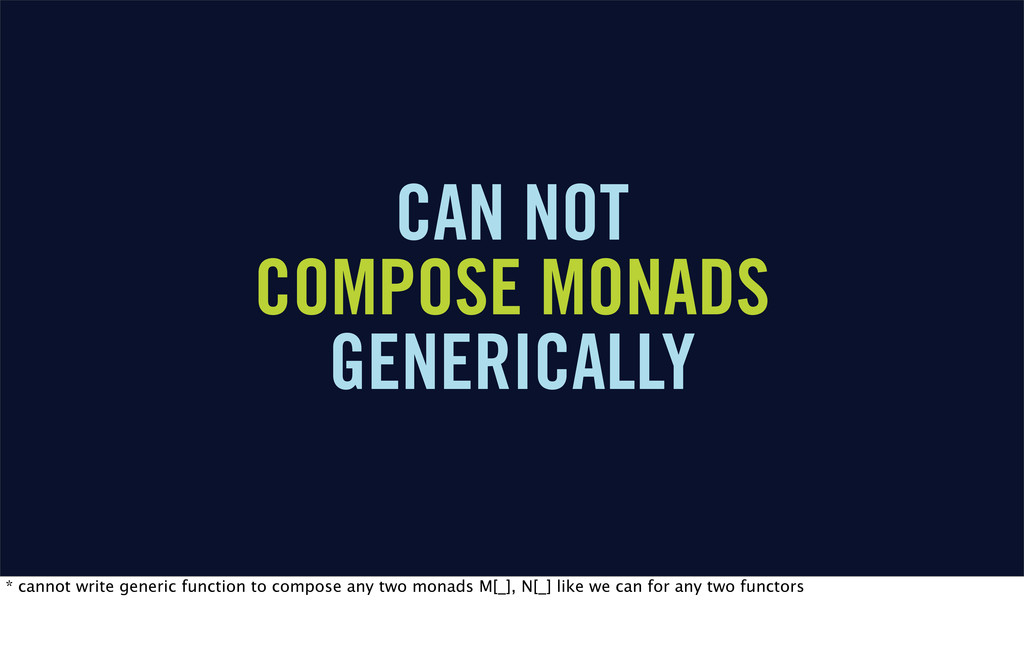
CAN NOT COMPOSE MONADS GENERICALLY * cannot write generic function
to compose any two monads M[_], N[_] like we can for any two functors -
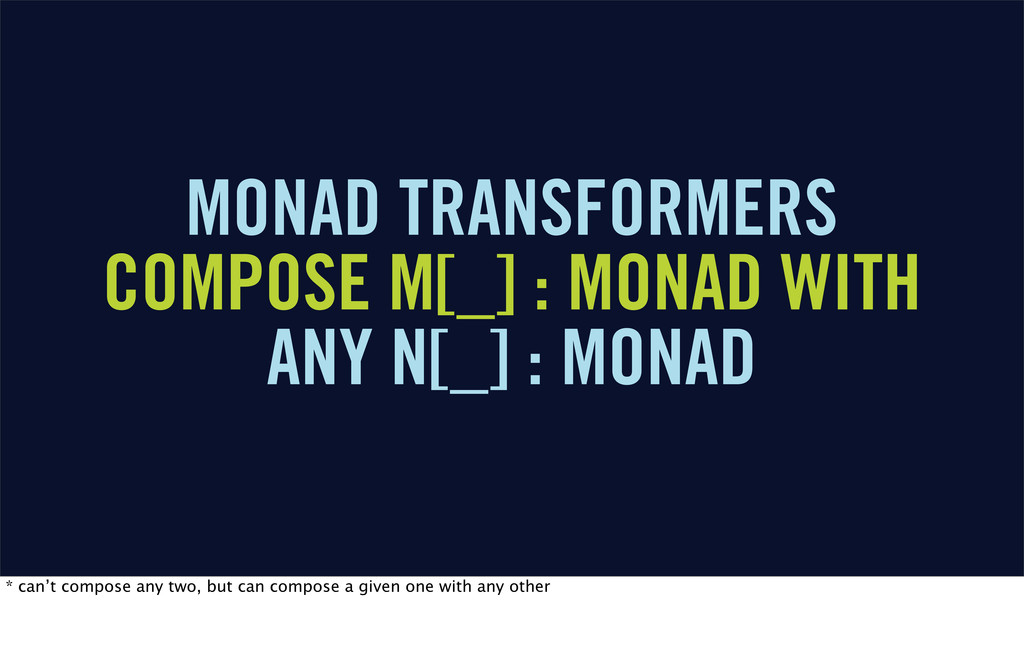
MONAD TRANSFORMERS COMPOSE M[_] : MONAD WITH ANY N[_] :
MONAD * can’t compose any two, but can compose a given one with any other -
MONAD TRANSFORMERS WRAP OTHER MONAD TRANSFORMERS * monad transformers are
monads * so they can be the N[_] : Monad that the transformer composes with its underlying monad -
MONADTRANS REDUCES REPETITION * often need to take a value
that is not entirely lifted into a monad transformer stack and do just that -
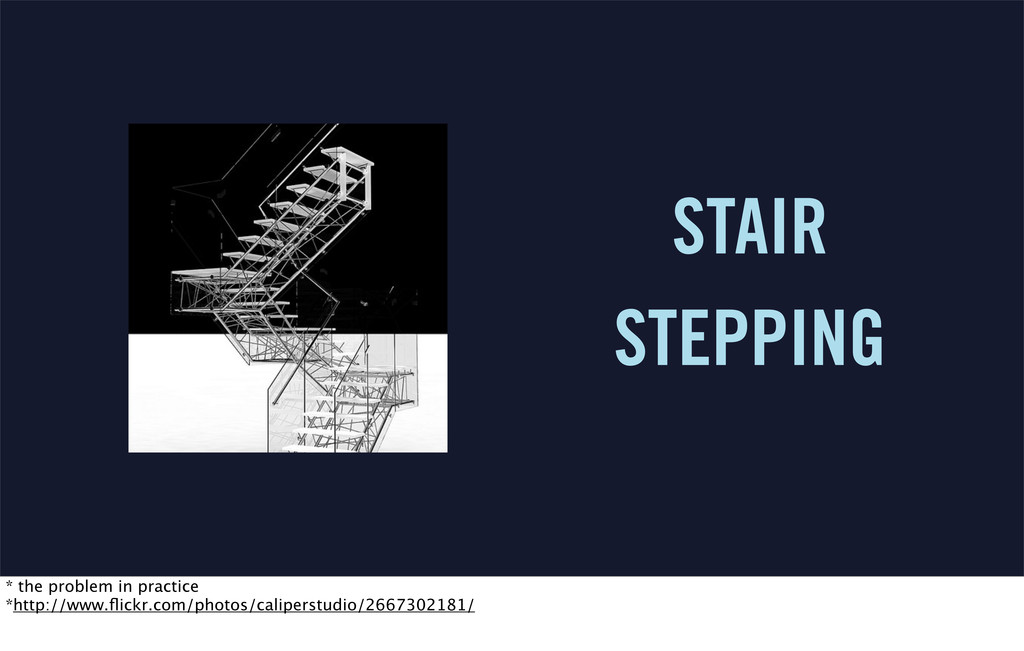
STACK MONADS DON’T STAIR-STEP * monad transformers reduce ugly, stair-stepping
or nested code and focuses on core task * focuses on intuition of mutiple effects instead of handling things haphazardly
 jrwest
 itsmedreamwalker
 j5ik2o
 tarao
 kmkim
 ziobrando
 barnbarn
 ooga04
 mtsmfm
 sodainc
 bicstone
 vivion
 steliosf
 samlambert
 baasie
 tammyeverts
 apolaine
 helmedeiros
 portentint
 reverentgeek
 szymonslowik
 codingconduct
 aleyda
 hannesfritz


(f :A=>F[B]):F[B]](https://files.speakerdeck.com/presentations/5011b0affd90ca00020056d3/slide_4.jpg)
: M[A] def map[A,B](ma: M[A])(f: A =>](https://files.speakerdeck.com/presentations/5011b0affd90ca00020056d3/slide_5.jpg)



![IO[Validation[Throwable,Option[A]] * and looking for that value may throw exceptions](https://files.speakerdeck.com/presentations/5011b0affd90ca00020056d3/slide_13.jpg)
![IO[(List[String], Validation[Throwable,Option[A])] * and logging what is going on is](https://files.speakerdeck.com/presentations/5011b0affd90ca00020056d3/slide_14.jpg)
(f :A=>B):F[B] }](https://files.speakerdeck.com/presentations/5011b0affd90ca00020056d3/slide_19.jpg)
![def composeFunctor[M[_],N[_]](implicit m: Functor[M], n: Functor[N]) = new Functor[({type MN[A]=[M[N[A]]]})#MN]](https://files.speakerdeck.com/presentations/5011b0affd90ca00020056d3/slide_20.jpg)
![def composeFunctor[M[_],N[_]](implicit m: Functor[M], n: Functor[N]) = new Functor[({type MN[A]=[M[N[A]]]})#MN]](https://files.speakerdeck.com/presentations/5011b0affd90ca00020056d3/slide_21.jpg)
![def notPossible[M[_],N[_]](implicit m: Monad[M], n: Monad[N]) = new Monad[({type MN[A]=[M[N[A]]]})#MN]](https://files.speakerdeck.com/presentations/5011b0affd90ca00020056d3/slide_23.jpg)
![def notPossible[M[_],N[_]](implicit m: Monad[M], n: Monad[N]) = new Monad[({type MN[A]=[M[N[A]]]})#MN]](https://files.speakerdeck.com/presentations/5011b0affd90ca00020056d3/slide_24.jpg)

![def b(data: MyData): IO[Option[MyData] BUT WHAT IF... * even w/](https://files.speakerdeck.com/presentations/5011b0affd90ca00020056d3/slide_31.jpg)


 define type that boxes box the](https://files.speakerdeck.com/presentations/5011b0affd90ca00020056d3/slide_34.jpg)
: IOOption[A] = IOOption(a.point[Option].point[IO])](https://files.speakerdeck.com/presentations/5011b0affd90ca00020056d3/slide_35.jpg)

 * what](https://files.speakerdeck.com/presentations/5011b0affd90ca00020056d3/slide_37.jpg)
(f: A => B): MyStateOption[B]](https://files.speakerdeck.com/presentations/5011b0affd90ca00020056d3/slide_38.jpg)
![case class OptionT[M[_], A](run: M[Option[A]]) define a new type parameterized](https://files.speakerdeck.com/presentations/5011b0affd90ca00020056d3/slide_39.jpg)
![case class OptionT[M[_], A](run: M[Option[A]]) { def map[B](f: A =>](https://files.speakerdeck.com/presentations/5011b0affd90ca00020056d3/slide_40.jpg)
![case class OptionT[M[_], A](run: M[Option[A]]) { def map[B](f: A =>](https://files.speakerdeck.com/presentations/5011b0affd90ca00020056d3/slide_41.jpg)
(f: A => B): IOOption[B]](https://files.speakerdeck.com/presentations/5011b0affd90ca00020056d3/slide_42.jpg)





![BOXES A VALUE run: M[MyMonad[A] * value is typically called](https://files.speakerdeck.com/presentations/5011b0affd90ca00020056d3/slide_50.jpg)
![case class OptionT[M[_], A](run: M[Option[A]]) { def getOrElse[AA >: A](d:](https://files.speakerdeck.com/presentations/5011b0affd90ca00020056d3/slide_54.jpg)


![FlowState[Option[A]] vs. Option[State[ReqRespData,A] * unboxing makes things easier to see](https://files.speakerdeck.com/presentations/5011b0affd90ca00020056d3/slide_62.jpg)
).map(_.point[Option])) eitherT[List,String,Int](List(1,2,3,4,5,6).map(Right(_))) resT[FlowState](encodeBodyIfSet(resource).map(_.point[Res])) * some cases require lifting the value](https://files.speakerdeck.com/presentations/5011b0affd90ca00020056d3/slide_65.jpg)
![trait MonadTrans[F[_[_], _]] { def liftM[G[_] : Monad, A](a: G[A]):](https://files.speakerdeck.com/presentations/5011b0affd90ca00020056d3/slide_67.jpg)
![def liftM[G[_], A](a: G[A])(implicit G: Monad[G]): OptionT[G, A] = OptionT[G,](https://files.speakerdeck.com/presentations/5011b0affd90ca00020056d3/slide_68.jpg)
![def liftM[G[_], A](ga: G[A])(implicit G: Monad[G]): ResT[G,A] = ResT[G,A](G.map(ga)(_.point[Res])) *](https://files.speakerdeck.com/presentations/5011b0affd90ca00020056d3/slide_69.jpg)