Upgrade to Pro — share decks privately, control downloads, hide ads and more …

Article 54.1 of the Russian Tax Code and Foreig...

Article 54.1 of the Russian Tax Code and Foreign-Owned Groups

A twelve-slide practitioner deck by Vetrov & Partners — a boutique Russian law firm — on Article 54.1 of the Russian Tax Code: the two cumulative conditions, the arrangements the Federal Tax Service typically targets in foreign-owned groups (management fees, royalties, shared services, R&D cost-sharing), the four evidentiary dimensions of an audit, the administrative appeal to UFNS, and the litigation calculus through the arbitrazh courts.

Read the full practitioner note at https://vetrovpartners.com/insights/article-54-1-russian-tax-foreign-groups/

More from Vetrov & Partners: https://vetrovpartners.com

Avatar for Vetrov & Partners

Vetrov & Partners

May 21, 2026

More Decks by Vetrov & Partners

Other Decks in Business

Transcript

  1. VETROV & PARTNERS ISSUE NO. XVII · 2026 PRACTICE ANALYSIS

    · TAX CONTROVERSY Article 54.1 and foreign-owned groups. Defending Russian tax audits in 2026. § I Twelve slides · Approx. 8 minutes vetrovpartners.com Boutique Russian law firm · Established 2009
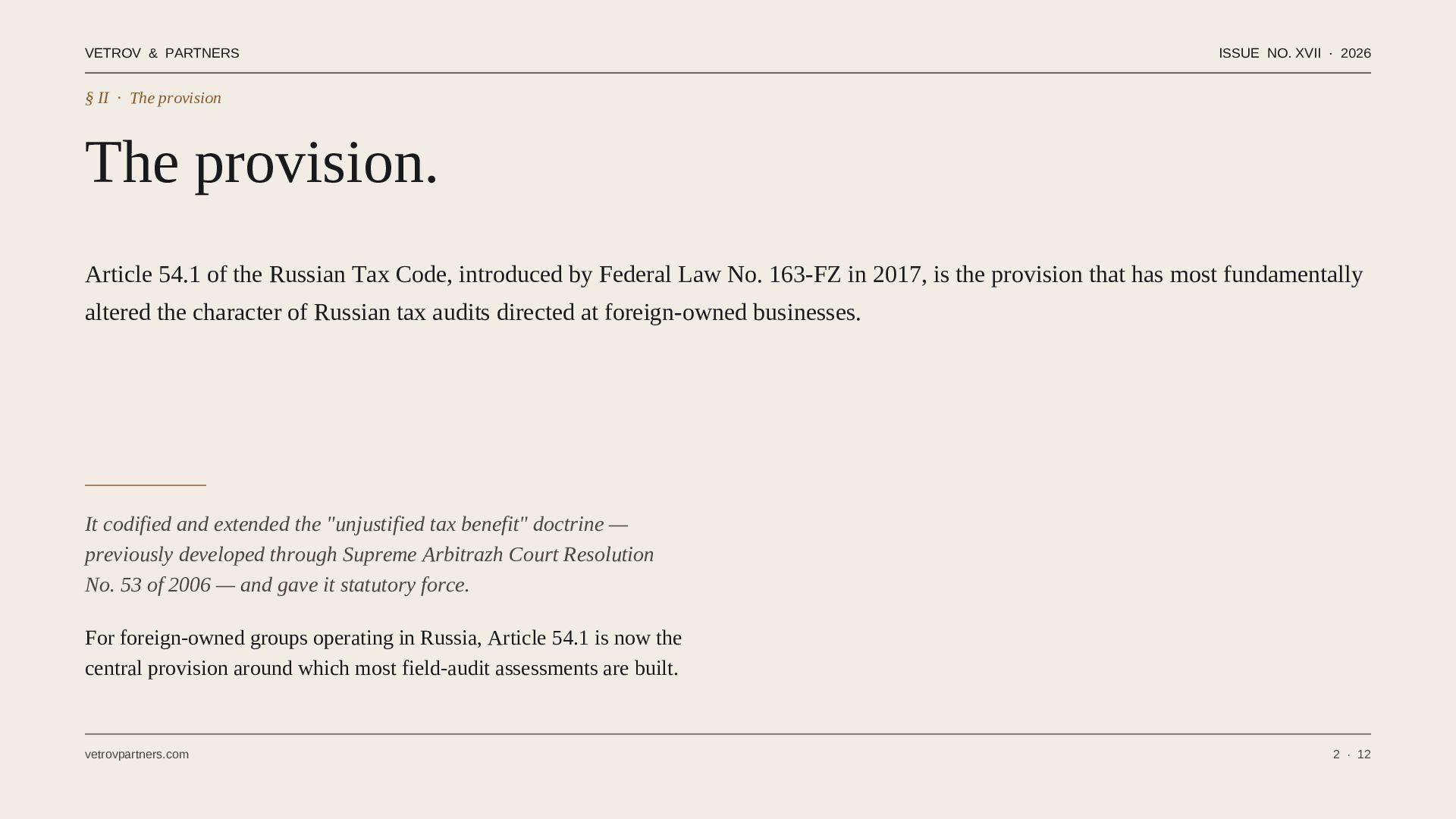
  2. VETROV & PARTNERS ISSUE NO. XVII · 2026 § II

    · The provision The provision. Article 54.1 of the Russian Tax Code, introduced by Federal Law No. 163-FZ in 2017, is the provision that has most fundamentally altered the character of Russian tax audits directed at foreign-owned businesses. It codified and extended the "unjustified tax benefit" doctrine — previously developed through Supreme Arbitrazh Court Resolution No. 53 of 2006 — and gave it statutory force. For foreign-owned groups operating in Russia, Article 54.1 is now the central provision around which most field-audit assessments are built. vetrovpartners.com 2 · 12
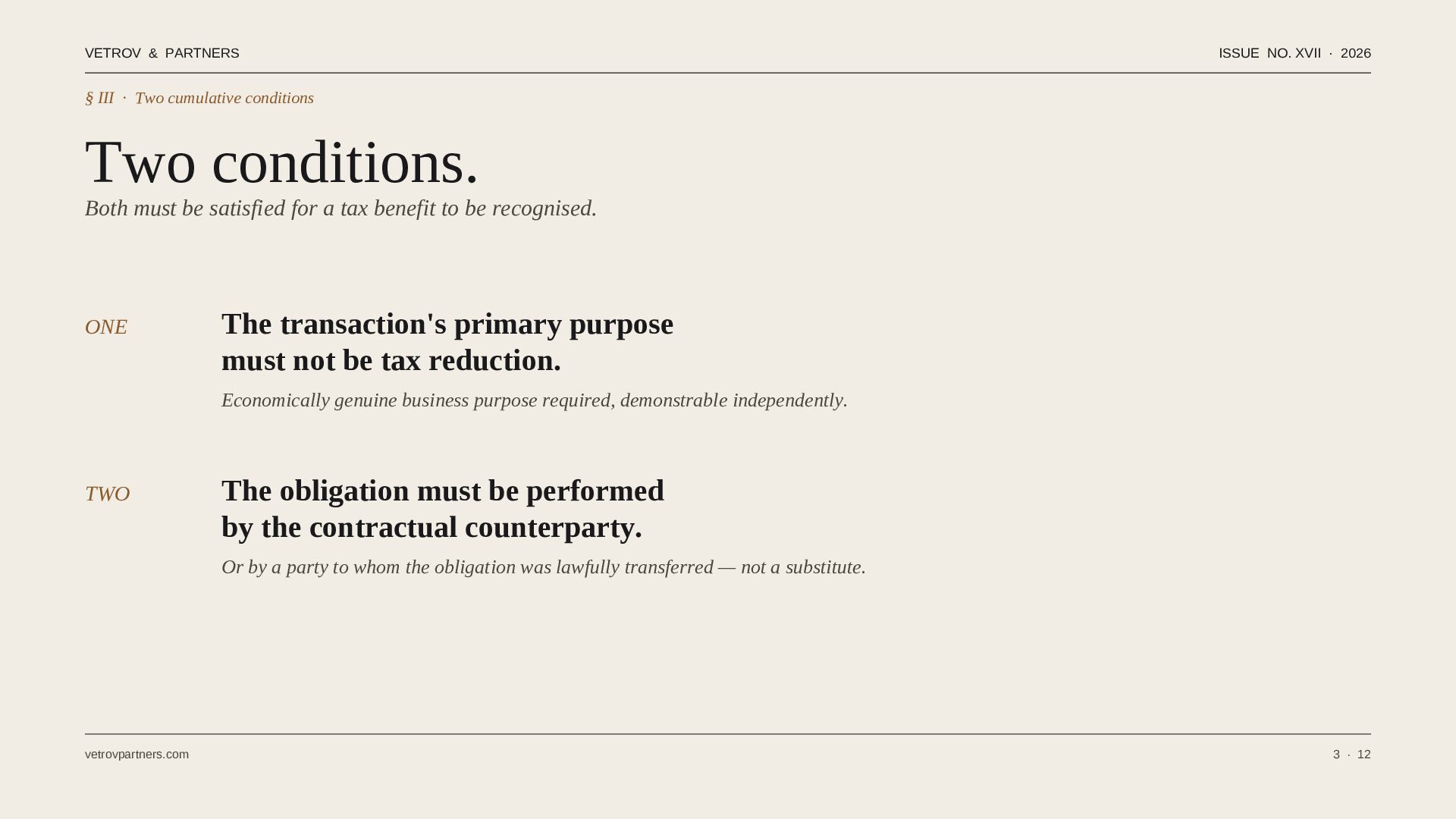
  3. VETROV & PARTNERS ISSUE NO. XVII · 2026 § III

    · Two cumulative conditions Two conditions. Both must be satisfied for a tax benefit to be recognised. ONE The transaction's primary purpose must not be tax reduction. Economically genuine business purpose required, demonstrable independently. TWO The obligation must be performed by the contractual counterparty. Or by a party to whom the obligation was lawfully transferred — not a substitute. vetrovpartners.com 3 · 12
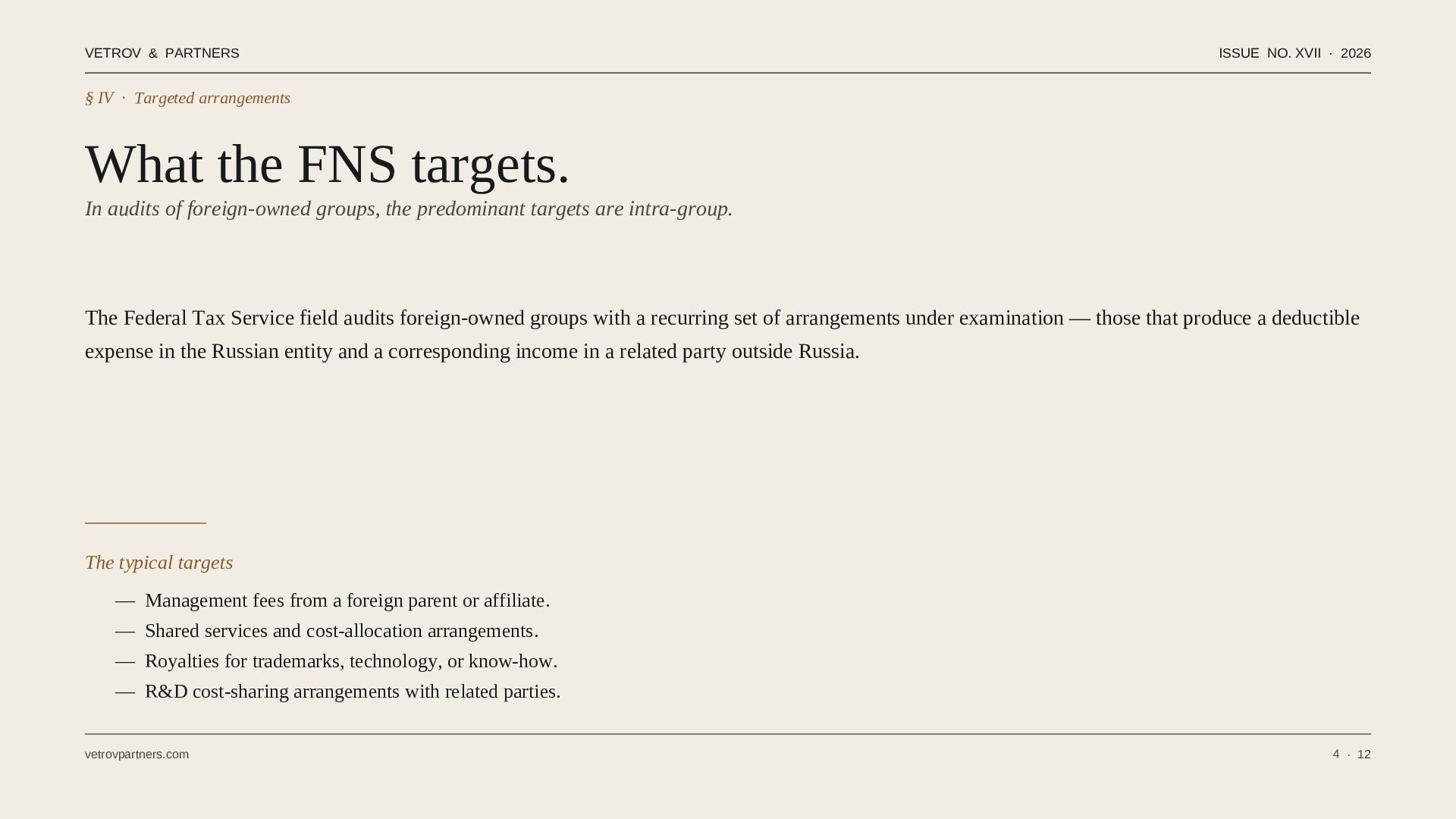
  4. VETROV & PARTNERS ISSUE NO. XVII · 2026 § IV

    · Targeted arrangements What the FNS targets. In audits of foreign-owned groups, the predominant targets are intra-group. The Federal Tax Service field audits foreign-owned groups with a recurring set of arrangements under examination — those that produce a deductible expense in the Russian entity and a corresponding income in a related party outside Russia. The typical targets — Management fees from a foreign parent or affiliate. — Shared services and cost-allocation arrangements. — Royalties for trademarks, technology, or know-how. — R&D cost-sharing arrangements with related parties. vetrovpartners.com 4 · 12
  5. VETROV & PARTNERS ISSUE NO. XVII · 2026 § V

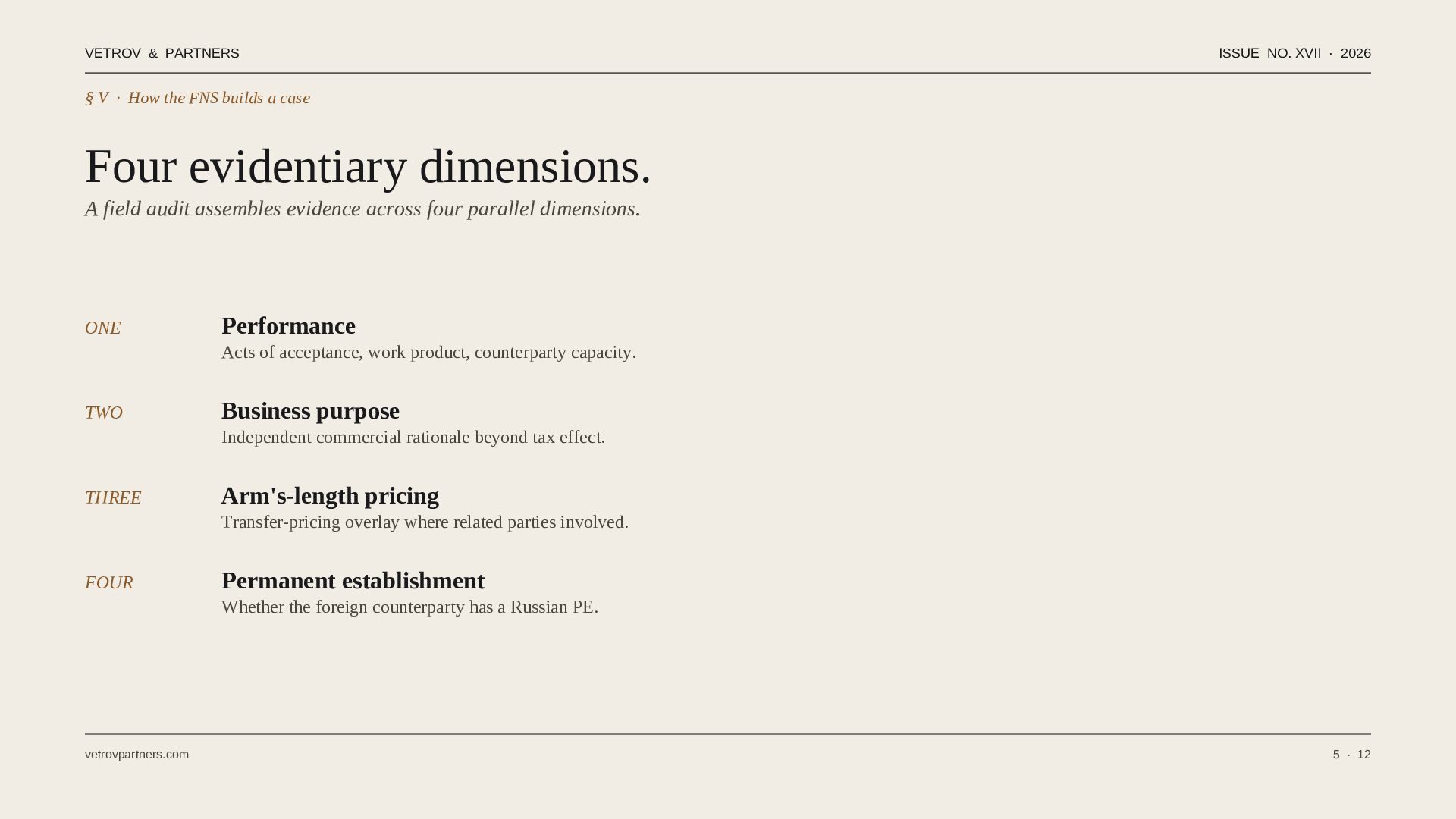
    · How the FNS builds a case Four evidentiary dimensions. A field audit assembles evidence across four parallel dimensions. ONE Performance Acts of acceptance, work product, counterparty capacity. TWO Business purpose Independent commercial rationale beyond tax effect. THREE Arm's-length pricing Transfer-pricing overlay where related parties involved. FOUR Permanent establishment Whether the foreign counterparty has a Russian PE. vetrovpartners.com 5 · 12
  6. VETROV & PARTNERS ISSUE NO. XVII · 2026 § VI

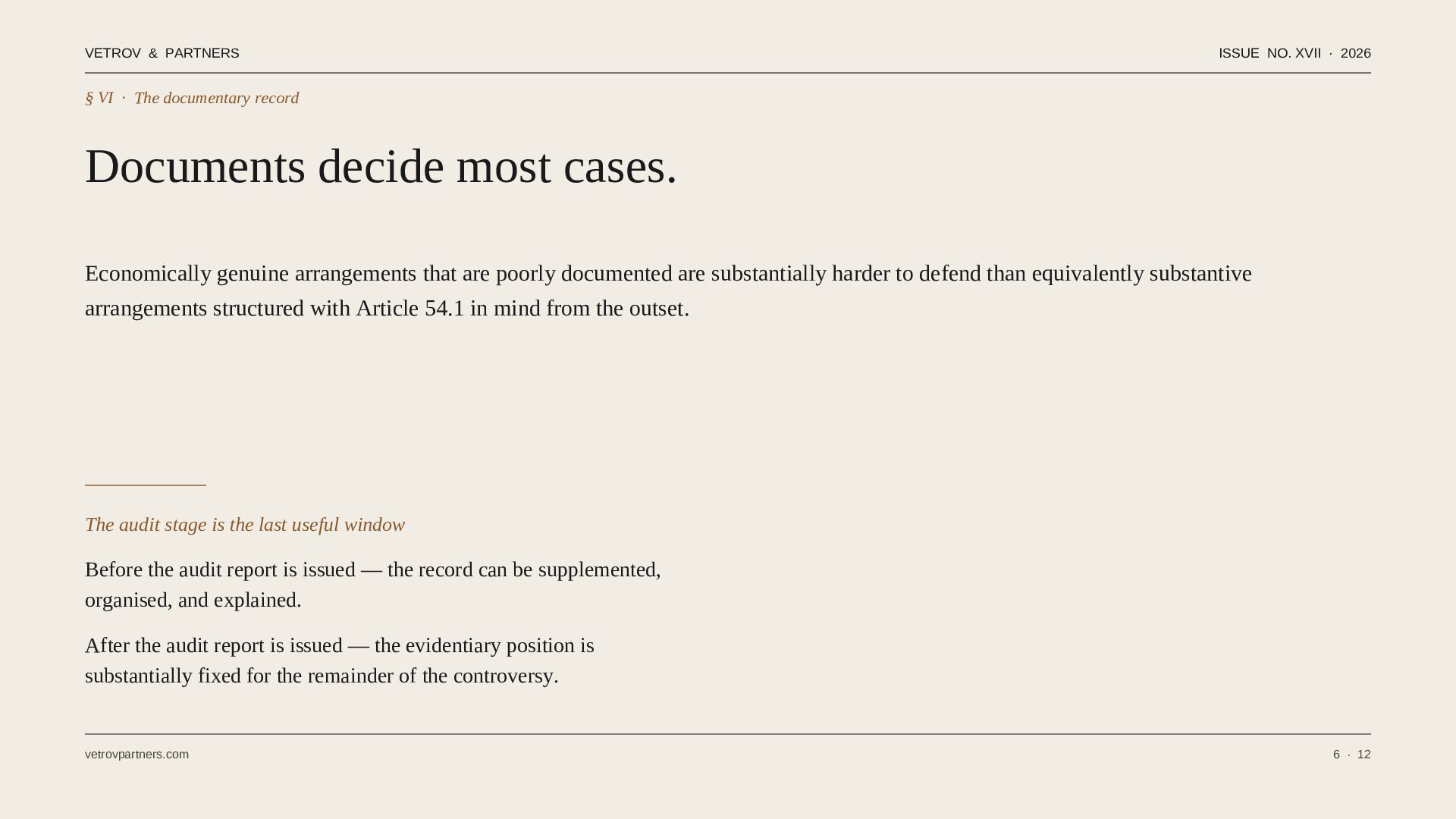
    · The documentary record Documents decide most cases. Economically genuine arrangements that are poorly documented are substantially harder to defend than equivalently substantive arrangements structured with Article 54.1 in mind from the outset. The audit stage is the last useful window Before the audit report is issued — the record can be supplemented, organised, and explained. After the audit report is issued — the evidentiary position is substantially fixed for the remainder of the controversy. vetrovpartners.com 6 · 12
  7. VETROV & PARTNERS ISSUE NO. XVII · 2026 § VII

    · The audit lifecycle From notification to litigation. Four stages — each with different procedural opportunities. 1 Field audit Up to six months. Three preceding calendar years. 2 Audit report Findings issued. Two months to respond in writing. 3 Administrative appeal To UFNS — the superior tax authority. One month. 4 Arbitrazh court Three-month limitation period from UFNS decision. vetrovpartners.com 7 · 12
  8. VETROV & PARTNERS ISSUE NO. XVII · 2026 § VIII

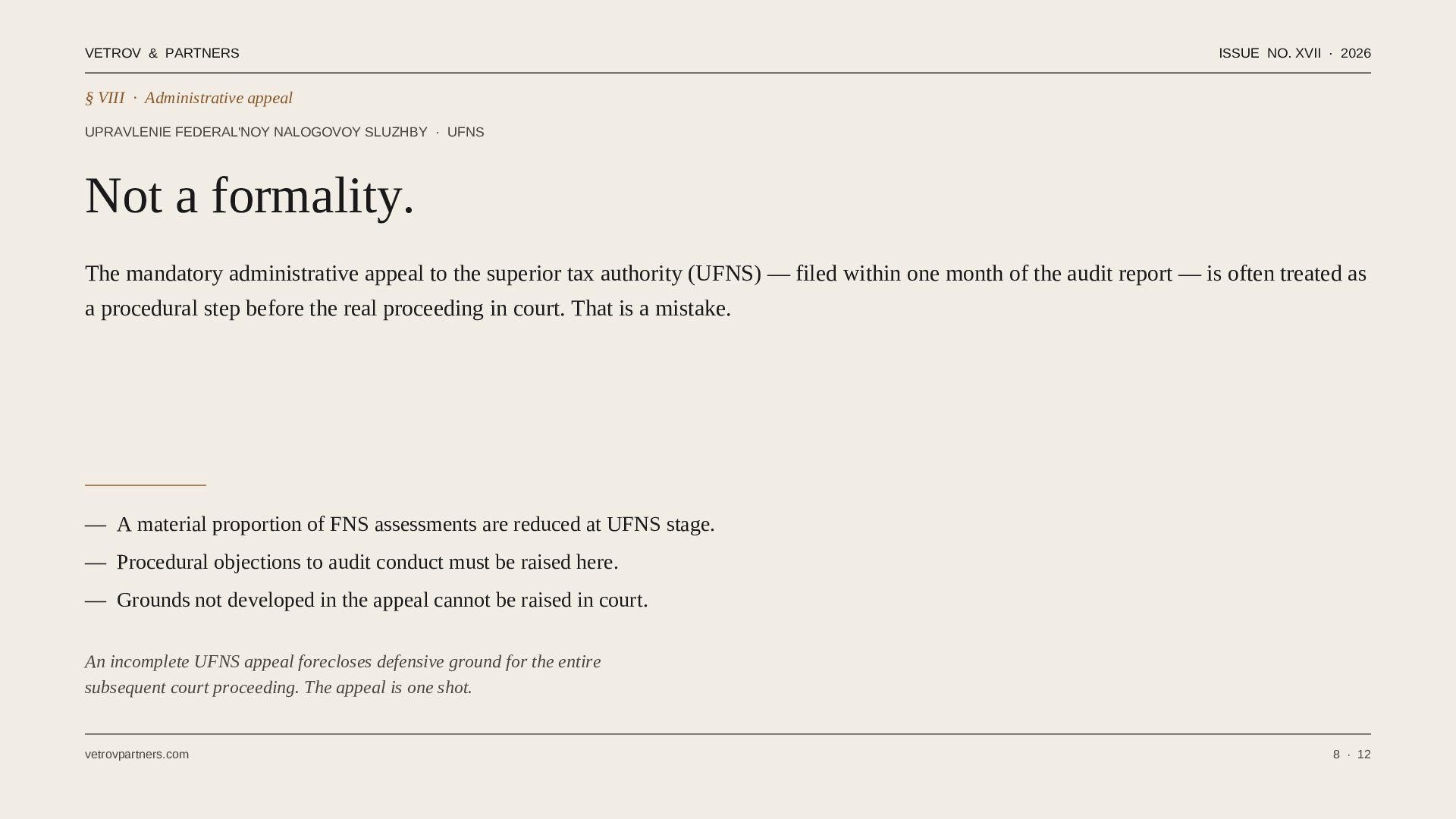
    · Administrative appeal UPRAVLENIE FEDERAL'NOY NALOGOVOY SLUZHBY · UFNS Not a formality. The mandatory administrative appeal to the superior tax authority (UFNS) — filed within one month of the audit report — is often treated as a procedural step before the real proceeding in court. That is a mistake. — A material proportion of FNS assessments are reduced at UFNS stage. — Procedural objections to audit conduct must be raised here. — Grounds not developed in the appeal cannot be raised in court. An incomplete UFNS appeal forecloses defensive ground for the entire subsequent court proceeding. The appeal is one shot. vetrovpartners.com 8 · 12
  9. VETROV & PARTNERS ISSUE NO. XVII · 2026 § IX

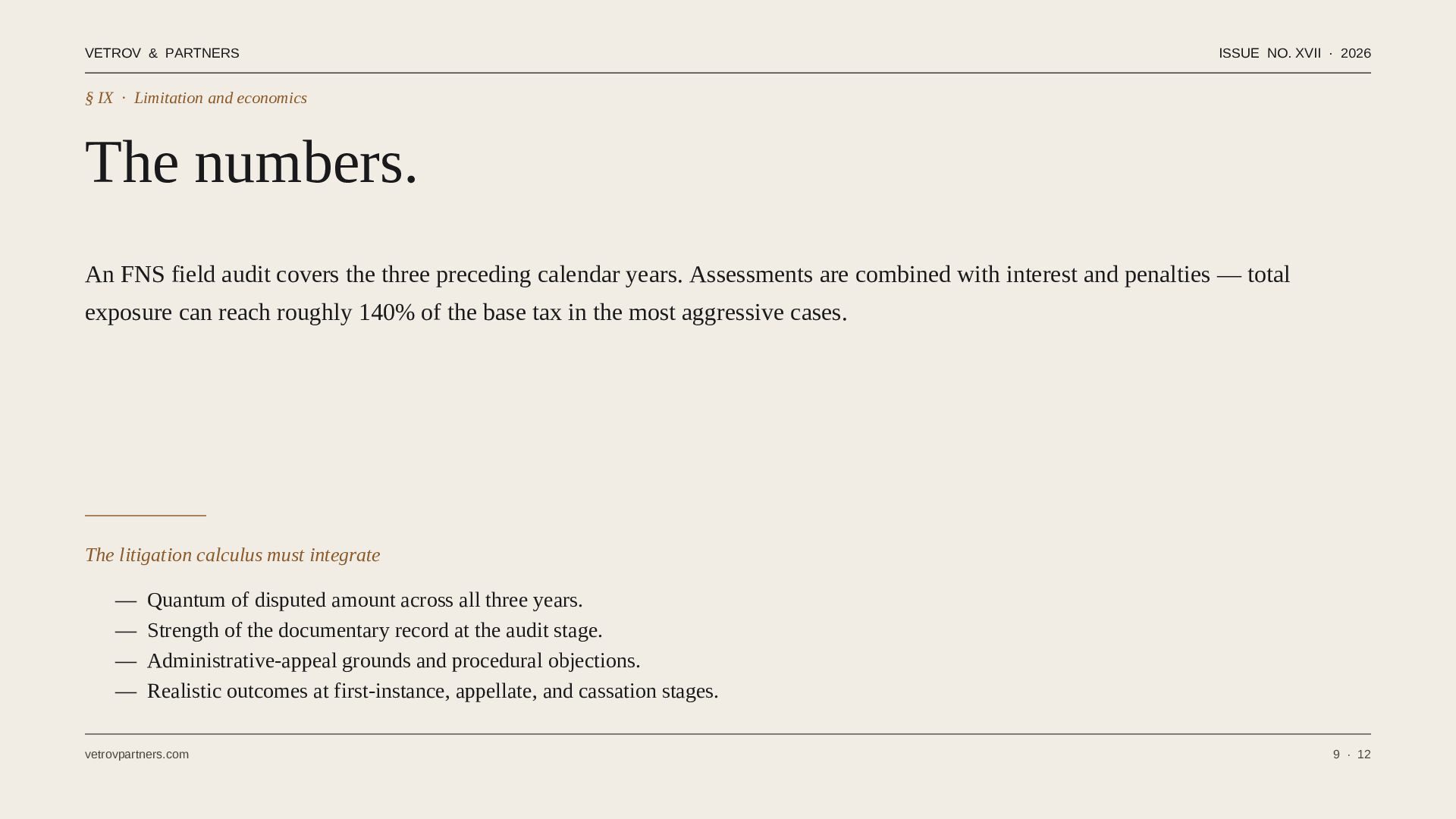
    · Limitation and economics The numbers. An FNS field audit covers the three preceding calendar years. Assessments are combined with interest and penalties — total exposure can reach roughly 140% of the base tax in the most aggressive cases. The litigation calculus must integrate — Quantum of disputed amount across all three years. — Strength of the documentary record at the audit stage. — Administrative-appeal grounds and procedural objections. — Realistic outcomes at first-instance, appellate, and cassation stages. vetrovpartners.com 9 · 12
  10. VETROV & PARTNERS ISSUE NO. XVII · 2026 § X

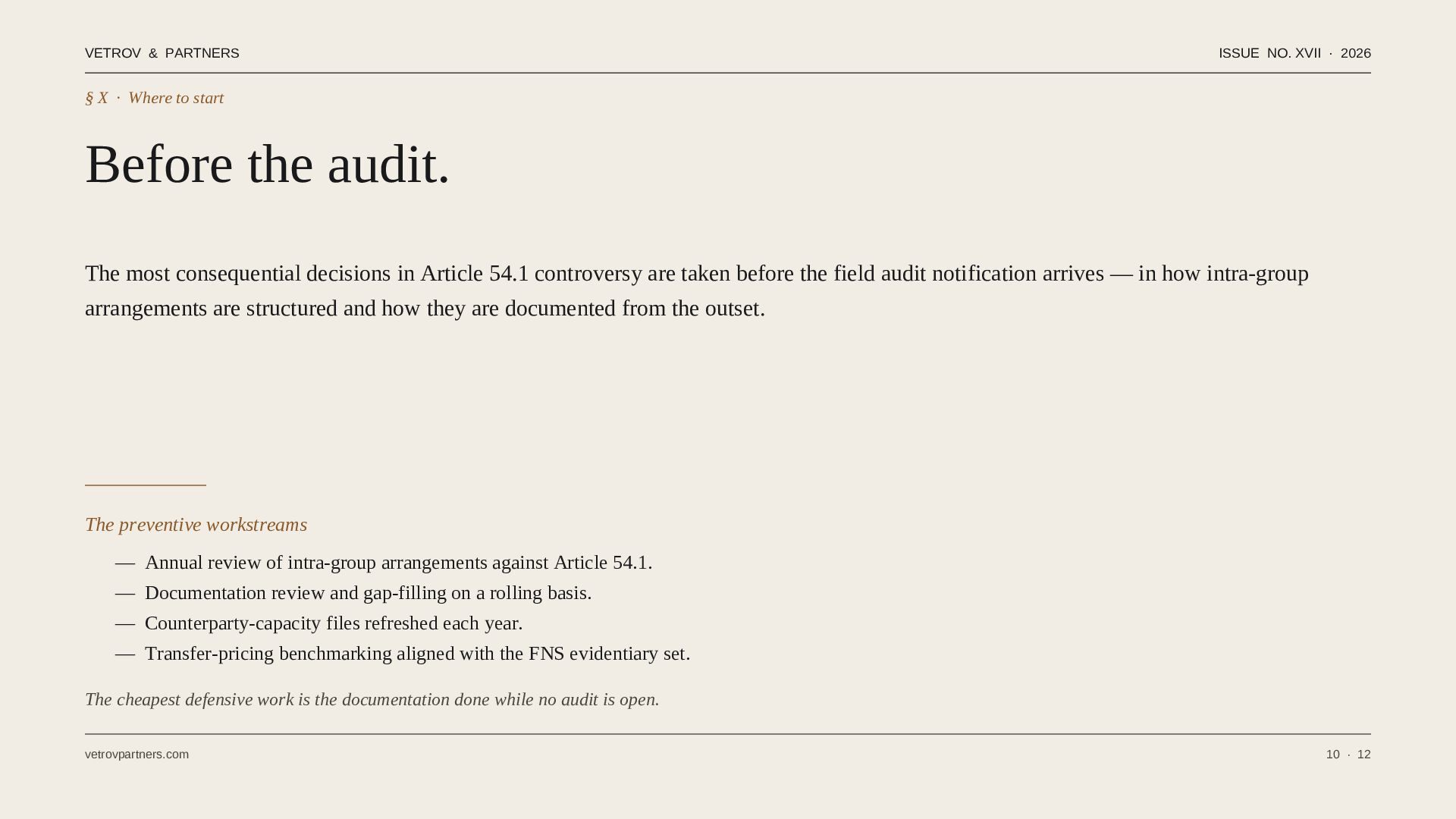
    · Where to start Before the audit. The most consequential decisions in Article 54.1 controversy are taken before the field audit notification arrives — in how intra-group arrangements are structured and how they are documented from the outset. The preventive workstreams — Annual review of intra-group arrangements against Article 54.1. — Documentation review and gap-filling on a rolling basis. — Counterparty-capacity files refreshed each year. — Transfer-pricing benchmarking aligned with the FNS evidentiary set. The cheapest defensive work is the documentation done while no audit is open. vetrovpartners.com 10 · 12
  11. VETROV & PARTNERS ISSUE NO. XVII · 2026 § XI

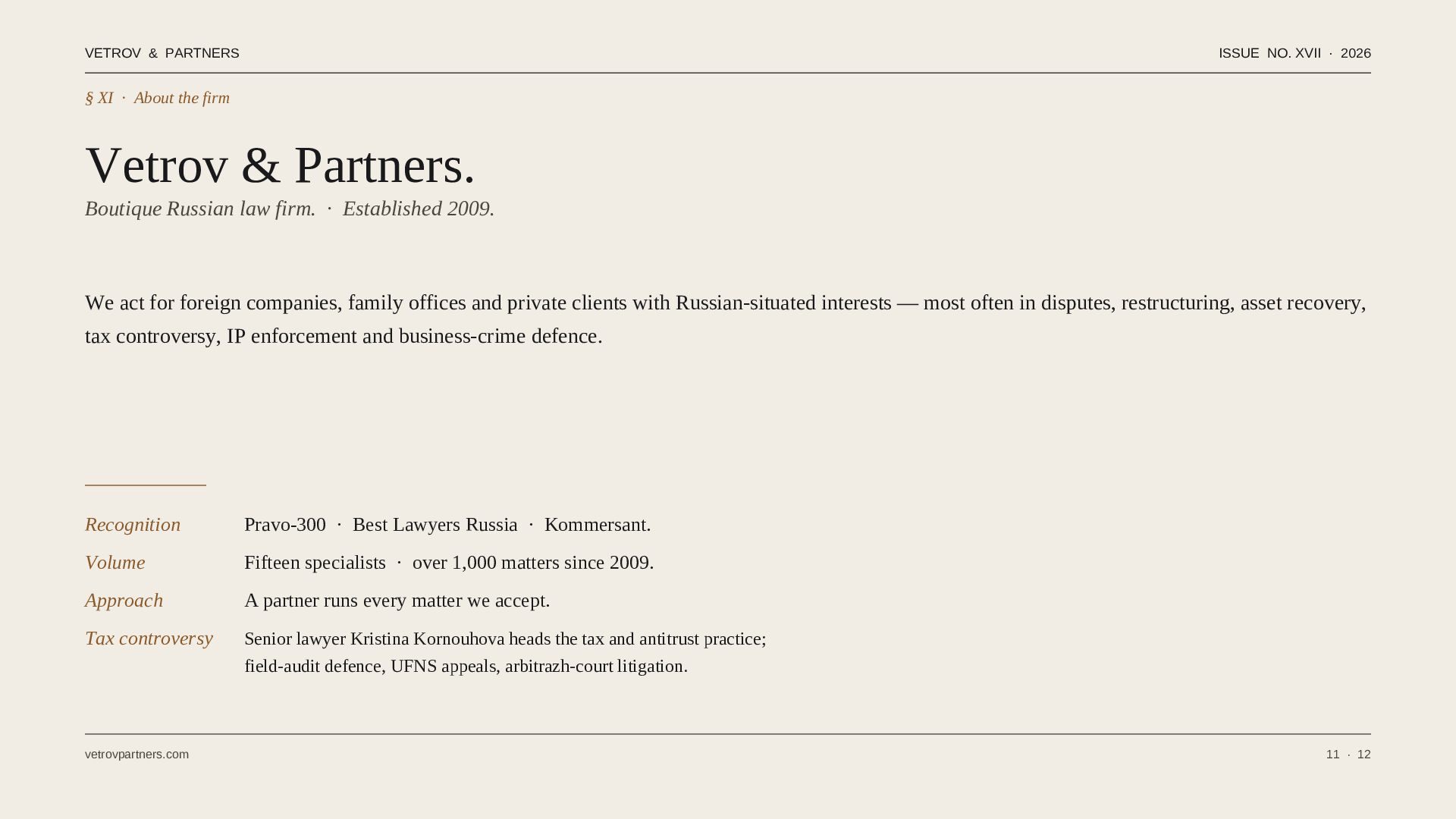
    · About the firm Vetrov & Partners. Boutique Russian law firm. · Established 2009. We act for foreign companies, family offices and private clients with Russian-situated interests — most often in disputes, restructuring, asset recovery, tax controversy, IP enforcement and business-crime defence. Recognition Pravo-300 · Best Lawyers Russia · Kommersant. Volume Fifteen specialists · over 1,000 matters since 2009. Approach A partner runs every matter we accept. Tax controversy Senior lawyer Kristina Kornouhova heads the tax and antitrust practice; field-audit defence, UFNS appeals, arbitrazh-court litigation. vetrovpartners.com 11 · 12
  12. VETROV & PARTNERS ISSUE NO. XVII · 2026 Read the

    full practitioner note. vetrovpartners.com/insights/article-54-1-russian-tax-foreign-groups/ Or visit vetrovpartners.com · [email protected] § XII vetrovpartners.com © 2009–2026 Vetrov & Partners. All rights reserved.