Upgrade to Pro — share decks privately, control downloads, hide ads and more …

Trademark Squatting in Russia — Legal Routes fo...

Trademark Squatting in Russia — Legal Routes for Foreign Rights Holders

A twelve-slide practitioner deck by Vetrov & Partners — a boutique Russian law firm — mapping the three procedural routes available to foreign rights holders whose marks have been registered in Russia by a squatter. Article 1486 non-use cancellation before the Intellectual Property Court; Article 1512 bad-faith invalidation; opposition before Rospatent's Chamber for Patent Disputes; and parallel TROIS customs registration.

Read the full practitioner note at https://vetrovpartners.com/insights/trademark-squatting-russia-foreign-brands/

More from Vetrov & Partners: https://vetrovpartners.com

Avatar for Vetrov & Partners

Vetrov & Partners

May 21, 2026

More Decks by Vetrov & Partners

Other Decks in Business

Transcript

  1. VETROV & PARTNERS ISSUE NO. XVII · 2026 PRACTICE ANALYSIS

    · IP ENFORCEMENT IN RUSSIA Trademark Squatting in Russia. Legal routes for foreign rights holders. § I Twelve slides · Approx. 8 minutes vetrovpartners.com Boutique Russian law firm · Established 2009
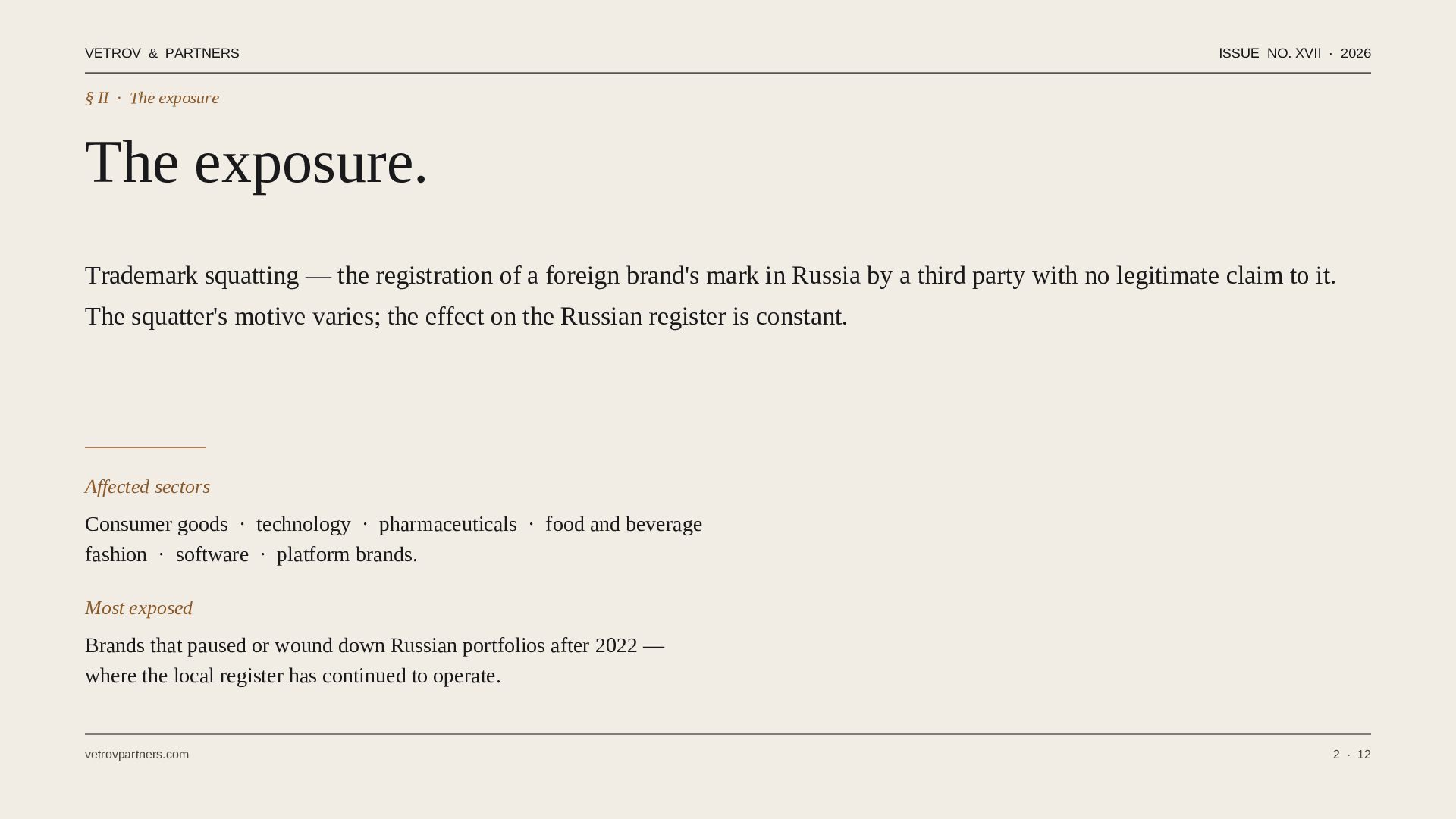
  2. VETROV & PARTNERS ISSUE NO. XVII · 2026 § II

    · The exposure The exposure. Trademark squatting — the registration of a foreign brand's mark in Russia by a third party with no legitimate claim to it. The squatter's motive varies; the effect on the Russian register is constant. Affected sectors Consumer goods · technology · pharmaceuticals · food and beverage fashion · software · platform brands. Most exposed Brands that paused or wound down Russian portfolios after 2022 — where the local register has continued to operate. vetrovpartners.com 2 · 12
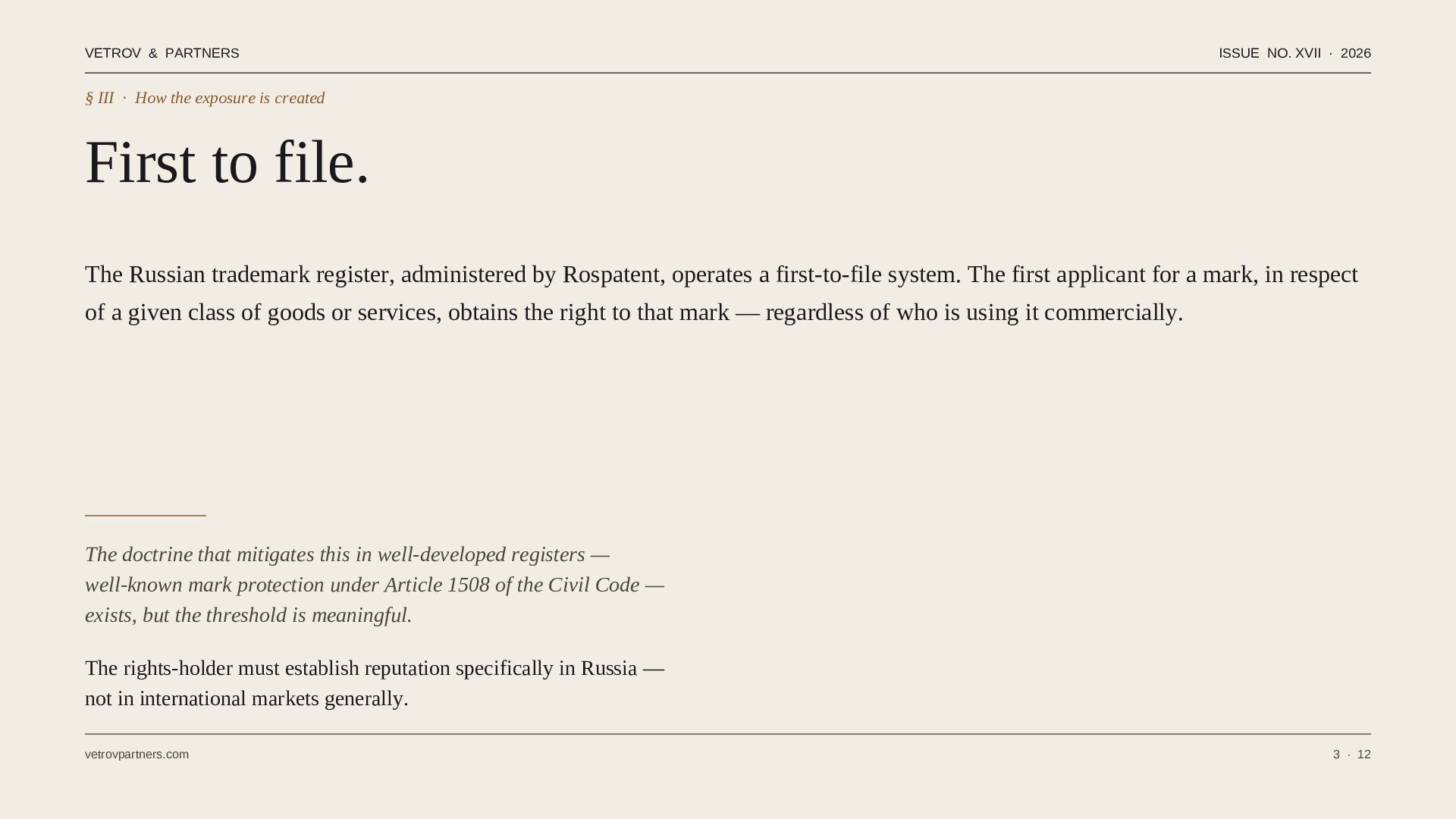
  3. VETROV & PARTNERS ISSUE NO. XVII · 2026 § III

    · How the exposure is created First to file. The Russian trademark register, administered by Rospatent, operates a first-to-file system. The first applicant for a mark, in respect of a given class of goods or services, obtains the right to that mark — regardless of who is using it commercially. The doctrine that mitigates this in well-developed registers — well-known mark protection under Article 1508 of the Civil Code — exists, but the threshold is meaningful. The rights-holder must establish reputation specifically in Russia — not in international markets generally. vetrovpartners.com 3 · 12
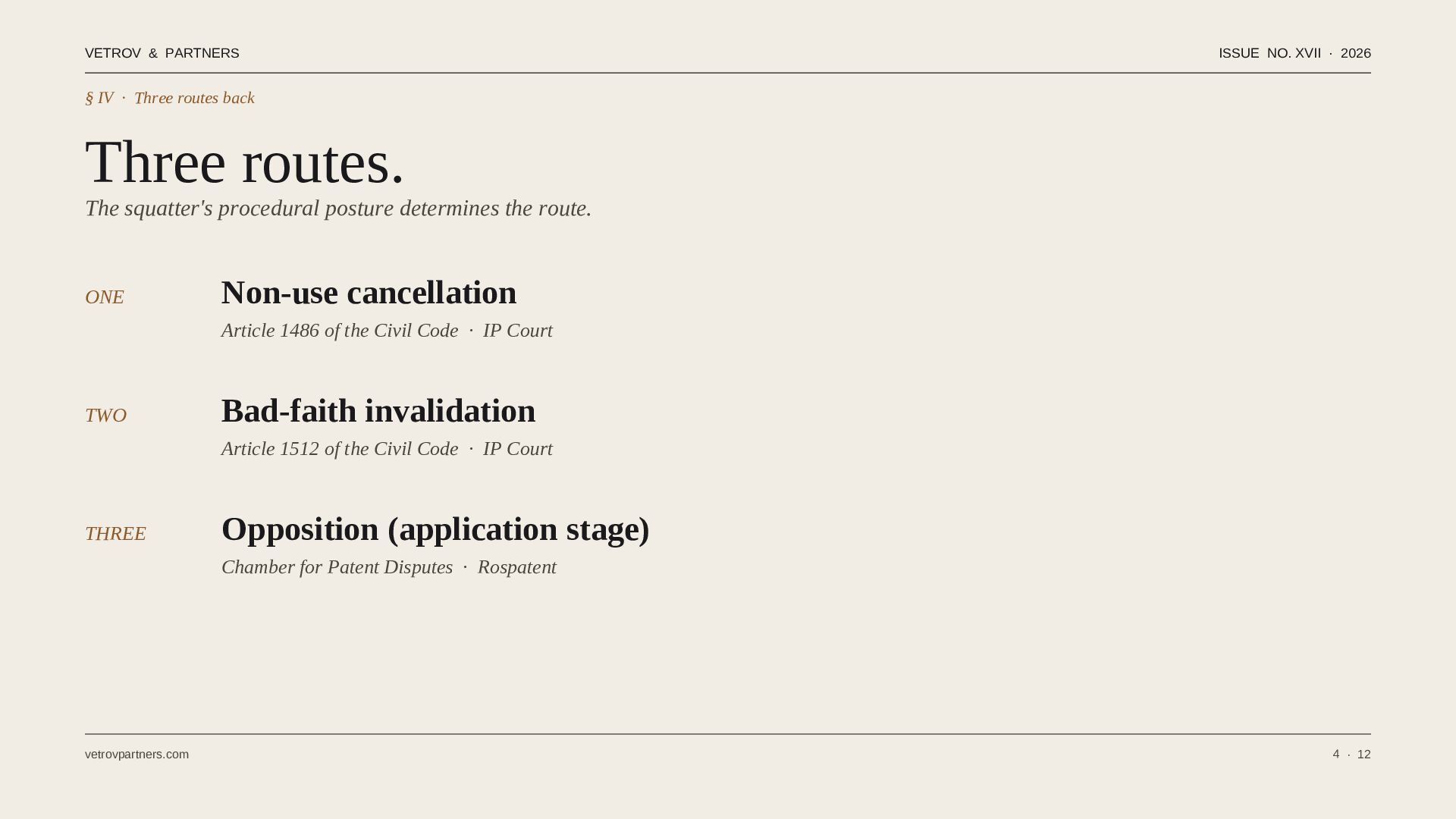
  4. VETROV & PARTNERS ISSUE NO. XVII · 2026 § IV

    · Three routes back Three routes. The squatter's procedural posture determines the route. ONE Non-use cancellation Article 1486 of the Civil Code · IP Court TWO Bad-faith invalidation Article 1512 of the Civil Code · IP Court THREE Opposition (application stage) Chamber for Patent Disputes · Rospatent vetrovpartners.com 4 · 12
  5. VETROV & PARTNERS ISSUE NO. XVII · 2026 § V

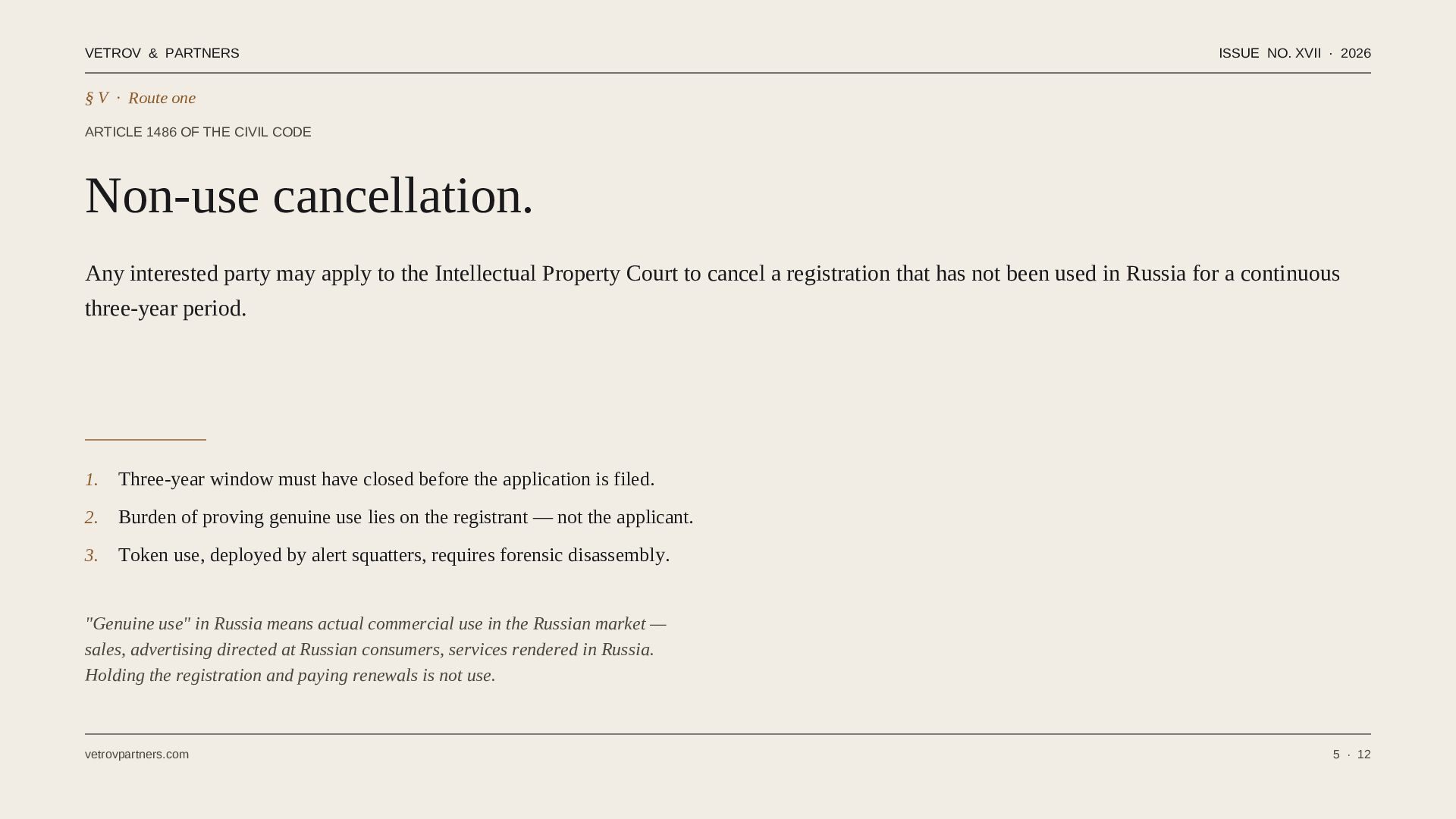
    · Route one ARTICLE 1486 OF THE CIVIL CODE Non-use cancellation. Any interested party may apply to the Intellectual Property Court to cancel a registration that has not been used in Russia for a continuous three-year period. 1. Three-year window must have closed before the application is filed. 2. Burden of proving genuine use lies on the registrant — not the applicant. 3. Token use, deployed by alert squatters, requires forensic disassembly. "Genuine use" in Russia means actual commercial use in the Russian market — sales, advertising directed at Russian consumers, services rendered in Russia. Holding the registration and paying renewals is not use. vetrovpartners.com 5 · 12
  6. VETROV & PARTNERS ISSUE NO. XVII · 2026 § VI

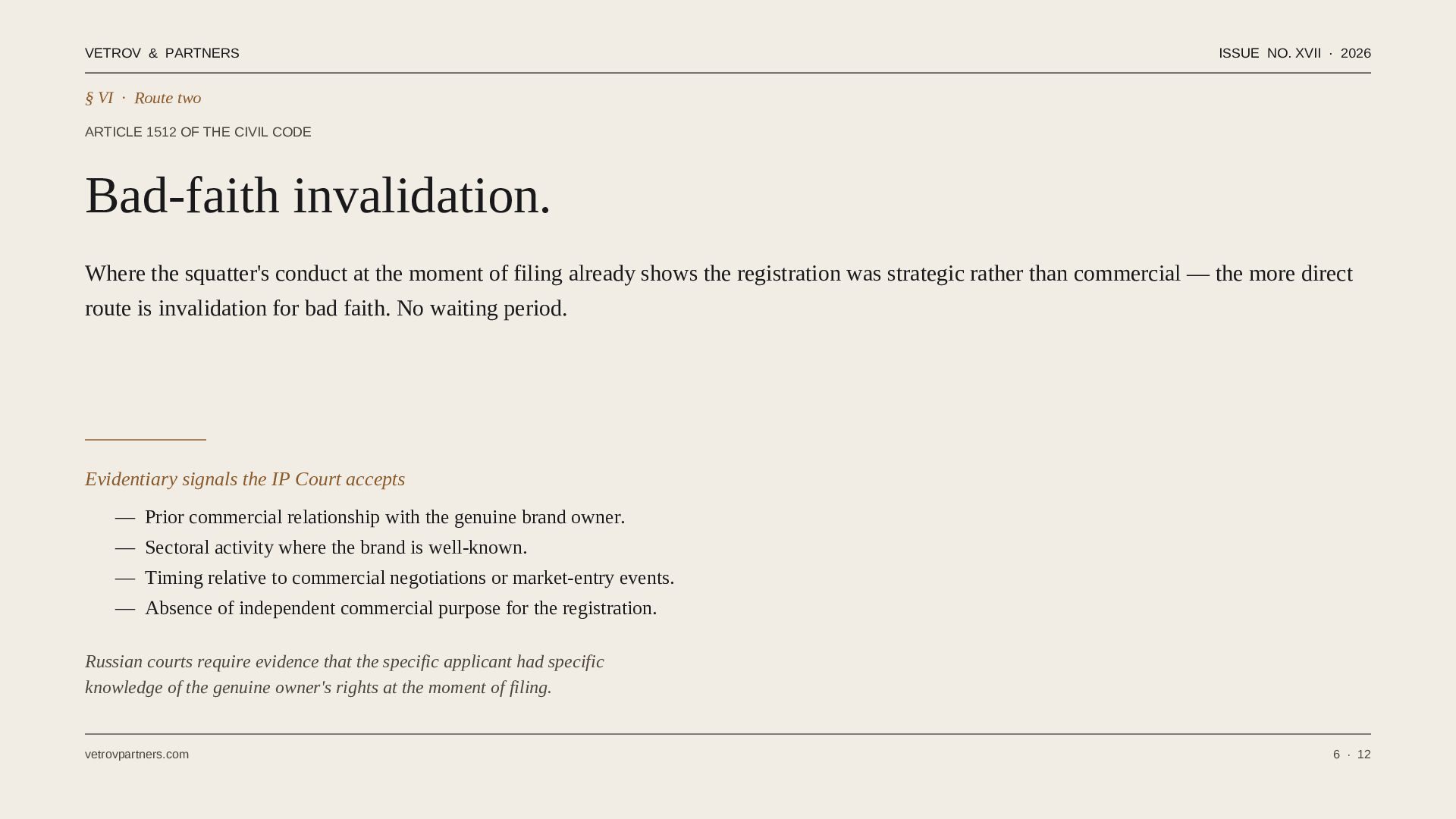
    · Route two ARTICLE 1512 OF THE CIVIL CODE Bad-faith invalidation. Where the squatter's conduct at the moment of filing already shows the registration was strategic rather than commercial — the more direct route is invalidation for bad faith. No waiting period. Evidentiary signals the IP Court accepts — Prior commercial relationship with the genuine brand owner. — Sectoral activity where the brand is well-known. — Timing relative to commercial negotiations or market-entry events. — Absence of independent commercial purpose for the registration. Russian courts require evidence that the specific applicant had specific knowledge of the genuine owner's rights at the moment of filing. vetrovpartners.com 6 · 12
  7. VETROV & PARTNERS ISSUE NO. XVII · 2026 § VII

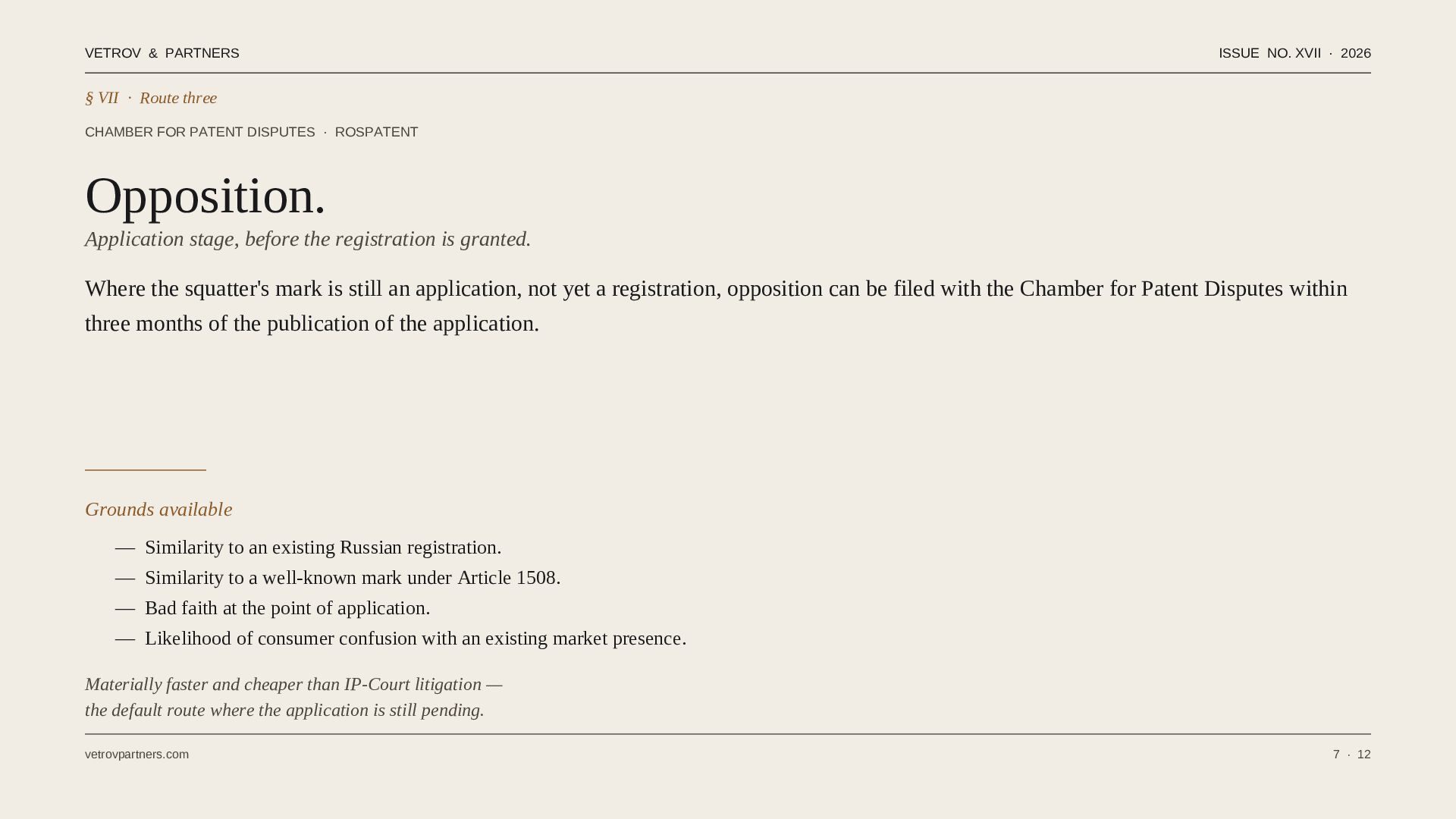
    · Route three CHAMBER FOR PATENT DISPUTES · ROSPATENT Opposition. Application stage, before the registration is granted. Where the squatter's mark is still an application, not yet a registration, opposition can be filed with the Chamber for Patent Disputes within three months of the publication of the application. Grounds available — Similarity to an existing Russian registration. — Similarity to a well-known mark under Article 1508. — Bad faith at the point of application. — Likelihood of consumer confusion with an existing market presence. Materially faster and cheaper than IP-Court litigation — the default route where the application is still pending. vetrovpartners.com 7 · 12
  8. VETROV & PARTNERS ISSUE NO. XVII · 2026 § VIII

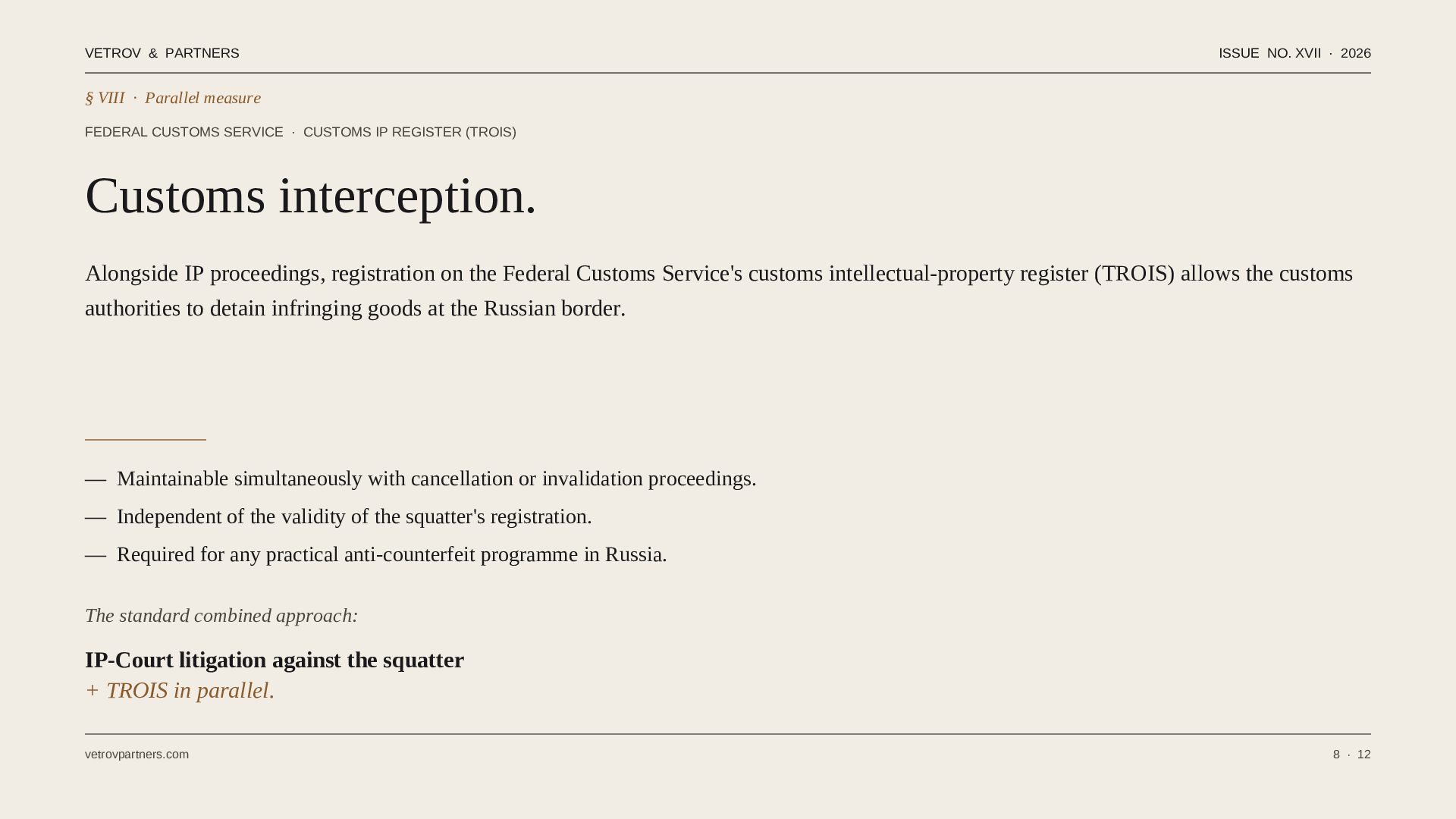
    · Parallel measure FEDERAL CUSTOMS SERVICE · CUSTOMS IP REGISTER (TROIS) Customs interception. Alongside IP proceedings, registration on the Federal Customs Service's customs intellectual-property register (TROIS) allows the customs authorities to detain infringing goods at the Russian border. — Maintainable simultaneously with cancellation or invalidation proceedings. — Independent of the validity of the squatter's registration. — Required for any practical anti-counterfeit programme in Russia. The standard combined approach: IP-Court litigation against the squatter + TROIS in parallel. vetrovpartners.com 8 · 12
  9. VETROV & PARTNERS ISSUE NO. XVII · 2026 § IX

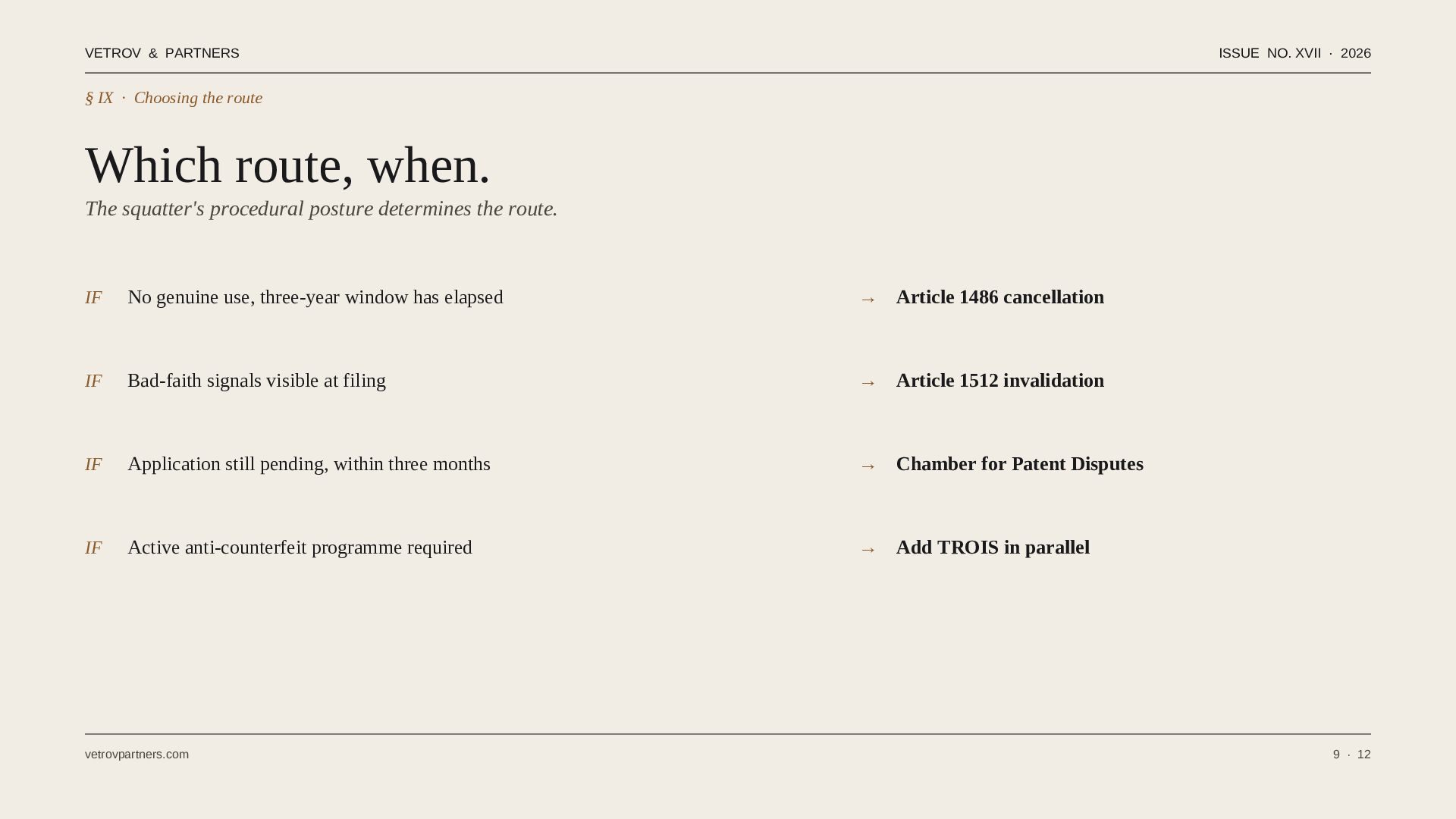
    · Choosing the route Which route, when. The squatter's procedural posture determines the route. IF No genuine use, three-year window has elapsed → Article 1486 cancellation IF Bad-faith signals visible at filing → Article 1512 invalidation IF Application still pending, within three months → Chamber for Patent Disputes IF Active anti-counterfeit programme required → Add TROIS in parallel vetrovpartners.com 9 · 12
  10. VETROV & PARTNERS ISSUE NO. XVII · 2026 § X

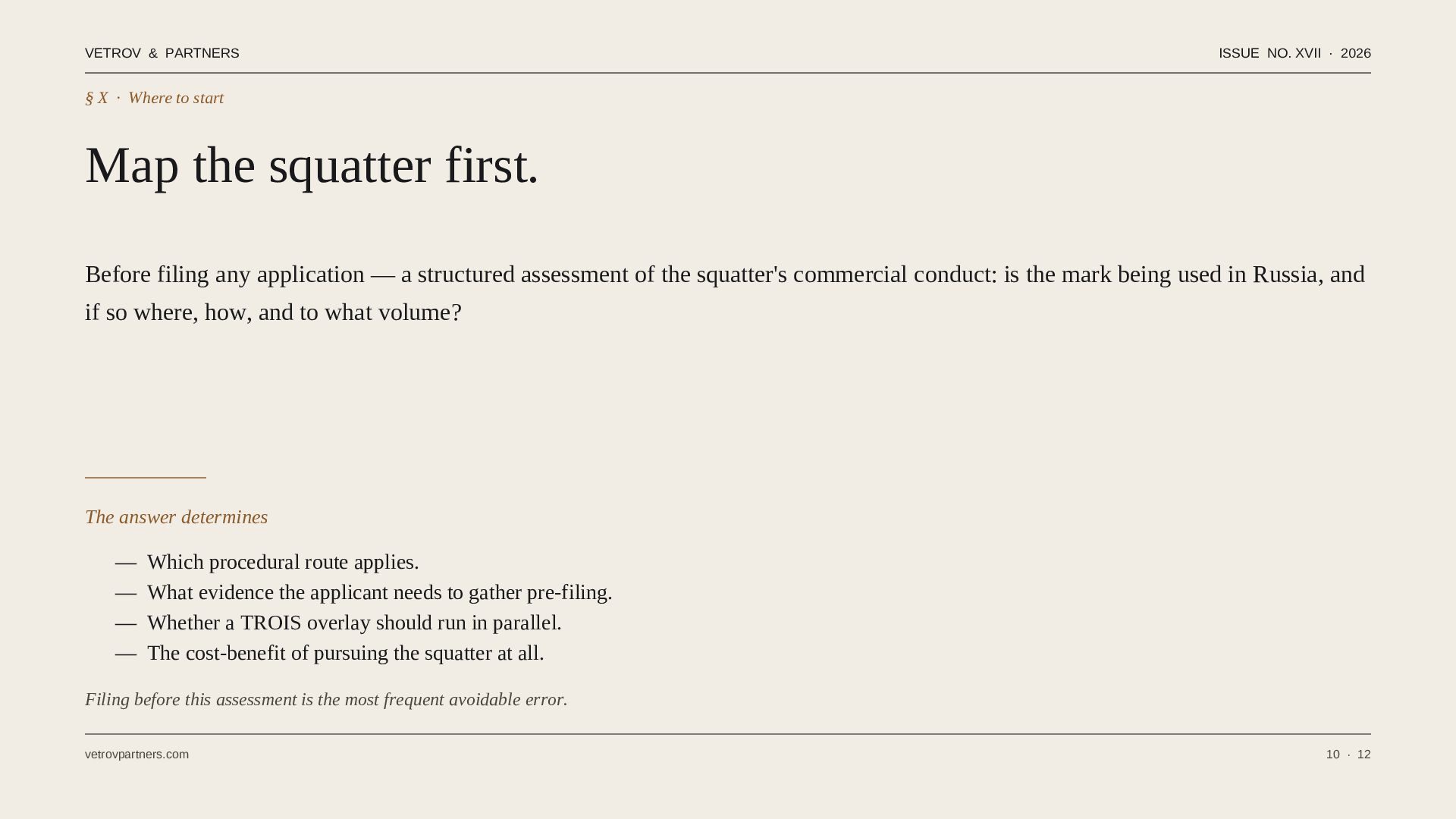
    · Where to start Map the squatter first. Before filing any application — a structured assessment of the squatter's commercial conduct: is the mark being used in Russia, and if so where, how, and to what volume? The answer determines — Which procedural route applies. — What evidence the applicant needs to gather pre-filing. — Whether a TROIS overlay should run in parallel. — The cost-benefit of pursuing the squatter at all. Filing before this assessment is the most frequent avoidable error. vetrovpartners.com 10 · 12
  11. VETROV & PARTNERS ISSUE NO. XVII · 2026 § XI

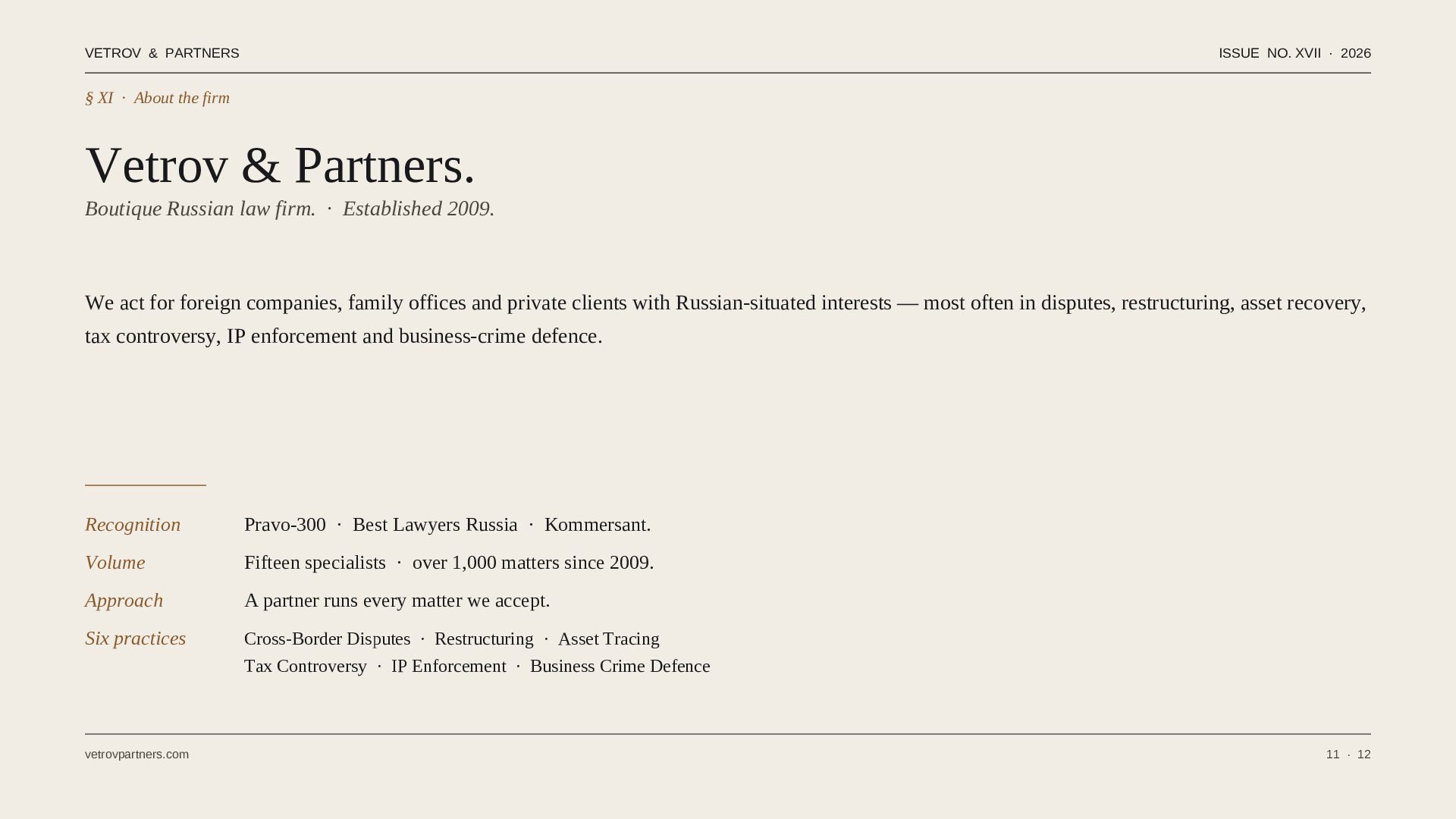
    · About the firm Vetrov & Partners. Boutique Russian law firm. · Established 2009. We act for foreign companies, family offices and private clients with Russian-situated interests — most often in disputes, restructuring, asset recovery, tax controversy, IP enforcement and business-crime defence. Recognition Pravo-300 · Best Lawyers Russia · Kommersant. Volume Fifteen specialists · over 1,000 matters since 2009. Approach A partner runs every matter we accept. Six practices Cross-Border Disputes · Restructuring · Asset Tracing Tax Controversy · IP Enforcement · Business Crime Defence vetrovpartners.com 11 · 12
  12. VETROV & PARTNERS ISSUE NO. XVII · 2026 Read the

    full practitioner note. vetrovpartners.com/insights/trademark-squatting-russia-foreign-brands/ Or visit vetrovpartners.com · [email protected] § XII vetrovpartners.com © 2009–2026 Vetrov & Partners. All rights reserved.