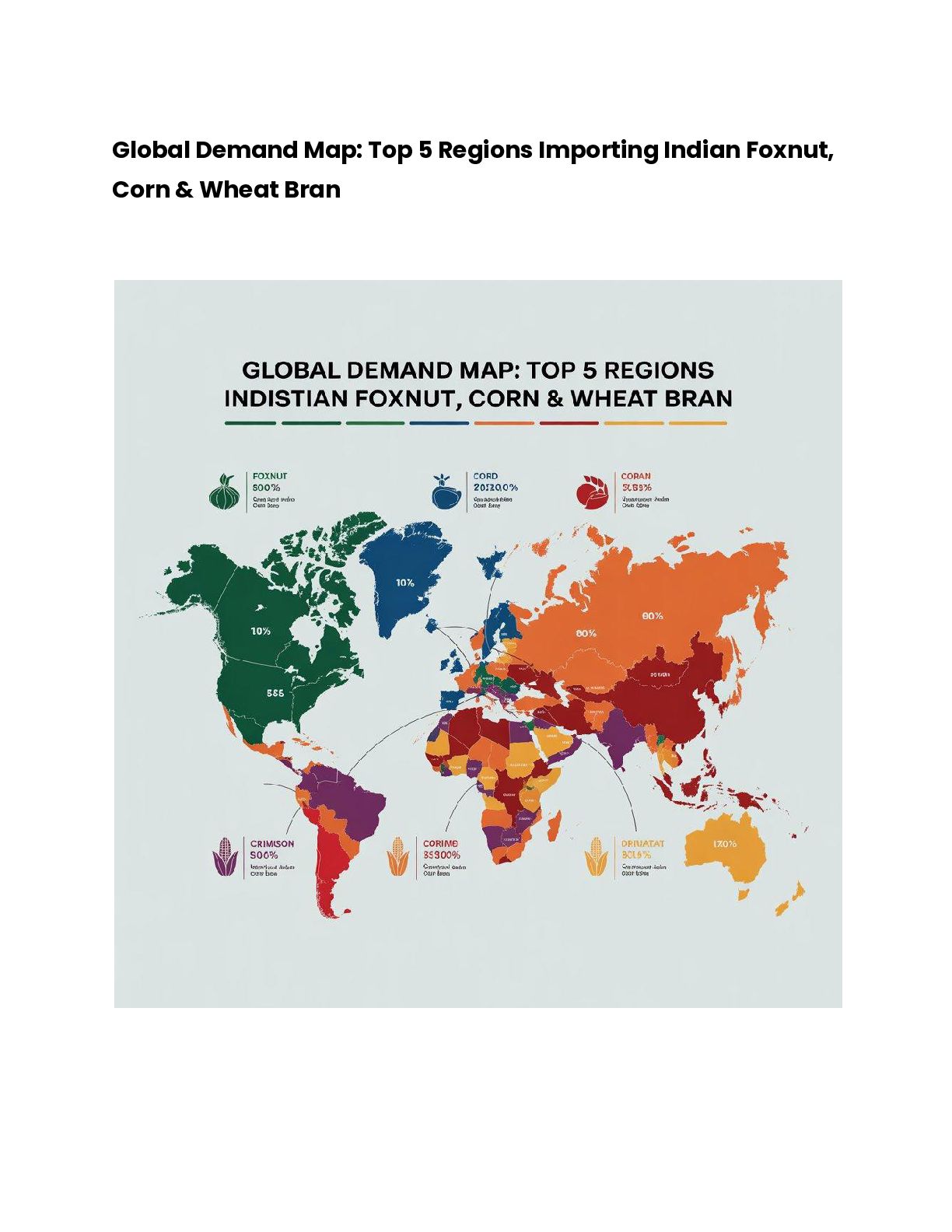
Global Demand Map Top 5 Regions Importing Indian Foxnut, Corn & Wheat Bran
Explore the 2024–25 global demand map for Indian makhana (foxnut), maize (corn) and wheat bran. Data-backed insights, top importing regions, market drivers and export opportunities for agricultural products export from India.
makhana (foxnut) to bulk staples such as maize and wheat bran. Each commodity follows its own demand map driven by health trends, feed requirements, regional supply gaps, and processing industries. This article maps the top five regions importing these commodities from India, provides authentic data and sources, and outlines practical takeaways for exporters and agribusiness decision-makers. The keyword you care about — agricultural products export from India — appears throughout this post to help SEO reach and relevance. Snapshot: Why these three commodities matter • Foxnut / Makhana — a niche, high-value snack and health ingredient. India is the world’s leading producer and exporter; demand is rising with global health-snacking trends. • Maize (Corn) — used for animal feed, food processing and industrial uses (including starch and ethanol). India’s corn flows largely to neighboring Asian markets but patterns shift with domestic policy and global prices. • Wheat bran — an inexpensive, high-fiber by-product widely used in animal feed (especially cattle and poultry) and industrial applications. Bangladesh is a major buyer of Indian wheat bran. Below we map the five top importing regions for these items and explain drivers, trade volumes where available, and what exporters should consider. Top 5 importing regions Before a commodity-by-commodity dive, here’s a quick combined view of the five regions that repeatedly show up as the largest importers or most consistent markets for Indian makhana, maize and wheat bran:
(retail & specialty health foods). 2. Middle East & Gulf (UAE, Saudi Arabia, Qatar, Kuwait) — retail and re-export hubs for makhana, and stable buyers for value-added cereals. 3. South Asia (Bangladesh, Nepal, Sri Lanka) — dominant buyers for wheat bran and maize (feed-grade), and proximate buyers for maize. Bangladesh is a major buyer of wheat bran. 4. Southeast Asia (Vietnam, Malaysia, Thailand) — strong demand for Indian maize (feed/non-GMO segments) and growing interest in value snacks. 5. Europe (UK, Netherlands, Germany, EU markets) — specialty retail and health food chains that import packaged makhana; also import processed grain products. Those five regions represent a blend of high-value retail markets (North America, Europe), processing/feed hubs (South & Southeast Asia), and distribution centers (Middle East). Now let’s unpack each commodity with region-specific insights and data. 1) Foxnut (Makhana) — Where the crunchy health-snack money is Quick facts & trends • India exported roughly ~25,000 tonnes of makhana in 2023–24 (strong growth over the early 2020s, ~39% CAGR reported by market intelligence dashboards). Bihar remains the production heartland. • Rising demand is driven by health-conscious consumers (low-fat, gluten-free, high-fiber snack), new product formats (roasted/flavoured, cereal inclusions),
1. North America (USA, Canada) — Growing retail penetration via health stores, Amazon and specialty importers. The USA alone receives a substantial chunk of shipments and is often cited among the top markets for Indian makhana. 2. Middle East & Gulf — UAE acts as both a direct importer and re-export hub to other GCC markets; demand is driven by expatriate communities and modern retail. 3. Europe (UK, Netherlands, Germany) — Niche retail and gourmet aisles import premium makhana, often as a branded health snack or ingredient for natural foods. 4. Canada & Australia — Similar retail/ethnic demand profiles as the USA; growth channels include ethnic stores and online specialty retail. 5. Southeast Asia (Malaysia, Singapore) — urban consumers with interest in premium snacks and functional foods. Exporter takeaways (makhana) • Value-add: Roasted/flavoured and ready-to-eat packaging command higher prices than raw makhana. Private label and organic certification help open western retail shelves. • Standards & docs: FSSAI, APEDA registration and international certifications (HACCP/ISO) smooth customs and retail onboarding.
packing fetch the best margins; invest in grading and moisture control. 2) Maize (Corn) — The regional feed artery Quick facts & trends • India’s maize exports are dominated by neighboring Asian markets; roughly ~90% of exported maize heads to nearby countries such as Nepal, Bangladesh, Bhutan, Sri Lanka and Vietnam (APEDA dashboards, market reports). Note: India’s maize trade is seasonal and sensitive to domestic policies (e.g., ethanol, MSP, stock control). Top importing regions for Indian maize 1. South Asia (Nepal, Bangladesh, Bhutan, Sri Lanka) — The largest and most consistent market for Indian maize, primarily for animal feed and local milling. Cross-border logistics and low freight costs make trade efficient. 2. Southeast Asia (Vietnam, Malaysia, Thailand) — Vietnam and Malaysia import Indian maize for feed and industrial uses; interest in non-GMO/identity-preserved maize creates niche opportunities. 3. East Africa (select markets) — Occasional consignments depending on price competitiveness vs other exporters; these are opportunistic rather than stable routes. 4. Middle East — Smaller volumes, often re-exported or for mixed feed formulations. 5. Domestic re-exports via trade hubs — Some shipments route through major ports and distribution centers to reach final buyers, especially for processed
feed buyers, moisture, broken kernels, foreign matter and aflatoxin levels determine acceptance and price. Indian suppliers must adhere to buyer specs (e.g., 14% max moisture). • Non-GMO and identity-preserved maize is an attractive niche for Southeast Asian and developed-market buyers — but that requires separate seed/segregation protocols. • Policy sensitivity: Domestic demand for ethanol and animal feed, plus MSP and buffer stock moves, can quickly tighten domestic supplies and affect export availability — monitor DGCI&S and APEDA dashboards regularly. 3) Wheat Bran — The bulk feed backbone (and Bangladesh’s appetite) Quick facts & trends • Wheat bran is primarily sold as a cheap, high-fiber feed ingredient for ruminants and some poultry formulations. Export volumes are substantial but concentrated—Bangladesh is repeatedly cited as the largest importer of Indian wheat bran. Trade platforms, import records and industry trackers show Bangladesh taking the bulk share of Indian wheat bran exports. Top importing regions for Indian wheat bran
food-processing uses. Market proximity and processing demand explain the heavy flows. 2. Nepal — Smaller volumes but steady imports due to cross-border feed demand. 3. Southeast Asian buyers (occasional) — Depending on price spreads, some shipments are routed to Vietnam or Malaysia. 4. African buyers (select countries) — Opportunistic, can appear during periods of price competitiveness. 5. Regional feed processors & distributors — Some large feed aggregators import wheat bran for pelletizing and blended feed products. Exporter takeaways (wheat bran) • Volume & logistics: Wheat bran is price-sensitive — small freight or handling inefficiencies can flip margins. Consolidate shipments and use cost-effective packaging (bulk sacks, pallets). • Quality consistency: Moisture content and contamination risk (mould, foreign matter) are the main drivers of rejection. Invest in drying and clean handling. • Price transparency: Many buyers use monthly or seasonal contracts; be prepared for spot selling and structured supply contracts in Bangladesh. Market drivers shaping demand (cross-commodity) 1. Health & convenience trends — Boost makhana’s appeal in North America and Europe; value-added packaging and clean-label claims matter.
consumption in South/Southeast Asia underpins continuous maize and wheat bran demand. 3. Policy & domestic consumption — Ethanol and domestic feed policies can reduce exportable surpluses (especially for maize). DGCI&S reports and APEDA data must be watched for new policy shifts. 4. Logistics & freight cycles — Proximity advantages benefit South Asian buyers; ocean freight cycles and container availability influence longer routes. Cited numbers and authoritative sources (quick list) • APEDA monthly dashboards — Makhana and Maize/Monthly dashboards (exports, production, market notes). • ExportImportData / SEAIR / market blogs — makhana export volumes (~25,130 tonnes in 2023–24; revenue figures mentioned in market write-ups). • Tridge & Volza — trade flow snapshots and destination concentration for wheat bran and corn. • DGCI&S / Ministry of Commerce analyses — for broader trade context and policy updates. How exporters should prioritize markets (practical playbook) 1. Segment by value and logistics: ◦ High-value / low-volume (makhana): target North America, Europe, GCC. Invest in branding, certifications, and packaged SKUs.
Southeast Asia and manage freight/warehouse costs tightly. 2. Certifications & quality checks: For premium retail markets, secure organic/non-GMO/ISO-HACCP and list FSSAI/APEDA credentials on B2B platforms. 3. Contracting and hedging: For maize, use forward contracts when domestic policy is stable; for wheat bran, lock in small-to-medium term contracts with repeat buyers (e.g., Bangladeshi feed mills). 4. Market intelligence: Subscribe to APEDA, DGCI&S releases and commodity dashboards to react swiftly to policy moves and price trends. Risk checklist for exporters • Policy shifts: Export restrictions or minimum export prices can appear on short notice (monitor Ministry of Commerce). • Quality rejections: Moisture, aflatoxin (for maize), foreign matter — control through post-harvest handling and testing. • Logistics & packaging: Bulk items are margin-sensitive; optimize packaging (palletization) to reduce damage and handling costs. Case in point: Bangladesh — a wheat-bran success story Multiple trade trackers and import files show Bangladesh as a massive and concentrated buyer of Indian wheat bran — in many months accounting for the lion’s share of exports. For exporters, that concentration is a double-edged sword: predictable demand but price sensitivity and intense competition. Long-term
Final checklist before you ship • Product grading & moisture test results packed with shipment documents. • APEDA / FSSAI / HACCP / ISO certificates (as applicable). • Signed quality contract outlining rejection clauses and arbitration venue. • Logistics plan: port, container vs. bulk vessel, palletization, insurance. • Market entry plan: for makhana — private-label partnerships; for maize/wheat bran — feed-mill long-term contracts. Closing: The big picture for agricultural products export from India India remains a competitive global supplier across the value chain — from specialty snacks like makhana to staple feed ingredients like maize and wheat bran. The top five importing regions — North America, Middle East, South Asia, Southeast Asia, and Europe — together create a balanced demand map: premium retail shelves on one side and commodity-fed feed chains on the other. Exporters who combine strict quality control, market intelligence from APEDA and DGCI&S dashboards, and targeted market entry strategies (private label for makhana; contract supply for maize and wheat bran) will find the best opportunities.


 tsogo817421
 makaibito
 progmat
 yasslab
 maruishi
 hansodeeeeee
 loglass2019
 uniam
 shunsuke_takeuchi
 ikuodanaka
 synergymarketing
 hr1nursing
 helenjbeal
 raygrieselhuber
 soudai
 kimpetersen
 techseoconnect
 auna
 lara
 tamaranovitovic
 jnunemaker
 wjessup
 csswizardry
 chriscoyier