Paper on the use of memes in algorithmic media as a youth outreach strategy by the political right in India delivered at the 2026 AsiaNetwork Annual Conference in Naperville, IL.
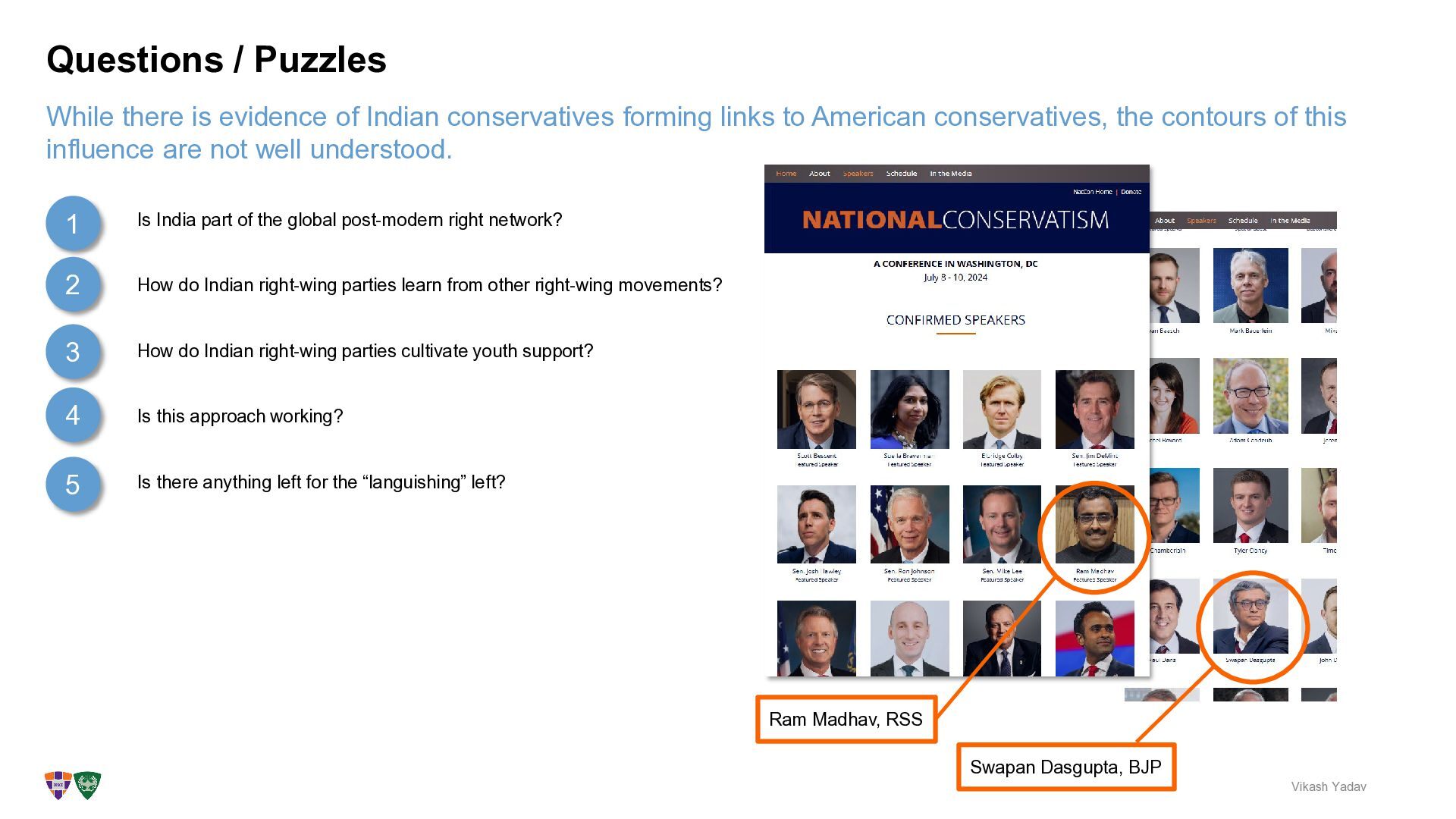
American conservatives, the contours of this influence are not well understood. Questions / Puzzles Vikash Yadav Is India part of the global post-modern right network? How do Indian right-wing parties learn from other right-wing movements? How do Indian right-wing parties cultivate youth support? Is this approach working? Is there anything left for the “languishing” left? 1 2 3 4 5 Ram Madhav, RSS Swapan Dasgupta, BJP
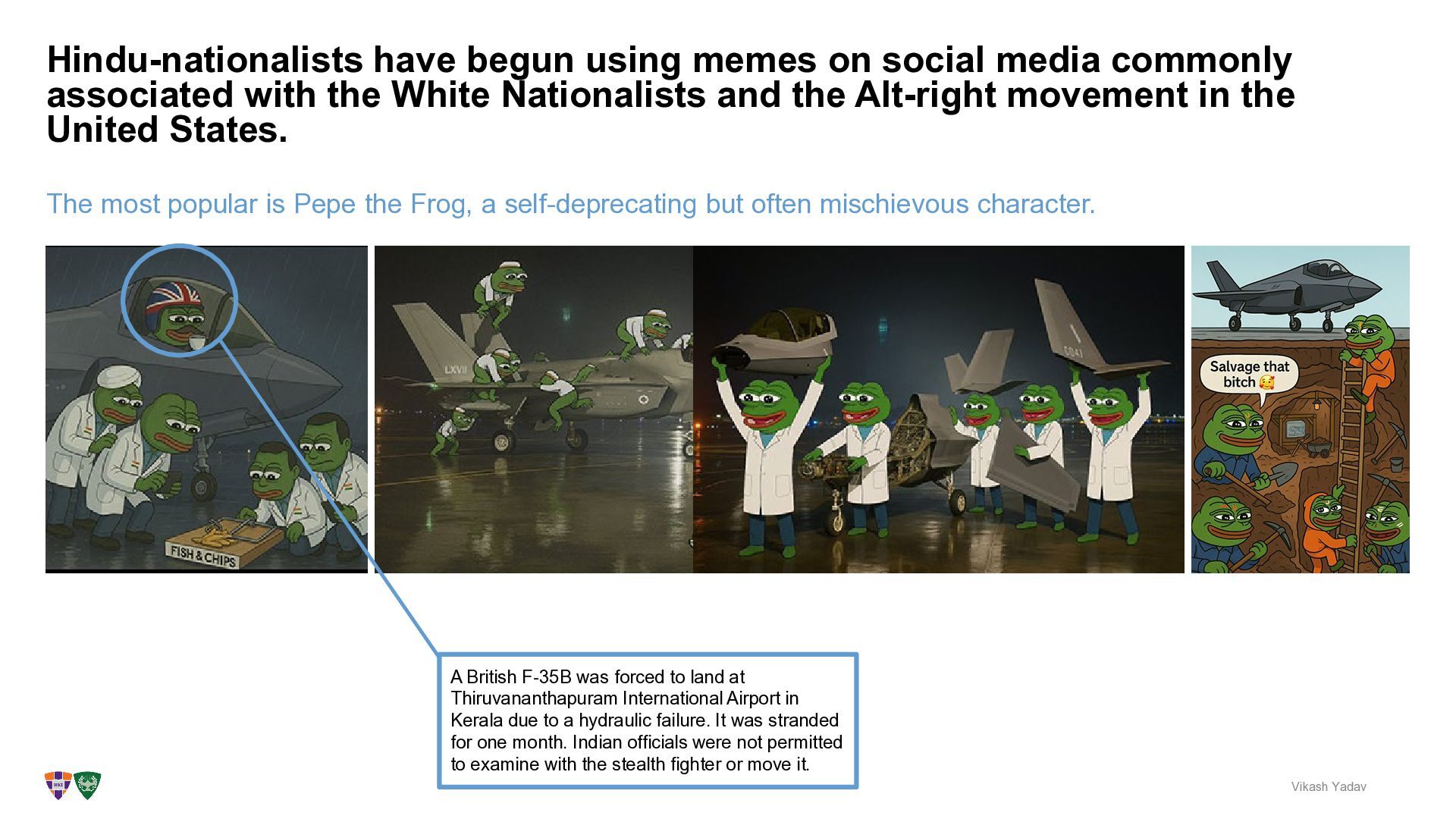
often mischievous character. Hindu-nationalists have begun using memes on social media commonly associated with the White Nationalists and the Alt-right movement in the United States. Vikash Yadav A British F-35B was forced to land at Thiruvananthapuram International Airport in Kerala due to a hydraulic failure. It was stranded for one month. Indian officials were not permitted to examine with the stealth fighter or move it.
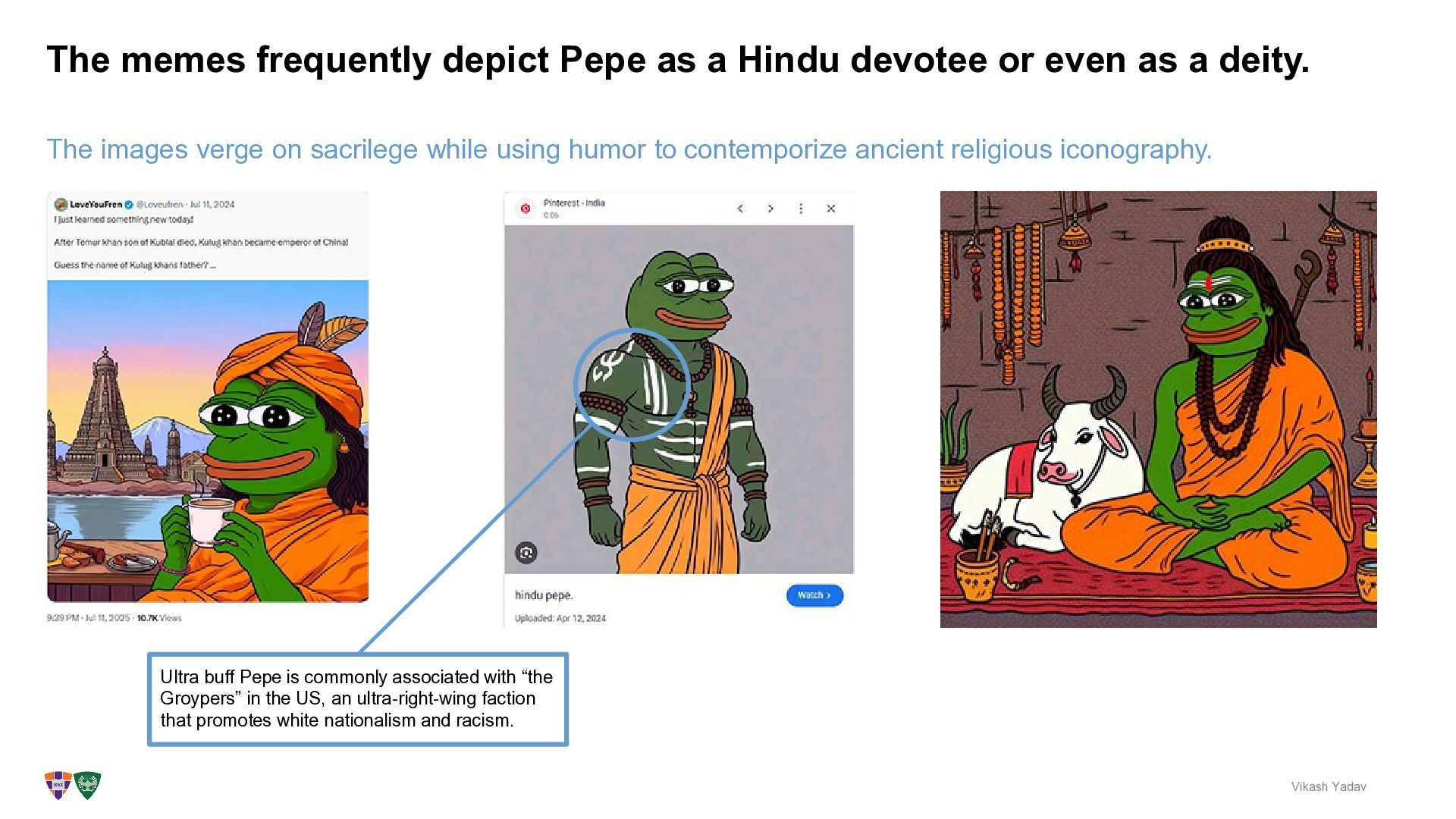
ancient religious iconography. The memes frequently depict Pepe as a Hindu devotee or even as a deity. Vikash Yadav Ultra buff Pepe is commonly associated with “the Groypers” in the US, an ultra-right-wing faction that promotes white nationalism and racism.
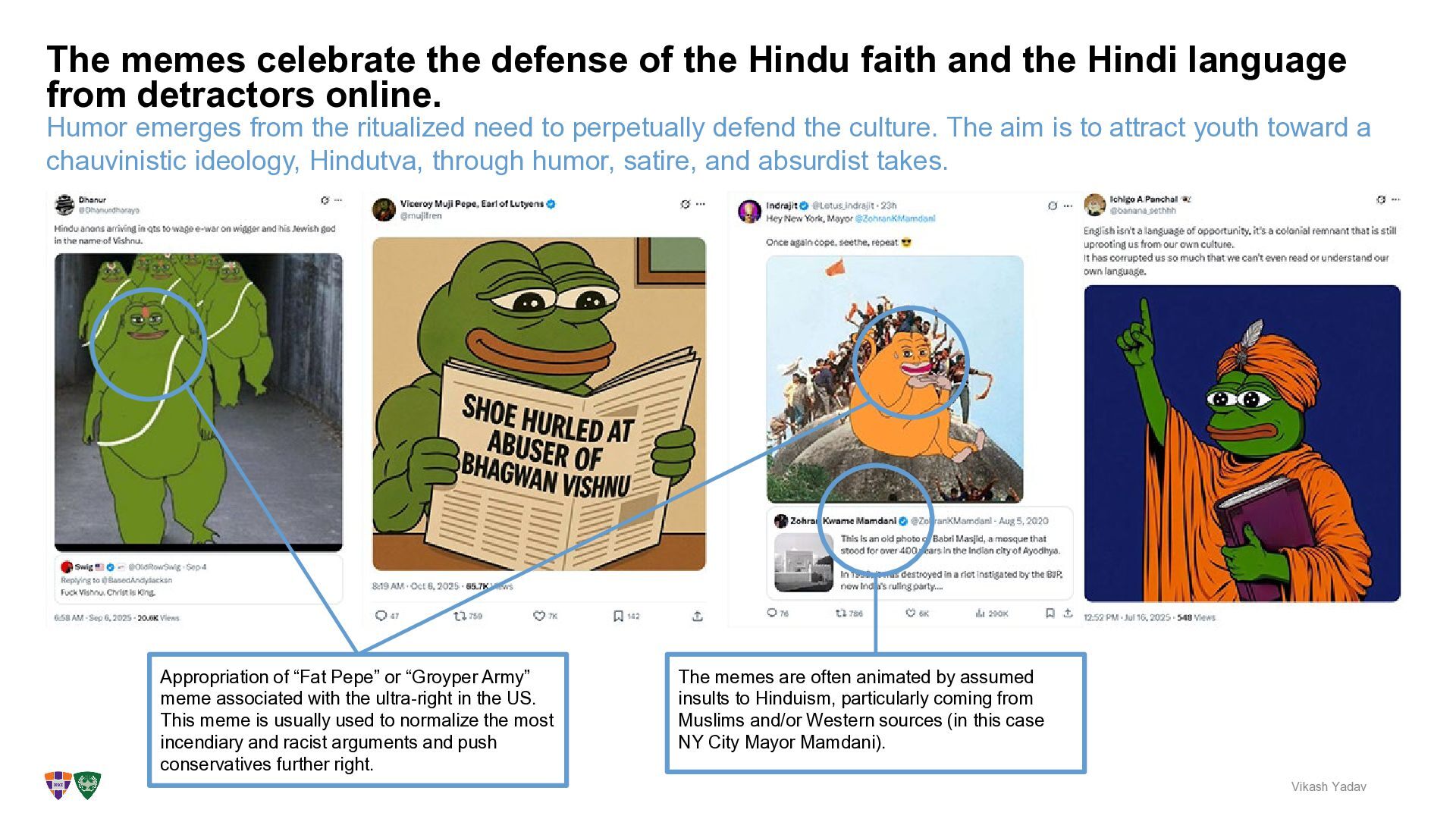
culture. The aim is to attract youth toward a chauvinistic ideology, Hindutva, through humor, satire, and absurdist takes. The memes celebrate the defense of the Hindu faith and the Hindi language from detractors online. Vikash Yadav The memes are often animated by assumed insults to Hinduism, particularly coming from Muslims and/or Western sources (in this case NY City Mayor Mamdani). Appropriation of “Fat Pepe” or “Groyper Army” meme associated with the ultra-right in the US. This meme is usually used to normalize the most incendiary and racist arguments and push conservatives further right.
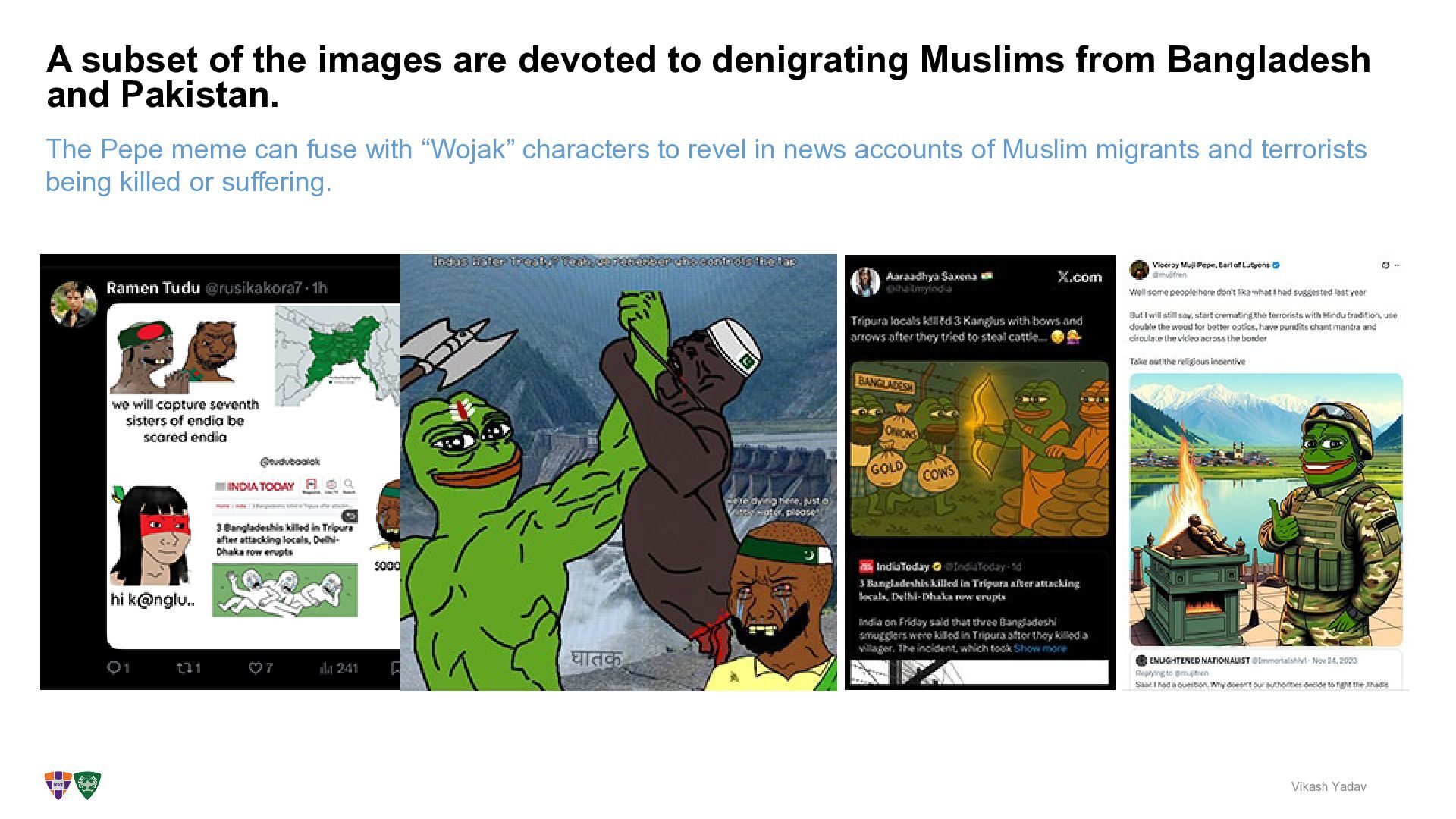
in news accounts of Muslim migrants and terrorists being killed or suffering. A subset of the images are devoted to denigrating Muslims from Bangladesh and Pakistan. Vikash Yadav
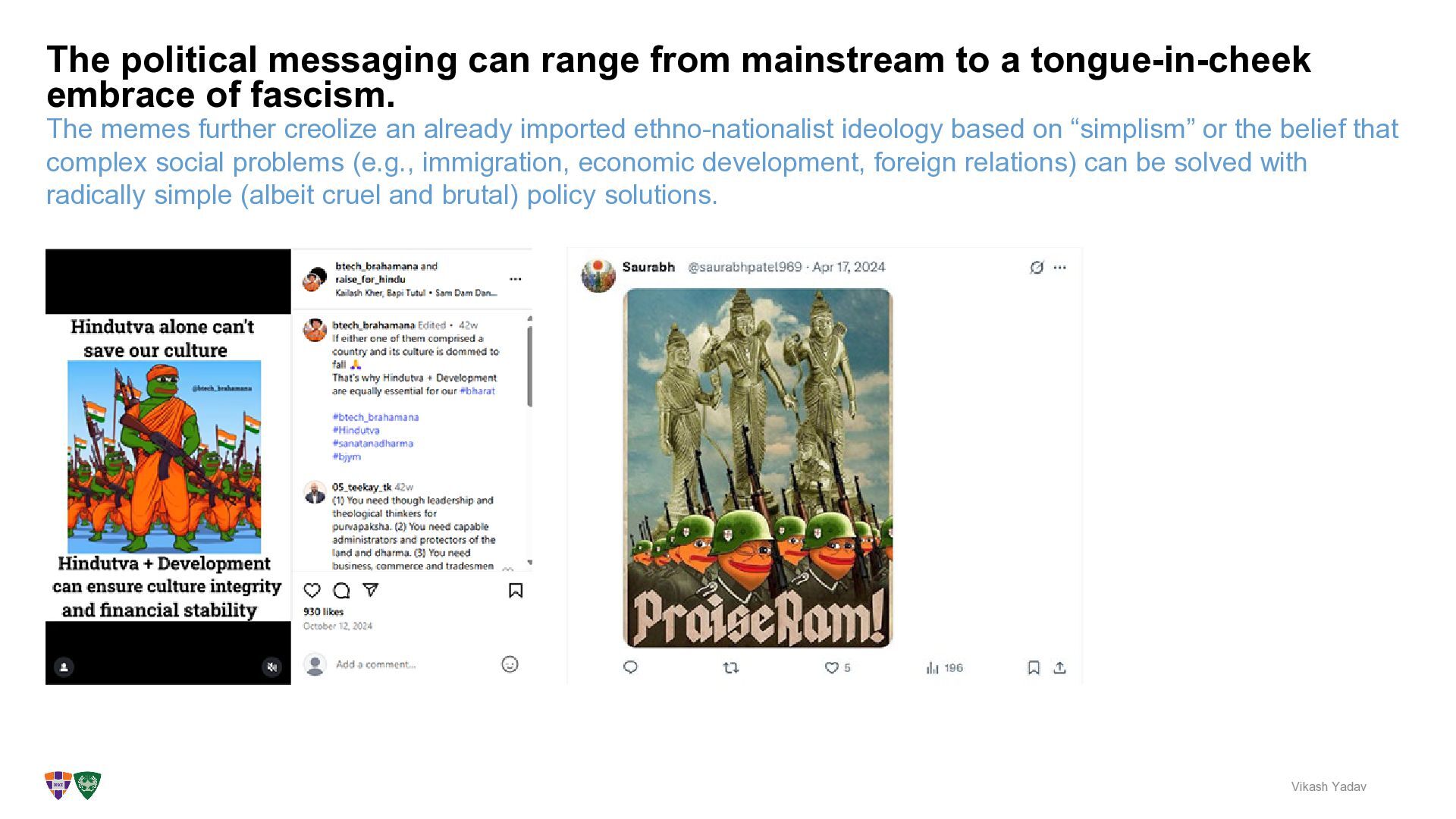
on “simplism” or the belief that complex social problems (e.g., immigration, economic development, foreign relations) can be solved with radically simple (albeit cruel and brutal) policy solutions. The political messaging can range from mainstream to a tongue-in-cheek embrace of fascism. Vikash Yadav
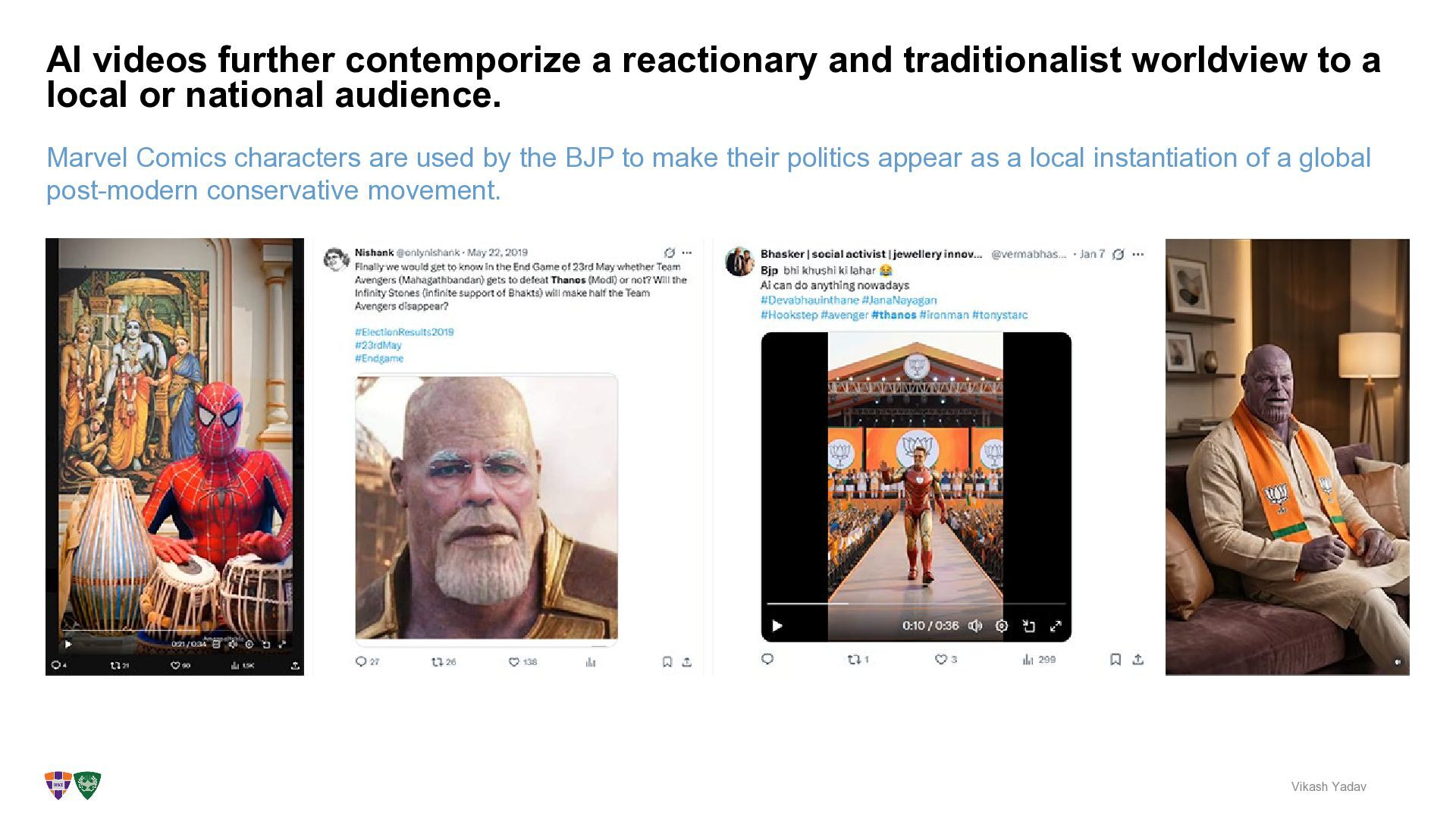
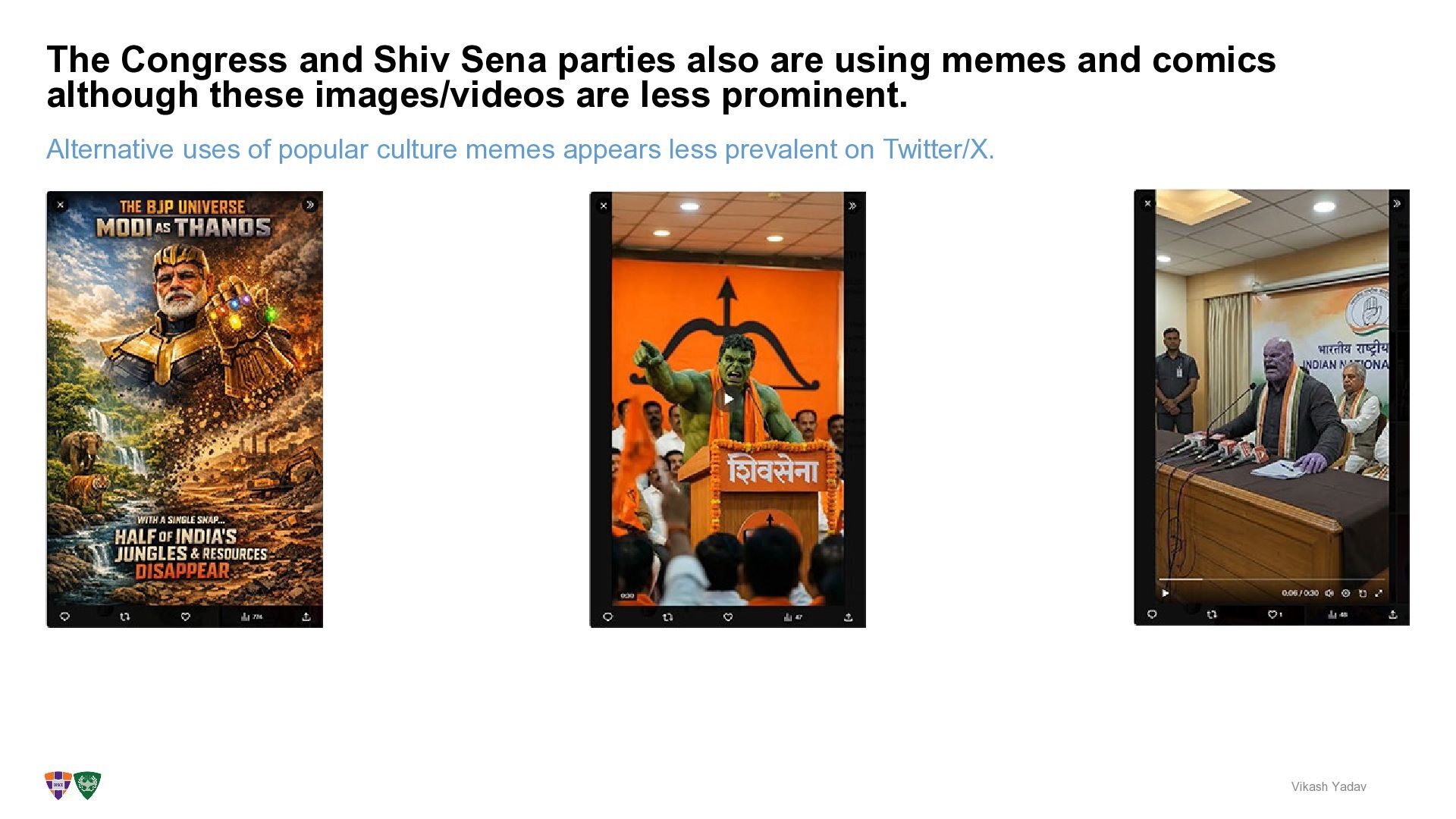
their politics appear as a local instantiation of a global post-modern conservative movement. AI videos further contemporize a reactionary and traditionalist worldview to a local or national audience. Vikash Yadav
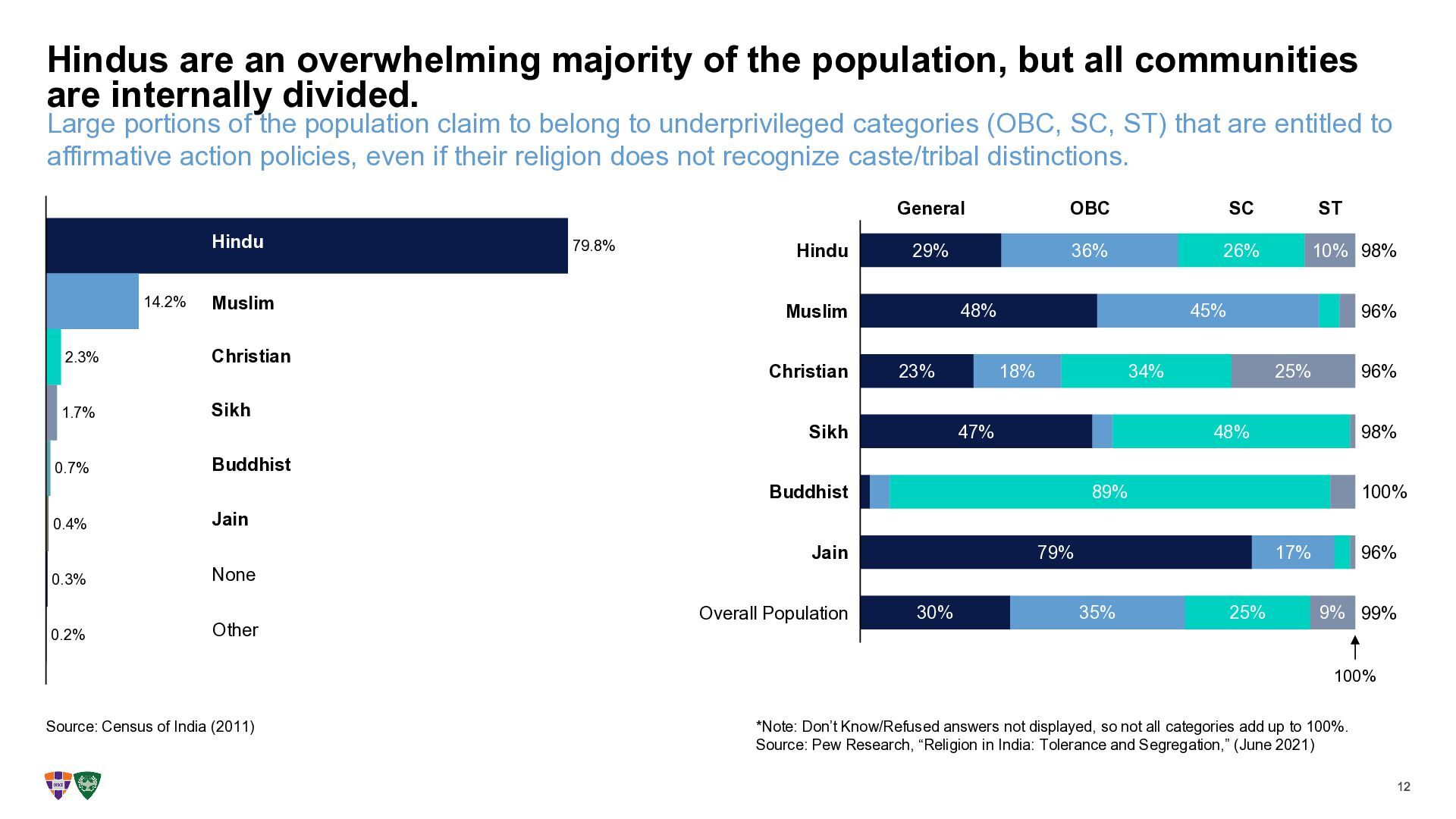
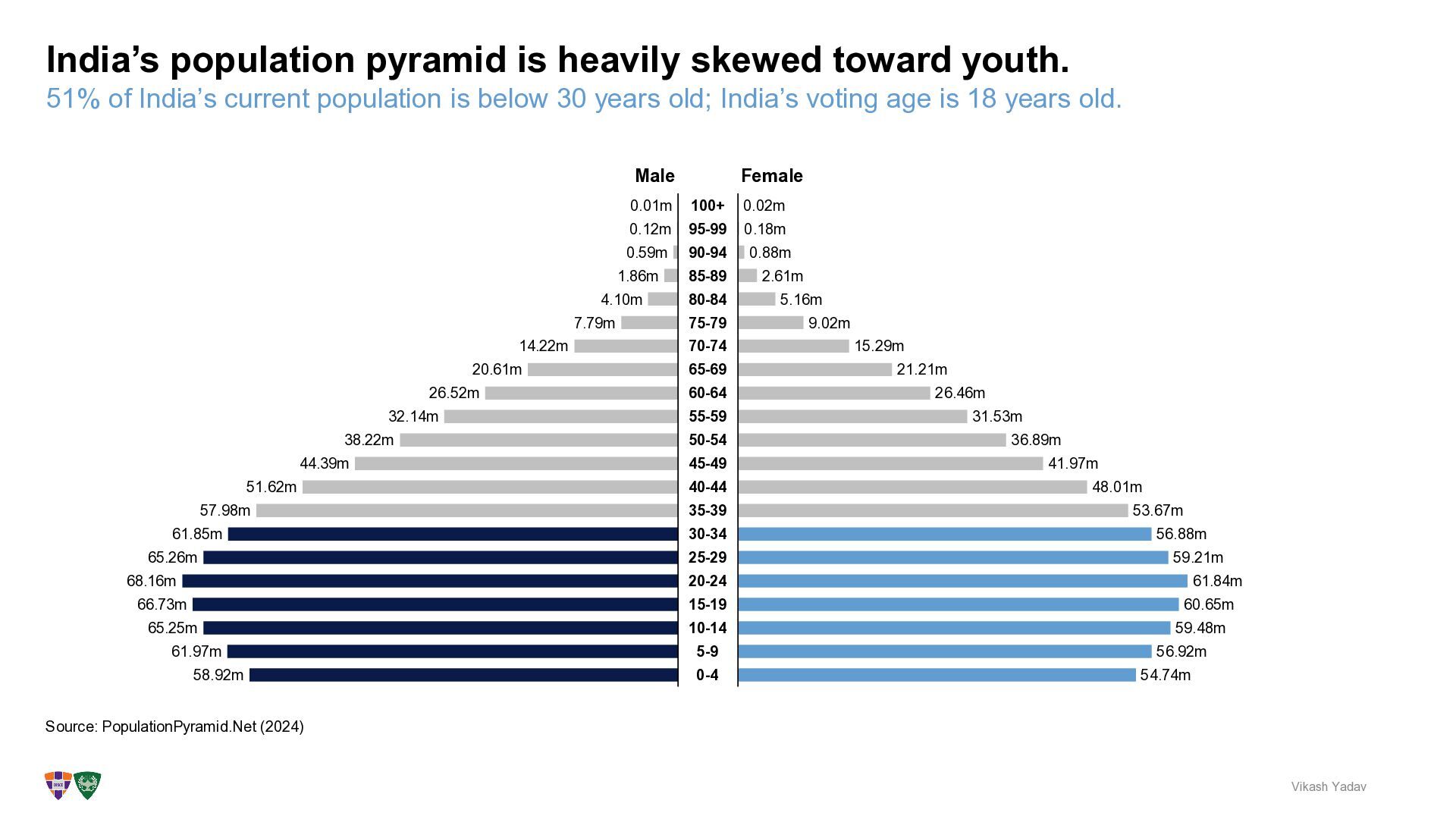
categories (OBC, SC, ST) that are entitled to affirmative action policies, even if their religion does not recognize caste/tribal distinctions. Hindus are an overwhelming majority of the population, but all communities are internally divided. Source: Census of India (2011) 79.8% 14.2% 2.3% 1.7% 0.7% 0.4% 0.3% 0.2% Hindu Muslim Christian Sikh Buddhist Jain None Other 29% 48% 23% 47% 79% 30% 36% 45% 18% 17% 35% 26% 34% 48% 89% 25% 10% 25% 9% Hindu Muslim Christian Sikh Buddhist Jain Overall Population ST SC OBC General 100% 98% 96% 96% 98% 100% 96% 99% *Note: Don’t Know/Refused answers not displayed, so not all categories add up to 100%. Source: Pew Research, “Religion in India: Tolerance and Segregation,” (June 2021)
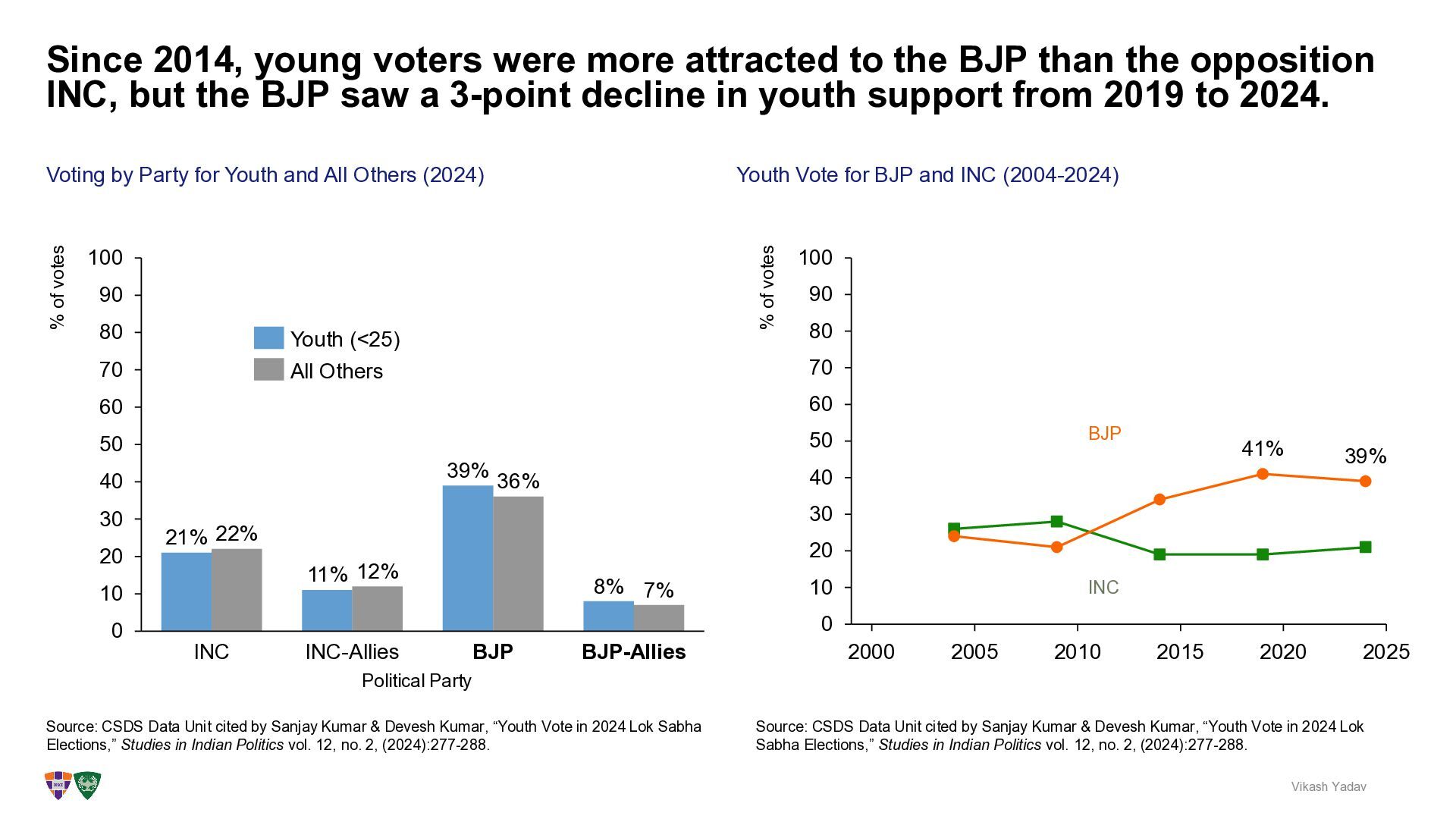
than the opposition INC, but the BJP saw a 3-point decline in youth support from 2019 to 2024. Vikash Yadav 41% 39% 0 10 20 30 40 50 60 70 80 90 100 2000 2005 2010 2015 2020 2025 % of votes Youth Vote for BJP and INC (2004-2024) Source: CSDS Data Unit cited by Sanjay Kumar & Devesh Kumar, “Youth Vote in 2024 Lok Sabha Elections,” Studies in Indian Politics vol. 12, no. 2, (2024):277-288. 21% 11% 39% 8% 22% 12% 36% 7% 0 10 20 30 40 50 60 70 80 90 100 % of votes INC INC-Allies BJP BJP-Allies Source: CSDS Data Unit cited by Sanjay Kumar & Devesh Kumar, “Youth Vote in 2024 Lok Sabha Elections,” Studies in Indian Politics vol. 12, no. 2, (2024):277-288. Voting by Party for Youth and All Others (2024) Political Party Youth (<25) All Others BJP INC
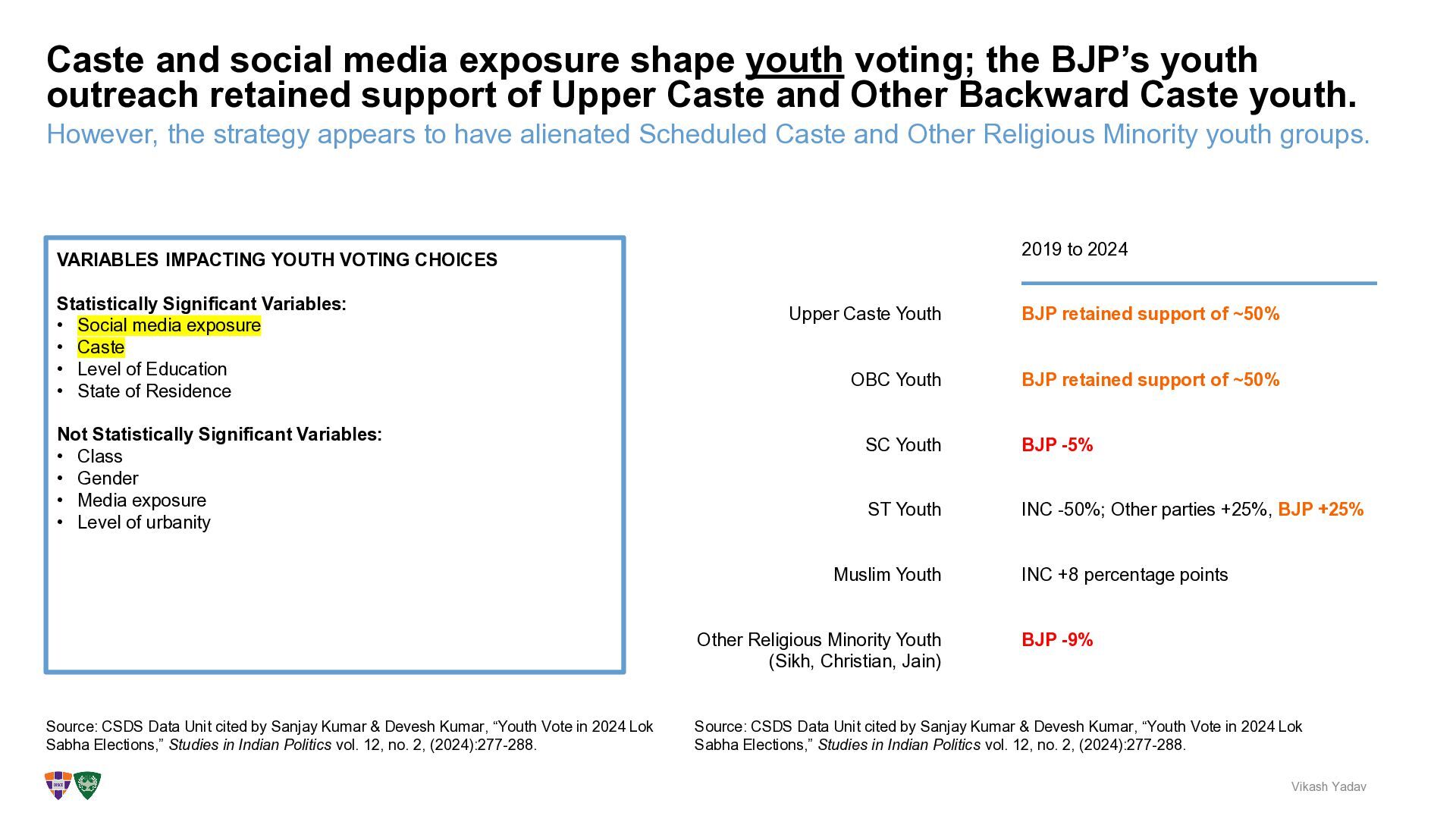
Other Religious Minority youth groups. Caste and social media exposure shape youth voting; the BJP’s youth outreach retained support of Upper Caste and Other Backward Caste youth. Vikash Yadav SC Youth ST Youth 2019 to 2024 Muslim Youth Other Religious Minority Youth (Sikh, Christian, Jain) BJP retained support of ~50% Upper Caste Youth OBC Youth INC -50%; Other parties +25%, BJP +25% INC +8 percentage points BJP -9% BJP -5% BJP retained support of ~50% Source: CSDS Data Unit cited by Sanjay Kumar & Devesh Kumar, “Youth Vote in 2024 Lok Sabha Elections,” Studies in Indian Politics vol. 12, no. 2, (2024):277-288. VARIABLES IMPACTING YOUTH VOTING CHOICES Statistically Significant Variables: • Social media exposure • Caste • Level of Education • State of Residence Not Statistically Significant Variables: • Class • Gender • Media exposure • Level of urbanity Source: CSDS Data Unit cited by Sanjay Kumar & Devesh Kumar, “Youth Vote in 2024 Lok Sabha Elections,” Studies in Indian Politics vol. 12, no. 2, (2024):277-288.
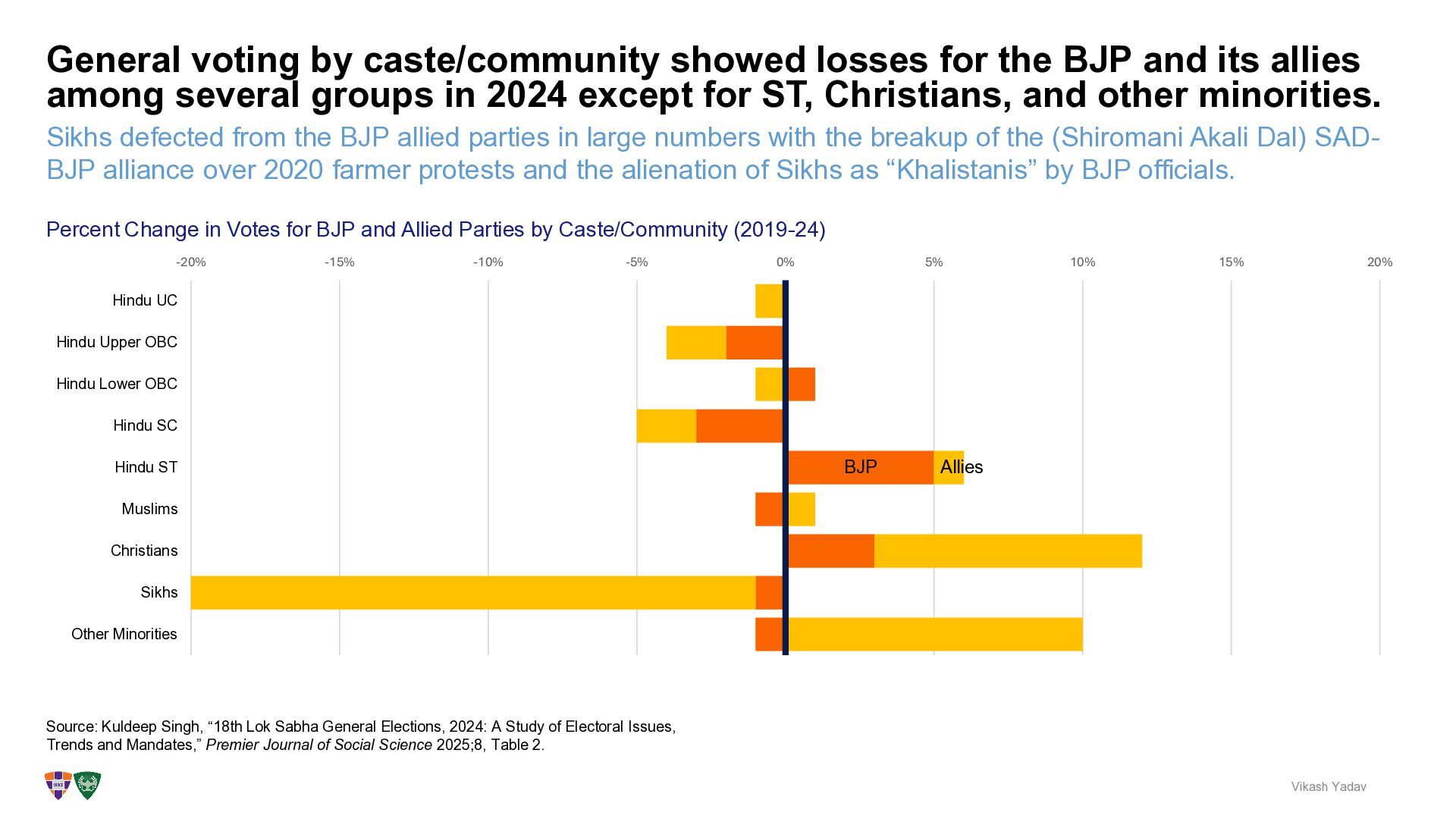
with the breakup of the (Shiromani Akali Dal) SAD- BJP alliance over 2020 farmer protests and the alienation of Sikhs as “Khalistanis” by BJP officials. General voting by caste/community showed losses for the BJP and its allies among several groups in 2024 except for ST, Christians, and other minorities. Vikash Yadav Source: Kuldeep Singh, “18th Lok Sabha General Elections, 2024: A Study of Electoral Issues, Trends and Mandates,” Premier Journal of Social Science 2025;8, Table 2. Percent Change in Votes for BJP and Allied Parties by Caste/Community (2019-24) -20% -15% -10% -5% 0% 5% 10% 15% 20% Hindu UC Hindu Upper OBC Hindu Lower OBC Hindu SC Hindu ST Muslims Christians Sikhs Other Minorities BJP Allies
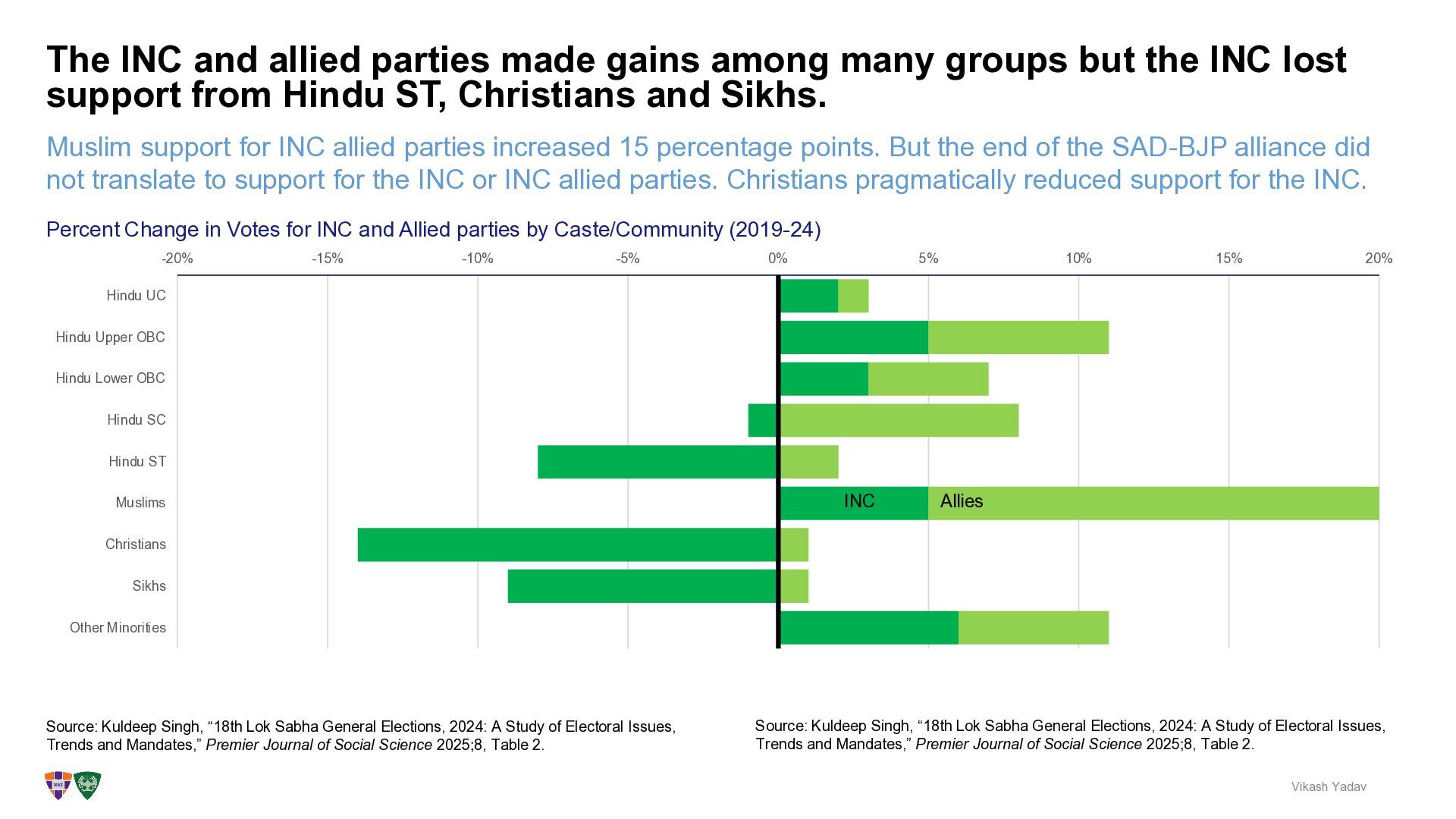
But the end of the SAD-BJP alliance did not translate to support for the INC or INC allied parties. Christians pragmatically reduced support for the INC. The INC and allied parties made gains among many groups but the INC lost support from Hindu ST, Christians and Sikhs. Vikash Yadav Source: Kuldeep Singh, “18th Lok Sabha General Elections, 2024: A Study of Electoral Issues, Trends and Mandates,” Premier Journal of Social Science 2025;8, Table 2. Source: Kuldeep Singh, “18th Lok Sabha General Elections, 2024: A Study of Electoral Issues, Trends and Mandates,” Premier Journal of Social Science 2025;8, Table 2. Percent Change in Votes for INC and Allied parties by Caste/Community (2019-24) -20% -15% -10% -5% 0% 5% 10% 15% 20% Hindu UC Hindu Upper OBC Hindu Lower OBC Hindu SC Hindu ST Muslims Christians Sikhs Other Minorities INC Allies
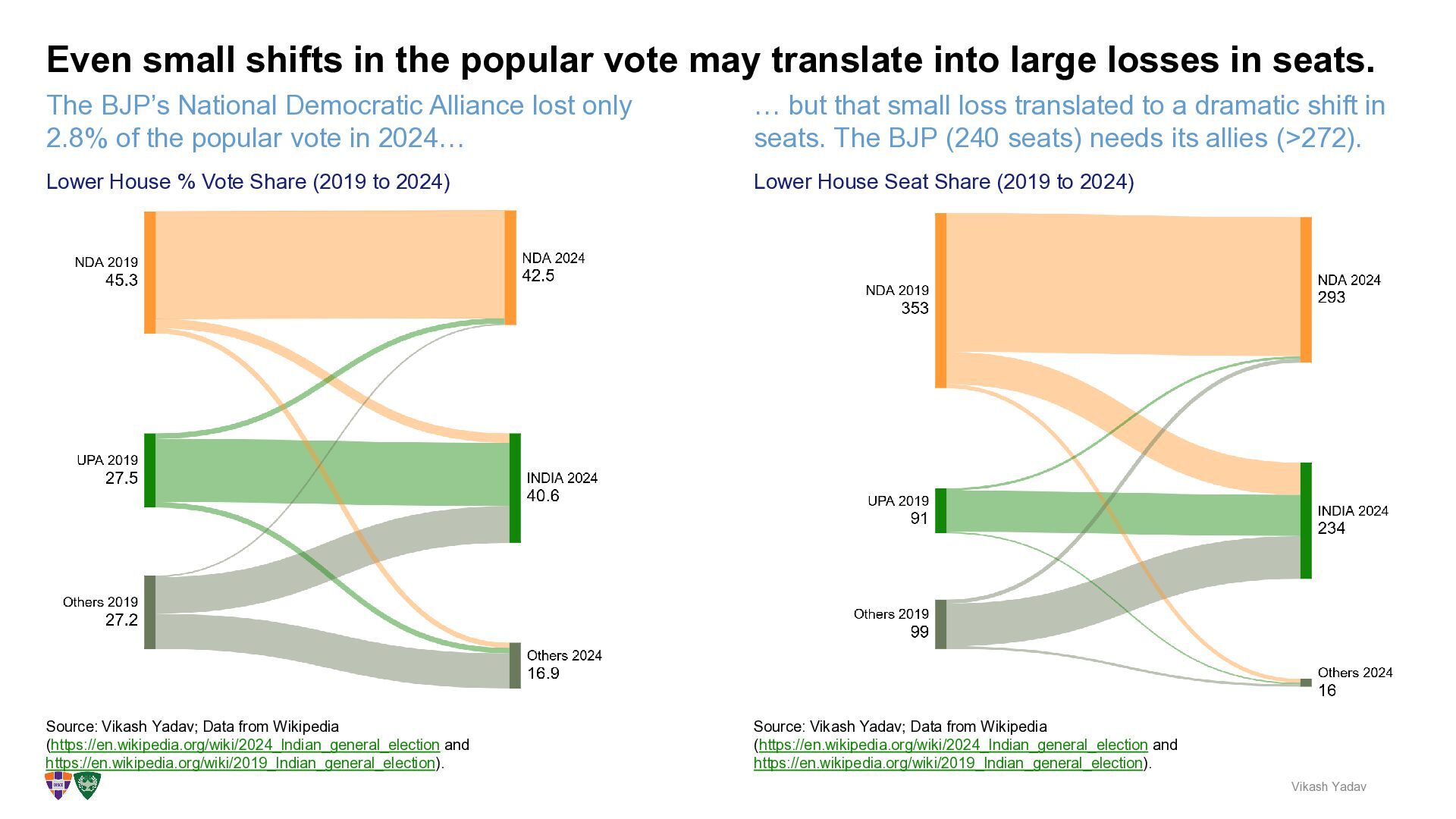
popular vote in 2024… Even small shifts in the popular vote may translate into large losses in seats. Vikash Yadav … but that small loss translated to a dramatic shift in seats. The BJP (240 seats) needs its allies (>272). Source: Vikash Yadav; Data from Wikipedia (https://en.wikipedia.org/wiki/2024_Indian_general_election and https://en.wikipedia.org/wiki/2019_Indian_general_election). Source: Vikash Yadav; Data from Wikipedia (https://en.wikipedia.org/wiki/2024_Indian_general_election and https://en.wikipedia.org/wiki/2019_Indian_general_election). Lower House % Vote Share (2019 to 2024) Lower House Seat Share (2019 to 2024)
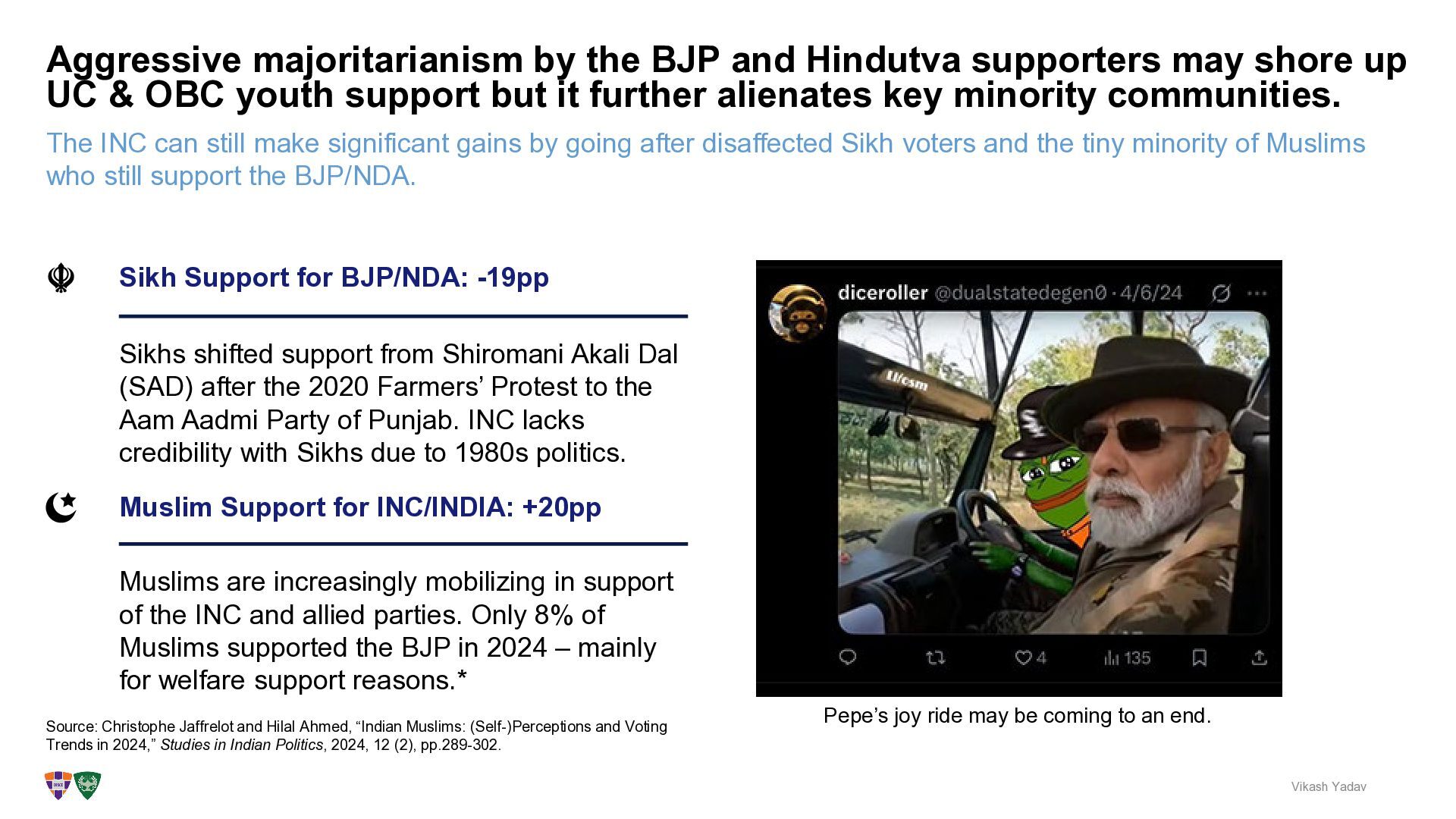
disaffected Sikh voters and the tiny minority of Muslims who still support the BJP/NDA. Aggressive majoritarianism by the BJP and Hindutva supporters may shore up UC & OBC youth support but it further alienates key minority communities. Vikash Yadav Pepe’s joy ride may be coming to an end. Sikh Support for BJP/NDA: -19pp Muslim Support for INC/INDIA: +20pp Sikhs shifted support from Shiromani Akali Dal (SAD) after the 2020 Farmers’ Protest to the Aam Aadmi Party of Punjab. INC lacks credibility with Sikhs due to 1980s politics. Muslims are increasingly mobilizing in support of the INC and allied parties. Only 8% of Muslims supported the BJP in 2024 – mainly for welfare support reasons.* Source: Christophe Jaffrelot and Hilal Ahmed, “Indian Muslims: (Self-)Perceptions and Voting Trends in 2024,” Studies in Indian Politics, 2024, 12 (2), pp.289-302.


 vyadav
 uranoken
 terasawat
 akiraasano
 ssmedikasda
 signer
 ishii_mit
 matleenalaakso
 yatabe
 spring_aki
 arnoknobbe
 bvr7352
 tammielis
 raygrieselhuber
 thirion
 jakevdp
 jmmastey
 cassininazir
 jcasabona
 keathley
 jacobtomlinson
 mojombo
 maggiecrowley
 kneath