Upgrade to Pro — share decks privately, control downloads, hide ads and more …

Digital Independence: Why, When and How

Digital Independence: Why, When and How

Today's rapidly changing global landscape demands bold decisions. Organizations that cling to the status quo risk falling behind—or worse, becoming vulnerable. Join this session to understand the real risks of inaction, discover actionable strategies for achieving digital independence, and learn how to build strong business justifications that lower your TCO and future-proof your organization.
Track: Business & Strategy

Speakers: Thomas Hampel , Wannes Rams

Avatar for Wannes Rams

Wannes Rams

May 06, 2026

More Decks by Wannes Rams

Other Decks in Technology

Transcript

  1. Digital Independence: Why, When and How A Strategic Briefing for

    European Organizations — Understanding the legal landscape, evaluating the risks of US cloud dependency, and charting a practical path toward genuine digital sovereignty.
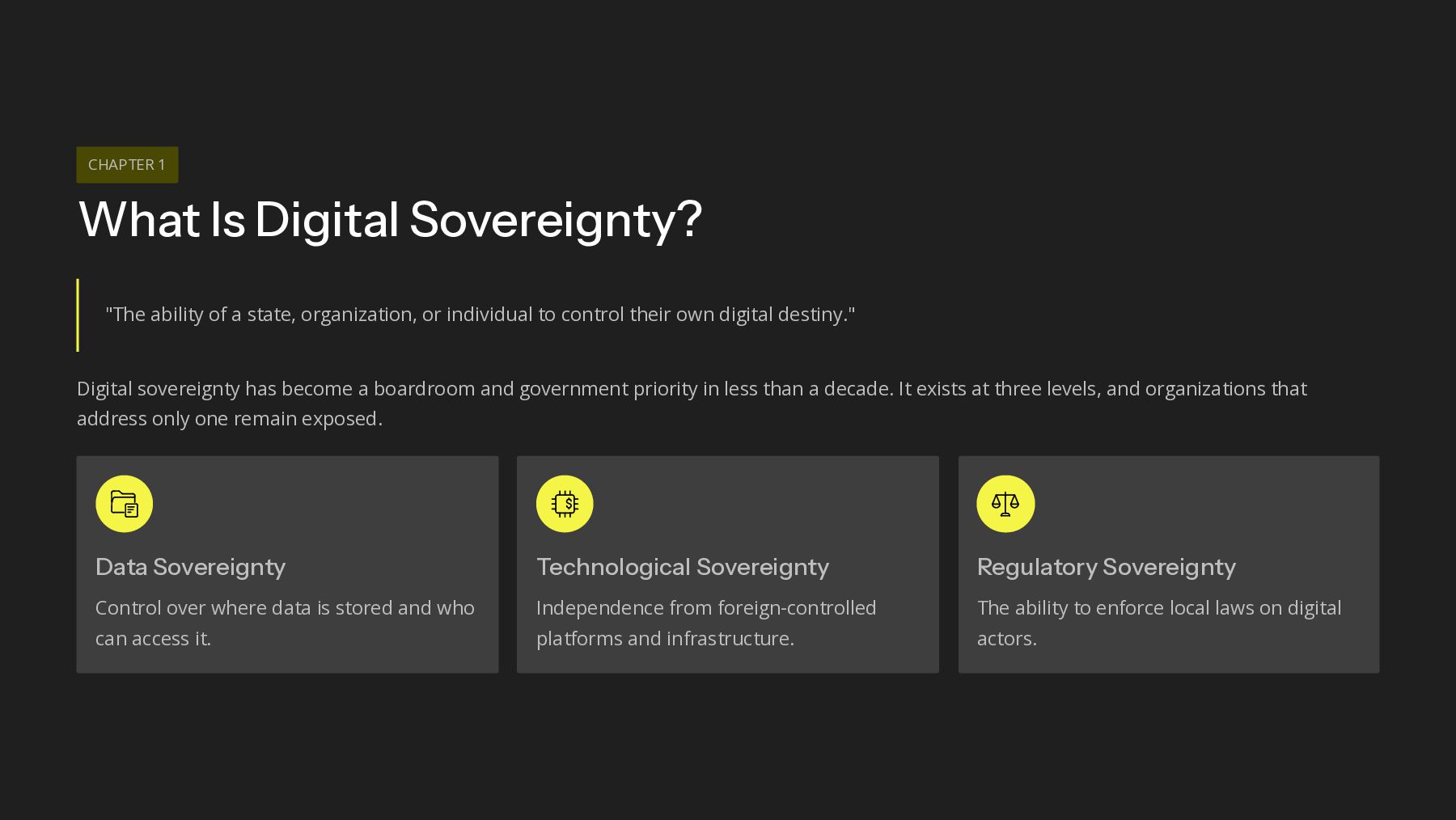
  2. CHAPTER 1 What Is Digital Sovereignty? "The ability of a
    state, organization, or individual to control their own digital destiny." Digital sovereignty has become a boardroom and government priority in less than a decade. It exists at three levels, and organizations that address only one remain exposed. Data Sovereignty Control over where data is stored and who can access it. Technological Sovereignty Independence from foreign-controlled platforms and infrastructure. Regulatory Sovereignty The ability to enforce local laws on digital actors.
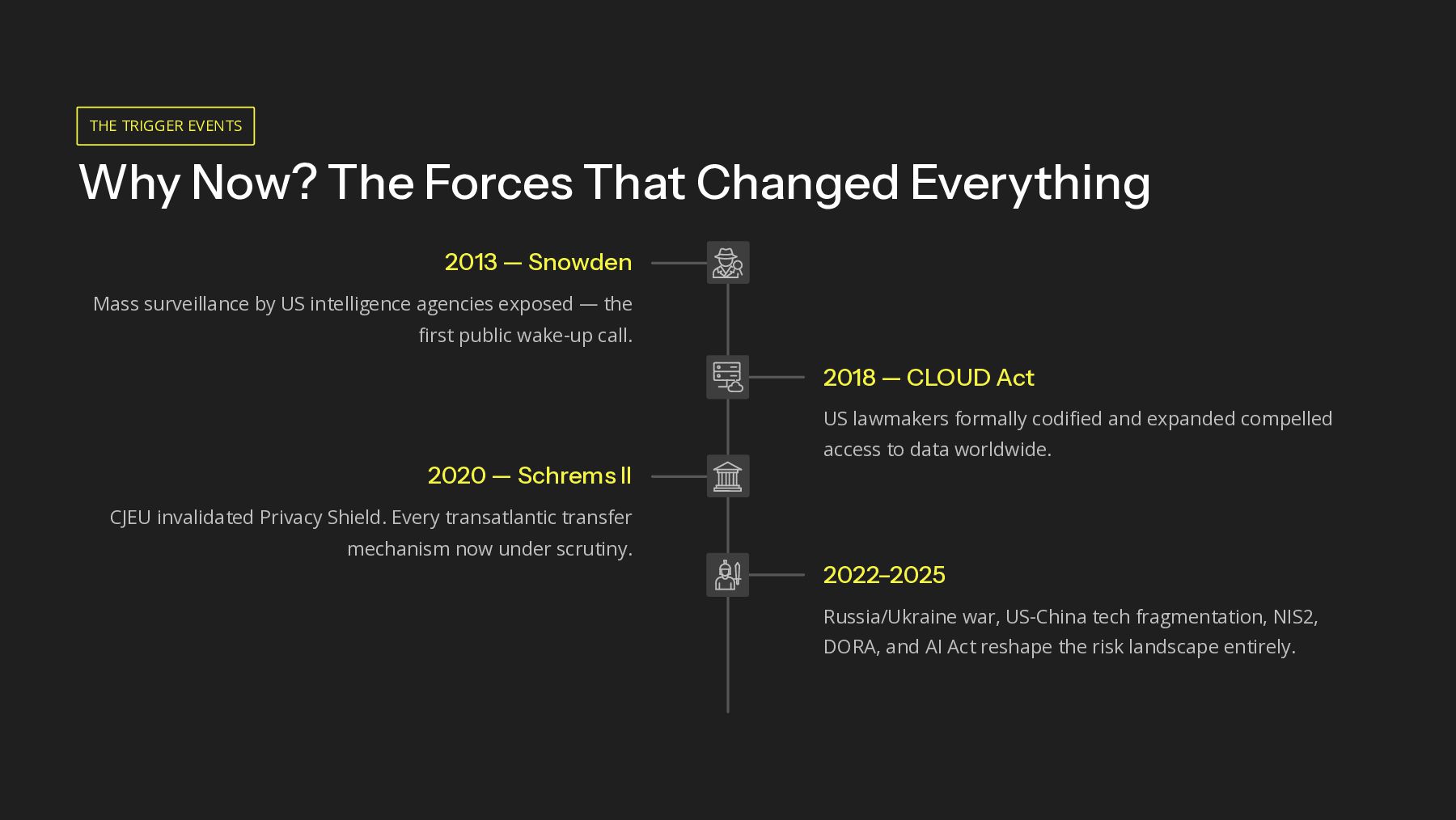
  3. THE TRIGGER EVENTS Why Now? The Forces That Changed Everything

    2013 — Snowden Mass surveillance by US intelligence agencies exposed — the first public wake-up call. 2018 — CLOUD Act US lawmakers formally codified and expanded compelled access to data worldwide. 2020 — Schrems II CJEU invalidated Privacy Shield. Every transatlantic transfer mechanism now under scrutiny. 2022–2025 Russia/Ukraine war, US-China tech fragmentation, NIS2, DORA, and AI Act reshape the risk landscape entirely.
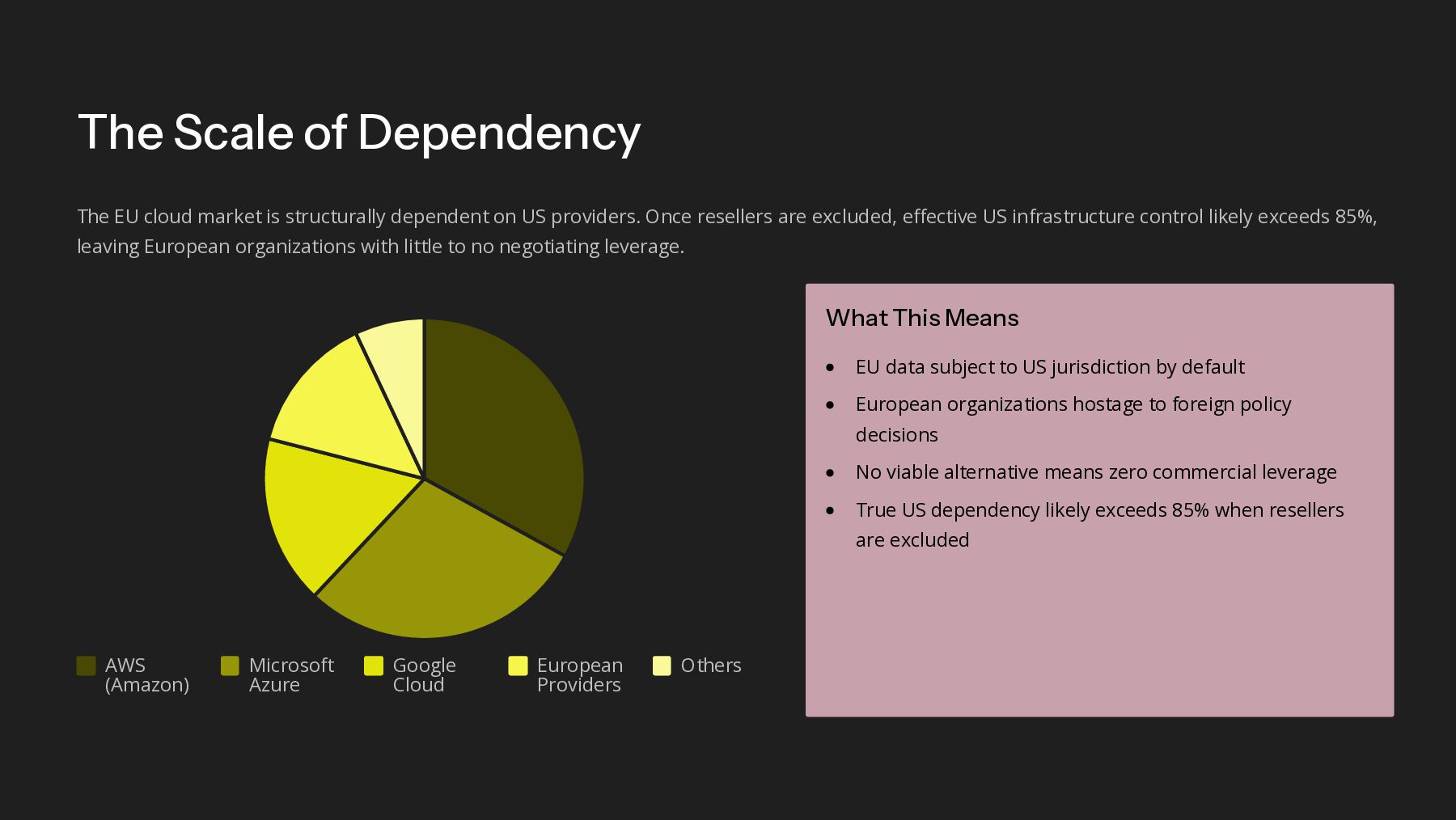
  4. The Scale of Dependency The EU cloud market is structurally

    dependent on US providers. Once resellers are excluded, effective US infrastructure control likely exceeds 85%, leaving European organizations with little to no negotiating leverage. AWS (Amazon) Microsoft Azure Google Cloud European Providers Others What This Means EU data subject to US jurisdiction by default European organizations hostage to foreign policy decisions No viable alternative means zero commercial leverage True US dependency likely exceeds 85% when resellers are excluded
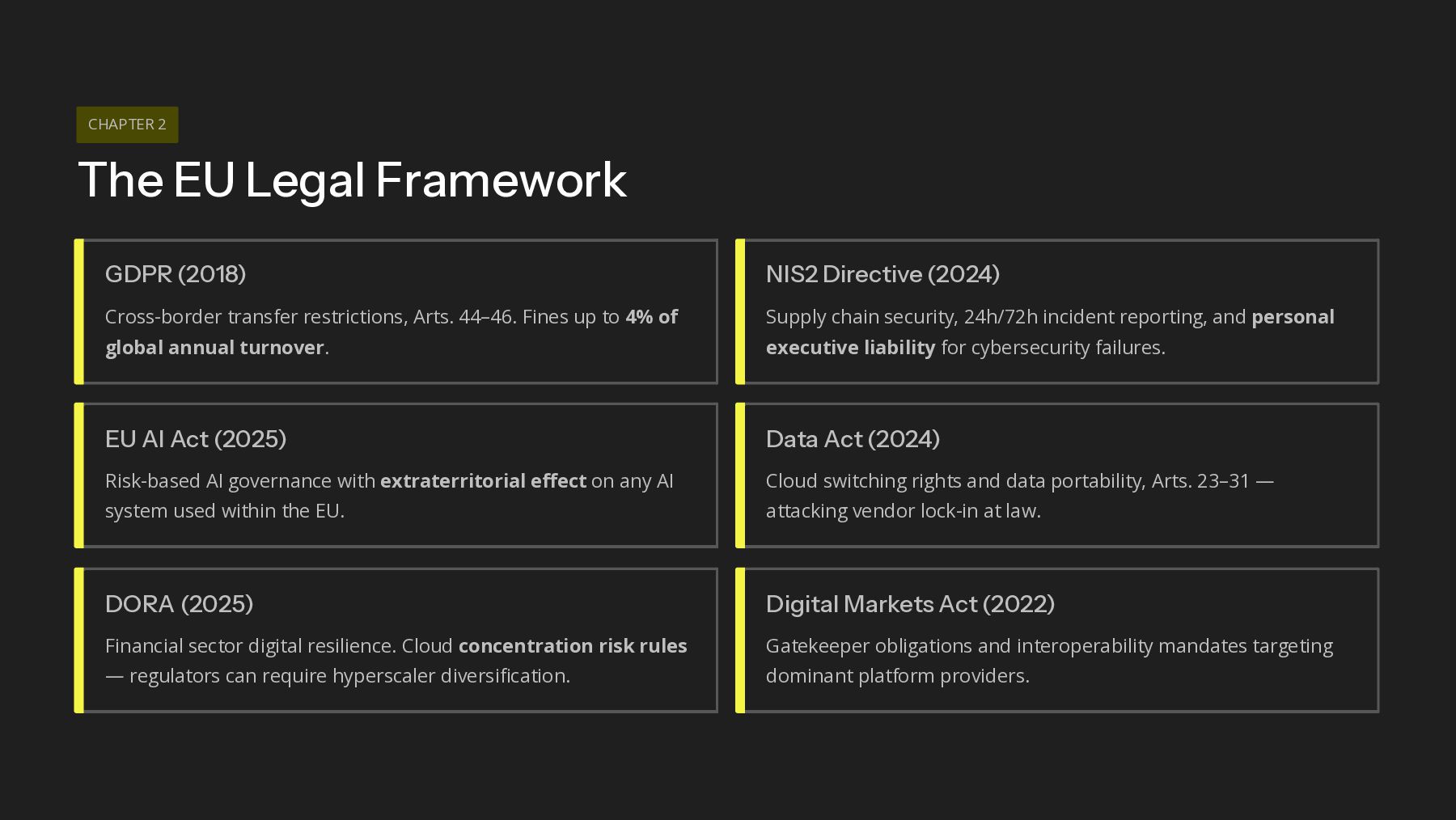
  5. CHAPTER 2 The EU Legal Framework GDPR (2018) Cross-border transfer

    restrictions, Arts. 44–46. Fines up to 4% of global annual turnover. NIS2 Directive (2024) Supply chain security, 24h/72h incident reporting, and personal executive liability for cybersecurity failures. EU AI Act (2025) Risk-based AI governance with extraterritorial effect on any AI system used within the EU. Data Act (2024) Cloud switching rights and data portability, Arts. 23–31 — attacking vendor lock-in at law. DORA (2025) Financial sector digital resilience. Cloud concentration risk rules — regulators can require hyperscaler diversification. Digital Markets Act (2022) Gatekeeper obligations and interoperability mandates targeting dominant platform providers.
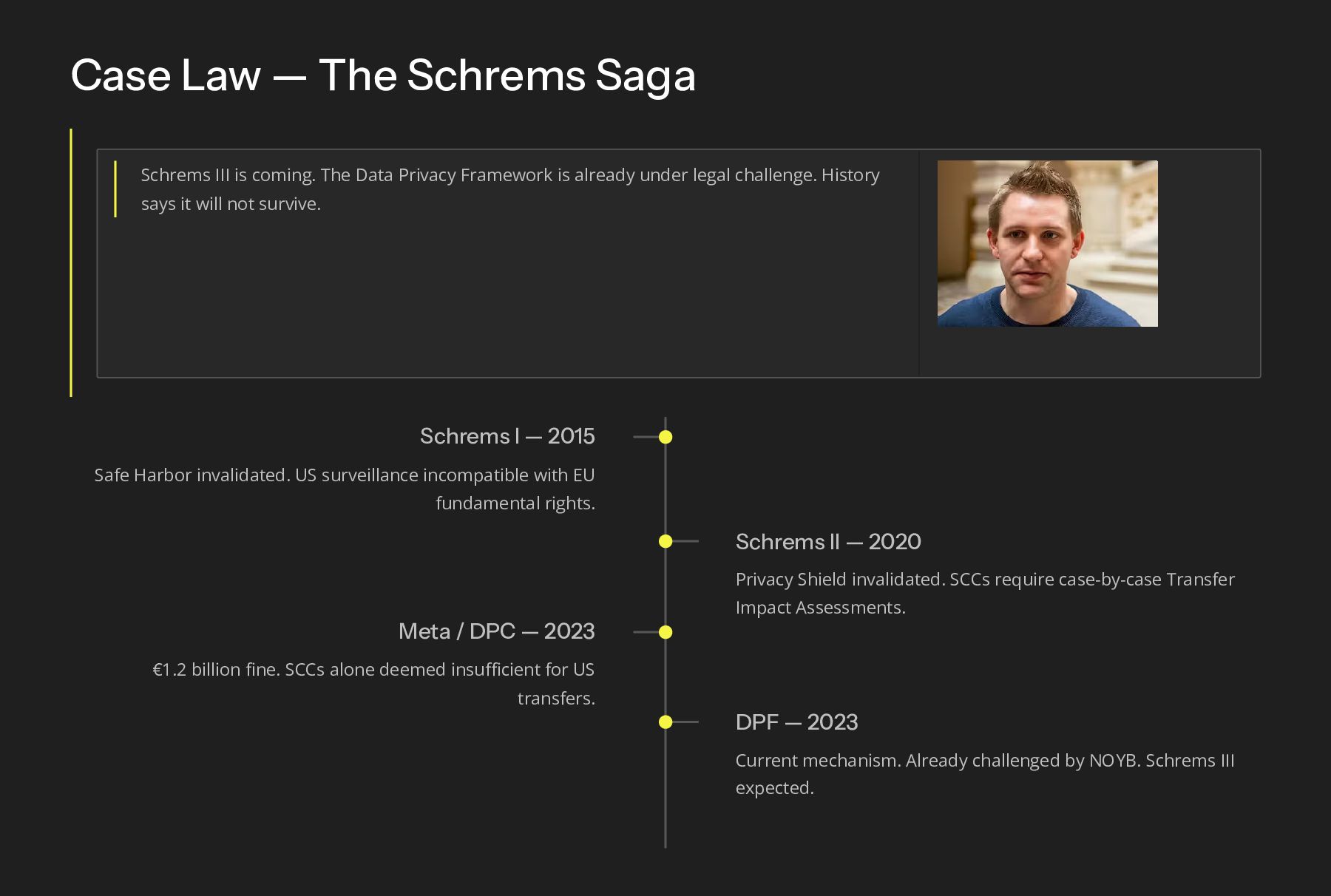
  6. Case Law — The Schrems Saga Schrems III is coming.

    The Data Privacy Framework is already under legal challenge. History says it will not survive. Schrems I — 2015 Safe Harbor invalidated. US surveillance incompatible with EU fundamental rights. Schrems II — 2020 Privacy Shield invalidated. SCCs require case-by-case Transfer Impact Assessments. Meta / DPC — 2023 €1.2 billion fine. SCCs alone deemed insufficient for US transfers. DPF — 2023 Current mechanism. Already challenged by NOYB. Schrems III expected.
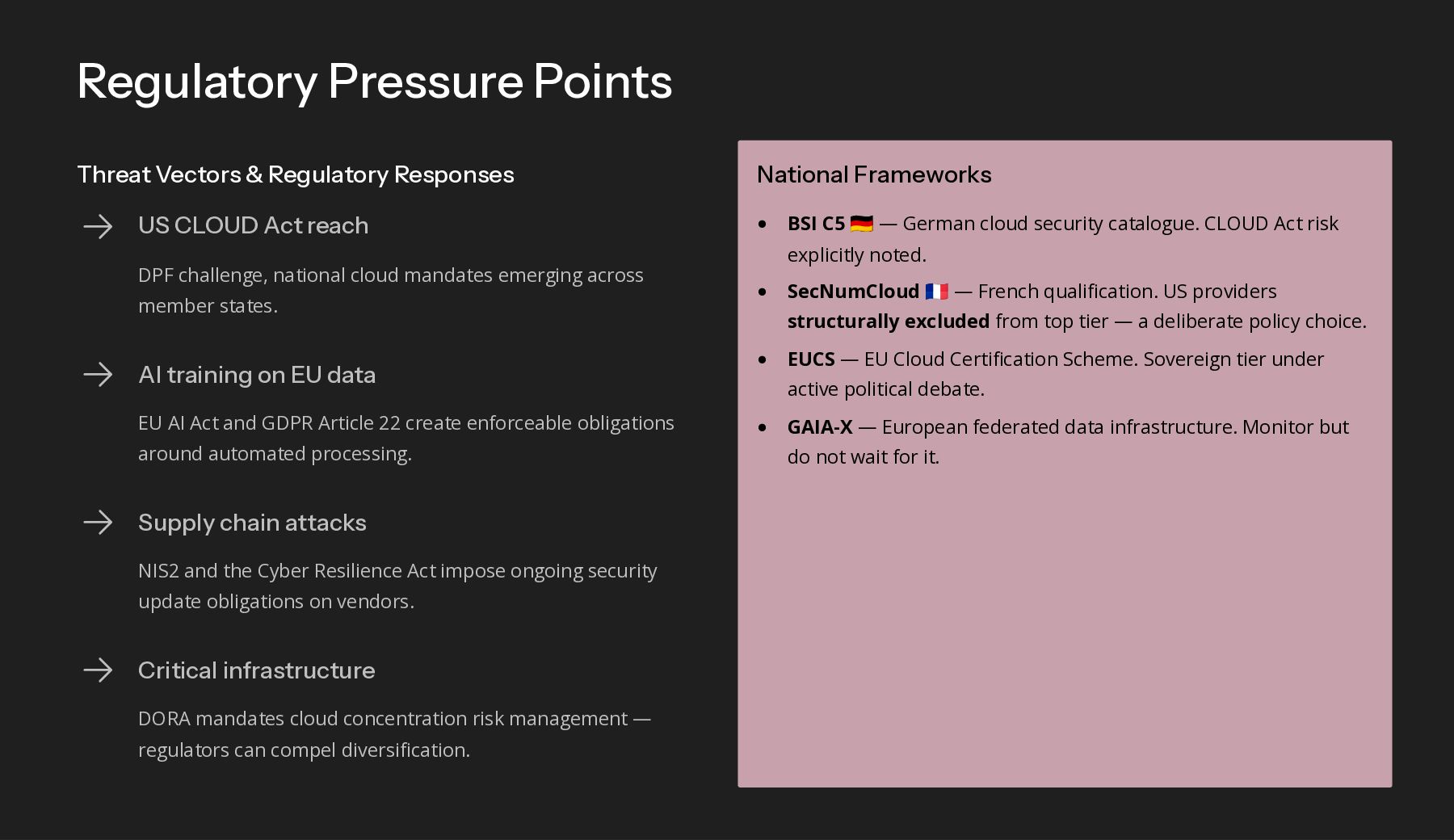
  7. Regulatory Pressure Points Threat Vectors & Regulatory Responses US CLOUD

    Act reach DPF challenge, national cloud mandates emerging across member states. AI training on EU data EU AI Act and GDPR Article 22 create enforceable obligations around automated processing. Supply chain attacks NIS2 and the Cyber Resilience Act impose ongoing security update obligations on vendors. Critical infrastructure DORA mandates cloud concentration risk management — regulators can compel diversification. National Frameworks BSI C5 🇩🇪 — German cloud security catalogue. CLOUD Act risk explicitly noted. SecNumCloud 🇫🇷 — French qualification. US providers structurally excluded from top tier — a deliberate policy choice. EUCS — EU Cloud Certification Scheme. Sovereign tier under active political debate. GAIA-X — European federated data infrastructure. Monitor but do not wait for it.
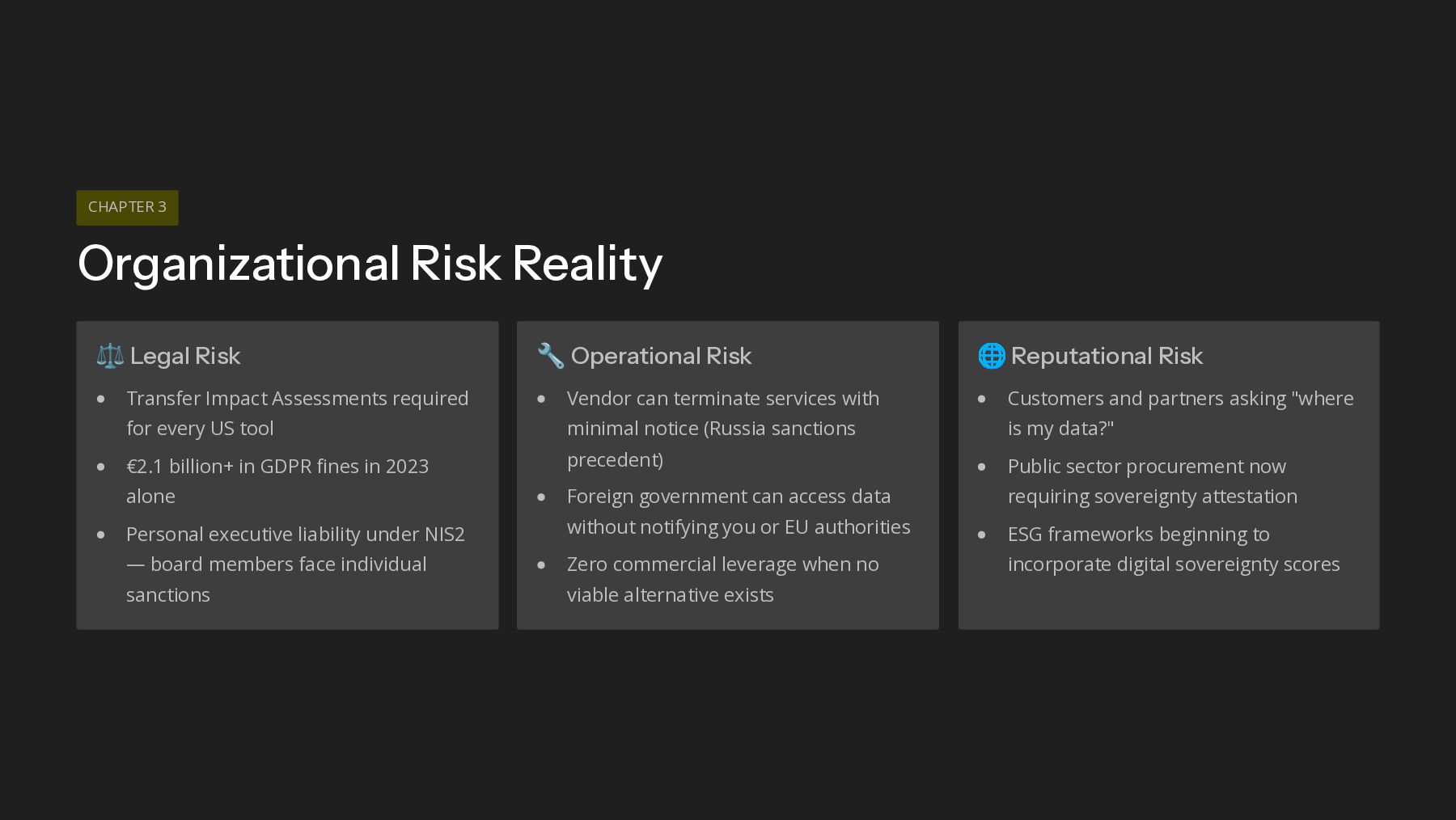
  8. CHAPTER 3 Organizational Risk Reality ⚖️ Legal Risk Transfer Impact

    Assessments required for every US tool €2.1 billion+ in GDPR fines in 2023 alone Personal executive liability under NIS2 — board members face individual sanctions 🔧 Operational Risk Vendor can terminate services with minimal notice (Russia sanctions precedent) Foreign government can access data without notifying you or EU authorities Zero commercial leverage when no viable alternative exists 🌐 Reputational Risk Customers and partners asking "where is my data?" Public sector procurement now requiring sovereignty attestation ESG frameworks beginning to incorporate digital sovereignty scores
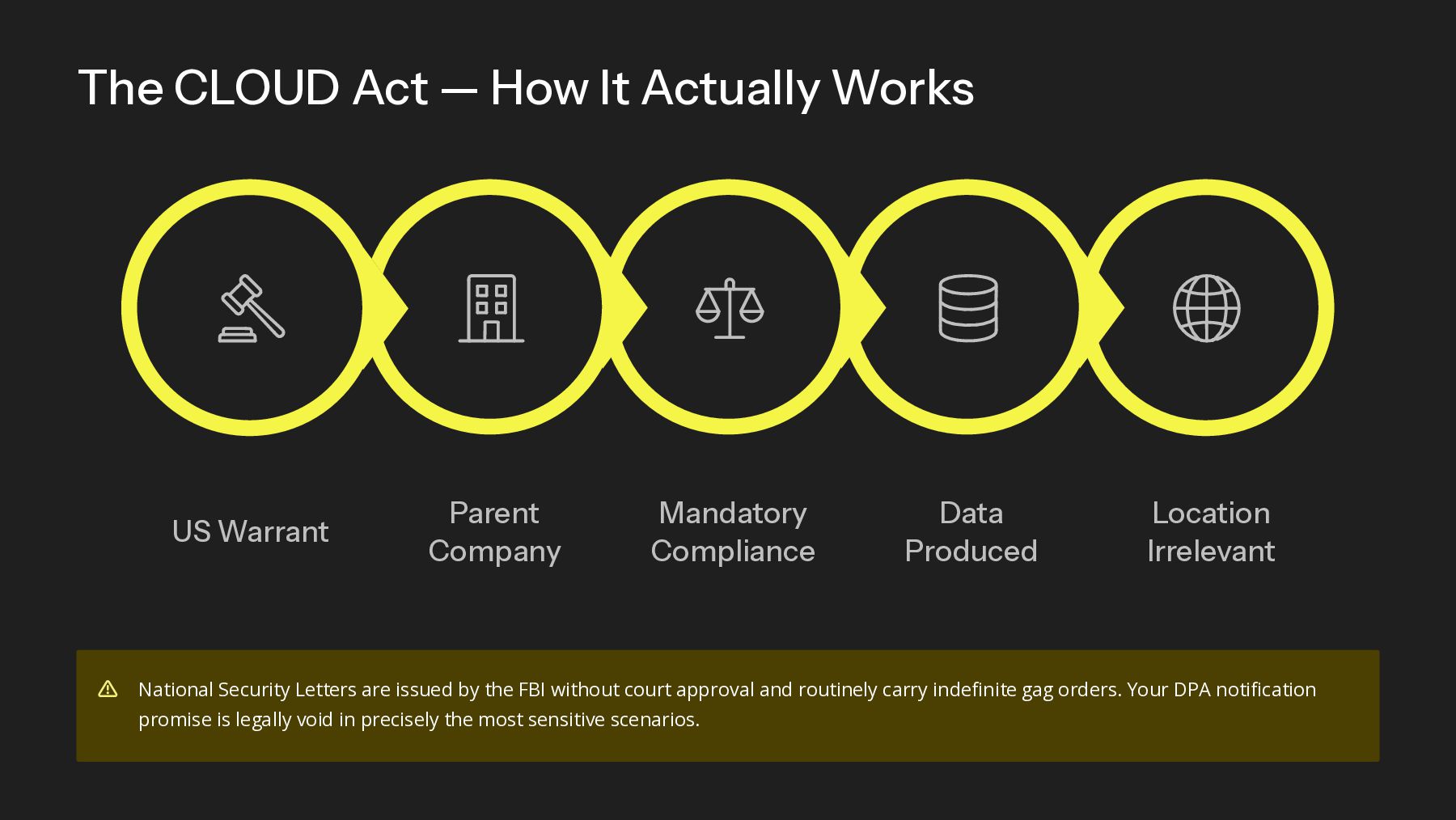
  9. The CLOUD Act — How It Actually Works Location Irrelevant

    Data Produced Mandatory Compliance Parent Company US Warrant National Security Letters are issued by the FBI without court approval and routinely carry indefinite gag orders. Your DPA notification promise is legally void in precisely the most sensitive scenarios.
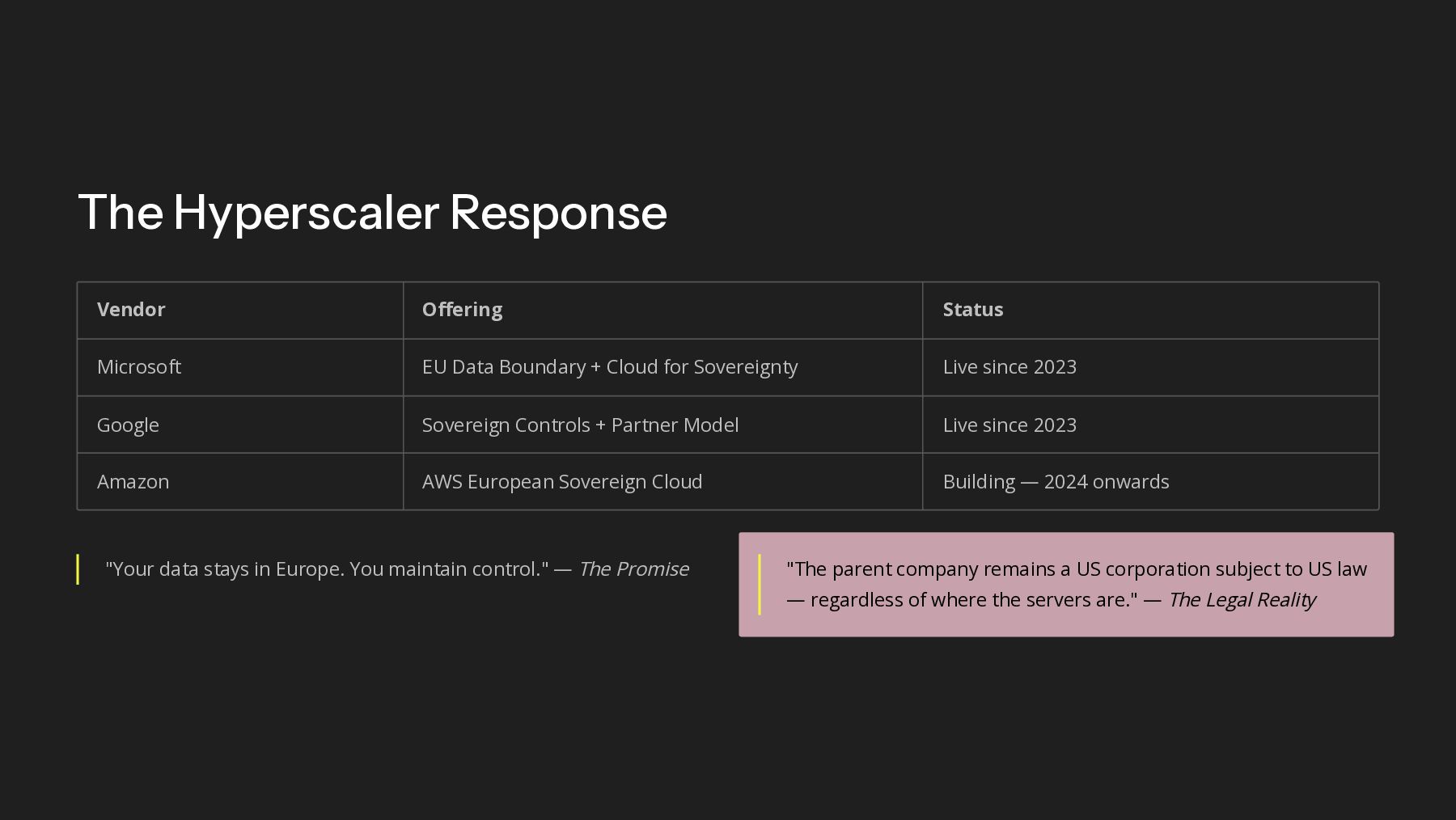
  10. The Hyperscaler Response Vendor Offering Status Microsoft EU Data Boundary

    + Cloud for Sovereignty Live since 2023 Google Sovereign Controls + Partner Model Live since 2023 Amazon AWS European Sovereign Cloud Building — 2024 onwards "Your data stays in Europe. You maintain control." — The Promise "The parent company remains a US corporation subject to US law — regardless of where the servers are." — The Legal Reality
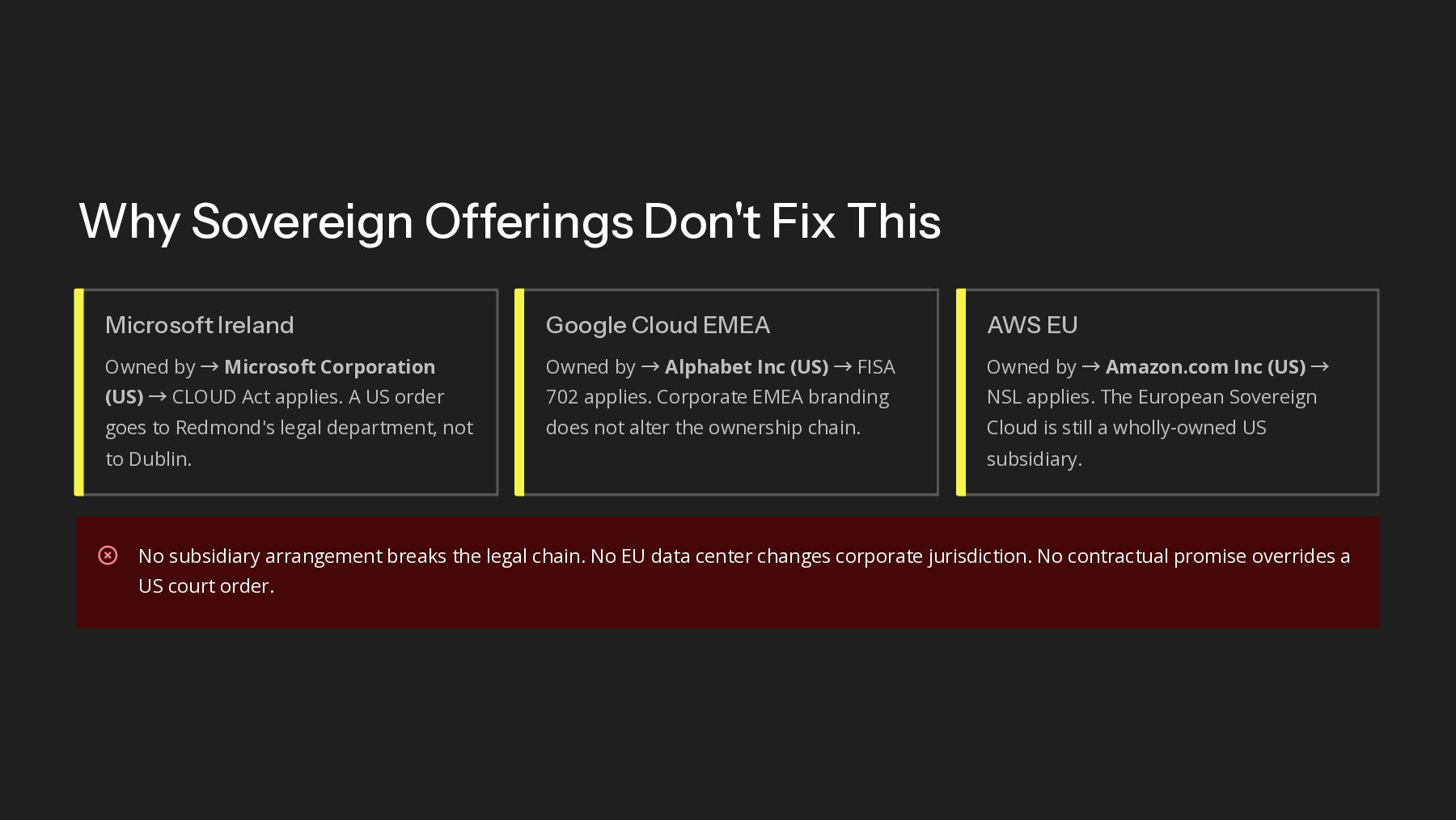
  11. Why Sovereign Offerings Don't Fix This Microsoft Ireland Owned by

    → Microsoft Corporation (US) → CLOUD Act applies. A US order goes to Redmond's legal department, not to Dublin. Google Cloud EMEA Owned by → Alphabet Inc (US) → FISA 702 applies. Corporate EMEA branding does not alter the ownership chain. AWS EU Owned by → Amazon.com Inc (US) → NSL applies. The European Sovereign Cloud is still a wholly-owned US subsidiary. No subsidiary arrangement breaks the legal chain. No EU data center changes corporate jurisdiction. No contractual promise overrides a US court order.
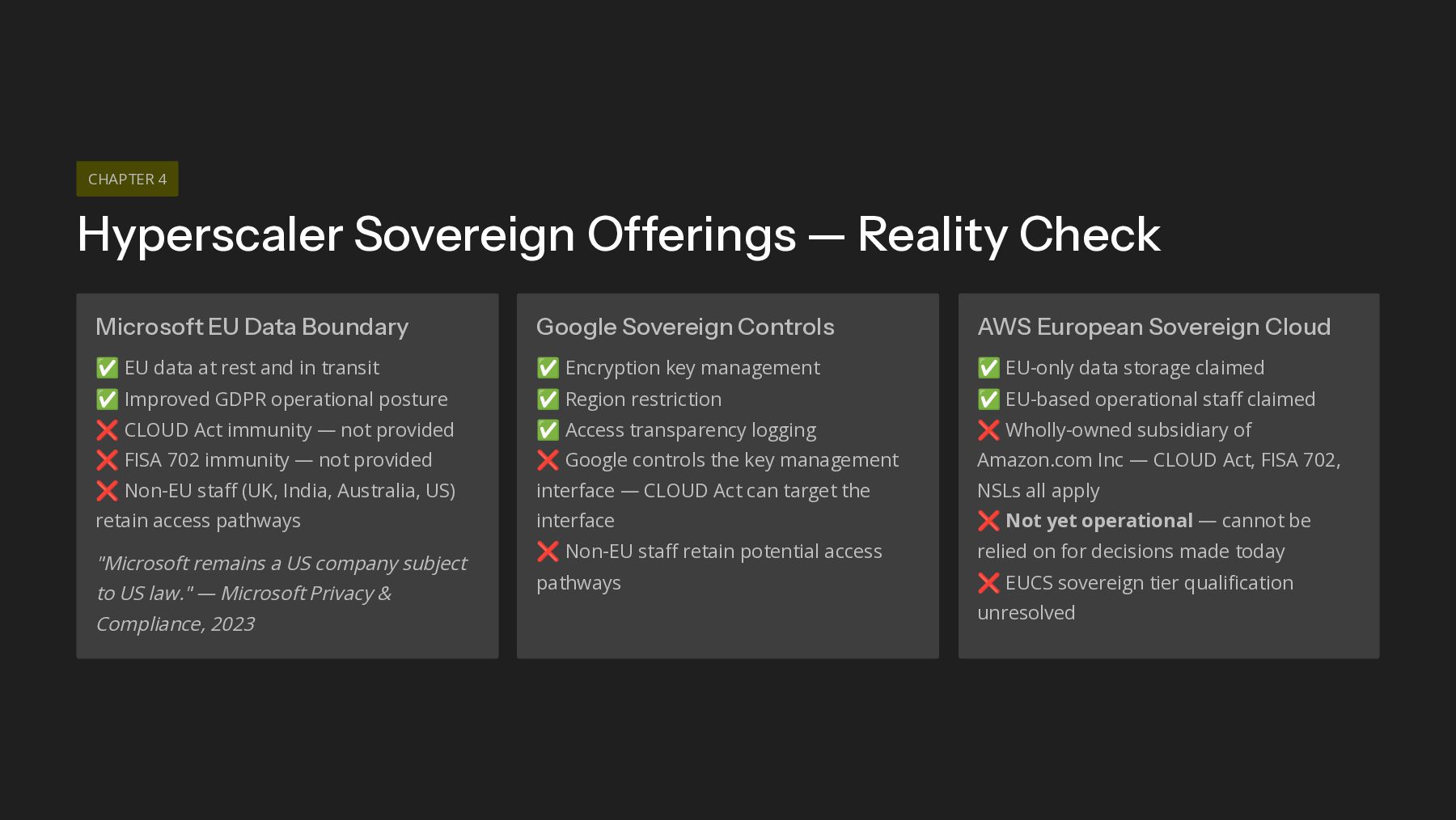
  12. CHAPTER 4 Hyperscaler Sovereign Offerings — Reality Check Microsoft EU

    Data Boundary ✅ EU data at rest and in transit ✅ Improved GDPR operational posture ❌ CLOUD Act immunity — not provided ❌ FISA 702 immunity — not provided ❌ Non-EU staff (UK, India, Australia, US) retain access pathways "Microsoft remains a US company subject to US law." — Microsoft Privacy & Compliance, 2023 Google Sovereign Controls ✅ Encryption key management ✅ Region restriction ✅ Access transparency logging ❌ Google controls the key management interface — CLOUD Act can target the interface ❌ Non-EU staff retain potential access pathways AWS European Sovereign Cloud ✅ EU-only data storage claimed ✅ EU-based operational staff claimed ❌ Wholly-owned subsidiary of Amazon.com Inc — CLOUD Act, FISA 702, NSLs all apply ❌ Not yet operational — cannot be relied on for decisions made today ❌ EUCS sovereign tier qualification unresolved
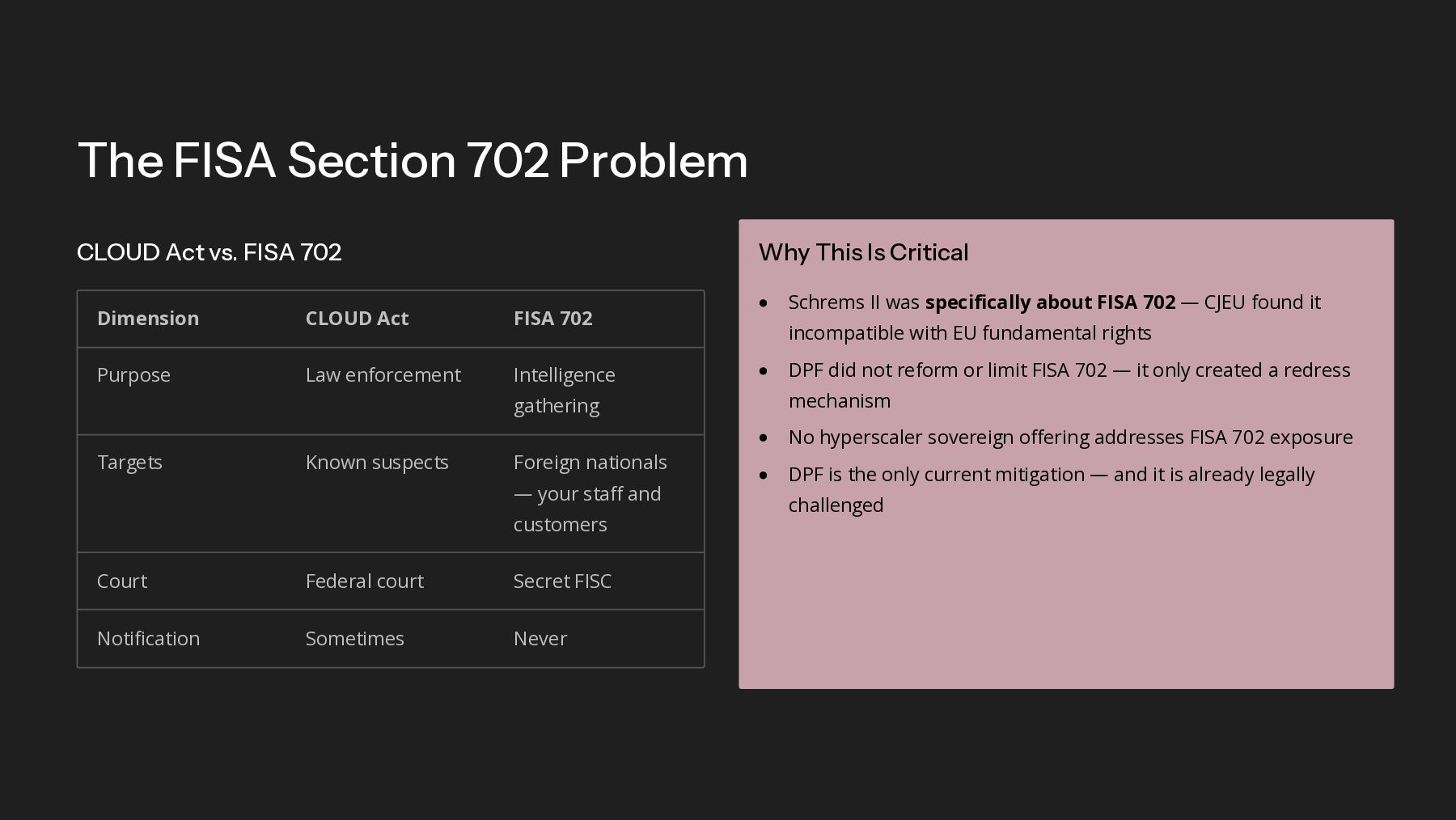
  13. The FISA Section 702 Problem CLOUD Act vs. FISA 702

    Dimension CLOUD Act FISA 702 Purpose Law enforcement Intelligence gathering Targets Known suspects Foreign nationals — your staff and customers Court Federal court Secret FISC Notification Sometimes Never Why This Is Critical Schrems II was specifically about FISA 702 — CJEU found it incompatible with EU fundamental rights DPF did not reform or limit FISA 702 — it only created a redress mechanism No hyperscaler sovereign offering addresses FISA 702 exposure DPF is the only current mitigation — and it is already legally challenged
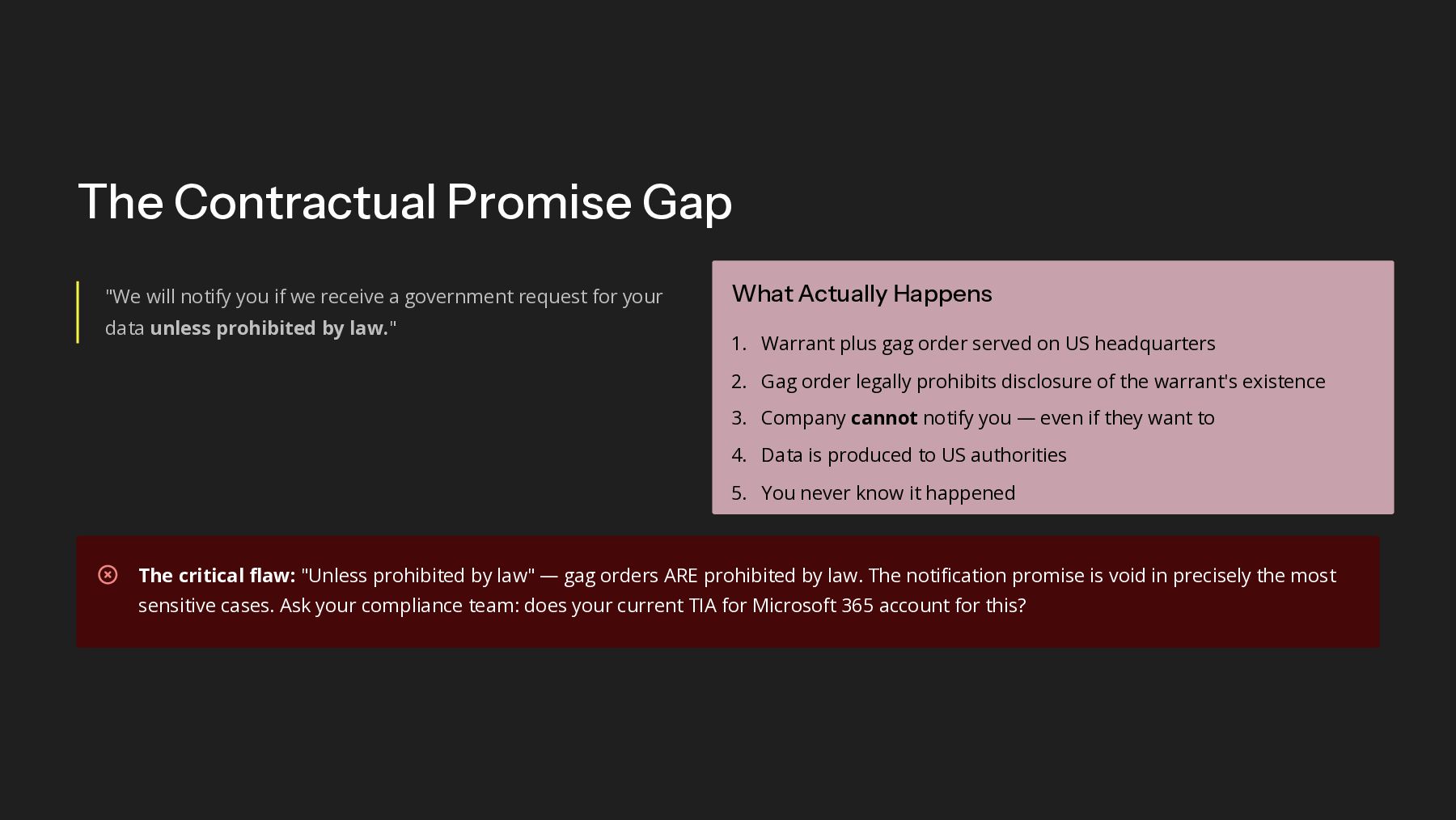
  14. The Contractual Promise Gap "We will notify you if we

    receive a government request for your data unless prohibited by law." What Actually Happens Warrant plus gag order served on US headquarters 1. Gag order legally prohibits disclosure of the warrant's existence 2. Company cannot notify you — even if they want to 3. Data is produced to US authorities 4. You never know it happened 5. The critical flaw: "Unless prohibited by law" — gag orders ARE prohibited by law. The notification promise is void in precisely the most sensitive cases. Ask your compliance team: does your current TIA for Microsoft 365 account for this?
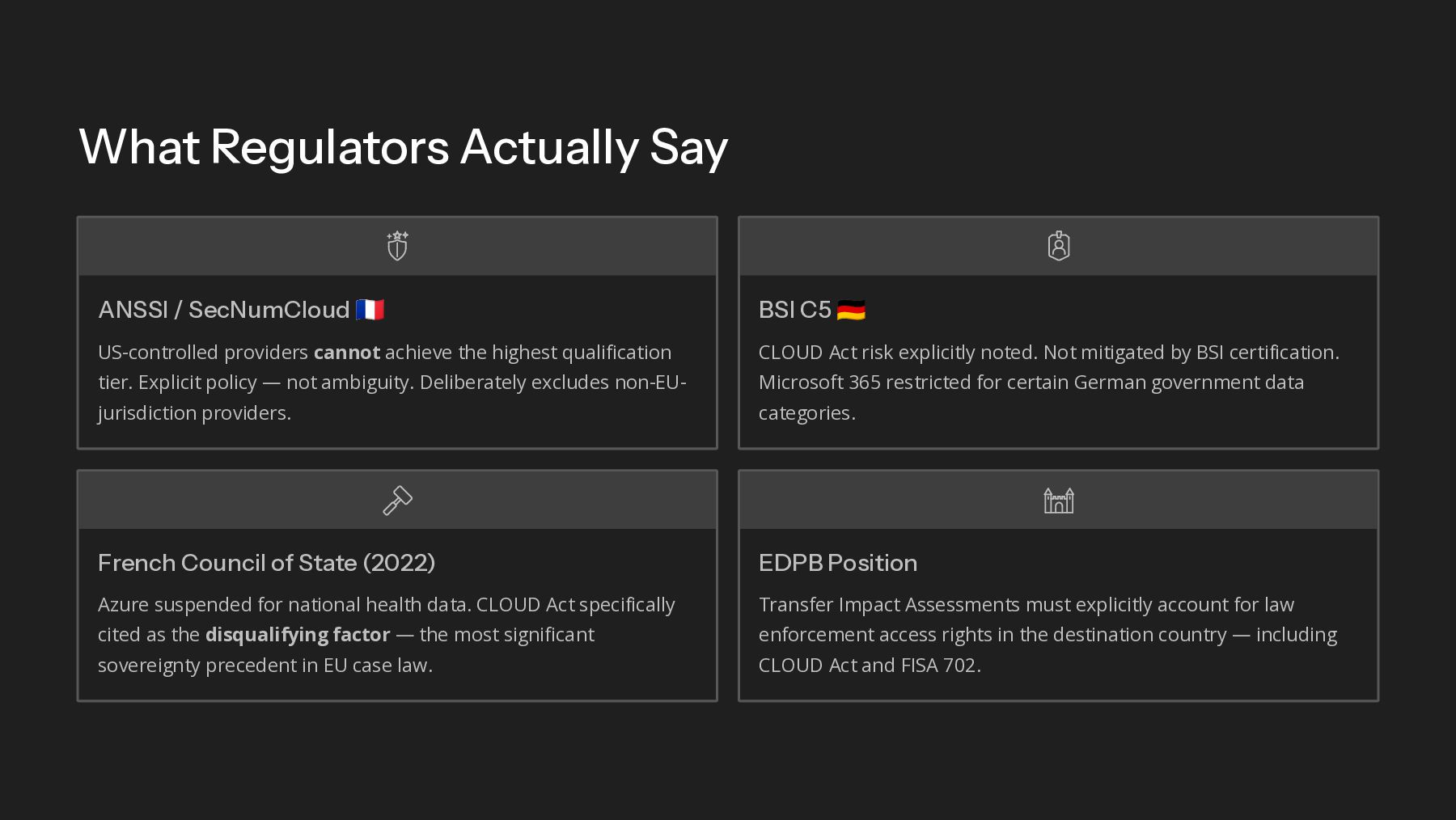
  15. What Regulators Actually Say ANSSI / SecNumCloud 🇫🇷 US-controlled providers

    cannot achieve the highest qualification tier. Explicit policy — not ambiguity. Deliberately excludes non-EU- jurisdiction providers. BSI C5 🇩🇪 CLOUD Act risk explicitly noted. Not mitigated by BSI certification. Microsoft 365 restricted for certain German government data categories. French Council of State (2022) Azure suspended for national health data. CLOUD Act specifically cited as the disqualifying factor — the most significant sovereignty precedent in EU case law. EDPB Position Transfer Impact Assessments must explicitly account for law enforcement access rights in the destination country — including CLOUD Act and FISA 702.
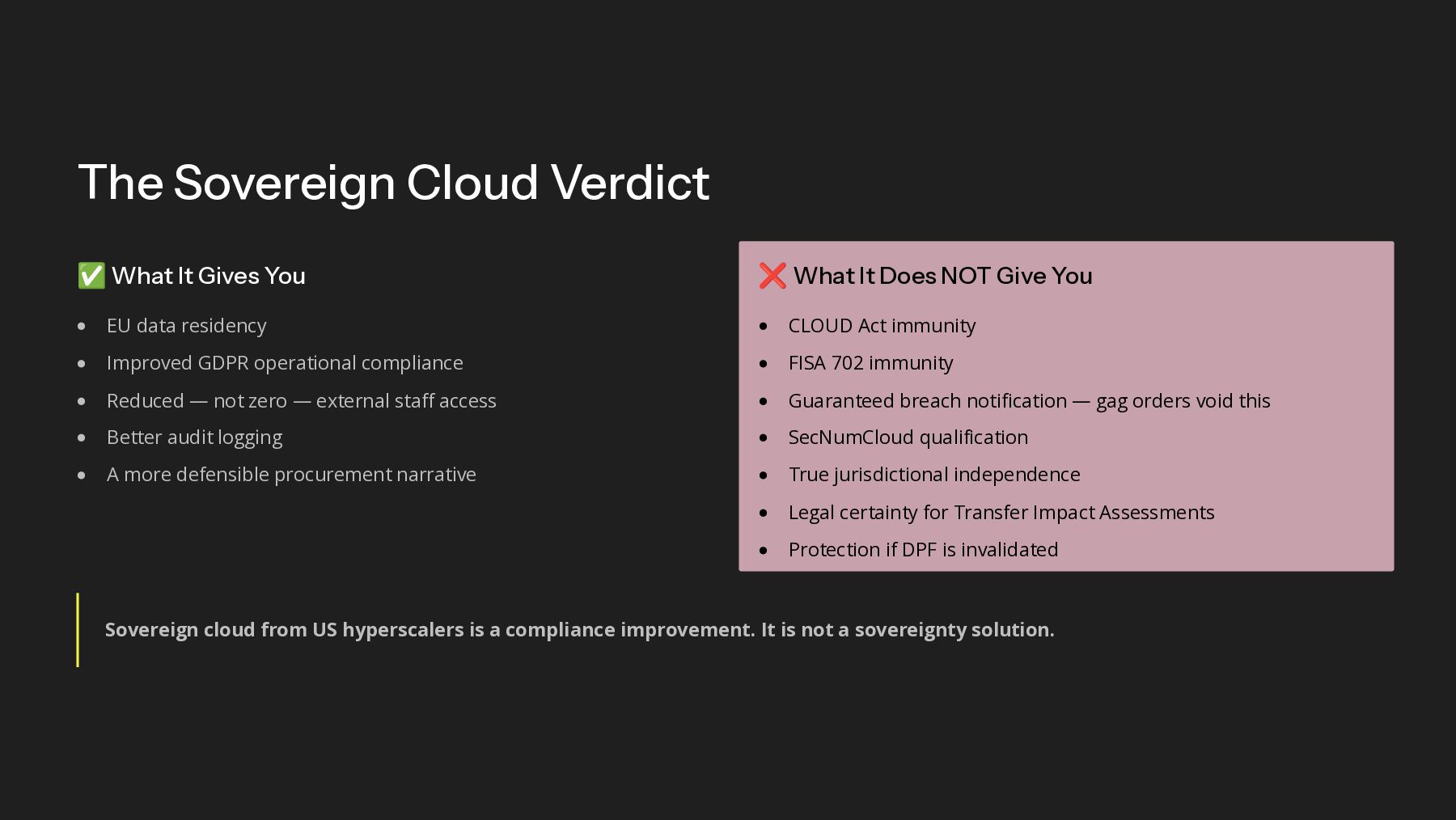
  16. The Sovereign Cloud Verdict ✅ What It Gives You EU

    data residency Improved GDPR operational compliance Reduced — not zero — external staff access Better audit logging A more defensible procurement narrative ❌ What It Does NOT Give You CLOUD Act immunity FISA 702 immunity Guaranteed breach notification — gag orders void this SecNumCloud qualification True jurisdictional independence Legal certainty for Transfer Impact Assessments Protection if DPF is invalidated Sovereign cloud from US hyperscalers is a compliance improvement. It is not a sovereignty solution.
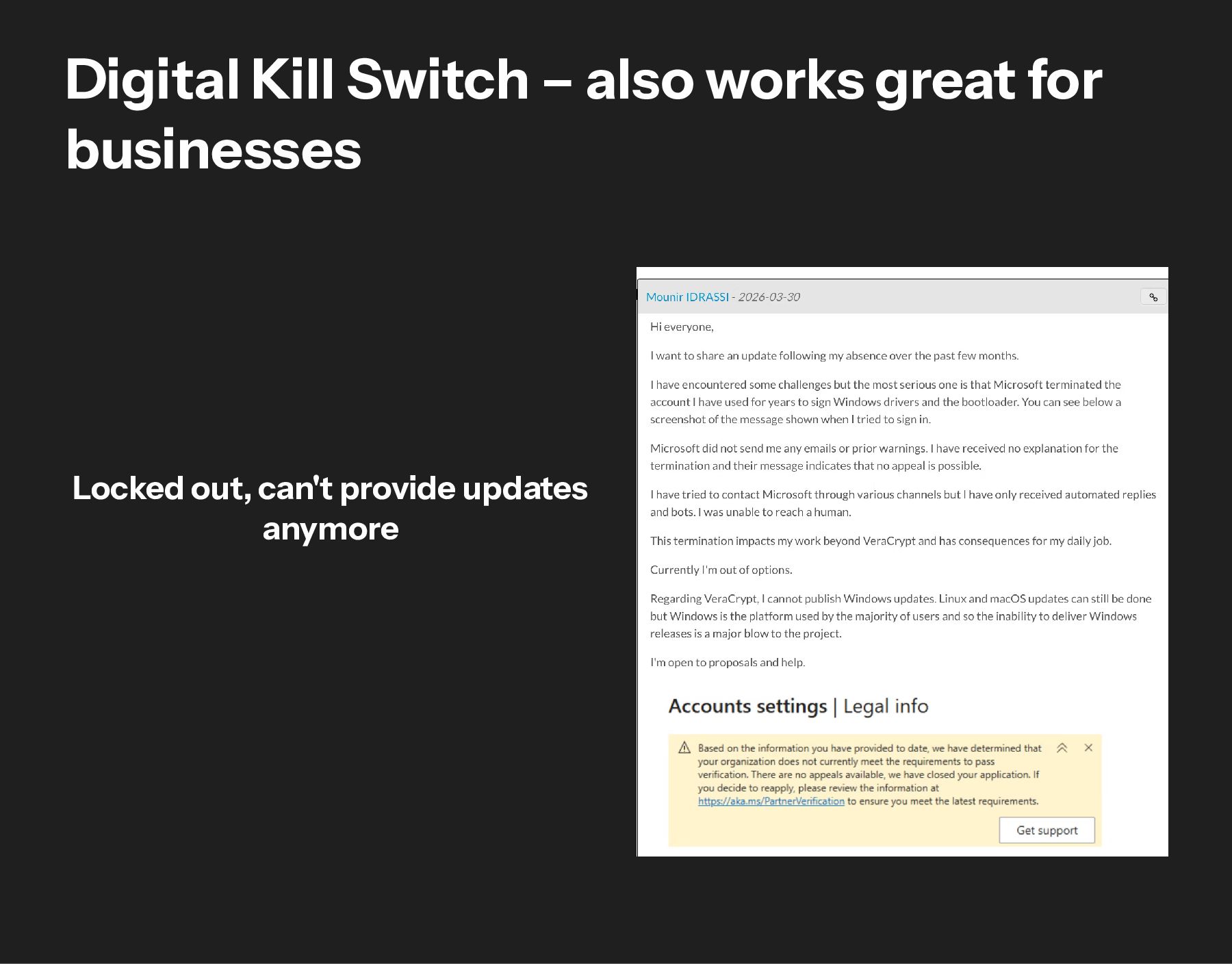
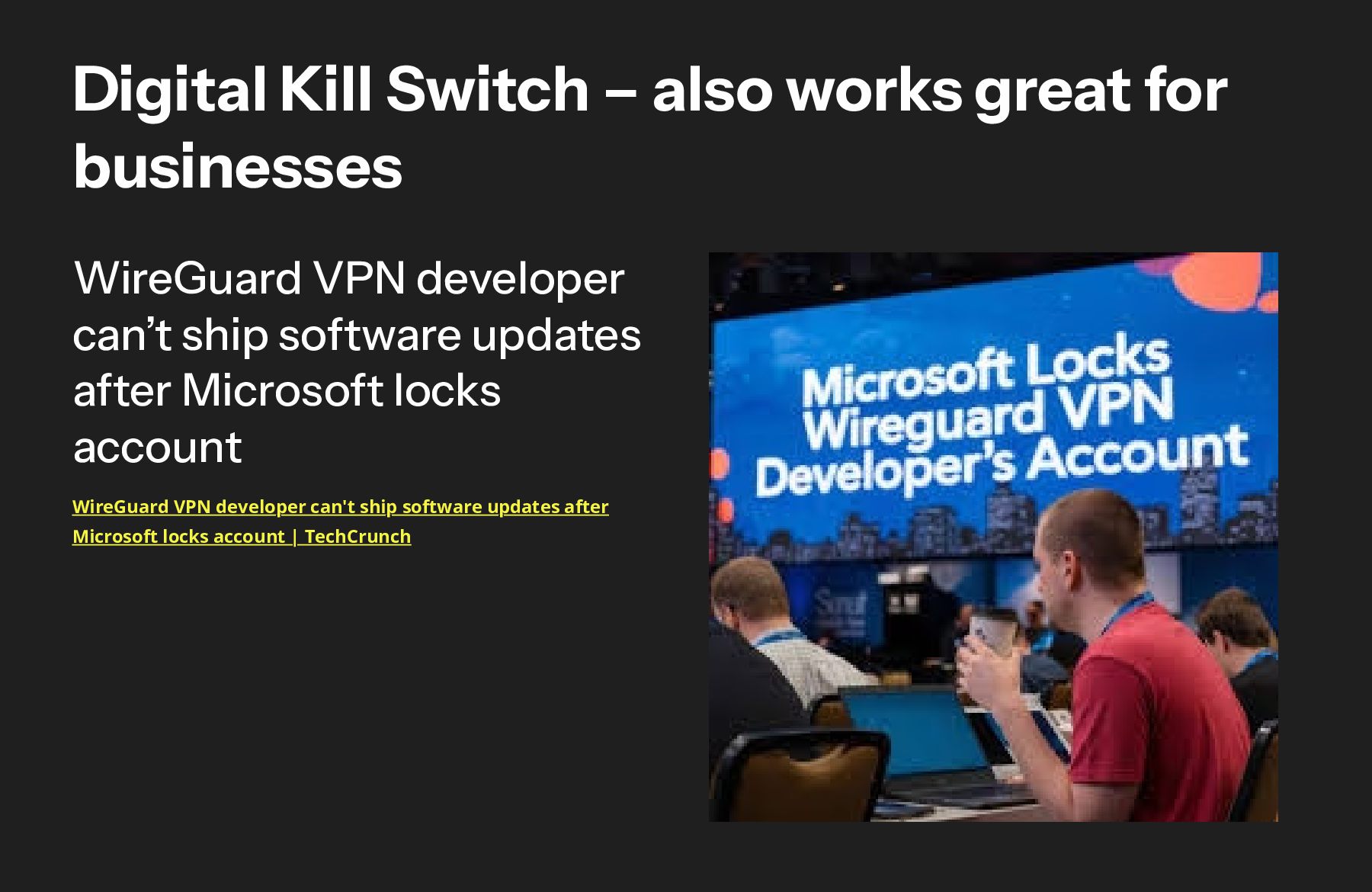
  17. Digital Kill Switch – also works great for businesses WireGuard

    VPN developer can’t ship software updates after Microsoft locks account WireGuard VPN developer can't ship software updates after Microsoft locks account | TechCrunch
  18. LinkedIn Is Illegally Searching Your Computer Microsoft is running one

    of the largest corporate espionage operations in modern history. https://browsergate.eu
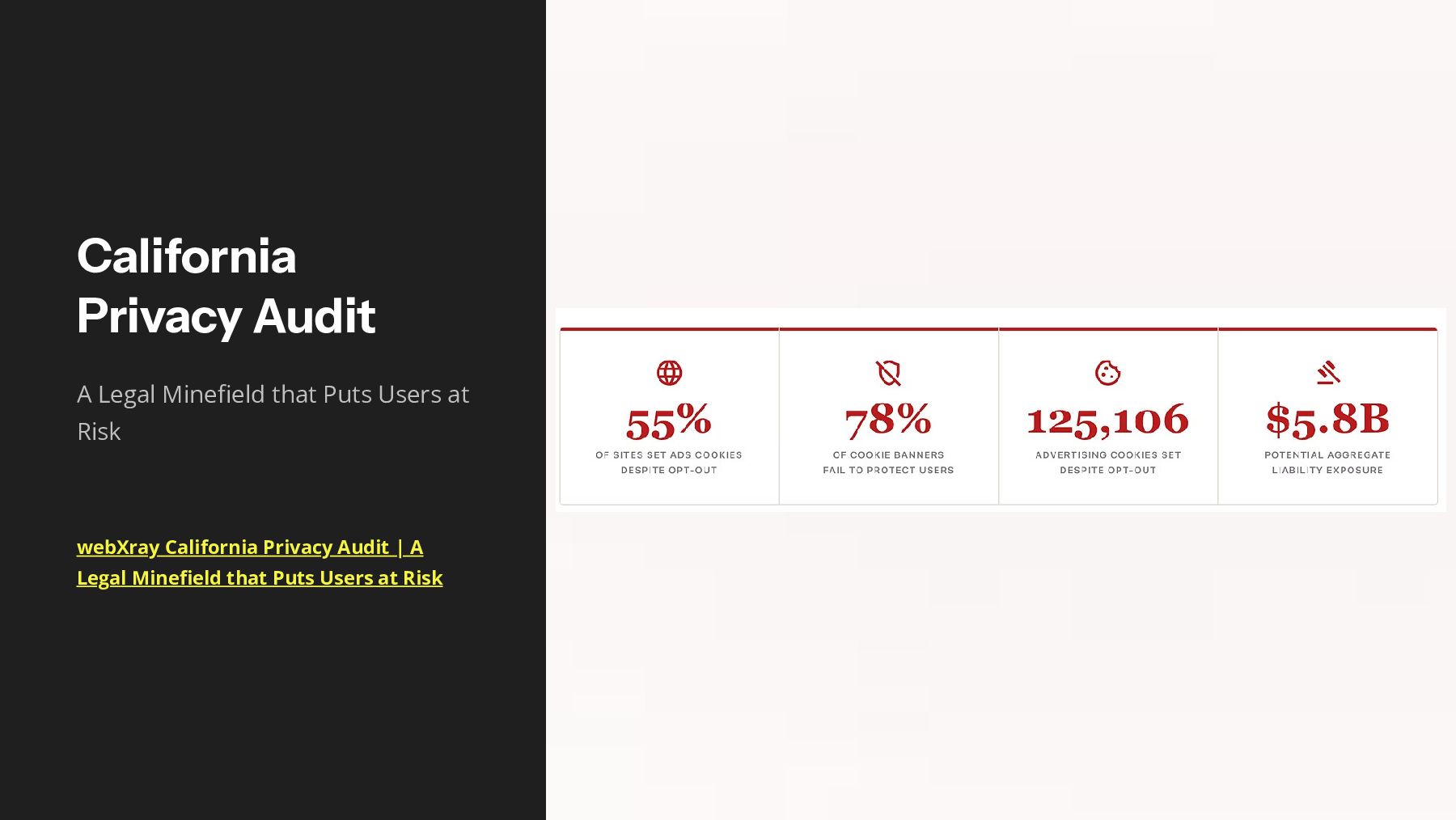
  19. California Privacy Audit A Legal Minefield that Puts Users at

    Risk webXray California Privacy Audit | A Legal Minefield that Puts Users at Risk
  20. Ex-Microsoft engineer believes Azure problems stem from talent exodus The

    cloud service's woes reflect a crisis made worse by AI – under-investment in people https://www.theregister.com/2026/04/04/azure_talent_exodus/
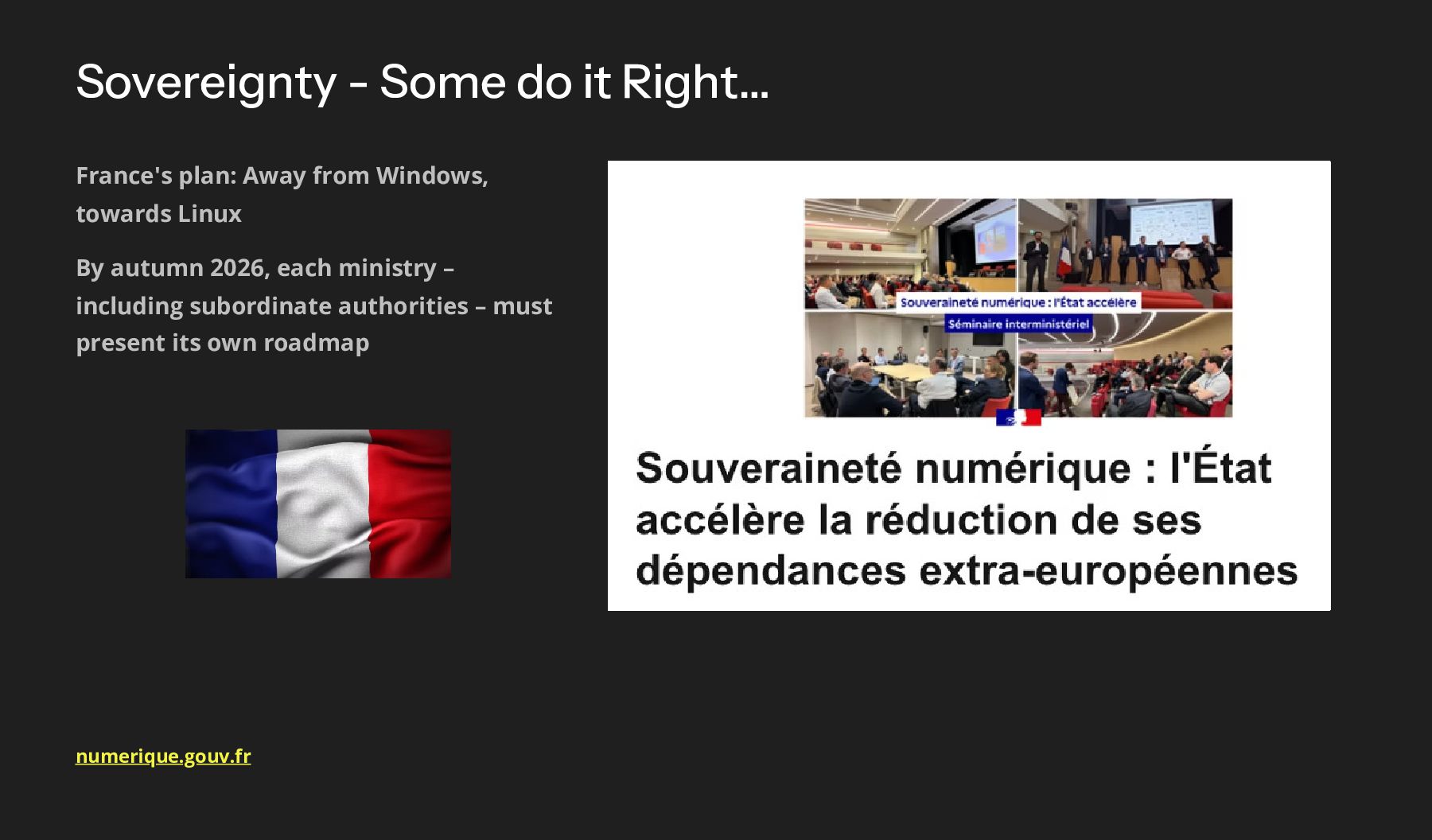
  21. Sovereignty - Some do it Right… France's plan: Away from

    Windows, towards Linux By autumn 2026, each ministry – including subordinate authorities – must present its own roadmap numerique.gouv.fr
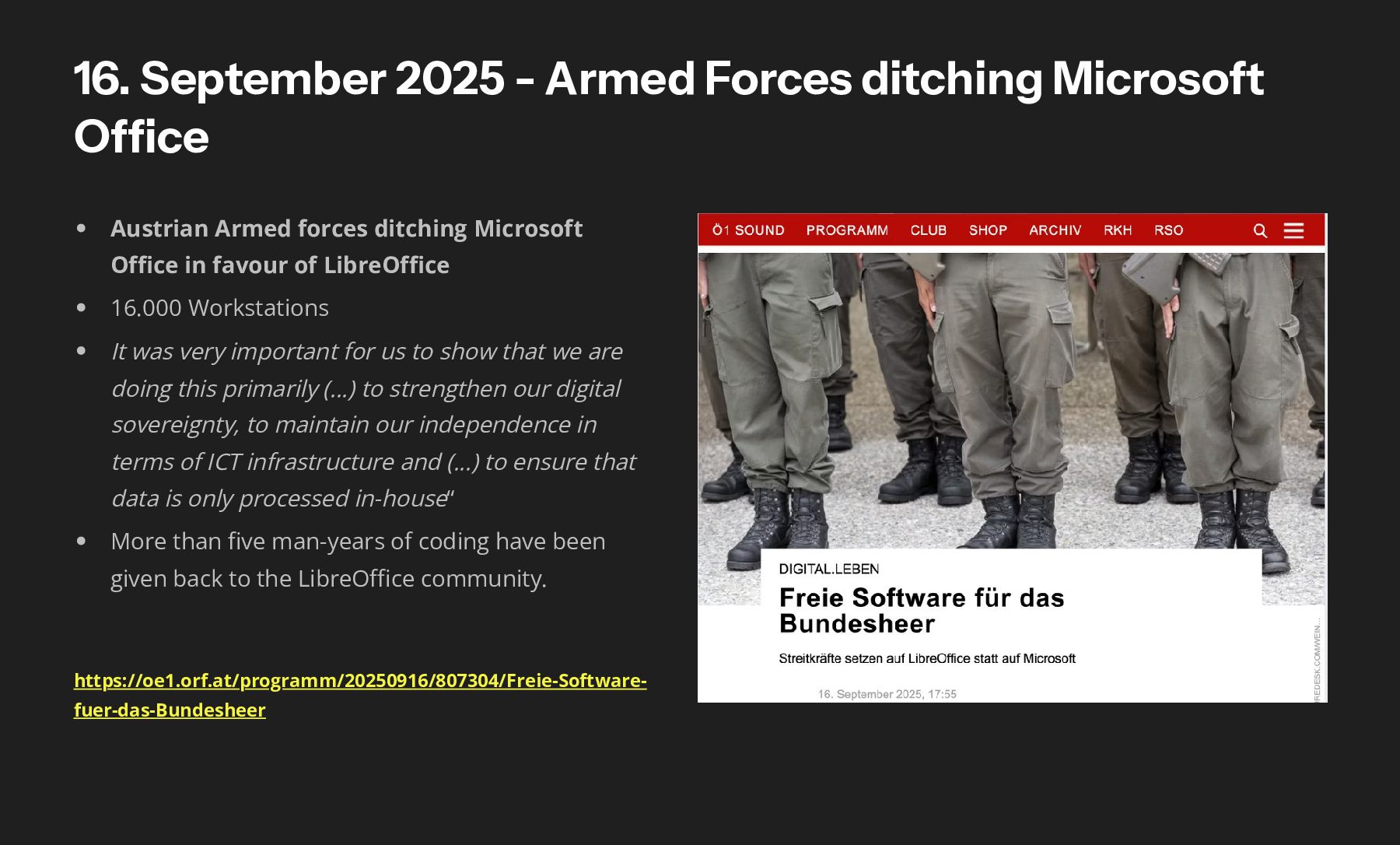
  22. 16. September 2025 - Armed Forces ditching Microsoft Office Austrian

    Armed forces ditching Microsoft Office in favour of LibreOffice 16.000 Workstations It was very important for us to show that we are doing this primarily (...) to strengthen our digital sovereignty, to maintain our independence in terms of ICT infrastructure and (...) to ensure that data is only processed in-house“ More than five man-years of coding have been given back to the LibreOffice community. https://oe1.orf.at/programm/20250916/807304/Freie-Software- fuer-das-Bundesheer
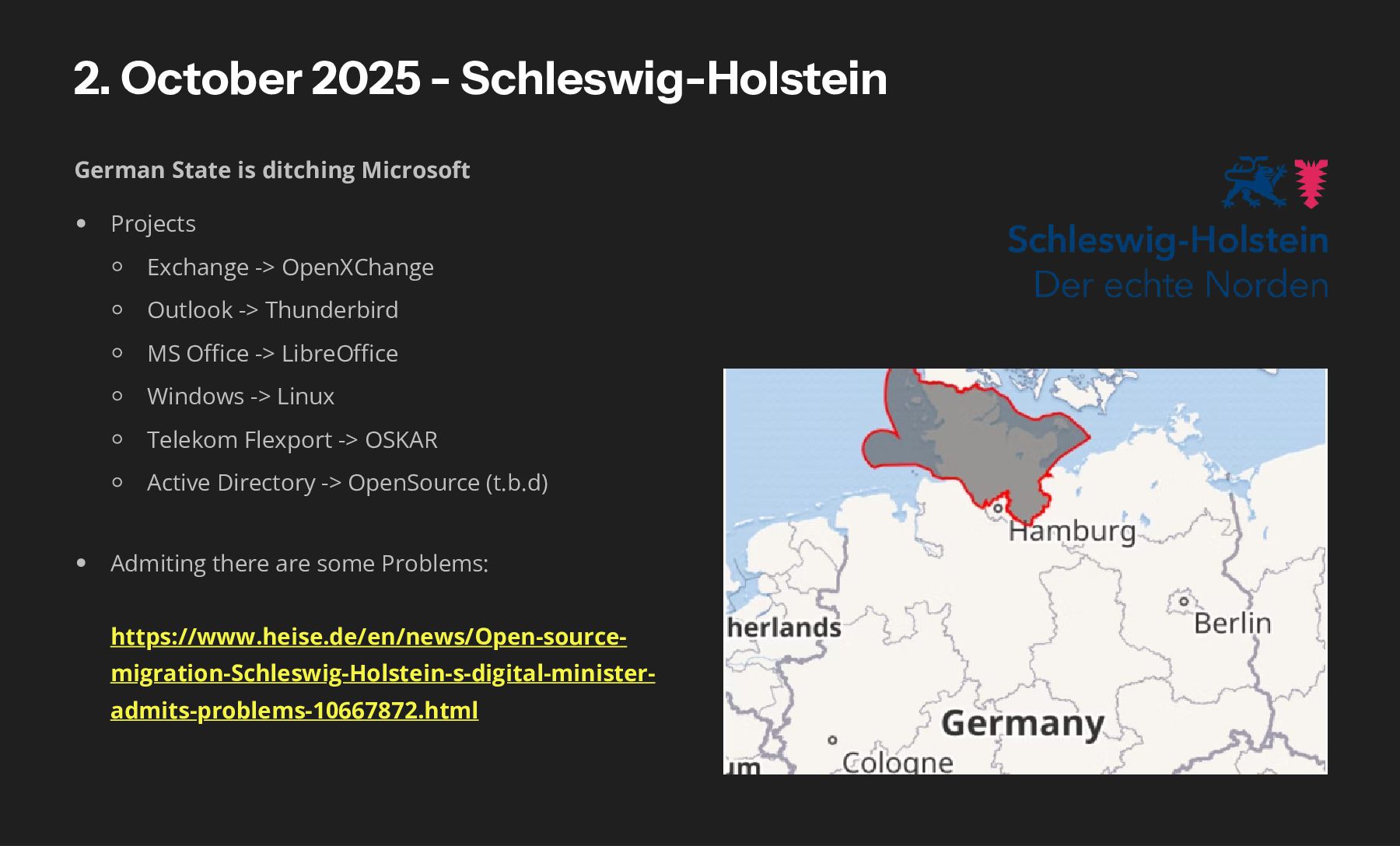
  23. 2. October 2025 - Schleswig-Holstein German State is ditching Microsoft

    Projects Exchange -> OpenXChange Outlook -> Thunderbird MS Office -> LibreOffice Windows -> Linux Telekom Flexport -> OSKAR Active Directory -> OpenSource (t.b.d) Admiting there are some Problems: https://www.heise.de/en/news/Open-source- migration-Schleswig-Holstein-s-digital-minister- admits-problems-10667872.html
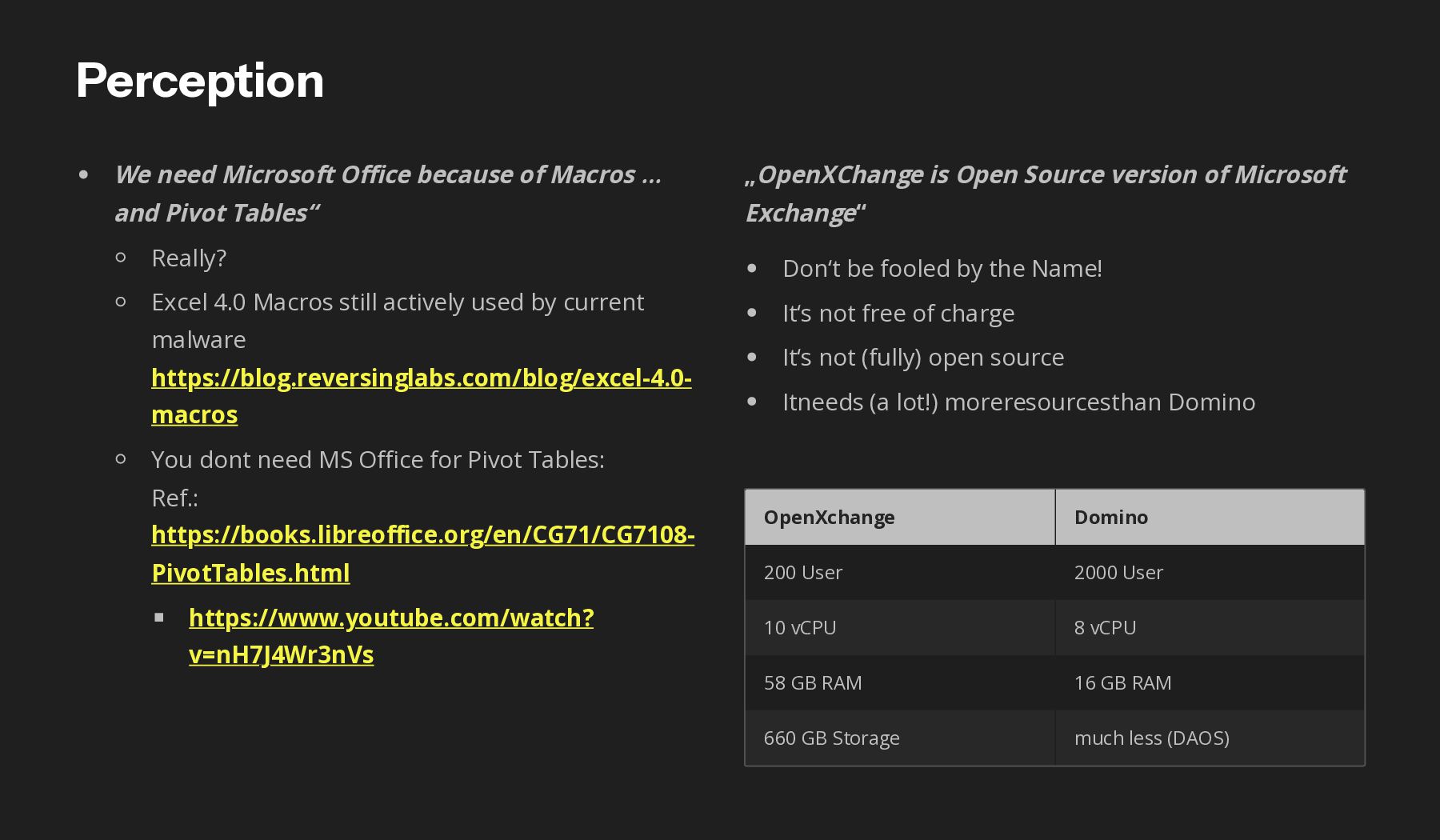
  24. Perception We need Microsoft Office because of Macros … and

    Pivot Tables“ Really? Excel 4.0 Macros still actively used by current malware https://blog.reversinglabs.com/blog/excel-4.0- macros You dont need MS Office for Pivot Tables: Ref.: https://books.libreoffice.org/en/CG71/CG7108- PivotTables.html https://www.youtube.com/watch? v=nH7J4Wr3nVs „OpenXChange is Open Source version of Microsoft Exchange“ Don‘t be fooled by the Name! It‘s not free of charge It‘s not (fully) open source Itneeds (a lot!) moreresourcesthan Domino OpenXchange Domino 200 User 2000 User 10 vCPU 8 vCPU 58 GB RAM 16 GB RAM 660 GB Storage much less (DAOS)
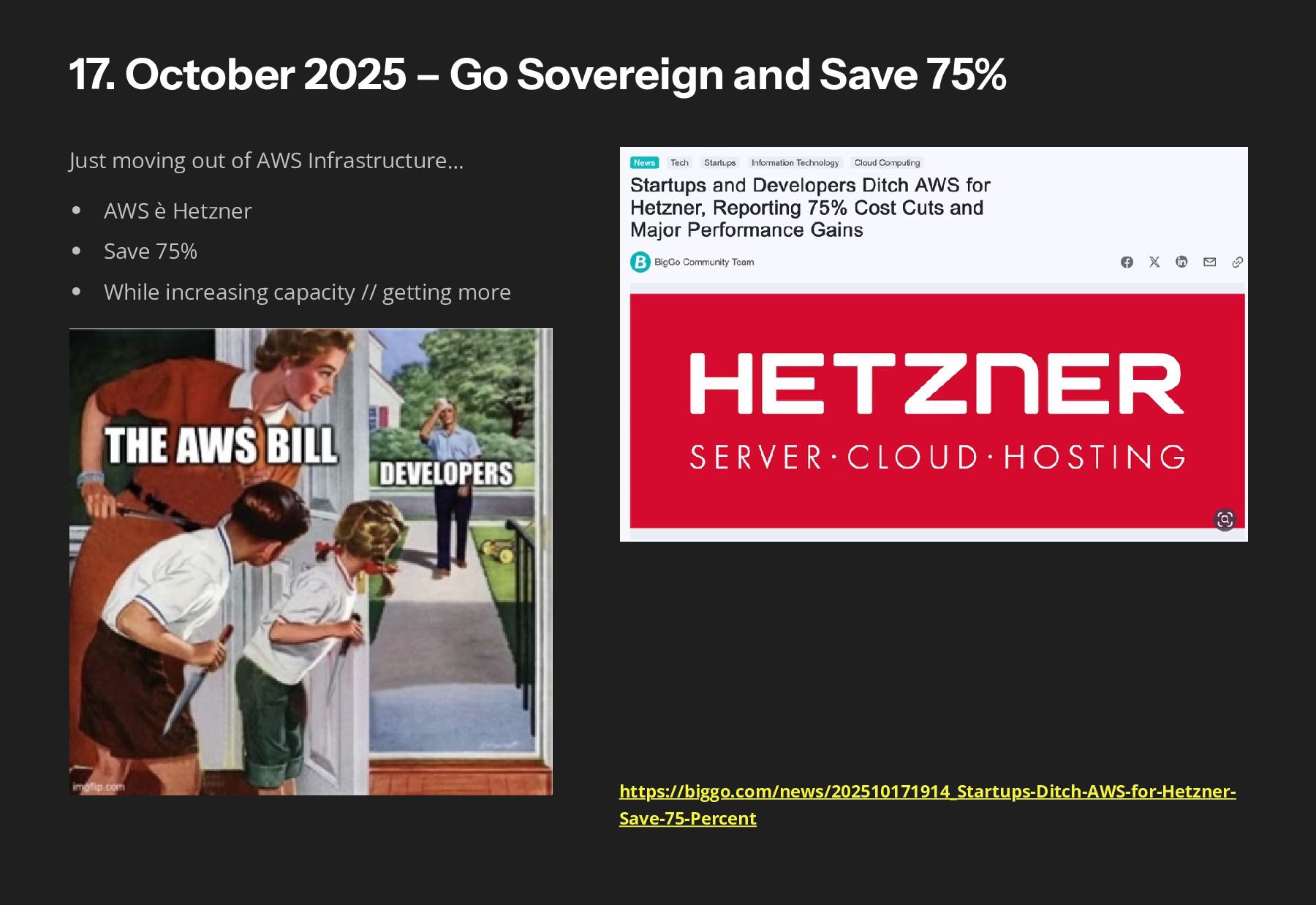
  25. 17. October 2025 – Go Sovereign and Save 75% Just

    moving out of AWS Infrastructure… AWS è Hetzner Save 75% While increasing capacity // getting more https://biggo.com/news/202510171914_Startups-Ditch-AWS-for-Hetzner- Save-75-Percent
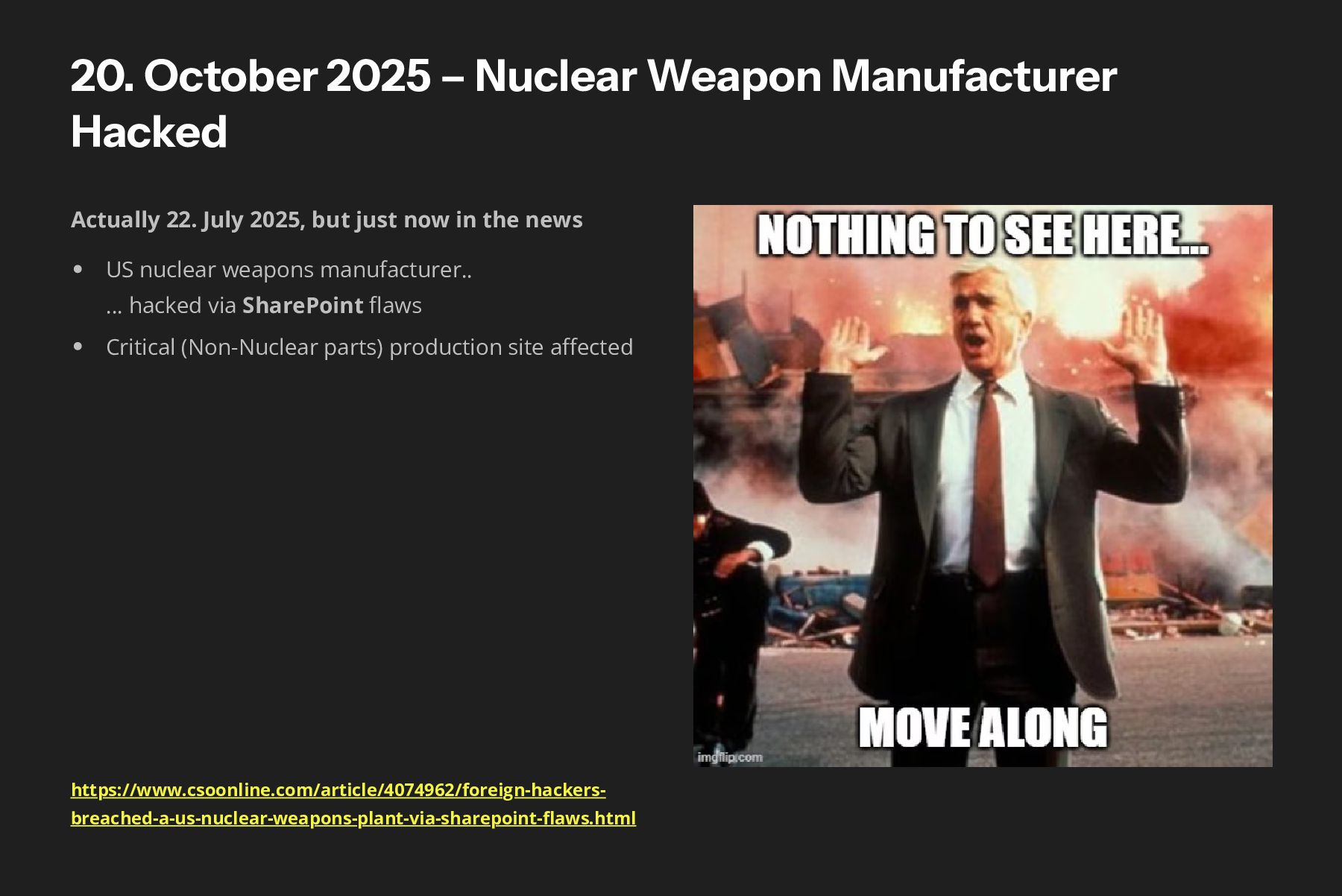
  26. 20. October 2025 – Nuclear Weapon Manufacturer Hacked Actually 22.

    July 2025, but just now in the news US nuclear weapons manufacturer.. ... hacked via SharePoint flaws Critical (Non-Nuclear parts) production site affected https://www.csoonline.com/article/4074962/foreign-hackers- breached-a-us-nuclear-weapons-plant-via-sharepoint-flaws.html
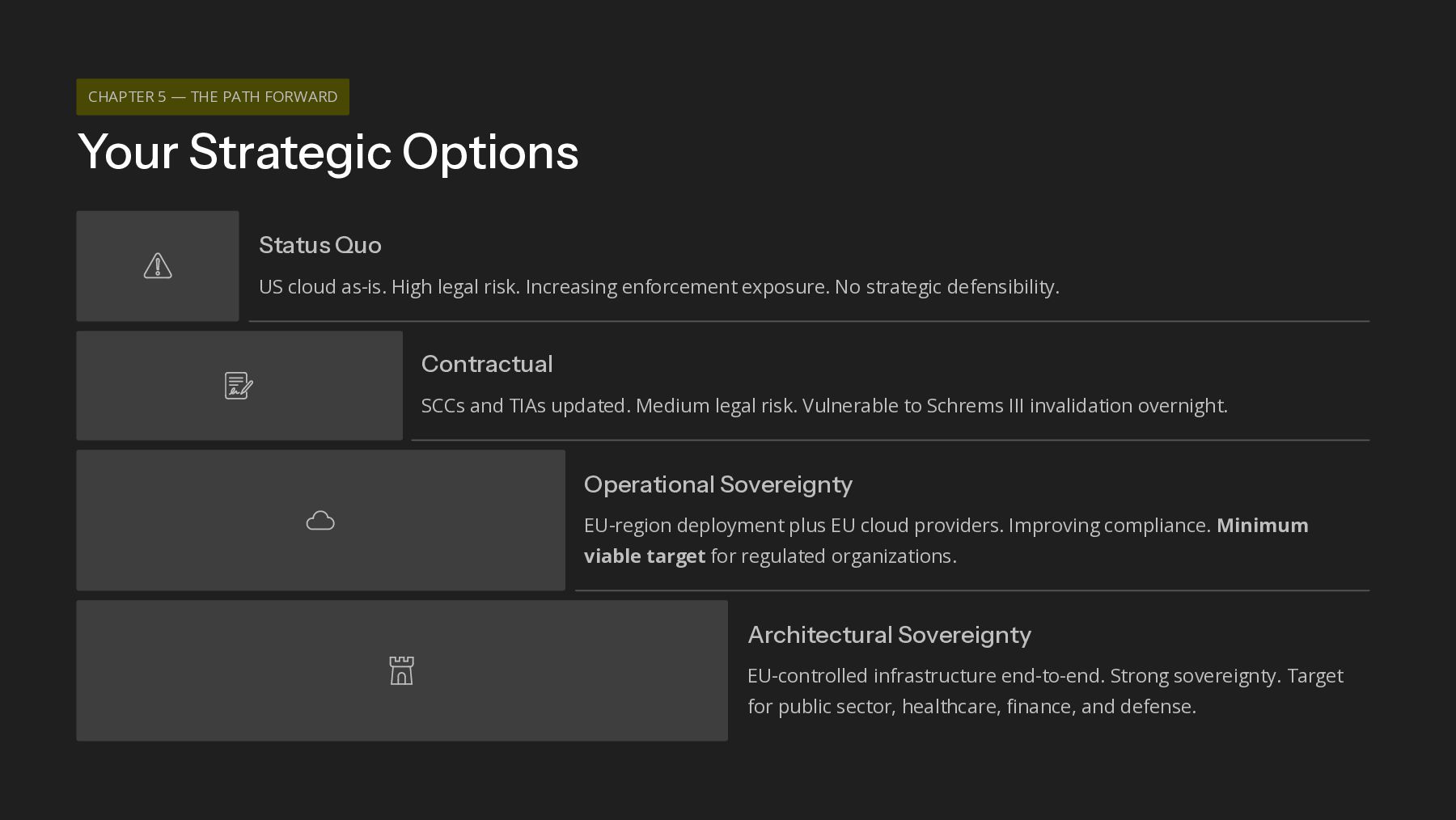
  27. CHAPTER 5 — THE PATH FORWARD Your Strategic Options Status

    Quo US cloud as-is. High legal risk. Increasing enforcement exposure. No strategic defensibility. Contractual SCCs and TIAs updated. Medium legal risk. Vulnerable to Schrems III invalidation overnight. Operational Sovereignty EU-region deployment plus EU cloud providers. Improving compliance. Minimum viable target for regulated organizations. Architectural Sovereignty EU-controlled infrastructure end-to-end. Strong sovereignty. Target for public sector, healthcare, finance, and defense.
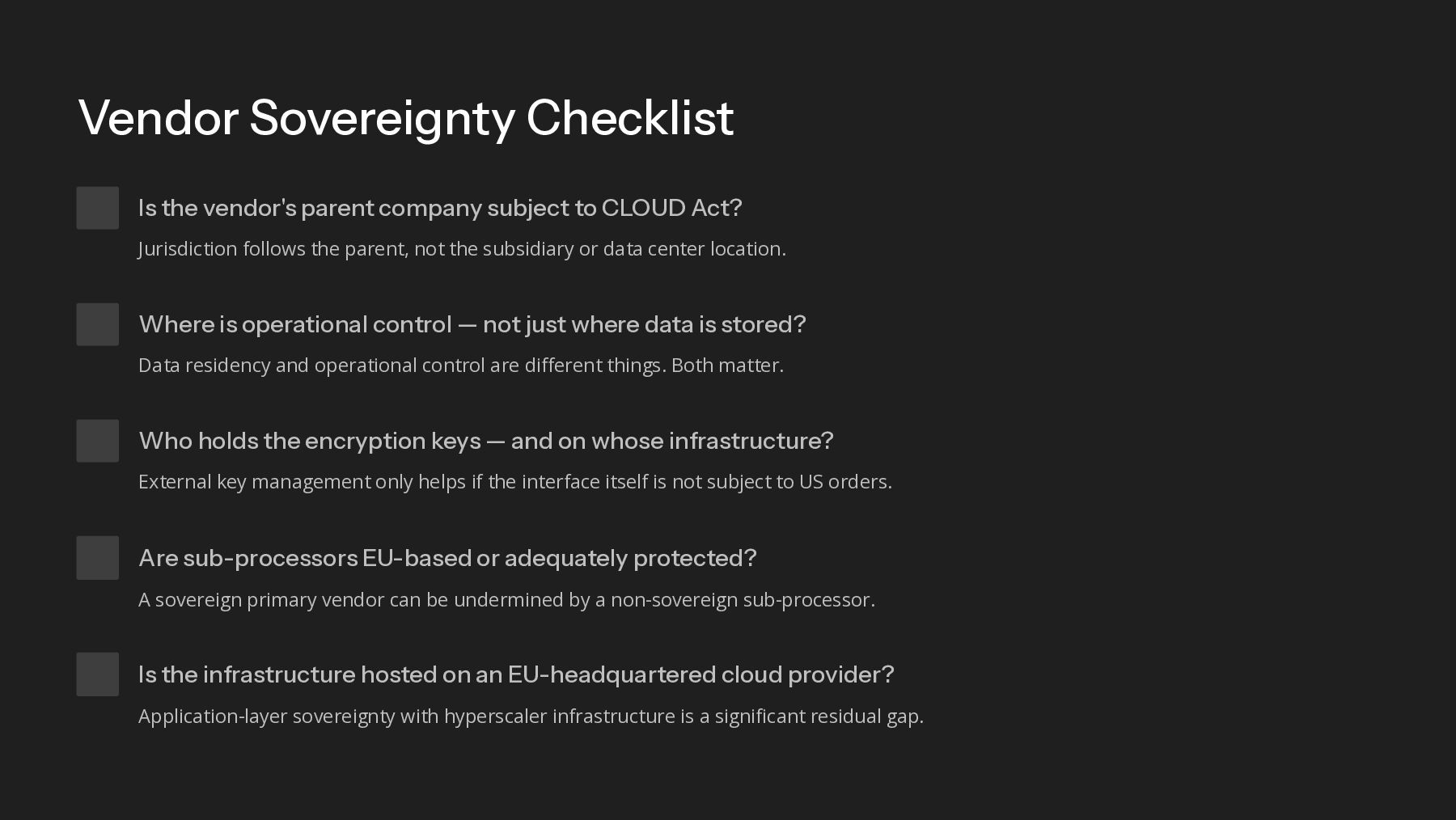
  28. Vendor Sovereignty Checklist Is the vendor's parent company subject to

    CLOUD Act? Jurisdiction follows the parent, not the subsidiary or data center location. Where is operational control — not just where data is stored? Data residency and operational control are different things. Both matter. Who holds the encryption keys — and on whose infrastructure? External key management only helps if the interface itself is not subject to US orders. Are sub-processors EU-based or adequately protected? A sovereign primary vendor can be undermined by a non-sovereign sub-processor. Is the infrastructure hosted on an EU-headquartered cloud provider? Application-layer sovereignty with hyperscaler infrastructure is a significant residual gap.
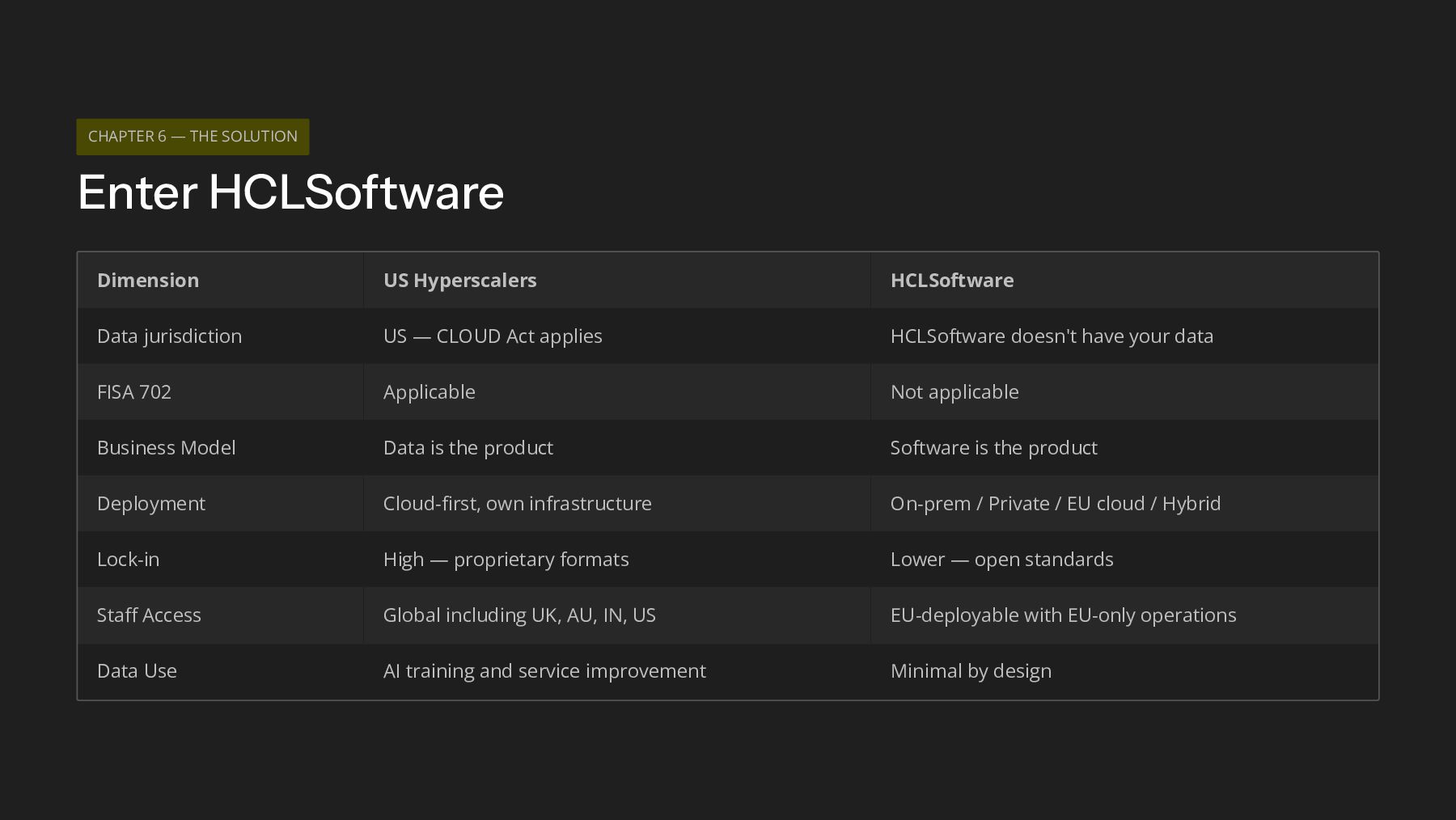
  29. CHAPTER 6 — THE SOLUTION Enter HCLSoftware Dimension US Hyperscalers

    HCLSoftware Data jurisdiction US — CLOUD Act applies HCLSoftware doesn't have your data FISA 702 Applicable Not applicable Business Model Data is the product Software is the product Deployment Cloud-first, own infrastructure On-prem / Private / EU cloud / Hybrid Lock-in High — proprietary formats Lower — open standards Staff Access Global including UK, AU, IN, US EU-deployable with EU-only operations Data Use AI training and service improvement Minimal by design
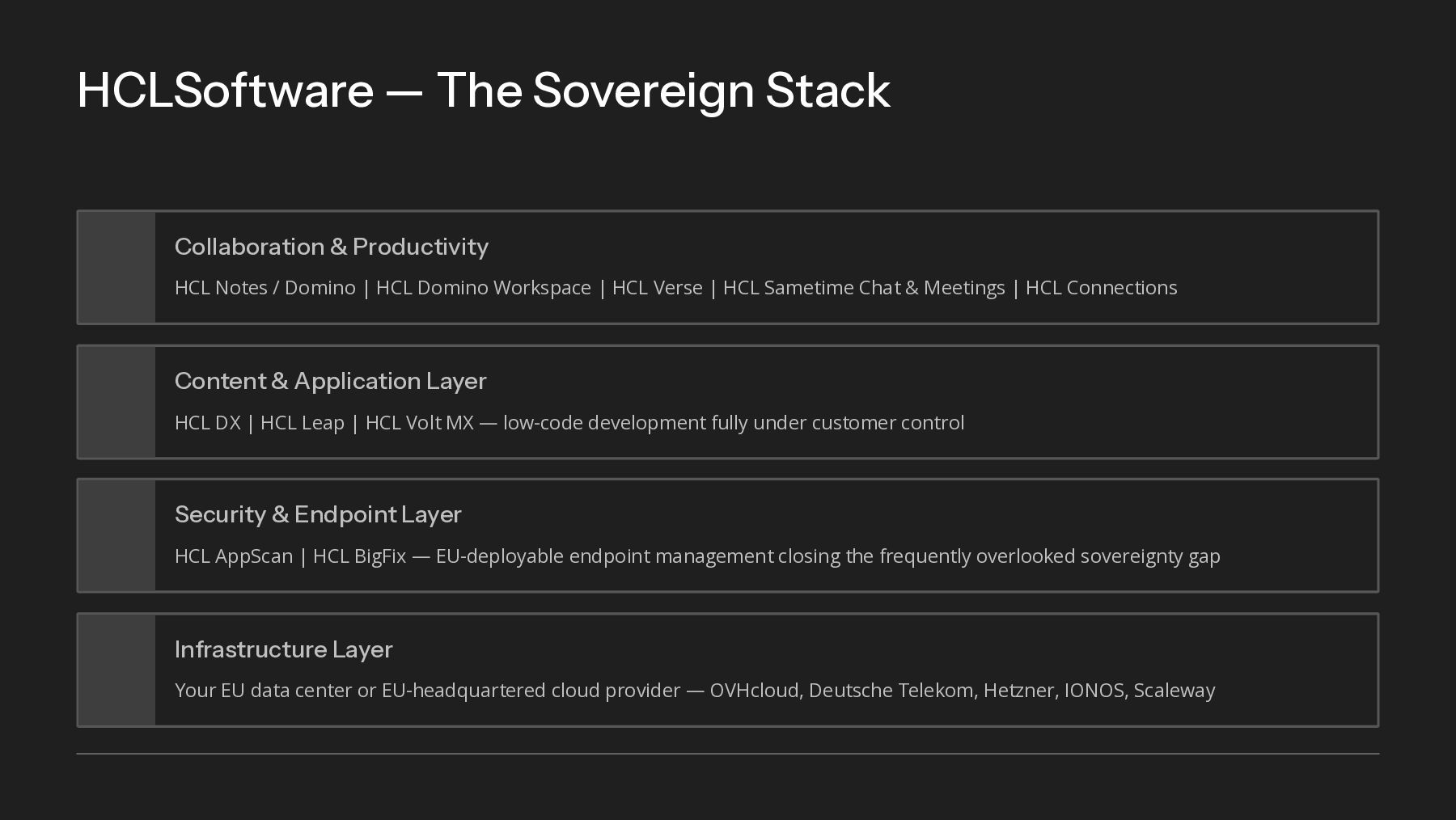
  30. HCLSoftware — The Sovereign Stack Collaboration & Productivity HCL Notes

    / Domino | HCL Domino Workspace | HCL Verse | HCL Sametime Chat & Meetings | HCL Connections Content & Application Layer HCL DX | HCL Leap | HCL Volt MX — low-code development fully under customer control Security & Endpoint Layer HCL AppScan | HCL BigFix — EU-deployable endpoint management closing the frequently overlooked sovereignty gap Infrastructure Layer Your EU data center or EU-headquartered cloud provider — OVHcloud, Deutsche Telekom, Hetzner, IONOS, Scaleway
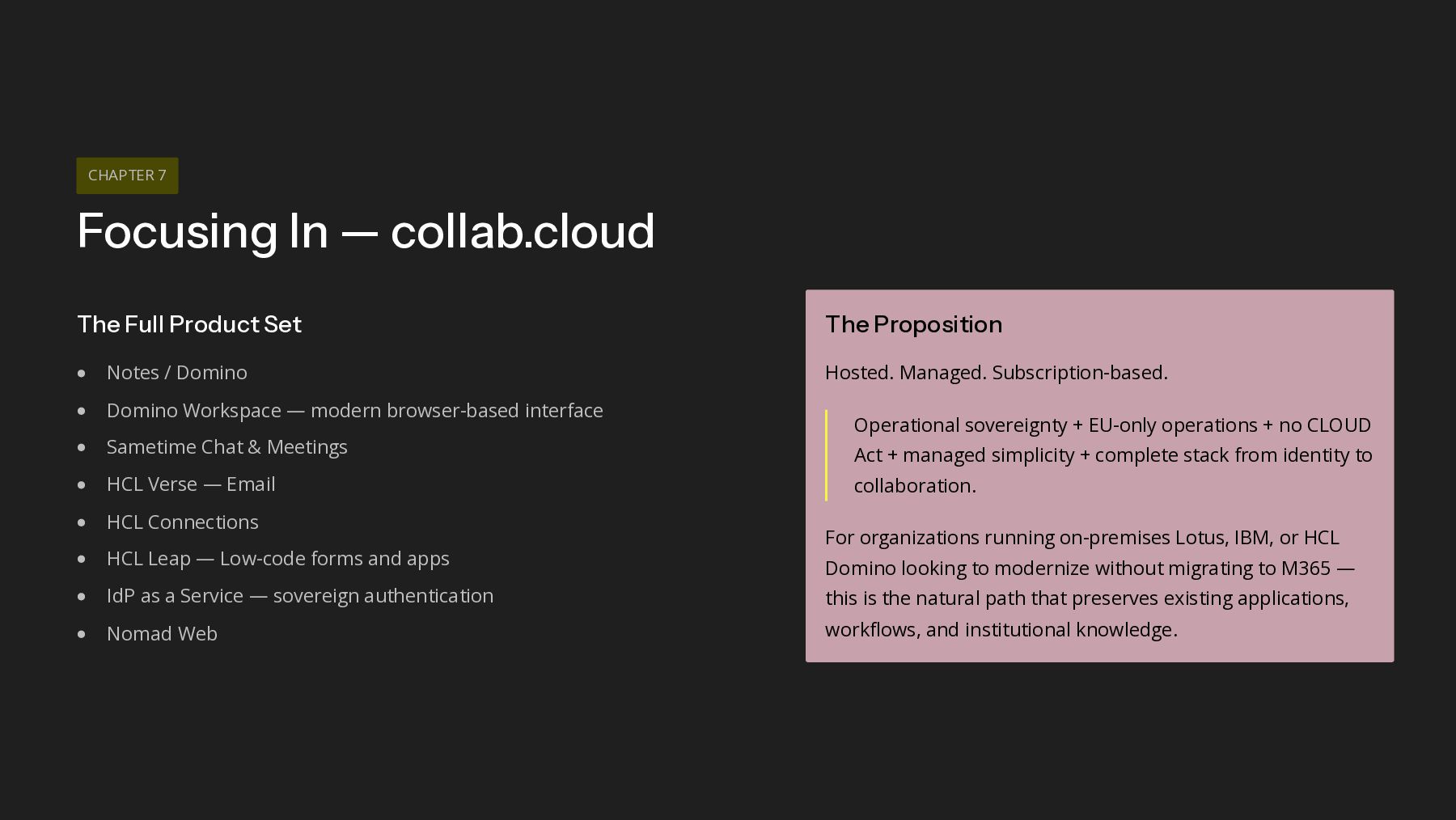
  31. CHAPTER 7 Focusing In — collab.cloud The Full Product Set

    Notes / Domino Domino Workspace — modern browser-based interface Sametime Chat & Meetings HCL Verse — Email HCL Connections HCL Leap — Low-code forms and apps IdP as a Service — sovereign authentication Nomad Web The Proposition Hosted. Managed. Subscription-based. Operational sovereignty + EU-only operations + no CLOUD Act + managed simplicity + complete stack from identity to collaboration. For organizations running on-premises Lotus, IBM, or HCL Domino looking to modernize without migrating to M365 — this is the natural path that preserves existing applications, workflows, and institutional knowledge.
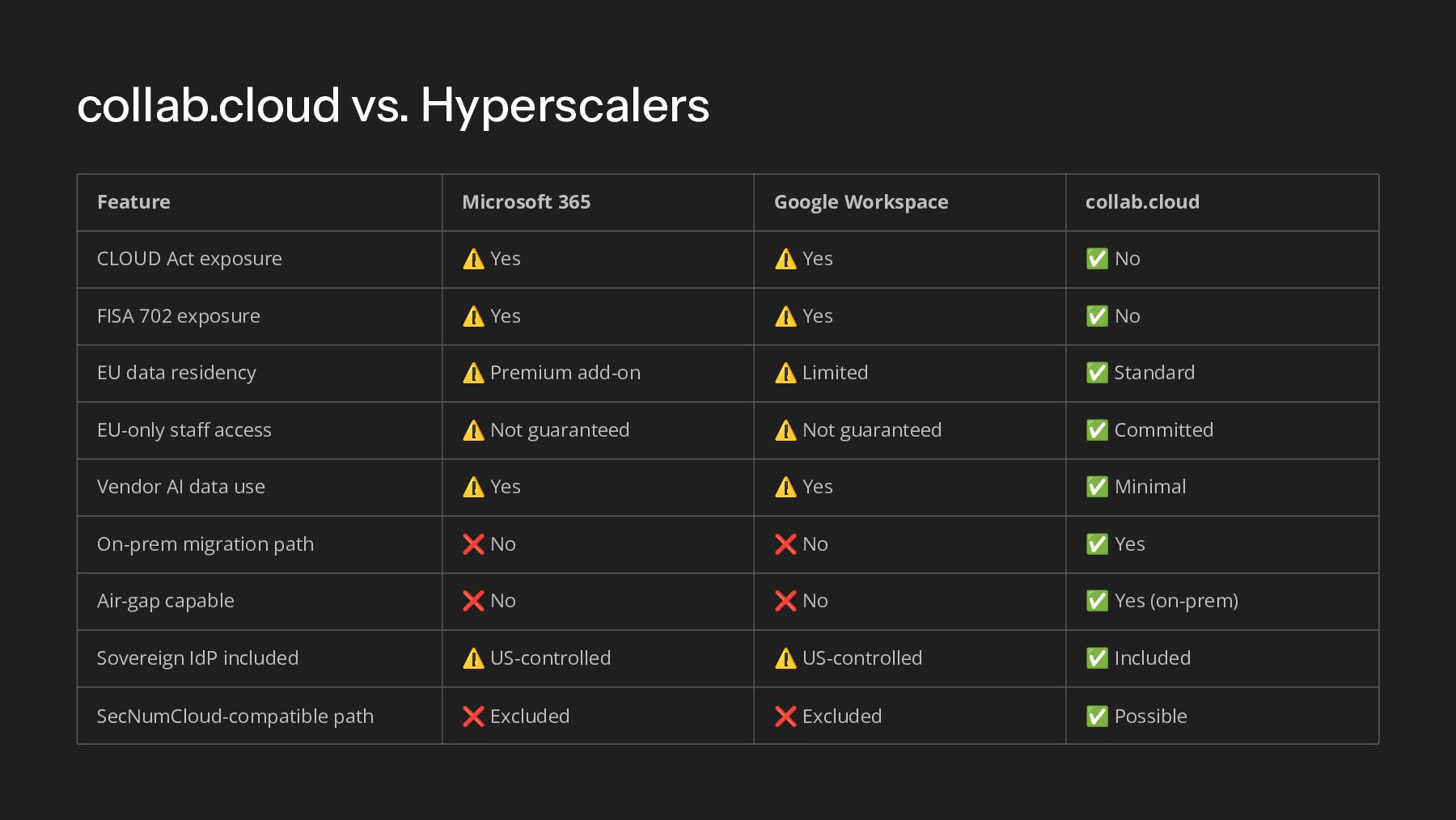
  32. collab.cloud vs. Hyperscalers Feature Microsoft 365 Google Workspace collab.cloud CLOUD

    Act exposure ⚠ Yes ⚠ Yes ✅ No FISA 702 exposure ⚠ Yes ⚠ Yes ✅ No EU data residency ⚠ Premium add-on ⚠ Limited ✅ Standard EU-only staff access ⚠ Not guaranteed ⚠ Not guaranteed ✅ Committed Vendor AI data use ⚠ Yes ⚠ Yes ✅ Minimal On-prem migration path ❌ No ❌ No ✅ Yes Air-gap capable ❌ No ❌ No ✅ Yes (on-prem) Sovereign IdP included ⚠ US-controlled ⚠ US-controlled ✅ Included SecNumCloud-compatible path ❌ Excluded ❌ Excluded ✅ Possible
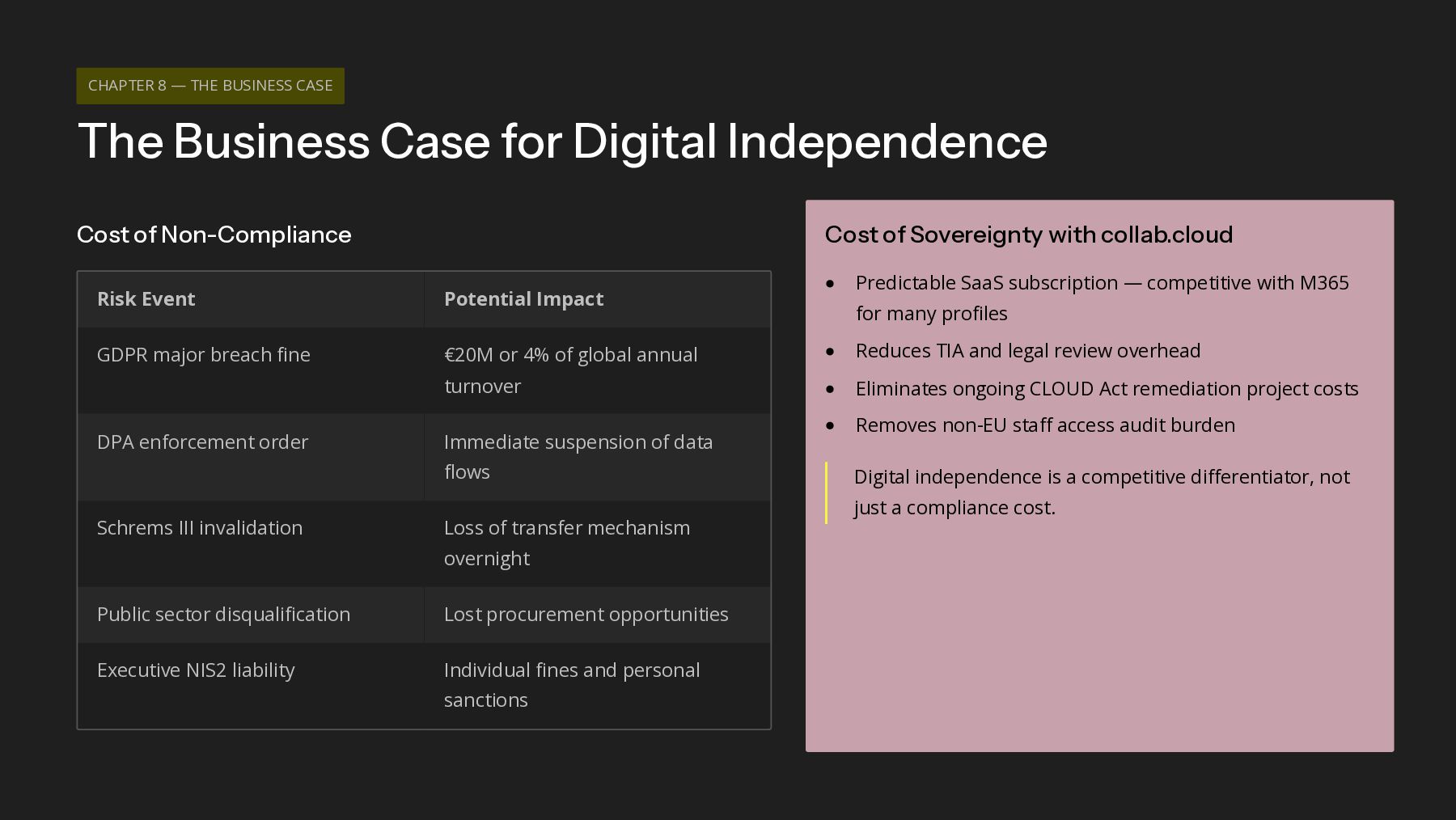
  33. CHAPTER 8 — THE BUSINESS CASE The Business Case for

    Digital Independence Cost of Non-Compliance Risk Event Potential Impact GDPR major breach fine €20M or 4% of global annual turnover DPA enforcement order Immediate suspension of data flows Schrems III invalidation Loss of transfer mechanism overnight Public sector disqualification Lost procurement opportunities Executive NIS2 liability Individual fines and personal sanctions Cost of Sovereignty with collab.cloud Predictable SaaS subscription — competitive with M365 for many profiles Reduces TIA and legal review overhead Eliminates ongoing CLOUD Act remediation project costs Removes non-EU staff access audit burden Digital independence is a competitive differentiator, not just a compliance cost.
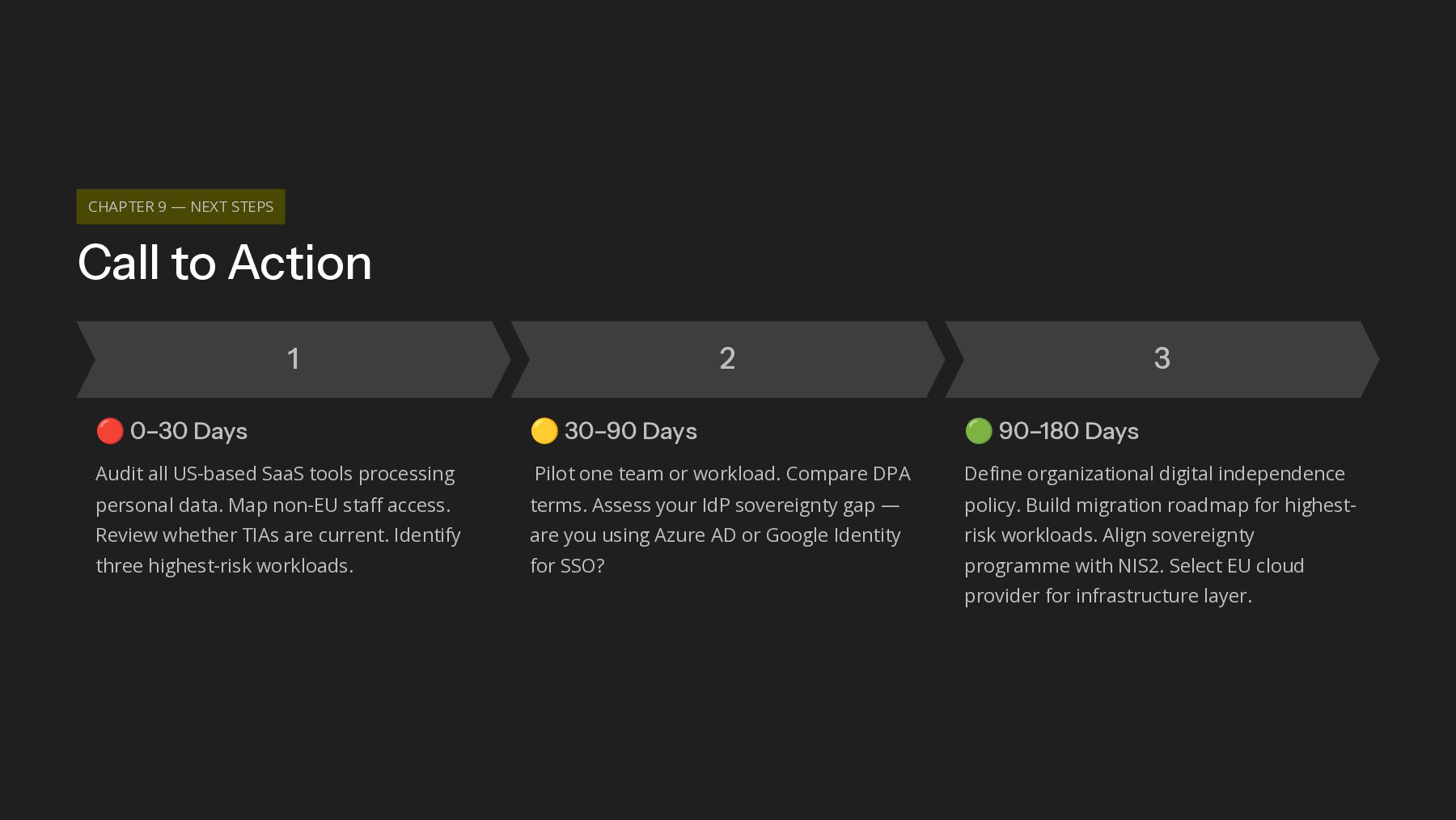
  34. CHAPTER 9 — NEXT STEPS Call to Action 1 🔴

    0–30 Days Audit all US-based SaaS tools processing personal data. Map non-EU staff access. Review whether TIAs are current. Identify three highest-risk workloads. 2 🟡 30–90 Days Pilot one team or workload. Compare DPA terms. Assess your IdP sovereignty gap — are you using Azure AD or Google Identity for SSO? 3 🟢 90–180 Days Define organizational digital independence policy. Build migration roadmap for highest- risk workloads. Align sovereignty programme with NIS2. Select EU cloud provider for infrastructure layer.
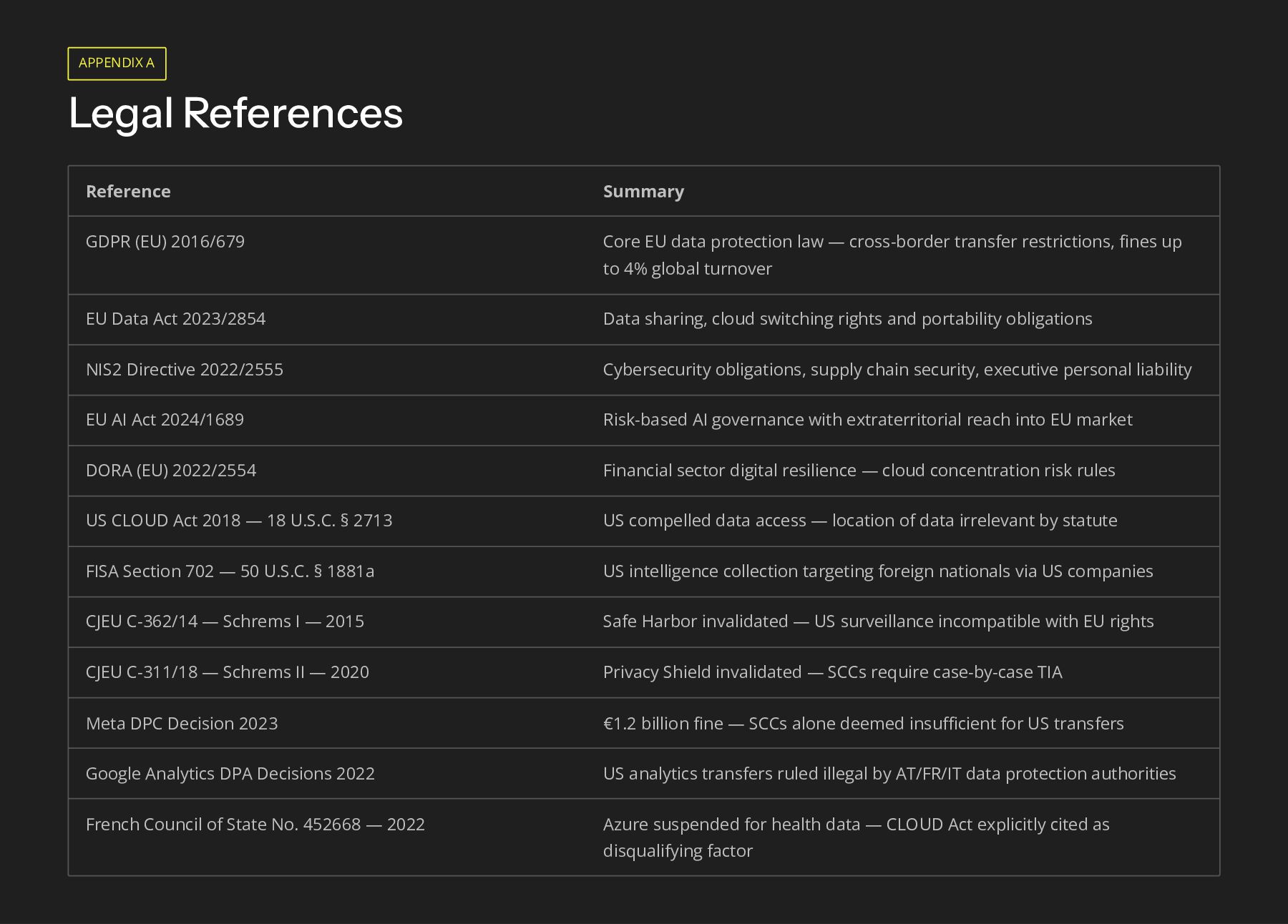
  35. APPENDIX A Legal References Reference Summary GDPR (EU) 2016/679 Core

    EU data protection law — cross-border transfer restrictions, fines up to 4% global turnover EU Data Act 2023/2854 Data sharing, cloud switching rights and portability obligations NIS2 Directive 2022/2555 Cybersecurity obligations, supply chain security, executive personal liability EU AI Act 2024/1689 Risk-based AI governance with extraterritorial reach into EU market DORA (EU) 2022/2554 Financial sector digital resilience — cloud concentration risk rules US CLOUD Act 2018 — 18 U.S.C. § 2713 US compelled data access — location of data irrelevant by statute FISA Section 702 — 50 U.S.C. § 1881a US intelligence collection targeting foreign nationals via US companies CJEU C-362/14 — Schrems I — 2015 Safe Harbor invalidated — US surveillance incompatible with EU rights CJEU C-311/18 — Schrems II — 2020 Privacy Shield invalidated — SCCs require case-by-case TIA Meta DPC Decision 2023 €1.2 billion fine — SCCs alone deemed insufficient for US transfers Google Analytics DPA Decisions 2022 US analytics transfers ruled illegal by AT/FR/IT data protection authorities French Council of State No. 452668 — 2022 Azure suspended for health data — CLOUD Act explicitly cited as disqualifying factor
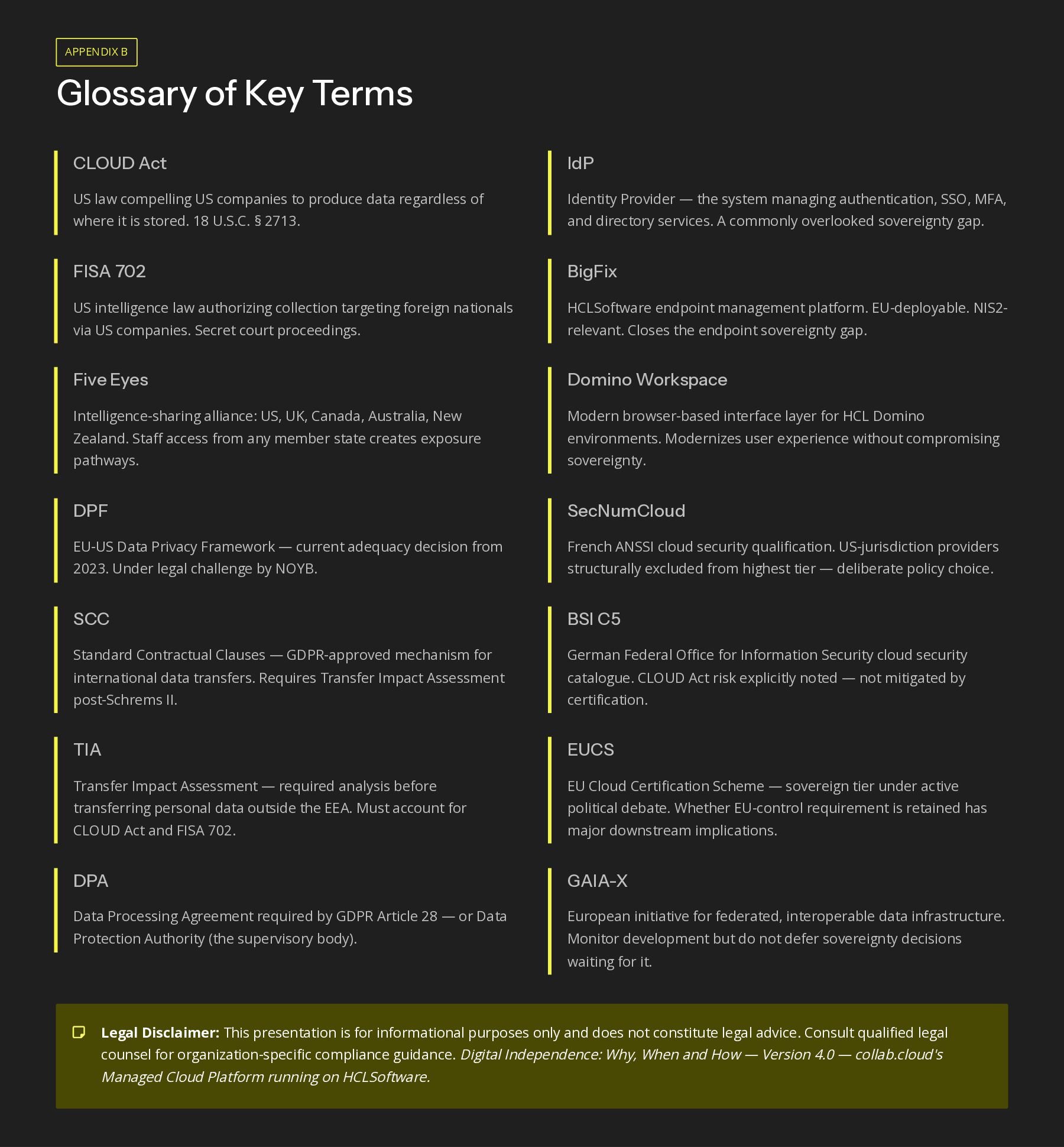
  36. APPENDIX B Glossary of Key Terms CLOUD Act US law

    compelling US companies to produce data regardless of where it is stored. 18 U.S.C. § 2713. FISA 702 US intelligence law authorizing collection targeting foreign nationals via US companies. Secret court proceedings. Five Eyes Intelligence-sharing alliance: US, UK, Canada, Australia, New Zealand. Staff access from any member state creates exposure pathways. DPF EU-US Data Privacy Framework — current adequacy decision from 2023. Under legal challenge by NOYB. SCC Standard Contractual Clauses — GDPR-approved mechanism for international data transfers. Requires Transfer Impact Assessment post-Schrems II. TIA Transfer Impact Assessment — required analysis before transferring personal data outside the EEA. Must account for CLOUD Act and FISA 702. DPA Data Processing Agreement required by GDPR Article 28 — or Data Protection Authority (the supervisory body). IdP Identity Provider — the system managing authentication, SSO, MFA, and directory services. A commonly overlooked sovereignty gap. BigFix HCLSoftware endpoint management platform. EU-deployable. NIS2- relevant. Closes the endpoint sovereignty gap. Domino Workspace Modern browser-based interface layer for HCL Domino environments. Modernizes user experience without compromising sovereignty. SecNumCloud French ANSSI cloud security qualification. US-jurisdiction providers structurally excluded from highest tier — deliberate policy choice. BSI C5 German Federal Office for Information Security cloud security catalogue. CLOUD Act risk explicitly noted — not mitigated by certification. EUCS EU Cloud Certification Scheme — sovereign tier under active political debate. Whether EU-control requirement is retained has major downstream implications. GAIA-X European initiative for federated, interoperable data infrastructure. Monitor development but do not defer sovereignty decisions waiting for it. Legal Disclaimer: This presentation is for informational purposes only and does not constitute legal advice. Consult qualified legal counsel for organization-specific compliance guidance. Digital Independence: Why, When and How — Version 4.0 — collab.cloud's Managed Cloud Platform running on HCLSoftware.