Share
Embed
Transcript
52 slides
-
AJAX Data Transfer Client-Server Apps - The Easy Way Saturday,
February 4, 2012 -
Agenda JSON Modify DOM by Server Data Web Sockets Saturday,
February 4, 2012 -
Communication Different systems use different data formats Each platform has
its own logic Need to decide on a language or protocol Saturday, February 4, 2012 -
Requirements What do we need from such a protocol ?
Saturday, February 4, 2012 -
Requirements Wide server support Wide client support Easy to debug
Pass firewalls Saturday, February 4, 2012 -
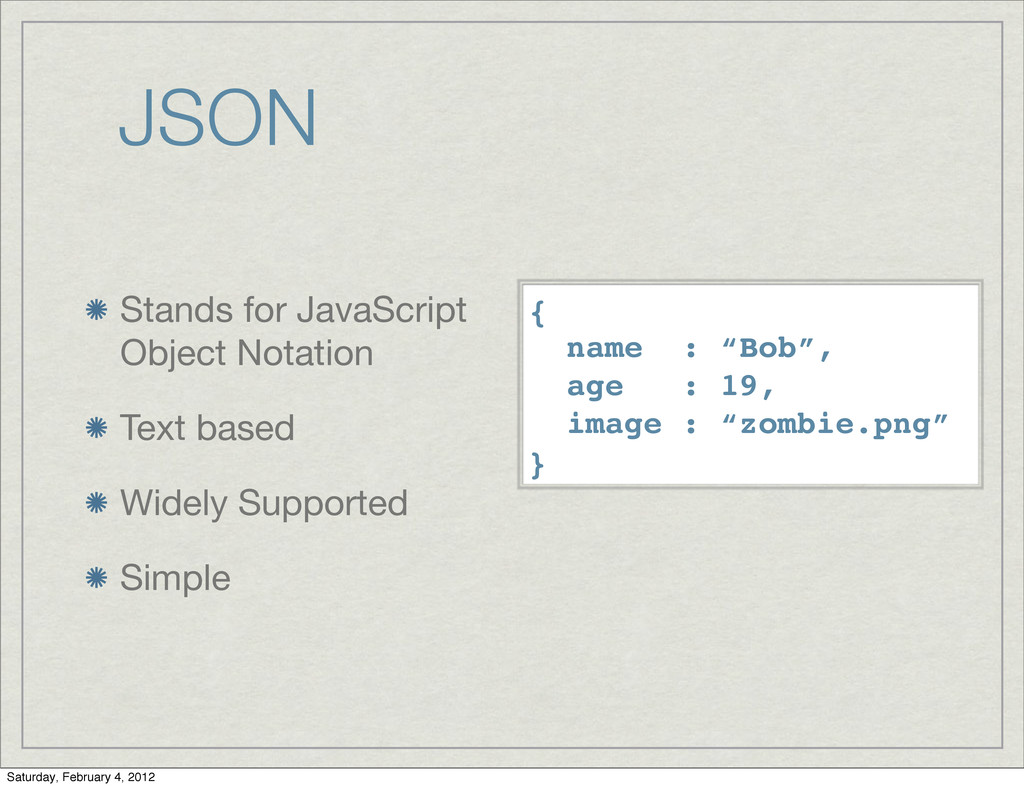
JSON Stands for JavaScript Object Notation Text based Widely Supported
Simple { name : “Bob”, age : 19, image : “zombie.png” } Saturday, February 4, 2012 -
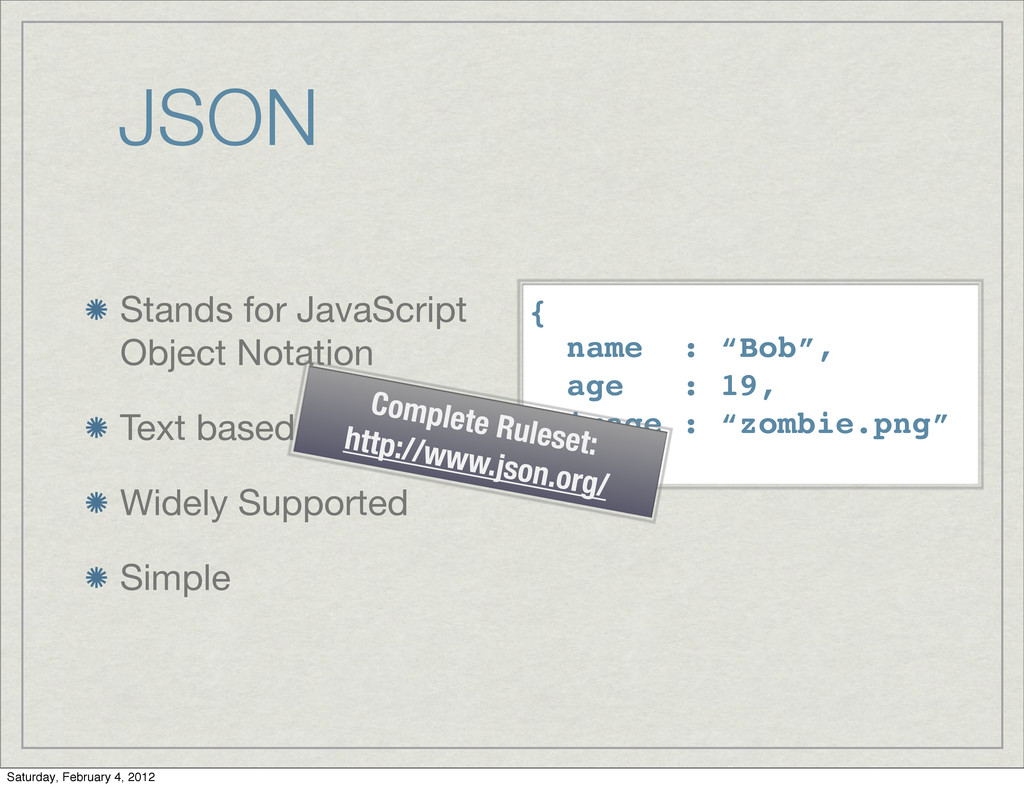
JSON Stands for JavaScript Object Notation Text based Widely Supported
Simple { name : “Bob”, age : 19, image : “zombie.png” } Complete Ruleset: http://www.json.org/ Saturday, February 4, 2012 -
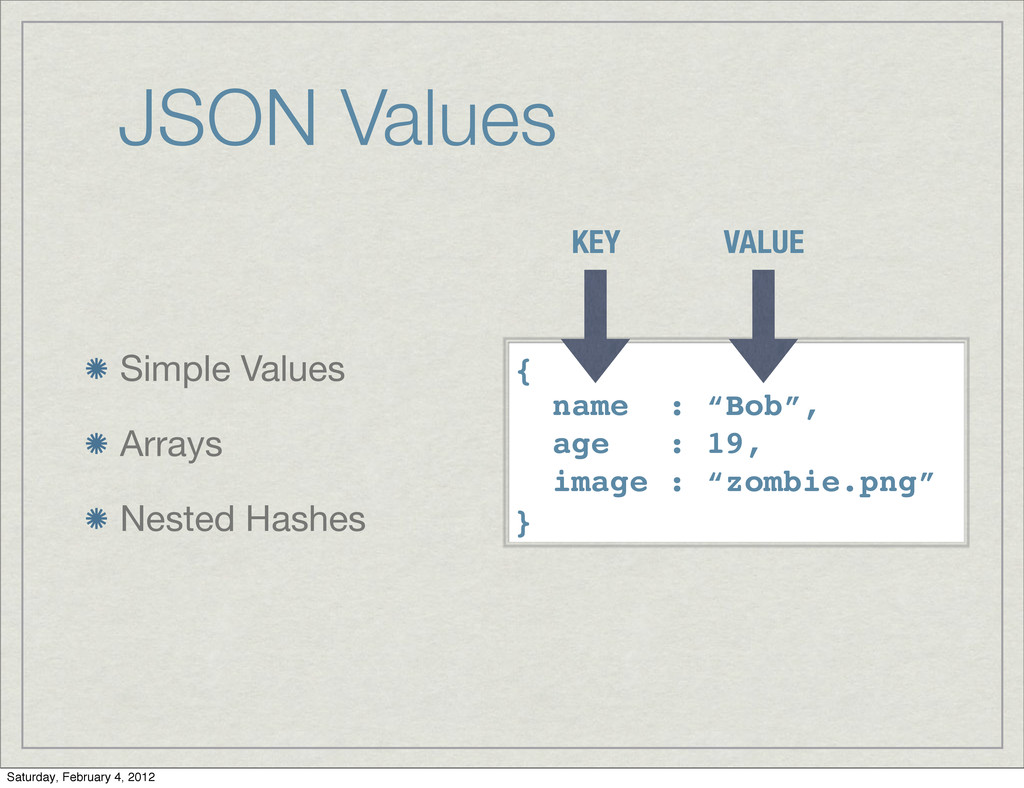
JSON Values Simple Values Arrays Nested Hashes { name :
“Bob”, age : 19, image : “zombie.png” } KEY VALUE Saturday, February 4, 2012 -
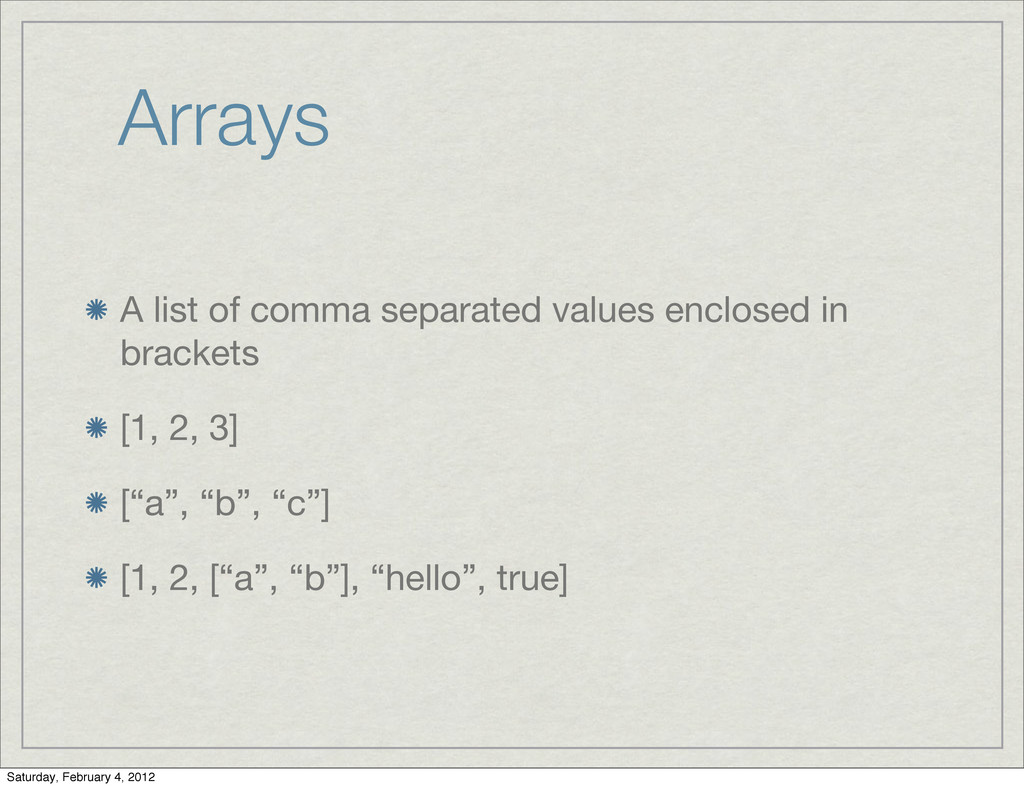
Arrays A list of comma separated values enclosed in brackets
[1, 2, 3] [“a”, “b”, “c”] [1, 2, [“a”, “b”], “hello”, true] Saturday, February 4, 2012 -
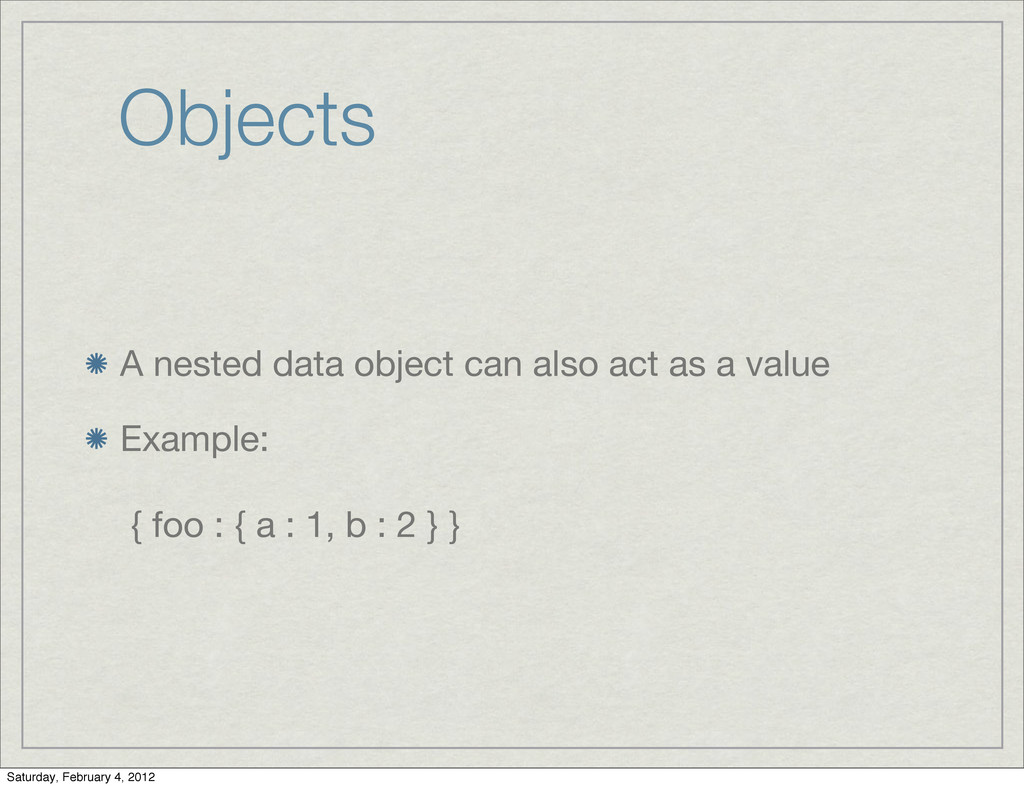
Objects A nested data object can also act as a
value Example: { foo : { a : 1, b : 2 } } Saturday, February 4, 2012 -
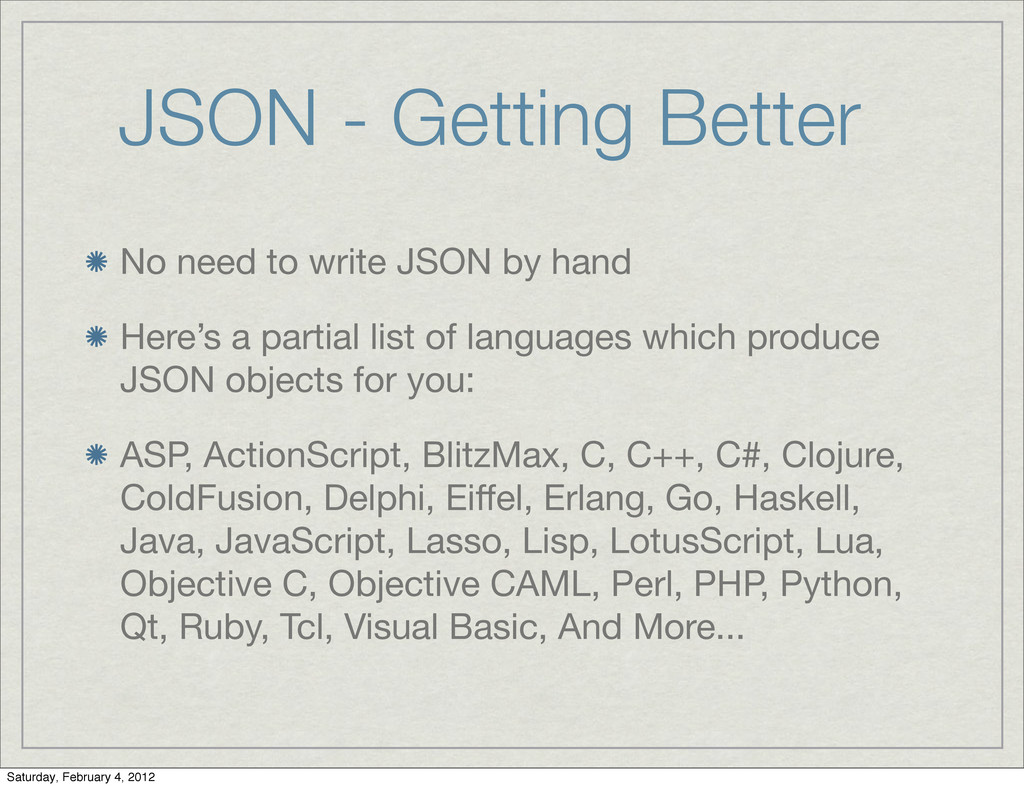
JSON - Getting Better No need to write JSON by
hand Here’s a partial list of languages which produce JSON objects for you: ASP, ActionScript, BlitzMax, C, C++, C#, Clojure, ColdFusion, Delphi, Eiffel, Erlang, Go, Haskell, Java, JavaScript, Lasso, Lisp, LotusScript, Lua, Objective C, Objective CAML, Perl, PHP, Python, Qt, Ruby, Tcl, Visual Basic, And More... Saturday, February 4, 2012 -
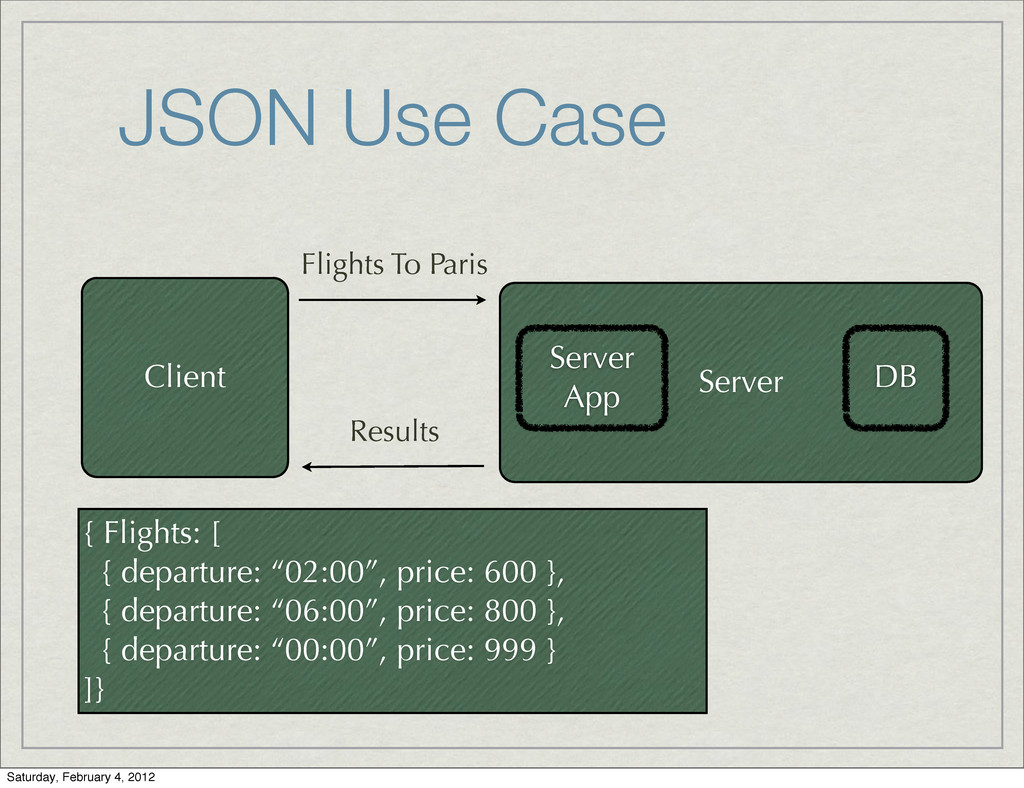
JSON Use Case Client Server Server App DB Flights To
Paris Results { Flights: [ { departure: “02:00”, price: 600 }, { departure: “06:00”, price: 800 }, { departure: “00:00”, price: 999 } ]} Saturday, February 4, 2012 -
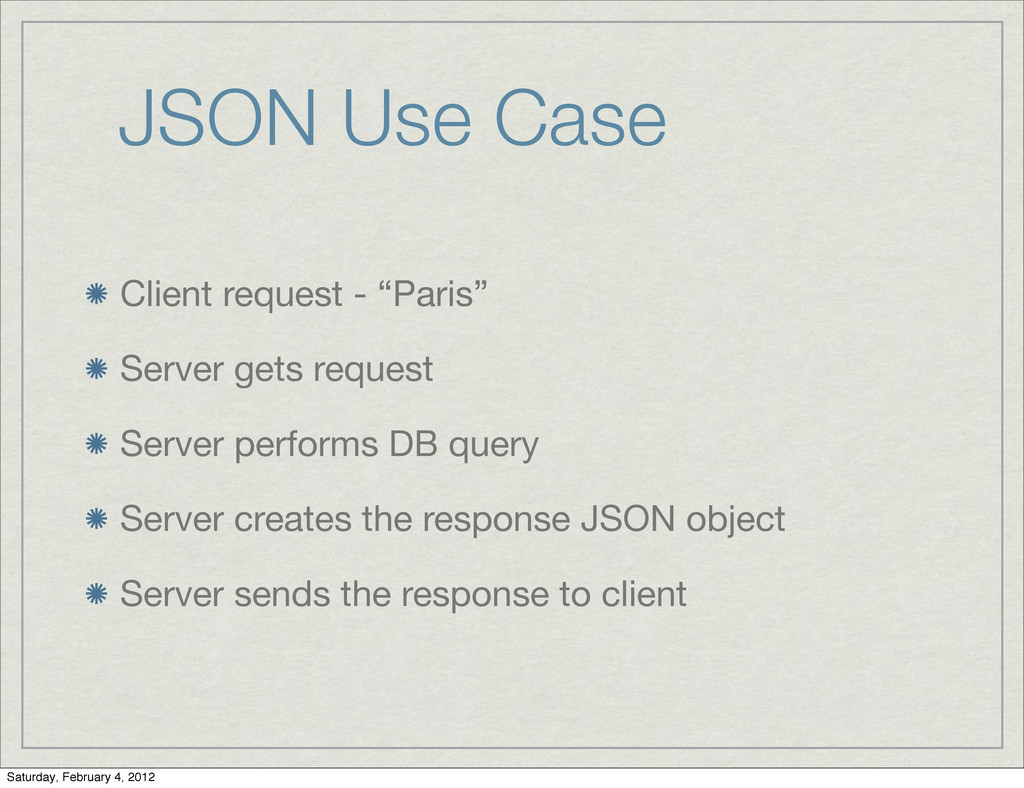
JSON Use Case Client request - “Paris” Server gets request
Server performs DB query Server creates the response JSON object Server sends the response to client Saturday, February 4, 2012 -
Demo: Time Server Server returning time of day using Ruby
& Sinatra App which shows the data Saturday, February 4, 2012 -
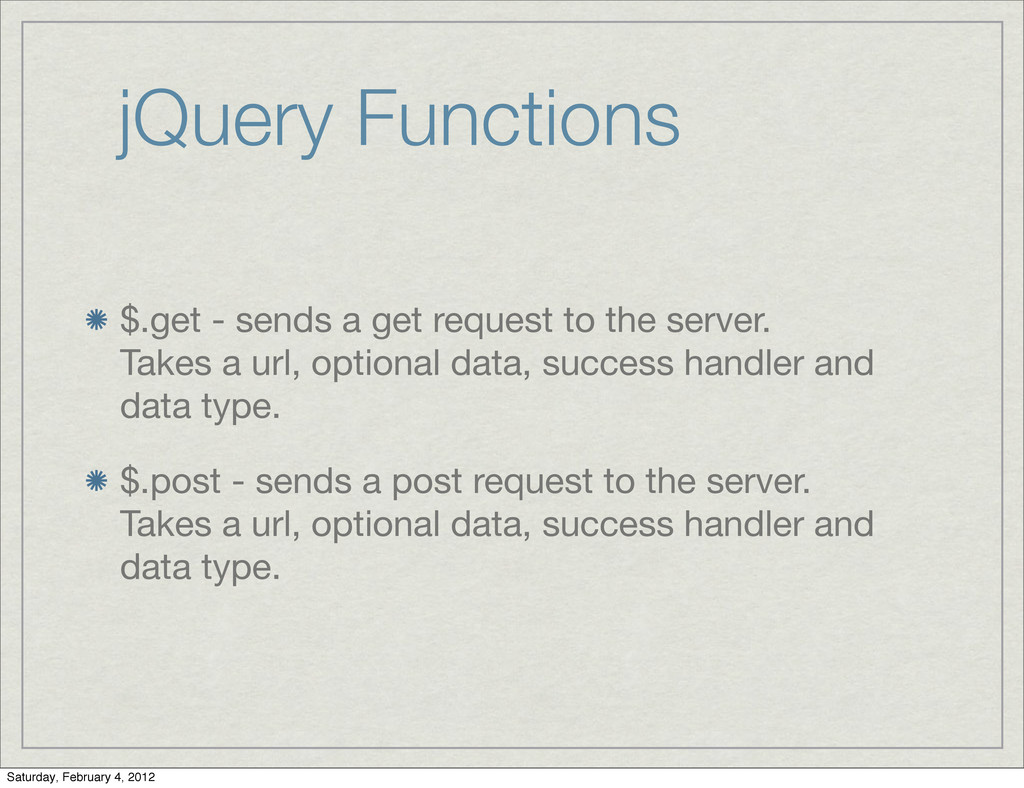
jQuery Functions $.get - sends a get request to the
server. Takes a url, optional data, success handler and data type. $.post - sends a post request to the server. Takes a url, optional data, success handler and data type. Saturday, February 4, 2012 -
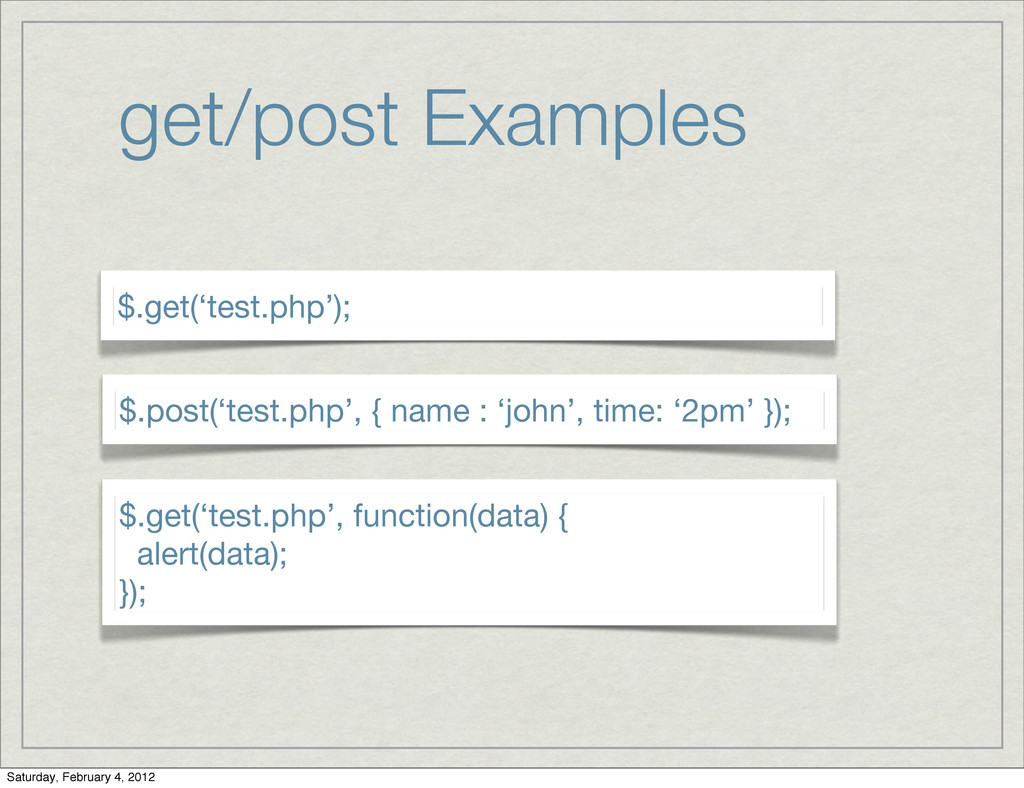
get/post Examples $.get(‘test.php’); $.post(‘test.php’, { name : ‘john’, time: ‘2pm’
}); $.get(‘test.php’, function(data) { alert(data); }); Saturday, February 4, 2012 -
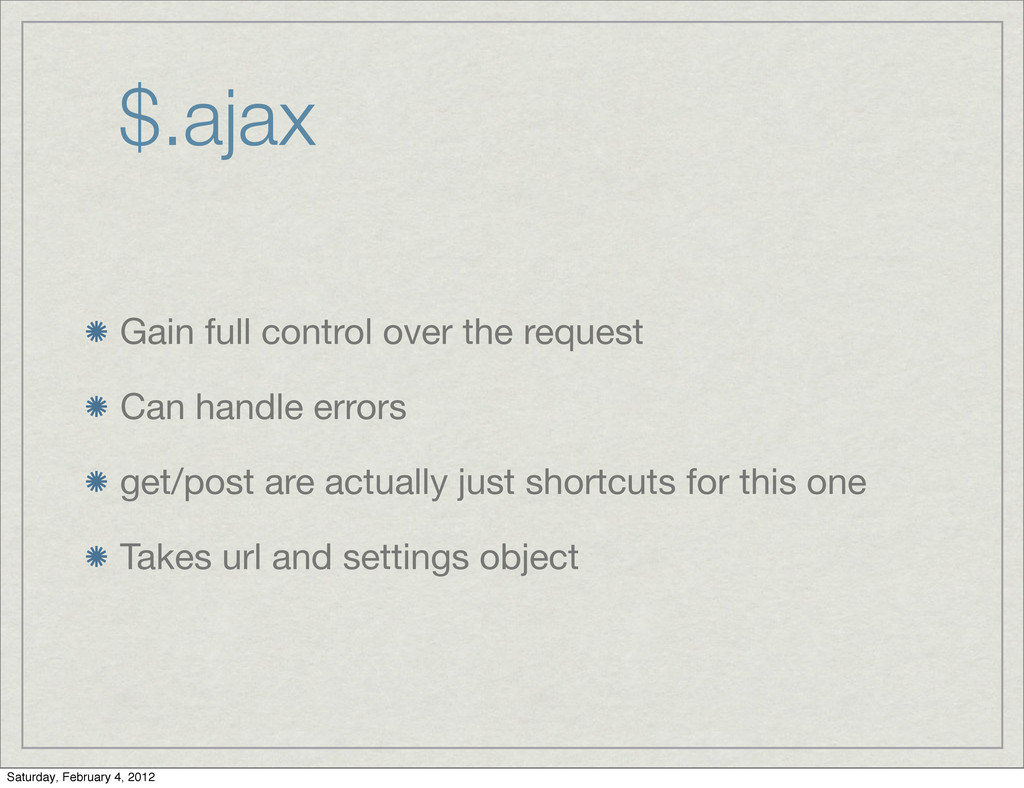
$.ajax Gain full control over the request Can handle errors
get/post are actually just shortcuts for this one Takes url and settings object Saturday, February 4, 2012 -
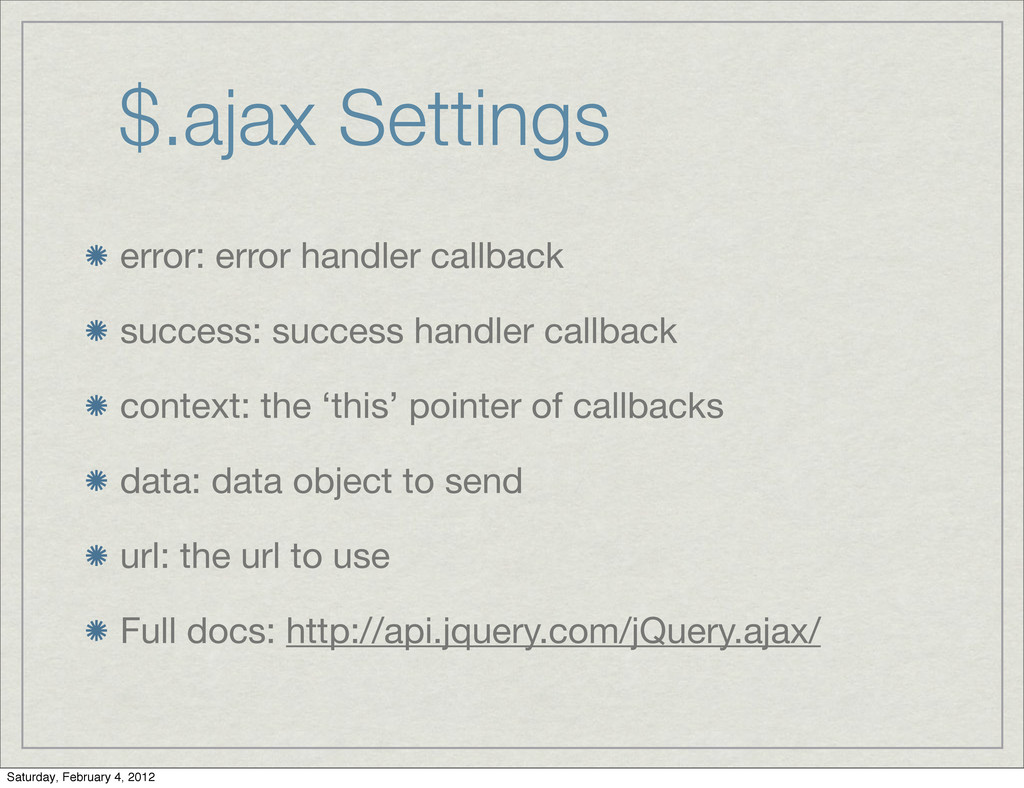
$.ajax Settings error: error handler callback success: success handler callback
context: the ‘this’ pointer of callbacks data: data object to send url: the url to use Full docs: http://api.jquery.com/jQuery.ajax/ Saturday, February 4, 2012 -
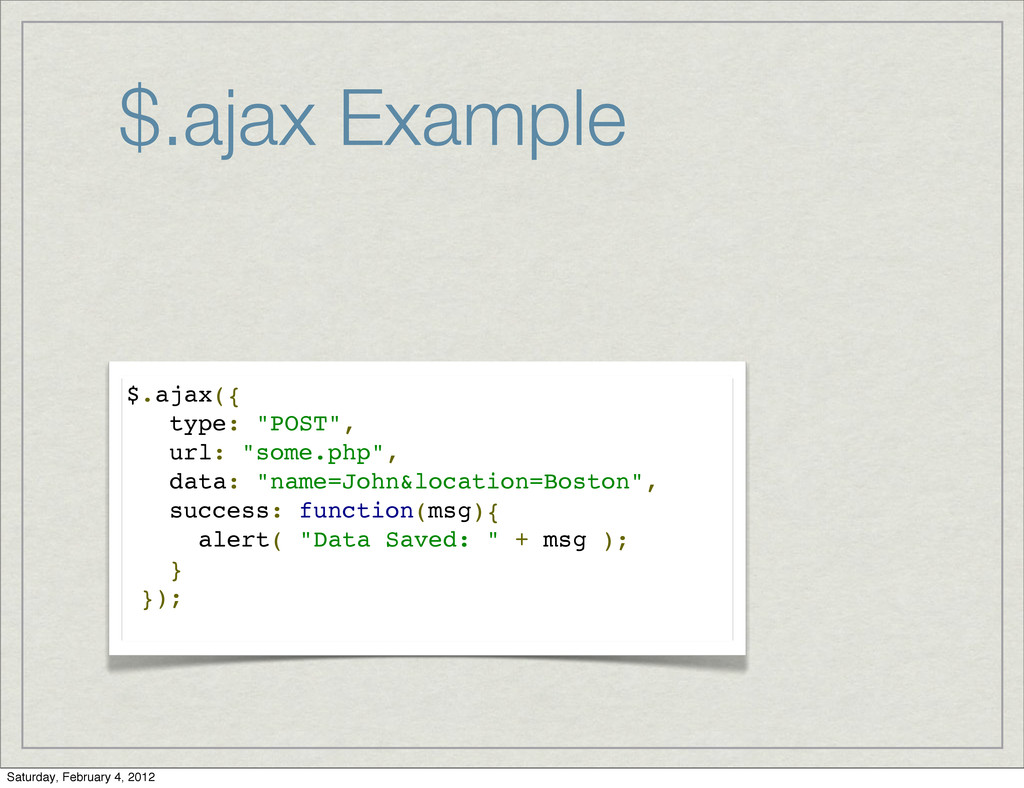
$.ajax Example $.ajax({ type: "POST", url: "some.php", data: "name=John&location=Boston", success:
function(msg){ alert( "Data Saved: " + msg ); } }); Saturday, February 4, 2012 -
Practice Use your favorite Server Side Technology Implement a mobile
wall: App displays a long list of sentences (the wall) Each user can add a sentence to the wall Everyone shares the same wall Saturday, February 4, 2012 -
Concepts Create parts of the DOM dynamically by using JavaScript,
based on data that is stored as JS objects Template + Data = HTML Saturday, February 4, 2012 -
Use Cases Data is collected from the server Data is
retrieved form local storage Data is aggregated from multiple sources Translations http://loveandasandwich.deviantart.com/art/Mustache- Monsterssss-201209873 Saturday, February 4, 2012 -
Selected Libraries mustache.js handlebars ejs pure.js underscore.js And many more...
Saturday, February 4, 2012 -
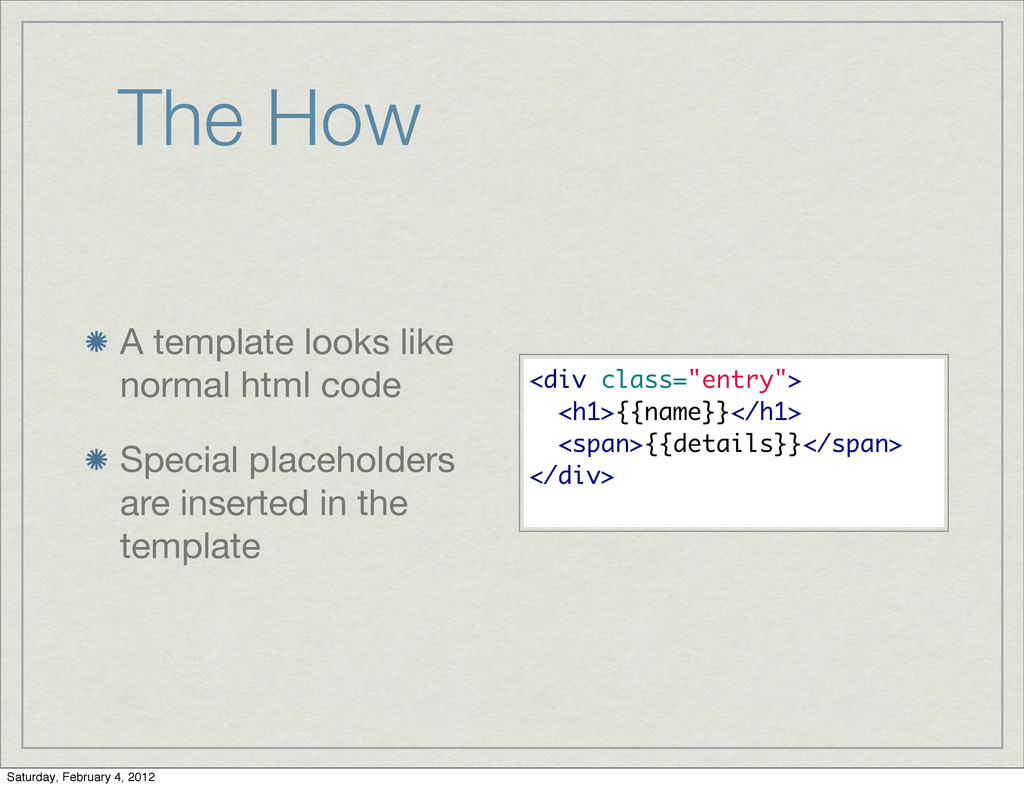
The How A template looks like normal html code Special
placeholders are inserted in the template <div class="entry"> <h1>{{name}}</h1> <span>{{details}}</span> </div> Saturday, February 4, 2012 -
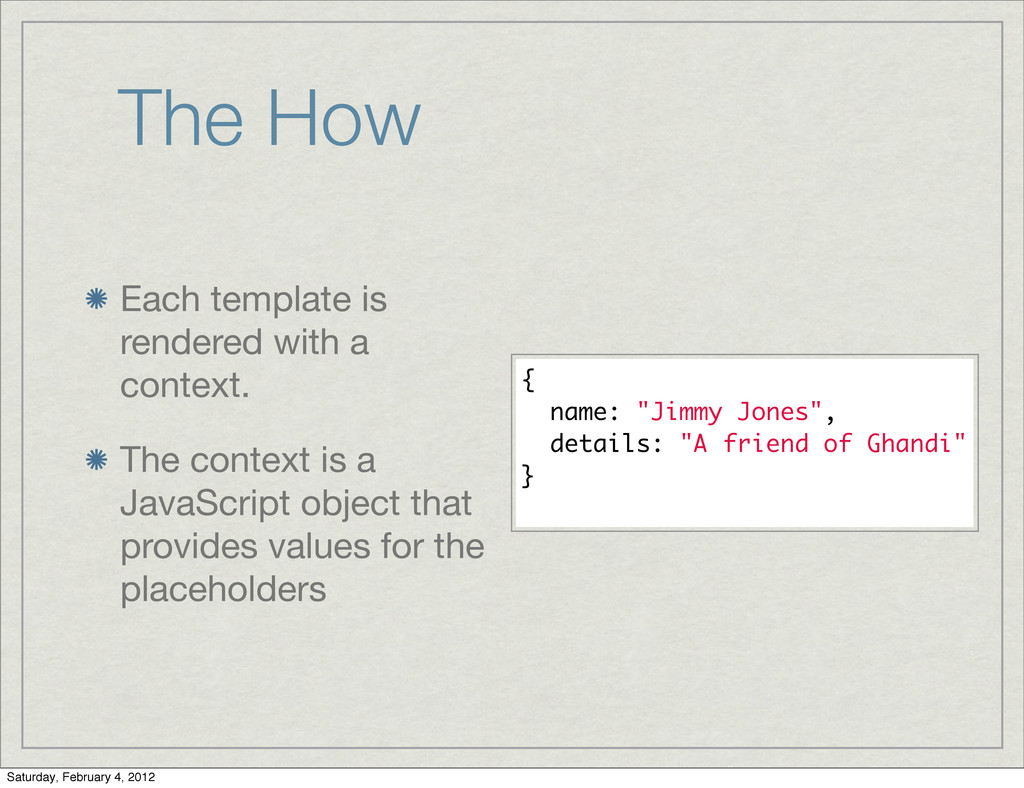
The How Each template is rendered with a context. The
context is a JavaScript object that provides values for the placeholders { name: "Jimmy Jones", details: "A friend of Ghandi" } Saturday, February 4, 2012 -
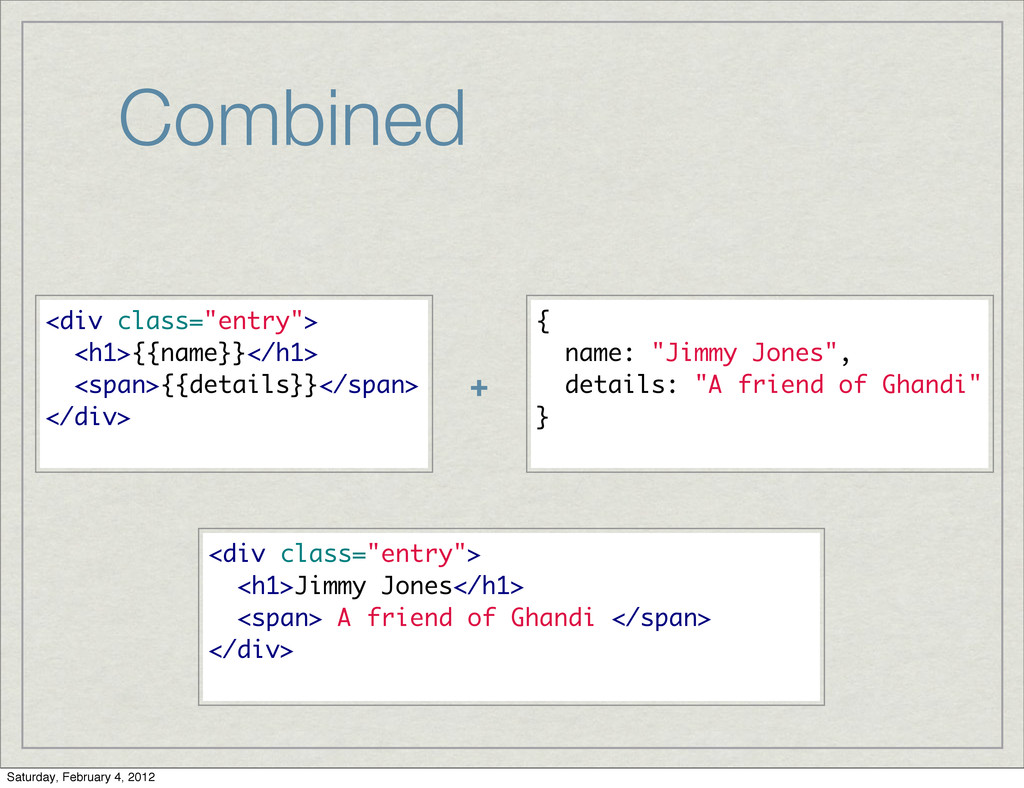
Combined <div class="entry"> <h1>{{name}}</h1> <span>{{details}}</span> </div> { name: "Jimmy Jones",
details: "A friend of Ghandi" } + <div class="entry"> <h1>Jimmy Jones</h1> <span> A friend of Ghandi </span> </div> Saturday, February 4, 2012 -
Demo Using a template embedded inside the html file as
a script Code: ajax/ Handlebars/Demo1/ Saturday, February 4, 2012 -
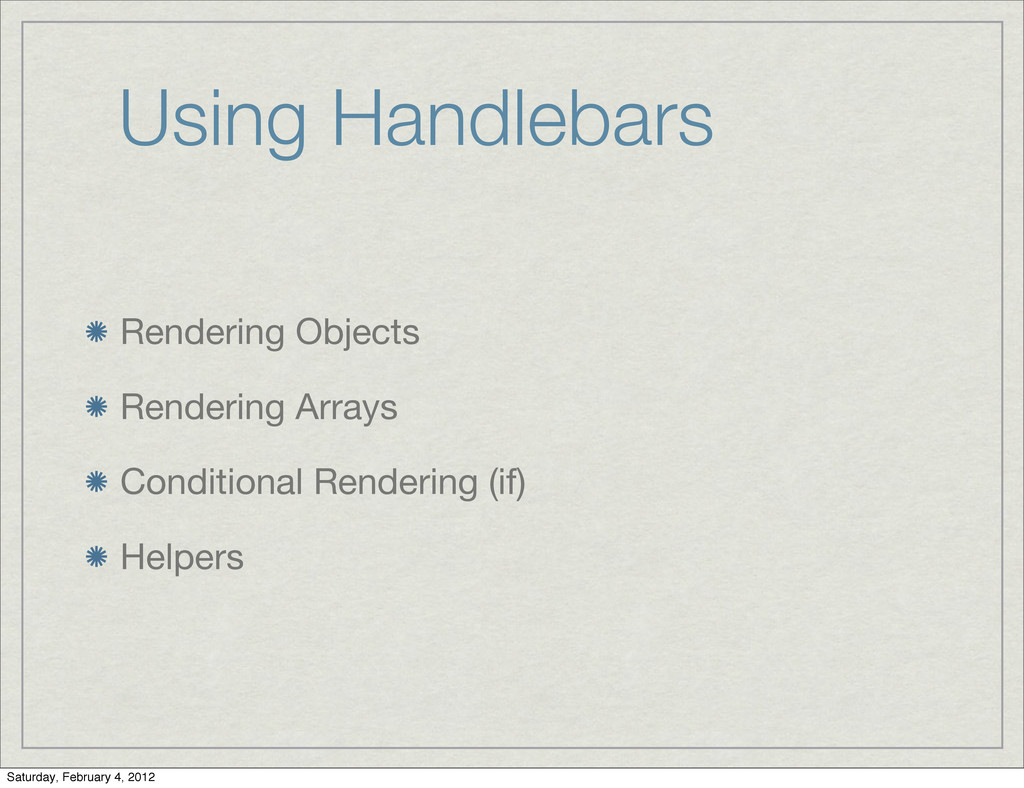
Using Handlebars Rendering Objects Rendering Arrays Conditional Rendering (if) Helpers
Saturday, February 4, 2012 -
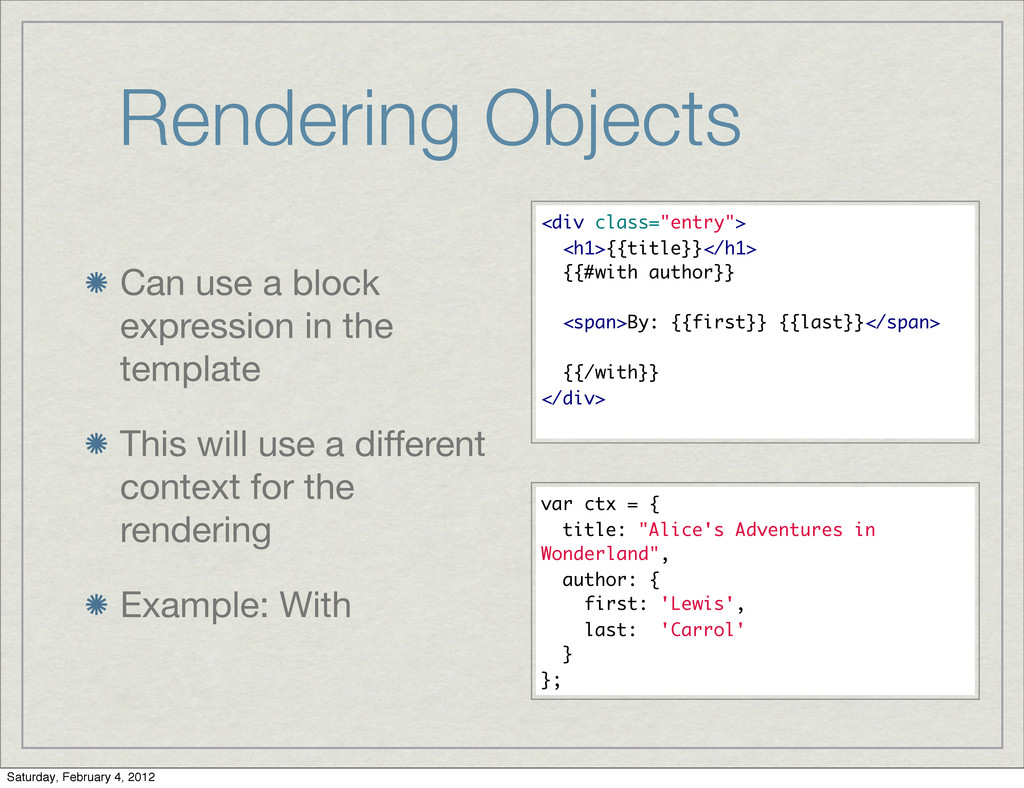
Rendering Objects Can use a block expression in the template
This will use a different context for the rendering Example: With <div class="entry"> <h1>{{title}}</h1> {{#with author}} <span>By: {{first}} {{last}}</span> {{/with}} </div> var ctx = { title: "Alice's Adventures in Wonderland", author: { first: 'Lewis', last: 'Carrol' } }; Saturday, February 4, 2012 -
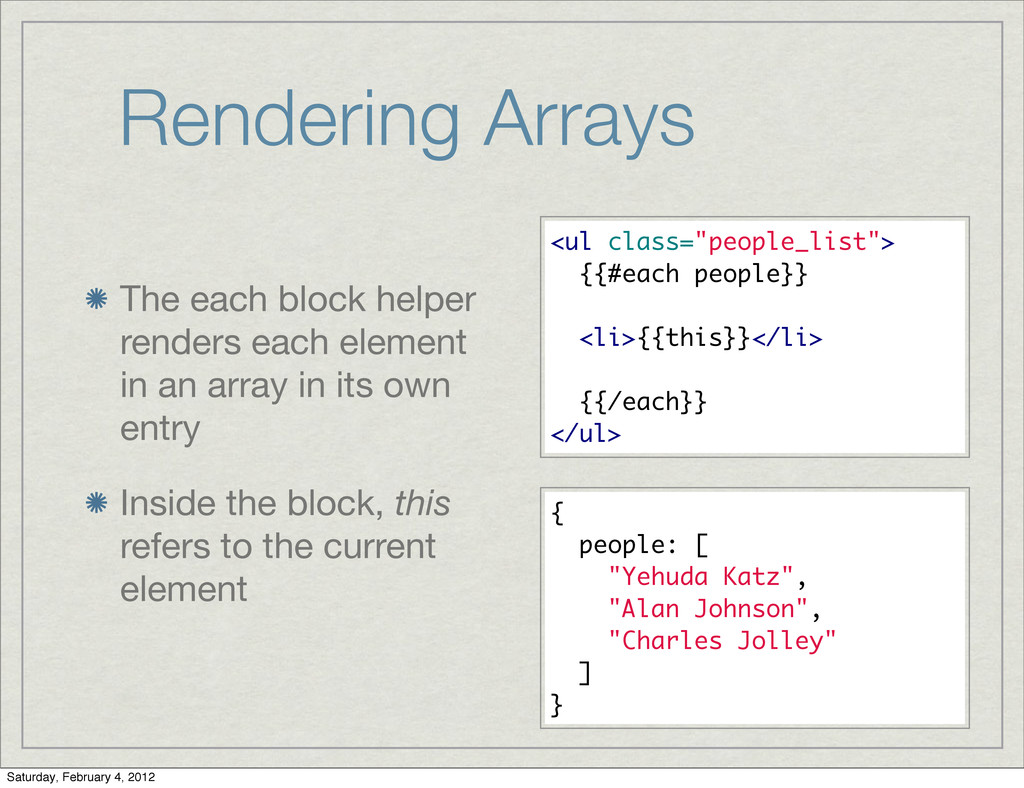
Rendering Arrays The each block helper renders each element in
an array in its own entry Inside the block, this refers to the current element <ul class="people_list"> {{#each people}} <li>{{this}}</li> {{/each}} </ul> { people: [ "Yehuda Katz", "Alan Johnson", "Charles Jolley" ] } Saturday, February 4, 2012 -
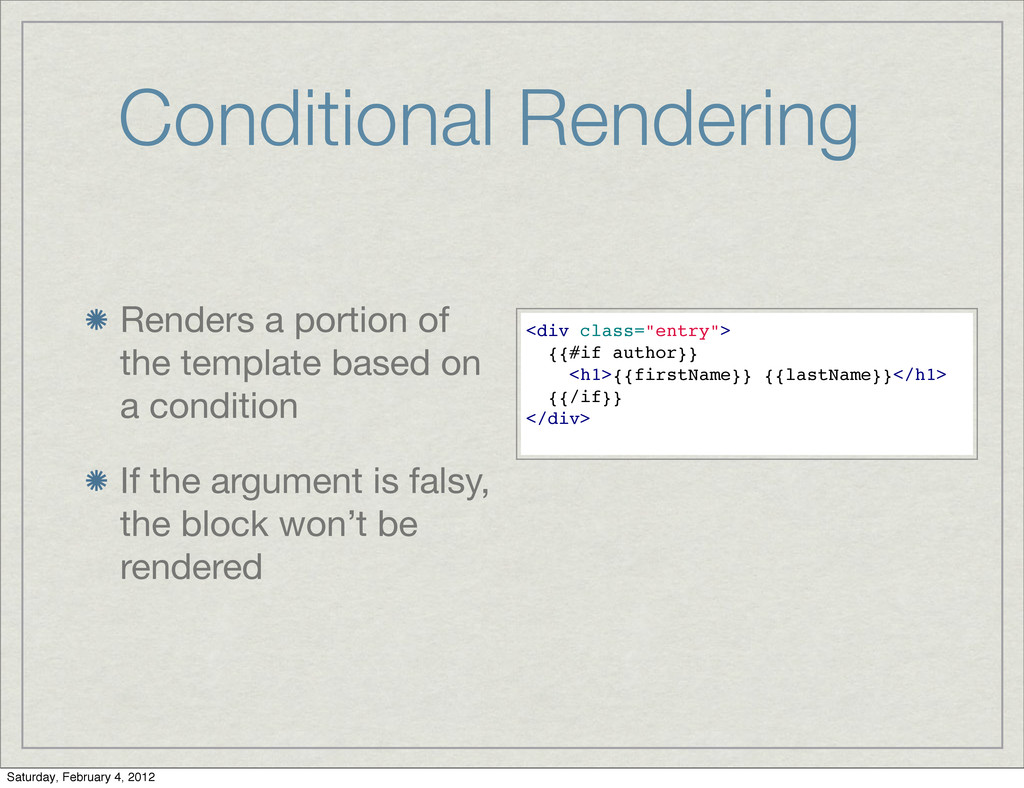
Conditional Rendering Renders a portion of the template based on
a condition If the argument is falsy, the block won’t be rendered <div class="entry"> {{#if author}} <h1>{{firstName}} {{lastName}}</h1> {{/if}} </div> Saturday, February 4, 2012 -
Helpers Run JS Code and put its result inside the
mustache The code is predefined as a helper Demo: ajax/ Handlebars/Demo2 Saturday, February 4, 2012 -
Exercise Write a simple todo manager using Handlebars Use a
form to add a todo item Use localStorage to save all items Use a handlebar template to create the todo list from the local storage Saturday, February 4, 2012 -
Server To Client HTTP is only one way client to
server protocol How can the server tell all clients that something new has happened ? Saturday, February 4, 2012 -
Server To Client Client frequent refreshes Web Comet Coined as
a play on Ajax Saturday, February 4, 2012 -
Web Sockets New Feature of HTML5 Needs a dedicated server
supporting web sockets Server-Side implementations: Socket.IO, Jetty (Java), Ruby, Python, Perl Client Side: Native support on iPhone. Full Solution: Socket.IO Saturday, February 4, 2012 -
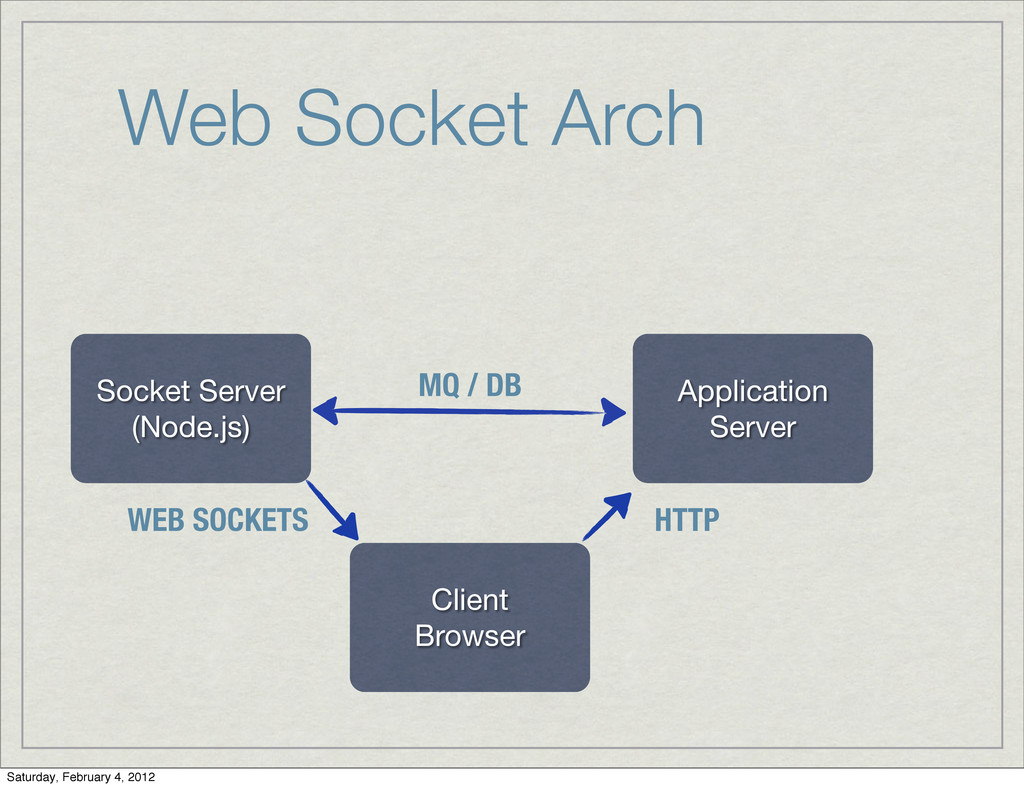
Web Socket Arch Socket Server (Node.js) Application Server Client Browser
MQ / DB WEB SOCKETS HTTP Saturday, February 4, 2012 -
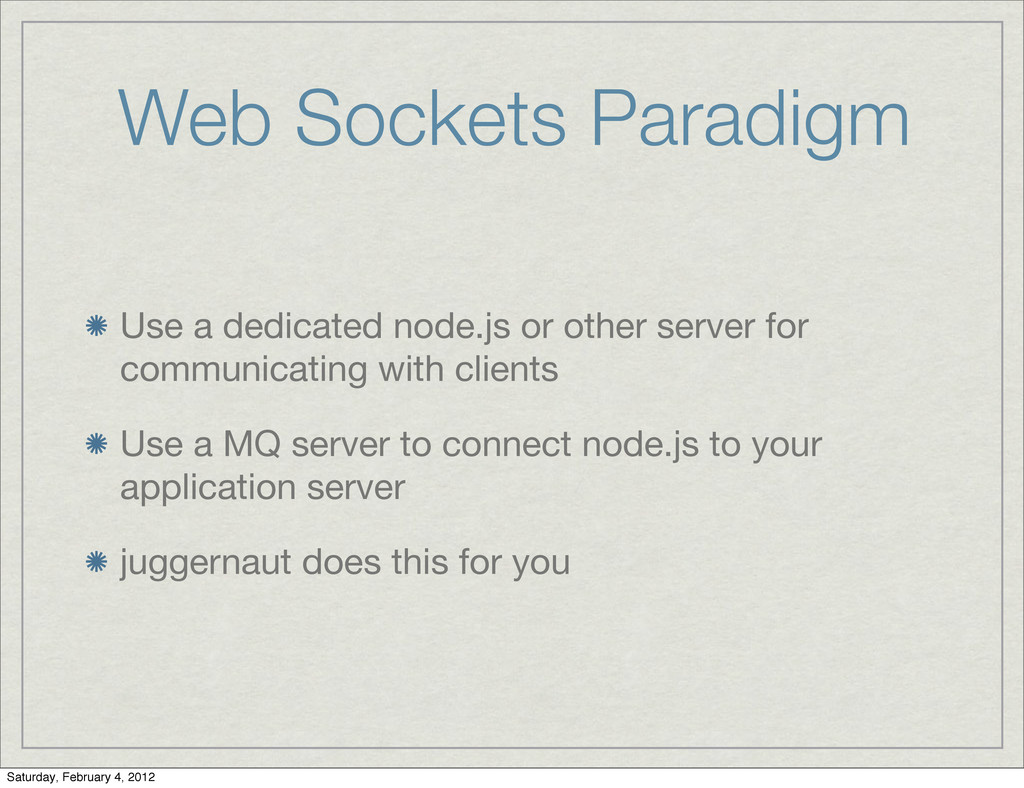
Web Sockets Paradigm Use a dedicated node.js or other server
for communicating with clients Use a MQ server to connect node.js to your application server juggernaut does this for you Saturday, February 4, 2012 -
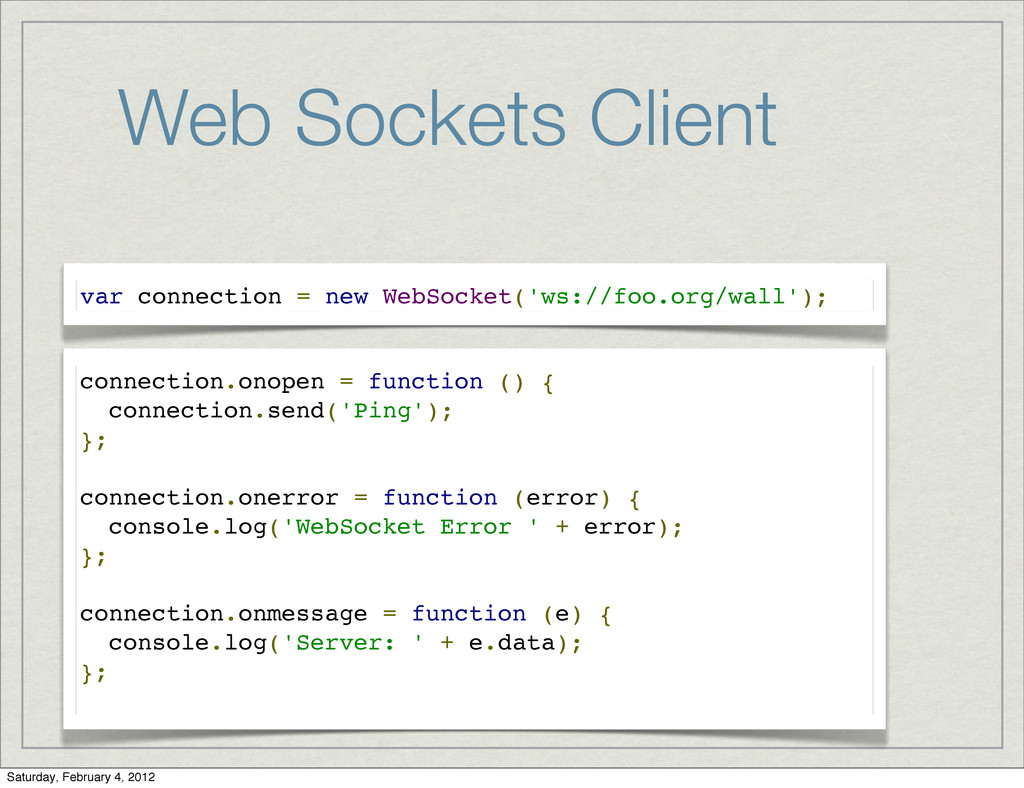
Web Sockets Client var connection = new WebSocket('ws://foo.org/wall'); connection.onopen =
function () { connection.send('Ping'); }; connection.onerror = function (error) { console.log('WebSocket Error ' + error); }; connection.onmessage = function (e) { console.log('Server: ' + e.data); }; Saturday, February 4, 2012 -
Web Sockets Today Currently, Web sockets are not widely supported
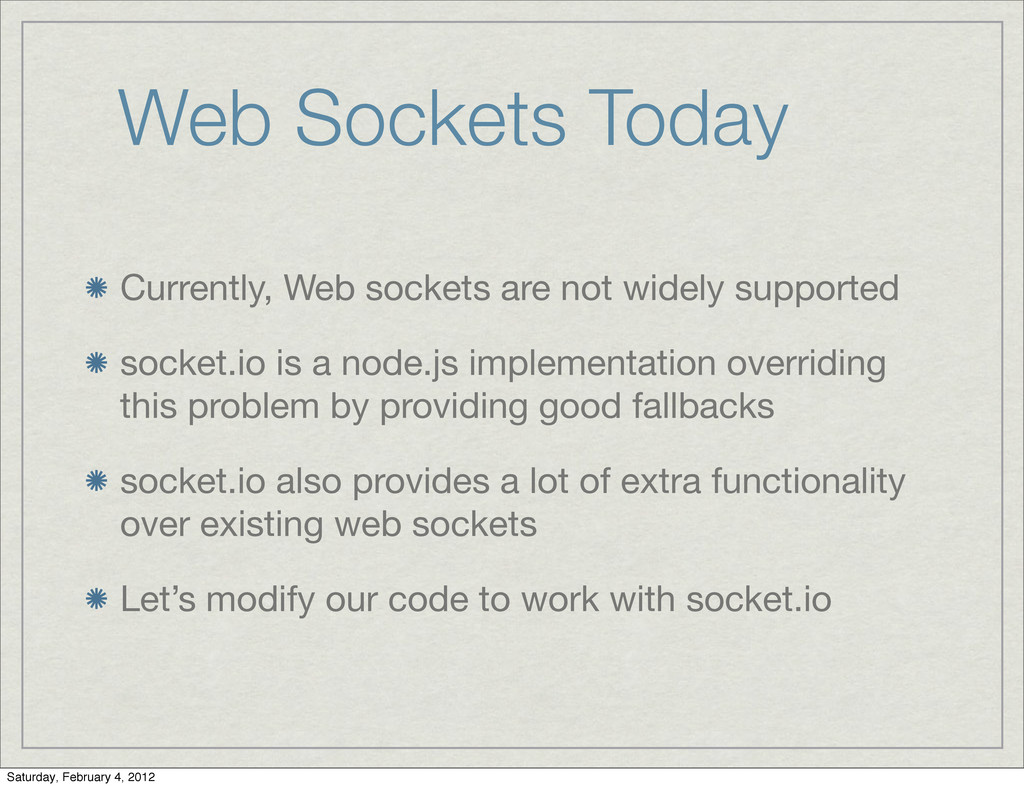
socket.io is a node.js implementation overriding this problem by providing good fallbacks socket.io also provides a lot of extra functionality over existing web sockets Let’s modify our code to work with socket.io Saturday, February 4, 2012 -
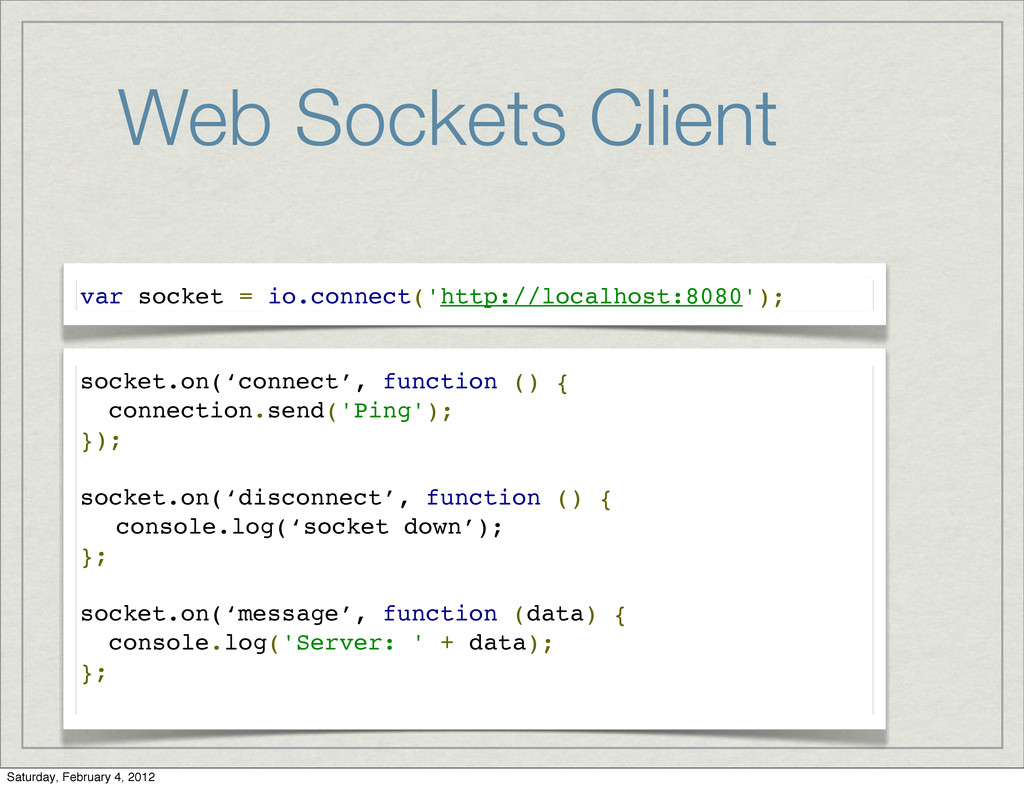
Web Sockets Client var socket = io.connect('http://localhost:8080'); socket.on(‘connect’, function ()
{ connection.send('Ping'); }); socket.on(‘disconnect’, function () { console.log(‘socket down’); }; socket.on(‘message’, function (data) { console.log('Server: ' + data); }; Saturday, February 4, 2012