Share
Embed
Transcript
98 slides
-
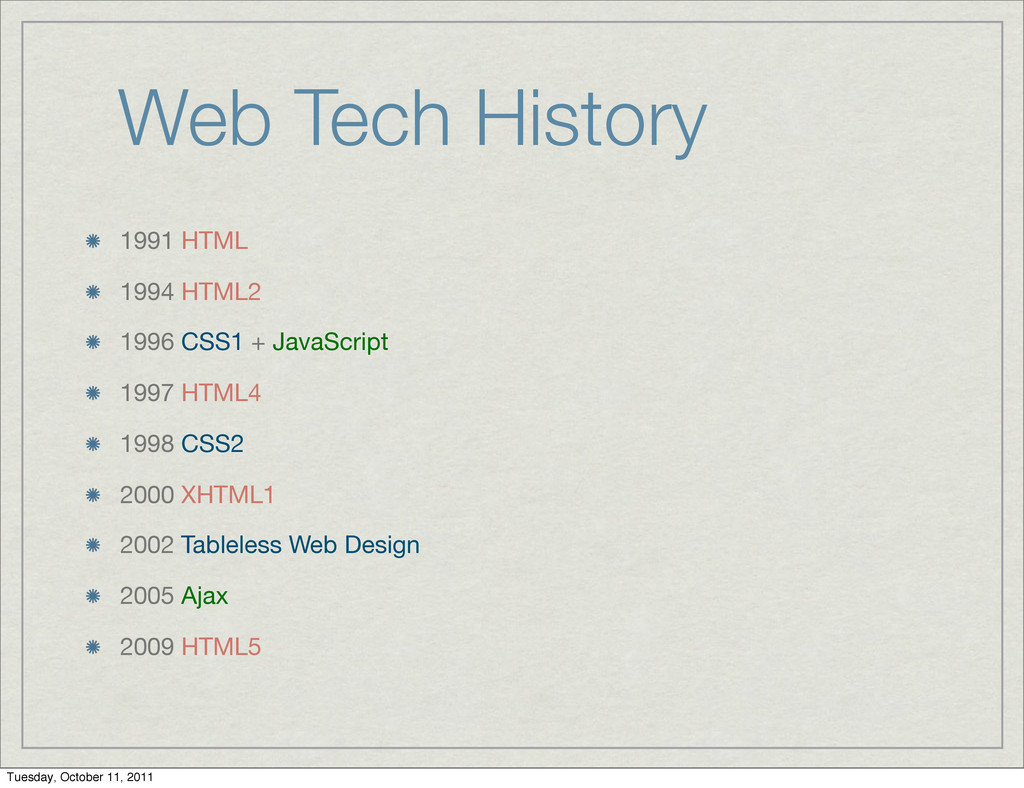
Web Tech History 1991 HTML 1994 HTML2 1996 CSS1 +
JavaScript 1997 HTML4 1998 CSS2 2000 XHTML1 2002 Tableless Web Design 2005 Ajax 2009 HTML5 Tuesday, October 11, 2011 -
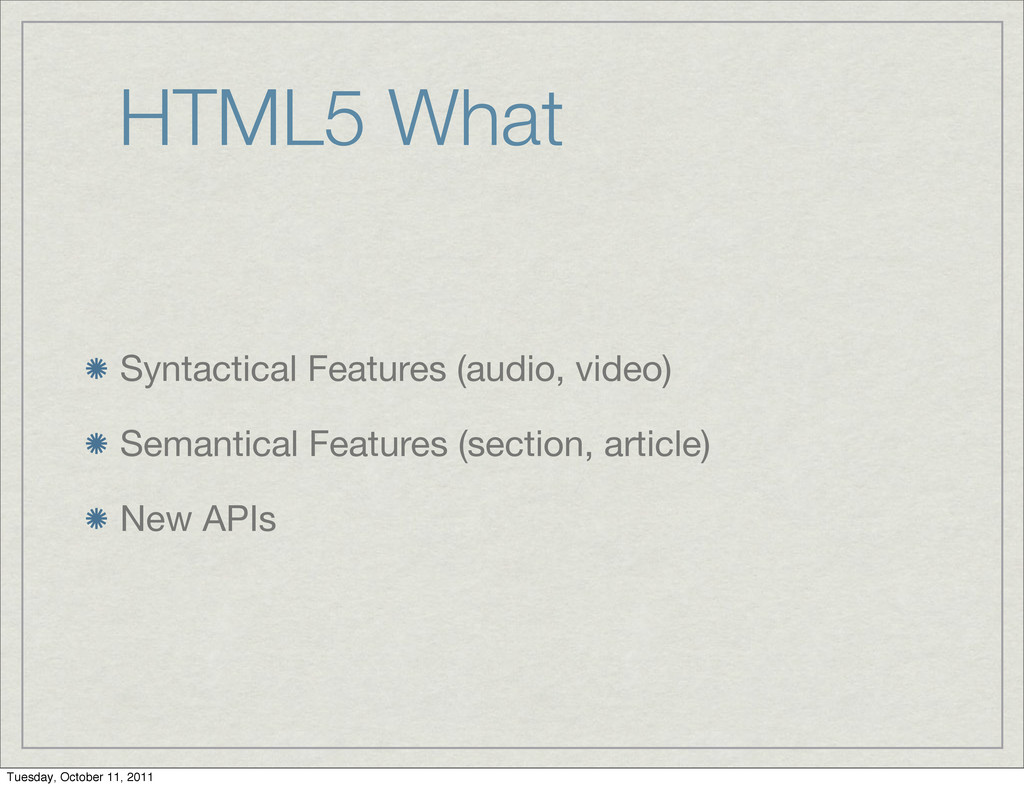
HTML5 What Syntactical Features (audio, video) Semantical Features (section, article)
New APIs Tuesday, October 11, 2011 -
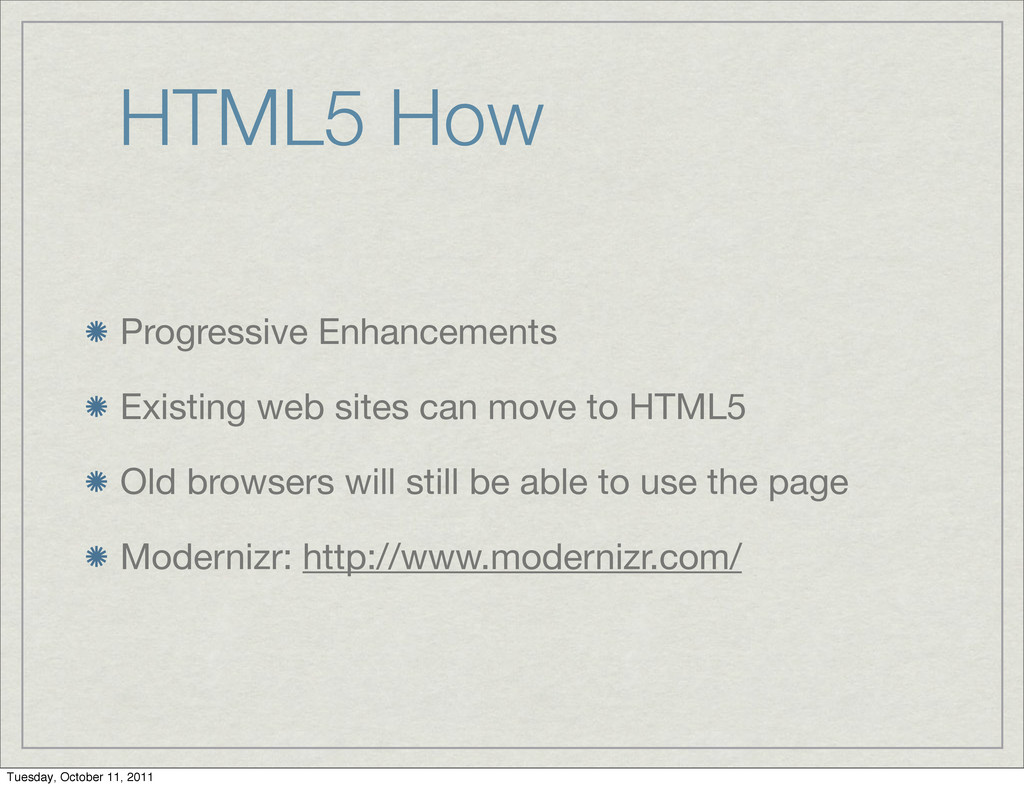
HTML5 How Progressive Enhancements Existing web sites can move to
HTML5 Old browsers will still be able to use the page Modernizr: http://www.modernizr.com/ Tuesday, October 11, 2011 -
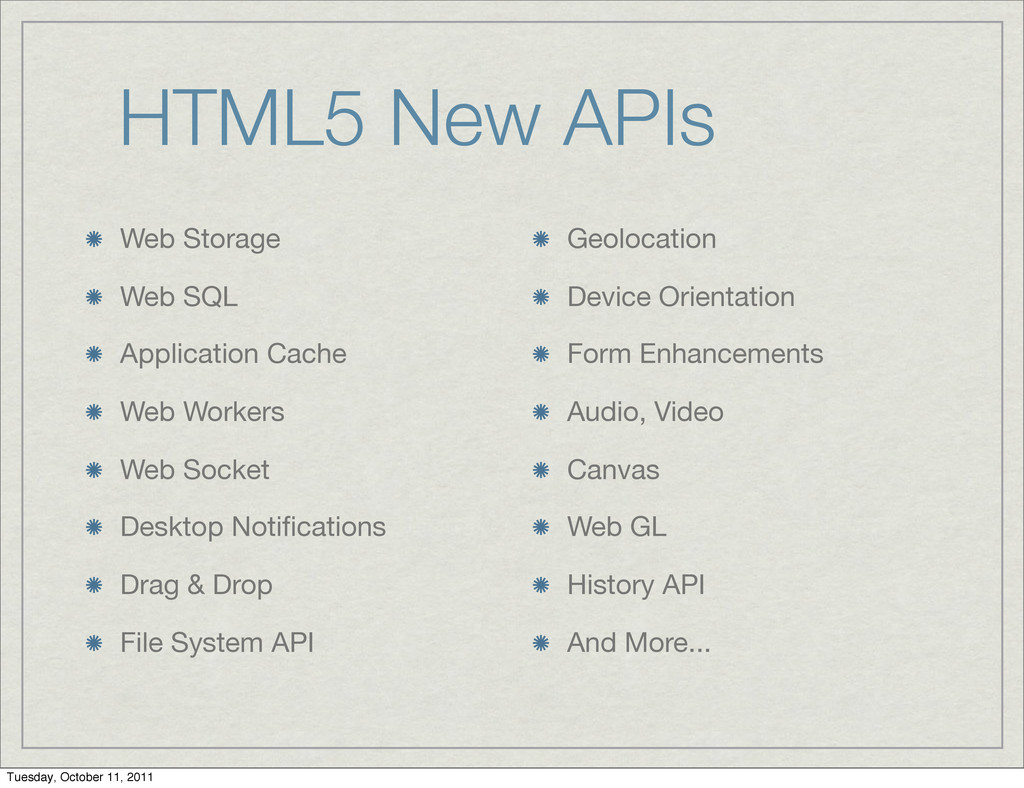
HTML5 New APIs Web Storage Web SQL Application Cache Web
Workers Web Socket Desktop Notifications Drag & Drop File System API Geolocation Device Orientation Form Enhancements Audio, Video Canvas Web GL History API And More... Tuesday, October 11, 2011 -
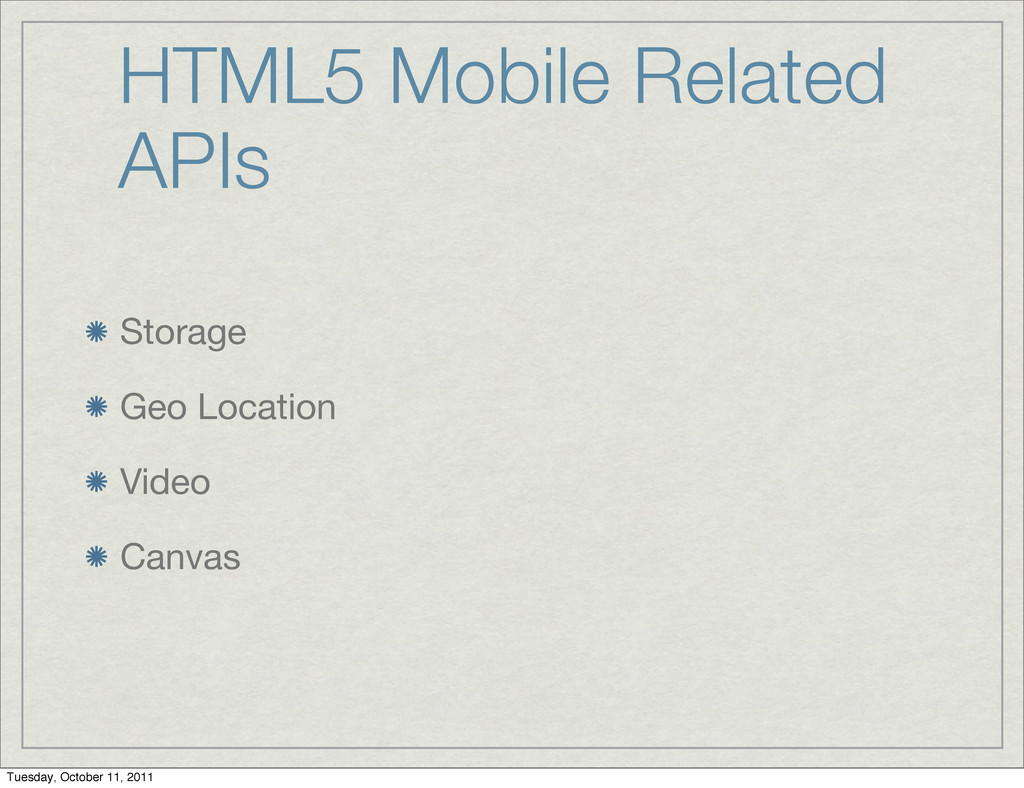
HTML5 Mobile Related APIs Storage Geo Location Video Canvas Tuesday,
October 11, 2011 -
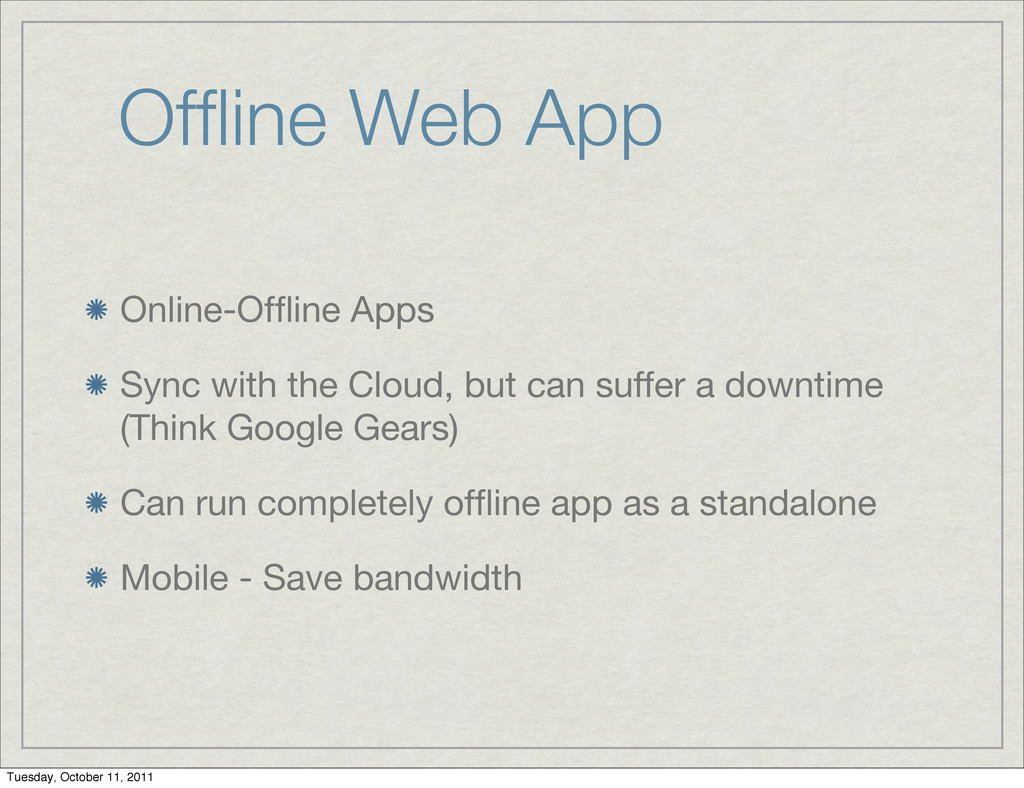
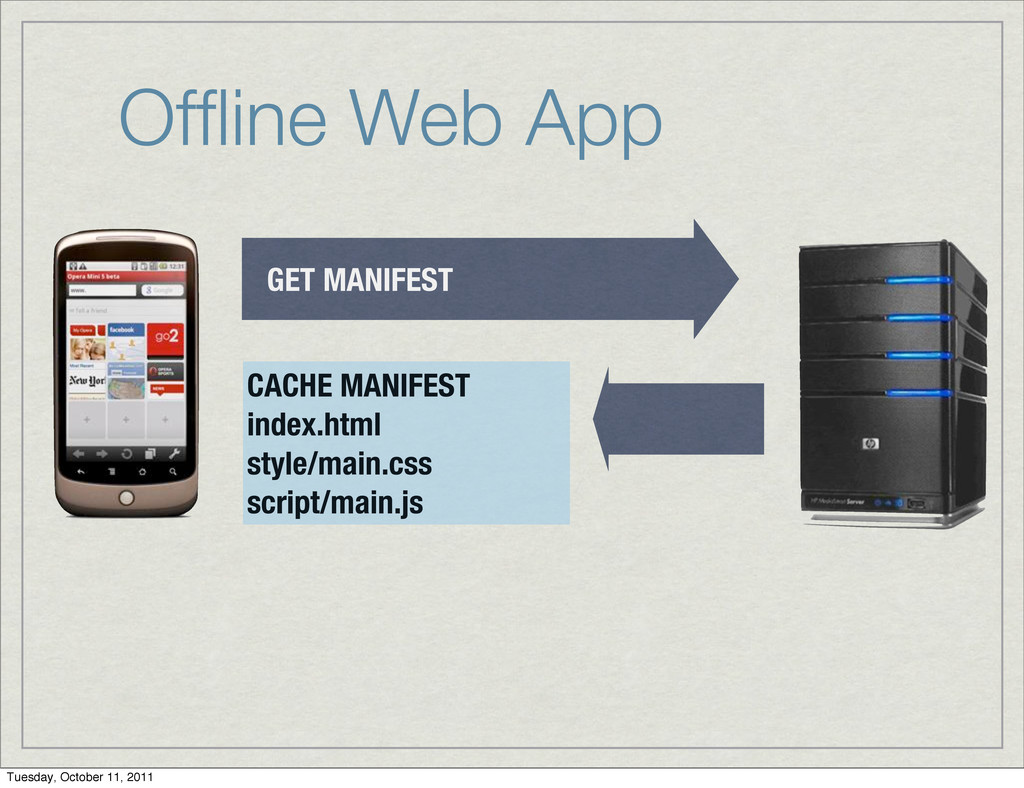
Offline Web App Online-Offline Apps Sync with the Cloud, but
can suffer a downtime (Think Google Gears) Can run completely offline app as a standalone Mobile - Save bandwidth Tuesday, October 11, 2011 -

Offline Web App GET MANIFEST CACHE MANIFEST index.html style/main.css script/main.js
Tuesday, October 11, 2011 -
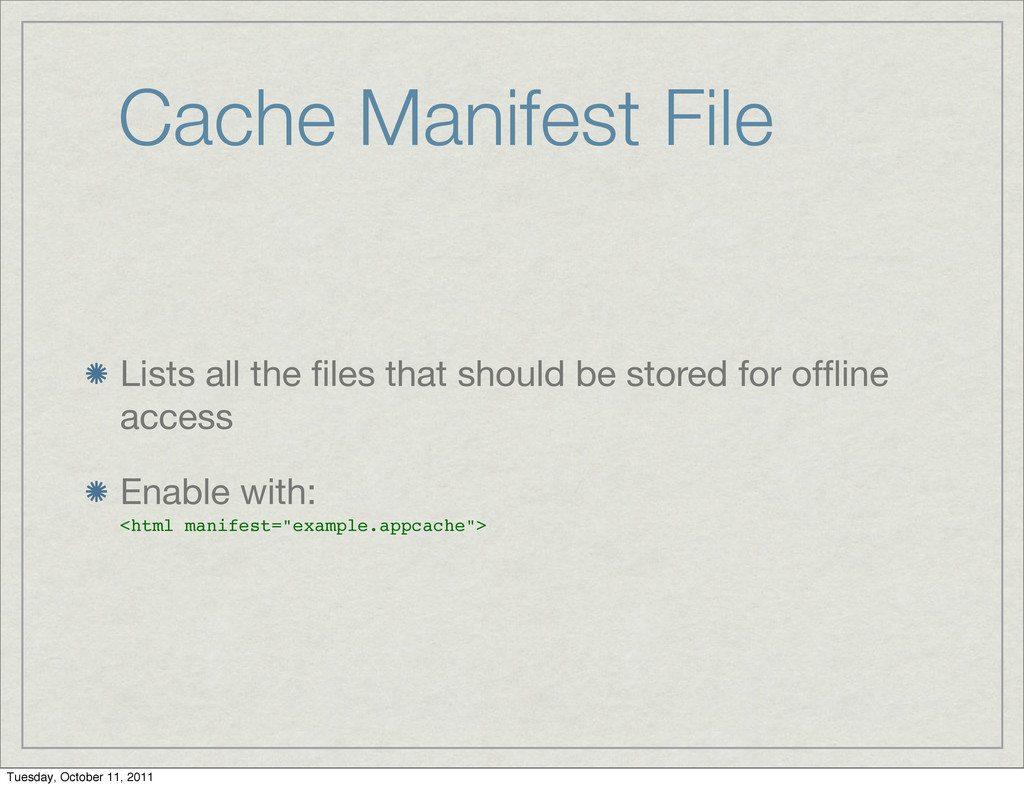
Cache Manifest File Lists all the files that should be
stored for offline access Enable with: <html manifest="example.appcache"> Tuesday, October 11, 2011 -
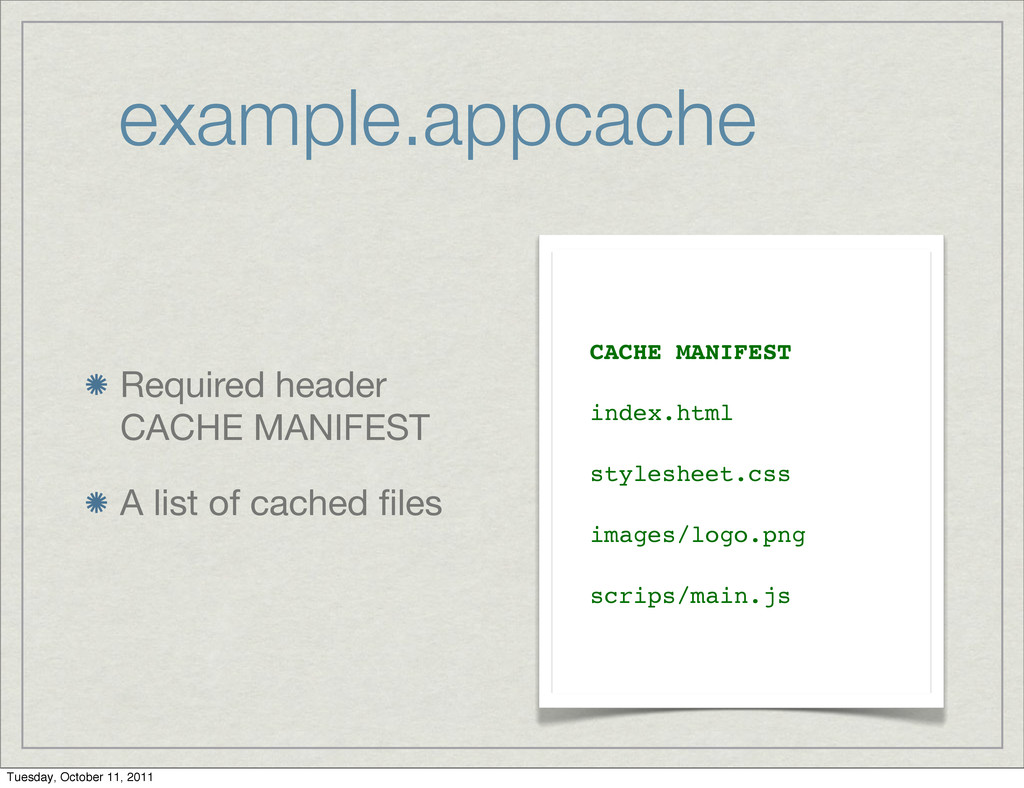
example.appcache Required header CACHE MANIFEST A list of cached files
CACHE MANIFEST index.html stylesheet.css images/logo.png scrips/main.js Tuesday, October 11, 2011 -
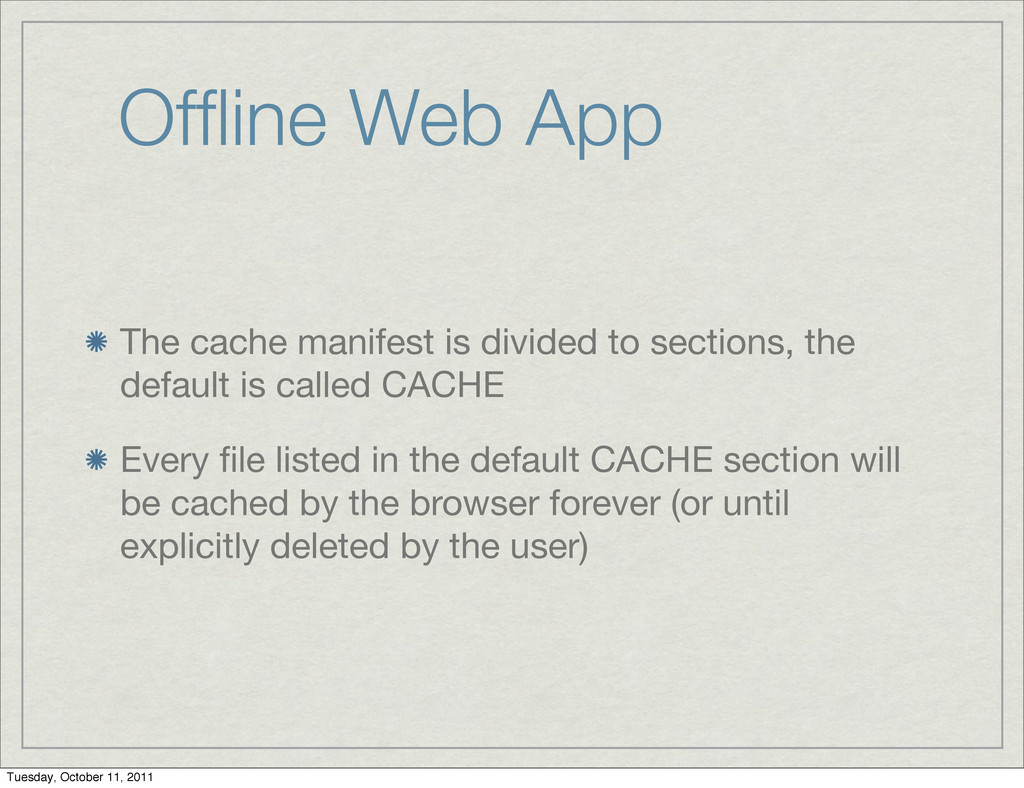
Offline Web App The cache manifest is divided to sections,
the default is called CACHE Every file listed in the default CACHE section will be cached by the browser forever (or until explicitly deleted by the user) Tuesday, October 11, 2011 -
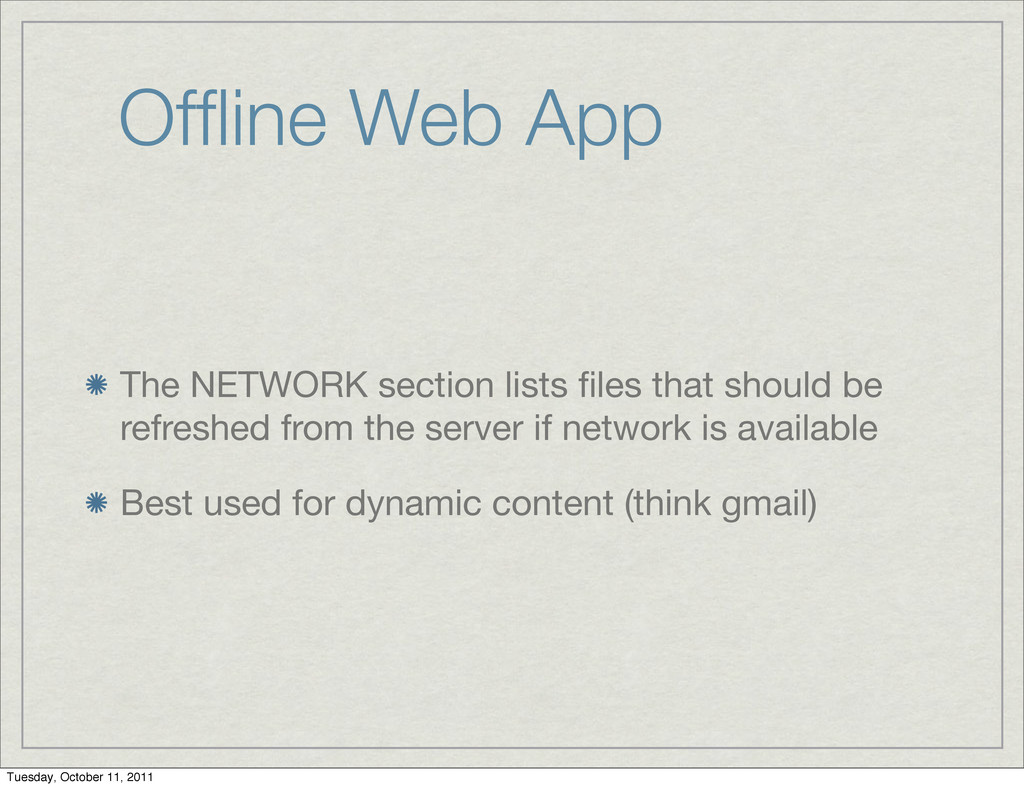
Offline Web App The NETWORK section lists files that should
be refreshed from the server if network is available Best used for dynamic content (think gmail) Tuesday, October 11, 2011 -
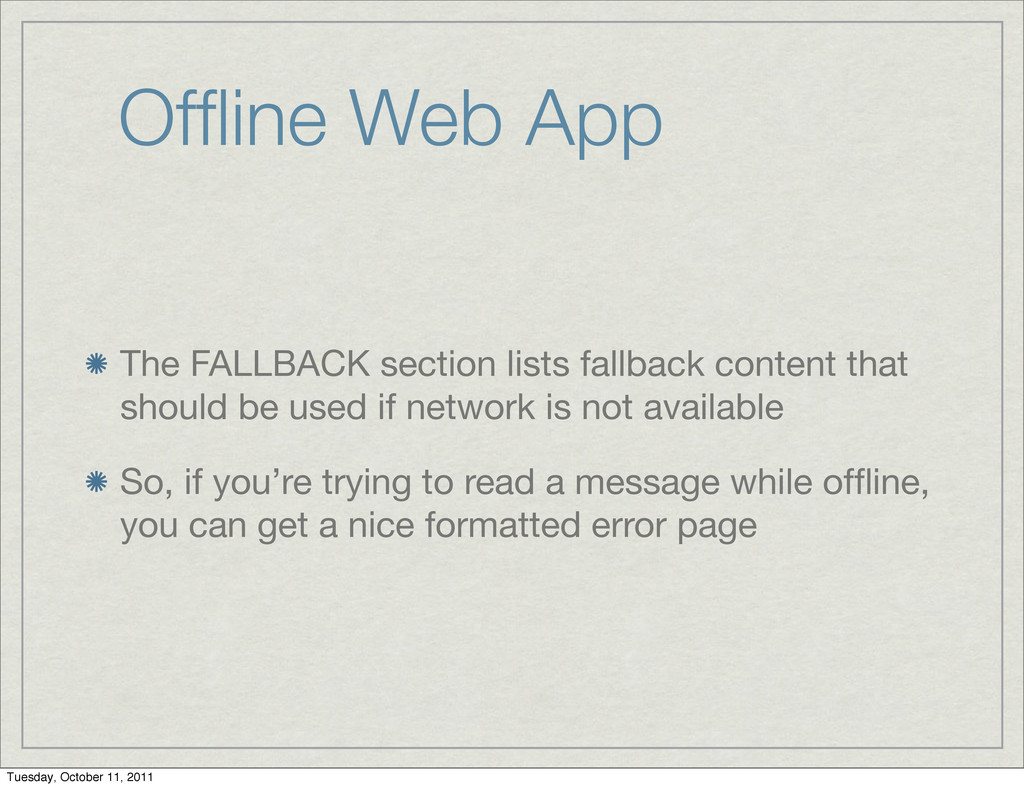
Offline Web App The FALLBACK section lists fallback content that
should be used if network is not available So, if you’re trying to read a message while offline, you can get a nice formatted error page Tuesday, October 11, 2011 -
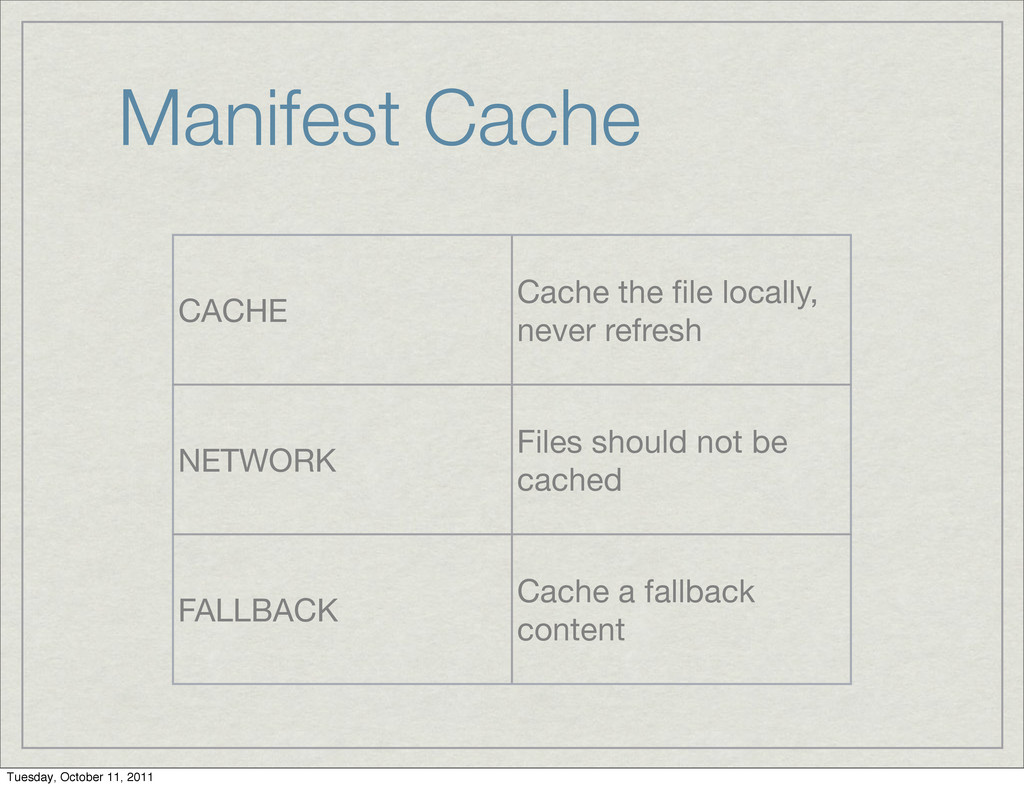
Manifest Cache CACHE Cache the file locally, never refresh NETWORK
Files should not be cached FALLBACK Cache a fallback content Tuesday, October 11, 2011 -
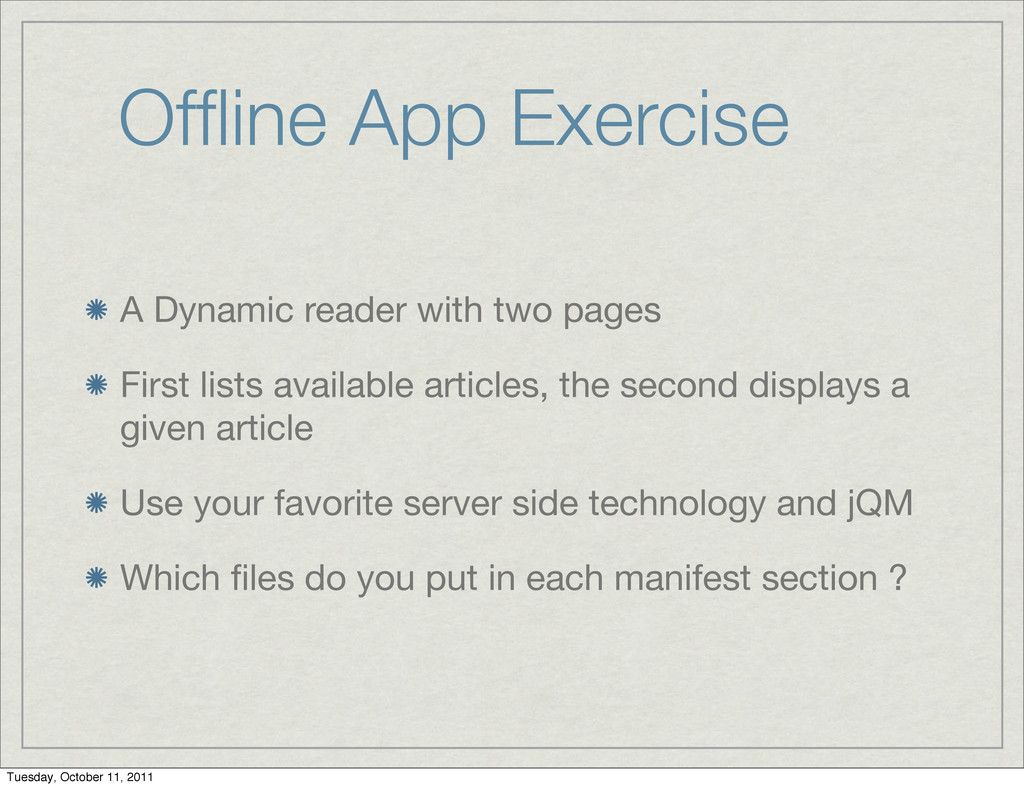
Offline App Exercise A Dynamic reader with two pages First
lists available articles, the second displays a given article Use your favorite server side technology and jQM Which files do you put in each manifest section ? Tuesday, October 11, 2011 -
Manifest - The Good Can store any file locally Provides
offline/online app functionality Transparent to the user Tuesday, October 11, 2011 -
Manifest - The Bad Not suitable for data storage Complex
update logic Tuesday, October 11, 2011 -
Local Data Storage How do you store data on a
client’s machine ? Tuesday, October 11, 2011 -
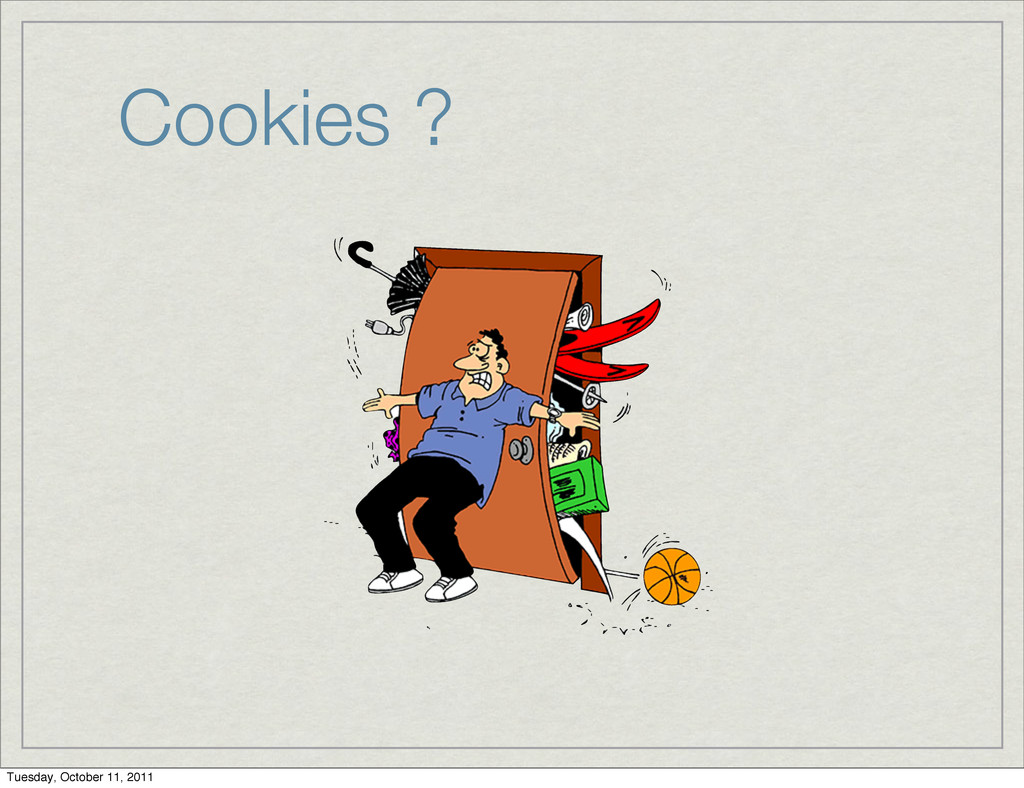
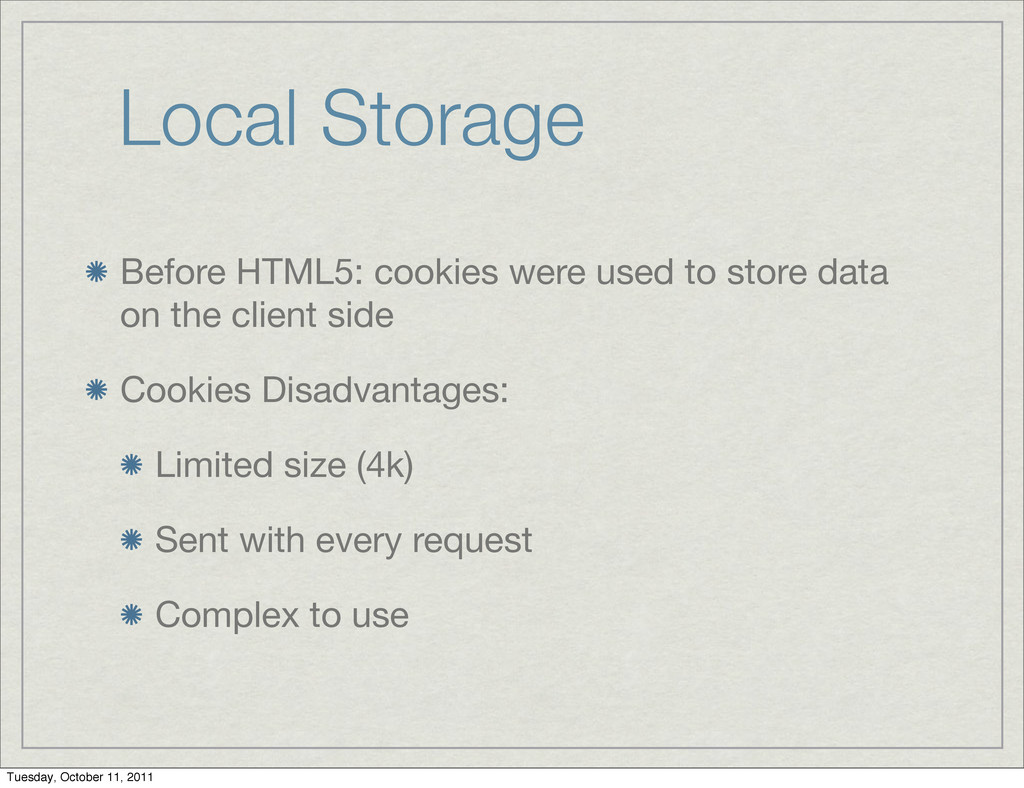
Local Storage Before HTML5: cookies were used to store data
on the client side Cookies Disadvantages: Limited size (4k) Sent with every request Complex to use Tuesday, October 11, 2011 -
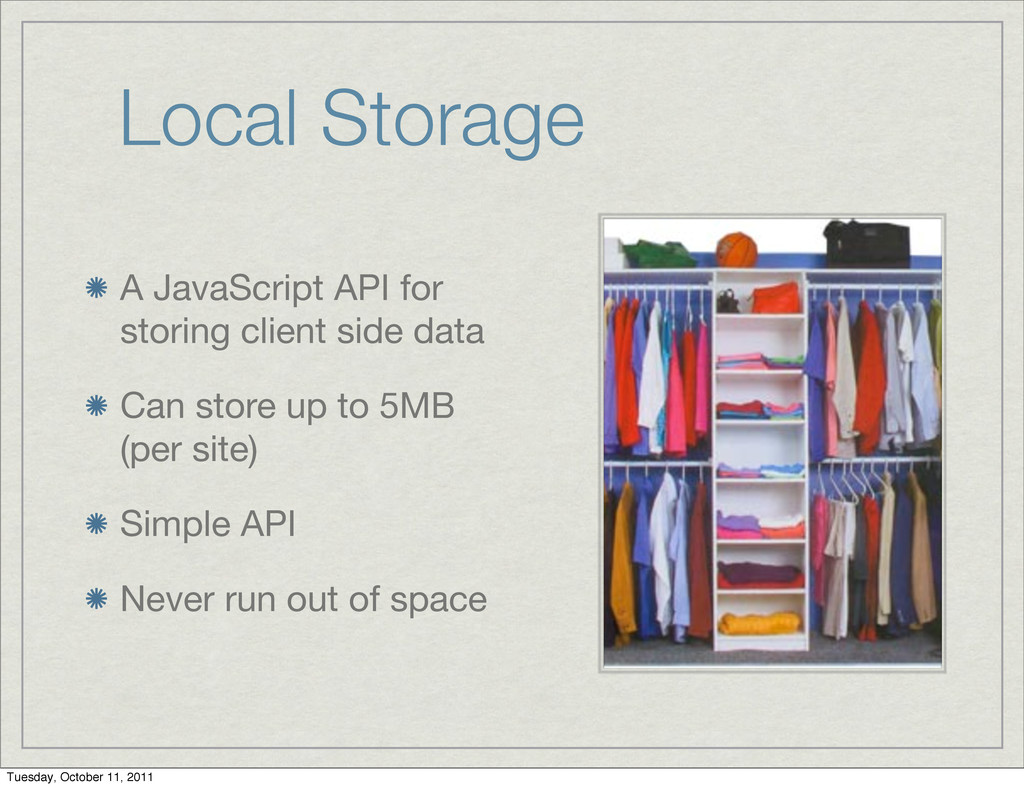
Local Storage A JavaScript API for storing client side data
Can store up to 5MB (per site) Simple API Never run out of space Tuesday, October 11, 2011 -
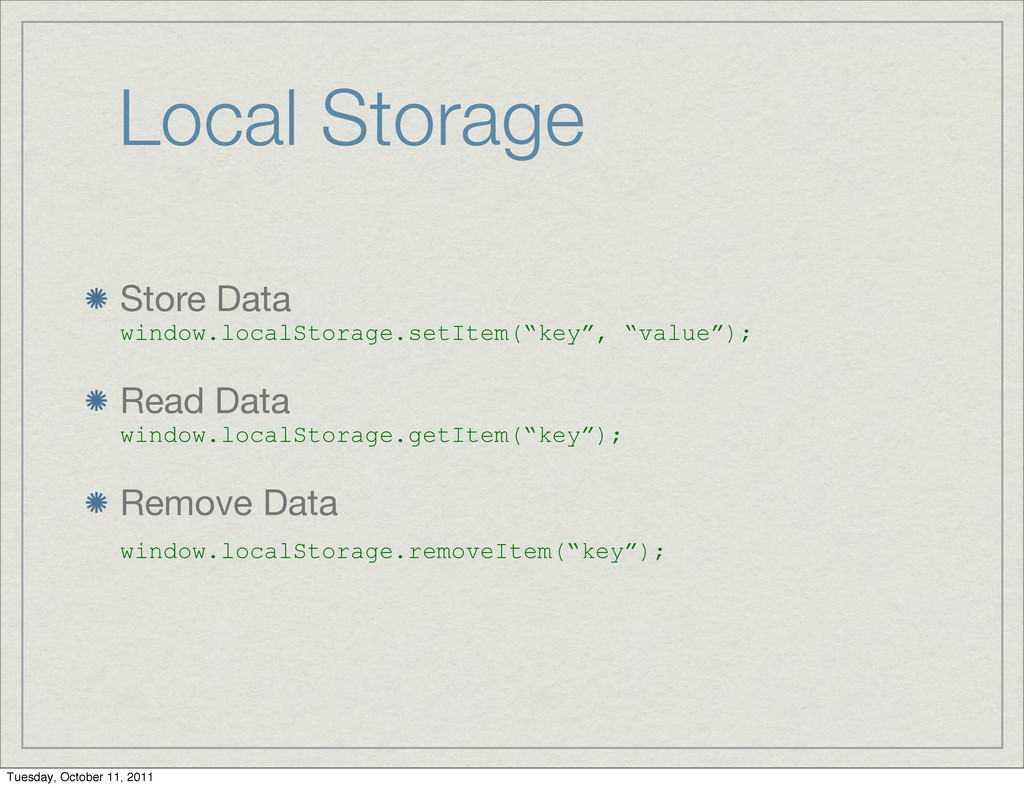
Local Storage Store Data window.localStorage.setItem(“key”, “value”); Read Data window.localStorage.getItem(“key”); Remove
Data window.localStorage.removeItem(“key”); Tuesday, October 11, 2011 -
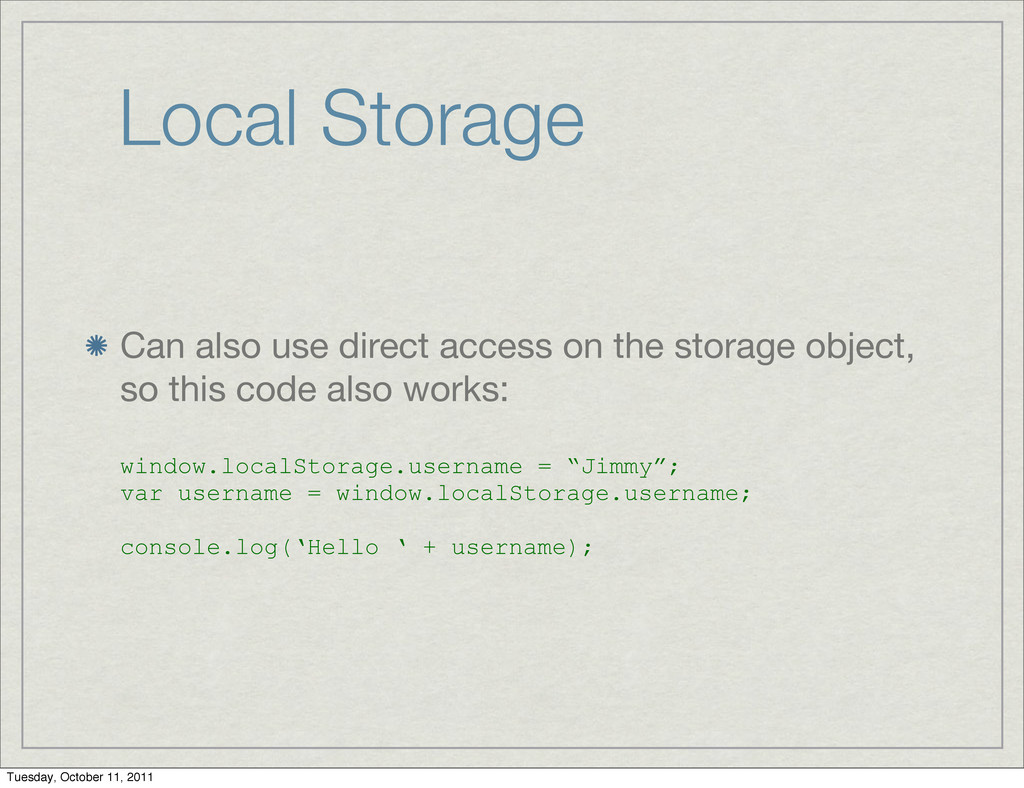
Local Storage Can also use direct access on the storage
object, so this code also works: window.localStorage.username = “Jimmy”; var username = window.localStorage.username; console.log(‘Hello ‘ + username); Tuesday, October 11, 2011 -
Local Storage Use clear() to delete all objects in the
cache related to this page Use key() to get an item by its index (for example, to iterate all keys) Tuesday, October 11, 2011 -
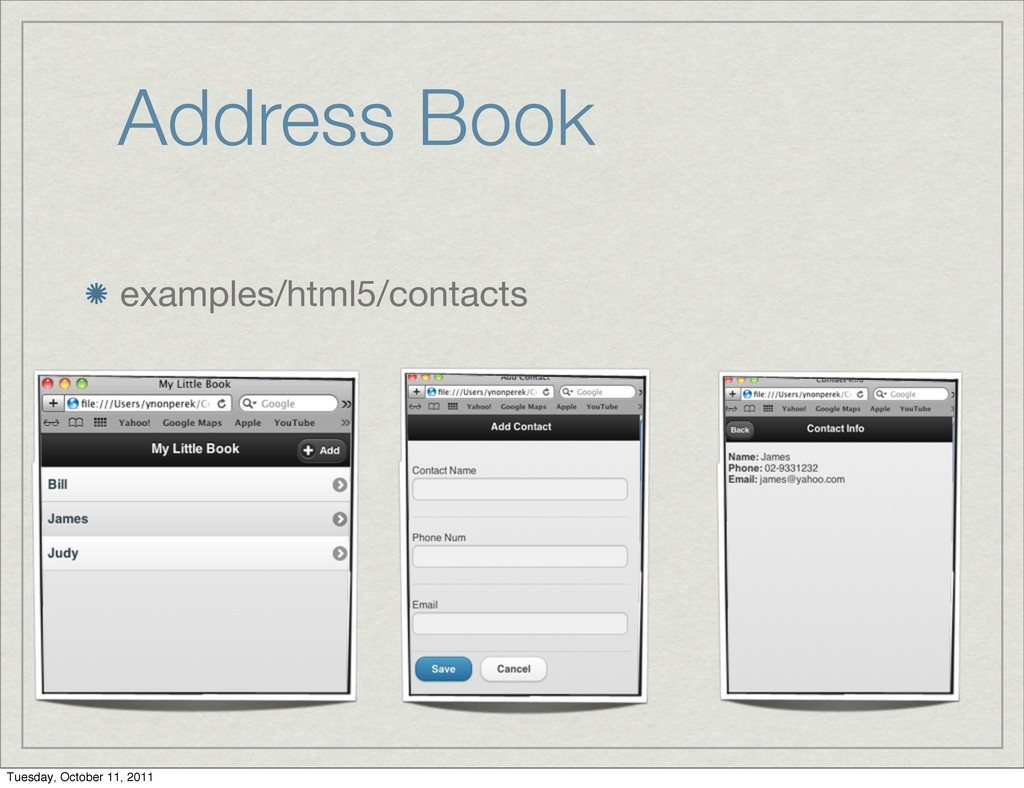
Storage Example We’ll implement an address book app Keeps a
list of contacts info: name, phone number, email Provide add/view/delete contacts Tuesday, October 11, 2011 -
Exercise (1/2) Implement a todo list mini-app Use a single
form to add tasks Use local storage to store them Display a list of active tasks Tuesday, October 11, 2011 -
Exercise (2/2) Use jQM to get a native look App
should display a list of all active tasks Header button called “Add” should open a popup with new task description, and buttons to “Save” or “Abort” Bonus: Swipe to delete Tuesday, October 11, 2011 -
Web SQL The final storage option for offline apps is
the Web SQL Allows using a local database to better store relational data Best suited for hierarchical lists apps Tuesday, October 11, 2011 -
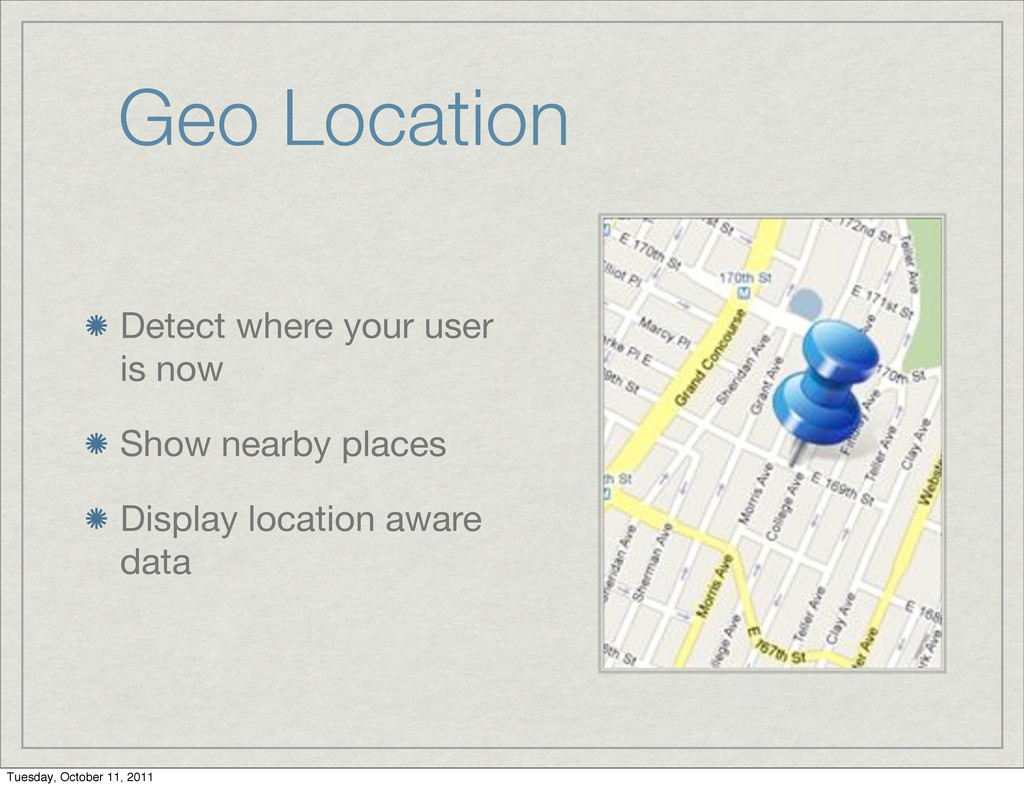
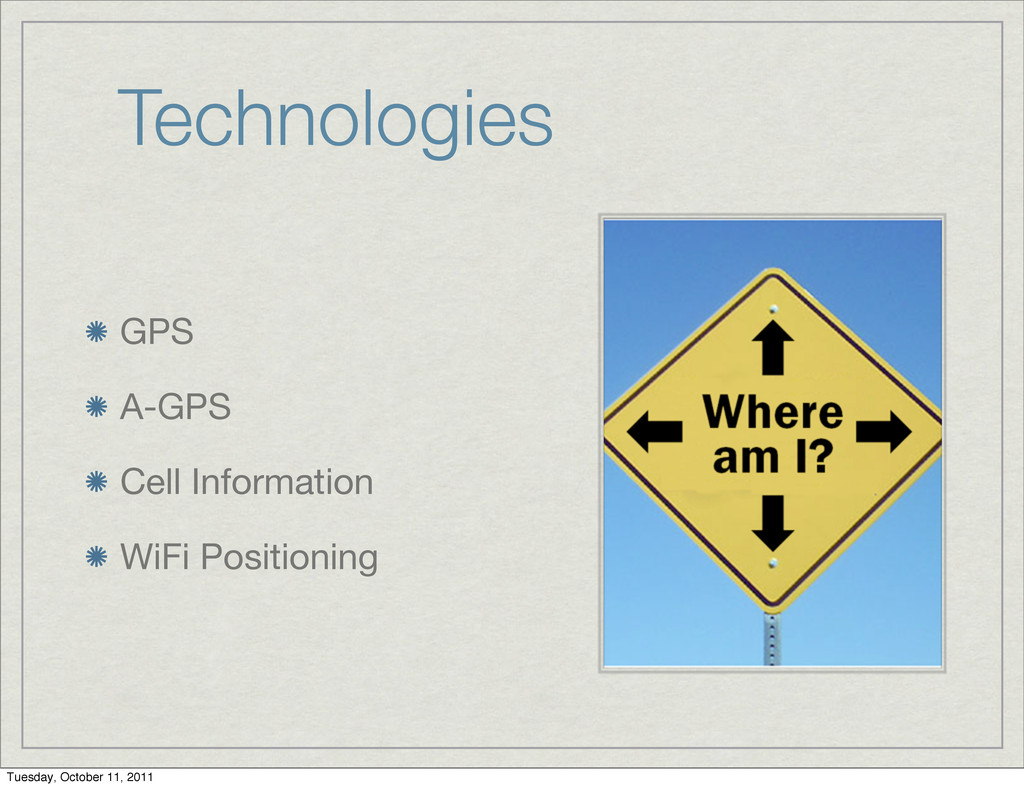
Geo Location Detect where your user is now Show nearby
places Display location aware data Tuesday, October 11, 2011 -
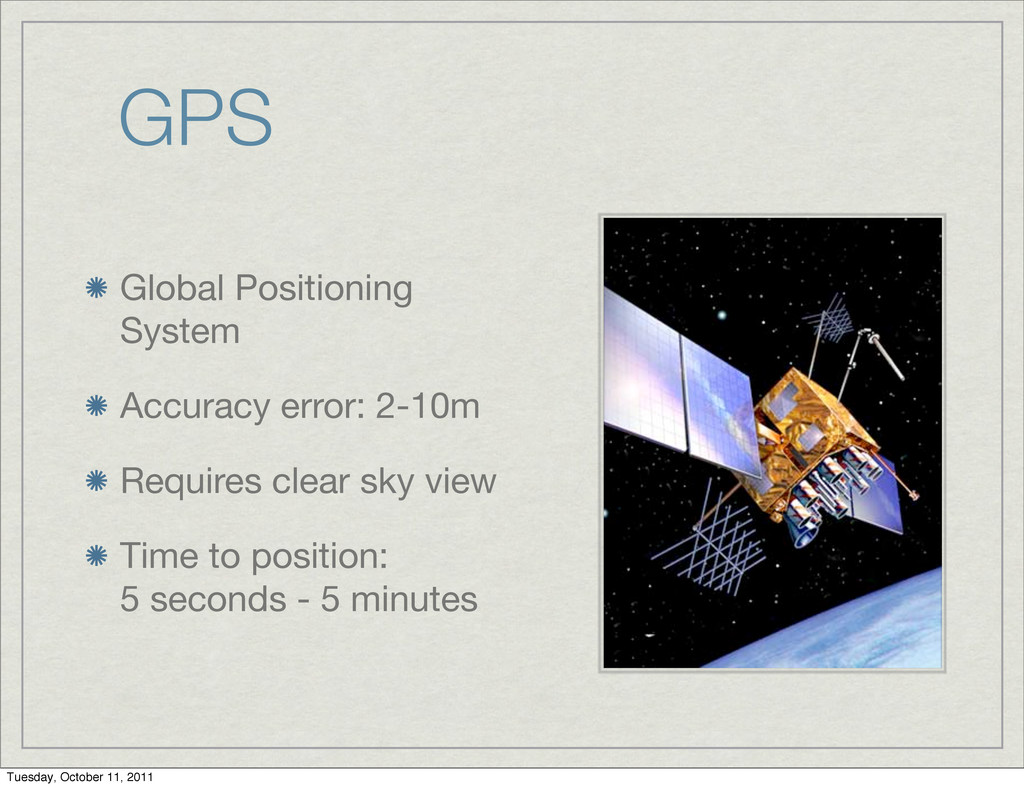
GPS Global Positioning System Accuracy error: 2-10m Requires clear sky
view Time to position: 5 seconds - 5 minutes Tuesday, October 11, 2011 -
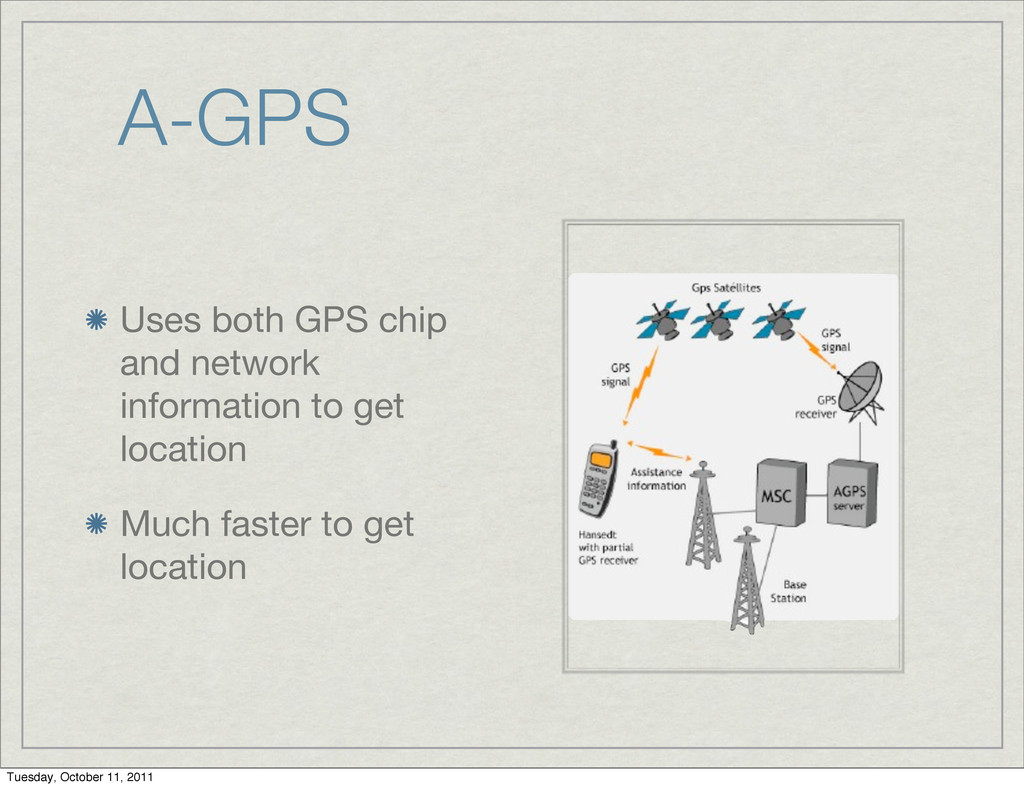
A-GPS Uses both GPS chip and network information to get
location Much faster to get location Tuesday, October 11, 2011 -
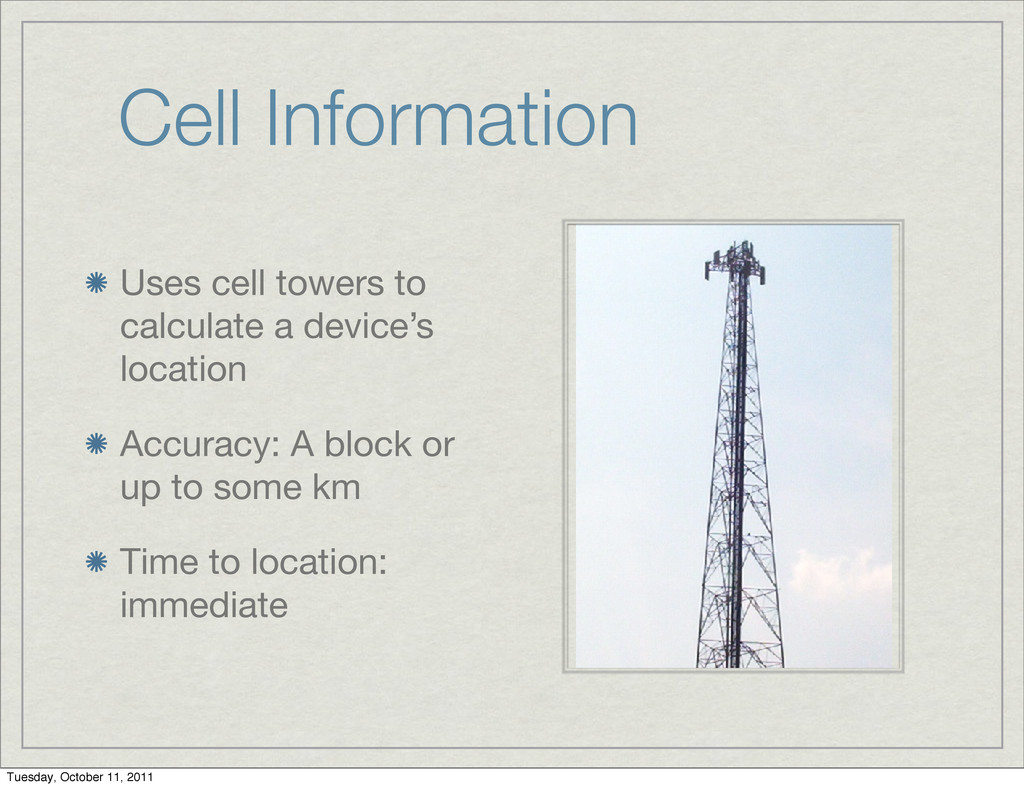
Cell Information Uses cell towers to calculate a device’s location
Accuracy: A block or up to some km Time to location: immediate Tuesday, October 11, 2011 -
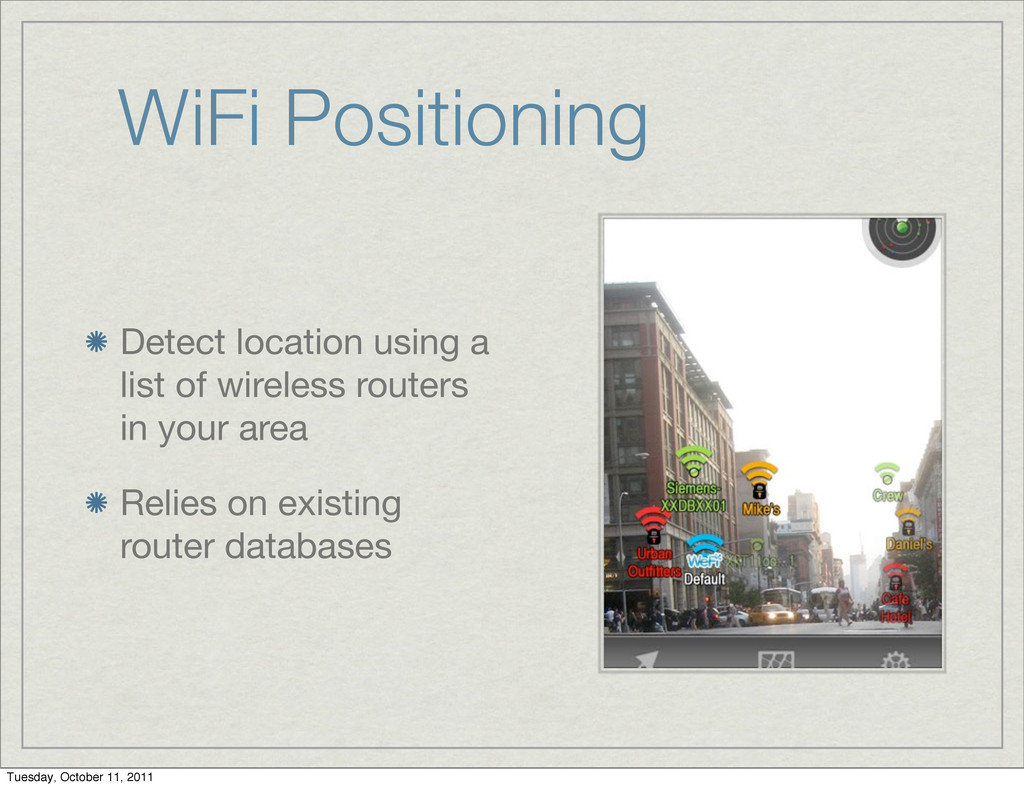
WiFi Positioning Detect location using a list of wireless routers
in your area Relies on existing router databases Tuesday, October 11, 2011 -
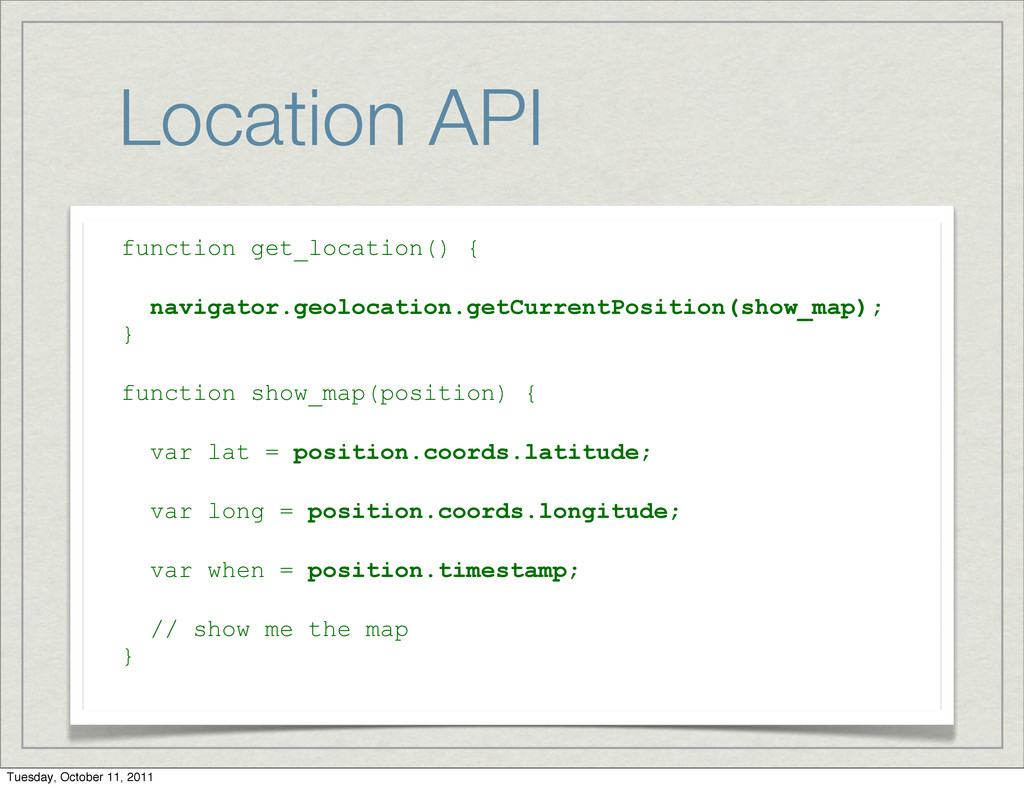
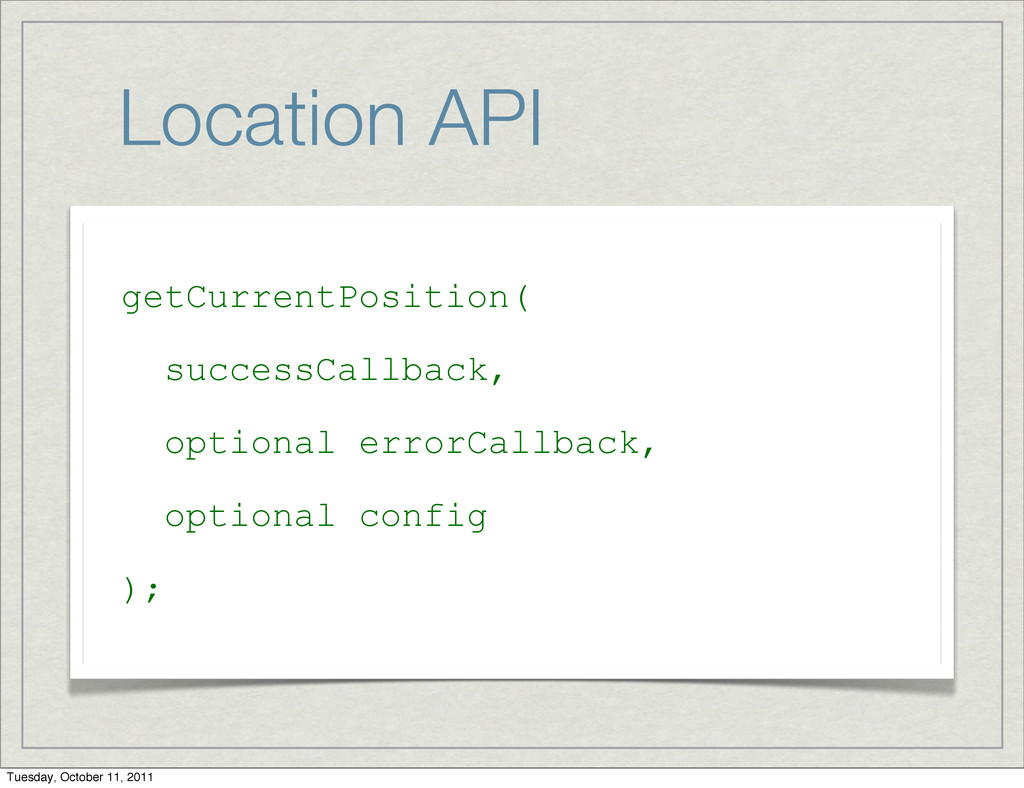
Location API function get_location() { navigator.geolocation.getCurrentPosition(show_map); } function show_map(position) {
var lat = position.coords.latitude; var long = position.coords.longitude; var when = position.timestamp; // show me the map } Tuesday, October 11, 2011 -
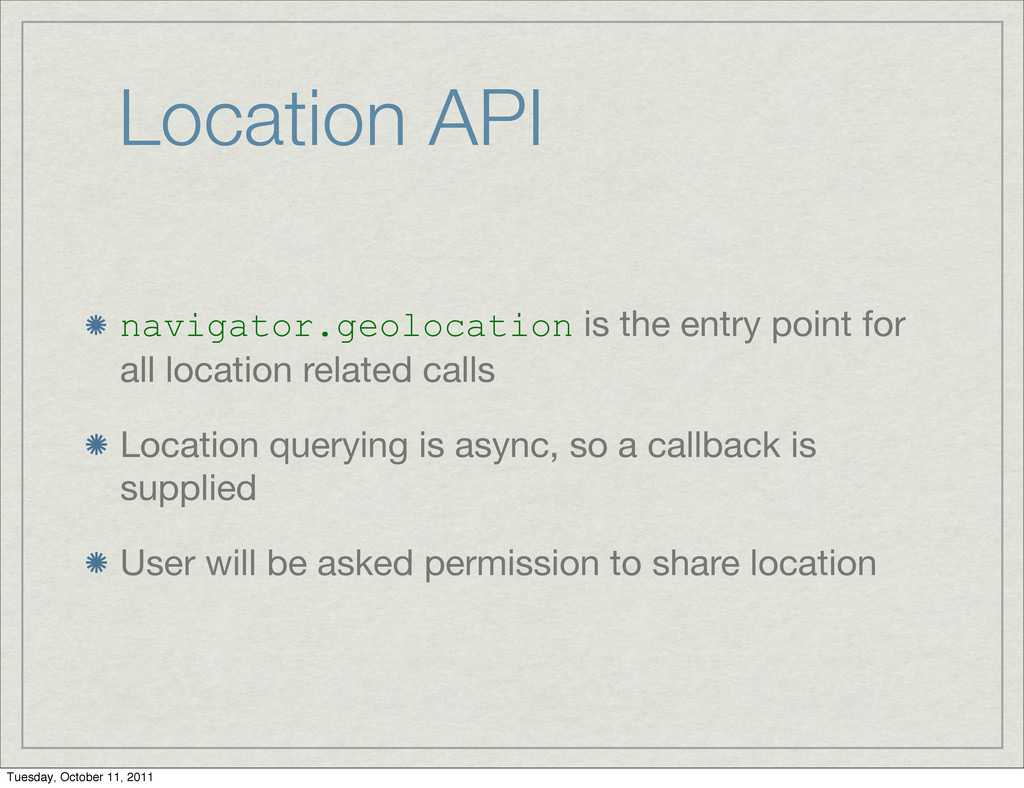
Location API navigator.geolocation is the entry point for all location
related calls Location querying is async, so a callback is supplied User will be asked permission to share location Tuesday, October 11, 2011 -
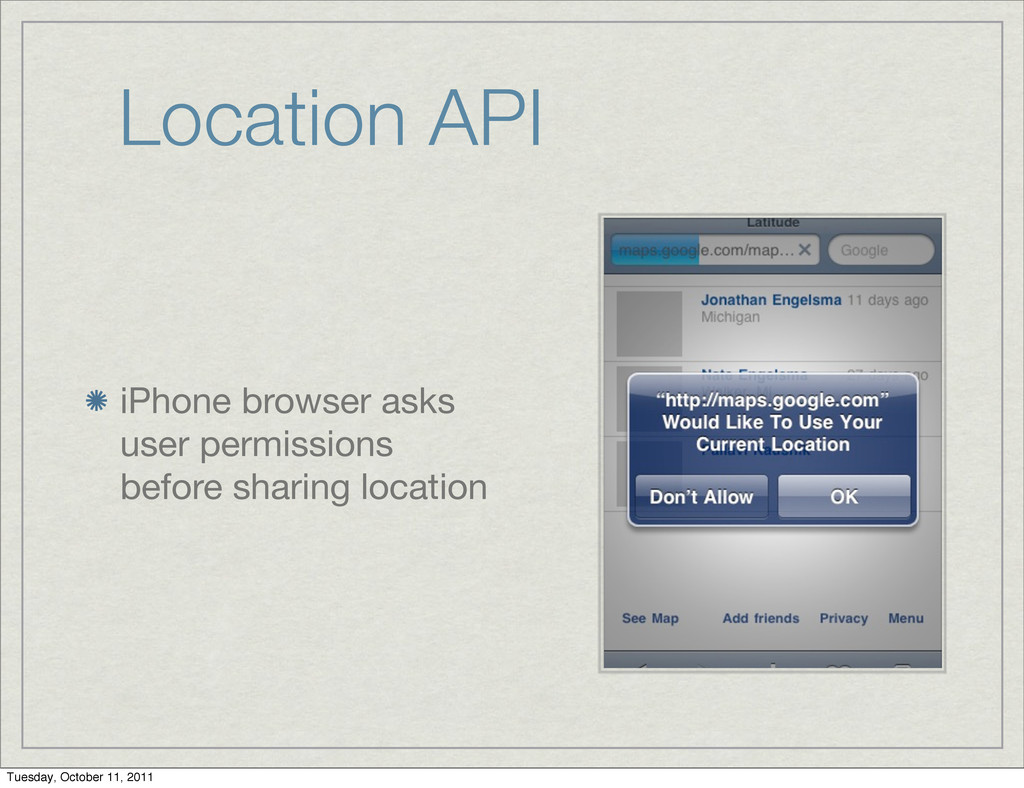
Location API iPhone browser asks user permissions before sharing location
Tuesday, October 11, 2011 -
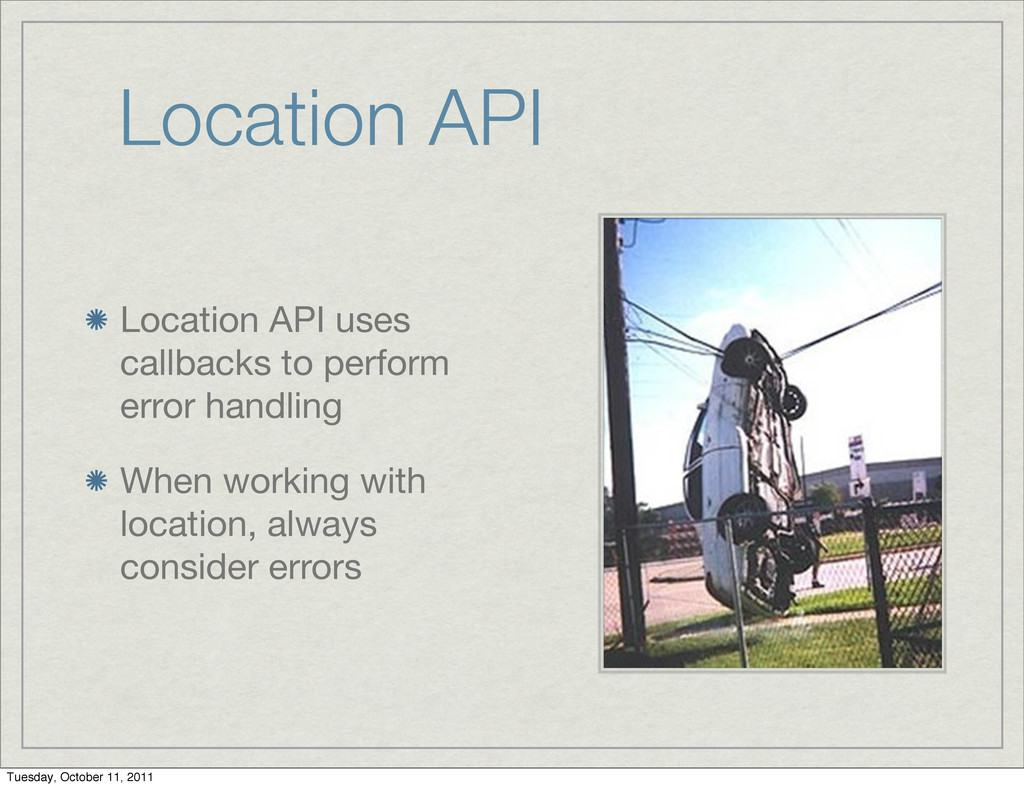
Location API Location API uses callbacks to perform error handling
When working with location, always consider errors Tuesday, October 11, 2011 -
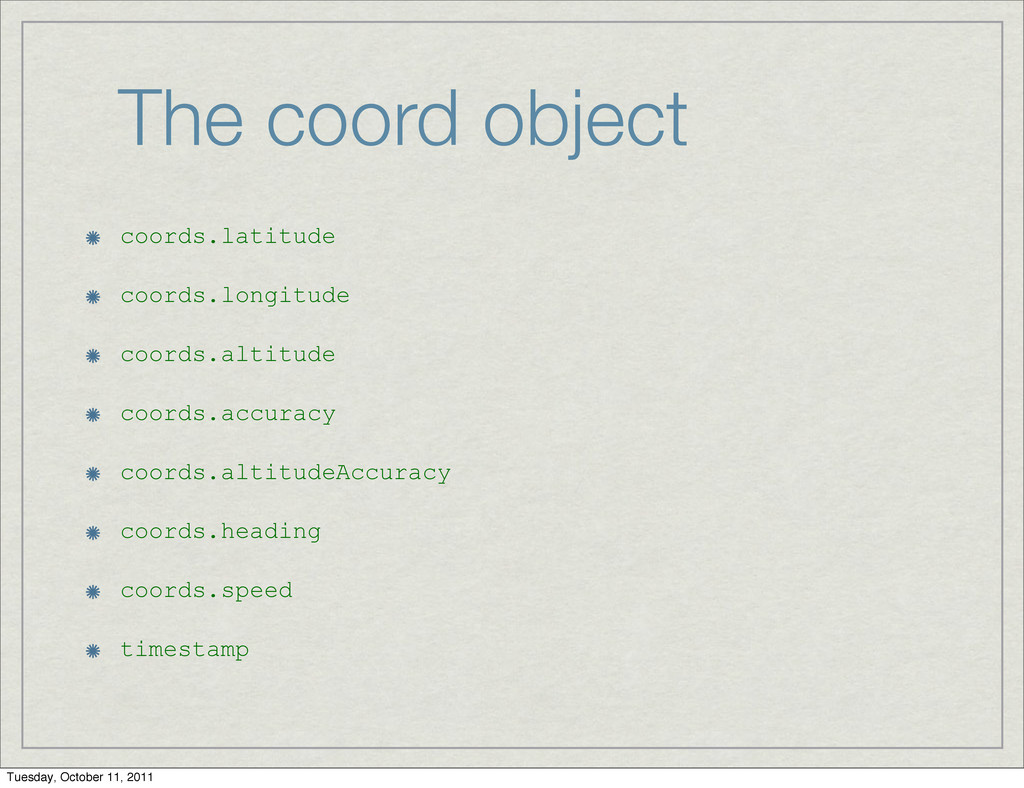
The coord object coords.latitude coords.longitude coords.altitude coords.accuracy coords.altitudeAccuracy coords.heading coords.speed
timestamp Tuesday, October 11, 2011 -
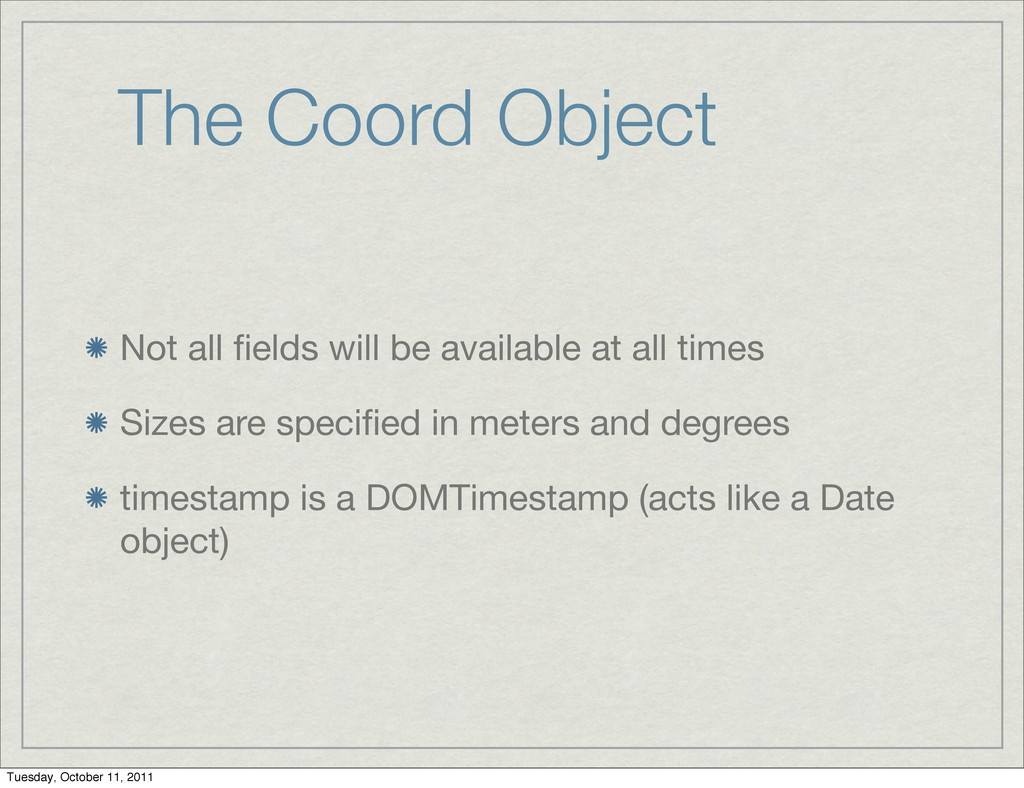
The Coord Object Not all fields will be available at
all times Sizes are specified in meters and degrees timestamp is a DOMTimestamp (acts like a Date object) Tuesday, October 11, 2011 -
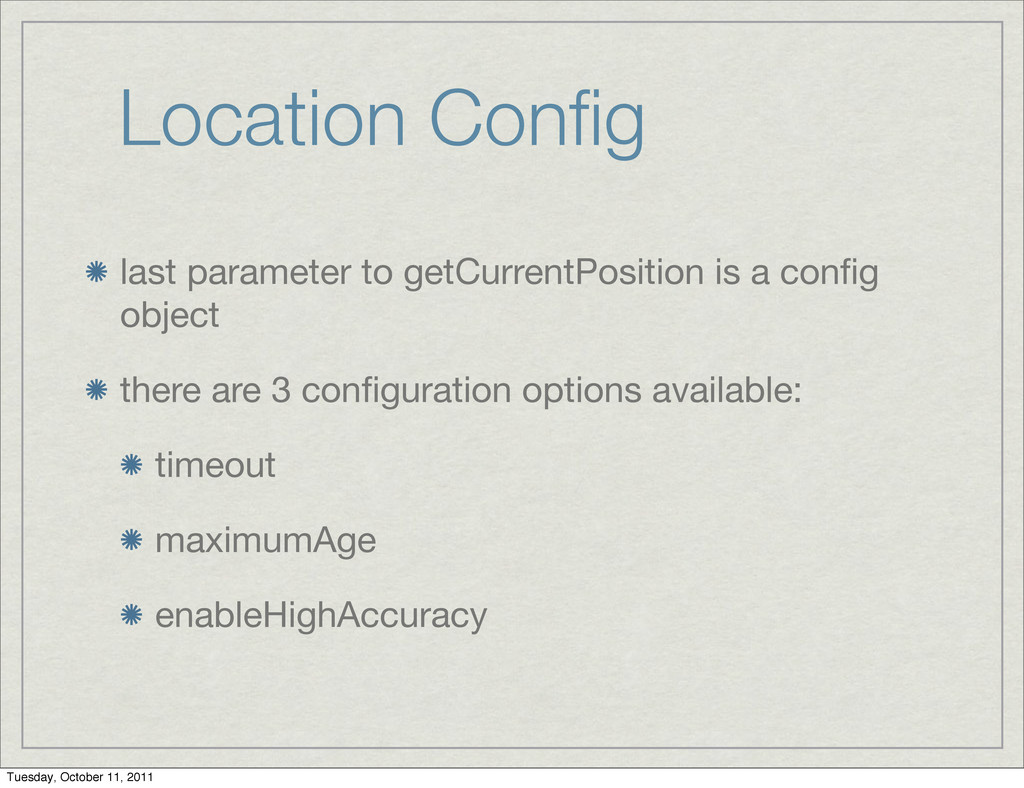
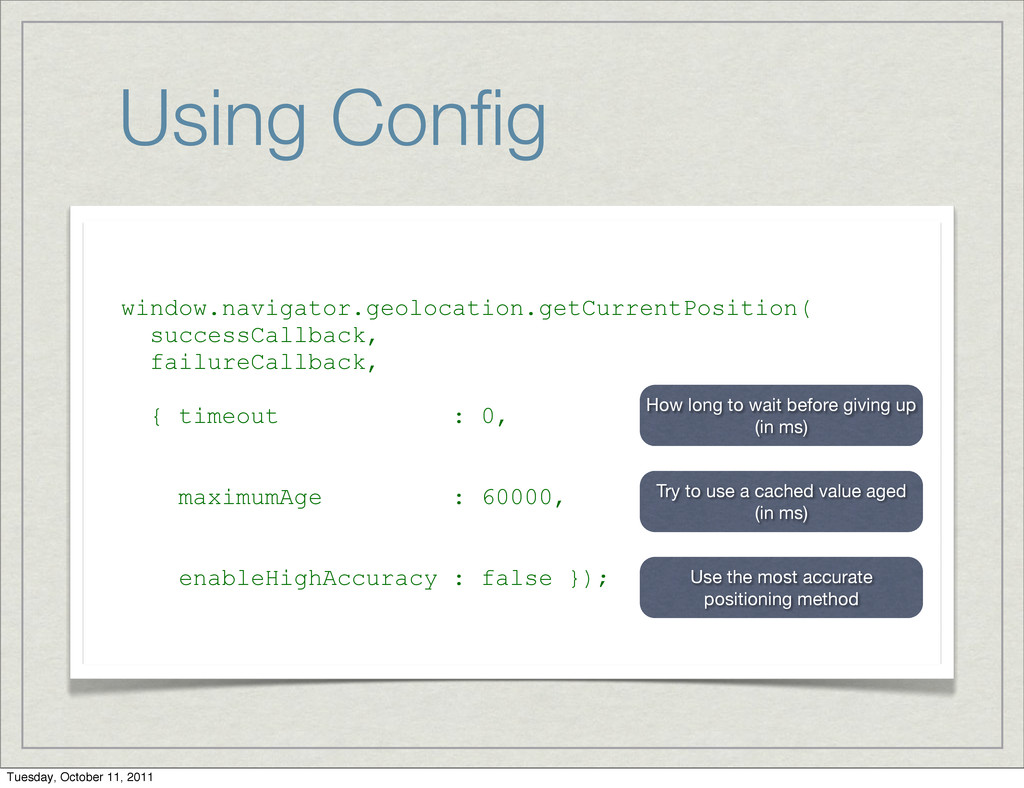
Location Config last parameter to getCurrentPosition is a config object
there are 3 configuration options available: timeout maximumAge enableHighAccuracy Tuesday, October 11, 2011 -
Using Config window.navigator.geolocation.getCurrentPosition( successCallback, failureCallback, { timeout : 0, maximumAge
: 60000, enableHighAccuracy : false }); How long to wait before giving up (in ms) Try to use a cached value aged (in ms) Use the most accurate positioning method Tuesday, October 11, 2011 -
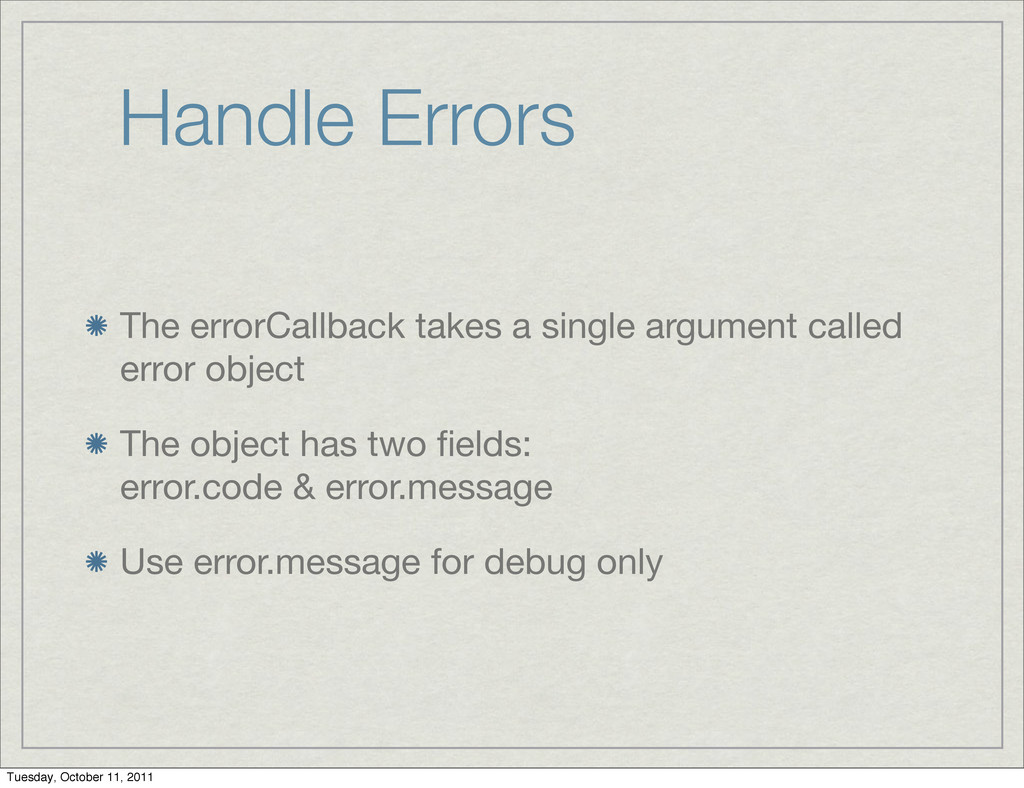
Handle Errors The errorCallback takes a single argument called error
object The object has two fields: error.code & error.message Use error.message for debug only Tuesday, October 11, 2011 -
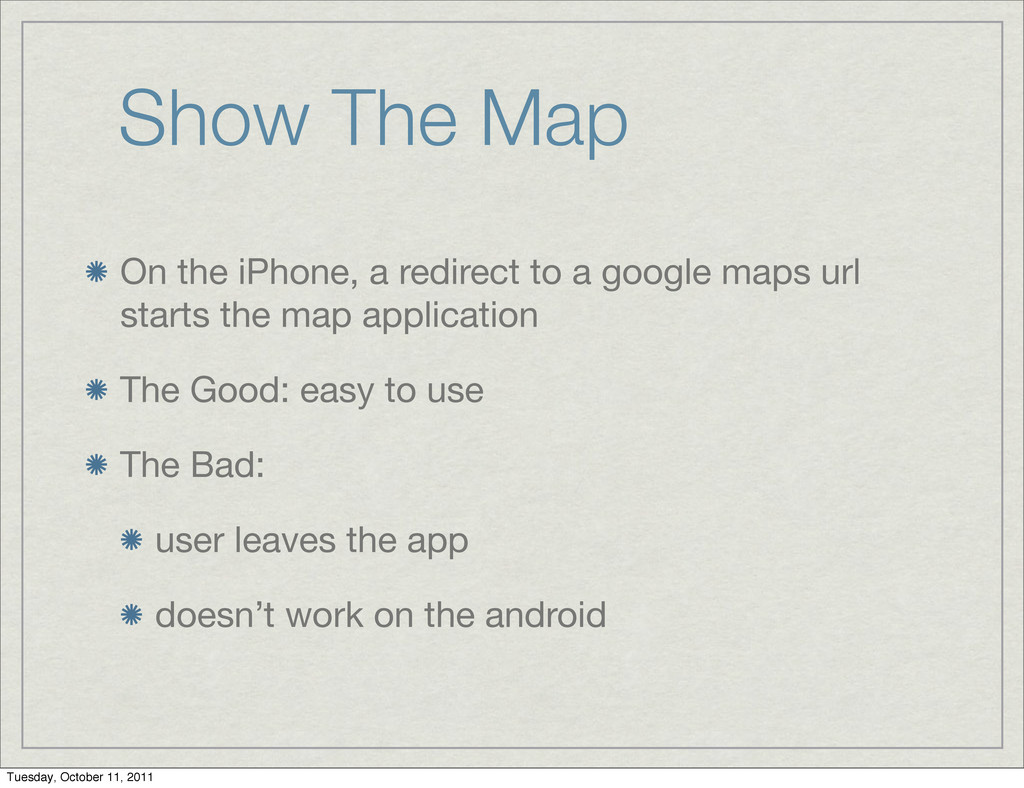
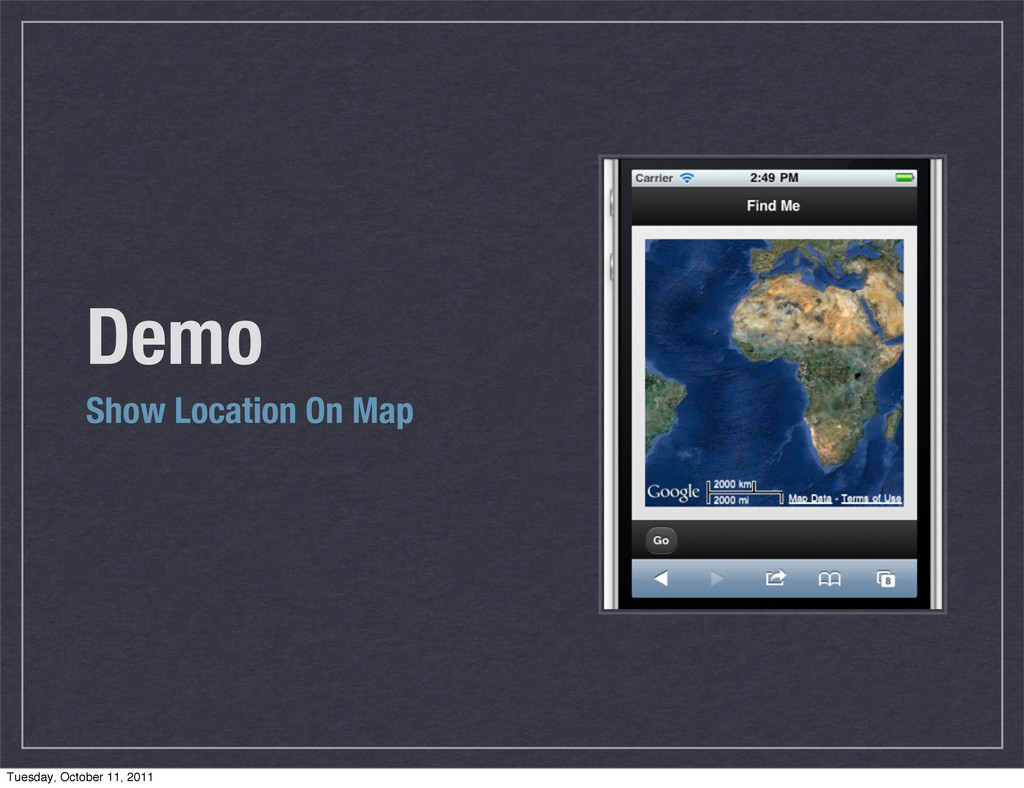
Show The Map On the iPhone, a redirect to a
google maps url starts the map application The Good: easy to use The Bad: user leaves the app doesn’t work on the android Tuesday, October 11, 2011 -
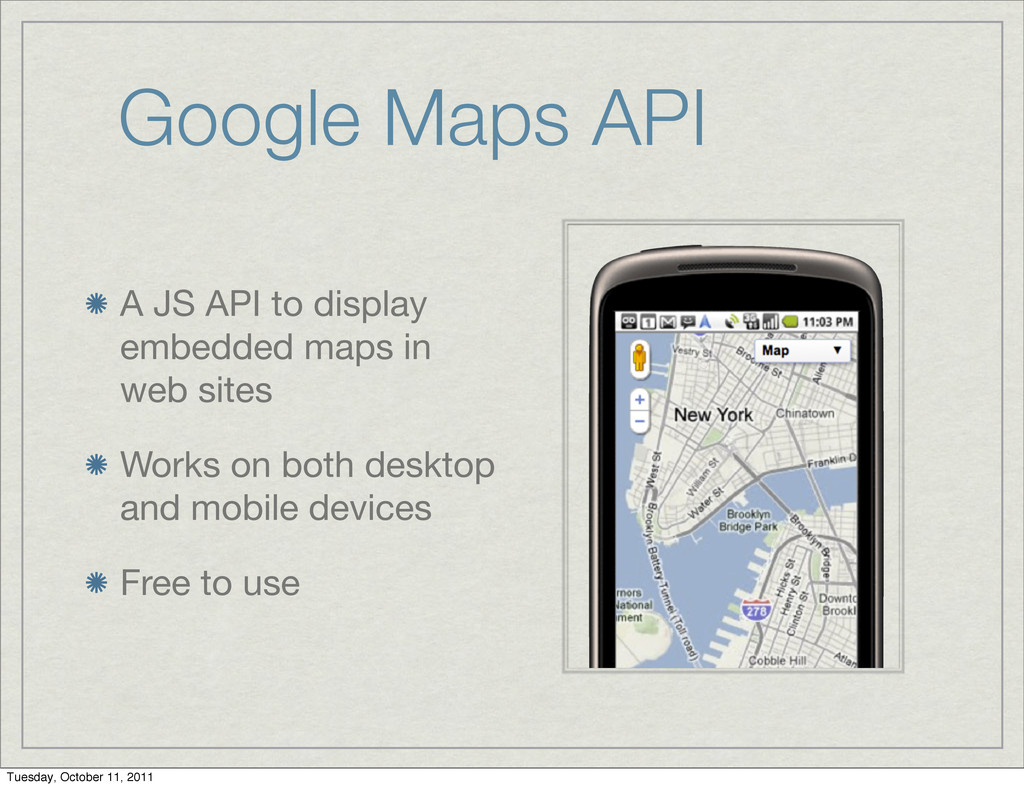
Google Maps API A JS API to display embedded maps
in web sites Works on both desktop and mobile devices Free to use Tuesday, October 11, 2011 -
Google Maps API Assign a special empty div that will
contain the map. recommended size of the div is entire page. Display the map by creating a google.maps.Map object Place markers on the map using google.maps.Marker Full documentation: http://code.google.com/apis/maps/ documentation/javascript/ Tuesday, October 11, 2011 -
Location Tracking Receive notifications about location changes Can use for
navigation apps, sport apps, and more Browser must remain open Tuesday, October 11, 2011 -
Location Tracking use watchPosition to start watching a user’s position
The method returns a watch id. Keep it. When tracking is no longer needed, use clearWatch with the watch id to stop. The callback of watchPosition will get called every time location has changed Tuesday, October 11, 2011 -
Exercise: Where’s My Car Write a parking reminder app One
button titled “parked” which marks current location and keeps it in local storage Another button titled “find” which shows a map leading to your car Keep data in local storage Tuesday, October 11, 2011 -
Q & A Storage Geo Location (iPhone, Android) Video (iPhone,
Android) Canvas (iPhone, Android) Tuesday, October 11, 2011 -
Video Tag HTML5 introduces a <video> tag to embed videos
in a web page. Different browsers support different video formats. The <video> tag can specify multiple formats. Tuesday, October 11, 2011 -
Video Formats Video formats are like languages The same video
can be encoded in different formats A browser must “speak the language” to be able to play the video Tuesday, October 11, 2011 -
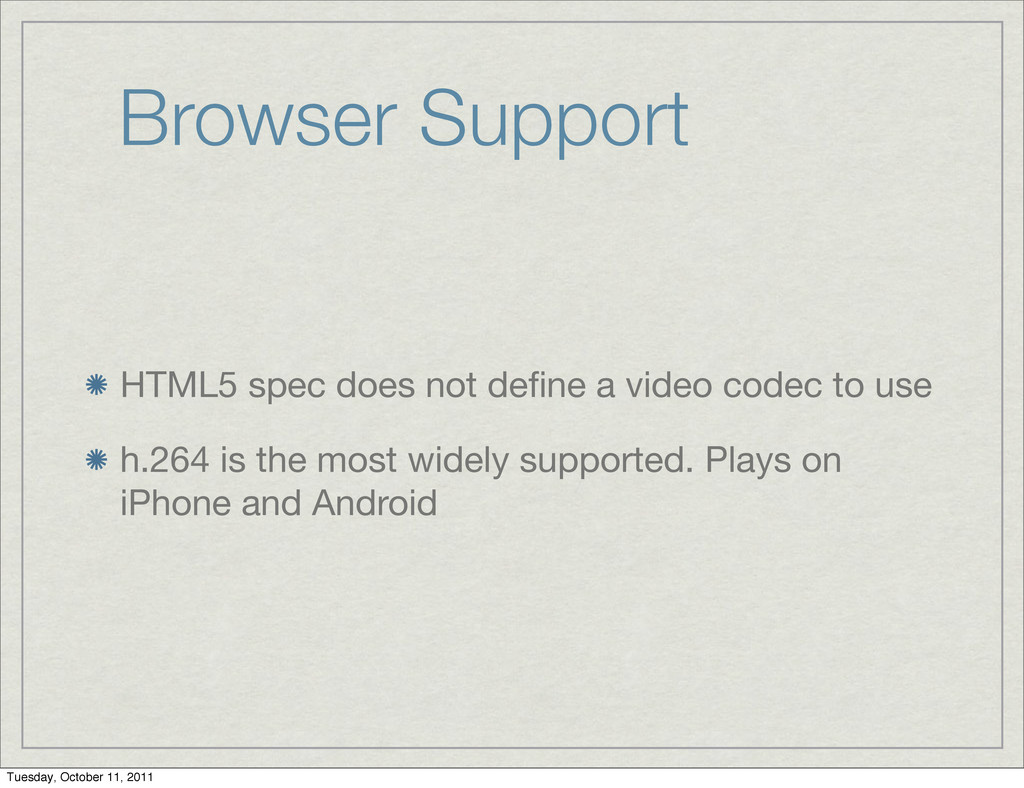
Browser Support HTML5 spec does not define a video codec
to use h.264 is the most widely supported. Plays on iPhone and Android Tuesday, October 11, 2011 -
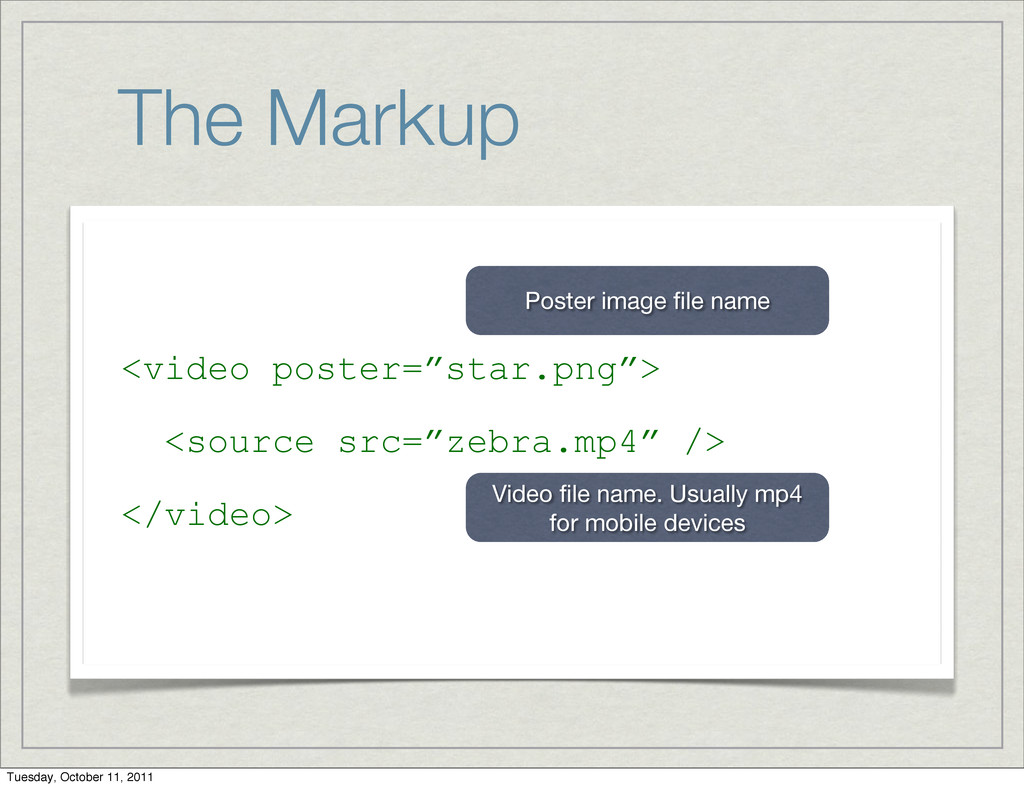
The Markup <video poster=”star.png”> <source src=”zebra.mp4” /> </video> Video file
name. Usually mp4 for mobile devices Poster image file name Tuesday, October 11, 2011 -
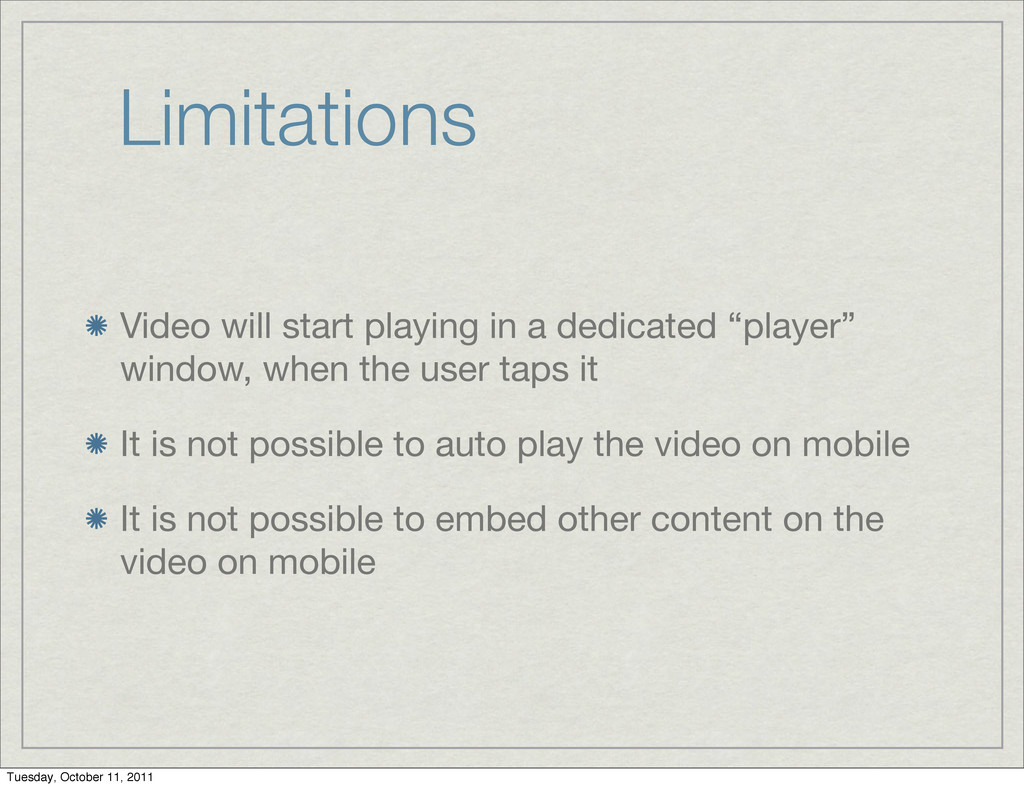
Limitations Video will start playing in a dedicated “player” window,
when the user taps it It is not possible to auto play the video on mobile It is not possible to embed other content on the video on mobile Tuesday, October 11, 2011 -
Q & A Storage Geo Location Video Canvas (iPhone, Android)
Tuesday, October 11, 2011 -
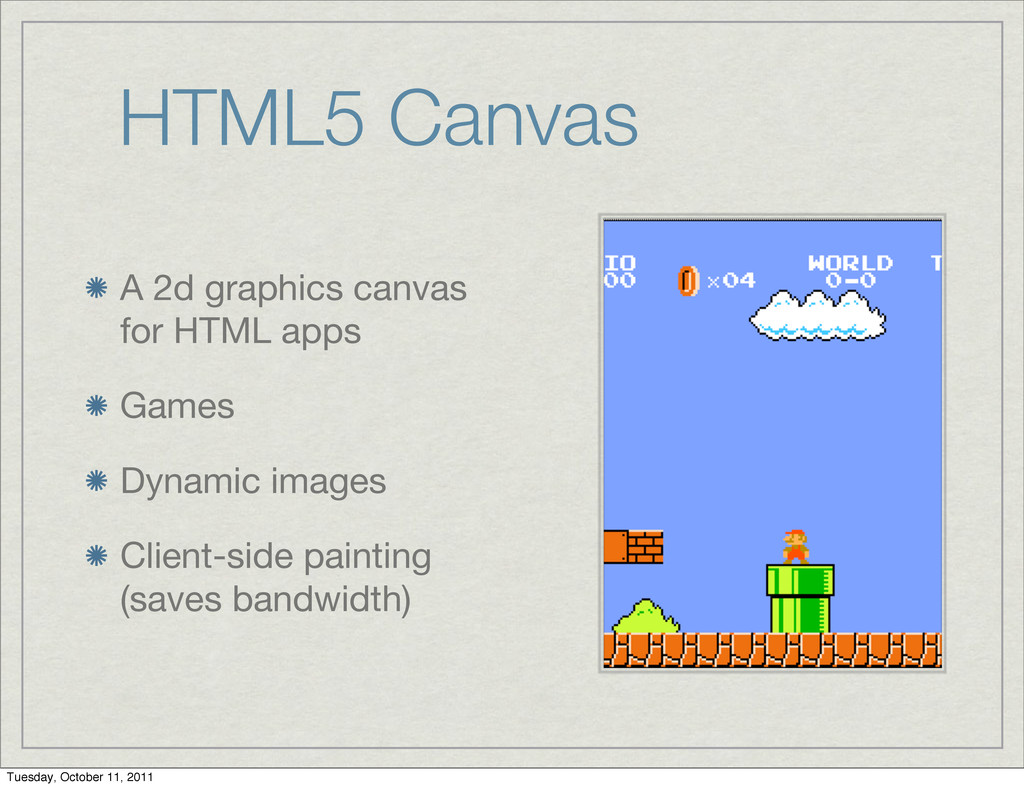
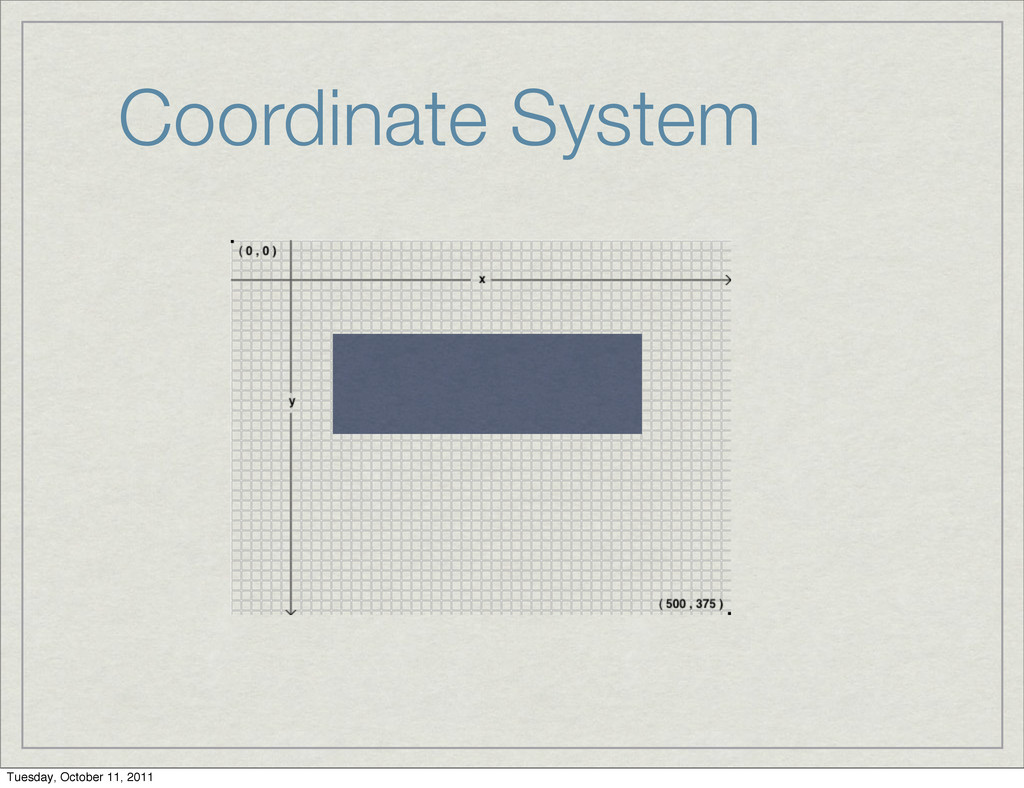
HTML5 Canvas A 2d graphics canvas for HTML apps Games
Dynamic images Client-side painting (saves bandwidth) Tuesday, October 11, 2011 -
Hello Canvas An HTML element <canvas> on the markup JS
code to do actual painting Tuesday, October 11, 2011 -
Hello Canvas The canvas element has no content and no
border of its own A canvas keeps a painting context on which we perform the drawing First example uses context.fillText() examples/canvas/intro.html Tuesday, October 11, 2011 -
Basic Drawing Context object provides the drawing functions. Each takes
coordinates and data. Drawing style is determined by setting attributes on the context object. Most style properties are plain text strings Tuesday, October 11, 2011 -
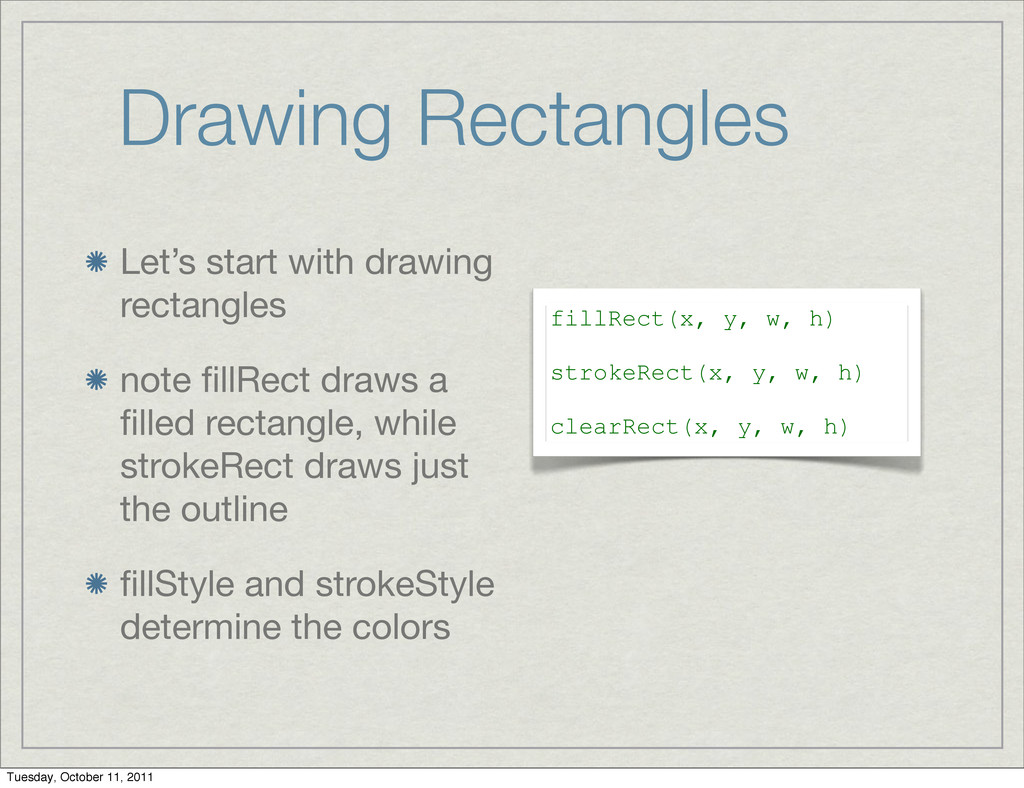
Drawing Rectangles Let’s start with drawing rectangles note fillRect draws
a filled rectangle, while strokeRect draws just the outline fillStyle and strokeStyle determine the colors fillRect(x, y, w, h) strokeRect(x, y, w, h) clearRect(x, y, w, h) Tuesday, October 11, 2011 -
Drawing Paths A composite shape on the canvas is called
“path” Paths are made of lines, arcs, curves and rectangles A path can be filled or stoked. Nothing is painted until either fill() or stroke() is called Tuesday, October 11, 2011 -
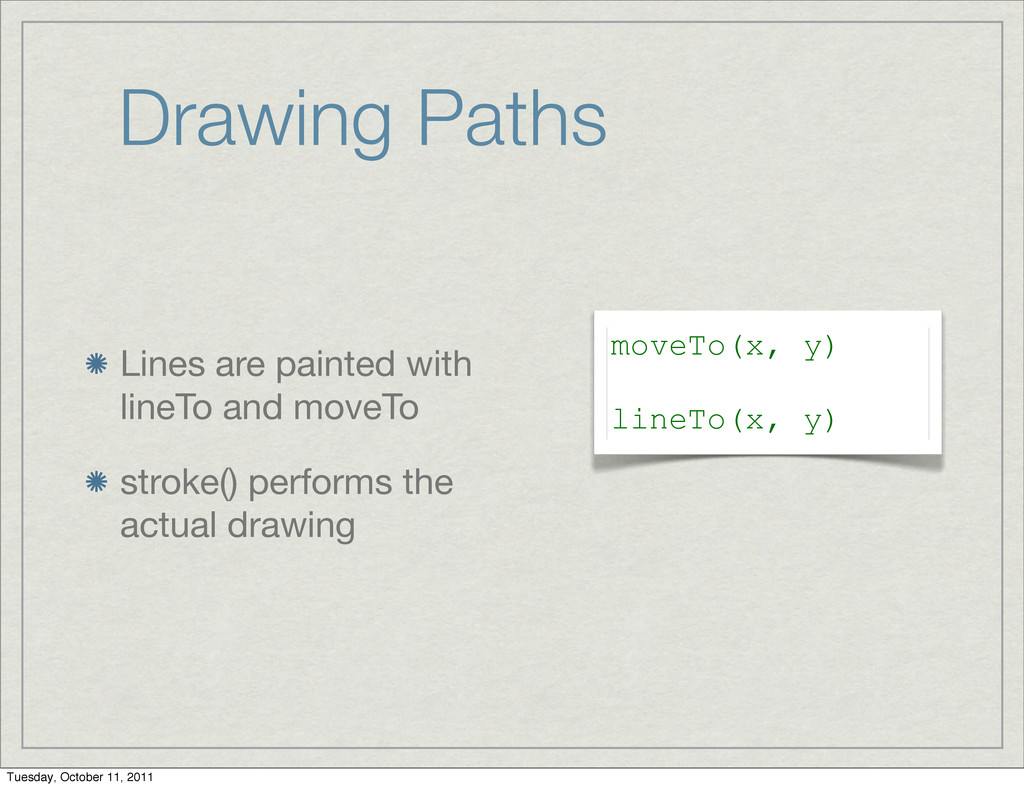
Drawing Paths Lines are painted with lineTo and moveTo stroke()
performs the actual drawing moveTo(x, y) lineTo(x, y) Tuesday, October 11, 2011 -
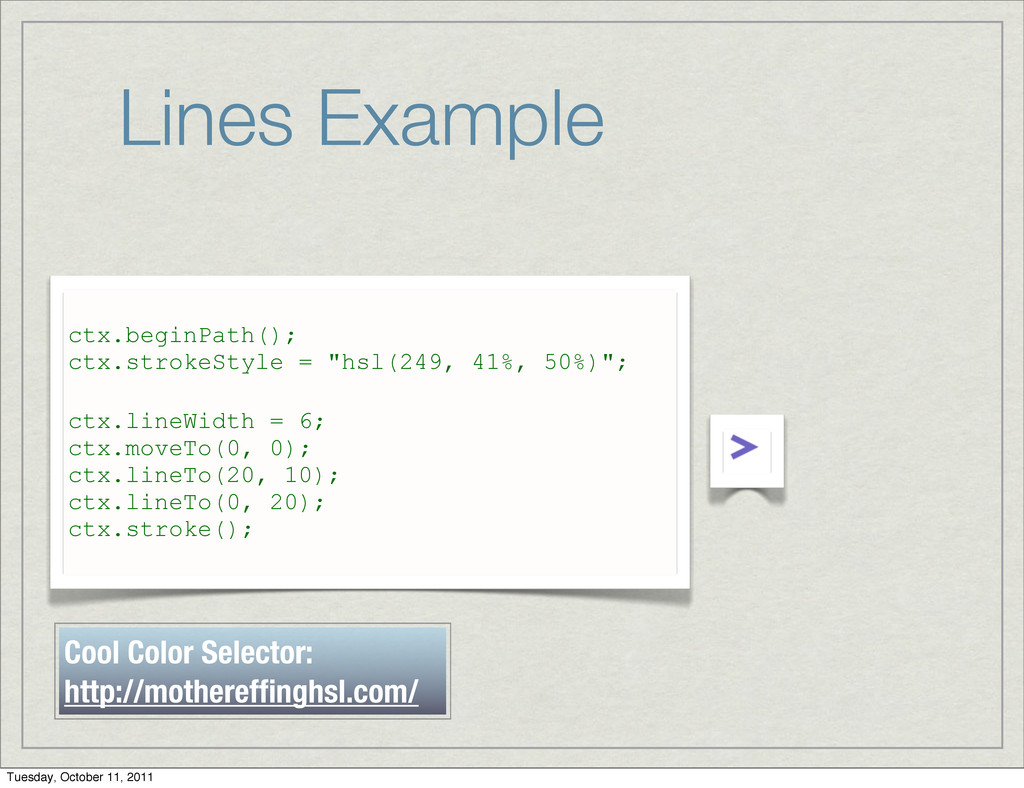
Lines Example ctx.beginPath(); ctx.strokeStyle = "hsl(249, 41%, 50%)"; ctx.lineWidth =
6; ctx.moveTo(0, 0); ctx.lineTo(20, 10); ctx.lineTo(0, 20); ctx.stroke(); Cool Color Selector: http://mothereffinghsl.com/ Tuesday, October 11, 2011 -
Using The Image It’s possible to use an image drawn
in a canvas for other elements get the image url using: canvas.toDataURL() use image url as a source attribute of an img tag Extra: draw on a hidden canvas Tuesday, October 11, 2011 -
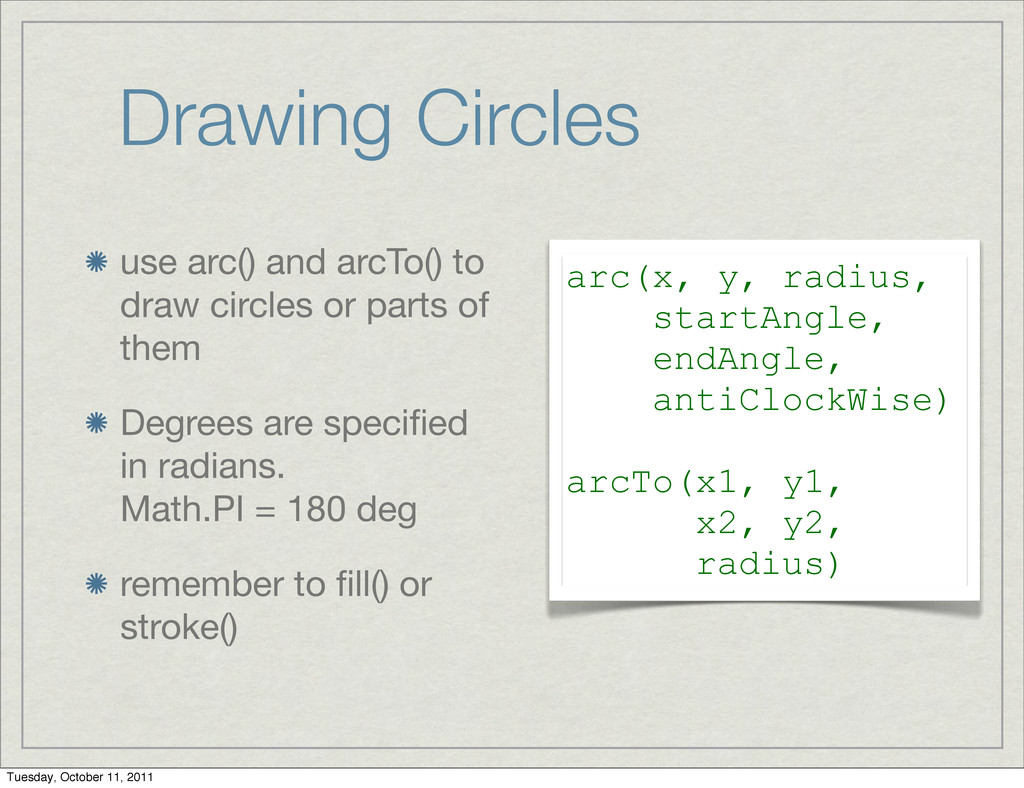
Drawing Circles use arc() and arcTo() to draw circles or
parts of them Degrees are specified in radians. Math.PI = 180 deg remember to fill() or stroke() arc(x, y, radius, startAngle, endAngle, antiClockWise) arcTo(x1, y1, x2, y2, radius) Tuesday, October 11, 2011 -
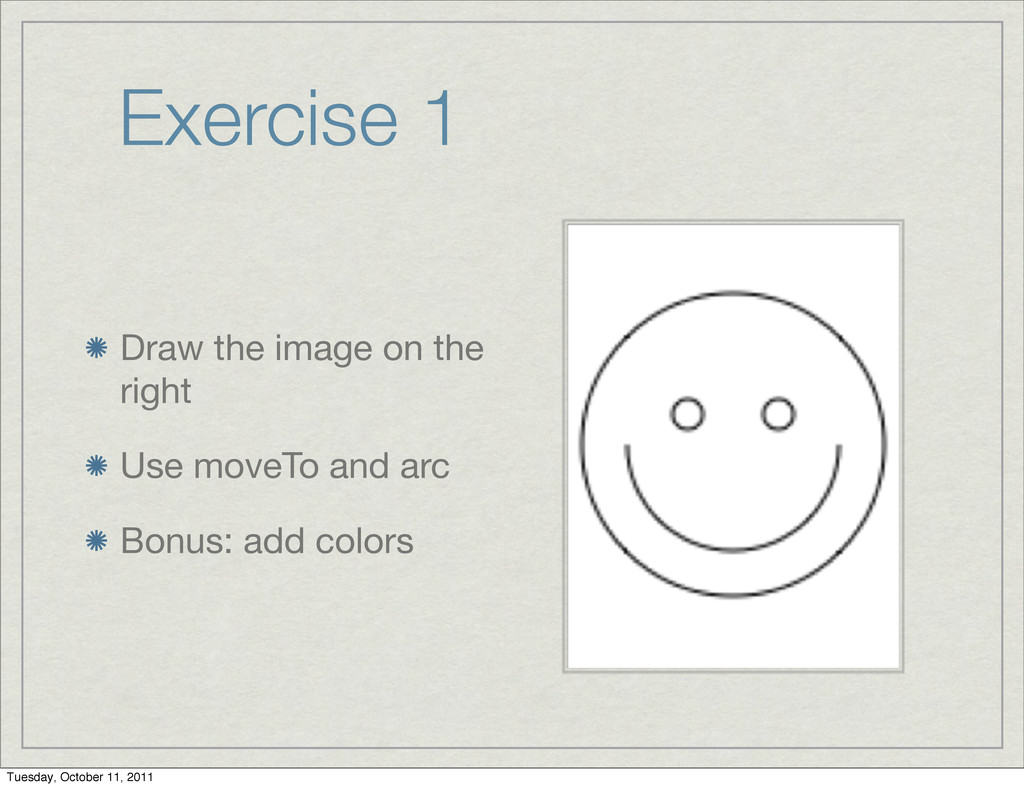
Exercise 1 Draw the image on the right Use moveTo
and arc Bonus: add colors Tuesday, October 11, 2011 -
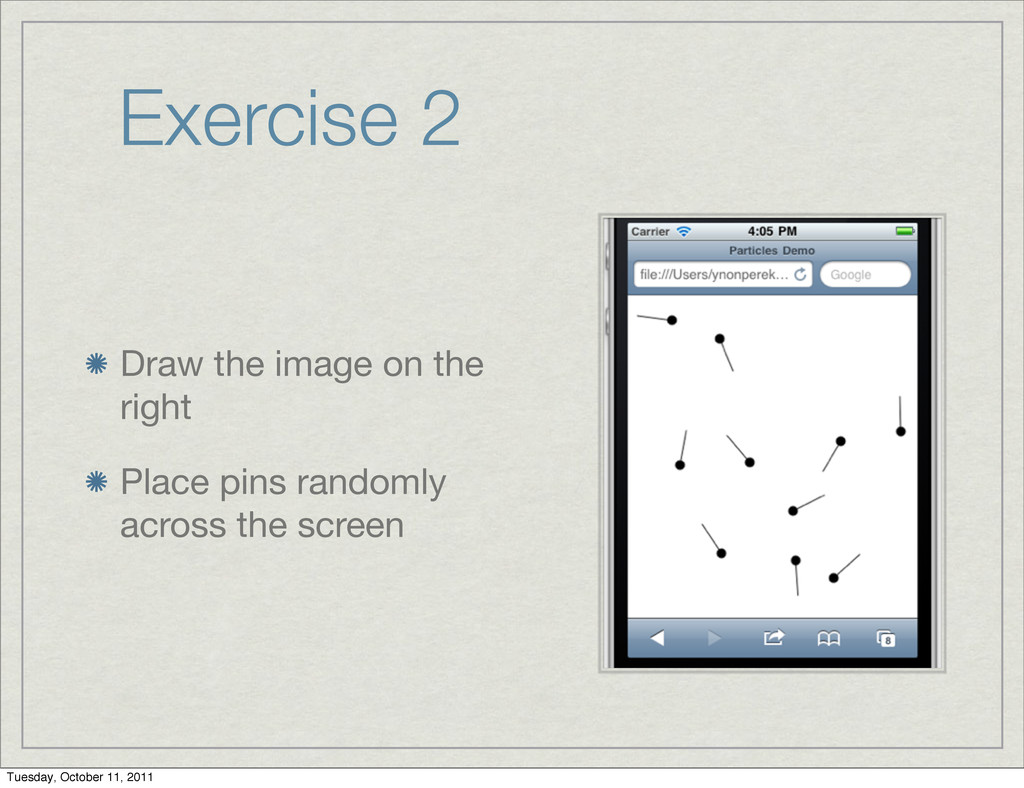
Exercise 2 Draw the image on the right Place pins
randomly across the screen Tuesday, October 11, 2011 -
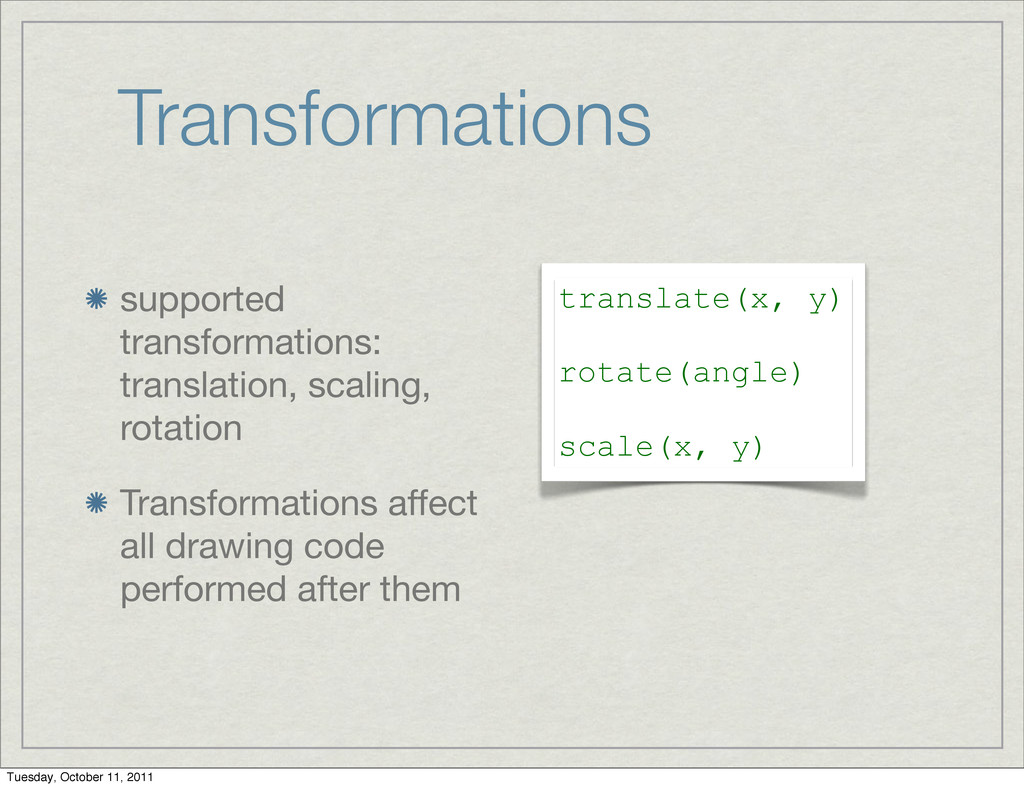
Transformations supported transformations: translation, scaling, rotation Transformations affect all drawing
code performed after them translate(x, y) rotate(angle) scale(x, y) Tuesday, October 11, 2011 -
Translation Move the origin of the canvas to another point
on the canvas The new point is now (0, 0) This can make drawing code simpler Tuesday, October 11, 2011 -
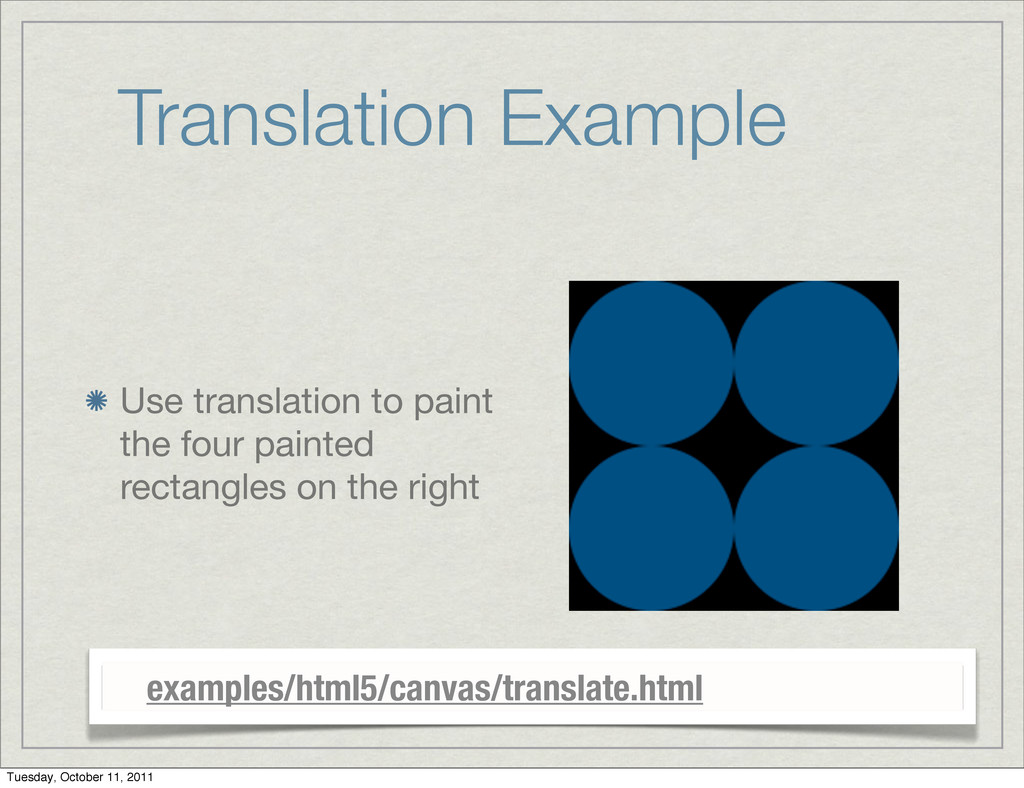
Translation Example Use translation to paint the four painted rectangles
on the right examples/html5/canvas/translate.html Tuesday, October 11, 2011 -
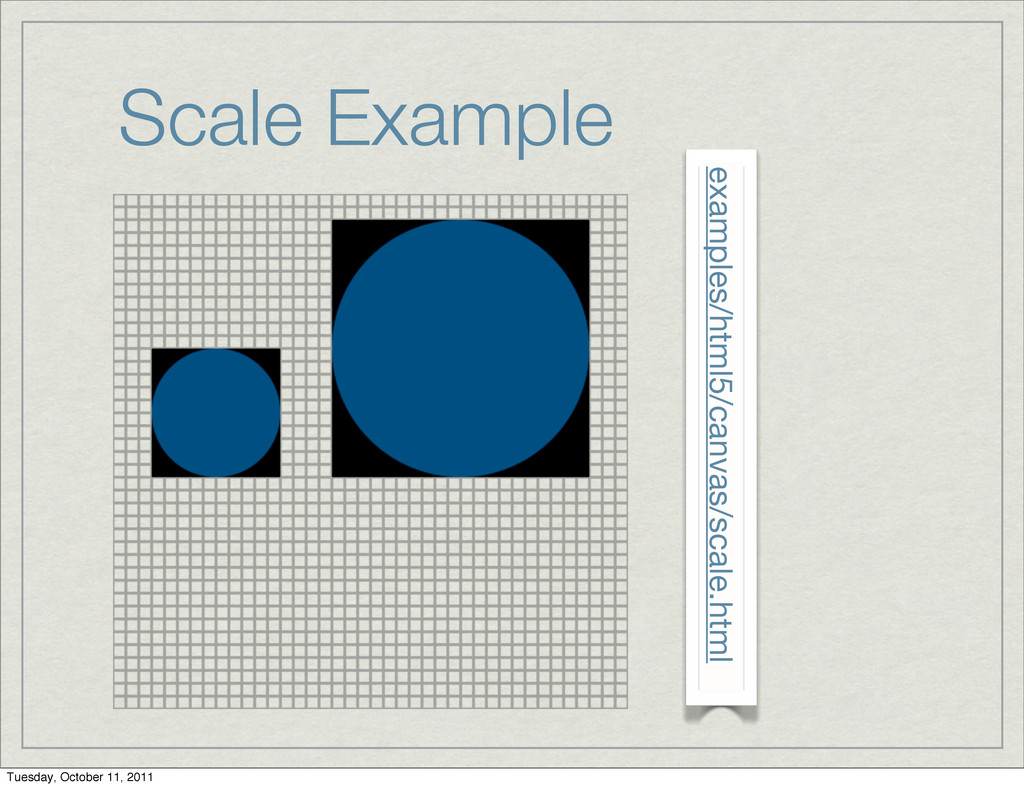
Scaling scales the rendering context size x and y are
scale factors translate before scale to maintain position Tuesday, October 11, 2011 -
Rotation Rotates a shape around its (0, 0) point of
origin Angle is specified in radians. Math.PI = 180 deg (half a circle) Math.PI / 4 = 45 deg Translate before rotate to maintain position Tuesday, October 11, 2011 -
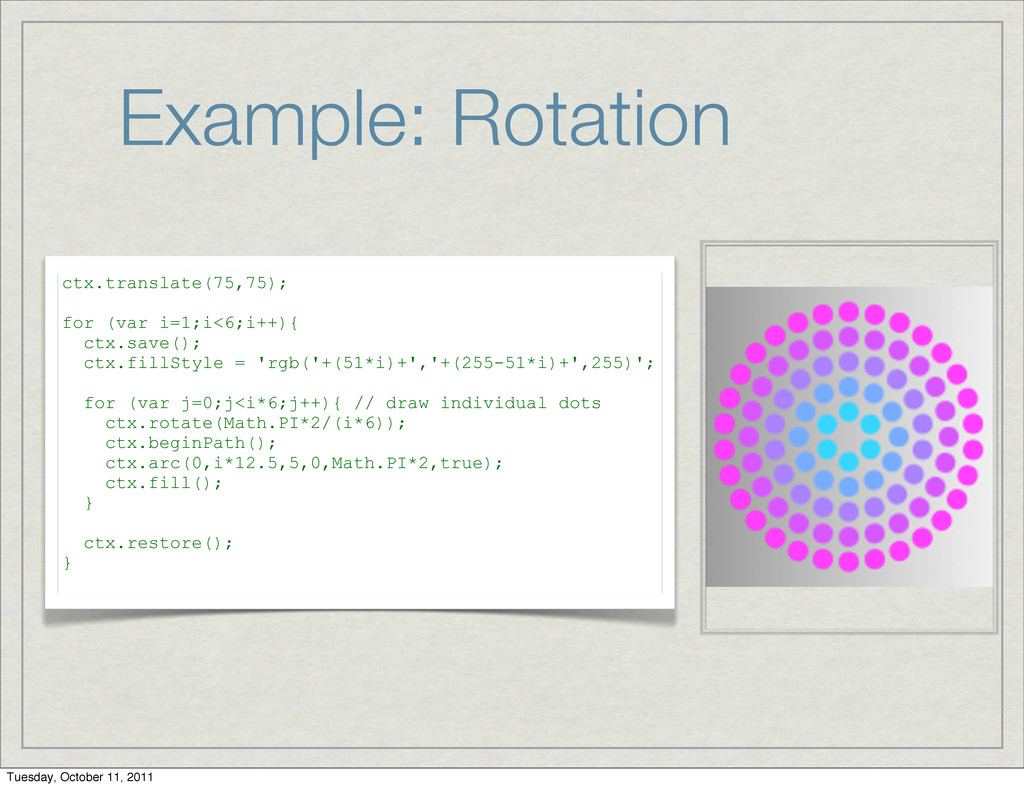
Example: Rotation ctx.translate(75,75); for (var i=1;i<6;i++){ ctx.save(); ctx.fillStyle = 'rgb('+(51*i)+','+(255-51*i)+',255)';
for (var j=0;j<i*6;j++){ // draw individual dots ctx.rotate(Math.PI*2/(i*6)); ctx.beginPath(); ctx.arc(0,i*12.5,5,0,Math.PI*2,true); ctx.fill(); } ctx.restore(); } Tuesday, October 11, 2011 -
Example: Rotation The background was painted with a gradient fill
Notice the save() and restore() at the beginning and end. Now we can put the code inside a function, and it won’t affect outside code ctx.save(); var grad = ctx.createLinearGradient(0, 0, 150, 0); grad.addColorStop(0, "#888"); grad.addColorStop(1, "#eee"); ctx.fillStyle = grad; ctx.fillRect(0, 0, 150, 150); ctx.fill(); ctx.restore(); Tuesday, October 11, 2011 -
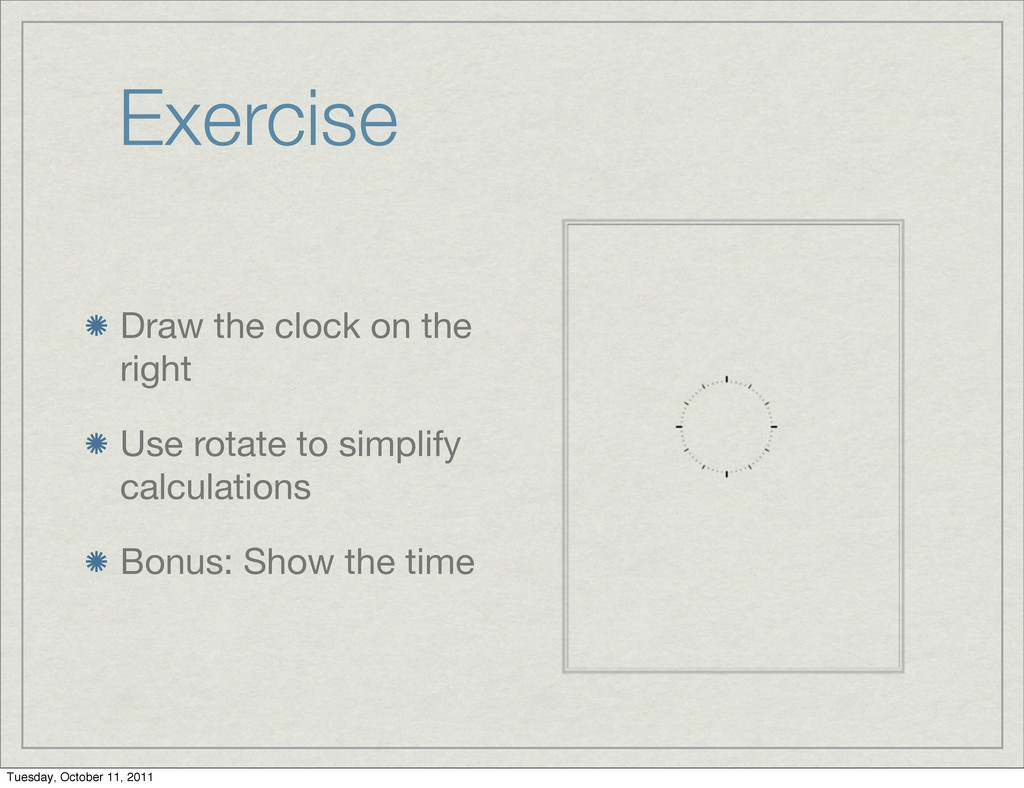
Exercise Draw the clock on the right Use rotate to
simplify calculations Bonus: Show the time Tuesday, October 11, 2011 -
Drawing Images on Canvas It’s possible to paint a png
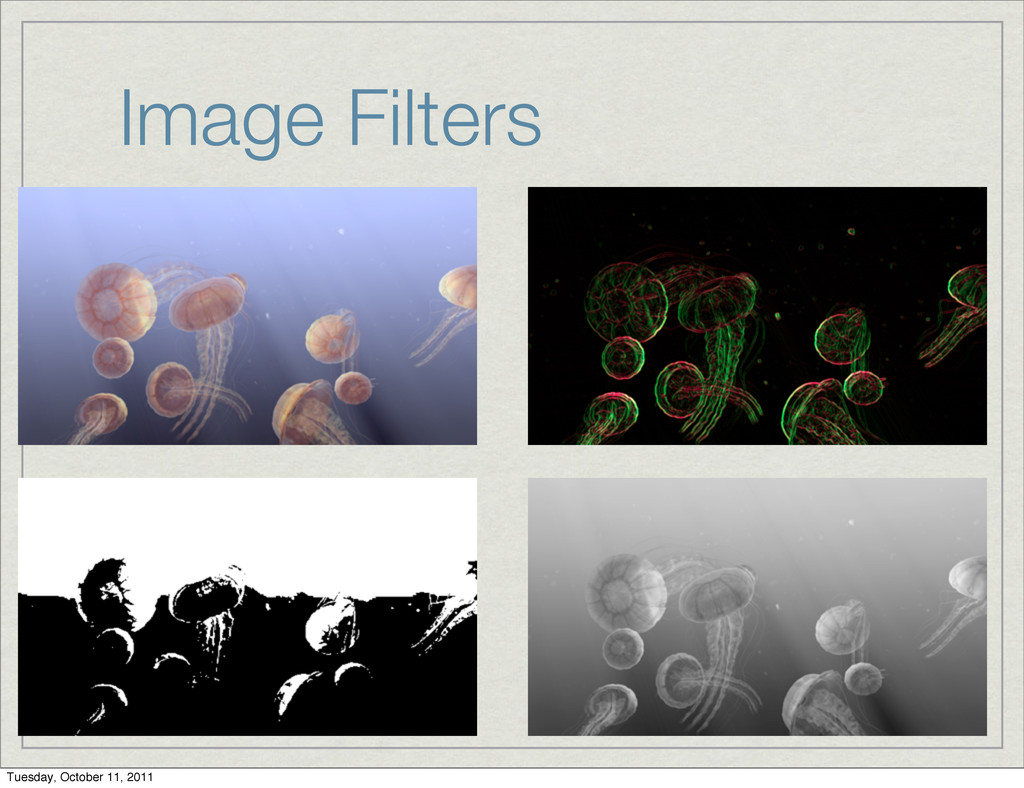
or jpeg image on a canvas using drawImage Canvas also lets JS code take the pixels from the image into an array. Using this array, we can transform the pixels and write the result to a new canvas The operation is called filtering Tuesday, October 11, 2011 -
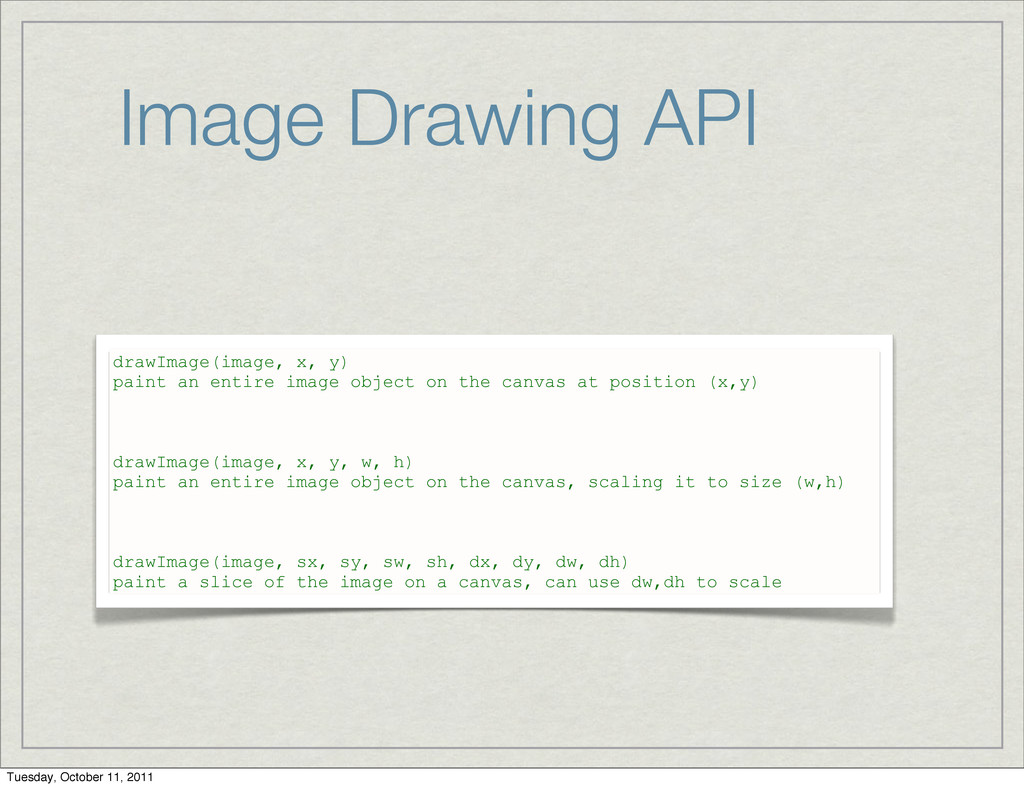
Image Drawing API drawImage(image, x, y) paint an entire image
object on the canvas at position (x,y) drawImage(image, x, y, w, h) paint an entire image object on the canvas, scaling it to size (w,h) drawImage(image, sx, sy, sw, sh, dx, dy, dw, dh) paint a slice of the image on a canvas, can use dw,dh to scale Tuesday, October 11, 2011 -
Image Filters For the next few slides, we’ll create a
Filters object. Each filter is a function of that Filters object The Filters object is responsible for reading pixel data and interacting with the canvas A filter function takes pixel data and manipulates it Tuesday, October 11, 2011 -
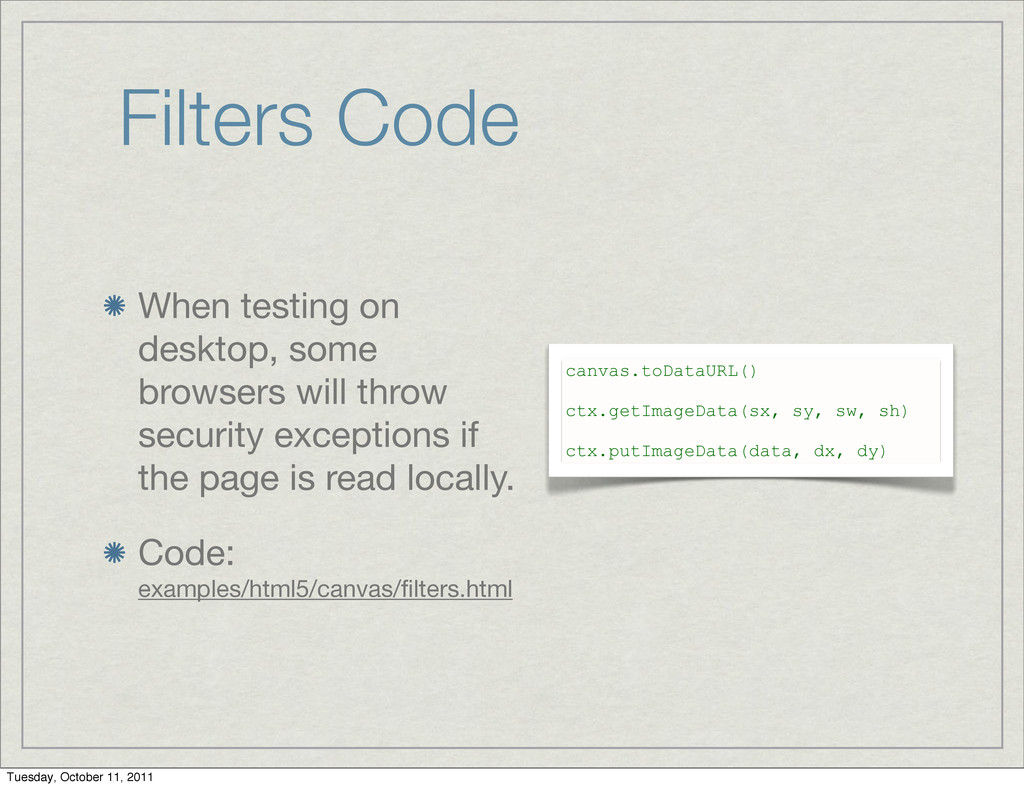
Filters Code When testing on desktop, some browsers will throw
security exceptions if the page is read locally. Code: examples/html5/canvas/filters.html canvas.toDataURL() ctx.getImageData(sx, sy, sw, sh) ctx.putImageData(data, dx, dy) Tuesday, October 11, 2011 -
Canvas Exercise Implement a mobile drawing app using the canvas
and touch events App should have a footer with a selection of colors. Tapping a color sets current color Tapping anywhere on screen should draw in the selected color Bonus: share photo on server Tuesday, October 11, 2011