Upgrade to Pro — share decks privately, control downloads, hide ads and more …

Radaris Research: Privacy-Safe U.S. Migration D...

Avatar for Zara Mann Zara Mann
August 04, 2026

Radaris Research: Privacy-Safe U.S. Migration Datasets for Demographic and Economic Studies

Explore privacy-safe, anonymized migration datasets designed for researchers, economists, journalists, and policymakers. This presentation explains the methodology, available datasets, and practical research applications for demographic and migration analysis. Learn more about Radaris at https://radaris.com

Avatar for Zara Mann

Zara Mann

August 04, 2026

Other Decks in Research

Transcript

  1. RADARIS RESEARCH Privacy-safe migration datasets, documented for researchers. Anonymized, ready-to-use

    data on how people move across the United States — free to download and cite. Built so demographers, economists, and the public can study migration without compromising anyone's privacy. Zara Mann Research Analyst, Radaris [email protected] radaris.com
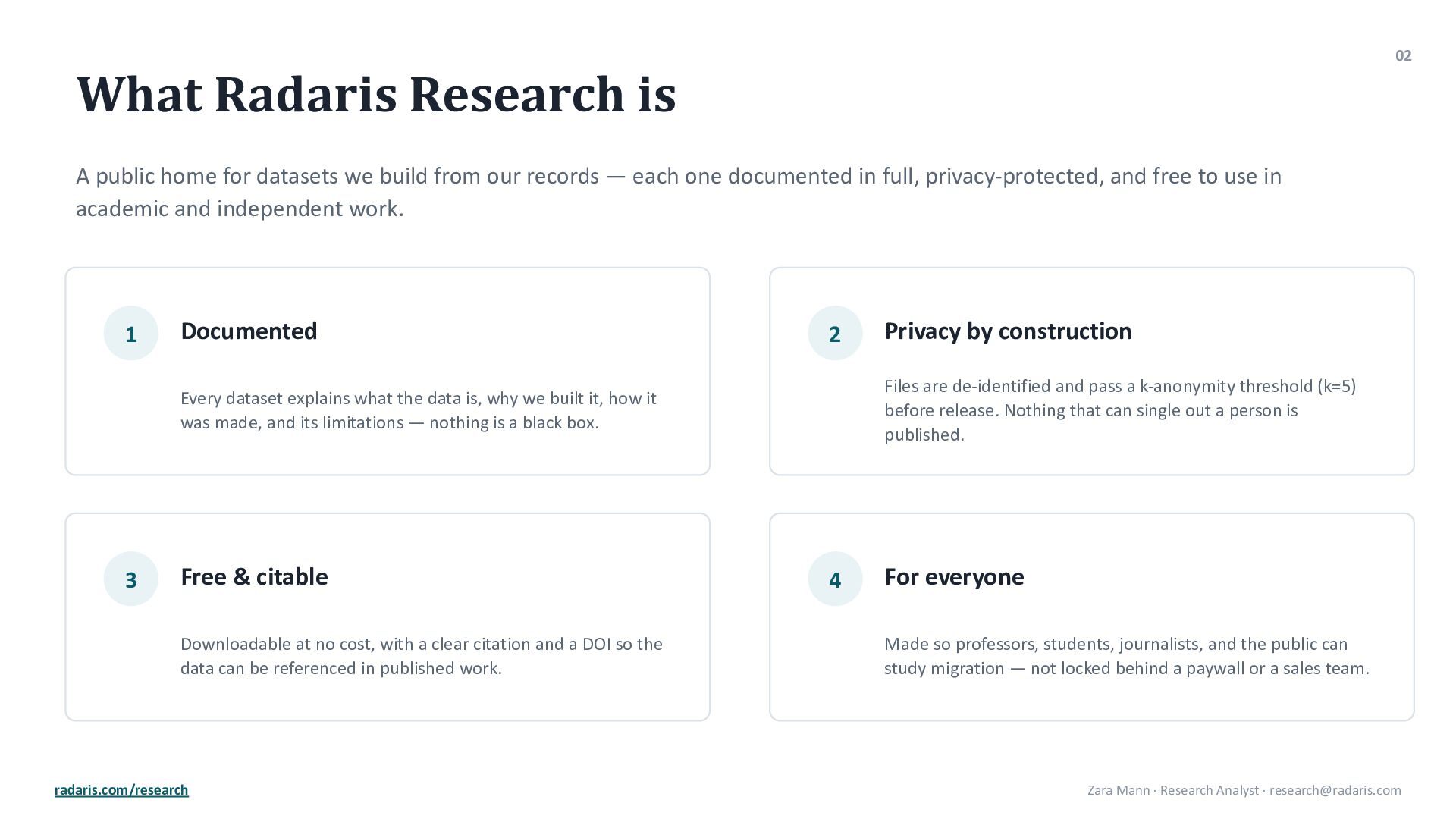
  2. 02 What Radaris Research is A public home for datasets

    we build from our records — each one documented in full, privacy-protected, and free to use in academic and independent work. 1 Documented 2 Files are de-identified and pass a k-anonymity threshold (k=5) before release. Nothing that can single out a person is published. Every dataset explains what the data is, why we built it, how it was made, and its limitations — nothing is a black box. 3 Free & citable Downloadable at no cost, with a clear citation and a DOI so the data can be referenced in published work. radaris.com/research Privacy by construction 4 For everyone Made so professors, students, journalists, and the public can study migration — not locked behind a paywall or a sales team. Zara Mann · Research Analyst · [email protected]
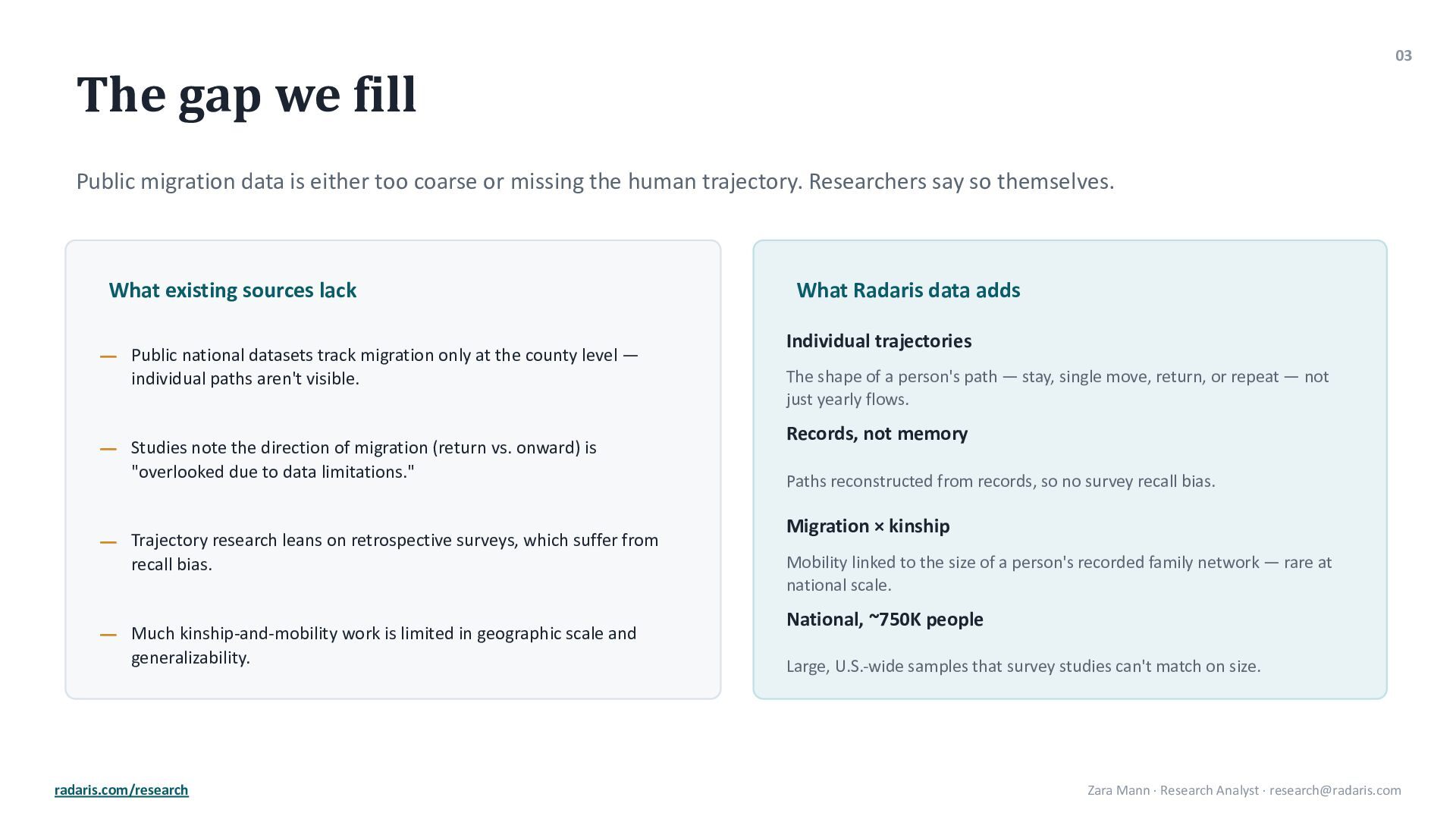
  3. 03 The gap we fill Public migration data is either

    too coarse or missing the human trajectory. Researchers say so themselves. What existing sources lack — Public national datasets track migration only at the county level — individual paths aren't visible. — Studies note the direction of migration (return vs. onward) is "overlooked due to data limitations." — Trajectory research leans on retrospective surveys, which suffer from recall bias. — Much kinship-and-mobility work is limited in geographic scale and generalizability. radaris.com/research What Radaris data adds Individual trajectories The shape of a person's path — stay, single move, return, or repeat — not just yearly flows. Records, not memory Paths reconstructed from records, so no survey recall bias. Migration × kinship Mobility linked to the size of a person's recorded family network — rare at national scale. National, ~750K people Large, U.S.-wide samples that survey studies can't match on size. Zara Mann · Research Analyst · [email protected]
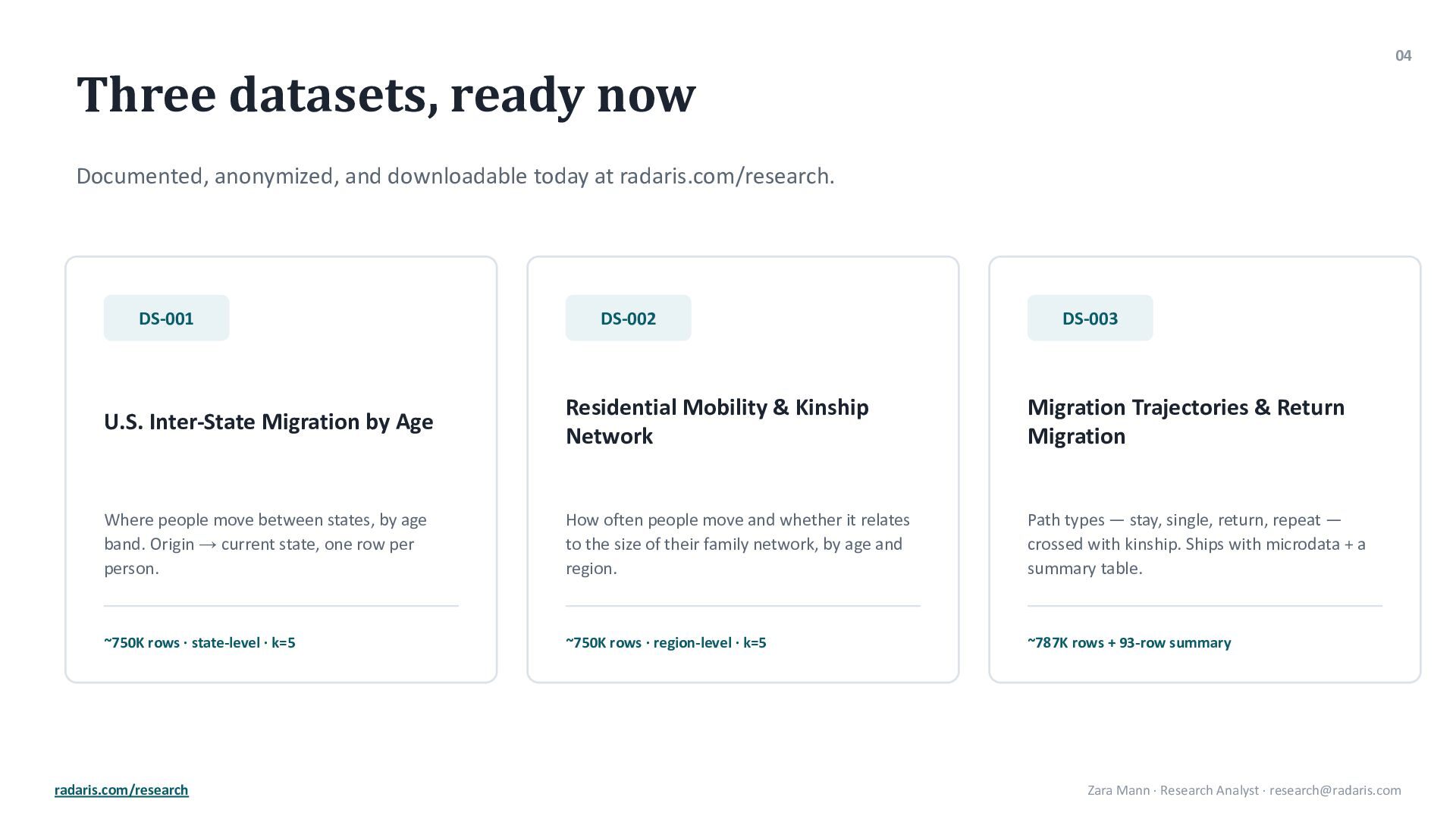
  4. 04 Three datasets, ready now Documented, anonymized, and downloadable today

    at radaris.com/research. DS-001 DS-002 DS-003 U.S. Inter-State Migration by Age Residential Mobility & Kinship Network Migration Trajectories & Return Migration Where people move between states, by age band. Origin → current state, one row per person. How often people move and whether it relates to the size of their family network, by age and region. Path types — stay, single, return, repeat — crossed with kinship. Ships with microdata + a summary table. ~750K rows · state-level · k=5 ~750K rows · region-level · k=5 ~787K rows + 93-row summary radaris.com/research Zara Mann · Research Analyst · [email protected]
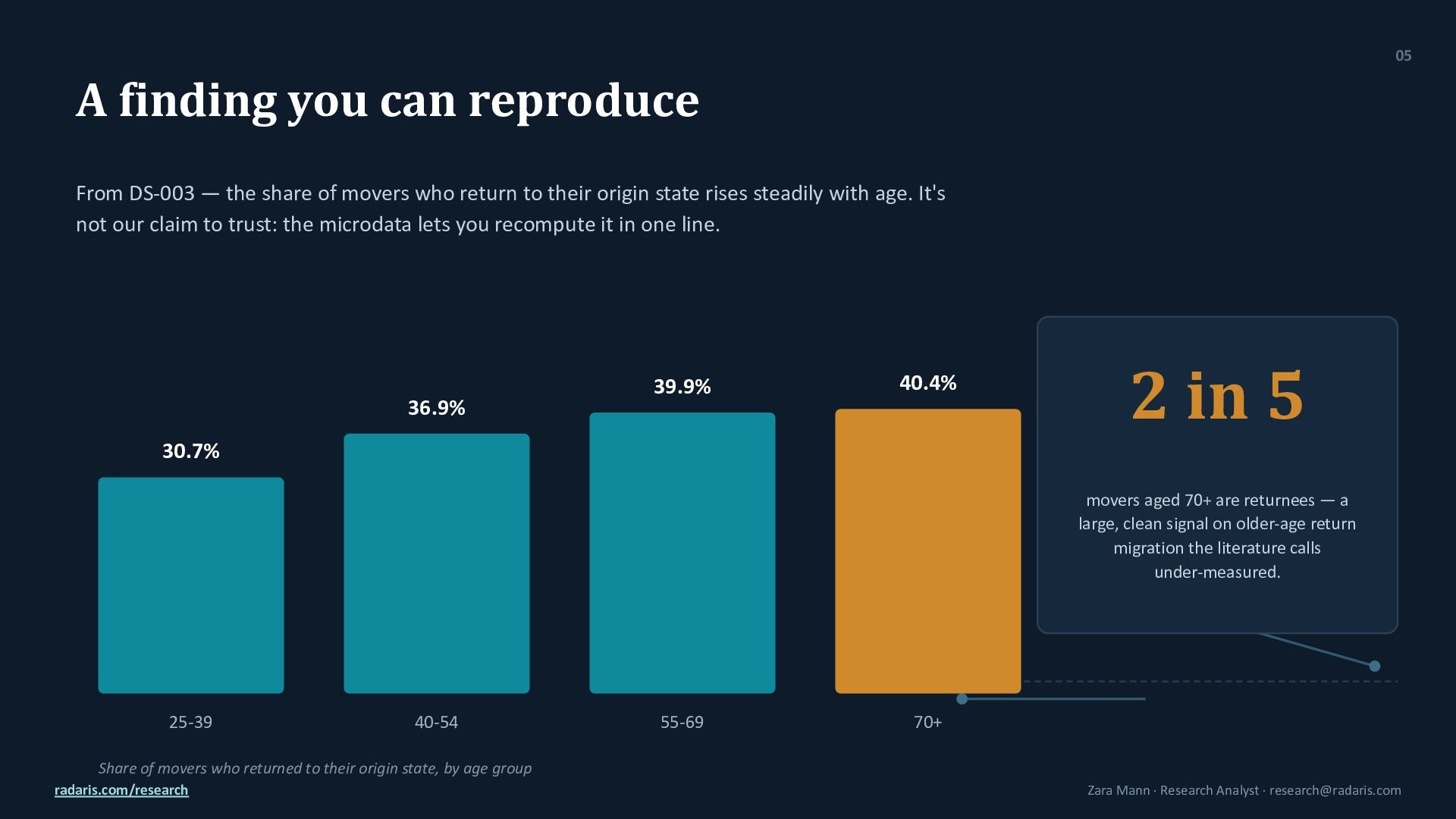
  5. 05 A finding you can reproduce From DS-003 — the

    share of movers who return to their origin state rises steadily with age. It's not our claim to trust: the microdata lets you recompute it in one line. 36.9% 39.9% 40.4% 2 in 5 30.7% movers aged 70+ are returnees — a large, clean signal on older-age return migration the literature calls under-measured. 25-39 40-54 55-69 70+ Share of movers who returned to their origin state, by age group radaris.com/research Zara Mann · Research Analyst · [email protected]
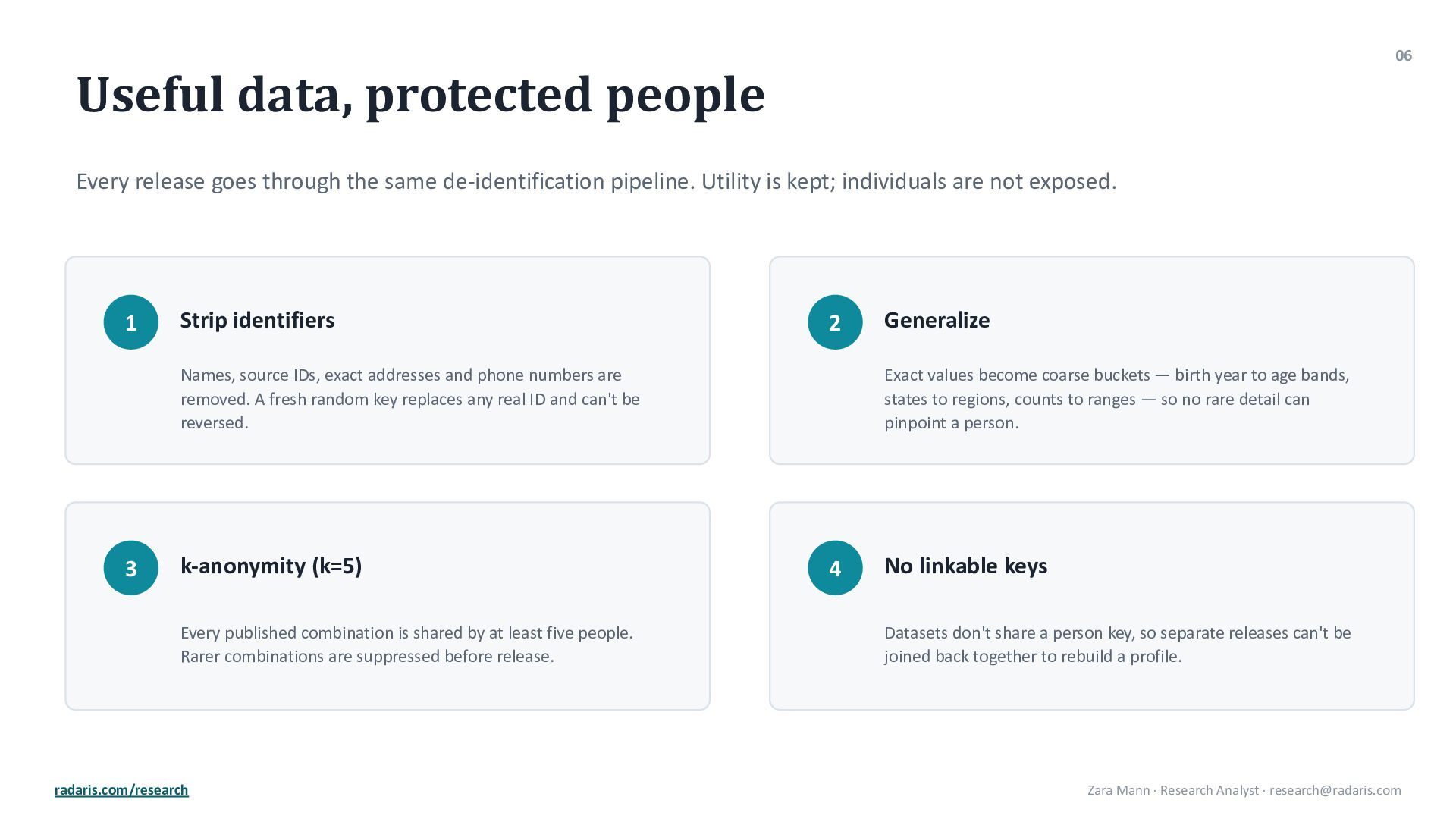
  6. 06 Useful data, protected people Every release goes through the

    same de-identification pipeline. Utility is kept; individuals are not exposed. 1 Strip identifiers 2 Names, source IDs, exact addresses and phone numbers are removed. A fresh random key replaces any real ID and can't be reversed. 3 k-anonymity (k=5) Every published combination is shared by at least five people. Rarer combinations are suppressed before release. radaris.com/research Generalize Exact values become coarse buckets — birth year to age bands, states to regions, counts to ranges — so no rare detail can pinpoint a person. 4 No linkable keys Datasets don't share a person key, so separate releases can't be joined back together to rebuild a profile. Zara Mann · Research Analyst · [email protected]
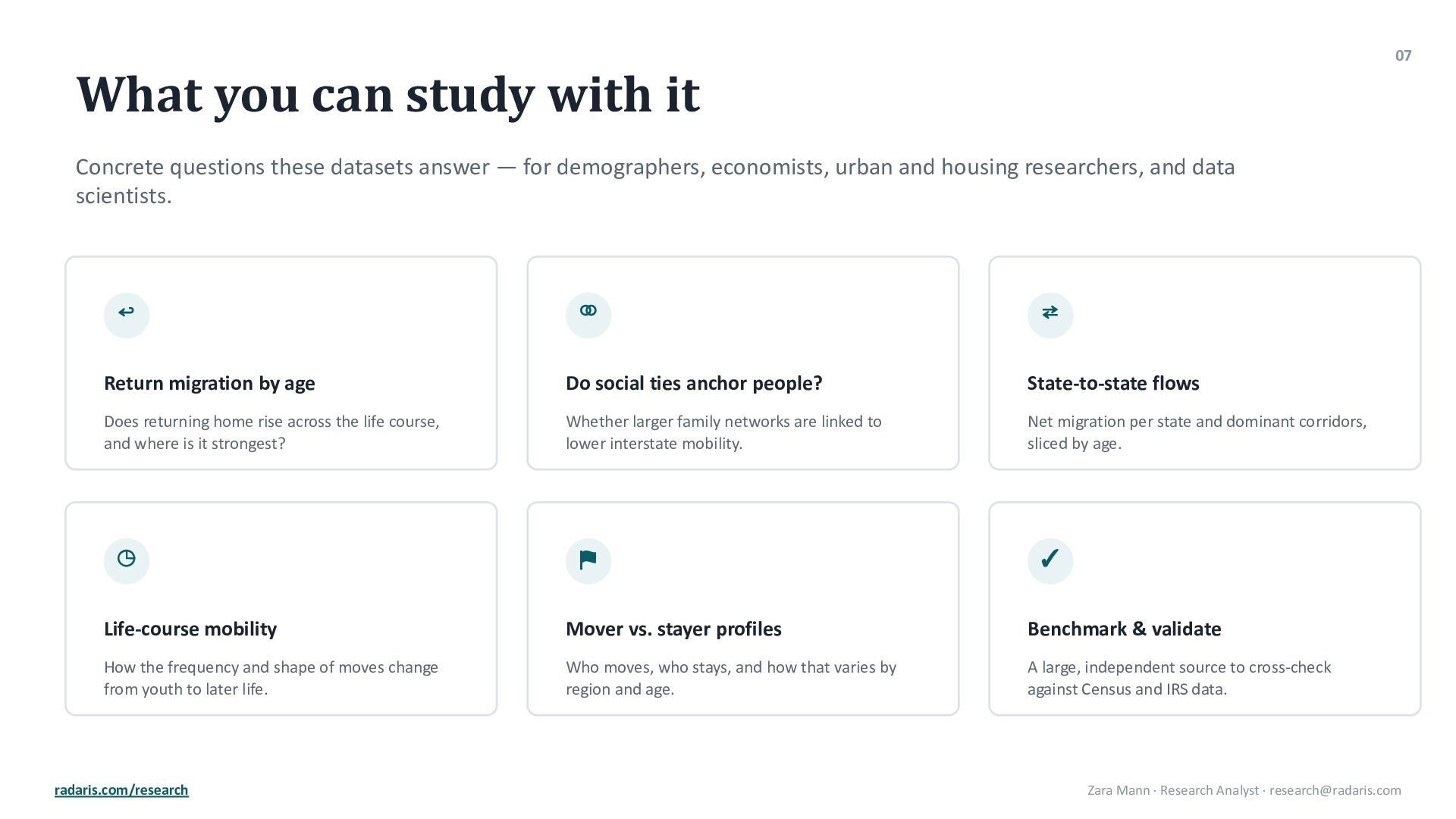
  7. 07 What you can study with it Concrete questions these

    datasets answer — for demographers, economists, urban and housing researchers, and data scientists. ↩ ⚭ ⇄ Return migration by age Do social ties anchor people? State-to-state flows Does returning home rise across the life course, and where is it strongest? Whether larger family networks are linked to lower interstate mobility. Net migration per state and dominant corridors, sliced by age. ◷ ⚑ ✓ Life-course mobility Mover vs. stayer profiles Benchmark & validate How the frequency and shape of moves change from youth to later life. Who moves, who stays, and how that varies by region and age. A large, independent source to cross-check against Census and IRS data. radaris.com/research Zara Mann · Research Analyst · [email protected]
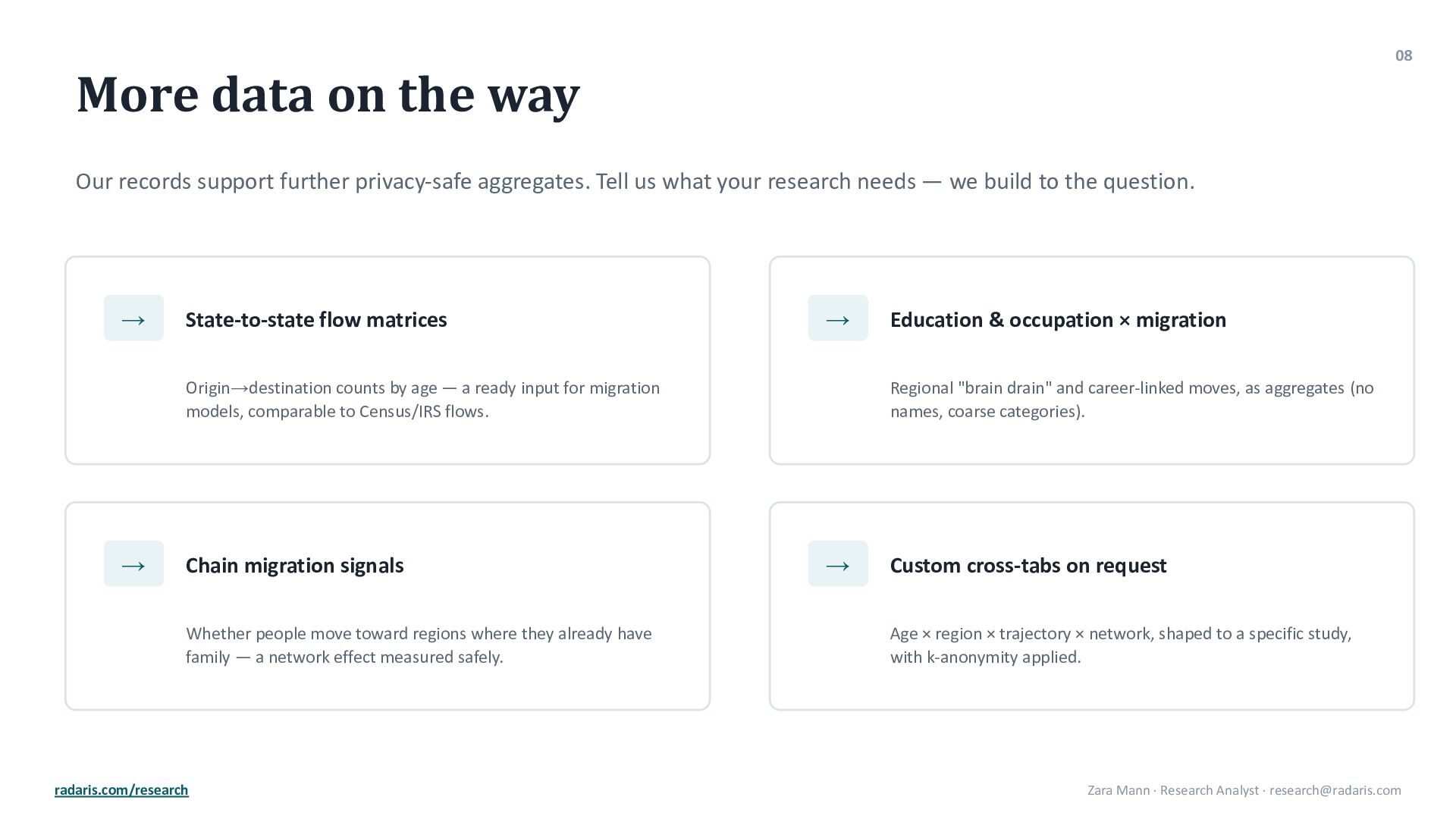
  8. 08 More data on the way Our records support further

    privacy-safe aggregates. Tell us what your research needs — we build to the question. → State-to-state flow matrices → Origin→destination counts by age — a ready input for migration models, comparable to Census/IRS flows. → Chain migration signals Whether people move toward regions where they already have family — a network effect measured safely. radaris.com/research Education & occupation × migration Regional "brain drain" and career-linked moves, as aggregates (no names, coarse categories). → Custom cross-tabs on request Age × region × trajectory × network, shaped to a specific study, with k-anonymity applied. Zara Mann · Research Analyst · [email protected]
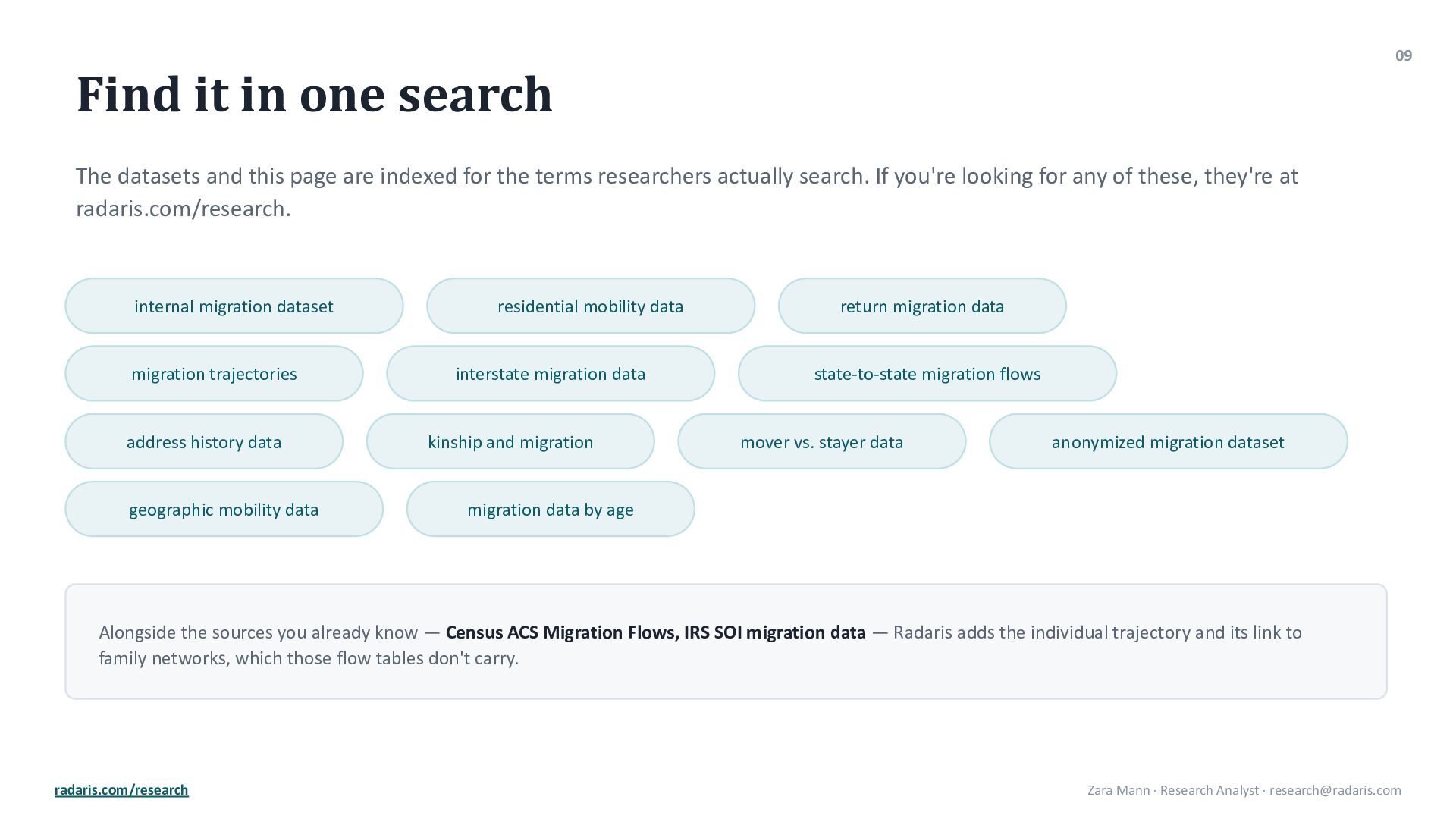
  9. 09 Find it in one search The datasets and this

    page are indexed for the terms researchers actually search. If you're looking for any of these, they're at radaris.com/research. internal migration dataset migration trajectories address history data geographic mobility data residential mobility data interstate migration data kinship and migration return migration data state-to-state migration flows mover vs. stayer data anonymized migration dataset migration data by age Alongside the sources you already know — Census ACS Migration Flows, IRS SOI migration data — Radaris adds the individual trajectory and its link to family networks, which those flow tables don't carry. radaris.com/research Zara Mann · Research Analyst · [email protected]
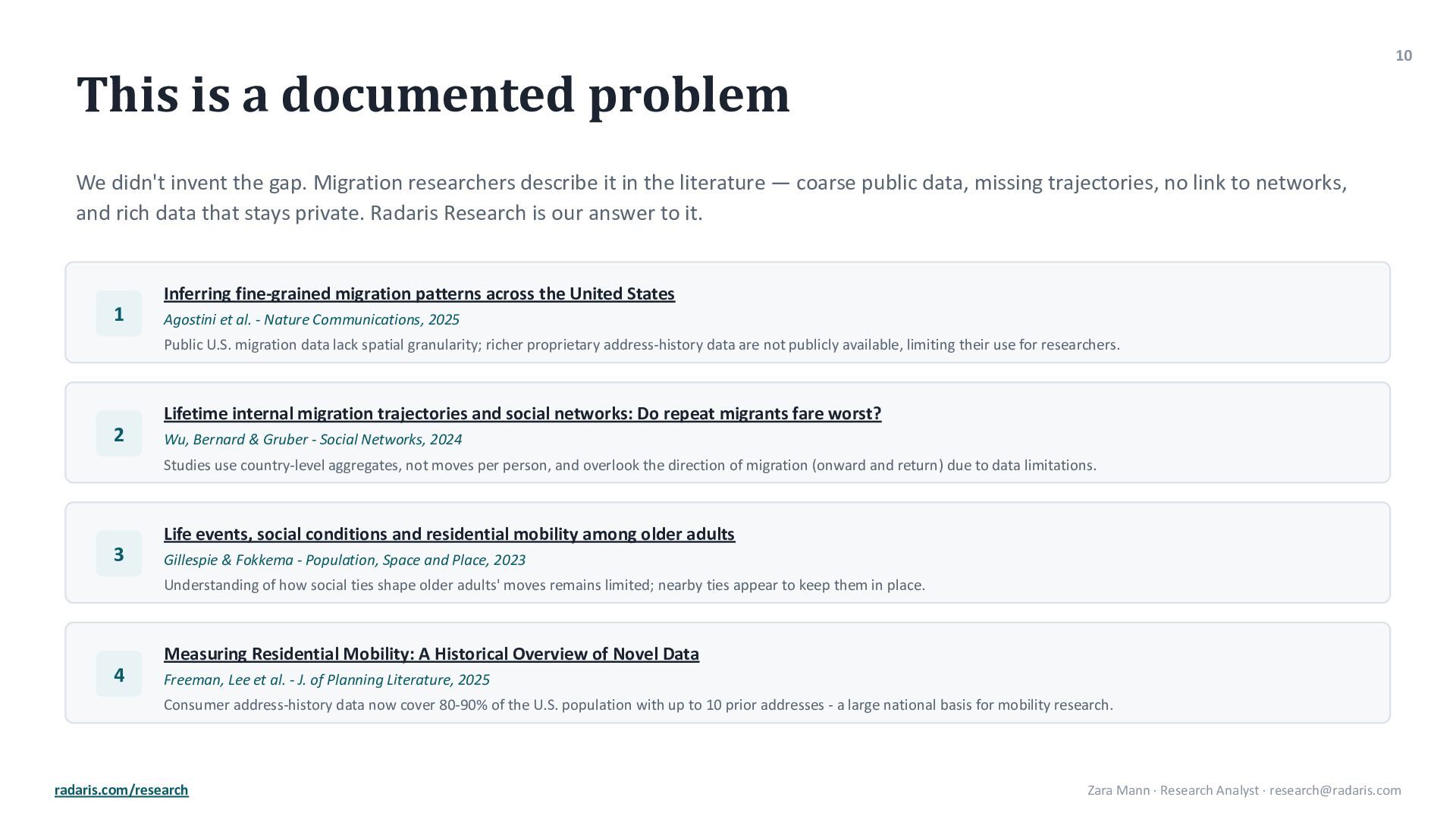
  10. 10 This is a documented problem We didn't invent the

    gap. Migration researchers describe it in the literature — coarse public data, missing trajectories, no link to networks, and rich data that stays private. Radaris Research is our answer to it. Inferring fine-grained migration patterns across the United States 1 Agostini et al. - Nature Communications, 2025 Public U.S. migration data lack spatial granularity; richer proprietary address-history data are not publicly available, limiting their use for researchers. Lifetime internal migration trajectories and social networks: Do repeat migrants fare worst? 2 Wu, Bernard & Gruber - Social Networks, 2024 Studies use country-level aggregates, not moves per person, and overlook the direction of migration (onward and return) due to data limitations. Life events, social conditions and residential mobility among older adults 3 Gillespie & Fokkema - Population, Space and Place, 2023 Understanding of how social ties shape older adults' moves remains limited; nearby ties appear to keep them in place. Measuring Residential Mobility: A Historical Overview of Novel Data 4 Freeman, Lee et al. - J. of Planning Literature, 2025 Consumer address-history data now cover 80-90% of the U.S. population with up to 10 prior addresses - a large national basis for mobility research. radaris.com/research Zara Mann · Research Analyst · [email protected]
  11. 11 Use the data. Cite the data. Tell us what

    you need next. All datasets are free to download and cite for research and reporting. If your work needs a cut we haven't built, we'll build it — privacy-safe, to your question. Browse datasets → radaris.com/research Zara Mann · Research Analyst, Radaris [email protected] radaris.com