the National Symposium on Modular Programming, organized at the Information and Systems Institute in July 1968. http://en.wikipedia.org/wiki/Modular_programming Look mom I built a plugin!
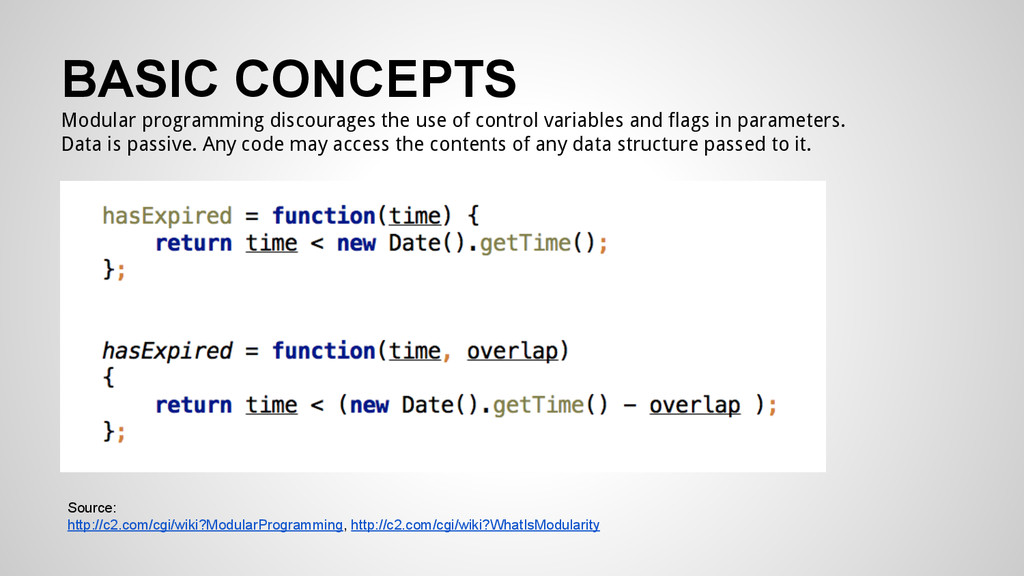
and flags in parameters. Data is passive. Any code may access the contents of any data structure passed to it. Source: http://c2.com/cgi/wiki?ModularProgramming, http://c2.com/cgi/wiki?WhatIsModularity
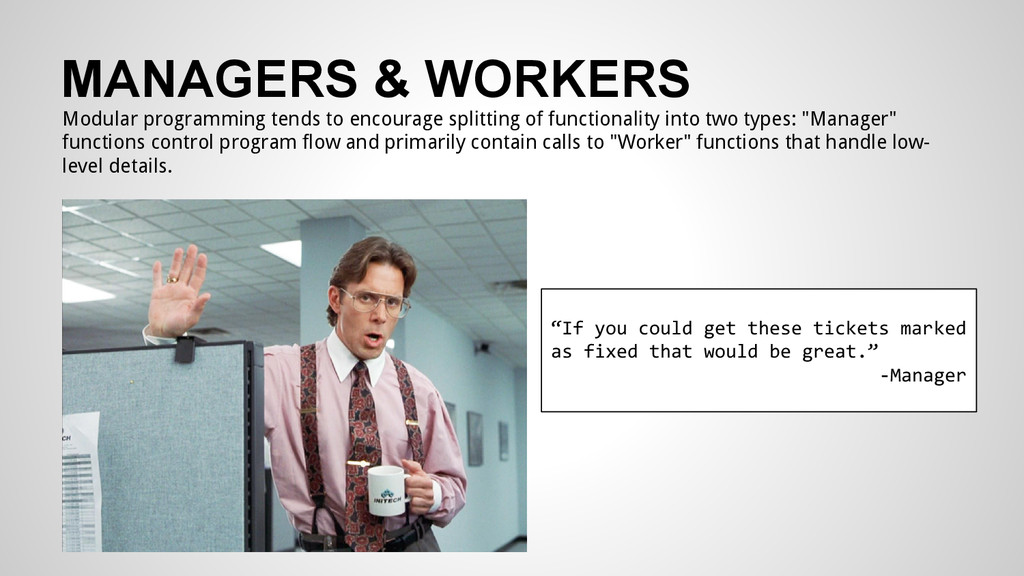
functionality into two types: "Manager" functions control program flow and primarily contain calls to "Worker" functions that handle low- level details. “If you could get these tickets marked as fixed that would be great.” -Manager
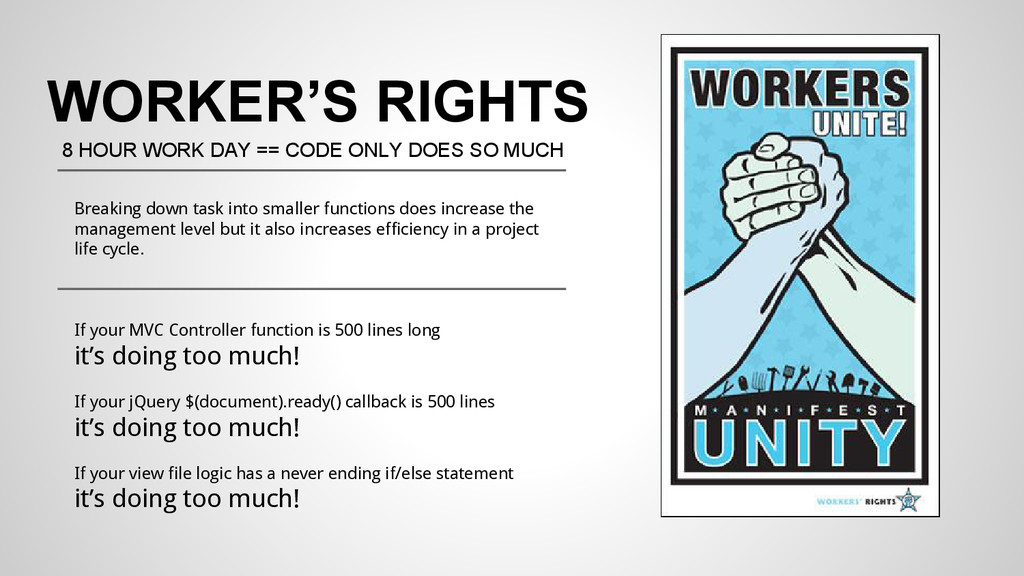
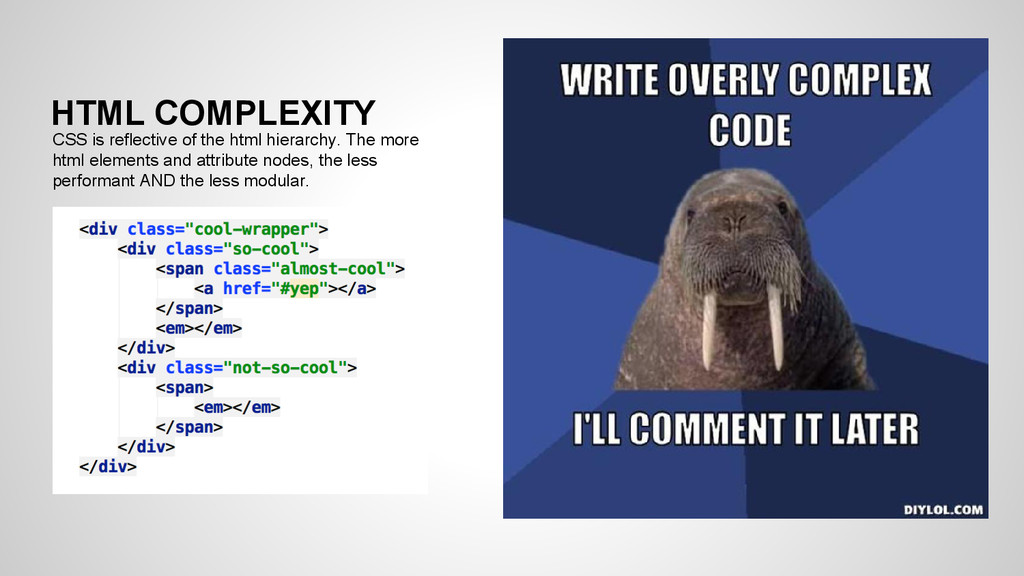
SO MUCH Breaking down task into smaller functions does increase the management level but it also increases efficiency in a project life cycle. If your MVC Controller function is 500 lines long it’s doing too much! If your jQuery $(document).ready() callback is 500 lines it’s doing too much! If your view file logic has a never ending if/else statement it’s doing too much!
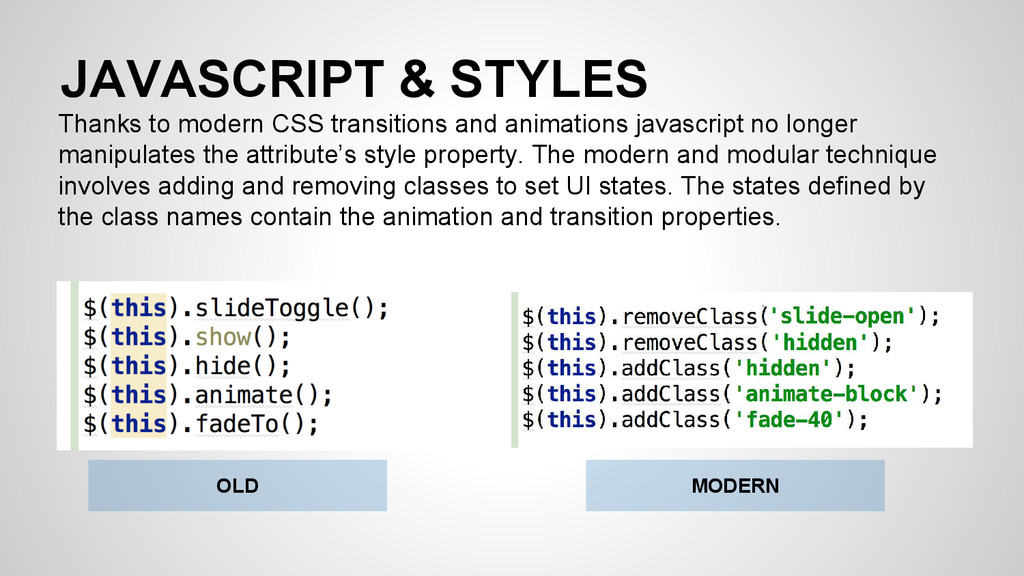
modular lifecycle. Other technologies do not offer the same luxuries. CSS could care less about your modular agenda. It’s you who makes the rules, it’s you who breaks the rules. Any great warrior is also a scholar, and a poet, and an artist. Steven Seagal
javascript no longer manipulates the attribute’s style property. The modern and modular technique involves adding and removing classes to set UI states. The states defined by the class names contain the animation and transition properties. OLD MODERN
level of abstraction. The more levels of abstraction, the greater the learning curve to understanding. If the levels of abstraction become too great, the positives of modular programming get outweighed by the complexity.
styles from your javascript. Stack classes in semantic groups for readability and reuse. Be wary of the levels of abstraction vs the benefits to the end product.


 acodesmith
 kishida
 yasaichi
 exoego
 xleitix
 deka_morita
 ryu1013
 dske104
 iwiwi
iwiwi
 uyuki234
 yukiny
 hollycummins
 cclai999
 rabernat
 samtorres
 mayunak
 sabderemane
 inesmontani
 chikuwait
 reverentgeek
 marktimemedia
 moore
moore
 smashingmag
 baasie
 asonas