Upgrade to Pro — share decks privately, control downloads, hide ads and more …

SMX Paris 2026 - Focus on Your Audience, Not Yo...

Sponsored · Your Podcast. Everywhere. Effortlessly. Share. Educate. Inspire. Entertain. You do you. We'll handle the rest.

SMX Paris 2026 - Focus on Your Audience, Not Your Keywords

Avatar for Amanda King

Amanda King

March 18, 2026
Tweet

More Decks by Amanda King

Other Decks in Marketing & SEO

Transcript

  1. Where’s Waldo? (I Don’t Care) Follow Your Audience Instead Amanda

    King @ FLOQ Consulting / Topic Compass SMX Paris 9 Mar 2026
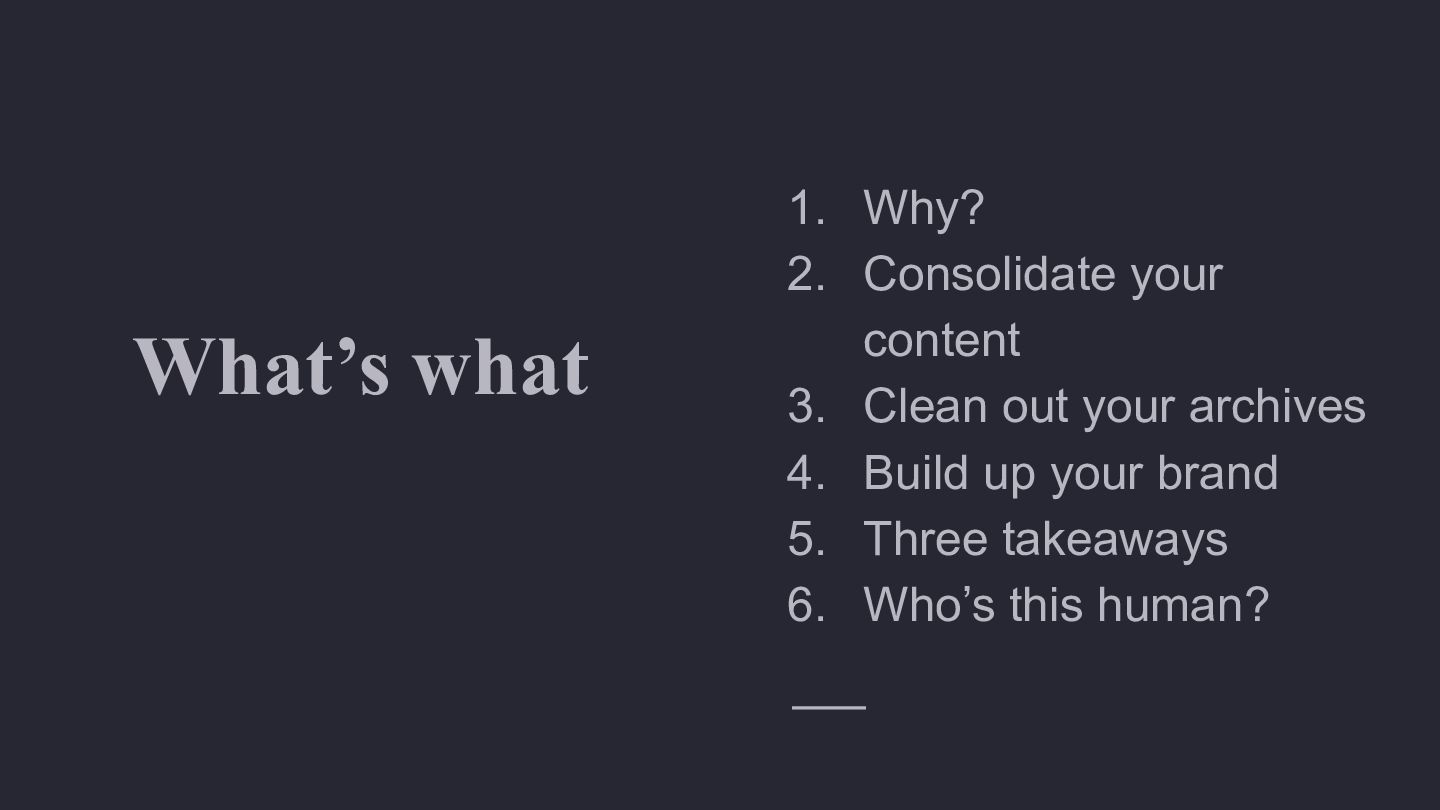
  2. What’s what 1. Why? 2. Consolidate your content 3. Clean

    out your archives 4. Build up your brand 5. Three takeaways 6. Who’s this human?
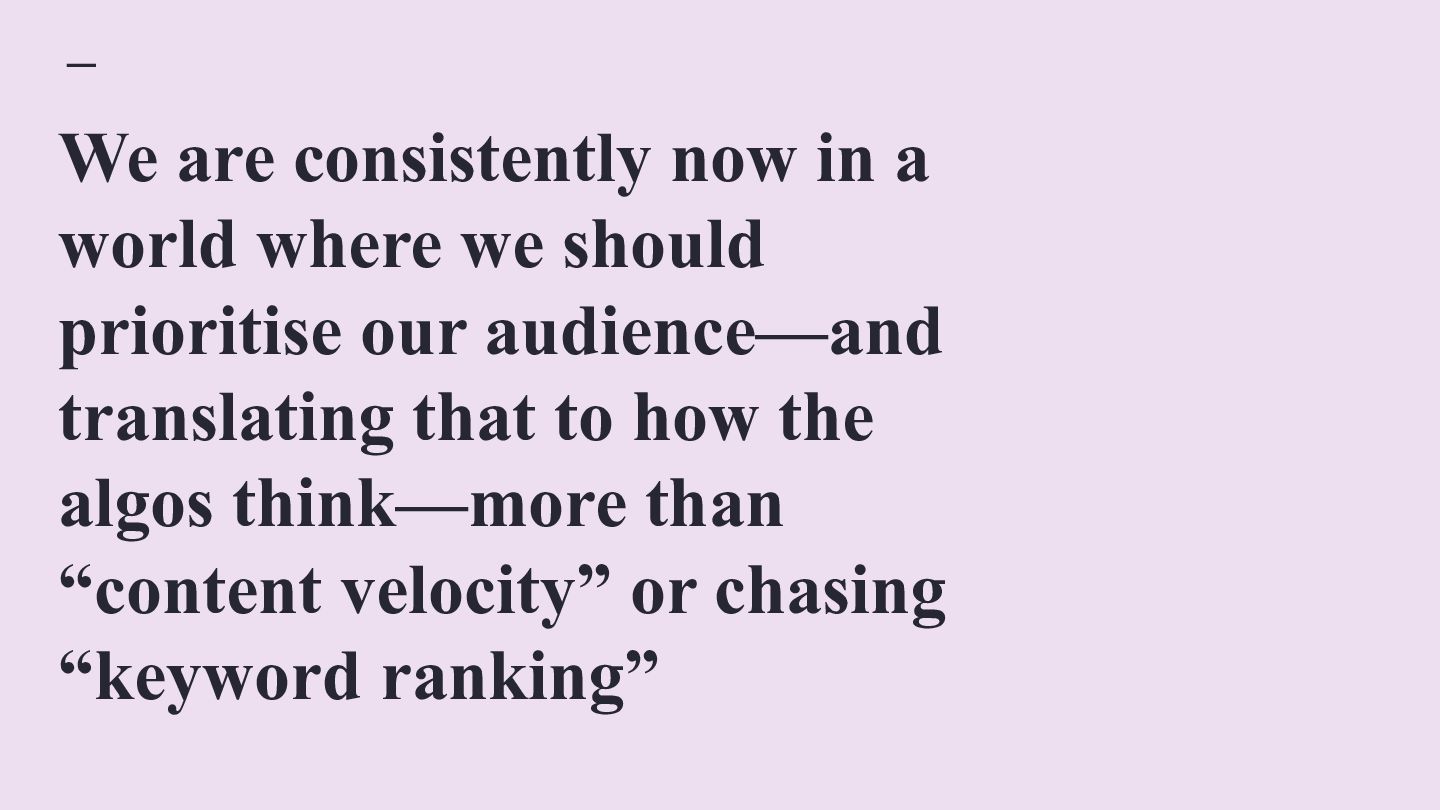
  3. We are consistently now in a world where we should

    prioritise our audience—and translating that to how the algos think—more than “content velocity” or chasing “keyword ranking”
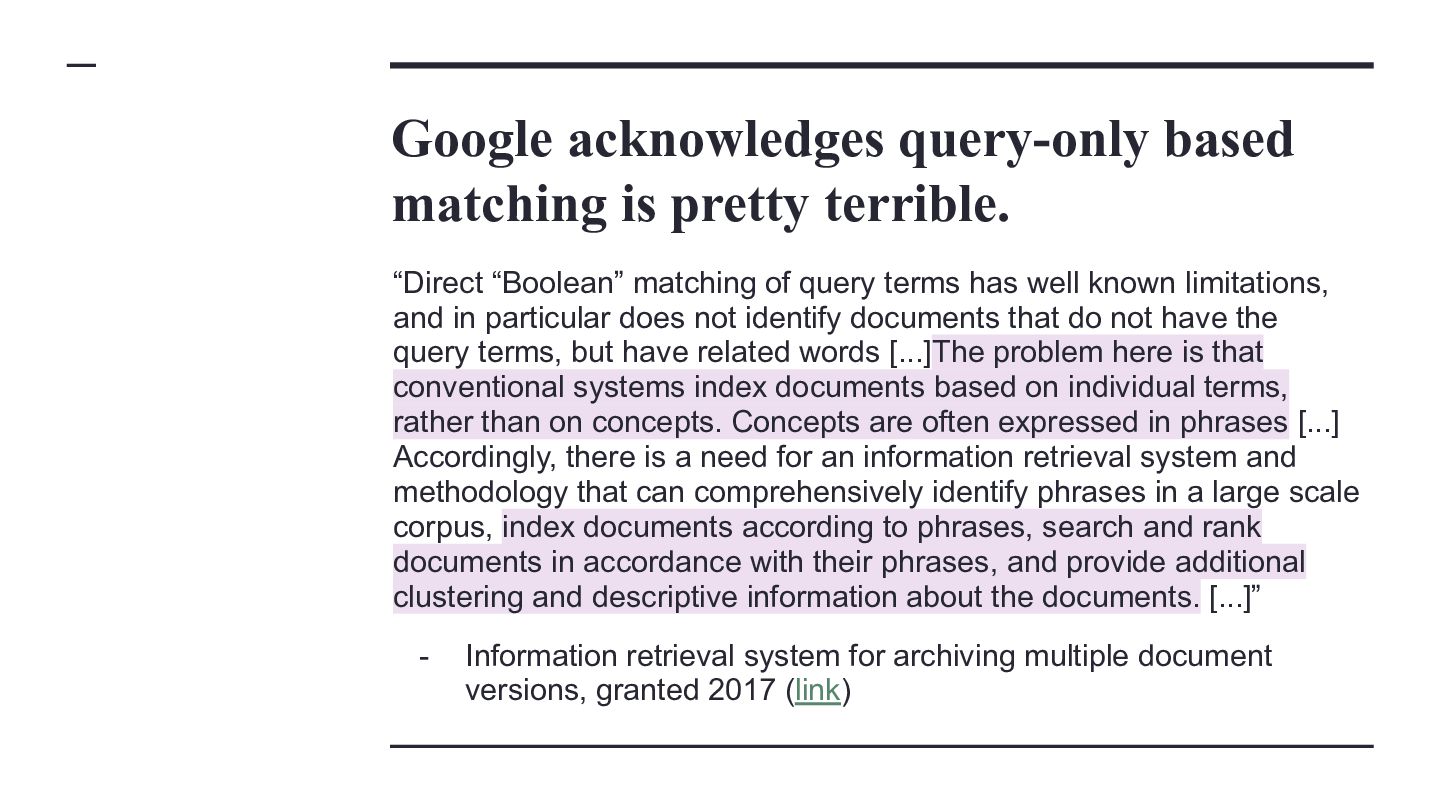
  4. Google acknowledges query-only based matching is pretty terrible. “Direct “Boolean”

    matching of query terms has well known limitations, and in particular does not identify documents that do not have the query terms, but have related words [...]The problem here is that conventional systems index documents based on individual terms, rather than on concepts. Concepts are often expressed in phrases [...] Accordingly, there is a need for an information retrieval system and methodology that can comprehensively identify phrases in a large scale corpus, index documents according to phrases, search and rank documents in accordance with their phrases, and provide additional clustering and descriptive information about the documents. [...]” - Information retrieval system for archiving multiple document versions, granted 2017 (link)
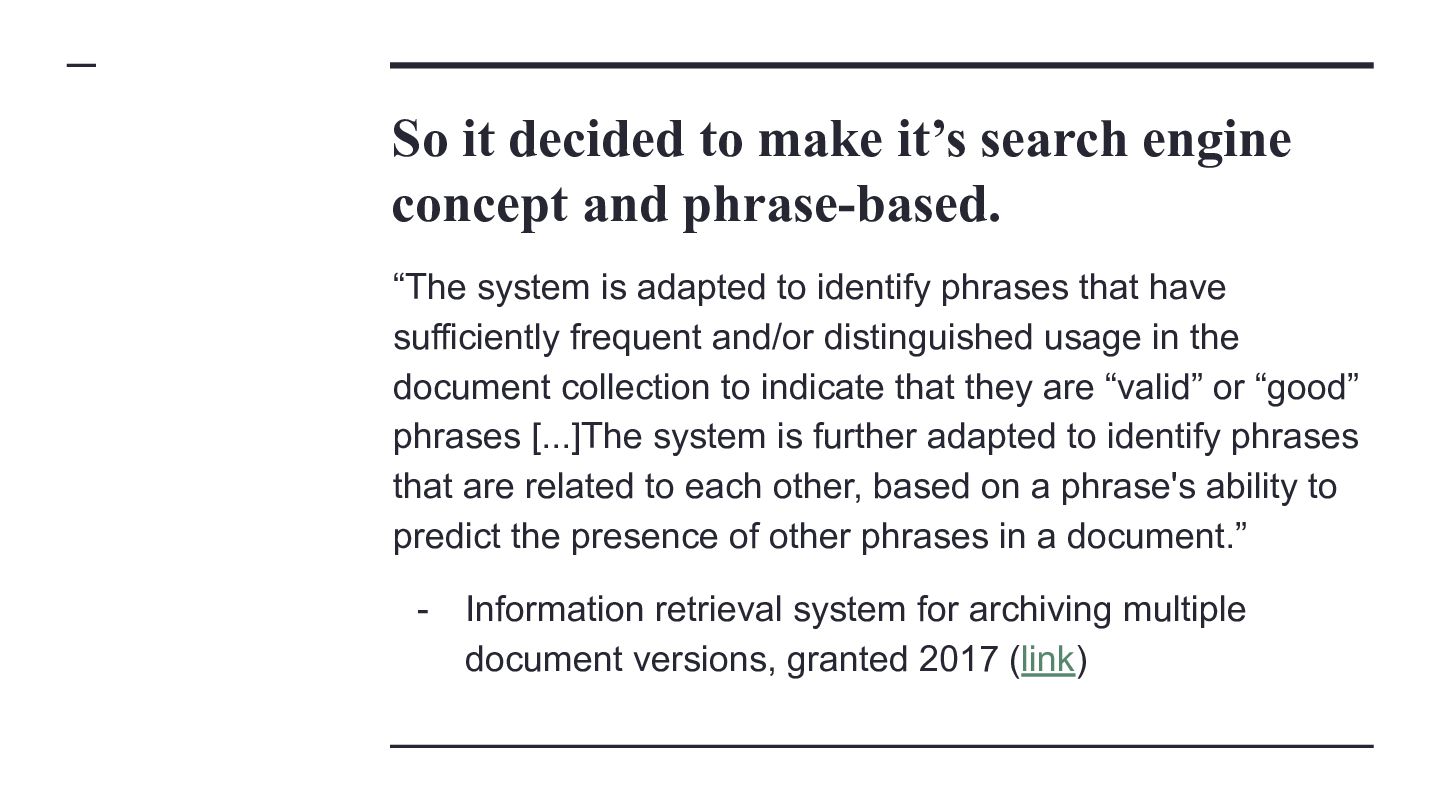
  5. So it decided to make it’s search engine concept and

    phrase-based. “The system is adapted to identify phrases that have sufficiently frequent and/or distinguished usage in the document collection to indicate that they are “valid” or “good” phrases [...]The system is further adapted to identify phrases that are related to each other, based on a phrase's ability to predict the presence of other phrases in a document.” - Information retrieval system for archiving multiple document versions, granted 2017 (link)
  6. Queries very quickly become entities “[...]identifying queries in query data;

    determining, in each of the queries, (i) an entity-descriptive portion that refers to an entity and (ii) a suffix; determining a count of a number of times the one or more queries were submitted“ - patent granted in 2015, submitted in 2012 Source: https://patents.google.com/patent/US9047278B1/en ; https://patents.google.com/patent/US20150161127A1/ , https://patents.google.com/patent/US8032507B1/en
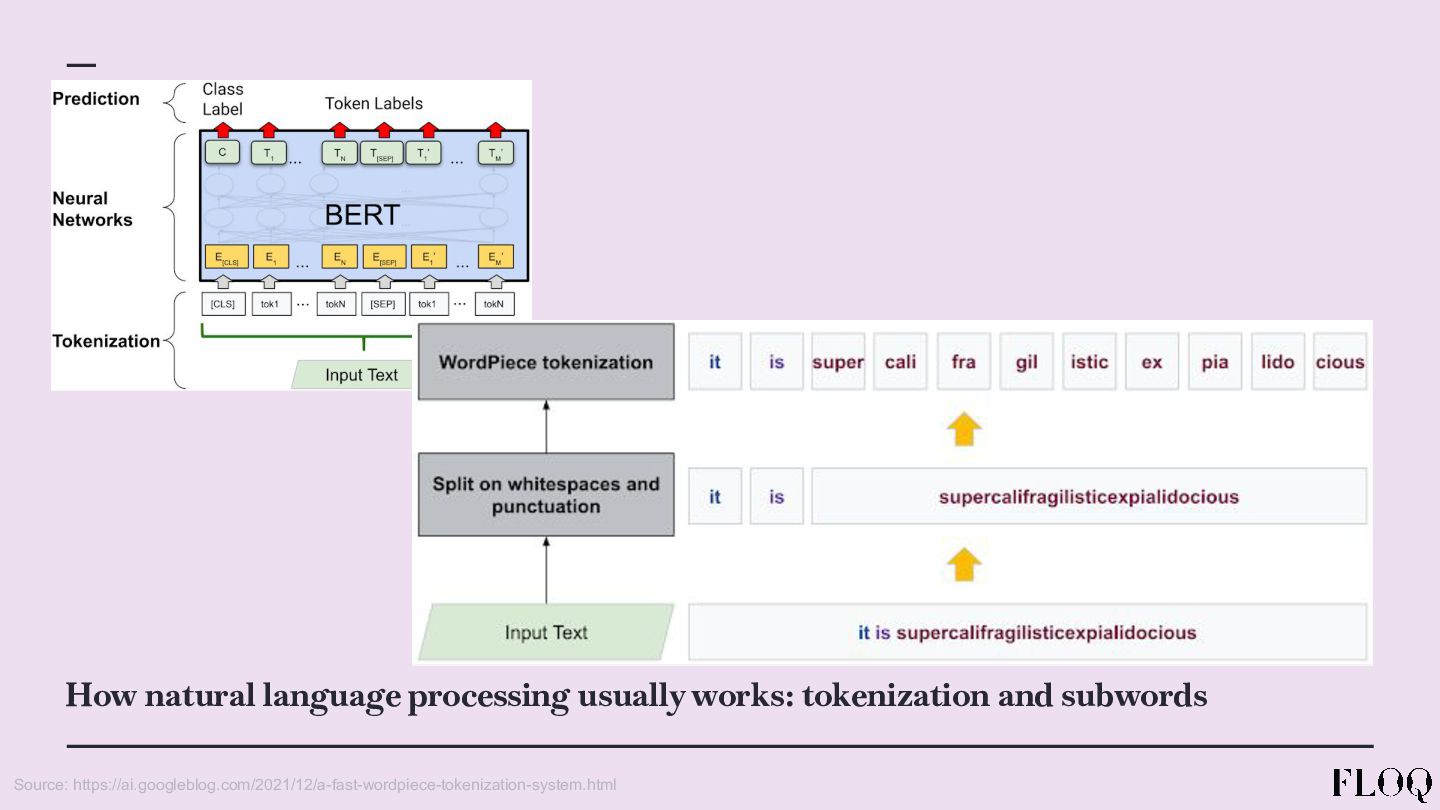
  7. How natural language processing usually works: tokenization and subwords Source:

    https://ai.googleblog.com/2021/12/a-fast-wordpiece-tokenization-system.html
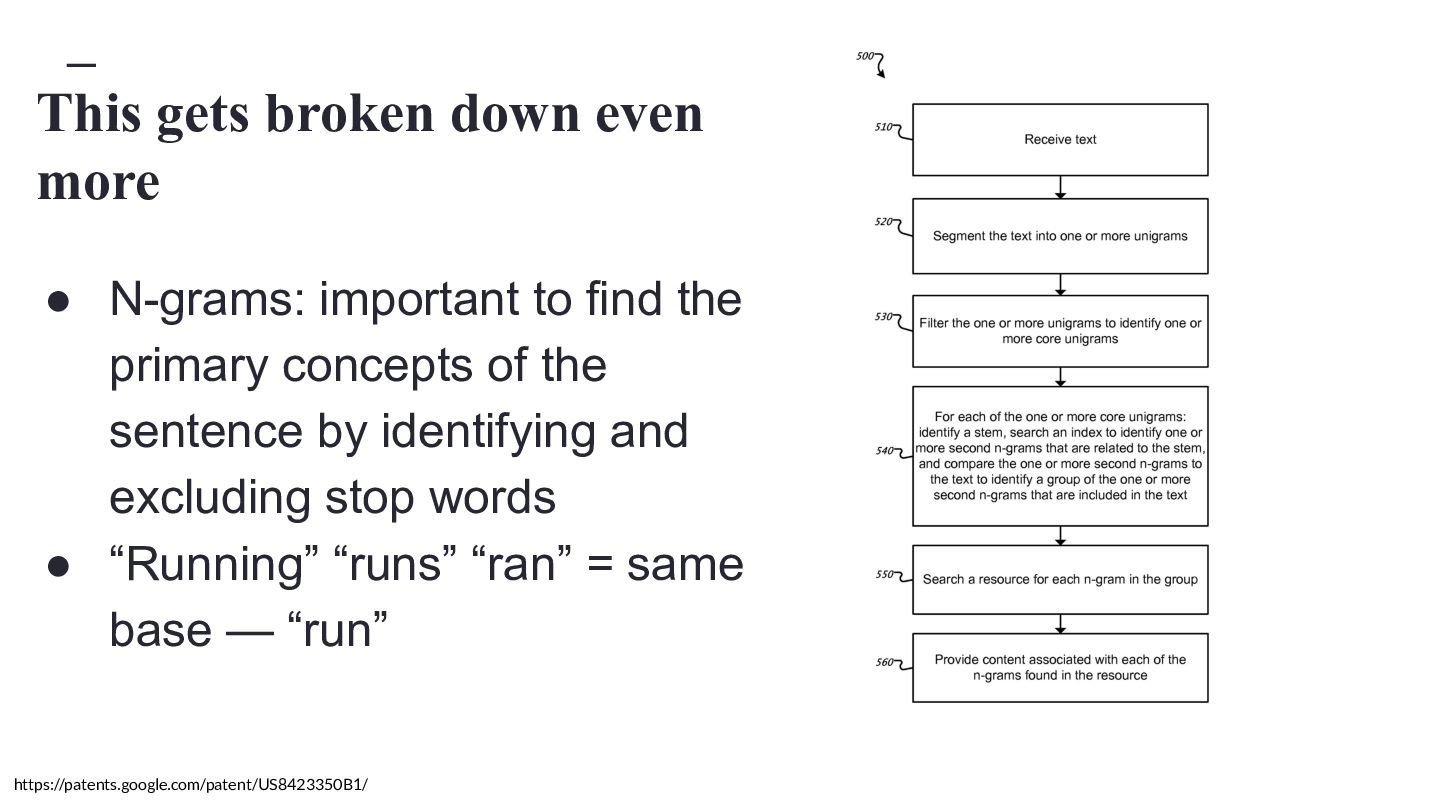
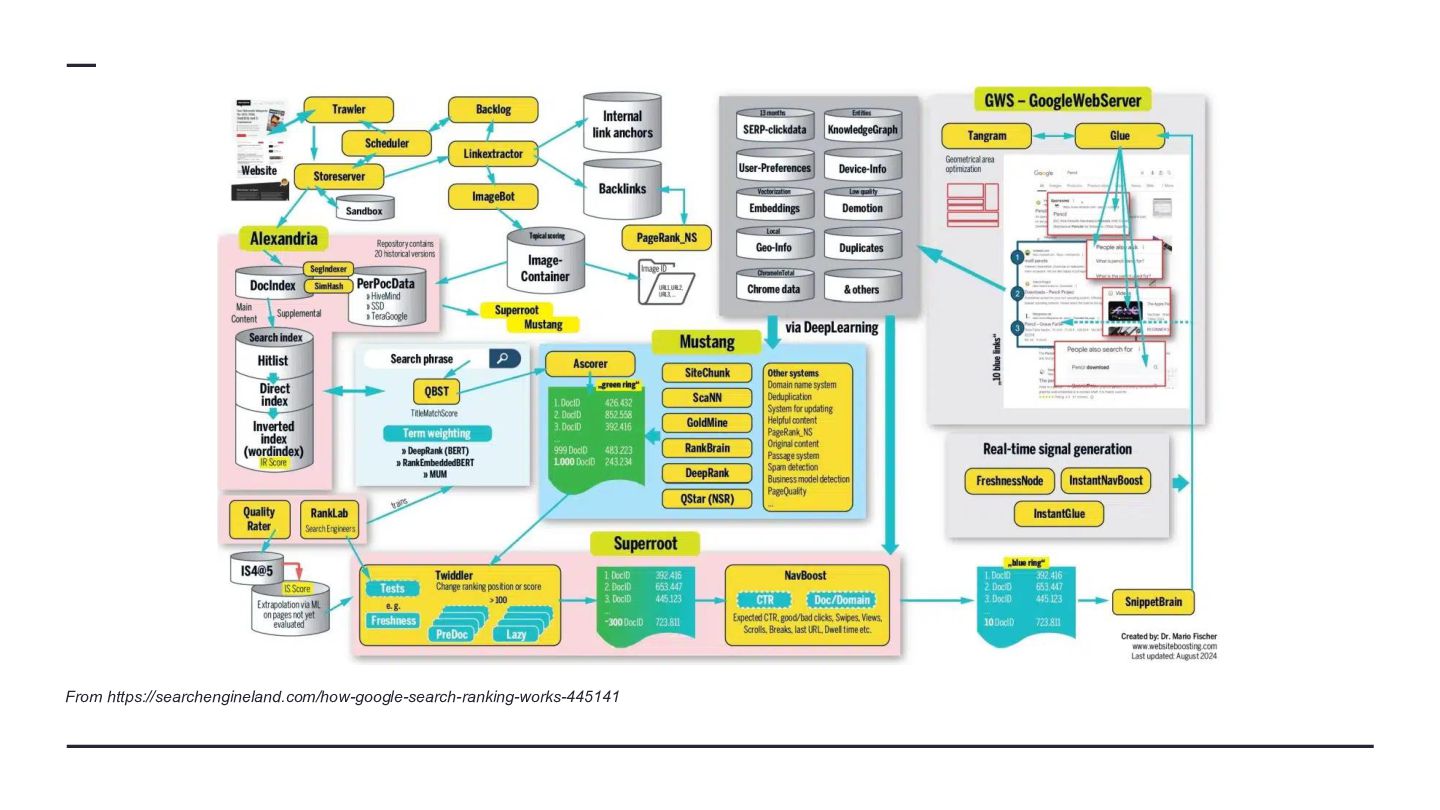
  8. • N-grams: important to find the primary concepts of the

    sentence by identifying and excluding stop words • “Running” “runs” “ran” = same base — “run” This gets broken down even more https://patents.google.com/patent/US8423350B1/
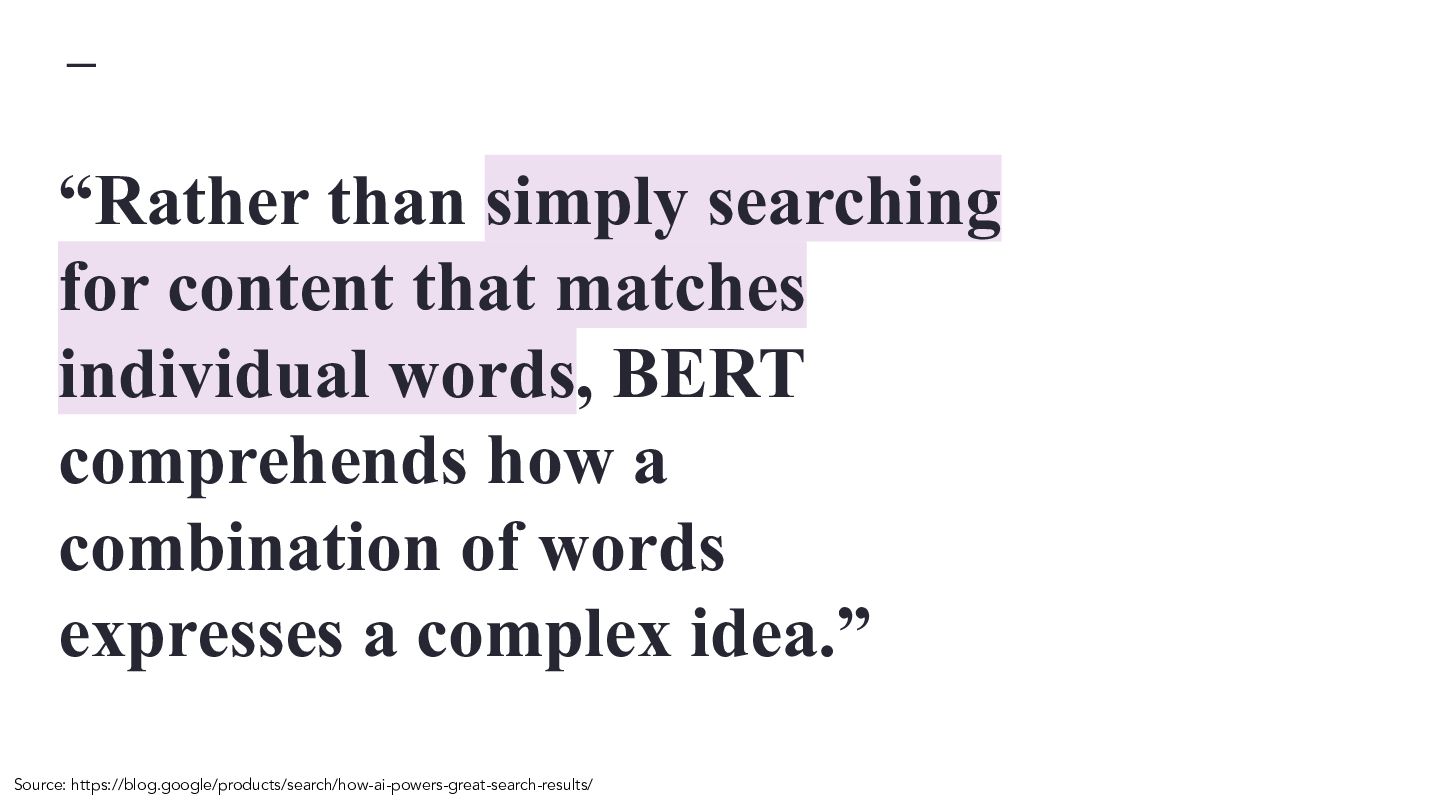
  9. “Rather than simply searching for content that matches individual words,

    BERT comprehends how a combination of words expresses a complex idea.” Source: https://blog.google/products/search/how-ai-powers-great-search-results/
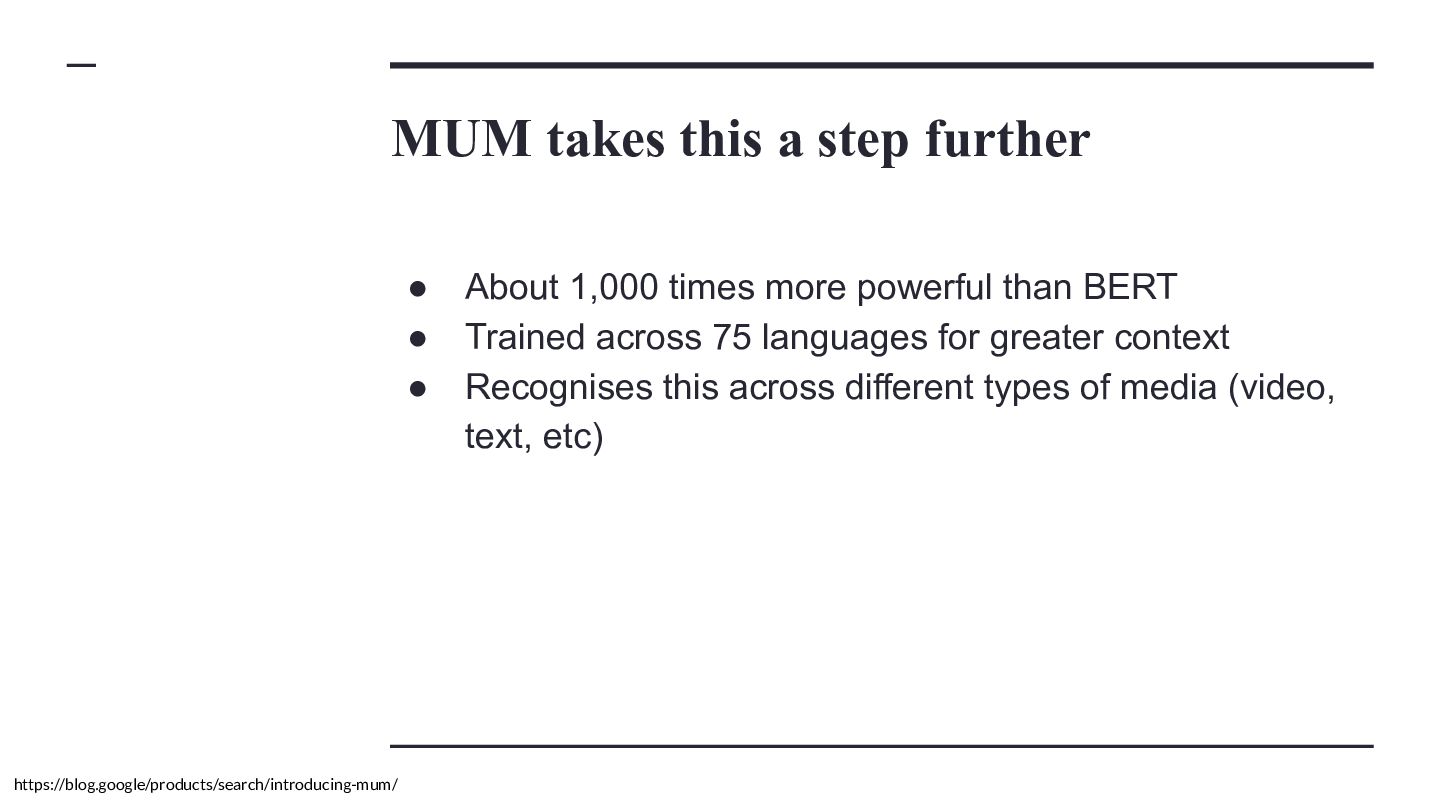
  10. MUM takes this a step further • About 1,000 times

    more powerful than BERT • Trained across 75 languages for greater context • Recognises this across different types of media (video, text, etc) https://blog.google/products/search/introducing-mum/
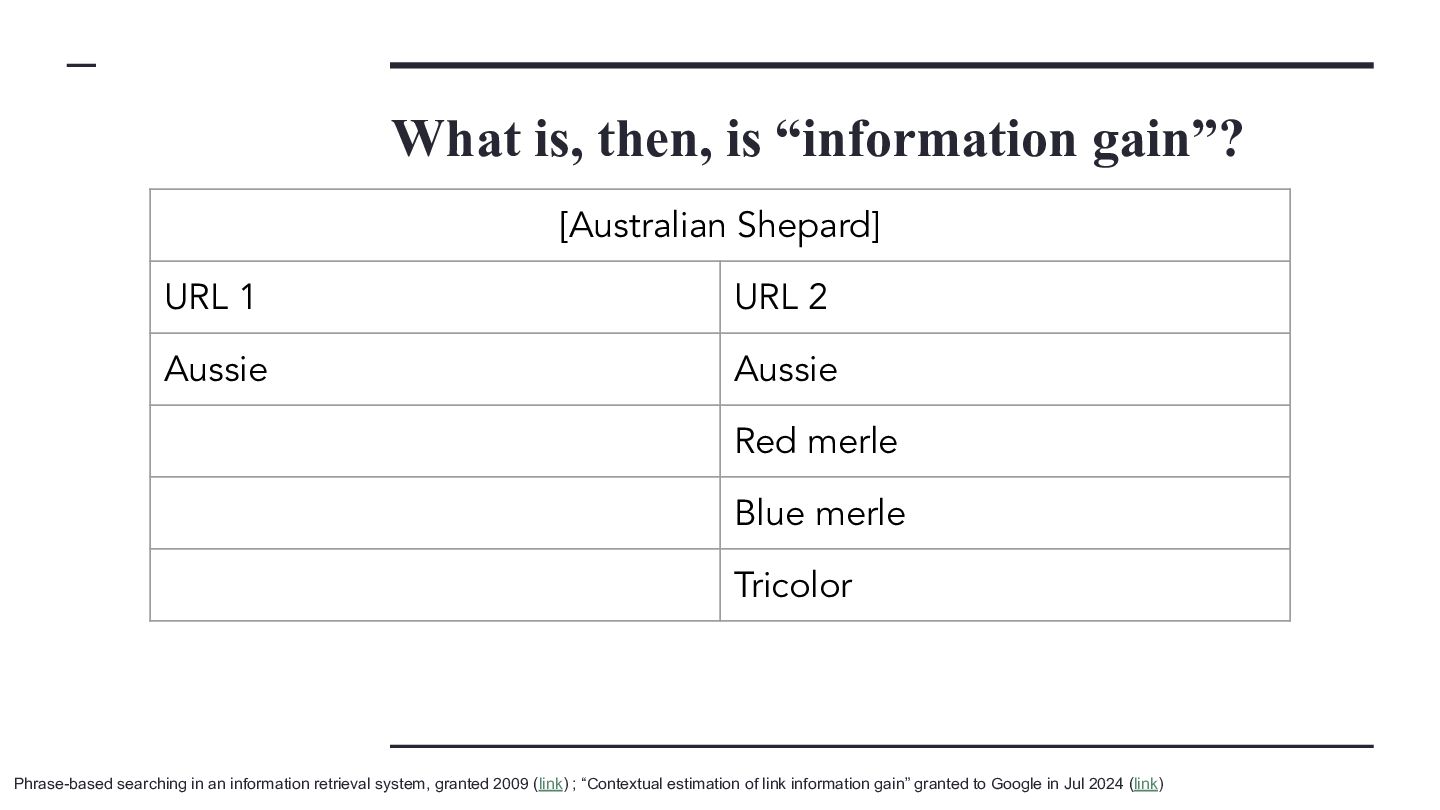
  11. What is, then, is “information gain”? Phrase-based searching in an

    information retrieval system, granted 2009 (link) ; “Contextual estimation of link information gain” granted to Google in Jul 2024 (link) [Australian Shepard] URL 1 URL 2 Aussie Aussie Red merle Blue merle Tricolor
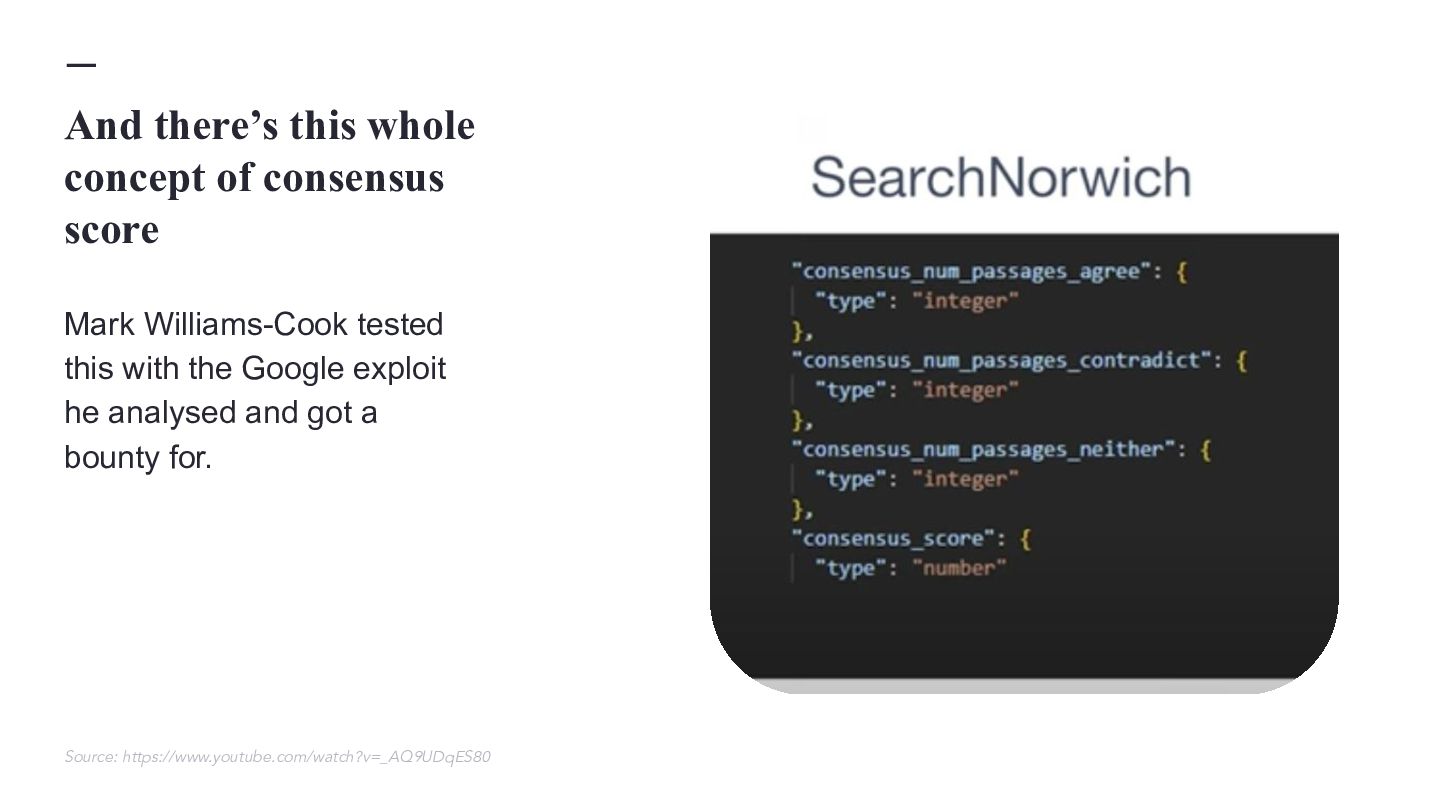
  12. And there’s this whole concept of consensus score Mark Williams-Cook

    tested this with the Google exploit he analysed and got a bounty for. Source: https://www.youtube.com/watch?v=_AQ9UDqES80
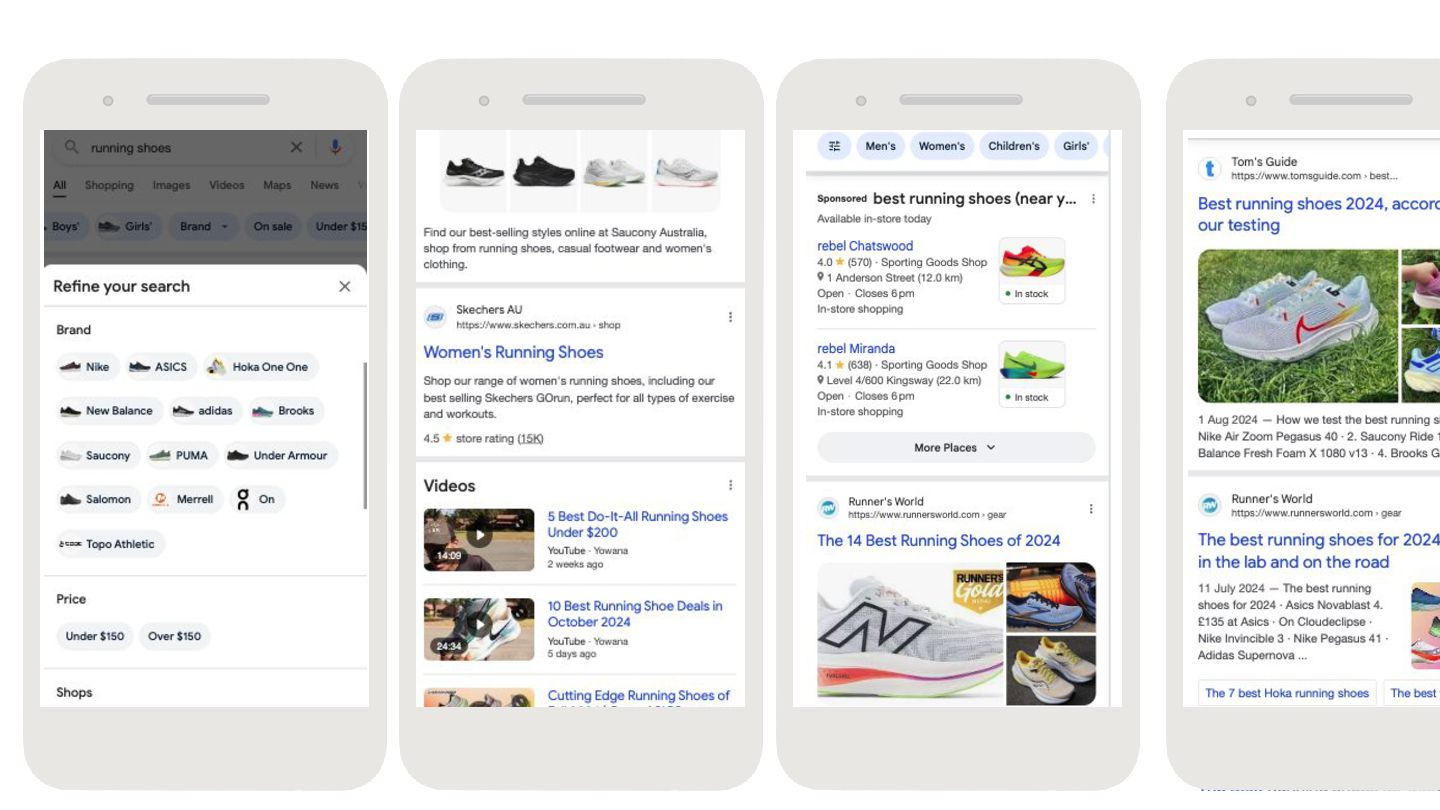
  13. Google ranks content on a lot of personal factors •

    Based on historical behaviour from similar searches in aggregate (application) • Based on external links (link) • Based on your own previous searches (link) • Based on or not it should directly provide the answer via Knowledge Graph (link) • Phrase- and entity-based co-occurrence threshold scores (link) • Understanding intent based on contextual information (link)
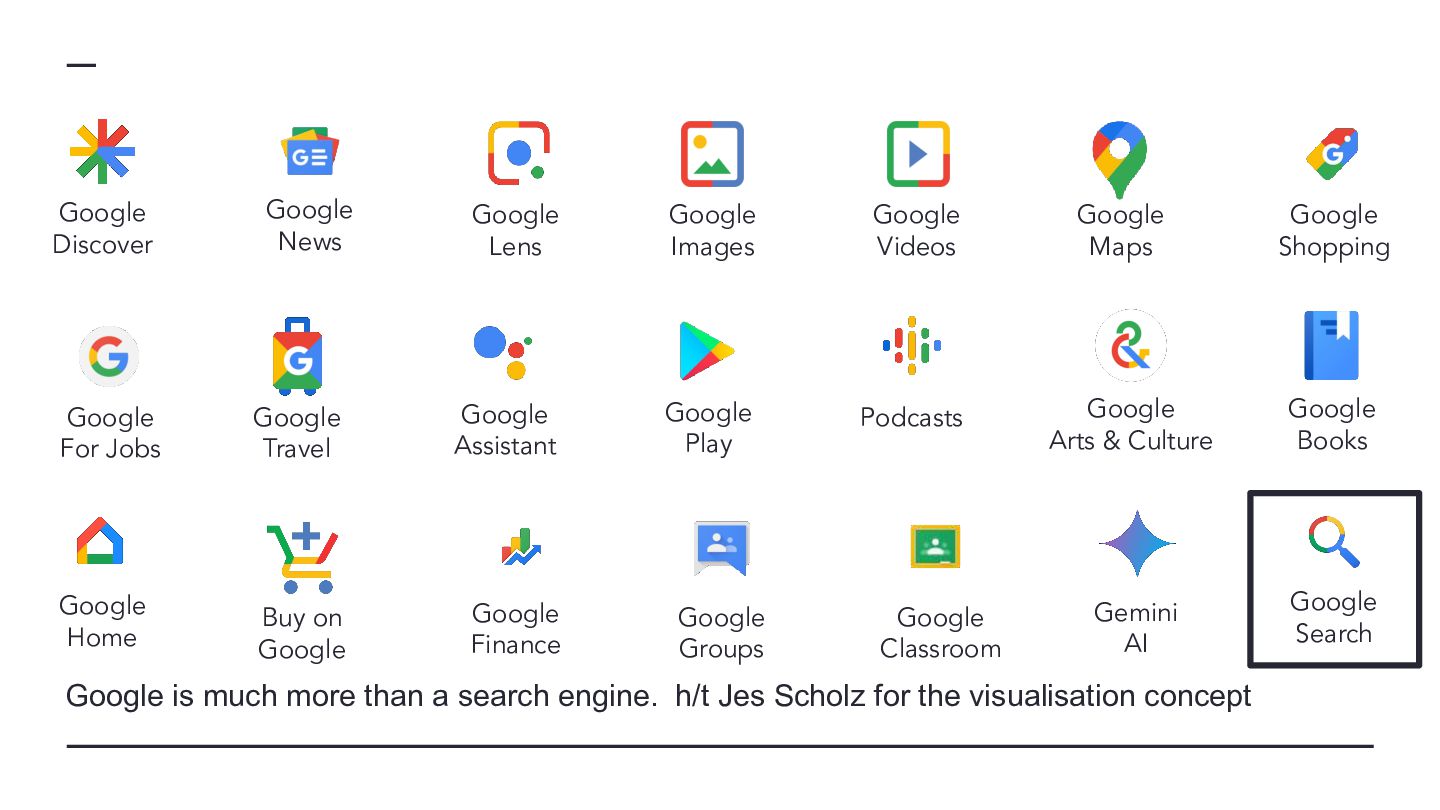
  14. Google is much more than a search engine. h/t Jes

    Scholz for the visualisation concept Google Home Google Groups Google Discover Google Lens Google Arts & Culture Google News Google Assistant Google Play Google Images Google Videos Google Maps Google Shopping Google For Jobs Podcasts Google Travel Buy on Google Google Finance Google Books Google Classroom Google Search Gemini AI
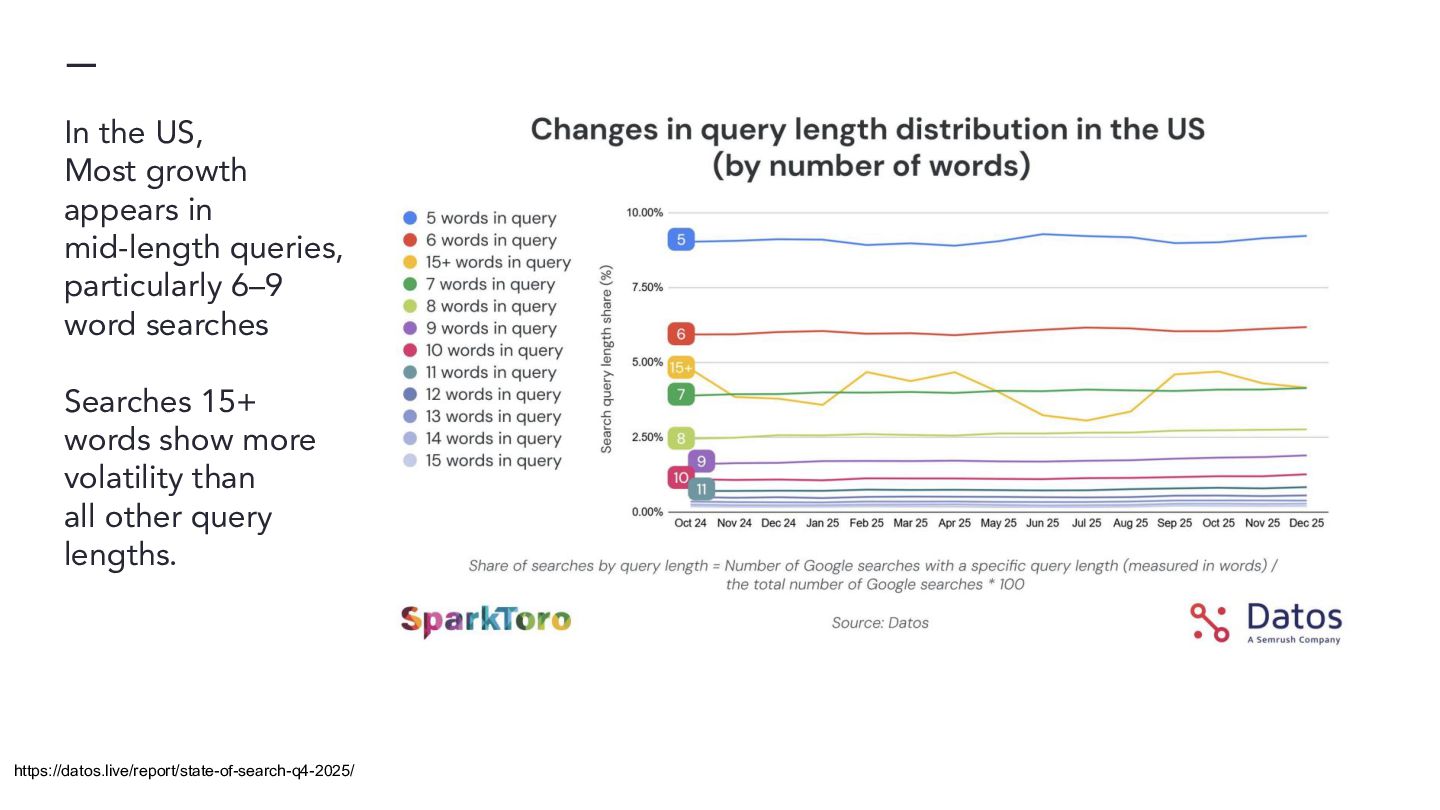
  15. In the US, Most growth appears in mid-length queries, particularly

    6–9 word searches Searches 15+ words show more volatility than all other query lengths. https://datos.live/report/state-of-search-q4-2025/
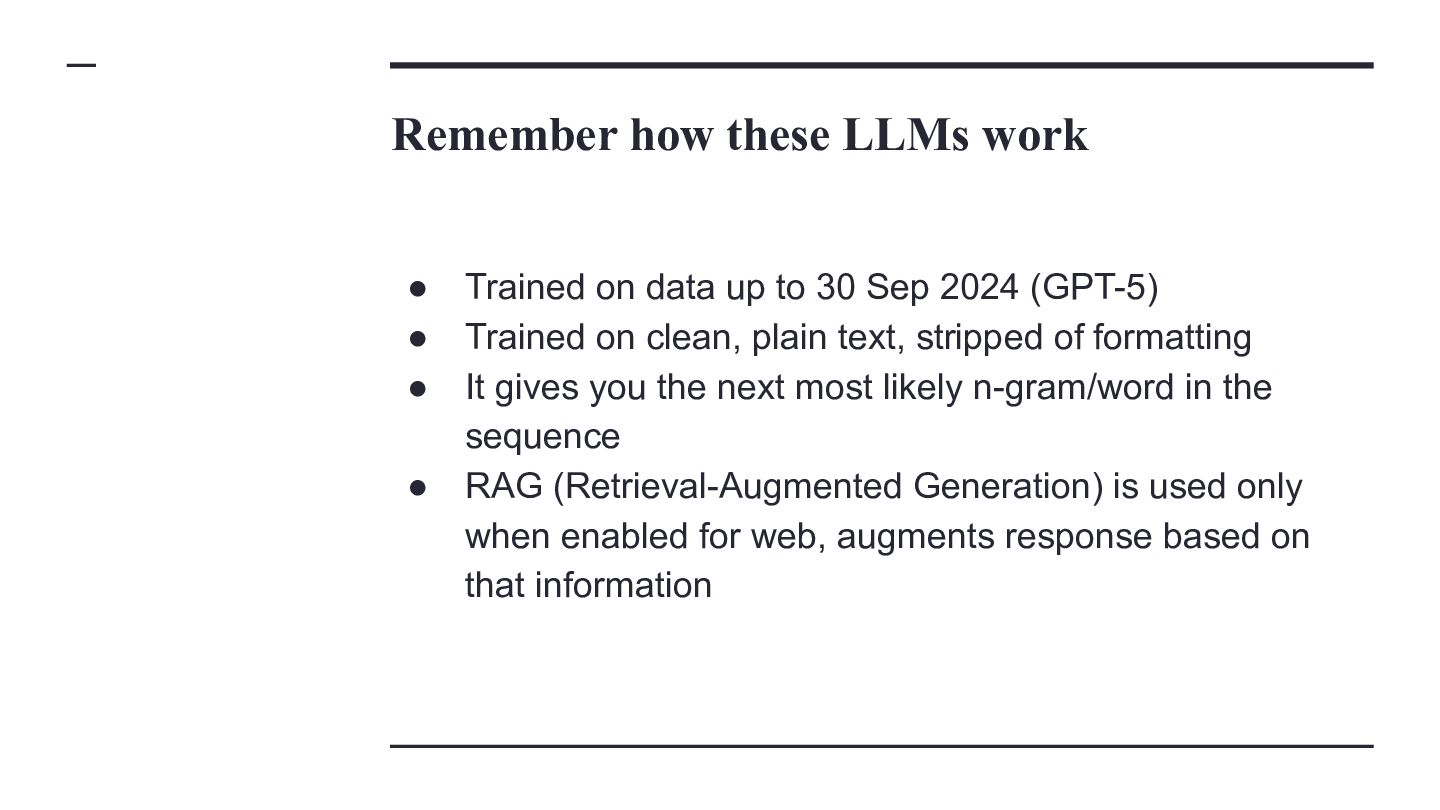
  16. Remember how these LLMs work • Trained on data up

    to 30 Sep 2024 (GPT-5) • Trained on clean, plain text, stripped of formatting • It gives you the next most likely n-gram/word in the sequence • RAG (Retrieval-Augmented Generation) is used only when enabled for web, augments response based on that information
  17. So, wtf. Why are we talking about “not keywords”, if

    LLM’s can’t even read my schema to understand an entity? Are keywords not the ideal?
  18. It’s about patterns and the implicit understanding of training data

    • Structured data and entity recognition is how you get on the shortlist to be a part of the RAG pipeline, or how you’re considered as a “good result” in the training data in the first place • When you codify how you talk about your brand and that’s consistent across channels, across media, across wherever you can control and influence, that’s a pattern LLM’s can recognise and interpolate
  19. What’s all this about ‘fan out’ 1. Query becomes vectors

    2. Use a decoder to create x number of variations on that query 3. Run these x query variations through a small, fast model simultaneously 4. Each variation returns small text snippets from a corpus 5. A confidence threshold (either fixed or dynamic) decides which results to keep 6. The selection process for these snippets is a black box - we don't control how they're chosen from the source pages
  20. Less might be more Because we want to make sure

    the content we do have is relevant to the industry and up-to-date
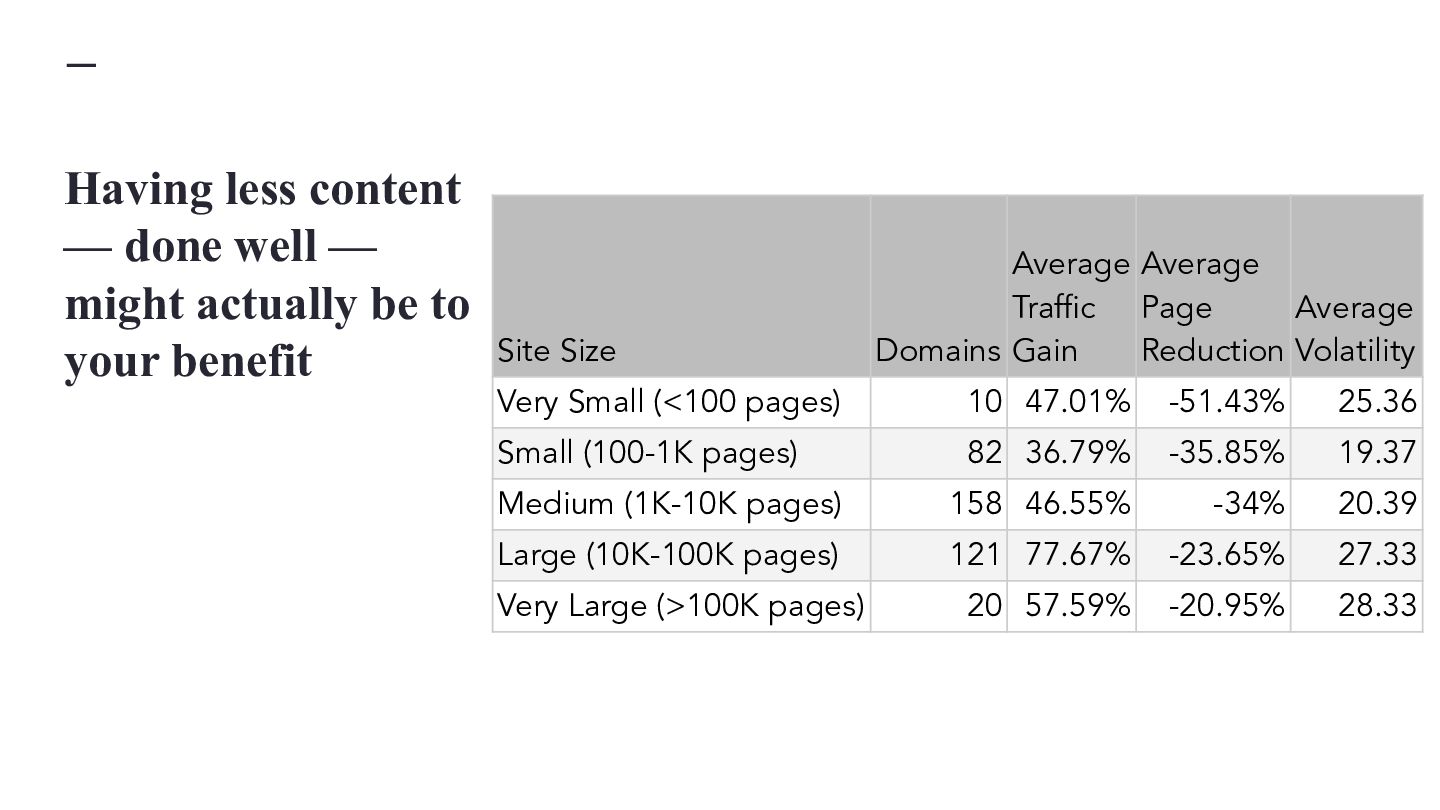
  21. Having less content — done well — might actually be

    to your benefit Site Size Domains Average Traffic Gain Average Page Reduction Average Volatility Very Small (<100 pages) 10 47.01% -51.43% 25.36 Small (100-1K pages) 82 36.79% -35.85% 19.37 Medium (1K-10K pages) 158 46.55% -34% 20.39 Large (10K-100K pages) 121 77.67% -23.65% 27.33 Very Large (>100K pages) 20 57.59% -20.95% 28.33
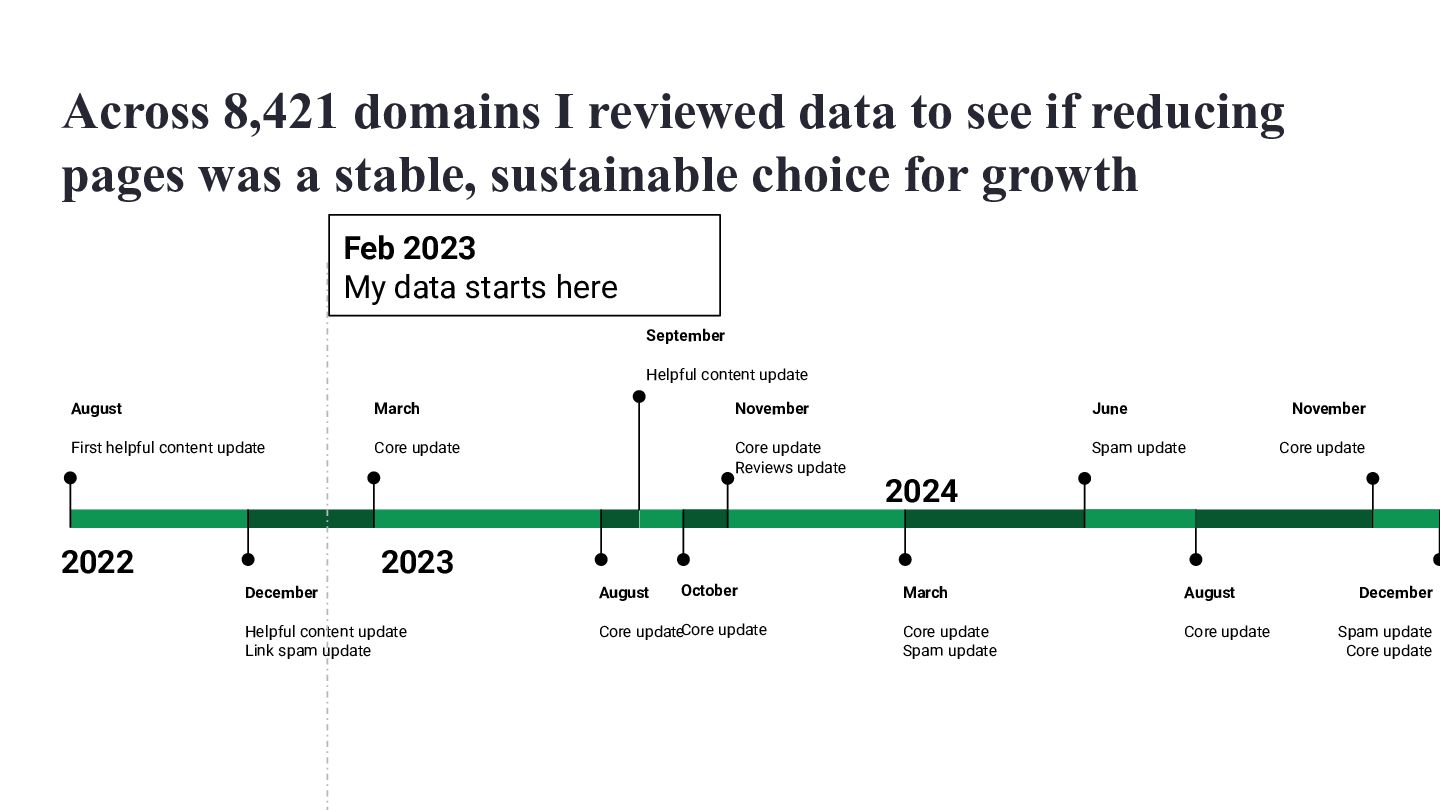
  22. Across 8,421 domains I reviewed data to see if reducing

    pages was a stable, sustainable choice for growth 2022 August First helpful content update December Helpful content update Link spam update 2023 March Core update August Core update September Helpful content update October Core update November Core update Reviews update 2024 March Core update Spam update June Spam update November Core update December Spam update Core update August Core update Feb 2023 My data starts here
  23. I aimed to play in the “middle of the road”

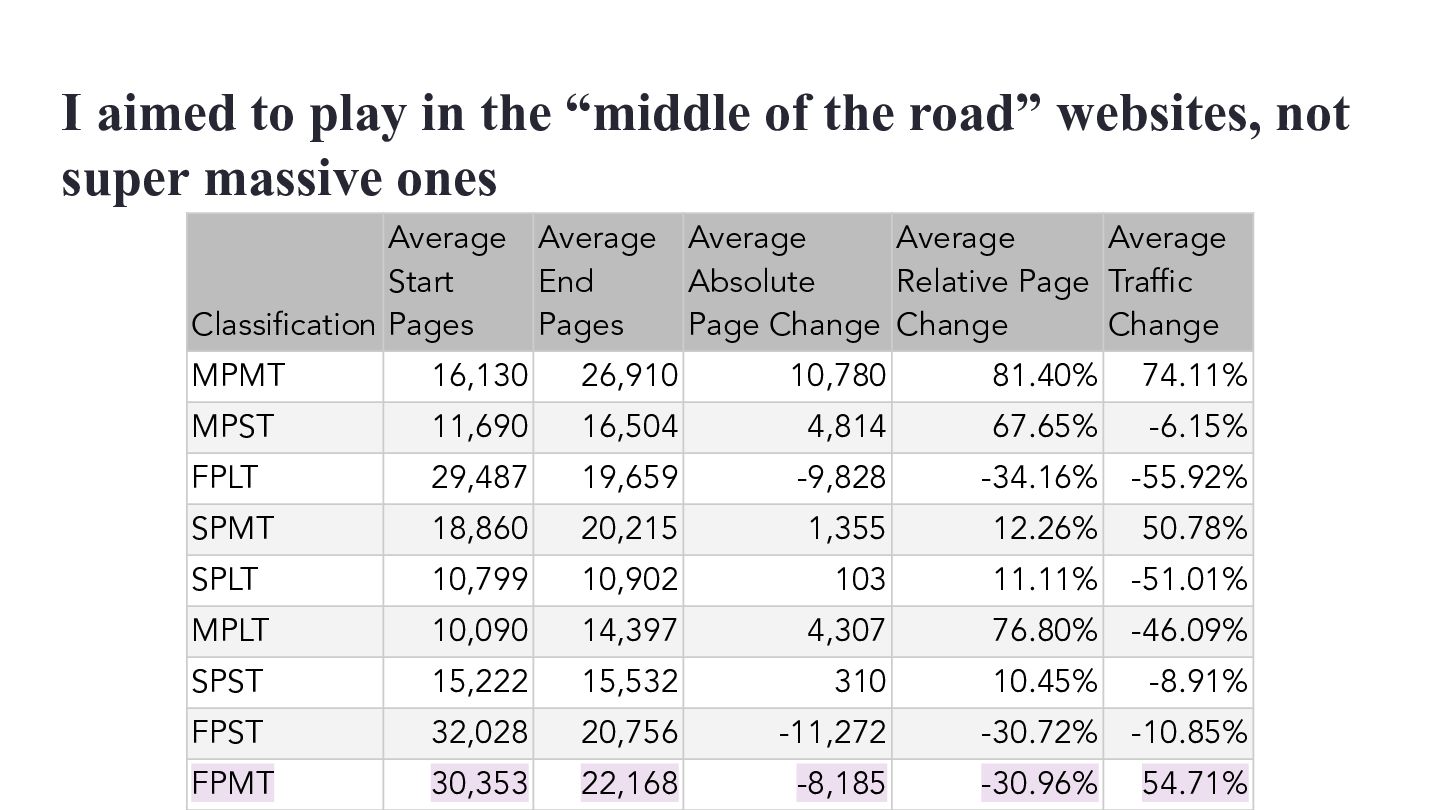
    websites, not super massive ones Classification Average Start Pages Average End Pages Average Absolute Page Change Average Relative Page Change Average Traffic Change MPMT 16,130 26,910 10,780 81.40% 74.11% MPST 11,690 16,504 4,814 67.65% -6.15% FPLT 29,487 19,659 -9,828 -34.16% -55.92% SPMT 18,860 20,215 1,355 12.26% 50.78% SPLT 10,799 10,902 103 11.11% -51.01% MPLT 10,090 14,397 4,307 76.80% -46.09% SPST 15,222 15,532 310 10.45% -8.91% FPST 32,028 20,756 -11,272 -30.72% -10.85% FPMT 30,353 22,168 -8,185 -30.96% 54.71%
  24. This was an interesting way to start the analysis Fewer

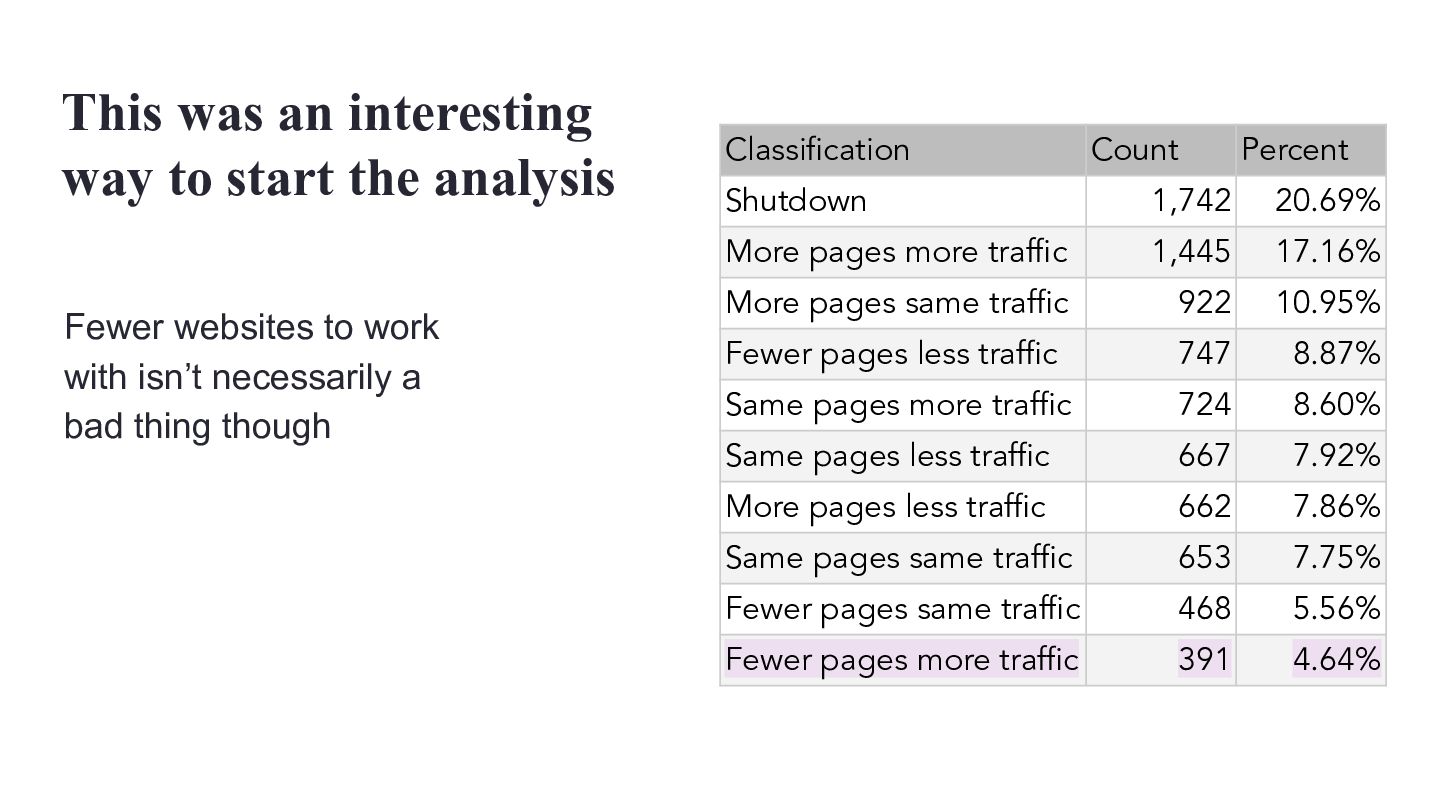
    websites to work with isn’t necessarily a bad thing though Classification Count Percent Shutdown 1,742 20.69% More pages more traffic 1,445 17.16% More pages same traffic 922 10.95% Fewer pages less traffic 747 8.87% Same pages more traffic 724 8.60% Same pages less traffic 667 7.92% More pages less traffic 662 7.86% Same pages same traffic 653 7.75% Fewer pages same traffic 468 5.56% Fewer pages more traffic 391 4.64%
  25. Reviewing specific industries show publications and YMYL tried this and

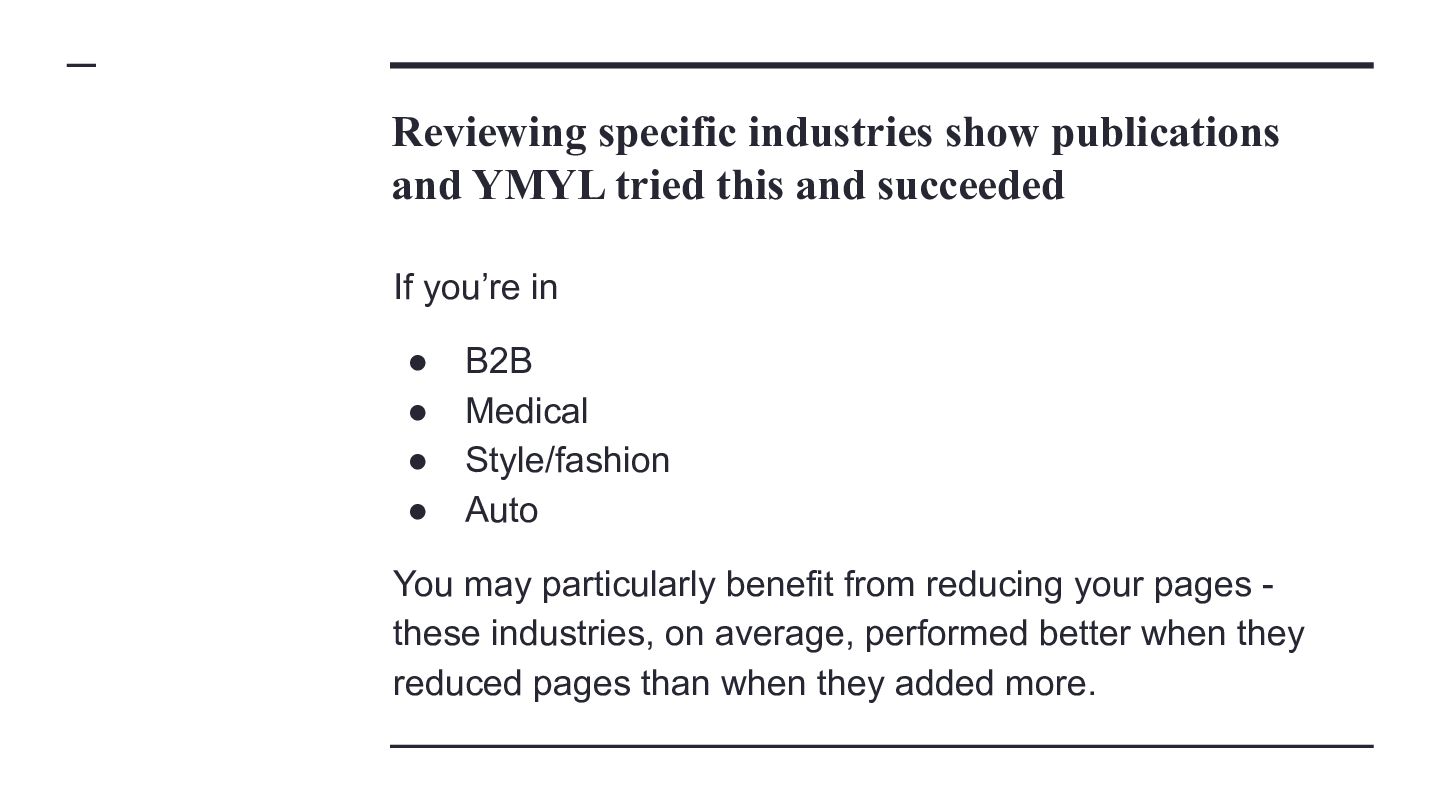
    succeeded If you’re in • B2B • Medical • Style/fashion • Auto You may particularly benefit from reducing your pages - these industries, on average, performed better when they reduced pages than when they added more.
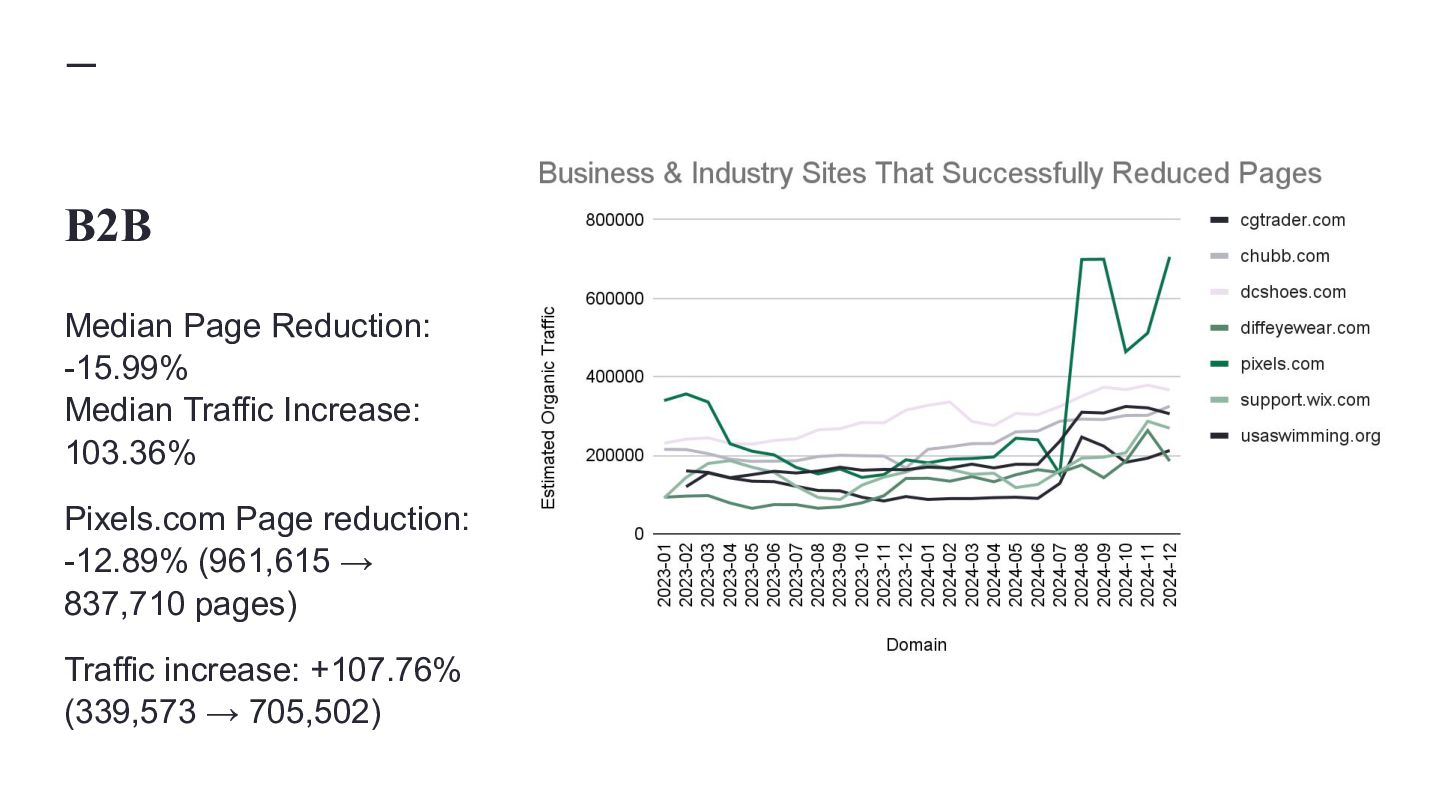
  26. B2B Median Page Reduction: -15.99% Median Traffic Increase: 103.36% Pixels.com

    Page reduction: -12.89% (961,615 → 837,710 pages) Traffic increase: +107.76% (339,573 → 705,502)
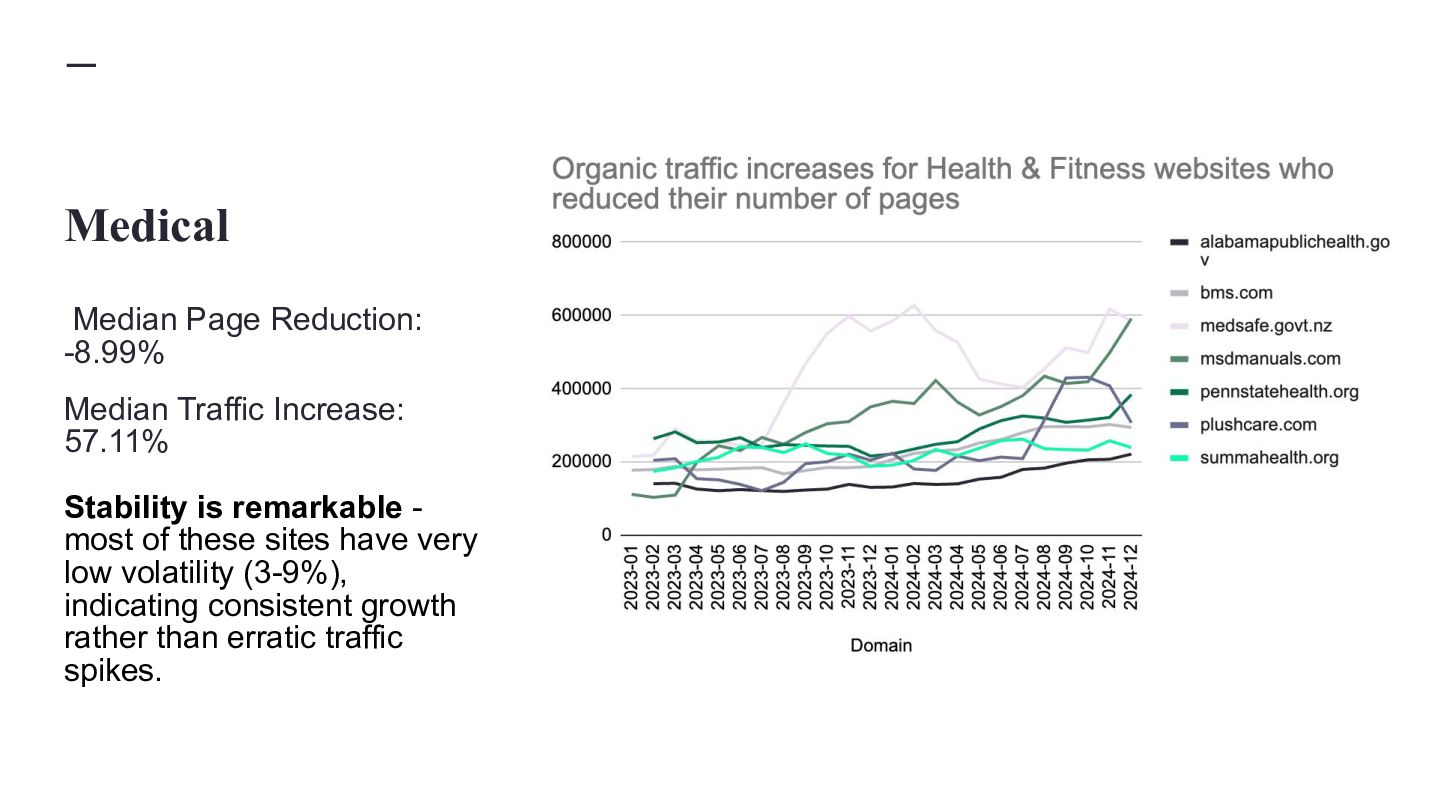
  27. Medical Median Page Reduction: -8.99% Median Traffic Increase: 57.11% Stability

    is remarkable - most of these sites have very low volatility (3-9%), indicating consistent growth rather than erratic traffic spikes.
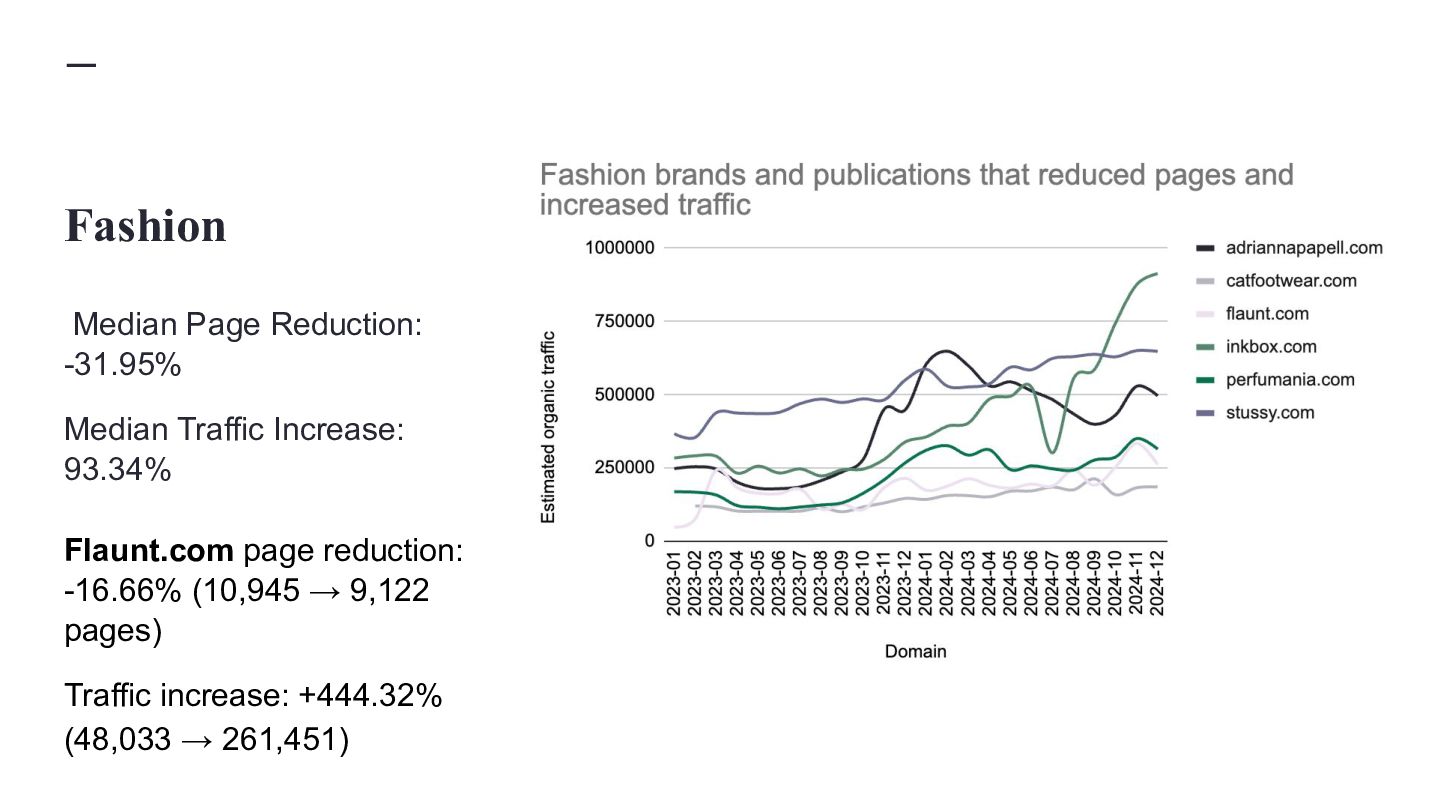
  28. Fashion Median Page Reduction: -31.95% Median Traffic Increase: 93.34% Flaunt.com

    page reduction: -16.66% (10,945 → 9,122 pages) Traffic increase: +444.32% (48,033 → 261,451)
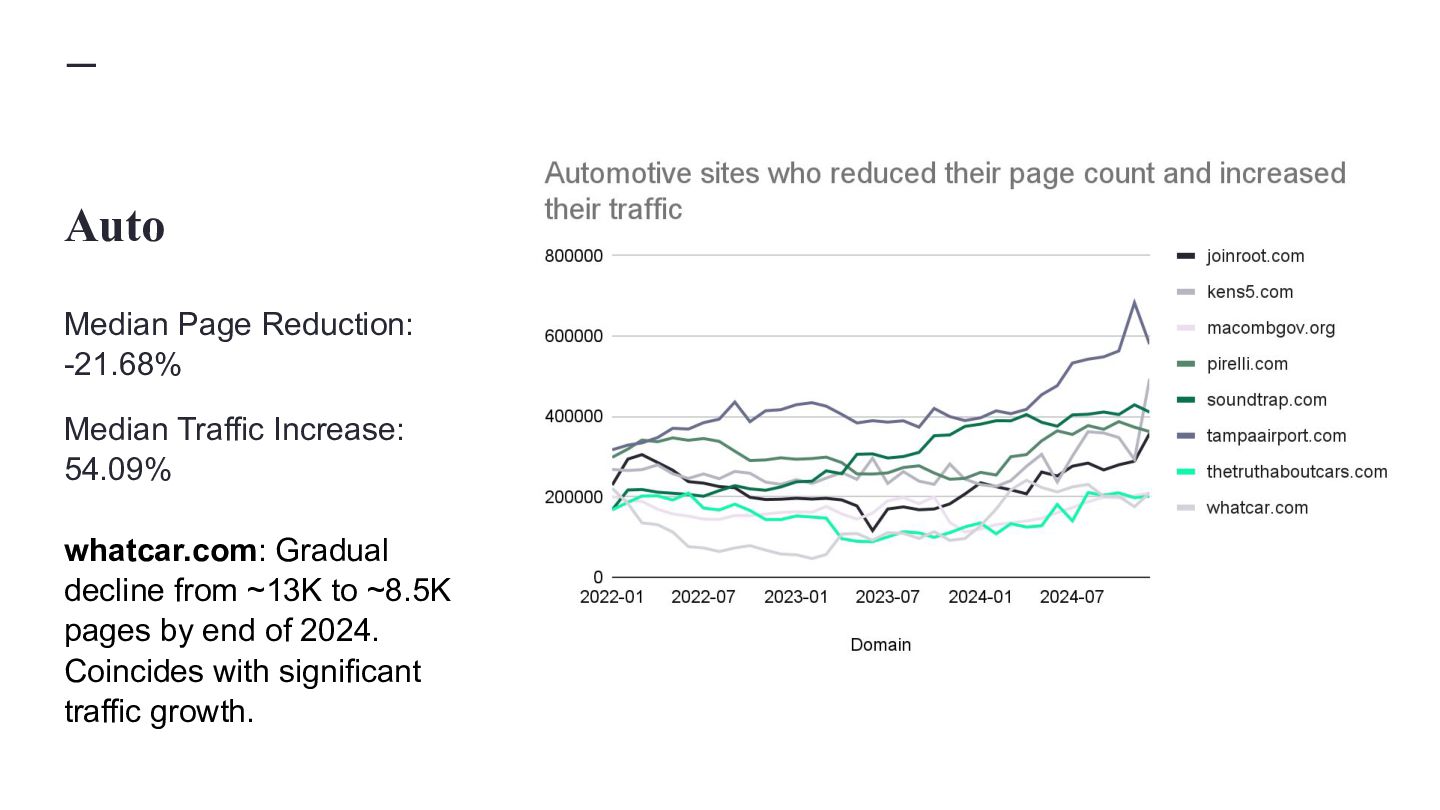
  29. Auto Median Page Reduction: -21.68% Median Traffic Increase: 54.09% whatcar.com:

    Gradual decline from ~13K to ~8.5K pages by end of 2024. Coincides with significant traffic growth.
  30. Less is more—if you’re not sure, be super targeted in

    what you consolidate Sweet spot: -10% to -20% reduction in content shows the highest traffic gains at 70.74%. Minimal page reductions (0-10%) produced substantial traffic gains (54.8%) with the highest stability rating (83.78%).
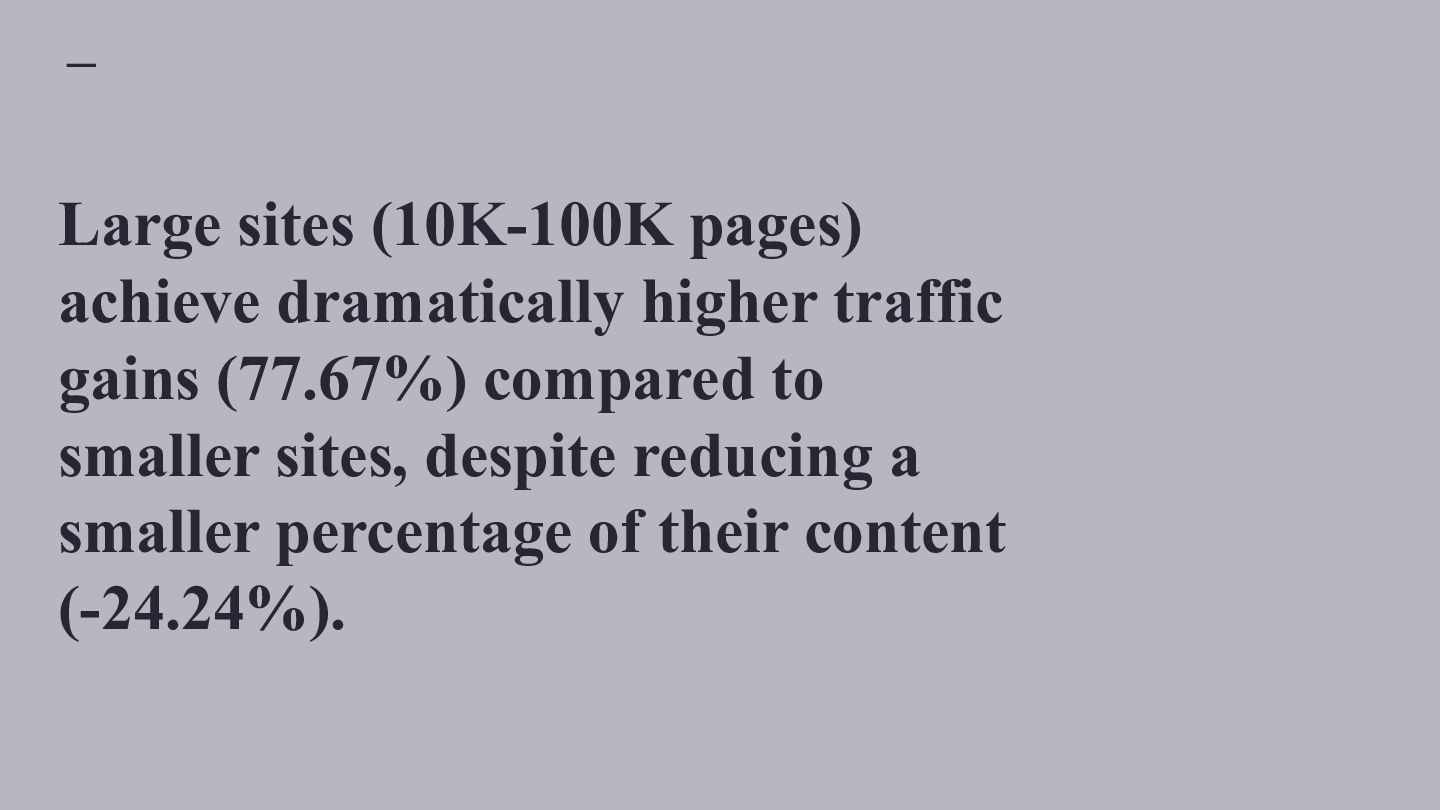
  31. Large sites (10K-100K pages) achieve dramatically higher traffic gains (77.67%)

    compared to smaller sites, despite reducing a smaller percentage of their content (-24.24%).
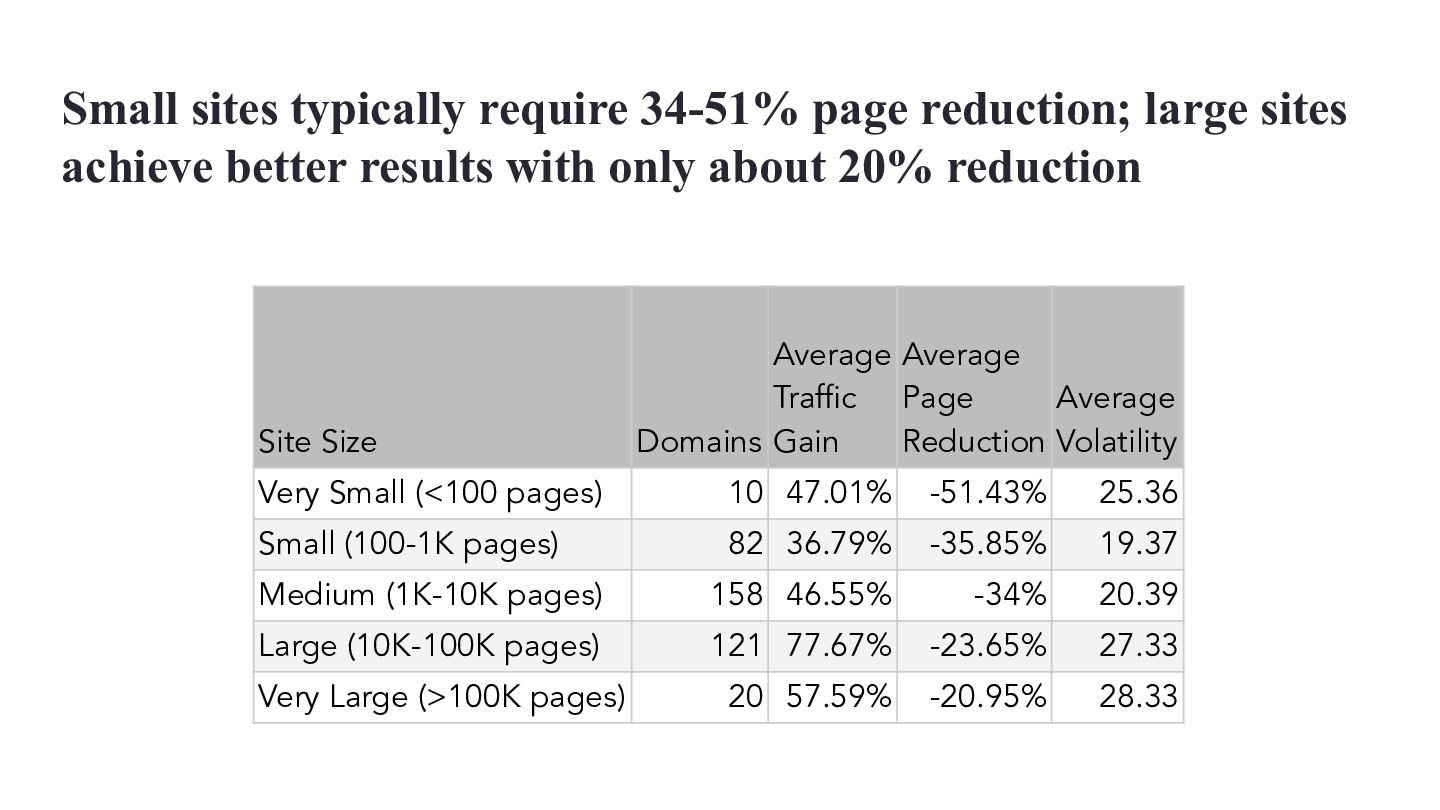
  32. Small sites typically require 34-51% page reduction; large sites achieve

    better results with only about 20% reduction Site Size Domains Average Traffic Gain Average Page Reduction Average Volatility Very Small (<100 pages) 10 47.01% -51.43% 25.36 Small (100-1K pages) 82 36.79% -35.85% 19.37 Medium (1K-10K pages) 158 46.55% -34% 20.39 Large (10K-100K pages) 121 77.67% -23.65% 27.33 Very Large (>100K pages) 20 57.59% -20.95% 28.33
  33. Based on the patterns I’m seeing, gradual, specific page reductions

    (likely content consolidation) are the more successful method to approach page reduction
  34. Where YMYL starts, the rest of the Internet will likely

    follow: plan to consolidate your content by 10-20% in the next 18 months.
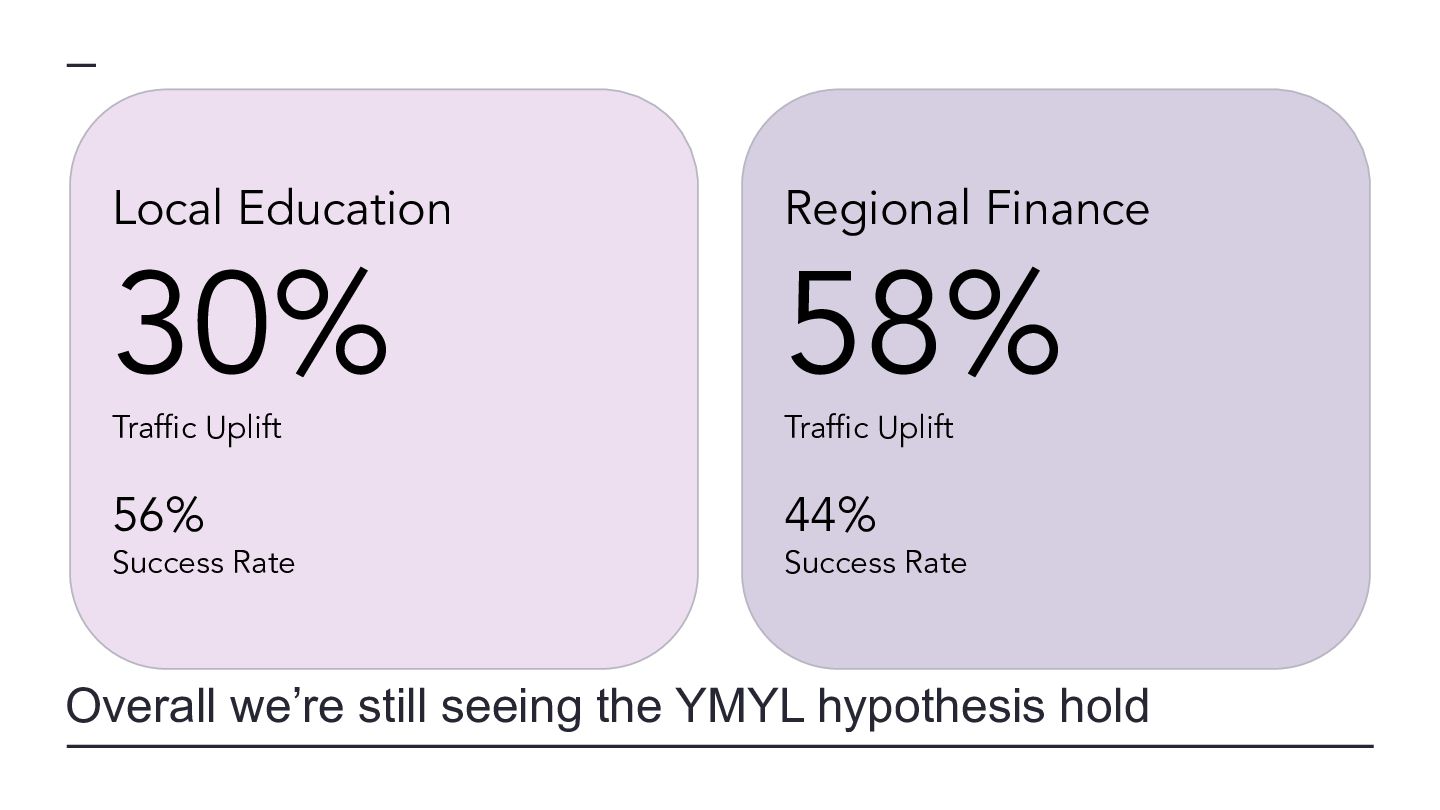
  35. Overall we’re still seeing the YMYL hypothesis hold Local Education

    30% Traffic Uplift 56% Success Rate Regional Finance 58% Traffic Uplift 44% Success Rate
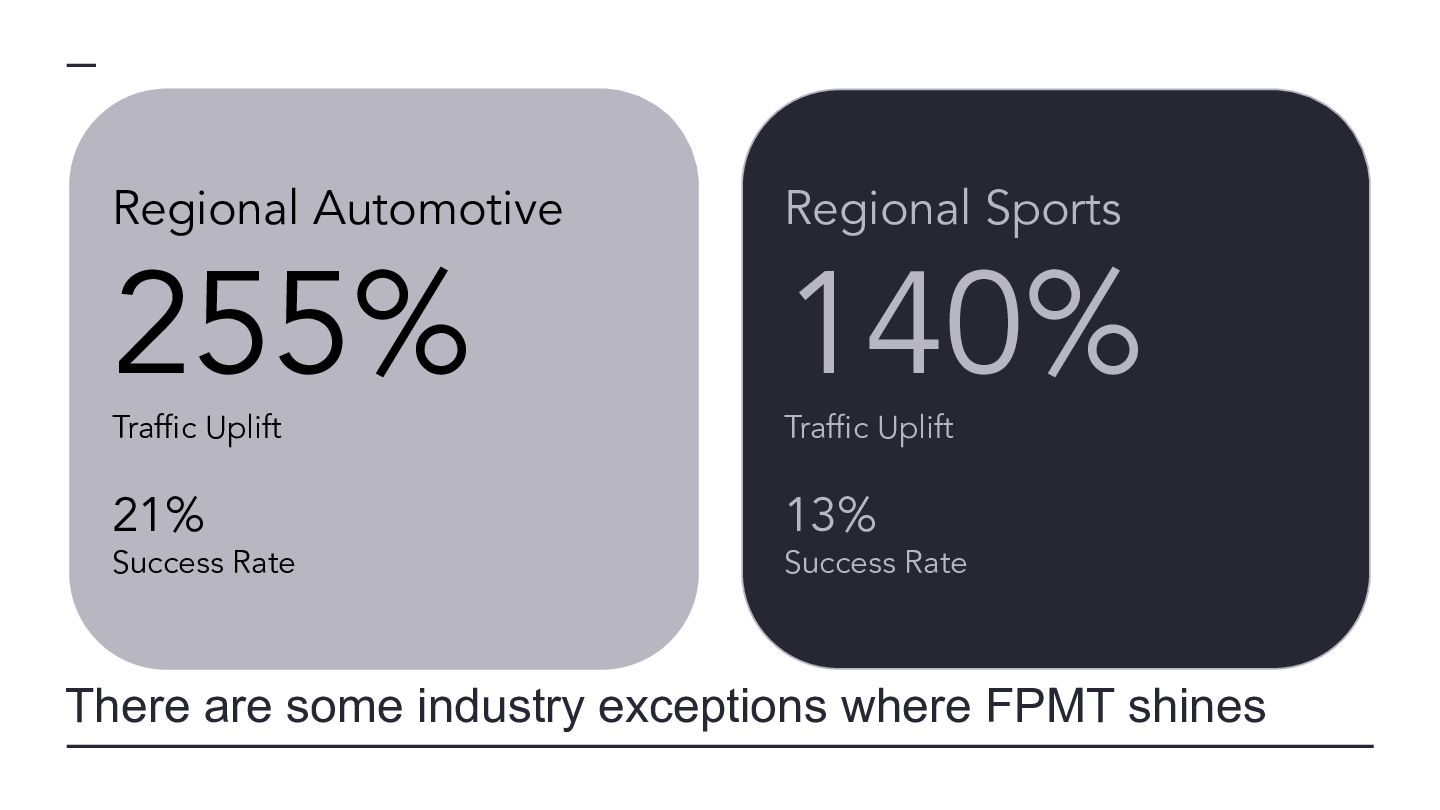
  36. There are some industry exceptions where FPMT shines Regional Automotive

    255% Traffic Uplift 21% Success Rate Regional Sports 140% Traffic Uplift 13% Success Rate
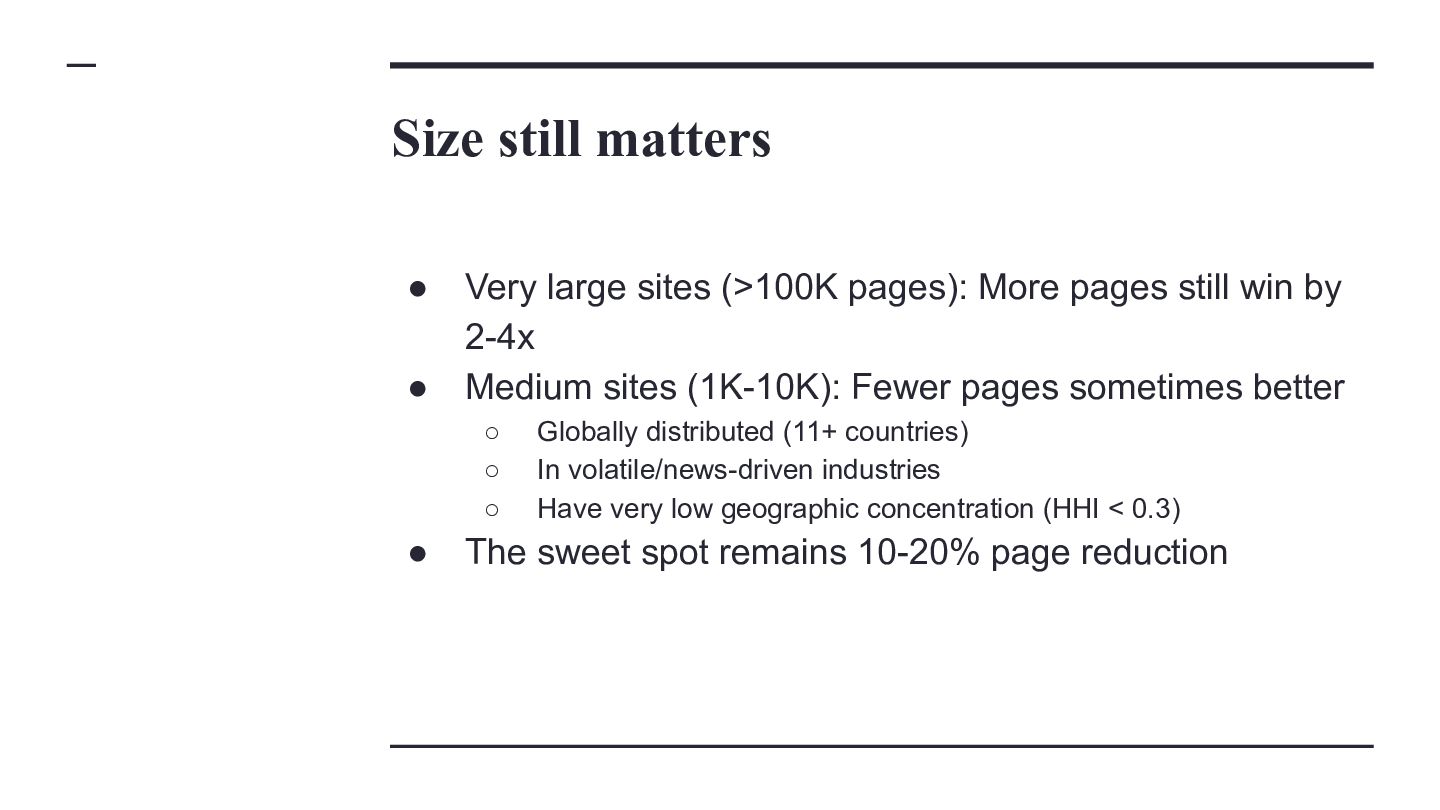
  37. Size still matters • Very large sites (>100K pages): More

    pages still win by 2-4x • Medium sites (1K-10K): Fewer pages sometimes better ◦ Globally distributed (11+ countries) ◦ In volatile/news-driven industries ◦ Have very low geographic concentration (HHI < 0.3) • The sweet spot remains 10-20% page reduction
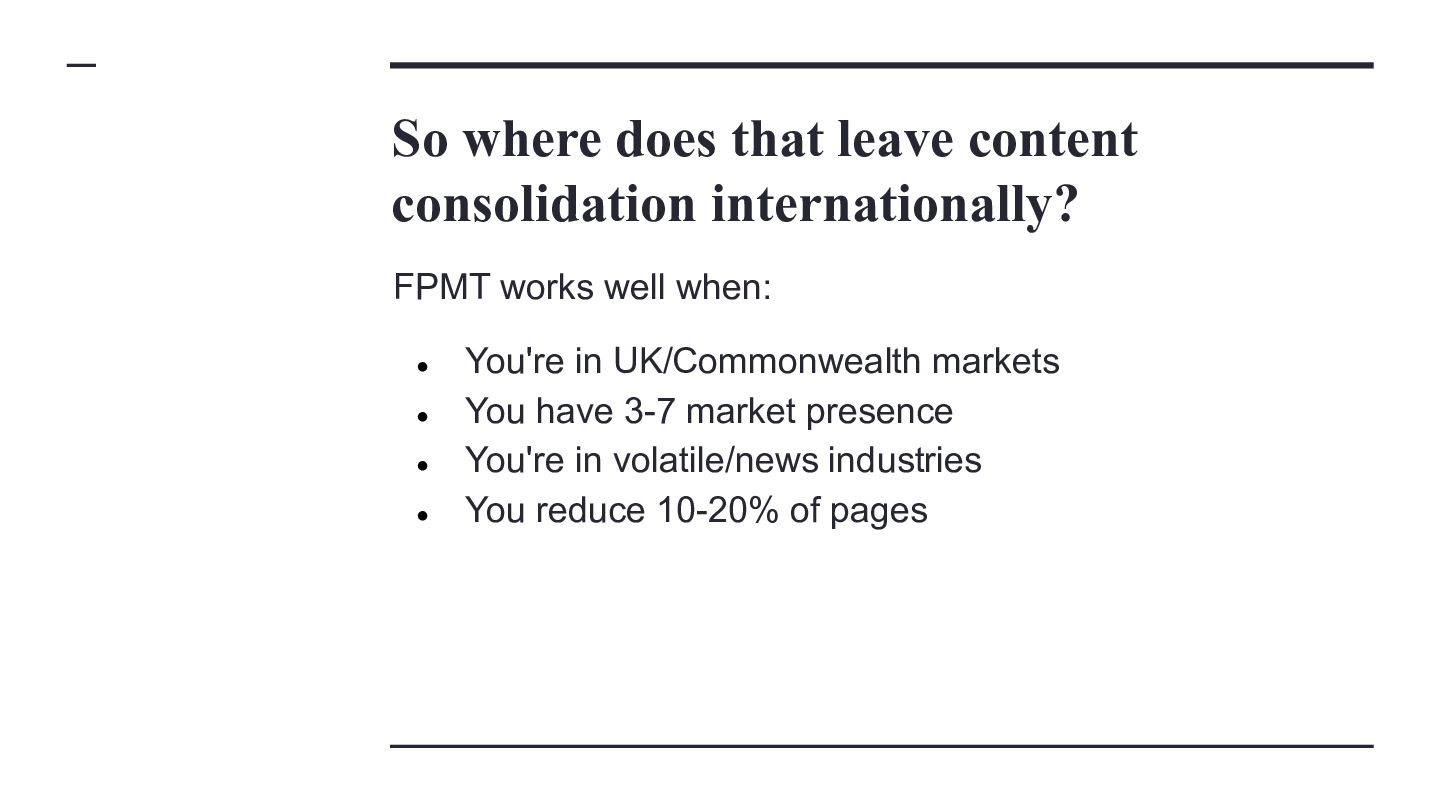
  38. So where does that leave content consolidation internationally? FPMT works

    well when: • You're in UK/Commonwealth markets • You have 3-7 market presence • You're in volatile/news industries • You reduce 10-20% of pages
  39. If you only come away with one insight… US-focused sites:

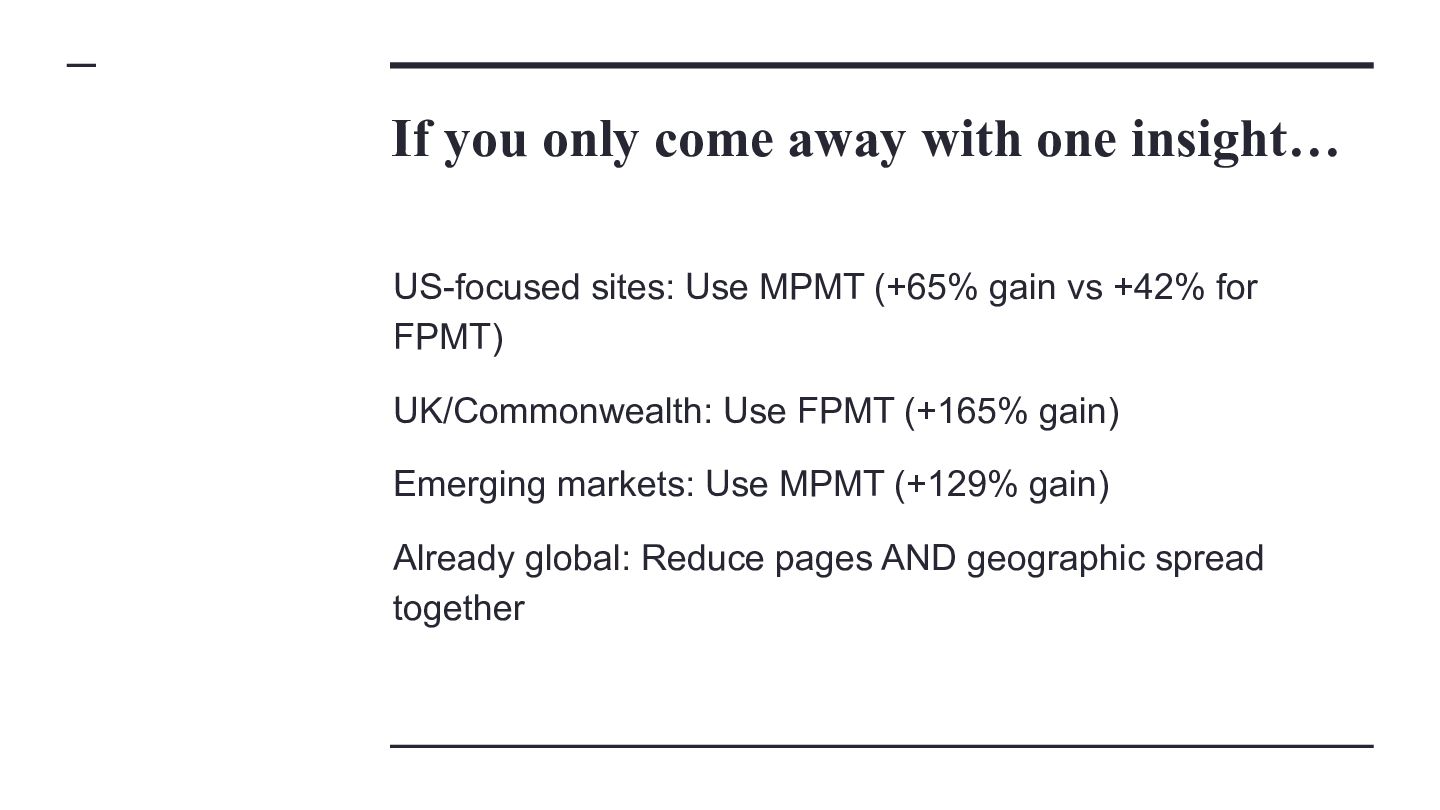
    Use MPMT (+65% gain vs +42% for FPMT) UK/Commonwealth: Use FPMT (+165% gain) Emerging markets: Use MPMT (+129% gain) Already global: Reduce pages AND geographic spread together
  40. Clean out your archives Steps to implement to be on

    the more favourable end of reducing the pages on your website
  41. We know folks have failed doing this, so 1. Find

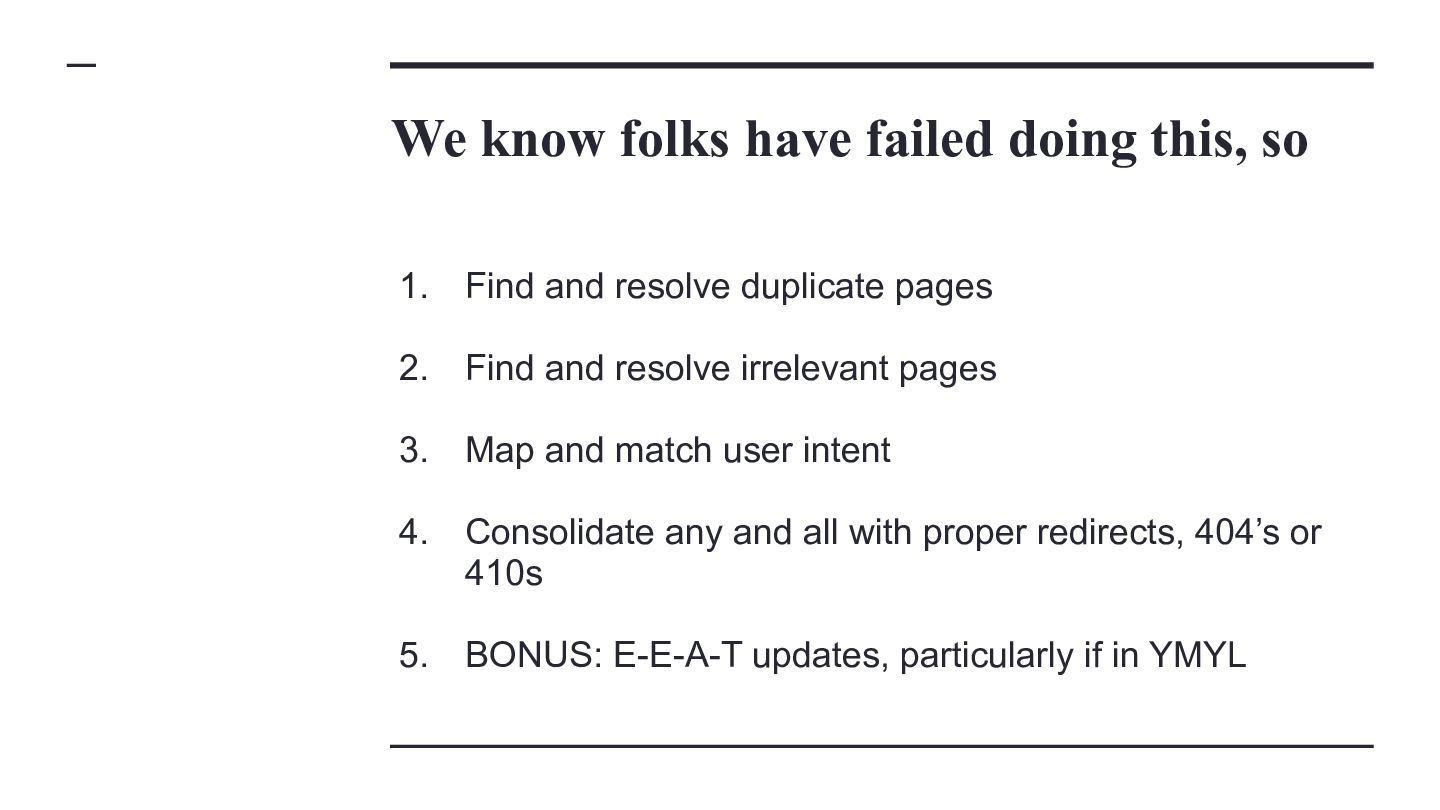
    and resolve duplicate pages 2. Find and resolve irrelevant pages 3. Map and match user intent 4. Consolidate any and all with proper redirects, 404’s or 410s 5. BONUS: E-E-A-T updates, particularly if in YMYL
  42. Find your duplicate content Do this at scale by using

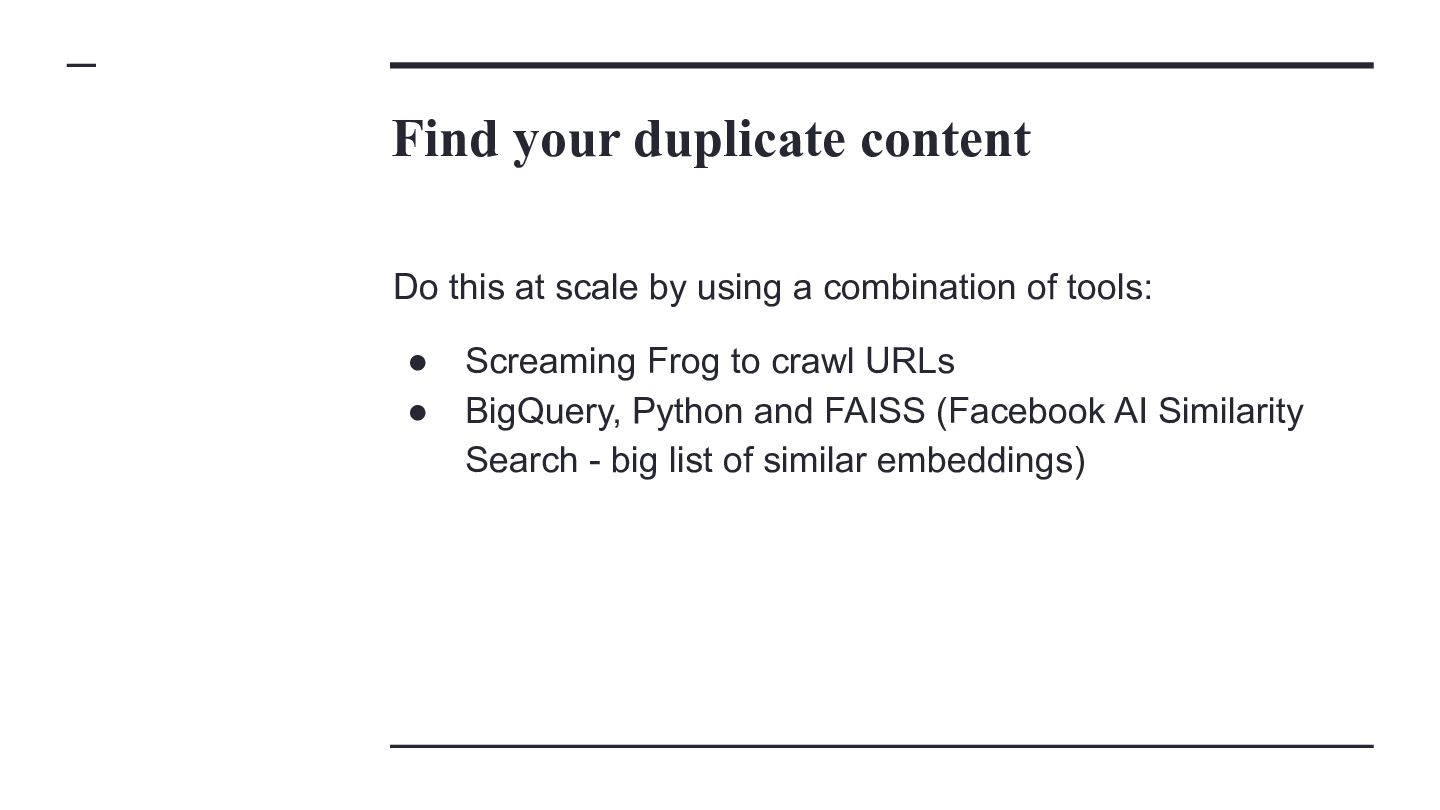
    a combination of tools: • Screaming Frog to crawl URLs • BigQuery, Python and FAISS (Facebook AI Similarity Search - big list of similar embeddings)
  43. Or if you don’t have the time to do this

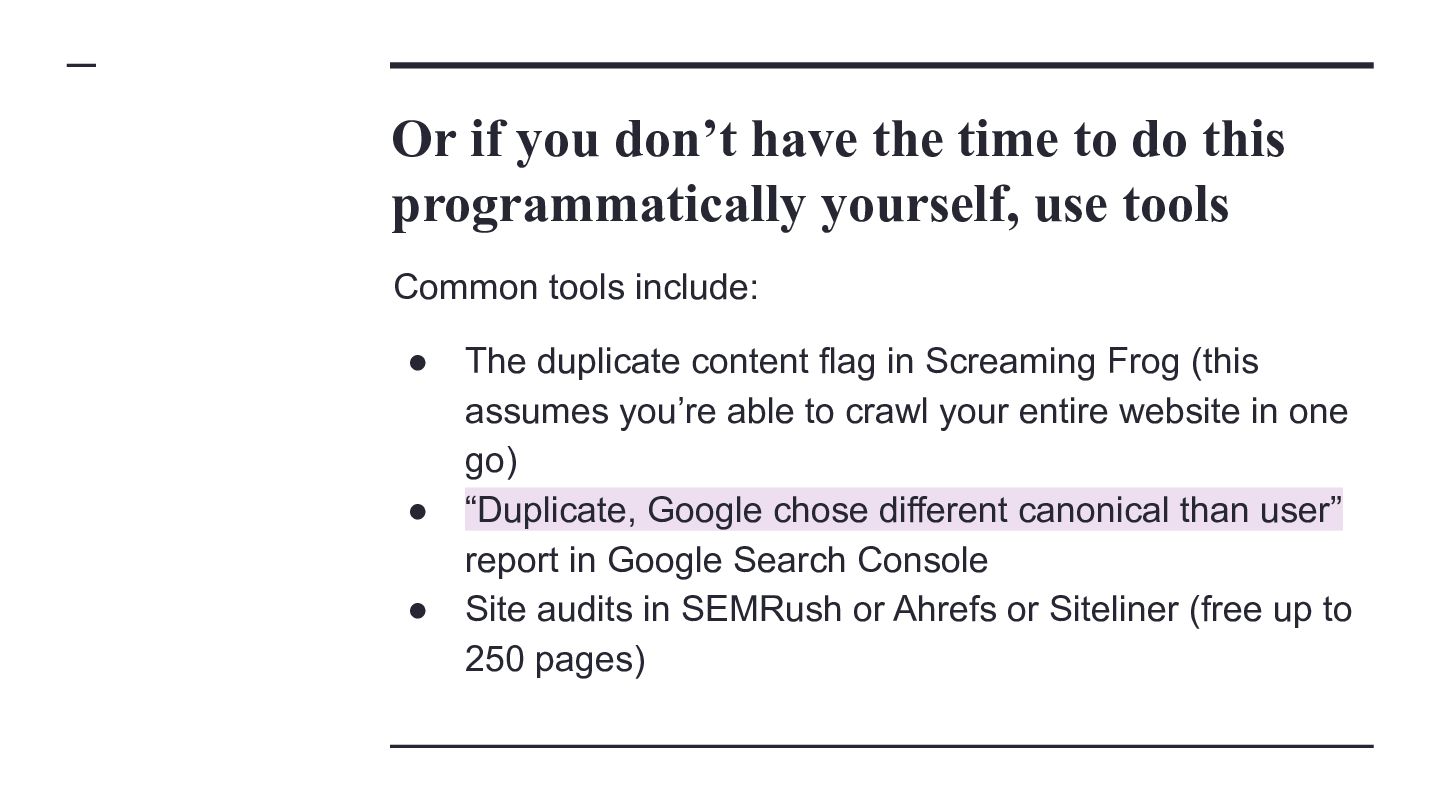
    programmatically yourself, use tools Common tools include: • The duplicate content flag in Screaming Frog (this assumes you’re able to crawl your entire website in one go) • “Duplicate, Google chose different canonical than user” report in Google Search Console • Site audits in SEMRush or Ahrefs or Siteliner (free up to 250 pages)
  44. Find your irrelevant content Analyse Search Console data at scale

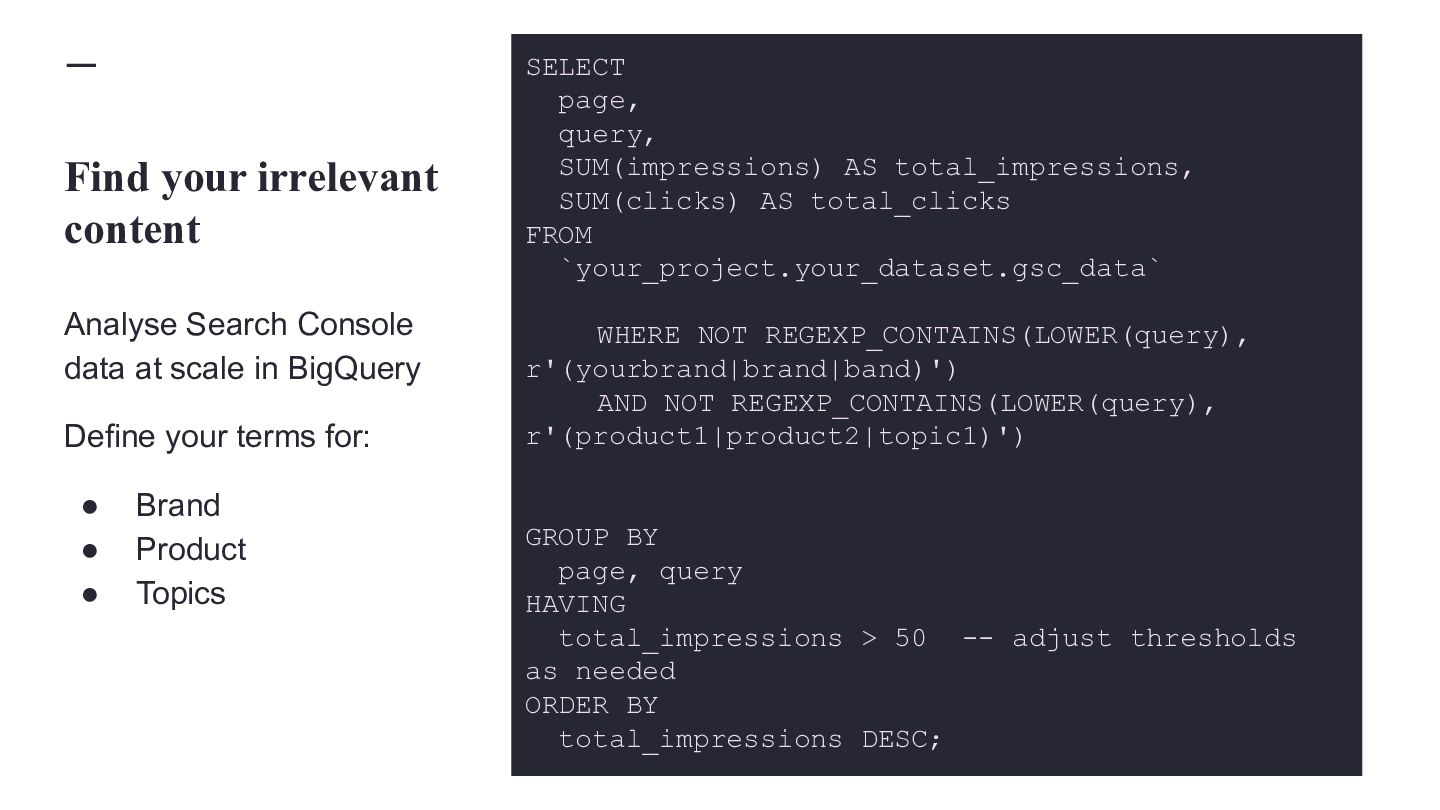
    in BigQuery Define your terms for: • Brand • Product • Topics SELECT page, query, SUM(impressions) AS total_impressions, SUM(clicks) AS total_clicks FROM `your_project.your_dataset.gsc_data` WHERE NOT REGEXP_CONTAINS(LOWER(query), r'(yourbrand|brand|band)') AND NOT REGEXP_CONTAINS(LOWER(query), r'(product1|product2|topic1)') GROUP BY page, query HAVING total_impressions > 50 -- adjust thresholds as needed ORDER BY total_impressions DESC;
  45. But what if I’m not sure what my topics are?

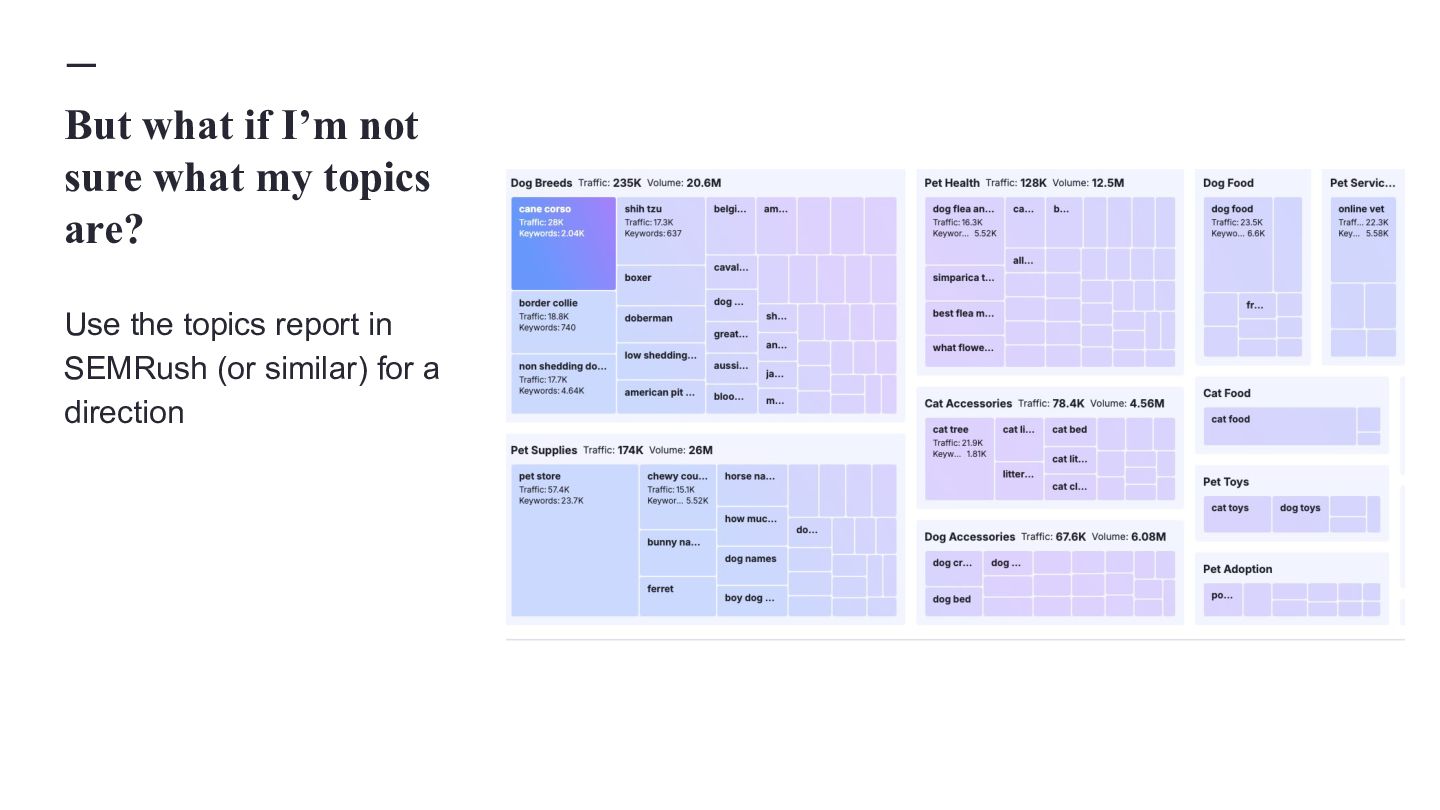
    Use the topics report in SEMRush (or similar) for a direction
  46. If you have more brainspace than I do, you could

    do this dynamically by automated relevance scoring with your brand proposition copy analysed against your query dataset using classifyText from Google’s Natural Language API
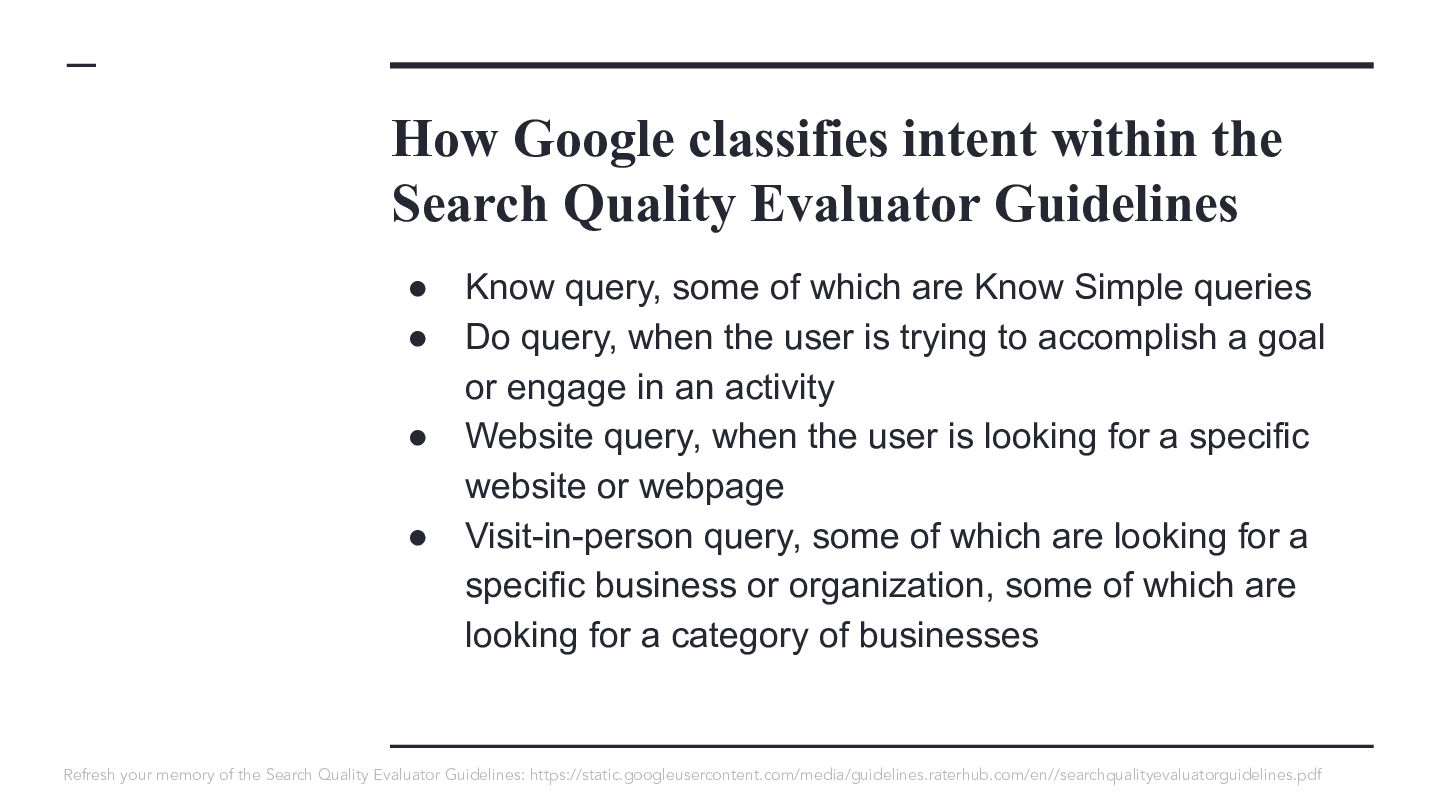
  47. How Google classifies intent within the Search Quality Evaluator Guidelines

    • Know query, some of which are Know Simple queries • Do query, when the user is trying to accomplish a goal or engage in an activity • Website query, when the user is looking for a specific website or webpage • Visit-in-person query, some of which are looking for a specific business or organization, some of which are looking for a category of businesses Refresh your memory of the Search Quality Evaluator Guidelines: https://static.googleusercontent.com/media/guidelines.raterhub.com/en//searchqualityevaluatorguidelines.pdf
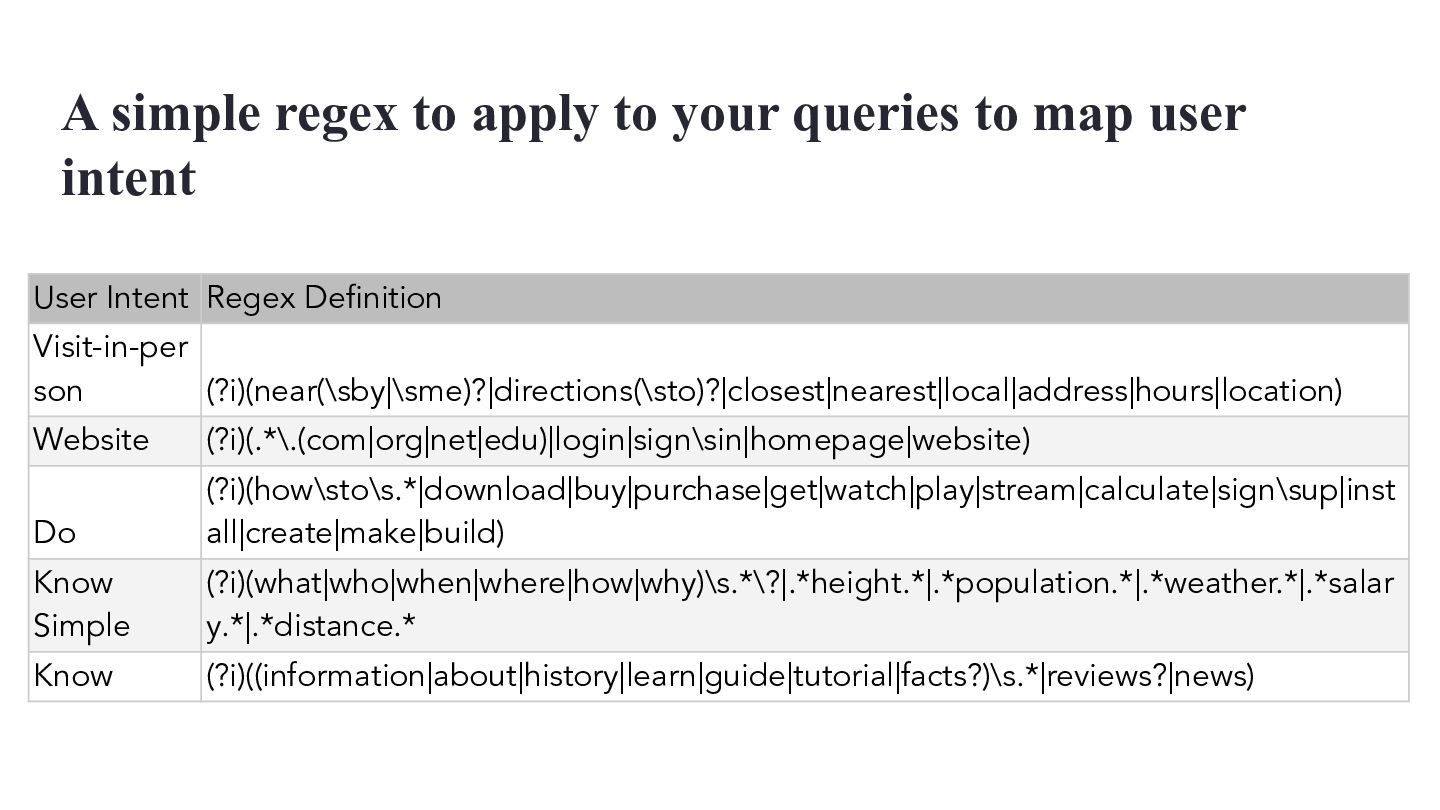
  48. A simple regex to apply to your queries to map

    user intent User Intent Regex Definition Visit-in-per son (?i)(near(\sby|\sme)?|directions(\sto)?|closest|nearest|local|address|hours|location) Website (?i)(.*\.(com|org|net|edu)|login|sign\sin|homepage|website) Do (?i)(how\sto\s.*|download|buy|purchase|get|watch|play|stream|calculate|sign\sup|inst all|create|make|build) Know Simple (?i)(what|who|when|where|how|why)\s.*\?|.*height.*|.*population.*|.*weather.*|.*salar y.*|.*distance.* Know (?i)((information|about|history|learn|guide|tutorial|facts?)\s.*|reviews?|news)
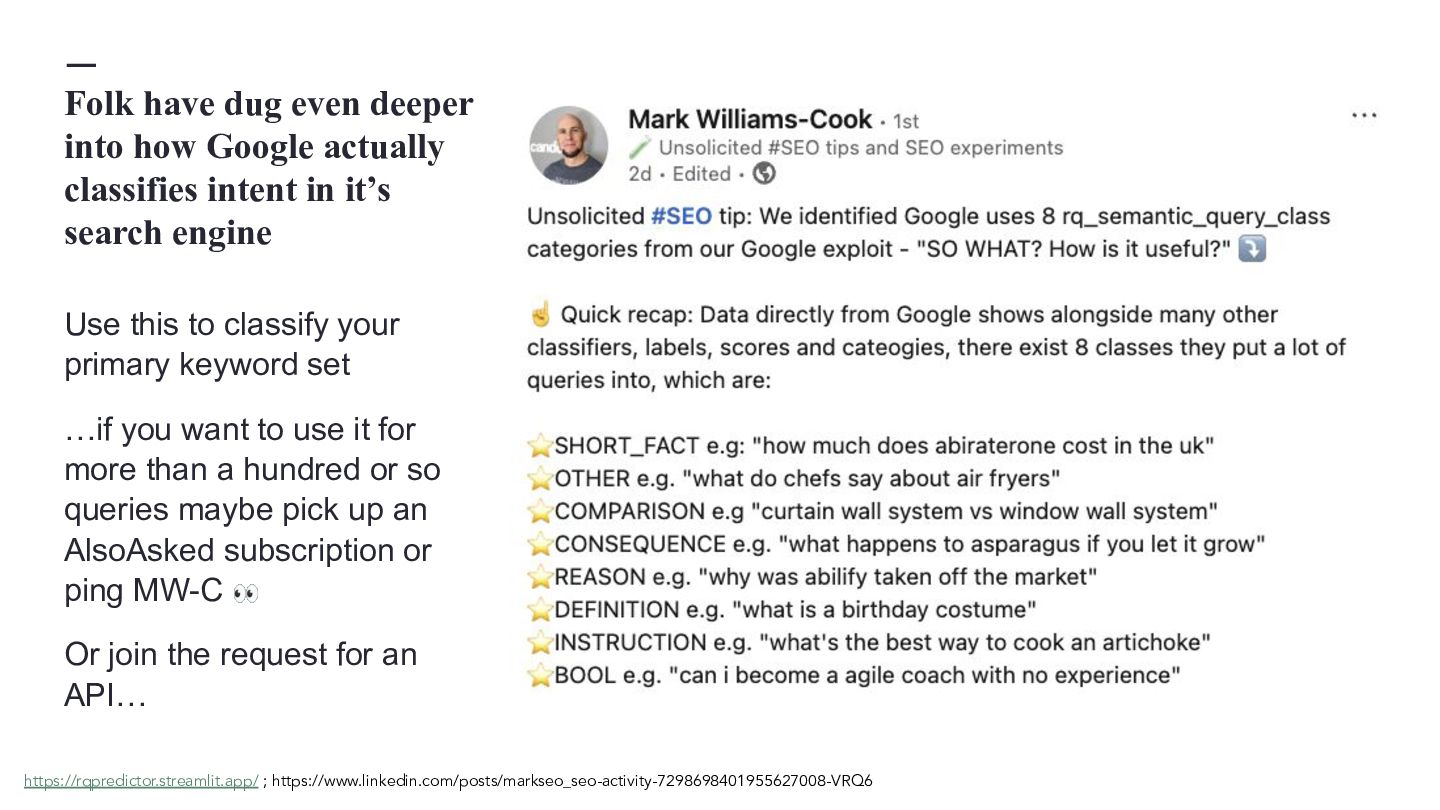
  49. Folk have dug even deeper into how Google actually classifies

    intent in it’s search engine Use this to classify your primary keyword set …if you want to use it for more than a hundred or so queries maybe pick up an AlsoAsked subscription or ping MW-C 👀 Or join the request for an API… https://rqpredictor.streamlit.app/ ; https://www.linkedin.com/posts/markseo_seo-activity-7298698401955627008-VRQ6
  50. And then once we classify the queries, we need to

    check if the topic aligns to the primary user intent for the query
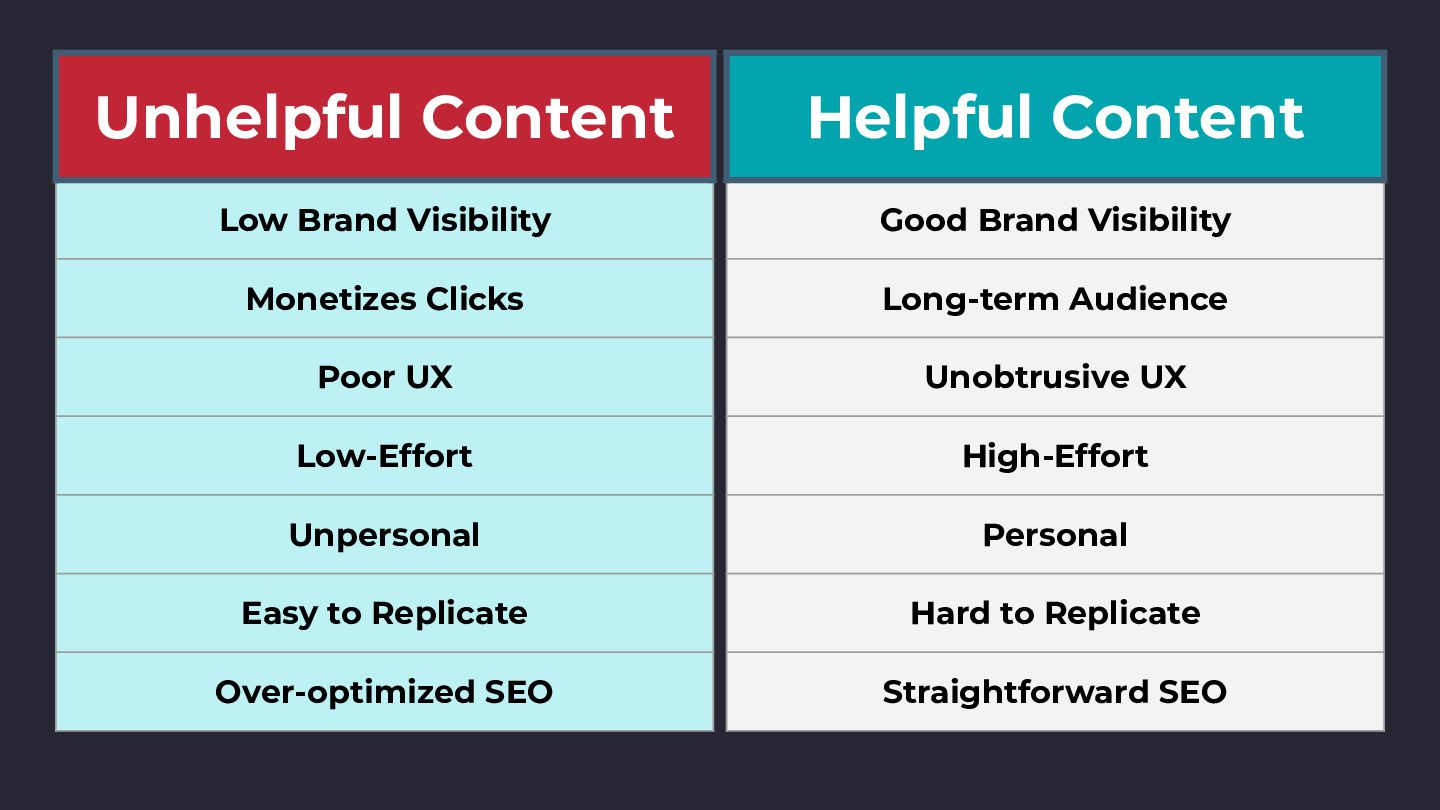
  51. Unhelpful Content Low Brand Visibility Monetizes Clicks Poor UX Low-Effort

    Unpersonal Easy to Replicate Over-optimized SEO Helpful Content Good Brand Visibility Long-term Audience Unobtrusive UX High-Effort Personal Hard to Replicate Straightforward SEO
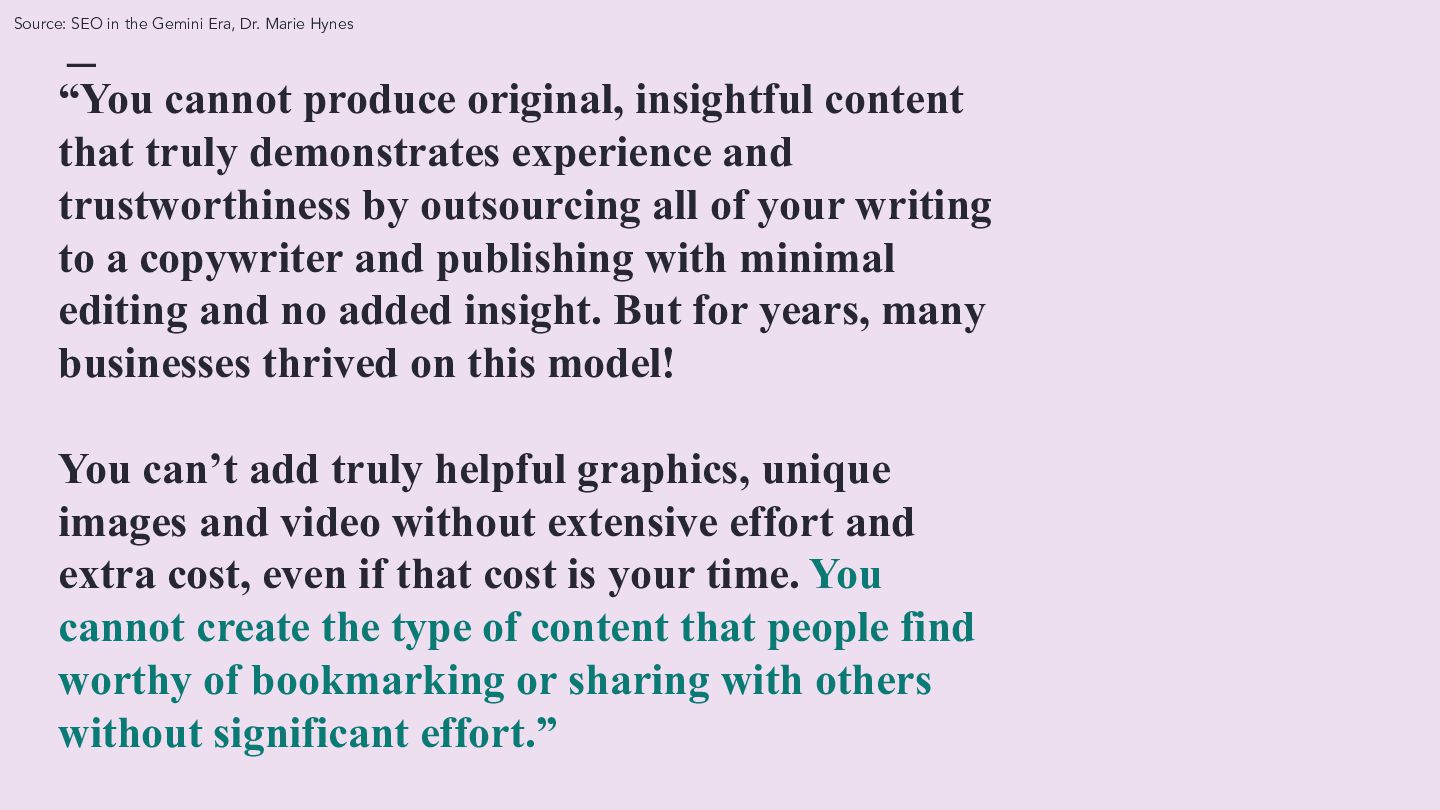
  52. “You cannot produce original, insightful content that truly demonstrates experience

    and trustworthiness by outsourcing all of your writing to a copywriter and publishing with minimal editing and no added insight. But for years, many businesses thrived on this model! You can’t add truly helpful graphics, unique images and video without extensive effort and extra cost, even if that cost is your time. You cannot create the type of content that people find worthy of bookmarking or sharing with others without significant effort.” Source: SEO in the Gemini Era, Dr. Marie Hynes
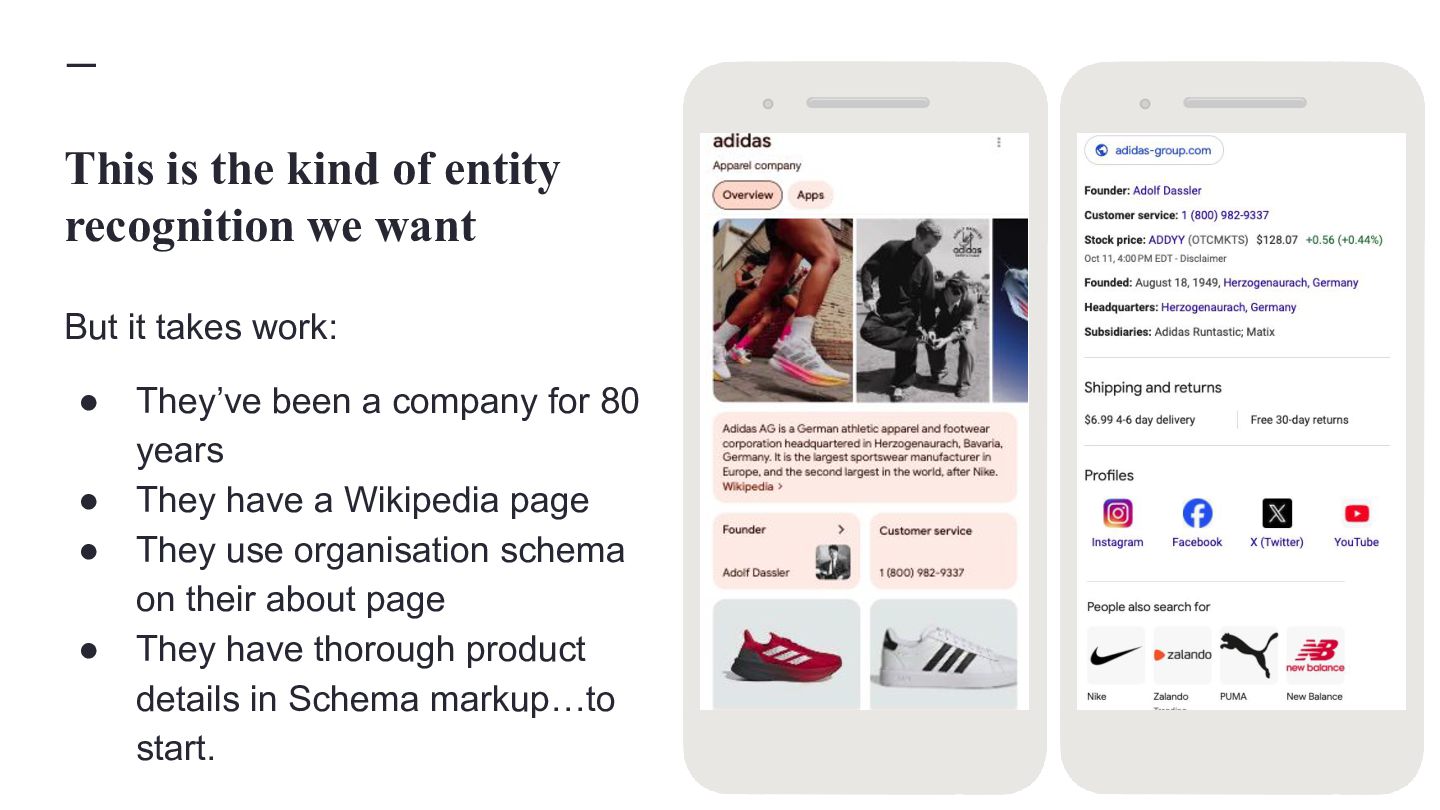
  53. This is the kind of entity recognition we want But

    it takes work: • They’ve been a company for 80 years • They have a Wikipedia page • They use organisation schema on their about page • They have thorough product details in Schema markup…to start.
  54. It’s about reality, not theory. • What does the SERP

    looks like. Check more than once • Talk to the customer service teams and sales reps • Use journey tracking tools like Fullstory • Do analysis in their analytics and review channel trends • Write more useful content (this can be a difficult conversation)
  55. It’s a lot like Online Reputation Management (ORM). At a

    glance, it’s a lot like owning the SERP. It’s amplification on ADHD meds. Because in order to get those 30 encounters, you will likely need to think beyond the bounds of your (client’s) website, with things like: • Podcasts • YouTube • An app • Interviews & press
  56. It’s a lot like local search. Name, Address, Phone (NAP)

    for entity optimisation is doing everything possible to facilitate those 30 encounters and making sure the information is consistent… …and then linking it all back through one of Google’s native languages, Schema markup.
  57. It’s a lot like voice search and rich snippet optimisation.

    • You have one result, rather than ten • The result presented may be incomplete, changed, or taken out of context • HTML formatting can matter if or in what way the information is presented
  58. It’s a lot like brand building. • Evidence of reputation:

    user engagement, popularity, user reviews on-site • Links and mentions: from authoritative places and topic experts • Popularity: Social media involvement, mentions in forums, comments around the web
  59. 3 takeaways To move forward with the new search experience

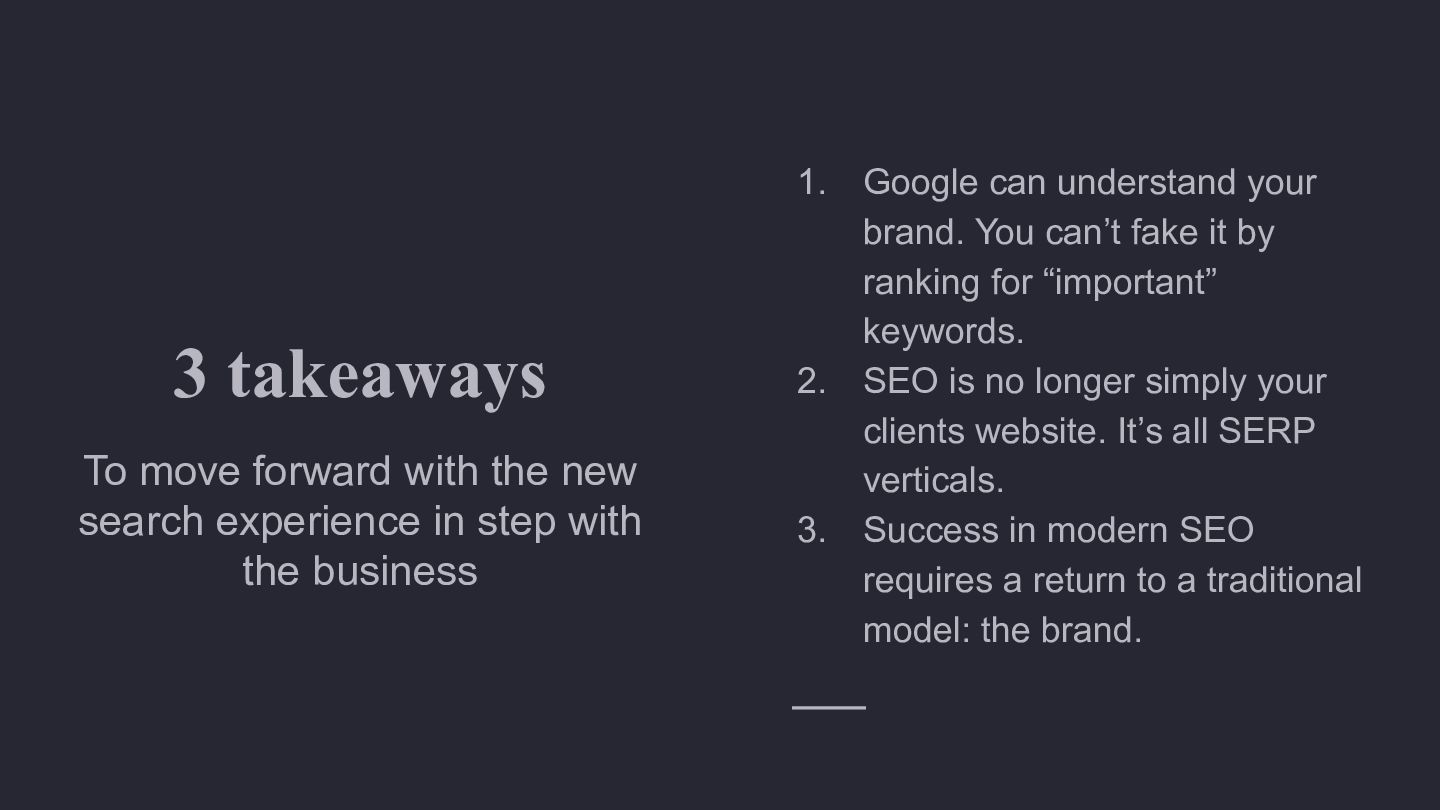
    in step with the business 1. Google can understand your brand. You can’t fake it by ranking for “important” keywords. 2. SEO is no longer simply your clients website. It’s all SERP verticals. 3. Success in modern SEO requires a return to a traditional model: the brand.
  60. Amanda King is human • 15+ years in the SEO

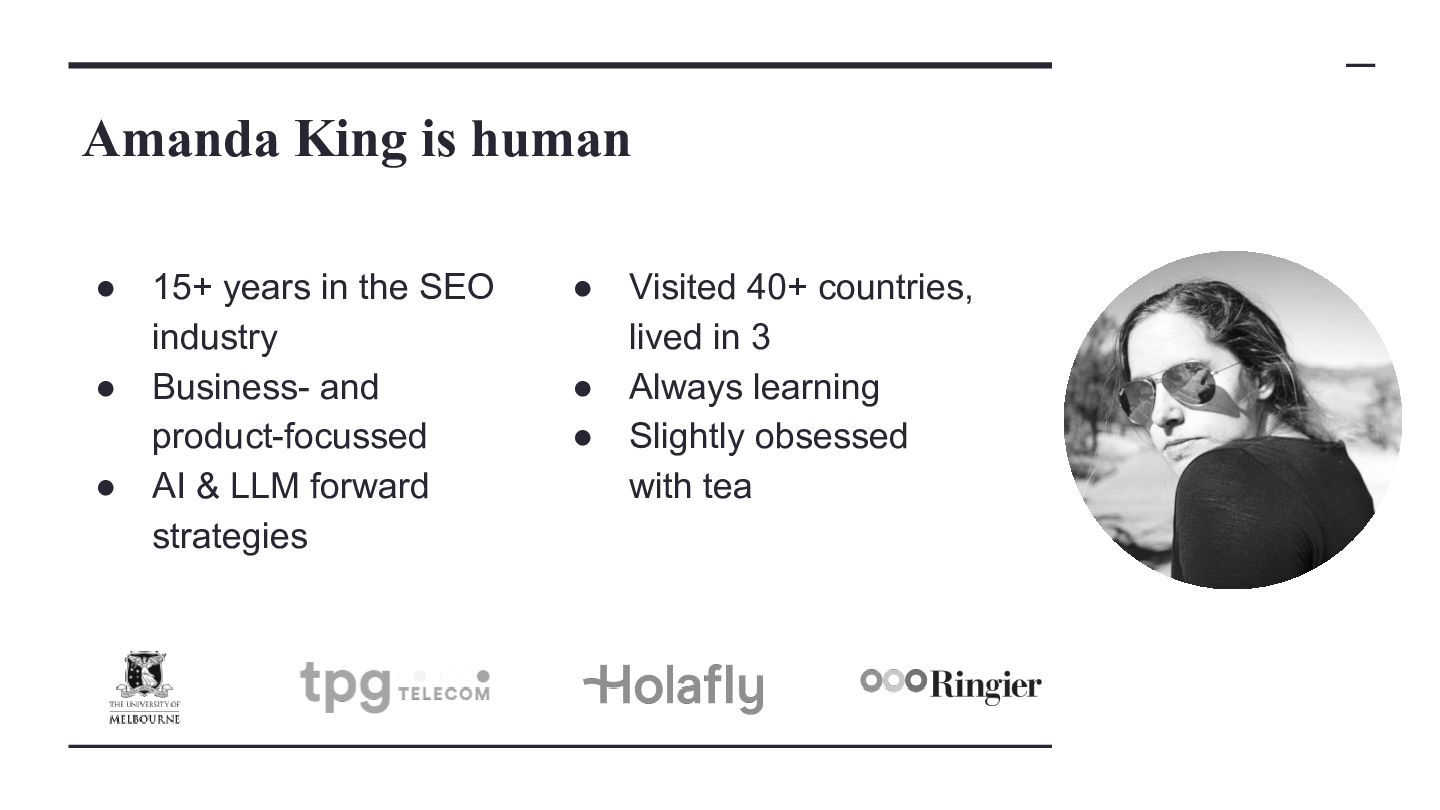
    industry • Business- and product-focussed • AI & LLM forward strategies • Visited 40+ countries, lived in 3 • Always learning • Slightly obsessed with tea