qualifications is an important responsibility for anyone working in aquatic safety. Whether supervising a community swimming pool, resort, recreational facility, or shallow-water attraction, lifeguards must remain prepared to recognize emergencies and respond appropriately. However, certifications expire, rescue procedures require practice, and employers expect personnel to demonstrate reliable emergency response skills. Lifeguard Recertification provides previously trained individuals with an opportunity to refresh essential knowledge, review lifesaving techniques, and renew their qualifications. Rather than repeating every aspect of beginner training, an appropriate renewal program focuses on maintaining competence and meeting applicable certification requirements. At American Lifeguard USA, returning candidates can explore recertification programs offered through the American Lifeguard Association (ALA). These programs include water safety education, CPR/AED, First Aid, rescue procedures, and flexible online instructional materials. The company's Shallow Water Lifeguarding program also provides renewal options for individuals working in aquatic facilities with water depths of five feet or less. This guide explains how lifeguard recertification works, who may qualify, what skills need reviewing, and how to choose the appropriate training pathway. What Is Lifeguard Recertification?
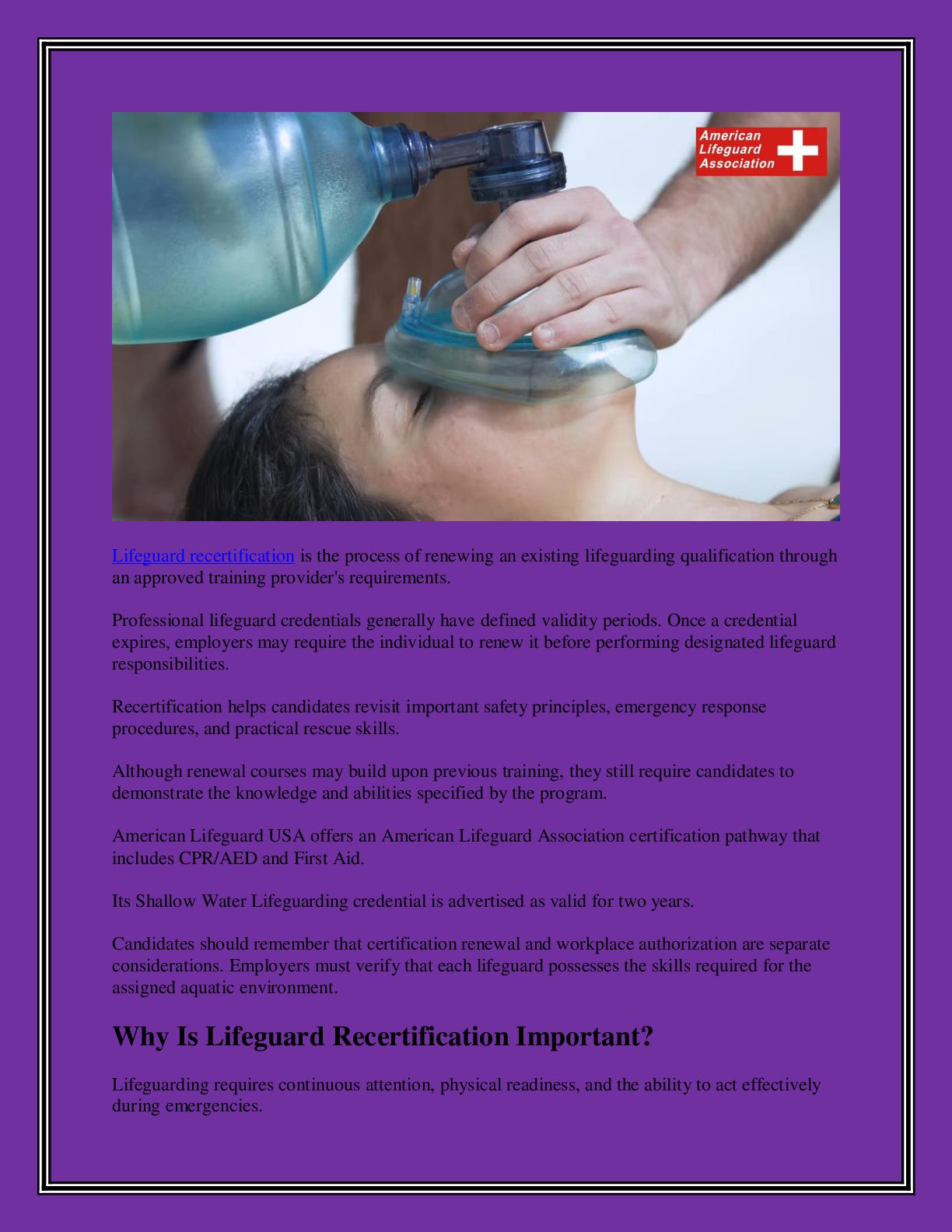
qualification through an approved training provider's requirements. Professional lifeguard credentials generally have defined validity periods. Once a credential expires, employers may require the individual to renew it before performing designated lifeguard responsibilities. Recertification helps candidates revisit important safety principles, emergency response procedures, and practical rescue skills. Although renewal courses may build upon previous training, they still require candidates to demonstrate the knowledge and abilities specified by the program. American Lifeguard USA offers an American Lifeguard Association certification pathway that includes CPR/AED and First Aid. Its Shallow Water Lifeguarding credential is advertised as valid for two years. Candidates should remember that certification renewal and workplace authorization are separate considerations. Employers must verify that each lifeguard possesses the skills required for the assigned aquatic environment. Why Is Lifeguard Recertification Important? Lifeguarding requires continuous attention, physical readiness, and the ability to act effectively during emergencies.
techniques are not practiced regularly. Recertification encourages returning professionals to revisit essential procedures and identify areas requiring improvement. Emergency care recommendations may also evolve as scientific evidence and professional standards develop. Reviewing updated instructional materials helps lifeguards stay informed about current approaches to water safety and emergency response. Another important consideration is employment eligibility. Aquatic facilities commonly require staff to maintain accepted credentials and demonstrate practical competency. Allowing a certification to expire without arranging appropriate renewal may interrupt a lifeguard's ability to work in a designated position. By planning recertification ahead of time, candidates can reduce unnecessary scheduling difficulties while continuing to develop their lifesaving capabilities. Who Is Eligible for Lifeguard Recertification? Eligibility depends on the training provider, previous certification, and type of credential being renewed. American Lifeguard USA advertises recertification opportunities for individuals who originally trained through the American Lifeguard Association or another organization, including the American Red Cross. Its Shallow Water Lifeguarding page also states that individuals with expired previous certifications may apply through its renewal pathway. Applicants who originally trained elsewhere are instructed to provide a copy of their previous certificate after registration. This documentation allows the training provider to review and maintain the candidate's certification history. However, previous certification does not eliminate the need to satisfy applicable training and practical competency requirements. Candidates should confirm that their existing qualification is suitable for the renewal pathway and that the resulting credential will be accepted by their employer.
aquatic environments or certification organizations. How to Renew Your Lifeguard Certification Renewing a lifeguard certification involves several practical steps. Review Your Existing Certification Begin by checking your current certificate's expiration date, issuing organization, and qualification type. Determine whether your credential covers shallow-water lifeguarding, general pool lifeguarding, or another specialized aquatic environment. Choose the Appropriate Renewal Program Select a course that matches your previous experience and intended employment responsibilities. American Lifeguard USA offers a Shallow Water Lifeguarding renewal option covering CPR/AED and First Aid. Register and Access Course Materials After registration, participants receive access to online training videos and reference materials. Returning candidates who trained through another organization are instructed to submit their previous certification documentation. Review and Practice Required Skills Study the provided materials and refresh practical rescue, swimming, and emergency care techniques. Candidates must be capable of performing the required skills safely. Complete the Knowledge Assessment American Lifeguard USA specifies a minimum passing score of 80% on its final online examination. Confirm Certification and Workplace Requirements After completing the provider's required steps, candidates receive certification information.
assessments, orientation, and in-service training have also been completed. Essential Skills Covered in Lifeguard Recertification A successful recertification program reinforces the skills needed to prevent, recognize, and respond to aquatic emergencies. Water Surveillance and Drowning Prevention Lifeguards must continuously monitor swimming areas and identify potential hazards. Renewal education emphasizes scanning techniques, recognizing distressed swimmers, enforcing safety rules, and maintaining attention throughout a shift. Prevention remains a central responsibility because early intervention may reduce the likelihood of serious emergencies. Water Rescue and Emergency Response Candidates review rescue approaches, appropriate water entries, assisting distressed swimmers, and safely removing individuals from the water. The selected techniques depend on the aquatic environment and training program. Practical demonstrations are essential for confirming that individuals can perform these skills effectively. CPR and AED Refresher Training Cardiopulmonary resuscitation and automated external defibrillator education are important components of professional emergency response preparation. Participants review emergency recognition, appropriate rescue breathing procedures, CPR, and AED operation. First Aid and Injury Management First Aid education reinforces initial care for injuries and sudden illnesses. Lifeguards may also need to assist individuals with suspected head, neck, or spinal injuries while following established emergency procedures. Online Lifeguard Recertification vs. In-Person Training
balance employment, education, and other commitments. Online instructional programs allow participants to review theoretical materials without attending scheduled classroom sessions. American Lifeguard USA provides video-based instruction, digital learning resources, and an online examination through its American Lifeguard Association programs. These resources help candidates revisit water safety principles, rescue procedures, CPR/AED, and First Aid. However, online coursework should not be confused with demonstrated physical rescue competence. Lifeguarding requires practical swimming and emergency response abilities that cannot be established through written examinations alone. The company's program describes employer-administered pre-service evaluations and continuing in-service training as important elements of workplace readiness. Before enrolling, candidates should confirm how practical skill verification will occur and whether the credential satisfies their intended employer's requirements. Shallow Water Lifeguard Recertification Requirements Shallow-water lifeguarding is designed for aquatic facilities with a maximum water depth of five feet. American Lifeguard USA offers training and recertification for individuals preparing to work in these environments. Its published prerequisites specify a minimum participant age of 15. Candidates are expected to demonstrate swimming endurance, water treading, and timed retrieval skills. The listed requirements include swimming 100 yards continuously using front crawl, breaststroke, or a combination of both. Participants must also tread water for two minutes using their legs without support. The program describes a timed exercise involving a 10-pound object retrieved from shallow water and transported back to the starting point.
and time limits must be followed accurately. These requirements help establish whether participants possess the physical abilities needed for shallow-water rescue responsibilities. Importantly, a shallow-water qualification should not be assumed to authorize lifeguarding in deep-water, waterfront, surf, or other specialized environments. How Much Does Lifeguard Recertification Cost? Training expenses are an important consideration for returning lifeguards. American Lifeguard USA currently advertises its Shallow Water Lifeguarding course at a base price of $285. The website offers a $100 recertification discount using the promotional code RECERT, reducing the advertised renewal price to $185 for eligible candidates. Applicants who originally certified through another organization are instructed to submit their previous certificate after enrollment. Pricing and promotional availability may change, so candidates should verify the final amount at checkout. They should also determine whether additional practical assessment, travel, or employer-related training expenses apply. Evaluating the complete renewal process helps avoid unexpected costs. Can You Renew an Expired Lifeguard Certification? An expired certification does not necessarily mean a candidate must start every training requirement from the beginning. However, renewal rules vary across organizations. American Lifeguard USA advertises a recertification pathway for applicants whose previous lifeguard credentials have expired. Returning candidates may need to provide their previous certification documentation and satisfy the current program requirements. Other training organizations may impose stricter limits on how long a certificate can remain expired before initial training becomes necessary.
policies apply to every certification. Individuals with expired credentials should contact their selected provider and prospective employer before enrolling. This is especially important when changing from an existing deep-water qualification to a shallow-water credential or moving between certification systems. Benefits of Maintaining Current Lifeguard Certification Maintaining an appropriate certification supports professional readiness and continued development. Regular recertification encourages lifeguards to refresh rescue knowledge and remain familiar with emergency response procedures. It also provides an opportunity to identify skills requiring additional practice. For seasonal employees, renewing credentials before summer recruitment periods can make employment planning more convenient. Experienced aquatic workers may also benefit from reviewing CPR/AED and First Aid information that applies to a wide range of emergencies. However, certification alone is not a guarantee of employment or rescue proficiency. Practical skills must be demonstrated, and employers may require additional assessments or facility-specific training. The most effective approach combines timely renewal with ongoing practice, strong supervision, and continuing professional education. Why Choose American Lifeguard USA for Recertification? American Lifeguard USA provides access to American Lifeguard Association programs designed for aquatic safety education and certification renewal. The company's Shallow Water Lifeguarding course includes instruction in water surveillance, rescue procedures, CPR/AED, and First Aid. Online materials allow participants to review lessons at their own pace. The website also advertises recertification opportunities for individuals previously trained through other organizations.
resources throughout the stated certification period. For returning lifeguards seeking a flexible learning option, these features may offer practical advantages. Nevertheless, candidates should verify employer acceptance, certification scope, and hands-on competency requirements before registration. Selecting a program that matches the intended workplace is more important than choosing a course based solely on price or convenience. Frequently Asked Questions About Lifeguard Recertification How long does lifeguard recertification last? American Lifeguard USA advertises a two-year validity period for its Shallow Water Lifeguarding, CPR/AED, and First Aid certification. Can I complete lifeguard recertification online? The company offers online instructional materials and a written examination. Practical swimming and rescue competence must still be maintained and verified through appropriate assessments. Can I renew a Red Cross lifeguard certification through American Lifeguard USA? American Lifeguard USA advertises renewal eligibility for candidates previously certified through the Red Cross. However, the resulting credential is issued through the American Lifeguard Association, not as a renewed Red Cross certificate. Confirm employer acceptance before enrolling. What happens if my lifeguard certification has expired? American Lifeguard USA advertises renewal options for previously certified individuals with expired credentials. Eligibility depends on its current course requirements and any applicable employer policies. Does recertification include CPR/AED and First Aid? Yes. The advertised Shallow Water Lifeguarding program includes CPR/AED and First Aid education.
lifeguard qualifications current is an important step toward maintaining professional readiness and supporting safer aquatic environments. American Lifeguard USA offers flexible learning resources and recertification opportunities through the American Lifeguard Association. Whether you're returning to seasonal work or renewing a shallow-water qualification, review the program's requirements and confirm that the credential matches your intended responsibilities. Explore the renewal options and take the next step toward maintaining your aquatic safety qualifications. Company Name: American Lifeguard USA Address: 80 SW 8th Street, 20th Floor, Miami, FL 33130 Phone: (786) 284-8734 Website: https://www.americanlifeguardusa.com/ Recertification Course: https://www.americanlifeguardusa.com/products/lifeguardrecertification-training Conclusion: Stay Prepared with Lifeguard Recertification Professional Lifeguard Recertification is about more than receiving an updated certificate. It provides an opportunity to revisit water safety principles, reinforce emergency response knowledge, and maintain essential lifesaving capabilities. From water surveillance and shallow-water rescue procedures to CPR/AED and First Aid, effective renewal education supports ongoing preparedness. American Lifeguard USA offers a flexible recertification pathway for returning lifeguards, including individuals with previous credentials issued by other training organizations. Before enrolling, candidates should confirm eligibility, practical competency expectations, and employer acceptance. Renew your skills, maintain your qualifications, and continue contributing to safer aquatic environments with American Lifeguard USA.


 pawan_pharm
 signer
 drpoonamkc
 adeputra13
 auctria
 hiola
 matleenalaakso
 koheihasebe
 minecr
 chriscoyier
 codingconduct
 marketingsoph
 jdejongh
 bkeepers
 helmedeiros
 axbom
 ryanjones
 quramy
 honzajavorek
 jakevdp
 gurzu