of JASMINE's science cases is the astrometry around the Galactic center. JASMINE is an image-based and small-field space astrometry mission. ▪ Images near the Galactic center are repeatedly obtained. ▪ The parallaxes of bright stars will be measured with an accuracy of 40 μas. Concepts of the JASMINE mission are partly validated via simulation. ▪ Measurements are split into chunks at different epochs (Plate Analysis). ▪ Image distortion patterns are estimated using multiple exposures. ▪ Foreground stars are used as refreences to fix the reference frame. ▪ Parameters are optimized with SVI, accelerated with JAX & numpyro. For details of the JASMINE mission, refer to Kataza+ (13092-9) in this conference
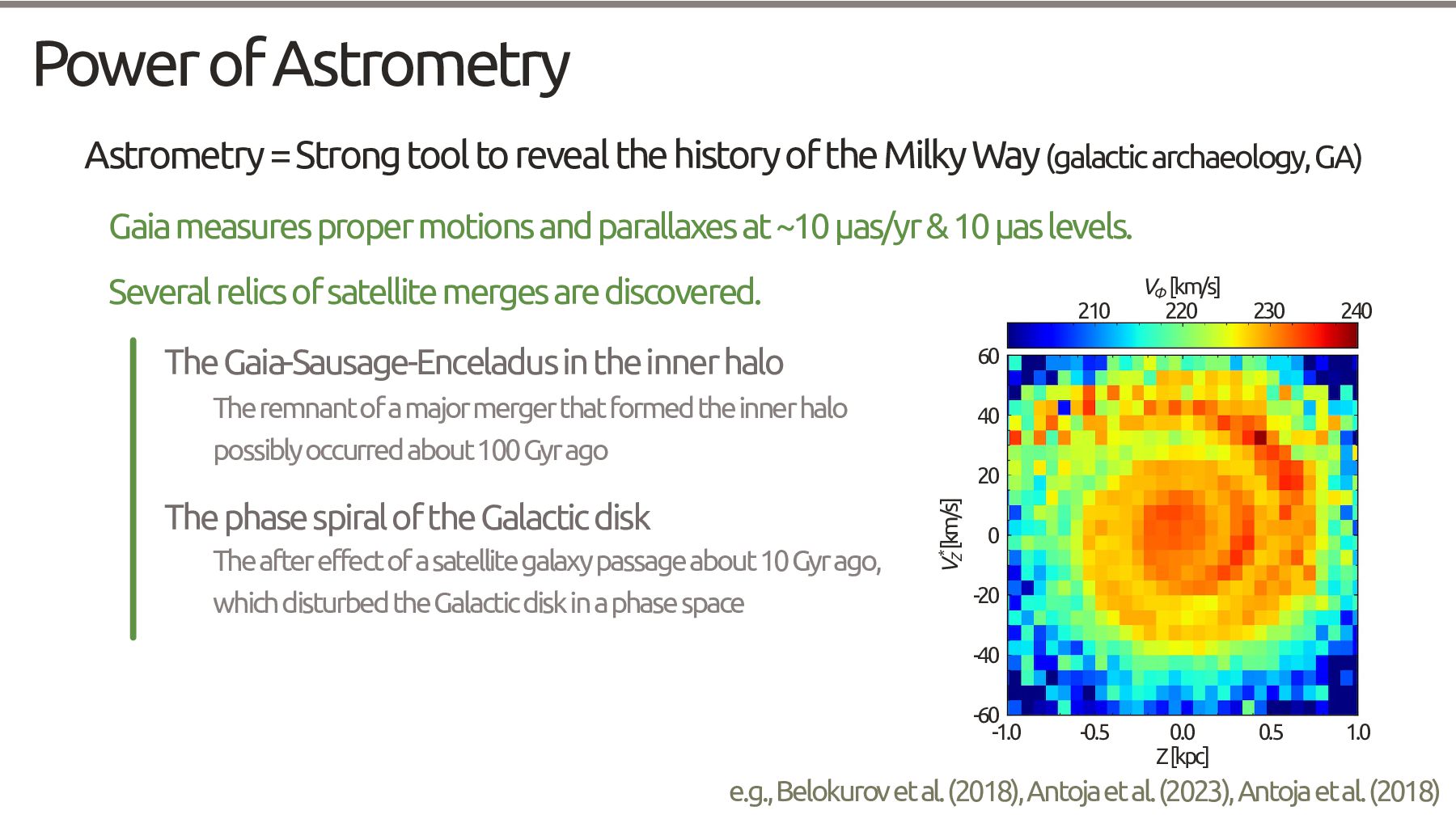
history of the Milky Way (galactic archaeology, GA) Gaia measures proper motions and parallaxes at ~10 μas/yr & 10 μas levels. Several relics of satellite merges are discovered. 210 VΦ [km/s] 220 230 240 0.5 1.0 60 The Gaia-Sausage-Enceladus in the inner halo The remnant of a major merger that formed the inner halo possibly occurred about 100 Gyr ago 40 The phase spiral of the Galactic disk The after effect of a satellite galaxy passage about 10 Gyr ago, which disturbed the Galactic disk in a phase space VZ*[km/s] 20 0 -20 -40 -60 -1.0 -0.5 0.0 Z[kpc] e.g., Belokurov et al. (2018), Antoja et al. (2023), Antoja et al. (2018)
position/parallax. The measurement system should be calibrated to the corresponding level. Including the satellite attitudes, alignments of the optics system, and so on... Calibrating all the components in advance is highly challenging. Self-calibration is one approach for such extreme calibration. Preparing an observation model that emulates how observables are obtained, with all the calibration parameters included. Optimize the parametes to reproduce the measurements. Precise astrometry needs optimizing a HUGE observation model. e.g., Hipparcos (van Leeuwen & Fantino, 2005), Gaia (Lindegren+, 2012)
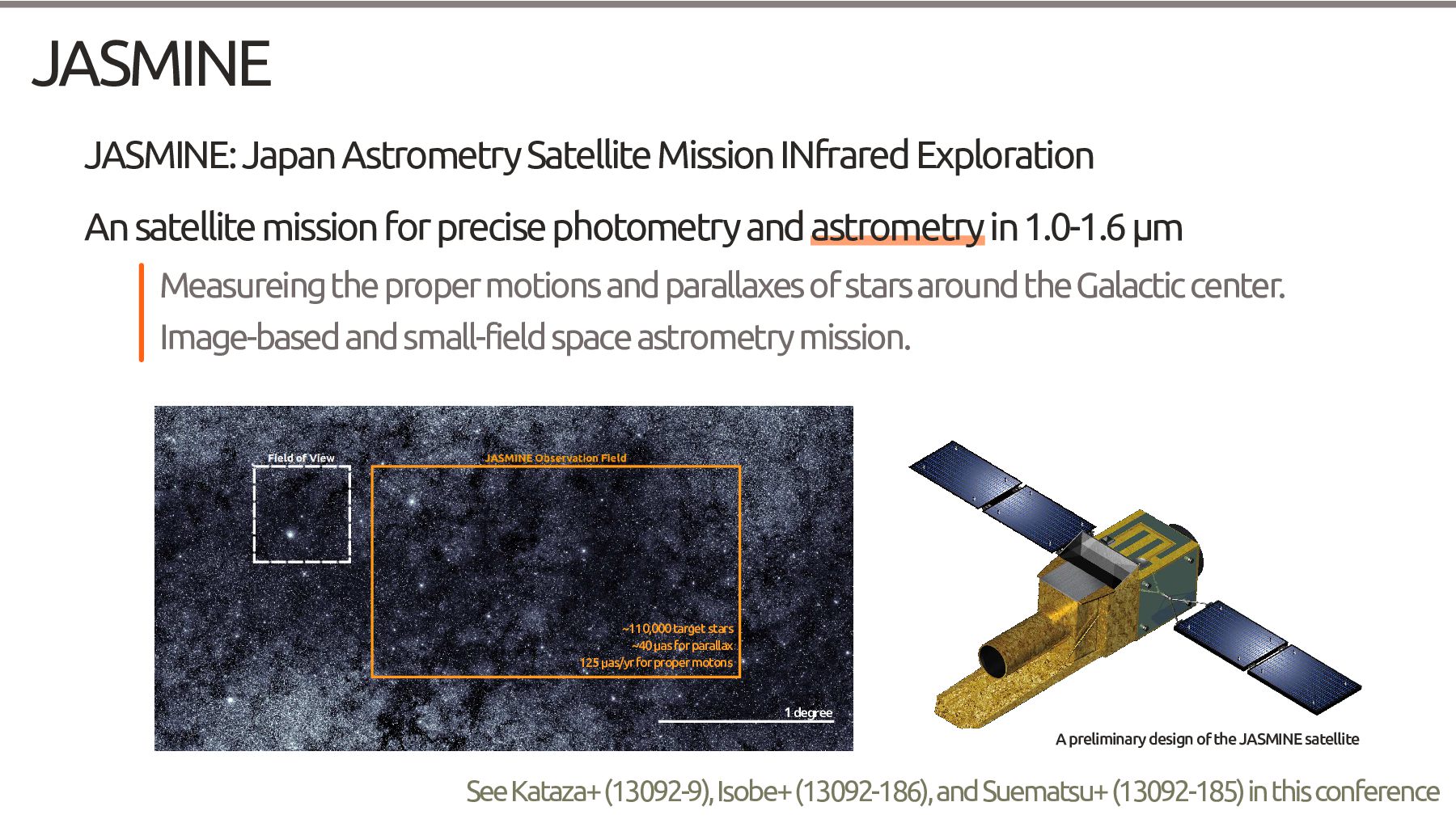
mission for precise photometry and astrometry in 1.0-1.6 μm Measureing the proper motions and parallaxes of stars around the Galactic center. Image-based and small-field space astrometry mission. ~110,000 target stars ~40 μas for parallax 125 μas/yr for proper motons 1 degree A preliminary design of the JASMINE satellite See Kataza+ (13092-9), Isobe+ (13092-186), and Suematsu+ (13092-185) in this conference
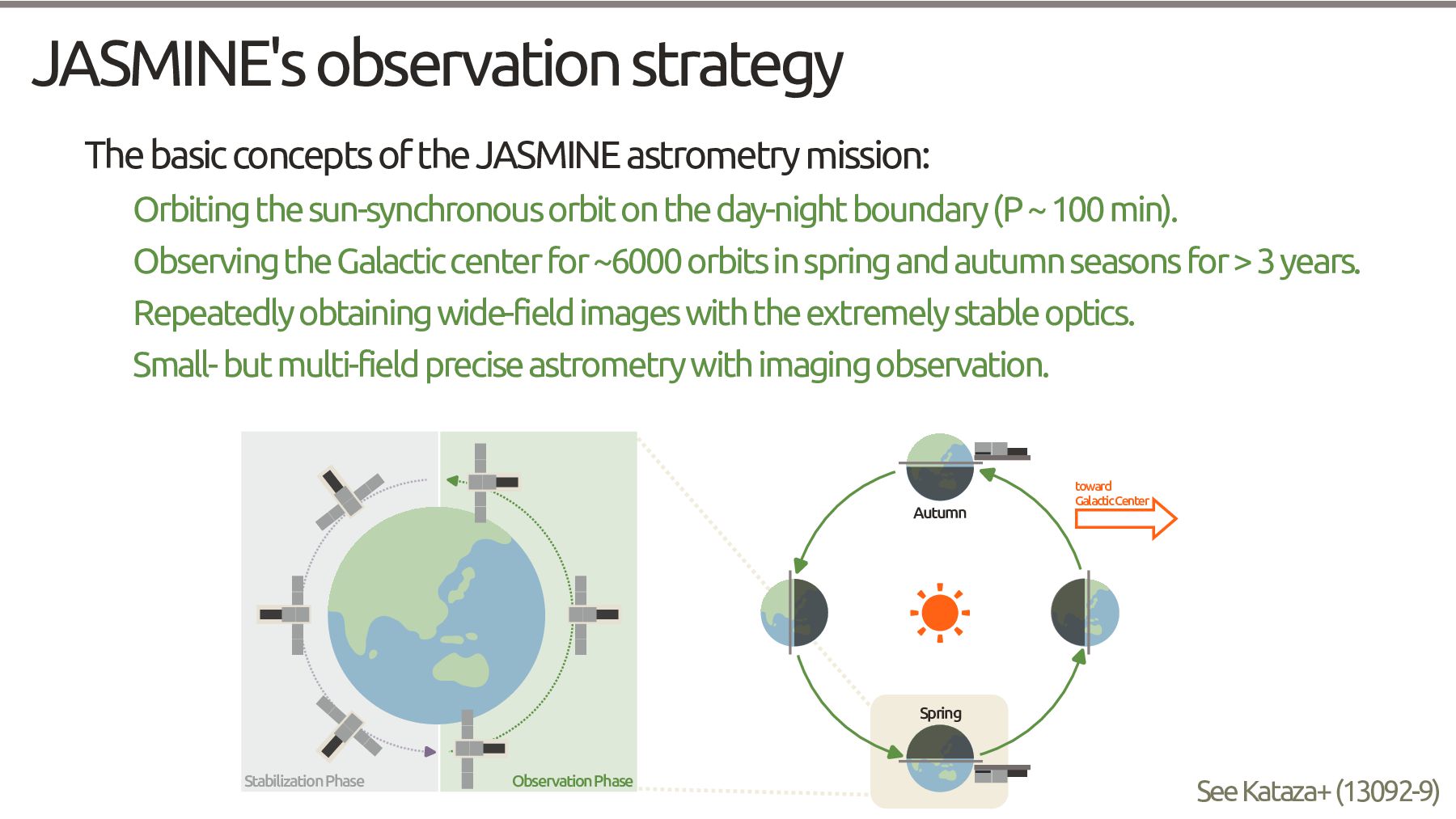
mission: Orbiting the sun-synchronous orbit on the day-night boundary (P ~ 100 min). Observing the Galactic center for ~6000 orbits in spring and autumn seasons for > 3 years. Repeatedly obtaining wide-field images with the extremely stable optics. Small- but multi-field precise astrometry with imaging observation. Autumn toward Galactic Center Spring Stabilization Phase Observation Phase See Kataza+ (13092-9)
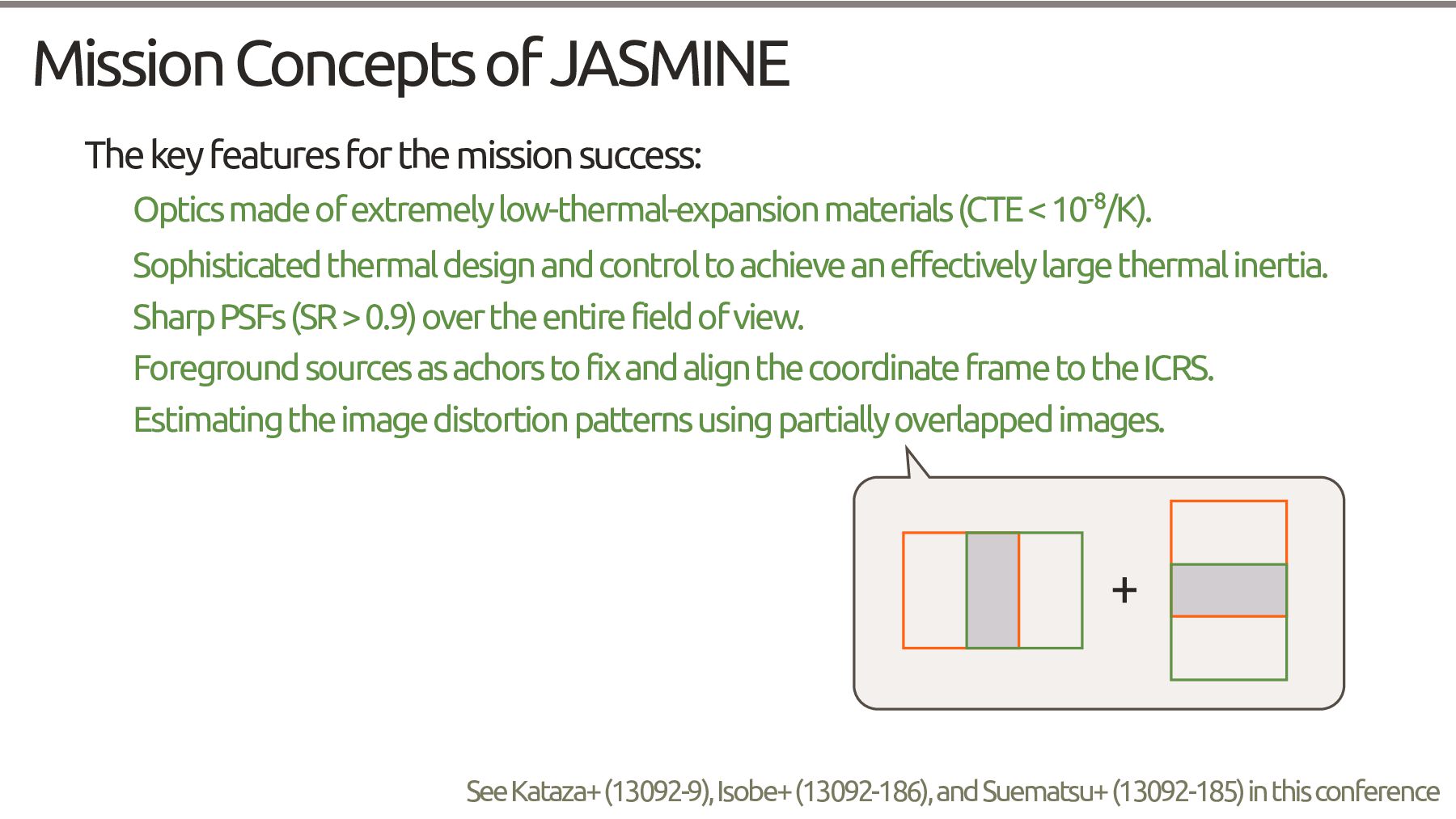
success: Optics made of extremely low-thermal-expansion materials (CTE < 10-8/K). Sophisticated thermal design and control to achieve an effectively large thermal inertia. Sharp PSFs (SR > 0.9) over the entire field of view. Foreground sources as achors to fix and align the coordinate frame to the ICRS. Estimating the image distortion patterns using partially overlapped images. + See Kataza+ (13092-9), Isobe+ (13092-186), and Suematsu+ (13092-185) in this conference
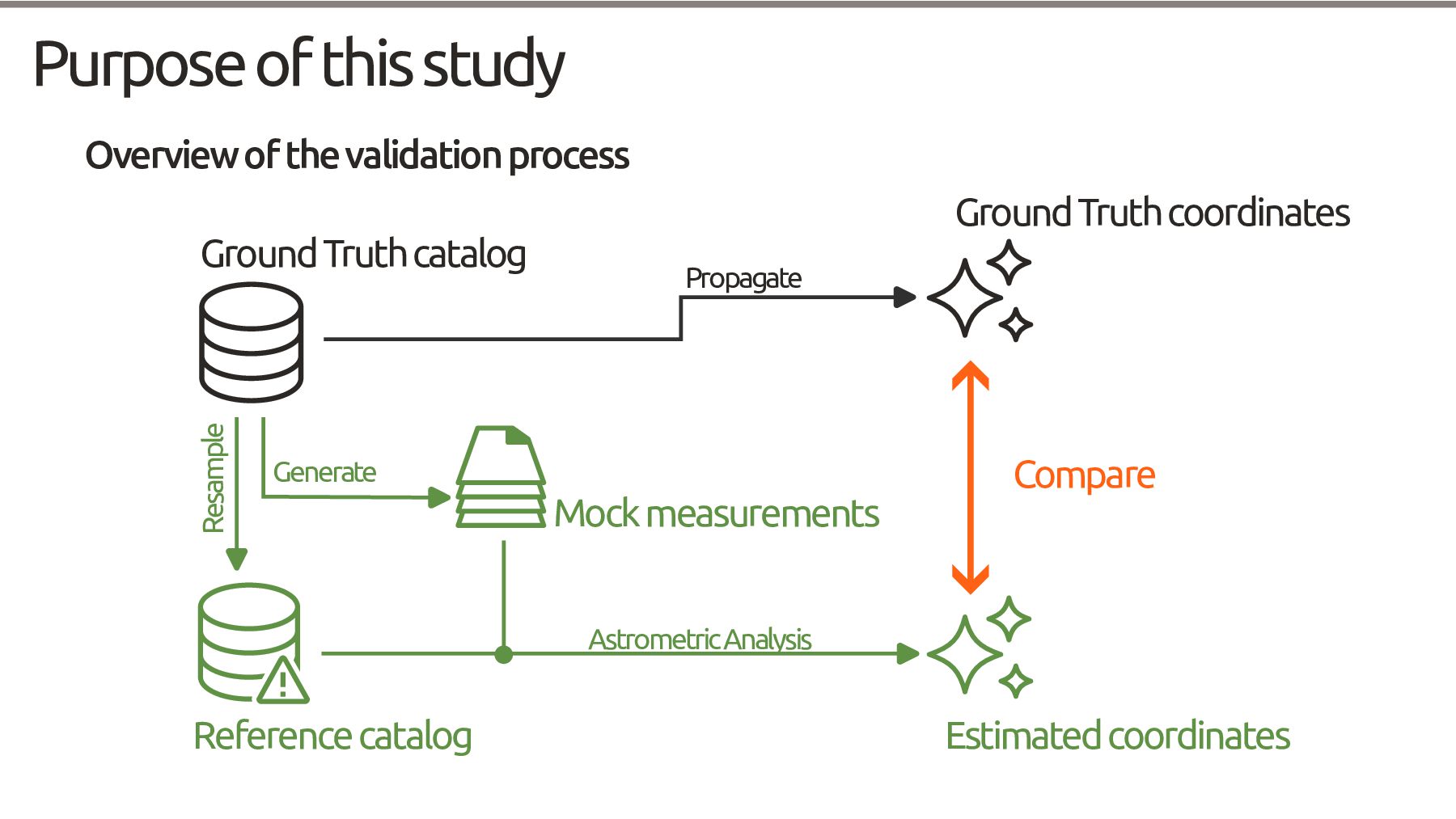
mission concepts by simulation. 1. Image distortion patterns can be estimated using a set of partially overlapped images.. 2. Motions of distant stars can be measured w.r.t. foreground stars. A simplified and small-scale survey is arranged (JASMINE mini survey): Generate Mock measurements (positions on detector) with measurement errors. Estimate the stellar coordinates at each epoch. Compare the estimated stellar motions with the ground truth.
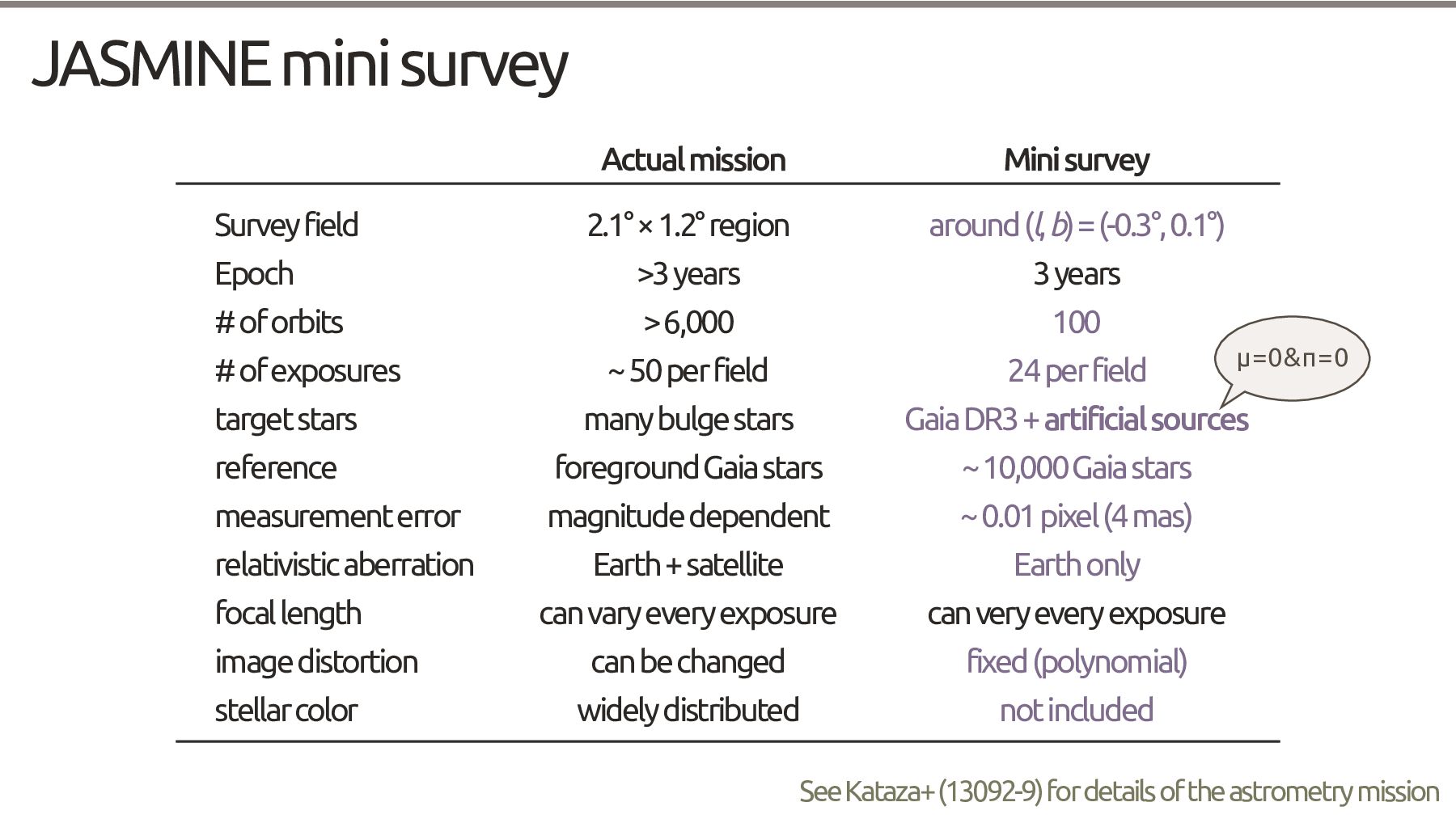
orbits # of exposures target stars reference measurement error relativistic aberration focal length image distortion stellar color Mini survey 2.1° × 1.2° region >3 years > 6,000 ~ 50 per field many bulge stars foreground Gaia stars magnitude dependent Earth + satellite can vary every exposure can be changed widely distributed around (l, b) = (-0.3°, 0.1°) 3 years 100 μ=0&π=0 24 per field Gaia DR3 + artificial sources ~ 10,000 Gaia stars ~ 0.01 pixel (4 mas) Earth only can very every exposure fixed (polynomial) not included See Kataza+ (13092-9) for details of the astrometry mission
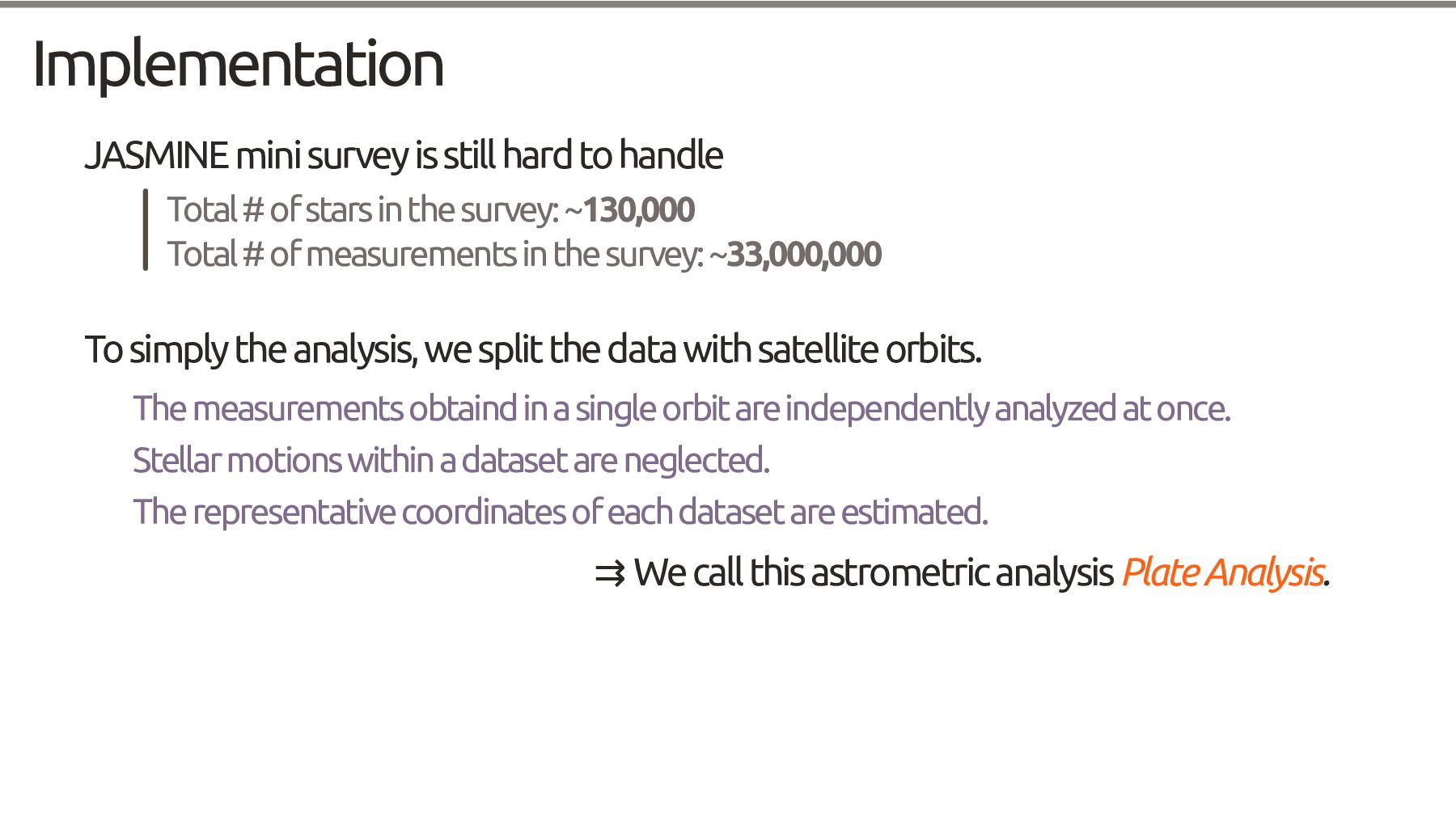
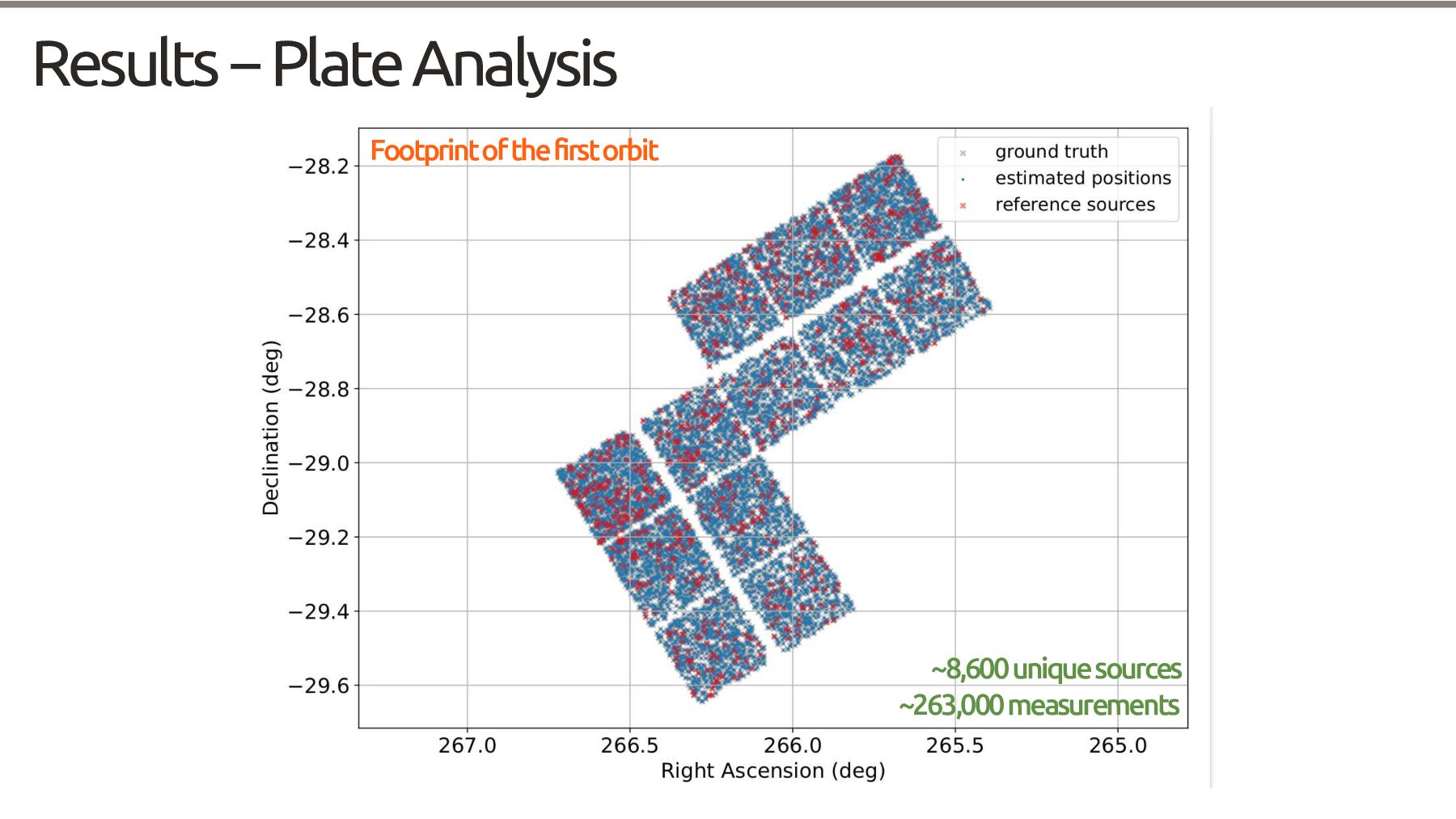
# of stars in the survey: ~130,000 Total # of measurements in the survey: ~33,000,000 To simply the analysis, we split the data with satellite orbits. The measurements obtaind in a single orbit are independently analyzed at once. Stellar motions within a dataset are neglected. The representative coordinates of each dataset are estimated. ⇉ We call this astrometric analysis Plate Analysis.
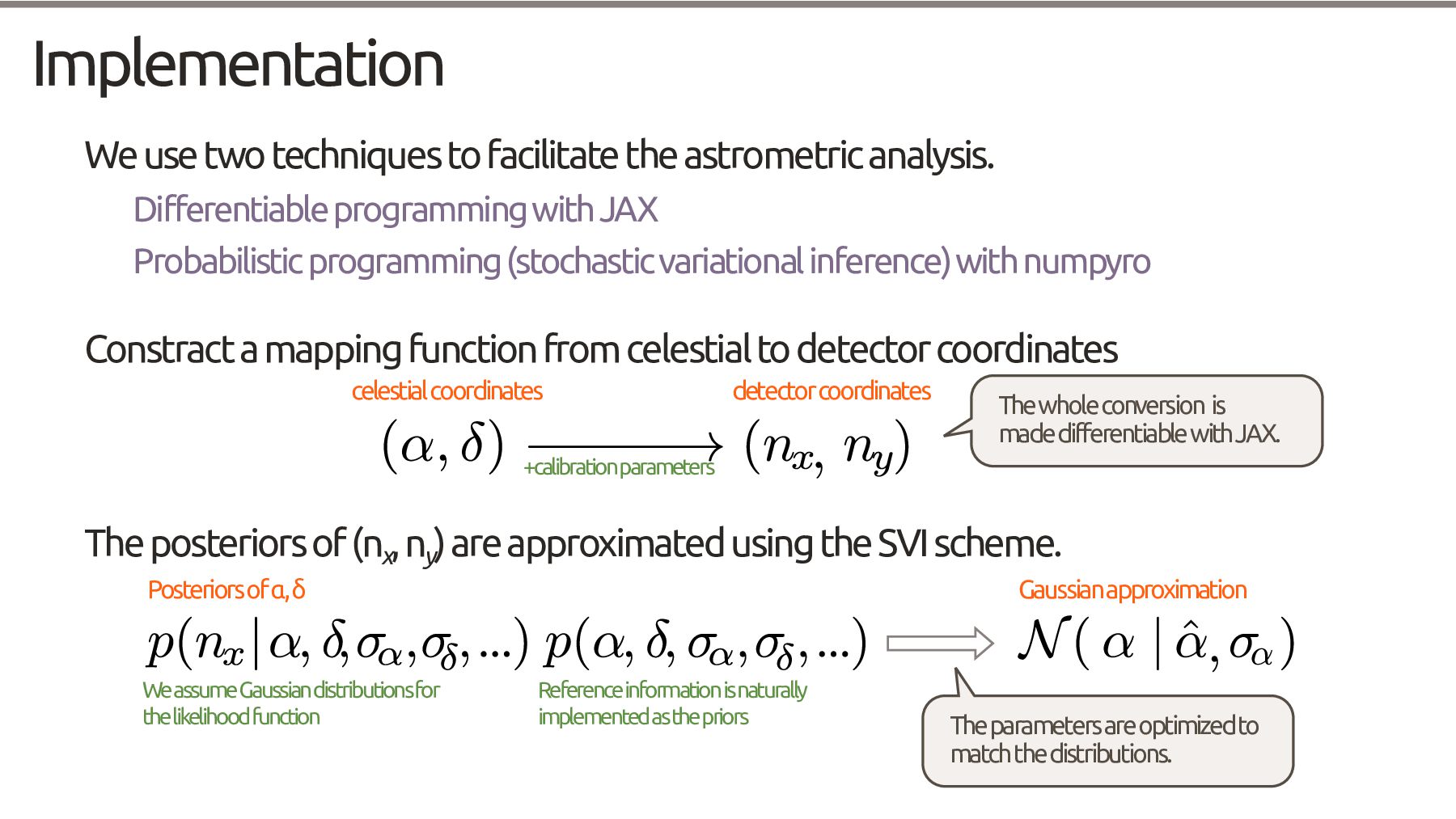
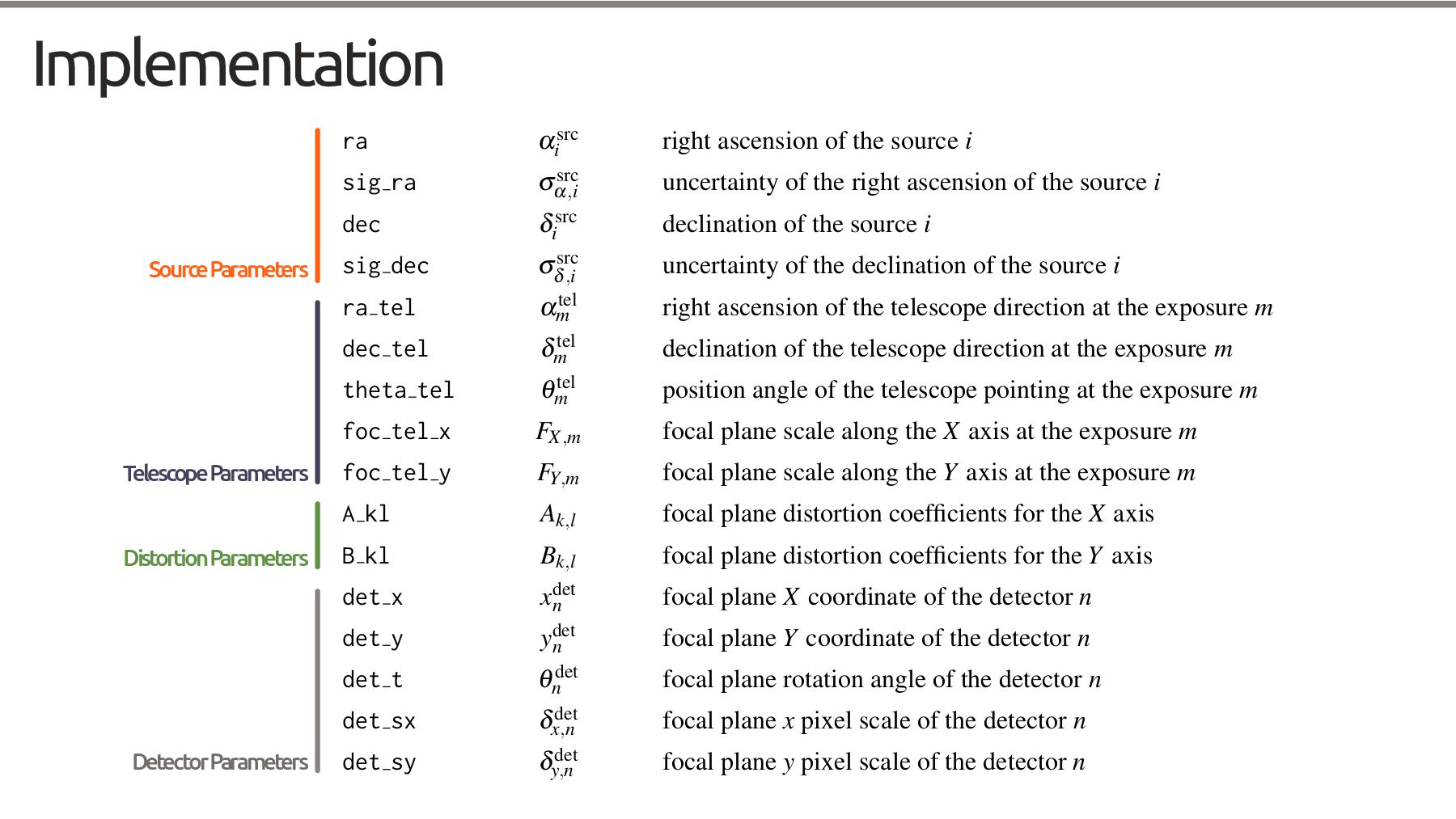
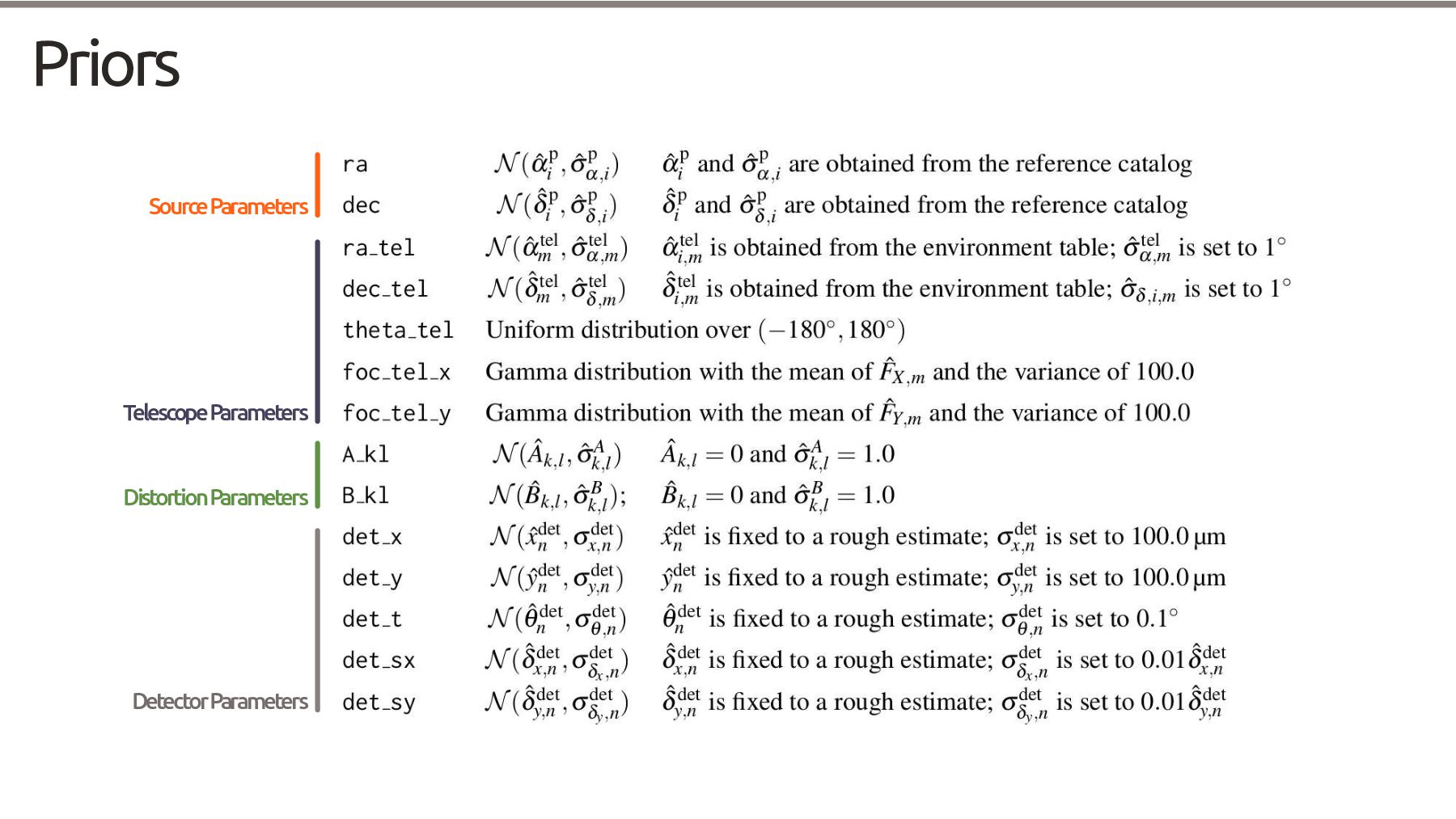
Differentiable programming with JAX Probabilistic programming (stochastic variational inference) with numpyro Constract a mapping function from celestial to detector coordinates celestial coordinates detector coordinates The whole conversion is made differentiable with JAX. +calibrationparameters The posteriors of (nx, ny) are approximated using the SVI scheme. Posteriors of α, δ WeassumeGaussiandistributionsfor thelikelihoodfunction Gaussian approximation Referenceinformationisnaturally implementedasthepriors The parameters are optimized to match the distributions.
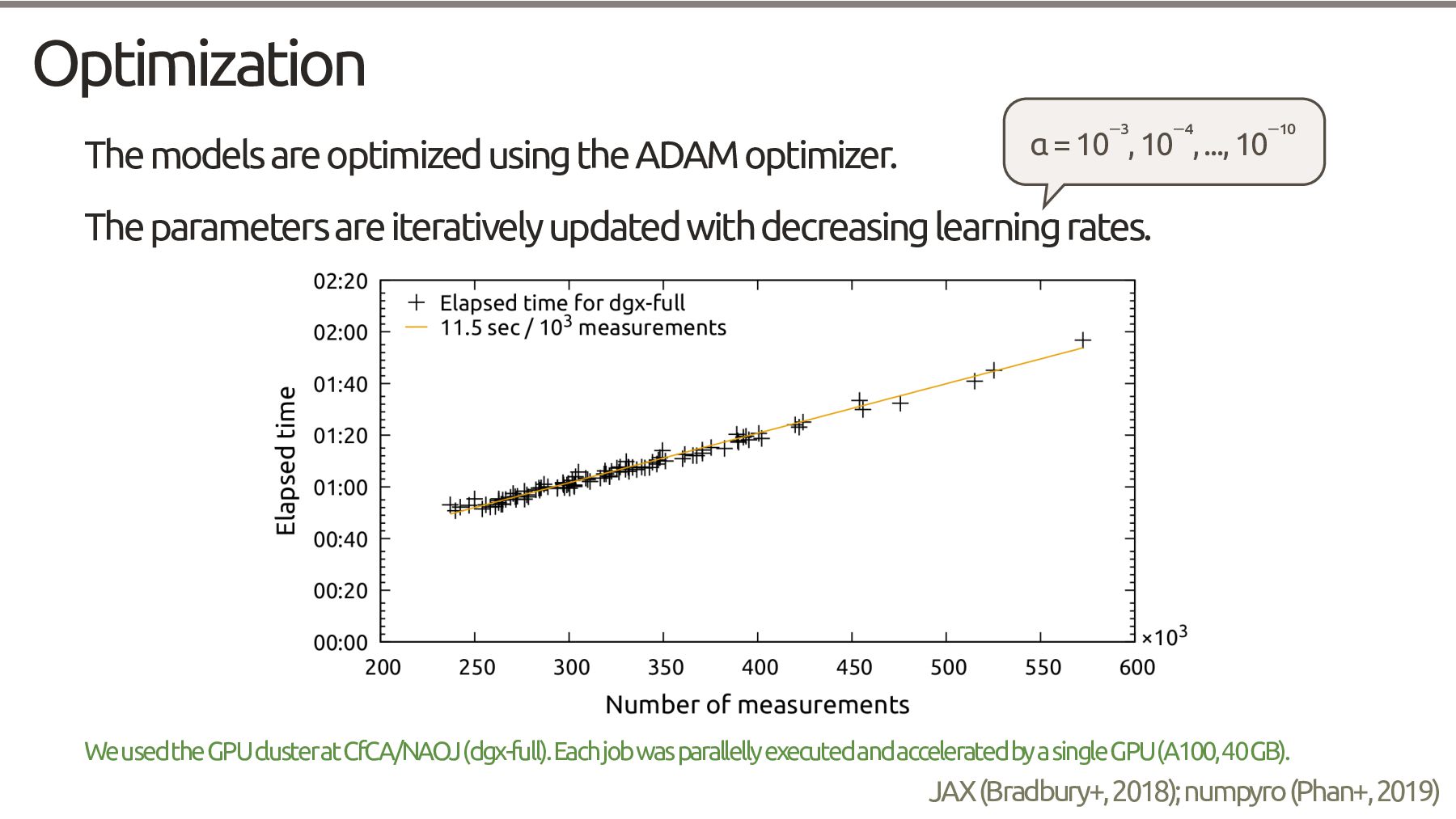
= 10⁻³, 10⁻⁴, ..., 10⁻¹⁰ The parameters are iteratively updated with decreasing learning rates. We used the GPU cluster at CfCA/NAOJ (dgx-full). Each job was parallelly executed and accelerated by a single GPU (A100, 40 GB). JAX (Bradbury+, 2018); numpyro (Phan+, 2019)
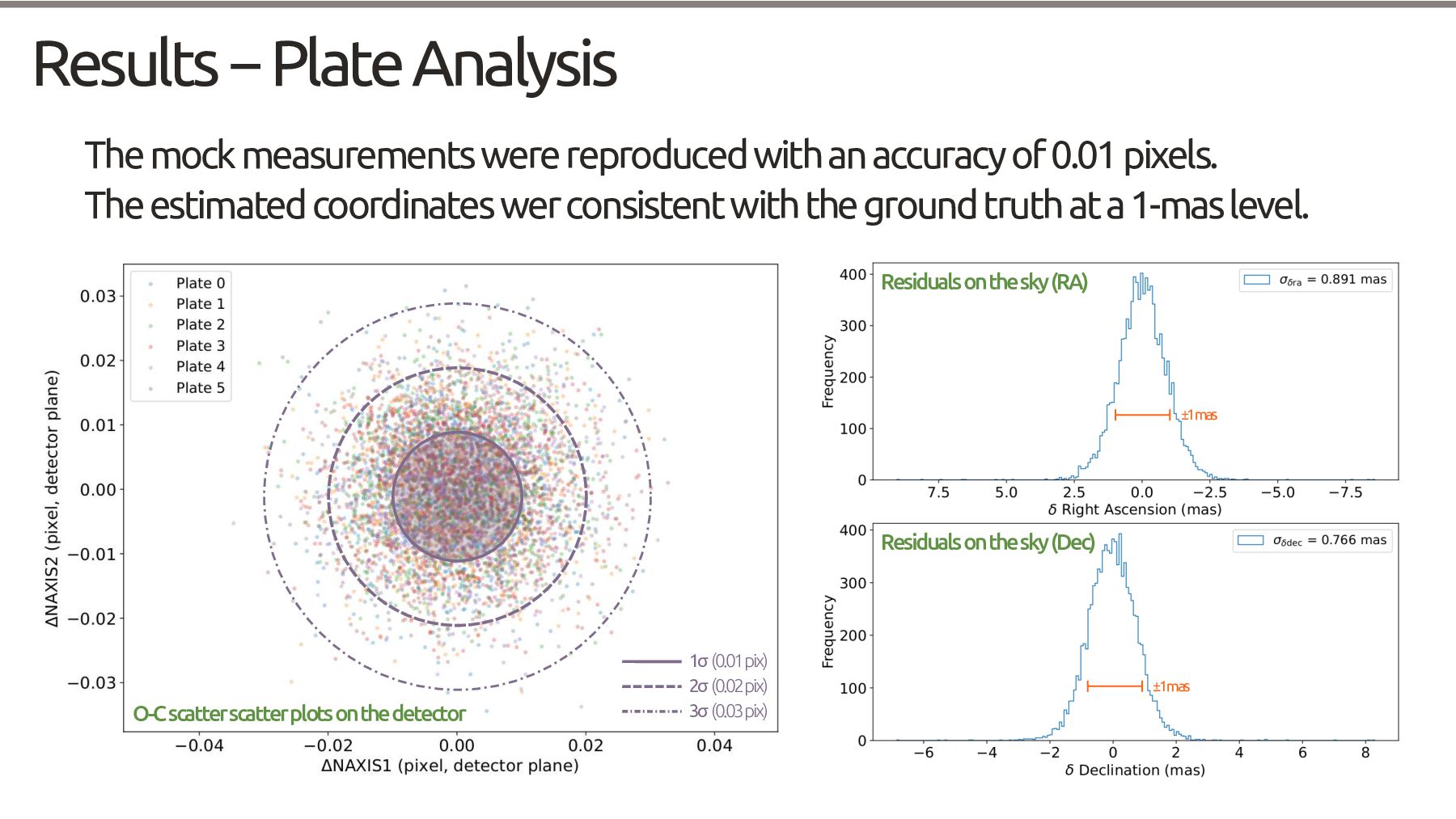
an accuracy of 0.01 pixels. The estimated coordinates wer consistent with the ground truth at a 1-mas level. Residuals on the sky (RA) ±1mas Residuals on the sky (Dec) O-C scatter scatter plots on the detector 1σ (0.01pix) 2σ (0.02pix) 3σ (0.03pix) ±1mas
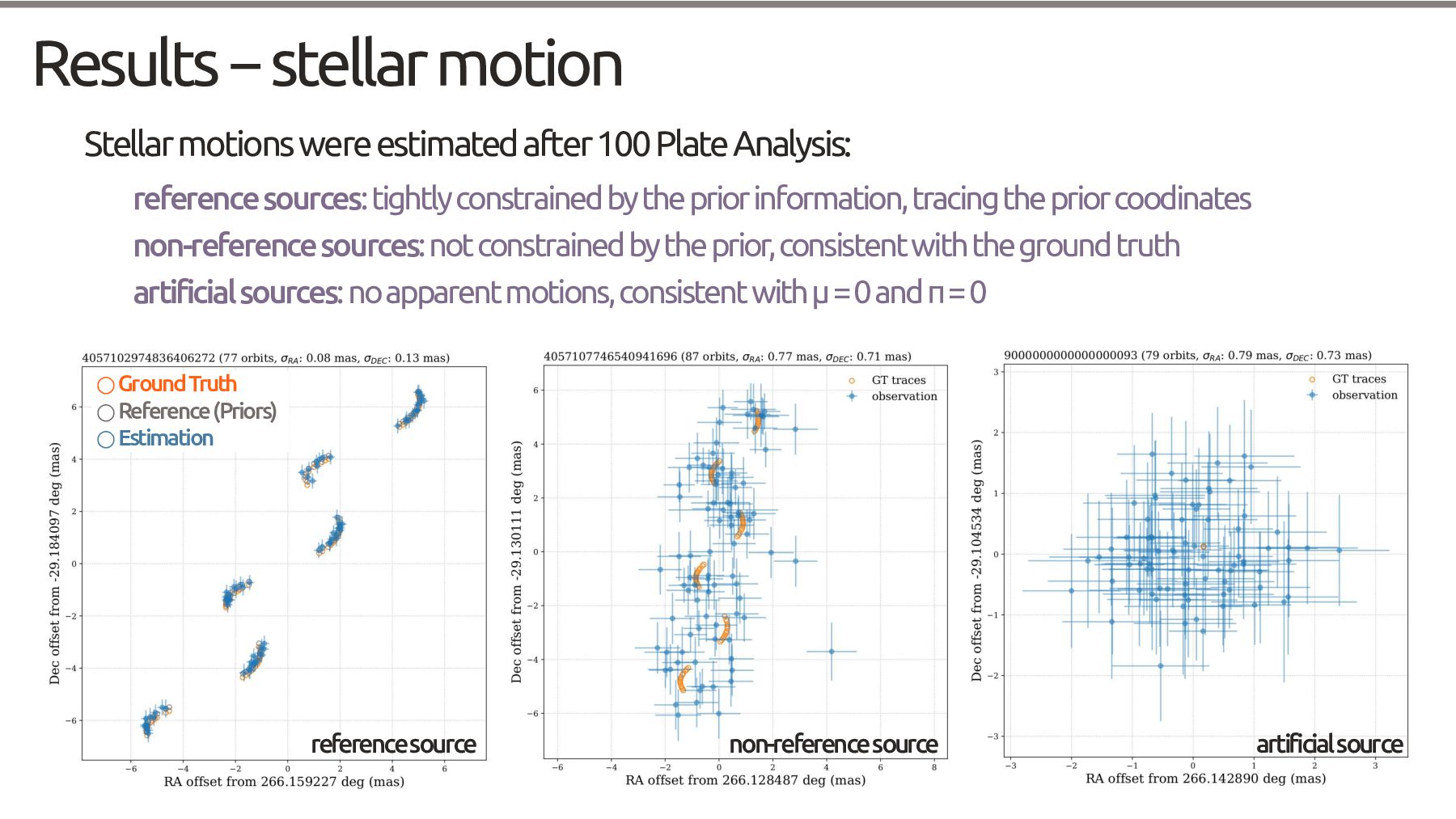
Plate Analysis: reference sources: tightly constrained by the prior information, tracing the prior coodinates non-reference sources: not constrained by the prior, consistent with the ground truth artificial sources: no apparent motions, consistent with μ = 0 and π = 0 ◦ Ground Truth ◦ Reference (Priors) ◦ Estimation reference source non-reference source artificial source
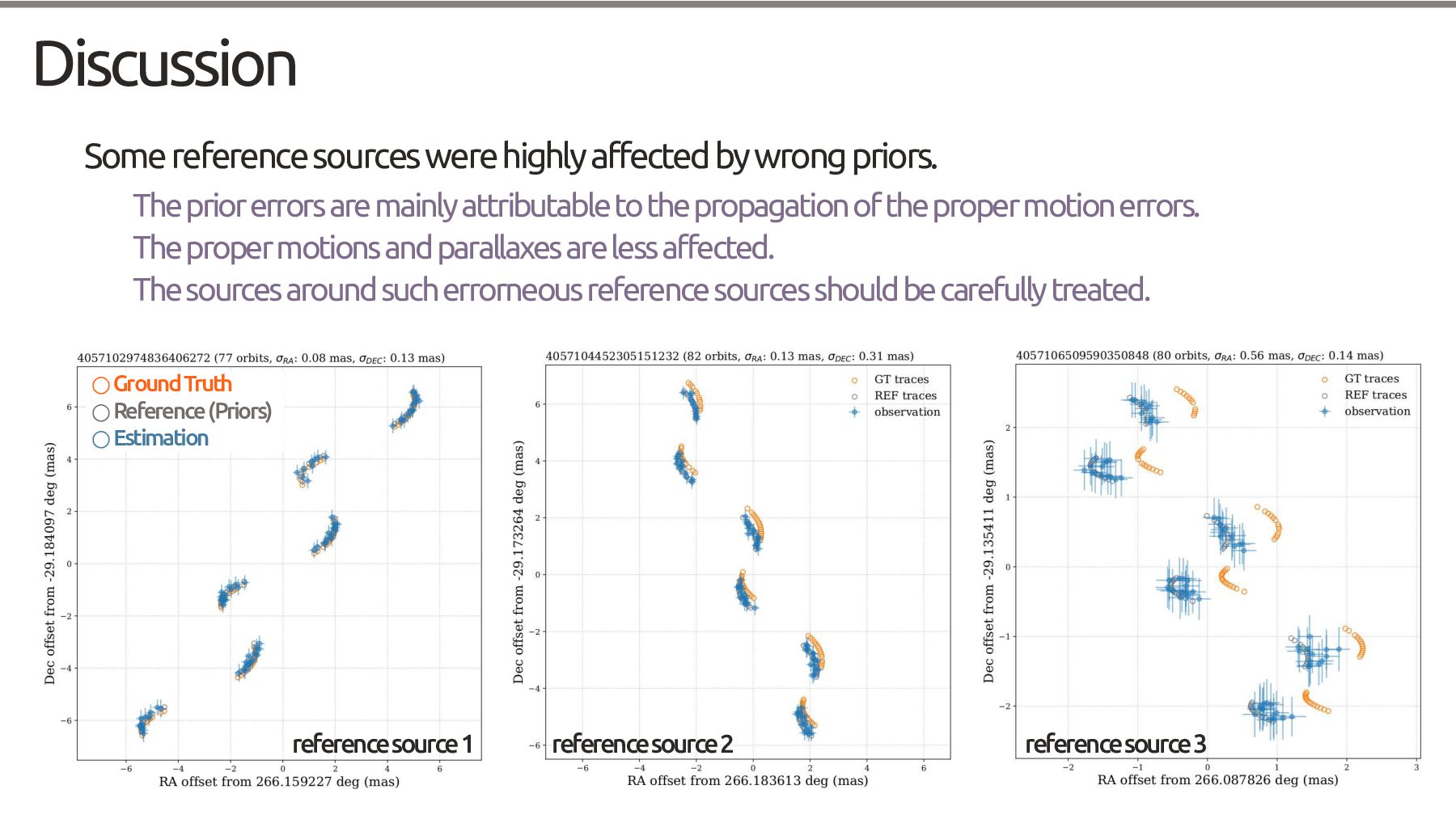
The prior errors are mainly attributable to the propagation of the proper motion errors. The proper motions and parallaxes are less affected. The sources around such errorneous reference sources should be carefully treated. ◦ Ground Truth ◦ Reference (Priors) ◦ Estimation reference source 1 reference source 2 reference source 3
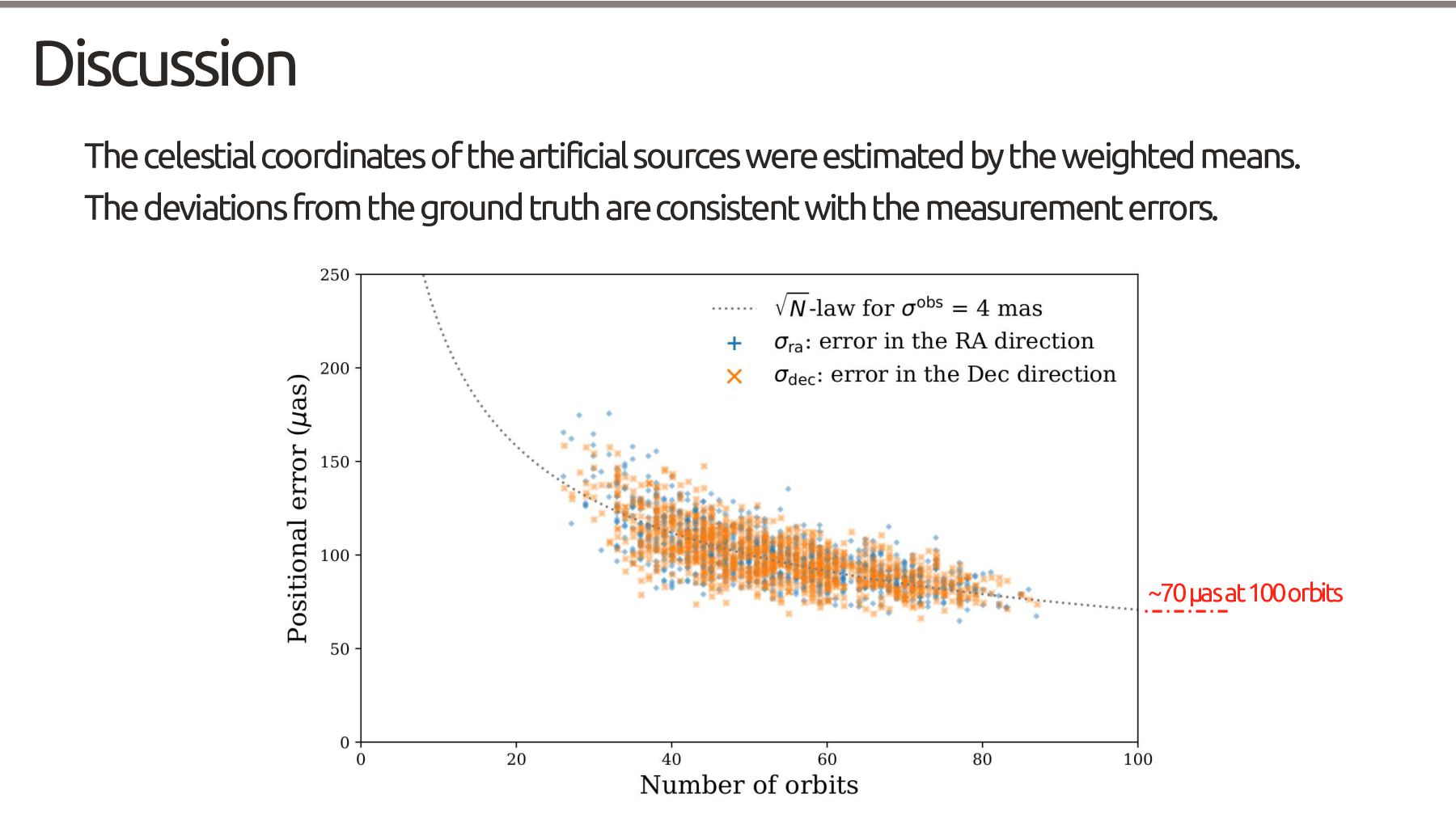
Concepts of the mission are partly tested via small-sclae simulation. ▪ Mock measurements of the mini survey are processed by Plate Analysis. ▪ Observation models (4×10⁴ params, 3×10⁵ meas.) are successfully optimized thanks to DP & SVI. ▪ Expected positional accuracy is ~70 μas as 100 orbits, consistent with measurementerrors. Future work ▪ More realistic simulation: Measurement errors (Kamizuka+, 13099-93), Stellar populations (Ramos+, 13101-104), Detector characteristics (Miyakawa+, 13103-82), Image distortion (Isobe+, 13092-186) ▪ From Plate Analysis to a global solution: All the measurement should be treated for better calibrations (like Gaia's AGIS and GSR)


 astronasutarou
 shumpei777
 mickey_kubo
 brainpadpr
 trycycle
 arfon
arfon
 enakai00
 masakiokuda
 sshimizu2006
%20square.jpg) baggiponte
baggiponte
 speakerdeck
 trishagee
 lara
lara
 letsgokoyo
 akashhashmi
 jonoalderson
 thekraken
 morganepeng
 garrettdimon
 jlugia
 kneath
 yeseniaperezcruz