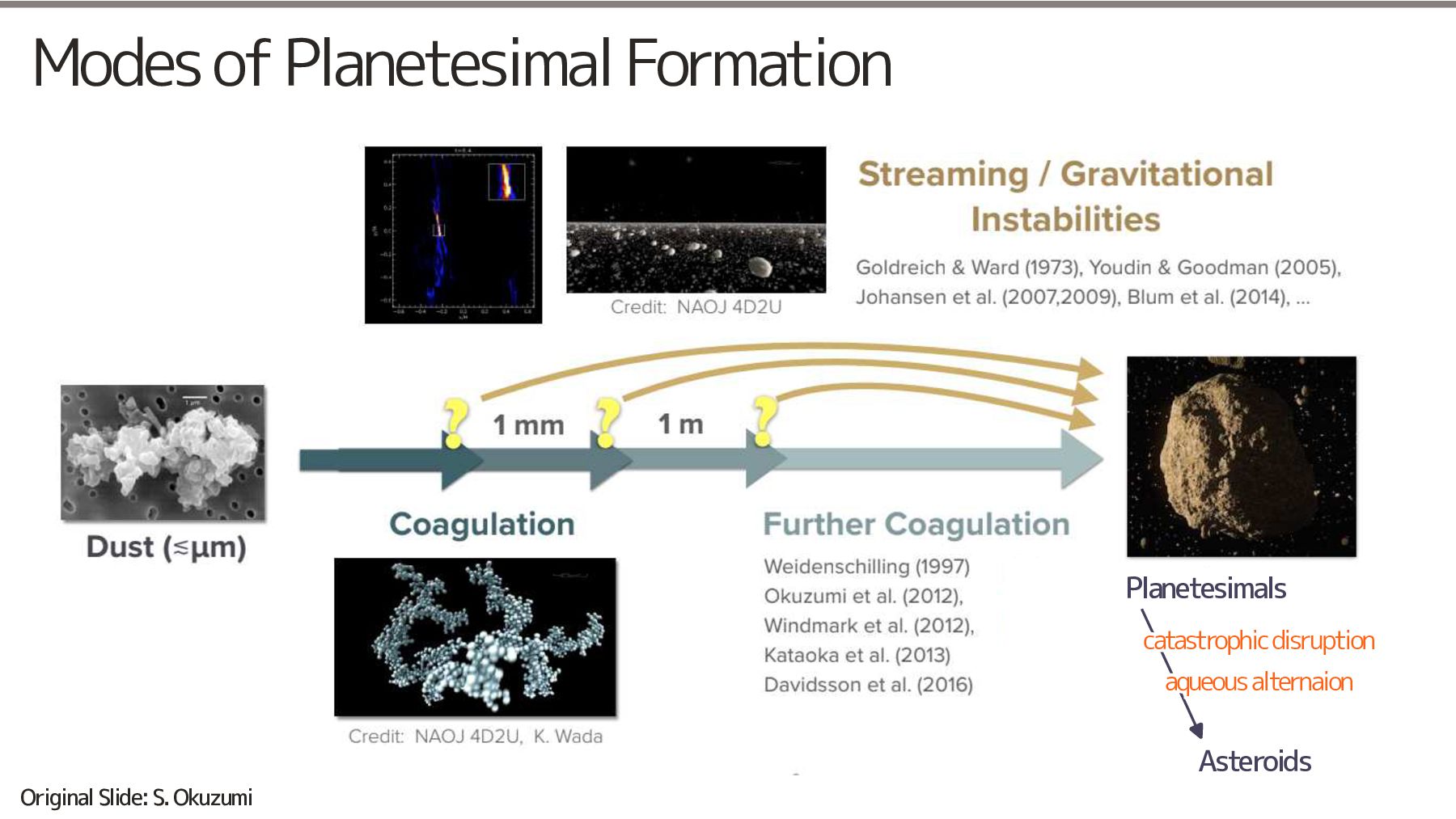
the Origin of the Solar System Ryou Ohsawa*, Hiroyuki Kurokawa, Yuri Shimaki, Naoya Sakatani, Ryota Fuaki, Eri Tatsumi, Jun Aoki, Yoko Kebukawa, Next Generation Small Body Sample Return Mission Science Team *National Astronomical Observatory of Japan, JASMINE Project
Key scientific requirements Unbiased samples of presolar grains; Samples of unprocessed organic materials; The internal structure and density profile of small bodies. ⇨ Next-Generation Small-Body Sample Return Mission (NGSR) Bringing back comeatry dust > 1 m beneath the surface; Measureing the depthwise variations of molecular abundances; Inspecting the size of voids in comeatry nucleus.
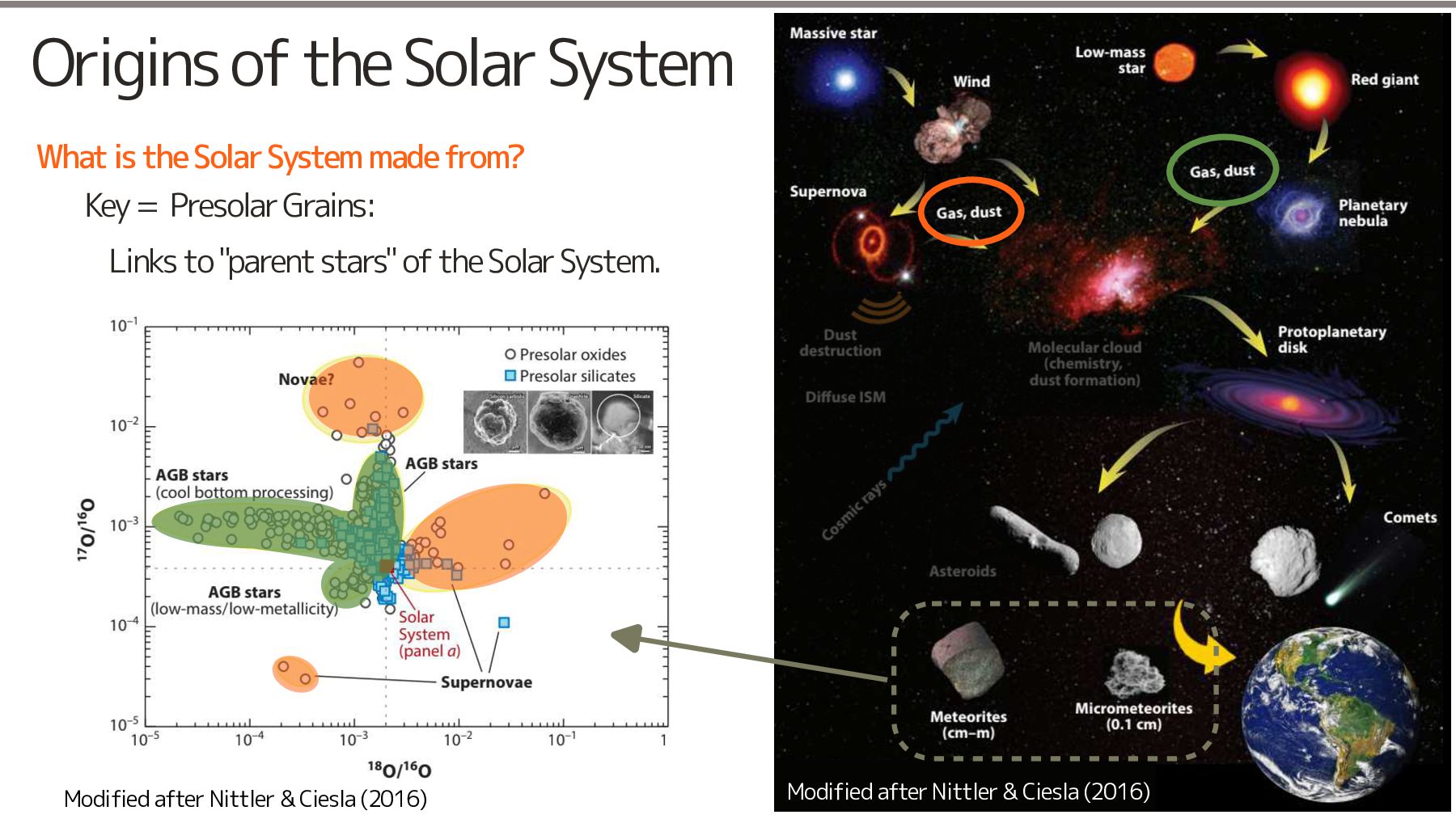
made from? Key = Presolar Grains: Links to "parent stars" of the Solar System. Modified after Nittler & Ciesla (2016) Modified after Nittler & Ciesla (2016)
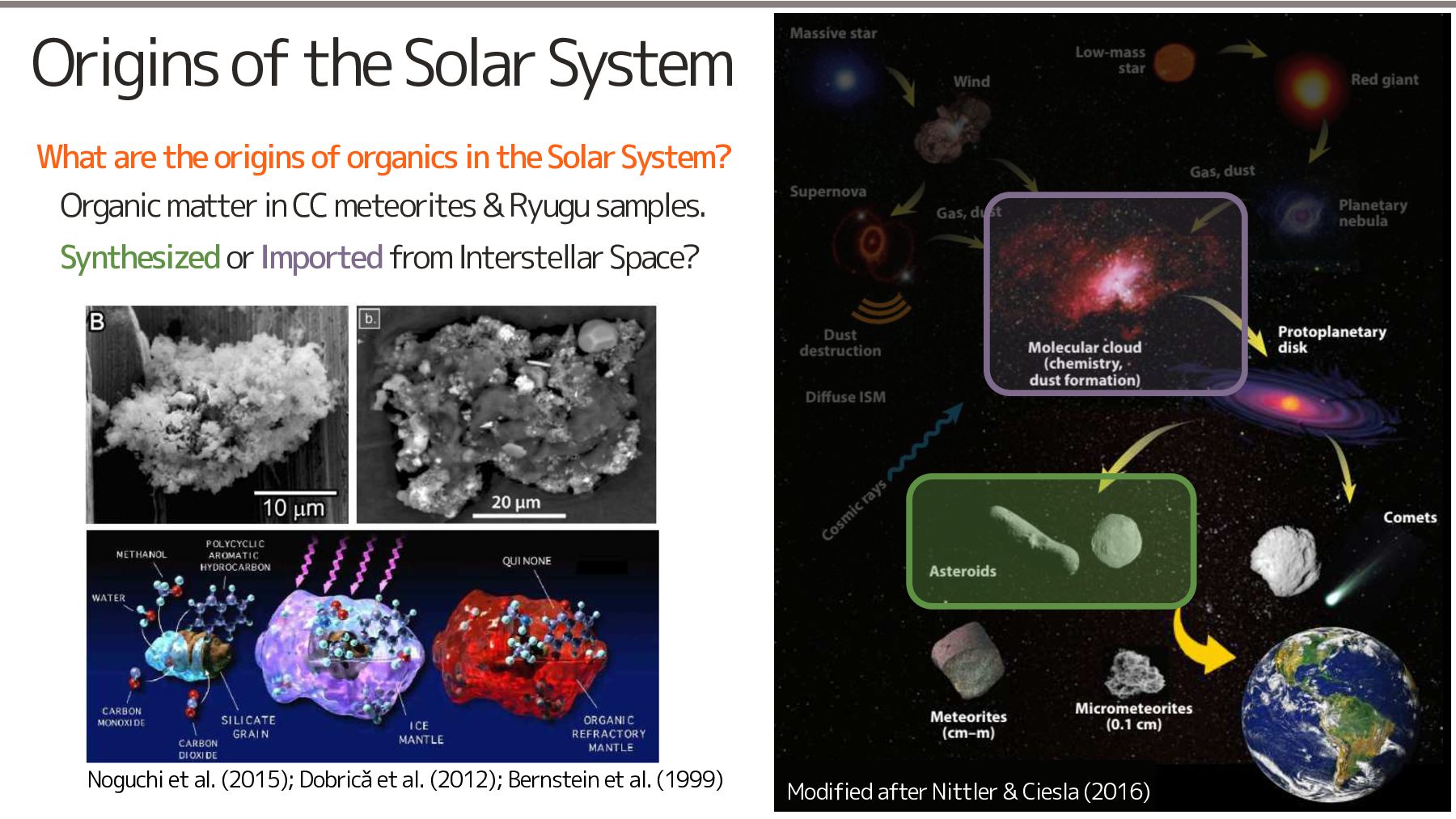
organics in the Solar System? Organic matter in CC meteorites & Ryugu samples. Synthesized or Imported from Interstellar Space? Noguchi et al. (2015); Dobricǎ et al. (2012); Bernstein et al. (1999) Modified after Nittler & Ciesla (2016)
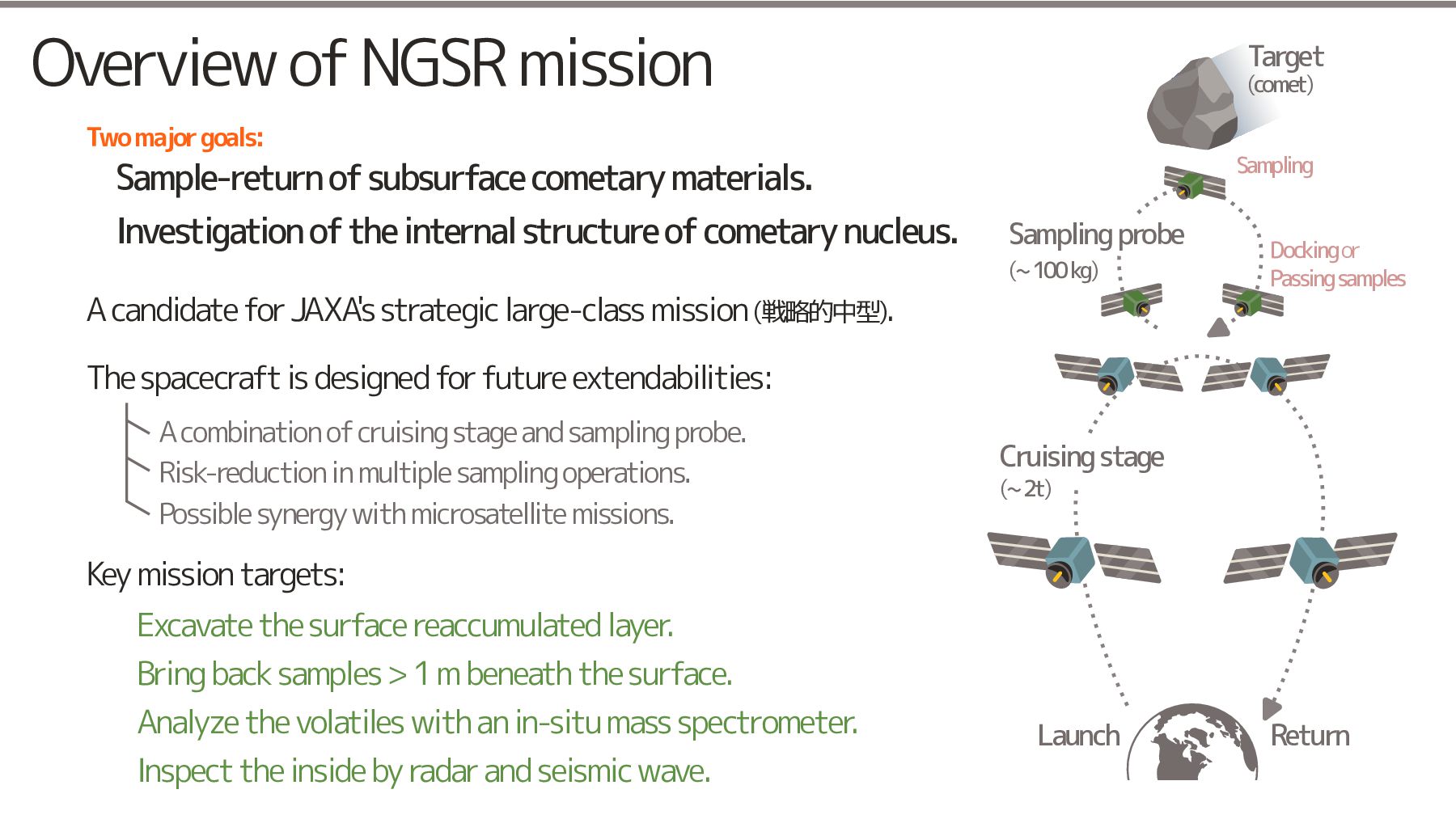
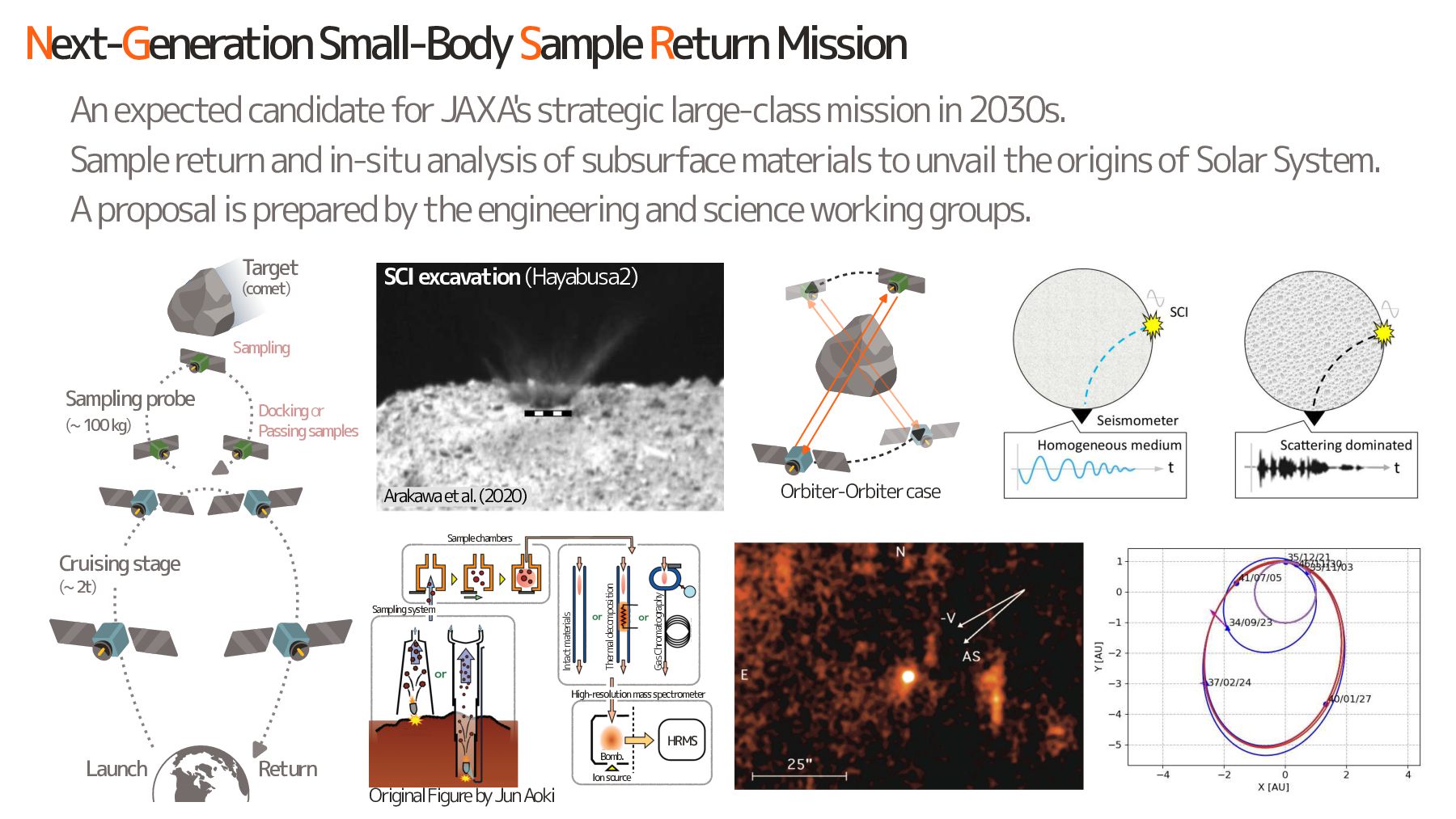
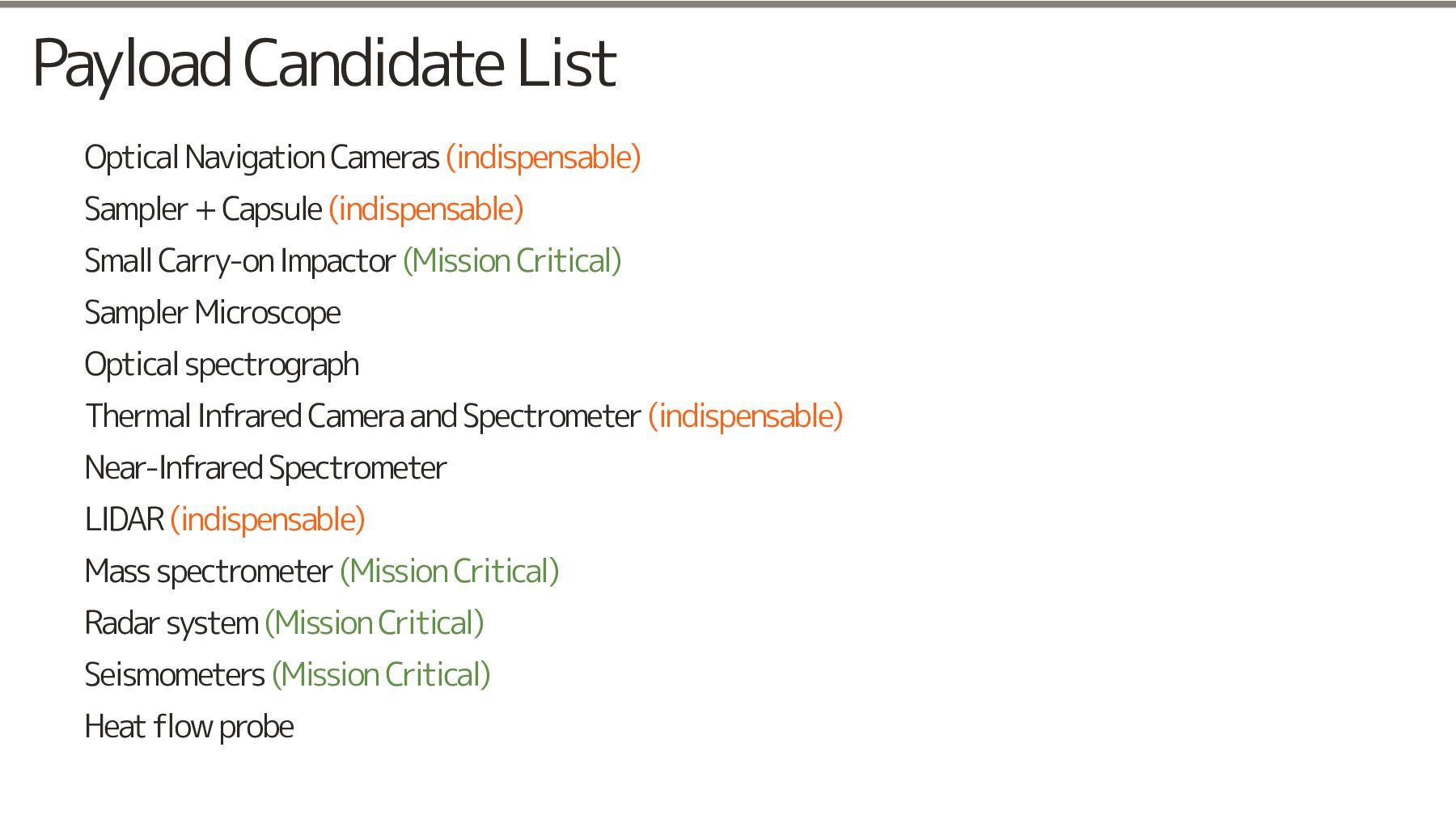
of subsurface cometary materials. Investigation of the internal structure of cometary nucleus. Sampling Sampling probe (~ 100 kg) Docking or Passing samples A candidate for JAXA's strategic large-class mission (戦略的中型). The spacecraft is designed for future extendabilities: A combination of cruising stage and sampling probe. Risk-reduction in multiple sampling operations. Possible synergy with microsatellite missions. Cruising stage (~ 2t) Key mission targets: Excavate the surface reaccumulated layer. Bring back samples > 1 m beneath the surface. Analyze the volatiles with an in-situ mass spectrometer. Inspect the inside by radar and seismic wave. Launch Return
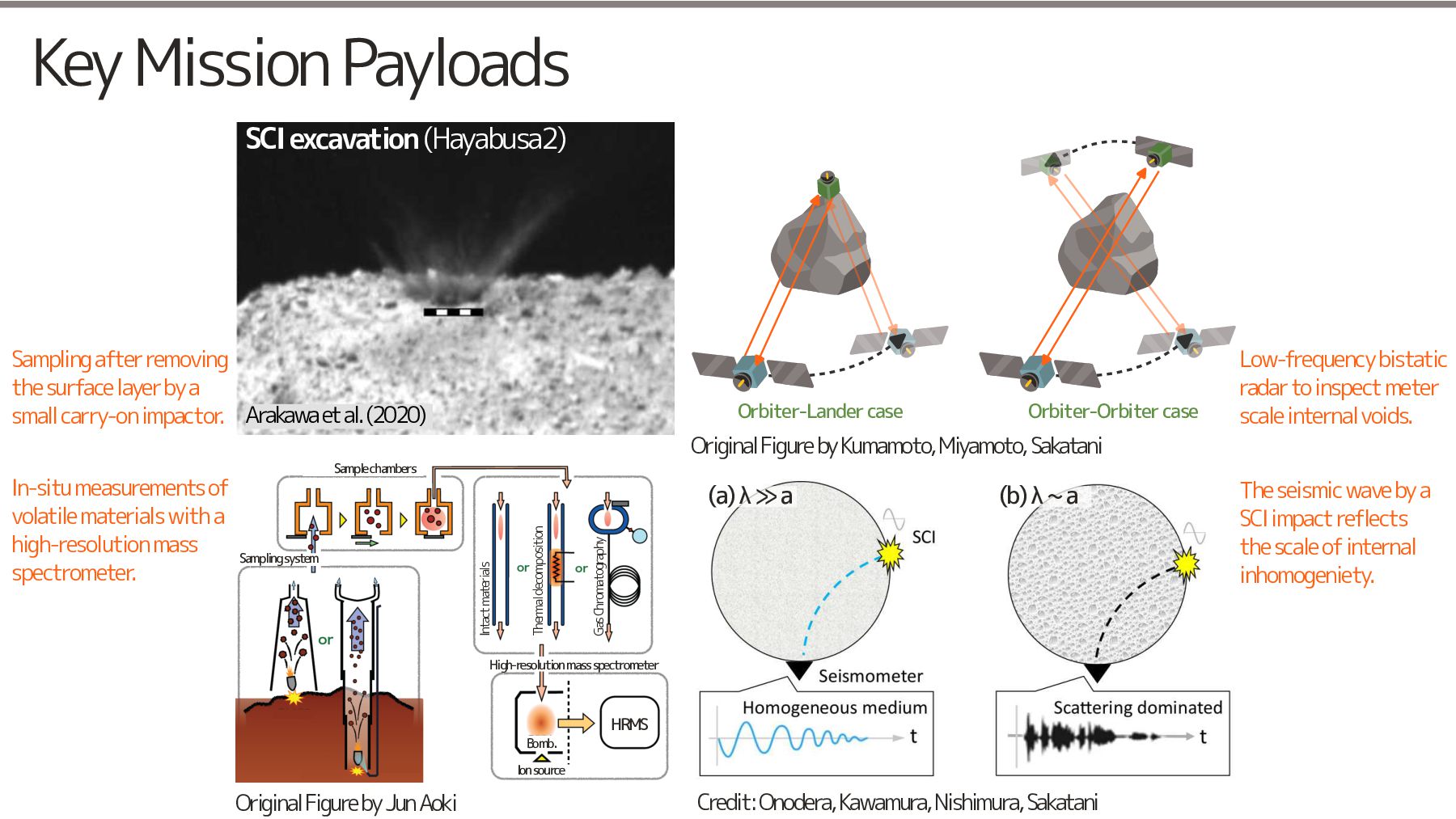
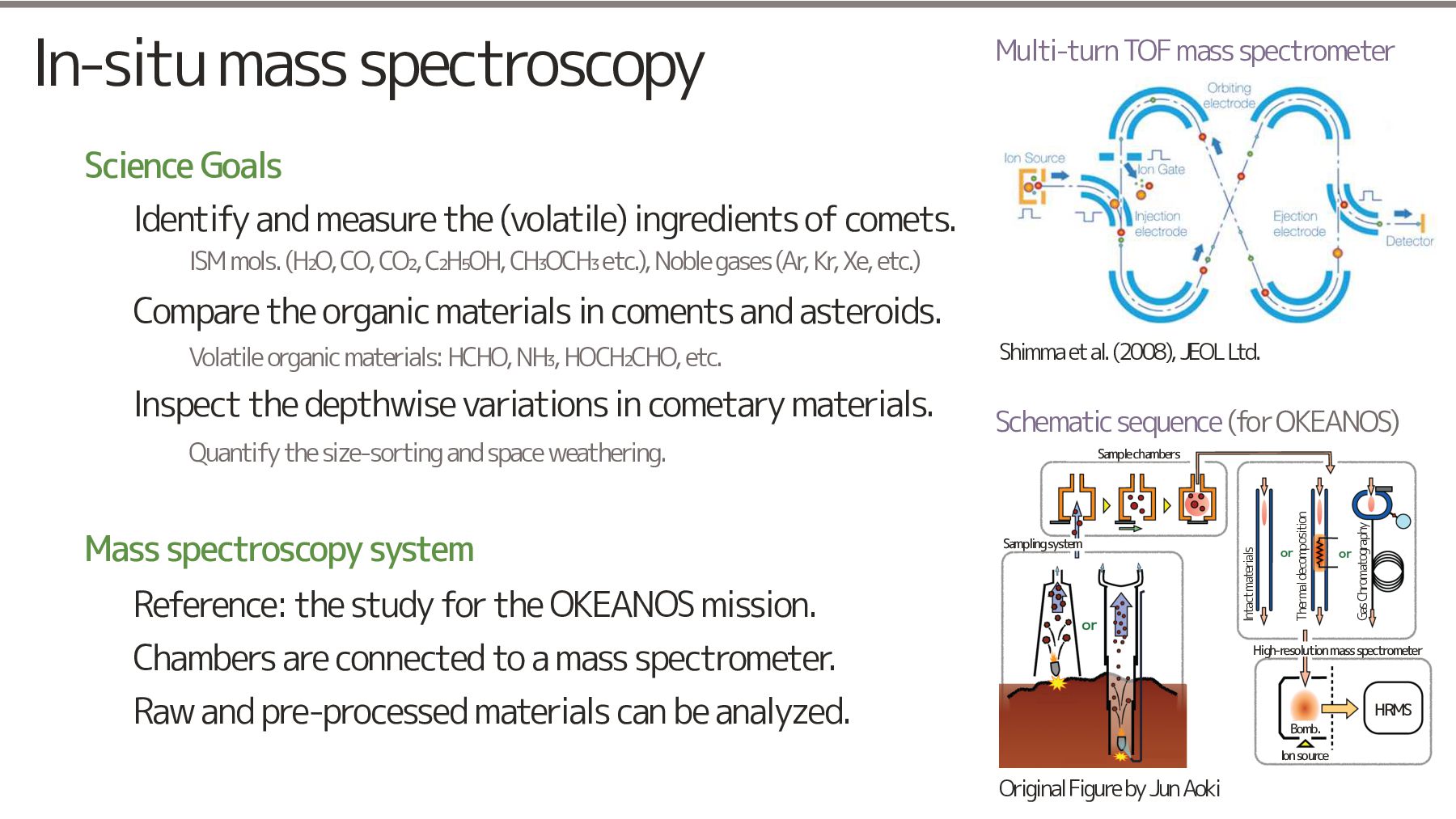
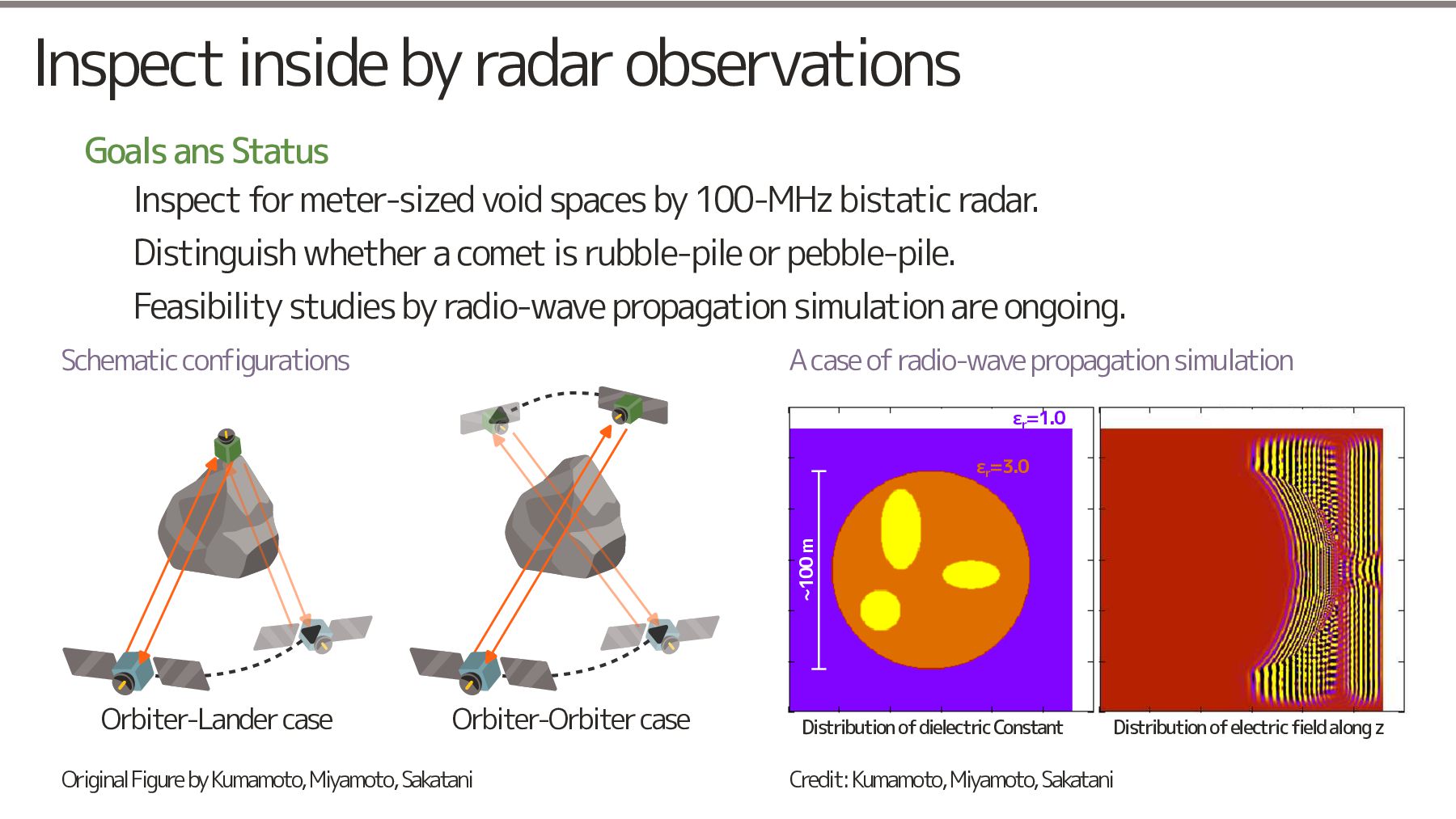
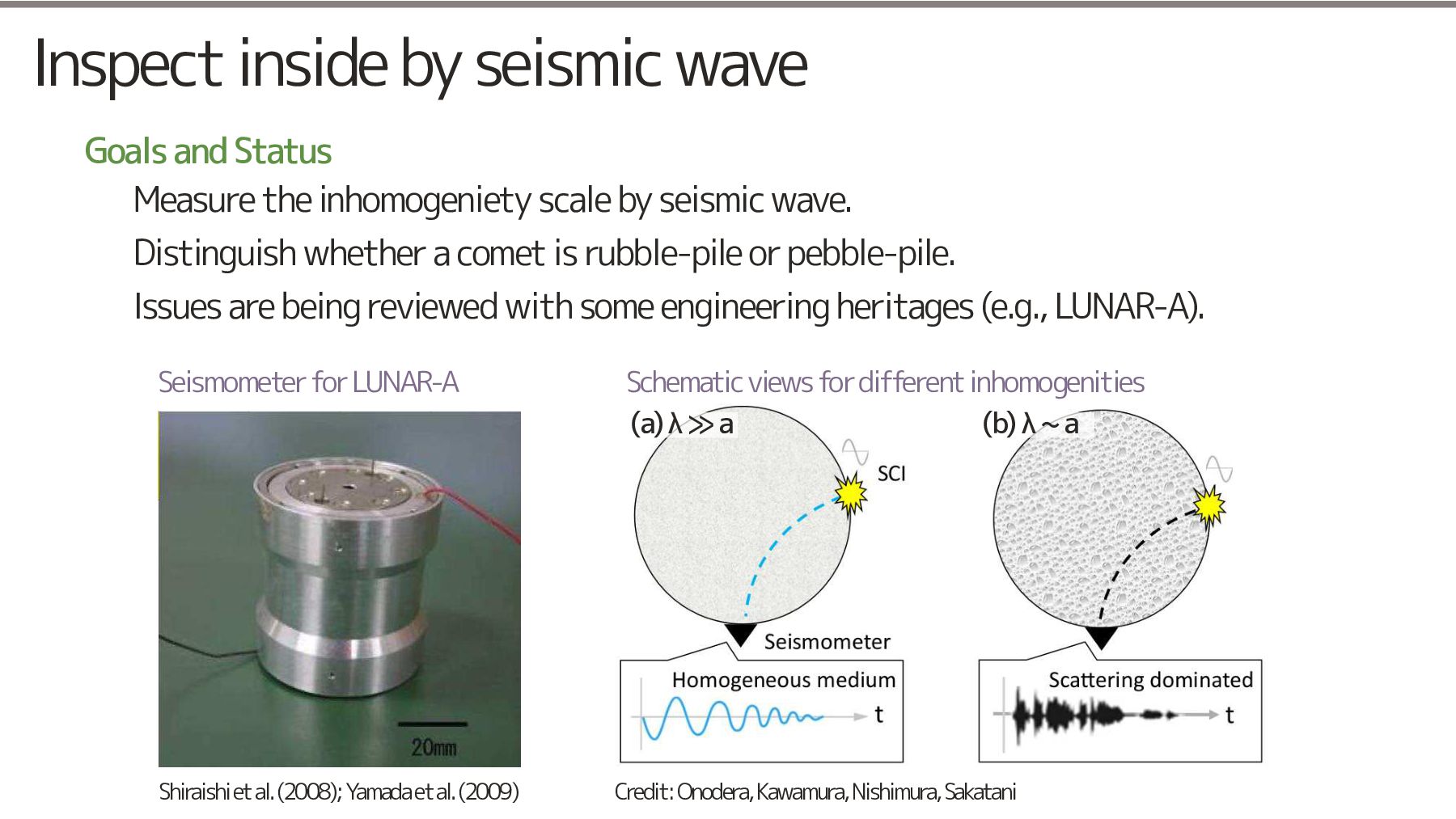
surface layer by a small carry-on impactor. Arakawa et al. (2020) Orbiter-Lander case Orbiter-Orbiter case Low-frequency bistatic radar to inspect meter scale internal voids. Original Figure by Kumamoto, Miyamoto, Sakatani Sample chambers (b) λ ~ a Gas Chromatography Thermal decomposition (a) λ ≫ a Intact materials In-situ measurements of volatile materials with a high-resolution mass Sampling system spectrometer. High-resolution mass spectrometer HRMS Bomb. Ion source Original Figure by Jun Aoki Credit: Onodera, Kawamura, Nishimura, Sakatani The seismic wave by a SCI impact reflects the scale of internal inhomogeniety.
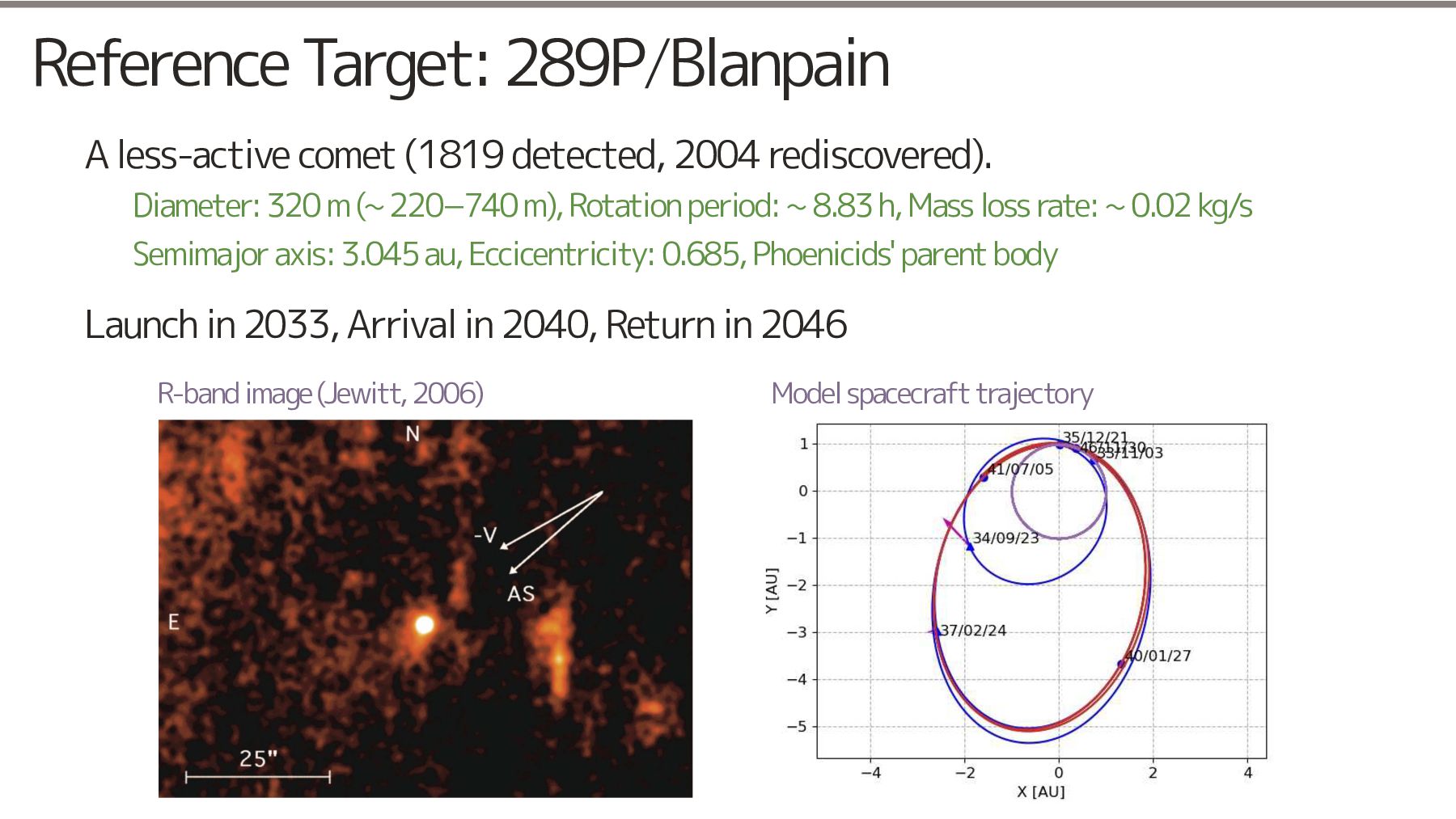
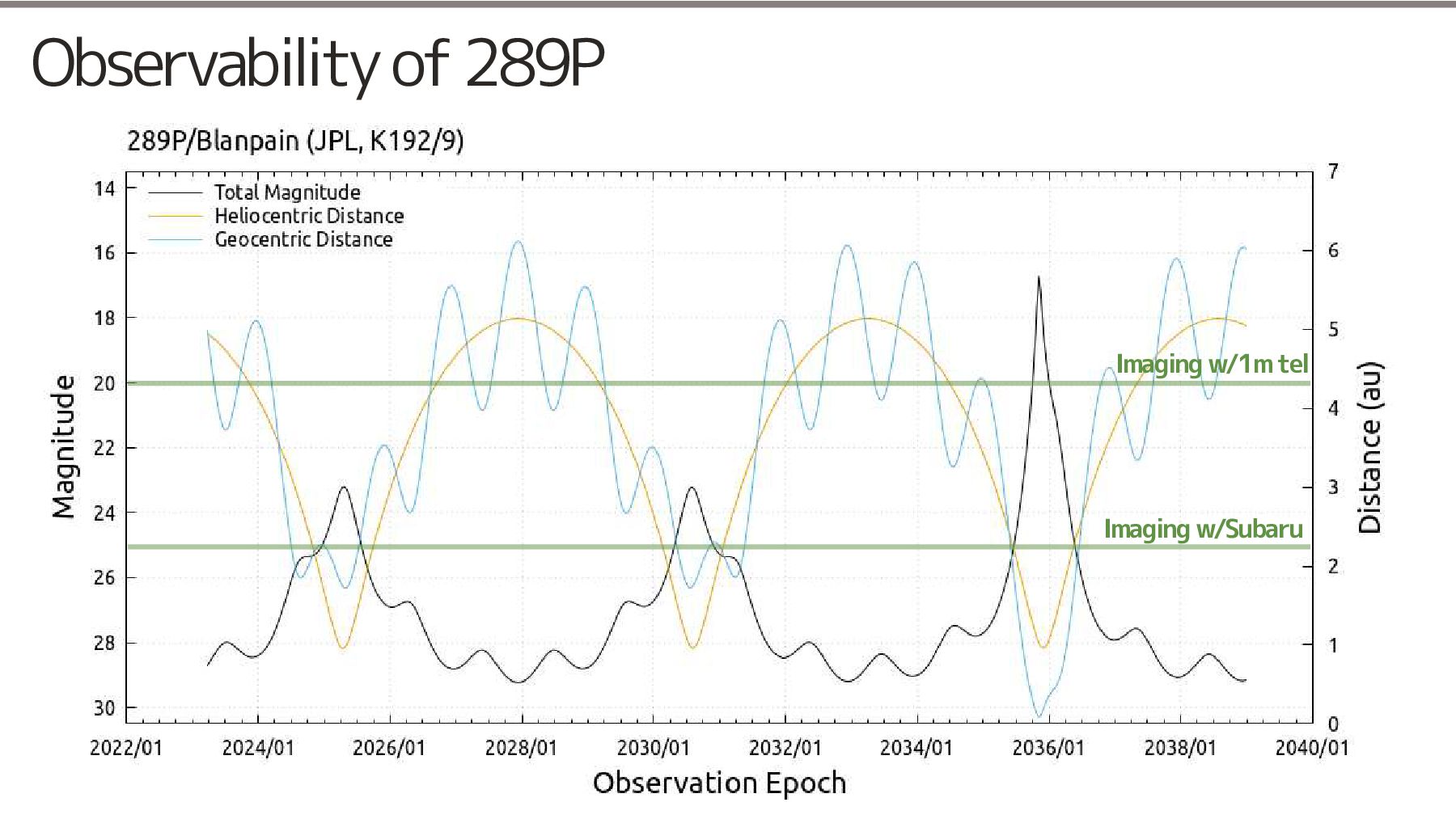
Diameter: 320 m (~ 220−740 m), Rotation period: ~ 8.83 h, Mass loss rate: ~ 0.02 kg/s Semimajor axis: 3.045 au, Eccicentricity: 0.685, Phoenicids' parent body Launch in 2033, Arrival in 2040, Return in 2046 R-band image (Jewitt, 2006) Model spacecraft trajectory
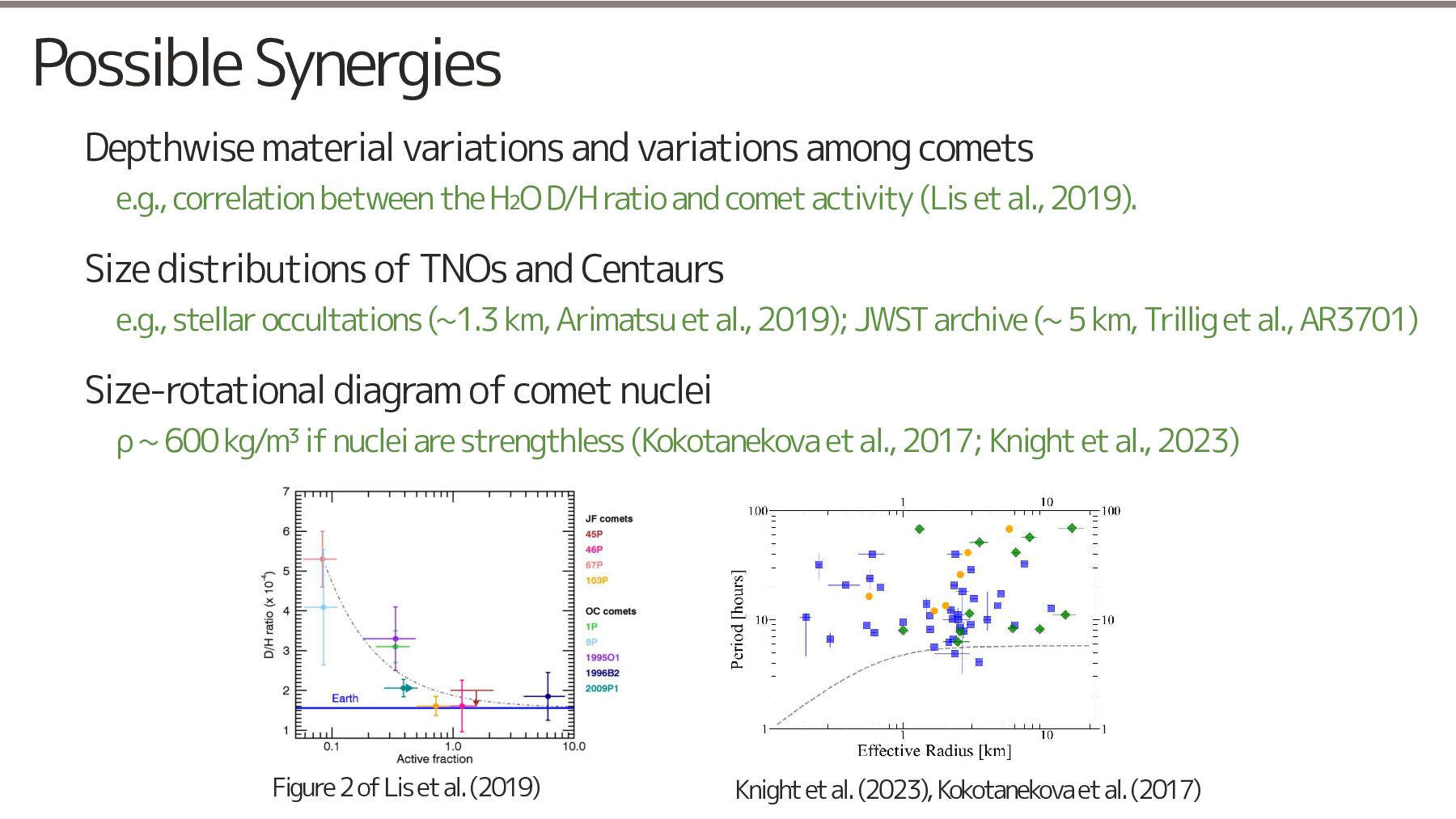
correlation between the H₂O D/H ratio and comet activity (Lis et al., 2019). Size distributions of TNOs and Centaurs e.g., stellar occultations (~1.3 km, Arimatsu et al., 2019); JWST archive (~ 5 km, Trillig et al., AR3701) Size-rotational diagram of comet nuclei ρ ~ 600 kg/m³ if nuclei are strengthless (Kokotanekova et al., 2017; Knight et al., 2023) Figure 2 of Lis et al. (2019) Knight et al. (2023), Kokotanekova et al. (2017)
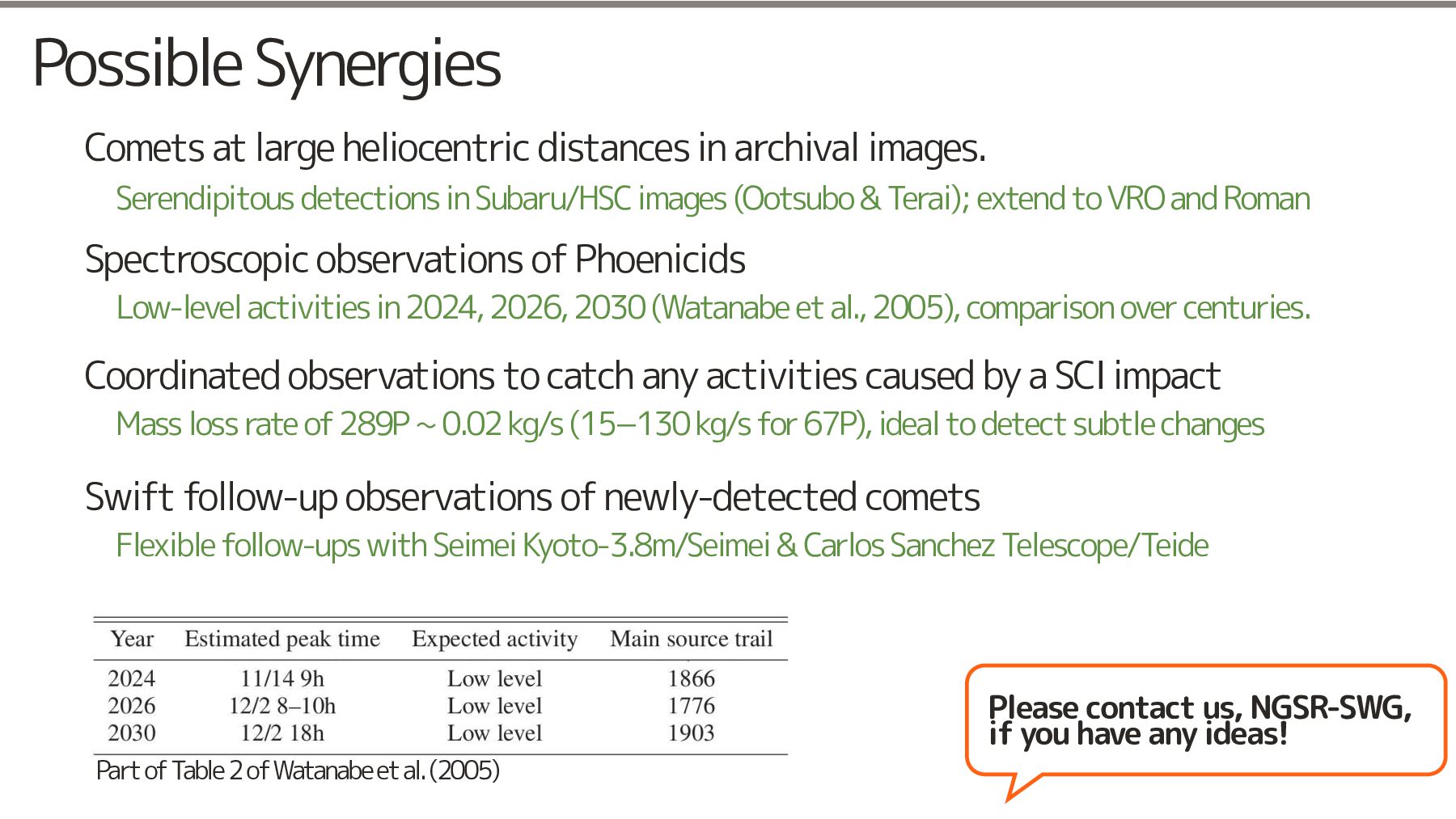
Serendipitous detections in Subaru/HSC images (Ootsubo & Terai); extend to VRO and Roman Spectroscopic observations of Phoenicids Low-level activities in 2024, 2026, 2030 (Watanabe et al., 2005), comparison over centuries. Coordinated observations to catch any activities caused by a SCI impact Mass loss rate of 289P ~ 0.02 kg/s (15−130 kg/s for 67P), ideal to detect subtle changes Swift follow-up observations of newly-detected comets Flexible follow-ups with Seimei Kyoto-3.8m/Seimei & Carlos Sanchez Telescope/Teide Please contact us, NGSR-SWG, if you have any ideas! Partof Table 2 of Watanabe et al. (2005)
strategic large-class mission in 2030s. Sample return and in-situ analysis of subsurface materials to unvail the origins of Solar System. A proposal is prepared by the engineering and science working groups. Target (comet) SCI excavation (Hayabusa2) Sampling Sampling probe (~ 100 kg) Docking or Passing samples Orbiter-Orbiter case Arakawa et al. (2020) Sample chambers Gas Chromatography Samplingsystem Intact materials (~ 2t) Thermal decomposition Cruising stage High-resolution mass spectrometer HRMS Launch Bomb. Return Ion source Original Figure by Jun Aoki
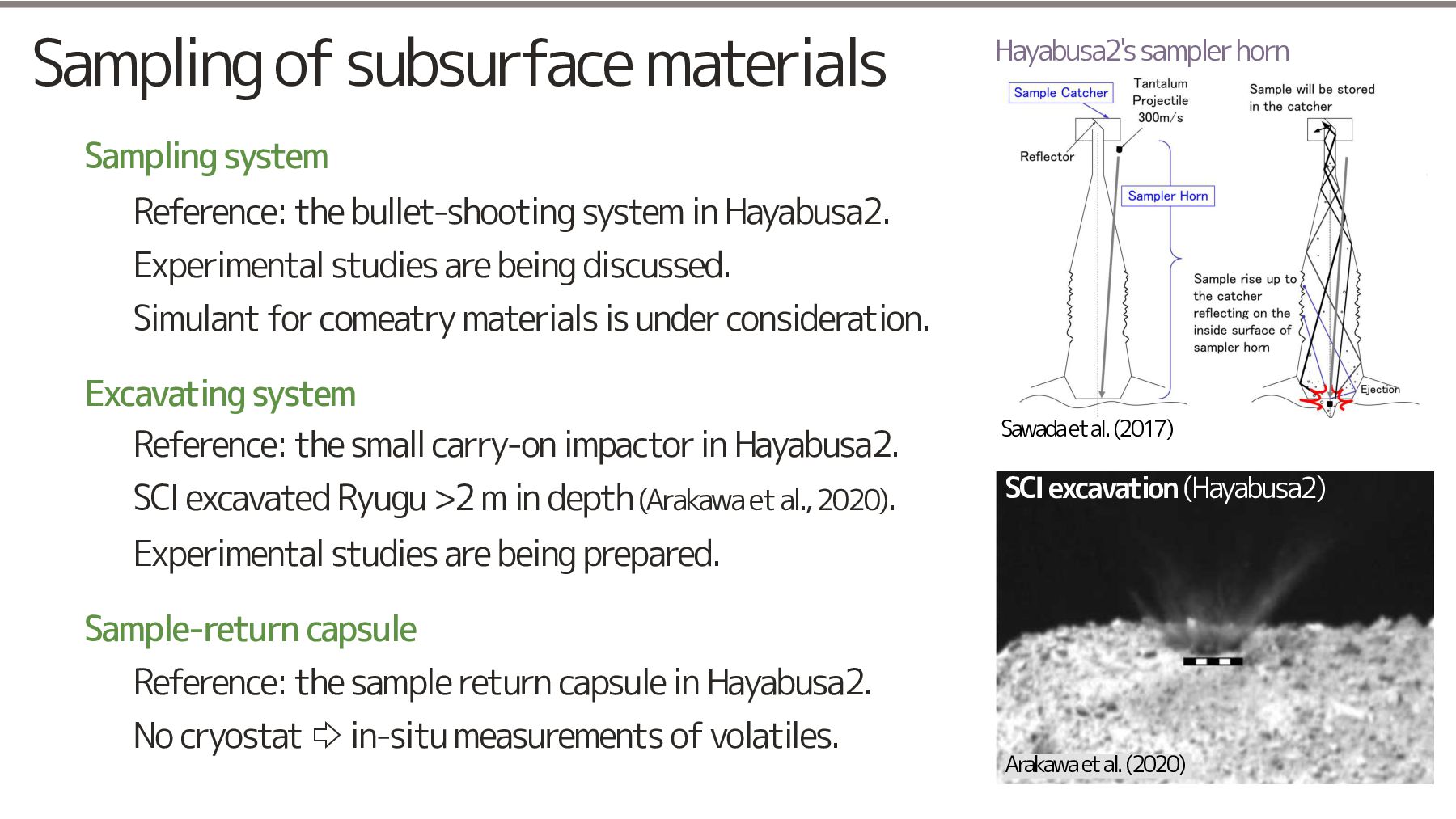
the bullet-shooting system in Hayabusa2. Experimental studies are being discussed. Simulant for comeatry materials is under consideration. Excavating system Reference: the small carry-on impactor in Hayabusa2. SCI excavated Ryugu >2 m in depth (Arakawa et al., 2020). Sawada et al. (2017) SCI excavation (Hayabusa2) Experimental studies are being prepared. Sample-return capsule Reference: the sample return capsule in Hayabusa2. No cryostat ⇨ in-situ measurements of volatiles. Arakawa et al. (2020)
and measure the (volatile) ingredients of comets. ISM mols. (H₂O, CO, CO₂, C₂H₅OH, CH₃OCH₃ etc.), Noble gases (Ar, Kr, Xe, etc.) Compare the organic materials in coments and asteroids. Schematic sequence (for OKEANOS) Quantify the size-sorting and space weathering. Sampling system Reference: the study for the OKEANOS mission. Chambers are connected to a mass spectrometer. Raw and pre-processed materials can be analyzed. Gas Chromatography Mass spectroscopy system Sample chambers Thermal decomposition Inspect the depthwise variations in cometary materials. Shimma et al. (2008), JEOL Ltd. Intact materials Volatile organic materials: HCHO, NH₃, HOCH₂CHO, etc. High-resolution mass spectrometer HRMS Bomb. Ion source Original Figure by Jun Aoki
meter-sized void spaces by 100-MHz bistatic radar. Distinguish whether a comet is rubble-pile or pebble-pile. Feasibility studies by radio-wave propagation simulation are ongoing. Schematic configurations A case of radio-wave propagation simulation εr=1.0 ~100 m εr=3.0 Orbiter-Lander case Orbiter-Orbiter case Original Figure by Kumamoto, Miyamoto, Sakatani Distribution of dielectric Constant Distribution of electric field along z Credit: Kumamoto, Miyamoto, Sakatani
inhomogeniety scale by seismic wave. Distinguish whether a comet is rubble-pile or pebble-pile. Issues are being reviewed with some engineering heritages (e.g., LUNAR-A). Seismometer for LUNAR-A Schematic views for different inhomogenities (a) λ ≫ a (b) λ ~ a Shiraishi et al. (2008); Yamada et al. (2009) Credit: Onodera, Kawamura, Nishimura, Sakatani
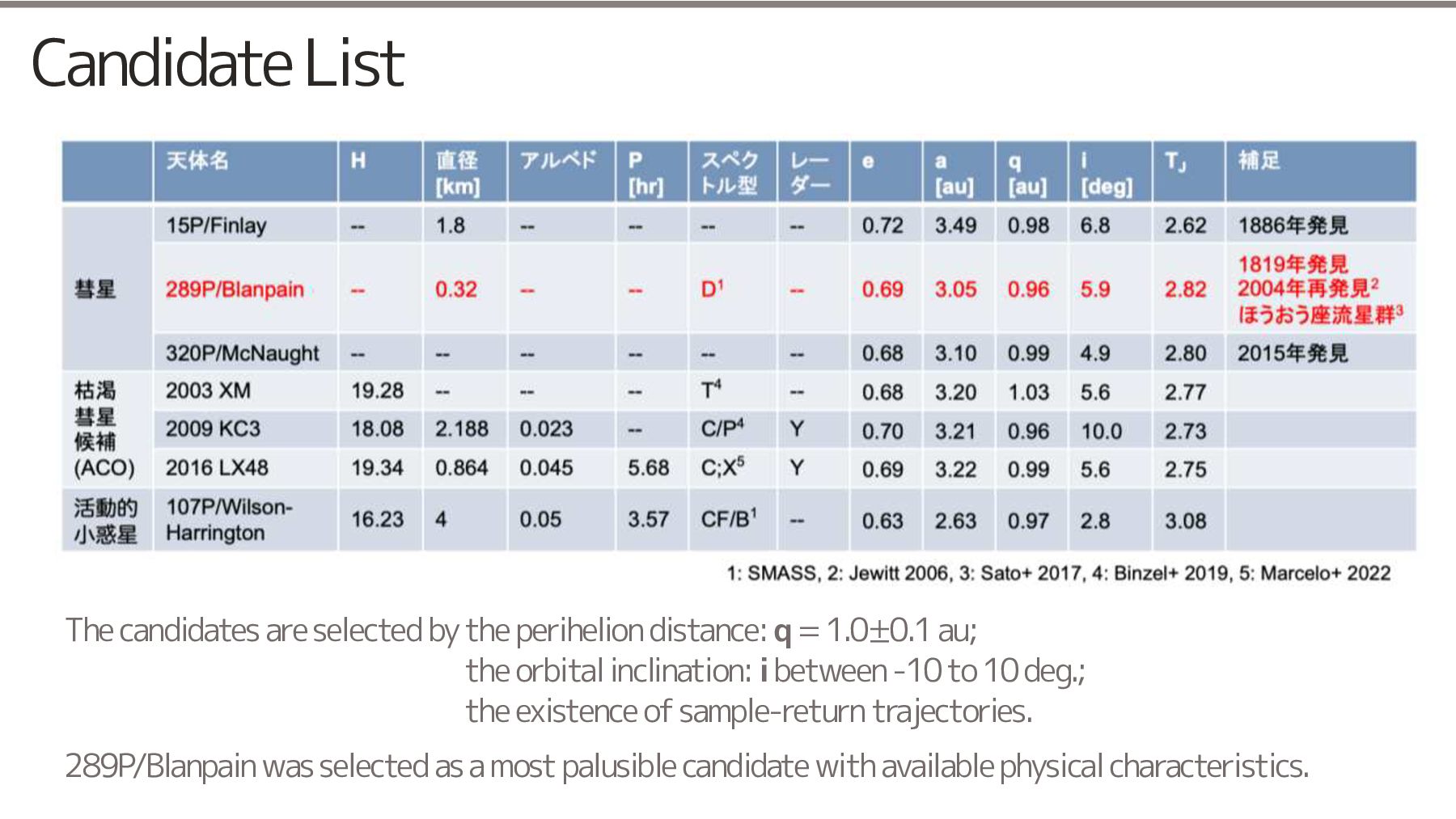
q = 1.0±0.1 au; the orbital inclination: i between -10 to 10 deg.; the existence of sample-return trajectories. 289P/Blanpain was selected as a most palusible candidate with available physical characteristics.


 astronasutarou
 arfon
arfon
 mickey_0226
 ianozsvald
 trycycle
 konakalab
 tagtag
 analokmaus
 syuchimu
 ykiyota
 voginip
 csswizardry
 wayneb77
 sonatard
 takai
takai
 jonyablonski
 jct
jct
 axbom
axbom
 gurzu
gurzu
 rabernat
 aki_iinuma
 joshbly