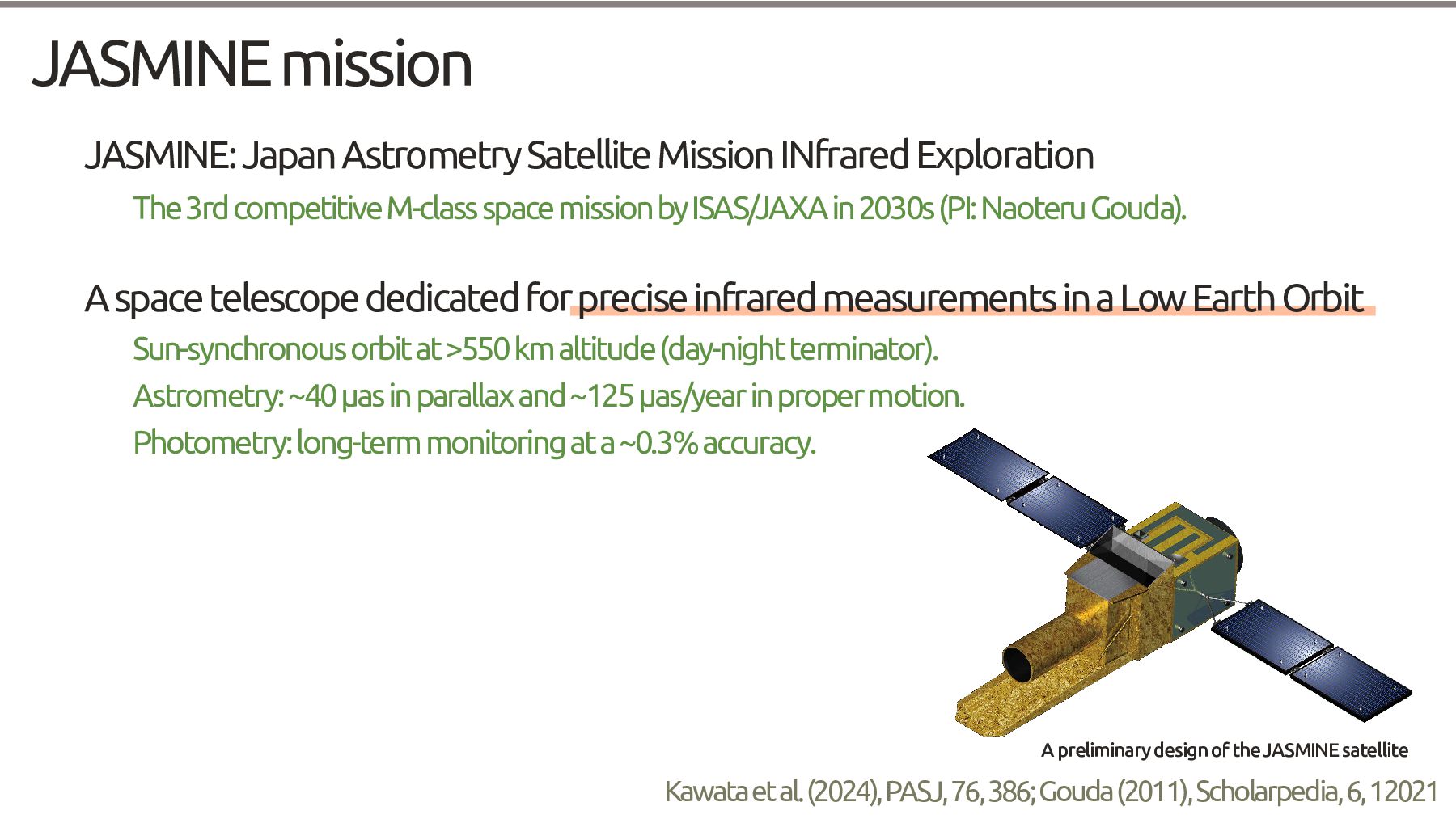
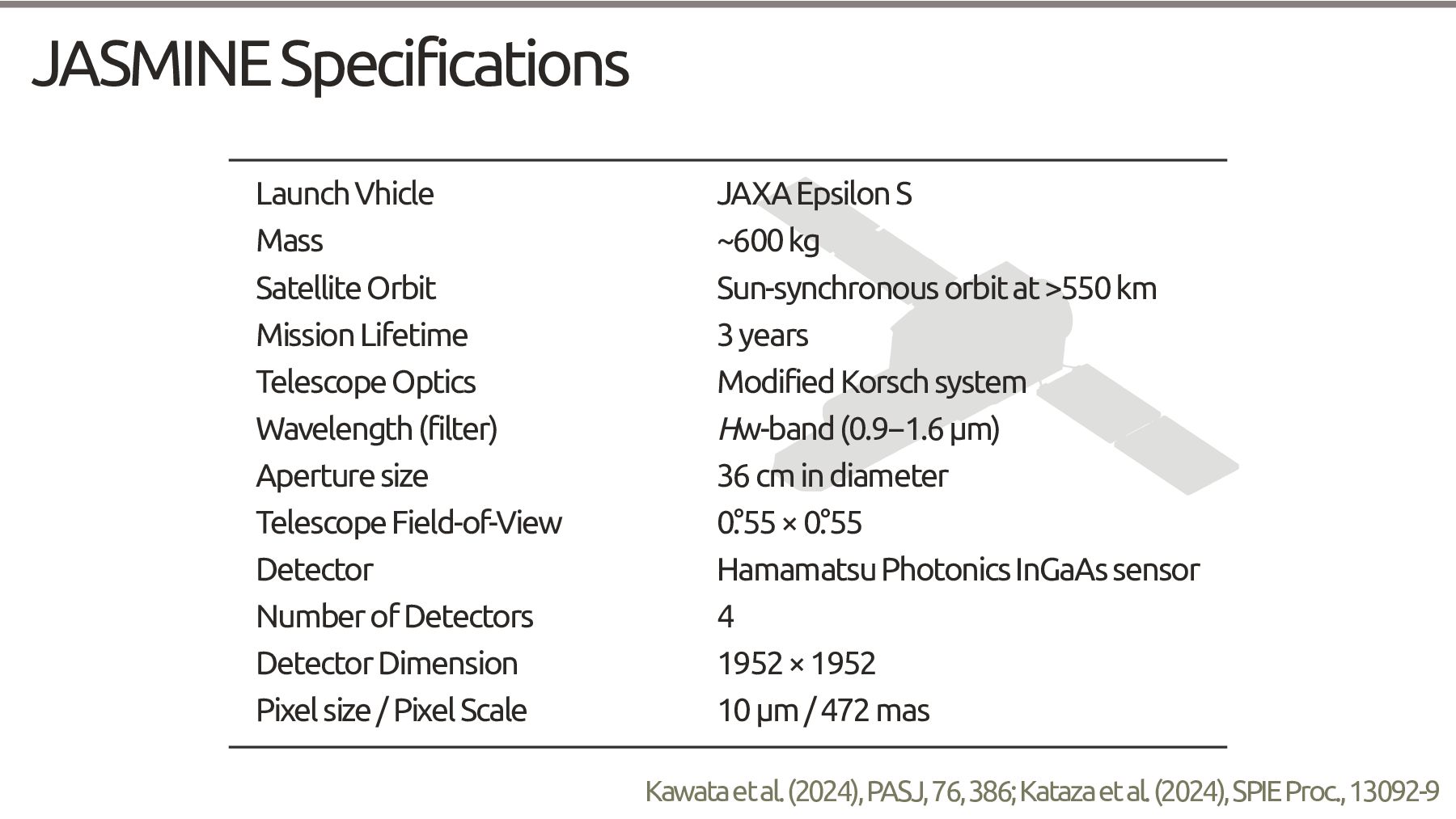
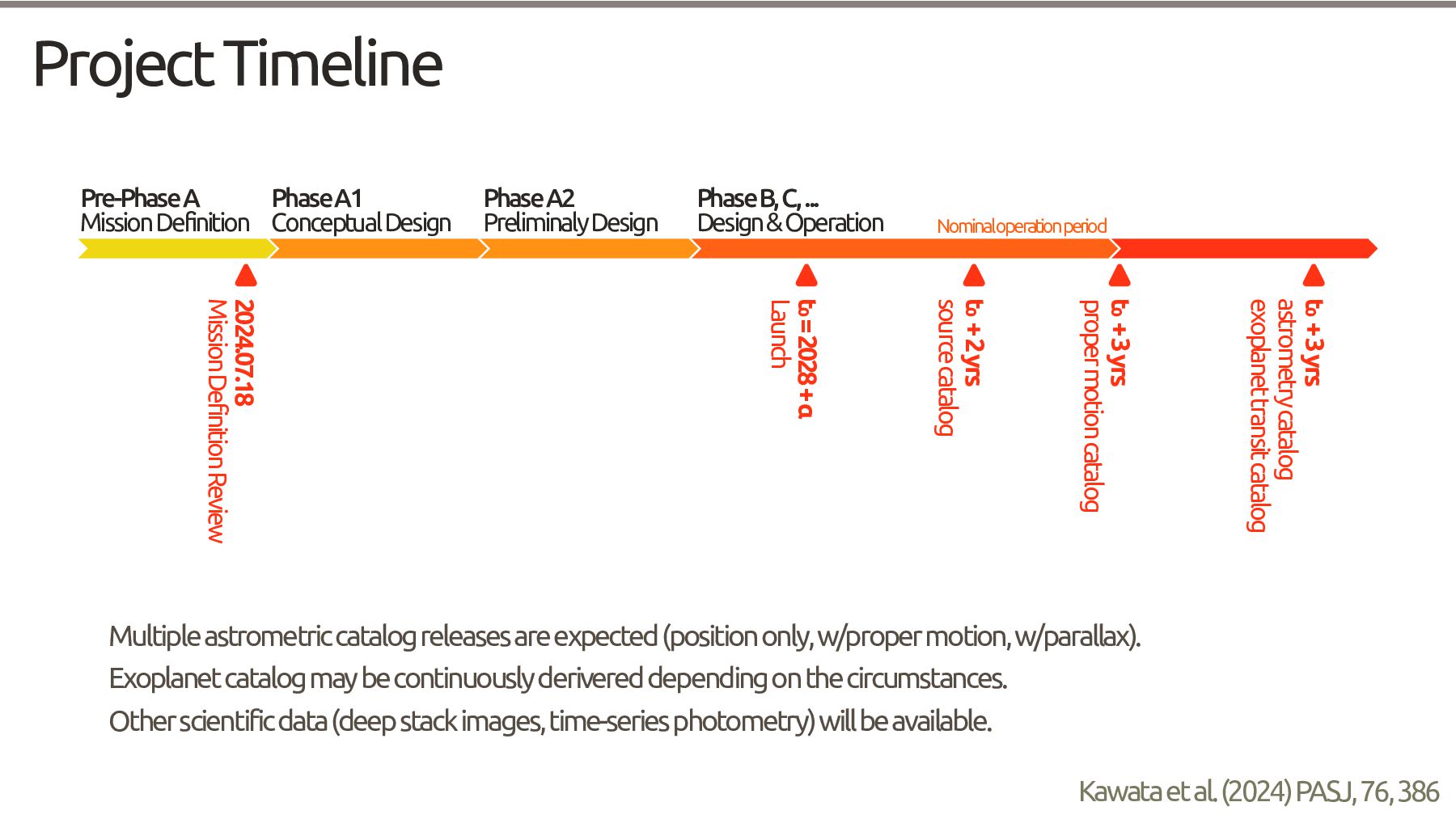
3rd competitive M-class space mission by ISAS/JAXA in 2030s (PI: Naoteru Gouda). A space telescope dedicated for precise infrared measurements in a Low Earth Orbit Sun-synchronous orbit at >550 km altitude (day-night terminator). Astrometry: ~40 μas in parallax and ~125 μas/year in proper motion. Photometry: long-term monitoring at a ~0.3% accuracy. A preliminary design of the JASMINE satellite Kawata et al. (2024), PASJ, 76, 386; Gouda (2011), Scholarpedia, 6, 12021
and age-gradient of the Nuclear Stellar Disk. Stellar orbits and gravitational field of the Nuclear Stellar Disk. Exploring the Nuclear Ellipsoid surrounding the Nuclear Stellar Disk. SO2 Precise photometry for transits by terrestrial planets Exploration of Earth-like planets orbiting mid M-type dwarfs. Providing ideal targets for spectroscopic studies of terrestrial planet atmospheres Kawata et al. (2024), PASJ, 76, 386; Kataza et al. (2024), SPIE Proc., 13092-9
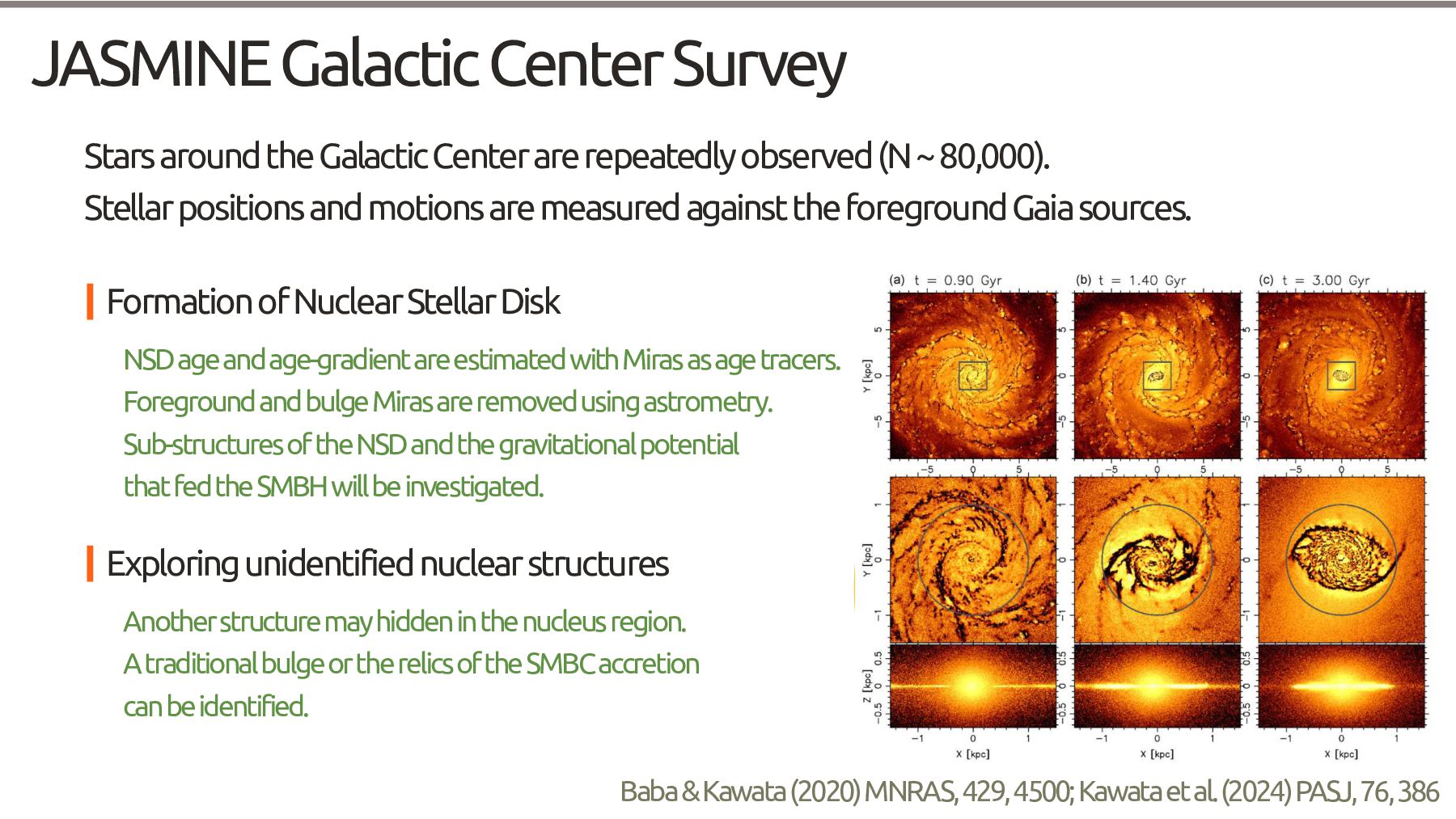
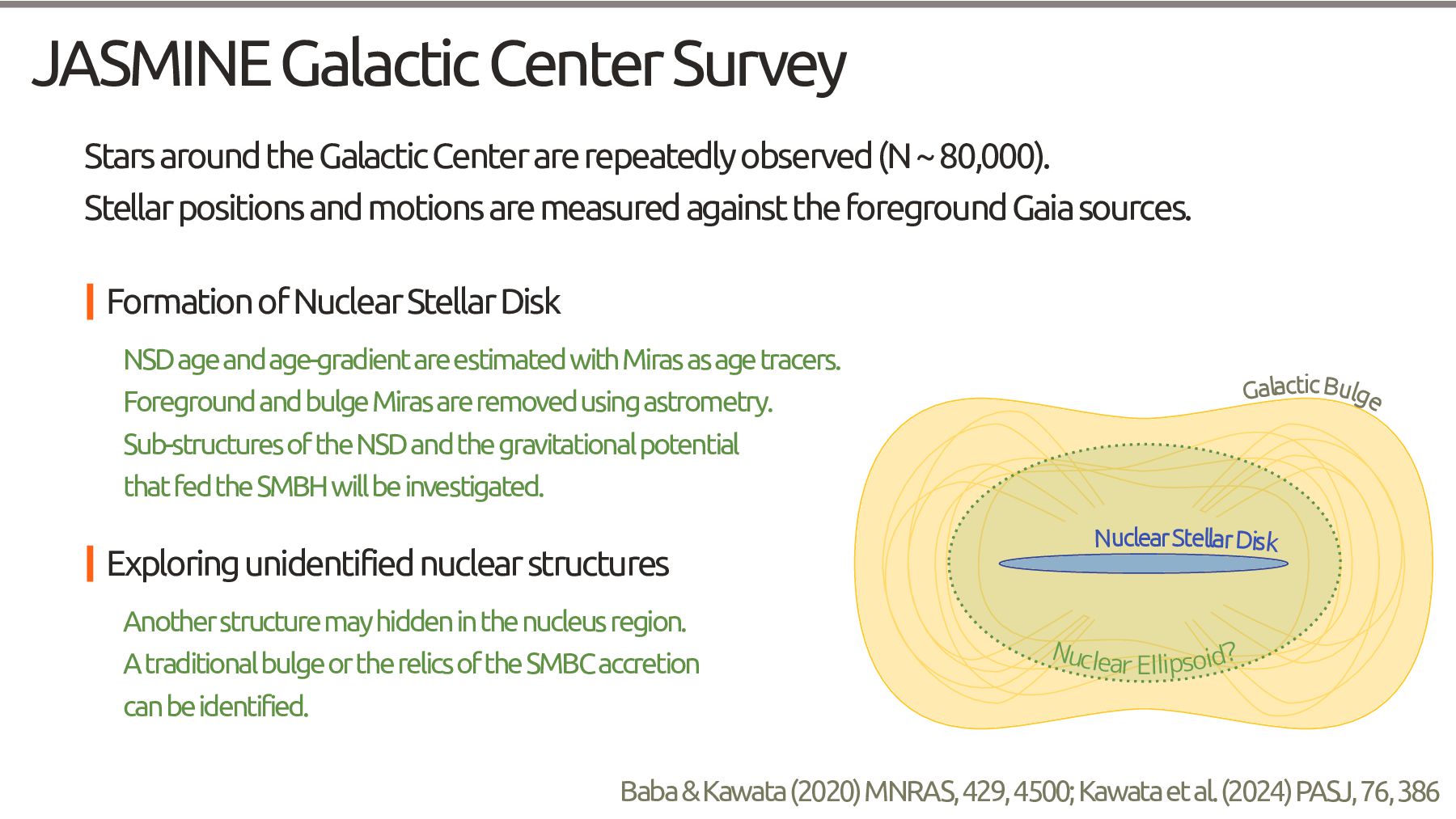
repeatedly observed (N ~ 80,000). Stellar positions and motions are measured against the foreground Gaia sources. Formation of Nuclear Stellar Disk NSD age and age-gradient are estimated with Miras as age tracers. Foreground and bulge Miras are removed using astrometry. Sub-structures of the NSD and the gravitational potential that fed the SMBH will be investigated. Exploring unidentified nuclear structures Another structure may hidden in the nucleus region. A traditional bulge or the relics of the SMBCaccretion can be identified. Galactic Bulge Nuclear Stellar Disk Nuclea r Ellipsoid? Baba & Kawata (2020) MNRAS, 429, 4500; Kawata et al. (2024) PASJ, 76, 386
repeatedly observed (N ~ 80,000). Stellar positions and motions are measured against the foreground Gaia sources. Formation of Nuclear Stellar Disk NSD age and age-gradient are estimated with Miras as age tracers. Foreground and bulge Miras are removed using astrometry. Sub-structures of the NSD and the gravitational potential that fed the SMBH will be investigated. Exploring unidentified nuclear structures Another structure may hidden in the nucleus region. A traditional bulge or the relics of the SMBCaccretion can be identified. Galactic Bulge Nuclear Stellar Disk Nuclea r Ellipsoid? Baba & Kawata (2020) MNRAS, 429, 4500; Kawata et al. (2024) PASJ, 76, 386
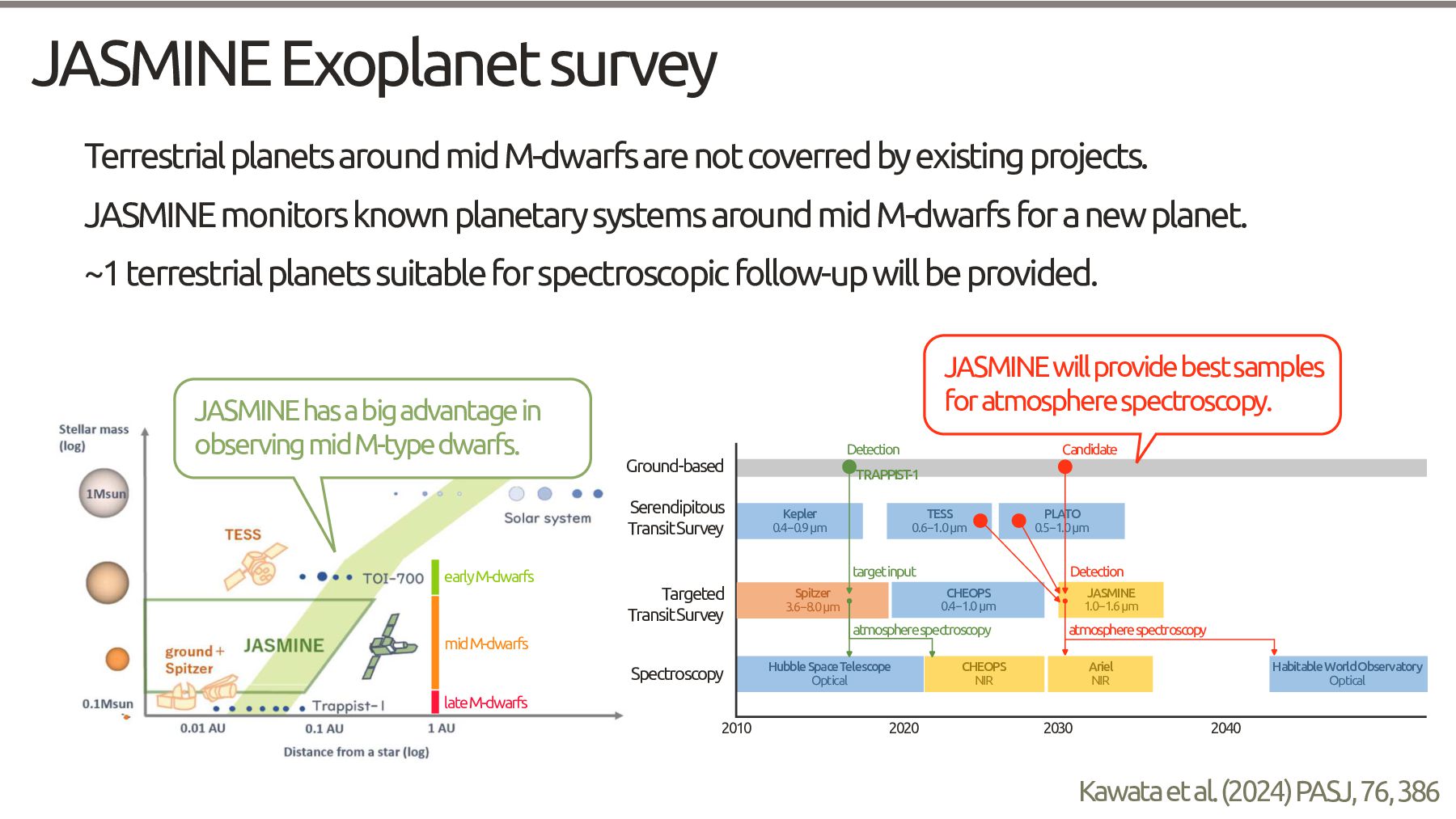
coverred by existing projects. JASMINE monitors known planetary systems around mid M-dwarfs for a new planet. ~1 terrestrial planets suitable for spectroscopic follow-up will be provided. JASMINE has a big advantage in observing mid M-type dwarfs. JASMINE will provide best samples for atmosphere spectroscopy. Detection Ground-based Serendipitous Transit Survey Candidate TRAPPIST-1 Kepler 0.4−0.9 μm TESS 0.6−1.0 μm Detection target input early M-dwarfs Targeted Transit Survey mid M-dwarfs Spectroscopy PLATO 0.5−1.0 μm CHEOPS 0.4−1.0 μm Spitzer 3.6−8.0 μm atmosphere spectroscopy Hubble Space Telescope Optical JASMINE 1.0−1.6 μm atmosphere spectroscopy CHEOPS NIR Ariel NIR Habitable WorldObservatory Optical late M-dwarfs 2010 2020 2030 2040 Kawata et al. (2024) PASJ, 76, 386
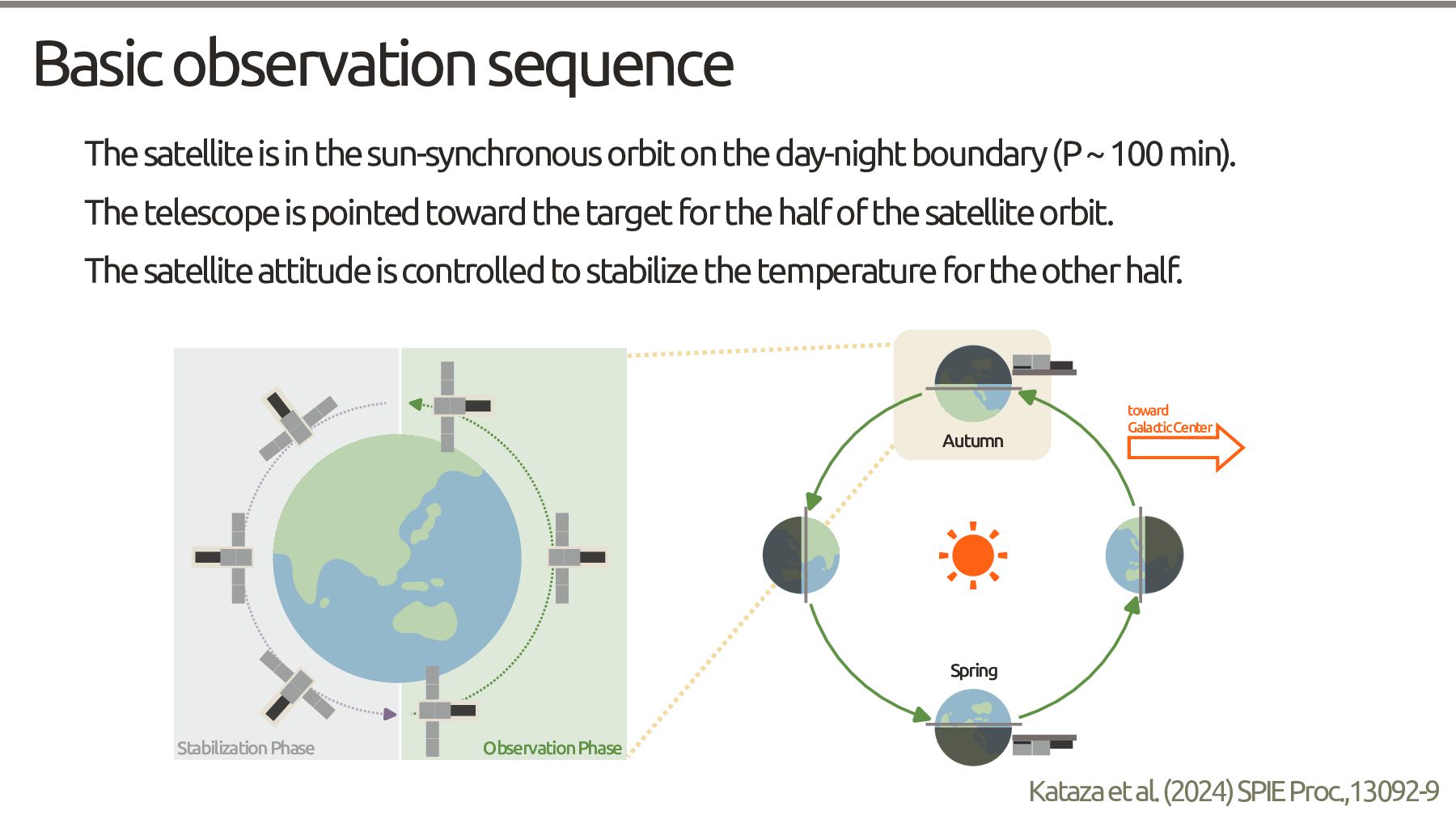
on the day-night boundary (P ~ 100 min). The telescope is pointed toward the target for the half of the satellite orbit. The satellite attitude is controlled to stabilize the temperature for the other half. Autumn toward Galactic Center Spring Stabilization Phase Observation Phase Kataza et al. (2024) SPIE Proc.,13092-9
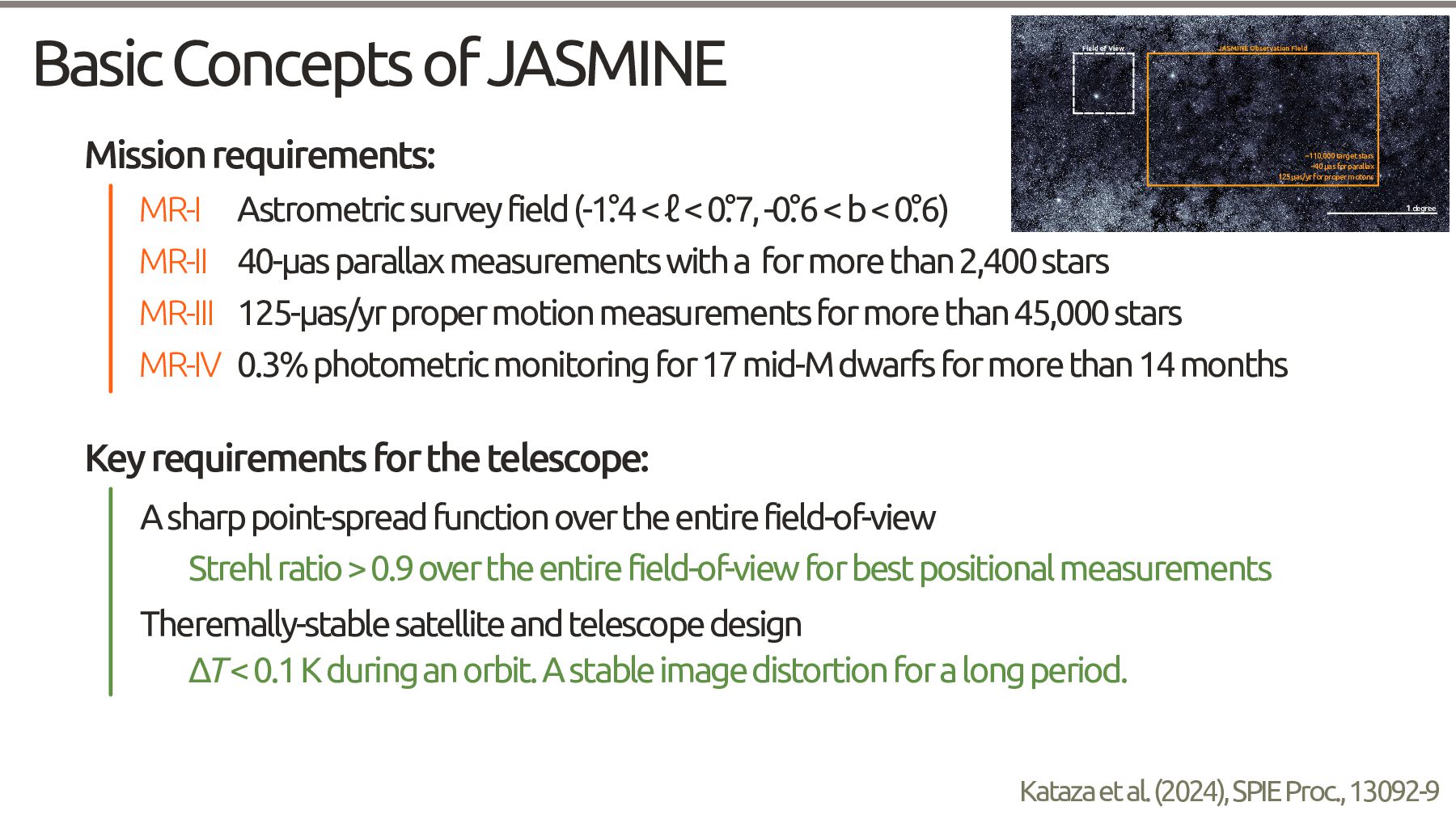
μas for parallax 125 μas/yr for proper motons MR-I Astrometric survey field (-1.°4 < ℓ < 0.°7, -0.°6 < b < 0.°6) MR-II 40-μas parallax measurements with a for more than 2,400 stars MR-III 125-μas/yr proper motion measurements for more than 45,000 stars MR-IV 0.3% photometric monitoring for 17 mid-M dwarfs for more than 14 months 1 degree Key requirements for the telescope: A sharp point-spread function over the entire field-of-view Strehl ratio > 0.9 over the entire field-of-view for best positional measurements Theremally-stable satellite and telescope design ΔT < 0.1 K during an orbit. A stable image distortion for a long period. Kataza et al. (2024), SPIE Proc., 13092-9
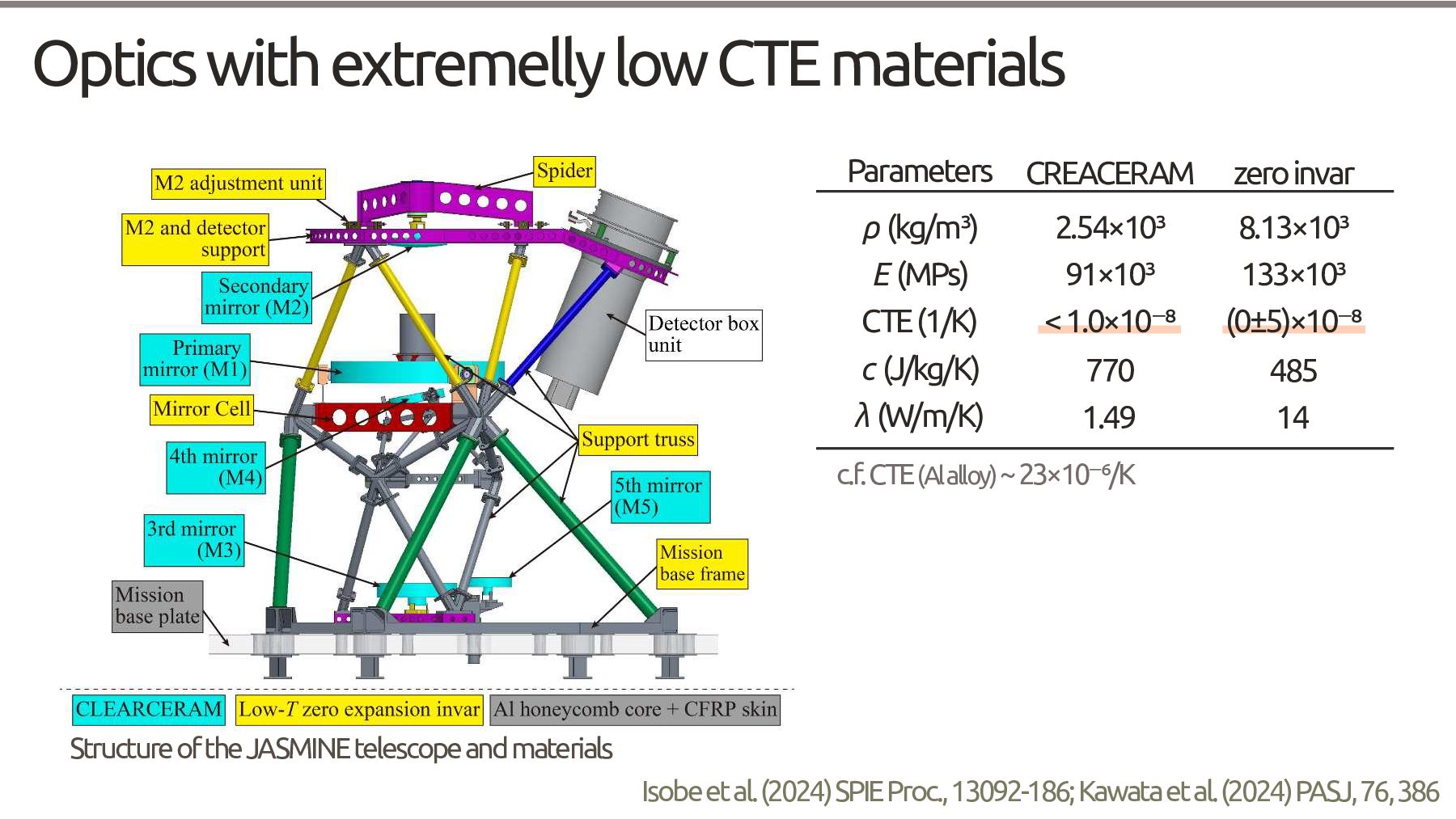
image sensor fablicated by Hamamatsu Photonics Optical system made of extremely-low-CTE materials Sophisticated thermal design and controls A fiber-fed flat-frame calibration source Isobe et al. (2024) SPIE Proc.,13092-186; Kawata et al. (2024) PASJ, 76, 386
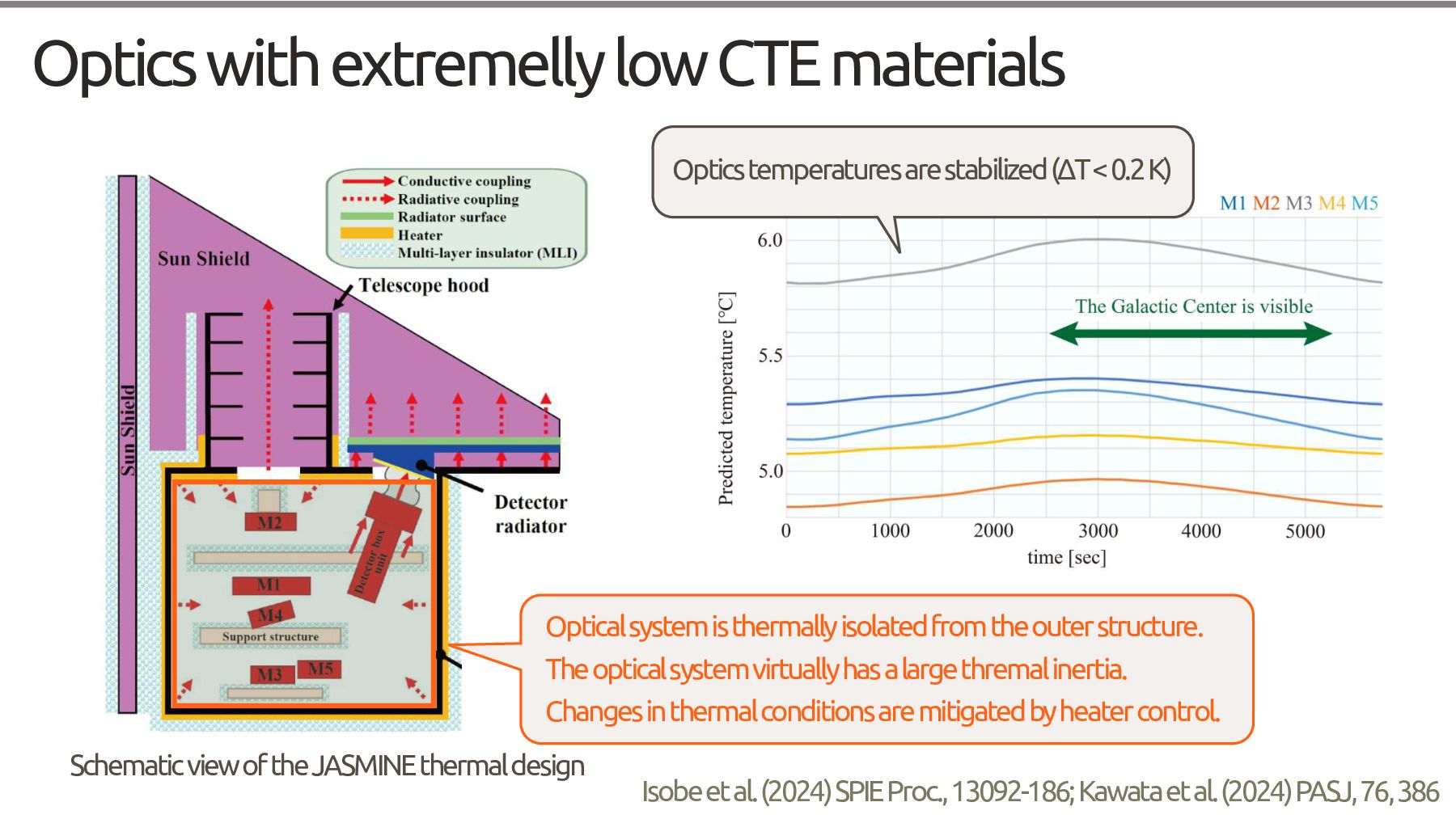
(ΔT < 0.2 K) Optical system is thermally isolated from the outer structure. The optical system virtually has a large thremal inertia. Changes in thermal conditions are mitigated by heater control. Schematic view of the JASMINE thermal design Isobe et al. (2024) SPIE Proc.,13092-186; Kawata et al. (2024) PASJ, 76, 386
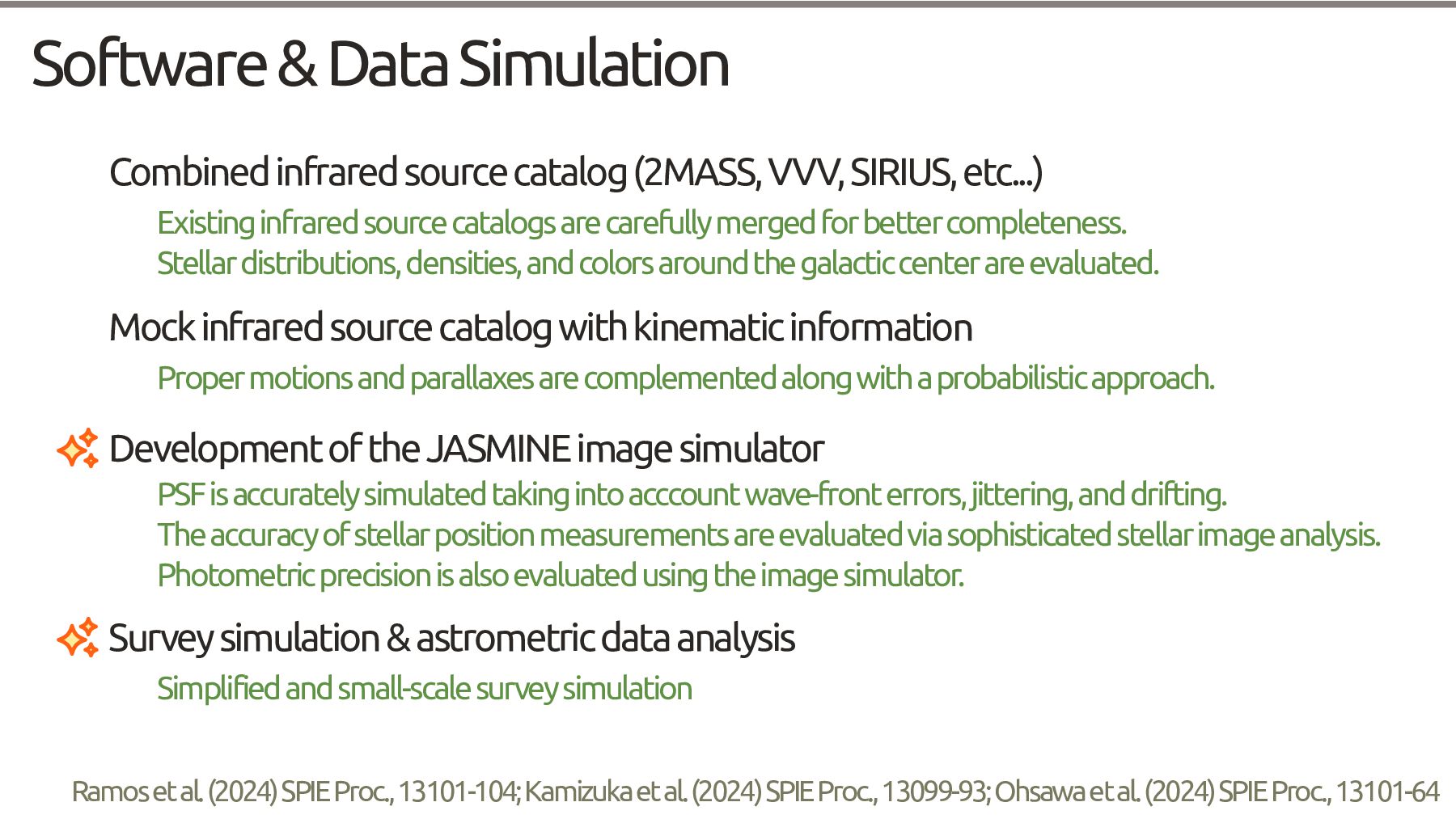
SIRIUS, etc...) Existing infrared source catalogs are carefully merged for better completeness. Stellar distributions, densities, and colors around the galactic center are evaluated. Mock infrared source catalog with kinematic information Proper motions and parallaxes are complemented along with a probabilistic approach. Development of the JASMINE image simulator PSF is accurately simulated taking into acccount wave-front errors, jittering, and drifting. The accuracy of stellar position measurements are evaluated via sophisticated stellar image analysis. Photometric precision is also evaluated using the image simulator. Survey simulation & astrometric data analysis Simplified and small-scale survey simulation Ramos et al. (2024) SPIE Proc., 13101-104; Kamizuka et al. (2024) SPIE Proc., 13099-93; Ohsawa et al. (2024) SPIE Proc., 13101-64
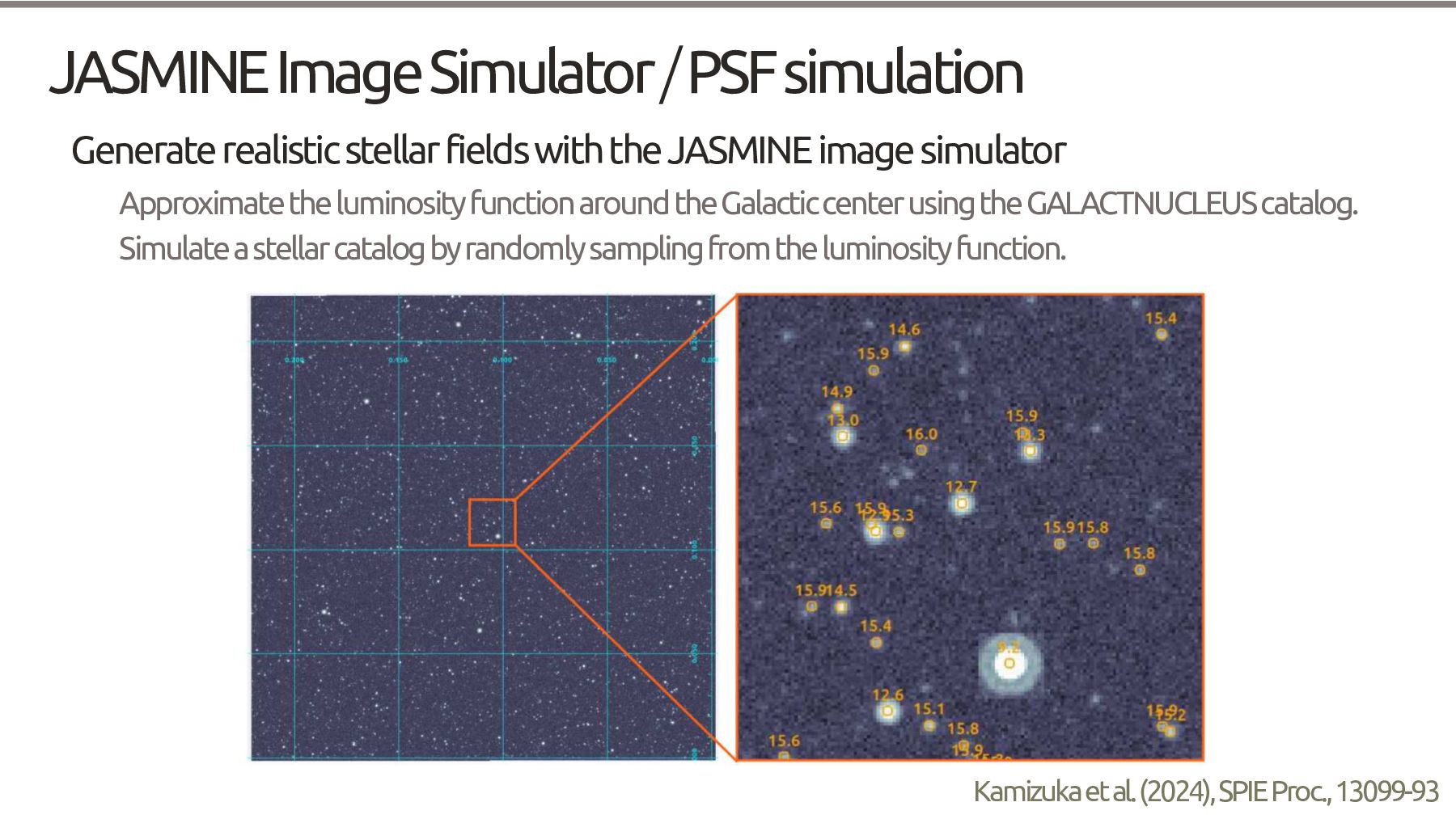
with the JASMINE image simulator Approximate the luminosity function around the Galactic center using the GALACTNUCLEUS catalog. Simulate a stellar catalog by randomly sampling from the luminosity function. Kamizuka et al. (2024), SPIE Proc., 13099-93
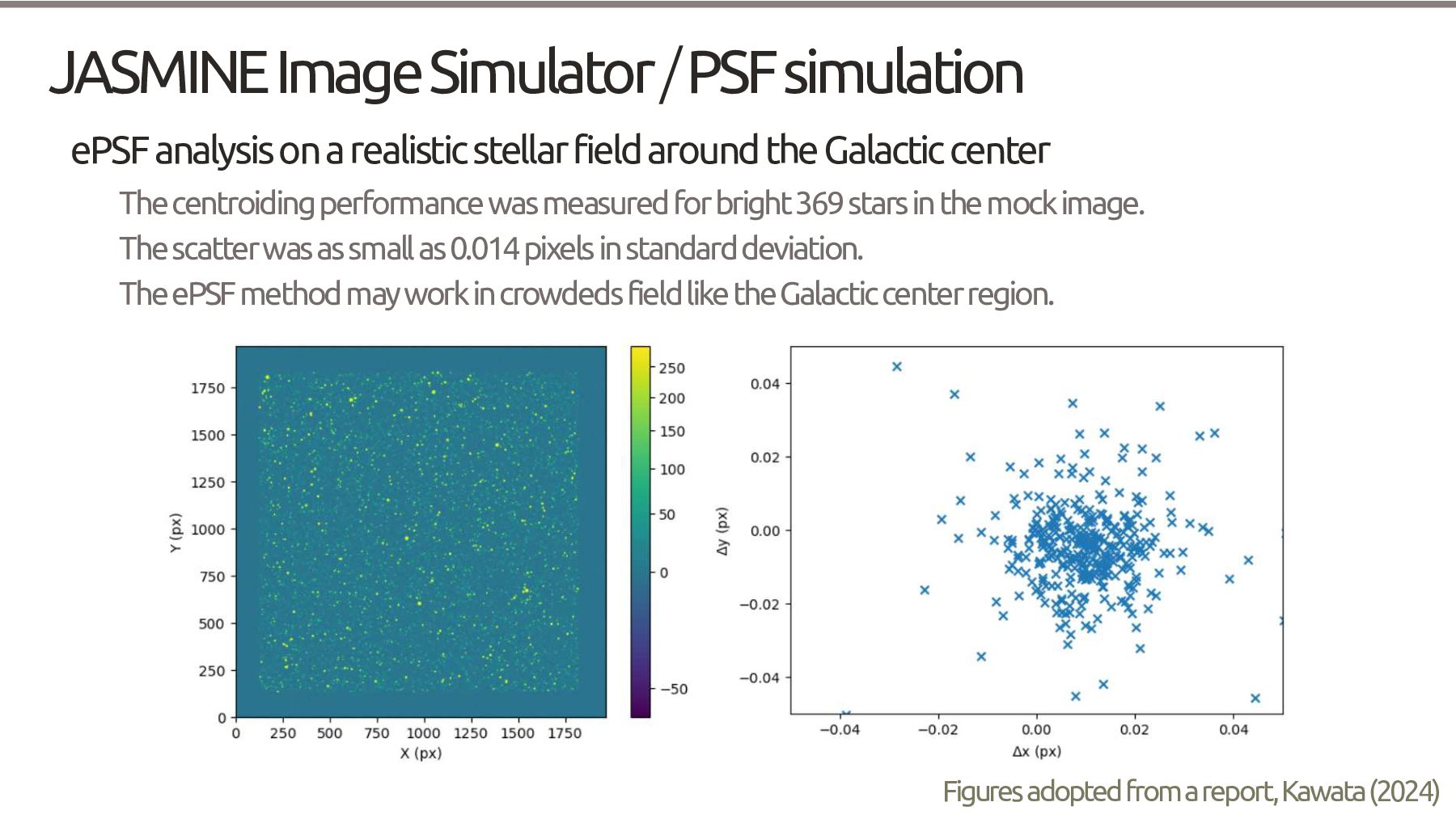
realistic stellar field around the Galactic center The centroiding performance was measured for bright 369 stars in the mock image. The scatter was as small as 0.014 pixels in standard deviation. The ePSF method may work in crowdeds field like the Galactic center region. Figures adopted from a report, Kawata (2024)
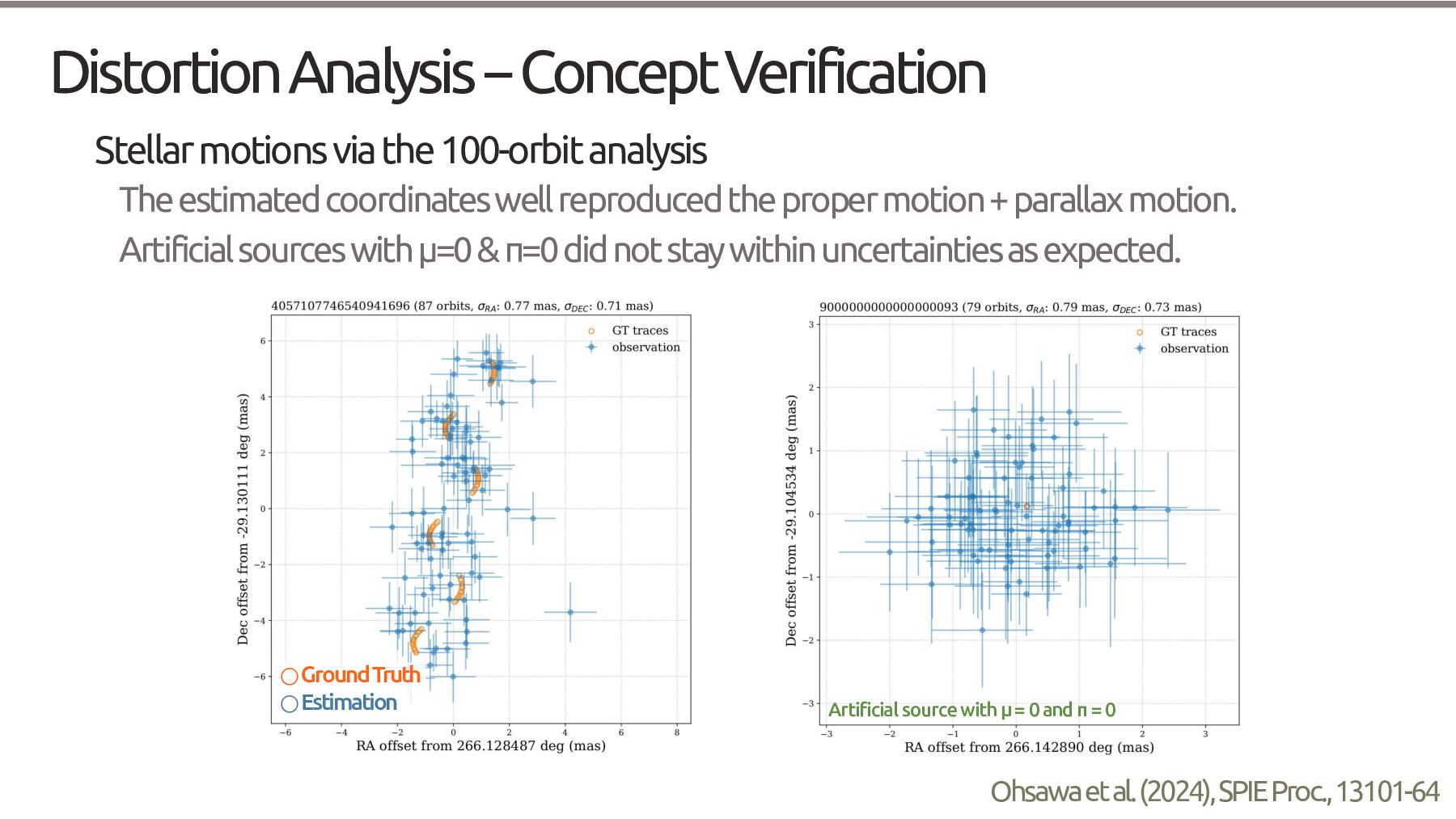
analysis The estimated coordinates well reproduced the proper motion + parallax motion. Artificial sources with μ=0 & π=0 did not stay within uncertainties asexpected. ◦ Ground Truth ◦ Estimation Artificial source with μ = 0 and π = 0 Ohsawa et al. (2024), SPIE Proc., 13101-64
field is not uniformly covered by the existing surveys. The mock catalog will be replaced with the PRIME data. The PRIME catalog will be useful in selecting the JASMINE target stars. PRIME will provide the catalog of Miras observable with JASMINE. Astrometric analysis with PRIME data The astrometric analysis techniques developed for JASMINE are widely applicable. The PSF and image distortion analysis will be tested with PRIME images. The astrometry of the PRIME data can be improved. Kawata et al. (2024) PASJ, 76, 386
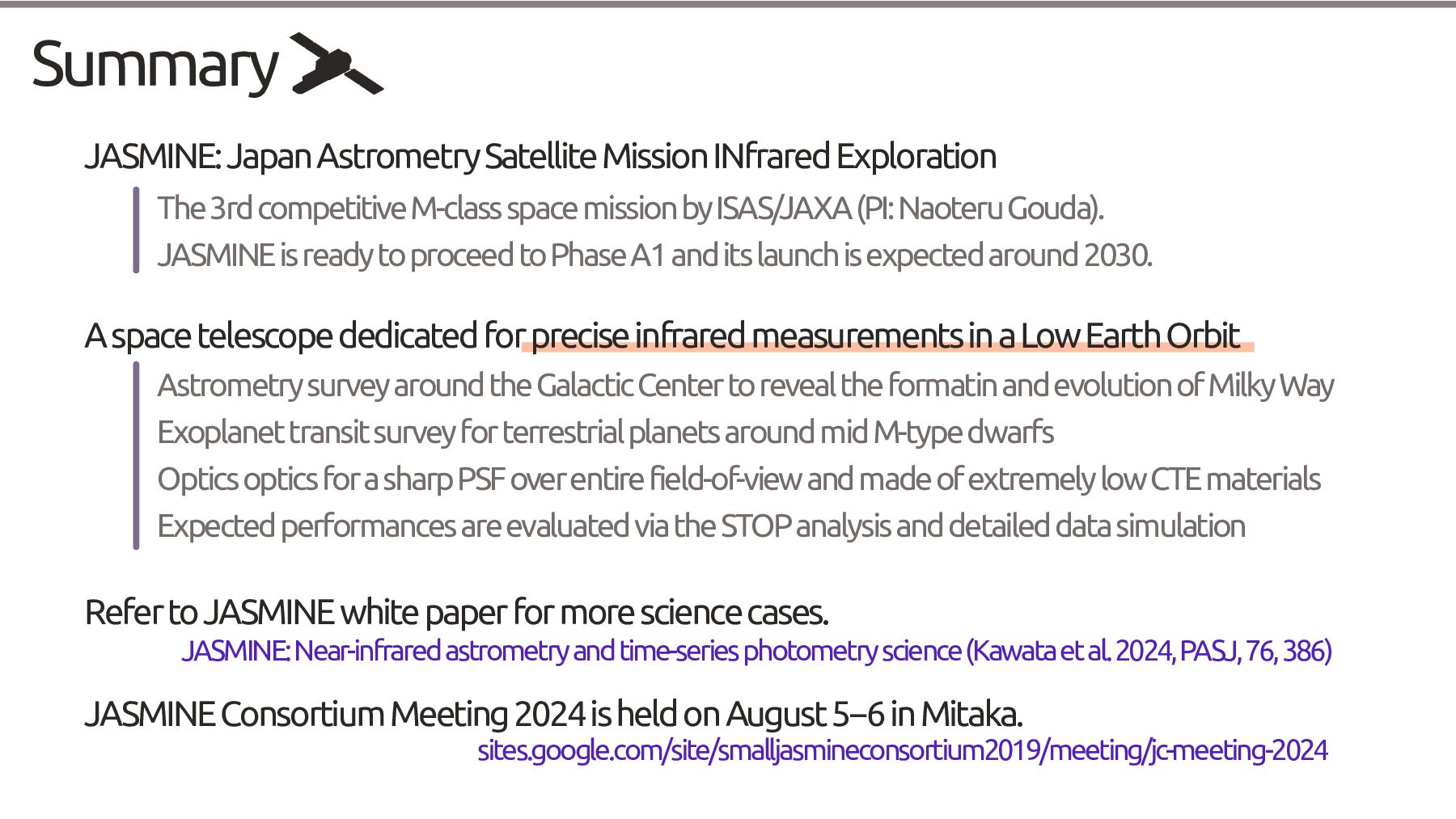
competitive M-class space mission by ISAS/JAXA (PI: Naoteru Gouda). JASMINE is ready to proceed to Phase A1 and its launch is expected around 2030. A space telescope dedicated for precise infrared measurements in a Low Earth Orbit Astrometry survey around the Galactic Center to reveal the formatin and evolution of Milky Way Exoplanet transit survey for terrestrial planets around mid M-type dwarfs Optics optics for a sharp PSF over entire field-of-view and made of extremely low CTE materials Expected performances are evaluated via the STOP analysis and detailed data simulation Refer to JASMINE white paper for more science cases. JASMINE: Near-infrared astrometry and time-series photometry science (Kawata et al. 2024, PASJ, 76, 386) JASMINE Consortium Meeting 2024 is held on August 5−6 in Mitaka. sites.google.com/site/smalljasmineconsortium2019/meeting/jc-meeting-2024


 astronasutarou
 voginip
 bonotake
 ykiyota
.jpeg) arthur1
arthur1
.jpg) lychee1223
lychee1223
 institutdelelevage
 nagano
 miyayou
 x_ttyszk
 trycycle
 peterdesmet
 bkeepers
 caitiem20
 jct
jct
 hannesfritz
 garrettdimon
 jnunemaker
 cassininazir
 tenderlove
 frankvandijk
 lara
lara
 marcoroth
 keavy
keavy