Department • Together, decide what tasks need to be done o What requirements need to be conveyed to other departments? o What tasks must you do yourselves? o What tasks must you do with other departments? o What artwork is required to convey the Vision of your design? • Together, decide what information must be acquired o What requirements do you need from other departments? o What design data do you need from other departments? o What technical information do you require? 2
Department • Plan the work and work the plan o Decide who does what tasks o Make sure every task is assigned to someone o Agree on when major parts of the design will be settled o Allow time to build the slides • Communicate! o Your design ideas may affect what somebody else is doing! o If you need information or help, ASK! o Schedule meetings to make sure you’re talking to each other! 3
Do? • Represents the department to upper management o Receives direction o Schedules for products o “Tiger Teams” to solve problems o Requests inputs o Information from other departments o Assistance with problems o Provides products o Design and requirements answers o Drawings, data, and slides for presentation 4
Do? • Negotiates with other departments (may be delegated) o Achieve consensus or compromise on design disputes o Seek upper management help if there’s an impasse • Negotiates disagreements in the department o Figure out reasons for differences, try to achieve consensus o If no consensus, seek compromise, or decide and decree • Assign Tasks o Make sure everything has somebody working on it o Make sure everyone has useful work to do o Keep an updated task list 5
In the real world, structural engineers… ◦ Analyze and design structures to support or resist loads ◦ Determine structural configurations for stability, durability, damage tolerance, and cost-effectiveness ◦ Aerospace Structural Engineers work on truss segments, attachment mechanisms, interfaces between moving and non-moving parts, impact of forces inside and outside of the station on the structure, wear and tear on the structural components, leaks, and more ◦ Commonly have mechanical engineering backgrounds, or civil engineering (especially if working on Earth-based projects) 7
In SSDCs, Structures covers... ◦ Location of settlement features (interior and exterior; communications arrays, power plants, warehouses, farms) ◦ Exterior views and maps ◦ Materials and major structural components ◦ Safety of residents, from environmental factors to facility placement ◦ Major construction steps ◦ Scenario-specific settlement features (solar shields, rotating structures, docks) ◦ Down surfaces and pressurized/unpressurized volumes ◦ Relative placement of major zones (industrial, commercial, residential) ◦ Considering room for future expansion, and business operations (Can we build more docks? More space for residents?) 8
will: ◦ Interface with other engineering departments to determine major structural requirements ◦ Plan the locations of each of those features ◦ Dimension those features... ◦ ...and map those features on easy-to-interpret drawings • Consider: ◦ Which features will be built first? ◦ How will construction crews build each major component? ◦ When should we perform a trade study? ◦ What does the RFP ask for? ◦ Can the overall settlement map be useful for other departments? 9
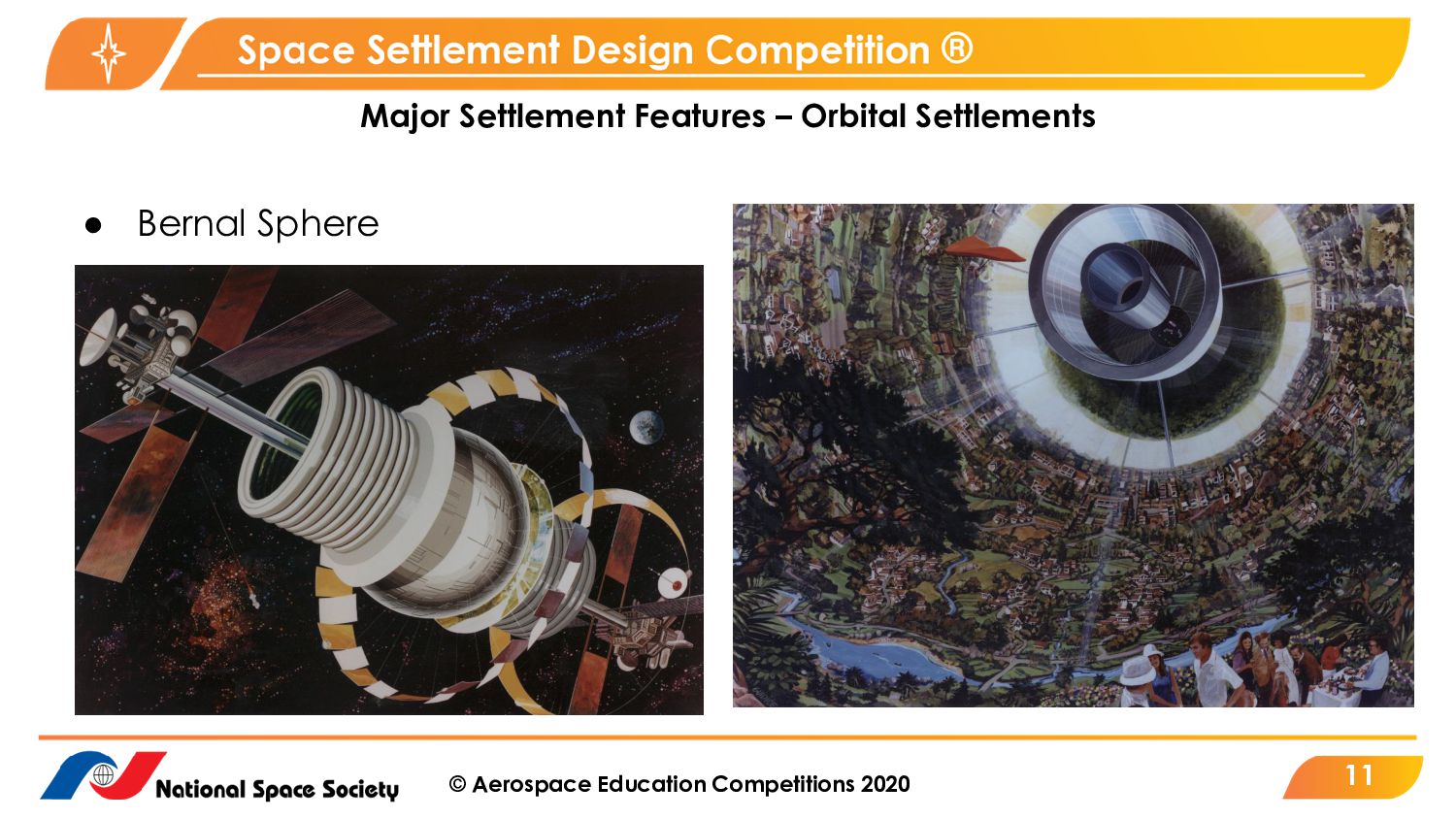
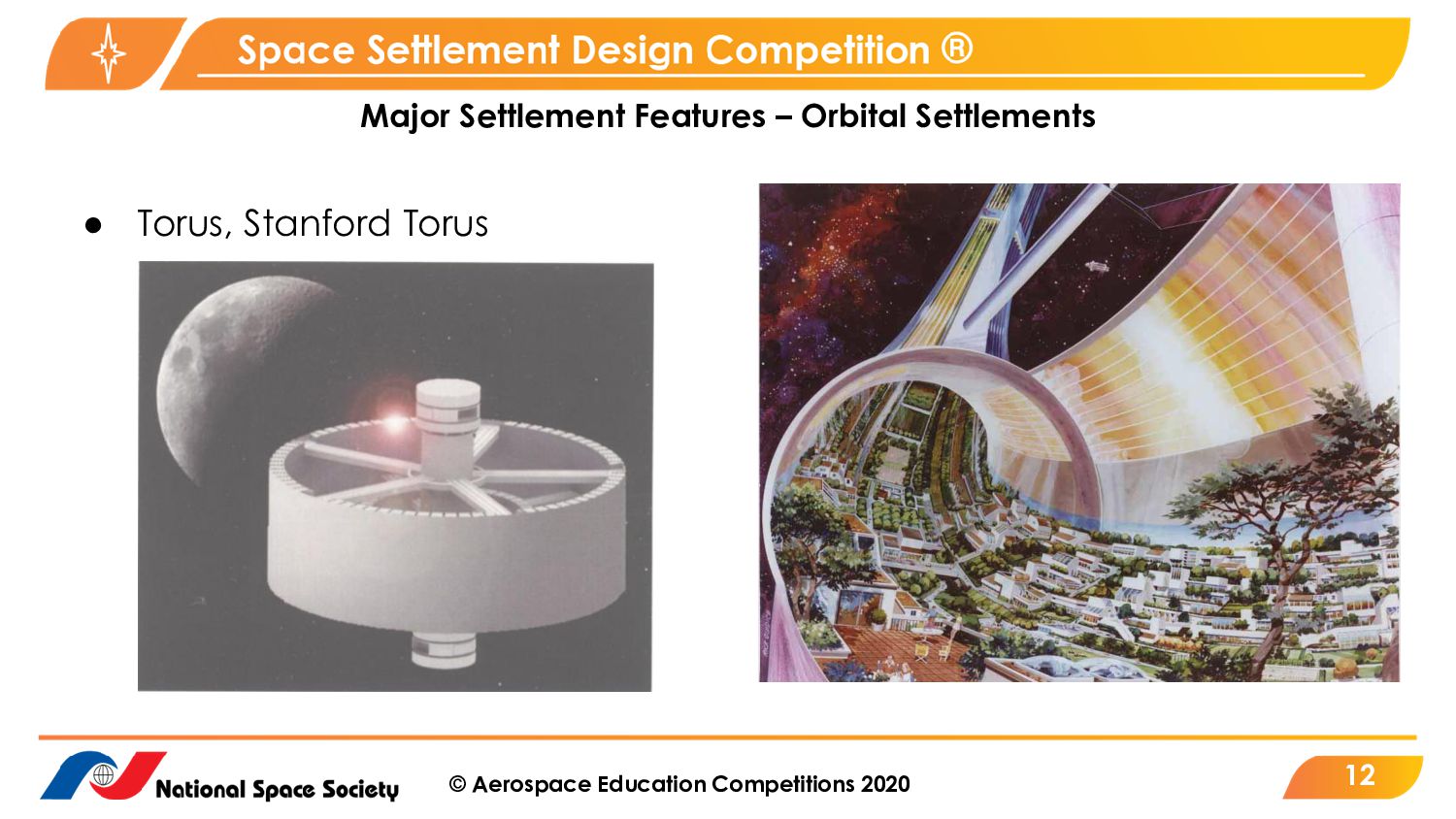
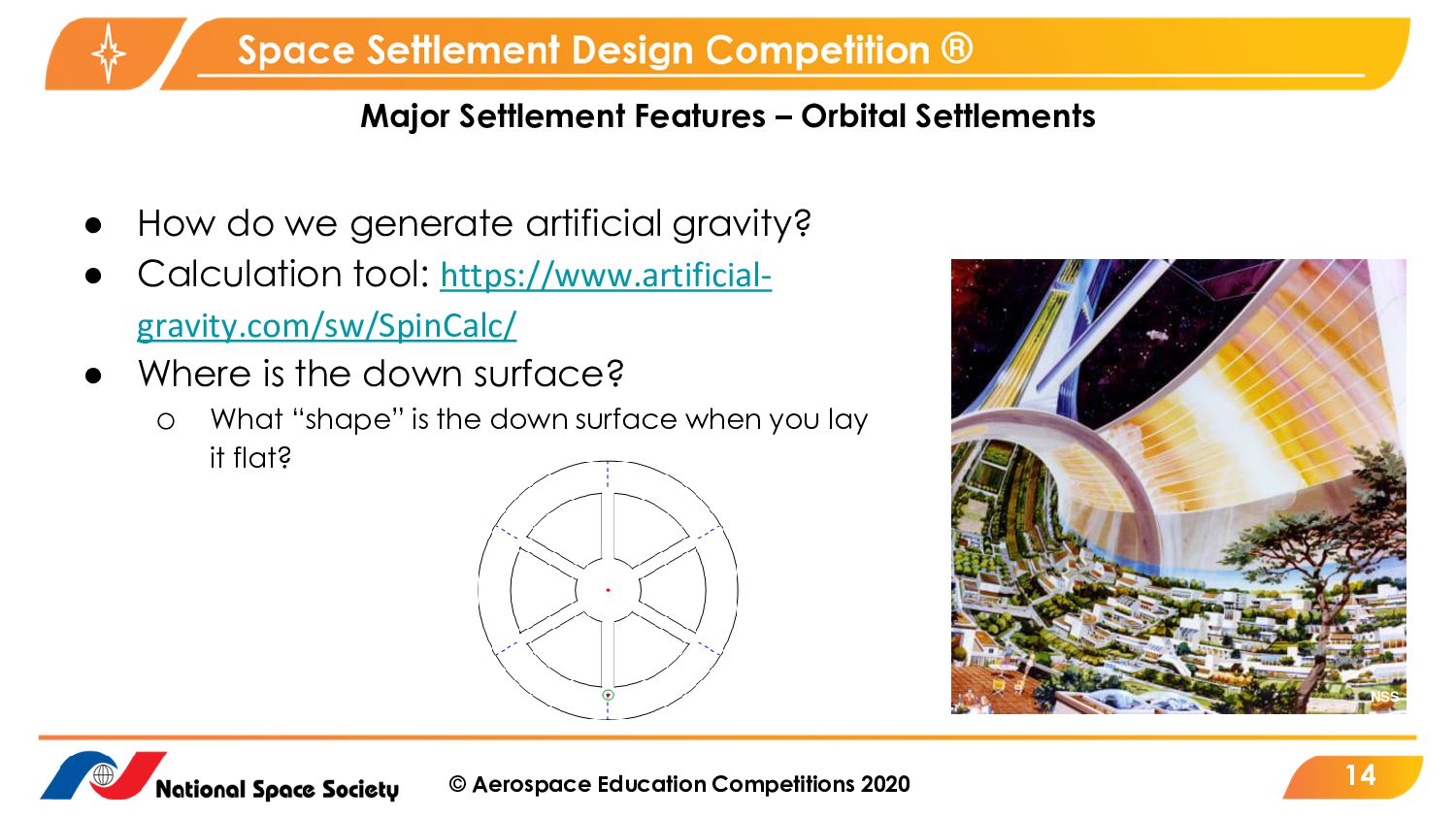
Settlements • How do we generate artificial gravity? • Calculation tool: https://www.artificial- gravity.com/sw/SpinCalc/ • Where is the down surface? o What “shape” is the down surface when you lay it flat? 14 NSS
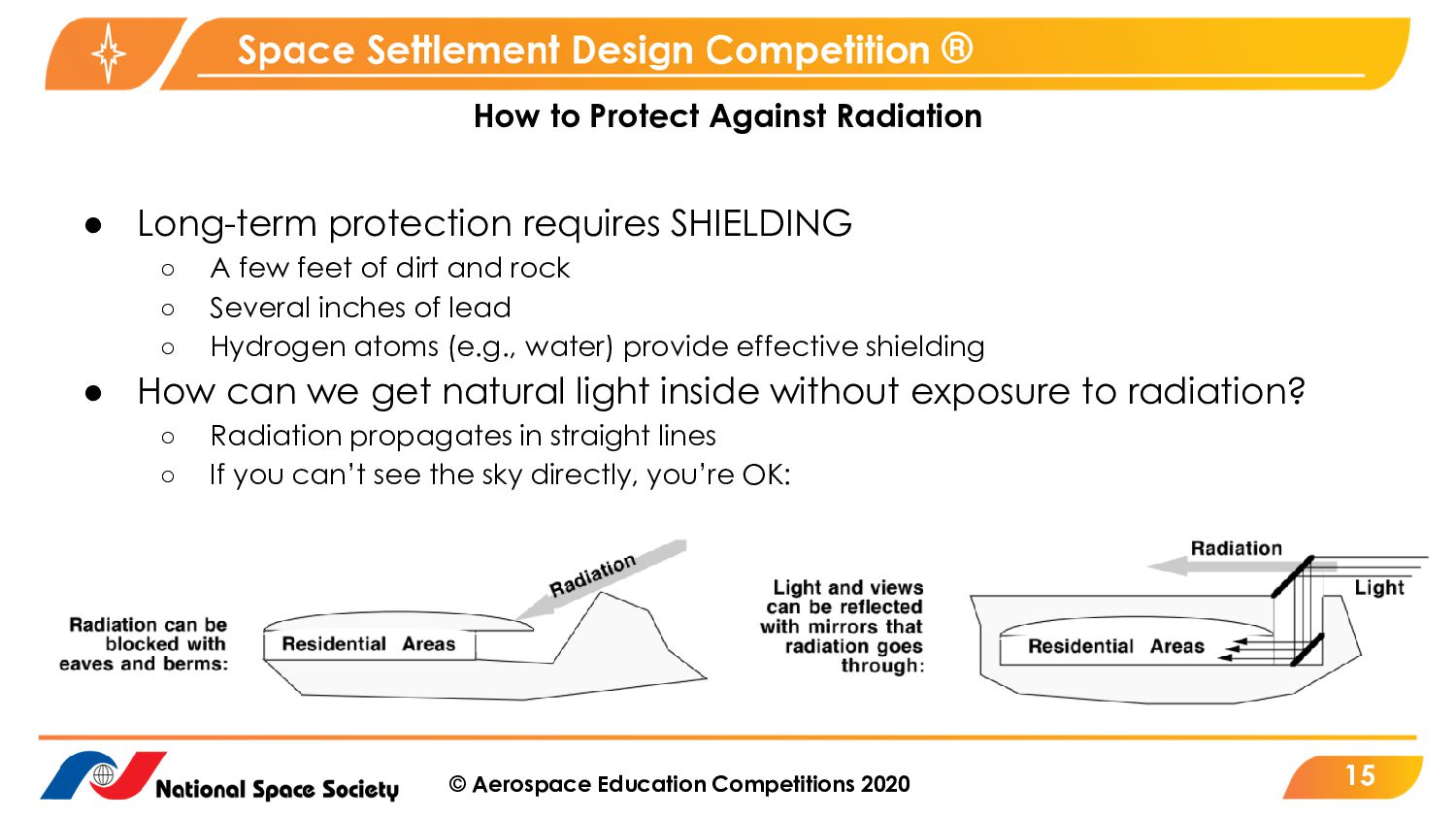
Radiation • Long-term protection requires SHIELDING ◦ A few feet of dirt and rock ◦ Several inches of lead ◦ Hydrogen atoms (e.g., water) provide effective shielding • How can we get natural light inside without exposure to radiation? ◦ Radiation propagates in straight lines ◦ If you can’t see the sky directly, you’re OK:
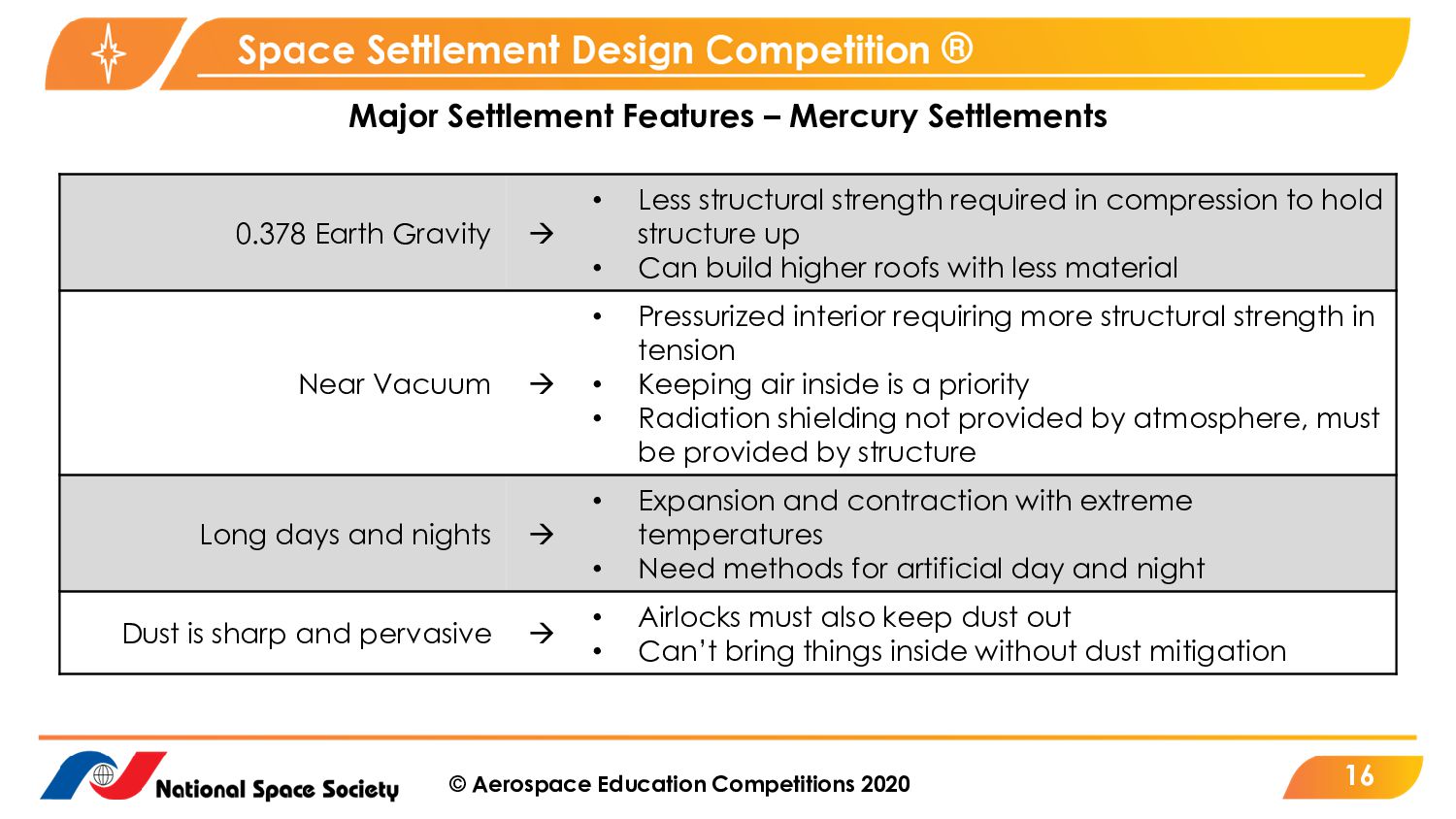
Settlements 16 0.378 Earth Gravity → • Less structural strength required in compression to hold structure up • Can build higher roofs with less material Near Vacuum → • Pressurized interior requiring more structural strength in tension • Keeping air inside is a priority • Radiation shielding not provided by atmosphere, must be provided by structure Long days and nights → • Expansion and contraction with extreme temperatures • Need methods for artificial day and night Dust is sharp and pervasive → • Airlocks must also keep dust out • Can’t bring things inside without dust mitigation
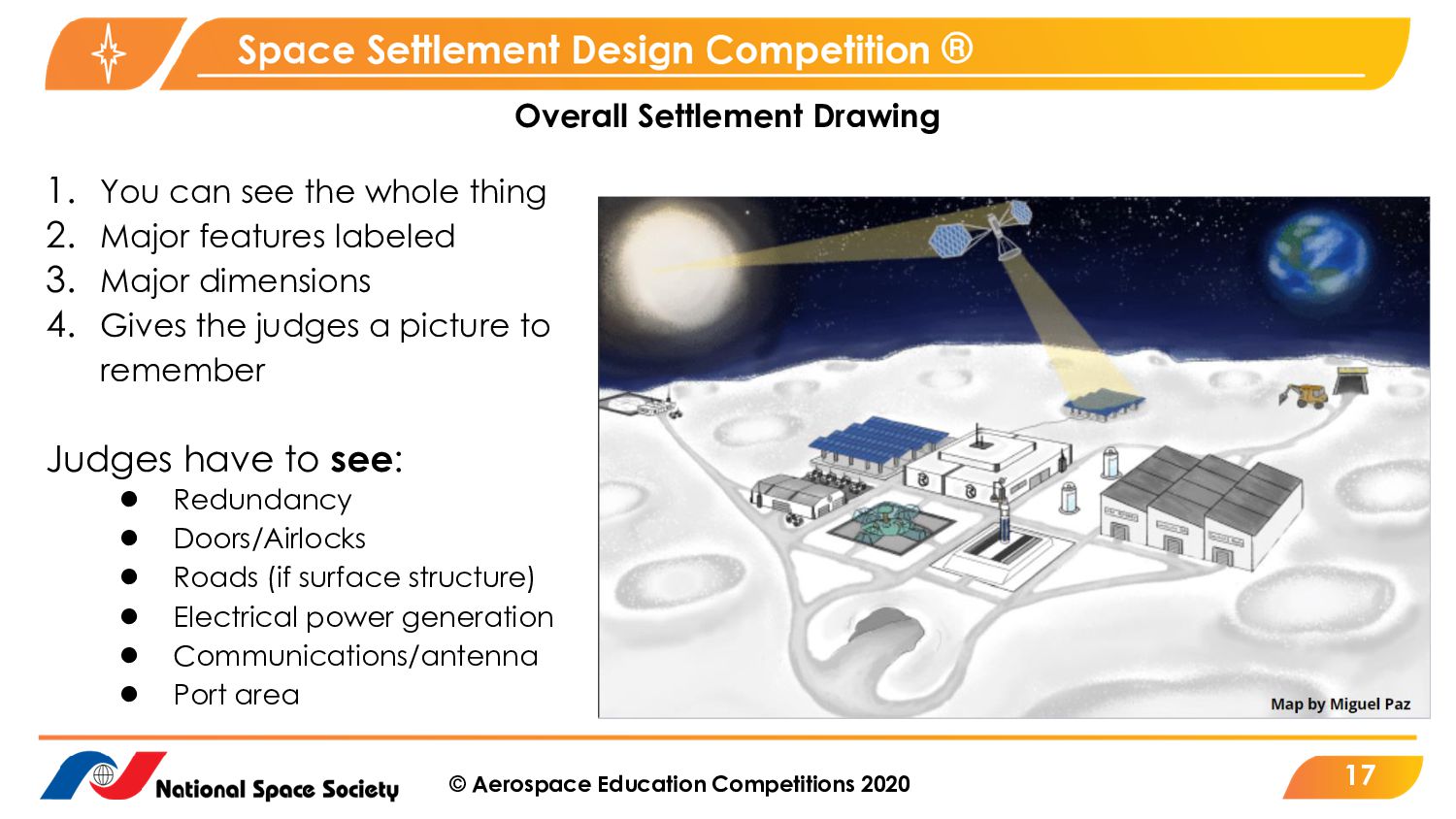
You can see the whole thing 2. Major features labeled 3. Major dimensions 4. Gives the judges a picture to remember Judges have to see: • Redundancy • Doors/Airlocks • Roads (if surface structure) • Electrical power generation • Communications/antenna • Port area
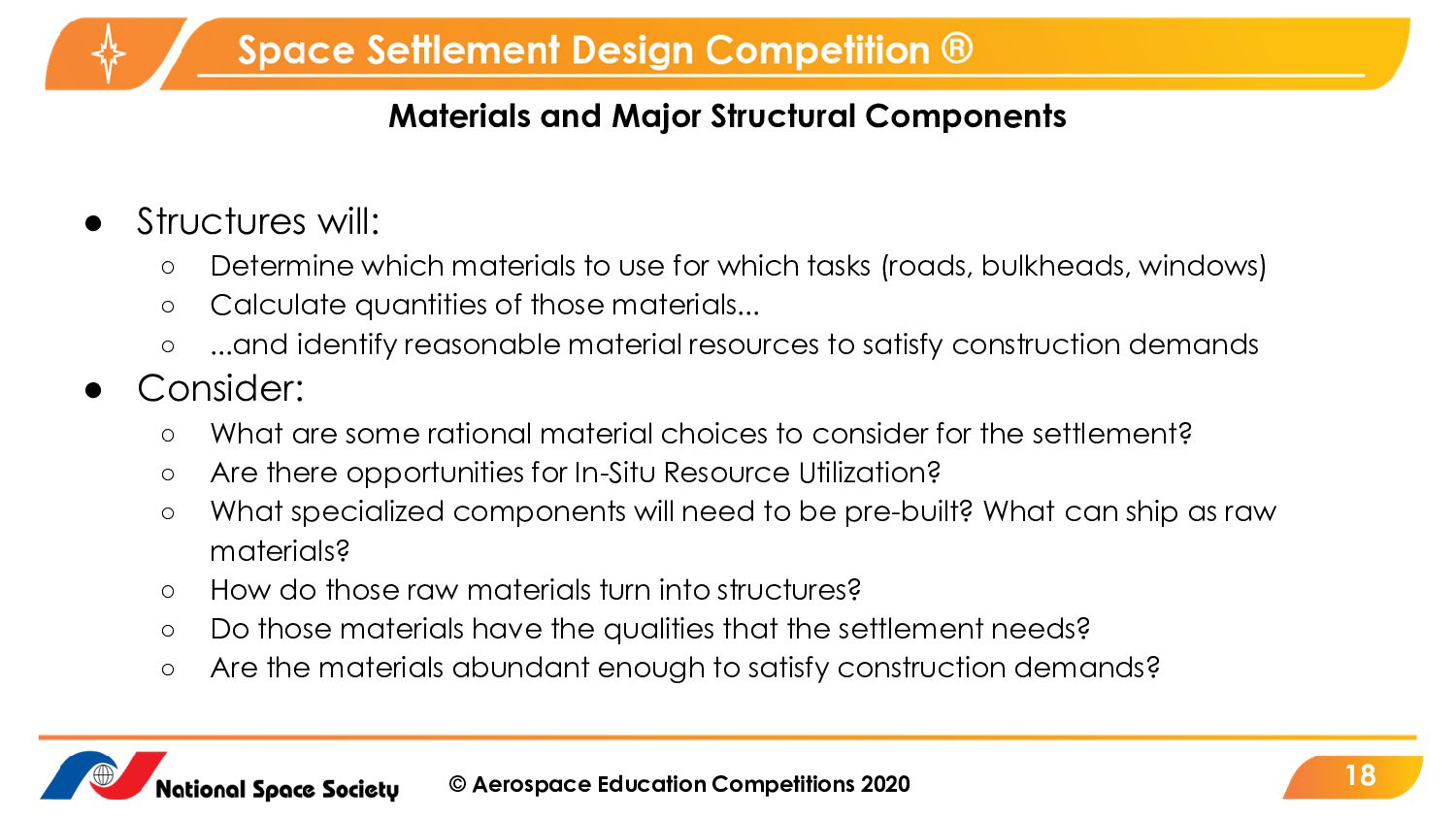
• Structures will: ◦ Determine which materials to use for which tasks (roads, bulkheads, windows) ◦ Calculate quantities of those materials... ◦ ...and identify reasonable material resources to satisfy construction demands • Consider: ◦ What are some rational material choices to consider for the settlement? ◦ Are there opportunities for In-Situ Resource Utilization? ◦ What specialized components will need to be pre-built? What can ship as raw materials? ◦ How do those raw materials turn into structures? ◦ Do those materials have the qualities that the settlement needs? ◦ Are the materials abundant enough to satisfy construction demands? 18
determine/design: ◦ Materials needed to build the settlement ◦ Facilities infrastructure needed, to be provided by ops (construction shack) ◦ Jigs, scaffolding, and mounting ◦ Construction site preparation (excavation, tunneling, rigging) ◦ Schedule and cost for construction • Think about: ◦ Materials available locally or from established settlements ◦ local considerations and hazards(rock, dirt, hills, radiation, high pressure, heat?) ◦ What challenges will construction equipment have? (gravity, loose rock, steep cliffs?) ◦ Launch and transport costs (especially for earth-sourced materials) ◦ What support does the construction process need? Power? Maintenance for robots? Human presence? 19
not to forget • Construction shack • Delivery and organization of materials – work with ops • Manufacturing capabilities for turning resources into components • Jigs, scaffolding, access equipment • Power sources • Maintenance of robotic construction equipment • Monitoring and control of robotic construction tasks • Excavation/preparation of surface 20
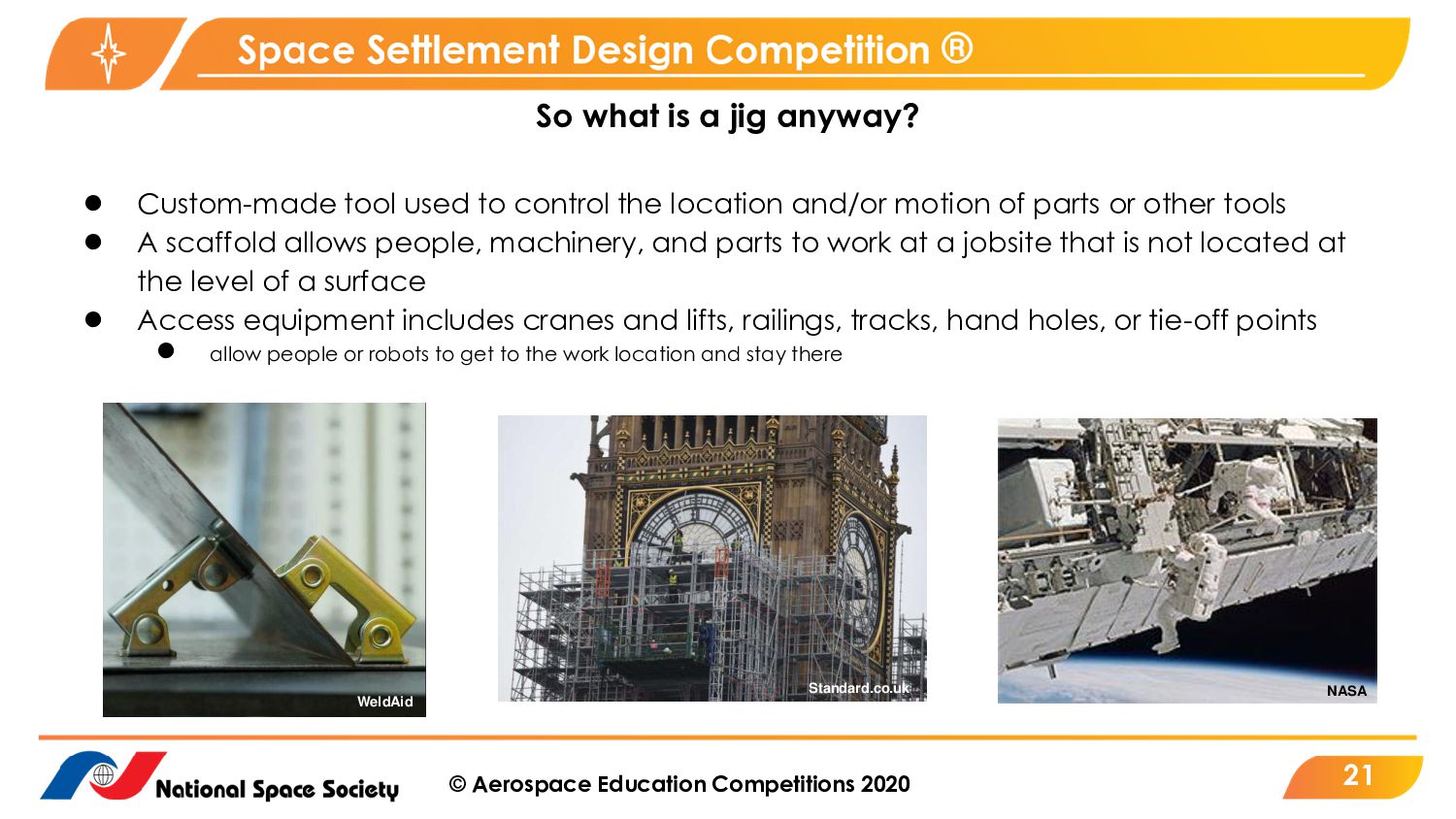
anyway? • Custom-made tool used to control the location and/or motion of parts or other tools • A scaffold allows people, machinery, and parts to work at a jobsite that is not located at the level of a surface • Access equipment includes cranes and lifts, railings, tracks, hand holes, or tie-off points • allow people or robots to get to the work location and stay there 21 NASA Standard.co.uk WeldAid
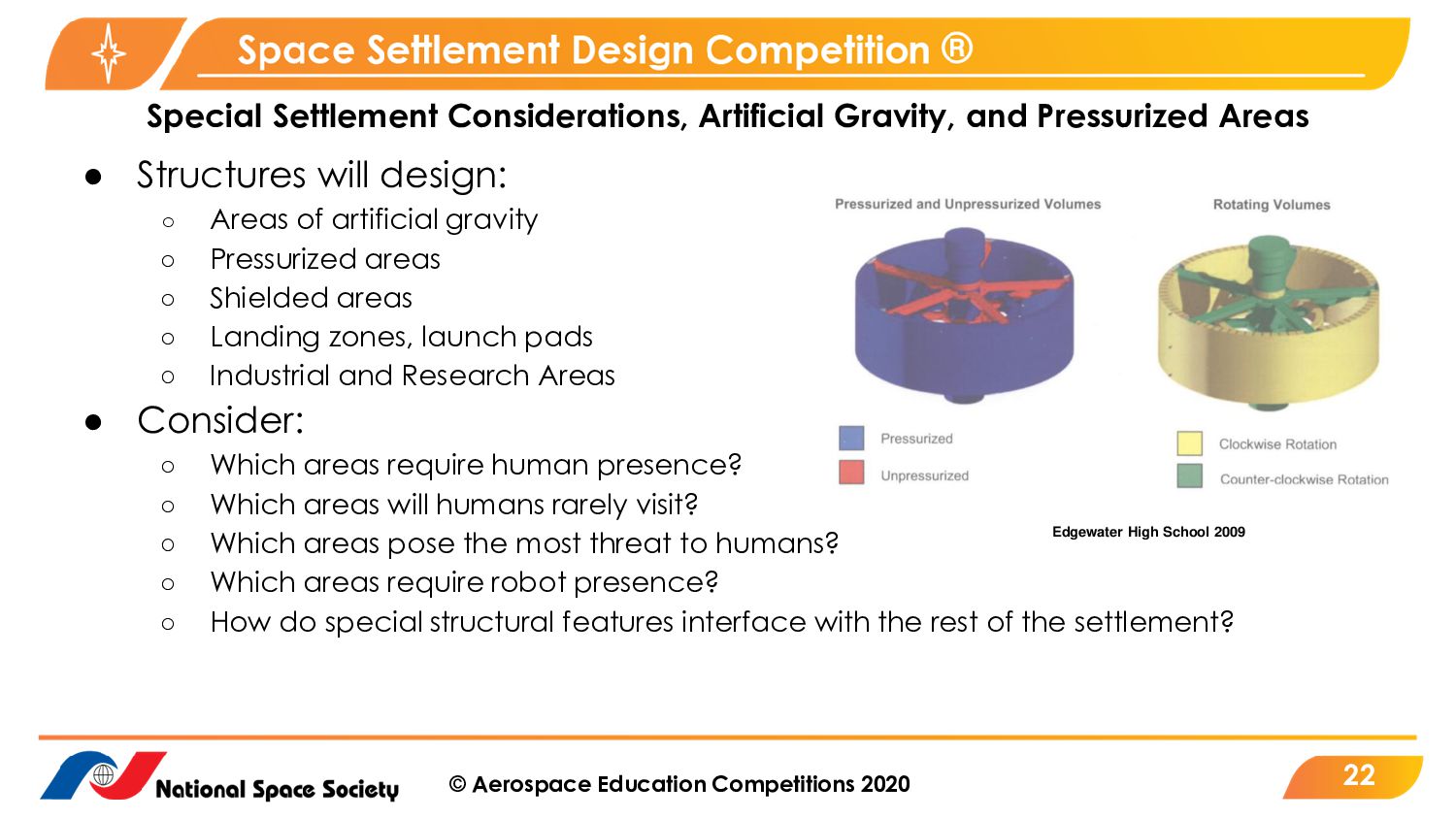
and Pressurized Areas • Structures will design: ◦ Areas of artificial gravity ◦ Pressurized areas ◦ Shielded areas ◦ Landing zones, launch pads ◦ Industrial and Research Areas • Consider: ◦ Which areas require human presence? ◦ Which areas will humans rarely visit? ◦ Which areas pose the most threat to humans? ◦ Which areas require robot presence? ◦ How do special structural features interface with the rest of the settlement? 22 Edgewater High School 2009
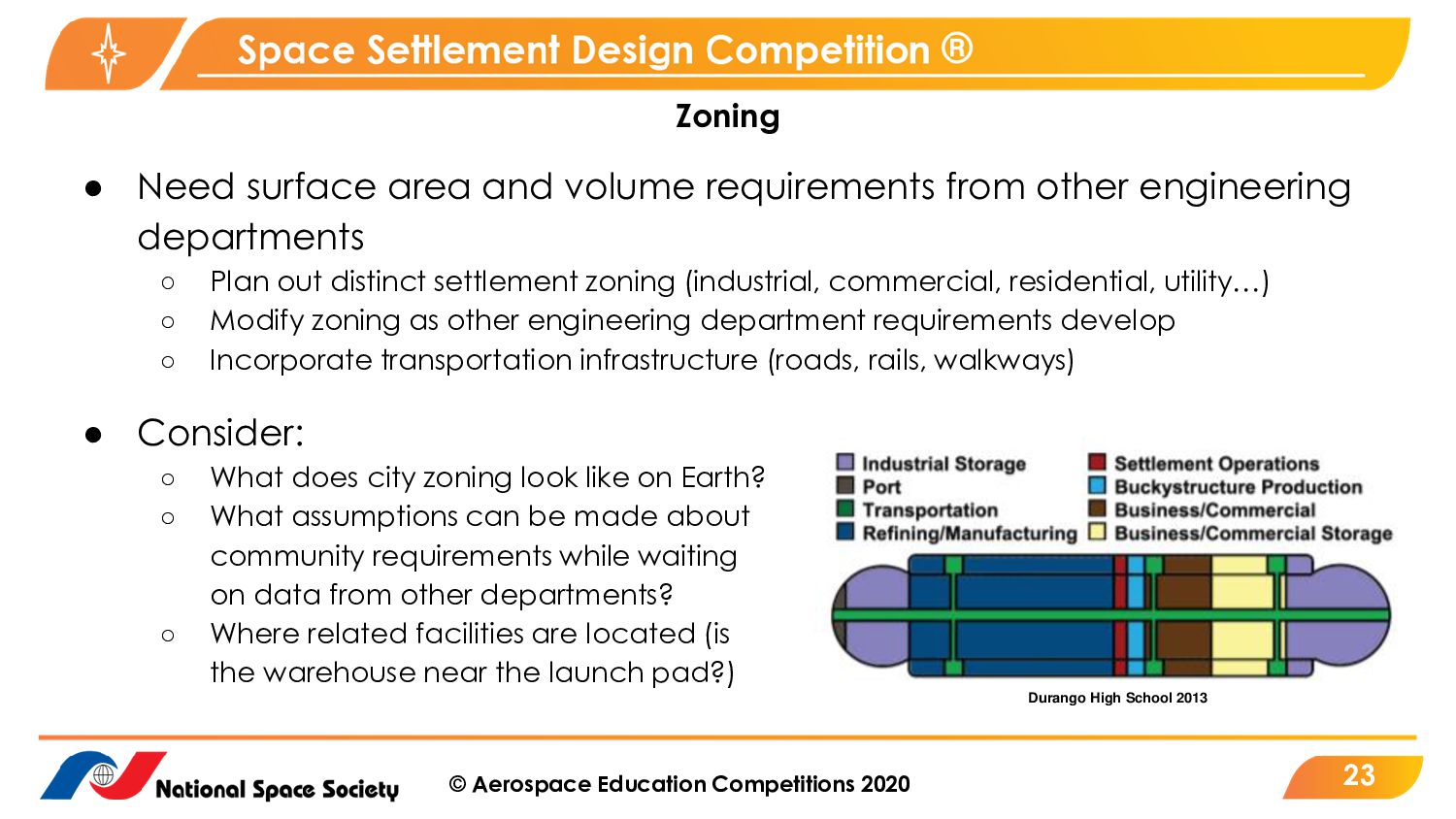
and volume requirements from other engineering departments ◦ Plan out distinct settlement zoning (industrial, commercial, residential, utility…) ◦ Modify zoning as other engineering department requirements develop ◦ Incorporate transportation infrastructure (roads, rails, walkways) 23 • Consider: ◦ What does city zoning look like on Earth? ◦ What assumptions can be made about community requirements while waiting on data from other departments? ◦ Where related facilities are located (is the warehouse near the launch pad?) Durango High School 2013
in Structural Engineering • Use easy-to-research projects to gauge schedule duration and cost ◦ Example: building a large structure like a skyscraper or bridge • Transportation costs can add up quickly, especially from Earth • Pay attention to the RFP’s instructions for what does NOT need to be calculated in costs • Don’t forget labor 24
• In the real world… ◦ Operations engineering is a branch of engineering that is mainly concerned with the analysis and optimization of operational problems using scientific and mathematical methods. (Wikipedia definition) ◦ Facilities exist to get a job done ◦ Operations engineers help the job get done efficiently, safely, reliably, and sustainably ◦ Ops engineers work on the original design of the facility, improvements made to the facility, or supporting daily operations of the facility ◦ Many engineering disciplines can work in operations engineering, as many disciplines are involved in operating any facility
• In SSDCs, Operations covers... ◦ Location of Facilities- and the most efficient (and cost effective) ways to get them there ◦ Operations to support construction- ensures working closely with other departments, therefore strengthening teamwork ◦ Utilities and infrastructure to support internal operations of the settlement- topics may include provisions of electricity, drainage system, communications, agriculture, and most importantly SAFE SELF SUSTAINABILITY! ◦ Establish requirements to enhance overall facility design functionality and efficiency ◦ Designing for efficient logistics of day-to-day settlement operations ◦ Considering room for future expansion, and business operations (for example: can the surplus food/electricity or RnD be ‘sold’?)
Check the RFP! (and other materials) ◦ Has the customer already selected a location? ◦ Provide rationale for your choice • Ask yourself… ◦ Will the settlement be built where it operates? ◦ Where are construction materials sourced? ◦ How will construction materials be delivered to the site? ◦ How, and how often, will visitors need to rendevous? ◦ What are the most important factors for your location for this scenario?
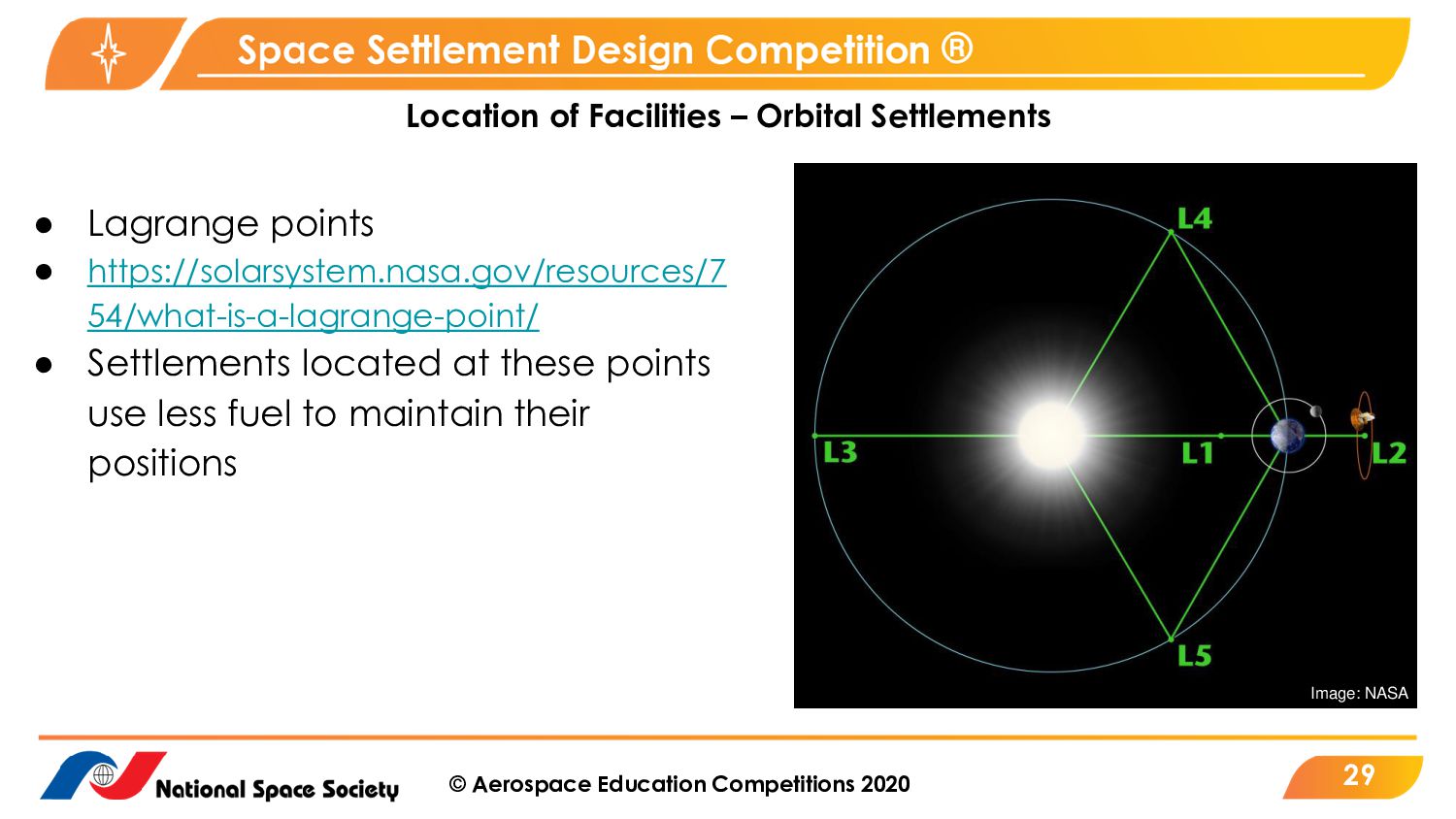
Orbital Settlements • Lagrange points • https://solarsystem.nasa.gov/resources/7 54/what-is-a-lagrange-point/ • Settlements located at these points use less fuel to maintain their positions Image: NASA
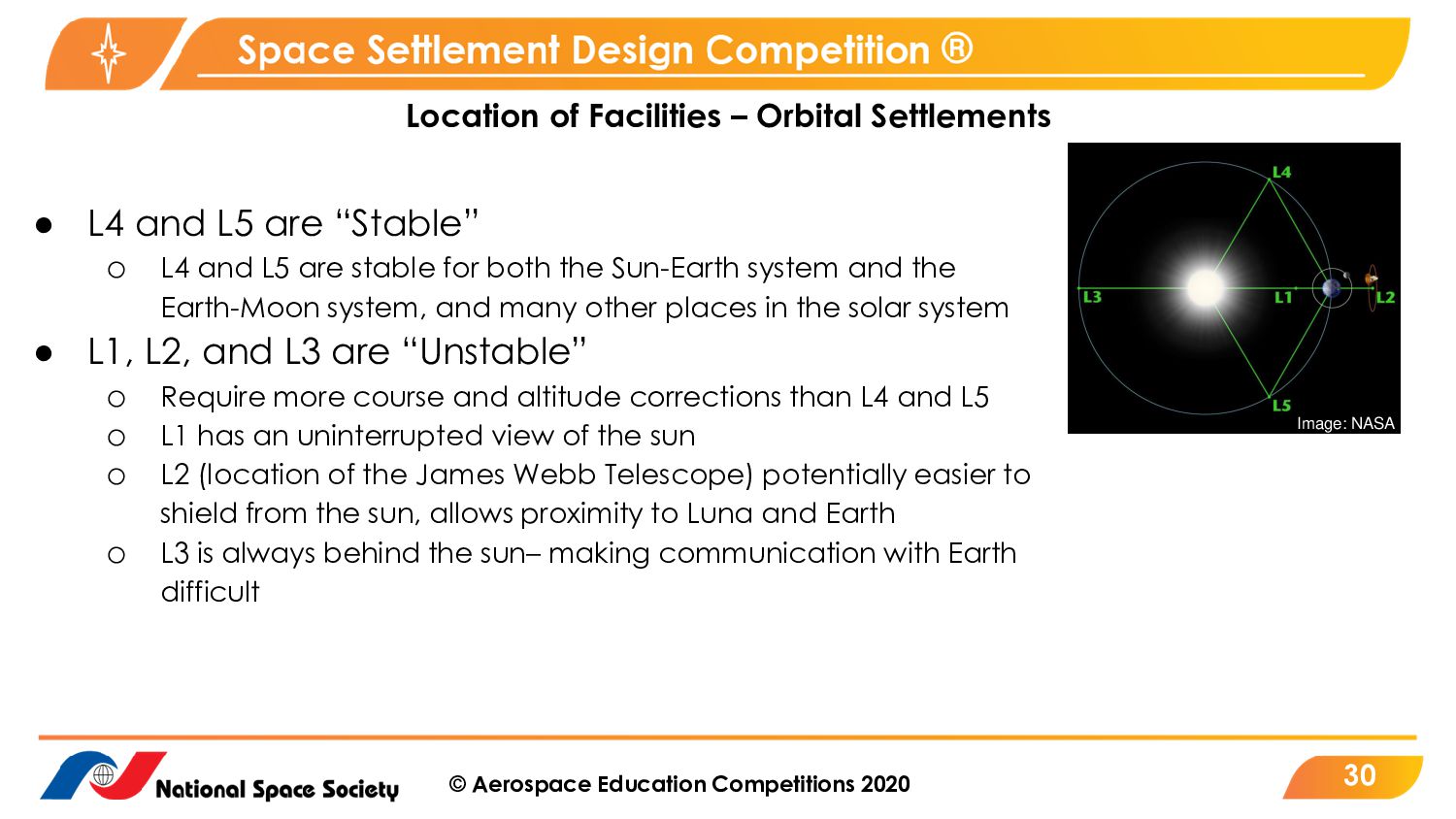
Orbital Settlements • L4 and L5 are “Stable” o L4 and L5 are stable for both the Sun-Earth system and the Earth-Moon system, and many other places in the solar system • L1, L2, and L3 are “Unstable” o Require more course and altitude corrections than L4 and L5 o L1 has an uninterrupted view of the sun o L2 (location of the James Webb Telescope) potentially easier to shield from the sun, allows proximity to Luna and Earth o L3 is always behind the sun– making communication with Earth difficult Image: NASA
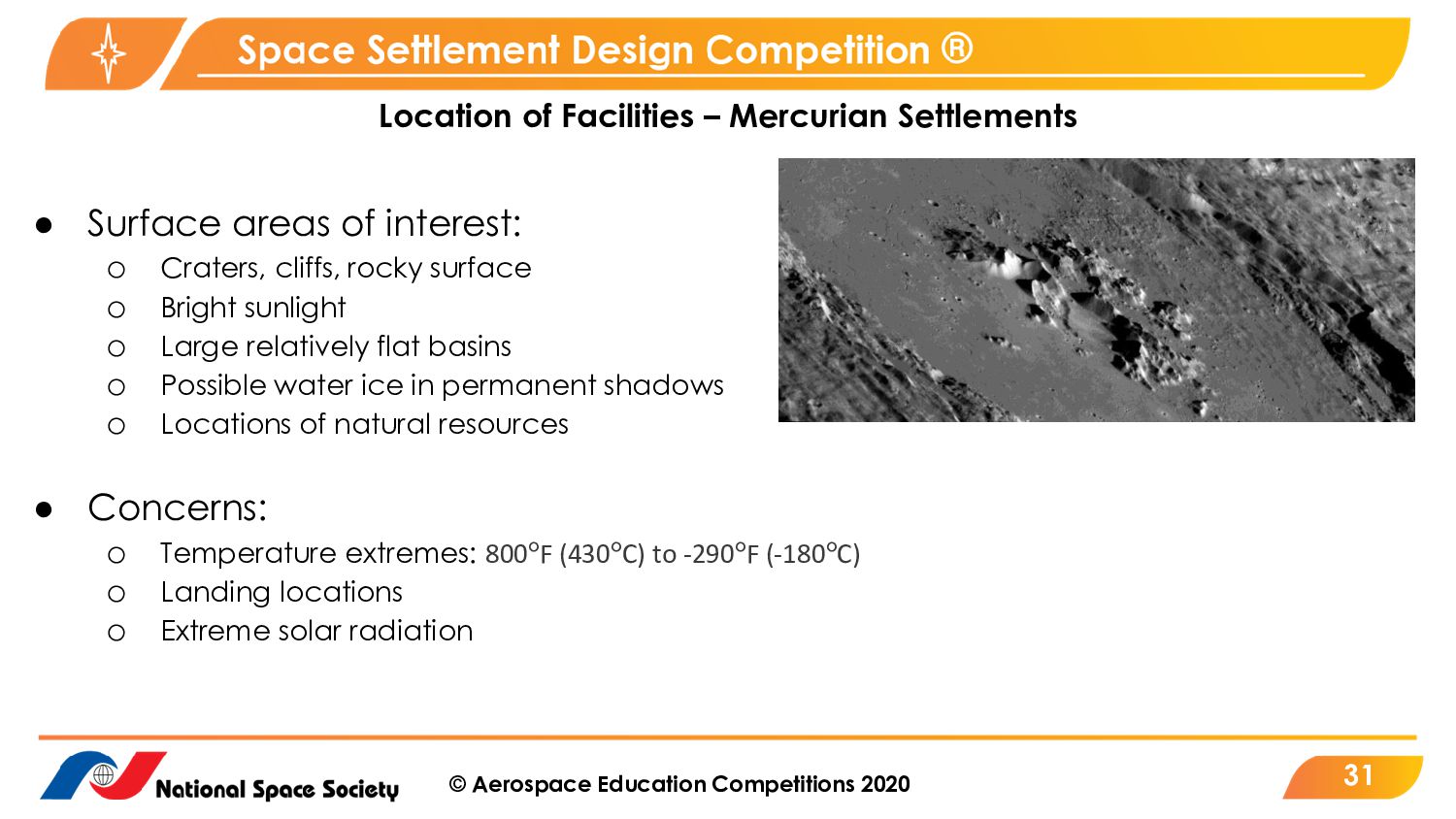
Mercurian Settlements • Surface areas of interest: o Craters, cliffs, rocky surface o Bright sunlight o Large relatively flat basins o Possible water ice in permanent shadows o Locations of natural resources • Concerns: o Temperature extremes: 800°F (430°C) to -290°F (-180°C) o Landing locations o Extreme solar radiation Image: NASA
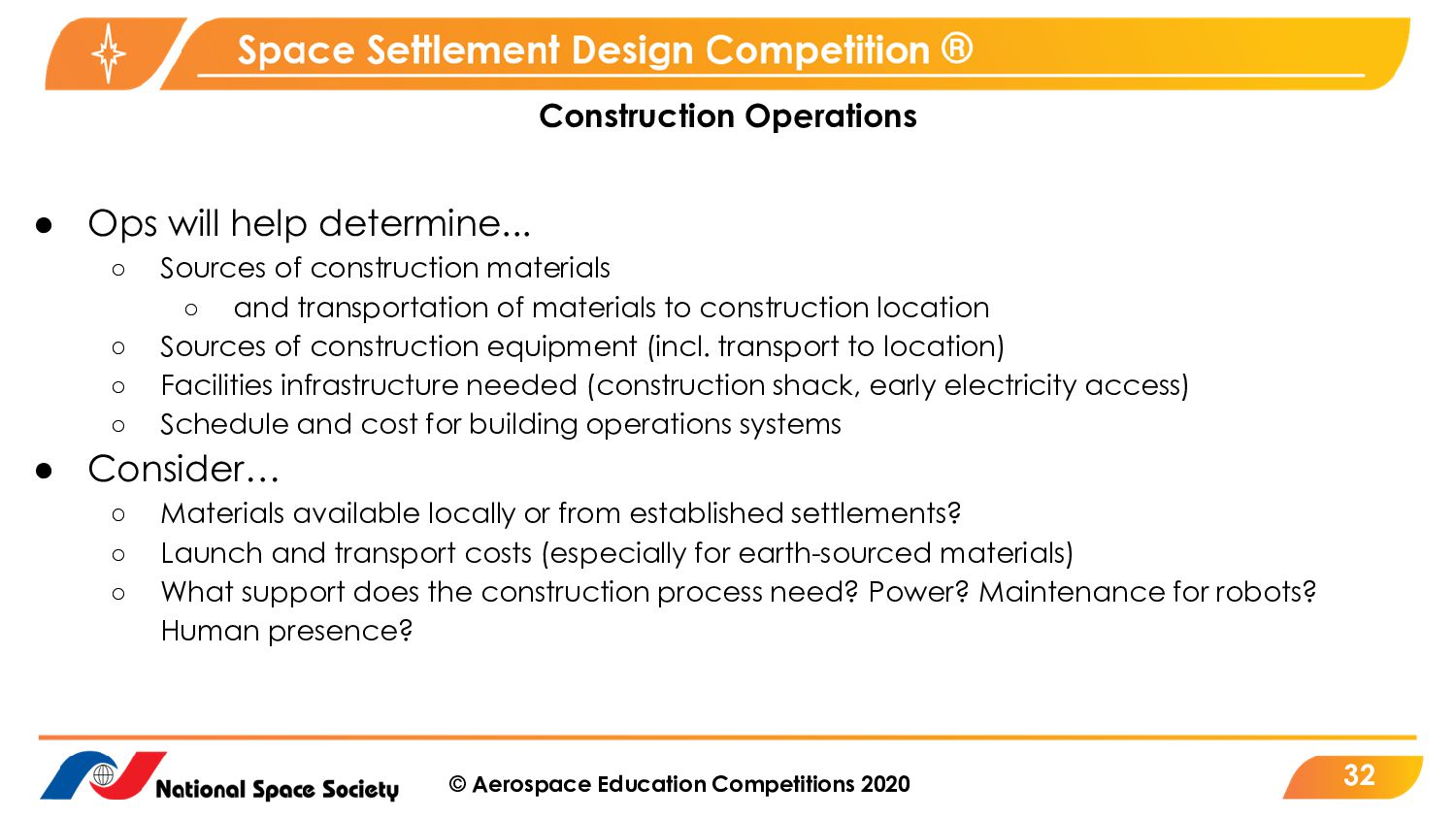
will help determine... ◦ Sources of construction materials ◦ and transportation of materials to construction location ◦ Sources of construction equipment (incl. transport to location) ◦ Facilities infrastructure needed (construction shack, early electricity access) ◦ Schedule and cost for building operations systems • Consider… ◦ Materials available locally or from established settlements? ◦ Launch and transport costs (especially for earth-sourced materials) ◦ What support does the construction process need? Power? Maintenance for robots? Human presence?
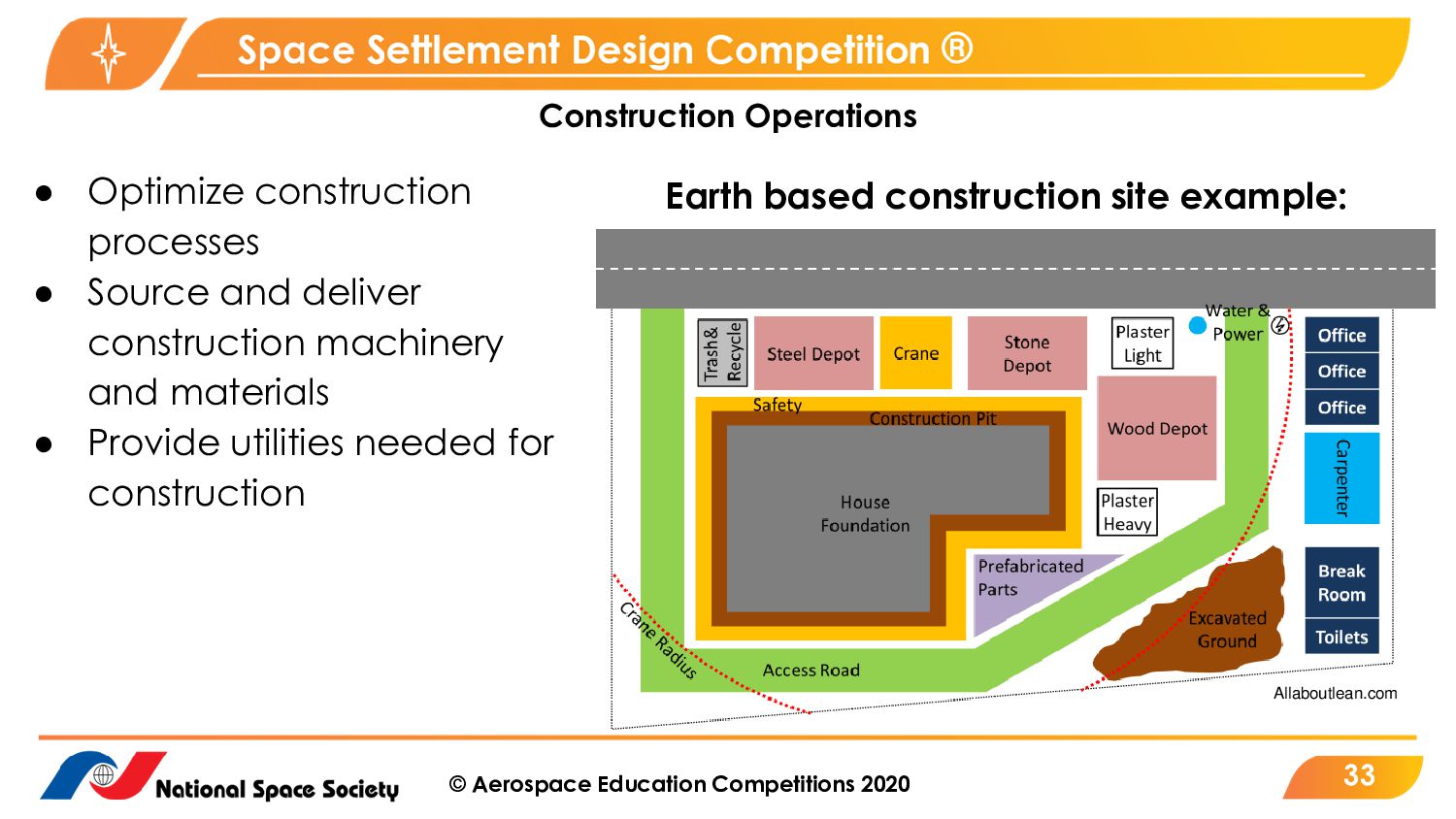
construction processes • Source and deliver construction machinery and materials • Provide utilities needed for construction Earth based construction site example: Allaboutlean.com
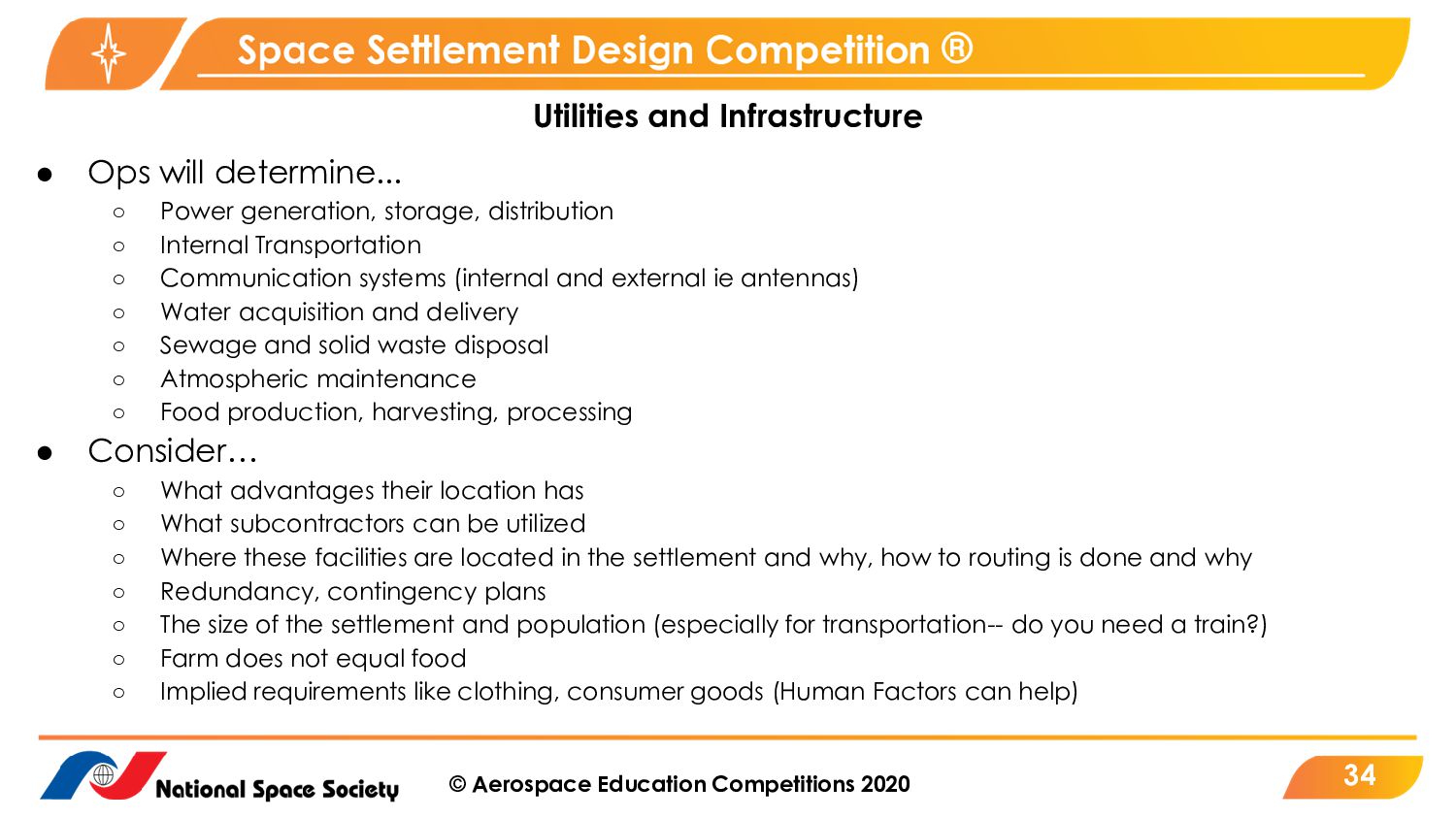
Ops will determine... ◦ Power generation, storage, distribution ◦ Internal Transportation ◦ Communication systems (internal and external ie antennas) ◦ Water acquisition and delivery ◦ Sewage and solid waste disposal ◦ Atmospheric maintenance ◦ Food production, harvesting, processing • Consider… ◦ What advantages their location has ◦ What subcontractors can be utilized ◦ Where these facilities are located in the settlement and why, how to routing is done and why ◦ Redundancy, contingency plans ◦ The size of the settlement and population (especially for transportation-- do you need a train?) ◦ Farm does not equal food ◦ Implied requirements like clothing, consumer goods (Human Factors can help)
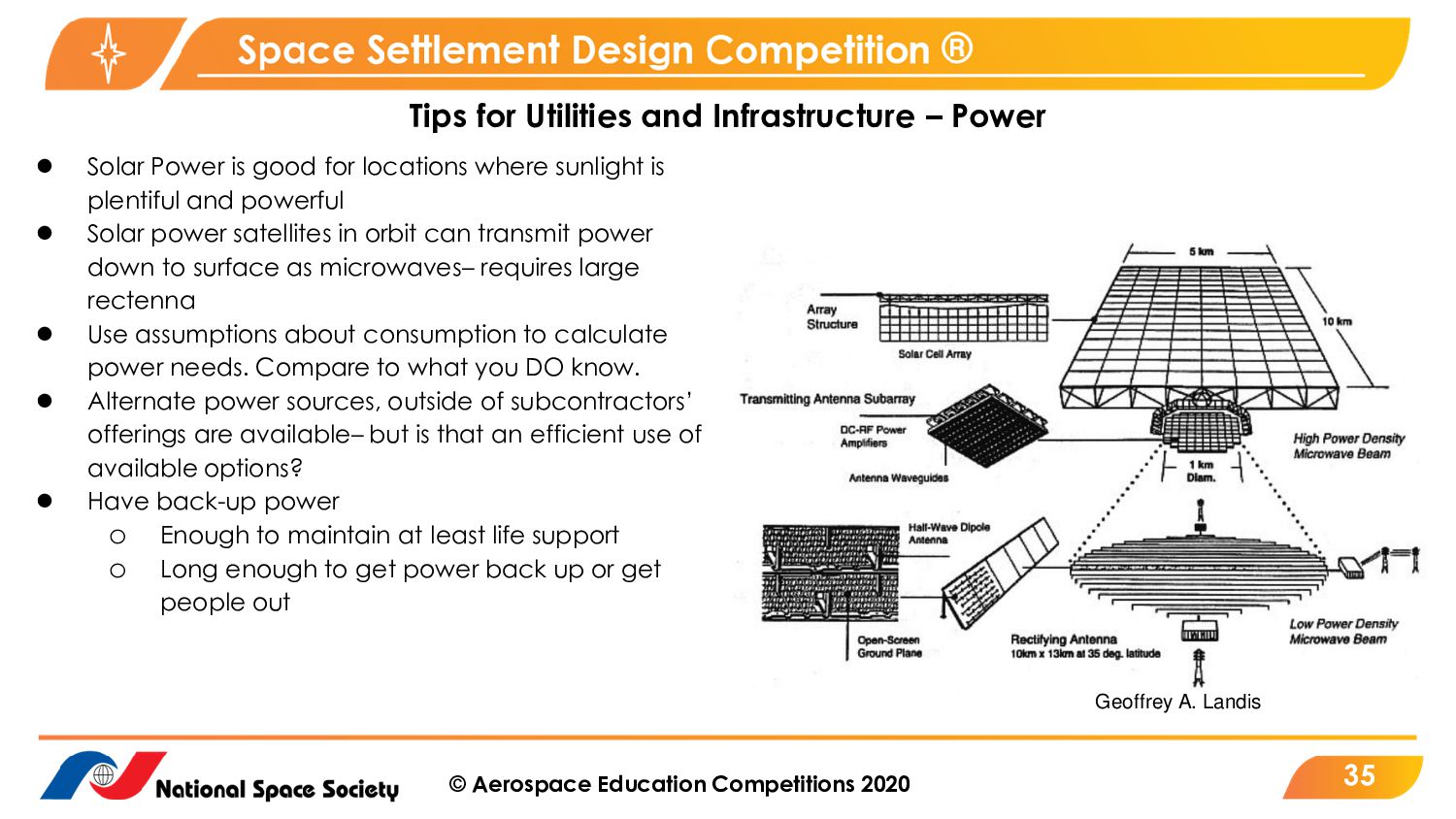
Infrastructure – Power • Solar Power is good for locations where sunlight is plentiful and powerful • Solar power satellites in orbit can transmit power down to surface as microwaves– requires large rectenna • Use assumptions about consumption to calculate power needs. Compare to what you DO know. • Alternate power sources, outside of subcontractors’ offerings are available– but is that an efficient use of available options? • Have back-up power o Enough to maintain at least life support o Long enough to get power back up or get people out Geoffrey A. Landis
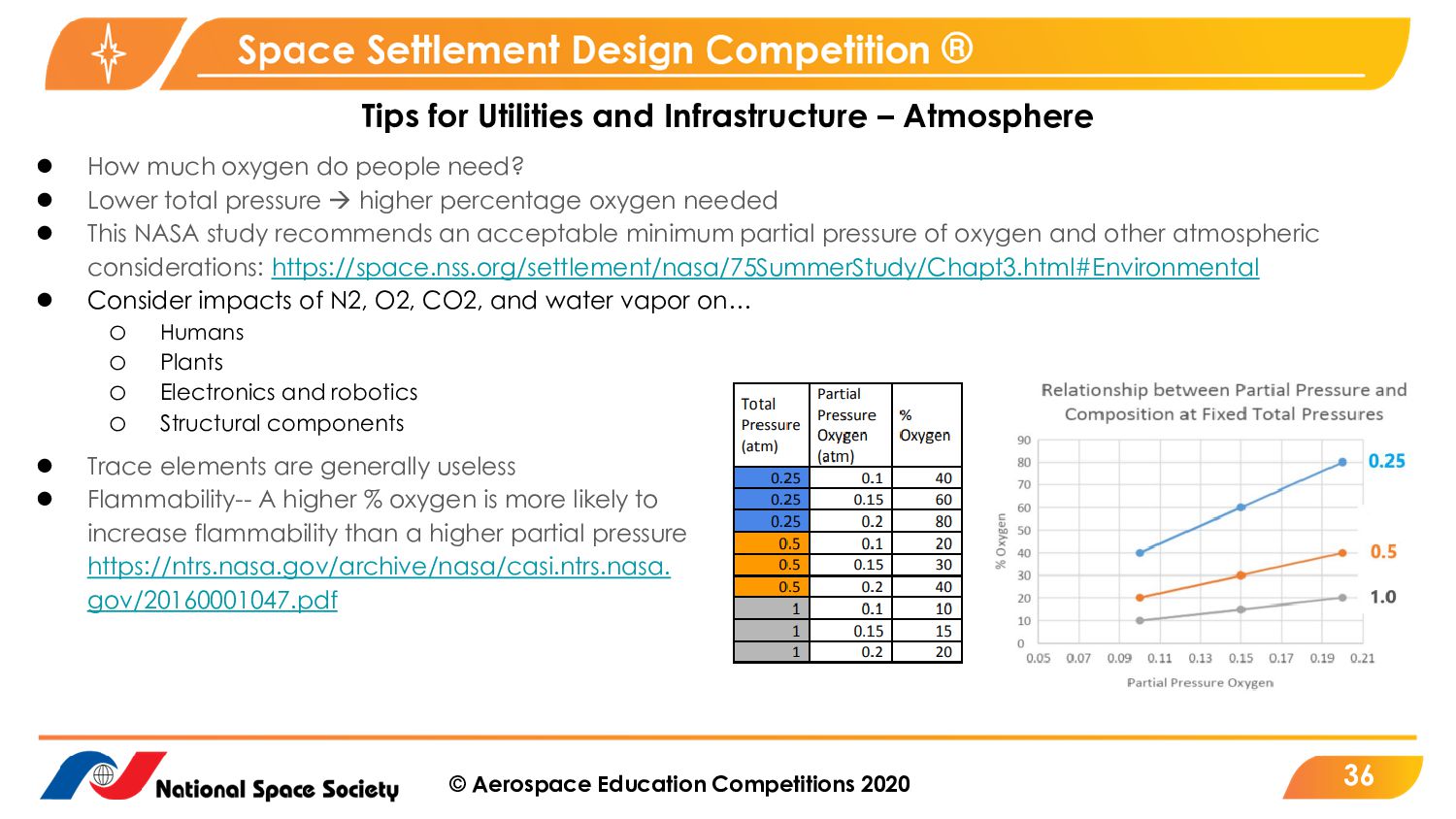
Infrastructure – Atmosphere • How much oxygen do people need? • Lower total pressure → higher percentage oxygen needed • This NASA study recommends an acceptable minimum partial pressure of oxygen and other atmospheric considerations: https://space.nss.org/settlement/nasa/75SummerStudy/Chapt3.html#Environmental • Consider impacts of N2, O2, CO2, and water vapor on… o Humans o Plants o Electronics and robotics o Structural components • Trace elements are generally useless • Flammability-- A higher % oxygen is more likely to increase flammability than a higher partial pressure https://ntrs.nasa.gov/archive/nasa/casi.ntrs.nasa. gov/20160001047.pdf
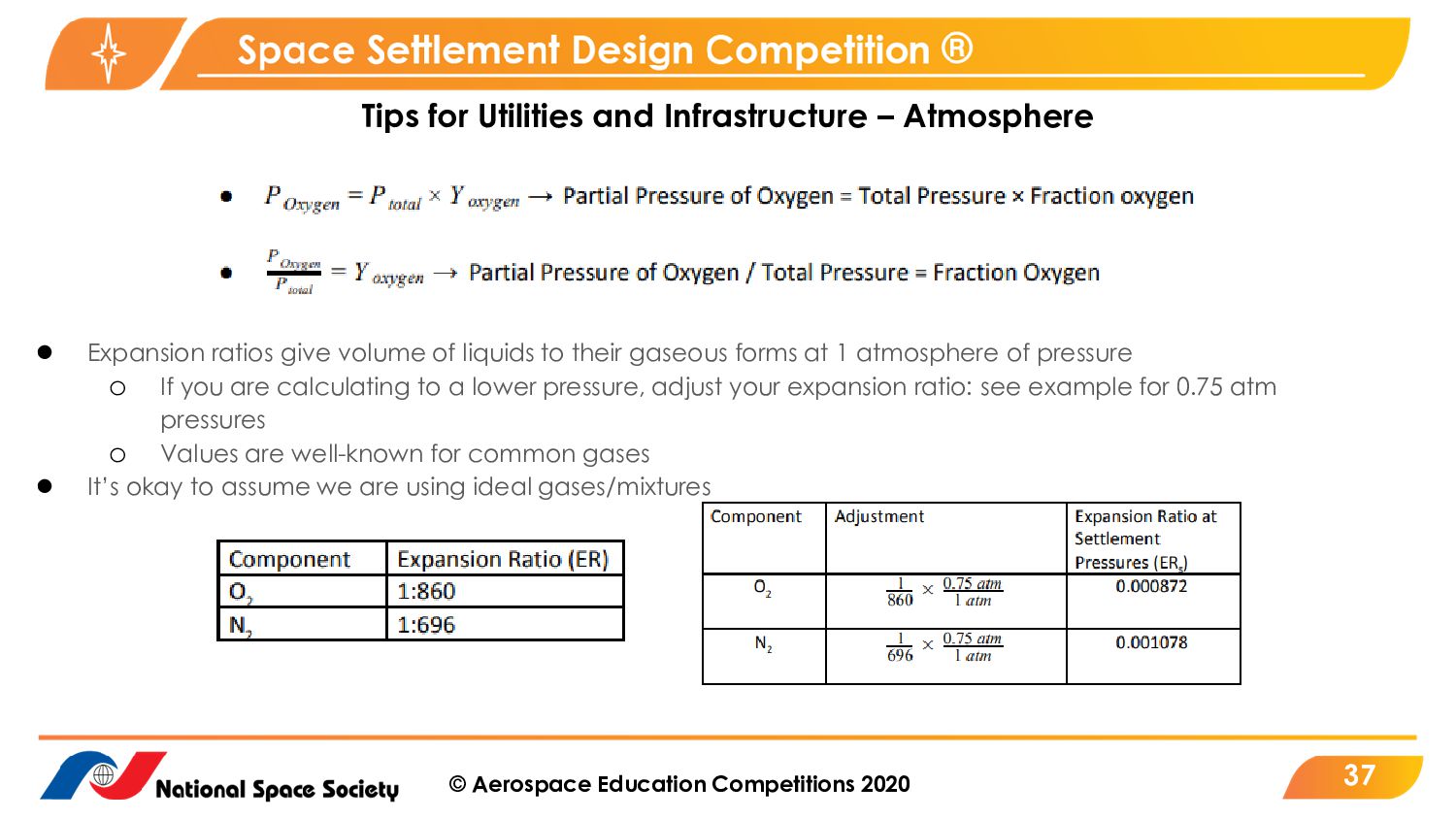
Infrastructure – Atmosphere • Expansion ratios give volume of liquids to their gaseous forms at 1 atmosphere of pressure o If you are calculating to a lower pressure, adjust your expansion ratio: see example for 0.75 atm pressures o Values are well-known for common gases • It’s okay to assume we are using ideal gases/mixtures
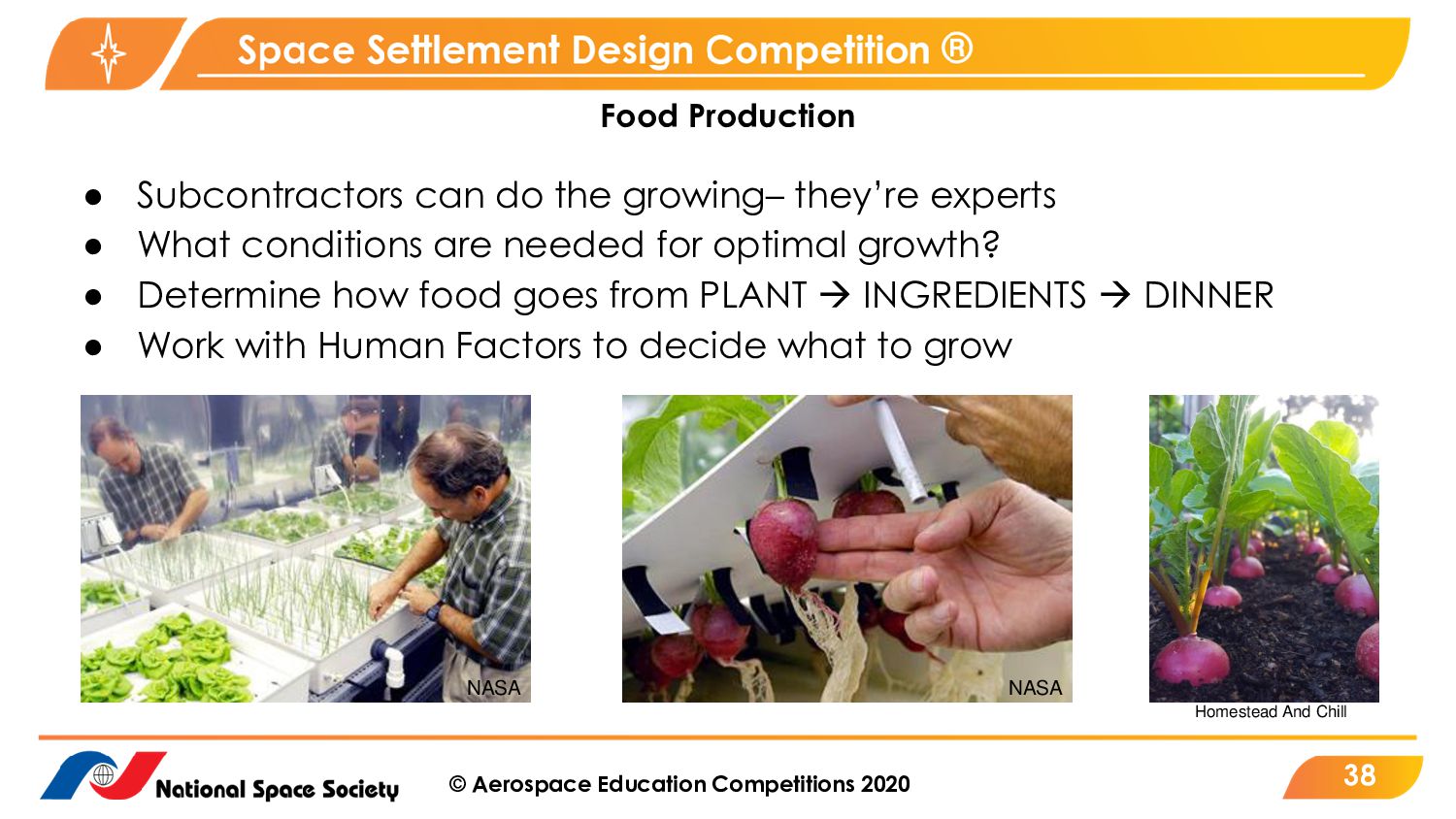
can do the growing– they’re experts • What conditions are needed for optimal growth? • Determine how food goes from PLANT → INGREDIENTS → DINNER • Work with Human Factors to decide what to grow Homestead And Chill NASA NASA
Cost in Operations Engineering • Use easy-to-research projects to gauge schedule duration and cost ◦ Example: building a railroad, power plant, or satellite communication grid • Transportation costs can add up quickly, especially from Earth • Pay attention to the RFP’s instructions for what does NOT need to be calculated in costs • Don’t forget labor
• In the real world… o Human factors engineering is the application of human factors information to the design of tools, machines, systems, tasks, jobs, and environments for safe, comfortable, and effective human use. (definition from Human Factors and Ergonomics Society) • In the aerospace industry, human factors engineers ensure humans can thrive in space environments • Human Factors engineers have a variety of backgrounds, including physical science, engineering, life sciences, computer science, mathematics… 41
• In SSDCs, Human Factors Engineering covers... ◦ Design and provisioning of living quarters ◦ Providing opportunities for residents to experience the location of the settlement ◦ Providing services typical of a community of comparable size, such as medical ◦ Entertainment, restaraunts, sports ◦ Parks and recreation ◦ Emergency response ◦ Considerations for mitigating the hazards of the space environment ◦ Defining space suit needs for all types of activities ◦ Defining needs of residents for commodities (food, clothes, toiletries) and how residents get those items ◦ Ensure residents have the ability to establish a culture and socialize with others 42
Remember what year the competition is in throughout your designs o Designs should reflect likely technologies available then o You can be optimistic about what will be available in the future 43
you need? • Figure out approximately how much space things need– estimate and give this figure to structures as quickly as possible o Don’t forget roads, spaces between buildings, parks and green spaces • Work with structures to adjust space available throughout the design period o Flexibility will prevent re-work o Decide early where that flexibility can come from o Don’t neglect RFP requirements • Once structures has a main shape chosen, discuss with them the shape of your community areas o Negotiate, don’t forget the RFP 45
All communities need medical care o BUT, services should be scaled for the community size and demographics • Look up how many hospital beds are needed per 100 or 1000 residents o Consider how easy or difficult it is to get to more help if your system is overwhelmed • Account for medical advancements o Faster healing times, shorter hospital stays o More outpatient procedures, less inpatient procedures o Better and more thorough preventative care o Computer simulations and robotics aiding medical professionals o Easy and quick diagnostic tools for early detection of many medical conditions • The amount of slide space you should use for a hospital design should be proportional to how much space in the RFP is used to ask for hospitals! 46
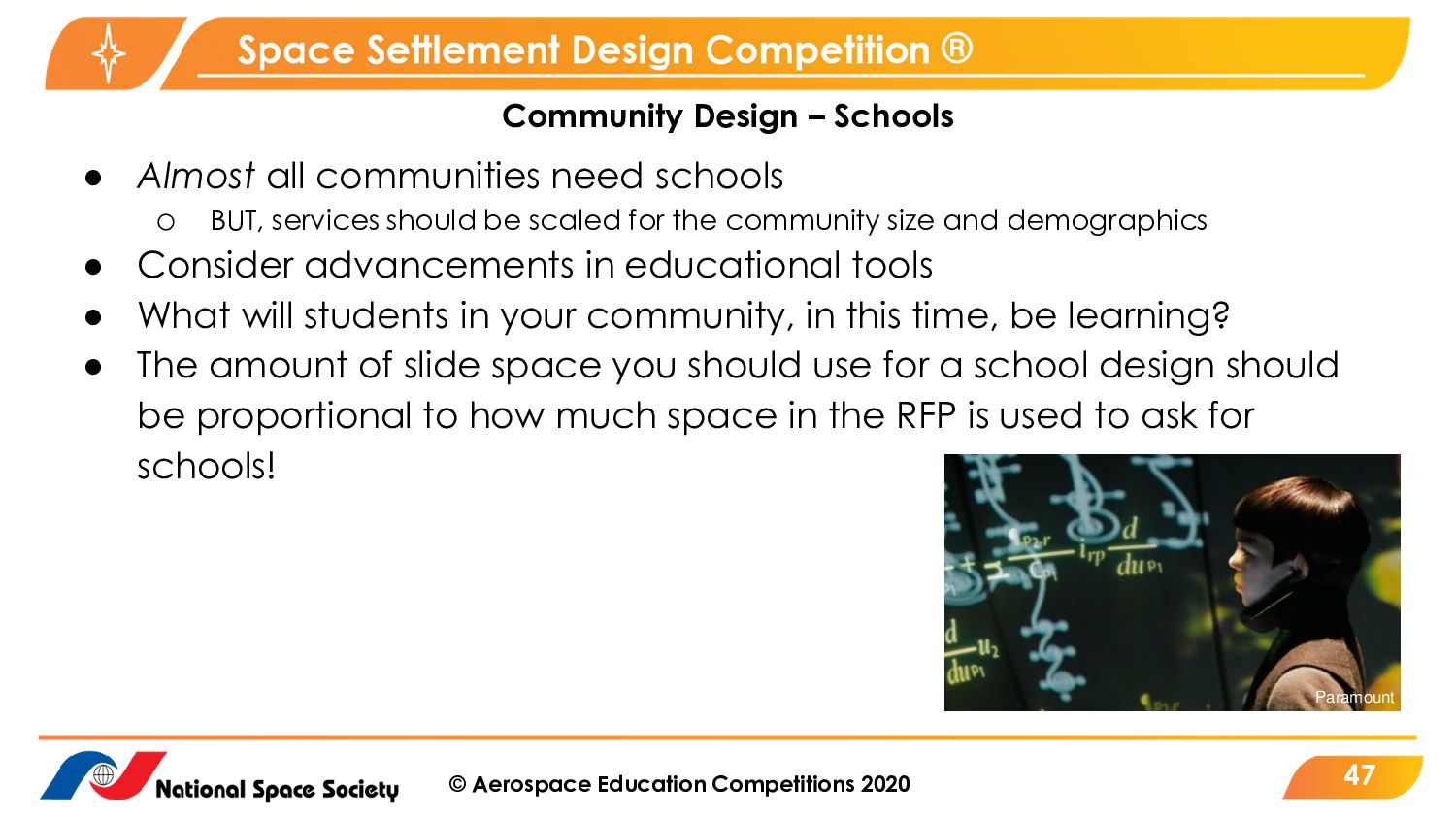
Almost all communities need schools o BUT, services should be scaled for the community size and demographics • Consider advancements in educational tools • What will students in your community, in this time, be learning? • The amount of slide space you should use for a school design should be proportional to how much space in the RFP is used to ask for schools! 47 Paramount
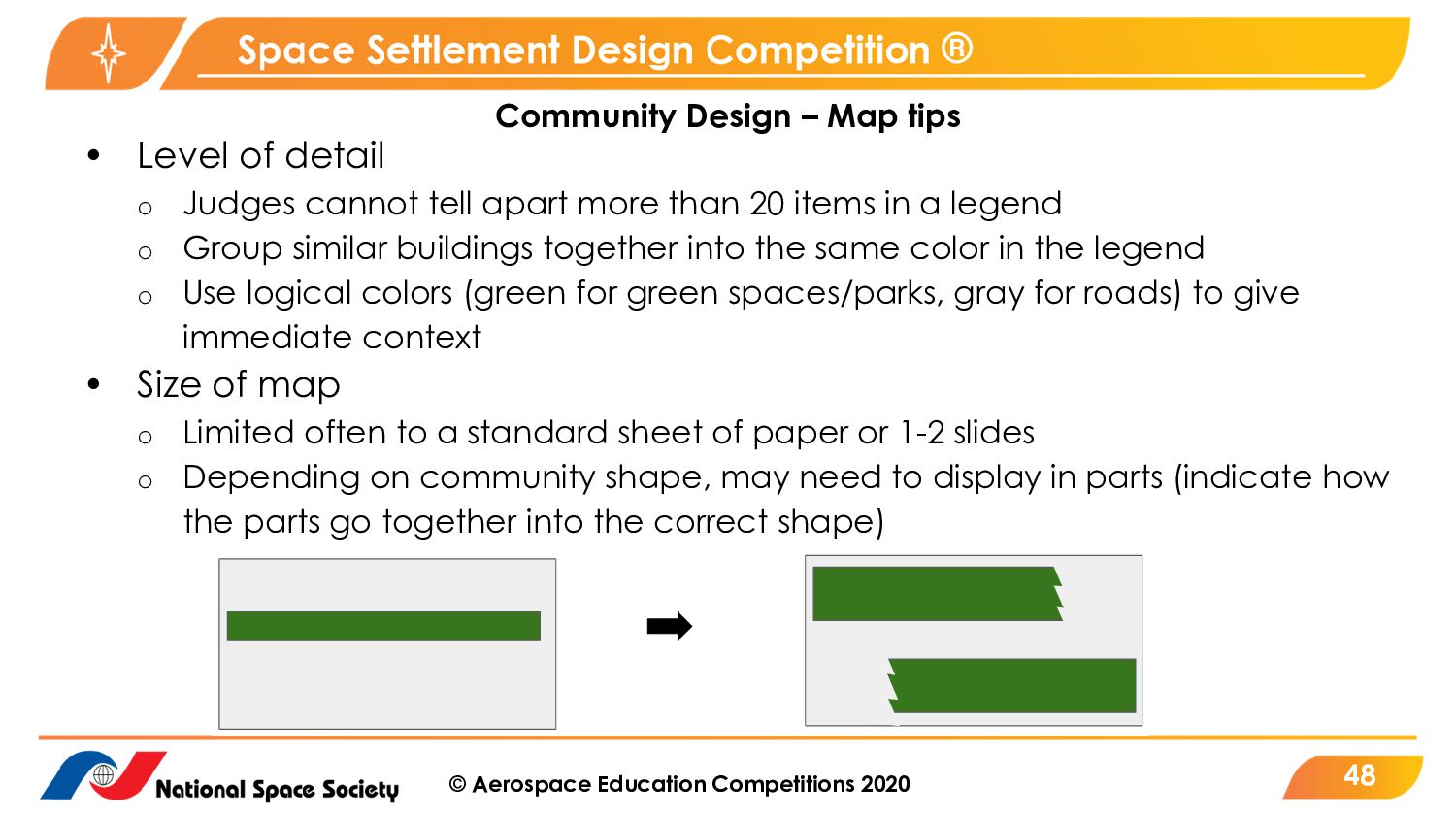
• Level of detail o Judges cannot tell apart more than 20 items in a legend o Group similar buildings together into the same color in the legend o Use logical colors (green for green spaces/parks, gray for roads) to give immediate context • Size of map o Limited often to a standard sheet of paper or 1-2 slides o Depending on community shape, may need to display in parts (indicate how the parts go together into the correct shape) 48
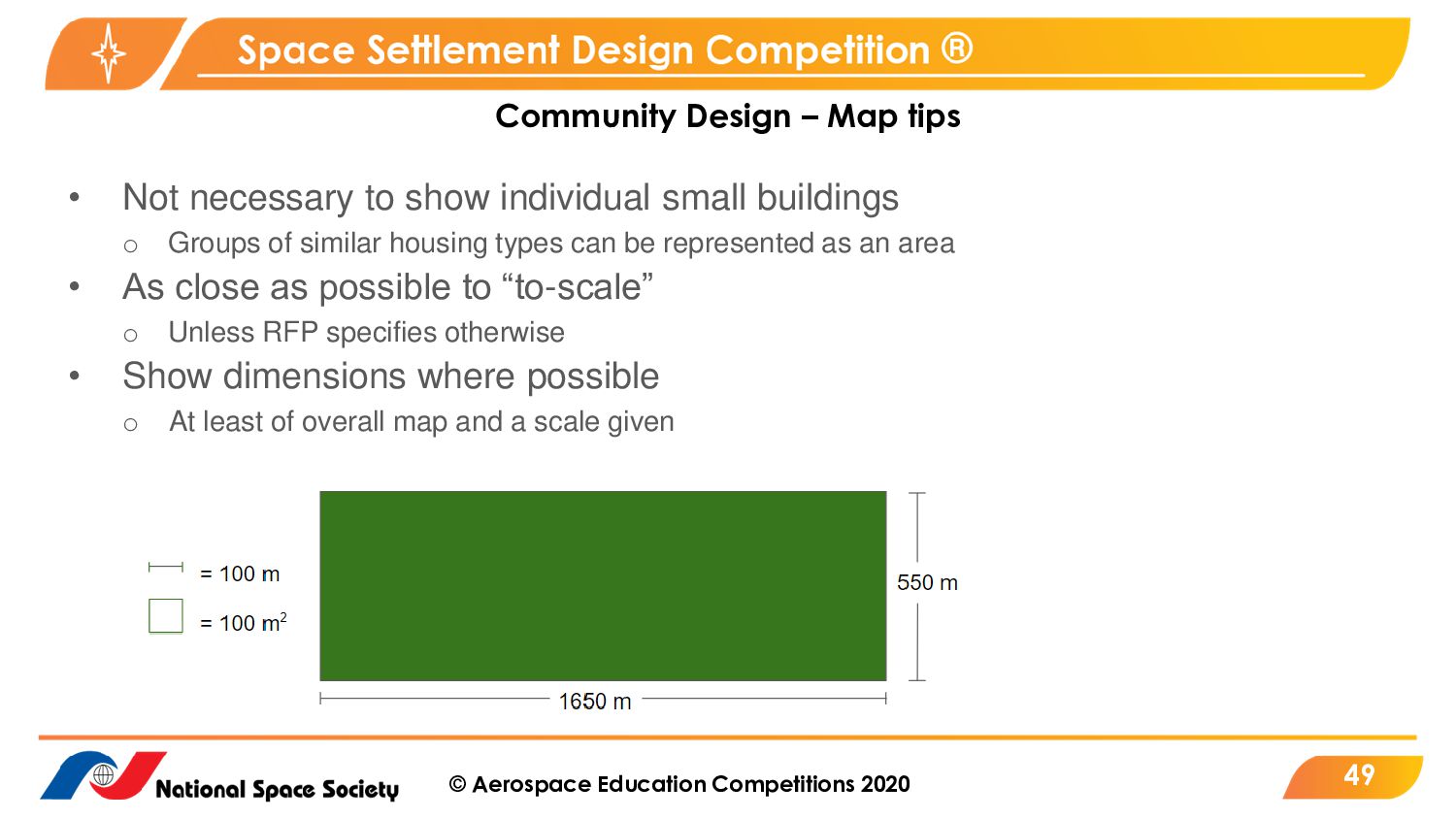
• Not necessary to show individual small buildings o Groups of similar housing types can be represented as an area • As close as possible to “to-scale” o Unless RFP specifies otherwise • Show dimensions where possible o At least of overall map and a scale given 49
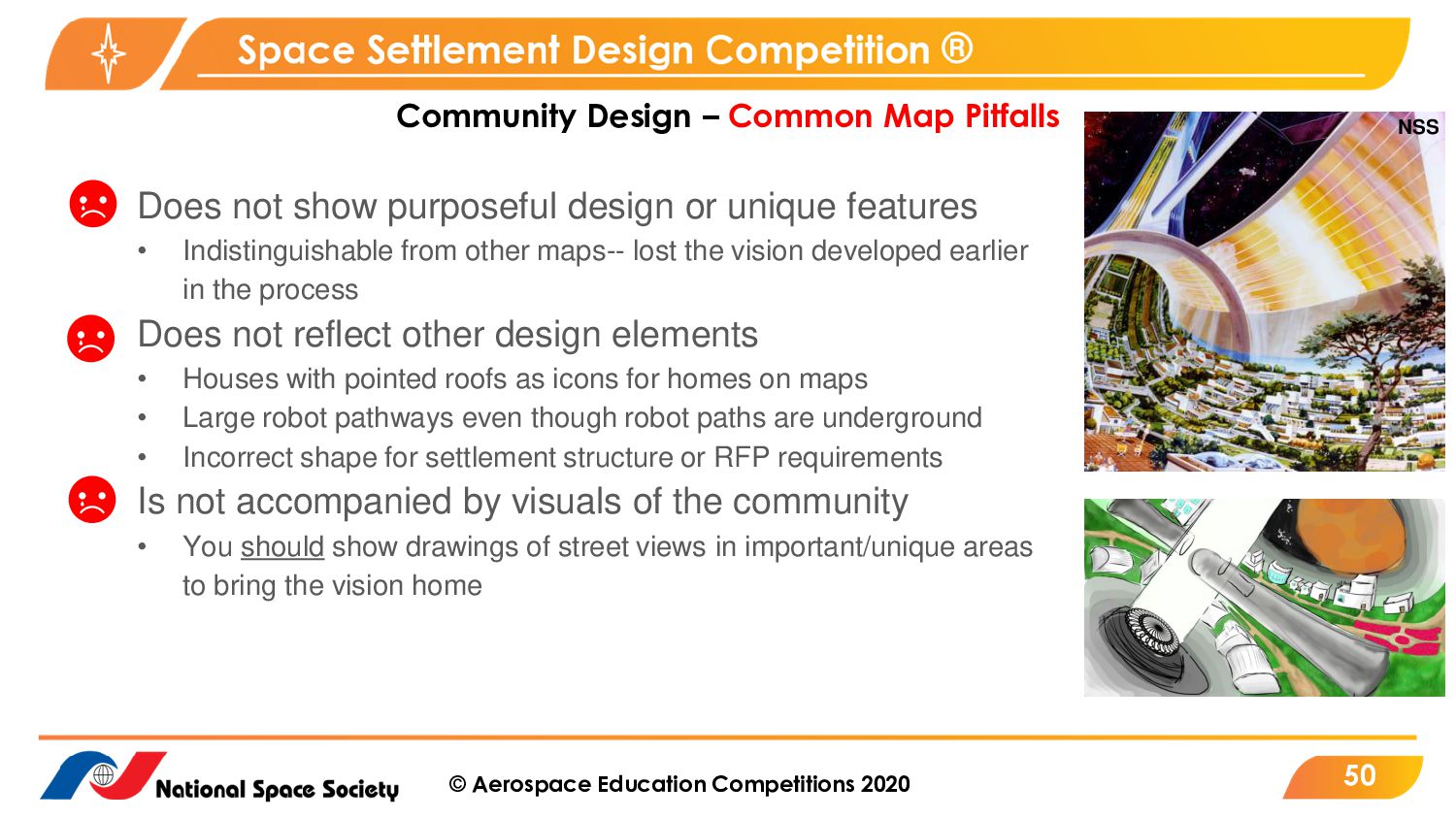
Pitfalls • Does not show purposeful design or unique features • Indistinguishable from other maps-- lost the vision developed earlier in the process • Does not reflect other design elements • Houses with pointed roofs as icons for homes on maps • Large robot pathways even though robot paths are underground • Incorrect shape for settlement structure or RFP requirements • Is not accompanied by visuals of the community • You should show drawings of street views in important/unique areas to bring the vision home 50 NSS
want • Features should be chosen to match the customer’s lifestyle • Features are limited by reasonable/responsible use of resources and space • Many websites have real estate listings for luxury homes in various types of neighborhoods and cities around the world for comparison and inspiration • Remember-- what may appeal to you, may not appeal to your customer 52
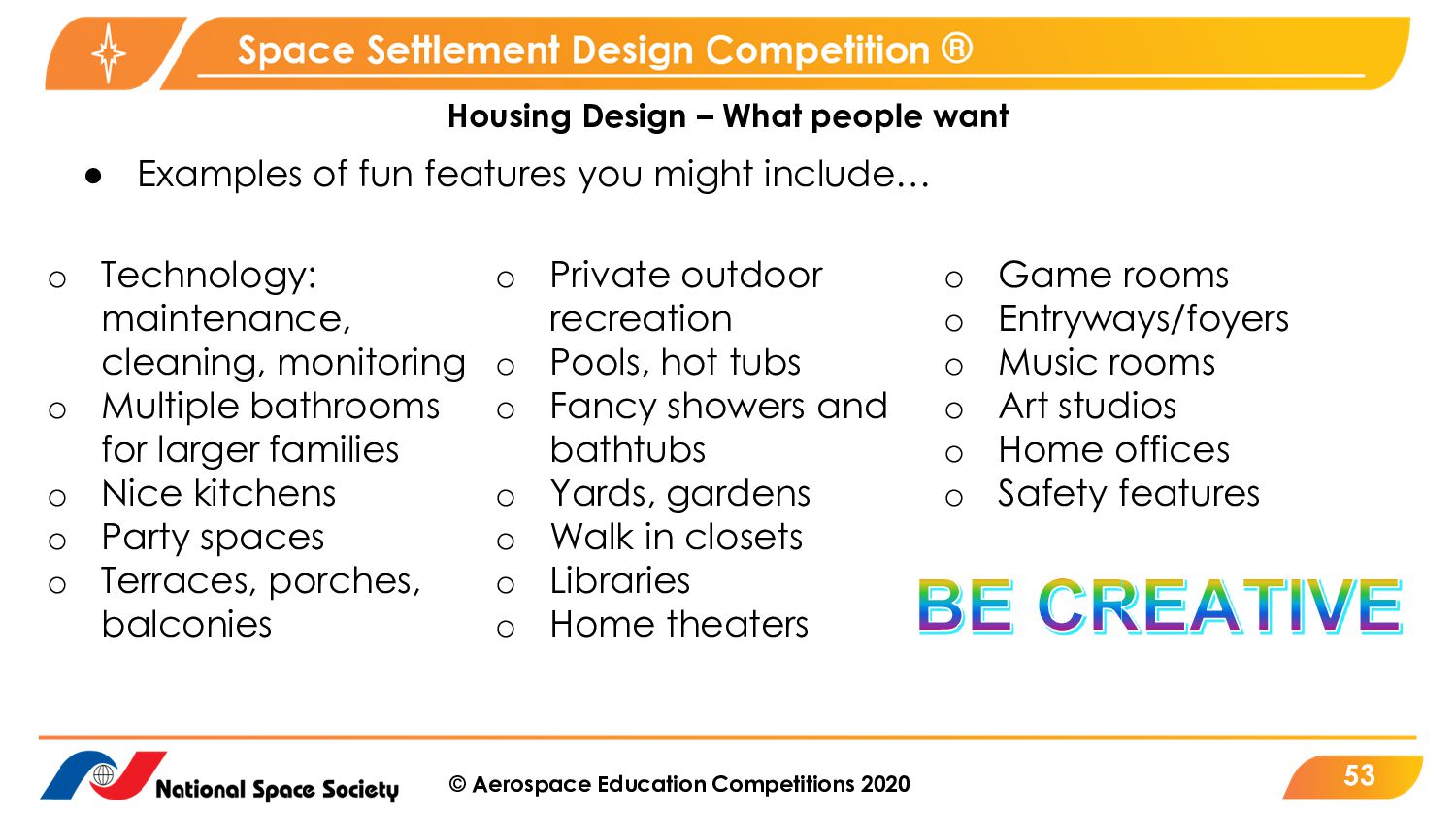
want • Examples of fun features you might include… 53 o Technology: maintenance, cleaning, monitoring o Multiple bathrooms for larger families o Nice kitchens o Party spaces o Terraces, porches, balconies o Private outdoor recreation o Pools, hot tubs o Fancy showers and bathtubs o Yards, gardens o Walk in closets o Libraries o Home theaters o Game rooms o Entryways/foyers o Music rooms o Art studios o Home offices o Safety features
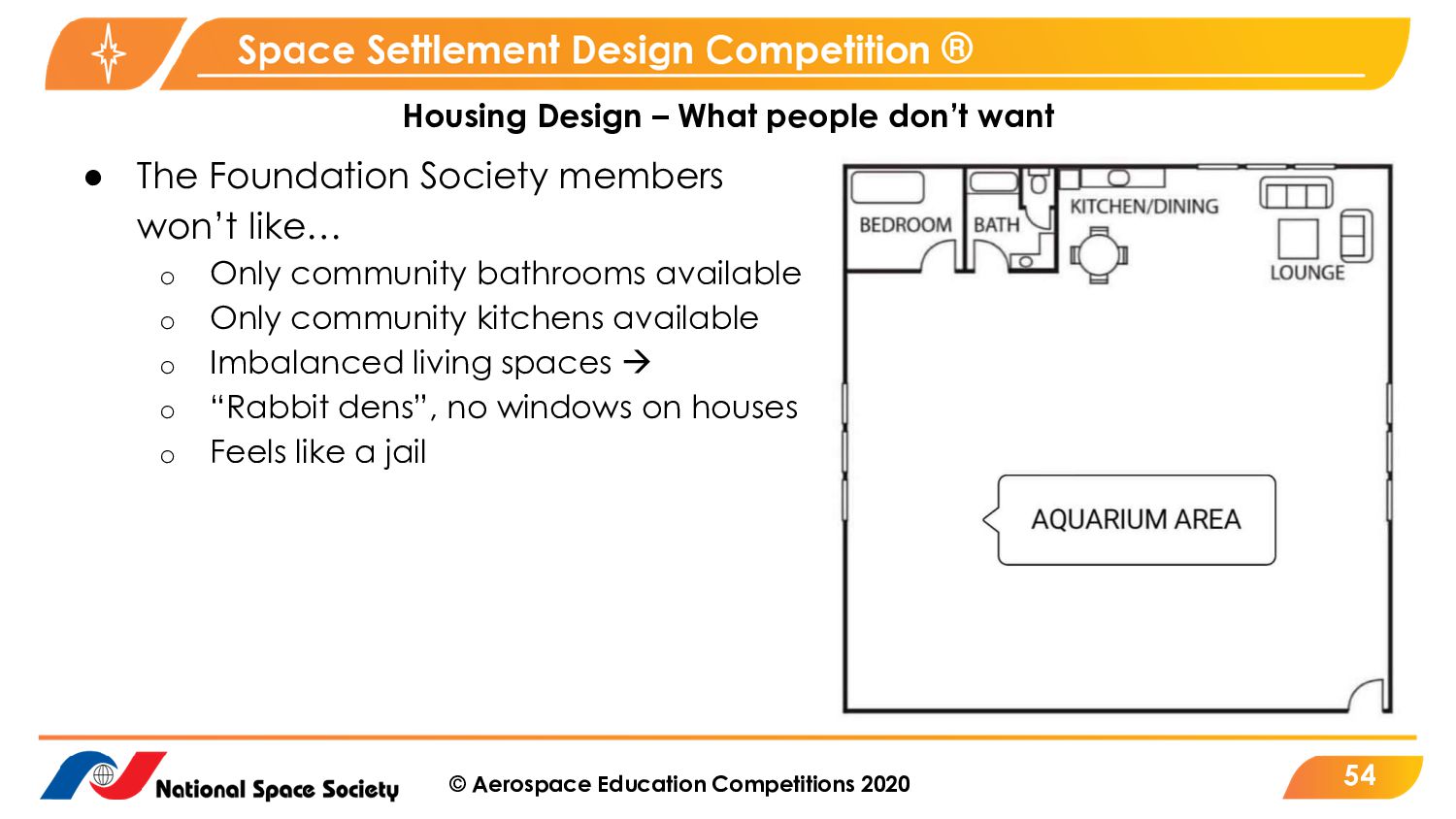
don’t want 54 • The Foundation Society members won’t like… o Only community bathrooms available o Only community kitchens available o Imbalanced living spaces → o “Rabbit dens”, no windows on houses o Feels like a jail
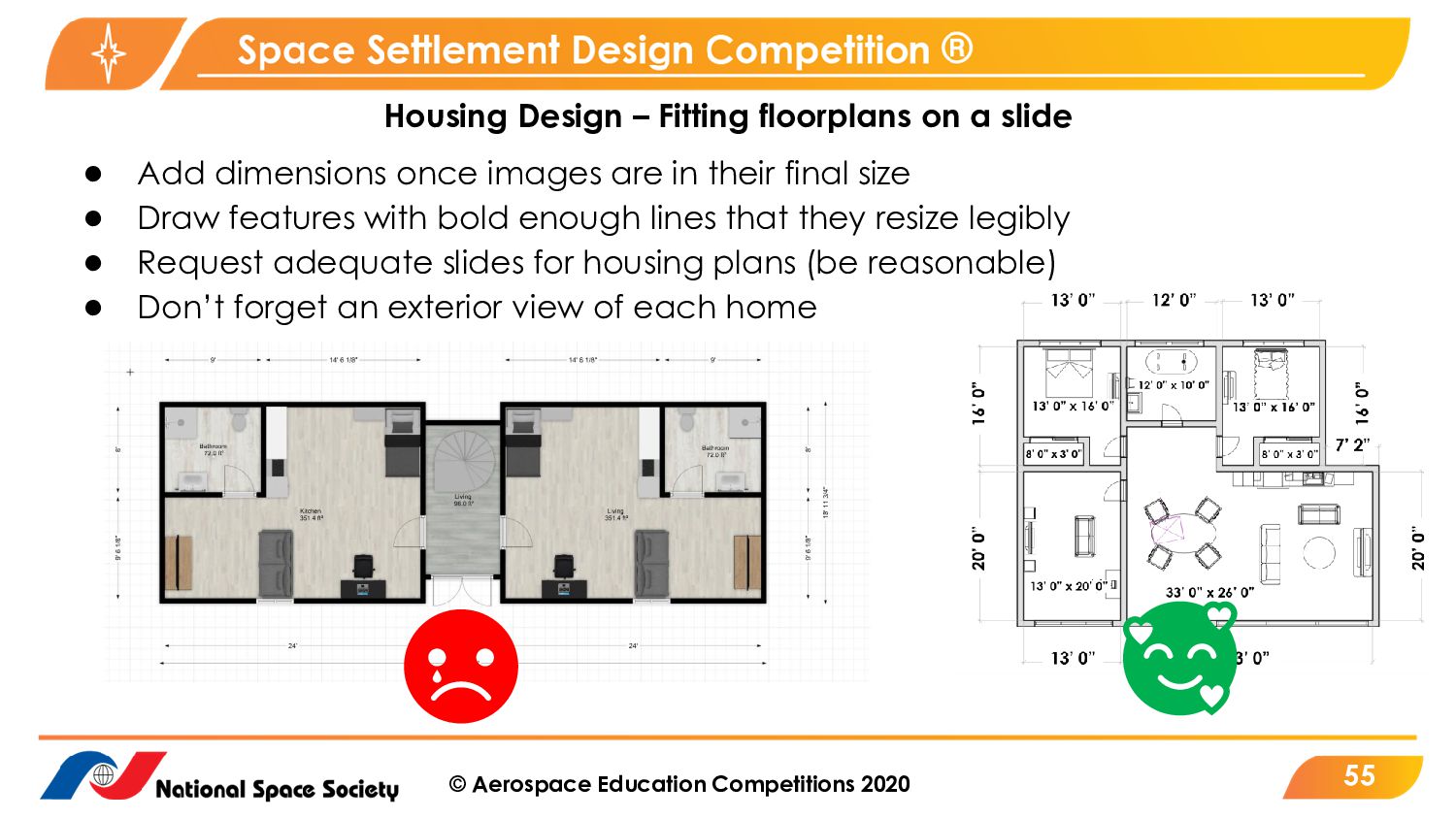
on a slide 55 • Add dimensions once images are in their final size • Draw features with bold enough lines that they resize legibly • Request adequate slides for housing plans (be reasonable) • Don’t forget an exterior view of each home
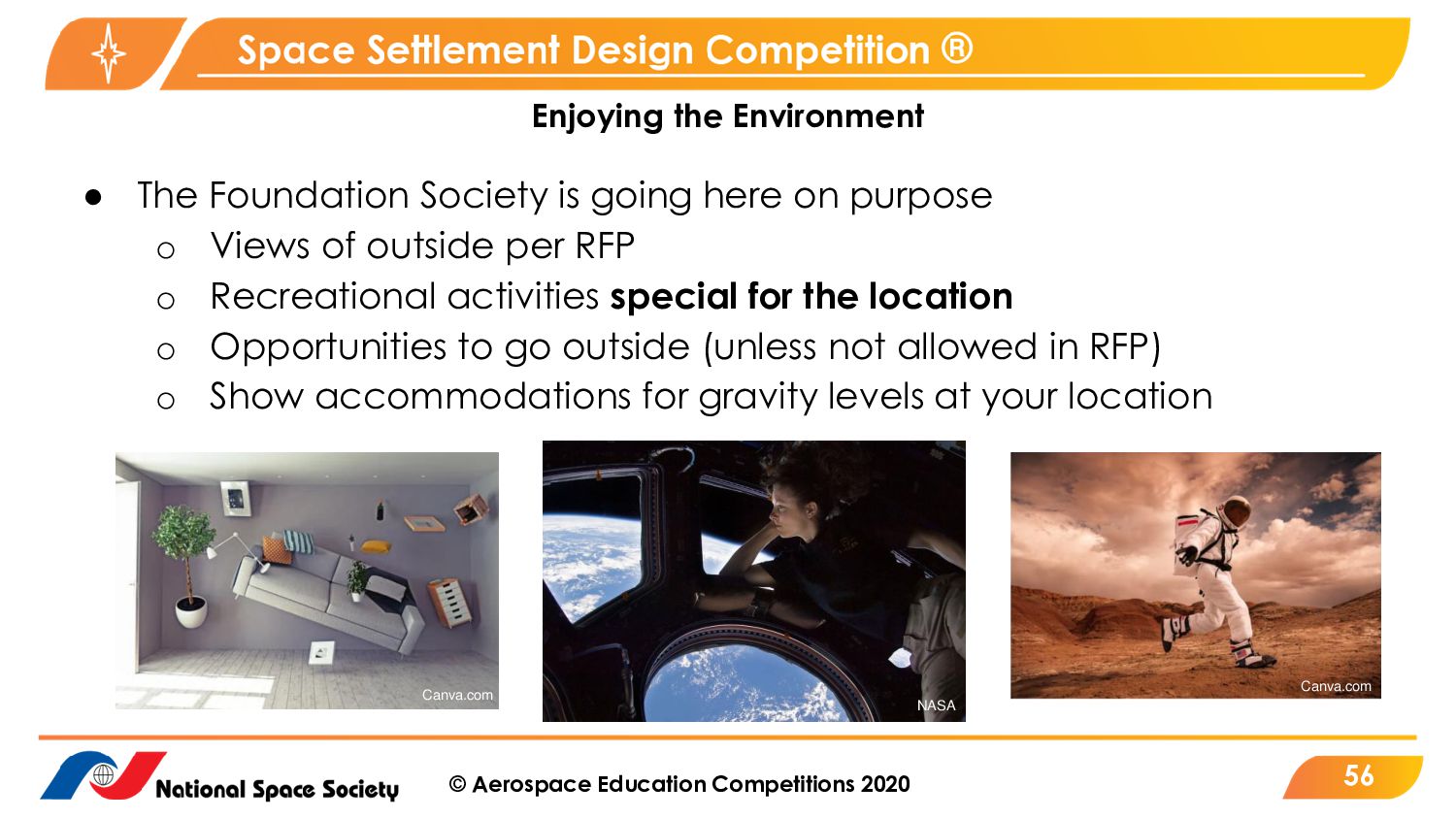
Foundation Society is going here on purpose o Views of outside per RFP o Recreational activities special for the location o Opportunities to go outside (unless not allowed in RFP) o Show accommodations for gravity levels at your location 56 Canva.com NASA Canva.com
light o Good for humans o Structures will need to accommodate this requirement from the start– advocate for it unless the RFP states otherwise • Long lines of sight o Helps make the settlement feel bigger o Helps with effects of artificial gravity (if applicable to scenario) 57
o Typically designed by a SUBCONTRACTOR • Human Factors must determine what features are needed o Types of activities o Main features needed to support those activities o Ease of movement, cameras, sensors and data, communication devices, wear- resistance, time outside supported… • Human Factors decides how many suits are needed o Everyone needs to be able to get out of the settlement in a reasonable time frame and get to safety without dying on the way o Good idea to have spares o Suits that have been outside can’t always just come inside 58
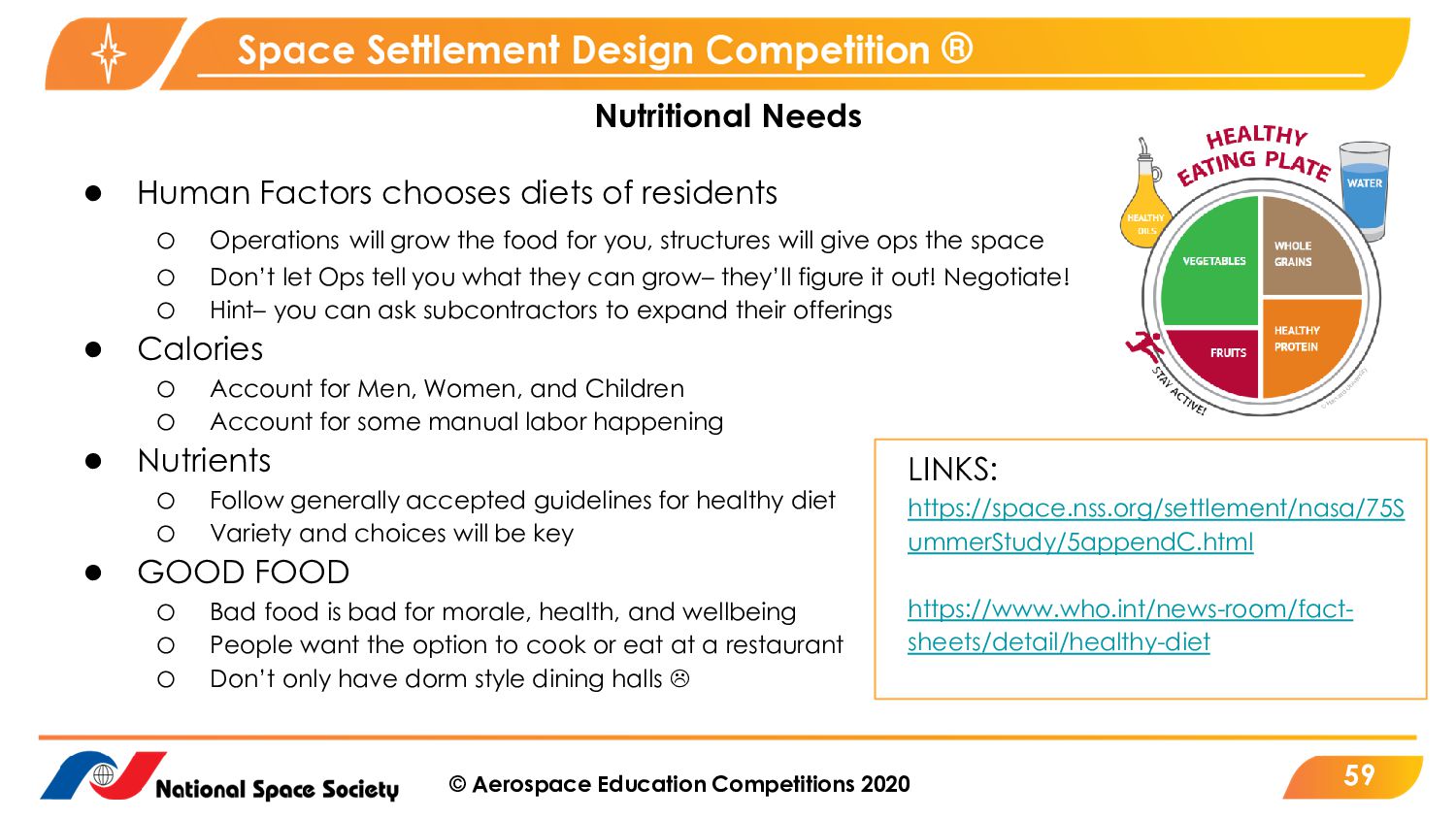
chooses diets of residents o Operations will grow the food for you, structures will give ops the space o Don’t let Ops tell you what they can grow– they’ll figure it out! Negotiate! o Hint– you can ask subcontractors to expand their offerings • Calories o Account for Men, Women, and Children o Account for some manual labor happening • Nutrients o Follow generally accepted guidelines for healthy diet o Variety and choices will be key • GOOD FOOD o Bad food is bad for morale, health, and wellbeing o People want the option to cook or eat at a restaurant o Don’t only have dorm style dining halls 59 LINKS: https://space.nss.org/settlement/nasa/75S ummerStudy/5appendC.html https://www.who.int/news-room/fact- sheets/detail/healthy-diet
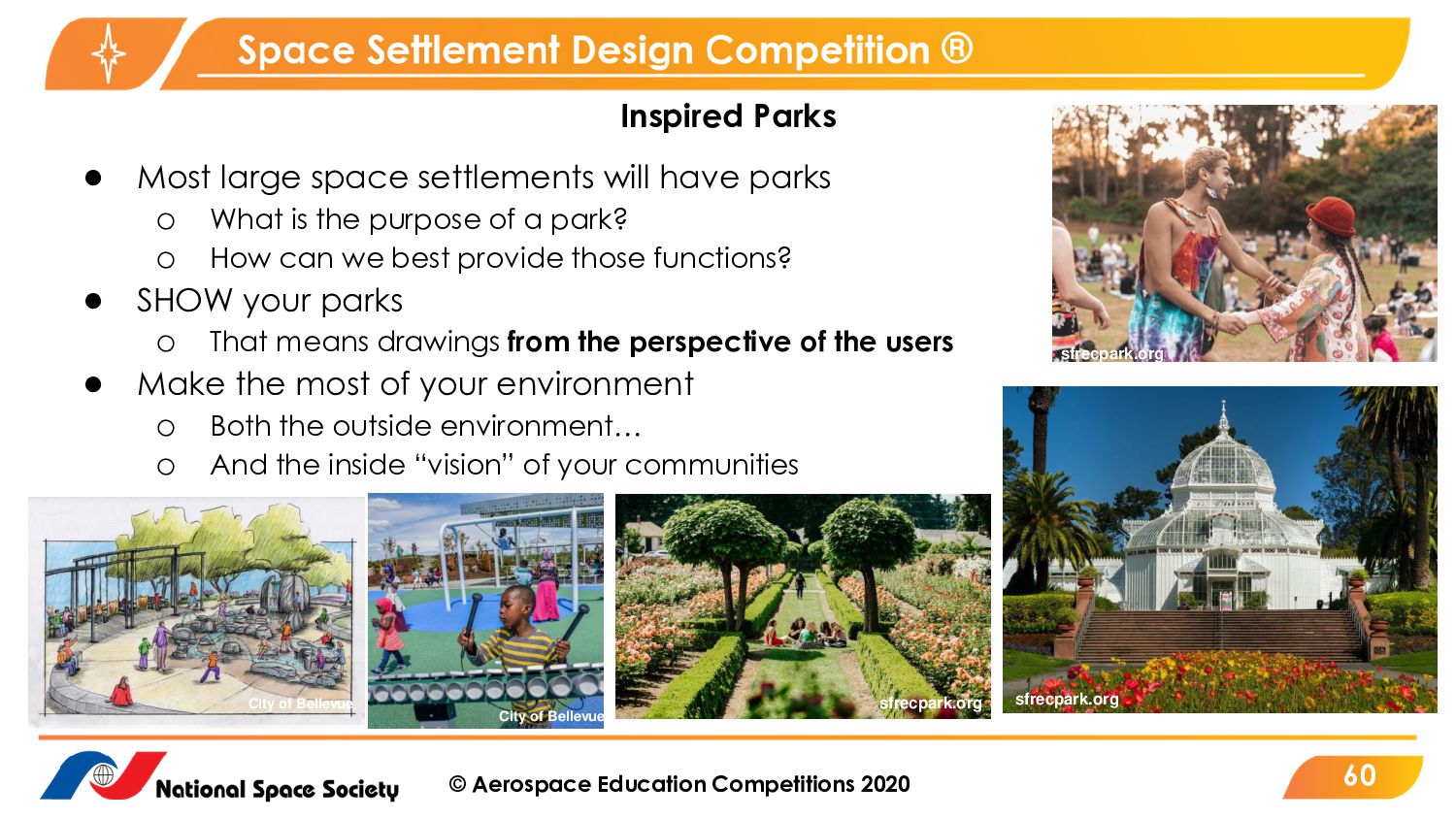
space settlements will have parks o What is the purpose of a park? o How can we best provide those functions? • SHOW your parks o That means drawings from the perspective of the users • Make the most of your environment o Both the outside environment… o And the inside “vision” of your communities 60 sfrecpark.org City of Bellevue sfrecpark.org sfrecpark.org City of Bellevue
Cost in Human Factors Engineering • Use easy-to-research projects to gauge schedule duration and cost ◦ Example: building house or playground • Transportation costs can add up quickly, especially from Earth • Pay attention to the RFP’s instructions for what does NOT need to be calculated in costs • Don’t forget labor
In the real world… • An automation engineer is a professional who improves the efficiency of various manufacturing and computer systems by automating certain parts of the systems to do work on their own. They plan and change existing technology so that it needs less human interaction, and they monitor the performance of the changes they make. Sometimes, an automation engineer may design entirely new technology to automate a system. (Indeed.com definition) • Automation engineers can be traditional engineers, who work with physical machines, or software engineers, who work with programming languages. 63
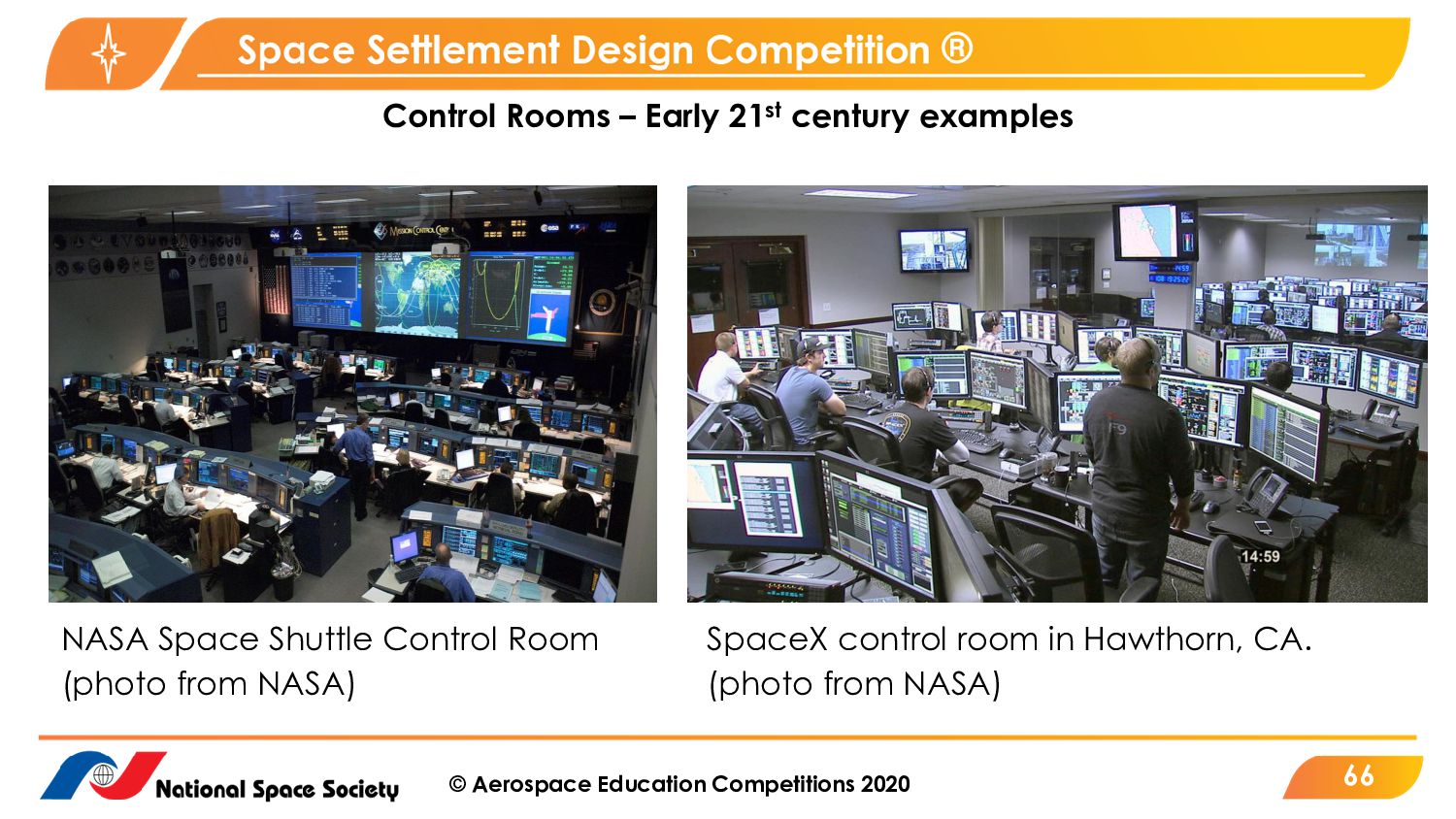
In SSDCs, Automation Engineering covers... ◦ Automation of construction processes ◦ Raw material handling and Industrial Automation ◦ Maintenance and repair ◦ Of the settlement ◦ Of automated systems ◦ Safety ◦ Security ◦ Networks ◦ Community automation ◦ Residential Automation ◦ Workplace Automation ◦ Control rooms 64
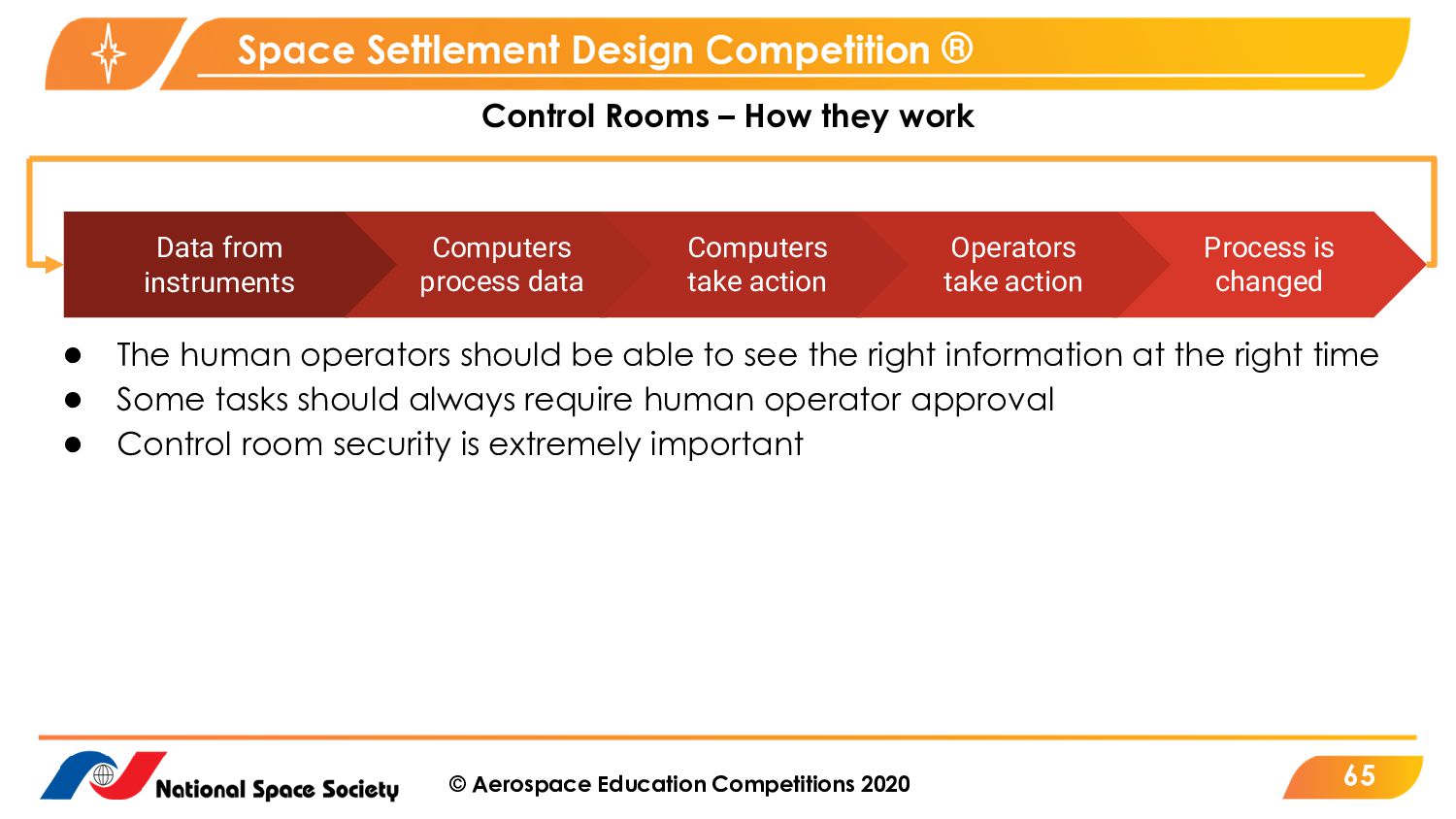
work • The human operators should be able to see the right information at the right time • Some tasks should always require human operator approval • Control room security is extremely important 65 Data from instruments Computers process data Computers take action Process is changed Operators take action
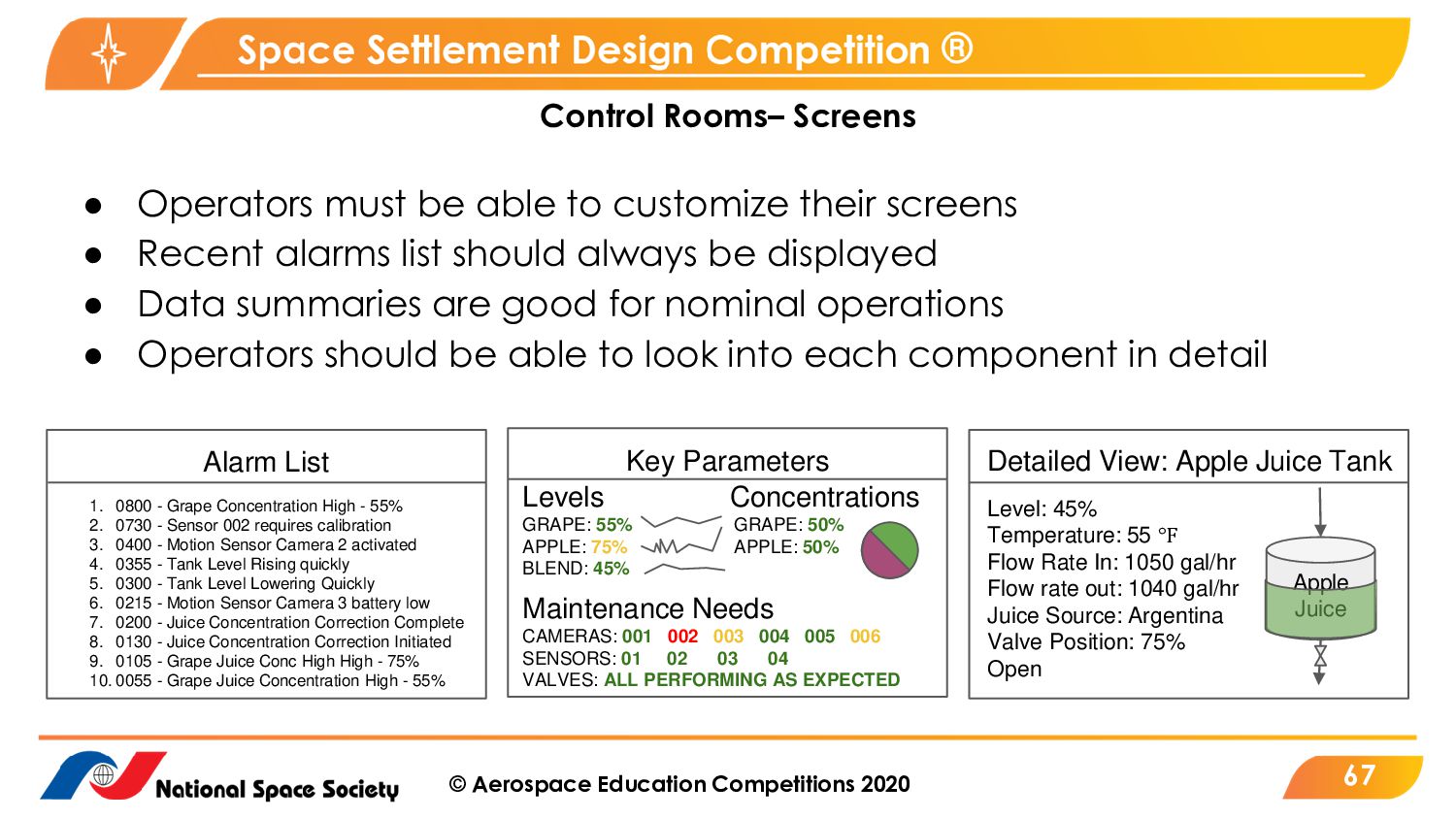
Operators must be able to customize their screens • Recent alarms list should always be displayed • Data summaries are good for nominal operations • Operators should be able to look into each component in detail Alarm List 1. 0800 - Grape Concentration High - 55% 2. 0730 - Sensor 002 requires calibration 3. 0400 - Motion Sensor Camera 2 activated 4. 0355 - Tank Level Rising quickly 5. 0300 - Tank Level Lowering Quickly 6. 0215 - Motion Sensor Camera 3 battery low 7. 0200 - Juice Concentration Correction Complete 8. 0130 - Juice Concentration Correction Initiated 9. 0105 - Grape Juice Conc High High - 75% 10. 0055 - Grape Juice Concentration High - 55% Key Parameters Levels Concentrations GRAPE: 55% GRAPE: 50% APPLE: 75% APPLE: 50% BLEND: 45% Maintenance Needs CAMERAS: 001 002 003 004 005 006 SENSORS: 01 02 03 04 VALVES: ALL PERFORMING AS EXPECTED Apple Juice Level: 45% Temperature: 55 ℉ Flow Rate In: 1050 gal/hr Flow rate out: 1040 gal/hr Juice Source: Argentina Valve Position: 75% Open Detailed View: Apple Juice Tank
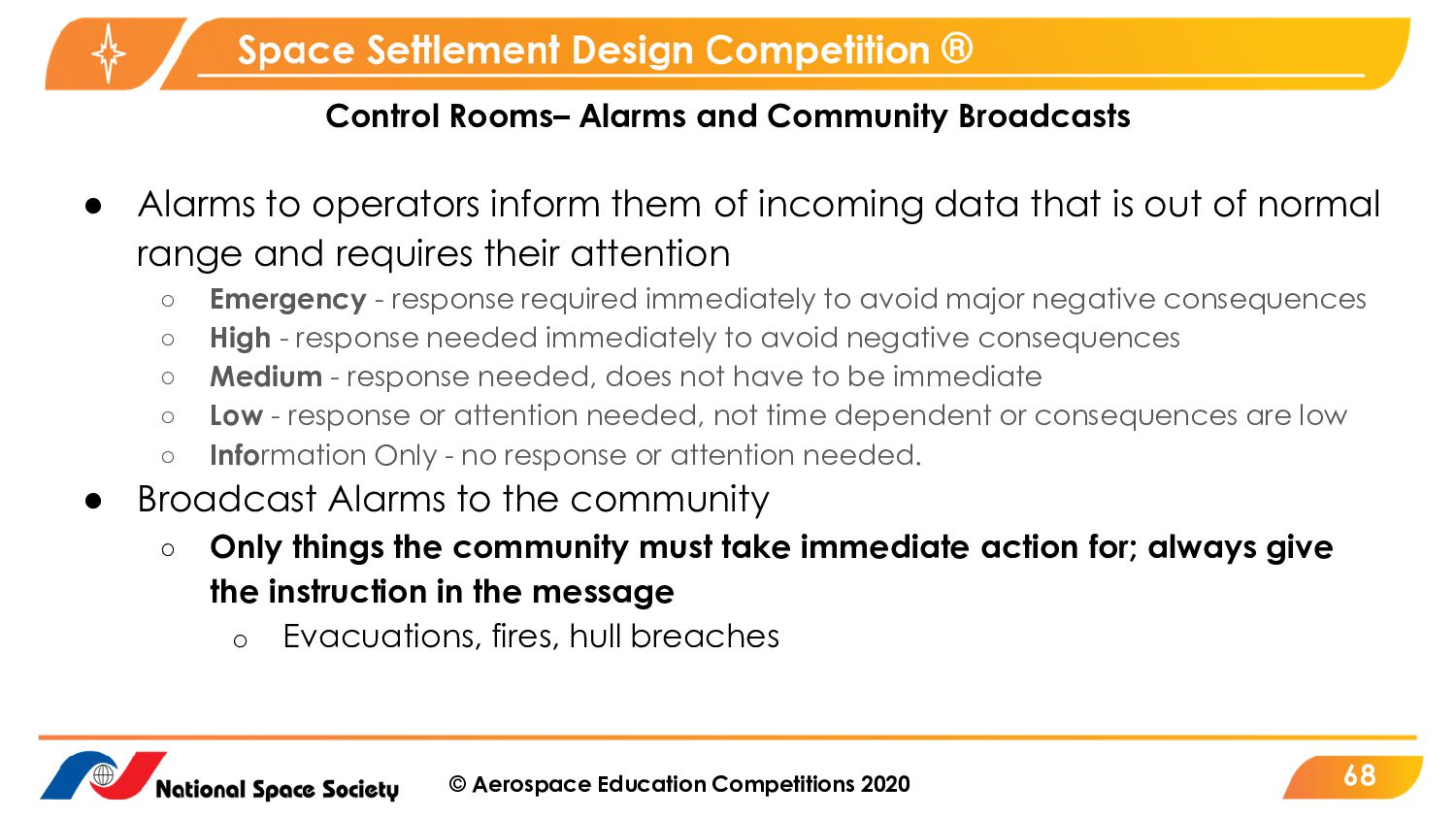
Broadcasts 68 • Alarms to operators inform them of incoming data that is out of normal range and requires their attention ◦ Emergency - response required immediately to avoid major negative consequences ◦ High - response needed immediately to avoid negative consequences ◦ Medium - response needed, does not have to be immediate ◦ Low - response or attention needed, not time dependent or consequences are low ◦ Information Only - no response or attention needed. • Broadcast Alarms to the community ◦ Only things the community must take immediate action for; always give the instruction in the message o Evacuations, fires, hull breaches
robots need to be resilient to unimproved work site conditions • There should be a control room early on in the construction process, even if it is not located at the settlement at first • Robots will be needed to do manual labor including unpacking and marshalling supplies, equipment, and components • Building jigs and scaffolding • May be preparing the site for construction to begin (building foundations, flattening surfaces) • Consider what the construction robots will do AFTER construction!
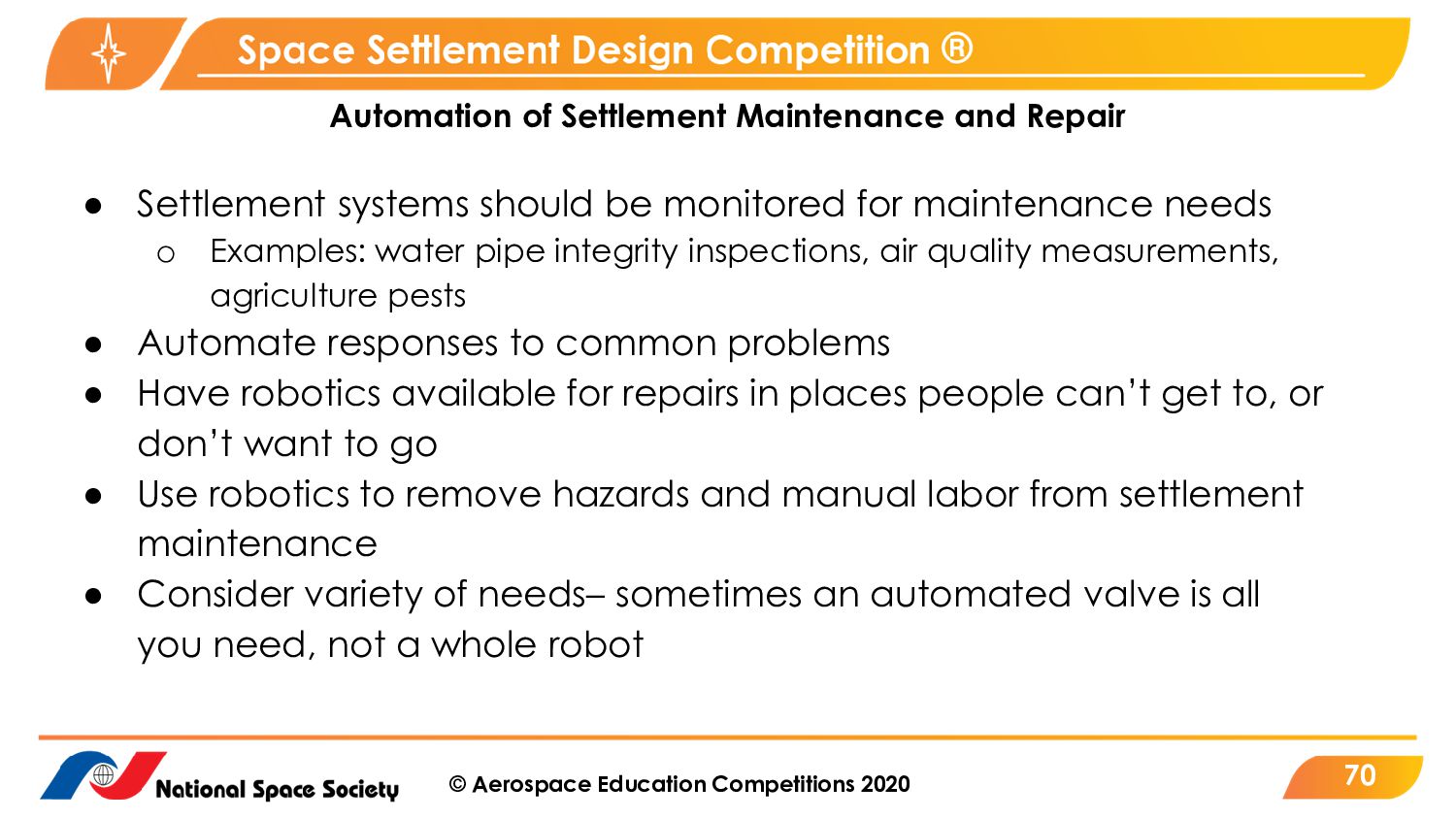
Repair 70 • Settlement systems should be monitored for maintenance needs o Examples: water pipe integrity inspections, air quality measurements, agriculture pests • Automate responses to common problems • Have robotics available for repairs in places people can’t get to, or don’t want to go • Use robotics to remove hazards and manual labor from settlement maintenance • Consider variety of needs– sometimes an automated valve is all you need, not a whole robot
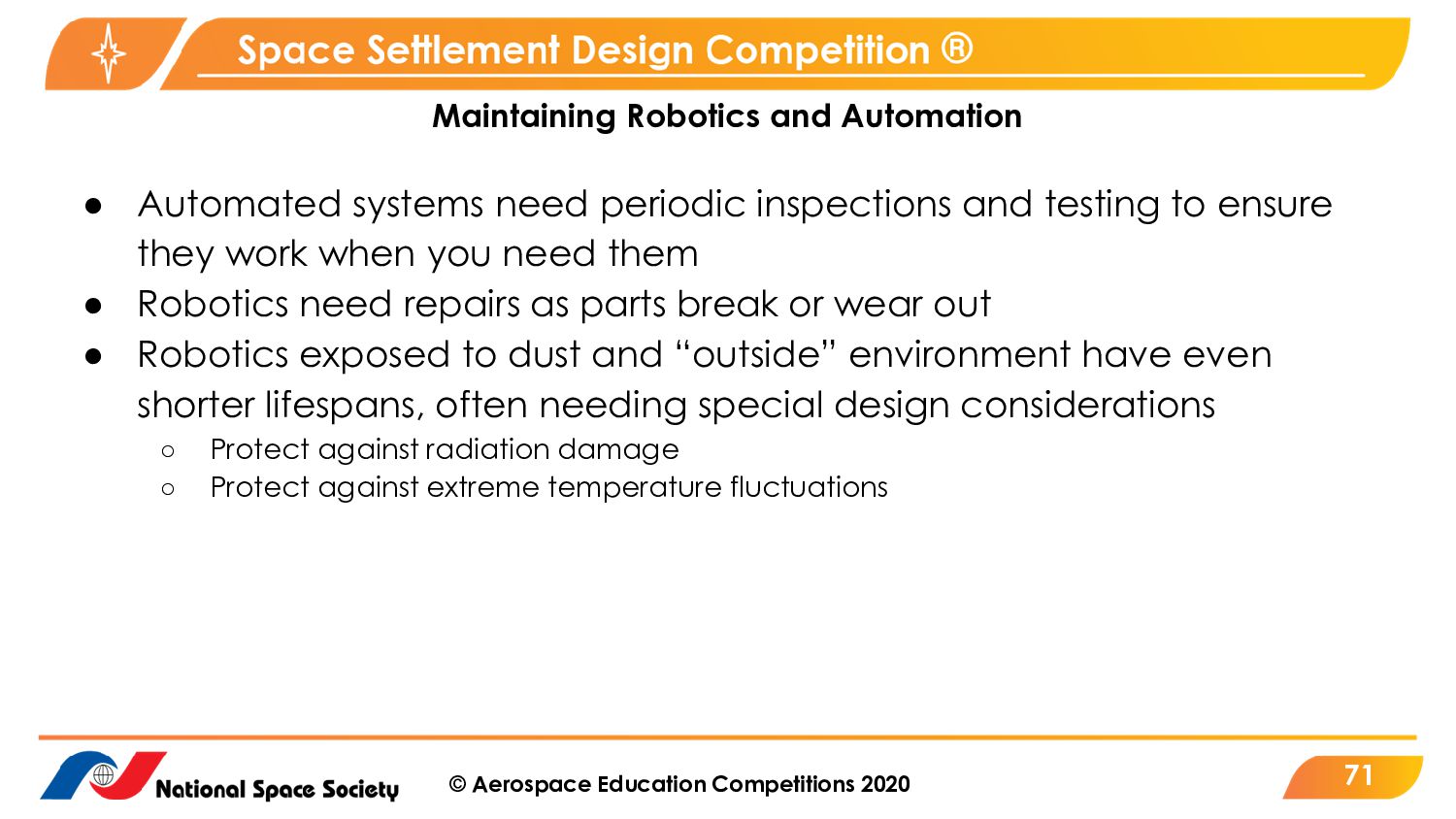
• Automated systems need periodic inspections and testing to ensure they work when you need them • Robotics need repairs as parts break or wear out • Robotics exposed to dust and “outside” environment have even shorter lifespans, often needing special design considerations ◦ Protect against radiation damage ◦ Protect against extreme temperature fluctuations
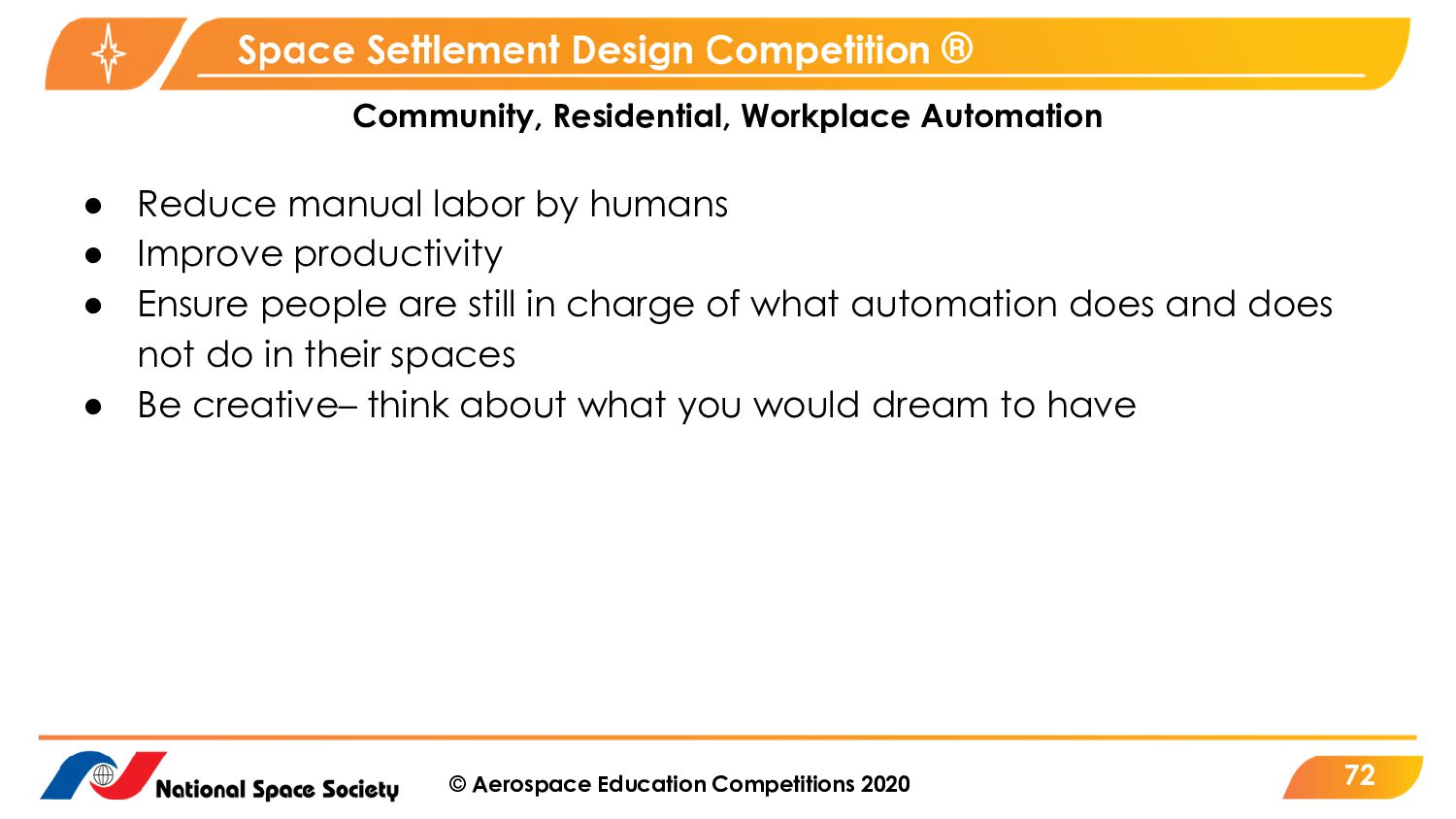
• Reduce manual labor by humans • Improve productivity • Ensure people are still in charge of what automation does and does not do in their spaces • Be creative– think about what you would dream to have
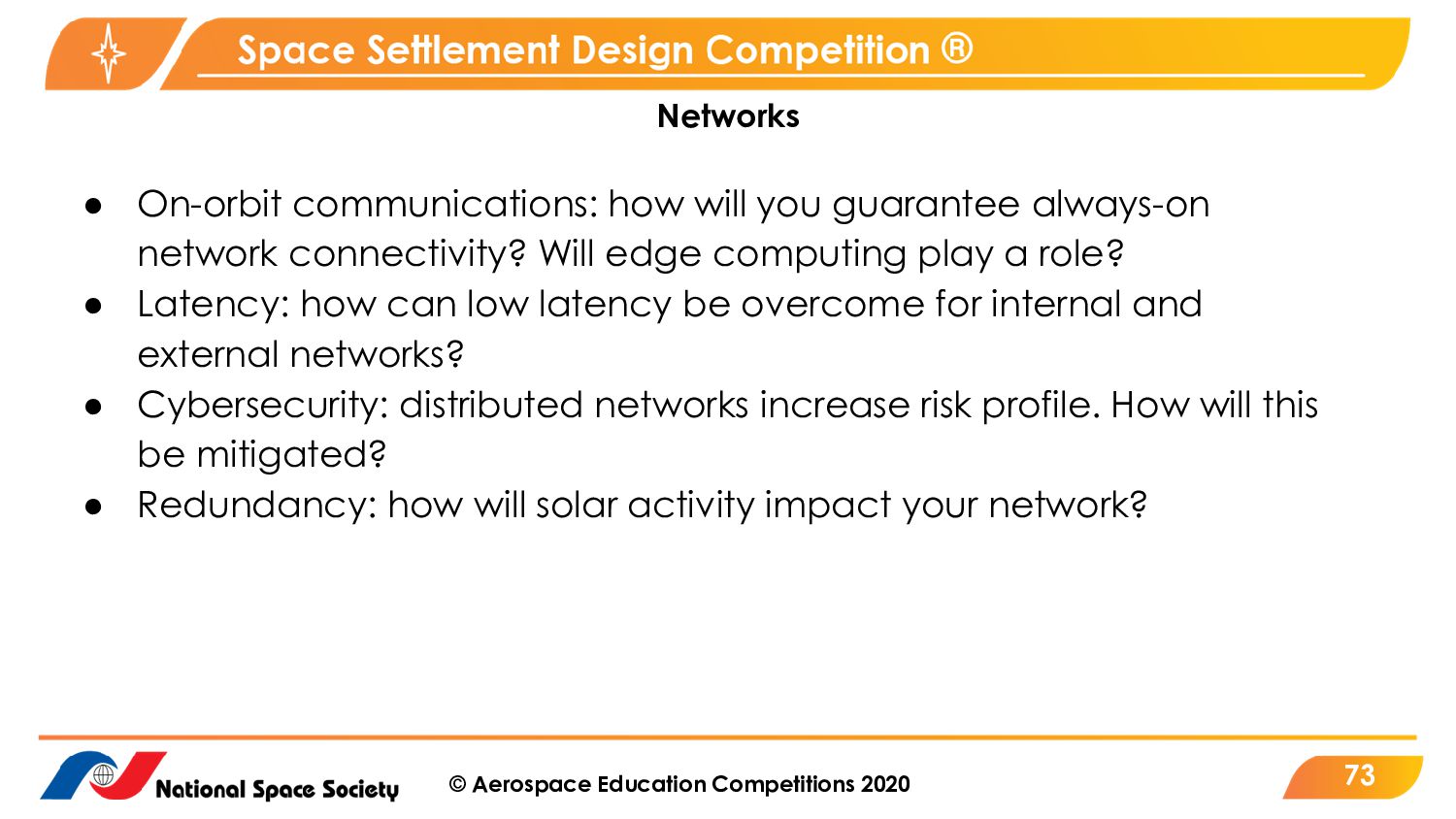
how will you guarantee always-on network connectivity? Will edge computing play a role? • Latency: how can low latency be overcome for internal and external networks? • Cybersecurity: distributed networks increase risk profile. How will this be mitigated? • Redundancy: how will solar activity impact your network?
beyond the cell phone– what year is it? • Exoskeletons: mass is unchanged in space, how can assistive robotics support activity in zero/low gravity? • Security: what trade off will be required between individual privacy and collective security? • What kind of conditions will personal devices need to operate in? Will they need to withstand vacuum? Be radiation hardened?
earth-based hardware won’t operate in orbit • Redundancy: supply chains on orbit are exponentially more challenging. How are you account for redundancy in hardware and software systems? • Interfaces: how will an interface change in zero/low gravity? • Sending humans into vacuum is inherently dangerous. Can their exposure time be mitigated through remote operation? • Compare storage capacity requirements to existing systems for estimates of requirements– and consider technological advancements and data needs for advanced operations
to see 76 • Reinventing the wheel • Robots with human legs • Robots that are terrifying • Roombas • Computers and personal devices that look just like the ones you use today • 5G networks
Cost in Automation Engineering • Use easy-to-research projects to gauge schedule duration and cost ◦ Example: building a server room, repairing factory robots • Transportation costs can add up quickly, especially from Earth • Pay attention to the RFP’s instructions for what does NOT need to be calculated in costs • Don’t forget labor


 ainischool
 kentaroy47
 masakiokuda
 hiola
 signer
 cbtlibrary
 ishii_mit
 ssmedikasda
 jdbedics
 sciencetokyo
 suisan
 jdejongh
 eileencodes
 notwaldorf
 axbom
 oripsolob
 nikkihalliwell
 pauljervisheath
 nwiizo
 jakevdp
 vanstee
 inesmontani